
Are you a Quiet Speculation member?
If not, now is a perfect time to join up! Our powerful tools, breaking-news analysis, and exclusive Discord channel will make sure you stay up to date and ahead of the curve.
I’m sure I speak for many when I say my favorite part of spoiler season is paging through new cards and looking for ones that fit into my pet decks. The leaked Shadows over Innistrad spoilers revealed Invasive Surgery and the delirium mechanic. As a Tarmogoyf enthusiast, this keyword spoke to me on a competitive and an ethereal level.
Reading the delirium cards spoiled thereafter felt like sacrificing a bunch of Clue tokens. My life had real meaning again. A purpose deeper than mulliganning into Sol lands.
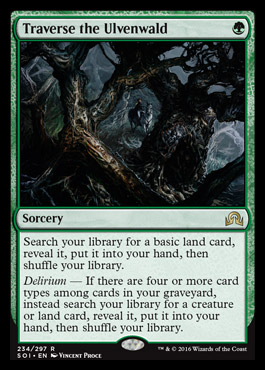
In this article, I’ll discuss possible additions to Temur Delver from Shadows over Innistrad and explore how one particular card, [tippy title="Traverse the Ulvenwald" width="330" height="330"]
 [/tippy], stands to redefine the way I build Modern decks.
[wp_ad_camp_1]
Updating Temur Delver
Since Wizards’ card design over the last decade pushes increasingly for midrange archetypes, big, splashy creatures take up the higher rarity slots. Indeed, if we look at any of Modern’s midrange decks, they’re full of rare cards. Consider recent additions to Modern midrange. Siege Rhino, Kolaghan's Command, and Kalitas, Traitor of Ghet are all rares. Even Eldrazi has hardly any commons and uncommons.
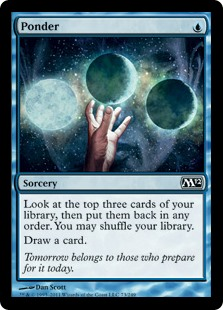 Tempo, on the other hand, is an archetype defined by mistakes. Ponder, Lightning Bolt, Delver of Secrets… these underestimated commons represent leaps in applied power that not Wizards or anyone else could have accounted for.
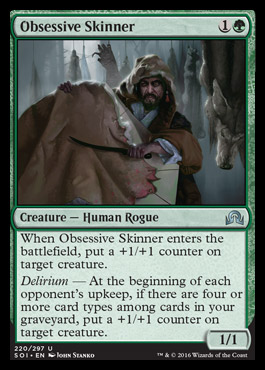
All that text to say when I scroll through spoilers looking for Temur Delver additions, I vest great hope in the common section. That’s where we found the last few big cards we got: Hooting Mandrills, Stubborn Denial, and Treasure Cruise. Shadows breaks the trend by not giving us a great common, though - instead, it gives us a great rare. [tippy title="Traverse the Ulvenwald" width="330" height="330"]
[/tippy] offers us serious midrange bulk while weaving effortlessly into our tempo plan. It makes our sideboard more robust and helps us take on our worst matchup, BGx Midrange.
Temur Delver, by Jordan Boisvert
Diversifying Card Types
The first change here from my previous versions involves adding more card types to support delirium. Having a wider variety improves the odds of milling a delirium enabler with Thought Scour. If we played two Tarfires, the second wouldn't add to our Tarmogoyfs; Seal of Fire does. I love Seal against creature-based combo decks like Abzan Chord, since it lets us tap out and have a burn effect ready to break up a combo.
Sideboard toolbox
The "Traverse package" takes up some sideboard slots in this deck, and those slots are very competitive. Consequently, I tried to keep the toolboxing to a minimum, only including creatures that address specific weaknesses or matchups very efficiently.
- Magus of the Moon: Replaces Blood Moon #3. I like having a searchable one, and some decks - Abzan, Sultai, Ad Nauseam - can't easily remove the creature.
- Izzet Staticaster: Guns down dorks for a whole
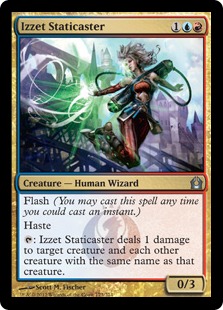 game, and significantly counters Lingering Souls. 1/1 Spirits can prove very annoying, since they team up to trade with Delver or just chump Tarmogoyf for four turns.
- Snapcaster Mage: I currently have Tiago in the mainboard, but he's definitely one of the deck's weaker cards. Whether in the main or the side, though, Snapcaster needs a spot in this deck. It would be wrong to omit him from a Traverse toolbox package. Having the ability to search up Lightning Bolt or Stubborn Denial is frequently game-winning.
Maintaining the instant and sorcery count
Against attrition decks, Temur Delver boards in a huge pile of threats for air like Thought Scour and Gitaxian Probe from the main. A high threat density helps us keep the pressure on attrition strategies, but an unflipped Delver doesn't offer much pressure by himself. One problem I sometimes run into post-board against Jund and Abzan is that my Delver rarely flips with fewer than 23 instants and sorceries in the deck, a number I consider low but acceptable. [tippy title="Traverse the Ulvenwald" width="330" height="330"]
[/tippy] solves this problem by increasing threat density while helping us hit that magic number.
Temur Delver Omissions
The following cards I considered for Temur Delver, but ultimately decided against.
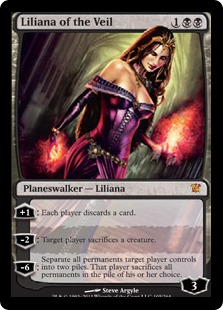
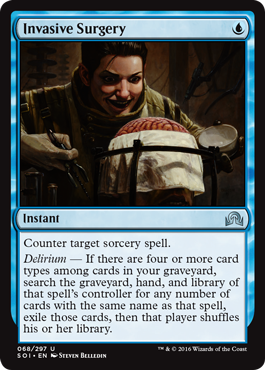
[tippy title="Invasive Surgery" width="330" height="330"] [/tippy]
A conditional counterspell that, like Spell Snare, never has "nothing" to hit. Against BGx, Surgery takes discard spells and maybe a Maelstrom Pulse; against blue anything, it counters Serum Visions. That said, Surgery's no Spell Snare; Snare hits the best cards in Modern (Tarmogoyf, Confidant, Snapcaster Mage, Terminate, etc.), while Surgery just counters small set-up cards in most matchups.
I love the idea of Surgery, but don't think Temur Delver needs a souped-up Envelop at the moment. Stubborn Denial simply covers more bases, and while Surgery always hard-counters, we have ferocious enough to ensure Denial usually gets the job done.
I won't run Surgery now, but that doesn't mean I never will. If [tippy title="Traverse the Ulvenwald" width="330" height="330"]
[/tippy] decks start popping up in spades, or if linear combo decks like Living End and Scapeshift have strong showings after the April announcement, I can see Surgery making the cut in the sideboard.
[tippy title="Skin Invasion" width="330" height="330"]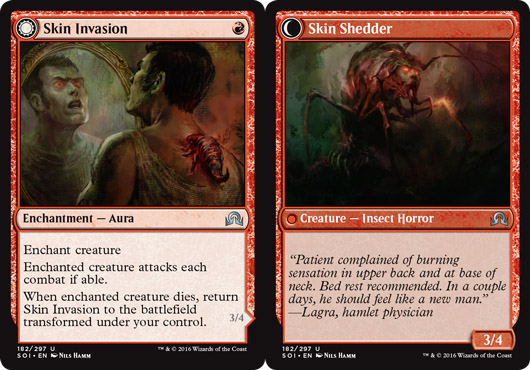 [/tippy]
The possible upside on this card is so great that StarCityGames has it preordering for a dollar a copy, and foils at five. [tippy title="Skin Invasion" width="330" height="330"][/tippy] definitely has one of the coolest designs in the set, and gets my vote for the best. But is it playable?
For Temur Delver, Invasion looks great on paper. It's at once a removal spell, a buff threat, and a delirium enabler. Imagine the best-case scenario: you play Tarmogoyf. Your opponent plays Dark Confidant. You give Bob a [tippy title="Skin Invasion" width="330" height="330"][/tippy]. Bob suicides into your Tarmogoyf. You get a 3/4 [tippy title="Skin Shedder" width="330" height="330"][/tippy]. Icing on the cake: once the Shedder's lived a fulfilling, Bolt-proof life on the battlefield, his corpse grows Tarmogoyf from the graveyard.
 On to the bad stuff. For Invasion to work, it requires a lot to go just right. First of all, it will only do anything against creature decks - this card starts off a pseudo-removal spell, and only becomes [tippy title="Skin Shedder" width="330" height="330"][/tippy] with a host. Among those creature decks, it can only enchant certain creatures to provide results. Invasion does nothing on a Blighted Agent, or on Glistener Elf when opponents have pump spells to grow their attacker past Tarmogoyf; the aura looks equally silly on Memnite or Ornithopter when those creatures can tap to Springleaf Drum before combat. (Same deal with Noble Hierarch and other mana dorks.) Besides, we would rather spend our precious removal spell slots on something not called Memnite against Affinity.
The nail in the coffin for this card is that our opponent having a creature we want to kill still isn't enough for [tippy title="Skin Invasion" width="330" height="330"][/tippy] to do anything. We need to kill that creature to get the Shedder. It has to be small enough for Lightning Bolt to handle, or smaller than a threat we already have on the board. Generally, if we have a big creature on the table, we would rather our cards be removal or permission to maintain board advantage. A two-card-combo aura is not what we want to draw here, especially since it necessitates leaving Tarmogoyf or whoever on defense.
My verdict: Invasion asks us to jump through too many hoops. Its two sides also don't mesh. In most matchups, we either want a lot of creature disruption, or we want extra threats. Invasion is an extra threat that also forces us to pack ample creature disruption.
[tippy title="Autumnal Gloom" width="330" height="330"]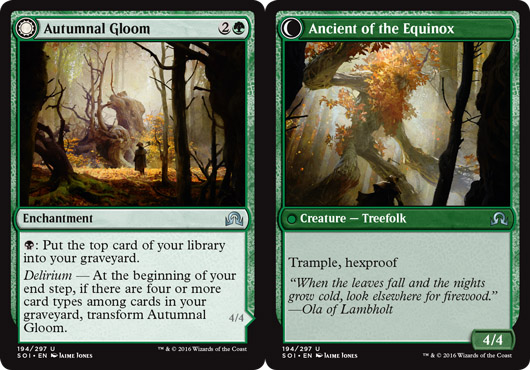 [/tippy]
Hexproof Hooting Mandrills is already a major improvement over [tippy title="Skin Invasion" width="330" height="330"][/tippy] for Temur Delver. Gloom at least doesn't force us to stretch our mainboard thin with removal and threats against the attrition decks we want extra creatures for in the first place. Those opponents often turn on delirium for us with their Thoughtseizes, Lilianas, and Decays, and as long as Gloom doesn't get walled by Tasigur or Tarmogoyf, he'll give attrition decks an incredibly hard time.
 One problem with Gloom is its high casting cost. We can only really play it against BGx Midrange, since it's harder to count on drawing three lands in a timely manner against anyone else. Additionally, the enchantment does literally nothing without delirium, so we can't run it against linear decks that refuse to interact with our creatures. It's also too slow in those matchups to make a lasting impression; even if it comes down on time, tapping out on turn three against combo decks like Storm is asking for it.
The biggest strike against this card is that we have better options available. Huntmaster of the Fells is another late-game threat that shines against attrition decks, but also has applications against most flavors of aggro. It's hard to make a case for [tippy title="Autumnal Gloom" width="330" height="330"][/tippy] in the sideboard if we haven't already maxed out on the Human Werewolf. Gloom might also be worse here than [tippy title="Traverse the Ulvenwald" width="330" height="330"]
[/tippy], which fetches and lets us cast Tarmogoyf for the same amount of mana. Traverse has the huge upsides of also finding us bullets, flipping Delver, and fixing our mana early on.
[tippy title="Thing in the Ice" width="330" height="330"]
 [/tippy]
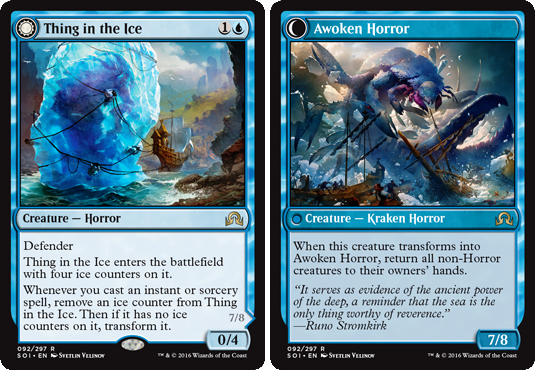
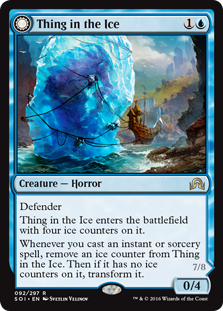
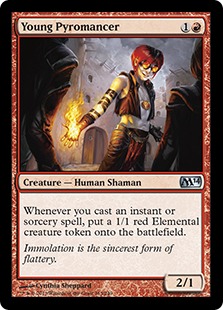 This card was hyped into oblivion for blue decks of all strains, including Delver. I was even a believer at first, and tested Thing in some UR Delver builds for a few days. But the creature always underwhelmed me. The best card to compare Thing to is Young Pyromancer. Thing's big advantage here is its immunity to Bolt, but Pyromancer boasts a functional immunity to edict effects. Beyond that distinction, Thing gives pilots nothing in return for removing just three ice counters. If opponents remove Thing before it flips, we're left sobbing. For his part, Pyromancer starts recruiting an army. He also swings in a topdeck war. I don't know how squeamish you guys are, but drawing Thing with no cards in hand against BGx would give me night terrors.
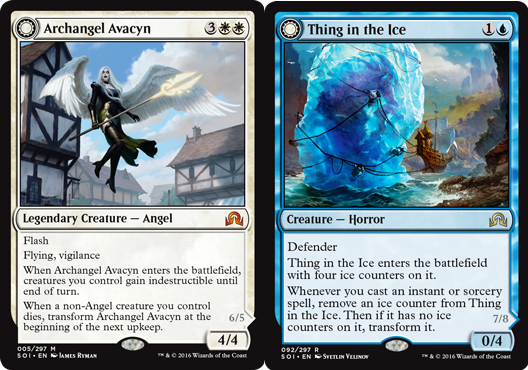
Another issue with Thing is its exclusivity. We can't play Thing and Pyromancer together, because Thing bounces all the tokens. We also can't pair it with Delver of Secrets, because we'd have to transform the Human Wizard again. Lastly, bouncing Tarmogoyf incurs a huge tempo loss. The only Delver creature that synergizes with Thing is Snapcaster Mage, but he does so best in a non-Delver shell. Thing does look splashy on paper, and it may show up in Modern, but I seriously doubt this card will see play in grow decks.
[tippy title="Moldgraf Scavenger" width="330" height="330"]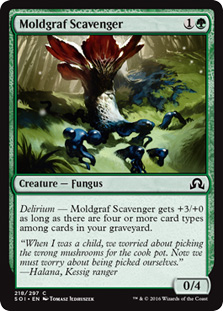 [/tippy]
Earning more of an honorary mention than anything, Scavenger is our "fixed Tarmogoyf." Except it's more like a nerfed Tarmogoyf. At least they gave it a completely irrelevant tribe - "Fungus!" Flavor win?
When I pined for a fixed Goyf last week, I meant a Goyf that wouldn't always be strictly worse than Modern's posterboy. If we have delirium, our true Goyfs are definitely bigger than this guy. And I wanted to swing with two 4/5s at once. I know, I know - pipe dreams.
Updating GR Moon
 As far as my analysis goes, [tippy title="Traverse the Ulvenwald" width="330" height="330"]
[/tippy] is the big winner from Shadows over Innistrad. And the card doesn’t just show promise in Temur Delver. My other go-to Modern archetype, GRx Moon, is arguably even more of a Tarmogoyf deck.
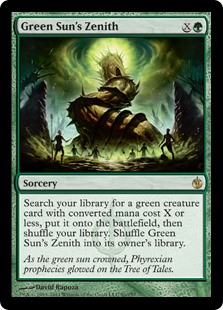
Once upon a time - specifically, about eight months ago - I brewed an illegal Modern GR Moon deck around Green Sun's Zenith. With Dryad Arbor, Zenith acted as a dork on turn one to accelerate into turn two Blood Moon. But the real reason so badly wanted to play with the card is it let me run eight Tarmogoyfs. With Traverse, 8Goyf finally becomes a reality.
GR Moon, by Jordan Boisvert
Dreams Come True: Introducing 8Goyf
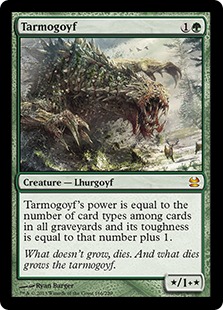 In a deck that consistently grows Goyfs to 7/8 and beyond, having access to eight of them makes us... well, Eldrazi. In the past, I've employed Sword of Light and Shadow, Siege Rhino, Goblin Rabblemaster, and Stormbreath Dragon as Goyf's supporting cast, and none ever held a candle to the spiky dude. [tippy title="Traverse the Ulvenwald" width="330" height="330"]
[/tippy] might not ramp with Arbor, but it gives us the extra Goyfs we've always wanted. It also searches Magus of the Moon, meaning we now play ten functional Blood Moons.
Mainboard toolbox
As with the Temur Delver sideboard package, GR Moon's mainboard lacks the space for a full-on toolbox. I've included more specific bullets in the sideboard, and allotted three mainboard slots for the cream of the crop.
- Grim Lavamancer: Isochron-Bolt against small aggro decks like Infect and Chord. Shoots annoying mana dorks that defy our Moons. We can get Lavamancer early enough to make a difference with Faithless Looting, which immediately turns on delirium in this deck.
- Scavenging Ooze: Generic graveyard hate and a concession to this deck's horrible Grishoalbrand matchup. Ooze is also randomly helpful against Snapcaster Mage, Lingering Souls, Jace, Vryn's Prodigy, Kitchen Finks, and Tarmogoyf.
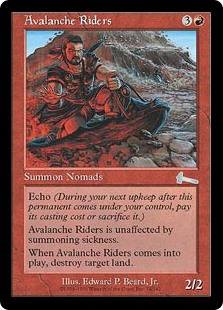 Avalanche Riders: I've advocated for a set of Stone Rain in the GRx Moon sideboard since I first developed the archetype. In two-color versions, I prefer Boom // Bust, as we don't mind playing four colorless lands in Darksteel Citadel. Boom is cheap enough to earn mainboard slots. Since I started testing land destruction in the main, I’ve loved it. Having the option to blow up a lone basic wise opponents fetch out can be game-winning. Thanks to Traverse, we can now search for a Stone Rain effect on command.
Sideboard toolbox
Most of these choices are self-explanatory, so I won't describe them all. In anticipation of some confusion, though, I'll say that Gaddock Teeg is very easy to cast between Hierarch and Sprawl, and turns off Through the Breach, Ad Nauseam, and the ubiquitous Disrupting Shoal.
We have lots of space in the sideboard for bullets, and I can see splashing other colors for certain creatures if the need arises. Traverse makes this deck very adaptable.
The Journey Awaits
When I proposed a Temur Toolbox shell last week, I didn’t mean to imply Modern will become a smattering of tricolor Goyf decks. But as [tippy title="Traverse the Ulvenwald" width="330" height="330"]
[/tippy] continues testing well for me in Temur Delver and GR Moon, I increasingly doubt interactive Modern decks won’t integrate the card on some level.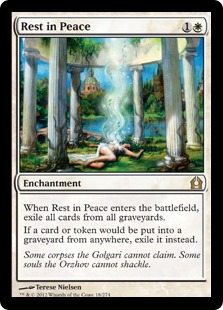 Running Tarmogoyf isn’t a huge “cost,” as evidenced by the format’s many interactive lynchpins that run him already.
Format changes tend to inspire other changes, and I won’t explore all of Traverse’s possible effects on Modern today. But one thing I’m anxious to watch unfold is the amount of graveyard hate present in the format. Cards like Rest in Peace and even Relic of Progenitus do a real number on decks packing delirium cards and Tarmogoyf. Luckily, I don’t need to lonelily theorize for long. Shadows comes out in a matter of weeks, and we’ll find out for sure how delirious it makes Modern deckbuilders!
 Sideboard: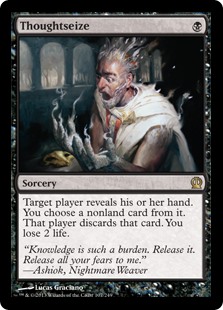
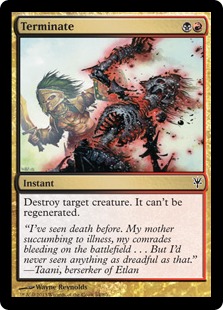 My opening hand was perfect in Game 2; Thoughtseize, Snapcaster Mage,Terminate, 3 lands, and a delve threat. I led on Thoughtseize, taking a Reality Smasher and leaving my opponent with lands and an Endless One. Unfortunately, he drew Thought-Knot Seer and took my Terminate after I had Snap-Thoughtseized him on my turn, leaving me with little to do as he proceeded to draw and cast a second Reality Smasher. Soon after, the game was over.
 Sideboard:
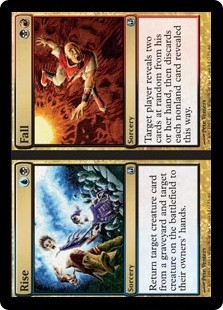
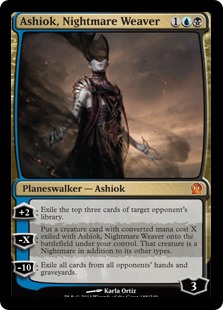 bounced his Dark Confidant and recurred my dead Snapcaster Mage, then used that Snap to flashback Rise and return Tiago and my dead Tasigur to my hand. Achievement unlocked!
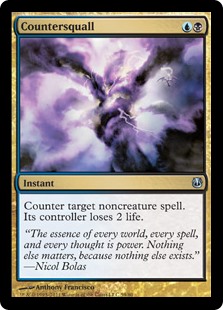 Sideboard:
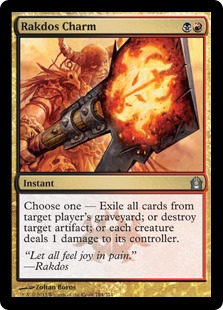 Sideboard:
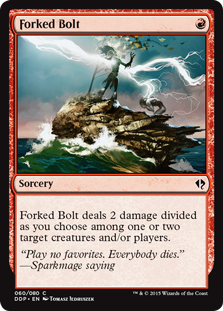 Game 2 had a rough start, and even though I mulliganed to six, I scraped my way to a very, very close win. Our life totals were both 1 before I was able to attack for lethal with a duo of flipped Delvers. One flipped early in the game, got in a few hits, and then a second one came down around turn four to finish. This game really underscored the importance of a clock in the Elves matchup.
 Looking forward, I can safely say Eldrazi Winter seems to have ended. With the impending ban announcement next week, Spring will have finally arrived, and with it, a whole slew of new cards from Shadows Over Innistrad. I am most certainly going to stick with Grixis Delver in this upcoming unknown metagame, as I expect it to look quite a bit like the pre-Oath of the Gatewatch metagame. I think my sideboard changes were correct, and although I never cast a few of those cards, and although I only boarded in 11 of my 15 across the matches, that was entirely due to pairings; no Affinity, no Burn, no Lantern, no Fish. They'll get their chance next time. That said, I’m not sure how much Shadows is going to add to Delver, because I’m not entirely sold on Thing in the Ice. Only Future Jeff has the answer to what it’s going to look like!
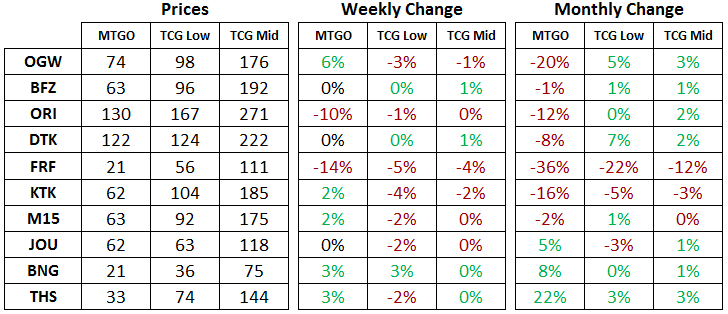
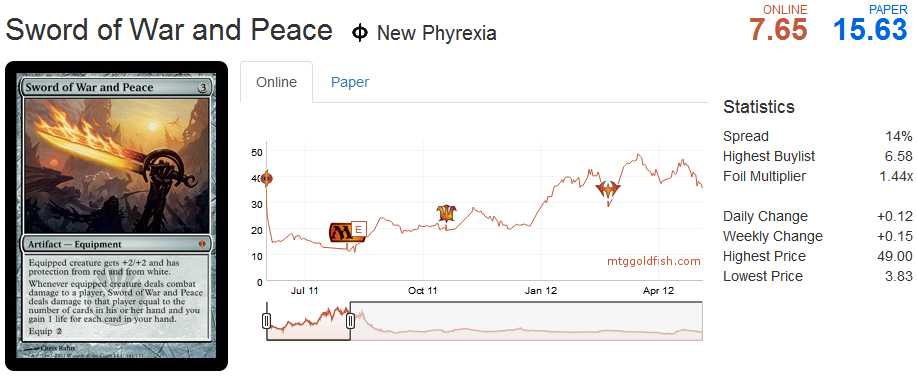
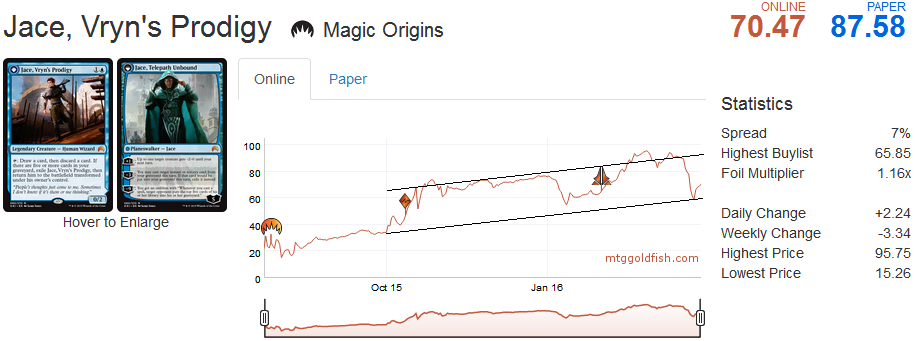
 If you view the secondary trade market through the lens of a large pool of money being circulated, anytime you trade at any premium, you are earning and using OPM. While abit more abstract than store credit, the additional value you gain through the trade is essentially other people’s money working for you. Conversely, when you trade against a premium, the additional value you offer is your money working for another person in exchange for the more collectible or less volatile card. Whenever you have a successful spec that earns you a profitable trade, or sell a card at release-hype pricing, all that additional value is a form of OPM. This is why trading into profits from successful specs is always the best approach, as this is giving you the perpetual benefit of other people’s money continuing to work for you. Holding on to specs is letting that money potentially slip away.
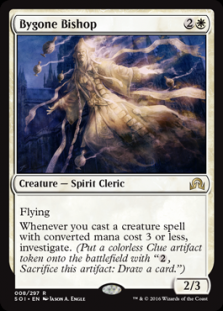 [/tippy] and of investigate in general is that it has very limited fair uses and its (currently known) unfair applications are almost certainly worse than pre-existing decks. I speculated that if Bishop had a home in Modern it would be in a "fair" deck, or a deck that does something fair in a very unfair way, of which the best one for artifacts is Affinity. I also thought it was too cute to be viable, but I said that about Nourishing Shoal in Reanimator and we know how
  To actually test a single card, I remove one of them from my deck before playing, draw six cards like I'm taking a mulligan (without scrying), and then take the top three cards and shuffle in the test card, then draw my seventh card. This ensures that, in a typical game, I will see the test card, but I'm not guaranteed when I will see it. This more accurately reflects a real game than just starting with it in hand. I then play ten goldfish games and five against Jund to see if it's a viable idea. I use Jund since it's the most-played fair deck and I think it's also the most "average" deck in Modern. It plays disruption, powerful threats, and burn, so if you're weak to something, there's a good chance Jund has it. I think this provides the best bang for your testing buck.
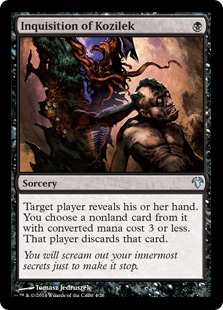 The Jund games really muddied the waters for me. It was never correct for Jund to Inquisition of Kozilek the Bishop, and in play he drew fire from more important artifacts, usually after making some Clues. He was also completely resistant to Kolaghan's Command and thus survived removal storms more often than Ravager, Overseer, and Master did. The other thing I didn't appreciate was the power of the Clues themselves. I knew from theory-crafting and the goldfish games that Clues were "free" Ravager fodder, but what I didn't appreciate until I tried it out was how good that was. Feeding Ravager without spending any real cards made Lightning Bolt much worse on a number of occasions and it also meant that when you went all-in on Arcbound Ravager you didn't actually have to eat your entire board.
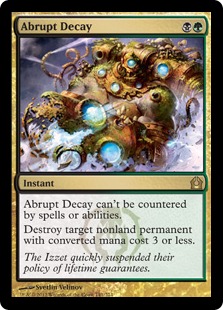 they're not likely to be the target of Abrupt Decay or Maelstrom Pulse. That was relevant once when Affinity's board got destroyed except for two Glimmervoids and one Clue. Of course, if they did eat removal, your business artifacts were safe. If it weren't for the Clue, I would have lost everything, and before you ask, no, that game did not at the time include Mox Opal or Springleaf Drum which normally occupy that job. Once Affinity got some more artifacts into play, sacrificing the Clue was better than anything it could have done with an Opal or Drum (it wasn't enough to win, but it was still better than the alternatives).
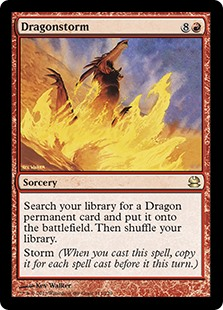 worse Storm?" I concluded pretty quickly that since Dragonstorm costs so much, the answer would always be "yes," so I shouldn't try to compete for the same deck space. This dovetailed nicely with my assessment of [tippy title="Vessel of Volatility" width="330" height="330"]
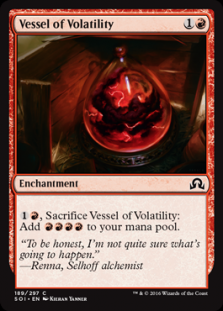 [/tippy]. Instead, this had to be a slower deck with a combo kill.
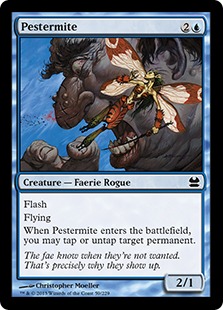 The testing procedure was the same as for the Affinity list, except for the card testing. Seeding cards was unnecessary since I'm testing an entire deck rather than a one-card addition. I don't know much about Modern Storm so I checked around for the consensus on how to play Storm vs. Jund and what to expect. Apparently, discard coupled with pressure is very bad for Storm and it normally wins by going off very quickly. Surprise! This really isn't possible for Dragonstorm so I anticipated not actually being able to storm off very often. I would instead rely on the Snapcaster plan to win. This didn't fill me with confidence, since the way Twin dealt with this problem was Pestermite beatdown, and with only Snapcaster and Hellkite to do that I had doubts.
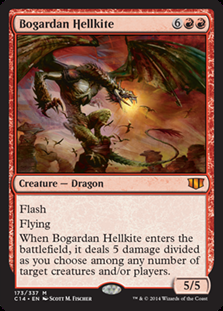 hands and killed on turn four. Sometimes you got Splinter Twin hands full of interaction and Snapcasters. Most were in between, which made actually goldfishing very difficult, but they suggested this is the kind of deck that would reward tight play and format knowledge. A hand of Serum Visions, Snapcaster, Bolt, Vessel, and lands was pretty typical and could be good in a number of different ways, depending on the matchup and your playstyle. Doubly so when deciding what you're scrying for. Simply playing out a Hellkite end of turn was a surprisingly fast kill as well and was also more common than I'd like. See Beyond may be necessary to prevent drawing all your Hellkites before you combo.
 heavy Jund hand frequently left Dragonstorm with only high cost spells and not enough interaction to survive and draw out of its predicament. Decay was also surprisingly strong against Vessel. Dragonstorm could survive the initial onslaught well enough, but was frequently too out of gas by that point to turn the corner and win the game. The one win it did get was thanks to unmolested Vessel's powering out drawn Hellkites. I suspect my build was trying to do too much and lacked enough of a unifying principle to work.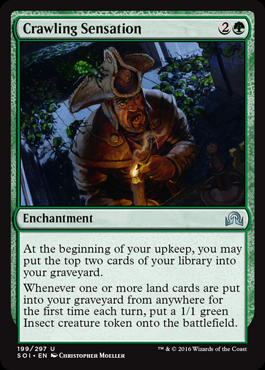
 [/tippy] is a dredge card! Now, I have long despised dredge and won't go to a Modern tournament without Rest in Peace, but I know a dredger when I see one. The self-mill, which has been good in the past in a
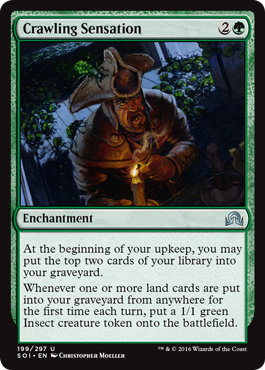
 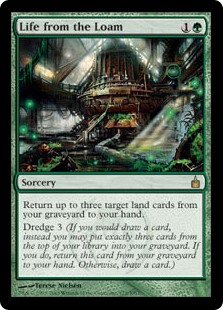 And they looked like real piles on paper. The current Loam lists are too tight to just shoehorn in Sensation and expect it to be good and it really, really, didn't play well with Smallpox. The lists I made from whole cloth were just awful and didn't make it past goldfishing. They were too slow and clunky to beat the goldfish before he died of being a goldfish. They were really good at building huge graveyards, but I tended to mill most of my business and it took forever to put together a win or even enough interaction to plausibly survive to win the game. I don't know if this means that Sensation is actually bad or if I just don't know enough about Loam decks to make it work, but if there are any Loam players out there, try it out and let me know.
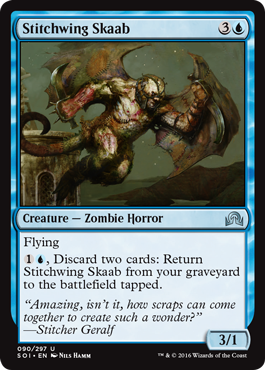
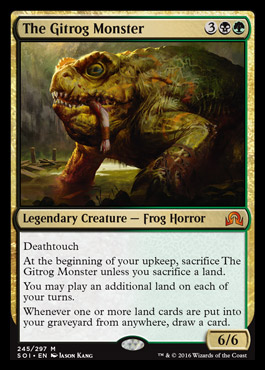


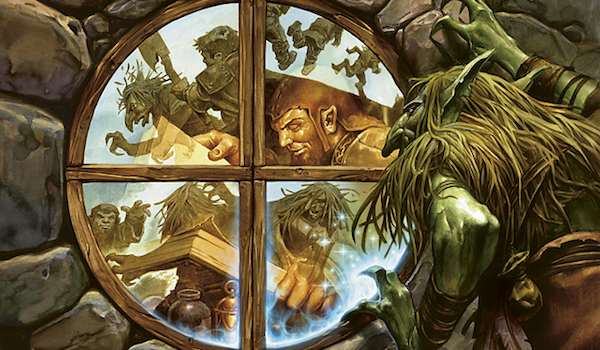
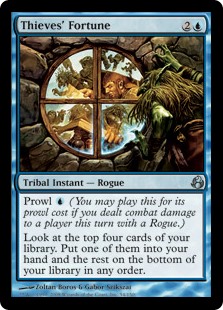
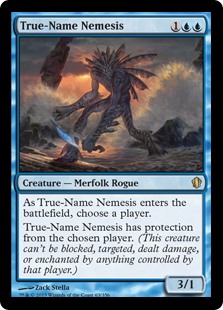
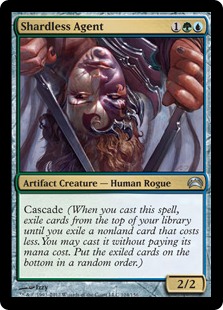
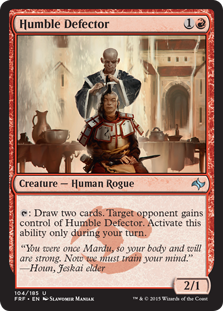 At this phase in the Rogue deck's lifespan, all I had was an idea: find a shell that allowed me to play Thieves' Fortune and Tarmogoyf together. Step one: check Modern for Rogues. By now, you've guessed that Humble Defector is a Rogue. So is Pestermite. This was all welcome news to me, and I came up with a Temur Twin shell that included the combo.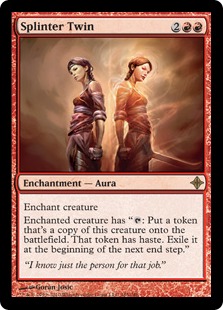
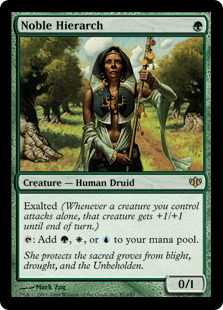
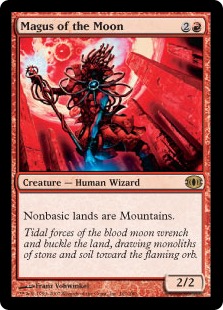 The main reason to play a Temur Traverse deck in Modern, besides its high density of power cards, is its ability to search a bullet Moon effect. Most decks in Modern
  [/tippy].
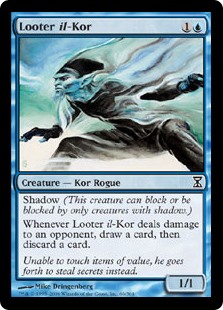 graveyard for delirium. It’s not uncommon to resolve a Looter on turn two, attack, dump a missing card type, and immediately be able to Traverse into a bullet. He can’t block, but makes up with the best evasive mechanic in Modern.
 [/tippy]: Our best answer to Pyroclasm and Anger of the Gods, which can dismantle our boards. Tarmogoyf also helps on this front, but I like having a hard answer to sweepers and board wipes in the sideboard. Surgery also hits all-stars like Lingering Souls, Serum Visions, Scapeshift, and Living End, and its extraction effect can prove deadly for combo decks.
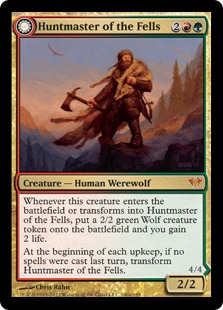 Interactive decks are simpler for us to handle, since we have such an impressive arsenal of interactive cards at our disposal. Stormbreath, Thrun, Sower, and Huntmaster all devastate certain interactive decks. The hardest to beat are those with targeted discard and cheap removal, since they can break up our Rogue synergies and deal with Tarmogoyf at parity. Traverse still frequently out-grinds these Abrupt Decay decks; Izzet Staticaster chews through Confidants and Lingering Souls tokens, and Magus turns off manlands. I originally ran a Keranos in the sideboard, but cut it because it proved unnecessary for these matchups. I also tried the Kiki-Mite package, first in the main and then in the side, before trading it for actual answers to my problems.