
menu

Insider: MTGO Market Report for March 16th, 2016

Are you a Quiet Speculation member?

If not, now is a perfect time to join up! Our powerful tools, breaking-news analysis, and exclusive Discord channel will make sure you stay up to date and ahead of the curve.

Welcome to the MTGO Market Report as compiled by Matthew Lewis. The report will cover a range of topics, including a summary of set prices and price changes for redeemable sets, a look at the major trends in various constructed formats, and a "Trade of the Week" section that highlights a particular speculative strategy with an example and accompanying explanation.

As always, speculators should take into account their own budget, risk tolerance and current portfolio before buying or selling any digital objects. Questions will be answered and can be sent via private message or posted in the article comments.

Redemption

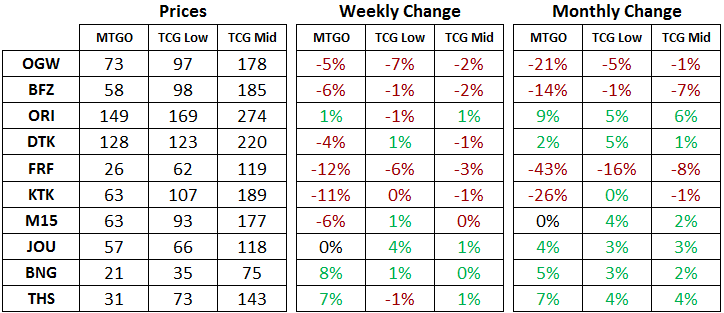
Below are the total set prices for all redeemable sets on MTGO. All prices are current as of March 14th, 2016. The TCG Low and TCG Mid prices are the sum of each set’s individual card prices on TCG Player, either the low price or the mid price respectively.

All MTGO set prices this week are taken from Goatbot’s website, and all weekly changes are now calculated relative to Goatbot’s ‘Full Set’ prices from the previous week. All monthly changes are also relative to the previous month prices, taken from Goatbot’s website at that time. Occasionally ‘Full Set’ prices are not available, and so estimated set prices are used instead.
Mar14

Flashback Draft of the Week

This week the format will be triple Ravnica: City of Guilds (RAV). When this set was first released, it had been five years since the last multi-coloured block, Invasion. Gold cards are a very popular theme and this set brought back gold cards with a twist. In addition to normal gold cards like Loxodon Hierarch, hybrid mana was a completely new spin on gold cards.

On top of the return of gold cards, the guild system was a new way to organize a block and all of its mechanics and themes. Only four of the ten guilds would be represented in RAV, so this block was also experimenting with unbalanced colours between sets, previously seen in the Odyssey block sets Torment and Judgment.

The set was also anchored by the first four of the shock lands, which were a great twist on the original dual lands and proved to be very popular. The staggered introduction of these also had a big impact on Standard as it favored the featured guilds and their colour combinations until the block was complete.

The key thing to keep in mind when drafting triple RAV is that you really must find the guild colour pairing that is open and be drafting around the mechanic and themes of that guild. Also, don't forget that RAV had the first wave of modern karoo lands and signets, both of which provided very cheap and flexible mana fixing.

Draft the karoo lands aggressively in order to take advantage of their raw power of these lands. Playing them means that you can expand your mana curve, splash other colours, and shave lands from your total land count. When three or four of your lands tap for two mana, your land count can drop from the normal range of 17 or 18 to a lower count of 13 or 14.

Selesnya is the green-white guild and uses a token-based strategy that can take over the board by using convoke to cast large creatures. Key commons include Selesnya Evangel, Conclave Equenaut and Siege Wurm. Selesnya Guildmage is a strong first pick, though don't play it out like a two-drop and expose it to removal as it's more useful in the later stages of the game.

Golgari is the green-black guild and uses a graveyard based strategy that seeks to take advantage of the recursion on dredge cards. By activating dredge in your draw step, you can avoid having dead draws later in the game. Golgari Rotwurm is a top common and a key way to close out games, though it must be said the changes to rules around the stack do not favor the Golgari as they have many sacrifice abilities that were good with the old rules.

The red-white guild is Boros. It plays out aggressively and is less dependent on its mechanic than Golgari or Selesnya. This is red-white drafting in the jank style where Sell-Sword Brute is a totally acceptable two-drop and Boros Fury-Shield is a useful card and sometime finisher that will come to you late.

Master Warcraft is a high-impact rare that a Boros drafter should never pass and try to pick up as many Skyknight Legionnaire as possible.

The blue-black guild, Dimir, is controlling and has a relatively strong mill strategy, backed up by powerful rares and the uncommon land Duskmantle, House of Shadow. The transmute mechanic allows flexibility for this colour pair, which favors a long game and many choices.

Don't be afraid to dip into controlling dredge cards like Stinkweed Imp. Although not a high pick, Lurking Informant is a subtle way to take control of your opponent's draws and one copy should always make your deck. Vedalken Dismisser and Vedalken Entrancer are two key blue commons to look for.

You may have noticed that red and blue only show up once in each of the guilds from this set. If there's no clear signal in the draft, try to stick to black, green or white cards until the signals become clearer and you can move into the guild that's open. Lastly, if karoo lands are coming your way, just keep drafting them and worry about your colours later.

Modern

This format is still struggling with the Eldrazi menace, and unless two or more cards are banned in April, the Eldrazi will probably be around for a while. Check out this build that takes the Tron mana base and adapts it to play with the powerful Oath of the Gatewatch (OGW) colourless cards.

Standard

Prices on Standard sets are weakening in both paper and on MTGO as spoiler season for Shadows over Innistrad (SOI) ramps up. Set prices for Fate Reforged (FRF) and Khans of Tarkir (KTK) are dropping faster than the rest of Standard as rotation for these two sets looms. Don't be caught trying to unload cards from these sets at the end of the month, although players should just hold onto their fetch lands rather than trying to time the market.

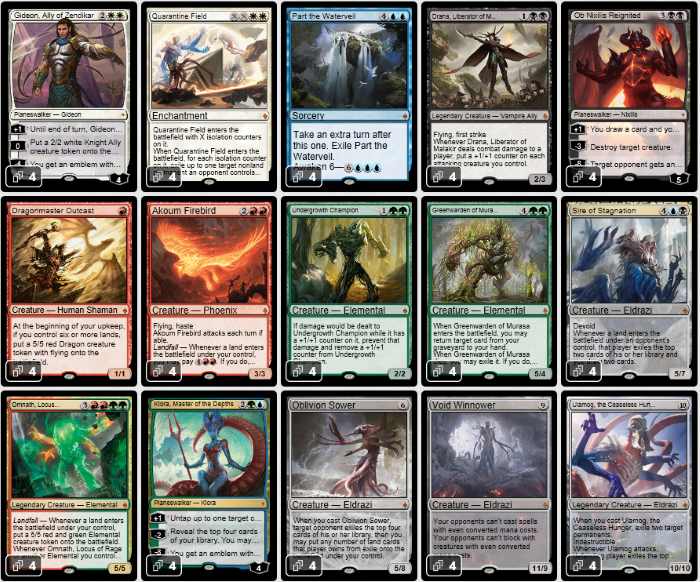
Drana, Liberator of Malakir from Battle for Zendikar (BFZ) saw a big jump this week as the vampire tribe gets more cards spoiled from SOI. It had been in the 3 to 4 tix range for months before ascending into the 6 to 7 tix range this week.

It's not yet clear whether or not Drana will be Standard-playable in April so a speculator holding copies of this card might want to hedge their bets at current prices by selling some of their stock.

Standard Boosters

Both OGW and BFZ boosters are dipping on the success of sealed leagues, though OGW boosters are still over 4 tix as of writing. Look for both of these to drop further in price during release events for SOI when players are scrounging for tix to play in events with the new set. At that time, these will be a low-risk, low-reward play as they will both approach 4 tix over the summer.

FRF and KTK boosters have declined this past week and are set for further drops in price with rotation getting closer by the day. Speculators should be unwinding remaining positions and moving into tix in advance of SOI release events. After rotation, the price on these will only be tied to the EV of their contents, which will be in decline.

Trade of the Week

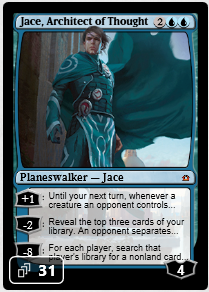
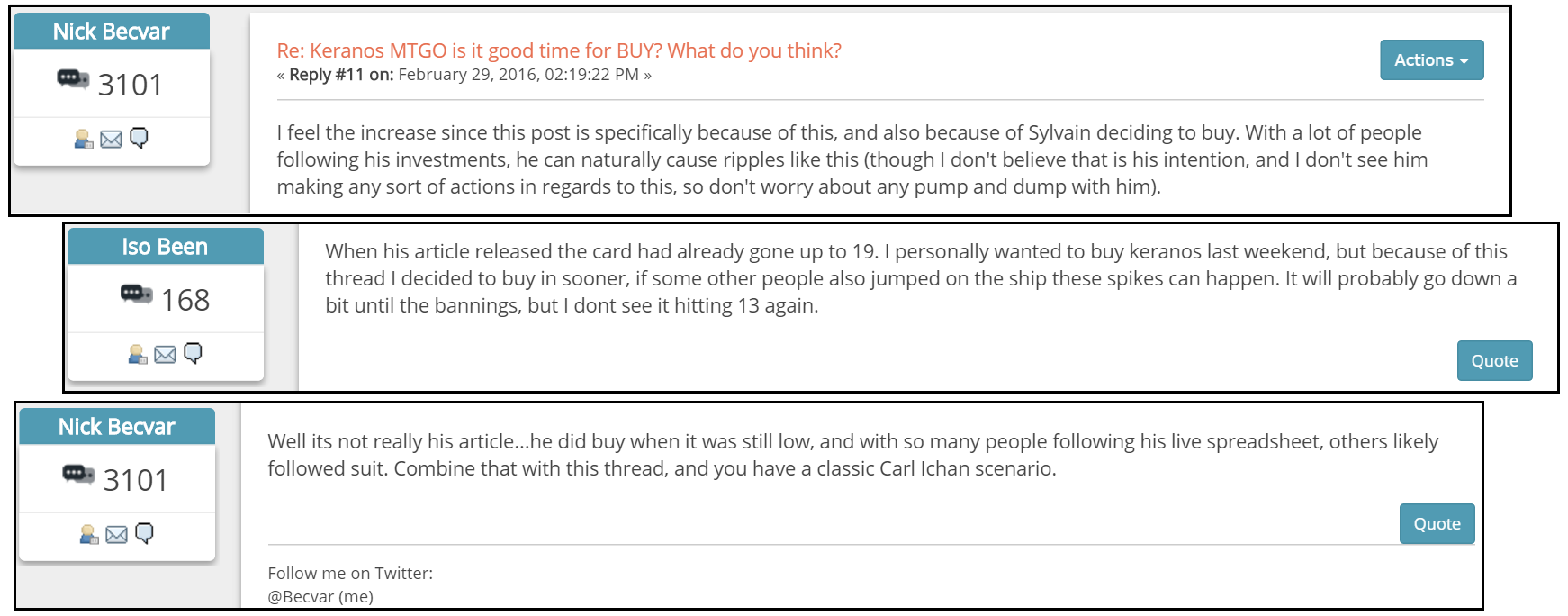
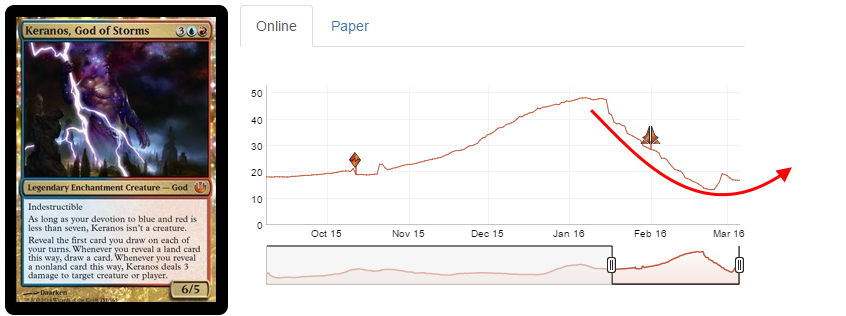
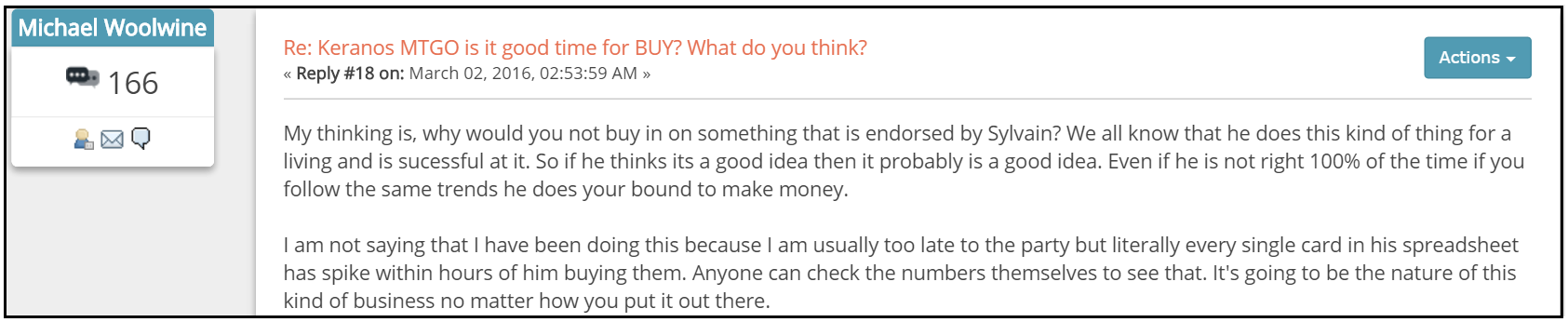
As usual, the portfolio is available at this link. This week highlights the sale of Jace, Architect of Thought. Although not a card that has been looked at previously, it was bought on a cyclic downswing and as the Eldrazi were overrunning Modern, with an eye to selling when Modern returned to normal after April's pending ban announcement.

In this case, the market moved sooner than expected and pushed the price to a level where further gains were not clear. With a bit of luck, this trade ripened quickly. With SOI release events on the horizon, taking advantage of this price swing and getting liquid is prudent in my mind.

Prepare for Falling Shadows

Are you a Quiet Speculation member?

If not, now is a perfect time to join up! Our powerful tools, breaking-news analysis, and exclusive Discord channel will make sure you stay up to date and ahead of the curve.

The shadow of the Eldrazi is beginning to lift from Modern, thanks somewhat ironically to the incoming Shadows Over Innistrad. Previews have begun and while we only have about a third of the set to ogle that hasn't stopped the speculation. I haven't seen very much to really tickle my Modern senses yet, though I'm cautiously optimistic that Madness could be a real deck again (assuming that better enablers have yet to be spoiled), but there is one that I'm interested in pursuing. Before that, however, I have some unfinished business.

Shadows Banner

As Eldrazi Winter gives way to Shadows Over Innistrad and our willingness to brew and test returns, it is important to stay grounded and remember that the heavy hitters of the previous metagame will not evaporate and will define the metagame for at least the first few events. Last week I teased both some metagame predictions and how I would position myself in light of these predictions, so today we'll be going in-depth on both and a look at how Shadows might affect Modern.

[wp_ad_camp_1]

The April 8 Metagame

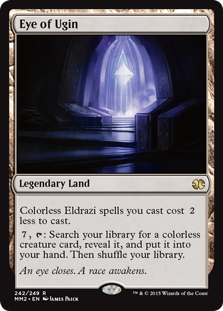
When starting any analysis, it's important to define your parameters and chose your variables. If this sounds familiar to you, that's because it should: I've said this before in my pre-Regionals article in January. I also said that following a ban things are even more uncertain.Eye of Ugin This is particularly true of this upcoming banning because while we know there will be one we don't actually know what it is yet and we don't know what the metagame should be. Oath of the Gatewatch took out a longstanding format pillar and warped the format with Eldrazi, so we don't actually know what the Twinless, Bloomless metagame looked like. As previously mentioned, StarCityGames' Regionals provided a glimpse of this world, but it was already being affected by the misshapen monstrosities. Therefore the place it makes most sense to begin is Assumption 4: Popular decks will stay popular.
Going on this assumption, we should look to the Top Decks page for guidance. Once again, we need to limit our variables and since we know Eldrazi will not exist in its current form after April 8, we should eliminate it from our analysis. Yes, Aaron Forsythe did say Wizards would like to see some form of Eldrazi remain playable, but since we don't know what will actually be banned it makes no sense to speculate on what that form will be. Tier 0 eliminated this leaves us the five decks in tier 1: Affinity, Abzan Company, Burn, Infect, and Living End.

Tier 1: 2/5/16 - 3/6/16

DeckOverall
Metagame %
MTGO %Paper %Major Event
Day 2 %
Affinity8.9%9.1%8.9%8.8%
Abzan Company5.8%3.8%6.2%7.4%
Burn3.8%2.8%4.8%3.7%
Infect3.8%3.4%3.6%4.3%
Living End3.2%4%2.2%3.4%

Affinity, Infect, and Burn are ubiquitous to every Modern metagame and at this point I think that every player should simply be prepared for these three decks irrespective of other metagame considerations, so I will lump them together as The Modern Aggro Decks. Most of the maindeckable answers and strategies for these three decks overlap so this is not as big a simplification as it appears. This simplification leaves us with The Modern Aggro Decks, Abzan Company and Living End.

Now we should look to Tier 2. Rather than try to deal with it in its entirety, we should focus on the most popular decks and see if we can lump any other decks together.

Tier 2: 2/5/16 - 3/6/16

DeckOverall
Metagame %
MTGO %Paper %Major Event
Day 2 %
UW Control3%2.6%2.1%4.4%
Merfolk2.9%2.4%3.9%2.5%
Jund2.9%2.6%3.6%2.4%
RG Tron2.1%1.2%3.5%1.5%
Elves1.6%0.2%2.2%2.3%
Scapeshift1.5%0.6%1.1%2.8%
Lantern Control1.5%1.8%1.2%1.4%
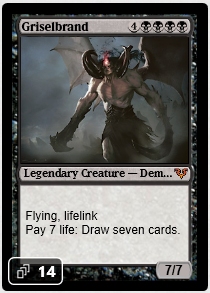
Griselbrand1.3%0.6%1.7%1.7%
Blue Moon1.2%1.4%0.8%1.3%
Ad Nauseam1.1%1.2%1.4%0.7%
Abzan1.1%1.2%1.2%0.9%
Kiki Chord1%1%1.8%0.2%

What jumps out immediately is the relatively large drop in popularity from Jund to GR Tron, and then onto Elves. I expect this is due to the commitment many Jund players have to their deck, the relative unpopularity of Elves prior to Eldrazi, and similarities to GR Eldrazi taking away Tron numbers. Therefore, anticipating a resurgence of Tron and Jund while Elves' numbers remain relatively unchanged, I will make my cut at GR Tron. Looking at the rest of Tier 2 I think that we can safely merge Jund and Abzan into GBx and merge Kiki Chord with Abzan Company into Green Toolbox decks. These decks share many cards in common so this is far less controversial than my creation of The Modern Aggro Decks, and it is also true that the same answers and strategies may be used to fight them. Therefore, my proposed April 8 metagame looks like this:

Deck
The Modern Aggro Decks
Green Toolbox
Living End
UW Control
Merfolk
GBx
GR Tron

Anticipated Positioning

Now, I could include the current stats for each deck and go into detail about how to prepare for and beat each of them, but that wouldn't actually be very helpful. This is a projection, not the actual metagame, so trying to be as specific as possible is going to be misleading at best. Instead, let's take a step back and look at the big picture. When dealing with theories and predicted data, it's more useful to try to analyze the story that it tells rather than the data itself. Looking at my table, I see two things:

1. Lots of Creature Decks

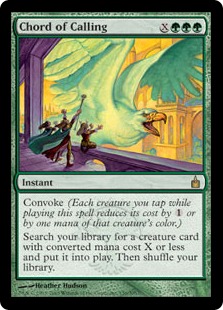
Chord of CallingToolbox may technically be its own archetype, but it still plays a lot of creatures at least some of which need to stay on the board for a turn or more to have an effect. Between The Modern Aggro Decks, Green Toolbox, Living End, Merfolk, and arguably GBx, decks built to beat large numbers of creatures should be good.

2. Decks that "go over the top"

Tron has always been the go-to choice if you wanted to simply overpower your opponent, but recent UW Control lists have taken a similar philosophy, using planeswalkers like Elspeth, Sun's Champion to finish games. Living End also qualifies thanks to its unique angle of attack as do the Toolbox combos.

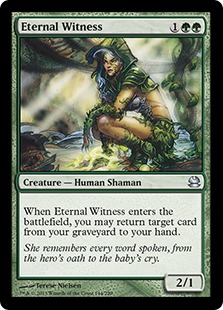
Eternal WitnessTraditionally the way to deal with the first category was either lots of removal and sweepers or to have the biggest creatures. The second category usually falls apart when faced with hard counters for their payoff spells or by being raced. Admittedly, this is less true of Modern's Toolbox decks since Eternal Witness goes a long way towards rebuilding after sweepers or counters and Toolbox's walls and Kitchen Finks make the aggro plan less effective, but it is still possible to get there with any of these plans (this resilience is why I expect the Toolbox decks to do well post-ban).
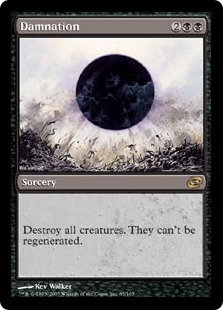
Putting these two points together gives us a choice between a control deck or GW Hatebears, the aggro deck with the largest creatures.Damnation Control has sweepers and removal for the creature decks and counters for the haymakers out of the rest. Hatebears outsizes The Modern Aggro Decks and BGx and can outrace the over the toppers. Of the two options I would not favor Hatebears; it is naturally weak to Living End and in my experience it has to run very well to beat Supreme Verdict or Damnation. The Modern Aggro Decks are often too fast for the size advantage to matter. Those problems are fixable, especially postboard, but what I'm looking for is a deck that is naturally positioned to be advantaged in Game 1. This leaves a control list.
Exactly which list is the next consideration. Jeskai, Grixis, Blue Moon, or UW all have access to the sweepers and counters to fulfill my criteria. It's just a matter of choosing which route to go. UW has mana stability at the expense of burn. Grixis has access to discard (which was traditionally the edge in control mirrors) but is vulnerable to graveyard hate. Blue Moon has Blood Moon but lacks a true Wrath of God variant, while Jeskai has no real weakness or advantage compared to the other decks.

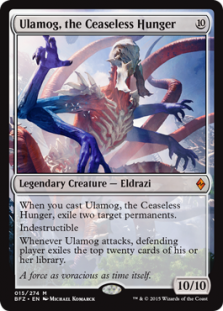
Fortunately, the Tron matchup will help to sort things out. Tron's ability to go over the top and thenUlamog the ceaseless hunger seize and hold inevitability thanks to Emrakul, the Aeons Torn (though Ulamog, the Ceaseless Hunger is often better these days). You would think this factor automatically means Blue Moon is the pick but not so fast: Blood Moon is not that crippling for Tron. They can just keep making land drops to drop their colorless bombs like normal decks, or use Chromatic Stars to generate colored mana, so without a fast clock (which all these decks struggle with) Moon itself isn't a solution. Land destruction is, at best, useful to let the control deck catch up manawise at which point they need to take the tempo role, playing out their win conditions and keeping Tron off theirs.
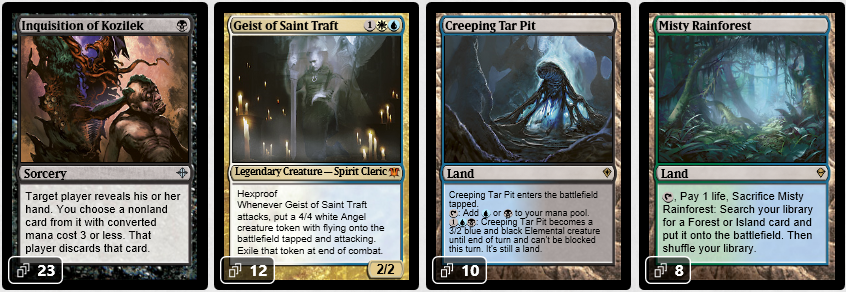
In my mind, that suggests a counter heavy build of UW with Geist of Saint Traft is where you want to be. UW maindecks mana disruption in the form of Ghost Quarter and Spreading Seas to buy time for Geist and packs the Cryptic Commands and Mana Leaks to keep bombs from resolving. However, I cannot actually recommend UW or any control deck at the moment thanks to a different GR deck that is an atrocious matchup.

Shift for the Win

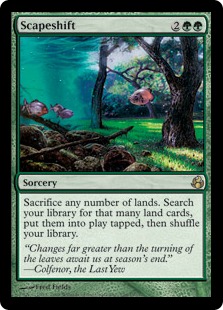
Traditionally, 3+ color Scapeshift was a pretty good matchup for control decks since it was another control deck with a combo kill.Scapeshift All a blue mage had to do was win the counter war over the namesake sorcery and they were golden. Not so with GR Shift, which has far more angles of attack. The Scapeshift mage can simply make land drops, power up Khalni Heart Expedition, and not expose their Valakut, the Molten Pinnacles until they go off in one massive, largely undisruptable turn. Shadow of Doubt can save you once, but unlike the old lists, GR can try again with another Khalni Heart or Scapeshift. Even if the GR player lets you Crumble to Dust Valakut, they can always win via Inferno Titan and Primeval Titan. GR Shift is too good at overtaxing control decks and with Eldrazi going away we can expect Shift to return to popularity.
From the Shadows, a Solution

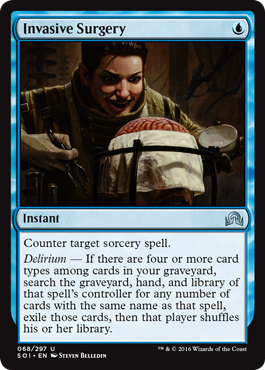
Invasive SurgeryFortunately, Shadows may have provided a solution. [tippy title="Invasive Surgery" width="330" height="330"]Invasive Surgery[/tippy] was one of the first cards spoiled and the one that I find most intriguing. Envelop sees some play in Legacy and Vintage against Show and Tell and see similar utility in Modern if it were legal. Surgery is Envelop with Cranial Extraction conditionally tacked on, which is good. VERY good.
Extraction has never seen much play due to its mana cost and utter lack of board impact. Yes, it does remove a problem from your opponent's deck permanently, but that isn't always relevant to actually winning the game. Most players these days know to diversify their win conditions, so Cranial isn't the blowout it used to be. Surgical Extraction solved the mana problem but is only useful if you set it up with discard or attrition, with the upside of hitting lands. Surgery may lack the flexibility of the Extractions, but it makes up for that by being an answer that is useful even when you aren't delirious.

Surgery is a huge boon for control decks against Scapeshift's primary avenue of attack. Early on, it can be used to hit the ramp spells, buying time to get your own win condition online. Later, it defends against instant death. This still leaves Titans and land drops to fear, but those are far more manageable when you don't need to fear a four-mana sorcery. Surgery certainly doesn't win the war, but it will give control players a fighting chance.

Prep the Operating Room

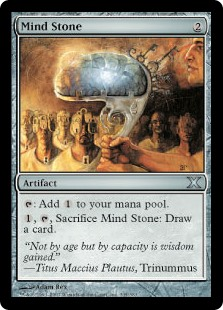
Of course, this is all assuming that you have four card types in your graveyard. Envelop is a fine card for Modern, sure, but come on; if we're going to play surgeon let us also deliriously cut! It's pretty easy to get lands, instants, and sorceries into our yard, but not so much the others, especially in a control deck.Mind Stone Adding some cantrip artifacts might appear to be a solution but if your deck didn't want Expedition Map or Chromatic Star before Shadows, it still won't want them afterwards. Mind Stone has seen some play but I suspect in matchups where Surgery is relevant you'll want the mana a lot more than the additional card type, though it may be a good enough option for UW or Jeskai. Tribal is a possibility but the only tribal cards that a control deck would play are All is Dust, Nameless Inversion, and Warren Weirding and, again, if your deck didn't want these cards before it doesn't want them now.
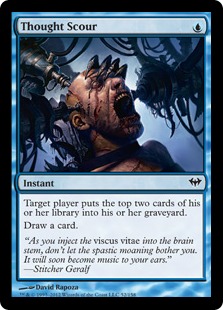
Realistically the most reliable way control will turn on Surgery is either to mill creatures and/or planeswalkers or discard them to Liliana of the Veil.Thought Scour This strongly suggests Grixis Control as the logical home for [tippy title="Invasive Surgery" width="330" height="330"]Invasive Surgery[/tippy], especially since that deck already plays Thought Scour. There is anti-synergy with the delve spells but Grixis already plays Snapcaster Mage so it obviously isn't that big of an issue. Trevor will doubtless be testing this out in the not-too-distant future, but I suspect that between Grixis' discard spells, powerful clock, hard counters, and now Surgery, it will become the default Modern control deck. I wish it wasn't so weak to Relic of Progenitus, but Chapin and Trevor's success with the deck suggest that it isn't as big an issue as I think.

The Doctor is In

We're less than a third of the way into Shadows spoilers but if Surgery is any indication this set will be good for Modern. Not Khans of Tarkir impact, but we already have new answers and the clue tokens are full of potential (as I'm sure Sheridan will talk about at some point). Keep your eyes open for more gems to come and I'll see you in the comments.

Insider: Forecasting Part Duex

Are you a Quiet Speculation member?

If not, now is a perfect time to join up! Our powerful tools, breaking-news analysis, and exclusive Discord channel will make sure you stay up to date and ahead of the curve.

Welcome back, readers!

superforcasting book

I've finally finished reading Superforecasting: The Art and Science of Prediction, by Philip E. Tetlock and Dan Gardner. Two weeks ago I wrote about what I'd read up to that point. This week I'll be covering additional topics from the book.

Words Have Meaning

First a little history lesson. Back in 1941 a man by the name of Sherman Kent left a job at Yale University to become the Coordinator of Information (COI) in the US government's recently created Research and Analysis Branch. The COI became the Office of Strategic Services (OSS) which then became the Central Intelligence Agency (CIA).

Needless to Mr. Kent left a huge legacy on how the US government's intelligence community works. Mr. Kent and his team briefed President Kennedy about a potential conflict in Yugoslavia calling the potential for war a "serious possibility."

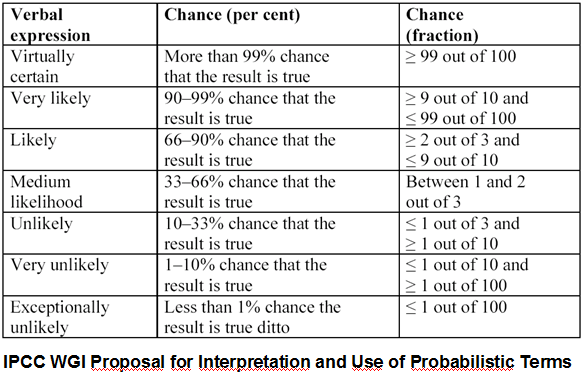
A few days after the briefing one of the other officials from the meeting ran across Mr. Kent and asked exactly what they meant by "serious possibility." His response was that they believed an attack was something like 65% to occur and 35% against. The official reeled back surprised as he and his other colleagues had assumed that the odds were considerably lower.

This led Mr. Kent to try and develop a standard for what words regarding probability should mean.

KQA_Uncertainty_Communication_IPCC_Scale

While it may not seem like a big deal, one of the biggest flaws in many types of forecasting is that many forecasters prefer vague terms to protect their egos from being wrong. If someone says there's a good chance that card A will go up in value at rotation without defining "good chance," then they can sit back and claim there was also a good chance it wouldn't go up.

One of the big points in this book is to view forecasting from a more scientific standpoint which requires specificity. This is why weather forecasters almost always include the actual probability an event will occur. They say there's a 40% chance of rain or there's a 90% chance of fog. Whether they are right or not is heavily dependent on tracking their forecasts over the long run (as every time there's a 40% chance of rain there's a 60% chance it won't rain).

Moving forward I will try to reference this chart whenever I make any type of financial prediction related to Magic cards. I feel it's extremely important that anyone who speculates/forecasts is specific with their intentions regarding card choices.

I accept that this won't be easy (I know I'll be picking my words much more carefully now) and my ego may end up a bit bruised after some wrong calls---but like a plant in a small plastic box, comfort zones inhibit maximum growth.

Fermi Problem

220px-Enrico_Fermi_ID_badge
Enrico Fermi


In my first article I discussed the idea of breaking down a question into sub-questions. This technique was popularized by renowned Italian physicist Enrico Fermi who often posed the following question to his students: "How many piano tuners are there in Chicago?"

Now when immediately asked we might stare back quizzically at the asker or thanks to smart phones pull out our phone and google it. Unfortunately for you, google doesn't just spit out an answer. The idea behind the question was to break it down using estimates. In this case,

  1. There are 9,000,000 people living in the Chicago area.
  2. There are on average 2 people per household.
  3. Around 1 in 20 households has a piano that they tune regularly.
  4. Pianos are typically tuned once per year.
  5. It takes about 2 hours to tune a piano (when you factor in travel time).
  6. A typical piano tuner likely works 40 hours per week, for 50 weeks a year.

9,000,000 people / 2 people per household = 4,500,000 households

4,500,000 households * 1/20 households with a piano = 225,000 pianos

225,000 pianos * 1 tuning per year = 225,000 tuned pianos

225,000 tuned pianos * 2 hours per tuning = 450,000 hours spent tuning pianos

450,000 hours spent tuning pianos / (40 hrs per week * 50 weeks per year spent tuning) = 225 piano tuners

So the final estimation to the problem is that there are 225 piano tuners in Chicago.

Apparently someone actually went through the phone book in the Chicago area and found there were actually 290 piano tuners. Given that all the calculations were done using estimates, being only 23% off is really impressive. The key to these types of problems is that while the question itself may seem almost (or completely) unanswerable at the time, breaking it down into all the potential factors can allow for some relatively accurate estimates.

It only took about five minutes to gather all that information and we were within 25% of the actual answer. To find the "correct" answer without estimation would likely take hours of combing through the Chicago yellow pages (and figuring out what types of businesses offer piano tuning on top of other services). In light of all this, the trade-off seems pretty worthwhile.

Traits of a "Superforecaster"

Mr. Tetlock found some common traits among his group of "superforecasters" which likely aid them in their abilities to forecast well. These are:

  1. Cautious - People who are quick to decisions often don't take into account all the options.
  2. Humble - Whenever you're in a position where others may look up to your decisions, humility goes a long way. Ego can often cause forecasters to extreme-ize their forecasts in order to make a bigger headline when they happen to be correct.
  3. Nondeterministic - When making forecasts one can't scientifically prove "what's meant to be will be." Thus while it can be comforting to people it does not aid in scientific endeavors.
  4. Actively Open-Minded - A good forecaster has an open mind about different possibilities; a "superforecaster" actively forces themselves to look at problems/questions from multiple viewpoints. This allows one to see potential pitfalls or benefits that could be missed if one only considered their own viewpoint.
  5. Intelligent/Knowledgeable - This isn't to say that someone who doesn't have a strong educational background can't make a good forecaster, but it takes a desire for knowledge to drive someone to keep researching/considering alternatives instead of stopping at the first plausible explanation.
  6. Reflective - A "superforecaster" needs to be able to accept criticism, especially from themselves. When we fail we need to determine why, and the same goes for success.
  7. Numerate - Numbers are important for proper forecasting---vagueness is akin to laziness when it comes to accurate forecasting. By being specific with the numbers the success or failure is easier to measure.
  8. Pragmatic - It's important for any "superforecaster" to be able to change their mind/opinion when facts or events change. Staying married to a bad idea or agenda will only harm the actual forecasts and lead to inaccuracy.
  9. Analytical - In order to maximize accuracy of a forecast it's important to analyze the information behind the forecast as not all sources nor information are equal.
  10. Probabilistic - Understand the probability of events occurring and how to develop more accurate odds on any future forecasts. This also ties in with our first discussion about the exact meaning of words.

I really enjoyed this book and I strongly encourage any of my readers to read it themselves. There are a lot of additional concepts I haven't covered yet. While I will likely try to write one more article regarding this book and its ideas, there are still concepts in the book that I personally don't feel I have the proper amount of understanding to explain myself, and thus I won't risk failing you all attempting to grasp them.

Avatar photo

David Schumann

David started playing Magic in the days of Fifth Edition, with a hiatus between Judgment to Shards. He's been playing Commander since 2009 and Legacy since 2010.

View More By David Schumann

Posted in Finance, Free Insider4 Comments on Insider: Forecasting Part Duex

Have you joined the Quiet Speculation Discord?

If you haven't, you're leaving value on the table! Join our community of experts, enthusiasts, entertainers, and educators and enjoy exclusive podcasts, questions asked and answered, trades, sales, and everything else Discord has to offer.

Want to create content with Quiet Speculation?

All you need to succeed is a passion for Magic: The Gathering, and the ability to write coherently. Share your knowledge of MTG and how you leverage it to win games, get value from your cards – or even turn a profit.

Insider: Scouring for Synergies in Innistrad’s Old and New

Are you a Quiet Speculation member?

If not, now is a perfect time to join up! Our powerful tools, breaking-news analysis, and exclusive Discord channel will make sure you stay up to date and ahead of the curve.

We're off to see the angel, the wonderful angel of Innistrad! Is she good? Bad? Who cares? This is Innistrad, baby.

It is almost time. The spoilers are getting ready to roll and everybody is at a fever pitch about the upcoming Magic release. The release of Oath of the Gatewatch (OGW) and its impact on the secondary market really made a strong impression on me about how I'm going to approach future sets moving forward.

In particular, how I see cards like this one:

There was an error retrieving a chart for Eye of Ugin

A new set that revolves around rehashing old themes creates opportunities for old cards to gain value. I mean, I know that things have changed on Innistrad since last we were there, but seriously how much could things have really changed?

Zombies? Check.

Vampires? Check.

Humans? Check.

It's the same old land of classic horror that we've all learned to fear and love.

So, my thought process for pre-buys and specs leading up to the spoilers was to look for iconic or powerful undervalued original Innistrad block cards that could be made better by synergies with the new set. Who would have expected that Eye of Ugin or Eldrazi Temple would suddenly spike in value with the release of OGW? The answer: people who made a lot of money!

Garruk Relentless

There was an error retrieving a chart for Garruk Relentless

Garruk is getting better just with the rule change to how flip cards work. It turns out that flipped cards no longer have a converted mana cost of X=0 and will retain the mana cost of the preflipped version they transformed from. The long and short of it is that Engineered Explosives on x=0 or Abrupt Decay no longer destroy flipped cards like Garruk.

Garruk also has some street appeal because it is a transforming planeswalker, which is pretty darn cool by any stretch of the imagination. The card certainly has casual appeal as well. So, based on the low tag, the Constructed gains, and the casual appeal, I like picking up Garruk Relentless right now.

Planeswalkers are the cast of players on the Magic stage and one as unique as a transforming one could also have iconic appeal somewhere down the line (especially if they ever do a Magic movie).

Champion of the Parish

There was an error retrieving a chart for Champion of the Parish

Champion of the Parish is my #1 pick in this article. The card is insanely popular from a card selling perspective. It is impossible for stores to ever keep it in stock. It basically sells out as soon as it comes into stock and yet the price tag doesn't really change.

This phenomenon is the benchmark of a card that is universally underpriced. I also think that if there are any good tribal human synergies in the upcoming block there is a chance the card could become Modern-playable. Well, more so than it already is! There are certainly some lower tier Modern decks that already utilize the Champion of the Parish.

One-drops are a really big game in Magic and any human tribal deck is likely going to play this card from now until the end of time. That alone should be a reason to consider that the price tag on this card is too low! Humans love to play humans!

The card is already a great card and underpriced. It seems likely that there will be at least some human-themed card in the block that makes it even better.

This is a card that will literally take you to church!

Mayor of Avabruck

There was an error retrieving a chart for Mayor of Avabruck

The flip card change makes Mayor better, as does the potential for new humans.

Basically, all of the reasons that make Champion of the Parish a strong spec target also apply to Mayor. At the very least the Mayor is a two-mana human lord. If Merfolk have taught us anything it is that 2cc lords are a huge game in constructed formats.

The card also has that cool, cool flavor that casual players love. The respected village elder who by night transforms into a terrifying werewolf? Very cool card that perfectly captures the flavor of Innistrad.

I'm hoping that the Mayor will get a new card or a shout-out in the new set. I remember getting absolutely crushed by the Mayor in Innistrad limited. They play it on turn two on the play and you are unfortunate enough to not have a two-drop? Game over!

As far as mayors who will straight up kick you in the butt and wreck things up, the Mayor of Avabruck is right up there with Kwami Kilpatrick.

Zooooooombies

There was an error retrieving a chart for Geralf's Messenger
There was an error retrieving a chart for Gravecrawler

I wrote a whole article last week about potential zombie winners on the verge of Innistrad and noticed small gains in these two cards already. I don't need to belabor the point, but I don't think these cards have hit anywhere near their possible potential. Something to consider...

I'm really feeling the undead specs right now. Sometimes you've just got to follow your heart on these picks and zom-be yourself!

Wolfbitten Captive

There was an error retrieving a chart for Wolfbitten Captive

Are you hungry like the wolf? Well, if you are considering building a werewolf deck this is a potential one-drop to consider. It isn't the most insane one-drop I've ever seen by a long shot but it could certainly have some sweet casual appeal. It's basically hanging around as a bulk rare and this card could end up making its way into a lot of kitchen table decks as players look for more wolves to fill out their tribal decks.

Obviously, this card is a far cry from a Modern-playable but I think it's worth the tiny risk for the casual potential.

Bulk rares are one of my favorite places to look for spec targets. The upside is that they cost almost nothing to acquire and when they hit you make a very large margin on them. Even if you can get $1 out of the card one day, the chances are that you can pick them up for a quarter. So, you quad up! That is the kind of profit margin that really makes me want to howl at the moon.

Descendants' Path

There was an error retrieving a chart for Descendants' Path

Descendant's Path is an interesting card because it is inherently very powerful. I strongly considered playing this card in Modern in my Eldrazi-themed deck. What could be more grand than just casting free Eldrazis off the top of one's deck? Conduit of Ruin for an Emrakul or Ulamog and go nuts!

The fact of the matter is that Descendant's Path has a lot of potential in a lot of different tribal decks (both constructed and casual). I also feel like it is unlikely to see a reprint just because it is sort of casual and under the radar. I also like this card in tribal Commander decks. I had one in my Sliver deck at one time when I used to play that format regularly.

My evaluation is that the card has room to grow. It has gone up a little bit over the past two weeks and I don't think we've hit the ceiling yet. I've been trying to pick up as many as possible.

Finding cards that have both obvious constructed and casual appeal is always a strong sign that you've found a winner and are on the right "path."

Silverblade Paladin

There was an error retrieving a chart for Silverblade Paladin

Silverblade Paladin was a strong card back when it was in Standard and it has a very effective and powerful set of abilities. The fact that it has semi-haste when it comes down and gives a creature double strike is really sweet. For three mana the amount of power and damage it throws around is at a ridiculous output.

I don't think it is out of the question that this could be in a human tribal Modern deck at some point, especially if there are a few winners in the upcoming Innistrad sets.

At the very least I still believe this card is much better than a typical bulk rare and that it certainly has room to grow. After all, the card is a great Magic card and has a lot of positive qualities going for it and has a fairly low mana-cost-to-damage ratio.

Maybe I'm a little nostalgic for this card (I played it quite a bit back in the day) but great cards are always solid to own. Just because it doesn't have a home right now doesn't mean it won't ever. Good cards tend to have a way of finding a place eventually.

~

I'm sure I've overlooked cards. Magic is so big that it's always impossible to see everything from every possible angle. The complexity is part of what makes Magic finance such a rewarding and difficult job. All it takes is to see a card and think, "What if this card gets paired up with a new card..." and bam! You've found a winner before the rest of the herd.

I do think there's a lot of value looking to the old Innistrad block for cards with inherent synergies with the new block. Keep your ears to the ground and your eyes on the spoilers!

Celebrating One Year of Modern Nexus!

Are you a Quiet Speculation member?

If not, now is a perfect time to join up! Our powerful tools, breaking-news analysis, and exclusive Discord channel will make sure you stay up to date and ahead of the curve.

Happy (semi-early) birthday to us! It was one year ago to the week we made our debut as "Masters of Modern" on Reddit and other social media. It was also one year ago to the week that our readers took a chance on a couple of relatively no-name Magic players and their vision of a Modern site for Modern players. Our name might have quickly changed, but our promise to deliver high-quality, data-driven, Modern-specific content has continued to be the core of our site's purpose since last year. Some of you played Magic through school as an escape from classes and tests. Here at Modern Nexus, I'm proud to say we will never let you escape the statistics, tables, and evidence-based analyses you have come to expect.

One Year of Nexus Banne

March 16 of 2015 saw us publish our first "Metagame Breakdown" article, and I'd like to hope the ideas of Tier 1, Tier 2, and Magic metagame analysis have never quite been the same. Today, I want to not only thank our readers and community for all your support and participation in the site, but also to give some reflections on where the site has been and where we plan on heading over the next year. This can also be a place for you to drop us some comments about what you want to see more of, less of (so long as that "less of" isn't statistics!), or what you want us to change.

[wp_ad_camp_1]

With that in mind, here are some Long-Term Plans as we forge ahead into our second year of operation.

  • Thank the readers
    We wouldn't be here today without our dedicated fans, commentators, audience members, current/former contributors, and overall community. Critics and outright trolls included! All of you have made the site possible, both in big things like reading and little ones like disabling ad-blockers, and I know I speak for our small but committed team when I thank you all for your involvement in Modern Nexus. Over the course of 2016, I want to think of ways to thank our readers and give back to them. This might take the form of more participatory articles such as a "Deck Doctor" series, community contests with snazzy prizes, reader-request articles, and more. Our readers rock and they deserve that explicit recognition.
  • Expand the staff
    I love our small Nexus team, but I am also aware of the limitations this places on our site growth. Just taking my own writing as an example, a week where I write 2-3 pieces and update all the metagame numbers on a daily basis is a week where I lose hours to test another Stoneforge Mystic vs. Insert-Tiered-Deck-Here article. There's also significant value in adding new perspectives to the team, particularly those with more tournament involvement than I have. I'm very much on the academic side of Magic and Modern, and although there is value to that in the game as much as in non-gaming spheres, it's important to maintain a balance. In 2016, I want to work to expand our staff through reaching out to new authors, strategic partnerships, guest appearances, and other arrangements to ensure we're giving you the latest and greatest in Modern content. I'm hoping you see the first wave of this by summer, but it could well be earlier!
  • Post more videos
    I'm an old-school writer and analyst more than I am a YouTube man, and I'm much more comfortable in RStudio than I am in Adobe Premiere. That said, I know our readers want to see more video offerings, and I'm aiming to get more of these added in the next six months. There's a lot of potential around not just conventional deck breakdowns, but also set reviews, event recaps and reports, financial advice, and other Modern topics.
  • Add a real deck and metagame database
    If we get absolutely nothing else accomplished in 2016, we're going to a) defeat the Eldrazi, b) get a meaningful unban and not another Golgari Grave-Troll, and c) integrate a proper database into Modern Nexus. I'm a man who's serious about his spreadsheets, but we're not reaching our potential when we're stuck on a Google Sheet with a manually updated Top Decks page. That doesn't provide the ability to search for decks, filter results, and tailor custom queries to create your own metagame analysis. There are plenty of deck databases on the Magic internet, but none capture the sheer number of Modern decks we do, none conduct the analysis like Nexus offers, and none are as accurate with respect to just Modern alone. I want to bring that to our readership and I'm going to work hard to add it by this time next year.

I've also heard murmurs about other ideas in emails and comment sections: a Modern-focused forum, "Legacy/Standard Nexus," hosting paper or online tournaments, in-person coverage of Modern events, and many more. These proposals and all the other bold suggestions I've heard and mused on aren't necessarily off the table, but I do want to prioritize the four goals above before getting too ambitious.

Keep your eyes open for some more announcements over the next month. Although these more administrative postings (not to mention the work that happens behind the scenes) might cut into the 2500+ word articles you've come to expect (eagerly anticipate? dread?) from the Sheridan Monday-Wednesday days, it will be worth it in the end if it means a more robust, informative, and enjoyable Modern Nexus.

Thanks for reading and a big thanks again to all of you for your continued support and reading. I'll be responding to all of you in the comments, so feel free to take questions, ideas, concerns, worries, and all other feedback there. You can also always email me at sheridan@quietspeculation.com, and although I have been inconsistent in responding to emails in the past month, I'll be back on top of it as we push into this new phase of growth.

-Sheridan
Editor in Chief

Deck Overview- Modern Esper Rally

Are you a Quiet Speculation member?

If not, now is a perfect time to join up! Our powerful tools, breaking-news analysis, and exclusive Discord channel will make sure you stay up to date and ahead of the curve.

As we await Standard rotation and a modern banning, this is not a generally exciting time for decklists. Luckily, there are still some heroes out there, like QMUNKE, who took this insane and/or brilliant concoction to a 5-0 record in a recent Modern League:

Modern Esper Rally

Creatures

4 Blood Artist
3 Bloodghast
1 Bloodthrone Vampire
1 Drowned Rusalka
4 Hedron Crab
2 Jace, Vryn's Prodigy
4 Magus of the Bazaar
4 Sidisi's Faithful
3 Viscera Seer
2 Zulaport Cutthroat

Spells

3 Ideas Unbound
4 Rally the Ancestors
4 Bridge from Below

Lands

4 Flooded Strand
1 Godless Shrine
3 Hallowed Fountain
2 Island
3 Marsh Flats
1 Oboro, Palace in the Clouds
1 Plains
4 Polluted Delta
1 Swamp
1 Watery Grave

Sideboard

2 Darkblast
2 Faerie Macabre
1 Felidar Cub
3 Lone Missionary
1 Ronom Unicorn
2 Spellskite
4 Tidehollow Sculler

It's impossible to know if this is an optimized list for this strategy, but there are a lot of sweet thing going on here. I truly enjoy playing two copies of Jace, Vryn's Prodigy to supplement Magus of the Bizaar, and I'm always happy to see an Ideas Unbound.

The strategy here is to interact with your opponents creatures with Sidisi's Faithful and chump blocking, much like the Standard Rally the Ancestors deck, and then to kill your opponent with Blood Artist/Zulaport Cutthroat triggers. There's also an outside shot that you can win with Bloodthrone Vampire in combat, though mostly you'll just be using it to sacrifice creatures so Rally doesn't exile them.

There was an error retrieving a chart for Rally the Ancestors

I really like the inclusion of Bloodghast and Bridge from Below as the go-to cards to discard, especially considering that the onus is going to be on your opponent to kill their own creatures if they want to remove Bridges. You can also just build a huge army of zombies with any of your sacrifice outlets if you win the Bridge lottery with Hedron Crab and/or your discard outlets.

There was an error retrieving a chart for Bridge From Below

I also thoroughly enjoy the inclusion of Oboro, Palace in the Clouds, which gives you a repeatable effect to guarantee landfall every turn for your Bloodghasts.

I don't actually know how good this deck is, but it's definitely worth paying attention to, as there are a number of cards in this list that would be poised to spike if this deck takes off. Specifically, Magus of the Bazaar is worth less than a dollar, and being from Planar Chao makes it old enough to increase in price substantially if it suddenly becomes relevant.

There was an error retrieving a chart for Magus of the Bazaar

Insider: Archangels and Things in Modern

Are you a Quiet Speculation member?

If not, now is a perfect time to join up! Our powerful tools, breaking-news analysis, and exclusive Discord channel will make sure you stay up to date and ahead of the curve.

We've already gotten several exciting Shadows over Innistrad spoilers, previews start in full tomorrow, and there's a 0% chance the wretched Eldrazi survive April 4 without at least one banning. Life is good. I'm looking forward to a Modern where a third to a half of games don't start "Eldrazi Temple, Eldrazi Mimic, go." Or Eye of Ugin into something even nuttier.

I'm also really looking forward to Shadows, unraveling the mystery of madness and the moon, getting more investigate cards for my Shape Anew deck, and maybe, just maybe, an Innocent Blood reprint.

There was an error retrieving a chart for Innocent Blood

...There's always Eldritch Moon for Blood too! Please, Wizards?

We've seen about 65 of the Shadows newcomers so far, and we're already noticing some mechanics, cards, and synergies that show Modern promise. Eerie Interlude is a better Ghostway. The return of madness bodes well for Faithless Looting and Vengevine fans. Thraben Investigator is begging to get those clue tokens converted into Blightsteel Colossus.

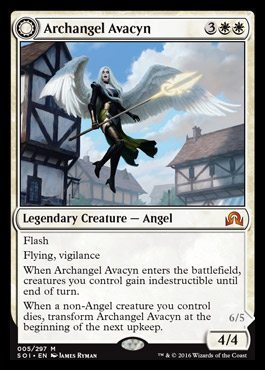
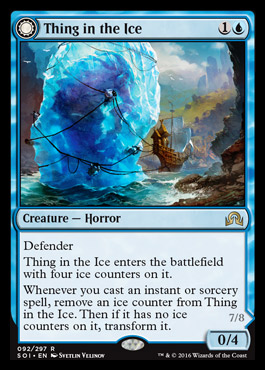
And, of course, Archangel Avacyn and Thing in the Ice both pushed presale prices to $20. Thing even started at $4.99 before going to $7.99. Then $9.99. Then $14.99...

We'll have plenty of time to digest the other Shadows spoilers over the coming weeks and as we see more previews. For today, we'll focus on Avacyn and Thing to see if their Modern playability supports their hype. Many speculators and players have been excited about these cards because of their multi-format applicability, and I want to investigate those claims to check their pricetags against their potential.

Archangel Avacyn in Modern

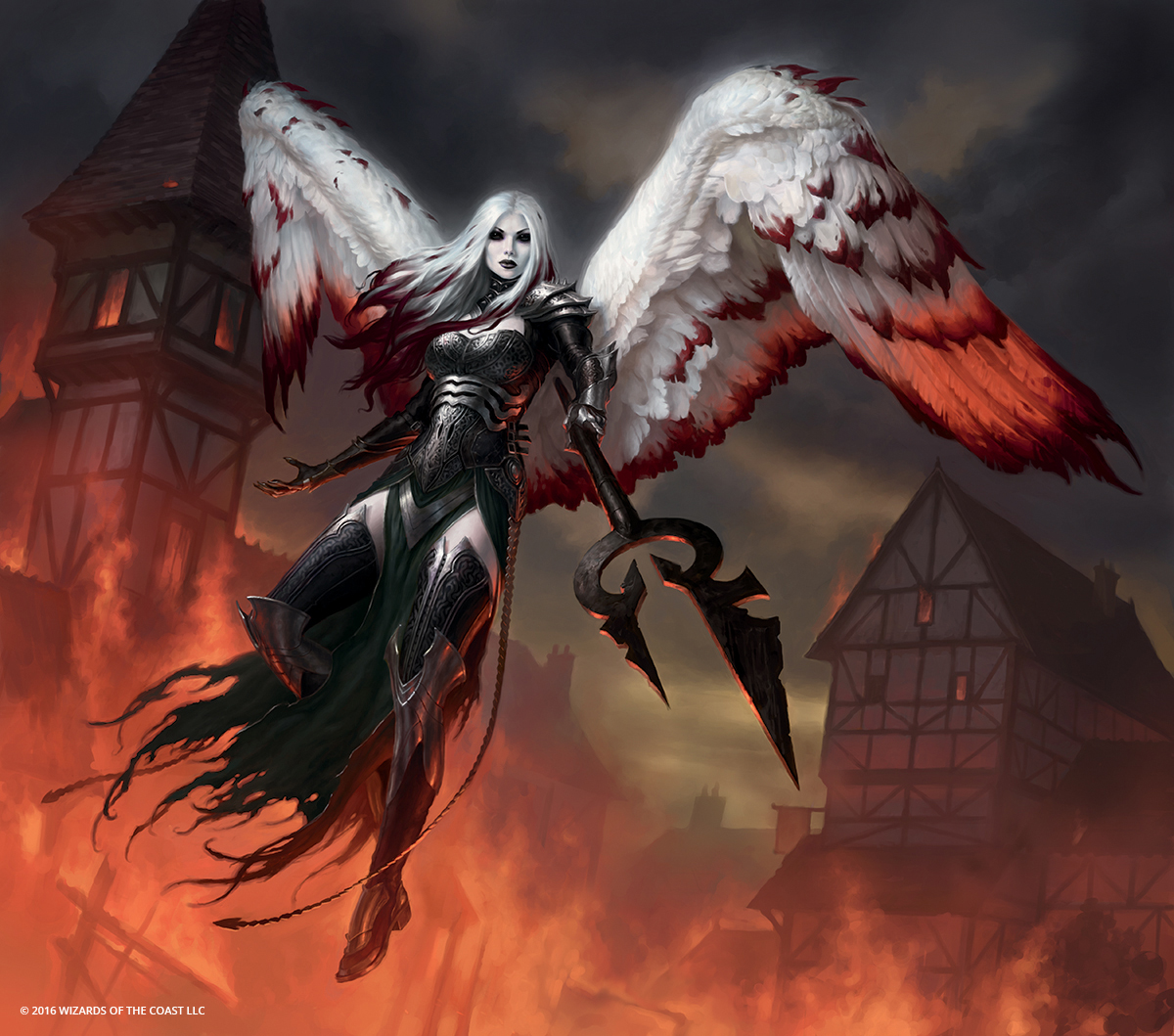
One of the highlights of the otherwise abysmal Modern Grand Prix weekend was watching Archangel Avacyn get unveiled at Grand Prix Detroit. Mind you, we didn't actually get to watch it live on the coverage (another strike against the weekend), but we did see the whole spectacle on Twitter.

Between the costumed presenter and the oversize flip legend herself, the Magic community was in love.

archangelavacyn

Unlike Thing, which we'll discuss more later, Avacyn is a card whose price tag depends entirely on Standard and Modern. Commander too, thanks to her double-colored sides, but I'm a Modern guy so I'll leave the commanding and standardizing to others. We want to see if Archangel Avacyn has a Modern home, because as any longtime Moderner or Modern investor knows, there's a lot of money to be had in this format.

Whenever evaluating a Modern card, I like to follow a few guidelines that have proven informative in the past. To summarize that Modern Nexus article, probably the most important predictor of successful Modern cards is the current Tier 1 and Tier 2 listing.

If a card either sees play in these decks, or matches up favorably against a sizable subset of them, there's a good chance it's a Modern playable. Or, stated negatively (which is often more important), if a card does not see play in these decks or target them, then it is not likely to see play.

Let's apply these guidelines to Avacyn. Let's also assume we're out of the Eldrazi Wastes so we have a wider selection of top-tier decks to choose from. I'm guessing the post-Eldrazi world (and, to be clear, Aaron Forsythe said they'll try to keep the Eldrazi intact in some form) will look a bit like the pre-Pro Tour Oath of the Gatewatch metagame. You can check out these numbers in a Nexus breakdown published in early February.

White-based decks were still struggling in this more normal Modern, but Jeskai Control was solidly Tier 2 at the time. U/W Control has since risen to Tier 2 status on the back of a positive Eldrazi matchup, momentum which might carry these white decks through past April. Avacyn might have a home here, but she's competing with (or complementing) another leading lady.

There was an error retrieving a chart for Restoration Angel

Any and all evaluation for Archangel Avacyn needs to start with Restoration Angel. They're both Lightning Bolt-proof fliers with flash. They both present a clock. They also both have an enters-the-battlefield ability that minimally saves creatures from combat damage or damage/destruction-based removal. And, of course, they're both angels.

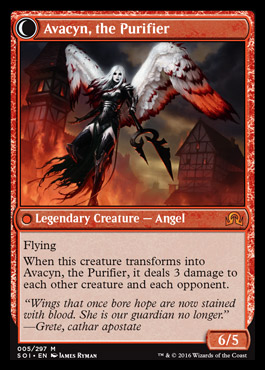
Archangel picks up an edge in four power versus Restoration's three. The difference between a five turn clock and a seven turn clock is huge. Add in Jeskai's Bolt/Lightning Helix/Electrolyze, not to mention Snapcaster Mage to do it all again, and Avacyn's extra power easily takes two turns off the opponent's clock. Of course, if you can flip Avacyn, the six-power version (plus Lava Spike) will often end the game in 2-3 hits.

This makes Avacyn a flashed Serra Angel even if you aren't getting any other utility out of her, with plenty of upsides in the right context.

Restoration Angel picks up points for mana cost (turn four is a world apart from turn five) and significantly more utility. The Snapcaster synergy is just too strong to ignore, not to mention helping out Wall of Omens and Kitchen Finks in the U/W Control shell.

The old Avacyn Restored staple also saves your creatures from all targeted removal, not just damage and destroy effects: Path to Exile and Dismember are ubiquitous in this format, and Avacyn doesn't stop them.

Another contextual weakness for Avacyn is her transformation clause. This all but prevents her from Abzan Company and Kiki Chord inclusion, where she gives your opponents a free Firespout. Her five-mana casting cost also stinks alongside Abzan's Collected Company. I actually think we might see Avacyn in Company decks without the transformation side: Serra Angel plus mass indestructibility is great. But self-Slagstorming? That's less great.

All in all, the nine damage swing is huge when she flips, and if played in response to a Dismember you can even start the beatdown early. Ultimately, I believe Avacyn is more likely to see play based on her Serra Angel form and not her transformation, although for Jeskai decks, it's pure upside, even if she's unlikely to flip.

avacynthepurifier

What about other white-based decks? Particularly less competitive decks outside of the Tier 1 and Tier 2 sphere?

Unfortunately, with the glaring exception of Eldrazi, Modern doesn't give a lot of examples of five-mana creatures who suddenly make low-tier decks viable. Avacyn is no Eldrazi, but there are other, non-Jeskai decks where she could see play.

Abzan Midrange is a great example here. She's brutal in Lingering Souls mirrors and stops the Company and Chord decks cold if flipped. The flying clock is nice too. BGx players might run her to get these edges, depending on the metagame.

As for other decks, I'm not optimistic. Death and Taxes, Hatebears, Zoo decks, and Abzan Liege all suffer from similar problems as Abzan Company; if flipped, she does a number on your own board. Naya Company decks also don't want her because of the Collected Company anti-synergy. That said, I can see her being very potent in Esper decks if those get more tools to play with. Innocent Blood, anyone?

Possible Partners for the Archangel

Overall, I think Archangel Avacyn has a home in Modern that's (close to) commensurate with her $20-$25 price tag. Assuming her Standard and Commander playability exist, not to mention casual appeal, she'll be at least as expensive as the Standard-only Deathmist Raptor and the Standard/Modern World Breaker, two mythics from frequently-opened sets. Should she drop to $15, that feels like a sweet buy-in point.

Thing in the Ice in Modern

Players got excited about Avacyn. Players lost their freaking minds about Thing in the Ice. I remember seeing this at $4.99 on Star City Games and thinking to myself, "Hmm. I feel like I should get a playset, juuust in case." About an hour-and-a-half later and at least four buyouts of the $4.99 stock of 40, the price was up to $7.99 and I got my playset.

As I'm writing this, Thing is currently sold out on Star City Games at not $7.99, not $14.99, but a whopping $19.99. I'm feeling better about that $32 expense by the hour!

thingintheice

Some have asserted Thing is a Modern mainstay destined to join Tarmogoyf in the format annals. Others have claimed it to be a multi-format all star like Snapcaster Mage. I'm not quite so generous as these assessors, but I'm definitely excited that people think this card is playable everywhere from Legacy to Modern to Standard and beyond.

This leads us to the $19.99 question (times however many singles you've speculated on)---just how playable is Thing in Modern?

Full disclosure: I haven't tested Archangel in Modern yet, and I always advocate people test as much as possible before evaluating a card. I'm convinced about 90% (or more) of card evaluators don't test either, but I'm still holding myself to a higher standard. That said, I have tested Thing in the Ice in Modern with some early, favorable results. I'll discuss the card itself before turning to results and format context. Then we'll jump to pricing at the end.

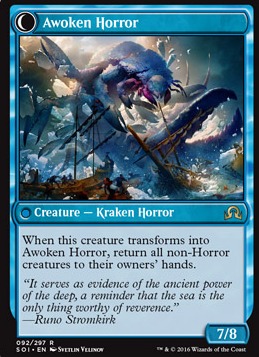
In a vacuum, Thing seems excellent. It's Bolt-proof, walls most of Zoo and Burn, rewards you for just playing Magic and casting spells you'd cast anyway, and flips into a burn- and Dismember-immune, board-clearing, three-turn, pseudo-hasty monstrosity. You also get to bounce back your Snapcasters and keep any protective Spellskites. What's not to love?

Awoken Horror

I'm certainly loving the Horror, but I also see its possible weaknesses. Abrupt Decay eats both sides alive, not to mention Path to Exile and Terminate. Affinity and Infect sneak around it, and the iced version can't even tangle with a Tarmogoyf, Tasigur, the Golden Fang, or Siege Rhino. Chump blockers like spirit tokens also give the 7/8 side fits, as long as they're deployed after the Whelming Wave effect.

All of this makes us wonder if the price tag is really accurate.

Patrick Chapin has praised Thing's synergy with Modern cantrips like Manamorphose, Serum Visions, and Gitaxian Probe. Others see Thing as a U/R Storm Plan B. Still others want to combo Thing with Vampire Hexmage (meh) and Natural Affinity (glorious). I'm not saying these strategies won't work, but if Thing is to support anywhere close to its $19.99 value, it needs to see mainline Tier 1 and Tier 2 play.

Following my Shadows card evaluation guidelines, I tested Thing in Jeskai Control and Grixis Midrange lists to assess these strengths and weaknesses.

On paper, Jeskai seemed like a great home for the Horror. Its burn spells and sideboard bullets shore up Infect and Affinity weaknesses, and you have more than enough ways to flip the Thing fast. In practice, this worked out almost as well as it played in theory.

Jeskai Synergies with the Horror

With the notable exception of Think Twice, and the techy but maybe too techy Feeling of Dread, Jeskai cards don't have a lot of explicit synergy with Thing. Rather, they address early aggression, happen to remove counters in doing so, and help you go over the top of fair decks as long as you can address things like Liliana of the Veil. Bouncing Snapcaster rocks in the Bolt-Snap-Bolt grind too.

Against Jund, Jeskai Control took a 4-2 testing record. Lily is always an issue, but between Bolt to remove Confidant, Path to take out Tarmogoyf, and Horror with Spell Snare and/or Cryptic Command backup, the deck performed quite well.

Affinity was also a 4-2 contest, and although Thing didn't contribute much here, it proved that Jeskai in the Ice remained a competitive option against varied decks. More specifically, Thing didn't dilute the natural burn and removal elements Jeskai was bringing to the matchup to begin.

Grixis also proved a viable home for Thing, with plenty of cheap staples for protecting and transforming the creature.

Grixis Synergies with the Horror

Unlike Jeskai, Grixis has a lot of inherent reasons to play cheap cantrips and free spells without fundamentally changing your deck. This is because Tasigur and Gurmag Angler explicitly reward the added cards in your graveyard, encouraging you to play Thought Scour as yet another instant-speed dig spell. There's anti-synergy with the delve critters and your Whelming Wave bounce, but it's not crippling and those creatures are strong enough in early turns.

Using this engine, I posted an even 3-3 record against Jund in initial tests. Abrupt Decay was annoying (Grixis otherwise blanks it with Tasigur and Angler), but turn one Inquisition proved strong here and we're still dodging all of Jund's Bolts. Flipping Horror was trivial, and it felt nasty to do it at instant speed, clear the opponent's board, and then swing to take out their Liliana.

Thing was much worse in the Affinity contest, where I only eked by with a 2-4 record. Affinity is a tough matchup for Grixis decks to begin with, and the Horror wasn't doing much to slow the charge. Affinity replayed all of its threats with ease, ignoring the under-Whelming Wave (hoho) and only falling in the face of excessive Bolts and Commands.

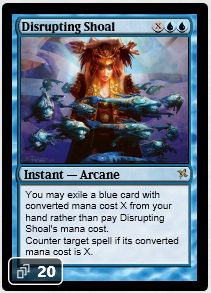
Despite some issues with Affinity, Thing showed a lot of early promise and I fully expect it to see Modern play. This also doesn't even touch on its potential in the Taking Turns Time Warp decks, alongside Disrupting Shoal, and as a finisher after Blue Moon establishes the Blood Moon lock. I'd also be lying if I said I hadn't dusted off the old Mercadian Masques Natural Affinity for a spin.

Other Homes for Thing in the Ice

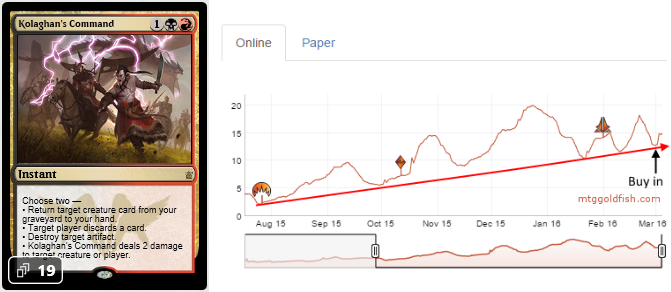
Taken together, these data points suggest Thing in the Ice is going to support a Modern price tag in the $10-$15 range. Kolaghan's Command got over $20 after less than a year, with Collected Company at just under $20 despite benefiting from a reprint. Thing doesn't seem like it will push beyond those benchmarks, but it should get past the Modern-only prices on other rares like Tasigur.

Hold off on buying these $19.99's for now, but if you can get in below $15, certainly below $12, you'd be in great shape.

More Shadows to Come!

I'll be back next week to review more Shadows over Innistrad cards, hopefully with more testing results of either Thing---I really want to see how it does with Disrupting Shoal---or the new Modern playables we're bound to get this week. And by "bound to get," I mean, "almost certain to not get and plunge Reddit into a righteous frenzy." What can I say? Spoiler season is always a good time.

Let me know in the comments if you have any questions about these two cards, other Innistrad previews, or any lingering Eldrazi topics you want to discuss. See you all soon!

Insider: High Stakes MTGO – Mar 6th to Mar 12th

Are you a Quiet Speculation member?

If not, now is a perfect time to join up! Our powerful tools, breaking-news analysis, and exclusive Discord channel will make sure you stay up to date and ahead of the curve.

Welcome back to another week of High Stakes MTGO!

Following two busy weeks, this past week saw less action especially in the sale department. Both Modern and Standard are in a sort of standby mode. Modern is patiently waiting for a another reset of the format when new ban(s) should put down the Eldrazi decks and Standard is about to experience its first Spring rotation.

Let's review what happened this past week. The details of my portfolio can be found here.

Buys This Week

BFZ4

Battle for Zendikar (BFZ) full sets lost a little bit more ground and are currently priced around 60 tix. I bought one more playset and with this new price trend I'm now waiting to see how low they can go before purchasing one final round of these full sets. The absolute bottom might well occur during the release events of Shadow over Innistrad (SOI).

SM

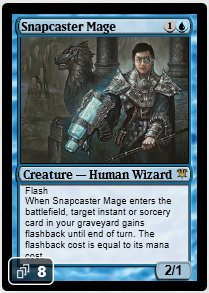
Despite being pushed to the sideline at the moment, Snapcaster Mage still remains a powerhouse in Modern. With the end of the Eldrazis all but guaranteed, and provided the Mage dodges a reprint in Eternal Masters (EMA), Snapcaster Mage should undoubtedly be priced around 25 tix sometime later this year.

In case of a reprint in EMA I'm assuming I'll have a small profitable selling window in April. Either way, and even with only moderate profits in the short term I think this is still a solid spec---hence my new purchase of two playsets.

PiF

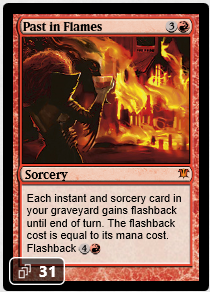
Past in Flames has a very unique effect and has seen play in Storm decks in Modern and Legacy, with only a minimal appearance in Modern considering the format's current situation. With the exception of a price dip last September during Innistrad flashback drafts, the floor of Past in Flames has been around 10 tix for about the last two years.

I see only upside in investing in this mythic at its floor price. As for many other of my Modern positions I expect a potential price spike during the next B&R list announcement.

Muta

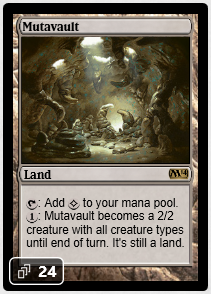
The reasoning for Mutavault is about the same as for Past in Flames. I bought this manland at its long-term price floor, waiting for the next spike.

MoW

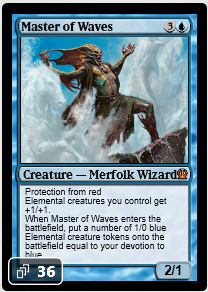
This may not turn out as a spectacular spec but with only moderate play in competitive constructed decks Master of Waves reached 14 tix in January. The recent big drop is most likely solely attributed to the end of redemption for Theros.

After the big fall a floor seemed to have been found around 8 tix, which is therefore only a reflection of the online demand. I'm taking my chances here; let's see how high this merfolk can go now.

DS

Another "Year of Modern flashback drafts" target; I could have bought it earlier though. I'm only expecting moderate profit here since I'm afraid the spread is always going to be big on this type of card. Anyway, I thought there was a chance at a little profit.

SS

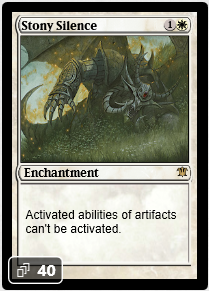
Probably the biggest swinger of these past two months. Stony Silence went from ~3 tix to ~8 tix three times since January. It's back to 3 tix this past week and I couldn't resist on another round of roller coaster. Affinity will most likely remain untouched after the next B&R list changes and will still be a strong player in any Modern metagame. No reason for the demand for Stony Silence to fade away.

Sales This Week

My weekly sales of Magic Origins painlands, my first sales of Yavimaya Coast. I'm not rushing my sales with the painlands, even with the profitable ones, but every time the buying prices are high enough I liquidate a few playsets. It's going to take some time to sell them all. I still think the demand will dramatically increase after the rotation of Khans of Tarkir.

The price was stabilizing around 15 tix for three weeks. At that point I realized that the spread was indeed fairly big, almost 20%. This means that if the price of Cascade Bluffs had started to tank a bit I would have been left with pretty much zero profit even with my buying price of 10 tix. I decided to cash out my modest profit and moved on.

Even after a solid spike the spread is still a major concern with Legacy positions. We are mid-March and prices don't seem to really push higher, at least for now. I didn't want to gamble with these guys even with all the noise around Legacy, Vintage and the release of EMA.

Before the Legacy leagues and the Legacy Challenge were announced Legacy specs were not on my radar so I happily take the extra cash coming from my few Legacy investments. Force of Will is the only card left I have from that mini wave of Legacy specs.

On My Radar

What's on my radar for the next few weeks until the release of SOI is to try to time the best I can the optimal window to buy BFZ and Oath of the Gatewatch (OGW) singles. Being a small set and now drafted as a two-of, OGW boosters are cracked very often, putting strong pressure on OGW single prices. I expect OGW prices to keep falling until April.

BFZ is more puzzling to me. Since the beginning of March the general trend has been on the decline for BFZ full sets. However a few singles I'm considering buying, including Drana, Liberator of Malakir, Shambling Vent, Prairie Stream and Cinder Glade, haven't really followed the full set trend and are actually up.

Did I miss the absolute bottom on these singles? Or is it only temporary? I'm inclined to believe that with the global trend being down these singles will eventually catch up to the declining trend, with a bottom to be found around the release events of SOI.


Thank you for reading,

Sylvain Lehoux

QS Cast 26: The Reflector Mage Summer

Are you a Quiet Speculation member?

If not, now is a perfect time to join up! Our powerful tools, breaking-news analysis, and exclusive Discord channel will make sure you stay up to date and ahead of the curve.

Play

Is a Thing in the Ice better than everyone’s hated U/W uncommon? Do you want to be Reflecting or breaking out a Thing in the Ice? Today, the show talks about:

  • why Thing in the Ice isn’t exactly a blue Tarmogoyf
  • Pia and Kiran Naalar, two unexpected beneficiaries of clue tokens
  • Vesuva as a post-Eye of Ugin ban target if Eldrazi Temple endures
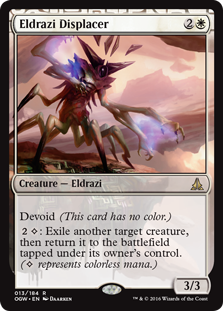
  • The new Avacyn: playing dangerously with Eldrazi Displacer

Douglas Linn

Doug Linn has been playing Magic since 1996 and has had a keen interest in Legacy and Modern. By keeping up closely with emerging trends in the field, Doug is able to predict what cards to buy and when to sell them for a substantial profit. Since the Eternal market follows a routine boom-bust cycle, the time to buy and sell short-term speculative investments is often a narrow window. Because Eternal cards often spike in value once people know why they are good, it is essential for a trader to be connected to the format to get great buys before anyone else. Outside of Magic, Doug is an attorney in the state of Ohio.  Doug is a founding member of Quiet Speculation, and brings with him a tremendous amount of business savvy.

View More By Douglas Linn

Posted in Free Insider, QS Cast3 Comments on QS Cast 26: The Reflector Mage Summer

Have you joined the Quiet Speculation Discord?

If you haven't, you're leaving value on the table! Join our community of experts, enthusiasts, entertainers, and educators and enjoy exclusive podcasts, questions asked and answered, trades, sales, and everything else Discord has to offer.

Want to create content with Quiet Speculation?

All you need to succeed is a passion for Magic: The Gathering, and the ability to write coherently. Share your knowledge of MTG and how you leverage it to win games, get value from your cards – or even turn a profit.

Losing and Learning: Analyzing Losses at GP Detroit

Are you a Quiet Speculation member?

If not, now is a perfect time to join up! Our powerful tools, breaking-news analysis, and exclusive Discord channel will make sure you stay up to date and ahead of the curve.

The triple Eldrazi Grand Prix weekend has come and gone, and with it went my final shreds of hope for this Modern format. Luckily, Aaron Forsythe confirmed at GP Detroit that Eldrazi was "DEFCON 1" for Wizards, and we’ll certainly see a metagame correction in April. While I won’t play much Modern until then, I still have a lot to say about this weekend. I brought the devoid sluggers to the battle myself, but lost as my misplays and poor pre-tournament decisions stacked the odds against me.

Oath Banner

In Sowing Salt: Eliminating Toxic Attitudes, I encouraged players to take their losses in stride and learn from the circumstances that contributed to each failure. Most Modernites are as sick of hearing about Eldrazi as I am of playing against it, so I won’t bore you with my Mimic-heavy tournament report. This article instead takes readers through my own loss-analysis process, considering the things I could have done better leading up to and during the tournament.

[wp_ad_camp_1]

Motivation and Work

Most of the errors I made come down to an overarching theme: motivation. The Eldrazi metagame hasn't really stimulated me. Normally a Modern junkie, I’ve spent a good deal of time away from Magic as the raging monsters took over my beloved format. But naturally, if you don't do the work, you don't reap the benefits. Here are some ways I could have quelled my apathy.

Setting and Keeping Goals

I realized the importance of goals at GP New Jersey. Treasure Cruise was destroying Legacy, and I showed up with a port of my Modern Counter-Cat deck to try my hand at the format for the first time. Tropical Island, Wild Nacatl, Daze, Volcanic Island, Ponder, attack for two. I ran very hot and ended up going 7-2 on Day 1, and 11-4 total, despite my inexperience.

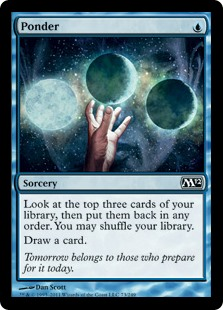
PonderI came home from that weekend a different man. Not because I’d had a good time, or met interesting people, or even attended my first Legacy tournament. But because I’d spent my weekend casting Ponder and Brainstorm. And you can’t cast Ponder and Brainstorm without a plan - unlike Serum Visions, which mostly smooths out future draws, those spells dig for answers very efficiently and are too valuable to resolve casually. Before casting them, you always have to ask yourself: what do I need to find?
Since New Jersey, I’ve applied this cantrip philosophy to every aspect of my life. When friends ask for advice, I wow them with my wisely stoic, stock response: well, what’s your goal in this situation? Realistically, I’m not that wise. All I’m doing is casting Ponder.

Unfortunately, I didn’t cast Ponder this weekend.

I had low hopes for the tournament, and my goal for the GP was just to make Day 2. I came up with this goal the morning of the event. Making Day 2 is a fine goal, but I could have prepared for it a little better by asking myself some questions. What will the level 0 field look like? What decks will see the most play early on?

I didn’t do any of this work, and ended up narrowly missing Day 2. Getting caught up in the soul-draining depths of colorless Modern made me forget what being a blue mage is all about: Pondering. But hey, at least my Ponders have Dan Scott’s signature on them now.

Remembering the Joy of Competition, and Planning Ahead

“I don’t get to play Delver.” “It’s not even real Modern.” “All the games will come down to variance anyway.” These are some of the excuses I made to diligently slug through hours of Dragon Ball Z characters “powering up” (how is that necessary?) instead of preparing for GP Detroit. When I got to the tournament and started playing, I realized that no matter how messed up the format was, competitive Magic really gets my rocks off. I wished I’d better prepared for the event so I could get more out of it than I did, and vowed to keep the regret in mind for next time.Ratchet Bomb

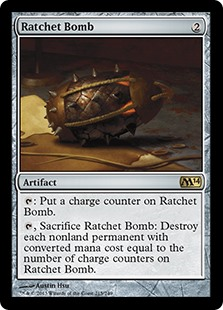
Planning ahead would have helped me avoid a number of snags. For instance, my Detroit list had 3 Ratchet Bomb and 3 Gut Shot in the sideboard, but my collection only had two of each card as I pieced the deck together before driving West. Despite the fact that I was driving to the tournament with someone who manages a card store and literally has every Modern staple at his disposal to lend me, I sleeved up Pithing Needle and Surgical Extraction (!??!!) instead. This two-card sideboard change heavily impacted the tournament, as I lost to Affinity twice by small margins.

Choosing a Deck

Here's where my lack of motivation first took its toll. Weeks before the tournament, I made a few deadly mistakes in even choosing a deck for GP Detroit.

Personal Biases

In last week's article, I discussed the importance of playing a deck you enjoy and know well. While I stand by those claims, it's possible to cling too strongly to a certain archetype, deck, or card. Sometimes, players take their "pet decks" to wholly hostile metagames, and lose as a result.

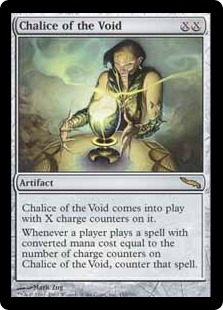
To avoid falling into the pet deck trap, I elected to play Eldrazi at GP Detroit. What I hadn't done was completely eliminate my desire to play something "different" from everything else. It's not any fun for me to win with a deck I didn't design, or at least heavily influence. Sleeving up UW or GR Eldrazi, which I correctly assumed were the strongest builds going in, wouldn't have sat well with me. I subsequently failed a number of pet deck tests, packing Serum Powder without doing hard data collection or number crunching, and running Chalice of the Void despite its obvious weakness in an eldritch ocean of four-drops. I didn't even test different color splashes.

Things I could have done differently:

  • Tested Serum Powder more rigorously
    I had originally planned to take sample hands until I opened Serum Powder 100 times and analyze the card's relevance in each. For the GP, I settled on playing a relatively arbitrary three copies, but this kind of data collection would surely have helped me find the optimal number.

To be clear, I loved Serum Powder during the event. It shone the most in Round 2, when I came out of a relaxing bye to face Affinity. I swiftly 2-0’d my opponent by finding perfect hands, spending a few minutes resolving my mulligans. The process took so long because I opened every Serum Powder in the deck - for at total of six in the match - and began each game with close to half my library in exile.

  • Chalice of the VoidTried omitting Chalice of the Void
    I actually worked for a while on a colorless version of Eldrazi without Chalice of the Void, instead putting the artifact in the sideboard. Simian Spirit Guide became much worse without Chalice in the main, and cutting Guide made the Chalices from the board pretty unreliable in the matchups I wanted them for. The problem I had with this build was I saw no real reason to remain colorless. If I wasn't going to play Chalice (or Guide), why not just splash UW and fill out those eight spots with more threats? I left these issues unresolved, and my deck suffered as a result.
  • Gave splashes a fair trial
    Thanks to Modern's painlands, splashing colors proves tremendously simple in Eldrazi decks. Some testing with various splashes might have led me to choose a few important threats and splash for them, or to include utility spells like Ancient Stirrings or Path to Exile. My stubbornness got in the way of these possibilities. When I first built the Eldrazi deck, I wanted to abuse Chalice of the Void as much as possible. The Colorless Eldrazi Stompy lists we saw at the Pro Tour soon after provided an improved way to do that, and inspired me to swear by colorless as a result. I think I missed out on a lot of superb options by not testing colors, or even trying to re-integrate black. In hindsight, Night of Soul's Betrayal and Whip of Erebos seem stellar in the pseudo-mirror.

Overall Metagame Positioning

I played Eldrazi because I liked certain elements of the deck, and figured it was better than any non-Eldrazi deck. I was mostly right, but had foolishly decided to try "dodging" the Eldrazi menace myself instead of innovating ways to get over (or under) the mirror. The problem with this strategy is that if I'm going to lose to Eldrazi, I might as well play not-Eldrazi.

Things I could have done differently:

  • Adjusted to beat the mirror
    I didn't do many games against UW Eldrazi, and have never even played against GR Eldrazi, at the Grand Prix or elsewhere. My losses at the GP were to UW Eldrazi (twice) and Affinity (twice); had I shored up the UW matchup a little, I might have taken one of those matches and made Day 2.
  • Eldrazi DisplacerPlayed a better-positioned deck
    This option relates back to personal biases. Had I not been so stubborn, maybe I would've given ol' Eldrazi Displacer a whirl (in its proper home). UW has more technical interactions and synergies than Colorless Eldrazi, but it's still Eldrazi; slamming threats on-curve is generally sufficient with these decks. It seems straightforward enough that I could manage even on my first try.
  • Played something more fun
    I had a decent time piloting Colorless at the GP, but I always have fun playing competitive Magic. A more innovative or complicated deck might have tickled me more, and since I didn't end up taking the tournament very seriously, I could have blatantly ignored (instead of just incidentally ignored) my metagame positioning and gone with something truly terrible, but more stimulating. You know, like Delver of Secrets. I also did a few testing sessions with a friend, Jamie Blanchette, to make sure his Esper Rally brew was favored against the turn two Thought-Knot Seer deck (it was). As much as Esper Rally isn't something I'd normally play, I wished I'd had a deck that mentally engaging to draw from throughout the tournament as I watched Jamie brilliantly blitz through Day 1. By comparison, I felt a little dumb winning games because I happened to open the right lands.

The Golden Rule of Brewing

I've long said that the first thing to do when you brew is to make sure your deck isn't a worse version of an existing deck. Many decks in Modern show up once, or maybe twice, and then vanish - that's because the superior version gets most of the credit. Humans? Often a worse Zoo. Slivers? Usually a lackluster Merfolk. Colorless Eldrazi? Yep, bad UW Eldrazi. These decks can still pair favorably and take home a trophy, but they do so rarely. For example, a Humans player can, in some depraved metagame, pair nine times against decks with atrocious Zoo matchups and end up undefeated. That doesn't make Humans a respectable deck, or one anyone should ever play. I ignored this rule for the GP, opting to play a cobbled-together list of cards I thought looked cool instead of a tested-and-proven assemblage of known hits.

Tuning Your Deck

With an acceptable deck in mind, we can begin tuning for the event in question. I may have failed in my deck choice, but I still tweaked my numbers for the GP. Regardless, I made a few mistakes on this front, too.

Number Count and Tech Choices

We discussed arriving at 3 Serum Powders above - the switch from four wasn't so much a result of testing as an intuition after sometimes clogging on them. Some other suspicious inclusions on my part are the one-off Sea Gate Wreckage and the pair of Endbringers.

Sea Gate WreckageSea Gate Wreckage tested very well for me against Eldrazi decks after we'd traded resources, but before we could activate Eye of Ugin. Likewise, Wreckage excelled against grindy midrange decks with mana denial effects and discard spells. Against these decks, Eldrazi already has such an advantage that I'm not sure Wreckage earns its spot over Mutavault #3. And against Edrazi decks, the matchup so frequently comes down to who draws the most explosive opener that I doubt Wreckage pulls its weight. It certainly did nothing for me this weekend.
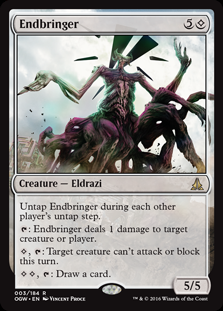
EndbringerIf I really wanted to beat Eldrazi, I should have ditched Endbringer entirely and gone with Oblivion Sower in the main. Sower was a card I tested before, even as a four-off, but decided not to play at the GP because it did so little against the format's small aggro decks, while Endbringer would carry those matchups by himself. I should have remained focused - there wasn't supposed to be that much Infect last weekend, and Sower would certainly have been a better choice against the known quantities of Eldrazi. Endbringer might get over Ensnaring Bridge, but that card has been seeing considerably less play as intelligent Eldrazi players brainstorm solutions to the artifact. (Or just play mainboard World Breaker.) As for Endbringer's relevance vs. Affinity, I could have probably dedicated more sideboard slots to the matchup and performed better against Modern's original devoid bogeyman.
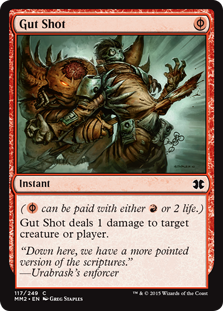
Bringing a Sideboard Plan

I’ve read many articles from experienced players about not needing or liking sideboard plans. Personally, I love them, especially when I’m not truly intimate with a deck. Just designing a sideboard plan challenges me to establish my probable role in each matchup. Between games, with thoughts about the recent win or loss swimming around in my head, it can be tough to focus and decide on the spot what I should be doing in Game 2 before I have a serious handle on my deck.

Making sideboard plans has another important function - it helps tune the sideboard. If I make plans for each matchup and realize that Surgical Extraction only comes in twice, maybe I should cut Surgical Extraction for something more flexible. If I have too many cards to bring in against UW Control and not enough to bring in for Affinity, maybe I should cut Crucible of Worlds for a third Gut Shot. I missed out on these thought processes by not making sideboard plans, and even had trouble identifying my role in a few matches as a result.

Knowing Your Role

Gut ShotAgainst my first UW Eldrazi opponent, I neglected to board in Gut Shot on the play, assuming my opponent would remove his Mimics and try playing a control game. He had the Mimics anyway and out-tempo'd me with them. Against my second, I never saw a Mimic after Game 1, and was told after the match that he'd boarded them out for Games 2 and 3, effectively blanking my now included Gut Shots. Whether one of these opponents knew his role and one didn't, they both misboarded, or they both picked up on and took advantage of my inexperience, the fact is I had no idea what I was doing between games, or what my opponents would do. I boarded poorly in both matches, and would have gained a significant edge by simply acquainting myself with the UW Eldrazi matchup.
In Game 3 of Round 8, I narrowly lost to Affinity after dominating the matchup earlier in the day. My sleepy opponent made a bunch of visible misplays, but none as major as mine. On turn three, I seized the initiative and slammed Reality Smasher on a nearly empty board with a grip full of disruption, deciding I could ride the behemoth to victory while negating my opponent's future plays. My opponent had no cards in hand and a lowly Vault Skirge on the ground, with two Inkmoth Nexi and an inactive Mox Opal for mana. He topdecked Cranial Plating and handily raced me to the finish line a turn before I could resolve and crack Ratchet Bomb on two. I made an obvious mistake: I tried to out-aggro Modern's most aggressive deck. Had I scared off the Plating by landing Ratchet Bomb earlier, my stream of business would easily have gotten me there. But I didn't know my role in the matchup, and ended up losing with a fresh Endbringer in play and the Bomb at one counter.

Modern Rules!

When I told inquisitive friends how I did in Detroit, they uniformly replied with disappointment and empathy. “Sorry, dude.” “That sucks.” I actually had a great time, and I learned a lot about deck building, event preparation, and priorities. Don’t be sorry! GP Detroit was about as tentacle-y as I’d imagined, but I guess even at its worst, Modern has something to offer me. Here’s to the coming April metagame and the open format we know and love.

Jordan Boisvert

Jordan is Assistant Director of Content at Quiet Speculation and a longtime contributor to Modern Nexus. Best known for his innovations in Temur Delver and Colorless Eldrazi, Jordan favors highly reversible aggro-control decks and is always striving to embrace his biases when playing or brewing.

View More By Jordan Boisvert

Posted in Brewing, Modern, TournamentsTagged , , 2 Comments on Losing and Learning: Analyzing Losses at GP Detroit

Have you joined the Quiet Speculation Discord?

If you haven't, you're leaving value on the table! Join our community of experts, enthusiasts, entertainers, and educators and enjoy exclusive podcasts, questions asked and answered, trades, sales, and everything else Discord has to offer.

Want to create content with Quiet Speculation?

All you need to succeed is a passion for Magic: The Gathering, and the ability to write coherently. Share your knowledge of MTG and how you leverage it to win games, get value from your cards – or even turn a profit.

Insider: Virtually Infinite – Eternal Masters & The Future of Legacy

Are you a Quiet Speculation member?

If not, now is a perfect time to join up! Our powerful tools, breaking-news analysis, and exclusive Discord channel will make sure you stay up to date and ahead of the curve.

We’re here with our second article in this series on how Magic Online players, collectors, and speculators can position themselves for the arrival of Eternal Masters (EMA) to preserve and increase the value of their collection. You’ll can read the first in the series here, and see some of my past articles here.

Legacy Is Dead. Long Live Legacy.

The thing about Eternal Masters is that it might rejuvenate Legacy and kill it at the same time. Let me explain.

Paper Legacy is in an existential crisis. The Reserved List is a hard cap on the number of people who can participate in the format. Decks are expensive and all the money is in the secondary market, which means Wizards has no financial incentive to support the format.

Despite the appeal of the format---which is complex, diverse, nostalgic, and a lot of fun---it's only a matter of time, without support from Wizards or a retailer like Star City Games, before it enters a death spiral. In paper Magic, the future of Legacy is as a cool niche format like Vintage, beloved to a few die-hard adherents but inaccessible to mere mortals.

Online is a completely different story. With no Reserved List for digital cards, there is no ceiling to how many people can enjoy the format. Wizards controls the flow of cards and can print online-only sets that leverage their existing intellectual property to rake in cash. They have an incentive to keep the format alive.

As a result of recent reprints, Legacy staples are surprisingly affordable. In paper, a revised Tundra will run you $220. On MTGO, Tundra recently jumped in price
to 14 tix. For the cost of one paper Legacy deck you can buy a digital collection that allows you to play six or seven archetypes. Online there is a diverse metagame supported by the convenience of “anytime, anywhere” play---including via newly introduced Leagues.

There was an error retrieving a chart for Tundra

Bottom line: Wizards has every incentive to support Legacy on MTGO, and virtually no incentive to support Legacy in cardboard. The future of Legacy on MTGO is bright. And there are a lot of cards with low supply that will rise in price as the format grows.

Let's be clear: now is not the time to go deep on Legacy. The uncertainty created by EMA reprints has kept a lid on prices, but has also created risk that anything you buy could plummet. And there are other lucrative investment opportunities available---in particular BFZ complete sets which should offer a safe and solid return over a 3-6 month timeline. Anything you buy right now has an opportunity cost that must be compared against these alternatives.

If you are a speculator you will want to be selective in the Legacy bets you place, but they can be a high-performing part of a balanced portfolio. If you are a player or casual collector I would steer clear of Legacy at the moment---with a few exceptions---and sell down cards that are at risk of reprint in EMA.

This article will look at what to sell. In the next article we will look at a few of those exceptions that we should be buying.

Is Legacy Underpriced?

Is Legacy underpriced right now? Today the Legacy index has been basically flat for 18 months and stands at 2150 tix for a basket of staples.

Legacy Index
Legacy Index, 2014-2016

Compared to past prices, Legacy is not expensive---the index is 20% lower than its peak 18 months ago, in September 2014. That suggests there is significant room for growth even if there were no other positive drivers. But there are other drivers, as we'll discuss below.

Right now, a lot of potential players are holding out for EMA, not wanting to buy cards until it drops. Of course, the index will drop when EMA hits the market, but the player base will increase, and any playable cards not reprinted will rise.

We saw this dynamic with Vintage Masters (VMA) in the summer of 2014. Over two months, the Legacy index rose 20%. That doesn't sound that impressive until you realize those gains were localized within only a dozen or so cards, which meant there were some big winners. We will be looking both to time the market right and to identify the right targets.

Factors Supporting Growth

Whether or not Legacy provides speculation opportunities hinges on the growth of the Legacy community on MTGO. What are the factors that may drive growth in Legacy prices?

  • Leagues - Right now it’s easier than ever to find a meaningful Legacy game, and if current leagues expand from 400 participants to 800 or 1000 that will be even more the case. I expect Legacy leagues to hit 1000 players this summer with the release of EMA, which would represent a significant growth in the player base. Leagues are not attractive to grinders, but for casual competitors they are perfect. We saw Pauper leagues revitalize the value of Pauper staples.
  • Fewer Barriers to Entry - Most people don’t realize that on MTGO Legacy decks cost less than Modern decks, and even less than most Standard decks. And that’s today, when Legacy still has some high-priced bottleneck cards that will be reprinted. When Eternal Masters comes, prices on a whole range of staples will drop. In particular, Wasteland is a bottleneck that keeps people from playing the format. So is Rishadan Port, which I expect to be reprinted in EMA.
  • Prize Support (TBD) - With the arrival of VMA, we saw high-profile Vintage events to highlight the format. They have already announced a monthly high-payout Legacy tournament (the first Legacy Challenge is March 12) and may have others in store once EMA hits. It's worth keeping an eye on these since MTGO activity is tied to major events and prize payouts.

Based on these factors, I expect continued growth of the Legacy player base, fueled by leagues and by an influx of cheap staples, which will in turn drive demand for cards that aren’t reprinted. We put that theory to good use last week when we nabbed a bunch of Reserved List staples on their way up.

Here are some of the picks from last article:

Reserved List Picks

I initially suggested this basket in a forum post. I have to admit that by the time the article came out these were not the best buys, since we were too late. That said, even if you bought at the time of the article there have been some gains.

City of Traitors has been the only especially strong pick on this list, doubling in price. Mox Diamond, Shallow Grave, and Gaea's Cradle have done well too. These are all safe medium-term bets, but there are probably better places for your capital. I am not recommending additional Legacy buys at this point.

Timing

In Sylvain’s article he stated, “I’m closely monitoring my Legacy positions and I might sell these very soon. I’ll discuss this more in detail below, but I didn’t intend to keep my Legacy positions for the long run.”

Sylvain has a stellar track record and his advice makes perfect sense. My take differs a bit because of I’m on different timeline. As I discussed in the previous article, I don’t have much time on MTGO and am not looking to buy and sell a lot of short-term positions. Rather, I am seeking strong passive investments in the three-to-six-month time frame.

There are opportunity costs to this, but I believe Legacy will offer several targets in the coming weeks and months that are worth buying and holding. In contrast, Sylvain will take his Legacy earnings and put them to work. Because buying and selling is relatively seamless on MTGO, that kind of velocity can provide very strong returns, if you have time to actively manage your portfolio.

Sylvain also offers a useful caution concerning the Reserved List:

“There is no such a thing on MTGO
 Anything and everything can be printed and reprinted at will in the form of special sets, promos or flashback drafts. Cards from the Reserved List won’t be in EMA and dual lands and the like may have a better chance to sustain the price hike they recorded these past two weeks
 However you should not think that’s a safe investment in the long run.”

This is valuable advice. There is nothing stopping Wizards from producing any and every card online. And there is no escape valve of redemption for eternal cards, so once a card is in the system it's there forever. Only demand from players, bots, and speculators puts upward pressure on prices of eternal cards. A lot of cards entered the system during VMA so there is still some slack.

That said, I think the risk of Vintage-set flashback drafts is low in the short term. The fact that we have a steady stream of Modern flashbacks scheduled for every non-release week makes me wonder where they would fit in Vintage flashbacks.

A promo or two seems more likely, since it offers a tie-in with their emphasis on Legacy. It does present a risk. But even then, they are unlikely to promo more than a couple of the cards on the Reserved List.

Our Investment Timeline

Even if Legacy does expand its player base, these cards are risky long-term bets. That’s why we will sell our Reserved List specs before the threat of promos and flashbacks.

I anticipate that in the end there will have been four opportunities to profit:

  1. The first bump was when Legacy leagues were announced.
  2. A second bump was when it was announced the Reserved List would not be included in EMA. That was a good time to buy RL cards, but is now in the rearview window.
  3. I expect a third bump when the full EMA list is released and people rush to pick up everything that wasn’t reprinted. (Those who weren’t paying close attention will have missed key Reserved List cards that are important parts of the decks they want to build.) The biggest spike will be from cards that everyone expected to be in the set but are not
if we could predict those we would be golden.
  4. Finally, I’d expect a fourth bump for all non-reprinted staples (including our Reserved List specs) in June and July, when EMA cards enter circulation and Legacy becomes a more accessible format. If EMA is popular there will be a liquidity crunch around that time, but soon after I’d expect the Legacy index to start a long, slow climb. There will also be some speculative activity in the week immediately before EMA hits the stores.

My plan is to sell some copies after each of these spikes in order to free capital for new specs. This is a 3-6 month play, not a long term buy and hold strategy. I am first and foremost a player, so I am willing to assume some reprint risk on my playsets. But I don’t want to be holding investment targets after July (though I will hold my playsets).

I still think some Reserved List cards offer good value. I’ll go into more detail in my next article. But in the meantime, let’s take on one of the frequently asked questions: what Legacy cards should I be selling right now?

Refining the Watch List

Last article I generated a broad watch list based on what people suspect might be reprinted. Let’s try to refine that list a bit.

The safe approach is to sell everything that could be reprinted. There are two problems with this. First, it limits your ability to play decks that use these cards. Second, buying these cards back will be much more expensive if they aren’t reprinted. Take Lotus Petal, a card that was widely expected to be reprinted in VMA---the moment it did not appear on the list its price shot up.

Lotus Petal dropped when it was assumed to be in VMA, then quickly spiked when the set list was announced
Lotus Petal dropped when it was assumed to be in VMA, then quickly spiked when the set list was announced.

For anything you sell, you may end up buying your playsets at a premium.

Vintage Masters contained reprints of virtually everything of value. That won’t be the case with Eternal Masters because it's a paper set as well. Wizards will not want to pack it too full of value or they risk having stores, dealers, and collectors hoarding unopened product rather than getting it into the hands of players.

Saffron Olive has some good articles where he crunches the numbers based on the EV of a box; it’s a good principle even though I think he has some of the details wrong.

Paper cards will be limited by how much product is printed. For MTGO we don’t have the same problem, since people will be able to draft the set as long as it’s available (three weeks). We know from previous Masters sets that the value of the set will drop precipitously.

So, what's on our watch list?

Cards Specifically Named by the Source

Zendikar Fetchlands - These were specifically named by the source of the EMA leak. They have already lost much of their value. But if reprinted (as is expected) they will drop to under 10 tix each. I’d recommend selling everything but your playsets, and considering selling any playsets you aren’t playing with regularly.

Just be aware that if these are not reprinted their price will spike in a matter of hours, so be prepared to act quickly.

My advice is to gradually sell down to playsets, and consider selling those. Consider switching to Expeditions, which are not much higher than the price of ZEN versions but are more likely to retain their value after a reprint.

Rishadan Port - Also named in the leak. I do not want to be holding Ports. A reprint seems inevitable as part of EMA. This will likely be printed at mythic, given how obnoxious it is in Limited and the fact that Wasteland is at rare.

Mother of Runes - a 2 ticket uncommon, this seems a likely reprint.

Lotus Petal - the Pauper and Legacy staple is 4-6 tix depending on the version. I'd expect this to be worth under 25 cents if reprinted at common in EMA.

Infernal Tutor - At 46 tix, this is a high-risk hold as a reprint seems quite possible. It's one of the cards that is more expensive online than in paper, which means that it can be reprinted without raising the paper EV too high.

“Piece of Elf Deck” - My guess is that Elves will be one of the archetypes available in EMA, though whether it is a heavy or light touch remains to be seen. One card we are likely to see is Natural Order since it plays really well in a Cube environment. It's at 10 tix and would drop to a ticket or less if reprinted at rare.

Judgment Wishes - Cunning Wish is at 6 tix, Living Wish is at 2 tix, and Burning Wish is under a ticket because it was reprinted in VMA. All will drop to pennies if reprinted at rare.

Other Likely Inclusions

Dark Depths - Banned in Modern so a reprint here makes sense since it can't show up in Modern Masters sets. It's 25 tix online.

Cabal Therapy - At 18 tix for an uncommon, the risk is high. If you want to maintain playsets, I'd recommend switching to the Premium Deck Series: Graveborn version, which is a third of the price.

Sneak Attack and Show and Tell - As I mentioned in the forums, I can see a reanimator/graveyard abuse theme being one of the main things you'll be doing as a black/Dimir drafter. Then once in a while you'll open a Sneak Attack which will pull you into Grixis or a Show and Tell which will improve your deck. This benefits the draft format by providing a role for the flashy and hard-to-cast Legacy and Commander creatures they surely want in the set.

Some other cards on my radar that would support this (they won't print them all, but they're on the watch list for me):

  • Goryo's Vengeance, Entomb, Recurring Nightmare and other reanimator stuff.
  • Natural Order (which I think we'll see at rare, and creates the Golgari version of the deck).
  • They could go with Makeshift Mannequin, Unburial Rites, Body Snatcher, etc. at lower rarity.
  • Through the Breach seems less likely, but possible.

I don't expect "Sneak and Show" as a dominant draft archetype, but as a cool thing that you'll have a chance at once every eight drafts or so. They've tried to keep some of these sub-archetypes in every MMA/VMA set.

Daze - Seems a very likely reprint as a “mythic common” worth 27 tix. It’s worth unburdening yourself since this will drop to pennies on the dollar.

Hydroblast (9 tix), Red Elemental Blast and Pyroblast (5 tix each), could all see reprints.

Exploration is at 30 tix and is a risky hold.

Submerge seems likely to me at uncommon, since it is playable in Limited, at 20 tix, and in low supply.

Quirion Ranger is at 3 tix and seems a likely reprint. Heritage Druid at 5.5 tix could also join the crew if an elf deck is in the works for Limited.

Finally, Containment Priest at 21 tix is a possible inclusion.

That's it for now---I'll keep a running list of these as we go. Stay tuned for my article next week on cards to target as EMA approaches.

- Alexander Carl

@thoughtlaced on Twitter

Insider: Going Deeper on Rotation Picks

Are you a Quiet Speculation member?

If not, now is a perfect time to join up! Our powerful tools, breaking-news analysis, and exclusive Discord channel will make sure you stay up to date and ahead of the curve.

Spoiler season isn't quite in full swing, but we are starting to have significant information about Shadows over Innistrad (SOI). Last week I covered buys based on abstract power levels, and this week I'd like to delve deeper into more speculative buys.

Recently we saw a spike in Risen Executioner which, as I outlined on the free side, looks to be little more than under-thought hype.

There was an error retrieving a chart for Risen Executioner

Tribal synergies are the most obvious interactions in Magic, so it makes sense that they're easy to hype. That said, we don't see tribal strategies succeed in Constructed without pushed mechanics, and Risen Executioner hardly fits the bill---at least when it comes to being a good lord.

What does look to be somewhat pushed, is madness.

heiroffalkenrath heirtothenight
ravenousbloodseeker incorrigibleyouths

Leading on either Heir of Falkenrath or Ravenous Bloodseeker into Incorrigible Youths means that you're attacking for 7 on turn three. It is worth noting that Ravenous Bloodseeker has some downside when you compare it to Aquamoeba, but discarding one card a turn still makes for a fine enabler.

These three cards alone warrant exploring a new aggressive Rakdos archetype, and Fiery Temper being in SOI pushes it even further. Notably these three creatures are all vampires, so I wouldn't rule out potential vampire synergies.

Of course, that doesn't help us with regard to existing cards. Kalitas, Traitor of Ghet has some "vampire matters" text, and very well could top the curve in such a deck, but that will be the measure of him being the right four-drop, not him being a vampire. Of course, there is another vampire that, while her creature type might not matter could slot perfectly into this deck:

There was an error retrieving a chart for Drana, Liberator of Malakir

I've written about this card previously, and I still think it's a great pickup. The great thing is that it's not expressly a lord, so it just fits into any black aggressive deck. With the mana in Standard getting worse, I would be surprised if such a great aggressive creature saw no play.

The card hasn't dropped below four dollars despite seeing no Standard play, likely due to "vampire appeal." I like picking up a couple sets of Drana.

A different card that has been creeping up, but that I like investing in more, is Liliana, Heretical Healer. She slots decently into an aggressive deck, and flipping her turns her into a great madness enabler---not to mention a way to recur your other threats.

I like buying a set or two of Liliana's right now, and given the right tools I could definitely see her showing up as a 3- to 4-of in a creature-heavy madness deck.

There was an error retrieving a chart for Liliana, Heretical Healer

A less obvious choice, though one worth considering, is Deathmist Raptor. Andy Ferguson took advantage of Raptor plus Jace, Vryn's Prodigy in his Bant Company deck, and discarding Raptors in a deck with some morphs is a reasonable way to generate value. I would also wager that with delirium being a mechanic we'll have incentive to cast Gather the Pack---a card that pairs naturally with Deathmist Raptor.

Also, Den Protector definitely doesn't get worse with rotation, so it wouldn't be too surprising just to see an increase in Den Protector and Raptor play. I'm quite confident that we'll see some price movement in Den Protector just on the merit of it being a great card, though I admit that Deathmist Raptor is somewhat more speculative.

There was an error retrieving a chart for Den Protector
There was an error retrieving a chart for Deathmist Raptor

A card that I was potentially interested in was Dragonlord Ojutai, though I'm not super convinced anymore. It's such an abstractly powerful card that is in the same colors as Reflector Mage, but with the new Avacyn spoiled, I'm not entirely sure if Ojutai can ball anymore.

archangelavacyn avacynthepurifier

I don't care if you're control or aggro, this card is just the stones. Ojutai has seen ups and downs historically, but I think we're firmly looking at downs going forward. Unlike Collected Company, which might just keep going up, up, up...

There was an error retrieving a chart for Collected Company

Collected Company has been climbing all year, and if it remains as good as it has been then there is still some room to grow, despite the Clash Pack printing. If a Bant manabase can work, then I see no reason that Reflector Mage CoCo decks wouldn't continue to be a thing. There's also a rather interesting uncommon that has been spoiled that plays quite well in a creature-heavy deck.

duskwatchrecruiter krallenhordehowler

A deck packed with creatures is quite likely to "hit" off of Duskwatch Recruiter's ability, and leaving up Collected Company will flip your 2/2 into a 3/3 that just might enable you to cast an extra creature spell on the following turn.

I don't think that Collected Company has the kind of upwards potential to speculate on from its current price, but it's the sort of card that is worth buying now if you intend to play before it rotates out of Standard. It will dip back down with rotation if you want a set for Modern.

A card that I liked when it was spoiled that I think still has potential---more so depending on what madness cards we get---is Oath of Jace. A draw three is plenty solid, and if you get to madness something on top of that then you're getting an excellent rate.

I already like just having Jace, Vryn's Prodigy and Chandra, Flamecaller in the same deck with Fiery Temper, and this slots right into such a deck. With a strong tournaments finish, Oath of Jace could be a $5 card overnight.

There was an error retrieving a chart for Oath of Jace

The long and short of it, is that Reflector Mage, Collected Company, planeswalkers, and the ramp deck are the old guard, and madness and Avacyn are the new kids on the block. My picks at this point in time all wrap around this context. I don't care for zombies, and I think Risen Executioner is a red herring. We already know that WotC didn't test Reflector Mage, and that card just crushes decks curving from two to four.

~

It's still early in spoiler season, so there are likely some wild swings ahead. SOI looks to be a great successor to original Innistrad, and I'm really excited to see what we get. I imagine there will be a set of allied-colored lands, though hopefully nothing too crazy with regard to mana-fixing. If it's just a simple cycle, then I'm quite confident in my stated positions.

Thanks for reading.

-Ryan Overturf
@RyanOverdrive on Twitter

High Stakes MTGO – Feb 28th to Mar 5th

Are you a Quiet Speculation member?

If not, now is a perfect time to join up! Our powerful tools, breaking-news analysis, and exclusive Discord channel will make sure you stay up to date and ahead of the curve.

Welcome back for another round of High Stakes MTGO!

There was a lot of mouvement again this week as I'm trying to have keep my portfolio as fit as possible. By fit I mean selling profitable or hopeless specs while reinvesting into any position with a decent potential. As I mentioned before my goal is not to spend every single tix on my account but rather to make sure each of my tix are put to good use as often as possible.

The snapshot of the account is here.

Buys This Week

IGCM

I was not fully stocked with these cards and their price went down to or below my original buying price. I still believe in these specs so there’s no reason in my eyes not to reload on a few playsets here.

MF

These two fetchlands lost about half of their value since before the release of Oath of the Gatewatch, a likely consequence of the colorless oppression from the Eldrazis. Both seemed like great targets to me with two to three month's perspective of growth. In my eyes rumors of ZEN fetchlands potentially being in Eternal Masters are mostly irrelevant at this point, considering the time frame I have in mind with my ZEN fetchland specs.

AlbS

Champions of Kamigawa drafts made Azusa’s price dip sharply, especially without a solid Amulet Bloom deck around. That being said we now have an idea of its potential price-wise. This is a mid- to long-term bet investment.

The situation is almost identical for Threads of Disloyalty. This card has a high ceiling and the Kamigawa block flashback drafts didn’t flood the market. When fair aggro decks come back in Modern this blue enchantment should logically find a home again in several decks, as it did after the previous B&R list changes and before the rise of the Eldrazis.

KC

This spec is purely graph-based. Another floor was reached when I bought the black-red command and I’m betting on prices in the neighborhood of 20 tix in the short term. A lot of good mythics and rares from Dragons of Tarkir showed that sort of nice up and down swing since this past summer. DTK is not rotating next April so that leaves me a comfortable room to exit my Kolaghan's Command position with a profit.

Gr

Investing in Griselbrand is like investing in full sets; I can invest a large amount of tix for only a few copies and expect moderate gains at best. However Griselbrand is playable in all eternal formats and if nothing happens in term of reprints a 60 tix ceiling can be reached fairly easily.

IN

This land is a key card in Modern and in Legacy. Mirrodin Besieged flashback drafts won’t be scheduled for a while so this guy has plenty of room to grow, especially after a likely ban of the Eldrazi menace.

JaoT

The redemption period for Return to Ravnica is over. With the stocks of this iteration of Jace fixed, the card is expected to follow cyclical Modern fluctuations from now on. I already rode Jace’s trend at the end of last year---the time has come for another ride with a planeswalker that has already proved himself in Modern.

Sales This Week

These Legacy specs were stagnating after the Legacy leagues spike that occurred earlier in February. I was satisfied with their current price so I decided to sell and move to something else.

As I'm writting these lines Counterbalance added another 10-15% to its price, potentially signaling that the growth of these and other Legacy staples may not be over after all. If you're still holding your Legacy specs it may be worth waiting a few more days. I'm still holding onto Force of Will, Tropical Island and Volcanic Island, and I hope they'll follow the trend of the blue enchantment from Coldsnap.

My target selling price was around 4 tix and that price was reached about a week and a half ago. In the short- to mid-term doubling is about the best I'm expecting with any shockland specs so I'm plenty satisfied with a +78% profit.

Ravnica block flashback drafts are just around the corner and if shocklands in Dissension shouldn't weigh too much on their Return to Ravnica or Gatecrash counterparts, I'm ready to bite the bullet with my Steam Vents and Overgrown Tomb. I should have maybe sold them a few weeks ago but I didn't. Shocklands will always have some demand in Modern so I'm ready to hold on to these for a longer run, until Return to Ravnica block flashback drafts at least.

These two positions reached my expected selling prices. Even if their current price trend plays in their favor I'm sticking to my strategy here and will sell happily with a good and certain profit.

2 tix was my goal with the Merfolk Master. I was able to sell a first batch of these at this price and now that they're back in this price range I'm selling the rest of my position.

Another disappointing/mismanaged spec from Khans of Tarkir. Time to let go though.

The last card from KTK/FRF I now have in stock is Dig Through Time. This delve blue instant is bound to be a losing spec anyway and I thought about selling it last week after it peaked around 1 tix. However thoughts of selling don't grant any reward in this speculative game. Dig is back to 0.3 tix. Sometime soon I'll pull the trigger and gather the 12 tix my pile of Digs is worth.

On My Radar

I don't have anything particularly on my radar for the coming days/weeks. I'll try to clean my Standard portfolio while continuing to buy and sell Modern positions as they fluctuate. Starting to buy singles from Battle for Zendikar and later in March from Oath of the Gatewatch is still on my agenda.

Questions & Answers

In a thread in our QS forum we had a discussion about my potential influence on prices. Allow me to develop my point of view below.

Using Keranos, God of Storms as an example, one could wonder if by---almost---publicly posting my purchases and sales I was able to "dictate" prices, at least in the short term.Q1

A decent number of speculators are out there on MTGO and many of them are posting on QS forums and share their ideas and opinions. A lot more might be acting without ever commenting on our forums.

When a card like Keranos, with a nicely defined price trend, drops from 48 tix to sub 20 tix a lot of people are wondering whether that's a decent floor to buy in. A lot of people are thinking about it and when copies start to slowly disappear, the price drop slows down a bit, and people start being more vocal about buying, then it doesn't take long for supplies to dry up and the price to rebound.

To some extent, this is in miniature similar to the unbanning of a card in Modern. I was clearly not the first to pull the trigger as I bought my copies after the price started to rebound, but undeniably my buys can be perceived as a green light for others to follow. The actual jump from 13.5 tix to 19.5 tix was made almost entirely by speculators, and my 22 copies are only a small part of it.

Keranos natural trend might have been something like this:

Kgraph

A more organic floor might have been found around 10-12 tix and the price probably would have slowly rebounded. If everything mentioned above is true then Keranos's price will probably stabilize around 15 tix in a week or two before resuming an upward trend. Or maybe only speculators were playing here and the price may keep falling.

Speculation in general, and in MTGO for what concerns us, is also a game of deciding what price suits you well. I happened to pass countless specs because other speculators had triggered a rebound sooner that I had planned on, and I simply moved on to another target.

Q2

Most likely I have contributed to the spike we observed for Keranos. As I said in the forum and above, a lot of people are following price trends on MTGO. After all it's available for anybody thanks to Mtggoldfish.com. If there may have been some causation in the example of Keranos it's correlation most of the time.

Plenty of other cards I invested in recently, including expensive cards in the range of Keranos, didn't have the same price rebound or even a slight price decrease. Take for example Misty Rainforest, Griselbrand, Marsh Flats, Geist of Saint Traft and Inkmoth Nexus.

Some got a little price increase after I posted my transaction, such as Kolaghan's Command and Creeping Tar Pit. Through the Breach, Jace, Architect of Thought and Threads of Disloyalty had a marked price increase. If any, posting my specs has a minor effect. Correlation doesn't imply causation.

If you think I have an effect on card prices then what about SaffronOlive posting his decks on Mtggoldfish? He must be a market manipulator. Have you seen the recent spike of Legion Loyalist? He simply posted couple of videos of a Modern Goblin budget deck and had good success with it.

The reason is the deck posted 5-0 results in Modern leagues before he made his videos. He and people such as Travis Woo can really set prices on fire with their brews. Speculators, even like myself, are no match in terms of "price manipulation."

Q3

Yes that's the nature of this venture and that's the direct and indirect influence we all have on prices. I decided to put my moves out there and that's all of the actual transactions I make. No recommendations, no "you should" or "you shouldn't," no advice I may not follow myself.

Sure, enough of my calls are good and profitable and anyone following them should be making some tix. There are also a lot instances where I'm wrong or miss on the timing at least. There's decent room for improvement for anybody willing to take this to the next level.

Unfortunately as big as the numbers you read may seem, I'm not speculating on MTGO for a living. It could be enough for a young single student sharing an apartment with three roommates in a city where the cost of living is low. But for the moderate life I have in Boston, with a toddler and a wife staying home to raise our kid, I have a day job that is just enough to cover our expenses.

At this point my MTGO specs are surely able to pay some bills but are not providing savings for retirement or health benefits. I plan on taking a trip to Vermont paid for by my MTGO specs but that's about it.


Thank you for reading,

Sylvain Lehoux

Want Prices?

Browse thousands of prices with the first and most comprehensive MTG Finance tool around.


Trader Tools lists both buylist and retail prices for every MTG card, going back a decade.

Quiet Speculation