menu

Insider: Adapting Temur to New Standard

Are you a Quiet Speculation member?

If not, now is a perfect time to join up! Our powerful tools, breaking-news analysis, and exclusive Discord channel will make sure you stay up to date and ahead of the curve.

Over the summer, I played one of my favorite decks of the past couple years, U/g Devotion. Most players thought devotion decks were dead once Theros block had revealed all its secrets, but with every new set release, I pursued the archetypes once again.

It wasn’t until Magic Origins was released that my efforts bore fruit. I and many other authors were filled with delight at the long list of possibilities brought to light by the brilliant finale to the core set model.

While everyone else was brewing U/R Artifacts or G/B Elves, I was working to bring back Blue Devotion. Here’s what I rocked all summer.

U/g Devotion by Mike Lanigan

Creatures

4 Faerie Miscreant
4 Harbinger of the Tides
4 Kiora's Follower
4 Bounding Krasis
4 Shorecrasher Elemental
3 Thassa, God of the Sea
4 Master of Waves

Spells

1 Triton Tactics
3 Clash of Wills
1 Hall of Triumph
4 Collected Company

Lands

4 Temple of Mystery
4 Thornwood Falls
4 Yavimaya Coast
1 Foundry of the Consuls
11 Island

Sideboard

1 Triton Tactics
2 Stratus Dancer
4 Dissolve
1 Bident of Thassa
3 Reclamation Sage
4 Profaner of the Dead

One way to discern if your deck has what it takes is to lend it to someone else to see how they do. I put this process to the test with this deck.

One day my shop was running a small tournament while I was busy with store owner stuff. A frequent customer showed up looking eager to play. With a forgotten deck sitting at home, they appeared about as distraught as a Star Wars fan two months from now who failed to preorder tickets.

The player I lent the deck to is not dedicated to the competitive scene, but their goal was to have fun, so I explained the basics and left them on their way. Being so busy, I didn’t have time to think about the results I was entering in, but at the end of the event I was pleasantly surprised to see my deck had made it to the finals.

In the limited time it was legal, I never got a chance to play U/g Devotion at a bigger event. I had so much fun playing the deck though, I didn’t want to let it die when the format rotated.

Porting Devotion to New Standard

When I saw that Lumbering Falls was in Battle for Zendikar, I knew there was a possibility of porting the deck into the new format.

Any manland WotC gives us will see play at some point. Even cards like Foundry of the Consuls or Spawning Bed are good enough for Standard.

Manlands that double as mana fixers are extremely powerful, and provide a strong incentive to build around. Lumbering Falls and its brother Shambling Vent may not be the most exciting examples we've ever seen, but they still present these incentives.

One of the key components of the U/g Devotion deck was the sideboard strategy against control decks. This may come as no surprise, but I was sideboarding in a healthy Counterspell package.

When Mono-Blue Devotion originally thundered onto the scene back in Theros block, players would bring in at minimum a play set of Dissolve. During that time I had a different strategy that worked quite well for me, but when I started remaking the deck with Magic Origins, I remembered back to how the original version played.

Take note that both of the Origins additions, as well as Collected Company, are instant-speed. This means your opponent never knows what type of disruption to expect at any given moment. Your open mana might represent an additional threat, a bounce or tap effect on a creature, or a counterspell.

This ability to play the game on the opponents' turn was the core attribute I was looking to retain in the new build.

This obviously meant various instants and threats with flash, but it also implies high-impact cards that can be slammed into play after you force the opponent to respond on their turn.

Originally, this role was played by Master of Waves and Thassa, God of the Sea. Both of these cards have a dramatic impact on the way the game plays out. Thassa allows you to filter draws and build to unblockable threats, while Master generates a massive number of threats in one card.

Trying to apply this principle to the new deck, I was at a loss. First of all, I didn’t think the deck had enough meat to make it with just blue and green cards, and second there was nothing remotely similar to Thassa or an elemental army in a can.

The Shift to Temur

I began looking to other colors. I was set on the core of Harbinger of the Tides, Bounding Krasis, and Collected Company. If this strategy was going to work, I would need all three of those cards to build around. That meant adding a third color.

One of Standard's underappreciated bombs is Savage Knuckleblade. When I remembered this card existed, I knew I was on the right track.

Players never got used to playing against this card because there hasn't been a deck that could take full advantage of it. Additionally, with the plethora of Siege Rhinos that were stampeding around the metagame, it didn’t seem like the appropriate time to be jamming 4/4’s.

I only needed to cast this guy one time to realize how insane it really is.

As it turns out, you don’t need to worry about a 4/5 because you can always threaten to pump your Knuckleblade. The risk of investing mana to pump in combat is also mitigated by the counterspell suite, which can protect Knuckleblade should they try to Abzan Charm him or the like.

Before I go on, take a look at the list I'm working with.

Temur Company by Mike Lanigan

Creatures

4 Rattleclaw Mystic
3 Heir of the Wilds
2 Jace, Vryn's Prodigy
4 Harbinger of the Tides
4 Savage Knuckleblade
4 Bounding Krasis
2 Shaman of the Great Hunt

Spells

2 Roast
3 Temur Charm
3 Clash of Wills
4 Collected Company

Lands

4 Frontier Bivouac
4 Lumbering Falls
3 Yavimaya Coast
3 Shivan Reef
4 Forest
4 Island
2 Mountain

Sideboard

4 Scatter to the Winds
2 Negate
2 Stratus Dancer
2 Roast
2 Radiant Flames
3 Plummet

You'll notice there are no lands yet; the mana base is still a work in progress. That said, the interesting part are the spells.

The one that probably stands out the most is Shaman of the Great Hunt. I can tell you, that guy has been bananas. Like, B-A-N-A-N-A-S.

Shaman is a great follow-up to any interaction on your opponent's turn. During my first tournament with this deck, I was able to sequence the turns that way, adding a +1/+1 counter to two other creatures in the process. To follow that up, later I drew three cards twice with Shaman's other ability. There are few cards in Standard that can get that much mileage.

The creature base can definitely get outclassed by other decks, but you have many ways to interact with larger threats. The majority of the time you can find some way to force damage through. And you can often just fall back on the power of Savage Knuckleblade. They don’t have many six-point chunks of life to spare, and they may be in chump-block mode faster than they expect.

Speaking of Knuckleblade again, he is the perfect threat for this style of deck for so many reasons.

First of all, Knucks is great to cast on turn three. Sometimes you have four mana thanks to Rattleclaw Mystic, who will let you haste him up on curve. Secondly, he fills the role of a board-dominating threat occupied earlier by Thassa and Master of Waves. Finally, there’s nothing better than this guy to hit off of Collected Company.

Another great aspect to playing Temur is that we have access to the wedge's charm as well. These Temur-specific cards have gone unnoticed not because they aren't powerful enough, but because they needed the right deck to take advantage of them.

Temur Charm, for instance, is Mana Leak, instant-speed Hunt the Weak, or pseudo-Falter. Talk about being prepared for any situation.

Not only can you counter nearly any spell, you can also deal with threats after they resolve. The last option happens to be extremely relevant right now with all the tokens running around. Against Bant Tokens, for example, your game plan if they stabilize is to dig for Temur Charm to push through the final points of damage.

Matchups and Further Development

I've been surprised how well this deck has fared in the current metagame. The hardest matchup is G/W Hardened Scales, which you won’t have to face off against very often.

Hangarback Walker is a pain as well. Sure you can tap it or bounce it, but you don’t really have a good way to deal with it permanently in this color combination. I might need to add Touch of the Void to the sideboard to solidify matchups against the thopter-making machine.

All the other matchups are winnable, and according to my limited testing, favorable.

I hope you enjoyed this walkthrough of the creation of Temur Company. If you love countering spells but also being aggressive, this deck is definitely for you.

If you're playing something similar to this deck, tell me how that’s going in the comments. Let me know if you're on the heavy green version too. I prefer the version that can cast Harbinger of the Tides, but I’m open to opinions. Give this deck a try and let me know what you think!

Battle for Zendikar Price Update

In case you missed the memo, Battle for Zedikar prices tanked hard this past weekend. Nearly every card in the set dropped in value.

We all thought this might happen, due to the highly-in-demand Expeditions forcing more and more product to be opened. The result is a market flooded with cards from the set, which brings overall prices down.

This trend should continue, in my opinion, until Oath of the Gatewatch is released. Take advantage of this knowledge now, and if you haven't already, unload your high-end cards from this set to get the most out of them.

As players race to open more and more product, dealers will be flooded with singles. Speaking as a dealer, even though I know prices are trending downward, I made a note to not be afraid of that knowledge. In the following year, prices will recover due to changing demand from the ever-shifting meta.

The lands, planeswalkers, and Drana, Liberator of Malakir are only some of the cards that are good investments. We are reaching peak supply on this set much sooner than most other sets due to the increased demand of Expeditions. Once someone starts putting up results with any of these cards though, there will still be room for prices to increase.

This is a topic I am always right in the middle of with my store, so I see a lot of real-time data relating to it. If you guys have any questions, please leave them in the comments section and I will cover them in a future article.

Until next time,
Unleash the Temur Force!

Mike Lanigan
MtgJedi on Twitter
Jedicouncilman23@gmail.com

Metagame Changes After SCG States

Are you a Quiet Speculation member?

If not, now is a perfect time to join up! Our powerful tools, breaking-news analysis, and exclusive Discord channel will make sure you stay up to date and ahead of the curve.

StarCityGames has done a lot to support Modern in the past year, and their support doesn't get much better than the October States circuit. Whether you're a player who got to enjoy some Modern action or a format aficionado who got to enjoy 50+ Top 8 standings, States was an exciting midpoint between GP Oklahoma City and GP Pittsburgh in November. In today's article, we're going to look at the metagame implications of SCG States, and how those forces fit into the broader Modern context around these nationwide tournaments.

Melira Art

Our November metagame update is due for release next week, so you can think of today's article as a sneak peek of that column. We'll also spend more time today focusing on States itself, not on the dozens of other events throughout October. In many respects, the collective States results represent the generic, mid-sized Modern event you can expect in the American metagame. This makes it an interesting case study from which we can unpack broader format implications. Whether you are heading to the SCG Open this weekend or just getting ready for Pittsburgh at the end of next month, this article will give you the Modern scoop you need to get ready for an unusually diverse field.

[wp_ad_camp_1]

The Pre- and Post-SCG States Metagame

Earlier this month, we pushed out a mid-October metagame update covering the 9/1/2015 through 10/15/2015 period. Those stats are currently reflected on our Top Decks page. Mid-month updates generally reflect a wider period than month-to-month ones, mostly to account for metagame fluctuations that have not yet run their course. The wider date range also helps bolster sample sizes: many tournaments don't post results as they happen, and a 9/1-10/15 period helps account for this lag.

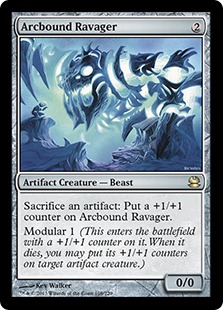
Arcbound RavagerGoing into SCG States, we could expect a metagame that wasn't too dissimilar from the September format described in our last breakdown article. You could expect a lot of Affinity, a mix of Abzan and Jund, and much less Twin than we have grown accustomed to. You could also expect a relatively open tier 1 with seven distinct decks, not to mention the combined URx Twin share which was hovering in the 8%-9% range (no single Twin deck was over 4%, however). Grixis was still relatively absent in this update, although the overall tier 2 decks were some of the most diverse we have seen in months, with decks like UW Control and Ad Nauseam showcasing Modern's diversity.

Things look surprisingly different after SCG States. To assess the difference, I looked at the metagame period leading up to States (9/1 - 10/17) and compared deck shares with their representation during the States tournaments themselves. This helps us observe any pre-trends leading into States, but also allows us to challenge those pre-trends based on the event results.

The table below shows this comparison, indicating the difference between the two metagame shares. In the interest of space and consistency, I'm only looking at decks that were tier 1 or 2 going into States with one notable exception. Test your metagame knowledge and see if you can spot it!

DeckPre-States
Meta Share
States
Meta Share
Meta Share
Change
Affinity8.99%8.82%-0.17%
Burn7.88%8.58%+0.70%
Jund7.66%8.09%+0.43%
RG Tron5.99%6.13%+0.14%
Junk3.88%5.39%+1.51%
Merfolk4.22%5.15%+0.93%
Abzan Company2.89%4.90%+2.01%
Infect5.44%4.66%-0.78%
Amulet Bloom3.77%4.41%+0.64%
UR Twin4.22%3.68%-0.54%
Elves2.00%3.68%+1.68%
Grixis Control2.66%3.19%+0.53%
Grixis Twin4.44%2.94%-1.50%
Gruul Zoo1.00%2.45%+1.45%
Naya Company1.89%2.21%+0.32%
Ad Nauseam2.22%1.72%-0.50%
Grixis Delver2.22%1.72%-0.50%
Living End1.55%1.72%+0.17%
Scapeshift1.44%1.47%+0.03%
UW Control2.11%0.74%-1.37%

The table is sorted by the SCG States prevalence (second column), but I strongly suggest you also sort it on the "Difference" column to see which decks were the biggest winners and losers.

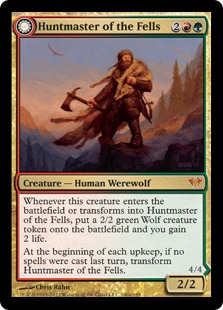
Huntmaster of the FellsFor the most part, these changes are well within the range we would expect of deck shifts from month to month. For example, Jund saw a slight .43% increase, but that probably doesn't mean Jund is really moving up in the metagame standings. Sorry that the Siege Rhino vs. Huntmaster of the Fells debate won't be settled today! Jund's .43% change is within the expected variation we would get in any sample of tournaments, just like flipping a fair coin doesn't always get a perfect 50-50 split on heads and tails. We've used confidence intervals to help us account for this variance in the past, and we can apply that same method here.

Here's the same table again, cutting out all decks with insignificant change between the pre-States and States period (for you stats folks, our confidence interval is a relatively conservative -.2% - .7%).

DeckPre-States
Meta Share
States
Meta Share
Meta Share
Change
Junk3.88%5.39%1.51%
Merfolk4.22%5.15%0.93%
Abzan Company2.89%4.90%2.01%
Infect5.44%4.66%-0.78%
Elves2.00%3.68%1.68%
UR Twin4.22%3.68%-0.54%
Grixis Twin4.44%2.94%-1.50%
Gruul Zoo1.00%2.45%1.45%
Ad Nauseam2.22%1.72%-0.50%
Grixis Delver2.22%1.72%-0.50%
UW Control2.11%0.74%-1.37%

These 11 decks are the big successes and failures of SCG States, although we'll need to go deck-by-deck to really see what mechanisms are at play in their movement. All of these decks experienced unusual metagame shifts that are unlikely to be explained purely by chance. We won't know until the end of October if those shifts are big enough to have a format-wide impact, but they were definitely at play in States and are likely to at least inform the SCG Open metagame we'll see this weekend in Dallas.

In these next two sections, I want to dive a little deeper, doing a quick deck-by-deck breakdown of these winners and the losers. Numbers are only as good as the explanations and context around them, so well need to examine those conditions to figure out why some decks succeeded and others faltered.

The Winners!

  • Abzan Company (+2%)
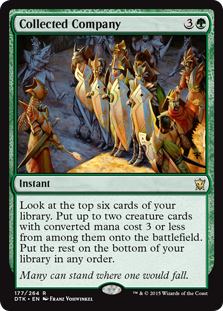
    collected companyCollected Company was by far the biggest winner at SCG States, with its two main decks (Abzan Company and Elves) dramatically outperforming their pre-States metagame shares. Naya Company had a small drop but one within the confidence interval, so I'm not too worried about its prospects. Company decks are on the rise for the same reason Affinity was blowing up all autumn: Twin's surprising decline. We'll get to Twin later, but for now it's enough to acknowledge the URx Twin fall and how this allows Company to excel in Modern. Twin decks have a lot of removal and don't care much about a trillion life, which is bad news for Melira and friends. Add crap like Dispel to the mix, not to mention Blood Moon and Anger of the Gods, and you have a real nightmare. Company players can rejoice that this deck is going down. As an added factor, Company players also have an above-average Affinity matchup, which makes these strategies well-positioned in an Affinity-heavy, Twin-light metagame.
  • Elves (+1.7%)
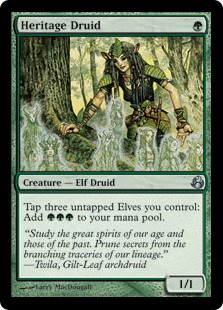
    Heritage DruidMore little green men who are happy to see less Deceiver Exarch at the top tables! Elves hates sweepers, doesn't pack a lot of removal, and struggles to assemble synergies under constant burn pressure. If we continue to see less Twin, we'll also see more Elves along the way. Unlike Abzan Company, however, Elves can struggle with the Affinity matchup, which is a big reason you see Company mages sleeving up Abzan cards and not just Elvish Archdruid and his people. We're at a weird point where there's enough Affinity for Abzan Company to benefit from the matchup, but also enough Affinity for Elves to be held back: the relative Company shares could change, depending on how this shakes out.
  • Abzan (+1.5%)
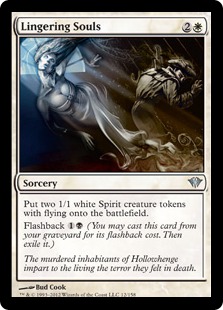
    Lingering SoulsNo matter what the Modern metagame looks like, we can always count on Abzan and Jund to be locked in an eternal struggle for top BGx contender. Jund is on top for now, but don't count on that to last forever. As players start packing larger creatures to get out of Lightning Bolt range, or try to go too wide for Kolaghan's Command to handle, you can expect the BGx mages to return to Path to Exile and Lingering Souls. Stony Silence doesn't hurt either, as no one wants to go into events with a bad Affinity matchup. I don't know if we're at the Jund/Abzan tipping point yet, but as Abzan keeps climbing we might get there soon.
  • Gruul Zoo (+1.45%)
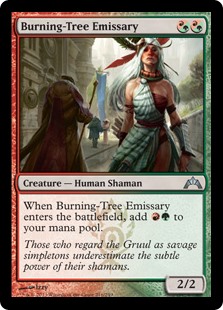
    Burning Tree EmissaryRemember that untiered list which got added to the table? That would be Gruul Zoo, aka "Small Zoo", aka "Too-Much-Pressure-Zoo". While everyone else was messing around with those silly robots, Zan Syed took a fiery Gruul Zoo build to the gold at an SCG Premier IQ in Atlanta. Nothing says aggro quite like a succession of Burning-Tree Emissarys hitting the board on turn two, and that's exactly what players like Doug Hendrickson did at his SCG States event in Colorado. Gruul Zoo's ascent reflects the Modern penchant to trend linear in open metagames. Gruul Zoo does this well by going wide to the max in a metagame without too many sweepers and where most players are worried about artifacts (against Affinity) or single threats (against Infect). I imagine we'll see more of these Burn/Zoo hybrids, all of which exist on different points of that spectrum, as we move into November.
  • Merfolk (+.9%)
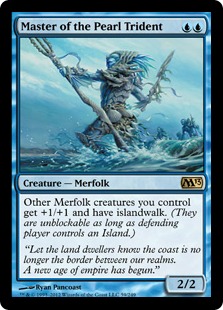
    Master of the Pearl TridentOn the one hand, I'm never surprised when Merfolk does well. It's such a solid deck with lots of random strong matchups and punching power. On the other hand, I don't really understand why this deck is doing well in our current metagame. Twin, Merfolk's best matchup, is on a hard decline. Affinity, Merfolk's worst matchup (and I mean god-awful worst matchup), remains at the top. My only explanation is that Merfolk has a lot of middling 50-50 or 55-45 matchups to make up for the awful Affinity duel, which gives it legs fins in an open, off-season metagame.

The Losers...

  • Ad Nauseam (-.5%)
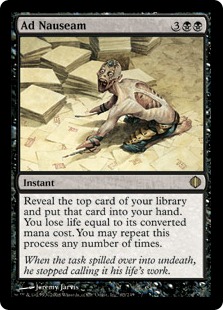
    Ad NauseamI'm only including Ad Nauseam here because it showed up in the quantitative analysis. From a qualitative perspective, I don't see Ad Nauseam being any better or worse off after States than it was before. This is a rogue combo deck that will sometimes excel and sometimes fail spectacularly. It's the kind of deck that is good at smaller events where you can take a field unprepared, but much worse in larger ones where you will randomly stumble on bad matchups. For all intents and purposes, Ad Nauseam should still remain a ~2% deck in your book, even if it was slightly less popular at States.
  • Grixis Delver (-.5%)
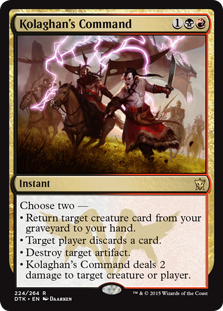
    Kolaghans CommandNot all -.5% changes are created equal. Unlike Ad Nauseam's dip, Grixis Delver's small decline represents a real drop in the format. As we've seen over the last few months, Grixis strategies are struggling mightily to remain relevant in Modern. Grixis Control (and its midrangey Liliana of the Veil-powered variants) saw a slight uptick to around 3.2%, and it's no coincidence that this increase (+.53%) is almost identical to Grixis Delver's decrease. This represents Grixis players shifting their cards around to keep competitive in a format that is heavily anti-Grixis. We see this echoed in Grixis Twin's decline (see below), a further indictment of the Grixis color pairings. There are lots of reasons for this shift: decks going big or wide to dodge one-for-one RB removal, a painful manabase that can't recover lost ground against linear decks, etc. The end result is less Grixis in Modern, and although I expect this to turn around in the future, I don't expect we'll see that for at least a few more months.
  • Infect (-.8%)
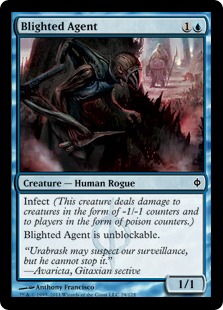
    Blighted Agent Infect always hovers in the 3.5% - 4.5% range, occasionally rising higher when players forget about it. This time, players remembered. Infect had a good September, starting with some strong finishes at SCG Cincinnati and retaining momentum throughout the month. It's no surprise that Infect retreated in October after players caught on and packed their Spellskites. Infect also suffers splash damage from rising Abzan Company shares, all of which contribute to this temporary decline. Expect Infect to stay in this range for the next few months, bouncing up and down as other metagame factors make the deck better (more Affinity) or worse (more Twin).
  • UW Control (-1.4%)
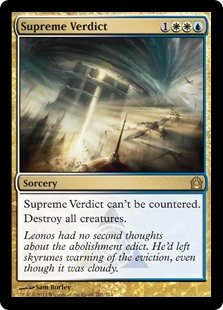
    Supreme VerdictPoor Sun Titan and Dragonlord Ojutai. After months (years!) out of the spotlight, UW Control finally earned a coveted tier 2 slot in our September rankings. States casts doubt on these September finishes, suggesting the deck might not be as lasting or powerful as many expected. I'm a little surprised at this because UW Control has enough sweepers to handle go-wide linear decks and enough lifegain/mana stability to avoid incidental lifeloss. We might think this would set up the deck for States success. With one notable exception, Craigo Bargo's win at SCG Kentucky, the deck fell flat all weekend. I think this reflects player uncertainty more than deck relevance. The surrounding Modern metagame hasn't changed much since September, back when UW Control made its recent climb, which suggests to me that players are just leaning more linear than controlling. I expect UW Control will return to glory in coming events, especially as players figure out whether they want to play the Emeria version or the more traditional Snapcaster/Angel one.
  • UR Twin / Grixis Twin (-.5% / -1.5%)
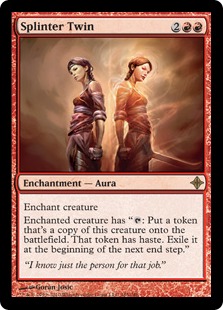
    TwinHere we are again: another metagame-related article reporting on another Twin decline. The most important part of the SCG States drop is the split between UR Twin's and Grixis Twin's relative dips. Grixis Twin, following the fate of Grixis decks throughout the format, took a giant hit to its old share. Then there's UR Twin, the time-tested contender, with a much more modest .5% drop. Incidentally (spoiler alert for next week!), UR Twin fared much better in the overall metagame, so I'm willing to write off at least the UR Twin decline as a States-specific oddity. It's certainly not reflected in the overall metagame, where UR Twin is back to a much more respectable 4.2% share after weeks under 3%. Grixis Twin, however, is a very real decline corresponding to the Grixis combinations' very real downfall. Throughout the year, we saw Grixis Twin's fortunes rise with the rest of the Grixis decks. As such, we can't be too surprised when Grixis shares trend in the other direction. To some extent, we'd need a lot more data to know if that's a real relationship or just a cute narrative, but I'm sticking with it at least through the end of the year.

Modern After SCG States

I'm pumped for SCG Dallas this weekend and for its impact on the November metagame update coming next week. Between the old Modern standbys in this article and some newcomers like Knightfall and Bring to Light Scapeshift, it promises to be an exciting tournament. I'm also still working on those Ancestral Vision in UR Twin tests, and you should be hearing about results soon. With all the metagame updates happening, the timing hasn't been good to report back on the banlist testing.

What are some other takeaways you saw from SCG States? Any other metagame movements you think we should ignore or pay attention to? Bring it down to the comments and I'll see you there!

Old School Magic- How Much Demand is There?

Are you a Quiet Speculation member?

If not, now is a perfect time to join up! Our powerful tools, breaking-news analysis, and exclusive Discord channel will make sure you stay up to date and ahead of the curve.

By now, you've probably heard of the "new" format known as Old School Magic, or 93/94. Basically, you can only play with cards released up to the year 1993 or 1994, and no proxies are allowed. There was a reasonably sized Old School tournament at Eternal Weekend this year, and I'll admit that the format looks fun, even if the barrier to entry is completely unreasonable.

There was an error retrieving a chart for Black Lotus

There have been a lot of spikes for reserve list cards occurring recently as a direct result of old school magic. You can see the market prices of these cards changing, but I'm curious about how successful anybody has been on speculating on these cards. Price and value, after all, are very different things. In my article about buying everything I mentioned the downside of purchasing cards that don't have mainstream appeal. I often have to lower the price of casual cards to set the new TCG low before I actually sell them. Right now, my store has a Russian foil Storm Crow that will never sell for the so-called "market price", or anywhere close to it.

Recently we came across an Italian Storm World in some bulk that we purchased. At the time, the card had just been bought off the internet, and the TCG price had spiked from around $3 to $75. There weren't any Italian copies on TCGPlayer when I went to post it, and I based my $40 list price off of English listed prices. A day later somebody else posted a copy at about $32, and there both of the listings sit. I will likely start lowering the price later this week or next, but I have no idea at what price point the card actually starts becoming attractive.

There was an error retrieving a chart for Storm World

I write this in part to caution investors not to buy things simply because they are rare, but rather to be more certain of real demand before making an investment. The other reason I write this, is because I want to know if any readers have stories of successful Old School Magic investments. Power doesn't count!

Avatar photo

Ryan Overturf

Ryan has been playing Magic since Legions and playing competitively since Lorwyn. While he fancies himself a Legacy specialist, you'll always find him with strong opinions on every constructed format.

View More By Ryan Overturf

Posted in FreeTagged , , 42 Comments on Old School Magic- How Much Demand is There?

Have you joined the Quiet Speculation Discord?

If you haven't, you're leaving value on the table! Join our community of experts, enthusiasts, entertainers, and educators and enjoy exclusive podcasts, questions asked and answered, trades, sales, and everything else Discord has to offer.

Want to create content with Quiet Speculation?

All you need to succeed is a passion for Magic: The Gathering, and the ability to write coherently. Share your knowledge of MTG and how you leverage it to win games, get value from your cards – or even turn a profit.

Insider: MTGO Market Report for October 28th, 2015

Are you a Quiet Speculation member?

If not, now is a perfect time to join up! Our powerful tools, breaking-news analysis, and exclusive Discord channel will make sure you stay up to date and ahead of the curve.

Welcome to the MTGO Market Report as compiled by Sylvain Lehoux and Matthew Lewis. The report is loosely broken down into two perspectives.

A broader perspective will be written by Matthew and will focus on recent trends in set prices, taking into account how paper prices and MTGO prices interact. Sylvain will take a closer look at particular opportunities based on various factors such as (but not limited to) set releases, flashback drafts and banned/restricted announcements.

There will be some overlap between the two sections. As always, speculators should take into account their own budget, risk tolerance and current portfolio before taking on any recommended positions.

Redemption

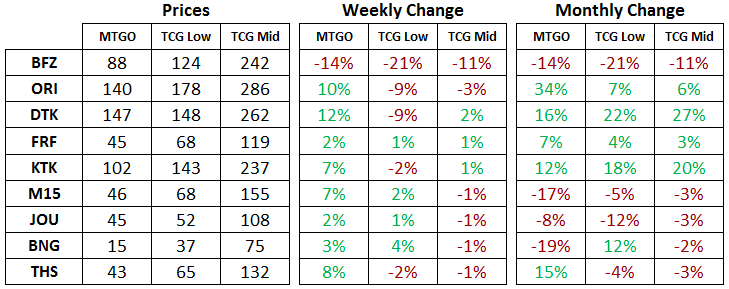
Below are the total set prices for all redeemable sets on MTGO. All prices are current as of October 26th, 2015. The TCG Low and TCG Mid prices are the sum of each set’s individual card prices on TCG Player, either the low price or the mid price respectively.

All MTGO set prices this week are taken from Goatbot’s website, and all weekly changes are now calculated relative to Goatbot’s ‘Full Set’ prices from the previous week. All monthly changes are also relative to the previous month prices, taken from Goatbot’s website at that time. Occasionally ‘Full Set’ prices are not available, and so estimated set prices are used instead.

oct26

Except for Battle for Zendikar (BFZ), all MTGO set prices are green this week. This is a clear indication that the liquidity crunch around release events is over and prices are stabilizing as a result. For those who have been waiting to deploy tix, the bargains will be fewer and farther between than last month.

Theros Block & M15

Sets of Theros (THS) continued to bound higher with an 8% gain this week. The rapid price gains of the last two weeks will not continue, as the gap between paper and digital set prices has narrowed considerably. Smaller gains at a slower pace are the forecast for this set over the winter.

Magic 2015 (M15) nearly matches THS in terms of value and recent price activity. However, the nature of core sets (a smaller window of drafting amid the summer lull) should ultimately give this one the edge.

The presence of a Standard-legal cycle of dual lands will also support the price of this set, in both paper and digital. M15 still looks to have good value, and Sliver Hivelord has received its marching orders as it heads higher on an, as yet, unbroken trend.

Tarkir Block & Magic Origins

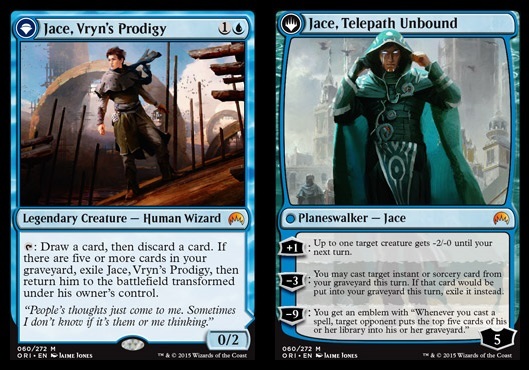
The gap between paper and digital set prices for Magic Origins (ORI) has begun to close. With Jace, Vryn's Prodigy now sitting above 70 tix online, further catalysts for large price gains on this set and its flagship card are difficult to imagine.

Betting against Jace has proven to be a poor strategy so far. But a price tag of 70+ tix on a Standard-legal card is unheard of in the post-$25 redemption fee MTGO economy. Now that release events for BFZ are winding down, look for players to play the Jace lottery as they draft ORI, eventually bringing its price down.

Elsewhere, Khans of Tarkir (KTK) has been rising steadily, and higher prices in paper will support future price increases on this set.

Dragons of Tarkir (DTK) doesn't have the same luxury, as MTGO prices have almost caught up to TCG Low prices. It does, however, have the third set effect, which means a much lower overall supply on the market.

[tt n="Ugin, the Spirit Dragon" a=5]

In Fate Reforged (FRF), the emergence of a ramp style deck at GP Quebec City has pushed the price of Ugin, the Spirit Dragon to nearly 13 tix. This card also features in Modern Tron decks, so the long-term outlook for Ugin is positive.

In the short term, as long as ramp is a playable strategy in Standard, Ugin's price has not yet peaked. There is an evident lack of supply at the moment, and only when the major bot chains are better stocked will a more stable price emerge. For the moment, be prepared to ride this one higher.

Battle for Zendikar

Although the emergence of a deck featuring Ulamog, the Ceaseless Hunger this weekend at GP Quebec City is welcome news, Battle for Zendikar (BFZ) set prices are down a whopping 14% this week. BFZ has dropped below the 90 tix level almost three months faster than KTK did last year.

With such a rapid decline in market value, BFZ could become a relatively underopened Fall set on MTGO. The novelty of drafting BFZ is going to quickly wear off as players burn through their tix.

[tt n="Ulamog, the Ceaseless Hunger" a=5]

Speculators should absolutely steer clear of any rare or mythic from this set, unless it's priced near junk levels. Usually this means 0.01 tix or less for rares and 0.4 tix or less for mythic rares.

In the case of rares, they must have some possibility of future Standard play to be worth speculating on.

Mythic rares always have some value due to redemption. But with such a rapid price decline (paper prices are also much lower relative to KTK last year), demand from redeemers is difficult to forecast. This makes junk mythic rares a riskier bet than normal.

Steer clear of the pure junk, but something like Sire of Stagnation, which might see Standard play eventually, could be worth speculating on. Picking this card up at 0.4 tix or less is a good long-term bet, though the rapid decline of BFZ set prices suggests it will go lower.

Modern

The spotlight in Modern this week is on Innistrad flashback drafts, which start today and run for one week.

This event, and the consequent expected price discounts, should definitely be on speculators’ radar this week. The bulk of Innistrad (ISD) price drops are likely to take place this weekend, presenting buying opportunities for some of the best Modern positions.

ISD

As discussed last week, Innistrad is of particular interest to speculators and players alike; some of the top Modern staples are in this set. Snapcaster Mage, Liliana of the Veil, Geist of Saint Traft, Past in Flames, Olivia Voldaren, Stony Silence and Sulfur Falls represent the most relevant speculative targets here.

Other positions, although with less speculative value, are likely to hit bulk prices during the special Halloween event, and may therefore drop to their absolute bottom for many months.

Among the cards speculators may want to pay attention to are the other four ISD check lands, Gavony Township, Garruk Relentless, Mikaeus, the Lunarch, Skaab Ruinator and Angelic Overseer.

[tt n="Snapcaster Mage" a=5]

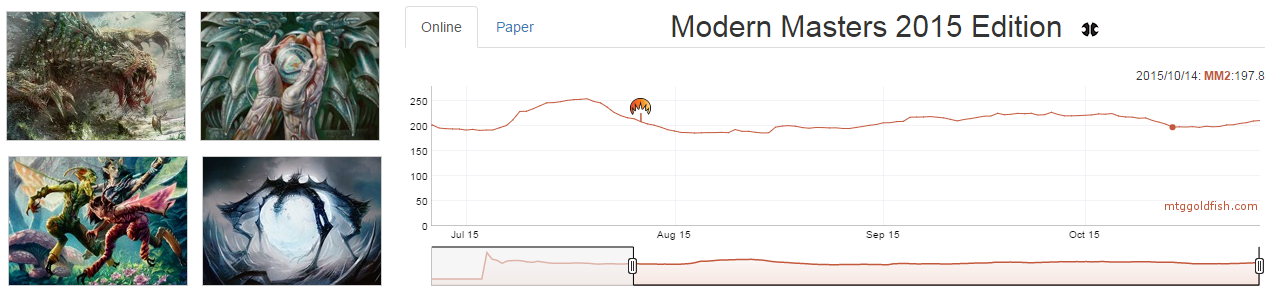
Elsewhere in Modern, MM2 positions have collectively rebounded and are on a distinct upward trend for the past two weeks. The Modern Masters 2015 index is actually up by more than 6% after a local floor was found on October 14th.

MM2

This trend is especially interesting as the majority of the 30 most valuable cards in MM2 have gained value this past week. Noticeable staples such as Spellskite, Splinter Twin, Fulminator Mage, Karn Liberated, Hurkyl's Recall and Dismember have gained more than 10%.

On a side note, Leyline of Sanctity is one of the few MM2 Modern staples that hasn't rebounded at all from its floor earlier in October.

[tt n="Leyline of Sanctity" a=5]

Overall, this upward trend should remain fairly uninterrupted for the next two to three months. Holding onto MM2 as well as any other Modern positions for further gains is strongly recommended.

Legacy & Vintage

While Season 12 of the MOCS opens today, with preliminaries and finals featuring Legacy, the focus on MTGO this past weekend was on Vintage. The Power Nine Challenge, the first of a monthly series of larger Vintage tournaments on MTGO, made its debut.

This tournament was fairly successful in the sense that a hundred players joined the event, an absolute record for Vintage online. The Top 16 was fairly diverse, with most of the usual suspects represented.

Last week we asked if such an event would have any impact on the Vintage community and Vintage prices. After the conclusion of this first large Vintage event, the answer is a tentative "maybe."

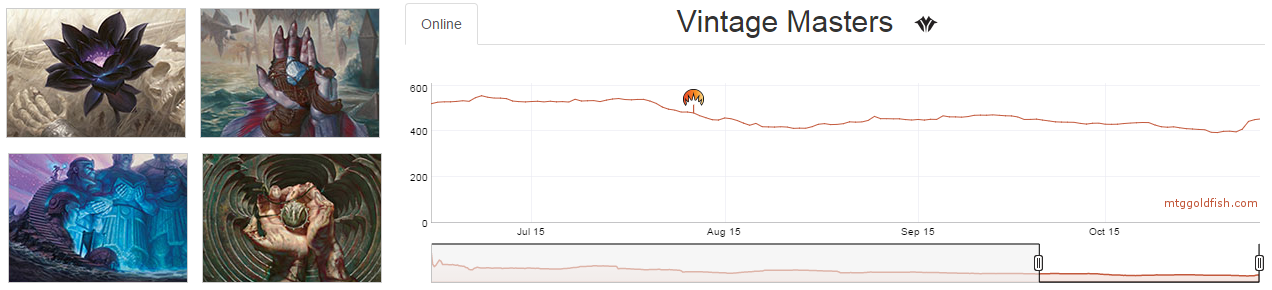
Led by the Power Nine themselves, several other Vintage staples, including Mishra's Workshop, Bazaar of Baghdad, Tolarian Academy and Null Rod have increased in value by ~20% or more since last week.

VMA

If the success of the first Power Nine Challenge becomes the norm, Vintage prices may finally have a shot at going up. However, despite a promising opening event, there's still a lack of visibility from a speculative point of view. Nothing yet guarantees that Vintage prices will keep up after their initial rebound.

Targeted Speculative Buying Opportunities

Modern

Phantasmal Image
Leyline of Sanctity

Targeted Speculative Selling Opportunities

None

Insider: QS Cast #9 – Kelly Reports from the Pro Tour

Are you a Quiet Speculation member?

If not, now is a perfect time to join up! Our powerful tools, breaking-news analysis, and exclusive Discord channel will make sure you stay up to date and ahead of the curve.

Play

In this cast, you’ll hear about how and why QS sent Kelly Reid to cover the Pro Tour. Kelly talks about his experiences, who he met, what saw play — and what did not. The gang also discusses good Modern and Standard pickups going forward, in case you want to avoid paying $750 for a Standard deck.

Douglas Linn

Doug Linn has been playing Magic since 1996 and has had a keen interest in Legacy and Modern. By keeping up closely with emerging trends in the field, Doug is able to predict what cards to buy and when to sell them for a substantial profit. Since the Eternal market follows a routine boom-bust cycle, the time to buy and sell short-term speculative investments is often a narrow window. Because Eternal cards often spike in value once people know why they are good, it is essential for a trader to be connected to the format to get great buys before anyone else. Outside of Magic, Doug is an attorney in the state of Ohio.  Doug is a founding member of Quiet Speculation, and brings with him a tremendous amount of business savvy.

View More By Douglas Linn

Posted in Free Insider, Podcast, QS Cast1 Comment on Insider: QS Cast #9 – Kelly Reports from the Pro Tour

Have you joined the Quiet Speculation Discord?

If you haven't, you're leaving value on the table! Join our community of experts, enthusiasts, entertainers, and educators and enjoy exclusive podcasts, questions asked and answered, trades, sales, and everything else Discord has to offer.

Want to create content with Quiet Speculation?

All you need to succeed is a passion for Magic: The Gathering, and the ability to write coherently. Share your knowledge of MTG and how you leverage it to win games, get value from your cards – or even turn a profit.

Insider: Cost Justification & Cost-Benefit Analysis

Are you a Quiet Speculation member?

If not, now is a perfect time to join up! Our powerful tools, breaking-news analysis, and exclusive Discord channel will make sure you stay up to date and ahead of the curve.

Welcome back, readers! This week's article will focus on the concept of cost justification.

This is something we do subconsciously all the time. Buying cereal at the grocery store, for example, you pick the lowest-cost option that you or your family will enjoy. You can't justify buying a more expensive box when there are plenty of acceptable options that taste the same, or similar enough.

We apply this concept when evaluating Magic cards as well. When evaluating a card's power level, we compare it to other cards with the same converted mana cost. This is why Tarmogoyf is so much better than Grizzly Bears. Both cost 1G, but Tarmogoyf is usually a much bigger threat than a 2/2.

Business Decisions

These examples are fine ways to explain the concept. What I want to discuss today is how cost justification can be used to make decisions about business expenses.

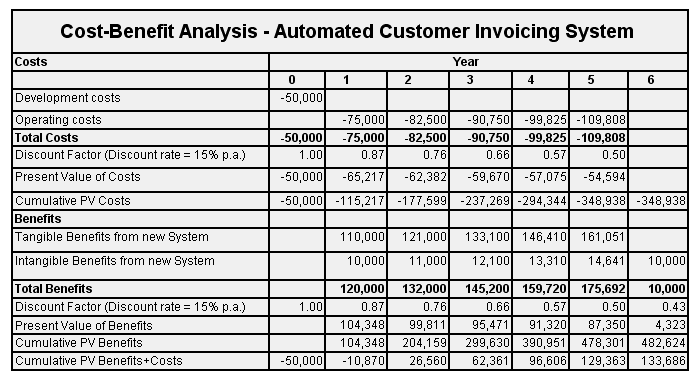
One of the principle tools associated with cost justification is the cost-benefit analysis. Wikipedia has a really good definition of Cost Benefit Analysis (CBA).

"In CBA, benefits and costs are expressed in monetary terms, and are adjusted for the time value of money, so that all flows of benefits and flows of project costs over time (which tend to occur at different points in time) are expressed on a common basis in terms of their 'net present value'."

CBA
Example of a CBA spreadsheet

Stores need to consider this when setting buylist prices, though admittedly a card's future value is often amorphous and difficult to conceive. This much is obvious.

But what about store upgrades? It seems obvious that if you have a small store and your current playerbase takes up most of your playing room, you'll want to grow your store space to accommodate future growth. But how much room do you need to add?

I've found the easiest way to explain things is via examples, so here it is.

Bill and Janet own a card store. They currently have about 20 players every FNM and enough table space to accommodate 24 players.

They've tracked their in-store sales over the past few months (which covered a new set release) and calculated that each player spends $60 a month on average. Their current rent is $700 a month. Utilities are $100. Taxes are $75.

They are considering moving to the following stores:

  • Store A - Holds 36 players. Rent $1000/Utilities $125
  • Store B - Holds 40 players. Rent $1200/Utilities $130
  • Store C - Holds 46 players. Rent $1400/Utilities $145

We can break this data down into a table for easier processing:

Measurements Option 1
(No Change)
Option 2
(Store A)
Option 3
(Store B)
Option 4
(Store C)
Increased Revenue 0 720 960 1320
Larger Tournament Capability (reduced cost of sealed product) 0 100 150 175
Capital Investment (additional chairs/tables) 0 -507 -696 -1014
Cost of Moving 0 -300 -300 -300
Rent -700 -1000 -1200 -1400
Utilities -100 -125 -130 -145
Taxes -75 -75 -75 -75
Total After First Month (including one-time expenses) -875 -1187 -1291 -1439
Total After Second Month -875 -380 -295 -125


The table shows about what we'd expect. The first month (with one-time expenses included) would imply that no move is better than any move. However, once one-time costs are removed from the equation, the largest store becomes the best option.

Incorporating Growth Rate

Unfortunately, the table makes one big assumption that could be very costly in the long run. It assumes the store would suddenly have the maximum number of players it can support.

This is highly unlikely, unless a competing store goes out of business the same month of the move. A considerably slower playerbase growth is far more likely.

It would be much smarter and safer to graph the CBA with an estimated playerbase growth rate. Obviously, this rate is hard to pin down, so it might be wise to vary the growth rate and see how long it takes each option to break even.

Below is the table for a 3% playerbase growth.

Week # Playerbase No Change Profit/Debt Store A Profit/Debt Store B Profit/Debt Store C Profit/Debt Playerbase Growth Rate
1 20.0 $325.00 -$807.00 -$1,201.00 -$1,734.00 3.0%
2 20.6 $650.00 -$768.00 -$1,365.50 -$2,112.75
3 21.2 $975.00 -$691.92 -$1,492.92 -$2,454.42
4 21.9 $1,300.00 -$577.65 -$1,582.15 -$2,757.90
5 22.5 $1,625.00 -$424.04 -$1,632.04 -$3,022.04
6 23.2 $1,950.00 -$229.91 -$1,641.41 -$3,245.66
7 23.9 $2,275.00 $5.95 -$1,609.05 -$3,427.55
8 24.6 $2,600.00 $284.80 -$1,533.70 -$3,566.45
9 25.3 $2,925.00 $607.93 -$1,414.07 -$3,661.07
10 26.1 $3,250.00 $976.66 -$1,248.84 -$3,710.09
11 26.9 $3,575.00 $1,392.35 -$1,036.65 -$3,712.15
12 27.7 $3,900.00 $1,856.44 -$776.06 -$3,665.81
13 28.5 $4,225.00 $2,370.35 -$465.65 -$3,569.65
14 29.4 $4,550.00 $2,935.59 -$103.91 -$3,422.16
15 30.3 $4,875.00 $3,553.70 $310.70 -$3,221.80
16 31.2 $5,200.00 $4,226.26 $779.76 -$2,966.99
17 32.1 $5,525.00 $4,898.82 $1,304.91 -$2,656.09
18 33.1 $5,850.00 $5,571.38 $1,887.82 -$2,287.43
19 34.0 $6,175.00 $6,243.94 $2,530.24 -$1,859.26
20 35.1 $6,500.00 $6,916.50 $3,233.95 -$1,369.80
21 36.1 $6,825.00 $7,589.06 $3,937.66 -$817.22
22 37.2 $7,150.00 $8,261.62 $4,641.36 -$199.61
23 38.3 $7,475.00 $8,934.18 $5,345.07 $484.96
24 39.5 $7,800.00 $9,606.74 $6,048.78 $1,238.51
25 40.7 $8,125.00 $10,279.31 $6,752.49 $2,063.12
26 41.9 $8,450.00 $10,951.87 $7,456.19 $2,960.90
27 43.1 $8,775.00 $11,624.43 $8,159.90 $3,858.68
28 44.4 $9,100.00 $12,296.99 $8,863.61 $4,756.47
29 45.8 $9,425.00 $12,969.55 $9,567.31 $5,654.25
30 47.1 $9,750.00 $13,642.11 $10,271.02 $6,552.03
31 48.5 $10,075.00 $14,314.67 $10,974.73 $7,449.82
32 50.0 $10,400.00 $14,987.23 $11,678.44 $8,347.60
33 51.5 $10,725.00 $15,659.79 $12,382.14 $9,245.39
34 53.0 $11,050.00 $16,332.35 $13,085.85 $10,143.17
35 54.6 $11,375.00 $17,004.91 $13,789.56 $11,040.95
36 56.3 $11,700.00 $17,677.48 $14,493.27 $11,938.74
37 58.0 $12,025.00 $18,350.04 $15,196.97 $12,836.52
38 59.7 $12,350.00 $19,022.60 $15,900.68 $13,734.30
39 61.5 $12,675.00 $19,695.16 $16,604.39 $14,632.09
40 63.3 $13,000.00 $20,367.72 $17,308.09 $15,529.87
41 65.2 $13,325.00 $21,040.28 $18,011.80 $16,427.65
42 67.2 $13,650.00 $21,712.84 $18,715.51 $17,325.44
43 69.2 $13,975.00 $22,385.40 $19,419.22 $18,223.22
44 71.3 $14,300.00 $23,057.96 $20,122.92 $19,121.00
45 73.4 $14,625.00 $23,730.52 $20,826.63 $20,018.79
46 75.6 $14,950.00 $24,403.08 $21,530.34 $20,916.57
47 77.9 $15,275.00 $25,075.65 $22,234.05 $21,814.35
48 80.2 $15,600.00 $25,748.21 $22,937.75 $22,712.14
49 82.6 $15,925.00 $26,420.77 $23,641.46 $23,609.92
50 85.1 $16,250.00 $27,093.33 $24,345.17 $24,507.71
51 87.7 $16,575.00 $27,765.89 $25,048.87 $25,405.49
52 90.3 $16,900.00 $28,438.45 $25,752.58 $26,303.27


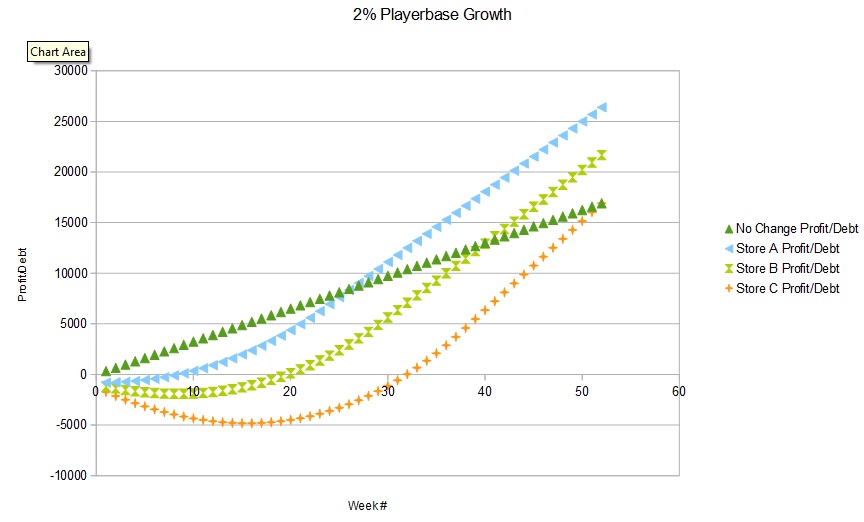
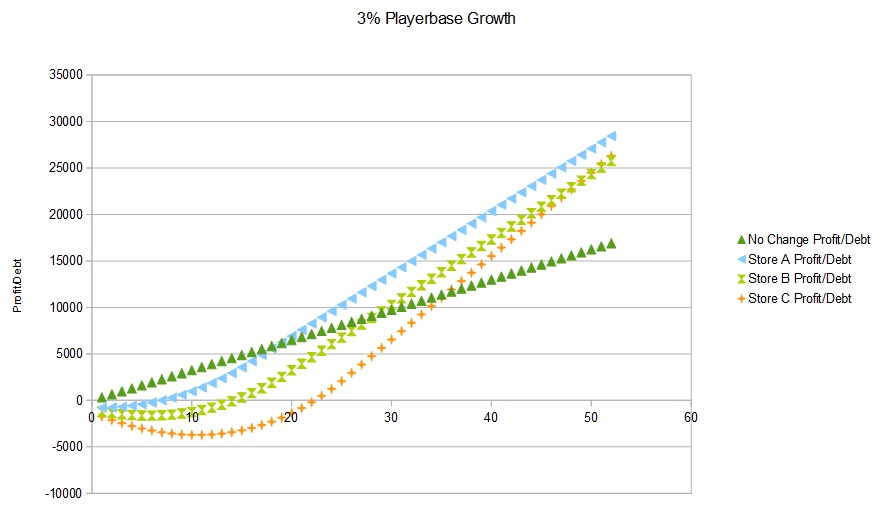
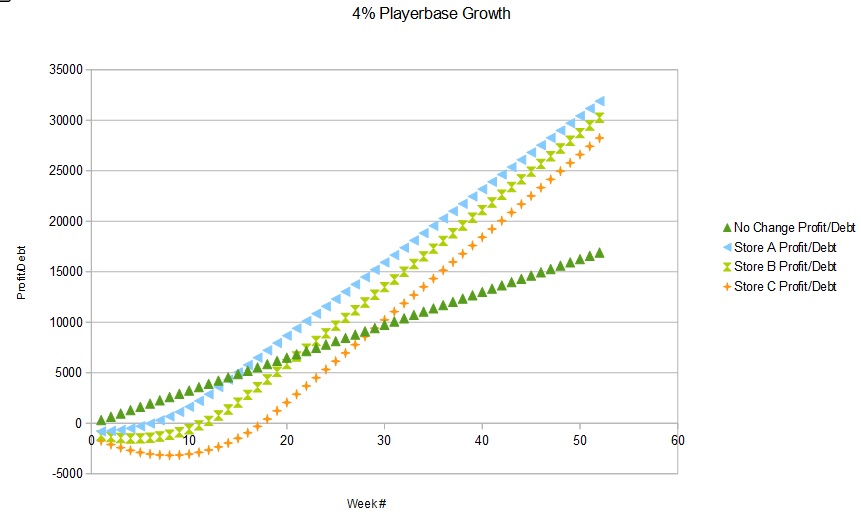
Below are graphical comparisons between a 2%, 3%, and 4% playerbase growth rate.

playergrowth_2percent

playergrowth_3percent

playergrowth_4percent

We can conclude from these graphs that, surprisingly, store A is actually the best option at these small (but reasonable) growth rates over a one-year time frame.

It's pretty evident that a longer time frame will make the bigger stores more profitable, by providing more time to offset upfront costs. If we extend our time frame to two years, we can see the point when each option becomes more profitable (for this part I'll stick to the 4% growth rate).

4percent growth rate 2 years

The key points to look for are when each store 1) surpasses the no change option; and 2) surpasses the other stores.

It's hard to see on the graph, but those points are the following:

  • Store A is better than no change at week 15.
  • Store B is better than no change at week 22; and better than Store A at week 97.
  • Store C is better than no change at week 30; better than Store A at week 92; and better than Store B at week 89.

This information is crucial because it allows you to make a decision with normalized information.

Store A is clearly the best option for those who plan on moving within a year, because Store B doesn't outperform A until almost two years in, and by that point Store C is better than both. Your best options are actually limited to Store A until week 92, and Store C after week 92.

Remember these key points are entirely dependent on the playerbase growth rate, which our estimate might not capture correctly. The smartest analysis would be to compare the key points of several playerbase growth rates, and then make the most informed decision based on your business's future plans and current cash flow.

Conclusion

Cost justification using cost-benefit analysis is an important aspect of the decision-making process for all businesses. It allows for proper comparison between different options.

There are still assumptions that have to be made, as the future is never certain. But by including as many aspects of the decision as possible (and the associated costs) we can make decisions with the most clarity and confidence.

An Affinity for Victory

Are you a Quiet Speculation member?

If not, now is a perfect time to join up! Our powerful tools, breaking-news analysis, and exclusive Discord channel will make sure you stay up to date and ahead of the curve.

It seems that the more things change, the more they stay the same and for Modern that means that Affinity is a tier 1 deck again. Affinity is one of the longest-standing decks in Modern and one of the biggest surprises about that statement is that Affinity has not gained much in the last two years or so. Affinity continues to push other decks out of tier 1 status while putting copies into the top of tournaments all over the world. So, what is it that keeps this deck at the top tables and why are other major decks unable to hate out this well-known strategy?

cranial plating banner

One of the biggest factors contributing to Affinity’s longevity and continued Modern dominance is that Affinity’s best draws are nearly unbeatable for most decks. As opposed to most tier 1 decks like Twin, Abzan or Jund, Affinity threatens the opponent as early as turn one with the ability to ramp out powerful two-mana threats or to simply drop their whole hand. This puts opposing decks under heavy pressure and often forces players to fetch and shock on turn one to survive against Affinity's openings. Of course, this just helps Affinity’s clock. In addition, when Affinity drops a lot of cards on turn one and then resolves a turn two Cranial Plating, the game often feels over.

This ability to warp the tempo of the game and create situations where a reasonable hand kept in the dark just dies to an Affinity pilot on the play is easily the robots' biggest advantage.

[wp_ad_camp_1]

Difficult but Rewarding

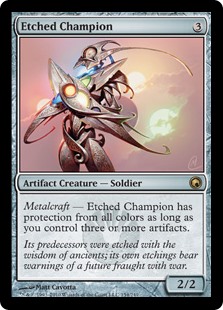
Another major benefit Affinity has compared to many decks aggressive Modern decks is that there is nearly no skill ceiling. Affinity's lines of play and arching decision trees will always reward higher-skilled players.Etched Champion Compare this to decks such as Burn, which tend to have a lower skill ceiling because you have fewer decisions throughout the game, even if many of those decisions are very important. Affinity can outmaneuver almost any deck when piloted correctly. While Affinity aims to kill around turn four, its ability to grind down an opponent who stalls with removal is very strong and rare for aggressive decks in Modern. Cards like Etched Champion, Inkmoth Nexus, and Blinkmoth Nexus go a long way towards this end. Unlike Affinity, the majority of aggressive decks in Modern are overly linear with fewer choices and decision trees. This difference is a big reason why aggressive decks wane in certain metas, but Affinity normally does not.

Affinity also has one of the best qualities of a deck for any open tournament: punishing an opponent's poor draws. In larger tournaments, it is very important to be able to close out a game quickly when your opponent misses on mana for a turn or cannot find a threat that matters. If you give your opponent time, they can come back. This is frequently a problem for slow, powerful decks such as UW Control. On the other hand, the average Affinity hand will punish any missteps and end the game quickly. Free wins are a real reason to play this deck in large tournaments as they allow you to take matches with ease and give your mind some time to rest in between rounds. This is important for a deck like Affinity that often takes a lot of mental energy and math.

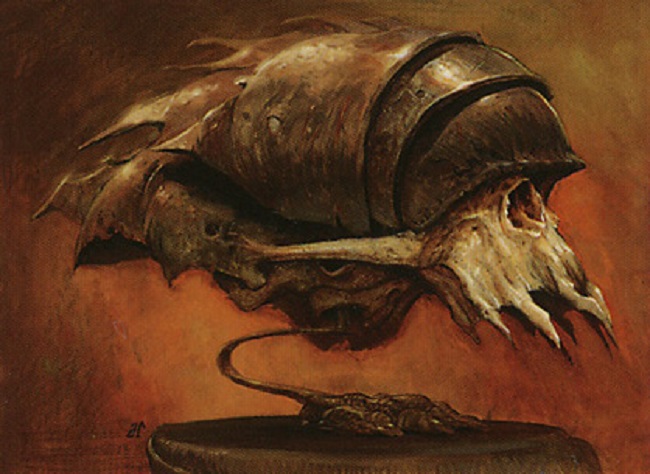
Arcbound RavagerWe can also look at the interactions between specific Affinity staples to help us see another big reason the deck weathers most storms. Arcbound Ravager, Inkmoth Nexus, Steel Overseer, andSignal Pest all create situations where the opponent’s answers have to line up perfectly with your diverse threats. If they don't, opponents fall too far behind. Arcbound Ravager makes spot removal, especially Lightning Bolt, much weaker by eating Bolt targets and growing other threats out of burn range. In addition, Ravager can change race situations with Inkmoth Nexus, suddenly powering out a 10/10 flying, infect creature opponents cannot beat. Of course, choosing what to eat and when is the hard part. Knowing when to "go all in" makes Ravager one of the hardest cards to play optimally in the format, but its many decision trees reward higher skilled players while punishing inexperienced pilots.

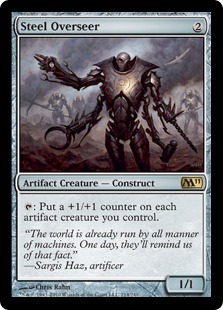
Steel OverseerSteel Overseer and Signal Pest demonstrate another strength of the Affinity deck: its ability to go wide quickly with big payoffs. Cards like Ornithopter, Vault Skirge, and Memnite require some support to make them worth playing, as they are quite underpowered on their own. Signal Pest and Steel Overseer, along with Master of Etherium, pump these smaller creatures, rewarding you for playing synergistic cards. Left unchecked, they will just take over the game, which is a big issue for opponents who don't (or can't) answer them. They also often require different sets of answers. Signal Pest cannot usually be traded with through creatures, Overseer requires immediate burn or removal, and Master will usually demand a hard removal spell to kill at all. The ability to play a very aggressive game, one bolstered with must-answer threats like Overseer and Ravager, creates an absurd amount of pressure for your opponents.

Now that we have talked about a lot of the individual stars from the main deck of Affinity, let us look at an average list of Affinity from a Magic Online daily that went 4-0.

"Stock Affinity"

Creatures

4 Vault Skirge
4 Arcbound Ravager
4 Signal Pest
4 Ornithopter
3 Steel Overseer
3 Etched Champion
2 Spellskite
2 Master of Etherium
2 Memnite

Non-Creatures

4 Galvanic Blast
4 Springleaf Drum
4 Mox Opal
4 Cranial Plating

Lands

4 Inkmoth Nexus
4 Blinkmoth Nexus
4 Darksteel Citadel
3 Glimmervoid
1 Mountain

Sideboard

1 Spellskite
1 Wear // Tear
3 Thoughtseize
2 Blood Moon
2 Ancient Grudge
2 Spell Pierce
1 Rest in Peace
1 Ghirapur Aether Grid
1 Dismember
1 Whipflare

Notable role players that help keep Affinity in the driver’s seat are Spellskite, Springleaf Drum, and Mox Opal. Spellskite allows the Affinity player to defend whatever card is most important to winning any particular game, often Cranial Plating, Steel Overseer, and your two manlands, while itself synergizing with the rest of the deck. Mox Opal and Springleaf Drum allow you to accelerate into more threats on turn one or have access to three mana on turn two. In turn, this lets you cast and equip Cranial Plating, or just drop Etched Champion as an early evasive threat. They also let you run a much lower land count than other Modern decks.

The Sideboard Trap

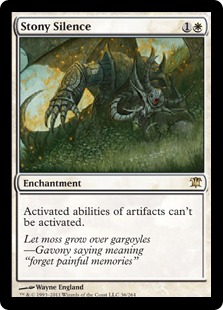
Stony SilenceOne of the biggest reasons Affinity continues to succeed is its diverse and effective sideboard. That said, this returns us to an earlier point about the deck rewarding high-skill pilots: over-sideboarding slows the deck down but under-sideboarding can leave you dead to cards like Stony Silence or Night of Souls' Betrayal. Affinity experts need to balance these tensions. Some all-star cards in current Affinity sideboards are Blood Moon, Ghirapur Aether Grid, Spell Pierce, and Thoughtseize, which all help steal percentage points back in tough matchups. Blood Moon can snipe wins versus various three-color decks and shut down land-based combo decks like Bloom Titan. Ghirapur Aether Grid allows Affinity to fight through the powerful Stony Silence and turn otherwise dead cards such as Springleaf Drum and Mox Opal into damage dealers. Thoughtseize and Spell Pierce allow the deck to take on a more aggro-control role post-board, letting you apply pressure while holding countermagic against the sweeping sideboard cards many players will have for Affinity.

The Matchups

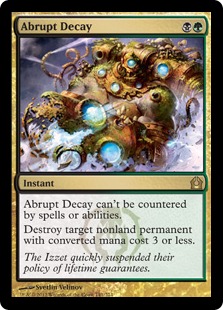
Abrupt DecayThe BGx matchup, especially Abzan, can be a struggle for the average Affinity draw. Their combination of cheap efficient creatures and removal makes the matchup feel like a race, but one where the BGx decks have cards like Lingering Souls, Lightning Bolt, and Tarmogoyf to swing the battle. The bad news is that Affinity cannot match the individual cardpower of Abzan or Jund, and both have tools to fight Affinity after board. The good news is that BGx decks suffer from having many fetchlands that want to find shocklands. This helps Affinity get there with weaker hands that can only deal 14 damage. Much like Burn, Affinity takes advantage of the punishing Modern manabase, only it seeks to punch through for single massive attacks rather than wear you down with burn spells. The keys to victory, especially against BGx, are experience and smart sideboarding. Overall, although Abzan and Jund can beat Affinity (especially postboard with Silence and Ancient Grudge), Affinity players  well-versed in their deck can weave through the matchup and take down many closer games.

Linear aggressive decks like Merfolk and slower value centric decks like Grixis, despite having cards that are good in the matchup, are not favored against Affinity. Neither deck can deal with Affinity's multiple angles of attack. Merfolk-style decks are too slow to race Affinity but also lack the removal to stay in the game. This forces them to draw their sideboard hate early or die.

Kolaghans CommandGrixis can be difficult if it has a removal-heavy draw, but hands with too much countermagic rarely pan out and delve creatures do not match up well with the Affinity package. The matchup is still very close, but Affinity often has the advantage against Grixis control, even if it is a slight underdog to the less-played Grixis Delver. True, Grixis Control has cards that are hard to deal with, such as Kolaghan's Command and Lightning Bolt. Skilled Affinity players can navigate around this, dealing a lot of damage quickly and closing the game out with evasive threats like Blinkmoth Nexus or Etched Champion, all the while baiting important cards and putting Grixis under immediate pressure. Grixis' lack of lifegain and painful mana also help. While the matchup feels close pre-board, Thoughtseize, Spell Pierce, and Spellskite make it hard for Grixis to answer Affinity’s threats cleanly.

On the other side of the coin, Grixis Delver can fight your game plan with the same cards as Grixis Control, but also apply its own pressure early. Their tempo plan can simply slip past Affinity's synergistic offense. However, the biggest advantage Affinity has is that even Grixis Delver cannot easily deal with fliers outside of Bolt and Command. Grixis can definitely brickwall the ground with Tasigur, the Golden Fang and Gurmag Angler, but the air is usually clear. If they're blocking with Delver, it's good for you. If not, Affinity can go wide and win the damage race.  While it is not impossible to lose to hate or bad draws, Affinity certainly has teeth in the matchup.

Against decks like UW Control and other traditional control decks with Spell Snare and sweepers, Affinity can struggle. It cannot usually play around sweepers and rarely has the burn to finish off opponents after losing its board. These decks also have lots of lifegain and sideboard hate. Luckily, decks of this nature are not particularly prevalent nor tier 1, at least yet.

The Twin Problem

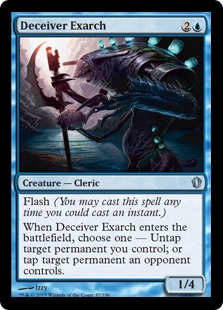
Deceiver ExarchTwin, especially UR Twin, has long been seen as a poor matchup for Affinity and its absence is seen as a reason for Affinity's recent dominance. This evaluation isn't wrong, but I believe that Twin is a more card-dependent matchup than many realize. Thanks to their interactive elements, Twin's kill is often faster. If they can resolve the combo, you have exactly four Galvanic Blasts to break it up in game one. Post-board you have a more answers, but Twin will be bringing in its own dedicated hate. Twin is one of the harder matchups for Affinity of the top tier decks as waiting until turn five to play Splinter Twin with Dispel backup can usually get the job done, even if the disruption plan is not enough. To win, the Affinity player must put the Twin pilot under enough pressure to force a combo on turn four with no protection. In that situation, Affinity can take down the game. The best plan for Affinity is to simply play as aggressively as possible and force Twin to combo or die.

While Affinity continues to play at the top tables of many Modern events, it does require a very high level of play and focus to do well in larger tournaments. Another aspect of Affinity that newer players struggle with is understanding when to slow down and hold answers to specific hate cards such as Creeping Corrosion or Stony Silence. In addition, many players at large events will come with excessive sideboard hate for a deck such as Affinity. If the Affinity player does not play around them properly, it's easy to hate out the deck.

I believe Affinity is a strong strategy for most tournaments and is a deck where the more proficient you become, the more wins you will earn. Affinity continues to exist at the top tables as it continues to win free games and put massive pressure on opponents, many of whom cannot answer Affinity's level of aggression. For these reasons, it will continue to stay at the top tables for a very long time to come.


Insider: Two Hot Modern Buys After SCG States

Are you a Quiet Speculation member?

If not, now is a perfect time to join up! Our powerful tools, breaking-news analysis, and exclusive Discord channel will make sure you stay up to date and ahead of the curve.

I've called this month a Modern off-season, but that's not exactly fair to all the players that showed up at StarCityGames' States last weekend. With over 50 tournaments across the country, SCG States is an informative and exciting midpoint between the Fall and Winter Grand Prix scenes. It's also a great early indicator of what the format will look like in November and December.

Last week, I drew attention to two underperforming Modern cards from the States circuit. Now that all the decklists are up, we can look at some of the big States success stories and figure out where to spend our money.

It's tempting to focus on finishes by rogue decks. Although investing in these kinds of decks/cards can make you some change in the short term, they aren't likely to turn a big profit. They are also fraught with risk: Greater Gargadon, sold out a few weeks ago, is still only a $1-$1.50 card.

Be skeptical of this hype, both after any Modern tournament and after SCG States.

Hyped Finishes out of SCG States

Instead of looking at cards like these, I want to focus on two Modern staples that enjoyed considerable success during the October 17-18 weekend. These cards are consistent Modern players with a history of success, and their recent States performance suggests they are well-positioned in the broader Modern metagame.

Want to get an edge on the market? These are two of the cards you need to be looking at.

Inkmoth Nexus

You can't go wrong investing in Tier 1 staples. You also can't go wrong investing in rares from older sets, especially those that didn't get reprinted in Modern Masters.

So how about a card that sees play in the most popular Tier 1 deck (Affinity), is integral to a second Tier 1 deck (Infect), and has multi-format appeal (Legacy Infect)?

That's what I call a good buy.

There was an error retrieving a chart for Inkmoth Nexus

I normally don't advise buying into cards in the $20-$25 range, especially for independent investors who don't have the coffers of more established Magic buyers. Inkmoth is an exception.

This card is undervalued at $21, and comically undervalued at the sub-$17 prices you can see on eBay. It would probably be undervalued at $25-$30 purely on the basis of Modern playability. Add in Legacy and casual appeal, on top of low reprint potential, and you have an excellent purchase target.

From a metagame perspective, Affinity has been the most played Modern deck for the last three months.

I track metagame stats on the Modern Nexus website, and although I don't expect Affinity to exceed its 11% share from September, it will still be a force in October. It's already tracking around 10% for the month, and was the most played deck in SCG States Top 8s.

We've already seen Arcbound Ravager spike on the back of this buzz, and Inkmoth's ceiling is even higher.

There was an error retrieving a chart for Arcbound Ravager

On top of Affinity's success (which alone would justify buying Inkmoth), we also see Infect returning to metagame shares we haven't seen since last February.

September saw Infect at about 4.5% of the format, the highest point since it started climbing back into the top tiers in early summer. Infect remains well positioned in October at about 4% of the format, and you can't play Infect without playing Inkmoth.

I wouldn't count on Infect necessarily remaining Tier 1 in every month, but the dual demands of Affinity and Infect make this a great target for those looking for undervalued staples.

Top Tier Powerhouses

You could invest in Inkmoth Nexus on the basis of Modern decks alone. Add in the casual appeal and, perhaps more importantly, the Legacy appeal, and Inkmoth becomes particularly appealing. If Affinity and Infect stay at their current metagame shares, which they show every indication of sustaining, Inkmoth will only go up from here.

An Inkmoth reprint would definitely torpedo both its current price and its ceiling, but this seems fairly unlikely in the short and mid-term. Wizards would need a Phyrexian- or Infect-themed product to bring the price down. Both seem unlikely for a Commander or Duel product, and Modern Masters 2017 is over a year away.

The main danger would be an Infect Modern Event deck. This could certainly be announced during the upcoming Modern tournaments as a way to build hype, but that also doesn't seem too likely; there are better Event deck candidates.

Barring such a reprint, Inkmoth is sure to go up from here. Get in now, either to play its decks or profit from its metagame profile.

Collected Company

Just a few Modern tournaments after Collected Company entered the format, the Birthing Pod replacement was already being billed as a green Dig Through Time.

To some extent, this was reminiscent of overreactive banlist hype that so often categorizes Modern finishes (Company and friends are nowhere close to being ban topics, let alone ban targets). That said, Company was an excellent card that gave a number of Modern decks newfound relevance, and it seemed poised to make a big splash.

Then the summer came and Company fizzled into Tier 2, while Dragons of Tarkir rival Kolaghan's Command stole the spotlight in Grixis decks.

There was an error retrieving a chart for Collected Company

Company Elves might have taken down GP Charlotte in June, but that was the extent of the card's dominance as we moved from June into September.

True, Abzan Company, Elves, and Naya Company lists were all present in the metagame. Unfortunately, they never excelled. You expected to see them in the same "Oh, I remember that deck!" category as Scapeshift, Jeskai Control, and Grixis Delver, not at top tables alongside Jund and Abzan.

Then came SCG States, which showed that Company decks are still a metagame force to be reckoned with.

Company Cohorts in Modern

Between Abzan Company, Naya Company and Elves, the Collected Company decks matched the performance of Snapcaster Mage decks, at least at SCG States. That's probably an over-performance more than anything else, but it attests to Company's power in a format that has forgotten about it.

At under $10, Company is a tremendous bargain, even though it's a recent Standard and Event deck printing. This goes doubly for the foil version, which you can get between $20 and $30 depending on the retailer.

What metagame factors outweigh this supply glut? Simply put, Company's continued relevance even as the format changes.

Even though no single deck has pushed into Tier 1 for any sustained period of time, Company decks as a whole regularly make up between 8%-10% of the format. This means you can expect Company players at almost every event, which was evidenced by States.

If Kolaghan's Command can hold value in the $12-$15 range, Company is sure to rise at least to that point: Grixis decks have done much worse than their Company opponents in recent months.

There was an error retrieving a chart for Kolaghan's Command

Going into November and December, you are likely to see more Company decks take center stage, especially as players get ready for a wide-open metagame. Company continues to establish itself as a Modern staple, and if we have learned anything about Modern staples, it's that the sky is the limit on their ceilings.

Revisiting Cautionary Tales

Before we close today, I want to look back at the two cards I discussed last week. We didn't have all the States results at the time, so it was possible these cards could experience a reversal in fortunes. Now that our data's more complete, it's important to check in and see how they are faring.

Ensnaring Bridge is our first candidate, and its prospects look even worse now than a week ago.

There was an error retrieving a chart for Ensnaring Bridge

As I discussed in last week's piece, Bridge and Lantern Control don't have the trappings of consistent top-tier Modern players.

You'll see Lantern Control again, but only in the hands of dedicated masters, and/or in metagames that have forgotten about it. Only a single Lantern Control deck made a Top 8 at States, which is a terrible showing for a deck that just won a Grand Prix and had every Magic site writing articles about it.

If you want to buy Bridge, wait for the card to drop more. If you have copies, start thinking about offloading them soon.

Our next card is Knight of the Reliquary, which wasn't much better than Bridge after all the States standings got posted.

There was an error retrieving a chart for Knight of the Reliquary

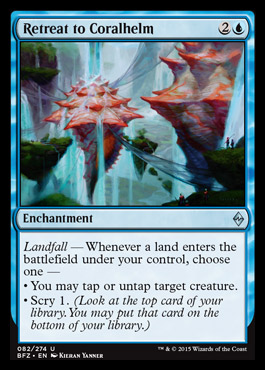
The Knight/Retreat to Coralhelm combo did sneak into the Top 8 at two separate events, including a Collected Company-powered Abzan Company hybrid and a true Knightfall build--but that's a big underperformance relative to its massive hype. I definitely think the deck still has Modern potential, but we're not quite there yet.

That said, Steven Schlepphorst posted a Top 4 finish at the SCG Open in St. Louis, piloting a Legacy Knightfall deck built around the combo.

This is sure to keep Knight's price high for the future, and also bodes well for its Modern prospects. As I've said in previous articles, I'll be surprised if this combo doesn't break into a major Modern Top 8 by the end of the year.

~

What other cards did you notice at SCG States? Any other financial takeaways we should consider? Let me know in the comments and I'll see you next week with more Modern investment advice.

Disparate MOCS and GP Top 8s

Are you a Quiet Speculation member?

If not, now is a perfect time to join up! Our powerful tools, breaking-news analysis, and exclusive Discord channel will make sure you stay up to date and ahead of the curve.

This weekend there was both a Standard GP in Quebec and a Standard MOCS final. If two players were to use the Top 8 of either event as a representation of the format at large, they would come to wildly different conclusions. One Top 8 was flush with Jeskai and featured 24 Jaces. The other was full of Rock decks, and didn't include a single copy of Jace.

This is the winning list from the MOCS:

Abzan

Creatures

4 Anafenza, the Foremost
2 Den Protector
4 Hangarback Walker
4 Siege Rhino
4 Warden of the First Tree
2 Wingmate Roc

Spells

4 Gideon, Ally of Zendikar
2 Silkwrap
4 Abzan Charm
3 Dromoka's Command
1 Murderous Cut

Lands

2 Canopy Vista
4 Flooded Strand
2 Forest
2 Llanowar Wastes
2 Plains
4 Shambling Vent
1 Smoldering Marsh
1 Sunken Hollow
4 Windswept Heath
4 Wooded Foothills

Sideboard

1 Den Protector
1 Wingmate Roc
1 Silkwrap
3 Duress
1 Sorin, Solemn Visitor
2 Surge of Righteousness
2 Tragic Arrogance
2 Transgress the Mind
2 Ultimate Price

Dark Jeskai

Creatures

4 Jace, Vryn's Prodigy
2 Soulfire Grand Master
1 Dragonmaster Outcast
4 Mantis Rider
3 Tasigur, the Golden Fang

Spells

2 Dig Through Time
4 Crackling Doom
3 Fiery Impulse
2 Dispel
3 Ojutai's Command
2 Wild Slash
2 Kolaghan's Command
1 Utter End

Lands

4 Mystic Monastery
1 Nomad Outpost
4 Flooded Strand
4 Polluted Delta
4 Bloodstained Mire
2 Prairie Stream
1 Sunken Hollow
1 Smoldering Marsh
1 Plains
1 Island
2 Mountain
1 Swamp

Sideboard

1 Dragonmaster Outcast
2 Arashin Cleric
2 Duress
1 Felidar Cub
2 Exert Influence
2 Roast
1 Virulent Plague
1 Painful Truths
2 Radiant Flames
1 Negate

The Magic Online metagame is often considered to be slightly ahead of the paper metagame, though interestingly the winning MOCS list is very close to the winning Pro Tour deck. There were two Jace decks in the Top 16 of the MOCS, and five more rounding out the Top 32. There were around twice as many Abzan decks in the Top 32, so it's possible that we're looking at a numbers game more than anything.

While these tournament results beg the question whether Siege Rhino or Mantis Rider are the top dog in Standard, I'm still hopeful that we will continue to see sweet brews like the deck that Jake Mondello used to Top 8 in Quebec.

Eldrazi Ramp

Creatures

4 Jaddi Offshoot
4 Hangarback Walker
2 Dragonlord Atarka
3 Ulamog, the Ceaseless Hunger

Spells

4 Sylvan Scrying
4 Map the Wastes
3 Nissa's Pilgrimage
4 Explosive Vegetation
3 Hedron Archive
4 Ugin, the Spirit Dragon

Lands

14 Forest
1 Mountain
4 Sanctum of Ugin
4 Shrine of the Forsaken Gods
1 Blighted Woodland
1 Haven of the Spirit Dragon

Sideboard

1 Ulamog, the Ceaseless Hunger
4 Seismic Rupture
3 Rending Volley
1 Ruin Processor
2 Whisperwood Elemental
2 Nissa, Vastwood Seer
2 Winds of Qal Sisma

Insider: Quebec City Brings Some New Standard Lists (Finally)

Are you a Quiet Speculation member?

If not, now is a perfect time to join up! Our powerful tools, breaking-news analysis, and exclusive Discord channel will make sure you stay up to date and ahead of the curve.

Dark Jeskai, at least the name for the deck isn't half-bad. If it's going to make up half of a Top 8, I much prefer it to a name like "Aristocrats" without their namesake. More on that line of complaining later.

There's plenty to be happy about with the Top 8 of GP: Quebec City. Serious competition faced off to bring us a few truly interesting lists for Standard. If you're not into flipped Jaces, read on--there's something for everyone in this recap.

There's finally an Eldrazi Ramp deck.

Jake Mondello brought R/G Eldrazi to a T8 performance and someone in Wizards is thanking their dark gods for it. The ramp strategy has been entirely absent from high-level Magic, even when we just had R/G Atarka Ramp last season. Seeing as how Eldrazi are the theme of the set, their absence was palpable.

Jake's deck utilizes land search spells and combines them with Hedron Archive and Shrine of the Forsaken Gods for true ramp.


There was an error retrieving a chart for Hedron Archive
There was an error retrieving a chart for Shrine of the Forsaken Gods

The latter card, Shrine, is only fifty cents right now. It's a great speculation target at that price. Though Jake's deck has Hangarback Walkers in it to make it expensive, it provides an alternative deck strategy for people who don't want to turn a Jace over or summon a Siege Rhino. That alone makes it worth speculating on.

Shrine is a lynchpin card for the deck (even though I hate it). Sanctum of Ugin is also about the same price and is a 4-of as well. I really admire Jake for making the most of his colorless land slots, running ten of them. He's got so much land search that all he needs is a single basic Forest to fix his colors.

Also, how gutsy is it to run a single Mountain to cast all your Red spells?

There's a great deal of expensive fat monsters in this deck, but I think the best play is to target those cheap lands. People want to cast Ulamog, after all.

Your weekly Dark Jeskai update.

The decks have basically standardized on their creature base. A full four Mantis Riders join Jace. Past that, a pair of Soulfire Grand Masters and a single Dragonmaster Outcast show up.

Thanks to Ojutai's Command and Kolaghan's Command, you're set to recycle your creatures over and over. The threat density doesn't matter as much when Ojutai can just pull back a burnt-out Soulfire Grand Master, for example.

That's why variations on the creature base are interesting to me. Edgar Magalhaes' list runs three copies of Pia and Kiran Nalaar in the main deck. That parental duo summons up a diverse group of attackers. In the mirror, the two Thopters can overload an opponent by sacrificing them to kill creatures.

They also put a lot of pressure on guys like Gideon, who have a hard time dealing with the fliers. Pia and Kiran are really cheap right now and may represent an intelligent next-level strategy for beating the mirror.

I find it very interesting that nobody ran regular Jeskai. In the Pro Tour last week, the deck that made it to the finals had all the hallmarks of a Jeskai deck but also ran four Gideon, Ally of Zendikar and four Hangarback Walker. Only Magalhaes' deck has four Hangarbacks, which obviously also play well with Pia and Kiran. Some of the other Jeskai decks run singleton bombs like Sarkhan the Dragonspeaker or Dragonlord Silumgar to break through, but none play four non-Jace Planeswalkers.

Gideon is taking a well-deserved vacation.

After running rampant last week, Gideon is nowhere to be found.

Seriously, only the Abzan deck is running him! That's a far cry from what we saw previously, but then again - there's less Abzan and no G/W Megamorph in the Top 8. He's dropped by $2 in the last week down to $40, even after such a conclusive Pro Tour performance.

The best explanation for me is that Dark Jeskai is probably the best deck and its manabase has an awful time trying to pay his colored casting costs. We'll still see him in other white-based decks. Those decks just need a good week to catch and kill the Dark Jeskai decks.

Maynard's Rally deck is yet another metagame angle.

Pascal Maynard came with an interesting Rally the Ancestors deck.

There was an error retrieving a chart for Rally the Ancestors

He jammed U/B Aristocrats together with the insane Catacomb Sifter/Grim Haruspex engine to get the best of both decks. While he's not going to make an ocean of tokens, he's still got a ton of great value creatures to eat with is Husk.

It's interesting that he chose to go with Jace over Liliana. The former makes Rally better, but Liliana provides a meaningful alternate win condition if someone saves a removal spell for the Nantuko Husk (or has a sweeper). Of course, Rally the Ancestors provides a potent buy-back for the deck if it gets swept away. Rally is hovering at about a dollar if you want to buy them.

Maynard's deck is ambitious and I don't believe we'll see widespread adoption or success with the deck, but it's a good alternative for people who have the Jaces and the fetchlands but do not want to play a fair game anymore.

Quick Hits

  • No Atarka Red this week, despite a great showing from PV last week.
  • Reid Duke's Esper Control deck is the latest attempt to play a wait-and-see game in Standard. He skips out on Dragons entirely, opting for Clash of Wills over Silumgar's Scorn and a set of Jaces over giant Dragons.
  • Shambling Vent rarely gets activated, but it makes a big difference in Abzan. If it manages to get two +1/+1 tokens from the Charm, all the better. This will be a hot Standard card for a very long time.
  • In the SCG Premiere IQ, three Ramp decks made the T8. While this is a softer field, it's worth paying attention to. The manabases all had the four Shrine/Sanctum combination discussed above.

If it happens next week, you'll read about it here!

-Doug


Sportsmanship and the Dreaded “Good Game”

Are you a Quiet Speculation member?

If not, now is a perfect time to join up! Our powerful tools, breaking-news analysis, and exclusive Discord channel will make sure you stay up to date and ahead of the curve.

There has been a lot of discussion on social media of late about the correct etiquette at the end of a match of tournament Magic. When it's all over and the last hit point has been taken, there are two people sitting across from one another, a match slip to be signed, and it isn't always obvious what to say.

The biggest taboo of post-match dialogue has always been the infamous "good game."

It seems innocent enough on the surface. But in the last few weeks I've seen no less than four lengthy Facebook conversations about whether or not people should use this phrase, and/or whether or not it is reasonable to be upset about getting "good gamed" at the end of a match you felt wasn't very good.

Perhaps people don't feel as cut and dry about what constitutes good sportsmanship in a tournament context as one might expect.

I've found myself wanting to weigh in on these social media conversations. But every time I try to respond I realize I can't sum up my feelings on the subject in two or three neat little sentences that encompass the depth of my experience.

The first thing I'd like to stress here is that you read the entire article before making a judgment or posting a response.

Personally, I believe there is a time and a place for lot of different reactions, which is why I tend to reject the premise that every match of Magic needs to conclude with matching "G.G.'s." I believe the aftermath of an intense game of high stakes cards requires more tact than a generic one-liner and a handshake.

"Good Game" as Sports Custom

As children we are taught that the "sportsmanlike" conclusion to a sports game is where everybody lines up, shakes hands, and tells each other, "Good game." Generally speaking, I think this practice is a good idea because children don't necessarily have a high capacity to cope with the complex emotions that come with winning and losing.

Parents and coaches don't want their kids crying, screaming, and throwing tantrums at the conclusion of the game, so they are taught to line up and show one another appreciation for the game. The underlying premise of this practice is to respect the game, respect one's opponent, and instruct children to win or lose with dignity.

It is a fine custom. The problem is it sets up the simplistic equation, "Good Game" = Good Sportsmanship. Many children are not taught to understand anything beyond this narrow view.

I played tons of sports when I was a youngster and after every game we lined up to shake hands with our opponents. Yet, if I remember those handshake lines accurately, there were also a fair amount of times where the losing team lined up, shook our hands, and said, "Bad game," "Bad game," "Bad game," or the winning team said, "We won," "You suck," "You lost," instead of the proper and acceptable "G.G."

I remember one of my little brother's middle school games when the opposing team lost and did the "bad game" thing. After the handshake line, the other team gathered together and the coach said something like, "I heard you guys saying 'bad game' out there and that is unacceptable. But in this case the referees were so bad that I'm going to let it slide..."

"Good game" and a handshake are said to represent the high ideals of good sportsmanship, integrity, and respect. But when it is taught as a forced custom tacked onto the end of a match it becomes hollow and patronizing.

Imagine a pee-wee hockey game that ends by the "Mercy Rule" at 10-0 in the first period, and then those children are required to line up, shake hands, and tell each other, "Good game."

Was it really a good game, or are these children just acting out a custom that makes comically little sense give the outcome? In actuality, the game was a blowout and given the mismatch these two teams probably shouldn't have been placed in the same division in the first place.

Now, tack this on for size (and dramatic effect): on top of the two teams being clearly mismatched and the outcome being completely lopsided, what if the coaches and parents of the winning team are acting like ridiculous human beings?

For instance, screaming at the kids the whole time like it's the last 0:45 of the Stanley Cup Finals; or calling for the kids to run up the score to pad their stats; or yelling at the referees and being genuinely obnoxious: "#14 can't skate! Take it around him, Johnny!"

For the record, I still go to friend's and family's kids hockey games and this crap actually happens. There is a certain percentage of sports parents that are the absolute most vile human beings on the planet. I find it hard to believe parents who behave that way don't raise children in kind. And those people are entitled to that "good game," and a handshake from you after they've won.

Now, I'm not saying that teaching kids to practice good sportsmanship is a bad thing. Generally speaking, it is a great thing, especially if kids are actually taught to be compassionate and thoughtful in both victory and defeat.

What I have a problem with is the ironclad rule that we should always say, "Good game," and shake on it. Sports and culture create an expectation for symbolic acts of good sportsmanship in games that are often unsavory and unsporting in the way they play out.

Outgrowing "G.G."

One recurring argument in support of the "good game" and handshake is that it is a custom associated with good sportsmanship. If children can handle this practice then so, the argument goes, should everybody else.

First of all, children are taught and forced to do this by adults and they don't have much say in the matter. If I ever thought to shrug off a handshake in sports as a child, no matter how obnoxious the other kid was during the game, I would have been grounded. So, you're telling me I had to lose at baseball and now no Nintendo for a week either? Not worth it.

Not everything we are taught as children remains 100% accurate and applicable when we become more mature and advance into adulthood.

Can you even imagine if you were still required to believe and practice every single thing you were told when you were six years old? Sometimes we are given general instructions when we're small that we're expected to modify as we become capable of handling more complex ideas.

"Don't talk back to adults," is a good example. You're not going to get far in life if you are never allowed to disagree with an adult...

But apparently not G.G. because that sucker is set in stone. The oft forgotten 11th Commandment:

Thou shalt always warmly extend thy hand and eagerly and sincerely congratulate thy opponent with "G.G." no matter what.

I am suggesting that for adults playing a competitive game for money, perhaps a more sophisticated course of action would be better in these situations.

Winning - Give Them a Minute to Process

If you want to get anywhere in this game, good sportsmanship is a requirement. If you are spouting off, pouting, and behaving poorly, chances are you don't have the mental toughness necessary to play the game at a high level. These are symptoms of being on tilt and it is impossible to navigate 15+ rounds of competitive play under these conditions.

The problem with "good game" as a lexical item is that it's a tilting phrase. When you "G.G" somebody after beating them, it can often tilt them. You've already won the round. The least you can do is not compound your opponent's unhappiness by rubbing it in.

If I just got mana screwed or flooded in an important game and promptly run over, the absolute last thing I want to deal with three seconds after I've conceded is an excited, grinning person sticking their hand in my face.

Even in the sports scenario those kids go to the bench, listen to the coach, and have a minute to decompress before the "good games" begin. Imagine if the final buzzer sounded in a close sports match and the players from the winning team immediately jumped off the bench and started sticking their hands in their opponents' faces and shouting, "Good game!" Pretty messed up, right?

My suggestion is for the winner to give their opponent a few moments and wait for them to engage. In most cases, after taking a few moments to compose themselves, the loser will be willing to discuss the match or interact in a good sporting manner.

When the winner immediately jumps into "good game" mode it comes across as self-congratulatory. It feels like the winner is rubbing it in.

This self-congratulating element is further compounded when the games are lopsided. If you immediately "G.G" an opponent who just lost in frustrating fashion there is roughly a one third chance this exact exchange will occur:

"Good game, man!"

"No, it wasn't a good game. I never drew a third land and died."

"Well, you don't have to be a poor sport about it. Geez."

How does this exchange foster good sportsmanship or any kind of productive dialogue? The loser is technically correct that the quality of the game was, in fact, not "good." In saying so, the winner is offended because the loser has basically said, "You're an idiot," and since one good turn deserves another, the winner retorts, "You're a bad sport."

"G.G." sportsmanship at its finest.

My advice when you win is to sit tight for a minute and let them process what happened. Games of Magic are intense and people become deeply invested. Sometimes it takes a minute to come out of "game mode" and return to "normal person mode." After a few, nine out of ten opponents will be cool and say "good game," wish you "good luck," or chat with you about the match.

If they don't strike up a conversation after a tough loss don't be too offended or uncomfortable. It isn't your responsibility to cheer them up or fix the fact that they feel bad.

Typically, I don't want to come across like I'm some kind of unfeeling, Magic playing robot, and after I've given them a minute and I'm ready to leave the table, I'll make an effort to say something nice that will be well received on their end.

This approach requires some tact, sensitivity, and compassion for your opponent. It isn't as simple as just mindlessly regurgitating some generic line and moving on.

Remember people like to talk about themselves and love to have their ideas appreciated. You go a lot further in smoothing over an opponent's feel bad by asking them about some unique card they were playing than by spewing a one-liner.

"I've never seen card X in Jeskai before. That's pretty sweet tech for the red matchup. Did you come up with that?"

99% of the time this will snap a player out of misery mode and turn an awkward situation into a positive one. You've paid them a compliment on their deck building (which makes them feel better) and maybe you even learned something in the process. After that exchange, it is much more likely that both of you leave the table on friendly terms and feeling good about the match.

"Hopefully, you play against the Abzan decks that are all over the place next round so you make day two. I bet you absolutely crush them."

Same idea with a comment like this. You are implying you want your opponent to win next round (which implies to some extent that you like them) and that your opponent made a good deck choice because it matches up well against a popular deck. In addition, you open up the opportunity for your opponent to talk about how cool their deck is and regain some confidence.

I like to think of these types of comments as "un-tilting" comments.

Remember that everything is always in context. The reason I don't like generic code phrases is they ultimately don't convey anything. It's a bunch of five-year-olds blankly slapping hands and repeating the same meaningless phrase to each other.

A Real Life Example

Here is a pretty cool context-driven example. My win-and-in at SCG Indianapolis was against a college kid playing G/W Hardened Scales. He lost a pretty close game three and was understandably pretty dejected. He played really well and had made it clear before the match that he knew who I was and had read some of my articles in the past.

Anyway, he didn't say anything to me after conceding and I gave him a moment so as not to rub it in. His friend who had been rail-birding sat down next to him and immediately started in with, "Dude, you punted so hard! Why didn't you just Dromoka's Command his thing in combat! He totally didn't have the pump spell there. You totally would have won!"

I had actually been baiting him to Dromoka's Command in combat so I could Become Immense for the win. My first comment is, "Worst friend ever..."

I took that opportunity to pipe up. "Actually, young friend, if he did that he would have lost the game on the spot. I did have the Become Immense and tried to disguise it by moving straight to damage. Clearly, you bought the bluff but your friend saw right through it and made the correct play. It bought him two more turns and if he had drawn better it would have saved him the game."

How many times better is that than "Mmm, good game?" Actually, dude's friend--you don't know what you're talking about and your friend should be proud because he made a great play in a tough game of Magic. My opponent's face, which five seconds earlier looked like somebody had stolen his puppy, was a big beaming smile.

I find the hardest situation to be a good winner is when you eliminate your opponent from a tournament. You can't wish them good luck in the next round because, well, they are out...

You can't really apologize for the fact that they feel bad either, because you were the one who killed them! Once again, you are hoping they open up the dialogue by wishing you good luck on day two but it can be super awkward when the seconds tick by and they don't say anything.

It's all about feeling out the situation and being a compassionate human being.

High level players will typically take their losses better--they've lost important matches before and this is just business as usual. You will never see L.S.V. sulking at the table for some extensive amount of time after a loss. He's been there before, knows how to deal with it, and will quickly be in good sportsmanship mode.

The player who takes it hard is the one who hasn't made day two before and just came the closest he's ever been. Let that sink in for a moment... Remember how it felt the first time you lost on the bubble? It feels horrible to come so close and not get there.

"Losing on the bubble sucks. The silver lining is it means you're playing well and if one or two things went differently you'd have gotten there. For what it's worth, I've always found that a tough loss helps me level up shortly after. Good luck at the next one."

I'm 100% convinced the reason "good game" exists is because most people are incapable of consistently practicing good sportsmanship without some super simple hack to do it in 1.3 seconds. It's not easy to say something genuine to somebody who lost a tough game. It's way easier to "G.G." them and pretend that's an acceptable demonstration of good sportsmanship.

Straying from the coded one-liner is hard because you don't know how your opponent will react. Will they think I'm being disingenuous? Will they think I'm being overly pretentious?

Remember most people will recognize good intentions. As for the small percentage of people who are offended, it probably says more about them than you. If you take the time to politely acknowledge your opponent and demonstrate compassion, that is all you can do.

Losing - Act Like an Adult

Anybody who possesses an ounce of compassion and empathy can be a thoughtful and gracious winner if they try. Don't taunt, don't gloat, don't rub it in your opponent's face, and it will pretty much be fine.

It's trickier to be a good loser. Not because the rules are more complicated, but because it's way harder to take a loss. It feels bad. It hurts sometimes. It's frustrating. Losing is the worst.

Nonetheless, it isn't your opponent's fault that you lost. The blame can be placed in a lot of places (yourself, your deck, bad luck, poor sideboarding, mana screw, etc.), but never on your opponent. He or she did their job--which is why you lost!

A lot of times players feel like their opponent didn't deserve to win. They only won because (insert reasonable excuse) and if (insert reasonable excuse) hadn't happened I'd have easily won.

Variance is a big part of Magic and thankfully so. If it wasn't most of us wouldn't even stand a chance at high level events.Nonetheless, it is frustrating to lose when we feel our opponent is outmatched but mana screw or flood ends the game before it even starts.

I one-hundred-percent get it. I'm paired against a person who I know will just play all their cards as soon as they draw them. He won't set any traps. He'll miss on-board tricks. He'll sideboard wrong.

It's like playing poker against an opponent who has their hand exposed the entire time. Unfortunately, mine doesn't work out, he doesn't fold because his hand is insane, and I can't win.

It is not their fault and being upset with them is irrational. We all started somewhere.

The first Grand Prix I made day two at was Onslaught Limited, where I beat one of the best Limited players in the world in the last round. He got mana screwed in game three. I was not very good back then and was super excited to achieve my most significant win yet. I'm sure my opponent was well aware how much better he was than me, but he was gracious in defeat and didn't do anything to let me know he felt I didn't deserve it.

Generally speaking even after the toughest of defeats I take a moment to get my head together, congratulate my opponent and wish them good luck. It isn't hard to do if you try and it's positive E.V.

Firstly, poor sports make themselves look bad. Secondly, you never know when you'll need to borrow cards at the last minute or request a scoop. As a general rule, treating people poorly for no good reason other than wanting to throw a tantrum is not a productive exercise.

I still think "good game" is among the weakest things you can say, but it's way harder to do from the losing side. It at least demonstrates an effort to be a good sport.

Another thing I've started doing when I lose that motivates me to snap out of "sulk mode" is to ask my opponent about sideboarding. I've found this is by far the most productive way to lose at Magic because it helps you learn from any possible mistakes you've made.

For instance, I lost to Gerry Thompson in the Swiss in a frustrating game three at SCG Indianapolis, but used the opportunity to discuss our sideboards. Our discussion greatly increased my understanding of the match-up which in turn came into play during our Top 8 match.

Productive loss, indeed.

Exercising the Right to Poor Sportsmanship

There are a few instances when I feel perfectly comfortable exercising poor sportsmanship.

I try to play every match of Magic as clean as possible. Not all players are nearly so straightforward, and I absolutely detest when people try to skirt the rules to their advantage.

I consider cheating, lying, and dishonest play to be the ultimate unsportsmanlike conduct possible. If I feel my opponent has been blatantly dishonest I reserve and exercise my right not to rubber-stamp it with approval at the end of the match.

The situation that comes up the most is when an opponent clearly makes a mistake in a game, realizes it, and then claims they made a different play. Ultimately, a judge is called, we both tell our side of the story and the ruling will be to back up to when the play was made. By the virtue of the powers of hindsight and the takesies backsies step my opponent wins the match.

I'm not going to shake hands with this individual after the match. In fact, I'm not going to say anything to them at all. I know what they did, they know what they did, and we are not cool and certainly not going to be friends.

The downside of exercising your right to "no sir" somebody is you may end up looking bad in the end. People watching the match don't necessarily see what led up to your refusal to shake hands. So, even in doing so you hurt yourself more than if you just shook hands.

The last time I no-sirred somebody on a handshake was way back in the Spring, and I actually regret it in hindsight.

I was playing against a guy in an SCG Open and the whole time I found his manner of playing really off-putting. He took forever to make every play but was constantly asking me to make a play. He flicked his cards constantly and loudly. He'd cast Thoughtseize, take forever to write down my cards and insist upon excessively touching and handling my cards. Every time he drew a card he whined about how unlucky he was.

It felt like he was going out of his way to be as annoying as possible. I would have rather been at the dentist than playing against him.

In our third game he got extremely lucky with his draw after a mulligan (and whined about his poor luck the entire time). He was playing The Rock and I was on Esper. His turn two Satyr Wayfinder milled two Gaea's Revenge. I Thoughtseize'd him and he had nothing. He topped the Whip of Erebos. He curved out lands and drew the third Gaea's Revenge to win the game.

Before I had even conceded the game (I had mana up and unknown cards in hand) he stuck his hand right in my face and said, "Good game!"

I put my hand up and said, "Give me a second here." He pulls his hand back but is still leaning way over the table with his eyes bugging out of his face in anticipation. I say, "Yeah, you got it." Again he immediately lunges at me with the hand right in my face.

My response was basically extreme irritation. I told him, "Get your hand out of my face," angrily signed the match slip and walked away. It's kind of funny that recalling the situation actually makes me feel irritated and annoyed even though it was a long time ago.

Nonetheless, even though the situation was extremely frustrating and I still think the guy was acting obnoxiously, I should have shaken his hand and said, "Good game." What was the cost? Nothing. Absolutely no cost whatsoever. Just shake it off.

Summary

If anything I'd like the takeaway to be as follows:

1. When you win, be considerate. Give your opponent time to soak it up and congratulate you, rather than immediately congratulating yourself.

2. If your opponent is taking a loss particularly hard, try to demonstrate some empathy. Do you like it when you get mana screwed and your opponent immediately extends the hand with an exuberant "Good game?" If so, please acknowledge that many people hate this and give us a break already.

3. Don't say, "Good game," when you win unless your opponent says it to you first. Say literally anything else.

4. When you lose, take a moment to compose yourself and recognize it isn't your opponent's fault. They were just doing their job! Use it as an opportunity to learn something.

5. If you're going to be a stick in the mud after a loss make sure it's for a really good reason. Personally, I draw the line at situations when I'm certain my opponent has purposefully played dishonestly. Not shaking hands with somebody just because you're frustrated or annoyed is ultimately a bad reason--even in extreme situations.

~

Ultimately, we all play Magic because we want to have fun and compete, and winning and losing are part of this. We should be mindful of how we act in those often emotionally charged moments directly following the conclusion of the match.

As for "good game," I'd be happy not to hear that phrase ever again at a Magic tournament.

Some people insist that "good game" is good sportsmanship. Is it better sportsmanship than "bad game," or "you suck?" Yes. Is it better than not saying anything? Depending on the context I think that's debatable.

For me, good sportsmanship means respecting the game and your fellow competitors to the best of your ability. Personally, I would never say "good game" to somebody I just beat who I actually respected. You may disagree. Different strokes for different folks.

All I can say is that no matter what you say or how you act when you compete: mean it and own it.


Trevor Holmes Plays MTGO Ep. 5: Bringing Gifts!

Are you a Quiet Speculation member?

If not, now is a perfect time to join up! Our powerful tools, breaking-news analysis, and exclusive Discord channel will make sure you stay up to date and ahead of the curve.

Hey guys! Welcome to Episode 5 of our Modern Nexus Video Series, where we pick a sweet list and run it through some matches on Magic Online. This week we have Luis Scott-Vargas' Bringing Gifts deck, which he talked about a little while ago on the Mothership. This deck features the traditional Four-Color Gifts Ungiven shenanigans, but with Bring to Light now in the mix for even more craziness!

Gifts_Master

Will Bring to Light be enough to finally push this deck into the spotlight? Let's find out!

[wp_ad_camp_1]

"Bringing Gifts - Luis Scott-Vargas"

Creatures

4 Sylvan Caryatid
2 Birds of Paradise
1 Snapcaster Mage
1 Glen Elendra Archmage
1 Eternal Witness
1 Thragtusk
1 Baneslayer Angel
1 Iona, Shield of Emeria
1 Elesh Norn, Grand Cenobite

Sorceries

3 Bring to Light
1 Unburial Rites
1 Damnation
1 Maelstrom Pulse
4 Inquisition of Kozilek
1 Thoughtseize
1 Raven's Crime
1 Life from the Loam
1 Lingering Souls

Instants

4 Gifts Ungiven
1 Abrupt Decay
1 Murderous Cut
1 Path to Exile
1 Sultai Charm

Artifacts

1 Engineered Explosives

Lands

4 Verdant Catacombs
4 Misty Rainforest
1 Watery Grave
2 Breeding Pool
1 Overgrown Tomb
1 Temple Garden
1 Stomping Ground
1 Hallowed Fountain
1 Ghost Quarter
1 Tectonic Edge
1 Creeping Tar Pit
1 Urborg, Tomb of Yawgmoth
2 Forest
1 Swamp
1 Plains
1 Island

Sideboard

2 Lingering Souls
1 Agent of Erebos
1 Eidolon of Rhetoric
1 Creeping Corrosion
1 Cranial Extraction
1 Aven Mindcensor
1 Sigarda, Host of Herons
1 Spellskite
1 Dispel
1 Ancient Grudge
1 Celestial Purge
1 Negate
2 Timely Reinforcements

Deck Tech

[youtube http://www.youtube.com/watch?v=IF67HrSHQ_o&w=560&h=315]

Round 1

[youtube http://www.youtube.com/watch?v=OlsbC7896W4&w=560&h=315]

Round 2

[youtube http://www.youtube.com/watch?v=NTC6HIwYiRo&w=560&h=315]

*Accidentally muted my webcam a few minutes before the end of the video. Apologies for the audio loss, gameplay still there though!

Round 3

[youtube http://www.youtube.com/watch?v=L5xjiur4OCw&w=560&h=315]

The results were not too bad! My prior experiences with Four Color Gifts had me worried that our deck would be too clunky and awkward, and the added power that Bring to Light provided wouldn't do much to change things. We only played three matches, but I think it's safe to say that Bring to Light in Gifts is a game-changer. In my opinion, Bring to Light evens out our draws, making our bad draws better and our deck run smoother. The ability to effectively quadruple the number of sideboard cards we have for any matchup is incredible as well, giving Gifts an incredible post-sideboard gameplan against pretty much everyone.

I plan on playing this deck a lot more in the coming weeks, so if you have any opinions/thoughts feel free to let me know in the comments or stop by my Twitch stream at twitch.tv/Architect_Gaming! Thanks for watching and I'll see you next week!

Trevor Holmes
The_Architect on MTGO
twitch.tv/Architect_Gaming
twitter.com/7he4rchitect

Deck Overview- Brave Sir Robin

Are you a Quiet Speculation member?

If not, now is a perfect time to join up! Our powerful tools, breaking-news analysis, and exclusive Discord channel will make sure you stay up to date and ahead of the curve.

Deck nomenclature has devolved to a point where we're just supposed to use a decks colors and whether its control or aggro these days, but I choose to represent the old guard and I like Steven Schlepphort's deck name. The deck is a Knight of the Reliquary combo deck that uses Retreat to Coralhelm to go lethal (not infinite) by using the knight to fetch lands repeatedly, being untapped with the Retreat every time, and ultimately to rumble in for a grip of damage. Seeing as neither Knight nor Retreat require you to tap the lands that you fetch, you can generate one mana every time you run through the sequence and wrap things up with the Taiga into Kessig Wolf Run to generate a huge/huge trampler.

Brave Sir Robin

Creatures

1 Birds of Paradise
4 Knight of the Reliquary
3 Noble Hierarch
1 Qasali Pridemage
1 Sigarda, Host of Herons
2 Vendilion Clique
1 Dryad Arbor

Spells

2 Jace, the Mind Sculptor
4 Retreat to Coralhelm
1 Sylvan Library
4 Brainstorm
3 Daze
4 Force of Will
4 Swords to Plowshares
4 Green Sun's Zenith

lands

1 Forest
1 Kessig Wolf Run
4 Misty Rainforest
1 Savannah
1 Sejiri Steppe
1 Taiga
3 Tropical Island
2 Tundra
2 Wasteland
4 Windswept Heath
1 Karakas

Sideboard

1 Engineered Explosives
1 Pithing Needle
1 Tormod's Crypt
1 Izzet Staticaster
1 Qasali Pridemage
1 Scavenging Ooze
1 Crop Rotation
2 Envelop
1 Krosan Grip
1 Path to Exile
1 Submerge
1 Gaddock Teeg
1 Council's Judgment
1 Bojuka Bog

Bant decks in Legacy tend to be quite slow. I've previously expressed my disdain for Swords to Plowshares decks, and adding a combo finish to the mix does a lot to address both of these weaknesses. You can find SCG's deck tech of the deck here.

The only complaint that I really have about the deck is that it's probably playing too many retreats. You only need one to go off, and the card isn't spectacular when you're not comboing. It's true that it pitches to Force of Will, but when a card isn't worth its cardstock pitching to Force is a "have to", not a "get to". Ponder and Spell Pierce are notably absent from the maindeck, and a Spell Pierce over one of the Retreats that he drew in the semis against dreamboat Eric Hawkins could have been a difference maker.

Want Prices?

Browse thousands of prices with the first and most comprehensive MTG Finance tool around.


Trader Tools lists both buylist and retail prices for every MTG card, going back a decade.

Quiet Speculation