menu

Insider: MTGO Market Report for September 23rd, 2015

Are you a Quiet Speculation member?

If not, now is a perfect time to join up! Our powerful tools, breaking-news analysis, and exclusive Discord channel will make sure you stay up to date and ahead of the curve.

Welcome to the MTGO Market Report as compiled by Sylvain Lehoux and Matthew Lewis. The report is loosely broken down into two perspectives. A broader perspective will be written by Matthew and will focus on recent trends in set prices, taking into account how paper prices and MTGO prices interact. Sylvain will take a closer look at particular opportunities based on various factors such as (but not limited to) set releases, flashback drafts and banned/restricted announcements.

There will be some overlap between the two sections. As always, speculators should take into account their own budget, risk tolerance and current portfolio before taking on any recommended positions.

Redemption

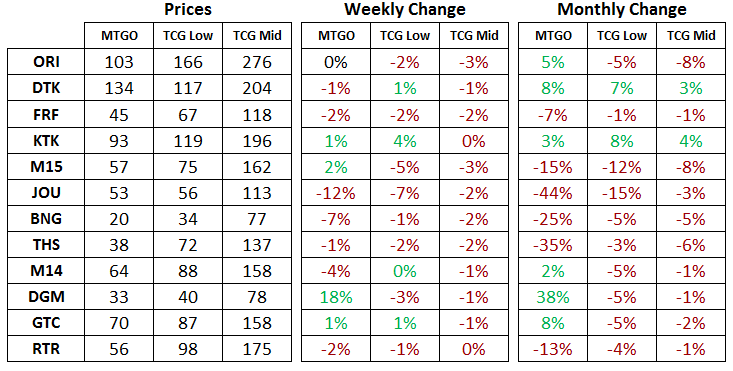
Below are the total set prices for all redeemable sets on MTGO. All prices are current as of September 21st, 2015. The TCG Low and TCG Mid prices are the sum of each set’s individual card prices on TCG Player, either the low price or the mid price respectively.

All MTGO set prices this week are taken from Goatbot’s website, and all weekly changes are now calculated relative to Goatbot’s ‘Full Set’ prices from the previous week. All monthly changes are also relative to the previous month prices, taken from Goatbot’s website at that time. Occasionally ‘Full Set’ prices are not available, and so estimated set prices are used instead.
sep21

Return to Ravnica Block & M14

Voice of Resurgence has seen a surprising move up in the past month, going from 18 to 30 tix. This type of move is a good demonstration of the price swings that Modern-playable cards can experience. September is typically a strong month for interest in Modern. Speculators who have ridden this card up from its recent bottom should take advantage and sell before Battle for Zendikar is released and players switch focus to Fall Standard and the new draft format.

For GTC and M14, prices continue to drift along in uninspiring ways. Look for these two sets to get one last small bump in prices near the end of October as the redemption cutoff date gets nearer. Neither is exceptionally good value relative to paper prices at the moment, but the end of redemption for these sets means there will be a steady loss of value from November onward, which will encourage the final spurt of demand.

Theros Block & M15

These sets have a little over two weeks left in the Standard format on MTGO, and set prices are showing this effect. THS is nearing a bottom and is approaching excellent value relative to paper prices. However, until paper prices stop falling, it's unwise to start aggressively targeting THS mythic rares. Junk rares from any of these sets that might be played in Modern can be speculated on though.

Any rare that is still Standard playable won't officially bottom until after rotation, but those priced at or near junk levels (0.05 tix or less) are almost at an absolute bottom. Speculating on junk rares due to their potential in Modern is a strategy with long odds so the more you pay for long-shot specs like this, the higher the opportunity cost. Stay disciplined and wait for the right price in order to avoid tying up too much capital in specs like this.

Sylvan Caryatid still sees fringe applications in Modern Jeskai Ascendancy decks and is currently priced at 0.05 tix, so it's safely within the price range of bulk rares. Temple of Malice gets played as a four-of in Gishoalbrand decks, though at 0.2 tix it is still too expensive to speculate on. Temple of Silence and Temple of Deceit are two other targets that could see play in Modern.

Tarkir Block & Magic Origins

Magic Origins continues to be the best value of all the redeemable sets. The gap between a set of ORI on MTGO plus the $25 redemption fee is $38, and that is valuing tix at $1 per tix. With a little over two weeks left of drafters focusing on ORI draft, the window for readily available cards from the last core set is closing.

Speculators who have been acquiring cards from ORI will be set to reap gains in two ways. First, the release of BFZ and the rotation of Theros block and M15 means that Standard will get a shakeup and the relative utility of all cards will change. Cards that find a home in the new Standard will appreciate in price as they are discovered. This process means that cards that are already heavily played won't see much benefit from rotation.

The second way that speculators will benefit is a closing gap between paper and digital. In the last month, a set of ORI has held quite steady at a few tix over 100. This implies a rough equilibrium between demand and supply. With redemption being a large part of demand, we can see the results in a declining price for a paper set. However, once supply from drafters dries up, redemption will continue its work and move ORI prices higher. This doesn't occur overnight, but after BFZ is released, ORI will be accruing value over the course of the Fall.

Elsewhere, Tarkir block sets continue to drift in price, though they have largely found their level. These sets have already experienced some of their price appreciation due to no longer being drafted, but just like cards from ORI, individual cards will see a shakeup in relative utility once BFZ is released.

The release of the full spoiler for BFZ has resulted in a wide agreement that the overall power level of the new cards is lower than in Tarkir block. With Lightning Strike and Stoke the Flames rotating out of Standard, and no obvious replacements in BFZ, a card like Draconic Roar could find a lot of demand in October. Although I wouldn't entirely count out the Eldrazi, it's looking like the skies of Fall Standard will be full of dragons.

Modern

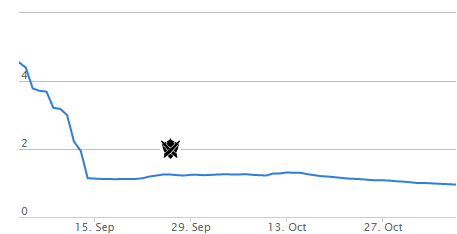
For several weeks now we've been discussing moving from Modern positions to ORI, or later in October to THS block positions that have rotated out of Standard. As shown by the Modern Total Format Price Index, prices may have found a local ceiling and actually started declining a little bit. This trend is expected to accentuate with the upcoming release of BFZ online.

However, when looking closely, different Modern cards are in different price trends. Positions such as Scapeshift, Living End, Grove of the Burnwillows, Horizon Canopy and Voice of Resurgence are in a marked upward trend initiated about a month ago. Misty Rainforest has even doubled its price compared to early this September. These, and others, should be on speculators selling lists. Most of them should lose some ground when BFZ hits.

At the other end of the Modern spectrum are positions that are currently at a low point, the lowest for several months for some of them. This means that unlike Modern positions speculators should consider selling now, these other Modern positions could be consider buying opportunities. Cards in this situation include Okina, Temple to the Grandfathers, Night's Whisper, Blood Moon, Magus of the Moon, Tectonic Edge, Thundermaw Hellkite, Thalia, Guardian of Thraben and Sower of Temptation.

The only hesitation here is that despite their very attractive prices they are also likely to lose an additional little chunk of their value for the same reason as any other other Modern positions--the release of BFZ.

Legacy & Vintage

One of the few striking facts in Legacy/Vintage these days is the abrupt drop of Infernal Tutor that lost more than 20% of its value in a week. Since this card is absolutely not played in Modern, only its demand for Legacy, Vintage and casual support its relatively high price.

The Tutor in Dissension was one of our picks back in June. Despite this recent plunge we recommend holding onto this position, as well as other Legacy positions, until the Legacy MOCS in November.

Pauper

Probably no strangers to the position of Kudoltha Boros this week in the Pauper Metagame, Ancient Den and Firebolt are nicely up this week. Another artifact land, Seat of the Synod, has hit a floor this week and could be a good target for Pauper speculators.

After being mostly above 1 Tix since June, Mental Note is now around 0.25 Tix after a sharp drop this past week. At this price Mental Note is definitely an attractive target to consider.

Targeted Speculative Buying Opportunities

None

Targeted Speculative Selling Opportunities

Modern

Goblin Guide
Scapeshift

Top 5 Modern Playables: Battle for Zendikar

Are you a Quiet Speculation member?

If not, now is a perfect time to join up! Our powerful tools, breaking-news analysis, and exclusive Discord channel will make sure you stay up to date and ahead of the curve.

My expectations weren't high when I went to open the full Battle for Zendikar image gallery. Like Jordan, I wasn't thrilled to see the first half of BFZ over the past few weeks, and was worried about what the rest of the set would hold. After seeing all 274 cards, I'm officially joining Jordan in the doldrums. As a Modern player, I have a hard time getting excited about three-mana Rampant Growths or conditional Essence Scatters. Reverse power creep has never felt more real. Community reactions to BFZ have shared Jordan's and my enthusiasm, particularly among Modern crowds. Everyone I've talked to or heard from has lamented the lack of playables, the absence of key reprints, and the missed opportunities in card design.

BfZ-Ulamog-Banner

Now that I've calmed down from my first exposure to a three-mana Birds of Paradise, the set is admittedly looking a little better. Emphasis on "a little": this is still one of the weaker Modern releases in recent memory, although Battle for Zendikar still has more potential than many are giving it credit. With Tarkir block fresh in everyone's minds, most of us went into BFZ spoiler season with high hopes for more format-defining cards like Tasigur, Kolaghan's Command, and Monastery Swiftspear. Unreasonably high hopes, in most cases. In this article, I'll try to boost Modern morale around Magic's newest set, highlighting some of the better cards that could still impact the format.

[wp_ad_camp_1]

Battle for Zendikar's Top 5

It's true that BFZ suffers from both design-level and power-level problems (Paulo Vitor Damo da Rosa wrote a spot-on critique of the set yesterday). Thankfully, even the weakest sets still have something to offer Modern, and Battle for Zendikar is no exception. Here are five cards which are likely to see Modern play. Disclaimer before we get started: none of these cards should come as big surprises. Sometimes we'll get a weaker set for non-rotating format play. When that happens, what you see is exactly what you'll get, so don't expect too many sleepers or under-the-radar gems here.

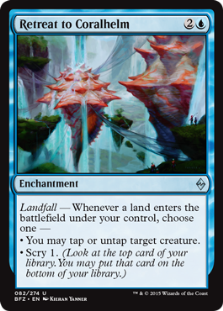
5. Retreat to Coralhelm

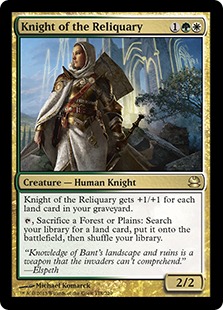
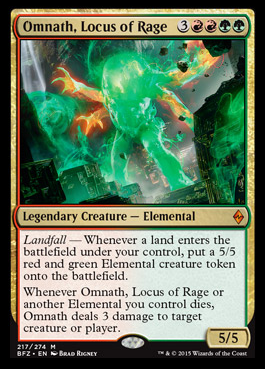
I don't remember the last time the Modern community went so crazy about a new card and a new combo. As everyone can't stop discussing on MTG Salvation, Reddit, and even the Legacy-oriented The Source, [tippy title="Retreat to Coralhelm" width="330" height="330"]Retreat to Coralhelm[/tippy] Retreat to Coralhelmcombines with Knight of the Reliquary to win the game on the spot. With a Knight and Retreat on the battlefield, simply activate the Knight and fetch a Forest, Plains, or fetchland. This triggers Retreat which untaps the Knight, allowing you to get another land or crack a fetch to stack triggers and "double up" on land searches. When the dust settles, you'll have a graveyard full of lands and a Knight in the 20/20 range. Add in Kessig Wolf Run as a mana-sink and countermeasure against chumpblockers, and Sejiri Steppe to stop removal or single-color blockers. Excess Retreat triggers even tap down blockers! You can get the combo online as early as turn three with help from Noble Hierarch or Birds of Paradise, and the Knight can be Bolt-proof if you lead with two fetchlands.

Is Coralhelm Knight (or whatever the community names the deck) good in Modern? That's a great question. I've tested a few lists and found them to be better than existing Bant builds, but still worse than most top-tier decks. Knight of the ReliquaryEarly versions also fail the "Why not Twin?" question Modern players must so often ask. That said, Bant has always been a fringe-playable color pairing even before BFZ. Indeed, Bant Company emerged as one of the best MTGO decks during the summer. Retreat is poised to make the deck more viable. What Bant lacks in early game interaction (Path to Exile instead of Lightning Bolt) it makes up for in strong creatures, high-end removal, ramp, and now a combo finish. Never underestimate the power of proactive strategies in Modern and Bant can now join this club. I don't see Retreat breaking out as a tier 1 or even tier 2 deck in the near future, so if you spent $15+ on your newly acquired Knights I'd offload those sooner rather than later. That said, I do see more players both exploring Bant strategies and having more tools to build with. Proactive win conditions like Retreat/Knight define the format, and I will be surprised if something strong doesn't emerge from this by the end of the year.
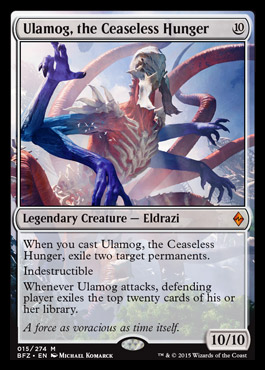
4. Ulamog, the Ceaseless Hunger

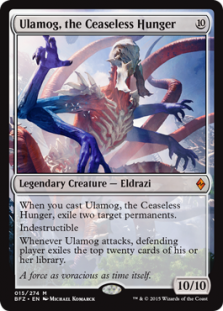
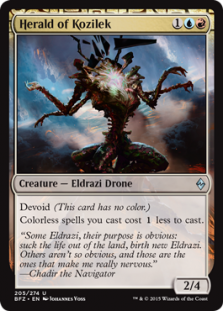
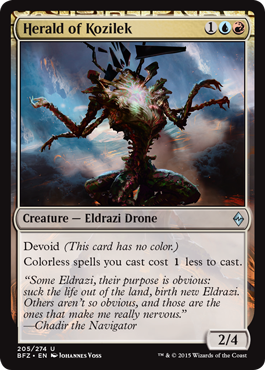
Ulamog the ceaseless hungerFor an Eldrazi-themed set, Battle for Zendikar sure skimped on the big bad Cthulhus. Emrakul, the Aeons Torn is a real Eldrazi. [tippy title="Herald of Kozilek" width="330" height="330"]Herald of Kozilek[/tippy]? Not so much. The only exception to this is the mighty [tippy title="Ulamog, the Ceaseless Hunger" width="330" height="330"]Ulamog the ceaseless hunger[/tippy], a true Elder God monster worthy of its creature type. Recent RG Tron lists have shied away from including Ulamog's previous incarnation, Ulamog, the Infinite Gyre, instead opting for 1-2 Ugin, the Spirit Dragons and/or Sundering Titans. We saw this in both the Top 8 and Top 16 Tron lists out of August's SCG Open in Charlotte. Call me optimistic, but I see new Ulamog ("Newlamog" as some have affectionately dubbed the card) reversing that trend. Ulamog is surprisingly nasty in a number of matchups, setting combo decks like Twin back in mana development, defeating Abzan Company players after they've gained billions of life, smashing mirror-match Karns and lands, etc.
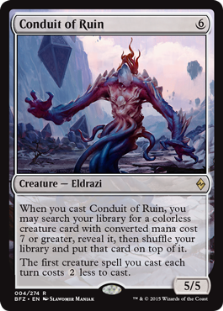
Lantern Control's recent success also bodes well for Ulamog: it's one of Tron's best outs to the Ensnaring Bridge/Spellskite/Welding Jar locks that neither Karn Liberated nor Oblivion Stone can handle. I expect all the Tron decks that were running Titans to switch those out for our new Eldrazi overlord. Bonus points for chaining the turn three [tippy title="Conduit of Ruin" width="330" height="330"]Conduit of Ruin[/tippy] into a turn four Ulamog.

3. Tangolands

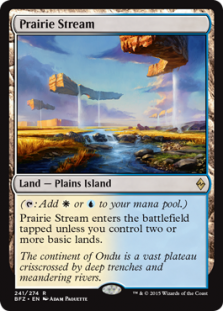
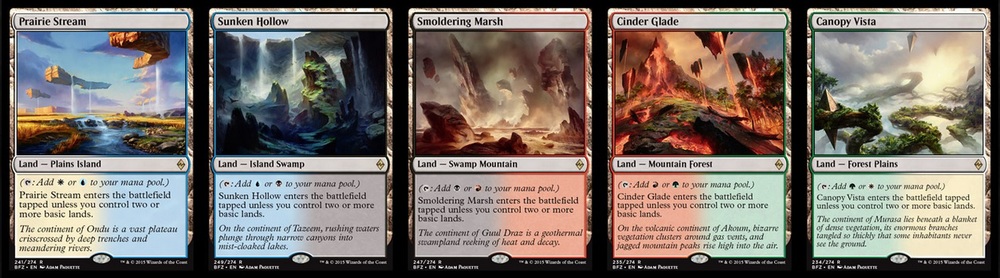
Prairie StreamWe're seeing a UW Control renaissance in Modern, and [tippy title="Prairie Stream" width="330" height="330"]Prairie Stream[/tippy] will be joining the force once BFZ hits tournaments in October. Between Yuuya Watanabe's Worlds 2015 performance and a series of recent SCG Open and Premier IQ wins (as recently as last weekend), UW Control looks like the real deal: I'm still standing by my August metagame prediction that the deck will be tier 2 in our next update. Stream is an unassuming but significant addition to these decks, particularly in lists like Phil Silberman's that rely on Emeria, the Sky Ruin to drown opponents in mid and late-game resources.
I include all the Tangolands in this category because I see them incentivizing players to try out two-colored decks in Modern. Historically, Modern control and midrange strategies have been dominated by three-colored approaches: Jund, Abzan, Jeskai Control, Grixis Control, etc. Even Twin, the traditional two-colored holdout, has seen plenty of three-color iterations including the summer's breakout performance of Grixis Twin. Tangolands don't place nicely in these 3+ color lists, although I still suspect we'll see 1-2 tossed in after all the color pairings are released. In the UW and BG lists, however, the Tangolands are really going to shine, providing fetchable and painless manafixing as the game progresses. Also, in case you were as confused as I was about the lands' name, it comes from the phrase "it takes two to tango". I don't know if the name will stick, but the lands sure will as more players shift towards UW Control and similar two-color strategies. Just be careful to watch your mana requirements before investing too heavily in these lands. Twin, for instance, will need both Cryptic Command and Splinter Twin mana by turn four, and Tangolands can interfere with that.

2. Lumbering Falls

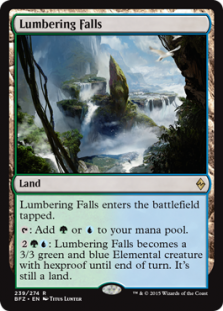
Although not as unassuming as [tippy title="Prairie Stream" width="330" height="330"]Prairie Stream[/tippy], the new Temur manland is another Modern addition many players aren't giving enough credit. Our own Sky Mason wrote an article covering [tippy title="Lumbering Falls" width="330" height="330"]Lumbering Falls[/tippy] last week, and I wholeheartedly agree with his assessment on the Elemental-Lumbering Fallsin-disguise. Scapeshift and Temur Twin are going to love this new card and their metagame shares should benefit accordingly. In the early game, Falls gives extra mana-fixing to decks that lack manlands of their own. As a comparison, consider Jund and Abzan with Raging Ravine and Stirring Wildwood respectively. Even the underplayed Jeskai pairings get Celestial Colonnade! Once you hit the midgame, Falls really begins to shine. In many respects, you can think of it like a recurring Lightning Bolt when animated on an open board, which naturally plays well into strategies relying on Snapcaster Mage/Lightning Bolt for removal and reach. Falls is also strong in the Snapcaster mirror where incremental Tiago beats can quickly cost you the game both as an attacker and blocker.
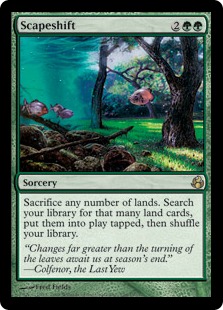
ScapeshiftWhen evaluating a land like Falls, I look for both internal and contextual strengths. Falls definitely has the internal pieces (Hexproof is nuts in removal-clogged Modern games and three power is the perfect clock), but what about the metagame ones? Although Temur Twin remains a less-played Twin variant relative to its Grixis and UR competitors, Scapeshift enjoyed some high-profile success at the recent GP Oklahoma City. Matthew Dugan piloted the combo deck to an 8th place finish, and between his performance and the upcoming Falls release, I expect we'll see more Scapeshift to come. As an added bonus, Scapeshift follows a Lantern Control-style strategy of blanking removal by playing low-importance creatures. This fits nicely in recent metagame developments and is another reason I predict Falls slotting into these Temur combo/control lists.
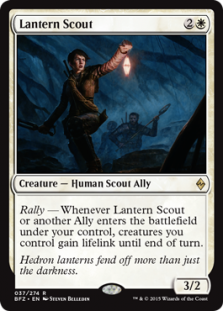
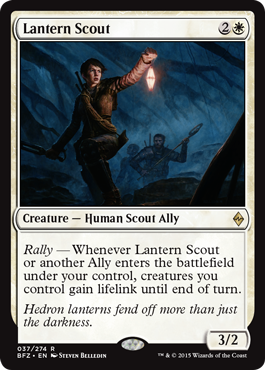
1. Lantern Scout

It's no secret that I love Allies in Modern and think they have a lot of unsung potential to make it big. Stephen Perigo thought so too, bringing his own take on Naya Allies to a Day 2 showing at GP Oklahoma City. Like many Lantern ScoutAllies players before him, Stephen relied on the mediocre Talus Paladin as a maindeck out against aggressive decks like Affinity and Burn. Ondu Cleric helped out of the sideboard, but the deck really needed an anti-aggro mechanism that synergized better with Aether Vial and, more importantly, Collected Company. Say hello to [tippy title="Lantern Scount" width="330" height="330"]Lantern Scout[/tippy], a card I think will make the biggest overall impact on any single deck in Modern, although not necessarily on the format as a whole. Allies already had the trappings of a fringe tier 3 deck before Battle for Zendikar. Scout gives Allies the edge they need to make a solid push into tier 3 with some legitimate claim to tier 2 in the future. Allies already drew strength from a win-from-nowhere aggro gameplan with Akoum Battlesinger and Kabira Evangel. This bursty, linear, and decidedly proactive style gives it a slight edge over the more deliberate Merfolk approach (which, admittedly, isn't quite fair to the very one-hit-killer Master of Waves). Scout works so well in Allies because it converts your board presence advantages into life resources that Burn and Affinity can't overcome.

If you're looking for Allies lists that leverage Lantern Scout and friends, check out Sky Mason's article from earlier this week. His new take on Naya Allies is sure to delight the tribal fan in everyone. As I talked about in my own article, I definitely think Collected Company is the way to go with Allies: explosive combat steps are what separates you from other aggro and Company decks like Naya, Slivers, etc. I think the jury is still out on Hardened Scales vs. Aether Vial, but that's a testing matter we'll undoubtedly resolve as more players bring Allies to the table. Expect to see this deck showing up more and more after BFZ makes its October debut.

Modern after BFZ

We shouldn't expect a lot of metagame shifts in the post-BFZ world. Only three of these five cards benefit upper-tier decks, with the other two still having a ways to go before they can reliably crack Day 2s and Top 8s across the Modern world. That said, some of these cards are likely only the beginning for their respective decks: Allies and Tron are sure to gain more as the set unfolds. As for Knight and Retreat, we'll have to wait and see how the brewers, tuners, and testers slap their Bant shells together: I'm optimistic that we'll see at least a few finishes with this deck on a big stage by the year's end.

What BFZ cards would make your Modern top five list? Any card evaluations you think I missed, or cards I gave too much/little credit? We have more Battle for Zendikar content coming throughout the week, so keep on reading as we figure out the best way to use our new set.

Insider: Applying Cash Flow Analysis to Magic Finance

Are you a Quiet Speculation member?

If not, now is a perfect time to join up! Our powerful tools, breaking-news analysis, and exclusive Discord channel will make sure you stay up to date and ahead of the curve.

Welcome back, readers! Today's article will focus more heavily on the business side of MTG finance, specifically cash flow analysis. To start let's define our terms.

  • Cash flow - the total amount of money being transferred into and out of a business, especially as affecting liquidity.
  • Cash flow analysis - An examination of a company's cash inflows and outflows during a specific period.

That was simple enough. But what does that really mean? I find the easiest way to discuss this type of subject is with examples. So let's do an easy one (with nice round numbers).

Tim's paycheck (after taxes) every two weeks is $1000. His apartment rent is $500 every month. His cable/internet bill is $100 every month. He spends $50 on gas every two weeks. He spends $150 on groceries every two weeks.

So Tim's monthly cash inflow is $2000 (2 x $1000) and his monthly cash outflow is $1000 ($500 + $100 + 2 x $50 + 2 x $150). So Tim's savings account can increase by $1000 per month (not bad Tim).

A cash flow analysis goes a bit deeper though. While the problem is still very simple we need to factor in the time variable into the equations a bit. For this analysis we need to know when Tim pays his bills. Since it's arbitrary let's say he pays on the following dates:

  • Rent 14th of the month
  • Cable bill 30th of the month
  • And let's say he gets paid on the 1st and 14th of the month.

So when we analyze Tim's cash flow we see something like this:

Income/Expense Week 1 Week 2 Week 3 Week 4
Paycheck 1000 1000
Rent -500    
Cable     -100
Groceries -150   -150
Gas -50   -50
Overall Cash Inflow/Outflow 1000 300 1300 1000


The takeways here should be pretty obvious. The worst week to try and buy things is week two of any month; that's when Tim's overall cash inflow/outflow is at its lowest. The best time for him to buy things is week three when his cash inflow/outflow is at its highest.

Cash Flow Analysis and Magic

That was a pretty simple example. What if we try something a bit more complicated (and ideally related somewhat to Magic).

Say Jim and his wife Ann own an MTG store. They just opened up and wouldn't you know it a new set is releasing soon. Perfect timing right? New sets bring in new players and those players spend money. However, Jim and Ann don't have a lot of starting capital left (after all they had to buy all the chairs/tables and repaint the storefront they found), say $1000. They want to buy as much sealed product as they can for release events, so they need to understand what they can afford.

Luckily, they have five competitive players who want to preorder product and they all pay the first day of the month (they each preorder two boxes at $100 each). The release is on the 30th of the month. The boxes cost Jim/Ann $80 each. The release packs cost $18 each (and they are charging $25 per pack to play in the event).

They want to make sure they give out decent prizes so for each player they plan on putting in an additional two packs per person (remember 36 packs per box). They also have to pay their facilities rent on the 14th ($800) and their utilities ($100) on the 3rd.

They are expecting 40 players total for their event. They get 20 of those players to pre-register (10 the first week and 10 the second week). Can they run their event as they wanted?

.........

.........

.........

.........

.........

.........

.........

No, they can't. If you just add up all their income and expenses, it shows they are +$402.24 for the month--not great, but not terrible. However, if you do an actual cash flow analysis, you come up with this:

Income/Expense Week 1 Week 2 Week 3 Week 4
Starting Capital 1000      
Box Preorder 1000      
Pre-release preorder 250 250    
Pre-release Event       500
Pre-order box cost     -800  
Pre-order release pack     -720  
Prize Pack Boxes     -177.76  
Rent   -800    
Utilities -100      
Cash Inflow/Outflow 2150 -550 -1697.76 500
Total cash on hand 2150 1600 -97.76 402.24


Cash flow analyses are crucial when building a proper budget (both for business and personal use) because they can help highlight potential cash shortfalls.

Say Jim/Ann just looked at the monthly budget and saw they'd be up $400, and a customer walked in trying to sell a collection for $200 on the 8th of the month. They might be inclined to buy it to increase their overall stock thinking they were still net positive $202.24 at month's end, only to realize on week 3 they wouldn't have enough money to buy all their release materials.

This example emphasizes the importance of cash flow and why it's often necessary to do the analysis. When you do not factor in the time element then everything can look good on paper, but when you actually go to try and pay for things you find yourself coming up short. You see on week 3 (when they would likely need to pay for all their preorders) they have negative cash on hand. Thus they cannot afford to put two packs into the prize pool per player unless they can get four more players to pre-register to help offset their cash outflow on week 3.

If you're an actual storefront, you might prefer to break it down into days (rather than weeks) because more often than not some bills may be due by a certain day and others may be more flexible. It may seem like a logical decision to just pay them as late as possible (without incurring additional fees), however doing so might cause you to make a poor expense decision that leaves you short on cash.

Many LGS's also want to keep some amount of cash on hand to purchase collections that walk in the door. More often than not when someone walks in trying to sell a collection quickly, if you don't have money to buy it, they'll simply move on, which can cost you a lot of potential future revenue.

A good cash flow analysis is extremely detailed (hence the suggestion to go to 31 days instead of by weeks). It goes hand in hand with a good detailed budget and can allow a business to run smoothly and without major hiccups caused by cash flow.

It also allows business owners to plan in advance and can be used to determine the best time to hold sales or specials (after all if you know you'll be short on cash on the third week of a month, having special sales on the second week would allow you to go into the 3rd week stronger, as opposed to having an impromptu sale when you realize you're low on cash).

If we look at Jim/Ann's store going into the next month, their "starting capital" is now down to last's months total gains (assuming they were able to get 4 more players to pre-register) so they only have the $402.24 on hand.

Income/Expense Week 1 Week 2 Week 3 Week 4 Week 5 (next Month) Week 6 (next month)
Starting Capital 1000      
Box Preorder 1000      
Pre-release preorder 250 250    
Pre-release Event       500
Pre-order box cost     -800  
Pre-order release pack     -720  
Prize Pack Boxes     -177.76  
Rent   -800       -800
Utilities -100       -100  
   
   
Cash Inflow/Outflow 2150 -550 -1697.76 500 -100 -800
Total cash on hand 2150 1600 -97.76 402.24 302.24 -497.76


Thus, they will have negative cash available by week 2 of the month (when rent is due). Obviously they will likely have other forms of revenue not covered on this spreadsheet (or their business would be an abysmal and short-lived failure), but again this emphasizes the importance of looking ahead and determining your businesses cash flow to look for pitfalls.

Rally to the Ally Cause

Are you a Quiet Speculation member?

If not, now is a perfect time to join up! Our powerful tools, breaking-news analysis, and exclusive Discord channel will make sure you stay up to date and ahead of the curve.

Now that the entire Battle for Zendikar set is revealed, I’m going to spend some time analyzing a deck that has much to benefit from BFZ's spoils: the Allies archetype. Recently discussed by Sheridan, Allies is a deck that has already had some success in the PPTQ scene. A Naya Allies build also had recent success at GP Oklahoma City, even before BFZ hit tournament tables. After reviewing Daniel Mulato’s list, I upgraded some of the weaker individual inclusions with recently revealed cards, improving on an already strong core strategy.

Veteran Warleader art

As Sheridan mentioned, the strength of Allies has always been its ability to win out of nowhere with Collected Company and Akoum Battlesinger. BFZ promises to make the manabase more consistent but also to help Allies push through opponents instead of overwhelming (and confusing) them to death.

[wp_ad_camp_1]

Join the Cause

I predict Allies will gain popularity due to its use of Aether Vial and Collected Company alone. Powering out efficient threats that effectively double as spells when another Ally enters the battlefield seems very good. Like the unforgiving Slivers deck Adam Bowman used to Top 8 the SCG Modern open in Cincinnati, Allies uses underpowered creatures and focuses on synergies that can quickly close out the game. Strategically similar to Merfolk, Allies is a more synergy focused Collected Company deck that does not rely on combos (Kitchen Finks, Viscera Seer, Melira, Sylvok Outcast) to win. Instead, we're looking to drop a few early Allies and then force them through without warning, aiming to win from one or fewer attack steps. We'll also leave the option open to play a longer, grindy attrition game.

Keeping Daniel’s original list in mind, I have added cards from Battle for Zendikar to create a fresh take on the Ally deck:

"Allies, by Sky Mason"

Creatures

4 Hada Freeblade
4 Akoum Battlesinger
4 Kabira Evangel
3 Lantern Scout
3 Kor Bladewhirl
3 Firemantle Mage
3 Adaptive Automaton
2 Veteran Warleader

Artifact

4 Aether Vial

Instant

4 Collected Company
4 Path to Exile
2 Boros Charm

Land

4 Cavern of Souls
4 Ally Encampment
1 Forest
2 Plains
2 Temple Garden
1 Stomping Ground
1 Sacred Foundry
3 Windswept Heath
2 Wooded Foothills

Sideboard

1 Wear // Tear
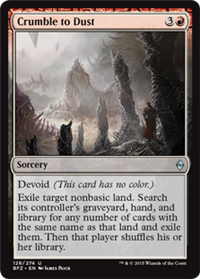
1 Crumble to Dust
2 Kor Firewalker
3 Suppression Field
2 Ancient Grudge
2 Rending Volley
2 Spellskite
2 Ondu Cleric

One of the major benefits of a synergistic deck like this is flexibility. Depending on the metagame, both the Allies you play and their numbers can move up or down to consistently beat any matchup. Effectively piloting any deck requires an understanding of each cards role, particularly in tuning to gain an edge in certain matchups and to avoid losing points to incorrect trimming. That's truer than ever in Allies. Be warned: never, ever, mess with the deck’s backbones. The entire deck revolves around having Aether Vial and/or Collected Company to reach a critical mass of Ally creatures. Without them, the deck is just a synergistic creature pile that has difficulty pulling ahead in a tempo-based Modern metagame. Many creatures in the deck cost three and without some way to cheat these creatures into play the list is too clunky to work. Nearly every opening hand without either Vial or Company is a mulligan; very few decks lose to a few anemic early turn creatures that are useless without specifically sequenced buffs.

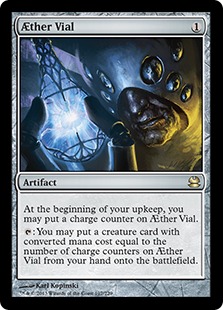
Aether VialWith Aether Vial or Collected Company in hand, you pull ahead in the mid-game with two or more Ally creatures per turn. Aether Vial, the more important card of the two, keeps your spells safe from countermagic and helps play around sweepers. Vial also lets you hold up interactive cards like Path to Exile or Boros Charm. Just watch out for those Kolaghan's Commands. Though not quite as impressive, Collected Company gains value as a way to apply massive pressure out of nowhere while selecting the most advantageous rally effects. Rally can make playing Collected Company difficult since hitting two rally creatures at end step loses some value, but as long as you have a follow-up Ally creature on your own turn it is not very disadvantageous. When casting main phase Collected Company, be sure to keep rally effects in mind, especially if you need lifelink or other effects to survive or close out the game that turn.
The New Recruits

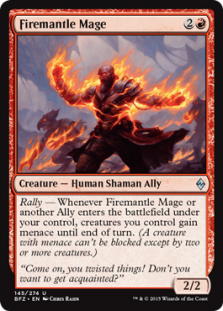
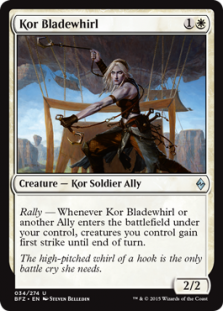
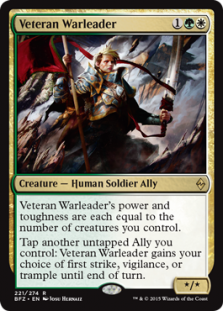
Though Aether Vial and Collected Company are certainly critical pieces in the deck, let's examine the creatures that really make this strategy tick. Focusing on new additions from Battle for Zendikar, the deck gains four very powerful cards in [tippy title="Firemantle Mage" width="330" height="330"]Firemantle Mage[/tippy], [tippy title="Kor Bladewhirl" width="330" height="330"]Kor Bladewhirl[/tippy], [tippy title="Veteran Warleader" width="330" height="330"]Veteran Warleader[/tippy], and [tippy title="Lantern Scout" width="330" height="330"]Lantern Scout[/tippy].
[tippy title="Firemantle Mage" width="330" height="330"]Firemantle Mage[/tippy]Firemantle Mage is the card that excites me most when it comes to beating decks like Abzan (or any creature matchup) that stabilizes through creature combat. Giving all your creatures menace whenever Mage or another Ally enters under your control allows congested board states to turn from even to advantageous. Since all rally creatures trigger upon entering, playing [tippy title="Firemantle Mage" width="330" height="330"]Firemantle Mage[/tippy] after deploying other Ally creatures will surprise your opponent and force damage past Lingering Souls and Tarmogoyf. One of the best features of rally compared to other tribal abilities is they do not require the creature to live for any amount of time upon entering the battlefield. This makes Allies more difficult for removal heavy decks like Jund and Abzan to deal with: you keep rally's benefit through the combat step. This doesn't happen when your Lord of Atlantis eats a Lightning Bolt mid-combat. That being said, [tippy title="Firemantle Mage" width="330" height="330"]Firemantle Mage[/tippy] is not powerful enough on an empty board to be anything other than a three-of late game card.

[tippy title="Kor Bladewhirl" width="330" height="330"]Kor Bladewhirl[/tippy] Kor Bladewhirlutterly eviscerates any creature deck or any deck trying to block profitably or at parity. Much like [tippy title="Firemantle Mage" width="330" height="330"]Firemantle Mage[/tippy], [tippy title="Kor Bladewhirl" width="330" height="330"]Kor Bladewhirl[/tippy] is especially effective as a combat trick with legs that gives all of your creatures first strike in repeatable fashion. This card pushes through damage and forces your opponent to create poor blocks, changing subpar board states into favorable ones. Vialing in Bladewhirl after blocks are declared can be especially brutal if the opponent was planning to use trades to stop you. These swingy types of effects break board stalls and win close matches. This can be particularly useful in a metagame with a lot of Naya Company and Affinity running around. Bladewhirl also comes down early and can attack for two on her own, which is itself not insignificant. Like Firemantle though, [tippy title="Kor Bladewhirl" width="330" height="330"]Kor Bladewhirl[/tippy] does not hold her own on an empty board and cannot attack alone through much even with first strike. The fact that she doesn't grow like Kazandu Blademaster means you cannot rely on the Kor to create insurmountable pressure on her own. Unless the metagame shifts very heavily towards creatures and combo completely falls out of favor, I do not see myself running four.

[tippy title="Veteran Warleader" width="330" height="330"]Veteran Warleader[/tippy]Veteran Warleader is a powerhouse addition that creates complex situations for any opponent. Often, players will talk about the threat of activation as a major asset among creatures with abilities. One of the benefits of a creature that can activate at instant speed for very little cost is that it is a constant threat, severely hampering the number of playlines opponents can take without fearing the ability. [tippy title="Veteran Warleader" width="330" height="330"]Veteran Warleader[/tippy] works wonderfully in the Allies list. Each Ally pumps her power, and can be tapped to give Veteran your choice of first strike, vigilance, or trample. Or tap multiple allies for multiple effects! This leaves the opponent unsure what or how to block each combat, a problem that Aether Vial and Collected Company makes even worse. Trample is especially beneficial in a deck like Allies, since pushing through the last few points of damage can be challenging. I really like this card in the deck, although she does not bolster any other creatures and cannot help the team get through an army of chump blockers. That's why I did not overload on Warleaders. Think of Warleader as a finishing threat rather than a three drop and it makes sense as a two-of.

Last, but certainly not least is [tippy title="Lantern Scout" width="330" height="330"]Lantern Scout[/tippy].Lantern Scout This card is phenomenal. An Ally with rally that grants all your creatures lifelink is backbreaking against aggressive matchups and can even throw off combo matches that often struggle doing more than 20 damage in one turn, such as Storm or Amulet Bloom. Unlike the old Talus Paladin, Scout has a more aggressive body and costs only three mana for Company. [tippy title="Lantern Scout" width="330" height="330"]Lantern Scout[/tippy] nearly made me cut all of the Ondu Clerics from my sideboard, but board stalled situations where I cannot risk attacking with many creatures made me keep the Clerics in the bench for now. The Scout, coupled with Cleric, really puts Allies in a favorable position against Burn and other hyper-aggressive strategies. Unfortunately, Scout isn't very effective against Twin or decks capable of making multiple large threats quickly. If the format moves into a more aggressive, non-combo oriented metagame, I believe this card can bury any deck trying to race with conventional damage. Until that day, three copies of [tippy title="Lantern Scout" width="330" height="330"]Lantern Scout[/tippy] will give plenty of advantage in creature matchups without stifling pump draws to force through damage.

Didn't Make the Cut

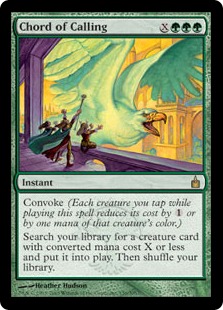
I considered adding some number of Chord of Calling to the main deck as a way to tutor for specific rally effects. That said, adding more non-creature spells makes Collected Company a Chord of Callinglot worse. Unlike the Slivers deck, Allies has very few silver bullet creatures either from Battle or original Zendikar. It's also not optimal to play non-Ally creatures since they don't trigger rally. Without the ability to hose your opponent’s plans with silver bullets like Eidolon of Rhetoric against Storm or Kataki, War's Wage against Affinity, Chord becomes much worse. While I like the idea of tutoring for specific cards like Scout against aggressive decks, the convoking instant does not add enough to the overall strength of the deck. Deck space means that you can run either Chord or Vial, and Vial is more generally useful.
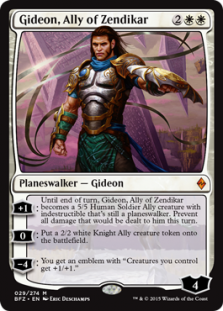
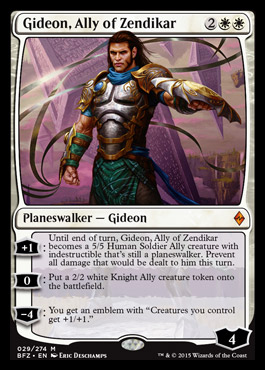
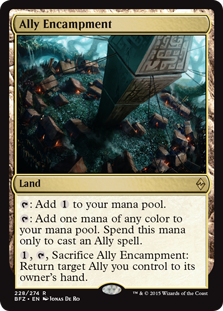
Before discussing the sideboard, I would like to address that I really wanted to try one to two copies of [tippy title="Gideon, Ally of Zendikar" width="330" height="330"]Gideon Ally of Zendikar[/tippy] in this deck. Unfortunately, the addition of [tippy title="Ally Encampment" width="330" height="330"]Ally Encampment[/tippy] on top of Cavern of Souls, makes casting a four mana double white non-Ally very difficult to achieve. Even so, in the future, I would like to try fitting Gideon into the sideboard.
Sideboarding Allies

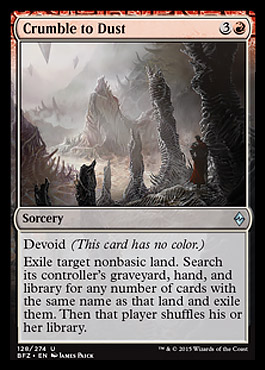
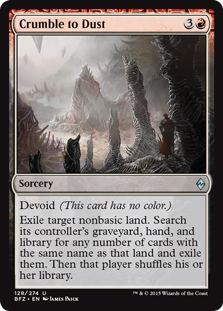
My sideboard is very similar to Daniel’s, with the exception of adding in a couple of Rending Volleys to help against Splinter Twin alongside the maindecked Path to Exiles. Combo is generally a bad matchup and we want to be prepared for the most popular ones. Since Affinity was performing well, I had been considering the second Ancient Grudge. After Lantern Control won Grand Prix Oklahoma City my decision was firm: Grudge is in a very good place right now. [tippy title="Crumble to Dust" width="330" height="330"]Crumble to Dust[/tippy] also makes an appearance. Spells with a single colored mana symbol work well with the updated manabase, and having an out to Tron is always a plus, especially since our game plan is particularly weak to Ugin, the Spirit Dragon, and Pyroclasm.pyroclasm
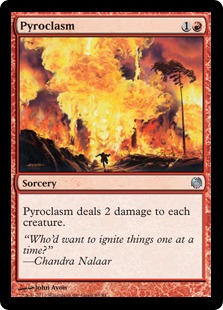
To properly pilot this Allies deck, it is important to understand the deck’s weaknesses. As mentioned above, Pyroclasm is a problem. Most of the creatures in this deck start small enough to die to Pyroclasm and Anger of the Gods, which makes playing against UR Splinter Twin or GR Tron much harder with both decks bringing down the wrath. Boros Charm is our out here - it gives all our creatures indestructible to survive sweepers. After our opponent’s Wrath has effectively fizzled, we can swing in for the kill next turn.

Creatureless combo decks like Storm or Ad Nauseam can be very difficult to beat. Allies cannot afford to play much interaction due to Vial and Company so we have to race them before these decks can assemble their combos. Storm has some difficulties from Wear // Tear and our Scout or Ondu Cleric, since gaining huge amounts of life throws off their Grapeshot math. In decks like Ad Nauseam, where the matchup is naturally poor, applying pressure and aggressively mulliganing for hate cards is crucial. Without hate cards or an aggressive start, these kinds of matchups are extremely difficult to beat.

Onward To Glory

Moving forward, matchups get better with more creature dependent decks, since our Allies combine to create unstoppable creatures that can easily overtake any board stall. In addition, the deck has the ability to close out a game quickly if the opponent stumbles on mana or cannot sequence their plays correctly. But be cautious; this deck also punishes pilots for incorrectly sequencing lands and spells. You have got to get very good at combat math and managing your rally triggers to play Allies well.

Since the metagame is shifting in a creature-heavy direction this deck is very well positioned. It destroys Burn and crushes creature-based decks that lack combo aspects, and with decks like Naya Company enjoying such success at GP Oklahoma City, Allies is only going to get better. What do you think of the deck, and what cards do you think could help push Allies into the limelight at the next big event? Rally to the comment section and let me know!

Insider: Five Modern Pickups After Battle for Zendikar

Are you a Quiet Speculation member?

If not, now is a perfect time to join up! Our powerful tools, breaking-news analysis, and exclusive Discord channel will make sure you stay up to date and ahead of the curve.

Modern players are rarely satisfied with new sets. I remember the outcry against the supposedly overpriced delve spells back when Khans of Tarkir hit shelves. A few months later, Treasure Cruise and Dig Through Time joined cards like Deathrite Shaman on the banlist.

Meanwhile, Tasigur, the Golden Fang and his Zombie Fish friend, Gurmag Angler, reshaped the format around the mighty Grixis color pairing.

Let's just say it's hard to evaluate new cards. Battle for Zendikar is certainly no Khans of Tarkir or Fate Reforged, but the set still has a few gems that are worth Modern players' time.

More importantly, some of these cards are likely to drive the prices of older Modern cards, creating a few investment opportunities for enterprising Modern players.

Looking for the next big thing

Before we dive into some spicy Modern purchase targets, I want to take a minute and introduce myself to all of you at Quiet Speculation.

I've been involved in Modern since the format's birth in 2011, both as part of online communities and as an avid player. This has included moderating the MTG Salvation Modern forums from 2013 through the present, where I do extensive work on metagame tracking and deck tiering for the Modern playerbase.

More recently, I co-founded the Modern Nexus website where I now work as Editor in Chief. We publish articles on all things Modern, most notably by collecting tournament finishes from across the world to get a complete picture of Modern's metagame.

I've written extensively on Modern prices and finance before and am excited to be joining the Quiet Speculation team to bring this information to the QS readership. You can expect my articles to have a mix of investment advice, rising deck alerts, metagame discussions, and general Modern finance analysis.

If you want to get ahead of the next Gilt-Leaf Palace buyout or invest in a rising deck before it takes off in popularity (and price), then these articles will give you an edge on the rest of the Modern competition.

Enough introductions: let's get to Battle for Zendikar.

Whenever a new set comes out, smart Modern investors need to analyze both the new cards and the old cards that promise to increase in value. Even weaker sets invariably lead to speculation, buyouts, and even sustained price increases in older cards.

Whether you are a player who wants to try a new deck or an investor who wants to make smart purchases, it's important to stay on top of (or ahead of) these trends.

Today, I want us to look at five Modern-legal cards that are poised to gain from Battle for Zendikar's release. I'll also talk about the Modern metagame trends driving these card prices to make sure you have the format-wide context before you make any purchases.

5. Ancient Stirrings

ulamogtheceaselesshungerAlready a mainstay cantrip in R/G Tron and Amulet Bloom, Stirrings saw a sharp price increase in June 2015 due to its performance in these two decks.
Ali Aintrazi was one of the driving forces in this increase, winning the SCG Invitationl with R/G Tron and reminding players how strong the Urzatron ramp deck was in a metagame shifted too heavily towards Jund. The Amulet Bloom craze drove Stirrings' price even further, with many pilots investing in the combo deck following a format-wide discussion on its strengths in Modern.

Grand Prix Oklahoma City added a new layer to the Stirrings narrative in Lantern Control. When Zac Elsik took down the entire tournament with his innovative Lantern of Insight/Ghoulcaller's Bell list, Stirrings gained another competitive home.

Between Elsik's high profile finish and the existing credibility of both R/G Tron and Amulet Bloom, the old Zendikar block common was already a strong pickup even before Battle for Zendikar cards promised to drive it up even further.

Tron pilots are reporting early success with Ulamog, the Ceaseless Hunger, as well as interest in Titan's Presence (particularly on the Mono Blue lists that have seen less press in recent months).

Although these cards are hardly the second coming of Wurmcoil Engine, Stirrings will only improve as more colorless monsters and spells get released. This makes Stirrings a strong investment both for players who eventually want to get into Tron and/or Bloom, and for players who want to capitalize on both decks' successes.

There was an error retrieving a chart for Ancient Stirrings

When analyzing an investment target in Modern, we need to analyze not only a card's financial profile/prospects, but also its metagame position independent of its price tag.

September metagame numbers are very favorable for Stirrings. We are already seeing an uptick in R/G Tron relative to its summer prevalence. Amulet Bloom also enjoyed some under-appreciated success at Grand Prix Oklahoma City, where Jacob Nagro flew under the radar with his 24th place finish.

Then, of course, there's Lantern Control, the breakout deck that everyone wants to play. While everyone else is speculating on their Ensnaring Bridge and Lantern of Insight playsets, get a step ahead and pick up the common cantrip that enables not just one but three powerful Modern decks.
Barring a reprint in a later BFZ set, the card will only go up from its current $3-$3.50 price: take a look at Serum Visions if you want to see what Modern demand can do to the price of even a common.

4. Supreme Verdict

prairiestreamU/W Control was another big winner from the summer of Modern.

For years, Modern control mages turned to Jeskai Control and its different variations over the Lightning Bolt-less U/W Control option. Not even Gabe Nassif's performance at Pro Tour Valencia 2014 drove interest in the deck.

2015 didn't start much better for the Azorius mages, with Grixis Control and the much-hyped Kolaghan's Command stealing the spotlight for months.

The format has changed dramatically since the early summer, including a series of strong U/W Control finishes at the SCG Open in Charlotte, at Worlds 2015, and again at the SCG Open in Cincinnati.

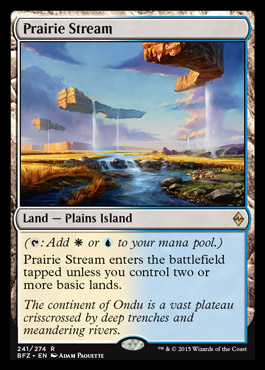
Battle for Zendikar adds a few cards which could see play in U/W Control, including a possible one-of in Blighted Cataract and the fetchable Prairie Stream. Stream is particularly strong in Michael Segal's version of U/W Control, which relies on Emeria, the Sky Ruin to outgrind opponents.

If you are looking to invest in U/W Control, the best pickup is Supreme Verdict.

There was an error retrieving a chart for Supreme Verdict

Verdict is played in all versions of the U/W Control deck (unlike something like Emeria or Sun Titan) and will only get better as decks shift to more creature-oriented strategies.

At between $3.50-$4.00, the card is incredibly undervalued for one of the best sweepers in Modern. It's particularly well-positioned for a return of any Grixis decks: Grixis Control has suffered a metagame share hit but is sure to return as the format keeps evolving.

The sweeper even has cross-format appeal as a mainstay in Legacy's Miracles deck! From a financial perspective, we're never going to see Verdict keep pace with Abrupt Decay prices (another Return to Ravnica rare), but the card still has a lot of room to grow as more players buy into it.

3. Return to the Ranks

Zulaport CutthroatWhen I think of Return to the Ranks and Rally the Ancestors-style decks, I think of Standard before I think of Modern.

We saw Ray Tautic's Abzan Rally deck score 1st place at the SCG Open in Chicago, and it looks like these mass-reanimation strategies got Modern players brewing, too.

Then fast forward to GP Oklahoma City, where Steve Rubin snagged 14th place with a grindy Return to the Ranks combo deck powered by Abzan Ascendancy and Collected Company.

Modern players are sure to have their eye on the deck since Rubin's finish, and Battle for Zendikar offers the deck a few more weapons it can use to keep taking down tournaments.

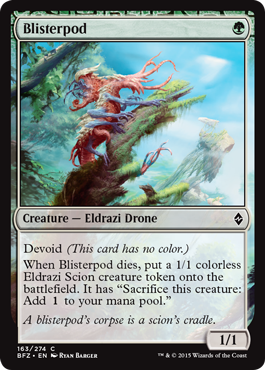
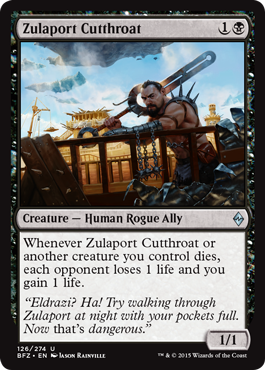
This includes a Blood Artist upgrade in Zulaport Cutthroat, and Blisterpod, a straight upgrade from the weaker Tukatongue Thallid.

Cutthroat is the more interesting of the two not because it replaces Artists, but because it can be Artists 5-8 in the deck. Or, should I say, Artist can be Cutthroats 5-8 for the post-BFZ Return Combo players.

It's unclear if these two cards will make Return a solid tier two deck, but with the combo seeing more profile and more support in BFZ, it's a great time to invest in its core engine, especially foil copies you can pick up for under $5.00.

Other investment targets following Cutthroat's and Blisterpod's addition to Return Combo include Teysa, Orzhov Scion (a low-supply rare from an underopened set) and Voice of Resurgence (a Modern sleeper with multi-deck appeal).

There was an error retrieving a chart for Return to the Ranks

2. Knight of the Reliquary

retreattocoralhelmHere's an investment target that has nothing to do with metagame trends and everything to do with new-card hype.

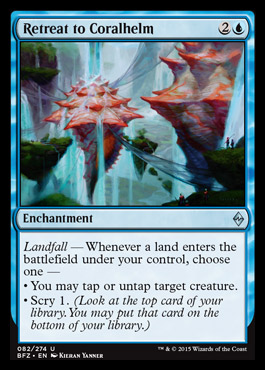
Retreat to Coralhelm is an unassuming enchantment in an otherwise unremarkable cycle of landfall engines. Or it would be, if the collective online Modern Hive Mind hadn't discovered its combo potential with the venerable Knight of the Reliquary.

With a Knight and a Retreat on the battlefield, you can sacrifice a Forest or Plains, get another Forest or Plains, trigger Retreat and untap the Knight, and then repeat the process until Knight is large enough to hit for lethal. Searching for fetchlands effectively allows you to "double up" on untap triggers for Knight, and you can always search for cards like Kessig Wolf Run (another solid investment target here!) to finish off the combo.

Knight plays alongside Retreat in a Bant Midrange shell, complete with Noble Hierarch/Birds of Paradise for mana acceleration, Loxodon Smiter/Geist of Saint Traft for beatdown, and a variety of other options including Collected Company engines and the flexible Commune with the Gods.

There was an error retrieving a chart for Knight of the Reliquary

Is Retreat Combo (Retreat of the Reliquary? Knight of Coralhelm?) a viable combo deck? I'm really not sure. I've tested the deck and, although its synergies are interesting, Bant has historically struggled in Modern.

Retreat only addresses one of those shortcomings--the lack of proactive win conditions--but not the others: lack of reach in Bolt/Snapcaster Mage, lack of good low-cost removal, etc. This strategy also suffers from the Twin comparison and the age-old question of "Why not just play Twin?"

From an investment perspective, this doesn't matter in the short term. The hype around Retreat Combo is very real, even if the deck is not, which makes Knight a good early pickup.

Indeed, I fear that by the time this article goes to press, Knight may have undergone a buyout and spiked up from its sub-$8.00 range to over $13-$15. If not and you still see copies around your LGS or on eBay, grab those knights as people figure out whether this combo is Modern-worthy.

1. Kabira Evangel

Lantern ScoutModern players have been trying to get Allies to work for as long as I can remember. I wrote an Allies deck feature on Modern Nexus where I charted the deck's recent history, and I remember seeing lists as early as 2013.

Allies saw their biggest success at this month's GP Oklahoma City, where Stephen Perigo's Naya Allies deck punched through a field of Affinity, Twin, and BGx to make it to day two.

Like the lists that came before his, Perigo's Allies leveraged synergies between Collected Company and Hardened Scales, combining them with the old-school Allies we know and love from old Zendikar block.

Also like his predecessors, this included the powerful Kabira Evangel--a rare Ally that has shown up in every single competitive Ally list since the deck first started cropping up on MTGO.

Battle for Zendikar introduced three new cards to Modern that are sure to improve the deck's strategy. This includes a new one-drop Expedition Envoy, an Ally-specific Sliver Hive in Ally Encampment, and, most importantly, a Talus Paladin replacement in the form of Lantern Scout.

Scout is the big player here, giving Allies a turn three source of lifelink to combat Burn and Affinity and adding another Company flip-target to the deck's creature base.

If Allies was making day two at GPs before Scout, I'm excited to see what it can do now.

There was an error retrieving a chart for Kabira Evangel

If you want to play Allies in Modern, you are going to need those Evangels for your army. The Cleric is an invaluable addition, protecting creatures from spot removal and damage-based sweepers like Anger of the Gods, holding the line against larger bodies (provided you have an enter-the-battlefield trigger to give protection), and ensuring a lethal swing when you have a large enough force.

You can find regular Evangels for under $1.00 with ease, and foil copies aren't yet over $5.00.

Even if you have no interest in playing the tribe, know that others will as BFZ block keeps unfolding. Lantern Scout alone is going to push Allies to a new level, and it's only a matter of time before the deck gets its last missing pieces and becomes a powerhouse.

Buy your Evangels now to stay ahead.

Other Modern Pickups?

Set releases are a great time to sneak in key investment targets before the hype train comes into the station. This kind of buy-in is often effective independent of how good the cards/combos/decks actually are in their own right!

Just take a look at Warren Instigator, which still hasn't recovered from its 150% price spike following Goblin Piledriver's printing in Origins, even though Goblins has seen next to zero play in Modern since then.

Here are a handful of random pickups you can look into over the next week or so:

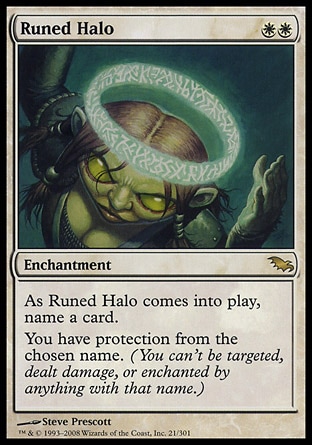
  • Runed HaloRuned Halo / Suppression Field / Nykthos, Shrine to Nyx
    Mono White Enchantments keeps pushing to break into Modern's tier three, particularly with new printings like Starfield of Nyx coming in every set. Stasis Snare is BFZ's addition to the deck, and although it's unclear if this will be much better than the existing enchantment options, it's hard to deny that Enchantments is reaching a critical mass of decent cards. Instant-speed really helps on Snare, and these core Enchantment cards could be decent buy-in targets as the format adopts Snare.
  • Huntmaster of the Fells / Scapeshift
    At about $12 and $22 respectively, these cards are a little higher than I'd be comfortable buying into without a deep pocket. Maybe a lot higher. Then again, Battle for Zendikar just gave Modern's two best Temur decks a powerful new manland in Lumbering Falls, a recurring Lava Spike once you've cleared out the board. Temur Twin enjoyed some success earlier in the summer at GP Singapore, with Scapeshift seeing newfound relevance following Matthew Dugan's 8th place finish at GP Oklahoma City. Temur gains a lot from 1-2 Falls in their maindecks, and Huntmaster/Scapeshift are the two important cards to get if you want to step ahead of an impending Twin/Scapeshift rise.

That's all for this week. What other older Modern cards strike you as important in this post-BFZ world? What other decks stand to gain from our new cards?

Let me know in the comments and I look forward to seeing how Battle for Zendikar fits into our evolving format!

Trevor Holmes Plays MTGO: Jund Midrange

Are you a Quiet Speculation member?

If not, now is a perfect time to join up! Our powerful tools, breaking-news analysis, and exclusive Discord channel will make sure you stay up to date and ahead of the curve.

What’s up guys! Welcome to Episode 1 of a new weekly video series here on Modern Nexus, where I take a Modern archetype and break down the decklist, basic strategy, tips, sideboard, and finer points and run it through an event on MTGO! This video series will almost always be two parts (video and text), usually in the form of time-stamped notes that reference plays/mistakes/amazing brilliance in the video and/or things I forgot to mention or would like to elaborate on.

Thumbnail_1920

This is all new territory, so if you have any thoughts/opinions about the structure of this series feel free to let me know in the comments! Let’s get to it!

[wp_ad_camp_1]

Untitled Deck

Creatures

1 Abbot of Keral Keep
3 Scavenging Ooze
4 Tarmogoyf
1 Tasigur, the Golden Fang
4 Dark Confidant

Instants

2 Abrupt Decay
1 Kolaghan's Command
4 Lightning Bolt
4 Terminate

Sorceries

2 Maelstrom Pulse
3 Inquisition of Kozilek
3 Thoughtseize

Planeswalkers

4 Liliana of the Veil

Land

1 Forest
2 Swamp
4 Blackcleave Cliffs
1 Blood Crypt
3 Bloodstained Mire
1 Ghost Quarter
1 Overgrown Tomb
4 Raging Ravine
1 Stomping Ground
1 Twilight Mire
4 Verdant Catacombs
1 Wooded Foothills

Sideboard

1 Nihil Spellbomb
4 Fulminator Mage
3 Kitchen Finks
1 Abrupt Decay
1 Ancient Grudge
1 Outpost Siege
1 Anger of the Gods
1 Kolaghan's Command
2 Damnation

Deck Tech

2:20 I wouldn’t play two Abbot of Keral Keep in the list. Part of my reasoning is my general bias towards cheap effects, which is the primary reason why I am supporting Abbot as a de facto “four drop” in the list over a more traditional card, but also because while Abbot is excellent, it can sometimes be a bit clunky. As a two drop, it doesn’t stabilize anywhere near as well as Tarmogoyfcan, and as a four drop, it’s more “risky” than something like Huntmaster of the Fells. Hands with multiple Abbot of the Keral Keep should play better than hands with multiple four drops, but I would still like to avoid awkward draws if possible.

We sort of brushed over Scavenging Ooze, but it’s worth pointing out that Ooze gives us great maindeck hate for Living End, Grixis Control, Lingering Souls, and Burn strategies. The couple points of life it can gain are nothing to scoff at, and any deck that plays Thoughtseizeand fetches shocklands would love access to any lifegain, no matter how small. Scavenging Ooze can sometimes be just a 2/2 for 1G (in matchups like Tron/Amulet Bloom) but we can easily cut them for Fulminator Mages in those matchups while it does excellent work elsewhere. Similar to Tarmogoyf, you can find uses for Scavenging Ooze against aggro, control, and combo.

4:38 Keep in mind that all board discussion is dependent on exact sideboard choices, and can vary widely based on matchups/what other options we have/where we want to position ourselves in the matchup. Jund can take advantage of a large spread of possible sideboard options/hate cards, and things like Choke, Shatterstorm, Bitterblossom, Feed the Clan, Night of Souls' Betrayal are all possible options.

Final Note: At the time of recording I was having difficulties capturing the MTGO Preview Pane, expect visual aids in future videos.

Round 1

2:10 Playing Abbot into our opponent’s Lightning Bolt in hand is also obviously poor. There’s a discussion to be had about playing spells quickly as we know our opponent has a poor hand clogged with Dispels and expensive stuff, but our hand composition (threat light) kind of forces our hand.

4:40 This same reasoning is why we play Tarmogoyfover the Lightning Bolt. It’s important to keep in mind that the Lightning Bolt wasn’t a wasted “hit” off of Abbot of Keral Keep; we didn’t really want to be drawing that anyway, so Abbot’s ceiling is really “draw a card” while it’s baseline is “scry 1”.

7:14 I missed a couple points by not animating Raging Ravine. I have failed you all.

12:00 All the Lightning Bolts should probably come out, but I like the ability to clear out Snapcaster Mages so our Liliana of the Veil can keep +1’ing, and I don’t mind using Lightning Bolt as Lava Spike either. It’s not the best use for the card, but two Lightning Bolts over the course of the game usually speeds up our clock by 1 or 2 full turns. Just something to consider.

18:48 Taking the other Remandwith the Thoughtseize(as opposed to a Snapcaster Mage) is a strong play if we plan on our opponent not hitting his fourth land in time. If we can get an activation out of Tasigur (by playing it next turn, then activating once he is able to Snapcaster-Remand) we are still ahead on resources and compounding the advantage that Dark Confidant has been giving us. Since our opponent drew his third land, I expected him to mainphase kill the Dark Confidant to stop our card advantage, which is why we left Remandas we could just play Tasigur while our opponent was tapped out. I can understand why he didn’t kill Confidant (he knew we had Tasigur and possibly just wanted to Remand again) but I think he would have been better off just killing Bob.

Round 2

There really isn’t much to say about this match, other than I feel this is a clinic on how to successfully cast discard spells and rip apart an opponent’s hand (skillgame). I still found this match interesting however, because it clearly demonstrates the power of Jund’s gameplan when executed correctly. Granted, our opponent’s hand was usually slightly poor, but Game 2 showed how powerful discard can be in the matchup. If I’m unable to remove my opponent’s Tarmogoyf, I believe that game goes very differently. The positioning that comes from Jund’s gameplan (disrupt, cast varied threats, find a path to victory) when lined up against Temur Twin (control, combo, tempo, all three?) is interesting and makes the matchup a lot of fun to play.

Round 3

4:30 Lightning Bolt was definitely wrong here, as we can’t Abrupt Decay an Inkmoth Nexus. Whoops.

This matchup was a lot of fun and feels pretty favorable for Jund. Killing creatures is what we do best, and Infect's plan is to try and stress our mana and make our two-mana removal awkward. Classic Infect strategy applies here as well; kill their creatures anywhere except inside the combat step.

22:30 I can’t clear out my opponent’s board as he has Become Immense and the mana/GY to cast it. In response to the Bolt he grows his guy, which then stops my attack. Also, Ghost Quarter can’t fetch me a Mountain, as we’re not playing a Mountain!

Conclusion

Thanks for watching! While we played a few favorable matchups and dodged Tron, I think this video series was pretty instructional and showed what Jund is capable of when executing its gameplan. Let me know in the comments what you think, about both the content and the presentation. We have a lot of freedom regarding deck choice, so let me know what you would be interested in seeing me play! Feel free to comment below or hit me up on Twitter, I’ll play whatever archetype gets the most votes! (Yes, even Lantern Control). See you guys next week!

Trevor Holmes
The_Architect on MTGO
Twitch.tv/Architect_Gaming
Twitter.com/7he4rchitect

Insider: Picking Undervalued Presale Cards in BFZ

Are you a Quiet Speculation member?

If not, now is a perfect time to join up! Our powerful tools, breaking-news analysis, and exclusive Discord channel will make sure you stay up to date and ahead of the curve.

We are currently less than one week away from being able to play with BFZ cards at the prerelease.  I'm just going to pause for a second to let that sink in... The full spoiler for BFZ has been up since Friday which has left us ample time to become acquainted with the new goodies that lie in store for us in the near future.

In today's article I'm going to walk through the spoiler and discuss cards that I think are currently preselling at less than their potential price.

The key to picking presale winners is the same as everything else in MTG finance: you have to find cards that are being undervalued and have room to grow. Pretty much any dummy can look at the new Gideon or the Tango lands and tell you that they will be great in Standard and should come out of the gate with a big price tag.

It's common knowledge that everybody needs these cards for their decks. The real trick to making money in the early stages of a new set is to predict the cards that people will want before those people even know they want them!
Underpriced Mythics

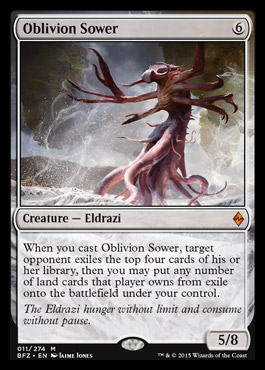
Oblivion Sower

oblivionsower

I talked about this card last week so I won't dwell on it too long. Everything that I said about the card before still applies now. It is a great card and will see a ton of play. The fact that there is a duel deck version has likely suppressed the price considerably, and as demand grows so will the price for regular versions. I think the potential of this card is similar to Polukranos, which still hit $12 despite being in a duel deck.

I think this is one of the most powerful overall cards in the set. It does a lot of things. It has a huge body and generates card advantage by netting lands. It also has some pretty nasty interactions with opponents who use the delve mechanic...

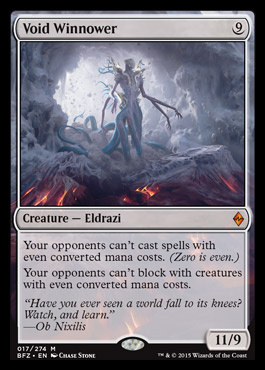
Void Winnower

voidwinnower

Void Winnower is a very powerful Magic card and if people are going to be ramping out Eldrazi this is one of the two high-end ones they'll look to play. Keeping an opponent from playing even cost spells is a huge deal. All of the best costs are even! Decks tend to have more two- and four-drops because those two numbers get significant bumps in power level. Two-drops tend to be significantly better than one-drops and four-drops tend to be significantly better than three-drops.

The card is a Meddling Mage that likely names more than half of your opponent's deck...

Also, it is pretty sweet that it makes tokens unable to block! The Void Winnower is also one of the best cards to cheat into play with See the Unwritten and so if that is a deck it will be playing this card. It is also significant that this card is probably insane in Commander.

Underpriced Rares

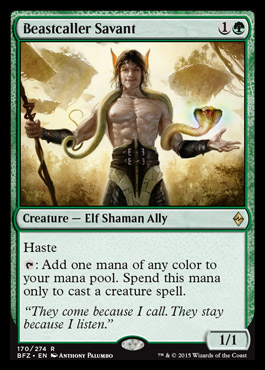
Beastcaller Savant

beastcallersavant

Three bucks on SCG? Give me a break...

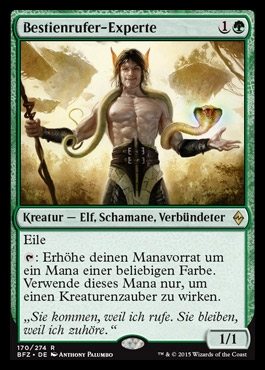
The card is going to be extremely important in Standard. First of all it fixes mana for every color when it comes to creatures which is huge because all of the best creatures cost three different colors of mana! Abzan decks lost great two-drop creatures and really needed a card to fill this role.

It's also just a mana dork that when you are on the play can randomly sneak in a point of damage, which is a pretty big upside. I can't think of another mana creature that actually has haste so the card is unique for sure. I think there are going to be a lot of decks that need this creature, and the current price tag is just too low.

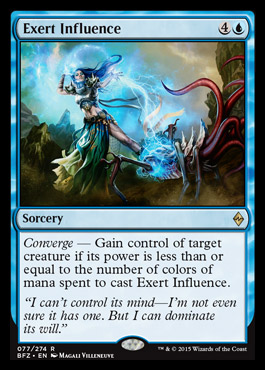
Exert Influence

exertinfluence

I think this is a sleeper card that will be very good in Standard. Gaining control of an opponent's card is no joke. It is the best possible kind of two-for-one.

The cost is reasonable and there will be decks that can meet the condition of making several different colors of mana in order to go all the way up to four or five colors. Can you imagine how awesome it would be to steal a Siege Rhino on curve? Right now the card is the bulkiest bulk rare, and I'm already looking at it as a card that I'd like to try to play with. Seems like a good time to buy in.

Manlands

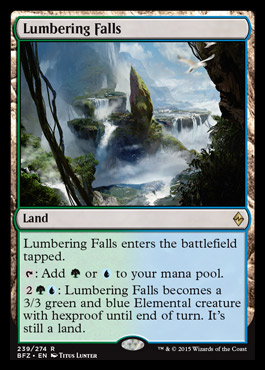
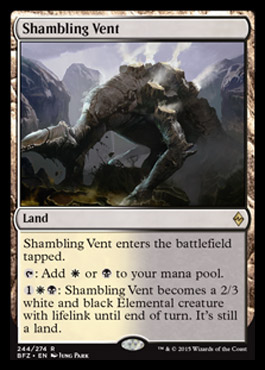
lumberingfalls shamblingvent

Both of these cards are going to be huge players in Standard. Manlands are always a dominant force whenever they are legal.

The biggest drawback to these cards is that they're weaker than the ones from Worldwake. Fortunately, the Worldwake ones are not legal in Standard to outclass them. The fact that they are worse than the WWK lands has absolutely no baring on how good they will be in new Standard.

In fact, I'm certain that any deck playing those colors will play four of these lands. The fact that these lands exist is a strong incentive to play these colors. In particular, I think these lands make Esper Dragons and Temur Collected Company strong decks right out of the gate.

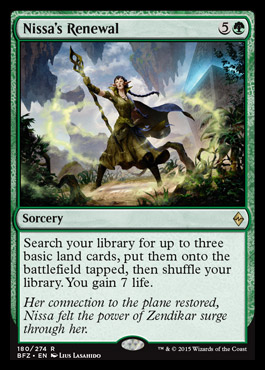
Nissa's Renewal

nissasrenewal

I think any dedicated ramp deck will want to play this card, and there's certainly significant incentive to ramp in Standard. I wrote about this card last week after it was spoiled so I won't go too in depth on it again, but I still think it is a strong card to target right now in the early stages of the set.

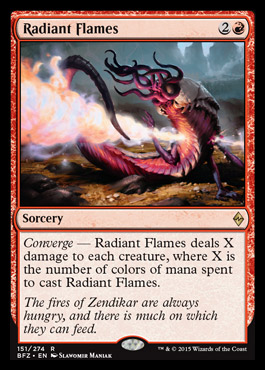
Radiant Flames

radiantflames

I don't think people have really thought through how good this card actually is. It is a Firespout that lets you choose how much damage you want to deal. Firespout was a dominant card when it was in Standard and this one gives you even more control, assuming you're three colors. I think the flexibility of this card makes it very good.

It is also just a good sweeper style card for three mana. In fact, I think it is one of the better three-cost sweepers of all time. The format lost Drown in Sorrow and Anger of the Gods and this is the card that will pick up the slack and fill that role. Seeing it written off as a bulk rare is embarrassing.

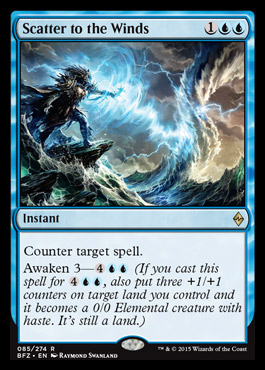
Scatter to the Winds

scattertothewinds

Scatter is going to see a ton of constructed play. The other good three-mana hard counters have all rotated out of Standard and this is the card to take up that mantle. Also, surprise! This card is completely insane.

It is a hard counter that also just turns a land into a win condition once you have a bunch of mana later in the game. Right now SCG is sold out at $3 but I wouldn't be surprised to see this card hit $8+ before the release. It is a card that will be in a lot of decks. It will also be in the blue decks, so you know it's going to be a force to be reckoned with.
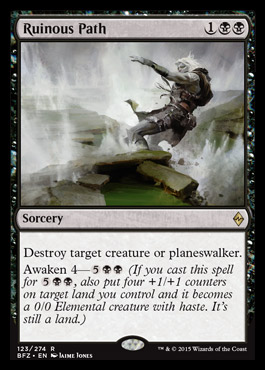
Ruinous Path

ruinouspath

It is a slightly worse Hero's Downfall and Downfall was a $10 card for much of it's tenure in Standard. It is also important that it picks up exactly where Downfall left off and fills that hole.

It is also significant that new Standard is full of fantastic planeswalkers. The old ones were good and Gideon, Ob Nixilis, and Kiora from BFZ are all cards that will see a ton of Standard play. In fact, I think the new walkers comprise most of the best cards in the set and will be among the most impactful. I just can't suggest them as great buys because they are already preselling for $20+ and likely won't go up much more.

Anyway, the card that kills all the best cards is going to be a strong player in Standard for the next year and $5 for a card like that seems on the low end.

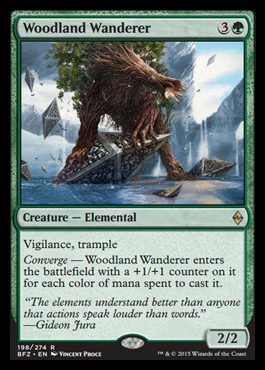
Woodland Wanderer

woodlandwanderer

Woodland Wanderer is a card that I think will see a lot of play. In particular, I think that with fetches and tango lands in Standard it will be possible to play four- and five-color midrange or control decks. They wouldn't print cards for those decks if they weren't possible, would they?
If you pay the full four colors for this behemoth, it enters the battlefield as a 6/6 trample vigilance. That is huge for just four mana! I could certainly see the kind of multicolor deck that wants to play this card also making nice use of the new Control Magic as well.

I remember the days when a 5/5 with a drawback for four mana was amazing and now we have 6/6s with two abilities for that cost! Wow, how the world has changed. Even if you can't make the full four colors and can only get to three colors this creature will still be a 5/5. With the embarrassment of riches that is the fixing in New Standard I can really see cards like this having a moment to shine. If Siege Rhino is the better card, it is certainly true that Woodland Wanderer dwarfs it in size.

~

I've been really enjoying brewing new decks for this format and can't wait to get a chance to try one of my creations out at SCG Indy in two weeks. I'm also looking forward to hitting up the prerelease this weekend!
Today, I basically went through the spoiler and found the cheap cards that I would actually be excited to play with in new Standard. They are all cards I think are actively good to be playing in new Standard in two weeks. Many of these cards that are selling as cheap cards in presale are cards that I believe will be format-defining staples in the coming weeks! Good luck at the prerelease and hope you track down everything you're looking for before it spikes!

Insider: Lessons From a Lame Duck Format

Are you a Quiet Speculation member?

If not, now is a perfect time to join up! Our powerful tools, breaking-news analysis, and exclusive Discord channel will make sure you stay up to date and ahead of the curve.
Battle for Zendikar is knocking on the door as we wrap up the last week of events for Theros block Standard. This week we will look at SCG Standard results, as well as consider what lessons carry over to the new Standard.

You Still Get To Play Khans Block

This is an important thing to remember, especially when you keep in mind Siege Rhino specifically. The most inherently powerful card in Standard keeps most of its support pieces, while trading out some removal along the way.

Khans also has a bunch of other things lurking in it. Anafenza, the Foremost is still a 4/4 for three, meaning that she will hit play a lot faster than some punk Eldrazi. Jeskai Ascendancy has borderline too-good synergies with the awaken mechanic, meaning your lands get to untap and generate mana once they come alive. There's still the hot mess of Sultai Dredge.

Spell Lands Are Really Good

It's been a long, long time in Magic since I've seen lands like the blighted cycle. The last really good cycle like this was all the way back in Odyssey. These lands are going to be fixtures of Standard, even if the white and red ones are pretty trashy. I played many a Barbarian Ring in my day, after all.

Mana is so good in Standard right now that decks can pack 1-4 spell lands and not really feel the downside. When the activation results in Explosive Vegetation, Inspiration or Diabolic Edict, all uncounterable, I'm really psyched. On top of that, Mortuary Mire is a downright nasty attrition card, buying back those aforementioned Siege Rhinos.

U/W Control Is a Strong Early Contender

Jim Davis and Michael Bernat both placed in the Top 8 of SCG Milwaukee with typical lists of U/W Control. This is a showcase deck for Jace, Vryn's Prodigy and helps cement its value in the Origins set. The deck packs a pile of removal and a few planeswalker finishers. Neither player even bothered with Dragonlord Ojutai, instead making Elspeth, Sun's Champion do all the work.

This is a logical place to start in the new Standard because it retains so many great components. One loses Banishing Light and Last Breath, but we gained a few good white cards in their stead. While Gideon doesn't spawn instant armies, his steady stream of 2/2s come out far earlier. I anticipate seeing a straight swap here. Even the counterspells get traded in. Dissolve rotates out, but Scatter to the Wind gives us a counterspell that also spawns a blocker/finisher at higher mana levels.

Another card to keep an eye on in this list is Ojutai's Command. In the maindeck, it only buys back Jace, but isn't that enough? Postboard, it'll bring back an Arashin Cleric and gain more life along the way, which should be a huge roadblock for red decks and any looser-looking Allies decks.

This deck currently runs Radiant Fountains. It will lose that four-of, but in its place the deck can take its pick of spell lands. Does it want to draw extra cards with Blighted Cascade? It can make tokens with Spawning Bed or Foundry of the Consuls. It can stash mana with Mage-Ring Network. This is a great time for lands in Standard, and a deck like this that can get the most out of spell lands is great. It gets more power because the deck benefits from drawing lands and will also have the mana and time available to cash in on Foundry or the like.

Mono-Red Will Be Less Dominant

Theros Standard was bookended by Mono-Red in various incarnations. No more, as things like Foundry Street Denizen, Eidolon of the Great Revel and Stoke the Flames exit. Goblin Rabblemaster is gone.

That said, we've still got guys like Lightning Berserker and Zurgo Bellstriker. I see these cards slotting into a Boros deck more than pure mono-red, though. The other factor is that the top end of the mana curve in the format is very rewarding. A deck that can live against Mono-Red can conclusively put the game away with an Eldrazi or similarly obscene spell.

It's Really Hard to Predict the New Standard

Ingest decks are heavily seeded. It reminds me of the U/G Madness deck from a decade ago, where all the parts were just handed to you by Wizards. There are logical blue and black cards at every step of the mana curve and we've got powerful spells to reward you for ingesting the opponent.

There's also a strong Eldrazi spawn theme that culminates in ramping to an Eldrazi. We have not seen this strategy since the original Zendikar, where ramping into cards like Kessig Wolf Run became pretty annoying after a while. There are certainly a ton of great spells to ramp into.

When I look at the spoiler, nothing jumps out as being powerful enough to build around. It reminds me of Theros in that way, but this is more hopeful. The power level has been increased a bit and the themes are more clear. It will take some time in Standard to see if the seeded Ingest deck and Allies, among others, stand out as playable and good decks.

This is where I figure the brewers will have free rein for a few weeks, which is sheer fun. I have not looked forward to a new Standard for a long time compared to BFZ; we should see some pretty wild lists to get started.

Jeskai Aggro Still Looks Dangerous With Soulfire Grand Master

Jeskai Aggro looks like a Mantis Rider deck backed with burn, but that's only one plan and it looks worse without Rabblemaster around. No fears, though. The deck is capable of obscene things with a Soulfire Grand Master and about eight mana.

A copy of the deck placed in 5th in this weekend's SCG Open. It packs a full four Ojutai's Command to get a lot of protection for its Jaces and Grand Masters. Now it can slot in Brutal Expulsion as well. The endgame for this deck looks positively sick now, especially because Brutal Expulsion can end up as a de-facto counterspell lock against a deck that intends to resolve big ramped-up fatties.

Bonus Modern Discussion: Keep an Eye On U/W Control Here, Too.

Phil Silberman won the Modern portion of the SCG with a U/W permanent-based control deck that I've seen pop up on the fringes of Modern. I bring it to your attention because the list is downright cheap to build by Modern standards. No Snapcaster Mages, no Celestial Colonnades, no Cryptic Commands. In their place are some goofy uncommons and Sun Titans.

This is a deck that loves the long game. It looks kind of janky, but it can cycle through a lot of the deck by not paying W to cast Court Hussar--that lets you buy it back with Emeria, the Sky Ruin or Sun Titan. That means you can find a Path to Exile when you need it (and I imagine that this deck needs them a lot).

I would make some minor tweaks to it; the Gifts Ungiven looks really out of place, especially compared to something like a Restoration Angel or Phantasmal Image. But I've got to love a deck that runs a pair of Pilgrim's Eye. Talk about a beating of a card against Jund!

Insider – 17 Foil Commons and Uncommons You Should Target At Your Battle for Zendikar Pre-Release

Are you a Quiet Speculation member?

If not, now is a perfect time to join up! Our powerful tools, breaking-news analysis, and exclusive Discord channel will make sure you stay up to date and ahead of the curve.

Commons and Uncommons are an unlikely source of revenue, but they can really help to pad your collection and your margins.  People always need them and seem to have a mental block about getting and keeping them.  They take almost no effort to acquire, and often people will just give them away.

I like to target foils because they can command significant premiums above their non-foil counterparts.  People at prereleases often don't care about their foils, so they're glad to trade them away at a discount for stuff they really care about.  That's what trading is all about; moving cards from where they're not wanted to where they are, and taking a bit of a cut in the middle.  It's a service, above all else.

So, here are the 17 cards that caught my eye while browsing the spoilers.  We'll be talking about the rares ad nauseam throughout the week, but I wanted to plant this idea before you spend all your time trying to find the next Hangarback Walker.

Dispel

This situational counterspell will look amazing in foil.

This is one of my favorite situational counterspells.  I have a huge soft spot for things like this, Force Spike, Stubborn Denial and their ilk.  This card is going to look totally amazing in foil.  It could easily command a buck or two in time, and most casual players at their pre-release won't even remotely care.  I want four immediately, and I don't even foil out decks!


Ruination Guide

And to your left, you'll see the smoldering remains of an ally encampment. You'll notice on your right...

I love linear decks and anthem effects, and I love it when 'tribal' synergies are so broad.  I doubt there are enough colorless creatures (aside from artifacts that care about other artifacts) to warrant this being played outside Standard, but I could see a Commander deck built around colorless, just for fun.  It's aggressively costed and helps you press a board advantage, turning Scion tokens into big threats in short order.

It's also a really good followup to some early turn shenanigans with...


Salvage Drone & Sludge Crawler

A prime Ghostfire Blade candidate!
Another dangerous one-drop

No Standard deck based around the Ingest mechanic could exist without strong 1-drops, and I must admit I was hoping to see a rare Savannah Lions type card here.  But, we have a pair of competent 1-drops (with the blue one being, shockingly better) that can hold Ghostfire Blade and hold their own in combat.  To do the really nasty stuff with Ingest, you need enablers and that's what these guys are.

Vampiric Rites

Going straight into my Teysa, Orzhov Scion Commander deck.
I doubt this is good enough to see competitive constructed play, but I think it's an important card for Commander decks.  Ways to turn creatures into card advantage are not necessarily abundant, and it combos very well with one of my favorite cards in the set, Smothering Abomination.   It doesn't play nice with Scions, but beyond that I think there are a host of useful applications here in casual formats.

Tide Drifter

That's a big butt for a 2-drop, and that back-end anthem effect is real solid too.

I am shocked this card is so big for its cost.  It makes your Scions markedly harder to kill, and it's a 2-drop that can block Siege Rhino (I know we're all sick of hearing it but that card still defines a format).  It's another important tribal card and I anticipate the foils will also look spectacular.

Grave Birthing

So much value, but so little actual impact.

This card feels like it's powerful, but I think it's just too grindy to be good in Standard.  Still though, I love cantripping token generators.  This could end up being a useful enabler for the bigger Ingest effects, so I'd like to have some copies of the foil just in case it turns out to be important. It does a lot for 3 mana, but it does nothing specifically well.  It has the hallmarks of a control deck "grind you out with value" card, and I'm keen to see if it actually draws any Pro interest.

Kalastria Healer

In multiples, can take over a game.

This is a key card for an Allies deck; in multiples, can take over a game quickly.  It gives much-needed tempo, and keeps you in the game until you can draw your big allies.  I would LOVE to cast this with Gideon, Ally of Zendikar on a subsequent turn, as that advantage will end up being worth a lot over time.  It's also a Vampire creature, for what that's worth.  I have not heard much about people loving vamps lately (maybe that Twilight garbage has run its course?) but it's always a tick in the right box for a new card.

Processor Assault

Is 2 mana too much for a glorified Flame Slash?

5 damage is a huge amount, able to kill most anything (including stupid old Siege Rhino).  Sorcery speed is a big drawback, and I imagine that you will occasionally be caught without a card to un-exile.  Still, it could be an important card in the Eldrazi Control decks that are spawning all over the place.  It's big-time removal, but it might be more exciting to cast Titan's Presence instead (though you need to draw your big guys to make it happen).  Still, I want to own this uncommon as I can see it finding a home and becoming more-than-bulk.

Blisterpod

A better Tukatongue Thallid for my Pauper deck

Aw heck yeah!  My stupid G/W Pauper deck has a replacement for the miserable Tukatongue Thallid!  Seriously though, this card is a 2-for-1 that gets better when it dies.  I desperately want it to wear a Ghostfire Blade, as it can really bring the beat down.  The mana boost is great too, as you can just cash in your token when you want to cast a real threat.  It does everything I want for a single green mana.  Sign me up.

Natural Connection

How has this card not existed for so long?

This card didn't exist yet?  Well, now it does.  This seems like a great compromise between cards like Untamed Wilds and Rampant Growth.  I can see control decks wanting to run this because it will always replace itself, and it ramps your mana.  The only reason it's viable is because the opportunity cost of casting is very low; you can just pop it off at the end of your opponent's turn to surprise them with a (potentially) more substantial monster on your following turn.  Another card I think has big time potential that is worth owning in foil.

Swell of Growth

This is everything I want in a combat trick.

This could be a monster blowout if things fall the right way.  The obvious dream is to put an extra shield on Undergrowth Champion with the landfall trigger and murder whatever tried to block or attack through it.  It's an awesome way to ramp your mana and potentially steal some board position in the mid-game.  The drawback of needing a land in your hand is not negligible, but it's generally something doable.  But, without one it's a really poor Giant Growth, a card that doesn't see constructed play.

Herald of Kozilek

A fair price for a 2/4 and one heck of an enabler.

Izzet is my favorite color combination, and looking at some of the colorless spells I want to cast (like Oblivion Sower) I'm glad to pay 3 mana to block until I can cast one and cheat a turn of mana.  Ghostfire Blade is terrifying with this card, as a 4/6 can smash through a lot of things.  Then again, Ghostfire is working out to be good with a lot of things.  This card has serious long-term potential and I want to own a foil playset asap.

Ulamog's Nullifier

Mystic Snake. Now you get the reference people are making.

Let's be real, the only reason we're talking about a UB Eldrazi Control deck is because of this card.  Don't lose sight of the fact that a 2/3 for 4 is seriously below power-level, even with Flash.  However, catching an important spell in the midgame with this as a 2-for-1 is brutal.  This might be the most important reason to play cards like Transgress the Mind and Processor Assault I can think of.  Perhaps a Grixis colored deck could support all of these cards.  I know I'll be brewing with this in mind.

Transgress the Mind

Open your mouth and say "ahhh".

As stated above, I think that this is important because it sets up cards like Ulamog's Nullifier.  Without that value implied, this card probably wouldn't see much play.  In light of that, however, I think it becomes a reason why the Eldrazi Control decks will work (if they do indeed). Unless you totally whiff on this, you're probably removing something like an Undergrowth Champion, which is worth killing for 2 mana proactively.

Blighted Fen

These excite me more than creature lands.

Wow, this is a card?  These spell-lands are more exciting than the creature lands!  Yeah, 5 to Diabolic Edict someone is pretty steep, but the opportunity cost is almsot nil.  Decks that play these can't play the new Converge mechanic, but I think that's just fine when your lands are removal spells.  What is going on in this crazy plane?

Blighted Woodland

This has the potential to be a -very- important card.

I saved the best for last.  Wait, for real?  Am I the only one who is shocked this card exists?  I remember Krosan Verge from back in the day and I loved that card.  A land that's a 2-for-1, mana acceleration, and it enters the battlefield untapped?  Forget about it.  This is crazy.  I'm not even thinking about landfall triggers yet, which could prove to be significantly more important depending on the prevalence of Undergrowth Champion (one of my favorite cards in the set, if that's not abundantly clear yet).

So, those are 17 cards that I want to own in foil if anyone opens them at my pre-release.  This set has a ton of great commons and uncommons, so while everyone is chasing after Expeditions and trying to figure out which over-saturated rare is going to be their next mistake, scoop these off draft reject tables and offer to trade people for their sealed pool after the event is over.  I just have a feeling that some of the uncommons in this set will end up being as important as some of the rares.

Insider: MTGO Foil Mythics, Part 3 – An Investment Strategy to Play MTGO for Free

Are you a Quiet Speculation member?

If not, now is a perfect time to join up! Our powerful tools, breaking-news analysis, and exclusive Discord channel will make sure you stay up to date and ahead of the curve.

Greetings Insiders, and welcome to the final installment of my discussion about foil mythic rares on MTGO. If you missed Part 1 or Part 2, be sure to check them out before continuing. Those articles covered the basic phenomena behind the wild price movements of foil mythics. Today we'll look at the investment strategy that can exploit these phenomena--one that is profitable enough and consistent enough to basically fund your entire MTGO experience.

Before that though, we have one more dimension of the price movements to discuss: the special case of seeded packs.

Foil Mythic Rares from Magic Origins & Khans of Tarkir

For the particular cases where there are prereleases with seeded packs, as was the case with Magic Origins, there’s one more piece of information to incorporate. Some of the foil mythic rares from ORI are more common than the others. If you look at the list, it’s easy to spot that the seeded packs held the foil versions of the flip planewalkers. As a result, they are relatively common when compared to the other 10 mythic rares of ORI. All things being equal they are cheaper than the rest of the foil mythic rares.

foil

In the case of a card like Kytheon, Hero of Akros, no one is really looking to use him in Standard at the moment, so most of the value, of either version, is tied up in being part of the redemption bottleneck. When mythic rares are expensive, the foil version will track the expensive non-foil version due to being a perfect substitute. But when mythic rares are cheap, like Kytheon is right now, the foil versions end up just being an expensive substitute so their prices diverge.

On the other end of the spectrum, both versions of Jace, Vryn's Prodigy are the most expensive card in their respective sets. In this case, the foil version has an approximate price floor that is based off of the price of the regular version. Foil Jace is a perfect substitute for regular Jace, so if regular Jace is 20+ tix, it makes sense that the foil version will be 20+ tix. The utility from Jace, Vryn's Prodigy as a game piece is the dominant factor in the value of both versions, while the dominant factor in the value of the cheaper flip planewalkers is as a component to a complete set--i.e. the value comes from being the bottleneck to redemption. Foil Nissa, Vastwood Seer is also priced as a substitute for regular Nissa, with both versions priced at 15.99 tix at the moment.

Kelly Reid has put together a new tool which can help highlight how foil mythic prices change over time on MTGO. Going back to KTK, here's a screen shot of the top 5 foil mythic rares, as tracked by Cardhoarder. Note the data set is a little spotty as the foil mythic market can be very thin, especially when a set is no longer being drafted. But we can see that the five most expensive cards have been in the 30-65 tix range since May 2015, and that they are Clever Impersonator, Pearl Lake Ancient, Sarkhan, the Dragonspeaker, the aforementioned Hooded Hydra and Sorin, Solemn Visitor.

foil
Clever Impersonator, Pearl Lake Ancient, Sarkhan, the Dragonspeaker, Hooded Hydra & Sorin, Solemn Visitor
KTK was using seeded packs at the prereleases in a similar way to ORI. In those packs, you had a chance to receive a foil version of the clan leaders. It's no surprise then that the cheapest foil mythic rares on MTGO are the clan leaders. Here's another screenshot from Goatbots showing the current buy and sell prices for some KTK foils.

foil

The Foil Mythic Strategy

With all the above theory and observations in mind, a definitive strategy becomes clear.

1) Buy foil mythic rares, even the junk ones, and hold onto them until after a set is no longer being drafted.

2) Do not buy any foil mythic rare that shows up in a seeded pack.

For players, this is a particularly amazing strategy. What it means, in practical terms, is that a player who can pay the upfront cost of a playset of each of the foil mythic rares will actually accrue value on their purchase over time. Players can confidently buy the foil mythic rares knowing that they are making a good investment and that they will be able to play with all the new mythic rares immediately. This is a huge win from a player’s perspective and will make playing on MTGO much more affordable over the longer term.

In practical terms this strategy is currently working for the non-seeded pack ORI foil mythic rares. When purchased for 12 tix or less, most of the foil mythic rares from ORI are already above this price level. As ORI continues to be drafted, the dynamics described above are predictably playing out for this set, and the average price of a foil mythic rare is drifting higher. The trick with ORI was to avoid the foil versions of the flip planeswalkers as they are more common than the other mythic rares so they will not tend to accrue value in the same way.

When Battle for Zendikar is released in the Fall, the same strategy can be employed by players and speculators, but with a lower price in mind. The seeded packs are not returning for BFZ prereleases, so there will be no skewed distribution of foil mythic rares. As of today, 10 tix is a reasonable price target for speculators to start buying any foil mythic rare from BFZ. On the other hand, players should just go ahead and buy a playset of each foil mythic rare during the tail end of release events, regardless of the price, having full confidence that the digital cards they are buying will accrue value over time.

After they’ve played with the foil versions for a few months, players will be able to trade them in for the regular versions that have steadily dropped in price. Players will get the chance to play with the new cards from BFZ right way (albeit at a higher up-front cost), and then down the road they will be able to sell them back into the market for a good price. The proceeds will cover buying the regular versions and can go towards covering the cost of the next set's foil mythic rares.

It’s important to stress that buying a complete basket of the foil mythic rares is necessary for this strategy to work. Although the overall price trend is predictable, particular cards can see dramatically different results . If someone can explain why Rakdos, Lord of Riots from RTR goes for 90+ tix and not Niv-Mizzet, Dracogenius, I am all ears. Buying a complete basket ensures that gains will average out and players won’t miss out on the one card that sees an extraordinary price.

For both players and speculators, the conclusion generated by applying the theory of redemption to foil cards is a startling one and everyone should heed this result. If followed, the strategy detailed above will mean that players will spend less to play online as they transition from gradually losing value on their cards to gradually gaining value.

Actionables for Battle for Zendikar

1. Buy any BFZ foil mythic rare available in the 8 to 12 tix range.

2. At or near the conclusion of release events, buy playsets of any foil mythic rares not already purchased, at any price.

3. Enjoy your digital objects!

4. Sell all your foil mythic rares in March 2016 and buy regular versions.

5. Profit!

Insider: Initial Questions About BFZ & Zendikar Expeditions

Are you a Quiet Speculation member?

If not, now is a perfect time to join up! Our powerful tools, breaking-news analysis, and exclusive Discord channel will make sure you stay up to date and ahead of the curve.

Hello, Insiders!

Battle for Zendikar has raised a lot of questions during this spoiler season. I wanted to take the time to cover some of those questions and how they’ve panned out thus far. As of writing this, we don’t have the entire spoiler so I reserve the right to re-evaluate this at a later date. I will certainly re-address this when I sit down and provide my Battle for Zendikar analysis for you all, which will be exactly like my Magic Origins layout.

That being said, let’s try to evaluate some of these questions and where they leave us in terms of investments going forward.

Traditional Ramp vs. See the Unwritten

This really has been the big question going into Battle for Zendikar, and to be quite honest the jury is still out. Both of these sides have been provided with key cards that make each viable. What remains is which ramp spells will be played, and which creatures will end up being played alongside See the Unwritten.

Green warden of Murasa Battle for Zendikar

I highlighted Greenwarden of Murasa in a spoiler article and I’ll only briefly touch on it here. Greenwarden really was the card we wanted to see for See the Unwritten. See the Unwritten wasn't looking that great at the beginning of spoilers since every Eldrazi was going to be “on cast” abilities instead of “coming into play” abilities, which really hindered the upside.

Greenwarden of Murasa obviously dispels a lot of those concerns. Alongside Dragonlord Atarka this is certainly something I’d like to hit, and “buyback” the spell to use again when needed.

Omnath,_Locus_of_Rage

The same thing can be said of the new and improved Omnath, Locus of Rage. A clash of titans may ensue to determine which will be the top end of the curve, or they could just be played in tandem. Omnath really only needs one fetchland activation to be extremely potent. I’m not so concerned about See the Unwritten not having the top-end targets as I was before seeing Greenwarden of Murasa, which has changed its outlook considerably. The only issue now is if the supporting cards will hold up to a more traditional ramp list.

Speaking of the supporting cast for ramp:

Obviously there will be some overlap between See the Unwritten and traditional ramp strategies. But there does seem to be an overwhelming amount of support in Battle for Zendikar for traditional ramp--WOTC has provided plenty of enablers to cast the new Eldrazi with their "cast" triggers. Ulamog 2.0 is still great off the back of See the Unwritten, but casting Ulamog for the trigger seems much better.

A traditional ramp list also gets access to the combo of Crumble to Dust and Oblivion Sower.

crumbletodust

We’ve mentioned on the QS Cast that Oblivion Sower might be the real deal (in which case it will follow a financial trajectory similar to Polukranos, World Eater). I love myself some Frenzied Tilling in days past, but it did not approach the power of the interaction between these two cards. Cranial Extraction one of their lands, dig four additional cards deep, and then put all those lands into play untapped, is an explosive play with a lot of potential.

So it seems the supporting cast at the current time is better for traditional ramp, but I think both versions can be viable. As far as what specific ramp cards get played, I think the jury is still out. The top end seems to lean heavily on creatures like Ulamog, so I think cards like Rattleclaw Mystic and Shaman of Forgotten Ways seem great here. We also were given this new guy:

beastcallerexpert

Beastcaller Expert
1G
Creature - Elf Shaman Ally
Haste
T: Add 1 mana of any color to your mana pool. Use this mana only to cast creature spells.

Will Expeditions Keep Prices Depressed?

This is the big question on everyone's mind. I have to say that I don’t have a definitive answer right now. There’s just no historical data to help draw a conclusion because we never had something quite like this before. It’s going to continue into Oath of the Gatewatch, and then where do we go from there? I don’t have any clue on the long-term outlook for Expeditions, but I can try to piece together some coherent thoughts.

We can start by simply ignoring the Expeditions all together, and looking at BFZ relative to other sets without Expeditions. What we get is a scenario similar to Khans of Tarkir, where pricing initially started high despite having fetchlands in the set. There was a time period when the singles of the set were commanding a high price simply because the supply hadn't caught up yet.

KhansHistoricaldata

As you can see, Khans started extraordinarily high, and then finally leveled off since everyone was cracking a large amount of sealed product for the fetchlands. It wasn't long ago that Anafenza, the Foremost was sitting at $9. Fast forward and the overall value of the set has diminished to the point that highly playable constructed cards like Mantis Rider are barely holding 1$. In fact, the only current cards holding above a 10$ price tag are the fetchlands themselves.

DTKDATA

The thing about Battle for Zendikar is that, all things considered, preorder prices are surprisingly low. Also, the disparity of opening an Expedition to opening a fetchland in Khans of Tarkir block is huge. Fetchlands are mere rares, whereas Expeditions are “slightly higher rarity than a foil mythic rare," according to Maro. In that regard the preorder pricing looks similar to a set like Dragons of Tarkir. We all remember how much value that set initially lacked, but eventually it had plenty of breakout cards.

So, why are the preorders so conservative then? Well, in addition to the Expeditions there’s also a rare land cycle in the “Company Lands”. In that case, we’re essentially given a hard floor with this rare cycle of lands, and a soft ceiling with the Expedition inserts. It’s really a tricky situation, because there’s not a ton of value to be extracted from this set, and the preorder prices reflect that somewhat.

You weren’t surprised Kiora 2.0 was pre-selling under 20$? Or Ob Nixilis preordering for 15$? On Star City Games no less; that just doesn’t happen often. Compare that to a card like Narset Transcendent at $49.99. The value really is going to be in a select few cards, just like Khans of Tarkir. I don’t think the Company Lands will all maintain prices above 10$, and it will be up to the speculators to identify which cards are the future gems.

My Picks So Far

That being said, I will divulge my attempt to find value in this set. Here is what I preordered thus far:

8 Fathom Feeder @ .49c
24 Fathom Feeder @ $.99

12 Oblivion Sower (BFZ Edition) @ $3.47
8 Oblivion Sower (DD Edition) @2.99

fathomfeeder

It’s a very small list, because I think the number of cards that have value in this set will be very small. As of right now, the Insider forums are really excited about this card. It’s the quintessential dollar rare that can explode in value for a period of time with the right exposure. I have a hard time not seeing this card in Standard, and quite frankly it's the only rare with a preorder price worth purchasing that caught my eye.

Oblivion Sower has also been discussed in the forums, and I think it’s starting to generate more interest as we continue to see more of the rares and mythics in this set. The value on this card is immense, and I think we’re going to see the situation that I outlined earlier. The Duel Deck copies are actually more aesthetically pleasing, and they're not in a high EV Duel Deck that could hold the price down. The price hike may not be the most exciting thing ever, but this is a great candidate for one of the small number of cards that can hold 10$ in this set.

~

Those are my initial thoughts about Battle for Zendikar. If you want to hear more, please comment here, or continue with the discussions in the forums. It’s a quick and efficient way to analyze these cards as they’re spoiled and come away with decisions on pre-ordering or not.

Also, take a listen to the QS Cast! Insiders get to them first, and we talk about what you want to hear--the cast is truly connected directly to our Insiders’ needs.

Until next time!

-Chaz (@ChazVMTG)

Insider: Promising Strategies in Post-BFZ Standard

Are you a Quiet Speculation member?

If not, now is a perfect time to join up! Our powerful tools, breaking-news analysis, and exclusive Discord channel will make sure you stay up to date and ahead of the curve.

Spoiler season is always exciting, as new Standard sets set the scene for what we'll be playing for the next year. Interestingly, Zendikar Expeditions have stolen the spotlight leading up to Battle for Zendikar's launch. There have been a number of very powerful cards spoiled so far, though the power might not lie exactly where we were expecting when we heard we were going back to Zendikar.

Today I want to talk about the cards spoiled thus far that I think will be pillars and defining elements of new Standard, and how we might use this information to reevaluate existing positions.

New Duals

Tango

You don't need to hear much more than the words "fetchable lands" to understand the implications of this cycle. With only ally colors available, the BFZ duals don't make color requirements completely pointless, but they make it pretty easy to conceive of a manabase that can cast whatever spells you're trying to put in the same deck. The fact that these lands don't care what kind of basic you control to come into play untapped is huge, and you'd better believe we're going to see some insane manabases in the coming months.

Fetches don't only enable you to use these lands to stretch the sort of spells you can play together, but they also let you make super consistent two-color decks. With 12 fetches and four copies of a new dual, you get to start your mana at 16 sources of both of your deck's colors. This isn't exactly a free-roll considering that fetches cost you life, so I'd expect this to advantage aggressive strategies more than controlling ones.

In particular, these lands seem to greatly benefit Atarka Red. Atarka's Command immediately became a Modern staple and is already a Standard Pro Tour champion. I would wager that you won't be able to find $5 copies for very long.

There was an error retrieving a chart for Atarka's Command

Horribly Awry

horriblyawry

When we heard we'd be returning to a plane with Eldrazi, there was a lot of excitement about fatties. Thus far, the fatties spoiled have been immensely underwhelming. There hasn't been a ton of new spells spoiled that benefit aggressive decks, but we already have a lot of powerful tools. From what we've seen, aggressive decks and midrange strategies are losing the least, and Horribly Awry is exactly the sort of counterspell that control decks need to thrive against these strategies.

Not only does Horribly Awry counter everything up to Siege Rhino, it also exiles the spell giving added value against Den Protector. This is by far my pick for the best card we've seen spoiled at this point. Not only is it just a great two-mana counter, but it's coming at a time when we still have Silumgar's Scorn. Not to mention Dig Through Time!

Let's face it, it's a great time to be Dragonlord Ojutai. I've been talking about this card for a few weeks, and I've never felt higher on it than now with a second bonkers counterspell entering the fray.

There was an error retrieving a chart for Dragonlord Ojutai

Gideon, Ally of Zendikar

gideonallyofzendikar

I talked about why I think this card will hit last week, but it would be wrong to leave him off the highlight real. We haven't seen the sort of allies that would support a Standard deck yet, and I wonder what sort of commons we'll get to fill in the gaps.

Regardless, Gideon is just a great card that will see play. In particular, he's an obvious staple for Jeskai Tokens decks. An anthem/token generator is just the perfect top end for this strategy. He's also not a bad four in UW/x control decks, as a flood of 2/2s combined with a few removal spells or sweepers can be too much for a lot of decks to handle.

Drana, Liberator of Malakir

dranaliberatorofmalakir

With Hangarback Walker being a serious contender for best card in Standard, Drana gets bonus points for her synergy with Walkers, both while they're still alive and after they've popped. Drana also might be reason enough to go into black for token decks. Mardu isn't completely out of the question, though it remains to be seen how much else black adds to the equation.

If Ojutai is as big as I expect it to be, then Crackling Doom is an attractive inclusion. A couple Sorin, Solemn Visitor to supplement your Gideons makes for a great top end as well. Drana is pre-ordering for $12, which seems pretty reasonable to me. If the card takes off, there will be a window for short-term gains, though long-term I would imagine the price will settle closer to $8.

Greenwarden of Murasa

Green warden of Murasa Battle for Zendikar

I imagine it's clear that Siege Rhino won't be leaving the limelight anytime soon. Elspeth, Sun's Champion, on the other hand, is. Warden of the First Tree is likely to keep Abzan Aggro as a solid deck, but the controlling versions need a new top end. Greenwarden not only offers a body that trades with Siege Rhino, but it also generates value that allows you to overpower Abzan mirrors.

Greenwarden is pre-ordering for about $7, and I could see it hitting $10-$12 before it levels off. Ultimately, I would guess that it only ends up seeing play as a one- to two-of, which would hold its price point down.

Woodland Wanderer

woodlandwanderer

Four mana for a 5/5 or a 6/6 with vigilance and trample is a great rate. I expect to see decks featuring this card alongside Siege Rhino, though I'm not sure that this will be the best way to build Abzan. There are still a handful of removal spells that favorably kill off a mono-colored four-drop, but this is a reasonable choice as a beatdown curve topper. Pre-order prices are around $4, which I don't think you'll be able to profit off of. I see this card as having solid constructed potential, but that price is too steep to reliably profit off of in the Expeditions set.

Checking the Hype

Lastly, I want to talk about a card that I expect to cool off in light of the set spoiled thus far:

There was an error retrieving a chart for See the Unwritten

This is a spec that I've been skeptical of the entire time that it's been hyped. I didn't say as much because it was conceivable that BFZ would give us some great cards to push the card over the top, but it seems like the card is actually losing more than it's gaining with rotation.

Sylvan Caryatid and Elvish Mystic helped you ramp to six. Now they're gone, and the things that we're ramping into just seem clunky. There are still some great creatures to make us ferocious, but trying to make See the Unwritten work is going to result in us loading up our deck with uncastables and four copies of a card that our non-Rattleclaw Mystic mana creatures can't even cast.

When I think of See the Unwritten, the closest comparison I can think of is Summoning Trap. There was a time when Summoning Trap had a lot of powerful things going for it. It was an instant, it had a built-in way to hose counterspells, and the ways to ramp into both it and the fatties not only could cast it but enabled you to activate Windbrisk Heights. There's just nothing along these lines going for See the Unwritten.

See the Unwritten had its shot in G/r Devotion, and the versions including the card were ultimately deemed to be weaker than the versions just playing more permanents. I don't like the spec, and unless something crazy happens with the spoiler I don't expect this card to really take off.

~

With the full spoiler on the horizon, it's time to realistically think about post-BFZ Standard. At this point, aggressive decks seem poised to run extremely consistently off of the new cycle of duals, and midrange decks will have great mana to continue to support the high-powered gold spells of Tarkir block. Horribly Awry is my current pick for best spell spoiled thus far, and I would be amazed if control decks don't see a huge surge in power and tournament results with the inclusion of this new counterspell.

Thanks for reading.

-Ryan Overturf
@RyanOverdrive on Twitter

Devoid of Enthusiasm: BFZ Spoiler Review, Part I

Are you a Quiet Speculation member?

If not, now is a perfect time to join up! Our powerful tools, breaking-news analysis, and exclusive Discord channel will make sure you stay up to date and ahead of the curve.

As a competitive player and avid brewer, I always look forward to spoiler season. I check the spoiler page at midnight and then again at 5 AM even though there's almost certainly nothing new. Some moments of elation justify this diligence; I remember my head exploding when Hooting Mandrills was spoiled. So it hurts to say that Battle for Zendikar's spoiler season is one of the most underwhelming I've ever experienced. At the time of my writing this article, we've only seen half of the set, but I'm unimpressed by its contents. Even Theros had me more excited than BFZ!

melancholy art

Before we look at individual cards, I'll say that I understand R&D's direction with Battle for Zendikar. Wizards has told us countless times that it tests non-Standard constructed formats minimally, if at all, and focuses heavily on Limited dynamics for set design. When I say that a card could cost less mana, I'm not questioning the testing R&D does in regards to Standard or Limited, as I believe in its competence regarding the maintenance of these formats. I just mean that for a card to be Modern-playable, it frequently will require a power boost.

[wp_ad_camp_1]

The Problems With Battle

Battle for Zendikar's main issues are its weak mechanics and uninteresting design. I want to be careful here, since I love the design on some cards (more on these below). I mean that we can look at a card like [tippy title="Complete Disregard" width="330" height="330"]Complete Disregard[/tippy] and instantly pass it off as unplayable, whereas if it cost just one mana less, it would prove an interesting addition to certain Modern strategies. In this section, I'll only cover weak mechanics, tackling "uninteresting design" in my playability analysis below.
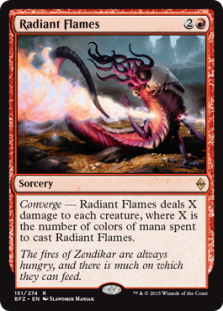
Weak Mechanics

Converge: A sunburst rework that applies to spells on the stack. I actually really like converge, since it asks players to build decks in special ways and rewards splashing. Engineered Explosives remains one of the coolest Modern cards for this reason. Unfortunately, none of the converge cards are as good. [tippy title="Radiant Flames" width="330" height="330"]Radient Flames[/tippy] seems less versatile than Anger of the Gods or even Firespout, while [tippy title="Painful Truths" width="330" height="330"]Painful Truths[/tippy] embarrassingly takes a backseat to a Standard-legal common, Read the Bones.
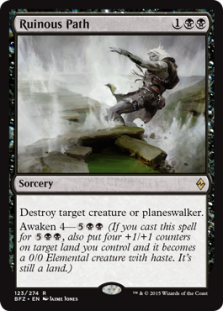
Awaken: The other BFZ mechanic I can (in theory) get behind, awaken could prove very strong if printed on an already decent card. Ruinous Path[tippy title="Scatter to the Winds" width="330" height="330"]Scatter to the winds[/tippy] and [tippy title="Ruinous Path" width="330" height="330"]Ruinous Path[/tippy] mark noble attempts, but Cancel and Hero's Downfall are already too slow for Modern, and Path is a sorcery to boot. Since awaken compliments grindy decks, we're mostly looking for cards that cheaply interact with opponents early on (removing a creature or countering a spell for two mana or less) to double as big threats in the late-game. If [tippy title="Roil Spout" width="330" height="330"]Roil Spout[/tippy] exiled a creature instead of Time Ebbing it, we might have something that could fight with Detention Sphere for slots in UW Control.
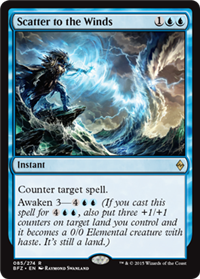
Rally: While it's nice to have a keyword for this ability, rally brings nothing new to the table.

Devoid: Like rally, devoid doesn't do anything novel.

Ingest: A mechanic as bad as it is disgusting. I love the flavor here, but creatures that need to connect with opponents to gain effects that possibly create value with additional cards don't exactly scream "Modern staple."

Landfall: A returning mechanic from Zendikar block, Landfall still stands tall as the best designed and most fun of the bunch. We've yet to see any cards here approach the power levels of Searing Blaze or even Plated Geopede.

Playability Analysis

I've divided this section based on card playabilty. As I mentioned, many BFZ cards would be interesting in Modern if costed more aggressively. As it stands, the set is too Standard-oriented to make as defined a footprint as the seminal Khans of Tarkir block.

Cards That Don't Get There

  • [tippy title="Scythe Leopard" width="330" height="330"]Scythe Leopard[/tippy]: If Modern doesn't play Steppe Lynx, it won't play this cute little guy.
  • Scythe Leopard[tippy title="Quarantine Field" width="330" height="330"]Quarantine Field[/tippy]: The decision to put this four-mana Oblivion Ring at mythic says a lot about BFZ's power level. It's a double-O-Ring for six, but that versatility makes it much worse at an earlier game stage, which is where O-Ring shines.
  • [tippy title="Herald of Kozilek" width="330" height="330"]Herald of Kozilek[/tippy]: Decks that want to abuse Herald are better off with Etherium Sculptor.
  • [tippy title="Sandstone Bridge" width="330" height="330"]Sandstone Bridge[/tippy]: Can be fetched by Knight of the Reliquary for a big attack against other aggro decks, but Sejiri Steppe is a much better instant-speed utility land for Knight decks, if they choose to run one at all. The other lands in this cycle also do too little.
Cards That Almost Get There

  • [tippy title="Horribly Awry" width="330" height="330"]Horribly Awry[/tippy]: Horribly AwryTrue to its name, Awry is my pick for most disappointing card in the set (just ask Trevor), since I'm always on the lookout for cheap counterspells. If it also hit noncreature spells, or if it cost one mana instead of two, this card would see Modern play (at the very least, by me) and alone buoy my interest in Battle for Zendikar.
  • [tippy title="Brutal Expulsion" width="330" height="330"]Brutal Expulsion[/tippy]: This card prompted some discussion at my LGS, as players compared it to Electrolyze, Venser, Shaper Savant, and Cryptic Command. While Expulsion may be easier to cast than Cryptic in some decks, like Grixis Control, it lacks the perpetual usefulness of "Draw a card." Cryptic's tap-team mode also gives it tremendous flexibility. A best-case scenario with Expulsion might look like Remanding a Collected Company while Pillar of Flame-ing a Kitchen Finks, and Cryptic can do a lot better than that. Still, Expulsion does kill Etched Champion and Master of Waves.
  • [tippy title="Transgress the Mind" width="330" height="330"]Transgress the Mind[/tippy]: At one less mana, this card would improve both in playability and in flavor, but since we don't see any in BFZ, R&D must have wanted to avoid fully coloring devoid spells. I can imagine Transgress being played at a single B, but not in its current iteration.
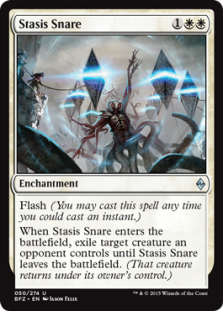
  • [tippy title="Complete Disregard" width="330" height="330"]Complete Disregard[/tippy]: Complete DisregardAn instant-speed Reave Soul effect that exiles creatures, this card, too, would inject a little spice into Modern and give black decks some much-needed additional variety in removal choice. But at three mana instead of two, feel free to completely disregard it. (Ha! Ha!)
  • [tippy title="Stasis Snare" width="330" height="330"]Stasis Snare[/tippy]: Sometimes I feel like Wizards draws scraps of paper from a word bank hat to name cards. Snare doesn't hit noncreature permanents, so it's probably worse than Oblivion Ring most of the time despite the flash.
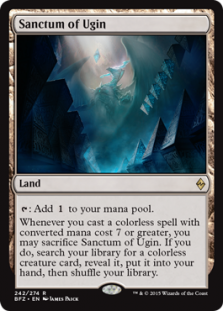
Cards That May Get There

  • [tippy title="Sanctum of Ugin" width="330" height="330"]Sanctum of Ugin[/tippy]: Sanctum of UginA searchable "extra threat" in Tron that doesn't ask pilots to sink an entire turn into finding a monster. Eye of Ugin gives Tron its late-game inevitability and a constant stream of fatties. But I've won many games against the deck with Delver builds because Eye got them a Wurmcoil Engine one crucial turn late. Sanctum asks Tron to have a threat to trigger it with, but it's still nice Path to Exile insurance. It also triggers off All is Dust! (Before it gets mentioned, [tippy title="Shrine of the Forsaken Gods" width="330" height="330"]Shrine of the Forsaken Gods[/tippy] does not do enough for this deck, since Tron should have its lands tapping for two or three mana by the time Shrine even comes online.)
  • [tippy title="Molten Nursery" width="330" height="330"]Molten Nursery[/tippy]: Repeatable damage to creatures and players is generally nothing to scoff at. Nursery's expensive cost limits its applications, but I like that it triggers other copies and gets nastier in multiples. Ghirapur Aether Grid, Nursery's closest analog, sometimes makes the cut in Affinity sideboards for help with the mirror or against Stony Silence, but multiples do nothing. Nursery seems less than perfect in that deck, though, since by the time it comes down, most of the colorless cards (Mox Opal, Springleaf Drum, Ornithopter) have already made it to the board to power out the enchantment in the first place.
  • [tippy title="Blighted Cataract" width="330" height="330"]Blighted Cataract[/tippy]: Blighted CataractA late-game utility land in the unfortunate shadow of Desolate Lighthouse for the URx midrange decks that might want it. I can picture a one-off Cataract in controlling color combinations light on utility lands, such as UB or BUG, since it gives them something to do with spare mana other than attack with Creeping Tar Pit. Colonnade is probably good enough in UW decks to win out over Cataract.
  • [tippy title="Gideon, Ally of Zendikar" width="330" height="330"]Gideon Ally of Zendikar[/tippy]: A four-mana planeswalker that resists Lightning Bolt and trains an army without losing loyalty. His 2/2 bodies beat Elspeth, Knight-Errant's 1/1s, but I don't think his other abilities stack up very well against hers; besides, Elspeth herself hasn't ventured into a Modern Top 8 in a while. Probably too low impact, but if Allies is a deck it might want Gideon.
  • Rolling Thunder: An exciting reprint that saw Extended play in the format's glory days. Thunder can wipe boards, deal a lethal blow, or do both for a relatively low price. I don't know what deck wants this, but it has the pedigree to get there.
  • Canopy Vista[tippy title="Prairie Stream" width="330" height="330"]Prairie Stream[/tippy], [tippy title="Sunken Hollow" width="330" height="330"]Sunken Hollow[/tippy], [tippy title="Smoldering Marsh" width="330" height="330"]Smoldering Marsh[/tippy], [tippy title="Cinder Glade" width="330" height="330"]Cinder Glade[/tippy], and [tippy title="Canopy Vista" width="330" height="330"]Canopy Vista[/tippy]: Color me surprised if these see no Modern play. But given the format's speed, most decks will forego these slower duals. The decks that want them most would likely prefer enemy pairings (UR, UG), but I think one will work its way into an archetype and stay there. My money's on [tippy title="Prairie Stream" width="330" height="330"]Prairie Stream[/tippy], which slots nicely into the UW Control decks we've seen a surge in lately.
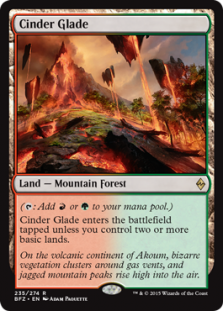
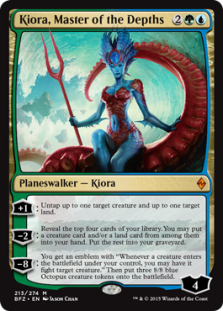
Lower-Tier Playables

  • [tippy title="Ally Encampment" width="330" height="330"]Ally Encampment[/tippy]: We've seen various iterations of Modern Ally decks perform passably by now, and Encampment gives them an extra boost. Its greatest application is facilitating a splash; combined with Cavern of Souls and Aether Vial, the land gives Ally decks Sliver-level color support. The ability also works well with utility Allies, especially with Aether Vial. It's a shame the Allies spoiled as of yet are terribly overpriced.
  • [tippy title="Kiora, Master of the Depths" width="330" height="330"]Kiora, Master of the Depths[/tippy]: Kiora, Master of the DepthsKiora slots into Modern's Devotion to Green decks, which already sometimes splash blue for Kiora's Follower, but usually stay GR. The planeswalker's loyalty effects may push the deck into a preference for blue.

Upper-Tier Playables

  • [tippy title="Ulamog, the Ceaseless Hunger" width="330" height="330"]Ulamog the ceaseless hunger[/tippy]: Though he lacks annihilator, this new Ulamog removes two problem permanents to Ulamog, the Infinite Gyre's one. He also gives Tron decks a non-damage win condition, which helps against infinite life combos when Karn isn't available.
  • [tippy title="Crumble to Dust" width="330" height="330"]Crumble to Dust[/tippy]: Speaking of Tron, it's in for an icky surprise. Sowing Salt just got a whole lot easier to splash, and (for whenever that's relevant) you can't even Flashfreeze it anymore!
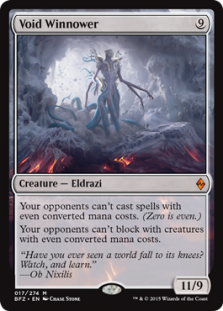
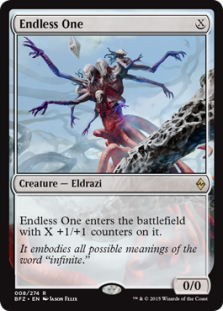
  • [tippy title="Lumbering Falls" width="330" height="330"]Lumbering Falls[/tippy]: As Sky Mason pointed out this week, this untouchable, mana-fixing Treetop Village may show up in RUG decks like Tarmo Twin and Temur Midrange.

Coolest Designs

  • [tippy title="Void Winnower" width="330" height="330"]Void winnower[/tippy]: Void winnowerI love these sorts of "lock effects," and Winnower boasts a truly unique one. It costs about seven mana more than I'm comfortable paying for a creature, but between Winnower's text and his wonky power/toughness, this card does it for me aesthetically.
  • [tippy title="Endless One" width="330" height="330"]Endless one[/tippy]: Simple and graceful. A Chimeric Mass you never have to animate, for better or for worse.
  • [tippy title="Skyrider Elf" width="330" height="330"]skyrider elf[/tippy]: Gaea's Skyfolk made history as one of the first tempo threats, a creature players could cast early and defend as it won them the game. Skyrider, complete with a splashing incentive, does Skyfolk justice as a powercreeping successor. My only complaint here is the absence of Terese Nielsen art.

Takeaways and Zendikar Expeditions

Even if the set's other half follows in this one's footsteps, we still have Zendikar Expeditions to look forward to in Battle for Zendikar. The original Zendikar block had it all: pushed tribal strategies, powerful, cross-format staples, "priceless treasures," and an unforgettable limited experience. Wizards has since wizened up when it comes to sales, packaging high-profile reprints and "money cards" with otherwise lackluster product to incentivize everyone to buy while keeping value high. Battle for Zendikar will be a huge hit if only for Expeditions and those ugly (yeah, I said it) full-art basics, so kudos to Wizards there. But it doesn't do much for players who prefer pack foil fetches and shocks, or care primarily about format growth. If BFZ has you shaking with excitement, terrific! But for my part, I'll keep hitting F5 and hoping for the next Hooting Mandrills to peek back out at me.

Jordan Boisvert

Jordan is Assistant Director of Content at Quiet Speculation and a longtime contributor to Modern Nexus. Best known for his innovations in Temur Delver and Colorless Eldrazi, Jordan favors highly reversible aggro-control decks and is always striving to embrace his biases when playing or brewing.

View More By Jordan Boisvert

Posted in Modern, Opinion, SpoilersTagged , , 24 Comments on Devoid of Enthusiasm: BFZ Spoiler Review, Part I

Have you joined the Quiet Speculation Discord?

If you haven't, you're leaving value on the table! Join our community of experts, enthusiasts, entertainers, and educators and enjoy exclusive podcasts, questions asked and answered, trades, sales, and everything else Discord has to offer.

Want to create content with Quiet Speculation?

All you need to succeed is a passion for Magic: The Gathering, and the ability to write coherently. Share your knowledge of MTG and how you leverage it to win games, get value from your cards – or even turn a profit.

Want Prices?

Browse thousands of prices with the first and most comprehensive MTG Finance tool around.


Trader Tools lists both buylist and retail prices for every MTG card, going back a decade.

Quiet Speculation