menu

Modern Metagame Breakdown: 5/1 – 6/1

Are you a Quiet Speculation member?

If not, now is a perfect time to join up! Our powerful tools, breaking-news analysis, and exclusive Discord channel will make sure you stay up to date and ahead of the curve.

It's a great time to be a Modern player, and as the summer starts, there's a lot to look forward to. The offseason is almost over! Modern Masters 2015 is driving down prices! GPs, IQs, and PPTQs are coming! New decks are everywhere! With all these factors at play, it's more important than ever to check the metagame and see which decks are rising and falling. Although I won't be attending any major events throughout June, I know a lot of our readers will, or at least are interested in trying their hand at  smaller Modern venues. Drawing from our Top Decks page, this May metagame update gives you the tools you need to understand the metagame going into June, arming you with important knowledge about what decks are looking strong and what decks you will need to beat.
Chord of Calling Art

Tier 1 Decks

In previous metagame updates, I've started with a discussion of the Top 10 decks before moving into  individual tiers. To make metagame developments even clearer and to emphasize the most important changes, I'm switching the format to highlight different tiers instead of just most-played decks. All data can be found on the Top Decks page, including collection and analysis methods for determining tiers.

[wp_ad_camp_1]


First, let's look at Modern's tier 1 decks. These are the most-played decks in the format, decks you can reasonably expect to face or win at big events. They may not always be the "best" decks from a win-rate perspective (see my most recent Matchups and Win Rate article for more on that), but they see a ton of play and are the "safe bet" decks in Modern. This first table gives a snapshot of the current tier 1 metagame in the 5/1-6/1 period, broken down by MTGO, paper, and an adjusted major paper event score.

Deck nameOverall
Metagame %
MTGO %Paper %Major Event
Day 2 %
Abzan9.1%5.3%9%12.9%
UR Twin8.5%5.7%9.8%10.1%
Burn7.9%9.4%5.1%9.1%
Affinity5.8%5%7.6%4.7%
Jund5.4%4.1%6.3%5.7%

The second table tracks changes in these tier 1 decks over the past four upates. This gives you a sense of how decks are shifting since February. Note Infect's inclusion in this table even though it's no longer a tier 1 deck as of May.

Deck nameMeta%
(5/1-6/1)
Meta%
(4/1-5/1)
Meta%
(3/1-4/1)
Meta%
(2/16-3/16)
%change
(April to May)
UR Twin8.5%9.2%11.8%12.3%-.7%
Burn7.9%9.2%10.2%10.6%-1.3%
Abzan9.1%9%13.2%13.4%+.1%
Affinity5.8%7.1%7%7.8%-1.3%
Infect3.4%4.5%6%7%-1.1%
Jund5.4%4.1%4.2%2.3%+1.3%

In this update, Infect falls out of tier 1 after weeks of underperformance. Meanwhile, Jund keeps climbing the tier ladder, despite all the other metagame changes around it. Other tier 1 decks remained on top, seeing some small fluctuations in their overall prevalence.

Back in early May, we were (to my knowledge) the first site tracking Jund as a tier 1 deck based on raw data. True, other players and authors had identified it as a strong contender, but that was all based on theoretical assessments and personal experience. Many players and writers now believe Jund is an even better choice than Abzan going into June, and this was something our metagame articles and data were pointing to over a month ago. This is great news for the dataset and our analysis strategy, because it suggests our statistical methods are accurate at both describing current metagames and predicting metagame trends. Jund is a great datapoint in that respect, and it increases my confidence in the data's ability to inform Modern decisions and metagame changes.
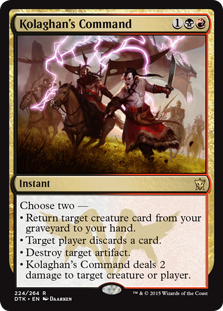
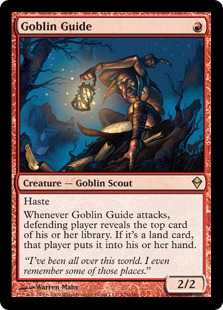
Kolaghans CommandFrom both a results and a theory-based perspective, Jund has a lot going for it. Its cards are extremely well-positioned in this metagame, especially Bolt, Bob, and the unassuming Blackcleave Cliffs. I discussed these points, and a few other Jund nuances, in an article last week. Jund is also rocking the insane Kolaghan's Command, which has given the deck a lot of new capabilities. The modes are just so versatile across the format: Shattering random artifacts like Vedalken Shackles, Inkmoth Nexus, and Batterskull, blowing up Elvish Archdruid, Young Pyromancer, or Anafenza, Kin-Tree Spirit, locking out a draw step, or recurring threats for value. As an example, Fulminator Mage is particularly nasty with Command, which has given Jund increased viability against its archnemesis, RG Tron. And of course, Jund still packs the BGx staple core of Decay, TS/IoK, Lily, Goyf, and Ooze. Abzan is packing it too, but Abzan is stuck with Path, Rhino, and Souls in a metagame that wants you to be playing Bolt, Huntmaster, and Command/Terminate. Looking to the results, Jund has yet to straight up win any huge events, but it consistently places at events across the world. Notable recent showings include T8 finishes at SCG Worcester and SCG Dallas. I expect to see a lot of this deck in June, especially given the hype surrounding it.
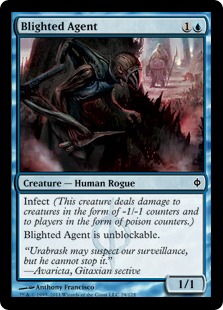
Blighted AgentThen there's Infect: poor Infect. Blighted Agent, Glistener Elf, and Inkmoth are just not where you want to be in a Bolt-heavy metagame. With Jund and Grixis Delver enjoying so much recent success, Infect's creatures are increasingly falling prey to Bolt. Abzan Company's rise has made things even worse for Infect. The deck runs not only Melira, but also maindeck Spellskite: it's the days of Pod all over again. Finally, the format has shifted away from Infect's best matchups. This includes Abzan, which remains a tier 1 deck but is not nearly as prevalent as it was back in February, and durdly decks like Scapeshift. Infect is still solidly tier 2, so it's not like the deck has disappeared from Modern entirely, but you no longer need to fear it nearly as much as you did back around the PT and GPs of late winter. In the broader metagame perspectve, Infect was never really a tier 1 deck in the same sense as Affinity, Burn, or Twin. But from a month-to-month basis, which is what our dataset tracks, it was an important inclusion for its relatively brief reign: players needed to prepare for this deck over the past few months.
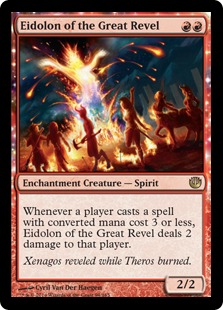
Eidolon of the Great RevelThe rest of the tier 1 changes are smaller shifts, but still very interesting in the broader Modern context. Burn has dropped a lot since the last update, in large part due to its paper share. In April, Burn's paper presence was 8.7%. Today, it's crashed to 5.1%, a huge percentage point drop for a tier 1 deck. Burn remains an MTGO powerhouse (9% a month ago, 9.4% today), but this has been true since even before Burn's initial rise in August 2014. A big piece of this paper decline is the rise of Abzan Company (see the next section) and Jund, both of which are strong against Burn. Or, if not outright "strong" in the case of Jund, much stronger than its Abzan predecessor. UR Twin has seen an opposite effect as Burn, with its paper share growing between the two periods (9.1% to 9.8%) and its MTGO share shrinking (8.1% to 5.7%). I don't think this has much to do with Twin's viability. Rather, it's because many Twin players are trying the Grixis build. As we'll see in the next section, Grixis Twin has a solid 2.8% of the MTGO metagame, and many of those players are probably UR Twin migrants who are just experimenting with something new. So in the case of Burn, the deck may have dropped due to viability. But in the case of Twin, the decline happened because of player preference and experimentation. As a final tier 1 note, don't count Abzan out of the picture altogether. Jund may be rising and Abzan may be falling, but the deck is still present. Expect to see more than a few Siege Rhinos throughout June.

Tier 2 Decks

In general, tier 2 can be understood as "tournament viable" decks, ones you might face at a large enough tournament but not ones you are guaranteed to encounter. Tier 2 decks are often as successful, or more in the case of decks like Amulet Bloom, as tier 1 decks, but their win rates tend to be more dependent on the metagame than the eternal Modern staples in tier 1.

In our last metagame update, we saw 13 decks in tier 2. Today, we still see 13 tier 2 decks , but there have been some changes since April. Temur Twin, Esper Mentor, and Blue/Temur Moon have all fallen out of the tier, replaced by Abzan Company, Elves, and Infect (the latter falling down from tier 1). The Grixis color pairing is a formative factor in this tier, both directly affecting decks (Grixis Delver and Twin) and indirectly affecting others (the fall of Temur Twin and the Moon decks).

Deck nameOverall
Metagame %
MTGO %Paper %Major Event
Day 2 %
Grixis Delver5.3%8.7%3.4%3.8%
Abzan Company4.7%4%7.2%2.8%
RG Tron3.8%4%3.9%3.5%
Infect3.6%2.4%2.4%5.9%
Amulet Bloom3.2%4.4%2.7%2.6%
Merfolk3.1%3.6%4.2%1.9%
Elves3%5.2%2.1%1.8%
Grixis Twin2.8%2.8%2.6%2.9%
UWR Midrange1.9%1.3%2.6%1.7%
Scapeshift1.8%.9%2.9%1.7%
Abzan Liege1.6%.9%1.8%2.2%
UWR Control1.6%2.3%.8%1.6%
Bogles1.6%1.9%.8%2.2%

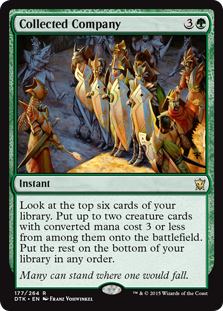
collected companyNo one doubted Collected Company could succeed in Modern, but I think many players underestimated just how much progress it could make in a GP-less month. Based largely on grassroots deck development online and in paper, Elves and Abzan Company have risen from total obscurity to Modern staples with respectable metagame shares. In that regard, Abzan Company's rise was less surprising. The deck had paper success even back in April, which suggested that MTGO success (and further paper finishes) weren't far behind. Sure enough, the deck basically tripled its share from about 2.75% in April to 7.2% in May. A big part of this was probably hype around the deck, but it also speaks to the deck's strengths in Modern. Elves was a bit more uncertain, because MTGO decks don't always translate their success into paper. Grixis Delver is a great example of this: the deck has been the second most-played MTGO deck for two months now, but isn't even top 10 for paper. Elves could have repeated that. But, due in no small part to its high profile performance at the Modern MOCS event, the deck ended up making a big impression on the community. Today, Elves has tripled its MTGO share from 1.8% to 5.2%, although its paper performance (2.1%) still lags behind. Both decks are sure to see play in June, where we will get more context on which of the two decks is better in what circumstances. I am excited to see these decks enjoy so much success despite no single pro really touting or developing them. This is community-level Magic at its finest (as with Grixis Delver), and I hope that metagame trend continues.
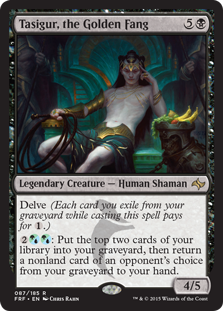
TasigurLooking away from Company, May sees Twin deck movement. Temur Twin's fall is not so much a strike against Goyf as it is a nod in favor of Tasigur, the Golden Fang and the overall Grixis color pairing. As with Bolt, Tasigur/Terminate/Command are where you want to be in Modern these days. We see this in UR Twin's and Temur Twin's decline, a drop that has occurred alongside Grixis Twin's continual rise. This Twin preference shift is shared in both MTGO and paper metagames. A similar dynamic is also at play in the decline of Blue and Temur Moon, two decks that have fallen out of favor in preference for Grixis Moon decks (i.e. No-Ultimatum Grixis Control). These metagame changes should come as no surprise to anyone who has followed Grixis Delver's meteoric rise online. Although Delver itself hasn't made the strongest transition to paper (3.4% paper share is still respectable), the deck's success has proven the viability of Grixis colors. It was just a matter of time before other URx decks started shifting towards Grixis away from options like Jeskai or Temur. As a related point, this is exactly why Esper Mentor has struggled to find a firm metagame footing: the lack of red cards like Bolt, Command, Terminate, etc. makes the deck weak in this metagame, or at least unpopular as compared to the proven Grixis option. Hype is also a factor here (never underestimate the effect of the hype train), with many players and authors seeing early Grixis success and hopping on board.

Other tier 2 fluctuations are even smaller than those in tier 1, so it's hard to read too much into them. Some decks are slightly up (Amulet Bloom, Grixis Delver, Merfolk), others slightly down (Abzan Liege, Scapeshift), and others right where they were in April (UWR Control, UWR Midrange). All those changes are within expected variance, however, so I don't think they indicate real changes in deck frequency. The general population of tier 2 decks is much more interesting. Tier 2 consists of a diverse range of combo, tempo, aggro, control, midrange, and hybrid strategies. This is important going into the June GPs because it suggests an open metagame with lots of viable strategies. It also makes sideboarding and deck selection much harder (sorry PV), because you can't just hedge bets against a certain subset of strategies. To some extent, this is expected metagame behavior in an offseason, where players try new things and don't have big events to guide their selections. But our current offseason is unusually open and diverse, which reflects both general uncertainty around what to play but also true diversity in the format.

Modern Metagame Predictions

Last update, I thought the 5/1-6/1 period would be less eventful than the 4/1-5/1 range. If nothing else, this current metagame has taught me to never underestimate how awesome and exciting an offseason can be. We saw lots of movement in the past month, much of which I correctly predicted in the last article and other articles around the site. Let's check back in on some of those predictions to see how we did.
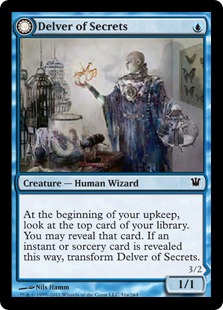
  • DelverGrixis Delver still a top 2 MTGO deck? Yes!
    Right now, there are only two certainties on MTGO: Burn and Grixis Delver. There's a 3 percentage point gap between second-place Delver and the third-place deck (UR Twin), and that gap only widened over the course of April through May. I actually expect Delver's share to go down in June as the format gets more definition out of GPs and major events, but the deck will easily remain an MTGO top 5 for the foreseeable future.
  • Abzan Company will become tier 2? Yes!
    If I've learned anything from looking at MTGO and paper data for the past few years, it's that paper decks almost always make the transition to MTGO. The reverse, however, is not always true. This made Abzan Company an easy bet for tier 2 status, especially given the internal and theoretical strengths of the deck.
  • Jund is still awesome? Yes!
    Technically, this wasn't a prediction from the metagame article itself, but it was a tier move that was met with a bit of resistance from some members of the community. Some felt it was too early to call, or that Jund just didn't have what it takes. But Jund's continual rise suggests these predictions and metagame trends were not misplaced, and I'm excited to see what Jund can do in June.

This is a good track record going into this next month, but it's hard to convert these metagame-wide predictions into GP forecasting. GPs are hard to predict. Sometimes, metagame data is good at indicating what will happen at a GP (e.g. never bet against decks like BGx or Twin). Other times, you need to read a few steps ahead of the data to predict the outcome (e.g. when Infect and Burn are too linear for more prevalent decks to handle) . And sometimes, decks appear out of nowhere and define the whole event (stuff like Abzan Liege and Amulet Bloom). Despite these dangers, and in the spirit of the exciting June events, here are two bold and exciting predictions (that I might regret in July).  Don't worry: there will be a GP-specific prediction article sometime next week.

  • Jund will surpass Abzan
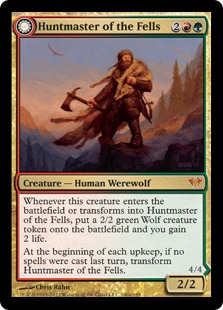
    Huntmaster of the FellsThere are two dynamics at play in this prediction. The first is Jund's theoretical power in Modern, which gives it a lot of comparative advantages over Abzan. Abzan will remain a strong deck in the abstract, and will probably even stay tier 1. But Jund will be much stronger, largely on the backs of the Burn matchup, and on the strength of Bolt and Command (and Confidant, to a lesser extent). The second reason, which is often understated when discussing deck choices, is hype. Everyone, this site definitely included, is on the Jund hype train. I don't think there's anything necessarily bad about a hype train, especially if it's carrying players towards a legitimately strong deck. But the hype effect can complicate our understanding of a deck's prevalence. Jund's natural metagame share is probably somewhere between 6% and 8%. But on the hype train, Jund's share is probably boosted to the 8%-12% range. This will be even more pronounced when the other BGx deck is routinely dismissed in this format, which moves even more players into Jund. Between the hype and the natural Jund strengths, this deck has all the building blocks to become the format's BGx deck of choice.
  • Abzan Company will become tier 1
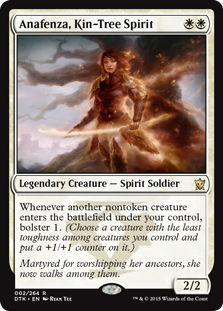
    Anafenza, Kin-Tree SpiritI've said it before and I'll say it again: never bet against Pod and never bet against BGx. Abzan Company has both of those qualities going for it, which is the perfect foundation for a breakthrough into tier 1. On the one hand, Abzan Company does not have an optimal list yet (less true of Jund), and players will be expecting the deck with some degree of hate. Don't be surprised to see all kinds of graveyard hate at the GPs, including Relic, Leyline, Spellbomb, etc. But on the other hand, Abzan Company is riding shotgun on the hype train alongside Jund, with many players and articles (again, this site included) drumming up its viability. As with Jund, this isn't necessarily a bad thing. Abzan Company has a lot of internal strengths that really do make it a good deck. But also as with Jund, this hype factor is likely to push Abzan Company beyond its more "natural" prevalence point and into a higher tier. I also genuinely believe that Abzan Company has great tools to reach tier 1 in this format, so the hype is just an added bonus. The paper prevalence is telling, with the deck already enjoying a 7%+ share of the metagame even before the season starts. That's a promising pre-trend for any deck, let alone one with so much going for it.

Whether you are participating in the June Modern events, watching the content online, or just keeping your Modern experience at the local level, these metagame developments will be critical for understanding the action. Even if my predictions and metagame picture gets blown out of the water, I'm still excited to see how the format grows and develops throughout the month. And as long as Amulet Bloom doesn't win all 3 events, the month promises to be an enjoyable one for Modern players everywhere.
Tarmogate

Are you a Quiet Speculation member?

If not, now is a perfect time to join up! Our powerful tools, breaking-news analysis, and exclusive Discord channel will make sure you stay up to date and ahead of the curve.

There our hero sat. Drafting in the Top 8 of the largest Magic tournament ever. With a finals finish, he would make serious headway towards qualifying for the world championship. One pack in, he like where his Boros deck was going. That's when it happened. He didn't know it, but over the course of the next minute he would face the most publicly scrutinized decision of his entire life.

Burst Lightning, or foil Tarmogoyf?

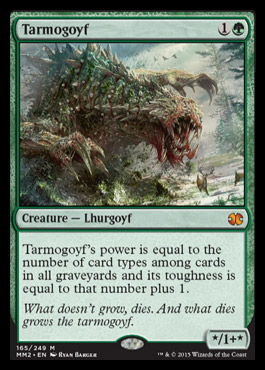
By now you've no doubt heard of #tarmogate. Or #goyfgate as the extremely unoriginals prefer to call it. Many pro players have cast rather harsh judgment on Pascal Maynard for basically rare-drafting in the Top 8 of GP Vegas, while the general consensus has been that the Tarmogoyf was the much higher EV pick.

There was an error retrieving a chart for Tarmogoyf

There have been a lot of fallacious arguments with regard to the discussion of the pick, because, you know, people are talking. Some pose the question "would you have paid $500 to have Burst Lightning in your draft deck?" In reality, picking the Burst Lightning is akin to denying $500 for a first pick out of pack two. Money out of pocket is pretty different from money being offered, but that discussion isn't terribly interesting either.

What the situation boils down to, is would you rather pocket a foil Tarmogoyf or give yourself the best odds to play in the world championship? As a commoner, it's pretty clear that the Goyf is the right pick for me. As Pascal Maynard, well, he's publicly admitted that he missplayed. That said, his play ended up being higher value than he could have possibly imagined.

If you haven't heard, Pascal has put up the foil Goyf on e-bay, pledging to donate half of the final sale price to Gamers Helping Gamers. So, if you're interested in owning a piece of Magic history, donating to GHG and Pascal, and have over $12,000 to commit to these ends then you can find the auction here.

Personally, I think that the Burst Lightning that he passed and then lost to in the semis has more value as a piece of Magic history, but alas, that one isn't up for auction.

Avatar photo

Ryan Overturf

Ryan has been playing Magic since Legions and playing competitively since Lorwyn. While he fancies himself a Legacy specialist, you'll always find him with strong opinions on every constructed format.

View More By Ryan Overturf

Posted in FreeTagged , 5 Comments on Tarmogate

Have you joined the Quiet Speculation Discord?

If you haven't, you're leaving value on the table! Join our community of experts, enthusiasts, entertainers, and educators and enjoy exclusive podcasts, questions asked and answered, trades, sales, and everything else Discord has to offer.

Want to create content with Quiet Speculation?

All you need to succeed is a passion for Magic: The Gathering, and the ability to write coherently. Share your knowledge of MTG and how you leverage it to win games, get value from your cards – or even turn a profit.

Modern Eight/Hate Rack

Are you a Quiet Speculation member?

If not, now is a perfect time to join up! Our powerful tools, breaking-news analysis, and exclusive Discord channel will make sure you stay up to date and ahead of the curve.

I'm fairly up for playing most decks in Magic: combo, control, aggro, or any sort of hybrid mix of such archetypes. As far as the colors in the game, Vegas rules; "Always bet on black!"

I've been a devoted black mage since was beat down by a Sengir Vampire playing one of my very first games and cast Spirit of the Night for the first time. I've even gone so far as to get the original art for Dark Ritual tattooed on my left arm with a black mana symbol above it to cast it.

So, yes, I'm a hardcore black planeswalker. If it plays black and is doing well, even if it's not that well, I'm on board. I played Mono-Black Control in the Odyssey Standard days, brewed my own mono-black control to crush Affinity when it was king, and most other variations of mono-black since. This is all why I'm really enjoying a tier-2 Modern deck greatly right now.

8 Rack, or as some like to call it, Hate Rack, is my current mono-Swamp mana producing weapon of choice in Modern. My friend gave me his list and I've been rocking it for about a month and a half now. It is as follows.

Eight Rack by Ernest Turck

Creatures

4 Dark Confidant

Spells

4 Liliana of the Veil 4 Wrench Mind 4 Thoughtseize 4 Raven's Crime 4 Inquisition of Kozilek  2 Smallpox 3 Ensnaring Bridge 4 The Rack 4 Shrieking Affliction 

Lands

3 Mutavault  1 Urborg, Tomb of Yawgmoth  19 Swamp

Sideboard

2 Smallpox  3 Smother   3 Nihil Spellbomb  4 Pack Rat  1 Ensnaring Bridge  2 Shadow of Doubt

At first glance this deck isn't out to make friends. In all fairness, you'll probably be a fairly disliked player at the event you pilot it at.

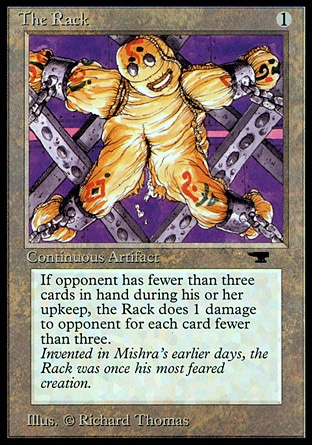
It's fairly straightforward. Make them discard their hands with your Wrench Minds, Thoughtseizes and company, stick The Rack and/or Shrieking Affliction and keep their hands empty. Dark Confidant helps you draw out of situations and will never hit you for more than three life.

It's easy to hide under the Ensnaring Bridge, like the troll you'll be while playing this deck, to keep the aggro off of you. Liliana of the Veil keeps both players' hands empty and if need be you can always target yourself with hand hate.

From a format prospective, I feel like this deck is a card or two off from being a top tier contender. It has a good match up again most of the field and can easily stabilize and turn the game into a win rather than a loss. The hardest matchup, by far, is Burn. There's no life gain and your Thoughtseizes are counterproductive, only saving you a point or two of damage.

The sideboard is fairly straightforward as well. Bring in the Smothers and the extra Ensnaring Bridge against fast aggro decks. Nihil Spellbomb is for people who like to play out of the graveyard.

Shadow of Doubt is a little out of place with Birthing Pod not being a thing anymore. It could easily be replaced by a creature such as Lifebane Zombie.

The Pack Rat is tech against anyone who has boarded out creature removal for the total blowout against this deck, Leyline of Sanctity. If you even think this card will be making an appearance postboard, you need to have the Pack Rats. In conjunction with Dark Confidant and Mutavault, you can become a beatdown deck to the unsuspecting opponent post-sideboard.

From a budget standpoint this isn't the most expensive deck to build in the format by far, but it can keep pace with higher dollar cards. Ensnaring Bridge is currently fluctuating around the 18 to 20$ range, the commons and uncommons aren't bank breaking either with Wrench Mind coming in around a dollar in most online outlets, Inquisition of Kozilek 7-9$. Dark Confidant has seen two reprints now and is settling under the 40$ mark it seems.

The real bank-breaker here is Liliana of the Veil--she has only seen one reprint as a promo and her value continues to rise since we won't see her in a Modern Masters set for at least two more years. Currently sitting around 90$+ for the non-foil/non-promo, I'd not be surprised to see her crack the 120$ mark, if not more, before a reprint hits.

With the versions of cards in my deck, the total comes in around $960 TCGPlayer mid. For Modern, since it doesn't run fetches, Tarmogoyfs or Snapcaster Mages, the deck isn't crazy expensive and eight of your big dollar cards are used in multiple other decks and formats.

Once again please leave any comments or questions about my article and list. I'm always looking to hear from y'all.

Julian Biondillo x

Julian, AKA hardcoreniceguy on Twitter

biondillodesign@gmail.com

Insider: When Disaster Befalls a Collection

Are you a Quiet Speculation member?

If not, now is a perfect time to join up! Our powerful tools, breaking-news analysis, and exclusive Discord channel will make sure you stay up to date and ahead of the curve.

Today I am going to talk about a strange and unique experience I had this past week, and some of the specific things I've learned from it.

Early last Tuesday morning my favorite local game store, RIW Hobbies, caught fire and burned. It is believed that the fire started in the Shawarma carry-out place next door and spread through the wall into the hobby shop. The only good news about this unfortunate incident is that because it happened around three in the morning nobody was around to get hurt.

The owner, Pam, is a fantastic businesswoman and I have no doubt that she will have the new location up, running, and successful in the near future. The store was (and still is) planning on moving this week into a new, bigger location just down the street this week. It is one of those bad timing issues where you just have to ask, "Couldn't the fire have waited to burn down the strip mall just one more week until after the store was moved?"

One of the unfortunate characteristics of fire is that it doesn't act according to any kind of logical or emotional rhyme or reason. It's just fire and it does as it pleases.

I Think "Toast" Is an Accurate Description

I don't know how many of you have personally been involved in a house or business fire but this is the second big fire I've dealt with in the past three years. My parent's chimney had a defect that led to a small, contained wall fire a few years back. The scope of the damage from that fire was considerably less than the fire this last week but the damage was still horrific.

It isn't a matter of looking for things that did or didn't burn. In a house fire the soot, ash, and smoke gets on and into everything and is very difficult to get rid of. It's like when you go to a campfire and leave smelling like the campfire. Except in the case of a house fire the campfire is inside your house and is roughly 1000 times larger and smells much worse because you are not just burning clean, chopped wood but all sorts of different materials.

In addition to the property damage caused by the smoke there is also a ton of damage caused by the firefighters. I mean, they have to rip up the building to make sure that things are not on fire inside or underneath and they basically soak everything with water sprayed from the fire hoses.

No complaints about firefighters. The damage would have been absolute to the point where the strip mall would have burned into a sunken crater in the Earth if they hadn't have put it out. They do a tremendous job.

My point is that when you have a fire it isn't just a matter of what burned and what didn't burn. There are many different ways that things can get ruined. I'm sure that you can imagine how firemen spraying water in every direction from high power hoses would be really bad for a gigantic Magic collection...

When my parents had their fire it was mostly contained and pretty promptly put out by the fire department. The real damage was caused by the smoke that got into everything in the entire house and needed to be professionally cleaned up.

My first encounter with the RIW fire was very different.  It was what you would actually expect a a fire to look like.

When I walked into the store through the back door one of the first things that I noticed was that the ground was wet, mushy and covered in muddy ash and that the metal "exit" sign that hung above the back exit was basically melted into a metal blob. The wall that divided the game store from the carry-out place had been completely burned away in the middle and the ceiling had been completely ripped out with stray cords, wires, and fixtures hanging down everywhere.
It looked like the inside of the Ted CLAMP center at the end of Gremlins II except instead of green gremlin ooze everywhere it was grey ashy ooze everywhere.
The glass-half-full side of things was that because the store was planning on moving in a week anyway, there is a new location to actually move into and open. Having to search out and set up a new store from scratch would have been absolutely backbreaking. It is very lucky that the store has somewhere new to immediately move to and reopen.

Everything That Sells Burns

In the case of board games, table top mini games, sleeves, and other product it really isn't the end of the world. One can simply call their distributor and have new copies of those items delivered right to the new store. That stuff is fairly easy to replace.

The most difficult thing to replace is Magic inventory. I have handled and worked on their inventory for a decade and it was quite an immaculate collection of cards. The store had everything neatly organized and available for sale all of the time, one of the biggest advantages it had over other newer game stores. Do you need 45 weird EDH rares spanning every set ever? Basically, there is a 100% chance that the store has all of them in stock.

I compare an immaculate Magic inventory in a brick-and-mortar store to owning a money tree. You've spent ten years growing it slowly over time, acquiring collections and buying or bulking up on cards when they are low in value. Now you literally just have 20 copies of every card. As we all know, Magic cards tend to appreciate over time so the value of the collection continues to generate value by being salable goods but also continues to accrue value.

Losing one's entire Magic inventory (even if it is insured) is a pretty devastating loss to a game shop. It isn't like a business can simply call up ACD Distribution and say "Hey, we need eight of every Magic single to restock our inventory."

ACD is insanely awesome but not even they can accomplish that task. It again becomes a job of rebuilding inventory through buying singles and collections from square one.

Saving What Can Be Saved

I've spent the past week along with the rest of the RIW crew basically sifting through the rubble to salvage whatever can be salvaged in hopes of having a nice "The Literal Fire Sale" when the store reopens. Or, at least finding the items that are in good enough condition that they don't need to be a "total loss."

Smokey-smelling or water-damaged Underground Sea or Tarmogoyf definitely have a value greater than zero.

I have learned quite a few things about Magic cards in the context of a fire this past week that I'd like to pass along to everybody. Some of these tips are probably worth doing no matter what because they are 100% value.

The store keeps its case cards in four column boxes on the back counter and each card is sleeved with a perfect fit sleeve. When the firefighters were spraying water around in the store very few of those cards got "direct hit" by hoses and ruined, but the cards that were sleeved from the top (so that the opening is at the bottom) fared much better than the ones that were sleeved the other way.

Water and mist in the air, as it settled, got into the sleeves on the ones where the opening was facing up. Also, the smokey smell got into the cards that were sleeved from the bottom much more densely. So, if you have cards that are sitting and sleeved I would heavily recommend sleeving them so that the bottom is exposed rather than the top. The same goes for cards that were sleeved and in binders.

One of the processes we used to salvage Magic product that wasn't actually destroyed was to open things until they were not smokey anymore. Yesterday, Mark Herberholtz came out to the store and he and I went through more Magic product than I could even quantify.

We'd look at a sealed case of Magic booster boxes. We'd smell the cardboard case, "does it smell like smoke?" Yes. So we'd crack the case and smell the boxes wrapped in plastic. "Does the plastic smell like smoke?" Yes. So, we'd take the plastic off and smell the cardboard. "does the cardboard booster box smell like smoke?" Yes. So, we'd pull the packs out of the box and smell the actual packs. "Do the foil booster packs smell like smoke?" Yes. So, then we'd just crack the packs.

The interesting thing is that while the smoke could penetrate through a cardboard box, through plastic wrap, through another cardboard box and onto the foil booster packs it never made it through the foil booster pack wrapper. Which is pretty lucky. In fact, even the exposed booster packs that were sitting on the shelves and reeked of smoke had cards inside that didn't smell smokey.

While the booster pack casings may have been awesome at keeping out smoke it was not so awesome against the elemental force of water... Which is one of the reasons we decided to crack so many packs yesterday.

I don't even know how it is possible (I actually do know because I took science classes but I simply refuse to believe it is true because it is so weird) that a booster box completely sealed with plastic shrink wrap with the cards wrapped with foil wrapping can be full of cards that are soaking wet. That should give you some indication of how much water the fire department was spraying around in there!

I realize that cracking packs is not value (especially for old sets like Urza's Saga, Tempest, etc.) but when the actually packaging is damaged and it is unclear if the cards inside are damaged it just sort of made sense. Not to mention that the store needed to rebuild its entire inventory so every single card opened (regardless of whether it is a bulk rare or not) is going to be used.

So, needless to say we opened a lot of packs.

More Reasons to Hate Modern Masters

We had so many boxes of Modern Masters get ruined in the fire it's unbelievable. The awkward thing was that if it had been any other set we would have been fine. Specifically, the new cardboard packaging caused a lot of problems with regard to the water and dampness of the fire.

You see, when the cases of MM2 got wet the water absorbed into everything including the cardboard booster pack packaging. Typically with packaging the cardboard booster box would hold and absorb more of the moisture and it would be harder for the water to get to the actual cards, since the foil booster packaging doesn't actually hold moisture very well.

However, with cardboard booster packaging the actual booster packs absorb water and get damp, which damages the cards inside much more easily than a foil package.

If MM2 had foil wrappers like every other set our booster packs would probably have been completely fine. However, the cardboard packaging caused a ton of problems. Even booster boxes that didn't look like they had any damage or smoke smell inside had damaged packs and cards from absorbing water. We also observed that tons of our foils were badly warped.

Anybody who bought Modern Masters 2015 and is investing on those boxes should mind this fact. Make sure that you don't store your packs anywhere that is damp because not having the foil booster wrapper to protect the cards will damage the cards right in the pack! How dumb. As if there weren't enough reasons already to be annoyed with Modern Masters 2015.

The MM2 Cards were ruined in the pack at a way higher rate than anything else and they weren't even close to having taken the worst beating with regard to water exposure. MM2 cards in a sealed case were in worse condition when cracked than foil packs that were literally sitting exposed on the shelf.

Do not store MM2 sealed product in your damp basement. The cards and packs inside will be ruined.

Without a doubt I would store my Magic cards in an airtight or plastic tupperware container of some sort. I actually went out and bought a couple of big airtight plastic bins to store my personal collection in.

The only cards in the entire store that didn't get damaged at all were a bunch of binders and boxes that were being stored inside of airtight plastic containers. These are impervious to water and smoke so it just makes sense to store valuable cards inside of them instead of just sitting in cardboard boxes on a shelf.

You never think that you will be the victim of a fire until it happens to you. It can happen to anyone. It is a miserable experience. Everything is ashy and stinky and disgusting. It is ugly to look at all of the nice things that you had damaged and undesirable.

In the end I'm just glad that everybody is fine and nobody got hurt. I'm excited that the store will be moving and reopening in the next week or so and that life will go on.

Insider: MTGO Market Report for June 3rd, 2015

Are you a Quiet Speculation member?

If not, now is a perfect time to join up! Our powerful tools, breaking-news analysis, and exclusive Discord channel will make sure you stay up to date and ahead of the curve.

Welcome to the MTGO Market Report as compiled by Sylvain Lehoux and Matthew Lewis. The report is loosely broken down into two perspectives. A broader perspective will be written by Matthew and will focus on recent trends in set prices, taking into account how paper prices and MTGO prices interact. Sylvain will take a closer look at particular opportunities based on various factors such as (but not limited to) set releases, flashback drafts and banned/restricted announcements.

There will be some overlap between the two sections. As always, speculators should take into account their own budget, risk tolerance and current portfolio before taking on any recommended positions.

Redemption

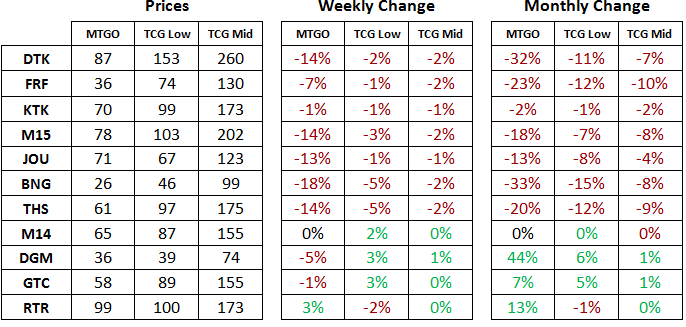
Below are the total set prices for all redeemable sets on MTGO. All prices are current as of June 1st, 2015. The TCG Low and TCG Mid prices are the sum of each set’s individual card prices on TCG Player, either the low price or the mid-price respectively.

All MTGO set prices this week are taken from Goatbot’s website, and all weekly changes are now calculated relative to Goatbot’s ‘Full Set’ prices from the previous week. All monthly changes are also relative to the previous month prices, taken from Goatbot’s website at that time. Occasionally ‘Full Set’ prices are not available, and so estimated set prices are used instead.

jun3

The set price data for this week has the interesting aspect of being completely red for all Standard-legal sets in both paper and digital, for both weekly and monthly changes in price. The price swings in the MTGO economy are related to the liquidity crunch generated by the release of MM2 this past week. This liquidity crunch occurs for two reasons.

The first is that players need tix in order to draft MM2 and their preference for selling cards for tix dominates over purchasing tix directly from the store. This leads to falling prices as players sell cards into the market.

The second reason is that the bots also need tix at the same time players are looking for tix. The bots are trying to stock the new set and so need a higher amount of tix in order to buy the cards coming onto the market from drafters.

These two effects are working in the same direction, pushing up the utility of tix during set releases. This is the most important feature of the MTGO economy for speculators to understand and to integrate into their speculative decisions. Accumulating tix in advance of set releases and then deploying tix during set releases is the best top down strategy available for maximizing speculative returns.

Return to Ravnica Block & M14

The set price of DGM is up over 40% in the last month on the back of Voice of Resurgence. After last week’s sell recommendation, the peak appears to be in as the price of the mythic two-drop has backed off from 30 tix to 28 tix.

Ongoing interest in the Modern format will broadly support the price of this card but depending on how the metagame develops, it could dip back to the 20 tix level. At that price, it would be time to consider establishing a new position in this card. For the time being though, speculators should avoid purchasing this card and look outside of DGM for speculative opportunities.

The two large sets from the second Ravnica block are seeing mixed price activity in the last week. Paper prices continue to inch up and grudgingly the price of RTR and GTC sets on MTGO are also trending higher. However, as pointed out last week, the gains are recently concentrated in the shocklands and the Modern-playable mythic rares.

Junk mythic rare prices are stable to negative, but there is evidence that this trend might be near an end. MTGOtraders currently has over half of the mythic rares from RTR and GTC on its hotlist, suggesting a looming supply crunch, which would set the stage for the next broad advance in mythic rare prices for RTR and GTC. The trigger for higher prices on this subset of cards will be fading interest in Modern Constructed on MTGO. After the Modern Festival concludes, value will accrue to the junk mythic rares as players sell their shocklands for tix.

The available supply of cards from M14 is higher and so in contrast, a supply crunch does not appear to be developing for this set. Sustained upward pricing pressure from higher paper prices will be necessary before further gains are possible on the junk mythic rares from this set.

Theros Block & M15

The start of MM2 release events on Thursday was the trigger for another substantial price drop for these sets. Ranging from a 13% drop for JOU to an 18% drop for BNG, the drop is steep enough that a bounce back is possible after the excitement for MM2 winds down. Nevertheless, for these sets the march towards Standard rotation continues and it is a death march.

At the moment, junk mythic rares are the only place in these sets to focus on for safe, long-term holds, and M15 sees both Soul of Shandalar and Soul of Ravnica dipping below 0.4 tix this week.

If speculators are willing to hold these cards for six-plus months, then prices higher than 0.6 tix are anticipated. Buying at 0.4 tix is a low-risk speculative bet with the potential for 100% gains. Speculators should keep in the mind the opportunity cost of holding these cards before making any purchases though.

Tarkir Block

Similar to THS block, the three sets of Tarkir block saw broad price declines this past week in the wake of the release of MM2. The liquidity crunch is in, with both DTK and FRF plumbing new depths and KTK only 5 tix off of its low. The next ten days will be a low-risk time to accumulate cards from all three sets of Tarkir block. Picking the absolute bottom for DTK and FRF will only be possible in hindsight, but it’s getting close.

A few cards from DTK appear to have found their footing and should be on speculators' radar as contrarian, buy-low candidates for speculating. Dragonlord Kolaghan of DTK has drifted back down to the 1.0 to 1.5 tix range, while Sarkhan Unbroken and Narset Transcendent are around 4 and 5 tix respectively.

On the pricier end of the spectrum, DTK mythic rare foils appear to be currently following a similar pattern to the KTK mythic rare foils from earlier this year. That pattern is one where value slowly accrues in the mythic rares that were not awarded in promo packs for prerelease events. Only Dragonlord Ojutai is bucking that trend as the other four dragonlords are the four lowest-priced foil mythic rares.

Although foil sets of DTK have lower potential overall due to the lack of fetch lands, the set is still having a broad impact across Modern and Standard. Further price increases on foil versions of cards like Shorecrasher Elemental and Descent of the Dragons are anticipated. The speculative strategy around foil mythic rares on MTGO needs further refinement but it appears to be safe to apply it to large sets so far. Stay tuned for further developments on this strategy.

Modern

Strengthened by the release of Modern Masters 2015, prices of Modern staples not reprinted in MM2 have continued to climb this past week. For speculators, the optimal selling window is several weeks ahead and more profits are still to come. These staples are nicely recovering from the low point they hit in the early Spring and many of them are on their way to reaching their previous record high.

Some staples have already passed their previous high and are cruising in uncharted territory. Serum Visions was 4 tix last year at this time and is currently priced at over 9 tix, an unprecedented price for a Modern-only common. The situation is very similar for Path to Exile, currently at 9 tix (the price of this card is the primary reason boosters of the original Modern Masters are selling for 8 tix).

Next there is Gitaxian Probe which went from 1.5 tix a month ago and is now flirting with 5 tix. Finally, Deceiver Exarch saw its price multiplied by 6 in less than a month, moving from ~0.5Tix to ~3 tix. On the rare front, the Scars fast lands, led by Blackcleave Cliffs, are soaring to prices not seen since Caw Blade Standard pushed the price of Seachrome Coast to 10+ tix.

Selling some of these positions now is prudent considering how impressive the gains have been in such a short time. Selling now will also free up tix to deploy into MM2 reprints. After less than a week of MM2 drafts, prices on the reprinted cards are down significantly, with the exception of Tarmogoyf.

Such price drops have attracted players eager to complete their Modern decks at discounted prices, triggering a rebound since the lows of the weekend. As the opposing forces of constructed players looking for cards to buy and drafters selling into the market tussle for control of prices, further price drops could be delayed. Speculators willing to wait a week or two may find better prices, especially for rares and uncommons.

Based on the price history from MMA, mythic rares will rebound quickly within the first two weeks of releases. The vast majority of rares, uncommons and commons will see their prices decreasing until the end of June and possibly until the release of Magic Origins.

The big factor this time around though is the series of Modern events scheduled for the start of summer that will have most prices rebounding by the end of June rather than in July and August. Estimating the absolute bottom on cards from MM2 will be a balancing act, but being approximately correct won’t be difficult.

Legacy & Vintage

Tempest Remastered drafts are closed since last week and prices of all playable TPR cards are now on a slow and steady rise. No big price jumps are expected from TPR cards but building some positions from this set is a safe strategy, at least until the Legacy MOCS at the end of this year.

Other Legacy and Vintage staples can be divided into two categories—those reprinted in Vintage Masters and those only printed in their original set (or as promos). Staples reprinted in VMA are in a relatively flat trend over the past three to six months. Those Conspiracy cards that made it into VMA such as Dack Fayden and Council's Judgment, are showing a little bit more interest and are slightly on the rise.

Cards only printed in their original set have a different story. Some of them, including Rishadan Port, Doomsday and Misdirection are still on a four-year-long upward trend. Others, such as Metalworker, Gaea's Cradle and Goblin Welder, are continuing to trend down after large price increases around the release of VMA.

Even without any clear speculative goals, these prices are becoming very attractive on their own, both for players and long-term speculators. 25 Tix for Goblin Welder may not happen anytime soon but 7 to 10 Tix is a possibility if the card sees a little demand.

Pauper

This week again Pauper positions all across the board are looking good and additional gains have been recorded compared to the past week. According to the Mtggoldfish Pauper Metagame stats, Mono-Red Burn has became the most popular deck early this week. The deck is relatively cheap and filled with cards printed multiple times, so no relevant changes are expected from this metagame shift.

All of the Pauper positions we have discussed so far in this report are showing price strength and it is still worth holding onto them for potential additional profit. Several of them have a decent room to grow in comparison to their previous highest prices.

Targeted Speculative Buying Opportunities

None

Targeted Speculative Selling Opportunities

Modern

Serum Visions
Slippery Bogle
Gitaxian Probe
Path to Exile
Pyromancer Ascension

All of these five positions have seen a huge price increase over the past month and since we recommended buying them. In addition they all have broken their previous record high. Fro these two reasons we recommend selling these now to maximize profit and time. The extra Tix generated here could be reinvested next in MM2 opportunities.

Insider: MTG Stock Watch for 6/1/15

Are you a Quiet Speculation member?

If not, now is a perfect time to join up! Our powerful tools, breaking-news analysis, and exclusive Discord channel will make sure you stay up to date and ahead of the curve.

Welcome back, speculators!

Penny Picks

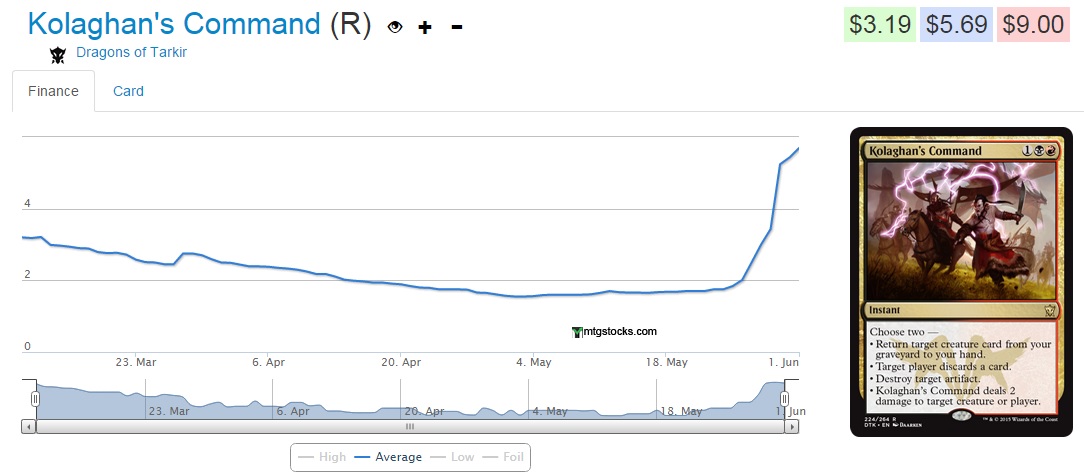
1. Kolghan's Command (+209.2%) - This recent Standard addition has proven that cheap two-for-ones are good in any format. It has even found a minor home in some Legacy Grixis decks, though this price jump is primarily due to its adoption in Modern Grixis Delver decks.

Maindeck hate for Spellskites and everything Affinity is borderline playable on its own, but Kolaghan's Command can also force an opponent to discard at instant speed, or even better, Raise Dead one of your powerful, efficient creatures (ideally a Snapcaster Mage).

kolaghans command

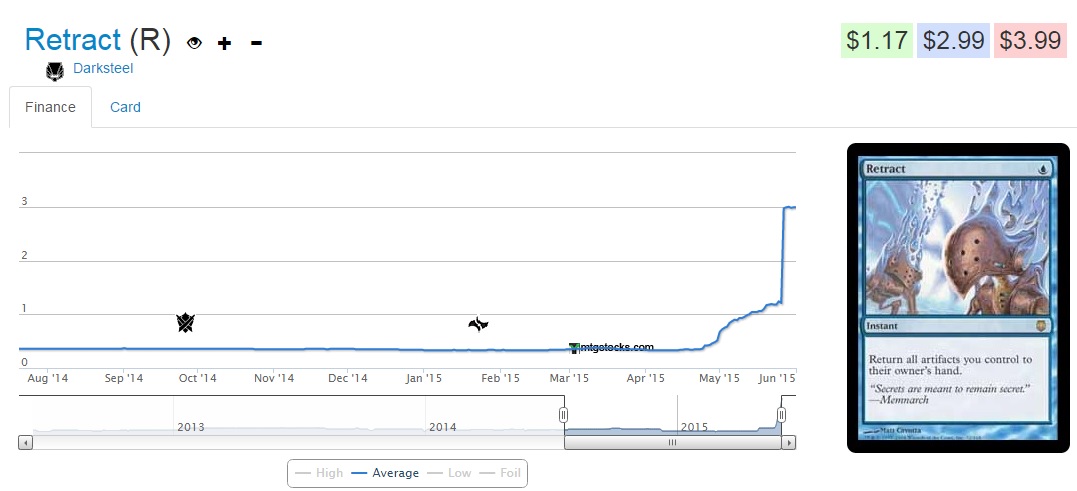
2. Retract (+141.1%) - This card found a home in the Puresteel Paladin combo deck of Modern, which basically wants to play and then replay as many of its free/cheap equipment as possible to build a really high storm count.

retract

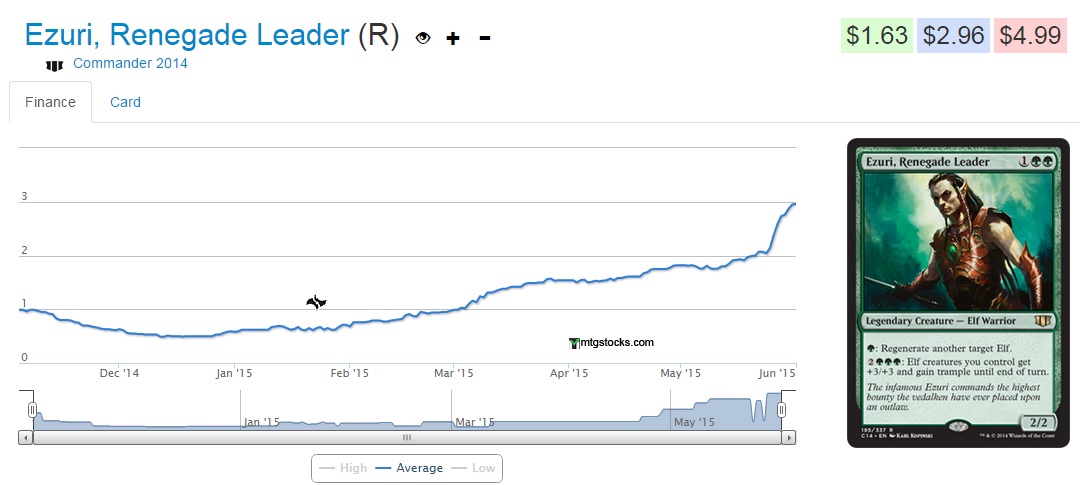
3. Ezuri, Renegade Leader (Commander 2014) (+38.3%) - With the Collected Company Elves deck debuting and proving its power level, it's not surprising to see demand for its Collectable kill condition rise.

ezuri

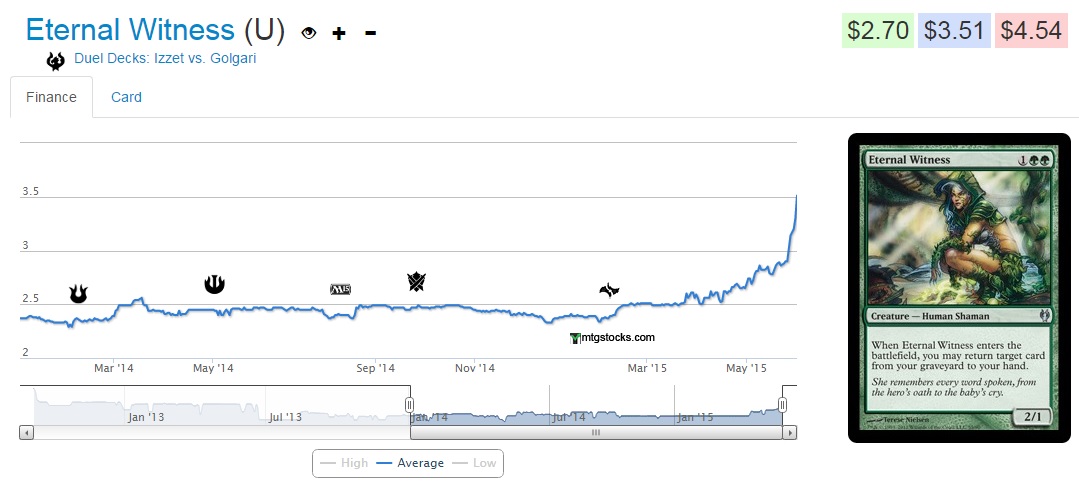
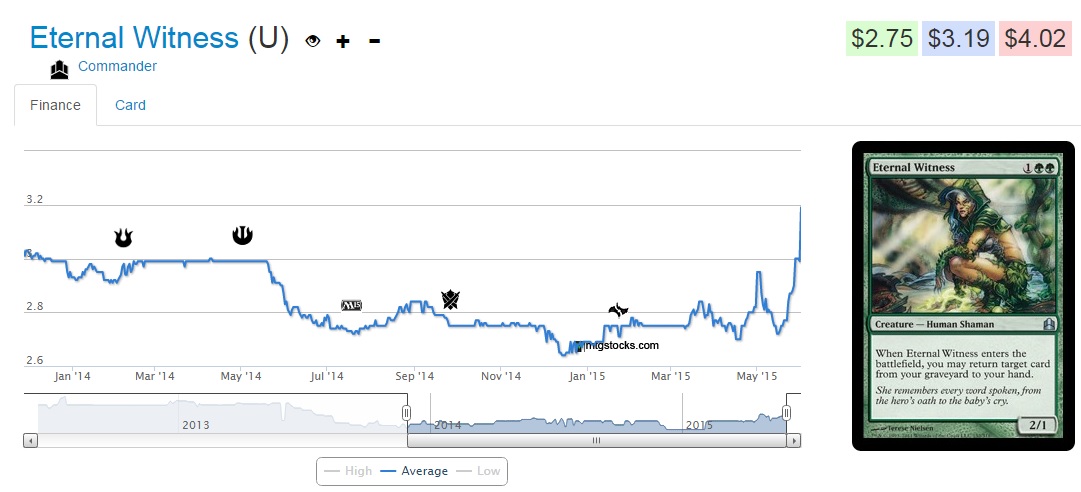
4. Eternal Witness (DD: Izzet vs. Golgari) (+21%) - The rise in this one is most likely due to the increase in Collected Company-based Modern decks. Eternal Witness provides a powerful card advantage engine and can rebuy the Collected Company used to put it into play (which is often the most powerful card in decks that play it.)

ewitnessig

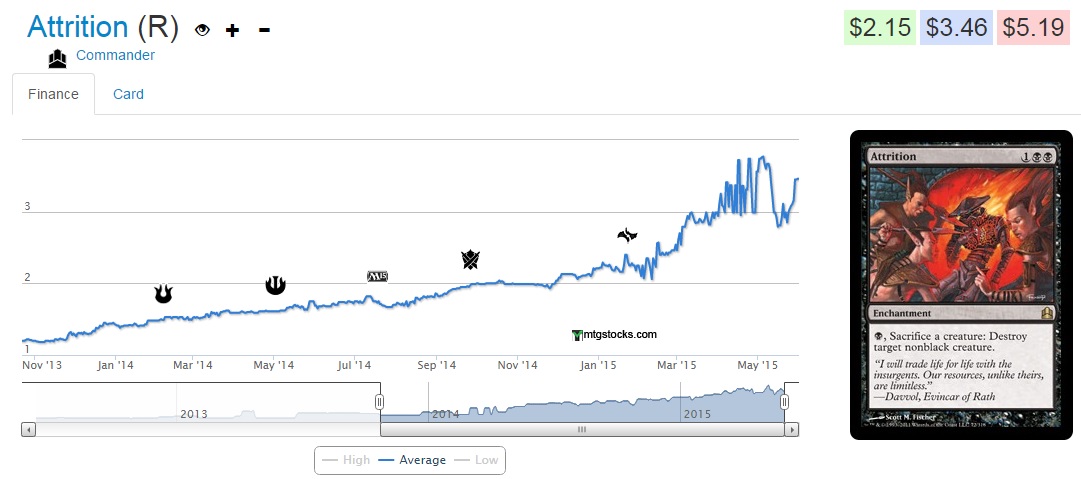
5. Attrition (Commander 2013) (+13.8%) - I count only 26 sellers for this on TCGplayer currently which implies that a few of the cheap ones leaving the market will cause a significant rise in the average price.

attrition

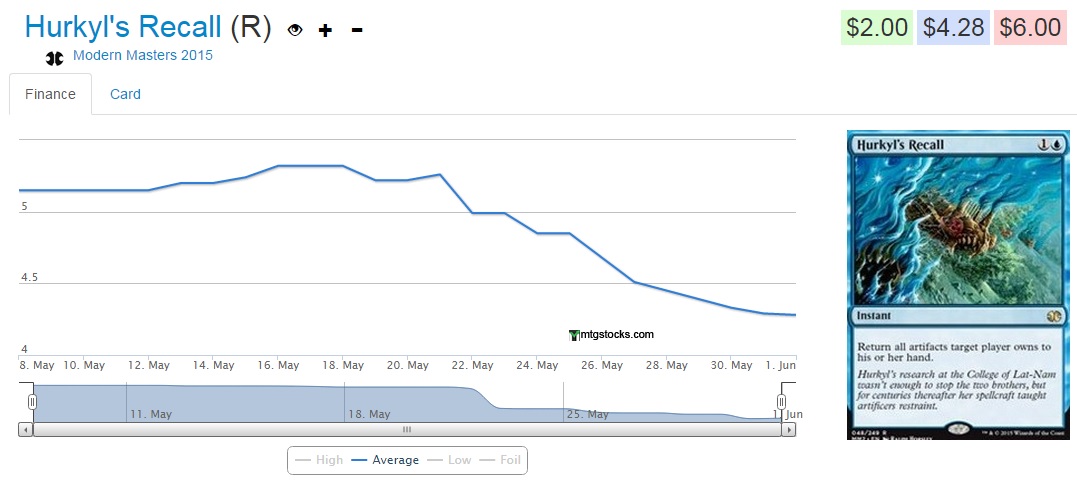
6. Hurkyl's Recall (Modern Masters 2015) (-11.8%) - It's not surprising to see this card taking a hit--with the reprinting in MM2015 and a resurgence in GBx decks, Hurkyl's Recall demand should be at an all time low.

I expect this one to keep dropping, but eventually a blue control deck will find a home again in Modern and then we'll likely see this narrow but powerful sideboard card gain.

recall

7. Eternal Witness (Commander 2013) (+11.2%) - See number 4.

ewitcom

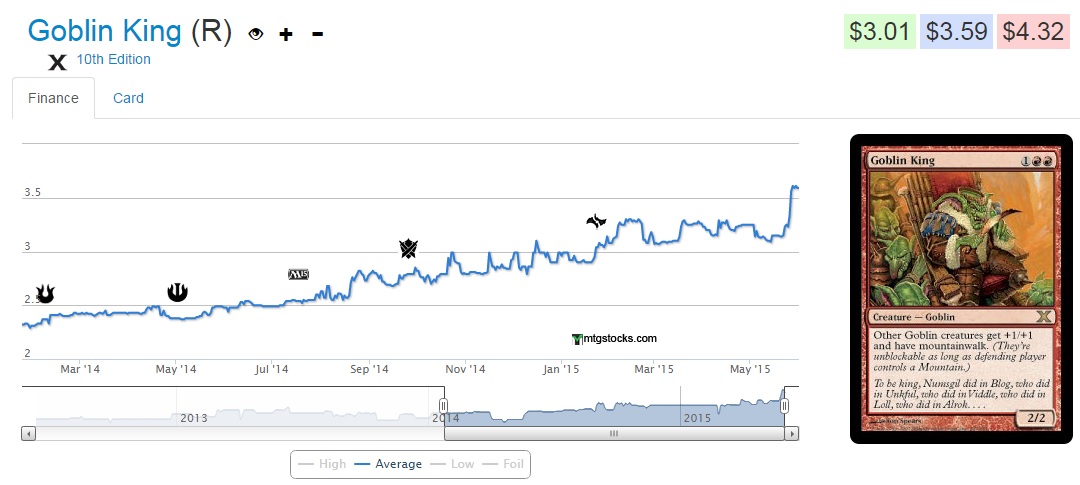
8. Goblin King (Tenth Edition) (+11.2%) - This one is most likely due to the small number of sellers listed (23 as of writing this). I can say this with some certainty because the 9th Edition version is sitting at around half the price, has the same artwork, and is theoretically rarer as it is older, and print run sizes tend to constantly be going upwards.

This discrepancy might also be due to the difference in border color, as Tenth Edition was the first Core Set since Beta printed in black-border.

goblinking

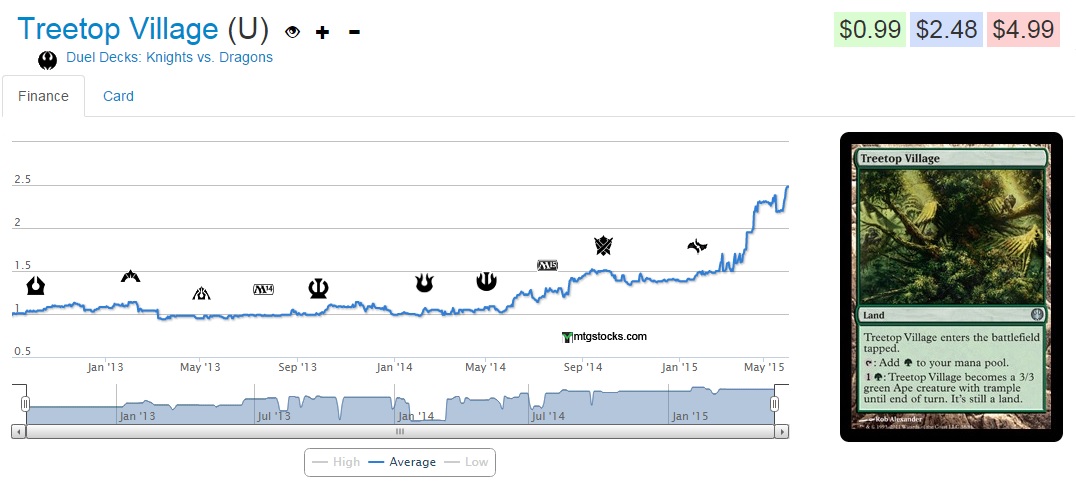
9. Treetop Village (DD: Knights vs. Dragons) (+10.2%) - Thanks to Collected Company we are starting to see a surge in GBx decks in Modern again. The banning of Pod set the archetype back some, though it's still considered Tier 1 by most players. Treetop Village provides a powerful, efficient attacker that can't get hit by Abrupt Decay and has a form of evasion in trample.

treetop

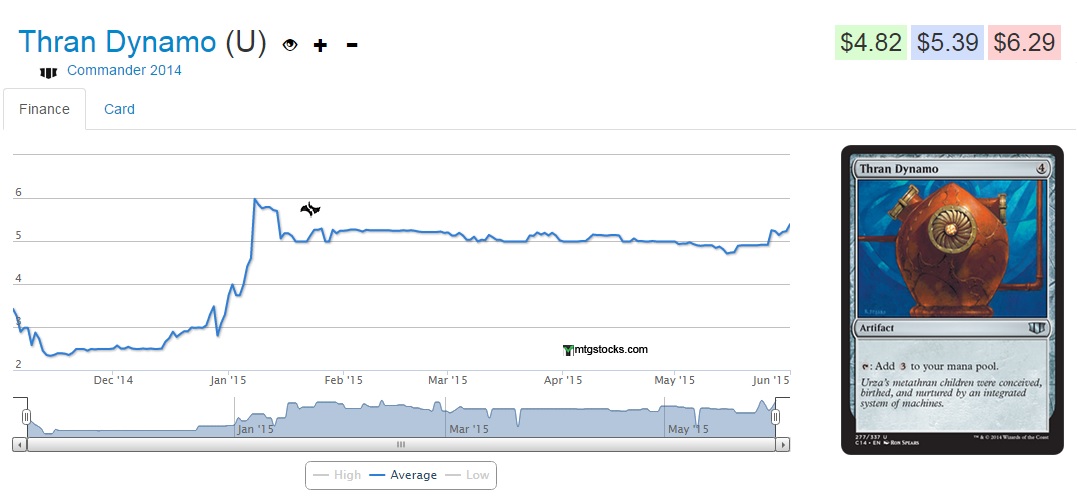
10. Thran Dynamo (Commander 2014) (+9.8%) - This EDH staple used to sit at $6.50 prior to reprintings, so it's not surprising to see it start to climb back up--especially since it only showed up in the blue Commander deck, which didn't have any powerful eternal cards and seems to be the one most often found sitting on store shelves.

thrand

Blue Chips

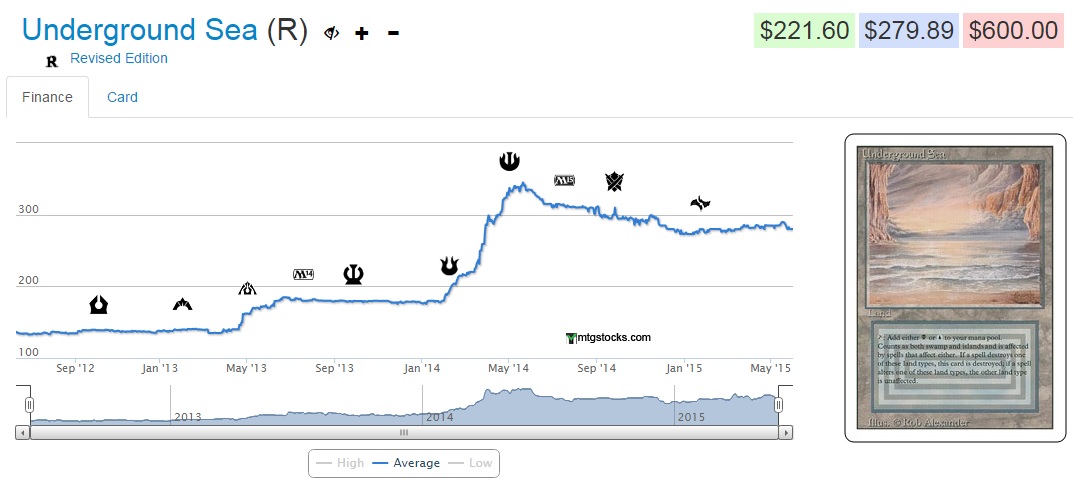
1. Underground Sea (-3.17%) - Despite an archetype that requires Underground Seas resurfacing (Grixis Delver), the king of dual lands still had the biggest price change this week...and it was negative. Underground Sea keeps getting closer and closer to Volcanic Island, and if this rate continues we may have a new "king dual" in the next couple of months.

sea

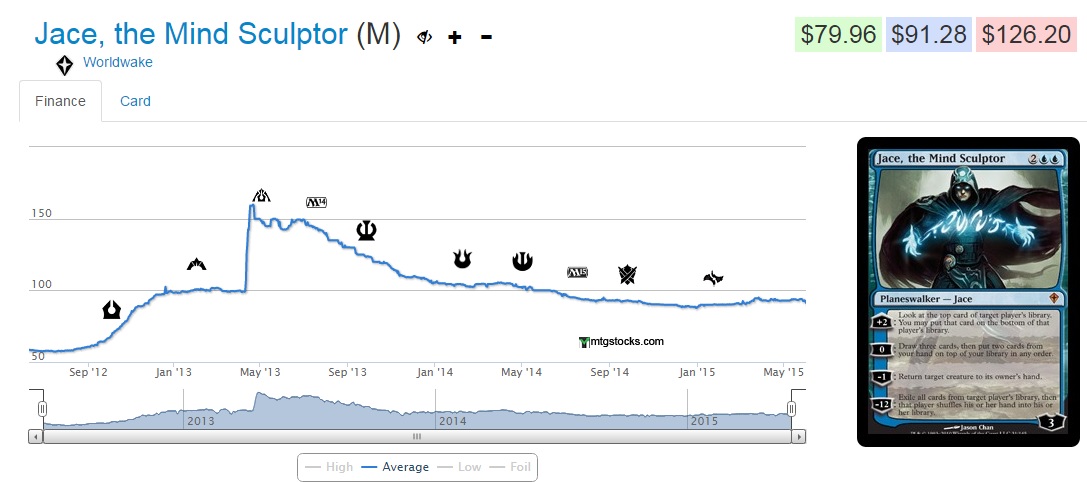
2. Jace, the Mind Sculptor (-2.09%) - With Legacy getting faster (with Infect and Omni-Tell), the best planeswalker ever is getting pushed out, as few players want to spend four mana on their own turn to cast Brainstorm and risk losing before Jace can do anything else.

jtms

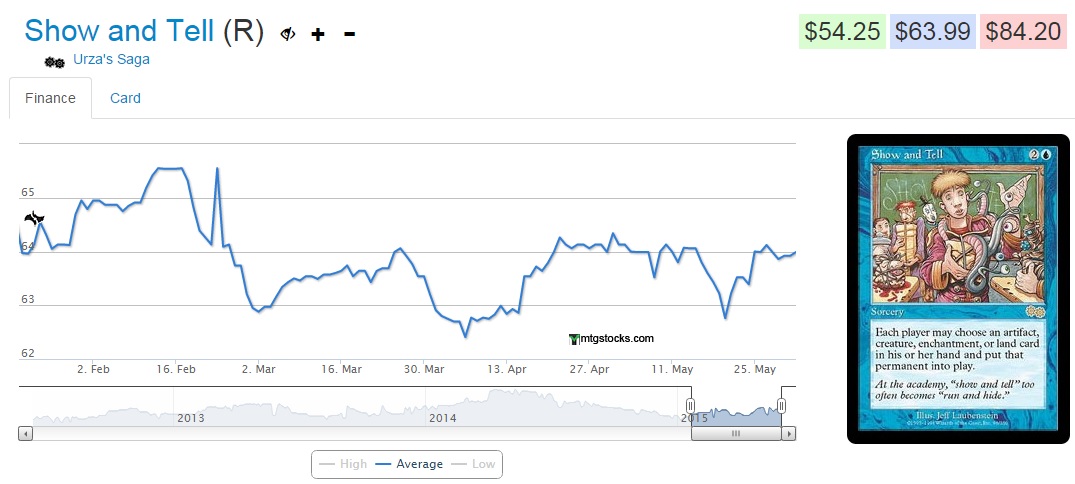
3. Show and Tell (+1.92%) - Not all that surprisingly, with the resurgence of Know and Tell decks, the lynchpin of the deck moves up this week, as does its partners in crime, Omniscience (+104.3%) and Cunning Wish (+113.6%).

show

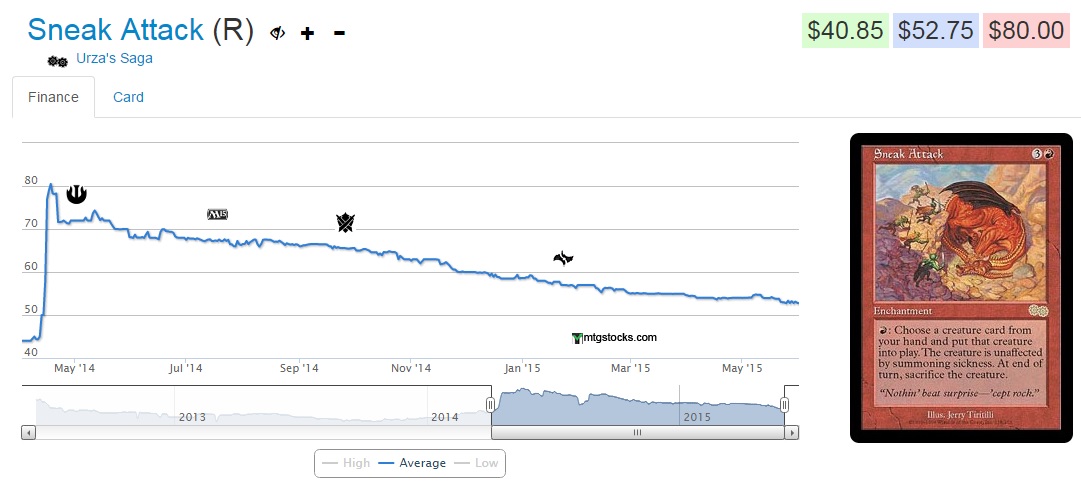
4. Sneak Attack (-1.91%) - Since apparently all of the Show and Tell players have jumped ship from blue-red to mono-blue, Sneak Attack again falls in price (for yet another week in a row).

sneak

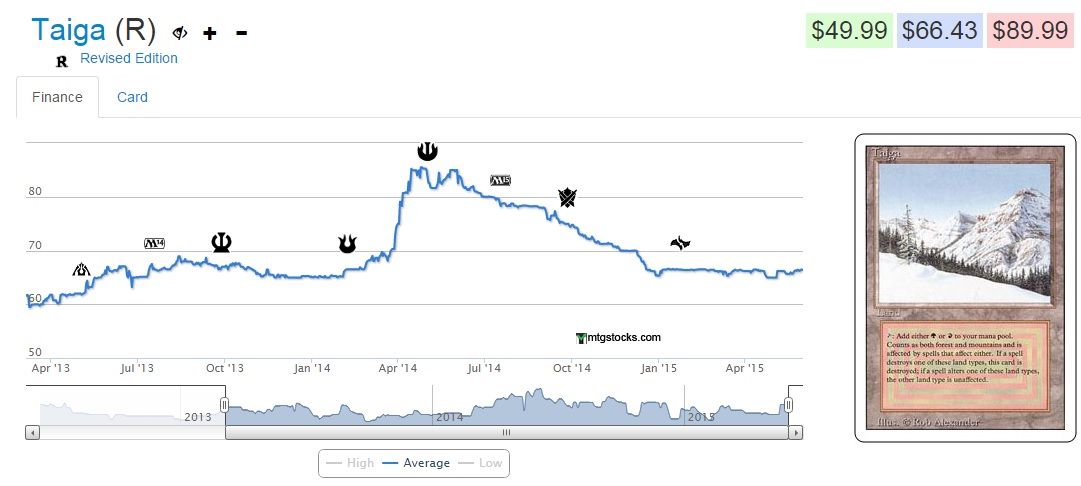
5. Taiga (+1.12%) - Taiga was the first dual land to return to its pre-spike price, which could well be why people have started buying them again. Thanks to the Reserved List they are safe from increasing in supply and demand will likely steadily grow for all duals as players transfer their recent MM2015 cards to more stable Legacy assets (like they did last time).

taiga

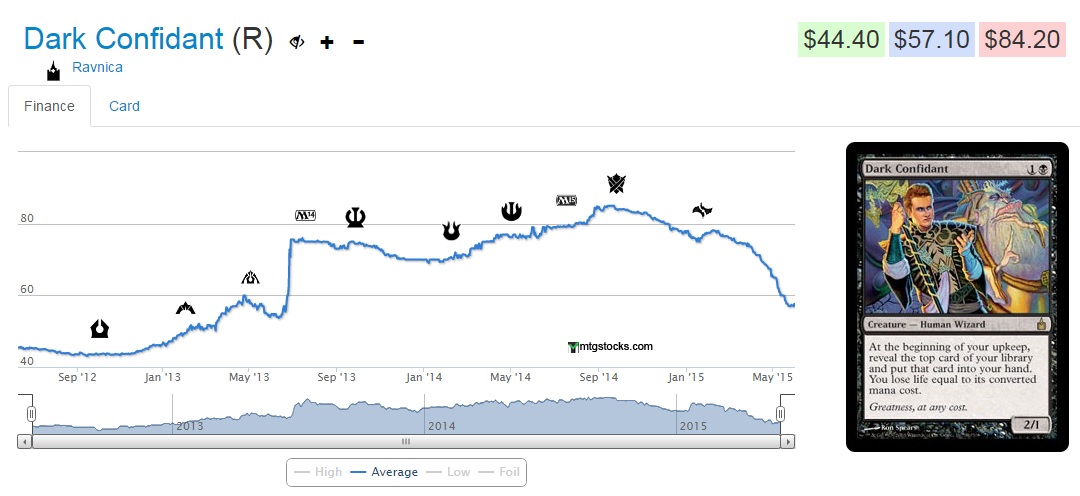
6. Dark Confidant (-1.03%) - Poor Bob, still on the decline thanks to seeing limited play in Modern and almost none in Legacy. However, Jund decks have started to resurface on the Modern scene and Bob is still their best source of actual card advantage. The fact that they can run both Huntmaster of the Fells and Kitchen Finks can help offset the life loss and allow him to wreck havoc when unanswered.

bob

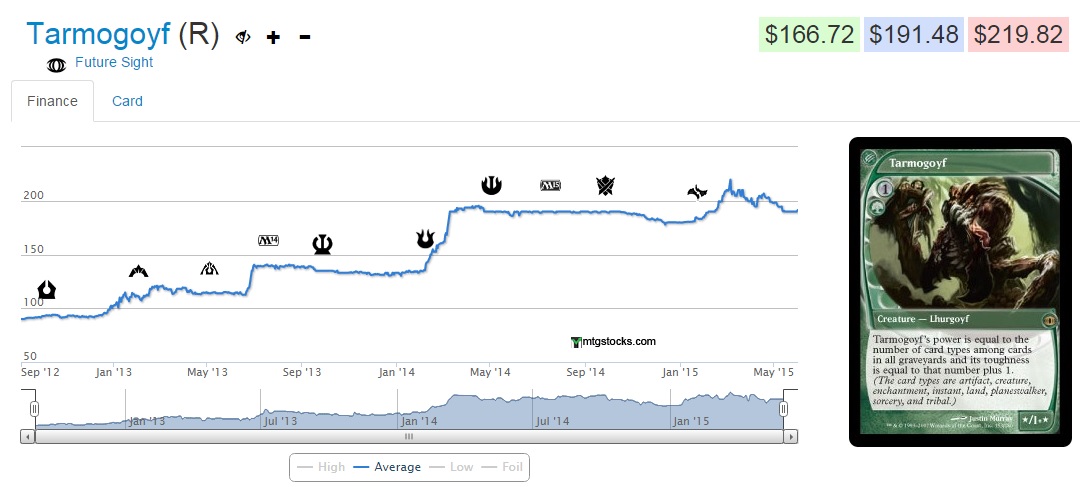
7. Tarmogoyf (+0.77%) - Not surprising the dip on the originals was minor, though currently MM2015 copies can be had for $50 less. The original Modern Masters version isn't fairing as well as his Future Sight brother though, having dropped a few dollars again.

goyf

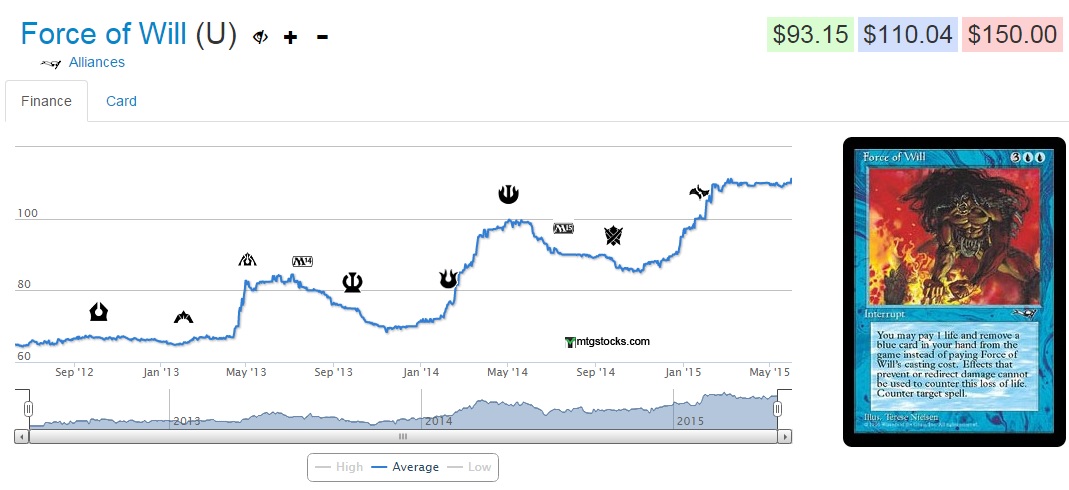
8. Force of Will (+0.77%) - Force of Will has come back full force as more players have moved into Legacy since last year, who don't want to leave home without the glue keeping the format together. This card's price and relative stability makes me think that Disrupting Shoal (as bad a comparison as it is) may well be the key to a full fledged control deck in Modern...

fow

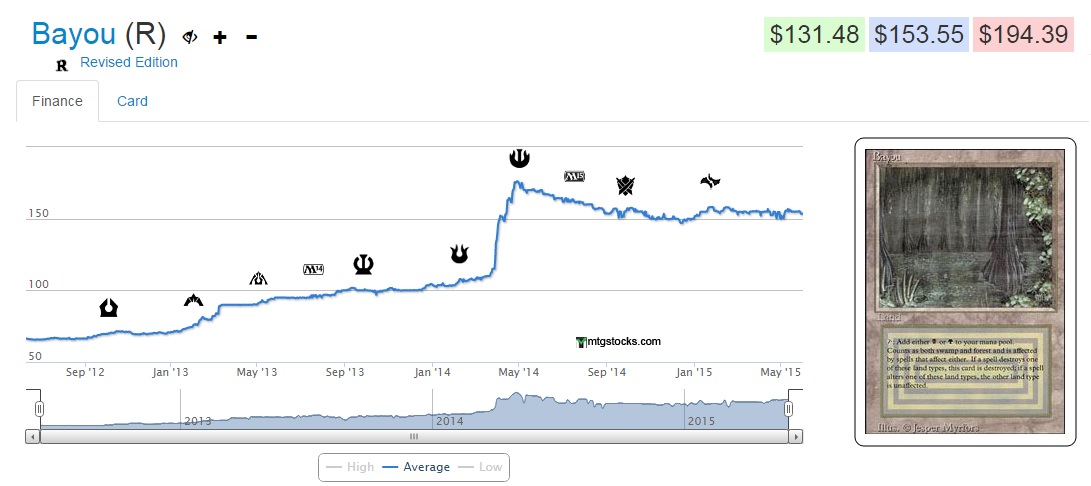
9. Bayou (-0.74%) - Despite Elves experiencing a resurgence in Modern, its Legacy brother still seems to be dropping in demand, most likely thanks to my beloved Miracles deck (Elves has a really tough time against both Terminus and Counterbalance).

bayou

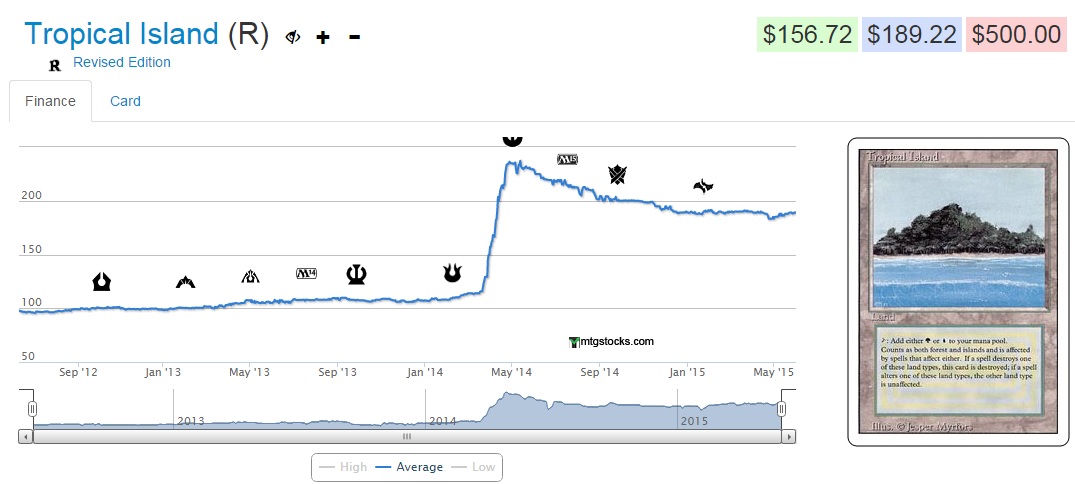
10. Tropical Island (+0.62%) - We've started to see BUG and RUG Delver variants resurface again and this is one of the critical lands for both. Legacy mana bases are getting greedier and greedier and it may be Stifle's time to shine again very soon.

trop

Sealed Product

It's time we visit our sealed product again as I've heard rumors in the forums of an increase in demand of even the cheaper sealed boxes. It is important to consider that every time someone drafts an older set or cracks the packs the overall supply is reduced.

As noted, Dark Ascension is seeing a pretty big jump in demand (+22.34%), which may be because it sat at normal sealed box pricing for so long and a few individuals decided to buy it up, or because people really want Huntmaster of the Fells.

Rise of the Eldrazi (ROE) is actually surprising given that the three biggest chase mythics of the set (the Eldrazi titans) all showed up in MM2015, so they can be picked up far cheaper going through MM2015 boxes than through ROE boxes.

Week of 06/01/15

Box Most Recent Completed Auction Second Most Recent Third Most Recent Fourth Most Recent New Average Average comparison
Innistrad $211.99 $215.00 $220.00 $229.00 $219.00 6.39%
Dark Ascension $112.95 $89.00 $126.48 $112.50 $110.23 22.34%
Avacyn Restored $139.99 $129.00 $129.95 $139.95 $134.72 -2.60%
Scars of Mirrodin $209.95 $194.95 $174.99 $166.24 $186.53 -5.86%
Mirrodin Besieged $122.51 $165.00 $149.50 $125.00 $140.50 -7.82%
New Phyrexia $288.04 $329.99 $329.99 $329.99 $319.50 3.84%
Zendikar $534.99 $514.99 $460.00 $500.00 $502.50 -1.04%
Worldwake $640.00 $640.00 $649.99 $640.00 $642.50 -6.03%
Rise of the Eldrazi $474.99 $599.99 $600.00 $599.99 $568.74 13.77%

Insider: Modern Masters Aftermath – Preparing for GP Charlotte

Are you a Quiet Speculation member?

If not, now is a perfect time to join up! Our powerful tools, breaking-news analysis, and exclusive Discord channel will make sure you stay up to date and ahead of the curve.

There was an error retrieving a chart for Blood Moon

When I walked the floor of Grand Prix Toronto a month ago, I saw that Blood Moon was prominently listed at the top of a dealer’s displayed buylist board, and I again saw the same thing at Grand Prix Atlantic City. It’s likely that I noticed this at all because I have been holding around a dozen Blood Moon I intend to part with.

After further investigation on mtg.gg, I found the spread on the various editions of Blood Moon (The Dark, Chronicles, 8th Edition, 9th Edition, Modern Masters) was quite low, even under 10% for the best buyers. With Modern season now upon us, and with cyclical demand from players increasing prices, I reasoned that dealers were preparing for the upcoming season by aggressively moving into Modern positions. Blood Moon has risen steadily in the last month, growing around 25-30% across the various printings.

The best Modern targets going forward are those not included in Modern Masters 2015. While reprinted cards fall in price, those not reprinted will certainly rise, potentially significantly.

Consider that risk of reprint in MM2015 held the prices of many cards down. When it was announced that the new set would include cards up to New Phyrexia, newer cards, like Snapcaster Mage and Liliana of the Veil, grew in price accordingly. When the final MM2015 spoiler was revealed, all of the cards that could have been included became primed for a rise in price. An obvious example, Serum Visions, saw an immediate price increase. As time goes on, this effect will take hold on more and more cards.

If MM2015 increases the popularity of Modern and demand for Modern cards, then these non-reprinted cards will become even more valuable over time. With Modern season beginning in earnest this weekend, now is a great time to get in on Modern positions before they grow more expensive.

While there will be Modern PTQs on Magic Online until mid-July, and Modern Grand Prix in Copenhagen and Singapore in June, I expect that the peak of the American Modern financial season is nearly upon us--Grand Prix Charlotte on the weekend of June 14th.

This event is building off the hype of MM2015, and it’s likely to draw thousands of players. There will be card-buying frenzy in the days leading to the event, and at event itself, dealers and traders will surely demand high prices for their format staples.

Today I’ll share some cards that I have had my eye on, cards that were not reprinted in MM2015, that are sure to be Modern players, and likely strong financial positions, going forward to GP Charlotte and beyond. These cards have seen recent upward movement that I expect will continue in the days leading to GP Charlotte.

There was an error retrieving a chart for Urza's Tower

G/R Urzatron is a very powerful Modern deck, and it is particularly well positioned in this metagame, which is being overtaken by creature decks, including those using Collected Company. The G/R Urzatron archetype had additional exposure last weekend in the Modern week of the Standard Super League, where Owen Turtenwald used a version with four Ugin, the Spirit Dragon to win the week.

I expect that G/R Urzatron will be a strong and popular choice at GP Charlotte and throughout the Modern season, and its cards are good financial targets.

The Urzatron lands themselves are of particular interest. While these have seen multiple printings, they maintain a strong price and are primed for growth. While the 9th Edition paper printing of Urza's Tower has grown over 30% in the last week, I look towards Magic Online for the most striking example of potential for Urzatron lands.

The online price of the 8th and 9th Edition printings of these lands has doubled in price over the last week. For example, the 9th Edition Urza's Tower has grown from 0.3 to 0.6 tix. Older printings have also grown in price, the Masters Edition IV Urza's Tower growing 25% from 1.6 to 2 tix.

I predict that the paper price of Urzatron lands will rise further, and we could reasonably expect to see $5 Urza's Towers in the future.

There was an error retrieving a chart for Grove of the Burnwillows

Another strong play from the Modern Urzatron deck is Grove of the Burnwillows. A staple four-of that was not reprinted, it’s sure to rise, and it has applications in other decks.

I point to the online price, which has grown from under 12 tix the first of May to over 27 tix the first of June. The paper price was in a steady decline from its peak of $47 in April of 2014 to a low of under $36 in early May. It has since began a slow growth up to over $37, and I expect it could reach $50 or more this Summer.

There was an error retrieving a chart for Twilight Mire

BGx-based Rock decks are a major factor in any and every Modern metagame, and its staple cards are surefire financial plays. Two options stand out, on opposite ends of the spectrum.

The first is Twilight Mire, which sits at $32. The price is high, but with no reprint imminent, the filter lands are primed for a price bump, and this is the best of the bunch in terms of top-tier Modern play.

The price, which peaked at $37 at the end of the last Modern season in September, will likely grow past $40 this season. Online, Mystic Gate has grown over 20% in the last month from 3.7 tix to 4.5 tix, which could signal future paper growth. I am bullish on all filter lands.

There was an error retrieving a chart for Treetop Village

Another land not getting enough attention is Treetop Village, which plays a part in nearly every BGx Rock deck in Modern. The online price of the 10th Edition printing has grown by a third in the last week, from 0.6 to 0.8 tix. The paper price, which was $1.5 in mid-February, is up to over $2, and I expect it will grow higher still.

There was an error retrieving a chart for Eternal Witness

On the topic of uncommon plays, I am a big fan of Eternal Witness. With Den Protector likely the best card in Standard, it’s important to take another look at an even more efficient card. It’s gaining popularity in Modern alongside Collected Company, which alone is enough to bump the price, but I expect we’ll be seeing more of it in this archetype and others going forward.

There was an error retrieving a chart for Timely Reinforcements

Timely Reinforcements is another card I have my eye on. It's a premier Modern sideboard card that will be excellent against a format with Zoo decks on the rise. This card was barely over $1 when April began, but here in June, it’s approaching $3. I wouldn’t be surprise to see this crack $5 by fall.

What cards are on your Modern radar?

Cheers,
Adam

Modern Masters 2015 Draft #1: Video

Are you a Quiet Speculation member?

If not, now is a perfect time to join up! Our powerful tools, breaking-news analysis, and exclusive Discord channel will make sure you stay up to date and ahead of the curve.

Yesterday I took to the Modern Masters 2015 draft queues to try out the new format with a 6-2-2-2 / three round Swiss draft.

modern masters 2015 Thoughtcast

I faced off against a Jund Wither deck, Affinity, and a strange but explosive Grixis Wildfire deck.

[wp_ad_camp_1]

See below for what happened.

As I say in the videos, I'm very rusty with drafting, so in retrospect, I would've been more aggressive in picking some Affinity centric cards instead of taking some of the more versatile cards and hoping for the Affinity stuff to wheel. This may well have prevented the other player from also drafting Affinity, greatly increasing the strength of my pool. Draft basics, really, but this is what can happen when you don't play Limited for many moons. Regardless, the deck turned out pretty well.

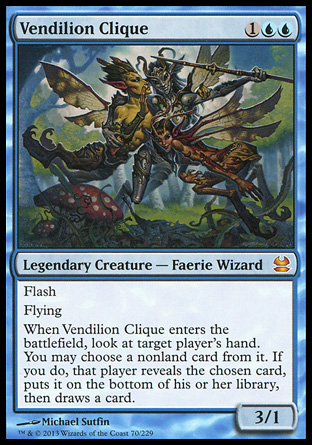
Tiny Tuesday- Vendilion Clique

Are you a Quiet Speculation member?

If not, now is a perfect time to join up! Our powerful tools, breaking-news analysis, and exclusive Discord channel will make sure you stay up to date and ahead of the curve.

Vendilion Clique has long been one of the best Commanders for one on one Commander. At least I imagine it is. I don't keep up on that stuff, but the card is great, so always being able to cast it is probably great, and that principle holds true in Tiny Leaders.

There was an error retrieving a chart for Vendilion Clique

You don't get a lot of options as a mono-blue player restricted by color identity. Dismember would be a fantastic inclusion, but alas, we're limited to counters, bounce spells, draw spells, and a couple choice permanents. This is the list that I like for tiny Vendilion Clique.

Tiny Vendilion Clique

creatures

1 Snapcaster Mage
1 Spellstutter Sprite
1 True-Name Nemesis
1 Augur of Bolas

spells

1 Vedalken Shackles
1 Isochron Scepter
1 Counterspell
1 Repeal
1 Spell Snare
1 Mental Misstep
1 Remand
1 Miscalculation
1 Daze
1 Force Spike
1 Brainstorm
1 Ponder
1 Preordain
1 Declaration of Naught
1 Mana Leak
1 Memory Lapse
1 Hinder
1 Spell Crumple
1 Vapor Snag
1 Into the Roil
1 Cyclonic Rift
1 Blue Sun's Zenith
1 Prohibit
1 Threads of Disloyalty
1 Broken Ambitions
1 Condescend

lands

1 Wasteland
1 Tectonic Edge
1 Cavern of Souls
1 Misty Rainforest
1 Scalding Tarn
1 Polluted Delta
1 Flooded Strand
9 Island
1 Riptide Laboratory
1 Mutavault
1 Mishra's Factory

I'm not going to pretend like I got clever here. Clique pretty much forces you to do things a certain way. The worst thing you could do with this deck is not play Vedalken Shackles, with Threads of Disloyalty and Isochron Scepter being two other powerful ways to get ahead.
There was an error retrieving a chart for Vedalken Shackles

I like maxing out on answers to opposing Commanders, running the full suite of Declaration of Naught, Spell Crumple, and Hinder. This will give you the best chance of successfully stabilizing and locking your opponent out with counterspells. The tuck rule may have been removed in EDH, but it's still a part of Tiny Leaders.

Vendilion Clique is definitely an expensive card even with the Modern Masters reprints, but now is probably the time to buy if you're looking to own one. The prices have dipped slightly recently, and over the course of this week as the copies from the worldwide GPs enter the market will likely mark the cheapest the card will be for a couple years.

Matchups and Win Rates: Top Tier Decks (Part 2)

Are you a Quiet Speculation member?

If not, now is a perfect time to join up! Our powerful tools, breaking-news analysis, and exclusive Discord channel will make sure you stay up to date and ahead of the curve.

The Deep Dive dataset is back! In three earlier articles, I analyzed a collection of MTGO dailies to determine the matchups and win rates of different top-tier decks. Unlike the publicly published MTGO dailies used to inform the Top Decks page, our Deep Dive dataset includes all finishes from a sample of dailies, not just the 4-0/3-1 ones. It also includes all the matchups between those different decks, not just their overall standings. Today, we are returning to the Deep Dive to see how different win rates and matchups are doing. This includes both overall deck win rates and individual matchups between decks, all with an even larger sample size than before. And as many of you can guess, one of the best decks from last time is still on top. In fact, it's more vigorous than ever.

Amulet of Vigor Art Cropped

As in this last articles, I'm going to focus on the top-tier Modern decks as defined in our Top Decks page, paying special attention to the MTGO stats because the Deep Dive dataset is MTGO-based. I'll also include a brief discussion of the dataset itself and all the different pieces that go into it. Then we'll dive right into the deck win rates and their matchups. All in all, this analysis gives us an important quantitative perspective on which decks are strong in the format, and which are strong against each other. So whether you are thinking of bringing these decks to the major events in June, or are just preparing to face the diverse Modern field, this article will give you a statistical foundation with which to start your testing and decision making.

Special thanks to MTGS users pizzap and Rickster for their work on the dataset. Also to Kim Josefsen, a regular reader who contributed to the work.

[wp_ad_camp_1]

Dataset and Methods

The MTGO Deep Dive dataset compiles a semi-random selection of dailies and the different decks and finishes within those dailies. In my last article on the topic, the dataset included 16 dailies. Now, we are up to 28, consisting of just over 5700 matches. For each daily, I analyze deck performance to determine a deck's collective Match Win Percentage (MWP) across different events. I also calculate matchup win rates between the different decks. This gives us a sense of both the "true" overall MWP of those decks (calculated over hundreds of games), and the "true" matchup win-rates between different decks. Also, note these are MATCH win percentages, not GAME win percentages (GWPs): a 2-1 win is counted the same as a 2-0 win for the purposes of counting an MWP. I focus on MWPs instead of GWPs because GWP numbers don't distinguish between pre-sideboard and post-sideboard games. MWPs at least capture this over the course of a match.

I adjust all MWPs and win-rates for byes, drops, splits, mirror matches, and other MTGO/statistical oddities that would skew the dataset. In addition, I assess all MWPs for statistical significance relative to the "weighted average MWP" of decks across the dataset. This produces different P values for each deck's MWP. The statistical tests and the resulting P value checks the likelihood of any given deck's MWP value falling within expected variance relative to the average MTGO MWP. A P value greater than .10 would suggest the deck is not truly above or below average relative to the MTGO-wide MWP: it's just within the expected spread. But a P value of less than .10 (or even better: less than .05) would suggest the deck is a legitimate outlier, and a true under- or over-performer.

Overall Win Rates: Tier 1 and Tier 2 Decks

To get our deep dive started, here are the MWPs for all the tier 1 and tier 2 decks in the format, along with their statistical significance. I also show the number of appearances each deck made throughout the dataset, and the total number of matchups used to calculate the overall MWP. This gives you some sense of the sample size, N, for each of the calculations, and in turn a sense of how accurate those calculations might be. All tier 1 and tier 2 decks are taken from our Top Decks page: visit the page to see how we define which decks belong in which tier (note the page is being updated on Wednesday, 6/3).

Below are the tier 1 decks as defined on the Top Decks page. As a point of reference, the average MTGO-wide MWP for all decks (weighted based on prevalence) is 50.1%. 

Deck# of Deep Dive
appearances
% of Deep
Dive Metagame
# of Deep Dive
matches
MWPP value and
significance
Abzan975.3%30252%.51
UR Twin1427.7%44252.3%.26
Burn19010.3%56950.8%.38
Affinity1085.9%33957.5%.01 (**)
Jund864.7%26349.4%.83

I don't want to go into too much detail on these overall MWPs -- that's coming in the next section. For now, it's enough to say most decks are hovering right around that 50% marker, with just Affinity standing out as an overperformer. With a P value of .01, the deck's 57% win rate is significantly higher from the MTGO average of 50%. More on that later.

Next, here are the tier 2 decks.

Tier 2: 2/5/16 - 2/16/16

DeckOverall
Metagame %
MTGO %Paper %Day 2%
Merfolk3.3%2.4%4.1%2.1%
RG Tron2.7%1.9%3%2.9%
Griselbrand2.3%0.5%2.6%3.7%
Abzan1.8%1.4%1.5%3.7%
Naya Company1.7%1.9%1.9%0.8%
Gruul Zoo1.6%0.5%1.9%2.5%

Amulet Bloom is clearly knocking the MWP ball out of the park, but I'm going to be discussing that in the next section so let's ignore it for now. Instead, let's focus on all the decks below Grixis Delver, decks without sufficient N to include in a matchup analysis section, but with enough overall matches to extrapolate a net MWPs. One of the challenge in working with the Deep Dive dataset is always obtaining a large N for any given deck. You are at the mercy of what people are playing for any given daily, so if people stop playing a deck (poor Infect!), we stop seeing matchups for it. This means a lot of these MWPs have a lower appearance and match N than I would like. But we can still make some general observations from what we are seeing here, because most decks still have over 100 matches.

collected companyLet's start with the Collected Company decks: Abzan Company and Elves. The Abzan Company MWP is just terrible right now, whereas Elves is right around the average. I think there are a few elements at play here. First, Elves is a fast, linear, minimally-interactive combo deck. Those kind of decks tend to be very successful on MTGO, where tournaments are just four rounds and you can gamble on good matchups. Heck, those decks tend to be very successful in Modern period, for the very same reasons. When you screw up against Elves, you probably lose on the spot. When you screw up against Abzan Company however, you can still play a fair game of Magic (unless the Company player combo'd, but that's harder to do now than it was in the days of Pod). This favors Elves in the MWP contest. The second element explaining these differences is in the decklists: it's much easier to optimize an Elves list than an Abzan Company one. There is substantial consensus about what goes into Elves -- not so for Abzan Company and its many variations. This suggests Company players might be bringing suboptimal lists into dailies, which would help account for the lower MWP.
Lightning HelixThe other deck I want us to think about is UWR Control. We don't have quite enough matches to determine if this deck's MWP is actually as high as its pointing here, but early signs indicate it might be. UWR Control has a lot of tools for this metagame, including ample early removal, lifegain, countermagic to get you through the midgame, and resilient finishers. My guess is UWR Control still suffers from many of the same problems it suffered from in past months (chiefly it's a reactive deck in a metagame rewarding proactive strategies), but I also think it's a better deck than people give it credit. Myself included! I've written off UWR Control before, but it seems like it's better positioned now than in the past. After all, as Bolt becomes better, decks like UWR Control become more viable, particularly with redundant Bolt effects like Helix and Electrolyze. Cryptic Command also becomes much better in slower/fairer formats. With decks like Grixis Delver, Temur/Blue/Grixis Moon, Jund, Abzan Company, and other similar decks rising through the metagame ranks, the format is becoming much friendlier to Command.

Before turning to the in-depth analysis of certain decks, one final word on the MWP tables above: don't look at the tables and say "UWR Midrange only has a 47% MWP. It's clearly a bad deck!" Instead, consider those MWPs in relation to their P values and their N. In almost all cases, the decks are right within expected variance around the MTGO-wide average of 50%. This suggests ALL of the decks are actually decent choices, although some (cough Amulet cough) might have more going for them.

In-Depth Win Rate and Matchup Analysis

Some of our decks have hundreds of appearances and matchups, which lets us perform a much deeper analysis on their performances. In this section, I break down some of those key decks to discuss both their overall MWPs and their matchups against each other. Not all top-tier decks are included here! Some decks didn't have a large enough N to draw results from, either overall or within different matchups. But for those decks I do show, I'll give a detailed discussion of the results and how I make sense of them.

Remember: quantitative data is just one datapoint you need to consider when doing any kind of evaluation or data analysis. Make sure you combine the numbers here with your own experiences and the other sources/experience you may know of. I'll offer a bit of commentary in each section to try and help people make sense of the numbers and put them in the larger Modern context.

Again, for reference, our weighted average MTGO-wide MWP is 50.1% (N=98 different decks with ~5700 matches).

TwinUR Twin

  • Top Decks MTGO prevalence: 5.8%
  • Deep Dive MTGO prevalence: 7.7% (142)
    Deep Dive matches: 442
  • MWP: 52.3% (p=.26)

vs. Abzan: 68.8% (11/16)
vs. Affinity: 55.2% (16/29)
vs. Burn: 46% (23/50)
vs. Jund: 55.6% (10/18)
vs. Amulet Bloom: 36% (9/25)
vs. Grixis Delver: 36.8% (14/38)

Twin's showing up a lot less in the Top Decks metagame than in the Deep Dive, which suggests a lot of people who play the deck are not consistently making 4-0/3-1. There is an underperformance effect at play here. This is also reflected in the MWP, which is slightly above-average but not significantly so. I found this a bit odd, given how strong Twin has been at events in the past year (the winningest GP deck after Pod). I think underperforming players are pulling down Twin's online MWP, which is why its MWP is only slightly and insignificantly higher than the MTGO average. In the hands of a good pilot, Twin is still one of the format's best decks. In the hands of a less experienced one, however, the deck does not necessarily carry the player. With so many people on Twin (remember: it's the third most-played deck), the MWP is going to take a hit just from player skill differences.
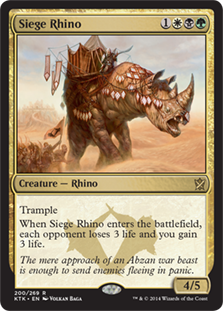
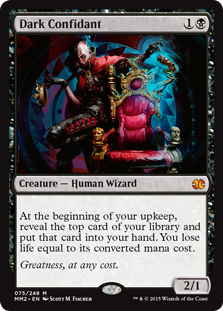
Turning to the individual matchups, the Burn and Affinity matchups make perfect sense. These are effectively 50-50 races, which reflects most of my experiences with the decks and those of players I know. Grixis Delver also makes a ton of sense. Delver decks are excellent against Twin, particularly the hard-removal-packed Grixis variants (sorry 4 toughness Exarch). Grixis Delver has exploded on the scene, and we know its Twin matchup is a big part of that.

Then we get to the Abzan and Amulet Bloom matchups. Abzan is supposed to be great against Twin. Here, however, it can't seem to win. We saw a similar effect last time we looked at the dataset, and it's still present even after increasing N. I believe player experience accounts for this, but not on Twin's side of the table. Abzan's metagame share has been declining rapidly on MTGO, which suggests to me the BGx deck is not a great choice these days (more on that later). True, players who are still sticking to BGW might be diehard Abzan pros, but they might also be players who are simply behind the metagame times. That second kind of player might have less overall Modern experience and thus be less equipped to battle Twin. The reverse effect is probably driving the Amulet matches. Your average Amulet Bloom player is quite experienced with their deck: Amulet has one of the lowest ratios of unique players to number of matches. Because of their experience and skill, those Amulet players are probably more experienced at navigating the Twin matchup than Twin players are at navigating the Amulet one. Player skill being more equal, we would expect both win percentages to normalize more towards 50%.

Goblin GuideBurn

  • Top Decks MTGO prevalence: 10%
  • Deep Dive MTGO prevalence: 10.3% (190)
    Deep Dive matches: 569
  • MWP: 50.8% (p=.38)

vs. Abzan: 55.6% (20/36)
vs. Affinity: 41.9% (18/43)
vs. Jund: 38.5% (10/26)
vs. UR Twin: 54% (27/50)
vs. Amulet Bloom: 22.7% (5/22)
vs. Grixis Delver: 59.6% (31/52)

Burn has been the most-played MTGO deck for a while, and that's just as true in the Deep Dive dataset as it is in the MTGO metagame numbers. Burn's paper metagame share has been crashing (it's currently between 4.5% and 5%), but it remains an MTGO powerhouse going into June. Even so, the deck's MWP has declined a few percentage points since my last article. This reflects both metagame adaptions to Burn, and the tendency for decks to fall back to 50% as more people play them. We saw a similar effect with Twin, but it's notable to me that Burn's MWP is right at the average even though Twin's is slightly over. This reflects the oops-I-win element of Twin, which is less present in Burn.

Unlike the Twin vs. Abzan/Amulet matchups, the Burn matchups make sense across the board. Affinity and Twin are straight races, with Affinity at a slight edge (it can threaten the turn 3 win and easily wins turn 4 on the play) and Twin at a slight deficit (the only way it wins turn 4 is if it draws the combo or if it can somehow control the damage). Amulet is also a race, but between the lifegain from sources like Radiant Fountain and the relative difficulty of Burn interacting with Bloom's cards, this is heavily in Amulet's favor. Burn struggles with Jund due to the less painful BGx manabase and Bolt, and beats Abzan for the opposite reasons (you can read my article on Jund's strengths for more on these points). Finally, Grixis Delver remains Burn's best matchup, which is something many Grixis Delver players will admit to. Grixis Delver struggles against Burn because of a painful manabase, a lack of lifegain, cards like Gitaxian Probe which are just terrible in the matchup, and a gameplan that is a bit too slow. Thankfully for Grixis mages, the Burn vs. Delver MWP isn't nearly as lopsided as it was in the first article, which was a normalization I predicted would happen as we added more data.

Arcbound RavagerAffinity

  • Top Decks MTGO prevalence: 5.8%
  • Deep Dive MTGO prevalence: 5% (108)
    Deep Dive matches: 339
  • MWP: 57.5% (p=.01***)

vs. Abzan: 61% (11/18)
vs. Burn: 60.5% (26/43)
vs. Jund: 30% (3/10)
vs. UR Twin: 44.8% (13/29)
vs. Amulet Bloom: 57.1% (8/14)
vs. Grixis Delver: 50% (12/24)

From a metagame perspective, Affinity's Deep Dive prevalence is very close to the overall Top Decks prevalence, although Affinity's paper presence has historically (and currently) been higher than its online share. Affinity is in an MTGO metagame share dip these days, but I expect that to reverse in the coming months. Just like you should never bet against BGx, never bet against Affinity.

Speaking of never betting against Affinity, the real takeaway here is not the prevalence -- it's the MWP and its statistical significance. The deck's MWP is considerably higher than the MTGO-wide average, which reflects Affinity's longevity in Modern and its biggest events. This deck has been around for as long as the format, and it has always put up results, particularly when people expect it least. With all the focus on Burn, Grixis Delver, Abzan Company, Jund, and other hot Modern decks, players are probably forgetting their Silences and Grudges at home. This is especially true of all the decks not represented in the top-tier echelons. Brewers and tier 2-3 players are preparing for a field of Company/Delver/Burn/BGx/Twin/etc. They are probably forgetting the oldest aggro deck in Modern. This is reflected in the data itself: Affinity has 339 matches, only about 1/3 of which are represented against top-tier decks. This suggests other matchups are strongly driving the significant MWP, which is exactly what we would expect in a format where players might be forgetting Affinity to try and beat decks with more hype.

Looking at individual matchups, the most interesting results are the Amulet matchup and the Abzan matchup. Against Abzan, I expected this matchup to be more even, but I also still think some of the players who are sticking strong with Abzan might not have the best grasp of the format right now. So it's possible those less experienced/informed players are bringing the Affinity vs. Abzan rate. As for Amulet, I think this is mostly a function of Affinity players having the clock advantage against a deck that can't really interact with them. It's not like Bloom has any tools short of a Hive Mind to consistently beat giant Inkmoth hits, or a huge Skirge swinging the life totals. Affinity players who know their Ravager/Plating combat math will be rewarded in this matchup.

Siege RhinoAbzan

  • Top Decks MTGO prevalence: 5.1%
  • Deep Dive MTGO prevalence: 5.3% (97)
    Deep Dive matches: 302
  • MWP: 52% (p=.51)

vs. Affinity: 38.9% (7/18)
vs. Burn: 36.4% (16/36)
vs. Jund: 71.4% (10/14)
vs. UR Twin: 31.3% (5/16)
vs. Amulet Bloom: 45.5% (5/11)
vs. Grixis Delver: 72.7% (16/22)

Abzan's MTGO metagame share continues to decline as players switch to other decks (get 'em Jund mages!). Abzan may still be considered the 50-50 deck, but that definition is becoming increasingly uncertain in a metagame where everyone expects Abzan. The deck's MWP is solidly average, which partially reflects the 50-50 nature of the deck, but also reflects metagame context less friendly to Abzan than it used to be. Looking at the deck's matchups, this makes a lot of sense. Path, TS, and a painful manabase are just not where you want to be against Burn and Affinity, which is why those win rates are so low. Abzan may have a very strong Jund matchup (which is absolutely reflected in my experience with the matchup, where Abzan easily outvalues Jund), but that's not enough to shore up those matchups against the linear, less-interactive decks. All of this contributes to Abzan's falling metagame share and its lackluster MWP.

Grixis Delver is notable here in being one of Abzan's few remaining strong matchups. The Delver variant is everywhere online, and it really struggles against things like Siege Rhino, Lingering Souls, and Path (especially against bigger Delver decks favoring Angler/Tas). Also, Decay is still just as crazy against Delver as it has always been. Another notable matchup is Twin. Abzan is supposed to have a good Twin matchup but, again, that's not what the data is tracking here. As I mentioned before, I think this is a function of player skill and experience. A lot of players jumped ship from Abzan in the last month, leaving some combination of high-quality Abzan regulars (who will bring the MWP up) and players who effectively "missed the memo" about Abzan's declining effectiveness (who will probably bring the MWP down). Perhaps the most important takeaway here is that the data suggests the deck isn't itself so strong against Twin that you can just rely on card quality to win. Pilots still matter.

Dark Confidant MM2015Jund

  • Top Decks MTGO prevalence: 4%
  • Deep Dive MTGO prevalence: 4.7% (86)
    Deep Dive matches: 263
  • MWP: 49.3% (p=.83)

vs. Abzan: 28.6% (4/14)
vs. Affinity:
 70% (7/10)
vs. Burn: 61.5% (16/26)
vs. UR Twin: 44.4% (8/18)
vs. Amulet Bloom:  71.4% (10/14)
vs. Grixis Delver: 38.9% (7/18)

Jund continues to rise up through the MTGO ranks, and I fully expect it to surpass Abzan by the end of the summer if the rest of the field still looks like it does now. Jund's metagame share is still lower than decks like Twin, Affinity, and Burn, but we have already seen Jund shoot up to 6.5% of paper: MTGO is likely to follow soon. That said, the deck's MWP is actually lower than the MTGO-wide average, which seems unexpected of a deck that is supposed to be such a great metagame choice. The difference is by no means significant, so it's hard to know where Jund's true MWP falls around the MTGO average, but this is certainly not the MWP we would expect of a rising tier 1 staple.

To understand the potential discrepancies between Jund's metagame trends and its MWP, we need to look at the matchups. Burn, Affinity, and Amulet Bloom are all at the core of Jund's successes. As I've discussed in the earlier article on Jund's successes, Bolt and a less painful manabase go a long way towards beating those two aggro decks. As for Amulet, Jund combines Abzan's disruption with better card advantage engines (Bob is way better than Souls here because Amulet can't kill him and can't handle the card advantage) and a faster clock (Bolt is big here). These are important driving factors behind Jund's success, and I expect this to continue into the summer. That said, Jund has some clear weaknesses bringing down its MWP. Jund is not great against fairer decks. Bolt is terrible against Goyf and Tas, and just as terrible against decks like Grixis Moon and UWR Control/Midrange playing Bolt-resistant strategies. Bolt is also not where you want to be against Exarch. All of that is reflected in the abysmal Jund vs. Abzan MWP, as well as the Jund vs. Twin MWP: Bolt is not what you want to be doing against Exarch. Grixis Delver is also an uphill battle, because Jund's strongest cards are not so great in that matchup (Bob gets killed too easily, Bolt doesn't stop Tas or Angler, you have no Rhinos to seal the game, etc.).

bloomAmulet Bloom

  • Top Decks prevalence: 4.1%
  • Deep Dive prevalence: 4% (76)
    Deep Dive matches: 250
  • MWP: 60% (p=.002***)

vs. Abzan: 54.5% (6/11)
vs. Affinity:
 42.9% (6/14) 
vs. Burn: 77.3% (17/22)
vs. Jund: 28.6% (4/14)
vs. UR Twin: 64% (16/25)
vs. Grixis Delver: 61.1% (11/18)

Yeah, Amulet Bloom is still probably the best deck in Modern. We are up to 250 matches and the MWP is only getting crazier. Now it's 60%, a full 10% points over the MTGO-wide average, with a jaw-dropping statistical significance of P = .002. This means Amulet isn't just at the upper end of expected variance. It's a legitimate overperformer in another MWP league relative to the competition. This also aligns with our more qualitative experiences of the deck. Amulet Bloom is perhaps the most difficult combo deck to interact with in Modern, and also one of the most linear. It punishes decks that don't interact with it, and very hard to interact with for decks that try. This matches all other available data on the deck, all of which suggests Amulet is the real deal and the hand's down victor for highest MWP in Modern.

From a metagame perspective, Amulet Bloom sees a solid amount of play but nothing too overwhelming. It's about as common as Merfolk, RG Tron, and Jund, which feels odd given how crazy its overall MWP is. Why aren't more people playing this deck? It has positive matchups everywhere, it has a strong gameplan, and it punishes opponents who either don't interact with it or screw up an interaction. Why is it underplayed? The big reason is a perceived skill floor. People think this deck is really hard to play, which scares prospective pilots. Is it actually as hard as people think? Yes and no. The deck has a lot of internal nuances to figure out and many play lines you need to consider. But it's not much harder than Tempo Twin variants or Affinity in that respect, and those decks see a lot more play. That said, most players don't believe this to be the case, which is why so many of them don't run Amulet. Those  running it online are extremely experienced with the deck: many have been playing it for years, and the deck has the lowest ratio of unique players to matches of any top-tier deck. This is reflected in all the matchups. Those win-rates aren't just Amulet Bloom showing its power. It's the players themselves showing their experience. Amulet is both a deck that rewards player mastery, and Amulet players on MTGO tend to be very experienced with the deck.

As a final note on this, I think both the Twin and Abzan matchup are closer to 50% than the numbers are indicating here. In both cases, there is a player experience effect at play that increases the Amulet Bloom win rate. These guys know their stuff and have been playing for a long time. But it's also a feature of the deck itself. When you screw up against most decks, you don't instantly lose. A misplay against Amulet, however, is often game over, and Amulet gives lots of opportunities for opponent misplays.

DelverGrixis Delver

  • Top Decks prevalence: 8.7%
  • Deep Dive prevalence: 8.9% (165)
    Deep Dive matches: 500
  • MWP: 50.4% (p=.395)

vs. Abzan: 27.3% (6/22)
vs. Affinity:
50% (12/24)
vs. Burn: 40.4% (21/52)
vs. Jund: 61.1% (11/18)
vs. UR Twin: 63.2% (24/38)
vs. Amulet Bloom: 38.9% (7/18)

We end with Grixis Delver, an MTGO staple which exploded on the scene back in March and hasn't looked back since. Grixis Delver is the second most-played MTGO deck after Burn, which is reflected in both the Top Decks dataset and the Deep Dive. Like Burn, the most-played deck online, Grixis Delver has a very middling MWP, which is expected given how many people are on the deck. With such a deck, you naturally see a mix of experienced pilots, good players who are just picking up the deck, people boarding the MTGO hype train, and outright bad players. This all but ensures an MWP hovering right around the average.

Grixis Delver's observed matchups align nicely with my own experience of the deck. Affinity is a straight race, although I think this is slightly in Delver's favor depending on what build the Delver player is using. Burn is a bad matchup and Abzan is much worse, the former because of a painful manabase and a slower effective turn, and the latter because Abzan's cards generally outclass Delver's. Getting your turn 2-3 Angler or Tas hit by Path is a disaster. So is trying to burn out a Rhino. Amulet Bloom is probably more in Delver's favor than the matchup results indicate here, but player experience is a strong matchup determinant on both sides of the table. Amulet players tend to be very experienced with their deck and the format. Grixis Delver players run a huge range.

Next Steps

When I look over this data, my biggest takeaway has to do with player experience and skill. I see lots of instances where a matchup is brought up or down based on the relative skill of pilots. This doesn't mean the deck isn't a factor. As with most social science data analysis, it's a little bit of both. But player experience is an under-appreciated factor in deck performance analysis, and one affecting most Modern players. You can use this kind of analysis to see which decks reward tight, experienced play, and which decks are easier to just pick up and take to town. You can also use it to see which matchups are easy/hard independent of player skill. Again, don't interpret this as player skill being the only deciding factor in matchups and win rates. Decks play a big part in this too. It's just to say you need to consider all the factors in deck evaluation.

We'll keep adding data to the Deep Dive dataset and keep updating you on its progress. June is here which means we are in for three Modern GPs and an SCG Open. Hopefully this article gives you some additional tools to help you pick your decks and improve your matchups. And hopefully those events will give us some more awesome finishes and data to discuss as the month goes on!

Deck Overview- Modern Gruul Company

Are you a Quiet Speculation member?

If not, now is a perfect time to join up! Our powerful tools, breaking-news analysis, and exclusive Discord channel will make sure you stay up to date and ahead of the curve.

With Modern Masters weekend being the big thing in Magic last week, there weren't any large-scale constructed tournaments to pull decklists from. That said, there were some pretty sweet ones in the MTGO daily events. There was a Golgari Warrior deck that intrigued me and a red beatdown deck splashing Self-Inflicted Wound that looked brilliant, but when I saw this list 3-1 a Modern daily I knew it was the one.

Gruul Company

creatures

4 Ball Lightning
4 Birds of Paradise
4 Eternal Witness
4 Groundbreaker
4 Hell's Thunder
4 Hellspark Elemental
4 Noble Hierarch
3 Primal Forcemage
2 Spellskite

spells

4 Collected Company

lands

3 Cavern of Souls
4 Fire-Lit Thicket
2 Forest
1 Mountain
1 Rootbound Crag
4 Stomping Ground
4 Windswept Heath
4 Wooded Foothills

sideboard

1 Boil
2 Destructive Revelry
2 Kitchen Finks
4 Magus of the Moon
2 Rending Volley
2 Scavenging Ooze
2 Shatterstorm

Ball Lightning hasn't been on anybody's mind as a constructed playable for some time, but the ability to use Collected Company as a twelve point burn spell might turn that notion on its head.

There was an error retrieving a chart for Ball Lightning

As fate would have it, Ball Lightning, Groundbreaker, Hellspark Elemental, and Hell's Thunder all share a common creature type, meaning that Cavern of Souls gives this deck some edge against countermagic. That said, countermagic isn't the only concern for this type of creature. That's where Spellskite comes in.

There was an error retrieving a chart for Spellskite

Spellskite will eat up pesky Lightning Bolts that function as counters for your Ball Lightnings, and also help combat Splinter Twin, which is an otherwise terrible matchup.

At first glance, this doesn't look like something that I'd bring to an SCG Open, but it looks like a ton of fun for the FNM level. And who knows, with some tuning this concept could really have some potential.

Insider: Artful Manuevers – Making the Most of Your Modern Masters 2015

Are you a Quiet Speculation member?

If not, now is a perfect time to join up! Our powerful tools, breaking-news analysis, and exclusive Discord channel will make sure you stay up to date and ahead of the curve.

I found this on Ebay..I'm going to assume one of you did this.

So you've just finished opening your box of Modern Masters 2015 (MM2). Hopefully none of your cards are bent, ripped, scratched or previously opened. You've sorted them and you find that your mythic rares and a few other rare cards will get you your value back on a box.

Your bulk rares and select uncommons have made their way into your trade binder and you now have a pile of commons and uncommons on your desk. How do you maximize your value on these?

Get your paints out!

There are many commons and uncommons in MM2 that are playable in casual and constructed formats. In the wake of Electrolyze and Remand, a lot of these cards present good opportunities to an alterist but are overlooked by the average player. Finding these cards and making them unique is a great way to add value to your binder where other players won't be able to.

I'd like to list a few of the cards that I will be targeting with my brush in the coming weeks. I chose these cards based on playability and the ease of the prospective alter that they present.

Tribal Flames - Modern Zoo lists look to this card as simple and efficient removal. As this is a tournament card, we need to make sure it is tournament legal. This means leaving the name and mana cost untouched. We can still extend the borders and even alter the text box to look a bit singed. Estimate: 1.5 hours

Alloy Myr - A three cost mana dork that is also an artifact is pretty cool. Okay, so it won't see constructed play anytime soon, but there is always room for colorless ramping cards in casual formats like Commander. On top of that, this guy's artwork has almost no detail. We could certainly go full art on this, but casual players generally won't like the price that comes with it. Extending the borders it is! Estimate: 0.5 hour

Darksteel Citadel - This is an obvious inclusion in Affinity decks. Once again, we are bound by having to make this card tournament legal, but we have superior art to work with. A borderless alter on this card will be eye catching enough, but I believe a play set of these would sell better. Estimate: 4.0 hours for the playset

Thrummingbird - I always forget about this little rascal until he whoops my tail in Commander. Any deck that is built around counters of any kind loves this card. Opponents often underestimate Thrummingbird until it's too late. If you couple that with some beautiful orange and purple hues, we have ourselves a great alter target. It would be tempting to create a full art version but I feel like the spikes would be very uninteresting toward the bottom of the card. Borderless! Estimate: 1.0 hour

Gruul Turf - All of the Karoo Lands see play here and there in constucted and casual environments. Hive Mind decks especially enjoy them. I chose Gruul Turf from among them due to it's simple color palette and lack of detail. This should be a simple alter that can be completed before your opponent plays his turn two Primeval Titan! Estimate:0.5 hour

Karoo lands - Ravnica - Modern Master 2
Time is money, so there is no shame in picking the easy one!


Ulamog's Crusher - Everybody loves an Eldrazi. They are huge, annihilating monsters! They also have a unique card frame, which gives us an advantage. Any tournament player will rather have the legendary Eldrazi over the lesser versions, which means our target audience will be casual players. The distinct card frame gives us less card to paint over which will save us time and keep the price down. Little Timmy Casual will love having this fine piece to show off at his kitchen table! Estimate: 0.5 hour

Vines of Vastwood - "Berserk Stompy" decks love their pump spells, and this one is no joke. It functions both as a pump spell and a defensive spell, making it playable in Legacy. You may be tempted to just extend the borders and move on, but I have a different idea. I will be spending my time on this card creating vines that grow up and around the borders of the text boxes and along the borders of the art. With some proper shadow effects, this may be a exceptional alter. It will take some time, but fortunately Legacy players aren't afraid to spend money on the right card. Estimate: 2.5 hours

PilloryOfTheSleepless
Old art is pretty cool too

Pillory of the Sleepless - I love the new art on this card. It's evocative and violent. Whether or not you agree that it is better than the old art, the fact remains that this is the only printing of the new art to date. It also features a limited color palette which will save us some time in extending its borders. Some slight detail work will go into the smoke effects, but this should be done pretty quickly. In terms of the actual card, it's an effective removal spell which can really turn a game on its ear if left unanswered. Pillory doesn't see play in any constructed decks, but who doesn't want this in their black/white casual deck? Estimate: 1.0 hour

Oblivion Ring - Death and Taxes continues to be a force in Legacy. "O-ring" continues to see play in that deck (or at least in it's sideboard). This art gives us an easy extended border alter right off of the bat. It's a popular, well known card, so we don't want to do too much more. We want to create as many as possible and let them move out of our binders. This is a quick and efficient sale item! Estimate: 0.5 hour

Smokebraider - Smokebraider will likely only ever see play in elemental themed casual decks, but it is also a must have for that popular tribe. The art is a magnificent challenge of color which, when risen to, will produce a marvelous and unique alter. A few of you will allow yourselves to stop after extending the borders, but you are missing a great opportunity. A full art version of this card--covering the text box and leaving the name plate--would easily be the star of any trade binder. It would attract great attention to your store's display case and generate traffic to your online storefronts. All of this would take time, though. Here we see the decision between a quick hitting sale and one that may take months to sell at the proper price. There are benefits to both and only your financial situation and personal preference can make that decision for you. Either way, don't pass on this beauty of a card. Estimate: 4.0 hours for full art.

~

There you have it. I would love to hear about cards you have your eye on in this set. Did I miss one? Let me know in the comments!

Insider: The Best MM15 Cards to Get If You Actually Play Modern

Are you a Quiet Speculation member?

If not, now is a perfect time to join up! Our powerful tools, breaking-news analysis, and exclusive Discord channel will make sure you stay up to date and ahead of the curve.

This weekend saw three huge events that pumped a mountain of Modern Masters 2015 into the ecosystem, and it obviously depressing most of the prices on those cards. The next two weeks will be a phenomenal point to pick up missing staples from your Modern collection. The issue is that most of these cards aren't even Modern-playable!

This week, I'll go over my list of cards that you should focus on acquiring while prices are low if you play a lot of Modern (or want to start a collection).

In some ways, prioritizing cards is a challenge because cross-deck play doesn't make a card an all-star and an essential part of one deck is only relevant if you want to play that deck (looking at you, Splinter Twin). I've done my best to break down my list into categories that make sense. Let's not get too hung up on whether something belongs in one more than the other, either.

One big thing this is predicated on is that the thousands of people opening MM2015 will actually sell it this weekend after opening. It could be the case that enough people put them in a box and forget about them with the intention of holding if they ever get into Modern. Let's hope the market efficiently prices cards so that people want to sell off their Limited piles.

"Build Around Me" Cards

These three cards form a core of the G/R Tron deck in Modern right now. It's Tier-2 and I don't think it'll ever win a GP, but people like to play with battlecruiser cards. If we see more huge colorless spells in Battle for Zendikar, then we can assume that Tron is going to use one or two of the new cards and may get better. All three are also resoundingly good casual staples. More on Map later, too.


Affinity did well this time around. They're still reprints, since Opals alone ran $240 for a set. I expect Opals to drop to $30 and stay there for awhile. The Nexus and Champ should drop even more, since they have no real casual appeal.


We all know what this card is and what it does. The Rise edition was $16 as recently as January of this year. I predict these will settle to about $10 or so. Like the Affinity cards, these have little interest in casual circles and Twin is only useful in the two or three Twin variants floating around at any time. I am leaving Kiki-Jiki, Mirror Breaker out of this because he hasn't seen play in Twin for a very long time and, consequently, doesn't rate a listing among the stars of the set.

From bulk rare to $30 staple, this enchantment shot up after people found out that Bogles was a real deck against Jund. It's still a force in the format and a scourge of 5-round tournaments. If you see yourself building the Bogle deck, this is essential. Otherwise, pass it by.

Solidly Good Sideboard Cards


I remember these being restricted in Vintage (really!) and then under a dollar for a decade. They picked up first in Vintage and again when Affinity became popular in Modern. For a while, Hurkyl's Recall was more expensive than Ancestral Recall on Magic Online! That should tell you something about the supply.

While I wish this card were printed as an uncommon, I can understand why they didn't want you to rewind an opponent's board for 1U in Limited. It's good to have at least two of these on hand for building sideboards. Decks with Snapcaster Mages get a lot of use from them. Sometimes you just can't make the mana right for Stony Silence, after all.


Suffering from the same problem as Hurk's, this card was printed sparsely and a long time ago. It's a unique answer to both discard and burn in Modern. On top of that, you'll want four to make the playset. Nobody sane runs just one of these. If you're looking to trade these away, try to trade away sets of two or four. Odd numbers don't play well with this.

A foil for Splinter Twin and a decent speed-bump for burn, Spellskite has quietly been an expensive sideboard card for a long time. It demolishes matchups like Infect and Bogles where other cards can't come close. This is one I expect to be right back up to its price in a year. You just can't print enough Spellskites.

If you're putting Faeries together, this is a godsend. In other decks, however, it's beyond bad. Even BW Tokens doesn't often run the Fae Factory.

Filling Out the Edges of Your Collection


These two show up in Gifts Ungiven decks with Unburial Rites. Though I'm partial to UW Tron, it's not a great deck right now. Elesh Norn is the better of the two cards and there's still a solid chance that we see it in other reanimation decks or things that can just ram seven mana together. Elesh Norn is worth picking up right now--I think there's some time left on Iona. The former is a Commander staple, so it'll be in demand where the Angel can only dream.

This comes up in the Amulet of Vigor deck and also in Monogreen Devotion. Neither deck really interests me much, and I feel like if you're playing those decks, you are intentionally not playing other things in the format. Some decks draw people to them and won't let go. Titan is banned in Commander and bad in other formats, so this one is not essential to pick up unless you've got a home for them right now.

Living End was the original driver of the Mage's price and I am so thankful we've got a reprint to take the heat off. It's a decently good sideboard option and Junk sometimes runs them to break up its awful Tron matchups. Where Mage picked up from fringe Modern play, the Liege had years of casual love before it slotted into Goyf-less Junk alongside Qasali Pridemage, Voice of Resurgence, Loxodon Smiter and Kitchen Finks. Neither of these cards are urgent pickups, but they're worth having if you want a complete collection.

Format All-Stars and All-Around Good Cards


The dream is for these to drop below $100. I doubt that'll happen with dealers paying that at Las Vegas. However, they're already on their way down. If you need a set, wait a week or two and then pick them up. Like many other cards on this list, people want four of them. Nobody runs just one Tarmogoyf.

Clique can either be one of those niche sideboard cards or an essential Flash creature in the maindeck to kick ass. I like it either way. Sometimes it's awful in the format (like with Treasure Cruise Delver), but it's great right now. It'll kill a Liliana or scrape a Scapeshift. Sure, the faeries suffer against Affinity and Lingering Souls, but they're a great clock otherwise.

Collected Company is earning Hierarch a lot of attention. I'll be carefully watching this one in the next few days, but $10 is a fantasy price for this. It'll be $15 at the minimum, which is a great buy in. At the moment, Hierarch is $36 and dropping.

Bobby Digital isn't so hot any more and he's got a rhino to blame. Siege Rhino is a better card in Junk and people are pushing the formerly-invincible black wizard onto the bench. It's a good card, but good in a deck like BW Tokens and not in Junk. Bob will be back at some point--Jund is waiting for one or two more good cards to beat Rhinos--and he'll have his day again.


Like Bob, Cryptic is waning in power. Control is not very good in Modern and this is solidly a control card. You see it as a 1-of or a pair in Twin now and then as a way to remove problem permanents. The age of a 4-Cryptic deck has passed, though. I counsel not picking these up right away because I don't believe you'll need them for a long time. Its favorite deck is UWR Control and Wizards has been especially antagonistic toward that color triad for a really long time. We won't see something on the level of Electrolyze any time soon.

Quick Hit: My Choice for the Best Pickup of the Set Is...

The Map, the lowly uncommon Map. It was a surprising $3 as a Zendikar common before its reprint and has since dropped to about $2 and below right now. I'm aggressively trading for these. The foils are especially interesting. ZEN foils are still $15 or so, but the new ones are $5.50. One has to come down or one has to go up. You can take a bet that ZEN will go down and you'll be buying MM2015 anyway, so that won't hurt. If it doesn't drop, then the demand will shift to the new ones and they'll go up.

Expedition Map is a casual all-star. People want five of them so they can run them in each Commander deck. Modern players want them for Tron alone, but Tron players are weirdly common about foiling their whole deck out.

Map is a wonderful card and, at $5, a great speculation target for the next 6 months. They'll be back up to $15 in a year or two.

~

What did I miss? What do you want to add? Please join the discussion below!

-Doug


Want Prices?

Browse thousands of prices with the first and most comprehensive MTG Finance tool around.


Trader Tools lists both buylist and retail prices for every MTG card, going back a decade.

Quiet Speculation