menu

Revisiting Booster Box Values

Are you a Quiet Speculation member?

If not, now is a perfect time to join up! Our powerful tools, breaking-news analysis, and exclusive Discord channel will make sure you stay up to date and ahead of the curve.

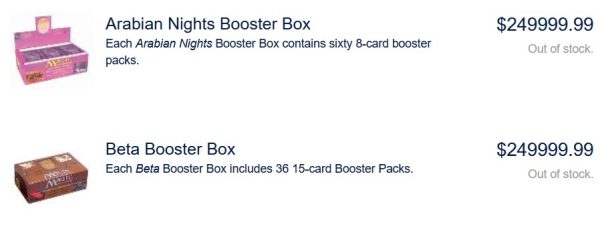
It’s time for a pop quiz! Have a look at the screenshot taken below from Card Kingdom’s site:

What product do you think this is from? What could Card Kingdom possibly charge $250,000 for, yet still remain sold out? It’s not Alpha Black Lotus—those are sold out too, but with a $149,999.99 price tag, a full $100k less than this other listing! In fact, you can’t even get a Black Lotus (or any piece of Power for that matter) from one of the answers.

Give up? The answer is twofold, actually, because there are two Magic products sold out at Card Kingdom’s site with the $250k price tag:

In all fairness, I doubt $250k is the “market price” for these products. In reality, supply is so low that Card Kingdom can put whatever number they want here… it’s unlikely they’ll be restocking these anytime soon. The most valuable booster box they do have in stock, by the way, is Legends, with a $50,000 price tag.

This week I’m going to do a deeper dive into these holy grails of Magic collecting and attempt to explain at least some reasons why these prices have gone through the roof, beyond simply their age.

Box EV Disconnect

When I saw the $50,000 price tag for a booster box from Legends, I must admit I was initially quite baffled. Flabbergasted, even. The most valuable card from the set is The Tabernacle at Pendrell Vale, which is worth around $5,000 in near mint condition. Let’s face it: in a booster box with 36 packs, you’re not going to open more than one or two of these. The same can be said for the next most valuable cards, Chains of Mephistopheles ($1600), Moat ($1500), and The Abyss ($1300).

There was an error retrieving a chart for The Tabernacle at Pendrell Vale

In determining the box’s EV, we also need to consider that you are just as likely to pull a $10 Kei Takahashi or $12 Teleport as your rares from various booster packs. There are probably fifteen to twenty rares that are worth around $20 or less. If you’re paying $50,000 for 36 booster packs, that’s nearly $1400 per pack—opening one of these $20 rares would be a tremendous feel-bad, but it’s virtually guaranteed to happen in some of the packs out of a box.

In fact, Dawnglare has the set EV for Legends estimated at $9,326.71 for a booster box as of this article’s writing, about one-fifth the price of the booster box Card Kingdom has in stock. Arabian Nights’ set EV for a booster box, by the way, is just over $80,000.

Why is there a huge disconnect between set EV (the estimated value of cards you’d open from a booster box) and the actual booster box price? Well, I’m sure collectability and age has something to do with it. If I peel back the onion, however, I can find a couple more reasons.

Seeking Out Those High Grades

When someone cracks open a booster pack of Legends or Arabian Nights, they don’t just open a Moat or Shahrazad, or any array of cards from these classic sets. They open near mint copies of these cards. If they’re lucky, they may even open grade-worthy copies of these cards. That is a whole new ballgame.

Consider this: I’ve been in the market for a nicely graded Shahrazad for a while now. I think it would be neat to have the card in a BGS case on display on my shelf at home. I figure if a near mint copy is worth around $600, maybe a graded 9.0 copy would be slightly more.

There was an error retrieving a chart for Shahrazad

No such luck. In fact, BGS 9 copies have sold for over $1000 recently on eBay. That begs the question: what would a BGS 9.5 copy sell for? It just so happens that two BGS 9.5 copies sold on eBay at auction this month, and both ended north of $2000! I won’t get into the science of subgrades this week (that could be a subject for an entire article), but these two copies were “basic” 9.5’s because they had one subgrade of just 9.0. Had these been all 9.5’s or higher, these copies would have sold for significantly more.

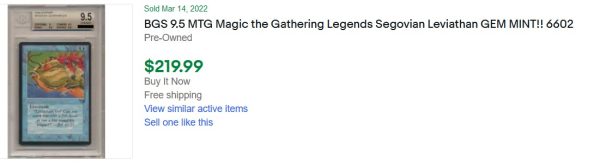
It turns out, highly graded copies of cards from Legends, Arabian Nights, etc. are quite collectible and valuable. When you’re talking about BGS 9.5, even the commons and uncommons can carry significant value. For example, Segovian Leviathan is a $3 uncommon from Legends, but this BGS 9.5 copy sold on eBay for $219.99! That’s a 73x multiplier!

Now all of a sudden, instead of pulling $5 uncommons and $25 rares, you’re pulling gradable cards worth $100’s each. I suspect even BGS 9.5 commons are still worth submitting for grading if they are nice enough to merit a 9.5. This would definitely bring up a box EV’s significantly, and it’s another reason these old boxes sell for so much.

Box Breaks

What is a box break, exactly? This is a trend that started in the sports card world, but has carried over to other collectible card markets such as Magic and Pokemon in recent years. The premise is simple enough. A box break is a live online event where buyers purchase “spots” from the breaker (the seller) to obtain high-value cards. The breaker opens the box and ships cards to the buyers of the spots.

There are two really attractive facets to box breaks. First, these events are done live in real time, meaning multiple people can experience the thrill of opening the booster box simultaneously. Even though you don’t have the booster box in your possession, you can still observe exactly what you are effectively opening at the same time as everyone else. There is a kind of thrill to this experience.

Especially when you take the second facet into consideration—the fact that you can afford to participate in opening a booster box that you otherwise would not have had the funds to do.

For example, a Revised booster box retails for around $14,000. That’s a tough pill to swallow. Personally, I’d rather have a heavily played Unlimited Black Lotus than spend $14,000 on a booster box. Instead of attempting to save up funds to make such a purchase, I could instead participate in a Revised booster box break. A Revised spot may only cost $420 for a pack, for example. Now I can effectively open an unsearched Revised booster (since sealed booster boxes obviously can’t be searched) at a more affordable price point.

Here's an example of a Revised box break done last year.

Meanwhile, instead of trying to find a buyer in the market for a $14,000 Revised booster box, the breaker instead pieces out the box in small, more affordable chunks, and may even make more money in the process.

The thing is, there are very limited quantities of these old booster boxes still in existence. If box breaks are catching on, then more sealed product could be opened, leading to a reduction in supply (in tandem with the increased demand due to the popularity of box breaks).  

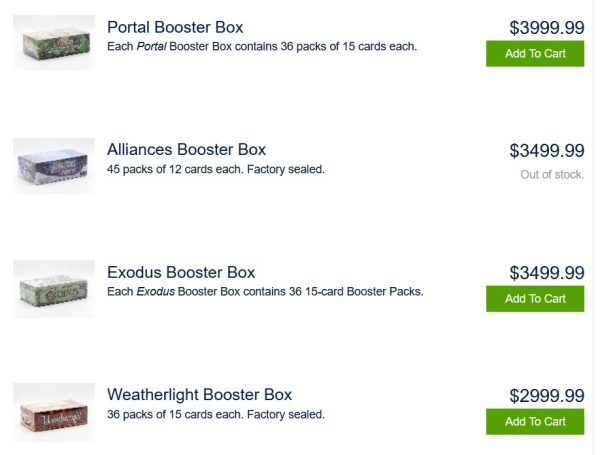
The result: rising prices. Box breaks don’t have to involve Magic’s oldest sets, either. Any booster box from Magic’s 29 year history could be exciting to open via a box break. This could lift prices of any booster boxes with relatively limited supply. Here are a couple other examples of older booster box price points:

Each of these could be attractive candidates for a box break. While there are a smattering of valuable Reserved List cards in each of the above sets (sans Portal), box EV alone can't be driving up these prices. There must be other forces at play.

Wrapping It Up

The more I study older sealed product, the more complex I believe the market is. When you get to the extremely rare product—particularly sealed Alpha, Beta, and Arabian Nights—you almost have to work with some intermediary to obtain the item. You can’t simply navigate to a TCGplayer, eBay, or Card Kingdom to make the purchase. This is more akin to the high end art market, where a given item may only be available for sale through connections, or on rare occasions.

As a result, my work investigating these collectibles is far from over. Consider this the first chapter of a dedicated series on the subject. As I garner sufficient information, I’ll write up another article to highlight these insights. It could take months to do the topic justice.

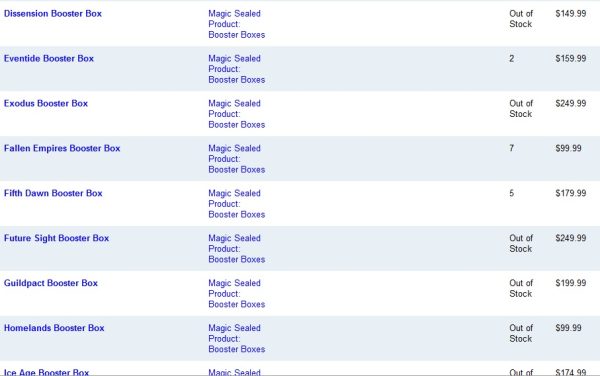
By the way, I wrote about investing in MTG booster boxes back in 2012. Below were prices per box from Star City Games’ site at that time:

How do those prices compare vs. today?

Set – Price in 2012 (SCG) – Price in 2022 (CK)

Dissension - $149.99 - $999.99
Eventide -  $159.99 - $799.99
Exodus
- $249.99 - $3499.99
Fallen Empires
- $99.99 - $799.99
Fifth Dawn
- $179.99 - $1199.99
Future Sight
- $249.99 - $2499.99
Guildpact
- $199.99 - $849.99
Homelands - $99.99 - $849.99
Ice Age
- $174.99 - $1399.99

Yup. I’d say I’m definitely onto something here.

Disclaimer: some members of QS staff own and collect old sealed product.

Three Tips from The Sport of Cycling to Improve Your Magic Game

Are you a Quiet Speculation member?

If not, now is a perfect time to join up! Our powerful tools, breaking-news analysis, and exclusive Discord channel will make sure you stay up to date and ahead of the curve.

The Overlap Between Magic and Cycling

At first glance, it might not seem like Magic: The Gathering and cycling have anything in common. As a nearly lifelong cyclist and Magic player, I can tell you that the path to improvement in both is actually quite similar. Here are three lessons I've learned that can apply to improving at both cycling and Magic.

Consistency is Key

In cycling, one of the best ways to improve your performance is to ride consistently. This doesn't mean that you need to ride every day, but several times a week is usually a good place to start. I set my baseline at 4-6 hours of ride time a week, and build from there.

Consistent playing is also a great way to improve at Magic. As a primarily Limited player, I know that I'll be drafting in person at least once a week. In addition to that, I try to get as many drafts on Arena as I can throughout the course of the week. The more I play a Limited format, the easier it is for me to pick up on its play patterns. I can also more readily identify potential tricks opponents may have during games. During the draft, my familiarity with the set means I'm better able to figure out what is open and move into the open colors or the open archetype.

The payoffs for consistent play can be true for other formats as well. Playing Modern frequently can, if you're playing the same deck all the time, make your lines of play feel natural. It can make your sideboarding decisions almost second nature as well. Playing Magic of any kind frequently can be good for keeping skills sharp. Things change a bit when preparing for an event. This takes us to our second tip.

Have a Plan

When preparing for an upcoming event, or working towards a specific goal, it's crucial to have a plan. In cycling, training plans are designed around a rider's current ability, and their riding goals. Whether that's to lose weight, have the endurance to tackle a big climb, or complete a century ride, the goal is the starting point to building a plan.

In Magic, the goal could be to do well in a particular event or to make Mythic on Arena. Whatever the goal, the plan builds out from that. Let's say, for example, my goal is to make a run at Mythic in Limited on Arena. The first part of the plan is one of timing. Ideally, I'd want to start my run on day one of the new season, so I'd have the most amount of time to level up. The rest of the plan includes:

  • Some amount of study, learning all the cards, the archetypes, etc.
  • Scheduling time for the drafts/games themselves
  • Reviewing performance/looking at what to improve

Study The Format and Review Performance

Going into the run I'd want to already be familiar with the format and the archetypes. This means studying format guides, draft guides, and data on what is performing well from 17Lands.com, or some other source. Using 17Lands, or a similar tracker, or recording my drafts allows me to review my performances to look at what I did well, and focus on where I need to improve.

Scheduling Time For Drafts

The last piece of the plan is scheduling time for the drafts/games themselves. Assuming I'm still planning on attending FNM every week to play paper Limited, I'd want to try to play Arena two-three times a week, or more as my schedule allows. I'd limit myself to one or two drafts per day, except on weekends when I might play longer. I'd likely have to tailor this plan around my win rate. Frank Karsten estimates that it's possible to make Mythic in Limited from Bronze in approximately 45 hours of play. For us mortals without Karsten's Hall of Fame-level skills, it will likely take longer. That's a lot of Magic in one month. This leads into my last tip.

Take Time Off

In cycling, recovery days are just as important as days spent training/riding. Taking time off is necessary to allow your body to replenish energy and rebuild itself for future workouts. A good training plan will include lighter days, and even full rest days off the bike to allow the body time to recover.

Though Magic is less physical than cycling, it still takes considerable mental energy to play the game. Our brains need rest and recovery like every other part of our body. Unlike with cycling, we don't always need complete breaks from Magic. Sometimes just taking time off from grinding and playing some Commander with friends, or organizing a Cube Draft is all that's needed. Stepping away from the competitive grind and enjoying the social elements of the game can be enough of a reset to get back to the A-game.

On the other hand, if you're feeling completely burnt out, don't hesitate to step away from the game for a bit. Struggling after a bad run? Time off from Magic could be just what you need to refocus yourself and return fresh and ready to battle. Maybe you could take up cycling?

The Finishing Sprint

At the end of the day, both cycling and Magic should be things we do for enjoyment. However we incorporate them into our lives, and however seriously we choose to take them, fun should always be part of the equation.

What lessons from sports you play or other activities you're involved in have helped your Magic game? Let me know in the comments or on Twitter. If you're local to CT, don't hesitate to hit me up to ride bikes or to draft.

Relaxing in the Middle of a Ride
Avatar photo

Paul Comeau

Paul is Quiet Speculation's Director of Content. He first started playing Magic in 1994 when he cracked open his first Revised packs. He got interested in Magic Finance in 2000 after being swindled on a trade. As a budget-minded competitive player, he's always looking to improve his knowledge of the metagame and the market to stay competitive and to share that knowledge with those around him so we can all make better decisions. An avid Limited player, his favorite Cube card is Shahrazad. A freelance content creator by day, he is currently writing a book on the ‘90s TCG boom. You can find him on Twitter and LinkedIn.

View More By Paul Comeau

Posted in Analysis, Arena, Free, Limited, StrategyTagged , Leave a Comment on Three Tips from The Sport of Cycling to Improve Your Magic Game

Have you joined the Quiet Speculation Discord?

If you haven't, you're leaving value on the table! Join our community of experts, enthusiasts, entertainers, and educators and enjoy exclusive podcasts, questions asked and answered, trades, sales, and everything else Discord has to offer.

Want to create content with Quiet Speculation?

All you need to succeed is a passion for Magic: The Gathering, and the ability to write coherently. Share your knowledge of MTG and how you leverage it to win games, get value from your cards – or even turn a profit.

Helping Your Fellow Magic Players, Commander Edition

Are you a Quiet Speculation member?

If not, now is a perfect time to join up! Our powerful tools, breaking-news analysis, and exclusive Discord channel will make sure you stay up to date and ahead of the curve.

We were all new to Magic once. When I started playing in Revised this is what Frozen Shade looked like.

There was an error retrieving a chart for Frozen Shade

The internet was still a new thing and there was no huge Magic community like exists now. At best we had our small rulebooks that came with each starter deck. To us, this card said, "pay one black mana: this creature gets +1/+1.....forever." A lot of our games ended up in absolutely huge board stalls with eight or nine creatures per side at least, multiple Shades pumping up turn after turn until eventually one of us would all in and swing-out only to be met with Fog. Repeat that two or three times until eventually one of us would be dead. It was fun times but we did not know what we were doing.

It's Different Now...Except It's Not

At Streets pre-release, I was carefully going over my not-so-great but not too terrible pulls. Then I carefully read and re-read a particular card many times and I was stumped. It was clear that it couldn't work like the words printed on the card indicated but I had to ask a judge anyways. While the judge was correct on this card the five other players I asked were equally confused; I received four different interpretations of the card from them.

Lagrella, the Magpie has a strange reference to "any number" and also "different players." Couldn't they just write "up to one other creature per player"? It's fewer total characters and is absolutely clear. Wizards why print "any number" when "up to one" solves this? Why make a totally brand new interpretation of a somewhat common templated ability when you have hundreds of other cards in the game that say "up to one"? A cursory search shows THREE instances of the "different players" template and 233 instances of the "up to one" template.

At Least The Internet Agrees With Me

Fortunately, I only had to play Lagrella in one of my games and it was decent there. Over the next week I read several articles regarding Streets and wouldn't you know it many people including judges kept mentioning Lagrella as the most confusing and poorly written card in the set. I felt vindicated. Me, a player since 94', should not have any issues with understanding how a card works. I'm beyond such things, right? Well, no. See even though I've been playing for a very long time, I have been playing with the Streets cards for exactly the same amount of time as everyone else. While I am not new, New Capenna certainly is.

And Then There Was SpellTable

After many, many, MANY hours on SpellTable I've run into things that I have never seen before in paper. Because of the nature of SpellTable, I am interacting with many more players of wider experience levels than ever before. Some of the conundrums are caused by playing remotely and just not seeing all the cards in play as easily, but occasionally there has been a new situation that neither I nor any of the other players have encountered. I've encountered an equal number of situations that I was familiar with, but that the other players were not. Explaining these rules interactions often requires tact and patience. For example, our table ran into this card and the game froze:

The entire table looked at this old Urza's Legacy card and thought they had it down..until they didn't. Every turn players kept counting and re-counting and re-reading Damping Engine. The game itself ground to a halt. Finally, I narrated what was going on to make it easier for the table. "I have the most permanents at 11, so, if you have 11 or less this does nothing. If you get to 12 this THEN stops you from doing things unless you sacrifice something." Play continued much more rapidly from that point. Someone keeping track of the highest total permanents allowed the table to play the game effectively.

I Was Betrayed

The board had just gotten reset by a bounce effect and the current player took the opportunity to play Sneak Attack and throw two gigantic Eldrazi monsters into play slapping your's truly for 22 damage and sacing six permanents. As I had nothing but land, I had to sac lands. This put me extremely far behind, however, I was already in last place (in my opinion) anyways. So I did what any diplomatic last place player would do in this instance; I fed the player who was already ahead and put them extremely ahead. In two turns I gave them 20 Treasure. This caused the It That Betrays player to leave the game. Of course, they left the game with six lands that were mine. What happens to my lands?

Who Knows?

Well, I knew. I've written a little bit about these types of situations in articles here, here, and here, but I have not gone in-depth and examined every possible situation because I'm just trying to play Commander; the rules guy is over here. Effectively, delayed trigger duration control effects expire when someone leaves the game so control returns to the owner at that point. But effects that give control without having a duration do not expire and those permanents are exiled instead. In this case, I'm just down those six lands. The other two players, however, were not completely sure about the situation and part of their uncertainty was their knowledge that *some* things do go back to the original owner's control but *some* things do not. As Magic continues to add new cards these situations become more the norm. It's up to all the players at the table to try and help everyone with complexity. In particular, if you are playing a deck that has a lot of theft mechanics, it's really on you as a player to know the rules for what you are bringing to the table.

Will Look At The Entire Turn

We were down to three players at a table and one of them cast Eidolon of Rhetoric. The next turn, a player killed it and then wanted to cast a second spell. The Eidolon player told them "You can't cast a second spell this turn because Eidolon sees the entire turn." While I have written about unique effects like Titania's Song that persist for a turn even if removed, the Eidolon has no such clause. However, when reading the Gatherer entry, one could argue that Eidolon still works even if it's removed because it says "even if Eidolon wasn't on the battlefield." Of course, that's not what they mean. The entry says "specifically" and then tells you what it means i.e. that the Eidolon sees the turn before IT enters the battlefield and stops you from casting more spells. Both I and the other player had to calmly but firmly argue with the Eidolon player that Eidolon does nothing from the graveyard. Eventually, they relented but it was obvious they did not agree. The problem here was that the player knew the card had special rules that were in effect even while Eidolon was not on the battlefield but they did not know the exact parameters.

This Is NOT A Rules Article

While I felt it was essential to go over specific instances of rules-y things that I have encountered in the last month of play, hopefully, you see the player side of the equation. Magic, particularly Commander, has thousands of cards from nearly 30 years of sets potentially interacting in ways no one at the table has ever seen...each game. There will be rules disputes. How you handle the situation is important for peace of mind, ease of play, and fun. Make sure to check Gatherer as a first stop when you're not sure because it's fairly often that the first ruling is a clarification on something that commonly comes up.

Next, be flexible with your viewpoint and be patient. Not only can it be a simple issue of not reading a particular word or line it could also be a misinterpretation based on another factor like having trouble picking a card up in SpellTable or forgetting some other interaction is happening on the table. Most of the time players agree on what is going on at the table but there was a detail that needed to be clarified and it was missed by one or more other players. After clarification, all tends to be well.

What Happens If You Can't Reach An Agreement?

This is a classic case of how to disagree without being disagreeable. If you're absolutely certain of the ruling cite your source and suggest the other players check up on that. If you're not absolutely sure have the other players cite their sources so you can check for yourself. If there's no chance of getting outside assistance from a judge, friend, or a Discord server and you're still not sure, try to reach an agreement with the table and move on. If all else fails reference the original rulebook: "During the course of a game, a dispute that you cannot solve by referencing the rules may occur. If both players agree, you can resolve the difference for the current game with a coin toss. After the duel, you can come to a decision about how you want to play such a situation in the future. If the players don't agree to a coin toss, both players retrieve their ante and the duel is a draw."

So toss a coin and don't forget to retrieve your ante! Is this foreshadowing for a future article? Maybe definitely.

Avatar photo

Joe Mauri

Joe has been an avid MTG player and collector since the summer of 1994 when he started his collection with a booster box of Revised. Millions of cards later he still enjoys tapping lands and slinging spells at the kitchen table, LGS, or digital Arena. Commander followed by Draft are his favorite formats, but, he absolutely loves tournaments with unique build restrictions and alternate rules. A lover of all things feline, he currently resides with no less than five majestic creatures who are never allowed anywhere near his cards. When not Gathering the Magic, Joe loves streaming a variety of games on Twitch(https://www.twitch.tv/beardymagics) both card and other.

View More By Joe Mauri

Posted in Commander, Free, RulesTagged , , , , , , , , Leave a Comment on Helping Your Fellow Magic Players, Commander Edition

Have you joined the Quiet Speculation Discord?

If you haven't, you're leaving value on the table! Join our community of experts, enthusiasts, entertainers, and educators and enjoy exclusive podcasts, questions asked and answered, trades, sales, and everything else Discord has to offer.

Want to create content with Quiet Speculation?

All you need to succeed is a passion for Magic: The Gathering, and the ability to write coherently. Share your knowledge of MTG and how you leverage it to win games, get value from your cards – or even turn a profit.

Applied Rules: A Verdant Succession Commander Deck?

Are you a Quiet Speculation member?

If not, now is a perfect time to join up! Our powerful tools, breaking-news analysis, and exclusive Discord channel will make sure you stay up to date and ahead of the curve.

Magic has a lot of rules, but talking about them in a vacuum can get pretty boring. This week, I'm going to talk about some of the goofy stuff I can get up to with my very favorite Commander deck, Spy Cat! helmed by Nazahn, Revered Bladesmith. At its core, it's a goofy Selesnya combo deck that depends on some truly atrocious cards. In fact, it hinges on a card that many players have probably never heard of: Verdant Succession.

The Linchpin: Verdant Succession

There was an error retrieving a chart for Verdant Succession

Most people's first look at this deck involves a question about Verdant Succession. Sometimes they innocently ask "What does that card do?" because they've never seen it before. Sometimes they make it more of a statement, like "That card doesn't do anything in Commander." In my favorite games, people see it, read it, and then go "...okay?" and ignore it, because they don't get it. But they'll get it very soon. Oh, yes they will.

See, they're right that Verdant Succession doesn't do much of anything on its own. However, Spy Kit exists. You see, one of the finest parts of Magic deckbuilding is taking two bad cards and combining them into something cool. So that's what we've done here.

Verdant Succession and Spy Kit

There was an error retrieving a chart for Spy Kit

Spy Kit is one of those cards with the dubious distinction of being called out specifically in the rules.

612.6. One card (Spy Kit) states that an object has “all names of nonlegendary creature cards.” This changes the text that represents the object’s name. That object has the name of each nonlegendary creature card in the Oracle card reference. (See rule 108.1.)

Magic: The Gathering Comprehensive Rules

So let's say I have a Devoted Druid equipped with Spy Kit. When the Druid dies, it last existed on the battlefield with all names of nonlegendary creatures. As far as Verdant Succession is concerned, this means that Spy Kit has "the same name" as every other nonlegendary creature in my deck, thanks to this rule (emphasis added):

201.2a Two or more objects have the same name if they have at least one name in common, even if one or more of those objects have additional names. An object with no name doesn’t have the same name as any other object, including another object with no name.

Magic: The Gathering Comprehensive Rules

In short, if a creature is equipped with Spy Kit and it dies while Verdant Succession is out, I can tutor any nonlegendary creature in my deck directly onto the battlefield.

Note that Spy Kit has similar interactions with Bifurcate and Pack Hunt. Bifurcate can target a Kitted-up creature to tutor any other creature directly to the battlefield. Pack Hunt, meanwhile, can get three creature cards into hand for the low cost of 4 mana.

Verdant Succession and Vigor

There was an error retrieving a chart for Vigor

Cards with triggers that put them back in your library when they go to the graveyard work great with Verdant Succession. Let's say my Vigor dies while I have Succession in play. Since I control both triggers and they want to go on the stack simultaneously, I can choose their relative order on the stack*. This means I can choose to shuffle the Vigor into my library, then get that same Vigor with Succession's trigger.

Looping Vigor like this doesn't do much on its own. It needs support from something like Ashnod's Altar to make tons of mana or Greater Good to draw a ton of cards. Some other all-stars can loop to great effect, though. Looping Worldspine Wurm results in as many 5/5 Wurm tokens as I want. Looping God-Eternal Rhonas makes the rest of my creatures very large.

In a pinch, I can even slap together Succession, Ashnod's Altar, and Soldevi Digger to loop any green creature.

Importantly, this loop requires that the creature has a trigger to shuffle it in, not a replacement effect. Since something like Blightsteel Colossus never hits the graveyard, it never "dies"; it won't ever trigger Succession, even if the Colossus were somehow green.

* Check out this article for a refresher on handling triggered abilities

Mirage Mirror

There was an error retrieving a chart for Mirage Mirror

Mirage Mirror may be my favorite card in all of Magic right now. I've been high on it since it was first spoiled. The flexibility to become practically anything is just... beautiful. But what does it do for us here?

Most importantly, it can get us some leaves the battlefield triggers of creatures we otherwise want to keep around. Since leaves the battlefield triggers look at what the thing was right before it left, the Mirror will have any of those relevant triggers.

Worldspine Wurm makes a great blocker, and sometimes I need to keep it around to fend off an opponent's giant creature. Make the Mirror copy the Wurm, sacrifice the Wurm to something, and boom - you've got the 15/15 Wurm and three 5/5 Wurm tokens. As a bonus, since being put into a graveyard "from anywhere" triggers don't look back in time, the Mirage Mirror in your graveyard won't have the trigger to shuffle it into your graveyard. It'll wait there for me to get it back with an Eternal Witness or something.

In desperate times, it can work as a very narrow replacement for a sacrifice outlet. If Mirage Mirror copies God-Eternal Rhonas, I can get rid of the "real" Rhonas to the legend rule. With Verdant Succession in play, this becomes a janky loop enabler.

The greatest tragedy of Mirage Mirror is that it can't usefully copy some of the best enchantments, like Defense of the Heart. Since no player gets priority before the upkeep step starts, it's never possible to make the Mirror a copy of Defense in time for the Mirror-Defense to do anything useful.

Cleanup

This deck has a ton of different lines and angles to play with, some more convoluted than others. I only touched on some that involve a little more rules info than "make a lot of dudes," but hey, if you're curious about it, I would love to talk about this deck with you. Seriously, it's one of my favorite things I've ever helped build. You know the drill by now -- come at me on Twitter or our Insider Discord.

Question of the week: What's your favorite very silly enchantment?

Questioning My Inner Monologue

Are you a Quiet Speculation member?

If not, now is a perfect time to join up! Our powerful tools, breaking-news analysis, and exclusive Discord channel will make sure you stay up to date and ahead of the curve.

Background

I realize that the title of this article seems cryptic, so I think it wise to begin with the premise. The longer one plays Magic the better one tends to be at evaluating cards. Humans are good at discerning patterns and doing so helps us make decisions quickly. Early on in our existence this might have been something like "The last cave I saw had a bear in it, so I will avoid going into this other cave". Our brains had established that there was potential danger to be found in caves and thus perhaps we avoided them whenever possible. This pattern development kept primitive man alive and eventually allowed humanity to flourish. This same pattern recognition still exists. It is the reason we can see a card like Highmore Vampire and immediately know that it will not see constructed play. A vanilla 4/3 for 4 mana is not powerful enough to justify its inclusion in a competitive deck. If instead it only cost 2 mana, it would likely see a good bit of play.

There was an error retrieving a chart for Elvish Piper

Why this matters!

The reason I bring this up is because we often look for patterns subconsciously and we can misjudge something simply to make it fit in a pattern. I have been speccing on Howlpack Piper and I was about to purchase even more copies when I started to wonder why they are still so cheap. We had discussed on the discord channel back when the card was originally spoiled how it was another Elvish Piper, which is currently an $8 card despite 8 mass printings. Howlpack Piper is very similar; it cheats any creature you want into play and it is a 4 drop. It even has upside that it is itself uncounterable, which is highly desirable for a creature that needs to resolve and stick around to do anything; and it can flip to dig for another creature.

There was an error retrieving a chart for Howlpack Piper

So why are copies under $1?

  1. The masses have just missed this card and the crowd is wrong. While possible—given that it has been out for months—this isn't all that likely. Clinging to this reason may be somewhat self deluding.
  2. The sorcery speed limitation is much more important than one might think. There is a pretty good argument for this as a major culprit for its current price, given how without haste the threat it cheats in also has to survive a full turn cycle to attack or activate abilities, whereas, Elvish Piper typically cheats non hastey threats at the end of the opponent's turn.
  3. The extra mana in the ability cost is more significant than it might seem. Plausible, but less likely than reason 2.
  4. The forced flip when it becomes night, which is a way to turn off the cheating into play ability, may be a larger liability than originally thought. While I think there is merit to this issue as well, a 4 drop that let's you take any creature in the top 6 of your library seems good enough that it would still be playable in many decks.

Validate Your Assumption

There is one last thing that one should do when considering a potential speculation target; verify the card is actually desirable by a large number of players. This is often difficult to do when a set is first released, however, the longer supply is in the market the more time the market has to absorb that supply. If the market chooses not to, take a step back and ask why. My initial assumption was that Elvish Piper is a highly desirable Commander card so a similar creature should be similarly desirable. However, a quick check on EDHREC.com shows that even Elvish Piper is only listed in around 8000 decks, which might seem like a lot, however, when there are over half a million listed on the site, that number puts it in less than 1%. Even more importantly, the Commanders that do tend to play it aren't all that popular anymore; with the top 3 being Mayael the Anima, Xenagos, God of Revels, and Arixmethes, Slumbering Isle.

Digging Deeper

There was an error retrieving a chart for Dig Up

If we dig a bit deeper we can find that amongst Gruul Commanders, Xenagos, God of Revels is the third most popular, which really isn't that bad actually. However, in the Simic group, Arixmethes, Slumbering Isle is the ninth most popular Commander. Similary, for the Naya group Mayael the Anima is also the ninth most popular Commander.

These results would indicate that demand for Elvish Piper should be waning, though interestingly enough, it has actually seen a fair amount of price growth since Kaldheim.

Now, looking at Howlpack Piper our EDHRec results show it finding a home in only 3300 decks. This shows that despite being very similar to Elvish Piper it makes the cut in decks playing it less than half the time. This likely means that even if it were to show decent gains, the price ceiling is likely not that high; perhaps $3-$5.

Final Conclusion

After digging into the pricing (or lack thereof) for Howlpack Piper, I have not completely given up on it as a spec; so it has not made it to the box of shame, but I am not going to invest anymore into it at this time. It can be very easy to make a snap judgement on a card and hold fast to that judgement, but in the world of MTG finance; it is better to cut your losses and re-invest in something with more potential than to doggedly chase a spec simply because it looked good initially.

Have you ever been mislead by your instincts on a card spec before?

Real-world Flavor. Classic Traits of Blue’s Color Philosophy in Magic Citations

Are you a Quiet Speculation member?

If not, now is a perfect time to join up! Our powerful tools, breaking-news analysis, and exclusive Discord channel will make sure you stay up to date and ahead of the curve.

There are as many pillows of illusion as flakes in a snow-storm. We wake from one dream into another dream.

Ralph Waldo Emerson, Illusions (1860)

In the previous two installments, we began our final sub-thread in this series on real-world flavor in Magic — an overview of the philosophies of Magic: The Gathering's five colors. We started with the color white, (split into Part 1 and Part 2), and today we're going to examine blue. In each of these installments, we are looking for each color's most typical expressions, both from lore and from a gameplay perspective.

Since we are still dealing with flavor text coming from real-world literature, the range of examples available is limited. Nonetheless, as we are trying to prove, a good deal of variety is still found, even in such a narrow field.

Blue Color Philosophy

Blue is the color of knowledge, manipulation, and deceit. From a gameplay perspective, the fact that knowledge often translates as "card advantage" has caused a few problems with the balance of the colors in terms of power level over the years. We need to look no further for an example of this than the legendary Power Nine from Limited Edition Alpha. Of the nine cards, six are colorless artifacts. The remaining three are all blue cards (Ancestral Recall, Time Walk, and Timetwister).

Wizards improved at balancing both the colors in general and the power levels of individual cards over the nearly thirty-year (and counting) lifespan of the game. Through it all, blue retained its ability to manipulate your library and provide card draw, a power that is still unmatched. Let's take a look at the main characterstics of this color. As we did with White, we are going to split the article in a few subsections, each of which will introduce some cards.

Knowledge

The color Blue is mostly driven by curiosity and the urge to improve reality, whether by manipulating it or by creating a new one altogether. The first consequence of curiosity, though, is simply the desire of knowing more, which leads in gameplay terms, to library manipulation or plain card advantage. Let's look at a few cards that match these criteria.

Tidings

There was an error retrieving a chart for Tidings

Many wearing rapiers are afraid of goose-quills.

William Shakespeare, Hamlet

First printed in Starter 1999, Tidings is a fine example of simple, effective card advantage. At the price of five mana, you get to exchange one card for four. No other colors offer you something like that, except maybe for Black, but we'll see the difference in the next installment.

Tidings is also a great combination of art and flavor text. The illustration by Pete Venters shows a hand imprinting a sign in the sealing wax of a letter. As for the quotation, it's from Shakespeare's Hamlet, one of his most famous and most quoted plays (even in Magic).

It's just one of several famous sentences stating that the power of words is stronger than the power of weapons. Just to mention another one, think of Edward Bulwer-Lytton's Richelieu: "The pen is mightier than the sword". Such a concept is simply perfect for the color Blue, which relies more on intellect than on brute force.

Ophidian

There was an error retrieving a chart for Ophidian

I will … tell thee more than thou hast wit to ask.

Christopher Marlowe, The Tragical History of Doctor Faustus

Blue's ability to provide card advantage comes in many shapes. The most obvious is instant and sorcery draw spells like Tidings or Ancestral Recall. Several blue creatures from throughout Magic's history also offer their owner a similar benefit.

The earliest is Ophidian, a defining example. First printed in Weatherlight, it's a humble 1/3 for three mana, but when it doesn't get blocked it gives you a card instead of dealing damage to your opponent. Many other creatures over the years have had this ability, and other cards have also been printed to give this ability to other creatures. Ophidian Eye from Time Spiral is one such example. As you see, even enchantments can turn out to provide excellent card draw, as long as they are blue of course.

The flavor text is quite ambiguous for a blue card. It reminds us why Blue appears next to Black on the color pie. This bit of text gives strong devil-pact vibes, particularly if you read "wit" as "common sense." In fact, it comes from The Tragical History of Doctor Faustus, by Marlowe. Pretty Black, right? The effect of the card is not misplaced on a blue creature, but the quotation is definitely a dark one, giving hints of forbidden knowledge and excess.

Manipulation

Another characteristic of Blue is its ability to manipulate and shape reality. It comes in several flavors, as it can influence both the battlefield and players' hands, not to mention their libraries. There are so many examples of this trait, that we cannot analyze all of them. Let's look at a few and briefly discuss what they have in common.

Some examples of Blue's manipulative traits

Confiscate

Confiscate is quite an expensive Aura, in terms of mana, but its versatility is extraordinary. You gain the control of any target permanent, with no limitations whatsoever. Other enchantments with similar effects have been printed, but this is among the most famous and archetypal. The flavor text is a quotation from Mark Twain: "It is better to take what does not belong to you than to let it lie around neglected". It seems to perfectly sum up Blue's philosophy, which is to always create and improve.

Alluring Siren

We have already seen Alluring Siren when dealing with flavor texts coming from Classical sources, as it quotes Homer's Odyssey. Let's just appreciate a different way Blue offers to manipulate the game. Hypnosis, and more in general mind control, is another typical ability of Blue. Here, it's offered on a small but interesting card, which allows you to force an opponent's creature to attack you.

Diminish

Blue lacks removal spells to eliminate opponents' creatures, so it must deal with threats in other ways. Cards like Diminish are very useful, especially when a Blue deck isn't supported by other colors. At instant speed, and for the cost of one single mana, it transforms any target creature into a 1/1, no matter its original strength and toughness. Its flavor text is a quotation from Alice's Adventures in Wonderland, and with its dreamy setting is a great example of Blue's dominion.

Deceit

Deceit is the last theme we are going to deal with today. It's close in kin to manipulation. In my opinion, though, deceit and deception make their presence felt in blue, at least in gameplay, via Blue creatures' evasion abilities, and some of Blue's counterspells and bounce spells. Let's take a look at some cards and see how this color is able to trick the opponent.

Some Examples of Blue's Deceiptive Traits

Gaseous Form

Let's start with an Aura, again. Gaseous Form, first printed in Legends, is not famous for its effect, but rather for its art. The illustration by Phil Foglio is one of those funny, cartoonish works that we have seen in one of the previous articles. In fact, it was Phil Foglio who also illustrated Greed.

As for the effect, it prevents all combat damage that would be dealt to and by enchanted creature. This kind of prevention is close to White's philosophy. White is the other allied-color of Blue, just as Black. The flavor text, quoting Shakespeare, mention the power of giving shape to "airy nothing": just what Blue likes to do.

Phantom Warrior

Phantom Warrior, on the other hand, presents a different kind of deception. It's a 2/2 creature for three mana, and its ability pertains to the field of evasion. Blue is the color with more flying creatures than any other, but unblockability is even better than flying, It's the evasive ability par excellence. The flavor text, which you can find at the beginning of this piece, is very in-color. In fact, it mentions illusions and dreams, both concepts within the realm of Blue.

Mana Leak

Last but not least today is Mana Leak. Perhaps the most famous, or at least most played of the cards we've seen today. It is a typical "permission" spell. They are also known as "counterspells", a name which comes straight from the archetypal Counterspell, a card that's thwarted opponents' plans since Limited Edition Alpha, and still sees play in formats ranging from Pauper to Modern.

Mana Leak has an advantage over Counterspell in only requiring one colored mana instead of two to cast it. Unfortunately, its weakness is that your opponent can always pay three mana to disregard your instant. The flavor text is a quotation from Sir Francis Bacon: "If a man will begin with certainties, he shall end in doubts". It's a perfect fit for a blue card, as when you play this color you like to keep your opponents in perpetual doubt. Should they try and cast that spell, or do you have a counter?

Conclusions

The cards we've examined all exhibit defining values and peculiarities of the color Blue in Magic. Just as we concluded with the piece on White cards, we can note how - even in such a restricted field - the main values of this color are visible. What do you think of Blue philosophy? Do you have something to add? Let me know in the comment section. In the next installment, we dive into the color black. What themes do you think we'll find?


Adam Plays Magic: Explorer RB Anvil

Are you a Quiet Speculation member?

If not, now is a perfect time to join up! Our powerful tools, breaking-news analysis, and exclusive Discord channel will make sure you stay up to date and ahead of the curve.

This week on Adam Plays Magic, we're diving in with the multi-format all-star archetype, RB Anvil. This deck centers around Oni-Cult Anvil as well as the notorious Cauldron Familiar plus Witch's Oven combo to attrition your opponents into submission. This build, in particular, comes from @BrandonHe1 who took the list on an impressive 14-0 run in the Explorer Metagame Challenge on Arena.

What I Like

The RB Anvil archetype has shown up in Standard, Pioneer, Explorer, Historic, and even Modern. Each iteration utilizes the same shell to gum up the board with tokens or sacrifice fodder, all while draining your opponent turn after turn. The top end of the deck showcases Mayhem Devil which generates a ton of value and keeps the board clear. When there's nothing left to ping, you can point the damage at your opponent. Thanks to your army of tokens and cat combo, your opponent will not be hitting you on the ground very easily. The incidental life gain courtesy of Cauldron Familiar and Oni-Cult Anvil puts you far out of reach from even the most aggressive of opponents. Moreover, Experimental Synthesizer and Deadly Dispute offers a surprising amount of card draw to keep your moving parts running smoothly.

Notably, your deck naturally has a lot of ways to interact with the Winota, Joiner of Forces deck, which is the top-performing deck in Explorer. Mayhem Devil picks off their small creatures, and your removal suite of Fatal Push and Voltage Surge can trivially answer Winota itself.

What I Don't Like

As with most aristocrats-style decks, your moving parts are below-par in card quality. You need your haymakers to close out the game, and if your opponent is prepared to answer the few meaningful cards in your deck, you become a sitting duck. Also, when the core conceit of the deck is to sacrifice permanents, you run the risk of having your day ruined by Yasharn, Implacable Earth or other hate pieces.

Honestly, there's not a ton to gripe about. The deck is solid and it's one of the best archetypes in Explorer. It's also a great way to conserve wildcards as the shell is viable in every format currently available on Arena. Play it, have fun, and rack up some wins.

The Deck

RB Anvil

Companion

1 Jegantha, the Wellspring

Creatures

4 Cauldron Familiar
4 Voldaren Epicure
4 Mayhem Devil

Artifacts

4 Oni-Cult Anvil
4 Witch's Oven
4 Experimental Synthesizer

Spells

4 Fatal Push
4 Thoughtseize
2 Castle Locthwain
2 Voltage Surge
4 Deadly Dispute

Lands

1 Swamp
2 Mountain
2 Den of the Bugbear
2 Hive of the Eye Tyrant
1 Sokenzan, Crucible of Defiance
4 Blightstep Pathway
4 Blood Crypt
4 Haunted Ridge

Sideboard

2 Voltage Surge
4 Ray of Enfeeblement
2 Kroxa, Titan of Death's Hunger
2 Duress
2 Go Blank
2 Kolaghan's Command

End Step

That's a wrap! Hope you enjoyed the gameplay this week. With the Streets of New Capenna constructed metagames starting to figure themselves out, we now know a bit more of what to expect for the next few months until Dominaria United releases in September. I'll be keeping an eye out for any new developments, particularly as they affect Explorer and I will be sure to keep you all in the loop. In the meantime, be sure to like the video on the Quiet Speculation Youtube page and follow us to stay up to date with all of our content. Until next time, I'll catch you later!

The Sideboard Dance: A Strategic Parallel

Are you a Quiet Speculation member?

If not, now is a perfect time to join up! Our powerful tools, breaking-news analysis, and exclusive Discord channel will make sure you stay up to date and ahead of the curve.

If the yearly Hollywood movie slate is any indication, new ideas simply do not exist. Everything is a sequel, reboot, or riff on some earlier work. As a content creator, I understand. Coming up with something every week is a challenge. Which may also explain why Modern is chasing its own tail in regards to deck strategy. There's a quirk in the current metagame that I hadn't previously noticed that might explain what is going on in Modern and inform players how to respond.

The Nature of Creation

While I realize that I'm a fairly small fry in the Magic content creation ecosystem, I still get recognized and periodically interact with actual readers. In person. It was disconcerting the first time someone I didn't personally know asked if I was that guy writing articles. Getting recognized at a Grand Prix was absolutely flooring. I don't know how actual personalities with real followings handle it all.

There was an error retrieving a chart for Name Dropping

I bring this up because, despite how odd I find it, there are benefits to having an audience. Specifically, they help tease out insights from my data I would never have seen on my own. In fact, conversation with readers directly led to this article.

Story time: I was at FNM following the publication of my Insider article and there are several players there that read my articles. The one who is an Insider and he had some questions about my conclusions. The others who weren't Insiders were quite interested in what I'd said and my answers as well. I'm always quite tight-lipped about these things: it'd completely defeat the point of doing Insider-only pieces if I discussed their conclusions openly. Even for free articles, I put too much time and effort into my writing to just give it away. I do work, you give me page views. A simple, fair, and effective system.

A Eureka Moment

However, in the course of me being non-committal and vague, a point was raised by said Insider. He noted that a lot of the current decks seem to be really vulnerable to sideboard hate, but keep winning anyway. Which is something I've been saying to varying degrees of explicitness for some time now. He then observed that the plan is essentially to win game 1 then try and steal game 2 or 3 through the hate. Which both a UR Murktide and Cascade Crashers player agreed with. And that made my brain itch. There was something there that I remembered, but couldn't quite remember what I was remembering.

There was an error retrieving a chart for Arcbound Ravager

Later that night it came to me like a Lightning Bolt to the face: that is exactly what we used to say about Affinity! And Living End, to a significantly lesser extent. My mind literally boggled. I've been struggling to put into words this feeling about the metagame and how sideboards are working in it for a while, and here it finally was.

The overall strategic plan for many of the current top decks in Modern is to have a very solid game one and then answer the (quite effective) sideboard hate coming their way. Which is exactly what Affinity used to do. This implies that the key to victory is to adopt the tried-and-true anti-Affinity strategy.

History Lesson

If you played Modern prior to Mox Opal being banned, you can skip to the next subsection. You know (or should know) this part. For all you (relative) newbies, there was once a deck called Affinity. It was not the Affinity (also called 8-Cast after the card-drawing spells) you know. Curiously, for much of its lifespan, none of its cards bore the affinity keyword. This Affinity used Mox Opal to accelerate out a bunch of cheap enabler artifacts and at least one payoff card and ride that payoff to victory.

There was an error retrieving a chart for Mox Opal

Said payoff might have been Arcbound Ravager, Cranial Plating, or Steel Overseer; it didn't matter which precisely. The plan was to hemorrhage the hand onto the board on turn 1 or 2 and win before the opponent could react. And from Modern's inception to January 13, 2020, it was a solid gameplan. Affinity was the longest-lasting good deck in Modern, seeing play in every Modern Pro Tour and Grand Prix during that time. Mono-Green Tron now holds that crown.

There was an error retrieving a chart for Stony Silence

Affinity was extremely vulnerable to artifact hate (as one might imagine), and everyone knew this. I had a rule for beginners to always play artifact hate so they didn't just lose to Affinity. However, despite this being known and the plethora of existing maindeck spells which were uniquely powerful against Affinity (Kolaghan's Command being the most prominent), Affinity survived and even thrived for years.

The Key to Survival

Affinity players knew that they were vulnerable. They knew that players would be bringing in quite powerful hate against them. They also planned accordingly. The maindeck plan was fast, resilient, and powerful enough to blitz game 1. Affinity had many ways to win turn 3 and held the title as fastest deck in Modern for years. With that win down, it just needed to steal a win in one of the remaining sideboard games.

To accomplish this, it played more answers to sideboard cards than actual sideboard cards itself. In the deck I linked earlier, most of the sideboard are counterspells, removal, and Thoughtseize. While said cards can be used as disruption, they were more commonly used defensively to answer hate, e.g. Seize ripping Stony Silence out of an enemy hand on turn 1. It was common (though very inadvisable) for players to mulligan to their hate piece against Affinity. Answering that hate piece often won the game.

There was an error retrieving a chart for Ghirapur Aether Grid

The ur-example of this is Ghirapur Aether Grid. The strongest individual hate piece against Affinity was and remains Stony Silence, which shuts off every card that does something. Unless Affinity had a big Ravager or Plating was already attached, the deck became nothing but anemic beats with the enchantment in play. Grid flipped the script by working through Stony and turning the game into a grindfest, completely repositioning the deck around the hate.

The Contemporary Convergence

This is repeating in Modern right now, and on a wider scale than ever before. To reiterate, I have called out many top tier decks as being very vulnerable to hate and that players should be more ready for them. That was a lot of my most recent metagame update, in fact. Consider:

  1. UR Murktide: Graveyard hate severely nerfs Murktide Regent[/card, [card]Dragon's Rage Channeler, and Unholy Heat, the best non-Ragavan cards in the deck.
  2. Cascade Crashers: Teferi, Time Raveler, Deafening Silence, and Chalice of the Void stop cascade, the entire gameplan.
  3. Living End: All the anti-Cascade hate and graveyard hate hit this deck.
  4. Amulet Titan: Blood Moon wrecks the gameplan, Torpor Orb neuters the win condition.
  5. 4-Color Omanth (all variants): Moon is crippling; Torpor Orb is arguably worse.
  6. Yawgmoth: Grafdigger's Cage stops the main combo and tutoring engine.

I could go on, but there's a lot of hate available against the top decks. Each of them are very beatable if players want to dedicate the sideboard space to make it happen. However, look at the sideboards of the linked decks. They're all running a lot of answers... to the answers. The fear of Chalice, Moon, and Leyline of the Void pushes many of these decks to run full sets of Force of Vigor. Crashers is particularly egregious, as its whole board is dedicated to answers, with some graveyard hate mixed in as a concession to Living End.

There was an error retrieving a chart for Force of Vigor

The only exception is Yawgmoth. The card it fears sees almost no play. Cage is extremely strong against Yawgmoth, but virtually worthless everywhere else. Yawgmoth is not a significant enough part of the metagame to warrant special attention, so the deck skates by.

Utilizing the Realization

What does this mean for players looking to fight the best decks? Well, first and foremost, if they want to actually hate out these decks, they need to play effective hate. Most of the graveyard hate seeing play is one-shot artifact graveyard removal to synergize with Urza's Saga. That works, but is much easier for Murktide to dodge and Living End to fight through. You can't hate out a deck unless the hate both bites and sticks.

There was an error retrieving a chart for Urza's Saga

Secondly, there needs to be a plan for when the opponent answers the hate. Just like against old Affinity, if you single-mindedly mulligan to find the sideboard hate expecting it to win the game for you, you're setting yourself up for disaster. Having the hate spell is great and all but you need a functional plan to win the game if it doesn't stick. Which is an important general point about sideboarding: If the opponent anticipates your sideboard strategy and correctly counterboards, can you still prevail?

An Alternative Arrangement

That said, trying to win the hate game against a deck that's prepared for the available hate is very hard. Remember back to the days of Krark-Clan Ironworks and its full sets of Nature's Claim and Lightning Bolt to beat every available hate card. Also recall earlier in this article how players have always tried that against Affinity, and it didn't consistently work. However, many players end their thinking there because of conventional wisdom surrounding sideboard games.

There was an error retrieving a chart for Krark-Clan Ironworks

There is an alternative, however. The classic sideboard experience is effectively trying to anticipate the opponent's moves and zig when they zag while trying to make them zag into your zig. What if instead, you do the obvious thing that they're not ready for? Instead of actually faking to the left, you merely think about faking left and completely befuddle the opponent expecting you to actually make the fake.

There was an error retrieving a chart for Lavinia, Azorius Renegade

For example, when Aether Grid first came out, I was playing Jeskai Control in Modern and relying on Stony Silence against Affinity. I lost to Affinity a lot when they played through my Stony and just ground me out because I couldn't remove all the artifacts. So I decided to change the game. Rather than run Stony, I switched to Wear // Tear and Anger of the Gods as my sideboard plan. Grid was neutralized by the additional sweepers and removed by Tear. It completely turned the matchup around.

Applying the Theory

The lesson is to come at the hateable decks with cards they're not ready for. Crashers is ready for the typical answers to its strategy. So bring in something atypical. I've dropped Thalia, Guardian of Thraben in favor of Lavinia, Azorius Renegade in Humans and am having success. Crashers rarely plays more anti-creature cards sideboard, while Humans can bring in Burrenton Forge-Tender to protect against removal. Lavinia doesn't just answer [card[Crashing Footfalls[/card] but the evoke elementals, which are most decks' only real removal these days. With a card swap, I'm dodging the opponent's responses and neutralizing their answers.

Walk a Different Path

The crux of all strategy is to find the easiest route to victory. If your opponent is strong, find somewhere they're weak. If they've anticipated your next move, do something else. Right now, Modern's best decks are sitting pretty on sideboard plans based around counterboarding against common answers. Throw it back in their faces.

Are Collectors’ Edition Prices Stable?

Are you a Quiet Speculation member?

If not, now is a perfect time to join up! Our powerful tools, breaking-news analysis, and exclusive Discord channel will make sure you stay up to date and ahead of the curve.

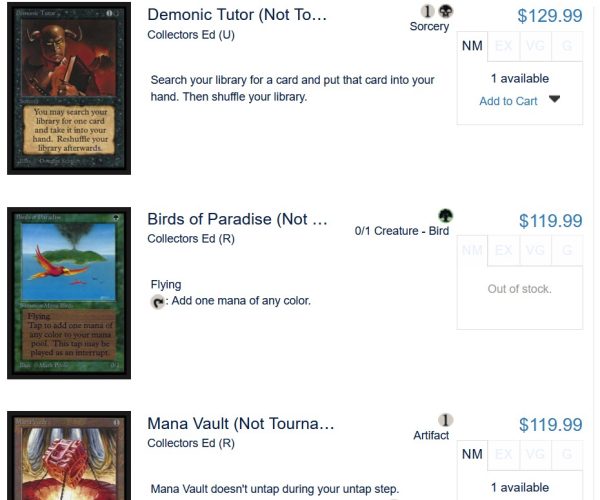
About twenty months ago, I wrote a deep dive article into a previously underappreciated set: Collectors’ Edition (and International Collectors’ Edition), or CE/IE for short. Additionally, I provided background on these sets back in a December 2019 article.

The short version is, initially released in December 1993, this extremely low print run collectors’ set was once panned as a collection of unplayable cards best suited to display cases and the like. However the surge in Old School’s popularity, combined with the overall increase in casual play has driven up demand for this set.

Since practically everyone uses sleeves nowadays, there is virtually no downside to shuffling up CE and IE cards as budget alternatives to their original Alpha, Beta, or Unlimited counterparts. In the case of Alpha and Beta, these also offer a similar black-bordered aesthetic, in some cases meriting a premium versus white-bordered sets Unlimited and Revised.

But after surging to new highs in 2021, Collectors’ Edition cards have seen a measurable pullback. What’s going on here? Is the budget Old School trend dying? Or is this a prime pullback opportunity to load up on discounted cards?

A Look at a Few Charts

Don’t take my word for it. Let’s review a few price charts to observe the downward trend I’m noticing in Collectors’ Edition cards. For example, how about Reserved List, Commander staple Copy Artifact?

There was an error retrieving a chart for Copy Artifact

Both retail pricing and buylist pricing are following identical trends on this card. In early 2021, its price spiked and buylists tripled from around $33 to over $90 for near mint copies. The jump in retail pricing was even more significant, increasing as much as fivefold at peak. The buy price peaked at $140 in March 2021, however, the card’s price has been gradually declining. There was a temporary reprieve from the decline in February of this year, but the downward trend picked up once again. Today, the best buy price is in the $70 range.

The trend on Chaos Orb looks fairly similar.

There was an error retrieving a chart for Chaos Orb

The card’s price ran up in early 2021, then peaked before pulling back from highs. Both retail pricing and buylist pricing followed suit here again. Then the top buy price did increase a little bit earlier this year, but that trend looks to have begun a reverse. Additionally, the TCGmid pricing and retail price have both been dropping this year. Another indication of a cool-off.

My final example is Birds of Paradise, another all-around staple with significant play across numerous formats.

There was an error retrieving a chart for Birds of Paradise

If we change the y-axis a little bit, this chart looks identical to that of Copy Artifact. A sudden surge in early 2021 followed by a lengthy cooldown period. However in this case, it’s possible we’re seeing signs of a bottom in 2022. Both the best buylist price and retail price seem to have been stable in April 2022 (the best buylist price even increased during this time).

Is this a screaming buy signal? Can this be the prime opportunity to jump in and acquire Collectors’ Edition cards on the cheap before they return to all-time highs?

Looking Ahead

To cut to the chase, I’m only cautiously optimistic that this is the all-and-out bottom for Collectors’ Edition. On the one hand, too many cards from the set still display some downward pricing momentum as copies continue to return to the market. Likely what we saw in 2021 was a surge in buying, drying up market supply on these incredibly rare cards.

On the other hand, their print run (9,000 CE sets and 5,000 IE sets) are on the order of magnitude of Beta and Unlimited, so the number of copies that exist are relatively tiny. Cards as rare as these are hardly what I would call “plentiful.” We have seen some rebound in supply in these cards as prices climbed. Suddenly, it was worth it for vendors to list their CE/ICE cards for sale on TCGplayer, or start acquiring them on buylists, or start bringing them to large Magic events. As prices climbed, stores restocked from buylisting. However, would you consider this a “healthy supply?”

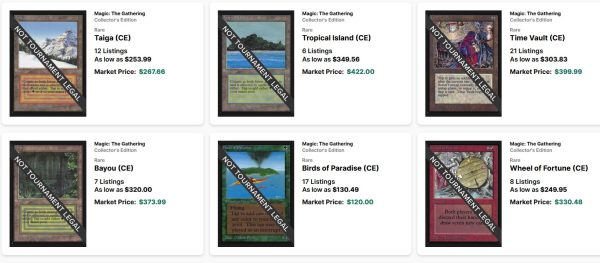
Granted, these listing numbers don’t include any listings that contain pictures. For example, there are actually 22 listings for CE Taiga when listings with pictures are factored in—not the 12 indicated in the picture above. That said, is 22 really all that much of a difference? We’re still talking low double-digit supply on these cards, or even less. The total number of listings for Wheel of Fortune: 9!

There was an error retrieving a chart for Wheel of Fortune

I checked out Card Kingdom’s supply as well, since their pricing is most dynamic. In a few words, I’d describe their Collectors’ Edition inventory as spotty at best. They seem to be out of stock or low in stock on every other card (worth playing).

With supply this inconsistent, I suspect pricing is still going to be in flux as Card Kingdom strives to replace its diminished supply. The result: prices are likely to climb on the cards that are out of stock. The adjustments may not happen overnight and it may not happen on a weekly basis. Over a period of a couple months, however, Card Kingdom is likely to adjust their prices as required to restock inventory.

The story is very similar over at Star City Games—they currently have 78 Collectors’ Edition cards in stock. The rest are sold out.

If we examine this market strictly from the supply side, I’d predict prices are starting to bottom and a bounce is on the horizon. However…

Could Demand Be Softening?

For prices to climb, you need both supply and demand to be working for you in the same direction. I’m observing that supply looks a little thin, but prices won’t necessarily climb unless demand at least remains robust in tandem. I’m not so confident this is currently the case.

For example, during its peak, I saw Collectors’ Edition Power (sans Black Lotus and Timetwister) selling for north of $1,000 on the Old School Discord. These were hot items, and moved fairly quickly. I had a couple moxes myself, which I sold for $900-$1,000 each amongst a backdrop of competitive buyers.

Now I see copies occasionally posted in the $800-$900 range. Sure, this isn’t a significant dropoff, so it may not be all that concerning. Likely the $1,000+ price tags were an overshoot, and now we’re in a more stable price range. But I can’t help but flag this as a minor watchout.

What’s more, I have seen prices on Old School cards specifically gradually pullback. Heavily Played Library of Alexandrias were once easily salable at $1,500—at one point, Card Kingdom was even buying at that rate! But recently, I had difficulty moving my heavily played Library for much more than $1,200.

There was an error retrieving a chart for Library of Alexandria

Likewise on Chaos Orb, I could have sworn Unlimited copies were minimum $1,000. But I couldn’t move a heavily played copy for more than $900, and I see other sellers having equally difficult times selling their copies for four figures. Similarly, I’m seeing Card Kingdom’s buylist pull back from highs on many Old School staples and classic collectibles (outside of Alpha and Beta).

I’m not sure if the Collectors’ Edition market can truly flourish if the broader Old School market is a little soft. There is too much demand from Old School players for this not to have an impact. So we may need to see a stabilization in the broader Old School market before CE and ICE cards can rally once more.

Wrapping It Up

The jury is still out on Collectors’ Edition cards. On the supply side, I’ve observed the available copies for sale are relatively thin. The fact that there are less than 25 copies in stock of many popular Commander staples especially (Wheel of Fortune, Dual Lands) tells me prices could bounce soon. However, I need to see a bit more stabilization in broader Old School demand before I could give the flat-out all clear for buying.

My most pragmatic advice would be to monitor which Commander staples have the thinnest inventory, and prioritize acquiring those cards if you insist on buying up CE cards. Wheel of Fortune would be a good starting point, as there are only 9 listings on TCGplayer. That said, no copies of the card have sold since February of 2022, so don’t expect to flip these for profit anytime soon. This is what I mean by a softening demand, and how we need to see this rebound before prices can really move. Anything you acquire now, plan to sit on for at least a few months and possibly longer.

The good news is, you’ll have plenty of opportunity to shuffle these cards up and play at your kitchen tables while you wait for prices to climb. A card like Wheel of Fortune, or a Dual Land, or Birds of Paradise have plenty of utility across multiple formats. As long as you’re playing in an unsanctioned game and your friends don’t mind, Collectors’ Edition cards are a fantastic way of improving the aesthetic of your deck on a relative budget while also doubling as a rare collectible for long-term investing.

To me, that is the best of both worlds.

Unexpected Stability: April ’22 Metagame Analysis

Are you a Quiet Speculation member?

If not, now is a perfect time to join up! Our powerful tools, breaking-news analysis, and exclusive Discord channel will make sure you stay up to date and ahead of the curve.

Welcome to the second installment of my Insider metagame analysis series. This is the companion article to this month's Modern Metagame Update where I do the non-statistical analysis of the data that there's no room for in the data article.

Insider subscribers are the first to get access to this analysis. If you're reading this as a free article a month after publishing, consider becoming an Insider subscriber to get access to these articles when they are fresh.

Last time looked at where Modern was after the last banning. This month, I'll be looking at how it has evolved over the past month and try to guess where it's going. This will be much less certain than usual given that a new set just released and the actual impact on Magic, never mind Modern, has yet to be seen. It's still too early for any actual trends to emerge, so there will be no trend tracking or graphing this month. Assuming that nothing is banned in May (which is unlikely) it will be that update when I have enough data to finally start making graphs and tracking how Modern is actually evolving. However, based on April's data, it looks like Modern was stabilizing prior to Streets of New Capenna.

A Persistent Outlier

First things first: UR Murktide didn't stop being an outlier in April despite my predictions. The last time that a deck was an outlier for more than one month was... checks the archive... never, actually. Technically, 4-Color Uro-Omnath Pile should have been treated as an outlier prior to Uro, Titan of Nature's Wrath being banned, but I didn't start doing that until after said ban. In every subsequent case, the outlier has disappeared after a month. And technically, it did in paper, so I was half-right.

There was an error retrieving a chart for Omnath, Locus of Creation

Of course, that also means that I was half-wrong, and I don't really know why. UR Murktide performed exactly in line with what its prevalence would predict, so it's not that it wins a lot. Previously, I hypothesized that it was simply a case of the deck being very popular because that cantrip-heavy tempo style is always popular. This is still my go-to answer, but I'd like to modify it slightly.

There was an error retrieving a chart for Murktide Regent

Based on conversations I've had with pilots and posts online, I believe that a major factor is that Murktide players feel that they have high agency. The deck is filled with decisions and ways to make more decisions. It's not quite to the level of Legacy's cantrips, but as close as Modern gets. Players like feeling like they mattered in the game, win or lose. UR Murktide rarely gets completely run over thanks to all the answers letting it put up a fight. It rarely freerolls an opponent either. A deck where pilot skill is intrinsic is very attractive, win or lose.

Can't Touch This

On the other hand, I think it's quite straightforward to explain why Hammer Time was an outlier. It's for entirely the opposite reason that Murktide was: it gets a lot of free wins. Hammer Time has many different ways to win on turn 3 (and an improbable turn 2 kill) and ways to do so through removal. It can play a longer game and win via chip damage and card advantage but that really isn't what it wants to do. Just like Infect years ago, Hammer just wants to slip past the opponent and that's always going to be a solid strategy.

Looking Ahead

Both decks will remain Tier 1 online. They were in March and continued to be in April. Given the current shape and spread of the online metagame, I have no reason to doubt that they will continue to be in May. This is particularly because the cards SNC brings to Modern look mainly like combo pieces and both decks are solid against combo. Should there be a metagame shift, I expect that both will survive largely unscathed.

There was an error retrieving a chart for Puresteel Paladin

As for remaining outliers, that's unlikely but not impossible. Murktide's already defied my expectations once. The decks are very solid and consistently do well in events and that will keep players interested. However, neither does exceptionally well such that players feel compelled to play either. The online metagame remains highly volatile and players could simply abandon either deck. Those looking to speculate online should move with caution.

A Duo Apart

However, moving into Murktide-related cards should be a solid move in paper. The same applies to Cascade Crashers cards as well. For the second month running, those two decks are the only composite Tier 1 decks. This is a very strong argument that they're the best decks in Modern currently. Murktide I'd expect to continue being Tier 1 for previously stated reasons, but Crashers is a harder call.

There was an error retrieving a chart for Crashing Footfalls

On the one hand, Crashers is the most consistent deck in Modern. It wants to make two 4/4 rhinos on turn 3 and ride them to victory in short order, and executes the former a high percentage of the time. That doesn't sound like it would be good enough on its own, but the deck plays a ton of interaction to clear the road and/or protect the rhinos. And 16 damage is often plenty to secure a win.

There was an error retrieving a chart for Teferi, Time Raveler

On the other, there are a ton of ways to answer cascade. Chalice of the Void and Teferi, Time Raveler are most frequently played, but there's also Void Mirror, Silence, Lavinia, Azorius Renegade, and normal counterspells to name a few. Crashers has answers to all of them, certainly, but they all are much more expensive and/or require card disadvantage to cast. This is fine so long as Crashers stays ahead, but if it falls behind it struggles to catch back up.

Price of Success

It feels like Crashers should start to fall back toward mid-Tier 1, flirting with Tier 2 as it did for most of last year. The sheer number of answers available and Teferi's prevalence in Modern seem deterministic on that front. This is supported by Living End being a top-performing deck and all the hate for Crashers working equally well against Living End. It would make sense to play more broad anti-cascade hate which would bring down both's metagame share.

There was an error retrieving a chart for Living End

Shutting off the cascade spells is worthwhile because, without that interaction, both decks are extremely mediocre. Sans-rhinos, Crashers has to win with Bonecrusher Giant beatdown and Living End must win via expensive draft-fodder beats. It's possible to do, but if that was proposed as the A Plan for a Modern deck it'd be laughed out of the room. Thus, I'd expect the metagame to drive down both deck's metagame share such that following a strong month, they'll have a weak month.

Opportunity Slumbers

However, that hasn't happened to Crashers yet. Given the time both have been hanging around Modern's upper tiers, I'm inclined to think that if it won't. The economic principle of "No Hundred Dollar Bills on the Sidewalk" implies that if an opportunity for gain exists it will quickly be seized. Thus, any apparently unrealized gain must either not be attainable or not actually be a gain. In this case, it suggests that either the opportunity cost of playing more cascade hate is too high relative to the format or it's too easily answered to be worthwhile.

There was an error retrieving a chart for Chalice of the Void

I think that the former is the problem. Living End does demonstrate volatility, moving between Tiers 1 and 2, but that deck is affected by graveyard hate in addition to cascade hate. Graveyard hate is far more common and far more versatile than Void Mirror, which only really hits cascade spells. It is not and has never been actual Tron hate, and so the only reason to play the card is to hit cascade and both decks maindeck artifact removal. Given the breadth of the rest of the metagame, the additional hate simply isn't worthwhile.

Remarkable Stability

This leads to a wider point about the metagame from March to April: it's remarkably stable. Yes, decks move up and down within the tiers quite a bit, but the overall composition of Tiers 1-2 didn't change very much across paper and online standings. Tier 3 is another matter, but given that it's the tier most affected by the cutoff stat changing, that is to be expected. It's also where decks propelled by trends, streaming, and enthusiasm tend to reside. Unless that translates into event wins, they always fade.

There was an error retrieving a chart for Ragavan, Nimble Pilferer

Thus it appears that Modern is finally settling into a relatively predictable metagame. Whether this is a good or bad thing in a vacuum is a matter of perspective. For those looking to try and exploit the metagame, it's definitely a positive. At this point, it's a guarantee that UR Murktide will be highly played regardless of event type or location. Crashers won't be far behind and the usual parade of Omnath decks will be nearby. Whether this will last for another month is unknowable.

Implications

This is all well and good for players, but what does it mean for the Modern marketplace? The knee-jerk response is that if you've invested in a high tier deck it looks to be a safe one. There's no indication that any deck will lose viability in the near future. I don't think that the additions from SNC will be format shaking much less format altering. Moreover, a lot of focus is off Modern right now because Pioneer will be the first qualifier season of the new Pro Tour. Prices should be in a temporary lull and will pick up slightly in the coming months. Not dramatically, but enough for some gain to be made.

There was an error retrieving a chart for Simic Growth Chamber

One deck I'd advise against getting into is Amulet Titan. For players, it's because the deck is extremely hard, and unless you're willing to devote your life to learning all the lines it is punishing. For investors, it's because the unique cards in the deck don't show much growth potential or even price volatility. There may be a slight increase on the basis of its performance in May, but that's down entirely to its performance at Star City events. Amulet has been overrepresented at SCG events for years and continues to be. Don't be fooled.

Keeping Watch

April was a month of metagame stability, and unless I'm very wrong about SNC, May will also show stability. For those concerned, unless Wizards sees something very dangerous in their win-rates data (which we cannot see), then there's no chance of bannings in the immediate future. So enjoy Modern with confidence!

Transforming Double-Faced Cards: More Than Meets the Eye

Are you a Quiet Speculation member?

If not, now is a perfect time to join up! Our powerful tools, breaking-news analysis, and exclusive Discord channel will make sure you stay up to date and ahead of the curve.

Magic introduced transforming double-faced cards (DFCs) in the original Innistrad, making these the earliest DFC design. As more sets have included transforming DFCs, the symbols indicating the front and back faces have changed a few times.

SETFRONT SYMBOLBACK SYMBOL
Innistrad block & Shadows Over Innistradsuncrescent moon
Magic: Origins & Core Set 2019modified Planeswalker iconfull Planeswalker icon
Eldritch Moonfull moonstylized Emrakul
Ixalan & Rivals of Ixalancompass roseland icon

Ulrich of the Krallenhorde uses the sun/crescent moon symbols despite being from Eldritch Moon.

I appreciate that Magic's talented designers wanted to flavorfully show players which face was which. However, here we are years later, needing a chart to keep track of what means what. This is, as the kids say, "not cool."

But enough about that! What's the cool stuff transforming DFCs can do? As it turns out, we can split transforming DFCs into a few different subclasses. First, let's look at the rules that govern all transforming DFCs. Then we can dive into what differentiates "regular" transforming DFCs from daybound/nightbound and disturb cards.

It Happens to Everyone

Anywhere but the battlefield or the stack, transforming DFCs have only the characteristics of their front face. Practically, this means I can't Crumble to Dust my opponent's Azcanta, the Sunken Ruin and exile all of the Search for Azcantas in their deck.

Generally, when a player casts a transforming DFC, they put it on the stack with its front face up. However, if something lets them cast it "transformed," they put it on the stack back face up. The spell has the characteristics of whichever face is up.

A transforming DFC's mana value is calculated using its front face no matter where it is. A transformed Delver of Secrets has a mana value of 1; Dorothea, Vengeful Victim // Dorothea's Retribution has a mana value of 2. However, a copy of the back face of a transforming DFC permanent or spell has a mana value of 0.

A transforming DFC that wasn't cast generally enters the battlefield with its front face up. For example, if my opponent Ephemerates my Insectile Aberration, it has to re-enter as a Delver of Secrets. I'd have to transform it again.

When a transforming DFC transforms, it's still the same object. Any auras, effects, and/or counters remain on the permanent. The exception, of course, is when an instruction tells us to "exile it, then return it transformed" on something like Jace, Vryn's Prodigy. In that case, the DFC would leave and then return to the battlefield. Since it's a new object, it doesn't have any of its old auras, effects, and/or counters.

Transforming DFCs can't be turned face down by effects like Ixidor's. However, a transforming DFC can be manifested with something like Whisperwood Elemental.

Only permanents represented by transforming DFCs can transform. If something tells a player to transform something that isn't represented by a transforming DFC, nothing happens. For instance, if I Clone a Huntmaster of the Fells, my Clone-Huntmaster won't ever transform.

Finally, if a permanent would transform, but its other side is represented by an instant or sorcery card face, nothing happens. The game really doesn't want instants or sorceries on the battlefield, for obvious reasons.

A Little Weirdness

A couple of paragraphs ago I said that only permanents represented by transforming DFCs can transform. If one transforming DFC is a copy of another, it can still transform... but the transformation won't do much.

Let's say I cast Mirrorhall Mimic and have it copy Huntmaster of the Fells. My opponent casts no spells on their turn, then passes back to me. At this point, Huntmaster transforms into Ravager, and the Mimic-Huntmaster transforms into... Huntmaster.

"What?"

Well, our Mimic-Huntmaster is represented by a transforming DFC, so it can transform. However, Mimic's copy effect only copied the face of Huntmaster that was currently face up. While it physically transforms, it still has all the characteristics of Huntmaster of the Falls.

To add another wrinkle of weirdness here, the Mimic-Huntmaster will even trigger the "whenever this creature transforms into Huntmaster of the Fells" trigger each time it transforms. This kind of trigger is a little strange. It doesn't mean that the permanent actually has to change characteristics. Instead, it triggers if the object transforms and it has the specified characteristic immediately after doing so.

Day 'n' Nite

Daybound/nightbound cards are a flavor of transforming DFC found in Innistrad: Midnight Hunt and Innistrad: Crimson Vow. Unlike "regular" transforming DFCs, which usually have a trigger to transform them, these cards are bound by the game's day/night cycle. Hence the name, see.

Day/night is a designation sort of like monarch. It isn't part of the game normally, but once a card introduces it to the game, it lasts forever. If it's day and the previous turn's active player (or active team) didn't cast any spells, it becomes night. If it's night and any of the previous turn's active players cast two or more spells, it becomes day. Some spells and effects like Unnatural Moonrise can also change the day/night cycle.

This day/night song and dance is the only way for a daybound/nightbound card to transform. Sorry, Moonmist fans - these Humans are stuck as Humans until it becomes night somehow.

Players always cast daybound/nightbound spells face up, as their daybound side. If it's currently night, the permanent enters the battlefield with its nightbound face up.

Disturbia

Funnily enough, cards with disturb were also introduced in Innistrad: Midnight Hunt. Disturb lets a player cast a transforming DFC spell from their graveyard for an alternate cost. In doing so, they put the spell on the stack transformed.

So, if I cast Dorothea, Vengeful Victim // Dorothea's Retribution from my graveyard, a few things are true. First, its mana value is 2, as mentioned earlier; it's a legal target for Spell Snare. Other than that, it has all the characteristics of its back face. It's an Enchantment -- Aura, so it's affected by cost reductions like Jukai Naturalist's. Since it's an Aura spell, it also needs a legal target to be cast.

The back faces of disturb cards all have a clause to exile them instead of putting them in the graveyard. Note that this does matter while it's a spell on the stack. If my opponent counters my Dorothea's Retribution, it gets exiled.

Cleanup

This is just a taste of the various and sundry double-faced cards in the game. We've also got modal DFCs and, technically, meld cards. But those are topics for another time.

Have any burning questions about transforming double-faced cards? Did I overlook something? Want to just tell me how handsome I am? Come find me on Twitter or our Insider Discord.

Question of the week: What's your favorite transforming double-faced card? (Mine is Huntmaster of the Fells)

The Best Blockers in the Business

Are you a Quiet Speculation member?

If not, now is a perfect time to join up! Our powerful tools, breaking-news analysis, and exclusive Discord channel will make sure you stay up to date and ahead of the curve.

Let's face it, no matter how diplomatic you may try to be you are going to get attacked. What does it take to be a great blocker in Magic? Toughness and some cool abilities. In no particular order, here are some of the most powerful defensive creatures Magic has ever seen.

But Why Not Just Use Removal?

Overall, I am looking for unique creatures that have high degrees of endurance when faced with uniquely challenging combat situations like those that can occur at your Commander table. That means you may need to block an arbitrarily large creature with four or five abilities in order to see the next turn. While the best answer to this situation is likely something else entirely, you may be stuck with blocking as your only option.

Additionally, I wanted most of the creatures appearing in this list to have some interaction with the HUGE trampling creatures from Sig's recent article. Many of the blockers listed can take on a Polar Kraken or Phyrexian Dreadnaught without cracking a sweat. Others do get smushed into pancakes though, so tread carefully!

A tiny ball of light that costs one black mana, Will-'O flies and regenerates for the same one mana. This card has been blocking almost anything and surviving since '93. In many ways this creature was the golden standard for defense for many years. Trample is the primary weakness of this card and many of the other blockers on this list have ways of dealing with it. Still, as the oldest card on the list, the Wisp does a tremendous job even to this day of providing flying defense at a low mana cost.

I Want More Punch With My Blocks

Okay, so the Wisp is not your style. All defense and zero offense. Do you want to kill something when you block? Or anything? Here are a couple of excellent candidates.

Sworn Defender has a very unique activated ability for one generic mana to change its power and toughness to one less and one more than the creature it is blocking or blocked by. Thus, if a 4/4 was blocking or blocked by the Defender, you could pay one to make it a 3/5. This means that in pure one-on-one combat, the Defender can never lose, no matter how arbitrarily large the creature it is interacting with becomes. Furthermore if you have static buffs like Glorious Anthem, your Defender now defeats anything. I find it particularly funny that various Wall- and Defender-laden decks are out-defended by the Sworn. Does it lose to combat tricks? Not unless you have no mana. As a Knight, Sworn enjoys tons of potential buffs and synergies.

Serene Master has a similar effect, turning the tables on many large creatures for just two mana. However, Serene would NOT be able to deal with a Wall-style deck, and there are potentially many power/toughness combinations that will not result in a kill. In any case, the Master will still achieve a nice block and live to tell the tale

Blocks, Lots of Blocks

There is no shortage of things that can block many things, or even everything. Unfortunately, it's a bit of a gimmick. It's quite rare that another player has an unlimited number of things attacking in the first place. It is much more common that they have one or two things that are difficult to deal with in some special way. Of these mass blockers, Guardian of the Gateless is clearly the best, as it has "reverse rampage" and gains +1/+1 for each thing it blocks. It also flies, and has a good creature typeline in Angel.

Occasionally you might need to block a horde of tokens or copied creatures that will cease to be at the end of turn, and one of these mass blockers could buy you that turn. However, in that case, so could Blaze of Glory: the spell turns any creature into a super-blocker for that one critical turn, and for only one mana. In any situation featuring large board states, having one blocker that is effectively infinite blockers does give you a lot of flexibility, as the shields are never truly down.

All This Stuff Dies to Removal

Anyone playing during Alara likely has strong memories about Wall of Denial, be they centered around loving how great a blocker it was or decrying that same fact. Extremely durable, hard to remove, flying, and also only three mana; this is one of the best-named Walls in Magic. While it cannot defend from absolutely massive threats, it does block most of the creatures in the game. Denial makes sense, but surely the next two don't, right?

Zoetic Cavern is effectively a 2/2 morphed creature. Is someone ever, and I mean *ever* going to use removal to kill a morphed creature? I understand it could be a decent tempo play in a specific situation, but I have not seen that situation yet. So, to me, Cavern effectively dodges removal by virtue of its own badness. The next part, though, is where the fun begins. On more than one occasion, I have blocked a juiced-up super monster that would kill me with my 2/2 colorless, typeless creature and then morphed it into a Land. End result? Their guy counts as blocked and my guy is now safely a land, which won't die to lethal damage. Sometimes you just need a colorless blocker, and Cavern takes up very little "build space" in your 99 as it is a land.

Dryad Arbor is both the same and different all at once. Consider that you can get an Instant-speed blocker with a Forest-finding fetch. This is definitely good and can save you. However, there is the deceptive tactic of "hiding" your Dryad amongst your other lands and then suddenly revealing it as a blocker when it suits your needs. I'm not advocating that you do this, as it is both cheating and bad manners. On SpellTable in particular, it's very tough to differentiate stacks of cards. However, I am absolutely advocating for blocking with your Dryad Arbor when other players don't pay enough attention. Keep in mind lots of removal has a non-land clause (such as Abrupt Decay).

What About Just Stopping or Modifying Combat?

While most of the taxing cards are extremely effective at preventing mass combat, they do a poor job when one or two extra-large monsters are headed your way. Plus, when is the last time you've actually *blocked* with Propaganda? I find Crawlspace to be in a similar boat, as it does defeat mass combat but still leaves you open to those one or two large creatures.

Blazing Archon is so good, however, that it is in a class all its own. The most important part of Blazing Archon is not that no one can attack; it's that no one can attack YOU. If players want to get attack triggers, they must attack someone else. The Archon is effectively the hipster of the blocking world because it could block anything if it wanted to but it never has to.

Finally, Silent Arbiter is both a potential blocker but also an enabler to make your own super blocker really shine. The Arbiter sets up your 1v1 duel that your Sworn Defender or Serene Master won't lose and it also prevents mass combat. A great card for synergy.

The Untouchables

While we have mostly focused on the survival angle, there is the other side of the equation. Any 1/1 with deathtouch is an expendable blocker that can trade favorably and buy you a lot of time. A card like Glissa, The Traitor packs a significantly higher punch by combining deathtouch with first strike. Then there is another extremely notable card from Magic's history, Abu Ja'far. If you take him down you are also going down, and for the low mana cost of just one white. The nice thing about Mr. Ja'Far is the ability to switch from ultimate defense with a Blaze of Glory to ultimate offense by giving him Lure. Turning your one-mana blocker into a one-sided Wrath of God is pretty cool.

I Like Big Blocks and I Cannot Lie

Some of the best interaction in Magic comes from combat. While it is usually more efficient to prevent combat from happening as much as possible it's not always possible. When that happens your best bet is to recruit not the A Team but the B Team.

What's your favorite blocker in Magic? Let me know in the comments.

Real-world Flavor: More Classic Traits of White’s Color Philosophy in Magic Citations

Are you a Quiet Speculation member?

If not, now is a perfect time to join up! Our powerful tools, breaking-news analysis, and exclusive Discord channel will make sure you stay up to date and ahead of the curve.

Let me redeem my brothers both from death.

William Shakespeare

in the last installment, we began dealing with some of the typical values and themes seen in the color White, focusing on Courage and Peace. In this installment, we'll complete our look at White's color philosophy by looking at two more characteristics of the color: Endurance and Honor. I chose the above flavor text to open the piece because of its ambiguity.

As we'll see in more detail later, redeeming someone from death would be accurate for Black, too, if the meaning intended was more in the sense of "retrieving." The only reason why it works on a white card is linked to the fact that the "brothers" it's referring to are still alive... or are they?

We'll come back to this later. For now, let's take a look at some more cards showing typical values of the color White.

Endurance

Fortitude, or the ability to endure adversities, is among the most typical traits of White, in Magic and in other areas of the fantasy genre. Just as happened with Courage in the last installment, you might think it is most easily displayed by creatures. After all, it's creatures that fight in battle and endure the pain of combat. And yet, one of the two cards we are going to see is an Enchantment. Again, the point is that it refers to the area of creatures, as you'll see soon.

Squire

There was an error retrieving a chart for Squire

Of twenty yeer of age he was, I gesse.
Of his stature he was of evene lengthe.
And wonderly delyvere, and of greete strengthe.

Geoffrey Chaucer, The Canterbury Tales

Squire is a funny card for several reasons. First printed in The Dark (1994), it has a name that is weirdly generic. over the course of Magic's history, over a dozen more "Squires" have been printed, each with a specific name reflective of the setting or set of their printing. In past articles, we looked at how naming conventions of Magic cards have evolved over time. As we have discussed, early in the game's creation, it was quite normal to see cards with names referencing generic animals, fantastic beasts, or in this case simply roles.

The second funny thing is the pairing of flavor text and illustration. The flavor text comes from Geoffrey Chaucer's The Canterbury Tales. The words might appear strange to modern readers because they were originally written in Middle English. The modern translation is: "Of twenty years of age he was, I guess. / Of his stature, he was of middle height, / Wonderfully agile, powerful in a fight". The point is that the illustration doesn't live up to expectations. I mean, this is just a 1/2 vanilla creature, but with such an emphatic flavor text one would expect something more. He also looks much older than twenty.

Both text and art convey an idea of humbleness, honesty, and overall simple strength. A very human kind of strength, of course: there is no magic, just hard work, and commitment. Which fits really well with what you'd expect a squire to possess.

Castle

There was an error retrieving a chart for Castle

Hang out our banners on the outward walls;
The cry is still “They come!”; Our castle’s strength
Will laugh a siege to scorn.

William Shakespeare, Macbeth

As we mentioned earlier, Castle is not a creature, but rather an enchantment. Nonetheless, it works with creatures and refers to their field. In fact, it gives your creatures a bonus +0/+2 as long as they are untapped. It's a very White feature, and in this, it's quite similar to what we saw with the card Inspirit in the past installment. Actually, the only reason I put one of them with the tag "Courage" and the other with "Endurance" is that Inspirit also gives a boost to strength.

The flavor text is a quotation from Shakespeare's Macbeth. Right at the beginning of Act 5, Scene 5, the protagonist is preparing for a siege. And he's not particularly worried, as "[his] castle's strength will laugh a siege to scorn". His plan, as he says in the following lines, is just to wait and let the besiegers die of famine. Even if we don't take into account this text, the very name of this card (and its image) are great examples of White's philosophy. It tends to endure, resist, and protect.

Honor

Now let's look at another virtuous color attribute: honor. We've seen numerous white cards in previous installments that share this attribute. Here, we'll look at a few we might not have discussed yet.

Warrior’s Honor

There was an error retrieving a chart for Warrior's Honor

No person was ever honored for what he received. Honor has been the reward for what he gave.

Calvin Coolidge, Have Faith in Massachusetts

Once more, Warrior's Honor is a good example of two different values of White. At the same time, it's about endurance and also about honor. I put it here because its name directly mentions the concept of "Honor." Aside from the name, the card is very similar to Inspirit and Castle.

First printed in Visions, it got this flavor text with its reprint in Ninth Edition. It's a quote from Calvin Coolidge, the 30th president of the United States in the Twenties. The sentence here is quite self-explanatory. Honor is a reward for what you give, not for what you receive. Of course, honor is also something you receive, so you might end up with more material gains, but the point is still true.

The card itself is a three-mana instant that gives your creatures +1/+1 until the end of the turn. We might be used to a higher power level these days, but even that aside, this card is still rather weak. It is a decent example of White's Solidarity cards, pumping your entire team.

Redeem

There was an error retrieving a chart for Redeem

Let me redeem my brothers both from death

William Shakespeare, Titus Andronicus

We'll end with the quote with which we opened the piece. The line is from Shakespeare's first tragedy, Titus Andronicus, and spoken by Lucius Andronicus, son of the protagonist Titus. It's about his brothers, Martius and Quintus. The tragic bit is that in fact they are already dead. Even worse, Lucius and Titus are asked to chop off one of their hands in order to redeem the two prisoners. Since they don't know the brothers have already been killed, Marcus and Lucius begin to quarrel about who is going to sacrifice his hand. Spoiler alert: as soon as they do so, they are presented with the heads of Martius and Quintus.

A bad ending indeed, but the concept of sacrificing yourself for the sake of your friends and for the honor of your family is very White. Redeem, is a rather ambiguous card flavor-wise, having aspects of both white and black. White and black both are able to fight death. Black can reanimate, acting after death, while White seeks to prevent death from happening at all. While the card might not be that impressive, the pairing of it and its flavor quotation works, but misses a bit of the aspect of sacrifice present in the quote but not in the card.

Conclusions

In this piece and the previous installment, we looked at White's color philosophy through the lens of real-world flavor texts. Even from that narrow lens, White's color values still shine through. In the next installments, we will look at the remaining colors in Magic's color pie. What characteristics do you think we will find that define with each color?

Want Prices?

Browse thousands of prices with the first and most comprehensive MTG Finance tool around.


Trader Tools lists both buylist and retail prices for every MTG card, going back a decade.

Quiet Speculation