menu

This is how you do April Fools, Magic-style

Are you a Quiet Speculation member?

If not, now is a perfect time to join up! Our powerful tools, breaking-news analysis, and exclusive Discord channel will make sure you stay up to date and ahead of the curve.

Today I found a blast from the past, thanks to social media.

We all know that Magic is coming out with a major movie in the next few years. It will be awesome, and if done right will generate a ton of new interest around the game.

But it's not the first time.

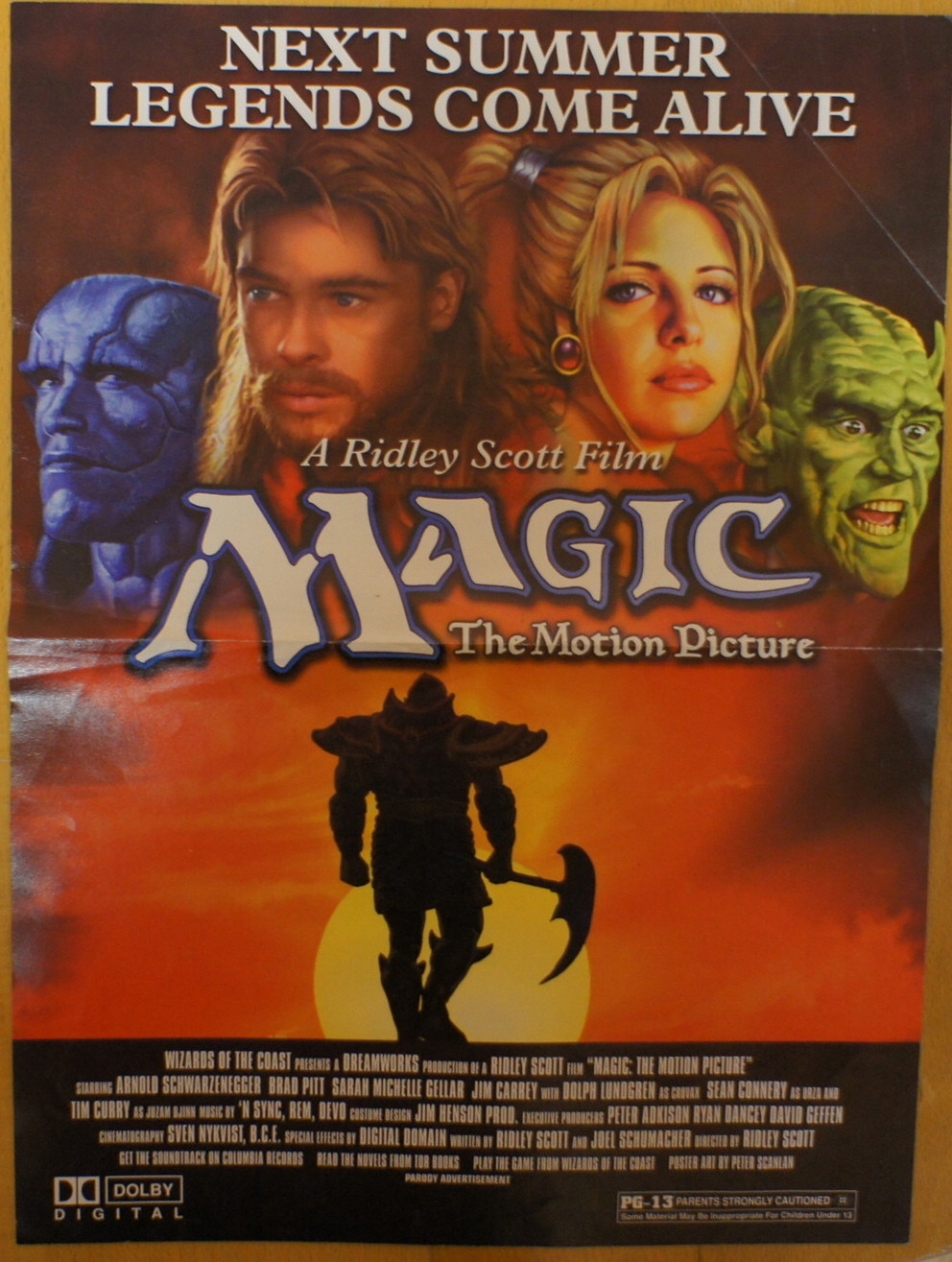
What could have been...

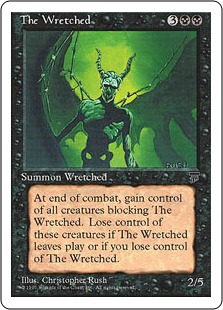
As it turns out, this wasn't a sweet movie. It was instead an April Fool's joke, and a pretty awesome one at that. I guess the poster was sent out to LGSs back in the day. And by back in the day, I mean in 1997, when a quick Internet search didn't exist to find the truth out about the movie.

An awesome joke, indeed. Nice work WOTC.

Avatar photo

Corbin Hosler

Corbin Hosler is a journalist living in Norman, Oklahoma (also known as the hotbed of Magic). He started playing in Shadowmoor and chased the Pro Tour dream for a few years, culminating in a Star City Games Legacy Open finals appearance in 2011 before deciding to turn to trading and speculation full-time. He writes weekly at QuietSpeculation.com and biweekly for LegitMTG. He also cohosts Brainstorm Brewery, the only financial podcast on the net. He can best be reached @Chosler88 on Twitter.

View More By Corbin Hosler

Posted in Feature, Free4 Comments on This is how you do April Fools, Magic-style

Have you joined the Quiet Speculation Discord?

If you haven't, you're leaving value on the table! Join our community of experts, enthusiasts, entertainers, and educators and enjoy exclusive podcasts, questions asked and answered, trades, sales, and everything else Discord has to offer.

Want to create content with Quiet Speculation?

All you need to succeed is a passion for Magic: The Gathering, and the ability to write coherently. Share your knowledge of MTG and how you leverage it to win games, get value from your cards – or even turn a profit.

Shotgun Lotus: Not Your Standard Stream

Are you a Quiet Speculation member?

If not, now is a perfect time to join up! Our powerful tools, breaking-news analysis, and exclusive Discord channel will make sure you stay up to date and ahead of the curve.

In the last few months, I've become a big fan of Shotgun Lotus (Twitter, Facebook), a Magic production company doing something different in an industry that one could argue just kind of does the same thing over and over again. Once a month, a group gathers at man-in-charge Paul Waite's house to engage in Magic shenanigans you may have never seen before.

shotgunlotus

So far, the company has streamed seven Vintage Rotisserie Drafts. If you're not familiar with the format, here's a quick rundown: one of every card in Magic, eight players, a rotisserie snake draft (the eight players publicly pick one at at a time out of every card in the pool, reversing pick order every other round), and a round-robin tournament to determine who makes the finals. VRD is the most powerful Limited format there is, and the deckbuilding requires creativity, adaptability, and lots of advance preparation. One more thing: they play for boose. Each entrant brings a bottle, and at the end of the tournament, the top three players draft them, with first place getting five, second getting two, and third getting one.

These drafts take place in Seattle neighborhood Ballard, and if you're able to be there in person, the group has qualifier events for folks who want to participate. This week, in the eighth draft in the VRDS, the roster is as follows:

Seat 1: Corbett Gray (a regular competitor who brews some sweet decks and has had success in SCG Opens)
Seat 2: Randy Buehler (former R&D member)
Seat 3: Jesse Hampton (PT Top 8 competitor)
Seat 4: Mike Thompson (GP Top 8 competitor, finished 10th at a PT)
Seat 5: Chris Kelly (Wizards of the Coast employee, winner of August qualifier)
Seat 6: James Nguyen (SCG Legacy Open Winner)
Seat 7: Marshall Sutcliffe (co-host of Limited Resources podcast)
Seat 8: Jesse Wilke (professional poker player)

That's a small list of big names, and the winner of this event will go on to battle for glory in a championship draft against past winners Cedric Phillips, Elliott Woo, Charles Wong, Paul Waite, Charles Dupont, Peter Beckfield, and Greg Peloquin.

Despite being out of someone's home, these broadcasts are very polished and professional. With the round-robin format, it's not hard to keep on-camera action going for the whole day, meaning there's less downtime than you would get for a PT, GP, or Open stream. Brian Wong, co-host of the Limited Resources podcast, made his commentating debut at VRD7, and will return for VRD8 along with Paul Waite and Dwayne St. Arnauld.

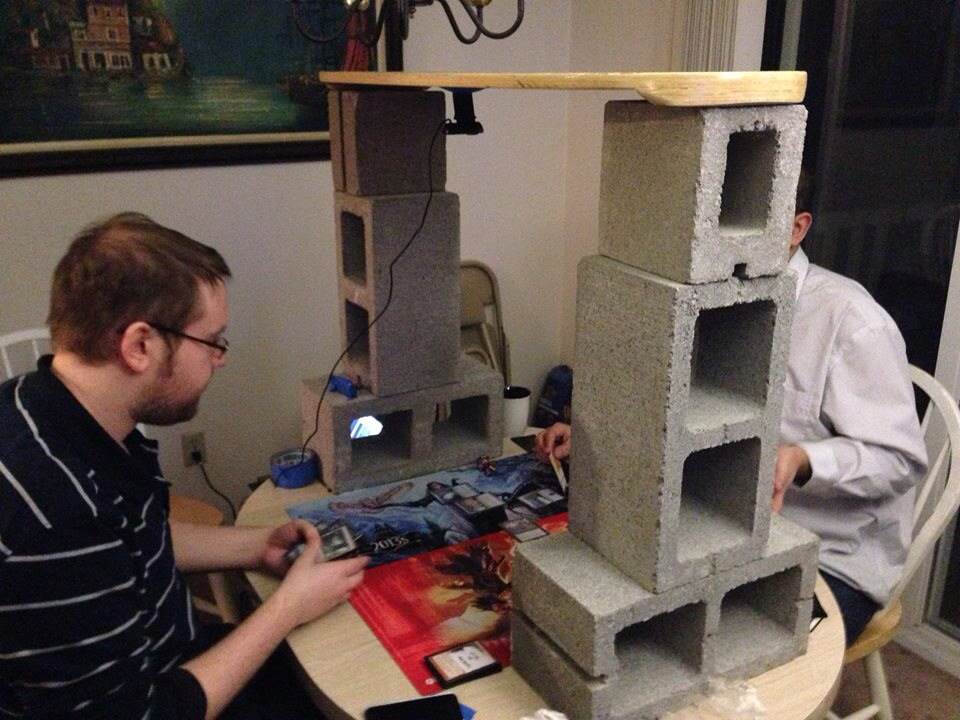
The company's technology has gone from humble beginnings:

IMG_2295

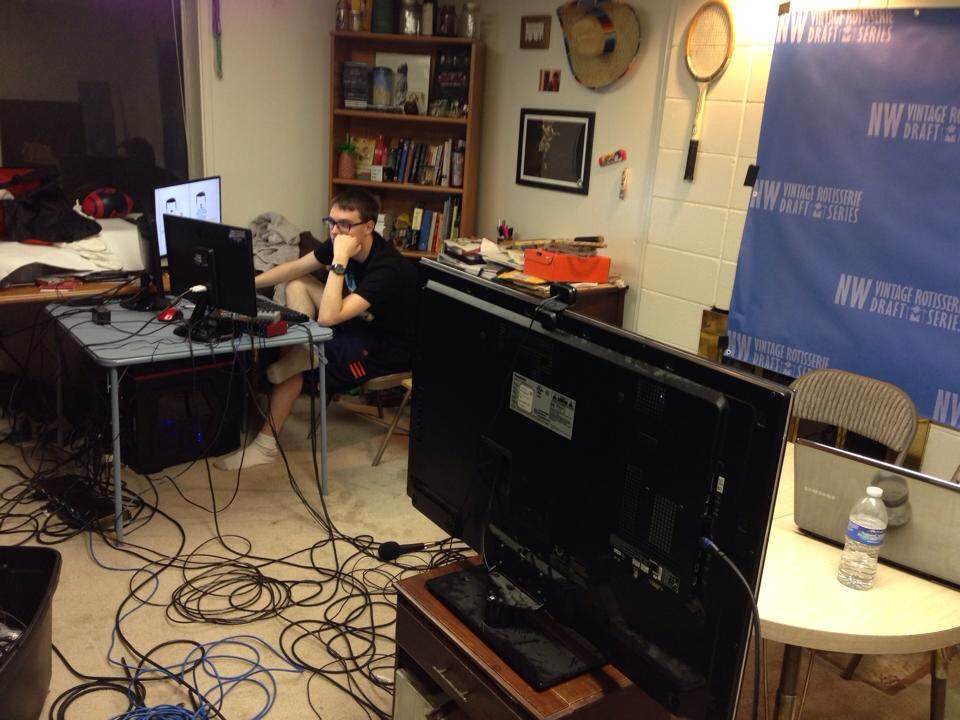
...to a pretty sophisticated setup allowing for professional-quality streaming straight out of a dude's garage:

IMG_2296

Photos from Shotgun Lotus Facebook page

These are truly entertaining events if you appreciate powerful, varied Limited Magic. I can't imagine watching a random Open or GP when one of these tournaments is running.

The main criticism I have about the VRDS so far is that Shotgun Lotus hasn't yet figured out the best way to cover the drafting itself. Competitors use Google Spreadsheets to input their picks, and even when running the stream on my 42" high-def TV, I have to squint to read the card names:

IMG_2294

It's certainly not an easy issue to solve, but if they can figure out a more engaging way to cover these drafts, it will help to involve the audience in a much more entertaining way. Even as is, the commentators do a good job of keeping viewers interested by discussing the cards that certain players might be fighting over, what cards are left for an archetype, and what has gone far too early or far too late. It's clear that Waite in particular really loves the format, and he has tons of info he shares about past drafts, typical picks and where they go, and more.

The next Vintage Rotiserrie Draft will be this Saturday, August 23, 2014, on the Shotgun Lotus Twitch.tv channel. I highly recommend checking it out. And if Limited isn't your thing but you still want to see powerful Magic, the company recently announced its plans for the next series:

IMG_2297

There will be a preview show tonight on the Shotgun Lotus Twitch channel [edit: I am wrong. It's on Randy Buehler's Twitch channel here], but I don't know much more than that. I'll be tuning in, and you can definitely count on me covering this as more information comes to light.

Avatar photo

Danny Brown

Danny is a Cube enthusiast and the former Director of Content for Quiet Speculation.

View More By Danny Brown

Posted in Free3 Comments on Shotgun Lotus: Not Your Standard Stream

Have you joined the Quiet Speculation Discord?

If you haven't, you're leaving value on the table! Join our community of experts, enthusiasts, entertainers, and educators and enjoy exclusive podcasts, questions asked and answered, trades, sales, and everything else Discord has to offer.

Want to create content with Quiet Speculation?

All you need to succeed is a passion for Magic: The Gathering, and the ability to write coherently. Share your knowledge of MTG and how you leverage it to win games, get value from your cards – or even turn a profit.

Do You Point Out Misplays?

Are you a Quiet Speculation member?

If not, now is a perfect time to join up! Our powerful tools, breaking-news analysis, and exclusive Discord channel will make sure you stay up to date and ahead of the curve.

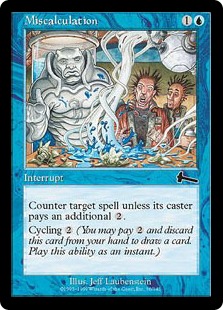
An interesting question was brought up on Reddit today: Do you point out to your opponent when they misplay?

Image.ashx

It's a question with a lot of different and equally-correct answers. For instance, in playtesting you should almost always discuss misplays as you see them happen. After all, what's the point of playtesting if you can't get the right set of information from the results?

As for friends? I almost always point things out after the match, because most of them appreciate and look for it, as I do after my own matches.

Things get tricky when it comes to your opponents. Some people like myself want to hear where I screwed up, regardless of where or who that information is coming from. But after emotional matches it can be tricky for some people. I think one of the best ways to do it is to ask them their line of thinking behind a given play. Their response should make it pretty clear as to whether or not they would appreciate your input, and this comes across a lot better than just telling someone how you think they did something wrong.

At least, that's my paradigm on the subject. What do you think?

Avatar photo

Corbin Hosler

Corbin Hosler is a journalist living in Norman, Oklahoma (also known as the hotbed of Magic). He started playing in Shadowmoor and chased the Pro Tour dream for a few years, culminating in a Star City Games Legacy Open finals appearance in 2011 before deciding to turn to trading and speculation full-time. He writes weekly at QuietSpeculation.com and biweekly for LegitMTG. He also cohosts Brainstorm Brewery, the only financial podcast on the net. He can best be reached @Chosler88 on Twitter.

View More By Corbin Hosler

Posted in Feature, Free12 Comments on Do You Point Out Misplays?

Have you joined the Quiet Speculation Discord?

If you haven't, you're leaving value on the table! Join our community of experts, enthusiasts, entertainers, and educators and enjoy exclusive podcasts, questions asked and answered, trades, sales, and everything else Discord has to offer.

Want to create content with Quiet Speculation?

All you need to succeed is a passion for Magic: The Gathering, and the ability to write coherently. Share your knowledge of MTG and how you leverage it to win games, get value from your cards – or even turn a profit.

Khans of Tarkir Spoilers 8/18/2014

Are you a Quiet Speculation member?

If not, now is a perfect time to join up! Our powerful tools, breaking-news analysis, and exclusive Discord channel will make sure you stay up to date and ahead of the curve.

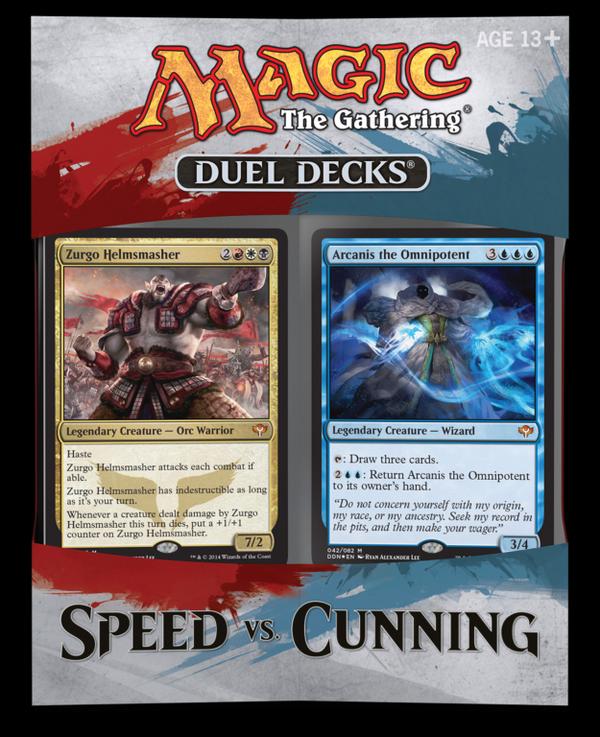
Speed Vs. Cunning is the gift that keeps on giving. We have a few presents from the visual spoiler today.

Some old favorites are getting new art.

And some of our suspicions have been confirmed.

The old cycle of tri-lands had a tendency to be underrated. While they were first-pickable in draft, people didn't tend to consider them collection picks until a lot of them started to approach $1 on buylists. A few of them have gotten several reprints over the years and that has limited their upside and obscured how much they would be worth now if they had been left to their devices. Get as many of these as you can for free. People had a tendency to leave the older ones lying on tables once the draft was over and while that may not happen this time around, grab free money while you can and sock these away in a box. Also, the foils will be underpriced. I think they will be overpriced right away, but they will sink and become solid pickups after a while. These are great EDH inclusions and foils will be valuable.

Jeskai Elder

So now we have a new keyword - prowess. This is a really clunky card, but it may get there in limited. However, you don't play as many non-creatures in limited so you're likely using this guy as a poor man's Ophidian. The card itself is not relevant, but you have to wonder if there will be any relevant creatures with Prowess.

All signs indicate that despite RUW being control colors now, Jeskai is not as much a control wedge as you'd imagine. With this odd [card]Wee Dragonauts[card]esque keyword, we may see Jeskai play more like RUW delver than RUW control.

Is Prowess better than the ability on a card like Blistercoil Weird or Nivmagus Elemental? Not on this creature, but if we get a good creature like that, card like Gut Shot and especially Gitaxian Probe could have real upside on Modern. Probe is out of control right now as it is.

Avatar photo

Jason Alt

Jason Alt is a value trader and writer. He is Quiet Speculation's self-appointed web content archivist and co-captain of the interdepartmental dodgeball team. He enjoys craft microbrews and doing things ironically. You may have seen him at magic events; he wears black t-shirts and has a beard and a backpack so he's pretty easy to spot. You can hear him as co-host on the Brainstorm Brewery podcast or catch his articles on Gatheringmagic.com. He is also the Community Manager at BrainstormBrewery.com and writes the odd article there, too. Follow him on Twitter @JasonEAlt unless you don't like having your mind blown.

View More By Jason Alt

Posted in FreeTagged , , , , 11 Comments on Khans of Tarkir Spoilers 8/18/2014

Have you joined the Quiet Speculation Discord?

If you haven't, you're leaving value on the table! Join our community of experts, enthusiasts, entertainers, and educators and enjoy exclusive podcasts, questions asked and answered, trades, sales, and everything else Discord has to offer.

Want to create content with Quiet Speculation?

All you need to succeed is a passion for Magic: The Gathering, and the ability to write coherently. Share your knowledge of MTG and how you leverage it to win games, get value from your cards – or even turn a profit.

Soon-to-be-Reprinted: Examining Elves vs. Goblins

Are you a Quiet Speculation member?

If not, now is a perfect time to join up! Our powerful tools, breaking-news analysis, and exclusive Discord channel will make sure you stay up to date and ahead of the curve.

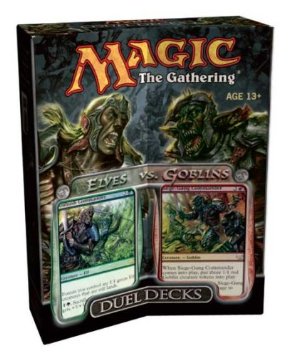
We know that reprints of old and rare decks are coming in Duel Decks: Anthology, but these products were released so many years ago that many of us (including me) aren't more than passingly familiar with the cards in them. If you want to get the bottom of these decks without trying to navigate old, broken product announcements like this, you're in luck: I've done the work for you. Let's talk about what's exciting in Duel Decks: Goblins vs. Elves.

elvesvsgoblins

This box set can currently be found on Amazon at a low, low price of $198.99. With a price tag like that, you know the deck is going to be packing some goodies. All prices cited below are TCGplayer mid, and it should be noted that none of these prices will be real when this product is released—almost everything will suffer a price drop when reprinted, at least temporarily.

The Big Kahunas

Almost every Duel Deck has one card that sticks out as the big, desirable reprint to buy the product. For the inaugural product in the Duel Deck series, we get...well, I guess there isn't really a big, flashy card in this one. Sorry?

Uncommons as the Hook

Interestingly, the most expensive cards in this set are all uncommons.

Goblin Warchief, currently $3.69, is a Legacy Goblins staple, and this printing is the only modern-border* one available besides the FNM foil. There is one copy in this product.
There was an error retrieving a chart for Goblin Warchief

*Quick aside: I guess there's a new border in town, so what do we call the Eighth through Conspiracy border now? "Modern border" is a misnomer, and "old border" leads to confusion. This is something the community will have to decide in the coming months. I guess I'll use "8C" border for now?

The reprint of Wirewood Symbiote, currently $3.13, mirrors the Warchief reprint in many ways: it's a staple in Legacy Elves, is the only 8C-border available, and is a one-of. Two copies of casual-favorite Imperious Perfect ($4.93) and one of Elvish Promenade ($3.29) close out the "priciest" cards on the list.

There was an error retrieving a chart for Imperious Perfect

Stuff Between $1 and $3

There are a few cards coming in between $1 and $3 in the set, including both cover foils, Siege-Gang Commander and Ambush Commander.

The goblin deck includes Gempalm Incinerator, Goblin Matron, Goblin Ringleader, and Reckless One, each of which derives its value from casual appeal plus some Legacy applicability.

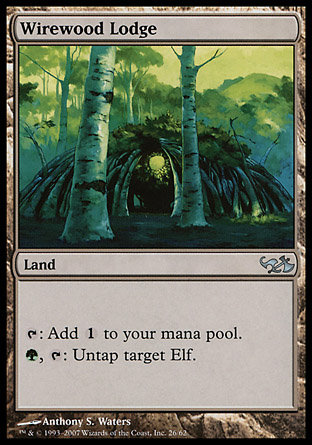
The elves deck doesn't boast quite as many Legacy-quality cards, instead including casual stuff like Elvish Harbinger, Heedless One, Sylvan Messenger, Wellwisher, Wren's Run Vanquisher, Harmonize, and Wirewood Lodge.

wirewoodlodge

Bulk Rares Aplenty

This set really derives its value from the uncommons. Besides the two foils, the other rares included in this set are under $1. For reference:

Allosaurus Rider
Voice of the Woods
Slate of Ancestry
Clickslither
Ib Halfheart, Goblin Tactician

So is the Deck Worth It?

I'm not going to do the math, but I'm pretty sure the cards added up in this set do not equal the $200 price tag that it's enjoying. This is a collector's item more than anything, and while $25 (a quarter of the Duel Decks: Anthology) price looks good compared to the current availability, keep in mind that this is a markup from the original $20 price.

This isn't exactly an auspicious start, at least from an MTG finance perspective, but these two tribes are casual favorites and these decks will provide a lot of fun for the casual player looking to expand his or her collection.

Until we go over the other three decks in the product, it's too early to tout this as a great buy or denounce it as a ripoff. We'll cover the other the rest of Duel Decks: Anthology in the coming weeks.


Insider: Reconciling Historical Inconsistency

Are you a Quiet Speculation member?

If not, now is a perfect time to join up! Our powerful tools, breaking-news analysis, and exclusive Discord channel will make sure you stay up to date and ahead of the curve.

I believe some clarification is owed to QS Insiders on some conflicting rationale I have provided in the past. The inconsistency revolves around what I call a “success” in MTG Finance and what I consider “failure”. Or, better put, “suboptimal performance”.

Through some enlightening feedback from the editors here at Quiet Speculation, my motivation this week is to reconcile these differences by admitting my faults and turning toward a more precise objective going forward. Hopefully the new viewpoint will shed some light on my thought process.

Perhaps it will also give you a better glimpse at my objectives, which in turn provide context to my MTG investing decisions.

The Disconnect In Logic

On the one hand, we are all after a similar goal involving reduced or even positive cash flow from this wonderful hobby.

Often times I’ll quote one of my favorite truisms: the goal is not to make the most money possible; the goal is to make money.

This quote is the basis for many of my MTG Finance decisions, such as my large investment in Innistrad Booster Boxes and my inclination to sell a card for any profit to eliminate risk from my portfolio. For me, having the ability to sell a card imminently for profit is more valuable than the prospect of gaining more cash later--it’s the old proverb a bird in the hand is worth two in the bush.

On the other hand, time and again I will communicate disappointment in an MTG investment due to lost opportunity cost. Sitting on nineteen Innistrad Booster Boxes made me money, but the annualized return on this investment was painfully small compared to many, better choices. I constantly reevaluate my portfolio allocations based on past performance, condemning myself for choosing incorrectly.

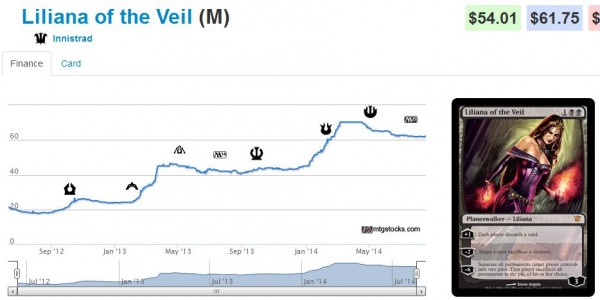
In reality, this self-deprecating mindset is unfair. Hindsight is always 20/20, and regretting my purchase of Innistrad Booster Boxes because a position in Foil Liliana of the Veils would have performed more favorably is a existential viewpoint at best. This comparison completely erodes my previous stance that my goal was to make money, not the most money possible. My risk aversion dictates this must be so.

Liliana

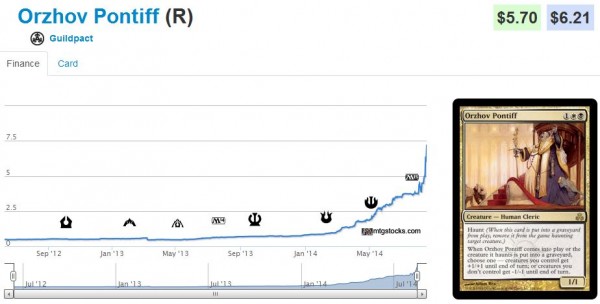
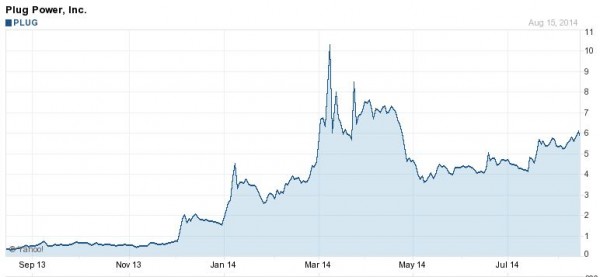
In fact, if I really wanted to pour on the feel-bads, I could unfairly evaluate my portfolio performance against some of the best performing assets throughout the past year. How about Orzhov Pontiff or shares of Plug Power, Inc., a stock I have been following for over a year now?

Pontiff

PLUG

It’s inappropriate for me to expect to predict the above outcomes consistently. And with my general aversion to excessive risk, I simply cannot hold myself to this standard. I made a strategic investment in a low risk asset by purchasing Booster  oxes and the yield was precisely in-line with expectations.

These boxes were, yet again, another profit generator from my pastime--this should be viewed as a success and not a miserable failure, right?

Opportunity Cost is Still a Thing

While it’s true I should be content to make profits on low-risk positions like Booster Boxes, I cannot disregard opportunity cost altogether. I am 100% certain there are other low-risk assets I could buy into which may yield better return in the next twelve months. By buying Innistrad boxes, I followed a strategy which required minimal effort. Once purchased, the boxes sat in a tote or on a shelf for a couple years.

At the time, this investment fit my lifestyle perfectly. My son had just been born and I wanted to stay in the MTG Finance game without having to invest hours of time into the hobby. Booster Boxes were a great way to maintain MTG exposure while also freeing up time to spend with my newly expanded family.

Now my son is older and I occasionally have more time to pour into this lucrative hobby. Continuing to invest in boxes could be considered a lazy approach. I need to learn from my past experience and shift my focus toward positions with greater potential.

Certainly I can still maintain a lower risk profile, but I should achieve that goal by diversifying. Placing all my eggs in a basket like Return to Ravnica boxes, for example, would likely provide me with yet another disappointing year of returns. While there may not be a safer place to park a thousand bucks right now, I can guarantee there are safe alternatives that will yield better returns.

Even though I made money buying and selling Booster Boxes, I cannot neglect opportunity cost completely. Sacrificed liquidity can also be a major drawback, because a purchase in something like booster boxes may not yield profit for many months. Shipping and fees force the wait time to lengthen even further.

Sometimes life circumstances could dictate that Booster Boxes are a perfect investment. But if those circumstances aren’t evident, one should take a step back and consider alternatives. The opportunity cost associated with a booster box investment is simply too large to blindly accept.

Going Forward – Turning a New Leaf

I do have a position in Return to Ravnica Booster Boxes. Nine of these beautiful, blue sealed boxes currently sit on a shelf in my basement, next to two Avacyn Restored Booster Boxes. Despite this still-sizable position, the relative percentage of my portfolio in sealed product is significantly reduced.

Moving forward there will always be a spot in my portfolio for sealed Booster Boxes. They add stability to a volatile class of assets and provide an ideal avenue for diversifying risk. But the days of 50% portfolio allocation to sealed product are long gone. Tying up that much cash in something I’m unable to sell profitably for months is way too unattractive.

Based on my experience with Innistrad boxes, I’ll turn my focus to a more liquid and more diversified approach. Although they are all relatively low-risk buys, the diversification yields greater liquidity and better chances for short-term gains.

This is why I’ve shifted focus to Theros block temples, dual lands (which have recently pulled back nicely), and Vintage staples. Thoughtseize also plays a great role in my portfolio, providing some safety with opportunity for a reasonable return in the next three to six months.

There was an error retrieving a chart for Thoughtseize

There was an error retrieving a chart for Temple of Epiphany

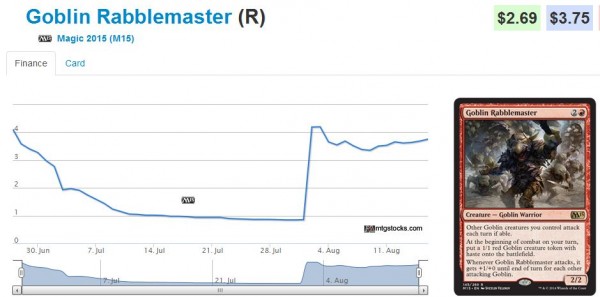
In the meantime, I'll continue to seek opportunities for immediate gain via quick flips from hype and arbitrage. Recently this has taken the form of a quick flip on Goblin Rabblemasters and arbitrage on Power between Europe and North America, or even dual lands between the U.S. and Australia.

Rabblemaster

These moves couldn’t be possible if I had all my funds tied up in illiquid assets like Booster Boxes. That’s not to say Booster Boxes don’t belong in a diverse MTG portfolio. But I am committing to maintain these investments to a smaller percentage. They’ll make me money eventually, and for this I will be pleased.

But in the meantime I can focus energy on other opportunities which will provide even greater returns. Therefore, when the next opportunity comes along to double up on foil Liliana of the Veil, I won’t be left regretting my decisions because opportunity cost won’t be holding me back.

Summing Up My New Attitude

I’m still after the same end result: to make money from Magic. This isn’t changing. My attitudes around how I achieve this are morphing, however. Instead of jumping onto any wagon that may take me to a land of profitability, regardless of transportation time, I’ll divide my resources onto varying forms of transportation. This way, I won’t regret missing other opportunities due to a lack of cash.

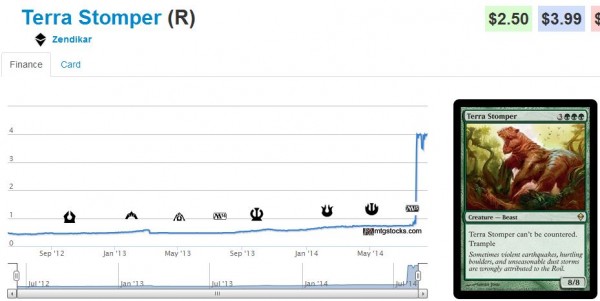
Once the opportunity cost barrier is broken down, the premise of regretting missed opportunities should evaporate entirely. There will still be boats I’ll miss. Often times these trends could not have been predicted with high confidence. Even major retailers did not anticipate the impact of M15 on Terra Stomper, for example, so there is no reason for me to regret this missed opportunity.

Terra Stomper

While Terra Stomper could have yielded significant returns, I am confident there will be other opportunities in the future with a more attractive risk/reward proposition.

As long as we learn from history, we will be better prepared to take advantage of future opportunities. As long as I internalize what I observe, I won’t hold myself to unfair standards. I’ll continue to make profits from MTG through a diverse approach, and that will be sufficient.

…

Sigbits

I used to disregard cards that were mostly 1-ofs in only one or two specific archetypes. It’s time to shift away from this attitude, however, especially when looking at older cards. Despite the turmoil in Modern card prices of late, some older 1-ofs that have continued to dodge reprint are getting relatively expensive. Spellskite being the poster child for this trend, of course.

  • Other than the occasional Modern appearance, I have no explanation for the explosion of Orzhov Pontiff. Star City Games is now sold out of nonfoils at $3.99 and NM foils at $24.99!
  • I suppose a quick comparison of Orzhov Pontiff with another 1-of in Modern, Ranger of Eos, could shed some light. The Ranger is not sold out, mind you, but he does retail for $14.99 despite coming from a more recent set. Perhaps the Pontiff’s price increase has been long overdue.
  • Another 1-of in Modern that has shown some price growth is Eye of Ugin. The land is played in Tron builds to fetch up Eldrazi when it’s time to win the game and has earned a price tag of $9.99 at retail.

Don’t Keep Your Coverage Ideas to Yourself!

Are you a Quiet Speculation member?

If not, now is a perfect time to join up! Our powerful tools, breaking-news analysis, and exclusive Discord channel will make sure you stay up to date and ahead of the curve.

In May, Richard Hagon appeared on Limited Resources, my favorite Magic podcast. On that episode he mentioned that the coverage team is always working to improve the viewer experience and that they read every piece of feedback. He then provided a contact email on the show: mtgeurovideo@gmail.com.

The next day I wrote him with an idea:

"For Top 8 matches I have a simple modification that could make a big difference. Instead of having the players remain at the table for sideboarding, why not take them each to a designated “corner” where they can sideboard in front of the camera with a side-line reporter present.

Instead of dead air, viewers now can watch the player making sideboard decisions right in front of them.

After the player finishes sideboarding, he hands his deck off to a judge who shuffles for him and properly randomizes the deck. While the judge is shuffling, the player stays in his corner and is interviewed by the sideline reporter: How did that last game go for you? What did you side in and take out, and why? What do you expect your opponent sided in? Does your game plan change after what you saw? Have you played this matchup a lot in testing, and what are the key points?

Now instead of having commentators speculate about what the players brought in and why, the viewer knows exactly what they did and what they were thinking. Instead of dead air, you have a key strategic element of the game brought to life. You could even do a split screen showing each player making their sideboard decisions while the commentators look in."

Richard expressed interest and we we had a good discussion about the challenge of "noise-bleed," and the fact that players would "have to be a long way away to avoid overhearing during interviews etc." It sounded like the idea may not work in its initial incarnation, but he was going to discuss it with the rest of the coverage team.

This week I got the following email from Richard:

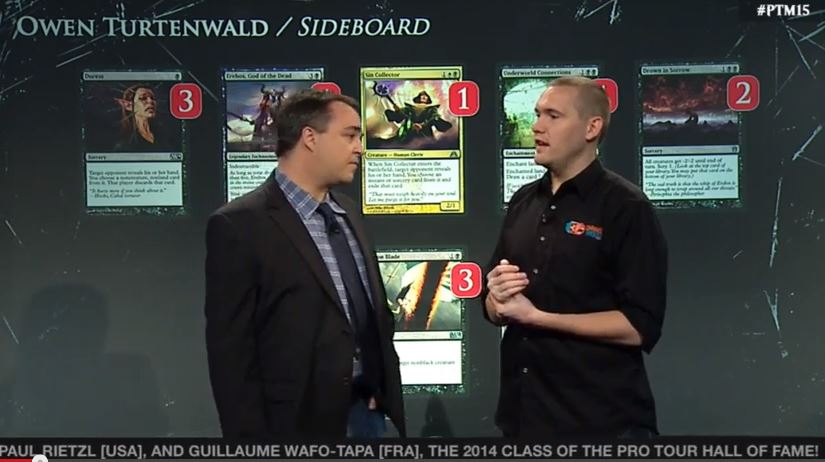
I hope you are watching the top 8 of pro tour magic 2015, where I am typing this from. If you are, you will see that we were able to take your idea and do something cool with it, namely recording sideboard I interviews with the top 8 before their matches. It has been very well received by the stream watchers, and I wanted to drop you a line to say thanks for the thought! Always glad to make coverage better,and this looks like something we may well do again.

I think they did a terrific job with this new feature, and it added a lot of depth to the waiting time between games.

A new Sideboard feature made its debut at PT M15
Coverage introduced a new Sideboard feature for PT M15

I tell this story not to pat myself on the back but to remind folks that if you have good ideas for improving coverage, please don't keep them to yourselves. Magic coverage has improved tremendously over the past couple years, but judging from the stream chat and from twitter there is so much negativity. Live broadcasting is hard, and improvements take time. But it's worth remembering hat they they are working hard to bring the top product they can to the screen, and if you have ideas that can help improve the experience, don't gripe about it in the chat--let them know! It benefits us all when coverage improves.

-Alexander Carl (@Thoughtlaced)

Insider: [Video] Planar Cleansing Standard

Are you a Quiet Speculation member?

If not, now is a perfect time to join up! Our powerful tools, breaking-news analysis, and exclusive Discord channel will make sure you stay up to date and ahead of the curve.

I've made some good progress on the technical problems that v4 has caused. Please let me know in the comments how you feel about the quality of these videos.

The deck and some analysis behind the card choices:

Untitled Deck

Spells

4 Quicken
4 Azorius Charm
2 Last Breath
2 Syncopate
3 Divination
4 Dissolve
4 Jace, Architect of Thought
4 Supreme Verdict
4 Sphinx's Revelation
3 Planar Cleansing

Lands

6 Island
6 Plains
4 Hallowed Fountain
4 Temple of Enlightenment
2 Temple of Deceit
2 Temple of Silence
2 Mutavault

Sideboard

2 Last Breath
4 Nyx-Fleece Ram
2 Archangel of Thune
1 Elspeth, Sun's Champion
1 Elixir of Immortality
1 Dispel
1 Gainsay
2 Negate
1 Deicide


Round 1

There was an error retrieving a chart for Temple of Enlightenment

Round 2

There was an error retrieving a chart for Supreme Verdict

Round 3

There was an error retrieving a chart for Jace, Architect of Thought

Round 4

There was an error retrieving a chart for Quicken

I don't think there's much that needs to be said about the financial implications of the cards in this deck.

Instead I'll just say that, although Nissa, Worldwaker is a powerful card, since it is at 21 Tix, I think you're much safer investing in Chandra, Pyromaster at 6 Tix.

It's also important to understand that just because you are rational and well informed, that doesn't mean everybody else is. Lately M15 boosters have been worth 3.05tix, yet I've been selling several playsets a day at 3.33 with a classifieds add that reads "Selling 3x M15 10 Tix".

Some people don't understand decimals and are put off by credit. It's not much, but it's a little bit of risk free easy money.


I always love feedback, so please leave a comment! I'm happy to answer any questions you might have. If you can find a better line of play or have an idea that might improve the list, I'm all ears.

How to Tell if Your Card are from Chronicles

Are you a Quiet Speculation member?

If not, now is a perfect time to join up! Our powerful tools, breaking-news analysis, and exclusive Discord channel will make sure you stay up to date and ahead of the curve.

Recently I saw pretty cool post on Reddit, where a guy's aunt sent him some cards that her son used to own. For a player just getting into Magic, it's pretty darn exciting to have Scrublands and Karakas and the like show up your door.

But an important lesson was learned here, and that's that cards we think are sweet from old sets aren't always what they appear to be.

Chronicles, not Legends.

Even "bad" cards like the one above can be worth real money if you find them from Legends. But Wizards did this thing in the '90s where, while trying to address card availability, they massively reprinted cards in a set called Chronicles. It kept the set symbol for cards but changed some other stuff around, making them fairly easy to distinguish if you know what you're looking for.

And what are you looking for?

- White borders. This is the main one, and easy to spot.

- Chronicles cards also have a copyright date, which the prior sets typically did not.

So there you go. If you're interested in learning more about how to determine different sets on old cards, I highly suggest looking at this page.

Avatar photo

Corbin Hosler

Corbin Hosler is a journalist living in Norman, Oklahoma (also known as the hotbed of Magic). He started playing in Shadowmoor and chased the Pro Tour dream for a few years, culminating in a Star City Games Legacy Open finals appearance in 2011 before deciding to turn to trading and speculation full-time. He writes weekly at QuietSpeculation.com and biweekly for LegitMTG. He also cohosts Brainstorm Brewery, the only financial podcast on the net. He can best be reached @Chosler88 on Twitter.

View More By Corbin Hosler

Posted in Feature, Finance, FreeTagged , 4 Comments on How to Tell if Your Card are from Chronicles

Have you joined the Quiet Speculation Discord?

If you haven't, you're leaving value on the table! Join our community of experts, enthusiasts, entertainers, and educators and enjoy exclusive podcasts, questions asked and answered, trades, sales, and everything else Discord has to offer.

Want to create content with Quiet Speculation?

All you need to succeed is a passion for Magic: The Gathering, and the ability to write coherently. Share your knowledge of MTG and how you leverage it to win games, get value from your cards – or even turn a profit.

Duel Decks: Speed vs Cunning Leaked!

Are you a Quiet Speculation member?

If not, now is a perfect time to join up! Our powerful tools, breaking-news analysis, and exclusive Discord channel will make sure you stay up to date and ahead of the curve.

Where has being skeptical gotten us?

A while back, a seemingly-odd collection of random cards was touted as the list for "From the Vaults: Annihilation" and a skeptical community rejected the information, likely for reasons no more complicated than "this doesn't seem to have Damnation. I want a Damnation."

With that in mind, someone stumbled upon two hyperlinks on the Mothership that appeared to have the speed vs. cunning decklists.

http://magic.wizards.com/en/articles/decks/speed-2014-08-15

http://magic.wizards.com/en/articles/decks/cunning-2014-08-15

Those links are dead now -whatever information was contained was clearly not intended for the public's eyes yet.

Someone did manage to copy the lists down, though.

SPEED

  • 1x Frenzied Goblin
  • 1x Infantry Veteran
  • 2x Leonin Snarecaster
  • 2x Dregscape Zombie
  • 1x Goblin Deathraiders
  • 1x Hellraiser Goblin
  • 1x Fleshbag Marauder
  • 1x Goblin Warchief
  • 1x Hell’s Thunder
  • 1x Kathari Bomber
  • 1x Shambling Remains
  • 1x Mardu-Heart-Piercer
  • 2x Beetleback Chief
  • 1x Krenko, Mob Boss
  • 1x Ogre Battledriver
  • 1x Flame-Kin Zealot
  • 1x Scourge Devil
  • 1x Zurgo Helmsmasher
  • 1x Oni of Wild Places
  • 1x Reckless Abandon
  • 1x Shock
  • 1x Bone Splinters
  • 1x Arc Trail
  • 1x Goblin Bombardment
  • 2x Krenko’s Command
  • 1x Act of Treason
  • 1x Dauntless Onslaught
  • 1x Orcish Cannonade
  • 2x Fiery Fall
  • 1x Fury of the Horde
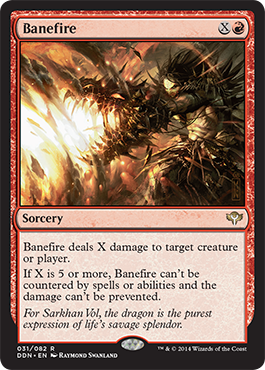
  • 1x Banefire
  • 2x Evolving Wilds
  • 1x Ghitu Encampment
  • 2x Nomad Outpost
  • 10x Mountain
  • 3x Plains
  • 6x Swamp


CUNNING

  • 2x Faerie Imposter
  • 2x Coral Trickster
  • 2x Fathom Seer
  • 1x Jeskai Elder
  • 1x Willbender
  • 1x Sparkmage Apprentice
  • 1x Lone Missionary
  • 1x Master Decoy
  • 1x Echo Tracer
  • 1x Kor Hookmaster
  • 1x Stonecloaker
  • 2x Aquamorph Entity
  • 1x Hussar Patrol
  • 1x Lightning Angel
  • 1x Faerie Invaders
  • 1x Thousand Winds
  • 1x Arcanis the Omnipotent
  • 1x Sphinx of Uthuun
  • 1x Fleeting Distraction
  • 1x Stave Off
  • 1x Swift Justice
  • 1x Impulse
  • 1x Mana Leak
  • 1x Lightning Helix
  • 1x Hold the Line
  • 1x Inferno Trap
  • 1x Steam Augury
  • 2x Traumatic Visions
  • 1x Whiplash Trap
  • 1x Arrow Volley Trap
  • 1x Repeal
  • 2x Mystic Monastery
  • 2x Terramorphic Expanse
  • 10x Island
  • 3x Mountain
  • 7x Plains


Nomad Encampment? Mystic Monastery? If I had to guess, I would say they are new additions to the Savage Lands cycle. They could be something new entirely, but with 3 color decks, that seems like a safe bet.

What do we think of these leaked decklists? Are you a buyer of these decks given this composition? Does this seem credible? Fake? What do we think?

Avatar photo

Jason Alt

Jason Alt is a value trader and writer. He is Quiet Speculation's self-appointed web content archivist and co-captain of the interdepartmental dodgeball team. He enjoys craft microbrews and doing things ironically. You may have seen him at magic events; he wears black t-shirts and has a beard and a backpack so he's pretty easy to spot. You can hear him as co-host on the Brainstorm Brewery podcast or catch his articles on Gatheringmagic.com. He is also the Community Manager at BrainstormBrewery.com and writes the odd article there, too. Follow him on Twitter @JasonEAlt unless you don't like having your mind blown.

View More By Jason Alt

Posted in FreeTagged 3 Comments on Duel Decks: Speed vs Cunning Leaked!

Have you joined the Quiet Speculation Discord?

If you haven't, you're leaving value on the table! Join our community of experts, enthusiasts, entertainers, and educators and enjoy exclusive podcasts, questions asked and answered, trades, sales, and everything else Discord has to offer.

Want to create content with Quiet Speculation?

All you need to succeed is a passion for Magic: The Gathering, and the ability to write coherently. Share your knowledge of MTG and how you leverage it to win games, get value from your cards – or even turn a profit.

Insider: Building a Vintage Community

Are you a Quiet Speculation member?

If not, now is a perfect time to join up! Our powerful tools, breaking-news analysis, and exclusive Discord channel will make sure you stay up to date and ahead of the curve.

This past year the Vintage and Legacy Championships were, for the first time in quite a while, not held at Gen Con. Instead these two tournaments were given their own weekend, and most importantly, the Vintage Championships was given its best coverage ever. With Vintage aficionados Randy Buehler and Chris Pakula doing commentary and each round getting a camera feature match, this was the kind of coverage that Vintage had long been waiting for.

Plenty of Vintage tournaments have been covered before--but they're a far cry from the record-setting, no-proxy tournament that took place last year. Vintage Champs clocked in at 233 players with a whopping nine rounds of swiss, plus Top 8! The decision to give these two tournaments their own weekend and provide amazing coverage did wonders for the format even before Vintage Masters was released on Magic Online.

This had a profound effect on my local Magic community and the popularity of Vintage.  Before Vintage Champs you could maybe play Vintage once every 2-3 months in the Twin Cities and the metagame was abysmal. We would maybe get 12 people to come out and play and there would be five shop decks, five dredge decks and two people who got destroyed playing blue. This was not a particularly fun environment, but for me and the few Vintage enthusiasts in the community, at least it was something.

Then Vintage Champs happened and all of sudden there were nine rounds of quality coverage for people to watch, some of the best Vintage players in the world appearing in the feature matches, and almost every archetype showcased at some point--it seemed like everyone wanted to play Vintage overnight. There was finally a reason to try and build a Vintage community in the Twin cities now and so the journey began.

The Beginning Stages

The first thing we had to do was get a local game store behind the idea. Even if it was just holding one tournament and seeing how it goes, we just needed someone to give it a chance.

We got a bunch of people to commit to the idea of having a big Vintage tournament on a Saturday afternoon and once Hi-Score games in North Saint Paul saw the demand, they gave the people what they wanted.  We had our first Vintage tournament with everybody on the high of Eternal Weekend and the turnout was awesome with over 20 people attending. This meant good things to come, but once many of these people finished playing in their first Vintage tournament, Vintage once a month was not going to cut it.

We continued to have our monthly tournaments, even one with a Mox Jet as first prize, which only got people even more excited, as there are not many Standard or Modern tournaments with power going to first place. When it came to getting the word out, Facebook and themanadrain.com were our best friends.

Then the talk of prizes for these events took more shape after our Mox Jet tournament. People who play Vintage talk about how much power they have won, not how many byes they will get at the GP or how many packs they won. It’s about power, hard-to-find Vintage staples like Mana Drain, Bazaar of Baghdad and Mishra's Workshop and cash when it comes to prizes.

Soon the community wanted to make a jump to having weekly Vintage tournaments. So we had a few people who looked into where we could have this and we found a taker. So we began experimenting with weekly Monday night Vintage at the local game store. It started a little slow, but for the last month we have consistently had 15+ people every week.

What Works

There have been many keys to our success. The first is that we have taken the community part of this very seriously. We have people who are willing to loan out multiple decks every week and provide proxies for people to use from week to week and that is invaluable. Because Magic players, of course, don’t want to build decks with a bunch of basic lands and sharpies, even if it means they don’t have to spend any money on their deck, as it is very time consuming.

The fact that we also encourage people to put their own decks together most of the time and not just have a bunch of the same decks available from week to week helps to create a healthy metagame. If we just had the same decks from week to week it would become quite stale and boring. So having multiple copies of decks either already built or a pool of cards that people can draw from has been invaluable; thanks Mike.

I think we have also taken the time to help people learn the format, and find what they like. Personally, I don’t think you have to sell Vintage much after people try it. The format speaks for itself when you dive in--there is depth, brokenness, history and tons of fun for all kinds of players.

This is also one of the healthiest Vintage environments in the format’s history. The restricted list is in a good place. Many of people’s favorite cards or draw engines are unrestricted and even creatures are claiming their place. And when people find what they like in the format, they really like it. I love playing Dredge in Vintage and will probably never be able to play it in Legacy ever again. Why have hamburger when you can have filet mingon?

The Vintage community in the Twin Cities has even given some people the opportunity to play Magic again because of the existence of proxies. People have jobs, families and responsibilities that come before Magic, as they should. The reality is that playing Standard from rotation to rotation is expensive and playing Legacy obviously takes a substantial buy-in, but people can play unlimited proxy Vintage for just the entry fee.

Building Demand

So in a format with unlimited proxies available what is there to gain from creating a community like this when it comes to finance? Well the first thing to realize is that even though unlimited proxies are available most of the time that does not mean that people will always choose that route. We have many people in our Vintage community that do not use proxies and have the option to play almost any deck they choose. Also some people only proxy 10-15 cards and the rest of their deck is made up of real Magic cards. These players are usually looking to acquire the cards they are proxying.

Creating a Vintage community also helps when it comes to foils. Vintage and Eternal players have been known to love their foils. That is why cards like Spell Pierce are worth ten times more in foil than in their non-foil version. And many Vintage staples are like this. Goblin Welder is worth five times more in foil than non-foil, Merchant Scroll is worth 12 times more, and there are many others.

All of a sudden these sweet foils that you couldn’t move if you wanted to because they are not in Standard, not really played in Modern and see some play in Legacy, have value to people in your community and may be easier to move locally. Foils like these are easy to move on the Internet, as they are not easy to find outside of the World Wide Web.

Maybe your local Vintage tournament organizer gives you a better price on those Vintage staples you have been looking to move because they want to have it for prize support at your next local tournament. When you have the supply, creating demand is the best thing you can do.

Ultimately the best thing about building a Vintage community is that it will have something for everybody. If you love to play with your old cards and haven’t played in a while, dust off those bad boys and take them for a spin. If you don’t want to have to spend a ton of money on building a deck, there are proxies. If you don’t like rotating formats, there are maybe 1-3 cards per block that affect Vintage in any way, so once you learn the format a good amount of that knowledge will be relevant over a long period of time.

If you don’t want to play for packs, maybe you can get to a place where you have tournaments for high-dollar Vintage staples. Do you have a bunch of Vintage staples that nobody in your community desires? Get a Vintage scene going and change that. Do you love having to figure out decision trees and lines of play? Well Vintage gives you that all compacted into fewer turns than any other format.

Obviously Vintage has a ceiling. It will never be supported by Wizards of the Coast as a PTQ, Grand Prix or Pro Tour format due to card availability and cost. Which means it is even more important to build these local communities. These communities are what make Vintage the format that it is. The Vintage community has a reputation for being one of the best and hopefully you can keep the community’s reputation when you decide to start your own.

Insider: Virtually Infinite – Mistakes We Make, Part 3

Are you a Quiet Speculation member?

If not, now is a perfect time to join up! Our powerful tools, breaking-news analysis, and exclusive Discord channel will make sure you stay up to date and ahead of the curve.

This is the third part in our series on “mistakes we make” where we analyze some of the common errors in trying to increase the value of your Magic Online collection. You can take a look at the previous two installations here and here.

One thing about many of these mistakes is that they are based in reasonable beliefs and practices. The initial premise is a solid one, but it is in the execution that we often go awry. A few of the mistakes I cover today fall into this category.

Trying to Buy What Seems “Low Stock”

“Buyouts” are a strategy that people exploit for financial gain on paper exchanges like TCG Player. In general, this is not a practice I really condone since it can border on market manipulation. Trying to create artificial scarcity is a losing strategy and ethically borderline. That said, if you can identify a card that has not been properly priced in the market and that has only a few copies available you can catch the train before it leaves the station.

One reason buyouts work in paper speculation is because that market can be slow to respond. The MTGO market adjusts much more quickly because there are few transaction costs and no shipping delay. Sometimes “low stock” is a mirage and not a good price signal, as Cooper describes here:

Buying a card that has a low stock on mtgowiki, mainly because of its low stock. (I bought a few Elesh Norns a LONG time ago just because I only saw 4-8 for sale). This is a big one I think (unless it's just me who is the dummy!) because in my mind when I was very new, seeing a card that sees play with such low stock available, albeit temporarily, meant that I thought it was a much better opportunity than it was. Obviously turned out to be a huge waste of time and some tix. Coopes @cooperribb

I don’t recommend trying to buy out a position on MTGO unless you are quite solid in your convictions and have done your homework. A card can be low stock on MTGO Library, for example, but have large stock at MTGO Traders or Goatbots or other major chains. Even worse, low stock will sometimes occur as a result of heavy speculative activity, which means you could be buying into a bubble.

Bottom line is that low stock can be a good signal but is not proof of a good spec. You need to rely on market fundamentals. Unless your bankroll is massive you will not be able to corner the market on a particular card; even if you do, you won’t be able to sell it at profit unless demand is real. Trying a buyout and failing is a good way to get exposed and one of the few ways to lose a lot of tickets in MTGO finance.

Technical Errors with Bots

I’m sure we could do a separate article just on common botting errors. I am not the best person to write that article, but I will note that because of irregularities in botting software it is easy to make technical errors that cost you money.

Bots sometimes break.

The MTGO market is fairly efficient, and a pricing error can cost you dearly. This is one reason botting is not for the casual speculator. Jacob Corey has done quite nicely with his Headkilla bot but there were some fits and starts:

The biggest mistake I made was with the bot. I accidentally put all my THS boosters up for sale at my buy price and allowed a single buyer to purchase several hundred for a very good deal. I ended up losing out roughly 100 tix on that blunder, not accounting for any gains I might have achieved. Jacob Corey

There are some good resources on QS if you want to get serious about botting. But be forewarned that there will be some bumps along the road.

Buying First Set Cards

Not all sets are created equal. Cards from the first set in any particular block (“the fall set”) are available for far longer than those in the second or third set. This is a well understood phenomenon in paper, but it is especially true in digital because of the constant flow of cards from sustained drafing.

In paper, a large portion of supply comes from boxes opened by retailers, and the rate of open tapers off quickly in paper as new sets are released. On MTGO, first-set opens will continue for a full year. And there is a lot more drafting of Theros than Born of the Gods, and a lot more Born of the Gods than Journey into Nyx.

As a result, some specs which look good on the surface have much lower upside if they come from a first set. When a new block is released, people sometimes jump the gun, and put too much money into long-term specs from that block. With months and months of drafting ahead that is rarely a good strategy. You may want to focus your specs in the first set of a given block on shorter-term specs rather than waiting a full year for that set to cease being drafted heavily. Here is an excellent analysis by Sylvain Lehoux:

A smaller part of my portfolio was more dedicated to trendy cards and Standard. At this time I was pretty sure that I could identify sleepers, grab some and be ahead of the crowd. I notably remember buying several copies of Bloodgift Demon (ISD) at 1 tix, thinking that such a nice creature will be valuable in the future. As we know, the demon finally hit 0.05 tix as a good junk as it is, and was never played. I did that with other ISD cards, such as Splinterfright and the ISD lands with abilities. Again, not really good bets.

I also bought a playset of Snapcaster Mage @ 12tix/each, I finally sold them at about 7-8 tix each, after a year of waiting.

Speculating on Standard is generally not a great idea I think. Especially on the first set, supply is simply too high. At best, buying at absolute bottom is the only way to avoid big losses. Even absolute gems such as Snapcaster Mage have to drop the first 3 to 4 months.

Along these lines, and after seeing Dismember and Gut Shot spiked at several tix (for uncos) I bought dozens of Unburial Rites, Midnight Haunting, Fiend Hunter and Desperate Ravings at low cost (~0.1 tix) thinking that they will be 2 tix cards later on. It never happened. Again, supply for 1st set is too high to speculate on them.

I would not touch any non-mythic from a first set, and speculating (I mean pure speculation, when you think you have identified the potential of a card before anybody else) on Standard cards in general is pretty risky. -Sylvain

Obviously, the specifics will depend upon whether a set is large-small-small (like Return to Ravnica or Theros blocks) or large-small (Innistrad-Dark Ascension), or will be drafted alone (Rise of the Eldrazi, Avacyn Restored).

But as a baseline, it is critical to factor in third-set scarcity issues. All else equal, I'd rather be invested in Journey into Nyx than in Theros, and you can see the scarcity issues come into play with the price discrepancies in scry lands.

MTGO and Paper Are Not Equivalent

Another common mistake is to assume that the rules of paper Magic finance apply directly to the Magic Online economy. If you are making the transition from paper to digital, it’s really important that you understand the ways that these two markets are fundamentally different. In a future article I will outline these differences so that you don’t get stuck, like Aaron Stuckert did, with dead specs:

There was the time I bought a LGS out of "New Frontiers" at $5 apiece because I had noticed it was worth infinite on MTGO for some reason. Some reason turned out to be due to the fringe casual format "Emperor", and they were still dirt IRL.
"Acceptable Losses" (@Aaron_Stuckert)

New Frontiers

Hope this series has been helpful in assessing some of the mistakes we make--and working toward continual improvement. Thanks to everyone who participated and offered the insights that made this series possible.

In terms of specs, this week we should be loading up on M15 mythics since there is plenty of room for growth in coming months. I really like Perilous Vault as a 2-tix mythic with potential breakout once RTR rotates, but you would do well to buy a broad portfolio as Sylvain recommends. Wait on M15 rares and uncommons since they should continue to drop for another few weeks.

Meanwhile, some of the MMA specs we made during flashbacks a couple weeks ago (Path to Exile,  Spell Snare, Pact of Negation, Bridge from Below, Engineered Explosives, and Kitchen Finks) have paid off nicely so these can be sold to generate liquidity.

-Alexander Carl (@thoughtlaced)

Insider: A Weekend of Events: Tournament Reports and Metagame Analysis

Are you a Quiet Speculation member?

If not, now is a perfect time to join up! Our powerful tools, breaking-news analysis, and exclusive Discord channel will make sure you stay up to date and ahead of the curve.

I played in two Magic tournaments this past weekend, a $5,000 Modern Pro Tour Qualifier in Columbus, Ohio ran by Griffon Events and Comic Town, and the final championship tournament of the Standard Summer Series at Great Lakes Game Emporium in Mentor, Ohio. Today I'll relay my experiences from both events.

Modern: $5k PTQ Khans of Tarkir

I have a considerable amount of experience with Melira Pod in Modern, including a Grand Prix Trial win, a Super IQ finals that earned me a SCG Invi slot, and 7 rounds of a PTQ. But 3 losses in said PTQ to Grafdigger's Cage soured the taste of the deck in my mind.

I strongly believe in playing what one knows, and people should play what they have the most experience with. On the other hand, armed with deep knowledge of a metagame and with the agility and Magic experience to play anything, picking a deck based on metagame positioning has its advantages.

In the days and weeks ahead of the PTQ, I was preparing to play a BG Rock deck, which plays a timeless strategy of threats and disruption--a strategy I have employed all year in Monoblack Devotion.

Nearly two months ago I saw that the writing was on the wall. Tweets from Tomoharu Saito implied that Rock was the top Modern deck in Japan, and the research I did into Japanese decklists corroborated. Immediately afterwards I saw BGx strategies were starting to rise to the top of PTQs in the USA, and, most importantly, these decks were actually winning the events.

I shared my findings in an article, "The Best Modern Deck You Aren't Playing". The deck has only grown in success as July turned into August.

My Rock deck of choice was BG Rock with a splash of white for a few powerful cards. Lingering Souls gives the deck a big edge in the Rock mirror matches--against Liliana of the Veil in particular--and it generates very relevant blockers, winning the attrition game against a tough matchup in the form of Affinity. And I expected both matchups in large numbers.

The GBw Rock list I played was based off of the deck Robin Dolar used to win GP Boston, with my own minor changes. That decklist, along with video of me piloting through a Magic Online Event, is here on TCGplayer. At the end of this report, I will share the decklist I recommend going forward in the wake of the PTQ.

White also provides solid sideboard hate, such as Stony Silence, which further punishes Affinity, gives the deck a tool against nightmare GR Tron opponents, and can do work against Birthing Pod. Aven Mindcensor is great for combatting Birthing Pod and Chord of Calling as a compliment to Grafdigger's Cage, while it also hates on Scapeshift, which has been gaining steam, as well as providing additional help against Tron.

I also expected plenty of Burn decks, so I was sure to include a copy of Timely Reinforcements to compliment a copy of Obstinate Baloth.

Looking around the PTQ tables before the event started, the metagame seemed to mirror my expectations and I didn't feel the need to do anything drastic with my decklist.

Round 1: Jund

I started out the event against a capable Jund opponent. I struggled in the first game finding lands, but I put maximum pressure against Dark Confidant with Treetop Village and tried to put myself into a position to win, but his flips did not yield damage nor my deck relevant cards.

Game two I had another awkward mana draw, lacking black mana, but I got on the board with Lingering Souls. Unfortunately, Olivia Voldaren came down for him on turn four. I made it a close game, and had an out for myself with a mainphase naked Slaughter Pact if he did not play enough blockers, but he did and I fell to the large flyer.

Round 2: GW Death & Taxes

The next round I came up against the GW Death & Taxes deck, which has the plan of using Blade Splicer to create huge value against my deck, combined with Flickerwisp and Restoration Angel.

The first game was played deliberately on both sides--him starting with an Aether Vial and my dismantling his hand with two discard spells, seeking to disrupt his curve and leaving him with Path to Exile and Restoration Angel, which I could do my best to play around.

In the end, I put myself into a fine position with a Liliana of the Veil on a blank board with a removal spells in hand, but I made a big mistake by failing to see his 3/3 Golem Token and passing without using my planeswalker, allowing him to kill Liliana. Then he won the topdeck war and took game one.

I missed his token primarily because it was a die and blended into his playmat. Had he an actual token, I never would have missed it. I am very guilty of using dice as tokens myself, and this experience certainly taught me that actual tokens are much better for a fair game. I plan on preparing my own tokens and expect my opponents to have the same. I have kept Pack Rat tokens with my Black Devotion deck all Standard season and it's something I'll replicate in other formats.

I was pretty upset with myself at this point, but I was confident in the matchup and I mentally planned on taking the next two games as if I had won the first.

They did go as planned, with me carefully timing the tempo of the game with discard and by using my mana efficiently. In one game I made an aggressive play early in the game: on turn 3 I played Liliana of the Veil to kill a creature and followed it with a Slaughter Pact, which cleared his board and put me in the driver's seat.

I seemed to have answers for everything, which my opponent lamented after his final play in game 2: Restoration Angel, which was defeated by my last untapped land and last card, Dismember.

The match really highlighted the power of discard spells and instant speed removal, and it felt like my deck was much closer to Faeries than a green deck.

Round 3: BW Tokens

The next round was against BW Tokens and I took game one with an uncontested Lingering Souls after dismantling his hand, with him failing to find flying tokens of his own.

In another display of the need for actual cards, my opponent was less than impressed by the dice I was using for Spirit tokens, asking how he would know if they were tapped or not. I meticulously switched the colors of the dice when tapped over many turns.

After I the first game, he complained about losing to his best matchup, so I prepared to fight against an onslaught of Mirran Crusaders in the next. It was hilarious when he started off with Lingering Souls, as he triumphantly grabbed his box and brought out some old Japanese-language Pokemon cards to use as tokens. I guess they were too precious to offer me in the first game, or it was too amusing to watch me manipulate dice.

My opponent did have Mirran Crusader, and, while I tried my hardest to race, I failed to keep up.

Game three he had another Mirran Crusader and I couldn't find Liliana of the Veil. I tried to race with Timely Reinforcements and a well-timed Obstinate Baloth to turn the tables, but he had the game firmly in hand and I fell to 1-2.

Round 4: Merfolk

Since this was a $5k event paying down many slots I decided to stay in the event even though I was not in Top 8 contention. This match was relaxed, and shuffling up for game 1, my cordial opponent mentioned he was playing a fair deck and I should not worry, but I said that now I am worried and I like to play against unfair decks.

I saw him shuffling up Merfolk cards, I warned him to be careful not to show his opponents his deck when shuffling. Now I really am worried because Merfolk is a bad matchup. I always have trouble with Merfolk when playing Rock, perhaps because their deck is so focused and redundant. I took a tough loss in day two of PT Hollywood in 2008 while in Top 8 contention, playing BG Elf Rock against Jan Ruess' Merfolk deck, and have been working on mastering the matchup ever since.

My opponent was playing Spreading Seas and had three of them in the first game. Combined with pressure and Islandwalk, this was enough to take me out. He had only two Speading Seas game two, but combined with a strong draw, it was again enough to knock me out, and like that I was 1-3. I dropped and quickly drove home!

~

Dan Musser is a local grinder and ringer, and he won the PTQ with Junk Rock. I am very confident in his build, and I would recommend using his list going forward.

Here's the deck Dan Musser used to win the event:

Junk Rock by Dan Musser

Maindeck

4 Verdant Catacombs
4 Marsh Flats
4 Tectonic Edge
2 Treetop Village
2 Stirring Wildwood
2 Overgrown Tomb
1 Godless Shrine
1 Temple Garden
1 Twilight Mire
1 Urborg, Tomb of Yawgmoth
2 Swamp
1 Forest
4 Tarmogoyf
4 Dark Confidant
3 Scavenging Ooze
4 Thoughtseize
3 Inquisition of Kozilek
4 Abrupt Decay
3 Lingering Souls
2 Dismember
2 Slaughter Pact
1 Maelstrom Pulse
4 Liliana of the Veil
1 Garruk Wildspeaker

Sideboard

3 Stony Silence
3 Grafdigger's Cage
3 Fulminator Mage
2 Engineered Explosives
1 Obstinate Baloth
1 Golgari Charm
1 Sword of Light and Shadow
1 Timely Reinforcements

Standard: Summer Series Championship

Great Lakes Game Emporium held a series of Standard events every Sunday over the course of the summer. I only played in a few, but I did well enough that I snuck into the top 20 by tying for 20th place in points, earning me a slot. The event was free and essentially a reward for playing in the series, and it had prizes including some revised duals, Tundra and Savannah, From the Vault: Realms, From the Vault: Annihilation, an Avacyn Restored Box, a Dark Ascension Box, lots of in-print Boxes and Fat packs, and even free FNM Drafts for half a year.

I played Monoblack Devotion through the series and the entire Standard season, so it was my go-to choice for the event. As a metagame call, I seriously considered switching to the BW Devotion that Owen and Huey played to the Top 8 of PT M15, but I did not have all of the cards handy and I realized that our small local metagame would not look like the Pro Tour, so I stuck to my guns with Monoblack.

Here's the list I played with:

Monoblack Devotion - Adam Yurchick

Maindeck

4 Thoughtseize
4 Devour Flesh
2 Bile Blight
4 Hero's Downfall
4 Underworld Connections
4 Pack Rat
3 Nightveil Specter
2 Lifebane Zombie
4 Desecration Demon
4 Gray Merchant of Asphodel
4 Mutavault
2 Temple of Malady
1 Urborg, Tomb of Yawgmoth
18 Swamp

Sideboard

4 Duress
2 Erebos, God of the Dead
2 Lifebane Zombie
3 Doom Blade
2 Pharika's Cure
2 Drown in Sorrow

Round 1: Boros Burn

As it went, I started off against Boros Burn, which might have been dicey since I cut all my copies of Staff of the Death Magus before the event, but I had strong draws and played well. Game two was exciting, as I cast Devour Flesh on myself a record three times, including to counter a Warleader's Helix and a Searing Blood.

Rounds 2 and 3: Rabble Red

The next two rounds I came up against Rabble Red, which I have little experience against. I also know that aggressive red opponents are among the hardest matchup.

Still, Monoblack Devotion was well suited to the matchup compared to BW, and I was prepared with sideboarded Pharika's Cure and Drown in Sorrow. I never drew the latter in either match, but I drew the former often. Both of these matches went to three games, and I won by outlasting their early rush and stabilizing, as, once their deck starts drawing lands, their aggression falls off.

I had an incredibly tight game 3 in the first match against Rabble Red. I was on the draw, and my opponent started with a fast curve. At this point he had enough pressure in play that using 1-for-1 removal was not going to win the game. I would be spending my turns killing creatures only to take 4 or more damage in return, a losing proposition.

I figured my only out was to leverage Pack Rat and hope he did not have removal. I played one on turn 2. I played another from my hand on turn 3, along with a Mutvault, giving me two potential 3/3 blockers.

From here on he never attacked me again, and I spent my turns making rat after rat. I played very defensively, ensuring I played around a possible alpha-strike, and I kept removal in hand in case he drew Legion Loyalist to steal the game. When I had four tokens, I went in for an alpha strike that would force his entire team to block, leaving two Mutavaults back on defense. He conceded.

Round 4: Monoblack Devotion

After a 3-0 start, I fell to my friend David in the Monoblack mirror, which he played well.

In game 3, I could have discarded his Erebos, God of the Dead and left him with Underworld Connections, but I figured that on the draw I would be on the losing end of a Connections mirror, and with another enchantment and two Gray Merchant of Asphodel in hand, I could pressure his life total and contain Erebos.

He fought through my overwhelming Underworld Connections advantage with Erebos, God of the Dead as I failed to find a 5th land turn after turn.

Round 5: Jund Planeswalkers

In the final round I took down Jund Planeswalkers by being the more fortunate one in topdeck wars. This match contained one of my most exciting plays ever with Monoblack Devotion--stealing and playing Garruk, Apex Predator with Nightveil Specter!

~

David won the Tundra, I finished in second and got a Savannah and some fancy foil lands in a special box for my troubles, and I called it a tournament well done.

There was an error retrieving a chart for Savannah

Looking Back, Looking Forward

After the Standard event, I checked out the coverage of GP Utrecht and saw that Blue Devotion won the tournament, with two more copies in the Top 8. It became clear that Blue Devotion would also have been the best metagame call for my local tournament...

The field was packed with Red decks, along with a modest amount of GW Aggro as their foil. David and I were the only Monoblack players; there were three players piloting BW, and that variation struggles in the matchup compared to straight Monoblack Devotion. There was also a surprisingly large number of Jund Planeswalker decks. I like Monoblue Devotion in these matchups, and I believe a skilled Monoblue Devotion player would have been well-poised to win the event, however, I don't recall seeing anyone play the deck.

~

It was clear the metagame of my event was a reflection of the earlier Pro Tour top 8 metagame, while Utrecht's top 8 was a strong reaction to the PT top 8. I imagine the Blue Devotion decks in the top 8 of Utrecht got there by slicing through a field resembling the PT top 8 metagame. A reaction this strong and immediate is fascinating; information from the PT was immediately digested and acted upon by the masses, and the savvy went one step ahead and bested the metagame. It's a strong lesson and a phenomenon I'll be paying close attention to after future events.

-Adam

Want Prices?

Browse thousands of prices with the first and most comprehensive MTG Finance tool around.


Trader Tools lists both buylist and retail prices for every MTG card, going back a decade.

Quiet Speculation