
menu

Insider: Opportunity Cost

Are you a Quiet Speculation member?

If not, now is a perfect time to join up! Our powerful tools, breaking-news analysis, and exclusive Discord channel will make sure you stay up to date and ahead of the curve.

Welcome back, readers and speculators!

Today's article is about the concept of opportunity cost when it comes to MTG finance. First and foremost we need to define opportunity cost, which I think Wikipedia did well:

Opportunity Cost is the value of the best alternative forgone, in a situation in which a choice needs to be made between several mutually exclusive alternatives given limited resources.

What this means in MTG finance is that all of us players and speculators have limited resources and we have to decide the best way to utilize them. These costs are often split into two categories:

Explicit Costs - Costs that involve the exchange of money. This is by far the easiest cost to define and the most obvious. If I spend $160 buying a Tropical Island, then my explicit cost is $160.

Implicit Costs - Costs that occur because the resources could have been used elsewhere. Implicit costs are a tougher concept. The implicit costs of said Tropical Island purchase is that I don't have $160 to spend on the next opportunity (for example, say the next day someone wants to buylist their Mox Opals, of which I could have bought the full playset for the same amount as the Tropical Island, but I don't have $160 on me anymore).

Some other good examples of Implicit Costs include:

  1. Interest - every time you invest your money into an asset, you sacrifice the potential profit you could have made by just leaving the money in the bank and gaining interest. Currently interest rates are so low (for smaller savings) that this cost is very little and until interest rates go back up it seems like you can put your money into a lot more options and make a bigger profit.
  2. Binder/Case Space - We can only carry/display so many cards to potential customers/trade partners; because of this we have to decide which cards we want to show them. As there is a cost to not having the actual card they want available, we try to display as many cards as possible and judge which ones are most likely to be purchased (there's a reason your LGS doesn't fill their case with all the standard commons). This issue is critical to the binder grinders because it's difficult to carry large amounts of cards on you at events (and some TO's have issues with people who do) so you need to make sure to stock only the most desirable and liquid cards to allow for the maximum potential that you'll have something a potential trade partner wants.
  3. Disorganization - Organization of your stock is critical. It allows you to find product quickly and easily and there's an obvious cost to being disorganized. If you know you have something, but don't know where it is, you can easily upset customers and you come off as unprofessional--which can easily make customers choose not to return and thus you lose future profits.
  4. Depreciation - This is most often (and easily) seen with Standard staples nearing rotation. They often quickly depreciate and having stockpiles of them can really hurt your profit margin. However, this isn't strictly related to rotation. Cards can depreciate because they are reprinted, banned in a relevant format, or overshadowed by newer cards. While we can obviously plan for rotation--every writer on QS advocates unloading the Standard staples you aren't planning on using over the summer in April or May of the year while demand is still high--we often can't plan for reprinting, overshadowing, or banning. Another form of depreciation is directly related to the fact that Magic is a game. Because our assets are also game pieces they can develop wear over time, which of course affects their overall value. This is similar to depreciation of machinery seen in factories. As machines age and wear they lose value, similar to cards when they fall from NM condition to LP, and eventually SP and HP.

What Does This Mean to Me?

Opportunity cost is a cost that many people may consider inadvertently; for example, if I'm currently playing Legacy Miracles and I only own 4x Force of Will, I can't trade them unless I'm willing to give up playing that deck until I can replace them.

This is what often leads to "untradeable" cards in your collection. Having these types of cards is itself an implicit cost, as you miss out on any sales or trades that could involve these cards. I bring this up because in order to maximize profits we need to reduce costs, which also means limiting your "untradeable" stock.

Some other cost reductions are obvious:

  1. Buy at a lower price. Unfortunately, there's also a cost associated with low buy prices, which is that fewer people will be willing to sell you cards. So your opportunity costs go up as your implicit cost of lost purchases/resells goes up.
  2. Buy cards with a larger accepted spread.
  3. Buy fewer cards (while not an individual cost reduction, it is an overall cost reduction).

Another option is to maximize liquidity, keeping the most amount of cash available for opportunities that come along. This focus means that you should only buy cards that are highly desirable in your area.

It also means that you might have to pass up on some good deals simply because while the price may be attractive, if you can't sell something the buy price is irrelevant. This can be a difficult thing to do, but it beats having a lot of money caught up in something and watching people pass up on it over and over.

I've seen this issue in one of our local game stores. The owner picked up a solid Legacy collection (including a lot of dual lands and Onslaught fetches) but they've sat in his case for four months because nobody that plays there is really into Legacy. Despite the fact that he got it at SCG buylist he'll likely have to sell it to another store at buylist prices to recoup some cash.

We often factor in opportunity cost while trading without realizing it. When people want to trade Standard cards for Legacy cards, the owner of the Legacy cards almost always demands a premium even if at that moment in time the cards are of equal value.

The reason is because the Legacy cards are more stable and the Standard cards carry implicit depreciation costs. Standard staples also tend to have higher spreads, so if the card owners both want to "cash out" the Standard player will have to trade in a higher dollar value of cards to get the same amount of cash as the Legacy player.

I consider how much stock I have of one particular card if someone tries to trade for all my copies (if I have extra copies elsewhere I can quickly replace them should someone else want them). I also enjoy trading up like many other traders because it reduces the implicit cost of binder space and higher value cards tend to be more stable.

This method does increase your implicit cost with regards to depreciation, which might seem counterintuitive at first. If the value reduction of a reprint is typical (about a 27% reduction on average) then converting lots of cards into one card means that if that particular card is reprinted you'll likely lose more value, and you would have been better off diversifying.

For example,

Pile A

  • Card X ($40)

Pile B

  • Card Y ($5)
  • Card Z ($20)
  • Card W ($15)

If Card X and card Z get reprinted and lose 27% of their initial value,

Pile A=$29.20

Pile B= $34.6

I'm not saying to never trade up--far from it. I really like picking up higher-dollar cards with smaller ones and accepting the reprint risk. I try to mitigate this by focusing on cards that I feel have a lower chance of reprint--ones with set/plane-specific keywords, specific character names, too powerful for Standard, etc. However, I always consider the opportunity costs to trading up before doing so.

Avatar photo

David Schumann

David started playing Magic in the days of Fifth Edition, with a hiatus between Judgment to Shards. He's been playing Commander since 2009 and Legacy since 2010.

View More By David Schumann

Posted in Finance, Free InsiderTagged 4 Comments on Insider: Opportunity Cost

Have you joined the Quiet Speculation Discord?

If you haven't, you're leaving value on the table! Join our community of experts, enthusiasts, entertainers, and educators and enjoy exclusive podcasts, questions asked and answered, trades, sales, and everything else Discord has to offer.

Want to create content with Quiet Speculation?

All you need to succeed is a passion for Magic: The Gathering, and the ability to write coherently. Share your knowledge of MTG and how you leverage it to win games, get value from your cards – or even turn a profit.

Insider: My Last Sideboard Slot for the Last Troll

Are you a Quiet Speculation member?

If not, now is a perfect time to join up! Our powerful tools, breaking-news analysis, and exclusive Discord channel will make sure you stay up to date and ahead of the curve.

After posting my GP Minneapolis report, a couple commentators inquired about seeing some video of the deck in action. Unfortunately I haven't had access to the proper recording software quite yet, but I did take the deck for a spin on stream on Thursday and I'll try to stream more often in the future. There were a couple sweet games on stream, although I did end up playing a match that exhibited the deck's Achilles Heel:

There was an error retrieving a chart for Thrun, The Last Troll

How do you beat Thrun with an Izzet Tempo deck? For reference:

Izzet Delver

creatures

4 Goblin Guide
4 Delver of Secrets
4 Snapcaster Mage

spells

4 Lightning Bolt
2 Pillar of Flame
4 Mana Leak
1 Remand
4 Spell Snare
4 Gitaxian Probe
3 Vapor Snag
4 Serum Visions
2 Vedalken Shackles

lands

4 Steam Vents
4 Scalding Tarn
4 Misty Rainforest
3 Arid Mesa
3 Island
2 Mountain

sideboard

1 Steel Sabotage
1 Hurkyl's Recall
1 Hibernation
1 Combust
1 Electrickery
2 Negate
1 Relic of Progenitus
1 Counterflux
2 Spell Pierce
1 Dispel
2 Magma Spray
1 Dismember

I've decided that I'm probably fine removing either the Hurkyl's Recall or Steel Sabotage from the sideboard in favor of something to beat Thrun. The Rock is easily a more difficult matchup than Affinity.

The last time Thrun was a problem for me, Phantasmal Image still traded one-for-one with it. Image can still stand off against an opposing Thrun, but is otherwise pretty lackluster against GBx decks. I've been trying to think of a card to solve the matchup against Rock decks, but I haven't come up with anything that seems particularly amazing. The idea is to find something that either goes bigger than Thrun or is just good against Abrupt Decay/Liliana of the Veil decks.

This is the short list of on-color options I've come up with:

Looking at this list, I feel like somewhat of a mad scientist. Decisions like these are what keeps me somewhat interested in Modern. Look at all these wonky options! Even if some seem easily dismissed, let's break down the merits of each.

Batterskull

I tested a Batterskull in the sideboard for a short while before deciding against it. Batterskull can win a grind against both Abrupt Decay and Liliana of the Veil and also hold a Thrun at bay, but it can't really beat a Thrun without another creature surviving to pick it up.

The major drawback to Batterskull is that it can just get Maelstrom Pulsed the turn it comes down, or, worse yet, Ancient Grudged--seeing as the maindeck Vedalken Shackles provide incentive for opponents to bring in Grudges. Ultimately, the weakness to artifact hate counts as a substantial strike.

Wurmcoil Engine

Wurmcoil Engine is better against Thrun, Liliana and Abrupt Decay than Batterskull, though it's comparably weak against Ancient Grudge. Six mana is also a tall order from our 20 land deck, though one six drop in the 75 isn't completely outrageous.

While Wurmcoil is pretty good against removal, I believe it ultimately ends up just being a very expensive way to trade for a card or two. I would easily be more interested in a non-artifact equivalent, but, even then, I'm wary of this option.

There was an error retrieving a chart for Wurmcoil Engine

Keranos, God of Storms

Somebody joked about Keranos while I was streaming on Thursday, and I've been wondering about the card ever since. Outside of the odd Oblivion Ring or Detention Sphere, I haven't seen anybody actually playing answers to Gods in Modern. Keranos itself won't beat a Thrun, particularly out of a deck that won't ever reasonably turn him into a creature, but it is a source of damage and card advantage that, short of a timely Thoughtseize, can't be interacted with. Notably, Keranos has a way of getting the better of Liliana--either by just shooting her down or by replacing the cards that she had you discard.

Five mana is a lot, and I can't say with certainty that the ability is good enough, but I'm intrigued. And, all told, I'm a little excited to try it.

Koth of the Hammer

Koth doesn't exactly beat Thrun, but he sure kicks the crap out of Liliana. Koth's ultimate isn't at its best in a six Mountain deck, though, and getting a Steam Vents Terminated or Dismembered sounds like a nightmare. He's pretty weak against Tarmogoyf, too. Koth is probably too cute, but man does playing him in Modern sound cool.

Giant Solifuge

They can block it with literally anything, and a Liliana edict doesn't care about Shroud as much as the Vapor Snag that you'll want to save it with does, but four power of haste is great at combating an active Liliana and keeping Thrun at bay.

Solifuge beats Maelstrom Pulse where Koth can't, but notably loses to Anger of the Gods/Pyroclasm.

There was an error retrieving a chart for Giant Solifuge

Calcite Snapper

Generally, Calcite Snapper is going to do about the same thing that Giant Solifuge does, save for being one mana cheaper, blue, and immune to a singular Anger of the Gods/Pyroclasm.

Like Solifuge, Snapper won't actually trump any of their creatures and is ice cold to Liliana. Snapper has a drawback that Solifuge doesn't, in that, when you run out of lands, it does a terrible job of facing off against Thrun. Lacking haste also makes it dramatically worse against active Liliana.

Blue Sun's Zenith

Drawing a lot of extra cards seems like a good way to deal with Rock decks. Of course, my list currently only features 9 actual mana sources, which really restricts Zenith's power. This limiting factor could be addressed by changing the mana base, though I wouldn't cut more than one or two fetchlands.

The biggest incentive to this option is that Zenith would also be a good option to bring in against combo decks, and with such a diverse sideboard, such overlap is essential. The biggest downside is that the variable power level of the card means that a lot of times, even drawing and casting it will only result in a five mana Divination. Zenith is actually way more enticing against the other decks than it is against Jund.

There was an error retrieving a chart for Blue Sun's Zenith

Sphinx of Jwar Isle

Sphinx is weak to Liliana and costs six, but that's the extent of its drawbacks. A 5/5 for six isn't the most exciting, though knowing the top of your deck isn't completely irrelevant in a deck with so many fetchlands--though after you have six mana, they're pretty bad anyway.

Ultimately, Jwar-Jwar Sphinx probably just ends up staring at a Thrun until your opponent topdecks something else to beat you. If only Consecrated Sphinx had shroud...

Consecrated Sphinx

Block Constructed and EDH all-star Consecrated Sphinx will ever be a favorite card of mine. There aren't a ton of ways to stop Consecrated Sphinx from being a two-for-one against Jund decks. The problem is that if it does die, even if it is a two-for-one, they tend to have more two-for-ones in their deck than you, and paying six mana for yours is a terrible rate.

There was an error retrieving a chart for Consecrated Sphinx

Prognostic Sphinx

While it can't grant the card advantage that its consecrated cousin can, Prognostic Sphinx does come with card selection as well as an ability that can address any non-Liliana, non-double-Anger of the Gods removal. I haven't often found myself sitting on extra cards against Thoughtseize/Liliana decks, particularly when I get to five mana, but that's not to say that I would never have anything to discard to give Prognostic Sphinx shroud.

Sphinx can face off against Thrun, though notably dies after blocking Thrun and eating an Anger of the Gods. Ultimately, five and six drop creatures that just eat it against Liliana sound like too big of liabilities from all my experience with the matchup. The biggest reason for this is that the turn when you deploy your five/six drop could very well be the first time you weren't representing Mana Leak in the game, and it's not uncommon to see opponent's sandbag Liliana until just such an opportunity arises.

So What Now?

All of these considerations in mind, it's clear to me who the frontrunner in this competition is.

There was an error retrieving a chart for Keranos, God of Storms

If a one-sided Howling Mind/Lightning Bolt factory is a powerful enough effect, then I'm confident in saying that Jund's inability to interact with Keranos solidly makes him the correct option here. Blue Sun's Zenith is my current second choice, though I do plan on going through all of these options until one clicks as something that really advantages me against Rock decks.

I'm going to try to do some more streams, with this deck and in general, so give me a follow @RyanOverdrive on Twitter to keep an eye open. I'll be hitting the Columbus Invitational in two weeks, so I'm not likely to be streaming any Modern until after then, but some Standard action isn't far from out of the question.

With Modern season looming, I can't imagine it will be long before I'm right back to grinding with Izzet Delver. Maybe even with a certain sideboard Izzet God. Be excited! I know I am.

Thanks for reading.

-Ryan Overturf

To go Budget or Not?

Are you a Quiet Speculation member?

If not, now is a perfect time to join up! Our powerful tools, breaking-news analysis, and exclusive Discord channel will make sure you stay up to date and ahead of the curve.

It's one of the age-old questions in Magic: If I want to build a deck to play, should I go for a cheaper option that wins less or an expensive one that wins more? It's a problem we all consider in this game when we're putting together a deck. Heck, I could maybe win a few games of Commander that I would otherwise lose if I replaced Watery Grave with Underground Sea, but personally it's not a tradeoff I'm willing to make. I'll pay the two life and save a few hundred bucks.

In Commander it's an easy choice. Where it gets more difficult is something like Modern, and the debate has come up again on Reddit.

Modern is an expensive format to break into, and if you don't have the (currently) expensive mana base your options can be limited. That leads players to building cheaper decks like Soul Sisters (the example used in the thread). Soul Sisters is a fun-ish deck that can pick up wins even if it's not truly "Tier 1." So is it a good idea?

Good or a bad idea?
Good or a bad idea?

My take on it is this: there exists a middle ground. Building the cheapest deck just so you can pay to enter Modern tournaments you can't win isn't going to get you anywhere. But there's also no need to go buy the most expensive deck on the market. For me, that middle ground is Merfolk. It's competitive even if it's not winning Grand Prixs, but I'm confident entering any tournament with it.

But the truth is, I've won local tournaments with Merfolk. I wouldn't feel the same confidence with a deck like Soul Sisters or GW Hatebears. And if you spend a bunch of money on a deck like that (or truly, even Merfolk outside of Mutavault), you're not getting any closer to truly competing in the top of the format. I would argue it's better to play Melira Pod without the best manabase than it is to have a perfect manabase in Soul Sisters.

The reason? You need to accumulate staples to set yourself up for the future of the format. Pods and a fetchland or two at a time will do that, but all the Norin the Warys in the world aren't helping you there.

I'm not here to say there is one right or wrong approach. But I do know that it depends on your goals. Do you want to play in a Modern tournament and have fun or do you want to be able to win a PTQ? One approach gets you closer to that goal than the other, and it's up to you to decide what you want to get out of it.

But that's my take. How do you feel about it?

Avatar photo

Corbin Hosler

Corbin Hosler is a journalist living in Norman, Oklahoma (also known as the hotbed of Magic). He started playing in Shadowmoor and chased the Pro Tour dream for a few years, culminating in a Star City Games Legacy Open finals appearance in 2011 before deciding to turn to trading and speculation full-time. He writes weekly at QuietSpeculation.com and biweekly for LegitMTG. He also cohosts Brainstorm Brewery, the only financial podcast on the net. He can best be reached @Chosler88 on Twitter.

View More By Corbin Hosler

Posted in Casual, Feature, Finance, Free, ModernTagged , 5 Comments on To go Budget or Not?

Have you joined the Quiet Speculation Discord?

If you haven't, you're leaving value on the table! Join our community of experts, enthusiasts, entertainers, and educators and enjoy exclusive podcasts, questions asked and answered, trades, sales, and everything else Discord has to offer.

Want to create content with Quiet Speculation?

All you need to succeed is a passion for Magic: The Gathering, and the ability to write coherently. Share your knowledge of MTG and how you leverage it to win games, get value from your cards – or even turn a profit.

You Guys Are Spoiled

Are you a Quiet Speculation member?

If not, now is a perfect time to join up! Our powerful tools, breaking-news analysis, and exclusive Discord channel will make sure you stay up to date and ahead of the curve.

One spoiler seasons ends and another one has already begun. We didn't get a ton of new stuff for M15, but I want to talk about the batch we just got because one of these cards is getting serious consideration.


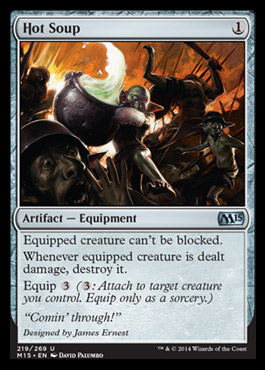
Hot Soup

hot soup

I'm not 100% convinced this isn't a card from the third "Un" set. The only way this card could have more flavor is if it were made out of actual soup. This reference to something as mundane as food just seems.. jarring. It's like 15 minutes of an episode of "24" focusing on Jack taking a dump or buying a latte. I'm sure people on these planes eat, I'm just not used to hearing about it. How many cards reference food? Blessed Wine? Morsel Theft? Fresh Meat? Off the top of my head, that's all I can come up with. Not much financial relevance here, but I hear unblockability is useful in limited.

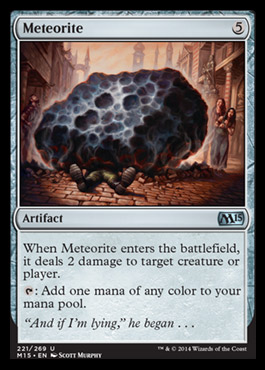
Meteorite

meteorite

You want this in limited. I'd rather it tapped for 2 colorless, but this is a great way to splash a bomb in. Removal that goes in every deck and helps mana issues is pretty solid. 5 mana is not insurmountable, either, so I'm all about it. Grab foils of this for some weirdo's cube? Naw, no financial relevance here, either.

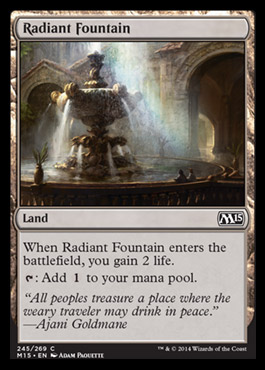
Radiant Fountain

radiant fountain

Here is a card that Spikey players are taking an actual look at. This is obviously no replacement for Mutavault but it's worth watching how testing pans out. Obviously there isn't a ton to be made on these if they're common, but these will likely be discarded on tables and will be worth picking up. Watching this card is less about what this card does and more an exercise in paying attention to what spikes are saying. I'm a decent Magic player but I won't pretend I think my opinion on card evaluation is good enough that it's the only one I listen to. I go with my gut a lot, but I love to crowdsource my ideas about spoiled cards. Individuals may whiff, but the masses are generally pretty astute. That is if you know which groups to listen to and which to ignore. Personally, I think the gang in the QS forums have great instincts and I'd bounce ideas off of them if you are wondering about upcoming stuff. Will Radiant Fountain make you any money? Not likely. But something in the set well. Did you know Spikes were talking about whether this card fits in somewhere? What else are they talking about that you've missed?

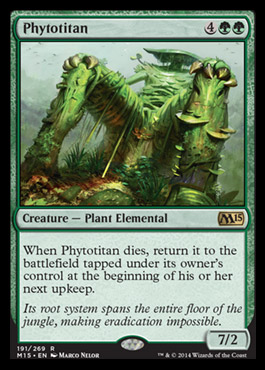
Phytotitan

phytotitan

I think this guy was spoiled already but he showed up in the spoilers again. Do we want a titan of phyto? He could be a decent beater every other turn and smash their best dude, but he seems like a bulk rare to me. His ability precludes infinite loops or blocking every turn so he is just a durdly, value dude. Probably annoying in limited. Probably bulk. But if I notice some spikey players trying to break this dude in standard, you'll be the first to know.

Avatar photo

Jason Alt

Jason Alt is a value trader and writer. He is Quiet Speculation's self-appointed web content archivist and co-captain of the interdepartmental dodgeball team. He enjoys craft microbrews and doing things ironically. You may have seen him at magic events; he wears black t-shirts and has a beard and a backpack so he's pretty easy to spot. You can hear him as co-host on the Brainstorm Brewery podcast or catch his articles on Gatheringmagic.com. He is also the Community Manager at BrainstormBrewery.com and writes the odd article there, too. Follow him on Twitter @JasonEAlt unless you don't like having your mind blown.

View More By Jason Alt

Posted in Free, M15Tagged , , , 27 Comments on You Guys Are Spoiled

Have you joined the Quiet Speculation Discord?

If you haven't, you're leaving value on the table! Join our community of experts, enthusiasts, entertainers, and educators and enjoy exclusive podcasts, questions asked and answered, trades, sales, and everything else Discord has to offer.

Want to create content with Quiet Speculation?

All you need to succeed is a passion for Magic: The Gathering, and the ability to write coherently. Share your knowledge of MTG and how you leverage it to win games, get value from your cards – or even turn a profit.

Insider: [MTGO] Nine Months of Portfolio Management – M14 and Core Set Rares

Are you a Quiet Speculation member?

If not, now is a perfect time to join up! Our powerful tools, breaking-news analysis, and exclusive Discord channel will make sure you stay up to date and ahead of the curve.

Two weeks ago I wrote about the core set mythics and how my experiment with the fifteen M14 mythics ended up well. Systematically buying all the mythics soon after their release seems to be a viable investment strategy with virtually no risk, provided you are not too greedy.

Today I take a look back on what happened with the entire set of M14 rares. We'll see that more than a dozen of M14 rares were played at some point in Standard decks and, consequently, saw a nice increase in price that could have been converted to profit.

First, let's talk about the two M14 rares I primarily focused on during these nine months.

Chandra's Phoenix

There was an error retrieving a chart for Chandra's Phoenix

Unlike Modern specs and other cyclical investments, investing in the Phoenix (and Mutavault) related more to pure speculation. We had some playability and price history available for the Phoenix and the man land. Nothing, however guaranteed that Chandra's Phoenix would see play in the next Standard.

A the time, not much was known of Theros, therefore I invested in the Phoenix based on key elements we knew back then, which I briefly discussed on the QS forums:

  1. Back in M12, Chandra's Phoenix was widely played in mono red decks.
  2. Mono red aggro is pretty much always a viable deck, and is usually more popular on MTGO than in paper MTG for cost and accessibility reasons.
  3. In addition, The PT Dragon's Maze showed that Return to Ravniva block cards already possessed a strong base for mono red aggro. Josh Utter-Leyton made Top 8 with an almost mono red aggro deck.
  4. When I got interested in the Phoenix, its price was in the 0.4-0.5 tix range. During its M12 era, the Pheonix spiked above 5 tix. The upside was big here.

Take these reasons together and you'll realize the potential was clearly there. I was expecting the M14 Chandra's Phoenix to settle somewhere in the 3 to 4 tix range.

After the PT Theros, the Phoenix stabilized and fluctuated between 2 tix and 3 tix. Without any obvious sign that it could go higher, I sold my position with a nice +363% profits.

Mutavault

There was an error retrieving a chart for Mutavault

Mutavault was first printed more than five years ago in Morningtide. Its price fluctuated quite a bit between 10 and 20 tix, and Mutavault was already played in some Modern and Legacy decks. When it was announced to be in M14, its price rose a little bit then dropped to about 6 tix with the fresh supply.

Things were not sure at first for Mutavault. How would this land integrate into a supposed multicolored Standard format, defined by Return to Ravnica sets and its shock lands?

Even If I was seeing some opportunities in the beginning, I was not totally convinced. After all, 6 tix for a rare is already quiet high, and any rare needs a fair amount of play to sustain such a price.

After the first tournament results with Theros, this could not be more obvious.  Mutavault was simply everywhere.

Not only were all aggro and midrange decks running three to four copies of the man land, but UW and Esper control decks too! When aggro and control decks are playing the same card, you know you have a winner.

At this point, investing in Mutavault was a no brainer. However, I was far from imagining the success it could have had. I was seeing the land to settle in the 10-12 tix range, pretty far from where Mutavault actually landed.

To note, Scavenging Ooze had about the same price tag at the time--around 6 tix. However, even if the ooze is a great card, I was really not so sure of how useful the creature was in Standard and/or Modern. With too much uncertainty and nothing concrete to sustain the price, I simply skipped it as a speculation.

Finally, Mutavault achieved tremendous success, reaching 30 tix and becoming the most expensive rare in the MTGO mythic era. I started to sell a few copies at ~15 tix, and following the trend sold the rest of my stock around 20 tix.

With no idea this could go to 30 tix, and 20 tix already being a record high, I was very happy with that.

In the end, I almost tripled my investment here.

What About The Other Rares of M14?

In the yearly agenda of set releases, the core sets have a special position. They are released during the summer, only about two months before the release of the first set of the new block in fall. They are the Standard set to be the least drafted among the Standard sets. To compensate this, and unlike the second and third sets of regular block sets, the core sets are drafted three boosters at a time.

However, and again unlike most of the second and third sets of regular block sets, the core sets are large, with 53 rares and 15 mythics.

Everything together contributes to make the core sets a sort of 4th large set. In terms of prices, this means cards tend to be less available, and therefore more valuable in the end. Nonethless, during the first two to three weeks, rares and mythics from the core sets are primarily treated as any other rare and mythics, e.g. their prices are low. Too low.

To illustrante this idea, many M14 rares have seen big swings, moving from low prices to fairly high prices.

For instance, and in addition to Mutavault and Chandra's Phoenix, Lifebane Zombie jumped from 2 tix to 9.5 tix (+375%), Fiendslayer Paladin jumped from 0.8 tix to 4 tix (+400%), and Imposing Sovereign went from 0.2 tix to 3.8 tix (+1800%).

Witchstalker moved from 0.4 tix to 2.5 tix (+525%), Xathrid Necromancer from 0.4 tix to 5 tix (+1150%), and Burning Earth saw an increase of +320%, moving from 0.7 tix to 3 tix.

Finally, Tidebinder Mage jumped from 0.1 tix to 2 tix (+1900%), Dark Prophecy moved from 0.1 tix to 0.6 tix (+500%) and Ratchet Bomb went from 0.3 tix to 1.3 tix (+330%).

These are the most successful of the M14 rares, impressive percentages, isn't it?

There was an error retrieving a chart for Fiendslayer Paladin
There was an error retrieving a chart for Xathrid Necromancer

Still, M14 has about the same number of tournament (mostly Standard) playable cards as Return to Ravnica and Theros sets--about a dozen. Some cards from Return to Ravnica, such as Pack Rat, Desecration Demon and Underworld Connections boomed from junk to super stars in their second year of Standard. For most of the other playable rares, they moderately fluctuated by a factor two or three at most.

The "4th set factor" of M14, and of core sets in general, allows the rares to experience higher swings. Also, you don't have to wait one year to see the some action. Core sets are here to stay only one year in Standard--no time for sleepers.

In terms of timing, pretty much all M14 rares experienced their lowest right before and/or during Theros release events and got a boost after the PT. Nonetheless, each rare found its peak at different times, according to the Standard metagame and trends. As you can see in the examples cited above, when a card is getting trendy, it doesn't do it half way.

Looking even more closely, speculating on the M14 rares could have been as good as the speculation I made with the M14 mythics. Prices of rares had pretty much all bottomed about one and a half to two months after M14 release. If you are able to carefully select potential winners, this could be a very interesting move. Since the bottom of almost all the rares has been reached, the risk is very small, and the upside extremely high.

Aside from Mutavault and Chandra's Phoenix, being reprints where we have an idea of their potential, all the other cards I cited were new. Avoiding obvious junks, reprints or first prints, and then carefully selecting the potential winners may be a good speculative strategy.

M15

For sure, I'll look twice now at the core set rares, starting with M15. The only catch to this strategy with M15 is that we'll have a PT Standard right during the release events of M15 on MTGO. Prices might be upside down with a Standard format poised to radically change two months from after this PT.

Since Standard appeal is already decreasing on MTGO, I really wonder what kind of effect the PT will have on the prices of not only M15 cards, but also Return to Ravnica block and M14, knowing that they are nearly dead within the MTGO economy.

With the successful examples of Chandra's Phoenix and Mutavault, my primary targets among the M15 rares will be the reprints of past cards that were seen in past competitive Standard decks. If cards such as Phantasmal Image, Champion of the Parish or Dungrove Elder are in M15, be sure that I'll grab several dozen copies of them a bit before Khans of Tarkir release events.

There was an error retrieving a chart for Phantasmal Image
There was an error retrieving a chart for Champion of the Parish
There was an error retrieving a chart for Dungrove Elder


Thank you for reading!

Sylvain Lehoux

Insider: Odds and Ends

Are you a Quiet Speculation member?

If not, now is a perfect time to join up! Our powerful tools, breaking-news analysis, and exclusive Discord channel will make sure you stay up to date and ahead of the curve.

Happy June! I usually prefer to have a theme for my articles, but today I have a few smaller topics to address. There’s lot going on in the world of Magic: The Gathering and much of it is financially relevant. So let’s get into it.

Standard Rotation

It’s June now, which means we’re beginning to see the price floor on Standard cards from Theros block. The time to buy is in the next two to three months, and the time to sell (in general) will be immediately after the release of the fall set, Khans of Tarkir.

We’ll be finding out more information about Khans at San Diego Comic Con, which is in July. I’ll be watching for any hints at that panel which may indicate how next year’s Standard environment will shape up.

Any hints that mono-color will be a theme or that aggro will be strong in the new meta will be useful information to guide purchasing decisions. In the meantime, picking up generally powerful and underpriced playables from Theros block (as I’ve gone over in recent articles) continues to be the play.

Conspiracy

Conspiracy seems to be a cube drafter’s dream, and I’m looking forward to picking up all kinds of goodies to add to my list. However, I’m looking to do this through drafting the set and making trades. Preordering anything here seems ambitious, as many of the cards in the set are good only in Cube, a one-of format that doesn’t create as much demand as competitive formats or its more popular casual counterpart, Commander.

There are some rather sweet reprints in this set, though, and it’s worth keeping an eye on their prices, as picking up copies at their floors should be profitable.

Both Altar of Dementia and Stifle have grown in price in the last year and should see some of that growth reverse once new copies start hitting the market. This is Stifle’s first non-foil printing in the soon-to-not-be-modern frame (and remember, strange as it may seem, some people dislike foils—I’m one of them), and Altar of Dementia hasn’t been printed since Tempest, meaning no foils nor current frames until now.

The list of sweet older cards goes on and on. Pernicious Deed, Mirari's Wake, Exploration, Reflecting Pool, Swords to Plowshares, Misdirection, Brainstorm, and Edric, Spymaster of Trest are some of the ones I’m most excited to see in the set. Many of these have never before been seen in foil, the eighth-edition frame, or both. I may not like to play with or collect foils, but I sure like them as trade bait, and some of these will demand a great price.

As for the new cards: these are casual cards. They’re mostly preselling for laughably high prices, and the fact is that you don’t need anything from the set to be competitive in Legacy or Vintage at this point, whether or not there are playable cards in the bunch. Do you think Dack Fayden will continue to be priced at $60 from Vintage demand alone? This seems less than unlikely—it seems impossible.

My plan is to keep a close eye on the big hits for the casual crowd. Assuming the multiplayer draft format is popular enough to see drafts fire consistently, and also assuming that demand will be met (and there’s certainly mixed reports on whether or not that will be the case), cards should drop steadily as the set is drafted more and more, likely up until the release of M15. At that point, prices will have leveled out at their lows and we can look at buying in.

Commander 2013

Speaking of cards leveling out at their lows, Commander 2013 cards seem underpriced across the board. Now that these decks are becoming rarer on store shelves, we may have reached a price floor, and I expect an ascent during the coming year.

Perhaps due to doubling the number of Mind Seize on the market, True-Name Nemesis has fallen from the most expensive card in the set to—well, still the most expensive card in the set. But its price has been cut in half from its high of over $40, with some copies available on TCGplayer at less than $20.

Assuming no ban in Legacy, I’d be surprised if this didn’t reach back to its previous price within the next six months to a year. At the very least, I think it’s time to pick up a copy for my cube.

Two other cards were proclaimed “Legacy playable” when this set was released, but never really performed the way TNN did. Toxic Deluge ($10) and Unexpectedly Absent ($5) have both fallen considerably from their highs, and if these do ever make an impact on the format, this will look like a great buy-in price. However, the fact that this hasn’t happened yet makes me wonder if these have further to drop. I’m leaning toward the latter possibility for now.

If Sol Ring ($4) and Command Tower ($1.50) are annual reprints in the now-yearly Commander decks, these are no longer worth buying or holding. However, I believe it’s much more likely that Wizards will want to vary the types of cards being printed in these decks and will move on to other staples.

It’s too risky to go deep on these, but I think trading at these prices is a safe play. It’s hard to imagine Sol Ring at less than $4, even if it is an annual reprint.

Go to TCGplayer and sort this set by descending price. It’s shocking how few expensive cards there are here, and it feels inevitable that the market will correct itself. We have proven reprints and unproven new cards both, all priced well below where they should be. There are only four cards in the set with an average price of over $5. That doesn’t seem right at all.

Vintage Masters

I’m so torn when it comes to MTGO in general and Vintage Masters specifically. On one hand, we have the best game ever made, and on the other hand, we have two separate, barely-functional clients, both of which look and feel about 15 years out of date.

As of two months ago, I was very much in the mode of drafting on MTGO every day, sometimes multiple times. But then MTGO crashed during the finals of a draft and lost me over ten minutes of clock. I ended up losing because of it and was denied compensation under WOTC’s policies. This turned me off in a big way, and in the two months since, I’ve drafted on MTGO only four times: two JNT drafts and two Cube drafts.

I assumed one of those formats would relight my fire for MTGO, but I’m just not feeling it so far. With Vintage Masters coming, I was sure that I would be psyched beyond belief and completely ready to start amassing cards for a Vintage deck. But alas, I’m still not ready to jump back into Magic Online.

Whether or not this set is “worth it” as far as what cards are in it versus its price, I’m not currently planning to do any Vintage Masters drafts. There are a few reasons:

  1. An MSRP of $6.99 a pack seems like a cash grab. This set is not redeemable and costs Wizards no more money to run on MTGO than a normal set. It’s already iffy that packs cost the same on MTGO as in paper Magic, and it was especially hard to swallow with Modern Masters. In this case, there isn’t even a paper analogue to justify this higher price.
  2. A “special” rarity for Power just exacerbates the problem of the higher-priced packs. If the moxen had been printed at mythic rare, it would have been easier to stomach the high MSRP, but here we see WOTC essentially double-dipping: you need to open more packs than normal to get the best cards, but you also pay twice as much per pack!
  3. Ostensibly the idea of drafting this set is to get you started on building a Vintage deck. Don’t get me wrong: this would be a dream come true. But with two unstable clients, an uncertain future about MTGO’s stability, and the potential market crash that may be caused by the permanent switch to the Beta, I’m extremely hesitant to start dumping hundreds (thousands is probably more accurate) of dollars into this ambiguous landscape.

If this turns out to be one of the best Limited environments in recent memory, I’ll probably change my tune. But as it stands right now, MTGO is a huge disappointment on a number of levels, and I’m not prepared to put money into a system that has caused me so much frustration.

Like most players, I’m eager for the MTGO landscape to improve to the level of the paper game that warranted its creation. In my dream world, I could play MTGO on my phone. Even Duels of the Planeswalkers on a smartphone would be great. SolForge has already made this happen and it’s a brand new game!

There are a lot of opinions on what we can do as players to speed along improvements in MTGO. I’m not sure which is right. For my part, I’m playing less MTGO these days than I have since I downloaded the program.

Part of this is protest, sure, but the larger part is that the unstable clients, long wait times, and questionable policies have just pushed me away. I’m not the first and I won’t be the last. I would love to be able to play Magic at my convenience. And considering the income this game generates, I have to wonder: why can’t I?

Thanks for reading.

Insider: The Biggest Loser (And Winner)

Are you a Quiet Speculation member?

If not, now is a perfect time to join up! Our powerful tools, breaking-news analysis, and exclusive Discord channel will make sure you stay up to date and ahead of the curve.

Greetings, Speculators!

I've gone into a lot of detail about the time I put into buylisting, but this week I wanted to try a different direction and see how it went. I spend a lot of time every week buylisting cards which involves sorting and alphabetizing and listing them. It requires a lot of referencing and since the prices are relatively kinetic, it doesn't involve a ton of memorizing because referencing is more effective and less likely to give you a false read. Still, buylisting is not the only activity that benefits from referencing.

I spend a significant amount of time each day checking the "market" to see which cards are trending upward and which are trending downward. Some price swings are profound and don't leave much time for you to benefit but can signal coming moves on other cards. Some price moves are very subtle and can serve as harbingers of more pronounced changes to come. I wanted to look at some of what went on this weekend with prices and see if there are some lessons we can learn from the data.

This week's article is a bit of an experiment in new formats for me, so if you like it, let me know I should do more. If you hate it, let me know that, too, and I'll hit you with some more solid buylisting advice next week.

It's good to get into the habit of checking card trends every morning and maybe this will get you in the habit. Without further preamble, here's what I came up with.

Winners

overlord

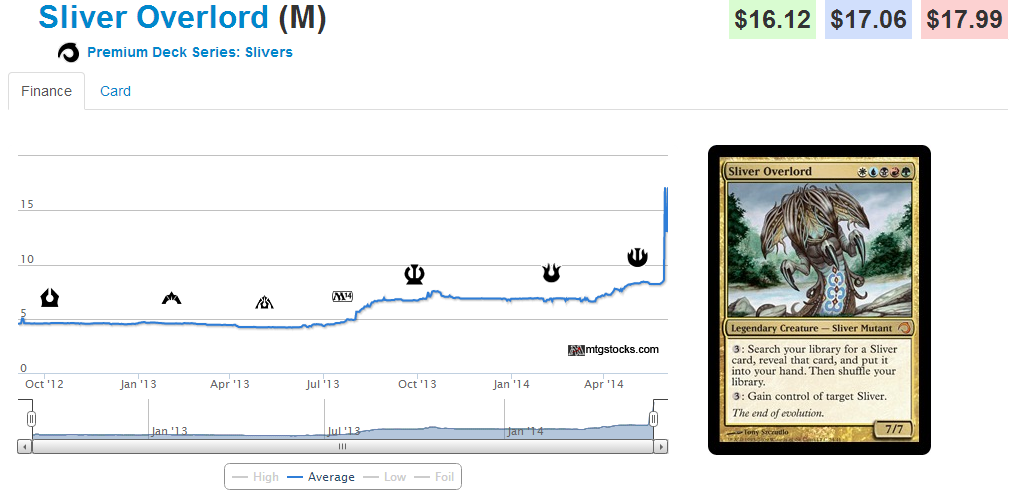
This weekend, Sliver Overlord from the premium Slivers deck went up nearly $4. This seems like a "whatever" sort of a move at first, but it's more interesting than all that if you give it a little credit.

First of all, this is significant in that the price for this premium deck foil with its inferior foiling is approaching the price of the set foil. Typically, cards like this settle between the normal set card and the set foil, and for sets as old as Scourge, it's typically closer to the non-foil. Indeed, Overlord sat very close to the non-foil for a long time. Until last summer, this version was actually cheaper.

It's incredibly significant for a premium deck foil to be the same price as a set foil. That is a very strong signal that EDH popularity is having a profound effect on the market. While the Scourge copies have barely increased by a dollar in the last two years, the premium foil has gone ballistic.

So while this is an obvious signal that EDH players want foil copies of a potential general, is there anything else that we can still invest in? I think if this card is a popular general, the non-foil staying stagnant may not continue. I think trading for them at $5 seems okay.

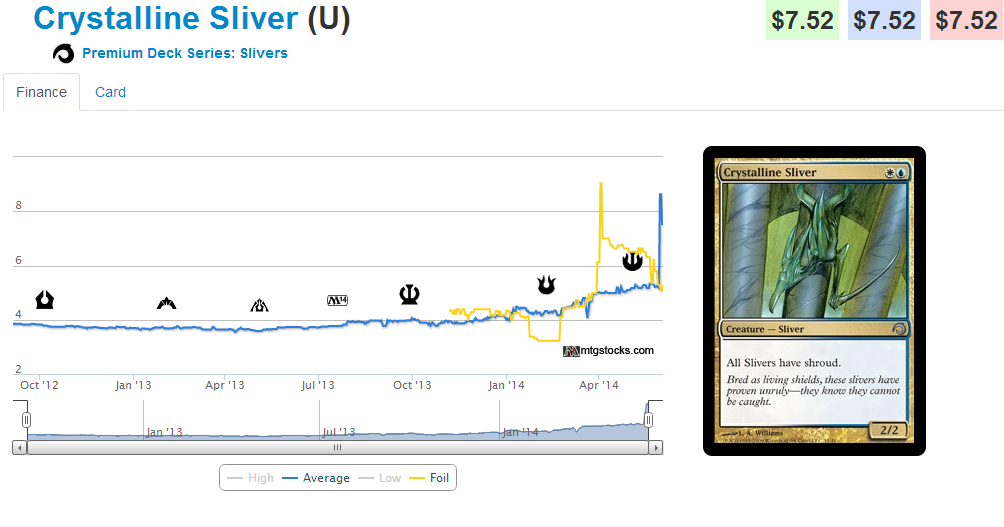
But the margin is higher for foil EDH cards, especially generals, and since generals are non-four-ofs, it's tougher for the price of a non-foil general to go out of control. Does this increase signal anything else? Well, if it signals that cards from premium decks can approach the price of set foils, we'd see that in other premium deck cards. Are any other slivers on the move?

overlord

overlord

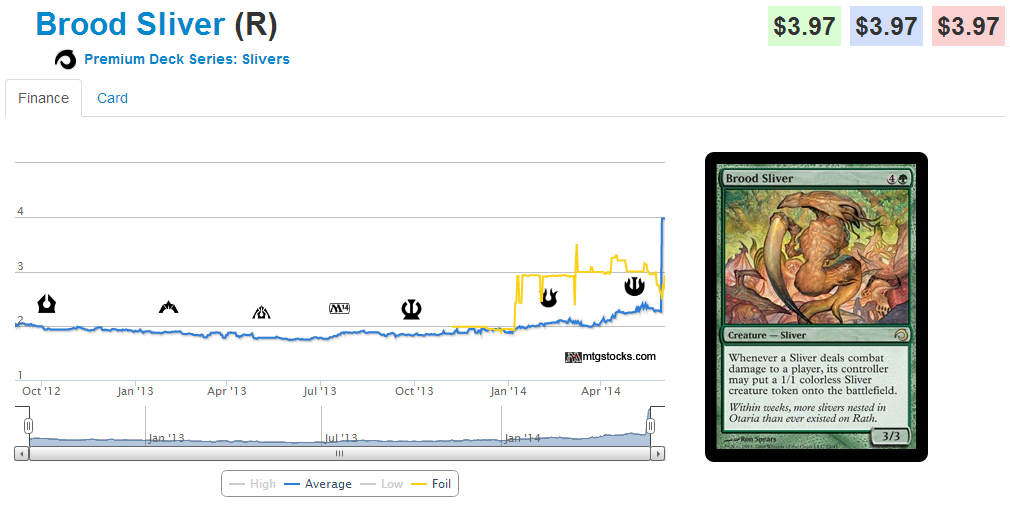
Here is the premium deck Brood Sliver (blue bar) graphed against the Legions foil (yellow bar). Below it is the Crystalline Sliver graphed against the rare FNM promo foil version. The premium foils, in the last week, have supplanted the set foil despite the inferior foiling on the premium card.

What could be causing this? A buyout? Scarcity? What we do know is that the conventional wisdom that premium foils more closely adhere to the non-foil price may not be such a rule.

I don't expect giveaway foils like Wurmcoil Engine or Restoration Angel to follow this trend. Also, the other all-foil premium deck, Fire and Lightning, didn't contain many cards with set foils to compare to for the decent rares.

Future all-foil offerings may be good early buy-in opportunities. A sealed Slivers deck just sold on eBay for $150. This is a real bucking of established historical trends and things like this are worth noting.

overlord

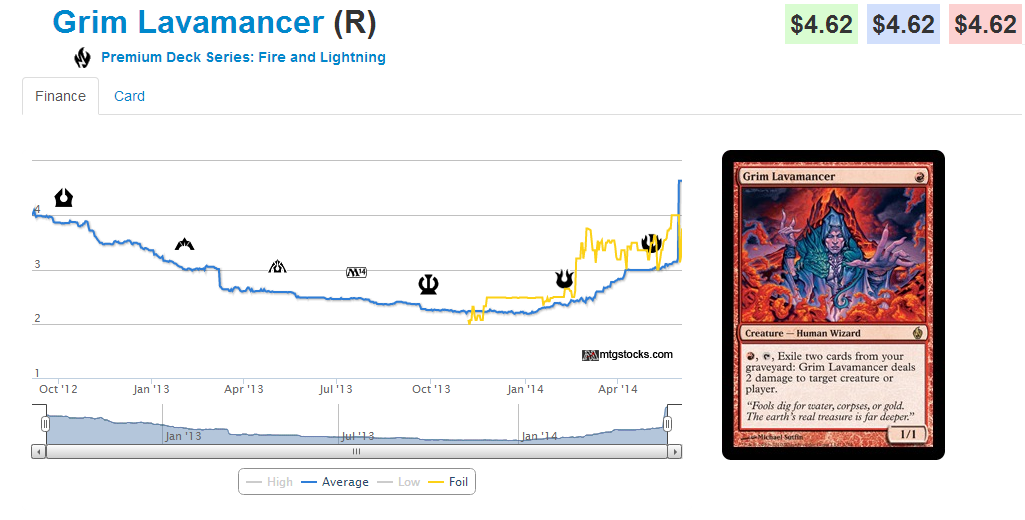
This trend falls apart a little when you have a card like Grim Lavamancer which has a $70 foil in Torment. Still, compared to the M12 foil on this chart, the premium version shot up this week. It seems like a lot of premium, FTV and other foils all went up at once.

Could this be the result of a buyout or a correction? It's hard to tell, but playable foils from premium sets are no longer the dogs they used to be. Even "bad" sets like From the Vaults: Legends saw quite a few increases this week.

overlord

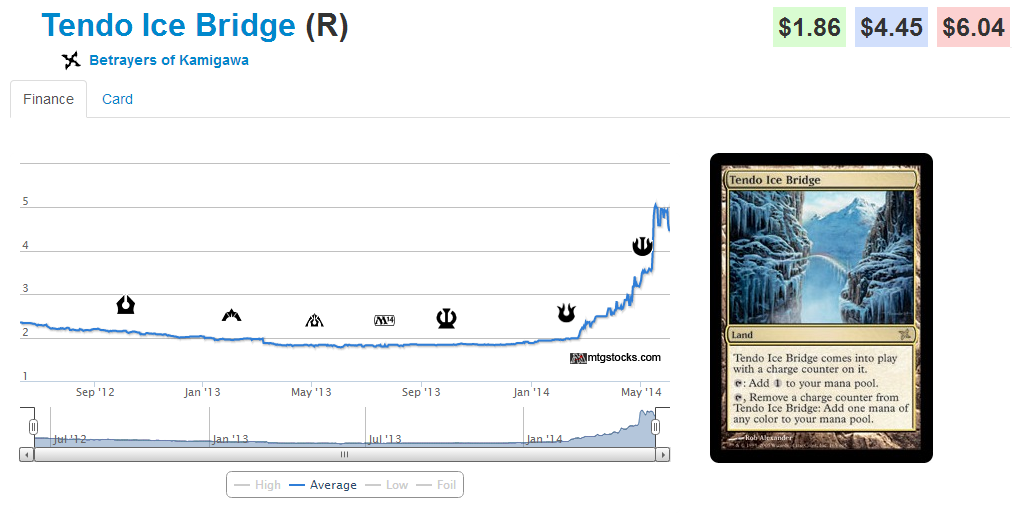
This trend is very interesting to me because this card is not good. It gets play in Modern in the Amulet of Vigor deck because you're able to return it with your bouncelands and replay it with cards like Azusa, Lost But Seeking and Summer Bloom, but in all other cases, this card is a dud.

The price increase seems entirely driven by speculation, but the ease at which a fringe card like this was driven up seemed based mostly on the low stock. Cards that don't seem like they are worth stocking are ripe candidates for this kind of buyout behavior.

A card like Amulet of Vigor had seen some play with previous iterations of the deck and stores were jammed with them after trying and failing to make money flipping them before. When Amulet spiked, old copies were dug out of bulk boxes, binders, and other places. When Amulet spiked again, everyone was ready because so many copies of it were loose and accessible.

Ice Bridge, on the other hand, was mostly socked away. With so few copies for sale, the price was vulnerable to a buyout, and any modicum of adoption was enough justification for a run on the card.

I imagine that copies priced at $4.50 or so are selling very poorly. Still, the things that differentiated Tendo Ice Bridge from a card like Amulet of Vigor can help us identify future cards that may behave in a similar fashion. A few criteria I could come up with are as follows.

  • The card hasn't been played in years. Ice Bridge saw play in block but almost none in Standard and none in EDH.
  • A low enough price that they are barely worth stocking, usually under $2.
  • A fringe enough effect that it only has applicability in one deck.
  • The deck that it is played in is fringe and likely not that good.
  • The stock on TCG Player can be bought for under $200.
  • Ideally the deck that runs it runs four copies.

If you look at a card like Sylvan Safekeeper, which seemed like a good spec when it first saw a blip in adoption in a Legacy sideboard, it doesn't really adhere to the list I came up with based on the weird spike in Ice Bridge.

Safekeeper was a one-of in the board, there were a lot of them in stock because it had been played quite a few different times in Maverick and other Legacy decks. More copies of Safekeeper were in stock in stores and that made it tougher to buy out and tougher to nail down enough copies to keep people from restocking at the old, low price.

There was an error retrieving a chart for Eidolon of Blossoms

Here's a card that saw a pronounced decrease in stock on TCG Player. The price hasn't caught up yet, which means there is opportunity here. I am bullish about this card just because I think it's a powerful effect. Powerful effects may or may not pan out, but if they have a strong showing in a block event right after the set comes out, people are going to buy in to brew at least. Eidolon of Blossoms has a long time to do work and these are disappearing across the net, which is a good sign.

There was an error retrieving a chart for courser of Kruphix

Courser is another card that has gone up a ton. It's probably too late to buy copies of this priced correctly, but we can learn quite a bit from this card regardless.

When Born of the Gods came out, it was clear that it was a small set with very few good cards. I anticipated a card like Spirit of the Labyrinth maintaining its inflated presale value. I was right about the effect of a card from a bad, small set mimicking Voice of Resurgence, but was way off base about that card not being Courser.

Playable in Modern, an all-star in Block and almost guaranteed to continue to impact Standard for another year, this card is a solid place to stash value.

It does follow the trend of Standard cards having a roughly 40% spread, which makes me want to try and buy a ton of these for their $10 buylist price and trade them for their $15ish retail value. If you pick up cards that haven't spiked yet or which have a much lower spread you can easily turn that initial investment of $10 per card into $12-$14 buylist just trading straight across. Dealers seem to have quite enough copies despite the recent price hike or the spread would not be quite so high.

This has room to grow, but I doubt it will be quite as ubiquitous in Standard post-rotation as it was in Block and the high spread coupled with the recent price peak makes this a good candidate for trading out.

Losers

overlord

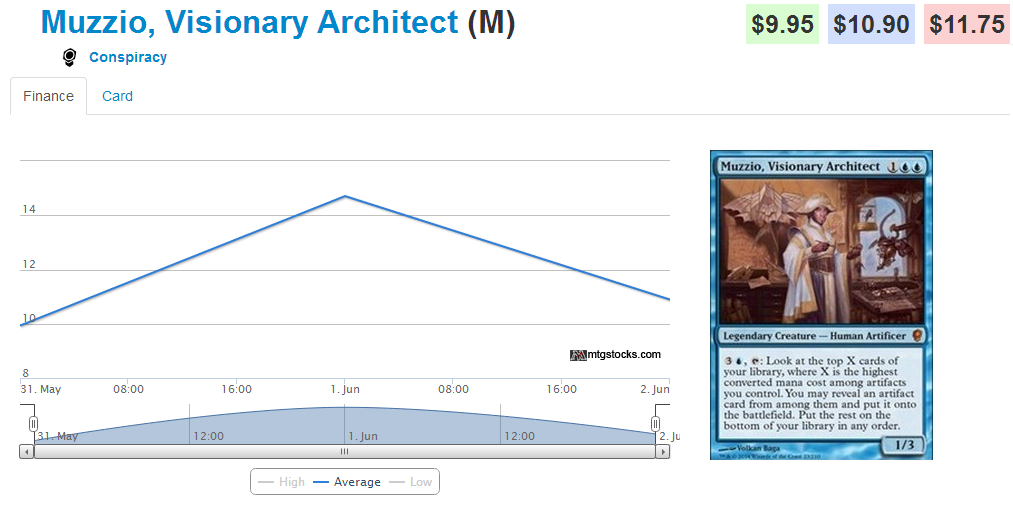
Muzzio didn't suddenly get worse. The set, however, suddenly got better. The spoiling of cards like Stifle, Pernicious Deed, Mirari's Wake and Edric, Spymaster of Trest took a lot of pressure off of cards like Muzzio. The EV of the set overall didn't change, but the amount of slack some of the newer cards had to pick up shifted.

If these cards can slip down so much on a whim, expect them to tank even more after the set has been drafted for a while. I am not bullish on picking these up for a long while. By "these" I mean Muzzio, Marchesa, Selvala, Brago and Grenzo. Brago seems like it can do a decent job of maintaining price but even a card as powerful as that is not impervious to the effect of so many packs of this set being busted in drafts. Let Muzzio represent this entire new cycle.

The cycle of "old" cards in gold in the set like Edric, Spymaster of Trest and Basandra, Battle Seraph are liable to tank a bit. Edric especially is on an artificial high right now after a good showing in Legacy, and this should cut him down to size. I wish I knew a way to short Magic cards.

overlord

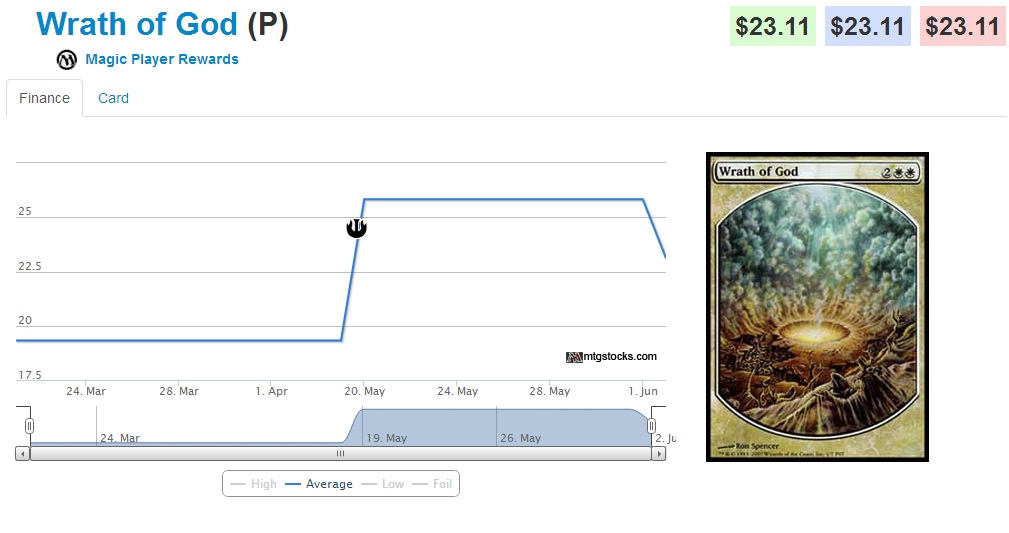
If I had to guess what caused this, I would say it was the announcement of FTV Annihilation and the spoiling of the new Wrath of God art in that set. The textless player rewards cards have been very solid gainers of late, and there's no real reason for this to eat it this hard. Still, let's not panic until it reaches its pre-May levels. This may be a correction for an artificial spike.

An Interview with Richard Garfield, Magic’s Creator

Are you a Quiet Speculation member?

If not, now is a perfect time to join up! Our powerful tools, breaking-news analysis, and exclusive Discord channel will make sure you stay up to date and ahead of the curve.

The man who started a movement. Or, more accurately, a lifestyle. Richard Garfield has impacted our lives in ways we can't even completely comprehend, and we all know how much Magic has meant to each of us.

jpg

That said, the man himself isn't involved in the day-to-day anymore. He helped work on Innistrad block and while you'll find his inspiration on everything in Magic these days, he's not making the cards themselves anymore.

With that said, we don't hear as much from Garfield as we do from someone like Mark Rosewater, who took a lot of Garfield's lessons and has used them to help advance Magic to where it is today. So it was awesome to read this interview that was done for Eurogamer. Definitely worth checking out.

Avatar photo

Corbin Hosler

Corbin Hosler is a journalist living in Norman, Oklahoma (also known as the hotbed of Magic). He started playing in Shadowmoor and chased the Pro Tour dream for a few years, culminating in a Star City Games Legacy Open finals appearance in 2011 before deciding to turn to trading and speculation full-time. He writes weekly at QuietSpeculation.com and biweekly for LegitMTG. He also cohosts Brainstorm Brewery, the only financial podcast on the net. He can best be reached @Chosler88 on Twitter.

View More By Corbin Hosler

Posted in Casual, Feature, Free2 Comments on An Interview with Richard Garfield, Magic’s Creator

Have you joined the Quiet Speculation Discord?

If you haven't, you're leaving value on the table! Join our community of experts, enthusiasts, entertainers, and educators and enjoy exclusive podcasts, questions asked and answered, trades, sales, and everything else Discord has to offer.

Want to create content with Quiet Speculation?

All you need to succeed is a passion for Magic: The Gathering, and the ability to write coherently. Share your knowledge of MTG and how you leverage it to win games, get value from your cards – or even turn a profit.

Insider: Benefits of Alternative Selling Outlets

Are you a Quiet Speculation member?

If not, now is a perfect time to join up! Our powerful tools, breaking-news analysis, and exclusive Discord channel will make sure you stay up to date and ahead of the curve.

Strategies to make profit from MTG Finance come in many shapes and sizes. Some people grind out trades while others strictly focus on buying and selling. Some invest in long term holds like Power and sealed booster boxes while others enjoy the thrill of Standard speculation. Some manage a small binder of cards while others handle budgets approaching six figures in size.

All of these strategies are fine if they are making people money effectively while also giving folks the thrill of the hunt.

While I enjoy making money in Magic regardless of the strategy, I must say my favorite opportunity for profit comes from buying underpriced cards and simply selling them at market rate. The risk to this strategy is virtually zero as profits of some sort are practically guaranteed. Most would agree that if they could simply buy underpriced cards all day and simply sell them at market price they would be happy to do so. The problem is, these opportunities are difficult to find.

Last week I came across such an opportunity – I found a NM Tropical Island on Card Shark for $123 shipped. The seller had a decent enough feedback rating (4.7) and I felt it was worth the gamble. Without seeing any scans of the card I pulled the trigger and made the purchase.

There was an error retrieving a chart for Tropical Island

First of All

Before I get into the meat of the article I want to take a moment to remind people about Card Shark. It has to be one of the most well-known yet overlooked buying option for Magic. When Dual Lands spiked I managed to pick up a few played copies at old prices. When Star City Games upped their buy price on Ancient Tomb to $15 I saw at least 10 copies under this price on Card Shark the next day.

There was an error retrieving a chart for Ancient Tomb

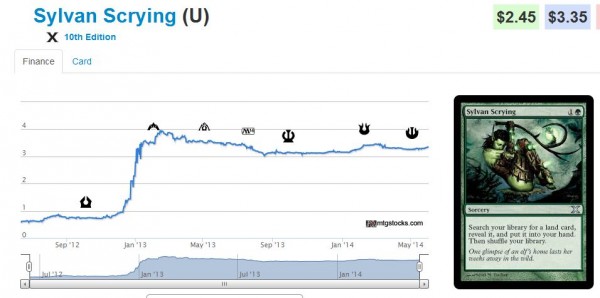
Even smaller cards can become worth purchasing on Card Shark if you can find sufficient copies to justify shipping. Right before Sylvan Scrying spiked I was able to find over a dozen copies priced at near bulk ($0.10-$0.25) from a single seller.

Scrying

Don’t forget to check for multiple printings too. Sometimes a seller may have just one or two copies of a card from a given set, but they may have a few more copies from a different printing. Do the math up front, and you’ll ensure you don’t get dinged on high shipping costs. /plug for Card Shark.

You’ve Got The Card – Now What?

Imagine my delight when the Tropical Island arrived in the mail less than a week later, and in Near Mint condition! Score another victory for Card Shark.

But having this piece of cardboard didn’t mean I had profited just yet. I needed to find an out for the card. Since I don’t get to local MTG events nearly as frequently anymore, I decided I would go for the sale. After all, I could use the cash.

The top buy list price on a NM Trop is currently $146. This number was higher than what I paid so naturally I considered this easy option. But when it comes to Dual Lands, card condition is very subjective and buyers will scrutinize ever square millimeter of the card. I’ve been burned on condition downgrades in the past, and I did not want to ship the card if I couldn’t get the NM price. To me, the risk of selling to buy lists wasn’t worthwhile, and stores I trust most like Star City Games and ABU Games were not paying nearly as much for NM copies.

I went to eBay next, where I saw NM copies of Tropical Island selling in the $155 range. This was definitely higher than what I paid, but eBay did not end my quest to sell this Dual Land. After a 10% fee to eBay, 2.9% + $0.30 fee to PayPal, and $2 for shipping I would be down to about $133 net funds. Yuck! I would rather risk shipping this card to a less-trustworthy retailer and gambling on their grading.

Near Mint Tropical Islands go for substantially higher on TCG Player, but I wasn’t so confident in this outlet either. Besides the fact I have no selling account on TCG Player, I also recognized the likelihood that my card would sit on the site for extended periods of time without selling. Even after a sale, I would still incur a sizable fee and I’d have to wait days or even weeks just to get paid. Finally, there is still the risk a buyer receives my card and disagrees on condition.

Alternative Selling Outlets

None of the traditional selling options were very enticing. All I wanted was a quick flip for reasonable profit without having to worry about an unsatisfied buyer. Fortunately there are other selling outlets worth considering, and while they may not increase your profits directly they may provide some non-monetary benefits in the long run. Allow me to explain further.

Selling cards on sites like TCG Player and eBay is incredibly impersonal. A few clicks and you buy cards from generic seller ABC. No connection is made and no relationship is developed.

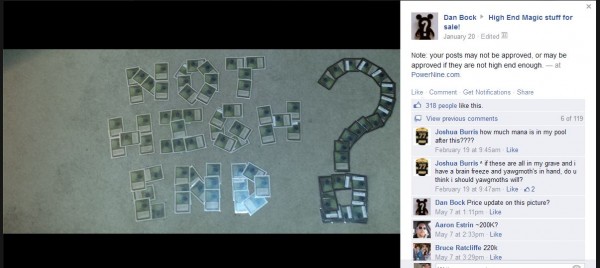
Not so when selling through other means. Selling in the QS forums connects you to other QS Insiders while also developing your reputation within the community. Selling on MOTL will at least net you references while also enabling you to avoid unnecessary fees. You could also sell in the Facebook group “High End Magic Stuff for Sale”. Selling here has the potential to connect you more personally with other members of the MTG Community. Some big names frequent this Facebook group, connecting you with major players who have over $100k in MTG inventory. These are worthwhile connections if you know how to use them.

High End

One suggestion I have is to price your card at roughly 5-10% below TCG Low / eBay completed listings. You may net the same profit number by passing savings onto buyers, but you also make personal connections. I’ve bought a number of cards from sellers this way, and I take note who is willing to give a deal to enable a quick sale. By avoiding fees and passing the savings to the buyer, you can earn a positive nod from members of the MTG community. Enough of these and you develop a reputation, making it easier to sell cards in the future.

You can also sell cards through Twitter. Again, having the right connections here is critical. You may not have a large Twitter following, but if you relay a few good deals to big-name players to prove your credibility, they may be willing to retweet sales for you. Just make sure the deals are reasonably priced – trying to sell cards at TCG mid on Twitter will get you nowhere. But the right pricing should allow you to net greater profits than what you’d earn on eBay or TCG Player.

Food For Thought

When selling cards, I encourage you to think outside the box. Traditional outlets such as eBay and TCG Player can be frustrating. You need to wait long periods of time for a sale and fees really eat into profits. Why pay eBay 10% when you could pass that 10% onto the buyer while also helping you develop your network? The bottom line may not increase by much in the short-term, but relationships do pay dividends over time.

What happened to my Trop? When I tweeted about my the purchase, a Twitter follower asked me to tell him when the card arrived. When I confirmed it was NM/NM-, I sent pictures to the Twitter member and he expressed interest. Going through the process described above, I decided to charge him top buylist + shipping. This nets me a higher number because my shipping is covered, and I avoid disagreements on condition because he saw the card’s condition via pictures. I made more than I would have on eBay too because I had no fees to incur To top it all off I strengthened my relationship with someone on Twitter, who may be inclined to buy cards from me in the future as well.

All in all the deal was very favorable for all parties. These win-win scenarios require compromise, but the resulting payout can accumulate nicely. Before you know it you’ll have a strong reputation in the MTG Finance community, and people will contact YOU when they want to buy something. It takes time to develop these connections, but the cost is nearly zero when compared to all the fees incurred from selling through popular channels.

…

Sigbits

  • First off I would be unjust if I didn’t call out SCG’s recent restocking of Vintage staples. They were out of stock on many high end cards for a long time, but all of a sudden they restocked a ton. Perhaps they were waiting to see where the market settled? Either way, they now have 20 ungraded Moxen for sale where as last week they had 1. They also stocked 9 Bazaar of Baghdads. The duration of time it takes for these cards to move will provide an accurate read of Vintage market strength.
  • SCG is sold out of Temple of Malady with a $9.99 price point. The G/B Temple quickly became one of the most desirable due to its utility in the current Standard environment and smaller print-run. This one may be most popular now, but I expect nearly all of the Temples will have a chance to shine once Standard rotates. I’ll still trade for any of the cheaper Temples when I get the opportunity, though I’m refraining from putting out more cash at this time.
  • The Judge Promo Force of Will is dropping back to reality very quickly. After a quick stint at $1000, these are now retailing for $799.99. I’ve seen sellers go as low as $650 to move their copies and I don’t think the bottom is here just yet. To be fair, I have no interest in these – but just in case others are getting itchy fingers I encourage you to wait a little longer before pulling the trigger. The same goes for most of the other new Judge Promos as well.

Insider Video: Zwischenzug Plays Angel-Pod

Are you a Quiet Speculation member?

If not, now is a perfect time to join up! Our powerful tools, breaking-news analysis, and exclusive Discord channel will make sure you stay up to date and ahead of the curve.

The Deck, as Compared to Melira-Pod

Untitled Deck

Creatures

4 Birds of Paradise
3 Noble Hierarch
1 Wall of Roots
1 Wall of Omens
1 Scavenging Ooze
1 Qasali Pridemage
3 Voice of Resurgence
1 Spike Feeder
1 Eternal Witness
2 Kitchen Finks
1 Blade Splicer
1 Orzhov Pontiff
1 Linvala, Keeper of Silence
1 Murderous Redcap
3 Restoration Angel
1 Archangel of Thune
1 Shriekmaw
1 Reveillark

Other

2 Thoughtseize
2 Abrupt Decay
4 Birthing Pod
1 Chord of Calling

Lands

4 Marsh Flats
4 Verdant Catacombs
1 Plains
2 Forest
1 Swamp
1 Godless Shrine
2 Temple Garden
2 Overgrown Tomb
3 Razorverge Thicket
3 Gavony Township

Sideboard

1 Path to Exile
1 Slaughter Pact
1 Dismember
1 Entomber Exarch
2 Thoughtseize
1 Lingering Souls
1 Eidolon of Rhetoric
1 Thrun, the Last Troll
1 Sin Collector
1 Harmonic Sliver
1 Spellskite
1 Scavenging Ooze
1 Kataki, War's Wage
1 Obstinate Baloth


Round 1

There was an error retrieving a chart for Birthing Pod

Round 2

There was an error retrieving a chart for Restoration Angel

Round 3

There was an error retrieving a chart for Archangel of Thune

Round 4

There was an error retrieving a chart for Voice of Resurgence

Helping One Of Us

Are you a Quiet Speculation member?

If not, now is a perfect time to join up! Our powerful tools, breaking-news analysis, and exclusive Discord channel will make sure you stay up to date and ahead of the curve.

Thursday night, a member of our community was walking home from taking a final exam when she was hit by a car. Her injuries are severe and it is doubtful she will ever walk again. Her hospital stat, convalescent care and the handicap-accessibility modifications that need to be made to her family's home are going to cost a fortune. It is times like these that we have an opportunity to pull together as a community and help out.

Giveforward.com is a website where groups can start fundraisers for medical expenses. Mariah's family has started a campaign and if you are interested in making a donation to help out one of our own, the page is right here.

If you aren't inclined to donate you can still help out. The page has several links for you to share the campaign with your social networks. Please share Mariah's story with your facebook friends and get the word out there. For those of us who have never met Mariah, she's a wonderful person and she didn't deserve this horrific accident. Please so what you can to help out. When one of us is in trouble, the entire community suffers and any little bit counts.

Avatar photo

Jason Alt

Jason Alt is a value trader and writer. He is Quiet Speculation's self-appointed web content archivist and co-captain of the interdepartmental dodgeball team. He enjoys craft microbrews and doing things ironically. You may have seen him at magic events; he wears black t-shirts and has a beard and a backpack so he's pretty easy to spot. You can hear him as co-host on the Brainstorm Brewery podcast or catch his articles on Gatheringmagic.com. He is also the Community Manager at BrainstormBrewery.com and writes the odd article there, too. Follow him on Twitter @JasonEAlt unless you don't like having your mind blown.

View More By Jason Alt

Posted in Free3 Comments on Helping One Of Us

Have you joined the Quiet Speculation Discord?

If you haven't, you're leaving value on the table! Join our community of experts, enthusiasts, entertainers, and educators and enjoy exclusive podcasts, questions asked and answered, trades, sales, and everything else Discord has to offer.

Want to create content with Quiet Speculation?

All you need to succeed is a passion for Magic: The Gathering, and the ability to write coherently. Share your knowledge of MTG and how you leverage it to win games, get value from your cards – or even turn a profit.

The New Kid in Theros Town

Are you a Quiet Speculation member?

If not, now is a perfect time to join up! Our powerful tools, breaking-news analysis, and exclusive Discord channel will make sure you stay up to date and ahead of the curve.

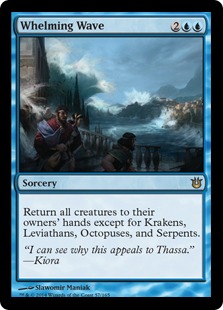
Sphinx's Revelation. Desecration Demon. Pack Rat. Whelming Wave.

One of these is not like the other.

Or is it?

Your newest Constructed staple?

Most of the cards on that list are easily recognizable as Constructed staples. Whelming Wave, despite the awesome flavor, has not been recognized as a powerful card to play in 60-card decks. Until now, I guess?

Anyway, check out this Mono-Blue deck. I know Mono-blue isn't anything new in Standard, but it sure is in Block, which is where this particular deck originates. Midway through Day One at Grand Prix Manchester several of its pilots are doing pretty well, which means our dreams of winning with sweet cards like Scourge of Fleets is still alive.

And really, what could be more fun than that?

Avatar photo

Corbin Hosler

Corbin Hosler is a journalist living in Norman, Oklahoma (also known as the hotbed of Magic). He started playing in Shadowmoor and chased the Pro Tour dream for a few years, culminating in a Star City Games Legacy Open finals appearance in 2011 before deciding to turn to trading and speculation full-time. He writes weekly at QuietSpeculation.com and biweekly for LegitMTG. He also cohosts Brainstorm Brewery, the only financial podcast on the net. He can best be reached @Chosler88 on Twitter.

View More By Corbin Hosler

Posted in Feature, Free, Journey Into NyxTagged , , , , Leave a Comment on The New Kid in Theros Town

Have you joined the Quiet Speculation Discord?

If you haven't, you're leaving value on the table! Join our community of experts, enthusiasts, entertainers, and educators and enjoy exclusive podcasts, questions asked and answered, trades, sales, and everything else Discord has to offer.

Want to create content with Quiet Speculation?

All you need to succeed is a passion for Magic: The Gathering, and the ability to write coherently. Share your knowledge of MTG and how you leverage it to win games, get value from your cards – or even turn a profit.

Insider: Lessons from Vintage Masters

Are you a Quiet Speculation member?

If not, now is a perfect time to join up! Our powerful tools, breaking-news analysis, and exclusive Discord channel will make sure you stay up to date and ahead of the curve.

If you’ve been reading this column, you know that we focus on how you can play more Magic Online for your gaming dollar through playing smarter and managing your portfolio better.

Friday provided a rare opportunity: a pre-announced market disruption that could result in major profits or losses. If you’d been following the conversation in the forums you were prepared and knew the full Vintage Masters card list would go up Friday--most likely midnight ET--on the mothership.

You also knew which cards to Ctrl-F the minute after midnight and what to buy and sell. Fortunately, Douglas Linn also sent out an Insider Alert, so for those not following the MTGO forum you still had a chance preserve and increase your portfolio if you happened to be near a laptop.

It’s important to be prepared for these events since the window of opportunity is extremely narrow. Bots sell out and adjust prices within 15 minutes and finding an open bot can be an exercise in futility. It was bedlam.

ICAP Brokers Continue To Trade During Financial Turmoil

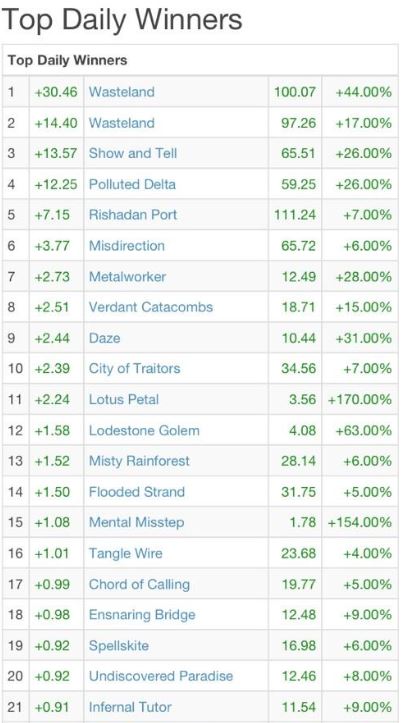
Wasteland jumped from 65 tix to 100 tix within the hour. Show and Tell, Sneak Attack, Rishadan Port, City of Traitors, Misdirection, Daze, Lotus Petal, Red Elemental Blast, Mental Misstep, Polluted Delta and other Eternal staples all jumped by 10-25% in a day.

Meanwhile, Vampiric Tutor, Ancient Tomb, Gush, Brainstorm and many other cards continued their free fall.

I've taken plenty of lumps over the past couple weeks, but was able to partially offset them with gains on Friday night. I’m guessing many subscribers made up for the cost of their annual Insider subscription on Friday alone.

Wasteland was atop the charts 24 hours after the VMA set list hit the web
24 hours after the list hit, Wasteland topped the charts.

In previous articles we predicted that new demand for Vintage would put upward pressure on all cards not reprinted.

But my view has been that the biggest beneficiary of Vintage Masters will be Legacy cards that aren’t reprinted. Legacy is a far more accessible and popular format than Vintage will ever be, and draws on a massive player base cultivated by the Star City Games tournament series.

These are not especially bold calls, and lots of people had the same idea. That said, it’s good to see that these trends have been validated over the past couple weeks. After hitting bottom last week (a result of pre-spoiler selloffs), the Legacy index has seen 5% growth over the past week. This bump is purely a result of speculation and players buying back staples they had sold as an insurance against reprints.

The Legacy Index rebounded 5% but is still down from its peak.

If players really adopt Legacy (as I predict they will after VMA launches) we are going to see a second ceiling. It won’t show up right away in the index since prices will continue to drop on reprinted cards, but many Legacy staples not in VMA still have room to grow.

Some cards are in a speculative bubble, but for many we haven’t hit the ceiling. We should see a second bump in Legacy once dual lands and Force of Will hit circulation and people start building decks...and realizing that they need that playset of Daze and that pair of Misdirection for the sideboard.

With VMA, Legacy has become a much more accessible format. However, even as overall cost of entry falls, there is a new set of “bottleneck” cards—especially Wasteland.

[pullquote]Wasteland and Rishadan Port are going to replace Force of Will and Lion's Eye Diamond as the most expensive cards in Legacy, but overall the format will be getting much more accessible.[/pullquote]While it is no doubt a barrier to entry, I don’t think the absence of Wasteland alone will be enough to stunt the growth of Legacy online. Wasteland is not ubiquitous.

For example, it is not played at all in combo decks: Show and Tell, Storm, High Tide, Belcher, Dredge, Reanimator, Painter’s Servant, etc. It is also not required for control strategies like U/W Miracles or Tezzeret. One of the best aggro decks, Affinity, does not play it. In midrange decks that do play it (Jund, Shardless Bug, etc) it usually appears as a two-of.

So it is very possible to build a large number of competitive Legacy decks without Wasteland, though you will need a playset to build a proper "gauntlet" for testing.

This month Force of Will (orange) and Wasteland (blue) flipped places as the barrier to entry for Legacy.

What Does the Absence of Wasteland Mean?

[pullquote]Wizards decided they didn’t need Wasteland to sell the set or the format, and that they could wait for another opportunity to monetize the equity locked up in those high-value cards.[/pullquote]It would have been easy to print Wasteland without warping the limited format—simply put it in place of Strip Mine, a card which is more degenerate and for which there is no price pressure.

This decision suggests to me that WOTC deliberately held Wasteland in reserve, along with several other key Legacy staples. Wizards decided they didn’t need Wasteland to sell the set or the format, and that they could wait for another opportunity to monetize the equity locked up in those high-value cards.

Wizards can’t directly profit from the rise of Legacy cards in paper, but by keeping some cards scarce they can profit from virtual printings of those cards. I believe that it’s only a matter of time before we see an announcement of the next virtual-only summer set: Legacy Masters. (Of course, it could take a couple years, and a lot will happen before then…)

Revisiting Our Portfolio: How Did We Do?

A lot of people smarter than me were wrong about what Wizards would reprint in Vintage Masters. Based on the initial announcement in October, we know that Vintage Masters was initially intended to be a much smaller set, akin to Modern Masters.

But in development, Wizards audibled to a new approach--a massive set packed with nearly everything Vintage-relevant. VMA would even include cards that had just seen a promo or special printing: dual lands, Force of Will, Lion's Eye Diamond, Jace, the Mind Sculptor.

In retrospect, most speculation prior to the May announcement was a swing and a miss. Kudos to Becvar for being virtually the only one to call this:

[pullquote]You didn’t need to test your trigger finger on Friday night to profit from the VMA spoiler: there was another far lower-risk approach available for several weeks…[/pullquote]Waiting for the spoiler was a good strategy if you could time things just right. But there were a number of reliable, low-risk strategies recommended in the forums and in recent articles.

One discussed in the forums (and in articles by myself, Sylvain, and Matt Lewis): load up a Modern-legal basket of Eternal playables that we knew wouldn't see a reprint.

In my May 17 article, I noted that "If you buy a portfolio of these cards you should do nicely in the mid to longer term. Some may see short-term gains as well." (Unfortunately, by the time the article came out, some of these cards had already increased because of speculation and represented less value.)

How did this strategy fare? I took a snapshot of these cards on May 17 and a snapshot today to see whether they had made any short-term gains.

These are the short-term winners. Only a couple big jumps; most of the gains were quite modest. One reason is that the market had been anticipating growth in these Eternal playables, so much of the upside was already priced in.

Two big winners were Lodestone Golem and Inquisition of Kozilek. It's interesting that Lodestone Golem spiked this week, since we have known for three weeks that it would not be reprinted because it is Modern-legal. If you bought them when that was announced on May 12 then you could get them for 0.50 and sell last week at 4 tix for a tidy profit.

Here were cards that remained stable (less than 5% increase or decrease.) From this list I like picking up Snapcaster Mage and Thalia during Innistrad flashbacks because they have crossover appeal in Modern, Legacy and Vintage. Griselbrand may also be underpriced, but ties up a lot of capital.

And here are the losers. Stony Silence and Geist of Saint Traft are Innistrad block cards that are being dragged down by flashbacks. Abrupt Decay is rotating in the fall, which explains its drop. Others are harder to explain.

I think all represent pretty good value in the coming weeks at their current depressed prices. Leyline of the Void, in particular, seems like a good pickup. Thoughtseize is also at a historic low and, as Sylvain mentioned in his article this week, is a multi-format all-star that will bounce back eventually.

In the past two weeks we didn't do great with these calls, and your money could have been better invested elsewhere. Being liquid was especially key on Friday night, so I'm glad I didn't go deep on these. But it's worth remembering that all of the cards above are longer-term plays, and are likely to continue their rise if VMA is heavily drafted and Legacy becomes a "real format" on MTGO.

In terms of very long plays, one of the best bets was advocated by Matt Lewis when VMA was first introduced in December 2012: Mental Misstep. For a long time you could buy them for 0.08. This week they hit 1.5 tix, and continue to climb. For each 10 you bought you earned yourself a free draft!

A ubiquitous Vintage card using phyrexian mana made this a high-demand card unlikely to see reprint. The same is true of Phyrexian Metamorph and Gitaxian Probe.

Legacy: in a Bubble or Underpriced?

By now, prices have reached a new equilibrium on most of the Vintage and Legacy staples. The question is whether this is the right equilibrium. In many cases it is not. For some cards, we find ourselves in a speculative bubble; if you missed the boat on a spike, stay away and look for the next opportunity.

Other staples still have room for growth, but represent a relatively high-risk investment.

Let’s look at Wasteland. 100 tix marks a psychological barrier for many players, and at this price Wasteland may actually represent good value. However, the problem with Wasteland at 100 is that a reprint seems virtually inevitable.

I would be surprised if we do not see Tempest block flashback by this fall. Lots of money Tempest block cards were not reprinted (Lotus Petal, City of Traitors) and its a fun format so lots of drafts would fire.

A second option would be to print Wasteland in a From the Vaults set, a duel deck, or another specialty product. This would provide additional copies to the paper market as well (perhaps they have something like this in mind which is why they held back.)

Finally, there’s the prospect of a Wasteland MOCS promo. Wizards remains stubbornly committed to a July timeline to shutdown v3 and switchover to the current Wide Beta client. If they do so, prices will plummet. What better way to mitigate the freefall than to offer a 100 ticket bribe for those willing to suffer through the new client? For me this scenario seems most likely.

People will be reluctant to buy and hold Wastelands but eager to play Legacy with their new dual lands, forces, and Lion’s Eye Diamonds. The net result of this will be to make Wasteland-free decks more attractive to players entering Legacy, and I expect  combo decks to be overrepresented in the online metagame.

[pullquote]Many cards in Sneak and Show are poised to rise, and the deck plays no Wastelands.[/pullquote]Sneak and Show is an interesting case: Sneak Attack, Show and Tell, and City of Traitors were presumed to be in Vintage Masters, as were Daze, Misdirection and Lotus Petal. None of these cards were reprinted, and have subsequently jumped in price.

But have they jumped enough? Do they have more room to grow? Considering that Show and Tell is among the best decks and Legacy, and is quite forgiving to beginners, I bought back into the deck. However, there remains significant risk in hold high-value cards with the v3 shutdown looming.

Are there other key cards in combo decks that are relatively underpriced? I'd be interested to hear your thoughts in the comments and in the Forums.

Finally, what about Onslaught fetches?

What price will these fetch?

These lands have basically doubled over the past few months, but (perhaps surprisingly) did not see a big jump after the VMA list was released. Even at current prices they are primed for further growth if Legacy and Vintage take off. However, like Wasteland, there is significant reprint risk--including in a Standard-legal set such as M15 (with a possible Zendikar subtheme) and Khans of Tarkir.

These are not a safe to go deep on, but they have significant short-term upside, especially Wooded Foothills, Bloodstained Mire, and Windswept Heath. (Note that Bloodstained Mire is so cheap because it was in an event deck when MTGO still did those...)

[pullquote]With the wildcard of the v3 shutdown looming, the best play may be to seek short-term gains, get liquid, and sit the summer out altogether...[/pullquote]Of course, the wildcard here is the v3 shutdown, which is still on pace for July and could create selloffs and lead to declines across the board. In last week's article, Heath Newton, owner of MTGO Traders, said he expects card prices to drop 20%. There's a good chance the the best play is to get liquid and sit the summer out altogether...

-Alexander Carl (@thoughtlaced)

Want Prices?

Browse thousands of prices with the first and most comprehensive MTG Finance tool around.


Trader Tools lists both buylist and retail prices for every MTG card, going back a decade.

Quiet Speculation