menu

Jason’s Archives: The Other Side of the Table

Are you a Quiet Speculation member?

If not, now is a perfect time to join up! Our powerful tools, breaking-news analysis, and exclusive Discord channel will make sure you stay up to date and ahead of the curve.

Greetings, Speculators!

I couldn't shut up about it for a week, so you all probably know that local financier and QS Insider Carter Hatfield and I had a table at the West Michigan Gaming Convention in Grand Rapids, Michigan. We really had no idea what attendance would be like and were delighted when the event got nearly as many players as the larger TCG Player 5k in Indianapolis on the same day. Add that to the crowds of random people hanging hanging around the building for other events or because they were nerds and heard the word "convention," and you can imagine there were a lot of eyeballs on my case.

But was I there to sell cards from my case? Not necessarily. The big advantage to an event like this over selling on another retail-caliber out is the ability to buy cards at buylist numbers, and buy cards I did. Sunday was a bit slow and most people wanted to trade things in toward Legacy stuff, but Saturday we spent the full amount we'd projected for the entire weekend within six hours. Fortunately we brought extra, but business was actually booming. This was my first time buying in this capacity, and I learned a few lessons over the course of the weekend.

1. Don't Try to Jack People

Some people told me they'd been sent to our booth by their buddy who claimed I was paying the best in the room. That said, I was offering numbers that, were I on the other side of the table as I so often am, I would not have accepted. Learning that you're paying the best isn't an invitation to offer even lower prices. It's a sign that you're getting a reputation as a fair buyer and you're going to get the first crack at people's binders.

I paid below other buylists so that, worst case scenario, I make a buck or two per card just shipping the stuff I can't eBay to another buylist for a profit. I paid an amount of money necessary to make a good profit selling the card for retail and people didn't say "no" all that often. I don't think I overpaid, so I'll try to shoot for the "best prices in the room" guy next time.

2. Buy a Calculator

It's tough to use the calculator app on your phone and also use it to look up prices if you have to. A nice cheap calculator with a big display lets the seller follow along with what you're doing and makes them more comfortable when they can see the numbers add up. Your phone might last more than three hours if you stay off of it for a bit.

3. Bring Business Cards

I didn't have any so I gave out Carter's. People impressed with how fair my buy prices were are now going to repay it in kind by patronizing his online store, Perfect Storm, as a result. I'm cool with him benefiting, but I should have business cards made up, even if they just state my name, phone number and e-mail address.

Other than that, the weekend was a great experience. I feel like the venue, the 28th Street Showplace, will be home to a lot more events in the future. The minor difficulty in finding the place (it's around the back of the building?) and the glacial pace of the internet connection (the free internet connection, mind you) was outweighed by the reasonable table price, ample space for vendors, proximity to a major highway, incredibly cheap concessions, free food for vendors and a bunch of excellent stuff I probably forgot (the bathrooms were so clean I would have eaten soup out of the sink). With enough space that it could have hosted a 400-player PTQ, I hope to be back at that venue soon.

The best part about the event was that I knew almost everyone playing so a lot of my friends won money.

Great, You Made Money. What About Those of Us with Jobs?

At the risk of reiterating my whole "have a buylist" diatribe from last week, I'd recommend trying to find your own opportunities to buy like that. If not, there is money to be made on the other side of the table, too. Word got out that I was paying $3 on [card Thalia, Guardian of Thraben]Thalia[/card], and I was shipped a stack of them. Had I been trading on the floor, I would have targeted Thalia at $4 in trade since another vendor was selling them for $4, and turning $4 in trade into $3 cash is obviously money.

Also, don't be afraid to beat up the buyer a little. I was there to spend all of the money I brought, and if that meant giving someone an extra buck on an [card Obzedat, Ghost Council]Obzedat[/card] I was buying at 50% of retail, then so be it. I didn't have a lot of people saying "no" when I offered numbers, and the more I got the impression they were going to "yessir" any number I threw out, the incentive to offer fair prices began to evaporate.

On the other side of the table, you want to have an idea of what you need on your cards. If they come in under your number, don't be afraid to keep the card. Someone else in the room may pay your number, and if everyone else offers you less and you decide to ship after all, you can always go back. Buyers don't mind when you say "I need at least X on that card" and it keeps them on their toes.

Knowing prices also avoids mutual mistakes. My phone was not getting access to digital buylists so I relied on a few printed paper buylists, and if a card was not on it, guess what? That's right, I guessed. Most of the time I was close. A few times, I was incredibly not close at all, and sellers who said "sure" didn't catch mistakes that were in my favor. Buyers aren't always out to get you, and someone offering $2 on [card Vorinclex, Voice of Hunger]Vorinclex[/card] may still think it's $4 because prices change all the time. Knowing Vorinclex is $4-$5 buylist will help you get the most for what you're selling.

Let's talk about decklists.

Worth Mentioning

The West Michigan Gaming Convention held a Legacy event on Sunday, and Sunday morning Jon Johnson approached me asking for City of Traitors. I was a little disappointed, figuring he was just going to jam something "safe" like Sneak and Show. Little did I know that he was actually going to play the most hilarious Legacy deck I've ever seen and finish in top eight.
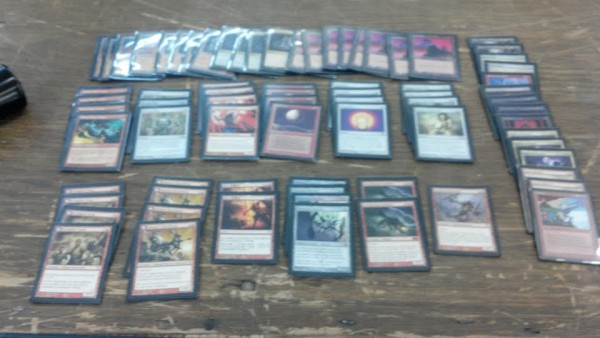
Yes, this is real life.

You're probably looking up Hanweir Watchkeep and Instigator Gang to see what they do. Apparently, the answer is "flip immediately because you land a turn one Trinisphere, [card Chalice of the Void]Chalice[/card] or [card Blood Moon]Moon[/card], and then swing for five or more." They flip easily, don't flip back, and in case you're wondering, two flipped Instigator Gangs swing for 22. The deck looks like a joke.

It isn't.

This outclasses aggro's creatures, punishes unfair decks with a raft of hosers like Trinisphere, Moons, [card Phyrexian Revoker]Revoker[/card] and Chalice and plays what turn out to be some of the most insanely efficient red creatures in Magic. Talk about thinking outside the box.

The land is hard to see, so I'll tell you it's 4 Ancient Tomb, 4 City of Traitors, 4 Cavern of Souls and 8 Mountains. Cavern in the best card in the deck, Zealous Conscripts is the worst and may want to be a Rakka Mar, although double red is usually an issue.

I wanted to use this deck to showcase the ton of brewing taking place in formats like Legacy and Vintage. (The following cards are being used in Vintage --Nightveil Specter, Hypersonic Dragon and Talrand, Sky Summoner-- but that could be its own article.) These are dynamic formats where someone can jam a deck like this without even tuning it and top eight. Eschewing that in favor of the relatively static Standard and Modern seems like a silly mistake for people to make, but make it they do. I need to stop writing about this before it turns into an entire article and I lose interest in talking about decklists.

SCG Invitational

The problem with the Invitational is that it's tough to say that the top eight players' Standard decks are the best Standard decks because what they played in Legacy mattered too. I think there is merit to concluding that players who did well enough to top eight at the end of Day 2 obviously made good choices on their Standard decks so there is some merit to that.

Honestly, though, if you want to get better at Magic, or finance, you can't ignore coverage of a big event like this one. There isn't a ton of data to mine here, so we'll go pretty quickly.

SCG Invitational Top 8 Standard

Again, these are the decks played in Standard by the top eight finishers, but an interesting trend still emerges. These are the game's top players, and three of the eight felt they would give themselves the best possible shot by running a deck we've seen emerge very slowly -- Esper Control.

Since creatures have gotten so much better lately, it takes longer and longer for the control decks to get their numbers right. Creature decks have obvious, powerful quick dudes (Champion of the Parish, Flinthoof Boar, Rakdos Cackler), value guys (Thragtusk, Restoration Angel, Boros Reckoner), ways to stuff sweepers (Boros Charm, Reckoner, Golgari Charm) ways to stuff counterspells (Cavern of Souls, counterspells being kinda terrible lately) and even the combo decks are running creatures as win conditions ([card Craterhoof Behemoth]Craterhoof[/card] for the win). Control decks have the tools they need, but it's taken this long to lock down a good list.

The three approaches to Esper Control were a bit different, but they had the same cards, relatively. Shaheen Soorani wanted a lot more planeswalkers, Ben Lundquist ran more creatures and Michael Hetrick looked like he wanted to win a lot more through milling. The basic shell is the same, but there is room for personal updates, which is interesting. Honestly, there was only one real beatdown deck in the top eight, piloted by Ross Merriam to the surprise of no one, given his tendency to play beatdown.

Shaheen and Hetrick must really like Esper...

SCG Invitational Top 8 Legacy

...because they both ran Esper in Legacy, too. Whatever works, I guess. Esper Stoneblade is an old go-to deck that continues to pop up every once in a while. Great. Whatever.

Worth discussing at length are the updates Brian Bruan-Duin made to the deck. A little bit of splashed green makes great use of Deathrite Shaman in all his capacities (the closest thing to a one-mana planeswalker we'll ever get). Gaining a bit of life makes Dark Confidant less of a liability, makes it easier to potentially shrink Tarmogoyf and hurt Reanimator and Dredge decks, and just help extend your life total a bit to keep you in the game. Deathrite Shaman's tendency to be a player-specific Grim Lavamancer never hurt, either. Running eight fetches that can grab Tropical Island is more than enough for the splash. I feel like this is the better deck in the mirror.

Corbin will be excited that Ben Lundquist opted to run Merfolk instead of doubling down on Esper. The deck is a thing. As much grief as I like to give Corbin, I have played Merfolk builds to some pretty decent finishes, including a version Kenta Hiroki turned me onto that ran Lavamancer and Lightning Bolt. The deck is solid, but I feel like it has zero ways to deal with Supreme Verdict.

I don't know whether Gerry T's Shardless BUG deck is the best deck in Legacy, but I feel like it certainly has a ton of power. Shardless Agent is going to cascade into something very good; there is a 100% chance of that. It's not always the thing you need, but on turn three, everything you hit is good. Hymn to Tourach? Solid, eat a Hymn, opponent. Goyf? Seems fine, it's beatface o'clock. Ancestral Vision? Feels like cheating. I like when my Mulldrifters cost three mana and draw three cards. Even a late Agent is going to get some value to mitigate how durdly a Gray Ogre is on turn ten. Gerry has been playing BUG decks in Legacy for a long time, and I don't expect the printing of Deathrite Shaman and Abrupt Decay to make him want to stop. This deck is solid, albeit tougher than you'd think to pilot.

TCG 5K

Despite not attracting many more players than a Grand Rapids convention in a strip mall where the likes of yours truly was taken seriously for an entire 48-hour period, there was a 5K in Indianapolis and Standard was played. Let's see how surprised by the results we aren't. I haven't clicked the link yet, but I'm predicting Junk Rites won, and there were between four and six Naya decks in the top sixteen.

TCG 5K Indianapolis

Oh, man. I was way off. There were actually seven Naya decks in the top sixteen.

I'm puzzled by the RUG Flash deck. [card Yeva, Natures Herald]Yeva[/card] is an OK 4/4 for four that grants the flash ability to a whopping one creature in the deck that didn't already have it. Sure, surprise [card Huntmaster of the Fells]Huntmaster[/card] when they attack is hilarious, but Yeva seems durdly otherwise. However, four toughness gets there in a format littered with three-power dudes and Searing Spear, so maybe a 4/4 for four is what this format needs. I personally miss Loxodon Hierarch, but Restoration Angel probably needs to rotate before that could ever come back.

It was good to see the Aristocrats not only top-eight, but also finally jam Blood Artist. I am a big fan of decks with Blood Artist and Gravecrawler. I feel like if that combination is good enough for Legacy, you should bother to try it out in Standard. One Thragtusk followed by Restoration Angel can undo lots of turns of hard work, but I feel like you have a certain degree of inevitability. I advocate the inclusion of Assemble the Legion, but this build seems fine. I'm going to miss Blood Artist when it rotates, but not too much since it's not leaving Legacy and also I never play tournaments.

The players in Indianapolis did not qualify for the Invitational, and I wonder if that event had a bit of a draining effect on the player base for Indianapolis. While the top eight in Atlanta had three Esper Control decks, the top sixteen in Indianapolis had only one. I think the meta was much different, and being set up to win through milling wouldn't have helped much in nine rounds of Naya Blitz matchups, but the Esper deck may also just be much, much tougher to pilot. Take this into account when picking a deck for your next event.

That said, expect to see more and more Esper in every event as the metagame sorts itself out. I saw roughly zero things that surprised me in the top sixteen in Indy and I hope Dragon's Maze really shakes things up. With new split cards and a decent planeswalker already spoiled, expect the answer to that question to be a resounding "yes."


Insider — It’s Worth HOW Much?

Are you a Quiet Speculation member?

If not, now is a perfect time to join up! Our powerful tools, breaking-news analysis, and exclusive Discord channel will make sure you stay up to date and ahead of the curve.

Welcome back readers. Today's article will focus on some cards you may or may not know have jumped in price. (I'm purposefully avoiding cards that got their bump from Modern.) The main purpose of this article is to help major event traders bone up on some prices you wouldn't expect when searching through your trade partners' "box of randomness." Without further ado, let's jump into it. All prices are TCG Mid and in USD, rounded to the nearest $0.25.

Blightsteel Colossus ($8.25) -- This EDH dream machine can (depending on your house rules) let you one-shot someone. He's also indestructible and colorless. He quickly knocked Darksteel Colossus off his high horse as king of the robots.

Platinum Emperion ($7.50) -- Another EDH robot, this second coming of Platinum Angel makes it hard for you to die. Of course people often forget/don't realize you can't pay life as a resource either (so no more fetchlands)/necropotence/etc.

Celestial Mantle ($4.75) -- Casual/EDH players do love to gain them some life. I remember trading these away at a quarter when it was Standard-legal (and getting them back at a quarter). Sigh.

Felidar Sovereign ($9) -- This guy's built-in alternate win-condition sets him apart from the plethora of other white life gain cards. I remember the days when he too was a "bulk" mythic.

Nissa Revane ($10) -- Planeswalker that's been printed once, check. Seems to do next to nothing but mentions the word "elf," check. $10 card, check.

Oracle of Mul Daya ($5.50) -- I knew this EDH staple card would be valuable one day because Exploration is valuable. And this one is easier to tutor, as it's attached to a green creature. (That also happens to be an elf.)

Warren Instigator ($7) -- He was hyped pretty hard, then plummeted into the almost-bulk category. So the lesson from Zendikar block appears to be, if it looks like bulk but is in a popular tribe, hold onto it for a couple years and you'll make a 400%+ profit. Same goes for life gain cards.

Dragonmaster Outcast ($9) -- This guy was often borderline playable (and quite good against control decks) as you could land him early and sit back, forcing them to play their mass removal to one-for-one you.

Basilisk Collar ($5) -- Another EDH favorite, this card is now back up to it's high during its Standard run, when it was discovered that Cunning Sparkmage and this card made a mini Viscera the Dreadful.

Joraga Warcaller ($3.75) -- It's an elf and a lord of sorts. The fact that elves can make stupid amounts of mana and you can multi-kick him pretty much guaranteed he'd retain a decent price.

It That Betrays ($6.00) -- Yep, this bulk rare from Rise of the Eldrazi has proven itself as an EDH staple, allowing the owner to take advantage of the plethora of sacrifice effects throughout the game's history, some which hit multiple players.

Khalni Hydra ($5.75) -- This previously bulk mythic has proven once again that green creatures can have absurd mana requirement as long as they have awesome abilities.

Eldrazi Conscription ($5) -- This half of the Mythic Conscription combo is most often seen in EDH decks running Sovereigns of the Lost Alara. In EDH, eight mana isn't as ludicrous as in other formats and players like to Voltron up their commanders. Few enchantments can match this one for that kind of power up, and annihilator is just gravy.

Sarkhan the Mad ($4.75) -- See Nissa, but replace "elf" with "dragon" and voilà.

Kargan Dragonlord ($4.50) -- This once-proud mono-red staple from his Standard years has managed to return to a respectable price. Despite the fact that level up in EDH is a little underwhelming, when coupled with Mana Flare effects and an abundance of artifact mana he becomes a pretty powerful creature.

Guul Draz Assassin ($3.00) -- This guy was also the buy-a-box promo so I'm really surprised at his non-bulk status, but leave it to EDHers to keep anything with the word Assassin out of the bulk box.

Kor Spiritdancer ($3.00) -- I'm not sure if I can blame the casual crowd or the Modern surge from the Hexproof Enchantments deck for this one. Perhaps both.

Godsire ($5.00) -- This token generator in Naya colors is the definition of a one-man army. His corresponding token card is actually worth something as well.

Lich's Mirror ($3.00) -- Another bulk mythic from Shards block that transcends bulk status. If I've learned anything from this list it's that any "casual" mythic in Standard is pretty much $3.00 or more once it's been out of rotation for about 2-3 years.

Future Gold

I noticed some trends when researching this information (not everything is listed, but a lot of cards from these sets haven't broken the $2 range but are much higher than bulk.)

1. Casual players love their tribes and cards that help popular tribes tend to creep up in value over time. This is especially true for once-printed planeswalkers.

2. Any big, swingy life gain cards (that haven't been reprinted too many times) also trend upward over time.

3. Cheap artifacts that can fit into a lot of decks and have a broad use are often ideal for casual players because they can fit into any deck and keep options available to more budget-conscious players. This means it's better to pick up Chromatic Lanterns than Prismatic Omens (if your goal is to trade to casual/EDH players), as both provide basically the same effect, but one can be played in any deck whereas the other requires green.

4. You can often gauge an EDH/Casual card's chance of becoming more valuable by checking to see if it's similar to anything that already exists which is highly in demand. The best example here is Oracle of Mul Daya, which combines abilities from Exploration and Future Sight, both popular above-bulk casual cards.

5. Giant mythic artifact creatures with even remotely relevant abilities often stand a chance to grow over time. Even non-mythic artifact creatures can benefit from this phenomenon. For example I fully expect Steel Hellkite to break $2-2.50 in the next year or two (even with it being a release promo.)

6. Bet on cards that get better with more players (the Primordial cycle is the most recent, but It that Betrays is another excellent example.)

The Bulk Box

We covered Scars, Zendikar and Shards block in this article, as the most recent blocks tend to exhibit considerably lower price memory on many cards. These are the ideal ones to pull out when going through bulk binders and boxes at your local game shop or a major event. While most stores are smart enough to pull any mythics out of the bulk box, they may have a slightly more expensive mythic bulk box or binder you can dig through. I know I've found quite a few gems doing this at various stores and events.

It's also a good idea to become familiar with the artwork of the cards. At GPs, many vendors often have giant bulk boxes with many foreign cards. While many EDH players dislike foreign cards (as they have to explain and sometimes look up the cards for their opponents), you can often find great EDH gems in these boxes.

Insider: The Legend of Legends Legends

Are you a Quiet Speculation member?

If not, now is a perfect time to join up! Our powerful tools, breaking-news analysis, and exclusive Discord channel will make sure you stay up to date and ahead of the curve.

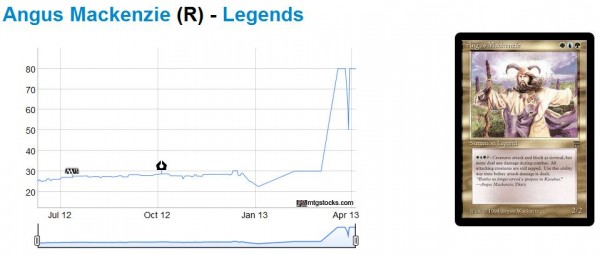
So I got a great deal on a Near Mint Angus Mackenzie the other day. The price? $49.95.

Wait, I paid how much for this Legendary Creature?? If you challenged me to tell you what the card does, or even what his power and toughness are, I would embarrassingly confess ignorance. But it doesn’t matter because of this:

This “Tim” lookalike has more than doubled in price over the past month or so. And many other Legendary creatures from Legends are following suit. Recently Star City Games has also bumped their prices on Legends Legends quite significantly, and the Quiet Speculation community has taken notice.

What does this all mean?

Casual Is King

I’ve touched upon how Magic has grown in previous articles. The game is selling at record highs and tournament attendance is so great that event coordinators have to turn eager participants away.

From an MTG Finance perspective, the most apparent evidence for the rise in popularity of Magic lies in casual prices… like this one:

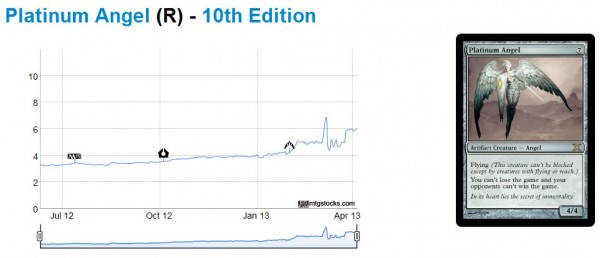
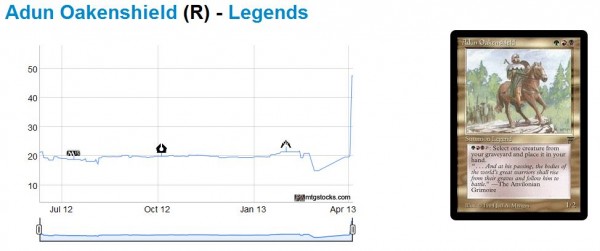
You may hesitate at the chart above and challenge that the card has only risen a couple bucks recently. My first response would be that a three dollar increase in price on this card means nearly a 100% gain. My second response would be to remind you this creature has been printed four times! My third and final response would be to show you the chart for a strictly casual card which hasn’t been printed so much:

Something’s Off

The two charts above don’t look very similar, even though the end result of a 2x price increase is the same. It seems everyone knows that Platinum Angel is a casual favorite and has been rising slowly over time as a result. On the other hand, Adun Oakenshield was a card I had never heard of until it became the number one “interest” on mtgstocks.com.

It feels like I am not alone in this regard. My conclusion is that these flavorful Legends Legends were an unknown entity to the vast majority of new players. Platinum Angel can be found in trade binders everywhere, but good luck finding an English copy of Adun Oakenshield or Rasputin Dreamweaver sitting in a trade binder. Cards from Legends are probably older than many new players.

Star City Games and ABU Games have both added energy into this chain reaction. Cards which once sold in eBay auctions for $20 are now buylisting at these major retailers for twice that. A quick glance at mtg.gg reveals how these two stores have left their competitors in the dust:

Naturally, the combination of mtgstocks.com, mtg.gg, and general speculation has caused these Legends Legends to skyrocket. Their growth hasn’t surpassed that of more well-known casual staples, so perhaps these jumps were long overdue. Or perhaps someone decided these shouldn’t be affordable cards any longer and triggered this hype.

No matter the cause, the question in the forefront of my mind is what to do with this “new age” of expensive Legends Legends.

To Believe or Not To Believe

The fundamental question underlying this debate is whether or not we should feel these price bumps are truly merited.

If we accept these prices as being merited, then perhaps we can draw a parallel between this phenomenon and the iPhone. Before the iPhone was invented, no one really knew they wanted such a device so badly. Once the right marketing scheme was devised and the product gained traction, everyone had to have an iPhone. Perhaps in a similar way, someone came up with a clever way of revealing to the MTG community how awesome Angus Mackenzie really is. People naturally wanted copies and the price now reflects the newfound demand.

If, on the other hand, we refuse to accept the legitimacy of these new prices, perhaps these parallel much better with Beanie Babies. Someone decided those stuffed animals were cute and awesome and desirable, and others blindly followed suit. The difference here is that once people owned hundreds of dollars in Beanie Babies, they realized the things weren’t really so cool after all. The hype fizzled as quickly as it built and prices plummeted.

In the first scenario, prices and demand are sustained. In the second scenario, prices collapse once the market became saturated and people lost interest.

Which One?

Boiling it down we can determine how sustainable these new Legends prices are based on how much we believe in their entertainment value. After all, entertainment (and a little coolness) is what really helps drive the casual market. And it will be the casual market that keeps these prices afloat since speculators don’t want to hold a spiked card greedily and no tournament player ever wants to use these cards.

Personally, I am a believer. I absolutely love the flavor of Legends Legends. The artwork is amazing, the creature abilities are interesting, and the color combinations are valuable in EDH. Therefore, I think these prices will remain. Demand may calm down once this initial hype passes, but these are the kinds of cards that players like to play with over and over again. They’ll never rotate and they’ll never be reprinted (thank you reserved list).

With that said, I’d say if you can find copies near mtg.gg buy prices and you want to own copies for yourself, I would buy. I just purchased a Rasputin Dreamweaver, Angus Mackenzie, and Adun Oakenshield and I will be very torn on whether or not I should sell them. The speculator within me screams “take profits now” while the casual player says “enjoy these sweet cards”. I likely won’t decide until I hold the cards in my hand and try building an EDH deck with them.

After all, these are the cards that made Magic so special when I was a kid. Playing the best deck on the internet wasn’t a thing yet, and we all enjoyed playing the wackiest combos and most entertaining spells. Sometimes I lose sight of this through all my speculation and discussion of MTG Finance. These cards help me return to childhood again, and I believe the same will be true for other players as well. That’s why I think these new prices are not artificially inflated. People have been reminded these flavorful creatures exist. And they want to have fun playing Magic again.

Sigbits – Casual Edition

  • Legends Legends have jumped drastically in price, but they’re not the only casual cards on the move. Kaalia of the Vast is up 33% in the past week according to mtgstocks.com. Despite not being an Angel, she’s still an awesome EDH commander that screams “build around me”. Only another reprint will keep her price in check in the coming months.
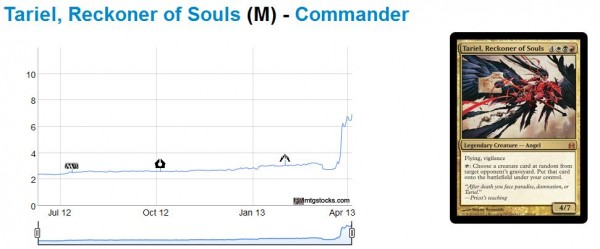
  • Someone recently noticed Tariel, Reckoner of Souls was a cheap, Legendary, Mythic Angel and they sought to correct that. Like Kaalia, this card’s jump won’t likely be reversed any time soon.

  • Got any Battlegrace Angels for trade? You may want to find some because these have more than doubled in price since the fall. I’m guessing this is again casual driven, which means I think the price is sustainable. I wouldn’t go deep, but grabbing these cheaply in trades can’t be a bad thing. Especially when the mtg.gg buy price on this card is nearing $2.00.

-Sigmund Ausfresser
@sigfig8

Insider: Building a Magic Portfolio

Are you a Quiet Speculation member?

If not, now is a perfect time to join up! Our powerful tools, breaking-news analysis, and exclusive Discord channel will make sure you stay up to date and ahead of the curve.

After reading Sigmund's article on the subject I got to thinking about perceived risk, and more specifically the asymmetry between gains and losses. Thursday I watched a company lose more than 50% (it did rally back some before the market close) of its market cap in a single trading day. I think the market actions and the following Sigbit are further proof that it takes time to drive up prices and very little time to drive them down:

I for one am completely shocked at the price of some Duel Deck products. Elves vs. Goblins ($249.99), Divine vs.Demonic ($149.99), and Jace vs. Chandra ($99.99) have all paid for themselves many times over. I wish I had these! Meanwhile Ajani vs. Nicol Bolas, Venser vs. Koth, and Phyrexia vs. the Coalition have all been a bust. Fortunately the rest have also increased marginally in price. This is why I see investment in these products as somewhat risky – you could increase your money fivefold or sit on a stagnant position for years depending on what you buy!

Sig offers a great example of why prices rise slowly; lets just do the math on those Duel Decks: $150 for Elves vs. Goblins, $100 for Jace vs. Chandra, $120 for Divine vs. Demonic, $45 for Garruk vs. Liliana, 24$ for Phyrexia vs. Coalition, $42 for Elspeth vs Tezzeret, $40 for Knights vs. Dragons, $31 for Ajani vs. Nicol Bolas, $17 for Venser vs. Koth, $18 for Izzet vs. Golgari, and MSRP for Sorin vs. Tibalt. Average value of random Duel Deck is $55, with nine of eleven fetching retail or greater. With average gains of 275%, this is only considered risky because we are placing too much weight on negative returns. Since inception (2007) you are looking at 45% annualized returns. 

Learning from Mistakes

Over emphasizing loses is the human thing to do, and I am not writing today to convince you to ignore downward price action. Ask yourself the following question: If I told you that tomorrow you had 50% chance to lose all of $1000 and offered you insurance at $500 to guarantee you'll keep $500 instead of risking a total loss what would you do?While mathematically there is no right answer, if we approach our investments by risking total loss we risk more than another $500 - we risk the opportunity to recover our losses.

So, keeping in mind what we've covered, I'd like to come up with a MtG portfolio that uses an understanding of price action and human psychology to help us better evaluate risk/reward and offers us a hedge - or at least an exit strategy. It is very difficult to hedge a Magic investment as you are of course hoping the game maintains its popularity and collect-ability. That said, there is a real floor to pricing most cards thanks to buylists and bulk rates.

The Sample Strategy

Lets start with $1000 and supplement our investment with $10 every month. That 10 dollars will help us re-balance the portfolio and keep us open to fresh investments.  I will split my portfolio up into three parts: sealed product, cards to flip and cards to save. My favorite part of this portfolio is sealed product, because it requires so little card evaluation on my part. I intend to spend $333 buying X number of Y Duel Decks. I will spend no more than retail for these duel decks and should I find myself able to purchase more than one type of Duel Deck, I will spend the same amount of cash on each Duel Deck type.

I get to make a couple of interesting choices using Ebay's expired auction data. Buying complete displays offers a discount most of the time and with single copies of Sorin vs. Tibalt commanding as much as $24 while other copies are available for $20 these look like a good bet even if I give up other decks. With the recently announced Heroes vs. Monsters scheduled for a September release I have six months to move my inventory, extract any value and diversify my sealed holdings. Assuming I can  sell half of the sixteen at $24, I should end up with enough cash to purchase 10 copies of Heroes vs. Monsters leaving me with an 8/10 ratio.

Cards to flip are those cards that have already shown plenty of price volatility. The best Standard example I can think of is Angel of Serenity. This card is worth picking up to flip come rotation. While the next block could remain as fast, keeping the price down and the flip off the table, an Angel that has a powerful ETB effect and is reanimation friendly will worse case get moved out of cards to flip and into cards to save. If Deathrite Shaman could get under $10 on Ebay another potential flip target emerges from Standard. My last article for Quiet Speculation explained my favorite kind of flip: low run collectibles.

Unfortunately the easiest way to get value from those kinds of flips requires you to do more than find a card at the right price. You've got to build relationships. While there's no easy way to do that, playing casual EDH games and being super friendly at your local shop (even in competitive drafts) will pay dividends. Start a Facebook Group for regulars and invite new players. Use that group to get people in the shop to trade and play with on days other than Friday. Creating a welcoming atmosphere will win you the shop owner. They are going to get first cracks at collections more often, but if you play nice you'll find a valuable resource for buying and selling cards. Take advantage of local demand. Pick up what is unpopular and let the internet help you extract value.

Cards to save are pretty easy to identify. They are playable across multiple formats. That means you want some combination of EDH/Legacy/Vintage/Modern staple. Generally I avoid hot Standard +1 cards because standard with drive up prices too quickly. Once you've identified your targets pass them through one more screen: are they on sale. What negative factors are weighing the price down and are these justifiable? For example: Kitchen Finks might see a reprint soon and there is some downward price action as a result. In this case, I hold off any purchases until Modern Masters is released. Then I buy up cheap staples thanks to the perception of too much supply. Presently I will remain boring and buy up copies of shocklands under $10.

But Never Forget...

While getting totally wiped out in a Magic spec is difficult, don't be afraid to buylist under-performing cards. You are there to make money and and assets you have in your portfolio needs to pay rent. Why hold on to a loser with a new set on the way? Take the loss and pass on the recovery so you will be able to pounce on the next opportunity.

Use the $10 added a month to help you re-balance your portfolio. You probably want to spread your investments across the three classes evenly every three months, unless you find and expect one asset class to consistently outperform another. Finally, spend some of the money you make if you are doing this for more than just giggles. Taking profits out of Magic will offer you a better hedge to your Magic investments than coming up with another MtG "asset" class.

Avatar photo

mathieu malecot

Mathieu is a daily trader of options/stocks, selling both bearish and bullish options. Lead wrangler of "The Kitten Ranch", as in lives and works at home with two annoying and cute (annoyingly cute?) cats. Ranch motto: "Always Feline Awesome". Playing magic since beta/ high school. Casual player and regular participant in FNM drafts.

View More By mathieu malecot

Posted in Finance, Free InsiderTagged , , 4 Comments on Insider: Building a Magic Portfolio

Have you joined the Quiet Speculation Discord?

If you haven't, you're leaving value on the table! Join our community of experts, enthusiasts, entertainers, and educators and enjoy exclusive podcasts, questions asked and answered, trades, sales, and everything else Discord has to offer.

Want to create content with Quiet Speculation?

All you need to succeed is a passion for Magic: The Gathering, and the ability to write coherently. Share your knowledge of MTG and how you leverage it to win games, get value from your cards – or even turn a profit.

Insider: Three Months of Magic and MTGO

Are you a Quiet Speculation member?

If not, now is a perfect time to join up! Our powerful tools, breaking-news analysis, and exclusive Discord channel will make sure you stay up to date and ahead of the curve.

There's currently a pause in top-down events such as release queues or other important announcements from WoTC. Modern season is over, and Standard is iterating, with Junk Reanimator holding the top position at the moment. Take a break from doing any card-by-card analysis to consider what is to come over the next three months. When the market is reacting in fear or greed, speculators should be acting with courage and discipline. Having the big picture in mind helps deal with surprises or unusual situations sucessfully.

April

This month is the calm before the storm. The focus has shifted away from Modern towards Standard, but many Modern staples are not yet priced at attractive levels. It'll take a few more months away from the Modern season before prices fall enough to start establishing positions. Also, the upcoming release of Modern Masters (MM) looms over all cards printed prior to ZEN block. And it's not yet clear how WoTC will release MM on MTGO. The uncertainty about what will be reprinted in MM and more importantly how it will be reprinted means there is no reason to consider buying any Modern staples at the moment.

Spoilers for Dragon's Maze (DGM) should start in the second half of April. Pay attention to the chatter and analysis. Without the ability to buy pre-sales on MTGO (which are typically not worth it in paper anyway), what we are looking for as speculators are cards that can revitalize out-of-favor archetypes or spawn new ones. Look towards interactions across formats. Cards that are printed with Legacy or Vintage implications often fly under the radar long enough for them to reach MTGO before prices reflect their impact. Deathrite Shaman is the recent example of this.

May

Dragon's Maze will be released in paper on May 3rd, suggesting a May 13th release for the digital version. Cube draft should return, so pay attention to what packs Cube will award as prizes. Last time it was Zendikar (ZEN) and Worldwake (WWK) packs, along with the associated ZZW draft queues. This triggered a big sell off in all ZEN and WWK rares, which resulted in a strong short-term buying opportunity. Something similar might occur so when the exact boosters awarded as prizes are announced, consider the implications and go from there. Talk about the impacts in the forums and see what opportunities crop up as a result.

The second half of May should bring MM spoilers. In this case, be on the lookout for what is not spoiled or not to be reprinted in MM. There should be widespread weakness in all pre-ZEN block Modern staples, but it's possible WoTC will make a mistake and not reprint a staple or two. This would be the time to gather a list of targets, and scoop them up as soon as they are confirmed not to be in the set.

June

Modern Masters is to be released in paper on June 7th, 2013. Because there will be little extra coding or testing of cards required for the digital release, it's quite possible we see a simultaneous release in paper and digital. As mentioned above, how this set is released online is the most critical aspect. It's quite possible there will not be a 'print run' in the paper sense. If MM drafting is popular, it might mean a significant price crash for Modern staples. Further analysis and observation will be required, but any time there is a significant market disruption, there is usually an associated buying opportunity for brave speculators.

Once the dust has settled on the release of MM, it's time to consider the transition to Version 4.0 of the MTGO client. Currently you are able to use the client of your choice, Version 3 or Version 4. WoTC is endeavoring to make improvements to Version 4 with an eye to making the full transition away from Version 3 in July. If history is any guide, this will not go well.

The release of Version 3 was a disaster. Significant functionality of that client was not ready in time for its launch, even with MTGO going completely offline leading up to its release. This might have been OK if the client itself was any good, but the poor quality of the user interface on top of the lack of functionality turned out to be a disaster. This botched update to the client created a significant market crash as players abandoned the online version of MTG.

Fast forward to today, and most functionality has returned. Crashes occur, but not like they did in the past. The success of Duals of the Planewalkers and the New World Order of Magic design has driven the MTGO user base to record levels, despite the still-terrible user interface.

If history repeats itself and WoTC moves forward with a half-baked update to their client, another market crash could be coming. Keep this in the back of you head over the coming months. It might be worthwhile to be more liquid than usual leading up to the date Version 3.0 goes dark. Having extra tix on hand will be prudent.

Portfolio Update

This is a brief rundown of what I am buying, selling and looking out for in the market. Some of this is repeated from last week, but a few things have been updated and I've fleshed out some of the reasoning to a greater degree.

Selling:

  • Rares from RTR that pop up on MTGOtraders' hotlist such as Temple Garden, Abrupt Decay, and Angel of Serenity. RTR is temporarily inflated in price and will come down somewhat after DGM's release, so selling in-demand cards right now is a fine idea. The metagame might shift and buying back in June is entirely possible. For more detail on my RTR mythic rare positions check out my April 2nd post in this thread.
  • Any excess cards from ISD, DKA, AVR and M13, though I am down to scraps at this point. The first cracks in the price of these are starting to appear. Huntmaster of the Fells has dipped below 20 tix for the first time since December 2012, and Bonfire of the Damned is skirting a six-month low.
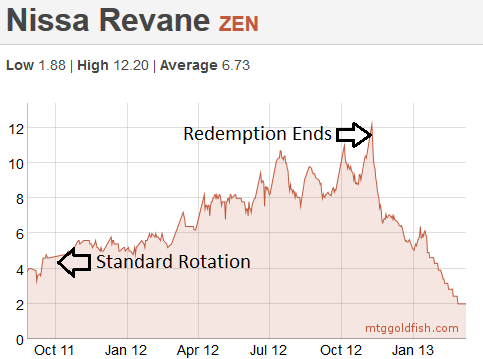
  • Mythic rares from Scars of Mirrodin (SOM) Block. I'm now about halfway through selling these. Between the comments section and the forum, a couple questions have arisen regarding whether I think SOM block mythics are good buys. I think this comes from last week's article which showed how Zendikar (ZEN) block mythics appreciated in price leading up the end of their redeemable period. ZEN block had a ton of cards that have appreciated in price for paper versions, such as the fetchlands and Jace, the Mind Sculptor. This drove the digital price higher too while they could be redeemed. I don't think similar price increases are happening to SOM block cards. I'd suggest SOM block mythics will not follow a similar pricing pattern to ZEN block mythics in the months leading up to the end of its redeemable period. Thus, SOM block mythics do not represent good value and speculators should not consider buying them when following a redemption speculation strategy.

Buying:

  • Duskmantle Seer and Aurelia's Fury if I can find a good price. Both cards seem like good value and don't seem like they will be increasing in price in the short term.
  • Nightveil Specter seems like good value in the 0.10 to 0.15 tix range. Ordinarily I avoid speculating on non-mythic rares, but occasionally a card jumps out at me as good value. This is one of those cards; see this thread for my reasoning.

Watching:

  • The Zendikar fetchland index. When this bottoms, it will be time to start buying these up.
  • GTC boosters have drifted down in price and I'd expect this trend to continue. RTR boosters dropped to 2.6 during GTC release events and a similar drop in GTC booster prices during DGM release events would suggest a good buying opportunity. However, after this thought experiment, I'd revise down any expectations on the bottom for GTC booster prices.
  • RTR boosters have ticked up in price, and the current buy/sell spread on Supernova is 3.43/3.54 tix. This trade looks to be on solid footing as the fundamentals of prize support and demand from drafters will support the price going forward. In the short term, WoTC has announced a special tournament for next Friday where you get to play against members of R&D. The prizes are RTR boosters, which should cause a short-term dip in prices and/or a widening of the spread. These are still a buy if they get back down to 3.33 tix per booster. Long term, I'll be looking to sell these for 3.8 to 3.9 tix after DGM's release.
  • Obzedat, Ghost Council has drifted down and seen a drop off in play in the top decks of Block Constructed. I'm still bullish on this card in the long term, but it looks like there will be some price weakness in the short term.

Insider: Beneath the Veil

Are you a Quiet Speculation member?

If not, now is a perfect time to join up! Our powerful tools, breaking-news analysis, and exclusive Discord channel will make sure you stay up to date and ahead of the curve.

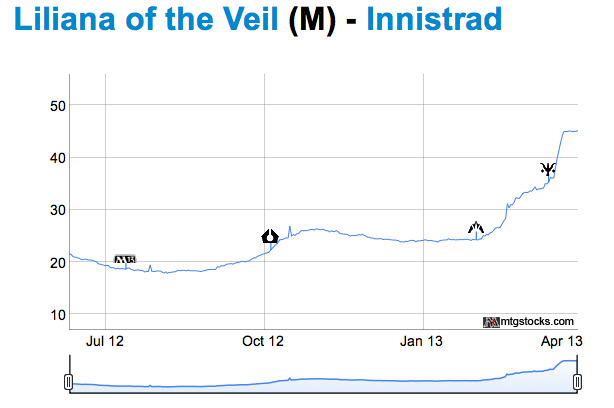
Liliana of the Veil has been an extremely interesting card to watch. The emergence of Jund in Legacy really flipped the switch on this card, turning it into a $50 ‘walker. Just this week foils began to spike out of control.

Many have attributed the price increase to the large influx of new players. But today I want to walk through Liliana’s price history to see if we can draw any other conclusions, and form a strategy for the card.

First Impressions

Let’s start at the beginning. Here’s what I wrote about Liliana in my Innistrad set review:

“In my limited testing, Liliana has been insane. She comes and edicts a player, then sticks around to accumulate value as you make them discard things they care about while you pitch something like a Vengeful Pharaoh. She probably won’t be staying at $35, but I see her staying pretty relevant as we move forward and price increases are possible. I’m interested in picking up as many of these as possible for reasonable prices.”

After the release, the price increase I talked about came to pass as players realized Solar Flare was the best-positioned deck heading into States, and Liliana rose to $60 or $70 for a couple weeks.

People began asking if we had the next Jace, the Mind Sculptor on our hands, which I addressed in an article detailing why Liliana wasn't as good as Jace.

While I was right at the time, and for the most part still am, it seems like things have changed since then. Liliana did in fact settle back down to $20 or so, and hung around there for a while. But the emergence of Jund in Modern kept the price high and the recent transition to Legacy has caused the run on Liliana. It’s gone from a pretty consistent $20-25 to $50 all of a sudden, with foils fetching $150.

The first question, of course, is can it maintain that price?

The short answer, for now, is yes. But I assume you didn’t come here for the short answer.

Sculpting Minds Beneath the Veil

At this point, the most relevant comparison is obviously the Mind Sculptor, who has seen a pretty substantial rise himself in the last few months. The reason this is such a good comparison is because, like Jace, Liliana’s appeal comes primarily from Eternal formats. She is played in Standard some, but not enough to justify the big jump.

Looking at Jace, we see it’s at $100 or so, where it’s been for the last few months after a big jump from $60. The most important thing to note from Jace's price is how steady it has been since it went up again. $60 Jaces turned into $100 Jaces pretty quickly, but unlike a ton of other flash-in-the-pan risers, it has since held steady as a c-note.

That’s good news for Liliana. While the card may settle down some from its current price tag, we have yet to see a mythic since Big Jace sustain more than $50 while in Standard. That said, I can’t think offhand of any others with the Eternal appeal of Liliana, so it some aspects we’re looking at a new standard-bearer here.

A lot of MTG finance is about using good heuristics, which means an established precedent from which to draw future conclusions. That’s why finding the right comparison is so important, and that’s why Big Jace is so important here.

With that in mind, it’s easy to call a “ceiling” of sorts for Liliana. It can’t go higher than Jace because even if demand were equal (which I don't think is the case), supply for Liliana is much greater. So if Liliana continues to rise, you can feel comfortable in the knowledge that there’s not much farther it can go.

So what’s our play on Liliana right now, at $50? To be honest, I’m not interested in acquiring at that price because it seems to have leveled off the last week, suggesting that for the time being the rise is over.

With that said, I do think it is a safe hold. While the upside may not be huge compared to the entry point right now, I don’t think the downside, especially over the long-term, is too much. It’s likely we’ll see a bit of a drop-off come rotation, but since we’ve already establish Standard isn’t the main driver here I’m not sure how much of an effect that will have.

Lili's Future

What about long-term? The risk of a reprint at this point doesn’t seem too high and it’s not eligible for inclusion in Modern Masters, so we can eliminate that. So there are really three questions to ask to determine a long-term plan.

  1. Will Eternal demand go down?
  2. What is the risk of a reprint?
  3. How much of a drop-off will Standard rotation create?

We’ve already answered the second on that list, and Eternal demand doesn’t seem to be moving either. The last question is probably the most relevant one, and while I think the impact won’t be huge, I do think it will exist.

That means you may be able to get in on cheaper Lilianas in a few months, but not so much cheaper that if you want your playset now you should wait. I think the current price tag is reasonable if you need them to play.

Once we see that rotation dip, whatever it is, it becomes time to buy unless we have new information about questions 1 or 2. Assuming everything else stays constant, we’ll have the low point of the card’s lifetime and can expect incremental gains from then on out, making an attractive target to both pick up and hold onto.

Wrapping Up

Of course, this is just my opinion of the card’s future. What do you guys think? Is my analysis useful; or overly aggressive or conservative? I know I’ll be acting on my own advice here, so I’m interested to see if anyone else has a different take!

Thanks for reading,

Corbin Hosler

@Chosler88 on Twitter

Another Domri Decklist

Are you a Quiet Speculation member?

If not, now is a perfect time to join up! Our powerful tools, breaking-news analysis, and exclusive Discord channel will make sure you stay up to date and ahead of the curve.

I feel like I've been talking about this deck forever, but my list keeps changing and I keep learning new things about playing it and how to combat the Standard format at large. Last week I was on a Strangleroot Geist deck and I was insistent on jamming Thundermaw Hellkites to combat the menace of Junk Reanimator. In the short span of time between then and now the presence of Junk has lead to a metagame that has been ripe for Naya Blitz to take over- both in terms of being played heavily and actually posting good numbers.

What I've learned from playing against Blitz is that attacking them is foolish and that blocking is sub-optimal to removal. Frankly, Strangleroot Geist was embarrassing. In my previous incarnation of the deck I had been playing Restoration Angel, which was very good against Blitz but ultimately eschewed for being worse than Ghor-Clan Rampager against Junk. At some point last week, presumably when I was delirious from lack of sleep I had the idea to straight swap out Geist for Angel and jam eight four drops. I spent a lot of time thinking "this can't be right" before landing on an exact list but since I've started battling with Angel and Rampager I've put up better results than any previous incarnation of the deck. I suppose this would be a good time to take a look at said list:

“DomriNayation”

spells

4 Boros Reckoner
4 Flinthoof Boar
4 Ghor-Clan Rampager
2 Thragtusk
4 Loxodon Smiter
4 Restoration Angel
2 Mizzium Mortars
2 Domri Rade
1 Pillar of Flame
4 Searing Spear
3 Selesnya Charm

lands

4 Sacred Foundry
4 Clifftop Retreat
4 Sunpetal Grove
1 Mountain
4 Stomping Ground
4 Rootbound Crag
4 Temple Garden
1 Kessig Wolf Run

For this incarnation I've elected to add Kessig Wolf Run as a spell. It was previously very awkward with Strangleroot Geist and Boros Reckoner in the deck even as a spell considering that it was basically an expensive Rancor, but it is capable of dealing tons of damage out of nowhere with Restoration Angel and is another awesome way to break through Angel of Serenity. It's still awkward with Reckoner, but the one has proven good thus far. We might look land heavy but this is a Ryan Overturf deck and that shouldn't be surprising.

The slot that I'm still trying to figure out is Thragtusk. I wanted the slot to be a creature to increase my odds with Domri while also being something that performs well with against aggressive decks to compensate for the fact that three of my Pillar of Flames are in the sideboard, but costing five has proven to matter more than being Thragtusk against the speed of Naya Blitz. At that point the rest of our deck has beaten or lost to them on its own merits. It is very good to have against Monored/RG aggro and other Thragtusk decks and it makes our Restoration Angels more valuable, but it might end up being sent to the sideboard. I'm considering a Garruk, Primal Hunter over one of them and I will probably be testing that in the near future.

That out of the way, let's talk about some matchups and a few things that I've learned from battling.

On Domri Rade

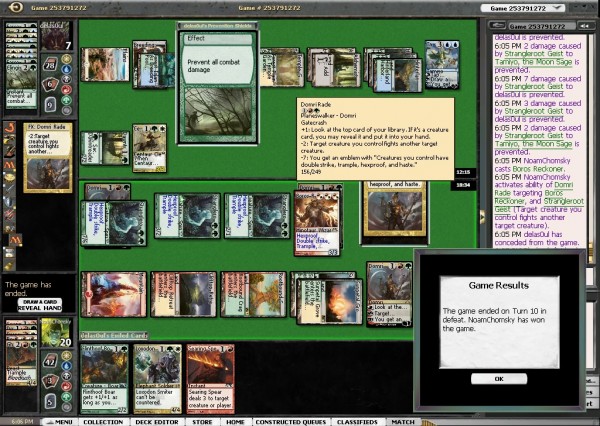
If you've been keeping up with Brian Kibler's progression with his own Domri deck then you've heard him say about one thousand times that missing with Domri's +1 can be devastating. He's not entirely off, but the solution that I've found has been just to -2 as much as possible.

The thing about Domri is that his emblem, while insane, often shouldn't be your primary game plan. There are lots of thing from Thundermaw Hellkite to Detention Sphere that can undo all your hard work of plus-ing him, and it's then that having missed earlier becomes truly problematic. From testing I've found that using Domri to Pit Fight, plus, and then Pit Fight again will matter a lot more than a few plusses in any matchup where things to fight are presented. A chance at a card and an absurd endgame is really tempting, but knowing when to grab your value while it's on the table will win you way more games in my experience. That's a big part of why having Strangleroot Geist wasn't cutting it in my deck- you need things that can fight with creatures that matter, and that means having creatures that at their base can at least tangle with a Frontline Medic.

Of course, there are decks that make Pit Fighting with Domri an unviable option- namely decks without (m)any creatures. Fortunately for the Domri player these decks tend to be very bad at interacting with Domri, which makes building to an emblem much more likely! One thing to keep in mind is that most decks that don't present good opportunities to -2 are Azorius Charm decks. It's very important in these matchups to wait until your second main phase to activation your Domri in case they have Charm to ensure that you get your card. It's a small thing and it might be obvious but I think it's worth mentioning.

Now lets get down to brass tacks. How does this deck fare versus popular decks and what are you doing against them?

Versus Naya Blitz

Their deck is more or less a pile of cards you don't care much about, Mayor of Avabruck and Frontline Medic. You're going to spend a lot of time blocking against them, and in the early turns I advise just not attacking at all to play around Lightning Mauler, but when it comes to Mayor and Medic you'll need a removal spell or you're going to get overwhelmed.

I streamed a daily the other day (you can find the video here) and played against Blitz three times. I ended up going 2-1 against the deck and if you watch the matches it seems clear to me that rounds one and two were very easy wins for me and that round four was just a case of them drawing dramatically better than I did.

A few blockers, removal spells and some patience and this matchup is easily on the favorable side.

Versus Esper Control

This is one of those matchups where you board into four Domri Rades post-board. You almost never get to fight but they don't interact with him well and they can't possibly beat an emblem ever.

Play around Supreme Verdict and let them one-for-one you as they will. All of your monsters are huge and eventually they will die. I've won when my Esper opponent has resolved as many as three Sphinx's Revelations. Their endgame looks much better than yours on paper but if you play in a way where you always have another threat in hand you will find that they ultimately succumb to your aggression in the long game. Don't get greedy!

A quick note on this matchup and something that I totally blanked on while streaming is that Boros Charm (which really should be in your sideboard) + Ghor-Clan Rampager generates more than eight extra damage. Whoops!

Your matchups against Jund and Bant control are going to be very similar, if worse, than against Esper. Don't overcommit into Supreme Verdict/Bonfire of the Damned and Rampage wisely. The major difference in these matchups is that your Domri will be able to (and should) fight more and that you don't want to cast your Loxodon Smiters from the getgo against Jund to play around Rakdos's Return.

Versus Junk Reanimator

Unlike against Esper, Junk will kill you in the long game better than you will kill them. Restoration Angel has proven very strong against Junk in that their Thragtusks can't block it and that it can leave you with two creatures on board when they make an Angel of Serenity.

Don't throw away creatures in combat to Thragtusk when they're just going to Unburial Rites you, don't waste Selesnya Charm on Thragtusk if you can't beat a Craterhoof Behemoth or an Angel of Serenity and don't use Ghor-Clan Ramger just to push through damage against something like a chumping Lingering Souls token unless you see a clear endgame from it.

I don't have a good read on exactly how good or bad this matchup is because I frequently see it as a route in one direction or the other. Player competence and deckbuilding decisions matter a lot, but this matchup is often just a demonstration of the swingy nature of Standard.

The Aristocrats

This is our nightmare matchup. Lingering Souls + either Aristocrat (God forbid both) is a sizeable beating against us and I really don't know what to do to crack this matchup. If anybody can give any advice on beating them I will gladly take it! In my experience they just play their spells and you die a painful death. If this deck becomes very popular I would absolutely recommend moving off my deck.

Random Things

There are still a lot of zonky decks showing up in Standard and thus far I haven't felt worse than 50-50 against anything fringe I've played against other than Humanimator, which is abysmal game one and contingent on drawing Rest in Peace (see- still unfavored) in games two and three. That said, Humanimator has largely been hated out unintentionally be people trying to beat Junk and isn't a major concern of mine.

And as for the other decks? I'm not too concerned:

Currently I intend to bring something very close to this list to the SCG Open in Milwaukee and if the metagame continues to look as it has then I will likely be battling with it in local PTQs. Questions? Concerns? Leave a comment!

-Ryan Overturf
@RyanOverdrive on Twitter

A Gruuling Standard

Are you a Quiet Speculation member?

If not, now is a perfect time to join up! Our powerful tools, breaking-news analysis, and exclusive Discord channel will make sure you stay up to date and ahead of the curve.

Every story has a villain. In my childhood, the reigning villain was Mumm-Ra, who led countless efforts to defeat the Thundercats. No matter what Mumm-Ra did though, he could not overcome the diverse group of threats presented by the Thundercats. Even when the whole team was captured, an unlikely hero (usually Snarf) would arise, free the team and again Mumm-Ra would flee in defeat. Even when Mum-Ra enlisted the help of other teams like the Mutants or the Lunitaks, he couldn't prevail.

The Thundercats are like the "best deck" in Magic, a seemingly unbeatable opponent who defeats everything thrown at him. This opponent can defeat you from any number of angles despite your best efforts. If we look at the Thundercats from a Magic perspective, they would be the villain for sure. Mumm-Ra and all his forces would simply be all of the tier two decks, trying to defeat the most overpowering opponent.

No matter what metaphor you are using, in today’s Standard, Junk Reanimator is the top dog. Week after week, tournament after tournament, this deck dominates top eights.

If Junk Reanimator is dominating so many events, what is stopping us from building a deck specifically to beat that one opponent? It seems that despite its overwhelming success, players still don't take it seriously. The metagame of a tournament is still so diverse such that a hate deck cannot exist. How are players are trying to beat the deck?

1. Be faster than them -- Both Naya Blitz and G/R Aggro try to win via this route. They suffer from inconsistent draws and higher overall variance than other decks. One big reason the format has not evolved to beat Reanimator is because these aggressive decks can win on turn four. Both of them play similarly, but G/R Aggro is less all-in than Naya Blitz. Here are examples of both of these decks from SCG Orlando last weekend.

Naya Blitz by Aaron Leblanc
1st Place at SCG Orlando

Untitled Deck

Creatures

4 Boros Elite
4 Burning-Tree Emissary
4 Champion of the Parish
4 Experiment One
4 Flinthoof Boar
4 Frontline Medic
2 Ghor-Clan Rampager
4 Lightning Mauler
4 Mayor of Avabruck
3 Thalia, Guardian of Thraben

Spells

3 Searing Spear

Lands

4 Cavern of Souls
1 Clifftop Retreat
1 Rootbound Crag
4 Sacred Foundry
4 Stomping Ground
2 Sunpetal Grove
4 Temple Garden

Sideboard

2 Tormods Crypt
3 Boros Reckoner
2 Fiend Hunter
3 Pacifism
3 Boros Charm
2 Gruul Charm

G/R Aggro by Arlie Silver
5th Place at SCG Orlando

Untitled Deck

Creatures

4 Ash Zealot
4 Burning-Tree Emissary
4 Experiment One
2 Firefist Striker
4 Flinthoof Boar
4 Ghor-Clan Rampager
2 Legion Loyalist
4 Lightning Mauler
3 Slaughterhorn
4 Strangleroot Geist

Spells

4 Mugging
2 Domri Rade

Lands

5 Forest
4 Mountain
2 Kessig Wolf Run
4 Rootbound Crag
4 Stomping Ground

Sideboard

1 Firefist Striker
4 Mayor of Avabruck
4 Skullcrack
2 Revenge of the Hunted
4 Traitorous Blood

Mugging is an interesting choice of removal spell for the Gruul deck. It functions similarly to Pillar of Flame but with the added bonus of Crippling Blight. As you can see, even bad cards that disable the opponent from blocking can be playable.

2. Be more controlling than them –- Not many players have found success using this strategy. I believe this is because Junk Reanimator can alternate between ramp and control strategies. It is difficult for a control deck to deal with all of the threats presented by Junk Reanimator. The deck has enough mana to hardcast all of its threats if the Unburial Rites strategy doesn’t work, so control is in for a rough match. The deck that does the best job of controlling our tier one opponent is Jund. Jund Control has the tools to beat all of the aggressive decks as well as have game against Reanimator. The version of Jund below did lose to Reanimator in the finals, but he beat three other versions along the way. Clearly Jund is an acceptable choice for fighting Reanimator.

Jund by John Cuvelier
2nd Place at SCG Orlando

Untitled Deck

Creatures

3 Arbor Elf
4 Huntmaster of the Fells
3 Thragtusk
2 Thundermaw Hellkite
3 Olivia Voldaren

Spells

2 Ground Seal
2 Abrupt Decay
1 Murder
2 Tragic Slip
2 Bonfire of the Damned
1 Dreadbore
4 Farseek
1 Mizzium Mortars
2 Rakdoss Return
1 Garruk, Primal Hunter
2 Liliana of the Veil

Lands

2 Forest
4 Blood Crypt
3 Dragonskull Summit
2 Kessig Wolf Run
4 Overgrown Tomb
2 Rootbound Crag
4 Stomping Ground
4 Woodland Cemetery

Sideboard

2 Acidic Slime
1 Ground Seal
2 Tragic Slip
1 Liliana of the Veil
2 Bonfire of the Damned
2 Duress
1 Mizzium Mortars
1 Pillar of Flame
1 Rakdoss Return
2 Slaughter Games

3. Ignore them –- This option is not currently being utilized but there are a few ways to accomplish this goal. The first is to ignore everyone by playing a hexproof deck. The problem is that the aggro decks are probably just faster. The addition of Gift of Orzhova might help to race them, but it may not be enough. If combo were a part of the metagame, this is the part of the pie where it would fall. Unfortunately (fortunately?) there is no combo deck in the format at this time.

4. Beat the decks trying to beat the best –- Well, despite that being a mouthful, it is a strategy that many deck builders use regularly. I much prefer to beat the best deck, but if you have a decent game against the best deck, while having a favorable match against the rest of the field, you should be successful. This can be a difficult balance to attain though. In my opinion, the Aristocrats holds this position in the current metagame. Here’s an updated list.

The Aristocrats by Taylor Raflowitz
3rd Place at SCG Orlando

Untitled Deck

Creatures

4 Cartel Aristocrat
4 Champion of the Parish
4 Doomed Traveler
4 Falkenrath Aristocrat
4 Knight of Infamy
4 Silverblade Paladin
2 Skirsdag High Priest
2 Zealous Conscripts

Spells

3 Orzhov Charm
2 Tragic Slip
3 Lingering Souls

Lands

2 Plains
1 Swamp
4 Blood Crypt
3 Cavern of Souls
1 Clifftop Retreat
4 Godless Shrine
4 Isolated Chapel
4 Sacred Foundry
1 Vault of the Archangel

Sideboard

1 Zealous Conscripts
2 Boros Charm
2 Electrickery
2 Purify the Grave
1 Rakdos Charm
1 Tragic Slip
1 Aurelia, the Warleader
2 Obzedat, Ghost Council
2 Sorin, Lord of Innistrad
1 Mark of Mutiny

Which path did I choose? Despite my preference for a deck built to beat the best deck, my efforts in that area have fallen short. There are plenty of decks I could build that would post great numbers against Junk Reanimator, but maindeck Slaughter Games would only help me lose games faster against my aggro opponents. With that being true, I am left with option 4. If I can regularly beat the rest of my opponents and have a decent game against Reanimator, I should do well. Here is the deck:

Gruul Aggro/Midrange

Untitled Deck

Creatures

4 Experiment One
4 Gyre Sage
4 Burning-Tree Emissary
4 Flinthoof Boar
2 Skarrg Guildmage
4 Boros Reckoner
2 Ghor-Clan Rampager
4 Thundermaw Hellkite

Spells

3 Mizzium Mortars
2 Bonfire of the Damned
3 Domri Rade

Lands

4 Stomping Ground
4 Rootbound Crag
3 Evolving Wilds
2 Kessig Wolf Run
2 Forest
9 Mountain

Sideboard

1 Ulvenwald Tracker
1 Yeva, Natures Herald
3 Pillar of Flame
3 Thragtusk
2 Garruk Relentless
3 Ground Seal
2 Zealous Conscripts

Similar to the Naya Blitz deck, this deck has many great openings. The difference is, this version of Gruul also retains a late game strategy. Often the best line of play is turn two Gyre Sage and then turn three Burning-Tree Emissary plus another spell or two. I believe a turn four kill is possible with this deck, but it is not nearly as likely as with Naya Blitz. Winning on turn five is much more likely.

The goal is to proactively add to the board and pressure your opponent but not leave yourself open to dying quickly. Many cards in the deck help accomplish this goal. At the top of the list are the sweepers. Mizzium Mortars does function as a cheap removal spell but often it is better to hold it until you can overload it. If you have a good Gyre Sage draw, you can overload Mortars on turn four. Winning from there should be easy.

One major pitfall of the deck is its weakness to Supreme Verdict. Many decks that have a bunch of threats on the board can still untap and cast a board wipe spell. For example, I was playing against my friend’s UWR deck last week with this build and I did not consider that he would have maindeck Supreme Verdict. It was a one-of, but I still lost the game because I dismissed the idea too quickly. It’s exactly like this…

Han Solo: “Now don’t get jittery, Luke. There are a lot of command ships. Keep your distance, though, Chewie, but don’t look like you’re trying to keeping your distance.” [Chewie barks a question] ”I don’t know. Fly casual.”

Make it look like you are keeping the pressure on, but also have something in reserve so that you can recover if they do draw a wrath. Both Flinthoof Boar and Thundermaw Hellkite serve this purpose well. If it’s after sideboarding, Garruk Relentless will also work fairly well.

Curious Card Choices

Skarrg Guildmage –- A 2/2 for two is commonplace in Standard today, so you don’t have to work too hard to make this guy playable. The first ability may not seem like much, but giving Thundermaw trample can be important especially, against Lingering Souls tokens. It can also help you force the last few points of damage in.

The animate land ability is the main reason to play the card, though. This ability is basically like being able to cast a four mana 4/4 with haste whenever you feel like it. You can also create a four mana 4/4 blocker, but that comes up less often than you’d think. This four-power threat is quite potent and can put any opponent in an awkward position and end the game quickly. In addition, I like playing him with six mana in order to get four damage in immediately.

Is this the best creature ever, no. It is a solid addition to the deck though. One final note about this new guildmage. If your opponent leaves mana open that could cast Restoration Angel, just attack with the 4/4 and not the actual guildmage. Then sit back and watch them struggle with what action to take.

Evolving Wilds –- There are a couple reasons for this inclusion. The first is obviously to fix the mana in a two-color deck that greedily asks for double- and triple-red. The other reason is to make your Domri Rade better.

While watching coverage of GP San Diego I took note of Brian Kibler’s Modern Naya deck. It stood out because he was running Domri Rade in Modern. After my loss to the card in my PTQ win-and-in, I had been thinking about how to make the card work in Standard. Evolving Wilds is one way to make the card more consistent. If you have one in your hand and don’t need it early for mana, save it for after you play Domri. When you peek and don’t draw a creature, shuffling away the chaff increases potency by a ton.

Gyre Sage –- In my opinion, this card has proven itself but in case you question it, play some games with it. Sage grants you a big mana advantage, but you have to work a little bit for it. I mentioned that often your Burning-Tree Emissarys come into play on turn three. By taking this line, you trigger your Sage’s evolve and produce additional mana to spend. This is a deck that can realistically trigger his evolve for a couple turns in a row and grow him quite large. By evolving Gyre Sage quickly, it allows you to cast your board wipe spells and land a Thundermaw Hellkite sooner.

Experiment One –- This is a great card in Naya Blitz, but I'm not sure if it belongs in this deck. There are only six ways to cast him on turn one, and that is about half as many as I’d like. The same reasons that make Gyre Sage powerful in this deck also apply here. Most notably, he is more likely to be a 3/3 or larger in this deck, whereas in a more aggressive deck, he will be a 3/3 some of the time and a 2/2 the rest. Still, this is the card I question the most in this deck.

Wrap Up

I really enjoy playing this deck and I think it can beat the majority of decks in the field. With both Mizzium Mortars and Bonfire, you have the ability to wipe your opponents’ board and whatever creatures you have in play can wrap up the game.

There are many powerful potential draws that put your opponent on a short clock. Your evolve creatures are better in this deck than any other I have played so far. This is also the best Domri Rade deck in Standard. The tools that Gruul has available can compete with any deck in the field. If you have suggestions on ways to improve the deck, please post them in the comments below.

Until next time,

Unleash the Gruuling Force!

Mike Lanigan
MtgJedi on Twitter
Jedicouncilman23@gmail.com

Jason’s Archives: The Day I Wrote My Article Three Times

Are you a Quiet Speculation member?

If not, now is a perfect time to join up! Our powerful tools, breaking-news analysis, and exclusive Discord channel will make sure you stay up to date and ahead of the curve.

Greetings, Speculators!

I'm writing this on April Fool's Day, but since it won't be published until April 2nd, I unfortunately don't get the opportunity to screw with you the way I might if I were published on the first. I'll have to screw with you in the typical way and hope that's sufficient.

What's Your Buylist Look Like?

Bam, right into it with no segue. You weren't ready for that, were you? That's the kind of chicanery I'm in the mood to pull today, so try to keep up.

You read this website either because you want to make money in the finance game or because you feel like you're getting away with something reading a QS article without paying for it. Either way you're concerned with value, and that's what I want to talk about today. Sue me. I'm the only person in the Magic community who cares about the Blackhawks, apparently, and there's never anything good on reddit. So let's talk about your buylist.

Why Should You Have One?

Sometimes, but not always, I have a paper copy of a buylist to work from. Sometimes it's just an online store's buylist from a GP, sometimes it's one I made up and printed and sometimes I just check buy prices on trader tools. Whatever method I'm employing at the time, I'm always ready to buy cards if people aren't at an LGS to sell to them or would rather sell to you for whatever reason. Knowing buylist prices helps you figure out which cards to target and it helps you quickly price out the expensive stuff in collections so you can make a competitive offer.

If you have an out like eBay or TCGPlayer or just want to buy cards to trade out at full value, buying at buylist prices is a great way to get stuff in. You could pay retail on a card you think will go up and thus speculate, but if you buy at buylist, you can be confident in your profits since you buy with the sell price in mind. I've come to call this method the "Medina Method" after Jon Medina espoused it as an alternative to speculation proper.

Don't get me wrong, I still speculate, but having it be known that I pay buylist numbers on cards has lead to some decent business opportunities. A combination of word of mouth, my self-advertisement in the local communities and my side gig running the singles sales for an LGS have all led to the opportunity to buy cards on a weekly basis. Even if you are just sitting around your friend's house and offer him a stack of bills to clean out his binder, it's profitable to buy at those prices if you have the right out.

A Glimpse into the Creative Process

So right now I've written 500 words, deleted it all, written 500 more and deleted all of that. I guess what I'm grappling with is, which points do I actually want to make? If I write an article saying, "It's profitable to buy cards for 50% of what you sell them for," your response will understandably be "No shit."

The question you want answered probably isn't the "why" but the "how." If I could whittle down the idea I woke up with in my brain into two salient points, they'd be these:

  1. Always be prepared to buy.
  2. Make your own opportunities to buy.

Time to get this article back on a more instructive track so I don't just ragequit the writing process altogether.

Always Be Prepared to Buy

What I'm driving at is that you should have a buylist because you want to be in the mindset to buy. You want people to know you're the guy if they want to sell singles somewhere other than the LGS. You want people to know you'll buy collections of any size. You want people to know if they ask you for a card the LGS doesn't have, you can snag it at the next event you travel to so they don't have to buy it online.

Most importantly, you want situations where someone approaches you to sell a card to go smoothly. You want to have cash on hand, you want to have a go-to buylist handy or go to trader tools. You want to do all of this without hurting your LGS (I covered this in depth in a 500-word section that was called "Be Careful" and is now called "One of the things I deleted today") since you're there to help the LGS, not the other way around. I recommend not buying or selling under their roof, and trying to avoid buying stuff not in their case and selling stuff that is.

If people know you're willing to pay competitive prices on singles, regularly have cash on hand, accept payment methods other than cash (I recommend a square or Paypal credit card scanner for your phone) and that you're not a scumbag, you can expect to have occasion to buy cards for cash somewhat frequently. The benefits of this should be obvious, and in a lot of cases you're doing a service to the community.

The alternative, I guess, is turning down someone who wants to sell to you because you weren't prepared. If you plan to be "the guy" in your area, don't turn people down because you weren't prepared to buy cards that night. Pay people competitive prices to get good word of mouth and watch your opportunities multiply. Always be prepared to buy.

Make Your Own Opportunities To Buy

I'm chopping a table at an event this weekend with local legend and Insider Carter Hatfield. I'm the beneficiary of Carter booking the event and intending to chop the table with Ryan Bushard who is busy doing an anime convention elsewhere this weekend and therefore double-booked. This whole thing fell into my lap, but it got me thinking that if being on the other side of the dealer's table is going to be profitable, it has got to be worth doing it on purpose next time.

I was also in the right place when the LGS I grew up buying cards and comic books from started to lag behind another store in town who caters heavily to the Magic community. I saw an opportunity to sell some of my singles for retail and offered to pay him a percentage of sales in exchange for use of his display cases. It's been over a year and it has kept me in free comic books, toploaders and sleeves as well as given me some money to buy collections with.

Best of all, since he isn't really interested in dealing with the Magic stuff, I get to buy collections people bring into the store to sell. This is obviously a best-case scenario as most stores have a decent handle on Magic, but you might be surprised. A lot of comic book shops make enough on comics sales that they don't branch out heavily into Magic. If you see an opportunity to set up a deal like I did, I recommend it. Even if the store doesn't end up a place where people hang out, selling singles will help them move sealed product and accessories. For us, this relationship has turned into a win-win. Add to that the owner's tendency to sell me stuff like the toploaders I need for eBay and even cases of new sealed product for cost and the benefits far outweigh the 25 minute drive.

This wasn't something that fell in my lap, it was an opportunity I pursued and it paid well. I encourage you to look for a similar way to make something like this happen. The time investment is minimal -- I go in once a week for about an hour to refill the case. This doesn't interfere with a normal day job and has been more than worth it.

Finally having something I'm happy with, I'm moving on to weekend events.

SCG Doubles Down on Standard in Orlando

Really? This is why they didn't have a Legacy event on Sunday? So they could play another day of Standard?

SCG Orlando Saturday Standard Decks

Reanimator continues strong, but it was ousted by Esper for the title of "Most Copies in the Top Eight." Control takes a bit to get dialed in, and in a format where the creatures are the best creatures have ever been, it's taken longer than usual. Also, the best Esper deck finished 5th, which isn't exactly on the cusp of winning the event. Loaded up on [card Nephalia Drownyard]Drownyards[/card] and a single Jace, most of these decks use their tons of removal to stay alive long enough to win via mill.

Mill is not a great strategy against Reanimator if you run out of counterspells for their Unburial Rites. Sweepers help prevent them from flooding the board with dorks to put you in danger of a lethal [card Craterhoof Behemoth]Craterhoof[/card] swing, but it seems overall like a poor matchup for Esper. The control player also has to play much tighter, which can take a toll after ten rounds. One Esper deck loaded up with four copies of Sorin, Lord of Innistrad. I'm not super opposed to this strategy, it turns out.

Reanimator, Junk Rites, 68 of the 75 cards from decks that were played six months ago at states, whatever you want to call it, it's doing well. If there is a way to make a Craterhoof deck viable, look to Brad Nelson to do it. Show up able to beat this deck or stay home.

Prime Speaker Bant isn't quite the powerhouse it was predicted to be after SCG Indianapolis, but drawing a million cards gets there a lot and it managed a top eight finish piloted by Rick Meditz. I feel like the deck is solid, but it goes to time a lot and looks frustrating to play.

Jund is a thing and always will be. Jund managed two top eights with two different builds on Saturday, but neither looks new. In fact, nothing on Saturday looked new.

Sunday, on the other hand...

SCG Open Orlando Sunday Decks

Nope, nothing new on Sunday either. A few top eight decks were different; Wolf Run Bant made it, as did The Aristocrats, a deck called "dead" by a lot of people, though none whose opinion I value.

Devour Flesh is a decent way to deal with Falkenrath Aristocrat after a wrath, but if you have the mana to play both, you've made the game go long and you're probably in good shape. Either that or you play them over two turns, getting clocked in the mean time, something you may not be able to afford. Can the Aristocrats race Reanimator? I'd test the matchup because I still think the deck could be a solid choice, although I advocate the inclusion of Assemble the Legion (good luck swinging through that, Craterdouche!) and Blood Artist. That said, I advocate the inclusion of Blood Artist in any and all decks.

A Mono Red Aggro deck piloted by Eric Jones made top eight as well. It looks capable of punishing inconsistent draws out of the control decks. Against all the hasty beats they can put down, wrath effects do little more than turn creatures into burn spells. Which is fine because the deck has plenty of those, too. I think Esper decks would do well to run more copies of Blind Obedience if haste is a problem in their meta.

Yaco Zaragoza has an awesome name and an awesome deck, in the form of "G/W Blink", a Conjurer's Cloudshift deck that prefers its Restoration Angels to be sorcery speed and cost zero mana, or cost W if they're an instant. Cloudshift is a powerful card that never really caught on once people started playing Restoration Angel. However, its benefits are numerous, not the least of which is Cloudshifting a Fiend Hunter with its first ability on the stack. Exile one creature forever and a second when Fiend Hunter returns. Not too shabby. Shifting [card Thragtusk]Tusk[/card], Centaur Healer, Acidic Slime or even Borderland Ranger can also put you pretty far ahead.

Oh, what the hell, jam a set of Restoration Angel, too. This deck could easily have made top eight with better tie breakers -- I know to ignore 9th and 10th place decks at your peril. Usually they had the same record as a deck in the top eight. This deck looks good enough to take down FNM and fun enough that you won't put a gun in your mouth playing Standard for the second day in a row.

That's More Than Enough for Today

I'm going to cut it off before I decide to delete the entire thing and start over again. If this seemed like an off week, let me know in the comments. I'll be sure to react poorly and it could be pretty hilarious.

Insider: Playstyle and Card Evaulations

Are you a Quiet Speculation member?

If not, now is a perfect time to join up! Our powerful tools, breaking-news analysis, and exclusive Discord channel will make sure you stay up to date and ahead of the curve.

Recently I started talking with my local community about what cards they think are over- and undervalued and began to notice a trend. One local player is obsessed with blue aggro-control tempo decks. He chooses to play them in every format and when we discuss card strengths that's the mindset he brings to the table. There's nothing wrong with this, in fact we all do it, but knowing you have this tendency can help you avoid missing out on potential speculation targets. Acknowledge your own bias and try to overcome it by discussing card power with people of different mindsets.

A great example is Deathrite Shaman. I have played a good amount of Maverick in Legacy and I love that deck. When this card was spoiled I immediately told all my friends to make sure they had a playset because I had dreams of Green Sun Zenithing for him (my own bias even had me ignoring his third ability as mere "icing on the cake" rather than a potential tool). He was an amazing answer to RUG Delver; he ramps you, shrinks their graveyard and he can block a non-thresholded Nimble Mongoose and live.

From my point of view, this was an obvious 10-15+ dollar card. However, many of my friends didn't pick up playsets. Instead, one bought two playsets of Abrupt Decays at $10 per card and used Abrupt's spike to $20 pre-release as justification not to buy Deathrite, since Abrupt Decay can kill it and it's uncounterable. Well guess what, he tends to play combo/control decks and in his world Deathrite was fine, but not spectacular; Abrupt decay was an answer to much of the hate he had to deal with. Our biases were reflected in both our decisions.

If you're having a difficult time categorizing your playstyle I've listed some common ones below as well as possible biases (read like a horroscope).

Aggro -- You always enter the redzone. You value low-cost, high-density threats. You prefer games in which you can get food in between every round because you don't like playing past turn 4 or 5. You play as few lands and as many threats as possible, understanding this relationship demands mainly one- and two-drop creatures that deal a lot of damage quickly. You like forcing your opponent to keep checking his life, smiling as the worry on his face causes beads of sweat to trickle down his forehead, all the while knowing that all you have is gas and one misstep on his part spells certain doom.

You prefer the colors red/green. Your concern is for mana cost (1 or 2) and creature power/threat density. Instants and sorceries exist to let your creatures continue their onslaught unhindered. You will often over-evaluate creatures and under-evaluate spells.

Aggro/Control (Tempo) -- You enjoy the redzone too, but you sacrifice speed for consistency. You play a lower threat density and prefer your threats to be more self-sufficient. You still want to maintain some control over the game, so you back up your threats with counterspells, but again run fewer lands, so your spells must remain in the 1-to-2-drop range. You too enjoy watching your opponent's concern over his dwindling life total, but you don't concern yourself with his "answers" because they'll never resolve. You like keeping your opponent off of his lands, as your counterspells tend to be taxing rather then permanent.

You also like red/green but you need blue to crush your opponents' attempts at hindering your success. You will focus on creatures who are not only powerful but have a bit of evasion or self-protection. Your spells will either help you find these threats, or prevent your opponent from interacting with them. You focus on low-cost spells (creatures or counters) and may under-evaluate spells whose CMC is greater than four due to them being "unlikely to ever resolve" from your mana denial strategies coupled with numerous efficient counterspells.

Control -- You dislike the redzone, you feel it's "beneath you", similar to using the restroom. It's necessary but not something you want to focus on. You prefer to play your games slowly, watching your opponent squirm as you answer his threats over and over, all while building inevitability towards his eventual downfall. You love to see your opponent's hands bare, waiting on you to make your decisions while they pray the top of their deck is merciful; all the while knowing it won't matter.

You like card advantage spells, as you always need answers to threats, and an unanswered threat spells doom for you, so you often look towards broader threat answers, to cover your bases. You prefer blue and white, perhaps with a bit of black. Your focus is on card quality, occasionally without regard to cost. You may over-evaluate cards which have a higher CMC (4+) due to their power level, without factoring the probability of those same spells actually resolving. You often under-evaluate creatures that don't fit into your color scheme.

Control/Combo -- You love the look on an opponent's face as you combo out, as they dejectedly realize their one play mistake gave you the small window you needed to turn defeat into victory. You like winning in one shot, building up your board and hand to the point of eminent victory. You dislike those aggro players who don't want you to play your way. Similar to the pure control players, you know you need answers, but you have the added knowledge that you can play only a few game-ending threats. So you stack your deck with answers of all shapes and sizes. You're more willing to play efficient, narrow answers because you have your ace in the hole.

Your focus is on efficient protection spells, combination pieces, or ways to find combination pieces. You'll often under-evaluate creatures because they don't play into your strategy and you may over-evaluate combination pieces, believing they are more powerful because you see the games in which all the pieces fit into place, but not the ones in which you die with one half of your combination in hand.

Combo -- You value a quick victory, similar to aggro players, but in your mind you'd rather guarantee a win than pray your opponent can't answer your threats. You want to one-shot them, ideally from out of nowhere. You like watching your opponents face as they realize they can do nothing but watch you "go off," dejectedly staring down at a hand that might as well not be there. You prefer to win fast; who needs counterspells when your opponent has no chance to interrupt you? If they do play counterspells you play discard effects to rip their hand apart, and it's a lot easier to win with perfect knowledge anyways. Instead of playing a bunch of card filtering effects, you'll often simply play tutors to find your combo pieces, so you can just win instead of durdling about.

Because your focus is on speed you'll often have to play various ritual effects (or other forms of mana acceleration), which allow you to play spells that shouldn't be cast early in the game before your opponent has a chance to get his defenses up. You prefer the colors black and red, as they have the most tutors and acceleration. You have three considerations for cards; 1) Does this card combo with another card, 2) Does this card speed up my existing combo, and 3) Does this card efficiently hinder my combo. If the answer isn't yes to at least one of those, you tend to pass it right over.

Hopefully, you can determine which category you fall into (or perhaps you fit several). Use these ideas to help overcome self-inflicted biases when evaluating your cards and enjoy reading over the spoilers with some new insights.

**********************************************************************EDIT***************************************************************************

Added More Examples;

Supreme Verdict- This is a card that the control and combo/control players probably valued very highly, as a Wrath of God that pitches to FOW and can't be countered it provides them a virtually guaranteed solution to help them reach the mid/late game. The aggro players most likely viewed it with indifference, as they have no outs to Wrath of God effects anyways, so being uncounterable was inconsequential. The combo players would pass it by, as they tend to have very good match ups versus creature oriented decks. The Aggro/Control players would most likely have realized the real potential for this card, as it provides them a good way to help control the aggro decks, but more importantly as a concern for them when facing the Control or Combo/Control players because their main solution (countering) the creature kill cards would have no effect.

Boros Charm- This card is very much an aggro players card. The ability to make all your permanents indestructible is one of the best ways to "counter" a wrath affect, especially since Supreme Verdict was already spoiled. The colors associated with this card are also aggro colors. The fact that you can send 4 to your opponents dome also allow the aggro decks more "reach" to kill past a strong attack step defense (ensnaring bridge, ghostly prison, propaganda, etc). To the control players, the fact that this card does effectively counter all wrath effects (except tuck/sacrifice) for less mana than the wrath effect cost would be a concern. It's restrictive mana cost would mean that only a few existing deck archetypes would play it though (Zoo, Boros Aggro). Combo players would view it as a counter to an affect they don't concern themselves with; however if the appropriate archetypes became popular, the 4 damage to the player would be an issue for any combo that drains the players life dramatically (ANT, Tin Fins).

Knight of the Reliquary- This is another aggro player card. It's ability to grow quickly means it provides a strong threat at an efficient price. The ability to fetch lands that act as spells was icing on the cake. The aggro/control players would view it as a creature they should counter as it will become dangerous very quickly and will be difficult to deal with. Control, Combo/Control, Combo players would view it as another creature with a cool ability, but ultimately not one that greatly affects them (this is heavily due to the fact that KoTR was printed BEFORE Cavern of Souls, which makes it more of an issue for any player planning on countering other threats).

Ad Nauseum- This card helped convert an existing archetype (TES) into (ANT), thus it was highly valued by combo players, as almost any card that allows you to draw a great number of cards in a single shot does. This would help accelerated wins and increase deck consistency as well as reduce reliance on tutors for combo decks (especially storm based ones). Any deck whose goal was to win via creatures would most likely look past this card as it has no place in an aggro deck, however, it is a way for an opponent to do part of your job for you (i.e. reducing their life total). Control decks, typically do not look for this sort of affect and against the decks that would play it, they simply save their counterspells.

Inquisition of Kozilek- This is one of many of the "duress" style cards given to black. However, the restriction of mana cost less than 3 is very versatile and certainly on par with the "non-creature" from duress. It could be used as a way to remove an opponents creature threat before it hits the table as well as a way to remove most counter magic a control player would use. It's versatility makes it ideal for any style of control player, however, it's color requirement doesn't pair as well with Aggro/Control decks, so their would be less chance for them to use the card. It serves as another way for combo players to remove counter magic from an opponent, thus allowing their combo to go off, however it does NOT hit Force of Will, which tends to be the combo players biggest concern.

Rest in Peace- This is a difficult card for all groups to analyze. The ability is nothing new (see Planar Void), however, white doesn't typically get this ability. The ability to remove graveyards is usually either black or an artifact. Thought it's important to note that the ability to both remove all graveyards AND a static ability to remove any card added to the graveyard after the fact is new. This style of card has a few known combos (most notably Helm of Obedience and Energy Field), so the question was would it be useful in a new color combination. It does serve as an active graveyard nuke, thus is a major problem for any combo decks that rely on the graveyard (Dredge) that can't go off before it's active (like All Spells). It also serves as good hate against creatures that rely on the graveyard for power/toughness (Tarmogoyf, Nimbo Mongoose, Knight of the Reliquary). In the end, most aggro players would find it a nuisance (specifically neutering the a for mentioned cards), but it doesn't greatly affect their game plan. Some of the combo players would be concerned (mainly Dredge or Past in Flames decks), but others can ignore it. Aggro/Control is concerned as they tend to play the creatures whose cost is low because their power/toughness is dictated by the graveyard, however it can be countered by numerous cards and it's ETB ability can be stifled. Pure Control players might use it as a sideboard card, but again they have always had plenty of options. It was highly prized by the combo/control players who wanted to have maindeck hate that affected a lot of other decks that happened to be part of their combo.

Emarkul, the Aeon's Torn- His mana cost alone eliminated him from the Aggro, Aggro/Control, Control players repertoire of spells. However, his abilities are so powerful that if you were able to get him into play without paying his actual mana cost he would be an unstoppable win condition. Combo players jumped all over him and cards like Sneak Attack and Show and Tell went from $5-10 to $50-70. He renewed the Sneak/Show archetype as a giant fatty that could NOT come in from the graveyard via most re-animation spells (though obviously as Tin-Fins has shown there are some that can still return him), thus giving Sneak/Show an edge over existing Re-animator style decks as they had the best fatty printed.


Card Name Aggro Aggro/Control Control Combo/Control Combo
Supreme Verdict  Low  Medium High High Low
Boros Charm High Medium Medium Medium Low
Knight of the Reliquary High Medium Low Low Low
Ad Nauseum Low Low Low Medium High
Inquisition of Kozilek Low Medium High High Medium
Rest in Peace Low Medium Low High Low/High
Emarkul, the Aeon's Torn Low Low Low High High
Avatar photo

David Schumann

David started playing Magic in the days of Fifth Edition, with a hiatus between Judgment to Shards. He's been playing Commander since 2009 and Legacy since 2010.

View More By David Schumann

Posted in Finance, Free Insider, Legacy, Modern10 Comments on Insider: Playstyle and Card Evaulations

Have you joined the Quiet Speculation Discord?

If you haven't, you're leaving value on the table! Join our community of experts, enthusiasts, entertainers, and educators and enjoy exclusive podcasts, questions asked and answered, trades, sales, and everything else Discord has to offer.

Want to create content with Quiet Speculation?

All you need to succeed is a passion for Magic: The Gathering, and the ability to write coherently. Share your knowledge of MTG and how you leverage it to win games, get value from your cards – or even turn a profit.

Insider: When Trade-in Credit Makes Sense

Are you a Quiet Speculation member?

If not, now is a perfect time to join up! Our powerful tools, breaking-news analysis, and exclusive Discord channel will make sure you stay up to date and ahead of the curve.

Ever since mtg.gg was launched I have fallen in love with the buy list concept. I often unload many cards at prices close to what I’d be earning after fees on major sites like eBay anyway. With buy lists there’s the added bonus of not dealing with excessive listing process. What’s more, there’s no risk of dealing with obnoxious buyers or receiving unmerited negative feedback.

I also love how some retailers pay above-bulk prices on somewhat arbitrary rares. You want to buy my Crimson Hellkite at $0.20? Sure thing! You want my Demonlord of Ashmouth at $0.15? Why not? When there are hundreds of copies of a card under $0.50 on TCG Player, I’m frequently satisfied with $0.15-$0.20 on bulk rares would otherwise rot in my binder.

Payday – An Important Decision

Last night I threw together a buy list order to Card Kingdom when I found myself encountering one of the tougher questions when it comes to buy listing: how do I want my payment? While simple on the surface, this multiple-choice question can really have an impact on both the amount of value you’ll get from your cards and the time it takes for payout.

Last night was particularly tricky for me. A few of the cards I was unloading I was admittedly selling at a small loss. This includes Domri Rade (chart from mtgstocks.com), which I will boldly claim is not done dropping in the short term.

I also sold some Sphinxs Revelations. I acquired a few at decent prices and they were paying $16 a copy. But while these two cards made up about half of my total sale order, I wasn’t as enthusiastic about this sale as I have been with previous orders. I took some risks which in the short term haven’t paid out as I’d hoped.

Then when I was faced with the payment decision, a thought occurred to me: sending cards in for trade credit instead of cash may not be a bad idea! Cash is always king, but there are some instances where trade credit is not only acceptable but even preferred. Let me give you an example.

Sealed Product

By now, everyone probably knows I am a fan of sealed product. These are great investments which are sure to preserve capital while providing plenty of low-risk growth opportunity. It only takes two years or so for one of these investments to pay out. Recently, growth has begun even sooner – consider Innistrad booster boxes as a prime example, which currently sell on eBay for nearly $120 shipped.

I’m always keeping a close watch on recent booster box prices to make sure I buy into the right sets before they take off. Innistrad hit my radar the other day when people starting discussing how foil copies of Liliana of the Veil sell for $150. While Liliana is no Jace, she’s still a highly desirable eternal Planeswalker. And while Innistrad was printed in massively larger quantities than Worldwake, I think $200 booster boxes of Innistrad are likely in a couple years.

So I decided I would buy a few. I purchased one on eBay last week and I begun my daily searches for a fair price on another.

Last night I was about to click “submit” on my buylist when something caught my eye: Card Kingdom (along with some other retailers) pays a cool 30% bonus on trade ins. Reading the fine print, it seems like that store credit could be used to purchase anything from the store…including Booster Boxes. So I humored myself with a quick search – turns out Card Kingdom had 28 Innistrad Booster Boxes in stock for $119.99. Not quite the cheapest, but certainly an acceptable price considering I’d be getting a 30% trade in bonus for my cards!

Online retailers are competitive with their sealed product pricing. So if I want to stock up on sealed booster boxes, this could be an acceptable route. I figure even if I have to pay $12 for shipping, I’d only be paying a 10%-15% premium for purchasing this box at retail. This is more than the 30% trade in bonus Card Kingdom provided, so getting credit seemed like an obvious choice.

Which begs the question: have I been doing this the wrong way all along?

Singles, and the Key Comparison

I recognize that I’m a bit more passionate about sealed booster boxes than most. Perhaps you read through the above and found it irrelevant because you live in a different country and retailers won’t ship booster boxes to you. Fortunately I thought of this and I have an idea.

If a retailer is paying 30% trade in bonus on buy list orders and you are planning to take the cash, at least first consider store credit. The 30% bonus is not something to sneeze at – this number adds up quickly, and it would behoove you to at least do a few quick searches on the retail site you’re selling to before clicking the check or PayPal button.

Perhaps there are some singles you need rather urgently. Perhaps there are some obscure cards you’re looking to acquire, but no one in your LGS has a copy. Or perhaps you have a friend who is desperate for a certain card and would be willing to give you a profitable trade for it. All of these scenarios would merit at least a quick search on the retailer’s site to see how much of a premium they demand vs. eBay or TCG Player. If that premium is smaller than the trade in bonus, then taking the credit is a mathematical no-brainer.

Trade credit could also be saved for a future speculation opportunity. Having $100 in store credit on hand from selling $70 of cards could mean you can go deeper on a new speculation target than you otherwise would have.

If all of this fails, then there’s one last fall-back idea I can think of – buying fairly prices staples. For example, if you had some trade credit at Star City Games you could buy some regular and foil Steam Vents.

Sure, SCG’s price on NM copies of Steam Vents are probably a buck too high to really be a decent price. But since SCG pays a 25% trade in bonus on buy list orders, you could do worse than sinking some credit into Steam Vents, even if their price is 20% too high. Plus there’s always upside potential from sitting on Shock Lands. Foil prices are also reasonable, albeit a tad higher than I’d like.

And if Shock Lands aren’t your thing, there’s always Scars of Mirrodin Lands and Worldwake Man-lands, which are pretty cheap nowadays. Some Standard cards may also be solid buys as we enter Standard PTQ season. Something like Supreme Verdict has been on a steady incline lately, with more upside potential as we prepare to say goodbye to Terminus in Standard (chart from mtgstocks.com).

If worst comes to worst, there’s always the hot casual card worth searching for. A retailer may have a competitive price on something like Platinum Angel, which has been on the move of late.

A Second Look

After reading through this entire article, if you still default to selecting the check option when selling cards to retailers, I can't fault you. As I said earlier, cash is always king. Taking cash means you’ve converted your current MTG positions into the most liquid position possible.

All that I ask is that you at least consider that trade-in credit for a couple moments. If you can find some singles with prices not much higher than auction, this could be a viable alternative. With thousands of unique cards in the game of Magic, there are bound to be a few competitively priced singles each retailer may have overlooked. If you don’t want to search through endless singles prices, think about grabbing some sealed product, even if it’s to draft with friends.

The bottom line is that when we are buy-listing cards to a retailer, it’s not because we’re quitting Magic. It’s often to obtain some cash which we intend to use to speculate on more cards. So if we’re thinking about buying cards or sealed product in the next month or two anyway, we might as well check prices at the retail site we’re selling to. If the premium they demand on their site is less than the trade in bonus on cards you’re selling, you’d actually grind greater value taking the trade in credit vs. cash to acquire the MTG cards you were planning to purchase eventually anyway.

Sigbits – Buylist Edition

  • Yes, I admit I sold my Sphinxs Revelations after touting them a couple weeks ago. I purchased a couple copies in the $15 range a few weeks back. They have increased slightly, but I haven’t seen massive movement on them. Card Kingdom is paying $16 on them and I could only get $20 from eBay before 12% fees and shipping. Since I was mailing some other cards anyway and I wanted the 30% trade in credit, I pulled the trigger.
  • Buy prices on Shock Lands are so low right now. Card Kingdom is paying highest on Steam Vents – a measly $3.75. These have really dropped hard, but I am still optimistic they will recover in the long term.
  • There’s nothing I love more than buying a card at lower price than a current buy list. This is exactly what happened to me with a foil copy of Dralnu, Lich Lord. I bought one from a Card Shark seller as part of a larger purchase for a couple bucks, and proceeded to sell it as part of a larger buy list order for $4. The profit is small, but since I was already buying from the one seller and selling to the one buyer, the amount of incremental effort for this profit was virtually zero.

-Sigmund Ausfresser
@sigfig8

Insider: When to Sell on MTGO

Are you a Quiet Speculation member?

If not, now is a perfect time to join up! Our powerful tools, breaking-news analysis, and exclusive Discord channel will make sure you stay up to date and ahead of the curve.

When to sell. This is a topic that every speculator thinks about. On MTGO, there are some predictable price cycles which provide guidance on when to sell cards in order to secure consistent profits. Always try to keep the bigger picture in mind when considering when to sell.

Fundamentals

Cards will fluctuate in price based on a few broad trends. Redemption is one of those drivers, which I have covered extensively in previous articles. For background information on redemption and why it matters, go here. In short, following redemption patterns means you are buying mythic rares that have rotated out of Standard. After a while, prices tend to rise as redeemers convert digital sets into paper. The plan is to buy cards when they hit their price low in the Fall, and then sell after redeemers have driven up the price by buying up the available copies.

Suppose you were reading up on redemption in the Fall, decided to follow this strategy and loaded up on some mythic rares from Scars of Mirrodin (SOM) and Mirrodin Besieged (MBS). Both sets have appreciated nicely since November, but is it time to sell? The answer is maybe.

Generally speaking, the window to sell cards based on this strategy stretches from the end of March into the Summer. Selling now would not be incorrect. Further price gains on these cards might not materialize. If digital prices have appreciated enough, redeemers might start looking elsewhere for opportunities.

On the other hand, for a set like Zendikar (ZEN), strong demand for the fetchlands kept paper prices rising, which ensured steady demand from redeemers for digital cards. Have a look at the chart for Nissa Revane. The price increases on this ZEN mythic rare lasted right up until redemption for ZEN block ended in November of 2012.

There is no sure-fire way to know exactly when to sell mythic rares in this case, but being approximately correct is pretty good. April through August should be your target sell period for cards following a redemption strategy.

Modern Season

The Modern PTQ season provides a much clearer sign for selling. Most Modern staples will find their in-season price level by the beginning of January. Often this won't be the highest price a card reaches during a given season, but it will be close. Take a look at the chart for Grove of the Burnwillows from the past season.

You could have bought this card at the end of October for around 8 tix. At the start of January, the sell price was about 14 tix. That would translate into profit of about 4 tix or 50% using bot prices, i.e. taking a 2 tix hit in order to sell to bots. There was a mid-season price increase on this card, so maximizing profits would have meant selling in the second week of February. But this type of mid-season price spike is not typical. Have a look at the chart for Dark Confidant.

It shows a similar pattern in the lead-up to the season, with a low at the end of October and then rising into early January. However, unlike Grove of the Burnwillows, there is no mid-season price spike. In fact, the price trend is mostly down during the season. Selling at the start of January would have secured the bulk of profits and would have avoided the downswing.

Avoiding a downswing like this is very important. When speculating, it can be tempting to look back in hindsight at the price you could have sold at last week or the month previous. If you were holding Dark Confidant at the start of February, you might look to the January highs as reachable and decide to hold on just a bit longer to try to squeeze out a few more tix.

Holding on longer would have had two effects. First you are chasing previous highs which might not return. After a brief price bump in early February, the trend down resumed. If you didn't unload at 24-25 tix in January, what are the chances you unload at 23 tix in February? And not unloading means you hold all the way down to 15 tix which Dark Confident reached near the start of March. Holding on longer exposes you to more risk.

The second effect is subtle, but important. Securing profits in early January frees up tix to invest in other cards! Holding onto a card for a further gain of 5-10% might sound good, but there are usually other opportunities around with the potential for much higher gains. If your capital is limited, then chasing maximum returns means you might be ignoring better opportunities.

Being approximately right is much better than chasing maximum gains. The types of in-season fluctuations seen in the charts for Grove of the Burnwillows and Dark Confidant are driven by shifts in the metagame, the banning and/or unbanning of cards and new sets shaking up a format. It's almost impossible to accurately predict how all these effects will play out for a given card. But we know with perfect accuracy when the season begins and ends. Selling Modern staples in early January will ensure you cash in on the bulk of the profits, while avoiding the variance of the season.

Wrapping Up

Avoiding losses is often a good reason to sell. Cards that are expected to drop in price are prime candidates. For example, all cards from Innistrad block and M13 are expected to drop over the next six months. Therefore, selling any and all cards from these sets would be prudent at the moment. There will be particular cards that spike up as a result of shifts in the metagame, but again this is unpredictable. Stick to what is knowable. And what is knowable is that the trend for Innistrad block and M13 cards on average is going to be downwards until the Fall.

Changing circumstances is one final reason to sell. Suppose you did your analysis and decided you would take a position and buy a bunch of copies of a card. Sometimes this will pan out, other times it won't. But before abandoning a position, think about your original analysis. Has anything changed? Maybe nothing has changed but the card hasn't found a home yet and is still under-appreciated. In this case, and other things being equal, selling would be incorrect.

However, if the original analysis was faulty or a large change to a format has rendered your idea a poor one, then it would be time to sell. In this case, I'm reminded of playing Texas Hold 'Em. New or bad players would hold on to their hands far too long, often going to the river for flimsy reasons. If the reasons for staying in a hand change from the flop to the river, you are probably going to lose that hand. Likewise, if your reasons for buying a card are shifting over time, then you are closer to gambling than speculating.

Portfolio Update

This is an idea that forum user Thoughtlaced suggested which I am going to try out every week. It's a brief rundown of what I am buying, selling and looking out for in the market. It's also inspired by Sigbits from QS's Monday columnist. If you feel this would be a helpful section, let me know in the comments!

Selling:

  • Rares from RTR that pop up on MTGOtraders' hotlist such as Temple Garden, Abrupt Decay, and Angel of Serenity. RTR is temporarily inflated in price and will come down somewhat after DGM's release, so selling in-demand cards right now is a fine idea. The metagame might shift and buying back in June is entirely possible.
  • Any excess cards from ISD, DKA or AVR, though I am down to scraps at this point. These are fated to fall in price.
  • The odd SOM and MBS mythic that pops up on the hotlist; I am just starting to sell my redemption buys from the Fall.
  • Gorilla Shaman from ME2 when it shows up on the hotlist. Affinity has made the predicted surge in the online pauper metagame, and Gorilla Shaman has stabilized at around 5 tix.

Buying:

  • Continuing to buy RtR boosters at up to 3.33 tix on the classifieds. I am even more confident about this position after the back and forth in the comments section of last week's article.
  • Duskmantle Seer and Aurelia's Fury if I can find a good price. Both cards seem like good value and don't seem like they will be increasing in price in the short term.

Watching:

  • The Zendikar fetchland index. When this bottoms, it will be time to start buying these up.
  • Obzedat, Ghost Council, a short-term spike to 25+ tix would be a great time to unload, though long-term I am bullish on this card due to its current high level of play in Block Constructed and it's resiliency to the removal available in Block.
  • Domri Rade seems very stable in the 12-13 tix range. This is another card I am still bullish on in the long-term, but am not buying currently.

Insider: Have You Sold Out Yet?

Are you a Quiet Speculation member?

If not, now is a perfect time to join up! Our powerful tools, breaking-news analysis, and exclusive Discord channel will make sure you stay up to date and ahead of the curve.

I'm betting this article isn’t for you. After all, you’ve sold out of all your Modern stuff already, right?

You’ve been reading or writing about the coming end of Modern season and the looming reprints from Modern Masters. You own zero cards that are subject to reprints in the set, and there’s no way you still have a bunch of Remands sitting in your binder.

Right?

After all, my readers have proven time and again to be smarter than me in some cases, and this is one of them, correct? You certainly haven’t made the same mistake I have, right?

What to Do, What to Do

Witty introductions aside, the truth is I have some Modern stuff that I haven’t moved yet, even though I know I probably should have. I’m sure some of you are in the same boat, so today I want to look at our options for outing or holding onto these cards and see what we can come up with.

The cards I have left are mostly higher-end stuff that, while I feel it will be in Modern Masters, isn’t easy to trade away. For instance, I had two Vendilion Cliques in the binder, which are selling for around $50. I wanted to turn these into Legacy cards instead of Standard stuff, but the opportunity never arose.

This left me with two Cliques that are somewhat stable in price for a bit, but are going to see lessened demand since Modern PTQ season is over and MM is on the horizon. That leaves me with depreciating assets sitting in my binder, and although they’ve gone up quite a bit in the past few months I’m pretty sure they will show up in MM and bring the price back down, which means I’m best off getting out of them now.

Well, I’m half out of trouble. I traded one a few days ago for an [card Emrakul, the Aeons Torn]Emrakul[/card] and a [card Ulamog, the Infinite Gyre]Ulamog[/card]. It’s a fairly even trade, and all three cards are at all-time highs. The good news is that the new cards I received aren’t subject to reprinting in Modern Masters.

So that’s the first suggestion I have for you if, like me, you still have some Modern cards you think should be moved. Remember, everything printed in Zendikar and after is safe from a Modern Masters reprint, so it’s primarily the cards before that we need to get rid of.

Trading “sideways” is perfectly acceptable if you are getting out a “riskier” asset (anything subject to reprints in MM) for a less risky pick like EDH cards or newer Modern stuff. You may end up getting a little less in trade over the next month than you would have in the previous month because prices are tailing downward, but it’s still better than waiting around until next season.

The buylist is always an option, even though it’s not as attractive as it would have been during the height of the season. I bring this up because I assume it’s our “default” action, but it’s one we’re looking to best since the time to buylist was a month ago, not now.

The reason for this comes from the effect of price memory. Stores may still list Spell Snares for $10, but MTG.GG tells us the best buy price is $5.50. A few months ago I saw lists as high as $7. But because people have grown accustomed to Spell Snares being $10, the retail price will come down much slower than the buy price, at least until the reprint hits.

That’s why I think trading is still the best option for those leftover Modern cards in our binders. We’re ostensibly losing money on these as we get closer to MM, but the hit to the trade price won’t come as hard as the hit to the cash price, and that’s what is important to take advantage of, especially on truly staple cards like Cliques.

Lower-Value Staples

But what about the lower end? The next set of cards I have is a little more difficult to move than an Eternal staple like Clique. I have a bunch of slightly played Remands that dealers don’t give a great price on because of the condition.

I was hoping to find someone to take these off me during Modern season, but it never happened. So now I have a bunch of mid-level Modern cards almost certain to be reprinted, and buylisting isn’t an option.

Again, trading is the best option, but my trading partners have shown even less interest in this kind of card which “everyone knows is being reprinted” than in big-ticket items like the Cliques. For the cards around the $10 level, if trading doesn’t come together, I’m more inclined to sell these myself, whether that’s through an auction site or locally. Even if I give someone a good deal, I may be able to beat buylist prices, and I’m sure going to do better than letting them rot in my binder.

I know it may seem like two contrary ideas, but there’s a happy middle in there somewhere. We want to hold out for trades, but keep a close eye on prices and be ready to cash out if things start to go downhill faster. Remember, cutting a really good deal today may not seem optimal, but sometimes it’s about taking the lesser of two evils.

I want the takeaway from this to be that you still have time. We’ve all been hyping “the end of Modern season,” but while buylists may have dropped and there’s certainly less demand from the regular FNM’er, you don’t need to panic-sell quite yet. Hold out for those trades and don’t be afraid to take a bit of a hit on your “value” if it allows you to get into cards with more upside.

After all, a big part of Magic finance isn’t just about making the big calls and getting paid that way. A lot of the work for the successful binder comes from keeping an eye toward the future, and sometimes that requires you to take less than you’d like today. It’s not perfect, but it’s the reality sometimes.

At least it is for me. After all, I’m sure none of you let this happen to you.

Thanks for reading,

Corbin Hosler

@Chosler88 on Twitter

Want Prices?

Browse thousands of prices with the first and most comprehensive MTG Finance tool around.


Trader Tools lists both buylist and retail prices for every MTG card, going back a decade.

Quiet Speculation