
menu

Insider: A Map for Coming Months

Are you a Quiet Speculation member?

If not, now is a perfect time to join up! Our powerful tools, breaking-news analysis, and exclusive Discord channel will make sure you stay up to date and ahead of the curve.

Change is in the air – and not in an airline sense. Rather, Magic is going to enter a time of flux in the days to come. It may not be drastic at this point, but with Modern PTQ season at an end, there is likely to be some shifts in the MTG Market. But what kind of shift can we expect? More importantly, what will the magnitude of these changes be and how will they impact our market?

These questions are difficult to answer. It’s easy to say that Tarmogoyf will drop in price because Modern PTQ season is ending and it is the one card confirmed for Modern Masters. I’ve also mentioned how the time to jump in on staple Return to Ravnica cards such as Abrupt Decay and Supreme Verdict (chart from mtgstocks.com) is nearly passed.
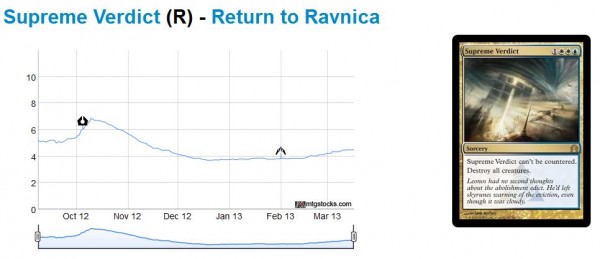
But for this week’s article I’d like to peel the onion one layer deeper to try and analyze what the magnitude of changes imply for the game of Magic. A drop in Modern staples of 50% and a drop of 10% may mean something very different – especially for the long-term health of the game. The increase in Return to Ravnica prices will also be very telling.

Allow me to explain further.

Modern Movement

It’s no secret that I’m very bearish on the most expensive Modern staples. This includes cards like Tarmogoyf, Thoughtseize (chart from mtgstocks.com), Dark Confidant and Vendilion Clique.
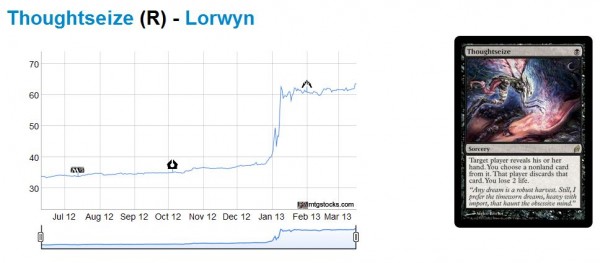
My negative outlook on Modern is based on the economic principle of buy low/sell high. One only needs to glance at the chart above for two seconds to understand that Thoughtseize and other Modern staples have recently jumped and are sustaining highs throughout Modern PTQ season. But with so much uncertainty in Modern Masters’ impact, I cannot anticipate these prices will hold.

But the percentage of the drop is in much contention. I maintain the drop will be sizeable, while many others suggest the printing of Modern Masters will ultimately increase Modern card prices. Even if the true outcome lies somewhere in between, my interpretation of players’ emotions towards Modern will be completely different.

Just because PTQ season is over doesn’t mean Modern disappears for months (it’s not Extended, after all). Some stores do run Modern at FNM’s, and since Modern is a mainstay of the Pro Tour,, there will be continuous focus there as well. The question I seek to answer: have Modern prices spiked strictly due to greater numbers of PTQ grinders, or is the format appealing to newer players?

I wish to know this because it will help me predict how Modern prices will shift in the coming months. If demand for Modern staples were strictly driven by PTQ grinders trying to grow their card pool for the first ever Modern PTQ season, then I expect prices to drop drastically as Modern Masters approaches. If, on the other hand, many new Magic players are dabbling in Modern, then the printing of Modern Masters may reduce barrier to entry sufficiently so that the number of Modern players actually increase.

I suspect the truth will lie somewhere in between, although I still maintain there will be a short term drop in the coming months. This is because no matter the scenario, the supply is about to increase significantly while demand will drop at least in the near-term. Demand may increase in time, but this will only happen because prices will drop, reducing the barrier to entry. Prices have to drop in order for more players to want to play Modern – it’s the whole premise of Modern Masters.

Net: I don’t think short term price directions are a mystery, but the degree of these changes will hint at the health of Modern as an FNM format. The more new Modern players there are, the more Modern prices can sustain their heights.

Standard Season

The next PTQ season is Standard, and the format is very diverse these days. I find myself itching to build a Standard deck despite my distaste for the evanescent nature of the format. The concept of building an $800 deck which may halve in price just a few months later sickens me and goes against my philosophy of the game – hence why I love Eternal formats much more.

Since the format is healthy, I anticipate large turnouts at these PTQ’s. Once again I pose the same question: will the usual PTQ grinders dump Modern and pick up Standard staples, or will we see an influx of new players trying to make it big? Both occurrences have a short term positive impact on the market, but the latter seems more sustainable to me.

Standard doesn’t quite fit the same mold as Modern, regardless. With almost-weekly Star City Games tournaments, it seems like every season is Standard season. Adding PTQ’s on top of this will definitely increase demand.

What I wonder is whether the demand increase will live and die with PTQ season, or if new players continue to pour into the game and buy into Standard. In the former case, card prices jump for a few months and then settle back down again. In the latter case, card prices continue their steady rise and don’t see a major hit when Standard PTQ season ends.

My suspicion is that there are many new Magic players trying out Standard. I base this on the fact that Standard and Casual card prices have shown a slow and steady rise recently. Supreme Verdict was one example mentioned above, but there are others. Perhaps the best examples are the mana-fixing lands which have been a mainstay of Standard for four years running (chart from mtgstocks.com).
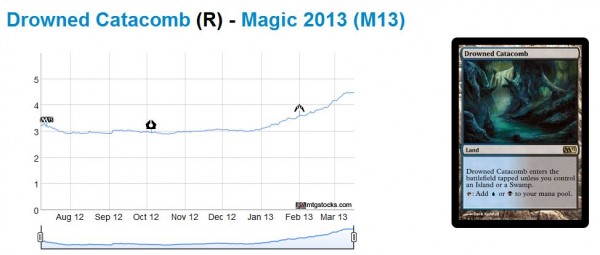
I have no clue how many copies of this card exist across its four printings – all I know is that there are many! Yet since January this card, along with the other check-lands, have each seen a steady price increase. This chart is very different from that of Thoughtseize, which leads me to believe the driving force behind the price movement is different. Instead of a sudden spurt of demand from a PTQ season, Drowned Catacomb has seen a steady increase in demand.

It’s possible that the ample supply of these lands may be dampening the response in price. But ample card supply hasn’t prevented other cards in Modern from spiking, such as the recently popular Ajani Vengeant (chart from mtgstocks.com).
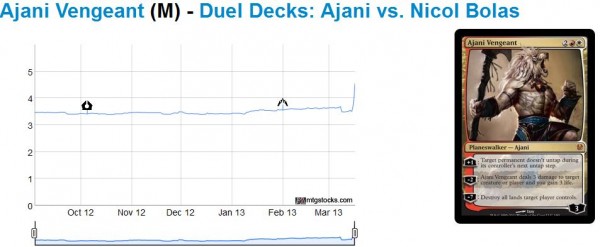
The price jump depicted above is much more discontinuous and suggests erratic behavior, such as massive buying from speculators. The price jump in the likes of Thoughtseize is also drastic and was likely driven by PTQ interest.

The price increase in Drowned Catacomb, however, seems much more subtle and, in my opinion, sustainable. PTQ players didn’t drive it nor did speculators. It’s much more likely that the number of Standard players has simply increased.

My Action Items

If I truly feel this way about market trends, I should put my money where my mouth is, right? In fact I already have – I’ve sold my top Modern staples and I’ve been steadily buying into Return to Ravnica. Abrupt Decay has already jumped in price, and I likely won’t be acquiring these much more. Supreme Verdict’s rise has been smaller thus far, so there still may be opportunity there. I also picked up a few Sphinxs Revelations since I feel these have bottomed as well (chart from mtgstocks.com).
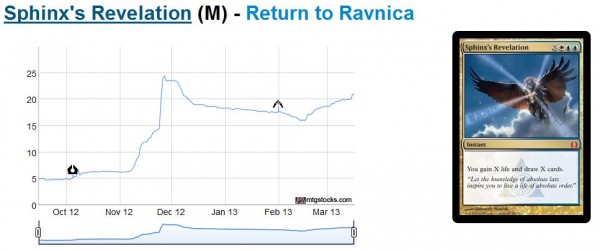
I suspect I have just a couple more weeks to grab more of these cards before they jump more significantly, driven by PTQ grinders and new Standard players alike. The key difference is that these price increases are likely to be stable, whereas the sustainability of the Modern price jumps is an unknown quantity. If you ask me, I’d much rather be in the steady risers until this whole Modern Masters thing settles down.

…

Sigbits

  • Unless you are tuned-in with the market, you may not be aware of how expensive Summer Magic cards have become. I have one card from the misprint set of ’94: a NM Gray Ogre. It’s even graded, which I think is kind of funny. A quick search on eBay and I see similarly graded Summer commons that no one wants to play with still sell for over $200! If you ever come across some Summer cards, I’d encourage you to take a closer look and compare prices online – you just may stumble across someone out of the loop on these price increases.
  • You know what card is reliable as an indicator for the health of casual Magic? Check Platinum Angel. I never see this card at tournament tables, yet the card has been on a steady incline for the past few months. This despite the fact it was printed four times! I guess new players really like the concept of not losing games!
  • Speaking of Angels on the rise, does anyone know why Battlegrace Angel has more than doubled in price over the past six months? I have never seen the card played in Modern and it’s not Standard legal. Must be those casuals yet again driving up prices. Seeing this makes me want to buy into Bruna, Light of Alabaster. Bruna is a Mythic, legendary angel from a third set with sweet artwork that retails for under $2. One of these days I’m going to buy a stack of these because I see no way these can drop further in price.

-Sigmund Ausfresser
@sigfig8

Insider: MTGO Grab Bag

Are you a Quiet Speculation member?

If not, now is a perfect time to join up! Our powerful tools, breaking-news analysis, and exclusive Discord channel will make sure you stay up to date and ahead of the curve.

The MTGO-to-Paper metric has proven a useful tool for analyzing the potential of speculative investments in digital cards. It appears as if Star City Games (SCG) is having a sale in March, so the current prices for complete sets are discounted. In order to preserve the usefulness of the metric, today's table simply uses last month's price from SCG.

When the baseline price from SCG changes, such as during the current (assumed to be) temporary sale, it's best to use older data. If the sale continues, then I'd have to adjust to the new baseline price and recalibrate the metric. Looking at how the metric changes over time provides a guide for identifying value but if the baseline is shifting it loses a lot of usefulness.

Rotation + Redemption = Profit

If you consider where the ratio stood for the Scars of Mirrodin sets back on November 14th, the signal was to buy Scars of Mirrodin (SOM) and Mirrodin Besieged (MBS) mythics over New Phyrexia (NPH) mythics. In terms of a percent return before transaction costs, a basket of every SOM mythic rare would have yielded a 97% return, an MBS basket would have yielded a 97% return as well and a NPH basket would have yielded 46%. Indices for these sets can be found at mtggoldfish, which tracks historical pricing data from MTGO. Each of these returns is calculated by taking the index value for today and dividing it by the value of the index on November 14th, 2012.

The big caveat in all of these numbers is that mtggoldfish transitioned from using Supernovabot prices to MTGOtraders prices in January. This probably biases the calculated percent returns higher by some amount due to the relatively higher prices of MTGOtraders in comparison to Supernova. However, this change or shock to the data occurred for all three sets. Thus comparing returns between sets is still a valid way to judge the results of the ratio metric. In this case, the digital/paper metric appears to be performing very well.

Set MTGO to Paper Ratio (Nov 14th) MTGO to Paper Ratio (Feb 14th) MTGO to Paper Ratio (Mar 14th) Supernova SCG Trend
Scars of Mirrodin 0.45 0.56 0.74  $92  $125 Up
Mirrodin Besieged 0.39 0.60 0.66  $66  $100 Up
New Phyrexia 0.57 0.84 0.90   $99  $110 Up
Magic 2012 0.36 0.52 0.61  $91  $150 Up
Innistrad 0.51 0.48 0.59  $162  $275 Up
Dark Ascension 0.64 0.62 0.77  $116  $150 Up
Avacyn Restored 0.76 0.64 0.71  $178  $250 Up
Magic 2013 0.50 0.52 0.56  $139  $250 Up
Return to Ravnica 0.39 0.44 0.57  $158  $275 Up
Gatecrash N/A 0.39 0.35  $105  $300 Down

The ratio metric suggested that NPH was the most expensive of the rotating sets (note that I am ignoring M12 in this analysis due to the presence of reprints). From a value perspective, the goal is to seek out cards from sets that are cheap and thus promise value. In this case, the metric correctly identified which were the cheapest and thus value-laden sets. Three months later the value in SOM and MBS has been realized through increased prices.

For those that have been following along and have a few copies of Koth of the Hammer or Consecrated Sphinx tucked away, selling now would be a fine move. Demand from redeemers looks like it should be slowing down as prices have risen substantially since November. For the 2012 round of Standard rotation, the bulk of gains have been made. Personally I will be selling down my supply of Scars block mythics over the coming months.

ZZW Follow Up

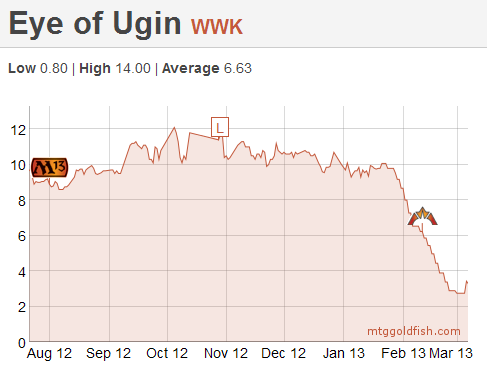
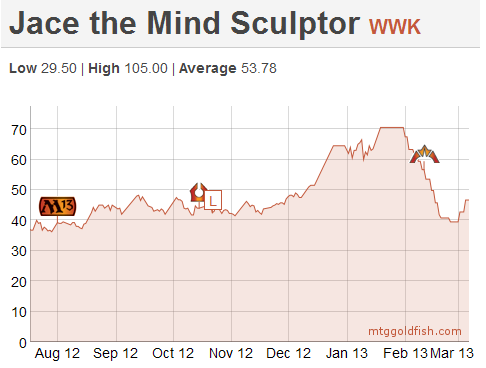
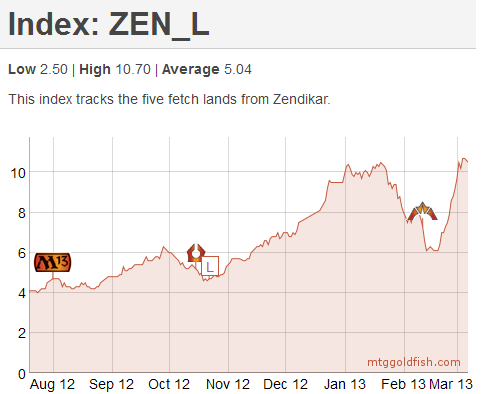
Last week's article looked at a couple of market laggards from Worldwake (WWK) in Jace, the Mind Sculptor and Eye of Ugin. In this case, these two mythic rares had dropped in price in a similar way when compared to the Zendikar (ZEN) fetchlands. The bounce back in the price of the fetchlands suggested that the market had temporarily overreacted to the injection of new supply from the ZZW queues. When the market is overreacting, either through delirious price increases or drastic price drops, it's time for speculators to pay attention.

While the fetchlands bounced back in price for their own reasons (namely they are Modern staples and the Modern PTQ season was in process), all cards from ZEN and WWK had dropped for the same reason. In a counter-factual scenario, if the fetchlands had not bounced back in price, then pursuing laggards would have been a mistake. A failure to bounce back would indicate that the supply injection for fetchlands was large relative to the demand.

Timing the buying and selling of the fetchlands in and around the ZZW queues would have been a neat trick. I didn't touch them at all because I had no data or experience to guide my buying decisions. If you managed to time the market perfectly on a regular basis, I'd love to hear how you do it. But, once the fetchlands did bounce back in price, this provided a strong hint at how much supply had actually been added into the MTGO market. With this hint in hand, I started looking at other cards from ZEN and WWK.

The bounce back in price suggested the supply added to the market was small relative to the demand and that prices had fallen too low. Speculators should have been looking to pick up market laggards such as Jace, the Mind Sculptor and Eye of Ugin. Although demand for these cards is not as high as the fetchlands, demand for them is non-zero and value is value.

Other Laggards

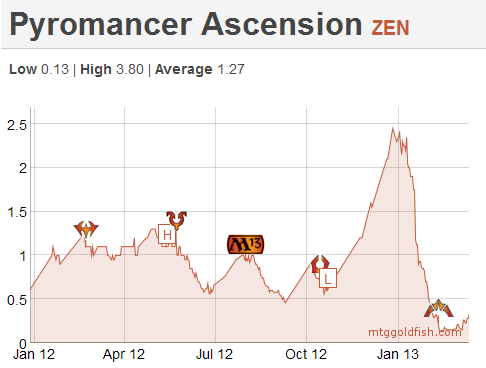
There are other laggards from ZEN and WWK that still offer good value for the patient speculator. Pyromancer Ascension took a double hit due to the ZZW queues and the banning of Seething Song. Now, I don't have a good idea whether Pyromancer Ascension decks are any good in Modern, but I do know that Seething Song was not an integral part to the deck. Buy Pyromancer Ascension at prices less than 0.4 tix if you are looking for value and are willing to hold for 8+ months.

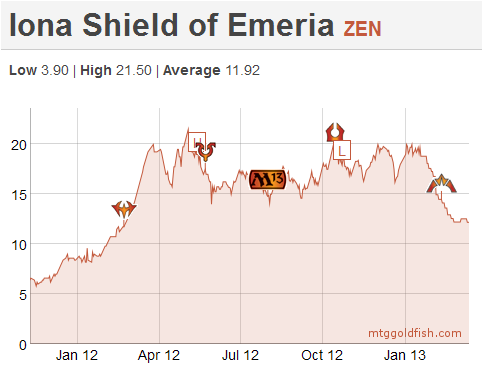
Another card which holds value from ZEN is Iona, Shield of Emeria. This card has been stable in the 16-to-20-tix range for most of the last year. It's an occasional reanimation target in Modern Gifts Ungiven decks. Also an angel! Although redemption no longer supports the price of ZEN mythic rares, Iona is another card that took a big hit from the ZZW queues and has not bounced back. Buy this laggard at current prices of 12-13 tix if you are willing to hold for 8+ months.

Developing new techniques for identifying value is a must for any serious speculator. Don't take what I have said here for granted; bring a critical eye and your own experience when considering any speculative bet. Do the analysis. Think about how things have gone in the past to see if they offer any guidance in the present. When it comes down to pulling the trigger on a new position or selling out of an older one, ultimately each speculator has to make that decision for themselves.

Insider: What I’m Selling

Are you a Quiet Speculation member?

If not, now is a perfect time to join up! Our powerful tools, breaking-news analysis, and exclusive Discord channel will make sure you stay up to date and ahead of the curve.

You may not realize this (or maybe you do), but Modern PTQ season ends soon. And by soon, I mean now. Like right now.

Okay, there may or may not have been some hyperbole there, but I hope I demonstrated my point. For all intents and purposes, Modern season is practically over. Sure, retail prices may not yet reflect this, but if buylists don't they will very soon.

That means it's time to sell out of Modern stock, if you haven't already. Now I’m not going to go through every card that could possibly be in Modern Masters and tell you to sell it, because I’m not sure an exhaustive list is all that helpful considering the multitude of cards that could be in the set. That said, there are a few I want to highlight, because I think that even if they don’t show up, Modern Masters reprints may not be all that far off.

But this list doesn't just encompass Modern. There are a few Standard commodities I think are going to continue dropping, and I want to highlight those as well. I’ll also highlight what I think you should be turning these cards into, and I’m planning an exhaustive Modern pickup list in the next few weeks.

So let’s get started.

Serum Visions & Sleight of Hand

Both of these are worth more than a few dollars, a level rarely seen for commons, so I think it’s probably best to move them. I’m not sure if either or both will be in Modern Masters, but there are a few reasons I don’t think they can go much higher.

The first is that the players who want to play with these already have them. I understand you can say this about basically anything. But these are pretty much only played in two decks in Modern, and Storm is basically dead at this point, so that’s another strike against them.

Add in the possibility of a Modern Masters reprint and I think you should clear all of these out. If you want some place to put the same money I suggest Street Wraith. The prices are similar, but Wraith is still trending upward and seems way less likely to appear in Modern Masters than the other pair of cards.

Azusa, Lost but Seeking

The recent spike on this to $15 screams mass buyout. Sure it’s a card in one Modern deck and is an EDH favorite, but the recent run-up is a product of hype and not much else. I think this will settle back higher than it started, but it seems like something that’s probably peaked for the time being.

Kitchen Finks

Not only am I fairly certain this will be in Modern Masters since it’s been a Modern staple since the inception of the format, but even aside from that this may be overpriced.

Right now it’s sitting at the same price as was when it was an auto four-of in Jund. Since then, not only has Jund become less ubiquitous but Finks is not an automatic inclusion any more. That’s a recipe for a card that will be cheaper in six months than it is now.

Boros Reckoner

I know this is an obvious one, but I wanted to include it because it’s a good time to check in on the price. Reckoner, after jumping to $25, is already all the way back down to $19 and dropping fast.

It amazes me, but people were arguing when this passed $20 the first time around that it was there to stay. This is one of those situations we'll look back at in six months when it’s $10-15 and everyone will say “of course it wouldn’t stay $25.” But there have been plenty of people who told me that it would, so it just goes to show not everyone is as savvy on supply and demand issues as we are.

Gatecrash Shocks

Speaking of overpriced new cards, the shocks from the second set are running significantly higher than their RtR counterparts. When I do come across Gatecrash shocks I’m doing my best to turn them into RtR ones, which I’m still stocking up on in trade at the $7-8 price you get them at. I’ll repeat it again, they may fall a little bit more due to Dragon’s Maze, but that’s not going to stop me from acquiring these because I expect they’ll be $10+ in a year and maybe even more.

Gatecrash shocks, on the other hand, are overpriced at the moment. I don’t advise getting into these until the price settles down to roughly the same level as RtR, even if that takes a few more months.

Champion of the Parish

This is one of those cards where the line between hold and sell was really close. I really liked them a few months back at the $4 or so you could acquire them at. Since then the Mid TCG price hasn’t risen as much as I expected despite the card seeing a ton of play, but the retail price from a few other places has gone to $8. I took this as an opportunity to out mine at $5-6 in cash to a local store.

With the event deck putting even more copies of this onto the market I think the ceiling is near at hand if not already reached. After winning SCG events and a Pro Tour, the hype on Champion can’t get any bigger, so now’s a good time to move out.

The Stragglers

There are a few other talked-about cards I don’t have any particular opinion on yet and will wait a bit longer (like Thundermaw Hellkite, which was a sell a month or two back when it topped out but now has settled.) But I know people new to the trading game, even if they know when to buy, often have difficultly knowing when to sell.

I figured a simple article like this explaining what I’m trying to move out is a step in the right direction. You can make just as much money by knowing when to get out of something as you can by knowing when to get in.

Thanks for reading,

Corbin Hosler

@Chosler88 on Twitter

Adventures in Qualifying — Modern PTQ #2

Are you a Quiet Speculation member?

If not, now is a perfect time to join up! Our powerful tools, breaking-news analysis, and exclusive Discord channel will make sure you stay up to date and ahead of the curve.

Modern seems to be wide open at the moment. Most of the PTQ top-eights from after the recent bannings contain at least six different decks. There are many options to choose from. Whatever deck type you like to play, there is one that will fit your play style.

Grixis Delver has been my deck choice recently. I feel that the deck is powerful and has answers to every deck in the format. Last week I wrote about the PTQ I went to with the deck and how I felt variance got the best of me. With some experience against high quality players, I felt prepared to win a PTQ with the deck. A couple minor changes helped as well. This is the list I played at the Pittsburgh tournament.

Untitled Deck

Creatures

4 Delver of Secrets
4 Deathrite Shaman
4 Dark Confidant
4 Snapcaster Mage
2 Vendilion Clique

Spells

4 Serum Visions
4 Lightning Bolt
3 Inquisition of Kozilek
2 Thoughtseize
3 Remand
1 Mana Leak
1 Izzet Charm
1 Electrolyze
3 Cryptic Command

Land

3 Creeping Tar Pit
2 Darkslick Shores
4 Scalding Tarn
3 Verdant Catacombs
1 Misty Rainforest
1 Watery Grave
1 Steam Vents
1 Flooded Grove
1 Blood Crypt
2 Island
1 Swamp

Sideboard

2 Firespout
2 Surgical Extraction
1 Liliana of the Veil
1 Jace Beleren
1 Geths Verdict
1 Go for the Throat
1 Thoughtseize
1 Countersquall
2 Ancient Grudge
1 Dispel
1 Spellskite
1 Dissipate

Round 1 –- Affinity

As I was walking over to the pairings for round one, a friend of mine told me my table number. I was a little surprised, but when he sat down next to me I understood why he knew my number. Even though I had to play a friend, neither of us knew what the other was playing so nobody had the game one advantage.

After [card Thoughtseize]Thoughtseizing[/card] him my first turn, I knew he was playing Affinity and that the five damage I just took (fetch, shockland, Thoughtseize) was going to make this game much harder to win. It took me longer than normal to determine which card to take. His six-card mulligan looked like this:

Eventually I settled on the Master because I knew it was the card I’d have a hard time beating. Second turn, I had to flash in a Snapcaster Mage with no spell to flash back because I needed to take as little damage as possible. Sometimes, it’s just fine as an Ambush Viper. I was able to climb out of game one on the back of Electrolyze and then flashing it back with my second Snapcaster Mage. Ending the game at five felt so close to losing but I pulled it off.

Game two was not as close. Again I had Electrolyze, but he sided in Spell Pierce to surprise counter it. I drew an Ancient Grudge which destroyed his Spellskite so I could use the other removal spells in my hand. I stabilized much earlier at ten life and then began attacking him.

I should mention that in both games, I had to make decisions about whether to use my removal on normal creatures or his Inkmoth Nexus’. Managing that aspect of the game is crucial when playing against this deck. Don’t be afraid to get some poison counters but make sure you deal with it. I will happily take five poison before killing an Inkmoth most of the time.

Record: 1-0

Round 2 –- Naya Pod

Game one, I stripped his hand with Thoughtseize, Snapcaster flashback Thoughtseize. That totaled ten damage to myself but crippled his combo-centered deck. When I used Vendilion Clique to get rid of the Restoration Angel from his hand, I was able to swing for the win in the air easily. He resolved many spells this game but none of them had much impact.

Game two, my hand did not have any threats to put pressure on him. So even though I was able to counter a Birthing Pod and remove a couple key creatures, he just went on the beatdown plan and killed me with Restoration Angels. I was happy with my play this game because I did not give up and I kept trying to find a way to kill him. I didn’t quite get there, but I gave myself outs. If I had drawn the Lightning Bolt I was looking for, I would have been able to deal him exactly lethal on the last possible turn. The fact that it didn’t happen is unfortunate, but at least I played to my outs.

Game three my Inquisition of Kozilek showed me Kitchen Finks, Restoration Angel, and Kiki-Jiki, Mirror Breaker as well as four lands. I was stunned that my opponent would keep this hand that did nothing until turn three -- or turn four, since I took the Kitchen Finks. If you are playing Naya Pod, that is an auto-mulligan. Anyway, as you can imagine, I basically did whatever I wanted and eventually killed him.

Record: 2-0

Round 3 –- Boros Burn

Anytime your opponent leads with Mountain, you can be almost certain they are playing some type of burn deck. The important thing to remember is that no two burn decks are the same. Some are monored and the rest are some combination of red, white, and black. All the games against burn are close calls.

Game one, I was trying to figure out a way to deal with Shrine of Burning Rage, Rift Bolt, and Hellspark Elemental, plus his future draws. I did a decent job keeping my life total high, but after dealing five damage to myself on turn one to get a card out of his hand, had a much harder time staying alive. Cryptic Command did bounce the Shrine to slow him down but I failed to counter it when he played it the second time. There was one play at the end of the game, where I did not counter his end of turn Lightning Bolt, which I think was a mistake. If I counter that spell then he has to rely on the top of his deck to win the game. Losing a game I felt I could win did not feel good but there was no guarantee I would win even if I countered there.

Game two I was able to race with Delver of Secrets. Because of that early threat, I could play the tempo game and stall him long enough to burn him out with my Lightning Bolt plus Snapcaster Mage to flash it back.

Game three I went all the way down to two life before I stabilized. He had to use two removal spells on Deathrite Shamans but he did not have anything for the third one and I was able to crawl back into the game by gaining two life per turn. Eventually once I was at ten and he had drawn a couple lands in a row, he conceded.

Record: 3-0

Round 4 –- Grixis Mirror

Game one I had the best hand possible for the mirror. Two Deathrite Shamans, Delver of Secrets, Lightning Bolt and three lands. On turn two I cast all of my one-drops, putting three creatures in play and killing his Deathrite. When I flipped the Delver with Remand, we both knew it was over and moved on to the next game.

Game two I kept an awkward hand that involved two Creeping Tar Pits, Deathrite, Cryptic Command and a Remand. When he killed the Deathrite, I knew it would take too long to get to four mana. I did not draw anything other than lands and by the time I had four mana, he just countered my Cryptic and kept swinging with his flipped Delver of Secrets that I had no answer for.

Game three was long and extremely close. We both cast a ton of spells and dealt with each other's threats, but in the end I was two life short of killing him and he finished me off with his unblockable Creeping Tar Pit. Overall, he drew much better than I did but I think the real mistake I made was not mulliganing the awkward hand from game two. If I had done that, I would have had a chance to win that game. This deck works better on six cards than any I’ve played so don’t be afraid to lose a card if you opener won’t work.

Record: 3-1

Round 5 -– Naya Pod

It surprised me to play this deck a second time in this PTQ, but I think it’s a favorable matchup for my deck so I was happy. The Inquisitions, Thoughtseizes, and Vendilion Cliques do so much work against decks like Pod that revolve around synergy. As long as you have two of these effects, it is relatively easy to win the game.

That's how game one went, but the second was the exact opposite. My mulligan to six contained an aggressive hand with three one-mana creatures. This is the hand I hope for often, but not in this matchup. I decided to keep because I had already mulliganed. It did not work out well for me. He had blockers for my creatures, so I was unable to get in much damage and then he successfully baited me with a Chord of Calling at the end of my turn. The last spell in my hand was the extremely versatile Izzet Charm, so I countered the Chord. He untapped and played Kiki-Jiki, Mirror Breaker to combo me out. If I had thought about the Chord more, I would have realized that Chord for three would not impact the game and I could have saved my spell.

Game three he had many reactive cards, but my tempo advantage was too much. With an early threat, you can use Remand and Cryptic Command to buy you the time you need to kill them quickly. Their mana curve is fairly high so Remand usually stops them from doing anything else on that turn. Even Remanding their end of turn Restoration Angel is fine because they should not be able to beat you on their turn.

Record: 4-1

Round 6 –- Eggs

Game one against Eggs is miserable, even more so when they are on the play. I kept a fine hand against almost any opponent, but it was not good enough to stop him from killing me on turn three. I slowed him down, but it was not enough.

Game two felt much more winnable. I boarded in Thoughtseize, Dispel, Countersquall, Dissipate and two Surgical Extractions. Even though I wasn’t sure it was right to board out the Cryptic Commands, I ended up cutting them because four mana is a lot in this match. Between my hand disruption and counters, he was not able to do much.

Game three Surgical Extraction won the game for me and my Vendilion Clique cleaned up the mess. I had to play this game in less than eight minutes in order to complete the round. After winning this match, I felt like I could beat any deck. Eggs is such a hard deck to beat and I felt a sense of accomplishment.

Record: 5-1

Round 7 –- Win-and-In against Gruul

I was pumped about playing in my win-and-in because I felt like I had been playing well all day and my deck seemed strong against the Modern metagame. If I won this round, I could draw into the top eight next round, so there was just a little pressure.

My opponent was basically playing a Standard deck with Tarmogoyfs. That should tell you how strong Burning-Tree Emissary is. Once I cast Inquisition and took his only relevant spell (Flinthoof Boar), I knew I could easily win the game from there.

Then, on his turn three, he topdecked an unexpected card that changed the game: Domri Rade. I just sat for a moment and stared at it. It resolved and of course he drew a card on the first activation. The card? Tarmogoyf, of course. He proceeded to draw an extra card each of the next two turns and then I had to figure out a solution to his planeswalker which was about to ultimate. I did not win this game. I felt like that was the single card he could have drawn in that situation to pull him out of the game. It was the only copy of the card in his deck.

Game two my mulligan could not handle his hand of double Tarmogoyf plus tons of burn and I was quickly overrun by rather large lhurgoyfs. I had outs to this situation, but I did not draw them.

After talking to some friends about this matchup I feel it may be the most difficult one for the deck. The problem is that you have a hard time dealing with Goyf. There are cards to handle it but if you don’t draw them specifically, you lose to the big green monsters. I thought Firespout would be the answer and I had them in the sideboard just for this deck, but it didn’t work out that way. My Firespout killed two or three creatures but left the Goyfs around to kill me.

I need to work out a solution for this deck if I play it again. The answer may be adding a Damnation to the sideboard in place of Firespout but that might not be the right direction. Bringing in Thoughtseize to take care of the problem ahead of time may work, but losing two life against an aggro deck seems risky. There is a lot to think about in terms of this matchup.

Record: 5-2

Round 8 –- UWR

From my last experience playing against this deck, it feels like a 50-50 matchup. Those stats only matter when you are playing to win. After I lost my win-and-in, I felt pretty demoralized. It was a clean cut to top eight. All the people who were X-1 or better were able to draw and I was out of contention. There were some packs on the line, but that was meaningless to me. Not often do I tilt, but this was one of those times. After he beat me game one, I tried to play a second game, but once the first thing went wrong I just conceded and started my drive home.

So close. That has been the story of the entire last year for me. I traveled to a ton of events last year, far and away more than any other year. Despite the number of events I attended, it wasn’t anywhere close to my best year. All the Grand Prix I attended, I did well and then lost the last round playing for day two. Many PTQs and other similar events I lost the last round playing for top eight. One of these is mine, I just need to keep my head up.

Tournament Tips

“There's just too much to Modern for one player to take on himself.”
-- Reid Duke

The only way to get into Modern, the only way to understand Modern, and the only way to enjoy Modern...is to go to an event and play. Do it.

Until Next Time,

Unleash the Force on Modern!

Mike Lanigan
MtgJedi on Twitter
Jedicouncilman23@gmail.com

A Story and a Thought – Of PTQs and Invitations

Are you a Quiet Speculation member?

If not, now is a perfect time to join up! Our powerful tools, breaking-news analysis, and exclusive Discord channel will make sure you stay up to date and ahead of the curve.

I played the wrong deck in Fargo. At the very least, I wasn’t well equipped to combat any double Lingering Souls draws, and that’s exactly what I lost to in round one. I was handily dispatched by Andrey Yanyuk. You may know him as Reynad; we Minnesotans know him as Kid Magic. He was playing some zonky Glittering Wish deck, which he demonstrated to me is much better when you draw Lingering Souls in multiples instead of its namesake card.

Then I kept a couple land light hands in round two and never drew adequate lands to actually play. It happens. It’s Magic. It wasn’t the first time I’ve 0-2 dropped and odds are slim that it will be the last. If anything, they 0-2 drop days are dramatically better than the bubble days, because at least I get an early start on drinking and Cubing.

Car mate Matt Tickal was not so lucky.

See, while I was off casting an un-kicked Rude Awakening to make my Sublime Archangel lethal, Tickal was slugging his way deep into the tournament.

His weapon of choice was Melira Pod. He’s been playing that deck in Modern for as long as there’s been a Modern. He has a propensity to play too quickly and miss some decidedly stupid things in game, but I would easily take him playing Pod over piloting the deck myself. Frankly, Demonic Tutor on a stick gives me headaches.

At the Des Moines PTQ Tickal piloted the deck all the way to second place, ultimately losing to a B/W tokens deck. For his trouble he was given a box of Gatecrash.

Now, if you’ve never battled in a top 8, winning a box sounds like a pretty solid end to a day of playing Magic. For only $30 of entry I’d say it’s easily an above-average pre-release. That said, PTQs and prereleases are entirely different animals. Sure, there will be people at both such events just there for some laughs and battles, but first prize is different in every relevant respect. I don’t think I’m alone in saying that the store didn’t have enough cases on hand to trade for such a prize, and one box just isn’t close.

Sure, San Diego isn’t the most glamorous of destinations, but this is the Pro Tour we’re talking about. I may be a bit jaded about the big stage myself, but I’m not going to pretend like I never lost sleep the night before a PTQ just daydreaming about playing on the PT, and I absolutely won’t lie about the fact that I stream as much coverage as possible during the event.

Playing in the finals of a PTQ is about as emotionally charged as a sleep-deprived, hungry nerd’s brain can get. Winning is literally a dream come true, and losing amounts to a few drafts and a “better luck next time”. I mean, they don’t even give you top 8 pins anymore!

Where was I? Oh yes, the dagger-laden life of Matt Tickal.

Descent into Madness

Fargo yielded yet another top 8 for Tickal, and once more he didn’t stop there. When I returned to the event site I found him easily dispatching his semi-finals opponent. The most notable excerpt from the match being his opponent reading his Master Biomancer, an achievement that many seek to unlock in single-elimination competition.

Then it was time for the finals.

Once again Tickal found himself battling against Black/White tokens for all the marbles. In game one his opponent lead with Tidehollow Sculler into Lingering Souls and proceeded to drop double Honor of the Pure on turn four. He barely got to play that game. He sunk in his chair as he made what few plays he had.

“You weren’t supposed to have two…”

While sideboarding he turned to me and said, “That was pretty nuts.” I wasn’t sure what I was supposed to say. What I knew for certain is that I didn’t want anybody walking away from the finals of a PTQ content to say that they were nutted out.

“Welcome to Magic.”

Maybe it was a little cold at the time, but I knew that if I were complaining in such a time I would want some tough love from my friends.

“Two more games, bro.”

Unfortunately, either from tilt or exhaustion, Tickal kept a miserable seven in game two. Naturally he drew nothing but lands and found himself finishing second to BW Tokens on back to back weeks.

I encouraged him to write an article to try to “play” for the sponsor’s exemption. Anybody that contends winning one PTQ is more difficult than finishing second at two, especially on back to back weeks, is just plain wrong. If he’s lucky he’ll just win the Minnesota PTQ this weekend, but if he’s not and he’s smart he should push for it.

Drawing Meaning

So why share this story? Well, I suppose this is my anecdotal defense of sponsor’s exemptions. For many the results of certain special invite competitors at PT Gatecrash, most notably Melissa DeTora, altered the perspective many had about such invites. For myself, the question of plight is much greater than the question of results. Whether somebody scrubs out of the PT or takes the whole thing down doesn’t factor into the equation of whether they have earned their trip there. Anybody can beat anybody else on any given day, and that is one of the aspects of Magic that contributes to the game’s greatness.

What I don’t care for is the nebulous nature of special invites. “Community contribution” is a phrase that I’ve filed under the category of “things that can mean literally anything”. I would personally be in favor of some manner of point system that allowed PTQ competitors to earn invites each season. Not something awful like Planeswalker Points that rewards just playing mind you, but something that allows multiple top 8+ finishes to equal an invite on an actual objective scale. I’m not saying that two second place finishes alone should necessarily be the ticket, but give me something to work with!

Or, you know, we could just bring back ELO, which was easily trackable and rewarded consistent players with some sort of ratings decay for those who would “sit” on theirs.

Or we could keep on with nebulous nonsense and endless grinding. It doesn’t make a tremendous amount of difference to me and I’ve long since learned to stop expecting things to play out logically. This system would better reward those dreamers that are actually chasing PT dreams, but obviously I, like WotC, don’t have all the answers.

All I know is that no matter how they structure their events I’ll always have a Cube to draft when things don’t work out. This won’t stop me from pondering how things could be better, but it’s a nice place to hang my hat.

Good luck to everybody playing the Minneapolis PTQ this weekend. I likely won’t be able to participate on account of my sister’s wedding reception starting around six, but I’ll probably stop by and bird/Cube for a little while anyway.

Thanks for reading.

-Ryan Overturf
@RyanOverdrive on Twitter

Insider: Profiting From a Thinly Traded Market – Alpha Cards and You

Are you a Quiet Speculation member?

If not, now is a perfect time to join up! Our powerful tools, breaking-news analysis, and exclusive Discord channel will make sure you stay up to date and ahead of the curve.

I've recently made two cash purchases of Alpha goodies and while that required a significant upfront cost, the actual risks involved in the purchase are minimized by availability of the product (lack of) and a transparent buylist. Generally, I concern myself with writing about actionable advice and consider talking about personal specs no longer available to my readers to be bad form. However, in this case my purchases will provide great examples for those willing to enter what remains a volatile and thinly traded area.

Target One

I was able to acquire a slightly miscut near mint Nevinyrral's Disk from Ebay for just $206.49. A quick check of  QS's own mtg.gg shows a buy price from retailers at $199.99, suggesting I'm putting $6.49 at risk. Of course, there remains a wide spread between this buy price and the remaining four dealers also looking to pick up Alpha copies of the Disk.

With an online low of $235 for the only heavily played copy and just two near mint copies of Larry's Disk listed for $399.98 turning this purchase into a profitable deal shouldn't be too difficult. Finding a buyer between the low and the high will be harder than trading to a retailer at $350. A trade of course requires something worthwhile to trade into.

Unfortunately with prices for Modern looking a bit hot and Legacy not far enough off the highs it achieved thanks to a Pro Tour event some years back, I'm faced with an interesting dilemma: hold out for a buyer or trade into shocklands/ Standard cards. I still find shocklands a tempting target but will hold for a buyer at least until Innistrad rotation. At that time plenty of new targets come up that should face pricing pressure as they move out of Magic's most popular format.

Target Two

The next Alpha card I picked up was Meekstone for $52 shipped. Just five days after the Disk purchase, my first reaction to finding a BiN auction @$55 was to let the local shop and some random people online at the QS forums about the deal. After a meal with some friends I came home and submitted a Best Offer to the seller that (after a counter) we could both accept. Here I expect a card in excellent condition, but with a high buylist price of $72.16 and a major buylist buying at $60 this deal is approaching risk free.

The secret to speculation in thinly sought after cards is first and foremost trusting your evaluation of the card. Disk is an EDH board wipe that is easy to abuse thanks to Goblin Welder, Academy Ruins and Indestructible effects. The card itself has multiple printings, but there are only (at most) 1100 Alpha copies of the card and while I don't expect every EDH player to want one I am pretty sure demand exceeds supply.

Meekstone is a card I already have a home for. The local store owner - same guy I gave a heads up to - has already offered me more than two times my investment in trade. MtG speculators are the middle men of Magic card supply. It is our job to take advantage of real or perceived supply imbalance in a market and profit. Any investment in cardboard is easy with the other end of the deal already on the line. If you attend competitive Magic events, you can expect many willing buyers for your cards obscura. At worst you'll be playing vendors off each other for the chance to snatch up a piece of gaming history.

How to Profit

There will always be opportunities to profit handsomely from thinly traded stock. Ebay is home to distressed sellers and your chances to pick up cards for less than buylist are plentiful even excluding Alpha print runs. Buylists are more stable as concerns older cards and represent the safest assumption of risk for a speculator in my experience.

While scouring online deals for similar specs will be time consuming, narrowing your focus to limited print run cards and seeking distressed sellers at off hours will offer significant return at an easy to identify level of risk.

To see just how rare some of these cards are, I'll leave you with these stats on print runs from Alpha, Beta, Arabian Nights, and Legends:

Print Runs

Total limited run of 10,400,000 broken down as 25% Alpha, the rest Beta.

Alpha has 116 rares each with 1100 copies versus Beta's 117 rares with 3200 copies of each rare.

Alpha has 95 uncommon cards with 4500 copies each versus Beta's 95/13400

Alpha commons 74/15900 versus Beta's 75/47800.

Alpha basic lands 10/86800 versus Beta's 15/137900.

Arabian Nights:

33U2/20000 of each

17 U3/30000 of each

1U4/40000 copies of Oasis

1C1/30000 copies of Mountain

16C4/120000 of each

9C5/150000 of each

1C11/330000 copies of Desert

Legends:

121R1/19300 of each

107U1/57900 of each

7U2/115700 of each

29C1/212100 of each

46C2/424200 of each

Insider: Modern Control Decks and Foil Profits

Are you a Quiet Speculation member?

If not, now is a perfect time to join up! Our powerful tools, breaking-news analysis, and exclusive Discord channel will make sure you stay up to date and ahead of the curve.

Hey guys. I have a lot Magic-related on my mind right now, but 99% of my thoughts are on Modern. I want to cover a few of the fun money-making opportunities scrawled onto my notepad for this week.

A Few Thoughts on Modern Foils

We've all heard of pimping out decks. In fact, many of us have done just that with our collections. With Legacy on the decline and Modern skyrocketing in popularity, I'd like to delve a bit into what “pimping” decks is, and how we can make money off of it in Modern.

When a deck jumps in popularity, or a card, we go and buy nonfoils for a quick flip. Often, I see sold-out cards where the foils are about the same price as non-foils. Those foils will go up in price as well. Sure, the non-foils can be quicker money, but if you have more money, grab the foils too.

Modern is a format where people's decks change much less often. Heck, I've only had one Modern deck in the last nine months since I moved into the format. I have heavily modified it, and it is over half foil right now. If I weren't trying to profit from Magic, it would probably be 100% foil. Many others like to foil Modern decks because the metagame shifts more slowly. So you can expect these foils to continue to rise.

When cards shoot up, the foils often are easier to pick up. When I went out two days late searching for Bloodhall Ooze, I found ten foils at $1.25 each, and not a single nonfoil at below $3. I was a bit amazed that TCG had some foils at $5, when most were listed at $7-8. I sold three of them at $9.99 on TCGPlayer, and that alone made me my money back. The foils actually jumped at a much higher rate.

Importantly, this is extremely abnormal, for a variety of reasons. For starters, foil rares are not usually 300% of the nonfoils. Also, Conflux foils are usually very cheap and readily available, due to the massive foil printing from Shards block premium packs. So, when we aren't buying foil copes for a third of TCG mid on nonfoils, we want to stray from trying to hit foil rares and Shards block foils.

Why so much for a foil Bloodhall Ooze? Well, the only thought I have -- Jund is still a driving force in Modern. It is no longer uncontested, but is still a great Tier 1 deck. People who previously had a pimped-out Jund deck want pimped-out Bloodbraid Elf replacements.

Using this as an example, we can start to look at other cards in the same manner. An important one is uncommons and commons. Commons especially can hit ridiculous spreads between nonfoil and foil.

Serum Visions is an interesting example. The nonfoil is $3. There was a promo printing, which goes for $9-$10. Yet the foil still maintains a $7 price tag. This is down a bit, as I recently sold a few at $8 each.

So, we need to identify commons, uncommons and even rares that are not quite to the Serum Visions[/card] level, but are gaining popularity to the extent that foils may go up further. We can identify these when a deck starts to gain popularity, but mostly when a deck starts using a new card they were not using previously.

Shadow of Doubt
Photo Courtesy of MTGStocks.com

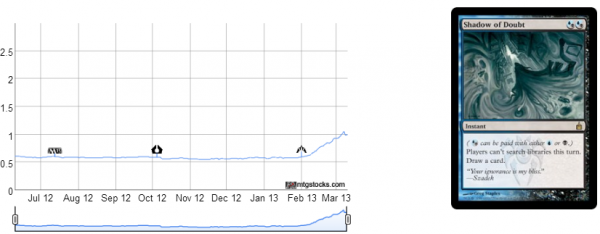
Shadow of Doubt, which is seeing play in a few decks, has seen recent increases. The foils are at about $3 and sold out on TCGPlayer. This offers a unique opportunity if you can find any –- as your TCGPlayer prices are now the price of the foil. I love these as a spec target, because they really shut down a deck in your favor.

This brings me to my next point.

Control... in Modern!?

Control decks are coming out in Modern (finally), and the metagame is probably the most diverse I have ever seen since I began playing. I'll be honest, Wizards did this format right. There is no nonland card you have to own to play Modern at all. I love it, and if I could, I would probably abandon Standard entirely for Modern.

So, these control decks are offering us a few opportunities. First, the foiling –- cards that are going up there can cause the foils to go up as well. I like foils because they go up slower, don't fluctuate, and have ridiculous ceilings. If you've read my past articles, you know I always bring up the shiny, and I really think there is money in them.

Looking at a few recent American Control lists on MTGO, we see some great targets. First, Supreme Verdict is seeing play. This shuts down even Merfolk lists, with their pesky counter spells. I really think Supreme Verdict is too cheap. It should be a $6+ card, as it is played in every format, and also has EDH and casual appeal. I would pick these up at $4 in trade, or $3 in cash.

We also see Electrolyze here. Now, this is a Commander reprint and a Champs promo. Obviously, the Champs promo is out of the question as a spec target, but the Guildpact foils are sold out. If you find them, they will probably fetch a pretty price tag.

Mystic Gate
Photo Courtesy of MTGStocks.com

These decks also run Mystic Gate. These are up to $10 now, but we could see more increase. If you have these I would hold them for a bit. With control decks on the rise they could hit $12-14.

Counterflux is a great target for both Standard and Modern. These decks seem to be running it for the control mirrors, and when Dissipate cycles out, we will see its use increase in Standard as well. It could hit $2-$3 at some point. The foils are already at the $3-4 price point, and the nonfoil just needs to catch up.

Detention sphere is also being played in these decks, and due to its “awesome” ability (being pitchable to Force of Will), it will probably start to increase slowly as RTR is being opened scarcely.

Condescend foils are about $1.50, and I think these have room to move. Gifts and U/W Tron both run a set, and both are fun decks to foil out.

I will keep my eye open for awesome new Modern decks as it is slowly becoming my favorite format. I am largely abandoning Legacy for Modern, and will continue to trade into it aggressively. Keep an eye out for my future articles, as I hope to cover new Modern archetypes –- and of course, their shinies –- for months to come.

Jason’s Archives: One Degree of Separation

Are you a Quiet Speculation member?

If not, now is a perfect time to join up! Our powerful tools, breaking-news analysis, and exclusive Discord channel will make sure you stay up to date and ahead of the curve.

Greetings, Speculators!

Today I want to talk about what we should have been doing while we were all patting ourselves on the back for not buying Shallow Grave.

Events to the Best of My Recollection

I think the order of events was as follows:

  1. Someone finally thought to jam another instant-speed reanimation spell in Legacy Reanimator because lol [card Emrakul, the Aeons Torn]Emrakul[/card].
  2. Shallow Grave hits $20, up from $3.
  3. People bought Shallow Grave for $20 apiece on eBay for a day, tops.
  4. The rest of the finance community threw a party congratulating themselves for being too smart to buy Shallow Grave after they spiked.
  5. Two weeks later the cost of Goryo's Vengeance tripled.

I saw that Legacy Reanimator deck watching the coverage, and I thought it was cute. Legacy Reanimator is already a Tier 2 deck, and there's a Tier 1 deck that cheats Emrakul into play. While it didn't occur to me that I should have moved on Shallow Grave when I saw the coverage, and there were no intermediate price steps between $3 and $20, we've seen things like this before. (I suspect one person went nuts in a bidding war and the BIN prices were set after that, but someone jacking the price on a retail site may have been the culprit; hard to say now.) If Grave had hit $5 for a day on its way to $20, more of us would have moved on it, but once it hit $20, it was clear there was nothing actionable there.

You know what a lot of us didn't do? Read the $%*^ing decklist.

Seriously

Goryo's Vengeance used to be near bulk. There wasn't a home for it in Extended until rotation at which point Kami block rotated out when Extended became Double Standard. In Legacy, no one was particularly jazzed about getting to swing with Sphinx of the Steel Wind once. EDH was a similar story where the card seemed underpowered and its "RFG" clause stymied further reanimation efforts on the same dude. Gerry T changed all that when he brewed a list a bit later in Modern that made the card worth it. I bought in at almost bulk and when the card hit $5ish (to the best of my recollection, you may need to fact check here) I sold out for a decent profit. The card trickled down to $3 or $4 and that's where it sat until last week.

People are playing Shallow Grave for one reason: it's extra copies of Goryo's Vengeance. It goes for more because Betrayers was opened more than Mirage, but its ability to animate non-legendary creatures doesn't make it four times as good as Vengeance. That meant nearly everyone who correctly identified Shallow Grave as overpriced, but still thought it spiked because of player demand, completely failed to identify Goryo's Vengeance as underpriced. Worse still, some people bought into Shallow Grave at $20 because reasons.

Why Does Stuff Happen?

Why did Aluren go up? If you say it's because someone manipulated the market you aren't wrong necessarily, but it's not the entire truth. Sure, some entity bought most of the copies of Aluren on the net, and small-time speculators bought the rest. But why did they buy all of the copies of Aluren?

Hindsight now tells us the timing is oddly coincidental with the announcement that Imperial Recruiter would be a judge foil -- putting more copies in the hands of players, some of whom would now be able to build Aluren if they wanted. The entity or entities responsible for the Aluren buyout were banking on more people building Aluren some day.

I bought a few Alurens for the pre-spike price because I moved quickly, but I sold them for far cheaper than the consensus going rate because I was hoping to nail a few wannabe speculators who thought buying a $20 card for $15 was a good deal. I got burned trying to flip them and I am stuck with a few copies, but Aluren is Aluren. It'll never be cheaper than when I bought it and since I made money on the endeavor I consider it a success.

What I should have done was look at what else could go up, other than Aluren, if Recruiter proliferates. Other deck archetypes is an answer, but other cards in the Aluren deck is an answer, too. Foils of cards like Cavern Harpy, for example, are cheapish. While most people ultimately would have decided (correctly) that nothing in the Aluren list was actionable and the odds of judge foil Recruiters turning a Tier 3 deck into a money machine were low, the analytical exercise is worthwhile.

How We Handle the Next Spike

There are two reasons a card may spike.

  1. It sees more play (Prime Speaker Zegana, Angel of Glory's Rise, Predator Ooze)
  2. Shenanigans (Cosmic Larva)

The next time we see a non-shenanigans related spike, the play is to look at what else is in the deck. If you're too late to buy in at a pre-spike price (or even a cost-effective intermediate step), you should probably not buy in at all. But if you think the spike is real enough to regret not moving on the card, there is probably still more you can do.

Check out decklists. There are other cards in the deck, and if they get played alongside the one that is spiking, it stands to reason that a rising tide lifts all boats. When Misty Rainforest hits $35, most of the QS community didn't durdle around saying "Wow, the blue ones are a lot better than the other ones." Most of the QS community said "Sweet Jesus, Verdant Catacombs is $10 retail right now, and that will likely be the buylist price in a month. Time to buy me some Catacombs!"

And you know what? Buying Catacombs at $10 was the play. They trade out at $25+ now, as do Marsh Flats and Arid Mesas. We all managed to make that small leap of logic in the face of price spikes of two of the fetch lands due to manipulation by an entity. Once we saw people were willing to shell out $35 for a Misty, we got on the Catacombs train to profit town. So if we're so smart, how many Goryo's Vengeances do we all have?

Probably should have read the decklist.

Did Somebody Say "Decklists?"

No, I said "decklist". Singular.

I Was...Trying to Segue into the Next Segment

Oh, sorry. My bad.

A Big Weekend Indeed

We had approximately all of the Grands Prix this weekend.

GP Rio Coverage

709 people came out to jam some Standard in Blanka's backyard.

A weird, junk-colored Unburial Rites deck put two copies in the top eight. This is basically Ryan Bushard's Seance list from like four months ago that loses the consistency of Seance recursion so it can run two more Unburial Rites and a do-nothing Acidic Slime. I like the deck, but I liked it more four months ago when Ryan built it.

Another archetype put two decks in the top eight, and that was Jund, which looks like a stock list from last week. Nothing new or exciting here.

I like the two Aristocrats decks in the top eight but I don't like their card choices. I don't know what's taking everyone so long to put Assemble the Legion in this deck, but I'm pretty sure Assemble plus Blood Artist is GG with sac outlets. The meta will catch up, and considering how hot Assemble was this weekend compared to how easily I scooped copies at bulk two weeks ago in Cinci, the meta is finally getting wise.

Humaninator continues to do well. Someone predicted a spike from Angel of Glory's Rise, but I wouldn't bet on it. The card's already around $2.50-$3 and I don't see it even hitting $5, let alone clearing it. I am selling now regardless since I bought in at a quarter each, so maybe I'll be pulling a Corbin Hosler and leaving 10% for the next guy before getting fired from the podcast.

I am not sure how the finals would have played out between Jund and Aristocrats; Artur Villela scooped to Jose Francisco da Silva. I think Aristocrats beats a deck that largely relies on haste creatures and odd junk like Mogg Flunkies, but it's hard to say.

What I will say is that Naya was largely absent from the top eight (one copy) and not a single blue card appeared. This is likely largely metagame-dependant and maybe some of the blue players went to a different event.

GP Verona

A European GP seemed like a better draw than one in South America, and the meta looked a lot different. The Junk Rites deck was here, but so were some pretty unusual decks.

A Rakdos deck piloted by Andreas Nilsson made it to the finals but couldn't beat the AngelTusk out of Mike Krasnitski's Junk Rites deck. The Rakdos list is very aggressive but doesn't run any green which gives it more removal and speed but seems like it robs it of power in the form of [card Huntmaster of the Fells]Huntmaster[/card] and [card Thragtusk]Tusk[/card]. Still, homeboy made the finals so it's hard to argue with results.

Max Schultze ran my favorite deck of the weekend, a UWR Reckoner build with Assemble the Legion. This card is going places as it has applications in a lot of decks and I think the meta is finally catching up to where it was always headed before it started dragging its heels. Legion is miserable to play against because it quickly becomes a clock. Scoop these cheap while you still can. If you still can.

Only one Naya list in the top eight here as well. I wonder if that says anything about where the metagame is headed. I wonder if Naya is still capable of winning SCG Opens...

SCG Indianapolis Standard Lists

I don't know that Naya winning is the story of the weekend.

Maybe it's the Zegana Bant deck that was all over this event. It is a much grinder Bant midrange deck than we're used to, but Zegana has always been an exciting card that just took a bit of time to get the mix right. The format may be ready for this deck as it has serious game against aggro and can usually out-advantage control. Chris Andersen turned me on to this deck, and I am sure he appreciates SCG publishing his 707th place finish. To be fair, I caught up to Chris after round one.

Me: "How'd you do?"
Him: "I'm dead."
Me: "Bummer. You lost, then?"
Him: "No, we went to time and the guy wouldn't concede so I conceded and dropped. I'm not going to try and win out the next 10 rounds."

Oh yea, did I not mention this event was 11 rounds? Because it totally was. You know who didn't play 11 rounds? That's right, players in day one of either GP. SCG Indy broke SCG's record for attendance, and it was clear because extra tables were hastily jimmy jammed in the room set aside for coverage, artists and side events. The overflow room wasn't super suitable for this purpose given one enormous design flaw.

The ceiling had %&$*ing mirrors on it. Yes, for actually. I watched a guy get some Dairy Queen for "cheating" because it was alleged he looked at the mirror during sideboarding to try and get an advantage. Outside, ranting to his friends, it was pretty clear he was innocent and just got caught looking up involuntarily the way we sometimes do when we're using our brains harder than normal. Regardless of his guilt or innocence, it sucks that there were mirrors there at all because most players don't have the danger of potentially getting bounced for cheating because you aren't supposed to have Magic Tournaments where there are mirrors on the goddamn ceiling. Not anyone's fault, except maybe us as players for having over 750 people attend this event. Last time there was an Open in the same ballroom there were maybe 400 attendees.

Lots of people were on the Prime Speaker deck and I think Prime Speaker could spike again. It already looks poised to return to its presale level of around $15 and anyone selling under $7 is already sold out. Scoop these el Cheapo if you can. This deck is the real deal, and even if it doesn't take off, it will take this turtley-ass metagame at least a month to realize it, giving you plenty of time to sell for a profit.

Seven archetypes in the top eight? Spoiler alert; that's the same spread as the Legacy event (two copies of RUG Delver). Seems pretty decent. Wizards worked hard to make Standard not terrible, and it paid off. There is no obvious "best deck" right now and people are playing decks they are comfortable with, which is how Magic should be. I love to see healthy metagames both days at SCG Opens.

Not as obvious as Prime Speaker and Assemble the Legions (BUY ZEM!) is a card I targeted heavily in trading in Cincinnatti: Supreme Verdict. This bad boy very quietly tripled over this weekend. No one likely knows yet, so try and scoop them for $3 in trades if you can.

Not much new here besides the Prime Speaker deck. The lists are all subtly different so check each one out. It seems like a good metagame choice.

SCG Indianapolis Legacy Decks

I expected to see more Punishing Jund. Maybe if more people had played that then Countertop, a deck all but KOd by Abrupt Decay, would not have won the event. In fact, I don't see any Punishing Fire decks at all scrolling down the list HOLY $&^% Punishing Maverick! WOOO! That's my JAM! (Actually, I'm pretty white. I have no idea whether a deck can be my jam. Please let me know in the comments if Punishing Maverick is, in fact, my jam). I like Punishing Fire decks right now, and I don't think Knight of the Reliquary decks are the worst either. Maybe they can run that new judge foil Crucible of Worlds everyone but me likes.

The number of High Tide decks is eleven fewer than the number of people who approached me trying to get a Candelabra of Tawnos. I figured the entire meta was High Tide, or one dude was asking a lot of people to ask a lot of other people. Either way, the pet deck of the week award goes to Riley Curran's Elf Combo.

The new Reanimator deck didn't finish in the top eight, but Todd Anderson got 15th, which is nothing to sneeze at. Some tighter play, better tie breakers, and probably losing one fewer match than he did could have easily seen him in the top eight, and that man knows how to close a top eight down. I think Countertop pulls down Reanimator's pants, though. It's generally considered poor if you cannot resolve any reanimation spells. Maindeck Blood Moon and the ability to board in an Energy Field to compliment the Rest in Peace/Helm of Obedience combo make Alex Binek's deck full of nasty surprises. I wonder if he beat any decks running Abrupt Decay.

I Wrote Too Much Again

I calculated what I get paid per word and it made me really depressed. I don't think I'll be able to write a shorter one next week since I essentially write two articles in one, but it does mean I don't like a protracted wrapup since I'm tired of writing. Go buy the cards I told you to buy, and be sure to thank me publicly when you pay off your student loans a year early.

Adios!

Insider: Reading Between The Lines

Are you a Quiet Speculation member?

If not, now is a perfect time to join up! Our powerful tools, breaking-news analysis, and exclusive Discord channel will make sure you stay up to date and ahead of the curve.

It’s 9:00 AM on a Sunday morning (It should be 8:00 AM but most people in the US had to sacrifice an hour of time for “daylight savings”. Grumble grumble. Hopefully this is still benefiting farmers or something). I’ve finished breakfast and my cup of coffee, and proceed to begin my article.

Historically the first ten minutes of this time would be spent surfing tournament results from the past weekend, examining the eBay items I perpetually watch to keep my finger on the pulse of these specific card prices, and stumble over to my email for some distraction. But since mtgstocks.com was created, this has all changed.

My Work Is Mostly Done Already

Nowadays I don’t have to research card after card on various sites to identify which cards are the movers of the week. This is already done for me on a daily basis by mtgstocks.com. I simply examine the recent “interests” and proceed from there. This isn’t the case every week, mind you, but on weeks where I am seeking out a shred of inspiration, I often look at mtgstocks.com first.

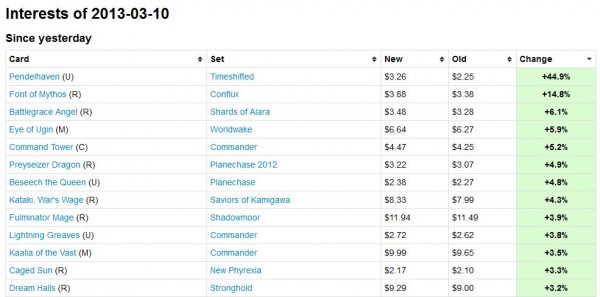
What inspiration did I find there this morning? It actually goes a layer deeper than just examining the movers and shakers. I’ve found I can categorize most of the top interests into distinct buckets, which I can use to infer trends in the overall market. Let’s start with the table:

Upon first glance, this is a very diverse lot of cards. Ranging from Stronghold to Planechase 2012, we see over a decade of cards on this list. But we should look a little closer and try to find trends, because I think they tell an interesting and consistent story.

Breaking It Down

I’ve chosen to use formats to categorize these cards, although there are a handful of possible approaches. With a quick glance at the above table, I can readily see that cards from Modern, Casual/EDH, and Legacy are all included. But which ones are showing up most frequently?

Modern: Pendelhaven, Eye of Ugin, Kataki, Wars Wage, Fulminator Mage

Casual/EDH: Font of Mythos, Battlegrace Angel, Command Tower, Preyseizer Dragon, Beseech the Queen, Lightning Greaves, Kaalia of the Vast, Caged Sun

Legacy: Dream Halls

Standard: N/A

Upon first glance, I’m noticing a glaring trend: casual cards are on the move! To me this makes perfect sense. As the player base rises, casual cards will naturally steadily rise in value as well. Many new players are attracted to casual formats like EDH because of the friendly, entertaining environment. It can be much less cutthroat and provide an avenue to play all the fun cards that never appear in actual tournament decks.

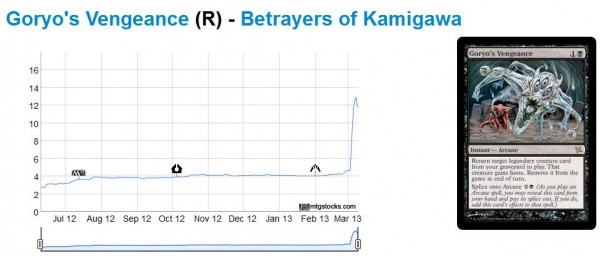
Modern cards are finally calming down some, but it still seems frequent that a Modern card will jump by over 40%. Today was no exception. Other recent Modern spikes include Kataki, Wars Wage and Goryos Vengeance (chart from mtgstocks.com).

The rationale for these Modern spikes is apparent, if not a tiny bit irrational. With an increase in player base, these “older” cards are shorter in supply. As a multitude of players jump into the Modern format to grind PTQ’s, they strive to complete various decks to strategize against a frequently-changing metagame. The result: players buy into the next hyped card, limited supply becomes apparent, and the card’s price spikes. This is magnified by the influx of speculators to the market as well.

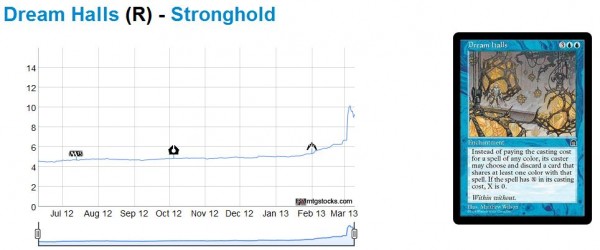
Next is the lonely Legacy card which broke the top 13 of the interests list: Dream Halls (chart from mtgstocks.com).

It is highly encouraging to see a Legacy card finally shake the MTG market. The format has such a tendency to stagnate until either a disruptive card is printed (e.g. Mental Misstep, Jace, the Mind Sculptor) or a card is unbanned/banned (e.g. Time Spiral, Survival of the Fittest). Despite all my concerns surrounding the health of Legacy, seeing that a card like Dream Halls can also participate in a price hike is calming.

But the feeling is short-lived. One niche card from fifteen years ago does not imply Legacy is thriving. If the format was growing significantly, more such examples would exist on the mtgstocks.com list. This is a trend I intend to follow closely in the months to come.

Where Are The Standard Cards?

Finally, I want to also touch upon what doesn’t show up in the Top 13 of the mtgstocks.com interests list: Standard. In fact, for this past Sunday I do not see a single Standard card on the interests list. Does this imply the Standard format is dying? Absolutely not.

Standard card prices are just a bit more difficult to impact. The recent influx of new players equates to more new product opened, which means supply is much higher. Luckily, demand has kept up so that the Standard market hasn’t crashed completely. But this does imply that sudden card price jumps is less likely in Standard simply because greater quantities of a given card need to be taken of the market to have such an impact.

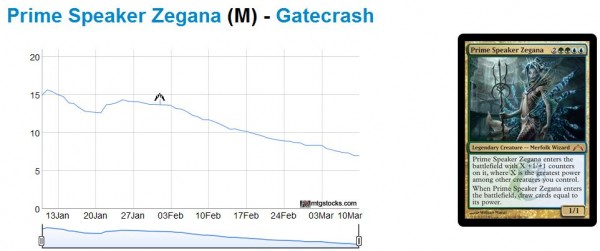
As Standard PTQ season begins, we may begin to see more of this. The rumors are already flying around Twitter. Most recently people are talking about Prime Speaker Zegana (chart from mtgstocks.com).

Most Return to Ravnica and Gatecrash cards have a price chart like this one – it’s typical for cards in new sets. But the key is to watch for that bottom, identify relevant and robust Standard staples, and buy in accordingly. Despite being a Mythic Rare, Prime Speaker Zegana is not likely to jump 50% in one day without winning a Pro Tour. Standard cards are much more inclined to steadily shift in price little by little.

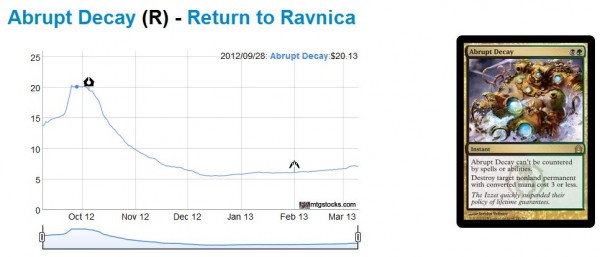
Consider one of my favorite targets for example, Abrupt Decay (chart from mtgstocks.com).

Notice first how the card’s price dropped drastically after Return to Ravnica’s release. Again, this is very normal. But notice how the card has been steadily creeping up since the beginning of the year? This type of slow movement is what I expect from many winning Standard cards. Return to Ravnica cards are already on the turnaround, and in a month or two Gatecrash cards will follow.

Key Conclusions Of Interest

What am I taking away from the interests page from today? Well, first it’s easy to see that Magic is healthy as a whole. There are WAY more cards on the list which have increased in price by two percent or more than those which have decreased by the same magnitude. Magic cards are a wise investment these days, so long as you stay focused and engaged in the community.

One level deeper: it is further apparent that the game is growing because of all the casual card price movers. Something like Command Tower can only be played in EDH, and yet the card continues to rise in price steadily. As more players join, a significant portion will want to have that casual / EDH deck for kitchen table shenanigans. Buying into other casual staples, such as Parallel Lives, could be a smart move here. It just may take some time before a given casual card’s price will appreciate sufficiently for reasonable profit.

The next conclusion I’ve made is that the Modern PTQ season was a huge hit. Despite many grumblers amongst the community, it appears Modern has been highly successful thus far. It will be interesting to see how much of these crazy gains Modern cards can hold onto during the off-season. This will provide further information regarding the health of the format. From a speculation standpoint, you won’t see me buying any card prone to Modern Masters reprint until after the set is spoiled. But come next Modern PTQ season, be prepared for another wild ride!

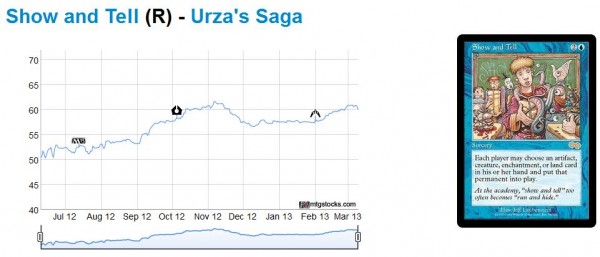
Legacy is an enigma to me. It seems the buy and hold strategy with some Legacy staples may not be optimal at this time. As strategies fall out of favor and the metagame evolves, some cards have transitioned from powerhouse to prehistoric. Last week I highlighted how mighty Natural Order has fallen in price significantly. With the increase in popularity of Show and Tell (chart from mtgstocks.com), who would want to pay four mana and sacrifice a creature when you can just pay three mana?

My best advice in Legacy: buy in cautiously. It may be best to buy Standard cards which are also popular in EDH (Dual Lands) and/or are in prominent Legacy strategies presently. Just be aware that the format can evolve from month to month, and a card like Show and Tell could go the way of Natural Order at any time. And should Show and Tell become too powerful, a Legacy ban would destroy the card’s value. Finally, should Star City games transition from Legacy to Modern more frequently… well we all know what that could lead to. You’ve been warned.

…

Sigbits

  • Here’s a noteworthy Legacy card for you: Lions Eye Diamond. This card mostly appears in Storm, Belcher, and Dredge strategies. The good news is that usually one of these three decks is doing well at any given time. The card is also on the reserved list, so don’t expect a reprint. But the card now retails for $79.99! Who would have guessed the once-bulk rare would hit such levels.
  • I’m still bullish on Sphinxs Revelation. The cheapest buy it now on eBay has been approaching $18, while Star City Games is selling copies for $21.99. This is a meager $4 spread between auction and retail – I don’t think the $21.99 price tag will last long at this rate.
  • Steam Vents is one of the most prominent Shock Lands in Modern. With the evolution of a popular Grixis Deck, the land is more present than ever before. Yet Star City Games has ample copies in stock at just $6.99! The Dragon’s Maze news surely has hit this card hard, but I think a price floor is finally here. I’m not paying retail, but I’d likely buy any shock land I see under $6 (hint: there aren’t many that low).

-Sigmund Ausfresser
@sigfig8
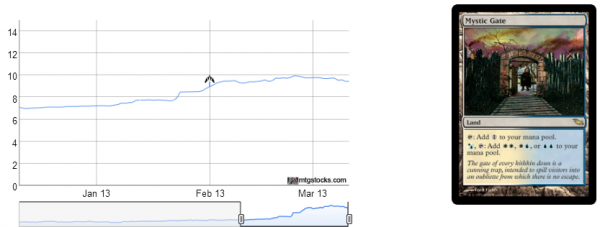
Insider: Impacts of ZZW Queues

Are you a Quiet Speculation member?

If not, now is a perfect time to join up! Our powerful tools, breaking-news analysis, and exclusive Discord channel will make sure you stay up to date and ahead of the curve.

The most recent round of Cube drafting on MTGO awarded Zendikar (ZEN) and Worldwake (WWK) packs as prizes. Concurrently Zendikar-Zendikar-Worldwake (ZZW) draft queues were up and running in order to give players a chance to use their prizes from Cube. With the Zendikar fetchlands as well as the pricey Jace, the Mind Sculptor available to be opened, ZZW turned out to be very popular. This resulted in an increase of the supply of rares and mythic rares from ZEN and WWK.

Worldwake Mythics

The above chart shows Eye of Ugin staying consistently in the 9-11 tix range for most of the past year. It's a staple in R/G Urzatron in Modern, but only a one-of in that deck. The price drop from the end of January to the beginning of March is steep and deep as a result of the ZZW queues spitting out a number of copies onto the market.


The chart for Jace, The Mind Sculptor shows a very similar recent pattern. Although banned in Modern, Jace is a staple of both Legacy and Classic/Vintage, and is from a lightly opened and heavily redeemed set.

At this point, you should ask yourself: are Eye of Ugin and Jace, The Mind Sculptor good buys due to their recent price drops or is the market just horribly flooded with excess ZEN and WWK mythic rares? If the market is simply flooded, then prices might continue to fall. Some further investigating should shed a little light on this question.

The Fetchlands

In the chart for the ZEN fetchlands index we can see that they too saw a steep and deep decline due to firing of ZZW queues, going from around 10 tix to about 6 tix on average. It's not the 70% drop of Eye of Ugin, but still a solid 40% decrease.

However, the subsequent rebound of the fetchlands has been surprising. There was a lull in the Modern PTQ season to be sure, but did a bunch of new Modern players enter the market, snapping up available supply of the fetch lands? Possibly, but maybe it's speculators who bought out the fresh supply.

It's basically impossible to say with any certainty where the price rebound came from, but it's enough to suggest two things. First, that Modern is a popular and growing format online, but more importantly that the recent increase in supply relative to the Modern player base was small.

What's Next?

The Modern PTQ season is near an end and prices on the ZEN fetchlands as well as other modern staples should begin to drift down in the coming months. Players will shift their focus to Standard and they'll also start looking outside at the improving weather. As attention on Modern drifts to other things, prices should slide. The recent price drop and rebound gives us an approximate price floor of around 6 tix for the average fetchland.

Check back in with the index to see where it is in around the release of Dragon's Maze online. Last year the prices on the ZEN fetchlands bottomed out during the release of Avacyn Restored, so it's reasonable to expect something similar to happen this year. At that time, if Scalding Tarn and Misty Rainforest are in the 6-7 tix range, then I'll be a buyer. Also look out for Celestial Colonnade, Creeping Tar Pit, Raging Ravine, Goblin Guide, and Pyromancer Ascension. All of these cards have uses in Modern and have been money makers for me in the past two Modern seasons.

As for Eye of Ugin and Jace, The Mind Sculptor, both are reasonable buys right now with different time horizons. The legendary land should be a useful card in Modern as long as the Urza lands are legal. The bounce back in the price of the fetchlands suggests that supply did not increase as much as was suggested by the initial price drop. With that in mind, and an eye to the next Modern season, buying Eye of Ugin today is a low-risk strategy that should yield a decent profit by this time next year. This play takes patience, but there's value in Eye of Ugin at around 3 tix.

As for Jace 2.0, over the years I have made quite a bit of profit buying and selling this card at different times on MTGO. In a column from early February, I discussed the motivation for buying into Jace. See the analysis here. At that time, I suggested a price range of 50-55 tix would be a reasonable entry point, and currently Jace sits at 46.66 tix on Cardbot. If you've been considering stepping up and buying higher priced cards in your specs, right now would be a good time to start.

On the downside, reprints of both of these cards are possible, with special mention of the possibility of Jace, the Mind Sculptor showing up in FTV:20. If that ends up being the case, an immediate dump would be required to minimize losses. Be vigilant for this type of reprint as well as the reappearance of ZZW queues.

From Nothing Came Teeth

Are you a Quiet Speculation member?

If not, now is a perfect time to join up! Our powerful tools, breaking-news analysis, and exclusive Discord channel will make sure you stay up to date and ahead of the curve.

Greatness, at any cost.

I can't think of a more iconic flavor text than that of Dark Confidant. When my sixteen-year-old eyes first laid eyes on it all I could think was, "That's freakin' cool." Seven years has done nothing to change this opinion.

Of course, nowadays what it means to me is that I'm willing to incinerate a lot of money to refine my decks of children's cards. So willing, in fact, that I ventured out to Omaha and Des Moines on back to back weekends to PTQ in a format that I knew very little about to learn as much as possible for the PTQ in Fargo this weekend. Apparently the cost of potential greatness is mind-numbing treks to three of the most boring states the Midwest has to offer.

My weapon of choice has been Grixis. Not to be a Magic hipster, but I was playing Grixis in Modern long before it was good. My first foray with the deck was a top 64 finish at GP Lincoln with a spicy Sedraxis Specter brew. As I found out in Omaha (and probably should've already known), that card is a pretty far cry from viable.

Luckily for me, in the week following that event Zac Hill unleashed his Grixis Delver deck to subscribers and moochers of SCG Premium worldwide. I was rather skeptical of the particulars of Zac's deck when I first saw it, as it had a lot of elements that I had tried before and didn't care for. The three cards that jumped out at me were Delver of Secrets, Serum Visions and Cryptic Command... A set of cards that I would have a hard time convincing anybody weren't good enough. Before I go into what I thought then and what I've learned now, I'll present the decidedly sub-optimal list that I brought to Des Moines:

"From Nothing Came Teeth Beta"

spells

4 Lightning Bolt
4 Dark Confidant
4 Snapcaster Mage
4 Deathrite Shaman
3 Remand
4 Tarmogoyf
2 Terminate
3 Spell Snare
3 Inquisition of Kozilek
3 Thoughtseize
2 Abrupt Decay

lands

3 Creeping Tar Pit
1 Island
3 Verdant Catacombs
1 Swamp
1 Mountain
4 Scalding Tarn
4 Misty Rainforest
1 Watery Grave
1 Steam Vents
1 Blood Crypt
1 Breeding Pool
1 Stomping Ground
1 Overgrown Tomb
1 Forest

I basically took Zac's deck and modified it for edges against the mirror, opposing Tarmogoyfs and Lingering Souls. The edge that I added is named Tarmogoyf. Like many others I saw the absence of Goyf as a weakness but adding it didn't end up helping the matchups that are actually troubling. The thing about opposing Lingering Souls and Goyfs is that they usually are coming out of decks that are doing slower, fairer things than Hill's list, so those decks are pretty beatable. I thought Goyf would be useful against GR Tron but having the extra one drop has mattered a lot more in my experience. If I could play against non-Tron decks all day I think I'd want something close to this list, but with Tron being a surprisingly popular deck in the Midwest, I've landed on this list:

"From Nothing Came Teeth"

spells

4 Lightning Bolt
4 Snapcaster Mage
1 Izzet Charm
1 Abrupt Decay
1 Electrolyze
2 Serum Visions
2 Spell Snare
3 Inquisition of Kozilek
3 Thoughtseize
4 Delver of Secrets
4 Deathrite Shaman
4 Dark Confidant
4 Remand
1 Pillar of Flame
1 Spell Pierce

lands

2 Creeping Tar Pit
1 Island
4 Verdant Catacombs
1 Swamp
4 Scalding Tarn
4 Misty Rainforest
1 Watery Grave
1 Steam Vents
1 Blood Crypt
1 Stomping Ground
1 Breeding Pool

On Delver of Secrets

Given the choice between having a Goyf in play and having an Insectile Aberration in play I would choose Tarmogoyf almost every time. That said, the difference in casting cost has turned out to be a dramatic drawback, and not just in terms of getting Spell Snared. The format is just faster than I gave it credit for. Many decks present leaving up Remand on turn two as a necessity, and having a one drop to pair with that Remand is infinitely better than the alternative.

I think that the major reason that I missed Delver initially was that I wasn't used to having Deathrite Shaman in the deck. Being a deck with two one drops is dramatically different from being a deck with only one, and both one drops in this deck are very serious threats.

On Serum Visions

It stinks and I don't like it. Next question.

Okay, that's being somewhat unfair to the card. Zac Hill contends that the card is abstractly good, whereas going in I was of the belief that the card was only good enough in decks that wanted as much card manipulation as possible due to having degenerate ways to end games. I think that the actual value of the card lies somewhere in between.

Basically, I'm playing two because I think a deck that thrives on mana efficiency wants some amount of manipulation but I'm ONLY playing two because drawing multiples tends to tie up too much mana for too little of an effect. I'd be surprised if the correct number wasn't one or two, but I've certainly been wrong before.

Having only two does impact consistency some, which I hedged with the inclusion of Izzet Charm. One copy does't seem like much but you almost never want to draw multiple Charms in decks that want to make their land drops and you can always Snapcaster it later if you are hurting for a Careful Study.

On Cryptic Command

I've revealed Cryptic to Bob and died in situations where it wouldn't even be good enough had I lived enough times (at least once) to be quite skeptical of its inclusion. I could potentially see it as a one of but it's basically just inefficient redundancy of things that you're already doing. The bounce mode gives you something pretty unique, but I don't see it being as relevant as the Bob drawback or the triple blue in my deck with one basic Island drawback. Again, I'd play the odds on one, but the card has been underwhelming in my non-Scapeshift Modern experience.

~

If you want to read up on how decks like this play, then I very much recommend Zac Hill's article on SCG. To sum it up, everything is based on context and experience is paramount to success. You're going to make some weird plays and you're going to win a lot of games that your opponent didn't think were lose-able.

While I'm quite fond of Grixis (beats literally every fair deck if played well and isn't bad against unfair ones) there are a lot of cool decks to mess around with in Modern currently. I think that the format is finally starting to grow into something unique and at least for now there doesn't seem to be a de-facto best deck. Now, whether or not this implies that the banned list is currently correct (it doesn't) is another matter, but for now I'm actually having some fun with the format.

Good luck to anybody playing in any remaining Modern PTQs, with Grixis or otherwise. Questions, concerns? Make a comment!

-Ryan Overturf
@RyanOverdrive on Twitter

Insider: Return to Ravnica Making a Comeback?

Are you a Quiet Speculation member?

If not, now is a perfect time to join up! Our powerful tools, breaking-news analysis, and exclusive Discord channel will make sure you stay up to date and ahead of the curve.

No elegant preamble this week. Instead I’m grinding some numbers on the best-selling set of all time, Return to Ravnica.

At least, it was before Gatecrash came out. The game is reaching ever higher places this week, and if this is to be believed we’ve picked up more players since we returned to Ravnica.

Which begs the question, are prices coming along for the ride?

I’ve talked for the last two months about how Return to Ravnica had hit its price floor as the market flooded. Now we’re away from drafting it for the moment (though we will… return), and it’s time to find out what prices on staples from the set are doing so we can figure out whether it’s time to buy in.

The Catalyst

Let’s start with the card that’s driving this column: Abrupt Decay. The multi-format all-star just hit a four-month high and seems like it’s going to continue rising.

It's important to note this isn't an overnight spike. The card is rising slowly, and even if there are fits and starts, this is how you tell the difference between a sustainable spike and an unsustainable one.

Thundermaw Hellkite, for instance, is a card I was hot on a few months back when it was $10-12. I advised picking them up then and I advised holding onto them at $20 because it wasn’t done rising. I came to that conclusion because the price would go up a dollar or so a day, sometimes punctuated by $3-4 jumps. But at no point did it spike from a dollar to $10 like we’ve seen too many cards do recently. That’s a telling factor for me.

So back to Abrupt Decay. The card is on the upswing now that its set is no longer being redeemed. Sure, some more product will enter the market in a few months when it's drafted again, but with redemptions basically over this won’t be a huge driver.

I expect Abrupt Decay to be $10 or so in a matter of months, so now it’s time to see if this trend is noticeable with other Return to Ravnica cards.

Supreme Verdict

Likely the best Wrath of God variant we’re going to see for a long time, I’ve been advocating stocking up on these, and the numbers seem to bear that out. Verdict hit an all-time low of $3.69 back in December and is up around 20 percent since then. I still think it’s a great time to move on these.

Slaughter Games

The all-time low on this occurred early before people realized how good it was. Since the beginning of the year it hasn’t moved at all, still sitting just above a dollar. Hard to draw anything from this (though I still think it’s a great pickup at a buck).

Ash Zealot

The all-time low on this card came shortly after release, and it reached a high of $4.83 two weeks ago. Currently sitting a few quarters below that, it’s still up a sizable amount since the beginning of the year.

Chromatic Lantern

I think this is an important one to evaluate because it’s pretty much just a Commander card right now. Again, we see an all-time low in the middle of December, and it’s up a dollar, or 50 percent, since then.

Deathrite Shaman

This is influenced quite a bit by Modern, but it’s still worth evaluating. The all-time low came right after the set release, which is a testament to how players misevaluated it more than any supply-sides issues.

The all-time high was set on January 23 at $15, and it’s currently sitting right around $14. For a card that, like Abrupt Decay, fits into every format, I think this is a very safe card to acquire at this point. It has similarities to Noble Hierarch, which keeps getting more expensive, and to Snapcaster Mage, which retails for about $9 more right now. There’s nothing to not like here.

Shocklands

Almost all of these are setting new all-time lows every day now. This cannot go on for much longer, even with more coming in a few months. I’ve been aggressive on these and I’m trying to stock up. It’s hard when people want them constantly, which is a sign of how important they are.

This is probably the single safest investment you can make in RtR right now, and I’m going to continue to stock up.

The Mythics

I’m lumping these together because the data is just so consistent. Outside of Sphinx's Revelation, every mythic in the set is at or very near an all-time low. Given the mixed set of data we have from the rares, this is an interesting development that probably speaks more to the fact that none of these besides Revelation are seeing play.

That said, does anyone really believe Jace, Architect of Thought is going to remain at $12.81 (an all-time low) forever? There’s just no way. It may not be until after rotation, but that seems way too low to me.

Conclusions

Looking over the data, we’re able to draw a pretty good lesson from all of this. Prices on Return to Ravnica are beginning to pick up in places, but others are still bottoming out.

So it would appear that Abrupt Decay may be the anomaly of the lot, for now. My biggest takeaway from this exercise is that there’s no reason to hit the panic button yet on your RtR picks. Prices on the whole aren’t rebounding yet, so you still have some time to pick up on what you want to speculate on, which is a good thing for those who haven’t stocked up yet.

It’s probable that I’ll come back to this list in six months or a year from now and see what data we have to work with. I believe the comparisons at that time will allow us to better pinpoint a time when prices hit the floor (I believe we’re at time right now), and exactly when they began rebounding (which I expect will be in a month or so).

Thanks for reading,

Corbin Hosler

@Chosler88 on Twitter

Want Prices?

Browse thousands of prices with the first and most comprehensive MTG Finance tool around.


Trader Tools lists both buylist and retail prices for every MTG card, going back a decade.

Quiet Speculation