
menu

Adventures in Qualifying: WMCQ and PTQ results

Are you a Quiet Speculation member?

If not, now is a perfect time to join up! Our powerful tools, breaking-news analysis, and exclusive Discord channel will make sure you stay up to date and ahead of the curve.

Last week I mentioned that I recently took my new pet deck, Wolf Run Black, to two major events. Today I wanted to talk about what happened in these events, and then look at the deck anew in light of the metagame becoming a little more diverse. First, take a look at the list I ran.

Untitled Deck

Creatures

1 Birds of Paradise
1 Glissa, the Traitor
1 Borderland Ranger
2 Phyrexian Metamorph
4 Solemn Simulacrum
1 Huntmaster of the Fells
1 Stingerfling Spider
3 Grave Titan
4 Primeval Titan

Spells

3 Doom Blade
2 Geths Verdict
3 Green Suns Zenith
4 Rampant Growth
1 Ratchet Bomb
4 Sphere of the Suns

Lands

4 Woodland Cemetery
1 Dragonskull Summit
4 Cavern of Souls
4 Glimmerpost
2 Inkmoth Nexus
1 Kessig Wolf Run
5 Forest
3 Swamp
1 Mountain

Sideboard

1 Curse of Deaths Hold
1 Surgical Extraction
2 Nihil Spellbomb
1 Ratchet Bomb
1 Tree of Redemption
1 Viridian Corrupter
1 Acidic Slime
1 Stingerfling Spider
1 Devils Play
2 Sever the Bloodline
1 Phyrexian Metamorph
2 Blasphemous Act

World Magic Cup Qualifier

Round 1: Dungrove Green

For the WMCQ my sideboard was a little different from the one above. I had neither Blasphemous Act nor Acidic Slime. That is relevant because I would consider Dungrove Green to be one of the unfavorable matchups and those two spells are great in this match.

Your removal matches up poorly against their threats and their untargetable [Card Dungrove Elder]Dungrove Elders[/Card] give you fits. Game one the plan is to find Glissa, the Traitor and ramp into a Primeval Titan so you can set up the poison kill. Sometimes this works, but if they have too much pressure you can easily run out of time to kill them. Glimmerpost helps a lot here, but usually you need to get Inkmoth Nexus and Kessig Wolf Run off of the first Primeval Titan before fetching [Card Glimmerpost]Glimmerposts[/Card] the following turn.

Without access to the right sideboard, and having mulliganed to five game one, this match was over rather quickly. I spent my plethora of extra time in the round getting my head back into the game and figuring out how I would have sideboarded if I had access to more cards.

0-1

Round 2: Delver

When I saw my opponent open on Seachrome Coast, I panicked a little inside. Here was the whole reason I built this deck. The reason I chose to play it. I kept reiterating this to myself in my head during the match.

In game one, I killed his turn one [card Delver of Secrets]Delver[/card] on turn three and took the game over with uncounterable titans. Game two was a little different as I never saw a titan, but with Solemn Simulacrum, Kessig Wolf Run and removal to stop his board progress, I was able to finish the game decisively.

Though I did not think this match a great sample, I was encouraged that I beat Delver with the deck I had designed to do so.

1-1

Round 3: U/B Poison

No, this deck did not contain Tezzeret, Agent of Bolas. Yes, it did have Phyrexian Crusader and other infect creatures. No, it wasn’t good, but it did manage to defeat me one game.

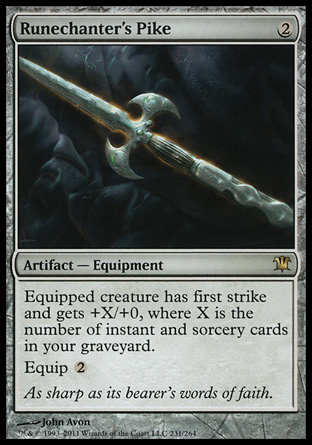
The first game was easy because I killed his first two infect creatures and then beat him with a titan. Game two he drew lots of creatures and then surprise killed me with Runechanter's Pike. Game three, I brought Viridian Corrupter back in to tutor for. However, I did not end up needing the artifact removal because my Sever the Bloodline blew him out and titans finished the job.

2-1

Round 4: Naya Wolf Run

While building Wolf Run Black, I thought that Doom Blade would give me an edge in the mirror. This is apparently not the case. Often, they present too many threats for three [card Doom Blade]Doom Blades[/card] to swing the match.

In this case, he had Entreat the Angels, though he didn't draw it against me. What he did have was an improved poison kill with Slayer's Stronghold. This land allows a Wolf Run player to do a couple awesome things. First, it gives the second titan they play haste, which is obviously powerful. Second, it allows them to pump an Inkmoth Nexus for a decent amount of poison damage, while still leaving up mana for other spells.

Though this match was close and went to three games, my opponent ended up on the winning side. I kept some very interesting hands in this match which probably would have paid off if not for some sweet topdecks from my opponent.

2-2

At 2-2, my chances of top eight were slim to none but I stayed in to get more experience with the deck.

Round 5: Delver

Sometimes keeping risky hands pays off. Recently, perhaps more often than I care to admit, I have been keeping risky hands with a huge upside. In this match, I kept a one land hand with both Sphere of the Suns and Borderland Ranger. It did not pay off though and I lost a four minute game one.

I won game two because my opponent boarded completely wrong. After the match, I asked him what he thought I was playing and he said Zombies. His boarding in the dark allowed me to trounce him with removal and titans. Game three was close but when Wolf Run gains twelve life, the aggressive deck has a lot to overcome. I never dropped below twelve life.

The bullet Huntmaster of the Fells helped a lot in this game as well. I really liked the one-of Huntmaster but I don't think the build can support any more. I did draw it naturally but with three Green Sun's Zenith, finding it is not hard.

3-2

Round 6: Delver

Having bumped my record back up to the winning side, I figured there was a good chance I would have to play Delver again. When I saw my opponent was indeed on the dreaded menace itself, I became excited to try my hand against my target matchup again and learn more about it.

I took game one with uncounterable titans but he came right back in game two with two blind flipped [card Delver of Secrets]Delvers[/card] and a total of four [Card Vapor Snag]Vapor Snags[/Card] between the actual spell and Snapcaster Mage. Game three was a close one but I gained some life from Glimmerpost and got in some damage with a couple [Card Solemn Simulacrum]Solemn Simulacrums[/Card]. After I stabalized with Stingerfling Spider, I was able to land a titan to finish the game.

For some reason, no one expected the spider but it was one of the best cards in my deck on the weekend. One maindeck and a second in the sideboard is exactly what you want for this matchup.

4-2

Round 7: Dungrove Green

I was feeling good about my 4-2 record until I saw that I was facing another mono-forest opponent. Even factoring in my experience from earlier, my deck was not built to beat this deck. It was a terrible and frustrating two games. He had lots of [card Dungrove Elder]Dungroves[/card] and Phyrexian Metamorph to kill [Card Glissa, the Traitor]Glissa[/Card] and copy my titans. I did not really stand a chance without the missing sideboard cards.

4-3

Round 8: G/R Aggro

Even though I was already knocked out from the prize money, I still wanted to finish the event. This turned out to be one of the most fun rounds of the weekend. My disheartened opponent sat down and announced that he would keep whatever hand he drew. I cracked a couple jokes to lighten the mood.

We ended up having a ton of fun with his blind keeps. To tell the truth, both of his hands were quite good. The first one was triple Strangleroot Geist and four lands. Normally I think that draw would wreck a lot of players. I drew pretty well this game and my turn four Grave Titan shut down all his guys. Game two was similar but I gained a lot of life in the process before again locking the game down with Grave Titan.

5-3

With a final record of 5-3 and losses to the mirror and a deck I didn't prepare for, I was still happy with the results. I felt confident that with different pairings, I would have landed in the top eight.

On the back of this confidence, combined with my sideboard changes, I was ready to take down the PTQ the next day.

Tournament #2 - PTQ

Round 1: Splicer Delver

This version of Delver, dedicated to Blade Splicer into Restoration Angel, was by far the toughest. A decent draw like Mana Leak turn two, Blade Splicer turn three and Restoration Angel turn four is likely to overrun any deck.

Game one he had a clunky draw and I beat him. Game two he led with the sequence above and even Grave Titan was unable to dig me out of that hole. I think I could have stabilized if not for the [Card Vapor Snag]Vapor Snags[/Card].

Game three was the closest game of the whole weekend. I had an early Doom Blade to stop a flipped [card Delver of Secrets]Delver[/card] but he quickly recovered and developed an overwhelming board presence. On the final turn before I killed him, he took me down to three life. Through a complex sequence of blocking, removal and tight play, I was able to win the game, even through his double Hero of Bladehold from the board.

1-0

Round 2: Dungrove Green

Unfortunately, my opponent this round was a good friend. I did know his list though. Revenge of the Hunted is quite a beating and I almost lost because of it. Game one was a stalemate until I got multiple titans in play. Game two he almost got revenge by forcing me to chump block a 14/14 Wolfir Silverheart with two Primeval Titans. I may have been at three life, but I still dealt him ten poison on my turn to seal the match.

2-0

Round 3: Naya Wolf Run

It seems like whenever an interesting build of Wolf Run appears at an event I partake of, I am required to play against it. Unlike the Naya Wolf Run deck from the day before, this one had Restoration Angel. The angel shut down my poison kill and blinked his titans, and yes, that really is as good as it sounds. He dispatched me in two games and I was left wondering how I could have beaten him.

2-1

Round 4: U/W Midrange

This delverless Delver deck plays like a traditional U/W Control deck. This is exactly the type of deck that every variety of Wolf Run preys on. Neither of the two games did I feel threatened and although it took a little while to play through Gideon Jura, my opponent did not really stand a chance against the best cycle of six-drops ever printed. His deck was powerful and has proven itself, but my deck is not the matchup it is looking for.

3-1

Round 5: RUG Pod

I had not actually played against this version of Pod before but it's similar to decks I had played against and I had a clear vision of what was necessary to beat it.

Game one, I had the tools. A little removal, the necessary ramp, and a follow-up titan were all it took to take him down. Game two I could not find removal for his threats or for Birthing Pod. His board got far out of control due to the deck’s namesake and a burn spell finished me off before I could stabilize.

Game three was basically in my control the whole time. I blew up his artifact and killed his Huntmaster of the Fells. Once that happened, it was time for the titan clean-up team to swoop in and finish things off.

4-1

Round 6: Venser Control

This match was my most frustrating defeat in recent memory. Who even plays Venser Control? I didn’t know anyone still did. My opponent said that any Solar Flare deck is basically unwinnable for him so I would not recommend this deck, considering that Solar Flare is making such a comeback.

Both games went nowhere. Game one, I did not deal a single point of damage or poison. He locked me down early with Tumble Magnet, disappeared a few combat phases, then cast Venser the Sojourner. If I had seen a Doom Blade at any point, my titans would have dealt lethal damage.

Game two, I mulliganed to four cards but I was pleased with the fight I put up. I actually thought I was going to win this game when I cast Devil's Play for thirteen damage. I was going to flash it back next turn but relying on Sphere of the Suns for my red mana proved a liability since his [Card Tumble Magnet]Tumble Magnets[/Card] could tap them down.

4-2

With that, my hopes of top eight were shattered. I decided not to keep fighting for the meager prize since my friends were eager to start our five hour drive home.

Overall, I was happy with the performance of the deck. Here’s how the matches look when compiled.

Wins:

  • 5 Delver decks
  • U/B Poison
  • G/R Aggro
  • Monogreen Dungrove
  • U/W Midrange
  • RUG Pod

Losses:

  • 2 Monogreen Dungrove
  • 2 Naya Wolf Run
  • 1 Venser Control

Beating all five Delver decks I faced on the weekend was quite the accomplishment and normally I think results like that would lead to at least one top eight slot. Unfortunately, in light of the crazy decks I had to play against, this did not turn out to be true. Wolf Run Black still seems well positioned in the metagame right now.

Dissecting the Metagame

The results of recent events may imply that Delver is on its way out but I do not believe that to be true. Delver might be down, but don’t count it out. The boxing champ might have taken a couple blows to the face at the latest Star City Games tournament in Detroit, but it will recover.

Despite a lot of Delver decks losing in the swiss, there was one that made it through to Top 8 and almost took the whole event. The sole Top 8 Delver deck ended in second place after beating a lot of very competent players that also made it that far. Take a look at the top 16 decks from that event.

1st – U/B Zombies
2nd – Delver
3rd – Esper Midrange
4th – Esper Midrange
5th - Grixis Control
6th – Esper Control
7th – Bant Pod
8th – G/R Aggro
9th – Mono Blue Infect Delver
10th – Naya Pod
11th – Delver
12th – Naya Aggro (no Pod)
13th – Delver
14th – Wolf Run
15th – Mono Green Dungrove
16th – RUG Pod

Delver will adapt. This is the wisdom you should take from this event. Delver, like its Caw-Blade predecessor, will be the best deck until it rotates out of the environment. Delver players will figure out how to play against new version of archetypes and develop cutting edge sideboarding strategies that will keep it on top.

Three copies of the best deck in the Top 16 implies that Wizards made the right decision by not banning any cards. I would bet this is the outlier and not the average for events from here on out.

This seems like a good metagame sample for what you should expect at the next big event you are attending. You will most likely have to play against a ton of Delver along the way though, so don’t forget about the best deck when choosing a deck.

As for me, I would still choose Wolf Run Black. This sample from the Top 16 seems very similar to the array of decks I had to play against at my two big events. I think Wolf Run Black is ready to take down some events. Will you be the one to play it?

Until Next Time,

Unleash the Force of Wolf Run Black!

Mike Lanigan
MtgJedi on Twitter
Jedicouncilman23@gmail.com

Insider: Quietly, Modern Sneaks Back In

Are you a Quiet Speculation member?

If not, now is a perfect time to join up! Our powerful tools, breaking-news analysis, and exclusive Discord channel will make sure you stay up to date and ahead of the curve.

This was a very exciting week, because we have more Modern results! I wrote a few weeks back about why it was a good idea to start moving on Modern cards, and now we see even more clearly what we want to pick up. Doug Linn touched on this event on Monday, and his advice to pick up cheap Birthing Pods is sound. But even in the Pod lists there is plenty going on that may not have been obvious.

If you’re lost, I’m talking GP: Yokohama, which happened last weekend and drew more than 1,500 players to a Modern tournament. It’s important we talk about that number. That’s 1,500 Lingering Souls playing Wizards’ new format. It was the largest tournament in Japanese history.

If you were ever on the fence about investing in Modern, this should sway you. It’s a sign that the format is popular, healthy and here to stay. There’s no excuse anymore to not buy in, especially since the seasonal nature gives you even more of an opportunity to invest cheaply.

There’s a really diverse amount of decks that won grinders before the event, even if not all of these decks translated into Top 8. It also stands to note that Affinity had the best conversion rate, getting players into Day 2 from Day 1. That means the Robots, never far out of mind in Modern, have survived a few new sets being added and are ready to stick around for next season.

So let’s look at the Top 8, and some of the breakout cards and financial opportunities contained therein.

To start, here’s the top 8.

-       1 Jund

-       1 B/W Tokens

-       2 No-Melira Pod

-       2 Melira Pod

-       1 Affinity

-       1 Faeries

That’s four Pod decks in the Top 8. That definitely makes Pod a great target in the next few months. While everyone else is looking to unload their Pods before they rotate, you can snag them for a buck or two in trade and look forward to a spike sometime down the road. The toolbox and flexibility Pod and similarly hot pickup Chord of Calling give you make the deck very resilient.

No Melira in Melira Pod?

I honestly thought this might have been a typo at first, but two of the Top 8 “Melira Pod” decks had no Meliras! This is because infinite life doesn’t mean much when people are planning on doing infinite+1 damage to you in this format. I still like Melira as a 1-of in these decks to give them more flexibility to gain the life in situations where it wants it, not to mention the insta-kill with Murderous Redcap.

So why did the Meliras get cut? The answer, of course, is Restoration Angel. A card I tagged as a player when the set was spoiled, it’s had a huge impact on Modern. It fits perfectly into a Pod deck, and provides an instant win with Kiki-Jiki, Mirror Breaker. Kiki-Jiki is another solid pickup, since it just saw a reprint and probably won’t see another for a while.

Even more important than the differences in the decks are the similarities. All four ran a full playset of Kitchen Finks. The card isn’t exactly cheap, but it’s not coming down, is harder to reprint due to the Persist keyword and is insane in any number of decks. Grab these in trade during the off-season (now) when people are less worried about them and hold until Modern season. This is probably one of the most stable moves in the format.

Looking ahead to Pod staying Enemy No. 1 next year, things like Torpor Orb, Grafdiggers Cage, Spellskite and Aven Mindcensor are the best ways to hate on the deck. The upside on these isn’t likely great, since only the latter two are likely to be maindecked, and usually not in 4s hurts the upside.

Another great answer card with more upside is Linvala, Keeper of Silence. She checks in at $8 out of stock on SCG and a buck above that on TCGPlayer. Capitalize on this gap while you can, and don’t be surprised to see this Legacy Maverick-playable card shoot way past $10 next Modern season, which is a lot closer than it seems right now.

Enough about Pod

The deck I hate most in Modern is RG Tron, since it’s so mindless and the least “Magic-like” experience in Modern. It’s similar to Dredge in that regard. But this event showed a distinct lack of Tron, in any combination. There was also a lack of Griselbrand in the Top 8, though one copy won a Grinder. If this deck goes on to become a thing again next season, the move is into Goryos Vengeance. As a $3 card from Betrayers, there’s a lot of upside here, though I’m not sure how good that deck actually is.

Moving on to the rest of the Top 8, let’s look at the winning deck, BW Tokens. It’s a sweet-looking deck, and most of the financial opportunities lie in the Uncommons.

Tidehollow Sculler, Spectral Possession and Zealous Persecution all could pay off big since you can get in so cheaply. Of course the deck also makes great use of Lingering Souls, which isn’t a Modern-only pickup, though I do think it’s a great time to get into Souls, since it will be making a big enough impact on Standard post-rotation to at least double in price.

As for the rest of the deck, Windbrisk Heights has some nice upside, coming in at $5 right now. Most people will let it go cheaper than that if you can actually find any in binders, so targeting it seems like an easy play.

Looking to next level the deck, the easiest answers are Ratchet Bomb and Engineered Explosives. Of these, the Explosives (and maybe Academy Ruins?) is the better play since Bomb is still in Standard. Explosives also occasionally pops up in Legacy and has a set-specific keyword, so I wouldn’t expect a reprint anytime soon.

Casually up to $12, by the way

One more note from the deck, even though it was just a 2-of. Fetid Heath. If this doesn’t blow your mind, you’re more ahead of the game than most — It’s a $12 card, with exactly one in stock on SCG. Eventide was basically just not opened, so anything out of that set is gold, just look at $10 Deathbringer Liege. All of the filter lands are good pickups right now, especially since Shocklands seem to be getting the reprint treatment. I’m after all the Filters, but especially the ones from Eventide.

Everything else

Looking at the other decks, it’s basically everything you would expect. Jund is Jund, Affinity is Affinity, and Faeries has Fae in it. Vedalken Shackles, which was $30 for awhile on SCG, is down to $20, but I’m not crazy about getting it at that price.

Cryptic Command, on the other hand, could be primed to move past its $15 price point. The insanely powerful spell was certainly played last season, but never seemed to really dominate. As the format matures, the Blue decks seem to be showing up (surprise), and Cryptic could easily shoot past $20 next season.

The most interesting thing out of the Affinity deck is the lack of Steelshapers Gift. The card spiked last season but then actually saw less and less play, since it turns out Steel Overseer is actually better in that slot. SCG has a ton of those in stock at $3, and there may be a little upside here, though nothing outstanding. Affinity is what it is, and everyone knows about it, so there’s not really any surprises going on to spike a card. I wouldn’t be afraid to get out of the Gift, though.

Threads of Disloyalty is another card I’ve mentioned from time to time, and it showed up in pretty decent numbers last weekend (though all in the sideboard). Another Betrayers rare, it’s priced at $5 on SCG and is a safe, if not incredibly sexy, investment.

That pretty much covers it. It was definitely a good event for the Modern format, and since it’s received relatively little press here in the U.S. it gives us some time to get ahead of the format a little bit. Plan, and trade, accordingly.

Thanks for reading,

Corbin Hosler

@Chosler88 on Twitter


Addendum: Don’t forget to check out the latest cast of Brainstorm Brewery, the financial podcast I co-host, where we delve into the spoiling of M13, and, more importantly, what isn’t in the set.

Insider: Legacy and Standard Summer Calls

Are you a Quiet Speculation member?

If not, now is a perfect time to join up! Our powerful tools, breaking-news analysis, and exclusive Discord channel will make sure you stay up to date and ahead of the curve.

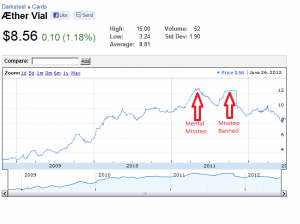
In April of last year we saw Mental Misstep shake the roots of the Legacy format and lead to an extremely rapid banning. At the time, we looked at how it would affect Legacy and made some pretty sweet predictions regarding Aether Vial (among others). Now that spoilers from M13 are warming up, I see two fan favorite Legacy decks gaining some pieces, and Aether Vial could be a winner. And it’s not the only one.

Legacy

Aether Vial, currently under $9, is lower than what it’s growth chart would indicate. If it followed similar growth patterns to other Legacy staples, it would be sitting at a solid $12-15. I’m expecting a fairly rapid climb up to those levels due to an increase in play from two key decks: Goblins and Merfolk. Both got new pieces from Magic 2013, and even if they don’t prove to have lasting power in the format, they will be seeing increased play in at least the short term.

Wasteland is another card on my radar. It’s on a dip right now, and is seeing tons of play. I expect decks to shift towards this card even more as they try to counteract BUG Control, Sneak and Show, RUG Delver and others. Further, the Aether Vial decks typically play Wasteland, so if they see increased play, Wasteland will also.

Merfolk

Legacy Merfolk gets a new and improved Lord of Atlantis in the newly spoiled Master of the Pearl Trident. We’ll now see virtually 8 Lord of Atlantis in a Merfolk deck, and I wouldn’t be surprised if Augur of Bolas sneaks in U/W versions that play Swords to Plowshares. Without having to play Phantasmal Image, Merfolk picks up a little consistency, and an actual strict improvement over the older Lord itself. A deck like Merfolk maindecks enough disruption and a fast enough clock to put up a decent fight against both varieties of Griselbrand decks.

Further, Phantasmal Image can’t wear an Umezawa's Jitte, and having easy access to cast Force of Will is about the best defense to combo that Aggro decks can get. Merfolk is otherwise a fairly inexpensive deck, so if it does pick up in popularity, players will flock to it. The only other card that may see some increased demand is Wasteland, especially considering it’s played in many of the decks in the format already, and is a decent way to combat Sol Lands. I could see this climbing back to $45 again.

Goblins

Goblins pick up a card in Krenko, Mob Boss. I’m not certain this card will make huge waves, but it seems like a pretty sweet card to sneak in via Goblin Lackey. It has great synergy with Piledriver, and is a sizable body on his own. Goblins won a StarCityGames Open just a couple weeks ago, off the back of Cavern of Souls. This deck is for real. Even without Krenko, the deck is strong, but I can see him being a strong addition, even if only one copy. Again we have another deck that features Wasteland. Goblins has a decent game against Show and Tell decks, and can put a scary clock against most of the format. Rishidan Port is strong against both Ancient Tomb and City of Traitors, and access to Red Elemental Blast gives them some protection post-board.

Standard

Thundermaw Hellkite

This is another card I want to talk about today. Thundermaw Hellkite is a 5 mana 5/5 flier, that has haste, and taps all opponents fliers while pinging each of them for 1. This card will undeniably be played in Standard, the only question is how much. Not a large variety of decks can play something like this, but it can swing a game pretty quickly. As a top end to an all-in red deck, it’s a bit expensive, but likely an inclusion. But as a mid-range or control finisher, this card is dangerous. Mark Rosewater said he wanted a Dragon at the level of Baneslayer Angel, and I think he found it. I don’t think it will see the heights that Baneslayer did, but would probably float around $15 indefinitely.

Akroma’s Memorial

This card is already $14 based purely on Commander play, and in a Standard Format that has Mana Dorks, Primeval Titan and Solemn Simulacrum, I expect this card to be in high demand, especially early on before many are opened. Sitting at Mythic Rare, this will be a $20 card in the early times as Commander folks will be hard to give up this staple from their deck. Longer term, I expect it to only be just barely higher than it’s current price, between $15-18.

Disciple of Bolas

This card seems pretty spicy to me, and pre-orders for $3. I don’t know that it will climb much higher than that, but if it sees any serious play, I could see it jumping up. It’s certainly a gamble, but it’s one I’m considering. I envision sacrificing a Geralf’s Messenger to this guy for maximum value.

Out of the newest spoilers, which ones are standing out above the rest? Any sleepers that we haven’t talked about yet? I’m really looking forward to the pre-release, and a new spin on both limited and constructed.

MTGO IPA Draft – Name Three Reasons to Incinerate Tickets

Are you a Quiet Speculation member?

If not, now is a perfect time to join up! Our powerful tools, breaking-news analysis, and exclusive Discord channel will make sure you stay up to date and ahead of the curve.

Everybody knows that 4-3-2-2 drafts are awful value. The prize pool for them includes one fewer pack than an 8-4 or a swiss draft. Additionally, you really don’t increase your bankroll by very much when you win them. This in mind, a person would have to have a pretty good reason (or a total lack of any) to play in a 4-3-2-2.

So why is it that I’m currently in a queue for such a low EV draft?

Because Invasion block is sweet.

If you were unaware, there are some pretty neat things happening on MTGO right now on account of its 10th anniversary. At first I was just excited to crush some gold queues, but I also have an affinity for experiencing different draft formats.

Yup. Common.

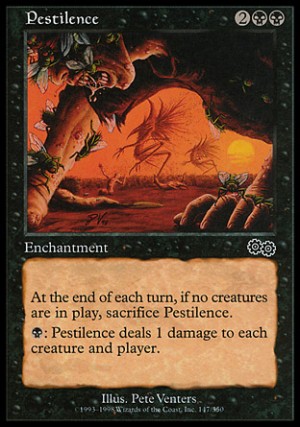
Most of the time I end up being widely disappointed by older limited formats. Tempest block was a somehow worse version of Zendikar. Urza block was miserable if you weren’t the guy playing Pestilence. Invasion block, however, is easily in the top five draft formats of all time.

Avacyn Restored has been extremely lame to draft in my limited (no pun intended) experience with it. For the most part, you just pick two colors and pick the best card for those colors in each pack.

Invasion is about thirteen times more complex. For starters, you can play anywhere from two-five colors*, and within each color combination there are a lot of choices to be made about exactly what you want your deck to do. In only seven drafts, I’ve played everything from very aggressive Gaea's Might decks to extremely durdly five-color control decks. The best part is that I still have no idea which route is better, if there even is a correct answer to that question.

*I suppose you could also try mono-color, but I sure have no intention of it.

I’ll say right off the bat that if you’re looking to grind value out of MTGO, then drafting IPA isn’t in your best interest. The 4-3-2-2 prize support is embarrassing and the money rares are few and far between (though, to be fair, there are a few commons that are worth .25-1 ticket).

Of course, playing limited on MTGO isn’t exactly a high EV venture in the first place. If you’re drafting on the regular you’re either doing it to refine your skill set or to have a good time. Either way, IPA delivers as both a skill intensive and immensely fun format.

Here’s where I think Invasion shines as compared to other limited environments:

Interesting Mana Fixing

If you compare the mana fixing in IPA to that of Ravnica or Shards of Alara, you’ll quickly notice that you had to work a lot harder for it in IPA.

Compare the Lair cycle, the tri-land cycle and bouncelands:

I can’t say definitively which I’d most want to have in a given deck, but I can say with certainty that it wouldn’t be the Lairs. Having such drawbacks on color-fixing forces a player to make tough decisions about how deep they want to go in terms of colored mana requirements.

Invasion’s Cameo cycle isn’t super different from Ravnica’s signets, but the Cameos, like most colorless fixers in IPA, are uncommon.

I really like these discrepancies in power level and rarity as they make it more difficult for a player to just take the best card/best fixer in every pack.

The coolest fixing available in IPA, IMO, are the creatures that tap to change land types. When I first heard that Dream Thrush was great in IPA, I was very confused. After using it on my opponent’s upkeep to color-screw them for the first time, things made a lot more sense. Not only that, but changing a player’s Domain count at instant speed has quite a few implications.

Which leads me to the next reason that IPA is awesome…

Spell Modality

This is probably the most important aspect to me with regard to what makes a Magic card interesting.

I think that Geist of Saint Traft is extremely boring. It does exactly two things, and it does half of them poorly.

Snapcaster Mage, on the other hand, does approximately four billion things. You can tell a lot about the strength of a player by the way that they sling their Tiagos.

For this reason I really enjoy Kicker as a block mechanic. It constantly forces a player to assess when they should cast their spells and how greedy they can afford to be. Some of the spells are rather obvious, such as Ardent Soldier, but when and how to kick a Nightscape Battlemage can have a dramatic impact on a game.

The Disciples of IPA are another great example of spell modality.  This is not only because of their multiple abilities, but also because they can fill completely different roles in completely different decks.

Take Dega Disciple for example. The card is reasonable for a slower black/white deck, an aggressive red/white deck or a midrange style black/red/white deck. What’s really interesting is that the power level of Dega Disciple changes dramatically depending on which of these archetypes you’re playing, as it’s a much better aggressor than a defender.

Additionally, each Disciple makes a player choose what (if anything) they want to do with it every turn. I'm all about cards that involve a lot of decision making.

CANTRIPS!

Clearly the most satisfying card in Magic.

“Draw a card.”

Is there a more satisfying sentence in all of Magic? I mean, “Counter target spell” and “The land continues to burn after Obsidian Fireheart has left the battlefield” come to mind, but there’s just something about cantrips.

For starters, there are cards like Kavu Climber that have solid bodies (it was a different time) and then have the cantrip as a completely free card. Having the ability on a creature is even sweeter when you throw some Gating creatures like Steal Leaf Paladin into the mix.

Of course, more commonly cantrips appear on cards that are more marginal. In a couple of my drafts I was able to pick up a Lashknife Barrier really late into pack two. It’s fair to say that the card would probably be unplayable without the cantrip, but that’s irrelevant. So long as a card doesn’t have any unreasonable drawbacks (of which costing three is not one), adding a cantrip to it makes it playable.

This really opens up the possibilities for some very unique situations. For example, Stifle probably isn’t going to end up in any 40 card decks. Bind, however, can really surprise a player activating a Disciple.

Hobble is another interesting card. Pacifism effects are generally very good in limited, but Hobble might’ve been pretty loose without the cantrip considering all the Gating creatures. In a format without Gating, Hobble would probably be really, really good. Imagine having it in Rise of the Eldrazi, for example.  Very cool design in my opinion.

Don’t even get me started on how insane Repulse is.

Flagbearers

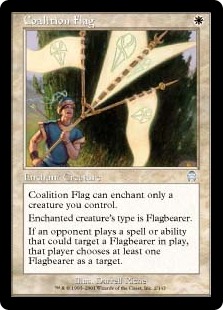
There aren’t exactly a lot of these, but I’m pretty much in love with Coalition Honor Guard.

Seriously, these guys are sweet. The obvious implication is that they mess with your opponents removal spells - they even invalidate damage-based ones to an extent. On a more interesting level they essentially blank your opponent’s removal spells and soak up all of their targeted Disciple abilities.

The only issue that I take with Flagbearers is that I never got to cast one in a physical game of Magic. It’s really satisfying watching an opponent tap and untap their mana when you control a Flagbearer. I can only imagine how much better it feels without them having an online client to tell them they can’t do what they want to do.

~

As I said earlier, drafting IPA on MTGO isn’t exactly a gold mine. However, if you’re in the market for a quality draft, then I couldn’t recommend it enough.

-Ryan Overturf


Jason’s Archives: The Audacity of Professional Jugglers/Cheaters, Reader Submissions & All the Decklist Analysis Your Prefrontal Cortex Can Handle

Are you a Quiet Speculation member?

If not, now is a perfect time to join up! Our powerful tools, breaking-news analysis, and exclusive Discord channel will make sure you stay up to date and ahead of the curve.

Greetings, Speculators!

Everyone, I have a confession to make. I don't know how to juggle, not even a little. If you gave me two objects, I could probably do a crude approximation of tossing them back and forth before they collided or I dropped one. It takes some work to learn how to juggle and I simply haven't put in the time.

I bet a lot of you don't know how to juggle either. You're not lazy, or bad people -- you just never developed that skill. Bearing that in mind, would you feel comfortable demonstrating your juggling prowess on camera?

Of course it's not juggling I want to talk about, but savage, unadulterated and audacious cheating.

Juggling on Camera

Back to the illustration I've set up. You have to show everyone how well you can juggle despite never having practiced before. There are several onlookers and your opponent in the juggling contest has his hands at his side, watching you from a foot away. How conscious are you of the camera pointed at you? I'm guessing the camera is not something you can block out or ignore. This is because you're probably not a very good juggler.

Conversely, to cheat on camera, it would take supreme confidence in your cheating skills to ignore the fact that you were on camera.

So what kind of person would even attempt such a brazen act?

The People's Exhibit A

This weekend at the SCG Open in Detroit, in a match between Jon Elden and Samuel Friedman, a play occurred that lead to the disqualification and, if there is any justice, future suspension of Jon Elden. In response to a Stoneforge Mystic activation, Friedman cast Vendilion Clique to send a Batterskull from Elden's hand to the bottom of his library. A few minutes later, Elden played a Batterskull and Friedman conceded. Almost immediately a rumor began to circulate, both around the room and on Twitter, that Elden had cheated.

The video evidence is quite compelling.

Even though we have a video of the event, we know what time the incident occurred, and we can pause and rewind the video, the cheat is easy to miss. Samuel Friedman, his opponent, has taken a bit of flak for not noticing what Elden had done.

Would you have?

Beginning with the resolution of Vendilion Clique and continuing through the next game of the match, Elden constantly attempts to distract Friedman. Adjusting his library, moving his deck around, failing to untap his Stoneforge Mystic to draw Friedman's attention to the board: classic misdirection techniques.

All of this was designed to distract from the final maneuver. Eventually Elden activated a Polluted Delta to search his library, leaving the bottom card (the offending Batterskull, put on the bottom by the Vendilion Clique) on the table and scooping it into his hand. Having played a Vendilion Clique of his own, he knew Friedman had no answer in hand to the Batterskull and that it would likely win him the game.

So He Cheated. Big Deal. (And What Was That About Juggling?)

The point is, just as you would only be at ease juggling nine bowling pins and a goldfish bowl on camera if you had spent hours and hours practicing, Jon Elden cheated on camera as nonchalantly as if he were playing a game of go-fish.

In under five seconds, without hesitating, he executed a complicated series of sleights of hand so well that he nearly got away with it. On camera. With Adrian Sullivan and Patrick Chapin commenting. The amount of dexterity required to pull off this caper I would equate to juggling.

At one point, using one hand, he attached a Sword of Feast and Famine to his Stoneforge Mystic and attacked with it, while simultaneously using his other hand to prepare the bottom card of his library to get scooped up. He didn't seem nervous, he didn't seem hesitant, he just executed.

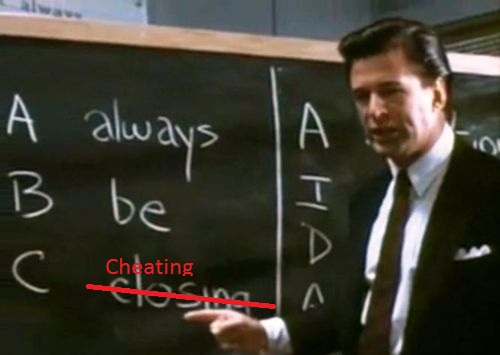
One only attains this level of confidence by remembering his ABCs:

There is a real cost to allowing someone like Elden, clearly the Houdini of cheating, to keep coming to events. Even if his opponents spend all of their time watching him like a hawk, they're not concentrating on their own game. His presence at events is a distraction and undermines the hard work others have done testing matchups and learning to sideboard.

While I may admire Jon Elden's skill, he should be using it to preform tabletop card tricks for tourists, not to cheat his way into the Top 8 of Magic events. For most players, Sleight of Hand and Misdirection are cards to play in decks, not skills to develop.

I imagine the DCI will deal with him in a manner similar to how they dealt with the Pele of cheating, Alex Bertoncini. Elden may not have Bertoncini's history, but he certainly has the chops.

Could This Happen to Me?

Just like the guy who French Fried when he was supposed to Pizza, a Magic player who spends the whole match trying to catch his opponent cheating is going to have a bad time. Anyone who gets cheated out of a match they should have won likewise isn't happy.

Wait, how many explores did you play this turn?

There are a few things you can do to make sure you aren't bamboozled (unless your opponent plays Bamboozle, in which case you're in good shape because your opponent is playing Bamboozle) without making your opponent feel like you're trying to visually undress them.

If your opponent is darting their hands around a lot, manipulating their library or graveyard excessively or putting their hand face down next to other cards, they may be trying to pull something. Watch out. If they do something shady, don't be afraid to call a judge.

A lot of cheaters get away with it for so long because they just apologize to their opponent and play it off as a mistake and their opponent feels awkward about calling a judge. Don't. That's what the judges are there for, and if the cheater tried it on you, he will try it on someone else.

That said, don't sacrifice fun. Most people aren't trying to cheat you. Don't be a sucker, but don't be a nanny either.

Archives Time

I have a lot of great stuff for you this week, and all of it was recommended by you, my readers! I decided to collect all of the reader submissions into a section I'm calling:

Reader Submissions

Our first bit of goodness comes to us from Quiet Speculation's own Douglas Linn who thought of all of you when he came across a collection of land liable to reduce all your creature types to Esperzoa -- that's how jelly you'll be.

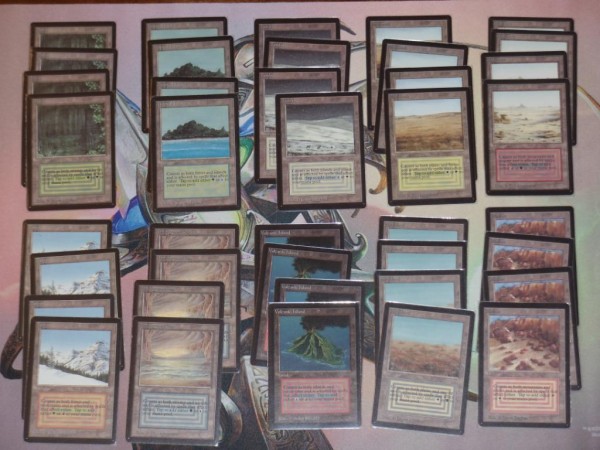
Power 40 > Power 9

That's a full set of Beta duals in all of their glory. For more sickness and other brags, check out the accompanying forum post.

If you don't already have Insider Access, and therefore can't read Doug Linn's weekly contribution, I would strongly advise you to consider it. Anyone with Insider will tell you that Doug's called shots have made many of us lots of money and his articles and both entertaining and informative. Good looking out for us, Doug!


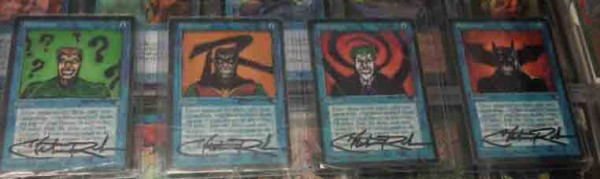
If you cast a Brainstorm with Solomon Grundy on it, you only draw one and have to put three back, so be careful.

A fan of the Archives sent me an e-mail to altjason17@gmail.com to make sure I saw this gem on Reddit, submitted by Riddlefox. Artist Christopher Rush altered and signed these beauties. Unfortunately, I can't afford them because I dumped gasoline on all of my money and lit it on fire for no reason.


Perfect for tinerking with your sideboard in class

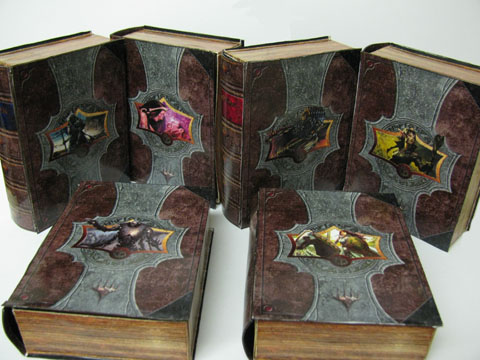
Another fan hit me up on Twitter to show me these custom deckboxes by artist Matt Milam. A little google fu revealed this webpage with more information about Mr. Milam.

If you want to hit me up on Twitter or hear about my called shots and speculations for the future I can be found @JasonEAlt.

And that's the news from the internets this week. Keep the suggestions coming and I'll do another user suggestion roundup in a little while. Thanks to everyone who contributed!

Other Detroit Happenings

I opted to drive out for the day on Saturday and grind the binder a bit. I made a new friend when I traded him my entire collection for his entire collection over the course of two and a half hours. Taking up roughly half a table and drawing a crowd that rivaled some of the feature match tables, this trade made my weekend. I upgraded some of my cards and my trade partner was thrilled with what he got. It's always nice when everyone wins. Like I always say, every trade is a value trade.

But most people didn't go there to trade with me (I was busy doing that one trade anyway) and some of them did pretty well this weekend. Let's go to the deck lists!

Top 16 Standard Deck Lists

This seems like the right amount of Delver to me. Maybe it's some bizarre consequence of the 1950s feel of the Cobo Center or maybe it's the natural evolution of a format that's healthier than we thought, but the number of Delver decks in the top 16 was way under sixteen. It was three, in fact.

It would have been two if I hadn't spent an entire car ride back from Indianapolis convincing Ray Perez not to play RUG Pod. (To be fair, I did spend some of the car ride swerving so his head would bounce off the window when he fell asleep. If I can't sleep, no one sleeps.)

RUG Pod wouldn't have been a terrible choice, however, as Ray's teammate, up and comer Josh Glantzman, placed 16th with it. You may remember Josh from the Indianapolis Open last weekend, where he top-eighted both the Standard and Legacy portions.

Other notables include the UW Midrange deck, which has changed gears a bit. It added black and now it's going for the throat in more ways than one. Two copies in the Top 4 make this deck a force to be reckoned with, although its pilots may have had something to do with its success.

B/U Zombies also continues to be a worthwhile endeavor. It ultimately took home the trophy in the hands of Brad Eier, who managed to beat U/W Delver for all of the marbles (everyone else got money and boosters).

Bonus points go to Steven Kreuger whose "Infect Delver" deck managed a Top 16. Personally I would be too afraid my opponent would stabilize the game at 2 life and 9 poison, but Kreuger managed to win a lot more than he lost. Between Inkmoth Nexus and Blighted Agent as Invisible Stalker numbers five and six, this deck seems capable of switching gears and getting there with Silver-Inlaid Dagger or Runechanter's Pike in one or two swings.

Great job, all!

Top 16 Legacy Deck Lists

Do my eyes deceive me? Is this a ploy, a prank, a practical joke? Could the Lands deck really have won the Legacy Open?

Great Googily Moogily, it got there! Running an impressive zero copies of Griselbrand, this deck is a lot of fun for everyone but your opponent, everyone watching, and of course also you. Bobby Kovacs took down a field full of Elves and Maverick handily, bumming out a lot of people who took to Twitter to complain. If you can get people who weren't even at the event to complain about your deck, you definitely deserve a high five.

Having some experience with the deck myself, I can attest to it being worthwhile to learn. It genuinely tests skill and requires forethought to set up your win conditions. Only in Legacy can a forgotten deck like this come out of the woodwork and win first place in an event full of skilled players.

Elves was the only deck to put more than two copies in the Top 16, much to the chagrin of Delver enthusiasts everywhere. Maverick and RUG Delver had two Top 16 finishes and the rest were decks that appeared only once. In light of the recent clamoring for the banning of Griselbrand, he put an underwhelming zero copies of himself in the Top 16, pointing to how dynamic and adaptable a format Legacy can be.

I Got Nothing

Nothing else, that is. Have a great week and tune in next time for more of me, your fabulous archivist, and all the wonderful gems I'll dig up for you. If you run across something you'd like to see featured, hit me up on my e-mail or on twitter.

Until next time!

Insider: A Diverse Finance Article

Are you a Quiet Speculation member?

If not, now is a perfect time to join up! Our powerful tools, breaking-news analysis, and exclusive Discord channel will make sure you stay up to date and ahead of the curve.

As I’ve explored our forums here at Quiet Speculation, I’ve discovered we have a very diverse readership. Some players are returning to the game after years of being away and they are looking for how to reenter the game in a financially wise way. Others have been avid floor traders for years and they are interested in reading about potential speculation plays.

Others still are long time players and collectors, interested in the theory behind the invisible hand driving the MTG Market. Finally, others are looking to apply some theories to the MTGO market.

Personally, I am fascinated by each and every one of these perspectives. While I may dwell on some more than others in my articles, I do recognize this diversity exists. For this reason, I want to try something different this week.

Rather than cater to one type of MTG player in a deep article, potentially disappointing others, I will seek to write a précis of multiple topics to try and address most of my readers. We will see how this goes…

The Classic Collector

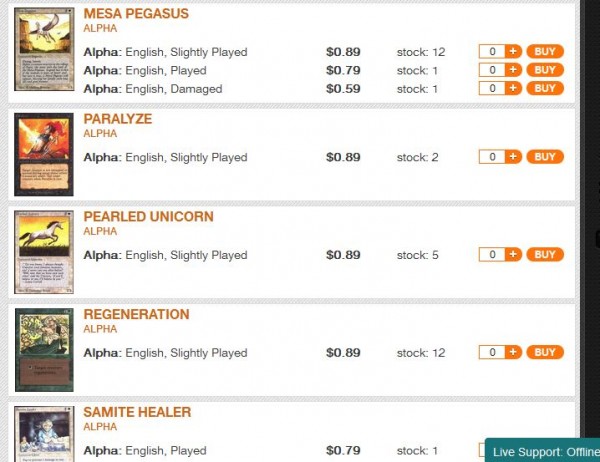
After exploring the value of Alpha cards a couple weeks ago, I began actively looking to acquire them at favorable pricing. The thinking was, with the recent jump in prices at major retailers, I may be able to identify some profitable opportunities.

After a couple weeks down this path, I’ve learned three tidbits of information – not enough for an entire article but certainly valuable to share. First, I have been able to find significant price discrepancy on Alpha rares between retailers and individuals. As a result, I have not had a difficult time negotiating with individuals on these cards. My target price for acquisition has been roughly 50% of SCG’s NM buy price, since all the cards I’ve bought have been at least SP.

On the other hand, commons and uncommons have been priced far more competitively amongst retailers. Channel Fireball has a dozen NM Alpha commons for $0.99 each, with a couple others at $1.49. Star City Games charges $1.99 for NM commons, but they sell played versions for just $0.99. On Uncommons, Star City Games does even better, charging just a couple bucks for played versions.

Individuals have frequently sought as high as twice the price of these retailers on their bulk commons/uncommons. Perhaps there is some emotional attachment driving this discrepancy – or perhaps people are convinced that any Alpha card is rare and merits at least a couple bucks. Either way, I’ve done almost all my bulk commons buying from CFB and I intend to buy some bulk uncommons from SCG.

Floor Trader

The latest bit of information we have on this front come from two sources – M13 spoilers and GP Yokahama.

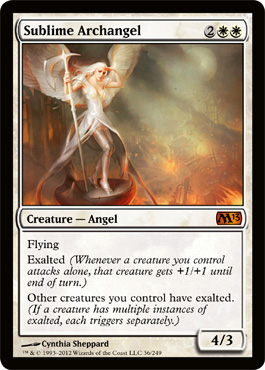
On the M13 front, I must be honest – I do not see many obvious opportunities. I am fairly confident Sublime Archangel will be relevant. But as for its or other M13 card’s impact on Standard, I am left guessing.

The set seems a bit underpowered so far. Sure, there are ridiculous bombs like Omniscience and Diabolic Revelation, but their casting cost is far too prohibitive to see constructed play. And all the buzz about improving the Dream Halls deck may sound fun, but I honestly see the deck stuck in the world of Tier 1.5 or Tier 2.

Net, my recommendation is to stay the course – Innistrad Dual Lands are still a safe place to move into. Though, keep in mind there are a handful of M13 spoilers we haven’t seen yet, so it is always possible something is printed that will impact Innistrad Dual values. Restoration Angel is a powerful control card that I also see maintaining value for some time.

As for GP Yokahama, here’s a breakdown of the Top 8:

Pod Kiki-Jiki / Restoration Angel Combo – 4
Jund
B/W Tokens
Affinity
Mono Blue Fairies

Is any elaboration really needed here? The newly improved Pod deck now adds Restoration Angel and Kiki-Jiki, Mirror Breaker for additional combo shenanigans.

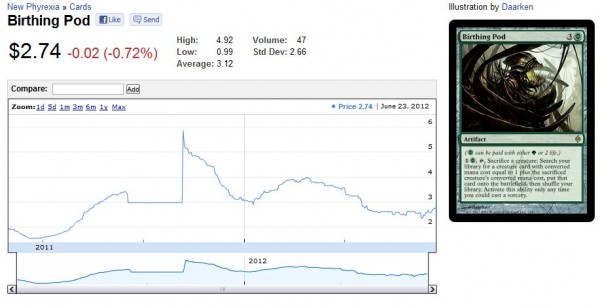
Key pick-ups are somewhat tricky to identify since the decks run such a diverse field of cards. That being said, the key combo pieces are safe bets, and I see even more reason for Restoration Angel to remain a buy. Search engines Birthing Pod and Chord of Calling are crucial enablers in the deck, and I see these as safe pick-ups as well. Especially Birthing Pod, which goes for just a couple bucks as it nears rotation out of Standard. (chart courtesy of blacklotusproject.com)

Getting Back Into Magic

I’ve seen in the forums recently that a few QS subscribers are looking to re-enter into Magic and try to trade and speculate in order to keep the hobby as close to “free” as possible. I love this approach as this is the primary reason I speculate and trade. Many hobbies, such as golf or art, are expensive to maintain and very difficult to make bank in. With Magic, one does not even have to be a good player to profit – all it takes is some research and discipline.

I take that back – there is one sacrifice I have had to make in order to drive profitability in Magic, and it is a piece of information I believe may be valuable to share. In order to truly profit maximally from Magic: The Gathering speculation, one has to emotionally detach from most of their cards.

When I am emotionally attached to a card, I value it incorrectly. The result is small value loss in my collection. While an occasional blip to work on a personal collection is okay, the occurrence needs to be minimal. This has been a difficult lesson for me at times, but my mistakes have made me savvier. I have traded for Angels I need at prices far above retail, and I have even occasionally preordered the latest and greatest [card Linvala, Keeper of Silence]Angel[/card] card – and most of you know how costly it is to pre-order cards.

In order to maintain the proper discipline, I’ve learned a key strategy: when being asked to trade away or sell a particular card that I may be emotionally attached to, I always rationalize my decision based on the fact that I can always acquire that same card again. And if I have a shot at buying back the card at a discount, I’ve then turned a profit.

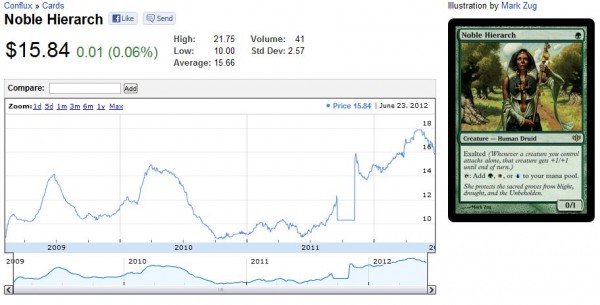
I actually recently did this with my set of Noble Hierarchs. I fear a reprint of the mana accelerator, yet I want to keep my set for Legacy. Still, I overcame emotion and sold my set for $62 since I wanted to put profitability first. A reprint still has not been revealed, and I recently repurchased a set from eBay at $54.50, in essence profiting $7.50 while keeping my set. And I am in the midst of selling this set yet again, still in anticipation of a potential price drop! (chart courtesy of blacklotusproject.com)

Net, make sure you keep the majority of your cards on the trading block, since you won’t always know when a profitable opportunity will arrive.

The MTGO Speculator

I have recently seen a call for more MTGO content. I have a confession to make: I don’t have a MTGO account. The concept of starting up a second collection is daunting to me and after playing paper Magic for fifteen years, I am not motivated to start from scratch.

That being said, I have come to understand there are some great opportunities for profit in the digital world. The possibility for fast-paced market adjustments combined with the absence of shipping costs is indicative of opportunity. But rather than make baseless recommendations, I would like to first appeal to my readers:

Is MTGO worth it?

I once tweeted this question and I received numerous responses with the majority pointing towards the negative. Since then I have resisted signing up.

Yet it seems inevitable that I join. I frequently find myself desperate for a game of Magic while being confined to home caring for an infant. A chance to play a quick game or even a quick draft could be worth the efforts of starting up a new collection. This especially becomes attractive if I can profit in the process.

Master of None

This article is a bit disjointed and I hope there was at least some value to my diverse readers. In an attempt to cover multiple topics, I haven't dove deeply enough into any one topic.

Rest assured this may be a one-shot occurrence as I attempt to broaden my topics to appease a larger audience. If it worked, please let me know and perhaps I will repeat this approach in the future. If, on the other hand, you feel value was lost due to the sacrificing of depth to enable breadth of content, please indicate this to me as well.

Next week, perhaps there will be some more impactful M13 spoilers to review. Or perhaps I will uncover some other price discrepancies to take advantage of. Or perhaps there will be some additional tournament results to review. Until then, thank you for reading.

-Sigmund Ausfresser
@sigfig8

The Top Five (Plus Two) Preconstructed Decks of Innistrad Block

Are you a Quiet Speculation member?

If not, now is a perfect time to join up! Our powerful tools, breaking-news analysis, and exclusive Discord channel will make sure you stay up to date and ahead of the curve.

Ertai

It's that time again! A feature that's become something of an annual tradition here on Quiet Speculation, we look back at the end of a block and rate its preconstructed decks. Which were the picks of the litter, those decks that brought something new and exciting to the table? And- yes- which were the worst, the ones that didn't quite live up to the promises of expectation and hope.

Because we're glass-half-full people at heart, we'll be beginning with a look at the best of the bunch, but for those who delight in the other end of the spectrum won't have long to wait.

Innistrad block has certainly brought with it plenty to get excited about, much of which was captured and preserved for posterity in its precon decks. We were given a slew of new tribal decks as well as some compelling new mechanics to play with. Sadly, the dual-faced cards were deemed too complex for inclusion in the Intro Packs, and didn't manage to find purchase in an Event Deck. As such, they find themselves in the forgotten class of sidelined mechanics, alongside miracles and fateful hour.

Still, we come not to bury Innistrad Block, but to praise it. Over the past year we at Ertai's Lament thoroughly tested each precon deck from the set and assigned each a score. We'll now look at the top five of the block, counting down to the very best of the bunch. As an added bonus, we'll then take a look at the Event Decks and present our picks of the best two of those as well!

5. Bound by Strength (Avacyn Restored) and Fiery Dawn (Avacyn Restored)

Wouldn't you know, a tie! Avacyn Restored brought us both of these decks, and they do a fine job of telling the story of the set in miniature. With Avacyn now returned to the benighted plane, the hunted and harrowed people of Innistrad have found the courage to come out from their barricaded homes and shuttered hearts. The fiends that have terrorized them for two sets are back-footed, and with renewed vigour the goodly folk are taking the fight to them.

The very concept of the hunted teaming up to become the hunters are at the very core of the new soulbond mechanic, and Bound by Strength is that mechanic's showcase deck. Packed with a ton of creatures designed to partner up and bring a power greater than the sum of their parts to the table, the deck was able to bring a ton of threats on-line in a steady stream of beaters. Reflective of Innistrad's removal-light environment you had few ways to impose your will on the battlefield outwith the red zone, but with the right soulbond pairings you could outpace your opponent and take the fight to them.

We saw this narrative reflected in Fiery Dawn as well, albeit in a much less overt manner. To understand the significance of this Red/White construction, we need to jump back two sets to Innistrad. Back then, the protective wards were faltering, and the night was encroaching upon the human settlements thanks to the abrupt and unexplained disappearance of the plane's guardian angel, Avacyn. Humanity's plight was unveiled in the Green/White Intro Pack deck Repel the Dark. While an entertaining enough deck in its own right, it lacked a certain punch, and if you got the impression that the Humans were circling the wagons, well, you weren't alone.

In earlier sets, Red Humans weren't the kinds you'd want to encounter in the night, being Werewolves and Cultists in the main. For the set's third act, the more pensive Green was out in favour of the fiery Red, as the Humans pulled their swords and pikes down off their mantles and burst forth to smite the things that go bump in the night. The aggressiveness the colour affords was a perfect base for the deck, and put this one far ahead of its earlier predecessor.

4. Dark Sacrifice (Dark Ascension)

We enjoyed the look and feel of this deck for a number of reasons, not least because of its historical significance. In a game where many remember the purging of objectionable creatures types like "Demon" and the sanitising of art with a whiff of occultism to it (see the early Unholy Strength), to find a deck where the objective was to play Humans and then sacrifice them to the forces of darkness was a sign of the game's maturity.

Of course, that alone wouldn't be enough to rate it on this list, so fortunately the deck is a blast to play. In a medium where most decks tend to be creatures + supporting effects = RAWR!, it's always a treat when Wizards sends something down the path that's cast from a different mould. Not for nothing he spell-heavy Mirromancy topped our list of best decks of Scars of Mirrodin Block last year. This time we get an updated sacrifice-engine deck in the grand tradition of some of the game's best theme decks like Coldsnap's Beyond the Grave and Mirrodin's Sacrificial Bam. Play out your altar-fodder, then sacrifice them up to reap up life, +1/+1 counters, or repeatable creature kill. The Dark Side is strong with this one!

3. Relentless Dead (Dark Ascension)

By the time the middle set of the block rolled around, it was a great time to be a Zombie. Already unearthed amongst a wicked garden of delights such as Endless Ranks of the Dead and Army of the Damned, Dark Ascension added a nasty lord to the mix in the Diregraf Captain, and at uncommon no less! It was the perfect tie-together for the divergent Zombie types we'd been introduced to in the first set.

On the one hand, you had the traditional "shambling undead" Zombie type in Black, the kind that claws its way out of its own grave at the ghoulcaller's beckoning. Not to be outdone, demented "skaberen" were cobbling together body parts, branding them with arcane symbols and bringing their patchwork dead back to a mockery of life. These Blue Zombies were flavourfully quite different, often requiring the exile of creatures from the graveyard as a condition of casting.

All of this came together for a delightful bit of tribal brain-eating with Relentless Dead. Though it had its share of filler and the typically poor removal suite (in Blue and Black!), the deck came together tighter than a skaberen's stitching.

2. Eldritch Onslaught (Innistrad)

The precons of a block's first set often seem to be the weakest, since as a rule they have the smallest card pool from which to draw (though to be fair, large-set closing acts like Avacyn Restored and Rise of the Eldrazi have the same limitation). Indeed, last year only one Scars of Mirrodin deck cracked the top five, and even then it was last on the list. Fair play to Eldritch Onslaught then for coming within grasping distance of top honours. Like the aforementioned Mirromancy, Eldritch Onslaught made a name for itself by defying the conventional formula and attacking the precon metagame from a different angle. Though we'll likely never see the likes of Stronghold's The Sparkler again, with its three creatures and bajillion spells, Edlritch Onslaught had  relatively muted number of them- fifteen- and many of them were there to support the spell-heavy strategy of using and abusing flashback for incremental advantage.

Novelty is all well and good, but what rates the deck so highly is that it worked. With thirteen of the deck's twenty-one noncreature cards being able to be played out of the graveyard, the deck also had something almost no other deck in the block was given- a hefty removal package. Eldritch Onslaught could bounce and burn with the best of them, then looked to land a finisher like Sturmgeist or Murder of Crows to close the game out. All in all, this was a great way to kick off the new block.

1. Grave Power (Dark Ascension)

When we reviewed Grave Power on Ertai's Lament earlier this year, we had this to say:

Although we try and avoid hyperbole when assessing the decks, it would be unfair to credit Grave Power with anything less than recognition for being one of the best Intro Pack decks we've ever seen- and certainly near the top of the Theme Decks as well. This is the rarest of precons- one that treats each card slot as something not to be squandered, has a cohesive theme and the strategy to get there, and throws its full weight behind it to support it.

Our enthusiasm has in no way diminished with the passage of time, and its crowning here as the "best in block" is fully warranted. Consistent from pillar to post, this deck took the same strategy as the Event Deck Deathfed and did it one better- with far less resources available to it. Often with Intro Pack decks we'll see one rare card that fits well within the theme, and one that isn't a perfect fit but does the job well enough. Though this tendency has lessened somewhat after Wizards adopted the policy of the non-foil rare being from the base set rather than having both rares come from whatever expansion the Intro Pack supported, the two in Grave Power were pitch-perfect. An early Splinterfright was like turning on a tank of nitrous in a race car, and in the removal-poor Innistrad environment a monstrous beater like the Ghoultree tends to stick around.

If you were going to experience this block through the lens of only one Intro Pack deck, this would be the one. It was an absolute joy to play, and we hope its a harbinger of things to come for the format.

Fiend Hunter

Bonus: The Event Decks

Although we haven't touched upon these in previous annual write-ups, it's an overdue addition since we review and rate the Event Decks just as we do all other precons. Since our "top five" list of Intro Packs scoops up the cream of the top one-third (or so- Scars Block had only fourteen Intro Packs thanks to being one light in Mirrodin Besieged), it only makes sense to hold to the same proportion. On that note, here are the two best Event Decks to come out of the block.

2. Hold the Line (Innistrad)

The White-weenie competitive archtype got an update with Hold the Line, after first being given the Event Deck treatment with New Phyrexia's War of Attrition. War was noteworthy for having the then-recently-banned Stoneforge Mystic in the deck, but Hold the Line could draw on no such power. Instead, Hold the Line looks to race off the blocks the very moment the starter's pistol fires, with an impressive eleven one-drops. Indeed, no creature in the deck costs more than three mana, and with four of those being Fiend Hunters, the deck has very strong tempo and removal options available to it.

We've noted here before how speed is the greatest weapon in the Event Decks' arsenal, given their avowed aim to keep you competitive at the Friday Night Magic tables. Hold the Line is blisteringly fast, though it is susceptible to stalling out in the mid-to-late game as all decks of this archetype tend to be. Still, with an impressive amount of removal at its disposal, what Hold the Line can't go through it can go over

1. Spiraling Doom (Dark Ascension)

The top deck here is one of the highest-rated decks we've ever reviewed on Ertai's Lament. Once upon a time here on Quiet Speculation, I mused that the need for speed was limiting what sorts of Event Decks Wizards could put together. Four decks in on this new product line, the adventurousness on display with Mirrodin Besieged's midrange Infect & Defile seemed tempered by results. Infect & Defile wasn't a bad deck, it just didn't live up to the competitive promise. Unsurprisingly, the next two decks for New Pyrexia were more of the "speed kills" vein, making up for limitations on card rarity and power by compensating with quickness.

We've been delighted to see the Event Deck line mature and prosper, with forays back into the midrange better tuned to withstand the rigours of Standard. Spiraling Doom was the pinnacle example of this, a toolbox deck that keys off of a single card: Birthing Pod. With Pod decks already competitive, it was a great archetype to build from with the inclusion of undying creatures. With answers for nearly any threat you could face staggered over a consistent chain of converted mana costs, the deck was remarkably consistent even if it did suffer from not having access to an extra Birthing Pod (easily remedied for those taking the deck into the field).

Time and again we've enjoyed decks that take the less-traveled path and still find ways to put up the wins. A stock 24-creature, 12-spell deck can be a lot of fun to play, but the focus on that formula tends to diminish the variety of win conditions we know the game is more than capable of. Such decks always get our attention...but they have to do more than that to attain ratings high enough to be included on the annual "best-of" list. The decks presented here today have done so, and claimed their rightful reward.

Thanks for joining me today in a look back through Innistrad block. We're already looking forward to the start of the next as we Return to Ravnica in the fall, but in the meantime we'll be back soon to look at how the other half lives as we present the worst decks of Innistrad block. See you then!

______________________

Jay Kirkman

@ErtaisLament

www.ertaislament.com

Anticipating Talrand

Are you a Quiet Speculation member?

If not, now is a perfect time to join up! Our powerful tools, breaking-news analysis, and exclusive Discord channel will make sure you stay up to date and ahead of the curve.

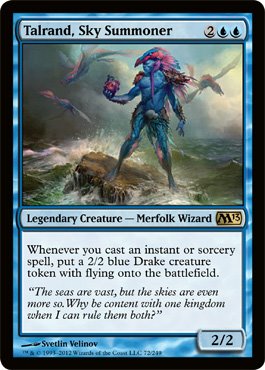
Welcome to the final article in my series on budget monocolored decks. Our target today is the oft-maligned color blue.

By now it should be no secret that I wasn't looking forward to this article. I hate the impact blue has in Commander. Its true that library manipulation and card drawing make it a great support color for decks trying to do interesting things. But the countermagic and combos make it a miserable color unto itself.

At this point, I've tried a few times to build a proactive blue deck, and it is possible. You have to limit the number of counterspells, combo pieces and card draw engines you play, lest the deck devolve into the generic strategy of valuing everyone to death.

The thing is, there are very few blue Commanders that lend themselves to aggression. Sakashima the Impostor does an okay job, depending on how aggressive the rest of the table is, and Hakim, Loreweaver is okay if you're willing to go all in on auras. But both seem gimmicky and likely to get old sooner rather than later.

That said, the mantra of this series has been that budget decks thrive on gimmicks that let them focus on accomplishing one thing as consistently and powerfully as possible. So I guess we should run with one of these two...

What's that? New legends in M13 you say? Well, let's check those out and see if there's something a little more exciting:

Let's Talk Talrand

This guy seems more interesting. He proactively develops the board and kills players directly rather than messing around and drawing a billion cards. He's on the cheap side, something not many popular blue Commanders can claim. He's more flexible than Hakim, and more gimmicky than Sakashima, but encourages you to play with blue's strongest card types.

I like Talrand because he asks a unique set of questions. How many instants and sorceries can you cast in one turn? How good are cantrips that double as combat tricks? What kind of effects can we find "draw a card" stapled onto, and how much better are those when they come attached to a 2/2 flier?

The short story is that this guy is absolutely insane for budget blue decks. Toss him into any deck with your favorite blue cards and whatever rares you have around, and make up the difference with miscellaneous cantrips. They don't even have to be good cantrips like Preordain. Bring on the [card Portent]Portent[/card]!

One Drake, Two Drake

The unfortunate thing is that Talrand does not lend himself to building particularly interesting decks under a budgetary constraint. You're going to splurge on a few powerful cards that interact favorably with the rest of your deck, and then pack it to the gills with as many drake producers as possible.

We want to cast as many spells as possible each turn, while still leaving up countermagic to protect Talrand. This means buyback and retrace cards as repeatable drake factories. It also means spells that untap lands or otherwise enable us to cast more spells.

Cantripping Down the Lane

Let's start with the cantrips:

  • Aquitect's Will ($0.25)
  • Cerulean Wisps ($0.15)
  • Clairvoyance ($0.15)
  • Cloak of Feathers ($0.15)
  • Fleeting Distraction ($0.15)
  • Gitaxian Probe ($0.75)
  • Interdict ($0.49)
  • Into the Roil ($0.99)
  • Leap ($0.15)
  • Mental Note ($0.25)
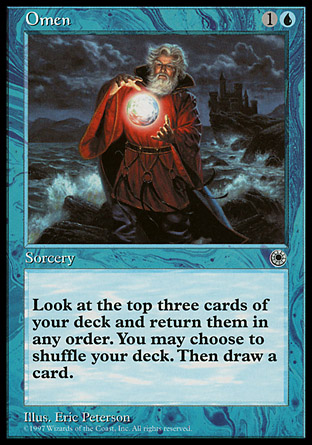
  • Omen ($0.39)
  • Obsessive Search ($0.15)
  • Opt ($0.19)
  • Peek ($0.15)
  • Ponder ($0.89)
  • Portent ($0.25)
  • Preordain ($0.89)
  • Quicken ($0.75)
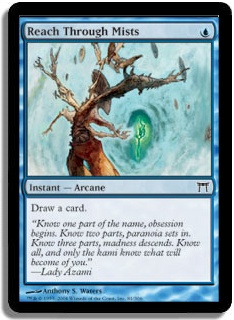
  • Reach through Mists ($0.25)
  • Serum Visions ($1.75)
  • Shadow Rift ($0.25)
  • Think Twice ($0.25)
  • Thought Scour ($0.49)
  • Visions from Beyond ($0.49)
  • Twisted Image ($0.15)
  • Whispers of the Muse ($0.25)
  • Gush ($0.49)
  • Peer through Depths ($0.89)
  • Merchant Scroll ($0.99)
  • Catalog ($0.15)
  • Deep Analysis ($0.75)
  • Distant Melody ($0.25)
  • Sleight of Hand ($0.89)
  • Jace's Ingenuity ($0.25)
  • Perilous Research ($0.49)
  • Shared Discovery ($0.15)

That's thirty-eight cards dedicated to sifting through your deck as cheaply as possible. Throw in some flashback cards like Think Twice for resiliency and some high impact cards like Distant Melody to pull ahead if you start running out of gas, and you're set.

There are a couple things to consider when running this high a density of cantrips. The first is that opening hands will look wonky, full of cards that do nothing but replace themselves (the first time that random Shadow Rift is actually relevant should be hilarious). It also means that the longer a game goes, the more likely you are to flood. You don't have much in the way of card advantage, just selection.

Mana Sinks

If all we can do is cantrip into more cantrips, it will be hard to actually win the game. That's where the other mechanics I've mentioned come in. Buyback and retrace make sure you always have something to sink mana into and provide a continuous source of 2/2 beaters.

  • Petals of Insight ($0.25)
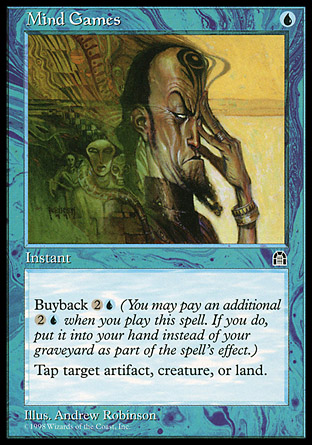
  • Mind Games ($0.15)
  • Capsize ($0.75)
  • Mystic Speculation ($0.39)
  • Oona's Grace ($0.15)

I only found these five cards but each one should be a reasonable mana sink. The worst one is definitely Petals of Insight, which I've had a soft spot for ever since running Petalmane Baku combo in Standard back in the day.

Mind Games seems like the kind of card that dominates games given sufficient mana. You can lock down problematic guys, turn off all of someone's colored sources or tap down blockers, all while generating more fliers. Seems fair, right?

Build Your Own Summoner's Bane

Take a look at this card from Zendikar:

Never having seen the light of day in Constructed, unplayable even in Limited, Summoner's Bane is actually a terrible card. But what if we can turn good counterspells into [card Summoners Bane]Summoner's Banes[/card]? With Talrand we get the upside of efficient counterspells with valuable bonuses and 2/2's on top of it! Suddenly, Summoner's Bane seems a lot more reasonable.

  • Arcane Denial ($0.75)
  • Dismiss ($0.75)
  • Exclude ($0.39)
  • Thwart ($1.75)
  • Foil ($0.75)
  • Bone to Ash ($0.15)
  • Counterspell ($0.99)
  • Deprive ($0.25)
  • Negate ($0.15)
  • Dispel ($0.25)
  • Turn Aside ($0.15)
  • Abjure ($0.25)
  • Controvert ($0.39)
  • Fervent Denial ($0.25)
  • Muddle the Mixture ($0.65)

Unfortunately, good counterspells are usually expensive because of the popularity of the color blue. But there are a ton of budget options, many of which appear here. Sure, you can do some great things with Forbid and Cryptic Command, but they aren't necessary. You should be fine as long as you can protect Talrand with stuff like Turn Aside, keep the game from getting out of control, and stop [card Wrath of God]Wrath of Gods[/card].

Winning the Game

At this point we should have no trouble blazing through our deck and generating an enormous army of drakes. But a continuous stream of guys will not always be enough to finish the game. We want a few ways to turn our temporary advantage into permanent victory.

  • Lunar Mystic ($0.49)
  • Sakashima the Impostor ($4.99)
  • Favorable Winds ($0.25)
  • Runechanter's Pike ($1.25)
  • Diviner's Wand ($0.49)
  • Laboratory Maniac ($0.49)
  • Surrakar Spellblade ($0.49)
  • Artful Dodge ($0.15)

These are the cards you're digging for, the ones that will end the game.

Lunar Mystic seems like a great way to make your counterspells even better. It also turns ordinary cantrips into real card draw to guarantee you don't run out of gas and hit your land drops late into the game.

Sakashima the Impostor is the big splurge for this deck. Doubling up on 2/2's will present lethal very quickly and easily, especially in conjunction with Favorable Winds.

The biggest question is what to do if you can't make enough guys to constitute a reasonable threat. We have a few answers to that problem.

Runechanter's Pike and Diviner's Wand can enable a one-shot kill and help avoid overextending into sweepers. Runechanter's Pike is especially powerful considering how little esteem it enjoys. This unassuming equipment has made the cut in most blue decks I've worked on since the release of Innistrad!

Artful Dodge is mostly there as a way to force through huge hits with one of your two equipment, but can also make a few guys in a pinch.

Lastly, Laboratory Maniac provides a quirky and fun plan B. You just want to be careful with him when going for the win. Try to trigger him with your draw step or a sorcery speed cantrip, and hold back instant-speed cantrips in case you need to respond to removal.

The Mana Base

The density of cantrips in this deck will let us run a low land count. We could try to run some number of mana rocks to incrase the likelihood of turn three Talrand, but given the choice between those and Sakashima, I think Sakashima has a higher upside. Because of that, and since we're already a little above the price I would prefer, our mana will simply be a bunch of basics.

  • 33 Island

There are definitely a few nonbasic lands to consider, like Buried Ruin or manlands. Even [card Lonely Sandbar]cycling lands[/card] can smooth out your draws and keep the cantrip engine running. The right number of lands might be higher or lower, but it's tough to say without playing a ton of games. Especially in a deck with so many cantrips, you're going to leave yourself open to a ton of variance.

With the mana out of the way, let's look at the finished deck! Coming in at $34.92, here's Talrand:

Untitled Deck

Creatures

Sorceries

Instants

Artifacts

Enchantments

Lands

33 Island

I can't express how excited I am to see what people do with Talrand. This guy rewards you for indulging in typical blue shenanigans, but does so in an interactive way rather than a degenerate way. Finally, blue has an efficient way to make an army that doesn't involve tutoring up Myr Incubator. I'm excited to see what corner case interactions end up defining Talrand decks, because it's going to be sweet!

I'm sure there are ways to upgrade the basic list above. Shuffle effects to go with the cantrips would probably be good. Cryptic Command and other tier-one counterspells would make a huge difference. Other than that I can only think of expensive staples to add, but there are undoubtedly a few gems lurking somewhere in Magic's twenty-year history.

The deck is pretty sweet as is but it will take some tweaking to find out which cards don't work and how many cantrips is enough.

I have Twitter to thank for next week's deck. @Andrew_Magrini was working on a Jund deck with Sek'kuar, Deathkeeper, and @GUDoug and I started talking about things you could do with Ghave, Guru of Spores. This approach seems right up my alley. There will be so many lands!

Carlos Gutierrez

cag5383@gmail.com
@cag5383 on Twitter

Insider: Grand Prix Yokohama Creates New Modern Price Trends

Are you a Quiet Speculation member?

If not, now is a perfect time to join up! Our powerful tools, breaking-news analysis, and exclusive Discord channel will make sure you stay up to date and ahead of the curve.

Grand Prix: Yokohama was this past weekend, attended by over 1,500 players battling for prizes and glory. Importantly, they did battle with Modern decks, which is good for Insiders. Modern is popular enough on the tournament level to drive prices and many of the cards in the set are old enough that it's hard to track them down. They get expensive or hard to find (I had to call 5 stores last week to find one that had Oboro, Palace of the Clouds!). Ergo, it's a good field to get action on, especially because many of the lower-tier decks still have good money rares in them that you can trade into. This week, we'll look at the Grand Prix results and analyze them for Modern play and speculation.

First off, here are the T8 decklists (new window).

Let's talk about Birthing Pod.

Birthing Pod has been involved in the Melira deck since Modern really kicked off. The card allows for combo kills in otherwise-midrange aggro decks. I was thinking about why a deck like Melira that looks so atrocious on paper is actually good, and here's my logic. If you ignore the combo and just try to race with superior monsters, they can rip the combo on you or alternately, grind you down over a long haul. If you just focus on stopping the combo, they can still beat you to death with exalted Kitchen Finks. Ouphe! I think Melira and other Pod combo decks are angled in such a way right now that they apply just the right amount of combo and old-fashioned beats. They should not be good, but they are.

Fully half of the decks in the T8 used Birthing Pod. That's incredible. I don't think these decks are unfair by any stretch - remember that their combo involves two-toughness monsters, whether they're angling for Melira or just Kiki-Jiki. Removal is so underplayed right now and the Pod decks are so resilient that they can move through a lot of point removal. These decks also ran Chord of Calling in some number. Chord has been a solid pickup for a long time. It doubled in price to about $6.50 but I'd still trade for them at that price, which is something I'll get into later in the article.

The other breakout has been Restoration Angel in those decks. Let me be honest; I didn't think the Angel would even cut it in Standard, much less in Modern. Four mana for a blink is a lot to ask for, but a 3/4 body for four mana with Flash is downright silly. Take off the blink and I think it's still a fine control card a la Vendilion Clique. I never expected to see it paired with enters-the-battlefield effects like the Pod decks do. That's the result of small thinking on my part. The Angel is here to stay and she makes fighting these kinds of decks harder. You can get the Lightining Bolt on Melira, but it has to make it past the Angel to stick. You can kill a Finks once, but the Angel will reset it - which is downright dirty.

That said, there are still some great ways to fight these decks. Remember how I said they all depend on two-toughness dudes? While Pyroclasm is a good sweeper if you can afford to play it (and Whipflare is also generous), I'm looking more at Sudden Shock ($0.10). Split Second is really nasty; it can off a Pestermite from Twin and blow away small Ravagers. It can also shut down the Kiki-Jiki coming from Pod. It's not stellar, since they can go get another Kiki if they have Murderous Redcap around, but I'm much more comfortable running a card like that instead of Krosan Grip. I'm also looking hard at Grafdigger's Cage ($0.75) because it stops all of the tutoring - their only out is drawing the Qasali Pridemage to get past it. Now, the Cage shuts down the Melira deck but it doesn't stop Kiki-Jiki from still killing you with Restoration Angel, but I figure you should have a way to kill the goblin at that point. There's also Torpor Orb ($0.15) to stop the combo, but it doesn't stop them from getting Pridemage and still killing the hate card. I'm inclined to run a mix of Orbs and Cages. The most brutal thing you can do is probably Aven Mindcensor ($2.25) because it offers a clock and some serious surprise, often stopping a Pod or a Chord completely.

There's money to be made by banking on Birthing Pod. You can get the Pod itself for about $2.25, which I feel is suspiciously low right now. Both Cage and Orb are seriously cheap and rare. These are the sort of card that shoots up to $3.50 when people realize that they're long out of print and they need them for sideboards. Damping Matrix did the same thing about four years ago when Zoo players needed the effect and I'm certainly going to get a few sets of Orbs and Cages to sit on. Aven Mindcensor is also a fine card to grab - it's a power uncommon but it's the kind of card that can also go up. Remember how expensive Spell Snare is right now! Mindcensor is a little more limited in scope, but it's still a brutal surprise to unleash. Kiki-Jiki is still expensive as heck, even though he recently saw a collector reprint. Trying to get money out of that goblin will be like getting blood from a stone. I'd stay away from trying to trade for them unless you get great deals, but they're a hot card and you could easily move it.

Looking at the predictable decks - Jund and Affinity

These two decks are the workhorses of Modern. You're going to have someone make the playoffs of an event with them because they are consistent and powerful, even though the decks are narrow. It's worth noting that the Jund deck has a lot of crazy Japanese one-ofs like Olivia Voldaren and Jund Charm. I don't think these are the right calls for consistency's sake, especially because there are no Maelstrom Pulses in his 75, but they are the kinds of cards that will come up just enough to really swing a game now and then. When the opponent doesn't suspect Olivia, she can take over a game. When they know she's coming, they can plan for it.

Affinity has about 3-4 slots that are open to whatever you want to put in. Most of the time, it's Shrapnel Blast, but it was Master of Etherium here. Master seems like a decent plan to me because Affinity falls totally apart in the face of Pyroclasm effects. Master gets the Ornithopters out of burn range and it also turns into a decent beater on the back of Moxes, Drums and Citadels. I prefer the sudden burnout of Shrapnel Blast, but Master is a fine play instead.

We can't draw much for speculation from these two stalwarts. I'll note that only Jund is running Dark Confidant, where he is a solid role-player. Not even the B/W Tokens deck runs Bobby Digital. I don't think his price tag is justified.

That B/W Tokens deck and Faeries?

First, Faeries. Vedalken Shackles is an enormously powerful card. The Faeries player needed to run Miren, The Moaning Well to make it better, but they somehow missed how awesome of a chain-gun that combo is. Spellstutter Sprite, as one player pointed out, is like Mental Misstep in the format. It's one of the few counters for Thoughtseize that I don't feel totally shameful about having to blow on the discard spell. The Faeries deck looks resilient enough with counters that it can probably get around a Pyroclasm, too.

Next, the tokens deck. Kelly and I have been saying that Zealous Persecution is highly powerful right now in Modern and this bears it out. Multiple times in the finals, the Tokens player just wiped out the Faerie board with Persecution. It was delightful to watch. This sports three main and the fourth in the board and I'll reiterate that it's a great card to pick up. You can't really make Lingering Souls do much without it, since 1/1s are pathetically small in Modern. Now, when they become 2/2s and your opponent's guys shrink, you're trading tokens to kill off Delvers and other, more serious monsters.

I'm not sure where the Tokens deck goes from here, though. It's still highly susceptible to things like Ratchet Bomb and even Repeal becomes a kill spell. It's got a good longer game since any pump spell combined with tokens is a serious matter. But even random things like Echoing Truth are still potent and the deck has no way to interact with a combo deck like the Birthing Pod lists. Nonetheless, I see BW Tokens being a serious part of the metagame for awhile. People like big, breakout rogue decks and this one is easy enough to make a budget copy of.

If you're going to speculate on Tokens decks, I suggest focusing on Windbrisk Heights ($3.00). It makes the deck pretty busted and it's one of the older cards in the deck. Spectral Procession is also a good snag, but things like Honor of the Pure and Intangible Virtue just aren't worth the dollar or two you'd make from them. These are 2-of cards that are nearly interchangeable. While Virtue is currently hot, Honor has been reprinted enough to make it essentially worthless.

Understanding really long term calls based on current R&D design trends.

I was chatting with a friend the other day about RG Tron and the Tron archetype in Modern. I said that I thought it was a good bet to keep playing Tron and that Tron will only get better with time. The reason is that there will be more awesome Tron cards printed in the future. Wizards loves big spells. We've seen things like Bonfire of the Damned, the Eldrazi, Wurmcoil Engine and more come as gifts from the sky. Karn, Liberated is the core of the RG Tron deck type! However, Wizards is never going to print any nonbasic land hate that's better than what we already have. It's simply against what R&D feels - they don't like land destruction to be too good. So we've got Molten Rain, Blood Moon and Sowing Salt, but we'll never see Wasteland or even Dwarven Miner in Modern. Tron is only going to get better and the hate for it will never be printed.

You can extend this to Birthing Pod and Chord of Calling, too. Wizards keeps making more creatures for the Modern pool and some of them turn out to be cards like Restoration Angel. Pod is only going to be better as time goes on. That's why I think getting Pods right now is an incredible long-term call for Modern and I still think Chord of Calling is fairly priced. If you've got money that you can tie up for a year in Modern, tie it up with Birthing Pods. You've got great factors on your side that are built into the card. It works on Phyrexian mana, so it'll never be reprinted. Similarly, Chord uses Convoke, so the only time we'll see it come back is in a special boxed set.

There are more calls like this all over Modern. A lot of the time, they're not worth tying money up into, but sometimes they are sure bets. I stand by Birthing Pod in particular as a good bet for a long time to come in Modern.

Questions, comments and feedback are always welcome! I love love love talking Modern.

Until next week,

Doug Linn

Douglas Linn

Doug Linn has been playing Magic since 1996 and has had a keen interest in Legacy and Modern. By keeping up closely with emerging trends in the field, Doug is able to predict what cards to buy and when to sell them for a substantial profit. Since the Eternal market follows a routine boom-bust cycle, the time to buy and sell short-term speculative investments is often a narrow window. Because Eternal cards often spike in value once people know why they are good, it is essential for a trader to be connected to the format to get great buys before anyone else. Outside of Magic, Doug is an attorney in the state of Ohio.  Doug is a founding member of Quiet Speculation, and brings with him a tremendous amount of business savvy.

View More By Douglas Linn

Posted in Finance, Free InsiderTagged , , , , 3 Comments on Insider: Grand Prix Yokohama Creates New Modern Price Trends

Have you joined the Quiet Speculation Discord?

If you haven't, you're leaving value on the table! Join our community of experts, enthusiasts, entertainers, and educators and enjoy exclusive podcasts, questions asked and answered, trades, sales, and everything else Discord has to offer.

Want to create content with Quiet Speculation?

All you need to succeed is a passion for Magic: The Gathering, and the ability to write coherently. Share your knowledge of MTG and how you leverage it to win games, get value from your cards – or even turn a profit.

Insider: The Booming Business of Ratios, Part 1 – Why Force of Will is Simply Worse Than You Think

Are you a Quiet Speculation member?

If not, now is a perfect time to join up! Our powerful tools, breaking-news analysis, and exclusive Discord channel will make sure you stay up to date and ahead of the curve.

Rather than try to dazzle you with my accomplishments, dear readers, I would instead like to begin this maiden article with a little bit of logic.

As a trader, I don’t necessarily make the most money in the business, not by a long shot. But as a starving college student, it’s wonderful to know that, if worse comes to worse, I’ll be able to pay for food and a couple of toys. More importantly, however, my time is limited, so my goal over the last 6 months has been to streamline the process of value trading as much as possible, maximize value and to minimize work. I'll start off my time here with this, my personal approach to trading for value. In it, I explain why low value cards are a more lucrative investment than high value ones, simply because their perceived value is less static, and people care less about smaller cards.

Why I’m Here

No bragging, just a prologue.

When I first approached trading, I learned Everything I could about it, with a capital ‘E’.

Here is a picture of everything, according to Google. Picture credited to abeautifulrevolution.com

I got a Quiet Speculation account and  read every other financial article published on the net since who-knows-when. Following that, I made a definitive list of every card I thought impacted Standard, Extended, Legacy and Vintage at that time and their prices... and then memorized it.

You may have found the flaw in my plan: the overall time commitment was, in a word, obscene. And while I now find myself with what I consider to be strong understanding of the underlying market economics of Magic: the Gathering, I attribute far more to intuitively knowing how cards measure up in the metagame than to any painstakingly devoured laundry list of then-current statistics.

I also tried my hand at speculation, finding reasonable success with the outbreak of Modern, but also found that the amount of effort I needed to put towards actually reselling, listing and calculating profit margins on those speculations to a bit more than the time I had on hand. I have never been the biggest fan of that side of M:tG finance simply because I dislike the variance of gambling, and the unfortunately uncontrollable nature of high-risk, high-reward speculation.

What I eventually lighted on was simple: since my goal was to make money to buy things, not just build a large collection, I had to trade for cards that made not only a good margin consistently, but also had reasonable selling value. These cards are the same ones you’ve heard time and time again: Death Baron, certain Lieges, Mana Reflection, Sanguine Bond - all those perennially undervalued gems that fetch surprising amounts at the dealer tables.

Ratios

The first of my approaches to this was simple - ratios.

Obviously, this is a picture of ratios- with a pie chart to boot. And now, back to the content.

Imagine yourself in a position where you misvalue a Silverblade Paladin at 5 dollars. This is a reasonable number, and not too far off from the truth. Say the last you checked was on May 21st, and it was retailing around 6 dollars.

You learn about this, you shrug, no biggy. What’s a buck in cardboard? It’s not even a real dollar, it’s probably not worth more than 40 cents. I lose that much to couch cushions on a regular basis.

Let’s take an alternative example. How much is Force of Will worth? If you’re any kind of player at all, you should be able to estimate the retail price pretty closely. If you’re a common trader, you probably know the TCGplayer mid too. If you’re an avid trader, you almost certainly know the average buylist, retail sell, eBay sell, TCGplayer and maybe a price compiler like ApathyHouse or BlackLotusProject.

As an avid trader, you were probably close on the Silverblade call - experience with cards in similar positions has left you with the ability to shoot in the right general area without having ever looked at the new set’s prices online.

However, and this is big: If everyone knows what Force of Will is worth, why do you trade for it? Obviously,  I’m not advocating avoiding FoW (the card is bonkers, hugely liquid and has a hefty buylist value), but what on earth do you expect to make out of it?

When Jace, The Mind Sculptor retails for 60 and you get him fro 50, you probably pat yourself on the back. I know I do. But what about Silverblade? Worth 6, gotten for 5? Same ratio, and a hell of a lot easier to do. If everyone knows the price of Jace, or the price of Force, where’s the value to be made? Even the most play-focused of people know better than to trade their Force for standard garbage, and most know it’s valuable enough to warrant them taking the mere 30 seconds to check on it.

Unlike previous pictures this one has relevance to the article. Also unlike the previous, it makes me cry on the inside. Credited mtgmintcard.com

Instead, what I do, and what I advocate, is the equivalent of assured penny stocks. If it’s worth 2 bucks and you get it for 1.50, you just made a 33% profit. That’s huge. Hell, it’s worth 3 and you get it for 2? Bam! 50% and it’s not even hard!

The first complaint here is almost certainly going to be buy value, but why? If you can trade these small value cards for slightly less small value cards, and make up the price gap, you don’t lose anything because of the low buy.

Another Example

Since that the last paragraph was slightly more complicated and indecipherable than the Minotaur’s maze:

You trade a 10 dollar card of your choice for 2 Silverblade Paladin. You make 2 bucks sell, and likely nothing buylist. Those 2 Paladins each turn into a pair of generic 3 dollar cards, which you find relatively easy to turn three of into a generic 10 dollar card.

Now what do you have? In 2 trades, you made a 30% profit on what looks like, at first glance, not only a not particularly lucrative series of trades but trades where your trading partners are unlikely to suspiciously check value. If they’re paranoid and do their research, their first thought probably isn’t to come after you with a pitchfork but to shrug and assign those lost dollars to incidental expenses and never think of them again.

The Brain

Psychology is an important part of Magic, and even more so in trading.

As you may have noticed in the previous example, I pay particular attention to the possible responses of a person. One of the biggest reasons I avoid making value in my big Legacy staple trades is because, psychologically, these are the hardest hits for people to deal with.

If you lose your Force of Will at 10 dollars below retail when the trade has been based on Star City, you feel it.

When you lose your paladin at 1 below retail, you really don’t - even if you lost a multitude of Paladins, it matters less.

When I trade for Legacy staples, I instead strive to achieve the fairest, most even trades I possibly can. Those are the trades that get scrutinized, that get seen and get judged, so being seen as an honest and upstanding trader gives me a level of trust not available to a person who seeks to grind value out of every trade.

In my opinion, this is one of the reasons it’s crucial to remember that trading is nothing more than a vehicle of convenience. Trading allows me to get cards, often more quickly than I would buying them, and obviously for less straight up cash.

If a person is trading for a Standard card, the likelihood is that there are many, many copies floating around their area and the local gaming stores near them. As such, regardless of their assumed cash value, their commonality devalues them in the eyes of the traders.

Perception Matters

Remember Stromkirk Noble? That sucker was once worth 8 bucks, but nobody would ever trade for it at that happily, because everybody and their mother had the better part of a playset sitting around in their binders.

Did you know this card still exists?

Guess what’s worth 8 dollars? Null Rod. Guess what happens to be valued at 10? Restoration Angel.

Which one do you think commands more value in a trade, despite the Angel being worth more? If you need a hint, remember that Null Rod is a Legacy and Vintage staple, and, even though it's almost completely unplayable right now, it retains some level of liquidity.

People remember it being good, and because it's old and not in Standard, tend to put more stock into its value than other cards. Simultaneously, how many more Angels do you see at the trade tables than Null Rod? If Force (valued 60) has more perceived value than 10 Silverblade Paladins (6 each), doesn’t it make sense that the owner puts more emphasis on not getting ripped when they trade it?

While that may seem unconnected to convenience, trust me - they’re intrinsically tied. The more value an object has that you wish to obtain, the more interest you have in shopping around. The more expensive it is, the more likely you are to scour the internet, the local papers and your friend’s garages to find it.

For example, how much work do you put into finding a nice flower pot? If you’re me, you put the least amount of effort possible - if I’m ever in the position where I need a flower pot, I walk into Lowe’s and get the closest one in the right size.

Compare that to a car. Buying a car, I’d check Craigslist, the local for sale ads, ask around, check on cars with for sales signs on them and generally do anything I could to get the best possible deal

Just like anything else, Magic cards have perceived value, and it's important to realize that when you trade for them.

~

Tune in next week for the second part of this series within which I delve further into the psychology of trading and the value of ratios. I'll even explain what to do if you don't want a binder full of Silverblade Paladins (or worse!), and what the next step is- perhaps there will even be a bulleted list. If you have questions, comments or snide remarks, I eagerly look forward to reading them in the comments section.

Avatar photo

Tucker McGownd

Hi, I'm Tucker McGownd. I'm a low risk trader that spends most of my time in Minnesota, where I go to school, play magic, study for school, play Ultimate for my college team, study for school, and read. I've been playing for a long, long time (I first played during Mercadian Masques block, and first bought a pack in Urza's Saga). I was incredibly lucky when I cracked packs until I learned how much cards were worth, at which point I proceeded to open Thoughtlace in every set until Scars, where I picked up more than my fair share of molten psyche. I'm currently looking forward to the inevitable reprint of Chimney Imp.

View More By Tucker McGownd

Posted in Free InsiderTagged 7 Comments on Insider: The Booming Business of Ratios, Part 1 – Why Force of Will is Simply Worse Than You Think

Have you joined the Quiet Speculation Discord?

If you haven't, you're leaving value on the table! Join our community of experts, enthusiasts, entertainers, and educators and enjoy exclusive podcasts, questions asked and answered, trades, sales, and everything else Discord has to offer.

Want to create content with Quiet Speculation?

All you need to succeed is a passion for Magic: The Gathering, and the ability to write coherently. Share your knowledge of MTG and how you leverage it to win games, get value from your cards – or even turn a profit.

You don’t have to be a stats genius to get results from split testing

Are you a Quiet Speculation member?

If not, now is a perfect time to join up! Our powerful tools, breaking-news analysis, and exclusive Discord channel will make sure you stay up to date and ahead of the curve.

I use a bit of split testing at QS and I know I've written about it before. The concept is simple: in my case, I send out a newsletter with slightly different titles to 20% of the list and see which one wins. That winner gets sent out to the entire list. One hurdle I face is the guessing game of "why did they choose this one? What can I learn for the future?" Sometimes I think that I don't need to split-test something because it's simple and that's bad thinking.

You always split-test.

You do it because one title will always outperform the other and that competition helps your message get out.

Typically, one headline beats another by about 11% with our newsletter. That's a several-hundred-person difference.

Even if all I'm doing is living in the moment, cranking out two headlines with a slight difference and not getting into the psychology of WHY people prefer one... I still get more eyeballs.

Even if I don't learn a thing for the next newsletter, I still get 11% more opens. That's more people reading our content, learning about the site, engaging with our writers and community, laughing and internalizing that QS is where you go if you want to make more profitable trades in Magic.

Douglas Linn

Doug Linn has been playing Magic since 1996 and has had a keen interest in Legacy and Modern. By keeping up closely with emerging trends in the field, Doug is able to predict what cards to buy and when to sell them for a substantial profit. Since the Eternal market follows a routine boom-bust cycle, the time to buy and sell short-term speculative investments is often a narrow window. Because Eternal cards often spike in value once people know why they are good, it is essential for a trader to be connected to the format to get great buys before anyone else. Outside of Magic, Doug is an attorney in the state of Ohio.  Doug is a founding member of Quiet Speculation, and brings with him a tremendous amount of business savvy.

View More By Douglas Linn

Posted in Biz BlogLeave a Comment on You don’t have to be a stats genius to get results from split testing

Have you joined the Quiet Speculation Discord?

If you haven't, you're leaving value on the table! Join our community of experts, enthusiasts, entertainers, and educators and enjoy exclusive podcasts, questions asked and answered, trades, sales, and everything else Discord has to offer.

Want to create content with Quiet Speculation?

All you need to succeed is a passion for Magic: The Gathering, and the ability to write coherently. Share your knowledge of MTG and how you leverage it to win games, get value from your cards – or even turn a profit.

Adventures in Qualifying – Epic Tales from the WMCQ

Are you a Quiet Speculation member?

If not, now is a perfect time to join up! Our powerful tools, breaking-news analysis, and exclusive Discord channel will make sure you stay up to date and ahead of the curve.

Each of us has our own reasons for playing Magic. For me, one of the main motivating factors is the opportunity to travel. Some of the best experiences of my life have been on Magic tournament trips. When I told my friends at work that I was traveling all across the East Coast this summer they were astonished. Most people do not get the opportunity to do that.

Magic has led me from my home town of Pittsburgh all the way up to the plains of Minnesota and down to the Music City of Nashville. Last weekend I found myself sitting down to play this great game on the campus of the University of Maryland.

Sights and Sounds of the Capitol

For those of you who don’t know, as I didn’t, the University of Maryland is actually located between Baltimore and D.C. The campus was beautiful but smaller than I expected for such a well known school. During the trip out there I kept thinking how cool it would be to see D.C. People all across the country dream of seeing our nations’ capitol. I was excited that Magic would afford me that opportunity.

Fast forward to 8pm Saturday night when four of my friends and I finish eating dinner at the best restaurant I’ve been to in a long time. As we left BD's Mongolian Grill, stuffed, we were discussing what to do for the rest of the evening. I suggested drafting my newly completed cube. But one of my friends had other plots in motion. Apparently his girlfriend was interning in D.C. this summer and she was a mere ten miles away. I did not mind abandoning my cube daydreams to accompany him to see her.

We soon learned that in D.C. ten miles translates to about an hour drive. The apartment was one of the nicest places I’ve ever seen. A window stretched across the whole living room and from fifth floor you could see into the D.C. night sky. We spent a little time hanging out and admiring the amazing view until someone suggested we find something to do in the city. One of the girls in the apartment was a tour guide so she offered to show us around.

At 10pm, I set out with nine other people on what would be one of the best experiences of my life.

We walked down the capital’s streets, streetlights shining down around us. There were lots of people out, but fewer than during the day and fewer I expected considering the city's size. After passing by a variety of skyscrapers and through overpasses where the trains echoed above, we began to walk through one of the many gorgeous parks in the city. At one point a man offered to sell us his baby and was chastised by his female companion. In spite of this bizarre occurrence, the park still seemed pristine in the moonlight.

After exiting the park, we traveled a few more blocks and arrived to see this:

I stared, and the gravity of this breathtaking site struck me. We walked around the front of the building for a while admiring the architecture and talking about the guard, his assault rifle, and his colleague that had just arrived as backup in case our intentions proved nefarious.

We continued our journey to the other side of the building where we could see the Washington Monument, which shone brightly in the distance. After our friends on the security force showed up to keep an eye on us, we decided to head over and take a look up close.

After crossing the large span of yard that surrounds the monument, I stared up at the structure. Words and pictures do not accurately portray how tall or incredible the obelisk is. We wandered around the area and passed couples sitting on the lawn and a group of bikers.

The final stop on our midnight tour would be the White House. The lights on the lawn were off so it was a bit hard to see, but it was definitely worth it. There were other groups in the area as well, some presumably to see the site where the president lives, but also the security guards on the street, and the man who had been living for years in a tent across the street in protest over something or other.

All in all, it was an epic journey. After this amazing experience, my friends and I vowed to see more of the cities we find ourselves in while playing Magic.

Magic Tournament, Anyone?

Rewinding to Saturday morning and the tournament proper, I had decided to play Wolf Run Black. While working with the Dungrove deck, I kept thinking how good Doom Blade is right now, especially for killing Restoration Angel. After mentioning last week that I thought black might be the right direction to go, I researched Conley Woods' list from a few months ago and based my deck off of his build.

Wolf Run Black did the exact things I thought were necessary to be successful at this tournament:

1. Beat Delver. You cannot top-eight an event or win the whole thing with out being able to beat this deck. Forfeiting the matchup against the best deck is never a good idea.

2. Have game against aggro. Another thing going for Wolf Run Black is its ability to beat aggressive decks like Green Red Aggro, Birthing Pod decks, and even Dungrove Green, although that is a tough matchup.

3. Present an inherently powerful game plan. Titans provide one of the most powerful effects printed in the last few years. They justify their time and mana investment more than any other top-end ramp card in recent memory. Haymakers like this also give you a good win percentage against unknown decks.

Although I did not top-eight either of the events this weekend, I do not regret my decision to play Wolf Run. With a few different pairings against normal metagame decks, my results might have been drastically different. The most important fact is that Delver is drastically in your favor. Playing against Delver is challenging, but I ended the weekend undefeated against the deck.

Here’s the list:

Untitled Deck

Creatures

1 Birds of Paradise
1 Glissa, the Traitor
1 Borderland Ranger
2 Phyrexian Metamorph
4 Solemn Simulacrum
1 Huntmaster of the Fells
1 Stingerfling Spider
3 Grave Titan
4 Primeval Titan

Spells

3 Doom Blade
2 Geths Verdict
3 Green Suns Zenith
4 Rampant Growth
1 Ratchet Bomb
4 Sphere of the Suns

Lands

4 Woodland Cemetery
1 Dragonskull Summit
4 Cavern of Souls
4 Glimmerpost
2 Inkmoth Nexus
1 Kessig Wolf Run
5 Forest
3 Swamp
1 Mountain

Sideboard

1 Curse of Deaths Hold
1 Surgical Extraction
2 Nihil Spellbomb
1 Ratchet Bomb
1 Tree of Redemption
1 Viridian Corrupter
1 Acidic Slime
1 Stingerfling Spider
1 Devils Play
2 Sever the Bloodline
1 Phyrexian Metamorph
2 Blashphemous Act

Tune in next week for a complete write up of both tournaments and more information about the deck. It is a solid deck so if you are looking for a change, try it out and post your thoughts.

Until next time,

Unleash the Force!

Mike Lanigan
MtgJedi on Twitter
Jedicouncilman23@gmail.com

Insider: Bans and Spoilers, Some Snap Thoughts

Are you a Quiet Speculation member?

If not, now is a perfect time to join up! Our powerful tools, breaking-news analysis, and exclusive Discord channel will make sure you stay up to date and ahead of the curve.

As expected, we’re deep in M13 spoilers now, and the set is fast approaching. Wizards has done a lot to make the core set interesting in recent years, and M13 looks to be no exception, especially with the Titans finally rotating out.

And while M13 remains the hot topic, it will be pushed out for a few days at least by the action, or inaction, of the banning committee. On Wednesday the quarterly decisions were announced, with nothing getting the hammer in any format, and Land Tax actually being unbanned.

Let’s start with the obvious. Land Tax has gone crazy in price, and we have no idea how good it will be in Legacy. If you have any Land Taxes or you got in cheap, I have to default to my usual rule of thumb: sell into the hype. Unload your Land Tax now while you can, because even if the card turns out to be real (and it could be, with Scroll Rack and miracles) it’s unlikely the price will hold where it is now. Unless you absolutely need yours, sell now and lock up some profits.

Arguably more important than the unbanning of Tax was the lack of a ban on any of the pieces of Sneak and Show. I honestly thought Show and Tell would get the ban, since it’s always being talked about for possible banning and is so difficult to interact with. I know some people were calling for the banning of Griselbrand, but I never bought into that. If the combo was too good for Legacy, Show and Tell would have gotten the axe, not the big baddie. After all, they banned Survival of the Fittest, not Vengevine.

With that said, there’s very little in the way of upward movement possible with the pieces, since Sneaks and Shows have already spiked. The big Demon himself, though, I’m looking to unload. He was banned in EDH on Tuesday, so that will cut down on some demand, not to mention the set he’s in is still being opened.

The most interesting tech to beat the combo decks has been Gilded Drake, a card that was fetching a weekend price of $20 on the floor at the SCG Invitational last week. It’s likely you can pick up some of these on the cheap still in trades, and I suggest doing so since it looks like those combo decks are going to stick around for a while.

Let’s touch on Modern for a second. While largely ignored right now, I wrote last week that it was time to move on Modern cards again to take advantage of this. The lack of bans in the format backs that up nicely, since it shows both that Wizards seems to be content with the current state of the format and you can make your investment moves accordingly.

Now onto Standard, where Delver still reigns supreme after no part of the deck got hit. If anything went, I expected it to be Snapcaster, since that’s the most inherently powerful card in the deck. But the win percentages of the deck seem to be acceptable to Wizards, though I suspect that is a product of such a large percentage of people playing the deck, including less skilled players. Just because a deck is “fair” in the hands of the average player doesn’t mean it’s not overpowering in the hands of a better player. While that’s true of any deck, it does help to explain why Delver dominates tournaments and headlines despite performing at a median rate.

But here’s what I suspect is the true reason behind the lack of bannings. First off, understand that Standard bannings are not where Wizards wants to be, and such measures will only be taken in extreme circumstances such as Cawblade. So when Wizards tells you in their release that tournament attendance has never been higher, you can see perfectly clearly why no ban is coming.

Sure, Delver may clearly be the best deck and close to overpowering, but as long as people are still showing up to play Wizards has a hard time justifying upsetting a portion of its player base by banning cards. I won’t go so far as to say it was absolutely the correct decision, but I think it’s probably fine, and it will only be another few months of Ponder and Vapor Snag anyway.

No bannings means you can feel confident picking up more Restoration Angel, as the card is obviously very good and now in no danger of losing its status as a go-to card in the best deck. It also means the cards that would stand to get better with bannings, like Primeval Titan, need to go asap.

Now let’s look at M13, the newest Core Set coming out. With the Duels of the Planeswalkers game releasing yesterday, previews are coming in earlier than usual. I’ll have my usual full review here in a few weeks, but I wanted to touch on the two new Planeswalkers we’ve had spoiled so far. If you’re not a spoiler person (do those people still exist, even?) then don’t read on.

Let’s start with Liliana. She’s a four-cast gal who comes down with three loyalty like our old buddy Jace. To start off, I see a few obvious problems with the card. It’s not that she can’t protect herself, exactly, but a lot of the time you’ll just be paying 4 mana to shoot one of their guys, in which case an actual removal spell is obviously better. She has more applications in a control deck, but I can’t see a ton of decks wanting to maindeck Liliana outside of something like a Control mirror where all that matters is hitting your land drops.

Now we get to the Ultimate. Except we don’t. Never judge a Planeswalker by their ultimate. Ever. In this case, the Ultimate is extremely underwhelming, and does very little to win you the game on its own. That’s pretty bad.

Price-wise, I see a similar trend to Jace, Memory Adept. Popular for casual players and EDH groups and a fringe contender in Standard. $10-16 is what I think now, assuming Shocklands in either M13 or Return to Ravnica and nothing else groundbreaking out of the set.

Now the big one. Imagine this sequence of plays, since it’s going to happen to you. I play a mana dork on Turn 1 and pass to you. You play your Shockland tapped. I play a Planeswalker with 5 Loyalty and ship the turn.

Sound bad? It is. The new Ajani doesn’t protect itself very well either, but it comes down so early and with so much loyalty that it can easily overcome that shortcoming. It makes your Birds big enough to trade with Delvers or pumps up your Champion of the Parish the turn it comes down.

It also has the ability to almost instantly end a game with its powerful -3 ability, not to mention sticking around afterward. Wizards really pushed this card, and while I don’t think it’s another Jace, it will probably settle around $20-30 in the end.

That’s where I’m at on the two big cards of the set, without knowing the full contents of M13. There’s also still a hole in the land cycle, setting us up for a possible reprint of shocks, probably the allied color ones I’ve been calling for a year in a half. What is almost certainly true is that there will be something new, since the lands haven’t been revealed and the old Glacial Fortress cycle would likely be spoiled by now. All the Farseek-type cards just reinforce my point.

There’s also the lingering question of Noble Hierarch. It’s a perfect opportunity for Wizards to reprint it, but the card could be too powerful for Standard. Hierarch is obviously great since it’s played all the way back to Legacy, and is even a Human to go into the GW Human decks. Of course, Hierarch into Geist into something dumb isn’t very fun for either side, so we’ll see what happens. One thing is for sure – it’s going to be an interesting next few weeks.

Thanks for reading,

Corbin Hosler

@Chosler88 on Twitter

Want Prices?

Browse thousands of prices with the first and most comprehensive MTG Finance tool around.


Trader Tools lists both buylist and retail prices for every MTG card, going back a decade.

Quiet Speculation