menu

Investigating Confounding Conundrum

Are you a Quiet Speculation member?

If not, now is a perfect time to join up! Our powerful tools, breaking-news analysis, and exclusive Discord channel will make sure you stay up to date and ahead of the curve.

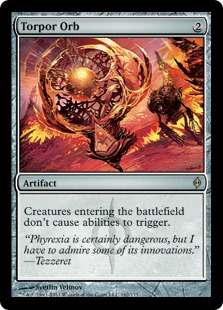
Ah, spoiler season. The time when I don't have to stretch myself doing statistical work. Just looking at the new cards, doing some basic analysis, and speculating about whether there's a place in Modern for them. Simple and low-pressure, just what this year's called for. Then, something had to come in a ruin everything: a card that appears tailor-made for Modern, something that a pet deck of mine has longed for, and yet, upon testing, has yielded conflicting data. I'm talking about Confounding Conundrum. And it's a frustrating card. It both does and does not work the way everyone thinks it does.
Hate pieces in general are pretty hard to evaluate. Their value depends on not only the prevalence of whatever they're targeting, but of the counterplay available. Rest in Peace seemed lethal against Hogaak, Arisen Necropolis decks, as they couldn't operate without their graveyards. However, it was useless in context due to Hogaak's speed as well as Force of Vigor. Enchantment removal is generally less played than artifact removal, making it more persistent, but the effects tend to be more narrow.

Confounding Conundrum is not only an enchantment hate piece against many cards and strategies, but a potentially maindeckable one. Which provides far more opportunities, but also exposes a lot of problems. I'll conclude that Conundrum is Modern-playable... asterisk.

About Confounding Conundrum
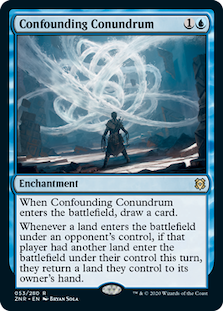
By now, everyone's seen the card because, at minimum, you see it alongside this paragraph. And there is a lot of text to work through then try and wrap the mind around.

Whenever a land enters the battlefield under an opponent's control, if that player had another land enter the battlefield under their control this turn, they return a land they control to its owner's hand.

Confounding Conundrum is a land hate card. Specifically, it's designed to hate ramp by ensuring that opponent's can only play the single land per turn the rules allow. Every additional land played per turn can only replace a land currently on the battlefield, ensuring equity. I'd expect this type of effect to be white, but blue does have a history of bouncing lands dating back to Boomerang, and the formatting is decidedly blue. Opponent's don't have to return the offending land, just a land. This will be important later.

When Confounding Conundrum enters the battlefield, draw a card.

I'm not being facetious here; Conundrum being a cantrip is very important. We've seen Growth Spiral, Manamorphose, and Veil of Summer, which have mediocre primary effects, become powerhouses thanks to cantripping. At minimum, Conundrum always cycles, which puts it into consideration as a maindeck card. We haven't seen this on a land hate card since Blood Sun, which never quite lived up to expectations. Not because Sun is unplayable, but the meta has never needed that type of effect. That may not be true of Conundrum.

How it Works

Conundrum is counting lands. When it sees more than one land in a turn, it triggers. The trigger will go onto the stack before the opponent can use the land. They're free to tap the land at this point, but can't cast any sorcery speed spells until the trigger resolves. This being a triggered ability, multiple Conundrums mean multiple triggers.
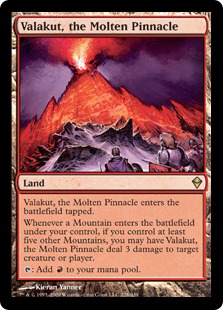
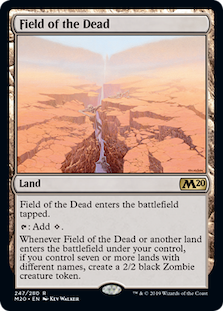
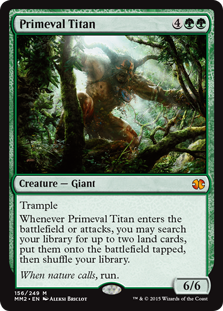
The final note is that triggers go onto the stack active-player-first, so any triggers the opponent may get from the extra land entering the battlefield happen after a land has been bounced by Conundrum. This in turn means that Conundrum effectively answers all the payoffs for all the Primeval Titan decks. Valakut, the Molten Pinnacle and Field of the Dead are looking for certain conditions to be met when they trigger and when they resolve (the intervening "if" clause). Both lands trigger when the conditions are met, then Conundrum's trigger goes on the stack and resolves first. If Conundrum leaves less than 5 other mountains or 7 lands with different names on the battlefield, the abilities fizzle. If they Scapeshift, then all the lands will have to be bounced for a really bad time. By the same token, Amulet must bounce a land before Amulet of Vigor can untap the karoo.

Also worth noting: Conundrum sees fetchlands as the allowed land drop. Cracking them on the same turn will trigger Conundrum. In this way, the enchantment gently hates on almost every deck.

An Exploit

The source of the new land is irrelevant. Two lands hitting in a turn is all that it takes for Conundrum to trigger. So Path to Exile and Field of Ruin count. Field is particularly exciting, as Conundrum turns it into better Dust Bowl. Much like pairing these cards with Leonin Arbiter, there is considerable potential in abusing Conundrum as a taxing piece. And unlike Arbiter, Conundrum isn't symmetrical.

A Problem

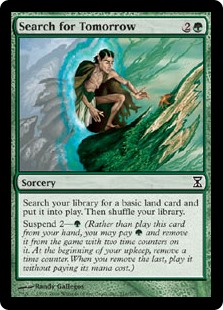
There are two problems with all of this. The first is the phrase "fail to find." A player can always fail to find when searching for a specific thing in any zone that is unknown information. They have to do anything else involved in the search (shuffling, mostly), but they never have to pick anything. Thus, a ramp player doesn't have to actually find a land when they search for one. I don't know why they wouldn't, as even though they have to bounce a land afterwards, they've at least ensured they'll have their next land drop. They can also resolve their Search for Tomorrow and not play another land that turn. With only one Conundrum out, this is a bit of a wash, and will only be relevant with several Conundrums out; indeed, fully resolving Search and triggering two Conundrums sets players back on mana development, making a fail preferable.
The second problem is that this isn't too hard to play around for most decks. They just have to not play more than one land on the same turn, and that's not too hard with smart sequencing. Decks with fetchlands can always just not crack them on their turn. This is standard practice for many decks anyway. Creature decks can skip their land drop until after combat in case of a Path. Valakut will crack their Sakura-Tribe Elder or Khalni Heart Expedition on their opponent's turn and ramp away. Plus, every deck misses land drops sometimes. Conundrum isn't going to surprise any opponent as long as they're actually paying attention, so don't assume that it will ever return lands. It's more of a threat than a reality.

On the Legacy subreddit, I saw someone call Conundrum a slow Sphere of Resistance. I agree with the sentiment, but would categorize it more as a slow Damping Sphere. Conundrum does nothing to affect any deck's ability to play spells in a given turn. It affects the subsequent turns. Go ahead and crack a fetch into Conundrum, float the mana, bounce a land, then cast whatever. The next turn is when the tax is applied, because of the bounced land.

In Modern's Context

Being solid in a vacuum is all well and good, but what matters is reality. I can wax speculative all I like, but the real test is when a card is actually tested. So that's exactly what I've been doing. I've decided test the maindeck potential of Confounding Conundrum, and to get the most out of it required a taxes shell. I'm no stranger to UW taxing decks, and have tried to make Spirits and Taxes work a few times. It never really worked out in the past as the deck, was incredibly anemic and fairly schizophrenic due to the Spirits portion not jibing well with the Taxes side, and the mana was always all over the place. However, Xurikk 5-0'd a League with Spirits and Taxes, so I just took that list, arbitrarily replaced the Deputy of Detentions with Conundrum, and got to work.
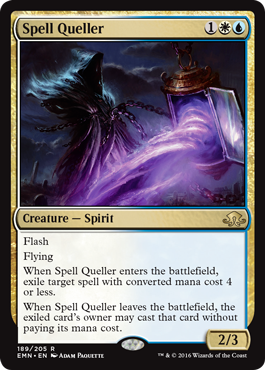
I'm not going to post a list because, of course, the deck wasn't very good. I went through a few iterations, but no change seemed to improve anything. That said, it was an ideal test platform, and it is from that testing that I can say that Modern has a place for Conundrum.

Testing Results
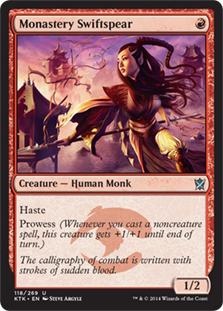
Conundrum is not good against Prowess decks. This shouldn't be much of a surprise as the tempo-negative Spreading Seas was never good against Burn, even though it usually took out one of their mana sources. Against Izzet and Rakdos, Conundrum hitting fetchlands does slow down the explosive attack. However, Prowess is still free to use fetched mana to play spells, and all I did was spread out the pain. There were a few times Conundrum slowed Prowess down enough to stabilize, but they were far outweighed by the times I lost to playing a do-nothing cantrip instead of a creature.

Additionally, Conundrum does nothing particularly great against the metagame's main ramp deck, Tron. Neither variant ever plays more than one land a turn. It is very dangerous to wait for a land drop before activating Field of Ruin against Mono-Green Tron. It's usually pointless to do so against Eldrazi Tron. There are instances where G-Tron was having a bad day and Conundrum made it worse, but for the most part it was worse than Seas would have been. Ponza was in the same boat.
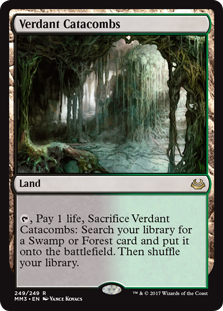
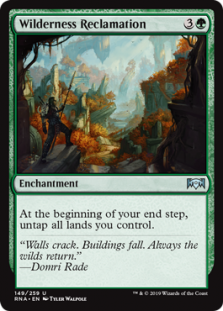
Against Jund and Wilderness Reclamation decks, Conundrum showed potential. Both decks play lots of fetchlands and like to use all their mana in a turn. Temur also runs acceleration sometimes. This meant that both had to really think about playing into Conundrum and reevaluate their gameplans. It was especially hard for Jund, given its playstyle, and a lot of mana was left on the table. This was not even getting into Path and Field suddenly having no drawbacks. As might be expected, mana disruption is more effective against slower fair decks.

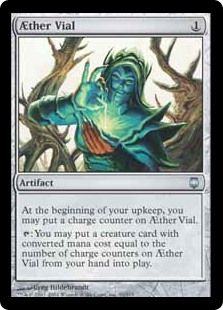
Conundrum was a beating and a third against the various versions of Valakut I tested. There's a whole spectrum from traditional Scapeshift decks to Vial Titan and Conundrum ruins all of them. Titan, Golos, Tireless Pilgrim, and Dryad of the Ilysian Grove are just land selection rather than ramp, while Sakura-Tribe and Elvish Reclaimer must be used on the opponent's turn only. Worse, there's simply way to just win with Valakut and, for once in its existence, it can only be the gradual value engine it was intended to be, and not a combo kill. Just a horrible wrench in the gears.

So, About that Asterisk

Observant readers have noticed that I skipped over Amulet Titan and more importantly Uro, Titan of Nature's Wrath. Conundrum does appear to particularly target Uro. Which is also what most of the hype is about. So, why so cagey?

These are the decks behind my opening-statement asterisk. My testing against both didn't go as expected. Something very strange happened when testing against Amulet that makes me nervous ever playing Conundrum against it again. And as for Uro...

First, It Gets Dangerous

Even if you get out Conundrum on turn 2, I didn't notice it having much effect. Uro decks durdle and are heavy on counterspells. They're fine cracking fetchlands on opponent's turns to not trigger Conundrum. Growth Spiral is an instant too, and is usually played on opponent's end steps anyway, so there's not a ton of disruption happening. I didn't really benefit much playing Conundrum, other than Field activations.
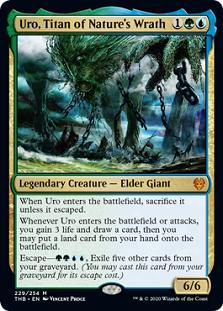
What about against Uro itself? Well, that's where it got complicated. Yes, stopping the ramp was decent. However, even when opponent's declined to put a land into play, Uro was still gaining three life and drawing a card. And preventing Hour of Promise from swamping me wasn't nothing. The problem was as the game went on, Conundrum makes it slightly easier to start looping Mystic Sanctuary. It was frequently correct later in the game to deliberately trigger Conundrum to recycle Sanctuary without burning Cryptic Command. And that felt really bad.

Admittedly, by that time, the game was pretty well lost, and the extra Sanctuary triggers were the door locking rather than closing. However, the fact remains that by lengthening the game, Uro started to benefit from my hate card. That shouldn't happen, and makes me leery of Conundrum in the current metagame.

Then, It Gets Weird

Meanwhile, the Amulet matchup mostly played out as expected. As I said, Conundrum answers Amulet of Vigor. It also hits Azusa, Lost but Seeking. It's a very strong hate piece here, arguably better than Damping Sphere. However, during a test game, something weird happened.
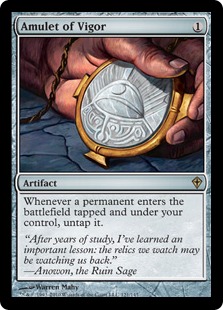
With two Sakura-Tribe Scouts, Azusa, Amulet, and five lands out against my Conundrum, Amulet played Simic Growth Chamber. Then started going off. As in, Summer Bloom going off. Using the Karoo bounce triggers, Amulet kept replaying the Chamber, returning the other lands, and floating the mana for Primeval Titan. Titan found Gemstone Mine and Slayer's Stronghold, let them be bounced, then used a Scout to replay the Stronghold, used floating mana to activate it, and swung. In the end, Titan was a mana short of the Sunhome, Fortress of the Legion kill. And that felt like a sequencing error.

That only happened once. But it did happen. Couple that with the Uro results, and I can't give an unequivocal recommendation for Confounding Conundrum. It has its uses, and in the right metagame it will be devastating. Right now? It's potentially more of a liability.

Positing Positioning

In a world full of Primeval Titan, I think that Conundrum is a slam-dunk sideboard card, possibly making its way into the main to randomly screw fetchlands. But in the current metagame, I'd steer clear.
A Look at Collectors’ Edition Cards

Are you a Quiet Speculation member?

If not, now is a perfect time to join up! Our powerful tools, breaking-news analysis, and exclusive Discord channel will make sure you stay up to date and ahead of the curve.

Last week I covered the recent move in a lesser-known bucket of cards: Foreign Black Border. This article was well-received overall, and readers acknowledged the recent trend, consistent with my own observations.

At the end of the article, I gave a very brief nod towards a different black-bordered set that can also be viewed as a budget alternative to many of today’s spiking Reserved List cards. That set is the Collectors’ Edition (and International Collectors’ Edition) sets, CE and IE for short.

While I wrote a section on these cards a couple time in the past (one insightful piece was back in December 2019), I wanted to spend more time this week covering recent trends on this set—there are some very surprising movements lately that merits an article to drive awareness.

A Little Background

If you want the full history, you can read about it in my December article. The key thing I want to emphasize here, for those who don’t want to bother getting lost in the hyperlink tangle, is that the set was released in 1993 and only 14,000 sets were produced. In today’s day, that’s an extremely tiny print run! Even Unlimited was printed in greater numbers, especially when you look at the uncommons and commons.

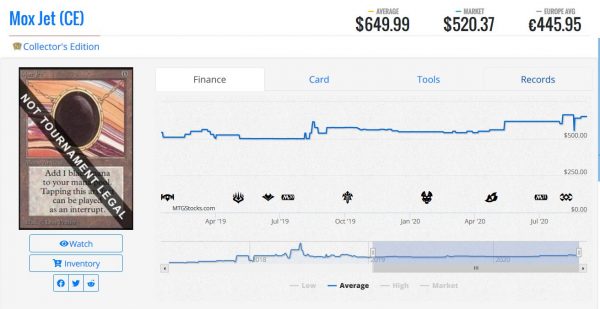
Keep in mind rarity has no meaning with Collectors’ Edition. Every set was printed to contain one copy of every card in the set. Therefore, there are just as many CE Ironroot Treefolk as there are Mox Jet—their price differential is therefore drifted solely by demand since the supply is constant.

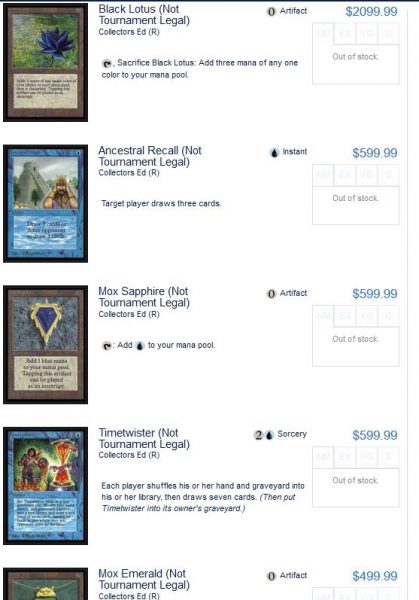
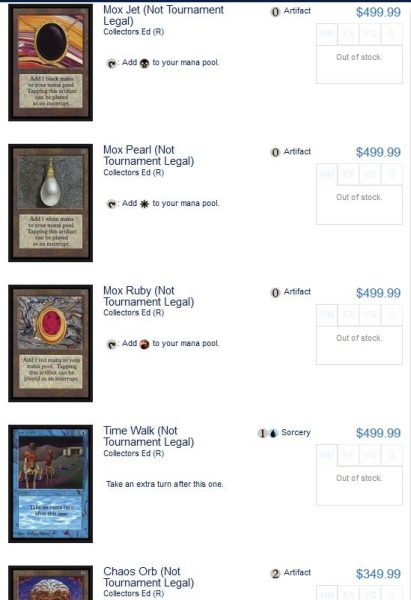
As you can see in the graph today, some of these CE cards are worth a pretty penny. But even though Power is on the move, there are some other CE cards that are running hot that are worth touching upon.

Some Hot CE/IE Cards

You may have noticed Braingeyser’s spike over the weekend—it’s another Commander-playable, Reserved List card so it’s no surprised speculators made their move.

There was an error retrieving a chart for Braingeyser

While the Revised copy was the one that popped on MTGStocks, a quick change to settings reveals that the Collectors’ Edition printing also jumped a significant amount.

According to MTGStocks’ weekly interests page, a couple other CE cards also rose measurable throughout the past seven days. This includes Goblin King (+14%), Savannah (+11%), Lightning Bolt (+11%), Zombie Master (+10%), Force of Nature (+8%), Jayemdae Tome (+5%), Fastbond (+5%), and Wheel of Fortune (+5%).

These gains may not seem drastic when compared to some of the recent Reserved List buyouts—that’s a fair observation. However, these modest gains are much more real than the artificial price manipulation we see on the more popular sets.

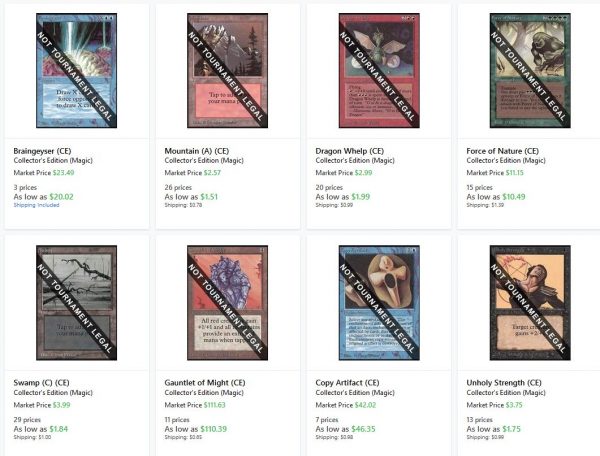
Moving beyond MTGStocks, there’s a clever way of utilizing TCGplayer to investigate which cards from a given set are hottest. If I go to the advanced search option, select Collectors’ Edition, as the set, and then click search I’ll narrow the browser down to all cards from the selected set. Then, in the sort drop-down menu, I pick “Best Selling”. Voila! I now have the set sorted according to which cards have sold the most on TCGplayer using some sort of recency basis.

So when I do this, what do I see?

There we go with Braingeyser as mentioned before, the number one seller. I see two other Reserved List cards also showing up on the top 8 list: Gauntlet of Might and Copy Artifact. I’m a little more perplexed by Dragon Whelp and Unholy Strength, but this could be a nod to the fact that some Old School players purposefully seek out CE cards as budget black-bordered alternatives. The basics could be on the list for that same reason.

Two other cards I want to specifically call out are Wheel of Fortune and Chaos Orb. The latter is especially pricey because of its play in Old School. I once saw a joke that CE/IE Chaos Orbs technically have a larger surface area than their rounded-cornered counterparts, so they actually maximize your chance of destroying a card. While that difference is negligible, the fact that Chaos Orb is an icon of Old School is not—because many playgroups allow CE/IE cards, Chaos Orb is one of the hottest cards in the set and will continue to be so.

Wheel of Fortune is an interesting one. It is also popular in Old School, but I suspect Commander players are buoying its price most of all. I mention this card because the CE printing is nearly the same price as the Revised version—both are in the $200 price range on TCGplayer. Interestingly, this similarity is not reflected on Card Kingdom and ABUGames’ site. This brings me to one last observation on these cards, which has a chance of making you a little money on this under-the-radar set!

There was an error retrieving a chart for Wheel Of Fortune

Lastly, let’s talk briefly about Timetwister, the only Power 9 card legal in Commander. Have you seen what’s happened to this card’s price recently? Nice condition copies are selling in the $3500 range and the cheapest Unlimited copy I can find for sale is a played $3980 copy on eBay. Collectors’ Edition copies have also moved in kind, and TCG low is $650. I don’t think this card will ever pass Black Lotus as Power 9 leader, but the gap is certainly closing.

There was an error retrieving a chart for Timetwister

Retailers Behind the Curve?

I made a purchase on Star City Games’ site for the first time in quite a while last weekend. In addition to the 20 Jaya Ballard, Task Mages I grabbed at $0.45 each, I picked up a played Collectors’ Edition Volcanic Island. I had to purchase SCG Premium in order to earn the 10% discount, so my cost basis is roughly $249.99 - $25 + $7.99 + $7.50 (shipping), approximately $241.

A quick glance at TCGplayer suggest this was an amazing price—market price may only be $250, but the cheapest copy available on TCGplayer today is moderately played for $300. While TCG low doesn’t exactly reflect a card’s value, it’s good at indicating directional trend. I believe popular CE/IE cards, such as Dual Lands and Reserved List staples, are climbing in price right now. When I factor in that a couple CE/IE copies of Volcanic Island sold on eBay in the low $300’s over the past month, and I’m confident this purchase will result in a modest profit.

When I browse CE/IE cards across Star City Games, Card Kingdom, and to a lesser extent ABUGames, I’m observing two related trends. First, their prices seem competitive on the set and in some cases actually low relative to the market. Second, they’re sold out of almost all the higher-end cards from these sets.

These two observations are directly related.

See what I mean? The most expensive card Card Kingdom has in stock from Collectors’ Edition is a near mint Mana Vault ($59.99). Even this price is consistent with eBay completed listings and TCG pricing, meaning you could grab those Vaults with store credit and do a decent job flipping them for cash.

The story is similar at Star City Games—they actually have a couple CE Dual Lands in stock: an Underground Sea and Volcanic Island, both near mint for $349.99. While these aren’t slam-dunks in terms of profitability, applying the SCG Premium 10% discount makes them attractive acquisitions with store credit. Given the current upward momentum behind CE cards, it wouldn’t surprise me if these sold out sometime in September.

ABUGames actually does have some high-end CE cards in stock. BUT their prices are often much higher than the rest of the market.

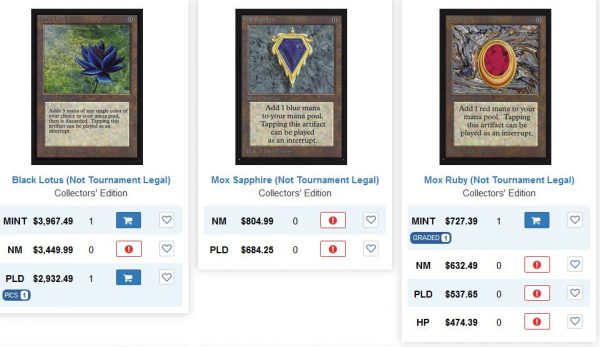
A $2932.49 played CE Black Lotus is about 30% higher than the market. And while that “MINT” CE Mox Ruby may be tempting if you have store credit to cover the $727.39 price tag, I’m pretty sure that card is really worth only about $500. It seems, in some cases, ABUGames has already adjusted their prices upwards on the most desirable CE/IE cards.

However, they do have some CE/IE cards that haven’t been adjusted yet. Consider Wheel of Fortune for which they charge about $100. No surprise they’re out of stock here! But if you can catch a restock on something like this, you could make some easy profit.

Wrapping It Up

While mainstream Reserved List cards continue to disappear from the market, it’s important to keep Collectors’ Edition and International Collectors’ Edition cards in mind. They may not be tournament legal, but many Old School playgroups allow the sets. It wouldn’t surprise me if Commander group did the same thing.

As a result, many CE/IE cards have been quietly climbing in price. This is observable when viewing the best-selling cards from the set on TCGplayer. However, many of the large online vendors haven’t quite caught up with their pricing yet. The result is an opportunity to make a little profit and acquire CE/IE cards at a discount to the market.

This price discrepancy won’t last forever—eventually, Card Kingdom and Star City Games will adjust their pricing accordingly. Until then, expect to see them largely sold out of most of the desirable cards from these sets. But keep an eye out for a restock. If your timing is good, you could nab a great deal on a CE/IE card. Using store credit, the deal becomes even more attractive!

Keep an eye on CE/IE cards in the coming weeks. As speculators swarm over the Revised Reserved List cards, you may find a deal on his overlooked set. Or, as a player, perhaps you are OK playing a CE card in your Commander deck and the budget alternative could save you some money. Whatever your angle, the days of ignoring the non-tournament legal square-bordered cards are long gone. There’s real demand for these cards, and their prices are finally reflecting this

Zen Again: Zendikar Rising Spoilers, Pt. 1

Are you a Quiet Speculation member?

If not, now is a perfect time to join up! Our powerful tools, breaking-news analysis, and exclusive Discord channel will make sure you stay up to date and ahead of the curve.

Zendikar Rising spoilers are officially underway! That also means summer is ending... but what great outdoor plans did we have that weren't ruined by a global pandemic anyway? There's never been a better time to forget about real-life exploration and lock ourselves inside to peruse new cards at a glowing computer screen!

Flip Top

Rising's marquee mechanic is the flipping cards, which let pilots choose which side to play the card as when they're ready to play either side. One side houses a spell, while the other has a land. On the whole, I don't think these cards will see a whole lot of play in Modern, but I wouldn't count them out entirely.

Lands on Lands

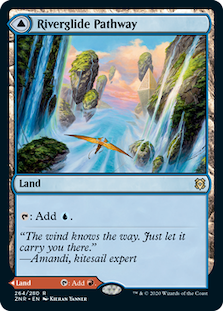
At their most basic, the flipping cards are two-sided lands, giving players the choice of producing one of two colors for a game's entirety (as with Riverglide Pathway). This cycle aims to provide mana fixing, but fixing is already very good in Modern—we've got fastlands of every pair, Horizon lands, and of course the ol' fetch-and-shock. Nonbasic lands need to be quite powerful to merit inclusion in Modern decks, as players open themselves up to hate like Blood Moon and Field of Ruin for running them. I don't think the double-land cards are gonna make it.
Lands n' Spells... At Once

Then there's the spell lands, which enter tapped but can also be cast for an effect. In theory, the idea isn't so splashy, but potentially powerful nonetheless. Having lands that can double as spells lets players functionally play fewer lands in their decks, as it mitigates the risk of flooding. Compare with cycling lands, which do something similar, but still tax pilots mana to draw into another card. Plus, that new card might just be a land, and not a spell!

Whether flip lands beat cycling lands depends mostly on how good the spells on the other side are. And they aren't great. For the most part, these spells are wildly overpriced for their effects, especially since they force players to run taplands.
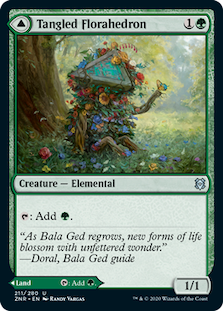
Take Tangled Florahedron. Here we've got a flexible-looking card: players can use it to ramp into four mana, or they can deploy the card as a land if they're light on sources early on. But then there's each side of the card: never would players want to run taplands in Modern, and no deck wants a generic two-mana Llanowar Elves. This is the format of infinite mana via Devoted Druid, after all!

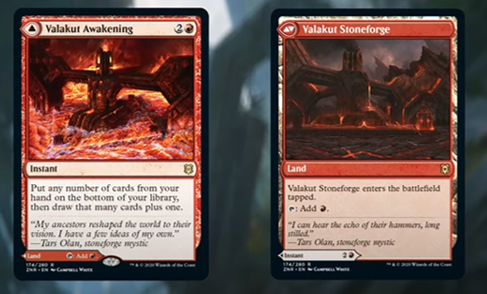
Splashier spells like Valakut Awakening show more promise. Depending on how the rulings will go, a deck like Dredge could bring back the land with Life from the Loam, then cast Awakening for more Dredge triggers. But even that deck now has better things to do at that stage of the game: recur Blast Zone, for instance, or just cast Ox of Agonas for a similar effect that also impacts the board—and a cheaper one, to boot! This line of thought gets more interesting with other land recursion effects, such as Wrenn and Six, but there's no getting around that the new spells in question leave much to be desired.
A Mythical Implementation

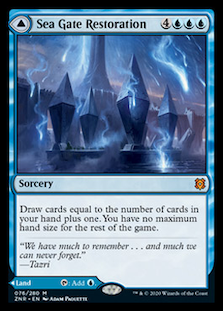
Yet another cycle of flip lands is the most promising. At mythic rare, this final cycle lets players have the spell land enter untapped, but at the cost of 3 life. That might seem like a lot until one considers these cards have three modes: spell, tapped land, and untapped land. That flexibility makes the steep asking price worthwhile and even desirable in many scenarios.
As for the spells, they're a lot more impactful, but mostly finisher-type effects. That means only slower decks will be able to run these. Still, those decks do love a high land count, and not needing to dedicate space to extra finishers—which can be invaluable in grindy mirrors—might merit further exploration.

Let's Double Up

Another exciting development is Rising is the set's plagiarism—that is, its printing of cards that closely resemble existing Modern playables.
Ruin Crab

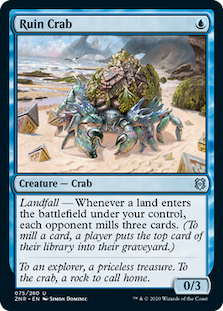
Hedron Crab? Meet Ruin Crab! Mill decks will love doubling up on their favorite creature, but I think the new Crab's most promising future lies in energizing brews that rely on Hedron Crab for self-mill. What's left of the Hogaak deck will probably want a playset, as well as fringe strategies like Rally the Ancestors.

Akoum Hellhound

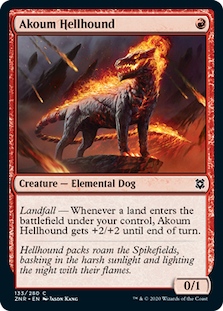
Steppe Lynx? Wow, haven't heard that name in a while. That's because Lynx was petty much the only Modern playable landfall creature, and as such, not really worth building around with a high land count: don't draw one of just four copies, and you're playing a Zoo deck full of lands. Yuck!
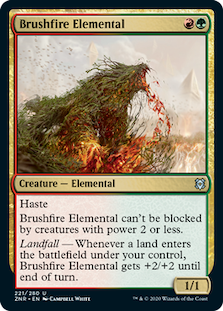
Well, Akoum Hellhound to the rescue! Lynx will certainly benefit from this canine companion, as it does from another somewhat-recent printing: Wrenn and Six. With Wrenn in the mix, a high land count isn't even a prerequisite, as the walker recycles fetchlands every turn.

It helps, too, that Plated Geopede got a makeover in Rising, ditching lame-brain first strike for the broken haste. Here's what I've been messing around with:

8Lynx Blueprint, Jordan Boisvert

Creatures

4 Steppe Lynx
4 Akoum Hellhound
4 Monastery Swiftspear
4 Tarmogoyf
4 Brushfire Elemental

Planeswalkers

4 Wrenn and Six

Artifacts

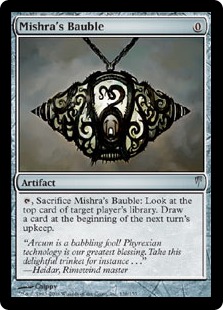
4 Mishra's Bauble

Instants

4 Manamorphose
4 Lightning Bolt
2 Path to Exile

Sorceries

4 Light Up the Stage
4 Crash Through

Lands

4 Wooded Foothills
4 Arid Mesa
2 Sacred Foundry
1 Temple Garden
1 Stomping Ground
2 Mountain

Yes, that's Tarmogoyf, who effortlessly grows to 5/6 in this build and backs up our fragile landfall clocks by slamming opponents who Fatal Push them. And Monastery Swiftspear, the attacker too good not to run in an aggro shell these days. Manamorphose, Mishra's Bauble, Crash Through, and Light Up the Stage happen to be pretty great alongside Tarmogoyf, too, and giving our landfall guys trample is the sauce. A common curve: T1 Lynx, T2 Goyf/Wrenn/Lynx-plus-removal and swing 4, T3 Brushfire-plus-Crash and swing for a ton.
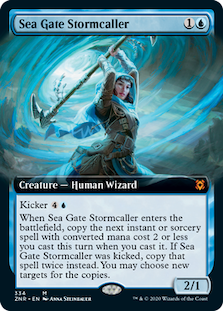
Oh, and yeah, 14 lands. That's the smallest amount I was able to hit by pushing my count lower and lower. Wrenn provides unending land drops, and we've got 12 cantrips, so the unbelievable number plays out fine in practice.

Sea Gate Stormcaller

Snapcaster Mage, meet Sea Gate Stormcaller! Except you play Stormcaller before your spell, not after. And on the same turn. And only on your turn. I'll see myself out.

Nonbasic Hate

One positive development in Rising is the presence of nonbasic land hate. We've seen a bit of this push in the past with printings like Damping Sphere, Field of Ruin, and Alpine Moon, all of which were adapted in some quantity to combat Modern's Tron menace. If you ask me, when it comes to nonbasic land hate, the more the merrier!

Confounding Conundrum

Conundrum replaces itself on resolution, making it relatively splashable. And it incidentally hates on fetchlands, giving it further application in different matchups. And it stacks, making for some very nasty plays with Ghost Quarter & co. Besides that, Conundrum seems tailor-made to fight Uro decks specifically, which are all about land ramping. Whether they can quell the Simic menace remains to be seen.

Cleansing Wildfire

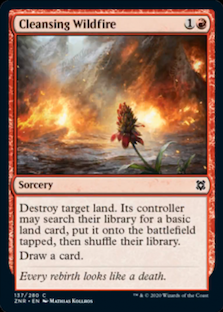
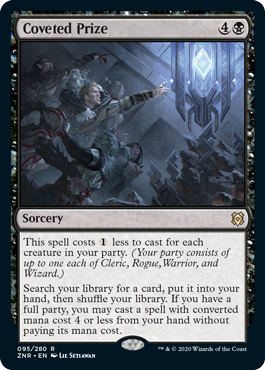
Hierarch, Aribter, Wildfire? Who doesn't want a cantripping Stone Rain? But then, what Hierarch-powered Christmasland scenario doesn't look awesome on paper? Cleansing Wildfire might take a bit more work to get going than Conundrum, but giving red a way to Field of Ruin opponents on a cantrip strikes me as a great way to start spreading nonbasic hate into different deck niches.


The Expediting Continues

Between two-sided cards, classics returning in new and exciting forms, and different colors getting extra ways to interact with enemy land strategies, I'm stoked to see what else Zendikar Rising has to offer. We didn't even get into the party mechanic... but you already know I'ma throw one if we get some cool Rogues to invite! Which new cards have you gearing up for an expedition?

A Breakdown of the Zendikar Adventuring Party Video

Are you a Quiet Speculation member?

If not, now is a perfect time to join up! Our powerful tools, breaking-news analysis, and exclusive Discord channel will make sure you stay up to date and ahead of the curve.

We got quite a lot of information from this video first posted on September 1st, 2020. If you don't like spoilers I suggest you skip this article.


While there is a ton of spoiler information in the video, I'm going to highlight the things I'm most excited about and what speculation opportunities I see due to the new cards.

Zendikar Rising Spoilers

Party Mechanic

At first glance, I almost brushed this mechanic off. The idea is that you need to control multiple creatures with specific creature types to get additional benefits from spells with this mechanic. A party consists of:

  • Cleric
  • Rogue
  • Warrior
  • Wizard

We don't have a lot of cards spoiled that include this mechanic just yet, but some of the first ones are impressive if you can reliably get a full party quickly.

I misread this mechanic at first thinking it was completely broken with Changelings, however, the wording appears to mean that even if you have a creature that meets the subtype requirement multiple times you are still limited to only benefiting from that creature once. This feels like a mechanic that WoTC felt they could push the power level of the cards IF you manage to get a full party only because it will likely be difficult to do so, and equally difficult to maintain it.

Landfall Mechanic Returns

The landfall mechanic appears to be the permanent one associated with the plane of Zendikar. So far, spoilers containing landfall cards have been somewhat sparse and I haven't seen any that make me want to take some action, however, if you were inclined to pick up cheap Azusa, Lost but Seeking wouldn't be a bad call. It's a powerful Commander card that also finds a home in Modern ramp decks that tend to play Primeval Titan.

There was an error retrieving a chart for Azusa, Lost but Seeking

Creature Subtype Matters

While I sort of touched on this with regards to the party mechanic, this set appears to have a lot of dual subtype creatures which opens the door to older cards that interact with any of those subtypes for significant gains. We have already seen Edgewalker spike in price and I expect to see more cards from that era do the same.

There was an error retrieving a chart for Edgewalker

Kicker Returns

I've been a fan of the kicker mechanic since it was first announced in Invasion. Making a spell semi-modal gives players flexibility, something that is highly desirable in a game with a fair amount of variance. My biggest concern with it is that WoTC so far has seemed to be a bit afraid of pushing the boundaries on this mechanic as there have already been 137 cards with the kicker mechanic (or multikicker) and only a small handful ever end up seeing meaningful play in any given format.

"Pog" Lands

I'm not sure what the official name for the new rare dual land cycle is, but I've heard people call them "Pog" lands and I enjoy that nostalgic throwback, so until there is an official name I'm going to stick with that.

These lands serve as "dual lands" when in your hand, but only tap for mana of whichever color you play them as once they leave your hand. This clever design allows players to fix mana the turn they play it but forcing them to live with the decision afterward. I think these lands are hard to evaluate in a vacuum because we don't know how much this restriction will affect deckbuilding. I do think we may see some of the blue options in Merfolk decks as a way to help get around Choke.

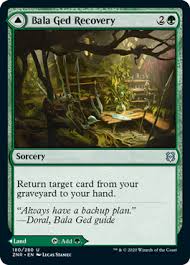
On a similar note, there are other dual-faced card lands in the set that instead of having a different land on the back instead have a spell. My two favorites so far are:

While these DFC lands come into play tapped when played as a land, the spell sides seem quite powerful. Regrowth for 1 more mana seems very good later in the game when the additional cost is minimal and the same goes for Valakut Awakening. While some of the other options are a lot less impressive, these two stand out to me so far.

One thing to look for with regards to these lands is older cards that return lands to your hand, as they can potentially sit on the battlefield (protected) from hand disruption, and then if you can return them when you'd like you can cast them when needed.

Expeditions Return

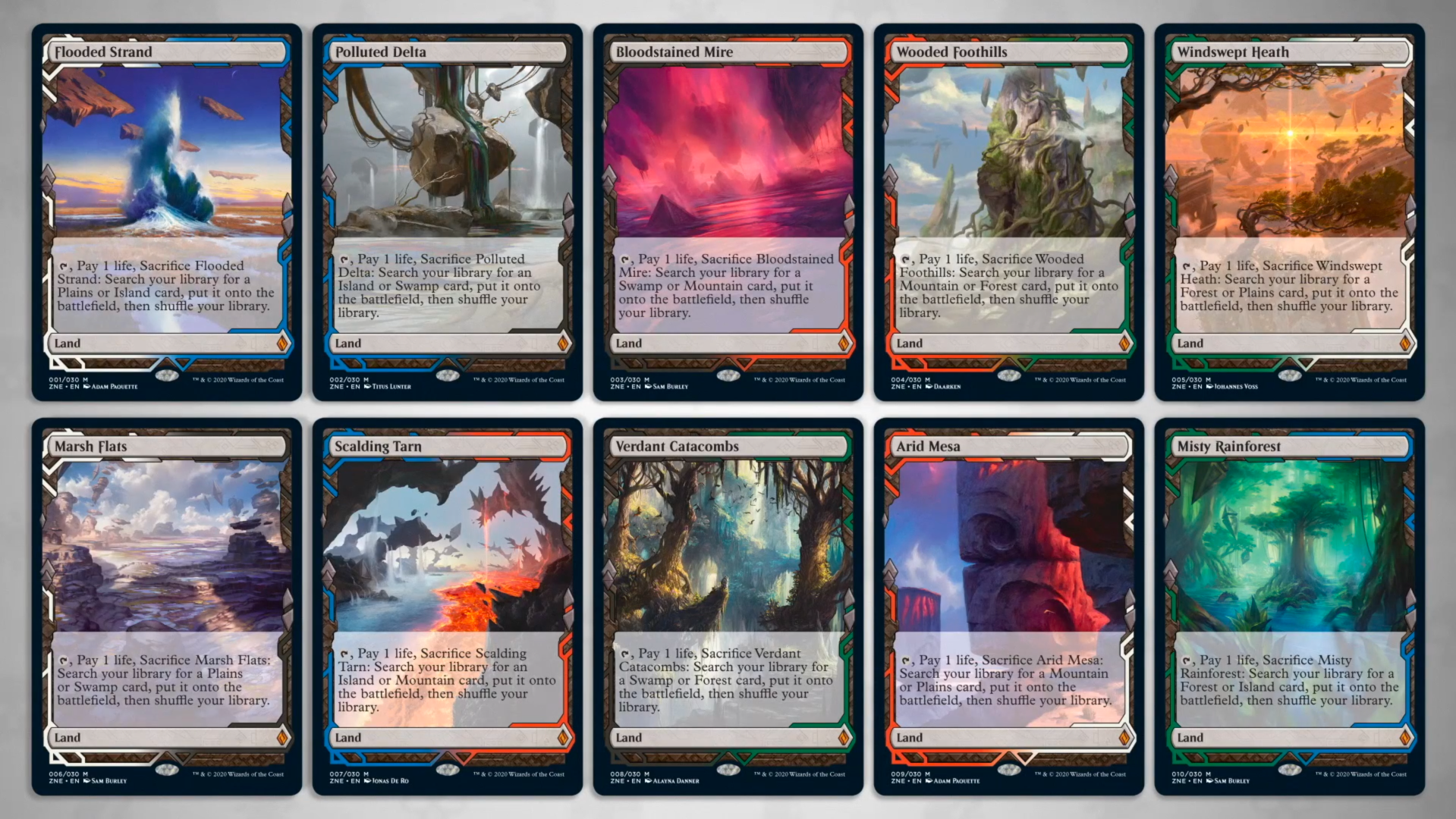
Apparently foil versions will only be available in Collector Boosters, unlike previous Expeditions, which were always foiled. Nonfoil versions will be available in draft/set booster boxes as box toppers. Collector Booster boxes will also include 2 non-foil Expeditions as box toppers. So far we have seen all the Expeditions spoiled, as the video states that there are 30 total and we have 30 spoiled:

  • Scalding Tarn
  • Misty Rainforest
  • Marsh Flats
  • Arid Mesa
  • Verdant Catacombs
  • Polluted Delta
  • Flooded Strand
  • Wooded Foothills
  • Windswept Heath
  • Bloodstained Mire
  • Prismatic Vista
  • Wasteland
  • Strip Mine
  • Cavern of Souls
  • Grove of the Burnwillows
  • Horizon Canopy
  • Luxury Suite
  • Morphic Pool
  • Sea of Clouds
  • Bountiful Promenade
  • Spire Garden
  • Darkslick Shores
  • Copperline Gorge
  • Seachrome Coast
  • Blackcleave Cliffs
  • Razorverge Thicket
  • Valakut, the Molten Pinnacle
  • Creeping Tarpit
  • Celestial Colonnade
  • Ancient Tomb

The List

Lastly, we were told that the set boosters may contain a card from "The List" which seems to be a curated list of 300 cards from Magic's past. The likelihood is apparently around 1 in 4. We got the following 3 cards spoiled from "The List"

  • Food Chain
  • Simian Spirit Guide
  • Slimefoot, the Stowaway

Judging by the images this appears to have the same planeswalker symbol in the bottom left-hand corner that we saw with Mystery Booster cards.

Kaldheim

All we were told about Kaldheim is that it is a Viking themed plane. That isn't a whole lot to work with, but it would make sense to have creature types like warrior or berserker in the plane so for those who really like to gamble look for cards that play with either of those subtypes as potential specs.

Strixhaven: School of Mages

This appears to be a plane with 5 Colleges of Magic. We didn't get much regarding this set, but it would seem likely that wizard might be a prominent creature subtype for this set, so some possible speculation targets might be something like:

There was an error retrieving a chart for Riptide Laboratory

Riptide Laboratory has only 2 printings: Onslaught and Jumpstart. Supply is likely to be pretty minimal of course there is a fair amount of risk that it gets reprinted and the price collapses. This is a card I will have in my card as spoiler season rolls around and should it be eliminated from possible contention in the set I'd probably buy a few copies.

Adventures in the Forgotten Realms

This is the Dungeons and Dragons crossover set. My knowledge on that game is pretty limited to games like Baldur's Gate that came out years ago so I don't have any potential speculation opportunities for this set currently.

Return to Return to Innistrad

While the set names haven't been released yet, there will be 2 sets in a return to Innistrad with 1 focusing on werewolves and the other on vampires both of which are beloved casual tribes so keep an eye out on older cards that interact well with either creature subtype.

Time Spiral Remastered

I actually took a break from Magic during my college years which happened to include the Time Spiral block, so I never got to enjoy drafting the block but have been told it was a lot of fun. Similar to the original Time Spiral block they will include timeshifted cards in the packs that include the old style borders, so artifacts will be brown, etc.

As old-style borders tend to be more desirable to many competitive players there could be certain timeshifted cards from the set that become more valuable than their original printing based solely on the old-style border. We got to see the following cards spoiled as timeshifted:

  • Path to Exile
  • Relentless Rats
  • Chalice of the Void


Why You Should Play Magic Arena

Are you a Quiet Speculation member?

If not, now is a perfect time to join up! Our powerful tools, breaking-news analysis, and exclusive Discord channel will make sure you stay up to date and ahead of the curve.

Hello, everyone! I'm Adrian. I used to cover MTGO content here about two years back and am glad to be sharing new content with you all again – this time about Magic Arena!

Since this is the first week covering this new mode of gameplay, I want to talk more about the pros and cons of Arena itself before we move on to figure out how to best play the game on a budget.

Magic Arena, released back in September 2018, has quickly become the platform where the Magic players compete to become the very best in the world. Especially in 2020, where many events in real life have been postponed or canceled due to the pandemic, social distancing and online business have become even more important nowadays. Most Magic players are no longer able to go out and play paper Magic. Instead, they stay at home and play digital versions of the game.

MTGO used to be a big part of my life, and I invested lots of time and money into it. However, as time went on, I found it difficult to sustain my time and money investments in the game. I'll put it this way: it's not wise to put in so much focus in exchange for virtual items when the economy is affected by COVID-19, which is expected to cause the worst global recession since World War 2. So, I quit MTGO and started playing Arena this year.

Why Choose Arena?

First of all, Arena's model is free-to-play (FTP), although it does offer in-game purchases whereby you can choose to pay to speed up your collection progress. In Arena, it's fine to remain an FTP player – you will encounter a bunch of similar players like this in the game. Instead of winning prizes (i.e., tickets in MTGO), we earn gold and experience from wins to unlock rewards such as cards and packs. Players will only be receiving gold and experience for the first 15 wins daily, which means players cannot progress faster than everyone else by winning more than 15 games a day. Sounds fair in an FTP game model, right?

In Arena, there's no trading system like MTGO. In other words, your collection can only grow and its just a matter of time for players to collect everything they need. Many of you might ask, since there's no trading, why would Arena contents appear on QS? It's simple: we want to share ways to help you get the best returns out of the investment you're putting into the game. If you save $100 after reading articles here, that's an extra $100 in your pocket!

Duplication Protection and Vault Progress

In every card game, having excess copies of a card past a playset is worthless unless you hope to generate value from it. In Arena, duplication protection is something important to be aware of in order to spend fewer resources while getting the same returns. Whenever you crack a pack on Arena, if you are about to open a rare or mythic that you already have, no matter from the same or a different set, the system will exchange it with another card of the same rarity. For example, if you have a playset of Fabled Passage from Throne of Eldraine and you happened to open the same card in M21 pack, you will get another rare insteaaad, until you eventually have playsets of all other rares.

What happens to the duplicate commons and uncommons? Instead of getting replaced by another card, duplicate commons and uncommons contribute to your vault progress.

Another feature of Arena that differs from MTGO is that players get wildcards of each rarity. Wildcards can be exchanged for any card of that particular rarity. When a player's vault progress meter reaches 100 percent, they get three uncommon wildcards, two rare wildcards, and one mythic wildcard. A very common strategy in Draft when one has no playables to choose from is to contribute more to one's vault progress by picking up uncommon chafe over common.

Players on Arena usually don't crack packs before they can guarantee full collections of at least all rares from the set in question. Note that the system only exchanges a card you owned with a card of the same rarity, meaning that if you have not collected all the mythics from the set, opening a rare card will not upgrade it to mythic! Instead, they turn into 20 gems (40 gems for duplicate mythics), which can be used to purchase various virtual items in the Arena store. In my future articles, I will compute the suggested amount of time to put into the game with the goal of collecting at least 98-percent of each set.

Ban List Protection

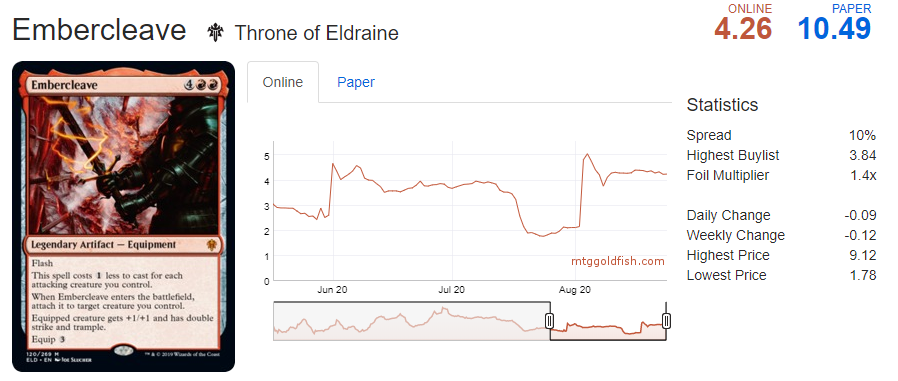
A ban is one of the most terrible things that can happen on MTGO. Why? Assume you are speculating that a certain card will be banned, say, Embercleave. So you sold off your sets of Embercleave before the B&R announcement, hoping to avoid losses. However, it turns out that Cleave is not banned and its online price went up by 3 tickets! Here, it's technically a loss of 12 tickets if we want to re-purchase a playset of the equipment.

Similar minor losses can happen the opposite way, where we fail to sell a card before B&R news. This is another nightmare scenario – without us even noticing it, the value of our collection might shrink over time to the competitive environment – we can lose a lot of money just from inaction!

None of this happens on Arena. If a card we own is banned, we get wildcards of the same rarity to replace it. If a really good card dodges a ban, it still costs the exact same one wildcard. How great is that? It means we don't need to think twice when we craft a card that we want to play!

Variety of Fresh Formats

The Arena team introduces new, fun formats from time to time, especially for FNM at-home events. Besides the normal formats such as Standard, Historic, and Limited, Arena also boasts:

  • Brawl: Commander deck except they only contains Standard-legal cards,
  • Artisan: Constructed with only commons and uncommons of the legal sets,
  • Event decks: Play an event with pre-constructed decks,
  • More, and most importantly most formats introduced have a low barrier to entry!

If you like Pioneer but you haven't had much chance to play, good news for you: WotC is constantly releasing sets which are Pioneer-legal into Magic Arena. Ideally, the Pioneer format will slowly but surely make its way to Arena.

Conclusion

Magic Arena saves me lots of money and time as a working adult, and I'm still able to have fun playing Magic! What else is more important than that as a Magic player?

Before I end this article, here are some Arena-related topics  items I'm planning to cover in the coming weeks:

  • Whether various sets are worth drafting on Arena.
  • Discussing the amount of time to put into drafting, if a player is interested in completing a particular set.
  • Building competitive yet budget-friendly decks and playtesting them on Arena.

Alright, that's all from me this week. Thanks for reading, and I'll see you again next week!

–Adrian, signing out.

Avatar photo

Adrian Tan

Adrian started playing Magic relatively recently, during Return to Ravnica block. He used to play a lot of paper Magic, but family and work commitments starting at the end of 2016 led to him selling off a large portion of his paper collection to focus on MTGO. He's found speculating on MTGO singles to be a great way to subsidize his gameplay expenses, and he's here to help you go infinite on MTGO!

View More By Adrian Tan

Posted in ArenaTagged , , , , Leave a Comment on Why You Should Play Magic Arena

Have you joined the Quiet Speculation Discord?

If you haven't, you're leaving value on the table! Join our community of experts, enthusiasts, entertainers, and educators and enjoy exclusive podcasts, questions asked and answered, trades, sales, and everything else Discord has to offer.

Want to create content with Quiet Speculation?

All you need to succeed is a passion for Magic: The Gathering, and the ability to write coherently. Share your knowledge of MTG and how you leverage it to win games, get value from your cards – or even turn a profit.

The Foreign Black Border Upswing

Are you a Quiet Speculation member?

If not, now is a perfect time to join up! Our powerful tools, breaking-news analysis, and exclusive Discord channel will make sure you stay up to date and ahead of the curve.

Remember the days when Old School cards were inexpensive and undesirable by most players? At GP Vegas in 2015, I remember walking around from vendor to vendor asking for cards like Juzam Djinn, Chaos Orb, and Beta Mind Twist. Nearly every vendor at the show didn’t bother to bring such illiquid, hard-to-sell cards.

Nowadays, between the explosion of Old School’s popularity and the advent of the “Reserved List buyouts of 2020”, these cards are readily available. The only catch is they’re more than ten times their 2015 pricing!

The result: many popular Old School cards, especially those that also see Commander play, have gotten away from many in the community. Prices have become so prohibitively expensive that the community has begun reaching for budget alternatives. Unfortunately, this has driven up the price of the budget black-bordered options as well!

Everyone knows about cheaper alternatives like Italian Legends, so I won’t dwell on those kinds of options. Instead, this week I’ll examine other black-bordered budget printings for Old School / Commander, discuss pricing, and talk about where one can buy or sell some of the more obscure options.

Copy Artifact: A Case Study

While browsing MTG Stocks Sunday morning, I noticed Copy Artifact was on the climb—it’s a likely buyout candidate but also sees significant play in Commander.

There was an error retrieving a chart for Copy Artifact

In 2015 during Grand Prix Las Vegas, as I was hunting for Old School cards, Revised Copy Artifact was $5. Today it shows as $66 on MTG Stocks and its market price is $50. That’s 1000% in price appreciation in just five years!

Obviously more prestigious printings from Beta and Alpha are even more expensive. Beta Copy Artifact’s market price is nearly $600 and Card Kingdom is completely out of stock, with $650 as their near mint price. Black bordered copies are simply out of reach, right?

Not necessarily! There are Foreign Black Border (FBB) options as well as Collectors’ Edition, for those not worried about tournament legality. Surely, those are going to be significantly cheaper, right?

That depends on how you define “significantly”. There was a time not too long ago (maybe ~2017-2018) when these would have been dirt cheap. In fact, Collectors’ Edition Copy Artifacts were under $10 in through 2017—a great budget option for players! Today’s price: nearly $50! In fact, it’s cheaper to purchase a heavily played Revised copy than it is a Collectors’ Edition copy!

FBB options have also jumped in kind. Market pricing on TCGplayer is $60—I am not sure what the price was in 2017, but I’m pretty confident it was a lot less! Perhaps the most budget option is the Foreign White Border “FWB” printing—good luck finding cheap copies outside of Europe, though. A quick search on TCGplayer and eBay suggests HP Revised is still cheapest. ABUGames prices FWB at about the same value as Revised, so all copies have climbed up in price in step.

Suddenly, budget options—especially with black borders—aren’t so “budget” anymore.

The Rise of Foreign Black Border

Copy Artifact may be special because it’s on the Reserved List, but it’s certainly no exception. Even non-RL cards popular in Old School and Commander have gotten pricey lately, lifting FBB and CE/IE versions. The result: some surprisingly expensive cards!

Looking up pricing on these cards can be tricky. Often times, popular FBB cards are too few in stock on TCGplayer and eBay in order to determine an accurate value. Card Kingdom doesn’t buy or sell FBB cards. Star City Games does, but their buy prices are significantly below market value.

Your best bet for pricing out FBB cards is ABUGames. If you don’t want to see inflated sell prices, you can examine what they’re willing to pay in cash. Here’s an example: Mana Vault.

There was an error retrieving a chart for Mana Vault

Star City Games pays $20 in cash for FBB 1994 German Mana Vault—that’s less than they pay for white-bordered Revised copies, by the way ($30). ABUGames also pays around $30 cash for Revised Mana Vault. But their buy price for FBB 1994 German copies is $88.74 cash! That’s more than four times SCG’s offer! Honestly, this is a much closer approximation to this card’s value, driven by Commander demand no doubt.

These once eschewed printings have truly surged in price, often eclipsing their Revised counterparts. The demand for black-bordered printings of these cards is real.

Here’s another example: FBB German 1994 Mind Twist can be sold to ABUGames for $33.66! Compare that to their buy price on Revised copies, $2.64. Clearly the black-bordered printing is driving up price—it’s good to know there is an attractive buylist outlet in case you have some copies you want to sell and are having difficulty moving them.

There was an error retrieving a chart for Mind Twist

While not tournament legal, Collectors’ Edition copies of these popular black-bordered cards have also climbed drastically in the past couple years. If you’re looking to price these out, there are more references. TCGplayer usually has at least a few copies of each CE/IE card in stock, so that could be a good first choice. But unlike FBB, many vendors will pay up for CE/IE printings nowadays. Card Kingdom has a fairly robust buylist for CE/IE. Even Star City Games is in the ballpark of the other two (though still not the best option).

If you really want to a challenge, you could deal in FBB printings from Japanese Chronicles and Renaissance sets. It turns out Star City Games has buy prices for these as well, though again I wouldn’t use their buylist to unload these obscure cards unless you’re absolutely desperate to liquidate.

While receiving $5 for a Japanese Chronicles copy of any card other than Blood Moon may seem attractive, I assure you the card is worth significantly more. Unfortunately, we can’t use any other vendor to estimate pricing—even ABUGames doesn’t have these printings listed on their buy list. So in this case, we have no choice but to rely on TCGPlayer and eBay.

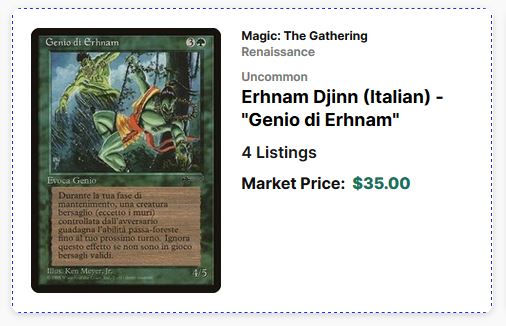
See what I mean when I say Star City Games’ buy prices are only last resort? Why sell for $5 when you could sell for $35 on TCGplayer? The cheapest Renaissance copy for sale right now is MP, $38.75.

Japanese Chronicles are cheaper—the lowest price on TCGplayer is $11.99 for a moderately played copy (eBay is consistent in price). Still, that’s more than double SCG’s offer of $5, and a far better option to try and sell these cards.

There was an error retrieving a chart for Erhnam Djinn

In my opinion, if you’re looking to maximize value from your cards and move them with fairly reliable liquidity, you should check out the Old School Discord. I’m seeing frequent sales posts there recently, containing FBB and CE/IE cards, and they always seem to sell for more than I anticipated they would.

A Nod To Collectors’ Edition

I’ve written about Collectors’ Edition and International Collectors’ Edition in the past, so I won’t dwell long on this bucket of cards. But to complete this week’s article, I need to at least mention how these budget black-bordered alternatives have also climbed steadily in price over the past couple years.

The most desirable cards from these sets—Power, duals, etc.—have really become expensive of late. Nice CE moxes, for example, readily sell for $450 nowadays and someone is always looking to buy in the Old School Discord. But even the less-than-playable CE cards, such as Dingus Egg, can be buylisted for a couple bucks nowadays. In fact, Card Kingdom has 270 Collectors’ Edition cards listed on their buylist—almost any CE card is worth at least something nowadays! Even lowly War Mammoth can be buylisted for $0.23!

Clearly, these rectangular, black-bordered cards are worth digging out if you’re sitting on any. While they’re not tournament legal, they still hold some allure for players seeking budget black-bordered options for their Old School / Commander decks. These cards have done nothing but appreciate in value over the past couple years. Consider how CE moxes were just $100 three years ago and now they have gone up fivefold!

Wrapping It Up

When the Old School format took off, many once-forgotten cards suddenly surged in price. There was a window of a couple years when budget black-bordered cards were available at a significant discount to their English counterparts.

Now, with Commander and Old School prices soaring again thanks to the daily Reserved List buyouts, players are reaching for these once-inexpensive alternatives for their decks. But unlike a few years ago, this time FBB and CE/IE options are not nearly so cheap. Many have taken off in price, and are often more costly than Revised or Chronicles alternatives.

I believe this trend will continue. Other budget options are also likely to see gains, such as Gold-Bordered cards and Foreign White Bordered (FWB) printings. But just because this trend exists doesn’t mean it’s easy to profit on it. These cards are a little tougher to sell, and buylists are sparse (ABUGames is probably your best bet). Luckily as this market heats up, these cards are suddenly more liquid than ever before.

One look at the Old School Discord, and I’m confident these cards are suddenly desirable. Thus, I wanted to highlight this trend—this way, players now aware of the trend can dig out their FBB cards and help bring them to the market, making a few bucks along the way and helping out some players who are trying to navigate a volatile market filled with buyouts. After all, this new trend seems like it’ll be around for at least a bit longer.

August ’20 Brew Report, Pt. 2: Bant from TV

Are you a Quiet Speculation member?

If not, now is a perfect time to join up! Our powerful tools, breaking-news analysis, and exclusive Discord channel will make sure you stay up to date and ahead of the curve.

Earlier in the month, we saw Stoneforge Mystic come to form the backbone not just of popular UW and Stoneblade decks, but of Colossus Hammer combo decks and bulkier flash strategies. Blue aggro-control decks also had an interesting month, with Arclight Phoenix making a comeback and Devotion to Blue rearing its head. The latter trend continues into the end of August, with blue decks dipping into white and green for support. The kicker? Not all of these decks even play Uro!

...But a Lot of Them Play Do Uro

I mean, it'd be almost wrong not to, right? We'll start by looking at the more traditional Uro-style shells that experimented with new tech this month.

Uro Hour, TOASTXP (19th, Challenge #12195644)

Creatures

4 Uro, Titan of Nature's Wrath

Planeswalkers

1 Jace, the Mind Sculptor
3 Teferi, Time Raveler

Instants

3 Cryptic Command
3 Force of Negation
4 Growth Spiral
4 Path to Exile
4 Remand

Sorceries

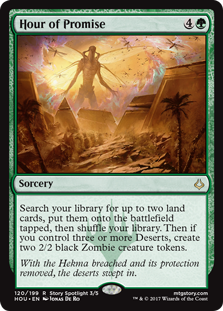
4 Hour of Promise
1 Supreme Verdict

Lands

2 Breeding Pool
2 Field of Ruin
2 Field of the Dead
4 Flooded Strand
1 Hallowed Fountain
1 Irrigated Farmland
2 Island
4 Misty Rainforest
2 Mystic Sanctuary
2 Polluted Delta
1 Prismatic Vista
1 Scalding Tarn
1 Snow-Covered Forest
2 Snow-Covered Island
1 Snow-Covered Plains
1 Temple Garden

Sideboard

1 Supreme Verdict
4 Aether Gust
2 Ashiok, Dream Render
2 Ceremonious Rejection
1 Dovin's Veto
1 Elder Gargaroth
1 Soul-Guide Lantern
1 Timely Reinforcements
2 Veil of Summer

We've seen midrange decks lean on other plans but still rely on 4 Hour of Promise before, most notably the Jund Field deck we covered in May. That was during the companions' reign over Modern, although the same concept still applies.
Uro Hour plays a controlling game with blue-chip countermagic and Uro itself, but should opponents find a way to deal with the Titan—via grave hate, perhaps—Hour provides an independent alternative, generating hordes of Zombies with Field of the Dead. It's especially nice that Growth Spiral, a staple in Uro shells, also contributes significantly to the Field plan, even though the two strategies require totally different answers: Uro demands grave hate and heavy-duty removal while drawing cards and going tall, while Field requires nonbasic land hate and damage-based sweepers while going wide.

Bant Moss, DARZYN (5-0)

Creatures

3 Scavenging Ooze
4 Birds of Paradise
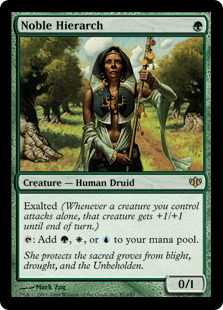
4 Noble Hierarch
3 Stoneforge Mystic
4 Uro, Titan of Nature's Wrath

Planeswalkers

4 Teferi, Time Raveler
4 Karn, the Great Creator

Instants

4 Path to Exile

Artifacts

1 Batterskull
1 Sword of Fire and Ice

Sorceries

4 Mwonvuli Acid-Moss

Lands

2 Breeding Pool
1 Flooded Strand
4 Forest
3 Ghost Quarter
1 Hallowed Fountain
2 Island
4 Misty Rainforest
1 Plains
2 Temple Garden
4 Windswept Heath

Sideboard

4 Aether Gust
2 Ashiok, Dream Render
1 Crucible of Worlds
1 Damping Sphere
1 Ensnaring Bridge
1 Knowledge Pool
1 Liquimetal Coating
1 Pithing Needle
2 Shadow of Doubt
1 Skysovereign, Consul Flagship

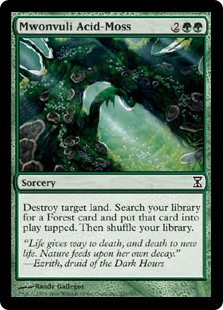
I first picked up on Bant Moss early this month (see list above). While the deck looked interesting, I found myself scratching my head at the prospect of running 4 Mwonvuli Acid-Moss in a Modern midrange deck. I mean, it's a land destruction spell that costs four mana! Was that not too much for a type of card typically used to deny opponents mana early on?

It turns out that in Uro mirrors, ramping yourself while de-ramping opponents is the sauce, even if that's not to happen until the mid-game. Indeed, Bant Moss nabbed 4-1 in a preliminary at the end of the month, a testament to its potential viability. And the deck has more going on than first met my eye.
For one, there's the creature suite: Uro is backed up by Scavenging Ooze, something of an Uro-slayer in the mirror; it can out-grow 6/6 and handily removes Titans from an opponent's graveyard. Similarly, bouncing Uro with Teferi, Time Raveler provides a massive tempo swing, and cutting Uro decks off their permission is also the sauce. Then there's Stoneforge Mystic to cheese wins against aggro and have a grave-independent angle of attack. Sword of Fire and Ice gets the nod for insulating creatures against Uro, sure, but also Aether Gust, fast becoming one of Modern's premier hate cards.

tl;dr: meet the Uro deck that wins the mirror.

Going Dude

Uro decks tend to be creature-light, since the recurring behemoth is at its best when it makes up the bulk of a red-zone attack. So more creature-centric Bant decks trim its numbers. Still, I think it's great news that such decks exist; this scenario illustrates that Uro is not dominating the UGx color quotient as it once may have.

Bant Rashmi, BBOTONLINE (5-0)

Creatures

3 Rashmi, Eternities Crafter
1 Birds of Paradise
3 Brazen Borrower
3 Elder Gargaroth
4 Frilled Mystic
4 Ice-Fang Coatl
4 Noble Hierarch
2 Prophet of Kruphix
2 Restoration Angel
4 Spell Queller
2 Uro, Titan of Nature's Wrath

Planeswalkers

3 Teferi, Time Raveler

Instants

3 Force of Negation

Lands

2 Breeding Pool
3 Flooded Strand
1 Hallowed Fountain
1 Horizon Canopy
4 Misty Rainforest
3 Snow-Covered Forest
2 Snow-Covered Island
1 Snow-Covered Plains
1 Temple Garden
1 Waterlogged Grove
3 Windswept Heath

Sideboard

2 Aether Gust
2 Ashiok, Dream Render
2 Ceremonious Rejection
2 Knight of Autumn
1 Lyra Dawnbringer
1 Mystical Dispute
1 Stony Silence
2 Veil of Summer
2 Weather the Storm

Rashmi, Eternities Crafter was hardly singled out as a Modern-playable upon its release, costing enough to emerge on the turn many decks end the game by and refusing to trigger until the next turn. But Bant Rashimi wouldn't take no for an answer, employing the Druid alongside a suite of useful flash creatures to get the most out of it.

Hitting all those cascade triggers is sure to get out of hand quickly, and Force of Negation holds things together by protecting Rashmi while players are tapped out after deploying him. For future turns, Spell Queller does that job, also combo-ing with Teferi to lock opponents' spells away for good. And both Force and Queller trigger Rashmi for even more pseudo-cascades!

Reclaimer Toolbox, HOUSEOFMANAMTG (23rd, Challenge #12195644)

Creatures

4 Elvish Reclaimer
4 Dryad of the Ilysian Grove
3 Thalia, Guardian of Thraben
2 Courser of Kruphix
2 Sakura-Tribe Elder
2 Tireless Tracker
2 Primeval Titan
1 Arasta of the Endless Web
1 Elder Gargaroth
1 Eternal Witness
2 Golos, Tireless Pilgrim
1 Knight of the Reliquary
1 Nylea, Keen-Eyed
1 Ramunap Excavator

Artifacts

4 Aether Vial

Instants

2 Eladamri's Call

Lands

1 Blast Zone
1 Bojuka Bog
1 Castle Garenbrig
2 Field of the Dead
4 Flagstones of Trokair
3 Forest
1 Ghost Quarter
1 Plains
1 Radiant Fountain
1 Selesnya Sanctuary
2 Snow-Covered Forest
1 Snow-Covered Plains
2 Temple Garden
2 Valakut, the Molten Pinnacle
1 Vesuva
3 Windswept Heath

Sideboard

1 Arasta of the Endless Web
2 Aven Mindcensor
2 Celestial Purge
3 Damping Sphere
2 Eidolon of Rhetoric
2 Knight of Autumn
3 Path to Exile

Didn't I tell ya? No Uro! Instead, Reclaimer Toolbox maxes out on Elvish Reclaimer to enable both a beatdown plan and a packed land toolbox suite; it's got Blast Zone for removal, Flagstones for ramping, Bog for graveyard interaction, Quarter for land hate, Field for midrange games, and Valakut for... a combo kill?! The deck's other 4-of creature is Dryad of the Ilysian Grove, giving it a dedicated combo plan ready to fire at any moment should the window present itself.

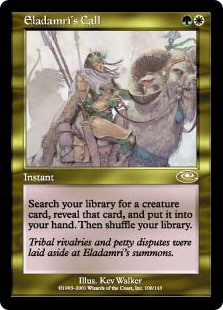
The creatures, too, form a toolbox, with Eladamri's Call fishing up goodies like the spell-hosing Arasta of the Endless Web and Ponza's favorite new stabilizer, Elder Gargaroth. Primeval Titan supports the Valakut plan, while Eternal Witness buys back lost pieces. And Aether Vial cheats everything into play!

After its Challenge placing, Reclaimer Toolbox went on to 5-0, boding well for the deck's longevity; it certainly seems to come with a steep learning curve, featuring packages upon packages for the uninitiated to wrap their skulls around. It also looks like there's something in here for everyone, so I wonder if enough players will give it a whirl that it catches on.

I Can't Get in the Club

We haven't seen Bant at these levels since the lockdown began, and I'm sure UGW mages worldwide are rejoicing. Hopefully other shards and wedges get some love in the coming months and their respective fanbases can also celebrate. For now, though, I guess we can enjoy this Titan's party!

Budget-Focused: Aggro Picks

Are you a Quiet Speculation member?

If not, now is a perfect time to join up! Our powerful tools, breaking-news analysis, and exclusive Discord channel will make sure you stay up to date and ahead of the curve.

Welcome back for some more Pioneer speculation this week! The last article was rather aggro heavy, and this one is going in a similar direction. We have three creatures and two non-creature spells to keep an eye on going forward. Be sure to let me know your thoughts in the comment section below!

Getting things done with token and creatures

There was an error retrieving a chart for Emmara, Soul of the Accord

To start with, we have a complementary piece to any Selesnya styled brew. Emmara, Soul of the Accord is a bargain at its current price, with non-foil copies coming in at $0.50(TCG Player), $1.08 for the foils, and $1.33 for the promo. There is a Gameday promo, but I could not acquire a price for it. Keep that in mind if you have any on hand to just hold onto them!

With white overall being used rather heavily in the format, this has a spot if Selesnya starts to garner attention. For starters, it is an elf, belonging to a sneaky tribe that always seems to find a build somewhere. Some may argue that Golgari would be a stronger color splash with cards like Shaman of the Pack, but in time, Selesnya tokens/elves might become a thing. Being able to tap this using other cards makes this quite intriguing. A little jank synergy combo using white would be using Pressure Point on it during your opponent’s end step. This not only gives us a token, but card advantage. Overall, this should be one to grow in value over time and could easily see a $2.00 - $3.00 non-foil price tag.

There was an error retrieving a chart for Hanweir Militia Captain

Next on our list is a white weenie that should be considered for white weenie decks. Hanweir Militia Captain should be in contention for a mainboard slot given the upside at any point in the game. The current price is $0.84 for non-foils(TCG Player), $1.68 for the foils, and $1.90 for the prerelease copies.

The biggest upside here is mid to late game using this with white weenies. Once it transforms, it not only gets buffed due to creatures but produces creatures as well! We can use this in any token or creature heavy deck. However, referencing the current meta weenies would be where this would fit optimally. As a solid two-drop, this could easily rise to the $3.00 range regarding the non-foil copies.

Turning up the heat with creature ramp

There was an error retrieving a chart for Garruk's Harbinger

Garruk's Harbinger is the next card we are going to discuss. The copy to target with this one will be the showcase foil copy. In previous articles, the subject of showcase cards affecting prices has been brought up. This one however is at a steal for the price. At just $0.90 avg(TCG player) for the foil this is a bargain.

This is a card that would benefit any deck that utilizes green. Ramping into creatures is what we want to use this thing for. The other upside is that it has hexproof from black. Seeing as Mono Black Aggro is a thing, this is something to slam onto the board without having to worry about pesky black removal spells. Playing devil’s advocate, there are two major downsides to this card: you must deal damage to trigger the ability, and its toughness is at the three-level. However, those cons do not outweigh the pros for me.

Having a power of four is fantastic for a three-drop creature. Synergy is something everyone needs to look at with this for another pro. In a past article, we discussed how Gruul can utilize a new red spell in Unleash Fury. In an optimal situation, using both Unleash Fury and Temur Battle Rage together would be an insane turn-four play. Not to mention if our opponent was not dealt lethal from that, we would then potentially get a creature put into our hand. Overall, if this card gets utilized as it should in green, the foil could easily hover around the $4.00 range long term.

Getting huge gains in the card draw department

There was an error retrieving a chart for Village Rites

Village Rites is our next card that needs to garner attention. The current price is at $0.25 average for the non-foils and $1.99 for the foil copies (TCG Player). Both versions have to room to grow, as this will most certainly be utilized outside of Pioneer format, mostly likely in Pauper. We've been eyeing Pioneer cards that have potential in this article, but we must not ignore where else this can be utilized. A Pauper sacrifice strategy will almost auto-include this in any black build, and we have seen how this format has a tendency to affect foil common prices.

Going into Pioneer, this will again be almost an auto-include to any black build going forward. Any one-drop that has this kind of card advantage is powerful! We must sac a creature as an additional cost, but that is not going to deter anyone from using this spell that is looking to put creatures in the graveyard or produces incidental tokens. At only one black mana and instant speed, it has the potential for greatness. Seeing as this is the sole printing, this can surely creep up to the $1.00 range for non-foils and maybe upwards of $5.00 for the foil copies.

Wrapup

Wrapping things up, I'll say that we need to keep an eye on a slew of Core Set 2021 cards in general, but Pioneer is the format that benefits the most at this point. The cards in this set seem to be raising the bar on how powerful cards will be with a lower mana cost. The power creep that has been going on with cards in newer sets is undeniable.

It seems like the Standard card design is gearing towards speed instead of a solid split of strategy and speed. One could argue that it has been this way for a while, but I personally feel that the past couple years of Magic have highlighted this. I hope that you all enjoyed this article and be sure to come back this way for the next one!

Spell Spotlight: Monastery Swiftspear

Are you a Quiet Speculation member?

If not, now is a perfect time to join up! Our powerful tools, breaking-news analysis, and exclusive Discord channel will make sure you stay up to date and ahead of the curve.

With all the talk of generalities, such as metagame numbers and new decks, it's easy to overlook the specifics. So let's talk about Monastery Swiftspear. Indeed one of the most pushed combat creatures ever, Swiftspear reigns supreme among Stage 1 beaters and has come to define the majority of Modern aggro decks. If you want to get 'em dead fast in the red zone, there are currently few reasons to forego the Monk.

In Spell Spotlight, we'll go deep on a specific card in the Modern pool. How much play does it see?  Who plays it? Why do they play it? What are the alternatives? Read on to find out!

Card Breakdown

Here's a blurb I've written defining Stage 1 creatures:

Stage 1 creatures always come down on turn one. Their role is to put opponents on the back foot, either slowing down their development as they deal with the threat or contributing to a blossoming board advantage that will end the game quickly. They tend to care little about removal because they all trade at mana parity or better with available options. Lightning Bolt, Fatal Push, Gut Shot, and Collective Brutality are commonly run to answer Stage 1 creatures; the first two kill every Stage 1 creature, while the last two narrow their sights to provide other benefits.

Indeed one of the most pushed combat creatures ever, Monastery Swiftspear reigns supreme among Stage 1 beaters and has come to define the majority of Modern aggro decks. If you want to get 'em dead fast in the red zone, there are currently few reasons to forego the Monk.

At one mana, Swiftspear is as cheap as players can expect to pay for a combat creature. It also has 2 toughness, letting it evade common removal options like Lava Dart and Wrenn and Six. That extra point also makes a world of difference when prowess is being employed to out-grow damage-based disruption. Thanks to the scalability of prowess, Swiftspear has applications in both aggro and aggro-combo strategies, the latter of which would have little use for static-power beaters like Goblin Guide.

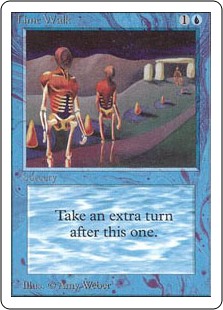
The real clincher, though, is haste. The best of Magic's evergreen mechanics, haste is Time Walk on a creature, and compensates for Swift's low starting power. Even without any prowess boosts, Swiftspear has dealt 2 damage by the end of its second turn on the battlefield--the same amount as something like Savannah Lions. (Of course, it often deals much more.)
Haste also gives additional insurance against removal: opponents can shoot down Swiftspear on their own turn, but they've already taken a point of damage. In this instance, Swiftspear essentially went up on the exchange, as it was able to cash in value despite trading at mana parity. Finally, haste greatly mitigates a traditional failing of Stage 1 combat creatures: their decreased relevance in the late-game. Slamming Liliana of the Veil into an aggro opponent's one-creature board is a great move from midrange players; now they've got a planeswalker ticking back up into another removal spell. But Swiftspear flips the script, as it can just come down and revenge-kill the walker immediately.

Wassup Homes

As mentioned, Swiftspear can be found in just about every aggro deck (click on for decklists):

Here's UR Prowess, the latest shell to prominently feature the creature.

UR Prowess, TUBBYBATMAN (3-2, Modern Preliminary #12176966)

Creatures

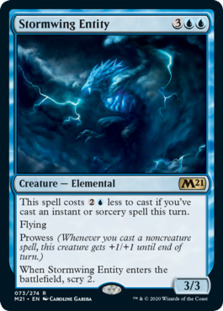
4 Stormwing Entity
2 Sprite Dragon
4 Monastery Swiftspear
4 Soul-Scar Mage

Sorceries

4 Serum Visions

Instants

4 Gut Shot
4 Lava Dart
4 Lightning Bolt
4 Manamorphose
4 Mutagenic Growth
4 Peek

Lands

4 Arid Mesa
4 Fiery Islet
2 Mountain
4 Spirebluff Canal
4 Steam Vents

Sideboard

3 Abrade
2 Dragon's Claw
4 Spell Pierce
3 Surgical Extraction
3 Vapor Snag

Omitting Swift are the "bigger" builds of each deck, which trend more reactive along the archetype spectrum. While Prowess and Burn don't really have midrange-slanted versions, Rakdos Unearth is happy to rely on Seasoned Pyromancer and Rotting Regisaur to dominate the mid-game, and Death's Shadow is best known for its two midrange shells, Grixis and Delirium. While all of those aggro-control decks win primarily through combat, none of them are pure aggro decks, which is why they have little use for the 1/2 haste; they are attack-and-disrupt decks. It seems that the less interactive an aggro deck becomes, the likelier it is to run 4 Monastery Swiftspear.

Drawing Cat-Parisons

If I were to ask a given group of Modern players which cards should be banned from the format, I'd be extremely surprised to hear Swiftspear among them. But I think there's a compelling parallel to be drawn between Swiftspear now and Wild Nacatl back when the 3/3 was banned. Here's what Wizards had to say on the Cat:

We looked at our Modern tournaments and previous Extended tournaments to find when the attacking decks were fairly diverse, and when they were dominated by Zoo.

[
]

The problem is that other decks try to use synergy to get rewards, but those rewards aren’t any better than the Wild Nacatl. For example, the Doran decks use Treefolk Harbinger to find Doran. When it all works, the Harbinger is effectively a 3/3 for Green Mana. With shock lands, Wild Nacatl is a 3/3, and doesn’t let you down when your opponent kills your Doran. With some effort, Student of Warfare becomes a 3/3 first strike creature, but that isn’t a sufficient reward for the effort compared with Wild Nacatl. This creature is so efficient it is keeping too many other creature decks from being competitive. So, in the interest of diversity, the DCI is banning Wild Nacatl.

Natch, Treefolk Harbinger wasn't much of a staple at the time this announcement was made. And similarly, I can't think of many lesser one-drops trying and failing to break into Modern, as since they're failing, they aren't necessarily on my radar. The reason in 2011? People just played Nacatl instead. And now? They play Swiftspear.
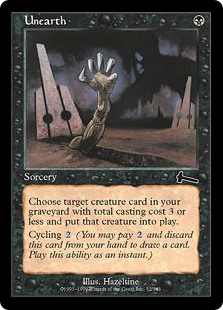
Splashing Swift

While I think Swiftspear is just as pervasive in attacking decks as Nacatl used to be, the comparison isn't perfect. One might argue that Nacatl could be easily enabled by splashing colors with fetchlands, just as Swiftspear can be easily enabled with free cantrips like Manamorphose and Mishra's Bauble. But I think these cantrips pose much less of a barrier, allowing more decks to run Swiftspear than they could Nacatl.

That's playing out in the numbers, too; most Nacatl decks were simply Zoo decks, with very little difference in composition. By contrast, Swiftspear is splashable enough to find its way to multiple aggro strategies, often with diverse means of achieving their shared goal of reducing opponents to 0 life.
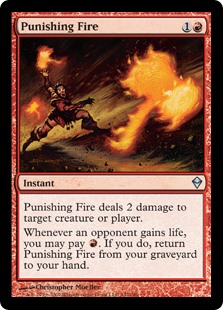
See the list of decks above: Burn seeks to assemble a critical mass of damage-dealing spells; Prowess soups up its creatures with cantrips and flashback cards before giving them trample with Crash Through; Rakdos Unearth employs graveyard synergies and a disruptive plan with Kroxa, Titan of Death's Hunger; Death's Shadow Zoo abuses its own life total and diversifies its card types to make a big attack using Temur Battle Rage. Four distinct archetypes that wouldn't leave home without the best one-mana beater in Modern. A world of difference from the samey universe of Nacatl into Pridemage into Knight of the Reliquary!

External Variables

Then there's the issue of Punishing Fire. I've long held that Wild Nacatl was an unneeded Modern ban, caught in the crossfires of a larger issue: the Punishing Fire-Grove of the Burnwillows combination. These cards together, coupled with the slower speed of the format a decade back, made it difficult for any aggro deck relying on x/1s or x/2s to break into the tournament scene. Nacatl was so important for aggro decks not only because it was very efficient, the reason given for its banning, but because it was the only Stage 1 creature immune to Punishing Fire. It's my belief that only banning Fire would have greatly decreased Nacatl's share among aggro decks by virtue of the move letting other x/1s and x/2s into the fold.
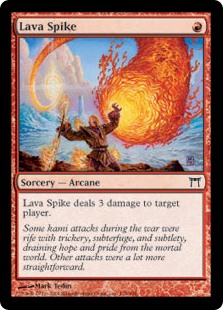
So what's Modern's current "Punishing Fire?" By which I mean, are there any external factors contributing to Swiftspear's status as top pick for aggro decks? Honestly, I'd say no. Swiftspear sees the play that it does not because it fulfills some special role in the Modern ecosystem, but because it really is the most efficient attacker at its price point, bar none.

Another Glass of Red

To summarize this celebration of Monastery Swiftspear:

  • Swiftspear is Modern's best Stage 1 attacker
  • Its popularity is based not on external variables, but its own efficiency
  • The creature is good enough in its role to be run in every pure aggro deck
  • Since it's so easy to splash, Swiftspear ends up in many different aggro decks, lending to diversity

Fill 'er up; it's swingin' time!

Jordan Boisvert

Jordan is Assistant Director of Content at Quiet Speculation and a longtime contributor to Modern Nexus. Best known for his innovations in Temur Delver and Colorless Eldrazi, Jordan favors highly reversible aggro-control decks and is always striving to embrace his biases when playing or brewing.

View More By Jordan Boisvert

Posted in Modern, TechTagged , , 2 Comments on Spell Spotlight: Monastery Swiftspear

Have you joined the Quiet Speculation Discord?

If you haven't, you're leaving value on the table! Join our community of experts, enthusiasts, entertainers, and educators and enjoy exclusive podcasts, questions asked and answered, trades, sales, and everything else Discord has to offer.

Want to create content with Quiet Speculation?

All you need to succeed is a passion for Magic: The Gathering, and the ability to write coherently. Share your knowledge of MTG and how you leverage it to win games, get value from your cards – or even turn a profit.

Choosing The Right Bullet: A Beginner’s Guide

Are you a Quiet Speculation member?

If not, now is a perfect time to join up! Our powerful tools, breaking-news analysis, and exclusive Discord channel will make sure you stay up to date and ahead of the curve.

It's time, once again, for a return to The Beginner's Guide to Modern. This my long-running but periodic series where I cover the fundamentals of Modern for those new to the format. Though, as happens with a series that's four years old at this point, I've already covered all the fundamentals and obvious misconceptions long ago. Which is why I don't write these too often anymore. However, when I do see players making what I consider significant mistakes, or simply misunderstanding decks, you can be sure that I'll have an article ready.

This one is particularly timely given what I said about Merfolk last week. I praised MissTrigger's deck for correctly understanding what mattered against Prowess and playing the right cards both maindeck and sideboard to win a Challenge. I've been stewing on this topic for a while, but what MissTrigger did is quite rare. It is far more common for players to attack decks incorrectly and/or sideboard the wrong hate cards. Why this happens depends case by case, but generally it comes down to failing to understand what's important, either to the targeted deck or to the overall matchup.

The former problem is almost always a case of mistaken causality. Humans are generally very bad at distinguishing correlation from causation because we're predisposed to fixating on the obvious thing as a survival mechanism. Some impressive thing happens in a match, and the loser's mind naturally assumes that thing determined the outcome of the match. But you should only ever focus on what matters. The failing is not knowing what matters, and when. I can't completely solve this problem, but I can outline common mistakes and provide advice to get around them.

The Sideboard Problem

While either mistake can happen at any time during a match, I find the more avoidable ones occur during sideboarding. It's not that game 1 is immune from players misunderstanding matchups. Rather, game 1, everyone has limited information and is thus prone to mistakes in identifying what's important. The only solution is extensive format knowledge, but even then you'll get surprised by rogue decks, weird card choices, and familiar decks played unexpected ways. It happens even to the best.

After game 1, players should have enough information to make informed decisions. However, there is a tendency for misidentification problems to manifest more in sideboarding than game 1. This usually comes down to fixating on certain "good" cards or interactions in a matchup while missing the actual context of that matchup. Consequently, I frequently see players misboard or worse, play the wrong type of hate in the first place. And it always costs them. The classic mistake is just playing the wrong card. I've shared this exchange before:

Me: Just in case what?

Them: If I hit Storm I need graveyard removal, so I have Surgical Extraction.

Me: I just saw you Extract Storm three times and you still lost handily.

Them: Yeah, Storm is a terrible matchup.

Me: Functionally unwinnable or unfavorable?

Them: Haven't won a match in weeks.

Me: Why are you using sideboard slots to try if it's unwinnable in the best case scenario?

Them: I need something against Storm.

This was a conversation I had with a Grixis Control player right before he left for an SCG tournament (2018 Regionals, I think). His deck was soul crushing against anything fair, but just couldn't beat combo. His problem was that, for all his answers, he could not win the game quickly. If memory serves, he won via Snapcaster Mage, Jace the Mind Sculptor, and Creeping Tar Pit. Nothing else. Storm was unbeatable for him not because he couldn't stop the combo, but because he couldn't win before Storm could rebuild from all his disruption. His solution was to play more answers for a specific aspect of Storm's attack, completely missing his actual problem in the matchup. A pair of Gurmag Anglers would have been better for the job.

I've recommended shifts like this for control players before. I always have Geist of Saint Traft and Vendilion Clique when I play control for this very reason. Time matters in combo matchups, not card advantage. I recall winning on my Grixis player giving up Extraction, but I couldn't convince him to replace them with Anglers or indeed any other creatures for fear of diluting his control game. He didn't do well at his tournament after facing more combo than expected. You have to target the right interactions to win.

I realize that this sounds familiar to regular Beginner's Guide readers. However, what I'm specifically looking at is when you are targeting the right interaction, but still miss the mark. If you've fallen for correlation over causation or failed to understand a matchup, you may be playing relevant hate cards in the right matchup and still losing. This isn't because they're actually bad, but because you've missed something.

Target Misidentified

I'll explain this using something I did. Going to an early Modern PTQ in 2013-2014, I was locked into playing UW Sun Titan control. I knew that Twin was a hard matchup and needed to sideboard hate to win. I could deal with the overall deck on its own merits, but doing so left me vulnerable to being combo'd out, so I wanted something to stop that which didn't require a mana investment. My options were Suppression Field or Torpor Orb.  Orb affected my value-creature plan, but completely shut down Twin. Meanwhile, the only cards that Field hit in my deck were Flooded Strand and Celestial Colonnade while hitting Twin's combo, fetchlands, and planeswalkers. It seemed like a much better plan to go with Field.

I was wrong. A more experienced player warned me before the tournament that I was, and should play Orb instead. I'd already lent out my Orbs, so I forged ahead and suffered. See, I'd fallen into the causality trap where I correlated the combo with losing. I was fixated on losing after fighting Twin to a stalemate and then getting combo'd out of nowhere. I was looking only to attack that angle. It didn't work because that's not the real reason I was losing. Twin was a tempo creature deck. It was heavily if not entirely dependent on its creatures actually gaining value when they hit. It's not like a 1/4, 2/1, or 2/1 flier is very impressive on its own. Especially against my 3/2's, 3/4 flier, or 6/6.
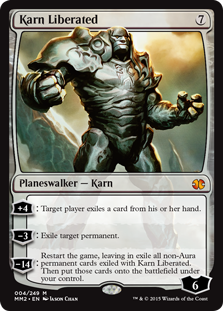
I successfully hated out the combo, but not the deck. Twin was able to just keep doing its thing, which was get under my slower control deck and then tempo me out. I did win a single game where a turn 2 Field locked out my opponent (only one non-fetchland), but I would have won many more if I'd played Orb and broken Twin's value engine. I had a much better medium-beatdown game than Twin. Because I missed what was really going on in the matchup, I played a hate card that let Twin escape. This is the lesson of this article: If you're going to play a hate card, make sure it actually hates out the target. Don't just kinda hate or be annoying. HATE THEM TO DEATH!

The Great Tron Problem

Over the years, this has been the great paradox of Modern Tron. Players have always complained about Tron, and have constantly proposed ways to fight against it. It never worked, until very recently. And it comes down to the incorrect target problem.

Tron wins by getting seven mana on turn three, then dropping big colorless bombs. Always has. This has led many to conclude that the key to beating the deck was to target the lands. The problem is that land destruction costs three or more. Which means that Tron can only be kept from hitting its mana when that Fulminator Mage comes down on curve on the play. Otherwise, there will be a Karn to deal with in addition to the lands. Players searched for years for a solution, but ultimately just always had to deal with the fact that Tron would hit its lands and drop bombs.
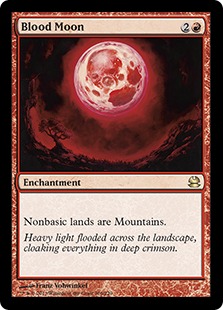
When Assassin's Trophy and Damping Sphere were printed, it was hailed as the end of Tron. Finally, there were effective answers that would definitely preempt Tron being assembled. However, that was far from the case. Tron kept powering on. It had to adapt by being mono-green and playing more basics, but it still just kept being Tron. The fact that this happened made many very unhappy.

Mooned Out

However, it shouldn't have been surprising given a well-known piece of advice: Blood Moon isn't good against Tron. It will just win through the Moon. Which is a very odd thought, seeing that Moon is the best land hate card available. It's devastating against Primeval Titan decks and unprepared three color decks. How could it be poor against Tron?

The answer was that Tron lands aren't the problem with Tron. Yes, they're the whole namesake of the deck, but the problem isn't that Tron ramps. The problem is that Tron drops big colorless monsters early. I realize that the former problem enables the other, but dealing with the former won't solve the latter. Too many players thought Moon was a solution to Tron, not realizing that Tron doesn't actually need colorless mana. Just generic mana, meaning red is just as good. Yes, Moon means that Tron can't hit those monsters early anymore, but there's nothing stopping Tron from hitting them later. And Karn Liberated is still a huge threat on turn seven. The problem isn't the Tron lands, the problem is Tron's threats.
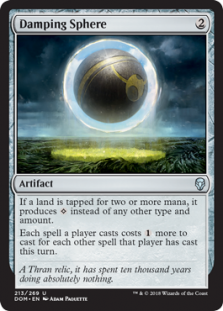
Players have finally started to catch on, and are adopting better strategies against Tron. Traditionally, blue control struggled against Tron, just like Jund. However, these days, control is playing more counters to actually answer Tron's answers on-curve. More importantly, Field of Ruin gives them a way to slow Tron down while fixing their own mana. This strategy has proven at least as effective as more dedicated strategies, and doesn't yield the heartbreak of land destruction not working. Except when Veil of Summer is involved.

Avoid the Monsters

On that note, stop boarding Damping Sphere against Eldrazi Tron! This is the most egregious example of players not understanding a matchup I know. E-Tron rarely hits Tron early. Frequently, it never has any acceleration at all. Playing Sphere protects against corner-case blowout games and nothing else. The reason that E-Tron works is that Chalice is a powerful card and the Eldrazi are big creatures. Far more than against Tron, attacking the lands is missing the point of the deck. Blood Moon is more effective here because E-Tron does need colorless mana, but that still won't help against a Waste. Only bring in hate cards that matter.

How Prowess Dodges Taxes

The second problem is missing the matchup context. Last week I mentioned that Thalia, Guardian of Thraben is poor against Prowess. This is not because her effect is bad against the deck; it can be utterly crippling when Prowess is mana-light. However, she's not effective because Lava Dart perfectly answers her. And can be flashed back later. Siding in Thalia is missing the important context of that matchup.

Worse is when players bring in Damping Sphere. The first spell isn't taxed, meaning that Prowess still gets to play its game. Not as much of it, and Sphere is still effective at preventing the explosive turns. As I learned against Izzet Phoenix, a smart player will be judicious with their spells so as to maximize their value and play around and through the Sphere. Unless you can really take advantage of it, the time that Sphere will buy is meaningless.
That same sideboard slot could go to Dragon's Claw and be more effective. Prowess plays a lot of red cards that don't directly deal damage. Getting an extra cushion of life buys more time than the ineffective taxing. It's not perfect, and Prowess absolutely will win through a Claw, but not quite as easily as a Sphere. Plus, Claw will never make it hard for its controller to cast multiple spells. While not the most effective Prowess hate (that would be Trinisphere), Claw's going after a more intrinsic part of the deck and is more effective than Sphere or any other taxing effect.

Storm's Dilemma

This brings up the question of taxing against any combo deck. And it is a complicated one. Taxing does generally work against these decks, but you can't rely on it. Storm plays cost reducer creatures, each of which undoes a Thalia or Thorn of Amethyst. This doesn't mean that Storm is suddenly free, since Modern Storm needs the cost reduction. However, it does mean that relying on taxing against Storm is risky. It's good as part of a wider attack (as Humans proved), but this isn't Legacy. If you want to really hate Storm, Deafening Silence or Trinisphere over Thorn.

Don't Overthink it

All that being said, don't overthink sideboard hate. It's possible to get too cute and level yourself. Basically, if a lengthy explanation/justification is necessary to explain why a card is effective, then it's better to opt for a simpler solution.

For a long time, I ran Plague Engineer in Humans. It made sense as a very powerful effect, and I'd been high on the card when it was spoiled. The problem was that Engineer is awkward to cast. The mana base is geared to only cast Humans, and I either had to save an Unclaimed Territory or draw Ancient Ziggurat/Aether Vial to actually play the thing. I've recently switched to Izzet Staticaster, and while it's not as powerful, it has been more effective because I cast it more often and easily. Theoretical power is meaningless if it's too hard to cast.
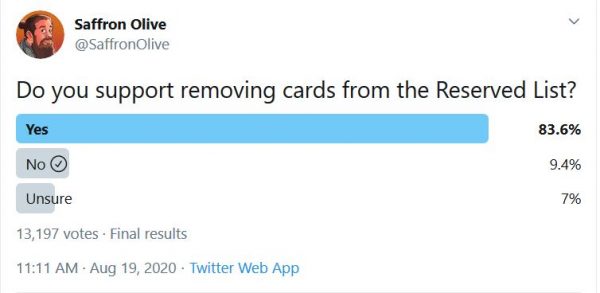
Similarly, the classics are classics for a reason. Sometimes it's best to just stick to normal cards rather than a powerful bullet or hate piece. Disenchant is the quintessential sideboard card. There are numerous more powerful, though narrow, options for the same effect. However, sometimes Disenchant is the best option. I've learned this the hard way in Legacy. Leonin Relic-Warden is a very strong card, especially when it answers Chalice of the Void, then gets flickered to take something else. However, it's linearly playing into Death and Taxes' ETB creature plan. This means that I've lost to Torpor Orb playing the Leonin when a simple Disenchant would win the game. Context is everything.

The Key

Sideboard space is a precious resource. Maximizing individual card impact is critical. However, so is ensuring that every card actually does the job it needs to do. Don't play a card because it seems good on paper. It must actually do the thing you're expecting to be worthwhile.

My Relationship with the Reserved List

Are you a Quiet Speculation member?

If not, now is a perfect time to join up! Our powerful tools, breaking-news analysis, and exclusive Discord channel will make sure you stay up to date and ahead of the curve.

I have a confession to make. This isn’t easy to say because I know it’s going to trigger numerous readers. Some may even go as far as to unfollow me on Twitter for sharing this unpopular opinion.

My name is Sig, and I like the Reserved List.

Clearly I’m in the significant minority on this matter; at least, I am in the minority amongst the MTG community most vocal on Twitter. But even Saffron Olive’s recent Twitter poll, which earned over 13,000 votes (surely this is statistically significant), indicates that my opinion is matched only by about 10% of the player base.

See that check next to “No”. Yup, that’s what I voted for.

I’m not going to sit here and delude myself, thinking a single article on the Reserved List is going to convert readers. I recognize everyone is passionate about this topic and a simple write-up isn’t going to change minds. But I feel I owe it to the community to explain my position. My goal with this article isn’t to convince you to support the Reserved List. The goal is only to convince you that one can support the Reserved List without malicious intent and with a genuine interest in Magic’s long-term health.

If I can’t accomplish that, then my minimum threshold for success is extremely low: I wish for readers not to think less of me for this opinion.

Sig, How Did This Happen?

I wasn’t always supportive of the Reserved List. In fact, the tweet I have pinned on my Twitter profile is a screenshot of a Facebook post I wrote back on March 20th, 2010:

What happened in March 2010 that catalyzed this post? Just two days prior, on March 18th, Wizards of the Coast posted a significant update to the Reserved List. The post was short and unassuming; in fact, it’s so short, I can paste the entire announcement from their website right here.

This brief 132-word post sealed the only available loophole in the Reserved List. Prior to this date, Wizards of the Coast had used premium printings of Reserved List cards in order to circumvent the list and distribute reprints. The “community” caused a stir, and WOTC felt compelled to close the loophole—it has remained closed ever since.

I’m not sure who this “community” was that WOTC referred to. Certainly this isn’t the same community that participated in Saffron’s Twitter poll. That community would have clearly supported premium foil reprints of Reserved List cards. Some influential group of people must have had WOTC’s ear in order to motivate this update. At the time, that influential pro-Reserved List group didn’t include me, hence my frustrated Facebook post.

In 2020, the fact that I predicted $100 Dual Lands doesn’t seem all that impressive. But it was a bold prediction back then, especially if you consider non-blue, heavily played Dual Lands. In fact, when WOTC posted this announcement, I first made a modest purchase on Card Shark before posting my Dual Land prediction:

I picked up heavily played Badlands, Scrubland, and Taiga and the three cards didn’t even cost me $100 (check out that sweet Ancient Tomb price, too). When I predicted Dual Lands would hit $100, I wasn’t referring to near mint Underground Seas. I was talking about these heavily played, non-blue duals.

Ten Years Later: Why I’ve Warmed Up to the Reserved List

Ten years ago, I was worried about the Reserved List. Since then, I have evolved my thinking for a variety of reasons. Here comes to controversial part of the article—I’m going to explain why I changed my stance from worrying about the Reserved List to being completely supportive of its existence.

I’m going to start with a picture from @MTGHistory’s Twitter account, of the first World Championship Finals that took place 26 years ago.

What’s the first thing that catches your eye in this picture? For me, it’s not the players, the board state of the game in action, or the awkward clothing styles from the early 1990’s. Instead, it’s that binder casually placed on the end of the table. No one even appears to be looking at it.

If that binder was placed on the end of a table in 2020, any nearby gameplay would instantly cease as players would surely gawk over the cards within. The reason is obvious: in 2020, that one binder page would be worth over $100,000. Nowadays a binder filled with Masterpieces and popular Modern staples are a dime a dozen. A binder filled with black-bordered Power
much much rarer.

The Reserved List itself isn’t the sole reason that binder page is so impressive. But the concept of unobtainable cards—cards that are out of reach and something to aspire to owning—is supported by the Reserved List.

This concept of “unobtainium” in a collectible market is often what drives interest in the hobby. This isn’t just a Magic thing; it exists in most relevant collectible market. In fact, the baseball card market collapsed in the 90’s because the card manufacturers printed cards so much that there was no longer an allure to collecting. According to an article on slate.com, “One trade magazine estimated the tally at 81 billion trading cards per year in the late ‘80’s and early ‘90’s.”

The article goes on to state, “In 1989, the Upper Deck Co. would transform the industry with flashy, high-priced cards aimed at investment-minded collectors. As the sales of new sports cards swelled to more than $1 billion a year, children began to flee the hobby, turned off by the pricey packs and confounding number of sets.” Pricey packs and confounding number of sets, you say? Hmmmm I must say that sounds familiar


Luckily for Magic, there’s a game played with these cards (vs. baseball cards) so players will still purchase the new product. But the comparison is intriguing.

How about with coin collecting? Part of the allure to collecting a complete set of coins, such as Lincoln Pennies, is the journey and challenge of obtaining the “key dates” of the series. The term “key date” refers to the dates in the series that are harder to obtain than the others. They are rare, making it difficult to complete a series. The excitement of obtaining the “key date” and completing a series would not exist if there was no “unobtanium” in the numismatic world.

The parallel is admittedly a stretch, but imagine if the U.S. mint went out of their way to create a new series of “key dates” as a way to drive sales. Let’s say they mint 1,000,000 more 1909S-VDB Lincoln Cents. Collectors would surely buy it, but the value would surely drop. Suddenly, a difficult-to-find piece of the series would be obtainable. Confidence in other “key date” coins would be shaken and the coin collecting hobby as a whole would fade in popularity.

A Brief Look at Psychology

Obtaining the unobtainable is a lifelong quest—something worth pursuing and then celebrating once accomplished. The Reserved List facilitates this experience by creating a subset of cards that will invariably be difficult to obtain, continuously climbing in price. Remove the Reserved List and some of that allure is lost.

Not all of it, mind you. I completely get that a Beta Shivan Dragon maintains a significant premium versus its Revised counterpart despite not being on the Reserved List. To this, I would argue that collectible, nostalgic cards like Beta Shivan Dragon would be worth less because its peers—Power, Duals, etc.—would be worth less.

There was an error retrieving a chart for Shivan Dragon

Part of why old, non-Reserved List cards are so expensive is because collectors can trade their expensive Reserved List cards for them. The rising tide lifted all ships, as it were.

Looking to psychology, there’s extensive evidence that suggests people who purchase more expensive things tend to like those more expensive things more. The BBC has an article that states, “In one study by the California Institute of Technology and Stanford University scholars, people not only rate the same wine more highly when they’re told it is more expensive, functional magnetic resonance imaging or functional MRI scans taken of their brains while they were drinking the wine suggest participants enjoyed the experience of drinking it more.”

Translating to Magic, I believe players enjoy the game and their card collections more when they have more expensive cards. Having something that’s more expensive and difficult for others to obtain would be even better! This is evidenced by the fact that Commander players often like to “pimp out” their deck and use the flashiest printings of each cards, possible. But while a Masterpiece Sol Ring is cool, nothing compares to having a Reserved List foil Gaea's Cradle in one’s Commander deck.

“But Sig, Gaea's Cradle would still be expensive even if it was off the Reserved List and reprinted because it is so popular.”

This is true, to an extent. And maybe a full-frame, alternate art, foil Gaea's Cradle would carry some premium. But if there are five choices for “best” Gaea's Cradle, would demand for them be diluted somewhat? Each player would have a different opinion of which copy is the best, distributing demand across all of them, resulting in a lower price across the board.

There was an error retrieving a chart for Gaea's Cradle

A lower price may be desirable to many players, I completely get that. My point here is that players will appreciate/enjoy their cards less if they cost less (the converse to the evidence from the California study cited above). Players think they want cheaper cards—it’s true that having a cheap Gaea's Cradle is better than having no Gaea's Cradle. It’s tough to visualize, but I’d argue that a cheaper Gaea's Cradle would be less appreciated and less enjoyed than an expensive one.

Magic needs to have expensive cards to drive this elevated level of enjoyment.

Wrapping It Up

This is becoming a lengthy article, and I feel I’ve only scratched the surface of my Reserved List perspective. My feelings on this list go much deeper than “More expensive, unobtainable cards are good for the hobby.” But to cover the depth of my appreciation for the Reserved List would likely require two more articles of equal length.

For now, I’ll leave with a brief summary of what I’ve written above. Magic is a game, but it’s also a Collectible Card Game. This is what sets it apart from games like Apples to Apples or Exploding Kittens. Those are card games, but they aren’t collectible card games. Part of what makes Magic so special is that it is collectible (i.e. an item worth collecting/of interest to a collector). Magic has been around for 27 years as a result...I don't think Exploding Kittens will be nearly as profitable as Magic after it has been around for 27 years.

Removing the Reserved List would not convert Magic into Exploding Kittens, obviously. But reprinting older cards would negatively impact some components of the market. Psychology studies suggest that paying more for something makes us appreciate it more. Reducing prices of cards across the board may sound attractive, but it would negatively impact our appreciation for the hobby.

Lastly, every collectible market has an “unobtainium” worth aspiring to. Whether it be coins, video games, stamps, or comic books. One key difference with Magic is that some of its demand is driven by desire for play and not just collectability. That complicates the equation significantly—reprinting cards shifts the supply/demand equation between collectors and players in a way that’s difficult to predict.

I know removing the Reserved List wouldn't mean removing an "unobtainium" component to the hobby. I get that. Players will still demand the most powerful cards and premium, rarer printings of those cards would carry additional value. But I suspect there will be a general "lessening" of value across the board. I can't predict what that would look like, but I'd rather not risk it.

I’d prefer things stay as they are rather than open Pandora’s Box and remove the Reserved List. Even if it means I can't afford all the cards I desire. It motivates me to keep striving for the unobtainable, keeping me engaged with the hobby.

Pandora’s Box

Are you a Quiet Speculation member?

If not, now is a perfect time to join up! Our powerful tools, breaking-news analysis, and exclusive Discord channel will make sure you stay up to date and ahead of the curve.


In June 2013, WoTC released the first of the paper "Masters" sets, simply called Modern Masters. It was the first all reprint set since Chronicles in 1995, which as many of you know was the catalyst for the Reserved List. For those who don't know the history of Chronicles, prior to the printing of the set, there were a lot of $10+ dollar rares from Legends and Arabian Nights and the ones included in Chronicles tanked in value due to the massive print run. You can find some fantastic information regarding print runs here.

The gist of it is that there were 20,500 of each Arabian Nights rare, 19,500 of each Legends rare, but 516,500 of each Chronicles rare which added 2580% to the supply of the rares included in the set. Obviously, there wasn't nearly that much demand at the time, so cards that were $10+ dropped to under $1 and a lot of people got upset.

There was an error retrieving a chart for Nicol Bolas
There was an error retrieving a chart for Nebuchadnezzar

Flash forward to 2013, and it appeared that WotC had learned their lesson with the printing of Modern Masters; with a more conservative print run, WoTC ensured that instead of tanking all the chase card prices in the set, we only saw some dips and the eventual recovery. It was a set that included numerous cards that had skyrocketed in value with the creation of the Modern format and was a way for WoTC to add additional copies of powerful cards into the supply without having to run them through the Standard format. What's more, it garnered interest in the Modern format.

There was an error retrieving a chart for Tarmogoyf

At the time, Standard was WoTC's bread and butter: it generated almost all of their revenue, while singles sales of older cards were often a major source of income for many local game stores. While some players feared what the advent of new "all reprint" sets would kill the singles market, this fear ended up ebbing as the cards rebounded. I myself actually bought a lot of singles shortly after the release of the set, and enjoyed speculating on numerous cards from it, given that my LGS had just enough boxes to sell me one and still run a wildly successful draft.

The next of the Masters sets didn't come about until two years later with Modern Masters 2015. This time the print run seemed to be noticeably bigger, as stores had boxes in stock for weeks as opposed to days. Again, I speculated on numerous Modern staples that had plummeted in value.

There was an error retrieving a chart for Spellskite

As was the case before, many of the staples from this set recovered from their price drops, and WoTC had other successful Masters set under their belts. Those who cried out that the sky was falling were proven wrong.


Here is where we start to see the gradual slide downward. While previously WoTC had kept these sets to every other year, which gave time for the singles in the sets to financially recover. They began now to start releasing more and more of them.

  • 2013- Modern Masters
  • 2014- No Masters set
  • 2015- Modern Masters 2015
  • 2016- Eternal Masters
  • 2017- Modern Masters 2017 + Iconic Masters
  • 2018- Masters 25 + Ultimate Masters

It seemed WoTC had fallen in love with these Masters sets. After all, they don't have to devote a lot of development resources to a set in which all cards and mechanics are already defined. They also know they can sell them at a significant premium over their standard set boosters, now called draft boosters, because the cards in the set held more value on the secondary market and thus players could justify the higher price because they got more valuable cards.

They also released a majority of these sets in late spring to early summer, when sales for Magic packs tend to dip; many student players were out of school and either working or doing other summer activities. I have no doubt that the higher-ups at WoTC loved having a nice financial shot in the arm for their quarterly earnings reports.

Not surprisingly, many of the singles in the sets from 2017 onward were not recovering in value, players and stores were seeing the value of their collections reduced with each new spoiler season. That isn't to say one couldn't speculate on cards in these sets, but with each new printing, the successful targets became fewer and fewer.

It's also important to note that there is one customer base who had no qualms with these constant reprints: the casual and newer players looking to get into older formats. For this group, WoTC couldn't make enough reprint sets. Finally, even WoTC could tell that the playerbase was feeling fatigued by these sets. With the release of Ultimate Masters, WotC vowed to put the Masters release schedule on a brief hiatus.

There was an error retrieving a chart for Engineered Explosives

That hiatus ended May 21, 2020 with the announcement of Double Masters and given that Ultimate Masters released December 2018 it lasted about a year and a half. Though, I think there is a fair argument to call the Mystery Booster set a Masters set in disguise, which if you do means the hiatus only lasted 11 months.

I'll be the first to admit that when Ultimate Masters released, I got caught up in the hype along with so many others. There were just so many awesome cards in the set. Previously, we'd have a fair number of duds in the other Masters sets to keep the overall EV of the set to a reasonable level, but Ultimate Masters seemed to be chock full of fantastic Modern and Commander cards. I looked through my records and realized I had spent $1340 on singles and $1032 on four boxes.

I loved buying cards like Engineered Explosives, Noble Hierarch, and Celestial Colonnade for 25-50% of their old prices. I took the promise from WoTC to hold off on more Masters sets as a security blanket, to invest heavily so I could reap massive future rewards. Those profits never came.

There was an error retrieving a chart for Celestial Colonnade

I can't blame it all on WoTC. I did see significant gains on Commander specs from the set; Ulamog, the Infinite Gyre, Demonic Tutor, and Phyrexian Altar. Unfortunately, before any of my Modern specs could recover, WoTC announced the Pioneer format, which quickly overtook Modern as the new People's Format. I don't think many people could have foreseen a new format coming out in 2019. I have to look at those losses as more from a "black swan" event than poor speculation targets.

I don't want this to come off as any sort of "woe is me" monologue, but I would like to warn those entering the speculation waters that the more something seems like a "sure thing," the warier you should be. In fact, my Ultimate Masters losses have caused me to re-evaluate my entire speculation strategy.

I know many of my fellow QS Insiders feel like Double Masters is one such "sure thing." I want to make sure people take a step back before going deep on any Double Masters reprints and hopefully learn from my failures. I also think it's very important to point out that while we are seeing a lot of the Double Masters cards already start trending upward, the initial non-VIP boxes had print run issues that reduced a lot of allocation for stores. We should expect more boxes to hit the market when WoTC's printers catch back up. I'd expect it to be a rather substantial print run, meaning the gains we see right now will quickly drop once additional supply hits the marketplace.

There was an error retrieving a chart for Firestorm Phoenix

My new speculation strategy is to avoid all metagame driven formats: Modern, Pioneer, Standard, Legacy, Vintage, Pauper, etc. Now, I almost exclusively speculate on Commander. Even then, I have to limit myself on how deep I'm willing to go on any given target. I choose to restrict most specs at 12 copies or $100, whichever comes first. I'm more than willing to allow those who love the high risk/high reward style of speculation to fill in where I have left off.

I'm sure that my preference for reducing risk comes from growing older and having a growing family, but many of the players I hang out with seem to feel the same concerns with WotC's current strategy of pumping out more and more supplemental products each year. I hear the term "wallet fatigue" thrown around a fair amount, and while I can't speak for everyone, my friends and I are definitely feeling it with all these supplemental products.


Want Prices?

Browse thousands of prices with the first and most comprehensive MTG Finance tool around.


Trader Tools lists both buylist and retail prices for every MTG card, going back a decade.

Quiet Speculation