
menu

Elephant in the Room: The Casual-Competitive Schism

Are you a Quiet Speculation member?

If not, now is a perfect time to join up! Our powerful tools, breaking-news analysis, and exclusive Discord channel will make sure you stay up to date and ahead of the curve.

I've been playing Commander for a long time at this point, upwards of six years. In all that time, I’ve heard a ton of complaints about things that would "destroy the format," be they Primeval Titan, the banning of Tolarian Academy, or the refusal to take Kokusho, the Evening Star off the banned list. Whenever something threatens to affect the format there's an explosion of discussion on various internet media like Twitter, Podcasts and forums, and ultimately everything turns out to be fine.

What I've seen drive more players away from Commander than every [card Sharuum, the Hegemon]Sharuum[/card] and Hermit Druid combo deck put together is people's inability to agree on what "fun" is and their insistence that they are correct. The topic is very polarizing for those who care about it. To be fair, there aren't that many people who are that invested in what fun means; most of us just want to play the game. That said, I've seen more than one group drift apart because one or two members couldn't resolve this issue.

In general, people fall into two camps. There are those who believe that if a card is legal, it's their job to break it in half; that it's their prerogative to build the most obscene deck they can, and other people should build and play up to their expectations. The other camp believes that if something isn't "fun" they should be able to house-ban it because it's not enjoyable for them.

The problem is that the people on either extreme of this issue are actually of the same mindset. Instead of just playing the game, they're interested in making other people play the game their way, because theirs is the "correct' way.

If you're part of a group that has one of these personalities, it's usually not hard to deal with them comboing off once in awhile or complaining about how a game ended.

The real problem comes when both of these personalities are in a group, and there's conflict between them. When that happens, people may refuse to play with others, tension runs high, and sometimes the neutral parties have to start choosing who they want to play with. In short, things can get ugly pretty quickly if the situation isn't defused.

What I want to do with the rest of this article is share some of my experiences from both sides, so that hopefully we can avoid more situations like this in the future. I've got three stories to share which are reasonably representative of the conflict in question, and which demonstrate the right (and wrong) ways to approach the issue.

On Being "That Guy"

One of the first Commander decks I ever built was an Azami, Lady of Scrolls High Tide deck. For someone who has mostly played fundamentally fair formats, there's certainly a draw to some of the unfair things you can do in Commander. I'd never had a real chance to play with stupidly unfair mana rocks like Sol Ring and Mana Crypt and had never played any kind of storm- or High Tide-based combo deck.

Let's be honest, there are few things more enjoyable than cantripping through your deck, finding more wizards to cast and turning them into more cantrips. The only thing more fun than that is using those cards to find a soft lock like Voidmage Prodigy plus a ton of creatures and Glen Elendra Archmage and Sage of Fables, or finding one of your two-card combos like Mind over Matter plus Temple Bell or Hide Tide plus Palinchron.

As I got more proficient with the ins and outs of dynamic combo decks, my turns started getting longer and I started going off earlier. The problem is that this was fun for me, but no one else. I learned this when my college friends started to grab a baking timer and pass my turn for me once five minutes was up. Everything was all in good fun, of course, but at the time it was kind of frustrating. I was having fun comboing off, the cards I was playing were legal; why was I getting singled out?

The most exciting part of the game is the untap-upkeep-draw sequence. What's this turn going to bring? Am I going to hit my one-of answer or some bomby threat? People get agitated when it takes too long between their turns because that's the part of the game that's most interesting to them. It's when they get to be the most interactive and when they are the most important politcally, since their spells and creatures are more relevant and they get to attack.

The difference between a dynamic combo like Azami as opposed to a linear combo like Hermit Druid is that it actively takes time away from other players while you're going off. You don't just end the game so everyone can shuffle up and play more, they have to watch you do your own thing instead.

The moral of the story is that people want a chance to play, and anything you do that prevents that is going to generate bad feelings. Whether you like it or not, you have to engender good feelings if you want to have people to play with on a regular basis. Because of that, it's a good idea to keep track of how long your turns are and how interactive your deck is. If your answers are "pretty long" and "not very," then you might want to think about building something different.

On Playing Their Game

People who play these linear, non-interactive decks love to tell other people to add answers to combat them. It doesn't matter if they're playing Melira, Sylvok Outcast persist combo as their top end, or any number of other shenanigans, all they want to do is tell you to stop complaining and add graveyard hate, or artifact hate, or whatever it is to your deck.

Loathe as I am to admit it, oftentimes they're right. We all love to cut cards our decks need for more cards that do cool things, and sometimes that's not correct. Sometimes you have to cut the nth bomby creature for a Relic of Progenitus or a Shattering Pulse. If the axis along which players in our group are interacting is different than the one that we've identified, we have to be willing to tweak our decks to interact better.

That said, what many of these players don’t understand is that there's a fundamental difference between tweaking your deck and radically altering it to ensure you have combo hate online by turn five. All too often a more effective solution is to decide not to play against combo decks at all, and then it won’t matter whether or not they've adjusted to beat yours.

Two similar situations came up at one of my local stores not too long ago. One person played a graveyard-based combo deck to death. Every game ended on turn seven or so with some kind of infinite combo out of the graveyard, and people weren't enjoying it. Some of them repeatedly tried to talk him into building something different, or removing some combo pieces, but he insisted that they just add some hate.

So they did. One person built a mono-black graveyard hate deck with Withered Wretch, Nezumi Graverobber and Leyline of the Void. One person built a mono-green graveyard hate deck with Scavenging Ooze, Night Soil and Krosan Reclamation. Yet another person built a mono-white deck with Stonecloaker and Salvaging Station/Auriok Salvagers plus Scrabbling Claws effects.

For about two weeks, the combo player's deck never got to do anything. Every card that hit the graveyard was exiled. All of his creatures were exiled instead of destroyed. His combo pieces were [card Sadistic Sacrament]Sadistic Sacramented[/card]. He wasn't really happy with how things played out, but he got the point and built a new deck. Now people enjoy their games a little more.

The other situation involved a mono-blue combo player, who wouldn't adjust his deck and insisted that other people play blue decks to interact with the stack more effectively. After a few weeks of trying to talk them into changing their deck, multiple people built red decks with Boil, Boiling Seas, Curse of Marit Lage and all kinds of Pyroblast shenanigans. They hated the blue deck off the table by preventing him from doing anything relevant.

This player took it much more poorly, and now refuses to play Commander at that store.

I guess whether or not things turned out well depends on who you ask, but the lesson to take away here is that there are reasonable steps to take before taking extreme measures to get someone to change their ways. You can talk to them about it. You can tweak your deck. But if all else fails and your group really can't stand it, it may be necessary to use a more "forceful" demonstration of your joint displeasure with a particular deck.

On Walking the Line
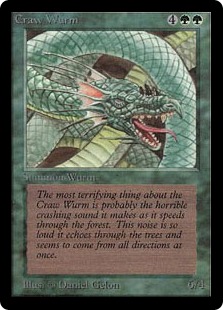
The players on either side of this issue have very polarized views of the other. Competitive players think that the casual players are just ramming [card Craw Wurms]Craw Wurm[/card] into on another, whereas casual players think that all the competitive games end on turn three. In reality, neither of these things are true and most players fall somewhere between these two extremes.

That said, it can be very difficult to walk the line. At any given time you may find yourself on one side or the other, depending on who you're playing with. One of the most frustrating things about a format based on a social contract rather than a hard and fast banned list is that it can make playing with new people awkward. Sometimes it takes a few games to figure out if your deck is too good, not good enough or simply not interacting appropriately.

I've played with a lot of people at this point in a ton of different places: two colleges, three Grand Prix and all manner of local events. Each of these scenes presented decks with different power levels, different methods of interacting and all manner of other differences.

There are three solutions that I think are the best ways to prepare for this situation. The simplest is to have different decks at different power levels, which is the solution I've taken to. At the moment, I will regularly carry around my Child of Alara Lands, Kemba, Kha Regent, Grimgrin, Corpse-Born and Horde of Notions Planeswalkers when I expect to be Commandering.

Of those, Child of Alara is the only one that's overpowered for most playgroups, and it only gets broken out for other competitive decks or when people ask to see the deck in action. Kemba and Horde of Notions are more moderately powered, but each interacts differently. Last, my Grimgrin deck is mostly commons and uncommons and is designed for "underpowered" playgroups, so I'll usually play a game with Kemba and then adjust accordingly. I've also usually got a fifth deck floating around depending on where I'm going and what kind of players I'm expecting.

Another solution that sounds promising is the idea of an "extra deck" (not to be confused with a sideboard.) You can carry around your 99 card deck, and then however may other cards you may need to tweak it on the fly. More artifact removal, more enchantment removal, sweet cards that you can't always fit into your main deck. If you can take your deck home and tweak it, why not just bring the rest of the cards with you and do that between games? As long as you're not oversideboarding to neuter other people's decks and are just giving yourself ways to interact, this is an elegant solution for someone wants to avoid carrying around a suitcase of decks.

The last solution that I would advocate is one that Adam Styborski introduced me to at Pro Tour Philadelphia last year. Adam has a Commander Box, in which he has one copy of each card that he typically wants to play in Commander. From this box of 500ish cards, he can build just about any deck he wants in about ten minutes. It has the added upside of requiring only one of any given foil or artist-signed card to be used across various decks. This solution gives you near infinite flexibility when it comes to adjusting for a particular playgroup's level of competition.

Remaining Flexible

We all need to learn to be more moderate and flexible. Bad outcomes occur when one or more parties refuse to be flexible. As long as everyone respects the social obligation of trying to make the game fun for everyone, and as long as we can have mature conversations and meet somewhere in the middle, everything will turn out just fine.

This week's topic was a little more abstract, and may be irrelevant for some people, but it's something that's come up repeatedly in my experiences with the format. I'd be glad to hear what anyone else has to share in the comments, since I want to know how best to address an issue like this in the future.

Next week we'll see more of a return to form. I've gotten a lot of questions about the Kemba deck I've been running at Grand Prix and other large events, so I figure it's about time to share that list. If you share my obsession with mono-white decks and grindy attrition, be sure to check it out!

Carlos Gutierrez
cag5383@gmail.com

Insider: Selling Singles vs. Selling Playsets on Ebay

Are you a Quiet Speculation member?

If not, now is a perfect time to join up! Our powerful tools, breaking-news analysis, and exclusive Discord channel will make sure you stay up to date and ahead of the curve.

I've often wondered whether there was any difference between selling hot cards as singles instead of playsets on Ebay. This question gets more complicated when we think about why people are buying cards. Since you only need one of a card for Commander, you might be unlikely to pay more for extra copies you won't use. If you need a playset, you might pay a premium so that you don't have to round up the cards from different buyers and wait for all of them in the mail. I sat down and ran the numbers this week on several cards, demanded in different markets, for a good analysis on what you should do. This information is specific to the cards, but I have attempted to describe what I think is going on with the individual cards and then extrapolate them to the broader market.

The big takeaway for traders is the question of "do I trade more to make a playset of this?" You're looking at duals, Snapcasters, the hot chase rares of Standard, and wondering whether there's a market premium in completing that pack to resell. Let's find out...

Tarmogoyf

1 2 3 4
$76.80 $76.56 $79.74 $81.70

This simple graph represents the prices, averaged out, for the sale of Tarmogoyfs in the last few weeks. Tarmogoyfs are a banner Modern creature and make quite a splash in Legacy, too. They are not much in demand for Commander, because they're not that great of a creature in the singleton format. Tempo and mana are not at such a premium, so a plain beater is less exciting.

The results of the Goyf sampling were perhaps the most interesting to me. There were plenty of data on sales of the card in each quantity, which made for a good investigation. I corrected for shipping price - but at the $70+ level, you get free shipping from most sellers (it's like the NPR tote bag). Tarm0goyfs are worth considerably more when bundled with their friends - just look at the $5.00 difference! That's $20 across a playset, and you'd be mad to break up a set to sell individually on Ebay. I concluded from this data set that when a card has little Commander appeal, but broad market appeal, the market rewards sellers who can get full sets together. Tournament players seem uninterested in slowly accumulating their Goyfs.


Volcanic Island

1 2 3 4
$75.70 $70.50 $70.62 $72.23


Another card, another fascinating table. Volcanic Island has casual appeal, for sure. People love the R/U color scheme and it pops up in a lot of Commander decks. However, it's not played that much in Legacy. The color combo is probably the second-weakest, behind B/R in Legacy. The astounding lesson for me here is that bidders tend to reward people who sell single Volcanic Islands, which makes me think that players will pay a slight premium to not have to deal with buying extra Volcs. If you're selling your Volcs, I don't think it's really worth breaking up a playset - you only net about $10, which might not be worth the trouble. The data are clear, however - don't sell doubles or triples of this card! Break it into single sales and you'll make extra money.

One of my initial hypotheses was that dual lands would particularly show this phenomenon, due to Commander players. It's nice to see it play out. The triple Volc category only had seven entries in recent memory, so I have to warn you off of totally relying on it, but the data seem clear on the advantage of selling individual Volcs. Also of note: more free shipping here. The doubles category was marked by several sub-$65 per piece auctions, which is absurd. Get out your bidding scheduler and price control that stuff!


Force of Will

1 2 3 4
$49.48 $48.83 $51.13 $51.08

A relatively flat data set comes back for Force of Will, long a loved card in Legacy and Vintage. I was sort of surprised by this because I thought that there were enough Commander players to make single FOWs more in demand. However, a difference of about $1.50 exists in the data-rich set across the four quantities. Since it's upward-trending, we can see a slight reward for sellers who take the time to assemble a playset.

The craziest thing when I looked at FOW prices was that there were several completed BIN listings for Force of Will at $65 in single copies. This is bizarre to me, but I had to remember that some people are going to just want the card and be done with it. Force of Will is a polestar of a card for inflated dealer and BIN pricing, so the actual floor on BIN prices for this card is much higher than it is for auctions. If you have a single Force of Will, I highly suggest putting it up for BIN instead of an auction. Too many people act like cowboys and put up auctions for a single card, thinking that they'll make more money, and they just eat $10 that they could have had with a BIN auction.


Bloodstained Mire

1 2 3 4
$14.47 $13.52 $16.29 $13.94

I chose Bloodstained Mire because it has a good casual and Commander following, but it sees no Legacy play. It's also a lower-priced card, which means that we can get a little diversity in our data. At this price point, barely anyone offers free shipping, either. Mires are relatively steady across three of the four categories, but that third column is interesting. First, let me level as a casual statistician here that the 3x Mire auctions were few and far between; I had only seven to count. On the other hand, it looks like bidders genuinely lost their minds when bidding on these cards, and they did it all the time. Almost all of the auctions were above $51 ($17 per) and some got up to $55. That's far, far above market price for any other category. Sometimes, you see auction histories where people went nuts, and the 3x Mire category was one of those for sure. In larger data sets, those flip-outs get evened out by the people who score cheap auctions, but there were really no cheap auctions to speak of with Mire. The lowest 3x pack went for $43, or $14.66 apiece. That's still above the average, the average! for the other three categories.

My only guess for why this happened is that there's enough people who really need those three, but do not want to get the four-pack and sell the extra one.


Snapcaster Mage

1 2 3 4
$18.25 $19.04 $19.31 $18.72

Snapcaster Mage is just about the hottest in-print card right now, so it's no surprise to me that given the volume, the price is just even. This tells me that the market is pretty wise to actual prices, and I wonder if people are doing their research. This was a very interesting one to analyze because nearly nobody offers free shipping, which threw off the graph. When you don't correct for the $2-3 that most people charge, the one-of sales look much cheaper, coming in around $15. At higher quantities, the shipping premium erodes and you get to a closer per-card price. It's interesting to me that buyers are not forcing the market on single copies downward, but then again, buyers don't exactly get together to talk about these things.

Even with Snapcaster Mages, I saw ample opportunities for price enforcement. There were several 2-of auctions that ended for prices around $31. There were also some 4-of auctions that spiraled past $80 for a set. That kind of action shouldn't be happening, but I also figure that people at that level are thinking that "hey, this is a $20 card" when in reality, it's not. There are enough sub-$75 auctions that you can wait a little for a good deal on these.

*     *     *     *     *

I enjoyed doing this data dump and there's a lot to learn from just scouring completed listings. The FOW BIN trend, the premium on single Volcs, the slight playset premium - all of these were interesting. I think I can boil what I learned down to these points:

  • There most certainly are buying trends related to the quantities of cards sold.
  • If it's a popular or essential Commander card, you'll make more selling it as a single.
  • Most people will pay a little more for a playset, meaning that it can be worth $8 or more to get that fourth copy of a card.
  • When something has little Commander appeal, you're just better off making the playset if you can.
  • You will never profit by selling things as 2-ofs!
  • It usually pays to break sets that aren't playsets down into singles and sell 'em off.

If you want to see the analysis on more cards, just let me know! This was a brute force exercise; I just started pulling in numbers. It takes some time, but it can be enlightening. My numbers aren't perfect and I'm sure seeing things like statistical deviation would help, but for a back-of-the-envelope style hypothesis test, this was pretty good.

Until next week,

Doug Linn

Douglas Linn

Doug Linn has been playing Magic since 1996 and has had a keen interest in Legacy and Modern. By keeping up closely with emerging trends in the field, Doug is able to predict what cards to buy and when to sell them for a substantial profit. Since the Eternal market follows a routine boom-bust cycle, the time to buy and sell short-term speculative investments is often a narrow window. Because Eternal cards often spike in value once people know why they are good, it is essential for a trader to be connected to the format to get great buys before anyone else. Outside of Magic, Doug is an attorney in the state of Ohio.  Doug is a founding member of Quiet Speculation, and brings with him a tremendous amount of business savvy.

View More By Douglas Linn

Posted in Free Insider10 Comments on Insider: Selling Singles vs. Selling Playsets on Ebay

Have you joined the Quiet Speculation Discord?

If you haven't, you're leaving value on the table! Join our community of experts, enthusiasts, entertainers, and educators and enjoy exclusive podcasts, questions asked and answered, trades, sales, and everything else Discord has to offer.

Want to create content with Quiet Speculation?

All you need to succeed is a passion for Magic: The Gathering, and the ability to write coherently. Share your knowledge of MTG and how you leverage it to win games, get value from your cards – or even turn a profit.

Insider: (Part 3) Collection Flipping – A Case Study

Are you a Quiet Speculation member?

If not, now is a perfect time to join up! Our powerful tools, breaking-news analysis, and exclusive Discord channel will make sure you stay up to date and ahead of the curve.

When we last left off, I was grinding a small collection I bought a month or so back. Today, I’ve decided it’s time to sell.

A good point was raised in the comments last week. If you’re making money trading the cards you bought, when do you draw the line and sell?

I have a few thoughts on this. The first thing that comes to mind is the thing I always have on my mind when dealing with Magic cards – How do I make money on this? You don’t make money by amassing a huge collection or buying a lot of cards to add to it. You make money by selling cards. And that means at some point you have to actually sell the cards for cash.

You don’t have to clean out your collection or deplete your binder to do this, but every few months you should be selling, whether that’s just moving casual cards (as I usually do), or selling rotating Standard cards, older cards that have spiked, etc… This way you’re able to cash out some of your profits from trading and still have a collection to make money on while you’re on the trade floor.

The second thing is a question of freshness. If you go to the same one or two stores every week, as I imagine many of you do, the amount of interest you’ll get in the first week of introducing a bunch of new cards will statistically be much higher than what you’d get six weeks in. That means the cards are starting to stagnate and at that point you should probably be getting ready to sell.

Wrapping up the trades

One note is that I found a local buyer for the foil Snapcaster Mage and foil Stoneforge Mystic. I was able to sell both of them for $70 total to a friend, cutting him a great deal and recouping my money from the investment, basically netting a free SP Wasteland in the process. I had a cash offer of $25 for the Wasteland from the local shop owner, but I decided I was better off trying to trade it, at least for the night, before going down that path.

I ended up finding a guy who wanted the Wasteland and actually had something I was interested in, allowing me to extract maximum value out of it. Star City Games is sold out of Wastes at $50, this allowed me to ask for a $55 price for it, since SCG often raises the price when they restock. As a player, he didn’t see any problem with the condition either. In return, I got a NM Polluted Delta, a Dungeon Geists and another $5-7 card (though which particular card escapes my memory).

SCG buys Wastelands for $30 and Deltas for $25, so once you add in buylist values of the other two cards this is pretty much straight up, though the upside on Dungeon Geists is nice. And that’s not even mentioning the fact that the Wasteland was played, so in reality I’m coming out $10+ ahead in cash on this trade.

I added these to my personal binder since I was already breaking even from selling the other two cards. Basically I netted a freePolluted Deltaand change from that particular deal, which is insane for a few hours of work and one trip to the ATM.

Selling out

Now we get to the crux of this piece. After selling the two foils, I’m basically $82 into the “collection pile,” so that was my breakeven point when selling.

The first thing I did was separate the collection into two piles. The first was the pile of bulk or near bulk. I don’t need to bulk out anything here, since that’s not really going to impact my profits at all. In addition, I pulled out a few cards I wanted to hold onto in anticipation of rising prices. That included things like Dungeon Geists, Kessig Wolf Runs and a stack of Strangleroot Geists. In short, I’m coming up with a pretty nice amount of stock to put into my trade binder. Even if most of it isn’t particularly expensive or desirable, having it gives me an opportunity to profit.

The second stack was the pile of things I wanted to actually sell, since that’s where all my profit is going to be. I was planning on selling all these cards at once, so we needed to find the best place to move these. I have a few favorites I like to sell to, and here are the advantages and disadvantages for the three stores I priced it out at.

Store A

By and large, the first store had the best prices and was buying the most cards. The only problem was they don’t buy foils. This was a problem because I still had the foil Angelic Destiny from the collection and there were a few other foils in the pile of cards I was selling from my “usual” binder.

Store B

A pretty average buylist, but one with some nice prices. The problem was that this store was buying very little, so chances are to get the good prices I would have to split up my order, in essence wiping out those extra dollars since I would have to pay double or triple shipping.

Store C

Here we come to a smaller store, and one that was buying the least cards. That said, their prices were pretty good, and I had met and done some business with the owner at an event before, so I wanted to give them a shot.

Wheeling and Dealing

Here’s where things got a little more messy. Just based on the numbers online, I would have been best off moving most of my stuff to Store A and getting the foils to the other shop. However, I really didn’t want to split up the sale, so I took the next step — I called each of the individual stores.

I found out why Store A doesn’t take foils and doesn’t want any at all, killing my optimism for shipping it all there. But Store C’s owner was willing to work with me. He took a look at my spreadsheet and made me a very fair offer for buying everything together. I happily accepted it, and we both won. He got cards he’ll be able to sell at a profit, and I got cash and the convenience of moving everything at once, even the stuff he didn’t have on his buylist. This shows the power of working with dealers and developing a professional relationship, something I can not stress enough.

I decided not to name the stores right now for a few reasons. It’s mostly irrelevant what particular stores they were, since it’s the principles here that matter. I also haven’t received permission from the owner who bought my stuff to put their name out there. If I hear back from him and he wants that, I’ll be more than happy to share it, but as a professional courtesy I also don’t want to send a ton of people his way asking him to change his policy. That doesn’t change the fact I think you should be willing to negotiate with dealers, but it’s probably best if I don’t flood someone’s email without at least asking.

As for the collection, I ended up getting a little over $200 for my entire sale, about $125 of which came from the collection I originally bought for $80. So, by grinding the collection in trades, I was able to add another $20-25 in cash in just a few weeks while also depositing some of that profit into my regular trade binder.

I’ll take that.

Of spreadsheets

I love making spreadsheets, and use it at every opportunity. It takes a lot of work to set one up, especially when you’re pricing for multiple stores, but it’s well worth the effort. As you saw, simply having a spreadsheet already compiled made the entire transaction easier for both myself and the dealer, and it’s an invaluable tool to have for your records.

If you’re interested, you can see my spreadsheet for everything here.

Wrapping it up

In the end, I was able to make $45 profit from the sale of the collection pile, and another $90 from the cards I sold from my regular binder. The important thing here is that when trading, I essentially turn my trading profits into what I call “dealer bait.” The things like Glimpse the Unthinkable or Captivating Vampire that sell at a good margin to dealers but don’t trade particularly quickly. Because of this, flipping through my binder now you’d barely notice anything missing even though I pulled almost $100 in cash out of it.

As far as the collection goes, I made a good amount of money from buying it, and even more from choosing to trade it rather than immediately flip it. By keeping the cards for a month to trade away, I was able to both add value to the collection and to my regular binder.

And that concludes our three-part series walking you through the process of buying and flipping a real-life collection. I hope you all have enjoyed the series, and let me know what you think!

Thanks for reading,

Corbin Hosler

@Chosler88


Insider: Pro Tour Avacyn Restored (#PTAVR) Exclusive Calls

Are you a Quiet Speculation member?

If not, now is a perfect time to join up! Our powerful tools, breaking-news analysis, and exclusive Discord channel will make sure you stay up to date and ahead of the curve.

#ptavr | fantasyPT | video | RSS | @quietspec

Hey Insiders!

We wanted to make things easy for you and put all of the Insider calls in one convenient spot, so you can follow along in our normal coverage and simply find the Insider exclusive content here.

7:30 am

Wolfrir Silverheart


As Zac Hill just said, this is a format defined by Wolfrir Silverheart. I don't think this is a card that is going to break out into Standard, but keep an eye on this. Sources claimed that these were selling for $12 at the event site. The format doesn't have great pinpoint creature kill and it's got tons of creature-based mana acceleration, so a Silverheart that turns on a Borderland Ranger is a deal. It's about $1.25 right now.

Angel of Glory's Rise

Angel ranges from being the endgame of Humans.dec to being a full-on combo with Falkenrath Aristocrat, as in Shouta's deck. It's a decent cast for value, since if you can get to the seven mana, it'll rebuy your entire Humans board. Shouta even used Faithless Looting to juice up his graveyard a little bit. Again, I don't think this is a breakout card for standard (it's seven mana!) but if you're going to be playing the GP in Anaheim later this month, or you're feeling especially risky, then this is a dollar bet.

2:45 am

Hellrider

People have been getting fancy lately with Block decks, trying for more AVR cards and different strategies. One that remains, though, is speedy R/W decks. The idea is simple; you play Gather the Townsfolk, Midnight Haunting, and then Hellrider for a truly monstrous amount of early damage. I anticipate that people are going to get clever and end up being smashed by Hellriders. The secret is out on Hellrider right now, but the card could go up a little more in price if it has a strong showing. I'll be keeping an eye on this guy. He's worth thinking about for Standard, since we anticipate a lot of tokens appearing in the format after rotation.

Desolate Lighthouse & Miracles

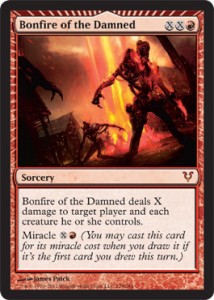
We've received word that several pros are running Miracle decks. The idea is simple - cram all the R/W/U Miracles into the same deck and then bank on seeing one every other turn. Does it matter if the Miracle is a Terminus or a Bonfire of the Damned? You're getting a discount on any spell flipped. The big question is not if they're running the Loothouse, but how many copies they have. This card is about $2.00 right now and could take off if they do well. Keep your eyes on the Miracle deck's performance and have a ready source for a few Lighthouses.

Douglas Linn

Doug Linn has been playing Magic since 1996 and has had a keen interest in Legacy and Modern. By keeping up closely with emerging trends in the field, Doug is able to predict what cards to buy and when to sell them for a substantial profit. Since the Eternal market follows a routine boom-bust cycle, the time to buy and sell short-term speculative investments is often a narrow window. Because Eternal cards often spike in value once people know why they are good, it is essential for a trader to be connected to the format to get great buys before anyone else. Outside of Magic, Doug is an attorney in the state of Ohio.  Doug is a founding member of Quiet Speculation, and brings with him a tremendous amount of business savvy.

View More By Douglas Linn

Posted in Avacyn Restored, Free Insider, Pro Tour Avacyn Restored1 Comment on Insider: Pro Tour Avacyn Restored (#PTAVR) Exclusive Calls

Have you joined the Quiet Speculation Discord?

If you haven't, you're leaving value on the table! Join our community of experts, enthusiasts, entertainers, and educators and enjoy exclusive podcasts, questions asked and answered, trades, sales, and everything else Discord has to offer.

Want to create content with Quiet Speculation?

All you need to succeed is a passion for Magic: The Gathering, and the ability to write coherently. Share your knowledge of MTG and how you leverage it to win games, get value from your cards – or even turn a profit.

Pro Tour Avacyn Restored (#PTAVR) Live Coverage and Analysis

Are you a Quiet Speculation member?

If not, now is a perfect time to join up! Our powerful tools, breaking-news analysis, and exclusive Discord channel will make sure you stay up to date and ahead of the curve.

#ptavr | fantasyPT | video | RSS | @quietspec

Hi folks! Don’t want to prune through Twitter updates all day for Pro Tour Avacyn Restored tech? Here’s the one page you need. We will be continuously updating this page with stories of savage beats, wild unsubstantiated rumors, worthwhile recaps and more.

Our Insider subscribers also get access to our realtime email blasts with trade ideas and tips!

Day 1 (Friday, 5/11): Rounds 1-5 Block Constructed, Rest Draft

Day 2 (Saturday, 5/12): Rounds 12-16 Block Constructed

Douglas Linn

Doug Linn has been playing Magic since 1996 and has had a keen interest in Legacy and Modern. By keeping up closely with emerging trends in the field, Doug is able to predict what cards to buy and when to sell them for a substantial profit. Since the Eternal market follows a routine boom-bust cycle, the time to buy and sell short-term speculative investments is often a narrow window. Because Eternal cards often spike in value once people know why they are good, it is essential for a trader to be connected to the format to get great buys before anyone else. Outside of Magic, Doug is an attorney in the state of Ohio.  Doug is a founding member of Quiet Speculation, and brings with him a tremendous amount of business savvy.

View More By Douglas Linn

Posted in Avacyn Restored, Free, Pro Tour Avacyn Restored, SpecialLeave a Comment on Pro Tour Avacyn Restored (#PTAVR) Live Coverage and Analysis

Have you joined the Quiet Speculation Discord?

If you haven't, you're leaving value on the table! Join our community of experts, enthusiasts, entertainers, and educators and enjoy exclusive podcasts, questions asked and answered, trades, sales, and everything else Discord has to offer.

Want to create content with Quiet Speculation?

All you need to succeed is a passion for Magic: The Gathering, and the ability to write coherently. Share your knowledge of MTG and how you leverage it to win games, get value from your cards – or even turn a profit.

Insider: StarCityGames & Avacyn Restored Standard Slump?

Are you a Quiet Speculation member?

If not, now is a perfect time to join up! Our powerful tools, breaking-news analysis, and exclusive Discord channel will make sure you stay up to date and ahead of the curve.

Avacyn Restored is now fully released and the set is legal in Standard. While Pros are overseas testing for Block Constructed, the rest of us peasants are working on PTQ season. I had expected last weekends StarCityGames.com Open in Providence to provide some new decklists so we could jump on some speculations right away.

The results of the event, however, weren’t exactly innovative.

What does this mean? Does it mean Avacyn Restored really won’t make much of an impact this season? Maybe it means people stuck to safe plays instead of trying new things. Perhaps it just means not enough people had access to the new cards to get their newest brews in working order.

What did show up?

Five different decks appeared in the top 8, some new and some old. The old decks didn’t see many changes, but lets take a look at them.

G/R Aggro

G/R Aggro won the event, and the only cards from Avacyn Restored in the mainboard was the same uncommon I honed in on last week, Wolfir Avenger. This deck boasted 3 copies in it’s mainboard, and I only expect this card to see more play. It is still only $0.50 retail, and I think that’s a crime. I’m stashing these.

In the sideboard we see a singleton Zealous Conscripts. This card is a powerhouse against control and gives G/R the ability to power through after a control deck tries to go over-the-top with a planeswalker or 6+ drop. He’s already climbed up to $3 retail pricing, and I don’t expect him to move much more than that. As a 5-mana non-mythic sideboard card, he’s probably at his peak right now. We’ll see later that some decks are running more copies of this guy in the board, but none yet creeping to the mainboard.

Wolf Run Ramp

There were two Wolf Run decks in the top 8. The big question is are we going to see Cavern of Souls? The second place deck ran 3 copies mainboard (with 1 in the side) while the 5th place deck only had two copies in the side. Time will tell whether or not Cavern of Souls is fully adopted into this strategy, but I simply don’t see the format progressing without this card being extremely relevant.

Forcing down a Primeval Titan is exactly what this deck wants to do. The question is whether or not Cavern of Souls can maintain its high ticket. Since it won’t be in the event decks, we can reasonably assume it will stay afloat, even if it creeps down a little bit.

One of the decks had a singleton Bonfire of the Damned, and I like that choice over Devil’s Play. This card has already shot up to $12 (and is sold out on StarCityGames.com). While I think $12 is probably too high for this card, it’s certainly a powerful Mythic and will be seeing play. If it dips to the $8 range I’ll be buying in. This is the biggest missed opportunity of the set. It preordered at $6, and I know I certainly misevaluated it, thinking it wasn’t going to make much of a splash in Standard.

Now that I’ve tested it a bit myself, I can see I missed the mark on this card. It will be a player throughout Standard season this summer. The Wolf Run decks both ran some number of Zealous Conscripts in the Sideboard, like the G/R aggro deck does, and I think this is a pattern we’ll see for the remainder of the year.

U/W Delver

The U/W Delver lists (3rd and 7th), literally saw no Avacyn Restored updates at all. I’m thinking (maybe hoping) that this is only temporary, and that either new decks will force the Delver decks to change, or that the Delver decks will evolve to include some new technology. Replacing last years “Caw Blade” with a similar U/W aggro-control deck will make for an annoying summer. That being said, Geist of Saint Traft and Snapcaster Mage are holding their own through the new set’s release.

Solar Flare

Solar Flare also jumped into the Top 8, with the Sun Titan+Phantasmal Image engine being the prominent focus of the deck. Two Cavern of Souls in the Sideboard are the only Avacyn Restored cards in this 75, and I was surprised to not see Griselbrand in some quantity in the main or side. In a land with no countermagic, Solar Flare is a solid strategy as long as it can employ a defense fast enough to hold off the aggro decks.

This deck relies on Oblivion Ring and Dead Weight, because they are recurrable with Sun Titan. I’d like to see more iterations of this deck, because Avacyn Restored brought lots of Reanimate options if this were to shift to a more Unburial Rites focus rather than Sun Titan. Keep your eyes on the big Angels and Griselbrand if that shift happens.

W/R Humans

In 6th place we did get a refreshing new deck. W/R Humans. It’s been terrorizing Block Constructed for months, and with the new Avacyn Restored additions, it immediately cracked top 8 of Standard. The usual suspects from previous Human decks are all present, but we get the addition of Silverblade Paladin and Lightning Mauler. Silverblade Paladin is a strong card, but is at its best in a White-Weenie deck like this one. I am uncertain if the Paladin can stand to grow any further, as its already been printed as a promo.

Further, we again have Zealous Conscription in the sideboard. This deck, however, ran the full 4Cavern of Souls and added a Slayer’s Stronghold. A tribal deck like this gets maximum value out of the Cavern, and this is where we get to see its best strengths. If there comes a point where there are multiple tribal decks fighting in top 8’s we could see the Cavern creep up, otherwise we’ll expect it to slowly fall downward, but not too far.

G/W Humans

In 8th place was a GW Humans deck, that had only the Wolfir Avenger sporting the Avacyn Restored expansion symbol. Again, this card is very aggressively costed, and it will continue to see play. Outside of that, this deck doesn’t look much different than GW Humans did after the release of Dark Ascension, and I don’t know that we’ll be seeing a ton of this deck in the coming weeks.

So what does the lack of AVR cards in this most recent open really mean? It means this format is still adjusting. The top pros are all working on block, and until they return from Barcelona, we likely won’t see the power of what these new cards bring to the format. Keeping our eyes on powerhouse cards from the upcoming Pro Tour weekend will give us a head start, but we’ll also want to keep our eyes peeled for new standard decks that pop up at the lower circuits. While people are focused on the Pro Tour, you can find some sick Standard speculations.

Avacyn Restored’s Impact on Standard

Are you a Quiet Speculation member?

If not, now is a perfect time to join up! Our powerful tools, breaking-news analysis, and exclusive Discord channel will make sure you stay up to date and ahead of the curve.

I’m sure by now that you’ve read a lot about Avacyn Restored. There are a wide variety of articles available about this set, each by a different author with his or her own observations. When a new set comes out I like to read a wide variety of opinions to get the broadest view possible.

Over the next few weeks, I’ll be talking about Standard decks, how the metagame is evolving and how we can adapt. For today though, let’s talk about the new cards that are going to impact Standard the most.

At first glance, a set chalk full of angels and demons like Avacyn Restored may seem like a casual players dream, unlikely to affect tournament results. However, this set has its top performers like any other and some are sure to become staples.

Here are my picks for the ten best cards.

Honorable Mention:

Many players, including me, underestimated soulbound at first glance. This is mostly because of a few details of the mechanic that aren’t immediately apparent. The biggest detail that people tend to misread or misevaluate is that soulbound creatures can be bonded to a creature that enters the battlefield after they did. This is an attribute that certainly ups the mechanic’s power level.

Lightning Mauler essentially has two modes. The first one consists of casting him on turn two after a one-drop and pairing him immediately. This is reminiscent of Rip-Clan Crasher, a card I’ve played to great effect before.

The other mode involves following Lightning Mauler with a powerful expensive card that can become downright nuts when it has haste. Hero of Bladehold comes to mind, for example.

Haste is a powerful ability, and Lightning Mauler seems good enough to see play in Standard. It’s possible that Humans may move into red to take advantage of him.

Honorable Mention:

One mana for five damage —a full fourth of your opponent’s life— is a crazy ratio. Even if you never cast this spell for its normal casting cost, it can play an important role in successful burn decks. Faithless Looting can also be used to discard Thunderous Wrath when it ends up in your hand. The red mages I’ve talked to do not agree on whether or not it belongs in the deck, so only time will tell.

#10

At my prerelease I had a lot of fun surprising opponents with Wolfir Avenger. Three mana for a 3/3 is already efficient and even if it only had one other ability it would probably see play in Standard.

Regeneration is powerful, but flash is what pushes Avenger over the edge, letting you ambush something midcombat. Don’t underestimate the relevance of three toughness either. Not many creatures in Standard deal three damage. I see this guy filling a hole in G/R Aggro. He already has a home, so be ready to play against him.

#9

Vexing Devil is not the second coming of Goblin Guide. I’d say it’s more like Furnace Scamp. So how good is it? I am not sure but I know it will be played. I also know the metagame needs to adapt to his presence. This will mean more Timely Reinforcements and other specifically anti-red cards. Celestial Purge is already seeing play because of Zombies, which may cause some splash damage to Devil. I am not sure if red has what it takes to contend in the new Standard environment, but I know players will try so be ready.

#8

Dangerous Wager has a lot of uses. It can be played in a reanimator deck to discard your fatties. It can be played in a Burning Vengeance deck to get rid of unneeded cards or fill up your graveyard with flashback spells. It can also be used in an aggro deck to draw some more cards after you've played out your hand. On top of all that, it’s an instant. Dangerous Wager isn’t sounding so dangerous to me; it sounds quite good.

#7

Last week, I talked in detail about the miracle cards from Avacyn Restored. I don’t think miracle cards are broken, but they are all strong and might find a home in various formats. Cost reduction effects have traditionally been the turf of tournament-caliber (and sometimes busted) cards.

Terminus for example, clears the board for a dangerous one mana. At thaht cost you can cast other spells in the same turn which can be back-breaking against an aggressive strategy. Sending creatures to the bottom of libraries is also more powerful than the typical “destroy” effect of Day of Judgment.

Six mana is perfectly reasonable for this effect so I imagine it will be played in Standard. It should also see Legacy play because you can set it up with Brainstorm. This is definitely a card to keep your eye on.

#6

[card Bonfire of the Damned]Bonfire[/card] seems to be one of the more influential miracle cards because of its strength against creature-heavy decks. I am still unsure whether it will be played in the sideboard or main, but a miser’s copy seems fine for any deck. It is not clear how much of an impact this sweeper will have on Standard, but it should make players alter their plays just by existing.

#5

My initial impression of Silverblade Paladin was that it was outclassed by Mirran Crusader. That is no longer my opinion. Despite the protection offered by Mirran Crusader, I expect more and more players to adopt the new three-drop. It can deal a huge amount of damage even on the turn it’s cast by granting another creature double strike. If they kill the first creature you pair with it, you can always pair another creature with it later.

Silverblade Paladin will effect the Standard format for as long as it is legal because it offers a unique and powerful effect. Between this and Lightning Mauler, there may even be a deck centered around soulbound.

#4

This is my favorite miracle card in the set by far and it seems like a lot of players caught on to how good this card is since its price quadrupled this week. This now twenty-dollar card seems like it is going to be quite the powerhouse. Revealing it when you have three, four or five mana is extremely good. The normal cost might be hard on the white mana, but the explosive upside will tempt a lot of decks to play this. If you summon your angels with the miracle cost, you are adding a ton of power to the board and can probably swing for lethal the following turn.

#3

Desolate Lighthouse may turn out to be the best of the ten-card cycle from Innistrad. This land allows you to filter out unnecessary lands or spells and draw into the things you actually need. In addition, it provides a discard outlet to enable other strategies. The power of this land may be subtle, but it will have a huge impact on deck building decisions for the upcoming season.

#2

It may surprise you to see a common burn spell as the second most influential card in the set. Pillar of Flame definitely has what it takes to shake up this format though. It permanently answers Gravecrawler, Strangleroot Geist and Geralf's Messenger, all a huge part of the metagame.

The best comparison we can make to this card is to Magma Spray. That card was an excellent answer to Kitchen Finks which had a huge presence and was very difficult for an aggressive deck to deal with. The same is true of Pillar of Flame. I love Magma Spray 2.0 and expect it to see a ton of play. It may even help some decks that may not have been viable otherwise. U/R Delver, for example, would love this card. Flashing it back with Snapcaster Mage is particularly strong, even if you have to do it on your turn.

#1

Unlike the previous card, I doubt this choice surprises anyone. Cavern of Souls is certainly not the end of Magic but it will change the game across every format. That is an impressive task for any card.

In Standard, Cavern of Souls allows tribal decks to flow more smoothly and also helps your mid- and late-game bombs resolve. In Modern it will see play but maybe not in as many decks. In Legacy, I think the existence of this land will altar the face of the format. This land might allow a creature-based combo deck like Elves to rise in status.

I do wonder if this land is too powerful to print. Only time will tell. Since it does exist, we may as well take advantage of it. Metagames will adapt to include more ways to deal with permanents instead of countering them, which I think is good for the game. In any case, I would advise you to get your copies now because I don’t see this going down in price very soon.

There are actually a bunch of other cards not on this list that may impact Standard, such as Angel of Jubilation, Avacyn, Angel of Hope, Restoration Angel and the other miracle cards. Avacyn Restored has a lot of playable cards for constructed Magic so start looking over the set to see how you can innovate your Standard decks.

Do you agree with my top ten? If you have strong feelings about this topic, post your list as well so we can talk about it. What did I miss? What do you think will impact Standard the most? Let me know in the comments.

Thanks for reading.

Until next time,

Unleash the Force on Standard!

Mike Lanigan
MtgJedi on Twitter
Jedicouncilman23@gmail.com

If You Build It: On Netdecking, Brewing and Playing the Right 75

Are you a Quiet Speculation member?

If not, now is a perfect time to join up! Our powerful tools, breaking-news analysis, and exclusive Discord channel will make sure you stay up to date and ahead of the curve.

Of all the constructed formats, I believe that Standard rewards playskill the least. Think about the cards that have defined recent Standard environments.

The difference between drawing these cards and not drawing them in their respective decks is colossal.

Okay, so this one is close.

The reason for this is that the second best card in any of these decks just isn’t close in terms of power level. Sure, Squadron Hawk was good, but how many uncounterable Batterskulls did it come with? Cryptic Command was insanely powerful, but it didn’t actually kill your opponent. Geist of Saint Traft is a fine man, but you’ll find that he’s a lot easier to Mana Leak than Delver of Secrets.

I’m not saying that good players aren’t rewarded for playing well in Standard, but I do believe that the luck involved in Magic is more readily apparent in Standard than Extended, Modern or Legacy.

This being the case I find that having a well-tuned deck for a given weekend is of the utmost importance in Standard.

When it comes to larger formats I like the idea of playing very close to the same deck week in and week out to maximize your familiarity with it. This just doesn’t work as well in Standard. Some weeks you want to be Delving and some weeks you want to be jamming Garruk's Companion. I don’t even want to think about what I’m playing in a given Standard tournament until I've seen the results of the week before.

If you want the best deck for an event you won’t find it in the standings the week before. You won’t find it neatly nested in the latest article of your favorite pro. The only way to truly obtain the “best deck” is to build it yourself.

On Netdecking

Don’t get me wrong, playing the popular strategies of Standard is usually correct. That said, copying exact lists is usually wrong. The simple fact of the matter is that people are always ready for last week’s tech.

Take a look at the results from SCG Salt Lake City. Sure looks like Delver is the deck to play, right?

Now look at the results from the very next week in Des Moines. GR aggro is tough for Delver and this information was exploited by both finalists in this event.

Since then we have seen a fluctuation of the success of these two decks in the presence of metagames that are hostile to one or the other.

Plague Wind is good.

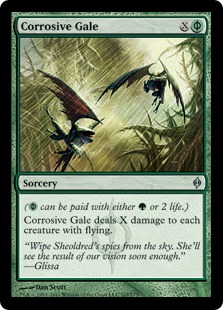
Remember the Pro Tour Dark Ascension Top 8? That Spirits deck sure looked real, until everybody (and I mean everybody) started siding Corrosive Gale. And did ramp fall out of favor immediately after or what?

You don’t want to be the one that shows up with last week’s Spirits only to lose to this week’s Corrosive Gales. You want to be the person that is casting the Gales. You want to be the person that innovates the Jace, Memory Adept tech against UB control. This is the difference between 0-2 drop and X-0-2 Top 8.

So what's the best way to do this?

Avoid Building with Large Groups

When it comes to deckbuilding, I’ve noticed that a lot of newer players will ask anybody who will respond for advice for their deck. This becomes a less fruitful exercise the better you get at the game.

The obvious reason for this is that the better you get at Magic, the fewer people with better opinions than yours there will be to ask.

The less obvious reason is that even amongst very strong players there isn’t always a consensus on what the optimal build of a deck is. Some players like Runechanter's Pike, some tend to Sword of War and Peace. Some prefer straight GR Wolf Run builds, while others would rather splash black or white.

An important thing to realize is that these ideas can’t always be hybridized. A mix of Pikes and SoWaP is fine, but Wolf Run splashing both black and white probably doesn’t work. The more differing opinions you incorporate into your deck-building process, the less likely you can successfully work them all into your build.

Different players have different playstyles and you don't want players with vastly different playstyles working on the same deck.

LSV is considered by many to be the best Magic player in the world. That said, he's not a stone master of all things Magic. Last December he posted a Running the Gauntlet video for Legacy RUG Delver. Let's just say that his play was a bit shy of perfect. During that series he tried to fit Thrun, the Last Troll into his sideboard. Meanwhile other players were moving away from Snapcaster Mage because it was too mana intensive.

Just because somebody is a great player that doesn't mean you want their opinion on every deck.

The Napkin Deck

Now for an anecdote.

Way back when there were still block constructed PTQs, I found myself with a group of Winona players at Perkins trying to build a deck for somebody that wasn't sure of how to build his deck.

The format was Lorwyn Block Constructed and he wanted to play GW Aggro. You would think that this would be an easy deck to hash out.

You would be very, very wrong.

Somebody wanted to cut this guy.

Heads butted for at least an hour on everything. The manabase. The spell suite. The sideboard. There were even people suggesting that obvious includes be cut.

I mostly kept quiet during the discussion, as there was no reason to raise my voice over a deck that I wasn’t going to play. Instead I asked my friend Jens if he had a pen I could borrow. After retrieving his writing utensil I began scribbling a potential UR control list.

I ended up with a pretty neat deck that featured Mulldrifter and Chandra Nalaar as the only win conditions. I considered playing it myself, but I had a Doran deck that I was pretty set on playing. I ended up shipping the list to Dan Skoglund.

The PTQ didn’t go well for me (actually, my story from this event is beyond embarrassing) but I was more interested in the contest between Napkin.dec and Greenwhitenonsense.dec. The GW deck ended up 0-2ing and Dan ended up missing top 8 when the wheels fell off after a 4-0 start. The list was strong but it was ultimately off by a few cards.

You Can’t Do It Alone

While I do advocate avoiding large groups, I also strongly recommend building with one or two other people.

The most success that I’ve ever had with a format was Extended during the PTQ season for PT Nagoya. I only played in two events this season. I Top 8’d both and won the second.

In order to prepare for this format I playtested everyday with Jon Amaro. Through our playtesting I personally had the chance to play with every deck that I thought was a major contender. This gave me a feel for which cards were and were not carrying their weight in every deck and gave me a lot of insight into which cards would be good to sideboard against each.

Problems arise when you get this information from other players.

The worst story I have in this regard was in preparation for PT Nagoya. We didn’t have a lot of time between the release of New Phyrexia and the Pro Tour itself, and this meant that some division of labor would be necessary to get the most information on the format possible. Everybody in the group focused on one deck specifically and was responsible for determining the best build of that deck.

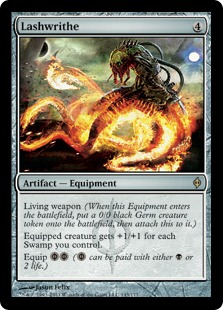
It equips for free and everything.

Brandon Nelson was our guy for Monoblack Infect, and he was immensely disappointing in this role. From the beginning we all encouraged him to include Lashwrithe.

He refused, citing that he "didn't like it.” For days he playtested with his build of the deck until Kyle Stoll decided to pilot it with  Lashwrithe. It was quickly determined to be the best card in the deck, completely invalidating all of Brandon’s data.

I was personally responsible for working with Tezzeret, Agent of Bolas. I had been playing a Tezzeret Infect deck online prior to the NP release, but ultimately I came up with a UB control list (found here).

Most of the team ended up on my list, but many of those playing it didn’t spend any time questioning my card choices. The first reaction that many players gave me when receiving the list was to ask for a sideboard guide. To be fair, we didn’t have a great deal of time to playtest the list after I brewed it, but it was clearly off by a few cards.

Kyle Stoll and Martin Goldman-Kirst were the players that spent the most time messing around with my list before it was time to play and they offered some very good changes. Off the top of my head, Kyle is responsible for the maindeck Stoic Rebuttals and the sideboard Batterskull that were both very strong improvements over my original list.

The Process

This could probably be pieced together from reading the above, but for all the tl;dr-ers out there, here is a quick guide for how I approach a format:

Step One:

Be very familiar with how all of the decks in the format operate from both sides of the table. Knowing what your opponent is trying to do is essential to knowing how to play against them and how to build your sideboard for an event.

DON’T GET THIS INFORMATION SECOND HAND.

Even very good players are capable of being wrong. Of course, you should be aware of common opinions and be honest with yourself about why you think your opinion differs from that of others when it does. Just because you won 10 games running on one side of a matchup does not mean that the matchup is good.

Flukes happen and it’s important to recognize them when they do.

Alternate deck-building process.

Step Two:

Be aware of what did well last week. Whichever strategies had success last week are likely to have a target on their head the following week. How exactly you adapt to this depends on the specific format, but it could be anywhere from completely avoiding playing last week’s deck to adapting the list from the week before to beat potential hate that is expected.

Step Three:

Come up with a rough list for what you want to play. You should come up with this list on your own so that your thoughts aren’t influenced by anyone else's bias.

Step Four:

Playtest your list to confirm or deny your thoughts on the cards in your build. Again, it’s very important to be honest with yourself in this phase. You can’t let the one time that you miracled Temporal Mastery eclipse all the times that it was a mulligan.

Step Five:

Send your list around and ask for suggestions. Hopefully the people you’re asking have been a part of your playtesting up to this point so that their suggestions are based on similar experiences.

From here you repeat steps four and five until you have a list that you’re happy playing.

~

My feelings about Standard may paint a gloomy picture, but I can’t understate the advantage that a player gains when they innovate new technology. I hope that you found this article helpful in reaching this end. Happy brewing.

-Ryan “The Dan ‘Wait that was probably too many oh God’ Broverton” Overturf

CommanderCast S6E01 – EDH Hipsters

Are you a Quiet Speculation member?

If not, now is a perfect time to join up! Our powerful tools, breaking-news analysis, and exclusive Discord channel will make sure you stay up to date and ahead of the curve.

The internet shudders, threatens to explode, but somehow remains intact as CommanderCast projects itself back into the datasphere with the season six premiere! In a riveting extended episode of emotional highs and lows, spiritual enlightenment, and some girlish giggles, I hold it down with my co-host Donovan and guests Carlos and Karston of TopAndGoProductions.

Hit the button or play, or download the entire episode! The full show notes are here.

For more Wrexial-Approved stuff, hit up http://www.commandercast.com.

Insider: Magic: The Gambling

Are you a Quiet Speculation member?

If not, now is a perfect time to join up! Our powerful tools, breaking-news analysis, and exclusive Discord channel will make sure you stay up to date and ahead of the curve.

Avacyn Restored is upon us in all its Angelic and Demonic glory. It appears Wizards of the Coast has hit another home run with this set, at least with casual players.

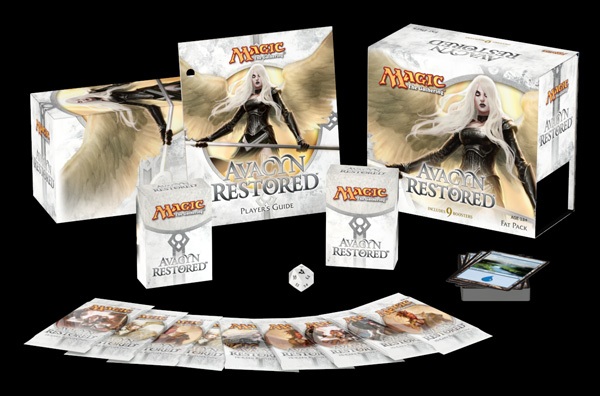
An Angel collector myself, I was even compelled to purchase a fat pack and try my luck at nine packs of Avacyn Restored. What I found inside, however, was utterly disappointing.

Within these packs were nine normal rares: Angel of Jubilation, Harvester of Souls, Captain of the Mists, Conjurer's Closet, Gallows at Willow Hill, Descendants' Path, Slayers' Stronghold, and two Druids' Repository.

Utterly dismal, these packs likely have trade value on the order of eight dollars and it really frustrates me that Wizards can’t at least ensure there is at least one Mythic Rare in each fat pack.

But this article isn’t completely about my anecdote, although it is certainly related. Instead, I want to dive into a deepening dichotomy Wizards has created through multiple questionable decisions they’ve made.

Do I Feel Lucky?

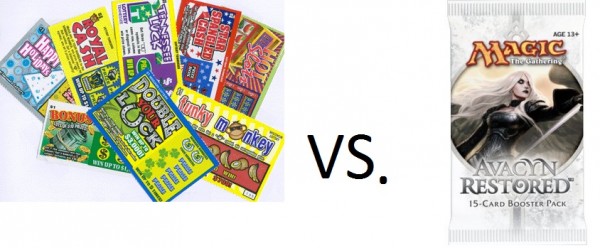
I have commented before how opening Magic: The Gathering packs have become analogous to scratch-off lottery tickets. The introduction of the Mythic Rare and Planeswalkers has compounded this result. While the inconsistent payouts to purchasing packs may be rewarding and even addicting to some, it has really dissuaded others from ripping open random sealed product.

The result is the first step towards the dichotomization I alluded to. Much like the purported dwindling of the middle class within the United States, many people have identified sealed Magic product containing middle-of-the-road value a thing of the past.

My most recent experience is a microcosm of this observation. Statistics may be the underlying body governing what people open in their packs, but at times the numbers appear suspicious. Even if I accept the fact that my luck was perhaps particularly poor this last fat pack, the general trend remains the same. And, given the psychology that my own experiences frame my perceptions on random distributions of events, I am left with a saddening conclusion: opening packs is feast or famine. The feasts are far outweighed by the garbage rares distributed throughout packs.

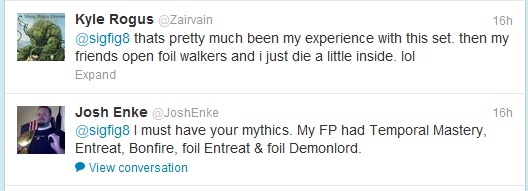
My hypothesis is further supported by fellow Tweeters who were quick to either commiserate or counter-argue with my own experience. Here are two examples, which occurred nearly simultaneously within the Twitterverse:

I realize statistically this sample size is insufficient – this I cannot argue with. But my individual perception is absolute and cannot be refuted. In this moment, my perception is that opening fat packs is like playing the lottery.

I have not had success playing the lottery in the past, so why do I continue to open packs? I may need to stop. After all, everyone knows the best way to obtain desired singles is to purchase them directly. Opening packs is monetarily inefficient as dictated by statistics.

Well Do Ya, Punk?

As I discussed last week with Hasbro’s recent earnings results, this strategy of feast or famine has clearly been successful. The makers of Magic: The Gathering have identified a way to legalize gambling for all ages. A 13-year-old can purchase a pack of Avacyn Restored for four dollars, open up a foil Cavern of Souls and proceed to sell it for forty dollars – a lucrative day at the local hobby shop.

On a related note, the recent Helvault experience magnifies the gambling experience.

What am I alluding to? The recent publication [confession?] of Wizards, which explained the distribution of jackpot Helvaults throughout the world:

We wanted to provide a unique Magic play experience for our players, so we made some Helvaults with special contents. Of the roughly 6,000 Helvaults we sent out, we selected 30 Helvaults to get this special treatment. We picked randomly from our Advanced level WPN stores and sent the Premium Helvaults to their new home. These stores received Helvaults which had the following inside:

• 54 Foil Oversized cards of Avacyn, Angel of Hope, Griselbrand, Sigarda, Host of Herons, Bruna, Light of Alabaster, Gisela, Blade of Goldnight
• 108 Foil Double-sided Angel/Demon tokens
• 54 20-sided spindown life counters
• 54 Promo Foils thematically tied to angels or demons

Do you realize what this implies? There was a 1 in 200 chance of opening the special Helvault! What was inside? Only a handful of promo foil cards arguably rarer than Beta Black Lotus!

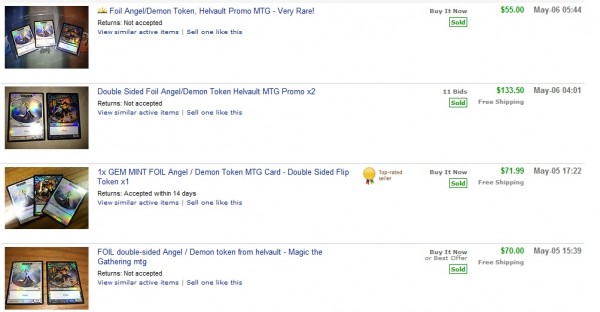
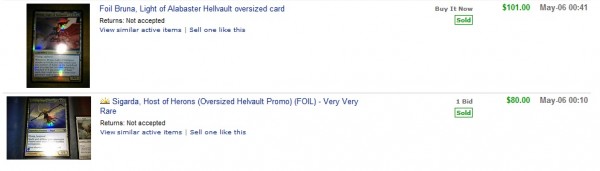
Considering the fact that foil tokens are averaging $70 on eBay and the foil oversized promos are even higher, the result was the random giveaway of thousands of dollars worth of cards in each special Helvault.

In fact, assuming each oversized foil promo is $100 and each foil token is $70, we can readily calculate that the value of a special Helvault auctions for at least $13,000!!! Talk about hitting the lottery!

Now the payout for attending your local Magic events is beyond even the lottery tickets you buy in the form of booster packs. With special events like these, a whole new level of gambling is created based solely on which event you attend and where. Anyone could have walked out of a hobby shop with hundreds of dollars in cards after an event like this one.

Magic players are known to grumble and groan when they shouldn’t. After all, it was generous of Wizards to create this giveaway – they certainly did not have to shell out the thousands of dollars it costs in printing, distribution, etc. for running a promotion like this. By having this drastic dichotomy in relative payouts, however, Wizards has only watered the seed that is the entitlement Magic players feel they deserve.

For Me, Always Assume There Is a Sixth Bullet Left

If you don’t get the reference, check this video out: http://www.youtube.com/watch?v=u0-oinyjsk0

What I am implying here is the perhaps painful message to Magic players around the world that we are NOT entitled. When you buy a scratch-off lottery ticket, you certainly do not expect to win, right? In the same vein, when we purchase a pack of Magic: The Gathering cards, we are only entitled our fifteen cards and one rare. We are never guaranteed to earn value back on packs.

With all the random promotion giveaways Wizards decides to organize, we are receiving free product. Rather than point fingers at the next guy over and accusing Wizards of showing favoritism, we need to remind ourselves that this is the reality of randomness.

Of course, this gambling experience the creators of Magic have fostered may not be appropriate in general. For most true games, the question of profit only becomes relevant with professional success. As it always has, Magic falls within a very unique category by containing aspects of both a game as well as a gamble.

My approach to this realization will remain firm from this point forward. I never purchase scratch-off lottery tickets because I anticipate losing. In the same sense, I will refrain from purchasing booster packs and fat packs because I do not wish to spend my hard-earned dollars on bulk cardboard.

My most recent fat pack experience solidifies this. With thirteen Angel creatures in Avacyn Restored, some of them even commons and uncommons, I was convinced I would open at least a few. Instead, I was punished with opening only two: Seraph of Dawn and Angel of Jubilation. At the price of $40 plus tax, this was a very poor outcome and highly reflective of the gambling nature of this game.

When odds are increased, and you are looking for simple commons and uncommons from a given set, opening such poor fodder is an even more fateful dagger. My message to Wizards and the broader Magic community: until this dichotomy is removed, I vow not to open another sealed pack of Magic outside of Limited tournament events. Who is with me?

-Sigmund Ausfresser
@sigfig8

Jason’s Archives: Arrested Development, More Tales from the Helvault, Future Sight & Lessons from Providence

Are you a Quiet Speculation member?

If not, now is a perfect time to join up! Our powerful tools, breaking-news analysis, and exclusive Discord channel will make sure you stay up to date and ahead of the curve.

Welcome back, Speculators!

With the Avacyn Restored Release event in our rearview mirrors, some surprising things are happening to the prices of singles:

  • Entreat the Angels, a 5 dollar preorder card, hit 20 dollars with no clear sign of stopping, despite a scant 5 copies of it appearing in the entire top 32 in Providence (more on that later).
  • Zealous conscripts, one of my called shots, continues to spike upward as players use it to borrow Wurmcoil Engines long enough to deal that KO blow or abuse its potential with Cloudshift.

A few cards I have up my sleeve are on the precipice of seeing real inclusion in Tier 1 decks and it's, in general, an exciting time to be a value trader and speculator.

A Public Service Announcement

No one asked me to do this, but I wanted to take a minute to talk to you about a time when I was wrong.

A year ago I was a reader of this site on my lunch breaks at my job, never imagining my life would change as much as it did and lead to me actually being a contributor. As a friend of Ryan Bushard (name dropper!) I was aware of this site and occasionally read the free site articles and lurked on the forums.

I saw how much Insider cost and dismissed it as too expensive. Insider access not only gets you excellent financial articles, but also gives you invaluable e-mail tips on called shots, allowing you to pick up cards that are sometimes literally hours away from spiking, which can make you a ton of money.

Did you manage to sell Food Chain at 10 bucks this week? If you did, do you still have four playsets because you bought them at 2 dollars the day before they hit 10? If you were an Insider, you probably did.

Again, no one from QS asked me to write this, nor were they aware before this morning I intended to, but if this makes it to print it's because I want the readers of my article to have every advantage.

I don't care whether you buy an Insider membership or not: my intention here was merely to counter my previous misconception. If  you think Insider is bad value, like I used to, I am here to tell you I would never go back to not having it.

When you sign up, I recommend taking the time to read some archived Insider articles. You will absolutely get your money's worth. In the case of Food Chain, that one tip made me more money than a year's subscription costs. [Editor's note: We currently offer subscriptions based on 1month-3month increments.  You can learn more about Insider here.]

Arrested Development

I think Fox made a huge mistake when they cancelled this show. I realize they had a nice "The only stuff we show on Sunday night is Seth McFarlane cartoons for 2 hours" motif going on, but AD is easily the most clever comedy ever conceived, and if you don't have Netflix (and what possible reason could you have for that?), get it soon so you can watch all 3 Seasons in time for the Netflix-exclusive fourth season. If you've seen the show, I imagine you're a fan and I hope you like what I have for you this week.

My name is juuuuuudge

A mystery judge recently took time out of his busy schedule to talk to reddit about any rules questions you may have. Buckle up, because it gets a little convoluted. But in the end I think you'll have an appreciation for the rules process a bit more. This is a can't-miss IAMA and I think you'll thoroughly enjoy.

Still, where'd the lighter fluid come from?

Brought to you be redditor wwcory:

    Dead Dove tokens not included. I don't know what you expected.
Dead Dove tokens not included. I don't know what you expected.

We've made a huge mistake (?)

Wizards wants to know if they have made a huge mistake with Avacyn Restored.

A lot of people have been jumping to conclusions (I'm not mixing Office Space jokes into an AD-themed section here, so let's just ignore that one) about future prereleases. Wizards seems to want to figure out how they will handle the next prerelease, as they're still collecting data on how the Helvault was received.

Want to be part of the solution? Take a survey and let them know what you thought of the cards, Helvault, art and Avacyn Restored in general. It's quick and the data will have an impact.

Tales from the Helvault

Not everyone's Helvault experience was the same. Some won the Helvault lottery and walked away with foil tokens and a foil Demoinc Tutor or Balance. Some had the relatively mundane experience of getting the spindown and regular tokens. Some, however, took matters into their own hands and made sure their Helvault experience was one to remember forever. Here are a few of the more exciting ones I found.

An easier way to break the seals

    Maintain a safe 10 foot distance from anyone wielding a Moonsilver Spear
Maintain a safe 10 foot distance from anyone wielding a Moonsilver Spear

Redditor WeetThins brings us a pic of his LGS and their decision to turn the Helvault into a game. This is what makes having to high-five a dude who's beating you with an Avacyn you can't deal with sting a little less.

Taking "soulbond" literally

Redditor Shuko shares with us a tale about the best possible outcome from the helvault for two of the players at his LGS.

Being part of the solution

Finally, if you hated your Helvault, do something proactive about it and follow WotC's advice.

Future Sight

A few announcements have been made that should have you champing at the bit (it's actually champing, not chomping. I don't know what the verb "to champ" means, but I'm assuming it has to do with bits) for future releases.

The gauntlet of might has been thrown

The next Dual Deck has been announced, and it coincides nicely with the announcement that the next block will be a return to Ravnica.  It's time to pick a side: Niv Mizzet or Savra, Nivix or Svogthos, Putrefy or Electrolyze (that last one seems easy). Wizards has finally gotten the Dual Deck formula right and they aim to continue with their success from Koth vs. Venser.

It sure SOUNDS LIKE the name of a land

MTGSalvation.com is all abuzz with speculation after the "buy a box" promo for M13 has been spoiled- at least its name has. Join the conversation on their forums.

Personally, I think there is little to no chance this indicates that they are continuing the Mirodin "fast land" cycle in a core set. Once Scars block rotates we'd be left with enemy color M12 lands a la clifftop retreat et al. and enemy color fast lands in the core set would give us zero allied-colored dual lands.

That seems pretty ridiculous. I would bet my last dollar that Rootbound Crag and friends see a reprint.

There is precedent, however, for enemy colored lands being in a core set as 9th and 10th editions have the pain lands. It's even conceivable that this could be the first multi-colored core set. We already know Nicol Bolas is a near lock to be printed in this set. All in all there are points to be made on either side, and a name like "Cathedral of War" gives us a lot to talk about.

More germ warfare

Finally, to continue with our germ motif I started last week, Redditor Noms_Tiem brings us Bacteriophage the Untouchable.

    Who needs a Batterskull when you've got T4 penetration?
Who needs a Batterskull when you've got T4 penetration?

Is it decklists time now?

SCG Providence just happened and it was the first real chance to see the new cards performing on a National level. I gotcha lists right here.

Standard

Is anyone else as underwhelmed as I am? There's nothing new here.

The event's winner, Dustin Taylor admitted in an interview after the event that he didn't have any time to test the deck with new cards. Wizards gifted us all Pillar of Flame, the best way to deal with every pesky undying dude from Geralf's Messenger to Strangleroot Geist and the event was won with a 75 that contained zero copies. He had the good sense to put the flashy beater Wolfir Avenger into his list, however. I'm bullish on this card to the max and his inclusion probably contributed to Dustin coming out on top.

Justin Schibanoff's R/W Humans list was easily my favorite list of the event and it contained the most new cards of any list in the top 32. Showing off the awesome power of Cavern of Souls, he put nearly every efficient beater in red and white to good use. I think this list highlights the versatility of Cavern of Souls and reinforces the notion that $25 may not be the ceiling, and I think the "uncounterable" clause may be secondary to the degree of mana fixing availed by this versatile land.

Since the non-human Stromkirk Noble didn't make the cut (and isn't great in a list that wants turn 1 Cavern), the ideal turn 1 is Champion of the Parish. The great thing about turn 1 Cavern > Champion is that any of the 13 plains in the deck coming down on the following turn makes a turn two Gather the Townsfolk happen.

After that, any land in the deck, including the 1-of Slayer's Stronghold, means you can plays t3 Silverblade Paladin and swing for 10. The one thing Cavern isn't great for is tapping for red mana to cast Pillar of Flame. It does, however, give you the colorless you need for Oblivion Ring, Revoke Existence, Sword of War and Peace.... I can go on.

This is the first of many deck that abuse Cavern of Souls and I am a big fan.

However, I have to caution you about reading too much into the results of the first non-Pro Tour post-new set event. Few players felt comfortable enough with a brand new deck and wisely chose instead to port prior weeks' decks over.

This top 32 isn't exactly a statement about the small impact of Avacyn Restored on the meta. We'd be best to wait until the pros get back from Barcelona before we can get comfortable with how the meta is likely going to look here on out.

Legacy

If you invested heavily in Cavern of Souls, you've been arguing with people for two weeks. People have been saying it's going to drop to 10 or 15 dollars, they'll point to how you can get a Snapcaster Mage for 17 Buy it Now on eBay, they'll tell you to sell them now while you can still get $25 for them.

Are they right?

If you're like me, you have been saying Cavern has nowhere to go but up because it may have a greater impact on Legacy than Snapcaster Mage.

Is that ballsy? Yes, maybe.

But is it incorrect? Cavern of Souls can make decks that aren't decks anymore decks again. Could we see the return of Counterslivers? It's surely possible. Can we use it to either windmill turn one Cursecatcher or turn one Aether Vial in the same deck? Yes, yes we can.

But can it make Goblins a deck again?

Apparently it has. The very first Goblin deck I have seen to crack the top 8 of anything since Mental Misstep was printed is running Cavern of Souls! Is this a harbinger of more Cavern inclusion in the future? Only time will tell.

There isn't much of note here other than that Maverick seems to have almost universally eschewed Punishing Fire in favor of Fauna Shaman.Esper Stoneblade may have been dealt a lethal blow by the inclusion of Sulfur Elemental in RUG's boards. And with only one Goblin deck in the top 32, Punishing Fire doesn't have that many tempting targets.

Fauna Shaman is a powerful tool and Maverick almost always benefits from pitching a late Mother of Runes or Noble Hierarch under the bus to tutor up more Knights and Oozes. Serving as another set of Green Sun's Zeniths, Shaman is the kind of utility card Maverick needs in order to stay relevant in a changing meta.

Also notable is RUG Guided Passage. I have been big on this card for a while and it's finally seeing play. The card advantage from this card is huge, it gives you a shuffle, which you can't sneeze at when playing Jaces and Brainstorms, and, most importantly, gives your opponent a chance to blow it.

If they misread the game state and give you the card you need to win, or even the Brainstorm to draw it, you can fish games right out of the toilet. A departure from the same old RUG decks like we're used to seeing, Benjamin Green has breathed a breath of fresh air into a format that was looking to desperately needed innovation.

Speaking of departures from the norm, David Rice wins with Aggro Loam? Only 1 Esperblade in the top 8? This is more like it!

Only time will tell the impact Avacyn Restored will have on the meta game. The pros slinging block cards in Barcelona this weekend may give us a few ideas about which Avacyn Restored cards we should be looking to pick up and potentially use in Standard.

Divine Deflection comes to mind.

That's All, Folks!

Join me next week where I'll be talking more about the impact of Avacyn Restored on the meta, sharing another exciting IAMA with you and maybe we'll have some M13 speculation to discuss.

Keep brewing this set, everyone. Don't be discouraged by the decklists out of Providence. There is a lot of good stuff in this set, and tribal just got better than ever. Buy Divine Deflections, sell Food Chains, use an empty Helvault to propose to some girl you don't even know. Get arrested!

...Development on DVD. Don't get too carried away. I don't want anyone calling me from holding with their one phone call saying they took my advice and cast Pillar of Flames on a police car. I don't care how bad the Canucks are this year.

Stay safe out there, kids, and follow me on twitter. I'd do it for you.

Avatar photo

Jason Alt

Jason Alt is a value trader and writer. He is Quiet Speculation's self-appointed web content archivist and co-captain of the interdepartmental dodgeball team. He enjoys craft microbrews and doing things ironically. You may have seen him at magic events; he wears black t-shirts and has a beard and a backpack so he's pretty easy to spot. You can hear him as co-host on the Brainstorm Brewery podcast or catch his articles on Gatheringmagic.com. He is also the Community Manager at BrainstormBrewery.com and writes the odd article there, too. Follow him on Twitter @JasonEAlt unless you don't like having your mind blown.

View More By Jason Alt

Posted in Avacyn Restored, Finance, Free, Timmy, Web Review6 Comments on Jason’s Archives: Arrested Development, More Tales from the Helvault, Future Sight & Lessons from Providence

Have you joined the Quiet Speculation Discord?

If you haven't, you're leaving value on the table! Join our community of experts, enthusiasts, entertainers, and educators and enjoy exclusive podcasts, questions asked and answered, trades, sales, and everything else Discord has to offer.

Want to create content with Quiet Speculation?

All you need to succeed is a passion for Magic: The Gathering, and the ability to write coherently. Share your knowledge of MTG and how you leverage it to win games, get value from your cards – or even turn a profit.

Insider: Food Chain, Time Spiral MTGO and Getting the Most of your Insider

Are you a Quiet Speculation member?

If not, now is a perfect time to join up! Our powerful tools, breaking-news analysis, and exclusive Discord channel will make sure you stay up to date and ahead of the curve.

This week, I'll be hitting on a few topics that are all related with a common thread: they are about pieces of tech and Insider info and how we get them to you. I'll be talking about some financial stuff, no worries, but also I'm looking to help you optimize your QS Insider experience.

People going crazy about Food Chain

Food Chain is the latest Legacy hype combo card to come out. This happens nearly every set - you get one or two Legacy cards that really tickle people and it can cause huge overnight shifts in the price of cards. Sometimes, it's Personal Tutor and Temporal Mastery. In this case, it's in regard to Food Chain and Misthollow Griffin. The idea goes something like this: you exile your Griffin early on with a Chrome Mox or a Force of Will. Then, you play it with Food Chain in play and net one mana each time you exile it. Infinite mana, just pour it through Maga, Traitor to Mortals or that beloved Eldrazi.

Let the record reflect that this combo is terrible. You can do everything it wants to do by taking Food Chains, Fierce Empath and a few preexisting monsters (like Evoke creatures). This adds nothing new to the mix. Food Chain is still a bad combo. That, however, does not stop people from wishing. Food Chain climbed from about $2.25 to about $11 since this card was spoiled.

On April 19, we sent out an email to let our Insiders know about it. I sent the email through Mailchimp, which is a third-party email sender that does a much better job than our native membership emailing software does. I've heard reports that our emails have not been going through to some people. If you did not receive that email and you were a member on 4/19/12, check your spam folder. If you see the email there, use the feature in your spam folder to mark it as "not-spam" or whatever you need to do. I also highly suggest that you add quietspeculation@gmail.com to your email whitelist, even if you have received Insider alerts from us in the past. Mailchimp is usually very good about delivering emails - it's a commercial product - but sometimes, things can get bounced. I love hearing from readers that they bought a few playsets of these, but it's also tempered with hearing that other readers did not get this email and could not take the opportunity. When you pay for a QS subscription, you're not just paying for articles - you're also getting Insider alerts and forum access.

Sell those Food Chains, by the way!

Tarmogoyf on MTGO

Tarmogoyf is one of the biggest tickets on MTGO - it was about 65 tickets a few weeks ago. Now it's dropped to 57 tix if you want to buy one. What accounted for this 13% drop? Time Spiral packs, and Future Sight in particular, are being given out as prizes for Cube warriors on MTGO. TSP Block is also available as a standalone drafting set on the software for another week. This has already depressed the market on the Goyf a bit. A lot of savvy players simply sold their copies beforehand and are planning on rebuying them later. I think this is a good idea, even though the difference between what you can sell them for and what you can later buy them for might still be a negative number. It makes sense to get out of that market if you know there's a reprint coming. For example, it's wise to get out of Karakas, since FTV: Realms will likely contain the super-Plains.

I first learned about the TSP prize and draft format from our content manager, Tyler Tyssedal. I sent out an email alert and then checked in on our forums, where a discussion had commenced.  You can access our forums by going to www.quietspeculation.com/forum and you can log in with your Insider account. I must tell you right now that everything you see when you log in is strictly visible to Insiders. No members of the public can see it. This is a big reason why people openly discuss trends like this. Forum poster Yossarian ran a contest this past weekend, soliciting wagers on the price of the Goyf at the end of Time Spiral drafting. We'll see on May 16th what the closest call to the actual price was.

The forums are an incredible resource and I tell every Insider to get in and take part. Again, you're paying for moderated, polite, private forums, so you might as well lurk at the least. A lot of trends that get into Insider articles have their birth there and people tend to go in-depth on some really cool subjects. For example, you can learn a bit about pack mapping and how to predict the rares in a box or pack of cards.

You can also get locked-profit pick tips from MTGO traders like the aforementioned resident genius, Yossarian, who explains that "this trade works because of steady demand from redeemers combined with a lack of supply once DII drafting slows down." I had no idea before we started up the forums that redeemers actually affect the MTGO market. It turns out that they move the price on bad mythics like Godsire when they need them to complete sets. Redeemers are, by the way, people who collect entire MTGO sets and then redeem them for the paper copies of the cards from Wizards. They then sell the sealed sets on eBay or through other channels. When you consider that cards on MTGO can be as little as 60% of their paper counterparts when in print, redeeming makes sense. You gotta have the little Mythic crappy cards though, and things like Elbrus and Godsire have a slight bit of demand.

We are always building

QS is always expanding and evolving. We've been around in our current form for a little over a year and a half. In that time, we've helped a lot of Insiders freeroll their hobby. Kelly and I love to hear from Insiders when we've made a good call that's paid off for them, and we also want to make sure that we give everyone enough tools to get the information that they need. We try to archive every Insider alert and then tweet about it (@quietspec) so that if it got bounced from your email, you might still have a shot at seeing it. We've built in alerts and the forums as an extra layer of discussion, participation and white-hot tips and we try to get things fixed when they come up.

We have been having some internal debate about whether to change our commenting system on articles. I know that it's annoying to sign up for another service, however benign, but we've had real problems with spammers when we don't. I still get a few comments that need to be killed every week on the free side from people selling Nike Airs. I've gotten negative responses about switching to logging in with Facebook, so IntenseDebate seems to be the necessary evil at this point.

The final point on the theme of building is that we welcome feedback from readers and we implement as much of it as we can.

Give the forums a shot, look out for our emails, and please, take part in the article discussion threads!

Until next week,

Doug Linn

Douglas Linn

Doug Linn has been playing Magic since 1996 and has had a keen interest in Legacy and Modern. By keeping up closely with emerging trends in the field, Doug is able to predict what cards to buy and when to sell them for a substantial profit. Since the Eternal market follows a routine boom-bust cycle, the time to buy and sell short-term speculative investments is often a narrow window. Because Eternal cards often spike in value once people know why they are good, it is essential for a trader to be connected to the format to get great buys before anyone else. Outside of Magic, Doug is an attorney in the state of Ohio.  Doug is a founding member of Quiet Speculation, and brings with him a tremendous amount of business savvy.

View More By Douglas Linn

Posted in Finance, Free Insider, MTGOTagged , , , 4 Comments on Insider: Food Chain, Time Spiral MTGO and Getting the Most of your Insider

Have you joined the Quiet Speculation Discord?

If you haven't, you're leaving value on the table! Join our community of experts, enthusiasts, entertainers, and educators and enjoy exclusive podcasts, questions asked and answered, trades, sales, and everything else Discord has to offer.

Want to create content with Quiet Speculation?

All you need to succeed is a passion for Magic: The Gathering, and the ability to write coherently. Share your knowledge of MTG and how you leverage it to win games, get value from your cards – or even turn a profit.

Want Prices?

Browse thousands of prices with the first and most comprehensive MTG Finance tool around.


Trader Tools lists both buylist and retail prices for every MTG card, going back a decade.

Quiet Speculation