
menu

Unlocked: The Market Forces at Play

Are you a Quiet Speculation member?

If not, now is a perfect time to join up! Our powerful tools, breaking-news analysis, and exclusive Discord channel will make sure you stay up to date and ahead of the curve.

Vendors have had variable reactions to recent shifts in card prices—particularly on older cards. Each online shop, whether it be ABU Games, Cool Stuff Inc, Star City Games, Channel Fireball, or Card Kingdom, has their own pricing strategies. Some move quickly and broadly, shifting prices of entire sets at once. Others bump card prices up little by little and in pockets.

But regardless of how vendors do things, one common trend has emerged: older card prices have been on the rise. The result is far less arbitrage opportunity across the entire market. I used to browse certain websites each and every day, scouring for restocks of cards priced far too low relative to the rest of the market. Now, sadly, this opportunity is much harder to find.

Is the party completely over? Can good deals still be located with patience and a little luck? This week I will examine a few websites I have tracked closely and share how their pricing strategy has impacted the broader market and evolved over time.

It All Started…

Back in March I discovered a major pricing discrepancy in Alpha cards. Prices had surged higher, but some vendors were slow to adjust. This led to numerous arbitrage-driven purchases from vendors such as Cool Stuff Inc, Star City Games, and my personal favorite, Card Kingdom. Here’s an example purchase:
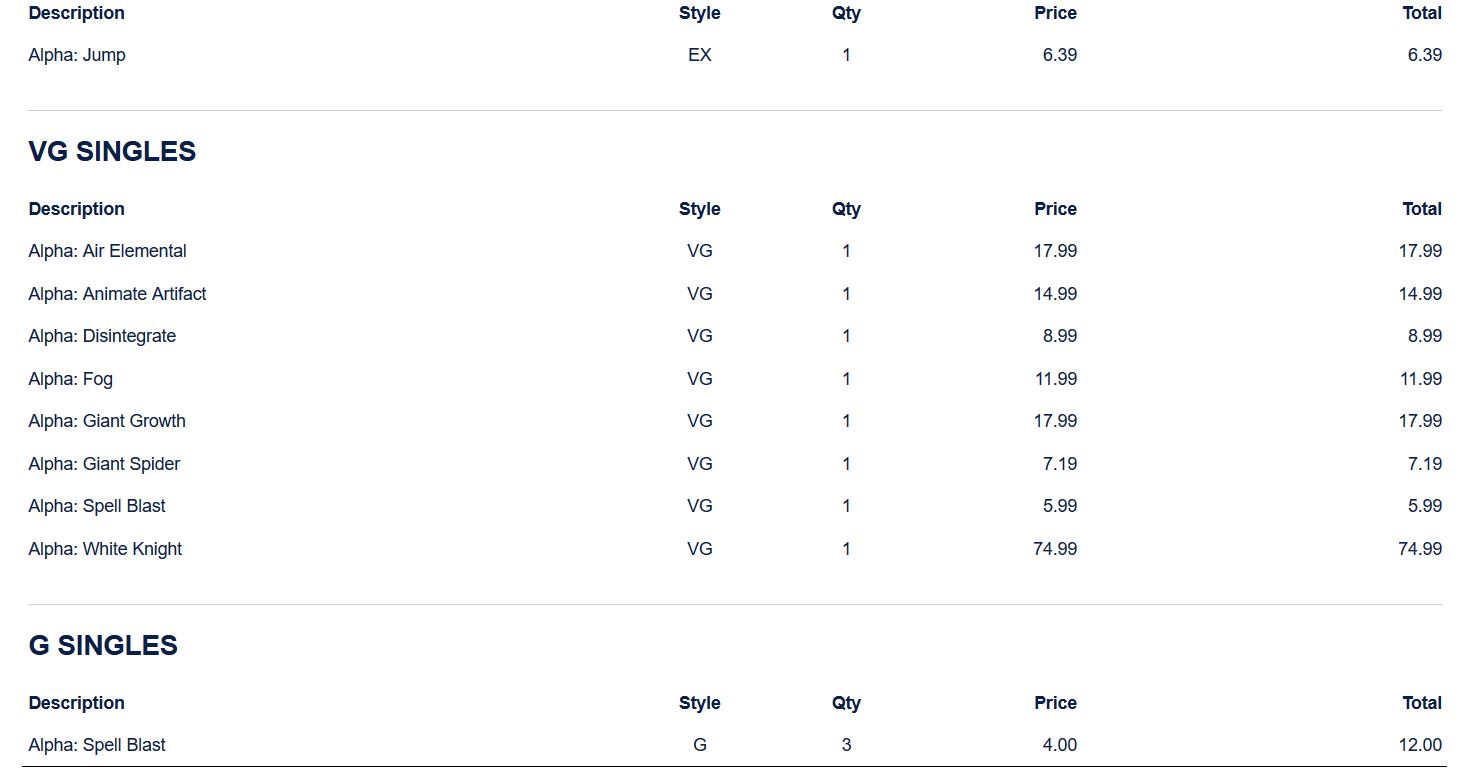
(Click to expand.)

Approximately every other day, Card Kingdom would restock Alpha cards at these prices, and I would buy up a bunch. Some I kept for my collection, and some I threw on eBay to sell for modest profits. It was a perfect system, and I leveraged it as much as I could for about two months. In that time period I made over 40 purchases of Alpha cards, most coming from Card Kingdom.

Then the inevitable happened. I sat by and watched Card Kingdom, Star City Games, ABU Games, and Cool Stuff Inc virtually run out of all stock of Alpha cards. This was a bad sign—it represented the inevitable. Vendors would have to increase buy prices to restock these in-demand cards, and this would lead to higher sell prices.

Then, seemingly out of nowhere, ABU Games came along and ratcheted their buy prices on all older cards way higher. Suddenly, the strategy needed to change drastically. Alpha cards were still sparse at major vendors, but some copies were available on TCGplayer for under ABU Games buylist. What’s more, ABU became aggressive on Beta, Unlimited, and Arabian Nights cards too. Suddenly one could purchase cards from these sets from Card Kingdom to ship directly to ABU Games for profit.

There was an error retrieving a chart for Old Man of the Sea

This move by ABU Games was the last straw. The market reacted; TCGplayer copies of older cards were relisted much higher, and other major vendors followed suit. Prices rose across the board, and the great deals on A/B/U cards became extinct.

The Current Landscape

Everything is more expensive now. Everywhere. For example, that $74.99 VG Alpha White Knight I bought from Card Kingdom would cost me $239.99 now. A similarly conditioned copy from ABU Games costs $287.49. Star City Games has arguably the most attractive price, $174.99 for “HP” (which I have found tends to be MP). This reflects a tripling of price in just four months.

The list of such price increases goes on forever. It also extends to Beta, Unlimited, and even Arabian Nights cards.

ABU Games’s aggressive move to increase buy prices created a halo effect, causing other vendors to follow suit. However this led to two additional consequences—one good and one bad.

On the plus side, major vendors finally have these old cards in stock again. It was so frustrating to browse Card Kingdom’s Alpha stock and see everything pretty much sold out. The same was true for Cool Stuff Inc and Star City Games. Now, a couple months later, vendors are finally starting to hold some of these cards in stock for longer than three minutes. Prices are all much higher, of course, but if you’re hoping to flip some store credit into these cards, it helps to at least be able to get said cards.

Now for the bad news: ABU Games was unable to maintain their crazy-high cash buy prices for these older cards. My guess (which is probably correct) is that after jacking up their buy prices, ABU Games received tons of high-end buylist orders. Cash flow probably became tight, and they had to adjust. That’s what happens when you suddenly pay above TCG low on hundreds of cards. However it also means the arbitrage opportunities are at least temporarily gone. It’s worth noting you can still get a ton of trade credit by shipping this stuff to ABU Games. Only the cash numbers were slashed.

There was an error retrieving a chart for Argivian Archaeologist

ABU Games’s super high buy prices were only available for about a month. But that was enough to drastically move the entire market. The result: higher prices everywhere across the board. But at least vendors are starting to hold these cards in stock long enough for you to make a purchase.

Looking Ahead

It took months, but most vendors are caught up on the new prices. That being said, some inconsistencies are still yet to be corrected. For example, every online vendor has zero or near-zero stock on Unlimited Power. Star City Games is sold out (or perhaps pulled their stock for the SCG Open); ABU Games is sold out; Card Kingdom has a NM Black Lotus ($12,000) and a NM Time Walk ($3200); Cool Stuff Inc has a single Mox Jet ($2300) and Mox Emerald ($2000).

I’ve seen pictures from GP Minneapolis—Power prices are higher across the board. Vendors have been gradual in their price increases, but this has led to a shortage of stock online. Expect prices on Power to continue climbing until vendors can actually hold. Don’t forget, pricing is all out of whack lately because of how hot older cards have become. When it gets to a point where a Juzám Djinn is worth nearly as much as a Mox, you know something isn’t right.

Let’s look at Chaos Orb next. This card ran up in price very quickly and caught every vendor off guard.

There was an error retrieving a chart for Chaos Orb

There are about a dozen Unlimited copies in stock on TCGplayer, with HP starting at $650 and NM at $1200. When I search all the major vendors, they’re all sold out. The one exception is ABU Games, who has a NM copy listed for $1749.99. By the way, that “near mint” copy is signed…

Vendors just can’t keep this card in stock, and they will have to keep increasing their buy and sell prices in order to actually have a couple available for prospective buyers. Until they make this adjustment, they will continue to be out of stock.

While we’re at it, let’s talk about Unlimited cards in general. Many Unlimited cards have jumped, partly thanks to ABU Games’s aggressive move. But vendors have been slow to react. Card Kingdom was way underpriced relative to the rest of the market for weeks, but they’ve gradually been catching up. But they're still offsides on pricing when it comes to cards like dual lands, Icy Manipulator, and Disrupting Scepter. Each of these prices needs to rise before Card Kingdom will be able to keep any in stock for more than a minute.

Lastly, I want to point out a shortage in a couple Arabian Nights cards on the market. Take a quick look at Guardian Beast.

There was an error retrieving a chart for Guardian Beast

There are eight copies for sale on TCGplayer, with HP starting at $350 and NM at $600. Card Kingdom has been out of stock on this card for days now. Their $350 buy price just isn’t high enough. ABU Games only has one altered copy in stock at $461.25. No thanks. Your best bet is actually to buy Star City Games’s “PL” copy at $425. This is a very fair price and will likely be a worthwhile purchase when looking ahead three months.

City in a Bottle is another Arabian Nights card that likely has an imminent price bump in store. Card Kingdom’s two copies of Juzám Djinn is unlikely to keep the vendor satisfied, so expect that one to adjust higher soon if they don’t get any new copies in.

Wrapping It Up

It’s really fascinating to watch the market on Old School cards unfold. With something like Standard or Modern cards, all vendors appear to move together in unison as they react to market trends. But with older cards that have low stock, price adjustments appear to happen in a cascading fashion. One vendor can make an aggressive move and cause other vendors to gradually follow suit. I find this fairly unique when compared to other MTG assets.

This has been happening steadily for the past few months as vendors take turns at an aggressive pursuit of key cards. That said, ABU Games was definitely one of the biggest catalysts for a market shift. When they posted crazy-high buy prices on Old School cards, it only took a month for the rest of the market to react. Now other vendors are all priced higher and TCGplayer has lost its allure for arbitrage.

With all that said, there are a couple positives from this move. For one, large vendors are gradually getting these desirable cards back in stock (albeit at higher prices). TCGplayer has also seen a gradual restock of Alpha cards, which is nice. And secondly, the attractive deals have not disappeared altogether; they merely shifted.

For example, you can still find some underpriced Unlimited cards out there if you are patient and lucky. Card Kingdom still has some low prices if you can catch a restock. Also, Cool Stuff Inc has restocked a handful of Alpha cards at pricing that is actually very reasonable. Even Star City Games is worth browsing if you’re after certain Alpha and Arabian Nights cards—their grading is conservative and this leads to some attractive deals.

In total, even though the general trend is a rising tide, relative opportunities are always present. There are too many niche markets with Old School cards for everything to be 100% efficient. The places one has to look may evolve with shifting market trends, but the opportunities are always out there, ripe for the picking.

Sigbits

  • Despite the recent pullback in dual land prices, Tropical Island appears to remain in robust demand. Card Kingdom still has the land on their hotlist and are paying $295 for near mint copies. This has got to be near their highest offer ever. Could this be a reflection of an evolving Legacy metagame?
  • Recently Card Kingdom upped their buy price on Beta Dark Ritual. They were paying $65, but they just upped their price to $78 for near-mint copies. Again, I don’t know if the Legacy metagame has anything to do with this move or if it’s strictly driven by Old School demand.
  • Card Kingdom has been varying their buy price on Eternal Masters Mana Crypt. At one point they raised their buy price all the way up to $90. Then they quickly went back down to $75. But as of this morning, they’re paying $90 again. This one will have sustained demand from Commander play, so expect it to keep climbing until it gets another reprint.

Daily Stock Watch – Grim Lavamancer

Are you a Quiet Speculation member?

If not, now is a perfect time to join up! Our powerful tools, breaking-news analysis, and exclusive Discord channel will make sure you stay up to date and ahead of the curve.

Hello, everyone and welcome to a new week of the Daily Stock Watch! There has been a rumor on the loose about the Reserved List that could possibly alter the Magic universe if it really does happen. I'm pretty sure someone in our team would take this topic on if the need arises in the near future. One of the reasons why I stray away from RL talks is because it could get really testy, and everyone will have varying opinions about it. This is also one of the reasons why I stopped talking about cards on that list for the Daily Stock Watch since I featured Tolarian Academy, and it should be a step in the right direction for those who would like to make profit out of the cards that tackle here.

That was quite an introduction to start your financial week just right! Let's get to the cool stuff with my pick for today.

There was an error retrieving a chart for Grim Lavamancer

This card has been on the prowl for quite some time for a lot of obvious reasons. I won't be shy to admit that I hate this card to my guts (I'm a Humans player and this card could just flat out wipe my entire board in game 1!) as it has always been a mean source of damage if left unchecked. I have always respected its abilities, but I didn't actually expect that the day would come when it becomes a near $20 card because of the multiple print runs out in the market, and the lack of relative success for red in Modern. As of posting, it has just reached its all-time high of $15.24 for M12 copies, and I expect the rest to follow suit in no time. It now sees play in a platoon of top tier decks in the format, and is almost exclusively an auto include in the 75 of decks that wish to abuse its raw power in a format run amok by fetches and cheap spells that fill graveyards to the brim early. I still think that it works best though in a shell where it could consistently give you a value for its ability, and what better way to get it running than in a classic Boros Burn list.

Boros Burn

Creatures

2 Grim Lavamancer
4 Eidolon of the Great Revel
4 Goblin Guide
4 Monastery Swiftspear

Instants and Sorceries

2 Shard Volley
4 Lightning Helix
4 Searing Blaze
4 Lightning Bolt
4 Boros Charm
4 Rift Bolt
4 Lava Spike

Other Spells

4 Aether Vial

Lands

1 Arid Mesa
3 Sacred Foundry
4 Wooded Foothills
4 Bloodstained Mire
4 Inspiring Vantage
4 Mountain

Sideboard

1 Stony Silence
4 Skullcrack
2 Searing Blood
2 Rest in Peace
2 Path to Exile
1 Kor Firewalker
1 Exquisite Firecraft
2 Ensnaring Bridge

Red has been underwhelming against Humans, but not when you have this on the board early. The spirits are slowly gaining traction in the format, and they only have Path to Exile to get rid of this guy on their main decks. Even Legacy decks are punished well by this guy off the board of Grixis Pyromancer decks, all the more now that Deathrite Shaman is nowhere to be seen. It is very useful and powerful at such a low cost, and it isn't painful at all if its gets dealt with at any point of the game. The window to target this as a spec might have passed already, but it isn't too late to pick them up for playing purposes. After all, this could easily get reprinted at any point in time with the upcoming Standard expansion as a possibility.

Guys Who Hate Grim Lavamancer in Modern

I'm sure a lot of other creatures with toughness two or less hates this guy to the bone, but these are pretty much the ones that are obvious choices. It's no surprise that most of them are Human pieces, but my Utility Checker has done its dirty job for us by telling us that these creatures are seeing the most play in the format. Not much should change as far as the meta is concerned, so it's safe to assume that this list won't be changing for a while.

At the moment, you could get copies of Grim Lavamancer via TCGPlayer, Card Kingdom, StarCityGames, and ChannelFireball for anywhere between $10.11 (from the Fire and Lightning series) up to $25.99 (Judge Foils). It would only continue to spike as the season goes on, so be sure to get your copies if you really need it in your deck. There should be a good number of Modern and Legacy tournaments ahead as the year progresses and this will be one of the hottest cards out there. Don't hesitate to pull the trigger. Not even a reprint should hurt its stock now.

And that’s it for today’s edition of the Daily Stock Watch! See you again next time, as we check out a new card that should be on the go, or good enough for speculating. As always, feel free to share your opinion in the comments section below. And if you want to keep up with all the market movement, be sure to check in with the QS Discord Channel for real time market information, and stay ahead of the hottest specs!

Legacy and Modern Sleepers on MTGO

Are you a Quiet Speculation member?

If not, now is a perfect time to join up! Our powerful tools, breaking-news analysis, and exclusive Discord channel will make sure you stay up to date and ahead of the curve.

Hi, guys.

This week I don't have a specific topic to talk about, but I have a list of cards that I think are currently the best picks for speculations.

The Hibernators

This is a category of cards that were once very popular and powerful cards in Modern and Legacy but are currently overshadowed by other decks in the format. In fact, Modern is so diverse right now that there's no such deck that can dominate the entire format like how Grixis Death's Shadow and Eldrazi Tron did last time. Let's look at the picks here:

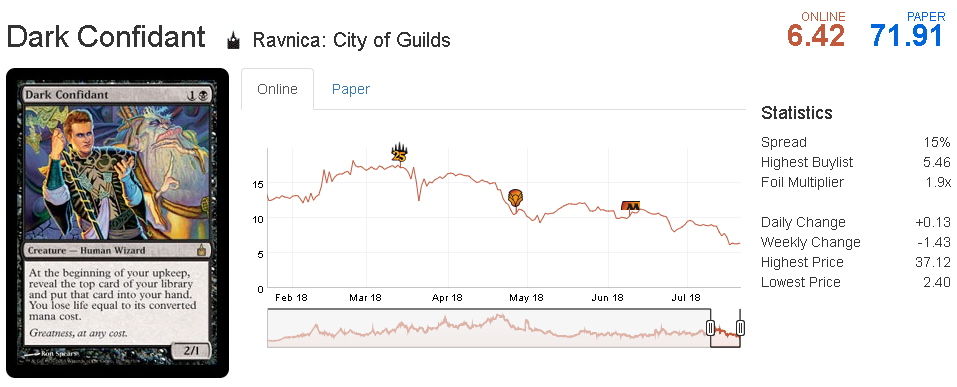
Dark Confidant was widely played in Modern before the Humans deck become popular, especially after the Bloodbraid Elf unban and the hype that generated. Now despite the price drop of Confidant, there are some Legacy decks that play the card and are doing pretty well: Four-Color Loam and Turbo Depths. While none of these decks are dominating their respective formats, 6.5 tickets is the lowest point in a very long time. It's definitely one of the best opportunities to obtain some playsets for investment we've seen in a long time.

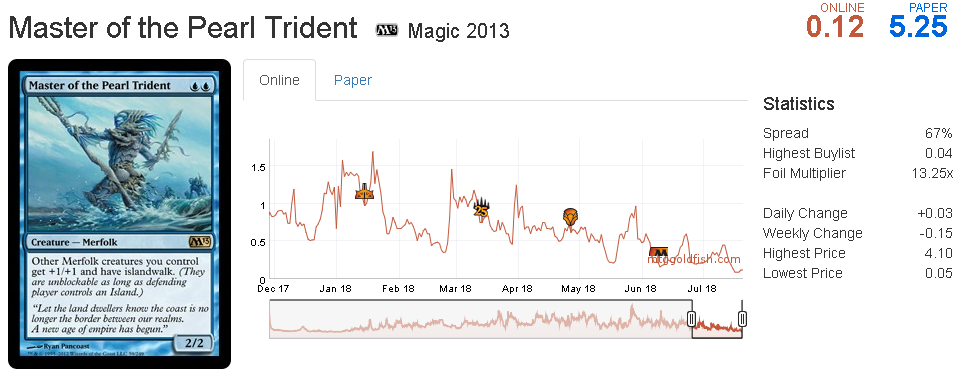
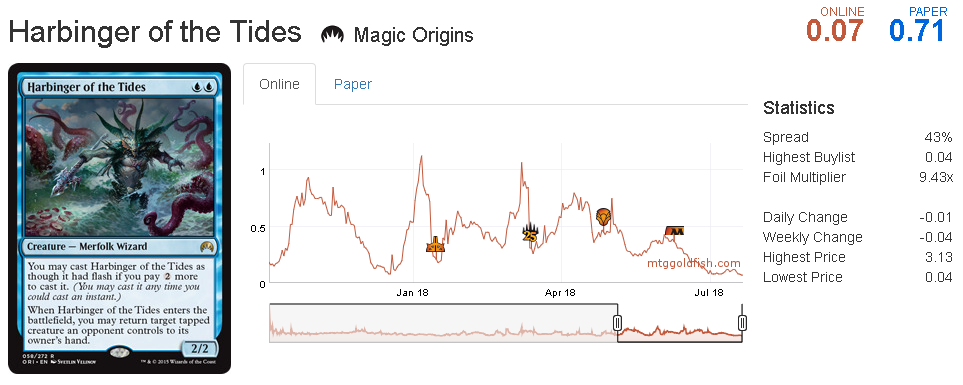
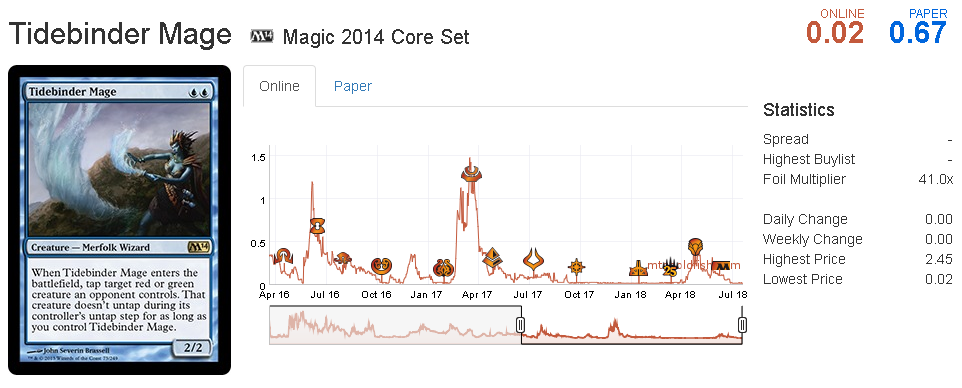
Merfolks Tribal is a deck that will never disappear. If you noticed, Merfolk is a deck that is very hard to hate out based on its disruption and speed. Furthermore, there will always be some Merfolk guys at every tournament who will never give up on the deck.

Currently, most of the Merfolk creatures are at their respective low points. Although this deck might be a little weak against Humans tribal, I believe Merfolk lovers will somehow find a way to adapt. Don't forget that Merfolk is a thing in Legacy as well, but with even more powerful spells like True-Name Nemesis and Force of Will.

Since the unbanning of Deathrite Shaman and Gitaxian Probe, the Legacy metagame has not yet stabilized. Players are still testing different decks. Meahwhile, we don't know if Merfolk will become the next deck to beat in either Modern or Legacy. Thus, I suggest buying playsets of any Merfolk that are being played, especially those above. If you look closely at the graphs, these cards are pretty cheap for now – but once the deck starts seeing play, each of these can easily be at least 1 ticket each, a huge ROI.


Low Risk, High Returns

These are the cards that are good based on historical data; thus, they have low risks and should provide high returns whenever they grow in price again.

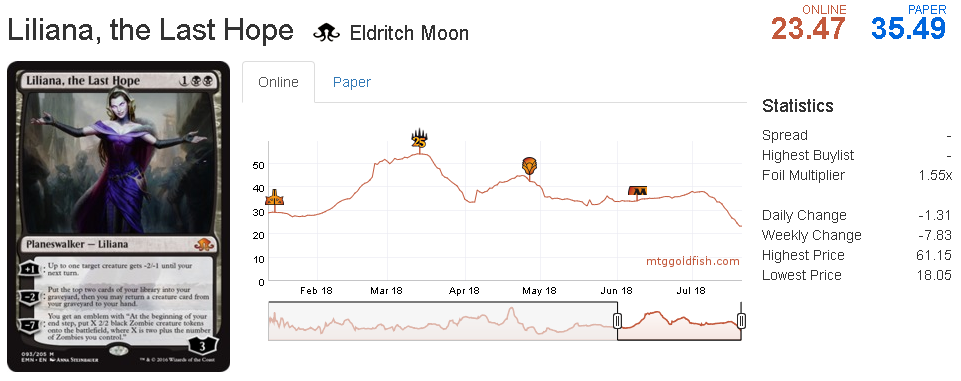
Liliana, the Last Hope has dropped by at least 8 tickets in a week. Jund and other black-green decks might not be as popular as before, which is the main reason why Liliana dropped in price (same for Liliana of the Veil, which is only 35 tickets now). I think a three-mana planeswalker like Liliana, the Last Hope is not going to be this low forever. The Last Hope is actually a very good card in Modern, as there are many one-toughness creatures in the format: Noble Hierarch, Snapcaster Mage, Selfless Spirit, and most Affinity creatures, just to name a few. So I don't think she will be staying at 20-ticket range for very long.

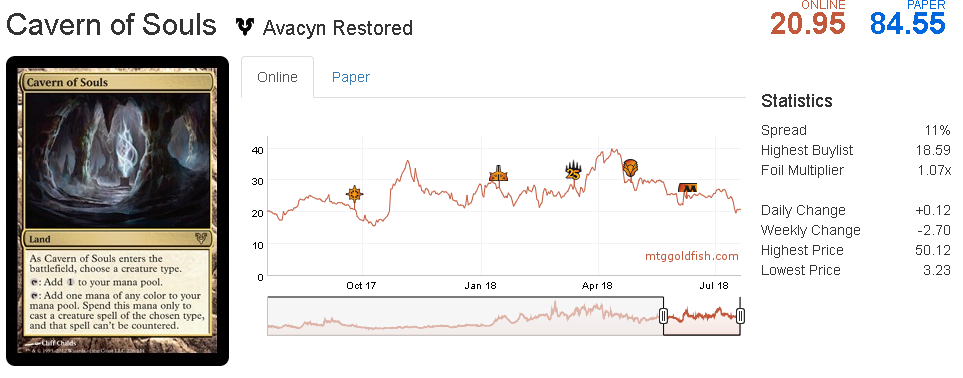
Cavern of Souls is creature deck's best card against blue control decks. Most creature-based aggro decks. especially tribal decks like Humans and Merfolk, will play the full four copies of Cavern just in case they run into control opponents. Currently, Cavern of Souls is pretty underpriced based on the graph above. The average price of Cavern is around 30 to 35 tickets based on data from January 2016. I think investing Caverns at 21 tickets is a very good choice and I'm strongly suggesting you guys do so.

The Return of Eldrazi

When I was grinding some MTGO leagues, I noticed that Eldrazi Tron and Bant Eldrazi reappeared in the metagame after some time. These are some examples of decks that play Cavern of Souls. In fact, I picked up the Eldrazi Tron deck online, and there's no doubt it's a very resilient deck compared to many other midrange decks. Also, with Damping Sphere becoming popular against Tron-style decks, the Eldrazi decks, which are less reliant on the Tron lands, will soon become the choice of Tron players.

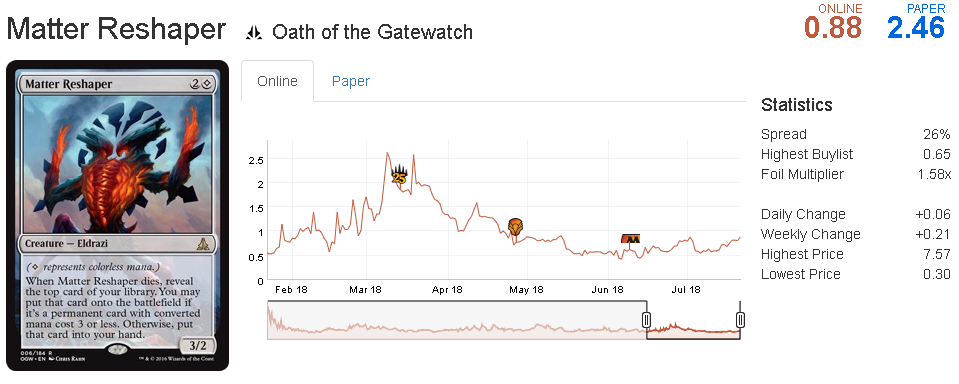
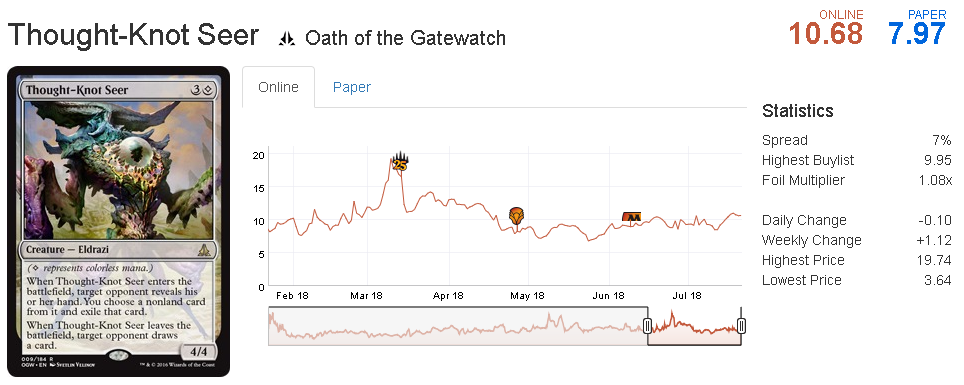
Eldrazi Tron comes ready with early interactions like Chalice of the Void and Spatial Contortion and creatures like Matter Reshaper and Thought-Knot Seer to help stabilize the game and gain card advantage. Just like Merfolk, Eldrazi are also present in Legacy, in Eldrazi Stompy and Eldrazi Post decks. So investing in these cards has a higher chance to see a return, since there are at least five decks in two formats that plays a full playset of these cards. Thus, I recommend buying playsets of Matter Reshaper and Thought-Knot Seer, as they are fairly low compared to past high prices.

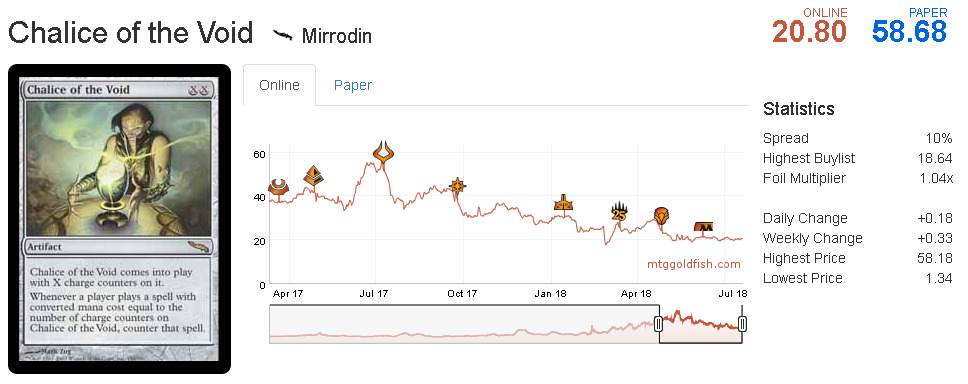
Meanwhile, since I have talked about Merfolks and Eldrazi, Chalice of the Void] is a card in common that these decks might have depending on players' preferences. (Yes, there's Merfolk deck in Modern that play Chalice.) If you look at the graph above, after its reprint in Masters 25 was announced around early February, its price dropped by about 8 tickets but immediately rose again and has now stabilized at around 21 tickets. This card may have a high supply in the market, but if Eldrazi Tron becomes popular again, its pretty likely that Chalice will increase in price again. We might not see it hit 40 tickets like it did in the past, but the chance for a good return is there.

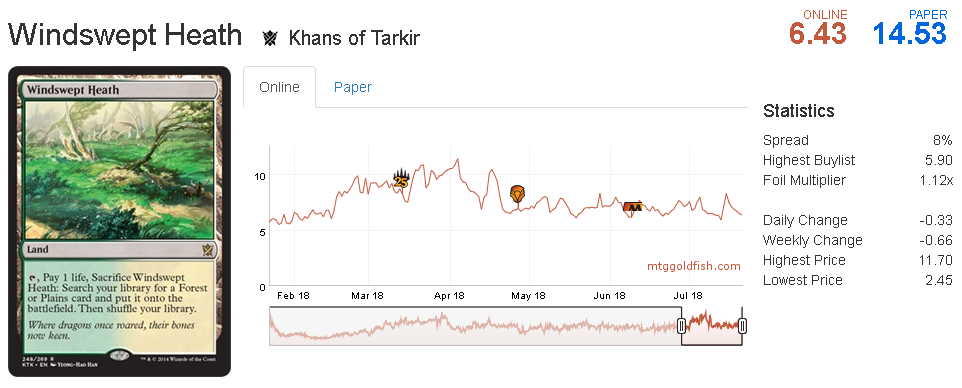
Windswept Heath is a four-of in some decks that appeared in 5-0 lists like Bant Eldrazi, Bant Spirits and Green White Collected Company variants. Not to say this is a very good pick compared to others, but if you do have some spare tickets, I do recommend you to buy in on copies of Heath for investment.


Alright, guys, that’s all for the week. Thanks for reading, and I’ll see you again next week.

Adrian, signing off.

Unlocked: A High-Risk Play – Borrowing to Speculate

Are you a Quiet Speculation member?

If not, now is a perfect time to join up! Our powerful tools, breaking-news analysis, and exclusive Discord channel will make sure you stay up to date and ahead of the curve.

Welcome back readers!

This week's article topic is courtesy of one of our fellow Insiders, who will stay anonymous unless they choose to out themselves. It is a story about a high-risk move, its potential for profits, and its potential for disaster.

Background

As you all know we've seen tremendous spikes in many Reserved List cards this year, and Legacy/Vintage/Old School staples have been hitting record high after record high. The potential profit is high, but so is the buy-in.

Given this, it might seem enterprising to use alternative forms of capital (i.e. credit cards or bank loans) to purchase these cards in advance of the anticipated market movement. It goes without saying that this strategy carries with it significant risk. Almost any type of short-term loan comes with interest fees, and the fewer hoops one must jump through to secure this capital, the more likely the interest rate will be high.

It's also important to note (especially with older, higher-dollar cards) that condition plays a big factor in card value. What might seem like a very good deal can quickly slip away if there is a condition discrepancy.

The Purchase

In case you haven't guessed yet, our Insider chose to pursue this strategy. They purchased the following cards, on the following dates, at the following prices.

Card Average Price Days Since Purchase Current Price Profit (Sold Today) Price Paid with Interest Interest
4x Volcanic Island $290.00 112 $435.00 $134.12 $300.88 $10.88
4x City of Traitors $117.00 112 $248.00 $126.61 $121.39 $4.39
4x Force of Will $53.00 112 $71.00 $16.01 $54.99 $1.99
5x Gaea's Cradle $230.00 106 $353.00 $114.84 $238.16 $8.16
4x Scalding Tarn $56.00 112 $68.00 $9.90 $58.10 $2.10
4x Ancient Tomb $30.50 112 $42.00 $10.36 $31.64 $1.14
Black Lotus (UL-MP) $3,000.00 82 $5,000.00 $1,918.04 $3,081.96 $81.96
Bayou (Beta-MP) $700.00 82 $1,200.00 $480.88 $719.12 $19.12

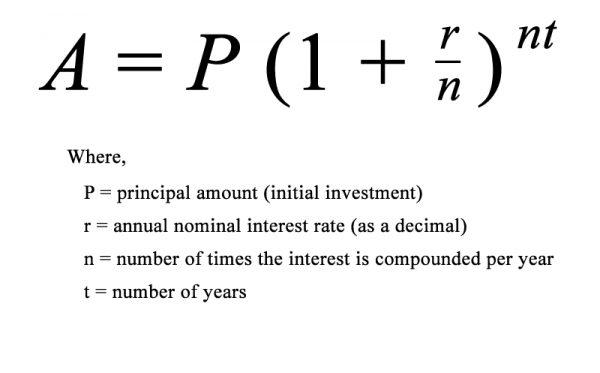
As usual I used this formula to calculate the interest.

It's important to note that this Insider had a pretty low credit card interest rate of 12 percent APR. Most credit cards have APRs in the 16-20 percent range. So if we do this exercise at those interest rates, we have the following "Profit Loss Due to Interest" amounts.

Card Interest Paid (16% APR) Interest Paid (20% APR)
Volcanic Island $14.59 $18.35
City of Traitors $5.89 $7.40
Force of Will $2.67 $3.35
Gaea's Cradle $10.94 $13.75
Scalding Tarn $2.82 $3.54
Ancient Tomb $1.53 $1.93
Black Lotus (UL-MP) $109.77 $137.83
Bayou (Beta-MP) $25.61 $32.16

However, these cards still haven't sold yet, so what happens if it takes another year to sell them?To be honest, these numbers really don't come out that bad. Sure, it isn't fun to lose a couple hundred dollars. However, if this person was in a situation where they couldn't swing the cash to purchase these cards at all, it seems they made the wise financial move here by getting a loan via their credit card.

Card Interest After 1 Year (12% APR) Interest After 1 Year (16% APR) Interest After 1 Year (20% APR)
Volcanic Island $49.23 $67.43 $86.60
City of Traitors $19.86 $27.20 $34.94
Force of Will $9.00 $12.32 $15.83
Gaea's Cradle $38.51 $52.73 $67.70
Scalding Tarn $9.51 $13.02 $16.72
Ancient Tomb $5.18 $7.09 $9.11
Black Lotus (UL-MP) $474.84 $649.22 $832.34
Bayou (Beta-MP) $110.79 $151.49 $194.21

These numbers also fail to take into account the typical fees associated with selling online (marketplace fees and shipping fees), which typically eat up another 13-14 percent overall. If we subtract those we get a more accurate, if not somewhat bleaker, picture.These numbers assume that all of today's prices remain constant, but you can see there are significant profit losses the longer this takes.

Card 12% APR 16% APR 20% APR
Final Profit Margin Final Profit Margin Final Profit Margin
Volcanic Island $36.81 12.69% $18.61 6.42% -$0.56 -0.19%
City of Traitors $76.02 64.97% $68.68 58.70% $60.94 52.09%
Force of Will -$3.55 -6.70% -$6.88 -12.97% -$10.38 -19.58%
Gaea's Cradle $35.98 15.64% $21.76 9.46% $6.79 2.95%
Scalding Tarn -$9.68 -17.28% -$13.19 -23.55% -$16.89 -30.17%
Ancient Tomb -$2.53 -8.30% -$4.45 -14.58% -$6.46 -21.19%
Black Lotus (UL-MP) $884.16 29.47% $709.78 23.66% $526.66 17.56%
Bayou (Beta-MP) $232.71 33.24% $192.01 27.43% $149.29 21.33%

Conclusion

In this case, if it took an additional year to sell these cards at their current prices, our Insider would lose money. This in spite of having purchased the cards at buylist values, significantly below market value.

There's also no guarantee the prices won't drop—most of these cards have already spiked and it isn't out of the question for them to slip a little if the market finds them too inflated.

So while this strategy can still prove quite profitable in the short term, it requires a lot of things to go right:

  1. The initial buy-in must be extremely competitive (likely around buylist).
  2. The cards must go up or maintain their value. This strategy seems extremely risky for cards whose prices wax and wane a lot, like Standard.
  3. You need to be able to actually sell the cards in a short time frame. A spike doesn't do you any good if nobody is buying at the new price.
  4. Ideally you need as low an interest rate as you can get, as interest can greatly reduce (or completely eliminate) your profits.

I bring this all up because with card prices jumping so drastically, and many people not having a lot of extra capital lying around to invest in cardboard game pieces, it's easy to get blinded by huge potential profits without realizing the risks behind the opportunity.

It's up to every individual investor to determine how much risk they are willing to take. But I caution people who ignore or downplay risks that can easily come back to bite you. Though our current speculator has so far remained in the green, it's very easy for them to drop into the red with a bit of bad luck.

Personally I would not take these risks myself, but I tend to be a risk-averse investor who prefers more conservative strategies that yield steady gains over the long haul. If you have any questions or comments about my calculations or the concept, please feel free to reach out to me via Discord or in the comments below.

Daily Stock Watch – Selfless Spirit

Are you a Quiet Speculation member?

If not, now is a perfect time to join up! Our powerful tools, breaking-news analysis, and exclusive Discord channel will make sure you stay up to date and ahead of the curve.

Hello, readers and welcome to a new edition of the Daily Stock Watch! The meta in Modern is always changing, and the first major piece from Core 2019 has somehow helped in shaping up a new Human-esque type of deck in Spirits. Our card for today is one of the major gainers from that archetype, and you have Supreme Phantom from M19 to thank for that. People seem to have learned from the surprise that the Humans deck has brought to the table, and they are taking this new spike in stride. Today's featured card has doubled its value in a week's time, and I wouldn't be surprised if it goes way beyond $10 if the deck succeeds just like how the Humans did.

There was an error retrieving a chart for Selfless Spirit

Multiple versions of the deck has showed up, and you could read more about it here in Edward Eng's segment. It seems that people have been fond of the idea of showing up in Legacy tournaments using their modern decks, and I'm all up for it considering that they are bound for success owing to the synergy that decks such as Merfolk, Human, Elves, Goblins, and now the Spirits, do possess. I'm building my own version of the deck for testing, and I'm still not certain if I'm going to use Esper, Bant, or go straight UW version. If you've got an idea on what you think is the best way to go, hit me up on the comments section.

For now, here's the list that I'm looking at:

UW Spirits

Creatures

2 Geist of Saint Traft
2 Phantasmal Image
3 Thalia, Guardian of Thraben
3 Selfless Spirit
4 Drogskol Captain
4 Rattlechains
4 Supreme Phantom
4 Spell Queller
4 Mausoleum Wanderer

Instants

4 Path to Exile

Other Spells

4 Aether Vial

Lands

2 Hallowed Fountain
2 Island
2 Plains
2 Moorland Haunt
3 Seachrome Coast
3 Cavern of Souls
4 Ghost Quarter
4 Flooded Strand

Sideboard

1 Worship
2 Unified Will
2 Stony Silence
2 Hokori, Dust Drinker
2 Rest in Peace
2 Eidolon of Rhetoric
3 Damping Sphere
1 Blessed Alliance

There's so much power in the whole list, that there are really a couple of ways that you could go about on how to play spirits. At two mana, Selfless Spirit is a very strong card that could protect your board from a removal hitting a jumbo-sized Mausoleum Wanderer, or saving your Geist of Saint Traft from an Anger of the Gods or Supreme Verdict. The presence of Aether Vial also gives you the instant-speed effect of giving your creatures hexproof via Drogskol Captain, or giving your creatures more power by sneaking in another spirit lord in Supreme Phantom. Based on testing so far, I could say that this deck could give you that feel that you're using a higher level of Merfolk, and it somehow gives you the vibe that you're also using a flying version of Humans. We'll see how it fares in the upcoming tournaments before we could pass judgment on how good the card is.

Possible Gainers because of Spirits

Some of these cards are already pricey prior to this iteration of Spirits, but they have the potential to shoot up some more if the deck becomes popular. The spike of Selfless Spirit is still debatable, but I've already bought three sets as of writing at $6 each. I like where the deck is headed, and it's also notable that even Humans or other White creature-based lists use it in their 75. If you're going to ride the hype train, now's the time to do so.

As of posting, you could get copies of Selfless Spirits via CardKingdom and TCGPlayer for anywhere between $7.50 up to $7.99, while StarCityGames has a pair of German copies sitting at $5.49. Normal foils are out of stock at $14.99, but there are still a few Pre-release copies via TCGPlayer at around $8. These copies might seem like a good buy right now seeing that it is in the same price range as normal ones, and they might take in some value in the future once supplies have dried up. I don't think it's bound for a reprint soon, so start getting your copies. This might just be the next version of Meddling Mage.

And that’s it for this week’s edition of the Daily Stock Watch! See you again next time, as we check out a new card that should be on the go, or good enough for speculating. As always, feel free to share your opinion in the comments section below. And if you want to keep up with all the market movement, be sure to check in with the QS Discord Channel for real time market information, and stay ahead of the hottest specs!

Brew Report: Aggro Christmas in July

Are you a Quiet Speculation member?

If not, now is a perfect time to join up! Our powerful tools, breaking-news analysis, and exclusive Discord channel will make sure you stay up to date and ahead of the curve.

Novel Modern decks have historically surfaced by tapping into a previously undiscovered combo card—examples include Second Sunrise, Krark-Clan Ironworks, and Amulet of Vigor. But lately, format newcomers are firmly rooted in the combat camp. It seems Modern is beginning to revolve around streamlined aggro decks; consider tribal strategies such as Humans and Spirits, engine abusers like Traverse Shadow and Hollow One, and damage outputters such as Goblins and RG Eldrazi. In this way, the Modern of today closely resembles the Legacy of the late 2000s, where aggro decks favored synergy over raw card power.

This week's Brew Report, our official second in the series, endorses that narrative. The 5-0 and Challenge-placing decklists covered here all find new ways to turn guys sideways in Modern.

Cantrip, Combat

My kind of Magic.

Amber Mentor, by ANDGRAND (5-0)

Creatures

3 Monastery Mentor
3 Erayo, Soratami Ascendant
3 Jace, Vryn's Prodigy
3 Snapcaster Mage
3 Jori En, Ruin Diver
2 Geist of Saint Traft

Instants

4 Lightning Bolt
4 Opt
4 Path to Exile
2 Repeal

Sorceries

4 Serum Visions

Artifacts

4 Mox Amber
4 Mishra's Bauble

Lands

2 Arid Mesa
1 Flooded Strand
2 Hallowed Fountain
3 Spirebluff Canal
2 Seachrome Coast
2 Sacred Foundry
2 Steam Vents
1 Eiganjo Castle
1 Island
1 Plains

Sideboard

3 Alpine Moon
2 Disdainful Stroke
3 Lightning Helix
3 Spell Pierce
2 Tormod's Crypt
2 Wear // Tear

Format observers have long wondered about Monastery Mentor's absence from the Modern scene. The card is restricted in Vintage, and decidedly a player in Legacy, where it once dominated alongside Sensei's Divining Top. But in those formats, Lightning Bolt doesn't carry nearly the metagame share it does here. For Mentor to meet the playability bar in Modern, it would need to reliably generate value on the turn it came down—in other words, before it died.

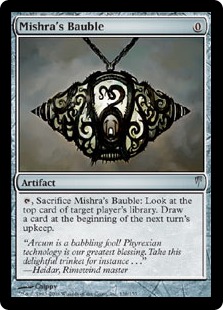
ANDGRAND cribs the solution from Vintage itself, running eight 0-cost artifacts to chase Mentor with. Mishra's Bauble is just a cantrip, while Mox Opal promises even more impactful Mentor turns: starting with Erayo or Jace lets pilots tap out for Mentor on turn three, play Mox and make a token, and then tap the Mox for a spell to make another token.

Like Monastery Mentor, Geist of Saint Traft threatens to take over the game if unanswered. It's a shame that both threats, as well as Erayo, Jace, and Monk tokens, die to Pyroclasm. Of course, there are systems in place to protect the deck's creatures; Eiganjo Castle saves legends from Lightning Bolt, a fast-flipped Erayo, Soratami Ascendent taxes opposing mana and spells, and Spell Pierce from the sideboard really turns up the heat on enemy interaction.

Then there's Jori En, Ruin Diver, here a poor man's Mentor. Jori too will spiral out of control unchecked, if less decidedly than Mentor, the latter of which has the upside of actually mounting pressure. I don't love not just maxing Mentor before going to 3 Jori, but it's true that in lack of a two-mana legend, Jori into Mox gives player an extra mana to spend on the card they draw. As things stand, I can see this build having trouble closing out the game against combo decks before getting its engines online.

Reveler Jund, by OCELOT823 (5-0)

Creatures

4 Tarmogoyf
2 Scavenging Ooze
2 Pia and Kiran Nalaar
1 Huntmaster of the Fells
2 Bedlam Reveler

Planeswalkers

2 Liliana of the Veil
2 Liliana, the Last Hope

Sorceries

4 Faithless Looting
4 Inquisition of Kozilek
2 Thoughtseize
2 Maelstrom Pulse

Instants

4 Lightning Bolt
2 Terminate
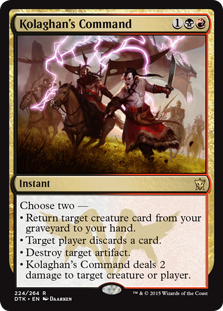
3 Kolaghan's Command

Lands

4 Blackcleave Cliffs
4 Verdant Catacombs
4 Bloodstained Mire
3 Raging Ravine
1 Blooming Marsh
2 Overgrown Tomb
1 Stomping Ground
1 Blood Crypt
2 Swamp
1 Forest
1 Mountain

Sideboard

3 Ancient Grudge
1 Anger of the Gods
2 Collective Brutality
2 Fatal Push
3 Fulminator Mage
2 Nihil Spellbomb
2 Surgical Extraction

Jund is far from the force some ordained it to be with Bloodbraid Elf in the format. While certain Modern players seem hell-bent on playing the deck in its purest form, OCELOT823 instead decided to take advantage of going literal hellbent, scrapping the Elf in question for the card advantage and selection package that's served Mardu Pyromancer so well: Faithless Looting and Bedlam Reveler.

There's no Lingering Souls here for incidental discarding value, nor do Flamewake Phoenix and Bloodghast cameo from Hollow One. The package simply serves as a brute-force method of getting to the right cards at the right time, something Jund has struggled with since its return to the format. Bedlam Reveler, perhaps looped by Kolaghan's Command and Liliana, the Last Hope, provides Reveler Jund with all the cards it could want should the game drag on.
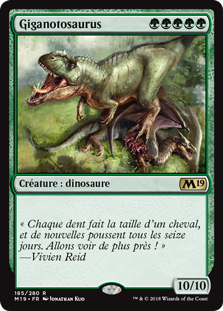
Reveler Jund also attacks from multiple angles. In the four-drop slot, Pia and Kiran Nalaar and Huntmaster of the Fells go small and wide, effectively complementing the rest of the deck's focus on large beaters—even Dark Confidant takes a personal day, negating the potential for blowouts by damage-based sweepers. Critically, the token generators operate independently of the graveyard, giving pilots ways around Rest in Peace.

The switch to Reveler probably helps against other midrange decks, and hurts versus combo and synergy strategies that can't easily remove Dark Confidant. Of course, for Bob to scoop up points there, Jund has to draw it; Looting at least gives this build methods to find its sideboard cards.

Jolly Green Giants

Go big or go home!

Gigantovotion, by MOX_EMPEROR (5-0)

Creatures

4 Arbor Elf
1 Birds of Paradise
4 Burning-Tree Emissary
4 Elvish Visionary
1 Scavenging Ooze
4 Steel Leaf Champion
3 Runic Armasaur
1 Tireless Tracker
1 Eternal Witness
4 Bloodbraid Elf
1 Acidic Slime
2 Gigantosaurus
1 Wurmcoil Engine
1 Ruric Thar, the Unbowed
1 Craterhoof Behemoth

Planeswalkers

1 Domri Rade
2 Garruk Wildspeaker

Enchantments

4 Utopia Sprawl

Lands

4 Misty Rainforest
4 Windswept Heath
1 Wooded Foothills
2 Nykthos, Shrine to Nyx
1 Stomping Ground
8 Forest

Sideboard

1 Abrade
2 Blood Moon
1 Damping Sphere
2 Lightning Bolt
2 Natural State
2 Obstinate Baloth
2 Relic of Progenitus
2 Spellskite
1 Thrun, the Last Troll

While we've seen GR Devotion decks before, MOX_EMPEROR's take gives the strategy a fresh spin. Gone is the clunky Wistful Selkie, as well as hit-or-miss enchantment Oath of Nissa. In their place? Cards that are actually good by themselves. Bloodbraid Elf gains some juicy cascade targets in Steel Leaf Champion and Runic Armasaur, making this Devotion deck less combo-focused and better-rounded. It even drops to 2 Nykthos!

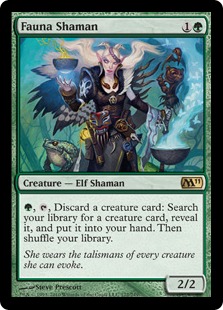
The deck's top-end likewise gets a makeover, with lynchpins Genesis Wave and Primal Command finally taking a bow. Gigantosaurus can be cast during board stalls even without much mana; so can Wurmcoil Engine. A couple bigger threats in Ruric Thar and Craterhoof still appear out of respect for Nytkthos, Shrine to Nyx. But can the deck reliably find these closers? Nope! This build of Devotion plans on drawing them naturally.
Devotion's newfound aggressive capabilities make the deck better in the face of disruption, as many of its cards no longer rely on a critical mass of other pieces to function. Genesis Wave in particular was starting to look quite bad in a format so prominently featuring Logic Knot and Stubborn Denial. Of course, the deck now has more trouble going over the top of fair opponents.

Cremator Evolution, by ARCHGAZE (5-0)

Creatures

4 Cragganwick Cremator
4 Noble Hierarch
1 Birds of Paradise
4 Strangleroot Geist
2 Fauna Shaman
1 Scavenging Ooze
4 Steel Leaf Champion
1 Kitchen Finks
1 Magus of the Moon
2 Tireless Tracker
1 Surrak, the Hunt Caller
1 Huntmaster of the Fells
2 Worldspine Wurm
1 Ghalta, Primal Hunger
1 Emrakul, the Aeons Torn

Instants

4 Lightning Bolt

Sorceries

3 Eldritch Evolution

Lands

4 Wooded Foothills
3 Misty Rainforest
4 Copperline Gorge
3 Fire-Lit Thicket
1 Kessig Wolf Run
2 Stomping Ground
6 Forest

Sideboard

1 Scavenging Ooze
1 Ancient Grudge
1 Caldera Hellion
2 Damping Sphere
2 Obstinate Baloth
2 Reclamation Sage
2 Relic of Progenitus
1 Shatterstorm
2 Slagstorm
1 Thrun, the Last Troll

Another 5-0 to feature 4 Steel Leaf Champion, Cremator Evolution is an aggro deck with a combo dimension. It plays a decent fair game, but can straight up win if it draws Cragganwick Cremator and a high-curve card. ARCHGAZE leverages Eldritch Evolution to maximize the odds of that scenario occurring; the sorcery can pull Cremator right out of the deck, forcing opponents to keep a possible burn-for-15 on their radar at all times. Fauna Shaman can tutor for either half of the combo while discarding irrelevant cards, ensuring Cremator discards the desired fatty. And if all else fails, Cremator is still a 5/4.

Mana dorks probably evolve into Steel Leaf Champion most of the time, while Strangleroot Geist makes up the bulk of Evolution's diet. Geist lets it tutor up Cremator or any of the deck's bullets. There are some neat interactions in the 75, too, like Fauna Shaman searching for Obstinate Baloth in response to discard.
This deck looks extremely scattered to me, but I sill admire its scope. While my gut says Cremator doesn't have what it takes for Modern, weirder things have happened in the format. Here's to hoping the list develops into something I can stand to read!

Building a Bridge

...to a better tomorrow battlefield.

Stitcher's Bridgevine, by CHAR_AZNABLE (5-0)

Creatures

4 Stitcher's Supplier
4 Gravecrawler
4 Insolent Neonate
3 Goblin Bushwhacker
2 Viscera Seer
4 Bloodghast
4 Vengevine
4 Hangarback Walker
4 Walking Ballista

Enchantments

4 Bridge from Below

Instants

2 Lightning Axe

Sorceries

4 Faithless Looting

Lands

4 Blackcleave Cliffs
4 Bloodstained Mire
3 Scalding Tarn
3 Blood Crypt
2 Stomping Ground
1 Mountain

Sideboard

2 Big Game Hunter
2 Collective Brutality
2 Grim Lavamancer
2 Ingot Chewer
4 Leyline of the Void
3 Thoughtseize

My M19 review pegged Stitcher's Supplier as a heck of an enabler, although I couldn't figure out what it enabled. That deck is Vengevine. Supplier milling Gravecrawler yields an instant Vengevine recursion, and the mills continue should it die. Supplier provides a welcome addition to Vengevine, which already had many of the tools it needed to succeed in Modern.

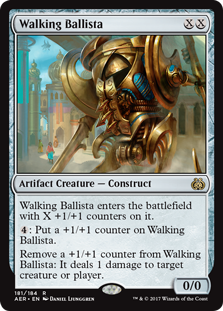
Among those tools are Hangarback Walker and Walking Ballista, flexible mid-game cards that can be dumped on 0 to power out Vengevine; Insolent Neonate, which discards the deck's namesake while counting as a creature spell; and Goblin Bushwhacker, giving the deck lines against graveyard hate. Tying it all together is Faithless Looting, consistency engine extraordinaire that slots ever effortlessly into graveyard strategies.
I'd be remiss not to also mention Bridge from Below, one of Supplier's stronger mills. With Bridge in play, blocks become nightmarish for opponents, and Viscera Seer doubles as a win condition of its own. Repeatedly sacrificing recursive creatures can create a huge battlefield even without Vengevine.

Shadow Bridgevine, by ICTOMOE0912 (5-0)

Creatures

4 Death's Shadow
4 Insolent Neonate
3 Bomat Courier
4 Street Wraith
4 Walking Ballista
4 Vengevine
4 Hollow One

Enchantments

4 Bridge from Below

Instants

3 Temur Battle Rage
2 Kolaghan's Command

Sorceries

4 Faithless Looting
4 Thoughtseize

Lands

4 Wooded Foothills
4 Bloodstained Mire
2 Verdant Catacombs
3 Blood Crypt
2 Stomping Ground
1 Swamp

Sideboard

4 Leyline of the Void
3 Ancient Grudge
2 Grim Lavamancer
2 Gut Shot
2 Pyroclasm
1 Damping Sphere
1 Destructive Revelry

But Stitcher apparently isn't the be-all-end-all of Vengevine strategies. To really beat graveyard hate, pilots should look no further than Death's Shadow... and Hollow One. I've tried mashing these two creatures together myself, albeit to less-than-ideal results. Things seem to have worked out better for ICTOMOE912, whose 5-0 list also incorporates more traditional Vengevine elements and replaces Bushwhacker with Bomat Courier.

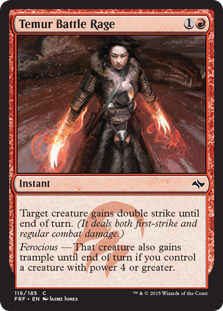
The fascinating thing about this list is how little of each component makes the cut. Shadow is supported by Thoughtseize and Street Wraith; Hollow One by Wraith and Looting; Bridge by Neonate and Bomat; Vengevine by seven one-drops and Walking Ballista. The trick: many of these cards are fine even at partial power. Temur Battle Rage mostly wins through Shadow, but 4 damage for two mana isn't bad, either. And can you really complain about a single-mana Hollow One? As compact packages are printed and discovered, it will be interesting to see this Yu-Gi-Oh!-esque, engine-mash style of deckbuilding continue to gain footing in Modern.

Bonus Brew: Monkey... Bo?

I'd also like to tease a brew I've been working on myself. After Noah Walker's breakout Legacy performance with post-ban Grixis Delver at SCG Worcester, I reached out to pick his brain about Bomat Courier, eager to try the card in my beloved Modern Delver shells. The ensuing week of testing led me here:

Temur Delver, by Jordan Boisvert

Creatures

4 Delver of Secrets
4 Bomat Courier
4 Tarmogoyf
3 Hooting Mandrills

Artifacts

4 Mishra's Bauble

Instants

4 Lightning Bolt
2 Vapor Snag
1 Tarfire
1 Dismember
3 Stubborn Denial
2 Mutagenic Growth

Sorceries

4 Faithless Looting
4 Serum Visions
1 Forked Bolt

Lands

4 Misty Rainforest
4 Scalding Tarn
2 Wooded Foothills
1 Spirebluff Canal
2 Steam Vents
1 Stomping Ground
1 Breeding Pool
2 Island
1 Forest
1 Mountain

Sideboard

3 Blood Moon
3 Mana Leak
2 Huntmaster of the Fells
2 Hazoret the Fervent
1 Ancient Grudge
1 Destructive Revelry
1 Firespout
1 Anger of the Gods
1 Engineered Explosives

Expect more on this deck in the near future. But for now, know that no matter how many Brew Reports you read, nothing can fully prepare you for Modern's infinite possibilities... and love it!

Buylists as Predictors of Future Value

Are you a Quiet Speculation member?

If not, now is a perfect time to join up! Our powerful tools, breaking-news analysis, and exclusive Discord channel will make sure you stay up to date and ahead of the curve.

Buylists are the bread and butter of the savvy Magic collector. While I have been making an effort to maximize my value by eliminating the middleman and selling directly to consumers online, I still admit that buylists play a huge role in how the Magic marketplace functions.

Buylist Equals Baseline

The most important function that buylists provide is to establish a baseline price for virtually every card in existence. Back in the day, before the secondary market was even a glimmer of what it is now, random cards were extremely difficult to evaluate and liquidate.

There was an error retrieving a chart for Sorrow's Path

If you had a random shoebox of cards and wanted to know what they were worth, it was tricky. Basically, cards were worth whatever somebody was willing to offer you on them. Obviously, there were resources like Inquest and Scrye magazines, which could give you a rough idea of what cards might be worth, but transforming those cards into cash wasn't so easy.

Now, it is very easy to understand what the cards you have are worth and to liquidate those cards through buylists. Any person can go online, search various buylists, and immediately turn unwanted or unneeded cards directly into cash or store credit. There's very little guesswork involved since we can immediately establish a baseline price that a card in hand can always be sold for.

Even today, one of the trickiest elements of Magic finance and collecting is answering the question: "what are my cards actually worth?" The reason this is tricky is that the answer to this question largely hinges upon who you are and who you are selling the card to. Are you a retail store? Are you a casual collector? Are you selling directly to the consumer? Or are you selling to a store?

In my opinion, I've always found that the buylist price is the most concrete and accurate predictor of value when it comes to cards. In a worst-case scenario, assuming the buylist price doesn't change somewhere down the road, I know that I can get at least equal cash return to posted buylist prices without needing to exert much effort.

Exploring These Baselines

One trend that I'm always aware of when making buys, trades, or sales is the relationship between "buylist" and "retail" prices. One might assume that there is a tangible relationship between buylist and retail, but it's trickier than that. While some have floated rules of thumb like, "The buylist price is half of what the store retails the card for," there is in fact no hard-and-fast rule.

There was an error retrieving a chart for Rule of Law

Obviously this "buylist equals half of retail" rule can apply sometimes, but not always. There are plenty of examples of cards that buylist for a fraction of the retail price. A good example of these types are cards would be singles that retail for $2.00 or $3.00 but buylist for $0.50. These are great value for stores and sellers, because the markup can be six to seven times the cost.

Inversely, buylists may offer $35 or $40 on a $50 or $60 single that is difficult to keep in stock and sells well. The buylist is much closer to the retail price in these instances.

I think that it's clear that the buylist price tells us an intriguing story about what these cards are actually worth.

Awareness of these buylist-to-retail ratios can lead to some extremely solid trades. For instance, I'd absolutely love to trade twenty copies of a card that retails for $2.00 and buylists for $0.50 for one card that retails for $40.00 and buylists for $30.00. If we only look at retail prices, this trade is a relatively even $40.00 for $40.00. However, when we look at the buylist baseline, the deal clearly favors one side of the trade, $30 to a lowly $10.

The Buylist-Retail Ratio Is a Predictor of Growth and Decline

I think it's pretty clear that the cards with smaller gaps between retail and buylist are hotter commodities. Sellers are willing to pay more because these cards are, for a number of potential reasons, easier to sell:

  1. Perhaps the card is a really hot card in a format at the moment and demand is very high.
  2. Perhaps the card is expensive and so netting a 20-percent profit is a large enough chunk of value that it's worth doing.
  3. Perhaps the card is scarce and thus difficult to acquire, and the smaller gap between buylist and retail reflects the difficulty of finding the card.

Some or all of these may be true depending upon the circumstance.

There was an error retrieving a chart for Karakas

One thing to keep in mind is that cards with the smallest gap between buylist price and retail price are the most likely to gain value in the near future. It makes a lot of sense if you think about it. When buylists are paying higher numbers in order for stores to stock a card, it is likely that card is ticking up in demand and value which equates to a growing price. On the other hand, cards that are buylisting for a low price compared to the retail price are likely poised to lose value on the horizon.

If you took a purely analytic approach to investing and honed in on the cards with the smallest gap between posted buylist price and retail selling price, you'd likely discover a trove of the best possible investments in Magic (outside of cards spiking based on unpredictable circumstances like tournament play and the like).

One thing you may have noticed over the past six months are the huge spike in Old School buylist prices. On the one hand, this seems obvious since the cards have gone up so dramatically. The savvy collector will also notice that the ratio between buylist and retail prices on Old School cards has shrunk, which indicates a few things to me:

  • First, it tells me that Old School cards are very difficult for retailers and other sellers to acquire. It's kind of a no-brainer, considering these cards are fairly rare and very popular with collectors.
  • Second, it tells me that the retailers who are offering high ratios on buylist-to-resale price anticipate that these cards are likely to continue trending up.
  • Third, it tells me that these cards are sufficiently popular and highly coveted to the point where without offering a well-above average buylist-to-retail ratio that online stores have a problem competing with collector to collector sales via eBay or TCG player.

I know that when I'm selling cards online there are two numbers I'm interested in. The first is what the card tends to buylist for. I like to know this number because I want to be sure I get more for my card than this number. The second number I care about is what the card sells for on TCGplayer. I'm basically trying to sell the card for a price that is somewhere in between buylist and TCGplayer mid.

There was an error retrieving a chart for Shivan Dragon

If the gap between buylist and TCGplayer mid is very small, I'm 100 percent holding onto that card, since it is likely on the verge of gaining value. If the gap between buylist and TCGplayer is spacious, I'm 100 percent listing that card and trying to strike while the iron is hot.

It's yet another way to identify marketplace trends and to focus on making deals that are equal but likely favor you moving forward. While the basic principle of this idea boils down to something as simple as it's a good idea to trade a bunch of shock lands into dual lands, it goes beyond the hyperbolic obvious.

These trends tend to be overwhelmingly true about casual cards, kitchen-table cards, and Commander cards before they start trending upward. I used to make the buylists for my LGS before we'd go to a Grand Prix, and most of the cards that had the smallest spread between buylist and retail were the casual cards we were always sold out of. Lo and behold, many of those cards are now rather pricey: Doubling Season, Volrath's Stronghold, Consecrated Sphinx, but were inexpensive at various points in time.

The moral of the story is awareness of information that can be gleaned from scanning and studying buylists. One of the biggest things I've learned (and often the hard way!) comes from a fairly common occurrence: I look at a buylist and see a price on a card that strikes me as unbelievably great. I would think, wow, I can't believe they are paying $4.00 on that card, it's only at $6.00. I would check TCGplayer and see it's at $6.00. In the past, I would unload that card for that "too good to be true price," only to find the card would go crazy the next week! Now I have a new philosophy: when that gap gets really small, buy 'em all.

Quiet Speculation's Trader Tools web app provides the tools you need to track the difference between buylist and retail – what we call the spread – of almost every card ever printed in Magic. Want to level up your MTG finance game? Start using Trader Tools today. 

Hold ‘Em & Fold ‘Em #3

Are you a Quiet Speculation member?

If not, now is a perfect time to join up! Our powerful tools, breaking-news analysis, and exclusive Discord channel will make sure you stay up to date and ahead of the curve.

Okay, this article might seem a bit counterintuitive at first...similar to my previous article. But the reason is because it depends on your situation as you’re reading this. I’ve received a lot of positive constructive feedback on my first two articles, and I really appreciate it. But the only way I’m going to really appreciate it is by putting the feedback to work for us.

One of the most common misunderstandings that I’ve had discussions around is that this series is focused on cards that tournament players should consider picking up for play before they spike. The focus of this series was detailed here. I think this is an important factor to keep in mind as you read these articles.

Each article will focus on two types of cards: 1) cards that you should hold on to or pick up for tournaments if you need them before they rise in price. These cards are either seeing increased play in one or more formats, the supply is drying up, or they are pretty far from the next reprint, and 2) cards that you should consider selling or trading away. Their prices are pretty much at the ceiling owing to inflation from speculation, reprint inevitability in the near future, a lull in tournament play, or some combination of these.

Some others have also asked if I actually follow my own advice – and the answer is yes.

Another suggestion that came up was to take more suggestions. I’ll be doing that towards the end of this article, so be sure to look out for that below.

Hold ‘Em

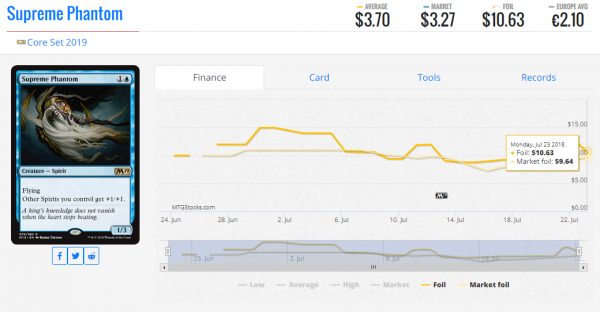
Supreme Phantom - M19 (Foil)

I bought a playset of foil Supreme Phantom on July 17 shortly after Zan Syed and his teammates placed 4th at SCG Worcester on July 15. Results from team tournaments are usually a bit risky to go off of because they’re more skewed than individual results. I didn’t buy these as I watched Zan play or suggest them in my second article for this reason. But since more data has come in, I’m suggesting this card as a pickup.

Not only does this see play as a four-of in Zan’s list. But a friend of mine just lost in the semifinals of a PPTQ this past Sunday with Esper Spirits, which I think could potentially be a contender against Bant Spirits as the best Spirits deck to play in Modern. You can find his list below. And you can read his in-depth tournament report here.

Modern: Bant Spirits by Zan Syed

Creatures

1 Birds of Paradise
4 Drogskol Captain
4 Mausoleum Wanderer
4 Noble Hierarch
2 Phantasmal Image
4 Rattlechains
3 Selfless Spirit
4 Spell Queller
4 Supreme Phantom

Non-Creature Spells

4 Collected Company
4 Path to Exile

Lands

1 Forest
1 Island
1 Plains
3 Botanical Sanctum
1 Breeding Pool
3 Flooded Strand
2 Hallowed Fountain
2 Horizon Canopy
3 Misty Rainforest
1 Moorland Haunt
1 Temple Garden
3 Windswept Heath

Sideboard

2 Damping Sphere
2 Rest in Peace
2 Stony Silence
2 Worship
2 Unified Will
3 Geist of Saint Traft
2 Thalia, Guardian of Thraben

Modern: Esper Spirits by Ty Thomason

Creatures

4 Mausoleum Wanderer
4 Rattlechains
4 Supreme Phantom
3 Selfless Spirit
3 Phantasmal Image
4 Spell Queller
4 Drogskol Captain
4 Lingering Souls

Non-Creature Spells

4 Path to Exile
4 Aether Vial

Lands

2 Mutavault
4 Seachrome Coast
4 Flooded Strand
2 Polluted Delta
2 Marsh Flats
1 Watery Grave
1 Godless Shrine
1 Hallowed Fountain
2 Island
2 Plains
1 Swamp

Sideboard

3 Stony Silence
3 Collective Brutality
3 Unified Will
3 Damping Sphere
2 Geist of Saint Traft
1 Kataki, War's Wage

Bant Spirits is also starting to pick up online as well. BAYESTA_93 placed third in July 22’s Modern Challenge on Magic Online. BAYESTA_93’s list differed from Zan’s list by one card. BAYESTA_93 played one Settle the Wreckage over the second Worship in the sideboard.

Another reason to try picking this card up on the cheap now is that this could show up as a four-of in Legacy Spirits since it’s blue. Take a look at the following list submitted to MTG Goldfish by Rayyn. This is a bit of a stretch, but it’s still something to consider, and I’d rather have at least my playset now over later to play with in Modern and Legacy.

There are just a few on Card Kingdom. And they went up from $8.99 to $10.99 since I bought them on July 17. And the supply is starting to dry up on TCGplayer for both pack foils and prerelease foils.

If you want to play with them, you’d better get them soon, since core sets like M19 tend not to get opened as much as other sets. And if foils are too rich for your blood, you might want to consider just getting regular copies, even if the upside is likely not as high.

Legacy: UW Spirits by Rayyn

Creatures

4 Mausoleum Wanderer
2 Phantasmal Image
4 Rattlechains
1 Remorseful Cleric
4 Spirit of the Labyrinth
4 Supreme Phantom
4 Drogskol Captain
4 Spell Queller

Non-Creature Spells

4 Swords to Plowshares
4 Force of Will
4 Aether Vial
1 Umezawa's Jitte

Lands

4 Cavern of Souls
4 Flooded Strand
2 Island
1 Karakas
1 Marsh Flats
1 Misty Rainforest
1 Moorland Haunt
3 Mutavault
1 Plains
2 Tundra

Sideboard

2 Flusterstorm
1 Grafdigger's Cage
1 Surgical Extraction
2 Disenchant
1 Remorseful Cleric
3 Thalia, Guardian of Thraben
1 Umezawa's Jitte
1 Geist of Saint Traft
1 Kira, Great Glass-Spinner
2 Gideon, Ally of Zendikar

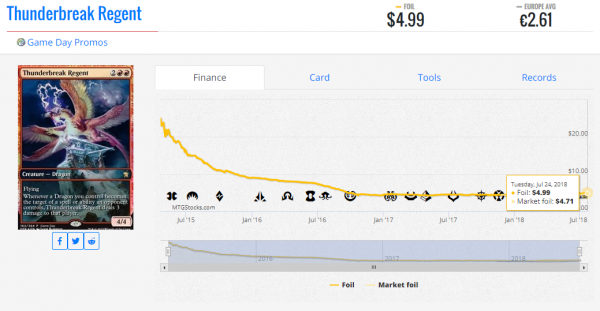
Thunderbreak Regent - Game Day & Store Championship Promos

Alright, let’s get to the "counterintuitive" part. Skred Dragons just won the SCG Philadelphia Classic. But I have no idea how, because I have no idea how this deck consistently beats UW(x) Control decks. But if you want to play this deck, I would pick up the Game Day promo of Thunderbreak Regent, because it will never be printed again and the deck runs four. Casual players love dragons as well, and this could also be easily reprinted in Standard.

Modern: Skred Dragons by Ozzy Kelly

Creatures

4 Glorybringer
2 Stormbreath Dragon
4 Thunderbreak Regent

Non-Creature Spells

2 Chandra, Torch of Defiance
4 Sarkhan, Fireblood
2 Ratchet Bomb
4 Blood Moon
4 Draconic Roar
4 Lightning Bolt
4 Skred
2 Anger of the Gods

Lands

21 Snow-Covered Mountain
1 Cavern of Souls
2 Scrying Sheets

Sideboard

1 Batterskull
4 Dragon's Claw
1 Ratchet Bomb
1 Alpine Moon
2 Anger of the Gods
3 Molten Rain
3 Shattering Spree

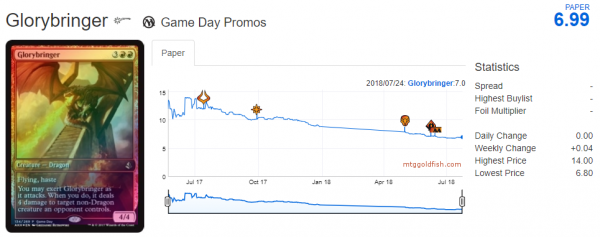
Glorybringer - Game Day & Store Championship Promos

Pretty much the same arguments used for Thunderbreak Regent go for this card as well. Yes, this will be rotating out of Standard in the fall. But the promo version will hold value over time. As mentioned in my first article, promos are the next buyout targets according to MTG finance guru Chas Andres.

Fold ‘Em

Thunderbreak Regent - Game Day & Store Championship Promos

Okay, this is where things take a slight twist. If you have these promos and don’t plan on playing with them in Modern or in Standard again, I would sell into any additional hype on Skred Dragons if any happens to develop. If this deck continues to do well, I don’t see it lasting for a very long time; so you might as well lock in the value now.

Glorybringer - Game Day & Store Championship Promos

Again, the same goes for Glorybringer.

Hold or Fold?

As I mentioned above, a friend suggested that I take a question or two from the community to increase readership engagement, which is a great idea. If you've been wondering about a particular card, drop it in the comments and we can discuss the card as a community.

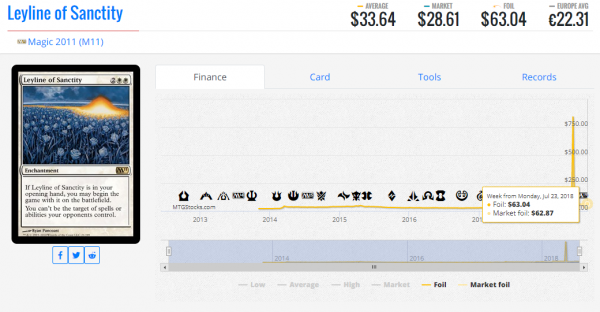
For example, I have a foil M11 Leyline of Sanctity. Is this a hold or fold?

Surely most of us have at least one card like this that we’re contemplating. And all of us would love to hear about it and discuss possible actions. So share your cards in the comments below and let’s get to work on dissecting them.

Summary

Hold ‘Em

-Supreme Phantom - M19 (Foil)
-Thunderbreak Regent - Game Day & Store Championship Promos
-Glorybringer - Game Day & Store Championship Promos

Fold ‘Em

-Thunderbreak Regent - Game Day & Store Championship Promos
-Glorybringer - Game Day & Store Championship Promos

Hold or Fold?

-Leyline of Sanctity - M11 (Foil)

Let me know what you think in the comments below. Agree? Disagree? Why? You can also connect with me on Twitter at @edwardeng. I’m also open to suggestions on how to make this series more valuable. Hit me up.

Have fun,
Eddie

Unlocked: MTGO Market Report for July 25th, 2018

Are you a Quiet Speculation member?

If not, now is a perfect time to join up! Our powerful tools, breaking-news analysis, and exclusive Discord channel will make sure you stay up to date and ahead of the curve.

Welcome to the MTGO Market Report as compiled by Matthew Lewis. The report will cover a range of topics, including a summary of set prices and price changes for redeemable sets, a look at the major trends in various Constructed formats, and a "Trade of the Week" section that highlights a particular speculative strategy with an example and accompanying explanation.

As always, speculators should take into account their own budgets, risk tolerances and current portfolios before buying or selling any digital objects. Please send questions via private message or post below in the article comments.

Redemption

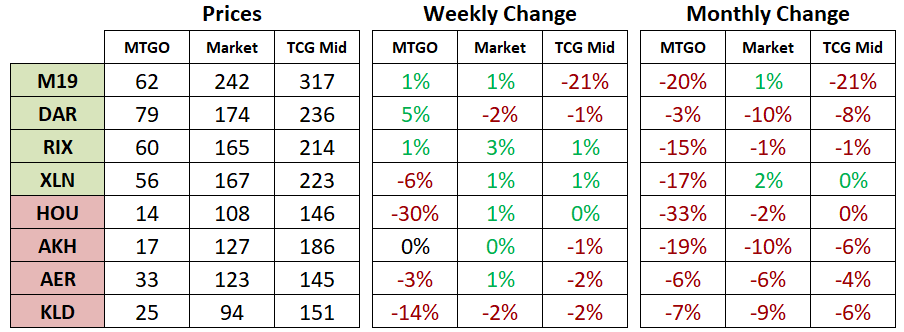
Below are the total set prices for all redeemable sets on MTGO. All prices are current as of July 23, 2018. The TCGplayer market and TCGplayer mid prices are the sum of each set's individual card prices on TCGplayer, either the market price or mid price respectively. Redeemable sets are highlighted in green and sets not available for redemption are highlighted in red.

All MTGO set prices this week are taken from GoatBot's website, and all weekly changes are now calculated relative to GoatBot's "full set" prices from the previous week. All monthly changes are also relative to the previous month's prices, taken from GoatBot's website at that time. Occasionally, full set prices are not available, and so estimated set prices are used instead. Although Hour of Devastation (HOU), Amonkhet (AKH), Aether Revolt (AER), and Kaladesh (KLD) are no longer available for redemption, their prices will continue to be tracked while they are in Standard.

Magic Arena

Alexander Carl returned to Quiet Speculation this week with an excellent article on MTG Arena. Be sure to check it out here. He's definitely bullish on MTG Arena, so much so that he sold out of his MTGO collection completely. The prediction he makes is that MTG Arena will supplant MTGO as the place to play digital magic and that the MTGO economy will collapse.

I think this is a possibility but a small one. The freemium model is a powerful one for attracting users, but MTGO has always been about competing with other players. MTGO is still the premier place to test constructed and draft and the level of competition has never been higher.

For this reason, I see a clear distinction between the markets that will be served by the two platforms. MTG Arena will grow to quickly eclipse MTGO in the number of daily users, but the hardcore users looking to improve their game will always gravitate to the platform that offers the best chance for developing their skills and practicing the latest format.

There will be a little bleeding back and forth between the platforms. I think there is a high possibility that MTG Arena actually grows the MTGO player base. But for competitive testing of constructed and draft MTGO will remain the go-to option. This does hinge on the assumption that competitive magic and the Pro Tour continues to be a driving force and a key plank of Magic marketing. If this changes, MTGO will lose a lot of traction.

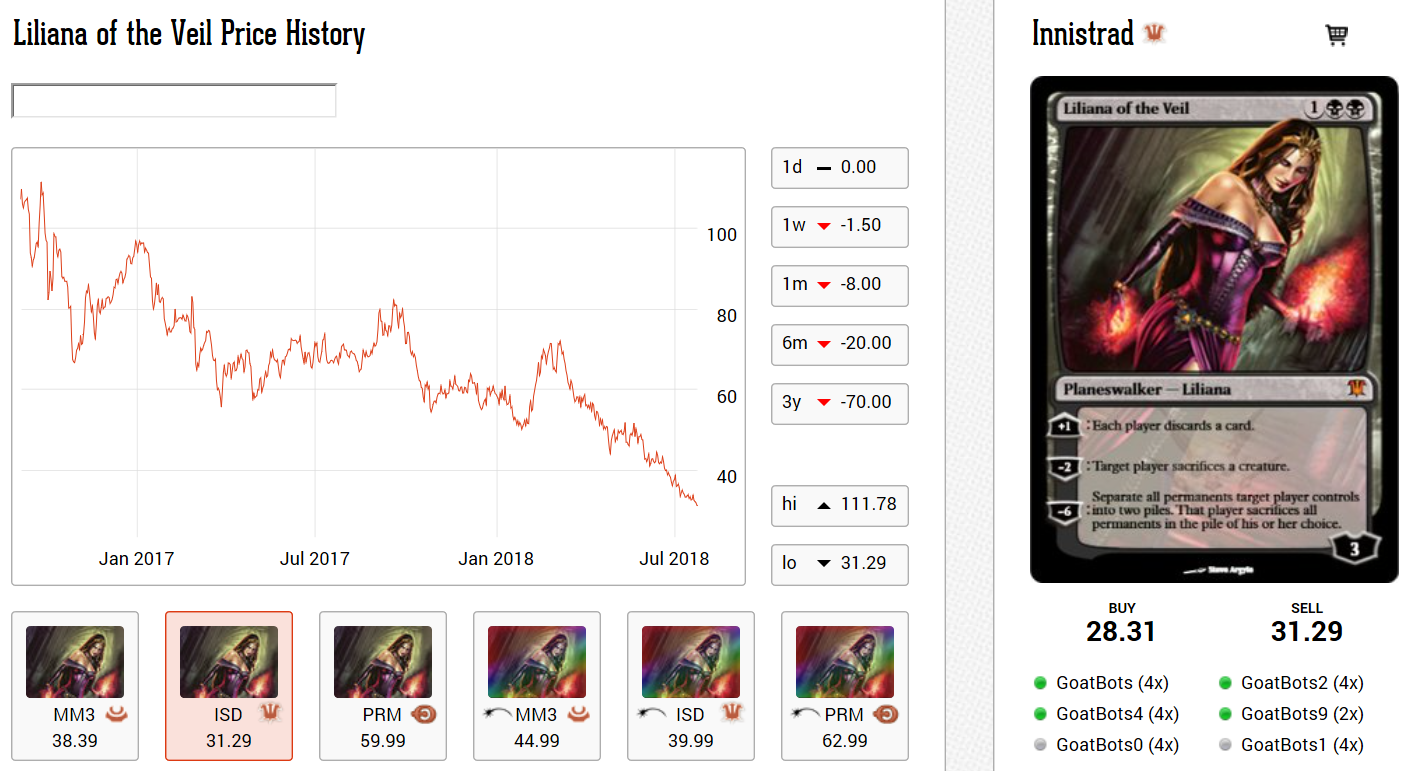
Regardless of what actually occurs, speculators should have been making large changes to their activities as a result of Treasure Chests. Have a look at the chart of a Modern staple, courtesy of Goatbots, and how it's priced has moved while Jund has been out of favor. The chart begins just prior to the introduction of Treasure Chests coincident with the release of Kaladesh (KLD).

After peaking earlier this year at 70 tix, Liliana of the Veil has been on a nearly steady decline and now sits just over 30 tix. This is the lowest price this card has been since it was legal in Standard.

Prior to Treasure Chests, if Jund were out of favor and Jund players were selling their cards then speculators could move in and buy Liliana of the Veil  knowing that a shift in the metagame would end up making it a profitable move, eventually. Now prices keep dropping. There's no obvious floor and so if you wait long enough then that long-term position will turn into a long-term loser. If you had bought Liliana at 40 tix, you'd be underwater by about 25 percent already, bleeding tix while Jund has fallen out of the Modern metagame. That's not a position to be enthused about.

As a result of Treasure Chests, I've severely curtailed single card speculative strategies on MTGO. I've focused most of my recent speculation on positions that have solid economic fundamentals behind them. They are not splashy specs, but they have a high expectation for success and they are not reliant on swings in the metagame. For those that have been paying attention, these are speculating on boosters, foil mythic rares and complete sets.

MTG Arena will have an impact, but Treasure Chests have already completely rewritten the speculative landscape on MTGO. I would not advocate completely selling out, but the new reality is that speculators should be thinking much more short-term and limiting their exposure to any single card that is being reprinted in Treasure Chests.

Standard

Sarkhan, Fireblood is making waves in Standard in Grixis Dragons builds. The price has almost tripled from a low of 2.9 tix to the current price of 8 tix. Have a look at an example of the deck here. This is a rapid repricing of this card that is just starting to take hold in paper too as it rises from $12 to $15.

There was an error retrieving a chart for Sarkhan, Fireblood

I think this trend has room to run further and will be amplified by applications in Modern. It's started showing up in Mono Red Prison and it also notably spawned the Skred Dragons deck that took first place at the SCG Modern Classic this past weekend in Philadelphia. Although these types of decks are heavily reliant on Blood Moon for disruption in Modern, they remain pesky Tier 2 decks that see some success from time to time. Having a three casting cost planeswalker slot nicely into the mana curve of these decks has the potential to bump up the power level of these archetypes.

Although the easy money has been made on this card, there's still room for it to run in my judgment. Information gets disseminated quickly, but uncertainty on the power level of this card is still present and the current price reflects that.

Standard Boosters

Dominaria (DAR) boosters jumped up this week into the 2.2 to 2.3 tix range. That means that all boosters bought for 2 tix or less are now clearing 10% profit in under four weeks. That's pretty solid. Checking in on the number of drafts that were ongoing on Tuesday evening, there are eight at the moment. That's a high number relative to the number of Ixalan (XLN)block drafts that were firing while DAR was the newest draft format.

This high level of drafting activity bodes well for continued gains as players grind through the available supply. A DAR draft set will be going for 8 tix in a month with a peak of 9 tix also possible. Those holding DAR draft sets will do well if they start selling in the second half of August or if the price reaches the 8 to 9 tix range.

Trade of the Week

For a complete look at my recent trades, please check out the portfolio. This week I took a look at the rapid ascent of Sarkhan, Fireblood and decided to pull the trigger on a short-term, momentum play. I think this card has further to rise as it demonstrates its utility in dragon based decks in Standard and Modern.

Three mana planeswalkers have a high pedigree and this one was discounted with Jace, Cunning Castaway as the most recent example fresh in player's minds. Prices in digital and paper are in flux as the market reassesses the potential of this card and grapples with the price and availability of a core set mythic rare.

Daily Stock Watch – Council’s Judgment

Are you a Quiet Speculation member?

If not, now is a perfect time to join up! Our powerful tools, breaking-news analysis, and exclusive Discord channel will make sure you stay up to date and ahead of the curve.

Hello, readers and welcome to a new edition of the Daily Stock Watch! The movement for Legacy cards continues as the search for the next best deck is on. Sneak and Show has proven its worth by dominating some early tournaments after the banning, while Death and Taxes has made some noise with the inclusion of Brightling. Our card for today is another one that has made its resurgence in the format, and is already one of the most coveted cards in Commander prior to its financial spike recently. It also helps it cause that it has only been printed once, and that a reprint is not looming in the horizon in the near future.

There was an error retrieving a chart for Council's Judgment

It's a household name in Commander, and is a very powerful removal in Legacy that could erase even the most powerful planeswalkers in the game. When Conspiracy was released in 2014, it was already considered as one of the best cards from the set despite of its confusing mechanic (for new players, at the very least!) and it hasn't lost a beat since. Now that white is making a splash again in Legacy via Miracle Control and D&T among others, Council's Judgment is making its way to $30 territory due to the lack of supply in the market, coupled in with the high demand for it. Could you imagine just how much the foil of this card is going to reach if this trend continues?

Just like what I have stated in the past, I am no Legacy expert but I know a good card that will keep its value when I see one. Check out this list where it is used in the main deck of Miracles Control.

Miracles Control

Creatures

3 Snapcaster Mage

Instants and Sorceries

1 Counterspell
1 Flusterstorm
1 Predict
1 Spell Pierce
4 Force of Will
4 Swords to Plowshares
4 Brainstorm
1 Supreme Verdict
1 Council's Judgment
1 Entreat the Angels
2 Preordain
3 Portent
4 Ponder

Lands

1 Arid Mesa
2 Plains
2 Tundra
2 Volcanic Island
3 Scalding Tarn
4 Flooded Strand
5 Island

Sideboard

2 Vendilion Clique
2 Surgical Extraction
1 Red Elemental Blast
2 Pyroblast
2 Monastery Mentor
2 Disenchant
1 Containment Priest
1 Supreme Verdict
2 Flusterstorm

An all around card that let's you exile any permanent is gold all day. There aren't too many spells out there that could help you rid of planeswalkers without the danger of your opponent getting them back (Oblivion Ring, Banishing Light effects) for such a low value (Hero's Downfall is the only other non-multicolored spell I could think of at the moment). Of course, this makes us think that cards like Dreadbore or Maelstrom Pulse are just as powerful in the same context, but its worth noting that this belongs to arguably one of the two best colors in older formats when it comes to removals (with black being the more obvious choice). It's hard to see its value dipping anytime soon, and I don't see a reprint coming as well because of the mechanic "Will of the council".

Walker Busters

Planeswalkers have been stronger after the rule change was implemented, and I don't mean to highlight the importance of Council's Judgment based on how effective it is against them. But in a format where a resolved Jace, the Mind Sculptor could end games if it's left unchecked, cards that could deal with it as soon as they hit the board become vital cogs of winning decks. And know that there will always be a home for it in any Commander deck given its raw power and versatility. You are a grand winner by now if you managed to hold on to your copies of this card for spec purposes.

At the moment, you could still get non-foil copies of Council's Judgment for anywhere between $17.09 up to $23.99 via StarCityGames, TCGPlayer, ChannelFireball and Card Kingdom. Just take note that they are drying out pretty quickly, and that there shouldn't be a restock of them anytime soon. Foil copies are already missing prior to this, and they should easily hold an $80 value with a possibility of hitting $100 as time goes by. I am a buyer at below $20, as this will easily be a $30 card in no time. I like the upside of this one.

And that’s it for today’s edition of the Daily Stock Watch! See you again next time, as we check out a new card that should be on the go, or good enough for speculating. As always, feel free to share your opinion in the comments section below. And if you want to keep up with all the market movement, be sure to check in with the QS Discord Channel for real time market information, and stay ahead of the hottest specs!

Unlocked: Common Pitfalls with Running a Store

Are you a Quiet Speculation member?

If not, now is a perfect time to join up! Our powerful tools, breaking-news analysis, and exclusive Discord channel will make sure you stay up to date and ahead of the curve.

Welcome back, readers!

Normally I like to focus on macro-level trends in the MTG realm, with some occasional spec picks. I've done several articles on starting an MTG store before. This week's article will focus on some common pitfalls you want to avoid as a store owner.

These pitfalls are compiled from both my own and fellow players' feedback about their experiences at different stores. This isn't meant to be a giant rant, but instead I want to take a step back (especially from any of my own personal experiences), and review what potential consequences might come about from a store engaging in any of the practices below.

There was an error retrieving a chart for Pitfall Trap

Sharing Personal Opinions

Everyone is entitled to their personal opinion. But remember that your opinion is just that—yours—and it's highly likely to differ from that of your customers. When you openly discuss volatile subjects (religion, politics, etc.) you risk offending or ostracizing people who disagree with you. The closer your opinions fall to any end of a particular spectrum, the greater the risk, and the more likely you are to lose customers because of it.

This issue extends to social media (especially as more stores realize the power of social media for advertising events, sales, etc.). It’s crucial to realize your online profile is tied to your business (whether you like it or not), and remarks/comments/opinions you express on personal accounts can reflect poorly on your business and alienate customers.

Simply put, feel free to discuss your personal opinions with your friends and family all you want—but leave your customers out of it.

Inconsistent Prices

As a business you’re welcome to charge whatever you want for any card. Only you really know your overhead costs (if you don’t, stop reading now and figure that out immediately as misunderstanding that will sink a business faster than anything on this list), and thus only you know what profit margin is required to stay afloat.

However, one issue I’ve seen that really bugged customers was when different employees at a store priced the same card differently (on the same day). Obviously card prices can change, especially if some hot new tech shows up on camera at a major event. But what I’m specifically talking about is when a store’s pricing is amorphous and certain employees try to charge more for a specific card to make a higher profit margin over others.

Long gone are the days when card prices were adjusted monthly with the latest Inquest or Scry magazine with a new pricing sticker placed on top of an old one. Today most customers expect a store to look up the price of a card upon checkout. The only exception is at a major event where everything is pre-priced for the day/hour—but those customers still don’t expect to get a worse price from one employee over another.

Not Scaling Prize Support

Competitive players spend a lot of money in order to play competitively. They expect good prize support when entering tournaments. A store obviously wants to make some sort of profit from hosting a tournament, and there is often additional costs associated with doing so such as hiring a judge, keeping a larger staff on the clock, etc. However, good Magic players can do basic math and multiply the number of players by the tournament entry fee to figure out how much income the store made from the tournament.

This usually becomes an issue when a set prize is announced ahead of time to garner attention, and then when more players show up than originally expected the store decides not to add to the prize. Sometimes it’s important to consider how you’d feel on the other side of the counter.

Disorganization

Inventory

We live in a time when you can get most anything you need with free two-day shipping. We can get information on just about anything we could ever want instantaneously from any location with cell coverage or Wi-Fi.
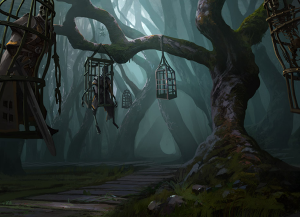
Patience is a dying virtue. People want to be able to see and buy their cards quickly. Nothing stalls a potential sale like responding to an inquiry with, “I don’t know, I’ll have to go look for it.”

There is also the obvious need to have an online presence, which again requires an organized inventory. Customers expect their cards to arrive quickly after ordering online (and TCGplayer actually expects sellers to ship within 48 hours of purchase). This can be extremely difficult and time consuming in a disorganized environment—and time spent is money spent. Luckily there are plenty of software packages that can allow for decent inventory management without too much cost.

Operations

Most people prefer order to chaos, and that extends to business preferences. When your business doesn’t have consistent operating hours, doesn’t fire tournaments on time, or is under- or overstaffed, it highlights instability to customers and discourages business.

One of the most common problems I’ve seen at numerous stores is delaying a tournament start for people who are running late. While it comes off as being generous to the people who are late, it ignores the time being wasted for those who showed up on time, and leads to resentment and general unhappiness. When you develop a pattern of doing this, you actually discourage punctuality—if you’re going to have to sit around at a store waiting on others, why not show up late knowing that the tournament will wait on you?

Lack of Cleanliness

While most people don’t enjoy cleaning—and let’s be fair, Magic players can be pretty messy at times—a store needs to be well maintained. You want to attract younger Magic players to grow your business and keep the game going. Having a smelly or dirty store is an easy way to turn away parents bringing their kids to enjoy the game those kids love.

It’s also important in order to attract female gamers (as I think most would agree that women often care more about cleanliness than men, especially when it comes to bathrooms). My wife doesn’t go into most game stores after some bad experiences in the past (which is a shame, but I can’t argue when there is a stale odor that permeates the store).

This can also lead to a bit of an uncomfortable discussion with some players in the community. My two best friends (who happened to be two of my groomsmen) used to play Yu-Gi-Oh. Both told me stories about how 8-10 years ago it was common for players not to bathe for extensive periods of time, and to use their terrible smell as a way to gain an advantage on an opponent through distraction/disgust. This was such a problem that tournament organizers started disallowing players with excessive body odor from participating in their tournaments.
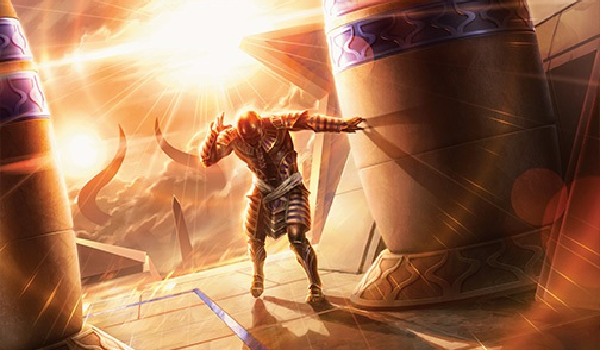
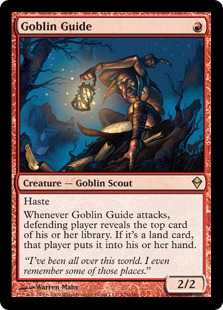
Luckily, I haven’t seen that be an issue with Magic, however, there are still some people who don’t practice good hygiene. While it’s their business anywhere but in your store, it becomes yours when it grosses out or turns away customers (and your business suffers because of this).

The same goes for store owners. I understand how much time one must spend at their shop to run it properly, but you are the face of the company. It’s not a difficult stretch for customers to think that a store owner who can’t take care of their own life surely can’t take care of a store.

Poor Inventory Visualization

While it’s not uncommon to have significantly more sales online than in store (especially nowadays), it’s important to keep in mind that a sparse store inventory will make local players believe you don’t have much in stock, and they will be less likely to bother asking for any cards period.

Remember that when you sell online, the marketplace gets a cut of the sale (TCGplayer and eBay both take around 13% overall), so in-store sales by definition are likely to have a higher profit margin for you as the owner.

You will also see more “splurge” buys when cards are visible to players. There are tens of thousands of different Magic cards, and it’s difficult even for those of us who have been playing a long time to remember them all. When your case is sparsely populated, you miss out on those “aha!” buys from players who forgot a card existed and suddenly decided they needed it for the deck they are brewing. This also serves as a good way to encourage players to “trade up” into more expensive staples, allowing you to make a larger profit overall.

Failure to Maintain a Fun/Inclusive Environment

We can all agree that Magic has all different types of players, with different definitions of fun. This isn’t a problem when players in a game have a similar view of fun, however, it can become a pretty big issue when they don’t.

This is more likely to occur in casual environments, when the majority of players just want to play the game, but another player wants to win at all costs or to play “griefer” decks. While it’s perfectly fine for everyone to play together, as a store owner you need to make sure that some of your players aren’t driving away others.

The trick is to make sure that your game store can accommodate these different types of players without excluding one type or another. One of the best methods I’ve seen, in Commander specifically, is the implementation of a point system that encourages fun/casual play and discourages win-at-all-costs/griefer play. This doesn’t mean that all Commander games need to follow this point system, but if you establish beforehand whether or not a game will utilize it, you can prevent bad feelings/unhappiness from the beginning.

In a similar manner, Magic players come from a lot of varying backgrounds with varying opinions, and it’s important to make sure your store environment is inclusive towards everyone without isolating or ostracizing anyone. Now, that doesn’t mean you remain lawless; simply make sure that all players show respect towards each other. Similar to the concerns about sharing opinions that I covered above, it’s important to keep the general store atmosphere neutral when it comes to hot-button issues.

Return to the PPTQ Grind: Week 1

Are you a Quiet Speculation member?

If not, now is a perfect time to join up! Our powerful tools, breaking-news analysis, and exclusive Discord channel will make sure you stay up to date and ahead of the curve.

Another PPTQ season, another few months trying to claw my way back to the Pro Tour. Or another opportunity to really analyze my game and try to find new areas to improve upon. I've been grinding a long time, and have come to adjust my expectations while maintaining ambition.

Usually, PPTQ seasons begin in central Denver and then gradually spreads outwards, but this year the outlying stores have been going first. It's weird for me because I don't see much of players outside the metro area and I never really know what to expect. There's a lot of regional flavor and bias in Colorado, especially the divide between Denver and the rest of the state. I'm always surprised by what craziness exists outside my normal sphere along the Rockies.

The Deck

Since last week, I've been refining and testing all of my decks, which both clarified and muddied my options. I got a feel for each deck's place in the metagame and better understood what kind of field they wanted to see, but with that experience came improved results across the board, meaning no one deck stood out. Thus I packed Storm, Jeskai Control, and UW Spirits and set off to the tournament. I planned to make my final choice based on scouting.

There weren't a lot of practice games going on, nor many decks being sorted for registration, but I did see several Burn decks, a Bant Spirits deck, and two Humans decks. Looking around the room I saw a lot of dedicated Burn players. Ramp, particularly Amulet Titan, and control enthusiasts were also there. This told me that Storm was a risky move, as Burn is a pretty poor matchup, in no small part thanks to Eidolon of the Great Revel.
Jeskai has good matchups against Burn and creature decks, but ramp decks are a nightmare. Amulet is better than Tron, but it's still not great for a deck that wants to tap out for Geist of Saint Traft. And Valakut decks are almost unbeatable.

I hadn't tested against non-Tron ramp decks with Spirits, but that deck had decent-to-great game against everything else, I saw so that's what I ran.

UW Spirits, David Ernenwein (PPTQ deck)

Creatures

4 Mausoleum Wanderer
4 Selfless Spirit
4 Rattlechains
4 Supreme Phantom
2 Phantasmal Image
1 Remorseful Cleric
4 Spell Queller
4 Drogskol Captain
2 Azorius Herald

Artifacts

4 Aether Vial

Instants

4 Path to Exile

Enchantments

2 Detention Sphere

Lands

4 Flooded Strand
4 Seachrome Coast
4 Ghost Quarter
3 Cavern of Souls
2 Hallowed Fountain
2 Plains
1 Island
1 Moorland Haunt

Sideboard

2 Wrath of God
2 Rest in Peace
2 Stony Silence
2 Damping Sphere
2 Disdainful Stroke
2 Dispel
2 Bygone Bishop
1 Worship

I never could lock down the last four flex slots in the maindeck, so I ended up running the four I sideboarded in the most during the week. Azorius Herald is the best spirit with a lifegain ability in Modern, and is excellent in racing situations or board stalls, but is very awkward around Aether Vial. Sphere is the catchall to end all catchalls. Bygone Bishop is a card that I have always wanted to work and never has, but was the closest thing I had to Tireless Tracker, a legendary grinding card.

The Tournament

It now seems a tradition for the first PPTQ of every season to take place at a shop where the relevant climate control system is broken. This problem started two years ago and has just kept going, even during the non-Modern seasons. It was so hot and muggy inside the building that the sun-baked parking lot was more comfortable, and players prematurely dropped just to escape. I know my play was affected, and most of my opponents complained about losing focus too. I overheard several players saying they'd dropped their primary decks for being too complicated and needed more focus than they were capable of that day. The air conditioner had broken a few days before the tournament, so the shop had some fans to keep things merely sweltering instead of stifling.

It was especially problematic because the shop's play area was completely packed with 71 players for seven rounds. This is enormous for a first PPTQ in Colorado; even when Standard was more popular, PPTQs usually topped out at 50, swelling to 60 midseason at the larger stores. The size may have been a function of location, as it was in north Denver and therefore close enough for the Ft. Collins crowd to make the trip. I can't prove that's the reason, but I barely recognized any other players.
My scouting was very accurate: almost a quarter of the room was on Burn. Colorado, always earning its fiery reputation. Jeskai Control and Humans were also popular, though as a whole, the field was very diverse. Most players told me they faced a different deck every round, though some said this appreciatively, others derisively. There was even a Zur the Enchanter deck, which I initially thought was a commander deck.

Afield full of weird decks can make tournaments run long, but surprisingly, the Swiss ended in under six hours. I finished 4-3, beating Grixis Death's Shadow, Jeskai Control, Humans, and Naya Blitz while losing to Ironworks, BG Rock, and Hollow One.

What Happened?

The short answer is that I ran inconsistently. In the matches I won, I ran incredibly well; almost perfectly against Jeskai. I knew Spirits was a control killer, but I am always impressed by the extent. In both games I danced around removal using Rattlechains, Aether Vial, and Cavern of Souls. I won game two by concession after baiting my opponent into exhausting his removal on Bygone Bishop and answering each piece with a cast Rattlechains and a clue.

In both games, the Grixis player had an early Gurmag Angler, but did so much damage to himself I easily raced him. He had Lightning Bolt to kill me Game 1, but couldn't cast it because I'd Quartered all his untapped red sources and he was at two life. Game 2, I Quartered him off all non-basics and despite what the life pad says, the game wasn't close. Shadow was a great matchup last year, and apparently still is.
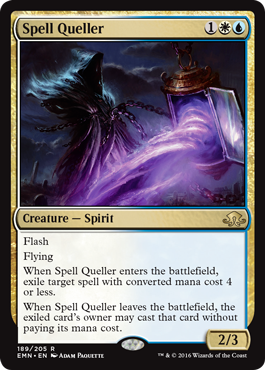
Humans didn't have a great draw, and I drew the paths for Champion of the Parish. The Blitz deck had great starts with Burning-Tree Emissary but lacked any follow-up. I just absorbed damage until I could start blocking and then alpha-striked for the win in both matches.

I lost because I kept not drawing what I needed. I never saw Spell Queller against Ironworks, nor Path against Hollow One. Granted, I was never really in there against Hollow one; Goblin Lore variance worked in his favor, and turn two Hollow One, turn three Flamewake Phoenix and Gurmag Angler is too fast for me to race. Even had I stuck Worship, I was still dead, because Lore left him enough removal to kill everything I had.

Even if I'd drawn Queller, I'm not certain I could have beaten all the Engineered Explosives my Ironworks opponent drew, but I would have stood a better chance than I did. I managed to make a game of it anyway and interrupted several combo attempts before finally dying with Path and Remorseful Cleric. The match strengthened my belief that the real problem with Ironworks isn't Mox Opal or Ancient Stirrings, but Explosives.
My Rock opponent and I have squared off across the table for years, and we're pretty much 50/50 lifetime. The first two games weren't interesting; I got crushed Game 1, then crushed him Game 2. In Game 3, we're both stuck on one colored and one colorless source for many turns. He draws out of it first, and by the time I can start casting spells, it's too late. Ultimately, I'm doomed by him having two Kalitas, Traitor of Ghet to my one Path. Had I taken a more aggressive line earlier and traded creatures, it is possible I would have survived a few more turns, but that may have prompted him to also get more aggressive with his creature lands to ensure the same result.

Lessons Learned

The main things I learned were about my deck, not my gameplay. The Jeskai and Grixis matches went exactly as I drew them up. The other wins were just two players playing their cards, and mine were better. Drawing poorly was the main problem in my losses, but in Game 2 against Ironworks, I had the option of two lines and no way to determine which was best. I took the safer option and it didn't work out. Discussing the game with my opponent after the fact revealed that he'd kept a speculative hand that drew everything it needed to deal with either line in the correct order, so my play really didn't matter, and that had I drawn another piece of disruption he would have lost. The same thing happened against Hollow One: I felt helpless against my opponent's draws.

On the Deck

The core of UW Spirits is solid, and I wouldn't change a thing. Flex spots and manabase are another matter. The five colorless lands made a number of games closer than they needed to be because I couldn't cast my spells easily. I'm not sure whether to add another Hallowed Fountain and cut a spell, cut a Quarter, or just accept the problem. I'm trying out a number of options, but this weekend's experience makes me want to ensure I always cast my spells.

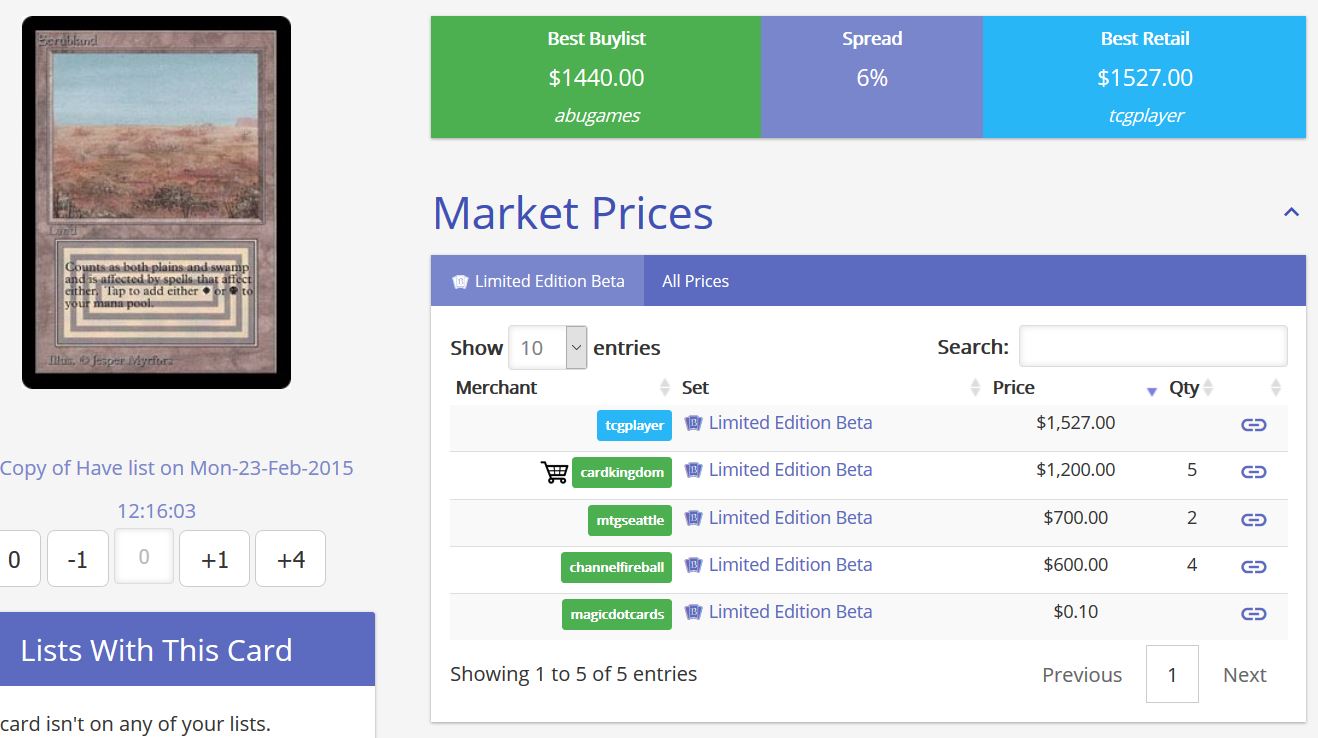
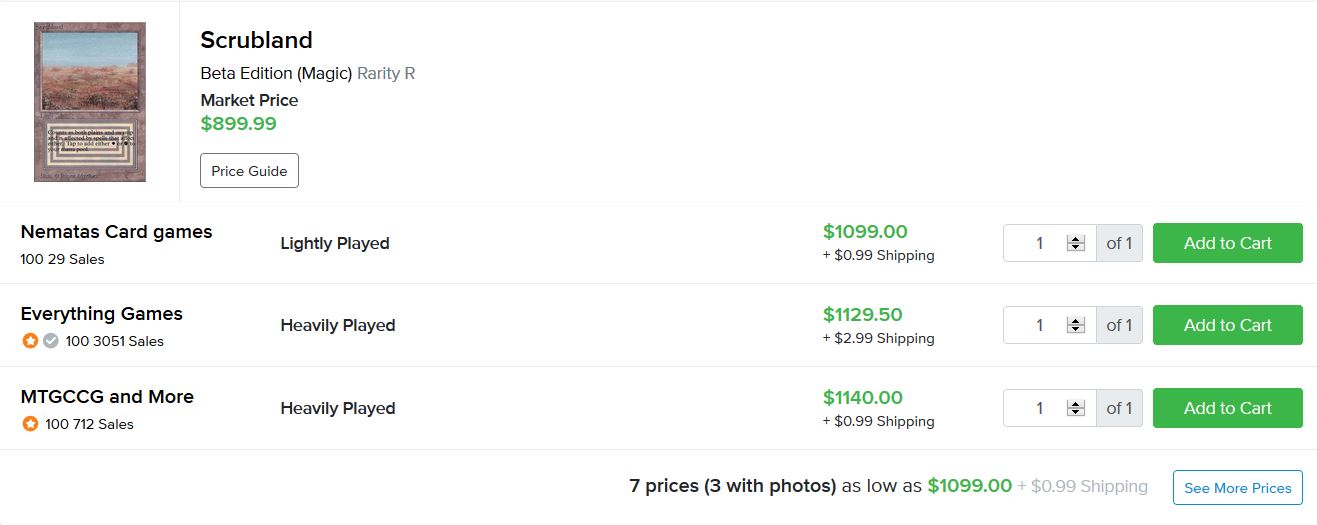
As for the flex spots, Detention Sphere was fine, but not amazing. I didn't hit any matchups where it was necessary or even good, so that doesn't tell me anything. Azorius Herald was exactly what I expected, and while it was great in the creature matchups, that sacrifice clause hurts far more than anticipated. There were a number of times when all Herald could be was a bad Healing Hands, and so just cluttered up my own hand. I plan on cutting Herald for a more easily castable card.

Moving Forward

I really like this version of Spirits. I just need to find the right maindeck. I'll be putting my efforts into finishing that list's development. If the meta last weekend is anything to go on, Jeskai is not well positioned and Storm isn't a real option. This makes me wonder if I need to change my deck roster.

Next week's PPTQs are at opposite ends of the state, Magically speaking: in Ft. Collins and Colorado Springs. Going to either means a three hour round-trip drive, minimum, so I'm not sure that I will actually attend. But if you are attending a PPTQ this weekend, good luck and grind on!

Avatar photo

David Ernenwein

David has been playing Magic since Odyssey block. A dedicated Spike, he's been grinding tournaments for over a decade, including a Pro Tour appearance. A Modern specialist who dabbles in Legacy, his writing is focused on metagame analysis and deck evolution.

View More By David Ernenwein

Posted in Modern, TournamentsTagged , , , , 6 Comments on Return to the PPTQ Grind: Week 1

Have you joined the Quiet Speculation Discord?

If you haven't, you're leaving value on the table! Join our community of experts, enthusiasts, entertainers, and educators and enjoy exclusive podcasts, questions asked and answered, trades, sales, and everything else Discord has to offer.

Want to create content with Quiet Speculation?

All you need to succeed is a passion for Magic: The Gathering, and the ability to write coherently. Share your knowledge of MTG and how you leverage it to win games, get value from your cards – or even turn a profit.

Unlocked: How to Price a High-End Card

Are you a Quiet Speculation member?

If not, now is a perfect time to join up! Our powerful tools, breaking-news analysis, and exclusive Discord channel will make sure you stay up to date and ahead of the curve.

Before jumping into this week’s article, I want to acknowledge a random, yet worthwhile tidbit: this is the 100th article I’ve written for Quiet Speculation since my return to the site a couple years ago. I’ve been writing about Magic for nearly seven years now, and the vast majority of that time was spent with this site. I look forward to the next 100 articles!

This week I want to share some thoughts on a common question I receive across various social media platforms. Whether it be Discord, Twitter, or Facebook, one common question on many folks’ mind is how to price a given Old School card.

You want the price of something new and plentiful, like Mox Amber? Just look it up on TCGplayer or Trader Tools and you will have reliable data.

There was an error retrieving a chart for Mox Amber

That’s great when there are hundreds of copies of a card in stock, making the bid/ask spread on the card nearly zero. But this strategy doesn’t work with obscure cards that have limited stock available. So how do I approach pricing these extremely rare and valuable cards? It’s all about using the data available.

Start with Buylists

When I approach pricing of a rare Old School card, I usually want to start by establishing a broad range. From there I seek to narrow that range down as I collect more data. The easiest part of the range to identify is the low end: that should be the top buylist price for the card in question at its respective condition.

Let’s use an example—I just recently picked up a slightly to moderately played Beta Scrubland and am having trouble pricing it. The first place I look is Trader Tools to survey buylists. This data will help me find the floor—the absolute minimum number I should expect to consider when negotiating price. Here’s what I found:

(Click to expand.)

If my Scrubland was near mint, this step of the research would already be complete. But unfortunately my copy is closer to SP- or MP+. So I need to do further research to identify what these shops are paying for played copies. Here’s a quick summary of the numbers from top buylists when accounting for condition.

Store Cash Buylist Trade Credit
ABU Games $630 $950
Card Kingdom $720 $936
Channel Fireball * $625 $812.50
* Buylist reported incorrectly in Trader Tools

With this data in hand, I can quickly establish that any number below $720 would be unacceptable. If I wanted to sell this immediately, Card Kingdom’s cash buy price would be the best way to go. Now we know the lowest possible number I should consider when determining this Scrubland’s value.

Upper End of Range

If I want to sell this card to another person, I need to price it higher than buylist. If I wanted to help a fellow Old School player out, of course I could offer at buylist. But I am not desperate to liquidate this card and I have no need to fire-sell it. So my inclination is to aim higher. But how much higher?

To determine this, I next look at how many copies in similar conditions are listed online. The upper end of my range when listing this card for sale needs to be about equal to whatever the cheapest copy is online in the same condition. If I price any higher, then my copy won’t sell until that cheaper copy sells (in a truly rational market).

So let’s see how much one would have to pay for an MP+/SP- Beta Scrubland if they wanted to purchase one right now.

Card Kingdom: Out of Stock
ABU Games: Only NM in stock at $2499.99
Star City Games: Out of Stock
TCGPlayer: LP is $1099.99
eBay: BGS 5.5 listed at $1199.99
Magic Card Market: 1290 Euros

Based on all the above data, I can identify the upper end of my range at $1099.99 because that’s the lowest price someone could pay to purchase a copy of this card immediately. In other words when I list my card for sale, that’s my competition. If I want to have any chance selling my copy, I need to at least beat this price.

(Click to expand.)

Now we have a fairly wide price range: between $720 and $1100. That’s far too wide, so we need to narrow down the range.

Narrowing the Range

Establishing that broad range is strictly data-driven. There’s no subjectivity or finesse associated with the process. Narrowing the range further, however, requires some critical thinking and an evaluation of how eager I am to sell.

For starters, let’s consider the value of avoiding the fees from selling on a platform like eBay. By selling directly to a peer, I avoid 10% in fees right off the bat. Now the upper end of my range is $990. Granted, I could pick something in between $990 and $1100 and split the “savings” with the buyer rather than give the buyer all of the fee savings. But while I’m not desperate to sell, I have opportunities in front of me should I raise enough cash. So let’s say I’m motivated enough to move the card quickly. If I was attached to the card and had less motivation to sell, I may aim higher.

But since I am motivated, I’m willing to give the buyer nearly all the savings from avoiding fees. I’d probably round up and use $1000 as the upper end, giving the buyer a 9% savings versus the cheapest copy on the market.

Next, I’ll look to completed eBay listings to see what people have actually paid lately. I see a copy in similar condition sold at auction recently for $883.50. Kid Icarus also sold a copy a couple weeks ago for $942.

Since these were auctions, I know there are at least a couple buyers willing to purchase this card in the above price range. I have little motivation to sell my copy far below these numbers. That said, if I sold my copy on eBay for, say $900, I’d have to eat a 10% eBay fee and a 2.9% PayPal fee. This would net me about $783. Still, that’s better than the $720 buylist price from Card Kingdom, so I can confidently raise the lower end of my range to $783.

Now my range is tightened to between $780 and $1000.

The Final Touches

I have no motivation to sell the card for below $780 and nobody should feel obligated to pay more than $1000. The space in between? That’s all about the art of negotiation.

There are probably endless books and articles published on this topic, and I don’t claim to be an expert by any means. So I’ll just state the obvious: when offering an Old School card up for sale, start towards the higher end of the range you defined and negotiate downwards. In my case, there’s probably a psychological barrier to that $1000 level so I’ll start with $950. That is a nice round number, a large discount to other copies on the market, and not far above what copies sold for on eBay lately. It seems like a great starting point.

From there, I can entertain offers and accept whatever number I’m comfortable with. That is truly a case-by-case measure. I can’t provide a rule of thumb for everyone to apply—it really depends on the individual. How attached are you to the card? How desperate are you to sell? What’s your opportunity cost for not selling? What is the trajectory for this card’s price over the next three months? Twelve months?

There was an error retrieving a chart for Scrubland

You really need to answer these questions for your particular situation in order to identify that singular value that you should sell a card for. Only you can answer these questions, and therefore only you can identify that number. This is why, when people ask me what a card is worth, I always give a range. I try to do some leg work as outlined above so the range is useful and not lazy; but I can’t provide a single number because I don’t know everyone’s personal situation.

At the end of the day, the individual situation and context is really what determines how much someone is willing to pay, or accept as payment, for that rare, Old School card.

Wrapping It Up

As long as I’m not busy, I’m always happy to help others out when trying to price their Old School cards. It can be difficult when there isn't enough stock online to easily find an accurate number. However, my approach isn’t exactly rocket science. We all have access to the same data, and I generally approach the data the same way every time.

I start with a range driven by available copies on the market and buylist. Then I narrow that range down based on completed listings, fee structures, and motivations to sell. The more eager I am to sell, the lower the price I would accept.

From there, I can’t help you any further. I can only offer a range because the final number depends on factors specific to your situation: your negotiation skills, your eagerness to sell, your opportunity cost, your perception of a card’s long-term potential, etc. Only you can answer all these questions and make the final determination. The lower you go within that range the faster the card will sell.

Hopefully this guide proves useful to everyone. If you have additional data points you use, please feel free to share in the Insider Discord. We can all benefit from learning how to price these obscure cards, especially as the rare get rarer and the expensive get more costly every month. One day—perhaps not even that far in the future—there will be some cards that simply aren’t on the market at all! Pricing such cards will only get more difficult in the future, so the more regimented we can be in our research, the better off we’ll be finding the right price!

Sigbits

  • While some of the recent Battlebond foil spikes seem speculative at best, one expensive foil that 100% merits its high price is True-Name Nemesis. Card Kingdom is offering $140 for near mint foils. And why not? This is the only foil printing of a Legacy staple. And I doubt a ton of supply is entering the market any more, so this one will stay expensive until it gets another foil reprinting…whenever that will be.
  • The buylist at Card Kingdom on Fifth Dawn Engineered Explosives is surprisingly high: $75. At least, it’s surprising to me. I did not realize this card had gotten so expensive. Plus it’s probably tougher to find near mint copies given how much it is played across multiple formats.
  • I noticed that Card Kingdom always seems to have a handful of Alpha and Beta cards on their hotlist. Recently they added Alpha Terror, with a $54 buy price. That’s still a hair below ABU Games’ $57.60, but Card Kingdom is starting to get competitive with their numbers on cards that are actually played in Old School.

Want Prices?

Browse thousands of prices with the first and most comprehensive MTG Finance tool around.


Trader Tools lists both buylist and retail prices for every MTG card, going back a decade.

Quiet Speculation