Are you a Quiet Speculation member?
If not, now is a perfect time to join up! Our powerful tools, breaking-news analysis, and exclusive Discord channel will make sure you stay up to date and ahead of the curve.
Hello Magic players, and welcome back!
Today, I would like to explore a very specific hypothetical situation. It's one that many players have likely discussed at some point in time, and may not be pleasant or comfortable to talk about as a Magic player. This, quite frankly, is the doomsday scenario.
What would happen if Wizards of the Coast stopped making Magic cards tomorrow?
Imagine walking into your LGS to pre-order a box of Rivals of Ixalan, and the guy behind the counter says to you: “I hope you enjoy it, because it’s the final set that will be released.” Yes, Wizards of the Coast has many sets planned right now. Iconic Masters, the return to Dominaria, the return of the Core Set, and many more are slated for the next year. Take a moment and suspend disbelief. Let’s say, for the sake of argument, that Hasbro, Inc. went bankrupt and its subsidiary Wizards of the Coast was forced to close its doors as well.
Now what do you do as a Magic player? What happens to the value of your collection? What happens to tournaments and the Pro Tour? What about Friday Night Magic?
This is a huge scenario to tackle, so let’s break it down into pieces and figure it out—because one day (likely not tomorrow, don’t worry), you might have to be prepared.
The MTG Card Market
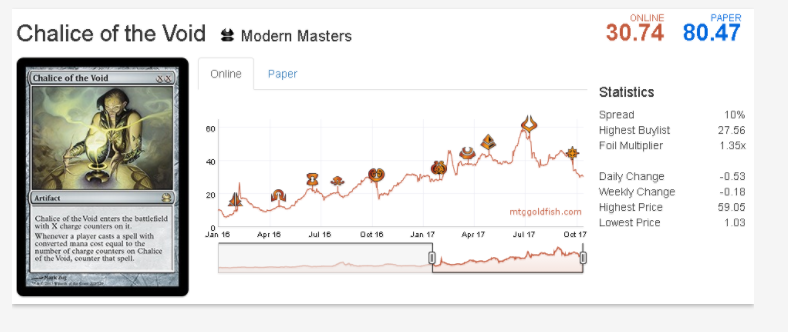
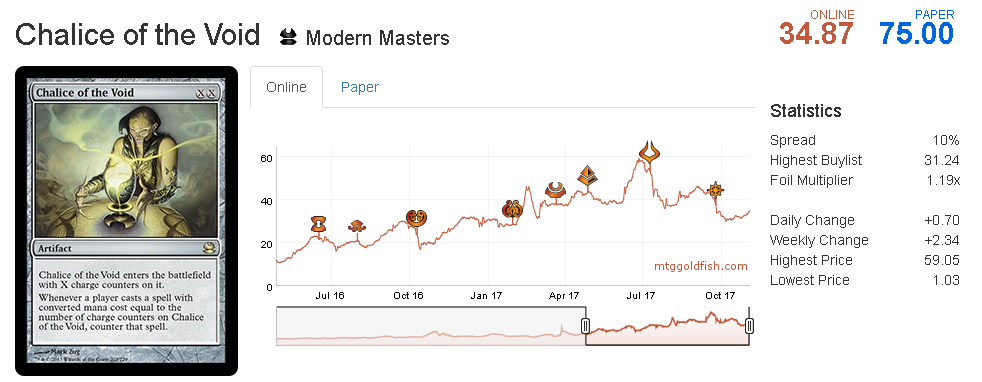
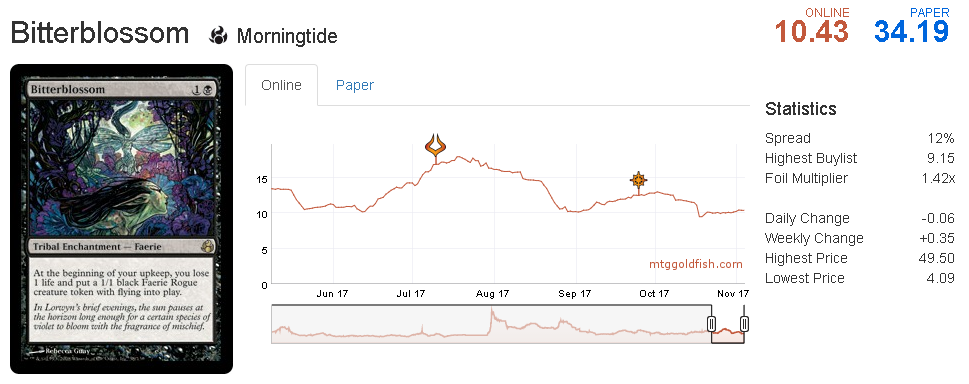
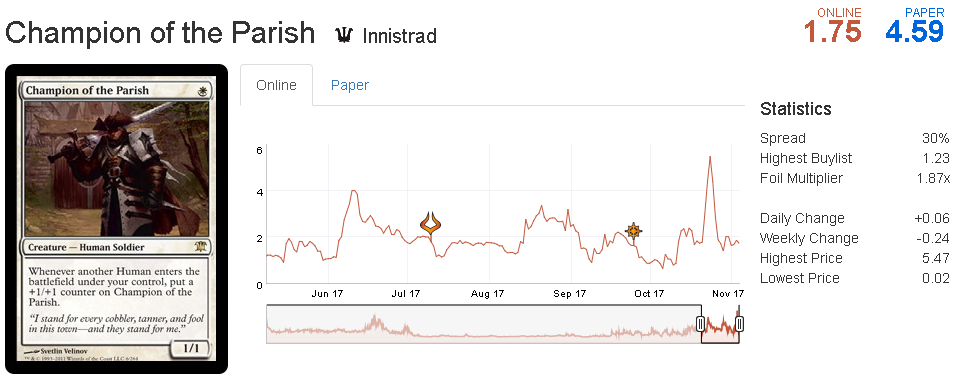
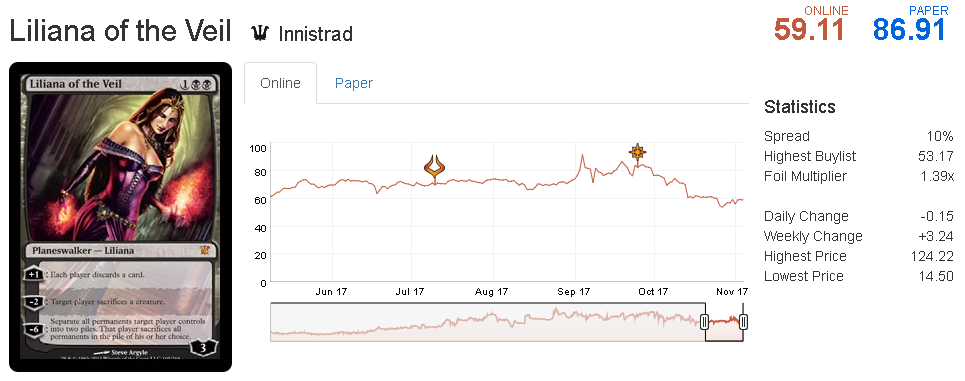
Every card has a price assigned to it, whether it’s 10-cent bulk or an insanely high-priced rarity like the full-art Mutavault Champs Promo. Magic players have been riding an enormous bubble in the last few years, as cards played in eternal formats have seen outrageous spikes. Chalice of the Void was a $90 card. Noble Hierarch—a great mana dork but still just a mana dork—was at $60 for months despite having three printings. As I write this, it is still around $50 even with the RPTQ promo having been announced.
The decline in price of a Magic card is something that no player wants to experience when cards are in their collection. However, heavy price changes would likely happen in one massive fell swoop if Magic product stopped being printed. After the initial drop in price, most cards would hold their value until the end of time, and possibly become collector’s items if nothing else.
Individual people have a very hard time letting go of their collectible items for less than the original market value or sticker price, believing their personal possessions to be worth a set amount. Would you get rid of all of your cards in a hurry (and probably for less money) if the printing of all future products ceased? Personally, I would not, because there is always a secondary collectibles market for popular products, and the longer they have been around, the larger the collectibles market becomes.
The sports card industry is a good parallel example of a collectibles market. Without future product, Magic would become very similar to this industry. Their product cannot be used in competitive tournaments, yet it exists within a collectibles market. While that market did experience a decline in the 1990s and 2000s due to an oversaturation of the market, it has seen a resurgence in the past decade. There were many sports cards companies producing product, and despite the disarray of their market for two decades, their vintage products still have a high (and every year increasingly higher) price tag.
With Magic, it's even possible that another company would step in and begin to design new cards. But that would take a concentrated effort over the course of a few years, and probably some major legal battles. This means that even if another company took over Magic, the market would have plenty of time to settle into its own rhythm with no company presiding over the product itself.
Pro Tour and Tournaments
That brings us to the next question: what happens to tournament Magic? Reasonably speaking, the Pro Tour would cease to exist. There would be no financial backing for a Pro Tour if Wizards of the Coast did not provide it. However, I theorize that tournament Magic would stick around as a format-specific store-to-store grassroots effort.
If something ever happened to Wizards of the Coast as an entity, and cards stopped being printed, the local game stores would feel the heaviest effects first. There’s no way to mince words—stores would suffer great losses, and would need to have additional sources of revenue to survive.
There are many stores that rely heavily on Magic as their number-one cash cow. There are always secondary streams of revenue in other card games, whether they are Yu-Gi-Oh!, Pokemon, Cardfight: Vanguard or Weiss Schwarz, or other up-and-coming card games like the Final Fantasy Trading Card Game. But any LGS that relies on Magic will almost certainly lose one of its best money makers. Many stores would go out of business, but some would continue to survive off of the unregulated stock market of Magic cards.
Friday Night Magic
To keep focus on the card game, there would be different efforts all over the world to continue drawing interest. Friday Night Magic would still be considered a hot point for any tournament scene that stuck around. Depending on the interest level of a given community, this would probably mean the creation of new formats or the resurgence of old ones.
The final Standard format would likely not be the end-all-be-all of Standard formats. Instead, old Standard formats would probably start to come back to some degree. Some of the most popular formats as far as deck diversity were, for example:
- The eight-set Innistrad-Return to Ravnica Standard, with M13 and M14.
- Theros block format, helpful for beginners.
- Lorwyn through Eventide, because of the extended time period and its cult following.
These different options, as well as a permanent Modern and Legacy format, would continue to draw interest at any place willing to continue running the events. It would be highly unlikely that the grassroots side of the Magic community wouldn’t persevere. That would fortunately bode well for the prices of Magic cards for at least enough time to salvage some amount of pricing.
How Hard Will My Magic Cards Get Hit?
This is the biggest question of them all. The answer largely depends on the type of Magic that comprises your collection. Standard players would likely get hit the hardest, since Standard is the only truly non-eternal format in the game. If Standard was popular enough at the time that production ceased, then Standard players have hope of seeing their cards retain some value, but recent Standard formats and turnout at many stores paint a negative picture.
The most immune players, I believe, are the Commander players. Commander is comprised of two possible groups: casual players, who play tabletop Magic and care a lot less about the market; and competitive players, who mostly build decks with cards considered collectible items as much as strong cards. If you play casually, your cards have already been obtained and will keep being used, granting sentimental value.
Modern and Legacy are in between. While Modern enjoys widespread popularity, and there are collectible aspects to Legacy, many cards from these formats would likely feel a sharp sting and a drop in price.
For Modern especially, if the tournament scene falls off any more than expected, then many cards that have multiple repeats would immediately tank in price from a marketplace trying to unload. Noble Hierarch, Aether Vial, Chalice of the Void, and Cavern of Souls are all notable examples of cards that have over-inflated prices despite multiple printings, specifically because of their popularity in Modern.
Legacy is slightly different, because the tournament scene can already be difficult to sustain on a weekly basis. This scenario would probably damage the Legacy tournament scene beyond reproach, since many Magic-centric stores would already be getting hit hard.
Conclusion
Hopefully, Magic’s tournament scene will grow into an unstoppable juggernaut before anything crazy or negative happens, so that even if no more cards get printed, the tournament scene will be prepared and persevere.
What do you think about the doomsday scenario? Do you agree? Do you think I’m way off in some aspects? Let us know in the comments below!
As always, thanks for reading!
Pete
@smash_pacman on Twitter
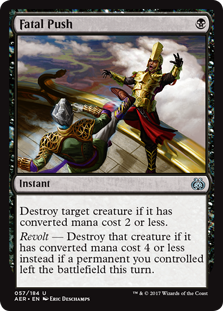 While it's no surprise to see Ryan on a Grixis deck, it's impressive he managed to Top 8 with
 Modern Nexus just did a feature on
 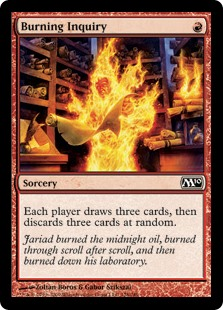 Second, Burning Inquiry is a fantastic enabler in this deck, and perhaps superior even to Faithless Looting. A single Inquiry lowers Hollow One's cost to zero, while Looting and Reunion make it cost one (plus the cost of the discard spell, which gives it an unexciting cost of three in Reunion's case). Inquiry may be less of a necessity, though, without a critical mass of cards that like to be discarded; I have sometimes found the card lacking in my my more dedicated Shadow/Delve builds, anyway. It also clashes with the Battle Rage combo, which requires multiple parts to function.
 Infect
 Aggro decks that goldfish a similarly early win rate, though, are protected by the losses and later kills guaranteed when playing against interactive decks. So, unless a combo deck is
  Notice anything special about
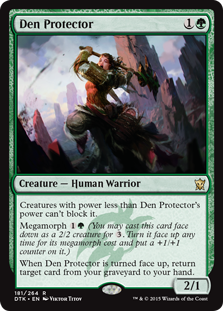
  The most common route to take these days seems to be to play all five colors, relegating the white splash to the sideboard for souls and Ranger of Eos. Some versions go straight Jund. Others still go Jund with Souls in the side. And the occasional weirdo plays Sultai or Abzan.
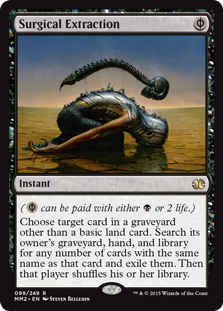 Surgical Extraction, too, enables surprise blowouts; this card is far more common out of Grixis, as Delirium usually prefers Spellbomb for its card type and utility in fair matchups.

 For those who know my (brief) competitive resume, you know that I hold a dear place in my heart for the Regional Pro Tour Qualifier circuit. Back in Fate Reforged Standard, in the middle of my streaming heyday, I spent weeks grinding and perfecting my Esper Dragons list, learning the ins and outs of every matchup and perfecting my sideboard strategy to a card. While the fact that Esper Dragons was the best deck in the format at the time certainly helped, I owe my Pro Tour berth to the RPTQ circuit and the hours I spent preparing for it.
 All that to say this: oftentimes the deck you choose to play and your resultant success is just as dependent on the type of event as all the other factors we are familiar with. The metagame, the rock-paper-scissors theory, deck familiarity, and more are all factors we take into account—but the type of player and quality of event we are playing in can influence results just as well. Packing Grixis Death’s Shadow at SCG Charlotte a while back—on the very weekend when everyone was gunning for Grixis Death’s Shadow—is a bold move, and must be considered during deck and sideboard construction. Were that event a Grand Prix, I would have spent less time teching for the mirror and opposing hate cards, and more time preparing my deck (and my comfortability) for an open field.
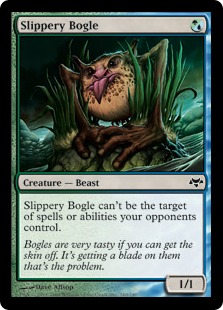 So, as always is the case with Magic, we’ve got options! Been playing Jund for years? Know the ins of outs of every matchup? Then you know your deck is a 50/50 deck, but go ahead and play it, content with the knowledge that you’ve tested every possible matchup more than your opponent, so you deserve to win even though you sleeved up a million removal spells against Tron. If that doesn’t describe you, and you recently found yourself with a beggar’s chance at the bright lights, perhaps something straightforward like Affinity is more to your liking. If you’ve been neck-deep in the metagame trends for the past few weeks, and you know what everyone is playing because you’re a genius, attacking with something off the wall like Living End, Ad Nauseam, or Bogles could be the way to go. The best thing about RPTQs, in my opinion, is that all options are possible, and the event is small enough that literally anything can take the room by surprise.
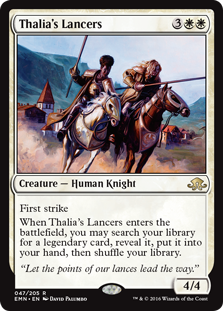 Is Thalia's Lancers actually good? I question it, but I shouldn’t, because I haven’t played it yet. And neither should you. I’m not above any card or strategy if it’s the one that’s going to help me win, and if that’s the attitude you have going into an RPTQ event, then you just aren’t meant for the Pro Tour. Sorry. Playing on the largest stage requires suspending disbelief, putting aside pride, and looking under every possible rock for the edge it takes to be a champion. For me, that card was Stratus Dancer. My final round, my Pro Tour win-and-in, came against Mono-Red, and I won the match by beating down for a few turns with a Stratus Dancer, then casting Silumgar's Scorn and Foul-Tongue Invocation to survive his lethal. Make the Pro Tour with a card that makes your opponent read it. It’s a memory you will never forget.
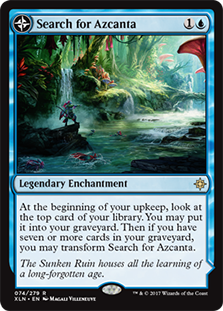 I know, it’s a control deck with Gideon of the Trials and Search for Azcanta. I can’t help myself. I love this deck for a couple reasons. First, every single card in this deck signals to me that the pilot knows what he’s doing. I’m not saying this is a perfect list, as the numbers could just as easily be experimental as intentional. But this is the sort of deck you play for weeks and weeks, trying out tons of variations of cards, finding the flex slots, and tuning for specific matchups. This type of approach takes dedication, and an iron will. I spent weeks grinding Esper Dragons only for it to become a target right before my RPTQ, but I stayed the course. UW Control will definitely not be a target in the same sense that Esper Dragons was, but a strong finish or two from a control deck right before the RPTQ can potentially ruin plans you've been working towards fruition for weeks.
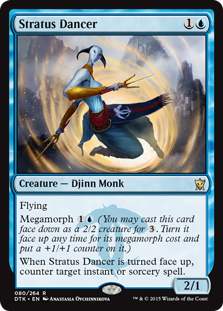 I know from experience that taking down an event with a deck you’ve played for weeks and weeks, perfecting it to the best of your ability, culminating finally in ultimate victory… It’s something special. RPTQs, in my mind, bring out the type of player you are, whether you realize it or not. How do you respond to a challenge? Do you face it head on, putting all of your faith in how you play your signature deck on game day? Do you bank on preparation, essentially betting your results on how accurately you were able to figure out the field? Or do you roll the dice on something you might not be too familiar with, but nevertheless feel will give you a hot-hand type effect?

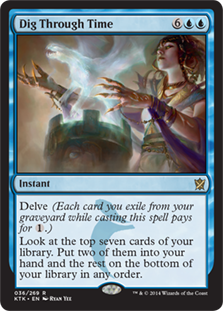
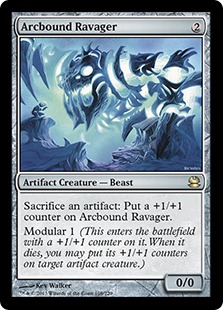 What I can be more definitive about is Affinity's result. Yes, I do consider Bertoncini's win suspect because of his reputation, but the rest of the results show that the robots are thriving. A random sampling of decklists suggests why: there's not a lot of dedicated Affinity hate out there. Rather than Stony Silence, Hurkyl's Recall, or Creeping Corrosion, players are sideboarding more general cards like Natural State and Wear // Tear. And fair enough, those effects are more versatile and therefore valuable in an open meta. However, most decks can't race Affinity and struggle to win without dedicated hate.
 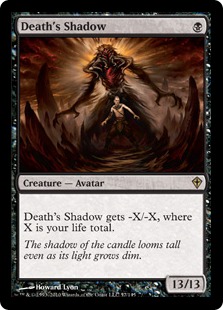 The second thing is Grixis Death's Shadow's rise. It was just barely a presence in the Open listings, but Regionals gave it a massive shot in the arm. This is interesting, and provokes a lot of questions that don't have answers. The deck is not easy to pilot and is known to fail without outside assistance in a way that few other decks can. The influx might be a function being advantaged in shorter tournaments. It is also possible that a lot of players bought into the deck over the summer and stuck with it where the Open players made changes. This is one to watch—odd spikes are where the interesting research is done.