menu

Insider: QS Cast Infographics – Episodes 37-65

Are you a Quiet Speculation member?

If not, now is a perfect time to join up! Our powerful tools, breaking-news analysis, and exclusive Discord channel will make sure you stay up to date and ahead of the curve.

Insiders, I'm ecstatic to bring to you all a new segment: QS Cast Infographics!

Part of our recent growth and additions to the site is the recruitment of some amazing people - in this instance Guillaume (@poppu_mtg) our new data analyst and Diego Fumagalli (Visualizing Magic) our resident graphic artist.

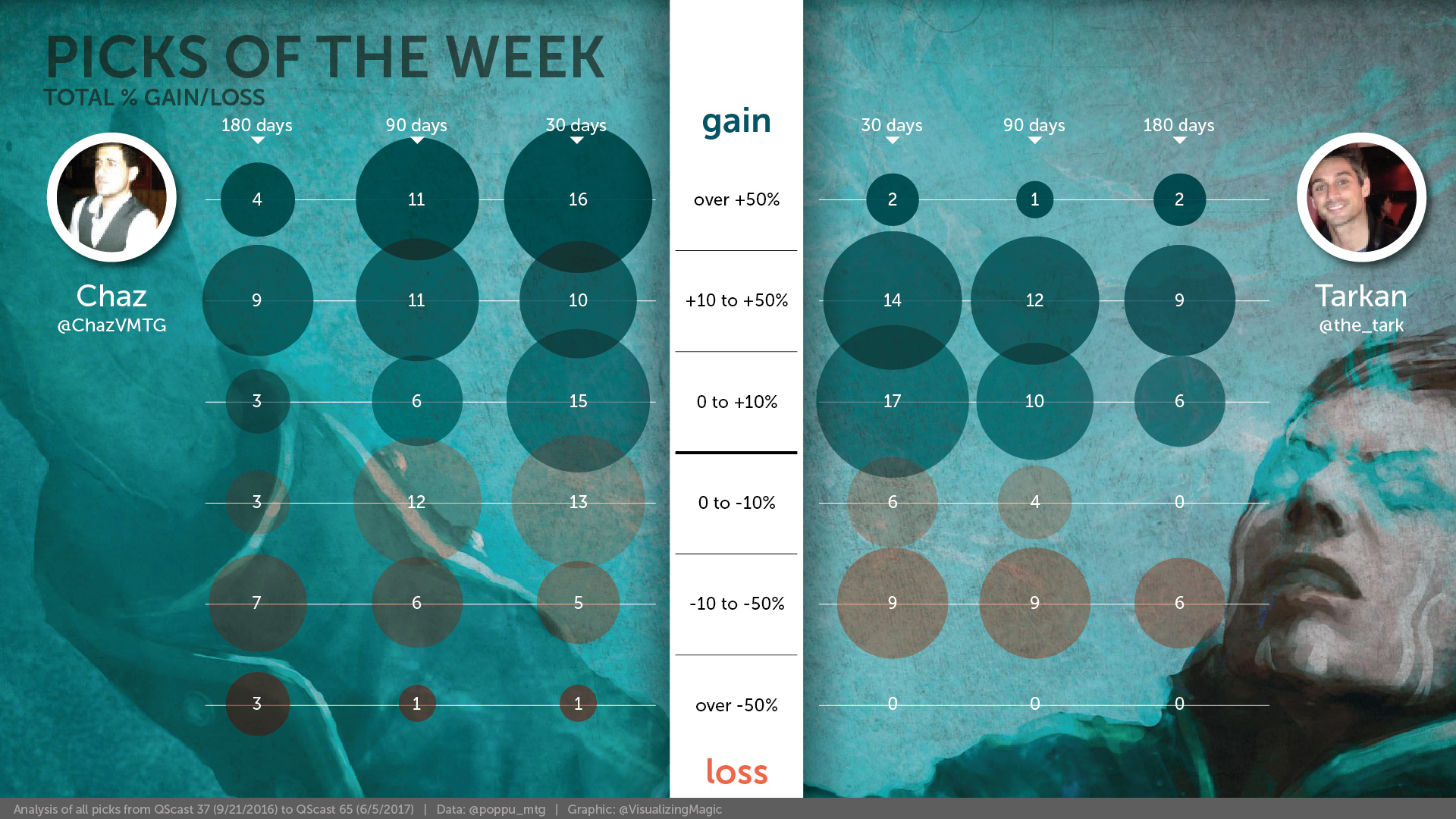
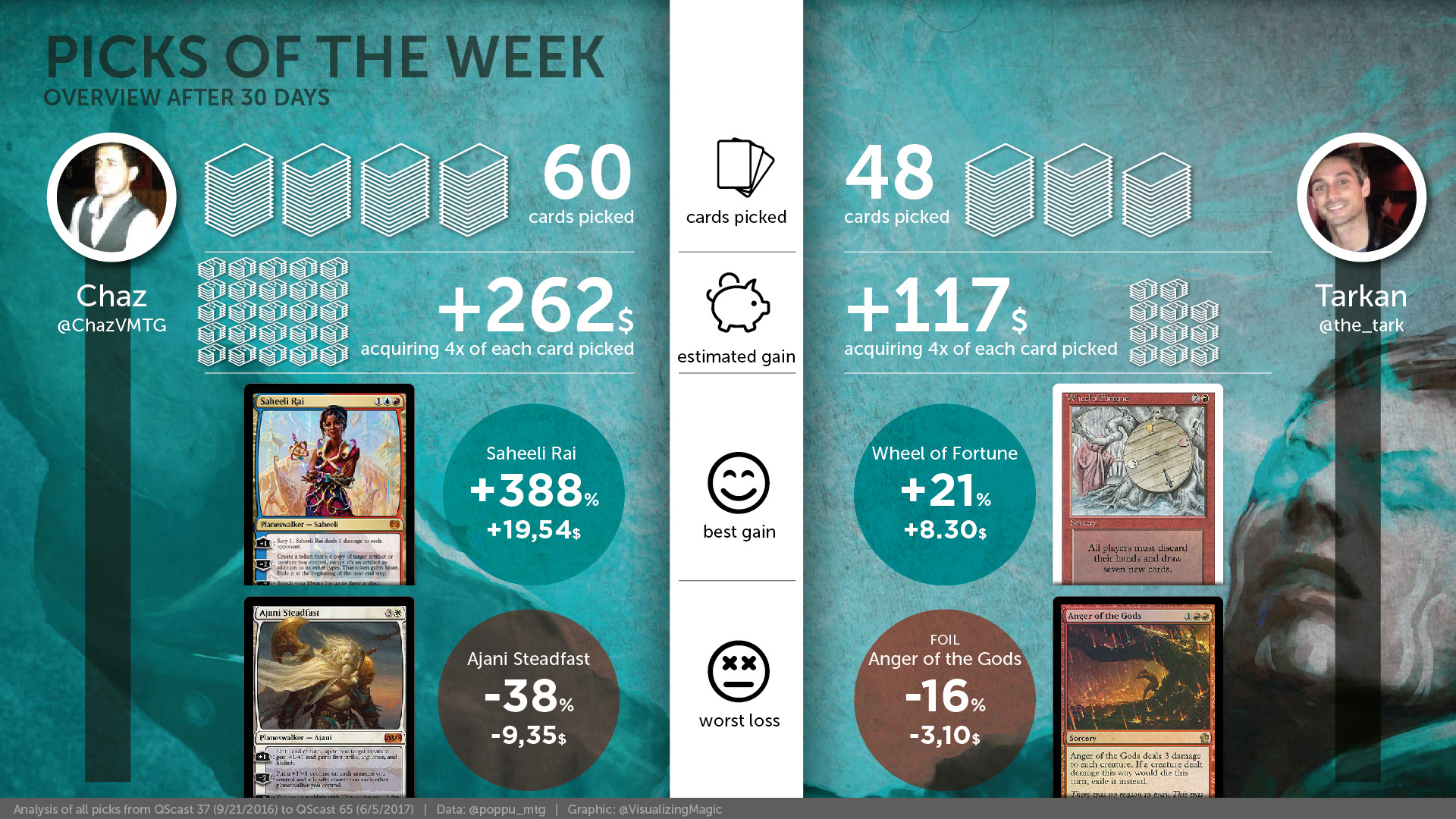
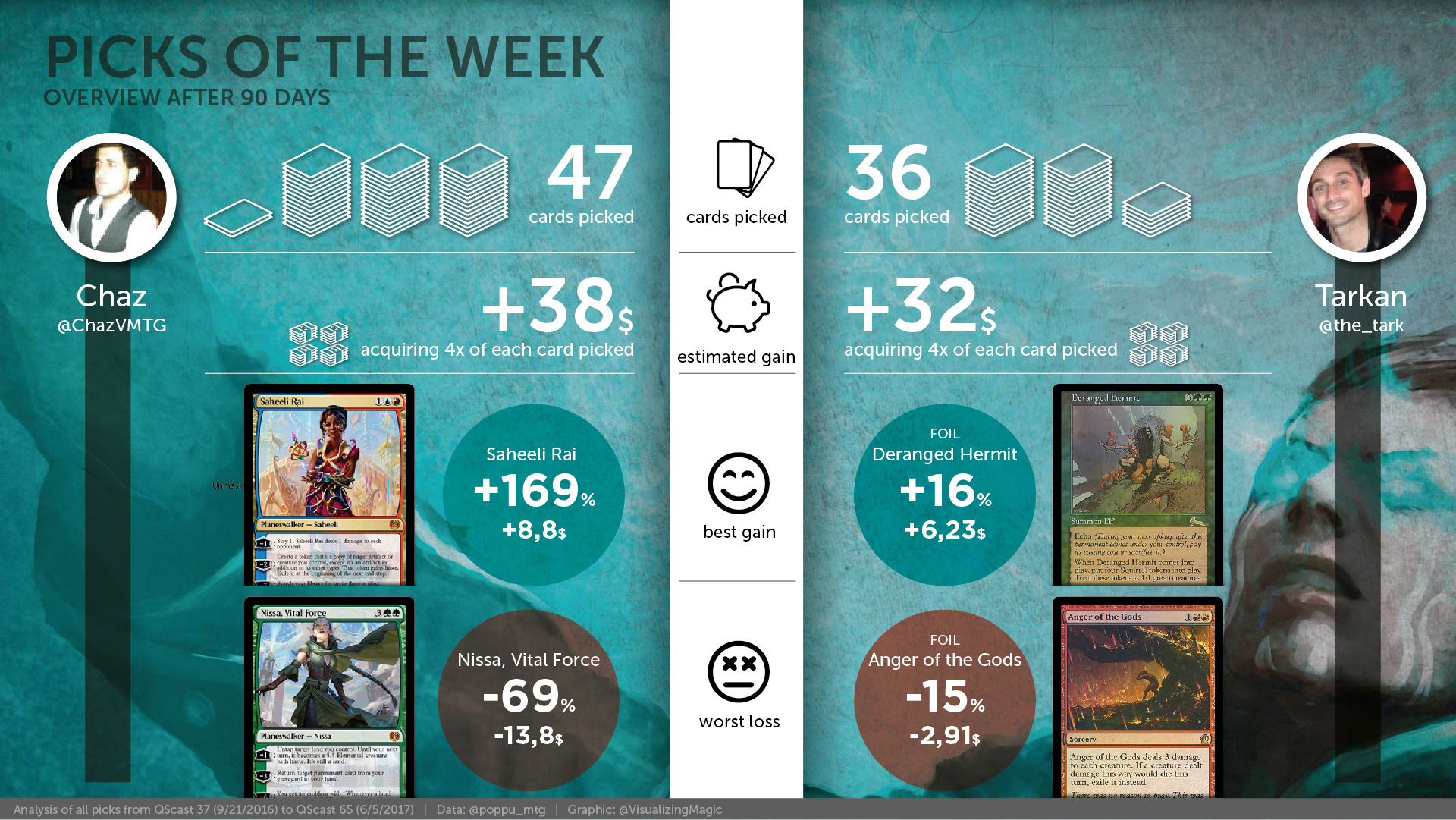
They came together and produced some amazing Infographics that have tracked the QS Cast and provided the numbers, and data, to track both Tarkan and myself since we've been duo-hosts. In this Infographic update they tracked Episodes 37-65 and provided graphics spanning from Overall to 30, 60, and 90 days.

You can be sure that we will provide monthly updates to reflect recent data, and will be adding our newest cohost Morgan Wentworth in future updates! I have the great pleasure of showing these off and providing a statement from Guillaume to give us some context behind these numbers and providing some additional clarity. Let's see how the QS Cast has fared for this update!

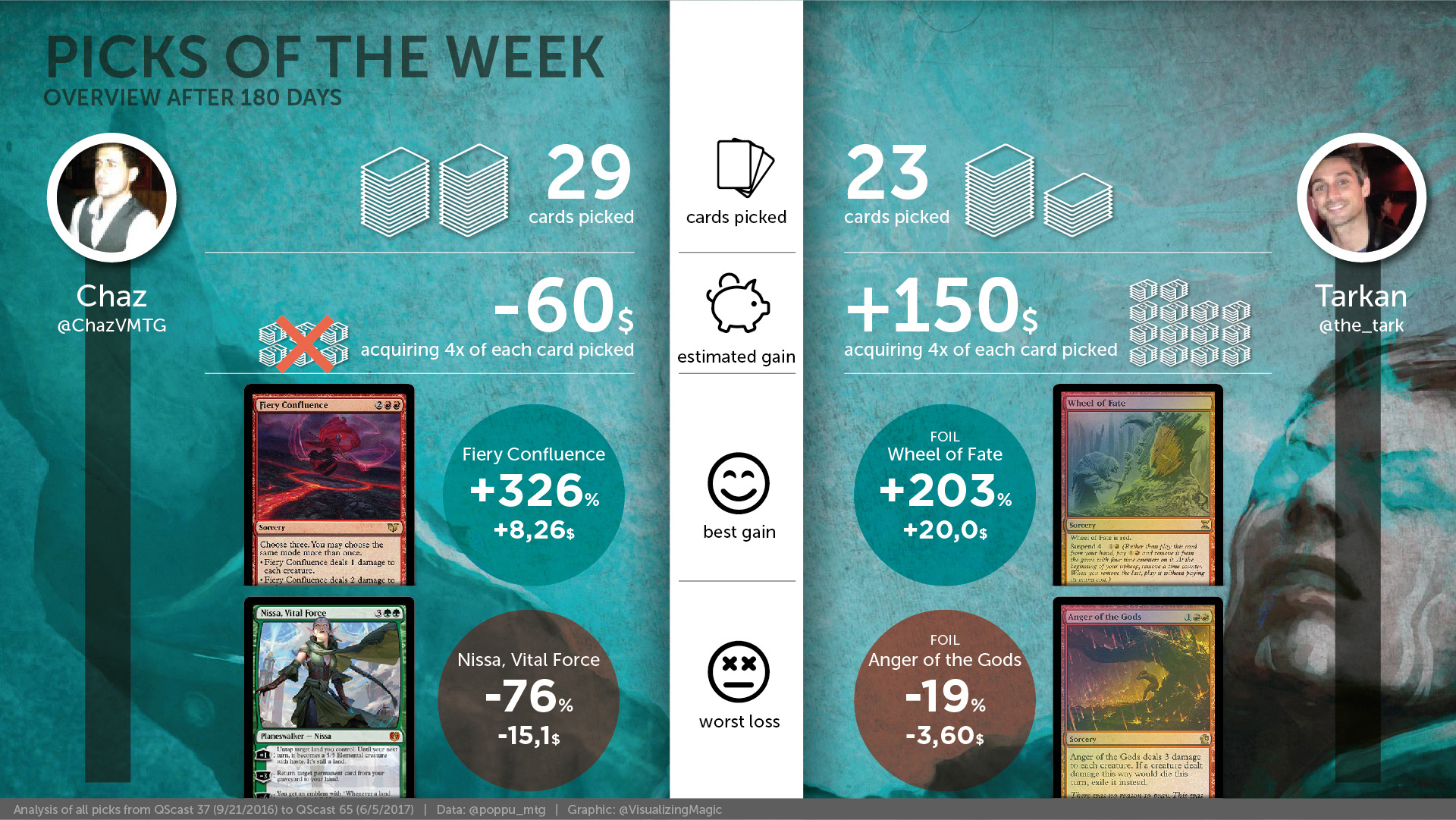
Looking at the big picture, both Chaz and Tarkan cover a wide spectrum of cards across all formats (Standard, Modern, Legacy, EDH), and each of them seem to have his own specialty: Chaz is better on short term gains, Tarkan takes over when checking after 6 months or more. This can be explained from the type of picks our casters are going for: 26.7% of Chaz's picks are Standard cards, and 16.7% are Modern targets.

At the same time, Tarkan's picks are mostly geared towards EDH or Reserved List cards, totalling 64.6% of his picks. With a constantly evolving metagame, Chaz's picks are much more volatile and as such have the potential for largest swings as exemplified by Saheeli Rai and Nissa, Vital Force.

On the other hand, Tarkan is in it for the long run, with a smaller number of picks but the vast majority of them in the green for all three time periods, between 0 and 50% gain, while his largest losses after 180 days coming from Standard cards (Aetherstorm Roc -38%, Panharmonicon -31%).

Ironically though, Tarkan's largest margin over 180 days comes from foil copies of Wheel of Fate (+$20 for a triple up since December 7th, 2016), also known as the "As Foretold Effect" (note: the card actually spiked to close to $50 but dropped to $35 a week later and has been tapering off since, due to the lack of results of Jeskai As Foretold Control).

All in all, Chaz and Tarkan have complemented each other above others on these types of Podcast: and allow to diversify your portfolio with confidence: whether you like quick turnarounds or stash-now-find-later, Standard or EDH, the data supports our casters' choices for "Pick of the Week." It will be interesting to see how Morgan fares now that she joined the Quiet Speculation Podcast as a full-time member!

-Guillaume, QS Data Analyst

 (click to enlarge)

Picsoftheweek_20170728_overall_1Picsoftheweek_20170728_30_copy_1Picsoftheweek_20170728_90_copy_1Picsoftheweek_20170728_180_copy_1


Avatar photo

Chaz V

Started playing during Invasion block at the age of 13. Always a competitive person by nature, he continues playing to this day. Got into the financial aspect of the game as a method to pay for the hobby and now writes, Podcasts, and covers all aspects of the game, always trying to contribute to the community and create great content for readers and listeners.

View More By Chaz V

Posted in Free Insider, Infographic, QS CastLeave a Comment on Insider: QS Cast Infographics – Episodes 37-65

Have you joined the Quiet Speculation Discord?

If you haven't, you're leaving value on the table! Join our community of experts, enthusiasts, entertainers, and educators and enjoy exclusive podcasts, questions asked and answered, trades, sales, and everything else Discord has to offer.

Want to create content with Quiet Speculation?

All you need to succeed is a passion for Magic: The Gathering, and the ability to write coherently. Share your knowledge of MTG and how you leverage it to win games, get value from your cards – or even turn a profit.

Back on the PPTQ Grind: Week Two

Are you a Quiet Speculation member?

If not, now is a perfect time to join up! Our powerful tools, breaking-news analysis, and exclusive Discord channel will make sure you stay up to date and ahead of the curve.

Another week, another PPTQ, another time I didn't get there. Which is good news for this article series, bad news for my desire to get back on the Pro Tour. Especially considering the announcement about the PT this season is feeding. Modern is back on the Pro Tour, and I'm elated. Not only will I get to play a superior format if I get there, but I'll actually want to watch PT coverage again.

Having Standard every PT just left me cold. Ever since I first became aware of the Magic Pro Tour, the older formats made for better watching. In the old days, you cared about the Block Constructed PT to tell you what was good from the new block, but you really ate up the Extended PT coverage. That was were the cool decks lived and was the kind of Magic you aspired to play. Everyone could play Block or Standard, but Extended was where the masters shined. In my opinion, that inspiration and allure has been missing since the PT became Standard-only. I'm all for Modern's return!

The Decks

As I said last week, I intended to play a new deck for this PPTQ. But exactly which deck, I didn't know. After some tinkering, I ended up on Esper Control. The archetype dropped out of sight sometime after Trevor covered it extensively. I was never sure why; dedicated card advantage is excellent against attrition decks like Grixis Shadow. I assume that it was too slow for the meta, as the version I played last week is absolutely glacial. That wasn't a problem for me because it fulfilled my main concern of beating Chord of Calling decks: deplete their resources enough, and it doesn't matter how you win. I maxed out on removal for small creatures, relegated discard to the sideboard, and added planeswalkers to close out games. It worked; I demolished every green creature deck I faced during testing. The deck is an enormous dog to Tron, but as I saw last week, Tron players don't show up to PPTQs, so I considered it an acceptable risk.

Esper Control, by David Ernenwein (PPTQ Deck)

Creatures

4 Snapcaster Mage
2 Tasigur, the Golden Fang

Instants

4 Fatal Push
3 Path to Exile
3 Negate
1 Blessed Alliance
4 Esper Charm
2 Cryptic Command

Planeswalkers

1 Elspeth, Sun's Champion
2 Gideon Jura
1 Gideon of the Trials

Sorceries

4 Serum Visions
3 Collective Brutality
3 Supreme Verdict

Lands

4 Flooded Strand
4 Polluted Delta
2 Marsh Flats
2 Creeping Tar Pit
2 Hallowed Fountain
2 Island
1 Watery Grave
1 Godless Shrine
1 Plains
1 Swamp
1 Darkslick Shores
1 Seachrome Coast
1 Celestial Colonnade

Sideboard

4 Thoughtseize
3 Ceremonious Rejection
2 Dispel
2 Lost Legacy
2 Surgical Extraction
1 Blessed Alliance
1 Disenchant

If the sideboard looks unrefined, that's because it is. I spent most of my available time this week working on the maindeck and using the sideboard to fill holes that came up. Not that it mattered, as I audibled off Esper. You probably knew that since this section title is plural, but for reasons that are in the next section, I couldn't justify playing any control deck. While I think that call was correct, the matchups that I actually hit would have favored this deck.

I again played Death and Taxes, to which made some adjustments since last week. I cut angels for Selfless Spirit maindeck and cut Gideon for Burrenton Forge-Tender. Spirit is not a great two drop, but it has utility and evasion, making it ideal for both curve purposes and the hole I identified last time. Forge-Tender is also good against sweepers with special utility against Burn, and frankly I couldn't think of anything else I wanted in that slot. After scouting the field at the venue, I also took out the Devout Lightcaster for a Disenchant.

Death and Taxes, by David Ernenwein (PPTQ Deck)

Creatures

4 Thraben Inspector
4 Thalia, Guardian of Thraben
4 Leonin Arbiter
2 Selfless Spirit
1 Phyrexian Revoker
1 Serra Avenger
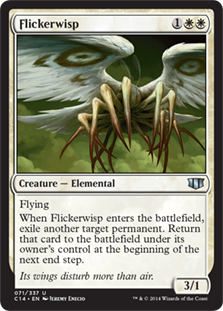
4 Flickerwisp
4 Blade Splicer
2 Mirran Crusader
3 Restoration Angel

Artifacts

4 Aether Vial

Instants

4 Path to Exile

Lands

10 Plains
4 Ghost Quarter
4 Tectonic Edge
2 Horizion Canopy
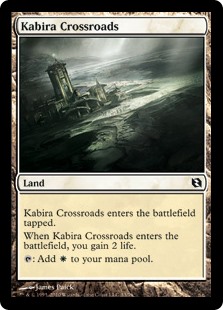
2 Kabira Crossroads
1 Cavern of Souls

Sideboard

2 Burrenton Forge-Tender
2 Wrath of God
3 Rest in Peace
2 Stony Silence
1 Phyrexian Revoker
2 Sunlance
1 Disenchant
2 Grafdigger's Cage

The deck felt and played much better than last time, and it's going to take a huge metagame shift for me to change it again. The sideboard is another story, and I will certainly adjust it before I play again. Revoker has been better than I expected, and I keep hitting matchups where Wrath is good; better than Dusk // Dawn. More tuning is required.

The Tournament

I was surprised to find out upon arriving at the site that this would be another huge PPTQ. Once again, there were 46 players for 6 rounds of Swiss. The north doesn't get many PPTQs compared to Denver, so I guess this shouldn't have surprised me. What was surprising were the decks I saw in the games room. I don't know what I was expecting to see, but five Prison decks and five Affinity decks laid out for registration definitely wasn't it. As I was moving to an empty seat, I saw two more Affinity deck sheets laying around. This forced me to completely reconsider my deck choice.

I had with me the Esper Control deck, UW Merfolk, and DnT, as well as the ability to switch Esper into pure UW if the need arose. As I sat down, I knew Esper was out of the question. Three of the Prison decks were Sun and Moon variants, with Lantern and the UR As Foretold deck I mentioned a few months ago.

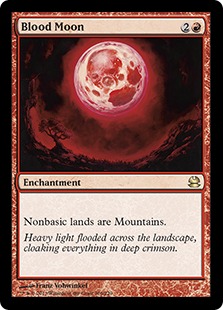
That made four dedicated Blood Moon decks. Affinity also plays Blood Moon in the sideboard. Esper control can't beat Blood Moon. You'd think that a deck with maindeck enchantment removal could fight Moon, and as long as it happens after turn three, you'd be right. However, all of these decks accelerate out the Moon early (because Simian Spirit Guide is good for Magic), and getting my lands turned to mud before I can fetch my basics kills the deck dead. I'll never play a deck that loses to a card that ~25% of the field has, so I had to change. There was also a number of Bant Eldrazi decks, which also aren't great for Esper. Not bad, exactly, but not something I wanted to face.

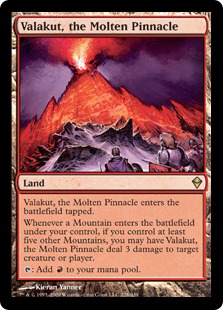
Merfolk was also out because of all the Affinity, so my choice was between rebuilding Esper into UW, which I had *just* enough time for, or playing DnT again. I looked around the room again and saw two GR Valakut, the Molten Pinnacle decks, so that ruled out UW. Not saying it can't be done, but I've never beaten GR Valakut with UW Control. I do that regularly with DnT. With good matchups against Prison, Affinity, and Valakut decks, I was feeling confidant. I saw only one Shadow deck and no other black decks during that room scan, so I cut Lightcaster for an answer to Ensnaring Bridge.

All that scouting went to waste, as I was not paired against any of those decks. Instead, I hit UW Delver, Bant Humans, Boros Burn, Counters Company, and Living End, finally dropping at 2-3.

What Happened?

Partially Wrath of Pairings, partially variance, and partially one huge misplay game three against Living End. For some reason, I hit the room's outliers instead of the decks with actual representation. You should always own your losses and learn from them, but hitting two rogue decks in a row is really anomalous. That makes for a difficult analysis—did I misevaluate something, or just get unlucky in pairings?

Round 1 against Delver I get crushed with Delver into Delver, both of which flipped immediately, and he countered my first Flickerwisp so I couldn't stabilize. The next two games I just slaughter him with Thalias and Blade Splicer.

Bant Humans is very nearly unwinnable and I never stood a chance. It's not only a faster clock, it goes wide and big. I didn't really have a chance and my poor draws didn't help.

My Round 3 Burn opponent only had two lands game one and one game two, and I got to Strip Mine him in both. Once that happens, they aren't really games, are they? Kabira Crossroads continued to be great here.

Against counters, I lock him off four mana with Arbiter and Revoker on Devoted Druid and just amp up the pressure until he dies in Game 1. The next two games involve me flooding out while he goes nuts with Renegade Rallier. I lament failing to draw Grafdigger's Cage and he agrees that he would have just lost to that card.

The last round against Living End was very hard. Game 1, I effectively hard-lock him with Thalia and land destruction. Keeping Living End from five mana with Thalia around shuts the deck out. Game 2, we both mulligan, and he has a phenominal curve which dances around and through Rest in Peace and my taxes. In Game 3, a critical misplay cost me the tournament. When playing a creature deck against Living End, you need to apply enough pressure to force them to go off, but hold enough threats in hand so that once they go off, you can flood the board again. The ultimate goal is to force another End, which will be more favorable to you.

I had a steady clock, but decided to Vial in a Flickerwisp to speed things up and get some value. Unfortunately, he had Violent Outburst to really get me. I fight on thanks to Mirran Crusader blocking Horror of the Broken Lands, but I'm forced to play around Archfiend of Ifnir, and by the time I get to Path, the damage is done. I have to use Restoration Angel to save Crusader; it gets shrunk and then killed by Deadshot Minotaur. He's at 2 life but has Desert Cerodon to prevent my lethal attack. When I die, the Path I need is on top of my deck.

Had I not played out that Flickerwisp, I would probably have won that game. I made a bad call about my clock and was rightly punished. In fairness, had I not flooded on lands and Vials immediately afterwards, I may still have won. That's no excuse, because if I'd cleared that Cerodon, I would have won anyway. Interestingly, Merfolk has a better matchup against Living End thanks to its counterspells. This match remade the case for including Warping Wail in the sideboard. My opponent showed how well End pilots can deal with RiP these days; having additional angles of attack would have been a good idea.

Lessons Learned

I have to be more careful about managing my clock. My final loss was entirely due to misevaluating the board state and undervaluing that Flickerwisp. I believe I've gotten complacent regarding that, since I played Merfolk for so long it became second-nature, but DnT is a different beast. When I play it in the future, I need to be more conscious of how my cards interact with the board and the clock. Muscle memory isn't going to carry me anymore.

I've also noticed that I'm getting very good at reading the room, making the right call on my decklists, and then not following through. Some of this is definitely overconfidence, but I think I may be overvaluing this information. This happened at the RPTQ as well, so I think it must be me. I need to re-evaluate how I'm using scouted information and if I'm making the right calls.

On the Deck

I was generally very happy with my deck, but there was an interesting conversation about it after my Round 5 loss. I had both my Crossroads in play by then, and several observers commented that if they had been Horizon Canopys, I would have won. After checking my game notes, I believe this is wrong.

The first Crossroads was my first land of the game and I played at least three spells with it before I had a choice to not take damage. That's five life gained, and represents no less than one draw step. I was at 22 when my opponent began attacking me, and he was very cautious about it, since he was at 4 and then 2 life. He only attacked with his mono-black creatures, and never the green or multicolored ones until I was very, very dead. Had I been lower, he may have been more aggressive, and I would have died before I actually did considering my poor draws. Thus, I argue that Crossroads did draw me cards in a sense, and I ended in the same or worse position as if I'd had the Canopies.

Moving Forward

This week's PPTQ is south from the last one, but still in northern Colorado. I won't be taking Esper along; Blood Moon appears to be popular up there (I saw a number of Zoo decks with Magus of the Moon, too). UW is not the best-positioned against Prison decks, but it demolishes the other decks that were present last weekend. I'm planning to build and test that deck primarily this week, but again, we'll see where things stand once I get to the tournament.

...And On...

That's it for this week. I hope some of you have succeeded where I failed. I'll be back next week with the latest results. Keep grinding!

Insider: The Return of Legacy to the PT

Are you a Quiet Speculation member?

If not, now is a perfect time to join up! Our powerful tools, breaking-news analysis, and exclusive Discord channel will make sure you stay up to date and ahead of the curve.

Welcome back readers!

For those who aren't aware, WoTC made a pretty big announcement, especially for us Legacy aficionados, on July 19th. They are having a team-based PT and one of the formats played on it will be Legacy.

The reason this is so important is that while GPs can increase interest in a format by a decent amount, Pro Tours increase it dramatically. We see our biggest price spikes from Pro Tours. While Legacy will have to share the limelight with Standard and Modern, the fact that we haven't seen Legacy on the Pro Tour since 2011 (specifically as part of a Team Constructed event in San Fransisco) makes this huge news. It will likely revive new interest in the format, which has taken a pretty big blow after SCG shifted their Sundays away from Legacy Opens.

I'm especially excited because the format has changed a good bit with the banning of Sensei's Divining Top. (I had to have a moment of silence after typing that... Rest in peace, sweet Miracles deck).

Normally we don't see a ton of innovation in a format with such a high bar on power level for individual cards. Usually it's in the form of sideboard tech based on the expected metagame, but other developments do occur. In the past year, for example, we've seen the creation of a BR Reanimator deck using Chancellor of the Annex as an uninteractable/uncounterable free Daze for your opponent's first spell. We've seen another reanimation-based deck that uses Vampire Hexmage and Dark Depths, and we've seen variations of the Lands deck.

There has been a good bit of innovation in the format as a whole, but I expect even more with pro teams now having to set aside time and effort into creating the ultimate Legacy masterpiece.

Now as awesome as this is for players, it's equally awesome for speculators. Legacy is the type of format where a card can suddenly go from pure bulk to $5, $10, or even $15 in a couple of days (see Predict and Soothsaying). The important thing here is to keep one's finger on the pulse of the format, to look at what is doing well, and consider what we expect the pros to lean towards.

If I look at the last three days worth of MTGO Competitive Legacy League results I see a plethora of different deck archetypes. This is fantastic for the format, but makes speculation a bit more difficult. Note also that Wizards has recently changed their reporting algorithm to select for different decks to highlight. So this isn't necessarily indicative of the metagame, but we know all of these decks are capable of winning a tournament.

  • 4c Control
  • Eldrazi Aggro
  • Dark Depths
  • Grixis Delver (2)
  • Storm
  • Sneak and Show
  • Jund
  • Shardless BUG
  • Grixis Pyromancer
  • BUG Midrange
  • Zoo

That is a whole lot of options. What about the Top 8 of the last SCG Classic?

  • Infect
  • Sultai Death's Shadow
  • Lands
  • BG Depths
  • Storm (2)
  • Grixis Delver
  • Sneak and Show

Between the two, we have 15 different archetypes over 20 different placements (you won't see that kind of diversity in Standard).

One thing we can expect from the pro teams is that they will likely want to do the most broken thing they can. Because the stakes are so high, we can also expect the pros to want to make sure they can deal with anything. This most likely means a lot of Force of Will decks, which isn't exactly surprising.

The next level would be to play a deck that doesn't care about Force of Will, like Storm or Lands. Storm because it plays a lot of hand disruption and Lands because most of its powerful cards are either uncounterable (thanks to being lands) or reusable (like Life from the Loam). We are also seeing a lot of very greedy manabases, so the ability to attack the opponent's mana production can be extremely powerful.

Now before we start looking at the possible speculation targets for Legacy, we need to keep in mind that the Team Constructed Pro Tour occurs on August 3-5 in 2018 (a little over a year from now). In that year we are expecting both Iconic Masters (November 2017) and Masters 25 (March 2018). Both will very likely contain Legacy-relevant reprints.

Given that, there are a few cards I don't want to own right now because they are not on the Reserved List and are extremely expensive. The irony is if any of them dodge reprints up until the PT, they could skyrocket and see massive gains—but the potential losses from a reprint are far more likely, and I tend to be a risk-averse investor.

The "Sells"

There was an error retrieving a chart for Flusterstorm

This Commander 2013 behemoth came in only the "Political Puppets" deck and has dodged a reprint thus far (discounting the judge foil). Flusterstorm could easily show up as a rare in any Masters sets, as it is unlikely to affect the Limited environment, but would certainly make the person who opened the pack happy. Sitting at close to $100, this isn't a card I want to be caught holding.

There was an error retrieving a chart for Rishadan Port

Port has only a single Standard-legal (i.e. mass) printing, all the way back from Mercadian Masques. The card ruled Standard and found a home in most Tier 1 decks of the time, and I don't see it returning to Standard anytime soon. But its only reprint was a judge promo with small supply, and it's sitting at a little over $100 for original copies.

Port shows up in Lands and in Death and Taxes (two of the better decks in Legacy right now). If you have extra copies you aren't using, I suggest you try and find an out.

Luckily, those are the only cards I'd currently rather not own at this time. I do have a personal set of Flusterstorm, and a judge foil too, but I don't like trading off my personal sets and I happened to have gotten all four when they were under $15.

The "Buys"

While I like to make sure my readers don't lose money, it is still more fun to find the "buys" rather than go over the "sells." Looking at the decks discussed above, there are definitely some nice speculation targets.

There was an error retrieving a chart for Dark Petition

Dark Petition has found a home as a typical one- or two-of in many Storm builds. Storm also happens to be one of the decks that does something incredibly powerful and doesn't worry so much about Force of Will, thanks to all the maindeck disruption it packs.

Dark Petition is the newest card in the deck, and while regular versions are sitting around $1.50, pack foils have only about a 3.5-4x multiplier at $5.50-$6. If Storm packing this card does well at the PT, I'd expect the foils to double up easily, if not triple up.

Having built and played Storm for a while, I can tell you this card is a critical piece of the deck. While paying five mana for a Diabolic Tutor and Dark Ritual might not seem like a steal, it solves one of the deck's biggest problems.

Going for Ad Nauseam when you're low on life can be a risky play, and you can even die from 20 if you get unlucky. Because of this, many players prefer to just go the Past in Flames route; with the additional three black mana from Petition, it's a lot easier to combo off and a lot less risky.

There was an error retrieving a chart for Show and Tell

It says a lot that this card was once sitting at $80, only had one reprint (at mythic in Conspiracy 2), and now those copies are sitting in the sub-$15 range. There was even a time when many people thought this card should be banned due to the dominance of the Sneak and Show and the Know and Tell decks.

With its current price point being so low and the deck still being very powerful, it seems like an excellent speculation opportunity. The fact that Show and Tell is a key component of both those decks, is blue, and can allow someone to essentially win on turn one (with a Lotus Petal) means that it is likely very appealing to pro players.

There was an error retrieving a chart for Sneak Attack

The Sneak half of Sneak and Show, Sneak Attack, has also seen a huge decline in price thanks to a single reprint, in Eternal Masters (and at mythic). While I prefer the original artwork, Sneak Attack also happens to be a good Commander card (as cheating in hasty threats is a powerful play).

I also think that the Sneak and Show deck is a better choice than Know and Tell, if only because Know and Tell relies very heavily on Show and Tell (and some on Dream Halls, which can also benefit the opponent). Meanwhile, Sneak and Show has both Sneak Attack and Show and Tell to carry the load.

I purchased eight copies about a month after Eternal Masters came out, expecting this price to rebound. Without a catalyst, its price has slowly declined to around $20 (from $25).

There was an error retrieving a chart for Berserk

Unlimited Berserks sat in the $100 range for a while thanks to the power of the Infect deck (where it is typically only a one- or two-of). But thanks to the Conspiracy 2 printing (at mythic), one can pick up Berserk for $8. That's insanely cheap for such a powerful card.

Now I will admit it's typically only used in the UG Infect deck, but that deck has the ability to kill on the second turn and packs a lot of cheap countermagic, which allows it to play well against other unfair decks. I did purchase five copies while writing this article, as I only owned one already.

Conclusion

I hope you are as excited as I am to see the return of Magic's greatest format to the center stage, if not, at least you can speculate on it as I think there are some juicy targets (and am personally invested in a few of them already).

Insider: A Beginner’s Guide to the MTGO Marketplace, Part I

Are you a Quiet Speculation member?

If not, now is a perfect time to join up! Our powerful tools, breaking-news analysis, and exclusive Discord channel will make sure you stay up to date and ahead of the curve.

If you are going to play Magic Online or invest in Magic cards online, you are going to very quickly encounter the MTGO Marketplace. Once you click the "Trade" tab, you'll see a whole slough of postings made by humans and bots who are trying to buy and sell cards.

For the individual new to MTGO, this open virtual marketplace can feel daunting and overwhelming. Even for the more experienced MTGO veteran, the MTGO marketplace remains something not fully known. Indeed, the MTGO Marketplace is much more like a Bazaar of Baghdad than your neighborhood grocery store – it is filled with vendors with established brands and lesser-known names, people trying to do honest deals and those trying to scam you, bots you know will be there tomorrow and bots that might vanish. What I hope to accomplish today is to give you a better sense for the MTGO marketplace and concrete steps to better engage with it.

There was an error retrieving a chart for Bazaar of Baghdad

This is not a how-to-trade guide. For that I recommend reading Cardhoarder's MTGO Beginner's Guide, and specifically watching this video of Marshall Sutcliffe explaining how to physically conduct a trade on MTGO. I'm going to first give you a lay of the land and then some suggested concrete routes to help you Explore.

I. The Top Dogs

1) Cardhoarder
2) MTGOTraders

These two bot chains are the Amazons and eBays of the MTGO Marketplace. Everybody knows what they are, and if you've traded online at all, you've probably done business with them. In fact, these are the two biggest bot chains on MTGO in terms of trade volume – I've heard estimates that 50 percent of all MTGO trading is done through these two chains.

Whether that's true or not, these two chains buy and sell everything. They are always fully stocked on Standard cards, and it's not too often that they don't have a Modern, Legacy, or Pauper staple I'm looking for. These two are also the two bot chains that MTGGoldfish uses to track MTGO card prices.

One thing that is helpful to remember, however: these bot chains' buy and sell prices are directly linked to each other, but they don't share credits between them. Thus, if you do business with one of them, I'd stick to that one and not bother with the other.

II. Popular Bot Chains

1) MTGO Library
2) GoatBots
3) MtgoEmpire
4) DrakeBots
5) _DojoTrade
6) Jedibot
7) TheCardNexus
8) bluedragon
9) Clanteam

This list is fairly exhaustive, though inevitably I will have missed a couple. These bot chains are ones that trade at a high volume, but not as high as Cardhoarder and MTGOTraders. These are, however, the companies that prevent Cardhoarder and MTGOTraders from becoming monopolistic behemoths in the MTGO Marketplace. In most cases, these bot chains buy and sell all cards for all formats. Unlike the Top Dogs, these bots sometimes are missing cards from non-Standard sets, but they can be relied upon to be fully stocked on Standard singles.

Some of the bots on this list, like GoatBots and MtgoEmpire, offer the same level of customer service as Cardhoarder and MTGOTraders, meaning that you can trade with their bots efficiently and smoothly, without any restrictions on the number of cards you can buy or sell, and with reasonable and contactable customer support should something go awry. Others can be lacking in one way or another; TheCardNexus and _DojoTrade, for example, only allow you to buy or sell a playset of any given card over a twenty-four hour period.

III. Your Specialty Stores

1) FoilValue
2) MaxValue
3) ValueBuyer
4) j-raja
5) Bulking
6) BoosterCity

This list is sampling highlighting the fact that there are a smattering of bots and bot chains that specialize in only one type of transaction. You'll often get better prices from these than from the jack-of-all-trades bot chains we discussed earlier. BoosterCity, for example, almost always offers the best buy and sell prices for treasure chests and boosters. Some bots focus on lands and promos. Some bots, like j-raja and Bulking, specialize in bulk. Some bot chains specialize in foils, and others only buy cards.

Things to Remember as a New User

If you are a new user, I think the most important thing is that you should take comfort in the fact that there are some real flesh and blood companies that run bot chains on MTGO, companies with websites and customer support. I've dealt with several of the owners and managers who run some of these bot chains (in particular Cardhoarder and TheCardNexus), and they have all been nice and helpful. Several of them are also responsive to your questions and messages on Twitter. Now that you know some of the big names in the MTGO Marketplace and have a general sense for what you'll find on the MTGO Marketplace, you won't feel as lost or overwhelmed when you look to buy or sell cards online.

This leads me to some recommendations for new – and veteran – users:

(1) If you are a new MTGO user, stick to trading with one or two from the list of "Top Dogs" or "Popular Bot Chains" until you grow more comfortable with the MTGO Marketplace. With the exception of the MTGO Library, which is unique in its overarching structure (see below), these are all bot chains that you can trust to give you reasonably fair prices and that will be trading on MTGO for the foreseeable future. Start there and branch outward as needed.

(2) Write down which bots you do business with! As simple as this rule is, it will save you tickets, time and headaches! I promise you will forget otherwise. While it would be tedious to keep a spreadsheet tracking your store credits with various bot chains, it is simple and painless to keep a list of those you do business with.

(3) Don't trade with an excess number of bots. Each individual bot chain company will save any left-over value from a transaction as store credit for you to use in the future. The value of store credit is identical to its value in Event Tickets (tix). For example, if you sold two Incendiary Flows for 0.40 tix to a ClanTeam bot, then you'll have 0.40 store credit (tix) saved up to use at any ClanTeam bot. Therefore, you want to minimize the number of bots you do business with to minimize the amount of outstanding store credit you have. Additionally, limiting the number of bots you do business with will make it easier to remember which bots you do business with, which means you'll be more often using store credit instead of giving away free tickets to bots.

(4) Avoid using the MTGO Library (Wikiprice) bots. Due to its unique structure, this is one for beginners to avoid using. The MTGO Library allows for individuals like you and me to run bots that are linked to the MTGO Library Smart Bot price updater. A hypothetical real-world example of this structure would be a group of family-run farms that pooled together to share pricing data and industry expertise but that operated their sales individually. The most significant danger involved in trading with bots of the MTGO Library is that you could trade with a bot that disappears a week later – and bots on the MTGO Library don't share credits with each other. In general, though, you'll be using your event tickets inefficiently because you'll often be trading with more bots than you otherwise would. Despite having done some good deals through MTGO Library, I've found its system quite tedious and recommend looking elsewhere.

(5) If you ignore the above advice, be very careful to avoid getting scammed. Always verify that the bot is buying or selling at the advertised price point. Many bots list false advertisements in the hopes that you'll just trust them. Is a bot you don't recognize offering a significantly better price than everyone else? Chances are high that if you open trade with that bot, the price isn't going to look so good. Just a few weeks ago, I saw an old bot chain that I had used in the past (rockchalkwalker) buying Hazoret for about .75 tix higher than others.  I opted to open trade. Lo and behold, the bot was actually offering 0.54 tix total for it! I didn't fall for this scam, and I don't want you to fall for these same scams either. Be careful! This is one of the main reasons why I recommend trading with the trustworthy bots I listed above. The other tactic to watch out for are bots that advertise a certain price but only offer that price for the first copy of that card you buy, raising the price for every copy thereafter. None of the bots I mentioned earlier engage in that practice.

Singing Off

I hope that this overview of the MTGO Marketplace will make you more comfortable trading within it. Next week, I will deliver Part II of this article, detailing some tips and tricks for more seasoned MTGO users as well as providing a run down of all the major bots I do business with and have done business with in the past. Inevitably, I didn't answer every question you may have on this topic, so leave a question down below and I'll answer it as best I can!

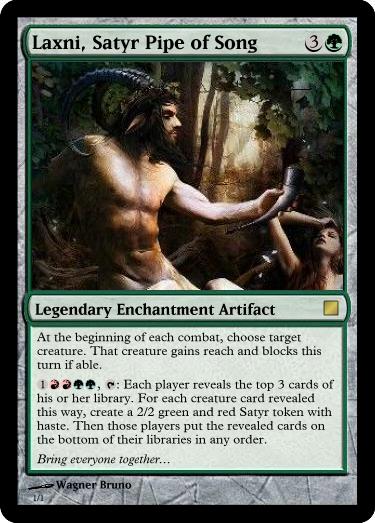
The card I leave you with this week is the first of a twin pair. Next week, I'll show you its companion Lapnos, the drum.

Laxni Satyr Pipe of Song

Insider: Selling Time

Are you a Quiet Speculation member?

If not, now is a perfect time to join up! Our powerful tools, breaking-news analysis, and exclusive Discord channel will make sure you stay up to date and ahead of the curve.

Another Pro Tour is officially in the books. Congratulations to any QS Insiders who managed to pick up some Hazoret the Fervents in advance of the grand event. Those who purchased their copies in the $5-$8 range will surely turn a profit.

There was an error retrieving a chart for Hazoret the Fervent

That is, if they sell quickly enough. You see, I don’t anticipate the price tag to remain this high for long. Typically cards that spike from Pro Tour camera time fall back down to a new, albeit higher, plateau. With Hazoret spiking to $20, I anticipate he’ll settle down in the $12-$15 range. I may change this prediction if mono-red strategies drop in popularity once the metagame is better understood. But for now, with rotation just a few months away now, I can’t be bullish on any Pro Tour spikes.

Sell, Sell, Sell

In fact, I’d go as far as to say that you should liquidate almost any Standard card that popped over the weekend. This would include God-Pharaoh's Gift, Earthshaker Khenra, and Angel of Invention, the other big movers from the weekend. Take those profits and apply them elsewhere in order to lock in gains and remain invested.

For me personally, I owned virtually zero Standard cards going into the Pro Tour other than a couple random rares I received as throw-ins from generous sellers. I had a couple very busy weeks at work and on the home front, and I just couldn’t get myself psyched up for the event. But just because I didn’t place any Pro Tour bets doesn’t mean I haven’t been doing any selling. In fact, over the past few weeks my selling has outpaced my buying, generating positive cash flow for the first time in a while.

Now, I haven’t been selling because my outlook on Magic finance changed. Far from it. I’ve been selling for two reasons. First, one of my investment theses changed recently, triggering a need for me to exit a sizable position. And second, I have found my rhythm when it comes to flipping certain varieties of cards for quick, modest profits. I’ll go into both of these reasons in further detail.

Knowing When a Thesis Fails

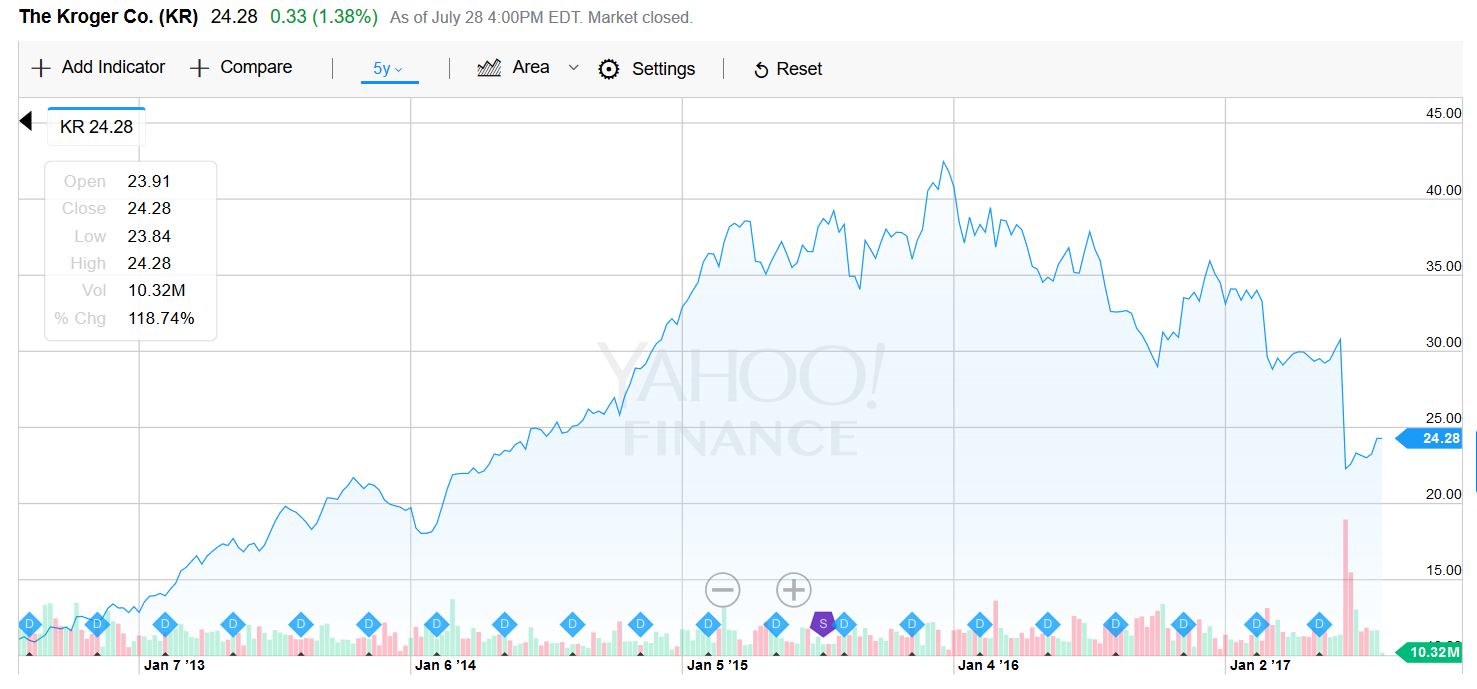
A few years ago my stock portfolio contained a large position in Kroger stock. The company was undervalued on a relative basis to the S&P 500 and it was the largest grocery store chain in the U.S., meaning it had a robust supply chain that could generate attractive margins. Margins even had a chance at improving with their foray into the naturals and organic segment of grocery.

The stock climbed in a slow, consistent fashion for a while. Then one day, Amazon made an announcement: they were looking into the grocery store market.

While this foreshadowed something that would not happen for years (i.e. Amazon’s acquisition of Whole Foods Market), I recognized that my thesis was being disrupted. I cashed out, missing out on some profits but content to make what I did. It turns out this was ultimately the correct decision, at least as of now.

(Click to expand.)
(Click to expand.)

I don’t always follow through on this, but when a thesis of mine is disrupted I re-evaluate the position seriously. I’ve done the same thing recently in MTG. A while back I made a bet on Magic Origins booster boxes. This was to be the last core set ever. The set contained some difficult-to-reprint flip planeswalkers. Frontier was going to drive up demand for these powerful but underappreciated cards. It was a perfect combination.

Things suddenly unraveled. First, Frontier lost its steam. The poster child card from a speculator’s standpoint was Jace, Vryn's Prodigy, which had a small spike in January 2017. Traction was lost, and the card now trades near its all-time low. Then Wizards announced the return of Core Sets—so much for being the last set ever.

Finally, Wizards also announced the new From the Vault: Transform. The set announcement site boasts, “In celebration of this versatile mechanic, we have assembled 15 of our favorite transforming cards in From the Vault: Transform. Each card represents a different aspect of power that comes with transformation, and each card has a story to tell.”

There’s only one story I care about here: we’re getting Magic Origins reprints. I don’t know which flip planeswalkers will be reprinted, but I am confident there will be at least one. The most logical inclusion would be Jace himself.

There was an error retrieving a chart for Jace, Vryn's Prodigy

Based on all these events unfolding, I decided to take a small loss and bail on my Origins box investment. It pains me to do so, and when I purchased these boxes I promised myself I wouldn’t sell until 2020. But the prospects for this set have deteriorated badly this year.

While it’s likely these could sell for more in 2020 than they are selling for now, the relative growth of these boxes will pale in comparison to other opportunities and I’d much rather have the cash available to make other purchases. Think about it: my boxes are sitting there rotting while Reserved List cards continue to sell out and dual lands rise. I need to pick up what I want for my collection rather than sit on newer booster boxes.

If It Ain’t Broken, Don’t Fix It

My other source of recent selling has fortunately been far more successful. I don’t mind taking small losses now and again because I only need to win more often than lose in order to make money from this hobby. Fortunately, I have found a few patterns that have proven themselves worth pursuing to positive results.

First, there's the Masterpiece series. This premium set has been a well I have returned to time and again. First it was Lightning Greaves, then Chromatic Lantern, then Extraplanar Lens, and most recently Rings of Brighthearth. In each case I found that TCGplayer stock was nearing zero, I scoured the internet for one or two remaining copies, and then promptly sold them for modest profit into the hype that ensued.

Why am I not holding these for the long-haul? That’s not the thesis behind my investment. I don’t care for holding these cards for the long term—I would much rather take easy profits over the short term. Personally, I would much prefer a 20% gain over a one-week timeframe rather than a 50% gain over a one-year timeframe. The liquidity is just far more important to me, plus the short-term flipping minimizes downside risk.

You know that pattern we see when a card spikes, then sellers undercut each other as the card finds a new plateau? These Masterpieces may be flashy and rare, but they’re not immune to this same trend.

There was an error retrieving a chart for Sol Ring

Similar to Masterpieces, I’ve found a similar trend with Commander-driven spikes. Just as stock on TCGplayer nears zero, I grab a few copies from scouring the internet and then proceed to cash out shortly thereafter. I did this recently with Mindmoil. I only managed to find one copy at the old price, but it was worth grabbing because I sold it to Card Kingdom as part of a larger buylist order.

I also flipped a couple of foil Cat cards: foil White Sun's Zenithes have been selling slowly at $8 on eBay and I just buylisted foil Raksha Golden Cubs for a small gain. I could hold these longer as well, but as before I enjoy taking profits when hype is high. I still have a couple bets on the Commander 2017 set, but cards I don’t have particularly high confidence in I like to sell for profit ASAP.

There was an error retrieving a chart for Raksha Golden Cub

Lastly, I’ve been strategically flipping Old School cards as they spike to unbelievable prices. For example, when Citanul Druid spiked, I found a cheap one on Card Shark and buylisted it to Card Kingdom. In that same order I also shipped them a set of Spirit Links from Legends, a card that has maintained a crazily high price point.

There was an error retrieving a chart for Spirit Link

These will likely keep going higher, but I was so shocked by the sudden price jumps that I felt obligated to cash out. I’m not a greedy investor, and as always I take profits when I can.

Wrapping It Up

You’re going to get 101 articles, tweets, and podcasts about the Pro Tour. There is a ton to discuss about Standard. What cards will maintain these new price points? Which cards will rise in popularity to combat mono-red strategies? What cards will lose utility come rotation? All of these thoughts will generate lively discussion going forward. The QS Discord will be an excellent place to stay engaged as people share their thoughts during this volatile time.

Personally, I’ve been uninterested in Standard for months now. Hopefully the launch of Ixalan and the upcoming rotation helps get me reengaged with the format. If that doesn’t, I'm certain that Return to Dominaria will. That very well could be the next set I buy packs of just to open! Time will tell.

But just because I didn’t speculate on the Pro Tour doesn’t mean I haven’t had any cards to sell. In fact, I’ve been selling fervently lately as I discover a rhythm to this market that has worked time and again. With these profits, I’ve even managed to move some more funds out of MTG and into my son’s Fidelity account.

I even reapplied a valuable lesson learned from the stock market: I trimmed my position in Home Depot upon news that Amazon was partnering with Sears to sell Alexa-enabled appliances. With those proceeds, I bought some stock in the ultimate MTG play: Hasbro stock. The recent sell-off could very well be a buying opportunity with so much on the horizon in the world of gaming.

All this to gradually approach my end goal: to fund my son’s college education through Magic: The Gathering. To do this I must continue selling and taking profits where I can. This will be an ever-present theme to my articles no matter the format or time of year.

…

Sigbits

  • I don’t know what is driving Anaba Spirit Crafter’s price higher. There are two cards I expect to see from Homelands on MTG Stocks each week: Didgeridoo and Merchant Scroll. But now there’s this third card cracking the $2 mark. All I know is that Star City Games had 11 NM copies for sale at $0.49 so I grabbed them. I also picked up their Anaba Ancestors at the same price. If this is a Minotaur thing, then this other Reserved List one has potential to hit $2 too.
  • One of my favorite Old School creatures is Flying Men. While these are only common, and have been reprinted in Time Spiral, the original Arabian Nights printing has gotten relatively costly. Star City Games is sold out at $5.99 and Card Kingdom’s buy price has been fairly aggressive.
  • Want to know what’s bafflingly expensive? Check out the price of Alpha and Beta Llanowar Elves. They’re $39.99 and $19.99, respectively, for near-mint copies! That may seem crazy for a common, but thus the power of Old School and collectability!

New Beginnings: Implications of a Modern Pro Tour

Are you a Quiet Speculation member?

If not, now is a perfect time to join up! Our powerful tools, breaking-news analysis, and exclusive Discord channel will make sure you stay up to date and ahead of the curve.

Modern's had some year. Star City Games kicked off its Modern-heaviest SCG Tour schedule yet, Modern Masters 2017 dropped containing a slew of much-awaited reprints, and multiple pros came around on the format (with some even calling Modern the "The Greatest Format"). And—most recently—Wizards of the Coast announced Modern is back on the Pro Tour.

Wait, back on the Pro Tour? Last time Modern was on the Pro Tour, its position there was blamed for the Splinter Twin ban, both indirectly by Wizards and more explicitly by the community (and even by writers on this very site). So, what gives? Are we in for another round of "shake-up bannings?" We've received a wealth of information from Wizards about Modern since that fateful January; today, we'll size it all up to answer that question.

Level 0: Mo' Modern...

Format newcomers will no doubt consider the addition of Modern to the Pro Tour great news. Having Modern on the Pro Tour means they've got something highly engaging to watch come Pro Tour season, not to mention something to maybe play for in the very distant future. I know if the Pro Tour were always in a format I didn't like for whatever reason (say, because it rotates and I don't get to jam my favorite cards), making it to the Pro Tour would strike me as less appealing. With Wizards' announcement, the bunch of Modern PPTQs currently underway represent quite a ceiling—this tournament at my LGS could lead to a seat on the largest Magic stage in existence, and I could be playing my pet deck the whole time!

Going a bit deeper, Modern's position on the Pro Tour signals a doubling-down by Wizards on their support of the format. Sure, Modern Masters sets seem to be going nowhere, and Star City Games has supported Modern unconditionally this year. But Wizards' recent gaffes in Standard, and their ham-fisted attempts to fix it, have all but left Modern on the back burner. Add to that occasional waves of community interest in unofficial formats like Frontier, and Mark Rosewater's hinting at design considerations for a post-Modern format, and newer players have wondered if it's financially reasonable to buy into Modern. For many, purchasing a deck full of pricey staples is excusable only if the format's liable to exist five years from now.

Putting Modern back onto the Pro Tour should quell some of these fears, as it's a bone thrown directly from Wizards to players and lovers of the format. The move is as tangible a "we still love Modern" as we could hope for from the company.

Level 1: ...Mo' Problems?

Longtime Nexus readers and Modern players are bound to be more cautious of the announcement. After all, Modern was removed from the Pro Tour for a reason; nay, for multiple reasons. When Modern was axed from the Pro Tour in 2016, Wizards had plenty to say. Let's look over Aaron Forsythe's now-classic Modern article, "Where Modern Goes From Here," to see if his points still stand.

Emphases on Innovative Deckbuilding and New Cards

Wizards pays for the Pro Tour with their marketing budget, so the tournament has to show off Magic's new blood. Aaron identified this goal as seeming directly at odds with having the tournament showcase a non-rotating format:

So why isn't [Modern] right for the Pro Tour? It comes down to our goals for the events. The first is that we want to reward good drafting, innovative deck building, and tight gameplay in unestablished environments. Second, we want to highlight the newest card set. To those ends, we positioned the Pro Tour events just a couple weeks after each new set comes out, which both provides the fresh new proving ground for our players and showcases each new set in a premier-level setting right at the beginning of its life cycle.

Modern has definitely shown itself of late to be a format that rewards innovative deck building. Take the breakout success of Jund Shadow. That deck soon morphed into Grixis Shadow, which in turn opened the floodgates for previously-unplayable decks like Death and Taxes and UW Control to stake out shares in the metagame. Tron's major adjustment of becoming more of a midrange deck with Eldrazi creatures, another stride made to combat Shadow decks, has equally affected these shifts.

The discovery of Death's Shadow has spurred Modern into a state of comfortable dynamism, boasting a fluctuating lower-tier metagame while retaining slower-moving pillars of linearity (Affinity, Burn) and interactivity (Shadow, Tron). Its established set of "best decks" isn't overpowered as to keep out innovation, instead promoting creativity as a way to attack the hyper-focused strategies at the top.

As for showing off new sets, Modern isn't much better than it used to be. But it's always been fairly adept at this goal, at least in my eyes, and despite what Aaron claims in the quote above. Ceremonious Rejection, Walking Ballista, and Fatal Push are just some of the many cards that entered the Modern consciousness with the recent Kaladesh block, and all have reshaped the landscape (especially the latter). With Wizards apparently committing to including more general answers in newer sets, the odds of another Fatal Push-esque card appearing in Standard are high, and these types of all-purpose solutions are often recruited for Modern play.

Our top players pointed out to us that Modern wasn't often about innovating or solving the puzzles presented by a new card set, but rather it rewarded huge numbers of repetitions with established decks, and while that kind of play can be interesting and is relevant to a lot of the Magic audience, it wasn't what the Pro Tour was supposed to be about.

Everything above said, Modern certainly will remain a format about putting in reps. Nothing has changed in the last year on this front. Wizards must have decided they want their Pro Tour to be about watching highly experienced pilots after all.

The Pro Tour "Predicates" Bans

Moving on, Aaron addresses one reason cards are frequently banned before Pro Tours:

In order to try to present the players with a new environment to explore, we'd implement the changes to the banned list that we had identified throughout the previous year right before the Pro Tour, which often cast a shadow of dread over the impending Pro Tour for many of the format's fans, as the spotlight of a Pro Tour accelerated the rate at which we'd ban problematic cards in the format.

Here we see the idea of "shake-up bannings" come into focus. As Sheridan once put it, these kinds of bans can deeply shake format confidence. At the time of the Twin ban, Wizards spoke more on the subject via Twitter:

By "predicates," Aaron means that having a Pro Tour accelerates the speed at which bans occur. In Sheridan's words, "Although those cards may have been bannable independently of Pro Tour pressures [...], the Pro Tour rotation forces Wizards’ hand and expedites the banning before the metagame can naturally police an offending deck. The end result could be the leading Tier 1 deck suffering an annual ban solely to ensure a more interesting Pro Tour."

Obviously, dumping that kind of pressure on Modern creates a very frightening scenario. But there's some light at the end of the tunnel. While Modern's rates of evolution haven't fundamentally changed much since 2016, Wizards's policy apparently has:

I'm not sure this tweet suffices as reassurance (I'd say we're due for an official, base-touching article from Wizards explaining their re-addition of Modern to the Pro Tour in depth). But it definitely helps!

"Solved Format" Diversity Bans

Unfortunately, Wizards managing the format "as [they] do now"—which seems to hinge mostly on diversity indicators like metagame shares and winning percentages when not dealing with Turn-Four Rule violators—doesn't account for another ban-related symptom of having a Modern Pro Tour. Aaron writes:

On top of that, the skill of the pro players combined with the high incentives of the event really accelerated the tuning and development of the best decks (such as this year's Eldrazi menace) to a large degree, which isn't great for a format that is designed to change very slowly over time. We'd rather let those deck evolutions play out over months on Magic Online or at store-level events, as that accelerated metagame pace often just means speeding up more changes to the banned list as well.

We live in an era dominated by information, and Wizards increasingly limits how much of it reaches us—with the stated goal of preventing formats from becoming "solved" too quickly. Agree or disagree with Wizards's data secrecy, one thing is for sure: the company feels that solved formats lead to decreases in diversity, and I've yet to hear any convincing argument to the contrary.

What does this mean for the Modern Pro Tour? Well, if groups of highly motivated professional players band together, as they do, and "solve" the format, as they are indeed paid to do, diversity is then bound to decrease, and Wizards is then bound to ban something. That sort of banlist management, which pays attention mostly to hard numbers and diversity indicators, is still "as we do now," to quote Aaron.

Level 2: The Leap of Faith

The next step, at least for me, is to take both sides into account and come away feeling okay about this decision. More exposure does translate to more players, and I'm happy Wizards is seriously recognizing that people love to play and watch this format.

The way I see it, the ceiling on this decision is pretty high—more people flock to Modern, and Wizards perhaps invests more resources in improving and maintaining the format (internal testing teams, the consideration of non-Standard supplementary products, a Modern "press secretary" who would regularly communicate with players about Wizards's visions and goals for the format, etc.—all things that might be worth looking into).

The floor? Some cards are banned in Modern and Wizards cancels the Modern Pro Tour again. Modern survived the first time that happened, and bounced back stronger than ever. Call me a believer.

Hour of Devastation Draft #1

Are you a Quiet Speculation member?

If not, now is a perfect time to join up! Our powerful tools, breaking-news analysis, and exclusive Discord channel will make sure you stay up to date and ahead of the curve.

Avatar photo

Morgan Wentworth

Morgan has been playing Magic for seven years now and producing Draft content for four. She loves value and is notable for going out of her way to draw cards and nab two-for-ones. All of her content is made with a primary goal: improving her own game – and taking you along for the ride.

View More By Morgan Wentworth

Posted in Drafting, Free, Hour of Devastation, VideoLeave a Comment on Hour of Devastation Draft #1

Have you joined the Quiet Speculation Discord?

If you haven't, you're leaving value on the table! Join our community of experts, enthusiasts, entertainers, and educators and enjoy exclusive podcasts, questions asked and answered, trades, sales, and everything else Discord has to offer.

Want to create content with Quiet Speculation?

All you need to succeed is a passion for Magic: The Gathering, and the ability to write coherently. Share your knowledge of MTG and how you leverage it to win games, get value from your cards – or even turn a profit.

Insider: My Basic Rules of MTG Finance

Are you a Quiet Speculation member?

If not, now is a perfect time to join up! Our powerful tools, breaking-news analysis, and exclusive Discord channel will make sure you stay up to date and ahead of the curve.

For as long as there has been Magic there have also been people creating strategies to make a few bucks off the game. It's that simple; people will find a way to gain value from anything and everything they can. It's not a snipe, but rather a fact of life. I've done my fair share of MTG investing and speculating over the years, and I can tell you that the better your strategy and sounder your logic, the better the returns will be.

I've been over my picks for Pro Tour Hour of Devastation the past few weeks and I feel really good about them. In fact, even with the Pro Tour just starting, I like where my head was at two weeks ago and stand by those picks as feeling solid and well reasoned.

What makes picks good or bad? Well, honestly, results! However, there are certainly strategies by which we have better or worse chances of hitting. Today, I'd like to go over the basics of how I view the Magic marketplace when it comes to investing. Basically, 99% of trades, buys, and/or sells that I do fall into one of a few basic categories that I will be laying out. Recognizing that a particular card falls into one of these groups ought to make it clear what the right move will be regarding the card.

Standard

Standard is interesting because it is literally defined by its short shelf life and volatility. Two things to always keep in mind when it comes to Standard cards.

1. The majority of cards have their highest value on week one when they are released since the demand for the cards is the highest it will ever be.

2. Most cards are, in the abstract, trending down, since they will rotate out of Standard eventually. Most cards do not have significant playability or demand outside of their Standard shelf life.

These two factors play a tremendous role in dictating how Standard finance works. Let's take a look at the archetypes.

When to Buy Standard Cards

There are a few times when it is a great move to buy in on a Standard card.

1. Buy to hold a card for value after it rotates out of Standard (long-term investment).

Typically these are cards with dwindling price tags that feel like they have significant upside in a format outside of Standard. Demand is often low on Standard-legal, Modern-centric staples, which means you can buy in low and wait for the value to slowly climb over time.

There was an error retrieving a chart for Reality Smasher

Example: The Eldrazi cards are a good example of a potential hold card that could have high upside after rotation. Lots of people are gearing up to dump rotating Standard cards but these are staples that will see play across multiple formats for the foreseeable future.

2. Buy to sell into a price spike (short-term investment).

These are quick-flip types of deals. You essentially are predicting where the metagame is headed, and buying or trading for a card before the market adjusts. You are betting that your information is better than what others have.

There was an error retrieving a chart for Hour of Promise

Example: Is ramp going to be a thing in Standard? Is the card better than people are giving it credit for? I'm betting yes. We will see what happens at the Pro Tour.

3. Buy and hold for a future version of Standard (medium-term investment).

Good card = good. The basic premise is that you identify a card that you think is great but doesn't currently have a top-notch deck to slot into. The idea is that the card will have its day before it rotates. These are tricky cards to bet on because a card can be very good but never find a home. You are essentially presuming that a card is great and will eventually find a home and garner higher demand and thus make gains.

There was an error retrieving a chart for Relentless Dead

Example: Relentless Dead came out of the gates with a lot of fire but quickly flamed out and fell into the $2 range. When the card was super cheap, I bought up several playsets. My mindset was that the card is strong, tribal Zombie, and can't really go much lower. To be fair, I was also largely betting on casual appeal and so this buy falls into a cross between categories #1 and #3. However, I also had a hunch that we would see some tribal Zombies in Standard and I got paid off for making that bet.

When to Sell Standard Cards

There are basically two situations that dictate when you should sell Standard cards: Rotation and price spikes.

1. Sell cards in anticipation of rotation.

I mentioned most Standard cards are always trending downward because they will inevitably rotate and lose a ton of demand. From a strictly financial standpoint you want to always be out in front of the curve when it comes to shipping off your Standard cards. There is a bubble, and when it hits, the prices tank hard. You want to dump rotating cards before everybody else gets in that mindset.

There was an error retrieving a chart for Gideon, Ally of Zendikar

Example: Gideon's value is 90% related to how good it is in Standard. Nearly everybody who needs Gideon has Gideon. It's time to move on this card before everybody else starts to. The value will quickly and aggressively trend downward. Don't get stuck holding the bag on this walker.

2. Sell cards into a spike (payoff).

One of the reasons to invest is to make value on investments. When your investments pay off and a card jumps in price—sell it. Trade it. Get rid of it! I'm a large proponent of moving off of these spikes as quickly as possible and reinvesting into more stable cards (which I will get to in the next section).

There was an error retrieving a chart for Eldrazi Mimic

Example: Before Pro Tour Oath of the Gatewatch I bought up over 150 copies of Eldrazi Mimic for between $0.50-$1.00. After the Modern Pro Tour they spiked up to $10. I quickly unloaded them wherever and as quickly as I could. I put playsets on eBay with Buy It Now for $20.00 when others were welling at $40.

The point was that I knew that price wasn't sustainable, and I wanted to get out of every single copy I had while the price was still high. Don't hold things too long. When it spikes, make your money and reinvest in something more stable.

Modern Cards

The rules of investing in Modern have changed dramatically in the past few years. Primarily because of the Modern Masters reprint sets. In the olden days, the strategy for everything was simple: "hold onto it and it will go up."

Not so much anymore. Reprints have dramatically altered the way that I think and feel about investing in Modern cards. No Reserved List for Modern cards means that nothing is sacred anymore.

When to Buy Modern Cards

1. Buy into a potential price spike because of a hot new deck or tech.

The theory is the same as with Standard. If you can predict based on playtesting or MTGO results that a deck is gaining in popularity, it is always a great move to buy in on the staple cards of the archetype. Players will move in on it, demand will increase, and price will go up.

There was an error retrieving a chart for Devoted Druid

Example: If you saw Devoted Druid coming and made a move, good job. You don't need to be a genius to figure out that a new infinite combo is going to get hype and make sales. It doesn't necessarily have to pan out in the long term with regard to the Modern metagame, it just needs to look spicy enough that people will buy in on the cards.

2. Hold and hope it doesn't get reprinted for a while.

Reprints make this strategy really dangerous, since any card can get a reprint at anytime. However, there is something to be said for hoarding up potentially great cards and hoping they dodge a reprint for a while and spike in price.

There was an error retrieving a chart for Mishra's Bauble

Example: Mishra's Bauble is a great example. The pricetag is gigantic and that tag is a representation of two factors: demand (it's in the best deck) and supply (it has miraculously dodged a reprint!). This strategy is strange, because not only do you have to pick "good cards" but they also largely need to dodge a reprinting to spike.

3. Hold onto cards with secure prices as investments.

Standard cards are always trending down. Modern cards are always at risk of a reprint and taking prices. What's the point? Invest in cards with extremely high demand like fetch lands.

There was an error retrieving a chart for Flooded Strand

Example: The point here isn't that I'm looking for Flooded Strand as a long-term hold or a potential spike. I'm looking to turn the cards I've already spiked into something with a less likely chance of decay. The demand for cards like shocklands and fetchlands keeps the price relatively stable, despite the inevitable possibility of reprinting.

Basically, it is good value to turn a card that is trending down into a card that is trending stable, that also has high demand and thus high liquidity.

When to Sell Modern Cards

1. Sell into a price spike.

The same rules apply as with Standard. When it spikes I nearly always want to dump it, regardless of whether it is a Standard or Modern card. The only exception are Reserved List cards.

Example: Every card that has every spiked ever and then slowly went down in value as the demand subsided.

2. Sell/trade/reinvest into better cards.

Modern cards are more stable than Standard cards. Reserved List cards are more stable than Modern cards. It's always good to turn your Modern cards (which can be reprinted) into cards that cannot (or are less likely to be).

God-Tier Cards (Reserved List)

If you are doing it correctly, the endgame is either to get more money in return than you put in, or end up facilitating a series of trades that turn into better cards. You can spike a bunch of Standard cards, but if you don't either cash them out or turn them into more solid cards, the value will eventually trend quickly downward.

Reserved List cards are a great investment because they cannot be reprinted. Also, many of these cards are just great from a collectibility angle because they are iconic and super powerful.

There was an error retrieving a chart for Tundra

They don't make 'em like dual lands anymore. Every Commander, Legacy, or Vintage deck from now until forever will want these cards. Long after Magic stops making new cards (which could be decades from now) people who play the game for the experience (much like how people buy Vintage Pac-Man arcade games) will still want dual lands and Power 9.

If you set your cards aside for five years and randomly discover a box of MTG in the basement, it is always better if that box contains Reserved List cards than anything else. They consistently increase in value and have an extremely high demand among players and collectors.

In the end, you want either more money than you spent in your hand, or to have traded your Standard cards into Modern cards, then into Reserved List cards.

I also think that identifying which of these categories a card falls into is extremely helpful in terms of knowing what to do with it. If the card falls into a category that dictates it should be sold or traded away, I sell it. If the card falls into a category that suggests it has a high probability of going up, I hold onto it (unless I am trading for a better quality of card such as Modern mainstays like fetches or Reserved List cards).

It's kind of funny, but following these simple rules and letting the rules dictate what you trade away, what you trade for, what you keep, and when you sell, is extremely consistent when it comes to gaining value.


Insider: R.I.P. FNM Promos and FNM Promo Finance

Are you a Quiet Speculation member?

If not, now is a perfect time to join up! Our powerful tools, breaking-news analysis, and exclusive Discord channel will make sure you stay up to date and ahead of the curve.

My first FNM promo was Krosan Warchief, and I still have it in a binder with cards that hold sentimental value. For me, FNM promos have been the core of Magic and a great part about the game. All of that is about to change, though. If you want my thoughts on the new change, skip to the end of the article, because first we’re going to dive into a little history and finance of this core concept to competitive players.

There was an error retrieving a chart for Krosan Warchief

The FNM promo was originated in 2000, and the first one printed was River Boa. In case you weren’t playing back then, River Boa was an absurd bomb. We all know blue is the best color (maybe I should start playing it more since I keep claiming this), which makes islandwalk is such a crazy ability. Pair that with regenerate and you have a promo that’s still worth $4, because it holds up even after all these years since its original printing.

There was an error retrieving a chart for River Boa

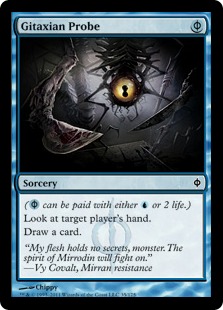
FNM promos have always been a nice bonus for attending weekly competitive events at my local game store. They have always been chosen from the common or uncommon rarity, but when Wizards made solid competitive choices like Gitaxian Probe, Path to Exile and Glistener Elf, it gave players a great way to start foiling their decks. Even casual favorites like Reliquary Tower, Evolving Wilds and Acidic Slime were great because they fit right into everyone’s Commander decks. Even less powerful cards, like Banisher Priest and Disdainful Stroke, were cool because they saw lots of Standard play.

Another great aspect about FNM promos is that sometimes they get reprinted. One of my favorite hate cards was Magma Spray. So, if you kept those promos around from the first printing, then you’d already have a swag set of them to slot into your Standard decks right now.

There was an error retrieving a chart for Magma Spray

What you’re really looking for here, though, is the finance surrounding this aspect of the game. What are these promos really worth today? Of course, many of them are not the most valuable parts of your collection, but I bet you have some cool memories from getting them. Let me know your cool FNM promo stories in the comments. For now, though, let’s dive into the finance of the FNM promo.

What I’ve done is break down the long list of these FNM prizes into categories.

The Under $2 Section


The $2 Section


The $3-to-$5 Section


The $6-to-$9 Section


The $10-to-$15 Section


The Insanity Section


  • Swords to Plowshares $97
  • Brainstorm $49
  • Quirion Ranger $32.50
  • Fireblast $23
  • Forbid $19
  • Capsize $27
  • Priest of Titania $24
  • Reanimate $30
  • Mother of Runes $19
  • Duress $23
  • Cabal Coffers $26
  • Remand $20
  • Eternal Witness $29
  • Pendelhaven $17
  • Kitchen Finks $21

FNM Promo Price Summary

As you can see, there are many price ranges for FNM cards over the years. Before writing this article, I didn’t know that there were so many cards with actual value to them, let alone that there were a dozen of them over $20. So what happened to cause this genre of card to fall so drastically in price?

If you have a bad opinion of what an FNM card is, I’d guess you’re thinking about the past three years. During this time, Wizards decided to primarily print Standard cards as FNM promos. It was easy to fill in the list above for this time period, because other than Path to Exile and Serum Visions, all of these promos are essentially worthless. The next highest card is around a dollar. Finding the next older cards reprinted during this time period, we get Fiery Temper and Goblin Warchief, but both of these already had promos and Goblin Warchief was already an FNM promo!

What I’m getting at here is that, yes, players might have been upset about the FNM promos, but what we’re upset about is getting unplayable Standard commons and uncommons. If Wizards would just go back to printing actual good Standard cards and mixing it up with older cards as well, the FNM promo would regain its allure and be anticipated weekly.

The Future

So where we’re headed now is apparently double sided tokens. I doubt these will have much value, even with them being foil. Competitive players just don’t care about tokens much. Wizards sees FNM as casual, but players don’t. Wizards has the concept of Showdown Packs and FNM promos backwards, but there’s not a lot we can do about that.

With FNM promos moving into a part of Magic history, I’d expect the good ones to get a small bump in price. Players will sense an iconic part of the game going away and want part of it for themselves. Lots of players need the old promos for Cubes and Commander decks as well as Modern or Legacy decks too.

Cards Most Likely to Increase in Value

When I think about the most likely cards from this list to grow, I went immediately to the $3-to-$5 category. (Also, I’d grab all the cheap Ancient Grudges as well, because they are really cheap right now.) Here’s the narrowe- down part of the list that I really like:

There was an error retrieving a chart for Tormod's Crypt

Tormod's Crypt only being $3 is crazy to me. Maybe there are just too many options for graveyard hate these days, but this will always be an option for any deck. It also has sweet art.

There was an error retrieving a chart for Ancient Ziggurat

Five-Color Aggro has popped up from time to time in Modern. As more and more powerful creatures are released, I find this deck concept to be more and more likely to find success. It’s sitting at $5 right now, and if this deck ever becomes more than just a casual favorite, it will skyrocket.

There was an error retrieving a chart for Wild Nacatl

As one of the best one-drops ever printed, Wild Nacatl should definitely be more than $4.50. Both Ancient Ziggurat and Wild Nacatl suffer from the Alara foil packs, but eventually those will become less of a reason why the price is so low and they’ll start growing once more.

There was an error retrieving a chart for Everflowing Chalice

Everflowing Chalice is probably never going to make waves in Modern, or any competitive format for that matter, but it’s huge in Commander, and we know that drives a ton of prices up. Just look at Doubling Season if you need a reminder.

There was an error retrieving a chart for Wall of Omens

Wall of Omens has been reprinted a million times, but there’s only one FNM promo. At $5, that’s a steal for this Modern-playable.

There was an error retrieving a chart for Glistener Elf

Infect may be on the low side of popularity right now, but when it swings back to tier-one again, Glistener Elf will jump in value. Under $4 is a steal for this future gainer.

There was an error retrieving a chart for Tectonic Edge

Tectonic Edge may seem underwhelming, but I like it a lot in Modern. The format might be a little fast for it right now, but I think it will slow down again. Ghost Quarter has been the go-to card, but Tectonic Edge is right behind it. I like the Expo Version at $23 as well as the FNM Promo for $3.50.

There was an error retrieving a chart for Lingering Souls

We probably need a Death's Shadow banning before Lingering Souls will resurge in Modern, but then again, it actually sounds like a great counter to that deck. At only $5, this is again pretty cheap for this card.

There was an error retrieving a chart for Serum Visions

This list would not be complete without the $3 Serum Visions making the list. There are still a lot of copies of this promo floating around out there as well as the recent Conspiracy: Take the Crown and Modern Masters 2017 printings flooding the market. Without another printing, I love this draw spell to bump up in a year or two.

There was an error retrieving a chart for Aether Hub

My favorite FNM promo printed in recent years is Aether Hub, as well as the up-and-coming Fatal Push. When Hub was released, it made my top 10 for that set because it’s applicable in every format. I utilized it in my Legacy Eternal Weekend top eight deck last year, and others have found other creative uses for it as well. A price of$4 is a fine long-term investment for this versatile land.

Hopefully all this information helps you realize which of your FNM promos are worthwhile and you can use this article to help you in picking up or flipping some of these cards. In addition, I’ve given you some particular ones to keep an eye out for to pick up. I put a ton of work into this article, so hopefully you guys enjoyed it. Let me know your thoughts about these promos in the comments.

If you’re interested in when these promos were released, check that out here. Shoutout to Gamepedia for its helpful wiki on this topic.

Until next time,
Unleash the Force!

Mike Lanigan
MtgJedi on Twitter
MtgJedi on YouTube

Insider: Earthshaking Up Standard

Are you a Quiet Speculation member?

If not, now is a perfect time to join up! Our powerful tools, breaking-news analysis, and exclusive Discord channel will make sure you stay up to date and ahead of the curve.

On my first episode of QS cast, I was nervous. I felt like there was a lot riding on one simple question that Chaz said he was going to ask me at some point in the episode: “What’s your pick from Hour of Devastation?” I felt like there was a lot riding on my answer (although I couldn’t have done too badly, because I keep managing to get on week after week), and then as I was sifting feverishly through the spoiler, I saw a card that made all of my anxieties vanish immediately. It was a 2/1 for two mana.

That’s right, everyone. Champion of Wits, although the card I am still most excited for in Hour of Devastation Standard, was not even the first eternalize card to catch my eye. When I was asked about what cards I thought would shine in Hour of Devastation, I said confidently, “Earthshaker Khenra.” When I talked about it the next Monday, it was around a dollar at TCGplayer mid. As of this writing, it is around $2, and buylisting on Star City Games for 50 cents.

The margins are not as good as they were a couple days or a couple weeks ago, but picking up a set or two now could pay off big time after the Pro Tour. Given recent bannings that have left Standard fairly open to shakeups after a long, stale period of Copy Cat and Aetherworks Marvel decks, the Pro Tour may well have several breakout finance winners this weekend. I firmly believe that Earthshaker Khenra can be one of them. My belief is rooted in both the quality of the card on its own and observation of some of the hallmarks of crappy-looking red creatures that go up to $8.

There was an error retrieving a chart for Earthshaker Khenra

When a red deck becomes viable in Standard, it usually takes a rare from a recent set to prop it up. That rare will generally be evaluated a specific way (“Sweet in Limited if I am playing red, I suppose,” leading to a nearly bulk pricing initially), followed by the realization that, no, "good in Limited" does not necessarily mean "bad in Standard."

Already, Earthshaker Khenra dominated the recent StarCityGames.com Team Constructed Open, putting three copies of Mono-Red Aggro into the top eight. One of the things that make this list even better: Tom Ross’s addition of Built to Smash. It will blow out Abrades and Harnessed Lightnings until people learn to play around it. Welcome back, beginning-of-combat stops! The combination of an aggressive enters-the-battlefield ability and late-game value makes Earthshaker Khenra one that is at the top of my list for whatever red deck I am trying to put together.

There was an error retrieving a chart for Abbot of Keral Keep

Over the past five years or so, there have been several cards that give me serious finance déjà vu. Earthshaker Khenra is from a long line of cards that made their respective Red Deck Wins builds tick. In Magic Origins, Abbot of Keral Keep provided an efficient body, a power boost and a card in a format where there was a chance that having a four-power creature meant your opponent was just dead. You can tell that this card was good because playing it on turn two and forfeiting the card was not necessarily wrong, and could very well have been correct.

There was an error retrieving a chart for Goblin Rabblemaster

Goblin Rabblemaster, from M15, was immediately recognized for the bomb it was in Limited, then the price skyrocketed when people found out that it could also deal a lot of damage very quickly in Standard. It helped that although Rabblemaster cost three, it frequently saw play in decks that cast it on turn two with the help of Elvish Mystic – this was my deck of choice back then.

There was an error retrieving a chart for Mutavault

Mutavault may seem out of place among these other cards, as people playing when Mutavault was most recently in Standard may remember it for the UW Control grindfests that were won by the control player’s single Mutavault, but every deck that could manage it was playing it, including Red Deck Wins. If you factor in that it needs one mana to activate and tapping it to attack removes the option of using it for mana later, it’s even a two-drop!

Mutavault was insanely inexpensive for what it had been pre-reprinting (~$40) at the beginning of the format, only to go up quickly once everyone realized that it went into every deck. It's important to note that this is what separates Mutavault and Goblin Rabblemaster from Abbot of Keral Keep and Earthshaker Khenra: Goblin Rabblemaster and Mutavault fit into multiple decks, leaving their long-term potential much higher.

I’ve mentioned before that one of the ways to evaluate whether a card was intended to see Standard play is to look for the Wizards development team's influence. Earthshaker Khenra has all the classic signs of a card thought likely to see tons of Standard play, from a set mechanic, to a color-specific mechanic, to an extra keyword just for the heck of it. The difference between Earthshaker Khenra and Champion of Wits is that Champion looked like it was actively downgraded; Earthshaker goes the other way due to the jam-packed rules text.

This fits in with other cards I have mentioned. Abbot of Keral Keep, for example, had prowess, a keyword that became evergreen in Magic Origins, and “impulsive drawing,” or a draw that requires the player to use the spell that turn. Mutavault was part of a series of really cool cards getting reprinted into Standard, alongside Scavenging Ooze.

One issue with this comparison, to be fair, is that there were other powerful things going on in those formats. Goblin Rabblemaster enabled its controller to cast Stoke the Flames for free with terrifying consistency. Abbot of Keral Keep was paired with the two-card combo of Become Immense and Temur Battle Rage, and had the benefit of being in a red deck against a field of four-color, fetchland-heavy decks. Mutavault is one of the best lands there ever was.

There was an error retrieving a chart for Ire Shaman

One card that seems to fit several of these categories – aggressively costed, set mechanic, red mechanic, and a bonus keyword – that never went anywhere is Ire Shaman, from Dragons of Tarkir. Ire Shaman had all the makings of a great red card: she had an aggressive body with an aggressive ability, and she could even draw you a card! She had it all… Except, in order for the card to be any good, you had to play it as a morph, essentially a 2/2 for three mana. This is not very impressive compared to getting value immediately from Earthshaker Khenra in the falter ability, which you can use again later in the game. It can be the first thing that you play and still be impactful late.

One more thing: Earthshaker Khenra is currently $6 on Magic Online. It’s pretty popular there, you could say. While online numbers don’t necessarily correlate with paper popularity, this is a $2 jump from when I looked at its MTGO price on Monday. That says a lot to me.

Earthshaker Khenra has the potential to go up to at least $5, if not more, over the course of the Pro Tour. This gives me hope for Standard, because if a red deck can thrive, say, one week out of four, that means to me the metagame is pretty well balanced. It also gives me hope for my own collection – I opened a promo Earthshaker Khenra at the prerelease. What do you think of this card's prospects?

Innovations in Modern: Decklists from SCG Atlanta

Are you a Quiet Speculation member?

If not, now is a perfect time to join up! Our powerful tools, breaking-news analysis, and exclusive Discord channel will make sure you stay up to date and ahead of the curve.

The SCG Modern Classic in Atlanta last Sunday signaled the end of Modern as we know it. Hour of Devastation is officially upon us, and with it, our reckoning has arrived. Armed with powerful new spells, creatures, and everything in between, the world’s best brought their collective knowledge to bear, shaking the foundations of our beloved format to its core under their combined might (do foundations have a core? I’m an architect, I should know). Behold, your new Modern influencers: Rhonas the Indomitable, Claim to Fame, and Irrigated Farmland! Hm. Well, that was disappointing...

So, by all early indications, it doesn’t look like Hour of Devastation is a knock out of the park, but as we discussed last week, that’s kind of okay. Modern is great right now, and far from solved, so a set release that doesn’t add much to the card pool is much more welcome than, say, if the format were busted beyond belief. Remember a few weeks ago when everyone said Death's Shadow needed to be banned? Remember a few weeks before that when Counters Company took an event by storm? And what about before that, when Dredge and Storm were putting up strong, consistent results? See what I mean? I could go on and on, but the truth of the matter is that Modern is great, and life is good—let’s appreciate it while we have it.

Let’s dive in to the Modern Classic results from Atlanta. Even though there weren’t many Hour of Devastation inclusions, there were still a ton of new archetypes and innovations hidden in the lists. How is that possible? Well, let’s look and see…

Shadow Domain Zoo, by Daniel Keigans (2nd, SCG Atlanta)

Creatures

4 Wild Nacatl
4 Tarmogoyf
4 Death's Shadow
4 Street Wraith
4 Monastery Swiftspear
3 Goblin Guide

Enchantments

1 Gryff's Boon

Instants

4 Lightning Bolt
4 Might of Alara
2 Dismember
3 Boros Charm

Sorceries

4 Tribal Flames
1 Claim // Fame

Lands

2 Windswept Heath
1 Temple Garden
4 Wooded Foothills
2 Arid Mesa
1 Blood Crypt
4 Bloodstained Mire
1 Breeding Pool
1 Overgrown Tomb
1 Sacred Foundry
1 Steam Vents

Sideboard

1 Ancient Grudge
1 Collective Brutality
1 Gaddock Teeg
3 Grafdigger's Cage
3 Pyroclasm
1 Rise // Fall
2 Stony Silence
3 Thalia, Guardian of Thraben

I’m not even going to try and hide my excitement. This deck looks so sweet. Might of Alara? Are you #^($&@ kidding me? Daniel’s list is so cool, I don’t even know where to start. Creatures seems like a good bet, but really this deck is just Burn, but a Burn deck that can actually beat Leyline of Sanctity and grind out the midrange decks.

Kolaghan's Command, Traverse the Ulvenwald, and company are gone, instead replaced by Tribal Flames, Boros Charm, and Might of Alara. We’ve finally reached the point where there are just so many good cards to play in Modern that the lines between Death’s Shadow Aggro, Zoo, and Burn are forever blurred. This week, dodging Leylines (and potentially Oketra's Last Mercy) seemed to be Daniel’s goal, and it worked out well for him. I appreciate going all-in and trusting your gut about the format, as there isn’t a basic land in sight. By sleeving up this 75, Daniel made a statement about where he expected the field to be, and I hear it loud and clear. This is what those in the business call betting the farm, and Daniel cashed in.
Next week, who knows if players will adopt his list, but that doesn’t really matter. Whether Daniel’s version of Death’s Shadow Jund, or Zoo, or creature Burn, or whatever you want to call it, is the right version for next week is hard to say. But I’m interested in seeing how the classic Death's Shadow decks will respond to this newcomer entering the clubhouse. Stubborn Denial was the de facto "best card" a couple weeks ago, but it doesn’t do much against 19 creatures attacking into you, especially when this list also has access to a ton of pump and burn to go with it.

It is interesting to note Daniel’s lack of discard, which of course doesn’t work when he’s trying to drop one-drops onto the field as fast as possible. Spell-based combo and the like could be happy to see this change, but it’s not like they are much happier to see a Wild Nacatl on the table instead. Will this push the format into more goldfishy combo, or will we see Jund and other removal-heavy decks come back even stronger as a result? I’m keeping my eyes on this one.

Grixis Delver, by Troy Smith (3rd, SCG Atlanta)

Creatures

1 Gurmag Angler
4 Snapcaster Mage
4 Delver of Secrets
2 Young Pyromancer
2 Tasigur, the Golden Fang

Instants

2 Kolaghan's Command
4 Lightning Bolt
3 Mana Leak
2 Spell Snare
2 Remand
2 Fatal Push
3 Terminate
4 Thought Scour
1 Murderous Cut

Sorceries

2 Inquisition of Kozilek
4 Serum Visions

Lands

1 Watery Grave
1 Blood Crypt
4 Bloodstained Mire
1 Darkslick Shores
3 Island
1 Mountain
4 Polluted Delta
2 Steam Vents
1 Swamp

Sideboard

1 Crumble to Dust
2 Dismember
1 Dispel
1 Engineered Explosives
1 Izzet Staticaster
1 Magma Spray
1 Pithing Needle
2 Relic of Progenitus
2 Surgical Extraction
2 Thoughtseize
1 Vandalblast

Not to be outdone, Troy Smith decided to pack Grixis Delver like it was 2015. It feels like I missed some Twitter hashtag or something, where all of the players decided to bring off-brews of all the established archetypes. This is classic Grixis Delver, all the way down to the Young Pyromancer, Remand, and Dispel in the sideboard. I’ll be honest, I love Delver of Secrets just as much as the next guy, but I can’t think of a reason why Delver of Secrets and Remand are better than Death's Shadow and Stubborn Denial, unless getting off the graveyard was 100% the way to go this weekend. It feels to me like the graveyard wasn’t supposed to be a big target heading into this weekend, but based off what I’m seeing, I’m starting to expect that was what was in players' minds as they chose their lines.
Still, Grixis Delver is a solid choice, and capable of strong results in the hands of a skilled pilot. It’s been so long since I’ve seen Mana Leak I had to reread it (nah, not really), but with midrange poking around again, the card finally seems solid. Not against Goblin Guide and Memnite, of course, but we knew that from the semis. I can get behind six one-mana removal spells again (plus Murderous Cut) but Fatal Push is the one we need to be maximizing. I understand the Bolt/Snap/Bolt potential, but Daniel’s list is just begging to blow you out every time you think about casting Lightning Bolt against his creature.

BG Midrange, by Sol Malka (4th, SCG Atlanta)

Creatures

4 Dark Confidant
1 Kalitas, Traitor of Ghet
1 Eternal Witness
4 Tarmogoyf
2 Tireless Tracker
3 Scavenging Ooze

Artifacts

2 Mishra's Bauble

Instants

2 Fatal Push
4 Abrupt Decay

Planeswalkers

3 Liliana of the Veil

Sorceries

2 Maelstrom Pulse
2 Thoughtseize
1 Traverse the Ulvenwald
4 Inquisition of Kozilek
2 Collective Brutality

Lands

4 Blooming Marsh
2 Forest
3 Ghost Quarter
3 Hissing Quagmire
2 Marsh Flats
2 Overgrown Tomb
2 Swamp
4 Verdant Catacombs
1 Windswept Heath

Sideboard

1 Bloodghast
2 Duress
1 Flaying Tendrils
1 Ghost Quarter
1 Golgari Charm
1 Illness in the Ranks
1 Kalitas, Traitor of Ghet
1 Liliana, the Last Hope
1 Maelstrom Pulse
1 Shadow of Doubt
1 Slaughter Pact
2 Surgical Extraction
1 Unravel the Aether

Still in the Top 4, Sol Malka makes an appearance with a masterpiece, in every sense of the word. Tireless Tracker, Eternal Witness just for the value, this is the kind of deck that dreams are made of. The singleton-Traverse the Ulvenwald, 13-different-cards-in-the-sideboard special. Every single card in this deck dares you to cut it before playing at least 10 games with the list. Don’t even try it.
There are just so many plays. One copy of Bloodghast in the board, because—why? It’s a 2/1 that keeps coming back to apply pressure against control, sure, and it combos with Kalitas, Traitor of Ghet when we have the mana and all the time in the world. Do we dare be so cute? Liliana of the Veil is just a three-of, but not Abrupt Decay; we’re packing the full four. That makes sense, as small creatures were apparently the way to go, but then we get to the two copies of Fatal Push and I’m just amazed. Again, I know just by looking at it that this deck is a finely tuned machine of metadeck domination, and I can’t wait to pick it up and start grinding games with it.

Jeskai Flash, by JD Umberson (5th, SCG Atlanta)

Creatures

4 Spell Queller
4 Snapcaster Mage
1 Vendilion Clique

Instants

4 Cryptic Command
3 Electrolyze
4 Path to Exile
4 Lightning Bolt
4 Lightning Helix
3 Logic Knot

Sorceries

4 Serum Visions
1 Supreme Verdict

Lands

3 Celestial Colonnade
1 Desolate Lighthouse
4 Flooded Strand
2 Hallowed Fountain
2 Island
1 Mountain
1 Plains
1 Sacred Foundry
4 Scalding Tarn
3 Spirebluff Canal
2 Steam Vents

Sideboard

2 Anger of the Gods
1 Blessed Alliance
1 Celestial Purge
1 Crumble to Dust
1 Dispel
1 Elspeth, Sun's Champion
1 Engineered Explosives
1 Izzet Staticaster
2 Rest in Peace
2 Stony Silence
1 Vendilion Clique
1 Wear // Tear

We’ll continue with the theme and go right to the 5th-place list to finish things out today. Sorry Affinity, but nobody cares. This is Magical Christmasland, and we only allow interesting decks here. Spell Queller and a ton of Burn spells is a lost three evenings waiting to happen, and I’d be lying if I said this wasn’t the first deck I loaded onto my MTGO account after going through the results. The options, of course, are endless. Opponent does something on three? Spell Queller 'em. They don’t play along? Electrolyze for two and cycle away. Next turn, let’s Cryptic Command. If not, lets Snapcaster Mage into Lightning Helix.

This deck is exactly what I want to be doing when you don’t expect many Tarmogoyf or Death's Shadow—or if the Tarmogoyf/Death's Shadow decks stop packing discard spells. Against the midrange decks, we’re a draw-go Burn list that can counter whatever they decide to eventually throw our direction, while we’re doing damage all along the way.

Conclusion

So, Hour of Devastation isn’t making a large impact, but the results from this weekend are evidence enough that Modern’s card pool is insanely deep already, and practically anything can put up strong results on any given weekend. I, for one, am fine with the way things are looking early into this new Modern, but that’s just because it looks almost exactly like old Modern with some brand new clothes.

What do you think? What are you playing heading into August 2017? Please tell me somebody is playing Kiki Jiki, Mirror-Breaker, or Geist of Saint Traft, or Bitterblossom. Anything is possible, apparently.

Thanks for reading,

Trevor Holmes

Insider: Pro Tour Hour of Devastation Picks for Standard

Are you a Quiet Speculation member?

If not, now is a perfect time to join up! Our powerful tools, breaking-news analysis, and exclusive Discord channel will make sure you stay up to date and ahead of the curve.

After last weekend, Standard looks a whole lot different than it did before, and things are only going to be amplified with Pro Tour Hour of Devastation this weekend. The previous frontrunner was White-Blue Oketra's Monument, but it has taken a back seat with the emergence of Mono-Red Aggro, which dominated the weekend by taking both finals berths in the SCG Team Open and winning the Standard Classic. It also won the PTQ at GP Kyoto, meaning it’s surely got the attention of the many pros that were in attendance at the GP. The deck has risen to one of the most popular decks online, and the prices of its cards have spiked accordingly. I expect if the deck is popular at the Pro Tour, which it most assuredly will be, the paper prices are going to follow suit.

There was an error retrieving a chart for Bomat Courier

Bomat Courier can be had for under $1, but the online price more than tripling from 0.8 tix at the HOU release to nearly 3 now, with 50-percent growth in the past week, leads me to believe the paper price is going to start heading upwards.

There was an error retrieving a chart for Falkenrath Gorger

Falkenrath Gorger has seen a similar online trajectory, nearly tripling since the HOU release with a 50-percent gain in the last week, indicating that the paper price of a $1 is too low if Mono-Red becomes a top-tier deck after the Pro Tour.

There was an error retrieving a chart for Earthshaker Khenra

Earthshaker Khenra has more than doubled online in the past week, from 3 tix to over 6, and the paper price has tripled to nearly $3, but given the $8 price tag on Champion of Wits, it looks like it has plenty more room to grow.

There was an error retrieving a chart for Soul-Scar Mage

Tom Ross using Soul-Scar Mage in his Open-winning list has sent its online price doubling from 0.6 to 1.25 tix, and the paper price had already been slowly trending upwards, so it’s due for a rise if it’s popular in the Pro Tour builds.

There was an error retrieving a chart for Collective Defiance

Collective Defiance is used in some versions of the deck, and it looks to be more important as players begin to fight back with cards like Kalitas, Traitor of Ghet. The online price doubled over the week, from 0.6 tix to 1.2, so the paper price of $1 is due for a rise.

There was an error retrieving a chart for Hazoret the Fervent

I’m also keeping my eyes on Hazoret the Fervent, which has gained 50 percent online in the past week to over 7 tix, but has seen its paper price stagnated to $6. It could head towards its previous peak of $10 with a good Pro Tour showing.

There was an error retrieving a chart for Chandra, Torch of Defiance

Another big player in the Mono-Red deck is Chandra, Torch of Defiance, which has seen its price grow to 36 tix online from under 30 before news of the deck broke. The paper price has gained a few dollars since, now at $30, and it could head higher. The planeswalker also has a lot of Modern and casual appeal, and is likely the best red planeswalker ever, so there’s the possibility that it sees movement like Jace, the Mind Sculptor and Liliana of the Veil and just continues to move higher even through rotation. The planeswalker still has another year in Standard too, so it’s possible that this price will soon look like a bargain.

There’s also the X-factor of the new God-Pharaoh's Gift Reanimator deck that won the MTGO PTQ and finished in the top eight of the SCG Classic. The deck operates differently than everything else in the format, and its high power level combined with a breakout finish mean it’s surely on the radar of the pros.

There was an error retrieving a chart for Angel of Invention

There are reports that the deck's key mythic, Angel of Invention, completely sold out at GP Kyoto and shops around Tokyo. There is clearly demand across the globe, as demonstrated as its price spiking from $2 to $7, and a breakout finish would send this price even higher.

There was an error retrieving a chart for Cataclysmic Gearhulk

The deck also uses Cataclysmic Gearhulk, which was hyped on release but hasn’t made even a minor impact in Standard since. It’s likely that this new deck, which can use Refurbish to get it into play after milling or trigger its ability by eternalizing a copy, will be its best home ever. The online price spiked from 0.3 tix to over 2 before falling back down to 1.2, but it’s now up to 1.4. The paper price has broken a dollar and is trending upwards, so there might be some money to be made here if the deck breaks out at the Pro Tour.

There was an error retrieving a chart for God-Pharaoh's Gift

The centerpiece of the deck is God-Pharaoh's Gift, and it has spiked from 50 cents to $3. The online price leveled off below 4 tix before falling under 3.5, but if the deck performs at the Pro Tour we’ll see both prices head upwards.

There was an error retrieving a chart for Champion of Wits

The deck also relies on Champion of Wits as a graveyard engine and draw fixing, and it’s to blame for the card’s recent spike from $3 to $8! The card is clearly one of the best from the new set, and I suppose $10 is a possibility, but I don’t see this one moving much higher. It’s likely that now is a good time to sell and profit from the hype, especially considering the online price failed to hit 9 tix before beginning to fall back towards 8.

There was an error retrieving a chart for Mausoleum Wanderer

Another component of the deck is Mausoleum Wanderer, which spiked from 0.5 tix to 1.7, fell to 0.8, and how now risen to 1.3 tix. The paper price is still under $1, and hype from this deck will send it upwards. There’s also appeal as a Spirit that’s Modern playable and a necessity for any casual spirit deck, so it looks great moving forward.

The Pro Tour begins today, and we'll have a clear picture of Standard by Sunday, so be prepared for big changes in the market!

–Adam

Insider: My Last Quiet Speculation Article

Are you a Quiet Speculation member?

If not, now is a perfect time to join up! Our powerful tools, breaking-news analysis, and exclusive Discord channel will make sure you stay up to date and ahead of the curve.

Quiet Speculation is extremely sad to see DJ go, but we are happy that he'll still be a part of the community and will watch his career with great interest. gl hf, DJ.

I'm not going to use a card name pun or some other cute article title. Today marks my last article on QuietSpeculation.com. I'm going to be honest: I'm not really sure what a "last article on a website" is supposed to contain. I suppose I'll clear up a few questions I expect you to have at this point, and we'll just sort of wing it from there.

  • I will still be writing a weekly column going forward, on TCGplayer.com!
  • My content will still be finance focused, and it will once again be free for everyone to read!

If you've been really following some of my content on Brainstorm Brewery and Twitter for the past few months, you might have noticed that I stopped talking about the grad school program that I started in August 2016, shortly after graduating with my bachelor's degree in May of last year. I haven't really gone "Facebook public" with the information up until this point, but I made a decision back in April that I would no longer continue with my graduate degree in Mental Health Counseling, and that instead I would focus entirely on an income based on Magic: The Gathering.

There was an error retrieving a chart for Bazaar Trader

I'm sure many of you are rolling your eyes, and that's fine. I don't expect everyone reading this article to completely comprehend my situation or understand it. To make a long story short, I was burnt out from school, and I was already trying to dedicate more than 30 hours a week to Magic on top of an internship and full-time degree. I ran a lot of calculations, and realized that I would be more financially sound if I stopped putting $13,000 a year into grad school and instead focus on Magic full-time.

What does this have to do with me leaving Quiet Speculation? Well, part of my decision involved getting hired part-time at the offices of TCGplayer. I actually live ten minutes away from their main headquarters in Syracuse, and I knew several people who had been working there for a reasonable amount of time. Some of them would constantly ask me to apply, and so I eventually did. During my first few days on the job, I had a couple of conversations with the content team. They were looking to pick up someone to do financial content, and I was already working in the warehouse a couple of days a week. As someone who read Craig Wescoe's and Conley Woods's articles back in early high school, it was a surreal opportunity to be on the same website that practically taught me to play Magic.

Maybe the whole Magic-income game plan won't work out in the long term. This game will die eventually, and I'm prepared to face that reality. However, I'm confident that my years of experience in the gaming industry will help me smoothly transition into another career that I'm equally passionate about. If I happen to spend the next decade buying, selling, writing, living, and breathing Magic on my own terms, then I'll consider that ten years well spent.

My wife is an amazing woman who supports me every step of the way, and I can only try to do the same for her whenever possible. Sometimes she helps me sort cards while we watch Netflix together, and she's spent more than a few days helping me out at the shop because she knows how to evaluate a card's condition, set, and price after spending almost eight years with me. (Seriously, if I leave Quiet Speculation with one important MTG finance tip: find yourself an SO who will sort cards for coffee!)

In summary, I'm far happier now than I was when I was trying to juggle an internship, graduate assistantship, school, and Magic all while commuting an hour four days a week.

There was an error retrieving a chart for Fire Juggler

I've pretty much just been writing off the top of my head for the past hour or so. I don't really have a direction here, because I know that finishing this article will be bittersweet. I'll still be writing every week for TCGplayer, but QS has always held a special place in my heart. It's the first and only Magic-related subscription I ever paid for, and it repaid me in kind dozens of times over. I certainly wouldn't be writing an article about my future in the industry if not for this site.

TCGplayer will be the fourth website I've written for in four years. Because of that, it can be hard for me to dig up some of my favorite archived articles on Quiet Speculation, MTGPrice and Brainstorm Brewery. That said, I did dig some up, and I'd like to link you to a few of my favorite articles that I've written over the past few years, if only for my own nostalgia.

Brainstorm Brewery: One More Card

This article still explains the logic behind why I speculate on certain cards. I really enjoy trying to find the near-broken effects in Magic that just need one more card for an engine or a synergistic piece to tie it all together. To this day, some of my pet specs are Myr Superion and Necrotic Ooze; cards that hover on the brink of, "Man, that effect just looks broken, but there's nothing to do with it yet." I really like that I was on the Heartless Summoning train a year early before Battle for Zendikar brought us the Eldrazi, because several of those colorless monstrosities happened to be the "one more card" that Summoning needed to spike. Today, I continue to pick up Summonings for 25 cents on the off-chance that Wizards makes another mistake with casting costs, or death triggers, that brings about new brews with the card.

MTGPrice: Nothing is Sacred

If you're ever interested in reading how I got my start in the financial aspect of this game, here's some material for you. I learned quickly that if I wanted to increase the chances of being "that guy" who had the cards my friends and customers needed, I had to separate my emotional attachment to my own cardboard and be willing to sell cards out of decks, or out of my spec box when necessary. Everything has a price, and nothing is sacred. This changes if you're a Standard PPTQ grinder who actually needs a gauntlet of decks, but most of us can afford to cut some emotional attachment to a card.

MTGPrice: Low, Mid and High: Then vs Now

This article came out only a month or two before the announcement of Market Price on TCGplayer, so I was proud that I was able to pinpoint the need for an update in the "low/mid/high" pricing system that TCGplayer used at the time. I was also able to get one of the actual editors of Scrye Magazine to contribute on Twitter and provide historical context, so that was really cool. I think that article also helped some people to distinguish between the different types of "low" pricing, the number that TCGplayer displayed, versus what most people expected while buying/selling on social media.

Quiet Speculation: The Lotus Saga, Parts One, Two and Three

Most recently, I had the opportunity to purchase my first-ever Black Lotus, and it was a really great and interesting experience learning to deal with a high-end card far beyond anything I'd dealt with before. I had no experience in this area, so I was very pleased with how well everything worked out.


Before I go, I want to say thank you to everyone who has ever read one of my articles on this site, or MTGPrice, or even back on Brainstorm Brewery. Even if you're just going to continue following me at TCGplayer, it means a lot that you've enjoyed reading my content, and I hope that I've been able to save you at least a little bit of money on this game. Maybe some of you will end up doing what I've done and create a lifestyle out of it all. That would be cool too.

For those of you who only see me on the Quiet Speculation article feed and want to continue following my content, there are several ways of doing so. I've mentioned before in this column that I'm on the Brainstorm Brewery podcast every week, where we discuss a variety of finance-related topics. My articles on TCGplayer.com will be going live every Tuesday going forward, and will be free to access. I'm always active on Twitter at @Rose0fthorns, and you'll be able to find me at several Grand Prix in North America throughout 2018, working for one of a few different vendors.

Goodbye, good luck, and thank you.

Want Prices?

Browse thousands of prices with the first and most comprehensive MTG Finance tool around.


Trader Tools lists both buylist and retail prices for every MTG card, going back a decade.

Quiet Speculation