menu

Insider: What Aether Revolt Mechanics Mean for Standard

Are you a Quiet Speculation member?

If not, now is a perfect time to join up! Our powerful tools, breaking-news analysis, and exclusive Discord channel will make sure you stay up to date and ahead of the curve.

The majority of Aether Revolt has been spoiled, and we now have a very good idea of the set’s mechanics and general direction. There are many high-powered and efficient cards, and it’s clear that their designers have pushed the new mechanics into Constructed playability. This has implications that will ripple through the Standard format. Today I’ll share my thoughts on the standouts from the spoiler and what they mean for the metagame and the market.

Improvise

metallic-rebuke

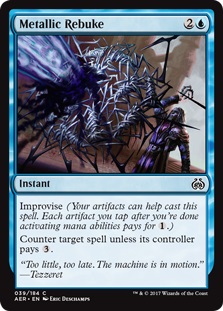
The cost-reducing mechanic improvise has been pushed very hard with cards like Metallic Rebuke, the closest thing to Mana Leak in years. Combined with a simple Clue token from Thraben Inspector, this is Mana Leak, and with any further support it can be cast for as little as a single blue mana, a chilling thought. As is, I see Metallic Rebuke making an immediate impact in White-Blue Flash, but it will also inspire artifact-centric aggressive decks that look to make even better use of it.

whir-of-invention-aether-revolt-spoiler

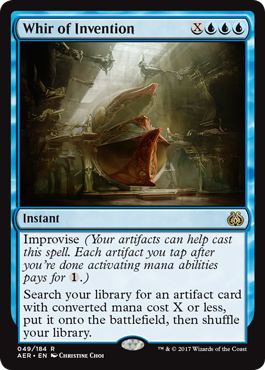
Another example of improvise being slated for Standard, and in this case Modern and beyond, is Whir of Invention, which in very simple terms is Chord of Calling for and by artifacts. Chord has set a precedent for just how good combining an instant-speed tutor with a cost-reducing effect is, and I expect Whir of Invention will be just as good. Artifacts are a bit more limiting than creatures, but improvise does offer its own unique advantages over convoke, like its effectiveness with Clue tokens.

There was an error retrieving a chart for Aetherworks Marvel

When I see Whir of Invention, Aetherworks Marvel is the first card that comes to mind as the best thing to be searching for. Decks built around Aetherworks Marvel have always suffered from consistency issues without a way to tutor for it, and people even toyed with using Madcap Experiment to find it. Much of the reason that the Red-Green version is popular now is it can win without Aetherworks Marvel, but Whir of Invention could bring about a return to the deck’s roots from Pro Tour Kaladesh.

The original version was more of an all-in combo deck full of cheap artifacts like Glassblower's Puzzleknot that are perfect improvise fuel, and it can be rebuilt to utilize Whir of Invention. It also offers the ability to add a utility toolbox to the deck, and even alternative win conditions. I expect to see a resurgence in the older style of Marvel decks driven by Whir of Invention.

There was an error retrieving a chart for Animation Module

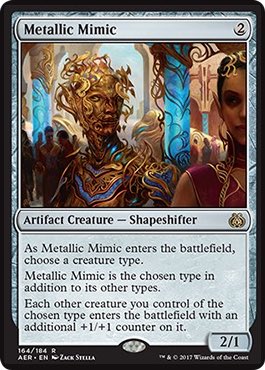
Whir of Invention might also be used to help assemble Standard’s newest combo, Metallic Mimic and Animation Module. Metallic Mimic is a pretty strong card in tribal strategies, but naming Servo and combining it with Animation Module will start a chain reaction every time a new Servo hits play, creating a new Servo, and then putting a counter on it, triggering it again to produce a new tokens, ad nauseam, for each mana spent.

metallic-mimic-spoiler

It’s a pretty decent imitation of the once-banned Sword of the Meek-Thopter Foundry combo, and it could break Standard. It is certainly great for the competitive and financial prospects of Animation Module. I expect that if this combo does make it into Standard, it will be in a deck that is capable of playing as a normal aggro deck, so I’d target other cards in the archetype, like the new Sram's Expertise, but specifically older cards like Master Trinketeer and Servo Exhibition.

There was an error retrieving a chart for Master Trinketeer

The revolt mechanic triggers when something has previously left the battlefield that turn, so it’s a natural combination with sacrifice effects. It’s going to be most common with Evolving Wilds, of course, but creature outlets like Syndicate Trafficker just got better. It will help to enable cards like Fatal Push, perhaps the best card in the entire set and a paradigm-shifting removal spell that will increase the competitive value of three- and five-mana creatures relative to one- and two-drops.

Great sacrifice fodder, like Scrapheap Scrounger, is better too, and something like Bomat Courier, which sacrifices itself, is premium. These two staples are among the finest artifact creatures in the format and look like big winners in a world of improvise and revolt.

There was an error retrieving a chart for Bomat Courier

Tireless Tracker keeps getting better and better. It’s more desirable in a world where Clue tokens are great revolt triggers and Evolving Wilds is everywhere, green has a fair share of quality revolt cards, like Hidden Herbalists as the newest Burning-Tree Emissary that could make major waves in constructed.

There was an error retrieving a chart for Tireless Tracker

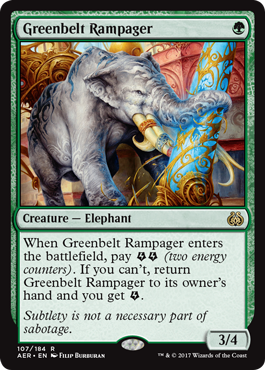
I’m taken aback by the number of powerful and high-quality energy cards in Aether Revolt. If it was not already abundantly clear from Aetherworks Marvel that energy is pushed, it will be after cards like the hyper-efficient Greenbelt Rampager make their mark in Standard. This card will reinvigorate the Red-Green Energy aggro deck in Standard, and I expect will push it into the top-tier.

greenbelt-rampager-aether-revolt-spoiler

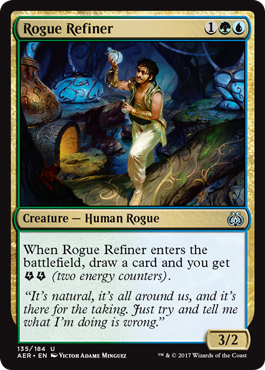
Rogue Refiner is a perfect fit for Marvel decks, which are already splashing blue. It would take a lot from the new set to push Marvel from the top spot, and with the deck receiving new tools, that’s unlikely, but new answers like Metallic Rebuke and Disallow do offer some hope.

rogue-refiner-aether-revolt-spoiler

Disallow gives control a fighting chance, as it now has some answers to Emrakul, the Promised End’s Mindslaver ability. The creature is easy enough to contain, so now the deck can play a long game against Aetherworks Marvel and expect to come out ahead. That’s a big shift, and it could bring about a revival in blue control. Blue-Black looks great with the new Fatal Push, and it’s a major beneficiary from Yahenni's Expertise, which provides control a sweeper and tempo play. I like the prospects of Thing in the Ice, which was a part of Yasooka’s Pro Tour Kaladesh-winning deck, because it survives the -3/-3 effect and benefits from casting a free spell.

There was an error retrieving a chart for Thing in the Ice

There’s almost a half the set waiting to be spoiled, but I expect they will only serve to strengthen mechanics by offering more incentives to play them and tools to support them.

--Adam

High Stakes MTGO – Dec 25th to Dec 31st

Are you a Quiet Speculation member?

If not, now is a perfect time to join up! Our powerful tools, breaking-news analysis, and exclusive Discord channel will make sure you stay up to date and ahead of the curve.

Hello, and welcome back for the final High Stakes MTGO article.

Today I'll cover the last week of my portfolio in 2016 and discuss where I'm going from here. As 2017 starts I'm remodeling my bankroll, most likely decreasing its size markedly. As the "high-stakes" element of the portfolio will no longer apply, I've decided to close this particular article series. Later in January, I'm planning to write a big review article where I'll go over the project as a whole.

The year of 2016 concluded on a strong Frontier note. Many of the cards involved in this unofficial format, starting with Magic Origins, received a nice boost last week. Enough to motivate me to sell several positions, including my ORI full sets. Frontier is definitely driving a lot of hype and has, at least, the merit of creating a lot of speculative opportunities.

Besides this, I'm still predominantly in the mode of selling, especially for anything that can give me moderate gains or limited losses. Several sales and only one buy were on the menu for this last week of 2016.

Let's see how it went. The latest and last snapshot of my portfolio is here. The live portfolio will remain available for Insiders after the articles stop.

Buy This Week

gotb

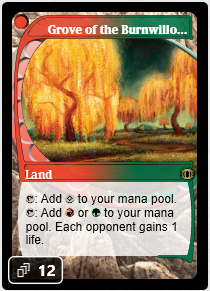
Buys are rare for me these days. Grove of the Burnwillows is finally a position that deserves some interest in my opinion. Last week, the unique Future Sight dual hit its lowest point in more than a year. Grove usually maintains consistent value, having dipped below 15 tix just twice since the summer of 2013.

Clearly, with the timing of this purchase, I'm betting that Grove of the Burnwillows won't be in Modern Masters 2017 next March. That seems like a very reasonable bet at this point, especially considering what I previously wrote about rare mana-producing lands in the Modern Masters series.

Grove could easily recover in the 25-30 tix range in the short term. It will certainly get a good boost if and when, as I anticipate, it's revealed not to be in MM3. If I happen to be wrong regarding a non-reprint in MM3, I'll sell this guy right away. To me, the risk-reward of this spec is overall very good.

Sales This Week

This quickflip didn't work out well, and it was time to take my losses here and move on. But even doing so was not done on the right timing either. The very next day after I had sold my copies of Aetherworks Marvel, for about 2.8 tix per copy, the price trend went back up and was around 3.5 tix as of yesterday. Irony or not, this quickflip was a miss in any case.

Dark Confidant was in the list of old MM2 specs that almost didn't do anything for as long as I have held them. From the bottom of the hole at about 6 tix, right after the release of Kaladesh, Confidant slowly recovered to above 10 tix at the beginning of December. Even with Jund making a small comeback in Modern, Dark Confidant didn't push higher than that 10-11 tix bar.

At this point I'm okay closing this position with a moderate 9% loss. After all, a third reprint in MM3 is not impossible.

ori

With Magic Origins (ORI) it seems like Frontier has shifted into higher gear. Last week the price of a full set of ORI made a 35% jump in a matter of days—an unprecedented spike for a full set price. Led by Jace, Vryn's Prodigy, most of this set's cards spiked overnight in a price movement closely trailing paper prices.

With this, my profit on that spec went up to 50%, a number impossible to ignore for a full set spec in my opinion. Frontier surely got a lot of speculators excited, and I thought that selling into the hype was the best response. There might be more to gain here, but it's in a much more speculative territory than a week ago.

I got what I was looking for with this full set spec, and in about the time frame I was expecting—no reason not to sell in such a favorable position.

The big price jump in ORI full sets came along with a price spike of several ORI singles. I was still holding onto singles acquired back when ORI was Standard-legal. Last week was the right opportunity to let go of some, with or without a profit.

If the trend sustains for a few more weeks, some of my other ORI positions will follow the same path. Vryn Wingmare, Harbinger of the Tides, and part of my giant stock of Battlefield Forge were the first to go this past week.

dtk

In the wake of Frontier speculation, Dragons of Tarkir (DTK) full sets are on a great upward trend these days. I sold four more full sets this past week, still with a return above 50%.

Although Frontier might be a factor, the price growth of DTK full sets appears much more organic than the growth of ORI full sets. I will spread out my sales a bit and continue to sell in the following weeks, as I expect prices to keep climbing.

Following the path of Return to Ravnica shocklands, the KTK fetchlands were nowhere near the ideal spec some of us may have expected. The momentary halt to redemption of KTK sets in mid-October probably didn't help either. Fortunately, KTK sets were restocked and re-opened to redemption soon after—all prices, including those of fetchlands, finally resumed where they left off at the end of September.

Now that a few of these fetchlands are becoming profitable, with returns around 15% to 20%, I decided to sell the profitable ones. 15% is nothing to brag about, but it's still a decent return that I'd rather put into the bank now. With more than 1,000 tix tied to these five fetchlands as of last week, I'm happy to secure profit whenever possible.

I had imagined Ugin getting closer to 10 tix sometime in 2016. It didn't happen and I even wonder where Ugin, the Spirit Dragon would be if Tom Ross hadn't piloted his G/W Tron deck to victory last November.

Ugin is now flirting with 7 tix, its highest price since Fate Reforged (FRF) rotated out of Standard. Even if Frontier can push this planeswalker a little bit more, I'm not convinced there's a lot to gain before FRF's redemption cutoff date. I sold almost all my copies with minimal losses here and I'm okay with it.

What's Next

As for the past few weeks, Modern and now Frontier are the two formats I'm trying to pay the most attention to. Because of what happened to my ORI full set spec, Frontier has already paid off for me—now I'm looking for a similar effect with my DTK full sets.

I also might sell some of the other Frontier-related specs I started a few weeks ago. There has been a lot of buzz—Rally the Ancestors, for example, spiked from basically zero to 1 tix—and the overall trend could lose steam. Taking profits while prices are high is always a good thing—I won't second-guess my judgment, and if my investments have tripled I might as well sell.

Before the end of January, I'm also planning on reviewing all of the 2016 specs made in the context of the High-Stakes series. It will be a great time to evaluate how successful my strategy was when applied to a high-stakes bankroll, and draw lessons for the future.

After that, on a longer-term horizon, I would like to write a series of more technical articles dedicated to the different strategies and methods I use in MTGO speculation. A lot of things have changed, and are still changing, on MTGO. But certain core principles remain, and will still be valid even if the redemption schedule changes.


Thank you all for reading along with me this year, and I hope you'll join me for the next project!

Sylvain

Insider: QS Cast #48: Tons of Aether Revolt

Are you a Quiet Speculation member?

If not, now is a perfect time to join up! Our powerful tools, breaking-news analysis, and exclusive Discord channel will make sure you stay up to date and ahead of the curve.

Play


The QS Cast has returned: Chaz Volpe, and Tarkan Dospil continue on with where the cast left off and in this episode they discuss the following:

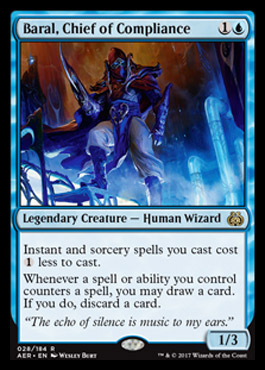
  • We discuss more Aether Revolt – are there cards worth acquiring? We both suggest that Baral, Chief of Compliance has upside. Perhaps even a Smuggler's Copter effect. The numbers already suggest this continues to increase. We felt this was a buy up to (and including) $4 and we have a feeling it can end up in the $12-15 range early on.

baralchiefofcompliance

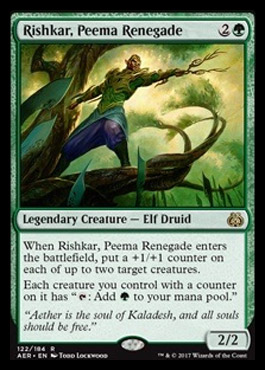
  • We also feel like Rishkar, Peema Renegade is a good purchase as well. Tarkan's comparison to Tireless Tracker felt like a good one.

rishkarpeemarenegade

  • Interests

Cards we discussed:

As always, please comment and leave questions for us to address on the next cast! We will be making QS Insider questions a priority, and we want to know what you want covered.

Enjoy! We’re glad to be back.

Find us on Twitter: @ChazVMTG  @the_tark

Modern Masters 2017 Mythic Predictions

Are you a Quiet Speculation member?

If not, now is a perfect time to join up! Our powerful tools, breaking-news analysis, and exclusive Discord channel will make sure you stay up to date and ahead of the curve.

Recently I've been putting a lot of thought into what could be coming down the pipeline in Modern Masters 2017. A lot of players are drooling over the new Masterpieces in Aether Revolt—and I don't blame them—but now is the time to think critically about the reprints we might see this spring. We're still three months away from the release date, but the closer we get, the more people start thinking. In order to find the best plan, we need to be the first to make one—that way by the time other people catch up to the news and prices start to move, we're already prepared. Today I'm going to discuss what I believe has a high chance of appearing in Modern Masters 2017 and why.

Precedent: The Best Prediction

In both psychology and finance, you'll often hear that the best prediction of future behavior is past behavior. I don't expect Wizards of the Coast to reinvent the wheel with this Modern Masters set, so there are some ground rules we can establish from older iterations. The first is that they always tell us in advance what time period the cards are drawn from. This Modern Masters set extends to the end of Dragon's Maze. The most important thing to note is that this includes Innistrad and Return to Ravnica blocks, which were not part of Modern Masters 2015. The emphasis here will be trying to figure out which of the newer cards from these two blocks they have an interest in bringing back.

While it's not a hard and fast rule, both Modern Masters (MMA) and Modern Masters 2015 (MM2) had exactly 15 mythic rares. These sets differed in total size (229 cards and 249 cards respectively), but the mythic count remained constant. The one monkey wrench here are double-faced cards, which debuted in Innistrad and are thus eligible for reprint in Modern Masters 2017. A large number of double-faced cards would likely necessitate a different printing process and rarity breakdown (as it did in both Innistrad blocks). That said, with the double-faced planeswalker cycle in Magic Origins, Wizards showed its willingness to include this mechanic in small numbers and without messing with the rarity scheme. Barring a heavy double-faced component (and possibly even with one), there's unlikely to be a change to the 15-mythic count.

The last piece of criteria I will be using to make my predictions is how expensive a given card was by January 2016. There is a big lead time on set design at Wizards of the Coast, and if any financial considerations influenced their choice of reprints they were probably locked in by the beginning of the year. This means that cards that became expensive this year won't be reprinted on that basis alone (although they might be for other reasons).

[wp_ad_camp_1]

The Breakdown

Modern Masters had 15 mythics that were broken down as follows:

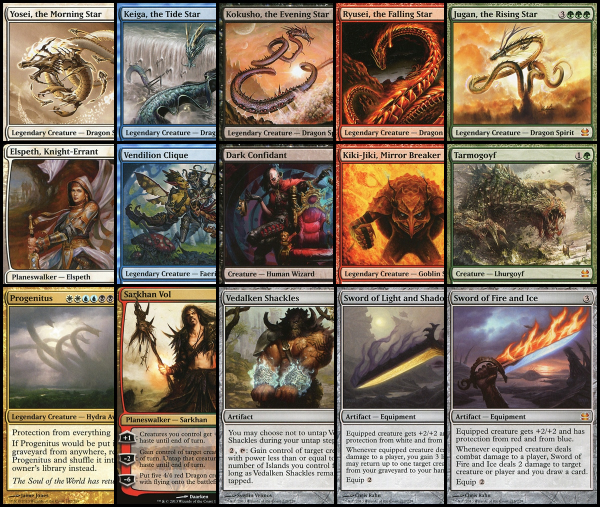
We have two of each mono-color (10), two gold cards, and 3 artifacts. There are also only two planeswalkers, which I wouldn't have considered a pattern until Modern Masters 2015 repeated it.

This is not a very impressive array of cards that you could open at mythic in your $7 boosters (remember, the MSRP of Modern Masters wasn't $10, even if that's what stores charged). A lot of people were understandably upset when they opened Jugan instead of Tarmogoyf, and while I think that Kokusho was a great inclusion, they didn't need to include the whole cycle. They learned some lessons from this and two years later released a much more exciting roster of mythics:

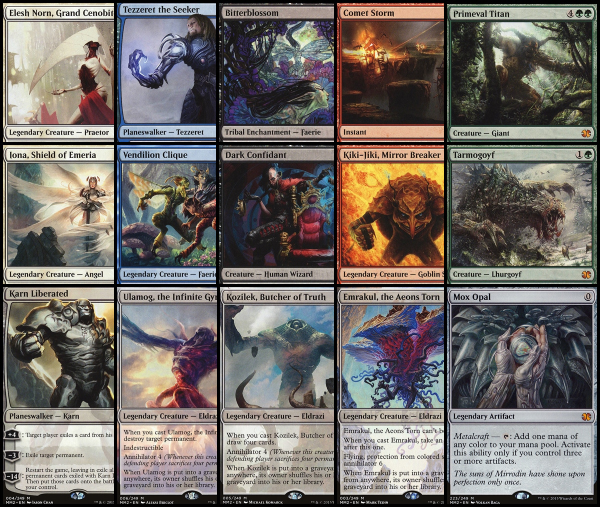
Well, would you look at that. Two of each color, four colorless, and an artifact. Four of the major Modern staples from MMA (Vendilion Clique, Dark Confidant, Kiki-Jiki, Mirror Breaker, and Tarmogoyf) return for a second run as they obviously weren't printed enough the first time around to satiate demand. They learned their lesson this time and included Elesh Norn without the rest of the Praetors to bog down the mythics. Generally, you were pretty happy if you opened a mythic that wasn't Comet Storm (really guys? Comet Storm, of all things?).

With all of this in mind, I'm going to go out on a limb and predict that we will see a distribution closer to MMA than to MM2. There aren't a plethora of colorless cards that need to be reprinted, but there are plenty of gold cards to choose from.

Predictions

White

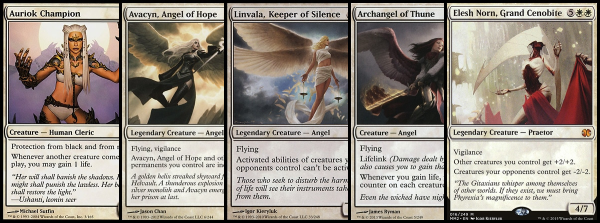
There aren't a ton of white cards that would make for exciting mythic rares in a new Modern Masters set. Both of the white mythics from MMA got swapped out for MM2, and I'd almost expect the same to happen here. The one card that might have enough demand to return is Elesh Norn.

This is my short list of "possible and probable" white mythics. There are not a lot of exciting or expensive mythics from the newest sets added to Modern Masters 2017 and the only existing miss from Modern Masters 2015 was really Linvala, Keeper of Silence. Elesh Norn is pretty reasonable for competitive and casual players and I would not be surprised if it was back again.

Auriok Champion is a weird card that, while expensive, is technically a rare. It was only printed once in Fifth Dawn, which is a set that did not contain mythic rares. Wizards has shown a leniency to upgrading rares to mythic if they initially came from a set without mythics (Tarmogoyf, Dark Confidant, Kiki-Jiki, Clique, Bitterblossom, Vedalken Shackles, both Swords, and all of the Dragons were upgraded).

Blue

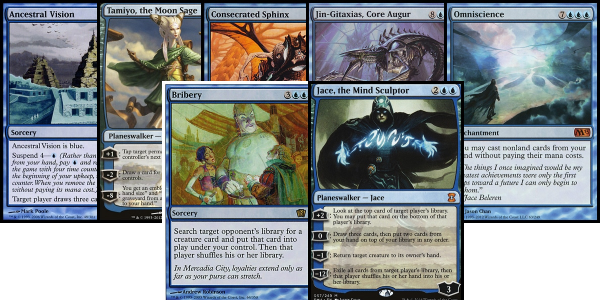
Blue has a better selection of reasonable cards to print at mythic, and this time I think we're going to see the retirement of Vendilion Clique.

Alright, before you freak out at that Jace, the Mind Sculptor image, let me explain. These are cards I think could get printed at mythic. I'm not guaranteeing anything because, at best, these are just guesses. So before you run to the comments section to tell me that I've gone completely mad to put a banned card in this section, let me remind you that Bitterblossom used to be banned and Splinter Twin got banned after it was reprinted. And many Modern players and commentators have argued that Jace would be relatively safe to unban.

There have been just enough Jace reprints that it could finally see the light of day in Modern without becoming $100 overnight. There is one B&R update before Modern Masters 2017 releases (the one for Aether Revolt), and I would be cautiously optimistic that a potential Jace unbanning will be accompanied by a reprint. Currently you can find Eternal Masters copies for about $45, and that's probably still artificially high considering how many copies are played in most decks.

Aside from that, I think Ancestral Vision is the most likely reprint here. It hasn't been reprinted in a booster set since the original printing, so upgrading it to mythic is easy. I think Tamiyo and Consecrated Sphinx are probably the next most likely to get reprinted. They are basically on par with Tezzeret the Seeker: popular casual mythics with price tags that don't make you feel bad when you open them. Jin-Gitaxias, Omniscience, and Bribery also have outside chances of being chosen due to their price tag.

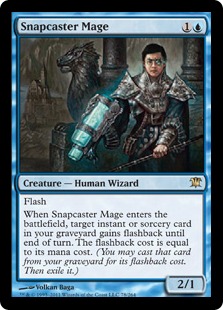
You'll notice that I've included all five Praetors in my list. They've gone long enough without a reprint that they're all relatively expensive, and each one has significant casual appeal. On the subject of Snapcaster Mage, I think it would be a mistake to reprint it at mythic, and it will likely be a rare. It's not out of the realm of possibility, however, that they deem the rest of these cards not good enough and that it ends up a mythic too.

Black

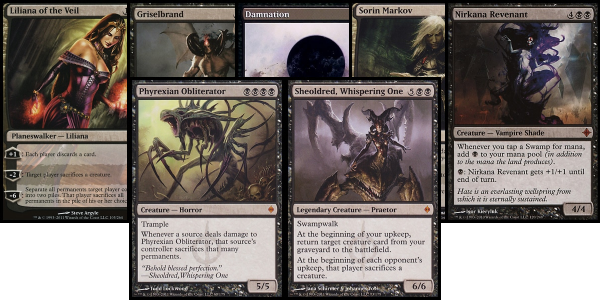
Clearly they're just going to put Liliana of the Veil on the sheet twice. Nothing else.

Okay, fine. They probably won't do that. I think that Dark Confidant will also probably retire this year, replaced by Liliana as the best mythic in the set. Past that, there are a few competitive choices (Griselbrand and Damnation) or a few casual $18-plus mythics that are probably considerations. While nothing really lives up to the hype that Liliana will bring, it's important to note that Wizards of the Coast continues not to reprint Damnation, so I wouldn't get your hopes up. All of these cards will feel better to open than a Comet Storm and that's mostly my goal. There is maybe a bizarro world where our mythics are Liliana and Dark Confidant, but at that point they might as well just call it the Jund Starter Kit.

Red

I hope Wizards of the Coast has as much trouble as me trying to figure out something exciting for this color. The mythics are not impressive.

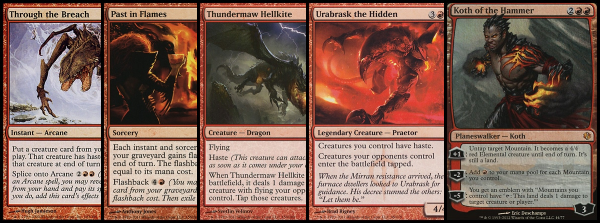
So I'm going to go out on a limb and say that Comet Storm and Kiki-jiki aren't returning. The best card to put at mythic would be Through the Breach, but it has a pretty big problem. As of June 2015 it was $10. Now it's $45 and still climbing. At the time they would have made the decision to reprint, January 2016, Titan Breach was a blip on the map and Breach was a reasonable-sounding $20. The price of Primeval Titan (the most likely card to sneak into play with Through the Breach) has mostly been kept in check by its very forward-thinking printing in Modern Masters 2015. So it's possible that they similarly noted Through the Breach as a reprint target.

Outside of that, I think Past in Flames would be a fine complement at mythic to a larger flashback theme. Thundermaw Hellkite is just a dude but he's a few bucks. Urabrask, like the other Praetors, is expensive and old so it could be a consideration too. Koth, finally, is the least likely of these because he already had a Duel Deck printing.

Overall the pool of red mythics just isn't very deep. It's even less impressive than the white offering. The one card on everyone's radar, which is more expensive than most of the cards above, is Goblin Guide. I think it would look pretty bad at mythic though, and it's probably better served as a rare to help with the supply problem.

Green

With Liliana all but guaranteed to soak up a ton of the value in this set, I can see a world where we don't get Tarmogoyf again. Two $100 cards in the mythic slot would mean either terrible mythics in the other slots, or a set that's immeasurably hard to find.

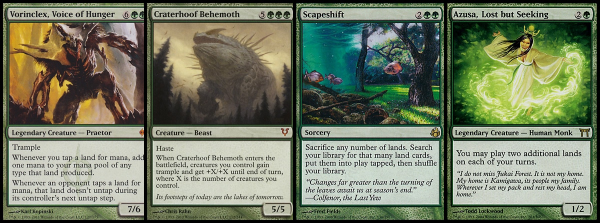
Green is also not a particularly deep color for expensive competitive cards, outside of Tarmogoyf. Vorinclex, like the other four Praetors, is expensive and popular with casual crowds, which makes it reasonable to open. Craterhoof Behemoth is also fairly expensive, and sees play in both casual and competitive decks. Like Goblin Guide, Scapeshift would be better served as a rare but it's from a set with no mythics so a rarity upgrade is possible. Azusa is kind of in the same boat. She's not as popular or expensive as she used to be when the Amulet Bloom decks were running rampant—but she's still popular in Commander and would fill the mythic slot better than another Comet Storm.

Colorless and Gold

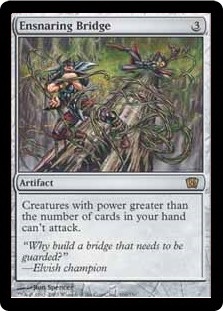
This is the area where I think we could see a lot of repeats from past MMA sets. The most expensive colorless, artifact, and gold cards have already been reprinted once in a Modern Masters set. Emrakul, Kozilek, Ulamog, Karn, and Mox Opal are all pretty expensive again. The only new cards in this section that I could really see as a mythic reprint are Ensnaring Bridge, Blightsteel Colossus, and Voice of Resurgence. If they decide to print Liliana and Tarmogoyf, we might see less expensive mythics that still play a role, like Wurmcoil Engine.

The real kicker here is that many of the most expensive artifacts were already reprinted in Modern Masters as rares. Aether Vial, Chalice of the Void, and Engineered Explosives are just a few of the original Modern Masters cards that really need another printing—just not at mythic.

Bringing It Full Circle

What do we do with all of this information? There isn't a ton to glean, but my main takeaway is that a lot of the plausible mythics in this set just aren't very good in Modern. Most of the cards people want reprinted are cards that should appear at rare. If we're lucky, we'll get a set more like MMA than MM2. Of course, Wizards knows a lot more about the upcoming sets than I do, so we might see some cards that weren't on anyone's radar. Like the reprints of Eye of Ugin and Eldrazi Temple right before we went back to Zendikar, we may see reprints that imply a coming need later in the year.

Insider: 500% Increases – A Review of 2016

Are you a Quiet Speculation member?

If not, now is a perfect time to join up! Our powerful tools, breaking-news analysis, and exclusive Discord channel will make sure you stay up to date and ahead of the curve.

Hey. Spoilers for Aether Revolt are here. I don't want to talk about them in my article yet, because I'm not the person to ask if you want to preorder stuff. We all know what my niche is here, and we're going talk about some bulk today. Check out mythicspoiler.com, and then come back to grind some bulk.

Qualifying Past Promises

Okay, remember how last week I promised that I wouldn't do a "year in review" article? Well, that was going to be true, until MTGStocks posted this informative list including the top 250 cards of 2016 in terms of percentage gains from January 1 until Dec 31. If you're a fan of long-term specs, this is the kind of information you want to make a mental note of before picking up some cards during the last of the winter doldrums.

The top 20 cards in this list of 250 all had gains of over 500 percent during 2016, and those are the kind of margins I can get behind. By separating those cards into their respective formats, we can break down where the most money was to be made in long-term specs this year. (Hint: it wasn't Standard.)

There was an error retrieving a chart for Sudden Shock

Modern

Old School

Pauper

EDH

Legacy

Kitchen Table

Doubling Up x 2.5

All of the above cards (in multiple printings, for some of them) quintupled in price between the two data points of January 1 until December 31.

Interestingly enough, most of these prices are relatively close to the peak post-spike price. On a "normal" spike curve when demand has a sudden increase, you expect the card to trickle down and reach an equilibrium after the spike, where the supply curve and demand curve interact. While you had a few days to sell Greater Gargadon at $15, the majority of its post-spike life has been coasting along at slighly less than $10, and seeing incremental decreases as Dredge adapts to no longer need the card.

There was an error retrieving a chart for Greater Gargadon

On the other hand, Squandered Resources is still $6 for several months after The Gitrog Monster was printed. It even continued to climb as Kaladesh released, and is sitting pretty at $6. Not bad for a card that's been an unplayable bulk rare for the past decade or two.

Of course, a 500-percent margin sounds great when you're talking actual cash. Turning a pile of $5 cards into $25 cards is the fairy-tale of all speculators looking to get started in Magic finance, but another cursory glance over Stock's top-20 list shows that we're talking about a much smaller individual card price on January 1, 2016. Barring weird Old School cards (Tetravus and Urza's Miter) and Ancestral Visions, basically every single card on that top 20 list (even going down to the top 30) was a bulk rare or dollar card that experienced a surge in demand.

Does it feel like I'm suggesting that you invest in bulk yet? Good. I am.

There's so much money to be made in the game through long-term specs, grounded safely in the fact that Wizards can't reprint everything that spikes. They're playing a game of whack-a-mole with Modern, EDH, Pauper, and Casual cards. Maybe they hit Brindle Shoat in a bridDuel Deck this coming year, but it's too late; I already made $20 picking a playset out of bulk and selling them to a Pauper completionist. Even if we ignore the existence of the Reserved List and formats like Old School as investment opportunities, it's clear that going wide on a bulk strategy is a power play that can't be burned out by an inconvenient move by Wizards.

There was an error retrieving a chart for Dig Through Time

My message to you is to pick up the cards that no one wants today, because the winds of change in Magic blow strong.

Do you want to know how many Dig Through Time I picked up at $.25 each immediately after rotation, because "that card will get banned in every format that matters?" Even if I only sell them on TCGplayer for $3.99, I'm raking in over $2.5 per copy for a 1000 percent gain.

Buy bulk rares. Be that person at the trade tables, and say, "I will take any rare that you want to give me at $.10-.11 a piece, as long as it is English, Near Mint, and gold symboled." Here's some of the cards I've picked up recently at $.10 a piece: Siege Rhino, Jeskai Ascendancy, High Market, Hallowed Burial, Hand of the Praetors, Kami of the Crescent Moon, and more.

Some people will say no. That's fine too. Some players would rather stockpile playsets of cards that they might consider playing in the future, and I don't blame them. But 90 percent of the time, there's some bulk that someone wants to get rid of, and dust into a couple of fetches from your binder. Most of the players who I pick up bulk rares from aren't unloading their collections to pay rent; they want space in their binder and Thoughtseizes in their decks. If you can be that person who's willing to soak up a large quantity of currently unwanted cards by unloading Standard/Modern staples, you're going to be light years ahead of those trying to figure out the next Smuggler's Copter or Torrential Gearhulk.

I'm rambling at this point, but I'm glad that Peter over at MTGStocks released this data as an overview of 2016. It got me thinking as to what kinds of cards we'll see on next year's "250 top risers of 2017" list. Maybe we see some ridiculous enter-the-battlefield triggers printed this year and Torpor Orb goes to $10. Maybe the aforementioned Jeskai Ascendancy combines with something that slips past the Development team at WotC, and we see it hit $4 again. Even if it only goes to $4 and we buylist for $2.50, that's the 1000-percent multiplier we're looking for. Based on the Expertise cycle we're getting in Aether Revolt, I wouldn't be surprised to see Beck // Call on that list already, considering it started the year at dime status...

End Step

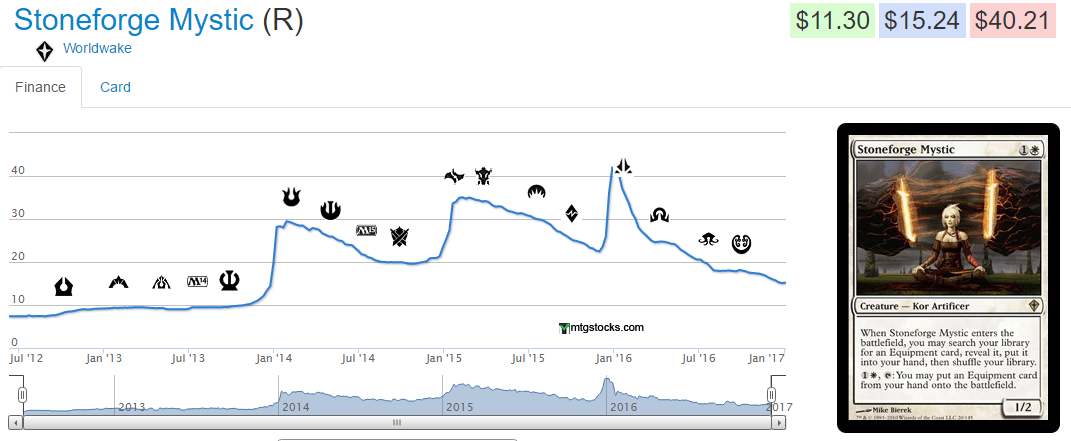
January means a lot of things: cold weather, writing the wrong dates on stuff, and the inexorable roller coaster that is Stoneforge Mystics price graph.

sfm

Every January for the past three years, it's jumped up and down like clockwork because of the speculation for its potential release from prison. This year is different, though, and the graph suggests that without any other information.

While the card has previously bottomed out at $20 before climbing, it's dropped to a paltry $15 this year, and that's only TCG mid. The culprit is of course the Grand Prix promo distributed en masse and swamping the market with Stoneforges, and you can find them for as low as $10 on TCGplayer nowadays.

So here's my question to you: what do you think is going to happen with Stoneforge? There's only a couple of possibilities here; it either gets crushed under the weight of its huge supply to the point where it doesn't jump in January, or the unban hype and low buy-in are strong enough to push it back into the $20s. What do you think? I mean, we all know you'd rather buy 100 bulk rares for $10, but if you had to buy a Stoneforge or nothing... what's your pick? I'm personally staying away, but maybe WotC thinks Modern needs another shake-up. Thoughts?

Insider: Frontier Finance Specs

Are you a Quiet Speculation member?

If not, now is a perfect time to join up! Our powerful tools, breaking-news analysis, and exclusive Discord channel will make sure you stay up to date and ahead of the curve.

In July 2014, Wizards released a core set that seemed just like any other that had come before it. As it turns out, this set would forever alter the landscape of our great game of Magic. M15 introduced the templating that contains the anti-counterfeiting symbol at the bottom of each card. Just like 8th Edition did for the Modern, so has M15 done for the fledgling Frontier format.

About a month ago, I heard about this new format called Frontier. There were some budget players discussing it at my shop, and I dismissed the credibility of the format almost immediately. Just like with any news in Magic, though, there can be financial implications from flash in the pan formats, like Tiny Leaders, just as there are in established formats like Standard, Modern, and Legacy. This is a principle I need to remember in the future. Just because I don’t think a format will survive doesn’t mean that others won’t invest their time and money in it.

Frontier is not an officially sanctioned tournament format yet, but from all the attention it’s getting lately, I suspect it will be added to the increasingly long list sometime in the near future. In case you aren’t up to speed yet, here are the list of sets that are legal in the format:

Magic 2015
Khans of Tarkir Block
Magic Origins
Battle for Zendikar Block
Shadows Over Innistrad Block
Kaladesh Block

With only eleven sets legal in the format right now, the card pool is relatively small. Basically we are talking about only two years of cards to build from. While there will be some powerful interactions from multiple Standard formats overlapping, there is nothing degenerate happening just yet.

Implications

Adding another non-rotating format to the mix could make the finance scene interesting. Modern is already similar to Legacy from a financial investment standpoint anyway. Many players still have a hard time breaking into Modern because of the price barrier. Wizards will continue to try to fix this problem with reprints and Modern Masters sets, but I think Frontier might be a better way to bridge the gap between the formats.

From an owner's perspective, I think this format is a genuinely great idea. Players who want to play frequently could run their Standard deck multiple times per week, and while that’s not ideal, they wouldn’t be completely outclassed like if they went up against a Modern deck. Additionally, many players have been around for the past couple formats and still have some powerful cards lying around that they could build from. My store is even thinking about hosting tournaments in this format because we have already generated a lot of interest from our player base.

The other reason that Frontier is great is because of the financial implications. These past two years' cards are mostly gathering dust around the shop because they don’t have a specific purpose. Many of the most powerful cards in this format are not quite good enough for Modern, and so they have fallen into the post-Standard price decline that cards normally follow. With a reignited need for these cards, prices have already started to change. If Wizards formally backs this format, we will be looking at a big bump to many cards from these sets.

The Targets

In addition to discussing the basics about this format, I also wanted to identify some great financial targets as well. Take a look at what I’ve dug up so far.

There was an error retrieving a chart for Dig Through Time

We all know that getting banned in Modern is an indication of power level. Unsurprisingly, Dig Through Time is one of the most powerful things you can be doing in Frontier. As of now, there is no banned list for this format because no one formed one yet. I think Dig would be one of the first cards on the chopping block, though.

There has been some initial demand already for this card. Recently, we sold all available copies on TCGplayer. Although the price hasn’t risen dramatically, it has already gone up with the limited demand Frontier has brought to the community.

There was an error retrieving a chart for Hangarback Walker

Hangarback Walker is the real evidence that credibility is being given to this new format. Formerly a slightly better than bulk rare, Hangarback has already quadrupled in price! Even the market price hasn’t adjusted to this new price point. The lowest copies available right now are $6 if you include shipping. That’s a lot for a card without a home. In Frontier, though, Hangarback is an all-star just like it was in Standard.

I don’t think this artifact creature has what it takes to get banned from the format, but I do think it will be a staple as long as the format exists. So, if you want to play this guy, $6 each might not be too much to ask for your copies. I think it will take a while before it climbs much higher in price though.

There was an error retrieving a chart for Anafenza, the Foremost

One of the most potent decks we’ve seen in the past couple of years was Abzan. There were many varieties of this deck including multiple versions of aggro and midrange/control.

Just like in every format, there will be some shenanigans from decks utilizing their graveyard. Anafenza, the Foremost does a great job at shutting down all of these synergies. No matter what your opponent is trying to do, she prevents all of it as long as they are creatures.

So the previously mentioned Hangarback Walker, gets to make no tokens when she’s around. This doesn’t do much to stop the cost altering for Dig Through Time though unless they are using creatures to fuel their Delving.

Abzan was a powerful color combination during its reign in Standard and it should continue its dominance in frontier as well. Anafenza is already up to $5 as well and it’s no surprise considering how well she pairs against the next card.

If you were looking for a better Abzan card to invest in, you might want to look to Warden of the First Tree. This green mythic rare is still bulk and should be able to be acquired on the cheap right now. Assuming a lower mana cost is preferable in Frontier just as it is in Modern and Legacy, Warden would be a premier threat in the format.

There was an error retrieving a chart for Rally the Ancestors

Although Abzan controlled the format for most of its time, many considered Rally the Ancestors to be the true best deck in the format. This one card combo, allows you to drain your opponent for all their remaining life points thanks to triggers from Zulaport Cutthroat.

As one of the best combo cards legal in the format, I expect Rally to adopt a strong following. I like this card a lot as a bulk spec. With a larger land selection to build with, the deck will now have better mana than it had previously as well.

There was an error retrieving a chart for Jeskai Ascendancy

Speaking of combo, what better way to kill your opponent than with tokens fueled by Jeskai Ascendancy? Whether your pairing Ascendancy with Hordeling Outburst or another awesome financial target like Goblin Rabblemaster, this deck should be the real deal.

This strategy was top tier when it was in Standard and now it should theoretically have more tools than it did before. One of the difficult initial aspects about Frontier is that we don’t really have a metagame yet. There are some results to base our initial thoughts on, but there are not enough of them yet to guide the format in one direction or another.

Even though its not clear yet where these decks stand in relation to one another, Jeskai Ascendancy is powerful enough that it should be a reasonable deck choice. I think that right now, the fact that you can basically play whatever strategy you’d like is a huge bonus for the format. You can’t play whatever you’d like in Modern or Legacy because some strategies are just outclassed by the power level of those formats. With Frontier, the power level is lower as is the card pool so everyone should be on more even footing.

There was an error retrieving a chart for Atarka's Command

All three of the good Commands seem like great investments. Atarka's Command and Kolaghan's Command already see play in Modern, so adding another Format to their viability would do a lot to increase their prices. Dromoka's Command is still great, just like it was in Standard, but it doesn’t really have a home in Modern yet. It’s powerful and versatile enough for that format, but there isn’t a deck that really wants to include it. Many Frontier decks could slot it into their build quite easily and it would be one of the best cards in the deck.

Frontier doesn’t have many good one-mana removal spells, if any, so these two and three mana spells are what the format will rely on for keeping the board in check.

I especially like Atarka's Command because it could be the centerpiece of Atarka Red once again. Frontier, just like every other format, is likely to contain a red aggressive deck who’s goal is to burn you out after using some cheap creatures to lower your life total. This time around though, we can base our strategy entirely on Goblins and add Goblin Piledriver to the already formidable roster. The deck might stick to just playing the most powerful creatures like Monastery Swiftspear, but it could also go in a tribal direction. No matter which way the deck sways, Rabblemaster will be a prominent inclusion.

There was an error retrieving a chart for Spell Queller

Standard will give us some great cards for this format as well. Spell Queller and Smuggler's Copter come to mind as great potential cards to play in our bridge to Modern format. We all know how great these cards are because they are seen all over the tables at events from an FNM to a Grand Prix.

The main reason I wanted to include these cards in this article is to show that the best Standard cards should frequently turn into format staples in Frontier. This is not always the case with cards transitioning to Modern, but for a while, it should hold true for Frontier. So, hold onto those Standard staples or get the most out of them. Don’t automatically devalue them because they are rotating out of Standard.

There was an error retrieving a chart for Jace, Vryn's Prodigy

Blue based decks are a favorite of tournament players and Jace, Vryn's Prodigy is one of the cards at the top of that list. The Snapcaster Mage like ability to recur your powerful interactive spells only gets better the more options you have. This Jace works best when paired with powerful Sorcery spells that you can utilize on your own turn. He also can do a great job enabling potential graveyard synergies.

We saw Vryn's Prodigy be valued more highly than any other card since Jace, the Mindsculptor. He already sees modest play in Modern but that adoption seems to have been severed for the most part. In Frontier though, he should be under consideration for best card in the format. I know I still have my copies from Standard to potentially use in Modern, hopefully you do to.

Jace is the prime example of real demand existing due to the influx of players looking for Frontier cards. His value a couple months ago was half of what it is now. If Wizards supports this format though, I think he could continue to climb even higher towards his Standard peak.

There was an error retrieving a chart for Collected Company

This past year was dominated by a green instant that let you cheat creatures into play for less than what they cost. Collected Company is good enough for Modern and certainly for Frontier. With how dominant it was in Standard, I’m not sure Frontier is ready to face this level of power.

I know I would be very excited to play with this card once more as would many other players who piloted any versions of the deck when it was in Standard. The Bant version would still be a strong choice, but I’m more interested in trying out different variations that utilize the entire card pool.

Before everyone was playing Bant Company, I was having a blast and crushing the competition with Temur Company and Savage Knuckleblade. My very first thought about Frontier was that I could revamp that deck and that thought got me hooked on the format. I think many players who like to build decks would have similar thoughts and that will quickly bring them into the format as well.

There was an error retrieving a chart for Polluted Delta

Since their time leaving Standard the Fetchland reprints in Khans of Tarkir have not gained any value. In fact, most of them have dropped from their heights while they were there. With another format adding demand though, the Fetches should start their incline in the near future. Right now, these lands range only from $11 to $15 which is very affordable for multi-format land staples such as these. If you were planning on ever getting Fetches, unless we get a large reprint, like having them again in Standard, this is likely the lowest they'll ever be.

We know we have the Battle lands like Canopy Visa to pair with the Fetch lands as well as any future lands with basic land types. Most manabases should include Wooded Foothills and the rest of the Khans Fetches. Khans block has the best mana that this format has to offer and I'm sure every deck will take advantage of it. The lands available in a format really dictate the tempo in which decks can operate, but with the amount of sets legal in Frontier, we already have enough tools to work with to make consistent three color decks.

There was an error retrieving a chart for Smother

A Warning

Lastly, I wanted to finish up by reminding us all, via Smother, what happened last time. When Tiny Leaders popped up, that format gained a lot of momentum in the community in a short amount of time. I think at this point we can safely say there’s no long-term future for the format, and for the most part, players have abandoned it altogether. Even with the validity of the format in question, tournament organizers still scheduled tournaments for the format and players still invested in it. I know I dove right in and made a bunch of decks as well as speculating on potential financial targets.

One card I identified early was Smother. With one of the main limiting factors in the format being converted mana cost three or less, it’s easy to see what an all-star Smother would be. Even though it’s not as efficient as a one mana spell like Swords to Plowshares, killing any creature for two mana is still powerful.

When excitement for this format was in full gear, Smother foils were selling for $15 or more and climbing. I accumulated a nice pile of foils from various sets and was able to buy list them all for $8 to $10 each. Now the sell price has dwindled down to around $3, but I still made money from these removal spells.

My point is that even if Frontier never gets adopted as the next big format, players will still invest in cards from this era. With the prices on these cards being so low, if any demand pops up for a sustained amount of time, these cards will definitely increase in value. Some shop owners might even preemptively pull these cards and reprice them in anticipation of the future price increase.

Right now, players are jumping straight to previous archetypes, and that’s a normal starting point. I want to play Temur Company or maybe another color combination with the card. Other players will be looking to advance their favorite strategy from the past two years as well. Once we get past this first initial stage, players will begin to mix the cards in new and interesting ways. This is when the real fun begins and the format will shape itself into a true metagame. There will be strategies that combine cards from multiple blocks that never had a chance to exist together before. What an exciting thought!

Until next time,
Unleash the Frontier Force!

Mike Lanigan
MtgJedi on Twitter

Insider: The Last Two Inventions

Are you a Quiet Speculation member?

If not, now is a perfect time to join up! Our powerful tools, breaking-news analysis, and exclusive Discord channel will make sure you stay up to date and ahead of the curve.

Welcome back, readers! I've been doing a lot more macro-level stuff recently, and I felt it was time to jump back down to the micro level (i.e. single card) speculation discussion. What prompted me, you might ask?

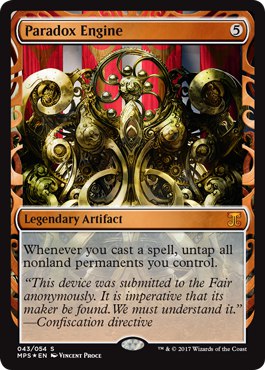
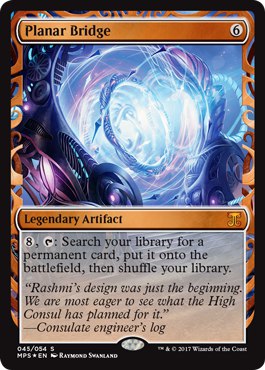
paradox-engine planar-bridge

These two Inventions flipped the switch on that part of my brain that loves Commander brewing. Wow. These last two were clearly designed for Commander players (though one could argue that Paradox Engine could see competitive play) and if you can't tell I'm very excited. It's important to keep in mind that in Commander, things being legendary is actually a benefit almost all the time, whereas in normal competitive play it is a downside. In Commander, you see, we have cards that specifically effect legendary permanents.

Paradox Engine

This (to me) is the more exciting of these two Inventions, primarily because I can honestly see it being extremely broken. Some might look at it and say, "Well, it doesn't untap my lands," and move on. I would simply remind these folks that in Magic's 23-year history we have a lot of cards that produce mana that aren't lands. Now it is important to note that while this card is legendary, it isn't a creature and thus can't be your commander. Thus, you won't have "constant" access to this ability like you would if it were on a creature. That being said, there are no shortage of good commanders that would play well with it.

There was an error retrieving a chart for Captain Sisay

Captain Sisay has always been a powerful commander that you tend to build around, rather than say just a "good stuff" general, and while her ability is extremely powerful, the fact that it's typically limited to once per turn and puts the card into your hand has kept it in check.

Now Rofellos, Llanowar Emmisary is completely banned, but both Selvala, Explorer Returned and Selvala, Heart of the Wilds are in Sisay's colors and generate mana. The reason this is important is that with a multiple-mana producer and Sisay, you could potentially tutor up your whole deck with Paradox Engine. I think Selvala, HotW is the better option because it's more likely to generate larger amounts of mana, and you could potentially ramp up mana by getting bigger and bigger creatures and generating more and more mana with Selvala (as each time you cast the card you tutored up you would untap both Sisay and Selvala). You could do the same with Sachi, Daughter of Seshiro; you'd just need to have a few more shamans out in order to cast your bigger stuff.

This general idea isn't just limited to Selvala or Sachi, though (I only picked them because they are also legendary so they can be tutored up with Sisay). If you made the deck more "elf" themed, then you have Priest of Titania and Elvish Archdruid to generate large amounts of mana. However, you'd have to draw or tutor them up some other way.

There was an error retrieving a chart for Arcum Dagsson

Arcum is the other obvious route to take. He can also tutor up Paradox Engine[card], but he puts it directly into play. Decks built around him tend to play a lot of artifact mana, which is the other way to gain lots of mana abusing [card]Paradox Engine.

However, one still needs to create artifact creatures to sacrifice for Arcum's ability and to get cards in hand (to keep casting to trigger Paradox Engine). Creating creatures is actually pretty easy. Two great options that are currently pretty cheap are Myr Turbine and Summoning Station, both of which only require tapping to activate (thus with Arcum out) you could tutor up as many artifacts as you have spells in hand/mana to cast. You could use Temple Bell or Otherworld Atlas to draw out your deck.

Earlier I mentioned how the last piece of this puzzle would be your mana-generating artifacts (since Paradox Engine would untap those as well). Because Arcum decks are mono-blue, one doesn't need a ton of different color-producing mana rocks. A few that generate colorless and a few that generate blue are likely all that are required.

There was an error retrieving a chart for Worn Powerstone

Now one challenge is that most mana rocks tend to be in the common and uncommon category, which means that unless they are extremely old they have a relatively low price ceiling. Two of my favorites for this style of deck happen to fall into the "old" category. Basalt Monolith and Grim Monolith are two extremely powerful mana rocks which were both tempered with a "does not untap in your untap step" clause and instead require mana to untap. However, when you have a way to untap them for free, they can just generate silly amounts of mana with no downside.

Grim is already pushing $45 (and it's on the Reserved List), so the buy-in is quite high, though I wouldn't be surprised if it gets a bump if we see a lot of players jumping onto the Arcum Dagsson train. However, Basalt Monolith can be picked up for between $0.5 and $1.50 with relative ease. It has been reprinted since it's ABUR days (Alpha, Beta, Unlimited, Revised) but both those printings were in Commander product (2013 and 2015) and in each case was only included in one deck (Evasive Maneuvers and Wade Into Battle).

Planar Bridge

This is a Planar Portal on steroids. Sure, you can only tutor up permanents, so you can't loop Beacon of Tomorrows) for infinite turns – but you get to put those permanents into play, not just into your hand. That's huge.

There was an error retrieving a chart for Planar Bridge

Unlike Paradox Engine, I don't see this card revitalizing or renewing interest in specific commanders. However, what it does offer is a lot of potential with a whole groups of cards that often don't make the cut.

Of course, I'm talking about "you win the game" cards. The problem with almost all of them (excluding Laboratory Maniac) is that they paint a big old bullseye on your head the turn before they would win the game (since most trigger during your upkeep). About half of them also require some number of counters on them to trigger the "you win the game" aspect. In that case, Planar Bridge is unlikely to help out a lot, as the game states in which you can both cheat said win condition up and put all necessary counters on said win condition are likely few and far between. However, there are a few cards in which you only need to meet a specific requirement during your upkeep to trigger an automatic win. These are:

All of these options can be triggered with a deck meant to do so, however, a few are typically easier then most. My favorite picks on this list are;

There was an error retrieving a chart for Epic Struggle

Making tokens is pretty easy in Commander, and there are some cards that could make the full 20 you need (assuming you have enough mana) by themselves. This is also the only mono-green option, and most would argue that green is the most powerful color in Commander. This is also a great card to tutor up when a board state locks into a stalemate because it forces opponents to act. However, in this instance, the idea would be to let the board get into a stalemate (with you eventually having 20 or more creatures), and tutoring up your win condition at the end of the opponents turn, winning in your upkeep (barring opponents having enchantment destruction and/or killing enough of your creatures for it not to trigger).

There was an error retrieving a chart for Felidar Sovereign

This card was a solid $9 to $10 card from April 2013 to October 2015 (when it was spoiled as a reprint in BFZ). I couldn't keep them in my trade binder for that stretch of time.

Thanks to both a reprinting and a rarity downgrade one can now get copies for under $0.5 (which I'd say is criminally under-priced, but I'm still not 100 percent sure how much impact the "Expedition effect" will have on BFZ rares). However, it's important to keep in mind that this guy is legal in Standard with Planar Bridge, so a deck designed to gain a bunch of life (perhaps with something like Aetherflux Reservoir) could have an additional win condition. (Though given you could likely just kill the opponent with said Aetherflux Reservoir, it seems superfluous.)

This is definitely the option with the lowest buy-in on the list that I think has some real potential. The fact that you could literally do nothing in a Commander game and win the game with this card makes it pretty nuts to tutor up.

There was an error retrieving a chart for Test of Endurance

This is the original "if you have X life at the beginning of your upkeep, you win the game" cards and is currently sitting at $6 or so. The beauty of this card (and Felidar Sovereign) is that because of the Commander format's starting life total of 40, most of your work is already done for you. Unlike Felidar Sovereign, though, you actually have to gain additional life from your starting total to actually win the game with this card. However, we all know that in a singleton format having similar cards adds redundancy, which is something you often want in a game of high variance (like Commander).

There was an error retrieving a chart for Mortal Combat

Besides being an amazing fighting game that causes me to reminisce about my childhood, this is an actual MTG card that doesn't get a lot of love in Commander.

The primary problem is that unlike the ones above, it requires a significant setup to trigger; specifically, 20 creatures cards in your graveyard, which without using cards to specifically mill yourself (in one way or another) means you're only likely to trigger it later in the game.

Typically, Commander combo kills/wins are best when they can be done quickly, which is why this one is last on my list and the one I'm least confident in. The buy-in is low, yes, but the setup is high, so the potential for gains is much lower. This is more of a card I'd simply pull out of any bulk rares I might have and see if something causes it to spike (as there are a few cards that would likely help trigger this one quickly – Traumatize and or Morality Shift come to mind), but now we're at a three-card combo, which is significantly worse in a singleton format than a two-card combo.

Conclusion

To be honest, I wasn't all that excited about Aether Revolt as a set until I saw these two cards spoiled. It's not that I don't think the set has some interesting mechanics, it's just that I don't tend to play a ton of Standard and few new cards end up making it in eternal formats.

But the two Inventions discussed today have caused me to do a 180, and now I can't wait until January 20th. I see so much potential in both these cards that I have no doubt that something will spike because of them.

Insider: MTGO Market Report for January 4th, 2017

Are you a Quiet Speculation member?

If not, now is a perfect time to join up! Our powerful tools, breaking-news analysis, and exclusive Discord channel will make sure you stay up to date and ahead of the curve.

Welcome to the MTGO Market Report as compiled by Matthew Lewis. The report will cover a range of topics, including a summary of set prices and price changes for redeemable sets, a look at the major trends in various Constructed formats and a "Trade of the Week" section that highlights a particular speculative strategy with an example and accompanying explanation.

As always, speculators should take into account their own budgets, risk tolerance and current portfolios before buying or selling any digital objects. Please send questions via private message or post below in the article comments.

Redemption

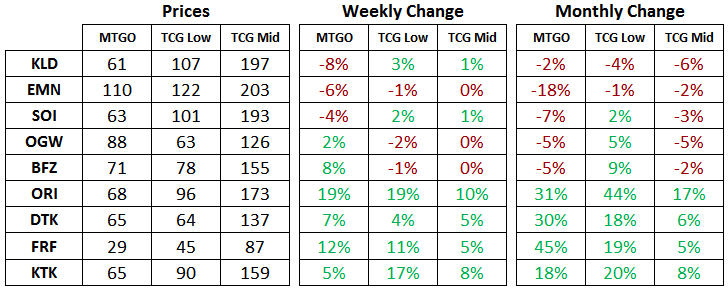
Below are the total set prices for all redeemable sets on MTGO. All prices are current as of January 3 2017. The TCGplayer low and TCGplayer mid prices are the sum of each set's individual card prices on TCGplayer, either the low price or the mid price respectively.

All MTGO set prices this week are taken from GoatBot's website, and all weekly changes are now calculated relative to GoatBot's "full set" prices from the previous week. All monthly changes are also relative to the previous month's prices, taken from GoatBot's website at that time. Occasionally, full set prices are not available, and so estimated set prices are used instead.

jan3

Standard

Spoiler season for Aether Revolt (AER) officially began this week, so it's worth considering existing Standard cards and how they will interact with the new cards. Rishkar, Peema Renegade is a legendary rare creature from AER that has an excellent rate. For 2G you get up to four power and toughness, and you only need one other creature in play to make that happen. On rate alone, i.e. the stats for the cost, it will see play in Standard, but it also has the potential to ramp up your green mana production. Be sure to check out Michael Flores and Patrick Chapin at their Top Level Podcast as they preview this card in depth.

There was an error retrieving a chart for Nissa, Voice of Zendikar

Nissa, Voice of Zendikar from Oath of the Gatewatch (OGW) seems like a likely candidate to benefit from the printing of Rishkar. Although its on the same spot on the mana curve, Nissa generates creatures to receive the +1/+1 counters from Rishkar, as well as being able to distribute its own +1/+1 counters. This type of redundancy can lead to very consistent and powerful decks. It's not clear to me yet if this angle is powerful enough to pursue, but it's worth keeping in mind. Nissa looks to be getting a boost from the cards in AER.

Modern

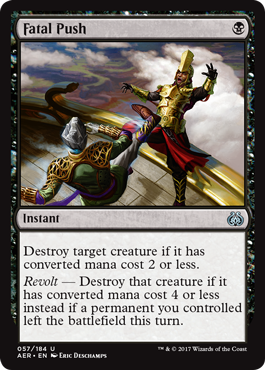
Standard doesn't get all the fun with the new cards as Fatal Push is set to enter the fray as a premier one-casting-cost removal spell in Modern. Check out the spoiled card here. It's floor of being able to destroy a two-casting-cost-or-less creature is already excellent, with many high-toughness targets that shrug off Lightning Bolt in the format, such as Tarmogoyf, Death's Shadow and Spellskite. Triggering revolt in a fetch land format makes the ceiling on this card very attainable, and don't forget that creature lands like Inkmoth Nexus and Celestial Colonnade will fall prey to this card even without revolt.

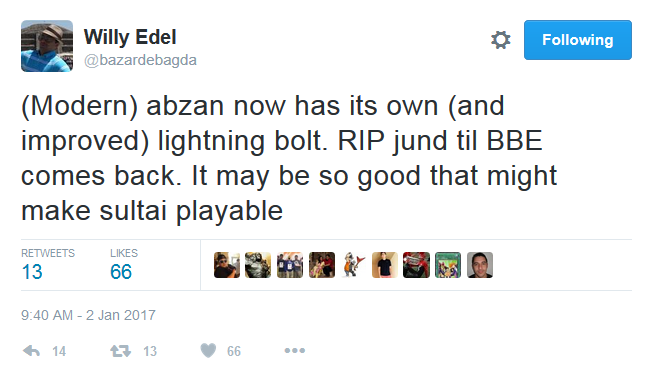
Noted B/G/x master and Hall of Famer Willy Edel tweeted out this after seeing the new black instant.

edelThe comparison to Lightning Bolt is interesting, but what he implies here is that this card is going to be doing a lot of the heavy lifting that Path to Exile had previously been doing. If Fatal Push can do 90 percent of what Path to Exile does, but with no drawback, then clearly this new card is going to push the format in a new direction. It will be worth keeping an eye on.

There was an error retrieving a chart for Path to Exile

Elsewhere, hype around the potential for Frontier has seeped into the prices of all the redeemable sets on MTGO. Jace, Vryn's Prodigy jumped up this week to 30 tix before settling back down a little. The large jump in paper prices for Magic Origins (ORI) this week suggests that this trend is not over, so if you are holding some ORI sets or singles, there looks to be further gains coming. But as I have been pointing out, we are getting close to the liquidity crunch triggered by the release of a new set, so don't hold onto your winning specs for too long. It will be harder to sell cards, particularly Modern cards, when everyone is interested in AER and its impact on Standard.

Triple Zendikar Draft Leagues

This week sees the first Flashback Favorite draft with the return of triple Zendikar (ZEN). Notably these events are not the single elimination events that we've seen, and are in fact draft leagues. You complete the league by getting to three match wins or two match losses. Relative to the recent flashback draft queues which had a 10 tix entry fee, the entry fee is higher. You can still enter these events with the appropriate boosters and 2 tix, but the tix only entry fee is 12 tix now (or 120 play points). Check out the full announcement here and you can read my brief summary of the format from back in August here.

There was an error retrieving a chart for Scalding Tarn

These changes mean that less product is going to be opened than what we saw back in August when the most recent week of triple ZEN flashback drafts went live. If the price of the fetch lands takes a big drop over the next few days, I would think this is an overreaction based off of this recent experience. I will be watching the market and looking for cheap copies of all the fetch lands. As an example, I would consider 20 to 22 tix for Scalding Tarn to be an excellent buy price.

Some financial writers have floated the idea that the ZEN fetchlands are going to be reprinted in Modern Masters 2017 (MM3) this spring. I would treat this idea with extreme skepticism. When ZEN was originally in development, Magic as a game was in the midst of declining sales and interest. For that reason, Wizards of the Coast pulled out all the stops when creating ZEN and part of that was the first printing of the opposing-color fetchlands. Due to their ubiquity in constructed formats, including casual formats, the fetchlands are guaranteed to make any set where they appear into a block buster.

MM3 won't need any help in being a successful release. Interest in Modern is strong and this set will get to draw from all Modern sets up to and including Magic 2014 (M14). Liliana of the Veil from Innistrad (ISD) is a shoo-in to be reprinted, and I expect this valuable card and popular character to be a tentpole in terms of promoting MM3. With a limited print run and other valuable cards to reprint, there is no need for Wizards of the Coast to include the ZEN fetchlands in order to sell MM3.

There was an error retrieving a chart for Liliana of the Veil

Despite all of this, I think that the MTGO market still fears a reprint in MM3. The digital price of the ZEN fetchlands seems low to me relative to the robust interest in Modern and the price of other format staples. I expect that we'll see a substantial increase in the price of the ZEN fetchlands when they are confirmed not to be reprinted in MM3.

Trade of the Week

As usual, the portfolio is available at this link. This week I continue selling down my positions with the sale of a set of Dragons of Tarkir (DTK). Although my timing on the buy side was too early, this purchase has still yielded a small profit. I should have known better than to start thinking about a full set purchase at the end of August, but all the Modern staples in the rare slot had me thinking that maybe DTK would be different.

It turned out the set was weeks away from completely bottoming out. This is a good lesson in avoiding bottom fishing and trying to be too fancy, especially when there are other signals that lower prices are on the way. In this case, it was much too early as historically sets rotating out of Standard only bottom out after they rotate. There is some variation on a card by card basis, but complete sets reliably follow this pattern.

A New Tool for Control: Evaluating Fatal Push

Are you a Quiet Speculation member?

If not, now is a perfect time to join up! Our powerful tools, breaking-news analysis, and exclusive Discord channel will make sure you stay up to date and ahead of the curve.

If you liked "dies to Doom Blade," you're gonna love "dies to Fatal Push!" Few are more surprised than I to see a great black removal spell grace the Aether Revolt spoiler page, though initial evaluations largely seem to be calling the card something it's not. It's a solid card with a role to play, but not the sort of card that redefines formats as large and diverse as Modern. Today I'm going to break down Fatal Push, what the card means for Modern, and close with an updated list for Grixis Delver.

I suppose talking about a newly spoiled card merits posting the textbox for reference. Here is the card that many are saying will redefine Modern:

Calling Fatal Push the black Path to Exile is a reasonable comparison, though it's not wholly accurate. Either way, people are going to call it that, so get used to it. The two cards are sort of opposites though, as Path to Exile is quite bad on turn one and gets better, whereas Fatal Push is exceptional on turn one and scales somewhat poorly.

[wp_ad_camp_1]

Strengths

The fact that Fatal Push checks on mana costs but doesn't care if the targeted creature is a land makes it great against both Noble Hierarch and Inkmoth Nexus (animated lands have a converted mana cost of zero, in case that wasn't obvious). More one-mana interaction to combat Infect is something plenty of Modern decks are in the market for, and Fatal Push is great for this purpose.

In a format so heavily defined by efficiency, that mana cost restriction looks way more appealing than toughness-based removal. Fatal Push doesn't care how big your Tarmogoyf, Monastery Swiftspear, Arcbound Ravager, or Death's Shadow has grown—it's dead all the same. Similarly, the card doesn't get fizzled by traditional pump spells like Mutagenic Growth. This is a blind spot for most of the efficient removal in Modern: Lightning Bolt, Darkblast, and Dismember all look at toughness. To get an unconditional removal spell besides Path, we have to jump up the curve to Terminate and Abrupt Decay. Filling this gap at the one-mana spot is where Fatal Push will really shine.
While Fatal Push will be quite powerful against all the linear aggressive decks, I don't feel that its weaknesses have been discussed nearly as much as necessary. If you're interested in playing a black deck that struggles against linear aggro, this card definitely helps you there. It will matter in plenty of other spots as well. That said, there are other factors that should be considered before sleeving up four Fatal Pushes and claiming invincibility.

Weaknesses

The Revolt Mechanic

Revolt is a quirky mechanic, but we're already starting to get a good idea of how to turn it on. By now you probably know of the interaction with fetchlands. The critical mistake I'm seeing many commentators make is assuming that revolt will always be on because fetches are legal in Modern. Revolt is easy. It's not free. You will play games where you can't kill a three- or four-mana creature with your Fatal Push. Imagine needing to topdeck a fetchland to kill half of a Kitchen Finks. This drawback is non-trivial, even for tagging three- and four-drops, and trying to classify Fatal Push as unconditional removal is simply inaccurate.
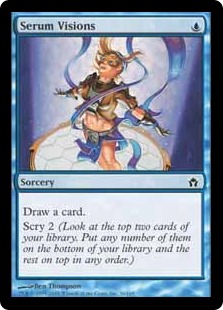
Fatal Push is being discussed mostly as a card for blue-black controlling strategies. Control decks can suffer from the problem of removal not lining up against threats, when they expect to kill everything the opponent does over a long game. Conditional removal is usually necessary in some number, but that's why you see a mix of different answers, usually in numbers smaller than four. Fatal Push likely won't be any different here. Turning on revolt is also complicated by a tension with shocklands and Serum Visions. To fix their mana and save some life, these controlling decks frequently want to fetch a dual on turn one. With Serum Visions in your deck, you're incentivized to fetch as soon as possible so the scrying will be relevant. This obviously competes with Fatal Push's desire for sandbagged fetches.

There are absolutely matchups and games where the revolt doesn't especially matter, but don't pretend like enabling it is free. If you play Fatal Push long enough, you'll eventually lose to a three-mana creature with it stuck in your hand.

Sticky Creatures

While it is true that Fatal Push excels in a number of matchups, it sure sucks against Dredge. I am aware that not everything can be good against Dredge, though that is one of the prime matchups that tends to give control decks problems. I know that's the matchup Grixis Delver is most interested in trying to shore up right now, and it's not like Jund or Abzan need to increase their percentage against the linear decks either. You can have a good game-one matchup against Infect without really costing yourself much of anything, but that's not especially true against fair decks or Dredge. I get that efficient exiling removal is a big ask given the splash damage against cards like Voice of Resurgence, but that's really what these decks are in the market for.
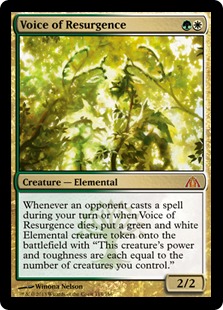
On the topic of Voice of Resurgence, creatures of this nature gain a lot of value as players run more Fatal Pushes. Yes, a one-mana exiling removal spell would be extremely pushed and powerful. I'm not saying that they should print such a card or that it would necessarily be reasonable. I am saying that a card of this nature is the type of removal spell that these fair decks actually want to address their weaknesses. Kalitas, Traitor of Ghet certainly helps in this regard, though is quite slow against the Dredge menace. Perhaps we'll be lucky enough to see that deck banned though. One can dream, right?

Creatures with a High Mana Cost

This one is obvious and only matters in a handful of situations in Modern, though it's worth taking note of. I've seen Primeval Titan referenced specifically in this regard, though you're usually dead if that one hits the battlefield anyway. Same story with Griselbrand. Where this matters is against Reality Smasher and delve creatures.
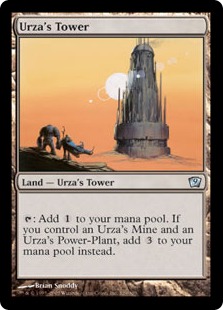
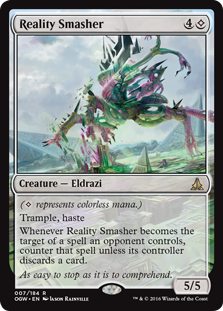
Frankly, as a Grixis Delver player I'm excited to hear that people want to shave Terminate for this card. Delver of Secrets already dies to everything. I am thrilled when your removal spells can't kill Tasigur, the Golden Fang. On the matter of Reality Smasher, that and the fact that revolt isn't free make it so that Bant Eldrazi isn't terribly upset if you want to play a bunch of Fatal Pushes. Somebody had the audacity to say to me that the same is true of Lightning Bolt, because he was apparently under the impression that Fatal Push can deal 3 damage to players. This downside only pertains to a handful of creatures, but to act as if this is irrelevant is absurd.

Trying to Kill Urza's Tower

As far as playable removal spells go, Fatal Push is certainly one of them. I expect the card to see play. It kills some things better than existing tools, and performs more poorly than those same tools in other areas. The card will see maindeck play, though it will not revolutionize Modern. It's good for what it does, though what matters more is what it's not. Ultimately, even if Fatal Push were convincingly the best removal spell in Modern, it wouldn't solve the biggest problem that control decks have.
More than anything, control decks in Modern are hurting for a way to get reasonable odds against Tron. It is true that Fatal Push makes it easier for black decks to take down linear aggressive decks. It is absolutely true that it is the best removal spell for a single black mana in the format. The issue is that control and midrange decks can already hold their own against aggressive decks. If Fatal Push is widely adopted and pushes these aggressive decks out, suddenly Tron—one of your worst matchups—gets better!

Don't get me wrong. Fatal Push is good, and will see both maindeck and sideboard play in Modern. It just isn't what control decks need to get better in the format. It's not a catchall, and there are good strategies against control decks that just ignore it. My initial read is that I want to try playing one copy in the Grixis Delver maindeck and go from there, though I find it unlikely that I end up with more than two in the 75. Decks like Grixis Control and BGx might want to play more copies, though these decks will continue to have the same weaknesses as before.

Brief Delver Update

Some of you are interested in an updated Grixis Delver list, and I think that's worth discussing. I'm not interested in trimming Terminate, because Infect isn't a notable weak point for Grixis Delver whereas Bant Eldrazi is. My most recent list has a maindeck Dismember that will very often be worse than Fatal Push.

Jeskai Nahiri has largely dropped off the Tier 1 map and the Grixis Delver mirror has become more of a thing. So while I'm moving things around I think it's wise to turn the Vendilion Clique into the second Kolaghan's Command. Kevin Jones and Jim Davis had it, and that card matters a ton in the mirror. It's worth noting that I would keep the sideboard Go for the Throat specifically to combat Bant Eldrazi, as it's also totally fine against Death's Shadow.

Grixis Delver, by Ryan Overturf

Creatures

4 Delver of Secrets
4 Snapcaster Mage
3 Tasigur, the Golden Fang
1 Gurmag Angler

Instants

1 Fatal Push
2 Kolaghan's Command
4 Lightning Bolt
4 Mana Leak
4 Spell Snare
4 Terminate
4 Thought Scour

Sorceries

4 Serum Visions
1 Collective Brutality

Lands

2 Island
1 Mountain
1 Swamp
1 Spirebluff Canal
1 Blood Crypt
2 Bloodstained Mire
4 Polluted Delta
4 Scalding Tarn
2 Steam Vents
2 Watery Grave

Sideboard

2 Engineered Explosives
3 Countersquall
1 Dispel
2 Magma Spray
2 Spell Pierce
1 Go for the Throat
4 Surgical Extraction

These changes are quite minor, of course, though I will say that I am way happier with a miser's Fatal Push than a Dismember. It's a totally fine card, though not one that lines up as well in Modern as the hype seems to suggest.

Thanks for reading.

-Ryan Overturf
@RyanOverdrive on Twitter

Insider: Assessing Frontier and Smart Investing

Are you a Quiet Speculation member?

If not, now is a perfect time to join up! Our powerful tools, breaking-news analysis, and exclusive Discord channel will make sure you stay up to date and ahead of the curve.

Earlier this evening I went out to a local bar for dinner, drinks, and to watch the Lions get embarrassed at home with a few of my Team Ann Arbor friends. One of the primary objectives was to discuss topics for our podcast on Wednesday. As we began discussing some of the basic ideas we wanted to work into our cast, I made what I believed would be a bold claim.

"Frontier is the hottest thing going on in Magic right now." A hot take that I thought would really sizzle. After a brief pause as my friends considered my statement, everybody quickly agreed that we should talk about Frontier and that it was indeed the biggest thing currently happening in MTG.

So let me get this straight... At a table full of pro players I said that an unsanctioned casual format is the most significant thing going on in the world of MTG and nobody even objected to it? Has the world gone completely mad!?

Frontier: Bark or Bite

As finance people, the biggest question most of us have now is how to capitalize on the Frontier phenomenon. The most obvious way would be to speculate on which cards will have an increased demand because of Frontier, and target those cards before they spike: Siege Rhino, Dig Through Time, Goblin Rabblemaster, etc. The cards that had very little value before Frontier existed but in a post-Frontier world are once again desirable.

There was an error retrieving a chart for Jace, Vryn's Prodigy

Jace, Vryn's Prodigy is a card that has notably spiked way up in value because of Frontier demand. But be careful. Is it really "Frontier demand" driving the spike? Not hardly. Droves of people didn't suddenly rush out and all try to buy Jace at the same time because they wanted to buy into Frontier. The spike is speculative. The spike is people betting that Frontier will take off, and that when it does, Jace will be the new Tarmogoyf.

It isn't a bad bet to make. However, I'd say if you didn't buy your Jaces when they were $16, it's probably not great to buy in now that they are twice that price.

The other question we should be asking is whether people will actually play Frontier. Are people going to invest their time, energy and money into the format?

Right now, Frontier is a bright, shiny object that seems fun because it's new and different. People like to think about new iterations of things they already know a lot about. As a Magic fan, it's easy to want to learn about Frontier and theorycraft about different decks and ideas that could be good. The big issue is what happens after all the reading and discussion. Will they actually show up and play?

Do Frontier Players Dream of Electric Rhinos?

I'm not actually sure the analogy works properly, but it's snappy and I kind of like it. How committed are Frontier players to actually creating events and playing Frontier? It matters for the sustained playability of the format.

The biggest problem facing Frontier is that it isn't actually supported by the DCI. There are no "real" events which makes it complicated to get tournaments off the ground. Basically, in order to play Frontier you already have to have a core group of players who want to play and then request that your local game store (LGS) run an unsanctioned event for you.

The whole process seems like a gigantic pain in the butt—and it is—but here's the freaky thing: the format is thriving in spite of that. Unbelievable.

I know for a fact that multiple LGSs in my area offer weekly Frontier events and get 15-plus players to show up and play a format that doesn't even exist. The question becomes: if the format has already made it this far, can it keep going?

For what it's worth, I'm creating more Frontier-based content on Channel Fireball in the coming weeks, and multiple other writers are also covering the format. Between QS and CFB, this is the fifth article I've written about a format that technically doesn't even exist!

With that being said, I'm not sure how much bigger the format can or will get beyond where it is right now. I think the next two weeks are going to be huge in determining the course it will take. Will Frontier be the next EDH or the next Tiny Leaders?

The Best-Case Scenario

From the perspective of a finance person, the best possible scenario would be that after we invested in Frontier staples, Wizards of the Coast announced that Frontier would become a real, sanctioned tournament format with Grand Prix and PPTQs.

Personally, I think they should. The format feels fun enough and they could really capitalize on the momentum that has been building. I love the idea of a brand that acknowledges what their customer base wants and delivers it, and Wizards has responded to player initiative in the past: both Commander and Modern are examples.

The problem is that that would be a risky move. Frontier could compete with Standard and/or Modern. Modern is great and super popular and I can see not wanting to mess with a good thing. Standard is beyond terrible (one of the main reasons Frontier is so appealing right now) and making a format that competes against Standard for attention could be unfavorable for them.

Either way, if Frontier (or some other iteration of a Frontieresque format) were to be officially created, it would significantly spike the price of staples. This is the biggest incentive to invest in Frontier: if you believe it will become a legitimate format down the road.

Capitalizing in Spite of Uncertainty

I have serious doubts that Frontier will become a sanctioned format. However, I still think there are ample ways to cash in.

In particular, I think there's still room for the format to grow in the coming month or so. People are very actively consuming the content. You are, after all, reading yet another article about the format yourself. It seems very likely that if enough people are reading the articles and learning about Frontier, eventually they will want to throw a deck together and play some games.

I predict there will be an opportunity to sell cards into the bubble that is apt to be created. Look for the prospective staples that players are likely to have gotten rid of since they considered them worthless. Siege Rhino is actually a bad example because the card is so obviously good in Modern. Here are some better suggestions:

There was an error retrieving a chart for Dig Through Time

Dig is banned or restricted in every sanctioned format, which means that there's no reason for people to own the card. If you want to bet on Frontier, this is exactly the kind of card to target. People don't have it and it is format-defining.

There was an error retrieving a chart for Collected Company

Collected Company is already a great Modern staple in addition to being one of the most powerful cards in Frontier. I'd be likely to target CoCo even if Frontier were not happening right now, so it feels like a double dip.

There was an error retrieving a chart for Atarka's Command

Atarka's Command has already begun to creep up, but it feels a lot like CoCo in terms of a Frontier investment. It is already great in Modern and the Frontier hype can't possibly hurt. Atarka Red would clearly be a format-defining archetype in Frontier.

There was an error retrieving a chart for Goblin Piledriver

Basically, a card that has very little value right now but could be good in some version of Frontier. Goblin Rabblemaster is a heck of a card, and Piledriver seems sweet alongside it. It always seemed weird to me that Piledriver was in Origins. Perhaps, having a Goblin deck for a format in between Standard and Modern was something Wizards already envisioned.

There was an error retrieving a chart for Goblin Dark-Dwellers

Another card that shows up in a ton of Frontier decks but which is basically a glorified bulk rare in Standard. It is also worth noting that the card is great with Ancestral Vision and Boom // Bust in Modern. Overall it's a card ripe for speculation.

There was an error retrieving a chart for Cinder Glade

The battle lands are the shocklands of the Frontier. If you can pick them up cheap it might be a good place to be for a couple of reasons. First, if Frontier takes off. Second, nobody is playing Standard right now but if Wizards manages to "fix" it or create new demand to play the format, there could be some gains as people rush to make decks after Pro Tour Aether Revolt.

There was an error retrieving a chart for Shambling Vent

The Modern-playable Zendikar block creature lands are great investments regardless of whether or not Frontier is here to stay. Good cards are good. The smaller the cardpool, the better and more important cards like these become.

Invest Smart

The key here is to identify cards that have some application beyond just Frontier as a way to hedge in case Frontier doesn't make it. I'm not saying it will or won't, but if interest starts to wane at some point I don't want to get caught holding the bag on a bunch of Siege Rhinos I paid $1 a piece on.

The other thing to keep in mind is that selling into the spike is very real. You can't control what the market will do indefinitely, and selling high is always a good option.

Bannings, Unbannings: A Question of Cantrips

Are you a Quiet Speculation member?

If not, now is a perfect time to join up! Our powerful tools, breaking-news analysis, and exclusive Discord channel will make sure you stay up to date and ahead of the curve.

Welcome to 2017! Hopefully you've recovered enough to actually face the new year, because we have a new set and a banlist announcement on the way. It's time once again for wild speculation and unrealistic expectations to flood the internet. Brace yourselves. We at Modern Nexus will do what we can to temper this and provide more grounded opinions and analysis.

I am not willing to speculate on what changes will be made on the 16th. I still think that Wizards is too unpredictable and unknowable for that to be worthwhile. However, I have been contemplating the banlist. Specifically I have been trying to parse why certain cards have remained banned while other, arguably more powerful, versions remain legal. I do understand why they're not banned. A card needs to be proven problematic before Wizards will take action, and that hasn't happened yet. That's not the problem I'm having. The problem is that there are some legal cards that are better than banned cards. Specifically, I question why Ancient Stirrings is still legal while Preordain is banned. If the former is fine, the latter should be as well.

You could argue that this logic applies to Ponder as well. I don't think it does, but you could argue it. Ponder is much more powerful than Preordain and I will be discussing why in a little bit. Given Wizards's design philosophy and fear of Storm, I don't think we can ever expect to both removed. I also don't think that we actually want both in Modern. UR Delver is a very scary deck when it has the opportunity, and while Treasure Cruise is gone, a critical mass of cantrips do a similar job. Let's focus on the safer option for now. For more on why Preordain is the acceptable choice, go read Jordan's article from Friday. His reasoning is in line with mine and he makes a good argument that I will be expanding on in this article.

[wp_ad_camp_1]

Examining Preordain

When Serum Visions was first released, everyone was a bit mystified. You drew a random card and then scryed. It looked weird and seemed counterintuitive. Why are we drawing first? It makes far more sense to draw a card we'd already scryed for. The thing was that Scry 2 (and in Fifth Dawn it was all Scry 2) always went below all the other card text. I recall at the time Mark Rosewater said that it was intended to be a new form of cantrip, but I can't find the article to confirm it. It saw a little bit of play at the time, but was largely ignored except by Storm decks that needed additional cantrips. This was before Legacy really took off and we clued into the real power of cantrips outside of combo decks.

Fast-forward a few years and Wizards eventually came around to the players' way of thinking. For M11 they "fixed" the templating and created Preordain. And it was much more powerful. It turned out that looking for a card to draw was really, really good. Especially when you do it in Caw Blade. However, the card was absolutely ubiquitous during its Standard run and saw considerable play in Extended as well. Blue decks everywhere played this card and prospered from the increased consistency and ability to dig for spells. To this day it's a mainstay in both Vintage and Legacy.

Recent History

Despite this pedigree, Preordain hasn't had much of an impact for many years. It was banned immediately following Modern's debut at Pro Tour Philadelphia along with Ponder. The problem was that alongside fast mana, combo decks were too fast and consistent in early Modern. Without Force of Will and Counterspell, combo was too consistent to be acceptable. The fast mana was clearly bad but the cantrips were equally guilty. The mana and time advantages were too much on combo's side to allow them access to powerful cantrips. Splinter Twin was very good for a very long time; can you imagine how much better it would have been with additional consistency? With most of the really powerful combos gone, Jordan and I think that Preordain might be acceptable again.

Meanwhile, Preordain doesn't see much play in Legacy in fair decks. Not because it's bad per se, but because Ponder and Brainstorm are that much better. It's only played in decks that want three different cantrips like Storm or Sneak and Show. This is the main reason that Ponder is not a serious unban option.

Examining Ancient Stirrings

Ancient Stirrings is a card that I suspect Wizards regrets with hindsight. When it was printed it was unremarkable and for most of its Modern life it was indisputably acceptable, but recent printings have brought that into question. When it was printed it was very limited target-wise. Now it's the best card in a number of decks.

Stirrings was intended to help find and cast the Eldrazi titans from Rise of the Eldrazi. Very few non-artifact colorless spells existed, just a small number of inferior Eldrazi and All Is Dust. Even in Legacy it could only find lands, artifacts, and Emrakul, the Aeons Torn (because why play Kozilek or Ulamog?). Thus it never saw any play. There were better ways to find Emrakul like Polymorph, actual land search existed, and artifact decks never wanted to waste time playing green spells. They were either Affinity, combo decks, or Stax. It just wasn't good enough and would have been forgotten had Wizards not gotten inexplicably bitten by the colorless bug.

Since 2010, Wizards has continuously printed more and more aggressively costed colorless spells, and as a result Stirrings has gotten increasingly powerful. It started with Karn Liberated in New Phyrexia and culminated in Battle for Zendikar block. It can now find any card type thanks to devoid. Stirrings first started seeing play in Tron, where it was still fairly weak since at the time the only real bombs were Wurmcoil Engine and Karn. However, Ugin, the Spirit Dragon and World Breaker have been added into the mix, as well as the new decks Lantern Control and Bant Eldrazi. Suddenly Stirrings is seeing widespread play.

Why Do I Care?

At this point the card is ridiculous. I'm only slightly exaggerating when I claim that it says, "G: Look at the top five cards of your library. Reveal one and put it into your hand." The closest comparison is Impulse, which cost a mana more and looked at a card less. No, instant speed doesn't really make up the difference. And Wizards considers Impulse powerful enough that they nerfed it into Anticipate.

This gives colorless decks an extraordinary advantage over colored decks. It is no accident that the Salt Lake City RPTQ sent 16 copies of Ancient Stirrings to the Pro Tour. Cantrips are powerful because they reduce variance. Every card you draw makes it more likely that you will see another given card in your deck. The more cards you draw the more chances you have to draw what you need. Cantrips like Ponder let you look at additional cards and pick what you want to draw, which is better than just drawing them in many cases. This reduces the randomness of your draw phase and therefore the variance of the game.

Serum Visions lets you draw a random card and look at two new cards. You cannot draw a card that you saw before it was in your hand. Now, compare Ancient Stirrings to the banned Ponder. Stirrings lets you choose the best card out of five. Ponder lets you arrange the top three cards of you deck and draw one, or shuffle away three bad ones and draw a random card, for up to four "looks." Stirrings may not set up multiple draws, but it gets you further into your deck than Ponder, which is what you often actually care about. You have to find the cards that you need right now. With Stirrings you see five cards and then your next draw is six cards deep. Smoothing out additional draws with Ponder is more like gravy.

Compare that to Preordain, which lets you look at two cards and draw one of them, or a random card, for three looks at most. Stirrings provides far more opportunities to find what you need. I ask again, why is Stirrings acceptable when Preordain is not?

Why It Matters

The problem I have is that there are a narrow band of decks that get an extremely powerful consistency tool while the rest have to settle for Serum Visions. This is giving them an unfair advantage in terms of reducing their variance relative to the rest of the format and as a result an edge over their competition. As Jordan noted, the relative consistency of most decks in Modern comes via redundancy—that is, playing many cards that do a similar thing. Think Inquisition of Kozilek plus Thoughtseize. I've also heard this referred to as "breaking the rule of four," and it's the standard method available in Modern. Certain decks are able to reduce their variance with cantrips, most notably Death's Shadow and Ad Nauseam, or through "drawing" lots of extra cards with the dredge mechanic.

I'm not saying that consistency tools are inherently bad. Legacy is built around consistency tools and works pretty well for the most part. When everyone has access to these tools then things are relatively balanced. Vintage decks are inherently broken beyond belief, but so is every deck they play against so it isn't that noticeable. The same is true in Legacy. Brainstorm and Ponder are so ubiquitous that the actual advantage they give to deck is muted by symmetry. As long as that is the case, then having powerful cantrips is not a problem. It's when only some decks can play that game that things get ugly.

Which is why it's a problem that Ancient Stirrings is a card. There is no comparable tool for other decks to match the effect. Therefore the effect of such a tool is more pronounced, and the decks with that effect have an inherent advantage over their opponents. This can shift the reality of matchups away from how they appear in theory. Tron and Eldrazi took a banning this year and have hate pointed at them—yet they still put up great numbers, in no small part by being more consistent than everyone else. At some point this needs to be addressed. Either the colorless decks need to play with the same variance as the rest of us, or the rest of the format should be raised up to meet them. This status quo cannot last.

The Long-Term Effect

Over the long term, decks that put up consistent results are the ones that linger in a format. You see individual decks spike tournaments but if they require immense amounts of skill to play or don't respond well to targeting they fade away. This is why Jund consistently sits in Tier 1 but Ad Nauseam and Grixis rise and fall with the season. When a deck possesses both the redundancy to stand up to targeting and has the tools to smooth out its variance, we have something to worry about. Bant Eldrazi's stock has steadily risen thanks to its powerful clock and Ancient Stirrings finding what it needs when it needs it. This does have a chilling effect and it isn't great for deck diversity.

Back when Eye of Ugin was banned, I said that there was finally a reason to play Mono-U Tron instead of GR Tron. This turned out to be wrong because GR hits Tron so much more consistently than Mono-U. The difference is that Ancient Stirrings and Sylvan Scrying are much better than Serum Visions. As things stand, if you want to play a (mostly) fair creature deck it is really hard to argue against choosing Bant Eldrazi, because it is so powerful and can be consistently powerful thanks to Stirrings. I cannot foresee this working out well over the long term, nor do I think it healthy for a prison deck like Lantern to have such a robust digging tool at its disposal.

So my stance is that, for the long-term health of Modern, Stirrings needs to go. Unbanning Preordain would help correct the imbalance, but I'm unconvinced that it would do enough when Stirrings is so much more powerful.

Insider: Year-End Review and Strategy for 2017

Are you a Quiet Speculation member?

If not, now is a perfect time to join up! Our powerful tools, breaking-news analysis, and exclusive Discord channel will make sure you stay up to date and ahead of the curve.

Happy New Year! It seems like 2016 was a particularly rocky year for MTG finance, and I am glad to bid it farewell in favor of ringing in 2017. Many cards suffered significant declines for one reason or another last year. Snapcaster Mage is my poster child for the Great Magic Recession of 2016.

There was an error retrieving a chart for Snapcaster Mage

My other favorite recession card of 2016 is Theros Thoughtseize, which hit an all-time low just a week ago on December 25th. I don’t think anyone would have predicted this card to dip towards $10 again without help of a reprint, but that’s exactly what happened.

There was an error retrieving a chart for Thoughtseize

Alongside cards like these, we also saw many cards take significant hits due to reprints in supplemental sets throughout the year. Mana Crypt suffered quite a bit upon reprinting twice: once in Eternal Masters and once as a Masterpiece. Both foils and non-foils will be facing pressure for years to come.

Force of Will was another reprinted card that saw its price drop quite a bit throughout 2016, from $100 to $78. Conspiracy 2 also wreaked its havoc on the secondary market, causing cards like Show and Tell to tank. Serum Visions and Burning Wish were hit particularly hard.

Looking Ahead to 2017

Focusing only on the cards mentioned above, one may develop a pretty bleak outlook on MTG finance going forward. But I believe 2017 will offer plenty of profitable opportunities. In fact, I have very recently been dabbling in purchases here and there as I look to pad my investments in certain areas after my recent liquidation of many cards.

I don’t think I’ll build inventory back to where it once was—most of my collection’s value will remain in Vintage and Old School. But there are a couple areas I can’t resist dabbling in carefully and strategically


Commander

If Commander 2016 taught me anything, it’s that the Commander player base is healthy and strong. I probably shouldn’t be so surprised at how much market movement last year's Commander product catalyzed. The same happened with previous Commander sets, so it should have been anticipated. I admit my shortcoming here, as I failed to closely scrutinize the cards in last year’s Commander set to look for investable opportunities. Opportunities like this one:

There was an error retrieving a chart for Krark-Clan Ironworks

It turns out Breya, Etherium Shaper is very popular. People love their artifact synergies, so it should come as no surprise that Breya’s printing has catalyzed much artifact price movement. It also explains much of Ashnod's Altar’s movement as well as Master Transmuter. These artifacts, along with a handful of others, all jumped in price thanks to the Commander 2016 Breya product.

Perhaps the one Commander deck that appeals more to players than an artifact-centric deck is a counter/token/planeswalker strategy. This is precisely what Atraxa, Praetors' Voice gives us, and it most definitely does not disappoint. It’s because of Atraxa that Doubling Season jumped even higher than its already-astronomical price. Contagion Engine is also an obvious include in the Atraxa deck for its proliferating ability.

There was an error retrieving a chart for Doubling Season

In addition to the obvious, many popular planeswalkers have also seen sudden surges in demand thanks to Atraxa. Ajani Steadfast already had its spike, and I believe Tezzeret the Seeker is right behind. Elspeth, Sun's Champion and Ajani, Mentor of Heroes are two other popular planeswalkers in the deck.

Looking ahead, I will be applying this learning actively in 2017 for a two-pronged approach to MTG finance. First, I don’t think Commander 2016’s impact has run its course. There are probably a handful of cards primed to jump higher as the last couple dozen copies are picked off TCG Player. I would encourage you to monitor stock of the most popular Commander cards (EDHREC is a good resource for this).

Then, I will be looking ahead to 2017 as I plan a more active strategy for future speculation. One thing I learned from last year was that Commander and casual play is as healthy as ever. If Wizards of the Coast prints a Commander product next year that is as successful as the one from this year, I believe there will be another wave of growth for format support.

In addition, there are always obscure cards playable in Commander that have a shot to explode next year. MĂĄrton Stromgald and Koskun Falls are a couple of my favorite examples. And one day I dream of one of my favorite control cards, Portcullis, will have its day in the sun! (Not likely.)

Old School

The year 2016 was one of explosive growth for Old School cards. The format gained a lot of traction behind avid, vocal supporters in social media. Channel Fireball’s announcement of Old School events at all their Grand Prix events was another boon for Old School players.

More and more people are developing interest in a format uninfluenced by reprints and metagame shifts. An investment in an Old School deck is an investment in some of Magic’s most iconic and collectible cards, and many players are discovering their appreciation of the nostalgic.

Looking ahead to 2017, I’m not sure there’s any negative catalyst on the horizon for ‘93/’94. Chaos Orb exploded in price, then drifted back down to a steady (higher) plateau. I believe this plateau is the new ongoing price, but 2017 could certainly spark another leg higher.

There was an error retrieving a chart for Chaos Orb

As recently discussed on the QS Podcast, Djinns and Efreets have all seen huge gains throughout 2016 and that could continue into 2017. And of course, any Reserved List playable card is worth grabbing for personal use sooner rather than later. I don’t see much reason why a card like Library of Alexandria will drop down from its current price in 2017 without systemic damage to Magic as a whole. Alpha and Beta Old School staples will likewise remain good investments next year.

So with that said, I believe my 2017 strategy will mirror my 2016 strategy very closely. I know I’ve been bouncing around the idea of cashing out of Old School and taking my profits. I still may sell some of the extra cards I own that have already jumped, but I don’t think my overall strategy will involve a massive sell-out of the format.

The cards offer so much upside potential as long as Magic remains healthy. And with the recent movement on MTG Stocks this past month, I am convinced there are still plenty of opportunities out there to invest in for profitable growth. Thus, 2017 will mean more buying of Old School collectibles for me, with Beta Demonic Tutor, Demonic Hordes, and Sol Ring towards the top of my list.

Frontier and Modern

For me, 2017 will bring with it many questions. Will Frontier continue to gain traction among the Magic playing (and more impactfully, speculating) community? What will be reprinted in Modern Masters 2017? Will Modern recapture some of its previous excitement to help prices rebound? Will Frontier gain enough popularity that it detracts from Modern altogether?

Due to all these uncertainties, my inclination is to remain on the sideline for 2017. Between Old School and Commander cards, along with a dabbling of other Reserved List investments, I’m not sure I see any need to expose myself to the risks associated with Modern and Frontier. If I do decide to buy in, it will be in minimal quantities with an extremely short-term horizon.

For example, I recently bought and flipped a handful of Anafenza, the Foremost, holding the cards for no more than 48 hours. I saw the opportunity and pounced, but I had no intention of holding for long-term Frontier growth. 2017 and Frontier will mean reckless speculation and sudden price spikes, and I hope to capitalize on a few where it is safe to do so.

For Modern specifically, my plan will be to hold on any Modern investing until I learn A) what is in Modern Masters 2017, and B) the format’s health without Pro Tour support. If Modern continues to taste stale and pale compared to a more exciting Frontier format, then I’ll be more inclined to ignore Modern staples altogether.

Or, better yet, I may strategically buy cards that have playability in both formats, thereby gaining exposure to potential upside on either side of the coin. Collected Company seems like a decent way of doing this.

There was an error retrieving a chart for Collected Company

I’ll continue to watch closely for other opportunities, but for now I don’t suspect there will be many Modern cards in my portfolio at any given time throughout 2017.

Wrapping It Up

2016 was a trying year for MTG investors for a multitude of reasons. Massive reprints, a record number of product releases, and dwindling Legacy/Modern support all contributed to price declines across the board. At its low point, I was strongly considering a massive exodus from MTG finance altogether. But some recent successes and noteworthy price jumps have re-inspired this disgruntled investor. Looking ahead to 2017, I’m far more optimistic than I once felt even a couple months ago.

My favorite places to play for 2017 will be Old School staples (surprise, surprise) and Commander cards. I will likely hold onto my Vintage deck as well, as I don’t think Power has much downside here. In fact, after pulling back slightly off the highs, these look to have stabilized reasonably well, offering another plateau from which to launch higher sometime in the future.

Speaking of Power, shout-out to Unlimited Timetwister. Thanks to its utility in Commander, the card is finally earning its status in the Power 9, worth as much as a played Mox or Time Walk. I think this piece of Power in particular is especially primed to jump higher in 2017.

There was an error retrieving a chart for Timetwister

As for the rest of the MTG market, I’ll likely sit on the sidelines. Outside of a few quick flips, I see little reason to take on unnecessary risk when there are so many other areas to put money to work. Despite my newfound optimism, 2017 will be far from reckless for me. I’ll continue to trim the fat of my collection and focus my investments strategically so that I don’t get carried away with buying.

With another year in the books, I’m one year closer to reckoning day, where I’ll have to turn over my gains to my son for his college education. While that’s still over ten years away, I need to keep focused because college tuition costs are eager to outpace even the most aggressive inflation targets. With my new focus and optimism, and a little luck, I will make yet another significant step closer to my goals in the New Year.

Insider: High Stakes MTGO – Dec 25th to Dec 31st

Are you a Quiet Speculation member?

If not, now is a perfect time to join up! Our powerful tools, breaking-news analysis, and exclusive Discord channel will make sure you stay up to date and ahead of the curve.

Hello, and welcome back for the final High Stakes MTGO article.

Today I'll cover the last week of my portfolio in 2016 and discuss where I'm going from here. As 2017 starts I'm remodeling my bankroll, most likely decreasing its size markedly. As the "high-stakes" element of the portfolio will no longer apply, I've decided to close this particular article series. Later in January, I'm planning to write a big review article where I'll go over the project as a whole.

The year of 2016 concluded on a strong Frontier note. Many of the cards involved in this unofficial format, starting with Magic Origins, received a nice boost last week. Enough to motivate me to sell several positions, including my ORI full sets. Frontier is definitely driving a lot of hype and has, at least, the merit of creating a lot of speculative opportunities.

Besides this, I'm still predominantly in the mode of selling, especially for anything that can give me moderate gains or limited losses. Several sales and only one buy were on the menu for this last week of 2016.

Let's see how it went. As usual, my live portfolio can be seen here.

Buy This Week

gotb

Buys are rare for me these days. Grove of the Burnwillows is finally a position that deserves some interest in my opinion. Last week, the unique Future Sight dual hit its lowest point in more than a year. Grove usually maintains consistent value, having dipped below 15 tix just twice since the summer of 2013.

Clearly, with the timing of this purchase, I'm betting that Grove of the Burnwillows won't be in Modern Masters 2017 next March. That seems like a very reasonable bet at this point, especially considering what I previously wrote about rare mana-producing lands in the Modern Masters series.

Grove could easily recover in the 25-30 tix range in the short term. It will certainly get a good boost if and when, as I anticipate, it's revealed not to be in MM3. If I happen to be wrong regarding a non-reprint in MM3, I'll sell this guy right away. To me, the risk-reward of this spec is overall very good.

Sales This Week

This quickflip didn't work out well, and it was time to take my losses here and move on. But even doing so was not done on the right timing either. The very next day after I had sold my copies of Aetherworks Marvel, for about 2.8 tix per copy, the price trend went back up and was around 3.5 tix as of yesterday. Irony or not, this quickflip was a miss in any case.

Dark Confidant was in the list of old MM2 specs that almost didn't do anything for as long as I have held them. From the bottom of the hole at about 6 tix, right after the release of Kaladesh, Confidant slowly recovered to above 10 tix at the beginning of December. Even with Jund making a small comeback in Modern, Dark Confidant didn't push higher than that 10-11 tix bar.

At this point I'm okay closing this position with a moderate 9% loss. After all, a third reprint in MM3 is not impossible.

ori

With Magic Origins (ORI) it seems like Frontier has shifted into higher gear. Last week the price of a full set of ORI made a 35% jump in a matter of days—an unprecedented spike for a full set price. Led by Jace, Vryn's Prodigy, most of this set's cards spiked overnight in a price movement closely trailing paper prices.

With this, my profit on that spec went up to 50%, a number impossible to ignore for a full set spec in my opinion. Frontier surely got a lot of speculators excited, and I thought that selling into the hype was the best response. There might be more to gain here, but it's in a much more speculative territory than a week ago.

I got what I was looking for with this full set spec, and in about the time frame I was expecting—no reason not to sell in such a favorable position.

The big price jump in ORI full sets came along with a price spike of several ORI singles. I was still holding onto singles acquired back when ORI was Standard-legal. Last week was the right opportunity to let go of some, with or without a profit.

If the trend sustains for a few more weeks, some of my other ORI positions will follow the same path. Vryn Wingmare, Harbinger of the Tides, and part of my giant stock of Battlefield Forge were the first to go this past week.

dtk

In the wake of Frontier speculation, Dragons of Tarkir (DTK) full sets are on a great upward trend these days. I sold four more full sets this past week, still with a return above 50%.

Although Frontier might be a factor, the price growth of DTK full sets appears much more organic than the growth of ORI full sets. I will spread out my sales a bit and continue to sell in the following weeks, as I expect prices to keep climbing.

Following the path of Return to Ravnica shocklands, the KTK fetchlands were nowhere near the ideal spec some of us may have expected. The momentary halt to redemption of KTK sets in mid-October probably didn't help either. Fortunately, KTK sets were restocked and re-opened to redemption soon after—all prices, including those of fetchlands, finally resumed where they left off at the end of September.

Now that a few of these fetchlands are becoming profitable, with returns around 15% to 20%, I decided to sell the profitable ones. 15% is nothing to brag about, but it's still a decent return that I'd rather put into the bank now. With more than 1,000 tix tied to these five fetchlands as of last week, I'm happy to secure profit whenever possible.

I had imagined Ugin getting closer to 10 tix sometime in 2016. It didn't happen and I even wonder where Ugin, the Spirit Dragon would be if Tom Ross hadn't piloted his G/W Tron deck to victory last November.

Ugin is now flirting with 7 tix, its highest price since Fate Reforged (FRF) rotated out of Standard. Even if Frontier can push this planeswalker a little bit more, I'm not convinced there's a lot to gain before FRF's redemption cutoff date. I sold almost all my copies with minimal losses here and I'm okay with it.

What's Next

As for the past few weeks, Modern and now Frontier are the two formats I'm trying to pay the most attention to. Because of what happened to my ORI full set spec, Frontier has already paid off for me—now I'm looking for a similar effect with my DTK full sets.

I also might sell some of the other Frontier-related specs I started a few weeks ago. There has been a lot of buzz—Rally the Ancestors, for example, spiked from basically zero to 1 tix—and the overall trend could lose steam. Taking profits while prices are high is always a good thing—I won't second-guess my judgment, and if my investments have tripled I might as well sell.

Before the end of January, I'm also planning on reviewing all of the 2016 specs made in the context of the High-Stakes series. It will be a great time to evaluate how successful my strategy was when applied to a high-stakes bankroll, and draw lessons for the future.

After that, on a longer-term horizon, I would like to write a series of more technical articles dedicated to the different strategies and methods I use in MTGO speculation. A lot of things have changed, and are still changing, on MTGO. But certain core principles remain, and will still be valid even if the redemption schedule changes.


Thank you all for reading along with me this year, and I hope you'll join me for the next project!

Sylvain

Want Prices?

Browse thousands of prices with the first and most comprehensive MTG Finance tool around.


Trader Tools lists both buylist and retail prices for every MTG card, going back a decade.

Quiet Speculation