
menu

Insider: High Stakes MTGO – Oct 2nd to Oct 8th

Are you a Quiet Speculation member?

If not, now is a perfect time to join up! Our powerful tools, breaking-news analysis, and exclusive Discord channel will make sure you stay up to date and ahead of the curve.

Hello and welcome back to another week of High Stakes MTGO!

Times are definitively rough for speculators, and for my portfolio more specifically. The changes announced two weeks ago, mainly affecting Modern at this time, combined with the usual price depreciation observed during the release of a new set, are putting my bankroll and overall speculative decisions to the test.

As judged by the Modern Staples price index, format prices have collectively dropped by about 15%. Depending on what's in your portfolio, you may have even lost more than that. Some prices are stabilizing, but different cards have completely different price trajectories.

Looking at the Treasure Chest curated card list, some cards are still losing value, such as Cavern of Souls, Horizon Canopy and Blood Moon. Others, such as Liliana of the Veil, Tarmogoyf and Creeping Tar Pit, seem to have stabilized. A third category of staples, including Inkmoth Nexus, Twilight Mire and Kataki, War's Wage, have already markedly rebounded or appear not to have reacted at all to the announcement.

More Modern flashback drafts are to come after Kaladesh (KLD) release events; Innistrad block is next. If a week of triple Avacyn Restored was not just a month away, I would be very tempted to grab a few copies of Cavern of Souls. This land is such a pillar in Modern and Legacy and certainly doesn't deserve the abrupt drop of roughly 50% that just happened in the past two weeks.

In all this chaos, Standard may be where the salvation begins. With the emergence of a new Standard environment prices are also shaping up. Many cards saw a temporary dip last week as the KLD prerelease events fired, but almost everything is now rebounding. Will we finally see Battle for Zendikar singles and full sets go up? Will Crush of Tentacles be more expensive than Chandra, Flamecaller by the end of this week?

With all this turmoil, my most recent decisions have been to cut down losses and salvage what I can from losing positions. As bad as things might be, this period of the year is still big in buying opportunities, in Standard especially—I want to have more cash available as Pro Tour Kaladesh lines up.

Let's review my moves this past week. The live portfolio is still here.

Buys This Week
emn

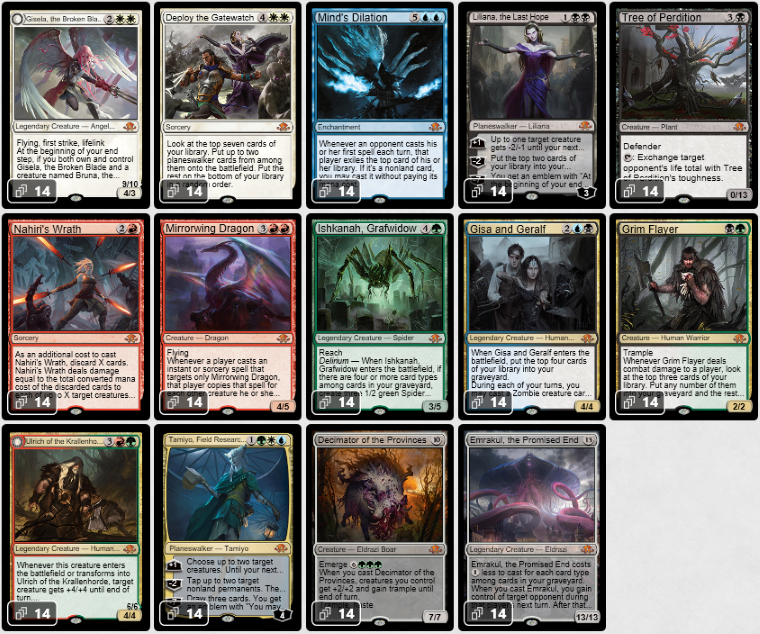
Two more Eldritch Moon (EMN) full sets purchased this past week. With the fresh tix generated from my sales, I'm likely to add a few more playsets again this week—hopefully right in time for a general price hike in the wake of Pro Tour Kaladesh.

My most recent full-set specs were rather under-performing to say the least, and I'll try to be more conservative about expectations this time around. Several EMN rares and mythics have the potential to explode, but isn't that the case with about every set? Overall I'm targeting a price in the 110 to 120 tix range.
sq

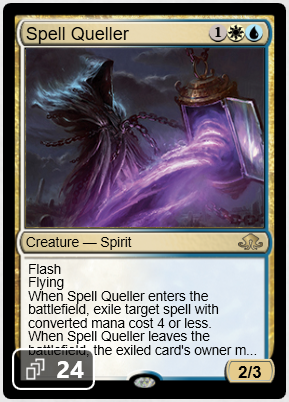
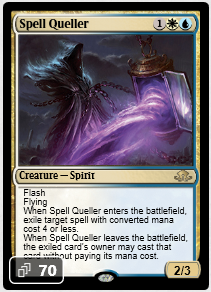
I reloaded on 46 more copies at an average price of 2.08 tix. Not the best price since Spell Queller hit 1.5 tix at the end of this past week, but its price has already rebounded to 2.5 tix. Currently, this Spirit seems to have better prospects in Modern than in Standard. I hope this changes soon to push Spell Queller closer to 4 tix, which would be a decent selling price for me.
zen

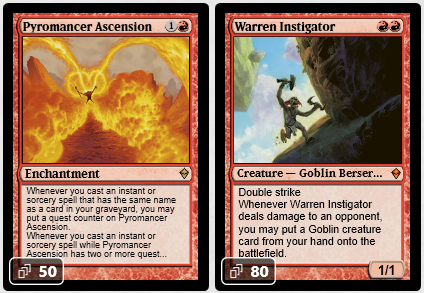
Two of the many Modern cards that took a hit right after the announcement of the Treasure Chest curated list. I thought my stocks with these guys could easily support more copies, and I'm still convinced that the impact of the Treasure Chests is exaggerated. I guess we'll see in few months if doubling down with these two cards was a good idea or not.
nph

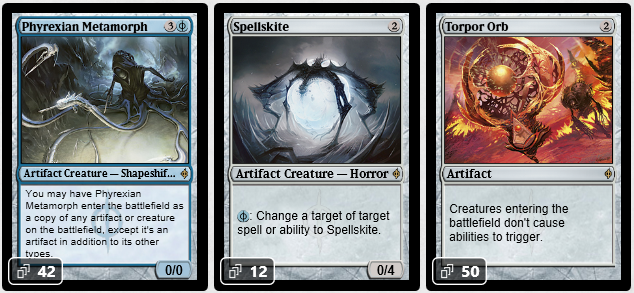
Less than a month ago, New Phyrexia was the most expensive set on MTGO. Then in the same week the set got flashback-drafted and the Treasure Chests were announced.

Torpor Orb and Phyrexian Metamorph are no Modern superstars but have shown great potential in the past, and I like them for this exact reason. Since they are not the usual Modern contenders, I would expect their current bottom to be fairly solid, while they could triple or quadruple if they become popular again.

Spellskite is definitely of another caliber. This artifact creature is played in many different decks in Modern and I'm expecting a rebound, although a moderate one, rapidly.

Sales This Week

I bought this card following Time Spiral flashback drafts. The Rack probably got a little boost recently with Tom Ross piloting 8-Rack to a seventh-place finish at the SCG Orlando Modern Open last month. A 40% profit is not something I'm going to neglect in this time of skinny cows, especially since I have a few new targets in mind at the moment.
ktklog

Khans of Tarkir (KTK) is simply not redeemable anymore. That doesn't help my KTK full-set spec, which already wasn't doing any wonders. With virtually nothing to expect from these in any foreseeable future I would rather take the loss and reinvest the tix now.

I still own a lot of fetchlands and haven't sold them yet. I'm hoping they can do better than the set as a whole. The only positive thing here is that a handful of Modern-playable cards, including Anafenza, the Foremost, Sorin, Solemn Visitor, the fetchlands, and Siege Rhino, will hit their absolute bottom soon.

bfzlog

Not all hope is lost for Battle for Zendikar sets as few mythics and several rares are rebounding a bit at this time. Nevertheless, I decided to let a few sets go to free up some tix before Pro Tour Kaladesh. Will we be able to break even with BFZ full sets? I'm not even counting on that, to be honest.

On My Radar

Does it surprise you to hear that Pro Tour Kaladesh is the one thing I'll be paying attention to this weekend? More precisely, I'll try to take full advantage of the Pro Tour hype by selling winning positions and attempting some quickflips.

Once again, paying attention to underdogs and cards not well covered at the Pro Tour could lead to interesting buying opportunities. During Pro Tour EMN, Pedro Carvalho piloted a U/R Thermo-Alchemist deck to a strong finish in Standard, notably causing Goldnight Castigator to jump from 0.8 tix to 4 tix in about a week. What will be the next Castigator? Or why not Castigator itself, since this Shadows over Innistrad (SOI) mythic is again under 1 ticket these days?

Although they won't necessarily rise next week exactly, I'll be watching the evolution of my EMN full sets. Oath of the Gatewatch full sets rose fairly quickly right after Pro Tour SOI and the bulk of the price hike happened in less than a month.


Thank you for reading,

Sylvain
Insider: Alternate Investments Worth Consideration

Are you a Quiet Speculation member?

If not, now is a perfect time to join up! Our powerful tools, breaking-news analysis, and exclusive Discord channel will make sure you stay up to date and ahead of the curve.

Standard. Standard, everywhere. This truly is the format in focus this month as players and speculators alike attempt to predict what the new metagame will look like with Kaladesh in and Dragons of Tarkir/Origins out. I used to enjoy this challenge, and there were certainly times in the past that following the right folks on Twitter revealed profitable ideas in broad daylight.

Those days are gone.

Wizards of the Coast introduced Masterpieces with the intent of keeping Standard prices down. So while there will certainly be a few cards here or there that pop, the ceiling on everything from Battle for Zendikar forward will be lower than before. That means the land mines—overpriced cards likely to drop—are more plentiful. Additionally, the upside is reduced versus before. Seems to me like Wizards of the Coast’s success comes at the expense of part-time Standard speculators like myself.

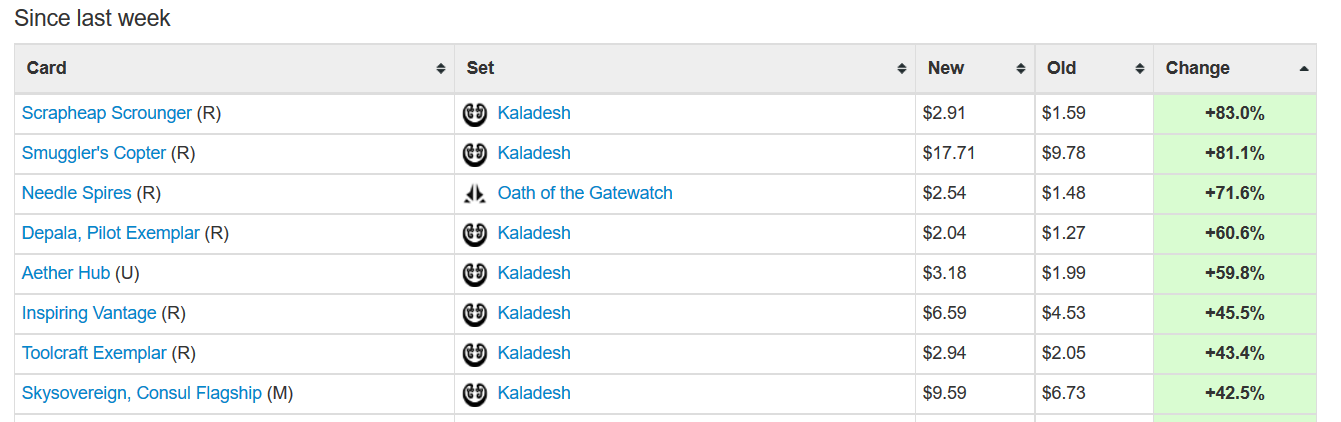
So what do I do at a time when Standard has taken center stage? The top eight movers over the past week were all Standard cards; seven of the eight were from Kaladesh.

interests

Do I follow the mantra, “If you can’t beat ‘em, join ‘em,” and speculate on Standard despite headwinds? Do I buy recently poor performers such as Dark Confidant or Snapcaster Mage, knowing that reprints in Modern Masters 2017 could be right around the corner? Do I continue to get deeper and deeper into Legacy and Vintage cards, knowing these formats are stagnant and offer only slow, gradual growth?

None of these. This week I’m breaking down the barriers of MTG finance to offer you some thought-provoking alternate investment avenues. They aren’t MTG finance, but they are tangentially related and could offer some intriguing opportunities to profit.

Pokémon Cards

I follow hundreds of MTG players on Twitter (@sigfig8). If I had to rank the top five topics I see discussed in my feed, I would say PokémonGO probably falls in the fourth or fifth slot behind Magic-related items. In other words, I suspect there’s a strong correlation between those who play Magic and those who enjoy PokémonGO. The game has entertained tens of millions of people worldwide. And while the player base has dropped off significantly since the game’s initial release in July, loyal fans (myself included) continue to engage with the augmented-reality game on a weekly basis.

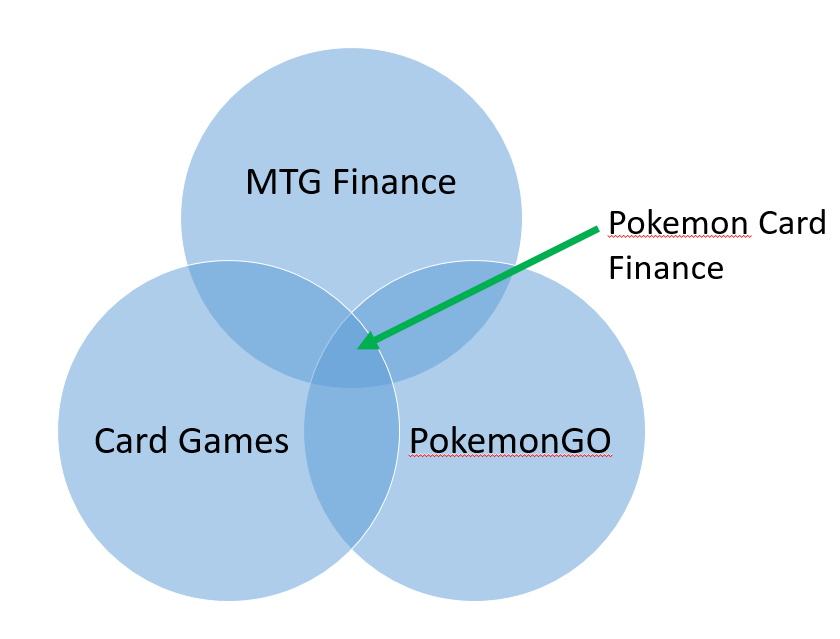
If I were to draw a Venn diagram with MTG Finance in one circle, CCGs in another circle, and PokémonGO in the third, the overlapping circle just may look like this:

venn

You may be asking whether or not I believe Pokémon cards can truly be better investments than MTG. I’ll be first to admit that, as a whole, I’d prefer MTG over Pokemon. But there are two trends worth identifying regardless.

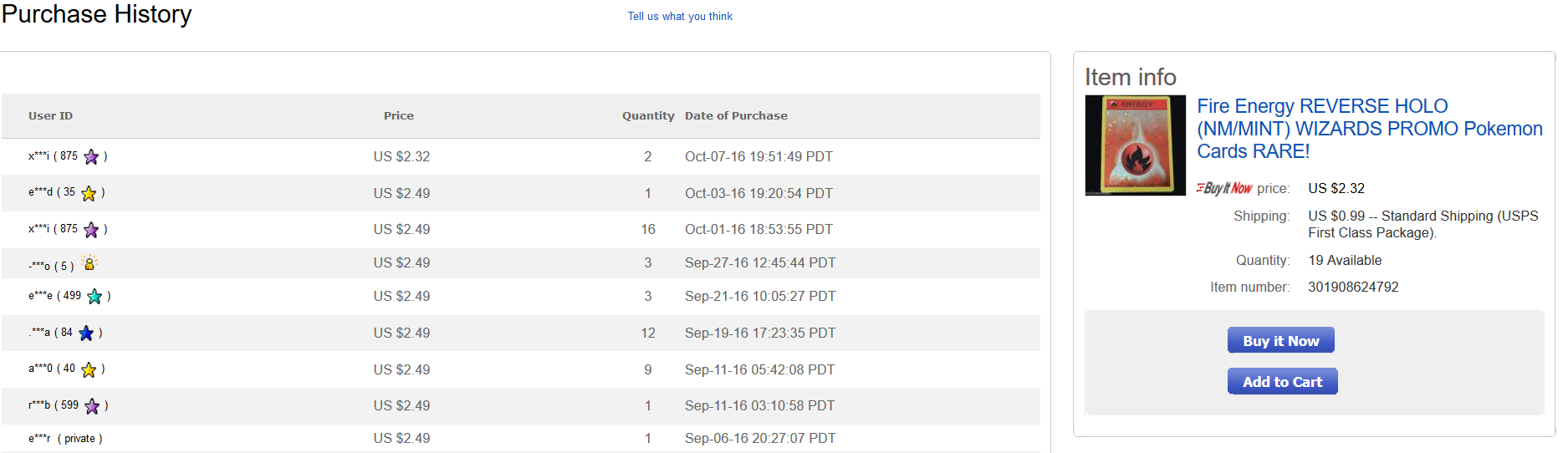
First, Kaladesh has quite possibly catalyzed growth in holo energy Pokemon cards. I’ve seen a handful of players pursue these Pokemon cards specifically because of the introduction of the energy resource in Magic. Take a look at the sale volume on these:

energy-holo

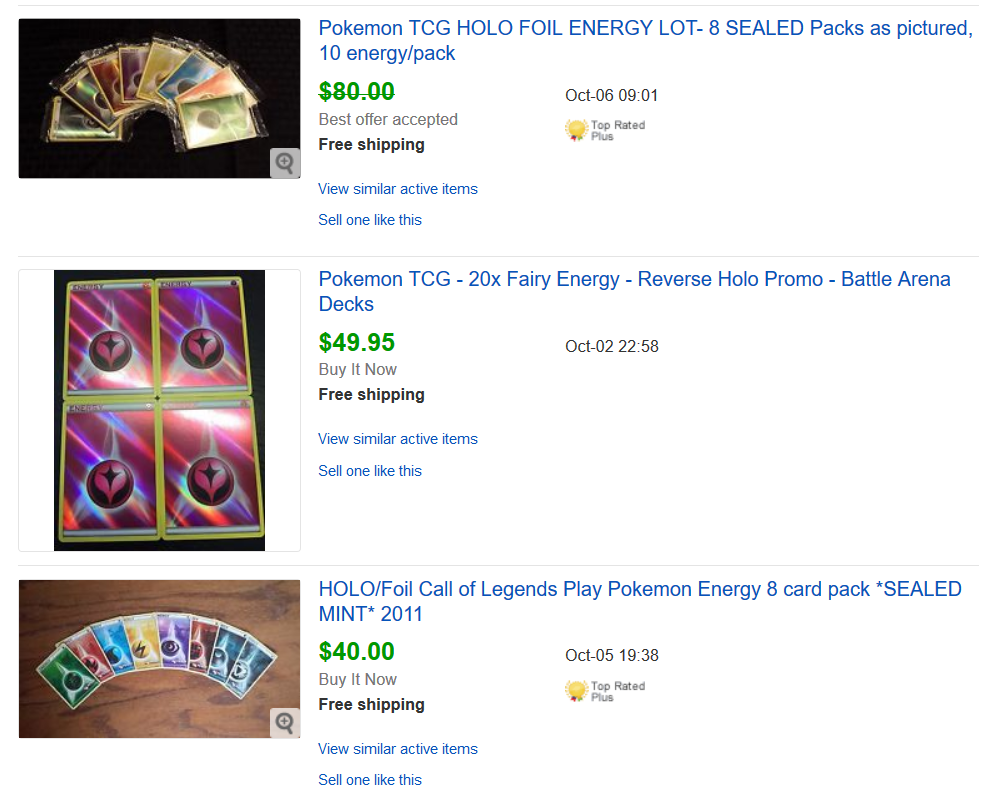
Selling one holo energy for $2.32 is hardly interesting. But when someone gets a handful of holo energies together, they add up quickly.

sold-energy-holo

The second area I have my eye on is the iconic. Truly investible copies of Pokémon’s most classic cards have shown some price appreciation lately. Perhaps the most famous is the Base Set Charizard. While the data in the chart below is noisy, the overall trend is irrefutable: up.

price-chart-charizard

Naturally, getting into graded versions of the Base Set Pokémon cards can offer an even more secure investment given collectibility. And if PokémonGO can convert at least a handful of players into collectors of the cards, you may have yourself a worthwhile investment. Stick to the most iconic cards, and you’ll minimize risk to this investment while gaining exposure to the returning phenomenon that is Pokémon.

Older Video Games

I’m not going to draw a Venn diagram for this one. No one is going to challenge me when I state that there’s a solid correlation between Magic players and people who enjoy video games. In Magic, many players have aged along with the game. Now in their twenties and thirties, these long-time players have incomes they can use to acquire some of the more iconic and expensive cards in the game. This is one of my hypotheses for why Power and the like will continue to appreciate over time.

As it turns out, collectible and iconic Magic cards are not all that us thirty-somethings are buying with discretionary income. We’re also nostalgic for other happy memories of yesteryear. I’d posit that classic video game investment is an up-and-coming trend that merits a closer look. Much like with MTG, I equally enjoy picking up the classic games I remember as a kid…and I can’t be the only one with this longing for nostalgia.

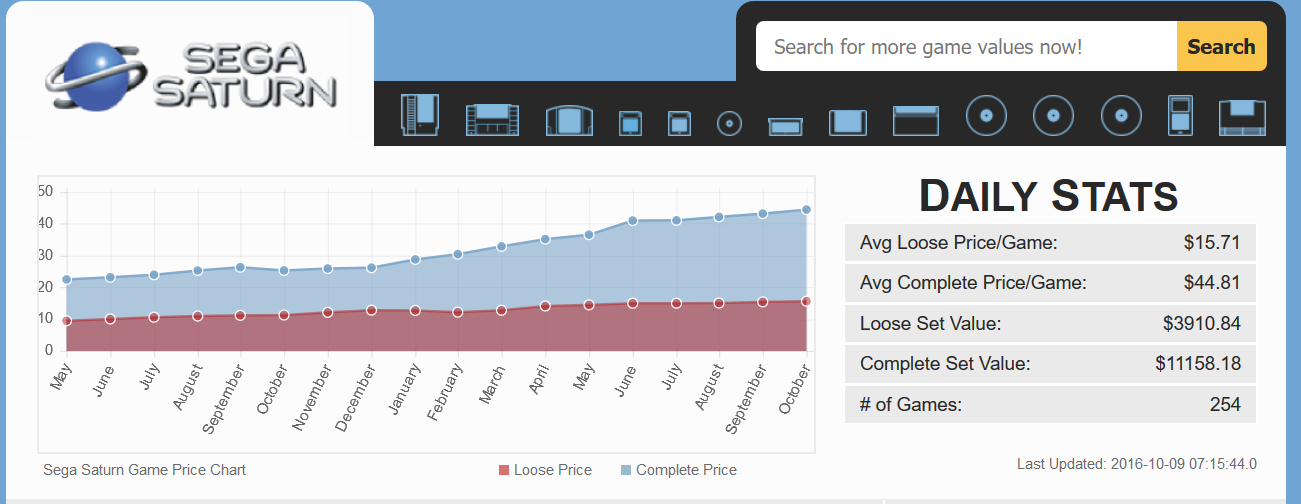
In this hobby, good luck landed on my side. The consoles I grew up with and had the fondest memories of were the Sega Genesis and Sega Saturn. It turns out these systems had some pretty rare and valuable games—especially the Saturn, which is generally considered a failure in the United States. So when I seek out games for their nostalgia, I simultaneously find myself investing in some rare games with appreciating value. According to GameValueNow.com, the average complete (read: collectible) Sega Saturn game has doubled since May 2016!

saturn

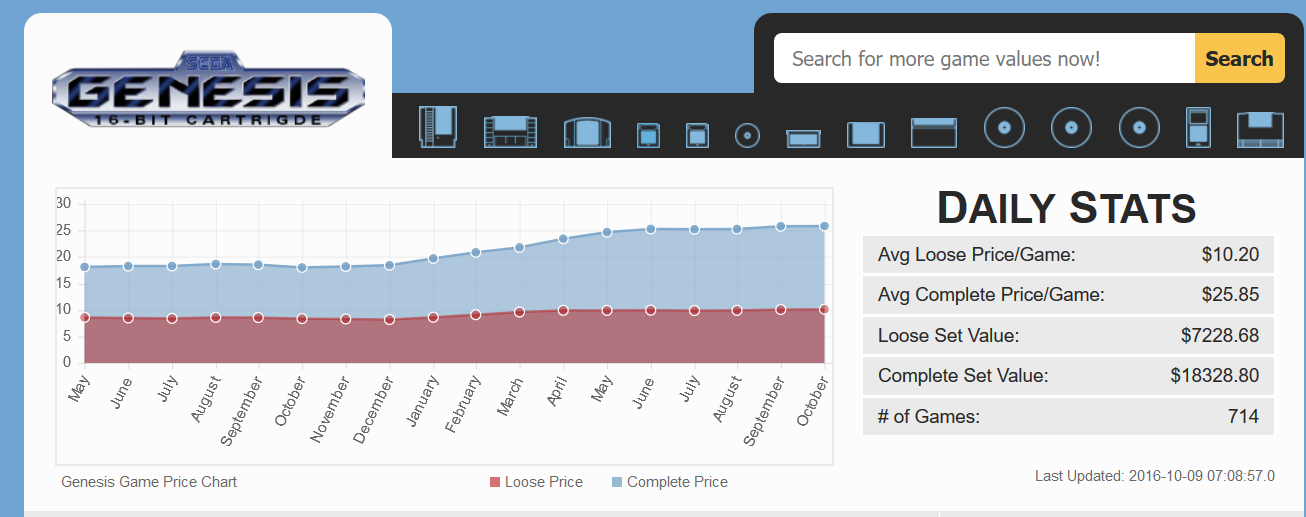
The Sega Genesis was much more popular in the U.S. So it’s no surprise that the price growth in Genesis games has been more gradual—there’s simply much greater supply on the market. Still, the direction has been upward over the last 16 months.

genesis

The same can be said for the Super Nintendo and the Nintendo 64, by the way. Their indexed charts both show decent price growth since May 2015.

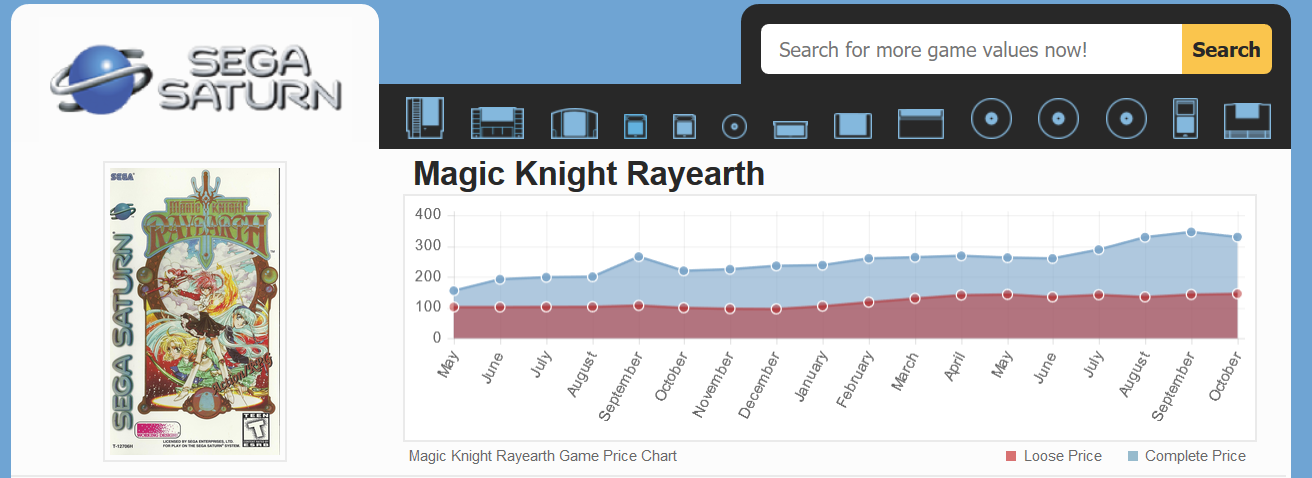
As an individual example, consider the last game ever to be released in the United States: Magic Knights Rayearth. It’s an RPG based off an anime, which I personally think is an awesome theme. Naturally being released so late in the Saturn’s cycle, not many copies were made. Thus, you have yourself an expensive game with a rapidly growing price tag.

magic-knights

Having sold so poorly, Sega Saturn and its games are quite limited in supply. But that doesn’t stop an aging fanbase from acquiring the games from their childhood. Add in a rising average income for these fans, and you have an equation that looks very similar to that of Power and iconic Magic cards: gradual, steady growth. I like these price charts most because they’re predictable and offer a terrific risk-reward equation.

The Ultimate MTG Investment: Hasbro Stock

Let’s quickly walk through a stream of logic.

  1. Player growth in MTG has become somewhat stagnant over the past twelve months.
  2. Wizards of the Coast is printing many more sets to increase sales growth.
  3. These sets have largely been successful lately, which indicates more product is being opened than before.
  4. Increased WOTC sales helps Hasbro’s bottom line.

In a vacuum, the natural conclusion could be that Hasbro’s stock is a screaming buy. Of course in reality there are many other factors at play that impact the toy maker’s stock price.

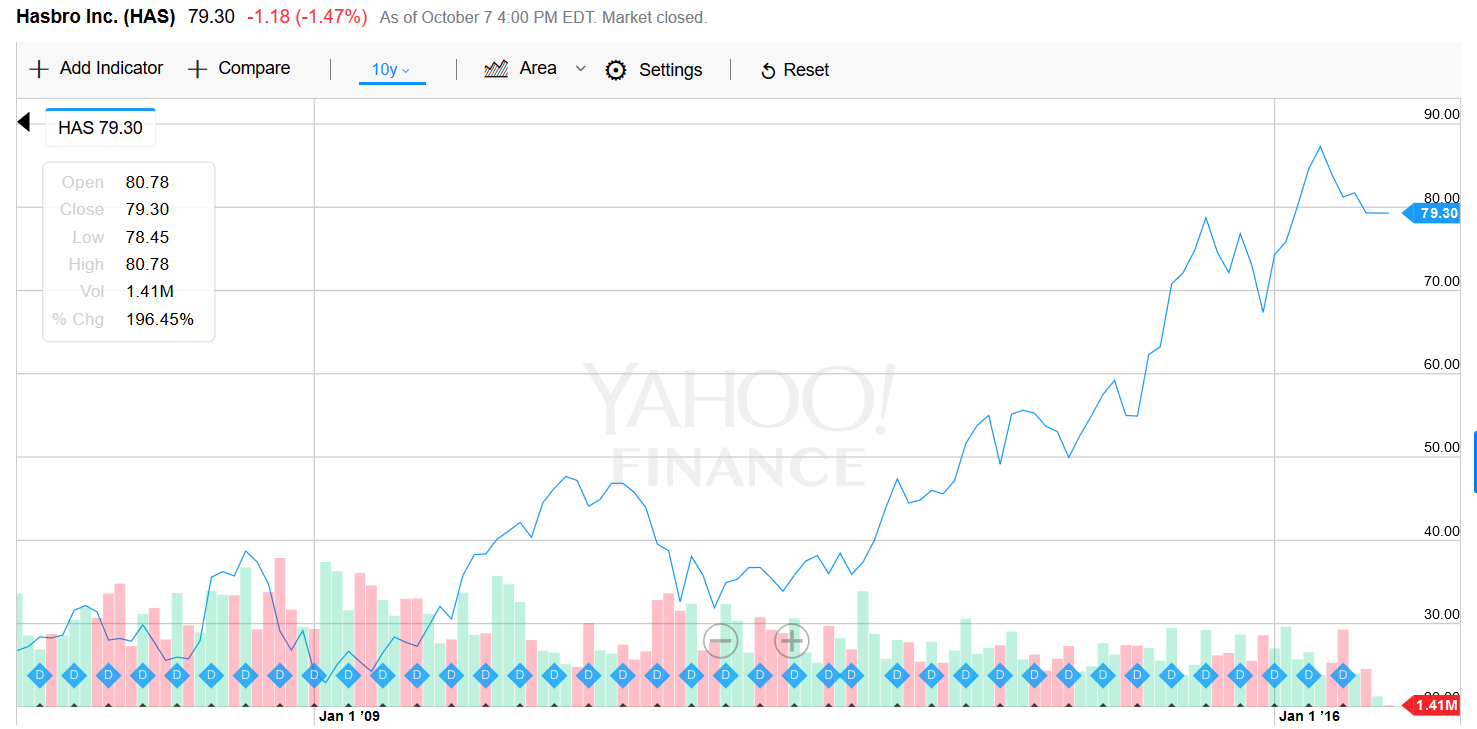
There’s no way someone can follow my analysis above and conclude that Hasbro stock is a worthwhile investment. I don’t even know if there’s a direct correlation between Magic: The Gathering sales and Hasbro’s stock price. What I will say, however, is that Hasbro stock has performed fairly well over the past ten years, far outperforming the S&P 500.

has

If we as MTG speculators truly thought Wizards of the Coast was striving to keep Standard prices down by introducing a new rarity and increasing product releases to drive sales growth, perhaps the most logical conclusion is to put that MTG money into Hasbro’s stock itself. If Hasbro and MTG speculators are butting heads, it almost feels like buying Hasbro stock is like betting on the house.

While I wouldn’t make the investment based solely on this article, I do suggest looking more seriously at this idea. MTG won’t be around forever… but Hasbro is highly likely to outlast Magic.

Wrapping It Up

I know this is an MTG investing and speculating website, but sometimes a little outside-the-box thinking is worthwhile. If nothing else, it provides alternate investment avenues you may decide to look into further.

Many people are aware of some alternate investments: artwork, coins and antiques are just a few. But I think Pokémon cards and vintage video games both merit a closer look. They correlate well with MTG investors, so if we make the argument that MTG investors have more discretionary income to spend, then it’s logical they’d spend that money on their interests outside of Magic.

Hopefully the data I presented support this hypothesis. I don’t own many Pokémon cards, but I have a friend who can attest to price appreciation on some highly graded collectibles from the game’s inception.

What I can attest to firsthand is the return on investment I’ve tracked on my growing Sega Saturn game collection. Seeing as I don’t expect there to be a “Sega Saturn reprint” anytime soon, I believe the trajectory for the next few years should remain upward. After all, these games are only getting rarer and harder to find.

Much like the iconic Power Nine in Magic, high quality, desirable video games will gradually fall into the hands of collectors. Supply will dwindle and prices will rise. I can’t wait to see what prices look like ten years from now—I suspect these “antiques” will have quite the price tags!

Sig’s Quick Hits

  • There appears to be sudden demand for Gavony Township. Star City Games is sold out of English, non-foil copies with a $5.99 price tag. This is sure to be relisted higher once the dust settles. The question is: where is this demand coming from? Is it just simple Modern speculation? If so, why now all of a sudden?
  • There have been 22 Halloweens since All Hallow's Eve was printed. Yet it seems this year the card has received some undue attention. I don’t think copies are moving at the $100 cited by TCGplayer mid, but it is true that stock is low. There are only a handful of copies on TCGplayer and Star City Games has just one English copy available: MP at $49.99. I think this one will disappear by All Hallow's Eve (couldn’t resist, sorry).
  • I’ve also noticed a little price traction for Singing Tree from Arabian Nights. The card has been hitting new highs, and Star City Games only has one copy in stock at $39.99 (SP). This is another one of those Reserved List cards that will just gradually dry up from the market over time. There’s no major demand for this card, but it’s still going to grow in price simply due to its age and classic feel.

Insider: MTGO Cards to Buy, Sell or Hold – Episode 12

Are you a Quiet Speculation member?

If not, now is a perfect time to join up! Our powerful tools, breaking-news analysis, and exclusive Discord channel will make sure you stay up to date and ahead of the curve.

Welcome back to Buy, Sell or Hold, after a brief recess due to the recent MTGO announcements. I don't think we will face the end of MTGO or the transition to the Hearthstone business model in the near future, but how Wizards manages (and has been managing in the last two years) the virtual version of the number one trading card game makes me worry about its continuity in the long term.

I'm not a fan of long-term speculations, mainly because every once in a while Wizards makes a big announcement with instant negative consequences for our portfolios. Their intentions are clear: they want cheaper card prices. Lowering the entrance cost for new players is very important for the game, and Wizards has been doing it well---the problem is that this has come at the expense of existing players' collections.

I closed all my profitable Modern positions as soon as I saw the announcement, and I'm still holding the others. Some prices are starting to rebound (they won't go down forever) and current prices are tempting, but the future is very uncertain. My recommendation is to avoid getting involved until we have a clearer and more predictable panorama.

All that we have left is Standard, which is the safest bet at the moment and could be very profitable in the next days because of the Pro Tour. So this week I will once more do an all-buy edition to stock up our portfolios before it's too late.

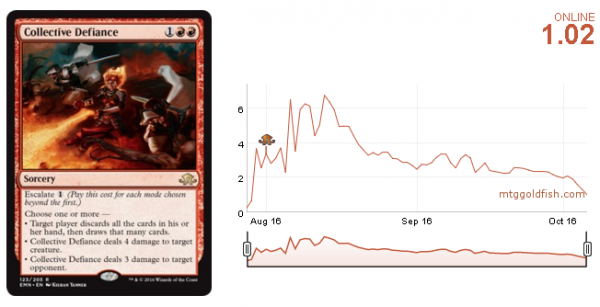
Collective Defiance

collective-defiance

Collective Defiance's price dropped 50% right after the first new Standard Star City Games tournament because it wasn't even played in the R/W Vehicle decks that dominated the first week. The card had a home in the previous Standard, and I think it's just a matter of time before we see it back in new builds. Just 1 tix for it looks like a great deal.

Verdict: Buy

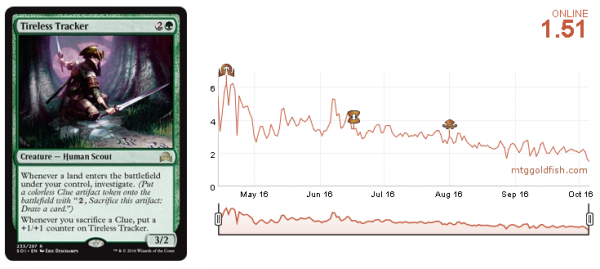
Tireless Tracker

tireless-tracker

Similar to Collective Defiance, Tireless Tracker only put two copies in the SCG Indianapolis Open Top 8. It was a two-of in G/B Delirium and the new G/W Aggro deck piloted by a few pros, but didn't come close to the outstanding results of the R/W Vehicles deck. We don't need much to see a price rebound---a few good performances at the Pro Tour or some different metagame conditions would suffice.

Verdict: Buy

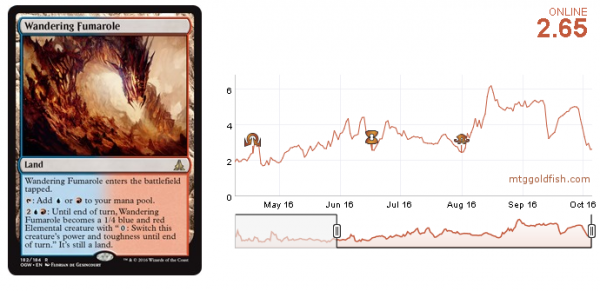
Wandering Fumarole

wandering-fumarole

In the same line as before, looks like everything that wasn't in the R/W Vehicles went down. The difference here is that blue-red was an expected archetype when Kaladesh was spoiled but the first week's results did not comply. Look at that steep drop! I think this will rebound even before the Pro Tour because its price drop is exaggerated.

Verdict: Buy

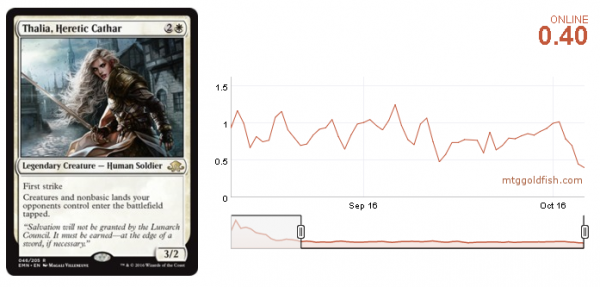
Thalia, Heretic Cathar

thalia-heretic-cathar

The trend here is very recognizable, and this is one of my favorite speculations. Thalia is bouncing somewhere between 0.50 and 1 tix. My strategy here is to buy and resell them as many times as possible until the trend changes and Thalia jumps off the rollercoaster. Right now circumstances are even better: she is actually slightly below her support level.

Verdict: Buy

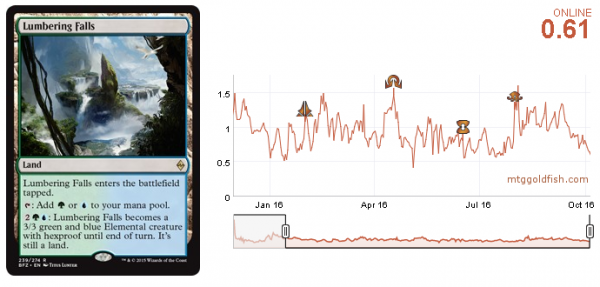
Lumbering Falls

lumbering-falls

Lumbering Falls is off the radar in the current metagame, which has helped its price to keep going down. Now that the wave of players selling their Collected Company decks has ceased, it's a great time to grab this staple land for cheap. The card is just sitting there waiting for a metagame shift to go up again.

Verdict: Buy

See you next week!

Insider: Interview with MTGO Entrepreneur Casey Stewart

Are you a Quiet Speculation member?

If not, now is a perfect time to join up! Our powerful tools, breaking-news analysis, and exclusive Discord channel will make sure you stay up to date and ahead of the curve.

Today, we’re talking with Casey Stewart, founder of MTGO Software Solutions (MTGOSS) and owner of several bot chains, including Card Ally and The Card Nexus. He's a longtime QS member and, as you’ll know if you've seen his comments in the forums, one of the top experts on how the Magic Online economy works.

Casey has developed a software platform that is used by about 25% of bots on Magic Online, including MTGOEmpire, JudgeBot, Drakebot, and Blue Dragon. He has offered to answer some questions and provide some insights into the MTGO economy.


Quiet Speculation (QS): How did you decide to get into botting?

casey-stewart

Casey Stewart (CS): In 2009 I was attempting to make the gravy train on the Pro Tour. "Play the game, see the world" had a lot of appeal for a guy who grew up poor and had barely left East Texas, much less the country. I played Pro Tour Kyoto in early 2009, and while I did terribly at the Pro Tour, I loved traveling to Japan, meeting so many new people and experiencing a culture so different from my own. So after that Pro Tour I doubled down on Magic and slacked off on college.

This was mistake number one. Mistake number two was that instead of getting a job I decided to grind MTGO events. I entered two or three Daily Events at a time, playing 80+ hours a week for nine months straight. It was great at first. By the end, though, it had become obvious the grind was a bad place for me to be.

I started hanging out in the Auction room on V3 towards the end of my grind, as it was basically the only place people chat on MTGO. There I started noticing arbitrage opportunities and taking advantage. Eventually it got to the point where I was making more money on arbitrage and speculation than I was by playing tournaments.

So I started doing arbitrage full time, and redeeming sets as well. This was right at Magic 2010 when there was a massive shortage of cards in paper so redemption was lucrative (around 50% margins). Around Worldwake I opened my first bot chain (“_____________fatbot1-3”). From there it has mostly been a logical progression.

QS: Is it a lot of work?

CS: Like a lot of things in business, the more you give to your bots (capital, time, etc.) the higher your earnings will be. What separates botting from most things in business is that after the initial setup you can coast along and still make money. Your earnings will not be maximized but you’ll still be making strong profits. This is true at least for our software.

QS: What makes your bot software unique?

CS: Before MTGOSS, all of the bot software on MTGO had been made by programmers guessing at what is needed to run a bot network. Our software was created ground up. I was in control of the specs, and with several years of experience running a bot at that point, so I knew what was needed. Rather than take something a programmer made and try to make it functional, we started with a question: what is needed to run a large complex business?

Our software is designed specifically to scale a business. Opening more bots on our system gives you economy of scale in terms of work and capital requirements.

MTGOSS is built to scale a business.

QS: What are some things people get wrong about the MTGO economy?

CS: The biggest misconception is underestimating the impact of redemption on MTGO and paper. Redemption takes full sets out of the digital economy and brings them into the paper economy. Without redemption the MTGO economy would fall apart, like it did during the V3 switchover.

Drafters on MTGO produce thousands of sets worth of new cards a week. But there aren’t thousands of new Constructed players to soak up that demand. Redemption is where all the excess goes until price equilibrium is met. While the market for paper cards would not fall apart without redemption, the cost to play Constructed would be much higher, and it would be much harder for players to find the cards they need.

QS: How are prices established in the MTGO economy? It seems like a couple major bot chains—MTGO Traders, Marlon, Cardbot—have an out-sized influence on buy and sell prices. Their prices are picked up by MTGGoldfish and, if I'm not mistaken, form the baseline for MTGO Library bot prices. How does this all work? Has this so-called "cartel" been affected by the entry of new bots like JayBots and Goatbots?

CS: That group—MTGO Traders, Marlon, and Cardbot—has an outsized influence because they all have identical buy/sell prices combined with a large market share. Individually, none of them would have enough market share to set prices, but as a group they do. So prices reflect a mix of supply, demand, and whatever algorithm the cartel is using. Basically, they say what prices should be.

Everyone else uses them as a baseline. Sometimes we—that is, all bots not in CardBot's group—charge more than their sell prices based on our inventories. Oftentimes we charge less.

QS: A lot of QS readers are either new to speculation or new to MTGO. What advice would you offer them as they seek to understand how the Magic Online economy works and how to profit?

CS: This is more of a general thing I wish people understood. “Sure things” rarely exist because of the very nature of speculating. As soon as a large enough group of people “know” to buy shock lands because they will go up, they raise the floor (because they increase demand early) and they lower the future ceiling (because they increase supply later). Look at all the "sure things" from the past few years: shock lands, fetch lands, Thoughtseize, etc. All have fallen flat.

No such thing as a sure thing…

The old adage, “buy when others are selling and sell when they are buying,” doesn’t work once everyone knows they should be on the other side of that equation.

QS: Cyclical investments based on rotation and redemption cycles are more predictable. Are they something of a sure thing?

CS: More predictable, yes, but they are not a sure thing. Look at Battle for Zendikar (BFZ) complete sets for instance. Those have gone down since rotation. The issue is similar to what I outlined above. Once everyone knows something is a sure thing, they prop the price floor up and lower the ceiling, limiting or possibly even inverting the opportunity into a loss.

bfz

QS: What should someone know before they get into botting? Is JayBot accepting new clients? What kind of bankroll does someone need before botting becomes worth the effort?

CS: The margins are tight---this isn’t the opportunity it was six years ago when margins were 25+%; now things are in the 5-15% range. There is still money to be made, but you need to come in with enough bankroll to run a business ($10k+) and treat it as a business. There are a lot of upsides to botting as a business, though. It is liquid in a way that other opportunities don’t ever approach, the cost to enter the market is low, and the time requirements are flexible and work around your schedule more.

The annual ROI for bots in my experience across a wide variety of bot setups is around 150% yearly, assuming you reinvest the money as it is earned. This is based on a larger (10k+ invested) bot chain. Diminishing returns seem to happen in the 125-175k range, but until then the percentages are pretty consistent.

JayBot is accepting new clients on a limited basis. We are only really interested in people who are going to succeed in running a business, rather than people with “draft for free” aspirations. Nothing against those people; that just isn’t what our business is geared towards. We would love to talk to anyone interested in botting.

QS: What do you see as the future of the MTGO client? Hasbro has announced it is producing Magic Digital Next in the next few years, which will fill the gap between expert (MTGO) and beginner (Duels of the Planeswalkers). What impact will that have on Magic Online? Do you see the possibility that MTGO will wither away?

CS: My expectation given the history of Wizards of the Coast and software is that Next is at least three years out. I don’t expect any relevant impact on MTGO as WOTC doesn’t want to risk their second largest revenue stream.

QS: Without using more colorful language, it’s fair to say that people are fed up with the MTGO client. There’s a perception that Magic is losing out to Hearthstone, with its slick interface. Are you seeing less volume on MTGO?

CS: Every release is a record breaker for my software as a whole (year over year), even adjusting for growth on our end. MTGO’s demise has been drastically exaggerated.

QS: I saw that you've played in a Pro Tour and have had some success on the PTQ circuit. What types of decks do you like to play? What's your favorite format (Limited and Constructed)?

CS: I like drawing cards and durdling…mostly drawing cards, though. I currently have the griefer pair of Miracles in Legacy and Lantern Thopter Control in Modern. Personally I enjoy Limited over almost everything (favorite formats in order are Rise of the Eldrazi, triple Shards of Alara, and Shadowmoor-Eventide). After that, Legacy is a new passion for me, and almost feels like rediscovering Constructed the way it existed when I first started playing. The decision trees are deep, and the mistakes plentiful. Basically, I don’t like autopilot Magic.

QS: If the overlords in Renton offered you three wishes, what changes would you make to the client to improve MTGO?

CS: Get rid of binders (and bring back V3 binder view). Reduce the ridiculous lag and memory leak combination. Just bring back V3 with leagues.

~

That's it for today, dear readers. Thanks to Casey for taking the time to talk to us. If you have any questions for him, leave them in the comments and he'll take a crack at answering.

-Alexander Carl

@thoughtlaced

Kicking Ass and Hugging Mom: Kaladesh Chandra in GRx Moon

Are you a Quiet Speculation member?

If not, now is a perfect time to join up! Our powerful tools, breaking-news analysis, and exclusive Discord channel will make sure you stay up to date and ahead of the curve.

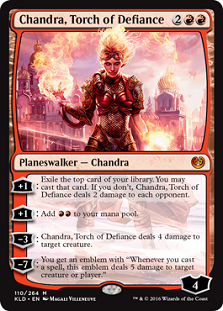
When players talk about Modern's "high power level," they are generally referring to how hard it is for Standard-legal cards to break into the format. After receiving archetype-spawning hits in Oath of the Gatewatch (Thought-Knot Seer, Reality Smasher), Shadows Over Innistrad (Nahiri, the Harbinger, Prized Amalgam), and Eldritch Moon (Eldritch Evolution, Bedlam Reveler), it's a little disheartening to leaf through the Kaladesh spoilers a week after the set's release and realize how little an impact the set has made in Modern. Well, fear not! Chandra, Torch of Defiance might not be Jace, the Mind Sculptor, but she still packs a serious punch and may be the card Modern best remembers Kaladesh by.

chandra-torch-of-defiance-art-crop

I mentioned Cathartic Reunion's possible applications in a Chalice-based GRx Moon deck last week, and am now happy to unveil the fruits of that idea. Chandra herself makes an appearance in that deck, and also updates the dork-based builds of GRx Moon I last worked on when Goblin Dark-Dwellers came to Modern.

[wp_ad_camp_1]

What Is GRx Moon?

It's been a while since I visited this archetype, so let's do a quick refresher. GRx Moon is a midrange deck that ramps into an early lock piece (often Blood Moon) and closes games out with heavy-duty threats (often Tarmogoyf or Huntmaster of the Fells). The nature of Blood Moon gives it extra points against mana-hungry strategies, including other midrange decks, in exchange for the early disruption of Inquisition of Kozilek we see from Jund. Looting effects are employed to help with consistency and grow Tarmogoyf.

GRx Moon vs. RG Ponza

When I introduced GRx Moon to Modern Nexus, the deck didn't have a proper analog in Modern. I'd adapted the deck from Skred Red after having adding green to that deck for Tarmogoyf. Today, another deck exists that plays similarly: RG Ponza.

Ponza is a Stone Rain deck that rides mana advantages from Arbor Elf and Utopia Sprawl to power out Inferno Titan and Stormbreath Dragons, all with a turn two Moon in play. I don't like how soft these decks are to Bolt effects, and especially to sweepers---if Arbor Elf gets taken out, it takes the Ponza deck five to six actual mana cards (be they lands or Utopia Sprawls) to start casting threats. Mana Leak also ends the deck.

GRx Moon has great insurance for dead dorks in Tarmogoyf, and stops its curve at four mana for threats. Extra mana sources (or disruption) can be cycled into more threats with Looting effects, or just played to get around taxing permission.

Rituals vs. Dorks

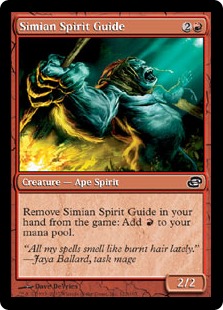
Simian Spirit GuideThere are two ways to build GRx Moon. The first involves fast-mana effects like Desperate Ritual and Simian Spirit Guide. This build is more explosive than dork versions, but less consistent and limited to a lower curve. The main attractions to playing rituals include not ceding too many points to Lightning Bolt (which is really good at killing Noble Hierarch) and gaining the ability to run Chalice of the Void.

Dork-based builds use permanent acceleration like Noble Hierarch, Birds of Paradise, and Utopia Sprawl to get ahead on mana for the duration of a game. These decks are easier to disrupt with removal than ritual versions, but are more resilient against targeted discard and play a stronger long game.

Interested readers can get more on the subject here.

A Torch For All

One historical problem with GRx Moon is that it has sometimes lacked adequate threats. Tarmogoyf and Huntmaster of the Fells are great, but we can only play four of each. Beyond those, I've dipped into threats as diverse as Goblin Rabblemaster and Siege Rhino to round out the suite.

Traverse the Ulvenwald helped us out greatly, allowing us to play more functional copies of our eight core beaters. So did Nahiri, the Harbinger. Each solution came with a problem: the former made us softer to graveyard hate and the latter pulled us into a third color.

Chandra, Torch of Defiance evades these pitfalls, all while working under Chalice, not bringing us above curve for our looting effects, and attacking opponents from a unique angle, just as Tarmogoyf and Huntmaster do. I expect her to remain a staple in GRx Moon decks going forward.

Fast Mana, Fast Wins

Here's my current build of GRx Moon utilizing rituals:

Tarmo Stompy, by Jordan Boisvert

Creatures

4 Tarmogoyf
4 Huntmaster of the Fells
4 Simian Spirit Guide

Artifacts

4 Chalice of the Void

Enchantments

4 Blood Moon

Instants

4 Dismember
4 Desperate Ritual

Planeswalkers

4 Chandra, Torch of Defiance

Sorceries

4 Cathartic Reunion
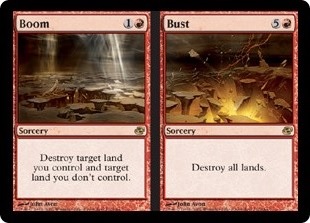
4 Boom // Bust

Lands

4 Misty Rainforest
4 Wooded Foothills
1 Windswept Heath
2 Stomping Ground
4 Darksteel Citadel
2 Forest
3 Mountain

Sideboard

2 Grafdigger's Cage
4 Anger of the Gods
2 Feed the Clan
3 Ancient Grudge
2 Roast
2 Choke

The Disruption

GRx Moon leans on the principle that an unexpected Blood Moon ends games more often than any other hate card in Modern. Chalice of the Void takes second place, though, so we've included that, too.

Chalice of the Void: Simian Spirit Guide allows us to power out Chalice on turn one, a play that put Eldrazi Mimic on the map in Modern during Pro Tour Oath of the Gatewatch and continues to reward players who run the combination.

Dismember: It's natural that opposing threats slip under a turn three enchantment. Chalice of the Void prevents us from playing Lightning Bolt, but Dismember does the job just as well in most matchups (Burn being the obvious exception). The Phyrexian removal spell has the added bonus of killing fatties like Thought-Knot Seer and young Tarmogoyfs in addition to Wild Nacatl, Restoration Angel, or a simple mana dork. The card is hugely versatile and I'm liking it more and more for streamlined aggro decks in need of removal that can't access Bolt.

Boom // Bust: One draw to the ritual build is its two-color manabase. No splash means we can play utility lands, and our best option by a long shot is Darksteel Citadel. The Citadel does a number of things for us:

  • Allow us to cast Boom // Bust on turn two without losing a land.
  • Pump Goyf and help with delirium when discarded by Cathartic Reunion.
  • Pump Goyf and help with delirium when blown up by Boom // Bust under a Moon.

boomThe last case is admittedly fringe, but the turn two Boom // Busts are often crippling for opponents. Even if we have to shoot a shock land, many opponents will use their next land or two to fetch up more shocks anyway, since they need their colors badly to have wanted to lead with a shock in the first place.

Citadel might enable Boom // Bust, but the card has applications on its own. At worst, it trades one of our lands for an opponent's, which is potent with a Moon in play. Picking off an opponent's precious basic lands makes our enchantments even more valuable in the mid-to-late-game.

The Bust mode has never been that relevant in ritual-based GRx Moon decks, but Chandra, Torch of Defiance changes that. Her ability to double as a Hedron Archive (all while gaining loyalty!) gives Boom // Bust new relevance as a card that threatens Armageddon once the planeswalker get going. And with Chandra in play, we're likely to recover before opponents do.

The Mana

One thing rituals have over dorks is they allow us to spend more mana in the first two turns of the game. Lines like turn one Dismember, turn two Blood Moon simply aren't possible with a Noble Hierarch as acceleration, which can be relevant on the draw against aggressive decks like Infect.

Simian Spirit Guide: A costless ritual that enables turn one Chalice and starts beating if it needs to. Too bad we can't play eight of these guys.

Desperate Ritual: Something of a necessary evil in this deck. I tried playing without Rituals too, but wanted the extra ramp too much to continue excluding them.

Consistency

For a time, I figured dorks had so many benefits over rituals that playing one-shot mana in GRx Moon was just wrong. I eventually tried rituals in the archetype, which for the large part vindicated this assumption. I came to the conclusion that the main reason to play rituals was access to Chalice of the Void. But without access to a filtering tool like Faithless Looting, to dig past not just extra Moons but extra Chalices and ritual effects, the deck never got off the ground for me.

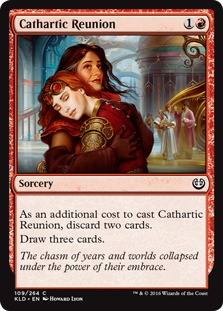
cathartic-reunionEnter Cathartic Reunion, a card leagues more efficient than Tormenting Voice that might remedy this issue. Reunion's main benefit is that it doesn't put us down a card unlike Faithless Looting, making it significantly better against decks with targeted discard. Those decks could tear our hand apart after we -1 ourselves to set up on the first turn. With Reunion, they have a much harder time. Granted, Reunion is much worse against countermagic. But I don't think that's a significant issue. As long as we prioritize resolving Reunions and are careful not to walk them into a Remand, this drawback is mitigated.

On to what the card actually does. In a longer game, Reunion cycles away two dead cards, compared with Looting's four, and sees three new ones, compared with Looting's four. Looting still seems like the better of the two cards to me in this archetype, but Reunion definitely comes close to it in terms of new cards seen, and at a smaller number-of-cards downside. Of course, the card's main benefit is that it gives a filtering tool to a deck that desperately needed one, since Chalice doesn't allow us to play Faithless Looting.

Girl Power

What's better than one splashy, four-mana planeswalker? Two, of course! Here's my current take on GRx Moon with dorks:

Naya Moon, by Jordan Boisvert

Creatures

4 Noble Hierarch
4 Tarmogoyf
4 Huntmaster of the Fells
2 Magus of the Moon
1 Emrakul, the Aeons Torn

Enchantments

4 Utopia Sprawl
4 Blood Moon

Instants

4 Lightning Bolt

Planeswalkers

4 Nahiri, the Harbinger
4 Chandra, Torch of Defiance

Sorceries

4 Traverse the Ulvenwald
3 Faithless Looting

Lands

4 Windswept Heath
4 Wooded Foothills
1 Plains
5 Forest
1 Mountain
2 Stomping Ground
1 Sacred Foundry

Sideboard

2 Dismember
3 Ancient Grudge
3 Anger of the Gods
2 Choke
3 Stone Rain
1 Reclamation Sage
1 Stormbreath Dragon

The Disruption

Nahiri, the Harbinger gives GRx Moon something it rarely has access to: a surefire way to kill enemy Tarmogoyfs. She exiles anything that attacks us and clocks slower opponents by herself. Emrakul nonbos with Traverse, but Nahiri's looting ability lets us cherry-pick which cards to bin, turning on delirium very quickly. Once we reach four mana, fair decks have a terrible time interacting with us, since we're just slamming haymakers non-stop.

The Mana

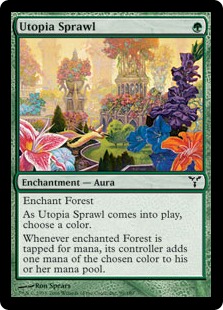
utopia sprawlThe obvious draw to dorks over rituals is that the mana actually sticks around, allowing us to play more high-curve spells.

Noble Hierarch: Birds definitely makes it easier to cast Chandra. But having a searchable way to apply more pressure and break Goyf stalls, all on a mana dork, is pretty silly. There's a reason Hierarch is consistently one of the highest-played creatures in Modern.

Utopia Sprawl: The dork that never dies to Bolt. We need to put it on a Forest so Blood Moon doesn't cause it to fall off, but that's hardly an issue with so many green basics and fetches in the deck.

Consistency

Naya Moon gets to play Faithless Looting, by far the most efficient digging tool GRx Moon has access to. Nahiri, the Harbinger also helps a great deal with consistency, as does Chandra, Torch of Defiance who allows us to see twice as many cards per turn. Traverse the Ulvenwald rounds out our consistency suite, searching for any creature in the deck once delirium turns on. That includes impossible-to-kill threats like Stormbreath Dragon and flexible answers like Reclamation Sage after siding, as well as a Moon-on-legs in all three games. Between these 15 cards, Naya Moon has a great time finding what it needs, when it needs it.

Full Moon Rising

chandra-torch-of-defianceI'm not finished experimenting with GRx Moon---I've got a third build in the works with Goblin Rabblemaster and Ghor-Clan Rampager. But these two builds have been testing well for me this week.

My advice to readers sulking after Kaladesh's admittedly uninspiring offering of fresh meat: just give Chandra, Torch of Defiance a little time. I'd be surprised if we didn't see her surface as a one-of in certain Jund and Jeskai lists, and it's possible she gives fringe archetypes like Skred Red or GRx Moon the boost they need to claw into the tournament scene.

Stock Watch- Aetherworks Marvel

Are you a Quiet Speculation member?

If not, now is a perfect time to join up! Our powerful tools, breaking-news analysis, and exclusive Discord channel will make sure you stay up to date and ahead of the curve.

Daniel Weiser was one my carmates for the Indianapolis Open this past weekend, and he was packing a pretty exciting deck. If his name sounds strangely familiar, it's likely because you saw it attached to his 25th place deck from the tournament.

Temur Aetherworks

Creatures

4 Emrakul, the Promised End
4 Ulamog, the Ceaseless Hunger

Spells

4 Glassblower's Puzzleknot
4 Woodweaver's Puzzleknot
4 Vessel of Nascency
3 Harnessed Lightning
3 Kozilek's Return
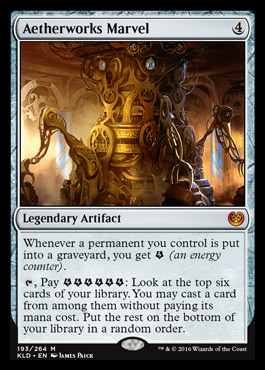
4 Aetherworks Marvel
4 Attune with Aether
4 Cathartic Reunion

Lands

6 Forest
1 Island
1 Mountain
4 Aether Hub
4 Botanical Sanctum
2 Game Trail
4 Spirebluff Canal

Sideboard

3 Dispel
1 Harnessed Lightning
3 Invasive Surgery
1 Kozilek's Return
4 Negate
3 Take Down

Survive. Make energy. Make Emrakul. This deck is very focused, and very good at what it does. Weiser was somewhat concerned with his Boros matchup going in, and the way the metagame shook up it was an unfortunate matchup to be weak in. They go wide enough that if you Emrakul them without triggering a Kozilek's Return they can often just kill you shortly after. Fortunately, with the current metagame being skewed very aggressive the deck could be tweaked to focus more on beating aggressive decks to try to solve this problem. Upping the red removal count and looking at putting Galvanic Bombardment in the 75 seems like a good direction.

This deck is more powerful and consistent than I think many realize, and I expect something similar to do well at the Pro Tour. The current price on TCGPlayer is about $7, and should the deck see a lot of PT exposure and success you can easily expect to double up in the short term.

Insider: I Used the Ion Core Scanner to Sort My Cards and Maximize Buylisting Efficiency, Part 2

Are you a Quiet Speculation member?

If not, now is a perfect time to join up! Our powerful tools, breaking-news analysis, and exclusive Discord channel will make sure you stay up to date and ahead of the curve.

With my collection sorted by price and ready to move, it was time to bring the next step of my plan into action. I would cart my cards around to a few local dealers so they could pick what they wanted, I’d let friends looks through them and entertain offers or trades, and whatever was left I would haul down to Grand Prix Atlanta to the dealer booths.

There was an error retrieving a chart for Bazaar Trader

My first stop was the local shop, which actively buys cards for its case but also has a thriving online business. The shop usually acquires big collections from people selling out and just throws a number on them for the lot, so I knew my approach of having cards priced out would be a radically different experience for them. Rather than grinding out the small cards, the shop was only interested in a few higher-price items it could turn for a quick flip. I sold $85 worth of Modern rares before heading home.

I immediately realized that my plan was going to be a lot more difficult to enact than I had envisioned, requiring a lot of travel and interactions with many people over an extended period of time. All that, and I would still inevitably be left with a lot of cards. Buylisting at a Grand Prix would be a reasonable out, but hauling thousands of cards to a Limited Grand Prix that I have to fly to seems like the worst possible timing to sell a collection. I accepted that the best path for me was going to be mailing to buylists, which are able to give me what my cards are worth, and most importantly, provide an outlet for nearly every card.

I had qualms with the conditions of my cards and the discount buylists would apply, but I accepted that any discount a buylist applied to my cards would pale in comparison to the discount that the typical buyer would attempt to pay on them, not including the time and effort I would have to put into selling face to face. I also inspected my cards and saw that while yes, many were played, the majority were actually in great condition from sitting in boxes or binders for years not being played.

There was an error retrieving a chart for Pristine Angel

While I knew it would be a lot of work, I set out to sell my collection to the buylists on Trader Tools. To save time and shipping, I decided not to buylist my boxes of cards worth $0.30 and under, because their total value wasn’t much more than $100 or so. It wasn’t worth my time at that moment, and they would be relatively expensive to ship.

I began to sort my cards into ten piles, one for each buylist, by using Trader Tools and the Ion Core scanner to find which shop was paying the best price. When I was ready to buylist my cards, they were already sorted by shop and ready to finalize.

It was then that I realized that when you use Trader Tools to push a list straight to buylists with Trade Routes, it automatically sorts the list into whatever buylists are paying at that moment in time, even if the price is different than when you scanned it. It’s great, because you will always get the maximum value for your cards, but this meant that when buylisting I had to search through piles and move some cards around, because some prices and buyers had changed in the time between when I scanned in the late night and when I buylisted the following evening.

If your plan is to sell cards to buylists and you aren’t handling it all during one sitting, it means cards may be better sorted into piles by set rather than by buylist or price. This will save you time in the long run, especially if you plan on waiting more than a day between scanning cards and buylisting them.

It also means that if I had an accurate list uploaded, I wouldn’t have really needed to scan my collection again after sorting by price last week. I could have just used Trade Routes to send to buylists, and then pulled and sorted cards after the fact. With this in mind, it’s important to keep a good list maintained in Trader Tools when scanning, meaning it’s worth the time to delete mis-read cards and fix the edition when it scans the wrong one. When dealing with multiple copies of cards, I found it easier to manually input the number of copies rather than scanning each one individually.

There was an error retrieving a chart for Take Inventory

When all was said and done, I designated almost every card I wanted to sell to the ten buylists, loaded the cards into their websites, and then packaged the cards up to ship. Here’s a summary of my experience with each of the ten buylists:

Isle of Cards

Isle of Cards supported Trade Routes, and the website was relatively efficient and easy to use. My only qualm was that the left half of the website window was taken up by a generic list of cards they were buying, so it made for a somewhat awkward visual experience. It was by far my largest order, so I only have great things to say about their prices.

ABU Games

ABU Games supported Trade Routes. Tuning the invoice took more time than others because it required loading for each search, but it was relatively simple. They also have a separate option for played cards at a lower price, so there is full disclosure on what you’ll receive for your cards.

Mythic MTG

MythicMTG worked with Trade Routes. They have a search bar that wasn’t particularly efficient or innefficient, but it was a small buylist of higher-priced cards that didn’t require much time.

Cape Fear Games

CapeFearGames worked with Trade Routes and had a website that made it simple to tune my order. They didn't buy much, but I will do business with them again on occasions where they are offering the best prices.

Magic.Cards

Magic.cards did not support pushing buylists with Trade Routes, but their layout was a breeze and extremely efficient. The search bar was fast and showed each set, and once selected it automatically loaded to the cart. There’s a bar to adjust the condition and the corresponding price. For convenience, their buylisting invoice is created in the order you upload cards, so unlike with other buylists, there is no requirement to sort cards afterwards. They are simply ready to ship.

Strike Zone

Strike Zone did not support Trade Routes, and their buylisting process was by far the least efficient because there was no search option. I had to select the set for each card, then find the card in the list. I’ve also heard they are very stringent on condition and don’t have interest in taking played cards at a discount, so I wonder if I will even have success with this buylist. Between the website and the grading, in retrospect, I should have not included them during the Ion Core scanning, and I will avoid them in the future. That said, they have the highest prices on some cards, so they could be an ideal place to send quality high-end singles. They’re respected stalwarts that can be found with a booth at many events, and I’ve only had positive interactions with their staff, so I recommend a face-to-face interaction to get the best experience.

Troll and Toad

Troll and Toad required uploading by hand but had a solid search feature. The inconvenience is made up for by the fact that they have been known as generous graders in the past.

AdventuresON

AdventuresON did not work with Trade Routes, and had a very clunky website on par with Strike Zone, with no search bar, so I would avoid them unless the rate is worth it on higher-end cards.

Cool Stuff, Inc.

Cool Stuff, Inc. required manual upload. It was easy to search through and use, and not particularly efficient or inefficient.

Card Kingdom

I saved the biggest buyer, Card Kingdom, for last. It didn’t work with Trade Routes, so I had to do it by hand—or so I thought. When I set out to finally manually input all my cards, I checked on Trade Routes again just in case, and lo and behold, it was working. I had previously logged into Card Kingdom, so I thought that could be the reason, but some sleuthing on the forums revealed that Card Kingdom’s connection with Trade Routes was actually fixed that very day, so I had great timing. Unfortunately, Card Kindom no longer had the best price on the majority of the stack, so most of those cards went to other buylists.

There was an error retrieving a chart for Trade Routes

At the end, I went back and sorted through what I had remaining and did a second, smaller round of buylisting, creating extra orders for Isle of Cards, ABU, and Magic.Cards, and packaged them up with their invoices with the other orders for those buyers.

For shipping, I packaged cards into old starter/precon/Commander/Duel Deck boxes, and placed those in high-quality waterproof bubble mailers, which cost $0.70 each, and shipped them for $2.62 each. The two largest orders I put in larger plastic Ultra Pro boxes, which I put into boxes and shipped for around $3. The two smallest orders I packaged in small, plastic clamshells placed in generic bubble mailers that cost around $0.50 each, and shipped for $2.62. I was satisfied with the postage costs, which at under $30 were below my expectation for shipping around a thousand cards to ten different buyers.

My takeaway was that Ion Core is a versatile tool with many uses, and how to get the most out of it will depend on your goals and timeline. It's a great way to upload a collection or pile of specs to sell via Trader Tools. You could upload your collection, keeping an eye on it and periodically selling when prices are best by adjusting the spread tool. It helps you identify cards that are demanding a premium, or you could just use it as a way to keep track of the value of your collection. It’s also a great way to slowly build up an inventory to sell in big fell swoops, such as when the value hits a certain point. I recommend checking it out and seeing for yourself—and head to the forums to talk with the Trader Tools experts!

I’ll report back next week with the results of my buylisting experience.

-Adam

High Stakes MTGO – Sep 25th to Oct 1st

Are you a Quiet Speculation member?

If not, now is a perfect time to join up! Our powerful tools, breaking-news analysis, and exclusive Discord channel will make sure you stay up to date and ahead of the curve.

Hello and welcome back for another High Stakes MTGO article!

Halfway through this past week several major announcements were made. As usual every time big changes are revealed by the WotC MTGO team they are taken as if the end of the world was coming. This has happened about half a dozen times. We've survived before, we'll survive this time again, and it's probably too early to definitely conclude anything anyway. I'll briefly give my personal and modest opinion on these changes in the Q&A section below.

With the release of Kaladesh on MTGO only three days away, everyone is getting ready for a new Standard. For speculators this is a very busy period (even more so now if you are trying to respond to the big announcements). Buying opportunities are everywhere---sets rotating out of Standard, boosters, full set specs, and more generally, prices heading into a short but marked depreciation period. Due to increased demand for tix during the release event period, prices across all formats---mostly in Standard and Modern---are generally anticipated to deflate a bit.

While the above price trend is largely considered to be the norm, this past week I found that many Modern staples were actually going up, at least until last Thursday. Some Modern cards even reached their record high price for the past year or so.

After fluctuating between 10 and 15 tix for about a year until last May, the price dynamic of Noble Hierarch changed as it climbed above 20 tix this past July, before reaching 30 tix two weeks ago. After soaring to 22 tix in August, Golgari Grave-Troll clearly survived the Dredge hype and rebounded to a new all-time record high at 25 tix. Disrupting Shoal, a position I sold a few weeks ago at 5.5 tix during the previous peak, just ventured over 9 tix (before crashing a bit)---a price that card hadn’t reached since August last year.

This doesn’t mean prices won’t drop this week and the following during Kaladesh release events, but it shows that good selling opportunities with Modern can happen about any time. For sure though, the big changes announced last Thursday cooled everything down a little bit and I'm not sure we'll see more cards breaking their long-term ceiling right now.

I was hardly able to keep up with all the potential buying opportunities but now it appears that I should also be watching for selling opportunities and trying to anticipate the potential consequences of last week's news. I might be tempted to sell Modern positions that have reached a decent price just to free up some tix for better targets. Although they are deep in the hole, I’m also thinking about selling part of my Battle for Zendikar (BFZ) boosters and full sets to put those tix to work somewhere else with better chances to do something now.

With all of this, let's review what happened for me this past week. The snapshot of the portfolio is right here.

Buys This Week

lp

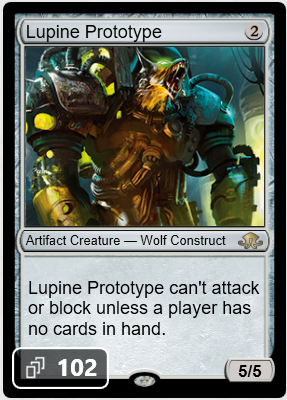
This card is not complete junk; several writers and players have mentioned it for both Modern and Standard. In addition to being a low-casting cost artifact playable in any color combination, Prototype synergizes pretty well with Kaladesh vehicles and, obviously, with anything able to empty your or your opponent's hand quickly.

Emptying your hand is not something very complicated to do these days with cards like Bomat Courier and Collective Brutality. It may also be a good thing if you are looking to activate delirium. At ~0.15 tix the risk is near zero and I’m gladly adding this bulk spec to my portfolio.

sq

Spirits were almost a Tier 1 deck in the previous Standard environment. Almost nothing from the U/W version is rotating out of Standard with Kaladesh coming in the mix. Spell Queller has also made a few appearances in Modern. Enough reasons for me to bet on this blue-white Spirit now rather than later.

emnsets

When looking for Eldritch Moon (EMN) singles that may have a chance to see play in the next Standard metagame, or that already have a spot in Modern decks, I started to think buying full sets might just be the best course of action. Buying targeted singles make a lot of sense when only a few of them are underpriced and/or have a strong potential in a given set. If too many singles from the same set feel like good targets you might as well go for what represents the best basket you can get for these singles---a full set.

EMN full sets remind me of Oath of the Gatewatch (OGW) ones right before the release of Shadows over Innistrad (SOI). The price of OGW full sets reached its lowest point weeks before the release of SOI and actually never dipped during the SOI release events. In less than a month OGW full sets increased their value by more than 50%.

EMN full sets never got as low as OGW ones did and 90 tix is clearly not as low as the 76 tix I paid for my OGW full sets back then. On the other hand, the paper value of EMN full sets is also higher than OGW full sets were. If EMN full sets can land anywhere near OGW full sets, the profit margin will still be very good. I just think the OGW full set scenario will happen again.

One last thing I might do with these EMN full sets is short-selling Liliana, the Last Hope. That's something I haven't done for a while and it could be the right situation to do so in few weeks. Liliana has been hanging up high since the release of EMN, but 25 tix, even for a mythic of a second set, is not easy to sustain. If she doesn't show up strong at Pro Tour Kaladesh she might come down quite a bit, probably closer to 15 tix.

vs

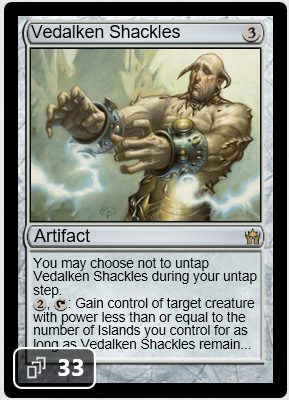
This is not Chalice of the Void or Engineered Explosives, and it won't be 25 tix anytime soon. However, Shackles hit an all-time low just this past week. Everything being a cycle in Modern, I'm going to bet that this artifact can at least go back in the 8-10 tix price range in a near future. A higher price could easily be possible if stars align since the original printing is Fifth Dawn and its only reprint is as a mythic in Modern Masters.

wa

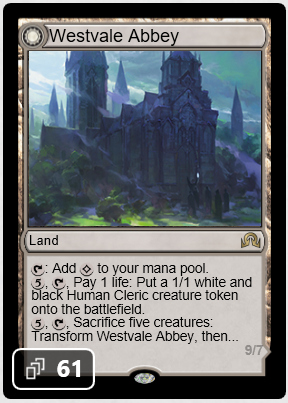
This land was a powerhouse in token decks in Standard and even sees play in other deck archetypes. It can be played in any color combinations, doesn't enter the battlefield tapped, is non-legendary and combines rather well with a sea of Servos. This card has been quite stable around 1 tix and if its price dropped further during Kaladesh release events I'll probably be adding a few more playsets to my stock.

Sales This Week

The last of my Caves found a home for about 0.3 tix a piece. This closes my third Magic Origins (ORI) painland position. I had hopped to break the symbolic bar of 1000 tix of profit for a single position. Nonetheless with a profit of 883 tix this is my biggest profit on a single spec besides boosters and full sets. I'm now down to the Battlefield Forge. I'll probably just forget about them until R/W Eldrazi becomes a thing in Modern.

foils

The BFZ foil mythics are, sadly, my only BFZ specs that are flying. Not all of them doing great but that's fine and I was only expecting a ~30% return on average. Here I'm selling some of the best performers to free some tix for incoming buying opportunities.

On My Radar

Aside from taking a much closer look at all the big changes the MTGO team dropped this past week I'll be completing my buying shopping list as we are entering the KLD release events period. I'll save some tix to once again try a large quickflip operation during PT KLD, and then I'll be watching what comes out of this Pro Tour. This time again I'll be focusing on selling all the big winners during the Pro Tour hype.

Questions & Answers

So we got some big, to say nothing of dramatic, changes on MTGO: changes to redemption, entry fees and prize structure, and the introduction of treasure chests. Big changes were made in the past and by now the world supposedly should have collapsed about a dozen times before---turns out we are still here, I'm still speculating, and I'm still writing about it.

Other people may have written and commented about these changes and many of them have probably spent way more time than me thinking about the subject. I'm only adding my modest two cents here; I hope I'm not too far off.

A Shorter Redemption Period

Starting with Kaladesh (KLD) the redemption period will be much shorter and, most importantly, will stop while sets are still in Standard. That's quite a change! Until the redemption time ends I think prices will behave similarly to before. After that, prices are likely to crash with, for instance, mythics not played in competitive decks falling as low as 0.01 tix.

With only demand from players driving prices and with Standard being the format driving the most demand on MTGO, I would expect prices to see bigger price swings with a potential bottom at 0.01 or less for any singles. Speculatively speaking, buying a card at 0.2 tix would involve more risks as it would be easier than ever to lose 95% of the value of such a card.

We might also see more spectacular spikes from cards jumping from 0.01 tix to 2 tix for example. Mythics will still be the cards with the most potential in that configuration since they could be valued at 0.01 tix one day and 10 tix the next.

Kaladesh Release Events Changes

This one is harder to read through without deeper thinking on the matter. For comparison, the introduction of Play Points, also supposed to doomed MTGO by the way, was commented in all possible ways and it appears that this change was positive in the end.

Everything that affects entry fees and prizes structure also affects the secondary market, prices of boosters, etc. It's hard to know the overall effect since everything is interrelated. It would be foolish from me to try to venture a conclusion. I guess I would be cautious about speculating on KLD boosters for now.

Treasure Chests

So basically these are another random way to get cards, including expensive staples and the Kaladesh Inventions. Most important is the list of curated cards. The 635 card list includes just about all of the most expensive cards on MTGO, from Rishadan Port to Black Lotus to Tarmogoyf to the Zendikar fetchlands. Several of the cards on that list already took a hit.

Is it justified? Most likely not, just like every other time the world was supposed to come to an end. It's hard to estimate the short- and long-term impact of these chests on the MTGO economy, although I strongly believe it won't be as terrible as some may think based on the panic sales we just saw.

Could this be comparable to the Expedition lands in BFZ and OGW? If so then what happened to the ZEN fetchlands for instance could be a guide. The fetchlands lost some value at the release of BFZ, and then in January 2016, hit their all-time high since the release of the Khans of Tarkir fetchlands.

If anything these panic sales are, this time again, most likely creating buying opportunities for wiser and more patient speculators. At minimum, even if buying isn't appealing considering that prices may drop further during KLD release events, selling is probably not the most appropriate reaction either.


Thank you for reading,

Sylvain
Finance 101: Selling Your Cards

Are you a Quiet Speculation member?

If not, now is a perfect time to join up! Our powerful tools, breaking-news analysis, and exclusive Discord channel will make sure you stay up to date and ahead of the curve.

As Magic players we all end up with cards we don't want or need. Turning these into cards we can use can be difficult. That's unavoidable and really part of the reason why Magic cards have any value at all. It's pretty easy for people to look at a pile of cards on each side and assume it's an equal trade, but you can't always find someone with the thing you want who also needs what you have. When this happens the simplest solution is to sell your cards---after all, everyone accepts money. Adding a desirable currency to a trade can make both sides come to a quick agreement. From the perspective of the player, of course, the question is whether they're getting the best offer possible.

jace-dollars-mashup

If you've been playing Magic for long enough you're no doubt familiar with the secondary market---brick-and-mortar stores, eBay and TCG Player, online retailers like Star City Games, and so on. What you may be less familiar with is how each of these different options compare to each other. A smart and informed approach to selling your excess cards can net you a good amount of extra money if you're careful. With that in mind, today I'm going to outline all of your best and worst options for selling cards.

[wp_ad_camp_1]

The True Value of Cards

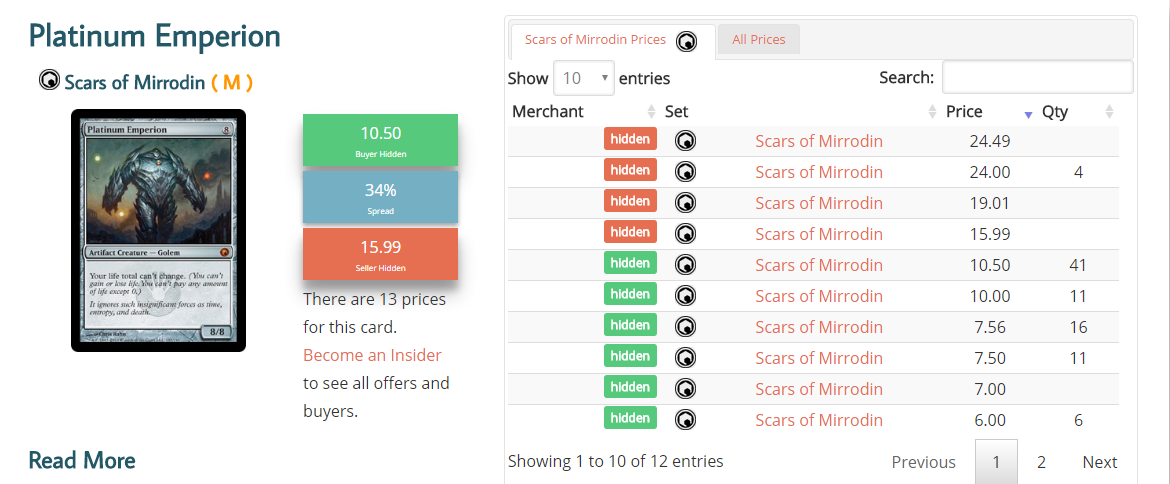
The first step to selling a card is to figure out what it's really worth. No, I'm not talking about how much you can buy it for in your local store or large online retailer. I'm talking about what it's worth to an average person. How much are people willing to pay for a card? The first step is to determine the cheapest price you can find this card for on the internet. Let's take a look at Platinum Emperion for an example.

Above is the pricing information Quiet Speculation provides to free users. While it doesn't tell you exactly where to find the cheapest price (that information is available with an Insider account), it can give you a ballpark estimate. Based on this information, Platinum Emperion is worth about $16. What can you get for it? Likely less than $16. If you are actively interested in selling a card, expect to accept offers less than the least expensive seller on the internet unless your buyer needs the card quickly. Ordering cards on the internet is far too easy for anyone to prefer your copy for any reason other than price. For Platinum Emperion, $15 is the absolute maximum I would expect to sell it for.

How Can I Sell My Cards?

There are a ton of different ways to sell cards. Each requires varying levels of effort and luck, usually in direct proportion to the amount of money you can expect to get. The easiest but least rewarding is to sell a card to a store (also known as buylisting). The hardest, but most profitable way is to sell directly to a person, much like a store would. In between these two extremes, selling on an aggregate sale site (eBay, TCGPlayer, Cardshark, etc.) requires intermediate effort. The final option you have, albeit only sometimes, is to sell your cards to a vendor at a major event.

The best option for you really depends on how much time and effort you want to put into selling a card. Because cards can change in price very quickly, I often find myself quickly cashing in my profits if a card has spiked, while I'm more methodical with a steady gainer.

Buylisting

How do you buylist a card, you ask? The process varies from store to store but the basic premise is pretty simple. Stores that accept orders through the mail will have a buylist listed on their website. You pick which cards you want to sell them and follow the instructions to submit a buylist. Some stores (Cool Stuff Inc., Star City Games) allow you to send a buylist directly through a web interface. Some stores ask you send them via email. Either way you are going to need to wait for the buylist to get approved before sending the physical cards.

One thing to be very careful of is to check the website's grading criteria. You don't want to send them cards of the wrong condition (or printing). Any errors on your part will cause you to lose money. Other common errors are not properly packing cards or sorting them according to instructions. Sorting takes times and most stores will lower the amount of money you receive if your cards aren't sorted or don't arrive in the agreed-upon condition.

The final thing you need to consider is payment. Obviously sending cash in the mail is not a good idea and stores don't generally offer that form of payment. Some stores offer checks (which take more time to arrive), PayPal (which has a fee), or store credit (which is not really money). It's important to take into consideration all of your options because they can really make or break your decision to deal with certain vendors. If you often buy cards from the vendor you're selling to then it is likely in your best interest to take store credit. Every store I have ever worked with has offered a percentage bonus for store credit.

csi-buylist-cropped

Cool Stuff Inc. has brick-and-mortar stores in Orlando so it's one that I frequent. It has a 25% bonus when you choose the store credit option. This means that if you decide to buylist a card it may be worth it to take store credit if you plan to buy the card you want from CSI anyway.

Using an Aggregate Site

I've sold a lot of cards on TCGPlayer. It's neither the best nor the worst platform to sell on. Some people like the familiarity of eBay and that's fine too---it's largely based on what you like the most. The most important thing to realize is that no matter how you end up selling a card on an aggregate site there will be fees. Shipping fees are just unavoidable, as they are with a buylist, but there are additional fees too. Most of the time you are likely to lose about 11% of the total sale price plus a flat amount to fees before shipping. It sucks but that's how the websites keep operating.

I have the most experience with TCGPlayer so I'll explain how I list cards there. When you make an account I strongly recommend changing your shipping charges to the cheapest available. Free shipping looks a lot more enticing to buyers and allows you to more accurately control the price of your card, as well as where it appears in search results. Starting out, you need to list cards cheaper than the lowest listing or it's likely that nobody will buy from you. The biggest mistake I see people make is marking down by too much. You don't need to offer your card for more than 1-2% less. Even a penny less sometimes is just enough that people will click on your card before someone else's. Just make sure that you base your price on other cards in the same condition.

(Click to expand.)

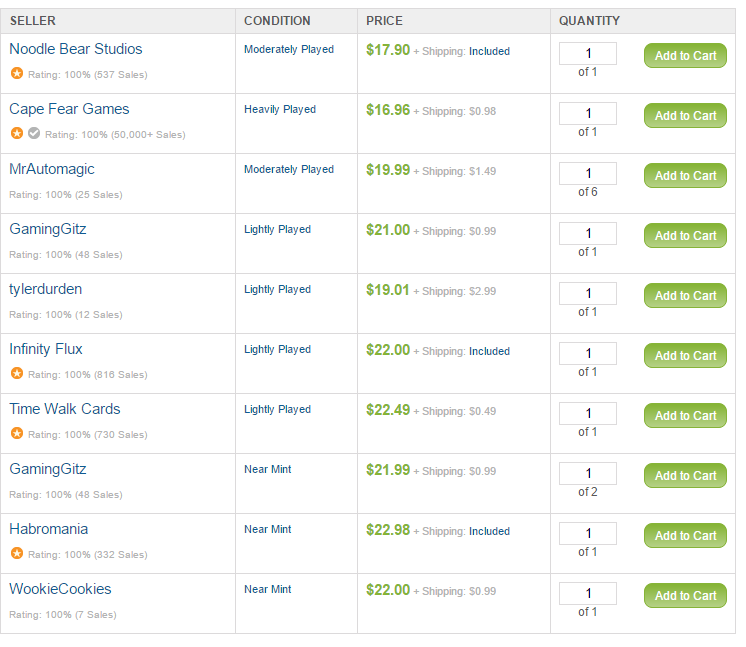
Here are the lowest prices listed for Platinum Emperion on TCGPlayer. If you have a Near Mint copy of the card you're looking to sell, you should list it for less than $22.98 (price + shipping of the cheapest NM copy). But wait, what's going on here? I said earlier you could expect to get less than $15 for a Platinum Emperion, right? Well it turns out the lowest listed price is sold out. Stores don't often update their prices after they sell out and since Platinum Emperion keeps trending up, the data on Quiet Speculation is a day behind. This highlights the importance of checking all of your options before you decide what to do with your cards. Sometimes the data isn't quite accurate, or is changing too fast and one source is lagging behind.

The last thing to consider is whether this card is worth the effort of selling. Fees for TCGPlayer are 11% + $0.50 so before shipping we would lose about $3 in fees on the sale. That means you can expect to clear about $20. The best buylist price was $10.50. Add a 25% store credit bonus, and we get $13.13 as the best we can expect from a buylist. If the card sells for $23 you're leaving about $7 on the table so it's probably not worth trying to buylist Platinum Emperion right now. The risk you run is if this card doesn't sell for $23 and a bunch of people list copies for $22 or $21 then your profits will shrink. It's important to remember that buylists are almost 100% certain, whereas selling on an aggregate site carries more risk because someone has to buy the card for you to get any money.

Selling to Another Player

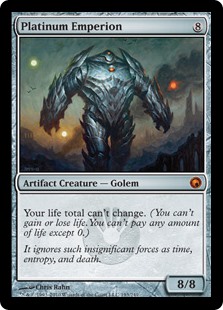
There are also several channels for selling directly to players. Generally the easiest is in person to someone you know. It's generally frowned upon to sell cards in a store so you will likely need to get in touch with a player through social media. There are plenty of Facebook groups for Orlando Magic players that I'm a part of, and similar groups exist in other cities. platinum-emperionIf there isn't one, start your own and after you start inviting people you will begin to grow the playerbase you can offer cards to.
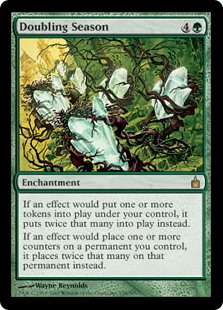
Here is the real kicker: since there are no fees for selling to another player directly you can offer cards for a lot less than other websites. Looking at the Platinum Emperion example, you could offer to sell the $23 card for $20 and you'd actually end up with more money than if you sold it on TCGPlayer. Due to the fact that after fees you would end up with $20, you still have to subtract shipping fees before you can get the true value of the sale. There are no shipping fees if you hand the card to someone in person.

Alternatively you can also sell directly to players via the mail in Facebook groups like this one. There is some amount of risk shipping to people on this group so I would be cautious or ask for references before buying or selling. If you want to be 100% safe, make sure to ship with a tracking number.

Selling at Events

The last and probably simplest method of selling cards I can suggest is at events. Grands Prix are the best to sell at because they have the largest numbers of vendors. The thing to keep in mind is that vendors spent money on a booth and are there to buy and sell cards. If they don't buy or sell enough then they end up losing money on the weekend---no vendor wants to do that. Some vendors go to almost every event (Cool Stuff Inc., Tales of Adventure, Channel Fireball, Troll and Toad), which you'll become acquainted with if you go to a lot of events. If you don't, it's not a big deal---but if you're planning on selling a few important or high-value cards you should go in with a plan.

The first thing to do is know how much you can sell the card for on TCGPlayer, and how much you can get from the best buylist on the internet. These numbers will help you if you want to negotiate with the vendor on a better price. It will also let you know what a good or bad price may be. doubling-seasonIf you're looking to sell a specific card you can ask anyone behind the booth how much they're paying for the card this weekend. Prices are likely to change as the weekend goes on. Your best bet is to sell on Fridays and buy on Sundays---vendors start with the most money Friday and want to bring the fewest cards home on Sunday.
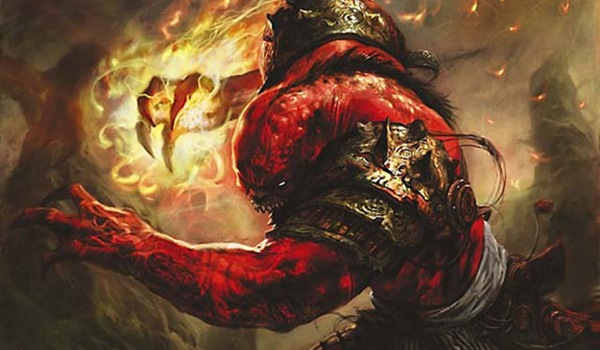
There are some vendors that won't haggle and that's okay. They generally have very good buylist prices across the board so if you have a binder of stuff you want to sell it's best to sit down with them. Some vendors also have specific cards they're more known for buying than others. Cool Stuff Inc. is a great place to sell non-foil Commander or kitchen table cards like Doubling Season. Hareruya is my go-to for selling competitive cards. They will likely pay the most for your Standard, Modern, and Legacy staples.

In the end it's a lot of trial and error, but generally speaking you can expect to get more money for your cards at a Grand Prix than a typical buylist and save on the shipping. You will also get your money instantly instead of having to wait for a check. The biggest downside is that there aren't typically Grands Prix in your backyard every weekend so it's not always convenient to wait.

Putting It All Together

You have a ton of different options for getting rid of unwanted cards without trading. It's important to choose the one that works best for the card and for you. If you don't have time or patience for selling online, then buylists are a great option. If you travel to a lot of Grands Prix then selling there is probably the best. What I haven't covered in this article, however, is the best way to ship cards. There are also a lot of ways to do this but it's going to require its own article to cover it in more than passing.

For now, I hope this article helped you get a realistic idea of how much your cards are actually worth, and how best to sell the ones you don't need anymore!

Kaladesh Week One: By the Numbers

Are you a Quiet Speculation member?

If not, now is a perfect time to join up! Our powerful tools, breaking-news analysis, and exclusive Discord channel will make sure you stay up to date and ahead of the curve.

With Kaladesh finally released, and week one of new Modern in the books, it’s time to finally transcend the realm of conjecture and speculation and step out into the world of the physical and tangible. Will Kaladesh “shake up” the Modern landscape we’ve become accustomed to over the past few months? Or will it fade quietly out of the spotlight, disappearing in a cloud of shame and despair, lamenting what could have been, à la Nickelback? Let’s find out!

flames-of-the-bloodhand-cropped

As this is week one of new Modern, we don’t have too much data to analyze. The Star City Games Open in Indianapolis was Standard, but that still leaves us a Modern Classic event’s worth of decklists to dig into. Let’s pop the hood and see if any Kaladesh options are lurking around.

[wp_ad_camp_1]

Infect, by Brad Carpenter (1st, SCG Classic Indianapolis)

Creatures

4 Blighted Agent
4 Glistener Elf
4 Noble Hierarch
1 Dryad Arbor

Instants

4 Become Immense
3 Blossoming Defense
1 Dismember
4 Might of Old Krosa
4 Mutagenic Growth
1 Spell Pierce
1 Twisted Image
4 Vines of Vastwood

Sorceries

2 Distortion Strike
4 Gitaxian Probe

Lands

2 Forest
2 Breeding Pool
4 Inkmoth Nexus
3 Verdant Catacombs
3 Windswept Heath
3 Wooded Foothills
2 Pendelhaven

Sideboard

3 Kitchen Finks
1 Viridian Corrupter
2 Wild Defiance
2 Dismember
1 Dispel
2 Nature's Claim
2 Spell Pierce
2 Twisted Image

Well, that didn’t take long! Infect is no stranger to the winner’s circle. It has been firmly in the top tier of Modern for what seems like ages now and consistently takes home the victor’s trophy every few events. Usually the archetype’s lists are pretty tight, as countless games worth of tuning have narrowed down most of the numbers to a point where the only deviation we usually see is either a result of personal preference or some distinct metagame characteristics necessitating a change.

blossoming-defenseThat being said, three copies of Blossoming Defense is without a doubt an exciting new addition to the archetype that should have some experienced Infect players doing a double-take. +2/+2 and hexproof for one green is slightly better than half of a Vines of Vastwood for half the mana, but in reality the difference between one and two mana is more than one, especially in a strategy like Infect. Mana considerations aside, Blossoming Defense is a solid upgrade to Apostle's Blessing, as we definitely would like access to a pump more than we want the ability to Falter a blocker. Especially post-board, when we’ll have non-pump interaction like Nature's Claim and Spell Pierce in our hand, the ability to protect our guy while still pumping for the win is huge.
Seeing Blossoming Defense in Infect reminds me of Death's Shadow Zoo moving away from Vines of Vastwood. Long considered a fairly regular two-of, Vines eventually disappeared out of Death's Shadow Zoo lists as they pushed to be both more explosive and more streamlined. When everything else in our deck costs one mana (besides Temur Battle Rage) spending GG to pump and save a creature can feel pretty clunky in comparison. In Infect, however, we really want as many protection effects as we can afford, and the number has historically been limited to how many non-pumps we can afford to play. Blossoming Defense solves this problem, enabling us to essentially afford seven protection effects without decreasing the number of pump spells in our deck.

Apostle's BlessingThis decklist characteristic, coupled with Brad Carpenter’s strong performance, suggests to me that he was correct in assuming a field reliant on cheap removal to deal with opposing threats. This can be a fallacy, however, as it’s entirely possible that Brad faced a field that went entirely the other way, eschewing removal completely to instead push the velocity of their individual strategies to the max. For the answer to that question, we’ll have to look closely at the makeup of other lists as we move down the line.
Moving forward, I would expect Blossoming Defense to continue to see play in place of Apostle's Blessing. Blessing is a fine card, and could still see play week to week depending on a few environmental factors, but Blossoming Defense is softer on our life total and increases our consistency, especially after sideboarding. We really weren’t even taking full advantage of the Falter ability to begin with, as Blighted Agent was already unblockable and Inkmoth Nexus flew over most creatures in the format.

This change carries with it a few cascades, primary among them being the increased power of blockers versus Infect. Lingering Souls was already bad news for any Infect player, but if they start running fewer ways to punish tapping out for blockers, more opponents will begin to take advantage. Tasigur, the Golden Fang has traditionally been a great option versus Infect and probably just got a little better, as it halted Glistener Elf attacks and could apply pressure all while coming down cheaply without opening the caster up to getting blown out.

RG Valakut, by Nathan Adrian (2nd, SCG Classic Indianapolis)

Creatures

4 Primeval Titan
4 Sakura-Tribe Elder
2 Courser of Kruphix
1 Obstinate Baloth

Enchantments

4 Oath of Nissa

Instants

4 Lightning Bolt
3 Summoner's Pact
4 Through the Breach

Sorceries

2 Anger of the Gods
3 Farseek
4 Search for Tomorrow

Lands

2 Forest
6 Mountain
4 Bloodstained Mire
2 Cinder Glade
4 Stomping Ground
3 Valakut, the Molten Pinnacle
4 Wooded Foothills

Sideboard

1 Engineered Explosives
1 Grafdigger's Cage
2 Relic of Progenitus
2 Spellskite
1 Courser of Kruphix
2 Ancient Grudge
1 Destructive Revelry
2 Fog
1 Pulse of Murasa
1 Anger of the Gods
1 Crumble to Dust

And that’s it. Valakut Breach takes second, with… no new cards. Still, if the Infect list is the metric we’re going off of, four Lightning Bolt, a few Anger of the Gods, and a fast, consistent strategy is kind of where I want to be. Anger of the GodsI’ve been dismissive of RG Breach in the past, but with midrange and control operating at a level significantly lower than what they have been in the past, a midrange/combo strategy of our own that beats up on aggressive decks is starting to look really appealing!
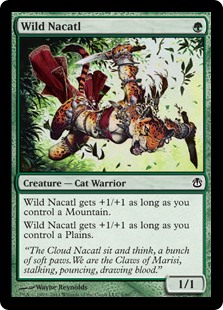
There's really not that much to say about this deck, because its entire strategy is focused on doing one thing well. Stay alive, ramp, kill things, hit land drops, cast gigantic thing. When it wins, it wins in style, by flinging a ton of Valakut, the Molten Pinnacle triggers at the opponent's face. When it loses, it loses abysmally, at is ramps into nothing or sees hands full of lands, removal and expensive bombs. A deck like this lives and dies based on the list, and at this point, most of the work has already been done. That isn't to say that the deck is easy to play, however. Sideboarding with tight lists like this can be incredibly tough, and any slip in-game is usually enough to cost the match.

Burn, by Arya Roohi (3rd, SCG Classic Indianapolis)

Creatures

4 Goblin Guide
4 Monastery Swiftspear
4 Eidolon of the Great Revel

Instants

4 Boros Charm
2 Flames of the Blood Hand
4 Lightning Bolt
2 Lightning Helix
4 Searing Blaze
4 Skullcrack

Sorceries

4 Lava Spike
4 Rift Bolt

Lands

4 Mountain
3 Arid Mesa
3 Bloodstained Mire
1 Inspiring Vantage
3 Sacred Foundry
3 Scalding Tarn
3 Wooded Foothills

Sideboard

3 Ensnaring Bridge
2 Deflecting Palm
2 Flames of the Blood Hand
2 Lightning Helix
3 Path to Exile
2 Smash to Smithereens
1 Wear // Tear

Burn taking third with access to a full playset of Flames of the Blood Hand is a clear sign to me that the format is getting really goldfishy. Besides a few Kitchen Finks and Obstinate Baloth here and there we don’t see much lifegain, so really Arya is using it as a three-mana deal-four. This by itself is actually good enough, supported by other finishes in the past of lists with Flames of the Blood Hand. Sometimes, especially when removal is low and you can count on Goblin Guide to get in two hits, enough “deal-fours” are all you need to get there.

Wild NacatlBesides Flames of the Blood Hand, the biggest thing about this list is what it’s not playing, namely Wild Nacatl and Atarka's Command. By staying relatively mono-color (with white cards in the sideboard) Arya can streamline his manabase. That gives him extra points in aggressive pseudo-mirrors and buys him that pivotal turn to win races.
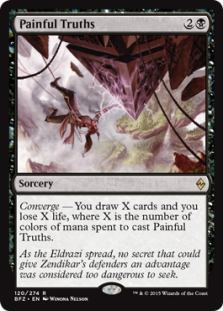
Still, if we’re banking on a lack of removal in the hopes that our creatures do more than two damage, to the point where we’re looking to play any deal-four we can (even if it costs three) doesn’t that mean that we would want Wild Nacatl? Dealing six is much better than four, and probably worth the extra damage we would take from our lands. So, looking at these results we can infer one of two possibilities. One, the benefits from staying mono-color were conditionally better than trading smoothness for power; or two, my analysis of the format as being removal-light is incorrect, to the point where Wild Nacatl was seen as a drawback, not an incentive.

Finally, the last deck I’d like to discuss today is David Nolan’s Grixis Delver. The only list in the event besides Infect to feature Kaladesh cards, David went the full progressive route by including… two copies of Spirebluff Canal. Easy, killer.

Grixis Delver, by David Nolan (6th, SCG Classic Indianapolis)

Creatures

4 Delver of Secrets
1 Gurmag Angler
4 Snapcaster Mage
3 Young Pyromancer
3 Tasigur, the Golden Fang

Instants

1 Electrolyze
2 Kolaghan's Command
4 Lightning Bolt
2 Mana Leak
1 Murderous Cut
2 Spell Snare
3 Terminate
4 Thought Scour

Sorceries

3 Gitaxian Probe
4 Serum Visions

Lands

2 Island
1 Mountain
1 Swamp
1 Blood Crypt
1 Bloodstained Mire
4 Polluted Delta
4 Scalding Tarn
2 Spirebluff Canal
1 Steam Vents
2 Watery Grave

Sideboard

1 Engineered Explosives
1 Izzet Staticaster
1 Countersquall
2 Dispel
2 Magma Spray
1 Spell Pierce
2 Surgical Extraction
1 Collective Brutality
2 Painful Truths
1 Vandalblast
1 Desolate Lighthouse

If Infect and RG Breach are both strong options, Grixis Delver is the deck I would sleeve up. Our threats are diverse and hard-hitting enough to give Breach’s damage-based removal fits, and our disruption/interaction can buy just enough time for our burn to finish the job. Against Infect, our cheap threats match theirs perfectly, and we have enough removal to just kill things post-combat and make them waste mana. Barring crazy draws, our Infect matchup is really strong, and we even have Izzet Staticaster in the board to seal the deal.

Painful TruthsAgainst the slower decks in the format (should we face them) Painful Truths is a great card to keep up with opposing card advantage, and our identity as the aggressor in those matchups should ensure that the life loss isn’t too awkward for us. All of this is relatively known information at this point, and this Grixis list doesn’t stray too far from the norm with any of its choices. This is fine, though. Grixis Delver does well when the format lines up correctly for it. It isn’t an archetype that is known for being “malleable” and while the numbers can vary significantly from list to list, in a broad sense most things stay relatively the same. Around 15 threats, at least 24 spells, a fair mix of card draw, removal, and permission.

Kaladesh's Impact So Far

So, what sort of takeaways can we draw from this event? To start with, the general lack of Kaladesh cards in lists suggests that Kaladesh might end up being a weak set for Modern. At one point a narrative existed that suggested players might not have access to new cards on events immediately after release, but I don’t think that narrative holds weight anymore. Players in SCG events are more competitive now than ever before, and if they are dropping over $50 on travel/entry/food/etc. to play Magic for a weekend, I find it hard to believe they wouldn’t put up the cash on new cards if they felt it gave them the best chance to win. I’m not going to jump out and give Kaladesh an F based on results from the first weekend, but unless something else pops up, Blossoming Defense isn’t getting anybody excited (sorry Infect players).

As for the conditions of the format, if we look at Infect’s composition (including Vines of Vastwood alongside Blossoming Defense) as well as RG Breach’s assumed strong positioning, it is relatively safe to state that removal is relatively high right now, even given the lack of midrange and control. Going “goldfish” seems to be the general response to the format’s conditions, and most strategies’ success is predicated largely on going fast and resisting disruption. Jeskai Control, Grixis and Jund Midrange, Abzan, and now even Eldrazi are nowhere to be found. In their place, Infect is running rampant (taking four of the top ten slots) and other decks like Affinity, Burn and Storm are putting up strong results as well.

What will end this tide of goldfish decks? What do you think of Kaladesh in Modern? Let me know in the comments below!

Thanks for reading

Trevor Holmes

The_Architect on MTGO

Twitch.tv/Architect_Gaming

Twitter.com/7he4rchitect

Stock Watch- Intervention Pact

Are you a Quiet Speculation member?

If not, now is a perfect time to join up! Our powerful tools, breaking-news analysis, and exclusive Discord channel will make sure you stay up to date and ahead of the curve.

Madcap Experiment is a card that is getting a lot of hype. The long and short of it is that Simian Spirit Guide is so broken that it can elevate some sub-Standard cards to great heights. On its own, Madcap Experiment can find Platinum Emperion and deal you no damage for your trouble due to the Emperion being in play already when it's time for the spell to resolve and damage you. For other artifacts, such as Blightsteel Colossus, you can utilize Intervention Pact to save you from dying.

There was an error retrieving a chart for Intervention Pact

Intervention Pact was previously bulk, but is about a $5 card now due to hype for Madcap Experiment. The card is likely to continue increasing in value by at least a small margin, and could take off if the deck puts up a strong finish in a large event. Personally, I think these decks like quite bad, though red fast mana and Blood Moon can generate plenty of free wins. If a degenerate Blood Moon deck puts up numbers with Intervention Pacts in its 60 there will be an increase in demand for the obscure Future Sight card.

Personally, if I had this card I would look to sell it in the short term, though a few bucks could be made looking around for cheap copies. Investing with cash at the current price seems bold to me, as it's a combo deck that is flush with weaknesses, though it could certainly pay off.

Insider: Navigating Standard from the Copter’s Seat

Are you a Quiet Speculation member?

If not, now is a perfect time to join up! Our powerful tools, breaking-news analysis, and exclusive Discord channel will make sure you stay up to date and ahead of the curve.

“Get to the choppa!”

It’s not only a quote from a great sci-fi movie, Predator, but now it’s the motto for Standard. I may have been late to the copter party, but now we’re all on board. Smuggler's Copter has flown through the metagame more thoroughly than even Siege Rhino. We may be talking Bloodbraid Elf levels of infiltration with this flashy new artifact.

Get to the Choppa!

And that’s exactly what every member of the Top 8 did this weekend at the SCG Indianapolis Open. They all piloted Smuggler's Copters to victory. Thirty-two copies of one card in a Top 8 is oppressive. That’s more than any Collected Company Top 8 and more than any Bloodbraid Elf Top 8. We’re talking more than Jace, the Mind Sculptor and more than Stoneforge Mystic. The only card I can think of to truly compare this vehicle to is Umezawa's Jitte. That may seem like a bold claim, but no other card has been able to creep into every decklist like these two.

W/R Vehicles

Creatures

4 Thraben Inspector
4 Toolcraft Exemplar
4 Veteran Motorist
4 Selfless Spirit
2 Pia Nalaar
3 Depala, Pilot Exemplar

Spells

2 Harnessed Lightning
4 Declaration in Stone
4 Smuggler's Copter
3 Fleetwheel Cruiser
2 Skysovereign, Consul Flagship

Lands

4 Needle Spires
4 Inspiring Vantage
6 Mountain
10 Plains

Sideboard

2 Fragmentize
4 Galvanic Bombardment
4 Gideon, Ally of Zendikar
2 Skywhaler's Shot
3 Weaver of Lightning

Obviously the biggest baddy of them all is the deck that landed at the top of the pile, W/R Vehicles. Not only that, but the deck landed four other pilots in the Top 8 as well! We know that Smuggler's Copter and this strategy specifically is the big story of the moment.

The card I like most financially from this deck might surprise you. Needle Spires is an essential mana fixer and finisher in this deck, and I can barely keep them in stock. The ceiling on this land isn’t too high because it was from a set that featured Expeditions, but I think a new price plateau around $3 to $4 includes reasonable growth that we could see.

What we don’t know is how the metagame will evolve from here. Clearly something has to shift. We can’t just have all different variations of the same strategy. Take a look at the next deck from the Top 8.

Rakdos Aggro

Creatures

4 Bomat Courier
4 Inventor's Apprentice
1 Reckless Bushwhacker
4 Scrapheap Scrounger
4 Pia Nalaar

Spells

4 Smuggler's Copter
2 Key to the City
4 Incendiary Flow
4 Unlicensed Disintegration
4 Fiery Temper
2 Fleetwheel Cruiser

Lands

4 Aether Hub
4 Foreboding Ruins
11 Mountain
4 Swamp

Sideboard

2 Call the Bloodline
4 Galvanic Bombardment
2 Kalitas, Traitor of Ghet
2 Lightning Axe
1 Reckless Bushwhacker
4 Transgress the Mind

This deck is listed as Rakdos Aggro, but honestly we should probably just be calling it R/B Vehicles. Look how many cards these two decks have in common! It feels like nearly half of both decks are the same. The red-black version offers reach in the form of burn spells—you'll get burned out if your life total dips too low. I like the small madness theme from this deck as well, and I’m surprised that someone other than me wanted to include Key to the City to enable the mechanic. Making your guys unblockable is great too, especially in combination with the burn spells.

I’m surprised that Bomat Courier hasn’t popped up above a dollar yet, but I’d expect it to increase a little. Pia Nalaar is the real gem, though. All of the Copter decks want her because she provides two pilots plus bonus abilities to go along with them. Scrapheap Scrounger is cheap right now as well, and it’s seeing play in multiple archetypes, so that’s one point in favor of future growth.

Take a look at it in our next Top 8 strategy.

Grixis Emerge

Creatures

2 Cryptbreaker
4 Insolent Neonate
4 Haunted Dead
4 Scrapheap Scrounger
4 Prized Amalgam
2 Wretched Gryff
4 Elder Deep-Fiend

Spells

4 Cathartic Reunion
2 Perpetual Timepiece
4 Smuggler's Copter
3 Kozilek's Return

Lands

4 Evolving Wilds
3 Sanctum of Ugin
3 Spirebluff Canal
3 Sunken Hollow
4 Smoldering Marsh
3 Mountain
2 Island
1 Swamp

Sideboard

3 Collective Brutality
2 Elder Deep-Fiend
3 Invasive Surgery
1 Kozilek's Return
2 Lightning Axe
2 Liliana, the Last Hope
2 Summary Dismissal

Originally, I thought Temur Emerge was the deck that broke through to the Top 8, but as it turned out, it was Grixis. This deck feels like it’s trying to do similar things to the Rakdos deck. Both decks are messing with the graveyard a bit, but this deck is trying to push the game into the mid- and late-game with the emerge cards. I don’t know if this is the best Kozilek's Return deck we will see in the metagame, but we all knew that card is too good to sit on the bench the whole season.

Over the past few weeks, I’ve continually lowered and lowered the price on both Elder Deep-Fiend and Distended Mindbender. Every time I have to lower these prices, I get more and more confused. With how much play these cards are seeing, and they are from a non-Masterpiece set, how can they continually drop in price? I think in part it has to do with the fact that they are from a small set, but they are rares so that makes it harder for them to increase as well. I still think they are good buys, though.

B/G Delirium

Creatures

4 Gnarlwood Dryad
4 Grim Flayer
4 Sylvan Advocate
2 Tireless Tracker
2 Ishkanah, Grafwidow
2 Verdurous Gearhulk
1 Noxious Gearhulk

Spells

4 Smuggler's Copter
3 Grapple with the Past
4 Grasp of Darkness
4 Traverse the Ulvenwald
3 Liliana, the Last Hope

Lands

4 Hissing Quagmire
4 Blooming Marsh
7 Forest
8 Swamp

Sideboard

1 Distended Mindbender
4 Dead Weight
2 To the Slaughter
2 Nissa, Vital Force
2 Ruinous Path
4 Transgress the Mind

Last up on our helicopter tour of the first big Standard tournament of the new season is G/B Delirium. Looking at the Top 8, I would have guessed that either this deck or the Rakdos one would have ended up winning the event. This deck has a cheap creature with deathtouch, Grasp of Darkness, and Smuggler's Copters of its own. It also has Ishkanah, Grafwidow as a great blocker and great midgame threat/finisher. If there was a deck that played four Grafwidows, that card could easily double in price. I think with a little tuning, this deck could be more suited to the expected metagame.

Where Are We Flying Next?

Unfortunately, I think the answer to help any struggling strategy may just be to add some Smuggler's Copters. My friend has been working on a Sultai graveyard deck and my honest advice was to suck it up and add the best card in the meta. I wouldn’t leave you with just that as my only advice though, so let’s see what else we can come up with.

There was an error retrieving a chart for Grasp of Darkness

I think the first answer may be just playing more targeted, instant-speed removal like Grasp of Darkness. You could also play Murder or Unlicensed Disintegration or any other spell with a similar effect. Cards like Declaration in Stone are no longer answers to all of the threats, and in fact, Declaration can have a bigger drawback as well. Giving your opponent an artifact now is almost like giving them a Glorious Anthem. With the green decks playing Blossoming Defense, the white decks playing Selfless Spirit, and the green-white decks playing both, I don’t know how reliable we can be on a couple targeted removal spells. It’s a start though.

There was an error retrieving a chart for Nahiri, the Harbinger

The best direction I’ve come up with is the centerpiece of the strategy I’ve been working on now for months and that’s Nahiri, the Harbinger. She comes down and can exile the helicopter that attacked you last turn. Sure, you don’t deal with it immediately, but I’m sure you are pairing her with removal spells to help out as well. We all know Nahiri is great, but I think now may be her time to really shine in Standard.

There was an error retrieving a chart for Fragmentize

Is it that time? Are we ready to rock some maindeck artifact and enchantment removal? If every deck is going to have targets, we may just have to play cards like Fragmentize or any other similar effect. Unfortunately, there are no cards of the caliber of Kolaghan's Command. If that card were in Standard, it would be in so many decks right now. We need a versatile card like that, maybe not quite that power level, but something that gives us options and isn’t dead when the opponent doesn’t have an artifact. We could find running Shatter-type effects as a one- or two-of in the maindeck to be worthwhile. I don’t think that would be crazy right now.

We have a lot to look forward to from the Pro Tour. I’m sure the pros will show off how broken Smuggler's Copter really is, but they may also come up with something that we haven’t seen yet. I’m excited to see what comes from that event and what the smartest minds in the game today can brew up.

To finish off the article today, I’ll just leave you with some fun topical lyrics.

“Now our escape begins
Get to the choppa
It's the only way out of here
Don't let them stop you
Don't let them hold you back
This is our chance
We all must go, dead or alive
Oh yeah bring it!
Get to the choppa
It's the only way out
Get to the choppa”

Until next time,
Unleash the Choppa Force!

Mike Lanigan
MtgJedi on Twitter

Insider: Using TCGplayer Suggestions to Your Advantage

Are you a Quiet Speculation member?

If not, now is a perfect time to join up! Our powerful tools, breaking-news analysis, and exclusive Discord channel will make sure you stay up to date and ahead of the curve.

I've written a lot about how bulk works across three different websites in the past three years. I've suggested what cards you should pick, how to acquire bulk, how to sell bulk, and what to do with the quarters and dimes that you pick. There's one subject that has stumped me for the past few years, though, and that's teaching you what casual cards to pick on your own, without me just linking you to a list and saying, "Here, pick these. Don't ask why." While we've come a long way in Magic finance in the past few years, and there are a couple comprehensive buylists out there that can give you a good overview of exactly what's pickable, nothing comes close to having the skills to figure out new picks without having to reference a spreadsheet every dozen or so cards. This article isn't going to be the end-all solution to that problem, but it's a good jumping off point for those of you who are new to picking bulk, or who pick their bulk but are only used to pulling competitive staples like Boros Charm and Thought Scour. There's an entire world of 78-card unsleeved casual Magic out there, and money to be made by understanding these players' thought processes and desires.

butcher-block-kitchen-tables

I'll preface the meat of the article with a link to The Blueprint, because I know that is likely to come up in the comments. The Blueprint is updated every month with new cards and prices, and includes even the bulkiest of bulk picks (down to .03 for some commons that you would never expect). If you want to memorize The Blueprint, or even just memorize all of the cards that are worth a dime or more, that's fine. You do what works for you.

Other People Bought...

This week on Brainstorm Brewery, Corbin brought up an excellent #breakingbulk pick that happens to be a great example for what I'm going to talk about. Let's look at Springjack Shepherd for a minute. It's a really obscure card from a hardly opened set that makes a little herd of Goats when it enters the battlefield. A few months ago, it saw the tiniest bit of play in a Modern devotion deck that never really flourished or showed results in anything other than MTGO daily events. I'm here to tell you that there's another market for the card, and that is casual Goat tribal. What? Yep. Goat tribal is a thing that players build. It's not a pile of cards that you'll be likely to see at FNM. It's not a Commander deck led by some white-weenie anthem lord, it's just good, old Magic cards being put together in a pile like in 1997. I've never played against it or sold cards to someone who told me they were building it, so how do I know it exists?

There was an error retrieving a chart for Springjack Shepherd

If you go on TCGplayer and look at a card's price page, you get a lot of useful information. The lowest listing per condition, the market price, the average buylist price, and you can even get some comedic value if you scroll down to the Facebook-linked comments section once in a while. One piece of information that I've never really discussed is the window labeled: "Customers who bought this also purchased..." This is mostly useless for spikier players and competitive brewers who know the exact parameters of the decks they're building. These people are going on SCG or Wizards's home page, and checking exact lists and statistics for the cards they need before they buy them. However, the "Other people who bought X bought Y" can come in extremely handy when figuring out the mind of a not-so-competitive player.

Let's go back to our Springjack Shepherd example. While it got some hype on Reddit that caused the initial spike, the price didn't exactly plummet back down to bulk or near bulk. While some of that is price memory, someone is still buying these Shepherds at $1 to 1.50 to make it worth listing them. This is the kind of deck that bridges the casual and competitive crowd, the Johnny who wants to make his deck work just once at FNM to see the shocked expression on the Jund player's face.

springjack1

springjack2

These are ten of the fifteen total "other people bought it" cards beneath Springjack Shepherd. You see a couple similarities between the Modern list that the linked Reddit user took to FNM (Obelisk of Urd, Soul Warden, Cloudshift), but there are a couple striking differences that certainly don't have any connection to the competitive list. Trading Post? Nyx-Fleece Ram? Heck, one of the other five cards not shown is Mirror Entity. As much as a PTQ grinder wouldn't think about spending $100 or more on a Goat deck just as a laugh with their friends, it is absolutely a thing. And you can use this list of cards to find other casual picks that you wouldn't think to find otherwise. Did you know you can still buylist Nyx-Fleece Ram for quarters sometimes? I mean, the card sees play in other casual life gain decks, but it's literally on this list because it's a Sheep. "Enchantment Creature — Sheep." It has no synergy with Goats, but it's in a similar animal family.

There was an error retrieving a chart for Relentless Rats

Let's go with another example, branching off a card that might be more familiar to readers. Relentless Rats is a pretty well-known commodity. Besides basic lands, any card that you need 30 copies of is pretty pickable, and Rats are already a home-run casual tribe with two printings. Here are five of the cards that pop up on the "other people bought this." Not even Corbin Hosler knew about this one when we talked about it on Brainstorm Brewery this week. Swarm of Rats is "as low as .58" on TCGplayer, but pretty much all of the NM listings are a solid $1.00. I've sold this card for $0.75 at Grands Prix before, and all the printings being fairly old means that there's a very low supply out there. If you knew that Relentless Rats were a pick and wanted to see what other vermin you should be pulling from bulk, you can search for Relentless Rats on TCGplayer and check what the so-called "invisible" casual market has been picking up on.

swarmofrats

There was an error retrieving a chart for Swarm of Rats

Of course, this can also hold true for the less popular competitive formats that Standard and Modern players might not be as up to date on. Pauper has been increasing in popularity lately, with price increases on Chainer's Edict and Oubliette signifying real demand for a cheaper version of the Modern/Legacy experience. We've mentioned Journey to Nowhere before on Cartel Aristocrats, and using this method can check out the Pauper players who have been jamming the card in lists with Mulldrifter, Lone Missionary, and Preordain. All of those are excellent picks that may have gone unnoticed if you locked yourself into Standard or EDH exclusively.

journeytonowhere

Even if you fail to find a pick by extrapolating from a card you look up on TCGplayer, you can still get a feel for what type of decks casual players enjoy building. Dash Hopes is another favorite of mine, because it's a favorite of the people I sell to. A Spike looks at this card and thinks, "It's always the worst of the two, my opponent can choose which one benefits them the most, and it will never do what I want it to if my opponent is smart." My customers think, "This is a black Counterspell! If they don't let me counter their spell, then they lose five whole life! Five damage for two mana is freaking sweet!" It's all about perspective and their desire to have fun. Look up Dash Hopes on TCGplayer, and let me know what you think about some of the decks people are building with it.

Downsides

Unfortunately, this isn't a perfect system. We aren't given empirical data by TCGplayer (with good reason, I might add), so we don't know exactly when these cards were bought together or how often card X and card Y were checked out in the same shopping cart. Some of the data could be really old; for example, Summer Bloom still lists several key components of the now-banned Modern Amulet Bloom deck as related cards. Unless there's a market out there for building banned decks that I don't know about, it appears that the data collected from TCGplayer in that situation would be several months old, and people may have just not been buying Summer Blooms at all.

End Step

There wasn't really anything interesting happening this week worth talking about here, so let's just look at how you can jump from one card to another until you eventually find a pick you didn't know about. You all know that Slippery Bogle is $3, right? Well, people who buy that also buy Hyena Umbra. Well, that's also a pick, because it's played in Modern in addition to some casual and EDH lists. Still not really surprising. What about jumping off of Hyena Umbra to Shield of the Oversoul? A really old casual card with no reprints that attracts a lot of love in, not Modern, but EDH and casual. And from Shield of the Oversoul we can continue onto Steel of the Godhead, a card that Bruna EDH players know by heart, but doesn't really see much love anywhere else. Yet it still find a place on the quarter section of the buy mat, and that's why I write these articles. Until next week!

Want Prices?

Browse thousands of prices with the first and most comprehensive MTG Finance tool around.


Trader Tools lists both buylist and retail prices for every MTG card, going back a decade.

Quiet Speculation