Are you a Quiet Speculation member?
If not, now is a perfect time to join up! Our powerful tools, breaking-news analysis, and exclusive Discord channel will make sure you stay up to date and ahead of the curve.
Eldrazi might be too powerful. We’ve known this since the Pro Tour, and it really has never been a serious question. Since Pro Tour Oath of the Gatewatch, a lot of drama has occurred, both in the Magic community and in the comments of our own site. Maybe a ban is necessary, maybe it’s not. There really isn’t much to gain from this discussion, as everything that can has already been said. Some of these reactions are warranted; others, not so much. I am of the opinion that until pen is put to paper and a ban occurs, any archetype can be beaten, and I do myself and others a disservice to cry “ban” when I could spend my time/effort/words focusing on finding a solution.
Today, I’ll be taking a hard look at Modern’s top dog, discussing ways to beat it sans bannings, and using my unique testing and opinions as framework. These are my findings. Results may vary. Let us begin.
[wp_ad_camp_1]
Why Grixis Control?
As some readers have been quick to question my motives/incentives/thought process lately, I thought it’d be fun to frame my discussion in a question/answer format. Call it a pre-emptive strike.
If we’re interested in beating Eldrazi, why are we messing with Grixis Control?
 Grixis Control is what I know best. For as long as I’ve been writing for this site, for as long as I’ve been focused single-mindedly on Modern, Grixis Control has been my weapon. It’s not all I know, as my time spent streaming and producing the late Modern Video Series let me play many other decks in the format, but it is something I love. My knowledge about the deck and intricacies of play translate (usually) to a better understanding and less biased opinions regarding its worth, compared to someone with less experience with the strategy. When you have a goal in mind, it’s usually best to start with the tools you know, before moving on to the ones you don’t.
Yeah, okay. Grixis Control sucks though.
Grixis Control probably does suck. Patrick Chapin put the archetype on the map, Gerry Thompson built an excellent version for the Invitational, and we saw some radical iterations to the deck in the hands of a few other players (Michael Majors had a strong performance with Jace, but wasn’t the only player researching that line). Mostly, Grixis Control hasn’t put up the numbers you would expect with such a pedigree of strong minds behind it, which has contributed to this notion that “the deck must just suck”.
I disagree.
Grixis Control, in my mind, has always suffered from trying to do a little too much, while almost always falling short. Magic players often use jargon such as “cute,” “synergistic,” or “durdly” to describe what Grixis Control does best, but its identity can roughly (emphasis on roughly) be summed up in one card: Rise // Fall.
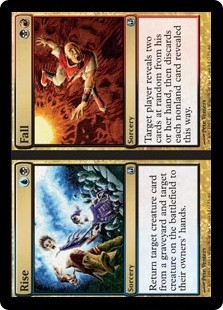 Discard into Jace, Vryn's Prodigy into Snapcaster Mage-discard into Kolaghan's Command into Rise // Fall goodness.
This is great and all, except we were doing this in a format where Affinity dumps its hand by turn two, or Burn just draws another Deal-Three, or Splinter Twin combos us out anyway, or Jund does the same thing we're doing but better, and with Tarmogoyf. To win, Grixis Control would have to rely on everything going “just right” and hope to dodge a handful of nightmare scenarios. These nightmare scenarios included multiple delve creatures in the opener. Opponents having discard spells. Sitting across from Scapeshift. Sitting across from Burn. Any player getting lucky with any draw step ever. Choke. Boil. Voice of Resurgence. Liliana of the Veil. You get the idea.
You still haven’t said why Grixis Control is good. I’m about 600 words into your article and you’ve made me so angry I’m going to yell at you on the Internet to show you how I really feel.
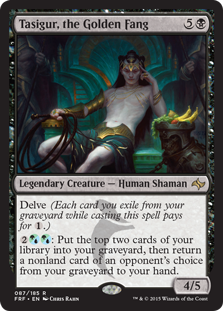 Grixis Control, in my mind, has always succeeded when it plays as a Jund deck, but with blue cards instead of green. By that, I mean rather than attempting to actually control the game, Grixis seeks to disrupt quickly, then present its own threats and put the onus on the opponent to answer them. Before Pia and Kiran Nalaar were all the rage, I found a lot of success in just going discard-Jace, Vryn's Prodigy-Tasigur, the Golden Fang with removal/counterspells to clean up. Quick, proactive, interactive, and powerful. Sure, there were some nonbos (counterspells with Jace, delving away Jace/Snapcaster targets) but there always was some value in just having powerful things to do. Playing a 4/5 that can draw cards for one mana is always powerful. Casting Rise // Fall… maybe not so much.
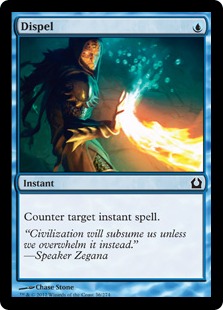 In the matchups where it was good, it was great. Infect had no hope. The Company decks were relatively easy as long as you made sure to save removal for their lords (Elves) and present a quick clock (Abzan). Having 5/5s for just a single black, with the ability to play them on turn two forced opponents to keep in Dismember and the like, which played right into our Dispels that are great against everyone post-board. There lay the strength of the deck, which is why we always saw it floating around Top 16s.
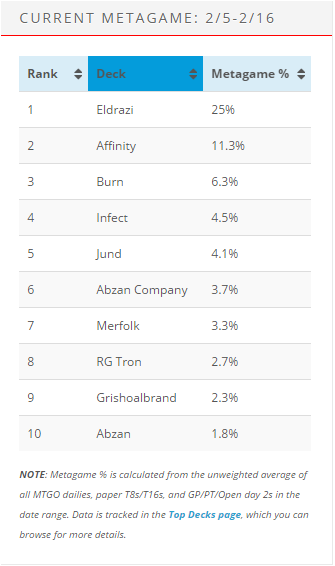
The problem? There was too much to fight. A Tier 1 with a handful of different archetypes and a Tier 2 where a dozen other viable decks meant playing a deck that rode the proactive/reactive fence while still trying to play “fair” wasn’t enough to cut it 65% of the time. If only we could see a metagame where the stars aligned, the various decks trimmed down, the shadowy figures on the fringes of reality coalesced into a handful of substantive enemies that we could actually see, and fight.
| Rank | Deck | Metagame % |
|---|---|---|
| 1 | Eldrazi | 30.3% |
| 2 | Affinity | 10.3% |
| 3 | Burn | 5.6% |
| 4 | Infect | 4.5% |
| 5 | Jund | 4.1% |
| 7 | Merfolk | 3.8% |
| 6 | Abzan Company | 3.6% |
| 8 | RG Tron | 2.3% |
| 9 | Grishoalbrand | 2.2% |
| 10 | Abzan | 2.1% |
Oh, well would you look at that.
Grixis Control - Trevor Holmes
With this list, I’ve played 20 matches against various flavors of Eldrazi on MTGO, and my win rate is 14-6. Against other archetypes, I’m mostly positive, with some more help needed against the obvious enemies in Burn and Jund.
Yeah, well I don’t trust you, and I’m just here to find fault wherever I can. Where are your facts?!?
I would record my matches, but 20 matches is a lot of video editing, and my processor is doing this weird thing where it gets to 89*C (yes, Celsius) and my computer shuts off. So when I get that fixed, you guys can get some videos. Until then, I guess you’ll just have to trust me.
The Deck
We’ll focus exclusively on the Eldrazi matchup in this section. Most of the other matchups are relatively similar to pre-Eldrazi/pre-ban Modern, but I'll touch on some key differences later in the article. For now, some general anti-Eldrazi discussion, quick-hits style.
- Eldrazi is not easy. The deck is doing some truly powerful things, and we’re doing the best we can to fight it. This is where I’m at after two weeks of hard testing. Game wins take a while, normally I’m not winning until turn 16-17 or beyond.
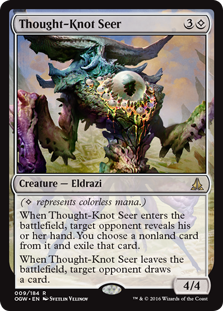 We win by killing the things, followed by more killing of the things. Thought-Knot Seer is a problem, Reality Smasher not so much, as we don’t need lands past the fifth and usually have a dud that we can discard in the midgame. Gurmag Angler and Tasigur, the Golden Fang hold everything at bay, barring Reality Smasher and large Endless Ones that we need to kill on sight.
- Eldrazi Mimics don’t stay on the board. Between Lightning Bolt, Kolaghan's Command, and discard, we can usually nab those things or kill them immediately, which really blunts Eldrazi’s early plan of attack. Playing a Seer on turn 2-3, or Reality Smasher a few turns ahead, is still fast, but we can handle that if we can get ahead on board.
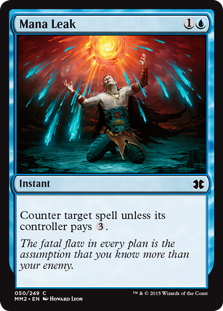
- To get ahead on the battlefield, it’s absolutely essential to have a turn one discard spell or Lightning Bolt. Nabbing their two drop lets us Mana Leak their follow-up, or play Jace, Vryn's Prodigy without falling too far behind. Always, always hold open that Mana Leak mana if you have it, as their accelerated mana makes it go dead faster than normal.
Game 1s are definitely the hardest, but still winnable. After board, we’re on the Ensnaring Bridge plan. 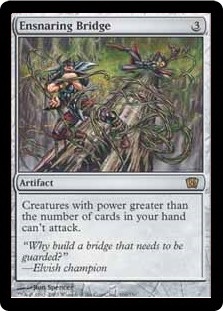 Ensnaring Bridge is excellent; if they’re playing Ratchet Bomb, they usually bring it out. As we’re playing a “rogue” deck, they aren’t anticipating Bridge and Game 2 is usually a breeze, as they have no way in their 60 to handle it and we just find and ultimate Jace with ease. Game 3 can be slightly more difficult, as they are wise to our game and (if they’re sharp) bring in Ancient Grudge to fight our Ensnaring Bridges. At this point, they have to find Ancient Grudge to fight Bridge, draw Dismember to fight our delve guys, and cobble together a relevant offense while we are working on disrupting their hand and killing their board. This is Also Known As “A Bad Time”, A.K.A. “The Squeeze”, A.K.A. “Sign the Match Slip Sucker”.
- Pia and Kiran Nalaar is underwhelming every time I cast then, so they're gone. They work as a good way to buy time in the midgame, and a relatively secure way to win under an Ensnaring Bridge (as we can draw for the turn, swing with thopters, and then play our card).
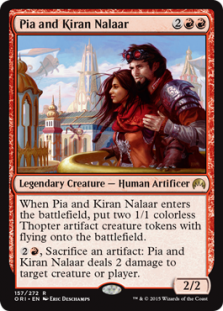 Eldrazi doesn’t have any 1/xs, so we can always safely leave one card in hand anyways. It just feels like cheating to draw, attack, then go hellbent. The Nalaars aren't bad, but they just aren't helping us where we need the extra boost.
- Another thing: attacking for two a turn in the air under a Bridge feels cute, until your Eldrazi opponent Eye of Ugins for World Breaker and you feel bad. Why does it have to have reach?!
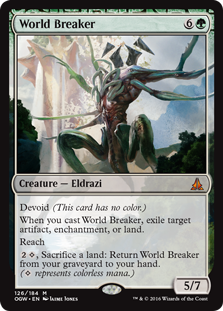
- World Breaker is the only card we care about them not finding with Eye of Ugin. This is the reason for Spreading Seas, since Breaker is a major foil to our Ensnaring Bridge plan. Not every list is playing it, but it’s something to keep an eye out for. Don’t get blown out! It’s not that bad, as we can often Spreading Seas an Eye of Ugin they can’t afford to keep in hand, but that still leaves topdecked Eyes and Ancient Stirrings to dodge. I’m not sure if we’re at the Slaughter Games level yet, but we could get there (We're not, don’t do that).
Be careful for Eldrazi Displacer, Eldrazi Mimic, and Spellskite shenanigans which can enable a 0 power Mimic to attack under a Bridge before growing off a Displacer activation on another fatty. Also, watch out for the Displacer and Thought-Knot Seer decking Plan B (more like Plan E), another Eldrazi out if they can't kill the Bridge. We're generally less vulnerable to these lines than other decks because we're still playing Bolt, but you'll still need to know the plays to not get blindsided. Also, Damnation. Maindeck Damnation. I'll leave you with that.
The Field
Even in a field of 30%-35% Eldrazi, we're still facing non-Eldrazi decks two out of every three matches. Thus, a deck that crushes Eldrazi in theory is useless if it can't hold up against the rest of the field. So how does Grixis Control fare against the best of the rest?
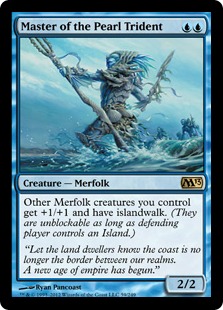 The bad matchups are still bad. Merfolk is difficult to beat, as is Burn. Tron can be a coinflip. Not much has changed on this front, and devoting sideboard slots to Ensnaring Bridge and Spreading Seas to fight Eldrazi means (by definition) that we have fewer slots to devote to bad matchups. Luckily, Ensnaring Bridge is a decent plan against Merfolk, and Spreading Seas is obviously great against Tron, so we're not losing as many "points" as you might think.
- After Splinter Twin's departure and Eldrazi's arrival, the metagame has actually shifted to a point where most of the rest of the field is favorable for Grixis Control. Amulet Bloom is gone, which was always a pretty rough matchup for Grixis. Scapeshift was a personal nemesis of mine, though other players claimed success against that strategy. Regardless, it has been putting up numbers since Eldrazi's arrival. Living End is also a bad matchup, and it's good to see its numbers diminished.
 On the other hand, take a look at the enemies we're looking to fight. Infect. Affinity. Company creature decks. The field has adapted to a point where we're facing creature decks most of the time, and moving back to counterspells to fight Eldrazi incidentally helps us against combo decks as well. Discard, Mana Leak, and Dispel are still tough for spell-based combo to fight through, and where Grishoalbrand used to be scary I'd be inclined to call it favorable (though I haven't run into it yet to test for sure).
- Moving back to Tasigur, the Golden Fang is, in my mind, the most important change for the archetype. We tried synergy-based Grixis for months and never seemed to "get there", and just having a cheap x/5 is great in this new format. Not having to kill absolutely everything, and being able to apply a quick clock and turn the corner is one of Grixis Control's best attributes. The effect it has on gameplay, sideboarding, and in-match positioning is considerable but not immediately apparent. If you're thinking about picking up Grixis, give the Gurmag and Tasigur a try!
Conclusion
I’ve had some success against Eldrazi. I’m not claiming Eldrazi is not overpowered (it probably is). I’m not arguing against a ban (it's probably coming). Fast mana is not a fair thing to give one archetype and not others, and for that Eldrazi will probably one day see a nerf. Admitting this, the tools to beat the deck exist. It’s likely that not every archetype has these tools, which is bad, but that’s where we come in. If you’re done playing Magic until April, that’s your prerogative. If you hate Wizards for everything they’ve done to destroy your life, you are allowed to feel that way. I’m here, calmly trying to do my part. I hope you found something of value in my words this week. Thanks for reading, and I leave the stage to you…
Trevor Holmes
The_Architect on MTGO
Twitch.tv/Architect_Gaming
Twitter.com/7he4rchitect
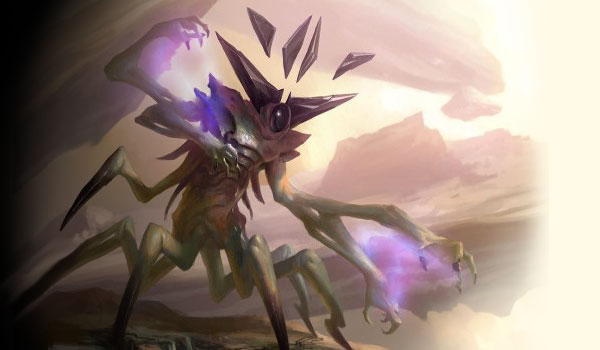
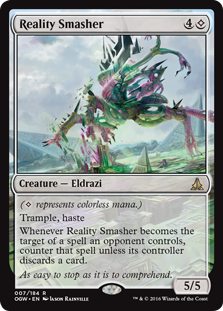 Did SCG Louisville reverse the narrative or challenge the Eldrazi's offense? Was our format reality unsmashed after the decisive Modern stand? The
 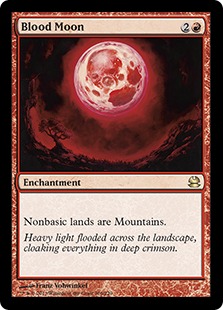 Twitch humor aside (and who doesn't love a dose of Twitch humor, channel mods excluded?), this is the exact opposite of what we wanted to see at SCG Louisville. We've seen the popular narrative of an unbeatable deck before: Amulet Bloom, Burn, Tron, and Affinity all come to mind from last year alone. In all those cases, the metagame resisted, whether through the Blood Moons at Grand Prix Charlotte or the Fulminator Mages of late 2015. Amulet Bloom eventually ate the ban, but that was for
 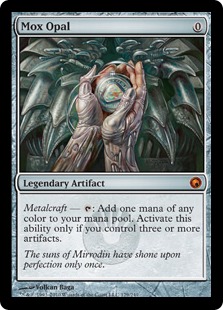 Austin Holcomb won Louisville with
  Two, the Eldrazi decks themselves have adapted (and keep adapting) to the Affinity challenge. Kent Ketter's
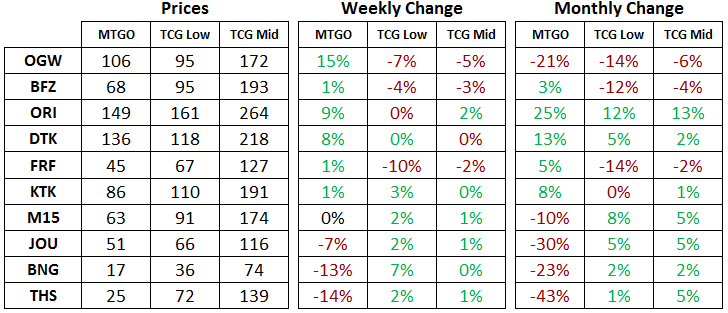
  Dailies and 316 decks. The paper dataset grew to 46 events and just under 350 deck-entries, not to mention all the SCG Louisville action joining with the existing Pro Tour stats to flesh out our "major paper" and Day 2 side of the numbers. Taken as a whole, that's about half the datapoints we'd normally expect for a proper metagame update, although I fully expect we'll get there by the March Grand Prix weekend.
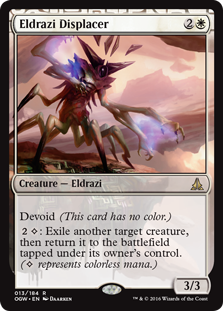 or flat. How does a deck already at 25% of the format jump up yet another 5%? Ask Eldrazi Displacer and its Louisville pals, who cemented Eldrazi's Tier 0 status just as they secured the Eldrazi mirror. Affinity's share retreated in MTGO and Day 2 while picking up .4% in paper, an overall loss for the deck supposedly keeping us safe.
 aftermath of the Pro Tour,
 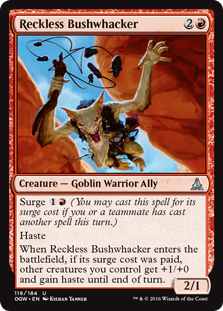 format doesn't make this narrative any prettier. As a player, consider the Tier 3 decks as niche options depending on your playstyle and preference. All of these decks have beaten Eldrazi opponents to even reach this point, which might make them feasible choices for upcoming events. Brave enough to rally your Reckless Bushwacker Goblins through a Grand Prix field? Hit me up for a feature piece, especially if you piledrive into Day 2.


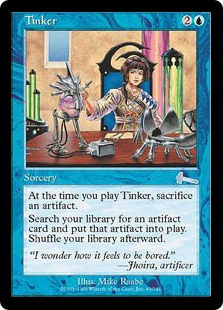
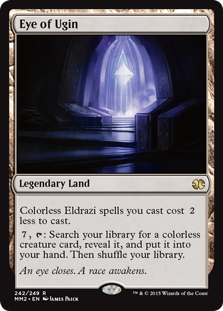
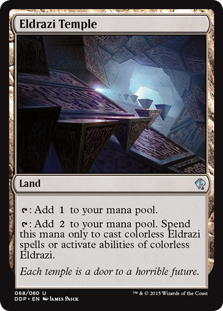 Look at Tron, another powerful land-based Tinker deck, which has a small number of bombs surrounded by land search. If it fails to draw a Karn or Wurmcoil (or, frequently, several) the deck does nothing because it had to give up so much to make its acceleration work. Now look at Eldrazi. Unlike the other mentioned decks that need multiple accelerants to assemble, it only takes one Eldrazi Temple to get the deck going and one Eye of Ugin to make the deck broken. A single Eye can generate six mana on its own per turn, easily generating four, and it can even tutor for more creatures. Compared to the original Natural Order or Tinker, there's no risk to this acceleration package and no way to answer it before the damage is done.
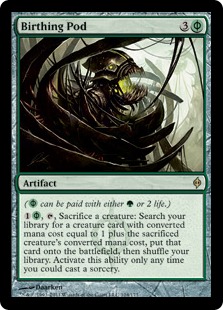 creatures? Check. Ability to adapt to any situation and win by generating overwhelming board advantage? Check. Toolbox has a history of bannings, with Survival being banned in multiple formats and tutors generally getting hammered. What made Pod unique compared to the various Survival decks was it was never a dedicated Toolbox deck and had several very good backup plans. From Tinker, it had acceleration in the form of Birds of Paradise, Wall of Roots, and Noble Hierarch. From Stompy, it had a solid beatdown plan of (mostly) green creatures pumped by Gavony Township, all of which were integral to the engine. The deck initially existed for years as a good, combo-centric engine with a Township Plan B. What finally pushed it towards Enigma power was it became an overwhelming value engine to power out a stream of Siege Rhinos, often with the threat of a combo in the wings. That simply overpowered every fair deck and outraced most of the unfair ones.
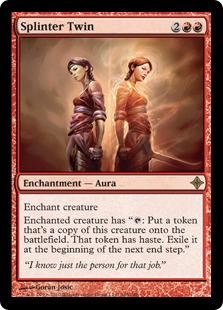 Twin is going to be the odd man out here because I'm not convinced it was ever a truly Enigma-level threat. Yes, it had an Enigma level two-card combo but most of the time it floated between Counter-Sliver and Weissman depending on the matchup. Ability to slide cheap threats under opposing defenses and protect them? Check. Potential to answer everything from the opponent? Check. Blue? Check. Twin was always a threat, and arguably oppressive, but it never felt too unfair and lacked the unbeatable, unanswerable power of Enigma. Instead, it played a lot of answers and tried to ride small creatures to victory when there was an opening, very much like the Counter-Rebels deck Flores cited.
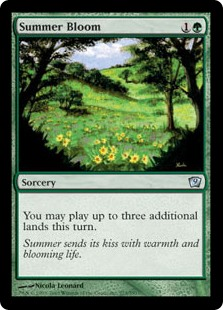 Again, Amulet Bloom was obviously a Tinker deck. Acceleration into huge threats? Check. Explosiveness? Check. Vulnerability to drawing poorly? Check. The deck accelerated out Primeval Titan and used early Blooms and Amulet of Vigors to generate absurd amounts of mana, sometimes killing on turn two. This pretty clearly moves it into Enigma territory. Although its metagame share made it top-tier in the eyes of Wizards, it was only a small fraction of the Eldrazi insanity we're seeing today. While the deck still technically exists without the Bloom, the explosiveness factor has diminished to the point that there's little reason to prefer it over other options.
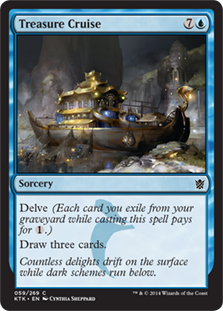 It's Necro. Mana efficient threats and answers? Check (Can't get more efficient than one mana). Lots of them? Check. Powerful card draw engine? Check. Wins via card advantage and mana efficiency? Check.
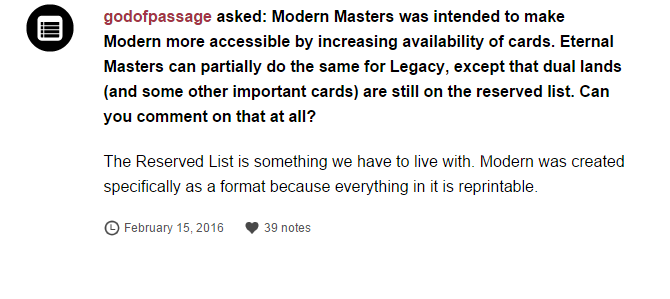
 The other thing about these previous decks is there was space around them. They stuck to one or a few archetypes and when there was bleed it was low, especially compared to the Eldrazi core straddling three very different strategies (even more, when the various flavors are all taken into consideration). In the Cruise era, it was possible to go Stompy on Delver with Death and Taxes and constrict and disrupt their mana enough to keep the Necro gameplan in check. It was possible to shut down Pod's tutoring engine. Twin kept many other, far more broken decks down by forcing them to interact or perish. Because Eldrazi does so many things and does them faster than the decks that normally occupy those spaces, it has stolen archetypal space that would have otherwise existed. Thus, in order to fight back, we need to look to other achetypes that Eldrazi can't touch to find room to win.