menu

Insider: MTGO Foil Mythics, Part 2 – The Theory of Redemption & Utility

Are you a Quiet Speculation member?

If not, now is a perfect time to join up! Our powerful tools, breaking-news analysis, and exclusive Discord channel will make sure you stay up to date and ahead of the curve.

Welcome back to my discussion of foil mythic rares on MTGO. In Part 1, I laid out the basic questions raised by the odd price behavior of foil mythics. Today we'll start to explain these phenomena through the lens of redemption.

The Theory of Redemption

Through the mechanism of redemption, players can redeem digital sets on MTGO for a factory sealed paper set. This applies to complete sets of foils too, which means that the online and paper full set values are approximately the same.

Mythic rares are ‘printed’ at about half the rate of regular rares, which means mythic rares are the bottleneck to redeeming a digital set into paper. Since only a complete set can be redeemed, the rarest parts of the whole set are the ones that hold the most value, even if the paper prices on individual cards are wildly different from MTGO prices. This is what makes even junk mythic rares hold a little value; you still need the junk mythic rares in order to redeem a complete set.

foil

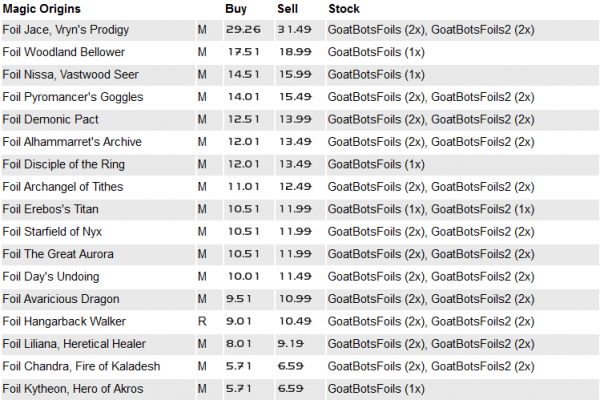
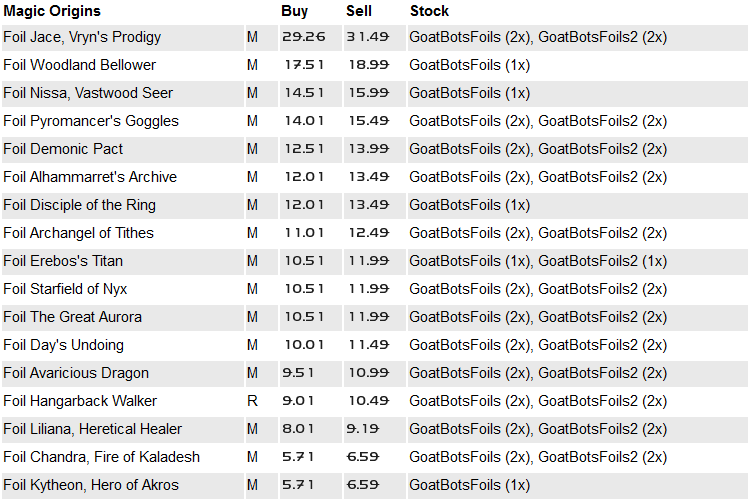
Next, foil mythic rares are generally expensive relative to their non-foil counterparts. If you look at the list of foil mythic rares in the above screenshot, every foil mythic rare is more expensive than its non-foil counterpart. The foil multiplier on Jace is about 5%; but for a card like Disciple of the Ring, which currently goes for 0.59 tix, the foil is over 20 times more expensive than the regular version. That is quite the multiplier!

The Theory of Redemption Applied to Foils

This discrepancy in the price of the foil and regular versions can explained by the theory of redemption, but there are a few extra factors to consider. The pool of value in a foil set is much bigger; with a foil set of ORI going for triple the regular set, this is obvious. It is still redemption that gives redeemable MTGO cards their value, and just like regular sets the bottleneck is still the mythic rarity. Therefore, foil mythic rares hold value just like regular mythic rares. But because the pool of value in a foil set is bigger, the average foil mythic rare holds more value too. Even the redemption fee of $25 is small potatoes when you are looking at a set priced at 300 tix.

The next question to consider is how the value and the price of a given mythic rare changes over time, a crucial factor when one is looking to buy or sell cards. In the case of the average mythic rare, the trend is down as more and more product is opened in drafts, and the price and value steadily decline over time as the supply grows.

There are always exceptions like constructed staples and shifting metagames that interrupt the trend, but for the most part it’s well understood that prices head down over time on the average mythic rare. Therefore, it is safest to buy the average mythic rare near the end of the drafting window for that particular card’s set. Peak supply is reached when new sets are released and the older set is no longer the current draft format.

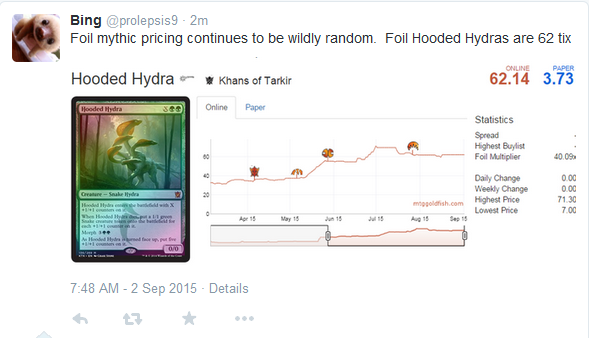
However, this trend doesn’t apply to foil mythic rares on MTGO. I’ll repeat that. The downward trend in card prices does not apply to foil mythic rares on MTGO. This will take some unpacking to explain.

First, we’ll start with the observation that foil sets tend to hold their value and have stable prices over the medium term of 3 to 6 months, especially compared to the price of a regular set. With that as an observation/assumption, let’s consider the dynamics of how the price of the components of a foil set change over time. We’ll start by focusing on the cards that are not the bottleneck, the rares, uncommons and commons.

On MTGO, these cards are valued according to their utility. Anyone who pays attention to the MTGO economy knows that there are ton of cards being opened all the time, as we often see the price of junk rares falling to below 0.01 tix and junk uncommons and commons are basically worthless. They hold no value due to their ubiquity. Foils are a little rarer, so even a junk foil ORI common sells for 0.03 tix.

To think about why these foils are not valued on MTGO, consider that to play Magic you just need the game pieces you want for your deck. Since a foil has no extra functionality when compared to a regular version, foils and non foils are perfect substitutes for playing Magic. In the real world, paper foils have value to collectors and players because they like them better than regular versions, but on MTGO the special nature of foils is not a big factor.

When foil rares, uncommons and commons have perfect substitutes, that means that their price will track the price of the regular versions. Players will just play with the cheapest version, all things being equal. Thus, the price of rares, uncommons and commons all trend down along with the rest of the cards that get opened in draft, with only a very small premium associated with being a foil.

That covers most of the components of a foil set which tells us that most of the cards from a foil set are getting cheaper over time. As the price of the rares, uncommons and commons are falling over time, combined with a stable price of a complete foil set, then the foil mythic rares must be accruing the value that the other cards are losing. And this is exactly what is observed over time.

The Conclusion

Looking at our picture above, it is obvious that foil versions of junk mythic rares have a much higher price than one might otherwise expect. This is because mythic rares are still the bottleneck to redemption, but with a larger pool of value in a foil set and the price of the rest of the set falling, then over time foil mythic rares actually go up in price. This is contrary to how most players expect prices to act so it’s worth repeating. Over time, foil mythic rares tend to go up in price on MTGO.

~

Join me next week, where I'll outline an investment strategy for foil mythics which should generate enough profits to fund most MTGO accounts indefinitely.

Click here for Part 3

Pyromancer iGrows Up: WMCQ Toronto

Are you a Quiet Speculation member?

If not, now is a perfect time to join up! Our powerful tools, breaking-news analysis, and exclusive Discord channel will make sure you stay up to date and ahead of the curve.

Five hours. That's how long it would take me and a band of Modern-loving francophones to reach Toronto in Milkman's big van. It took much longer.
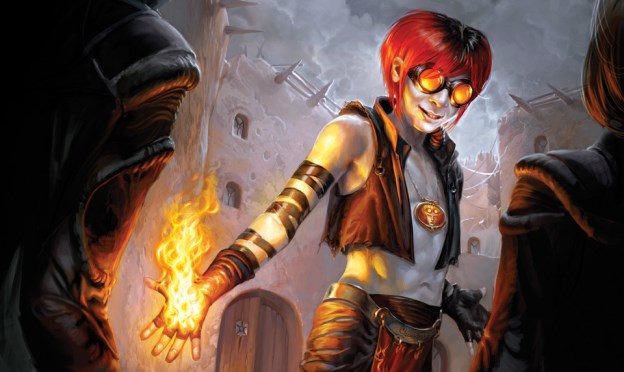
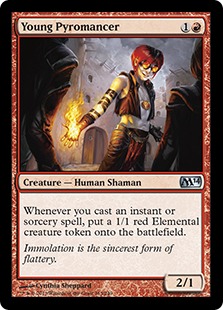
Young Pyromancer art

After an airport shuttle from the hotel, a busride from the airport, and a yellow-line subway jaunt, I arrive at my buddy's Chinatown apartment five hours late. He'd hit the town without me, so I stay up a few hours to jam Traditional Yu-Gi-Oh! online. At 3:30 AM, I decide to stop waiting for my friend and get some rest. He comes in loudly an hour later and we catch up.

[wp_ad_camp_1]

I wake up, shower, and open my computer to check the directions. My friend texts me: "Where are you?" Don't worry, I'm awake. The tournament starts in 40 minutes. I've got plenty of time. I leave the house and start walking.

15 minutes into the stroll. I'm on Yonge. Just five minutes away! But hang on: there's no way a WMCQ would be held in a cramped LGS. I call one of the francophones and ask where he is.

"We're at the convention center! Go in the entrance next to the Second Cup!"

Next to the Second Cup? What the hell? That could be anywhere. I hail a cab. The tournament starts in 15 minutes.

"Hey, can you take me to the convention center?"

"The convention center? Which entrance?"

I guess this might work. "Next to the Second Cup." The cab driver gives me a big grin. "I know exactly what you mean!" Yeah, I hope so. He turns up his radio and we jet off.

I accidentally overtip and stumble out of the cab. Where's the Second Cup? What are all these people here for? Oh, a Fan Expo. I guess this is the convention center. Wish I had time to get a coffee. I'm getting a call. "Where are you?"

"Hey, I'm looking for the Second Cup. I'm next to a line of people." The tournament started three minutes ago.

"Hang on, I see you!" We walk in and my name gets checked on a list. They give me a red bracelet. I sit down and fill out an illegible decklist. It feels weird omitting "3 Effect Veiler."

"We thought you weren't going to make it!" Ha, ha. I always make it. We wait an hour before the player meeting even starts.

I've never played iGrow in an event this large. There were 270 something players. Since the PPTQs this summer, I haven't played at all barring some local tournaments, in which I've done well. I was excited to play it against a truly competitive field. In the end, I went 6-3.

What I Played

At the last minute, I borrowed a Hurkyl's Recall to hedge against Affinity. Someone said there would be a lot of it (there wasn't). I cut a Send to Sleep to make space. Besides that tweak, my list looks like it has for the last month.

iGrow Toronto, by Jordan Boisvert

Creatures

4 Delver of Secrets
4 Monastery Swiftspear
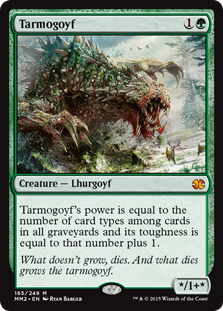
4 Tarmogoyf
4 Young Pyromancer

Sorceries

4 Serum Visions
4 Gitaxian Probe
4 Day's Undoing
2 Sleight of Hand

Instants

4 Lightning Bolt
4 Vapor Snag
4 Disrupting Shoal

Lands

4 Scalding Tarn
4 Misty Rainforest
2 Wooded Foothills
2 Steam Vents
1 Breeding Pool
1 Stomping Ground
3 Island
1 Mountain

Sideboard

3 Snapcaster Mage
2 Forked Bolt
2 Electrickery
1 Flame Slash
1 Snapback
2 Threads of Disloyalty
1 Send to Sleep
2 Destructive Revelry
1 Hurkyl's Recall

The biggest change here from the last iGrow list I posted to Modern Nexus is an increased reliance on the sideboard Snapcaster Mage package. I moved away from quadruple Forked Bolt as I lost to aggro decks that simply "drew out" of my removal spells. Snapcaster adds to the beatdown plan while doubling my removal, and lets me recycle the best spells for a given matchup like (Flame Slash, Lightning Bolt, and even Send to Sleep). He provides enough virtual creature kill on his own that I don't need all those glorified Shocks. With a cantrip, he also digs for red spells.

Another big change is the abandonment of hosers. Granted, I ran that Recall on a whim for the WMCQ, but I wouldn't do it again. The Burn and Affinity matchups are good enough with this deck that flexible sideboard cards fit better than highly specific ones. I also didn't love Flashfreeze, since it was the only card I'd need to hold up mana for. This deck wants to tap out every turn and counter spells anyway, and having just just one or two two-mana counterspells interferes with that plan. Flashfreeze is still one of the better counterspells in Modern, and in less of a "tap-out" tempo deck, I recommend trying even mainboard copies.

Send to Sleep and Threads of Disloyalty have tested phenomenally against medium-big aggro decks. They're also fine against Burn and Atarka Zoo, but they pull the most weight against Wild Nacatl and Tarmogoyf. Beating Zoo has always proven difficult for iGrow, and these cards help immensely.

Before jumping into the report, I'd like to add a quick note on Day's Undoing. The fact that it won me many games this tournament aside, this article isn't about that one card. It's mostly about playing tempo in Modern. I happen to believe that the format's only viable tempo decks in a field of midrange play Day's Undoing, so I naturally include it in my builds. But I've refined my opinion of the card as an utter Modern game-changer; the decks best equipped to play it are URx Delver variants and artifact-based, dump-your-hand decks (Affinity, Tezz). And no, I don't consider Grixis Delver a tempo deck.

WMCQ at 401 Games - Toronto, Ontario

Round 1 vs. Grixis Twin (1-2, lose roll): In game one, Delver into Pyro into double Probe puts me ahead. My opponent's stuck on two lands, but spends a turn Bolting the Pyromancer instead of casting Serum Visions. I have Disrupting Shoal and he dies with a hand of Remand, Pestermite, and two Splinter Twin.

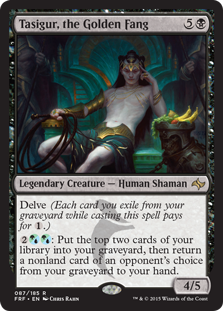
Game two, my opponent stabilizes at nine life with double Cryptic Command and a Tasigur. I fetch pretty greedily this game and lose to beatdown and Bolts as I scramble to find Vapor Snag.
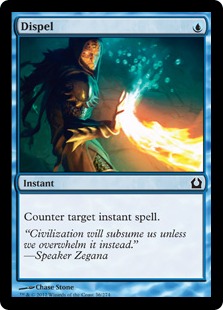
DispelGame three, I get my opponent to 3 life and cast Day's Undoing with two Steam Vents untapped. He has Grim Lavamancer and a Snapcaster Mage on an otherwise empty board. I draw Swiftspear, Bolt, Snag, and some cantrips and pass the turn. Here's where I mess up: I should Bolt my opponent on his upkeep, to prevent him from drawing a counterspell. But at just two mana, I want to play around Mana Leak. However, Grixis Twin rarely runs that card, and instead I should play around Dispel or Cryptic by casting Bolt before the draw step. I don't, he plays a Serum Visions and scrys one to the top. Then he plays another Visions, which I sleepily allow. The card he draws, of course, is a Dispel. My EOT Vapor Snag resolves. Swiftspear eats a Terminate, and the Bolt gets countered. I lose two turns later.

Sideboard Plan:
-2 Sleight of Hand
+1 Flame Slash
+1 Snapback

Thoughts: Losing to my best matchup wasn't a great way to start off the event, but game three taught me an important lesson. It's crucial with iGrow to know exactly what you want to play around and to keep your senses sharp. A small slip cost me the game - my opponent told me afterwards that he was dead to a Lightning Bolt anyway, so he spent his turn digging for an answer, which I let him find.

Round 2 vs. Kiki Chord (2-0, win roll): Game one, I play Delver, and my opponent plays an untapped land. I play Swiftspear and attack, and she eats a Path to Exile. Works for me; I cast Serum Visions and leave Undoing on top. I Shoal a Voice of Resurgence, untap, cast a Bolt, attack for three, and Undo with just a land left in hand. My opponent resolves a Scavenging Ooze, which I Bolt, and a Wall of Omens, which I ignore. When he goes for Kiki-Jiki, Mirror Breaker, I Vapor Snag his Wall in response and attack + Bolt him for lethal.
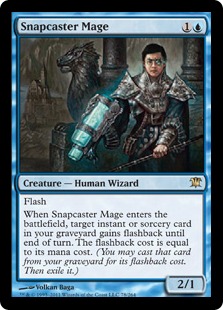
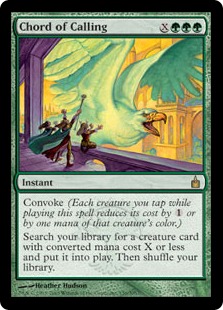
Snapcaster MageGame two, I keep double Snapcaster Mage, removal, and lands. Probe shows I've got all the time in the world to deal with his threats, as there isn't a Chord of Calling or Gavony Township in sight. I slowly resolve two topdecked Pyromancers off my two lands. One gets Path'd once I make nine tokens, and I begin my assault. Wall of Omens and Voice block 1/1 Elementals and my overloaded Electrickery does a number on his team. He plays Witness for Voice, drops Voice, and passes it back. I Flame Slash the Wall, Forked Bolt the Witness and Voice token, and Vapor Snag the Voice of Resurgence. Blockers removed, I attack for lethal.

Sideboard Plan:
-4 Disrupting Shoal
-4 Day's Undoing
-2 Sleight of Hand
+3 Snapcaster Mage
+2 Forked Bolt
+2 Electrickery
+1 Flame Slash
+2 Threads of Disloyalty

Thoughts: My opponent confirmed between games that he was on Hoogland's list. I usually like Shoal for aggro matchups, but Kiki-Chord lacks strong targets for it. It's also midrangey enough to justify Day's Undoing in game one. Kiki-Chord struggles with heavy removal packages, though, so Undoing gets cut after boarding for red spells. This is one of those weird decks where Send to Sleep would shine in game one, but doesn't mesh with our post-board plan. We want hard removal for Chord's creatures.

Round 3 vs. Jeskai Control (0-2, lose roll): Game one, I open Day's Undoing and hold it forever as my threats get answered one-for-one. In hindsight, I should have cast it the moment I ran out of threats to refill. My opponent starts pointing his burn at my face and swinging with a Colonnade, and I can't Undo safely anymore.
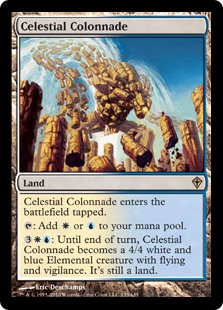
Celestial ColonnadeGame two, Swiftspear and Tarmogoyf bring my opponent down to 5 life, but then they die and I lose to Electrolyze and Lightning Helix. I don't draw Undoing this game.

Sideboard Plan:

No changes

Thoughts: I designed iGrow to beat midrange decks, but I had a specific kind of midrange deck in mind: one that accrues incremental advantage on the board, and not in the hand (i.e. BG Death Cloud). One that can easily trade their cards for damage (i.e. Jeskai Control), give iGrow a harder time than most. For what it's worth, the deck tested positively against Jeskai Control before the tournament, but I didn't dedicate much time to the matchup since it's such an elusive pile (yeah, I went there). Jeskai's definitely harder to beat than something like Grixis, and if we see a resurgence, I'll put some hours into beating it consistently.

At this point in the tournament, I'd lost my chance to break into Top 8. Only booster packs were on the line, and I have zero use for those (seriously: if someone wants to buy a box, email me). I resolved to take risks, pay attention, learn a lot, have fun, and encourage my opponents do the same. As a result, the last six rounds ended up being some of the most fun Magic I've played since GP Charlotte. I'm writing this aside to encourage readers who lose early on in events to keep playing and keep their heads up. If you lost, you can improve, and where better to practice than at a competitive REL event?

Round 4 vs. Grixis Twin (2-1, lose roll): In game one I lose to gradual aggression, as my threat-light hand gets dismantled and I fail to find Day's Undoing. Game two, Delver and Tarmogoyf plus Disrupting Shoal for protection gives me the win. Send to Sleep "removes" a Tasigur.
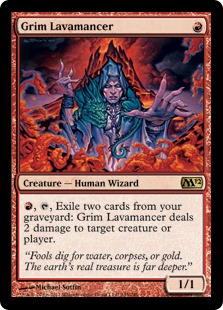
Grim LavamancerGame three, we both Serum. My opponent plays Grim Lavamancer and I foolishly try Snagging him after playing a Delver. Naturally, my opponent casts Dispel, untaps, and shoots my threat. I cantrip, draw Bolt, and pass, without much left to do. Something interesting happens with Duress on the stack. I tap my last land to Bolt the Lavamancer, and my opponent taps out for Remand. I exile Send to Sleep to Shoal the Remand. Everything resolves and I reveal Scalding Tarn to the Duress. I cast a freshly drawn Serum and get a Delver, then scry another Delver to the top and play the first one. Of course he gets Bolted, and I surprise my opponent with another off the top. This Delver blind flips off a Snapback and I draw Day's Undoing and Shoals while attacking for three. Delver takes my opponent from 16 to 0. I get shown a hand full of Remand, Splinter Twin, and Dispel.

Sideboard Plan:
-2 Sleight of Hand
+1 Snapback
+1 Send to Sleep

Thoughts: After my round 1 loss, I elected to board in Send to Sleep over Flame Slash and was pleased with the swap. While Slash deals with a resolved Exarch or Spellskite, Sorcery speed hurts for breaking up the combo. Send stops the combo long enough to find Vapor Snag in a pinch, and also taps down Tasigur so I can get more damage in. It even pitches to Shoal to counter relevant spells, including Terminate and Snapcaster Mage. I still prefer Slash against UR Twin, which has more targets and casts Exarch earlier.

Round 5 vs. Mono Green Stompy (2-1, lose roll): Game one, I don't see any Bolts, and get overwhelmed by dudes. I Shoal a Strangleroot Geist, but lose to Dryad Militant, Experiment One, Leatherback Baloth, and Avatar of the Resolute.

Game two, I fall to just one life. An early Spellskite complicates my removal plan, forcing me to Vapor Snag it each time before casting my Bolts. I manage to keep the field clear of Avatars and my Insectile Aberration gets the job done.
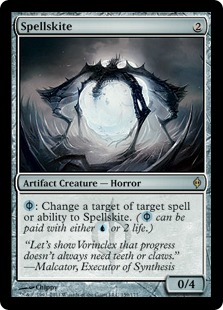
SpellskiteGame three, I have a great start of Delver into Pyromancer with a grip of Bolts, but Spellskite again makes life a little tougher. My opponent has a strong start too and I have trouble interacting enough on just three lands. I decide to trade my unflipped Delver for his Dryad Militant, since I have two more Pyromancers in hand. Eventually I find Flame Slash for Spellskite, ruefully holding my Destructive Revelry since I'm operating on Island, Island, Stomping Ground. I throw Pyro under an attacking Scavenging Ooze and resolve another one. He puts Rancor on a Scooze and plays another Scooze, enchanting that one with Rancor as well. Send to Sleep taps them both down and makes me some tokens, and just before the green guys wake up, I finally draw my Scalding Tarn. An upkeep Snapcaster-Sleep buys me enough time to win past the huge, trampling, snoring Oozes.

Sideboard Plan:
-4 Monastery Swiftspear
-4 Day's Undoing
-2 Gitaxian Probe
-2 Sleight of Hand
+3 Snapcaster Mage
+2 Forked Bolt
+1 Flame Slash
+1 Snapback
+1 Send to Sleep
+2 Threads of Disloyalty
+2 Destructive Revelry

Thoughts: Of all the matches today, this was the most stressful. Tarmogoyf and Threads of Disloyalty took some well-deserved time off this round, but were sorely missed. Hopefully, my report speaks to the strength of Send to Sleep, and of Young Pyromancer against aggro decks in general.

Round 6 vs. Amulet Bloom (2-0, win roll): Game one I open an Undoing, but slow-roll it until I can squeeze some serious advantage out of it. My opponent resolves Summer Bloom and drops a Dragonlord Dromoka on my head. I have a growing force of Young PyromancerElemental tokens to match, and we start trading hits. Lifelink hurts so I only get in a couple points each time; the notepad shows my opponent going from 15, to 20, to 14, to 19, to 11. In the meantime, I resolve another Pyromancer, which eats Slaughter Pact. Then I draw Vapor Snag to finally bounce Dromoka and Undo it away at just six life, and with one mana up. My opponent draws seven cards, untaps, pays for Pact, resolves Primeval Titan, and gives it haste. I Vapor Snag before it swings and then I attack for lethal.
Game two, I follow Swiftspear and Delver with Tarmogoyf. My opponent plays Seal of Primordium, and when I Probe him, I see another Seal and four lands. I attack a few times, and with just one turn left on the clock, he topdecks and resolves Primeval Titan. I Snag it before attacks, and my opponent casts Pact of Negation. But he can't find the lands he needs to win; I'm at 15 life and he's short one mana to give the 8/6 Titan double strike.

Sideboard Plan:
-2 Young Pyromancer
-2 Sleight of Hand
+1 Snapback
+1 Send to Sleep
+2 Destructive Revelry

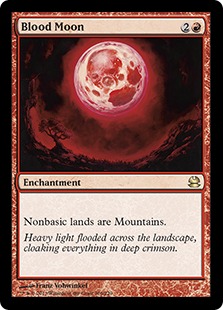
Thoughts: My opponent, and a few other players, told me Day's Undoing is bad in Blood Moonthis matchup. I love it since it cancels Transmute effects, cantrips, and Summoner's Pact on turns where the Amulet player doesn't play the big threat he gets right away. It also combines with Vapor Snag to shuffle fatties away and help my beaters get there. Its relevance carries over to other big mana decks in Modern; against Tron, it "Remands" an Eye of Ugin activation and delays Expedition Map cracks for a turn. I was amused at the Seals, but my opponent was still right to bring them in. I found in testing that Blood Moon wasn't even necessary against Amulet, which is one of the reasons I cut it from my build. On boarding: I cut a pair of Young Pyromancer for hate cards because Amulet doesn't pack a lot of removal, so 16 threats is a bit heavy. The removal they do run (Firespout) kills Pyromancer anyway.
Round 7 vs. Affinity (1-2, lose roll): I wasn't thrilled to see Springleaf Drum across from me. Lucky I brought that Hurkyl's Recall! I drew it in game two and won, but game three I mulled to five trying to find a competent hand and lost to Champion plus Plating. We did a bunch of games afterwards and I took them all. The highlight of those was casting Threads on a Steel Overseer and stonewalling Etched Champion.

Sideboard Plan:
-4 Monastery Swiftspear
-4 Day's Undoing
-4 Gitaxian Probe
-2 Sleight of Hand
+3 Snapcaster Mage
+2 Forked Bolt
+2 Electrickery
+1 Flame Slash
+1 Snapback
+2 Threads of Disloyalty
+1 Send to Sleep
+2 Destructive Revelry

Thoughts: The Recall was sweet when I had it, but I really want to avoid running cards like these in the sideboard. I prefer more versatile answers, so a third Electrickery or Forked Bolt might be better. Send to Sleep doesn't exactly fit into my plan against Affinity, but Flame Slash does, and it works in the matchups I want Send for.

Round 8 vs. Burn (2-1, win roll): Game one, I stabilize the board at four life and lose to a Boros Charm, short just one point of winning. Game two, I take some damage from lands to rush out double Tarmogoyf, which does a number on my opponent.

Game three, I create a board of Snapcaster Mage, Swiftspear, and Tarmogoyf, and my opponent casts Ensnaring Bridge with two cards left in hand (what year is this?) to my one. He's at six life, and I topdeck Monastery Swiftspear, play it, and Threads my own Goyf to make exactly lethal prowess.

Sideboard Plan:
-4 Day's Undoing
-4 Gitaxian Probe
-1 Sleight of Hand
+3 Snapcaster Mage
+2 Forked Bolt
+1 Flame Slash
+2 Threads of Disloyalty
+1 Send to Sleep

Thoughts: Here's another matchup I originally played a hoser for (Feed the Clan) before cutting it for widely applicable sideboard tech. Bridge isn't a card we see enough from Burn to merit Revelry's inclusion post-board, especially since we can win through it anyways.

Round 9 vs. GR Tron (2-0, win roll): It's always nice to end the day with a stellar matchup. Game one, I slow-roll my threats after seeing a do-nothing, sweeper-heavy hand with Gitaxian Probe. Swiftspear and Delver each eat a Pyroclasm, and Pyromancer resolves to wreck his usual havoc. Vapor Snag gets the Wurmcoil, and I Undo into lethal Bolts.

Game two, I keep attacking and Revelry an attacking Wurmcoil Engine. I Hurkyl's Recall away the tokens and crash in for the game.

Sideboard Plan:
-4 Disrupting Shoal
-1 Sleight of Hand
+1 Snapback
+1 Send to Sleep
+2 Destructive Revelry
+1 Hurkyl's Recall

Thoughts: Day's Undoing shines even brighter here than against Amulet, since Tron is so full of search effects like Sylvan Scrying that clog its new hand. Snag effects also improve, since unlike Primeval Titan, Tron's threats don't generate cards upon resolution. The best thing they can do is cast Thragtusk, but even that's manageable, and many builds don't run it.

Growing with the Flow

I mentioned dropping one Send to Sleep (the one I'd cut for a Recall this time) for a versatile card with some Affinity relevance. Right now, Flame Slash looks like the Day's Undoing 223x310best option. But my biggest takeaway from the day was just how bad Sleight of Hand is. It does more in this deck than possibly any other, digging for business, triggering Prowess and Pyromancer, pumping Goyf, providing value with Snapcaster, and flipping Delver. But it's always the first card to go post-board, so I'd like to try something actually good in this slot. I'll probably go with a pair of Hooting Mandrills; they don't do Delver any favors, but man, can they bite!
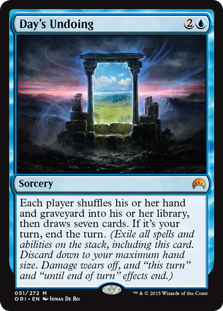
A couple weeks ago, I said I'd shut up about Day's Undoing until I had "a finish to write home about," and if your standards resemble mine, 6-3 might not qualify. But hopefully, this report shows that iGrow can tangle with the best decks in Modern. If not, hold tight! The way things look, that postcard-material finish is fast approaching.


Jordan Boisvert

Jordan is Assistant Director of Content at Quiet Speculation and a longtime contributor to Modern Nexus. Best known for his innovations in Temur Delver and Colorless Eldrazi, Jordan favors highly reversible aggro-control decks and is always striving to embrace his biases when playing or brewing.

View More By Jordan Boisvert

Posted in Modern, TournamentsTagged , , , , 28 Comments on Pyromancer iGrows Up: WMCQ Toronto

Have you joined the Quiet Speculation Discord?

If you haven't, you're leaving value on the table! Join our community of experts, enthusiasts, entertainers, and educators and enjoy exclusive podcasts, questions asked and answered, trades, sales, and everything else Discord has to offer.

Want to create content with Quiet Speculation?

All you need to succeed is a passion for Magic: The Gathering, and the ability to write coherently. Share your knowledge of MTG and how you leverage it to win games, get value from your cards – or even turn a profit.

Insider: QS Cast #4, Even More BFZ Spoilers

Are you a Quiet Speculation member?

If not, now is a perfect time to join up! Our powerful tools, breaking-news analysis, and exclusive Discord channel will make sure you stay up to date and ahead of the curve.

Douglas Linn

Doug Linn has been playing Magic since 1996 and has had a keen interest in Legacy and Modern. By keeping up closely with emerging trends in the field, Doug is able to predict what cards to buy and when to sell them for a substantial profit. Since the Eternal market follows a routine boom-bust cycle, the time to buy and sell short-term speculative investments is often a narrow window. Because Eternal cards often spike in value once people know why they are good, it is essential for a trader to be connected to the format to get great buys before anyone else. Outside of Magic, Doug is an attorney in the state of Ohio.  Doug is a founding member of Quiet Speculation, and brings with him a tremendous amount of business savvy.

View More By Douglas Linn

Posted in Free Insider, PodcastLeave a Comment on Insider: QS Cast #4, Even More BFZ Spoilers

Have you joined the Quiet Speculation Discord?

If you haven't, you're leaving value on the table! Join our community of experts, enthusiasts, entertainers, and educators and enjoy exclusive podcasts, questions asked and answered, trades, sales, and everything else Discord has to offer.

Want to create content with Quiet Speculation?

All you need to succeed is a passion for Magic: The Gathering, and the ability to write coherently. Share your knowledge of MTG and how you leverage it to win games, get value from your cards – or even turn a profit.

Analyzing SCG Cincinnati for GP Oklahoma

Are you a Quiet Speculation member?

If not, now is a perfect time to join up! Our powerful tools, breaking-news analysis, and exclusive Discord channel will make sure you stay up to date and ahead of the curve.

Another week, another giant leap forward. This past weekend Modern was showcased at the SCG Open Series in Cincinnati. This is very timely since this weekend is an even bigger Modern event in Grand Prix Oklahoma City. You would think that players looking for an edge would be pouring over the results looking for new tech and information. While I normally leave the trend analyzing and event reviews to other community writers, focusing instead on opinion pieces or in-depth deck analysis, I haven’t been hearing much discussion about GP Oklahoma City or Modern recently.

Glistener_Elf-Art-Banner

Everywhere I turn people are blathering on and on about Eldrazi, when we aren’t even living in their shadow yet. Nobody is looking at the significance of Cincinnati (the event, not the city) or what it means for GP Oklahoma City. It’s like they don’t care about Modern, and frankly, I find their lack of faith disturbing. So let’s get to it, shall we?

vader meme

Context

Currently, we are in the middle of the Modern “offseason” between Grand Prix Charlotte/Copenhagen/Singapore back in June (the end of the previous season), the Modern PPTQ's, and Pro Tour Oath of the Gatewatch in February 2016 (and the beginning of a new season). In between, we have a few high profile events that will serve to guide the metagame; the dual SCG Open weekends in Charlotte and Cincinnati, the upcoming Grand Prix Pittsburgh in November, and the SCG Invitational in December (Standard/Modern). This means we are looking at an environment where we get one week of high profile results a month, supported by a lot of “under the surface data” in the form of MTGO Daily and SCG Premier IQ results. Conditions like this normally lead to one of two results: slow, gradual changes to a format that happen naturally over time or surprise results where a deck comes seemingly out of nowhere to capitalize on positioning for a weekend or spikes an event. Case in point: Grishoalbrand at GP Charlotte.

[wp_ad_camp_1]

SCG Cincinnati

So what can we learn from offseason results? Besides analyzing metagame information and trendspotting, we can normally comb through decklists to find a few gems. It’s a thankless job, digging through IQ Top 8 sideboards in search of tech, but valuable nonetheless. Plus, I did it already so you don’t have to!

"Affinity, by Devin Eckard (SCG Cincinatti 2015, 3rd)"

Creatures

3 Etched Champion
4 Arcbound Ravager
1 Master of Etherium
3 Memnite
4 Ornithopter
4 Signal Pest
3 Steel Overseer
4 Vault Skirge

Artifacts

4 Cranial Plating
4 Springleaf Drum
4 Mox Opal
1 Welding Jar

Instants

2 Galvanic Blast

Sorceries

3 Thoughtcast

Lands

4 Darksteel Citadel
1 Island
4 Blinkmoth Nexus
3 Glimmervoid
4 Inkmoth Nexus

Sideboard

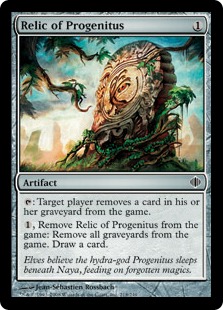
2 Relic of Progenitus
2 Spellskite
2 Blood Moon
2 Ghirapur Aether Grid
2 Stubborn Denial
1 Wear
2 Thoughtseize
2 Whipflare

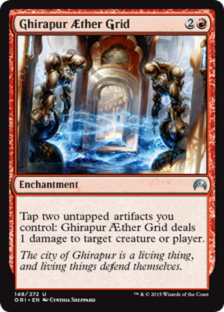
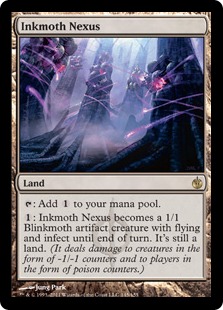
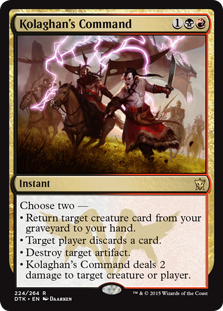
Ghirapur Aether GridLooking at Devin’s 3rd place list, there are a few takeaways. Ghirapur Aether Grid is no longer new tech, but is worth mentioning as a great way to fight Stony Silence (if you can cast it first) and a bomb for the mirror. Relic of Progenitus is excellent against both Living End and a solid plan against Grixis Control (whose main goal is to race and cast Snapcaster Mage on Kolaghan's Command), and we see the trimming of Galvanic Blastin favor of Thoughtcast. More reliably than death and taxes (the phrase, not the deck), when Affinity starts cutting Galvanic Blast for Thoughtcast the format is being ruled by midrange decks. While Grixis Control has yet to actually win a major event, its ubiquitous presence both in MTGO Daily results and pro writers’ articles has nonetheless established the archetype as Public Enemy #1 in everyone’s minds, and possibly the format as well. This was the deck to beat and expected to take at least a few top spots in Cincinnati and yet:
Where is Grixis Control?!?

Archetypes in SCG Cincinnati Top 32

Deck NameTop 32
N
Top 32
%
Affinity516%
Junk412.5%
Jund412.5%
Infect26%
UW Control26%
Grixis Twin26%
Kiki-Chord26%
Amulet Bloom26%
Merfolk13%
UR Twin13%
Silvers13%
Naya Burn13%
RG Tron13%
Naya Company13%
Scapeshift13%
Abzan Company13%
Death and Taxes13%

Well isn’t that interesting. Zero, count them, zero Grixis Control decks in the Top 32 of SCG Cincinnati. Grixis Twin, while an entirely different strategy, also only placed two copies into the Top 32, with one list taking 11th and the other taking 25th. relic of progenitusSeeing these results makes me immediately stand up and take notice, as there has to be something going on to explain a complete lack of a tier 1 archetype in the Top 32 of an event. While the 1st and 2nd place Infect lists are great matchups for Grixis Control, literally every other matchup in the Top 32 is an unfavorable one for Grixis (by my count, seven lists are favorable matchups: Twin, U/W Control, Infect, and Slivers). This suggests a field that is hateful or at least prepared for Grixis Control. Multiple copies of Relic of Progenitus in each of the Top 4 lists reinforces this idea and goes a long way towards explaining Grixis’ absence. This also suggests an explanation for Infect’s strong showing. The two copies to make Top 32 were able to dominate the field of decks attempting to prey on Grixis Control. Therefore they were able to capitalize on the absence of a poor matchup and they ran the tables all the way to a double showing in the finals.
What’s the Deal with UW Control?

"UW Control, by Jessy Hefner (SCG Cincinnati 2015, 6th)"

Creatures

4 Restoration Angel
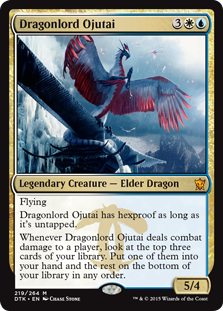
2 Dragonlord Ojutai
2 Blade Splicer
2 Snapcaster Mage
3 Wall of Omens
2 Vendilion Clique
1 Kitchen Finks

Enchantments

1 Detention Sphere

Instants

4 Path to Exile
2 Cryptic Command
1 Valorous Stance
2 Think Twice
2 Spell Snare
3 Remand
2 Mana Leak

Sorceries

2 Supreme Verdict

Lands

2 Seachrome Coast
1 Moorland Haunt
4 Celestial Colonnade
3 Tectonic Edge
2 Glacial Fortress
2 Hallowed Fountain
4 Flooded Strand
3 Plains
4 Island

Sideboard

1 Rest in Peace
1 Jace, Architect of Thought
2 Stony Silence
1 Timely Reinforcements
1 Dismember
1 Spellskite
1 Dispel
2 Kor Firewalker
1 Celestial Purge
1 Negate
1 Kataki, War's Wage
1 Engineered Explosives
1 Disenchant

Dragonlord OjutaiThis is now three weeks in a row of strong showings from UW Control. Michael Segal placed 13th in Charlotte with Emeria, the Sky Ruin, while Daniel Villamizar and Jessy Hefner got 1st and 6th respectively in back-to-back weekends with Celestial Colonnade. Blessed with excellent positioning, UW Control has attacked the metagame from the opposite end of the spectrum as Infect, going way over the top of everything, while dodging the graveyard hate that has been “good enough” against the de facto control deck of the format. While I am of the opinion that Grixis Control is still a better control deck when these two go heads up, it doesn’t really matter right now because U/W is enjoying smooth winds above the hate while Grixis is fighting through rough seas. As long as U/W has a great plan against fast combo, it seems to be positioned excellently for Oklahoma City, second only to…
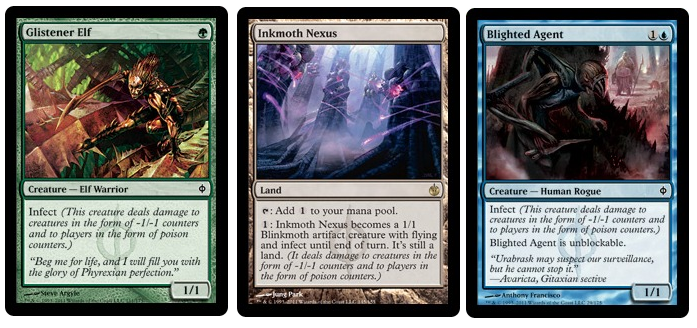
"Infect, by Todd Anderson (SCG Cincinnati 2015, 1st)"

Creatures

4 Blighted Agent
2 Spellskite
4 Glistener Elf
4 Noble Hierarch

Enchantments

1 Rancor

Instants

2 Apostle's Blessing
3 Become Immense
1 Dismember
4 Groundswell
2 Might of Old Krosa
1 Mutagenic Growth
1 Twisted Image
4 Vines of Vastwood

Sorceries

4 Gitaxian Probe
2 Serum Visions

Lands

1 Dryad Arbor
2 Forest
3 Breeding Pool
4 Inkmoth Nexus
3 Misty Rainforest
4 Windswept Heath
2 Wooded Foothills
2 Pendelhaven

Sideboard

1 Grafdigger's Cage
1 Pithing Needle
2 Relic of Progenitus
1 Necropede
1 Spellskite
1 Viridian Corrupter
1 Leyline of Sanctity
2 Dispel
3 Nature's Claim
2 Twisted Image

When Affinity is cutting Galvanic Blast for Thoughtcast, when Grixis Control is the boogeyman, when decks can get away with four or sometimes less removal spells maindeck, Infect will always, always, show up to stomp the unwary into the ground. Focused more on the environment than deck composition, Infect lists look relatively similar week-to-week, often with only slight differences in the board to account for current metagames. A strong, but not necessarily resilient strategy, Infect has proven that it can’t survive under dedicated hate. Therefore I expect that we won’t see another week of two copies in the finals of an event for some time. Infect is not a flash in the pan and will still be strong unless the format expects it, but I expect its performance to wane as the community diversifies their board to include tools to fight it and, simultaneously, lessen the hate against Grixis Control.

infect big three

"Slivers, by Adam Bowman (SCG Cincinnati 2015, 8th)"

Creatures

2 Blur Sliver
1 Darkheart Sliver
3 Diffusion Sliver
4 Galerider Sliver
4 Manaweft Sliver
2 Necrotic Sliver
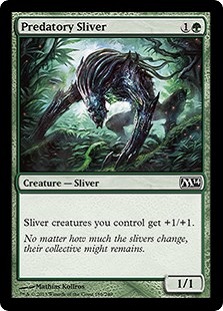
4 Predatory Sliver
3 Sedge Sliver
2 Sentinel Sliver
4 Sinew Sliver
1 Syphon Sliver

Artifacts

4 Aether Vial

Instants

2 Abrupt Decay
4 Collected Company

Lands

1 Forest
1 Blood Crypt
1 Breeding Pool
4 Cavern of Souls
4 Mutavault
2 Overgrown Tomb
4 Sliver Hive
2 Windswept Heath
1 Wooded Foothills

Sideboard

2 Bonescythe Sliver
1 Darkheart Sliver
3 Harmonic Sliver
1 Shadow Sliver
2 Syphon Sliver
2 Telekinetic Sliver
2 Abrupt Decay
2 Sliver Hivelord

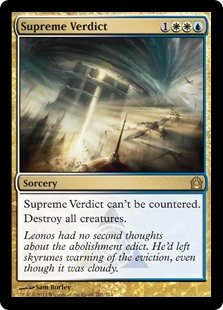
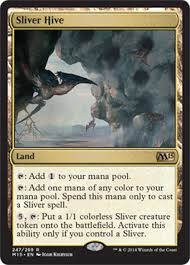
I know there will be pitchforks if I pass by Slivers, so…SLIVERS! There, are we good now? Slivers is, in my mind, part Naya Company, part Merfolk, and part Affinity in both strategy and execution. predatory sliverIts Collected Companys are simultaneously individually weaker and more explosive/synergistic than Naya’s, while it can quickly spiral out of control if opponents let it build up a board state a la Merfolk. In addition, Slivers functions similar to Affinity in that it can apply quick pressure and can’t afford to dedicate much room to interaction with the opponent. This makes it a poor choice against fast combo (like Living End and Amulet Bloom) and simultaneously a poor choice against removal heavy lists (Grixis Control, anything with Supreme Verdict) but man does it crush decks like Jund and Abzan. While I am excited that Slivers was able to Vapor Snag a Top 8, my rational side knows that this was due to the same conditions that allowed Infect to dominate the event. I’m sure we could pin down a metagame where Slivers is a good choice but Infect and Merfolk are not, but I’ll leave that one to the dreamers.
The Takeaway?

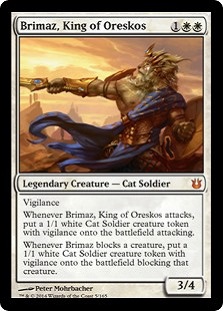
BrimazBe vigilant! While I’m sure Brimaz, King of Ereskos would agree with me, the fact remains that SCG Cincinnati’s results should not surprise us if we’re paying attention (and I’m sure it didn’t surprise Todd Anderson). He correctly anticipated a field hateful towards Grixis Control, and took advantage of the lack of a bad matchup and proper positioning against the rest of the field to catapult himself to a win. Leading up to SCG Cincinnati, Grixis Control had been putting up consistent results, was the talk of pretty much everyone (myself included) and was slowly warping the format around itself. Todd correctly jumped on the flash point, when the hate became too strong and Grixis in its current form wouldn’t be able to survive, and took a weekend by storm with a deck that nobody was prepared to beat. This story repeats itself week after week; sometimes the best deck for the weekend hits some bad draws/matchups and doesn’t make Day 2 and we see Random Joe take home the trophy, but other times correct analysis, proper deck choice/construction, and tight play run the tables and take home the trophy. Which one are you going to be?

Thanks for reading! I hope you enjoyed my article, if you have any thoughts/opinions, feel free to let me know in the comments! I’m always looking to improve my writing and I welcome any conversation about my analysis/writing style/witty humor. As always, if you’d like to see any of these decks in action feel free to stop by my stream at twitch.tv/Architect_Gaming! Follow me on Twitter for updates, and I’ll see you there!

Trevor Holmes
The_Architect on MTGO
Twitch.tv/Architect_Gaming
Twitter.com/7he4rchitect

Insider: Battler for Zendikar Spoilers

Are you a Quiet Speculation member?

If not, now is a perfect time to join up! Our powerful tools, breaking-news analysis, and exclusive Discord channel will make sure you stay up to date and ahead of the curve.

The Battle for Zendikar has just begun. So far our heroes are revealed, as is some of the landscape on which this epic battle will be fought. I discussed one of the villains, Ulamog, the Ceaseless Hunger, last week in one of our spoiler articles. Spoiler coverage is one of the best new parts about Quiet Spec, so make sure you check it out.

Let’s start off by meeting our heroes.

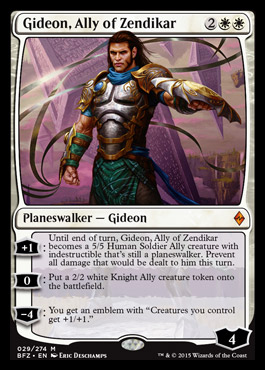
Gideon, Ally of Zendikar

gideonallyofzendikar

As the protector of Zendikar, Gideon leads the charge against the Eldrazi horde. As the leader of the allied forces, this time around he is bringing the ally mechanic to life through his new planeswalker self.

There’s good and bad news about this card. Starting with the bad news first, Gideon is competing with another version of himself--Kytheon, Hero of Akros is quite good as well. Just like Garruk, Primal Hunter and Garruk Relentless before him, one version will likely win out and the other will sit on the sidelines. Character development is great, but situations like this with the same planeswalker in Standard multiple times causes good cards to not see play.

The good news is that this card is powerful. First of all, we know planeswalkers that make creatures tend to be playable and powerful. Gideon, Ally of Zendikar reminds me a little of Xenagos, the Reveler because they both make a 2/2 with an ability. Haste seems better on average than a corner case creature type like ally, but we won’t truly know that until we see the full set. Gideon does provide a constant stream of allies and that’s something that might have pushed the tribe over the top the last time around.

In true Gideon-like fashion, this planeswalker not only makes creatures, but also turns into a creature himself. While he is a creature he is still hard to kill, but he remains vulnerable in his planeswalker state as always. He becomes an ally in his creature form, but it remains unclear if that will matter as the new "rally" mechanic buffs all your creatures regardless of type.

Finally, Gideon can make an emblem right away. Although, Xenagos came to mind, Gideon ends up resembling Sorin, Lord of Innistrad much more. Both make you a creature every turn and can give you an emblem to boost those creatures.

This time, our emblem gives +1/+1 instead of +1/+0 and that bonus matters a lot. The new format is shaping up to contain similarly sized creatures battling each other so this is a way to break parity. Comparing a new planeswalker to these two proven cards is a good sign that Gideon will be seeing some play once he is in the hands of the players.

One worry I have about Gideon, Ally of Zendikar is that he is dropping into a format that already contains Sorin, Solemn Visitor. Sorin brought his vampire pals to the party and they can fly over the heads of your unsuspecting opponents. They can also get +1/+0 and gain you a bunch of life. That’s no emblem but we all know how powerful it is. Maybe we can play them both side by side and create an unstoppable army of 2/2’s, but Gideon may get lost in Sorin’s wake.

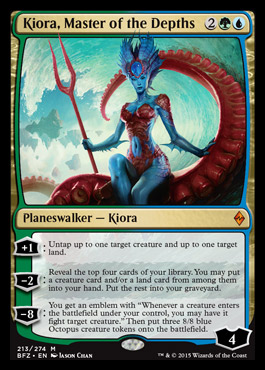
Kiora, Master of the Depths

kiora master of the depths bfz spoiler

Up next we have Kiora, Master of the Depths joining the fight. I’m not sure what to make of Kiora, but I like her. She doesn’t really protect herself unless you already have a creature in play, but if so, that creature basically gets vigilance. You can also untap a land in addition to your creature though so she functions as mana ramp. Xenagos, the Reveler is almost the love child of Kiora, Master of the Depths and Gideon, Ally of Zendikar. Gideon provided the creature producing while Kiora added in the mana production and card advantage.

Mana and card advantage are great but what Kiora really needs is a home. That was her problem last time. Every time I played against Kiora, the Crashing Wave, which was not often, it was difficult to defeat her. She was a strong impact on the board and I saw opponents beaten down by 9/9 krakens. This time around, her ultimate might take longer to pull off, but summoning an octopus army that fights you is no joke.

She is good enough to find a home but I’m still looking for where that is. The right place might be alongside Harbinger of the Tides and Bounding Krasis. I’ve loved those cards since they were released in Magic Origins and I’d love to keep playing them after rotation. Hopefully we will get the tools to make a deck like that able to compete in the new meta.

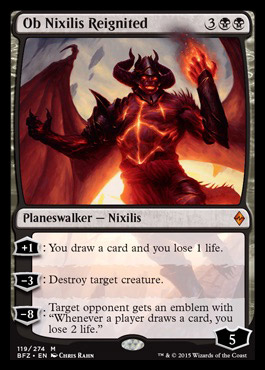
Ob Nixilis Reignited

ob nixilis reignited bfz spoiler

Ob Nixilis is an ally of Zendikar? Maybe when he reignited he started along a new path towards helping the plane of Zendikar, but I’m doubtful. When was the last time you trusted a demon to help you out of a situation? I wouldn’t be surprised if we see Mr. Ob betraying the allies in the end.

As far as the card itself, we need a lot of action for a five-mana planeswalker to make it in competitive play. Good old Ob does have some rather good abilities but I don’t know if they justify the steep cost.

To start, Ob Nixilis provides his summoner with a Phyrexian Arena. You won’t start this process until turn five when he is cast. Both the old Arena and Underworld Connections let you start drawing extra cards on turn four, and this is only a turn off from those known powerhouses. That’s a good start. We saw a progression like this when Elspeth, Knight-Errant followed up Bitterblossom and that one turn wait proved to be well worth it. Elspeth is regarded as one of the best planeswalkers of all time though but I doubt Ob will follow her to that list.

His second ability is solid as well, but we’ve seen a countless number of five-mana removal spells never come close to impacting a constructed format. Most recently we had Unholy Hunger printed in Magic Origins. If you told someone you were playing that card in a tournament, they would know that you are not likely to succeed. Ob does destroy a guy, then stick around to draw you more cards though.

What if we just +1 our way to more cards and then ultimate? Unfortunately, drawing an extra card per turn is way better than the potential emblem you could obtain. When an expensive emblem doesn’t win you the game or make it so your opponent can’t win, I always feel left out and let down. It’s nice though that his +1 is strong enough that we might forget about that little detail.

Over the past few years, Wizards has shown us that they are pushing midrange strategies. This planeswalker is the perfect addition to that strategy. If we have a deck like Abzan Control around post-rotation, Ob will have a home immediately and might be the most played ‘walker in the ‘verse.

It will be interesting to see where he ends up. I’m not sure how other writers will rate him, but I think at the moment I would classify him as an underrated hero. Since his first version, Ob Nixilis, the Fallen, I've always liked what he could do. Hopefully this time around, I'll be able to get him in play in Constructed and not just Limited.

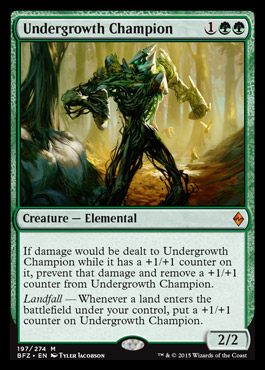
undergrowthchampion

Speaking of underrated heroes, my pal the new Vinelasher Kudzu should catch your eye because he’s full of potential. Undergrowth Champion is like Steppe Lynx or Plated Geopede stapled to a Phantom Centaur. Add to that the fact that this time around we have fetch lands to double up on counters. This is a solid threat that becomes a serious adversary as the game progresses.

Eldrazi Spawn and Devoid

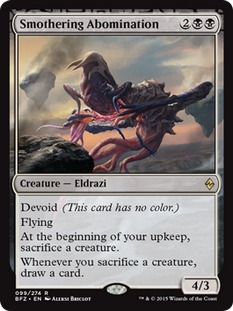
So far, the army of Eldrazi has yet to impress me. There have been some neat rares and they will be tons of fun in Limited but I haven’t seen cards that I thought would impact Standard yet. Smothering Abomination comes close, but we’ve seen lots of four-powered flyers overlooked for competitive play and one that dies to both Gideon’s Reproach as well as Draconic Roar doesn’t seem too appealing to me.

SmotheringAbomination

One aspect of these cards that my brain glossed over until now was that just like the Eldrazi army getting upgrades, so did their minions. Eldrazi Spawn used to be 0/1 creatures that you could sacrifice to get one mana. Now they are 1/1’s and that makes a huge difference. Suddenly we have this army of 1/1s instead of zero-power chumps and that is impactful. While none of the spoiled cards stuck out, the future might hold powerful token enablers that we can utilize.

Zendikar Expeditions Update

If you’ve talked to any Magic players lately, you know Zendikar Expeditions are on their mind. Last week, I spent some time doing some math and working through what the potential price projection might look like. My numbers were based on the premise that you are likely to open 2-3 of these cards per case.

By the way, make sure to get a full case if at all possible or split it with your friends so you don’t miss out on your cut of this cycle. If it turns out that the average is one per case, the number I discussed will be drastically different. Even if I am correct about the distribution, we don’t always think logically about Magic card purchases and that will certainly affect the price.

From reader and friend feedback, what I discovered is that everyone has a differing opinion about what these cards might be worth. I also learned that my prediction is the lowest by far. Everyone I have talked to about the matter has quoted me prices as high as $600 per land but most average about double what I set as my prediction. If you haven’t weighed in yet, let’s start the discussion in the comments below.

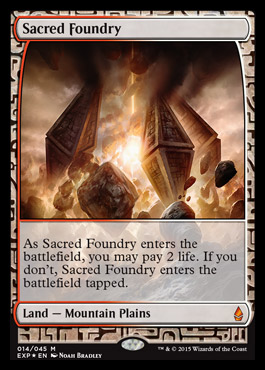
There is another reason that I wanted to bring up Zendikar Expeditions though and it’s one I’m not sure everyone is familiar with. Life has been busy lately so I haven’t been as active on social media as I normally am, so maybe you already know this. First, take a look at the latest addition to this cycle.

sacredfoundry

Now take a closer look and focus on something other than the amazing artwork and the insanely cool border.

sacred_foundry_14-45

That’s right. This is the 14th card out of 45!? We know that there are 25 lands in this cycle in Battle for Zendikar, but that means 20 more will be in the second set in the block! If the 10 fetches, 10 shocks, and 5 new duals weren’t enough, we’re going to get more awesome cards in the second set!

What could they be though? My friends have thrown out crazy speculation like sweet old lands getting reprinted, but I honestly have no idea what they could put in this spot. Maybe they would give us a cycle of manlands like the original Zendikar cycle plus the new Battle for Zendikar cycle. That would only account for half of the spots though. So, what do you think these mysterious 20 cards will be? Post in the comments below about the second set of the cycle as well as your predictions about the monetary value of the first half.

Until next time,
Unleash the Force of Battle!

Mike Lanigan
MtgJedi on Twitter
Jedicouncilman23@gmail.com

Insider: MTGO Market Report for September 9th, 2015

Are you a Quiet Speculation member?

If not, now is a perfect time to join up! Our powerful tools, breaking-news analysis, and exclusive Discord channel will make sure you stay up to date and ahead of the curve.

Welcome to the MTGO Market Report as compiled by Sylvain Lehoux and Matthew Lewis. The report is loosely broken down into two perspectives. A broader perspective will be written by Matthew and will focus on recent trends in set prices, taking into account how paper prices and MTGO prices interact. Sylvain will take a closer look at particular opportunities based on various factors such as (but not limited to) set releases, flashback drafts and banned/restricted announcements.

There will be some overlap between the two sections. As always, speculators should take into account their own budget, risk tolerance and current portfolio before taking on any recommended positions.

Redemption

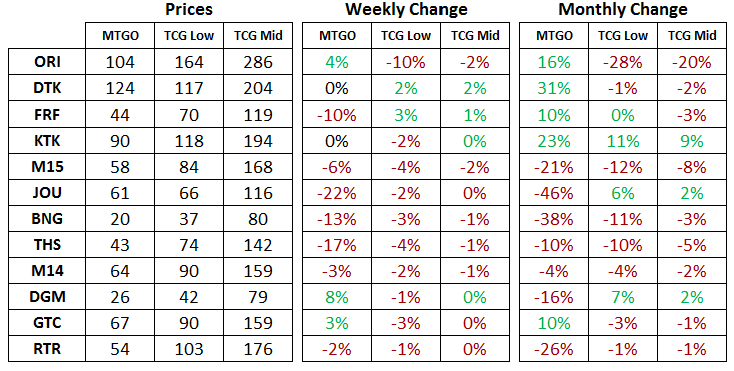
Below are the total set prices for all redeemable sets on MTGO. All prices are current as of September 7th, 2015. The TCG Low and TCG Mid prices are the sum of each set’s individual card prices on TCG Player, either the low price or the mid price respectively.

All MTGO set prices this week are taken from Goatbot’s website, and all weekly changes are now calculated relative to Goatbot’s ‘Full Set’ prices from the previous week. All monthly changes are also relative to the previous month prices, taken from Goatbot’s website at that time. Occasionally ‘Full Set’ prices are not available, and so estimated set prices are used instead.

sep7

Return to Ravnica Block & M14

Although redemption for RTR has already been cut off, it's almost time to remove the other sets from the price tracker as the redemption cutoff date of early November is looming for GTC, DGM and M14. After the release events for BFZ wind down in the middle of October, there will be one last chance to redeem these sets. It's typical to see a final bout of redemption-driven demand at that time. Any remaining positions in mythic rares that get most of their value from redemption should be sold by the end of October.

Theros Block & M15

Standard staples from these sets are bleeding value at a prodigal rate in recent weeks. Temple of Malady and Temple of Epiphany from JOU are two prime examples of this. Both have been over 10 tix in the last month, and both are now down to 3 tix. Do not expect an end to the carnage until Standard rotates in October.

There is some value starting to appear though as Xenagos, the Reveler is now close to 1 tix, which is not far off of the 0.8 tix level that Gideon, Champion of Justice of GTC reached last year. Both planeswalkers are similarly unplayable in Modern, so the price trajectory of Gideon is a good estimate for Xenagos. If Xenagos reaches 0.8 tix or less, don't hesitate to start accumulating this card.

The price of M15 is holding up better than THS has been, partly as a result of featuring the enemy-coloured pain lands. Since these are also present in ORI, they will maintain their Standard utility and thus contribute to M15 holding more value than it otherwise would have if the entire set was rotating out of Standard. This also means that M15 will end up having a different level of demand from redeemers than THS. Speculators should approach M15 cautiously until it rotates out of Standard, though junk mythic rares are still a good buy if they reach 0.4 tix or less.

Tarkir Block & Magic Origins

The paper price of ORI took its first big hit in the last week. As more sets are redeemed, the digital and paper prices will continue to converge. In the near term, this means that paper sets will be getting cheaper, but when BFZ is released and drafters switch formats, there will be upward pressure on the digital price of a set of ORI. Speculators should still be targeting cards from ORI, but with some eye to BFZ and the need to be liquid during release events.

The Tarkir block sets saw mostly positive price changes in paper, with TCG Low for KTK being the one exception. Although it is foolish to try and definitely declare a bottom or a top without the benefit of hindsight, it does appear that the paper prices on these sets will not be heading lower. This will set the stage for broad price increases for the MTGO versions, once the dust settles on the BFZ release events. Patient speculators who were acquiring cards from these sets earlier this year will be able to reap decent gains into the winter.

Modern

On average Modern positions keep cruising up this month although at a rather slow pace. Modern Masters 2015 prices went up by about 15% over the last four weeks and should gain about the same percentages before the release of BFZ on MTGO.

This past weekend the SCG Modern Open saw Todd Anderson win an Infect mirror match in the finals and put a Slivers deck in the Top 8. Although this is not the first time a Slivers deck featuring Collected Company has been seen in Modern at this level of the competition, it gave Sliver Hive, Sliver Hivelord and a flock of other slivers a huge boost. A boost that is not, however, likely to sustain even in the short run.

September is usually a month of contraction for Modern and consequently also a month of sale. As observed during the past few years, the release of the fall set marks a clear decline in Modern prices with players redirecting their wealth to a brand new Standard.

However, if the trend and timing are well identified, individual Modern positions will not all behave the same at the end of September. Some positions might tank before, some later, and some not at all. It is therefore a good speculative decision to sell, even with moderate profits, in order to reinvest into other buying opportunities happening this month. As mentioned several times, ORI rares and mythics represent great buying opportunities these days, opportunities worth selling Modern positions for.

In this report we try to provide guidelines and buy/sell recommendations to the best of our knowledge and research. We also encourage speculators to make their own educated decisions, according to their bankrolls, portfolios and personal preferences.

For instance, several MM2 positions, including Leyline of Sanctity, Spellskite, Daybreak Coronet and Hurkyl's Recall, have topped their first MM2 spike that occurred earlier this July. It may be time to sell these and to move on to other speculative targets. Alternatively, waiting a few more weeks could increase margins and should also be considered a well reasoned decision.

Legacy & Vintage

Legacy positions remain mostly unchanged again this week. The Legacy Price index is stable for the past three to four weeks now and hasn't really recovered from the small dip recorded during ORI release events. In the grand scheme of things prices remain very stable and are, on average, slightly below their three-year average. Hopefully, the upcoming Legacy MOCS in November will drag several positions up during a window Legacy speculators don't want to miss.

After hitting an all-time low about a month ago, Vintage prices, and more precisely P9 prices, have currently rebounded by about 15% in average. Prices still remain below their pre-ORI levels and nothing indicates that the general downward trend is coming to a halt. Vintage remains a poor place to invest on MTGO.

Pauper

Pauper continues to show signs of a healthy and dynamic format in terms of price fluctuations, which is a good indicator of speculative opportunities. This being said, the combination of sometimes rapid price fluctuations and a greater average spread than Standard or Modern positions prevents the margins from being as spectacular as one may think by looking at price charts.

Here again it is up to each individual speculator to take action. The weekly publication of this report often renders potential Pauper recommendations inadequate. Pauper speculations can nonetheless generate a constant stream of Tix for small bankrolls and speculators willing to pay attention to daily price variations.

Targeted Speculative Buying Opportunities

None

Targeted Speculative Selling Opportunities

Modern

MM2 Leyline of Sanctity
MM2 Hurkyl's Recall
MM2 Daybreak Coronet

Succeeding in Modern

Are you a Quiet Speculation member?

If not, now is a perfect time to join up! Our powerful tools, breaking-news analysis, and exclusive Discord channel will make sure you stay up to date and ahead of the curve.

Magic has seen unprecedented growth over the last five years. Every year more and more players pick up the game, buy cards, and attend events. The logical first step is Standard with its smaller card pool and cheaper barrier to entry. With Modern being perceived as the “supported” eternal format between Modern Masters and active Banned List management, however, we are seeing more players take the jump into Modern. The problem even for longtime players is that this is quite the jump. According to Gatherer, Standard’s current card pool is 1,707 cards. Modern has 9,271! In addition to the sheer volume of cards the speed and interactivity of the format is much greater than Standard.

TFK

Newer players can easily become discouraged by this, but the transition from Standard to Modern does not have to difficult. A little knowledge of the card pool, adjusting to and accepting the unique aspects of Modern, and practice go a long way to breaking down the barrier and bringing players into Modern.

[wp_ad_camp_1]

Thirst for Knowledge

The most intimidating step in becoming a Modern master is learning the cards. The format is huge and there are hundreds of commonly-played cards and thousands more that are playable. Knowing the possible contents of a given deck is an important step to succeeding. Not knowing what your opponent is going to do or could have in their hand puts you at a giant disadvantage. A good start is looking at every tier 1 and tier 2 deck in the metagame and learning every card. Once you have a good idea of the cards that get played you will know what to expect when facing a given matchup. You'll have at least a general idea of what the opponent is trying to do and the cards they could have to disrupt your plan. Narrowing down the possible cards an opponent could have is a skill that takes time to learn but is invaluable since it lets you play around specific scenarios and allows you to win more games. However, this has its limits. If you are playing a  Splinter Twin mirror and your opponent has two mana up they could be representing a dozen cards. Knowledge of the possibilities is not enough, you need to put some time in to learn the specific cards that your deck cares about and how to play against them. A recurring theme of this article, and of Modern in general, is you have to master your deck.

Card Interactions

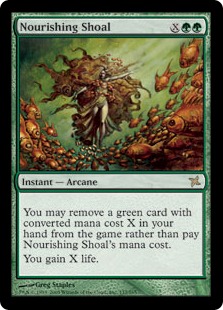
On a similar note it is essential to learn how your cards work against the opponent and with each other. With so many cards in the format there are interactions that no one ever expected or saw coming. Lantern Control could have existed for years but nobody saw it until Zac Elsik made Top 16 at Grand Prix Charlotte. It has taken years for players to realize that Nourishing Shoal plays wellNourishing Shoal with Griselbrand. What about Ghost Quarter? Everyone assumes that it exists to break up the Urzatron or kill Amulet's bouncelands. Did you know you can Ghost Quarter your own land to escape from color screw? You probably did and yet I constantly see players new and old alike forgetting and leaving themselves color deprived and unable to play. Many also forget that they can respond to a fetchland in order to dodge countermagic while the needed land is in “limbo”.  These little things put you ahead every time, and over a game can change the outcome. Examples from my primer series include Deceiver Exarch and Vedalken Shackles to fog and opponent's attack step and Vialing in Phantasmal Image to stop a Splinter Twin kill. Speaking of Twin, when was the last time you read that card? Did you notice that it is an activated ability that can be stopped by Pithing Needle or Phyrexian Revoker? And these are just from commonly played cards. Who knows what is lurking in the massive Modern card pool! The best advice I can give you is to learn your deck, and know all the ways your cards interact, as some of the instances will only pop up once every 30 games. When they do come up though, making that play may be the difference between a win and a loss. Again, true mastery only comes with playing a deck for a long period of time. The best way to get an edge in Modern is to learn your deck inside and out and know how to recognize and utilize unusual interactions.
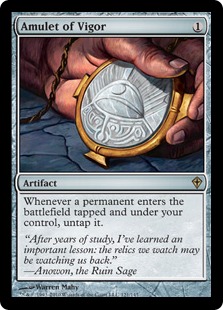
Metagaming

Thanks to the massive card pool metagaming in Modern is many times more difficult than in Standard. In Standard you usually have 5-10 played decks who change position and viability based on last weeks “best” deck. You can look at last week’s results, and plan ahead 1-2 weeks to “beat” the meta. Modern has much slower, gradual shifts. With far fewer large Modern events, you have fewer results to evaluate. The metagame breakdowns we do on the Nexus are month to month, and even then we only see a shift in a few percentage points. If you look at last month’s breakdown, the biggest change was less than 2%. Not only does the cost of entry affect this (not everyone has a playset of the most used cards and can switch at will), people usually (correctly) stick to a deck for longer periods of time. The time it takes to get good with one deck makes switching based on perceived shifts in the metagame difficult and costly. Coupled with the extremely large amount of tier 1 and 2 decks, someone coming from Standard who's used to metagaming week to week will struggle and be frustrated by how difficult this is. Even if you want to switch, trying to make this decision based on the metagame is almost impossible. I went into my WMCQ this past weekend expecting a large amount of Grixis – and played it zero times! In fact, according to last month's Modern tier 1 breakdown, after six rounds I had played against only one tier 1 deck. There simply isn't enough of an edge to be gained from metagaming as there is from choosing and mastering one deck.

Going Rogue

amuletConversely, Modern rewards rogue decks far more than Standard ever could. Remember how massive the card pool is? Or what I said about Lantern Control? With so many cards in Modern, it is tough to know exactly what to expect – and that’s with the most played decks. If you're willing to go outside of them and Explore, anything is possible. Modern is a brewer's paradise and if you put the time in to tune and master your deck you will be rewarded when players have no clue what you're doing and cannot interact with you. The success of Amulet Bloom, Grishoalbrand, and Lantern Control all stem from players knowing their unusual decks and confusing their opponents to death. Justin Cohen played and tuned his Bloom list for years before his breakout performance at PT Fate Reforged. Meanwhile I doubt many of opponents understood his deck enough to find a way to win, even though Bloom was a known deck for years on MTGO and metagame forums. Imagine how confused Zac Elsik's opponents must have been as he took control of their deck with Lantern of Insight.
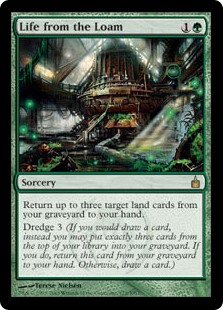
Life from the LoamWould you play around a turn 2 Smallpox? Would your opponent know to? It is also possible to gain wins by deceiving your opponent into thinking you're playing a tiered deck when you're actually playing some off the wall brew. When most players see Urza lands they think Karn, and so won't be ready when you Open the Vaults. Being able to do things your opponent is not expecting is the easiest way to gain an edge in Modern. There are only 15 sideboard slots and upwards of 20 known viable decks at any given time so being unexpected can completely invalidate an opponent's entire sideboard. Of course, don't play a deck that in reality isn’t powerful outside of being unknown. Instead learn exactly what your unexpected deck needs to do to succeed, tune and test well, and you can take a room by surprise when you show up with a Life from the Loam deck and they left the graveyard interaction at home that week.
Sideboarding

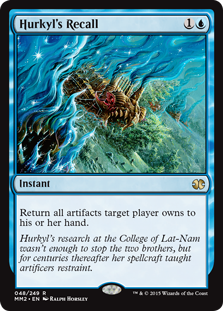
Hurkyls RecallThe biggest mistake I see players (new and old alike) make is how they build a sideboard. Many players make or pick a deck, build the 60, and then think about the sideboard. I consider a deck 75 cards. The deck needs synergy across the board, and without this you have an awkward sideboard that doesn’t do what you want it to do. That sentiment rings true for Standard, but is even more important for Modern. With only 15 cards for the sideboard and dozens of known viable decks, it’s hard to cover every matchup you need, especially with how poor some decks matchups are. For example, Merfolk has an abysmal Affinity matchup. I would consider it 80/20 in Affinity’s favor. Your first reaction is probably “I need four Hurkyl's Recall since this matchup is awful” and you jam in four without even thinking. You’ve just used a quarter of your sideboard to shore up one bad matchup. While it does improve the matchup, not only does it not put it above 50/50, the card is extremely narrow – you’d be hard pressed to find another deck in Modern you’d bring REcalls in against.
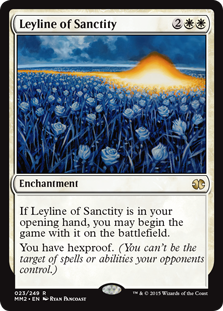
Leyline of Sanctity MM2015One option, which I'll talk about below is to just ignore bad matchups. The other is to fill your sideboard with cards that are less powerful hate cards but are better in more matchups. For example instead of playing the narrow but very powerful (against only Affinity) Hurkyl's Recall I could have splashed white and played Stony Silence which is also good against Tron, Eggs, and Lantern Control. Against Burn, a card like Kor Firewalker may be extremely powerful, but too mediocre against everything else. Leyline of Sanctity is a better choice since it is also usable against Storm, Ad Nauseam, and Jund's discard. Flexibility is key! The more flexible your sideboard is the more likely that it will be usable against every matchup.  Go for format coverage first and foremost, and then worry about any extremely poor matchups.

Unwinnable Matchups

As mentioned in the sideboard section, some decks just have near unwinnable matchups. Like Merfolk versus Affinity, some decks just have another deck that trumps them. Don’t let this discourage you from a deck or archetype. As I mentioned, I played Affinity zero times this past weekend – easily my worst matchup and probably (outside of very good draws for me and bad draws for them) an auto loss. With a format as wide open as Modern is, don’t let a bad matchup keep you off an otherwise good deck. You may never play it. Even if you do, your opponent might not be playing a version that is as good against you. Small changes in card selection from personal preference or metagaming can have a huge effect. On the flip side, some people will just over-sideboard for the bad matchup, which is usually a bad idea.

ShatterstormDon’t lose any sleep if while playing Affinity your opponent casts their fourth Shatterstorm. Some people dislike losing to specific decks, and you can take solace in the fact they put themselves at a large disadvantage against the rest of the field. Take my WMCQ experience. If I had included four Recalls, a quarter of my sideboard wouldn’t have left my deck box! In Standard the field is small enough that you need to have a plan to beat every deck since you're likely to see every one in a tournament. In Modern, it is okay to sacrifice a matchup and just hope to dodge it in order to increase your game against the rest of the field. Dropping those four Recall allowed me to play four other cards that I brought in against three decks that day, and arguably won me some of those matches. You can and should sacrifice terrible matchups if it helps you win more against better ones.
Winning in Modern doesn’t have to be hard. While it takes a lot more dedication and  Magic knowledge, it’s still a format that can be beaten once you master your deck and learn format. Writing this article has even opened my eyes to some things I have let hold me back in Modern, so take solace that even people playing the game for over 10 years still have room to improve! As always, let me know in the comments if you think I missed anything. Also, I’m hoping to go back and do some more in my primer series in the next few weeks, so am looking for some suggestions on which deck to do next!


Insider: MTGO Foil Mythics, Part 1 – A Surprising ROI

Are you a Quiet Speculation member?

If not, now is a perfect time to join up! Our powerful tools, breaking-news analysis, and exclusive Discord channel will make sure you stay up to date and ahead of the curve.

When I got started with speculating on MTGO, it was thanks to Sebastian Park (aka Runeliger) and the late Erik Friborg (aka Hamtastic) on their Freed From the Real podcast over at puremtgo.com that I clued into some of the cyclical pricing patterns of the MTGO economy. They didn't provide a deep explanation of the patterns, just a 'time to buy/sell this type of card', so this left me with a nagging question. Where did these patterns come from?

There's nothing better than learning by doing, so I dove in, and followed their advice to pick up cards from Shards of Alara block after they had rotated out of Standard. I bought twenty copies of Thornling. I liked the card, and to me it seemed too cheap! Months later I turned a modest profit, but I still didn't understand what had happened to make this card rise in price.

Over the course of that winter I joined Quiet Speculation and I started to think more and more about the MTGO economy and why my purchase of a random Conflux mythic rare had turned into a somewhat larger amount of tix. With the QS forums, I had come to a place where I could discuss and develop my ideas, and it wasn't long before I proposed a very specific speculative strategy in the forums. You can read it here, but the backbone of the strategy was the theory of redemption. The journey from buying (and profiting) on Thornling had led directly to me recommending people buy a junk mythic rare from Scars of Mirrodin, Quicksilver Gargantuan.

That series of events would wind up inspiring me to share what I had learned and I started writing for QS. One of my early articles laid out exactly why redemption is so important to the MTGO economy.

Recently I've been turning my attention to another puzzling pattern. Once again, the process started out with me making a somewhat blind purchase. I had no theory and no good explanation for what I was doing; I just had a hunch that the Khans of Tarkir foil mythic rares were good value. I detailed exactly what I was doing in the forums, and the feedback from that exercise helped me to further refine the theory of redemption, this time applied to foils. As usual I owe a thanks to the forum users, but a special thanks goes to forum member Casey Stewart of The Card Nexus for his sharp analysis and on-point comments on this matter.

That particular strategy of buying KTK foil mythic rares ended up working out very well, and much quicker than I had imagined it would. But the success of the strategy just forced me into asking more questions and to thinking about why it had worked. It turns out I am not the only one who has been puzzled by the price of foils! Noted Magic Online player Bing Luke posted this from his Twitter account earlier this week.

Bing

He makes a statement that the pricing on foil mythic rares is apparently random. But after developing my ideas around how the price of MTGO foils develop over time, I would argue it is only seemingly random and that there are simple processes at work which yield irresistible conclusions. A deeper dive into the nature of the MTGO economy will reveal those dynamics and provide a very useful speculative strategy.

For good measure, here's another recent screen shot, this time from Goatbot’s website.

foil

Both of the above screen shots generate some interesting questions, but let's examine the price list and see if we can discern any patterns. At the top of the list, it's no real surprise that Jace, Vryn's Prodigy shows up as the most expensive foil. But sitting just beneath that card is Woodland Bellower. Further down the list, Kytheon, Hero of Akros is tied with Chandra, Fire of Kaladesh for cheapest foil mythic rare. This list seems to confirm Luke's assessment of mythic foil pricing as being somewhat random, and more questions immediately spring to mind.

Why is Goatbot buying Woodland Bellower for 17 tix? Surely it's not worth more than double the value of Kytheon, Hero of Akros or Chandra, Fire of Kaladesh? Why do some foils have a premium relative to their non-foil counterparts, when the foil version of Jace is nearly the same price as the regular version? These are the types of questions that, when answered within a solid theoretical framework, can provide a benefit for players and speculators.

~

The key to understanding these questions is the theory of redemption. Come back on Friday for Part 2, when I'll explain the basic tenets of redemption and how it applies to foil mythic rares.

Click here for Part 2

Modern Metagame Breakdown: 8/1 – 8/31

Are you a Quiet Speculation member?

If not, now is a perfect time to join up! Our powerful tools, breaking-news analysis, and exclusive Discord channel will make sure you stay up to date and ahead of the curve.

Modern offseasons lead to weird metagames. Following the nonstop action in the June Grand Prix circuit, Pro-level Modern mostly wound down for the rest of the summer, a lull broken only by the SCG Modern Open in Charlotte. August saw a ton of PPTQs, IQs, and other regional events, but each had a different local flavor and metagame character. MTGO Dailies continued to fire, but with lower attendance than we have seen since 2012. Overall, these were the broader event-level factors which shaped the tier 1 and tier 2 decks throughout August. The results are a mix of familiar faces (Burn always prevails in an offseason) and some strange shifts that may or may not be a sign of things to come (Twin? Where art thou?).

Skullcrack Art

GP Oklahoma City is coming at the end of September, along with all the goodies we are still unwrapping from Battle for Zendikar: enemy manlands, here we come! Going into the GP alone, it's important to know what you are up against and how you can get ahead of the metagame. This article breaks down the big happenings from August so you are ready for Modern events throughout September.

[wp_ad_camp_1]

Tier 1 Decks

Metagame stats can take weird twists and turns during offseasons, and it's up to us to figure out if those fluctuations matter in the long run or if they are just temporary shifts. I don't remember a metagame breakdown that exemplified this more than our current one. With Origins added to the metagame and the June GPs over two months old, the metagame numbers were bound to exhibit some movement. I didn't expect this much movement, however, and we'll need to take a step back to see how these numbers fit in the broader metagame context.

As a quick reminder, these are prevalence-based tiering statistics: tier 1 decks should be considered as decks you are likely to face in tournaments and decks you are likely to bring to a Top 8. With that in mind, here are the tier 1 decks from 8/1-8/31.

Deck nameOverall
Metagame %
MTGO %Paper %Major Event
Day 2 %
Burn8.7%9.7%8.1%8.4%
Jund7.3%5.8%9.4%6.7%
Affinity6.9%7.1%8.6%5%
Grixis Control6.2%7.4%3.7%7.6%
Merfolk5.5%5.8%5.7%5%

At first glance, that probably seems like a Modern Usual Suspects list, full of mainstays like Merfolk, Affinity, Burn, Twin... wait a second. Where's Twin? Where's any Twin variant? When all the metagame dust settled at the end of August, there wasn't a single Twin deck that was even close to cracking the tier 1, prevalence-based cutoffs. Not even UR Twin, a Modern tier 1 regular for years, had the stats to cut it over August. Although the remaining tier 1 decks stayed roughly where they were in the 7/1-7/31 breakdown, the absence of Twin is jarring. To give us more metagame context, here's a table tracking the prevalence trends for both Twin and the other tier 1 decks. Take note of the huge drop in Twin we saw in August.

Deck nameMeta% change
(July to August)
Meta%
(8/1-8/31)
Meta%
(7/1-7/31)
Meta%
(6/1-6/30)
Meta%
(5/1-5/31)
Jund-1.6%7.3%8.9%8.8%5.4%
Affinity-1.5%6.9%8.4%8.5%5.8%
Burn+.6%8.7%8.1%8.5%7.9%
Grixis Control+.7%6.2%5.5%4.7%.8%
UR Twin-1.8%3.5%5.3%5.1%8.5%
Grixis Twin-.6%4.2%4.8%5.5%3%
Merfolk+.7%5.5%4.8%3.3%3.1%

There are a few other metagame points to discuss with respect to the tier 1 decks, but the Twin developments are by far the most interesting. Let's start with Grixis Twin. Tasigur and company enjoyed Tasigura lot of success in the June metagame, but has been declining gradually ever since. Given the deck's poor conversion rate from Day 2 to Top 32 at GP Charlotte, this overall drop makes perfect sense. Grixis Twin had a lot of hype going into Charlotte and, as is often the case with hyped decks, the deck wasn't as strong as its Day 2 turnout suggested. Players either realized this through internal testing or through looking at June Grand Prix results, because Grixis Twin saw consistent .6% share decreases in both the July and August metagame periods. Or maybe players were still bringing Grixis Twin to events and simply weren't getting to the top tables. A more plausible explanation is the parallel rise of Grixis Control, the "better" Grixis deck. Grixis Control saw an uptick in the past month, and some part of that was likely Grixis Twin converts. All of these factors shouldn't come as much surprise to anyone who has been following the metagame. These drops are also characteristic of offseason metagames, where prevalences tend to normalize around decks in the 8% range. By contrast, an on-season metagame can see decks polarize in the 10%-12% range based on a few high-profile finishes. Grixis Twin is a victim of this offseason normalization, in addition to those other factors mentioned above.
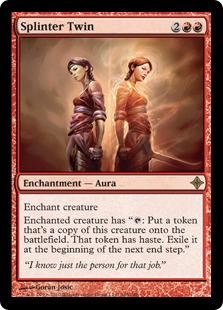
Splinter TwinThen comes UR Twin. Although the traditional blue-red combo deck saw a huge drop between May and June, it was still hovering around the 5% range since then, even increasing slightly from June to July. Given UR Twin's longevity in Modern, this is about what we would expect of UR Twin in an offseason. It's a reliable fallback, but for every player who gravitates back to Twin, there's at least one more who wants to try something new out. Based on that model, we might expect Twin to stay in the 5%+ range, or even fall down to the high 4% range. Instead, Twin plummeted to 3.5%, which doesn't even make it the most-played tier 2 deck, let alone worthy of tier 1 status. At first, I thought this might be a consequence of a small sample size, but that is only partially supported by the data. On the one hand, our MTGO numbers have gotten worse and worse by the week, which Daily attendance hovering in the 8-10 player range (down from the 25-30 range in June). On the other hand, August saw more paper events (about 170) than any previous metagame breakdown period, and paper numbers are some of Twin's lowest.
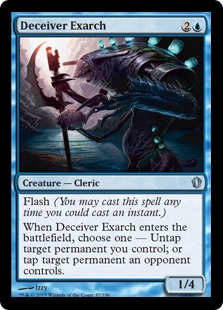
Deceiver ExarchOf course, another important reason for UR Twin's drop is its terrible showing at SCG Charlotte, where it only sent a single representative to Day 2. I considered writing this off as a one-time fluke due to bad pairings or some other tournament misfortunes, using an adjusted Day 2 metagame prevalence instead. Unfortunately, even this wouldn't have elevated UR Twin to tier 1. This .8% SCG Open prevalence also reflects (and, to some extent, exaggerates) the deck's metagame-wide drop, and was confirmed in top-table results at Worlds, the SCG Open itself, and some of the larger Italian and Japanese events. Based on this narrative and the events throughout August, it really does seem like UR Twin doesn't have what it takes to be considered tier 1 for this update, even if this might change once GP Oklahoma City rolls around.
Before we move to tier 2, here are a few observations on the other tier 1 decks' August movements:

  • Eidolon of the Great RevelBurn decks often do well in an offseason, and August was no exception. It's linear and consistent enough to succeed in unknown metagames, cheap enough to attract new players entering the format at the local level, and versatile enough to adapt to different opponents. It struggles at larger events with too many rounds (Burn can only do so much against dedicated hate), but in the 7-8 round events like those dominating August, Burn is a great choice. This is an interesting datapoint for the future, because it suggests we should bet on Burn during Modern offseasons.
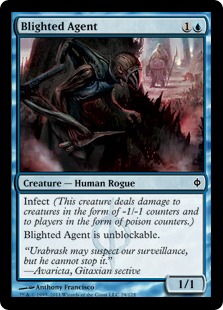
  • Grixis Control continued its rise to the top, outpacing Merfolk and further cementing its status as a major format player. There was perhaps no stronger indicator of this than the Worlds 2015 metagame, which might seem odd because there wasn't actually any Grixis Control present at the event. Reading between the deck choices, however, we see a metagame built around fear and respect of the Grixis Control matchup. Coupled with the deck's broader success in paper, its continued presence on MTGO despite the decline in Daily attendance, and its strong SCG Charlotte showing, Grixis Control is sure to remain a top deck for months to come.

It's worth noting that Jund suffered a steep drop of 1.6% from July to August, even if I don't think this indicates anything more than a Modern offseason in action. Affinity saw a similar drop, but this happened in the context of Affinity being the best deck at Worlds 2015. These drops are expected in offseasons and we shouldn't read too much into them. I imagine both decks will be strong choices for GP Oklahoma City. Then there's Merfolk, a deck I predicted would be a top four deck in my last breakdown. We'll come back to my disappointing fish-friends after we look at tier 2.

Tier 2 Decks

Modern offseasons have a similar effect on tier 2 decks as they do on those in tier 1. The tier 2 options tend to open up in months like August, with more decks showing up as metagames are defined more by local options and less by major tournaments. In the 7/1-7/31 article, we had only 11 decks in tier 2. Today, we are up to 15, including poor UR/Grixis Twin and some rising stars from tier 3. The table below reflects August's tier 2 metagame. As in past articles, I consider "tier 2" to be those decks which you can win tournaments with and may see at events, but do not need to specifically prepare against.

Deck nameOverall
Metagame %
MTGO %Paper %Major Event
Day 2 %
Grixis Twin4.2%3.2%3.5%5.9%
Infect4.1%3.9%3.4%5%
RG Tron3.5%3.9%4.1%2.5%
UR Twin3.5%5.2%4.5%.8%
Abzan Company3.1%1%4.2%4.2%
Grixis Delver3.1%2.9%2.3%4.2%
Abzan3%2.3%2.5%4.2%
Naya Zoo2.8%.6%2.6%5%
Scapeshift2.5%4.2%.9%2.5%
Elves2.3%1%2.6%3.4%
Ad Nauseam2%1.3%2.1%2.5%
Bogles1.9%1.9%1.4%2.5%
UWR Control1.9%1.9%1.2%2.5%
Temur Twin1.8%.3%1%4.2%
Amulet Bloom1.7%2.3%2.1%.8%

I'll say one last word (promise!) on Twin's August decline before moving to the other tier 2 developments. With all three Twin archetypes down in tier 2, you should be preparing for any Twin deck, not just a specific representative. Indeed, looking at SCG Charlotte results, it was Temur Twin that was the breakout Twin deck of choice. Grixis Twin may have had more showings, but its 5.9% Day 2 share was comensurate with its metagame-wide prevalence. Temur Twin, by contrast, shot up to a 4.2% Day 2 share, far higher than its 1%-2% share in the normal paper metagame. This doesn't mean any one of Temur, Grixis, or traditional UR is necessarily better than any other. It does mean the metagame is open to different Twin variants, so you'll need to consider all of them in your own testing.

August's big tier 2 winner was Infect, and as I'm going to talk about in my Metagame Predictions section, I think this is only the beginning of Infect's return to glory. Infect tends to do well in overly fair Blighted Agentmetagames where players are shifting towards grindy, midrange contests. This was exactly what happened back in February 2015 during PT Fate Reforged when pros got ahead of the Abzan-clogged field with some strong Infect finishes. It's true that our current metagame isn't quite as vulnerable to Infect as the Lingering Souls/Path to Exile/Siege Rhino-defined format of February. It's also true, however, that players are more prepared to outgrind Jund and Grixis Control than they are to handle small Infect swarms. The big difference today is the prevalence of Lightning Bolt, which was relatively underplayed back in February. Even decks ignoring Infect are still playing their Bolts, so there's probably a limit to how high Infect can rise. I do expect it to keep moving up through the ranks, and if the deck's metagame-wide pretrends are any indication (not to mention its strong performance at the SCG Cincinnati Modern Open, where two of its three players made the Top 8) , we'll be revisiting Infect in early October.
Slippery BogleTurning to the offseason tier 2 winners, we see some movement in decks like Bogles, Ad Nauseam, and UWR Control. These kinds of decks tend to thrive in Modern offseasons and quickly fall away once metagames re-polarize back to the tier 1 fallbacks. Bogles is a prime example of this and is exactly what we expect of players metagaming against Grixis Control, Burn, and Affinity. Some interesting Worlds decks also made movement (UW Control, Living End, BW Tokens), but not enough to get them into tier 2: they don't have the metagame-wide numbers to justify their promotion. I expect many of these decks to fall back into the lower-tiers after September, and although something like UW Control might continue to rise, our 9/1-9/31 breakdown will likely see a tier 2 more similar to that discussed in the 7/1-7/31 writeup.
Final thought on tier 2: Modern's super scary combo decks continue to struggle even in the offseason. Amulet Bloom saw a 4%+ metagame Goryo's Vengeanceshare back in July along with lots of GP play from the previous month. Looking back over August, the deck crashed down to the 2% range and saw only a single player during SCG Charlotte's Modern Open. Grishoalbrand did even worse, falling out of tier 2 and seeing less play than even Amulet Bloom. We would expect broken decks to fare well in offseasons when players forget about the matchup and experiment with decks that might be ill-equipped to handle the low-interaction linearity of Amulet/Grishoalbrand pilots. Instead, both decks crashed, which indicates to me something we've secretly (or not so secretly) known since June: these decks are strong but not nearly as broken as many make them out to be. If anything, the recent ban announcement should have emboldened players into investing in these decks, knowing that they survived a ban during a time full of torches and pitchforks. The continued mediocrity of Amulet Bloom and Grishoalbrand suggest that these decks are much tamer fixtures of the metagame than many believed. They'll definitely be back, but they'll also definitely fall out again as players police them.

Modern Metagame Predictions for 9/1 - 9/31

Sometimes we knock the predictions out of the park. Other times, we fall a bit short. This was one of those "falling short" months for the metagame predictions, although I wasn't as far off on Merfolk as I was on Kiki Chord. Before we get to the metagame predictions for next month, let's reflect on the ones I made in the 7/1-7/31 article.

  • Harbinger of the TidesMerfolk rises to a top four deck? Nope.
    It was so close too! Merfolk shot up by .7% between July and August, surpassing both Grixis Twin and UR Twin and closing the gap with Modern's big three (Jund, Affinity, and Burn). Then came Grixis Control. Those darn Grixis players also brought their deck up by .7%, matching Merfolk's rise and keeping the Lords out of the coveted top four position. Jace, Vryn's Prodigy was partially to blame for those, drawing attention to the deck and keeping hype around Grixis high. The Grixis deck is also just a very strong deck in its own right, and I think its ability to succeed off synergies around Snapcaster/Command/Bolt/Angler is greater than Merfolk's current potential to swim to the top. I expect Merfolk to stay in tier 1 for at least a few more months, but I also don't see it dethroning Grixis Control for the foreseeable future.
  • Chord of CallingKiki Chord rises to tier 2? Nope.
    I don't think I missed too badly on the Merfolk prediction: it still went up by one slot and did enjoy a sizable increase in the metagame update period. Kiki Chord is another story. The deck stayed at its 1% metagame shares for both paper and MTGO, exhibiting virtually no movement despite plenty of online buzz around the deck. Jeff Hoogland definitely did his part in promoting and piloting the deck, Top 8ing with Kiki Chord in three separate tournaments throughout August. Unfortunately for Kiki and fans, not a lot of other players caught on to the deck, or maybe they did and didn't crack Top 8 at their respective events. It's possible the deck is missing something to make it big, in which case we are unlikely to see Kiki Chord enter tier 2 until after a set or two.

I'm bummed by Merfolk's falling short in tier 1, but think we will have some exciting metagame changes over September. Affinity's looking hot-hot-HOT right now, and we still have the Abzan vs. Jund conflict to play out (hint: so long as Affinity is a thing, Jund is going to win this battle). GP Oklahoma City is going to be huge in shaping the September and post-September metagame, and here are two predictions I think will come out of this upcoming month.

  • Inkmoth NexusInfect will return to tier 1
    Looking only at the August pre-trends alone, Infect is making a comeback that could easily tip it into tier 1. Adding in the broader metagame trends (Infect is strong against all sorts of random unfair decks and decks that are too grindy) and the deck's awesome performance at SCG Cincinnati, and you have a formula for a very strong deck over September. I don't think Infect is going to take over the format or even necessarily surpass Merfolk. That said, I do see it crossing that tier 1 prevalence-based threshold following a (hopefully) commanding performance at GP Oklahoma City. Be prepared for the eventual Infect matchup by packing efficient, Bolt-style removal and by not trying to do anything too crazy with Grishoalbrand, Amulet Bloom, Ad Nauseam, or other decks that are going to get run over by 11/11 Inkmoths.
  • Supreme VerdictUW Control will rise to tier 2
    Modern players have been trying to get UW Control to work for years, notably following Gabe Nassif's UW Control list from PT Valencia in 2014. Yuuya Watanabe did well at Worlds 2015 with his own UW Control version, which followed another strong UW Control finish at SCG Charlotte by Michael Segal. That's a lot of UW Control in the air, and it comes alongside a 3% MTGO prevalence and a 1.4% paper one. These stats place UW Control just outside of tier 2 range and I can't imagine this deck stays underplayed for much longer. SCG Cincinnati already saw a few UW Control players in the Top 8/16, and it will be impossible for control fans or players looking for techy new decks to not take notice. I don't know which UW Control version is best (Dragonlord Ojutai? Emeria, the Sky Ruin?), but the deck as a broad classification is going to have a great September and you'll be getting ahead of the game by playing it (or preparing for it) right now.

That's all for the September update. Let me know in the comments what you think of the metagame stats and the analysis. Are there trends I missed? Decks that need more discussion? Predictions of your own for September? Starting next week we'll be doing a lot more Battle for Zendikar-focused articles, so let's get excited for those enemy manlands and more Allies as we head into September.

Insider: MTG Stock Watch for September 8, 2015

Are you a Quiet Speculation member?

If not, now is a perfect time to join up! Our powerful tools, breaking-news analysis, and exclusive Discord channel will make sure you stay up to date and ahead of the curve.

Welcome back, readers, to another installment of MTG Stockwatch. I'll continue with the formatting change I implemented last time as I think it's simpler and cleaner then the previous ones.

Winners

1. Jwari Shapeshifter (+262.4%) - Ryan Overturf wrote a quick blurb about this buyout last week. It seems that the hype train regarding allies has left the station and this was the best option near bulk prices.

The allies spoiled so far don't really make the Allies archetype viable in Modern, but Shapeshifter does have several appealing factors going for it. It's a blue two-drop clone (we've seen how powerful Phantasmal Image was) and a rare from Worldwake, which outside of Jace, the Mind Sculptor, didn't really draw people to cracking a whole lot of packs at the time.

If Allies does become Modern-viable it's highly likely that this and Haribaz Druid (the other ally that got bought out) will find a home in the deck. I think that with the past weekend's success of Modern Slivers, there are brewers trying to do the same thing with allies.

2. Shaman of Forgotten Ways (+97.2%) - Last week we had See the Unwritten and this week we get Shaman of Forgotten Ways as our "BFZ Standard" hype gainer of the week. The main draw for this so far is that we haven't see any mana dorks in BFZ yet, and with Sylvan Caryatid and Elvish Mystic rotating out there will be very limited options in that department. The two best ones right now are Rattleclaw Mystic and Shaman of Forgotten Ways, with Honored Hierarch way behind in third place.

3. Animist's Awakening (+60.3%) - Here it seems another plant card for BFZ is gaining some traction. Animist's Awakening can be a powerful ramp spell as well as a source of multiple landfall triggers. The spell mastery aspect will be more difficult to muster unless you're playing a deck that gets most of its mana ramp from green sorceries (Nissa's Expedition, Explosive Vegetation, Nissa's Pilgrimage).

I like this card in the long run even as a much worse Genesis Wave in the casual EDH decks as it's less "must counter" and in big mana decks can thin your deck a good bit, making sure you draw spells more often.

4. Sedge Sliver (+56%) - I previously alluded to a Modern Slivers deck doing really well at SCG Cincinnati and this appears to be the biggest gainer so far (not that it's the only one or will be the only one). Sedge Sliver, and I think the archetype as a whole, actually has a lot going for it. We've seen powerful tribal decks are possible in Modern (Merfolk being the best example) and Slivers have even more synergy, at the cost of a more difficult mana base.

Sedge provides two things that weenie/tribal creature decks want--an anthem effect and protection from sweepers. Unfortunately, Sedge Sliver, Syphon Sliver, and Galerider Sliver were the only rares and of those Sedge is the only one not printed within the past two years.

The sideboard of the deck had a few more rare/mythic slivers, but none from sets before M14. As mentioned in our QS Insider email, Sliver Hive is one of the better options from the deck as it hasn't spiked yet, was a four-of and provides both mana fixing and an endless stream of 1/1 slivers.

5. Dragon Whisperer (+12.4%) - With rotation nearing, we know that mono-red aggro is often the first deck out of the gates in a new format. Dragon Whisperer seems to be a pretty safe bet to find a home in this style of deck as we'll lose Goblin Rabblemaster and Eidolon of the Great Revel. These formed the backbone of various incarnations of the deck over the last year and the void left by their rotation needs to be filled by something strong. The fact that this is a mythic from the third set means it has a lot of potential upside and limited downside.

6. Kor Spiritdancer (+12.4%) - With Seth Manfield taking down the Magic World Championship, it's not that surprising that one of the key cards of his Modern deck of choice (Bogles) would see a slight bump in price. With only eight nonland rares in the maindeck, the deck isn't that expensive for a strong Tier 1 Modern deck so it's more likely to draw newer players. The Spiritdancer acts as a key part of the deck's engine as it tends to sputter out if the first voltroned-up threat gets dispatched. The Spiritdancer allows it to reload and keep firing on all cylinders.

7. Zo-Zu the Punisher (+11.1%) - I'm honestly not 100% sure on this price movement. It's on the higher end of Mono-Red's converted mana cost spectrum in Modern, but it does have a powerful static ability that can serve as a good follow up to Eidolon of the Great Revel, and it punishes heavy fetchland decks greatly. It's also a Goblin which may be relevant for those trying to push the Modern goblins deck.

8. Evolutionary Leap (+10.4%) - This card originally was preordering for around $10 before it plummeted down to the $2 range. Many people call it the fixed Survival of the Fittest, though I personally don't believe it's even that; the card is a powerful form of card advantage in Standard (especially when used as an outlet for creatures that are going to die anyways). It does partner well with Deathmist Raptor as well.

9. Emeria, the Sky Ruin (+10.4%) - As mentioned in the MTGO section of our forums here, a Modern U/W Control brew has surfaced utilizing the power of Emeria, the Sky Ruin and Sun Titan to reach inevitability through indefinite recursion of threats. I haven't seen the deck in action, but the power level is there and the land itself has a deceptively powerful ability that is only mitigated by the steep cost of getting it online. If you can build an archetype that wants to get 7+ plains in play anyways, then it's just a powerful, uncounterable, manaless engine.

10. Jace, Vryn's Prodigy (+10.3%) - Jace has been tearing up Standard lately. It's amusing that the Origins planeswalker so many people wrote off (myself included) has proven to be the most powerful. With MTGO set redemption recently beginning we can expect to see all the Origins cards dropping slowly--however, I don't expect this one to see too significant a drop anytime soon.

Losers

1. It That Betrays (-15.1%) - The announcement of this card showing up in the Battle for Zendikar duel deck (Zendikar vs. Eldrazi) quickly erased the promise this card was showing. I expect further drops as more copies become available (especially since before the announcement this card was worth almost 70% of the duel deck MSRP).

2. Goblin Piledriver (-14%) - Goblins has yet to prove itself as an archetype in either Standard or Modern, so the preorder price of this Legacy Goblins all star started very high and has kept falling. Note that it's very low right now (near $3) which I feel is close to the floor. I may begin trying to pick these up in trade now.

3. Battlefield Forge (-12.9%) - This price drop is specifically related to the 10th Edition version which is finally starting to drop to be closer to the ORI/M15 versions. It still amazes me that the 9th/10th are still sitting on TCG Mid around $5 (on par with the original Apocalypse printing) when the ORI/M15 versions are closer to $1.25.

4. Day's Undoing (-12.2%) - This Origins mythic had tons of hype going for it when it was spoiled and preselling. People were trying to slot it into all sorts of aggressive "drop your hand" decks in Modern, but so far none have really panned out. The price is starting to catch up to the reality.

5. Demonic Pact (-12%) - This card is still falling after a brief spike following the Pro Tour caused it to almost double in price. This card's playability is entirely dependent on how many ways there are to get rid of it in Standard. The fact that it doesn't affect the board when it comes into play is another strike against it. I'm not a fan of this one and I imagine it will continue to drop.

6. Languish (-11%) - This card, on the other hand, I feel is the polar opposite of Demonic Pact. Come rotation, Standard loses two of its best three-drop mass removal spells (Anger of the Gods and Drown in Sorrow) leaving us with Seismic Rupture, which is a worse Pyroclasm. Languish kills a good portion of the current field, though I imagine if we see an Eldrazi-heavy environment its stock will continue to fall. This card is best in a deck that doesn't play a lot of X/4s (similar to how Crux of Fate is really good in a dragon deck).

7. See the Unwritten (-10.6%) - This is the price correction after last week's spike. The old price was likely an overshoot (as it actually became the most expensive non-fetchland in Khans) and here's it has fallen back down a bit as the hype has slowly drifted back. I still love the card moving forward and can't wait to play it in Standard, but this card was once $2 and has always been pretty amazing in many EDH decks.

Insider: Five Underpriced Modern Specs

Are you a Quiet Speculation member?

If not, now is a perfect time to join up! Our powerful tools, breaking-news analysis, and exclusive Discord channel will make sure you stay up to date and ahead of the curve.

It’s “Modern Mania” here in the Magic universe. Three big events, the World Championships, SCG Open Cincinatti and the upcoming Grand Prix Oklahoma City, have really stirred up excitement for the format. Modern is a great format (especially for speculators) because there are so many different decks and cards that span over a decade of printings. There are plenty of opportunities for good deckbuilders (as well as savvy collectors) to find hidden gems.

The key to making great trades and investments is to understand trends and to predict which cards will be in high demand in the coming weeks, months, and years.

I had the opportunity to play at SCG Cincinatti last weekend and I played a new variation on the traditional Affinity archetype. The big change that I made from more traditional lists was to forgo Etched Champion and instead opt for four copies of Hangarback Walker. I’ve been extremely impressed with the card in the past few weeks and wouldn’t be surprised if the card quickly became a format-defining staple in Modern.

There was an error retrieving a chart for Hangarback Walker

Hangarback Affinity by Brian DeMars

Creatures

4 Ornithopter
3 Memnite
4 Signal Pest
4 Vault Skirge
4 Arcbound Ravager
4 Hangarback Walker
4 Steel Overseer
1 Spellskite

Spells

4 Mox Opal
4 Galvanic Blast
4 Springleaf Drum
4 Cranial Plating

Land

4 Blinkmoth Nexus
4 Inkmoth Nexus
4 Darksteel Citadel
3 Glimmervoid
1 Mountain

Sideboard

1 Spellskite
2 Back to Nature
2 Ghirapur Aether Grid
1 Dismember
2 Ancient Grudge
2 Whipflare
2 Torpor Orb
1 Grafdigger's Cage
2 Ghost Quarter

I enjoyed playing this deck a lot. It had a lot of fight in it and I was able to put up a respectable 66th-place finish with it (I was one of just five players with a 10-5 record that didn’t cash on tie breakers).

I’m coming to believe that Hangarback Walker is a really, really good Magic card in all formats. I played four copies of the card at the Vintage Championship, I played four copies in Modern last weekend, and I’ll likely be playing four copies the next time I play Legacy as well.

Although the deck didn’t make Top 8 of the Open, a friend of mine was in contention and lost back-to-back “win and in” matches playing Jund with Walker in the maindeck. Can you even image how good it would feel to flip a Hangarback to a Dark Confidant?

I’d also like to point out the SCG Open series superstar Chris Anderson narrowly missed Top 8 playing an Affinity deck that was also packing Shrapnel Blast as an additional way to get value out of the Walker.

It may seem counterintuitive considering its price tag is already so high, but I think Hangarback could well be one to hang onto and even continue to pick up. There is certainly a lull on Standard cards because the format is relatively lame duck at the moment which makes the high tag even more intriguing.

In my opinion as a player the card has done nothing but impress the hell out me. I’m hesitantly willing to claim the card is Snapcaster Mage-good. I see it as the type of card that will be extremely good and omnipresent in every format where it is legal for tournament play. I also think the card is going to be absolutely dominant in Standard post-rotation.

I really like foils of this card as an investment. I was pretty lucky to pick up a foil Japanese copy at the Open from a dealer for $40! Pretty psyched about that.

So, that is just my little hype talk about Hangarback Walker, the best creature of all time. We are only scratching the surface of the things that Walker can do in the older formats.

Five Solid Modern Specs

Stony Silence

There was an error retrieving a chart for Stony Silence

Affinity may be the best deck in Modern right now. Metagames shift, but there's a compelling argument to make for the claim. Many of the pros picked it as the deck to play at Worlds, it put two copies into the Top 8 of SCG Cincinatti, and experimentation with cards like Hangarback open up even more space for the deck.

It is also worth noting that Stony Silence is one of the best possible sideboard cards against another one of the format’s bogeymen, Urza Tron. Typical lists of Tron play upwards of twenty artifacts with activated abilities! Stony Silence literally makes a full third of their cards do absolutely nothing. “But it doesn’t do anything!” “No -- it does nothing!” And nothing is exactly what a white mage would want Tron’s cards to do.

It stands to reason then that the best card against the best deck in the format will be a desirable commodity.

It is getting harder and harder to find copies of this card just randomly floating around in trade binders. It’s several years removed from Standard now and players simply do not have copies to trade and are often actively looking for copies for decks. I find it hard to believe that any deck playing white in Modern wouldn’t have two copies in the sideboard.

Stony Silence also has plenty of Eternal applications outside of Modern. It sees plenty of play in both Vintage and Legacy. Plain and simple it is really good at punishing people for relying too heavily on artifacts.

I love the idea of having extra copies of this card set aside for the future as well as foil copies. I could easily see premium copies spiking sometime in the next year.

Death's Shadow

There was an error retrieving a chart for Death's Shadow

I recently had the displeasure of getting absolutely crushed by this card in a local Modern event. First of all, it costs one mana, the gold standard for Constructed playability. Secondly, it interacts uniquely and powerfully with Phyrexian mana spells: Gitaxian Probe, Mutagenic Growth, Dismember, and Apostle's Blessing.

It hits so card and makes racing kind of nightmare. Do you want to hit me for six and make my guy even bigger? One of the key cards to breaking this card wide open is Temur Battle Rage. Make it huge and Berserk for lethal.

It’s the kind of card that is one Top 8 away from being desirable and in high demand. It goes into Zoo style decks which means that there are a lot of potentially interested buyers for this card if they ever become convinced that it is good. They key here is that I’ve seen the deck in action and I think it is actually very good (the nut draw is actually a turn two kill) and expect it to have a breakout performance by somebody at some point in the future.

It also occupies a weird space with regard to uniqueness. It is a 13/13 creature for one mana, which creates weird interactions with other cards in Magic. For instance, imagine that you have a Varolz, the Scar-Striped in play and a Death’s Shadow in the graveyard. You can pay a single black mana for thirteen +1/+1 counters.

Now, I’m not saying that combo is good in Modern or anything but my point is that all it takes is for some new printing to be able to take advantage of the ability and all of a sudden Shadow is a tier-one combo staple. Nourishing Shoal is a great example of a weird card that can become insane with the right synergies.

Rest in Peace

There was an error retrieving a chart for Rest in Peace

I honestly think that the reason this card doesn’t see as much play as it ought to is that so many decks are themselves reliant upon their graveyards. The problem is that it is simply too good against everybody and there are very few decks left to actually play with it!

It is so unbelievably good against so many decks in the format that it will continue to be a player in the format moving forward. Once again it also has the added bonus of being good in both Vintage and Legacy.

The other thing that is insane about Rest in Peace is that it will only get better as time goes on. The more graveyard shenanigans that get printed in the years to come, the more important Rest in Peace will become. The current price tag on the card is simply too low for how important the card is in constructed Magic. The main reason is that it is a fairly new printing and copies are still relatively easy to acquire.

I look at the trajectory of Rest in Peace as one that will likely mirror Stony Silence. Give it another year or so and it will get a nice bump and then continue to trend upward and onward forever.

Ghost Quarter

There was an error retrieving a chart for Ghost Quarter

Ghost Quarter is an unbelievable Magic card. I played four in my sideboard at Vintage Championship and ran the card back in the Modern Open. The card is also dirt cheap for how great it is.

I get that it was reprinted in Commander 2014 but we are getting more and more removed from the years they were in print.

In particular, I really like picking up Dissension copies. First of all, the artwork looks like a thousand times better than the other printings. I see Ghost Quarter as the kind of card that I’m extremely happy to have people throw into a trade that is just slightly off by a small margin. I have a box of them at my house and I just keep adding to the pile.

The good thing about a spec like this is that they cost very little to get and even if they never spike hard and pay off big, they can never go down. It’s a $0.50 uncommon that sees a ton of constructed play in Modern and is a Vintage sideboard staple.

It is also worth noting that foil Ghost Quarters spiked in price pretty significantly a few weeks ago.

Tasigur, the Golden Fang

There was an error retrieving a chart for Tasigur, the Golden Fang

The prize that I won at Vintage Championships two weeks ago for 9th place in the 500-player event was $250 in store credit from Card Titan. I don’t shop at Card Titan so I needed to use up my credit on the spot. My choice? I bought every single copy of Tasigur, the Golden Fang onsite at $7 each, with the intention of hanging onto them for the foreseeable future.

Tasigur is a format-defining Magic card in Modern and the reason that black-red midrange and control decks have seen a resurgence. Well, that and Kolaghan's Command…

Nonetheless, Tasigur is a huge part of why Grixis and Jund are among the best performing and most popular decks in the format. The ability to interact for a few turns and then slip a gigantic, card-generating body into play for one mana is completely amazing.

The fact that it can pressure opponents out of nowhere, stabilize the board against attackers, and generate card advantage via the activated ability in a board stall makes Tasigur, the Golden Fang a true triple threat.

I’d also like to point out that SCG has been sold out of Tasigur, the Golden Fang in any version going on two weeks now. This is typically code for the fact that they are not interested in selling copies at the current market price. (I’ve also been checking in daily on SCG prices for Jace, Vryn's Prodigy and Hangarback Walker and they’ve been sold out of those since after Vintage Champs as well.)

Tasigur is a card that rewards you for casting a bunch of other spells first. Sound familiar? It is the basic principle behind the storm mechanic, and we all know how good that strategy is.

~

Modern is full of awesome gem speculation targets. The best thing to do is to keep an open mind and to think about which cards see a ton of play and yet have modest price tags. The key is to figure it out before everybody else!

Deck Overview- Modern Slivers

Are you a Quiet Speculation member?

If not, now is a perfect time to join up! Our powerful tools, breaking-news analysis, and exclusive Discord channel will make sure you stay up to date and ahead of the curve.

While it isn't surprising to see Collected Company showing up in Modern, sometimes the decks that it shows up in are. This isn't the first time that I'd heard the notion of Modern Slivers, but the deck making Top 8 of the Modern Open this weekend in Cincinnati definitely put it on the map in a new way. I can't speak to all of them, but the numbers here suggest that Adam Bowman put a good amount of time into this list:

Modern Slivers

creatures

2 Blur Sliver
1 Darkheart Sliver
3 Diffusion Sliver
4 Galerider Sliver
4 Manaweft Sliver
2 Necrotic Sliver
4 Predatory Sliver
3 Sedge Sliver
2 Sentinel Sliver
4 Sinew Sliver
1 Syphon Sliver

spells

4 Aether Vial
2 Abrupt Decay
4 Collected Company

lands

1 Forest
1 Blood Crypt
1 Breeding Pool
4 Cavern of Souls
4 Mutavault
2 Overgrown Tomb
4 Sliver Hive
2 Windswept Heath
1 Wooded Foothills

sideboard

2 Bonescythe Sliver
1 Darkheart Sliver
3 Harmonic Sliver
1 Shadow Sliver
2 Syphon Sliver
2 Telekinetic Sliver
2 Abrupt Decay
2 Sliver Hivelord

Monastery Siege is a card that Merfolk has been adopting to beat Lightning Bolt, and Slivers gets the advantage of having this effect tacked on to Diffusion Sliver. It's worth noting that this ability only triggers in play, so if you're worried about targeted removal but not sweepers then you might consider casting main phase Collected Company in search of Diffusion Sliver as a way to preempt removal. The two Blur Sliver and the selection of lords also offer incentives to main phase your CoCos.

There was an error retrieving a chart for Diffusion Sliver

I'm not sold on running so many Sedge Sliver and so few Swamp, though the reward is definitely real and you still get a 2/2 sliver out of the card even if you haven't yet found a Swamp.

There was an error retrieving a chart for Sedge Sliver

This deck definitely has more problems with Blood Moon than Merfolk, though the four Manaweft Sliver pull some weight there. They also make turn three Collected Company possible.

Wheel of Fortune: Riding the Archetype Spectrum

Are you a Quiet Speculation member?

If not, now is a perfect time to join up! Our powerful tools, breaking-news analysis, and exclusive Discord channel will make sure you stay up to date and ahead of the curve.

This week marks my fourth piece on deck archetypes, and it looks to be the most fun. Digging for specific answers with Serum Visions has taught me to be goal-oriented in other areas of my life. So with the basics laid out, we'll focus on my favorite part of the theorizing process: application!

Wheel-Of-Fortune art
We all know I can't go one week without at least referencing a Draw 7!

(This article is the fourth in a series on Modern archetypes and deck categorization. If you haven’t read parts onetwo, and three, check them out first!)

[wp_ad_camp_1]

The Wiser Mage

"The Wiser Mage?" More like the counter-clock-wiser mage, since that's the direction wise players move on the archetype spectrum wheel! Consider this diagram from last week, now enhanced with pink and gold (but still hideous):

archetype wheel - gold pink grow folk moon jund

The pink lines and dots represent specific Tempo decks, and the gold ones represent Midrange decks. We'll look at sideboarding decisions for two different matches: Monkey Grow (Temur Delver) vs. Merfolk, and Jund vs. Blue Moon. In this article, I use Aggro-Control hybrid archetypes (Tempo and Midrange) to explore the many options these decks have, and omit Combo decks, which frequently inhabit another axis entirely*.

The lists here are stock, and relatively recent; I by no means consider the builds of the decks (or the decks themselves) tournament viable (looking at you, Blue Moon!). I've chosen these lists because they do a straightforward job of representing their archetypes, which should help readers understand the theory and apply it to other decks and matchups.

*In general, the blue-line Tempo decks beat up on unfair strategies, including Combo, while the green-line Midrange decks beat up on fair strategies, including Tempo and Aggro decks.

Pink: Monkey Grow vs. Merfolk

Merfolk runs upwards of 20-something threats, and registers on the blue line closer to the red Aggro dot than to the black Control dot. As such, it has natural game against Grow decks, which give up some aggression for permission elements. Here are the lists:

Monkey Grow, by Jordan Boisvert (SCG Premier IQ Worcester 5/2015, 1st place

Creatures

4 Hooting Mandrills
4 Tarmogoyf
4 Delver of Secrets
2 Snapcaster Mage

Instants/Sorceries

4 Disrupting Shoal
4 Gitaxian Probe
4 Serum Visions
4 Lightning Bolt
4 Thought Scour
3 Stubborn Denial
3 Mana Leak
1 Simic Charm

Other Spells

2 Curiosity

Lands

4 Scalding Tarn
4 Misty Rainforest
3 Island
2 Steam Vents
1 Wooded Foothills
1 Breeding Pool
1 Stomping Ground
1 Forest

Sideboard

1 Simic Charm
1 Dismember
4 Huntmaster of the Fells
3 Blood Moon
2 Ancient Grudge
1 Vapor Snag
1 Flashfreeze
2 Destructive Revelry

Merfolk, by Hunter Nance (SCG Open Charlotte 8/2015, 2nd place

Creatures

4 Lord of Atlantis
4 Silvergill Adept
4 Cursecatcher
4 Master of the Pearl Trident
4 Harbinger of the Tides
4 Master of Waves
3 Merrow Reejerey
2 Kira, Great Glass-Spinner

Instants/Sorceries

2 Dismember
2 Spell Pierce

Other Spells

4 Æther Vial
4 Spreading Seas

Lands

11 Island
4 Mutavault
2 Cavern of Souls
1 Oboro, Palace in the Clouds
1 Minamo, School at Water's Edge

Sideboard

1 Dismember
1 Spell Pierce
1 Hibernation
2 Unified Will
3 Tidebinder Mage
3 Spellskite
2 Relic of Progenitus
2 Dispel

Assuming both decks play out their standard gameplans, Merfolk will beat Monkey Grow nearly every time. To succeed in this matchup, the Delver deck needs to reposition itself on the archetype spectrum. In a perfect world, it moves counter-clockwise enough to pass the Fish dot; otherwise, crossing over to the green Midrange line should put the 'Folk in their place. Look at this opener:

Delver of Secrets
Hooting Mandrills
Disrupting Shoal
Snapcaster Mage
Serum Visions
Thought Scour
Scalding Tarn

With these seven cards, Monkey Grow can out-aggress Merfolk, playing closer to the red dot to come out victorious. A possible turn-by-turn:

DelverTurn 1: Delver of Secrets
Turn 2: Thought Scour, Gitaxian Probe, Hooting Mandrills (if we've found a second land), Shoal the Lord (exiling Snapcaster Mage)
Turn 3: Hooting Mandrills (if we didn't cast him last turn)

By the third turn, Monkey Grow has drawn at least four new cards, so the lines become muddled after that. But this opener definitely affords pilots the possibility of playing aggressively. The free disruption from Disrupting Shoal helps ensure that Merfolk can't race seven evasive points of damage.

Another option for Monkey Grow, opener depending as always, is to play a Midrange game against Merfolk. A draw well-suited to the task:

Tarmogoyf
Lightning Bolt
Stubborn Denial
Hooting Mandrills
Serum Visions
Misty Rainforest
Island

This hand can wall attackers and deal with Islandwalk-givers, and has the tools to start applying pressure with a board stall set in place. However, as a dedicated Tempo deck Grow's Midrange options are significantly hindered pre-board. That opens the archetype up to beatings from a plethora of more aggressive decks, among them Merfolk, Zoo, and Hatebears. This was my sideboard plan against Merfolk for the StarCityGames IQ:

In:
4 Huntmaster of the Fells
2 Ancient Grudge
2 Destructive Revelry
1 Vapor Snag
1 Simic Charm
1 Dismember

Out:
4 Thought Scour
3 Mana Leak
2 Stubborn Denial
2 Curiosity

With a combined total of just 18 threats in the 75, "going Aggro" against Merfolk isn't as viable an option as going Midrange. This sideboard plan transforms Monkey Grow into a Midrange deck. Cards that punish unfair/high-curve decks, like Mana Leak and Stubborn Denial, come out for haymakers like Huntmaster of the Fells, who can eat the whole board once a little disruption has rendered Merfolk unable to secure instant wins with huge, Islandwalking armadas. The deck ends up close to the green Rock Control (Grixis) dot on the archetype spectrum, practically undergoing a 180° transformation to turn an unfavorable matchup into a good one (green-line decks generally have the edge against blue-line ones). We end up with something like this, indicating Monkey Grow's dominance post-board:

post-board tempo

Merfolk's game one plan won't do it many favors against the newly assembled Huntmaster deck. Against a green-line Midrange deck like Huntmaster RUG, Merfolk wants to get as far away from the blue line as possible. With all their creatures, the fish simply don't have the tools to approach the black Control dot that would trounce Control Rock. Their best bet is to get even lower to the ground and closer to the red Aggro dot, cutting cards like Spreading Seas for additional threats. I want to remove all of Merfolk's threats, and an increase in threat density across the table complicates my doing so. I win most of my Merfolk matchups with this deck, since Merfolk players (most players?) aren't very familiar with Monkey Grow and sideboard incorrectly. But those that correctly anticipate my switch to Midrange can tempo me out.

Gold: Jund vs. Blue Moon

Here's another example on the diagram: the Jund (Aggro Rock) and Blue Moon (Control/Control Rock) matchup. See the lists below:

Jund, by Joseph Herrera (SCG Charlotte Open 8/2015, 1st place)

Creatures

4 Dark Confidant
4 Tarmogoyf
3 Scavenging Ooze
1 Tasigur, the Golden Fang
1 Abbot of Keral Keep

Instants/Sorceries

4 Terminate
4 Lightning Bolt
3 Thoughtseize
3 Inquisition of Kozilek
2 Abrupt Decay
2 Maelstrom Pulse
1 Kolaghan's Command

Other Spells

4 Liliana of the Veil

Lands

4 Blackcleave Cliffs
4 Verdant Catacombs
4 Raging Ravine
3 Bloodstained Mire
2 Swamp
1 Wooded Foothills
1 Stomping Ground
1 Overgrown Tomb
1 Blood Crypt
1 Ghost Quarter
1 Twilight Mire
1 Forest

Sideboard

1 Abrupt Decay
2 Anger of the Gods
1 Shatterstorm
2 Damnation
1 Olivia Voldaren
1 Ancient Grudge
3 Kitchen Finks
3 Fulminator Mage
1 Nihil Spellbomb

Blue Moon, by Liberolabie18 (MTGO Daily 4/2015, 4-0)

Creatures

4 Snapcaster Mage
1 Vendilion Clique
1 Keranos, God of Storms

Instant/Sorcery

4 Serum Visions
4 Lightning Bolt
3 Remand
3 Cryptic Command
3 Mana Leak
2 Electrolyze
2 Shadow of Doubt
2 Spell Snare

Spells

3 Blood Moon
2 Spreading Seas
2 Vedalken Shackles
1 Monastery Siege
1 Batterskull

Lands

8 Island
4 Scalding Tarn
4 Polluted Delta
3 Steam Vents
2 Sulfur Falls
1 Mountain

Sideboard

2 Anger of the Gods
2 Vandalblast
1 Spellskite
2 Sower of Temptation
1 Roast
2 Rending Volley
1 Jace, Architect of Thought
2 Dispel
1 Counterflux
1 Izzet Staticaster

On the Midrange side of things, we can see Blue Moon comes "before" Jund on our archetype clock. Jund often aspires to the late game but more controlling decks are built to dominate it. To beat Blue Moon game one, Jund needs to position itself somewhere else on the archetype wheel. Ideally, it would sit just before the black Control dot, finding itself on the blue Tempo line instead of the green Midrange one. While Midrange aims to disrupt then apply pressure, Tempo applies its pressure first and then disrupts opponents. These types of decks, as indicated by their location on the archetype wheel, can easily get under hardcore Control strategies. Even though Blue Moon classifies as a Midrange deck, it's controlling enough to fall prey to competent Tempo plans. A decent "Tempo draw" for Jund in this matchup might look like this:

Inquisition of Kozilek
Tarmogoyf
Tarmogoyf
Lightning Bolt
Abrupt Decay
Verdant Catacombs
Blood Crypt

With this hand, Jund can take a pretty simple line to victory against Blue Moon. When deciding whether to keep a hand, I generally ask myself how many plays I can make with just the cards I open, and whether those plays are relevant in the matchup. Even assuming dead draws for the rest of the game, the following sequence seems very appealing to me:

TarmogoyfTurn 1: Inquisition of Kozilek
Turn 2: Tarmogoyf
Turn 3: Tarmogoyf
Turn 4: Abrupt Decay/Lightning Bolt

Naturally, the best Tempo tools elude Jund pilots: there's no Mana Leak or Stubborn Denial in Golgari colors! Still, Tarmogoyf is a perfect early threat against Blue Moon, since he's hard for that deck to interact with. Decay and Bolt are strong disruption pieces that come down after the Goyfs begin their assault to mess with Vedalken Shackles, Sower of Temptation, or whatever else Blue Moon might employ to quell the beats.

Sure, double Goyf into disruption beats Blue Moon. But Jund can't open a "Tempo draw" every game. Sometimes, Jund draws hands like these:

Dark Confidant
Kolaghan's Command
Lightning Bolt
Thoughtseize
Treetop Village
Verdant Catacombs
Bloodstained Mire

This draw might crush Aggro decks, but it doesn't stand a chance against Blue Moon. Looking back at the spectrum, it plants Jund firmly on the green Rock dot, a position predated by the more controlling Blue Moon. While an unanswered Confidant can provide a stream of cards, he's unlikely to survive against a Bolt-Snap-Bolt-Electrolyze deck. When two Midrange decks draw openers encouraging them to trade cards with opponents, the clockwise rule can be observed in full, and whoever comes first in the circle gains a huge advantage.

Jund has another viable option against Blue Moon in game one - it can play very aggressively, moving forward on the spectrum towards the red dot. Take a threat-heavy hand like this one:

Tarmogoyf
Dark Confidant
Kolaghan's Command
Huntmaster of the Fells
Raging Ravine
Overgrown Tomb
Forest

If Jund moves towards the red dot, it also moves further away from the Blue Moon deck on the spectrum. Sure, it's not getting behind Blue Moon, but at least it's not directly in front of it. I'd say Blue Moon still has the edge in this game, but Jund will do a lot better than with the previous hand, since this time it can operate organically as an Aggro deck. Blue Moon's on-curve Keranos, God of Storms means much less if it requires tapping out at 8 life when Jund has a creature, a manland, and who knows how many Lightning Bolts.

The second Jund hand also has a little bit of play to it. Pilots could cast Goyf, Confidant, Command, and Huntmaster on-curve before animating Ravine on turn five. Against more aggressive decks, Jund would Kolaghans Commandprobably prefer to play its hand out like this: Goyf, Kolghan's Command, Huntmaster of the Fells, Dark Confidant (+ Treetop as a blocker). But against Blue Moon, Jund might even (barring a telegrtempoaphed Lightning Bolt) attack with Treetop Village on turn three. This approach lets Kolghan's Command double as a virtual "extra threat," bringing back deceased beaters when Jund starts to run out of steam. It also affords Jund extra points of damage. BGx isn't a deck that usually likes trading mana or cards for damage early on. Still, playing things slow does little for it here, since Blue Moon stands to gain more from drawn-out games - Keranos will actually beat Jund players who don't frontload enough pressure.
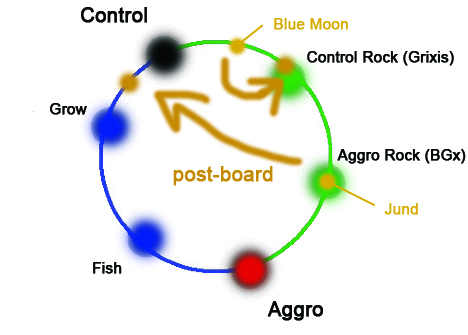
When it comes to sideboarding, Jund tries improving the odds of opening a hand that allows it to play Aggro or Tempo. Kolaghan's Command becomes more valuable here, since it combines with Fulminator Mage to provide Jund with a potent mana denial angle. Tempo traditionally wields mana denial better than other archetypes (see Canadian Threshold), so the Command-Mage engine should drastically improve Jund's Tempo plan in this matchup. Late-game trumps can work, but Jund pilots shouldn't rely too heavily on these options, since Blue Moon usually outperforms BGx in the late-game. That gives us a new wheel, which clearly favors Jund:

post-board midrange

Spectrum Fluidity

We talked about the possible lines with Jund's "Aggro" draw against Blue Moon. The sheer variety of possible play options Jund boasts, even with standard openers as shown, explains its unquestioned Twinstrength in Modern. The same can be said of Twin. Decks with cards as flexible as Jund's and Twin's (among them, versatility lynchpin Lightning Bolt) can play a host of roles depending on the matchup, and by extension, move the largest distance forwards and backwards on the archetype circle. More linear decks like Mono Green Stompy, Burn, and Ad Nauseam might do well in certain metagames, but they have trouble shifting locations on the archetype spectrum. Moving fluently around the circle, an ability almost entirely exclusive to Twin in Modern, gives a deck immeasurable adaptability - and with it, viability. I call this ability spectrum fluidity. Taking a look at the diagrams above, Merfolk and Blue Moon obviously have less spectrum fluidity than Monkey Grow and Jund. In this case, like in many others, the decks with higher spectrum fluidity become favored after siding.


Going into open metagames, decks with high spectrum fluidity almost always make decent choices. That's why so many pros favor Jund and Twin at big-ticket events. Linear decks tend to have low spectrum fluidity. If you're planning on playing Burn or Infect at GP Oklahoma City, your focused strategy will toss you some free wins. But those come at the cost of ceding a fighting chance to better-rounded decks that draw their disruption.

Eyes on the Prize

I'll close by reiterating the lesson from my pal Serum Visions. Being goal-oriented is key to using the archetype spectrum wheel to your advantage. Players who visualize the wheel and can adequately gauge the section their opponents play on can make optimal choices both during and between games.

Jordan Boisvert

Jordan is Assistant Director of Content at Quiet Speculation and a longtime contributor to Modern Nexus. Best known for his innovations in Temur Delver and Colorless Eldrazi, Jordan favors highly reversible aggro-control decks and is always striving to embrace his biases when playing or brewing.

View More By Jordan Boisvert

Posted in Modern, StrategyTagged , , , 7 Comments on Wheel of Fortune: Riding the Archetype Spectrum

Have you joined the Quiet Speculation Discord?

If you haven't, you're leaving value on the table! Join our community of experts, enthusiasts, entertainers, and educators and enjoy exclusive podcasts, questions asked and answered, trades, sales, and everything else Discord has to offer.

Want to create content with Quiet Speculation?

All you need to succeed is a passion for Magic: The Gathering, and the ability to write coherently. Share your knowledge of MTG and how you leverage it to win games, get value from your cards – or even turn a profit.

Want Prices?

Browse thousands of prices with the first and most comprehensive MTG Finance tool around.


Trader Tools lists both buylist and retail prices for every MTG card, going back a decade.

Quiet Speculation