menu

The Best Deck Nobody is Playing: When Bears Attack

Are you a Quiet Speculation member?

If not, now is a perfect time to join up! Our powerful tools, breaking-news analysis, and exclusive Discord channel will make sure you stay up to date and ahead of the curve.

when bears attack dragon scarred

The great Thomas David Baker, in his infinite wisdom, came up with the "metagame-breaking" Legacy deck he named "36 Bears" back in 2009. Exploiting the broken synergy between Forests and cards with the "Bear" subtype, he attempted to take down the 128 man "Win a Piece of Power 9" tournament at Worlds that year. Below is the list he ran.

[wp_ad_camp_1]


36 Bears by Thomas David Baker

Creatures

4 Grizzly Bears
4 Runeclaw Bear
4 Balduvian Bears
4 Bear Cub
4 Ashcoat Bear
2 Forest Bear
4 Striped Bears
4 Spectral Bears
2 Pale Bears
4 Bearscape

Lands

24 Forest

Sideboard

1 Pale Bears
3 Golden Bear
1 Razorclaw Bear
4 River Bear
4 Werebear
1 Underground Sea
1 Lion's Eye Diamond

Baker didn't see much success that tournament (mainly due to mana issues and missing 2 copies of Forest Bear), and so sadly the deck failed to take off as the prominent meta force it deserved to be. I'm taking it upon myself to fix this historical error by porting the deck to Modern and eventually taking down the Pro Tour with it. I have no doubts about the strength of the deck -- now that Dragon-Scarred Bear and Alpine Grizzly are in the format, we'll have no trouble mauling opponents to death.

When Bears Attack by Sean Ridgeley

Creatures

4 Alpine Grizzly
4 Runeclaw Bear
4 Dragon-Scarred Bear
4 Druid's Familiar
4 Grizzly Bears
4 Ashcoat Bear
4 Ulvenwald Bear
4 Ulvenwald Tracker

Instants

4 Giant Growth

Land

20 Forest
4 Cavern of Souls

Sideboard

4 Favor of the Woods
3 Hibernation's End
4 River Bear
4 Predatory Urge

Strategy

How this deck works is you play Forests then use those Forests to play bears. It's understandable if you find it difficult at first, but I assure you that you'll be dropping Forests and playing bears in no time with the best of them after some practice.

Card Choices

A few notes about some of the less self-explanatory cards, and one I purposely didn't use:

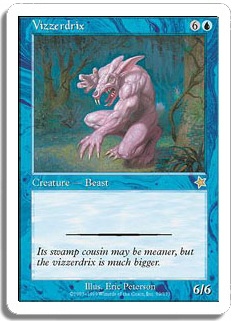
Dragon-Scarred Bear: The clause on its ability might seem poor but remember we have 32 bears, all with two power or more, so we'll be able to use it constantly. Also note the name: this thing fought a dragon and won, so it'll have no problem fending off a wimpy Tarmogoyf turn after turn. The only thing better than a bear is a regenerating bear, as everyone knows, so this is a key card to making the deck work.

Ulvenwald Bear and Ulvenwald Tracker: While the synergy between forests and bears is the real strong point here, there's also some good stuff going on between these two powerhouses. It plays out like this: use Tracker's ability to kill an opposing creature that probably isn't half as good as a bear with your bear, then play Ulvenwald Bear as a 4/4, or a 2/2 and make one of your other bears even more awesome. That's basically a 5 for 1, probably. In the words of the famously articulate Zac "Creatures Are So Awesome" Hill: devastating!

when bears attack giant growth

Sideboard cards: River Bear and Hibernation's End ensure blue players won't be able to keep up with your bear assault; Urge is for creature-heavy decks like Zoo where you need a little more removal, and Favor helps you with Burn and possibly other aggressive decks. If there's a more airtight sideboard than this, I don't want to know about it.

Savage Punch: I left this out because it depicts bears in a bad and completely unrealistic light. In a real Magic fight, that bear would've ripped off both that guy's arms before he even thought about punching it. Bear versus human fights are just too hardcore for Wizards artists to depict accurately, I guess.

Looking Forward

I know some of you still won't believe as I do in the raw power of this deck, because it's new and new things are probably bad and whatever. If you don't, just wait for the results -- this time next year When Bears Attack will be at the top of the meta and threatening a ban (I put bets on Dragon-Scarred Bear). See you then!

No Easter PPTQs

Are you a Quiet Speculation member?

If not, now is a perfect time to join up! Our powerful tools, breaking-news analysis, and exclusive Discord channel will make sure you stay up to date and ahead of the curve.

This weekend is my weekend off, and as such I was hoping to do some PTQQing. I knew that this Sunday was Easter, but I was not expecting that to mean that no PPTQs would be scheduled this Sunday. I can see why one wouldn't want to host an event on Easter, but I thought that somebody would be putting one on.

There was an error retrieving a chart for Scoured Barrens

There actually was one PPTQ scheduled for Easter Sunday, but it was changed when the organized had realized what he had done. There are three PPTQs in Minnesota this Saturday, tough to be fair one of them is in Duluth. If you're unfamiliar with the geography of the area, Duluth may as well be Canada.

Even still, with two stores hosting on Saturday, I have to wonder if one of them might have seen a better turnout if they bit the bullet and hosted on Easter. There are of course costs associated with doing so. Some employees don't like working Easter and you tend to have to pay them a little more to do so, but as somebody who has worked a handful of Easters in his lifetime I can't say that there's any reason to want it off other than the fact that other people don't have to do anything on that day. I know for sure that I'd be playing a PPTQ if there were one on Easter.

Question time. You're a TO, and there is one PPTQ scheduled the Saturday of Easter weekend. Do you think that it benefits you most to host a Saturday PPTQ, an Easter PPTQ, or to just not do anything, and why?

Also of some relevance, would you attend an Easter PPTQ as a player?

Avatar photo

Ryan Overturf

Ryan has been playing Magic since Legions and playing competitively since Lorwyn. While he fancies himself a Legacy specialist, you'll always find him with strong opinions on every constructed format.

View More By Ryan Overturf

Posted in FreeTagged 4 Comments on No Easter PPTQs

Have you joined the Quiet Speculation Discord?

If you haven't, you're leaving value on the table! Join our community of experts, enthusiasts, entertainers, and educators and enjoy exclusive podcasts, questions asked and answered, trades, sales, and everything else Discord has to offer.

Want to create content with Quiet Speculation?

All you need to succeed is a passion for Magic: The Gathering, and the ability to write coherently. Share your knowledge of MTG and how you leverage it to win games, get value from your cards – or even turn a profit.

Insider: MTGO Market Report for April 1st, 2015

Are you a Quiet Speculation member?

If not, now is a perfect time to join up! Our powerful tools, breaking-news analysis, and exclusive Discord channel will make sure you stay up to date and ahead of the curve.

Welcome to the MTGO Market Report as compiled by Sylvain Lehoux and Matthew Lewis. The report is loosely broken down into two perspectives. A broader perspective will be written by Matthew and will focus on recent trends in set prices, taking into account how paper prices and MTGO prices interact. Sylvain will take a closer look at particular opportunities based on various factors such as (but not limited to) set releases, flashback drafts and banned/restricted announcements.

There will be some overlap between the two sections. As always, speculators should take into account their own budget, risk tolerance and current portfolio before taking on any recommended positions.

Redemption

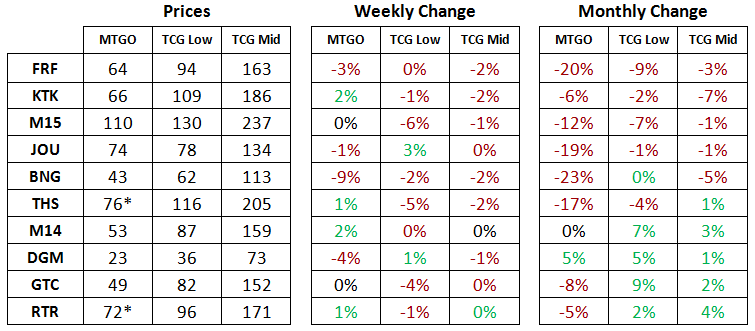
Below are the total set prices for all redeemable sets on MTGO. All prices are current as of March 31st, 2015. The MTGO prices reflect the set sell price scraped from the Supernova Bots website while the TCG Low and TCG Mid prices are the sum of each set’s individual card prices on TCG Player, either the low price or the mid-price respectively.

Usually Supernova’s prices are a good proxy for market prices. They are not perfect, but they are close. Recently though, their prices for RTR and JOU have been too low, so I’ve put an asterisk (*) beside those set prices. The set price for RTR and JOU on goatbots is currently 87 and 89 tix respectively.

Paper prices on THS block and M15 are almost all negative in both weekly and monthly changes. This is likely the start of the long slide as the inevitability of rotation gets closer.

For MTGO speculators, this means the price floor of redemption will not be supporting prices. As paper prices drift down, expect continuing price weakness in digital. Speculating on what are seemingly cheap rares and mythic rares will probably turn into a painful lesson. Check out the comments on last week’s article for some insight from one of our readers.

Apr1

Targeted Recommendations Summary

Today’s report is going to be a little different as we take a look back at the first 3 months of the MTGO Market Report and perform an analysis of our buy and sell recommendations.

Each closed call (i.e. the card was bought and sold) can be evaluated and judged a success or failure by looking at percentage gains or losses. We’ll also construct a mock portfolio to estimate what the net gains or losses could be for a speculator following the recommendations. Lastly, we’ll make comments on any outstanding buy calls and discuss their future.

Evaluation Method

There is no absolute and unique method to evaluate the performance of our recommendations, but we’ve come up with what we think is an objective approach to estimate gains and losses. Gains and losses presented here may also be different from a given person’s portfolio, even if they strictly followed our recommendations.

Buy Prices

For every recommendation, the buy price we used is the price as recorded by mtggoldfish.com on the day of the recommendation. The bias here is that it’s possible to buy cards at a lower price than the listed mtggoldfish price. Mtggoldfish uses mtgotraders prices which are frequently not the cheapest (they focus on stocking every card, not the lowest price). Also, acting on the recommendation on a different day might yield different results as prices might have fluctuated in the interim period.

Sell Prices

The sell price we used is the price as recorded by mtggoldfish.com on the day of recommendation, with the following adjustments. For every card price below 2 Tix, 80% of the listed sell price was assumed to be retained. This accounts for the buy and sell spread of most bots on low-priced cards, which tend to have higher margins. For cards above 2 tix, 90% of the listed sell price was assumed to be retained.

Again, the exact price which a given speculator gets will probably not correspond perfectly to the sell price either. The purpose is to illustrate what is possible, given a reasonable set of assumptions and the actual buy and sell recommendations given in the report.

Current Prices for Open Recommendations

Prices used for recommendations still open are as of Saturday, the 28th of March. The same 80% and 90% price adjustments have been taken into consideration for cards less than 2 tix and cards greater than 2 tix, respectively.

The Mock Portfolio

A mock portfolio based on these recommendations was built in order to put the recommendations into a different, more tangible context. The rules of this simulated portfolio are as follows. A maximum of 50 Tix was dedicated to each recommendation, and an upper limit on the number of copies was set to 40. Based on our experience, buying or selling up to 40 copies of a given card, without significantly affecting prices, is possible if a number of different bot chains are used.

Evaluating the Recommendations

The table below presents the percentage change in each recommendation as per the above assumptions.

* indicates the maximum buying price we recommended for this card, although the price on Mtggoldfish was higher on the day we recommended the position.

Considering all recommendations, both closed and still open, the average gain is +16.7%. If closed positions are considered the the average gain is +31.6%.

Now let’s take a look at our mock portfolio:


The mock portfolio would have initially used 2431.5 Tix of our recommendations. The total value of this portfolio (both closed and open positions) would be now at 2682.3 tix, a gain of 250.8 Tix, or +10.3%. Considering only the closed positions, this portfolio would have gained 408.8 Tix, or +24.4%.

Overall, these results are within the range of what you should expect from a diverse portfolio containing cards from different sets and different formats, with both short- and longer-term potential. A growth of +5% to +10% per month over the course of several months usually represents a very decent return for a speculator on MTGO.

Outlook for Currently Open Recommendations

Standard Positions

Among the still open recommendations, about half of them concern Standard positions, with the majority of them being from Theros block. With Dragons of Tarkir newly introduced and Pro Tour DTK in less than two weeks, the interest in the Standard format will be ramping up. Standard prices are likely to rebound. The best window to sell any Standard cards will be between PT DTK and the release of Modern Masters 2015. Stay tuned for specific targeted sell recommendations over the coming weeks, but expect the majority of THS block and M15 positions to be closed out.

Siege Rhino and Anafenza, the Foremost may also bump up in price as drafters focus on DTK, switching from the KKF to FDD, in terms of boosters. Note that these two cards will still be around after Standard rotates in the Fall, so they are fine longer-term holds at the moment.

Modern

Several of our Modern recommendations printed in MMA have only rebounded from their bottom following the MMA flashback drafts last January. We think that for these and the other Modern positions from recommendations, selling is not suggested and holding is what we recommend. These surely have a chance to be reprinted in MM2 but considering their current price we think there’s more to gain than to lose.

For the Modern positions that won’t be affected by MM2 reprint, namely Domri Rade, Restoration Angel and Sphinx's Revelation, the risk of losing value is extremely low. We recommend waiting on more favorable times to sell them with profit. This holds also true for Deathrite Shaman.

Pauper

The Pauper cards we recommended still have room to grow. Mental Note recently tanked because of the ban of Treasure Cruise in Pauper. Nonetheless, for all Pauper specs we think the mid-term to long-term outcomes are positive and are worth the wait.

Targeted Speculative Buying Opportunities

None.

Targeted Speculative Selling Opportunities

None.

Smart Deck Investments: Twin and Scapeshift

Are you a Quiet Speculation member?

If not, now is a perfect time to join up! Our powerful tools, breaking-news analysis, and exclusive Discord channel will make sure you stay up to date and ahead of the curve.

It doesn't have to be, but Modern certainly can be an expensive format. Even if you're a spike with a reasonably large budget, after dropping $1,800 on Junk, you maybe don't want to drop another $1,200 on Twin. Or maybe you get sick of Affinity, but don't want to start from scratch to play something else.

There's a way to avoid this: buy into decks that lend themselves well to card sharing and inexpensive transformation(s).

twin scapeshift cryptic command

Note that if you're sharing cards between decks, you should be using the same sleeves for those decks so you don't have to remove cards from sleeves. Just be sure to keep track of what goes where to prevent game losses and suboptimal lists.

Today I'm going to discuss two decks that lend themselves well to sharing and transformation, both in blue. But first, I'd like to talk a little about investment criteria.

[wp_ad_camp_1]

Identifying Good Investments

The first step in finding a deck that qualifies as a good investment (in a non-speculative sense) is determining whether or not it's linear. If it is, chances are it's a very singular strategy fueled by lots of cards that don't fit into any other decks. Strong, popular examples of this are Burn, Affinity, Merfolk, Amulet, and Infect (notice they're all primarily one colour). Sure, there are cards in these decks that can be played in other decks, but they are few, and many of them are inexpensive, thus saving us very little money long-term.

Conversely, if the deck is considered "goodstuff" (that is, little or no synergy or dependency between cards, but a lot of power in each card), or is non-linear (has at least two win conditions and/or falls under two archetypes e.g. Combo/Control), there's a high chance it has many pricey cards we can use in other decks. Strong, popular examples include Junk, Twin, and Scapeshift.

Despite these criteria, virtually any deck that runs fetchlands and shocklands is almost definitely a decent investment at worst. Fetch prices will probably drop dramatically after Battle for Zendikar releases in October, so this becomes even more true then; shocklands should be picked up as soon as possible, particularly Steam Vents, and to a lesser extent, Overgrown Tomb, as they go into the most amount of Modern decks. Prices are low on shocks now, but they will increase hugely over the next few years.

The Blue Card Pool

Blue decks in Modern almost all run a lot of Remand and Snapcaster Mage (which by no coincidence are stupid good together). Each of them is quite expensive, so buying into any deck that runs them will get you a lot of usage long-term. Keep in mind Remand will almost definitely be reprinted in Modern Masters 2015 in May, so it's strongly recommended you wait until then to invest in it.

Also extremely common among these decks is Batterskull and Spellskite. While they aren't run in high numbers within each of the decks, they are very costly unto themselves, and also slot nicely into some non-blue decks. These are likely going to be staples for as long as Modern exists, or at least through the far-off future, so they're great incidental acquisitions.

scapeshift twin batterskull

Batterskull was recently reprinted as a MOCS promo and Spellskite is plane-specific, and with a Zendikar theme incoming, a Phyrexia theme may well follow. As such, I'm inclined to Skull won't be reprinted anytime soon, and Skite won't be reprinted in May, but could be sometime next year. If you don't want to wait, it's smart to pick decks with these cards up now or soon.

Less expensive and/or common cards in blue decks include Lightning Bolt, Electrolyze, Blood Moon, and Path to Exile, among others, so anything with them will lend itself to conversion or sharing.

Beware the Bans

Something to keep in mind in debating which deck to invest in is the possibility of bans. The format is pretty stable right now, but Modern is young and has seen a lot of cards put on the chopping block, most recently Birthing Pod, which at least temporarily, axed an entire deck (I'm looking forward to seeing if a new brew with Collected Company and Congregation at Dawnis viable).

Our recent banlist article gives a good rundown on Wizards' banning criteria, so anything there that might apply to a deck you're considering building might be a poor idea, at least if the deck doesn't contain a ton of format staples. The main one is format domination -- if our stats say a deck is about 15% or more of the meta for a prolonged period of time, there's a strong chance it will see a ban. That's not to necessarily say the deck will die or become bad, just that it's a less strong investment. Fortunately the meta is fairly balanced right now, and should stay put until the next round of bans and unbans.

Twin: The Complete Package

twin scapeshift pestermite

Your best bet then, particularly when considering deck effectiveness in this meta, is Twin, by far. Our internal data shows a very strong 12.4% meta share and the second highest day 2 tournament presence in the format at 12.5%, and it includes pretty well the full array of blue control cards: Remand, Snapcaster, Vendilion Clique, Serum Visions, Batterskull, Spellskite, and many more. If you buy into Twin, you buy into results, which can earn you your money back, and you buy into the foundation for almost every blue deck in the format.

Once you have the deck, you can share many of the cards between other decks, or transform it into all kinds of things, usually for a relatively low cost (which is great if it sees a ban, as it might). Your most viable choice is Scapeshift, but other reasonable selections include Jeskai Control, Jeskai Midrange, Delver (Izzet or Grixis), Blue Moon, Sultai Control, and Faeries. There are other decks which share some of the cards, but not enough to save you much dough.

CardCost (paper)Cost (MTGO)
Snapcaster Mage x4$199.96$62.44
Grim Lavamancer x2$11.50$8.82
Vendilion Clique x2$144.50$78.90
Keranos, God of Storms x1$10.66$11
Splinter Twin x4$107.92$34.24
Lightning Bolt x4$8.08$0.36
Serum Visions x4$33.84$21.16
Remand x4$45.51$30.84
Cryptic Command x2$114.74$36.40
Electrolyze x2$6.28$1.50
Scalding Tarn x4$227.96$92.60
Sulfur Falls x4 $32.64$7.20
Steam Vents x3$40.05$15.48
Misty Rainforest x2$71.94$24.96
Breeding Pool x1$10.21$3.27
Polluted Delta x1$13.27$4.39
Blood Moon x2$41.82$39.92
Batterskull x1$15.99$41.77
Spellskite x1$23.97$25.91
TOTAL COST$1160.84$541.16

The only problem with buying into Twin is the hefty price tag (sourced here from TCGPlayer and MTGOTraders). A lot of that comes from Scalding Tarn, so if you're fortunate enough to have those, that sweets the sting some. If you don't, you can pick them up in October and save a huge chunk of change then instead. Nearly as expensive are the Snapcasters, Cryptic Commands, and Splinter Twins. Again, Snaps should be reprinted, but you'll have to bite the bullet on Commands and probably Twins. If you're starting from scratch after BFZ, expect to drop about $900 (paper) / $350 (MTGO) total. Alternately, you can just invest in the second option (see below).

Scapeshift: True Control, Sort Of

twiin scapeshift

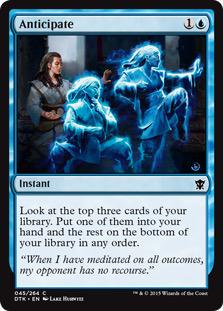
Twin is not every blue player's cup of tea, as it often plays like a tempo deck as opposed to a "true" control deck. If you're looking for a modular blue deck that plays more in that vein, Scapeshift is your ticket. It has an okay meta share of 1.7% right now, which may well increase with the sorely needed Anticipate entering the meta.

Buying into Scapeshift now will run you roughly $900, which is a little easier to swallow. By October, that could be up to about 30% less (even easier). Below is a rundown of the costly cards in the deck.

CardCost (paper)Cost (MTGO)
Snapcaster Mage x2$99.98$31.22
Scapeshift x4$93.96$49.40
Lightning Bolt x4$8.08$0.36
Remand x4$45.51$30.84
Cryptic Command x4$229.48$72.80
Electrolyze x1$3.14$0.75
Steam Vents x4$53.40$20.64
Misty Rainforest x4$143.88$49.92
Breeding Pool x1$10.21$3.27
Stomping Ground x4$34.16$14.40
Flooded Grove x2$45.58$14.30
Valakut, the Molten Pinnacle x2$5.34$0.94
Spellskite x1$23.97$25.91
TOTAL COST $796.69$384.91

Scapeshift's card pool gives you a good start on Twin, Delver, Jeskai Control, and Jeskai Midrange, and to a lesser extent Blue Moon. And of course, a large number of decks use a minimum of two of these cards (Blue Tron with Remand and Skite, Gifts with Snapcaster, Remand, Skite, etc), so you get a little help there, too.

I don't see this deck getting a ban anytime soon, if ever. It's powerful but not too much so, and anything that busts it (typically blue spells like Dig Through Time) is probably busted in other decks too, and will just be banned instead of anything else in the list. The previous unbanning of Valakut gives me more confidence Wizards wants this deck to stick around.

Twin and Scapeshift Shared Card Pool

Below is a rundown of the shared cards between Twin and Scapeshift. Crunching the numbers, you can see buying into Scapeshift lets you play Twin at an added $607.24 / $332. 80 cost (a lot less if you just use the full set of Mistys and a couple extra basics instead of Tarns); buying into Twin lets you play Scapeshift for an added $307.13 / $120.60 cost. Buying into other decks from either of these will cost you roughly the same.

CardCost (paper)Cost (MTGO)
Snapcaster Mage x4$199.96$62.44
Lightning Bolt x4$8.08$0.36
Remand x4$45.51$30.84
Cryptic Command x4$229.48$72.80
Electrolyze x1$6.28$1.50
Steam Vents x4$53.40$20.64
Misty Rainforest x4$143.88$49.92
Breeding Pool x1$10.21$3.27
Spellskite x1$23.97$25.91
TOTAL COST $720.77$267.68

Honorable Mentions

There are three main other blue decks in Modern that carry a heap of staples. If you don't mind sacrificing some viability, check out Izzet Delver (which carries a lot of high-end staples unlike its Grixis cousin), Jeskai Control, and Jeskai Midrange. With these, you'll net Snapcaster, Bolt, Electrolyze, and Remand, among others. While they're not great now, the meta will forever ebb and flow and new cards will be introduced, which could well bring them to top tier status.

Until Next Time

If blue decks aren't your thing, or you love a little black in your Magic collection too, join me next time when I break the black decks of the format down to see which are the smartest investments. Naturally, you can expect the same kinds of cost rundowns and analysis.

Insider: The Hydras of Tarkir

Are you a Quiet Speculation member?

If not, now is a perfect time to join up! Our powerful tools, breaking-news analysis, and exclusive Discord channel will make sure you stay up to date and ahead of the curve.

Last week I got into it a little bit regarding the overprinting of dragons lately, and how even good dragons have limited upside in an environment where dragons are no longer a novelty.

Competition for a finite number of deck spots with the other tribal monsters makes cards that seem like obvious slam-dunks have upside that’s more limited than you think.

The best dragons printed are going to slot into a dragon tribal EDH or casual deck, obviously, but how do we know which those are?

It was suggested in the comments last week that we could rank dragons (and hydras, vampires, zombies, angels, etc.) and that way we could see which ones would get “bumped” off the list when new ones were printed, but I think that’s a little less instructive than exploring some criteria to use when we evaluate new tribal cards when a new set comes out.

Hopefully we can arm ourselves with some tools, because we’re going back to Zendikar soon, and if you don’t think we’re about to get hit with a vampire sledgehammer, you’re fooling yourself.

Instead of trying to see which vampires might be worse than the new vampires they might print, let’s instead look at a few points to consider any time a new card comes out.

Will Casuals Care?

Or EDH players, or whomever.

Well, will they care about Stormbreath Dragon?

There was an error retrieving a chart for Stormbreath Dragon

What are the long-term price prospects for a card like this? This tanked even harder than Thundermaw Hellkite, and while it’s showing a few brief glimpses of a rally, it’s mostly circling the drain.

Could we have predicted this? I think so. It is nuts in a Standard environment that saw people use multicolored removal spells and cards like Chained to the Rocks to deal with dragons, and it scales into the late game the way a card you want to lean on and have be your finisher needs to.

Still, is this knocking a dragon like Bogardan Hellkite or Utvara Hellkite off of its pedestal? There are dragons that impact standard and go on to live long, prosperous lives in EDH, but those cases are rare.

One indicator that almost sorts the cards for us without us having to really assess the cards?

What’s the Converted Mana Cost?

A 5 mana dragon is affordable enough to play in a fast, 1-on-1 format like Standard. A 9 mana dragon is too slow to be hardcast in a fast, 1-on-1 format like Standard.

A 9 mana dragon is likely equipped with powerful abilities that make it worth playing and powerful enough to end the game in a slow, multiplayer format like Commander or casual. A 5 mana dragon likely isn’t powerful enough to get there.

Sure, you can menace some people with Stormbreath, especially after you use its monstrosity ability, but that’s a little like saying Shivan Dragon is going to terrorize them if you have 35 red mana floating.

Dragons with CMC 6 or less are almost always relegated to competitive formats and the trade-off for their reasonable cost is their low impact. Utvara Hellkite was too slow for Standard, but once it gets going in EDH, it’s a terror. And rightly so.

Hydras are a little tougher to sort, but I imagine the number of colored pips in their casting cost after the X (if they have one) can help us out.

Kalonian Hydra seems like it may be an exception until you realize that, despite being good in EDH, its price has fallen significantly. It has upside, but it has a while before it gets to where we’d be unhappy we sold out too early.

More than two green pips or a fixed cost of more than 5 and we’re likely looking at a card that is going to go up in price later.

There was an error retrieving a chart for Kalonian Hydra
There was an error retrieving a chart for Hydra Broodmaster

Does it Matter That It’s a Dragon?

This can affect its upside in either the “right now” formats like Standard, and possibly Modern, and it can also affect EDH and casual upside. Let’s look at one of my favorite dragons:

There was an error retrieving a chart for Hellkite Tyrant

Does this matter that it’s a dragon? Yes.

And no.

In fact, “yes and no” is the correct answer, I think. When it was announced that this block would be lousy with dragons, people started taking a look at the cards that had upside.

Scion of the Ur-Dragon was a card that was identified because people might want to build dragon tribal out of all of the new dragons. This card is one that was getting played already, though, which is why it wasn’t total garbage.

If there were no other dragon cards in all of Magic, this card would still be good and still be playable. Mayael decks can cheat it into play. Maelstrom Wanderer decks can cascade into this and swing with it right away and steal some artifcats. This is basically an artifact-based Battle of Wits or Test of Endurance in a Daretti or Bosh artifact deck.

This card is solid. Let’s look at two things.

The first is that despite being very good and being a mythic, it was a very recent card and EDH demand alone was making this a $1ish mythic. That’s poor performance for a card that came out two years ago. Being a very, very good dragon and being a mythic wasn’t enough to buoy its price much.

It would have crept up on its own eventually, but it leapt instead. Why?

An event made it jump. People identified it as a very good EDH card and one that had significant upside already, and being a dragon made it go up along with a lot of other good dragon cards when there was renewed interest in building dragon EDH decks. It was able to experience the upside of all dragons at the announcement of an incoming dragon set because it’s a dragon.

So does it matter if the card is a dragon (or angel or demon or whatever)? Yes, and no. If the card is good enough to get played in non-tribal decks, the card has upside attached to its playability. It will go up on its own merits, so pay attention to tribal cards that are still good if their tribal alliance isn’t a factor.

Also, it should matter if the card is a dragon because anything that affects all dragons will affect it. It has upside that has nothing to do with its own inherent playability and that matters, too. Cards that can answer the question “Does it matter that this is a [insert tribe]?” with “Yes, and no” are the best horses to bet on. Or angels. Whichever.

Does it Have or is it a Lord?

Having a lord, or several of them, will go a long way toward exposing a card to upside. Innistrad brought us a bunch of zombies and that was good for everyone. They had lords waiting. Lots of them.

There was an error retrieving a chart for Lord of the Undead
There was an error retrieving a chart for Aven Brigadier

This sure has been printed a lot of times for a card that’s worth money. Lords are obviously great and you should pick up any and all lords. Even durdly, bad lords trade out well to casuals, can trade out four at a time, and can experience upside from subsequent printings.

I don’t advocate buying these for cash, but I don’t ship any lord in bulk. If we got a ton of decent birds in a subsequent set, these would shoot up. Is the likelihood high? Nope, but the risk is low if all you are doing is just waiting to ship them in bulk. You can either get a dime now or experience potential upside and you always have the option to move these as a bulk rare.

Not being legendary doesn’t even really matter because this can be a 4-of in the deck it goes in because casual players like tribal decks. This can even go in a deck as a soldier lord, which I’ve actually seen someone do.

Grab lords. For the most part, they have upside over time, barring a reprint.

There was an error retrieving a chart for Adaptive Automaton

See? This card was never particularly exciting when it was legal in standard, but the desire to play it in any durdly tribal deck is strong. Not being EDH playable doesn’t hurt its upside either, as cards like this can be bought four-at-a-time.

When a card already has lords associated with it, it has more upside. Hydras and dragons are actually the big losers here. While cards like Zirilian of the Claw and Vorel of the Hull Clade can be used to build a deck of that tribe around, not having a four-of, obvious lord card hurts its upside for 60 card casual.

I think, looking ahead to Zendikar, we know we have good vampire lords and this means we will evaluate vampires differently than we would dragons in some respects.

Some cards are a bit of both, like Risen Executioner. Does it matter that this is a zombie lord? Yes and no.

Is its price of $3 correct? No, there’s no way it is. But does that make it a snap buy now? Not necessarily.

What Do We Do?

I am a big fan of waiting for cards to bottom out. Rotation really hits casual cards hard if they don’t get played in Standard and don’t really have applicability in Modern. This is a fairly obvious consequence of Standard being the format that rotates the most often. But people dump cards after they rotate if they don’t want them and that can make prices of casual cards very attractive.

It’s obviously best to buy at the absolute floor, and since there is no real hurry to snap up casual cards right away, you can just wait until they rotate and see if the prices bottom out.

There was an error retrieving a chart for Risen Executioner

It’s possible Risen Executioner goes above $3 in the short term, but it’s likely to go below $3 at some point. Could this be a $9 card in two years? I think that’s possible, given what it does.

Does it matter that it’s a zombie? Yes and no. It has a cool ability regardless and it plays well with graveyard strategies.

Does it have or is it a lord? Yes to both. This can be both a beater and a lord and it’s a great zombie card.

The converted mana cost is 4, which makes this a bad EDH include but a great 60 card casual include. That means that, unlike dragons and hydras, which thrive in a slower format, this will thrive in a faster format, and it will be sold 4 at a time to boot. Zombie tribal EDH may want this, but 60 card decks are much more likely.

These factors muddy the waters. On one hand it looks like a card that will peak in price now due to the fact that it’s not great in EDH and looks more like a Standard card. On the other hand, it has some characteristics that make it look like a card that will peak in price later.

The truth is that it is pretty similar to vampire lords we’ve seen in the past.

There was an error retrieving a chart for Vampire Nocturnus

With four printings available, upside is limited here. It’s also maintaining value nicely which means there is no real hurry to sell. I think this is a good corollary for Risen Executioner. But I also think it has potential upside if we see good vampires come around in the next block and rekindle enthusiasm for vampires.

Maybe Executioner at $3 isn’t such a bad buy.

Tiny Tuesday- Zurgo Bellstriker

Are you a Quiet Speculation member?

If not, now is a perfect time to join up! Our powerful tools, breaking-news analysis, and exclusive Discord channel will make sure you stay up to date and ahead of the curve.

Welcome to Tiny Tuesday! Last week I got into a little bit of a brewing kick, which was mostly inspired by how much I enjoyed crafting my first Tiny Leaders deck. I found myself brewing a number of Tiny Leaders builds, and have decided to dedicate Tuesdays to discussion of a potential Tiny Leaders shell. These posts will both serves as ways for me to generate ideas for the community as well as a place for readers to comment on things that I may have missed myself.

This week, I’m going to highlight new RDW all-star Zurgo Bellstriker. Previously, Zo-Zu, the Punisher was the go-to Tiny Leader for burn decks, but I like Zurgo a lot better for this role. Zurgo immediately puts pressure on opposing life totals while Zo-Zu taxes a resource that a lot of Tiny Leaders decks don’t especially care about while also having a fragile, inefficient body. Zo-Zu is sweet when your opponent is trying to Valakut, but otherwise I’m non-plussed.

Zurgo, on the other hand, allows us to capitalize on the type of card that is not only historically great for burn, but also excels in a format where larger creatures are generally not allowed- that is we get to play a turn 1 2/2 and follow it up with a Searing Blaze or Searing Blood. Lunge, Arc Lightning, and Flames of the Firebrand all do reasonable imitations of these cards, but they’re a little too inefficient for my taste.

I do like being able to split damage with cards like Forked Bolt and Twin Bolt to keep decks like Ezuri in check, but mostly I just want the maindeck to be a streamlined pile of burn and manlands. This is my current Zurgo build:

”Tiny Zurgo”

creatures

1 Eidolon of the Great Revel
1 Goblin Guide
1 Monastery Swiftspear
1 Grim Lavamancer
1 Hellspark Elemental
1 Keldon Marauders
1 Young Pyromancer
1 Chandra's Phoenix

spells

1 Lava Spike
1 Shard Volley
1 Pillar of Flame
1 Forked Bolt
1 Twin Bolt
1 Searing Blaze
1 Magma Jet
1 Char
1 Rift Bolt
1 Flame Rift
1 Searing Blood
1 Burst Lightning
1 Lightning Strike
1 Searing Spear
1 Sulfuric Vortex
1 Price of Progress
1 Arc Trail
1 Incinerate
1 Bonfire of the Damned
1 Goblin Rabblemaster
1 Firebolt
1 Pyrostatic Pillar
1 Lightning Bolt
1 Chain Lightning

lands

1 Mutavault
1 Ghitu Encampment
1 Barbarian Ring
1 Mishra's Factory
8 Mountain
1 Wasteland
1 Scalding Tarn
1 Bloodstained Mire
1 Arid Mesa
1 Wooded Foothills

sideboard

1 Flames of the Firebrand
1 Arc Lightning
1 Zo-Zu, the Punisher
1 Ankh of Mishra
1 Molten Rain
1 Red Elemental Blast
1 Pyroblast
1 Smash to Smithereens
1 Volcanic Fallout
1 Flamebreak

I’m on the fence about whether or not to include Forgotten Cave, as it’s really bad when you actually want a land, but other than that I like this list, and if you’re into burn it’s really fun to play.

Like the list? Anything I missed? Let me know your thoughts on Zurgo in the comments!

Deck Overview: Standard Dimir Control

Are you a Quiet Speculation member?

If not, now is a perfect time to join up! Our powerful tools, breaking-news analysis, and exclusive Discord channel will make sure you stay up to date and ahead of the curve.

This weekend marked the 2015 Star City Games Season 1 Invitational, and it was quite the show to watch. It was the first big tournament with Dragons of Tarkir being legal, and it was quite the spectacle. There were some awesome games all weekend, and the finals pitted the two best players in the tournament against one another. You can’t really ask for more than that.

Of course, with the nature of the tournament being split-format, the Top 8 is not necessarily representative of the successful Standard decks from the tournament. Jacob Wilson, despite winning the tournament, only posted a 5-3 record in the Standard portion of the swiss rounds!

As such, it behooves us as players to open up the page for 7-1 or better Standard decks. On this page we find Christian Calcano’s UB Control deck. The deck didn’t gain a ton of unique cards from Dragons, but the few cards that it did gain dramatically improved the strategy.

”UB Control”

spells

1 Pearl Lake Ancient
1 Silumgar, the Drifting Death
1 Ugin, the Spirit Dragon
2 Perilous Vault
4 Anticipate
3 Bile Blight
4 Dig Through Time
2 Disdainful Stroke
4 Dissolve
4 Hero's Downfall
2 Jace's Ingenuity
2 Ultimate Price
2 Crux of Fate
5 Island
5 Swamp
1 Bloodstained Mire
4 Dismal Backwater
1 Flooded Strand
1 Haven of the Spirit Dragon
4 Polluted Delta
2 Radiant Fountain
4 Temple of Deceit
1 Urborg, Tomb of Yawgmoth

sideboard

1 Prognostic Sphinx
1 Disdainful Stroke
2 Negate
1 Dragonlord Silumgar
1 Tasigur, the Golden Fang
3 Drown in Sorrow
2 Self-Inflicted Wound
4 Thoughtseize

The big story here is Anticipate, with a minor nod to Ultimate Price. Previous incarnations of UB Control jammed the full four Jace's Ingenuity because it was so difficult to make their individual cards line up right against opposing threats, and the only way to try to address this was to aggressively out-card your opponent. Anticipate gives you the card selection to help line your answers up better and in Calcano’s list even took slots away from Jace's Ingenuity- card that you just couldn’t cut before.

Anticipate also gives you another efficient delve-enabler for Dig Through Time- your other fantastic card selection option.

Most of the buzz for control decks was centered around Narset, Transcendant Master, but I would recommend looking at Calcano’s list over UWx control. His list is just leaner while also being the papa bear of control mirrors.

Insider: Weekend Recap – Inviting DTK into the Invitational

Are you a Quiet Speculation member?

If not, now is a perfect time to join up! Our powerful tools, breaking-news analysis, and exclusive Discord channel will make sure you stay up to date and ahead of the curve.

Dragons of Tarkir made its debut this weekend at the high-power SCG Invitational, where strings of ringers showed up to battle for novelty oversized checks.

While we're all still unsure of DTK's lasting impact, the set was decently represented in this weekend's event. While the upcoming Pro Tour and subsequent events will cement the format, this is our first glimpse of the power.

Let's take a tour of its impact on Standard.

Roast: Is This the Best Doom Blade We've Got?

We've seen many different cards jockeying for the slot of spot removal. Hero's Demise is great if you've got three mana and Utter End is the utter best at 4. But what fills in at two mana?

Ultimate Price saw a few spots in Abzan control, but Murderous Cut remains the premiere removal for GWB. Champion Jacob Wilson had a 1/1 split, while Jason Coleman (on aggro) and Joe Bass had zero. Dromoka's Command turned out to be a little more popular in the spot. Coleman used it to amp up his attackers and fight opponents.

Roast has limits on its application, just like Ultimate Price--neither are exactly going to pick off a flying golden dragon. On the other hand, Roast can fight all kinds of aggro and the ever-present Courser, so it's got a good home in the mono-red and RG decks that Top 8'ed.

There was an error retrieving a chart for Ultimate Price
There was an error retrieving a chart for Roast

Action: Ultimate Price and Roast are both uncommons, but Ultimate Price already saw a previous printing in Return to Ravnica. Pass on that. On the other hand, Roast has got a lot of legs on it. It's at a dollar now and that's a decent price to get in at. The foils are a little rich at $5, but these are good trade targets. With Roast in mind, let's take a look at...

Mono-Red Aggro, Scourge of First-Week Formats

Since Tom Sligh strung together Dwarven Warrior and Goblins of the Flarg (read 'em and cry at the dis-synergy), mono-red has been shredding unsure formats.

If there're cheap red drops, your inefficient deck is going to get torn apart. Red tends to get dealt with by decks with sweepers and lifegain, but those do best in a more stable metagame. While there's no wrong threat, drawing the End Hostilities against a grip full of fire sucks.

Michael Braverman brought his badass last name and efficient mono-red deck to an 8-0 performance in Standard. Let that sink in--undefeated with little red dudes. His rampage was stopped by W/G Devotion, as Whisperwood Elemental is still that good. However, take a moment to look at his deck.

Is it fun? Yep, Hordeling Outburst is always fun.

Does it have power? Yep, 8-0 against an intense field speaks to that.

Is it cheap? You bet! Stoke the Flames is quasi-rare at $4, Eidolon is $7 and Zurgo Bellstriker is $2.50--but that's the money rares.

This deck is going to tear up FNM for awhile and I want to be in on Zurgo.

There was an error retrieving a chart for Zurgo Bellstriker

SCG has raised the price to $5 at printing, but there are still a bunch of copies on TCG Player at $2.15 or so. There's a significant segment of Magic players who want to run the "good" budget deck and it's hard to beat this one. You just crank out guys and attack. The single Rabblemaster can be cut for budgetary reasons and the deck will still function decently.

Action: When you see a cheap deck do well, step in and pick up the pieces. It's very rare for a Magic deck to wind up less than $100 and this one is both tempting and cheap. Zurgo is the action card here, seeing as he can hit $6 with relative ease. Hordeling Outburst is still about a dollar; I've been saying it's primed to go up for five months now, so I don't think I'm a great judge of this card right now. I presume that as soon as I lose faith, it'll go up in price - it happened with Whip of Erebos, after all.

Tasigur: Still Bananas?

Tasigur. Is he an attractive necklace or still a real threat?

Fully half of the T8 ran a pair of him. It seems that if you've got black mana on hand, a duo of the clan leader is called for. Tasigur is still overhyped in Modern, but he seems to do good work as a cheap beater in Standard. I have rarely seen his ability really matter, but he comes down on a good turn for a lot of decks.

Action: Tasigur hasn't broken his original spike to $12 and sits, lounging, at $7 or so at the moment. I don't love trading for him but he's a good hold; when you see a staple pop up in each deck that can run it, that should tell you something.

Dragonlord Ojutai Made a Brief Appearance

The QS Staff was pretty high on Ojutai coming into the Invitational. He's a giant Hexproof body that draws cards, and that's cool in its own right.

Shaheen Soorani thought so too and cruised 6-2 with his dragon-based control deck. He ended up in 12th place with the dragon thanks to a similarly strong Legacy performance. While Ojutai was about $8 going into the weekend, he's comfortably selling at $13 now. If you ordered some, I hope they ship.

Ojutai also popped up in Todd Anderson's Jeskai Tokens deck. While many lists will bring in sweepers like Drown in Sorrow, there's not a lot they can do against the flying dragon. Brad Nelson pointed out that combined with Jeskai Ascendancy, the lord is nearly unkillable. That's because it'll untap as soon as you whisper "in response..." and regain Hexproof.

Action: Ojutai's star is rising. He is priced correctly now but can also become a $30 mythic on the basis of a great Pro Tour showing. If he's absent from control lists, get rid of him. I don't advocate buying right now, but this is a great card to watch for the PT.

Rhino Hunting On An Exotic Abzan Safari

I detest the idea of shooting rhinos here on Earth, but Tarkir seems overrun with them.

Twelve copies showed up to the surprise of nobody in the T8. The tri-color rares from Khans have had a hard time breaking $8 and sustaining it. Mantis Rider is nowhere right now, for example.

Siege Rhino has a shot at climbing back to $8 and beyond because Khans will not be opened in the same quantities as it was before. If your LGS hands out packs of the latest set for prize, then this will sustain a higher price for KTK. If your LGS lets you choose, then the obvious pick is KTK because of higher set value--but this is uncommon.

Action: Siege Rhino continues to kill people off the top of the deck and it'll be a major force for the next year. Don't trade them away if you have them. If you're looking to get rid of cards and your trade partner has Siege Rhinos, they're a safe card to pick up through summer. The manabase is there, the effect is huge and Whip will stick around for the time being.

This is how is DTK doing as a set

Dealers aren't exactly racing to pick up DTK cards. Part of this is because we're not sure where they'll end up. Prices stay low in an uncertain market and they should firm up much more after the Pro Tour.

You can check the QS Price Chart for DTK, which shows you the highest buylist prices and average sell prices on dynamic, sortable tables. Right now, only Damnable Pact, Sarkhan Unbroken and Deathmist Raptor have spreads under 30%.

There was an error retrieving a chart for Damnable Pact
There was an error retrieving a chart for Deathmist Raptor

There was an error retrieving a chart for Sarkhan Unbroken


That means that those are the only three cards that dealers are so confident in that they'll pay very close to retail to pick up.

Quick hits:

  • Silumgar's Command joins Ojutai's Command as "least likely to see play."
  • Shorecrasher Elemental wasn't enough to make Monoblue Devotion kick back up.
  • There's no base-blue control in the T8, which is common for a new format.
  • Thank goodness that there was only one GW Devotion deck in the T8, sparing us from untimed mirrors.

Let me know what you thought of the Invitational!

Until next week,

-Doug


Rising Deck Alert: Esper Mentor Midrange

Are you a Quiet Speculation member?

If not, now is a perfect time to join up! Our powerful tools, breaking-news analysis, and exclusive Discord channel will make sure you stay up to date and ahead of the curve.

Back when Monastery Mentor was spoiled, Modern players weren't sure how the card would affect their format. Or even if the card would affect it. But on February 22, a rising Japanese pro player named Yuuki Ichikawa teamed up with Monastery Mentor to take down a 214 player Modern event. I stumbled across that Esper Midrange Mentor list while doing my metagame spreadsheet updates. It was a cool list (another player at that same event got T8 with it), featuring Lingering Souls, Snapcaster Mage, and a bunch of other Esper staples. You see a lot of decks when you dig through metagame data like I do, but this one looked like it had what it takes to succeed, both in cards and in its finishes.

A few weeks ago, I published a metagame update calling attention to the deck. I took note of its MTGO and paper finishes following in the wake of Ichikawa's win, and I thought the deck's growth would continue into April. Monastery Mentor didn't disappoint. The deck is up to about 1% of the paper metagame and at roughly 1.5% of MTGO, which is exactly what the article predicted a few weeks back. This included another respectable 5th place finish at a Modern event in Milan, and, just as this article was being edited, a 15th place finish at the SCG Premier IQ in Richmond. Doubters take note: Monastery Mentor is looking more and more like the real deal.

monastery mentor

If you don't know Esper Mentor Midrange, this article will introduce you to its list and strategy. If you do know the deck, it will give you some detailed information on its metagame context and places it can go from here. Despite Modern's notable format diversity, a lot of players criticize the format as being an inhospitable one for innovation. "Play Goyf or don't play creatures"; "Abzan is the best midrange deck"; "Just play fast combo and don't interact at all". These kinds of statements are everywhere in online and local Modern communities, but Mentor and company are here to prove them wrong.

[wp_ad_camp_1]

Deck Background and Metagame Stats

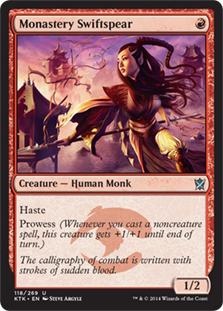
monastery swiftspearSome cards are instant Modern celebrities, including one of Mentor's (probable) students: Monastery Swiftspear. MS looked like an auto-include in Burn, exploded onto the scene as an auto-include in Burn, and retains auto-include status to this day. But Mentor was less obvious. Caleb Durward praised the card in Vintage but questioned where it might land in Modern. In two of his articles, one previewing the card itself, Chapin said the card was good but didn't speak much to its value in Modern specifically. Pro player Adam Yurchick also tinkered with some brews featuring Mentor. Some players noticed Ichikawa's February finish (Gerry T in an SCG Premium article), but it wasn't getting as much press as new decks like Grixis Tasigur Twin or Grixis Delver.

Although Modern writers might not have caught on to the deck, MTGO grinders definitely took notice. It saw three finishes in the first week after Ichikawa's victory. By 3/16, the deck was up to 15 finishes since that 2/22 tournament. For reference, this was more finishes than even decks like Jund, Ad Nauseam, and UWR Control had in the period. We are now up to just over 20 finishes in that period, which makes Esper Mentor a solidly tier 2 choice for MTGO. The deck has only 6 paper finishes to complement this (7+ if you add in the recent SCG result from 3/29), but it is only a matter of time before those paper players are ready to enroll under the Mentor.

Decklists and Card Choices

Modern players are no strangers to midrange decks. But playing midrange without the almighty Tarmogoyf can feel as heretical as playing blue in Legacy without Brainstorm. Esper Mentor doesn't need anything but blue, black, and white, which makes it a standout in a format dominated by green (for Goyf) and red (for Bolt).

Below are two Esper Mentor lists for you to look over. I'm kicking off with Ichikawa's list, the deck that started it all a month ago. Note Chris Mahaffey used a very similar list in his 18 point finish at SCG Richmond.

Esper Mentor by Yuuki Ichikawa  - 1st at God Series Season 3: February 22, 2015

Creatures:

4 Monastery Mentor
4 Snapcaster Mage
2 Tasigur, the Golden Fang

Instants:

2 Slaughter Pact
4 Path to Exile
4 Thought Scour
2 Spell Snare
1 Disfigure
2 Remand
2 Murderous Cut

Sorceries:

4 Inquisition of Kozilek
2 Thoughtseize
4 Lingering Souls

Planeswalkers:

1 Sorin, Lord of Innistrad

Lands:

2 Island
1 Plains
1 Swamp
2 Watery Grave
1 Godless Shrine
1 Hallowed Fountain
4 Flooded Strand
4 Polluted Delta
1 Marsh Flats
4 Creeping Tar Pit
1 Vault of the Archangel

Sideboard:

4 Timely Reinforcements
2 Disenchant
2 Celestial Purge
2 Negate
2 Stony Silence
1 Flashfreeze
1 Thoughtseize
1 Curse of Death's Hold

The second list is from JK Eternal's Modern event, held in Milan on 3/14. Simone Giovannetti has his own take on Ichikawa's deck, using a tighter but not necessarily "better" list with more playsets.

Esper Mentor by Simone Giovannetti - 5th at JK Eternal's Modern: March 14, 2015

Creatures:

3 Tasigur, the Golden Fang
4 Monastery Mentor
4 Snapcaster Mage

Instants:

2 Murderous Cut
3 Disfigure
4 Path to Exile
4 Thought Scour

Sorceries:

2 Thoughtseize
4 Inquisition of Kozilek
4 Lingering Souls
4 Serum Visions

Lands:

1 Plains
1 Swamp
2 Island
1 Godless Shrine
1 Hallowed Fountain
1 Marsh Flats
2 Watery Grave
4 Creeping Tar Pit
4 Flooded Strand
4 Polluted Delta
1 Vault of the Archangel

Sideboard:

2 Timely Reinforcements
2 Stony Silence
2 Disenchant
1 Flashfreeze
2 Zealous Persecution
2 Celestial Purge
2 Countersquall
2 Rest for the Weary

It's hard to talk about a "core" of a deck that has only been around for about 40 days, especially when that deck is only gradually rising through the ranks. But even at this early stage of Mentor's Modern career, a few cards are emerging as the core pieces of this deck. I'm not going to break all of them down card-by-card -- things like Snapcaster Mage, Path to Exile, and Inquisition of Kozilek/Thoughtseize are pretty self-explanatory. But other cards are either less obvious or just deserve special mention for how they work in this deck and how they make the deck work.

Monastery Mentor

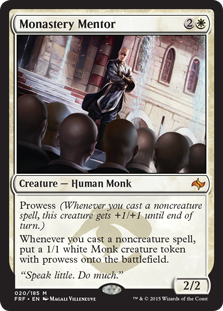
Monastery Mentor CardDid you think we would start anywhere else? When this deck first hit the online communities, some players speculated as to whether or not Mentor was even needed in the deck. Maybe the deck should just splash for Goyf, or go with a more conventional Delver of Secrets path to victory. But after you've played the deck or played against it, it's pretty clear Mentor really is the engine that makes this deck run, and is just as much a core of the deck as the deck's name suggests.

On his own, Mentor just looks strong. It spits out trainee Swiftspears with every trigger, and swings for respectable damage on his own. He's at that critical less-than-3 mana cost Modern playability depends on, and has innate resilience to removal in his pump (less relevant) and his ability to create tokens even if killed (much more relevant). That said, a lot of players criticized Mentor as too fragile. He dies to Bolt. He dies to Abrupt Decay. He dies to Path to Exile. He's not even really a 3 drop, because you probably want to play this with 1+ mana open to get some value out of him if he eats removal.

The Esper Midrange shell is designed to mitigate these weaknesses and maximize Mentor's strengths. IoK/TS can clear the way for Mentor to land on turn 3. You can also play a more controlling game with countermagic and removal until you guarantee open mana to get a Monk; Ichikawa's list can even ensure value out of the Mentor with Slaughter Pact backup. But you will notice this deck lacks cards like Mana Leak or Apostle's Blessing, the kind of "hard" protection spells that would save Mentor. Instead, it just drops threats (Mentor included) and pressures the opponent to answer them. If they do, no worries -- another threat is on the way. But if they don't, Mentor quickly takes over the game. Modern isn't really a format that rewards you for holding back cards to set up a Mentor, but it is definitely a format that rewards an aggressive turn 3 Mentor against an opponent who can't answer it. Or a Souls into a Mentor with Scour backup; that's the sort of play Abzan must immediately answer or die.

Overall, Mentor fits a unique role of providing both a means of outgrinding an opponent, and also bursting them down when needed. Slotted into this disruptive and controlling shell, it is a formidable card.

Lingering Souls

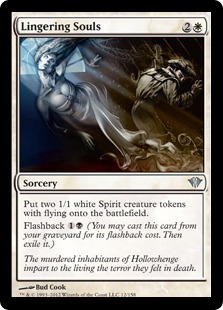
Lingering SoulsIf you want to play a fair game of Magic in Modern, there are few cards better than Souls. Whether chumping Goyfs and Tas', protecting your creatures from Lily, or swinging in for 2-4 damage per turn, Souls is game-breaking in many of Modern's most important matchups. Yeah, it's not the best card to drop on turn 3 against Burn or Amulet Bloom, but it's still one of those fair cards that isn't totally dead in the unfair matchups; even against Infect and Affinity, it clogs up the sky against those problematic Inkmoths and Skirges.

The card gets even better with Mentor and in the Mentor shell. Mentor into Souls plus Snare/Scour/Path/IoK backup is just too much value for most decks to handle. As mentioned earlier, it also defends Mentor from Lily in the all-important Abzan matchup. Souls is also excellent with either Scour or Tasigur, giving you more options for getting value out of your milling and over-pressuring an opponent. Modern is reaching a point where virtually all BWx decks are playing Souls (Abzan, Abzan Liege, BW Tokens, Deadguy Ale, 4C Control, 4C Gifts, etc.), and Mentor Midrange is just the next entry in that lineage.

Thought Scour

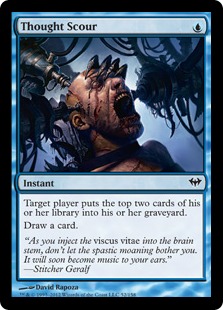
Thought ScourIf you played Modern during the Treasure Cruise era of 2014, you will remember Thought Scour. Whether fueling delve in Modern or enabling dredge or Delver strategies in other formats, Scour is a powerful card. Mentor is another deck to abuse it; it fuels your Tas and Cut, you derive value from it with Snapcaster and Souls, and it's a cheap cantrip to trigger Monk mentoring off your deck's namesake. Not all blue-based midrange and control decks can use this card effectively. Even the Grixis midrange and control decks using Tas and Snappy don't go all-in on the Scour playset. But the synergy with Mentor is too much in this deck, particularly because milled cards can be recast to trigger additional tokens. Add the fact that most of your sideboard cards are also flashbackable off SFM and this really solidifies Scour's place in the deck.

Murderous Cut

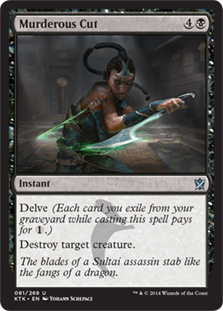
Murderous CutModern creatures are harder and harder to kill. Rhino, Goyf, Tas, Exarch, Spellskite, and a number of other creatures are out of range of Modern's most iconic removal spell, which has forced an arm's race of increasingly powerful kill spells. Abzan and Grixis decks have been trying to fit Cut into their shells, but the spell really hasn't found a home. That is, until now. Esper Mentor has a number of things going for it that make the deck well-suited for Cut. First, the deck packs a ton of low CMC cards and fetchlands, which guarantee some delve fuel. The fetchlands in particular have been a big barrier for Cut's usefulness in other decks; I tested this in 8Rack but it was hard to reliably cast it on turn 2-3. Second, you really need to run Cut alongside a card like Scour, and as we already discussed, Esper Mentor is great for TS. Between that and the fetches, you have a great chance of casting this on turn 2 as an unconditional Doom Blade. Finally, these 1 mana spells have great synergy with Mentor, because it maximizes your chances of getting Mentor value on turn 4. Even if you just drop Mentor on turn 3 and pray he lives through turn 4, the low-cost Cut ensures you have lots of spells for prowess triggers. Between this and Path, Esper Mentor is unique among midrange decks in having 6 "unconditional" removal spells in game 1 (more if counting Snapcaster recursion). By comparison, Abzan must rely on the highly conditional Decay.

Creeping Tar Pit

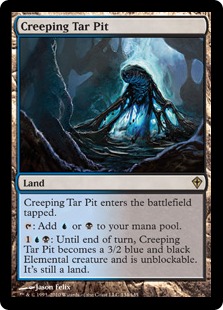
Creeping Tar PitAbzan has Treetop Village and Stirring Wildwood. UWR Control has Celestial Colonnade. And Esper Mentor has Tar Pit, an under-appreciated entry in the Worldwake manland cycle. A big part of this was the historic prevalence of Bolt, which dictated a minimum creature toughness for years. But with Jund out in favor of Abzan and Bolt at all-time lows in the top decks of the format, Tar Pit is looking a lot better. It turns out Tar Pit is incredibly unfair against fair decks, particularly BGx ones relying on Decay and Lilly. Pit also dodges sorcery speed sweepers (e.g. Supreme Verdict and Anger of the Gods), as well as sorcery speed spot removal (e.g. Maelstrom Pulse and Flame Slash). This surprising resilience, which is definitely a function of the current decks in the format, makes Pit a great choice in this metagame. 3 power is also considerable, especially when compared with the other burst-damage potential of the Esper Mentor shell.

As mentioned earlier, other card choices are pretty automatic for this kind of deck. You can't play black in Modern without IoK and TS, at least not with a straight face; Tas is a card that could have received some special consideration, but with everyone from Twin to Delver players trying to squeeze the Sultai shaman into their gameplan, he hardly needs introduction these days; Disfigure is a neat inclusion as an additional line of defense against Burn, Infect, and Affinity.

As for the sideboard, it's a who's-who of potent Esper cards to target important matchups in the metagame: Stony Silence for Affinity, Timely Reinforcements for Burn, Negate as a catchall, etc. In particular, I'm a big fan of those Disenchants, sideboard cards that have fallen out of favor in recent years but remind me of my earlier days of Magic (GOGO Lin Sivvi, Defiant Hero!). Esper colors give you some strong, albeit largely reactive cards for this current metagame, which further supports the color choices of this deck.

Innovation Ideas and Next Steps

Modern has more room for innovation than many players think, and Esper Mentor is both a testament to, and an opportunity for, that innovation. I am sure we will see lots of updates to Ichikawa's list in the coming months. Here are some ideas about what this innovation might look like, and some directions I don't think the deck should take.

Mishra's Bauble

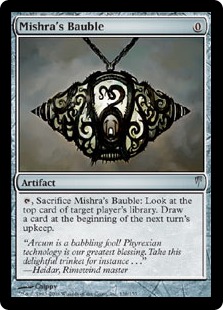
Mishras BaublePat Chapin might have bombed out of PT Fate Reforged with his Esper Delve list, but the Innovator lived up to his name by (re)introducing the Modern world to a hot piece of old tech: Bauble. Chapin used the card to fuel his Tas's and Gurmag Anglers, fixing draws with fetchlands, and obtaining information from the opponent. Bauble is a natural consideration for Esper Mentor. It not only fuels Tas and Cut, but also dramatically improves your chances of getting some value out of Mentor before he eats removal. Once Mentor resolves, you can simply cast the free Bauble to immediately generate a Monk token. This helps you cast Mentor more aggressively, on top of all the other benefits gained from Bauble.

The big issue with Bauble is, of course, it doesn't really do much on its own. This makes it fairly underwhelming against fast, linear, "unfair" decks in the format that don't care what information you are gaining and don't care if your Tas lands on turn 2 or turn 3. But it gets a lot better in the grinder matchups where those kind of plays matter more, where fetchland and quasi-scry synergy becomes more important, and where you aren't punished for having a "dead" card in a hand. But unlike the upcoming Probe, this is a lifeloss-free way to fuel delve and trigger Mentor, so in aggro heavy environments I would turn to Bauble first.

Gitaxian Probe

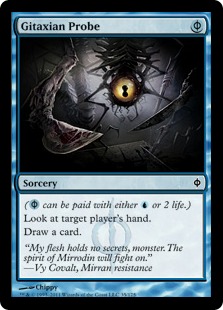
Gitaxian ProbeIn many respects, Probe can be a better Bauble. It draws you a card right away, and so is never really dead even in fast matchups. It gives you a lot more information than Bauble, which can help you prioritize removal or decide when to play aggressively or reactively. And like Bauble, it fuels delve and has great synergy with Mentor. That said, 2 life is a big deal in Modern. Decks like Burn and Affinity can punish you hard for a free Shock, and the information gained isn't always worth that loss in life. That's especially true for a deck already playing a mass of fetchlands and shocklands. Still, I am a big fan of information, especially in a format as diverse as Modern, where decks vary both at the metagame level (i.e. what deck is someone playing?) and the decklist level (i.e. what cards is this version of the deck playing?). This is still very risky against the lifeloss aggro decks like Affinity, Merfolk, and Burn, and in a metagame somewhere around 12% Burn, you really can't afford that. If your metagame has more Twin and Abzan, along with similar decks, then Probe is a good choice. Otherwise, I would prefer Bauble.

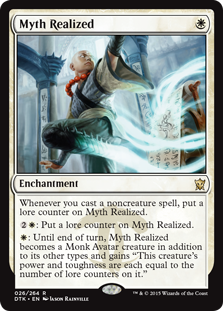
Myth Realized

Myth RealizedIs that Mentor himself?? It's hard to tell because all Jeskai monks all kind of look alike, but regardless of who the Myth is, this is the natural DTK contender for the deck. I've already talked about how I think this is one of DTK's standout cards, and Mentor definitely figures into that. Played on turn 1, this is an easy 4/4 by turn 4, which is right on curve for a "creature" that basically dodges all removal. It also isn't as terrible a topdeck in Mentor as in other decks, because it triggers Mentor himself. But it still isn't the greatest topdeck past turn 2 or so, which creates an odd tension where you want to run more copies to get it in your opening hand, but don't want to draw this on turn 5. In most decks, this suggests a 1-2 copy inclusion, but I think Mentor wants to go 3-4. You really do want this on turn 1. Keep in mind some of the topdeck drawbacks are mitigated by Mentor himself.

A big part of this depends on how good Myth actually is. We didn't see it at all at the first SCG Premier IQ to feature Modern cards, but maybe it's a late bloomer like Mentor himself. If Myth turns out to be good (which I believe it will be), then Mentor is a home for it. You would expect this deck to use Myth regardless of the metagame, but with a particular strength in matchups that didn't have Decay. If Myth turns out to be overhyped, then Mentor isn't going to be the deck to make it work. After all, if we are looking for another creature, we might have better options...

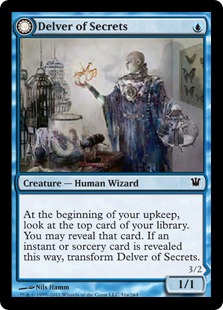
Delver of Secrets

DelverIt's no coincidence Delver is bald. Ex-Jeskai monk anyone? Guess even when you get kicked out of the monastery, you can still have a successful career...as a giant Cronenburg-style manbug. Delver was one of the first cards players wanted to pair with Mentor, and with good reason. Anything flipping Delver is also something triggering Mentor, and prowess is definitely a strong mechanic to pair with the bugman. Delver makes the deck much more aggressive; in the current version of the deck, you are expected to land a creature on turn 3 (with turn 2 Tas a remote possibility). Delver drops on turn 1 and starts swinging on turn 2, a full two turns before your typical 3 drop is likely to get its first crack. That changes both how the deck feels and plays, but also how you should build it. For instance, Bauble would definitely be out, and you would definitely want Visions in (Ichikawa's build doesn't use SV).

Unfortunately, I am not sure this deck wants that kind of aggression. Delver is so strong in Grixis, Temur, and UR builds because it is backed up by Bolt, Electrolyze, and Snapcaster. This gives you an aggressive reach that is unavailable in Esper. True, we could use Delver to give us additional aggression as a way to increase the deck's options, but I think this just puts us in a jack-of-all-trades, master-of-none scenario.

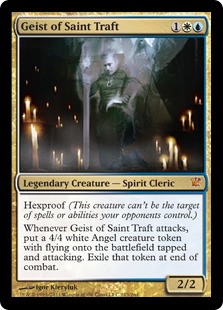
Geist of Saint Traft

Geist of Saint TraftThe final creature I want to think about is Geist. When some players first saw Esper Mentor Midrange, they considered cutting Mentor in favor of Geist himself. After all, Geist had considerable success in Jeskai Delver, UWR Midrange, and Domain Zoo, whereas Mentor was totally unproven. Although I think we have moved past cutting Mentor for Geist, there is still a real question as to whether or not we run the two together. One argument in favor of Geist is he's much easier to protect than Mentor, and Esper colors are typically good at protecting creatures as is (IoK/TS/Snare, etc.). We could add in Shizo, Death's Storehouse and/or Eiganjo Castle to support Geist too, and our hard removal spells can clear a path for attacks into even the biggest defenders.

A big issue with Geist, however, is our lack of burn spells. Geist is a lot better alongside cards like Electrolyze because you can clear away Spirit tokens and other smaller blockers before an attack. Yes, we do have strong one-for-one removal, but this removal is at its strongest when aimed at Goyf and Rhino, not Pestermite or Spirits. This makes Geist comparatively weaker in our deck than it is in Jeskai ones. Although Geist does give us another beatstick, one that is often a better topdeck than Myth, I don't think I would run it over the enchantment in the maindeck. I do think it has a home in the sideboard, particularly against removal heavy decks (red ones especially) that threaten early Mentors. Trying 3 of these in the board could be a good direction for the deck to go.

If the current metagame data is any indication, Esper Mentor looks like it will quickly rise up to become a Modern mainstay. Expect to see this deck looking even stronger by the time summer rolls around, and even to make some T16 appearances at those upcoming GPs in June. So sleeve up those Esper cards, take down some dailies, and show Abzan they don't have the midrange monopoly they think they do!


EDIT: An earlier version of this article incorrectly referred to the player as "Ichikawa Yuuki" instead of "Yuuki Ichikawa". This has been amended. 

The Most Important MTG Crowd-Funding Project Of 2015 (and no, we’re not doing a Kickstarter)

Are you a Quiet Speculation member?

If not, now is a perfect time to join up! Our powerful tools, breaking-news analysis, and exclusive Discord channel will make sure you stay up to date and ahead of the curve.

The last 18 months have seen a number of Kickstarter & IndieGoGo* crowd-funding campaigns in Magic: the Gathering.  It's a sign that our community really is as tight-knit as everyone thinks, and it bodes well for the future of independent Magic projects.  Until recently, aspiring creatives and ambitious engineers were at the whims of WotC and the large dealers, but now the community is showing that it's willing to come out in force to support what it believes in.

Don't take this the wrong way - Magic wouldn't be where it is today without the sponsorship of brands like Cool Stuff Inc, Star City Games and TCGPlayer.  In fact, it's doubtful that QS would be where it is today without them. Both of QS's founding members owe a tremendous debt to these companies - Doug wrote a Legacy column on SCG,  Kelly wrote forTCGPlayer & ManaNation (which was then acquired by Cool Stuff Inc and merged with GatheringMagic, which then allowed MN founder Trick Jarrett to move on to a career with WotC).   Without these guys, we'd still be praying for 'ramen profitability' from Google AdSense.

But this is 2015, Year of the Kickstarter.  And what we're trying to tell you is, pay attention.  Unless you're living under, or chained to the rocks, you know what PucaTrade is.  They raised a successful crowd-funding campaign on IndieGoGo a little while ago, and now they're going back to the well to really step up their game.

Here's why this is the most important crowd-fund of the year:  it's about Magic Online.  We all hate trading on MTGO.  It's clearly not designed with finance in mind, nor does that figure to change any time soon.  Well, Eric and the gang from PucaTrade want to fix that.  They have 66 hours left and are almost 90% of the way to their goal.    If they don't close that 10% gap, they get nothing.

Come on #mtgfinanciers.  Let's make this happen.


Here's what they're doing.


*Fun Fact:  QS and IndieGoGo were both runners up in a business contest in 2011.  We got to travel all over the world and meet Magic players from London to Paris to New Zealand.  IndieGoGo got 2nd place.  We got...not 2nd, but we did get to meet IGG's founders!

Insider: The Top Ten Standard Decks to Beat This Week

Are you a Quiet Speculation member?

If not, now is a perfect time to join up! Our powerful tools, breaking-news analysis, and exclusive Discord channel will make sure you stay up to date and ahead of the curve.

With this past weekend’s SCG Invitational complete, the Dragons of Tarkir Standard format now has a high-profile competitive event under its belt. This event is especially impactful as a driver of the metagame given the high-stakes, super competitive nature of the event.

Compared to a normal Open event , the Invitational draws out more great players from farther distances. Expert deckbuilders left nothing on the table with their decklists, and the crucible of the tournament forged the strongest into solid decks that will live on into future tournaments. The high-profile nature of the event means that compared to a normal Open, it has more prestige, and it is more publicized, viewed, and shared, and will lead to a greater number of copycats and netdeckers. It’s all but certain that the top Standard decks from the SCG Invitational will become players in the metagame moving forward, and they will be most impactful during this coming weekend’s round of tournaments.

Today I’ll share ten decklists, taken from the Invitational, that represent the current top Standard archetypes and should be a part of everyone’s testing gauntlet this week. These particular decklists will be the most widely imitated going forward, so it’s important to be knowledgeable about them given the likelihood of seeing them across the table this week at local stores and perhaps this weekend at larger events.

For the competitor, these decklists are also very reasonable deck choices to play this week, and for the deck tuner they are great starting points for further experimentation.

Abzan Control

Winning the SCG Invitational was Jacob Wilson with his innovative Abzan Control deck.

Abzan Midrange

Creatures

4 Satyr Wayfinder
4 Siege Rhino
4 Courser of Kruphix
2 Sidisi, Undead Vizier
2 Tasigur, the Golden Fang

Spells

2 Elspeth, Sun's Champion
1 Garruk, Apex Predator
4 Abzan Charm
2 Bile Blight
4 Hero's Downfall
1 Murderous Cut
1 Ultimate Price
1 Utter End
4 Thoughtseize

Land

2 Forest
2 Plains
1 Caves of Koilos
2 Llanowar Wastes
4 Sandsteppe Citadel
4 Temple of Malady
4 Temple of Silence
4 Windswept Heath
1 Urborg, Tomb of Yawgmoth

Sideboard

2 Fleecemane Lion
1 Virulent Plague
1 Back to Nature
1 Bile Blight
1 Ultimate Price
1 Nissa, Worldwaker
1 Ugin, the Spirit Dragon
2 Drown in Sorrow
2 Duress
1 End Hostilities
2 Read the Bones

There was an error retrieving a chart for Satyr Wayfinder

There was an error retrieving a chart for Tasigur, the Golden Fang

Satyr Wayfinder is a great enabler for Tasigur, the Golden Fang, but before Dragons of Tarkir it lacked synergy with the rest of the deck.

There was an error retrieving a chart for Sidisi, Undead Vizier

Enter Sidisi, Undead Vizier, which is a perfect fit into the Abzan Control strategy as a large creature and tutor, but which lacks suitable sacrifice fodder; Satyr Wayfinder fills this role.

The combination of Tasigur, the Golden Fang and Sidisi, Undead Vizier creates a critical mass of synergies in the deck to be supported by a full playset of Satyr Wayfinder, which is now an essential cog and roleplayer for the deck and, if widely adopted, for the archetype going forward.

A pair of Sidisi, Undead Vizier gives the deck significant tutoring power for powerful one-of cards. One-ofs include those that are unwieldy to play in multiples, like Wilson’s maindeck Garruk, Apex Predator, a great haymaker that plays very well against a metagame slanted towards midrange and control. In the sideboard, Ugin, the Spirit Dragon goes even bigger. It’s best against decks that go wide, like Jeskai Tokens and Devotion strategies.

Sidisi, Undead Vizier can also set up a tempo play with access to singleton Murderous Cut and Ultimate Price, or answer any permanent with Utter End. These removal spells are efficient but situational, and Sidisi, Undead Vizier provides reliable access to them without the need for multiple copies.

The sideboard contains some great silver-bullet hate cards, including Virulent Plague, a dedicated hoser against Jeskai Tokens which also punishes Hornet Queen, Sidisi, Brood Tyrant and Elspeth, Sun's Champion. Back to Nature is a powerful play against decks with many enchantments, especially R/W Aggro and Whip of Erebos decks. A single End Hostilities is a great tool against aggressive decks.

The sort of card selection provided by Sidisi, Undead Vizier excels in a controlling deck like Abzan Control with powerful situation cards. It opens up a great deal of deckbuilding space and creates opportunities for customization, especially from the sideboard.

It’s exactly the sort of super-charge the archetype needed to maintain its grasp at the top of the metagame. Wilson’s adoption of Satyr Wayfinder to power the delve on Tasigur, the Golden Fang and Sidisi, Undead Vizier represents a real evolution of the archetype and is likely the best configuration going forward.

Sidisi Whip

Here's the deck Reid Duke played to the finals:

Sidisi Whip

Creatures

1 Hornet Queen
1 Reclamation Sage
4 Satyr Wayfinder
1 Soul of Innistrad
4 Sylvan Caryatid
1 Torrent Elemental
4 Courser of Kruphix
1 Dragonlord Silumgar
4 Sidisi, Brood Tyrant
2 Sidisi, Undead Vizier
1 Silumgar, the Drifting Death
2 Tasigur, the Golden Fang

Spells

2 Hero's Downfall
4 Murderous Cut
2 Whip of Erebos
3 Thoughtseize

Land

3 Forest
1 Island
2 Swamp
3 Llanowar Wastes
4 Opulent Palace
3 Polluted Delta
3 Temple of Malady
1 Temple of Mystery
1 Windswept Heath
2 Yavimaya Coast

Sideboard

2 Doomwake Giant
2 Bile Blight
1 Disdainful Stroke
2 Hero's Downfall
1 Negate
2 Sultai Charm
1 Pharika, God of Affliction
1 Drown in Sorrow
1 Duress
1 Thoughtseize
1 Treasure Cruise

The card selection provided by Sidisi, Undead Vizier is also excellent in a synergistic deck like Sultai Whip. This graveyard-centric archetype leverages the graveyard-filling power of Satyr Wayfinder and Sidisi, Brood Tyrant to enable things like delve and Whip of Erebos, but both of these creatures are also great sources of exploit fodder for Sidisi, Undead Vizier. It’s a natural fit into the archetype.

Just like in Wilson’s deck, in Duke’s deck Sidisi, Undead Vizier enables an array of powerful one-of bullet cards.

Torrent Elemental is both a win condition and way to fight against attrition, so it earns a slot. Hornet Queen has been reduced to just one copy, making the deck less clunky. Silumgar, the Drifting Death is great against decks that go wide or those that rely on removal, and the new Dragonlord Silumgar is excellent against decks that produce powerful individual threats or against those without removal.

There was an error retrieving a chart for Dragonlord Silumgar

I’m particularly impressed by the ability to tutor for a Treasure Cruise in post-sideboard games.

Reid Duke’s decklist is the model for Sidisi Whip going forward. With Dragons of Tarkir additions, it has catapulted itself back into top-tier contention.

G/W Devotion

In my eyes the best deck before Dragons of Tarkir was G/W Devotion, fresh off its dominating performance at GP Miami.

GW Devotion

Creatures

4 Deathmist Raptor
4 Elvish Mystic
3 Genesis Hydra
4 Sylvan Caryatid
1 Temur Sabertooth
3 Voyaging Satyr
4 Whisperwood Elemental
4 Courser of Kruphix
3 Polukranos, World Eater

Spells

4 Mastery of the Unseen
2 Dromoka's Command
9 Forest
2 Plains
1 Mana Confluence
4 Temple of Plenty
4 Windswept Heath
4 Nykthos, Shrine to Nyx

Sideboard

3 Fleecemane Lion
2 Hornet Nest
1 Reclamation Sage
1 Dromoka's Command
3 Surge of Righteousness
1 Dragon Throne of Tarkir
2 Nissa, Worldwaker
2 Glare of Heresy

This deck received some great new addition from Dragons of Tarkir, Deathmist Raptor and Dromoka's Command.

There was an error retrieving a chart for Deathmist Raptor

Deathmist Raptor has natural synergy in this deck, which can produce manifest dorks in surplus and reanimate Deathmist Raptor from the graveyard at will. It provides the deck with a great source of board presence throughout a long game and is exactly the fuel necessary to outlast any opponent fighting a war of attrition. With two green in the cost, it’s also a great source of devotion for Nykthos, Shrine to Nyx..

There was an error retrieving a chart for Dromoka's Command

Dromoka's Command is a versatile and powerful utility spell that’s a great fit into the G/W Devotion strategy. The best ability of all is making the opponent sacrifice an enchantment, which is excellent when applicable. The fight ability is a functional removal spell combined with the relatively large green creatures in this deck. The +1/+1 counter is a combat trick and a way to play around burn spells as removal and Bile Blight, and the card also has the ability to effectively counter burn spells.

New tools from Dragons of Tarkir make G/W Devotion a more powerful and robust strategy than it was previously. Personally I have had nothing but success with the archetype and have great things to say about it, so I can’t recommend it highly enough. It’s well positioned in a world of midrange and control decks.

Jeskai Tokens

Todd Anderson and his Roanoake crew have updated the Jeskai Tokens strategy for a Dragons of Tarkir world.

Jeskai Tokens

Creatures

4 Goblin Rabblemaster
3 Seeker of the Way

Spells

4 Jeskai Ascendancy
3 Anticipate
1 Lightning Strike
3 Raise the Alarm
4 Stoke the Flames
1 Valorous Stance
4 Wild Slash
4 Hordeling Outburst
1 Roast
4 Treasure Cruise

Land

1 Island
2 Mountain
2 Plains
3 Battlefield Forge
3 Flooded Strand
4 Mystic Monastery
3 Shivan Reef
3 Temple of Epiphany
3 Temple of Triumph

Sideboard

3 Disdainful Stroke
2 Negate
2 Valorous Stance
3 Dragonlord Ojutai
1 Elspeth, Sun's Champion
2 Anger of the Gods
2 Glare of Heresy

Anticipate makes the deck more consistent in all games, whether it be digging for Jeskai Ascendancy, a threat, or a Treasure Cruise. It also helps the deck better operate as a control deck in post-sideboard games. The change to the deck is subtle, but it’s impactful, especially in post-sideboard games where Jeskai often finds itself in a controlling role.

There was an error retrieving a chart for Dragonlord Ojutai

The standout card from Todd’s list is Dragonlord Ojutai, which has officially made its Standard debut. It’s extremely strong out of the sideboard of Jeskai Tokens, where it shifts gears as a large, standalone threat. Opponents will likely cut cards like Hero's Downfall in favor of cards like Drown in Sorrow, leaving Dragonlord Ojutai to run roughshod.

Coverage lauded it throughout the weekend, and I expect that if Todd had won the Invitational it would be very popular going forward. As it stands, the cat is out of the bag, but last weekend it was overshadowed by other Dragons of Tarkir cards.

Jeskai Tokens is well positioned in any metagame that is not prepared for it, and I expect it will be a fine option this coming weekend. Maindeck Silumgar, the Drifting Death is a problem, and Virulent Plague could be a sideboard issue, but the deck has the ability to overcome any issues with sideboarding of its own.

Abzan Aggro

Abzan Aggro has been a competitor all season long, and it continues to perform after Dragons of Tarkir.

Abzan Aggro

Creatures

1 Whisperwood Elemental
2 Tasigur, the Golden Fang
4 Rakshasa Deathdealer
2 Sorin, Solemn Visitor
3 Anafenza, the Foremost
4 Siege Rhino
2 Wingmate Roc
4 Fleecemane Lion

Spells

2 Dromoka's Command
2 Abzan Charm
2 Bile Blight
3 Hero's Downfall
4 Thoughtseize

Land

2 Urborg, Tomb of Yawgmoth
4 Sandsteppe Citadel
3 Temple of Malady
2 Temple of Silence
4 Windswept Heath
2 Plains
2 Forest
3 Caves of Koilos
3 Llanowar Wastes

The hyper-efficient creature suite didn’t receive any updates from the new set, but Dromoka's Command gives it a great new tool to play with. All of the modes are great here, and it will often be able to set up a two-for-one.

As far as its metagame positioning, Abzan Aggro is strong against Sultai Reanimator, so the success of that deck is good news, but Abzan Control is not a favorable matchup. As an aggressive and proactive deck full of individually excellent cards, it has plenty of game against the field, and it will continue to be a player in the metagame as long as people play the archetype.

Mono-Red Aggro

Mono-Red Aggro is great in any field full of control and slow midrange decks, and it found success at the invitational with a Top 8 finish.

Mono-Red Aggro

Creatures

4 Eidolon of the Great Revel
4 Foundry Street Denizen
4 Lightning Berserker
4 Zurgo Bellstriker
3 Goblin Heelcutter
1 Goblin Rabblemaster
4 Wild Slash
4 Hordeling Outburst
4 Stoke the Flames
4 Lightning Strike
3 Dragon Fodder

Land

21 Mountain

Sideboard

4 Roast
4 Outpost Siege
2 Hall of Triumph
1 Scouring Sands
1 Mountain
3 Arc Lightning

Michael’s teammate also put up an excellent 7-1 or better Standard record with a nearly identical deck on his way to a 18th place finish, so the deck is the real deal.

There was an error retrieving a chart for Zurgo Bellstriker

I am slightly surprised by the inclusion of a full playset of the legendary Zurgo Bellstriker, but the card does hit quite hard and is much more robust than Firedrinker Satyr, which falls to things like Satyr Wayfinder and 1/1 tokens. It’s a better late game draw because it effectively has haste with dash. Dash returning the creature to hand also combines well with Foundry Street Denizen.

Another dash card is Lightning Berserker, which completes the one-drop creature package. It doesn’t hit hard early, but the fireball ability means it demands attention or will deal a ton of extra damage. With dash, it’s a very strong late game draw as a surprise Blaze-effect.

This deck also incorporates three Dragon Fodder to supplement the four Hordeling Outburst. These cards make Foundry Street Denizen excellent, as well as Stoke the Flames. They are also reliable sources of board presence that play well against targeted removal, and they are useful for helping to create a swarm of creatures to overwhelm blockers.

G/R Monsters

G/R Monsters made a big impact at this format’s inception, but it has been a minor player in the overall Standard picture over the last six months. Dragons of Tarkir offers many new useful tools, including two huge threats in Thunderbreak Regent and Surrak, the Hunt Caller, and removal in Draconic Roar and Roast.

GR Monsters

Creatures

4 Elvish Mystic
4 Goblin Rabblemaster
3 Heir of the Wilds
4 Rattleclaw Mystic
4 Stormbreath Dragon
4 Thunderbreak Regent
4 Boon Satyr
3 Surrak, the Hunt Caller

Spells

4 Crater's Claws
1 Roast
2 Draconic Roar

Land

6 Forest
6 Mountain
2 Mana Confluence
1 Rugged Highlands
4 Temple of Abandon
4 Wooded Foothills

Sideboard

3 Hornet Nest
3 Destructive Revelry
3 Wild Slash
1 Nissa, Worldwaker
3 Xenagos, the Reveler
2 Roast

There was an error retrieving a chart for Thunderbreak Regent

Thunderbreak Regent is the perfect mana curve pal for Stormbreath Dragon. It creates value against targeted removal spells, so it’s right on this deck’s game-winning plan of dealing 20 to the opponent. Three free damage makes the job of Crater's Claws that much easier, and if uncontested it will end the game quickly as a large threat with evasion.

There was an error retrieving a chart for Surrak, the Hunt Caller

Surrak, the Hunt Caller effectively has haste in the majority of situations, and once in play it retains excellent value on its following turn with its ability to grant haste to future creatures. It adds an explosive damage potential to this green deck. It is an especially good follow-up to Goblin Rabblemaster, which will trigger formidable if a goblin stuck around the turn prior. This also opens up a turn three nut draw enabled by Elvish Mystic. It turns Thunderbreak Regent into Stormbreath Dragon.

Draconic Roar takes advantage of the eight dragons in deck. As a creature removal spell it’s always a Lightning Strike, so there is little downside in that sense, though it is poor against the rare creatureless control decks because it can’t target the opponent directly. Given this deck’s plan to use burn to close out games, the upside of this card is huge.

Jeskai Aggro

Kevin Jones has been advocating Jeskai since Khans of Tarkir hit Standard, when he won the first SCG Standard Open with the strategy. He played his deck to a 7-1 or better record at the Invitational, so it’s one I’d take note of.

Jeskai Aggro

Creatures

3 Goblin Rabblemaster
4 Mantis Rider
4 Seeker of the Way
3 Soulfire Grand Master

Spells

1 Anticipate
3 Dig Through Time
1 Disdainful Stroke
3 Lightning Strike
1 Ojutai's Command
4 Stoke the Flames
3 Valorous Stance
2 Wild Slash
2 Elspeth, Sun's Champion
1 Sarkhan, the Dragonspeaker

Land

2 Plains
2 Island
3 Battlefield Forge
4 Flooded Strand
4 Mystic Monastery
3 Shivan Reef
3 Temple of Epiphany
4 Temple of Triumph

Sideboard

2 Prognostic Sphinx
2 Disdainful Stroke
1 Erase
1 Jace's Ingenuity
1 Magma Spray
1 Negate
1 Ojutai's Command
1 Brimaz, King of Oreskos
2 Anger of the Gods
1 End Hostilities
1 Glare of Heresy
1 Roast

This particular list is extra controlling and powerful with maindeck Elspeth, Sun's Champion and Sarkhan, the Dragonspeaker, powered by three Dig Through Time. Kevin plays just three Goblin Rabblemaster, while three Soulfire Grand Master give the deck great late game potential as well as valuable lifegain.

U/B Control

Control is best in an established metagame, so it’s no surprise that it wasn’t widely adopted at the Invitational, but some skilled players found success with control strategies. Christian Calcano played his U/B Control deck to a record of 7-1 or better en route to a 14th place finish.

UB Control

Creatures

1 Pearl Lake Ancient
1 Silumgar, the Drifting Death

Spells

4 Anticipate
3 Bile Blight
4 Dig Through Time
2 Disdainful Stroke
4 Dissolve
4 Hero's Downfall
2 Jace's Ingenuity
2 Ultimate Price
1 Ugin, the Spirit Dragon
2 Crux of Fate
2 Perilous Vault

Land

5 Island
5 Swamp
1 Bloodstained Mire
4 Dismal Backwater
1 Flooded Strand
1 Haven of the Spirit Dragon
4 Polluted Delta
2 Radiant Fountain
4 Temple of Deceit
1 Urborg, Tomb of Yawgmoth

Sideboard

1 Prognostic Sphinx
1 Disdainful Stroke
2 Negate
1 Dragonlord Silumgar
1 Tasigur, the Golden Fang
3 Drown in Sorrow
2 Self-Inflicted Wound
4 Thoughtseize

There was an error retrieving a chart for Anticipate

Anticipate is superb in this deck. It’s a subtle but powerful addition to the deck that gives it a great deal of added play and ability to craft a game plan. It now more reliably can find the specific cards it needs at any given time, and it makes the deck all the more deadly.

Anticipate does come at the cost of two mana, so there is a tempo loss, so the best way to take advantage of it is to turn up the aggression and make the control deck pay for their lost time, as accomplished by decks like Mono-Red and Abzan Aggro.

Esper Control

Another take on control strategies is Esper Control. James Buckingham finished 7-1 or better in Standard with his Esper deck.

Esper Control

Creatures

3 Dragonlord Ojutai
1 Silumgar, the Drifting Death

Spells

4 Anticipate
3 Bile Blight
4 Dig Through Time
4 Dissolve
1 Foul-Tongue Invocation
4 Hero's Downfall
1 Ojutai's Command
4 Silumgar's Scorn
1 Utter End
2 Narset Transcendent
2 Crux of Fate

Land

4 Island
3 Swamp
2 Caves of Koilos
2 Dismal Backwater
4 Polluted Delta
4 Temple of Deceit
3 Temple of Enlightenment
3 Temple of Silence
1 Urborg, Tomb of Yawgmoth

Sideboard

2 Arashin Cleric
1 Foul-Tongue Invocation
2 Negate
1 Ojutai's Command
2 Utter End
1 Dragonlord Silumgar
3 Drown in Sorrow
3 Duress

This deck is another beneficiary of Anticipate. For one, it allows for better access to colored mana, but in James’ deck in particular it provides more reliable access to an assortment of one-of cards, including Ojutai's Command, Utter End, and Foul-Tongue Invocation.

This last card is the most interesting, because it belies the existence of other dragons, in this case three Dragonlord Ojutai as the finisher of choice. A full four Silumgar's Scorn join four Dissolve to create a sizable counterspell suite.

There was an error retrieving a chart for Silumgar's Scorn

Silumgar's Scorn has some variance attached to it, but it’s important not to underestimate just how strong it is as a Force Spike, especially against the unprepared. It’s hard to play against, because slowing down the curve to get an extra mana in play before casting spells is a major tempo loss, and may fail entirely if the opponent draws a dragon, which just gets more likely as the game goes on.

The deck will draw a dragon in the 7-card opener just under 40% of the time. Once the deck has seen 10 cards, whether from drawing or by casting Anticipate, it will have seen a dragon more than half of the time. The dragons are particularly strong with Crux of Fate as the sweeper of choice.

There was an error retrieving a chart for Narset Transcendent

This deck also plays a pair of Narset Transcendent. Each +1 ability will hit around 50% of the time, so it’s a decent source of card advantage comparable to Domri Rade. The rebound ability is great with the one-of spells I mentioned, and it’s strong with the card draw and removal spells.

~

If you're planning to play Standard in the coming weeks, make sure you're prepared for these decks. Turn to the comments sections with any questions, criticism, or things to add!

-Adam Yurchick

Tucked or Untucked?

Are you a Quiet Speculation member?

If not, now is a perfect time to join up! Our powerful tools, breaking-news analysis, and exclusive Discord channel will make sure you stay up to date and ahead of the curve.

The EDH rules committee has issued a ruling that has eliminated "tucking" from EDH. Essentially, cards that would shuffle a commander into the deck give the owner the option of putting the commander back in the command zone, as well as cards that return the card to owner's hand or place it in the graveyard. So how do we feel about the ruling?

Jason Rice wrote an impassioned piece about the subject and called for essentially the dissolution of the Rules Committee calling them out of touch and calling for the subject of EDH rules to fall under WotC's purview. It's a compelling piece and sparked a lot of debate on Reddit.


Untitled


On the other hand, Sheldon Mennery was a guest on the excellent EDH podcast, The Command Zone. Sheldon does a very good job of defending the committee's decision and their necessity.

It's a weird debate and I'm sure you all have an opinion even if your opinion is "I don't care about EDH, bruh". Leave it below and let's get a brouhaha started up in here.

Avatar photo

Jason Alt

Jason Alt is a value trader and writer. He is Quiet Speculation's self-appointed web content archivist and co-captain of the interdepartmental dodgeball team. He enjoys craft microbrews and doing things ironically. You may have seen him at magic events; he wears black t-shirts and has a beard and a backpack so he's pretty easy to spot. You can hear him as co-host on the Brainstorm Brewery podcast or catch his articles on Gatheringmagic.com. He is also the Community Manager at BrainstormBrewery.com and writes the odd article there, too. Follow him on Twitter @JasonEAlt unless you don't like having your mind blown.

View More By Jason Alt

Posted in Free10 Comments on Tucked or Untucked?

Have you joined the Quiet Speculation Discord?

If you haven't, you're leaving value on the table! Join our community of experts, enthusiasts, entertainers, and educators and enjoy exclusive podcasts, questions asked and answered, trades, sales, and everything else Discord has to offer.

Want to create content with Quiet Speculation?

All you need to succeed is a passion for Magic: The Gathering, and the ability to write coherently. Share your knowledge of MTG and how you leverage it to win games, get value from your cards – or even turn a profit.

Insider: Next-Leveling Based on What We Know About Zendikar

Are you a Quiet Speculation member?

If not, now is a perfect time to join up! Our powerful tools, breaking-news analysis, and exclusive Discord channel will make sure you stay up to date and ahead of the curve.

We now know every card in Khans of Tarkir block. We also know we're returning to Zendikar in the fall. The key is combining these two pieces of knowledge to make some next-level decisions regarding what in KTK block may just be good in Standard next fall. Being way ahead of the game will be the most profitable, so let's examine the information we have with the clues we can deduce.

Warriors

Tribal warriors was a major sub-theme in Khans of Tarkir. However, due to staples like Sylvan Caryatid and Courser of Kruphix (especially), a competitive warriors deck hasn't made a real impact on Standard this season.

Two questions regarding this archetype are important:

  1. Does rotation of Theros block make this archetype playable on its own?
  2. Is there anything coming up in the next block that might make the warriors archetype even better?

First, we need to know where the best warriors currently are. The Mardu clan (red, white, and black) is the clan most likely to sport warriors in the block, with the best ones tending to show up in white and black.

Now, there's no way we can know what will be in Battle for Zendikar block. Our two previous returns to planes—Scars of Mirrodin and Return to Ravnica blocks—reprinted very few cards from their original expansions. However, what was similar in each of these returns was the flavor and, importantly, creature types. In fact, creature types are such a big deal that when a new type was added, special emphasis was placed on it to get fan speculation going. (Then #4merfolk happened, so don't get too excited about what gets added to the world of Zendikar this fall.)

If you look through the 24 warriors in Zendikar block, there's a pretty important factor: there aren't any in white. In the land of Zendikar, warriors are black, red, and green. So, this could mean one or more of a few things:

  1. If a black-white warriors deck becomes popular, the white warriors will all be from Khans of Tarkir.
  2. Black warriors are probably better speculation targets, should you decide to go down this road.
  3. A red-black warriors deck could emerge, probably leaning more toward black based on what's in Khans of Tarkir, but possibly leaning toward red if Battle for Zendikar points deckbuilders in that direction.
  4. Green warriors could be an outside factor, but given that all the most powerful warrior synergies are in Mardu, this seems least likely.

If warriors does become a deck, some of the rare warriors from the current block are great pickups.

There was an error retrieving a chart for Bloodsoaked Champion

Bloodsoaked Champion will be key to keeping the damage coming, and it's currently only $2. This reminds me in some ways of Champion of the Parish: a one-drop rare from a large fall set that has narrow but powerful synergy in a particular archetype. Based on that history, $5 to $6 doesn't seem unreasonable if the archetype takes off. That's not worth a cash buy-in, but if you do a lot of trading, this might be a good one to target.

Mardu Strike Leader, on the other hand, is even less ($1.34 as of this writing), but it's not so cut and dry that it would be part of the deck. It lacks evasion and costs three. On the other hand, having dash gives you more options, and it's no small thing to generate reasonable attackers for free. Being from a small set means this one has much more room to grow, even if it's probably not as good as Bloodsoaked Champion.

There was an error retrieving a chart for Arashin Foremost

Like I said, we shouldn't really be expecting any new white warriors in Return to Zendikar. That being the case, what we have is what we've got. Arashin Foremost is pretty good, and given that there are so many parallels with Silverblade Paladin, I'm surprised its price is currently so low. Silverblade Paladin, you'll recall, was a rare from a large spring set, and it started at around $4 and peaked around $12. Sure, Arashin Foremost is more narrow than Silverblade, but it's also arguably more powerful in a deck with enough warriors.

If you believe in the power of warriors once Theros is out of the format, these cards are all reasonable targets. Remember that Zendikar was extremely aggro-focused. If the same remains true in Battle for Zendikar, we could see warriors rise to the top tiers of Standard tournaments.

Morph Synergies

Deathmist Raptor has recently been a posterchild for the idea of a "morph deck," or at least a deck utilizing morph synergies.

Here's the thing: there's virtually no chance that face-down creatures play any role in Battle for Zendikar. In the case of morph, what you see is what you get. You're not not getting any more.

So will there be a morph deck? There are a few powerful ones that have seen some fringe Standard play (Hooded Hydra, Ashcloud Phoenix, and Rattleclaw Mystic come to mind, for example). Each of these have something in common: they are pretty good when cast for their normal converted mana cost.

The Goblin Piker cycle of megamorphs in Dragons of Tarkir could certainly have an impact, but I would be hard-pressed to believe that a morph deck will make any kind of significant impact in competitive Standard. If you want these cards for casual or personal reasons, by all means, pick them up. But if you're looking to speculate on what may be playable next year (or just get ahead of the curve to save some money playing), I'd keep away from morph-specific synergies.

Landfall?

There weren't a lot of repeated mechanics between Mirrodin and Scars of Mirrodin blocks (I believe imprint was the only one?), and there were none between Ravnica and Return to Ravnica blocks. That said, landfall was a very popular mechanic that played a huge role in the way Zendikar played. Mark Rosewater has placed landfall as a "1" on the Storm Scale, meaning it will definitely come back at some point.

Despite the history of returning to planes telling us otherwise, my gut is telling me that landfall is in the set. It helps further explain R&D's decision to plant the Onslaught fetchlands in Khans of Tarkir (in addition to boosting sales numbers, of course).

The question, then, is whether the enemy-color fetchlands will be in the set. Frankly, I would be very, very surprised if they are not. But that's by no means a guarantee.

There was an error retrieving a chart for Scalding Tarn

If (note the emphasis, which implies I don't think it's super likely, but within the realm of possibility) the enemy fetchlands are not in the set, and landfall is, that's going to put a lot of pressure on the Khans of Tarkir fetchlands, and they will be past peak supply at this point.

If you have any designs on picking up fetchlands for Modern or Legacy, the time is over the next four to six months. They're barely being opened in drafts anymore (a small proportion of Fate Reforged packs have them), we'll be hitting the summer lull in a month or two, and everyone will need them forever. Don't expect them to be cheaper when they rotate out of Standard than they are now. That is by no means a guarantee.

Think Ahead

These are three examples of combining information we have based on clues we can deduce. There are certainly plants for next year in Khans of Tarkir block—there always are. We just have to be able to find them. Until next time!

Want Prices?

Browse thousands of prices with the first and most comprehensive MTG Finance tool around.


Trader Tools lists both buylist and retail prices for every MTG card, going back a decade.

Quiet Speculation