menu

Looking Ahead to Theros Standard

Are you a Quiet Speculation member?

If not, now is a perfect time to join up! Our powerful tools, breaking-news analysis, and exclusive Discord channel will make sure you stay up to date and ahead of the curve.

This incarnation of Standard will soon be over and the Wheel of Time will continue to turn, moving us into the next cycle of Magic. Once Theros is released, we will be thrown into a Brave New World of Greek mythos combined with Ravnician (that’s a word right?) flavor.

These two worlds seem at first glance to not synergize with each other, but there will undoubtedly be powerful interactions between cards we don’t know just yet.

Even though there are many unknowns as far as Theros is concerned, one strategy I find useful is to examine the current Standard format, as well as Block Constructed, to establish a baseline for what strategies might be viable post-rotation. With this mindset, you can pick up cards you might need in trade much cheaper now than once they become real decks in the new format.

Block Decks

Most decks in the current Standard metagame are filled with Innistrad block cards. Most of these decks will not survive rotation.

There is one deck in particular though, that is formed mainly from cards that will continue to be legal. By now, everyone has most likely played against Monored but if not, it’s not that far off from the G/R aggro decks we’ve been seeing all season.

This is likely a great starting place for the format post-rotation. Not only is it cheap, but certainly we will get a couple red cards good enough to improve it.

Here is a list that might help you see the beginnings of this deck.

Mono-red
by Ari Lax

Untitled Deck

Creatures

4 Foundry Street Denizen
4 Legion Loyalist
4 Rakdos Cackler
4 Ash Zealot
4 Burning-Tree Emissary
4 Firefist Striker
4 Gore-House Chainwalker
4 Boros Reckoner
4 Rubblebelt Maaka

Spells

3 Madcap Skills
3 Dynacharge

Lands

18 Mountain

As of now, I would not be happy to play this in a Standard event, but luckily we have a new set to look for updates from.

There are a couple cards from M14 that I would want in this deck. Chandra's Phoenix seems decent, but only if there are a couple of good burn spells in Theros. Shock is an option, but I doubt it would be good enough.

The main card I want to add immediately would be Mutavault. Obviously Mono-red is a fairly straightforward strategy, but with a curve this low, you gain some virtual card advantage because you will be drawing more spells than lands.

A sweeper can set this deck back enough that it cannot recover, so this deck’s presence in the format may depend on how good the control decks are.

Esper

Pro Tour Dragon’s Maze, which was Return to Ravnica Block Constructed, had many decks utilizing the same strategy. While this strategy did not win the event, it did put many players in the top eight.

I would suspect that these Esper Control decks try to take over the metagame once it rotates. It is always unfortunate to me when current decks that see play survive rotation because I am always looking forward to something fresh and new. Take a look.

Esper Control
Top 8 deck by Matej Zatlkaj

Untitled Deck

Creatures

4 Sin Collector
2 Blood Baron of Vizkopa
2 Aetherling

Spells

3 Syncopate
4 Azorius Charm
2 Detention Sphere
4 Far // Away
4 Supreme Verdict
4 Sphinx's Revelation

Lands

4 Hallowed Fountain
4 Godless Shrine
4 Watery Grave
3 Dimir Guildgate
2 Orzhov Guildgate
1 Azorius Guildgate
5 Plains
4 Island

These cards together in the same deck is nothing new. Certainly this iteration of the deck is unique because it is from a Block Constructed event, but we all know how powerful these cards are based on their play in Standard.

Keep in mind that all of these lands are still legal post-rotation so a deck like this is very possible. It is doubtful that Guildgates will be commonplace outside of control or midrange strategies, but we could have a format where every deck needs them to operate efficiently.

Typically, some type of blue-white control deck is playable in Standard, but it is almost a certainty that this will be a staple deck in the format. Hopefully we will see some different cards to battle against from Theros though to change it up a little bit.

Tokens

The last deck likely to make a strong showing initially is the winning deck from Pro Tour Dragon’s Maze. This deck is based around the core concept of making token creatures while at the same time staying resilient against control.

Craig Wescoe demolished the top eight full of control decks with his list so that may keep the hoards of players from flocking to Esper Control’s bandwagon. That is my hope at least. Here is the winning deck list.

G/W Tokens
Top 8 deck by Craig Wescoe

Untitled Deck

Creatures

4 Dryad Militant
4 Experiment One
4 Judge's Familiar
4 Voice of Resurgence
4 Loxodon Smiter

Spells

1 Civic Saber
4 Call of the Conclave
4 Selesnya Charm
4 Rootborn Defenses
4 Advent of the Wurm

Land

4 Temple Garden
1 Selesnya Guildgate
9 Forest
9 Plains

Now that’s an aggro deck! This deck has an amazingly low curve of rather large creatures to beat down with but does not sacrifice the ability to fight through removal. You don’t have much direct removal outside of five-power or greater creatures, but considering how fast you will get damage in, I’d say most of the time your opponent will be on the back foot.

Of the decks listed so far, this is the one I would be most likely to play. I doubt people are going to forget about this deck existing at the beginning of the new format, but if so it should be good enough to wreck some events with.

Domri and Dragonmaster

The only other deck idea I wanted to talk about today was that of G/R Dragonmaster. After looking over the deck closely, it seems that many of the cards will rotate. The idea behind the strategy is solid though and I think it could remain as a viable deck if we get some new cards to replace the ones rotating.

The main factor drawing players to the deck should be Domri Rade. His effectiveness keeps going up and up in my book. Every time I see him played, he just takes over the game.

You may not draw a card every time you use his first ability, but just the knowledge of what that top card is can help you sculpt your turn accordingly. The card advantage doesn’t hurt when it happens either. I doubt the mana will support both Boros Reckoner and green cards, but if so, combining him with Domri is also a colossal beating.

The other reason I like Green Red post-rotation is because you can build it like Fires of Yavimaya from back in the day. Many authors explored this strategy when Kalonian Hydra was spoiled, but no deck was able to successfully use the new mythic.

The best way to play the Hydra in my opinion is in conjunction with Ogre Battledriver. Not only do your creatures gain haste, but they also all get a free Teetering Peaks pump when they attack. As long as your Battledriver lives, you will crash in for huge chunks of damage on the next turn.

This deck does need a bunch of cards from Theros to make it playable, but it seems likely to me that they will be there. Keep your eyes open for this strategy to make an appearance.

That’s all for this week. Over the next couple of weeks we will be taking a look at some sweet Theros cards. I can’t wait!

Until Next Time,

Unleash the Force!

Mike Lanigan
MtgJedi on Twitter
Jedicouncilman23@gmail.com

Insider: Digging up the Plants – 2013 Edition

Are you a Quiet Speculation member?

If not, now is a perfect time to join up! Our powerful tools, breaking-news analysis, and exclusive Discord channel will make sure you stay up to date and ahead of the curve.

This is an article series I started a few years back. It began mainly as a fun exercise but turned out to be really profitable, so I started to revisit it every summer.

The idea is to look at what we know about the new block and figure out how it affects the cards currently available to us. Last year we knew about multicolor, humans and merfolk coming in the next block. Of course, some of those turned out to be more true than others. (Looking at you, sad stack of Master of the Pearl Tridents in my car.)

Anyway, I’ve hit upon some solid calls in the past doing this, and last year was no exception. There were the really solid calls of the Innistrad lands, Stromkirk Noble, Falkenrath Aristocrat, Champion of the Parish and Silverblade Paladin, all of which made some nice gains.

I also put watch calls on Riders of Gavony, which did have a few weeks to shine where you could make good money by buying them in bulk, and Craterhoof Behemoth, which obviously spiked super hard and made people money.

Theros Block

So let’s look at what we know about Theros

  • Enchantments -- Wizards has announced that this is an "enchantment" block.
  • Devotion -- A new mechanic that counts the number of colored mana symbols you have, like chroma from Eventide.
  • Gods
  • Minotaurs
  • Merfolk?

Obviously the important thing here is enchantments, so I’m going to keep that in mind while trying to find some sleepers. Watch calls are just that, and buy calls mean to acquire the card, which I usually do through trading rather than cash, where there’s more overhead.

Martial Law

A card like this is certainly pretty loose. It’s not the worst in Constructed if the format slows down, but it’s also unlikely to be better than something like Supreme Verdict. But if there is some sort of enchantment-centered deck, this could go from bulk status to a few bucks. Imagine if there’s a way to pull enchantments out of your deck or reduce their cost; something like this could be useable.

I’m not overly excited for this one, but it’s worth noting.

Verdict: Watch

Sphere of Safety

When I talk about the “Enchantment Deck,” it’s mostly because of this card. Ghostly Prison is a fine card, and this can do wonders in the right deck. Will we get the pieces for that deck? Will the format slow down enough for it?

We may not ever find out, but I know Travis Woo has written about this before, and I’m sure he won’t be the only one to try it out once Theros hits the streets. That could take this bulk uncommon to solid buylist territory for a while. It’s also possible this is basically the Maze's End deck.

Verdict: Buy, but only because it’s basically a draft leftover right now. Pick them up as you can, but don’t buy for more than bulk.

Underworld Connections

Here we have a card that is good on its own in addition to fitting into an enchantment theme. It’s also fallen down to near-bulk status, which makes it tempting since it was worth a few bucks not that long ago, and is still a great source of card advantage.

Verdict: Buy

Mana Bloom

I’ve seen people talk about this before, and while I’m obviously not super excited, I can imagine places where it’s better than a Rampant Growth effect, which I don’t believe will actually be in Standard next year.

Anyway, let’s think back to the Sphere of Safety deck. Playing this on turn two to cast Martial Law and turn three or using it to jump to five mana on turn four isn’t the worst thing imaginable, as long as there are plenty more “enchantments matter” cards in that deck.

Let’s be clear. This is a really bad Farseek, but even “bad” versions of cards can sometimes be what you need. If such a deck exists and wants to accelerate, having that come in enchantment form can actually be a benefit.

Verdict: Buy, again only because it’s bulk. It’s a no-lose situation.

Detention Sphere

Such a deck also assuredly wants Spheres. And with O-Ring leaving the format, this becomes that go-to card. I think this is just a solid card period that has bottomed out at around $2, and should only go up from here.

Verdict: Buy

Blind Obedience

Another card that has been good enough to see some play on its own. How good this is will tie directly into how many haste creatures (like Exava) are terrorizing the format. It’s falling to dollar-rare status at this point, though, and there’s no reason not to let that continue until there’s a better reason to buy in.

Verdict: Watch

Debtors' Pulpit

I kind of hate that I’m including this, but it was the hot tech at the Block Pro Tour to shut down opposing Aetherlings without wasting a million cards. That could be enough to make it relevant. Doesn’t hurt to grab out of junk piles in case it hits a quarter on buylists or whatever.

Verdict: Watch

Assemble the Legion

Now here’s a card I like. I was big on this when it came out and hyped it during our set review on Brainstorm Brewery, and after a little while it started putting up some results.

The metagame shifted after that (and Aetherling was printed), so decks started to go elsewhere for their game-winning bombs. That said, it’s between $1-2 now and could easily double up if it saw play. I keep defaulting back to Sphere of Safety as the “enchantments matter” card, but in reality there could be plenty of new cards that follow the same trajectory, and in such a deck this could be better than Aetherling.

Verdict: Watch

Deadbridge Chant

Another card I hyped in my set review that doubled in price the weekend after it released. The card advantage this provides is insane, and gives non-blue decks another source of late-game card-drawing power.

Of course, there’s no telling whether the metagame will be right for something like this in a few months, but it is worth keeping an eye on.

Verdict: Watch

Gaze of Granite

A Cube card mostly, I’m not sure this will ever be fast enough to make waves in Standard. But we have talked before about how Dragon’s Maze is the perfect storm to create expensive cards, so it is worth mentioning because it kills enchantments in addition to everything else.

Verdict: Watch

Ajani's Chosen

This is the most obvious plant we have, but I’m not sure how I feel about it. Given what we know about the new mechanic bestow (enchantment creatures that can be cast as an aura and then become a creature if they’re ever not enchanting something), I believe you can cast a creature like this with Chosen out and attach it to the cat token without paying the extra bestow cost.

That’s a lot of text, and I think maybe it says something about this mechanic. Complexity creep, right?

Anyway, assuming that works like I think it does, you can get some mileage out of the Chosen. At near-bulk right now, it’s hard to lose.

Verdict: Watch, possibly Buy if I understand the new mechanic right.

Planar Cleansing

I think it may be time for control decks to go back to Cleansing if the bestow mechanic makes Constructed waves. Basically it provides a layer of defense to removal spells, keeping you from getting two-for-oned, but it also provides a defense against Supreme Verdict. That means Cleansing could play a pretty key role.

This has been reprinted a ton, so I doubt it’s going to go crazy in terms of price, but it’s worth keeping in your binder for sure.

Verdict: Buy

Primeval Bounty

This is a big EDH card in addition to maybe making some Standard waves. At $6 now, I don’t hate trading into these since they have a solid back-up niche even if they never touch a Standard game.

Verdict: Buy

Cyclonic Rift

Bouncing permanents actually seems kind of relevant now. That means this card, which has stayed around $2 since it was printed, probably has more upside than downside at this point. Another safe call.

Verdict: Buy

Low-Risk Bets

I hope you’ll notice few of these calls involve much risk. The bulk rares you’re unlikely to lose money on, and the more expensive stuff already has some backing for why it’s worth money.

There’s not a lot of hype in the prices of these calls right now, which is one of the best things about them. I don’t think we have another Stoneforge Mystic here, but there are some solid candidates for double-ups, which is what I like.

Did I miss anything? Are of these calls out of line? Let me know!

Thanks for reading,

Corbin Hosler

@Chosler88 on Twitter

Insider: New Beginnings, or How I Got My Groove Back

Are you a Quiet Speculation member?

If not, now is a perfect time to join up! Our powerful tools, breaking-news analysis, and exclusive Discord channel will make sure you stay up to date and ahead of the curve.

Intro's are always the hardest to write, as I much rather to just get to the good stuff. I guess I will just tell you who I am and why I am writing this article.

If you have ever been on Magictraders.com or MTGSalvation, or even remotely sniffed the financial forums of those sites, you will have seen me post. I have been on MOTL since 1999 and have a top 20 ref count, which sort of shows how old I am and how long I have been working in MTG Finance.

I was also a Mod for MTGNews back when it was cool and MTGSalvation when it started. I am extremely opinionated and will ardently speak in defense of my opinions and suggestions. Needless to say, I am sure I have ticked off my fair share of people over the years, but I am alright with that when it comes to defending my ideas.

As for Stu, the person, I am a 28 year old Accountant based in Pittsburgh, PA. I went to school at West Virigina University for Business and got my MBA in Accounting at Indiana University of Pennsylvania. I have a hyper-aggressive personality, where I often find myself competing, rarely satisfied.

I have rededicated myself to getting better at Magic. I am also a bit of a health-nut, and I love working out and being active.

Cut to the Chase...

You are here to invest intelligently in Magic, and I am here to assist. I feel like financial articles fail when they are simply attempting to spoon-feed information, not truly teaching anything.

As is this is my first article back, I am going to do something rather simple: I am going to give you my top five speculation targets in Standard and Modern for this article and give my reasoning to show you some basics about looking for future spec targets.

"But Stuuuuuuu, you said no spoon feeding!"

"Grrrrr, I wasn't done yet!"

Now, with each of these picks, I am going to justify my position. And your job is to critically engage in the reasoning (perhaps in the comments) and see what you can apply to future speculations of your own.

These cards will be all ranges of prices, so no matter your bankroll, you should be able to find something you like. I personally am not on all of these cards, I think diversification is a double-edged sword. On one side, I think people that preach it are not firm on their convictions, but on the other you need to have multiple copies so when they do spike, you have the customer's needs covered. Bankroll is also another huge factor. One spec on this list is as cheap as $1 and another is $35. Anyways, enough preamble, let's get to the picks (in no particular order, other than by format).

Standard:

1. Abrupt Decay

This is the quintessential example of a card that needs to be aggressively bought. How these things are only $6 I have no clue. This is a multi-format staple ranging from Standard to Vintage. It is also just as rare as Deathrite Shaman, and wherever the Shaman is played, Abrupt Decay is not far behind. I fully expect this card to double in price before Modern season comes around. The last time this card was drafted in any kind of seriousness was nearly a year ago so the supply is slowly drying up.

2. Deathrite Shaman

So, Noble Hierarch is a $20+ card and this is only a $13? Tell me how that makes sense. Another card that spans from Standard to Vintage, this card will be $20+ and I will gladly take 50% profit any day of the week and twice on Saturday. The trick with this card is recognizing what really drives the price, which is Eternal formats. It sees only fringe play in Standard, so I don't see a big spike coming until a month or two before Modern, but its going to happen. If your budget allows it, Deathrite can be had in foil at $50 or so, and I can see it hitting the Snapcaster level of $80+ on foils.

*Note: These first 2 cards illustrate focusing on both format appeal and amount of time this card is drafted. I am willing to wager over the course of the lifespan of a card in Standard, 65% of the cards in the market are from random people opening packs and 35% of actual drafting of the product.*

3. Sphinx's Revelation

A good rule of thumb is that every fall, Standard slows down. Four sets rotate out and all of the mana ramp and fast creatures that were legal are removed. This tends to make control decks a bit better early on. I particularly think that straight Blue-White or Blue-Black will be the way the format leans initially due to Burning Earth. Blue-White gets Sphinx's Revelation which is sitting at $16 at the moment. This looks more like a $25 card to me. Mythics from a set drafted a year ago just smell like $25.

4. Jace, Architect of Thought

Jace follows the same rule. It is around $8 right now and that just feels so low. It is a Mythic planeswalker that is good, just not in the context of current Standard. It's problem right now that is that it can't affect the board in a positive way against these R/G and Jund decks. Jund leaves in the fall and R/G loses a lot of its aggression in the form of Hellrider and Flinthoof Boar.

5. Ravnica-Gatecrash-Dragon's Maze Uncommons

Yep, cheating on this one. I think we are going to see an unprecedented level of $2+ uncommons, particularly from Dragon's Maze. The set was underdrafted with Modern Master's cutting the time it would have been drafted plus it being a 3rd set just sets up a spike in price for cards like Sin Collector, Unflinching Courage and Far // Away (which is on my short list of top 5 cards in the new Standard in the fall). Don't overlook uncommons and commons when it comes to make some easy money. Elvish Mystic is going to be a $1 card that can be had for $0.25. These add up and I have no problem dropping hundreds on Commons and Uncommons if it means 300% profit.

Modern:

1. Liliana of the Veil

Of all of the cards I am listing here, this one has the biggest potential. More than any card in Standard, more than any card on any Restricted/Banned list. It's also one I am not buying and that is WRONG. $35-$40 on ebay with the potential to be the next $100 planeswalker. It is this cheap while not even that good in Standard, but is outrageously bonkers in Modern and Legacy. As important as Deathrite Shaman is to the eternal formats, it's this card that defines Modern and is THIS close to defining Legacy with the new planeswalker rules in effect.

2. Scavenging Ooze

People are just now starting to catch on with this card. This one is a bit longer of a hold due to PTQ scheduling and the promos. However, it might not matter, this card is still rising while being in the set that is currently being drafted. This card is good in Standard but will be a top 3 card in Modern next summer. I think Ooze actually gets a big boost from Modern being next Summer, an additional 6 months away from being drafted and promos drying up means this card should go from $13 to $25 easily.

3. Batterskull

Just feels like a $25 card. Well, it sure isn't a $10 card. After doing this for so long you just get a feeling. You look at a card and it's price and go "that doesn't seem right." Ok, for some actual analysis on the card: It's a Legacy staple and starting to see more play in Modern for both maindecks and sideboards. Add on top of that it is a third set mythic from nearly 3 years ago and I would not be surprised to see it be at least $20 by next Modern season.

4. Spellskite

Why is this card only $6? Anyone else remember it being $10+ last season? This card tanked for almost no reason since last Modern season. A lot of people whose opinions I respect more than myself are playing this card in all sorts of decks, from decks trying to fight the enchantment decks to others protecting their player and creatures from spells that would look to do them harm. It goes in the same vain as Batterskull being a 3rd set rare from a set a long time ago and you have a double digit card for next season easily.

5. Path/Snare/Helix/Inquisition

These will all see spikes by next Summer. Similar to the comment about the standard commons and uncommons, these have plenty of time to rise up in price before spiking for Modern season. Path to Exile, Spell Snare, and Lightning Helix are all depressed due to Modern Masters printings but the surplus will dry up and these cards should get back to their pre-Masters levels. Inquisition of Kozilek will spike and hit double digits, and being a staple in both Legacy and Modern bodes well for its future.

People are already speculating on Modern Masters 2 for next Summer and I just don't see it. I think Wizards will make this a special thing and keep it every 2 years or so, I can see people getting mad at Wizards for doubling up on some of the rares and mythics and tanking the market on the cards. I really think they hit a nice balance with getting more cards in the market while letting said cards regain value and not tanking people's collections.

~~

That is it from me this week. Remember, this is more about teaching you a mind frame when looking for targets, and not as much as to just give you some things to buy. Let me know what you want to see from me or if you have any questions.

-Stu Somers
Twitter- https://twitter.com/ssomers55

Insider – Bulk Trading

Are you a Quiet Speculation member?

If not, now is a perfect time to join up! Our powerful tools, breaking-news analysis, and exclusive Discord channel will make sure you stay up to date and ahead of the curve.

Welcome back readers. My article today is about bulk trading. I realize this topic has been broached several times, but I would like to re-emphasize how amazing this strategy is and more importantly explain some of the nuances of this style of trading.

Bulk Box

First, the bulk box. The concept of a "bulk box" is a box you trade out of that has a set price. For example, my bulk box(es) have these rules written on them: each rare = two new rares, a mythic/foil rare counts as two rares and I will accept some uncommons (this is the most complicated one as I only want uncommons that I know I can trade/unload easily).

This means that if someone roots through it and pulls out 10 rares they need to put 20 new rares or the equivalent in mythics or some combination. This is a pretty easy concept for people to grasp and one that can really work out well for you. I only accept uncommons that my LGS (Nextgen) is looking for at the time because I know I can get immediate trade in credit for them (they also tend to be uncommons that are more valuable than usual).

Now, one "rookie" mistake might be to repeatedly check prices in your bulk box to pull out anything that isn't truly bulk (i.e. stuff you know you'll only sell at bulk rates to stores). This is a lot more work than you'd think given how prices fluctuate, and more importantly it means that your bulk box will end up being only the lowest-end chaff that nobody wants.

That's not where you want it to be, the reason being that your rules already state that each rare in it can potentially net you two rares, so anything that's worth less than two bulk rares is the same whether it's in the box or not. But even more importantly, if you don't have little hidden gems in the box, people will not feel a need to root through it over and over (this is where the real beauty is).

Another lesson I learned was to seperate my bulk box into two boxes, Standard and not-Standard. The reason for this is to allow people to search more easily. The Standard players are only concerned with the Standard box, and usually look for cards that are slightly above bulk or they need for a deck they are building; these are my favorite bulk box traders as they often have little use for non-Standard cards and often put in non-Standard cards that are above bulk.

I then filter through the new stuff looking for any hidden gems that I actually need and put all the other stuff into the non-Standard bulk box. The non-Standard bulk boxes tend to be more geered toward casual and EDH. For the non-Standard box you want a lot of diversity, as EDH decks can often vary greatly based on play style. It's important to have all kinds of random cards from all different sets.

Bulking Out

Second, we have the practice of trading high-end staples for "bulk". This is something I've seen other people do far better than myself.

There's one guy who attends many of the events here in the south. I won't call him out, but he always brings an impressive binder full of duals, Onslaught fetches, and every manner of Legacy/Standard staple you can think of. He trades for bulk constantly.

In my earlier days I traded with him twice, to pick up a Savannah, Karakas, Show and Tell and Tarmogoyf. He traded them at fair prices, but the beauty was he knew what the buylist prices were for most of my cards. So he offered me a fair deal, then could walk over to a vendor and sell my stuff for cash (often more than enough to replace the cards I'd picked up).

I finally learned my lesson and decided to branch out on my own. I now offer people the opportunity to trade for anything in my trade binder (at TCG mid value) at bulk prices (0.10 cents per rare, 0.25 cents per Mythic/Foil rare).

I enjoy this because it takes me out of the equation. My trade partner can go through their binders and unload the stuff that nobody wants and get the high-end cards for "crap". I just have to go through the effort of filtering it out and then finding the appropriate dealer to generate the most revenue.

While I can see some feel there is an ethical grey area when people trade you stuff that isn't bulk at bulk rates (and this is something I've actually wrestled with); the fact is that sometimes it would be nearly impossible to go through all the stuff people are trading in and alert them. This is the main reason I let them make the decision of what to trade in and what not to trade in. Only trade in stuff they have no use for.

When someone trades in a large amount of bulk and while going through it later I find stuff that is considerably more valuable than bulk I try my best to credit them (this only works for people I see on a semi-regular basis), so that if they ever need something small or we're trading "normally" I can make sure they get a better deal. You certainly don't have to do this, but I feel like I should (it's a personal decision).

The best time for bulk trading is right before or right after a Standard rotation. The Standard-only players will dump their old stuff to get the latest stuff and this is prime time to get a lot of new "bulk" to trade to EDH/Casual/Eternal players later.

In case you're wondering how well this can turn out (and this isn't actually meant to be a brag), I've received the following cards as "bulk":

  • 4x Terminus
  • 1x Terminus (Foil)
  • 1x Stomping Ground
  • 5x Temporal Mastery
  • 3x Detention Sphere
  • 2x Dreadbore

I did credit the people who traded these in, so the next time we trade and they are a couple dollars off I won't sweat it.

Cashing Out

Last but not least, remember that you can and should cash out cards every once in awhile. My rule of thumb is I don't want anymore than eight of any rare in any particular bulk box.

If I go above eight copies I'll pull them out and put them in a "cash out" box, which I can then send to a dealer. Our very own Gus Landt actually pays well for non-Standard bulk rares (he may very well get inundated with them now), but you always have SCG as an out as well.

Jason’s Article: What QS Is All About

Are you a Quiet Speculation member?

If not, now is a perfect time to join up! Our powerful tools, breaking-news analysis, and exclusive Discord channel will make sure you stay up to date and ahead of the curve.

Greetings, Obliterators!

It's not often , but occasionally I have to be conscious of what I say in certain outlets lest I be accused of being a shill for this website. I took some time this week to think about what that means, and whether being a shill is all that bad at the end of the day.

What I Do

Obviously I write for this website. You probably know I am a member of the Brainstorm Brewery finance podcast and a writer for Gathering Magic as well. In addition to that, I try to be a presence in the Quiet Speculation forums and the Magic Finance Subreddit when I can.

I sell on TCGPlayer and occasionally eBay and I am a big whore who loves to go on other podcasts whenever I'm invited and talk about MTG finance.

I think we can all agree that what I write here on Quiet Speculation is a bit hard to define--since abandoning the "Jason's Archives" format I've basically waxed philosophical about Magic and put as much finance content into a free article as I can get away with. Quiet Speculation plucked me out of relative obscurity and gave me a soapbox and a paycheck, so it seems natural that I would try to stump for the site whenever possible.

Since Brainstorm Brewery is also populated by Quiet Speculation alumnus Ryan Bushard and current QS superstar Corbin Hosler, it seems natural that this website would come up in conversation from time to time. In fact, we managed to talk up Quiet Speculation to the extent that a raft of new Insiders cited Brainstorm Brewery as the impetus for their signing up for an Insider account.

It's my contention that features like the 111% guarantee, Insider e-mail blasts and the QS forums--which are, no bullshit, top notch, especially when compared to other internet forums pertaining to this game--sell themselves and we merely told people about them.

Does talking up a website I write for make me a shill? I don't know that it does, and I'm certainly not paid extra to influence people. I believe in the site and what it's trying to accomplish, I see value to justify the subscription fees and I try to make my free article consistently entertaining because I realize that the icing on the cake is some people's favorite part.

What QS Does

Besides providing a service to people, namely actionable finance intel in the form of articles and timely insider emails, QS occasionally courts controversy. That is just the cost of doing business. By definition, labeling your subscription holders "insiders" makes everyone else "outsiders" and sometimes "outsiders" will resent the way you do business.

Whether or not I agree that it's worth it, the fact that QS charges people for a subscription rubs some people the wrong way. Other websites with paywalls for premium content draw similar criticism.

Some people who don't want to pay for a subscription do a good job of sniffing out the various ways some of the same content can be gleaned or approximated for free--Twitter is probably the world's best "free Magic intel" source and not everyone is on it for reasons that baffle--and others sit with their arms folded and complain about the subscription cost.

For better or worse, charging a fee to access some of your content is going to upset some people and as a business, erring on the side of upsetting people who don't want to give you money to make the people who do want to give you money happier with their product seems to be the play. Still, let's not pretend there isn't controversy surrounding the subscription.

Quiet Speculation Insiders accidentally made Didgeridoo go up in price. It started as a joke, snowballed into a small number of people buying several copies of a very small supply of a bad, joke card and eventually turned into those same pranksters being able to sell their copies to a buylist for a profit during a brief window.

Whether or not the Insiders' intentions were malicious or rooted firmly in "for the lulz," it did focus some negative attention on the QS model in general.

For a while, every card's price spike was blamed on "speculators" whether or not the spike was tied to a card being spoiled, a deck doing well or a retail store conspicuously buying all of the copies. When cards go up, and they go up a lot, people who were "totally going to buy that card some day, probably" get upset because now the card is more expensive.

If there is no immediate, obvious reason for a card spiking, people tend to get upset because it's a clear indication of an actor or some actors doing something unscrupulous. When there is an immediate, obvious reason people get more upset because there is more of a chance they'll need that card some day and now they'll have to pay more for it.

The feel-bads are palpable when a card you don't have goes up in price and I get that. However, a lot of this criticism of MTG finance comes from people outside of MTG finance, and QS gets an unfair share of it due to how many speculators congregate in the secret forum on this site.

Finally, a recent controversy in the podcasting community arose when QS bought ad space at the beginning of each podcast on MTGcast.com. This caused a lot of acrimony and several prominent podcasts left the mtgcast network, including Brainstorm Brewery.

I think QS has gotten a bit of the blame for what amounted to a long battle among affiliates of that website, and I'm not sure why. If it hadn't been QS, it would have been another site that bought the ads, and buying that ad space kept the people running MTGcast from paying out of pocket to keep the site going.

Hopefully Brainstorm Brewery can find a way to return to that site in the future, but I don't think QS is to blame for the departure and let's not pretend people wouldn't bristle at having an ad for any site before their podcast. It was an unfortunate turn of events, but QS really isn't to blame for the fallout--and I say that as someone whose cast was directly affected as our exclusivity deal with Gathering Magic precludes ads from a competitor before our podcast and the conflict caused us to leave the site.

What QS Actually Does

Quiet Speculation provides a place for great finance thinkers to congregate, talk about spikes and specs, read good analysis and generally get and stay in a finance mindset. Lots of sites offer finance content, but this site is devoted to it.

It gave me a place to make my voice heard and tolerates my shenanigans. I have made actual money from Insider Alerts and generated a few of my own, too. I owe a lot of my success to this site. If I talk it up on a podcast or article on another site, I want to be clear that it's because it means something to me on a personal level to do so.

Trying to get people interested in MTG Finance in general, or maybe a one-month trial on this site more specifically, isn't something I am only doing for the money.

That would be the spoiler updates.

Grand Prix Madness!

All anyone wanted to talk about on Twitter this weekend was GP Oakland. And why not, it featured a much bigger percentage of Pro Players, there was a sick after party:

and Huey Jensen won it all, letting us all know he belongs on the Hall of Fame.

A Limited Grand Prix is always a bummer because it's less data to analyze. Fear not, there was an obscure GP in Japan this weekend as well.

GP Kitakyushu, War's Wageushu

There was a Standard GP in Kitakyushu which is so much lamer than a GP in California with an after party with life music and Karaoke, I could write another 2,000 words about the difference.

Still, it tells us about the format, and the Japanese are always people to watch for tech because they are some of the best innovators in the game.

GP Kitakyushu Top 8

Raymond Tan took it down with Bant Hexproof, which we all certainly acknowledged as a possibility before this point but I don't imagine any of us really thought it was possible. However, the deck grew the beard a bit with some additions from M14, and Geist of Saint Traft is still unfair.

The Top 8 actually had someone I recognize--Tzu-Ching Kuo from the Taipei team that won last year's World Cup at Gen Con. He also chose to run Bant Auras, so maybe there is a bit of a consensus here.

Don't count on it--the rest of the Top 8 contained five different decks, including a crazy Junk Tokens list and U/W Delver of all things.

I am going to assume that's a typo and Kouichi Kudo didn't indeed have two copies of Scorching Spear in his board. Searing Spear seems a lot better, all things considered.

Besides that humorous anecdote, his and Hiroaki Taniguchi's Kibler Gruul decks are pretty stock. Domri Rade is going to be a player moving forward, but with R/G losing some of its speed, will it still be the primary aggro deck? If your testing indicates it is, I would look to pick up Domri Rade. He is gas in Modern as well it would seem, and poised to go up. At least save yourself having to pay more later.

KentarĹŤ Yamamoto's deck seems fun. I warned of a possible spike on Desecration Demon a while back and it looks like it's finally coming true. Demon is losing a lot of its primary antagonists like Lingering Souls to rotation and it could be a real wrecking ball in the new Standard. Four-mana 6/6 creatures are historically a beating, and with token producers on the way out, he is free to fly the unfriendly skies and eat faces.

It's sad that cards like Mutilate and Disciple of Bolas took so long to get played and are facing rotation all too soon, but better late than never. I have no way to substantiate this with fact, but I have a funny feeling in my gut that Underworld Connections is a good card to spec on. Let's revisit this card in three months and we'll see if I was onto something. Take my gut's spec ideas with a grain of salt, though--my gut has shit for brains.

Takashi Naitou's Junk Tokens list could be a real thing moving forward. Ratchet Bomb may be enough to keep it from being Tier 1, but Ratchet Bomb is legal now and Tokens is doing fine. Losing Lingering Souls is obviously a huge blow, but it's also a lot of the impetus behind playing black, and G/W tokens seems very powerful. Rootborn Defenses is going to continue to be legal, and stuffing that Ratchet Bomb on top of making another token is solid.

I see this list is running Scion of Vitu-Ghazi. Somewhere Ryan Archer is rolling around in a pile of Scions, laughing his head off. I should have bought in deeper while there was still time. Oh, wait. There totally still is. Come on, guys. Pretend it's Didgeridoo and buy a few copies. Expect more populating and less generating of tokens moving forward. If Advent of the Wurm isn't a serious player in the post-rotation landscape I am going to be shocked.

U/W Delver? It may be worth mentioning that the deck ran two maindeck Quicken. I don't know whether this was mostly just to flip Delver of Secrets, cantrip and sit in the yard fueling Pike, but it's possible it was meant to aid the boarded-in copies of Supreme Verdict.

Casting Verdict on their turn has got to feel like cheating, and you get 10 planeswalker points every time a bewildered opponent asks to read Quicken.

Could Tidebinder Mage start to see play for reasons other than his tribal affiliation? One can only speculate. I'm balls deep on Tindebinder regardless and I hope you'll join me. He's a playable merfolk, and he can replace the durdly copies of Vapor Snag that Modern Merfolk decks--not that they are really a thing--needed to grow the beard.

That's all I care to talk about for this event.

SCG Baltimore

Baltimore is pretty far from Japan, both geographically and in terms of the metagame.

SCG Baltimore Standard Open Top 16

Look at all the Jund. Five copies in the Top 16, which is actually less than normal. Luckily for the good guys, Jund lost in the quarterfinals to a Big Red build piloted by Joesph Herrara. Anthony Lowry, newly of Star City Games, has been a big proponent of the deck, and he remarked over the weekend that a deck with the new Chandra took it down. No one is saying it's because of Chandra that the deck did well, but it certainly doesn't hurt when its +1 helps your Phoenix.

I love Monored with Burning Earth right now. We are losing a ton of non-basics to rotation, but I imagine Theros will pick up the slack and give us some new mana fixing. I love a Standard format where a monored deck can thrive, and if Theros gives red direct damage to replace... every burn spell the deck runs now, it could be a factor moving forward. Losing Hellrider and Thundermaw Hellkite hurts too, but something will come along. It always does.

In second place was a deck I still have a great fondness for, Junk Aristocrats. I didn't recognize the full potential of Voice of Resurgence, but as a man with a big stack of sexy Voice of Resurgence "angry stag" tokens to pass out to people, I hope it gets jammed in every deck. Unfortunately, this deck loses too much to rotation, but I expect Varolz and Voice to go on. Scavenging Ooze, ironically, seems like it would keep a Tier 1 scavenge deck in check, but Varolz does too many things well to be held down forever.

I like the U/W Control deck, but what will it do without Restoration Angel and Snapcaster Mage? Blue mages have had it too good for too long, and they are going to have to go back to how it used to be--lots of countermagic, lots of draw-go and two big swings with a creature with "ling" on the end of it. I think they'll manage.

Luckily U/W keeps two powerhouse spells--Supreme Verdict and Detention Sphere--intact. You think there will be some decent ways to benefit from playing Detention Sphere in Theros? Sure, there will likely be more enchantment removal floating around, but that tends to only matter in Limited. What's more likely is that playing Detention Sphere in Theros will be even better and more beneficial, and Sphere is El Cheapo right now. How many do you have? Stock up.

BBD's B/W Midrange deck looks awesome. It's mostly going away, but a sweet card like Blind Obedience coupled with removal and black-white fatties will still be around. A lot of people are looking at Esper Control post rotation, but I think BBD is really on to something here.

You'll have Obzedat and Blood Baron for beatsticks, you'll have a whole raft of one-for-one removal spells which will be even better in a world without Snapcaster, Restoration Angel, Thragtusk and Huntmaster of the Fells, and you can still play Blind Obedience and potentially other extort permanents as well. Honestly, I'm trying to guess which cards will pair with Desecration Demon going forward and buying accordingly. The card is an obvious "build-around-me" card, so let's not ignore it because it has a drawback. Necropotence has a drawback, too.

G/W Elves isn't quite the deck it used to be. The surprise factor got a lot of people, but they've learned that four untapped elves is lethal if they play a Craterhoof Behemoth to go with them, and we're not catching as many people as we used to. That and the deck isn't super popular. With rotation poised to take its entire advantage engine with it, don't invest heavily unless you really like griefing people for a few more weeks. This may be the only utility for the new Garruk, so maybe dump those while you can.

Standard continues to be a lame duck, but people are trying out a few things to see how they'll work post rotation, and we'd be fools not to pay attention. I like where BBD's head is at in particular.

SCG Baltimore Legacy Open Top 16

The Pet Deck of the Week takes it down! Determined to make it the most expensive deck ever, Johnathon Suarez jammed four copies of Imperial Recruiter into his Painted Stone list. Still, winning the whole event makes it tough to question his deckbuilding choices. Strong work, sir.

I'd like to see more Punishing Jund decks do well. I outed all of my Groves already, but Liliana is a card that should go up, so I'm ready to pick them up when they dip at rotation.

Liliana hasn't been showing up as much in the Top 16 in Legacy, so the notion that it's not as good coupled with its impending rotation might depress prices nicely. Pick them up accordingly. Make no mistake- this is the second-best planeswalker ever printed.

I think Legacy needs a Punishing Grove deck at all times, and if people aren't inclined to jam Maverick, it may as well be this one. Magic players love to play Jund all day.

Death and Taxes, buoyed by its popularity and subsequent high finishes in Europe has made its way West and is fighting for Tier 1 status. Thalia, Guardian of Thraben is the card to watch. I feel like they are criminally cheap right now and I'm snapping every loose copy I can find. Buying them lower and lower feels better and better.

Thalia is the perfect Legacy card. The foils are down to only about $15 right now, but don't expect that to stay the case. Still, the best profit potential is in non-foils IMO and I am very deep on Thalia. The majority of the deck's cost is in the landbase, so the deck is cheap, powerful and fun. Expect to see more. Wasteland could be poised for another jump, as could Rishadan Port. Karakas is hot off a judge foil printing, but it could also creep back up, especially English Legends copies. This is a deck to watch.

Planet Earth seems to be low on copies of Baleful Strix. Shardless Agent gets jammed in a lot of the same decks, but Strix seems to be tougher to find. I'm buying both at their current retail. A reprint seems unlikely for both, but especially unlikely for Shardless Agent given its block-specific keyword ability and the unlikeliness of another Planechase or Commander deck featuring cascade.

I feel like their current retail is too low. They hit $25 easily a while ago and I expect them to do so again. BUG Cascade is a good deck, and they are good cards in it. Strix has utility in Tezz decks as well, so trade for these aggressively. I can't get enough of them, currently.

I'm surprised to see Esper Deathblade not scratch the Top 8. This was the consensus best Legacy deck for quite a while, but Legacy really is an "Any Given Sunday" sort of a format, isn't it?

No deck had more than two copies in the Top 16, which seems like a healthy and dynamic format. Legacy will continue to evolve, be shaped by new cards, develop new archetypes, and incorporate the metagames from other countries--and I think it will continue to be an SCG supported format. It's not dying, it's not shrinking, and it's not as expensive as you might think.

That's all for this week. Join me next week where I may try to sneak in some MTG finance content when no one is looking.


Insider: The Tracks of my Trades, 2012 Edition (Part Two)

Are you a Quiet Speculation member?

If not, now is a perfect time to join up! Our powerful tools, breaking-news analysis, and exclusive Discord channel will make sure you stay up to date and ahead of the curve.

Last year, I kept a record of all the trades I made during the Scars of Mirrodin rotation. A couple articles ago, I examined several of these to get a sense of what I was doing right, what I was doing wrong, and how best to proceed with this year’s rotation. Today I’ll be going through more trades, and with hindsight I hope to determine if my trading strategies are sound. Let’s begin:

Trade 1 – October 1, 2013

I traded out:

1x Temple Garden $10.93 (then), $12.55 (now)

I received:

$11 cash

I got retail value at the time of this transaction, but the purchaser clearly knew what he was doing, as the card spiked to $16.56 just two-and-a-half weeks later. Still, though, at current prices getting $11 on shock lands is quite good, so it’s not like this was a disaster of a transaction. At the time, I was anticipating all of the shock lands to fall to $8 after enough Return to Ravnica was opened. Many of the shock lands followed this prediction, but Temple Garden did not.

What can we learn from this?

1. Cash is king, and if someone is offering you retail value on a card, you’d better have a good reason not to take it. A good reason might be that the card is poised to spike and today’s retail price is tomorrow’s buy-list price, or that you need the card for play, or any number of reasons. But short of these, turning cardboard into cash is usually the right play—there are just so many more things you can do with dollar bills.

Trade 2 – October 5, 2013

I traded out:

1x Jace, Architect of Thought $39.52 (then), $11.97 (now)

I received:

1x Misty Rainforest $17.12 (then), $52 (now)
1x Arid Mesa $11.20 (then), $36.15 (now)

Total: $28.32 (then), $88.15 (now)

The funny thing about this trade is that the very next day, Star City Games raised its price for Jace to $49.99, and I was super bummed that I had lost out. I had already given a premium to pick up the fetch lands I needed, and I was worried that the timing of the trade was such that I had ripped myself off. Had I missed the next Mind Sculptor?

What can we learn from this?

2. As it turns out, no, I did not miss the next Mind Sculptor. It’s an adage repeated over and over again on this site and on the Brainstorm Brewery cast: sell into the hype. The new Standard hotness is so, so unlikely to hold value, and it is almost always correct to trade it out for established cards. Sure, you might occasionally trade your Voice of Resurgences at $30 and lose some profit, but think of all the losses you avoided by trading out your Ral Zareks, Master of Cruelties, and Blood Scriveners at pre-order prices. A blanket “sell” on new product might have you losing money on individual cards, but your overall balance will almost always be positive.

Trade 3 – October 5, 2013

I traded out:

1x Talrand, Sky Summoner $5.33 (then), $1.32 (now)
2x Azorius Charm $0.77 (then), $0.98 (now)
1x Dryad Militant $0.88 (then), $0.33 (now)

Total: $7.75 (then), $3.61 (now)

I received:

1x Sol Ring (Revised) $7.20 (then), $10.97 (now)

It seems like you just cannot go wrong trading Standard cards for established older cards.

What can we learn from this?

3. I always keep uncommons from the new set in my trade binder for the first couple weeks. I’ve noticed that these cards are often disproportionately hype-priced when compared to many rares, and if Standard players need the cards for play, it’s possible to get some real value for them. They almost always drop significantly, and even when they don’t (such as Azorius Charm above), you’re not losing that much value (note: this applies to Standard-only cards. Eternal-playable uncommons can get ridiculously expensive).

4. Be sure to check out the condition of cards you’re trying to acquire. I failed to look at the back of the Sol Ring until well after the trade, and was horrified to find that it was moderately played, with lots of whitening around the borders. The front half looked pristine, so I was not expecting this. Ultimately, I’m still glad I made the trade, but I might have been able to get a slightly better price if I had noted the wear during negotiations.

5. Talrand was seeing a good amount of play in Delver decks before rotation, but for those paying attention, it was pretty clear that Delver was on the way out. With a significant reduction of cheap, effective spells in the format (losing Ponder and Phyrexian mana was especially brutal), Talrand had nowhere to go but down, and I traded him at the right moment. What current decks are dependent on Innistrad Block cards to function? Identifying these now can help you lock in some profits before cards become obsolete.

Trade 4 – October 5, 2013

I traded out:

1x Overgrown Tomb $15.99 (then), $9.43 (now)
1x Mizzium Mortars $4.69 (then), $2.90 (now)

Total: $20.68 (then), $12.33 (now)

I received

4x Thalia, Guardian of Thraben $4.44 (then), $2.99 (now)

Total: $17.76 (then), $11.96 (now)

I appear to have lost this trade, but I have not lost all hope. Thalia has plenty of room to grow, although so does Overgrown Tomb. So maybe I broke even?

What can we learn from this?

6. Sometimes you can trade away cards for the right reason ($16 was way too high for [card]Overgrown Tomb[card] at this time), and trade for cards for the right reason (Thalia had all the pertinent criteria to become a $15+ card), and you still might not come out ahead. Wizards has proven in the last year that they will reprint Modern-legal cards with abandon, so try not to overextend on these types of specs. The Event Deck reprinting of Thalia was painful for those who went deep.

7. Don’t tilt if a spec doesn’t work out. I still have these very same Thalias stashed away because I believe the card will still hit $10 someday. It’s easy to have a fire sale if something goes awry, but a bump in the road doesn’t necessarily spell disaster.

Trade 5 – October 19, 2013

I traded out:

1x Ash Zealot $2.90 (then), $1.48 (now)
3x Cryptborn Horror $0.56 (then), $0.25 (now)
2x Yoo-hoo beverages $1 (then and now)

Total: $6.58 (then), $4.23 (now)

I received:

1x Wurmcoil Engine $8.82 (then), $13.93 (now)

Occasionally you’ll trade with a casual player who just doesn’t care about the card you want, but doesn’t really have anything in mind to acquire. This was one such trade. The guy did not want the Wurmcoil at all, but couldn’t come up with a stack of cards that I felt comfortable exchanging for it. We were in an LGS so I couldn’t offer cash to even things out, so I asked him if there was any product I could buy for him. Two Yoo-hoos later and I was the proud owner of a Wurmcoil Engine.

What can we learn from this?

8. Get creative! There are more ways to even out trades than just cash and cards.

Last Thoughts

Between this article and my last trade retrospective, I’ve outlined 18 lessons I’ve learned in less than a month of trading during last year’s rotation. But you know, until I put all of this knowledge into practice, these are just words on a page. I’m looking forward to using the principles I’ve outlined in these two articles to make my trades during this rotation more profitable, more informed, and more fun. I’ve enjoyed going through last year’s trades, so I intend to track everything this year, as well. Reviewing my habits, preferences, successes, and failures has been a real learning experience, and the same is open to you. All you have to do is a little bookkeeping.

Insider: Portfolio Redux- A Lesson in Hedging

Are you a Quiet Speculation member?

If not, now is a perfect time to join up! Our powerful tools, breaking-news analysis, and exclusive Discord channel will make sure you stay up to date and ahead of the curve.

Today I'm putting together a list of some pretty boring spec targets that happen to be cheap and have great catalysts for growth. "Boring" is just a reflection of predictability in price fluctuations. Thanks to MtG format seasonality and block rotations, trying to guess the next spike isn't really necessary; we can just play it safe acquiring "obvious" winners. Let's spend $100 picking up cards we can expect to turn around come Theros/Modern season and hedge those bets picking cards leaving Standard that are getting a lot of play outside of Modern.

The Picks

I like Supreme Verdict, and at $4 and change it could have some upside come Theros. It is also played heavily in Modern Control. Adding a set of four for less than $17 looks like a pretty safe bet.

Terminus is soon leaving Standard and shines in formats with Ponder, Brainstorm and other top deck manipulators. Without many of those options in Modern, Terminus is likely a fringe card in the format. I like this card as a hedge against our bets on New Standard and Modern and $11.50 for a set looks good, although we can afford to wait for Innistrad block to rotate if we want to try and stay under $10 for 4.

Putrefy offers instant speed removal and artifact destruction in one, unconditional, package for Modern Jund. The new Dragon's Maze reprint can be had for less than fifty cents per and with Lotleth Troll, Deathrite Shaman and Scavenging Ooze knocking around in Standard it isn't hard to imagine B/G/x being a thing. Considering what makes Putrefy good today in Standard AND two of the first seven spoilers for Theros (Bident of Thassa, Destructive Revelry) spending $5 to pick up ten copies looks like a good bet.

To hedge Putrefy I selected Abrupt Decay. While definitely not unplayable in Standard or Modern, Abrupt Decay is a card that shines in Legacy's explosive format. For $24 you can buy a playset and while that price might scare off some, I'd say Abrupt Decay is at least worth half as much as Vindicate.

Detention Sphere is $2.14. For a card this flexible and potentially one-sided (token eater to the extreme) that shares colors with Supreme Verdict to be that cheap seems silly. Oh, have you said goodbye to Invisible Stalker yet? Modern playability is proportional to how many times your opponents cast Lingering Souls. Adding two play sets for a little over $17 seems worthwhile.

Entreat the Angels is a one or two of in Legacy Miracles. It makes tokens, angel tokens at that, and will see play in casual formats as a result. With a buy price just a hair under $5 I could see adding four. This card functions a lot like Terminus in the portfolio as both cards are very clunky without effects similar to Top tricks. Again, like Terminus, waiting for Standard players to unload copies might get us a lower buy-in price. Locally at least, I've seen little of this card in Standard and don't expect much of a price drop.

Last, But Insanity Not Least

Here we have about six dollars left to reach $100. Adding a play set of Sire of Insanity for $2.33 gives us a nice finisher that should play well against Control builds in Standard if that becomes a thing. In the looking for way to break category: Notion Thief. Four copies for $2.45 seems reasonable for what is at least a flashy sideboard option. Finally, $1.64 buys a play set of Modern Masters edition Grapeshot. If storm has a prayer in Modern, Grapeshot will be involved. The new art from a small set looks like a long run winner even if Blistercoil Weird tricks doesn't get there.

There you have it, another portfolio this time constructed to demonstrate how to build in hedges. Not unlike buying bonds to hedge against stocks, playing different Magic formats against each other can help protect you against the unexpected: seasonal delays, price spikes, reprints. Until next time, happy hunting!

Insider: Always Have a Thesis

Are you a Quiet Speculation member?

If not, now is a perfect time to join up! Our powerful tools, breaking-news analysis, and exclusive Discord channel will make sure you stay up to date and ahead of the curve.

With Standard season about to rotate, Modern season put on hold, and an array of new products arriving in the coming months, there certainly has been no shortage of buy opportunities.

I’ve been pulling the trigger like mad on opportunities left and right. From Sowing Salts on Card Shark to a MP Savannah on eBay, I’m trying to grind as much fair profit as I can.

But when I go on these buying sprees I always make sure I have one specific thing in mind: a selling strategy.

I try not to make a single purchase unless I have a thesis for why I will eventually be able to sell these cards for more cash. Nowadays trading is a rare thing for me because I spend so much time with my young one. So if I’m going to shell out hard-earned cash out of my MTG bankroll, it is absolutely critical I know what my exit strategy is.

Different acquisitions come with different theses, however. There is simply no one-size-fits-all approach to selling, and the more options you have available to more opportunity you’ll discover to make profit.

This week I’ll highlight different types of theses I come up with when I purchase MTG cards by using a few examples. This will give you a glimpse at my thought process.

Categorizing

Sometimes my theses are concrete and straightforward–-I know exactly when I plan to sell and at what price. Other times my purchases are open-ended and flexible--in these cases I’m okay with holding onto the cards for longer periods of time and I focus less on the immediate sell strategy.

But in general I always have a thesis. And each one usually falls into fairly defined categories.

The Buy List Plan

In my opinion this is the most straight-forward strategy and I try to take advantage of it as much as possible. Because the risk is nearly zero, I’m also willing to go through the effort to execute this plan even if profit margins are fairly low. As long as it’s worth the five minutes’ time to flip these I’ll go for it.

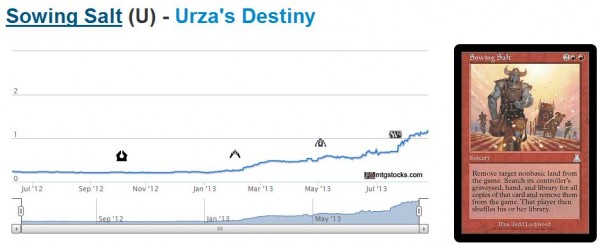
Consider my recent purchase of Sowing Salts as an example. Recently, WeQu graciously pointed out an easy opportunity to purchase these cards for quarters with buy lists in the neighborhood of a buck. I went for it, making three purchases similar to the one below:

The exit strategy in this case is incredibly simple: sell ten copies to ABU games for $1.05 each and sell the rest on eBay, where the cheapest listing for a playset is $6.19 (mine). I have exploited a knowledge gap profitably–-arbitrage at its finest.

Could I hold these and hope for more come Modern season? Sure, and I still might hold a couple sets (I bought 43 copies in total) but taking this easy money is just too tempting.

These scenarios are often my favorite, and for good reason. It takes just a couple minutes checking a few sites for these opportunities. Thanks to mtg.gg, it’s easy to identify which random singles have favorable spreads. They don’t come up too frequently, but I’ll jump on any opportunity to buy cards at one price and immediately flip for profit elsewhere. Buy lists are great for this.

The Quick Hype Flip

There is some overlap in strategy between the previous plan and this one. In both cases, cards are purchased cheaply. But sometimes a card’s price will jump so rapidly on the secondary market that buy lists don’t quite keep up. In these cases, you don’t have a guaranteed profit, but there is still likelihood for opportunity if you’re quick enough.

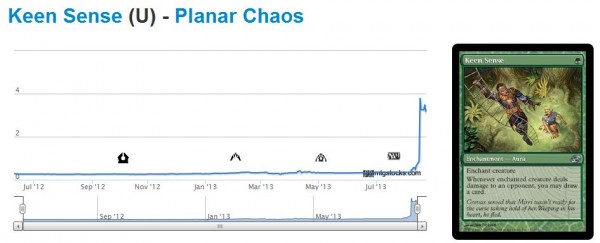
These days price spikes are weekly occurrences, but one recent example I can share is a purchase I made of Keen Senses during the TCG Player and eBay buyout, also from Card Shark.

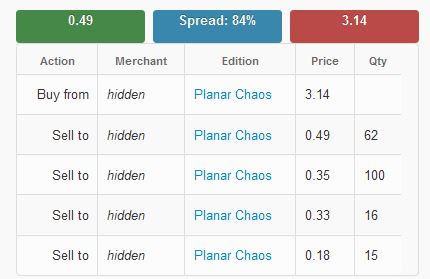
These are now valued at $3, but there were still a handful available for quarters much like the Sowing Salts. But the problem this time is the highest mtg.gg buy price is only $0.49. Talk about an awful spread!

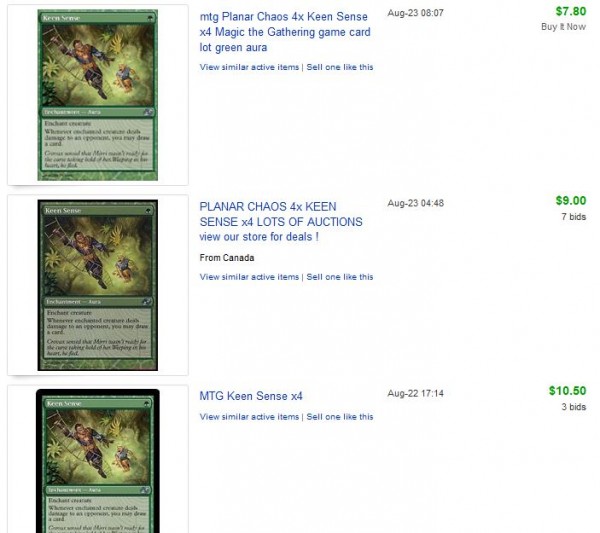
Did I just blindly buy these cards without deciding on an appropriate exit strategy? Of course not! Check out the completed eBay listings for playsets of Keen Sense:

Clearly I should be able to get about $10 per set before fees and shipping. And this is the exact strategy I decided upon when I bought these hot auras. Buy during the massive buyout and sell to latecomers to the party, even if retailers aren’t interested. Again, these could increase in price further, but I see nothing wrong with taking the easy profit and letting someone else sweat it out.

The strategy carries slightly increased risk, but there’s still ample opportunity to profit here. And this same strategy is applicable to any card spiking with hype, from Horizon Canopy to Kor Spiritdancer--funny how this has happened a lot on Modern cards lately.

Mid-term Buy

Now it gets interesting. Here is where we cross the boundary between opportunism and speculation. The risk profile on mid-term bets ranges from confident (INN dual lands) to guessing and rumor-mining (Didgeridoo). But despite the range in risk, the overall plan is the same: buy cards now, wait for them to rise in price based on some theory, and then sell.

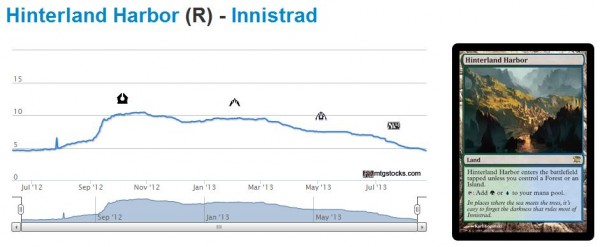
Innistrad dual lands are a poster child for this type of speculation. While Innistrad block was being drafted, these could be had for just a couple bucks each. I did my best to acquire a few sets of each expecting them to go up in price within a few months.

The thesis was a simple one: Scars dual lands jumped once they were no longer opened in drafts. With the coming of a likely popular block themed around multi-colored cards, the demand for INN duals was bound to rise.

The price charts illustrate the success of this bet.

The exit strategy here is to sell towards a card’s peak price in Standard. Don’t know exactly when the peak will be? That’s perfectly fine. There’s nothing wrong with taking profits after a successful thesis comes to fruition, even if you leave a little on the table. I find selling for profit is much easier on a card’s upswing rather than on its downswing, and I’d suggest you keep this in mind.

More recent examples I am currently speculating on include shocklands (obviously) and Serra's Sanctum. The theses behind these two purchases are different, but the exit strategy is identical. Should my expectations become reality, these cards will jump in price and I’ll profit.

It may take months or even years, but a key feature of this strategy is having a thesis in place at the time of purchase. You should already have a target timeline for when to sell before you even consider pulling the trigger on a purchase.

Buy and Hold

Sometimes, you just know cards will go up in value but it’s difficult to pinpoint exactly when. These are the cards with uncertain time horizons, when it’s okay to throw them in a box under your bed and forget about them for a couple years.

For me, this category includes my Innistrad booster boxes, Scars of Mirrodin dual lands, and graded Alpha cards. I’m fairly confident all three of these bets will pay out and I have a thesis associated with each one. But there’s not really a catalyst that will make this happen within a certain time frame.

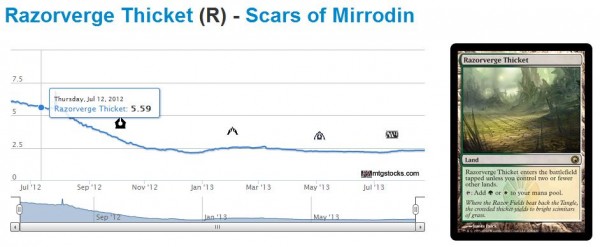
Razorverge Thicket is one of the most-played fast land in Modern right now, yet the card hasn’t budged upward in price for years.

I would like to believe these will finally get some love come the next Modern season, but in reality it may take longer. I’m okay with this–-I purchased them knowing full well my money would be tied up for years. But when prices dropped below $2 retail, it was impossible to resist.

Even pain lands (excluding Shivan Reef), which have been printed a billion times, can retail for $1.99 and they see such minuscule play. The fast lands will get there eventually.

And that’s just it--these buy-and-hold bets aren’t intended for quick profit. They are more focused on the slow and steady potential of so many cards.

Even Zendikar basic lands fall into this category. They’re never going to drop in price unless Wizards starts printing all basics in the full frame. Considering the likelihood of this is near zero, you’ve got a perfect target to acquire, throw under your bed and forget about. In a recent article Corbin has shown us he did just that.

Know Your Outs

I’m running out of words, so let me end the article with this mantra: know your outs. In other words, make sure you have a thesis before making any MTG investment.

If you can’t come up with an intelligent argument why you will be able to profit from the purchase, don’t do it! There are dozens of buy opportunities available to us speculators every week–-there’s just no need to force fit a buy.

Once you make your purchase, organize your cards so that you know which ones are intended for quick flips, which are mid-term, and which are buy-and-hold. This will also help remind you to revisit your theories on some frequency. If a thesis no longer holds true, you better either come up with another one or sell.

Let’s face it. Sometimes our bets just don’t pay out. When I went after Skaab Ruinator I had an elaborate thesis on graveyard strategies in Standard. Once it became obvious these synergies were nonexistent I bailed for a small loss.

Unless you think your purchase can double as a buy-and-hold, it’s usually not a good idea to sit on your failures. The reminders are bitter, and you may end up watching values fall further and further.

Instead, stick to your thesis and sell at the right time. Doing so will help you remain disciplined and profitable.

…

Sigbits

  • Speaking of Shivan Reef, did you know this card is $5.99 retail on Star City Games? It seems the popularity of U/R combo decks in Modern have helped drive this enemy-colored pain land fairly high. Keep an eye out for them when trading.
  • After peaking at $99.99, it looks like Force of Will has finally returned to Earth, even at retail. SCG still has 130 total copies in stock, with NM copies now selling for $79.99. I don’t think Legacy is dying, but it’s certainly telling when a major retailer is looking to sell 130 copies of one of the most necessary spells in the format $20 below peak price.
  • Kor Spiritdancer has been on an absolute tear recently. In fact, all the cards related to the aura-themed Modern deck have taken off. Keep an eye out for these. Even though SCG is sold out, they still have their price at $2.99. Once restocked they will likely more than double.

-Sigmund Ausfresser
@sigfig8

Insider: Looking for a Breakout Growth Stock

Are you a Quiet Speculation member?

If not, now is a perfect time to join up! Our powerful tools, breaking-news analysis, and exclusive Discord channel will make sure you stay up to date and ahead of the curve.

At the moment, Liliana of the Veil is the most expensive Standard card on MTGO. Defying the predictions of an impending price drop, Liliana has continued to reach new highs in the face of Fall rotation. As speculators, trying to make sense of why this card has continued to rise in price could reveal future opportunities.

The Value Perspective

Investing from a value perspective is the strategy perfected by Warren Buffet, who became the most successful speculator of all time. The basic tenet is to identify what the market is valuing incorrectly, place a bet accordingly, and then wait for the market to realize its mistake. Usually investing for value involves buying the shares of out-of-favor companies, but it can also mean identifying structural changes that the market has not yet fully understood.

Buffet purchased a large stake in Coca-Cola in 1988. From a value perspective the shares of Coca-Cola weren’t that cheap at the time with a Price to Earnings ratio of 15. It wasn’t a battered-down company which the market had abandoned, but Buffet went ahead and bought a big chunk of the company anyway. The stake represented a third of Berkshire-Hathaway’s portfolio at the time, a significant bet to say the least.

Buying Coca-Cola stock in 1988 turned out to be a very good move as the company continued to see strong global growth. Although not cheap from a value perspective, Buffet had identified a strong growth company that the market wasn’t valuing correctly.

A Market Shift

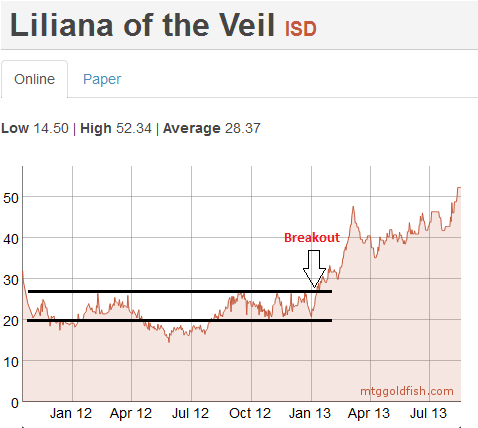
The MTGO price of Liliana of the Veil saw a long congestive period between Innistrad's (ISD) release right through to January of 2013. It did have a period of price weakness in the Summer of 2012 where it dipped as low as 15 tix, but for the most part it stayed in the 18-25 ticket range.

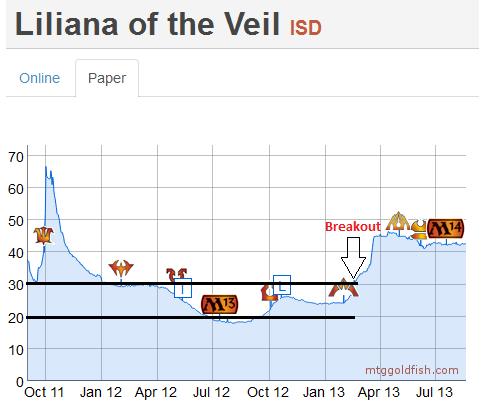
The paper version roughly mirrored this price activity. After ISD’s release, the price was usually in the $25 to $30 range. Like the digital version, there was a period of price weakness in the Summer of 2012 where it touched $18.

Things got interesting in January and February of 2013. On both of the above charts I have pointed out when the price broke above its trading range.

The Breakout

At the time, the Modern PTQ season was underway and Liliana broke out above 28 tix on January 11th. By the end of the the month, it was 30 tix. The rise continued in February, and by the 20th of that month it sat at 35 tix before heading even higher, briefly getting to 47 tix by March 7th.

On the other hand, the paper version took a few weeks to catch up to this shift. By the end of January it was still in its long-term price range, lounging around $25. The breakout occurred a few weeks later on February 19th, when it got over $31 for the first time in over a year.

In this case, the breakout was over a month after the price began moving on MTGO. Identifying the shift that was under way on MTGO could have yielded nice profits on the cardboard version.

Although looking at charts can guide decisions, often times it's only in hindsight that such trends become obvious. However, a synthesis of the value perspective and charting techniques can yield an actionable strategy.

From the value perspective, Liliana of the Veil had a number of things going for it on MTGO. In January of 2013, relatively few copies of Liliana of the Veil were coming onto the market as ISD was not being actively drafted. Besides a stable supply, playability of the card was good. It looked like the card was going to be an all-format staple as it was showing up in Legacy, Modern and Standard.

Lastly, the fact that it is a mythic rare ties the online value of the card to the value of paper ISD through redemption. Besides the impact of Liliana itself, the redemptive value of ISD on MTGO has been high due to the presence of Snapcaster Mage, the enemy-colour check lands, and Geist of Saint Traft.

All of these value factors were observable to anyone who was wiling to think about them. The strong technical breakout in price confirmed that Liliana of the Veil was the equivalent of a growth stock and had further gains to come.

Moreover, it looks like MTGO was ahead of the curve in this case, and that paper prices began following suit an entire month after the price move was already underway online. After the paper price started moving up, the feedback effect of redemption ensured further gains on the digital version.

Jace, Architect of Thought

It looks like the Return to Ravnica (RTR) version of Jace is just at the start of a breakout online. Similar to Liliana, it had a long period of price congestion where it mostly bounced between 14 and 17 tix. This week, it has jumped above 18 tix. Let’s consider the fundamentals of this card to see whether this price move might be a signal for a period of growth.

First, Jace, Architect of Thought is a Block Constructed staple, and has proven useful in Standard as well. Although playability in Block is not a ringing endorsement for future gains, its prevalence there points, at the very least, to continued usage in Standard.

Next, we have entered the period of core set draft with the release of Theros on the horizon. The supply of online RTR block cards will be relatively fixed at this point.

Lastly, RTR might not be as redeemable as ISD, but it has a number of staple rares with high value to redeemers. Half of the shocklands lead things off and then there are two Legacy staples in Deathrite Shaman and Abrupt Decay. The shaman in particular looks to be a fixture of Modern as well, a format showing continued growth.

Overall, Jace does not stack up to Liliana from a fundamental perspective, but the factors still suggest future price increases. I’ll be watching this card over the coming weeks, and if it gets to 20+ tix instead of heading back down into the 14-17 tix range, then this would be a strong signal for further price increases to come.

In terms of a speculative strategy, the paper price has not yet made a move. If the MTGO version continues to show price strength, then I’d expect the paper version to follow suit. This suggests two ways to profit. On a strong breakout in price, combined with good fundamentals, buy both the digital version and the paper version.

Advocating a paper buy is a new strategy I am considering in order to take advantage of the times when the MTGO market is ahead of the paper market. At this point, this is an untested strategy and should only be employed by those with a high tolerance for risk.

As for the MTGO version, if the paper price breaks out and starts heading higher, the feedback loop of higher paper prices leading to higher MTGO prices through redemption should begin. If you are thinking of buying Jace in order to speculate, keep your eye out for a price breakout in paper. This would signal further gains to come on the digital version.

Portfolio Update

This is a brief rundown of what I am buying, selling and watching in the market in the last week.

Selling:

  • RTR and GTC boosters are both close their peak and I have started selling down my boosters. I don't want to be left holding these in October.
  • Many of the junk mythic rares from RTR and GTC have jumped up in recent weeks as the shift to core set draft has cut off supply. I've been selling a few of these, but I expect another price jump in October once the new Fall Standard gets under way.

Buying:

  • A few Modern cards have caught my interest lately, including Twilight Mire, Goblin Guide and the Modern Masters version of Knight of the Reliquary.
  • Jace, Architect of Thought is a card that I have been accumulating in recent weeks, and I feel that is has strong potential for further gains in the Fall.

Watching:

  • Obviously I will be keeping an eye on Jace, Architect of Thought. A breakout in the paper price would be bullish for both the paper and digital versions.
  • M14 boosters have jumped up from the release event lows. I'm expecting these to soften in price leading up to the release of Theros online. Once these get into the 3.0 to 3.2 tix range, I will start buying.
  • M14 continues to present good value as a whole and I'll be paying attention to how the prices on chase rares such as Lifebane Zombie, Mutavault, and Scavenging Ooze develop over the coming weeks. These should be on your short list of rares to pick up from M14.
  • Mythic rares from ISD Block have started softening in price in recent weeks and I'll start buying these once they have bottomed out in price.

Insider: The Next Modern Spike: Will It Last?

Are you a Quiet Speculation member?

If not, now is a perfect time to join up! Our powerful tools, breaking-news analysis, and exclusive Discord channel will make sure you stay up to date and ahead of the curve.

It’s become one of our favorite pastimes these days, analyzing the latest Modern card to spike in price and wondering if it’s for real. A lot of times people either look at something and say “yup, it’s real,” or “just a buyout, nothing to see here,” without ever bothering to check back in.

So that’s where we’re going to do today. I'll look at several spikes on Modern cards in the last six months and see how they did in the weeks following the spike, how they’re doing today. This will help inform our decisions on the upcoming spikes in the Modern format that are surely coming. I was able to call the last one in Shadow of Doubt, but what’s next? That’s the important question.

I would say Elesh Norn, but since I talked about it a few months back at $10 it’s nearly doubled, and is probably headed the way of the Eldrazi, of course to a lesser extent.

Let’s start with one that illustrates an important point: Nivmagus Elemental. This thing was all the rage for a weekend, but even by the end of the event the floor was beginning to fall out. It spiked hard to $4, but today is back down to bulk pricing.

I think the lesson to draw is that Standard cards, even if hot in Modern, are not worth speculating on. Voice of Resurgence also supports this theory, since its spike to $50 was influenced by the play it saw in Modern. Since then, Scavenging Ooze has come out and seemingly helped to neuter Pod decks. That has helped bring Voice’s price back to Earth.

Moving forward, something like Ooze certainly had some upside a few weeks ago, but the lesson is that even though it will likely remain an all-star in Modern for years to come, its price at the peak of Modern season may not be indicative of its price come Standard rotation. On the other hand, it may go the way of Snapcaster Mage and not budge. Only time will tell, and we have a while before we have to make a decision there.

Okay, so far I’ve discussed Standard-legal cards and not really the stuff that spiked overnight because of Modern. So let’s take a look at some of those.

Paradise Mantle

Already popular casually, this had the hard spike to $10 when a quirky little Modern combo deck began playing it. Despite that, and another printing in Modern Masters, it’s still over $4, or 30 percent more than it was before the spike.

I think this is an important one to mention, because it basically has all the hallmarks of a one-hit wonder. It’s an uncommon, it’s not in a “real deck,” and it was reprinted. And yet the original printing is still worth more than it was before the spike.

It also means that something seemingly fringe like Keen Sense may no be seeing the bulk box anytime soon.

So what about some other fringe cards?

Cloudstone Curio

Another $2 card before the spike, which in this case was due to the printing of Beck // Call (and was the recipient of an e-mail blast). The spike was to $10, and the subsequent drop in the next week brought it down to $8.

Since then? Still holding steady at $7.

That’s some pretty powerful data. This card has zero top eights to its name in the nearly six months since it spiked, and hasn’t moved much. And it’s not alone. Chord of Calling spiked to $40 before coming down some, but since then has held steady at $35.

Noticing a trend yet? Even when we go back further, and look at something like Leyline of Sanctity, one of the first Modern spikes, we see a trend of prices stabilizing well above where they started. Leyline, for instance, started at $4, then peaked to $15 before settling to the $11 it sits at still today.

I hear what you’re saying. These are all playable cards, even if not heavily so. Of course they’re staying higher.

So what about Hall of the Bandit Lord?

We all (correctly) called “buyout” when it disappeared at a dollar and spiked to $8. It started to come back down after that and we all forgot about it and moved on.

Today? Still $4.

I want to believe these buyouts won’t have this effect, but the evidence I found while researching this article all points the opposite. Makes you feel a lot better about those Horizon Canopy.

I know my adage is always to sell into the hype, and in every one of these cases that’s been the right play. But it’s not the only play. If you’re legitimately interested in these cards to play with, it’s worth knowing that they really aren’t dipping back down to where they started.

I somewhat expected this with the playable cards like Daybreak Coronet. Sure, it seemed insane that it spiked to $25 back in Modern season, but here it is still $16 (and was still $14 before Reid Duke’s recent performance with the deck).

But I didn’t at all expect these results with stuff like Paradise Mantle and Hall of the freaking Bandit Lord.

Modern: The Real Thing

To some extent, this is true of all cards, that the new price doesn’t usually match the old one. But it seems Modern cards are going even farther to that extreme. Aluren, for instance, was bought out at $5 and spiked to $25. Based off the examples we’ve looked at so far, it would still be something like $18-20 if all cards (Eternal-playable ones, even) followed this path.

So where does Aluren rest today? $8.

Sure, that’s more than it was, but it didn’t even maintain a double-up, which is insane when the cards we’ve discussed so far are measuring their growth in terms of multiple hundreds of percent.

Like I said, that’s powerful data, and further reinforces the notion that Modern is not only here to stay, but is still a force. It took one event for an already-played card like Living End to go from $2 to $10, and since then it hasn’t budged at all.

This is somewhat dangerous advice to give, but at this point it seems you really can’t lose. Even if you don’t buy in at the lowest price point on a moving card, it seems those investments aren’t as risky as we might normally think on a spec.

So how does this benefit us going forward? Well, I have several cards I like right now. I’ve talked about Birthing Pod a million times, and even though Ooze hurts it some I still like it as a play.

Looking further down the line, Eiganjo Castle seems very similar to Shadow of Doubt in that it’s seen steady growth, and one buyout could trigger a run and push it to $15 or more.

As far as mythic targets, I'm not sure any are better right now than Thrun, the Last Troll. This has fallen from $15 to $8 after its own buyout a while back, and we’ve yet to see how the new legend rule will affect PTQ season. If RWU Control stays popular, which I’m sure it will, Thrun could come into the limelight. $8 is going to look like a bargain then as he moves to $20.

Worldwake manlands (and still Scars fastlands) are another great bet right now. We’ve seen Celestial Colonnade move, and I suspect Raging Ravine will follow suit first. I’m also picking up the staple uncommons that were reprinted in Modern Masters.

The Modern season being pushed back several months just means we have more of an opportunity to acquire these cards before the Magic community really starts gearing up for it. Trading new, overpriced Theros goodies in the next few months and turning them into Modern staples is going to be a profitable strategy.

…

Anyway, that’s where I’m at right now with Modern. I see a lot of opportunity, and a strong demand base propping up the market. That’s a good thing. We’re living in the boom times now, and I’m going to milk Modern for all it’s worth.

Thanks for reading,

Corbin Hosler

@Chosler88 on Twitter

Descendents of Standards Past

Are you a Quiet Speculation member?

If not, now is a perfect time to join up! Our powerful tools, breaking-news analysis, and exclusive Discord channel will make sure you stay up to date and ahead of the curve.

A brave new Standard is upon us.

As you are all aware, we have reached critical mass in Standard. Right now more cards are legal for Standard play than any other time until next year at this same time. Having access to this many cards provides more tools than normal. With the addition of M14, some of the preexisting decks were made stronger, and some are brand new or revitalized versions of previously successful decks.

A decent deck obtaining another quality card to fill out all the slots can take it from moderately playable to tier one. I believe that is the case not only with G/R Dragonmaster, but also with my version of Aristocrats.

In addition to making known decks better, some new decks are now possible that were not before. By now, I’m sure you all have played against the G/B Rock deck that has been surging forward in the metagame. It is definitely a good deck and it is new, but there are only a couple cards from M14 that made it into this deck.

Lifebane Zombie and Scavenging Ooze are the two cards that form the core of this deck. They are extremely good against the field right now and Jund could not really fit enough copies of these cards, hence the need for a new archetype. Let’s be honest, B/G Rock is basically the same deck as Jund. Some of the cards may be different, but their goal to control the game long enough to stick huge monsters on the field is the same.

What I want to talk about today is a brand new deck built mainly from new cards. This archetype is quite popular among the casual crowd, but with the current tools available, I know from experience how potent it can be. The deck concept in question: Slivers.

Before you leave the page and chalk this up as just another casual deck, keep an open mind and listen for a minute. Let me first say, I lost to this deck at FNM this past week. Normally that would not be cause for concern, but in this case we are talking about losing when the deck I am playing has an abnormally high win percentage. Because of how much I am winning with my Aristocrats deck, when I lose to something, it catches my interest more than it normally would.

I will say that my opponent was quite lucky during our match and I also didn’t really get to play Magic in game three because I mulliganned to four cards. Nevertheless, he still beat me and I can’t stop thinking about his deck!

What sets his version of Slivers apart from the rest? He has an engine built into the deck that provides additional potency as well as card advantage. All of the other M14-based Sliver decks I have seen were generic piles of the slivers we know are good. Of course, this strategy was not good enough and that’s why you have not seen any successful sliver decks in the top eight of any Standard event.

This engine might change that. Some of you may have seen this interaction before, but this was the first I had ever laid eyes on it myself.

Descendants' Path is a great engine for many reasons. The first reason is its similarity to Domri Rade. In Slivers the enchantment is actually quite good and I think even a better card than the planeswalker. Both have the ability to generate card advantage for you and both are good in the same types of decks because they rely on you having lots of creatures in your deck.

The next reason is one I did not know about until I was facing down a free--that’s right, check the text, free--Megantic Sliver on turn four. The wording on Descendants Path is the wording I always wished Domri had. Instead of keeping your noncreature on the top of your deck, it goes to the bottom. This is important because it helps you not to mana flood. In addition, it puts the creature in play!

Of course, it has to share a creature type with one in play, but you are playing a tribal deck. With slivers, it’s almost like they all have a comes into play ability also because they effect the board immediately. Also, you have Mutavault to turn on the enchantment if you don’t have any creatures in play.

These are some powerful synergies going on here. Between the Paths and mana acceleration granted to all of your slivers, you can accelerate into the more expensive slivers quickly. Take a look at a tentative list based on these principles and synergies.

Sliver Descendants

Untitled Deck

Creatures

3 Galerider Sliver
4 Striking Sliver
4 Predatory Sliver
4 Manaweft Sliver
4 Blur Sliver
4 Bonescythe Sliver
4 Thorncaster Sliver
3 Megantic Sliver

Spells

4 Descendants' Path
2 Domri Rade

Lands

4 Cavern of Souls
4 Mutavault
4 Stomping Ground
4 Rootbound Crag
2 Temple Garden
2 Sacred Foundry
2 Breeding Pool
2 Steam Vents

Strengths

Well, first of all, there are many amazing abilities your slivers can obtain from each other. The “Hellrider” sliver for example, is quite a beating. The ability to deal that damage anywhere you want is game breaking. When my opponent got this guy in play, he attacked and killed all of my creatures.

Because your slivers gain the abilities from each other, it becomes very difficult to slow this deck down in combat. If you are battling against another creature-heavy deck, how are they supposed to block effectively when all of your creatures have a handful of sweet abilities each? If you reveal so potent slivers off of Path, you can kill your opponent quickly as well.

Another benefit to this deck is Mutavault. The addition of a card like that to a tribal deck adds a huge looming threat just by making your land drops. Whatever slivers you have in play, your Mutavaults are going to be better than the normal 2/2 they normally are.

Weaknesses

My main concern with a deck like this is how horrible your match against Jund will be. Certainly there are things you can do to make it better, but Bonfire seems like your worst nightmare. When your opponent only has targeted removal, they can slow you down a bit and deal with your other creatures. All they have to do is kill your best sliver, and then your army is much less threatening.

Jund can not only kill your best sliver, but also wipe the board. Because your slivers are not individually powerful on their own, you will obviously have a difficult time rebuilding your board presence. It is possible to beat Jund but it usually involves you getting lucky and them being unlucky. Boros Charm in your sideboard might help as well.

The other issue can be the mana. I'll be honest, I'm not sure this land base is as good as it could be, but I think it's close. All of your shock lands tap for red or green which casts most of your spells as well as letting Rootbound Crag be almost a free dual land most of the time.

Being that you are running four colors, there will be times where you struggle to cast your spells, but if you take out any of the colors, it makes your curve a more clunky and gives you fewer abilities. The mana is just something you'll have to deal with if this is a strategy you enjoy.

Summary

Overall, this is a good deck that is a ton of fun to play with. It is definitely good enough to play at FNM and if Jund goes on the decline before rotation, it could be good enough to compete at larger tournaments.

Just because a deck has not been competitive level in the past, does not mean it never will be. Every deck can be good enough given the right cards. Keep an open mind, sometimes the least likely person might give you a great idea.

Tournament Tips

One aspect of this game that many of us skimp on is testing. If you want to get better and become more successful, figure out how the games play before the tournament starts.

Because my schedule is so busy, I often do not have much time to test. A lot of us fall into that category because we carry normal jobs during the week.

Recently I have been using FNM as my testing. Before this summer, I did not attend many FNMs because I was traveling to so many events. Being a teacher, I had a bit more time over the summer so I started going to FNM sometimes. The reason I liked going so much, other than playing this amazingly fun and complex game, was because I used that time as testing.

If you don’t go into the FNM with the mindset that it is testing, you won’t gain any productive information from it though. During the matches I was actively thinking about things like the following: Do I like this card in this match up? How effective was my sideboard plan? Is this matchup really as good as I think it is?

If you are not actively reflecting on each play and each game, FNM won’t be a productive testing session for you. It’s helpful to write down some notes to refer back to at the end of the night as well. Another great way to use FNM as testing is to try out new cards and/or think about a card being different than the one you cast.

A great example of this is Boros Reckoner vs Chandras Phoenix in G/R Aggro. Most players have had Reckoner in their lists for quite a while, but when M14 came out, I argued that Phoenix was better suited for that deck.

One of my friends played each game with his Reckoners but kept track everytime he played one and thought about whether or not he would rather have had a Phoenix in that situation. At the end of the night, the decision was overwhelmingly Phoenix. If he had not been using FNM as testing, he might not have gotten in enough games to make that type of decision.

Until Next Time,

Unleash the Slivery Force!

Mike Lanigan
MtgJedi on Twitter
Jedicouncilman23@gmail.com

The New Face of Pauper Delver

Are you a Quiet Speculation member?

If not, now is a perfect time to join up! Our powerful tools, breaking-news analysis, and exclusive Discord channel will make sure you stay up to date and ahead of the curve.

Last week I wanted to write about the Minneapolis Legacy Open and how I was trying a few changes out in RUG Delver, but I just couldn’t put pen to paper. I’ve been trying out Preordain over Ponder and I’ve been pretty satisfied with it in practice and in theory but for whatever reason I just wasn’t interested in writing about it. Half of my disinterest in writing about Legacy at the moment has to do with the fact that everybody can plainly see the major trends in the format (Wasteland is REALLY good right now) while I imagine that it would take some actual results to get people interested in the more off-color points that I want to talk about (playing Preordain over the widely accepted Ponder).

At any rate, I just couldn’t find any motivation to write about what was basically the only thing in Magic that I was actively thinking about. My tournament was filled with one-sided games in both directions and the stories of my play don’t strike me as particularly interesting. Something from that weekend has been on my mind though.

The morning of the event my girlfriend and I were dining on a choice breakfast of coffee and bacon pancakes. When I left she said something to me that caught me completely off guard.

“Have fun!”

What was she talking about? Fun? At a Magic tournament? I honestly can’t remember the last time anybody told me anything other than “good luck” before an event. I assured her that “I almost never do” and made my way to the convention center, but her words, simple and unassuming as they may have been, stuck with me.

As much as I enjoy playing Legacy, I haven’t been having nearly the fun that I used to playing. Somewhere along the way I lost sight of what actually made me enthusiast about Magic. That is, and always has been, building new decks. Sure, I was trying out a few new slots in Delver, but the differences between Preordain and Ponder are subtle enough as to not alter the deck in any fundamental way.

I didn’t fully grasp my longing for a good deck-building session until I found myself getting thoroughly destroyed over and over playing my Pauper MUC Delver list against Mono-blue Fissure Post. Questions started stirring in my mind that hadn’t in months.

What could I have drawn differently to win that game?

Is there a way to make my deck more aggressive without sacrificing too much against Stompy/Monored and the mirror?

Is this just going to be a terrible matchup for me?

That last question woke something up in me that had been lying dormant.

I refuse to just concede this matchup.

When the Rubber Hits the Road

Refusing to lose. Such an irrational thought can only be derived from passion. The passion that led me to staying up until three in the morning and wake up again at seven just tinkering with decklists.

I couldn’t think of a reasonable way to sway the Fissure-Post matchup in MUC’s favor, so instead I asked myself what sort of cards would give Fissure-Post fits. For the most part I was losing to the deck’s Mulldrifters, so having a way to deal with all of them would likely give the deck fits. The first card that came to mind at excelling in the anti-Mulldrifter role was Pyroblast. A sideboard card, sure, but you can lose most of your game ones if you win most of your twos and threes.

The only existing deck that plays Pyroblast and fits my playstyle is Izzet Post, but that’s just another deck that struggles against Fissure Post due to its inability to apply early pressure. Kilnclops is a deck that can win quickly and has access to Pyroblast, but it plays a lot of “dead” cards like Assault Strobe when it’s not just winning and it matches up laughably poorly against MUC Delver. I considered trying to play a version of the deck that cut Kiln Fiend due to its weakness against Quicksand, nearly every removal spell and, you know, blockers, but realized that a deck dedicated to quick wins cannot be carried by just a one mana 1/1 and a three mana anything.

That’s when I started thinking about just playing UR Delver. Guildgates have made two-color manabases pretty reasonable in Pauper and I’d be able to utilize most of the spells I like from my usual deck of choice in addition to implementing the sideboard that I desired. The problem that I had for all of zero seconds was with replacing Spire Golem, but with Mulldrifter never being far from my mind this was an easy fix.

Taming the Beast

Outside of the fact that adding red cards would likely be to the benefit of a deck with red mana sources, there were a few other obvious implications to putting together UR Delver instead of traditional MUC. Gush loses a lot of its value and bounce spells/counters become less necessary, though they’re still obviously very powerful. Being red I definitely think it’s right to play fewer than four Vapor Snag, but considering that most of the deck’s red mana sources come into play tapped a few Snags come in handy against faster starts from aggressive decks. They’re also useful for the occasional rescue of your own Delver or to bounce your Mulldrifters.

Considering that I’d be playing at least four Terramorphic Expanse effects I thought Brainstorm to be an option for the deck until I started playing it. Brainstorm just doesn’t interact that well with CIPT lands/fetchlands. Ponder and Preordain are both abstractly more powerful and Think Twice actually generates card advantage, which is always good in a deck playing any semblance of a control game.

I initially perceived my lack of Spire Golems as an issue in Delver mirrors and tried out a Trinket Mage package with Bonesplitter to allow me to attack better in the “mirror” but despite his ability to “break” combat in that matchup as well as find red mana (Great Furnace) or a removal spell (Pyrite Spellbomb). Trinket Mage, while cool, was a bit expensive for what it did and the Bonesplitter was just miserable to draw against aggressive decks. It also turned out that Flame Slash was a good enough tool against Spire Golem and I haven’t really missed the utility or extra body at all.

I realize that talking about card choices before showing the list can leave much of this discussion without context, so let’s get on to where I finally landed:

”Mulldelver of Secrifts”

spells

4 Delver of Secrets
4 Mulldrifter
4 Counterspell
1 Deprive
2 Dispel
4 Ponder
4 Preordain
4 Think Twice
2 Vapor Snag
2 Flame Slash
2 Electrickery
2 Burst Lightning
4 Lightning Bolt
1 Firebolt

lands

4 Izzet Guildgate
4 Terramorphic Expanse
3 Mountain
9 Island

sideboard

4 Pyroblast
4 Hydroblast
1 Stormbound Geist
2 Relic of Progenitus
2 Flame Slash
1 Electrickery
1 Shattering Pulse

The spell suite isn’t an exact science, but the split is based on the fact that your burn spells need to kill a ton of x/1 / x/2s or a few x/4s. That or be able to dome your opponent, but that’s not a good enough reason not to play Electrickery and Flame Slash, which do a TON of work against the aggressive decks. I’ve actually really liked having Electrickery over Serrated Arrows in the Delver shell as it both flips Delver and catches up when you’re behind much faster than Arrows. Granted it can’t kill two/three toughness creatures nearly as quickly, but there are plenty of other tools for that job.

At this point I’m actually not sure if Lightning Bolt is better than Burst Lightning. Outside of a very small set of creatures Pauper is defined by one, two and four toughness bodies. I wouldn’t be the least bit surprised to find myself reversing that split.
Thus far the deck has been testing incredibly well. The mana has only caused me trouble in one game so far in a hand that I really should have just mulliganed anyway. Adding red to Delver has made the aggressive matchups dramatically better, as your plan no longer necessarily involves racing as you have a ton of removal to just one-for-one opposing creatures instead of trying to out-tempo them.

The only matchup that I think might have gotten worse is Affinity, considering the loss of Spire Golem + Quicksand which often made their attacks pretty bad, but having access to four Flame Slash post-board as well as Shattering Pulse could very well make up for this difference.

While we’re on the topic of bad matchups I might as well raise the point that GW Hexproof shouldn’t be consistently realistically winnable. You basically have Electrickery, Counterspell and luck as tools in this matchup. Fortunately the deck is super inconsistent and that type of strategy isn’t very inviting to strong pilots. I’ve managed to beat the deck twice so far with this list but all the credit for that goes to one opponent drawing poorly and the other making a savage punt. Adding bounce spells like Repeal and Echoing Truth can help improve this matchup, but it’s a pretty small portion of the metagame and I’m personally not very concerned with it.

Despite putting around 10 hours into battling the current list in two-mans (Pauper dailies are sooo sporadic and, too often, inconvenient) I haven’t run into Fissure Post yet. That said, I’ve posted a 14-1 record thus far with the deck, feeling extremely favored against aggressive decks and the mirror. My one loss thus far has been to GW Slivers oddly enough. I probably could have won had I respected Virulent Sliver more but I ended up losing game three to being poisoned while on 7 life a turn before I could have wrathed my opponents board with Electrickery with him being empty handed. Truth is I’m not that broken up about it.

This deck has been a blast to play thus far and seems very well-positioned. I highly recommend it, and have no intention of stopping playing with it anytime soon.

Thanks for reading.

-Ryan Overturf
@RyanOverdrive on Twitter

Insider: Modern Picks from Innistrad Block

Are you a Quiet Speculation member?

If not, now is a perfect time to join up! Our powerful tools, breaking-news analysis, and exclusive Discord channel will make sure you stay up to date and ahead of the curve.

I don’t have enough words for a long introduction, there’s too much to cover below. Let’s skip that nonsense and get to the discussion. Below are the cards from Innistrad block that are pertinent to Modern (and Legacy to a lesser extent):

Clifftop Retreat / Hinterland Harbor/ Isolated Chapel / Sulfur Falls / Woodland Cemetery

Other than Sulfur Falls, none of these have seen significant Modern play. That said, it is almost always correct to pick up lands at rotation. These are currently all sitting above $5, so don’t start picking them up just yet. But if they drop to around $2 or $3, you can’t go wrong trading for as many as you can.

Delver of Secrets (foil)

For some reason foil Delver is currently only sitting around $5. Given that the card sees Legacy and Modern play, this seems criminally low, even for a common. I’d trade for copies at this price, and I’d even go deep if they see a significant drop after rotation (which probably won’t happen, as the card hasn’t seen Standard play for the last year). There might even be marginal long-term upside to picking up non-foil copies.

Gavony Township

This card sees play, usually as a three-of, in both of the popular versions of Birthing Pod decks in Modern. If that deck isn’t nerfed by bannings in the next year or two, Gavony Township could see some nice gains. I have a hard time seeing it getting as high as $10, but $5 seems extremely likely if nothing in the meta changes. Currently selling at around $1, with some copies as low as half that, this seems like a great throw-in target for the next several months.

Geist of Saint Traft

This is one of the more powerful creatures that has ever been printed, and its current price tag in excess of $20 reflects that. I’m not sure how much this will drop at rotation, as many players will be keeping their copies for Modern. For my part, I’ve decided to hang on to my playset, as I picked them up for $11 each and I’m not sure the card will ever go lower than that. If it does, well then you’d better have some sweet trade bait to get as many of these as you can. The only thing keeping this from hitting Vendilion Clique-like prices is how much more Innistrad was opened than Morningtide. Still, with the game growing steadily, there may not be enough Geists to go around in a year or two.

Geralf's Messenger

There was a brief period where Jund played this card over Kitchen Finks. Nowadays, Modern Jund lists don’t run either card, so I’m not sure how strong a pickup it is. Currently sitting at $2.50 or so, I’d only pick this up for Eternal purposes if it dropped below a dollar. Even then, it might never see play again.

Gravecrawler

Sam Black’s Legacy Zombardment deck has kept this card at around $4. Given that the deck hasn’t dominated in any way and this card hasn’t seen any Modern play, I’m not looking to pick any of these up. I am, however, holding on to a playset out of an abundance of caution. The card gets better with each new Zombie printed, is from a small set, and is objectively powerful. Trading these was the right call a few months ago, but at $4, I’m holding. If it drops below $2, I might consider picking up a few more, but Zombies hasn’t seen Standard play for a while, which means this card’s price is likely coming from Legacy and casual players.

Griselbrand

Griselbrand is sweet, there’s no doubt, but I’m going to keep away. He’s above $10 so the buy-in is high. He is banned in Commander so there’s no casual demand. And Wizards has shown in the past they’re willing to ban this type of card-draw effect. He will probably grow steadily for a while, but I feel like sitting on any of these for an extended period is risky business.

Huntmaster of the Fells // Ravager of the Fells

It appears that Huntmaster of the Fells has replaced Bloodbraid Elf in Modern Jund lists. If Jund continues to be as heavily played as it was last season, there’s virtually no way this doesn’t see long-term gains, especially being from a poorly-received small set. It’s currently sitting at $10, which seems like a reasonable price to get a playset, but I’d like to see it dip to $5 or $6 before I start investing for speculative purposes.

Liliana of the Veil

Liliana is still over $40. This price is almost entirely based on Modern and Legacy play, so I don’t know if we’ll see any drop at all come rotation. Sigmund Ausfresser has been pointing out for a while now that the card as seeing more Legacy play than Jace, the Mind Sculptor. I don’t know if the future price trajectory for Liliana will mirror Jace, but it’s possible. That said, I don’t like to invest in expensive cards like this, as the risks are much higher and the potential gains are much lower. If you need a set for play, you probably want to pick these up as soon as possible after rotation.

Olivia Voldaren

Olivia has seen some occasional Modern play, but usually as a one- or two-of. At its current price of around $8, I’m staying away, but if it drops to $3 at rotation, this becomes a fine target.

Past in Flames

Before Storm was nerfed, this would have been a sure-thing, as its price has always been fairly low. As is, I’m advocating picking up this card on power-level alone, not because it sees any current play. It’s only $1.50, so there’s not much to lose.

Restoration Angel

This is one of my favorite Magic cards ever, so I’m pretty biased in its favor. Still, I think it receives the same evaluation as Olivia: stay away at $8, pick them up at $3-4. In Restoration Angel’s favor, the card is a four-of in Kiki Pod and sees some occasional play elsewhere. However, it’s only a rare, which might keep its long-term price depressed somewhat when compared to comparably-priced mythics.

Snapcaster Mage

Snapcaster Mage pretty much held steady above $20 its entire time in Standard. I’m very interested to see where it ends up long-term. It is an inevitable reprint for Modern Masters II, but we don’t know how long it will take for that set to drop. It’s worth noting that Dark Confidant and Tarmogoyf were printed at mythic and both have seen price increases, so Snapcaster might not be doomed to a value-destroying reprint. I’m holding my playset (plus one for EDH) indefinitely, but I’m keeping an eye on the rotation price before I decide whether to pick up any more.

Stony Silence

In my last article I claimed I learned my lesson on narrow sideboard cards, but there’s always an exception. This gets a mention because it shuts down certain strategies in Modern, but is currently at bulk prices. I wouldn’t go out of my way to pick these up (Rest in Peace is better), but these are the types of throw-ins that might have some long-term upside.

Terminus

This is one of the few cards on the list I think is worth picking up right away. It hasn’t seen any Modern play yet, and its Legacy play in Counter-Top has been held down by Abrupt Decay, but $3 is extremely low for a one-mana wrath that keeps cards out of the opponent’s graveyard. This has been as high as $11, and I wouldn’t be surprised to see it reach that point again in the next year or two.

Thalia, Guardian of Thraben

Thalia was hurt by the Event Deck printing, for sure. The card was around $6 and then, BOOM, that price was cut in half. Although its upside has probably been downgraded from $15 to $10, I think this is another card worth picking up right away. It’s seeing more Modern play, and if Maverick ever sees a resurgence in Legacy, Thalia will be a moneymaker.

Zealous Conscripts

I love this card, and I have ever since I used it in draft to kill a Tamiyo by using her ultimate ability. It sees play as a one-of in Kiki Pod, so I don’t know how much upside there is. It’s only a dollar, though, so if you can pick them up as throw-ins, you should.

Odds and Ends

It’s worth being aware of the following cards, but I don’t have high hopes for any of them to break through in Modern. Still, a sentence for each seems appropriate.

Bonfire of the Damned: powerhouse in Standard; probably won’t make the jump to Modern, but anything’s possible.

Craterhoof Behemoth: lots of combo potential here.

Desolate Lighthouse: I’ve seen it in Kiki Twin lists, but it’s not exactly efficient.

Entreat the Angels: Counter-Top doesn’t really see play and this was only good in that, but maybe something will change someday?

Falkenrath Aristocrat: the power-level is high and an aggressive deck might want this as a curve-topper.

Garruk Relentless // Garruk, the Veil-Cursed: has actually seen fringe Legacy play; can be removal, tutor, and token-maker.

Heartless Summoning: will Theros produce an enchantment-matters card that might make this consistent?

Kessig Wolf Run: probably too mana-hungry to make the jump.

Moorland Haunt: sees occasional Modern play as a one-of; not a lot of upside, but a good throw-in.

Nephalia Drownyard: if Modern control ever becomes a real thing, this might be a part of that.

Sigarda, Host of Herons: sees occasional one-of sideboard play out of Pod decks; too high now, but keep an eye on post-rotation price.

Vexing Devil: the price for this is annoyingly high due to casual demand, but it sees occasional play in Modern burn decks and is worth mentioning.

Last Thoughts

The adjustment to the PTQ season schedule could have some profound effects on Modern card prices. It's possible the best time to pick up Modern specs isn't directly after rotation, but three to four months later, when Theros Standard is in full swing and Modern is still a few months down the line. The good news is that we're going to have more time to stockpile our targets. The bad news is we're going to have to wait several extra months before we find out if our speculation paid off. Invest accordingly.

Want Prices?

Browse thousands of prices with the first and most comprehensive MTG Finance tool around.


Trader Tools lists both buylist and retail prices for every MTG card, going back a decade.

Quiet Speculation