
menu

Insider: Early Speculation Anticipating Gatecrash

Are you a Quiet Speculation member?

If not, now is a perfect time to join up! Our powerful tools, breaking-news analysis, and exclusive Discord channel will make sure you stay up to date and ahead of the curve.
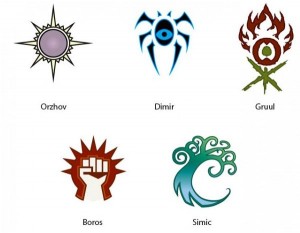
The release of Gatecrash is rapidly approaching, and when it arrives Standard will get a face-lift of sorts. The remaining five Shock Lands will become available as well as some [hopefully] powerful cards from the remaining five guilds. For quick reference, the five guilds in Gatecrash are Boros (W/R), Simic (U/G), Dimir (U/B), Gruul (G/R), and Orzhov (W/B).

Each of these five guilds will have an impact on Standard in varying ways. As the metagame evolves to absorb the new set, certain cards will shift in popularity and value. But rather than wait for the shift in value, we can begin speculating on what may be powerful with the release of Gatecrash.

In fact this has already begun in some circumstances – I will do my best to bring you up to speed on recent price moves based on Gatecrash speculation. I’ll also try to mention a few possible ideas that may not have gotten everyone’s notice yet.

Orzhov

Black/White is always a popular casual color combination. Therefore, any awesome Legendary Creatures in Gatecrash that represent the Orzhov guild have a chance at being financially relevant. But before getting excited about speculation on new cards, we should first consider cards already in Standard which may see a price bump with the printing of many Orzhov cards.

To me, three obvious cards come to mind – and one of them has already seen a small price rebound. Check out the token B/W Planeswalker, Sorin, Lord of Innistrad (chart from blacklotusproject.com):
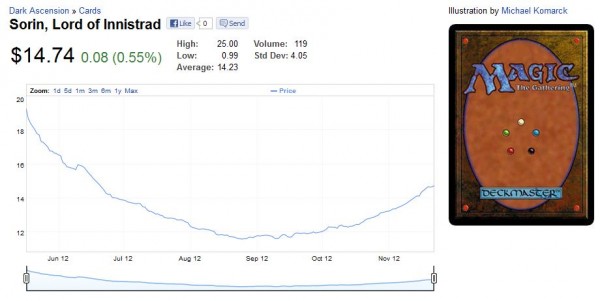
This Planeswalker really hasn’t seen that much increase in play lately. But the anticipation of strong B/W cards to enable a viable Orzhov deck has already bumped Sorin up in price. He’s not near his peak yet, so there is certainly some more upside. If he sees increased play with the release of Gatecrash, he has potential to return to $20 (cash prices).

But if his fifteen minutes of fame is cut short, his run will end. Still, once Gatecrash is released there will be so much hype that people will want to brew decks with Sorin. Whether he is a hit or a myth, he will still see increased demand – it could be wise to acquire Sorin in trades now and move him shortly after release unless he breaks out.

Two other clear options for Orzhov include Lingering Souls and Vault of the Archangel. Both have already seen some price increase. They are both from Dark Ascension and were, therefore, opened in fewer quantities. These seem like auto-includes in any strong Orzhov deck – I would recommend acquiring these either at discount prices or in trades, as they are well positioned to be strong players come Gatecrash release.

Dimir

Blue/Black is often the most popular and powerful color combination. After all, there is a reason Underground Sea is the most expensive Dual Land. But in Standard, this trend tends to break down. Perhaps Wizards is afraid of making this very control-based guild too powerful. Either way, Dimir is bound to have an impact on the format.

That being said, it’s difficult to identify cards in current Standard that are on the rise from Dimir anticipation. Nephalia Drownyard would be the most obvious choice, but the card has already seen significant play and still is nearly bulk. Evil Twin also has an essence of Dimir associated, but it too seems near bulk rare status. Should these two see increased play, potential upside is still limited.

In my opinion, Dimir may make a strong partner to Orzhov to create a Tier 1 Esper Control deck. Such a deck has already seen some success in Standard, and having access to Watery Grave and Godless Shrine can certainly help. A powerful removal spell, draw spell, or counterspell would also strengthen the deck and improve the utility of Snapcaster Mage.

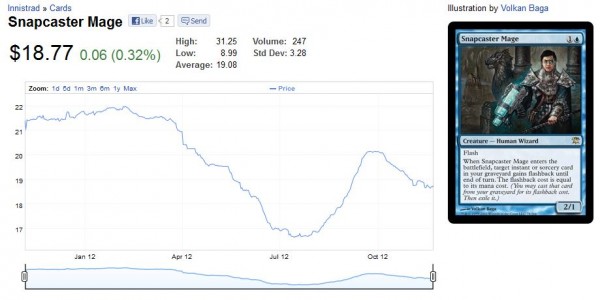
In fact, Snapcaster Mage may see increased play again should this be the case. It may return to $20 but its price cap does seem fairly firm in that region (chart from blacklotusproject.com).
Geist of Saint Traft is another powerful creature that may fit into an Esper Control deck. Though this Legendary Creature is even more expensive than Snapcaster – acquire cautiously, in my opinion. I’d rather have $30 worth of Lingering Souls than one Geist of Saint Traft.

Gruul

One prime creature comes to mind when I think Gruul…
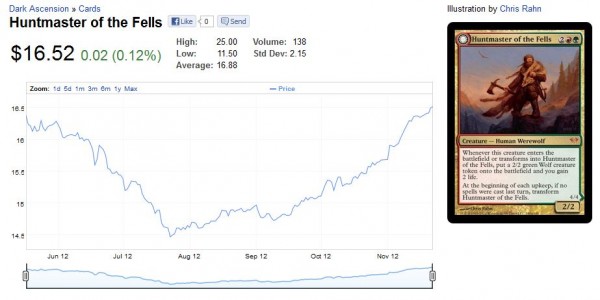
I have been bullish on Huntmaster of the Fells (chart from blacklotusproject.com) since his price bottomed a couple months ago. He’s been a 4-of in many successful Jund lists at SCG Opens. And being a Mythic Rare from Dark Ascension, his potential upside is significant… once people break down that apparent price barrier of $20. For some reason he’s bumping into a ceiling that Geist of Saint Traft hasn’t dealt with.

Either way, with Jund decks already being popular and powerful, Gruul will likely strengthen the strategy. This can only increase the playability of Huntmaster, and I can see his price finally hitting $20 cash, should Jund/Gruul decks remain Tier 1.

Although slightly more on the speculative side, Somberwald Sage is another creature worth considering. This mana-producing creature has already proven relevant in Standard with Brad Nelson’s G/B/W ramp / [cardUnburial Rites[/card] deck.
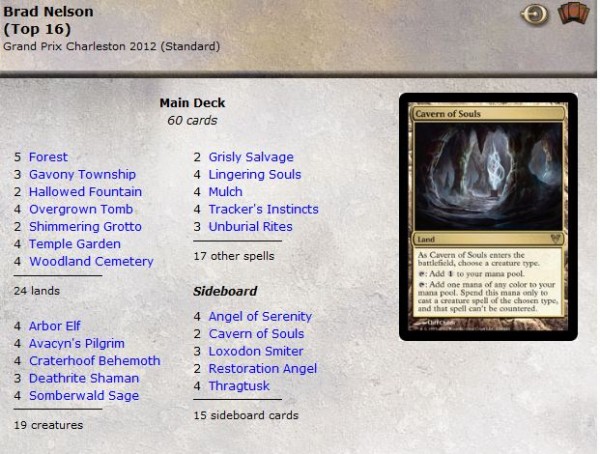
With Gruul likely to bring more poweful creatures, Somberwald Sage may have another home in Standard. Her power has been proven – now it’s just a matter of finding the optimal color combination and guild to maximize her power. I feel the release of Gatecrash will help her chances more than hurt them. And at $1 each, you could do worse for a small cap speculation.

Boros

The most obvious play here, in my opinion, is Clifftop Retreat. This land has already run up to compete in price with the other Innistrad Dual Lands. Because these lagged behind for so long, they are now the only Innistrad Dual Lands I own. The rest are all sold. I’ll be selling these once the first awesome Boros card is spoiled.

Some players anticipate Silverblade Paladin to be a good fit with a Boros deck (chart from blacklotusproject.com).
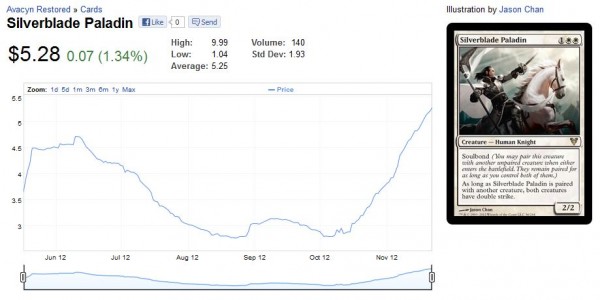
The Paladin’s recent success has already helped bolster his price to an all-time high. Double Strike is such a powerful ability that essentially doubles the power of an attacker. With Boros being a fast-paced attack-oriented guild, Double Strike can provide a powerful one-two punch. Silverblade Paladin is one card I am consistently trying to pick up, but they sell to dealers so freely it’s uncanny. Buy and sell prices are rising to keep pace with demand and I can see this creature hitting $10.

I’d caution from there, however, since Silverblade Paladin was a promo. Even though Restoration Angel sees a ton of play, her promo has kept her very close to the $10 range and Silverblade Paladin may have that same price ceiling to contend with.

Sublime Archangel is another creature on the rapid rise. She could fit in reasonably well in a creature-based Boros deck. Once she hits the board, her presence is known and I’m surprised it took so long for her to get notice. My eye is definitely on her and I plan on trading for her when I can.

An even better fit for Boros may be Hellrider (chart from blacklotusproject.com).
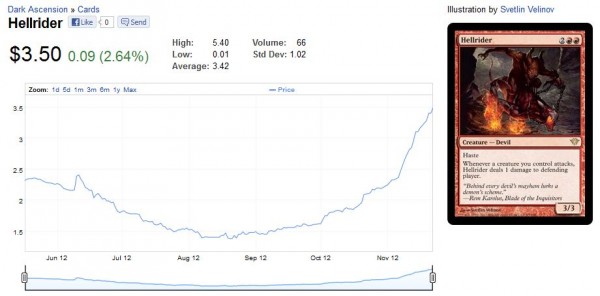
This card has been on quite the run lately, driving the price up more than double it’s bottom. And blacklotusproject.com hasn’t even caught up yet – expect to see this card finally plateau near $6.

I am not sure how much room this one has to go – it’s a tough one to predict. On the one hand, he’s a rare from Dark Ascension and may be slightly harder to find. He is also very powerful in creature-based decks that like to attack. On the other hand, Red aggressive decks are often hated out of formats and marquis creatures from these decks often hit a ceiling quickly. It may all depend on what Boros brings to the table that can enable this guy. The same goes for Thundermaw Hellkite, which also has potential upside in the right Tier 1 deck.

Simic

Last but not least we have Simic, the mysterious U/G guild. Most rumors on this guild include some sort of Merfolk creature theme. Thus many in the QS forums have been advocating Master of the Pearl Trident. I personally don’t see this creature hitting the big time, but I could be wrong. He is fairly cheap to acquire now, so if you are bullish on Merfolk in Standard, the time to acquire is now before any Merfolk [potentially] get spoiled.

Hinterland Harbor would be a clear play on the lands front. But at $11.99 on Star City Games already, I’m not sure how much more room this one has to grow. Looking at the chart it appears this one has already leveled in price (chart from blacklotusproject.com).
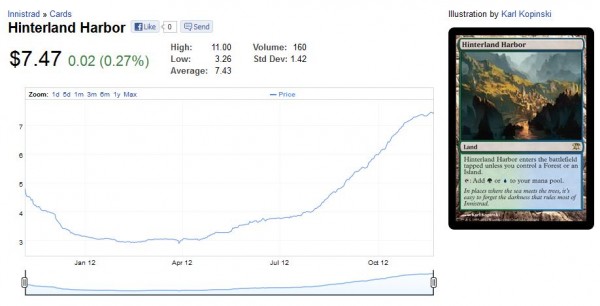
Can Hinterland Harbor go up further? Of course… Woodland Cemetery set precedent on how high these can go. But until we see Simic become a major strategy, I’m inclined to hold off. I like Clifftop Retreat much more going into Gatecrash release.

Summing it Up

When new sets are launched, it means opportunity. Being able to anticipate what cards may become more popular well before spoiler season can net you solid profits. In fact, it may be nearing a bit late on many of the ones I listed above. Sorin, Lord of Innistrad, Clifftop Retreat and Silverblade Paladin have already seen price bumps.

But even if we are too late to the speculation party this time around, it is very helpful to analyze what moved and why. We can then reapply the logic when subsequent sets are released to help us stay ahead of the curve next time around.

…

Sigbits

  • It’s amazing how some Commons from recent sets have gotten so expensive, relatively speaking. Spell Pierce is definitely trade binder-worthy now. It buylists for $0.25 and sells for $1.49 on Star City Games. Lorwyn copies of Ponder also buy lists for $0.25 on Star City Games and all versions will cost you $1.49 to buy.
  • For a card that sees slight play in Modern, Cryptic Command sure has remained financially relevant. Both promo and normal versions buy list at $10 on Star City Games. Some players haven’t noticed this gradual price increase and still value the card around $12. Watch out for a reprint in Modern Masters, however.
  • The price of Terminus has proven to be fairly resilient. Even as the Standard metagame fluctuates, the card remains sold out at Star City Games at $12.99. This is another card that everyone values differently. I’ve managed to purchase this card recently from a dealer booth for $5 and sell them online for $9. Quite the discrepancy.

Insider: Financial Guide to Masters Edition Events on MTGO

Are you a Quiet Speculation member?

If not, now is a perfect time to join up! Our powerful tools, breaking-news analysis, and exclusive Discord channel will make sure you stay up to date and ahead of the curve.

This week sees the return of the Master's Edition sets to MTGO, just in time for American Thanksgiving. 4 pack sealed deck queues will run until the 28th, and 64 player draft events will run over the long weekend. When playing in these events, it's good to keep in mind the secondary market value of the cards that you crack. Below is a guide to the price of notable cards in each set, as well as some comments on limited play and other oddities.

As a rule of thumb a card worth 4 tix, essentially close to cost of a pack, is worth rare drafting. Keeping the pricier cards in mind when drafting will help you to "go infinite" and play in future drafts for free or at lower cost. Playing in more events cheaply gives you continued chances at cracking one of the high value foils. Unlike normal in-print sets, the foils in the MED sets can be priced at many multiples of the non-foil version's price.

All prices are from MTGOTraders and are current as of Wednesday November 21st, 2012. These prices will fall as a result of the events, but they provide a useful reference for those who will be playing MED I through IV sealed deck and draft.

MED

A complete set of Master's Edition (MED) is priced at 164 tix. It was released at a time when the online player base was much smaller. It is also pretty bad for limited play as a standalone set, because it was meant to be played with 10th Edition. These factors have combined to create the situation where the set was only lightly opened, and Force of Will is the most expensive card in the digital economy as a result. Crack a foil version and it will definitely pay for a few drafts! Notably, Animate Dead and Lightning Bolt are reproduced here with their original art, which is why foil versions go for 7 and 6 tix respectively.

Cards over 4 tix:

  • Foil Animate Dead ($7.0)
  • Foil Ankh of Mishra ($5.0)
  • Foil Armageddon ($4.9)
  • Berserk ($4.19), Foil Berserk ($10.5)
  • Foil Contagion ($4.0)
  • Foil Diamond Valley ($8.0)
  • Force of Will ($105), Foil Force of Will ($295)
  • Foil Hydroblast ($4.0)
  • Foil Hymn to Tourach ($18.0)
  • Nevinyrral's Disk, ($5.52), Foil Nevinyrral's Disk ($15.2)
  • Foil Ivory Tower ($4.45)
  • Foil Lightning Bolt ($6.0)
  • Foil Mishra's Factory ($6.0)
  • Foil Moat ($10.2)
  • Foil Pyroblast ($6.0)
  • Sylvan Library ($7.9), Foil Sylvan Library ($21.75)
  • Foil Thawing Glaciers ($7.75)
  • Winter Orb ($5.12), Foil Winter Orb ($14.1)

Notable Commons and Uncommons: Hydroblast ($1.88), Pyroblast ($2.0), Foil Goblin Grenade ($2.0), Foil High Tide ($3.0), Foil Zuran Orb ($1.0)

MED II

Master's Edition 2 (MED2) is priced at 151 tix for the set. It heralded the printing of the original allied dual lands but otherwise the power level of this set is probably the lowest of all the Master's Editions. Like MED, limited play was again quite poor.

Creatures are such a huge part of Limited and it's only in recent years that WoTC has gotten a better at designing and costing them. Thus, MED2 has such notables as Adarkar Sentinel and Kjeldoran Skycaptain. To modern eyes these cards may seem mediocre, but both of them should pretty much make the cut every time in sealed deck.

Lastly, Gorilla Shaman was printed in this set as an uncommon, but due to its original paper printing in Alliances at common, it is legal for play in Pauper. That's why it carries such a high price. It is a fantastic sideboard card to bring in against Affinity builds, which rely heavily on the Mirrodin artifact lands.

Cards over 4 tix:

  • Badlands ($13.42), Foil Badlands ($40.3)
  • Foil Brainstorm ($15.0)
  • Helm of Obedience, ($4.63), Foil Helm of Obedience ($12.75)
  • Imperial Seal ($5.87), Foil Imperial Seal ($20.55)
  • Mana Crypt ($12.05), Foil Mana Crypt ($48.2)
  • Necropotence, ($4.89), Foil Necropotence ($13.45)
  • Savannah ($24.42), Foil Savannah ($73.3)
  • Taiga ($10.72), Foil Taiga ($32.2)
  • Foil Temporal Manipulation ($6.0)
  • Underground Sea ($29.73), Foil Underground Sea ($81.75)

Notable Commons and Uncommons: Brainstorm ($1.57), Gorilla Shaman ($1.52), Foil Gorilla Shaman ($3.45)

MED III

A set of Master's Edition 3 (MED3) is priced at 139 tix. It saw the printing of the original enemy dual lands, and development was handled by Erik Lauer, who implemented a more enjoyable limited experience this go around. There are some important things to keep in mind for sealed deck and draft. Portal Three Kingdoms shows up here, along with the Horsemanship ability. Creatures with this ability play out much like creatures with shadow from Tempest block, i.e. they are evasive and should be valued as such.

Riding the Dilu Horse, an uncommon, deserves special mention. Although it is a sorcery, it grants +2/+2 and Horsemanship permanently as if it were an enchantment. Don't ask me why; Portal was a strange beast.

There are also many overcosted gold creatures from Legends in this set. In sealed deck, six or seven mana is not too much for these creatures as not much removal can take them out and games usually go long enough for large creatures to matter. Also, Remove Soul is excellent pseudo removal as a consequence.

Cards over 4 tix:

  • Bayou ($14.64), Foil Bayou ($51.25)
  • Bazaar of Baghdad ($5.67), Foil Bazaar of Baghdad ($15.6)
  • Foil Black Vise ($9.45)
  • Foil Capture of Jingzhou ($5.45)
  • Foil Concordant Crossroads ($4.65)
  • Grim Tutor ($4.7), Foil Grim Tutor ($12.95)
  • Foil Karakas ($7.35)
  • Land Tax ($10.2), Foil Land Tax ($28.05)
  • Mana Drain ($20.13), Foil Mana Drain ($110)
  • Plateau ($7.06), Foil Plateau ($24.75)
  • Scrubland ($15.9), Foil Scrubland ($47.7)
  • Foil The Abyss ($4.35)
  • Foil The Tabernacle at Pendrell Vale ($5.4)
  • Tropical Island ($20.49), Foil Tropical Island ($61.5)
  • Volcanic Island ($18.78), Foil Volcanic Island ($65.75)

Notable Commons and Uncommons: Chain Lightning ($0.39), Foil Chain Lightning ($1.0)

MED IV

Master's Edition 4 (MED4) is priced at 285 tix. This set basically filled out all the pre-Mirage cards WoTC wanted online that weren't previously available. Notably absent were the Power Nine. All ten of the original duals were printed again and original art versions of Balance, Black Vise, Counterspell, Dark Ritual, Fireball and Swords to Plowshares (among others) show up here as well. Following in the footsteps of MED3, MED4 was another decent limited environment. In comparison to MED2, the power level of this set is off the charts, with many Eternal format staples from Alpha, Arabian Nights and Antiquities appearing for the first time.

Cards over 4 tix:

  • Foil Armageddon ($5.65)
  • Ashnod's Altar, ($4.49), Foil Ashnod's Altar ($12.35)
  • Badlands ($13.51), Foil Badlands ($40.55)
  • Bayou ($17.04), Foil Bayou ($59.65)
  • Candelabra of Tawnos ($5.65), Foil Candelabra of Tawnos ($15.55)
  • City of Brass ($4.82), Foil City of Brass ($13.25)
  • Foil Control Magic ($7.55)
  • Foil Copy Artifact ($5.75)
  • Foil Dark Ritual ($5.00)
  • Demonic Tutor ($8.00) Foil Demonic Tutor ($32.0)
  • Fastbond ($4.22), Foil Fastbond ($11.6)
  • Library of Alexandria ($11.56), Foil Library of Alexandria ($55)
  • Mana Vault ($7.4), Foil Mana Vault ($20.35)
  • Maze of Ith ($9.89), Foil Maze of Ith ($27.2)
  • Mishra's Workshop ($17.56), Foil Mishra's Workshop ($65)
  • Plateau ($8.27), Foil Plateau ($28.95)
  • Foil Regrowth ($5.20)
  • Savannah ($24.67), Foil Savannah ($74.05)
  • Scrubland ($16.04), Foil Scrubland ($48.15)
  • Sinkhole ($6.5), Foil Sinkhole ($17.9)
  • Sol Ring ($5.43), Foil Sol Ring ($14.95)
  • Foil Stasis ($5.9)
  • Strip Mine ($8.93), Foil Strip Mine ($24.55)
  • Taiga ($10.86), Foil Taiga ($32.6)
  • Foil Time Vault ($15.0)
  • Tropical Island ($20.5), Foil Tropical Island ($61.5)
  • Underground Sea ($23.68), Foil Underground Sea ($65.15)
  • Volcanic Island ($17.32), Foil Volcanic Island ($60.65)

Notable Commons and Uncommons: Foil Swords to Plowshares ($3.0), Foil Counterspell ($1.2)

Going Infinite

Although the cost of entry for 4 pack MED sealed is 20 tix, the combined secondary market cost of one pack of each of the MEDs is equal to 24 tix currently. At the outset of these events, WoTC is essentially offering a discount for players to enter the queues. Clearly they want people to play these events.

As a comparison, normal 4 pack sealed only costs 16 tix. The extra cost of the MED queues is made up for in the prize payout, as it has been increased by a total of 8 packs. Going 2-1 in a MED sealed queue will turn your 20 tix into 4 packs (one of each of the MEDs), plus you get to keep the cards that you open. As long as the price of packs doesn't crash too hard, 'going infinite' this week should be doable for those who are decent at sealed.

Speculating on Eternal Formats

Prices on Pauper staples from all four sets should crash as a result of these events. Pauper is a format that goes in and out of favor, but has been observed to drive up prices on certain commons quite high. This year, Tempest Lotus Petal reached 10+ tix. Determine the commons from the MED sets that are low in price and sock them away for the future. In particular, pay attention to the cards from MED and MED2, the sets with the lowest supply and thus the most potential for price spikes.

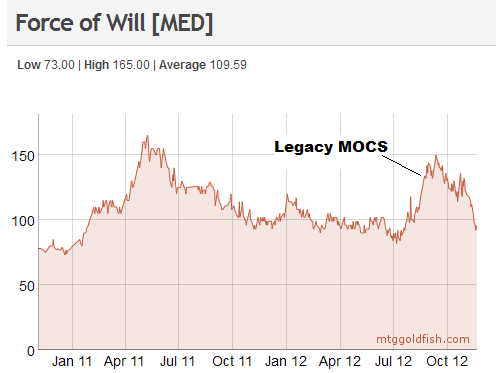
Depending on how popular these events are, there could be a large fall in the prices of many Legacy and Classic staples from these sets. Down the road, it's wise to anticipate another Legacy MOCS, such as the one that occurred this past summer on August the 18th. The result of having a high profile tournament online was to stoke interest in Legacy, pushing up the price of many Eternal cards. This type of seasonal swing is the bread and butter strategy of investing in Eternal staples on MTGO. Fluctuating interest drives prices up and down, creating opportunities for speculators. Legacy on MTGO is no different from Modern in this regard.

In addition, Modern Masters will be printed in the summer of 2013 which will make Eternal formats more affordable across the board for constructed play. Staples not printed in the MED sets and not in line to be reprinted soon are safe bets and will see price increases.

Wasteland is a good example of a Legacy staple that saw a recent price drop due to Tempest-Stronghold-Exodus (TSE) queues popping up on MTGO. WoTC has shown that it will rotate through out-of-print formats and next in line is Urza's block and Masques block. This suggests that we will not see another round of TSE or MED events in the medium term. Wasteland previously touched over 40 tix, suggesting that at the current price of 29 tix, there is some value for speculators in buying Wasteland.

Going forward, I will be paying close attention to the price of Force of Will. There could be a huge buying opportunity on this card if the price comes down enough. And if you haven't seen this contest in the forums, be sure to join in! I want to see what everyone thinks will happen to the price of Force of Will as a result of these holiday MED events.

Bringing Back the Boss

Are you a Quiet Speculation member?

If not, now is a perfect time to join up! Our powerful tools, breaking-news analysis, and exclusive Discord channel will make sure you stay up to date and ahead of the curve.

A little over two years ago, right after the release of Worldwake, a deck broke out in Standard. This was an important development because Jund was at the peak of its dominance. Until this point, there were not many options to combat the powerhouse tier one deck. There were talks of banning Bloodbraid Elf in Standard because we were seeing top eights with as many as six Jund decks.

At Pro Tour San Diego 2010, the Channelfireball team piloted a new Naya deck. Since the deck's designer, Tom Ross, was nick-named "The Boss," the deck was named Boss Naya. The catchy name stuck and most players remember it because of that. What made Boss Naya so good were the new toys from Worldwake like Stoneforge Mystic, Raging Ravine, Stirring Wildwood, and Basilisk Collar. The deck also featured a combo from the sideboard that aimed to assemble Cunning Sparkmage equipped with a Basilisk Collar. At the time, this was a brand new innovation. We had not seen an interaction like this before, so it took the field by surprise.

When I saw the coverage of this deck, I was immediately on board. Since the Naya shard was released in Shards of Alara, I had been playing that color combination to much success so changing my preexisting deck by a handful of cards was no problem at all. As I am prone to do even with a Pro Tour top eight deck, I immediately began to incorporated changes. My analysis was that the amateur metagame would have a larger percentage of Jund and aggressive decks so I wanted that Cunning Sparkmage package maindeck instead of as a sideboard plan. After making adjustments, I headed off to a Star City 5k the weekend after the Pro Tour. As I suspected, most of the players had not adjusted to the new deck and I wrecked the field with my version.

This was my list:

Boss Naya by Michael Lanigan
5th place at SCG Richmond, Virginia on 2010-02-28

Untitled Deck

Creatures

2 Birds of Paradise
4 Bloodbraid Elf
4 Cunning Sparkmage
4 Knight of the Reliquary
4 Noble Hierarch
4 Ranger of Eos
1 Scute Mob
2 Stoneforge Mystic
4 Wild Nacatl

Spells

2 Oblivion Ring
1 Basilisk Collar
1 Behemoth Sledge
2 Ajani Vengeant
1 Elspeth, Knight-Errant

Lands

4 Arid Mesa
3 Misty Rainforest
2 Raging Ravine
1 Sejiri Steppe
2 Stirring Wildwood
1 Tectonic Edge
2 Terramorphic Expanse
5 Forest
2 Mountain
2 Plains

Sideboard

1 Basilisk Collar
1 Behemoth Sledge
2 Baneslayer Angel
1 Goblin Bushwhacker
1 Scute Mob
2 Manabarbs
1 Oblivion Ring
3 Lightning Bolt
3 Summoning Trap

This is one of my favorite decks that I have ever played, for many reasons. Certainly one reason was my success with it, but there are so many synergies in the deck and it is a ton of fun to play. With a deck like this, you can utilize your skill and outplay your opponent by taking a variety of lines of play. What makes this deck so powerful is that all of the cards are strong and playable on their own, but when you get them online together, they become even better.

The reason I wanted to talk about this today is because there are a lot of similarities between Boss Naya and what I am playing in Standard right now. Building this deck did not start with the concept of Boss Naya, but it did end up rather similar. Here's the deck for comparison.

Boss Jund

Untitled Deck

Creatures

3 Deathrite Shaman
4 Nightshade Peddler
4 Izzet Staticaster
4 Huntmaster of the Fells
3 Falkenrath Aristocrat
3 Olivia Voldaren
2 Zealous Conscripts
2 Thundermaw Hellkite
2 Thragtusk

Spells

4 Farseek
4 Trackers Instincts

Lands

4 Cavern of Souls
4 Overgrown Tomb
4 Blood Crypt
4 Steam Vents
3 Woodland Cemetery
3 Rootbound Crag
3 Hinterland Harbor

Sideboard

3 Slaughter Games
2 Snapcaster Mage
4 Pillar of Flame
2 Bonfire of the Damned
2 Evil Twin
1 Falkenrath Aristocrat
1 Zealous Conscripts

Similarities Checklist:

  1. Powerful Spells on their own, check.
  2. Even more powerful synergies, check.
  3. Card advantage, check.
  4. Lands that affect the game, check.
  5. Sparkmage + Collar combo, double check!
  6. Green, Red, and White mana, nada.

Despite not being a Naya deck at all, these two decks have a lot of conceptual elements in common. If you look closely, this is basically just a different version of the current Jund deck in Standard. There are many cards that overlap between the two decks. We all know Thragtusk, Huntmaster of the Fells, Falkenrath Aristocrat, Olivia Voldaren, Thundermaw Hellkite and Farseek are strong cards. Lots of decks use these cards on their merits alone. Let me talk about the cards you don't see too often and provide some details.

The Stars

Nightshade Peddler -- Here's the secret. This is the best card in the deck. I know, it seems like I'm joking around and in another sentence or two, I'm gonna laugh as I type some witty comment to let you in on my joke. But this time I'm serious.

There is a lot going on with Mr. Flower Salesman here. (Nightshade is a flower, in case you didn't know, and he peddles it, hence the nickname.) The two-mana creature acts more like an enchantment but pairs well with Izzet Staticaster, Huntmaster of the Fells, Olivia Voldaren, and Thundermaw Hellkite. There will rarely be a time when you don't have something to soulbond with it. The goal is to get him online with Staticaster to become a creature-killing machine gun. Think about how many decks omit removal entirely and rely solely on creatures to win the game right now. This Boss Naya synergy completely dominates those matchups. Even against the rest of the field, there is rarely a deck you don't want him in play against.

Izzet Staticaster -- If there were an actual Izzet deck being played right now, I would advocate this new addition to the guild in the deck. Right now, Lingering Souls and mana creatures are being played more than they should with no repercussions due to the lack of Pyroclasm in the format. Against decks that run these cards, you don't even need the Nightshade Peddler to pair with it because it is capable of killing multiple cards on its own. Even if they pump the tokens with Intangible Virtue or Gavony Township, you can always find the Peddler or a second Staticaster.

Zealous Conscripts -- Stealing permanents can be a viable way to win the game, especially if you can sacrifice them to Falkenrath Aristocrat or use the ability of a planeswalker you took. The power level of Conscripts varies depending on what deck you are playing against. Make sure to side it out against the fast decks, but bring the other one in against any midrange or control deck.

Deathrite Shaman -- While new to Standard, this one drop has a proven itself in Modern and Legacy. In Standard many players are utilizing their graveyards and against the slower decks you can take a big chunk out of their life total with the black ability. Shaman interacts with more than just the graveyard decks too. Against Snapcaster decks, you can remove their flashback target before they can cast it and even against decks like Mono Red, the lifegain can give you enough time to stabilize.

I foresee players arguing about my decision to run three copies stating it should either be four or zero depending on your evaluation of the card, but I think three is the correct number. You don't always want one in play and you certainly don't want two, so I believe three to be exactly right.

Tracker's Instincts -- It may not seem like it, but this innocuous little sorcery is one of the most powerful cards in the deck. Think of it as an Impulse with upside and you will begin to catch on to the power level. With so many synergies in the deck, being able to assemble them more easily is definitely a plus. The cards you don't choose also go to your graveyard, which is important for Deathrite Shaman. By the way, the first time you pick Nightshade Peddler over a mythic rare, you know you are on board with this deck.

Cavern of Souls -- Did you get the memo? Pro players have been sending it out to computer screens across the world for weeks now. Counterspells are back. If you are not ready for them, you will be left unable to resolve a spell the entire game. Cavern, despite the differing creature types, is absolutely necessary in this deck. It's presence alone changes the U/W Flash and control matchups entirely. When they can no longer rely on all their counters as removal spells, they find themselves quickly overwhelmed. Don't forget, almost all of your creatures are either humans or vampires but name dragon or beast with confidence when necessary.

Sideboard Basics

Aggro Package -- 4 Pillar of Flame, 2 Snapcaster Mage, 2 Bonfire of the Damned

Midrange -- 2 Bonfire of the Damned, 2 Evil Twin, 1 Falkenrath Aristocrat, 1 Zealous Conscripts

Control -- 1 Falkenrath Aristocrat, 1 Zealous Conscripts, 3 Slaughter Games

Short Local Tournament Recap

Round 1 -- Jund

This will definitely feel like a mirror match because you share a lot of the same cards except you have card draw from Tracker's Instincts and can kill any of their threats in multiple ways. Unless one of you lands a quick Olivia Voldaren that goes unanswered, the match tends to go long, but you are definitely favored. In this match I ended up losing game one while I was mana screwed. Game two, I was in control the whole game and he never really saw removal to keep my creatures from running him over. In game three, my turn two Farseek, turn three Huntmaster, turn four Bonfire was enough to win a quick game with not much time left in the round.

Round 2 -- Jund

At first I thought this was going to be a replay of round 1, but then he played a Dreg Mangler followed up by a Falkenrath Aristocrat. It was basically still Jund, just a more aggressive version. Again, I lost game one to never hitting a fifth land despite fighting through many of his threats while stuck on four lands. Game two, my life total ended over twenty and was basically me doing what this deck does and killing every creature he played. Game three, I thought I was going to stabilize after he Bonfired my first two Huntmasters and [card Dreadbore]Dreadbored[/card] the third, but a topdecked Rakdos's Return killed me a turn too soon to allow my summoning-sick Deathrite Shaman to gain some life. A very close game that I thought I should have won but given the cards I drew, I don't think there were any plays I could have made differently.

Dreg Mangler was quite good and it makes me think it should see more play. He may have been onto something with Dreg Mangler into Falkenrath Aristocrat.

Round 3 -- Junk Troll Rites

Being a different version of the reanimator deck, my cards are naturally good against him since he has no removal. Lotleth Troll is still good though and I took a lot of damage from it before gaining it back. I'm not sure he had an answer to Staticaster, let alone when paired it Peddler. This was a quick two games and I was in control almost the whole time. If he did not tap his mana wrong in game one to leave one less black open, it may have been closer but we will never know. This is a great example of Boss Jund dominating certain decks.

Round 4 - Naya Midrange

I would say this is one of the best matchups for this deck. They also have no removal so how are they supposed to beat your machine gun? Game one I stumbled on mana again and I thought I was going to be overrun by Restoration Angel and two Thragtusks plus a Borderland Ranger, but luckily I [card Trackers Instincts]Tracker's Instincted[/card] into an Olivia to pair with my Peddler.

Make sure you play around Selesnya Charm in this match. It is one of their only ways to interact with you. I declined to kill a second creature during his combat step and take a dangerous amount of damage so that he could not remove her. Then when I untapped I killed a creature and responded to the removal spell by killing the rest of his creatures. Going as low as two life after that attack, I ended the game at eleven once I got back on track. Game two was no contest because I started killing his creatures early. Even when he had the Oblivion Ring, I had a replacement to keep up the killing machine.

Abiding the Boss

In Summary, Boss Jund is really a force in the metagame right now. My plan is to take the deck to the TCG Player Invitational next weekend and let it loose on the high profile event. Hopefully there will be great results to follow. I have not been this excited for an event in a long time. If you've been hating Standard recently like I was, give this deck a shot and you won't be disappointed.

Until Next Time,

Unleash the Boss Jund Force!

Mike Lanigan
MtgJedi on Twitter
(I'm active on twitter again, so send me a message sometime.)
Jedicouncilman23@gmail.com

P.S. If you want a flashback to Boss Naya, here's the link to the original deck tech.

Insider: I Just Bought A Collection.

Are you a Quiet Speculation member?

If not, now is a perfect time to join up! Our powerful tools, breaking-news analysis, and exclusive Discord channel will make sure you stay up to date and ahead of the curve.

I've been thinking a lot about buying collections again recently. It's fun as all heck to see what's in someone's binder and you can make a pretty good profit with turnover. Moreover, I was tired of seeing Sig and Corbin post about going through collections – jealous! I started hitting Craigslist last week to see what I could find. I live in Cincinnati and I figured that there would be a lot of competition for collections, so I was not hopeful about what I'd find. Chas Andres talks about how you need to emotionally distance yourself from getting a good deal, since people can and will sell to the first person who shows up with cash.

First attempt: a failed start.

I messaged someone on Craigslist who ended up living about a mile from me. He had a small stack of cards and no pictures of what they actually were, but he had no idea what Magic cards were. He had some random worthless Heroclix figures and cards that he'd picked up at a swap meet. He said he paid $100 for them, so I had hope. He also said that he was not going to negotiate, that he wanted the full $100 – and he had a habit of typing in all caps. Oh boy.

I walked over and checked out the stack, hoping for old Revised duals. Instead, it was a stack full of trash from Odyssey block – and someone had already picked out all the rares and foils! Seriously, the only thought I had looking through it was "I wonder how much Deep Analysis is on buylist." There was absolutely nothing of value in the stack and I broke the news to the guy that I wasn't even going to make a pity offer of $5. He took it fine but I think he was internally kicking himself, because whoever swapped those cards to him made out like a bandit if they got $100 for them.

Round Two: Too good to be true?

After checking out that collection, I went to CL again to see what I could find. Another guy said that he had a big collection and wanted about $500 for it. He listed things like Unlimited Drudge Skeletons for $18.00 (in reailty, $0.25...) but luckily, he had a list of all of the rares. On Saturday, he sent it over to me and boy, this was STACKED. He had easily $500 in value in that rare binder and I wanted at it. Unfortunately, I was about three hours away in Indianapolis and I wasn't getting back until Sunday!

We went back and forth, with me trying to instill in him that I was the one he was going to sell this to. Call Oprah and tell

Taken from a site about how "the Secret can get you girls." All I want are foils, man.

her I figured out The Secret – I was using this guy's name a lot, telling him that the offers from other people for $250 were insulting, and more. I wanted this guy to hold out for me and in the end, it worked out.

One thing you need to make deals on Craigslist is cash. Not money in the bank, but the Nike shoebox full of twenties. Banks are closed on weekends and evenings and this is when deals happen. I made sure to get $500 out of my bank so that I could be prepared for this. Honestly, even if he were around on Saturday, I didn't have the actual money to get this collection – ATMs limit the cash withdrawals and I would have felt awful.

On Sunday night, I gave myself time to price out his list. It would be easy, and foolish, to punch the whole thing into a decklist builder on a Magic store and see what it would all cost to buy. This is bad; everyone will sell you Island Fish Jasconius for $.30, but nobody will buy it for that (or even half that). I used Trader Tools and I checked out all the rares on the list. It came out to be $850 in total, so I felt that anything around $500 would be a good deal. I'll also note that I didn't do the deal until a Tuesday morning. Sure, other people were emailing offers to the guy, but I was beating the war drums about meeting at the earliest opportunity with cash. This gives me hope that in a city as big as Cincy, I can still get a deal if I'm not the first to see it.

As an aside, you have to figure out what your time premium is worth. $0 is not the correct answer. This number is going to inform how much of a discount you apply to the cards that you want. I wanted to double up on this, so spending anything over $500 would not really be worth my time. I don't think you have to kick yourself morally about lowballing to get a good price if you think the discount you're applying is worth it. You also have to figure that you're assuming the risk of selling these cards. You also must only buy on what you can see. People on Ebay fail this all the time since they want to hope that there will be gold hidden in the uncommons. Look, this kind of stuff happens, but what kind of premium do you want to put on it? I find that you can get about 10% of the value of the collection's rares in “buried binder treasure” and that's about it. You can't hope that the guy just randomly didn't know that Plateau was a rare.

We ended up meeting in a Target parking lot yesterday morning. I kept the cash in my car and didn't pull it out until we had made a deal already and the cards were loaded into my car. This is a safety measure. This also totally looked like a drug deal. I looked at the cards to make sure all of the money stuff was there, and it was. Unfortunately, I also realized this principle right there:

People don't take care of their cards.

Casual players never use sleeves. They mock their friends who use sleeves. All those bulk rares I priced out? I can't sell them even at bulk – I'll have to get rid of them some other way. Those elves like Ambush Commander and hits like Kamahl, Fist of Krosa had white, nasty, beat borders. That moves a card from “I can buylist this out” to “maybe I can trade this away?” That makes your job significantly harder.

On the balance, most casual players play bad cards. The really good stuff sits in a binder because the text is too long to understand. I have this mental rule that always comes true – you'll find a mint Force of Will because nobody can understand it. I found one here, a little prize in the binder that the guy didn't even figure into what he wanted for the collection! The $90 offset from that certainly takes the sting out of it. Thank goodness the best cards are blue and casual players are allergic to Islands.

I ended up offering him $480 for it, which was a bit more than what I wanted to pay. However, I wanted these cards emotionally – I had pursued them and seeing things like Force in there made me a little more generous in my offer. While Goblin Piledriver and Sword of Fire and Ice were chewed up, I could still get something from them. Things like a mint foil Stifle helped make me confident in what I could offer.

If you buy a collection based on mint prices for cards, you will be seriously disappointed.

The Pareto Principle: 80% of everything is junk.

The Pareto principle is this theory that 20% of “things” do 80% of the work. That's vague, so let me explain the 80/20 principle more. In my law practice, 20% of my customers pay 80% of my fees. In a company, 80% of the salesforce will be average and 20% will be excellent. Those 20% will account for 80% of the profits. This rule tends to work out all the time, everywhere, in spooky ways.

80% of the rares in this binder were absolute trash. 20% were solid gold, and made up a huge portion of the actual value. For example, there was an entire set of Onslaught in the collection. You've got a set of 244 cards, but the five fetchlands and the Goblin Piledriver and Sharpshooter drive most of the value of the set. This plays out in even more extreme examples in other sets (like Prophecy and Homelands).

This collection was definitely 80% trash, but when I'd portioned it out, the remaining 20% that could sell above bulk looked pretty nice. I had to trim anything that wasn't NM and I was pretty strict in my grading – I probably left a bit of money on the table but I don't really want to push it on condition with online stores. I was also prepared to sell all of it. In fact, the only card that I really wanted from the whole thing was a Sword of Fire and Ice – the rest I could sell happily! This underscores a point I learned from a Magic card's flavor text:

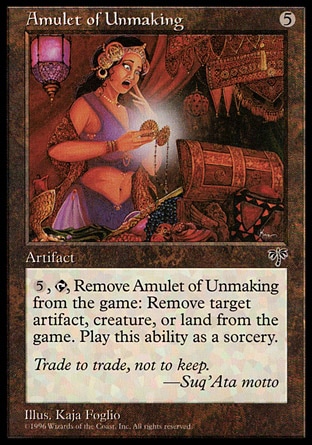
Trade to trade, not to keep.

- Amulet of Unmaking

I've definitely bought collections before where I ended up keeping all of the money cards. This gets to be expensive. You get a big box and all the fun stuff is, well, fun. I've kept the Badlands, the Italian Force of Will, the Sliver Queen – you name it. That really eats into your profits and it means you have to work so much harder to break even. I've made my mind to sell as much of this as I can – I want all that money back in the bank at the end of the month!

Now what do I do with all these crummy, beat cards?

Honestly, I still haven't made my mind up. I'm 12 hours in and I've got the entire thing sorted. Removing 8,000 cards from binder sleeves takes practice if you want to end up with neat stacks.

Here are my options, as I see them:

Sell to played-friendly buylists: ABUGames has a great played-card option on their site and the prices are good. Unfortunately, their setup takes a lot of time to punch in a bigger list of cards, and this still leaves me with about 8k in actual stone terrible bulk commons and uncommons. Things like the worn Goblin Sharpshooter will probably go this route.

Sell as a collection on Ebay: This is attractive, since people seem to be going nuts about buying collections these days. I've seen things go for hundreds of dollars and all they have in the pictures are Ball Lightnings. That's buying on faith, for sure.

Piece out and sell on Ebay: There are a few cards, like the Force of Will, that I can get much more for on Ebay versus buylists, even with a 16% loss. Ebay is much friendlier to played cards, so the slight dings on the Polluted Deltas shouldn't hurt them too badly in the market. As a result of some research, I found that there's not much of a price difference when you're selling two cards or four cards – the Ebay market is pretty efficient in that regard. I have no fears about throwing up, say, two Mystical Tutors.

Stock up a trade binder and grind: I don't trade a lot these days and the thought of grinding $1 cards over and over is not appealing. I'd love to run an automatic box (you get any card in here, you have to throw in two bulk rares though) at events, so I might retain a big stack of cards for this purpose. I also don't know that there's much appeal in most of these cards for traders. Do people want Safe Haven, Bloodbound March and Forsaken Wastes? Maybe they do and I can be the king of crazy casual binders! This method does have the advantage of converting played bulk into unplayed bulk, even if I'm doing low-level trading.

When I have tackled collections before, I've run into played cards but never on a level like this. I'm looking at a stack of about six hundred worn and beat cards, from Counterspells and Lightning Bolts to Crypt Rats and Wirewood Hivemasters. They're all good and someone would love them. Things like the Hivemasters are theoretically worth money, but the only venue I can think of to dump them is Ebay – and the low profits plus a big cut make that an unattractive option.

Since I've covered a lot of my initial investment, I want to ask you, the reader, what I should do next. My time is kind of important to me and after I break even, I tend to care less about getting each last penny. Is the correct option to just send it postage-payable to Kelly Reid and make him deal with it? Let me know below!


-Doug Linn

Postscript: I wanted to provide actual reader value in this article instead of turning it into a bragpost, but If you'd like to know the hits of this set and what convinced me to get it, here's a short list. Vampiric Tutor, Goblin Piledriver, Stifle, foil Stifle, a copy of each Onslaught fetch and a kicker Delta, Arcbound Ravager, miscellaneous expensive Slivers, Lion's Eye Diamond. Casual cards like Crucible of Worlds and Altar of Dementia added up quickly, too. This isn't the collection of a one-time FNM player, but it had a good mix of chase cards.

Let’s Talk Real Estate

Are you a Quiet Speculation member?

If not, now is a perfect time to join up! Our powerful tools, breaking-news analysis, and exclusive Discord channel will make sure you stay up to date and ahead of the curve.

It’s your turn. You’re battling with GW Humans. Your opponent is on Bant Control and has just cast their second Thragtusk. Your relevance in the game is quickly deteriorating. You draw your card.

Land.

Again.

Worse yet, it’s a basic Plains.

Basic. Freakin’. Plains.

Chalk up another loss to mana flood.

So what happens now? Maybe you trim a land from your deck. Twenty-three lands could be on the high side with four Avacyn's Pilgrim, right? Let’s try twenty-two.

How many one-landers do you mulligan before you start missing that twenty-third land? How often do you contemplate jumping all the way to twenty-four at this point?

It’s a maddening dance, and no matter how many lands you play from week to week the balance never feels quite right. A number of players even end up quitting Magic because they can’t get over the games that they lose to drawing the wrong quantity of lands. I’ve heard more than one person try to sell people on WoW TCG on account of its more stable resource system.

I’m personally way too deep into Magic to even consider such a move. I’m more inclined to put the work in to trying to find the build of a given deck that best manages the problem with lands. It’s a topic that probably doesn’t get as much direct attention as it deserves. Even still, I believe that the Magic community as a whole has gotten much better at determining how many lands to play in the past several years.

Back when I started playing competitively I would hear a lot of clamoring about wanting to build “20/20/20” style decks. Twenty lands, twenty creatures, twenty spells. This was what was believed to be “correct” in the original Ravnica block era. The idea was basically to play as few lands as possible, or rather to “cheat” on lands because drawing more spells would generally lead to winning more games.

Even the limited format back then was heavily dedicated to cheating on lands. The popular consensus was to pick up as many bouncelands as possible and to play as few as 14 lands whenever possible. Again, drawing more spells leads to more game wins.

This is a notion that has carried over from the very early days of Magic. The most influential deck along these lines is probably Dave Price’s Deadguy Red:

Deadguy Red

spells

4 Ball Lightning
2 Dwarven Soldier
4 Fireblast
3 Goblin Digging Team
4 Goblin Vandal
4 Hammer of Bogardan
4 Incinerate
4 Ironclaw Orcs
3 Kaerveks Torch
4 Lava Hounds
2 Viashino Sandstalker

lands

4 Dwarven Ruins
18 Mountain

Price’s deck had four drops, X spells and a Hammer of Bogardan that you know that he was planning on buying back. Even still, there is no way that a deck intending to play turn two Grizzly Bears with downside is going to play more than twenty-two lands.

These days Ironclaw Orcs isn’t even close to playable. I even hear people rag on Grizzly Bears proper in modern limited sets from time to time!

Spells are just stronger now. In light of this, there is an elevated importance to making land drops as the game progresses, especially when trying to go big. I will never understand a Thragtusk deck that only plays twenty-four lands. I don’t care how many Unburial Rites and Faithless Lootings are featured. I just won’t get it. Never.

When your spells are very strong, and I think it’s safe to say that Thragtusk is, just being able to curve out will win a high percentage of games.

Perhaps the most eye-opening decklist that I ever saw came from Simon Gortzen’s PT San Diego winning Jund deck:

Jund

spells

4 Bloodbraid Elf
3 Broodmate Dragon
4 Putrid Leech
3 Siege-Gang Commander
4 Sprouting Thrinax
2 Garruk Wildspeaker
4 Blightning
4 Lightning Bolt
3 Maelstrom Pulse
2 Rampant Growth

lands

2 Dragonskull Summit
4 Forest
2 Lavaclaw Reaches
3 Mountain
4 Raging Ravine
1 Rootbound Crag
4 Savage Lands
3 Swamp
4 Verdant Catacombs

Twenty-Seven lands. Masterful.

I had quite the Jesse’s Girl moment when I saw this list. Nothing but very powerful spells and a grip of lands to assure the casting thereof. There is beauty in simplicity, and it is showcased here in this deck. I never looked at Jund the same after this list. I even played 26 lands in Jund to the top 8 of an extended PTQ with four being the top of my curve the year after.

It is now quite common for me to add one or two lands to almost every deck that I play before even getting in a single game. Why? Because if I’m playing it I probably believe it to be the most powerful strategy. If I have the most powerful strategy then the most important thing is execution. Execution necessitates having the proper resources. The proper resources are quantities and colors of mana.

The Concrete Application of All This Theory

So where am I going with all of this? I suppose that the more general conclusion that I’m driving at is that Prosak wasn’t playing enough lands in UW Flash, nor enough Sphinx's Revelations.

I wrote a few weeks back about the importance of scaling power levels, and playing more lands plays directly into a strategy intending to scale. If you play more lands you’ll make more land drops and your Sphinx's Revelation will draw more cards. When you draw more cards (and gain more life), you win more games. That’s the whole reason that people cheat on lands in the first place, right? To have a higher percentage of their draws be spells? Turns out drawing more cards accomplishes the same goal.

The counterpoint that I frequently encounter is that cards like Thought Scour make it easier for one to hit lands. This isn’t entirely false. It’s true that cantrips allow a player to draw more cards, and drawing more cards leads to drawing more lands, but I’ve already written about the problems with Thought Scour on more than one occasion. In a nutshell my counterpoint here is that jamming Thought Scours instead of lands invites an unnecessary amount of entropy into your games and also fills your deck with relatively low impact spells. You don’t beat Thragtusks with one-for-ones, and Runechanter's Pike while powerful, is undoubtedly more clunky than just burying your opponent in the card advantage acquired from higher impact spells and the ability to cast them.

So what the hell does any of this have to do with a GW aggro deck flooding? To an extent this is something of a subjective question. Do you believe that the aggressive decks can consistently beat the slower decks before they get off the ground, or do you believe that the slower decks will beat the aggressive decks simply by virtue of surviving to turn five? Is the solution to ignore the fast decks? The slow ones? To try to beat both? Is the answer to hybridize- to build a deck capable of winning quickly but equally capable of going long? Does all of this remain a static aspect of Standard or does it change weekly with the metagame? I see a lot more value leaving these as questions rather than trying to provide absolute answers. It’s not like there’s only one good answer.

~

The idea for this article started out as me wanting to write a love letter to the 27th land, but clearly I wasn’t able to find much focus. Now and again I think that unfocused stream of conscious thinking can be a good thing. Let me know in the comments if you found any of this interesting or thought provoking, or if you thought it was just complete trash. As always, I would love to field any questions.
Until next week, good luck; high five!

-Ryan Overturf
@RyanOverdrive on Twitter

Return to Ravnica Draft #3

Are you a Quiet Speculation member?

If not, now is a perfect time to join up! Our powerful tools, breaking-news analysis, and exclusive Discord channel will make sure you stay up to date and ahead of the curve.

Zach Mcnair plays through another RTR 8-4

Unfortunately, we have lost the finals of this match, but if they are recovered it will go up immediately.

Posted in FreeLeave a Comment on Return to Ravnica Draft #3

Have you joined the Quiet Speculation Discord?

If you haven't, you're leaving value on the table! Join our community of experts, enthusiasts, entertainers, and educators and enjoy exclusive podcasts, questions asked and answered, trades, sales, and everything else Discord has to offer.

Want to create content with Quiet Speculation?

All you need to succeed is a passion for Magic: The Gathering, and the ability to write coherently. Share your knowledge of MTG and how you leverage it to win games, get value from your cards – or even turn a profit.

Insider: Under the Sea- Making Money with Merfolk

Are you a Quiet Speculation member?

If not, now is a perfect time to join up! Our powerful tools, breaking-news analysis, and exclusive Discord channel will make sure you stay up to date and ahead of the curve.

Hot Topic

After some recent debate on the forums about the merits of a Master of the Pearl Trident spec, I thought I'd take a look. Merfolk is an archetype with a lot of longevity in Legacy and with many pieces also available to Modern players, it sees play across both formats. With Wizards offering FNM support for the Modern Format, I'd expect more demand for Merfolk as the season kicks off.

Most of the comments on the forum talked about the potential for Master of the Pearl Trident to see standard play, or the likelihood of a tribal deck in the format.  While I see this as a distinct possibility, if for no reason other than the decks popularity across formats, others are less convinced. Looking at the standard pool right now, Augur of Bolas, Talrand and even Scroll Thief all look very playable. The deck is screaming for a one drop, but any decent Merfolk in Gatecrash is going to have people toying with the idea.

The real challenge for any deck right in Standard is its ability to deal with the meta and put up results. Thankfully, in Gatecrash the Merfolk are most likely coming out of Simic which opens up another home for Thragtusk at 5cc. People insisting any Merfolk deck needs another lord are forgetting Clone. Using that card to copy just a Master of the Pearl Trident is awful, but the ability to shut down other legendary creatures or gain life and deliver resilient beats is strong. A Standard Merfolk variant might also finally be a home for Cackling Counterpart.

Ultimately, who cares about viability. The question is, how do we make money with Merfolk? The easiest way to do that: Phantasmal Image. Recent rotation out of Standard has hurt pricing on this super cost efficient clone. Modern runs this as a 4-of and Legacy calls for 2 at least. This card is starting to turn up after bottoming around 4$, but was a 12$ card in its prime. Conservatively this card could easily reach 8$ very quickly come January.

Moving into Modern

With Master of the Pearl Trident also a 4-of in Modern decklists, the card could peak in value around 4$ come Modern season. If it sees no play in Standard that is still almost a 100% return on investment at today's prices. For me, the margins aren't quite there at $2, so I'm limiting myself to aggressively trading into the Master of the Pearl Trident rather than buying it outright. This guy should perform at least as well as Coralhelm Commander.

Like many decks that need to protect vulnerable targets, Merfolk decklists often run Spellskite in the sideboard.  Here we've a $2 card that might settle out around $4 over time. I don't expect this card to spike much even as it creeps into some deck's main, but its utility will likely raise the floor on prices as time passes.

Related Targets

At $16 Cavern of Souls is about 25% off its high water mark. Here we have a card that belongs in many decks today in Standard and will see play in almost any deck that runs Æther Vial. For me, $14 looks like a good entry point for a long term investment that can turn hot in standard in a flash.

Jason’s Archives: Tweet Police

Are you a Quiet Speculation member?

If not, now is a perfect time to join up! Our powerful tools, breaking-news analysis, and exclusive Discord channel will make sure you stay up to date and ahead of the curve.

Greetings, Speculators,

I had a lot planned but I may make this one brief. Today, in the process of minding her own business in a pedestrian crossing, my wife managed to get struck by a car. I have it on good authority from an eyewitness that the noise she made when her head bounced off of the windshield was roughly "GaFAWK!" which, slowed down, I imagine stretches out to "Is this ACTUALLY #$*%ing happening right now?" Worst of all, Team Dreamcrush member (he insists on being referred to as the founder) Dr. Kyle English was on duty in the ER that day, so he insisted on treating her when she came in.

"Does it hurt when I do this?"

"Yes."

"Does this hurt?"

"YES!"

"How about now?"

"STILL YES! GaFAWK!"

Six hours later she's resting comfortably at home, propped up in bed with her laptop, eating painkillers and demanding to be waited on. Unfortunately, she is going to live.

That's Fascinating. Want to Talk About Something I Care About?

Wow, you're kind of a dick, rhetorical device.

Fine, let's talk about the latest MTG drama before we talk about decks.

Over the weekend, someone posted something racist on Twitter. Ok, lots of people posted lots of racist somethings on Twitter, but only one in particular caught the particular ire of the Magic Community. I won't repost the tweet here, you can find it on Helene Bergeot's page should you desire. Helene's response is also at this link.

Essentially someone made a racist tweet, it was reported to Helene Bergeot and she responded by saying there would be an investigation. Predictably, the community lost its damn mind. There were people defending the tweet as "not that racist" (I personally think it's kind of funny but that doesn't mean it's not racist; it so is) and that they were "disgusted by the level of PC." PV compared getting a DCI ban for a tweet to getting a DCI ban for getting in a fight at school. Phrases like "Twitter police" and "PC police" and "Nate Silver is a genius!" were tossed around on Twitter all weekend.

Here's what the libertarian wing of the Magic community forgot in their condemnation of the DCI ban (which itself is something they made up; if you re-read Helene's tweet, you'll see she used the word "investigation"). Tweety McRacist used the #SCGSea hashtag.

Can you see how that's maybe kinda relevant? Anyone who types in that hashtag to read about coverage is going to get that racist tweet as one of the search results. That means when someone performs a search associated with the event, they'll see that tweet, and Wizards allowing it to stand could be construed as a tacit endorsement of racism. Wizards should be allowed to take steps to protect its brand. If you think it's a First Amendment issue, you're mistaken. If some guy is putting flyers on windshields in a WalMart parking lot, no one will likely think the guy speaks for Walmart. But what if the flyer he's distributing is printed on WalMart's letterhead? See how that is a little different?

This isn't about WoTC caring what some chucklef%$^ says on Twitter. It's about Chuckles' use of a Magic hashtag. That's it. No one said he'd get a ban. Helene Bergeot only responded when an offended member of the community brought the tweet in question to her attention. Put down your pitchforks. WoTC isn't abridging anyone's First Amendment rights, it isn't policing twitter, and it certainly isn't banning someone for the equivalent of getting into a fight at school (PV himself conceded that the use of the hashtag was a nuance he hadn't considered that made the situation different).

I think WoTC is within its rights to investigate someone making a racist comment using an SCG hashtag which could cause the tweet to show up in the crawler on coverage, could be seen by people searching for coverage and could be construed as being tacitly endorsed by Wizards if they don't condemn the tweet in question.

Am I wrong? Let me know what you think in the comments, the forums or on my own Twitter feed. I'm pretty entrenched in my position (my position being "calm down, you're not thinking this through") but I'm willing to have the discussion. Anything's better than going upstairs and having to fluff pillows and refill water glasses.

Deck Me in the Face!

Besides racial controversy, what else happened at SCG Seattle?

SCG Seattle Top 16

Good God! Is that... Zombies!? In the top eight? It is! Is that eight unique decks out of a possible eight? Yep! Seems like the format is getting healthier.

Half of the decks jammed the maximum possible number of Thragtusks, but I prefer to think of the glass half empty. Meaning only half of the decks jammed the maximum number of Thragtusks, and given the diverse top eight, the other half can beat Tusk. Bant Control, a deck I've been on for weeks, has so many possible permutations to respond to different metagames. I've seen it built around [card Snapcaster Mage]Snapcaster[/card], planeswalkers-- even Cyclonic Rift. Whichever way you build it, the shell is sound and probably the right colors for a control strategy right now.

Garruk, Primal Hunter is criminally underpriced right now. I can't keep them in my binder and I was buying them for $3 cash a few weeks ago. That seems not correct.

How many [card Thalia, Guardian of Thraben]Thalia[/card] do you have? That card's on its way up, and with its high Legacy playability, not on its way back down. If you can trade another Standard card straight for Thalia, get the Eternal card always. Geist of Saint Traft is putting up results too, which is why it's sold out at $75 on a popular website. That's not even exaggerated that much!

Zombies went from the most expensive deck in Standard to a budget deck. [card Gravecrawler]Crawlers[/card] and [card Geralfs Messenger]Messengers[/card] were still beaucoup bucks because of other formats, but the rest of the deck was really affordable ($3 Lotleth Troll? Gimme!) and it might pop up more as people put it together on the cheap. It may not be able to beat double Thragtusk, but as decks get durdlier, it may be to go-to aggro deck for the budget-conscious. The mana base is still bonkers, but every mana base is, and Zombies is the deck without the $35 mythic or the $25 core set rare.

Augur of Bolas may be the best consolation prize for Ponder we've seen in years. It's getting jammed in a lot of decks, and its tribal alignment may be relevant in the next block. As a Simic guild member, I don't foresee us not getting crapped on, but others are more optimistic. I personally think all the merfolk will be prohibitively-costed.

I said to pick up Hellrider before it went out of control, and the top eight mono-red deck is why. With Gruul and Boros both in the pipe, Hellrider will almost certainly go up even more post rotation.

Reanimator is changing. With Brad Nelson's hoof deck stomping people (more on that later), expect more graveyard hate. Don't jam a Reanimator deck unless it can win through a Rest in Peace. Could those be going up the more popular [card Craterhoof Behemoth]Hoof[/card] gets? That all depends on whether it beats Hoof. Test it, and if it's effective, pick some up. They're practically a throw-in on trades, and if it hits $4 or $5, you did pretty well.

SCG Seattle Legacy Top 16

High Tide wins? Ugh. What a miserable deck both to play and play against.

Maverick was declared dead on Brainstorm Brewery this week (not by me) and it's looking good for a reanimated corpse. I'm sure a deck with efficient beaters, good ramp, access to hate bears, Green Sun's Zenith and Sylvan Library will always get there. Maverick is the best Knight of the Reliquary deck.

Junk begs to differ, though. Essentially "Dark Maverick," this list is also a contender for "best Knight of the Reliquary" deck.

BUG Still is a great deck idea and BUG decks have always been popular in Legacy since they printed Tarmogoyf.

I went a long time without mentioning Aluren! I love this deck! Parasitic Strix makes the combo much deadlier than previous iterations and Aluren proves that pet decks can get there given a skilled pilot and a little luck.

Eight decks in the top eight. Not much else to say. Legacy trends show RUG Delver and Sneak and Tell decks decreasing in popularity as players have finally figured out how to beat them. Show and Tell is peaking, and if you don't think you'll play them again, now may be the time to ship. Still no Academy Rectors... why did that card spike, again? Certainly not based on results.

What About the GP? Tell Me about This Hoof List

GP Bochum Top 16

Brad Nelson and event winner Martin Juza both played a silly Craterhoof Behemoth Ramp deck that uses Hoof (hope you got these at $2 like we said to on Brainstorm Brewery) and Somberwald Sage (potential spec target here as well). With its resilience to graveyard hate, hopefully its popularity won't cause other graveyard decks to take a lot of splash damage. Monkey see monkey do is in full effect here as the entire internet is scrambling for Hoofs and Sages. You pay a premium for lacking foresight and imagination, it would seem. It may be too late to get on the Hoof train, but Rest in Peace could get there as I said earlier.

Three similar Jund decks in the top eight. The pros still like this deck even if it's falling off a bit on the SCG trail.

B/R Zombies? OK, sounds fine, I guess. These could be on the rebound, so get those trade binders stocked. Anyone who sold their cards off and now is kicking themselves when they want to rebuild it will likely need the entire deck from you. Oblige them.

U/W/R and U/W Flash are both getting there. It's possible the pros play a little tighter and that Thragtusks are training wheels for control decks, or it's possible they made a metagame call. Either way, only one Bant deck top-eighted, but I guess only one U/W Flash deck made top eight and people won't shut up about how that deck is the dominant deck in Standard. Everyone's a pundit, but waiting for a U/W deck to get two top eights before declaring it the dominant deck isn't exactly Sabermetrics. The deck is good, but so are a lot of decks.

This Is Your Idea of "Short?"

I guess I can't half-ass my article, even when I'm busy. Oh well, more for you. I'll be back next week where I'll be telling you how I've invested my Craterhoof money. I may try to pay my house off a decade early.

Insider: Why Settle for Less

Are you a Quiet Speculation member?

If not, now is a perfect time to join up! Our powerful tools, breaking-news analysis, and exclusive Discord channel will make sure you stay up to date and ahead of the curve.

A profitable transaction always feels satisfying. Being able to find a discounted card and flip for profit is nice – speculating on a card and watching it catch on is even nicer. It’s truly a rewarding hobby.

With this in mind, I often strive to achieve as many profitable opportunities as possible. Whether I’m trading, selling online, or selling to a dealer, I always love the gratifying feeling of making money on Magic Cards. Perhaps this satisfying feeling is the emotional motivator that keeps me going in this hobby even though I rarely have time to actually play the game.

But sometimes I wonder if this greed for profitability is a hindrance. It drives me to emotionally charged decisions, and based on all that I’ve observed and read I should not be defaulting to emotions when running the MTG Finance gauntlet. Often times the best profit comes from patience and emotional neutrality.

My propensity to snap-sell cards for profit may inhibit my absolute performance due to acceptance of lower profit margins. This easily calculable factor is a key driver for business growth and success. There aren’t many companies around the world that are content with their current profit margins – we would all like them to be greater. Sometimes there is a difficult balance between emotions and profit margins, and I want to do my very best to explain (justify?) why I settle for lower margins so often.

Time Sensitivity

Card prices are in constant flux. As Magic grows in popularity the opportunities will become more frequent, but some may also be short lived. This is especially true thanks to the modernization of Magic. With live internet broadcasting of premier events, net decking, and endless forums, many cards are exposed to their fifteen minutes of fame. The most recent example was Nivmagus Elemental, a card that saw a tad of hype for about fifteen minutes while highlighted in a Pro Tour Feature Match.

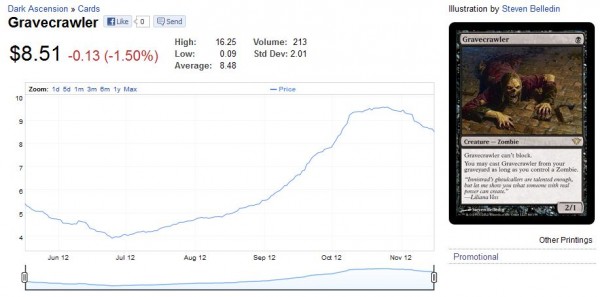
Like Nivmagus Elemental, many cards don’t maintain their higher prices. And in some cases the price drop could occur at a moment’s notice. A card like Gravecrawler has seen peaks and troughs as Zombies succeeds and fails in Standard (chart from blacklotusproject.com).

Because of these price fluctuations, I’m often quick to sell when I can profit. If I had purchased several copies of Gravecrawler at $4 back in July (I think I did, actually), I’d be inclined to sell them as quickly and as conveniently as possible as the card’s price rises. Therefore, when a desperate dealer offered $6 on the card, I was more than happy to sell. Even though the card was still on an upward trend, I was way too concerned that there would be a significant price drop. Rather than extend the risk of owning this card, I was sure to move it right away.

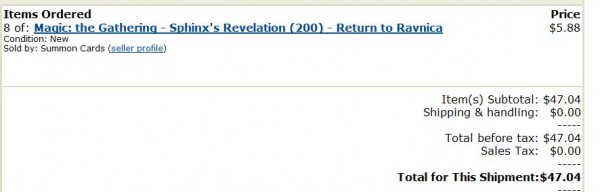
More recently, I jumped on two play sets of Sphinxs Revelation. Below is a snapshot of the deal I found on Amazon.com:

Within days of placing this order, Star City Games increased their buy price on Sphinxs Revelation to $6 and sell price to $13. Seeing this sudden increase, I was faced with a dilemma. Do I hold out and hope this Mythic Rare continues it’s drive? Or do I cash out, freeing up some profits for a subsequent purchase.

This card is very metagame-dependent. Now that U/W control strategies are thriving in Standard, Sphinxs Revelation is well positioned. But once Gatecrash is released, that could easily change. Rather than hope the metagame remains constant, it seems like a safer bet to expect change. With this assessment in mind, I decided to sell. Four copies sold on eBay for $41.99 and the rest were traded / sold to a local dealer to $8.

Could I have made more? Possibly. Do I feel rewarded and emotionally charged from this successful speculation? Absolutely. And emotions are likely to win in a case like this.

Opportunity Cost

The concept of opportunity cost has been discussed multiple times before on this site – both in articles and the forums. In short, owning cards locks up funds and may prevent you from investing elsewhere. If I hold fifteen non-blue Zendikar Fetch Lands in anticipation of a price rise, that equates to about $120 of funds tied up in this asset. This is cash that I can’t use elsewhere.

So, if non-blue fetch lands end up spiking significantly then my choice was a wise one (chart from blacklotusproject.com).

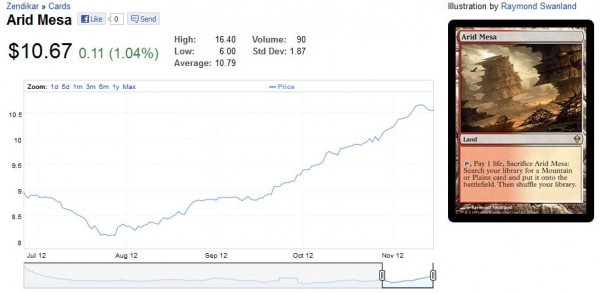
But if these cards only increase marginally and/or gradually, perhaps my money would have been better suited elsewhere. For example, while Arid Mesa has increased nicely since July (about $2), could another R/W land have increased more in this time window? How about this one:

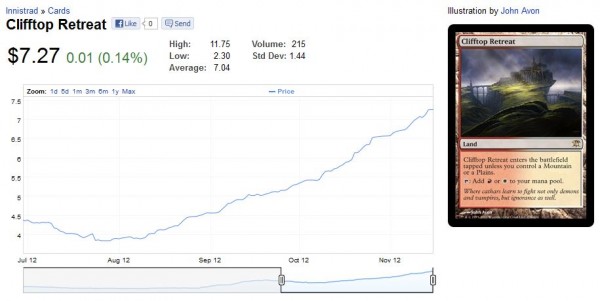
Clifftop Retreat (chart from blacklotusproject.com) has gone from $4 to $7.50 in about the same time period. Not only is this a greater absolute gain vs. Arid Mesa, but the percentage gain is substantially higher. Arid Mesa has seen a 25% increase while Clifftop Retreat has risen 67% in that same time frame.

So if I bought a few Arid Mesas at $8.50 a few months ago and sold recently, did I maximize profits? Arguably, no. Everyone expects non-blue Zendikar Fetch Lands to follow their blue counterparts and see a significant price bump due to Modern. But to me profit is profit. And selling those Arid Mesas freed up my cash so that I can speculate in something else. This ensures high turnover in my stock and shields me from significant risk of holding cards which are not top performers.

Fear of Losses

The final motivation for cashing out prematurely I want to touch upon is the irrational fear of losses. This is the most emotional motivating factor and perhaps the most costly. I’ll describe the concept with an example that took place just this past week.

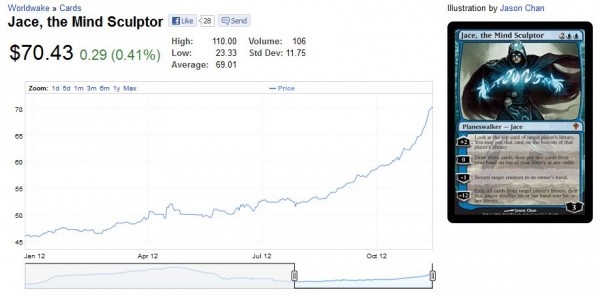
A couple weeks ago Star City Games decided Jace, the Mind Sculptor was too cheap. They decided the price should be higher and they increased their buy price to $60 and their sell price to $100. Naturally, the internet reacted immediately and the “invisible hand” of economics shifted the price up significantly.

During this bump I noticed copies of the Planeswalker were selling out all over the place. eBay cracked $80, Amazon was even higher, and of course most retailers sold out. I found a copy at Card Shark selling for $69.99. Thinking this card was surely going to hit $80 at least, I pulled the trigger.

When the card arrived things had calmed down a bit. While Star City Games hadn’t changed their pricing, eBay had at least settled down. Copies were reliably selling in the low $70’s and I couldn’t even recoup my costs by selling. This created an internal dilemma.

To hold the card was to carry a double-edged sword. If Jace were to be unbanned in Modern, for example, the card could have no price ceiling. But unbanning of Jace in Modern seems unlikely. Even if it was possible, Wizards of the Coast has made it clear they want Modern to be affordable. A reprint would surely be on the horizon.

Because I didn’t want to be stuck holding a $75 card (opportunity cost), I started pushing the extra Jace. But there were no takers. Already I had felt like I was destined for a loss with potential for greater downside. The loss was so unbearable that the first dealer to offer me $70 was the proud owner of a new Jace. (chart from blacklotusproject.com)

Here I am fairly confident the decision was not technically correct. I should have held out and sought at least a trade outlet if not an improved selling price. But I was unhappy even with losing a few bucks on the card already that I had developed an irrational fear that I may lose more. Wanting to avoid being left with a “hot potato”, I cut loose and ate the $4 loss.

Give and Take

There are some benefits to being anxious to sell. I rarely lose excessive amounts on an investment and I keep high turnover in my binder. Opportunity cost is also rarely an issue for me.

The cost of this, however, is that I must accept a lower profit margin sometimes. Being quick to sell doesn’t always ensure the greatest payouts.

This is where my emotions come in. By justifying my actions with the rationalization that profiting from a hobby is an invigorating pastime, I’ve overcome disquiet from suboptimal business. This could be for better or worse. From a logical standpoint you could say I am “not doing it right”. But if I’m making money and having a blast, I don’t really care.

…

Sigbits

  • Some dealers are still overvaluing Umezawas Jitte. It seems like retailers want this to be a $30 card, but that is just not the case. This weekend I sold my extra copy to a dealer for $17 even though auctions on eBay are ending in the $18-$20 range.
  • If you haven’t been following along in the forums, then you need to know that Helm of Obedience is now a $20 card thanks to Star City Games. NM copies can be sold to SCG for $10. I’m not sure if this price will stick, but I hope to unload my copies quickly. It’s worth noting that Helm is on the Reserved List.
  • Speaking of Reserved List, what is going on with Gaeas Cradle? This card is sold out at Star City Games at $80 and I don’t see very many copies in trade binders. I had my shot at a MP Japanese copy today but it’s too difficult for me to stomach giving up so much for this card when it sees almost no play outside of EDH. I passed and opted to sell my Jace rather than trade it for the Cradle.

Good Luck, High Five! Episode 11: Why I Gotta Wait?

Are you a Quiet Speculation member?

If not, now is a perfect time to join up! Our powerful tools, breaking-news analysis, and exclusive Discord channel will make sure you stay up to date and ahead of the curve.

Banner

Mike, Forrest and Ryan get together to rant about Modern, GP Chicago and the foul condition of Mike's recently "cleaned" room. This week's episode features Mike contemplating donating his body to science, Forrest finding an Oreo and Ryan complaining about T-shirts. All of this plus discussion of A+ card Unsummon for well under five dollars!

Show notes:
Keep the Jeep ridin'.

(The views expressed in "Good Luck, High Five!" are those of the personalities featured and do not necessarily represent the views of and should not be attributed to our host.)

Parental Advisory: May Contain Mild Obscene Language

Insider: Return to Redemption

Are you a Quiet Speculation member?

If not, now is a perfect time to join up! Our powerful tools, breaking-news analysis, and exclusive Discord channel will make sure you stay up to date and ahead of the curve.

In the world of MTGO speculating, certain factors have a larger influence on the digital economy than others. One of these highly influential factors is set redemption.

In a previous article, I outlined how set redemption affects the MTGO economy. If you need a refresher I'd recommend starting there. Today I'm going to analyze some price data to illustrate some of these principles in action.

Comparing MTGO and Paper Prices

Presented below is a chart with set prices from the last 4 years, both from supernova bots and Star City Games. A simple ratio is calculated using these two values to show how an online set is priced relative to its paper counterpart. Also presented are the ratios from the previous time this metric was used. This illustrates how the relative value of sets can change over time and informs what broader trends can be expected in the MTGO market.

Set MTGO to Paper Ratio (Aug 12th) MTGO to Paper Ratio (Nov 14th) Supernova SCG Trend
Shards of Alara 0.23 0.17 $29 $175 Down
Conflux 0.33 0.28 $39 $140 Down
Alara Reborn 0.27 0.27 $30 $110 Flat
Magic 2010 0.23 0.18 $27 $150 Down
Zendikar 0.56 0.6 $135 $225 Up
Worldwake 0.74 0.64 $96 $150 Down
Rise of the Eldrazi 0.77 0.65 $130 $200 Down
Magic 2011 0.41 0.26 $39 $150 Down
Scars of Mirrodin 0.38 0.45 $56 $125 Up
Mirrodin Besieged 0.4 0.39 $39 $100 Flat
New Phyrexia 0.61 0.57 $63 $110 Down
Magic 2012 0.37 0.36 $54 $150 Flat
Innistrad 0.54 0.51 $141 $275 Down
Dark Ascension 0.46 0.64 $96 $150 Up
Avacyn Restored 0.53 0.76 $190 $250 Up
Magic 2013 0.33 0.5 $125 $250 Up
Return to Ravnica N/A 0.39 $138 $350 N/A


The Non-Redeemable Sets

Shards of Alara block and Magic 2010 have seen further price declines overall. Without redemption to support prices, these sets are priced according to the presence of tournament staples. Eternal play is still dwarfed by Standard, so the down trend in these ratios is not unexpected.

Zendikar block and Magic 2011 just went offline for redemption. This means there is no longer a strong connection between digital and paper prices for these sets. In the table, the trend for these sets as well as other non-redeemable sets is mostly down, with Zendikar being the exception. The price of online sets are falling relative to paper prices. Expect this trend to continue so avoid speculating on cards that are not format staples as the long term trend for these sets is down. Any reprints or Zen block draft queues will make a large impact on prices without redemption to sop up extra supply.

Opportunities in Scars Block

Scars block and Magic 2012 just rotated out of Standard and the price on these sets has fallen for both digital and paper versions. New Phyrexia (NPH) has the highest ratio of these sets, and the other three all have a ratio about 2/3 the value of NPH. On a relative basis, this suggests that redeemers will have more incentive to convert the first two Scars block sets rather than NPH to capture the greater price differential.

With reprints in the core set muddying the waters somewhat, the recommended course of action is to focus on mythics from Mirrodin Besieged (MBS) and Scars of Mirrodin (SOM), in that order. From MBS, cards like Hero of Oxid Ridge and Consecrated Sphinx are good medium term targets and both have bounced off of their post rotation lows. Longer term, both Tezzeret, Agent of Bolas and Sword of Feast and Famine will benefit from being both redeemable and playable in Eternal formats.

Nissa Revane as a Guide

Nissa Revane saw a steady price increase after Zendikar rotated. The trajectory of this card can inform an approach to potential speculation targets from SOM. The presence of the fetch lands in Zendikar no doubt increased demand from redeemers for all ZEN mythics, so lower price targets are more realistic for SOM mythics.

In the chart below, the price bottom of Nissa Revane is clearly visible just prior to rotation in October 2011, followed by a steady up trend over the course of the year. A price peak is observed just prior to the end of Zendikar redemption, followed by a sharp decline.

The trio of planeswalkers from SOM have all found their post rotation lows. Elspeth Tirel, Koth of the Hammer and Venser, the Sojourner should all see steady increases in prices over the following year.

The Big Lesson

Looking back to the August ratios, one of the lowest for in-print sets was Magic 2013. In retrospect there turned out to be a ton of value in Magic 2013 back in August. We've seen Thundermaw Hellkite, Sublime Archangel and Thragtusk drag the ratio much higher in the last six weeks. It's foolish to suggest the ratio predicted price increases on these cards, but it definitely pointed to the online set being priced too low.

Looking at the highest ratios, the old high was held by Rise of the Eldrazi, and the current high is held by Avacyn Restored. At this point, this ratio metric is not very well developed, but it suggests that Avacyn Restored is close to being fully priced and does not present much value overall. On the other hand, despite the recent price increase on the cards from Magic 2013, it looks like there is still some value in this set as its ratio is currently in the middle of the pack.

In particular, both Ajani, Caller of the Pride and Liliana of the Dark Realms have seen slightly higher prices in the last month, which can be attributed mostly to redemption and the slowdown in core set drafting. Both of these planeswalkers could see more play in Standard than they do currently, and with Gatecrash looming expect the format to be shaken up.


Aggressive mono red decks are the current beatdown deck of choice on MTGO. Its rock solid mana base is a part of the reason. Once Sacred Foundry is available, along with any Boros goodies, aggressive R/W builds will become more viable and Ajani looks well suited to appear in decks that enjoy the attack step. In particular, the interaction between Precinct Captain and Ajani seems currently underexploited. For those with only a few tix, Precinct Captain appears well positioned to join the Boros guild.


Liliana of the Dark Realms's +1 Loyalty ability is only functioning at half power in the current Standard environment. When Watery Grave and Godless Shrine are printed in Gatecrash, the cycle of swamp shocklands will be complete, reducing deck building restrictions on this card. Liliana of the Dark Realms might fit into an Esper control deck at that time, so currently this card represents good value to the patient speculator.

Both the new Ajani and new Liliana currently present low-risk opportunities as they are near their respective price floors, and redemption will support prices for M13 mythics. The prices on the other mythic rares that have broken out give a good indicator for potential gains.

Dark Ascension (DKA) has one of the higher ratios of the redeemable sets, which suggests that DKA presents less value to redeemers and should be avoided by speculators. Without demand due to redemption, prices are more volatile and thus present riskier opportunities. This is not to suggest there are no gains to be had from speculating on cards from DKA, but that speculators tread cautiously when assessing cards from this set.

Return to Ravnica

Interestingly enough, Return to Ravnica (RtR) presents the best opportunity for speculators, as indicated by the ratio. Redemption for RtR begins after the downtime today, Wednesday November 14th 2012, which means the ratio will start to rise. The start of redemption will push a steady supply of physical sets into the real world, bringing down IRL prices.

Also although it's not known whether redemption consumes all the packs that are currently opened in draft, it seems unlikely that that is the case. This suggests that that online prices for cards from RtR should continue to fall over the coming weeks. It's expected that IRL prices fall faster than digital prices. Keeping an eye on the ratio will inform us which effect is dominating.

Also, a low RtR ratio in the New Year would suggest a good speculative opportunity. Once Gatecrash is released online, RtR drafting will slow down considerably. This will reduce new supply. If the ratio stays low, demand from redeemers should be unchanged as they seek to capture the difference between digital and paper prices. This would indicate that RtR could offer exceptional value as a speculation target in the weeks leading up to the release of Gatecrash.

Insider: Tales From the Floor – SCG Dallas

Are you a Quiet Speculation member?

If not, now is a perfect time to join up! Our powerful tools, breaking-news analysis, and exclusive Discord channel will make sure you stay up to date and ahead of the curve.

Finally back in Oklahoma and trying to recover from a crazy weekend!

I was actually able to make it to a big event (a rarity for me during the sportsball seasons), and went to SCG: Dallas last weekend. Before I get into what was moving well on the trading floor, let's get out of the way how much trying to get myself there sucked.

Most reasonable people left on Friday night to make the three-hour trip from Norman to Dallas, but since I had to cover a football game on Friday night that wasn't an option for me. Luckily I found a group of people leaving Saturday morning to head down there, which also helped me to save a night on hotel costs. The only catch? The group themselves lived two hours away in Lawton, which while south of Norman, wasn't exactly on the way to Dallas. And since I don't finish with work until about 11:30, this meant I had a difficult choice to make as to when to head down there. Luckily, someone was kind enough to let me crash on their couch in the wee hours of Saturday morning when I finally made it down there, and I got about three hours of sleep before we left at 5 a.m. for Dallas.

This started the theme of not sleeping, resulting in the crash once I arrived home. But before that happened I was able to do some nice work out on the trade floor.

Let's start with what went well.

- Thragtusk was in demand, and I was happy to flip any copies away. While the card is highly liquid and the price is probably stable, there's also no upside on it, which is a problem. And since only two of the decks in the Top 8 were running the beast, we could even see a price dip if the trend continues.

- Speaking of the Top 8, Restoration Angel was all over the place, as was Geist and Snapcaster. The RWU decks seem like the real deal going forward, at least until the meta shifts to combat them.

- Deathrite Shaman is ridiculously hot. This is almost entirely because of Modern and Legacy play, although he's proven to be better in Standard than I initially gave it credit for. It was trading for $12 on the floor, and I flipped at that price and traded for everyone I could at $8-10. While only a Rare, and certainly no Snapcaster, Deathrite probably has legs at $10, so I'm not afraid of moving on some at that price to keep them stocked.

- Thundermaw Hellkite continues to climb. We've been ahead of this one for awhile, and it's starting to pay off. I have a handful in my trade binder that people have been going crazy for over the last two weeks, but I've been up front with them that I have to have at least $20 to trade them away. While people scoffed at me at first, it's now up to $20 on SCG and pushing that on TCGPlayer. Wouldn't be surprised to see this hit $25 on the trade floor in the next week or two.

- Now here's my "spec" of the weekend. Hellrider. With the Red deck tearing up Magic Online but not yet translating into paper, not many people have caught onto this. This allowed me to pick them up at $2-3 all weekend, and I even felt comfortable grabbing them at the SCG price of $4. SCG had them in stock for a while on Saturday, but by the afternoon they were sold out online. Since then, the card has gone up to $6 (still sold out) on SCG and nearly $6 on TCGPlayer. Remember, this is a card from Dark Ascension with no secondary printings. We're talking about an underopened set that was only available for a few months. Don't be surprised to see this hit $8-10 in couple weeks.

- Dark Ascension in general. For instance, Thalia finally has reached the heights I originally predict for it, $6-8. And with all the Legacy play this sees, $10 won't be out of the question before long. I'm more than happy to pick these up at $5-6 and hold onto them for the forseeable future.

Now, an interlude.

Back to the hassles of making real life work with Magic. Since I technically work on Saturdays (although most of the work can be done remotely), I planned on spending the drive down there getting some work done. Of course, conversations about life and Magic and Allies in Modern (Aether Vial, anyone?)  instead dominated the trip, so I was left with work to do when we arrived. This led to the humorous sight of me sitting down on the convention center ground with a laptop on the floor and high school football rosters spread out around me. Not the weirdest place I've done work before, but certainly inconvenient. Anyway, after only a few people giving me weird looks like I may be lost I was able to finish up and hit the floor again.

So let's talk about what didn't trade well out on the floor.

- Zombies. As expected, the deck has completely fallen off, though some of the prices haven't yet caught up. The biggest issue I see at the moment is Falkenrath Aristocrat. Still sitting at $20 (higher than Huntmaster) despite seeing absolutely no play. I still had a handful in my binder and I was ecstatic when I found probably the only player in the room looking for them. If you still have any of these, I suggest moving them before the price catches up with the playability.

- Bonfire of the Damned. I may have failed miserably calling the initial rise of Bonfire, but it looks like I've been spot-on in predicting its downfall. SCG was paying just $12 on-site. It's still listed at $30 on their site, but you know it's a bad trend when you're not even getting 50% on a card. That's a clear sign that it's probably headed even further down.

- Niv-Mizzet. This one hurt me a little, since I still think it's basically the nuts finisher in a control deck. It's seen some play in that role already, yet somehow this thing isn't difficult to find and retails for just $5-6. I'm telling you again, this is a steal. With Dimir coming out in Gatecrash and making Grixis more viable, a Control finisher that doesn't die to something like Mizzium Mortars and is good in both the creature and control matchups is something to watch out for. There's no reason now to stack up on these at $5. Worst-case scenario you break about even or lose a little value, since as a Commander general and iconic card there's a certain floor for Mythics like this ($3 or so), and this is way better than something like that. We're going to see a spike somewhere along the line, and you'll be glad you had them.

A second interlude.

Look at the art on the card Syncopate. Now imagine a waitress serving you delicious adult beverages who looks exactly like her. That's exactly the experience a group of friends and I had while out on Saturday. And the best part was, when someone was brave enough to actually show her the card and tell her, she had a good time with it. A pretty awesome experience, all in all, especially considering I drafted RTR for just the second time later that night after drinks and crushed everyone with Rakdos.

In fact, I was feeling so confident after the draft I entered one of SCG's $10 casual drafts the next day, where the prize is three packs for the winner. Determined to rare draft over drafting a good deck, I preceded to open Blood Crypt, Overgrown Tomb and Cyclonic Rift. Then, playing an awkward Bant deck where two of my four wins came from Doorkeepers, I accidentally made it to the finals, where I scooped to a friend who promptly opened three bulk rares in his pack.

Sometimes you're just good at Magic.

- The only other note I want to make is the benefit of trading with dealers on the floor. Some people are very leery about trading with dealers who don't have a booth because they think they're only going to get ripped off. On the other hand, i enjoy being able to be honest about real prices when trading with dealers, and I have no problem trading Standard stuff at cash prices to floor dealers who want to move their Legacy cards. This is how I've come into my Dual Land collection, and it nets me a better deal than simply going to a booth and trying to trade in. If you're interested in acquiring high-end Legacy cards, don't be afraid to take this route, since dealers usually need Standard cards that sell easily more than they need Dual Lands.

All in all, I had a great time at my first big event in 3+ months. Hopefully I'll be at either San Antonio or Indy in the next few weeks, and if so, I hope to see you there!

Thanks for reading,

Corbin Hosler

Adventures in Qualifying: GP Chicago

Are you a Quiet Speculation member?

If not, now is a perfect time to join up! Our powerful tools, breaking-news analysis, and exclusive Discord channel will make sure you stay up to date and ahead of the curve.

Here’s the situation: It’s been a long day. You are playing in round eight of nine at Grand Prix Chicago.

Format: Modern

Your Deck: Naya Pod

Untitled Deck

Creatures

4 Birds of Paradise
2 Noble Hierarch
4 Wall of Roots
4 Restoration Angel
3 Kiki-Jiki, Mirror Breaker
1 Meddling Mage
1 Spellskite
1 Wall of Omens
1 Phantasmal Image
1 Deceiver Exarch
1 Kitchen Finks
1 Eternal Witness
1 Aven Mindcensor
1 Harmonic Sliver
1 Murderous Redcap
1 Zealous Conscripts

Spells

2 Commune With Nature
4 Birthing Pod
3 Chord of Calling

Lands

4 Arid Mesa
2 Misty Rainforest
1 Scalding Tarn
1 Marsh Flats
1 Temple Garden
1 Stomping Ground
1 Sacred Foundry
1 Steam Vents
2 Fire-Lit Thicket
4 Copperline Gorge
2 Razorverge Thicket
1 Forest
1 Mountain
1 Plains

Sideboard

3 Path to Exile
3 Creeping Corrosion
2 Obstinate Baloth
1 Kitchen Finks
1 Qasali Pridemage
1 Thalia, Guardian of Thraben
1 Ethersworn Canonist
1 Glen Elendra Archmage
1 Linvala, Keeper of Silence
1 Cunning Sparkmage

Your Opponent’s Deck: Storm with Pyromancer Ascension and Goblin Electromancer

Your board state:

After drawing for the turn, your only card in hand is Fire-Lit Thicket.

You know that you need to do something otherwise there is a good probability you will lose on your opponent’s next turn. So, what’s the play?

These are the types of situations you find yourself in piloting Modern Naya Pod. The large number of one-of’s regularly create complex decision trees. For this case, since I needed to stop my opponent immediately, I sacrificed the Wall of Roots to the Birthing Pod and searched out Harmonic Sliver to blow up his Pyromancer Ascension. Was that the correct play though? At the time I thought it was, but after the match I realized that I blew it. My opponent needed one extra turn but he beat me easily by comboing out.

Here was the correct line of play:

Pod out Wall of Roots using the mana it produced and two life. Search out Deceiver Exarch and untap the Birthing Pod. Activate the Birthing Pod again sacrificing the Restoration Angel to get Kiki-Jiki, Mirror Breaker. Proceed to win the game.

This was not a complex or uncommon board state and I was disappointed that I did not see the play. It was likely I would lose game three with Storm on the play, but I would have at least gotten to play the game.

9 days earlier…

After finalizing arrangements for a place to stay outside of Chicago, I was tormented by the fact that I didn’t know what I was going to play. Modern is a complex format that is always in a state of flux. I think one of the most important parts of playing the format is knowing which deck will be good from event to event. For this event, it was obvious that Jund would be a huge hurdle to overcome. I was not going to this event with a deck that didn’t have a decent match against the most popular deck. This is solid advice for any event but especially one where as much as thirty percent of the metagame could be the deck-to-beat. The problem is that no deck has a significant edge against it.

I spent a lot of time thinking about what deck I could play. Briefly I considered trying to develop my own deck to trump Jund, Infect and Affinity, all three of which I believe are weak against a controlling deck. With a limited amount of time to prepare I decided this plan was not the best idea.

The two main decks I played in Modern last PTQ season were Melira Pod and Splinter Twin so I thought about my experiences with them. I hated the Jund vs. Splinter Twin match so that was not a route I was willing to take. Jund vs. Melira Pod though, was not bad at all. Sometimes they beat you but often you have a ton of time to stabalize and win either by grinding damage or eventually comboing them out. Jund with Deathrite Shamans seemed like it would be a closer match but ultimately still in favor of the combo deck. Melira Pod seemed much less efficient than the newer version using the Kiki-Jiki combos.

Once I decided on Naya Pod for the event, I got to work on my list. Some of the cards are auto-includes but there is actually a lot of wiggle room to play around with the slots. Many of the singletons can be changed for other things so keep that in mind when you are going to play a version of this deck.

This list may look generic, but there are some significant differences between my list and the more common versions. The first main difference is my inclusion of Commune with Nature. Unfortunately, my tech was spoiled a few weeks ago at a European Grand Prix, but the card is still very good, adding consistency to the deck for a low mana cost. I considered playing a third copy but I didn't want to cut anything. Playing the full four Chord of Callings can be a liability due to its mana cost, especially when you don't draw a Wall of Roots. Commune with Nature is very good early on turns one and two when you are trying to set up the combo. Having the option to regrow it later with Eternal Witness is also good.

Another card I included was Meddling Mage. I feel that Modern is weak to this card right now especially in game one of many matches. Storm, Splinter Twin, Eggs, and even decks like U/W Midrange have a tough time playing through a Meddling Mage chanting the correct card. The only match where I don’t like the original hate bear is against Jund but it is so good against the rest of the field that it’s worth including. Even naming something like Cranial Plating against Affinity is great because it forces them to have a removal spell or not be able to kill you quickly. Against every deck, naming their key card gives you time to find or protect your combo.

Murderous Redcap may seem like a normal card choice but it actually went out of style many months ago. Sometimes you just need to cap a guy though right? Seriously though, I think Redcap is great against Jund where it is often trading for two of their creatures. It is a solid metagame choice when you are expecting aggro decks be prevalent. Against many opponents Redcap gets swapped for Glen Elendra Archmage. For this event I believe my choice to be correct.

Wall of Omens was a great idea but even with many aggressive decks being played, it seemed not quite good enough. I like the idea of podding into it since it replaces itself but I think the spot could be better served as something else. [card Chord of Calling]Chording[/card] for it is moot because you'd rather just wait to chord for Eternal Witness and follow it up with another Chord for Restoration Angel to blink Witness. This line of play should be used in many hands with this deck.

Make sure you are aware of the most important line of play with this deck because it comes up so much of the time. Opponents will rarely be able to predict their demise from this sequence of turns. Take a look.

Turn 1 – Land, Birds of Paradise
Turn 2 – Land, Wall of Roots
Turn 3 – Land, Birthing Pod
Turn 4 – *Blindside Win

*Blindside Win:

  1. Pod Wall of Roots using its mana and two life into Deceiver Exarch.
  2. Pod Birds of Paradise with its mana and two life into Phantasmal Image copying Deceiver Exarch.
  3. Pod the Deceiver Exarch copy into Restoration Angel and blink the original.
  4. Pod Restoration Angel into Kiki-Jiki, Mirror Breaker.

This version of the combo highlights the power of this deck. Many players are still not aware of how easy it is to win with this deck and they will often tap out leaving a window open for you to kill them.

There are many ways to win on turn four but winning on turn three involves some luck. If you have double Wall of Roots and double Birds of Paradise in addition to Birthing Pod and the right number of lands you can win turn three, but I believe that is the only way.

Nine days and many card choice changes later I arrived at GP Chicago. Here’s what happened.

Round 1 – Bye

Round 2 - The first game of my tournament I got to show off the blindside win. My opponent tapped out turn four and was punished with a loss. Game two was a thirty-five minute affair that finally ended with me unable to deal the final couple points of damage to finish the game. I maintained pressure for a long time but eventually I drew too many lands in a row. Drawing all four Birds of Paradise did not help at all this game either. Game three was never finished so I started out my day with a draw. Frustrating.

Record: 1-0-1

Round 3 – The draw bracket scared me because I thought I would be grinding games against blue-white all day. Luckily, that was not the case and I was granted an unprepared GR Tron opponent. He literally said he removed all of his sideboard cards for this matchup. He was not lying either and it was a quick match. He did have some sick natural tron draws and a bunch of Karn Liberated.

Record: 2-0-1

Round 4 – Running it right back, I had another GR Tron player to take down. When your opponent has the right sideboard cards, Combust, the match is a lot closer though. Game one was slow because I had to fight through not one but two Karns, but eventually I won. Game two he blew me out with the Combust but I knew he had Emrakul, the Aeons Torn in hand so I had to go for it. Late in game three I tanked at the end of his turn and finally came up with the play to chord for Deceiver Exarch, tapping his Prismatic Lens so he did not have access to Combust mana. I successfully assembled the combo on my turn. If you have enough time, you should try to combo with Kiki-Jiki and Zealous Conscripts against them because it wins even through Combust.

Record: 3-0-1

Round 5 – My opponent this round was playing Jund but he was almost as defensive as a control deck. This gave me plenty of time to assemble Restoration Angel plus Kiki-Jiki. Because he did not have any pressure, I was able to win through two discard spells and two or three removal spells. The second game played out similarly, like playing against a Jund control deck rather than the hard-to-manage aggro control deck.

When I thought I was going to win the game, instead I lost to an unlikely card. Rakdos Charm. Making 500 Restoration Angels seems terrible when you die immediately. Game three was more of the same accept I was resigned not to lose to a terrible Standard uncommon. Instead of focusing on assembling the combo, my goal was to grind him out with damage. He didn’t realize this in time and found himself in a position with no outs to my Restoration Angel attacking for the win.

Record: 4-0-1

Round 6 – Being on the draw when your opponent plays first turn Celestial Colonnade is not the best place for Naya Pod. Even though this opponent had a much better record than the last one with a similar deck, it was a much easier match for me. It was not too hard though when he had two Mutavaults and a Tectonic Edge to go with his man land. He quickly ran out of answers due to a lack of colored mana.

Game two I was starting to think the game was going long after he countered a bunch of my spells, but luckily when I tried to steal his Tectonic Edge with my Zealous Conscripts he was out of counters and had to sac it in response. Making this play on his turn off of Chord sealed the match because then he was tapped out for my turn when I hardcast Kiki-Jiki to make 500 Zealous Conscripts. Turns out, he didn’t know that was a combo.

Record: 5-0-1

Round 7 – After four straight wins, I was feeling confident wrecking up the draw bracket. This was not my day though and I finally got a terrible paring. I was up against eventual Top 8 player Michael Simon piloting U/R Splinter Twin, but of course I didn’t know it at the time. While we were playing I noted how strong his deck list was as well so I was not surprised to see him do well.

In my opinion, this is the worst match for Naya Pod. They are basically playing the same deck as you except theirs is much better positioned. Moving Linvala, Keeper of Silence to the sideboard really hurt me here. Game one he was on the play, I kept a fine hand in the dark, but losing on turn four highlighted how bad it was against him. Game two should have gone in my favor but instead of winning on turn four, I missed two land drops to fall too far behind.

Record: 5-1-1

Round 8 – Right after getting crushed by my worst matchup, I had to go play the second worst one, Storm. Despite the Pod vs. Storm match being distinctly in their favor, it was a great match. Game one, I kept a strong hand with four lands, Angel, Kiki-Jiki and Wall of Roots. This is an auto-keep against almost anyone. Unfortunately he won the die roll and I never got a fourth turn to kill him. He did play a Gitaxian Probe to rub it in though. Remember the story from the beginning of the article? That’s what happened game two. I missed the kill because I was too focused on disrupting his gameplan. With this deck it is really important to know when to disrupt your opponent and when to go for the kill so be careful.

Record: 5-2-1

Round 9 – Despite having an extremely small window to make day two, I stuck around for the last round. My opponent had to go catch a train so I got the end of the day concession which was nice. We played a quick game one in which I smashed his homebrew Esper Gifts deck, but it seemed to be quite an interesting sixty.

Final Record: 6-2-1 and five spots short of making day two.

Naya Pod is a great deck and I don’t regret my decision to play it. With the exception of the misplay against Storm that cost me the match, I was pleased with my level of play with the deck. I made a number of subtle plays over the course of the event that led to game wins and that is key with this deck. The deck seems apt for PTQ season but some tweaks are necessary. Any comments on the deck list are welcome so share your thoughts!

Until Next Time, remember…

Four mana,

Birds of Paradise,

Wall of Roots,

Birthing Pod,

And eight life to pay,

Is a recipe for infinite damage.

Mike Lanigan
MtgJedi on Twitter
(I'm active on twitter again, so send me a message sometime.)
Jedicouncilman23@gmail.com

Want Prices?

Browse thousands of prices with the first and most comprehensive MTG Finance tool around.


Trader Tools lists both buylist and retail prices for every MTG card, going back a decade.

Quiet Speculation