Are you a Quiet Speculation member?
If not, now is a perfect time to join up! Our powerful tools, breaking-news analysis, and exclusive Discord channel will make sure you stay up to date and ahead of the curve.
Last week I discussed some valuable strategies for locating bargains throughout the realms of the internet without taking on much risk. Wise eBay searches, desperate Cardshark sellers and patient browsing through MOTL were all recommendations.
Some readers even commented with additional suggestions, such as identifying underpriced EDH foils at your local gaming stores.
After all these purchases are made, the next logical step is to unload these cards for profit. There are a vast number of strategies people will implement for selling their cards. I will not pretend that my strategy is the optimal one.
Instead, my approach will be outlined below in a categorical way, with optimal opportunities falling within each subset depending on an array of circumstances. In the end, selling is all driven by your personal goals and is not “one size fits all”. So I will illustrate some of my own goals.
Inventory Costs Money
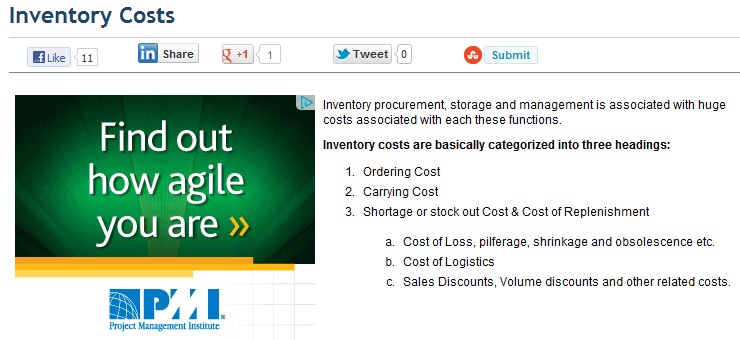
Companies on Wall Street are constantly striving to reduce inventory. There’s a very good reason for this – inventories cost money. They need to be maintained, kept organized and stored in a particular space. This is true no matter what the items are for sale.
(Picture courtesy of http://managementstudyguide.com/inventory-costs.htm)
Maintaining an inventory of Magic Cards likewise has associated costs. I have only so many pages in a binder without risking overstuffing them. Additionally, holding value in terms of cards is much less liquid than holding actual cash. Thus, opportunity cost is a factor. Finally, I spend hours a month sorting and resorting my stock to make sure my binders are organized satisfactorily and my sales list is up to date.
Bearing this in mind, my primary objective with selling cards is to turn over inventory as fluidly and consistently as possible. Again, this is driven by my realization, that like in the stock market, holding a card indefinitely is often a poor investment choice. Sure, in MTG there may be exceptions, such as some cards I expect will rise in value over time, but these cards only make up a small portion of my diverse portfolio – the majority of cards are maximized if sold immediately.
With this context in mind, let me now dive into a few different approaches to selling cards. With each approach I’ll provide a synopsis of strategy along with pros and cons.
(Picture courtesy of http://yumclips.com/show/traft)
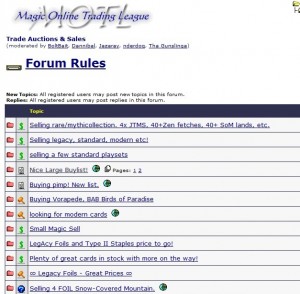
First Stop: MOTL
When it comes to buying, MOTL is often towards the bottom of my priority list. Sifting through endless lists of overpriced cards is not the most fruitful task. Selling, on the other hand, is ideal with this online site.
You have endless freedoms here. You can set your own prices, list as many cards as you’d like and set up a set of personal rules – all with no fees and no unreasonable limits.
Everyone has their own strategies for grouping cards and establishing prices. Again, mine is likely not fully optimized. But in achieving my goal of holding cards in inventory for small amounts of time, my approach works rather well.
I begin by sorting my cards by format, then I list the pricier cards towards the top – they are first ones seen and most likely to be scooped up. They also attract attention, so that prospective buyers will see that you have cards worth browsing. Finally, I set competitive prices.
Because I’m not a retailer, I simply cannot expect to achieve 100% margins. I can attempt to buy cards at Star City Games’ buylist prices all day, but I would accumulate very little. Likewise, selling at retail prices on MOTL will only gain you insults and disrespect (harsh world!). Therefore, when looking to quickly flip cards I’ve acquired at bargain prices, I seek to price my cards to match some of the cheapest completed eBay listings. Profits will never be fully maximized (one downside to MOTL) but recall that my goal is quick, small profits to turn over inventory.
This, I feel, is a sweet spot for pricing cards I am anxious to sell. I win because even if I listed an auction on eBay and it closed higher, fees would not make the endeavor worthwhile. Buyers win because they don’t have to navigate through endless eBay auctions and lose bid after bid until they achieve this minimal price. I have sold many cards rapidly using this technique.
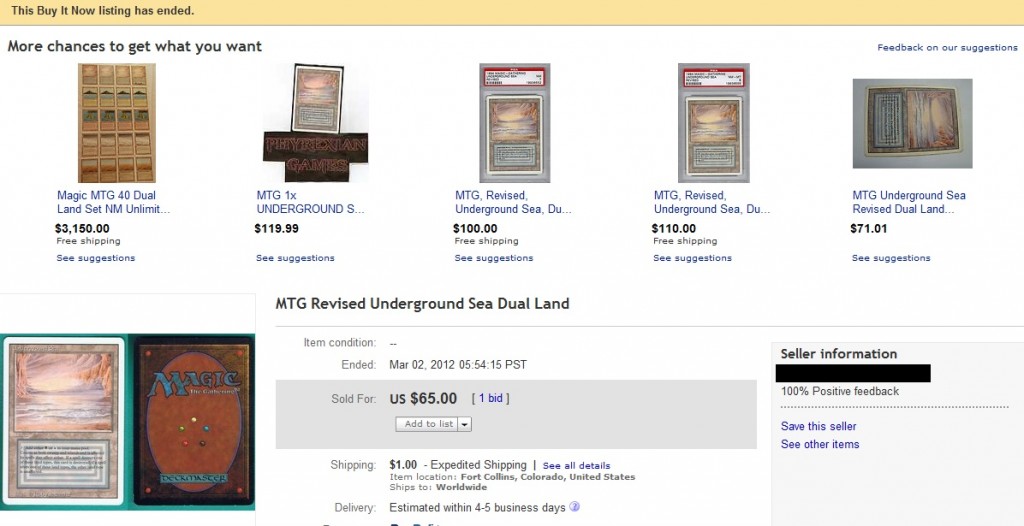
As a quick aside, this is generally my price ceiling when buying cards. If I can acquire cards below the lower quartile of eBay ended auctions, I am inclined to pull the trigger. Now you can appreciate why this is my price point for buying – it enables me the most opportunity to make a little profit. And since I’m not seeking to make a full fledged living from this endeavor, I am more than happy with accepting a 10% profit margin if it means I’ve sold the card immediately. This to me is far more valuable than holding a card for months until I’ve improved my margins to 20%.
Twitter – (yes you can sell cards through Twitter)
Sometimes my desire to sell a particular card is even more pressing. Perhaps I’ve acquired a card at an incredibly cheap price. Perhaps I’ve speculated on a couple cards and they are at a price peak. Or perhaps I’ve failed at selling cards on MOTL and I really need to unload them.
In all these cases, I turn to Twitter as a means of selling instantaneously. Like MOTL, it is completely free to sell via Twitter and there are no unreasonable limits to what you can sell. Of course, if your prices are not highly competitive, you’re likely to be ignored (or worse, unfollowed). Therefore you need to be careful in how you implement this venue for selling cards.
First, I do a bit of research to decide upon a price. The cost for your “deal of the day” should be cheaper than any major online venue, perhaps even including eBay. This will ensure the cards will sell. Also, it helps to keep the transaction simple – after all, you only have 140 characters to work with. A recent tweet of mine that earned a sale was:
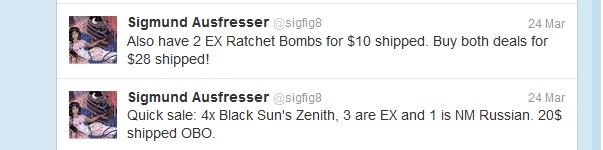
I know that Standard rotation is approaching, and I don’t want to be stuck holding these niche cards for long. Therefore, I decided a small loss was acceptable here if I could earn a quick sale. The cards had been listed for a week on MOTL with no takers, and such a quick sale on eBay would have meant a larger loss due to fees. I tried Twitter, and sure enough within the hour the cards were sold.
Of course having followers helps – this is a downside to using Twitter. But do a few modest giveaways and make a few quick sale purchases, and you’ll have a couple hundred followers before you know it!
Selling Through eBay – A Last Resort
Ebay will generally side with buyers when settling any disagreement between buyer and seller – no matter what the issue is with the transaction. Fees are paid solely by buyers. With these two downsides to eBay, I only sell cards on this venue as a last resort.
Usually, if my competitively priced cards aren’t selling on MOTL or Twitter, and I see that eBay completed auctions are closing more than 10% above my asking price, I take a chance on eBay. I try to sell through this auction site only when I can at least break even after fees.
As you can imagine, this is a rare occurrence. Sometimes obscure items are best sold on eBay. For example, I recently sold a sealed Coldsnap Booster Box through eBay:
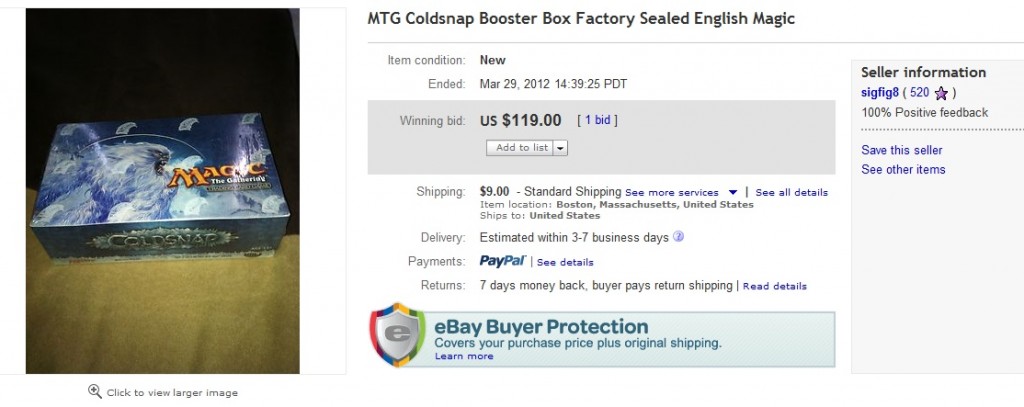
Notice how I structured this listing: a) I listed the item as an auction so I did not have to pay listing fees, b) I set the starting bid price around my desired sell price, so as to avoid selling the item too cheaply yet not having to use a reserve, and c) I charge a fair shipping price so I don’t lose money or pay more fees by offering free shipping.
This is the only way I sell on eBay these days, and it seems to work fairly well when the need arises. It’s not optimal, but it does maximize your chances of selling the item because you are reaching the largest audience.
Selling vs. Holding – You Decide
As I mentioned before, I’d prefer selling for a small loss to holding cards for an unknown period of time. The sooner I obtain additional cash, the sooner I can seek out new bargains to profit from.
My approach to selling cards online should reflect this overall objective. If your preference is to maximize profit margins on your cards, be prepared to hold inventory for much longer. For some, that is acceptable. For me, opportunity cost is a real factor and I recognize the expenses incurred from holding inventory. Therefore, I strive to sell my inventory rapidly. The result is a win-win scenario, where I can flip my inventory at a rapid pace while offering competitive prices to prospective buyers.