
menu

Insider: Unwinding Some Positions

Are you a Quiet Speculation member?

If not, now is a perfect time to join up! Our powerful tools, breaking-news analysis, and exclusive Discord channel will make sure you stay up to date and ahead of the curve.

Part of speculation and long-term strategies involves making sure that your cash is doing the most work that it can. When your cards are not performing, you need to fire them and get some more productive cards on the line. This weekend at GP: Indy, I divested from several cards that I had been sitting on. The subtheme of my article is "win, lose or draw," with a look at how an Eternal player confronts finite cash, broad possibilities and the desire to clean house. This week, we will look at a lot of my sales and why I did them. Maybe they were stupid in the long term - who knows. I ended up selling big piles of cards to dealers; I don't trade with enough velocity to truly work miracles (Kelly is your guy on that), so the cash for online speculation funds was more important. Hence, dealers.

The clear wins

First, let's look at the cards I made a big profit on. Karakas is the first that comes to mind. I had bought several Karakas when Iona was just printed. I've slowly sold them off and I got rid of a great Italian copy this weekend. I paid $7 for it a couple of years ago, so we are looking at a great markup for a final sale of $35. I sold the Karakas because I cannot play it in Commander and they are reasonably common enough that I can borrow them for the few Legacy events I get around to playing in anymore. The impending threat of a Karakas appearing in FTV: Realms was enough to chase me off of the card for much longer. If I need to, I'll rebuy a Karakas, but the need to have a personal physical copy is very small.

I got rid of a pile of Lava Spikes at $1.50, as well. I became very good at spotting the secretly-expensive cards in older sets after doing my long-term set review project. Lava Spike is a common from a big set, but it's a huge deal in burn decks. Both Modern and Legacy burn lists run Spike, so it was easy enough to set them aside when I was looking through old boxes. Since they were essentially free at the time and I had no use for them in decks, away they went.

Next, I got rid of my Sword of the Meek stack. Back before QS existed in the form it did, Kelly and I were just goofy guys swapping hints over gchat and texts. One day, I called him up (when he had a day job!) and told him to get Grove of the Burnwillows and Sword of the Meek, since they were breaking out that Friday afternoon at the Pro Tour. Kelly took a lunch break and bought as much as he could on both cards. We know the end result on those calls. I got rid of the last of my Swords because Thopter/Sword is only a tier-2 strategy in Legacy. Sword has been holding steady at a couple dollars for years now, and it was time to shake off the rust and turn them into movable cash. Again, these were almost free to begin with - maybe a dime apiece - so the Swords were clear winners, too.

The Holding Pattern

Along with those Karakas I bought years ago, I also acquired a The Abyss for $40. It was a big gamble, but we have seen with cards like Moat how insane the price jumps can be. I speculated on this and occasionally used it in Commander, but The Abyss simply wasn't pulling its weight. It did nothing in three years and the card is unpopular in Commander. Time to fire the World Enchantment. I ended up selling it to a dealer for the same $40 I paid for it awhile ago.

Looks like I broke even, right? Incorrect. $40 today is worth much less than $40 was three years ago. Even with crappy interest rates, this card should have been worth more than it currently is. The margins on selling an Italian Legends card are really low to begin with, and almost nobody needs the card. I wish I had done this sooner and I was even prepared to take a small loss; I needed to get the money out of The Abyss ATM and put it into workable stock.

Sometimes, you take a loss

This next section could accurately be titled "sell it already!" Let's talk about Standstill. I had five copies of the card and it was an incredible pickup earlier this year. Merfolk was the best deck by a mile in Legacy, even when its pilots weren't drawing extra cards. Merfolk runs on Standstill and the card had briefly hit $15. I saw buylists offering $10 and I should have packed them away for a cool $50 when I could. When Batterskull came out, Stoneforge Mystic became a Legacy staple and format-warper. Merfolk simply can't beat Batterskull, and Standstill has dropped to about $5 these days. I was lucky to get $3 apiece out of my played copies, but I should have taken much more when I could have. I repeat that people should not be greedy and just get their money out of a card when they make a comfortable profit; I waited too long on these and I lost.

I also got rid of my Null Rods. They are useful in Vintage, but the Mishra's Workshop decks do not play the card anymore. With Lodestone Golem, they get more support by stacking up the taxing abilities of Sphere of Resistance and Thorn of Amethyst. If the artifact prison lists have been off of Null Rod for over a year, there is little chance of it coming back. What I scored for $6 apiece years ago, I was happy to get rid of for $12 for the set this past weekend.

Letting go of hoarding impulses (this is the controversial part)

I sold my Underground Seas.

I gave three to Kelly for "friend prices" at $85 apiece; they were not mint by any means and I would have required more from a stranger.

My Seas have sat in my "playables" box for two years. They come out only for unlimited-proxy Vintage events. I don't use them at all in Legacy and I can borrow what I need.

I wasn't playing them, but they're still highly expensive cards. Why did I fire my Underground Seas? They were not doing enough work for me! Underground Sea is a fantastically expensive card. It's a banner card for casual and competitive players alike. But $100 retail is a lot to ask for a card that does not see much Legacy play (only 3 in the T8 of GP: Indy). I took a gamble and I'm interested in your feedback. I think I can make more from speculating that $255 this year than I can from just sitting on those Seas. Even if Sea hits $150 apiece by December, I am merely asking to double my money - and over a year of solid speculating, that isn't challenging. Seas gained about $22 last year, which means that the card saw about a 31% yield. That's great, but it hasn't changed in price since last July (while basing these observations on its BLP page).

I liked my Seas a lot. There's prestige in owning hundreds of dollars in old, blue duals. I won them in a Vintage tournament five years ago, so I paid about $10 apiece for three. Even if I bought them last year, though, I would still probably be happy to get rid of them. A 30% price increase over a year is fine, but I don't think Seas have much more room to go up. I wanted these, but I wanted the cash more. Not to blow on junk - to roll again with speculating. Kelly and I follow the card buying advice that we send out to our readers and we have made some great calls lately that resulted in us both making some paper with very little work. I felt crunched at the time - I couldn't buy as many Huntmasters at $11.50 as I wanted to, for example. Putting this money in the spec account will give me much greater reach this year. For cards that I don't get out of the box more than once a year, I was happy to let these go. I predict much more happiness from flipping that cash into more cards to speculate on!

Finally, as an observation: I don't know what the future of Legacy looks like. I think the format is in a slow downward decline. I talked to many people this weekend and most felt that Stoneforge decks and the resultant format made for boring play. Tracking down $50 Scavenger Oozes to play what is, at the end of the day, a Green-White deck, was unpleasant as well. I don't see Legacy enjoying the same booms that it had before. Let's not blame Mystical Tutor for this or point at things like Brainstorm as problems. I think people are just Legacy-ed out right now. Consequently, I felt more safe in stepping away from some of the seriously Legacy-specific cards like Standstill, Karakas and the Seas.

Did I make the right call? Should I have held onto those Seas if I had no intention of trading or playing them? What would you have done?

Until next week,

Doug Linn

The Grand Cenobite’s Pedigree

Are you a Quiet Speculation member?

If not, now is a perfect time to join up! Our powerful tools, breaking-news analysis, and exclusive Discord channel will make sure you stay up to date and ahead of the curve.

You may have noticed recently that [card Elesh Norn, Grand Cenobite]Elesh Norn's[/card] retail price is pushing the $30 mark. While this article is not intended to discuss or predict future price changes, it is certainly worth noting the recent rise in [card Elesh Norn, Grand Cenobite]Ms. Norn's[/card] price tag.

The thing is, she's worth that much for a reason.

[card Elesh Norn, Grand Cenobite]Elesh Norn[/card] has been making quite the waves of late in Standard. Some players may still be unaware how far reaching and prevalent her impact truly is. They may have heard about her popping up as a one-of in a variety of ramp or control decks, but that is merely one of the roles she's fulfilling in the current metagame.

[card Elesh Norn, Grand Cenobite]Elesh Norn[/card] has gone from high-end finisher to early game threat in a matter of months, all thanks to Faithless Looting. The Careful Study upgrade is finally showing its power in a string of new reanimator decks, epitomized by Raphael Levy's Frites deck from the Pro Tour.

Before reading further, let's look at what Levy played.* (You can check out his deck tech here.)

Raphael Levy's Frites
Pro Tour Dark Ascension

Untitled Deck

Creatures

4 Avacyns Pilgrim
4 Birds of Paradise
4 Elesh Norn, Grand Cenobite
2 Inferno Titan
1 Llanowar Elves
2 Wurmcoil Engine

Spells

4 Faithless Looting
4 Lingering Souls
4 Mulch
4 Trackers Instincts
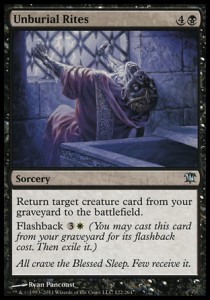
4 Unburial Rites

Lands

4 Blackcleave Cliffs
4 Copperline Gorge
2 Darkslick Shores
6 Forest
1 Mountain
1 Plains
4 Razorverge Thicket
1 Rootbound Crag

Sideboard

4 Ancient Grudge
2 Jin-Gitaxias, Core Augur
2 Memorys Journey
1 Purify the Grave
3 Ray of Revelation
1 Thrun, the Last Troll
2 Wurmcoil Engine

Reanimating for Fun and Profit

The basic premise of this deck is to self-mill and ramp your way into an early Unburial Rites on [card Elesh Norn, Grand Cenobite]Elesh Norn[/card] or Inferno Titan.

The key to pulling off such an ambitious game plan is the liberal use of the powerful mana-fixing Standard has to offer. Scars of Mirrodin duals are actually pretty sick, and combined with [card Birds of Paradise]Birds[/card] and Mulch, enable the deck to cast its five colors of spells without too much trouble.

Many decks are cold to an [card Elesh Norn, Grand Cenobite]Elesh Norn[/card] in play, and often Inferno Titan is just as crippling. Merely resolving either of these creatures immediately impacts the board by killing some of the opponent's creatures. When they stick around you just win the game, and in the event they die reanimating another is usually an easy task.

Your perfect draw threatens to plop a giant monster into play as early as turn three. Ramp on the first or second turn, then cast Faithless Looting, discarding Unburial Rites and [card Elesh Norn, Grand Cenobite]Elesh Norn[/card]. If they can't kill your mana accelerant or exile your graveyard, you're golden!

While this deck may seem fragile, it is actually a serious contender in the metagame and one you must consider when preparing for events. In light of how fast Frites can reanimate a creature, hoping to outrace them before they get to their finisher is really not an option. If you don't have an answer you're going to find yourself in a tough spot.

New Developments

This deck is still relatively off the radar because nobody on the French team that played it in the Pro Tour finished in the top 8. This past weekend though, one player did top eight the Star City event in Tampa with an updated list. Here’s his deck:

Justin Hostutler's Frites
7th Place at SCG Tampa

Untitled Deck

Creatures

4 Avacyns Pilgrim
2 Inferno Titan
1 Phantasmal Image
1 Rune-Scarred Demon
1 Sun Titan
3 Elesh Norn, Grand Cenobite

Spells

2 Oblivion Ring
4 Faithless Looting
3 Lingering Souls
4 Mulch
3 Trackers Instincts
4 Unburial Rites

Lands

6 Forest
1 Mountain
1 Plains
4 Blackcleave Cliffs
4 Copperline Gorge
2 Darkslick Shores
4 Razorverge Thicket
1 Woodland Cemetery

Sideboard

1 Sword of Feast and Famine
1 Sword of War and Peace
2 Wurmcoil Engine
2 Ancient Grudge
4 Mental Misstep
2 Ray of Revelation
3 Thrun, the Last Troll

In this list we can see further innovation and improvement on an already solid deck. Oblivion Ring, for example, seems amazing to me as a catch-all for a wide variety of problems. It's especially useful against an opposing Oblivion Ring or Fiend Hunter that's trapped your finisher, letting you bring it back on the cheap.

The exact mix of finishers seems to be undecided as well. It should probably change from week to week as the metagame develops.

If you're looking for a similar deck with a less crazy manabase, try out Mike Flores’ list that cuts green altogether. Going from five colors down to four is a big change. The only white mana this version needs is for flashback on Unburial Rites, so it plays out basically as a Grixis deck. Take a look:

Mike Flores' Four-Color Big-Big
As suggested here

Untitled Deck

Creatures

4 Inferno Titan
4 Elesh Norn, Grand Cenobite

Spells

4 Desperate Ravings
2 Forbidden Alchemy
3 Geistflame
2 Mana Leak
3 Liliana of the Veil
4 Faithless Looting
4 Ponder
4 Unburial Rites

Lands

2 Island
4 Mountain
2 Plains
2 Swamp
4 Blackcleave Cliffs
4 Darkslick Shores
4 Evolving Wilds
4 Seachrome Coast

Sideboard

2 Wurmcoil Engine
2 Consecrated Sphinx
2 Curse of Deaths Hold
4 Go for the Throat
2 Negate
1 Liliana of the Veil
2 Timely Reinforcements

Even though the mana here is a little better and you're not relying on fragile mana creatures, I still prefer the Frites build. Between Mulch, Trackers Instincts and Lingering Souls there are a lot of powerful cards Flores misses out on.

Lingering Souls in particular is vital to the deck's success as a means to buy time against aggro. I’m sure some number of games are also won against control decks by grinding out damage with spirit tokens.

Both of these decks are effective at executing their main game plan of slamming an early game-breaking fatty. If this seems appealing to you, try it out. If not, make sure you know about the deck so you can plan appropriately. Main deck Nihil Spellbomb doesn’t seem bad now with Reanimator and Zombies running around. Don’t leave home with out your shovel. You know, because you will need a shovel if you are working in the graveyard?

OK, bad joke is bad, I get it.

Anyway, Reanimator. Be prepared for it.

Until next time,

Mike Lanigan
MtgJedi on Twitter
Jedicouncilman23@gmail.com

* Levy updated his list in his most recent article here. The deck is basically the same, with the exception of a revamped sideboard.

Insider: 10 Core Set Cards You Didn’t Know Were Valuable

Are you a Quiet Speculation member?

If not, now is a perfect time to join up! Our powerful tools, breaking-news analysis, and exclusive Discord channel will make sure you stay up to date and ahead of the curve.

With Modern season winding down, Standard more or less figured out and Legacy waiting to make an appearance this weekend, I figure now is a pretty good time to run this particular column.

It’s an idea I did a while back, and one Doug has been exploring for more than a year in his columns, the very straightforward look at older sets to highlight the money cards. While Doug’s series does a great job of looking at the expansion, the core sets don’t show up as often, so this week I want to highlight some cards from these sets you may have forgotten about. I’ll be focusing on the more recent core sets since that’s what you’re most likely to find in binders nowadays.

An easy way make dealers pipe up a few bucks

10. Elvish Piper

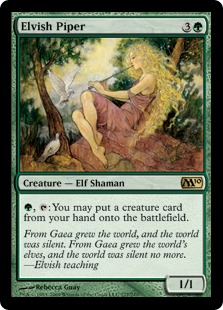
A perennial favorite of mine, the old Piper shows up in binders fairly regularly and is often mistaken as bulk by many people, when in fact the opposite is true. You can get $2-3 from dealers for the Piper and trade for it at a third of that price. I’ve spoken before about how I make the bulk of my profit in trading from getting stuff like this, and this is an easy target to look out for.

9. Chandra's Phoenix

I include this card simply because many people don’t realize how much it has risen. I hadn’t either until I randomly noticed last week that this thing has moved up to $8 on Star City Games, fetching $3-4 from dealers.

Using this knowledge I picked up a few of these at FNM last week, and nearly everyone pegged them at $4-5. Take advantage of this mistaken price perception while you can and cash in.

8. Captivating Vampire

Much like another card that will make an appearance on our list, this guy is expensive for a number of reasons. Oh wait, he’s a Vampire Lord? Never mind. That’s the only reason he’s worth $4 on SCG and an easy $2 to a dealer.

It’s easy to miss cards like this, but the rule of thumb of “tribal lord = good” holds true more often than not. That one line of reasoning has been very good to me over the years and I expect it will continue to be. Even those guys trying so hard to be “legit traders” often miss on small cards like this, and perfect knowledge of every Modern staple in the world won’t stop them from bleeding their profits if you don’t know this side of the market as well. Just look at [card]Adaptive Automaton ($4).

Honorable Mention

I want to mention Sanguine Bond since we’re on core sets here, but I hit on this one in the first piece of this series, so I’ll just give it passing mention here. A solid $2-4 to dealers, by the way.

7. Serra Ascendant

This little guy got hot a few years back when Conley Woods broke out Soul Sisters on an unsuspecting Nationals audience. Ascendant sees a little bit of Modern play, but I have to think it’s the EDH crowd keeping this thing as expensive as it is. You can get $2-3 dollars from dealers for it and it will trade all day long at that price, netting you easy profits every time.

6. Jace, Memory Adept

It's Jace. And he Mills. Enough said.

Everyone knows this guy is worth money, but a surprising amount of people know realize exactly how much. This guy sees very little play in any format, and that means people don’t look in on him often. Because of this, people don’t have a solid idea what this guy is worth and, in my experience, most will guesstimate $8-12.

Truth is, this thing moves on SCG at $15 and you can get $8-9 from dealers for it.

Also of note is that I only see this going up over time if it isn’t reprinted because it’s a huge Mill card. That said, I think the chance of a 2013 reprint is fairly high, so be careful holding onto these for too long. You’re better off picking them up on the cheap for other Standard cards that don’t have as good of a buy/sell spread and unload these.

If you want to make the longer-term play, trade expensive Standard staples for them now and you’ll be on the much better end of the deal a year from now after rotation.

5. Grave Pact

People can underestimate the value of this card since it’s strictly an EDH card and was reprinted in the Commander expansion, but this recurring edict pulls $5-6 and will net you $3-4 from a dealer, numbers that any grinder can get behind.

Since it’s likely to come up, I’ll tell you the Commander version is $2 cheaper on SCG and is bought by dealers cheaper in accordance. Still grab these as throw-ins if you can, but don’t go hard after these unless they’re from a core set.

4. Lord of the Undead (and friends)

All Zombie cards have gone up in price since Innistrad, and this is no exception. While you’re more likely to find Cemetery Reaper in binders (which is still a good throw-in target), the real treasure is finding Lord or Death Baron. If you see anything resembling a Zombie from the last five years, it’s time to go hard for it (assuming you’re getting the right price, which you usually will).

3. Elvish Champion

Remember what I said about Tribal lords? Sure enough, that principle applies here, and the Champion will get you $2-3 from a dealer.

This particular lord has been reprinted a ton, yet every version (even the Dual Decks version) is worth at least $2 on SCG. The prime target is the 10th Edition, which goes for $6, but grabbing any of these on the cheap will pay off.

I love these kinds of cards because even those people who consider themselves in the know and realize these type of cards aren’t valueless don’t always know how much they’re worth. For instance, I knew Champion was worth money, but before looking it up today I probably could have been convinced to trade it at $3 or so, and someone who’s read this article would have doubled up on me.

The more you know.

2. Master of the Wild Hunt

This guy was definitely the stones back in the day (like two years ago), when he was tearing up Standard and got poor Charles Gindy DQ’ed from Worlds for screwing up what he could do with it.

Of course, that’s pretty much all I could think about when I played him at GP Dallas last year and rolling his face with my Caw-Blade killer Elves list (crushed CawBlade but lost hard to Lotus Cobra). Anyway, I beat the former Pro Tour and Nationals winner but missed Day 2 by five spots while going 6-2-1, beating CawBlade five times and RUG once, losing to RUG twice and drawing with Valakut (somehow).

Back to the Master. SCG sells him for $6 despite not seeing any play these days (though he seems like he would be good in creature mirrors in Modern). If you’re lucky enough to spot one in a binder, try to grab it.

The point illustrated by Master and many cards both on and not on this list (Time Warp, sells for $1-2), Mythics from the core sets since 2010 have retained value very well. All of these core sets are only opened for a short amount of time, but the early ones (mostly M10) were criminally underprinted, which creates some really nice trading opportunities.

1. Vampire Nocturnus

Tearing up kitchen Tables since '09.

This is pretty much the Holy Grail of Core Set Gold over the last few years. This guy was a Prerelease promo but still holds down a $20 pricetag. This is pretty much “the” Vampire Lord of the last five years, and the price on this guy is going to stay strong for a very long time.

I’ve seen dealers offering up to $15 on these, and you should never accept less than $10 if you can get ahold of any. For what it’s worth, even the prerelease card has held its value really well, sitting at $15 today. Almost makes me feel bad for giving away mine to my buddy for his casual deck.

In Other News

I’ve been lucky enough to get off work the next two weekends, so I’ll be at SCG: Dallas this weekend and GP Nashville next weekend! I know I’ll be looking for all the cards on this list, and hopefully you’re able to use this yourself to boost your profits. If you’re going to be at either event the next two weeks, let me know and come say hi!

Thanks for reading,

Corbin Hosler
@Chosler88 on Twitter

Insider: MTG and Taxes, Part 1 – Hobby Tax

Are you a Quiet Speculation member?

If not, now is a perfect time to join up! Our powerful tools, breaking-news analysis, and exclusive Discord channel will make sure you stay up to date and ahead of the curve.

Most of you are readers of QuietSpeculation.com because you plan to leverage your knowledge of the financial world of Magic: The Gathering in a profitable way. This can mean a couple of different things to different portions of our readership.

Some of you may operate a Local Gaming Store, some of you may travel to large events for trading and sell cards on eBay, others use trading to reduce the overall costs of playing Magic. Whichever you are, you need to know and be aware of what the government is expecting you to report as income.

I am not an accountant and I’m not a tax attorney. In short, and as an obligatory warning: don’t hesitate to work with a professional on your taxes.

What do you mean by Hobby Tax?

A Hobby, in the eyes of the IRS, is an activity that is carried out without the intention of making a profit. The idea behind income taxes for a hobby is set up to prevent tax shelter abuse. Since a hobby is undertaken without the intention of making a profit, you may not deduct any losses incurred during your non-profit hobby from your overall income at the end of the year. However, if you have incidental income (perhaps from speculating on a batch of cards) you must report it and are able to deduct any other expenses incurred from your hobby as a result. You simply cannot deduct more expenses than the income you report from that hobby.

Why does this matter?

It matters a lot. Hobby Income is not subject to Self Employment tax. Self employment tax is approximately 15% in the United States, and this is in addition to any income tax you owe. Your income as a hobby is still taxable, but is not subject to additional Self-employment tax. Because a hobbyist is only allowed deduct up to the amount he profits in expenses, there is no way to deduct your hobby expenditures from your net income that came from other sources like a typical employment. In order to be able to deduct all of your expenses, you must operate as a business and pay your Self Employment tax.

Imagine your year looked like this:

You traveled to some GP’s, you played all the local PTQ’s and did lots of trading and buy/sell on eBay. Perhaps your eBay gross income was $3,000 and your total expenses on the year were $4300. You could write off up to $3000 on your taxes, but could not get a tax benefit from losing money on the year. If it was the other way around, with a Gross Income of $4300 and expenses of $3000, you could deduct $3000 and pay income tax on the remaining $1300 without being held accountable for Self Employment tax.

How do I know if what I’m doing counts as a hobby?

The IRS doesn’t exactly lay out this as clearly as one would hope. But ,ultimately ,if you get audited by them, they use a number of factors to determine this. This link shows their checklist of things that the IRS will consider (excerpted here) to verify if an income is considered a hobby or a business.

  • Does the time and effort put into the activity indicate an intention to make a profit?
  • Do you depend on income from the activity?
  • If there are losses, are they due to circumstances beyond your control or did they occur in the start-up phase of the business?
  • Have you changed methods of operation to improve profitability?
  • Do you have the knowledge needed to carry on the activity as a successful business?
  • Have you made a profit in similar activities in the past?
  • Does the activity make a profit in some years?
  • Do you expect to make a profit in the future from the appreciation of assets used in the activity?

Further, “An activity is presumed for profit if it makes a profit in at least three of the last five tax years, including the current year.” So if you’ve been doing this long enough where the IRS can see a track record of you reporting income, they will consider you a business and you should report your income accordingly.

PayPal

If you conduct business on PayPal, you need to be aware of how they report that income to the IRS.
If you sell over $200,000 in Gross Sales and receive over 200 total payments, they are going to report all of your income to the IRS, they will notify you of this and request appropriate tax information from you.

International Laws

In many European countries, the law is similar in some ways but not others. You’ll want to be very careful to be aware of the laws in your own home country. Most countries where I was able to find documentation stated that you can only deduct the expenses incurred in the process of earning the hobby income, and you can deduct no more than the amount you earned.

In Closing

If you feel you fall into the Hobbyist category, it means you likely are spending more on your hobby than you are earning. And that's fine, that’s what a hobby is. The benefit of that is you can deduct your expenses from the gross income you’ve made along the way. If it’s clear you’re operating a business, or you’ve been successful a number of years in a row, be prepared to pay Self Employment tax. Find a professional who can help you itemize your deductions and get started.

Next week I’ll talk more about taxes from a Self Employment standpoint.

Avatar photo

Chad Havas

Chad has been with Quiet Speculation since January of 2011. He uses price speculation to cover all his costs to keep playing. Follow his journey from format to format and be prepared to make moves at the right times.

View More By Chad Havas

Posted in Finance, Free Insider3 Comments on Insider: MTG and Taxes, Part 1 – Hobby Tax

Have you joined the Quiet Speculation Discord?

If you haven't, you're leaving value on the table! Join our community of experts, enthusiasts, entertainers, and educators and enjoy exclusive podcasts, questions asked and answered, trades, sales, and everything else Discord has to offer.

Want to create content with Quiet Speculation?

All you need to succeed is a passion for Magic: The Gathering, and the ability to write coherently. Share your knowledge of MTG and how you leverage it to win games, get value from your cards – or even turn a profit.

CommanderCast S5E8 | The Derpmandercast Learning Discovery Experience

Are you a Quiet Speculation member?

If not, now is a perfect time to join up! Our powerful tools, breaking-news analysis, and exclusive Discord channel will make sure you stay up to date and ahead of the curve.

Did you know CommanderCast has a sort of brother pocast, Off-Color Cast? Well, after this episode, you should have an idea of exactly what that our friends over at OCC are like. When I say Off-Color is like CommanderCast's brother, I mean it's your younger brother who spent some time in jail, was 'around' for a few years and came back to town asking you for money. But he's still awesome.

We talk about the title 'scrub', Heel decks, red cards that make the colour awesome despite the haters, and of course top it off with some bad cards we love.

Hit the button or play, or download the entire episode! The full show notes are here.

For more Wrexial-Approved stuff, hit up http://www.commandercast.com/

That Morbid Feeling

Are you a Quiet Speculation member?

If not, now is a perfect time to join up! Our powerful tools, breaking-news analysis, and exclusive Discord channel will make sure you stay up to date and ahead of the curve.

Two weeks ago, I posted a somewhat introspective article ("Hitting the Wall") about how I go about looking for new deck ideas. As I explained in the article, I find it important to look for new avenues to explore in deck building so that each brew is unique.

While coming up with examples for that article, I realized I have a tendency to avoid building three-color decks, as well as decks centered in Black or Blue. My theme of choice usually is focused enough for one or two colors to get the job done, and when it isn't I find it hard to resist moving right on up to five colors. This tendency has left a huge gap in my Commander experience.

In light of this discovery, I've decided to spend the next few weeks focusing on three-color decks.

To start with, I wanted to look at a sweet concept that I had for a Jund deck with a Morbid theme and Kresh the Bloodbraided at the helm.

Getting Morbid

Morbid is a fun mechanic, and it's quite easy to trigger in a format like Commander where creatures are constantly dying. Jund provides the ideal color combination for the dual task of killing creatures and benefiting from the resulting bloodbath. In addition to slaughtering monsters and reveling in their deaths, these colors give us access to an ample supply of reanimation effects.

There are two classes of Morbid cards that will form the backbone of our deck. Let's take a look:

Kresh in Training

  • Rockslide Elemental
  • Algae Gharial
  • Lumberknot
  • Scavenger Drake
  • Deathbringer Thoctar
  • Vulturous Zombie
  • Khabal Ghoul

Commander is typically a creature-centric format. Creatures attack and die, only to get recurred to do it all over again. If you've ever played a game with or against Kresh, you know how big he can get in just one turn cycle.

These guys may not get as big as Kresh, but they do a pretty good impression, and many bring bonus abilities to the party! They certainly do not rank with the most powerful cards you could be playing, but they have the potential to outclass even the biggest creatures on the table.

Besides, who doesn't love perpetually growing monsters?

Along with our next set of cards, these cards tie together and reinforce the morbid theme.

Morbid Engines

  • Reaper from the Abyss
  • Vicious Shadows
  • Falkenrath Noble
  • Salvaging Station
  • Butcher of Malakir
  • Furnace Celebration

As much fun as giant creatures are, they aren't always a reliable way to win a game. You also need ways to control the board and generate card advantage, which is where these guys come in.

Your best tools out of this lot are Reaper from the Abyss and Butcher of Malakir. Reaper for his part is an undervalued card in Commander, and especially powerful in a deck that has been built to activate morbid essentially at will.

The other centerpiece cards are Salvaging Station and Furnace Celebration. Salvaging Station is great for generating absurd amounts of card advantage, as well as recurring utility artifacts like Nihil Spellbomb. I've always been a huge fan of the Station, and I really encourage you to give it a shot!

Furnace Celebration is exciting not because it's particularly powerful, but because of how well it pairs with the following theme.

Bring on the Tokens!

Tokens play a huge role in Commander. They're one of the best ways to present a threat, since you can put a lot of power into play with just a few cards. It's also easy to turn tokens into "real" cards with things like Attrition and Skullclamp. Tokens are incredibly popular due to this power and versatility, and this deck is certainly not going to buck that trend!

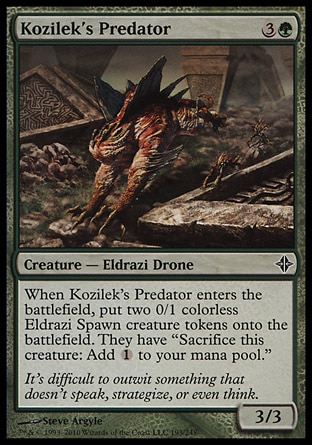
In our quest to abuse token generation, we could go with the boring old standby of Plants, Squirrels and Elves. Instead, why not enlist a whole awesome suite of tentacled-spawny-things from Rise of the Eldrazi that will complement our Morbid theme?

  • Awakening Zone
  • Corpsehatch
  • Growth Spasm
  • Dread Drone
  • Kozilek's Predator
  • Emrakul's Hatcher
  • Deranged Hermit
  • Siege-Gang Commander
  • Goblin Marshal
  • Avenger of Zendikar
  • Grave Titan
  • Phyrexian Altar
  • Skullclamp

Alright, so they may not all be Eldrazi Spawn generators, but the few that aren't can be turned into pseudo-Spawn with Phyrexian Altar. The point is to produce a lot of tokens, then kill them to grow your creatures and generate value with Reaper from the Abyss and friends.

Aside from the various interactions enabled by tokens, don't overlook the ability of these cards to take over a game on their own. Every time one of these hits play you get a massive board presence which can be leveraged in any number of ways, and the deck is set up to make them hit play frequently.

The biggest question remaining is how to tie all these pieces together.

Start Your Engines

There are a wide variety of creature-based engines available to a Commander deck. Whether you're playing with Survival of the Fittest, Reveillark or Oversold Cemetery, creatures are the easiest card type in the game to abuse and recur. When you're playing a creature-based deck, there are all kinds of ways to eke extra value out of your guys, and to ensure access to a particular effect when you need it.

For this particular deck, we want a combination of tutoring power and recursion. Preferably, we want to include things that interact well with Morbid rather than over-the-top powerful bombs.

Workin' on the Chain Gang

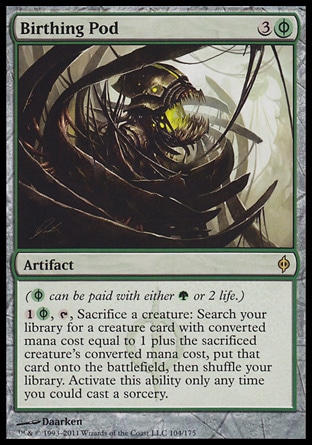
  • Birthing Pod
  • Wild Pair

These are two of my favorite Green cards in the format, mostly because they make you do some crazy things during deckbuilding to make sure you can chain creatures consistently.

Ideally, each creature you cast or Pod away can find any effect you might need at any time. It can be challenging to accomplish this while supporting other themes, but the cards provide enough upside that I think we can make it work.

The fact that Birthing Pod enables morbid, and that both Birthing Pod and Wild Pair allow you to ignore color requirements, is a big deal for this deck.

Both of these cards can easily run away with the game through card advantage and selection. I'm actually rather surprised that they don't see as much play as Survival of the Fittest.

Recurring Your Monsters

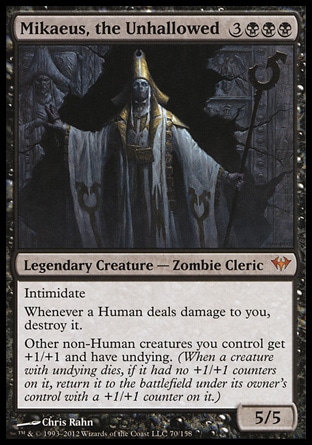
  • Mikaeus, the Unhallowed
  • Phyrexian Reclamation
  • Nim Deathmantle
  • Mimic Vat

Recursion is the other half of the value-creature engine. Once you've found your good creatures, you want to be use them over and over again, and I think these cards best enable you to do that in this deck.

You have a number of free sacrifice outlets that let you get a huge advantage out of Mikaeus, the Unhallowed. It's a shame that Eternal Witness is a human, but we can certainly make up for it with the rest of the recursion package.

First there's the obligatory Nim Deathmantle, which does let you go infinite with certain creatures plus Phyrexian Altar. Phyrexian Reclamation is one of my favorite permanent-based recursion engines because it has such a low activation cost and can be done at instant speed. This means that it doubles as protection against graveyard hate and lets you leave up mana to interact on other players' turns.

I wasn't sure whether Mimic Vat or Corpse Dance would be better as the last recursion spell, but eventually I decided that [card Mimic Vat]Mimic Vat's[/card] ability to steal other players' creatures gave it the edge. It's possible that playing both is correct, but only time will tell.

Filling in the Gaps

Once you've figured out the primary function of your deck, in this case tokens and Morbid shenanigans, you have to make sure that everything runs smoothly. It's great to have a strong theme, but without the right support you'll find it difficult to execute all the interesting interactions you've built into the deck.

In this case, the deck needs ways to answer noncreature permanents, accelerate its mana and generate card advantage outside of the principal tutor engines. The most difficult part of this is going to be fitting everything into convenient numbers for Birthing Pod and Wild Pair, but let's see what we can do!

Utility Creatures

  • Green Sun's Zenith
  • Eternal Witness
  • Duplicant
  • Solemn Simulacrum
  • Shriekmaw
  • Acidic Slime
  • Yavimaya Elder
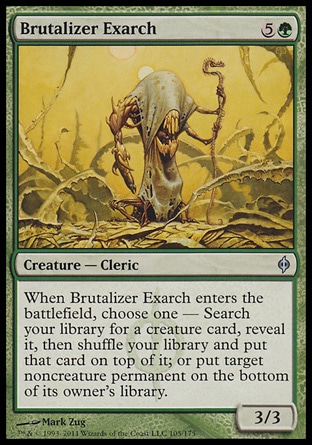
  • Brutalizer Exarch
  • Glissa, the Traitor

The function of most of these should be pretty obvious, but there are a few interesting ones.

Glissa, the Traitor acts as another copy of Salvaging Station as well as creature removal, and sits at a sweet spot for Wild Pair. The deck really appreciates having access to her as a tutor target.

Acidic Slime is your obvious answer to pesky permanents, easily found by Birthing Pod. It is complemented by the slightly spicier Brutalizer Exarch, which is at a better spot for the purposes of Wild Pair and works double duty as a tutor.

Utility Spells

  • Tragic Slip
  • Maelstrom Pulse
  • Putrefy
  • Krosan Grip
  • Violent Ultimatum
  • Dread Return
  • Damnation
  • Blasphemous Act
  • Demonic Tutor
  • Diabolic Intent
  • Wayfarer's Bauble
  • Nihil Spellbomb
  • Horizon Spellbomb
  • Expedition Map
  • Voyager Staff
  • Scrabbling Claws
  • Executioner's Capsule

To begin with, we have some generic removal and cheap sweepers, the kind of effects everyone needs to have. But we've also got a few sweet things going on here!

Dread Return seems absurd for this deck. I've been looking for a deck that can justify running a "fair" Dread Return, and I think I've finally found a home. With the number of token generators we're running the flashback shouldn't be a big deal, and it may even be a boon to your team of Kresh and his impersonators. With so many value creatures eligible for reanimation, it's not a bad effect by any stretch; I'm excited to see how it turns out!

The other interesting suite of cards is the Salvaging Station package. The important thing to recognize is that none of these are bad on their own, and the potential exists to stick a Salvaging Station and just go off, generating way more cards than a typical Jund deck. Each of the trinkets also provide utility effects that can be useful to recur at a later point in the game.

It's possible that Salvaging Station is just too cute to take up this many slots, but for now I think it's worth running.

Mana Ramp

  • Sakura-Tribe Elder
  • Kodama's Reach
  • Cultivate
  • Explosive Vegetation
  • Caravan Vigil
  • Primeval Titan

As with most Commander decks, this deck has a ton of high-cost spells and engines, as well as intensive color requirements. Ramp is important in alleviating these problems.

The only card that may seem out of place here is Caravan Vigil.

I've tried this card before in several decks and was quite satisfied. It's not difficult to get Morbid in a multiplayer game, and when that happens Caravan Vigil is effectively free. Primal Growth might be better in this slot, since it's a similar effect that also enables morbid, but I have a foil Caravan Vigil that's been looking for a home!

The Mana Base

  • Urborg, Tomb of Yawgmoth
  • Tainted Peak
  • Tainted Wood
  • Dragonskull Summit
  • Woodland Cemetery
  • Savage Lands
  • High Market
  • Phyrexian Altar
  • Reflecting Pool
  • Command Tower
  • Terramorphic Expanse
  • Evolving Wilds
  • Bojuka Bog
  • Vesuva
  • Mosswort Bridge
  • Lavaclaw Reaches
  • Raging Ravine
  • Shizo, Death's Storehouse
  • Rakdos Carnarium
  • 6 Forest
  • 5 Swamp
  • 3 Mountain

Last but not least, the manabase. Three colors is actually a pretty good spot to be in as regards your mana. There are plenty of dual lands so your mana shouldn't be that bad once you figure out what your deck needs. But unlike in five color decks, there's enough space for utility lands and basics without resorting to an unusually high land count.

In this deck, for example, we get some sacrifice outlets in High Market and Phyrexian Altar, graveyard hate and card advantage in Bojuka Bog and Mosswort Bridge, and manlands in Raging Ravine and Lavaclaw Reaches. Vesuva helps you capitalize even more on your utility lands (or anyone else's for that matter) and Shizo, Death's Storehouse lets you one-shot people out of the blue with Kresh!

There's certainly space for more nonbasics in the deck if you have them; you could pretty easily cut up to three or four basic lands for something like Volrath's Stronghold or Maze of Ith.

Recently, I've been trying to limit the number of high-dollar cards in any given deck that I post. I think I've been doing a pretty reasonable job, and I'd like to keep the trend going. Just because you can throw a pile of expensive staples into a deck doesn't meant that you should; putting a budgetary restriction on decks forces you to be a little more creative and emphasize powerful interactions over individually powerful cards.

With the mana out of the way, here's the list that I'm starting with:

[deckbox did="a151" size="small" width="560"]

I'm excited to play with this, since it's an all-out Timmy deck and I don't have too many of those. Most of my decks revolve around convoluted and obscure interactions, whereas this one just focuses on going big!

It should be a nice change of pace from what I'm used to, and will be a ton of fun to play against the Melira, Sylvok Outcast-based combo decks that have been plaguing my group recently.

Be sure to check out next week, when we'll look at a Commander who usually lives in the shadow of Sharuum, the Hegemon. The giant sphinx isn't the only Esper legend, and Ertai, the Corrupted can do some pretty dumb things!

Carlos Gutierrez
cag5383@gmail.com

@cag5383 on Twitter

Insider: Standard’s Amorphous Evolution

Are you a Quiet Speculation member?

If not, now is a perfect time to join up! Our powerful tools, breaking-news analysis, and exclusive Discord channel will make sure you stay up to date and ahead of the curve.

Last week, I endeavored to relate the various risks and rewards to trading in unique cards. This is a valuable topic in the realm of MTG Finance because profit margins are often much larger on obscure cards than on Standard staples. My hope was to elaborate upon the mathematical components of profit margins a bit further and…

I can’t do it. There is a much better topic I want to discuss this week. And boring you with some number crunching and percentages seems like a waste of your time. Let me rewind.

How Amazing Is Standard Right Now?

This format has an incredibly diverse metagame and it seems like every week there is a new frontrunner. Cards which used to dominate the format, such as Geist of Saint Traft, Moorland Haunt, and Kessig Wolf Run have now become interspersed with newcomers such as Huntmaster of the Fells, Elesh Norn, Grand Cenobite, and Sword of War and Peace.

I will be first to admit that I have not closely followed the Standard metagame for very long – perhaps since Fairies (uh… I mean Lorwyn) block at the latest. But I am going to jump out on a limb: this has got to be one of the most dynamic and diverse formats we have seen in a while.

We are in the midst of a brewer’s dream. Cards like Splinterfright hold such promise in this awesome metagame. And as soon as a particular strategy seems to earn top notch, another one comes along and trumps it.

Financially Speaking…

This is a financial column. I am not a Pro Tour player and I am not delusional – I recognize I am here to write about MTG Finance and not MTG Strategy.

Don’t get me wrong. This is an incredibly exciting time to speculate in Standard. Modern PTQ season is winding down in less than a month and Standard will garner even more spotlight. It is already the most popular Magic format, but it will gain even more popularity amongst PTQ grinders in the coming months.

This means there will be profiting on the horizon. But this time around we can’t simply acquire the most popular staples because that list of cards is changing at a rapid pace. This makes for exciting tournaments, but not having the trusty Jace, the Mind Sculptor, Maelstrom Pulse or Bitterblossom to acquire in droves makes for an uncertain time.

We speculators will have to work a bit harder this season. There will be tournament results bombarding us from all angles, and it is imperative we are aware of trends. No longer can we acquire Jund and Caw-blade staples in the off-season for some promised profit. Instead, we will have to think.

My Two Cents

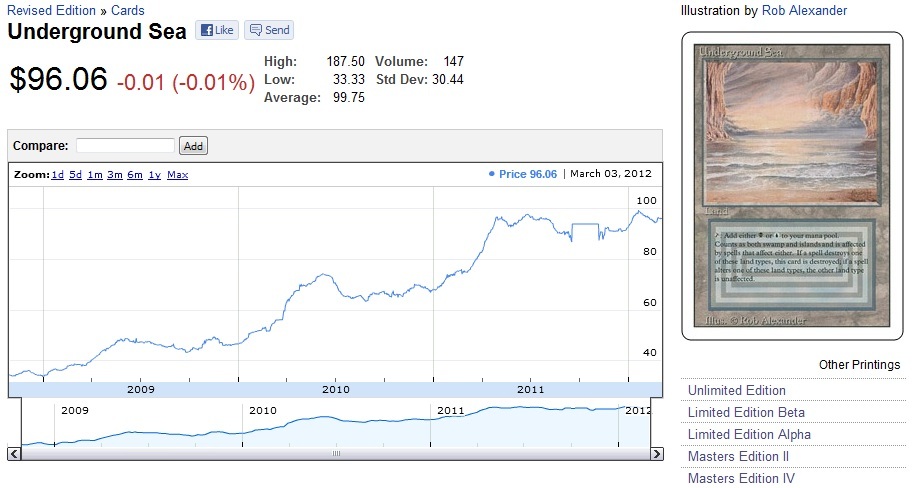
I cannot promise that my predictions and speculations will always net you pure profit. If you want a guarantee, purchase Underground Seas. (chart courtesy of blacklotusproject)

What I can offer is my perspective on what cards are worth considering from four different tiers of risk:

  1. Prime Performers,
  2. Forgotten Favorites,
  3. Gradual Grinders, and
  4. Long Shots (I couldn’t think of another alliterative name).

Allow me to explain.

Prime Performers

No one can really predict what decks will make Top 8 at the next SCG open or Standard Grand Prix. There are a large number of viable options and Avacyn Restored is bound to shake up the list even more!

The idea for Prime Performers is to rapidly deal in the most popular cards. I want to emphasize the window in which you should operate here. As soon as you see a particular card see increase in favor, you need to move on them immediately. There is often a narrow span of a few days when you can purchase or trade for these cards before they peak.

However, you also should be able to unload the card within days of obtaining it. In this way, you can minimize risk. Wait too long and your card may fall out of favor, thereby dropping the card’s price and moving it into the next category.

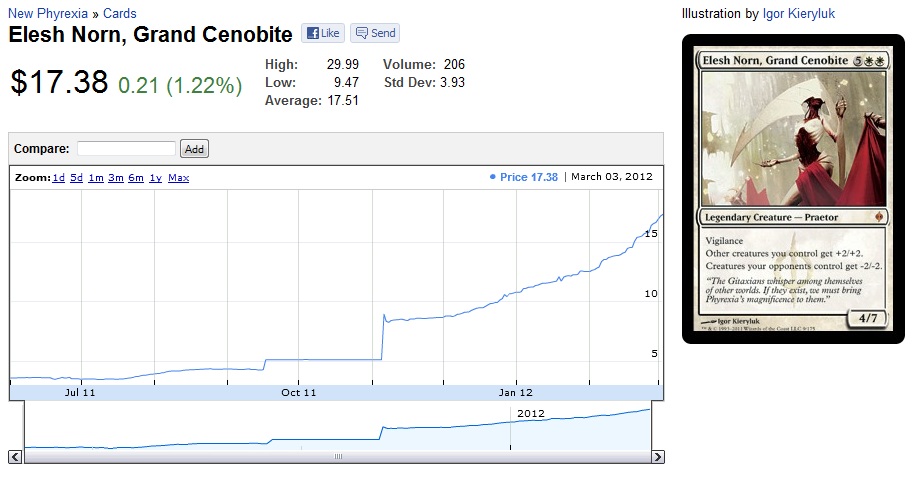
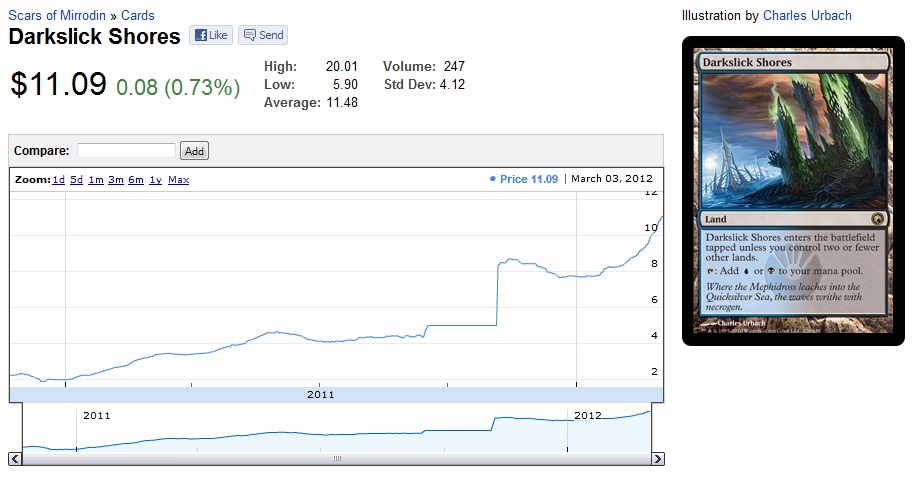
My examples of (very) recent Prime Performers include Elesh Norn, Grand Cenobite and Darkslick Shores (charts courtesy of blacklotusprojects.com). Both have about doubled in price in the last month or so. The moment they started seeing increased play, there was a brief opportunity to acquire them cheaply. Now, the room to profit on these cards is nearly passed. Rest assured there will be others, but, unfortunately, I don’t have any definite candidates right now.

I hear a lot about Zombies – maybe Geralf's Messenger or Gravecrawler?

Forgotten Favorites

Cards in this category made a splash in Standard at one point but have since fallen out of favor due to metagame shifts. They are off their peak price significantly, but the precedence for higher prices is already established. They are still powerful cards.

I would consider these cards slightly more risky than the active top performers, but they have proven themselves already. Therefore you could do worse than to hold a few of these.

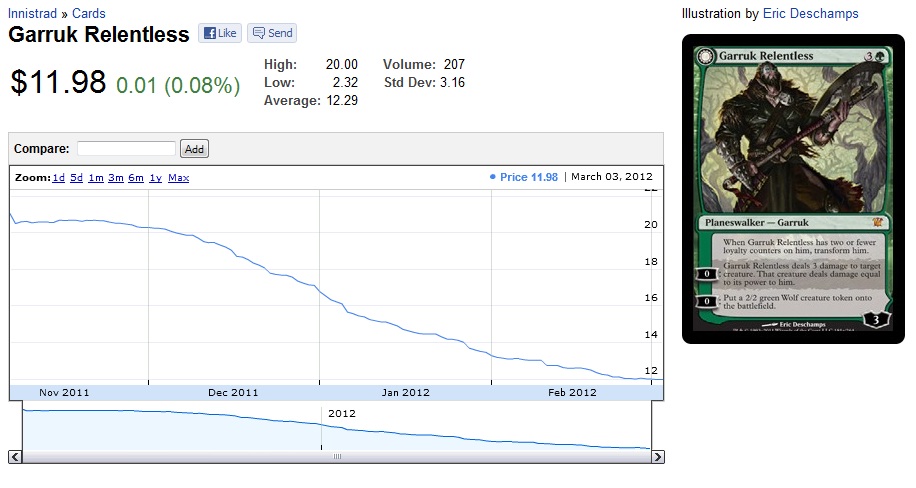
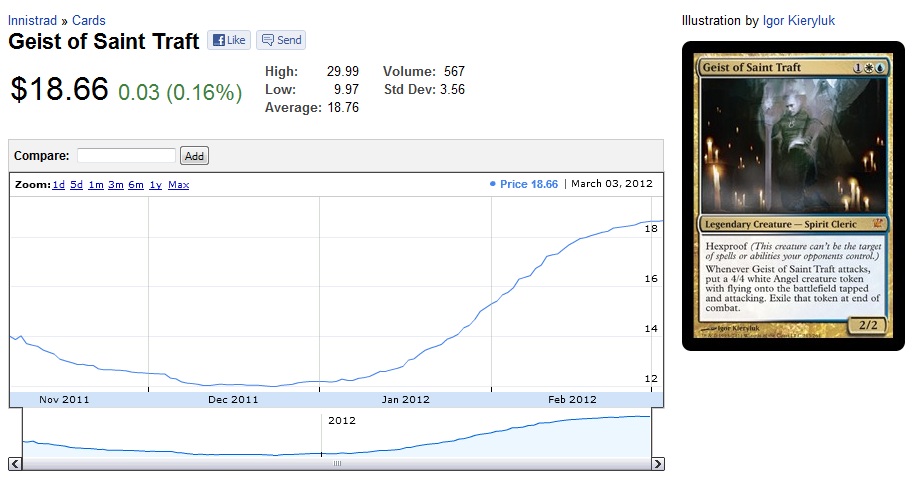
Because of how rapidly this format is evolving, there are many cards in this category. To list a few, consider Garruk Relentless, Geist of Saint Traft, Sword of Feast and Famine, Tempered Steel, Garruk, Primal Hunter, Elspeth Tirel, and the list goes on.

I’ve provided charts for Garruk Relentless and Geist of Saint Traft. The former I feel has nearly bottomed in price, while the latter may soon begin its decline.

Gradual Grinders

This category is my favorite one and, as a result, much of my trade binder consists of these cards. There are very good reasons for this.

Cards in this category should remain fairly well-positioned regardless of how the metagame shifts. While there can be no guarantees, these cards should have a higher likelihood of increasing in value from where they currently are. However, they may be a bit cheaper now because either demand is soft or supply is too large.

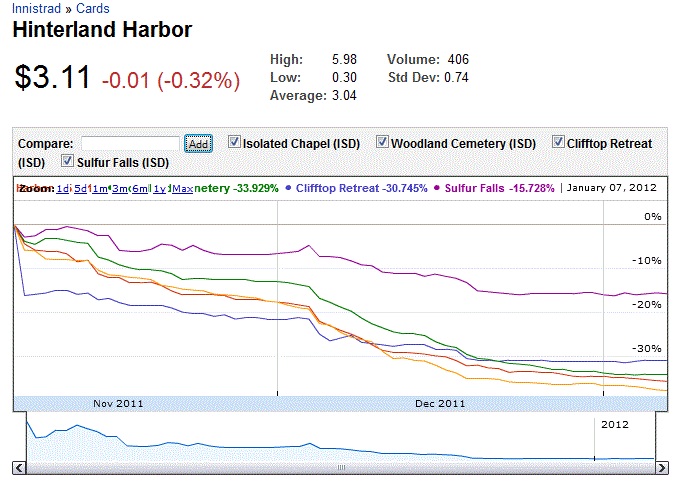
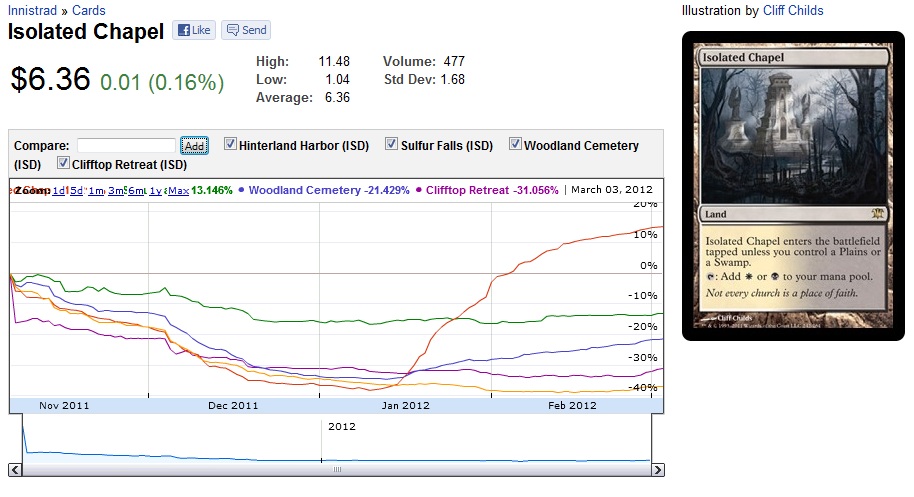
The best examples of these cards are all the rare lands in Innistrad and Dark Ascension. My favorites are the Innistrad Duals. Many of you should already know this because I’ve written about them in the past. In fact, a few weeks ago I shared their price trends, indicating that they bottomed. Don’t believe me? Check out this link: https://www.quietspeculation.com/2012/01/insider-a-very-exciting-time-to-speculate/

Here’s the picture from that article, depicting the trend on the Innistrad duals as of January 11th, 2012:

And here’s the same trend today, as of March 3rd, 2012 (charts courtesy of bloacklotusproject.com):

It is quite clear that the bottom I called in early January was in fact accurate (so far). But notice how only Isolated Chapel and Woodland Cemetery have shown recovery.

I want to emphasize that these cards are all mana-fixing lands. Barring a reprint, at least one land from this cycle will be trading at a premium from its bottom. Right now it’s the B/W land, but as the metagame shifts each of the other four may get their chance to shine. Downside risk on these other four is low. Which is why I love this category.

In addition to the Innistrad Duals, the spell-lands from Dark Ascension and Innistrad are also worth acquiring at such a cheap price. Also, Ratchet Bomb would have been a great card in this category before it spiked. Although a reprint, Solemn Simulacrum is another card which should remain strong no matter the metagame.

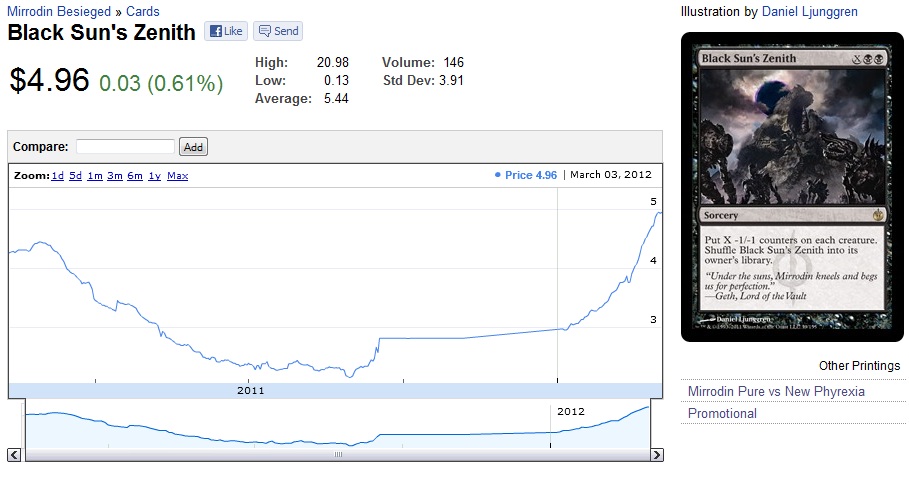
One last example is Black Sun's Zenith. It’s relatively cheap but represents one of the most efficient board sweepers in this Standard format. It’s not likely to become a $10 card, but being a premier board sweeper in Standard earns it a spot in my MTG portfolio (chart courtesy of blacklotusproject.com)

Long Shots

These are the Skaab Ruinator and Splinterfrights of the world. They are cards that seem synergistic with the mechanics of a given set but have not broken out yet. Even Heartless Summoning and Havengul Lich may qualify to fall in this category. While they have made Star City Game Open Top 8s, they have still not shown up in numbers at tournaments. Thus, there is room for them to go up or down.

I like buying a few cards from this category for my collection, but not excessively. Unless you want to make a hobby of collecting a given card for personal reasons, I personally don’t advise going too deep. I tried that with Past in Flames and it came back to bite me. I suppose there’s still time, but the Standard metagame is nowhere near a place where Past in Flames can be good.

A Balance

Like everything in life, a smart strategy is to diversify across all four categories. This way your collection is always relevant and you are enabled to trade with anyone at any tournament looking for Standard cards.

A good goal to strive for is continue to buy, sell, and trade cards regularly so that your collection always has something for everybody. It’s a fair strategy across all formats as well. You’ll rarely make $1,000 on one card this way, but you will always have a full collection worth looking at. After all, with this strategy, it’s all about the journey.

-Sigmund Ausfresser
@sigfig8

Insider: Using Bid Schedulers to Price-Enforce Ebay

Are you a Quiet Speculation member?

If not, now is a perfect time to join up! Our powerful tools, breaking-news analysis, and exclusive Discord channel will make sure you stay up to date and ahead of the curve.

You've browsed through Completed Listings on Ebay before, trying to get a read on what price you should bid for a card you'd like. There are eight or ten at a normal price, and then there's one that went for far less than it should have. Sometimes this happens because the listing ended late at night; other times, it's because an auction for the same item just ended and people might not have aggressively bid on two of the same card.

If you want to be the lucky person snagging those underpriced cards; if you want to assemble a collection while you sleep, with an hour a week worth of work; if you have the patience to wait out some great prices because "your door is always open," then this article is for you. This article is about how you can use bidding schedulers to automatically scoop up cards that you want at prices below what they should be. Kelly Reid coined the term "Price Enforcing" to describe the process of going to local stores and looting the cases for underpriced cards, and there's no reason you cannot do it on Ebay, either.

What is a bid scheduler?

These are programs or websites that will automatically place a bid for you when you tell it to. They will bid the price that you would like and put it in when you specify that it should. You shouldn't just tack bids onto every item you see, because people are emotionally tied to their desire to win. They will just re-raise you. Bidding in the last few seconds cuts off the possibility of a re-raise.

You really shouldn't be paying money for scheduled bids, even if it is a couple of pennies. You should avoid downloaded programs; they are simply a pain in the butt and you expose yourself to spyware. I use www.biddingscheduler.com to bid on Magic cards. They use advertising to make money (ads I don't see, thank you No-Script). Firefox warns me that the information I send is encrypted but going to a third party. This is somewhat concerning, because it has my Ebay ID and password, but my Paypal is not linked to it. I haven't had problems in the months that I've used it. Use your best judgment and never give out a Paypal password.

What cards should I target for price enforcement?

I have been snagging Ravnica shock lands for awhile. They exhibit a high degree of variability in price and they are worth a bit of money; I definitely wouldn't do this with dollar cards most of the time. Generally, any card worth about $15 that has a good trade volume is a good target. Something that makes your trade binder look better is also nice. If you want to narrow things down, take a look at the charts on www.magictraders.com and look up your cards. For example, here is what Breeding Pool says:

Card                            Price StdDev Average  High    Low   Change Raw N

Breeding Pool, 23.08, 8.68, 24.21, 32.99, 16.84, -0.14, 51
This has all the hallmarks of an excellent card to sit on with your bidding scheduler. It's got a good price, a good volume (the Raw N number) and it's got an insane standard deviation. If you avoided Stats 110 in college, standard deviation is generally a measure of how far the price varies from the most common price. The difference between the high and low is nearly $20 and the deviation is $8.68. That means that the price wildly varies, which is corroborated by just looking up the card sales. The cheap sales were regular cards, in good condition. The expensive cards are selling because there are bidding wars on them, not because they are foil/altered/foreign. I made sure that the prices were current and that there were some going low and some going high - pay attention that you're not just looking at the residue of a burst bubble.

How should I bid?

I try to set a price that's pretty close to what the cards are selling for normally. I want a deal, but I also want to win a few of these. I also put in bids on every card at auction. I make sure the shipping price isn't astronomical and I adjust my price on it. Let's take a quick look at some investing theory, by way of Benjamin Graham. He came up with the idea of "Mr. Market," which was a personification of the stock market that sat down at your desk all day during trading hours. Sometimes, he'd say "look, I'll sell you all the Breeding Pools you want at $30" and you'll balk. Other times, he comes in drunk to work and says "sell me as many Breeding Pools as you have for $35." If you don't want to do business with Mr. Market that day, you pass. You only engage the market when it's profitable for you to. You get to act like Mr. Market in this (but sober!). You say to Ebay, "look, I'll buy any Breeding Pools you're willing to sell for $19 shipped." You tell Ebay this by scheduling all of your bids on auctions for Breeding Pools to reflect this. Sometimes, the market won't sell you anything. Other times, you'll get a deluge of good cards for low prices. Since you are assembling cards to trade or flip, you don't care that you now have eleven Breeding Pools.

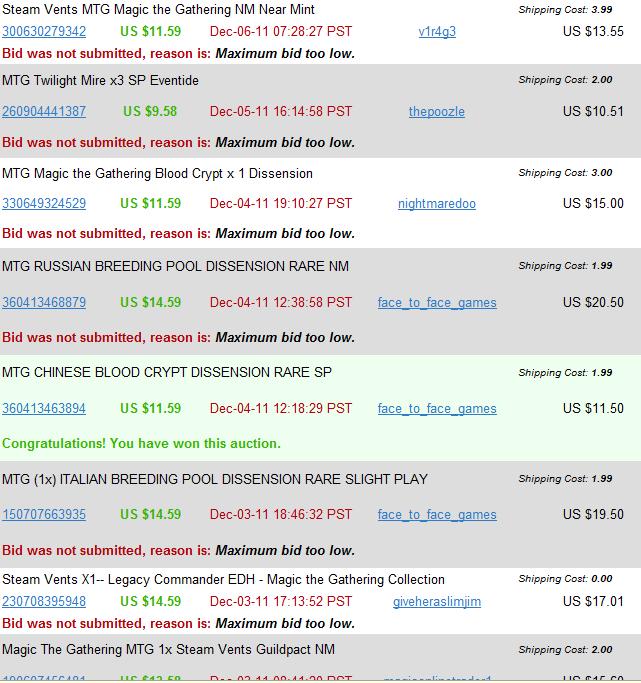
Eventually, your scheduler will look like this:

Only one winner; too many winners and you're doing something wrong.

In this example, I only won one card - a Blood Crypt for $13.50 shipped. The other Blood Crypt went for $18.00 shipped, which was closer to the going rate at the time - a big savings, and one that especially adds up over time.

Note the caption on the picture. If you are winning a lot of these, you are screwing up! You're showing up drunk to work again, Mr. Market! If you're winning a lot, that means that you're paying closer to market price. You are not getting the scoops, you're just paying what every other schmoe does. The cure for this disorder is to lower your "will buy for" price and place a lot more bids. You will win a lot less, but you will get much better deals.

I suggest checking in on Ebay two times a week. It'll usually take a half hour or less to check your list of cards. Use  Ebay's filters and just find the new auctions for cards that you want to watch. Make sure to pay your bills when you win cards and keep a very clear list of what you have won. Check off cards when they arrive (and note who sent them), or you will lose track of something and lose all your money on it. I speak from experience.

If you do this, you will win cards for a lot less than what they normally go for. Look, I can't explain why people set their auctions to end at 2am on a Tuesday morning, but they do. They put up auctions for cards that don't have a lot of motion or turnover, and they'll sell very cheaply. These are the sort of auctions you can win with a good frequency.

Why should I schedule bids if I'm not building a big binder?

This is a legitimate question, and there are two reasons you should still do this. First, you should schedule all of your bids anyway - it's a fact that people will re-raise you on Ebay even if they think they've already bid their highest amount. You're buying commodities, not unique items, so you don't need to win that one antique letter opener (like me last month). Schedulers will tell you when your scheduled bid is too low, so you can raise it if you really need to win the item - and you're doing it with stealth.

Second, if you trade at all, this is a great way to buy trade stock at a really good price. You can buy all the Breeding Pools you can at $20 and then put them in your binder for $27 in trade. That's an entirely fair trading price and you've bought the cards at about a 25% discount. Anything you trade them into will have the same discount applied. You don't even have to pick big, dynamic cards to trade in, as long as they have a good secondary market. I've been sitting on Tawnos's Coffin auctions for awhile now. Every now and then, the $15 card will sell for $4. I'm determined to be the next one to get it at a fire sale price, and the Coffin is such a fun Commander card that I'll have no trouble getting rid of it. I just saw a High Market close for $2.25 shipped, when that card easily trades at $5 on any floor you'll find.

When you are buying your binder's contents for 60 cents on the dollar, you don't have to rip off trading partners to make real profits. Nobody seems to be price-enforcing Ebay right now and this is a great untapped market for Insiders. Like I said, this takes very little work and it will remind you of the old thrills when you first started winning auctions on Ebay again.

I'm happy to answer questions about the theory and practice here. Join me next week when we look at more trading techniques and tips!

-Doug Linn


Douglas Linn

Doug Linn has been playing Magic since 1996 and has had a keen interest in Legacy and Modern. By keeping up closely with emerging trends in the field, Doug is able to predict what cards to buy and when to sell them for a substantial profit. Since the Eternal market follows a routine boom-bust cycle, the time to buy and sell short-term speculative investments is often a narrow window. Because Eternal cards often spike in value once people know why they are good, it is essential for a trader to be connected to the format to get great buys before anyone else. Outside of Magic, Doug is an attorney in the state of Ohio.  Doug is a founding member of Quiet Speculation, and brings with him a tremendous amount of business savvy.
View More By Douglas Linn

Posted in Finance, Free Insider, Special7 Comments on Insider: Using Bid Schedulers to Price-Enforce Ebay

Have you joined the Quiet Speculation Discord?

If you haven't, you're leaving value on the table! Join our community of experts, enthusiasts, entertainers, and educators and enjoy exclusive podcasts, questions asked and answered, trades, sales, and everything else Discord has to offer.

Want to create content with Quiet Speculation?

All you need to succeed is a passion for Magic: The Gathering, and the ability to write coherently. Share your knowledge of MTG and how you leverage it to win games, get value from your cards – or even turn a profit.

Insider: State of the Modern Staple

Are you a Quiet Speculation member?

If not, now is a perfect time to join up! Our powerful tools, breaking-news analysis, and exclusive Discord channel will make sure you stay up to date and ahead of the curve.

Last week was a fun and informative look back at some old trades I made, and I plan to bring it back as a topic in the future, as well as posting new trades, but this week it’s time we got back to the Grindstone, so to speak.

We’re now being inundated with decklists, with GPs and SCG Opens happening nearly every weekend. The information is flying at us from every angle, and it’s easy for a new card or deck to steal the spotlight. Standard seems to be in a good, if predictable, place (not an indictment of the format), so I don’t see too much interesting happening there at the moment.

So, rather than focus on that, I want to look at Modern.

And I’m not here to hype you on the merits of Seismic Assault or something else new that’s come on of late. There were something like 12-14 unique decks vying for Top 8 spots in the last round of GP Hoth, and from that we can deduce a few things.

Yes, it says good things about the format that so many decks were in contention. But it’s still a very fledgling format that hasn’t been sorted yet.

Legacy used to be much the same until it started getting played every week and broken down by the best. That is why there is most certainly a metagame to Legacy now, even if decks occasionally break the mold and pop up (Burn!).

I see Modern evolving much the same way.

So, while you should certainly be aware of the newest trends and act accordingly, you need to keep in mind that it can all change very rapidly.

But we know there are some things in the format that will stay very safe bets, and that’s where I want to focus our attention this week. I’m not just going to provide another list of Modern cards to have, as myself and others have done in the past.

Rather, I want to look at the price of these cards today compared to their price on the day the most recent round of bannings were announced. Since the format seems to be in a healthy place, I think it’s safe to say we won’t see a lot more banned soon unless that assessment changes.

Ergo, we can fairly accurately evaluate the status and changes in the Black Lotus Project (eBay) prices of these staples with confidence. They should stay “staples” for a good while and can help us make our investment decisions accordingly. Let’s dig in.

The Staples

Fetchlands

This is, in my opinion, the safest thing you can do in Modern finance-wise. If you’ve read much of my past work, you know of my love for lands and my Fetchland project. It’s possible we see a reprint of one of these in FTV: Realms, but I doubt it (since it wouldn’t exactly be from “the vault”).

We’re going to use Scalding Tarn as our baseline, since it’s the most commonly used.

Dec. 20, 2011: $10.35

March 1, 2012: $11.67

Here we see the slow growth we expected from the fetchlands. This still leaves a ton of room for upward growth, and, barring reprints, these will continue to rise. Can’t suggest trading into these any more strongly.

Tarmogoyf

Dec. 20, 2011: $73.31

March 1, 2012: $79.05

This still seems as safe as ever, though I imagine the chance of this seeing a reprint somewhere along the line is quite high.

I hit on these two first because it reveals something very important – even cards that were already Modern staples pre-banning are continuing to rise. This means the format is not being viewed as a passing fad by the player base and confidence in the format is high. This means these are stable prices from the angle, and reprints are the biggest thing to watch out for.

Onto more interesting cards (finance-wise).

Hallowed Fountain

Dec. 20, 2011: $22.08

March 1, 2012: $26.04

This is also interesting. The card is down since its highs in September that were primarily driven by speculation rather than actual demand, but has risen since December. I think this strengthens the point above that true demand is driving the prices on Modern staples at this point and will continue to do so.

Chord of Calling

Dec. 20, 2011: $2.87

March 1, 2012: $6.13

Here’s one of the new “staples” of the post-ban metagame, and we see the drastic increase you would expect from such. Ever since Green Sun's Zenith got the boot, this has been the go-to card, over even Summoners Pact. The fact that Melira Pod (which are both cards you should grab on the cheap) is a true player means that Chord will hold value competitively.

But more important is that Chord seems to be an acceptable tutor for Wizards to allow and probably won’t see the banhammer like Zenith did. The biggest reason is probably that Zenithing for a Dryad Arbor in addition to a late-game bomb was too powerful, whereas Chord doesn’t present that danger.

Inquisition of Kozilek

Dec. 20, 2011: $1.78

March 1, 2012: $1.87

We haven’t seen much movement here, but I think this is one of the best speculation targets in the format. More and more decks are starting to use Inquisition over Thoughtseize. It hits a lot of the important cards that ‘Seize does but doesn’t lose you the life, which is proving to be extremely relevant in the format.

Kitchen Finks

Dec. 20, 2011: $3.30

March 1, 2012: $4.91

I understand that it has a set-specific keyword, but this thing has to be ripe for a reprint in some ancillary product in the next year or two. That leaves plenty of time for you to continue to profit off of them, however.

This thing is insane in the format in all variety of decks. And even people who realize it’s not a bulk Uncommon won’t realize it retails for $5-7. Continue to move on these.

Arcbound Ravager

Dec. 20, 2011: $14.34

March 1, 2012: $17.66

Another staple, another price increase. Affinity may be on the edge of having something banned to bring it a little more in line since it’s put up the best and most consistent results of any deck, but for now it seems to be safe, which means Ravager is a fine investment. It’s important to note that this card was worth real money before Modern was a thing, which helps back its price.

Dark Confidant

Dec. 20, 2011: $29.67

March 1, 2012: $34.60

Another card that I would put at risk of a reprint somewhere (because it’s older and so well-known), but for now Bob looks safe. As I wrote back in April 2011 (when I suggested buying Bobs at $14), drawing cards isn’t getting worse any time soon, so I wouldn’t be worried about putting your money in Bobs.

Rounding Up

That’s more than enough cards to spot the trend. Modern cards, across the board, are up solidly in just the last three months. This allows us to throw out the hype from the format’s creation or the rampant speculation that followed and see that demand is truly driving card prices.

What does this mean for us? Besides the fact that our current holdings are staying stable, it means that we can expect slow appreciation on those cards just like we plan on for Legacy.

This means that, moving forward, you can treat something like Cryptic Command or Life from the Loam like you would treat Polluted Delta or Lions Eye Diamond – as cards that will hold value and resell at a better percentage than Standard fare. This bodes very well for Modern as a format and for all the investments you’ve hopefully already made into it.

Thanks for reading,

Corbin Hosler
@Chosler88 on Twitter

Unleashing the Zombie Apocalypse

Are you a Quiet Speculation member?

If not, now is a perfect time to join up! Our powerful tools, breaking-news analysis, and exclusive Discord channel will make sure you stay up to date and ahead of the curve.

This past weekend I traveled out to Columbus, Ohio to attend the two PTQs being held there. While I was away, there were some other big events going on around the east coast. Star City Games held one of their signature events down in Memphis and Wizards held a Grand Prix in Baltimore. Since I was living in my own little Modern world at the PTQs, I missed most of the coverage surrounding these other two events. While taking a look at them this week, I noticed a trend that I wanted to share with everyone today.

Zombies on the Rise

If you're like me, you certainly can't remember the last time that zombies as a tribe were competitive. Until now, zombies have been just another casual tribe that overzealous players have tried and failed to pilot successfully. Well, you had better throw that mentality out the window, because this tribe is here in force with the new cards from Dark Ascension.

Gravecrawler is the real deal. It feels like cheating when you cast him from the graveyard for the same efficient one-mana cost printed in his upper-right corner. Eat your heart out, Skaab Ruinator! Along with Gravecrawler, Geralfs Messenger provides another aggressively costed creature that synergizes with the zombie theme. We even have Diregraf Ghoul to pair with them.

Since Dark Ascension came out, I have suspected that Gravecrawler and [card Geralfs Messenger]Messenger[/card] would be enough to carry an aggressive black archetype. I put some work into the deck, but it did not seem to come together.

The key to making this deck viable was brought to light in a deck tech from the Pro Tour. The seemingly innocent draft reject Skirsdag High Priest, along with Fume Spitter, provide an additional angle of attack for a typically linear aggro deck.

Skirsdag High Priest preforms quite well against other aggressive decks, especially when you are on the draw or forced into a more defensive role.

Of course, the majority of the time, Zombies will not have the luxury of running defense. Gravecrawler can’t block at all and Geralfs Messenger can’t block the turn you play him. The reigning zombie motto is, “The best defense is a good offense.”

Whichever side of this match-up you find yourself on, remember well this adage.

Managing Your Zombie Hordes

Last Friday I played the blue/black version of Zombies at my FNM and did not lose a single game in the four round event. The deck is for real, and if you dismiss it as sub-par or underpowered, you may well find yourself on the losing end of your match against it. It is quite powerful, and a ton of fun to play as well.

This innocent-looking aggro deck actually involves lots of decisions and allows for ample room to out-play your opponent. A lot of the deck's intricacies are not apparent at first glance.

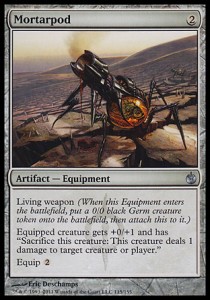
Mortarpod, for example, is one of the best cards in the deck due to its ability to trigger Morbid. Several of my opponents, good players at that, just plum forgot it was a creature. Usually, Mortarpod acts as a mere removal spell that can subsequently be reequipped for value. In this deck, the Germ token has added value as a body to tap for [card Skirsdag High Priest]Skirsdag High Priest's[/card] ability.

Let me mention Gravecrawler again for a moment. While he seems like a fairly straight-forward card, he actually forces you to play a slightly different game.

As competitive Magic players, we sometimes take for granted how we play cards because we are so used to doing things that way. We generally wait to play new creatures until after combat in order to leave mana up. This not only helps us win more combats, but also gives our opponent less information about our plans. In short, playing creatures during the second main phase is almost always better.

In this deck there are plenty of times when that is not the case.

One time in particular, I drew my card for the turn and immediately moved to combat, only to realize that my opponent could block my Gravecrawler. This would leave me without another zombie and hence unable to rebuy the Gravecrawler. Luckily I had top-decked one, but if I not, I would have missed an attack for no good reason.

When to play Diregraf Captain applies here too, but playing your lord before combat to gain the additional power and toughness should be easier to see.

The Anatomy of an Undead Army

Getting back to my original point, Zombies is very good. In case you missed it, the deck made top eight of both the Grand Prix and SCG events this past weekend. At the SCG event, there were a total of two copies in the top eight and two more in the top sixteen.

There is some disagreement over exactly how to build the zombie deck. The core is the same in all of them, but that core basically boils down to Gravecrawler and Geralfs Messenger. Blue mana is not even guaranteed, as one of the SCG decks splashed white for Lingering Souls and some players opt for a red splash instead. All in all, there is still lots of room for innovation.

The version from this weekend that most closely resembled mine was Matt Scott's, which he piloted to the top eight of the Grand Prix. Here is his list:

Matt Scott's UB Zombies

Standard -- Grand Prix Baltimore 2012

Untitled Deck

Creatures

4 Diregraf Captain
4 Diregraf Ghoul
2 Fume Spitter
4 Geralfs Messenger
4 Gravecrawler
4 Phantasmal Image
2 Phyrexian Obliterator
2 Skirsdag High Priest

Spells

3 Geths Verdict
4 Mortarpod
2 Sword of Feast and Famine
3 Tragic Slip

Lands

4 Darkslick Shores
4 Drowned Catacomb
14 Swamp

Sideboard

1 Cemetery Reaper
3 Corrosive Gale
3 Distress
2 Nihil Spellbomb
1 Phyrexian Metamorph
2 Phyrexian Obliterator
1 Swamp
2 Sword of War and Peace


The main difference between this list and mine is Matt's inclusion of Sword of Feast and Famine. This card has been virtually absent from Standard for a few months now, but we may see a resurgence due to the recent popularity of Wolf Run Ramp and Blue Black Control. Sword seems well suited to bring down both of these decks, as attacking their hand can be an effective strategy.

However, Protection is not what it used to be because of the adoption of cards like Geths Verdict, Liliana of the Veil and Slagstorm. The sword's mana cost is also of some concern. With only twenty-two lands, you may have a rough time surprising opponents. Usually you'll need to take a turn to play the sword and another to equip it. Luckily, you do have a recurring threat in Gravecrawler, which makes Sword better.

In the current iteration of my list, I've opted for fewer [card Diregraf Captain]Diregraf Captains[/card] and more [card Fume Spitter]Fume Spitters[/card], but the rest of the cards are basically the same. If you like this deck, there is some wiggle room to adjust it to your play style and preferences.

Conclusion

After playing Red Black Vampires for so long last season, I found it easy to jump on board with this deck. If you enjoy an aggro-control strategy, this may be the deck for you.

You can even relive last season and jam red/black aggro all over again! Just thinking about Brimstone Volley in a deck with Mortarpod and Fume Spitter has me itching to brew up a red/black list.

That, however, is for another day. For now, I am set on the power of Phantasmal Image.

Regardless of your like or dislike for the zombie tribe, make sure you're prepared for it at your next major event. No life total is safe.

Until next time,

Unleash the Zombie Apocalypse!

Mike Lanigan
MtgJedi on Twitter
Jedicouncilman23@gmail.com

Monday Night Magic #299 | Pray I Don’t Alter It Any Further

Are you a Quiet Speculation member?

If not, now is a perfect time to join up! Our powerful tools, breaking-news analysis, and exclusive Discord channel will make sure you stay up to date and ahead of the curve.

"You read it somewhere else, but you heard it here first!"

Hit the button to play, or download the entire episode!

Our Sponsors

We are brought to you by MTGOTraders.comCapeFearGames.comCardHoarder.comDecked BuilderDrafter iPhone apps, MagicOnABudget.comHalfPriceHobbies.comMTGPad.com and MTGMintCard.com!
Get your own MTGCast t-shirt today! - http://www.zazzle.com/mtgcastshirts

MNM Host(s) This Week

Jason 'Chewie' Slate from Monday Night Magic - http://www.mtgcast.com/

Jack LaCroix from Monday Night Magic - http://www.mtgcast.com/

Marshall Sutcliffe from Limited Resources - http://www.mtgcast.com/

Ron Faris  from Black Wing Studios - http://blackwingstudio.blogspot.com

This Week in Magic and other MTGCast News

-- Jack and Chewie are joined by L3 Judge Sean Catanese, Ron Faris of Black Wing Studio (http://blackwingstudio.blogspot.com), and Marshall from the Limited Resources podcast (http://LRCast.com) to talk about everything from warning letters to GP results to PTQs to artistic expressions.  Sure it's a long episode, but it will be well worth your time as we have packed a LOT of information and fun into it!

-- Pastimes responds to playmat fiasco

-- Edgar Flores suspended for 3 months "for misrepresenting game state" supposedly due to his DQ at SCG Indy

-- But Dad, Two Explores by Scott Holmes

-- Congratulations to Raphael Levy who is now officially the all-time leader on Pro Points. He passed Kai Budde with a 32nd place at #gpmadrid

-- GP Madrid

-- GP Baltimore

-- Quote from Scott Marshall (Level 5 DCI Judge):  I expect that the next PTQ round will be placed with stores.  NOTE:  The next season starts on April 1st.

-- Aaron Forsythe Twitter Quote -- Cool #WorldMagicCup fact #1: Team members will be able to talk to each other as they build their draft decks on Day 1.

-- Aaron Forsythe Twitter Quote -- Cool #WorldMagicCup fact #2: The first tiebreaker for determining which player gets cut after Day 1 will be Pro Point total from this year

-- The Magic Cup Rules

-- The Magic Cup Player Race and Possible Qualifiers (Brian David-Marshall)

-- MTGO Release Events -- Feb 22 through March 9

-- What do you think of playing altered cards in a tournament? There's text box confusion, possibility of cheating, etc

-- Heading 3.3 Authorized Cards: Artistic modifications are acceptable in sanctioned tournaments, provided that the modifications do not make the card unrecognizable, contain substantial strategic advice, or contain offensive images.  Artistic modifications also may not obstruct or change the mana cost or name of the card.

The Head Judge is the final authority on acceptable cards for a tournament.

-- The MortarPod Podcast is done and will no longer exist.  The hosts have requested that all of its shows be pulled off of the MTGCast Network immediately as well, making them the first such Podcast to request "self-censorship" from the internet.

-- We'll start here for next week

-- Gold Run at GP:SLC -- $12,000 in free cards

-- MS Charity Magic tourney

Magic Calendar

-- MTG MOM Events Calendar

-- MTGO Events Calendar

MTGCast Website Donations

-- MTGCast in is need of Donations. We are a bit low behind the monthly goals at this point.

MTGO MTGCast Official Clan: Limited Resources

Contact "marshall_LR" in game to join the MTGO Clan, Limited Resources. Marshall can also be reached via twitter at: http://twitter.com/#!/Marshall_LR
Subscribe to the MTGCast Monday Night Magic RSS feed!
RSS feed for Monday Night Magic
iTunes feed for all shows on the MTGCast network
RSS feed for all shows on the MTGCast network
Twitter for MTGCast
Hoodchefz favored by MTGCast crew

Contact Us!
Call us and leave a voice message at 570-486-6637!

Join the MTGCast Facebook Group - Discussion, Photos, Videos and More!

Chewie at chewie@mtgcast.com -- http://twitter.com/#!/themanapool

Jack LaCroix at jack@mtgcast.com -- http://www.twitter.com/jacklacroix
Christopher E. Otwell at otwellc@mtgcast.com-- http://www.twitter.com/otwellc
Tom Gustafson at pitimp@mtgcast.com -- http://www.twitter.com/mtgcast

Chris Lansdell at lansdellicious@gmail.com -- http://www.twitter.com/#!/lansdellicious
Adena Chernosky at prsgrrl@gmail.com -- http://twitter.com/#!/prsgrrl
Eric McCormick at eric@mtgcast.com -- http://twitter.com/#!/EricMTGcast
Conley Woods at conley@mtgcast.com -- http://twitter.com/#!/Conley81
Robert Martin at robert@mtgcast.com -- http://www.twitter.com/thebeme
Tristan Gregson at tsg@channelfireball.com -- http://twitter.com/#!/TristanGregson
Marcel White at marcel@mtgcast.com -- http://twitter.com/#!/AllUpOnMyDeck

Chewie, Jack, Chris, Adena, Eric, Conley, Marcel, Chris, Robert, & Tom - The Monday Night Magic News Team!

Insider: Did You Know..?

Are you a Quiet Speculation member?

If not, now is a perfect time to join up! Our powerful tools, breaking-news analysis, and exclusive Discord channel will make sure you stay up to date and ahead of the curve.

We’re at a in interesting place in the financial world of Magic. And with the changes to set releases back in 2009, the Pro-Tour and GP schedule changes over the last several years, and the increased frequency and spread of the SCG opens, getting a better feel for what the seasonality of demand really looks like is possible.

We also get amazing promotional products geared for different types of players and collectors like Commander products and From the Vaults. Sometimes I get so caught up in the right now, we need to step back and look at the big picture again.

Did you know... Modern PTQ season ends in 31 days?

Our LGS hosted its first PTQ in history this season and it was a pretty awesome event. For the weeks leading up to it, almost all trade talks in the store involved one person trying to locate a Modern card to finish up their deck.

Since then, however, I’ve been watching people dump that stuff back off for Standard cards. Why? Because, believe it or not, when you have a PTQ or even just a “special” event at your store, all the players who play there want to try it out.

They all wanted to give their Modern homebrew a run against the top decks. Now it’s over, they’re ready to go back to EDH or Standard or Draft, or what ever it is that scratches their itch. After Modern season ends, the quantity of people interested in Modern dwindles quickly, and even as the season approaches a close, people will be shifting away form their Modern cards as soon as it becomes irrelevant to them.

In my community, for some players that was this past Saturday. For others it’s in two weeks after a PTQ 80 miles away. I plan to use my Modern deck a few more times, so I can’t tear it apart yet, but any other trade stock is getting dumped at GP Seattle this weekend to the highest Buy List.

Whatever you need to play kepp, but, from a financial standpoint, anything that has already showed significant gains, is ready to ship out. Exceptions are cards that maintain relevance either in Standard or Legacy.

Did you know... Wizards is releasing a Land centric From the Vaults: Realms?

Sure, who knows what 15 lands will be all foiled out for this promotion, but FTV: Dragons still sells for over $75 sealed on eBay. And if we key cards in this set, it will surpass all of its predecessors.

If any retailer starts pre-selling these before spoilers hit of what’s inside, I’m going to gamble on it as big as possible. And so is Ted Knutson, and he usually doesn't open his mouth without knowing what he's talking about.

The art on the front of the announcement sure as heck looks like a Glacial Chasm to me, and I’d be willing to wager we see that in the pile. While a narrow Legacy card, it’s still a Legacy card and alone would see some demand.

Keep in mind, we won’t be seeing Dual Lands or Tabernacle of the Pendrell Vale as they are on the Reserved List, but there are plenty of desirable lands that aren’t. And remember that they usually include a spoiler from the new block in this set, so we should be watching this as it develops very closely.

Did you know... Standard is still Top Dawg?

Back in May of last year, I wrote about “Riding PTQ Waves”. So, let’s keep riding them.

As mentioned in the first section, Modern Season is ending and Standard is on it’s way. Combine that with the LGS promotions WotC is running, including Game Days, makes Standard a “Year-round” format.Of course PTQ season inflates it and we need to be prepped for it.

Innistrad Lands really have shot up a lot faster than I thought they would, so hopefully you started picking them up upon my reccomendation in November. These are only going to continue to grow. Even then I was skeptical of some of the non-Blue lands, but since then we’ve seen the printing of Sorin, Lord of Innistrad and Lingering Souls, so we can safely assume that Isolated Chapel is going to be around.

If you can connect the dots here, I’m suggesting to move out any excess Modern stock for Standard manabase. And do so en masse. I know QS’s own Sigmund (@sigfig8) is sensing the same thing I am, and I’ve spent the better course of a year laying out what this seasonal cycle looks like and how to be best positioned. Time to take the full cycle's results and package it into our business plan to make the next cycle even better.

I’m looking forward to a profitable Standard Season while I close out my profits on Modern.

I’ve been meaning to post a piece about taxes with respect to Magic profits, but I had a delay with my interview, so for those that mentioned it on Twitter, it’s coming next week.

Also, if you’ll be at GP Seattle, ping me on Twitter (@torerotutor) and say hello!

Insider: The Prizes and Pitfalls of the Obscure

Are you a Quiet Speculation member?

If not, now is a perfect time to join up! Our powerful tools, breaking-news analysis, and exclusive Discord channel will make sure you stay up to date and ahead of the curve.

I have a confession to make: I still own and avidly enjoy playing my Sega Saturn. The system flopped miserably in the United States. But before the system was pulled from the market, a few truly unique and exciting games slipped through the cracks and hit store shelves.

Unfortunately many of these sparsely known gems can also fetch a pretty penny! For example, consider what some claim to be the best Sega Saturn game (certainly the best RPG for the system):

Ok, I’ll admit this is an extreme scenario – the game is in mint condition and brand new. Still, opened versions of Panzer Dragoon Saga easily fetch in excess of $300 on popular auction sites. Who is paying this much for a relatively ancient video game?! There is someone out there who must be willing to pay this much or else these rare games would not be so expensive (in fact, there was one offer on this item that was declined).

What Does This Have To Do With Magic?

Like many hobbies, Magic has its fair share of the unique. These oddities often sell for phenomenal amounts of money. Some even exceed the costs of the game’s most valuable set-print card, Black Lotus.

But there is some risk to these obscurities. While they may have an attached retail value, an item’s true value can also be defined as the amount someone else is willing to pay for the item! The eBay listing I referenced above may truly “retail” for $1500. However since the game has no intrinsic value, the seller will eventually have to settle for the value as a second party perceives it. Otherwise the seller will be doomed to hold this game forever.

Thus, we have identified that there can be tremendous profit in the unique Magic Card market. Find the right buyer, who values your oddity at a high price, and you can make significant cash. But this endeavor can be a double-edged sword.

Case Study: Chinese Portal Starlit Angel

Because I collect Angels, this is my favorite obscure card example. What makes this card so rare? To answer, I defer to MagicLibrarities.net for the concise explanation:

The Chinese government has restrictions of what can and can not be depicted. Specifically, depictions of death, religion, or erotica are prohibited. Consequently, when Wizards of the Coast printed card sets for distribution in China, several artworks had to be changed. Over time, the artwork was no longer replaced, but modified. Furthermore, Wizards of the Coast has decided to meet Chinese standards when commissioning new artwork, hence alternate art has rarely become necessary anymore.

As luck would have it, there was one Angel that required special artwork for China – Portal’s Starlit Angel. Because there are many Angel collectors in the game, this card’s retail value has shot up. People who moved on this card early on have the potential to make significant profit!

As a savvy buyer, however, I refuse to pay such a high cost for this card. I am confident that should this card ever go to auction, the final sale price would be significantly lower – equal to the highest amount a buyer is willing to pay.

Being an avid Angel collector, I happen to know that there has not been such an auction for a very long time. I repeatedly see this card relisted every thirty days or so with no successful sale. This seller is a wise one because he knows that forcing bidding to end via a week-long auction will lead to a significantly less payout. Of course, eventually either some desperate buyer will pull the trigger or the seller will get sick of holding this piece of cardboard and he’ll reduce the price. It becomes a game of chicken at this point.

More Realistic Cases

While not many players possess the Chinese Portal Starlit Angel, many players still own cards which are less available than the average Mythic Rare. Examples include Japanese foil playables, [card Snow Mercy]Holiday Promo Cards[/card], Summer Magic, Misprints, Altered cards, and the list goes on.

I’ve already demonstrated that there can be opportunity to profit from these Magic oddities. How can we maximize profit from these rarities when we come across them? I’ll divide this up into two sections: acquiring and unloading.

Acquiring Rarities

There is one fundamental rule that you should follow when acquiring these rarities: research! Knowing what these cards retail for, auction for, and buylist for is absolutely critical to ensuring you are acquiring these cards at a price point which enables profit.

An example I recently encountered involved the Holiday Promo Snow Mercy. I was interested in picking one of these up for my personal collection and so I did some research on their value. I saw that eBay auctions typically ended in the $60-70 price range. Meanwhile, Star City Games buys the rarity for $50 and sells it for…get this…$100!

Did you know that this large of a discrepancy existed? I was absolutely shocked. A few weeks ago I came across a vendor at a PTQ selling a copy of Snow Mercy for the bargain price of $45. I put that meme in the back of my mind and continued to battle through the tournament.

After 7 grueling rounds (and going 4-3 drop, unfortunately), I returned to the same dealer only to observe that the Snow Mercy was still for sale! I was baffled to see that no one saw that this card was priced below buylist price, especially with the ubiquity of Smart Phones. I assume the reason no one else jumped on this opportunity was either because they didn’t do their research or they didn’t want to bother with finding a buyer for this card. But with a guaranteed sale of $50, downside was altogether absent.

The moral of this anecdote is that the average Magic player is not familiar with values of the obscure. These are your opportunities to acquire. Before I get attacked for poor morals and taking advantage of ignorance, I am NOT advocating that you value your friend’s Snow Mercy at $20 in an attempt to profit. You still need to choose a viable basis for your valuations.

However, there should be no moral qualms with valuing your trade partner’s rarity at slightly below eBay price – after all, finding the perfect buyer willing to pay near retail price for the card takes a lot of work and you are entitled to a small premium for doing that work for your trade partner. A pseudo-finder’s fee of sorts, this practice enables the acquirer to make profit while providing the seller an asset which is in much higher demand (cash, format staples, etc.). Not to mention you are saving them the hassle sometimes associated with online sales: waiting for a buyer, fees, having to go to the post office, etc. It is instant gratification for them. And this should carry a price.

If no eBay auctions have ended recently for the given card (such as my Chinese Portal Starlit Angel example), then start with roughly half retail price as a negotiating point.

Unloading Rarities

After you’ve acquired an oddity or two, it becomes time to begin the unloading process. I want to emphasize here that I would not recommend acquiring multiples of a single oddity nor would I myself go deep in picking up obscure cards. This will result in a lopsided portfolio, filled with cards the average FNM attendee couldn’t care less about.

Instead, focus on having a few of these oddities on hand at any given time. Make sure they are fully visible in your trade binder (I’d recommend the center of your front page) so that if you stumble upon the right buyer at a tournament you maximize the likelihood that buyer gets wind of the fact that you own this oddity.

This technique alone may not be enough. My Snow Mercy was in my trade binder for a couple weeks and multiple tournaments and not a single person even mentioned the card while turning the pages of my binder. Clearly, another outlet was needed.

Enter: the internet. Sites like MOTL are a great way to unload obscure Magic Cards because your post reaches a ton of prospective buyers instantaneously. The more people who know of your rare cards, the more likely the one person willing to pay close to retail will be discovered. A match made in heaven.

Finally, as a last resort, I can condone turning to eBay. But only under one condition. Do NOT set your item to sell via auction with a starting bid below a price you’re happy with. Obscure cards like the Chinese Portal Starlit Angel are attractive to very few people. And if not enough such people see your auction, your ending price will end up far below what you had hoped.

Instead, use either the buy it now option or set the starting bid of the auction to be around where you’re hoping to sell. This ensures the card will only sell if someone is willing to pay at least your bottom line. Your profit is protected – just remember that the card is only going to sell when it is cheap enough for the buyer to perceive it is a good price. Typical supply vs. demand economics hold true.

Quite the Adventure

Trading in the obscure can be very exciting, but it is also feast or famine. Pay too high of a price and you will be destined to hold the card forever hoping to find the one desperate buyer.

Your goal should be simple: find the sellers looking to unload their obscure cards for quick cash or format staples and then unload these cards to the collectors who want to complete their sets of obscure cards. By taking on the task of mediating between the two, you can be rewarded with ample profits.

I ended up selling the Snow Mercy on MOTL for $65 shipped. I could have held out for more, potentially waiting until someone would give me close to the retail price of $100. But I recognized that holding this card in inventory was doing me no good, and I was willing to settle with a $15 dollar profit with a quick sale. Perhaps the buyer knows someone who will pay $100 – if so, the cycle will continue.

Eventually the collectors will find the cards they’re looking for and at an acceptable price. The key is to help move that process along while snagging profit along the way.

-Sigmund Ausfresser
@sigfig8

Want Prices?

Browse thousands of prices with the first and most comprehensive MTG Finance tool around.


Trader Tools lists both buylist and retail prices for every MTG card, going back a decade.

Quiet Speculation