menu

An Introduction to Alterations

Are you a Quiet Speculation member?

If not, now is a perfect time to join up! Our powerful tools, breaking-news analysis, and exclusive Discord channel will make sure you stay up to date and ahead of the curve.

Editor's Note: Here is yet another free sampling of the kind of material we are covering in the Insider section of the magazine. Starting with the next article in this series, we are going to be running this as Insider exclusive, so if you have ever held an interest in how to create your own alters or the price values that can be associated with them, grab an Insider subscription! ~Conrad

Introduction to Painting

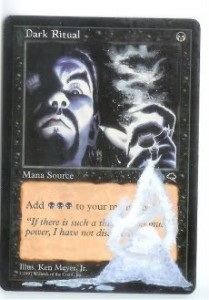
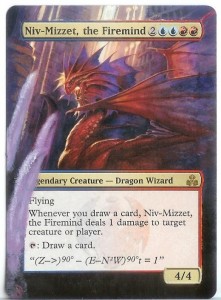
You probably all know that one guy at your local shop who can alter cards. The guy who painted the Eye of Sauron on the Sol Ring and has a Dark Tutor with Darth Vader on it. His EDH general is borderless and even though you act like you dont notice, you do. You may have thought about trying it yourself, but you are too afraid to ruin your cards. The more financial minded of you have probably thought about how the alteration would effect the price of the card. If you have about thought either of these things then please keep reading.

Before we get into things, I think a quick introduction is in order. My name is Mike, I've been playing Magic for upwards of 6 years now. I've not won any kind of major tournament, there are no PTQ top 8's to my name (though I did take down a GPT once), and as a player, I'm VERY average. My greatest accomplishment so far in Magic was when somebody saw a card that I altered, and liked it so much he paid me to make one for him. He then told his friends, and a couple of them also commissioned me for a couple of cards. I wish I could say that this snowballed into an in-home business, but it hasn't. It has however continued enough to allow me to play Magic for free. Sound like a plan? Let's get to the good stuff!

What are the Benefits?

Well, as I stated above, if you practice enough you could become the go to guy for commission work in your area. The other benefit being that you have yet another way to “pimp” your decks. Consider that almost every EDH deck runs a Sol Ring but up until recently there had never been a foil version. That left you with either trying to get one from Alpha or having a drab mud-colored white-bordered card sticking out from amongst your otherwise shiny deck.  For those of you who care, this is a big deal. For those who are just happy to have a Sol Ring, hang with me. As for the price, well I have seen an average of 40% percent increase in the cards value when I sell them.

But I'm not an Artist....

Whenever people see my cards the first thing that comes out of their mouths (after they ask “did you do that?') is that they “don't have the talent”. This is false. I have always maintained that if you can write with a pen, you can paint. It does take a bit of practice though, and in some cases a touch of direction, which is where I come in.  Let's jump in shall we?

Tools of the Trade

There are a number of things that can be helpful when painting, but this list will only show you the most basic necessities. I don't want to price you right out of the game before we start.

Paint – I use Liquitex brand acrylic paint. This can be found in a starter set at your local craft store for around $20. The set will include red, green, yellow, blue, black, and white.

Brushes -  This is subject to preference, but for the purposes of this list, I like to use a flat blending brush, Size number 4 or smaller. These can vary in price from $2-$12, I haven't noticed a difference in quality so feel free to go cheap. It helps to have two or three different sizes though.

Canvas – You'll notice that I mount my cards on a 4in x 6in canvas. These aren't necessary but you do want to find something to mount your cards on. Anything from cardboard to scrap wood will do. The goal is to be able to pick up your card without touching it.

Paint Thinner – A small bottle should be like $4. This is a necessity for keeping your brushes clean.

Tooth Picks – Your most dangerous tool. The hope is that you'll only use it to clean up edges. A hundred tooth picks might cost you a dollar.

2 Small Cups – One for tap water, and one for paint thinner. Dixie Cups will work.

Paper Towel – Always handy...

For Starters...

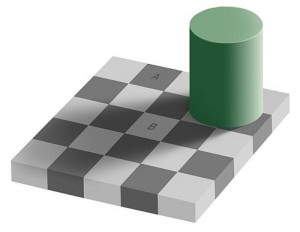
Choose a bulk common to practice on. Something with a simple design, perhaps with a small range of color. Basic lands work perfectly for this. Find yourself a clear surface to work on. Be sure to use newspaper on anything that is not going to be primarily a designated paint area. Make sure also to have good light to work with. Use your white paint to create a primer layer. While that's drying use the paint and your knowledge of the color wheel to try and match the colors on the card. Remember that it wont take very much paint to cover such a small area. The idea is to train your eye to see through the illusions created by the colors at work (such as the one pictured)  Don't be discouraged, this is the most difficult thing about altering any card but it can be mastered with some practice. Experimenting will lead to more learning than reading a guide will ever do. Speaking of guides, join me next week when we “Go for the Throat”.

The Painters Servant

Everything Old Is New Again

Are you a Quiet Speculation member?

If not, now is a perfect time to join up! Our powerful tools, breaking-news analysis, and exclusive Discord channel will make sure you stay up to date and ahead of the curve.

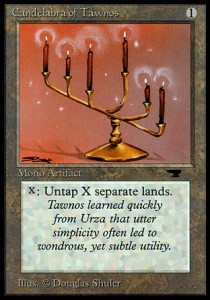
If you're like me, you traded for a Candelabra of Tawnos 6 months ago at $25 and just traded it away at $175. This didn't happen because I predicted the unbanning of Time Spiral and subsequent reemergence of High Tide as a deck. This happened because I play EDH (Commander). Candelabra is a good card that works well in EDH, so I had one when the price spiked. I'm not saying I'm about to make you hundreds of dollars, but there are certain things you should be looking for if you play EDH so that you can reap the benefits of spikes like this.

Before going into further detail, I should also mention that it's almost certain all EDH staples are going to increase in value this summer when both the Commander precon decks and From The Vault: Legends are released. These two products should generate interest in the format, which means demand will increase. Even if you don't pick up anything that has a ridiculous spike, there's still a high likelihood of a lot of these cards gaining value. How much I can't tell you, but most of the things you're looking for are so cheap it's almost impossible to lose money anyway. Here are the categories of cards you should be looking for:

Foil Legendary Creatures - This one is obvious, but it still bears repeating. Legendary creatures are on the rise, and a lot of them are far too inexpensive for how powerful they are as generals (commanders).

Colorless Utility Cards - This is another obvious one, but I don't want people in the comments saying that I ignored either of these groups. Colorless utility cards are the cards that can go in every deck. Many of these have already seen EDH related price hikes, such as Maze of Ith and Sword of Fire and Ice and its brethren. Some already have price hikes to the foils like Mind's Eye, Sculpting Steel, and Oblivion Stone. Finding cheap foil EDH cards is certainly the best investment, but even non-foils have a good chance of gaining value, albeit less dramatically so.

Along these lines, I absolutely recommend picking up Contagion Engine every time you get a chance,  especially foils. This is THE colorless utility card: it wipes an opponent's board, helps you kill people with poison, pumps any of your creatures with +1/+1 counters, and accelerates your planeswalkers. It even has more bizarre and hilarious applications like making Goblin Bomb threatening or Chance Encounter a viable win condition.

Shards Block Foil Mythics - A number of these mythics are legendary creatures, so technically they're already covered. The reason that I'm singling them out, however is the all foil Shards block packs. It's no mystery that the older a card gets, the more its price will rise if it sees continuous demand. Most old cards are worthless, but the cards that have always had demand, such as Sliver Queen and the Darksteel swords, keep going up (no promises as to how quickly). Many of these mythic rares will see continuous demand because they're great for EDH, be they generals or otherwise. Most of these mythics are also grotesquely undervalued because of the glut of foils resulting from the ill-conceived Shards block foil packs. Kresh, the Bloodbraided foil can be picked up for about $3 pretty easily. Considering that this is one of the easiest generals to kill someone with in a single hit, that's pretty strange. You can get Maelstrom Nexus for about the same price, and that's a must-have for every five color EDH deck ever. There are still foil Shards block packs available because the demand for the packs was so low (which, if you're reading, Wizards, was only because of the price) but once the influx of new supply dries up, we'll see the price rise. I expect some of these cards to have dramatic increases.

Cards With Off-Color Abilities - People enjoy playing mono-coloured EDH decks for a number of reasons. You'll never get colour screwed, you don't have to spend money on expensive mana bases, and you get access to powerful cards like Extraplanar Lens and the [card Sapphire Medallion]Tempest medallions[/card]. Every color has its weakness, however, because of the colour pie. Of course, the colour pie has changed multiple times, and Wizards used to frequently prints off-color cards.

Have you ever lost a game to Sword of Light and Shadow because your mono-black deck can't destroy artifacts?

Well a card that has seen a recent price spike from mere pennies to multiple dollars, Gate to Phyrexia, can keep that from happening. These cards are very limited in how much they can raise in price because they're normally very specific and often underpowered cards, but any profit is good. Oh, and making your deck better is good too.

Cards With Obviously Powerful Abilities That Nobody Cares About- And here we have it. This is where you have the chance to make real money, if you get lucky. Candelabra was a blatantly powerful card. In a format like EDH where lands [card Miraris Wake]never tap for a single mana[/card], Candelabra was like a 1 mana Mirari's Wake. Eureka has an enormously powerful ability that was great for multiplayer fun. And I'm not even going to get started on how many stupid applications Power Artifact has. Now many of these cards that no one cards about, cards like Karmic Justice, Mana Reflection, and Hunting Grounds are unlikely to ever have tournament applications. Flip through your binders though or search through old sets on gatherer to find more cards with ridiculous abilities. If they're affordable and have EDH applications, there's a good chance you'll see them rise at least a little bit. And if you get really lucky, you may have just accidentally bought the next big legacy card.

Plodding through Prophecy (yes, there are valuable cards in the set)

Are you a Quiet Speculation member?

If not, now is a perfect time to join up! Our powerful tools, breaking-news analysis, and exclusive Discord channel will make sure you stay up to date and ahead of the curve.

Prophecy... the set is the butt of jokes about worthless sets. It's like all the good cards were just used up in the previous sets and this is the chaff we have left. However, there's money to be made in the unlikeliest of places, including Prophecy. This article will be a little longer than you think, since some of the Prophecy foils can catch big dollars. Let's start looking!

editor's note: yes, we realize that Nemesis hasn't been covered yet. Doug's mind was so clouded with the mediocrity of Prophecy that he submitted this one first. Expect the better follow-on set next week!

Avatar of Fury

Our first card is, perhaps, the most puzzling to me. The Avatar has been played in zero real decks. It looks like a dragon, behaves like one, but doesn't even have the correct type line! My best guess is that Dragon collectors still want to have it. Since it's not patently awful as far as Dragons go, and since it was only printed in PR, it commands a bit of a value. It's good to know about because these are the kinds of cards you can scoop up as throw-ins or shark from dealer boxes if you're fortunate enough to find them. Just don't expect to trade them off easily!

$1.75

Avatar of Hope

The only reason I mention this clunker is that some people apparently really want it in foil (and also get down to 3 life often enough to need it).

$12.00 (with the caveat that it only appeared in two Ebay auctions)

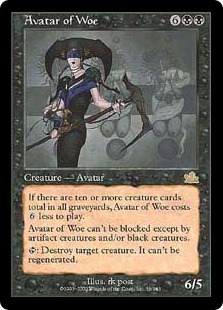
Avatar of Woe

Avatar of WHOA YEAH!

The Avatar is great for casual players: easy to understand, great in multiplayer, and cool rk post art. It's sometimes outclassed by Visara the Dreadful, but it still reigns for fans. Though it's been reprinted in Time Spiral, the Avatar retains a bit of its value. However, don't expect the $15 tag it used to command. They are tradeable to EDH players and casual crowds, and you'll find ready buyers online.

The Avatar seems to hold a special place for a lot of players; it was the first of its kind to offer truly unbridled creature-kill, and it's a combat monster to boot. It's no wonder folks love it.

$4.00

Foil

Foil Foil, get it? People like the dumb pun enough to drive up the price of the foil. Surprisingly highly tradeable in foil.

$4.25

Plague Wind

Though Plague Wind has been reprinted, the PR printing remains the only black-bordered copy. People love their black sweeper spells in Commander (see Decree of Pain's price) and this is a superb one. In the big-mana format, playing the Wind isn't a challenge, and the advantage of clearing away opposing creatures for an alpha-strike is pretty good.

Rhystic Study

Again, this card is also driven by casual players. Prophecy's notable Contructed cards were things like Chimeric Idol and... um, Ribbon Snake, and those cards don't sit well outside of that specific Standard environment. Rhystic Study is the best of the Rhystic cycle, which was basically “hope your opponent taps out all the time or your cards are blank.” This card, reminiscent of Mystic Remora, lets you draw unfair piles of cards early in the game, and any other time an opponent would forget to pay for it.

Foils of Rhystic Study are absurdly priced, but even the regular version is decently valuable. The trick is that most people only want one copy, not four. So, they can be challenging to move.

$1.00, about $15.00 in foil

Squirrel Wrangler

We've gone through the “people love Squirrels” phenomenon before, and this guy is a fan favorite. Though it isn't as good as Deranged Hermit, it does serve as a repeated Squirrel factory (and can pump them, too). What I find really interesting about it is that the foils have almost no markup over the regular copies, which leads me to believe that Squirrel fans don't like foils. I don't know that you can move this quickly, but there are people who want them.

$1.00

Certified broken in drafts.

So, in short, I apologize that Prophecy was such an awful set that most of its money rares could be used as coasters to no ill effect. The mechanics were pretty flawed; I get that they wanted lands to matter, but when it sits in the same block as Rishadan Port, you won't get people trimming spare lands often. If they wanted things to matter more, they could have riffed on the kind of things that Dragonspeaker Shaman and Temple of the False God relate to. They could have devoted the block to it. They could have put in lands that matter in Prophecy. As it is, the set is mainly oriented to making use of a resource that isn't easily returned and that people don't pack surplus of in their decks. Then they go and make a card like Troubled Healer to ruin limited.

I promise, readers, that next week will be Nemesis and we'll have more to talk about.

Until then,

Doug Linn

Infinite Boxes

Are you a Quiet Speculation member?

If not, now is a perfect time to join up! Our powerful tools, breaking-news analysis, and exclusive Discord channel will make sure you stay up to date and ahead of the curve.

Hello there.  How did your box(s) turn out?  I hope well because there certainly is an extremely high variance between them.  Some boxes have three Tezzerets and some have none. In case you don’t know what I am talking about, in my last article, I wrote about the process that I have been using for the last year to buy a continuous stream of boxes with each set release.

I was excited about the strong response I received from my last article, even if many people questioned the method.  In case you missed it, here is the basic premise.  When you buy a box of cards, typically you do not need all of the cards in the box.  Usually in a set there are only a few mythics or rares that you need.  Most of the other mythics and rares you open go into the trade binder or get lost somewhere in your collection.  The goal of this method is to recycle those unused rares and make them into more boxes.  Most of us do not have a ton of extra money that we can afford to buy a couple boxes every time a set comes out so this method is to help with the cost of playing this great game.

If this was your first foray into the world of finance, perfect, this set was 100% amazing for starting to pay attention to the financial side of magic.  If you have been doing this for a while, well then, you were probably disappointed a bit with the set depending on how your boxes turned out.  You may have been on the three Tezz side of variance but I was on the zero side unfortunately.

The reason that I say this was the perfect set to start this method is because it did exactly what it was supposed to do in terms of protecting your investment.  With the amount of variance between Tezz and non-Tezz boxes the number of cards that needed to be sold to cover your investment varied somewhere between a Tezz and a handful of other cards to virtually all the cards that a website was buying.

**Pause for aside.  Alright, I know that last statement might seem ridiculous to some of you financiers out there but you have to look at this process through the eyes of someone just getting started in this money side of magic.  This is perfect for someone trying to get their feet wet.  Sure you might not be able to keep all the mythics you open but at least the investment is still there for when the next set comes out so the continuation of competitive play may continue.  Keep in mind that when I started this it was because too much of my trading resources went into trading for dumb stuff like uncommons. I simply could not afford to buy them or the boxes to crack them from.  End aside**

Another reason that this set was a perfect place to start this method is because many of the cards in demand are designed for distinctly different archetypes.  For example, you are most likely not going to need Hero of Oxid Ridge, Blightsteel Colossus, and Thrun.  These are distinctly different cards with distinctly different purposes.  Rarely would these cards go in the same deck.  The red hero is designed for an aggressive deck, Blightsteel a combo deck, and Thrun a midrange or control deck.  The same goes for the rares.  Think about opening these following three rares:  Green Sun's Zenith, Black Sun's Zenith, and Contested Warzone.  I doubt anyone is playing those cards together.  Even if you think that they can be played together, the point is that the set is not geared toward just one main archetype, there are cards for everyone and hopefully you figured out which ones were for you.

So what was the goal for this method?  Step one, order your box.  Step two, determine what cards you actually want from the set.  Step three, sell the rest.

Well let’s take a look at my box and see what happened when I put this method to work.

White:

Mirran Crusader

Victory's Herald

White Sun's Zenith

Blue:

Blue Sun's Zenith

Distant Memories

Mitotic Manipulation

Black:

2x Black Sun's Zenith

Massacre Wurm

2x Phyrexian Vatmother

2x Sangromancer

Red:

2x Galvanoth

Slagstorm

Green:

Green Sun's Zenith

Phyrexian Hydra

Praetor's Council

Thrun, the Last Troll

Multi-Color:

None

Artifact:

Bonehord

Darksteel Plate

Decimator Web

Knowledge Pool

Magnetic Mine

Mirror Works

Myr Turbine

Phyrexian Revoker

Psychosis Crawler

Shimmer Myr

Spine of Ish Sah

2x Sword of Feast and Famine

Land:

2x Contested Warzone

Uncommons:

2x Go for the Throat

If you look over this list of cards and highlight the ones you can sell, you will notice that this box did not go very well.  Sure there are two Sword of Feast and Famines but past that, it goes downhill quickly.  In my experience with this set, this is on the low end but basically a typical box.  Sure there are much better ones than this but it doesn’t get much worse.  This is about average in terms of what you normally open.  With this being a small set, most boxes have a copy of almost all the rares.  That is actually great for this set because there are a bunch of rares that we actually care about in terms of selling.  Now just figure out what you want to keep.  This was pretty easy for me because I am playing valakut at the moment, so my needs were Green Sun's Zenith and Slagstorm.  Past that the only cards I need would be if I decide to play something else or if I am thinking about EDH (commander).

So here’s the list of cards that we can sell from this box and what they sold for.

White:

Mirran Crusader        3.00

White Sun's Zenith              .50

Blue:

Blue Sun's Zenith        .50

Black:

2x Black Sun's Zenith         3.00 (6.00)

Massacre Wurm          4.00

2x Phyrexian Vatmother    .50 (1.00)

Red:

None

Green:

Praetor's Council       1.00

Thrun, the Last Troll         12.00

Multi-Color:

None

Artifact:

Bonehord                  .50

Phyrexian Revoker       3.00

2x Sword of Feast and Famine    10.00 (20.00)

Land:

2x Contested Warzone    3.00 (6.00)

Uncommons:

2x Go for the Throat          1.00 (2.00)

If you add all that up you  basically get $60 (59.50) and when you put in the bonus store credit you get $77.35.  That was from a crappy box!  If you open packs better than I do, this would have turned out even better.  Sure I was a little disappointed that I didn’t cover my whole investment but it was pretty close.  This is the closest call I’ve had with this method, it was bound to happen at some point but we still got there.  Now I do supplement this with the repacks as I said in the last article so I did end up covering my investment.  If you followed the plan exactly, then when the next set comes out you basically have to throw in under twenty bucks and can order another box.

Also, if your goal was to get  a hold of Tezzeret, you can add in the Green Sun's Zenith for 7.00 and the Slagstorm for 1.50 and bump the price to $68 ($88.4).  with that amount you can chase your Tezzeret in another box immediately.  This is another application of this method, flipping a box immediately so that you get the chase mythic, or at least have a better shot at it.

One thing that is important to remember is the window.  The window is about as short as it can get at two weeks.  It is imperative that you sell during this window.  If there is a big tournament, like for this set there was a pro tour, you can wait until after for the prices to spike, but the window is the limiting factor here.  If you were to price these  same cards now, the price to sell them would be much lower, with the exception of the sword which has stayed the same after the pro tour bumped the price up a little bit.

If you decide to start using this method regularly, you should think about investing in two or three boxes because that actually cuts down the variance drastically.  Think about replacing any of those mythics with a Tezzeret for example.  If you had basically those same cards but Tezzeret instead of Thrun, your investment for both boxes would be covered even with the shipping.

This method is a win win situation for player and dealers alike.  We get to keep buying boxes, they get to keep selling singles.  Sometimes we have to throw in some extra money, like in this case for the shipping, but everyone wins.  The dealers make out too because they now have product that will be sold for roughly double what they pay for the card, sometimes more.  So the cards that I sold for 60$, they can sell for $120.  Sure the dealer is taking a small but calculated risk doing this because if they are buying say Time Reversals high and then the price crashes like it did they are going to lose some money but it will be made up for in the Primeval and Grave Titans that skyrocket.  I think some dealers get nervous when I mention anything about how I buy boxes, but in truth, it’s exactly what they need.  They need a bunch of people to sell them cards so that they have stock to resell at double the price.  Without us, where would they be?

Before I go for this week, I wanted to end with two small tidbits of financial advice.  The first is risk free and the second will take a while to show fruit.

Tip 1. Pick up at least one playset of Praetor's Councils.  This card does something truly unique and powerful.  Sure it costs eight mana but that’s ok.  Right now people are hungry to trade this card away because they view it as junk.  Its usually a throw in or the final card to even out a trade.  There is no risk here because the card is at its bottom and cannot possibly go lower than the 1$ price it’s at right now.  The card has a lot of potential in a control deck or combo deck to regrow your graveyard.  The effect is similar to Yawgmoth's Will but more expensive because you get to keep the cards in hand instead of having to play them all in one turn.  This card already sprung up in a Valakut list that top eighted one of the new Starcity Invitational Qualifiers so it definitely has the possibility to be recognized and used in that deck as well as others.

Tip 2.  If you can trade for Tezzeret, I think it would be a good investment.  Initially when I evaluated the card in preparation for my boxes, I thought he was garbage and everyone should sell immediately.  I was unsure about my evaluation though so I did not share it with basically anyone.  Since then I have changed my opinion for two reasons.  The reasons are comparisons to other cards.  When I think about Tezzeret he seems like either a Jace, The Mind Sculptor/Koth hybrid or a one mana cheaper Sarkhan the Mad.  If you think about the card either of those two ways, there is no way that this card won’t see play.  I doubt he is the next Jace TMS but I think he could likely hold his current 50-60$ price tag for most of the time he is in standard.  This tip has some risk so be aware of.  He realistically could drop to 30 to 40$.  I am in the process of acquiring them myself and will hopefully own my playset in the near future.

I promise next time, we will talk about what to do with your left over rares from the box(s).  They are a resource so don’t dismiss or discard them.  Hold on to those Signal Pests to trade as well, the dealers don’t really buy them but they sure do trade well.

Until next time.

Wishing you boxes filled with Tezzerets in your near future,

Mike Lanigan

MtgJedi on twitter

Tracking Your Results

Are you a Quiet Speculation member?

If not, now is a perfect time to join up! Our powerful tools, breaking-news analysis, and exclusive Discord channel will make sure you stay up to date and ahead of the curve.

Being a trader, or one who focuses on the financial side of Magic, is not much different than being a small business owner. The number one mistake small business owners (and Magic players) make is not knowing their numbers. One needs to know how much money is coming in and out on a regular basis, what quantity of sales they need to turn a profit, and their success rates. Further, in order to continue to push a small business to the next level, they must be continually setting goals, and adjusting them.

What is your collection worth, if you needed cash today? What about if you could take your time to dump it all? What about the portion of your collection that is up for trade, on display in the binder? How much have you invested in your collection? Have you pulled any money back out of it? This is all information that any business has on hand. Financial statements provide the business owner (or even shareholders) a snapshot of exactly what’s going on at all times. If you don’t know the answers to these questions already, you really should, if you plan to finance any portion of your Magic hobby by trading. Some people like to track things down to the minute detail, others with broad strokes, but ultimately without knowing your numbers, you can’t quantify your results. Spikes across the country check every Thursday for the DCI update to see how their rating has shifted. To be a financial guru, you must do the same. Many of you are familiar with “Pack-to-Power” among other similar trading challenges. These are really just ways to quantify your results. “How long will it take me to trade a $3.99 booster, into a $300 piece of power?” Of course, it's no shy goal to increase your portfolio 100-fold, but it doesn't matter what the goal is, just have one, and track it.

There are a number of ways you can track your results, and I’ll outline a few of them here. Some may be more applicable for you than others, and I strongly suggest taking these ideas and making them your own, so that they fit your needs.

1) Your trade binder is your portfolio. In order to properly track the value of your trades, you need to start with two things. A source for valuing your cards, and a frequency of updates. Depending on how much trading you do, you may want to be tracking your results daily or weekly, maybe even monthly, but anything beyond once a month is simply not enough. You also must have a benchmark of what you’re pricing things against. I’d suggest starting with Chris’s buy list updates, here on QS Insider, but any method should work fine, as long as you are consistent. Depending on how savvy you are with spreadsheets, you can make this as detailed as you like.

It may be helpful to record whether you feel each gain or loss in value was due to speculation or simply a gain in value due to a good trade. Knowing your strengths is a great way to maximize the value of your time invested into trading. Personally, I’m a much better speculator than trader, and focus my trades accordingly. I prefer to trade at close values, but with my own speculation on the line as to how the future values of those cards might change. If you’re like me, treating your trade binder like a stock portfolio is perfect, record the values where you get in and out of each position, and TRACK YOUR RESULTS. The spreadsheet I use is actually the most basic Stock portfolio template built into excel. (In Excel 2007 it’s called Portfolio Analysis) Your mileage may vary.

2) What are your goals with trading? To cover your expenses of playing? To make some extra cash? To grow your collection? In any case, the reason you are trading is you’ve found it to be cheaper than simply buying the cards you want. Are you injecting funds into your collection? Are you selling cards out of your binder to cover costs of events or travel? Keep a ledger of every dollar you spend on Magic. The simple task of writing it down keeps you honest about your hobby, and your trading. My LGS offers store credit that is issued to you in gift cards. I have the ability to log in to the card issuers website and track all my purchases at the store. I filter them to categories like: Event Entries, Card Purchases, Snacks, Event winnings and Card Sales. It allows me to quantify what portion of my freerolls (see: Draftcycle) are coming from trades and which are coming from winnings. I know that when I trade in cards from my binder for store credit, its because the value of my binder has grown enough to warrant such a deal. Even if it’s not as easy as logging in, with a little ‘copypasta’ to a spreadsheet, take the time to do it.

3) What does it take to keep your events free? How many events do you hope to play each week/month and how much money will that cost you? Ryan Spain of the Limited Resources podcast, the foremost authority on all things limited, (twitter: @modogodot) has an awesome spreadsheet he uses to track his MTGO limited events. He tracks wins and losses, but more importantly for our purposes, he tracks his net gain/loss of tickets and packs. He also records what rares he drafted, if any. He was kind enough to let me post his spreadsheet here, thank him on Twitter, or in the comments of his podcast on MTGcast. I use my LGS gift card to track my results, but you should know what the outflow is, and how you will replace that with an inflow. If tournament winnings aren’t the primary driver for you, then your trading and speculating will need to be. If you know you need $30/week to participate in the events you want, it gives you a goal to shoot for when reviewing your trades each week. Drafts are an expensive habit, so you will want to make sure you've got a plan to fund it. You’ll gain satisfaction and confidence when you see how easily you can meet your goals, once you’ve actually set them.

Knowing your numbers really is as simple as that. It does take some time, but the benefits are well worth it. It keeps your energies focused, provides feedback on your trades and events, helps you attain your goals, and forces you to consider what outside funds are being injected into your hobby. I’ll be honest, I’ve seen many gamers who have themselves fooled as to how much money they spend on this game. While its not bad to spend money on your hobby, its bad to be dishonest with yourself on exactly how much its costing you.

Avatar photo

Chad Havas

Chad has been with Quiet Speculation since January of 2011. He uses price speculation to cover all his costs to keep playing. Follow his journey from format to format and be prepared to make moves at the right times.

View More By Chad Havas

Posted in Finance, Free Insider2 Comments on Tracking Your Results

Have you joined the Quiet Speculation Discord?

If you haven't, you're leaving value on the table! Join our community of experts, enthusiasts, entertainers, and educators and enjoy exclusive podcasts, questions asked and answered, trades, sales, and everything else Discord has to offer.

Want to create content with Quiet Speculation?

All you need to succeed is a passion for Magic: The Gathering, and the ability to write coherently. Share your knowledge of MTG and how you leverage it to win games, get value from your cards – or even turn a profit.

Governing the Guildless

Are you a Quiet Speculation member?

If not, now is a perfect time to join up! Our powerful tools, breaking-news analysis, and exclusive Discord channel will make sure you stay up to date and ahead of the curve.

In my first article for QuietSpeculation, I discussed how to build a cube by tweaking aspects of a cube's design.  While some aspects of a cube's design like the rarity allowed in a cube will define many cards in it, other aspects of a cube's design can be changed pretty easily with smaller, yet still important, effects.  One of these cube design aspects is alternate methods of categorizing cards and I'll be covering several methods in this article.

Literal

Photobucket

When cubes were initially built in the early-to-mid 2000s, many of them were similar in content as they typically had set number of cards for each section (X cards, usually 50 in white, blue, black, red, green, artifacts, lands, multicolor) with multicolor usually being bigger (60 or so) to accomodate for the tri-color cards.  These cubes had a strict method of defining cards, categorizing cards like Kird Ape as red and cards like Vedalken Shackles as artifacts because their of their mana costs.  Cube lists such as Tom LaPille's and modern cube lists such as  Evan Erwin's, Kenny Mayer's and Anthony Avitollo's still use this literal method today.

Aside from practical reasons such as the ease of sorting cards, this method addresses one of the fundamentals inherent in the game. In order to use effects on cards, you need access to all of the sources of that mana at that time and the literal method acknowledges this.  Historically, multicolor has been used as a drawback mechanism to offset more powerful effects.  Neither green nor white gets an unconditional 3/3 for 2 mana, yet Watchwolf does just that because its GW mana cost constrains what decks can use the card, rewarding decks for going out of their way to accomodate for those casting costs.  Keeping cards like Kird Ape and Vedalken Shackles at their literal cost addresses the factor that when a Gruul (red-green) player casts a spell, the player has to have access to the appropriate mana at that time to reap the benefits as a Gruul player, not later, since a Gruul player can play a mountain on turn 1 to cast it but not have the forest in hand until the 2nd or 3rd turn.

Other methods, however, look at these cards in a different manner.

Functional

Photobucket Photobucket

The functional method categorizes cards in the section not according to their literal mana cost, but according to the section in which they will be most played and how the card ultimately functions in a cube.  For example, the functional method puts Kird Ape in the same red-green section as Stormbind.

When I started making my cube several years ago based on Evan Erwin's, Tom LaPille's and other cube lists online, one of the things that bothered me was the consideration of cards like Kird Ape at their literal cost.  "Isn't Kird Ape a red-green card?" I thought.  Despite the fact that it had a solitary red mana symbol in its cost, I realized that Kird Ape was mostly played in Gruul decks and categorized it as such.  To counter this point, I had heard arguments that "well, sometimes a mono-red deck needs a 1/1 for R, so it should be considered to be a red card" but that's hardly a reason to consider it a red card as Mons's Goblin Raiders is hardly cubeworthy.

Thus, I built my cube using the functional categorization, considering cards like Kird Ape as red-green and cards like Vedalken Shackles and Crystal Shard as blue (especially since Vedalken Shackles is flat-out useless without Islands.)  This method was considered odd since it was a new idea at the time. As far as I know I was the first to use the functional method, but it has slowly started to catch on in the past few years and many cubes on the MTGSalvation cube forums use this method. [Editor's Note: By the time I created my cube, the "functional" system was the most prevalent. I rely on it keenly.]

Another useful benefit of this method is that when cards like Vedalken Shackles andCrystal Shard are considered to be artifacts, doing so essentially subsidizes blue by giving it 2 extra cards at the expense of others as artifacts are, generally, able to be used in any color of deck. Besides, when did blue need extra help in cube? The next method is the guild system.

Guild

Photobucket Photobucket
Photobucket

The guild system created by MTGSalvation user wtwlf123 as a further evolution of the functional system. The guild system takes the idea of additionally integrating mana-producing cards into the color and multicolor sections of a cube. As you can see by the above table, cards like Stormbind and Kird Ape are considered to be Gruul cards as well as guild-affiliated mana-producing lands such as Raging Ravineand Gruul Signet.

While the functional system recognizes the fact that cards like Kird Ape are played most of the time in these decks, the guild system goes one step further by realizing that color-aligned mana producers like Shelldock Isle and Faerie Conclave are going to be mostly played in blue decks and, thus, should be used in that section.

Some cubes used a "build your own land cycle" in the land section by using a cycle of one or two color-aligned lands in the land section. The problem with this is that it while colors like red easily had two really good color-aligned lands (Teetering Peaks and Smoldering Spires in commons cubes) colors like black weren't so lucky (with lands like Bujoka Bog and Piranha Marsh in commons cubes. Just say "No," kids.)  Doing so violates the central tenet of cubes according to Adam Styborski: "Don't use bad cards."  Even if it's just to complete a cycle, don't use bad cards. [Editor's Note: "Bad" can be relative depending upon circumstance. That said, "Don't use bad cards." is a solid rule to apply universally. Your cards should do something, and do that something well. Thank you, Eric Klug.]

Using this method helps the color pairs play to their strengths appropriately (as has been mentioned in my Cube SWOT series of articles.)  Since a color pair like Boros (red-white) has little use for signets and "bouncelands" like Boros Garrison, it instead uses cards like Rugged Prairie and Goblin Trenches since these cards align much better with the Boros strategy (don't fear the drawback, Trenches is a good card, by the way.)  Conversely, since Azorius (white-blue) has a tragically low number of good cards in its color pair but a high need for mana acceleration, it has much more use for its appropriate signet while being able to not having to resort to using lower-tier multicolor cards.

This method also helps to make it so that designers can use some cards in some land cycles without having to resort to using all of the cards in the cycle: since blue-based decks are generally slow control decks that seek to gain card advantage, the bouncelands are useful in these decks whereas the Ice Age/Apocalypse "pain lands" (Karplusan Forest) are more useful in aggressive-based guilds such as Gruul, Boros and Rakdos (red-black.)

Due to the fact that the guilds take some cards from both artifacts and lands, the guild system uses a smaller "colorless" section as a counterpart to the guild section.  The "colorless" section essentially comprises the non-multicolor aligned artifacts and lands, containing cards like:

  • Rishadan Port
  • Wurmcoil Engine
  • City of Brass

I have found that this method is extremely useful for managing the use of mana-producing cards.  One of the main problems that I personally found was that while signets in guilds like Azorius and Dimir (blue-black) were highly used due to the controlling nature of their guilds, in aggressive-based color guilds like Rakdos and Boros were not used very much in those guilds' decks since they were the antithesis to those guilds' controlling nature.  In fact, the only times that those signets were played much more in decks like the relatively atypical ramp/control builds from those color pairs (Boros or Gruul Ramp) and especially in decks like 5-color control, which could usually take these cards at a premium since they seeked to easily have access to all 5 colors of mana while accelerating.

While these 3 methods capture what many people use to categorize cards in their cubes, there are many other methods in doing so.  I'll be next covering a few other features to build your own categorization.

Custom

These aren't the only ways to use alternate categorization for your cube, after all, as these 3 methods use a variety of elements.  Want to make your own method?  Read ahead!

Build Your Own Land Cycle!

As discussed earlier, one idea that has been used is to integrate a customizable land cycle in a land section of a cube.  Using a customizable cycle of lands in a land section provides for some additional mana fixing that addresses the strengths and weaknesses of the color pairs.

While ones for color-aligned lands can be imbalanced due to the fact that ones like Volrath's Stronghold are much better than the others, the build-your-own multicolor land cycle doesn't suffer the same fate as much as the mono-color aligned lands.  As mentioned with the guild system, the customizable land cycle uses lands that are closest aligned to the goals of the guild - giving a color pair like Izzet a control-friendly land like Izzet Boilerworks whereas an aggressive color pair like Rakdos would be represented by a land like Sulfurous Springs or Blackcleave Cliffs.  While the power level between the lands in the cycle can be argued, in theory, it's mitigated since each color pair gets the best land for its archetype. More than one land can be used for each guild, but the number ultimately depends on how much manafixing you wish to provide in your cube.

Separation of hybrid from multicolor.

After the Shadowmoor block, many cubes tinkered with the idea of having a separate hybrid section from the multicolor section.  This is because multicolor cards play pretty differently than hybrid ones.  As mentioned earlier, since multicolor costs are typically used as a drawback for cards like Watchwolf and Putrid Leech, but hybrid is more of a benefit since multiple decks can use the cards easily (a base-white or base-green deck can use Kitchen Finks rather easily.)

Many cube designers, however, choose to keep hybrid cards integrated into multicolor sections since hybrid cards play optimally in multicolor sections because Kitchen Finks may be used easily in decks like a base-white or base-green deck, it is best used in a Selesnya deck.

Due to the lack of powerful hybrid cards in pairs like Golgari in Izzet (red-blue), using a separate hybrid section means that some suboptimal cards will end up making it into a cube (Golgari's best hybrid card being Creakwood Liege, but Golgari Rot Farm could arguably be used in a hybrid section, as it's usable in both base-green and base-red decks.)

Whether to integrate mana-producers into sections.

When I was talking about the use of the guild system on Twitter, In Contention co-host Kranny talked about one of the potential pitfalls of the system, saying that blue "makes out like a bandit" from getting good mana fixing, while getting less low-tier multicolor cards with the system.  The point addresses the question of whether to include mana-producing cards into a cube's color (and multicolor) sections.  While a card like Blazing Specter may see a fair amount of play in a Rakdos section, mana producers like Lavaclaw Reaches are almost assuredly going to make it into potential Rakdos decks.  Mana producing lands like Faerie Conclave and Treetop Village will almost never be in the sideboard of base-blue and base-green decks, since including mana producers requires no further configuring a deck (as you can simply take out an island/forest to put one of the manlands into a deck.)  Due to the fact that these are very "safe" picks, one could argue that they shift the power of a section unfairly.

In a section like Azorius or Dimir which has both the guild signet and the Mirrodin talisman, this can result in the section having a lot of "safe" picks, which can be problematic for a section that should reward people for taking the risk of going multicolor because, as Kranny said, those sections (and colors) can make out like a bandit.  I hadn't noticed this too much personally, but it has gotten me to consider another idea.

Method that I'm considering: mix of guild and customizable.

In my cube, I am planning on using a hybrid of these methods.  I have historically used the guild system for alternatively categorizing cards, but I plan on trying a slightly different method.  In essence, my method acknowledges that the "safeness" of the guild system can result in some inbalance, so I am choosing to have four mana producing cards in the "guild" section in addition to four multicolor cards.  Three of the guild-aligned mana producing lands are the staple cycles:  the original dual lands (Plateau), Ravnica dual land (Sacred Foundry) and Onslaught/Zendikar fetchland (Arid Mesa) with the other mana producing card is determined by the goals of the guild:

  • Azorius (UW):  Azorius Signet
  • Dimir (BU):  Dimir Signet
  • Rakdos (RB):  Lavaclaw Reaches
  • Gruul (RG):  Raging Ravine
  • Selesnya (WG):  Horizon Canopy
  • Simic (UG):  Simic Signet
  • Izzet (RU):  Izzet Signet
  • Golgari (BG):  Twilight Mire (or Golgari Rot Farm, most likely Twilight Mire)
  • Boros (RW):  Rugged Prairie
  • Orzhov (BW):  Fetid Heath

Of course, this isn't set in stone, but rather an idea that I am tinkering with (as the individual cards may change.) Changing from the guild system to this method only will require changing a few cards in my cube but the overall impact on balancing my cube should be more apparent and every little bit helps when it comes to balancing a cube.

I hope that you've enjoyed reading on how several methods of categorization have been used and how they can apply to your cube.

Thanks for reading!

@UsmanTheRad on Twitter.
idratherbecubing.wordpress.com - my cube blog with my various cube lists.
The Third Power – a cube podcast that Anthony Avitollo and I co-host.

Angels Waiting in the Wings

Are you a Quiet Speculation member?

If not, now is a perfect time to join up! Our powerful tools, breaking-news analysis, and exclusive Discord channel will make sure you stay up to date and ahead of the curve.

"I’m actually going to win," I thought excitedly. "My first Constructed tournament."  My opponent is down to 8 life, and I’ve got a Boggart Ram Gang in play, a Ball Lightning and some burn in hand. He draws his card for the turn. “Please just be a land,” I pray silently. He taps one pile of lands. 4 mana. He reaches over and taps another. It’s a Plains. That familiar feeling of dread creeps over me. Sure enough, my demise soon lands on the table.

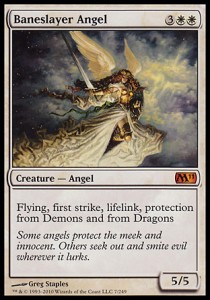
Baneslayer Angel.

We all know her and we all remember the outcry when she was selling at $50 apiece. We decried the unfairness of it all. The card’s power level, her insane price, the existence of Mythics, the blatant power creep, MaRo’s lies about Mythics, and just how boring it is to watch the Enchantress deck play a match (wait, that one was last week). At the time they printed Baneslayer, I was just getting into Constructed Magic (and trading) and couldn’t believe how unfair it was to lose to $50 cards when all I had was my homebrew RG beatdown deck.

Little did we know how good we had it. $50 Angels seem downright quaint compared to Benjamin Franklins masquerading as Jace, the Mind Sculptors.

But why do I bring up the (former) Walletslayer?

For starters, her price is at an all-time low, even as she begins to see competitive Constructed play once again. If you don’t know what I’m talking about, check out the latest SCG Top 8 – 8 copies of Baneslayer. LSV ran 4 in his CawBlade deck last week. While 8 copies of the Angel in the Top 8 isn’t groundbreaking, it does signal a metagame shift that presents us with a solid investment opportunity.

So why is Baneslayer so good right now after falling out of favor for more than a year? Let’s break it down.

Swords

In particular, Sword of Feast and Famine, and the Squadron Hawks that come with it. Titans, the toast of Standard for the last year, don’t do much about a Hawk carrying a sword (in its talons?) overhead. In addition, until Sword of War and Peace (my name) gets printed, no sword grants Protection from White, making Baneslayer the perfect blocker to fight against CawBlade.

Speaking of Swords, Baneslayer holds one pretty well, and embarrasses any Titan (except for the Frost variety) in combat once she’s holding a Sword. Before, if someone went over the top of your Angel with a Titan, you were in trouble. Now you just throw a Sword on her and go to town.

The Rise of Aggro

After the Fall rotation, aggro pretty much disappeared from the metagame outside of the occasional Boros appearance. When people are fighting to resolve their titanic 6-drop, 5/5s don’t do much, even when they are the Angelic kind. In addition, the dominance of U/B Control made it much easier to kill the Angel than it was before.

But since Mirrodin Besieged released, we’ve seen a huge increase in the amount of Aggro decks floating around. Kuldoltha Red, Aggro CawBlade, Elves, and Boros all struggle mightily against a Baneslayer, and in many cases literally can’t beat it. Even the CawBlade decks splashing Red don’t get very far against Baneslayer with their Lightning Bolts.

Creature-Centric format

While this is somewhat connected to the amount of aggro decks out there, it goes farther than that. Superfriends is no longer a deck, and everything these days (Except for Valakut) plans by winning through the combat step, making Baneslayer a house. When the “control” decks plan on winning by equipping equipment to tiny creatures and attacking you, 5 power and First Strike is a good place to be.

Putting it all together

So what does this mean for us? It means it’s time to buy in on Baneslayer. I’ll tell you up front I don’t know how long she’ll see play as the metagame continues to evolve, but I think it’s safe to say she will played at least until the next set, with the (assumed) addition of a Protection from Red and White Sword.

The market doesn’t seem to have caught up to the metagame, as her price hasn’t begun to spike yet, but the natural evolution of the metagame is toward more Angels. As both a Mythic and an Angel, she is always going to hold some value, so the risk to buying in now is not high. Depending on her level of usage, I think it’s reasonable to see a 50 percent spike in the next month, and possibly more if the card starts to be even more heavily included.

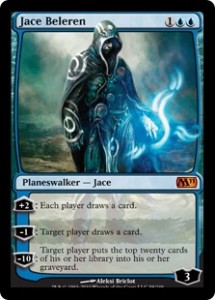
The fact that Baneslayer was reprinted doesn’t even hurt her price all that much. Remember when Jace Beleren was a $4 card? He’s been reprinted three times now and has been in Standard for going on four years, but it recently hit its highest price since the Summer of 2009. That’s a good sign for Baneslayer.

I will be aggressively trading for Baneslayers in the next few weeks, and I don’t see myself having a hard time flipping them one way or another.

That’s it for this week. Standard is in a very interesting place right now, as the format’s actually way more open than it has been in recent years. I’m excited to see where it goes from here.

Corbin Hosler

@Chosler88 on Twitter

Standard Metagame Data

Are you a Quiet Speculation member?

If not, now is a perfect time to join up! Our powerful tools, breaking-news analysis, and exclusive Discord channel will make sure you stay up to date and ahead of the curve.

After DC, I knew I didn't want to wing it again. I decided to do my homework for the upcoming SCG Open in Memphis in order to select my deck properly this time. Time to break out the spreadsheet and analyze the metagame!

You can download it and change the relative score of SCG events relative to MTGO Dailies - it's all controlled by that one set of cells, so it should be fairly easy to make changes. There are blank columns which leave you room to do more calculations if you prefer something like a logarithmic formula.

The MTGO Dailies sheet features a considerably less arbitrary calculation, but is limited to a homogenous set of events.

The 5 most-played decks online are Valakut, Boros, Caw-Blade, Vampires, and Angry Birds (red Caw-Blade), in that order. The 5 best-performing decks online (with a minimum of 20 appearances) are Vampires, Caw-Blade, Valakut, Angry Birds, and RUG, in that order.

Looking first at the Daily Events, we see that Valakut is the single most-played deck to a position of success, which isn't much of a surprise given its prior data. However, now a solid 24% of the Valakut decks recorded are at 4-0, which is right next to the major decks. Given Valakut's massive sample size, this is fairly impressive. If you subscribe to the theory that MTGO is ahead of the metagame curve, you should probably be sleeving up Valakut this weekend. Its poor Open performance hurts the overall numbers, and if you think the past two Opens are the best indicator for Memphis, you should stay far away from this deck.

This Valakut list was played to a 4-0 finish in DE 2129899 by Krush aka Virus.

Untitled Deck

creatures

2 Avenger of Zendikar
2 Oracle of Mul Daya
4 Overgrown Battlement
4 Primeval Titan

spells

2 Cultivate
4 Green Suns Zenith
4 Harrow
4 Khalni Heart Expedition
3 Lightning Bolt
3 Slagstorm

lands

2 Evolving Wilds
5 Forest
12 Mountain
1 Raging Ravine
4 Terramorphic Expanse
4 Valakut, the Molten Pinnacle

sideboard

2 Act of Treason
2 Gaeas Revenge
3 Natures Claim
4 Pyroclasm
4 Summoning Trap

Boros is the most widely successful Aggro deck, which shouldn't be surprising when you realize that it's basically turned into Caw-Blade with all the control cards replaced with Red facesmashers. What's not to love? Well, for starters, only 11.4% of the recorded lists have gone 4-0 in Daily Events. Furthermore, it didn't put anyone in the top 16 in Edison. The data would suggest that if you want to be beating face with Squadron Hawks, you should be investigating the Green/White deck, or looking at the much more successful Vampires deck.

This Boros list was played to a 4-0 record in DE 2128632 by Greeed.

Untitled Deck

creatures

4 Goblin Guide
1 Hero of Bladehold
1 Hero of Oxid Ridge
4 Mirran Crusader
2 Plated Geopede
4 Squadron Hawk
4 Steppe Lynx
3 Stoneforge Mystic

spells

2 Adventuring Gear
2 Arc Trail
2 Journey to Nowhere
1 Koth of the Hammer
3 Lightning Bolt
1 Sword of Body and Mind
1 Sword of Feast and Famine

lands

4 Arid Mesa
4 Marsh Flats
5 Mountain
6 Plains
4 Scalding Tarn
1 Teetering Peaks
2 Terramorphic Expanse

sideboard

1 Basilisk Collar
4 Cunning Sparkmage
2 Divine Offering
4 Kor Firewalker
1 Koth of the Hammer
1 Leonin Relic-Warder
2 Mark of Mutiny

This is the green-white deck I recommend investigating first, played to a 4-0 record in DE 2128583 by Smi77y.

Untitled Deck

creatures

1 Baneslayer Angel
4 Birds of Paradise
4 Fauna Shaman
1 Hero of Bladehold
1 Kor Hookmaster
1 Linvala, Keeper of Silence
2 Llanowar Elves
3 Lotus Cobra
1 Molten-Tail Masticore
3 Nest Invader
4 Squadron Hawk
4 Vengevine

spells

3 Ajani Goldmane
4 Lead the Stampede

lands

5 Forest
4 Misty Rainforest
4 Razorverge Thicket
4 Stirring Wildwood
4 Sunpetal Grove
3 Verdant Catacombs

sideboard

3 Kor Hookmaster
2 Linvala, Keeper of Silence
1 Obstinate Baloth
3 Phyrexian Revoker
3 Silence
3 Viridian Corrupter

Caw-Blade is arguably the best deck in the format, and has recently surpassed Valakut in online results. The straight Blue-White version has 25% of the recorded decks at 4-0, which is very close to Valakut and RUG. Angry Birds isn't making it to the next level at this point in either dataset, and at this point the splash can easily be considered worse... except for one catch: the loss of Tectonic Edge makes the deck considerably worse against Valakut, and Valakut is currently in greater prominence online than in the SCG Open series. If you think Valakut is overplayed online, abandoning the Edges for red or black mana is the way to go for Memphis.

This version of Caw-Blade made a 4-0 record in DE 2128645, piloted by Ra_Po.

Untitled Deck

creatures

2 Baneslayer Angel
4 Squadron Hawk
4 Stoneforge Mystic

spells

2 Day of Judgment
1 Deprive
1 Dispel
2 Gideon Jura
4 Jace, the Mind Sculptor
3 Mana Leak
1 Mortarpod
2 Oust
4 Preordain
2 Spell Pierce
1 Sword of Body and Mind
1 Sword of Feast and Famine

lands

4 Celestial Colonnade
2 Glacial Fortress
5 Island
1 Marsh Flats
1 Misty Rainforest
5 Plains
4 Seachrome Coast
4 Tectonic Edge

sideboard

1 Day of Judgment
1 Dispel
1 Divine Offering
4 Flashfreeze
4 Kor Firewalker
2 Linvala, Keeper of Silence
1 Oust
1 Sun Titan

Heinrick_A_Payaso played Angry Birds to a 4-0 record in DE 2128637 with the following list.

Untitled Deck

creatures

3 Cunning Sparkmage
4 Squadron Hawk
4 Stoneforge Mystic

spells

2 Arc Trail
1 Basilisk Collar
3 Gideon Jura
4 Jace, the Mind Sculptor
3 Lightning Bolt
2 Mana Leak
4 Preordain
3 Spell Pierce
1 Sword of Feast and Famine

lands

4 Arid Mesa
4 Celestial Colonnade
1 Glacial Fortress
3 Island
4 Mountain
2 Plains
4 Scalding Tarn
4 Seachrome Coast

sideboard

1 Cunning Sparkmage
1 Deprive
1 Divine Offering
4 Flashfreeze
1 Inferno Titan
1 Linvala, Keeper of Silence
1 Mana Leak
2 Pyroclasm
1 Sword of Body and Mind
2 Twisted Image

DE 2128628 saw portugalovic splashing black in his Darkwing Duck variant.

Untitled Deck

creatures

2 Grave Titan
4 Squadron Hawk
4 Stoneforge Mystic

spells

2 Day of Judgment
3 Doom Blade
2 Gideon Jura
4 Inquisition of Kozilek
4 Jace, the Mind Sculptor
3 Mana Leak
4 Preordain
1 Sword of Body and Mind
1 Sword of Feast and Famine

lands

4 Creeping Tar Pit
4 Darkslick Shores
4 Glacial Fortress
2 Island
4 Marsh Flats
3 Plains
2 Seachrome Coast
3 Swamp

sideboard

2 Baneslayer Angel
3 Condemn
3 Divine Offering
2 Duress
4 Flashfreeze
1 Sun Titan

The data is showing Vampires to be convincingly better than Boros, with the best 4-0 rate of any deck with more than 20 appearances in this data set. That makes it a strong consideration, despite its goose egg in the last two Opens.

DE 2129899 saw two people pilot Vampires to 4-0. The following list belongs to brantner2000.

Untitled Deck

creatures

4 Bloodghast
4 Gatekeeper of Malakir
4 Kalastria Highborn
4 Pulse Tracker
2 Vampire Hexmage
4 Vampire Lacerator
3 Viscera Seer

spells

4 Burst Lightning
2 Go for the Throat
4 Lightning Bolt
2 Staggershock

lands

4 Blackcleave Cliffs
4 Dragonskull Summit
4 Lavaclaw Reaches
3 Marsh Flats
8 Swamp

sideboard

3 Arc Trail
1 Crush
2 Dark Tutelage
2 Duress
2 Manic Vandal
2 Mark of Mutiny
3 Skinrender

RUG is finally putting up numbers online, and has some of the best overall numbers. Decks vary a great deal here, but the general basis of this deck is the same as it's always been - mana ramping and extremely powerful cards backed by a bit of countermagic and removal.

Untitled Deck

creatures

2 Avenger of Zendikar
3 Inferno Titan
4 Lotus Cobra
3 Precursor Golem

spells

4 Explore
1 Garruk Wildspeaker
4 Jace, the Mind Sculptor
4 Lightning Bolt
4 Mana Leak
4 Preordain

lands

4 Copperline Gorge
3 Forest
1 Halimar Depths
5 Island
4 Misty Rainforest
2 Mountain
4 Raging Ravine
4 Scalding Tarn

sideboard

2 Acidic Slime
1 Burst Lightning
2 Flashfreeze
2 Obstinate Baloth
4 Pyroclasm
2 Ratchet Bomb
2 Spell Pierce

Red Deck Wins is fairly new and hasn't made any 4-0s online. Winning an Open is impressive, but [card Kor Firewalker]haters gonna hate[/card], and with that kind of high profile finish, you can expect people to be bringing some hate. Kor Firewalker is absurdly hard to beat, so I'd avoid this deck for now just to see if people bring the hate, and if they don't, go crush face.

Since there's no 4-0 decklist online, here's Patrick Sullivan's deck from Edison.

Untitled Deck

creatures

4 Ember Hauler
4 Goblin Guide
4 Plated Geopede
4 Spikeshot Elder

spells

4 Burst Lightning
4 Lightning Bolt
4 Searing Blaze
4 Staggershock
4 Koth of the Hammer

lands

12 Mountain
4 Arid Mesa
4 Scalding Tarn
4 Teetering Peaks

sideboard

4 Ratchet Bomb
4 Manic Vandal
4 Arc Trail
3 Mark of Mutiny

Observations:

One of the 4-0 Vampires decks played a pair of Manic Vandals maindeck. Looking at the metagame as a whole, that's a solid call against Caw-Blade, Boros, and Tezzeret. It seems absurdly weak against Valakut and RUG (though [card Wurmcoil Engine]Wurmcoil[/card] is a target). Of course, Boros also has access to this card, but the fact that the trigger is mandatory makes it somewhat awkward in a deck with its own equipment. Vampires does seem like the best home, even with the lack of tribal synergies. The card hasn't been picked up universally, as you can see.

Red/Green midrange beats made 4-0 in a Daily Event. Fluke, or a real deck? I'm guessing the former, but the deck does look like it has a solid resistance to board sweepers.

Now would be a really good time to play Leonin Arbiter if you can find a home for it. It forces you into monowhite or an allied color pair with no fetchlands, and makes you give up Squadron Hawk and probably Stoneforge Mystic as well, but you gain advantage against literally every major deck in the metagame. You'd probably be looking at finding a way to fit it into a White Weenie shell, and it's worth noting that Honor of the Pure remains legal.

Untitled Deck

curve

4 Elite Vanguard
4 Student of Warfare
4 Hada Freeblade
4 Kazandu Blademaster

skies

4 Kor Skyfisher
4 Kor Aeronaut
4 Leonin Skyhunter

hate

4 Leonin Arbiter
4 Leonin Relic-Warder

pump

4 Honor of the Pure

land

20 plains

This is pretty rough, it packs it in to a Pyroclasm without Honor of the Pure or multiple Allies, and it might not have enough ability to hate people out of the game since Caw-Blade, Valakut, Boros, and Vampires all have the ability to spot kill your hate bears. A Green-White variant may be better, and it is possible to stick Arbiter in a green-white shell as a 1-of for Fauna Shaman to get. The timing makes this suspect though, since you won't even be able to stop a Stoneforge Mystic on the play.

For similar reasons, Cosi's Trickster seems well-positioned, and with the possible rise of Grand Architect there may now be a deck it can slot into. This is probably the key starting point for brewing up a new deck, or a new twist on one of the existing Blue decks. I've seen rumblings of Thada Adel, Acquisitor as an anti-Stoneforge card, but the mana cost seems highly awkward for that role.

Next week, I'll have a Memphis report for you, and I aim to make it a much more interesting one than my last two.

Joshua Justice

@JoshJMTG on Twitter

Grading the Mirrodin Besieged ‘Event Decks’

Are you a Quiet Speculation member?

If not, now is a perfect time to join up! Our powerful tools, breaking-news analysis, and exclusive Discord channel will make sure you stay up to date and ahead of the curve.

Mirrodin Besieged has seen the inagural launch of a new preconstructed product, the Event Deck. The blurb on the back of the box trumpets their suitability for the "world of tournament play," each card "handpicked to inflict pain upon any opponent" and designed to let you be "immediately competitive." Promising, no? Of course, these being preconstructed decks my buying them was a given, but by the same token I wanted a way to assess their success. It's been awhile since I played a lot of competitive Standard (reviewing precons takes up the bulk of my gaming time), but surely there had to be some way of measuring the effectiveness of the Event Decks right out of the box. Obviously, they were designed to be competitive. How well did they pull it off?

Metrics, Baby, Metrics

My first instinct was to find some way to relate them to the current Standard environment. Sure, you'll always have a few folks at their Friday Night Magic that want to run the wacky combo decks or tribal themes, but you'll also have some of the latest tech show up in the hands of the truly competitive who have been scouring the internet for the latest strats. How to measure these decks against the top of the field?

As it turns out, there does happen to be one notable personality who's given me the perfect tools to do precisely that: Luis Scott-Vargas, better known by just  the acronym LSV. For those who may not know him, LSV is a pro player of no small standing. In addition to being the editor for Channel Fireball, he took top honours at Pro Tour Berlin in 2008 and has a slew of other respectable finishes (including winning US Nationals in 2007). While his credentials aren't in doubt, it's not his actual play that caught my attention. No, it was something LSV does, and does in every set that sets him apart from the rest of the Magic writing community.

He ranks every card.

Every one. New set comes out, and LSV's right there with a comprehensive and in-depth review of it, card by card, assigning each a rating on a 5-point scale for both Constructed and Limited. And hey, let's face it, it's not a perfect system, but it does give a pretty good guideline overall. A case can certainly be made that some of LSV's ratings are low because he doesn't see how a block unfolds, were cards that might appear less useful early blossom later (see: Stoneforge Mystic), but this isn't a capital murder case. If we at least apply a consistent standard, we'll get the ballpark figures we're looking for, even if we do treat these decks as little more than the sum of their parts!
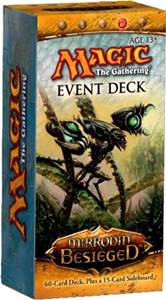
Kuldotha Lite

Being just a few strong cards away from the "Kuldotha Red" archetype, Into the Breach is strongest in its creature base. Leading cards here should come as no surprise to anyone, as they are staples of the archetype: Goblin Guide, Goblin Bushwhacker, Lightning Bolt. LSV loves the Bolt, giving it a very prestigious 5.0 rating. It also packs in a pair of Devastating Summons, which LSV awarded a 3.0 (somewhat insightfully calling it "good enough to build a deck around"). There are a dozen noncreature spells in the deck, and they add up to an "LSV Score" of 34.0.

Back to those beaters, some relatively new faces make their appearance here, and get solid marks from LSV, in particular the Goblin Wardriver, Memnite, and Signal Pest, all of whom carried 3.0 ratings. The 26 bodies that Into the Breach come equipped with top out at a 59.5 LSV Score.

The deck picks up three easy points from a single Contested War Zone, and features a rather robust sideboard. A playset of Searing Blaze leads the field here, each worth a further 3.5 points. Four [card Goblin Ruinblaster]Goblin Ruinblasters[/card] each net 3.0, the rest filling in for two apiece. Total sideboard value? 40.0.

This gives Into the Breach a final score of (34.0 + 59.5 + 3.0 + 40) 136.5. Don't worry if that seems abstract all by itself, we'll be giving it some context here shortly, but first let's hop over to Infect & Defile.
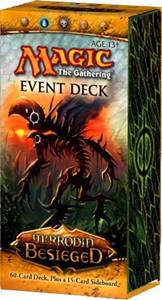
Now For Something Completely Different

Infect & Defile is a midrange infect and proliferate deck. I had it clearly pegged at the outset as the weaker of the two, but of course I wouldn't know just how much weaker until I'd put it through the LSV treatment. Creature-light, the deck leaned heavily on its rare bodies Phyrexian Vatmother and Hand of the Praetors, with playsets of role players like Corpse Cur and Plague Myr to fill it out. The Vatmother was a bit middle-of-the-road for LSV. Though he did call her an "impressive beauty," her rating (2.5) suffered a bit due to the lack of a seat at the top-tier table for infect. The Hand suffered for the same reason, as well as being "at least one [mana] too many," and only was rated a 1.0. Overall, for all sixteen creatures, Infect & Defile charted a mere 22.0 LSV Score.

To be fair, the deck is surprisingly creature-light, so howabout those noncreature cards? All-star inclusions like Mana Leak (4.0), Smother (3.5), and Consuming Vapors (3.0) lead the pack here, which include extra removal like Doom Blade and library manipulation in the form of Preordain and Foresee. Taken together, these more than pick up the slack in the creature department, earning an LSV Score of 49.0.

Finally, we have the sideboard and the land. Land is a bit tricky to score. No points are awareded for the basics, but a deck like Into the Breach is perfectly happy with a ton of Mountains. Two-colour decks like Infect & Defile are different in that they really do need them to be competitive. We'll call it a wash and award 8.0 points for the twin [card Drowned Catacomb]Drowned Catacombs[/card] and set of Jwar Isle Refuge. As for that sideboard, it's about on par with the first deck's. Two [card Go For the Throat]Go for the Throats[/card] and two more [card Smother[/card]Smothers[/card] pack in extra removal, while extra slots are filled by effects like Flashfreeze and Negate. Total sideboard value? 39.5.

Taken together, Infect & Defile has an overall score of (22.0 + 49.0 + 8.0 + 39.5) 118.5. Unsurprisingly, the deck is considerably weaker than Into the Breach, and the LSV Score has substantiated the decks' first impressions.

But are the decks "immediately competitive" in the "world of tournament play?" Let's pull in the winning deck from Pro Tour: Paris and compare.

Ben Stark's Caw-Go

Ben's White/Blue deck put in a dominating performance, and the "Caw-Go" archetype (and subsequent variations like "CawBlade") have hit their stride. It's not too far-fetched to expect to see at least a watered-down version of this in even a moderately competitive meta. Can the Event Decks keep up?

This version of Caw-Go ran only two creatures, Squadron Hawk and Stoneforge Mystic, for a total of 16.0 points. Interestingly, LSV said that the Mystic was "unlikely to make a splash in Standard," but of course this was well before we knew that the next set was to be an artifact block. From there, the deck opens up quite a bit. Packing in 'walkers like Gideon Jura and Jace, the Mind Sculptor, solid support like Day of Judgment, Mana Leak, and Sword of Feast and Famine, these accrued an impressive LSV Score of 86.0. The lands? Packed with dul and fetch goodies, there's another 55.0 points right there. Add in another 37.0 for the sideboard (Baneslayer Angel, Oust, Ratchet Bomb et al.), and you've got quite the deck?

Top-grade, tier-one Constructed? Pro Tour Paris was won with an (16.0 + 86.0 + 55.0 + 37.0) 194.0 LSV Score.

And there it is. Even the better of the two Event Decks is only about 70% as "good" as Caw-Go, which tells me that these decks are very solidly tier-two (with Into the Breach charting a bit higher than Infect & Defile). In all likelihood, despite the box's promises you're not likely to be tearing up the scene with either of these two Event Decks anytime soon, so maybe what's needed is a little bit of perspective. Perhaps what the hype on the back of the package meant by tournament was something small and local. To find out, I had one more test in mind: I would pilot the better of the two decks for Game Day.

Trial by Fire

One of the clerks of the shop, we'll call him "Violent J," is my first-round opponent, and all signs look good as I blow him out of the water in the first game. I open with a pair of [card Ornithopter]Ornithopters[/card] and a Memnite, then pop a 'Thopter to a Kuldotha Rebirth to have an immediate and commanding board presence. A Contested War Zone adds a solid amount of damage, and a Darksteel Axe on the Ornithopter gives it some teeth after Violent J [card Doom Blade]Doom Blades[/card] and [card Grasp of Darkness]Grasps[/card] away some of my dorks. Still, he falls to the swarm in just a few turns, and the day is looking promising.

I get another aggressive start in the second game, but Violent J's able to stabilise with a Black Sun's Zenith. In fact, he Zeniths twice in this game, keeping things clear while he brings in a pair of [card Vampire Nighthawk]Vampire Nighthawks[/card] and a Bloodghast and easily gets there on the back of a Sangromancer. Although I didn't see much of his deck in the first game, I've got enough of an eye on it to sideboard this time. Out come role players like the [card Panic Spellbomb]Spellbombs[/card], in go more spot removal with the [card Searing Blaze]Searing Blazes[/card].

Unsure of how many Zenith's he's running, I go ahead and trigger an early Devastating Summons for 3 to try and get stuck in early. Unfortunately, Violent J's got the Zenith, and wipes my board again. Once more he rides a pair of Nighthawks to a comfortable win.

Then my nightmare began.
A quick aside here for a moment. It is a indisputable certainty that each and every one of us was new to this game at one point in time- none of us were 'born to it.' Nor is it at all unusual for folks to take time away from the game and return after a long absence, as I did. Indeed, my second-round opponent, I'll call him "G-Money," was one of those as well. He'd only recently returned to the game, and it showed. His deck was a mono-Red aggro/artifact deck.

G-Money made a lot of bad plays. He frequently forgot to attack with his Goblin tokens, and always left something at home to guard even when I had nothing to attack with (a single Signal Pest, for instance). He opened up game two by playing a Mountain and [card Galvanic Blast]Galvanic Blasting[/card] me to the face for 2. He tried to equip his equipment at instant-speed. And in what can only be described as a "wrong card for the right reason," G-Money even ran an 'alternate win condition' of an Inkmoth Nexus.

G-Money's card selection was filled with jank. I was beaten down by a Snapsail Glider, though I had to correct G-Money that his Glider did not have flying because its metalcraft did not count his Embersmith. Artificers, as it turns out, aren't quite the same as artifacts. I had my face smashed in by [card Koth's Courier]Koth's Couriers[/card] more than once. He cleaned my board with a Kuldotha Flamefiend. All told, his deck had the look of a sealed deck construction, and in truth it was probably not very far from this.

And the most painful thing? G-Money had his way with Into the Breach.

The first game he picked off my three [card Signal Pest]Signal Pests[/card] with Embersmith. The third game he burned out my turn-1 Goblin Guide (on turn 3), then wiped me with the Flamefiend, which he ramped into by way of my Contested War Zone. I'd had the Zone guarded, of course, but he dropped and sacrificed a Panic Spellbomb to make my lone defender step aside, and I never managed to get it back. I won game 2 in large part due to his inability to function with only two land.

In Conclusion

If I make sport of G-Money's card selection and gameplay, it is done out of a sense of affection and irony rather than any real malice or cruelty. As I said, we've all been there. My hat is off to my opponent not just for beating me, but also for having the courage to show up to compete so recently back to the game. I took my losses in good spirits and good humour, notified the shopkeep I was done, and I left an 0-2 drop on Game Day.

As always, your mileage may vary, and in fairness will typically be much better than the luck I had. The Event Decks aren't bad decks; they're just poorly positioned ones. They overpromise a bit, but I suppose that's marketing's job, to get you excited enough to buy. These decks will get you in the door to any minor tournament and give you a fair chance at a successful evening, though you're not likely to have consistent success with either one out of the box. That said, I'm very excited all the same at this new segment of the market Wizards is looking to explore.


Knowledge Pools

Are you a Quiet Speculation member?

If not, now is a perfect time to join up! Our powerful tools, breaking-news analysis, and exclusive Discord channel will make sure you stay up to date and ahead of the curve.

As I sit here preparing my article, I have to tip my hat to Starcitygames, because they have redefined the market. How so? Well, the answer is in the clever use of the Open Series. Almost every week we have a "major" standard event to keep track of, and more often than not a large Legacy event as well. Compared to a few years back when we only had PTQ's, Pro Tours, and constructed format Grand Prix, the Open Series gave us the next step in weekly evolutions.

Deck builders and testers work weekly now to keep up with the newest tech available to everyone interested the day of the event. Before PTQ results were often posted a week or more after the event, and the tech for the metagame was outdated. From the financial aspect, real time data on whats doing well from week to week gives us a more accurate picture of the market to work with. Overall, the game and its community are growing stronger, and getting better and better for players which is awesome!

Alright enough chatter, down to business.

Green Sun's Zenith on CFB for $6.99 and SCG for $9.99. At this point I'm gonna say ship the extras you have. It hasn't gained anything in weeks, and stagnation more often than not means a drop at some point as we can already see at CFB.

Sword of Feast and Famine $20 on CFB and SCG? Seems fair, but I also don't see it going up a lot more. Keep them or ship them, either way they are still a solid card to have.

Go for the Throat $1.99-$2.49 is a fair price for this card. I would hold on to them as the price on Path to Exile didn't spike until it had been out for a few months.

Thrun, the Last Troll $11.99 on both sites and continuing his march downward. He's going to need to see more play soon to raise his price, but I'm content seeing him low.

Contested War Zone continues to be in demand, but not as much as it was initially. CFB has them at $2.49 and SCG at $4.99. Keep a set to use and ship the rest while people will still trade for them at $5+.

Praetor's Counsel is down to $1.49 on CFB, and $2.99 on SCG. I really like this card and think it has some possibilities if a combo deck comes up in the next year. At that price I might even consider getting a few, in an act of pure speculation.

Promo Black Sun's Zenith Considering that the foil version is $9.99 and sold out at SCG, and CFB doesn't have a listing for them I would either sell these as fast as you possibly can or hold it for use. Ebay has the promos at roughly $15 each.

Spikeshot Elder rose a bit on the back of its 4-of inclusion in this weekends Standard Open winning list. CFB hasn't moved their price past the $0.99 mark if you're looking to pick up a few still, though SCG has them at $2.49.

Baneslayer Angel is picking up in play again, so keep that in mind when trading for them or trading them away. $12.99 on SCG, $10.99 on CFB.

Linvala, Keeper of Silence is another card becoming more popular again, though only in small numbers and primarily in the sideboard. $9.99 on SCG, $6.99 on CFB.

As much as I do love legacy, from a financial perspective its rather dull. Yes, there are a number of options as far as "investments" go, however its much slower to see price changes overall.

This is an investment piece.

Hopefully you all got the e-mail Doug sent out saying to try and get Candelabra of Tawnos and Time Spiral. The prices on them have risen with demand, and the numbers available are scarce.

I find that the above list is a necessary evil, I find them dreadfully dull to write about but the information is something that is extremely useful to anyone who is looking for a quick reference sheet of cards to keep an eye on or try to trade off.

Accounting in a sense of cards is something that I've been building to cover for a while now. I've almost got a spreadsheet that I feel comfortable sharing for people to use, and if you have any specific requests you want to see, please let me know. I've got a lot of things on there, but there may be something that I've overlooked. I believe that tools for tracking our success are important because they allow us to see how we are doing over a period of time. Expect to see the completed sheet in a few weeks after some trial runs and tweaks.

There are a few cards that I would like to put onto the watch list, because of their versatility in the current meta and because of their possibilities.

- Praetors Counsel started high for presales as most mythics do, and it has dropped way low. Its a powerful effect in a color that has been known for its ability to ramp and untap lands for use again. Giving you all of your spells back and non maximum hand size seems good if there were anything combo-like to come out anytime soon.

- Ratchet Bomb looks amazing right now, clearing out Squadron hawks, little red guys, and larger threats alike. I'm surprised to see it not included more overall. Demand could increase in the coming weeks/months.

- Goblin Guide its in demand, its not in demand, its in demand again. Goblin Guide has been a roller coaster during its lifetime, but being one of the best one drops ever will help keep its price even after rotation. Be looking for these to get cheap in the coming months.

Those are the main three I'm watching right now, and will be watching for a while I expect.

That's all for this week, leave a comment and let me know what you think! We're here to serve you guys, and your thoughts count.

Stephen Moss

@MTGStephnmoss

MTGstephenmoss@gmail.com

Maximizing Your EDH Trade Value

Are you a Quiet Speculation member?

If not, now is a perfect time to join up! Our powerful tools, breaking-news analysis, and exclusive Discord channel will make sure you stay up to date and ahead of the curve.

[Here is the first offering from Ryan Bushard, in Kelly Reid's own words "a damned good trader." Please let us know in the comments what you think! -Dylan]

Magic is a diverse culture of players, as there is a format for nearly everyone and each has their own unique trading style as well. This column will be devoted to understanding how to approach each trade, with everything from how to organize your binders to what cards to look for. This week I will cover how to maximize values when trading with an EDH (Commander) player.

Whether the long box filled with eight different decks or the odd fascination with every obscure card gives it away, the EDH (Elder Dragon Highlander) player is always fairly easy pick out. Typically these trades are a great chance to unload a lot of your bulk rares. EDH has become a major driving force in the market today, and it's a great way to make money without having to break the bank on a large investment. Many cards were long forgotten until this format was created, and the announcement of the release of the Commander preconstructed decks has been helping staple cards rise to impressive prices. Most people missed out on the initial surge in prices, but there are still a host of ways to make profit, and this article will show you how.

EDH Binder

This is one of the best binders you can have put together. It should feature a good mix of staple cards and flashy, hard-to-find cards. Foil Generals as well as obscure cards from hard-to-find sets are always a good investment. You may sit on the same card in this binder for a month or two, but picking up a bulk rare from someone could net you a good amount in value if you find the right trader. EDH has a strong following from both the casual and competitive crowd, and from what I have seen, the judges enjoy it quite a bit as well. This diversity makes almost any unusual rare worth more than just bulk prices. For this reason, leave your binders filled with the high end cards such as Time Spirals and Mana Crypts and get a few fat pack boxes to fill with bulk. One key about EDH players is they can never have too much to look through. The more bulk you bring the more they will find, and those two or three dollar rares add up quickly. I have six to ten Fat Pack boxes filled up with mostly rares and staple/hard-to-find commons and uncommons. I frequently find myself trading what I acquired at just above bulk price and turning that into competitive type two cards.

The Trade

I personally enjoy EDH, as do most people I know, and EDH players love nothing more than, well
 a game of EDH! If you have time play a game while trading, this eases the sometimes-tense trading process. The game not only serves as a way to relax the players, but it also reminds them of cards they need for their decks. This of course requires you to have an EDH deck, and if you don’t already have a deck I would suggest a strong Aggro-themed deck. This will allow you to stay in the game versus the more competitive decks while still allowing the casual players to have a chance to play. No casual player wants to lose to your eight minute long turn three win every game.

Casual

The casual player is looking for the cool cheap rares, and you should always let them start pulling cards out first. It is a lot easier to convince them to part with their [card Jace, the Mind Sculptor]Mind Sculptor[/card] when they are looking at a pile of the forty rares they want for EDH decks. Picking up competitive cards for a lot of bulk is ideal for making quick liquid trades. Most of the casual players don’t spend a lot of money on the game, so though they know how much Jace is worth, they will more than likely never see much if any competitive play because they can't afford three more for a deck. I also keep lists of any cards these casual player are looking for so when I am trading with a competitive player I know what to look for. I can obtain cards that I know will be getting 4-5x in trade value for a quarter of the price when I know what people want. I highly recommend keeping a list of cards people want in your local area before going to a major event. Most of these players don’t go any farther than the card shop or a local PTQ so they are only exposed to certain binders constantly. Keeping your binder ever-rotating allows you to trade more frequently, because if one thing's true about an EDH player
 they can always find something they want!

Competitive

The competitive EDH player is a whole different crowd. These players come in two varieties: the ADD designer and the pimped out deck builder. The ADD deck builder is looking for that tenth or eleventh Sol Ring for his new creation. This guy refuses to tear a deck apart, and if someone doesn’t have a deck, he is always willing to oblige. These types of traders typically have a good idea of what they are looking for, as this isn’t their first time around the block after all. With that in mind have your binder stocked appropriately; these players have no problem parting with competitive cards as long as you have what they need. At the end of this article I will include a short list of cards that are highly sought after and can allow you to maximize profits while still being able to fulfill trading needs. You should always remember the uncommon and common staples as well when devising your EDH trade collection. Keeping a healthy box full of Brainstorms and Lotus Petals can really even up those final few dollars it may take to close a trade. On top of the format's staples, this player may be looking for new deck ideas, and as with any great idea you have to start at the base. This is where having a solid collection of unique generals such as Cao Cao, Lord of Wei can pay off, and having cards that can be hard to find will always be a boon when trading with the competitive EDH player.

The other type of competitive player also likes unique cards, just of a different variety. These players are looking for the latest and greatest of everything, and the only thing better than a foil is a signed altered art foil with a Pro Tour stamp and signed by their favorite pro. Too much is never enough for these players and the sky is the limit on profit potential. These players are few and far between at my local shop, as the investment it takes to invoke this level of EDH madness is rare. These players will more commonly be found at major events peeling through everyone’s binder looking for a few select cards to finish their pimped out version of Zur. The best way to prepare for these trades is to acquire any rare cards you can when you are in your local area, and to be ready to unload them when you travel. A foil Chandra Nalaar may not be worth more than a few dollars to your local players who never travel, but if you can pick it up and catch the artist somewhere that year it may be worth the investment. These investments can be risky if you're looking for short term profit, and certainly not as guaranteed as trading staples or bulk, but they can have great margins if you can sit on them for long enough. A great example of one of these trades involved a Pro Tour foil Treva, the Renewer. I picked the card up in a trade for about 10 from a PTQ player the year it released, and though I sat on it for a good few months, without any added work I flipped it to a player who had been trying to obtain one for his EDH General at nearly triple its value in trade! Promos and foils are a great market if you are business savvy and know how to bargain, as you stand to double or triple your investment just by knowing how to pitch a card and how to bargain properly. I don’t advise this market to anyone who hasn’t had a lot of trade experience as you can tie a lot of your collection up on cards that you may sit on for a long while. If you have a large collection or run a store this can be a great area to get into but it requires constant attention as foils can shoot up in value or plummet from something as simple as Conley Wood’s latest scheme to the latest EDH banlist.

The Attitude

This section will be included in every article, and it is key in how to conduct your trades. Everyone acts differently based on their surroundings. As a good trader you must learn how to adapt and interact with the crowd you are surrounded by. Casual players don’t want to hear about the 4 PTQ’s you’ve won and the GP you just t16’ed. On the same note competitive players don’t want to talk about how awesome Avatar of Woe is in your EDH deck. Knowing your crowd, pacing the conversation, and knowing what your trade partner is looking for is key for fluid trades that are both quick and profitable.

With the EDH trader relaxed, this is probably the least competitive player out there; I have met causal players who can still be cutthroat, but a real EDH player is playing the format for fun. Talking about the pricing right off the bat can make them feel uneasy and rushed, so talk to them about what decks they have, and keep a small list of cards that come to mind when they give you information on what they are running. People always want to make their EDH decks better, and with such a large card pool many of them don’t even know some of the best cards for them exist. Like I discussed before, sometimes you will run into the more competitive EDH crowd and, though the trade style is probably going to be more formal with that group, it is still good to keep a steady conversation going. If they know what they are looking for, help them to that section, and if they don’t have any interest in looking through cards, don’t make them! That’s why you have an organized binder: quick smart trades. Most EDH trades however run slightly more casual, since many don’t even know what they are looking for until they see it. Ensuring your EDH boxes are diverse will give everyone something to find and create a good chance for you to snag some of those hard to find competitive cards at good prices. As I stated earlier, always let them pull things out first, and tell them you're interested in cards but want to see what they find first. Once you pull a card out, they begin to pick and choose what they want instead of going on impulse and pulling out anything that catches their eye, and that’s fewer cards for you to move. The most important things to remember are to stay casual (It is, after all, a casual format) and to allow them to lead the trade. You don’t usually have to try very hard for this one to end up in your favor.

Cards to look for

Cards to look for, as stated earlier, include almost any colorless mana producer, as with the [card Mox Sapphire]Mox[/card]es and [card Black Lotus]Lotus[/card] banned in EDH people will settle for what they can get their hands on. These investments are always sure if you can get them for the right price, cards like Sol Ring and Mana Vault will only continue to rise with the demand from EDH players. The below list is a great start at the high end cards that every EDH player wants at their deckbuidling disposal.

Official Elder Dragon Highlander [EDH] List of Format Staples

In addition, any foils you can get your hands on are never bad investments, and buying foils in bulk from people can be a cheap way to get into the game. People will unload them for cheap, and with a little bit of organizing, they will make a nice addition to your EDH trade fodder. This also goes for bulk rares. Many players would be willing to sell you their bulk as opposed to mailing it and having to pay shipping, if they never travel you may have a reliable outlet for more EDH fodder. Never overlook the large stacks of junk rares, many of them may just find their way into an EDH deck someday.

Cards to pick up

EDH players typically only need one to two copies of most cards so there is a good chance that they wont have playsets of many things, but picking up a lot of singles that are more useful in other formats is ideal. Even at a fair value of most rares being at least a dollar in trade, if they pick out ten junk rares that can quickly turn into a fetchland, and if you look at the margins on that it's very impressive. Get a good idea of what you want the first time through and filter from there based on their picks.

Well that’s it for this pilot article. If you like the information or just want to know more, please leave me a comment. If anyone has any particular recommendations for the article or things you would/or would not like to see in the future, please let me know! Next week when I return from Atlanta, I will be covering the topic of how to approach a trade with a player vendor, the unique combination of a currently or previously competitive player with a business mindset out to make money at the game. Most of the people reading this article, myself included, may fall into this category, and you may be surprised at how you can both make a good trade that can turn out to be profitable for each party.

Ryan Bushard

Digital and Paper, Head to Head

Are you a Quiet Speculation member?

If not, now is a perfect time to join up! Our powerful tools, breaking-news analysis, and exclusive Discord channel will make sure you stay up to date and ahead of the curve.

Hey everyone, and welcome back to Whinston’s Whisdom on Quiet Speculation. Last week for the comment contest someone suggested a topic so good that I knew I needed to cover it: why are there often large price discrepancies between MTGO and paper Magic? In this week’s article, I tried to break it down according to the law of supply and demand. What are the differences in supply and demand between the two platforms, and why are they there?

Let’s start by talking about supply. At the most basic level, supply is how much of a commodity there is. The less there is, the more it will cost, and the more there is, the less it will cost.

The first major difference between paper and MTGO, is that MTGO has significantly more copies of a card than the paper world does. More packs are being opened every day, and so the number of a certain card in circulation is greater. While there are more people clamoring to own copies of that card, there are significantly more limited-only players on MTGO than in paper, so the supply available is greater. Let’s look at two examples where this can be seen (for reference, I'll be using Starcitygames for paper prices, and MTGO Traders for MTGO prices):

Jace, the Mind Sculptor

Paper price: $110

MTGO Price: $95

While this difference in price is only about 10%, it still shows the impact that a greater supply can make on MTGO. Also note that Jace was in Worldwake, which wasn't opened very much online, meaning that this difference in price is smaller than it is for other sets, for instance...

Primeval Titan

Paper price: $40

MTGO Price: $30

Here is where the difference is more apparent. There is a full 25% decrease in price when switching from Paper to MTGO. M11 was opened much more online than in paper, so the value of a digital copy of Primeval Titan is worth much less than its paper counterpart.

Another factor to consider when looking at supply is the absence of "old" or "out of print" cards on MTGO. Many cards in the paper world don't pull their cost in terms of power, but because they are so old, and there are so few copies remaining, they command higher prices than they would otherwise. Yet online supply doesn't suffer from this problem. There's no limit to the number of packs that can be bought from a store while in print, and these cards then remain in circulation, can never get damaged or lost etc. This leads to MTGO having significantly lower prices on older format staples than paper.

Karakas

Paper price: $40

MTGO price: $2.50

As you can see, this is a massive price gap. A digital copy of the legend bouncing land costs only 1/16th the price of a paper copy. This holds up for most "old" cards on MTGO, especially those played in Legacy and Classic (the MTGO form of Vintage), such as the original dual lands.

And finally we arrive at our final supply category: looking at the 3rd set. In both paper and MTGO, the 3rd set of a block will feature cards more expensive than the previous 2 sets in a block? Why? Because this set is opened the least. Let's use Timespiral as an example. When Timespiral was released, it was triple Timespiral draft, so every draft had 3 packs of Timespiral being opened per person. With the release of Planar Chaos, 1 pack of Timespiral was replaced with 1 pack of Planar Chaos, leading to a TTP configuration. And finally with Future Sight, there was 1 pack of each type, so TPF. This meant that for every 6 packs of Timespiral opened while drafting, only 2 Planar Chaos and only 1 Future Sight got cracked. This leads to significantly lower amounts of these cards in circulation, which in turn, increases price. This effect is much more pronounced on MTGO, however, because nearly all the packs that get cracked come from drafting or other Limited events. Unlike paper, it just isn't profitable to buy packs for the sole purpose of cracking them, so the fewer packs of a set  that get drafted, the lower the supply of cards, and the higher the prices. This effect was at its highest with Eventide, because of the 4 set block structure, as evidenced by two cards on MTGO in particular...

Twilight Mire

Paper price: $6

MTGO price: $13

Figure of Destiny

Paper price: $10

MTGO price: $17

With differences in price of over 100% and 70% respectively, the 3rd set obviously has a larger impact on the price of digital cards than in paper.

Now we move on to covering differences in demand. The potential markets, and the desires of your customers differ greatly between the digital and physical worlds. these desires prominently hinge on the formats that a card is playable in, so we'll first look at the gap in popularity of formats between the internet and the real world, and then look at some MTGO specific formats.

But first, there are two formats that have a massive gap in popularity between paper and MTGO. The first of these is Vintage. In paper, Vintage is the most expensive and powerful format, with a nearly nonexistent ban list. But online, where fewer of the most important Vintage cards such as the Power 9 have been released, the MTGO version of Vintage, Classic, is floundering, and this has had a noticeable impact on card prices.

Mishra's Workshop

Paper price: $300

MTGO price: $17.50

While some of this monumental difference is undoubtedly due to the wider availibility of Workshop on MTGO, it also has to do with the larger popularity of the vintage format in paper as compared to MTGO.

The same is true when looking at EDH. EDH is one of the most popular ways to fool around with your Magic friends, and pass time in between rounds. Yet online, Commander (the online EDH), is not very popular at all, and so many of the staples for the format cost much less.

Bribery

Paper price: $10

MTGO price: $3.75

Bribery is one such card. It's an EDH staple in paper, but because EDH doesn't enjoy the same popularity online, its price is lower.

Last, but not least, we come to how MTGO specific formats can cause discrepancies in price. The first of these is quite obligatory: Momir Basic. Momir Basic uses the Momir Vig Avatar, a card not even available in physical form, and so demand for the Avatar online must therefore be higher than in paper (a Momir Avatar can go for about $12). But a format that could possibly be mirrored in paper, yet isn't, is Pauper.

Pauper is easily one of my favorite formats. It is an all common format with a Legacy ban list , and the format is incredibly diverse, making it my format of choice when I just want to kick back and relax. Yet the popularity of this format has caused some ridiculous prices for in demand cards, such as...

Crypt Rats:

Paper price: $.50

MTGO Price: $1.75

Now for the first time we can have a clear cut example. The only reason for this price difference is Pauper. the supply level is relatively even between Paper and MTGO, and so Pauper is the only thing causing this +300% price increase.

Overall, the different types and popularity of formats on MTGO affect prices in a huge way when compared to paper cards. when evaluating a card online, always make sure that you have a market that will pay for it before picking it up, or else you may end up with it stuck in your collection.

Let's move on to this week's comment contest.  Last week's winner was Macadosche, who will receive a textless Searing Blaze and textless Treasure Hunt as his prize, so please email your address to me so i can get your cards out to you. For the previous winners: your cards have been shipped and should be on their way. Because I'm running low on cool cards to give away, I'm going to be cutting the comment contest down to a monthly thing, but I'll be looking at every week's article to determine the best comment and winner. So comment under the article or send me a tweet (I'm nwhinston on Twitter) with one positive comment, one constructive criticism, and one future article idea you'd like to see in order to have a chance to win.

Moving on,

--Noah Whinston

mtgplayer@sbcglobal.net

nwhinston on Twitter

Arcadefire on MTGO

baldr7mtgstore on ebay

On the Floor: GP Denver

Are you a Quiet Speculation member?

If not, now is a perfect time to join up! Our powerful tools, breaking-news analysis, and exclusive Discord channel will make sure you stay up to date and ahead of the curve.

I was at Grand Prix Denver a few weeks ago, and GPs are a lot of fun for Judges. Not only do we get to travel, but we get to meet new people and see others we probably haven’t seen in weeks or months. There is usually a lot of Judges at an event like this, in our case there was at least 50 different Judges from all over the world who came together to make this event happen. There are a lot of interesting and fun things that happen when you get that many Judges together.

Besides the huge amount of EDH (and/or Commander) that is played and drafting that is done after the GP is finished, there is a opportunity for great discussions and ideas to be shared. We all had assigned tasks during the GP, but those tasks usually took up about 10-15 minutes of a 50 minute round. The rest of the time we would be patrolling the floor waiting for Judge calls. When you get that many Judges together, with that much down time, strange or tricky interactions usually become the topic of conversation.

There will be a question that floats around the hall for a few rounds, getting the opinion of how to resolve the situation from as many Judges as possible. In a perfect world, everyone would give the same response. We all are working off the same policy documents, right? Well, questions that had easy answers wouldn’t be very fun to talk about. This is one of the things that was discussed for a few rounds at GP Denver.

“JUDGE! I have a question. I played Jace Beleren. I put him in play with a die set to 3 on him. I rolled it down to 2, and said ‘draw a card.’ I drew a card, and a second later, my opponent drew a card. What do we do?”

This seems pretty straightforward. The opponent of the Jace player obviously thinks that the +2 ability was used, and each player should draw a card. The Jace player could have been more clear about what he was saying. The ability he used does say “Target player draws a card,” but can we really think that he would target his opponent with this? Let’s break down what the resolution can potentially be.

There are three things that come to my mind right away. Each of those things has pros and cons, but remember, finding the one that best fits the current policy is what is important. It might not feel right for whatever reason, but as Judges we need to be consistent and enforce the policy as written. If there is an issue, there are outlets that we can use to discuss it with those who write the policy to see things change.

Option 1: Jace player’s opponent gets a Game Loss for Drawing Extra Cards.

This seems pretty harsh to me. One Judge at the GP made the argument that “Jace is good enough on his own, he doesn’t need to be handing out Game Losses all by himself.” While I don’t disagree with that statement, it isn’t really a good argument against this ruling. What exactly needs to happen to issue this penalty?

“This infraction is committed when a player illegally puts one or more cards into their hand and, at the moment before they did so, no other Game Play Error or Player Communication Violation had been committed.”

So right there we can see that if we can’t make a good argument for either Game Play Error or Player Communication Violation that this poor player has probably lost this game. It feels like this player just didn’t understand what was going on, or was just used to people using the other ability on Jace, but if neither of the other Penalties fit, we will have our answer.

Option 2: Jace player gets a Warning for a Player Communication Violation. Place a card at random on from his opponent’s hand on top of their library.

This option punishes the Jace player for not being clear about what he is doing, and doesn’t cause that much disruption to the game. Putting a card at random back on top of the deck is an accepted solution for when you draw and extra card and don’t get a Game Loss. Many people say that a player could get an advantage by having a card they shouldn’t have in their hand, and the card they should on top of their deck. While I don’t disagree with them necessarily, this is what the policy says we should do. The next time that player draws a card legally everything will be back where it belongs.

Player Communication Violation penalties have very specific rules for when they can be applied. It can’t just be handed out because two players don’t agree on what is happening in a game. While that might be poor communication, PCVs have to violate specific rules.

Players may not represent derived or free information incorrectly and players must answer completely and honestly any specific questions pertaining to free information. If they have unintentionally done any of those things, than a Player Communication Violation has occurred and we need to fix the problem. So is the ability that was used free or derived information? The target of the ability is free information, but was that incorrectly represented? Was it represented at all? Does that matter? Hmm
 Lots of things to think about. let’s move on to our next option.

Option 3: Warning for a Game Rule Violation. Put a card at random from non-Jace player’s had on top of their library.

So, this brings up an interesting question right away, which player should get this warning? What Game Rule was Violated? One player drew a card when they shouldn’t have, did he just fail to resolve Jace properly? Did the Jace player not properly play his ability by not announcing specifically what ability he wanted to use, or by not specifically choosing a target? Maybe they both get a warning?

Is there another option?

Option 4: Issue no penalty. Turn the die on Jace Beleren up to 5.

Could an argument be made that this Jace player was too ambiguous with his ability? This solution makes what the players did legal and corrects any potential miscommunication. Should we really be fixing things like this for players though? This one would require talking to each player but would probably not end up being what happens. But who knows?

So this week, rather than tell you guys the solution, I want to know what you think. Comment on this article with which option is the "correct" option? Is there something that I forgot about? Feel free to discuss it and I will chime in every so often and next week I will cover what is supposed to happen.

If you’re interested you can click here to find the PDF of the Infraction Procedure Guide.

As always, Keeping it Fun,

Kyle Knudson

Level 2 Judge

Allon3word at gmail.com

Want Prices?

Browse thousands of prices with the first and most comprehensive MTG Finance tool around.


Trader Tools lists both buylist and retail prices for every MTG card, going back a decade.

Quiet Speculation