menu

Pioneer Inspired Pick-ups

Are you a Quiet Speculation member?

If not, now is a perfect time to join up! Our powerful tools, breaking-news analysis, and exclusive Discord channel will make sure you stay up to date and ahead of the curve.

By now, my readers are familiar with my writing style and areas of focus. I often cover older formats, investing, and Magic’s earliest sets. These realms of MTG finance reflect overlap between all of my personal interests in the game. I love that there are so many ways for people to engage in this hobby—it’s like there’s something for everybody!

This week I’m going to shift gears a little, stepping outside of my comfort zone. I’m going to talk about cards in new frames for once!

How will I do this without any expertise in formats like Modern, Pioneer, and Standard? I’m going to use MTG Stocks’ “Most Played Cards” page as an estimation for each format’s metagame. Then, using the data provided, I will make some comparisons to see which cards show up in multiple formats.

The addition of Pioneer may have fractured the player base a little bit, and this could cannibalize Modern or Legacy. But if a card sees significant play in multiple formats, it has a higher likelihood of maintaining a consistent demand profile. Combine that with a growing Pioneer player base and tax refunds coming in, and you may have some reasonable targets to consider!

Multi-Format Targets

Because Pioneer is the newest driver for demand, I’m going to try and find cards that see play in multiple formats that include Pioneer. Here’s what I found.

There was an error retrieving a chart for Thoughtseize

Thoughtseize has to be one of the most solid pick-ups. According to MTG Stocks, it is the number one card in Pioneer. This could fluctuate as the metagame evolves, but I’m confident no matter how the meta shapes up, Thoughtseize will find a place in the top 50 of the format. For reference, the Players Tour in Brussels last weekend included Pioneer and there were 16 copies in the Top 8.

Thoughtseize is also the 18th most played card in Legacy and 21st most played in Modern. It’s not quite as prevalent as number one, but still a very useful card in those formats. Expect demand of this one mana sorcery to remain strong in 2020. Barring a reprint, this card probably has an upward trajectory in the coming months.

There was an error retrieving a chart for Fatal Push

The number two card in Pioneer according to MTG Stocks is Fatal Push. There were twelve total copies at the Players Tour, so it is definitely prevalent in the format. The one-mana removal spell is also the 18th most played card in Modern. After the uncommon bottomed in late 2019, it rebounded into the $5 range. While it may be difficult for a newer uncommon to overtake the $10 mark, a lack of reprint and robust multi-format demand could be enough to get Fatal Push there.

There was an error retrieving a chart for Mystical Dispute

I have to admit, when I sat down to write this article I would not have expected to mention a Throne of Eldraine uncommon. I can still visit my local Target and purchase boosters of the set, after all! Yet I think it deserves mention being the fifth most played card in Pioneer, the tenth most played card in Modern, and second most played card in Standard. There were thirteen copies played in the Players Tour Top 8 last weekend.

What gets me excited about this card is its low casting cost and obvious utility in non-rotating formats (especially where blue is popular). The card reminds me of Spell Pierce, a common worth over two bucks before its reprint. One mana counterspells are potent in older formats, and I believe Mystical Dispute’s full potential is just now being unlocked. Given its recent printing, I’d look closely at foils for maximum upside. The foil multiplier is currently only 2x, and that seems low for a multi-format staple.

There was an error retrieving a chart for Leyline of the Void

The Core 2020 reprint of Leyline of the Void crushed the enchantment’s value. It was worth north of $40 before, and has since retreated down near $10. There is one upside to the Core 2020 reprint, however: the card is now Pioneer legal. While it’s not likely to be a main deck all-star like Thoughtseize, this card is a potent sideboard tool in the right matchup. There were seven copies in the Players Tour Top 8 and MTG Stocks has it listed as the 18th most played card in Pioneer.

The black Leyline also happens to be the 7th most played card in Legacy and 6th most played in Vintage. One could argue that these older formats won’t generate enough demand for Leyline of the Void, and to an extent, they may be correct. But the card’s efficiency at hosing graveyards is difficult to match, and I think there’s upside here as Core 2020 fades in the rearview mirror.

There was an error retrieving a chart for Blooming Marsh

The last basket of cards I want to touch upon is the enemy-colored Fast Land cycle. These Kaladesh lands are likely to see play in various degrees across both Pioneer and Modern. Actually, I was at first going to write about Shock Lands since they’re likely the first consideration for Pioneer deck builders. But those lands have been reprinted so many times, whereas the Kaladesh fast-lands have yet to be reprinted. Despite slightly less demand, these have greater upside potential due to their lower supply.

At the Players Tour, deck-builders had to be creative when developing their mana base. A quick browse through the Top 8, and it quickly becomes apparent each player found utility in a different variety of lands. Some maxed out on Shock Lands and supplemented with others, while others preferred lands with more utility, such as Temples and Fabled Passage. I particularly liked Joel Larsson’s Sultai Delirium list for its distribution of lands:
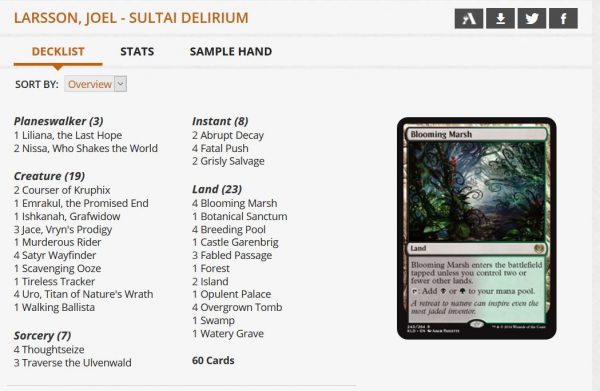
Playing three colors in Pioneer is not difficult, but the traditional fetch-shock or fetch-dual approach of Modern and Legacy, respectively, is not available. Between all the mana fixing lands available, there’s no shortage of options. Which lands are most played will vary by metagame, but I believe Kaladesh Fast Lands offer the best balance of playability and print run (single printing) to offer upside in 2020.

Wrapping It Up

It didn’t take long for Pioneer to become popular—players love new formats as it quickly becomes a new place to brew and explore Magic. MagicFest Brussels had a terrific turnout as players remain excited to play the evolving format. I believe this newfound interest will translate to greater sales of the most played cards, leading to higher prices.

While not my area of focus, I felt it important enough to explore the format a little more in-depth to see which cards had the greatest upside potential. In order to minimize risk, one approach would be to find cards with multi-format appeal and buy accordingly. That’s precisely what I tried to do this week.

It turns out the list of options is quite long, meaning there’s no shortage of ideas to explore. If you’re new to Pioneer like me, then perhaps this list offers a useful snapshot of where to focus your attention. Personally, I have no position in any of the cards I discussed today—I’ve been focusing on upgrading my Old School decks recently. But if I do decide to make a play in Pioneer (probably a good idea as it encourages portfolio diversification), the cards I discussed in this week’s article are where I’d start.

…

Sigbits

  • Legends Mana Drain has made a return to Card Kingdom’s hotlist, now with a $120 buy price. After seeing a pullback post-reprinting, this card has rebounded strongly and offers decent upside going forward…as long as it doesn’t get the reprint treatment again!
  • One card with a bafflingly high price is Bloom Tender. Somehow, after all these years, the card still continues to dodge reprint outside the Mystery Booster Packs (which really doesn’t count, the set is too huge to introduce significant supply of any one card). As a result, the card remains on Card Kingdom’s hotlist with a $42 buy price!
  • Another card that constantly dodges reprint is Cabal Coffers. The uncommon (not even rare!) did see a reprint in Planechase, but that was still a long time ago now. Thanks to its popularity in Commander, the land now buylists to Card Kingdom for $49! Torment copies buylist for “only” $39, but that’s still wildly high for an uncommon that sees little play in 60-card formats. I jokingly wonder at what point Torment booster packs are worth cracking for a shot at this card!
Jan ’20 Brew Report: Amberning Up

Are you a Quiet Speculation member?

If not, now is a perfect time to join up! Our powerful tools, breaking-news analysis, and exclusive Discord channel will make sure you stay up to date and ahead of the curve.

It's a whole new Modern, but we've got some unfinished business to take care of. Sure, some of the following lists are from after the Oko ban. Others, before. But all of them are from this month, which saw some really neat developments!

Simic Urza

Don't call it a comeback! Simic Urza may have lost its key payoff in Oko, and its key enabler in Mox Opal, but it's apparently still viable.

Simic Urza, LUCABIRESKUSKU (3-2, Modern Preliminary #12076840)

Creatures

4 Uro, Titan of Nature's Wrath
4 Emry, Lurker of the Loch
4 Gilded Goose
4 Ice-Fang Coatl
4 Urza, Lord High Artificer

Artifacts

4 Arcum's Astrolabe
3 Engineered Explosives
4 Mishra's Bauble
2 Mox Amber
1 Tormod's Crypt

Instants

3 Cryptic Command
3 Metallic Rebuke

Lands

2 Breeding Pool
4 Flooded Strand
4 Misty Rainforest
2 Mystic Sanctuary
1 Scalding Tarn
1 Snow-Covered Forest
5 Snow-Covered Island
1 Steam Vents

Sideboard

2 Tormod's Crypt
3 Blood Moon
2 Ceremonious Rejection
3 Galvanic Blast
2 Mystical Dispute
1 Questing Beast
2 Veil of Summer

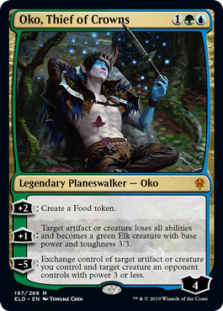
I have to say I was quite surprised to see Simic Urza putting up any kind of result after the bans. As I understood the deck, it began splashing green only to fit Oko, Thief of Crowns, the card it was more or less built around. But while the components have shifted a bit, Simic Urza appears to be following a similar gameplan: ramp into strong three- and four-mana plays and secure the advantage with permission.
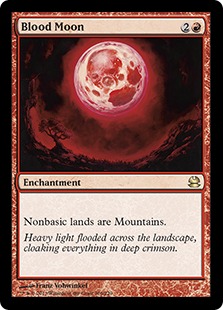
The new cards here are Uro, Titan of Nature's Wrath and Mox Amber, which respectively replace the identically-costed Oko and Opal. Uro is a passable value play that becomes more threatening later on. It of course can't wear Oko's many hats, but it still provides some velocity up-front and gets pilots closer to Urza, Lord High Artificer while being more flexible than a regular cantrip. 6/6 is kind of huge in Modern, where the strongest toughness-matters removal stops at 5.

As for Mox Amber, the only card activating it quickly is Emry, Lurker of the Loch. And the pair has notable synergy, as Mox gives Emry affinity, and can then tap for mana once the legend resolves. But without Emry, it's just an artifact for the battlefield, similar to Mishra's Bauble, another cog pilots are hesitant to crack early on.

Both changes are significant downgrades, but the Urza core seems strong potent to make things work.

Temur Urza, DANKCONFIDANT (5-0)

Creatures

4 Emry, Lurker of the Loch
4 Urza, Lord High Artificer
2 Uro, Titan of Nature's Wrath

Planeswalkers

3 Wrenn and Six

Artifacts

4 Arcum's Astrolabe
2 Engineered Explosives
4 Mishra's Bauble
4 Mox Amber
1 Pithing Needle
1 Aether Spellbomb

Enchantments

2 Blood Moon

Instants

2 Cryptic Command
3 Galvanic Blast
2 Metallic Rebuke

Lands

1 Breeding Pool
1 Fiery Islet
1 Ghost Quarter
1 Lonely Sandbar
4 Misty Rainforest
2 Mystic Sanctuary
3 Polluted Delta
2 Scalding Tarn
1 Snow-Covered Forest
5 Snow-Covered Island
1 Steam Vents

Sideboard

1 Galvanic Blast
2 Ashiok, Dream Render
2 Damping Sphere
1 Dismember
1 Ghirapur Aether Grid
1 Grafdigger's Cage
2 Magus of the Moon
2 Mystical Dispute
1 Nature's Claim
2 Weather the Storm

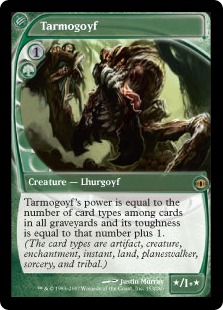
Then we have Temur Urza, which splashes red for high-power plays like Wrenn and Six and Blood Moon. Wrenn plugs a curve hole as does Tarmogoyf in mana-dork decks, punishing opponents for removing a first-turn mana generator and attacking from a unique angle besides. Moon also penalizes tap-outs, the very threat of its existence slowing opponents down.

Splash aside, this build goes harder on Mox Amber, including a full set. It's Uro which finds itself in slimmer numbers, trimmed to accommodate the red payoff cards.

While my own playstyle biases make me partial to how this deck looks, I can't help but wonder if it isn't stretched too thin. The red plan it splashes for has no overlap with the artifact plan forming the deck's backbone, and a major draw to Simic Urza decks pre-ban was the cohesion between its pieces: while Oko stood alone as a win condition, it was only enhanced by an abundance of Baubles and Astrolabes in a way that Wrenn and Moon aren't. Either way, though, I find this development for midrange-trending Urza decks interesting and even refreshing, as most Urza decks post-ban have naturally reverted to prison-style Whirza decks.

Dats a Combo

Simic Urza was great at unfolding its gameplan while disrupting opponents, but it also proved soft to the kind of disruption that has historically wreaked havoc on combo decks. During its reign, sleeving up any form of combo seemed like a a shaky choice. These decks are starting to crawl out of the shadows.

Coretapper, CHERRYXMAN (5-0)

Creatures

4 Coretapper
2 Walking Ballista

Planeswalkers

4 Karn, the Great Creator
4 Ugin, the Ineffable

Artifacts

4 Astral Cornucopia
4 Chalice of the Void
4 Everflowing Chalice
4 Expedition Map
4 Mystic Forge
2 Paradox Engine
4 Surge Node

Instants

1 Once Upon a Time

Lands

2 Blast Zone
1 Ghost Quarter
1 Inventors' Fair
1 Sea Gate Wreckage
1 Snow-Covered Forest
4 Urza's Mine
4 Urza's Power Plant
4 Urza's Tower
1 Wastes

Sideboard

1 Walking Ballista
1 Paradox Engine
1 Crucible of Worlds
1 Ensnaring Bridge
2 Grafdigger's Cage
1 Liquimetal Coating
3 Spatial Contortion
3 Thought-Knot Seer
1 Tormod's Crypt
1 Witchbane Orb

Coretapper suffered doubly under Simic Urza's reign, as it simply cannot function under Collector Ouphe, a card popular for incidentally cramping Urza's artifact engine. The deck isn't entirely new to Modern, but it has gained an interesting tool lately in Once Upon a Time. The exact number of copies to run remains a mystery; still, Once pulls double-duty here by both finding Tron lands and locating Coretapper, an integral component of the deck's mana engine. And like the dedicated Tron decks themselves, losing Mycosynth Lattice doesn't appear to make Karn, the Great Creator any less of a staple in decks that produce a lot of mana.

Oracle Ad Nauseam, SLYDANIEL (5-0)

Creatures

4 Thassa's Oracle
4 Simian Spirit Guide

Artifacts

4 Lotus Bloom
4 Pentad Prism

Enchantments

4 Phyrexian Unlife

Instants

4 Ad Nauseam
4 Angel's Grace
1 Lightning Storm
3 Pact of Negation
4 Spoils of the Vault

Sorceries

4 Serum Visions

Lands

3 City of Brass
4 Darkslick Shores
3 Gemstone Mine
2 Plains
3 Seachrome Coast
3 Temple of Deceit
2 Temple of Enlightenment

Sideboard

1 Pact of Negation
2 Bontu's Last Reckoning
2 Grafdigger's Cage
4 Leyline of Sanctity
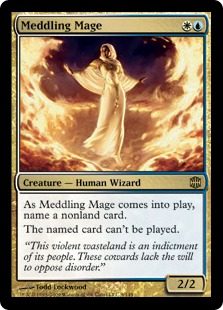
1 Meddling Mage
1 Path to Exile
2 Teferi, Time Raveler
2 Wear // Tear

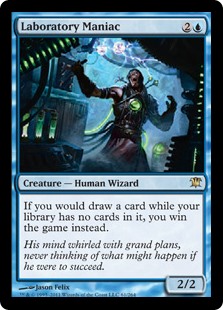
Oracle Ad Nauseam runs not one, not two, but four copies of Oracle of Thassa. David explored the card's potential in this deck a couple weeks ago, but he hadn't expected Oracle to surface in such a quantity! It turns out that blocking and scrying along the road to six mana is closely aligned with Ad Nauseam's Plan A in addition to offering a straight upgrade to the once-run Laboratory Maniac.

Christmas Beatings

Speaking of my predilections, nothing feels more Magic to me than turning dudes sideways. And I'm not alone in my pursuit of combat!

GR Aggro, PSYCHOPHOBIC (5-0)

Creatures

4 Bonecrusher Giant
4 Arbor Elf
2 Birds of Paradise
4 Bloodbraid Elf
4 Glorybringer
4 Gruul Spellbreaker
4 Magus of the Moon
2 Obstinate Baloth
4 Vengevine

Planeswalkers

1 Domri, Anarch of Bolas
2 Kiora, Behemoth Beckoner

Enchantments

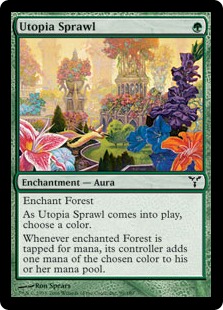
4 Utopia Sprawl

Lands

8 Forest
1 Kessig Wolf Run
1 Mountain
3 Stomping Ground
4 Windswept Heath
4 Wooded Foothills
60 Cards

Sideboard

2 Obstinate Baloth
2 Ancient Grudge
3 Anger of the Gods
2 Cindervines
2 Ruric Thar, the Unbowed
2 Trinisphere
2 Wheel of Sun and Moon

This build of GR Aggro follows a simple credo: cast a three-drop on turn two. I mean, it worked for Oko decks, right? An abundance of four- and five-drops turns extra dorks (and incidental mana garnered from the Arbor-Sprawl interaction) into real threats, including the recursive Vengevine. Vine boasts little synergy with any element of the deck other than it plays a lot of creatures, making this list perhaps the most fair usage of the 4/3 I've ever seen in Modern.

Here too is Bonecrusher Giant, a card gaining steam as a versatile modal spell that locks in value for longer games. Between Giant in aggro strategies, Brazen Borrower in Ux tempo decks, and Merchant of the Vale in graveyard-based ones, the adventure mechanic has shaped up to be quite strong in Modern.

GR Aggro, KILLAGERM (32nd, Modern Champs #12061198)

Creatures

4 Arbor Elf
4 Bloodbraid Elf
3 Goblin Rabblemaster
2 Hexdrinker
2 Magus of the Moon

Planeswalkers

1 Chandra, Awakened Inferno
4 Karn, the Great Creator
3 Wrenn and Six

Enchantments

4 Utopia Sprawl

Instants

1 Dismember
4 Lightning Bolt
3 Once Upon a Time

Sorceries

4 Pillage

Lands

5 Forest
1 Ghost Quarter
2 Horizon Canopy
2 Mountain
4 Stomping Ground
3 Windswept Heath
4 Wooded Foothills

Sideboard

2 Anger of the Gods
2 Cindervines
1 Ensnaring Bridge
1 Liquimetal Coating
1 Mycosynth Lattice
2 Shifting Ceratops
1 Trinisphere
2 Veil of Summer
1 Walking Ballista
2 Weather the Storm

This build of GR Aggro focuses less on three-drops, featuring something to do should opponents actually have a Lightning Bolt. It's more midrange-leaning too, with a higher curve epitomized by 4 Karn, the Great Creator. I don't see this package hanging on with Lattice gone, as it's no longer a win condition, but I'm still tickled by the idea of an aggro deck adopting such a strategy so decisively. Once Upon a Time is also cool here, as it finds Arbor Elf for Sprawl shenanigans or Rabble, Hex, or Magus depending on the matchup (hence the split between those creatures).

One notable is that Tarmogoyf is absent from both decklists. Even though it hits like a ton of bricks and covers for shot-down one-drops, the above deckbuilders evidently found that the once-ubiquitous beater had little to contribute to their ecosystems: PSYCHOPHOBIC's deck refuses to indulge even a single two-drop, while KILLAGERM's prefers Wrenn (and Once) in those precious few slots. My, how the mighty have fallen!

Year of the Brew

That's it for today's installation. If you happen to come across any sneaky-scary Modern brews, don't hesitate to rat them out!

Pioneer Goes to the Players Tour

Are you a Quiet Speculation member?

If not, now is a perfect time to join up! Our powerful tools, breaking-news analysis, and exclusive Discord channel will make sure you stay up to date and ahead of the curve.

This weekend brings the Players Tour, the New Pro Tour, to Europe and Asia. The results will heavily influence the metagame going into next week’s Northern American event and the Pioneer GP along with. The market has already been in a frenzy, and I expect things to only get wilder as the weekend develops. While the best chance to get in on recent big movers like Niv-Mizzet Reborn and Inverter of Truthhas likely passed, there are plenty of other cards showing signs of a breakout. 

The Inverter of Truthand Thassa's Oracle combo deck is the real deal. On Wednesday the winner of the last Mythic Championship, popular streamer Piotr “kanister” Glogowski announced to the world he had registered it for the Players Tour, and others have followed suit. The buzz is building, and there’s no doubt we’ll see the deck in action this weekend, maybe even on Sunday. While Inverter of Truth itself has already spiked, there could be opportunity in its other staples, especially because the rest of the deck has not been completely nailed down yet. Targeting cards riding the rising tide of spiking cards is one simple and effective way to approach it speculation, so I’ve been keeping a close eye on the decklists and any new tech to emerge.

Interests

There was an error retrieving a chart for Pack Rat

Pack Rat has shown up in the deck’s sideboard as an alternate kill con, and in turn has a massive spike online from around 0.10 tix to over 1. The paper price already nearly tripled after the Pioneer announcement on pure speculation but has held steady since, so I’d bet it will take off in price it ends up seeing success at the Players Tour.

There was an error retrieving a chart for Ashiok, Nightmare Weaver

Another card of note is Ashiok, Nightmare Weaver, which has seen its fortunes improve with the rise of Blue-Black decks, and has increased online accordingly. It was an old Standard staple and has even seen a bit of play in Modern, but it didn’t budge with the Pioneer announcement. That leaves plenty of room for it to rise if the card starts seeing play, and the Players Tour would be the perfect catalyst, but the verdict is still out if this is actually a staple or not. If it does end up putting up good results, it’s something I’ll be looking to buy in on. 

There was an error retrieving a chart for Quarantine Field

Combo decks may prove to be the story of the weekend, because the Heliod, Sun-Crowned combo with Walking Ballista has also been taking off on Magic Online. It has found a good home in a White Devotion shell, and two online cards that have spiked from it are Gideon of Trials and Quarantine Field. At around $0.70 for a Mythic Rare Quarantine Field feels like a solid bargain bet, while under $4 looks cheap compared to the $20 level where Gideon of the Trialsbroached while in Standard. 

There was an error retrieving a chart for Gideon of the Trials

Another promising target in the deck is Anafenza, Kin-Tree Spirit, which is a nice option because it’s also played in Modern decks that have been built around the combo. It currently has a strong buylist price of $0.75 at CardKingdom, which is barely lower than the retail price around $1.

There was an error retrieving a chart for Anafenza, Kin-Tree Spirit

One version of the deck splashes green for the powerful Collected Company, and it has increased demand for Fortified Village online. A look at the paper price shows a very promising graph showing steady growth since the Pioneer announcement, and this deck could be the spark that sends it truly spiking.

There was an error retrieving a chart for Fortified Village

The same concept could also apply to Choked Estuary, on the back of the Inverter of Truth-Thassa's Oracle combination. It has not become a consensus staple, however, and is generally played as a two-of if not completely absent from some decklists.

There was an error retrieving a chart for Choked Estuary

Compared to the graph of Fortified Village, it has not maintained its growth and actually pulled back, but it has been stable all month. I’d approach cautiously, but certainly, the deck only helps its prospects.

Last weekend brought qualifiers for Magic Online’s new Showcase Series, and the Pioneer event was won by Pro Teruya Kakumae playing his own version of red aggro. Included was a set of Abbot of Keral Keep, an old Standard staple and one-to-be in Pioneer.

There was an error retrieving a chart for Abbot Of Keral Keep

I immediately scooped up a few dozen mint copies at $0.40 each upon the news, but I should have focused my efforts on Magic Online, where its price spiked from mere cents to over a ticket by the day after, and is now sitting around 0.40. I expect it to become a real staple of the format in the coming weeks and years so I love its long-term prospects, but a breakout at the Players Tour could send its price spiking sooner than later.

Low on Graveyard Decks

None of the Gather the Pack decks have been performing well recently. Soulflayer has fallen off, Dredge seems nonexistent. I buylisted all of my spec of Decimator of the Provinceson news that "Sodeq", the foremost proponent of the deck and one who popularized it in the first place, is not even using it in the most recent list. I got rid of all my Gather the Pack along with it.

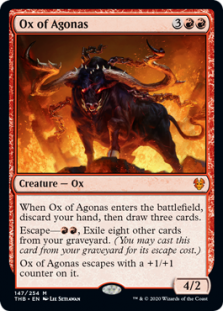
One graveyard strategy I would watch is Izzet Arclight Phoenix, which has seen only minor play in the past few weeks. It seems to have been mostly forgotten, but a promising new version that incorporates Ox of Agonas has been building steam and put up a 5-0 Preliminary finish this week. Adding broken new cards is always a recipe for success, and I think Ox of Agonas itself, at around $6, could be a strong spec target. It has been creeping up online this week, so interest seems to be building. 

There was an error retrieving a chart for Ox of Agonas

Season’s Greetings: Early Metagame Indicators

Are you a Quiet Speculation member?

If not, now is a perfect time to join up! Our powerful tools, breaking-news analysis, and exclusive Discord channel will make sure you stay up to date and ahead of the curve.

That Modern is changing should be obvious: there's a lower-power set coming out and we just had a major banning. But how Modern is changing is an open question. The only major Modern events for the next month are SCG Classics and Team Opens, which aren't the most reliable sources for data. So we'll have to get creative to figure out the bigger picture.

Methodology

Given the lag in large event data, I have to use less-reliable sources. I play a lot of Modern, both online and in paper, and have made plenty of observations about what is going on in both. However, I am just one data source, and can only observe a small slice of metagame activity. My experiences provide color, context, and commentary, but should not be regarded as hard data.

The only place where there are enough Modern events going on to develop a good data set is online. The problem with MTGO is that the data isn't entirely accurate. Wizards doesn't report the totality of League results, only curated lists. Cherry-picked data isn't valid because it reflects the choices of the surveyor, not reality. To circumvent this bias, MTGGoldfish adds in the results from Challenges and Preliminaries. MTGTop8 adds in whatever paper results get uploaded, which adds credibility and bulk to their data.
The two sites do not agree with each other in terms of metagame rankings, a result of their their differing data sets. My experience more closely reflects what Goldfish is reporting, specifically their at-time-of-writing top five decks (in order: Mono-Red Prowess, Jund, Burn, Amulet Titan, and Dredge). All these decks appear in MTGTop8's January decks to beat, but not in that order. In any case, we'll focus on those five decks today.

Burn's Back

MTGGoldfish lists Mono-Red Prowess and Burn as different decks, with Prowess being more popular. MTGTop8 makes no distinction, lumping them together as Red Deck Wins, but again, right now Prowess has more entries than Burn.
Regardless of the deck, it makes sense that a red deck would be on top right now. Burn generally does well after major metagame shakeups. This is primarily because in a time of uncertainty, people gravitate towards what they know: when they're not sure what to play because they don't know what's best anymore, they'll just play Burn. Which is never a bad decision because Burn is a good deck, and it will take major changes in how Magic works for it not to always be.

Fiery Twins

However, Burn isn't the most popular red deck at the moment; Prowess is. That's not to say that Prowess necessarily threatens Burn in the long-term.

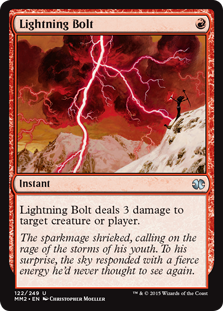
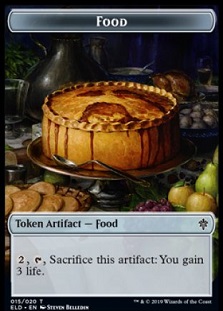
Prowess is currently benefitting from Oko-era holdovers. Burn can deal with some amount of incidental lifegain. However, a constant stream of food is lethal. Sacrificing a food is functionally the same as countering a Lava Spike, and Oko, Thief of Crowns prevented Burn from progressing its gameplan. Meanwhile, Prowess kills with big chunky turns of damage, a strategy that pushes through streams of food. Coupled with Light Up the Stage and Bedlam Reveler, Prowess had the gas it needed to stomach the feast, and was more successful.
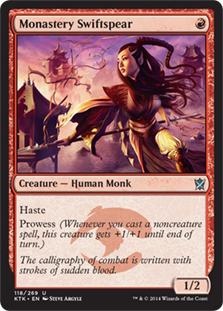
With that being said, Burn is historically favored in an open meta. Every spell is live for Burn late-game, whereas Lava Dart is pretty pathetic unless it's powering up several prowess creatures. Prowess is also weaker against combo decks since it can't maindeck Eidolon of the Great Revel.

More generally, Prowess relies more on creatures than Burn, and that makes it easier to answer. Jund is well-built for killing a number of one mana creatures and then racing with big Tarmogoyfs. It's much harder to race 3-4 to the face every turn after clearing a board. Which red deck emerges supreme will depend heavily on how everything else shakes out.

Place in the Sun

I expect both decks to fall off as the metagame develops regardless of their positioning, as typically happens. As the metagame becomes more defined and tuned, there are fewer inefficiencies and clunky decks for the streamlined red decks to exploit. Other pilots also remember that Burn exists and go back to running sideboard hate.
While I wouldn't expect a red deck to stay on top for that long, they will secure a long-term place in the metagame. Being the fastest aggro deck is never a bad strategy, and so long as Modern's manabase is based on fetch and shocklands, there will be room for Burn. I don't understand why players never respect Burn only to end up eating their words, but it happens constantly. Red Deck Wins will remain a high-tier deck in the immediate future, and one that must at least be accounted for in the foreseeable future.

They're Back... Again

Dredge is sitting on the low end of both sites' lists, which I find very surprising. I've barely seen the deck in months, and the only times it did well was against unprepared opponents. After Faithless Looting was axed, it looked like Dredge was dead. There were some attempts to keep the deck relevant afterwards, but Dredge looked dead for good during the Oko era.

However, that's always an illusion. There's a reason my sideboarding rules include "Don't Just Lose to Dredge." As soon as players start cutting the hate, the deck comes back, as it is now.

Ox-ing Around

Every Dredge player I've asked has been raving about Ox of Agonas. However, I'm unconvinced, as every conversation has gone roughly as follows:

Me: Why is Dredge suddenly good now?

Them: Ox is insane! When I get it out turn 2 via Haggle turn 1 it just wrecks my opponent.

Me: How?

Them: I have a 5/3 at minimum, and I can dredge three times on turn two!

Me: Couldn't you have done that with Cathartic Reunion?

Them: Yeah, but this way I get a threat guaranteed. No spinning the roulette wheel.

Me: Only if you have an Ox to escape. And your whole deck is a roulette wheel anyway. Also, why are you Haggling the Ox? Why not just do that with a dredger?

Them: If I don't there's no guarantee I'll hit an Ox to escape.

Me: Yeah, but then you got started dredging, and possibly got to dredge on your opponent's end step, your draw step, and then three times with Cathartic.

Them: *Awkward silence/muddled spluttering*

I'll admit that I could be missing something, but every line I've seen involving early Ox has been worse than just getting the dredge engine online. Every Ox turn in the mid-game has ended up in the same place as if it had been Cathartic instead. Ox hasn't shown me anything that makes Dredge actually better: it still loses to the same cards, wins the same way, and generally plays identically to how it always has, if slower now that Looting is gone.
As I see it, Ox hasn't really made dredge any better or worse than before. Instead, it's incentivized players to pick Dredge back up, which does technically mean that it is a major factor in Dredge's return. Technically.

Going Tall

The other big deck is the biggest one: it has a Giant. Amulet Titan has become the big mana deck according to MTGGoldfish. Tron and Valakut retain places in MTGTop8's rankings thanks to strong showings in paper, but Titan is gaining on them.

During the Oko era, Amulet was consistently putting up strong showings in Day 2 results, but those never translated into high Top 32 placements. At the time, I thought that Amulet was simply overhyped and the StarCity circuit was chasing its own hype and tail.

When I saw twitter threads and reddit discussions claiming that Titan was the Next Big Thing, I was dismissive. But I've since been impressed by the deck's showings, and believe that its recent meandering may have been the result of a transitional phase in deckbuilding.

Untapping a New Form

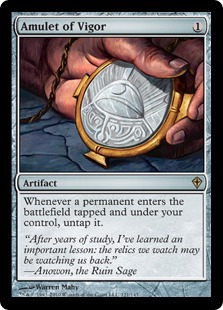
Since its coming out party, Amulet Titan has remained relatively unchanged. It's a land combo deck based on using the unique abilities of Simic Growth Chamber and its ilk, along with extra land drops and Amulet of Vigor, to generate absurd amounts of mana, drop Primeval Titan, then kill with Slayer's Stronghold and Sunhome, Fortress of the Legion. While the deck composition has shifted with the metagame over the years, the overall gameplan hasn't.

Amulet Titan, Andyscwilson (MTGO MOCS 5/13/19, 1st Place)

Creatures

4 Sakura-Tribe Scout
4 Azusa, Lost but Seeking
4 Primeval Titan
1 Hornet Queen

Artifacts

1 Engineered Explosives
4 Amulet of Vigor
2 Coalition Relic

Planeswalkers

3 Karn, the Great Creator

Sorceries

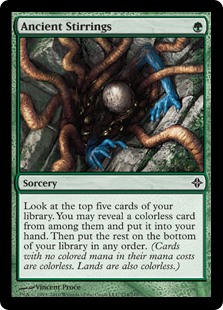
4 Ancient Stirrings

Instants

4 Summoner's Pact
1 Pact of Negation

Lands

4 Simic Growth Chamber
4 Selesnya Sacnctuary
4 Gemstone Mine
3 Tolaria West
3 Forest
2 Cavern of Souls
1 Bojuka Bog
1 Boros Garrison
1 Ghost Quarter
1 Kabira Crossroads
1 Khalni Garden
1 Slayer's Stronghold
1 Sunhome, Fortress of the Legion
1 Vesuva

Sideboard

3 Path to Exile
2 Spell Pierce
2 Engineered Explosives
1 Emrakul, the Promised End
1 Mycosynth Lattice
1 Negate
1 Reclamation Sage
1 Thragtusk
1 Tormod's Crypt
1 Walking Ballista
1 Wurmcoil Engine

Everything began to change with Throne of Eldraine. Specifically, the change started with Castle Garenburg. Castle generates the mana to play Titan a turn earlier than previously possible for non-ramp decks. There's no real cost to running it, since it's not legendary and taps for green. Amulet players began favoring Castle over karoo lands.

Amulet Titan, Ouranos139 (MTGO PTQ 12/10/19, 1st Place)

Creatures

4 Azusa, Lost but Seeking
4 Sakura-Tribe Scout
4 Primeval Titan

Artifacts

4 Amulet of Vigor
1 Engineered Explosives

Planeswalkers

2 Oko, Thief of Crowns

Instants

4 Summoner's Pact
1 Pact of Negation
4 Once Upon a Time

Sorceries

3 Ancient Stirrings

Land

4 Simic Growth Chamber
3 Tolaria West
2 Snow-Covered Forest
2 Forest
2 Breeding Pool
2 Gemstone Mine
2 Castle Garenburg
1 Boros Garrison
1 Cavern of Souls
1 Field of the Dead
1 Ghost Quarter
1 Golgari Rot Farm
1 Gruul Turf
1 Khalni Garden
1 Radiant Fountain
1 Selesnya Sanctuary
1 Slayer's Stronghold
1 Sunhome, Fortress of the Legion
1 Vesuva

Sideboard

2 Engineered Explosives
2 Dismember
2 Disdainful Stroke
1 Bojuka Bog
1 Cavern of Souls
1 Chameleon Colossus
1 Field of the Dead
1 Force of Vigor
1 Obstinate Baloth
1 Oko, Thief of Crowns
1 Ramunap Excavator
1 Reclamation Sage

Oko, Thief of Crowns facilitated this change. Not only was a manabase reworking necessary to accommodate Oko, the walker's existence also made the Amulet itself less valuable, as opponents could turn it into an Elk. Besides, pilots now had a functional gameplan in their own Oko.

As Amulet of Vigor became less central, the need for Ancient Stirrings was lessened. Instead, the sometimes-free Once Upon a Time was adopted, allowing for more utility lands. But since Theros: Beyond Death, Amulet has undergone yet another growth spurt.

Amulet Titan, egadd2894 (MTGO Preliminary 1/25/20, 2nd Place)

Creatures

4 Primeval Titan
4 Dryad of the Ilysan Grove
4 Sakura-Tribe Scout
4 Azusa, Lost but Seeking

Artifact

4 Amulet of Vigor
1 Engineered Explosives

Instants

4 Summoner's Pact
1 Pact of Negation
4 Once Upon a Time

Lands

4 Simic Growth Chamber
4 Castle Garenburg
2 Breeding Pool
2 Forest
2 Tolaria West
1 Bojuka Bog
1 Boros Garrison
1 Cavern of Souls
1 Field of the Dead
1 Gemstone Mine
1 Ghost Quarter
1 Golgari Rot Farm
1 Gruul Turf
1 Radiant Fountain
1 Selesnya Sanctuary
1 Slayer's Stronghold
1 Snow-Covered Forest
1 Sunhome, Fortress of the Legion
1 Valakut, the Molten Pinnacle
1 Vesuva
1 Windswept Heath

Sideboard

3 Dismember
2 Mystical Dispute
1 Cavern of Souls
1 Engineered Explosives
1 Field of the Dead
1 Force of Vigor
1 Radiant Fountain
1 Ramunap Excavator
1 Reclamation Sage
1 Tectonic Edge
1 Tireless Tracker
1 Valakut, the Molten Pinnacle

Dryad of the Ilysian Grove means never having to worry about mana balancing and no reason not to play Valakut, the Molten Pinnacle. More creatures means more Garenburgs and no need for Stirrings. Amulet Titan is morphing from a land combo deck into a land value engine.

I've even seen decks cutting Amulet of Vigor entirely, which I don't quite know what to make of. Without Amulet pumping out Titans early, the deck strikes me as a worse Valakut.

Meanwhile, in Jund Land...

As if out of spite, Jund remains constant in the face of all that innovation. There's little need for players to substantially change the deck's gameplan or the overall configuration, though I've seen a few players with slightly tweaked threat packages, primarily featuring Hexdrinkers.

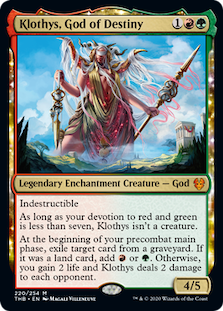
Some are also trying Klothys, God of Destiny as a mirror breaker and anti-control card, as I predicted they might. However, the feedback I've received indicates that Klothys is only relevant in really, really grindy games, making its future uncertain.
Jund's resurgence is in line with that of the red decks. With the format in disarray, players feel comfortable digging out their proven midrange deck without fear of being poorly positioned. And they no longer have to worry about the Mox-powered Simic Urza beating them at their own game. Jund is and has always been just a very solid deck, and without something obviously broken around, it's time to grind again.

The Once and Future Metagame

As the saying goes, the more things change, the more they stay the same. Jund and red decks are as Jund-and-red-decks as ever, while Amulet becomes more unrecognizable by the day. Which metagame developments have you intrigued?

Exploring Magic Memorabilia

Are you a Quiet Speculation member?

If not, now is a perfect time to join up! Our powerful tools, breaking-news analysis, and exclusive Discord channel will make sure you stay up to date and ahead of the curve.

When thinking about MTG finance topics, 99.9% of the time my mind goes to cards. The game is made up of cards and they are the only necessary entity to enjoy the game. The cards are what’s tracked on MTG Stocks, and the QS Insider Discord is constantly debating and discussing what cards are smart to buy or sell.

This week I thought I’d switch it up a little bit. There are Magic related items that aren’t cards, which can carry significant value. These aren’t necessarily worth “speculating” on and I wouldn’t advocate buying the market out of any of these items. But it’s good to have an awareness that these items exist, are rare, and have demand. You never know when you’ll stumble over one of these when buying collections or vending at an event.

Duelist Abacus Life Counters

Spindown dice are a dime a dozen nowadays. Wizards puts these in so many products; it’s difficult to not accumulate a handful. This has severely eroded their value. I remember a time when Star City Games offered actual dollars on various spindown dice. Today, while the “Supplies” category is still available to select on Star City’s buylist, nothing comes up when you click on it.

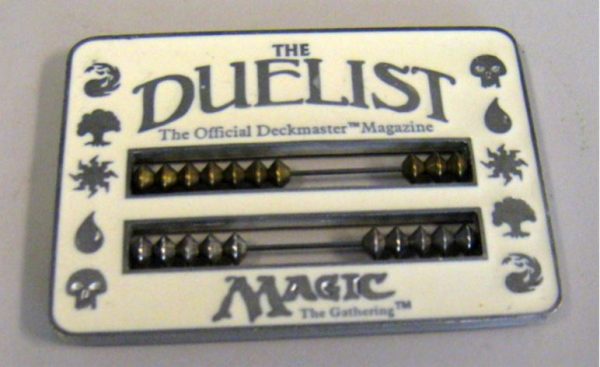
Let’s rewind the clock now. Before Wizards gave everyone spindown dice, keeping track of life totals was a more creative process. One of the first “cool” ways to track life during a game of Magic involved one of these:

This is an official Duelist Magazine Abacus life counter. You see, back in 1995 Duelist Magazine sold these life counters for $12.99 ($22 in 2020, adjusted for inflation). I have no clue how many Duelist sold, but given the age of these items and the fact that Magic is far more popular now than it was in 1995, these have to be somewhat rare.

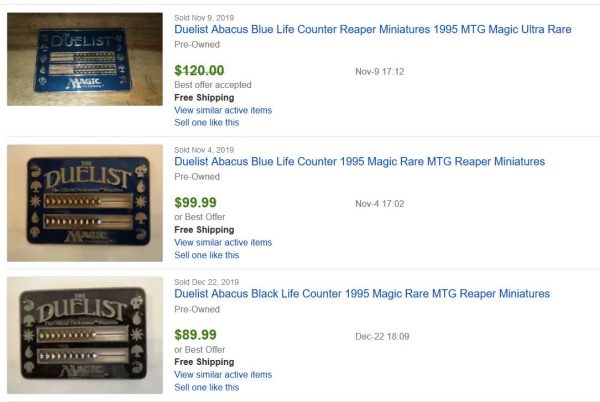
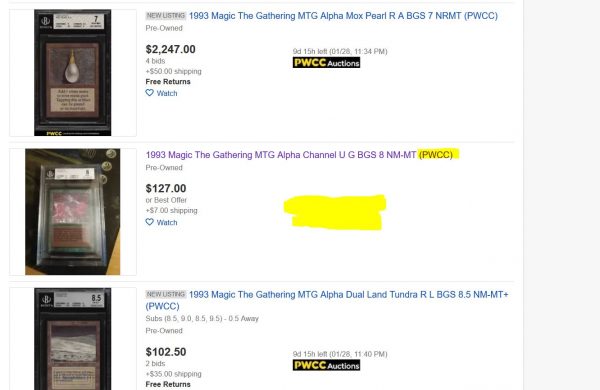
And their price reflects as much:

If you had purchased these from Duelist back in 1995, you would have made an attractive return for your money. Of course, no one would have guessed that Magic would have been around another 25 years, nor that these would be considered a collector’s item. So it’s doubtful anyone is sitting on tons of these unless they’re collecting them now (in which case, they know what they’re sitting on). But if you ever uncover these in someone’s collection, do them a favor and let them know they have a desirable gem in this life counter.

Magic Page-a-day Calendar

A few years ago, my brother bought me a sweet Magic page-a-day calendar as a Christmas present. At the time, I thought the novelty was really cool and I wanted to show off the gift. The truly special part was that the year was turning over to 2014; coincidentally (or not…my brother is clever), the days/dates of 1997 are the same as 2014.

Therefore, I proudly displayed this page-a-day calendar at work, tearing off each page and enjoying the “card of the day” one at a time. Then 2014 ended and the calendar was gone. It wasn’t until afterward that I realized that I had just thrown away a collector’s item one page at a time!

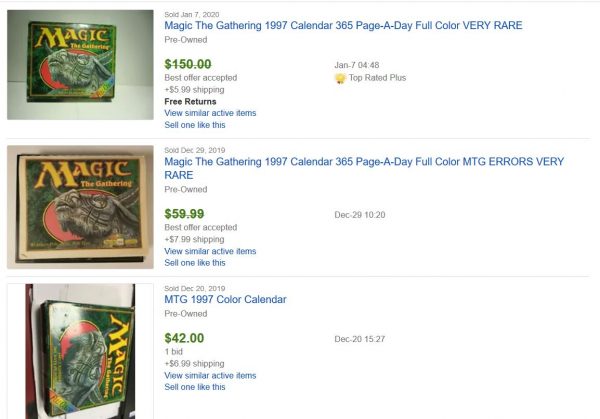
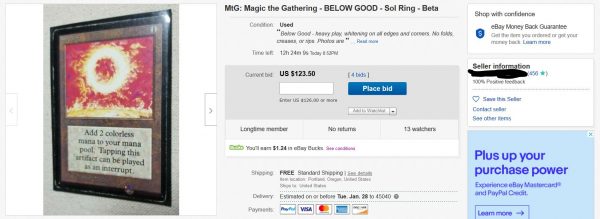
I’m not sure how much that top listing sold for, but it’s safe to say these calendars are worth over $50. That’s not bad for a calendar that has been obsolete for 23 years!

After I realized the collectability of these calendars, I was fortunate enough to purchase a new one from a seller in the Old School Discord channel. This one I won’t even consider using, however. Well, at least not until the days line up again in 2025!

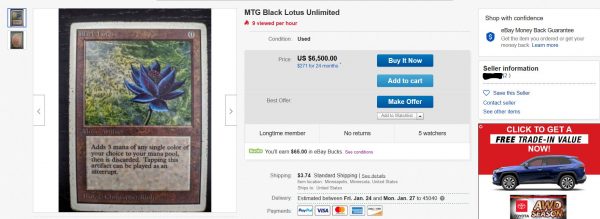
By the way, this is one of those items that is worth whatever someone is willing to pay for it. I point this out because currently on eBay there is only one listed for sale—at $6500! Obviously that seller is dreaming, but I do think these are rare enough that the seller can set whatever price they want and just wait patiently. There’s can be no competition and price undercutting when there’s only one seller! Maybe I should list mine for $5500 and see what happens…

InQuest Magazines

I grew up reading InQuest magazines. I loved the monthly publication, and I remember my excitement at discovering a new issue was available at my local hobby shop. My favorite portion was the price guide—even as a casual player back in 1998, I still appreciated that these collectible cards had value! My friend enjoyed the numerous articles that covered all things Fantasy and Gaming.

As an adult, I’ve decided to collect issues of InQuest Magazine. A store manager at my local LGS gifted me a box full of InQuest issues, and this helped springboard my respectable collection. I now have 112 of the 151 issues that exist.

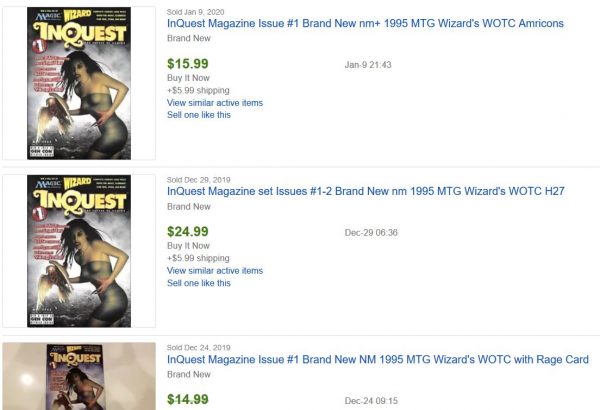
But wait a second. The last issue InQuest published was numbered 150, so how are there 151 in total? Because before issue 1, InQuest published this little number:

This issue is commonly referred to as “Issue 0”. I have to imagine it is quite rare, and because of collectors like me, it carries a little value. Granted, the value doesn’t rival that of the Duelist life counters or page-a-day calendars, but these are definitely worth holding onto if you find any.

Checking eBay, I see that one seller had sold two new copies of Issue 0 back in November for $15.99 + shipping. But now there are none for sale on eBay, and I can’t help but wonder if there’s a buyer out there willing to pay a higher price tag. I had a saved eBay search for “Inquest magazine 0”, and I had to wait many months before someone finally listed one for sale. There only has to be a couple others out there with the same interest, and one of these issue 0’s could readily sell for upwards of $30-$50.

Issue 1, by the way, is worth a little something as well. In fact, all issues probably have a little value to collectors, but Issues 0 and 1 are definitely the most collectible.

Magic Poker Decks

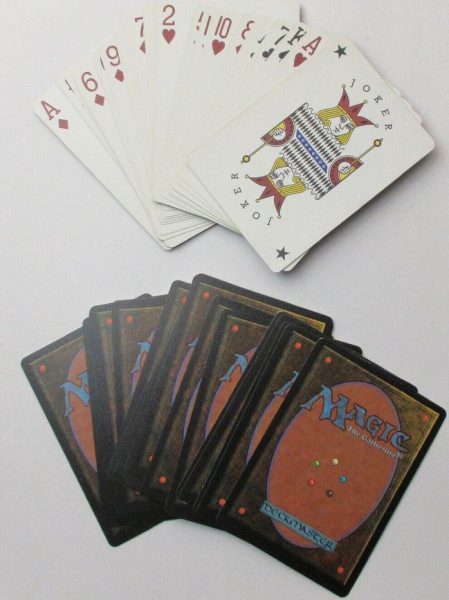
I’m not referring to poker decks that magicians use to display sleight of hand tricks, here. I’m literally talking about a poker deck with Magic card backs.

This collectible item dates back to 1998. Other than the Magic card back, these are also cool because the face cards use classic artwork—the kings are dragons, the queens are angels, the jacks are knights and the jokers are jesters.

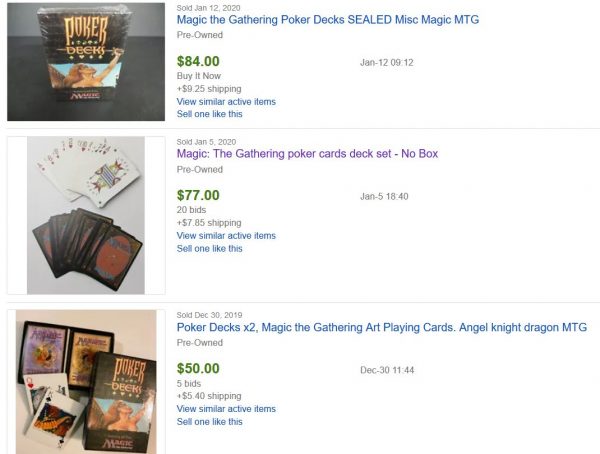
What does an item like this fetch on the open market? You may be surprised to see some of the completed eBay listings!

These are approaching $100! Well let’s face it, these are 22 years old now and it’s not like they’re making any more!

Havic: the Bothering

Last but not least, what Magic ancillary product article would be complete without mention of Havic: the Bothering. Published by PGI Limited back in 1998, this collectible card game was designed as a spoof on Magic. The target audience was high school and college boys, judging by the awful stereotypes in the art (some of these are downright offensive).

I doubt many of these sold. Despite PGI Limited’s best efforts, I believe there were some legal ramifications to publishing this game. A planned expansion set never made it to the market and the game disappeared from store shelves as quickly as it arrived.

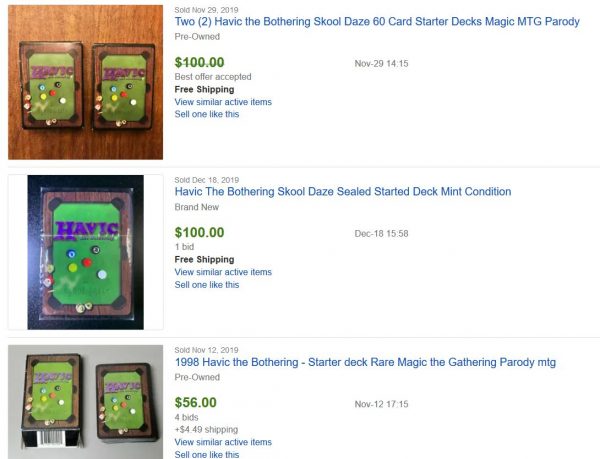
Nowadays, starter decks sell in the $50 range.

There was a hot minute when these were selling for a higher price—it was shortly after Rudy of Alpha Investments made a video about this game. A few decks sold in the $200-$300 range. At the time, I remember declining an offer of around $700 for my three decks. In hindsight, I should have accepted the offer since these have dropped back down to their old price. But I’m a pretty big fan of this obscure product, so I’m happy to keep these (now I own 5) decks for a rainy day.

Wrapping It Up

I guarantee there are other ancillary Magic products worth money that I left out of this article. I know there’s something called a “Spellground playmat” that sells for a couple hundred bucks. There may be other life counters or calendars worth money. There may even be Magic figures worth digging out of collections.

This was not meant to be an all-inclusive article. Instead, it was a fun exploration of a variety of products with surprising value. If you want a more exhaustive list, I’d recommend browsing Magic Librarities. There you’ll find a more complete catalog of rare Magic products.

I hope you enjoyed exploring Magic memorabilia as much as I enjoyed writing about it. If nothing else, your awareness of these products will make you a better collection buyer. You never know when you’ll find a Craigslist listing or a garage sale with these products, and now you know they can have some real value!

Author’s Note: If anyone has old InQuest magazines—even issues beyond 0 and 1—and you want to turn them into a little cash, please reach out to me! I have 112 issues, but that means I still need 39 more! Most of the issues I need are between 106 and 138, so please help me complete the collection!

…

Sigbits

  • Card Kingdom’s hotlist hasn’t changed too much over the past seven days. Many of the same cards remain, and only their actual buy price has fluctuated. I noticed Transmute Artifact and Power Artifact are still on their, now with high buy prices of $105 each. These fluctuate between $80 and $105 frequently, so if you’re looking to buylist these I’d definitely hold off until you can get three figures.
  • I see a number of Judge Promos on Card Kingdom’s hotlist, including Mana Drain ($120), Elesh Norn, Grand Cenobite ($100), Noble Hierarch ($95), Mana Crypt ($140) and Force of Will ($180). These are also fluctuating frequently, and Card Kingdom is definitely a good pricing resource with up-to-date numbers on these promos.
  • Remember the uninspiring set that was Iconic Masters? Here’s a pop quiz: what is the most valuable card from the set? Hint: it’s on the first page of Card Kingdom’s hotlist. Give up? It’s Mana Drain! The reprint is currently buylisting for $70, a full $50 higher than the next highest card from the set (Avacyn, Angel of Hope).


Delver Delivers: Flipping Out in 2020

Are you a Quiet Speculation member?

If not, now is a perfect time to join up! Our powerful tools, breaking-news analysis, and exclusive Discord channel will make sure you stay up to date and ahead of the curve.

A scratching at the window. A fluttering of tiny wings. A grating of jagged teeth. Does anyone else hear what I hear? Perhaps 2020 is Delver's year!

Okay, so maybe I'm jumping the gun a bit. But there sure is a lot of Delver in the recent dumps. Today, we'll look at the different varieties and see how the archetype is evolving without Oko to fall back on.

UR Delver

We'll begin with UR, historically among the most aggressive of Delver builds.

UR Delver, ANOMALOUST (5-0)

Creatures

4 Young Pyromancer
4 Delver of Secrets
4 Snapcaster Mage

Instants

4 Archmage's Charm
2 Deprive
4 Force of Negation
4 Lightning Bolt
2 Magmatic Sinkhole
2 Mana Leak
4 Opt
2 Spell Snare

Sorceries

4 Serum Visions

Lands

1 Fiery Islet
3 Flooded Strand
2 Mystic Sanctuary
4 Polluted Delta
4 Snow-Covered Island
2 Spirebluff Canal
4 Steam Vents

Sideboard

2 Abrade
1 Beacon Bolt
2 Blood Moon
3 Dragon's Claw
2 Grim Lavamancer
2 Mystical Dispute
2 Surgical Extraction
1 The Royal Scions

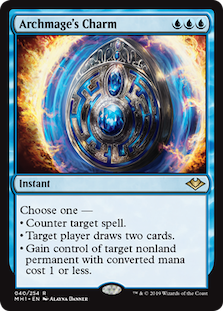
This iteration of UR Delver has been around in some capacity since Modern Horizons, but finally appears to be out in force. Its main draw is the high reversibility enjoyed by melding the aggressive potential of Delver and Pyromancer with the mid-game applications of Snapcaster Mage. That threat suite is complimented by Archmage's Charm, the deck's lynchpin.

With Oko Urza gone from Modern, UR Delver is positioning itself to be Charm's premier utilizer. The card does quite a bit for protect-the-queen strategies: it double-cantrips, offering an answer to attrition plans; it steals nasty creatures, including Death's Shadow and Giver of Runes; and it counters spells, securing a lead while ahead. In other words, it's good at all stages of the game, something a deck as role-restless as Delver appreciates greatly.

Archmage Charm's main drawback is its manacost, which can, of course, be accommodated for. But not by all strategies, which is why we don't see much more of it; the spell is narrow in terms of which decks supports, as many can't swing the triple blue.

As a bonus, being locked into UR doesn't mean the deck fails to utilize its graveyard. Magmatic Sinkhole is a grave-sink so potent even Temur builds accommodate it from time to time, as we'll soon see!

What About Swinging?

Charm's reactive nature prevents the deck from being too aggressive, which is why we don't see Monastery Swiftspear & co. make the cut. Such cheap, red threats proved popular in the blitz-focused, Wizard's Lightning-reliant UR Delver builds from 2018, but UR now prefers to utilize Archmage's Charm and assume the more controlling role shared by equally outdated Spellstutter Sprite variants.

Indeed, the aggressive niche once championed by UR Delver now seems monopolized by Mono-Red Prowess, a deck that's abandoned Arclight Phoenix in light of the Faithless Looting ban but nonetheless retains its power.

And Stripping?

Which brings us to another friend of Insectile Aberration and Young Pyromancer: Inquisition of Kozilek. This combination, too, seems to have become extinct. As far as I can tell, the black spells aren't worth giving up Archmage's Charm when it comes to permission-based decks, and discard-fueled starts are better suited to Mardu Pyromancer or other midrange-leaning strategies.

Temur Delver

Let's shift gears and explore Temur Delver, which we'll focus on for the remainder of the article. I noticed a couple of interesting pre-ban builds from this month while perusing the 5-0 dumps, as well as a juicy updated version from one of the shard's veteran brewers.

Casting a Hex

Temur Hex Delver, THEIMPOSSIBLEEMU (5-0)

Creatures

4 Hexdrinker
4 Delver of Secrets
4 Tarmogoyf

Planeswalkers

2 Oko, Thief of Crowns
2 The Royal Scions

Instants

4 Force of Negation
4 Lightning Bolt
2 Magmatic Sinkhole
4 Mana Leak
4 Opt
1 Spell Pierce
1 Spell Snare
2 Stubborn Denial

Sorceries

4 Serum Visions

Lands

1 Breeding Pool
4 Misty Rainforest
4 Scalding Tarn
1 Snow-Covered Forest
3 Snow-Covered Island
1 Snow-Covered Mountain
2 Steam Vents
1 Stomping Ground
1 Wooded Foothills

Sideboard

1 Ancient Grudge
2 Ashiok, Dream Render
3 Blood Moon
2 Collector Ouphe
1 Engineered Explosives
2 Firespout
1 Huntmaster of the Fells
1 Saheeli, Sublime Artificer
2 Weather the Storm

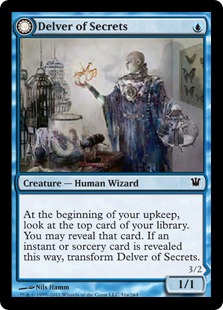
For starters, here's Temur Hex Delver, which doubles up on one-drops via Hexdrinker. The idea of supplementing Delver with pushed green one-drops dates back to Canadian Threshold, but never exactly took off in Modern; the closest I came myself was with Counter-Cat, which splashed white to enable Wild Nacatl. Rather than run Hooting Mandrills, the deck fills out its top-end with planeswalkers, a strategy I tried (and briefly enjoyed) in Six Shadow (a Delver deck at its theoretical origin).
I've picked up on some dissent in the Delver community regarding whether Hexdrinker is even worthwhile in a format crawling with Wrenn and Six, but the consensus among diehards appears to be to treat Hex as a four-drop when faced with these decks. It's mostly slower strategies such as Jund that employ the walker, giving Temur more time to make its land drops and a reasonable mid- to late-game threat they can peel as a topdeck.

True to its Modern origins, Temur Hex Delver features a light midrange package in the sideboard to overwhelm opposing creature decks and gain equity against other disruption-heavy aggro decks.

We Hardly Knew Ye

Temur Oko Delver, CHAUGHEY (5-0)

Creatures

3 Noble Hierarch
4 Delver of Secrets
4 Tarmogoyf
4 Hooting Mandrills

Planeswalkers

4 Oko, Thief of Crowns

Sorceries

4 Serum Visions
3 Flame Slash

Instants

2 Force of Negation
4 Lightning Bolt
4 Mana Leak
4 Once Upon a Time
2 Stubborn Denial
4 Thought Scour

Lands

2 Breeding Pool
1 Island
4 Misty Rainforest
4 Scalding Tarn
1 Steam Vents
1 Stomping Ground
1 Wooded Foothills

Sideboard

1 Force of Negation
1 Stubborn Denial
3 Alpine Moon
1 Ancient Grudge
2 Collector Ouphe
1 Dismember
2 Forked Bolt
2 Grafdigger's Cage
2 Veil of Summer

As rapidly as it materialized, Temur Oko Delver has now folded back into aether; without its namesake planeswalker, this particular build becomes defunct. But I still want to draw attention to it, as it nonetheless was putting up results earlier this month as the format struggled under the oppressive force of Simic Urza.

To make the most of Oko, Temur Oko Delver runs the off-plan Noble Hierarch; while less reliable than the full package of Gilded Goose, Mox Opal, and Once Upon a Time, the dork nevertheless ensures Oko comes down ahead of curve some of the time, which as we now know categorically puts an enormous strain on opponents.

Once itself does make the cut here, too, which increases the odds of starting with Hierarch while also lowering the chances of drawing it later (with Once in the picture, the dork only needs to appear at 3 copies but still has a high likelihood of being opened). Beyond helping with fast Okos, it makes Delver much better at its Plan A by drastically upping the odds of beginning with an Aberration. Once is also an instant, so it transforms the creature as well; as a free spell, it's even fast juice for Hooting Mandrills or Tarmogoyf. Going forward, Once seems especially potent for the archetype.

On Borrowed Time

Temur Borrower Delver, CHAUGHEY (5-0)

Creatures

4 Brazen Borrower
4 Delver of Secrets
4 Tarmogoyf
4 Hooting Mandrills

Sorceries

2 Flame Slash
4 Serum Visions
1 Sleight of Hand

Instants

4 Lightning Bolt
2 Tarfire
4 Mana Leak
4 Once Upon a Time
3 Stubborn Denial
4 Thought Scour

Lands

2 Breeding Pool
1 Forest
1 Island
4 Misty Rainforest
4 Scalding Tarn
1 Steam Vents
1 Stomping Ground
2 Wooded Foothills

Sideboard

1 Stubborn Denial
2 Ancient Grudge
3 Damping Sphere
1 Dismember
3 Feed the Clan
3 Grafdigger's Cage
2 Pillar of Flame

In truth, it was Oko who was living on borrowed time, but there are only so many idioms featuring "borrow!" Temur Borrower Delveris the latest Delver list we've seen succeed online, and it comes to us from none other than CHAUGHEY---the guy behind Temur Oko Delver above, and countless other Temur iterations dating back at least a year.

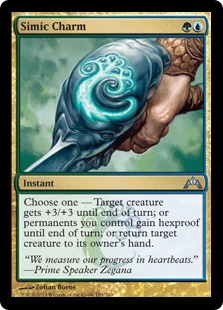
Without Oko, the deck gets a makeover, immediately trading Noble Hierarch for Brazen Borrower. Delver decks of Modern's past have traditionally appreciated Vendilion Clique primarily for its status as a pre-flipped Insectile Aberration with flash, no joke in a permission-based thresh deck. While the additional effect was icing on the cake, it pales in comparison to Borrower's benefits: the flashy new Faerie doubles as a critical mode of Simic Charm, bouncing not just creatures but any opposing nonland permanent to disrupt a myriad of possible combos. What's more, its adventure typeline negates the card disadvantage of running bounce effects and gives the deck a reliable late-game mana sink: Once finding Borrower being cast as an adventure and then again from exile taxes pilots a whopping 7 mana! All that late-game energy makes it justifiable to skip out on running dedicated midrange cards in the sideboard, further playing to the deck's bottom line.
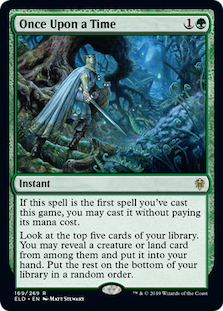
That Once can find Borrower also greatly improves the card. Strong openers that feature land and threats can functionally pick up a bounce spell by casting Once, rounding out their plan and helping the card look more like an all-purpose cantrip than its text box suggests. After the game starts, Once can be cast on an opponent's end step should they elect to play around Mana Leak, and then let pilots choose from a variety of potential options. After all, Borrower itself offers three possible modes: the bounce line, the creature line, and both!
Also making the cut is Flame Slash, a card that looks extremely appealing in the current metagame. With Thought-Knot Seer, Urza, Lord High Artificer, and other x/4s running around, not to mention the weaker enablers that have formed Modern's backbone forever, Slash has a ton of high-value targets.

Flipping the Script

Oko, Oko, Oko---that's all the Magic community has been hearing about since the planeswalker showed up and decimated a bunch of constructed formats. But the message I'm getting the most from the January dumps is Delver, Delver, Delver. While I doubt the Insect comes to dominate the format in any capacity resembling Oko's, I'm excited to see new developments surrounding one of my all-time favorite creatures and hope Delver's string of successes stretches into the future!

MTGO: Modern is On the Horizon!

Are you a Quiet Speculation member?

If not, now is a perfect time to join up! Our powerful tools, breaking-news analysis, and exclusive Discord channel will make sure you stay up to date and ahead of the curve.

Welcome back folks, and happy New Year!

Today I'm going to discuss a much-requested topic - Modern speculation targets.

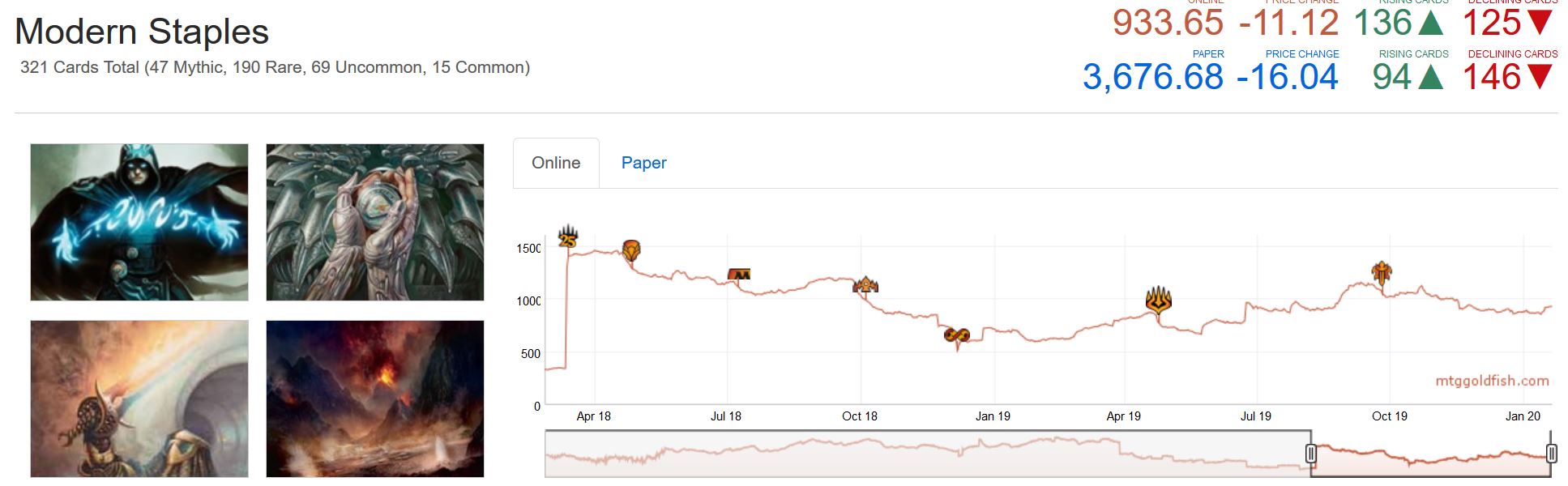
As you can see, Modern has been recovering for quite a while now. Like all of Magic Online, prices in Modern took a dive with the release of the Open Beta of Magic Arena, and then as panic waned and players came back to Magic Online, prices have been recovering ever since.

What many might not know is that Magic Online finance is often cyclical, with Standard more popular in the fall and winter months and Modern more popular in the spring and summer months. The price index of Modern staples peaked in September at around $1,150 and dipped to $869 after the release of Throne of Eldraine. The calendar is starting to swing back and, as one would expect, Modern prices are beginning to climb again. The much-needed bans probably helped spur interest too!

So, now is a good time to invest into Modern. Players should consider buying the staples they want to play with, and investors should look to put in the capital now and sell in three to six months.

I. Modern Horizons

In the fall, I counseled against investing into Modern Horizons because we were told that cards from the set would begin to be included in treasure chests after the release of Eldraine. Only three cards from the set ended up being included, and only at low frequencies. Consequently, the set's overall value has trended upward in recent months, and we can expect that trend to continue. Below are some of the cards I expect to go up in value over the next several months.

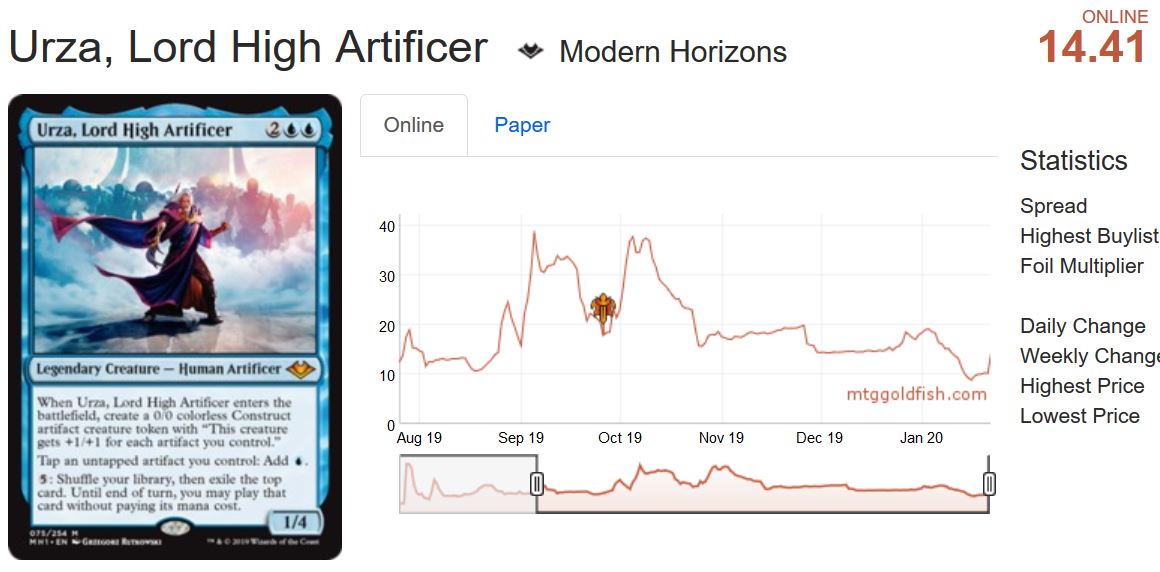
1. Urza, Lord High Artificer

Wizards has made clear, for better or for worse, that it is willing to sacrifice busted format staples from Magic's past at the altar of new sets, especially new premium sets like Modern Horizons. Urza's value got cut in half when Mox Opal was banned, and undoubtedly it will take some time for players to create a new shell around him. As a mythic from a set with small supply, it won't take much for Urza to climb to $20, with as much as $30 to $35 possible. I like, too, that the floor on Urza is high (around $7 I'd say) due to Legacy and Commander demand.

EDIT: When composing this article, Urza was $9, and it has now spiked to $14. I still think it is a good (but no longer amazing) spec at $14. The card is just too powerful to not feature prominently in a top tier deck in Modern.

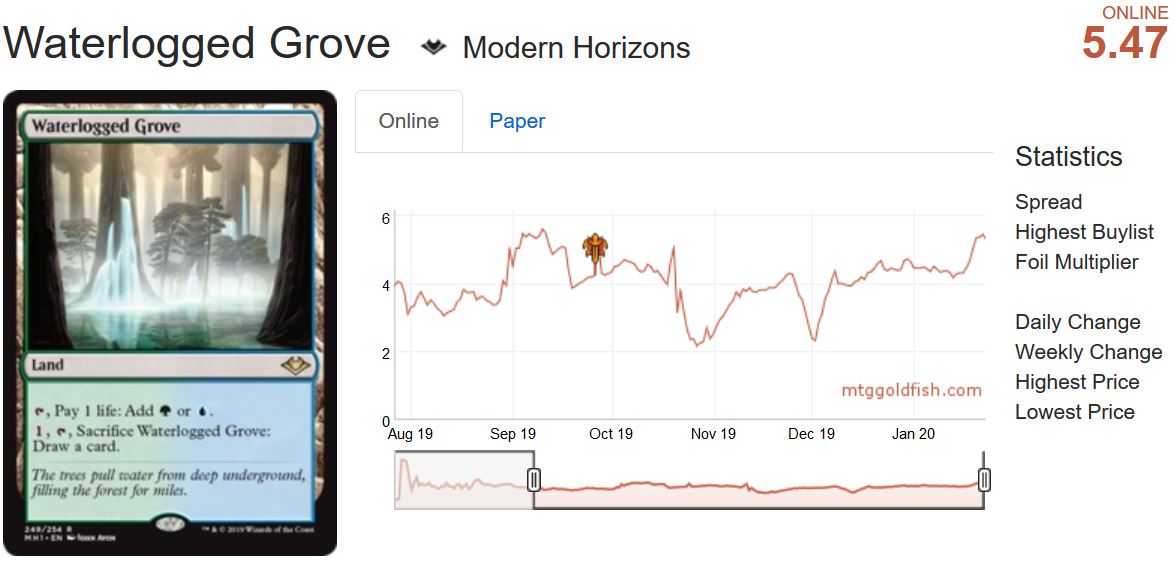
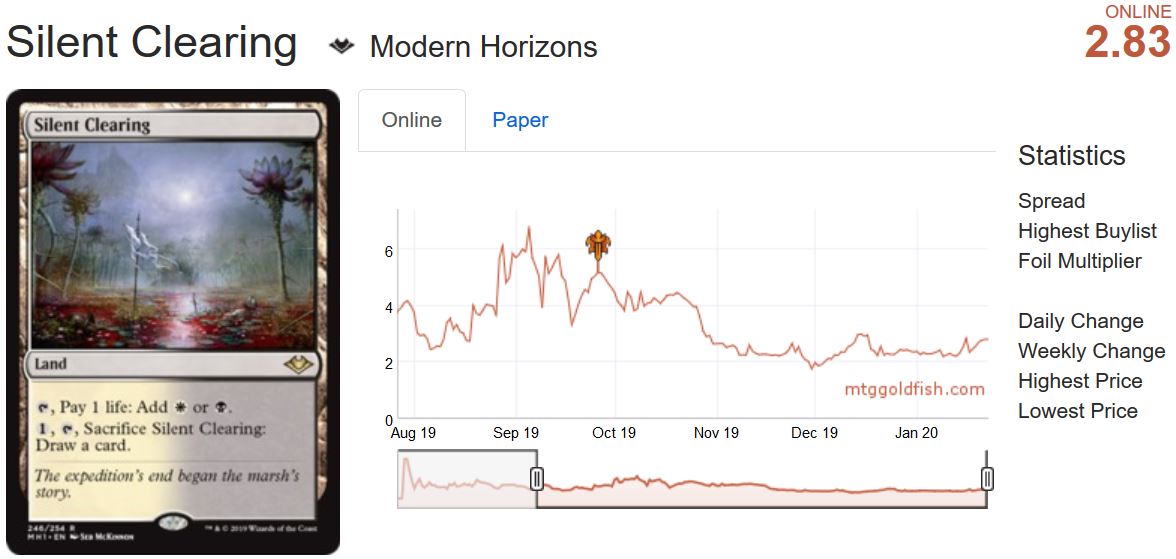
2. Waterlogged Grove & Silent Clearing

Sunbaked Canyon has climbed to $14. Nurturing Peatland and Fiery Islet have climbed to $10. Yet Waterlogged Grove and Silent Clearing are still stuck at $5.50 and $2.75 respectively. These lands are just too useful to not see more play, and undoubtedly will go up in value as more and more players turn their attention to Modern. Don't expect to triple your money on these, but I'd wager that they will both be 50% higher at some point during the spring or summer.

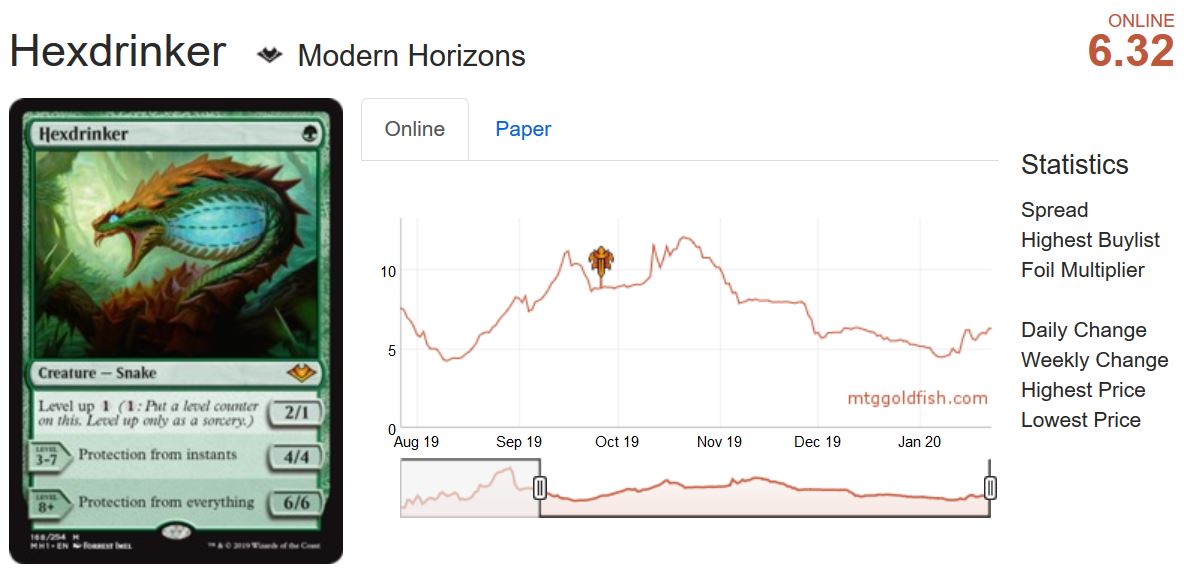
3. Hexdrinker

I considered discussing a few other cards in this slot, but as a powerful mythic that fits into a prominent archetype and can slot into several others, Hexdrinker gets the nod. I like that it is a relatively cheap buy, and as a mythic it has a high price ceiling. It saw a sizeable amount of play until Urza and Oko took the format over by storm. Now that the format has been reset by bannings, we should expect Hexdrinker to find more homes than it had in November and December.

For players, I would feel safe buying playsets of most Modern Horizons cards. The only card I might feel a bit queasy about is Wrenn and Six, mainly because it has nothing back to fall on outside of Modern playability and because it is so expensive. With that said, if you'd prefer to own it rather than rent it, it isn't in the treasure chests so there will be no external downward pressure exerted on it.

II. A Brand New Format!

1. Past in Flames

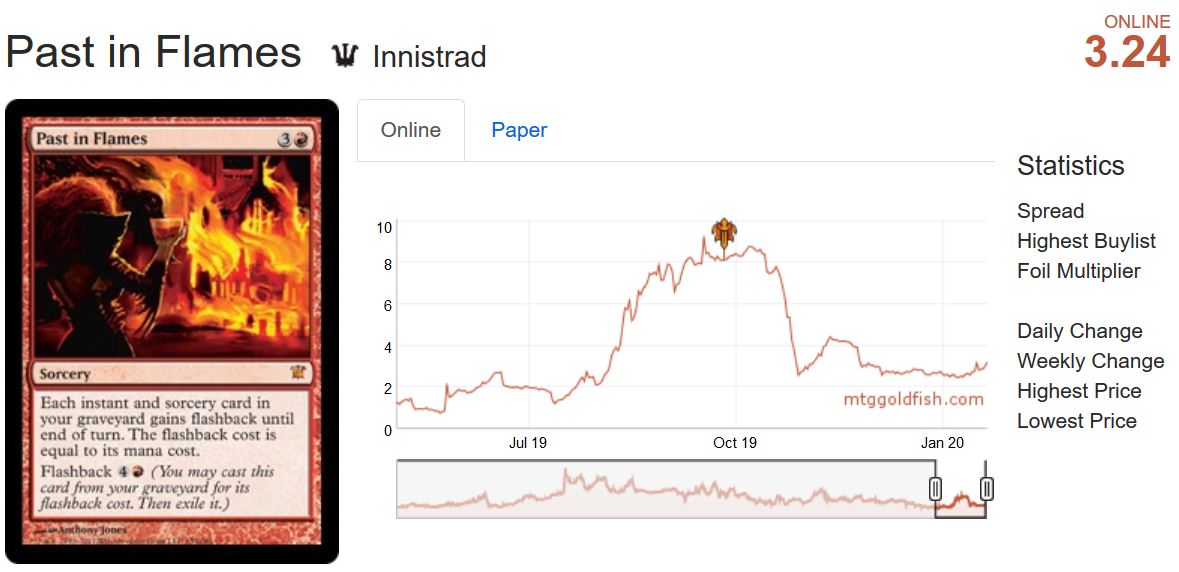
One of the best parts about overpowered metagame-hogging decks getting banned is that it frees up room in the meta for other decks to enter the top tier of competitive play again. Gifts Storm has already shown signs of life in tournament results this week, and that success has begun to be reflected in the price of Gifts staples, as Gifts Ungiven, Past in Flames, Remand, and Aryia of Flame have all increased in price.

While I got in at the absolute floor of $2.50, there's no shame at getting in at a low price of $3.25. As long as Modern is balanced with a healthy meta that ebbs and flows, there's no reason why Past in Flames won't reach $6 again. The other aforementioned pieces of this deck are also worth considering if you wish to diversify or focus on cheaper cards.

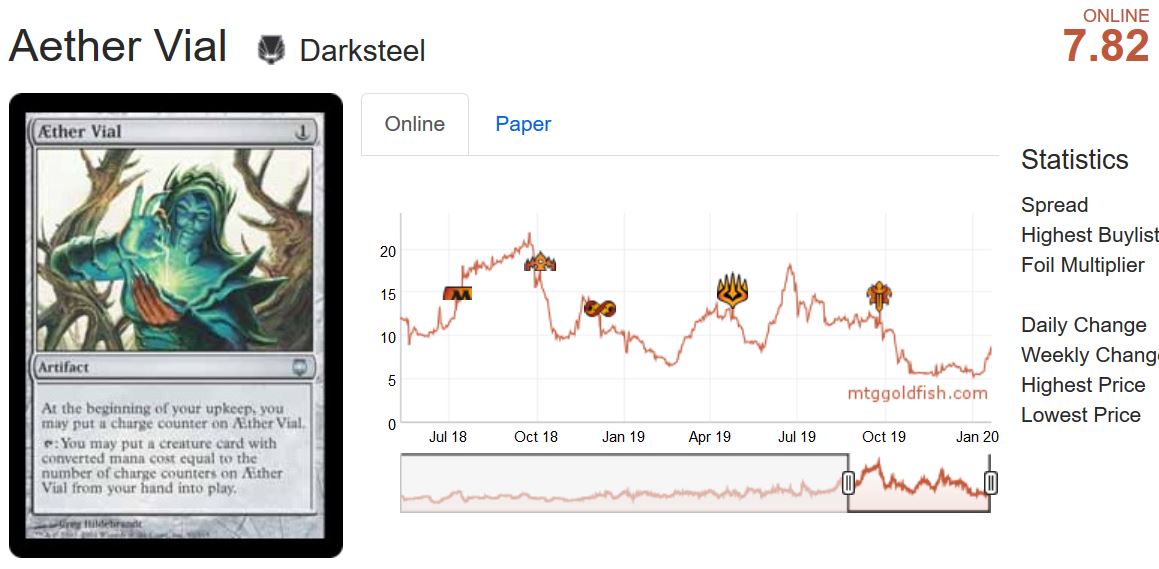
2. Aether Vial

Aether Vial is one of Modern's hallmark cards and one of several that separate Modern from Pioneer. Aether Vial stands to benefit from the ban of Mox Opal and Oko as decks like Humans can reemerge.  Aether Vial is an attractive speculation as well because it has a history of reaching a ceiling during Modern season more than double the current price. For those scared that Pioneer will destroy Modern, that Aether Vial is starting to climb again should reassure you that Modern is still a format that players want to play.

In general, while the staples in Amulet Titan variants have spiked already, cards from other decks are still acquirable at prices that will likely go up. It is better to buy into Modern now than to wait until March or April to do so.

3. Light up the Stage

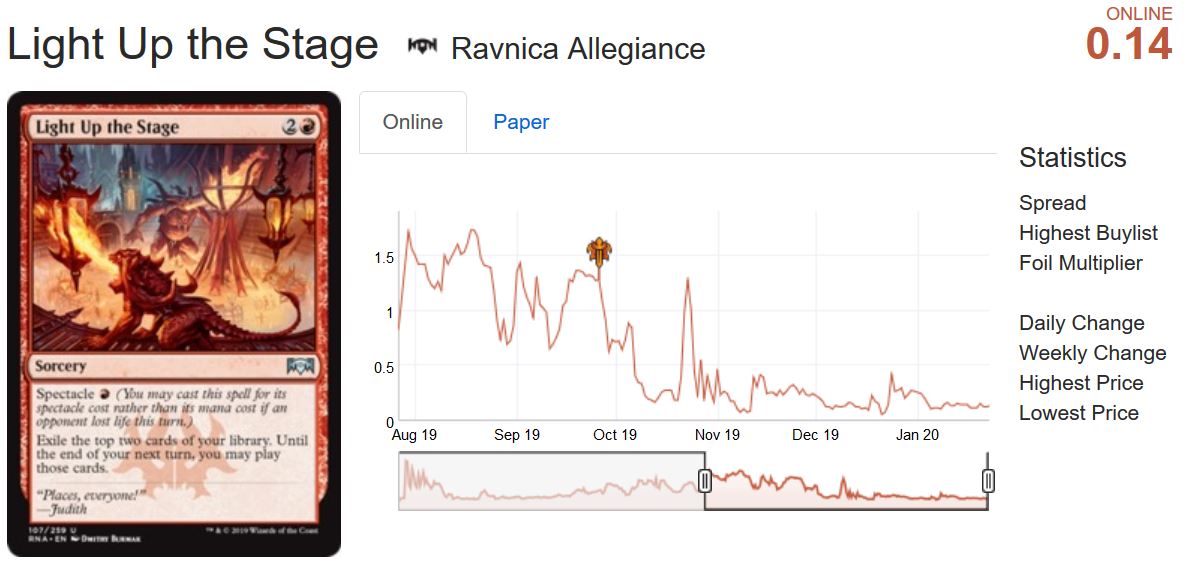
Investing into Modern is not just for those with a lot of capital! There are some cheap attractive options as well. As Red's most premium pure card draw spell, Light up the Stage is widely used in Pioneer and Modern. It's also sitting at $0.14, practically an all-time low. There are a lot out there, but fewer than you think since Ravnica Allegiances was not drafted much on MTGO. This feels like a $0.50 card to me even if it never sees Standard play, and I think it could spike higher. But at the very least, if you enjoy playing aggressive Red decks, now is a good time to pick up this staple.

IV. Signing Off

I've received a few questions about whether it is better to invest or speculate on certain days of the week. To date, I've not noticed card prices being higher or lower on the weekend contra during the week. At the very least I can say that demand is relatively stable, and I think it prudent to focus on other things when making buying and selling decisions. For formats as fluid as Pioneer and Modern, it could be prudent to study which cards broke out or over-performed on a given weekend (like Niv Mizzet, Reborn did recently).

Thanks for reading! As always, please leave your questions and comments either here or on Discord. Next week I'll be back with my Financial Power Rankings for the Theros Beyond Death mythics, so stay tuned for that!


Beyond First Impressions: Theros Review

Are you a Quiet Speculation member?

If not, now is a perfect time to join up! Our powerful tools, breaking-news analysis, and exclusive Discord channel will make sure you stay up to date and ahead of the curve.

With the Prerelease out of the way the actual work of exploring Theros: Beyond Death has begun. As Jordan previously noted, there are a number of interesting role players in Theros. However, there don't appear to be any unequivocal home runs. Considering how 2019 went, that's a very nice change; I'd like a chance to finally catch my breath in the wake of Hogaak, Arisen Necropolis and Oko, Thief of Crowns.

With that in mind, I've already looked at some standout cards, and couldn't find one that didn't have massive setbacks regarding Modern playability. That spirit continues this week, as I examine some more cards that have Modern potential, but may end up not actually being worth the effort. Based on what I've seen from my own efforts and those of others, Theros isn't a block that will unequivocally shake up Modern, but it should disrupt some stagnant decks. And that's more than good enough for me.

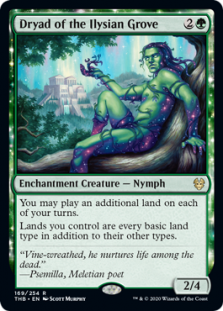
Dryad of the Ilysian Grove

Dryad of the Ilysian Grove is Prismatic Omen mixed with Exploration, given legs and with better stats than (but for the same price as) Azusa, Lost but Seeking. A lot of the chatter I've seen on the card has been for Pioneer, where despite multiple bannings, Mono-Green Devotion remains a top deck. We have Mono-Green Devotion in Modern too, but Leyline of Abundance is still legal here, so it's not interested in a 2/4 enchantment creature.

I initially saw a few players talking about Dryad as an answer to Blood Moon. But just like with Omen, Dryad and Moon operate on the same layer, so timestamps determine which effect applies. Thus, a Dryad cast after Moon unlocks mana, but cannot preempt the enchantment. And again, Modern already has Prismatic Omen for this purpose.

Even if Dryad did play well against Blood Moon, it wouldn't be played for that purpose. Amulet Titan runs Azusa, and Dryad being more robust makes it appear more attractive. However, Azusa gives two land drops to Dryad's one, and in Amulet that's all that matters. Amulet doesn't care about land types, so Dryad's second ability is superfluous. The deck that actually wants Dryad must not only want additional land drops but care about basic land types.

Dryad Struggles to Belong

Both conditions apply to Valakut. Some pilots were already running Prismatic Omen to make Scapeshift kills faster, so Dryad's chances look good up front; with Omen out, a Scapeshift for six is all that's needed for 18 damage, compared to the seven lands normally required. Ramp spells and additional land drops are functionally the same, and with 28 lands on average, Valakut should theoretically be able to make good use of Dryad.

Unfortunately, Dryad sits in an odd place on Valakut's curve. The deck's usual line is turn one suspending Search for Tomorrow, turn two ramping with Farseek or Sakura-Tribe Elder, hitting five mana on turn three, and dropping Primeval Titan turn four; the Scapeshift kill requires Omen on turn three to kill on turn four. Dryad doesn't much alter either line. Valakut also empties its hand quickly, so the extra land drop will lose impact if not exactly on-curve. And Dryad doesn't find more land or Valakut, making it questionable whether it's better than Omen.

Still, several actual Valakut players I know lost their minds over Dryad, and their investigation is at least suggestive.

Dryad Valakut, Test Deck

Creatures

4 Sakura-Tribe Elder
4 Dryad of the Ilysian Grove
4 Primeval Titan

Instants

4 Veil of Summer

Sorceries

4 Farseek
2 Explore
4 Search for Tomorrow
4 Scapeshift
2 Hour of Promise

Lands

4 Wooded Foothills
4 Valakut, the Molten Pinnacle
4 Stomping Ground
3 Snow-Covered Mountain
3 Mountain
2 Cinder Glade
2 Forest
1 Snow-Covered Forest
1 Sheltered Thicket
1 Castle Garenburg
1 Field of the Dead
1 Verdant Catacombs
1 Windswept Heath

Their idea is to treat Dryad as a combination ramp spell and Omen, which frees up some slots now used for Veil of Summer. This configuration is closer to pure combo than to a ramp deck with a combo kill. They've had some success in testing, but part of that is due to other decks still adjusting to the bans.

Valakut's Odd Child

As far as can be determined so far, Dryad is a fine card, but not exceptional in Valakut. Because of how the deck curves out, the kill speed over Omen hasn't noticeably changed. Valakut doesn't have card draw, so Dryad only actually grants one extra land drop before Valakut runs out of cards in hand (maybe two). In terms of actually going off, Dryad is a wash.

However, Dryad is having an unexpected positive impact on the Humans matchup, and to some extent against midrange thanks simply to being an affordable 2/4. Dryad is a solid wall against Humans that nets some value when resolved. Humans can very narrowly goldfish Valakut since its kill speed is similar, so a persistent road block significantly alters the race. Meddling Mage can still be backbreaking, especially for this Bolt-less version, which means the sideboard is geared against Humans. Against UW decks, Dryad attacks planeswalkers and frequently slips through Jund's discard to put some pressure down or absorb an edict effect to protect Titan.
I don't think that Dryad will find a home in Valakut based solely on its text box. If pilot want an Omen effect, Dryad can be played in that slot with little effort or change to the gameplan. However, given a need for an actual creature to deal or absorb damage, Dryad is far better than Azusa.

Setessan Champion

In terms of potential archetype churn, there may be no deck more affected by Theros than Bogles. After all, the set's about auras, and Bogles is an aura deck. However, that didn't happen last time we visited Theros. Bogles is a very stagnant deck, and has been throughout Modern's history. Once Wizards realized that hexproof is broken compared to shroud, they stopped printing cheap hexproof creatures, and no aura has approached Ethereal Armor or the Umbra enchantments in power. The most dramatic change I've ever seen the deck make is moving Leyline of Sanctity to the maindeck.

But Setessan Champion may deeply impact the archetype: it doesn't challenge any of the actual one-drop threats, but rather Kor Spiritdancer. Spiritdancer is the card that Bogles likes to cast but never actually enchant. Lacking hexproof, it's actually vulnerable to removal. The only times I've seen it enchanted is when Bogles has no Bogles, or when it's up against combo and needs to accelerate the kill. Spiritdancer is played because it draws cards as a cast trigger; Bogles usually has to mulligan aggressively to find a threat and some good auras, so that card advantage is essential.
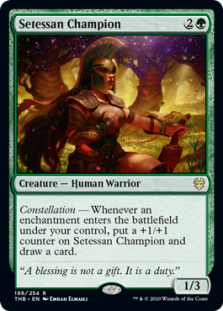
Champion has some drawbacks compared with Spiritdancer: a higher mana cost and the card draw effect being an enters rather than a cast trigger. Counterspells become stronger and the deck slightly clunkier as a result. However, Champion offers some compensating factors; primarily, it actually does something when not enchanted. Spiritdancer is 0/2 while Champion is 1/3, a stat upgrade substantial in that the Warrior can plausibly attack and block. And unlike Spiritdancer, Champion grows just by playing auras. Bogles can keep loading up its hexproof creatures and still grow Champion. +1/+1 counters will also survive if all the auras get destroyed, leaving behind a real gameplan should Engineered Explosives go off.

Restored to... Glory?

I think that Champion is close enough to Spiritdancer that it's worth reexamining Bogles, especially in light of Theros also bringing Staggering Insight to the table. Bogles asks a lot of its current two-mana enchantments and tries to ride its GW manabase for all its worth, but I've seen Keen Sense in Bogles before. Adding lifelink and +1/+1 is enough of an upgrade to include it, especially in a churning Modern where Burn will be prominent.

Bant Bogles, Test Deck

Creatures

4 Slippery Bogle
4 Gladecover Scout
4 Setessan Champion

Enchantments

4 Ethereal Armor
4 Spider Umbra
4 Rancor
2 Gryff's Boon
2 Hyena Umbra
2 Spirit Mantle
2 Staggering Insight
4 Daybreak Coronet
4 Leyline of Sanctity

Lands

1 Dryad Arbor
3 Horizon Canopy
3 Waterlogged Grove
3 Misty Rainforest
3 Windswept Heath
3 Temple Garden
2 Breeding Pool
2 Hallowed Fountain

The mana is still very reliable, and adding blue grants more sideboard options. I haven't noticed much actual impact on matchups during testing, but that may be because I'm sticking close the classic formula. I've seen some Bogles decks online that are barely recognizable. In any case, I haven't felt any negative impact from adding Theros cards and blue, so I'm going to keep working on the deck.

Thassa's Oracle

On the surface, Oracle isn't so flashy; manipulating the top of the library without drawing a card is only playable occasionally in combo decks or when repeatable. But of all the Theros cards I've examined, Thassa's Oracle has the most clear home.

The second part of Oracle's text turns it into a win condition, albeit a tough one to trigger. Assuming, of course, that the condition is being met the "correct way," with lots of blue permanents in play. It's much easier to just Oracle with an empty library. And there happens to already be a deck in Modern that does exactly that.

Ad Nauseam, Test Deck

Creatures

1 Thassa's Oracle
4 Simian Spirit Guide

Artifacts

4 Lotus Bloom
4 Pentad Prism

Enchantments

4 Phyrexian Unlife

Instants

4 Angel's Grace
4 Spoils of the Vault
1 Lightning Storm
4 Ad Nauseam
4 Pact of Negation

Sorceries

4 Serum Visions
2 Sleight of Hand

Lands

4 City of Brass
4 Darkslick Shores
3 Temple of Enlightenment
3 Temple of Deceit
2 Seachrome Coast
2 Gemstone Mine
1 Island
1 Plains

Ad Nauseam decks have traditionally run Laboratory Maniac as an alternative to Lightning Storm, though some have recently opted for Jace, Wielder of Mysteries. In either case, since Ad Nauseam draws its entire deck, playing Maniac and Serum Visions or using Jace's +1 won the game. While a decent way around Leyline of Sanctity, these options cost a minimum of four mana on the combo turn. Oracle does the same job, only requires one card, and is two mana. Thus, Oracle is a straight upgrade and replacement for the previous options.

An Answer with More Questions

A singleton upgrade for a fairly niche deck might not be enough to warrant much discussion. But the more general application of a self-contained Laboratory Maniac is.

At the beginning of spoiler season, it looked like Underworld Breach would the Modern card. Breach, Grinding Station, and any 0-CMC artifact mills the entire library. Escaping Mox Opal repeatedly generated mana, building into either Grapeshot or Banefire on turn three. Of course, Opal was banned immediately thereafter, making that deck dead-on-arrival.

However, the combo still mills a whole library. And it costs less than Ad Nauseam, even if it is spread out over two cards. As Dredge has repeatedly shown, milling an entire library is very powerful. I have been trying to find a use for the combo, and Thassa's Oracle is the obvious win condition. As a bonus it can also scry towards missing pieces and block if necessary. Just make sure to have one in hand before comboing off. The main problem has been that to get everything together consistently and quickly I've been building decks that are effectively more elaborate versions of traditional Ad Nauseam. And more elaborate combos is not where a combo deck wants to be. I think this is solvable by thinking more outside the box with card choices, so it's worth pursuing.
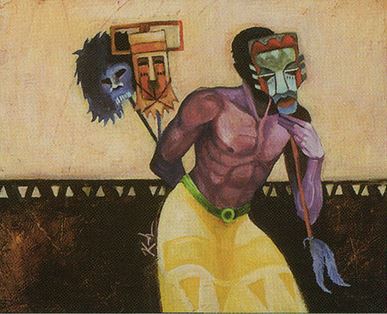
The potentially fatal problem for the deck is the combo itself. This is an all or nothing combo with a very narrow usage. All the milled cards have to be exiled to keep the loop going, so typical graveyard shenanigans don't work. Firing off a full set of Creeping Chills sounds good, but if triggered then they can't be exiled to pay for escape. Same with creatures like Narcomoeba. To get value from milling my deck, I need to stock the graveyard with fodder first, which defeats the point of the combo. It doesn't generate any mana either, so there's no way to combo off except with Oracle. Ad Nauseum technically does, because it finds Simian Spirit Guide. The combo is built to exile the library, and does so efficiently, but it can't do anything else.

But What Does it Mean?

Everything I've found so far has been more intriguing than obviously good, and none of it has clearly won a place in Modern. However, I can't dismiss these cards, either. It's like there are pieces that I can't quite grasp when solving this puzzle. I intend to keep working on the solutions, but if you've had any success, please share in the comments.

QS Insider Cast – Theros: Beyond Death, Modern Bannings, and More!

Are you a Quiet Speculation member?

If not, now is a perfect time to join up! Our powerful tools, breaking-news analysis, and exclusive Discord channel will make sure you stay up to date and ahead of the curve.

Welcome back to the QS Cast! Chris O’Berry and Sam Lowe discuss Theros: Beyond Death, recent Modern Bannings, Promo Pack reprints, and the Pioneer road ahead. This cast was originally broadcasted live to Insiders in the QS Insider Discord, January 20th, 2020.

Show Notes

- Legacy is awesome, but not very relevant right now.
- Pioneer is the way forward. Ride the wave.
- What did we get right during spoiler season?
- Modern Bannings - initial impressions and the road ahead
- PTQ Promos: Cryptic Command, Surgical Extraction, Aether Vial
- Promo pack reprints, shocklands galore
- Questions, Pioneer Discussion, and Desperate Ravings
- Welcome to 2020!

Wanna chat? Find us on Twitter or in the QS Discord

Chroberry – @chroberry
Chris Martin – @ChiStyleGaming
Sam Lowe – @MahouManSam

How to Reduce Risk of Receiving Counterfeits

Are you a Quiet Speculation member?

If not, now is a perfect time to join up! Our powerful tools, breaking-news analysis, and exclusive Discord channel will make sure you stay up to date and ahead of the curve.

Safety is central to much of what we do at work. The mantra, “Nothing we do is worth getting hurt” comes to mind. Because of this focus, many lines of defense are implemented to avoid injury. People will wear protective equipment such as safety glasses and steel-toed boots. There are safety trainings in place to remind people of safe operating procedures.

The first line of defense, however, is to develop a process where these safety procedures and protective equipment aren’t needed at all. This can be done by engineering the risk out of the system altogether.

In a way, this parallels with counterfeits in Magic. There are many resources out there to help you identify fakes. David Schumann wrote about this back in 2014, and Apathy House contains some of the fundamentals of fake spotting. While these resources will always be highly valuable (fakes can never be avoided completely), we can still implement some buying strategies to help us reduce the risk of receiving a fake in the first place.

With social media touching on counterfeit cards more often lately—and as people may be planning larger Magic purchases with tax returns—I wanted to share my strategy for avoiding counterfeit cards. While not foolproof, I have never received a fake when purchasing a Magic card. I hope to keep that streak going for years to come.

Avoiding Fakes on eBay

I wish I could say that counterfeit Magic cards could only be obtained from sellers overseas. Many are produced overseas, so this is a reasonable assumption. Unfortunately, it’s incorrect.

If you want to shop around for fake Magic cards, there are always some to be found on eBay. This morning I googled “MTG Black Lotus” and the second listing down appears highly questionable.

At first glance, I didn’t like the coloring on this lotus. It almost seems too bright. The card may look like it has been shuffled in play for 27 years, but I suspect otherwise. But the biggest red flag for me is under “Seller Information”. I blacked out the name, but I left behind the only thing you need to see: the seller’s feedback rating. This seller hasn’t done an eBay transaction in over a year, has just two feedback, and is now deciding out of the blue to sell Magic’s most coveted card?

This is exactly the kind of listing I avoid at all costs to minimize odds of receiving a fake. The only time I’ll purchase high-end cards from eBay is if a major vendor is selling it. I stick with the PWCC auctions, Kid Icarus, Card Kingdom, and ABUGames as my favorite eBay sellers. Other safe eBay sellers include MTG Seattle, Strike Zone, and Power 9 (Dan Bock). In general, any eBay seller with 10,000’s or 100,000’s of feedback is probably safe.

Imposter Sellers on eBay

I wish I could tell you that all you have to do is stick to this set list of eBay sellers and you’re guaranteed to dodge fakes. Unfortunately, that’s not the case. While sticking to the major sellers will drastically reduce your chance of receiving a fake, there’s still another layer of complexity that needs to be navigated.

When shopping from these sellers on eBay, you still need to be very careful. You see, many of these sellers place their store name in their listings, making them easy to find and identify. But imposters have caught on. Kid Icarus is a top-rated seller, so all his listings contain the “Top Rated Plus” Ribbon. That is one thing an imposter can’t fake, but they still use the Kid Icarus name to deceive buyers:

These three listings all contain “Kid Icarus” in the name. But one is not like the others—that last listing is an imposter. The “From Australia” is a dead giveaway.

Imposters aren’t only international, too. Check out this listing from Kentucky:

This seller at least has 781 feedback, so these Wastelands are probably real. But check out that feedback score: 97.9%. That’s dismal in the world of eBay, especially when you have hundreds of transactions to your name. Kid Icarus, this is not. Don’t be fooled by these imposters—always check the seller information before making a purchase.

Another seller with imposters is PWCC:

Then there’s the subtle Card Kingdom imposter. Card Kingdom only sells “Below Good” cards on eBay. You can watch for their new listings by saving “MTG Below Good” because that shows up in any of their eBay listings. Unfortunately, others have caught on to this trend—while they’re not stealing Card Kingdom’s name directly, one could be deceived by this subtle (maybe unintentional?) impersonation.

You may bid on this auction thinking you’re getting a card from Card Kingdom, one of the most trusted Magic sellers on the net. Instead, you’d be getting a copy from a small shop in Portland, Oregon. Does this Portland shop have the same staff and expertise to confirm cards are not counterfeit? Doubtful. This card may be 100% legitimate (judging by this seller’s feedback rating, it probably is) but this is the kind of listing I eschew in favor of a more reliable seller.

Reapplying to Other Platforms

It’s difficult to perform the same blatant impersonation when selling on TCGPlayer. Unless you upload pictures, there’s no open field where one can pretend to be a seller they are not. All sellers’ feedback ratings are more prevalently visible too—there’s no chance of purchasing from a Channel Fireball imposter.

That said, there are still large sellers with 10,000+ feedback and smaller sellers with under 10 feedback. Which would you rather buy your Dual Lands from? It’s possible all these sellers with low feedback are selling nothing but genuine cards. But when spending $100’s or $1000’s, is it worth the risk?

For example, check out the listings for Revised Underground Sea:

There are a couple hundred copies for sale from over 100 sellers. As is often the case, the new seller lists at a slightly lower price point to try and build up feedback. But would you want a $300 purchase to be this seller’s first sale? Without any feedback, it’s impossible to buy with confidence. TCGPlayer will protect you the buyer from counterfeits, of course, but is that a hassle you’re willing to endure to save 3%? If I were shopping for this card, I’d be more inclined to grab those two MP copies—they’re just $9 more and are sold by stores with 1,000+ and 25,000+ feedback.

This isn’t a blanket statement to knock new sellers. Everyone has to start somewhere. I’m merely cautioning you the buyer when shopping for high-end cards on popular platforms. The newly launched seller may be 100% legitimate—I’m not saying otherwise. All I’m insisting is that sellers with less feedback are, by definition, less vetted by the community for their customer service, card quality, and ability to spot fakes.

Peer-to-Peer Buying

TCGPlayer and eBay have customer service teams to protect buyers from counterfeits. If you receive a card you suspect is fake and the seller isn’t cooperating, you can contact their support staff for help.

When buying cards peer to peer through social media like Facebook, Twitter, and Discord, this becomes much trickier. Your recourse could involve much more effort. Or in the worst case, you may have no recourse other than involving the police (talk about a hassle!).

Therefore, one needs to be more cautious when dealing in peer-to-peer transactions. To minimize risk of receiving counterfeits, I have three tips:

  • When buying high-end cards, stick to trusted sellers.
  • Never be too shy to ask a seller for references. Then, make sure to vet at least a couple of the references if there’s still doubt.
  • If a deal smells fishy, there’s no obligation to complete the transaction. A few times in the past I’ve talked with a seller from MOTL or Facebook and I got an odd feeling that the seller was almost too eager to complete the transaction. I decided to play it safe and passed on the deal. It’s just not worth the risk.
  • If any doubt remains whatsoever, pay via PayPal Goods & Services and eat the fee.

None of these tips are breakthrough or eye-opening. But they’re all really important when trying to avoid counterfeit sellers online.

Wrapping It Up

None of the advice in this article can guarantee a card’s authenticity. Any time you purchase a high dollar card, you should scrutinize it closely. I’m sure even major sellers make mistakes once in a while; nobody is perfect.

Instead, this article is geared more towards risk reduction. It really comes down to playing the odds—there are certainly deals to be had out there when buying from new, inexperienced sellers. But you have to ask yourself if it’s worth the risk. Saving 3% may seem inconsequential if it means a higher risk of receiving a counterfeit.

There was an error retrieving a chart for Underground Sea

Even some experienced sellers should be scrutinized closely—these are the imposters on eBay posing as other large vendors. They may still be selling legitimate cards, but I don’t like how they’re using deceptive listing titles. It leaves a sour taste in my mouth, and I won’t support such action with my dollars.

I’m sure there are other safe avenues to purchase genuine cards. It’s not like the market for Power is controlled completely by Card Kingdom and ABUGames. Plenty of individuals have these cards for sale as well. In these cases, it’s best to vet sellers as much as possible by asking for references and cross-checking with said references. Usually, if the seller is a bad apple, this becomes apparent somewhat quickly. And as always, if there is any doubt, you are not obligated to complete the transaction.

By following these principles, I have avoided every receiving a counterfeit card. It could be that I’m still very lucky. But I believe that my strategy removes some of the counterfeit risk that’s out there, even though I may have to pay a couple percent more for my cards. This is a price I’m willing to pay to ensure I am receiving genuine cards.

…

Sigbits

  • Revised Dual Lands are all over Card Kingdom’s hotlist this week. Included are Tropical Island ($220), Badlands ($145), Scrubland ($110), and Plateau ($75). Their numbers aren’t the most compelling, but if you’re trying to liquidate some Duals I’d keep an eye on these numbers…they tend to fluctuate a good deal and you may catch a decent sell price.
  • There’s a Reserved List card I almost never discuss on Card Kingdom’s hotlist: Survival of the Fittest. Their current buy price is $60, and I’m not sure what is driving demand for this card. It’s banned in Legacy, underwhelming in Vintage, and too old for other formats. It must be 100% Commander demand catalyzing the higher price tag.
  • Just about every printing of Vampiric Tutor is on Card Kingdom’s hotlist this week. Eternal Masters copies are posted at $53, Visions at $47, Sixth Edition at $48, and Judge Promos at $52. I assume this card is extremely liquid to be ever-present on Card Kingdom’s hotlist in so many printings.


Fool Me Once: Introducing GR Eldrazi Stompy

Are you a Quiet Speculation member?

If not, now is a perfect time to join up! Our powerful tools, breaking-news analysis, and exclusive Discord channel will make sure you stay up to date and ahead of the curve.

Just when I figure out an Oko shell I like, Wizards drops the hammer on the card I'd built around! Not that I think Oko was particularly balanced in Modern; I did endorse the walker as my candidate of choice as face of the 2020 metagame, after all. Fortunately for me, plenty more Modern game-changers have been released in recent months, and it didn't take long to occupy myself with a different idea: integrating Once Upon a Time into Colorless Eldrazi Stompy. Today, we'll see where that experiment has led the deck and weigh the benefits of different color splashes.

For starters, the deck:

GR Eldrazi Stompy, Jordan Boisvert

Creatures

4 Eldrazi Mimic
4 Eternal Scourge
4 Thought-Knot Seer
4 Reality Smasher
2 Endless One
4 Simian Spirit Guide

Artifacts

4 Serum Powder
4 Chalice of the Void
2 Smuggler's Copter

Instants

4 Once Upon a Time
4 Dismember

Lands

4 Eldrazi Temple
4 Karplusan Forest
2 Gemstone Caverns
2 Ghost Quarter
2 Blast Zone
2 Mutavault
2 Blinkmoth Nexus
1 Wastes
1 Forest

Sideboard

4 Relic of Progenitus
1 Surgical Extraction
4 Abrade
1 Gut Shot
2 Ratchet Bomb
2 Damping Sphere
1 Sorcerous Spyglass

Thanks to my experiments with Gx Eldrazi shells and continued testing of Once Upon a Time alongside Serum Powder since coming across Once a Powder Tron in a 5-0 dump, I've become a believer in what the controversial cantrip does for the cannoli carnivores.

Landing on Both Feet

A critical area of focus in redesigning the deck was the manabase. I considered Hashep Oasis as a green source that also produced colorless, but the upside of its activated ability seemed incredibly marginal; barring a lucky Gemstone Caverns or being Path to Exiled, I'd have to draw and play a whopping three copies before even thinking about paying four mana for a sorcery-speed Giant Growth. So I turned to the painlands, which at four copies grant us a second color splash more or less free of charge.

No Pain, No Gain

The go-to in that case was Karplusan Forest. There weren't really any colored cards besides Once I was interested in running main, but Karplusan nonetheless taps for Simian Spirit Guide, giving the creature a significant utility boost throughout the game. Red is also among the deck's most useful splashes, and I've lamented not having access to red sideboard cards in the past.

Naturally, running a full set of painlands hurts our action-packed manabase, which draws its strength from how much the lands themselves do for us when cards start to run dry. In theory, the early-game boost and actual card filtering from Once, increased relevance of mid-game Guides, and actual land filtering of Once itself should help on this front, covering for the card they directly replace: Zhalfirin Void. But I'd be hesitant to add too many color sources for fear of further watering down our land effects.

Less Is More

I also trimmed a Wastes for a Forest, which turns on cantrips stranded in hand if opponents Path or Quarter us, and trimmed the land count to just 20, as we function fine with just a couple in the opener and lack mana-sinks late-game. Specifically, the cuts were a Ghost Quarter (as we pressure big mana decks like Tron and Amulet more reliably) and Blast Zone (which we lack the mana to support at three copies).

Ghetty Green

The main reason for splashing at all is Once Upon a Time. Between this cantrip and Serum Powder, Eldrazi Stompy gains an unmatched capability to execute its Plan A, bringing the deck even closer to its Eye of Ugin-fueled prime.

While the potpourri of Once a Powder Tron eschewed Simian Spirit Guide in favor of Urza land enabler Expedition Map, an early play replacing the dreaded turn-one Chalice, I actually love the Ape alongside Once. Turn-one Chalice is all the more reliable when Once can grab our choice of an Eldrazi, a land, or a functional Lotus Petal out of our top five cards.

Omissions

Ancient Stirrings and Noble Hierarch are absent from the deck despite making my core for Gx Eldrazi strategies. This is still Colorless Eldrazi Stompy at heart, meaning we don't want to spend precious early-game mana futzing around setting up our plays; at that stage of the game, we're already looking to establish a clock or lock opponents out of the game.
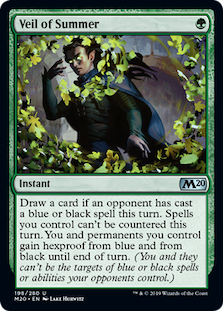
A notable omission in the sideboard is Collector Ouphe, which I'd previously praised in Once-powered Eldrazi decks. With the recent bans to Oko and Opal, though, I expect a significant lull in artifact-themed decks barring Whirza. The most threatening course of action Whirza has against us is to search up Ensnaring Bridge, which Ouphe does little to stop.

One card I considered for the side was Veil of Summer, a tool against the Bx and Ux decks looking to grind us out. It's no secret I'm partial to the stick-a-threat-and-counter-spells playstyle, Veil is simply too at-odds with our consistent Plan A to be of much use in this deck, and Relic already hassles interactive opponents enough in the one-mana slot besides having many other applications. Still, it's nice to know we have access to Veil should a counterspell-heavy deck that does pose issues for us arise down the road.
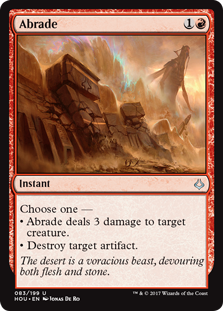
Better Red

Just as green is reserved for the mainboard, red finds itself mostly in the side. An exception to this principle is Simian Spirit Guide, which is now easier to cast than ever and choosable off Once in a pinch.

As far as the sideboard goes, though, Abrade seems like a significant improvement to Spatial Contortion. Like Relic, it's extremely potent in its role compression, so I'm comfortable with a full set: against creature decks, we can never have enough Pyrophobia; against prison, we can never have enough Shatter. The latter has historically menaced Eldrazi Stompy to the point that Karn, the Great Creator fishing up Ratchet Bomb to tick into a Bridge-breaking activation, clunky as the plan reads on paper, was a godsend for the strategy.

Colorless Contrasts

There are also some notable colorless cards filling in for the usual suspects.

Good Cop, Bad Cop

First on our list is Smuggler's Copter, a card I've lauded in CES for giving us a Splinter Twin-style pressure effect while soaring over opponents gumming up the battlefield with value creatures.

Copter is all the better in this build, making excellent pilots of those newly-castable Simian Guides and spare Endless Ones. And with a full eight mulligan-helpers in the deck and the notable absence of the once-convenient Zhalfirin Void, Copter assuages the burden of drawing too many enablers or lands. When we mulligan especially low, or opponents throw a wrench into our plans with a fast Damping Sphere or Ghost Quarter, Copter can turn a clunky hand into an acceptable plan, so it acts as an insurance policy as well.

Something I don't like about Copter is that it can't be found by Once. I also tried Karn, the Great Creator in this slot, but never wanted them together for this reason. Karn's utility is still high, especially its ability to grab Relic of Progenitus against midrange and start recurring Scourge as of Game 1. But it strains the sideboard and is quite expensive at four mana given our Once-affected manabase. Abrade also covers for many of Karn's biggest draws in helping us defeat artifact-based prison.

It Don't Matter to Me

The final change in this version is my total forsaking of Matter Reshaper. I've elected to relegate the grinding plan to the sideboard for Game 2, where it takes the form of a set of Relics. I think those will prove enough, at least as the metagame settles; we now have more anti-aggro tools with Abrade, and I find shaken-up metagames often default to aggro in their early stages. Reshaper, too, was appealing for role-compression purposes, but we may have those bases covered with Abrade; besides, Reshaper was always garbage against linear combo and other fast archetypes.
Endless One remains, as the card is more potent alongside Once Upon a Time and a pair of Copters. I frequently cast the Eldrazi for 1 just to have a pilot, and late-game, it can be found with the cantrip to create a big attack with Eldrazi Mimics or just register a large body. Endless plays nice with our Plan A, benefits from an increased ability to find Temple, and is highly adaptable to different situations. Of course, it's never tremendously impactful for its price, especially compared with Seer and Smasher; I can see going back to Reshaper if Fatal Push or Wild Nacatl decks start giving us trouble, but I'm not holding my breath.

New Horizons

I was indeed excited to start tuning Six Shadow, a deck that's been killed along with many others by the recent bans. Still, Once Upon a Time has got me bursting with ideas too, and I can't wait to see if it fits into my pettest of decks. How goes everyone else's new-year brewing?

Insider- MTG Business Models (Part 1)

Are you a Quiet Speculation member?

If not, now is a perfect time to join up! Our powerful tools, breaking-news analysis, and exclusive Discord channel will make sure you stay up to date and ahead of the curve.


It's always sad to see a game store close. I have numerous great memories from my childhood while at my local game store (LGS). These are where I met my best friends and best men at my wedding. These are the places we go to when we want to relax and enjoy the company of people with similar hobbies and interests; where people of various backgrounds with a great many differences can bond over shared interests and realize that despite these differences we still have a lot in common. Their importance in the MTG Finance realm is paramount.

All that being said, I think one should take a step back and consider this statement. I don't know the background or history of Wizard's Keep Games, but I find it a bit hard to believe that the Secret Lair series was the straw that broke the camels back. I say this being one of the people who criticized WoTC for that series myself. I think WoTC has misevaluated the importance of LGS's to their own business model, but that is on them to figure out.

Every store needs to understand that WoTC has a monopoly on Magic: The Gathering and all their other franchises. They are going to do what they think will generate them the most income as all good businesses do. This means that WoTC's #1 priority is their own business growth. We've seen a lot of game stores pop up in large part due to Magic's massive growth over these 26 years, with many generating a significant amount of revenue with just Magic singles sales. In fact, that may very well be where our problem lies.

Magic singles are a very lucrative business. When you compare buylist prices to store retail price you often see profits of 30-50%, which is insanely high compared to almost every other industry. Now, to be fair, there are overhead costs that eat into those profits, but if you can turn over a large number of cards regularly those costs are minor profit reducers. So why is that the problem?

With singles being so lucrative, it makes sense that more and more people would want in on the market. The biggest bottleneck was how to convey your wares to the world. While we have almost always had eBay as an option, TCGPlayer opening up to non-B&M (brick and mortar) stores was the real game-changer. Now anyone can own a store with your competitor's prices readily visible, making pricing a lot easier.

To make matters worse for LGS's, these non-B&M stores have much lower overhead costs. This means they can price out many B&M stores that don't have enough singles sales to make overhead costs negligible. In this very real and unfortunate way, every one of us who sells cards on TCGPlayer but doesn't own a physical store presence is contributing to the downfall of the LGS.

The Great Debate

Interestingly enough, I often see two types of players debate this problem on social media.

One side argues that the higher cost of the cards is that the store provides additional value; the LGS provides an environment to play those cards, and if there were no stores, there is little reason to buy the cards. This is a legitimate argument, but one that likely obfuscates a potential root cause of a store's financial problems. This argument is only accurate to the point where the price difference equals the actual overhead costs + TCGPlayer low with shipping. Obviously, the buyer doesn't know the store's overhead costs, but it's important to understand that any copy of the same card has the same "play value," in that a copy of Sol Ring I buy from the cheapest store on TCGPlayer is just as playable as the copy I buy from my LGS.

This is important to understand, because we live in a society where people want the best deal. The definition of "best" will likely vary from person to person, but the financial impact on their wallet is almost always a significant factor in defining "best." A store that tries to sell a card for $10 when the same card can be readily had for $6 online needs to justify the $4 price difference. There may be additional value in immediate accessibility, but there may not.

The other side argues that their LGS prices are not competitive with the market and those stores often try to justify this cost difference due to overhead costs. This argument is typically only known at the micro level; between the person arguing and their LGS owner who is likely not in the debate to begin with, so each instance is very localized.

Unfortunately, this makes it extremely difficult to determine the validity of their concerns. They could be well grounded or they could simply be unhappy with their LGS. In our example above, they view the $10 price tag on a card they can buy online for $6 as the store owner trying to "rip off" their local players. Again the $4 price difference may or may not be justified but the potential buyer views the markup as unreasonable and thus has no interest in making the purchase. The store owner now makes 0% profit instead of whatever they would have had the price been believed to be reasonable from the potential customer.

Why this is Important?

We will now circle back to the Secret Lair series from WoTC. While one could make a fair argument that supplemental products with specific cards included has meant that WoTC has always had a toe in the MTG singles market, the Secret Lair series implies WoTC is willing to dip their whole foot in. One could argue that the Spellbook series was really the initial start of this transition.

However, the big difference here was that the Spellbooks were distributed through LGS's, so they got a share of the profits. The Secret Lair series bypasses the LGS entirely, which is what has rankled so many store owners. To be fair, this is quite justified as they are already being squeezed by non-B&M stores, but nobody can compete with WoTC in the singles market.

There was an error retrieving a chart for Benthic Biomancer

Adapt

Everything isn't doom and gloom, though. In the natural world, species that face harsh climates adapt, and so too can the LGS. The LGS environment is definitely a resource store owners can utilize. You have a relatively captive audience, especially during tournaments, which offers a lot of opportunities:

Snacks and Drinks

Many LGS's offer prepackaged snacks and drinks. While they typically won't be making a ton of money off this per transaction, concessions do offer good profit margins when purchased in bulk. Having access to a big bulk store like Costco or Sam's Club allows you to buy these items at a heavily discounted rate, and you can make a 50-75% profit margin while still being competitive with any nearby convenience stores. These profits also tend to scale nicely with tournament attendance.

There was an error retrieving a chart for Mastermind's Acquisition

Inventory Acquisition

As a person who buys and sells cards online, one major challenge I face is acquiring new inventory. All online transactions carry additional risk because they aren't instantaneous: cards can get lost in the mail, people can sell fakes, or even fail to ship out cards. Large stores are willing to shell out thousands of dollars just to set up a few tables at a MagicFest, and for good reason. You can't grow your singles business without consistently acquiring new inventory, and having an actual set, safe location to conduct these transactions can be a vital resource.

I've been to numerous shops where the owner doesn't actively try to pick up cards from patrons and simply waits on them to come up to the store to sell. This likely means that a lot of patrons never trade or sell cards into their LGS simply because they aren't actively trying to get rid of anything. However, when given the opportunity, many players will be happy to move cards they don't really use towards things they do want, though that requires having a good inventory to entice trade-ins.

To be continued...


Emerging Pioneer Staples

Are you a Quiet Speculation member?

If not, now is a perfect time to join up! Our powerful tools, breaking-news analysis, and exclusive Discord channel will make sure you stay up to date and ahead of the curve.

2020 is here, and it’s going to be a big one for Pioneer. With the new year comes the first Premier-level Pioneer events, which until now has been played mostly on Magic Online. Bringing Pioneer to Magic Fests and the Players Tour, the first of which is at the end of January, will drastically drive up demand for cards while increasing exposure to the format. Add in the fact that the upcoming PTQ season will be Pioneer, and you have a recipe for higher prices. That makes Pioneer cards look like a great place to be heading into the spring. 

At this point, the constant bans that defined the early days of the format are behind us, and the metagame is stabilizing. I expect staples from all of the top decks to appreciate in value, so now really is the time to buy-in to any deck you know you plan on playing.

This past weekend, I burned the last bits of credit from online stores and spent some cash getting the cards I was missing from Mono-Black Aggro, and I’m eyeing some Teferi, Hero of Dominaria to have access to the Azorius Control deck. I’ve also been exploring the possibility for some spec targets, some as solid options in top-tier decks likely to see slow and sure growth, and some a bit more speculative. Upcoming events do hold the potential to rock the boat and the metagame, and any breakout deck would bring with the chance for breakout prices.

There was an error retrieving a chart for Dread Wanderer

Mono-Black has recovered from the Smuggler's Copter ban and is again the most popular deck in Pioneer, and with a great track record. I’ve been following innovations in the deck, and by increasing demand for new cards they could drive up prices. An example is Dread Wanderer starting to see play as up to a 4-of, which explains its price increase from $1 to $1.20 in the past week.

There was an error retrieving a chart for Rotting Regisaur

Another piece of growing tech in the black deck is Rotting Regisaur, up to a four-of as a huge threat that plays well in a deck that can quickly empty the hand. 

Green decks that once defined the metagame suffered from the Oko, Thief of Crowns ban, but a new Mono-Green deck that merges an aggressive plan with the Devotion of Nykthos, Shrine to Nyxhas become one of the top contenders in the field. It has driven up the price of its cards online, and I’ve identified two that look particularly attractive. 

There was an error retrieving a chart for Surrak, the Hunt Caller

Surrak, the Hunt Caller is a staple of the deck as a 4-of, where it helps give it a sort of combo kill with a hasty Ghalta, Primal Hunger. What stands out about the card is its low spread, which at the time of this writing was actually negative, with Cardkingdom is paying $0.72 and selling for $1.79, but they are widely available on TCGplayer for around $0.60. Buy prices have now fallen a bit and the cheapest copies are drying up, but once more people catch on to the deck I expect them to start increasing across the board.

There was an error retrieving a chart for Rhonas the Indomitable

Another staple is Rhonas the Indomitable, which while only a 2-of, has the upside of being used in another rising archetype, the Soulflayer-Zetalpa, Primal Dawn deck that is now putting up very real and consistent finishes. Its price doubled over the course of December to around $13, but it has stayed stable. With buy prices at $11, it could be a solid play if these decks become mainstays. 

One strategy starting to pick up steam online is a Dredge-style graveyard deck, without Dredge cards themselves but many of the familiar payoffs like Prized Amalgam and Narcomoeba. Seemingly a key card that has brought it to the next-level is Decimator of Provinces, which gives it a powerful kill-condition to pair with its small creatures. 

There was an error retrieving a chart for Decimator of the Provinces
 

CardKingdom is paying $0.8 for Decimtor of the Provinces,  so when I found some available for under $1, I picked up a handful of low-risk playsets, and I’m going to hold onto them with the hope the deck sees a real breakout and the price spikes. A finals finish in the SCG Pioneer Classic this week in the hands of Ross Merriam could be exactly what I was looking for.

The biggest emerging Pioneer trend online this week is a Five-Color Niv-Mizzet Reborn control deck. It started picking up steam early in the week when a 5-0 in a Preliminary event caught attention, but another on Friday by the same player turned things into a frenzy over the weekend, which culminated in the Pioneer Challenge where it took three of the top four spots! The price of Niv-Mizzet Reborn has consequently spiked online, along with solid growth by four-ofs Fabled Passage and Teferi, Time Raveler. 

There was an error retrieving a chart for Niv-Mizzet Reborn

Heliod, Sun-Crowned is one of the hottest cards in Theros: Beyond Death, as seen in its price as the second-most expensive in the set so far, because of its incredible combo potential with Walking Ballista. This Pioneer-legal combo is sure to make waves in a format where a two-card combo was recently banned, and as such Walking Ballista has seen a nice price spike. It’s not clear what the best deck for the combo will be, but I imagine one viable strategy will be a White Devotion plan with cards like Knight of the White Orchid that makes the most of all the God has to offer. A very attractive piece of that plan could be Archangel of Tithes, which almost turns it on single-handedly. 

There was an error retrieving a chart for Archangel of Tithes

While this creature was never quite good enough for Modern, Archangel of Tithes seems perfect in power level for Pioneer, and is well-positioned in this metagame where aggressive decks in all colors are among the most successful. It’s especially attractive now that Mono-Red aggro is becoming one of the best in the field. It matches up quite well against their strategy, and the five-toughness flier matches up perfectly against their top-end of Glorybringer. 


Want Prices?

Browse thousands of prices with the first and most comprehensive MTG Finance tool around.


Trader Tools lists both buylist and retail prices for every MTG card, going back a decade.

Quiet Speculation