menu

MTGO: Modern Horizons Financial Outlook, Part I

Are you a Quiet Speculation member?

If not, now is a perfect time to join up! Our powerful tools, breaking-news analysis, and exclusive Discord channel will make sure you stay up to date and ahead of the curve.

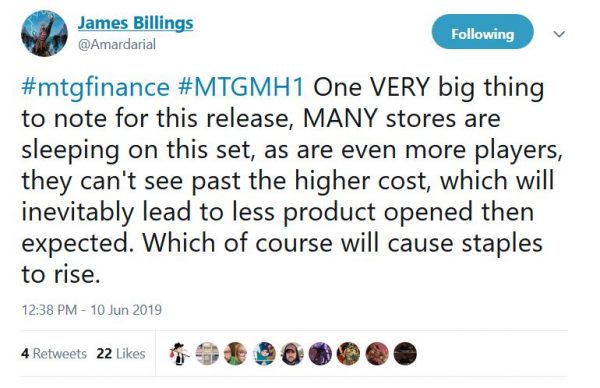
Modern Horizons is the first supplemental set ever released on MTGO that wasn't billed as a Masters set. Normally MTGO players get left out in the cold on supplemental summer sets like Conspiracy or Battlebond, but not this year! And what is more, since this is a set that was actually released like a regular set, whose cards weren't released exclusively through treasure chests, this set will follow the familiar pattern that speculators can capitalize on.

For the next month or so we should expect Modern Horizons to reach peak supply, and once cards cease entering the market altogether in August we can expect the value of the set to increase over time. Investors, speculators, and players should all make financial decisions in sync with this timeline.
I. When Should I Invest in Modern Horizons?

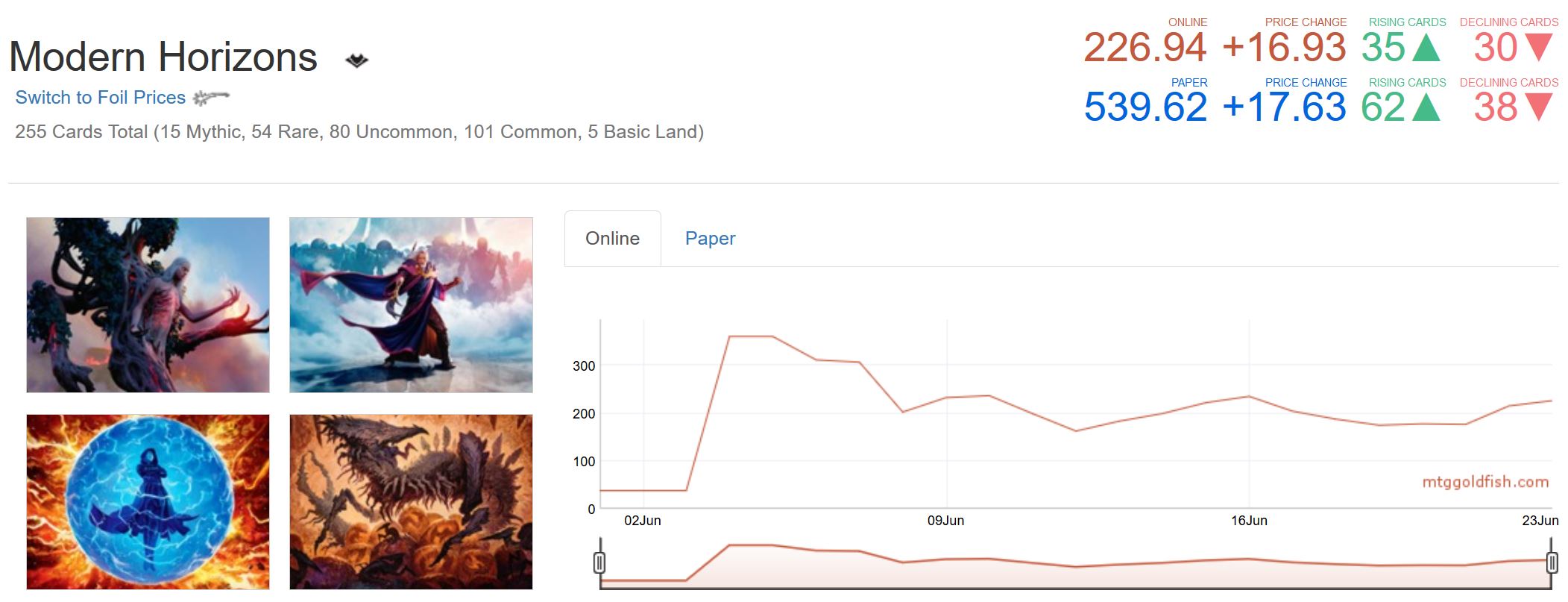
Currently, Modern Horizons is sitting at a set value around $225. Modern is not just the most popular format on MTGO but is also typically most popular during the late Spring and Summer. Product is still being opened, albeit more slowly than in the first few weeks of June.

The release of a new Standard set always shifts player excitement and focus toward Standard, and I expect Core 2020 to be no different. Eternal cards tend to dip at that time, and I expect the same to happen with Modern Horizons cards. That's when I'll be looking to buy. Hopefully, the set value will be closer to $175 at that time.

Prices should hold relatively steady until the set is no longer draftable (mid-August). After that, expect to see a slow gain. By next year, I think the set value for Modern Horizons will be at least $300. Over the next month, players should be happy buying cards from this set to play with as there is little financial risk in holding them.

II. Where will the Big Money Cards Settle?

1. Wrenn and Six
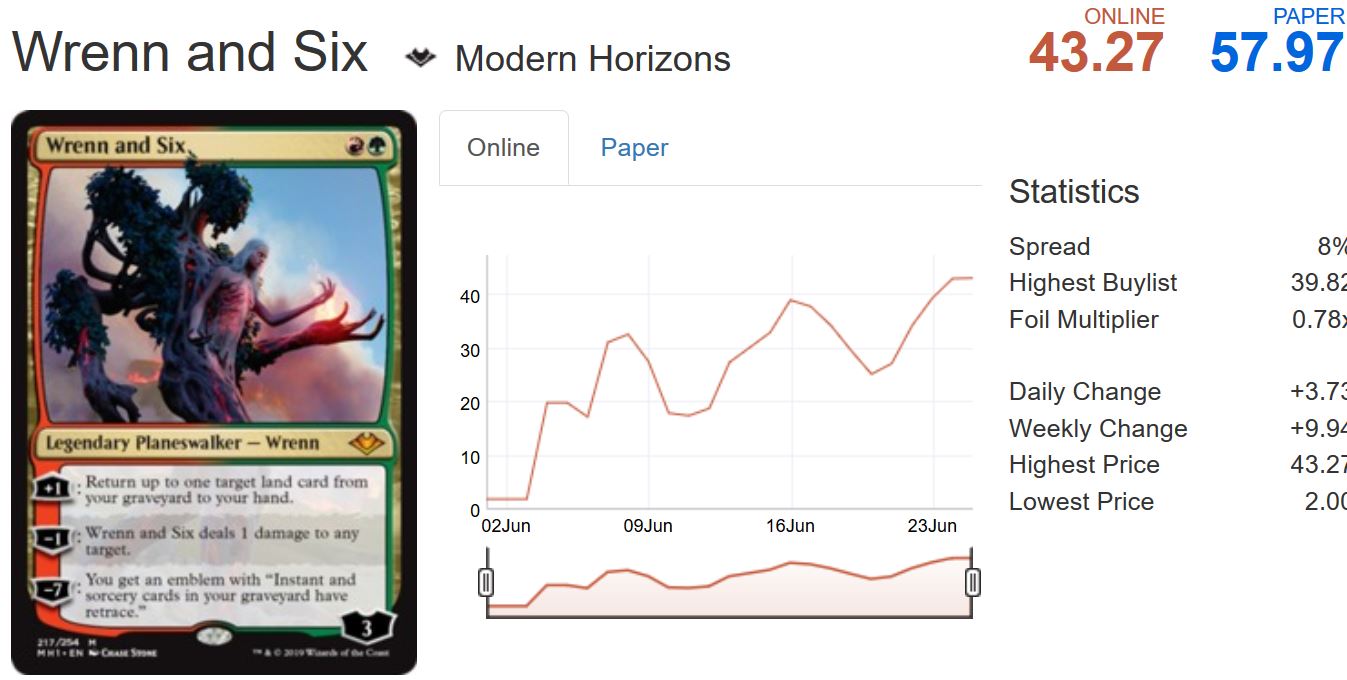
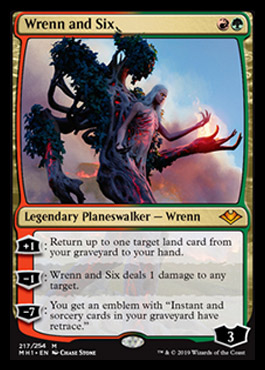
I expected Wrenn and Six to be the most valuable card in the set, but I didn't expect it to be this high this quickly. Standard, Legacy, and Pauper all command sizeable demand on MTGO, and Legacy demand is likely accounting for 50% of Wrenn's value. It is already showing signs of becoming a Legacy staple. I can't recommend investing in it due to the inherent risk of buying a card at this price point, but I don't think it's going to settle below $30. Prices are still swinging wildly and I'd be trying to snag your playset around that $30 point. Hopefully when Core 2020 releases it'll dip to that price. I will say, though, that Wrenn and Six has the potential to break the $100 mark if it sees more Modern play and isn't included in treasure chests. I'm not willing to bet the farm on that, but I see it as a possibility.

2. Force of Negation
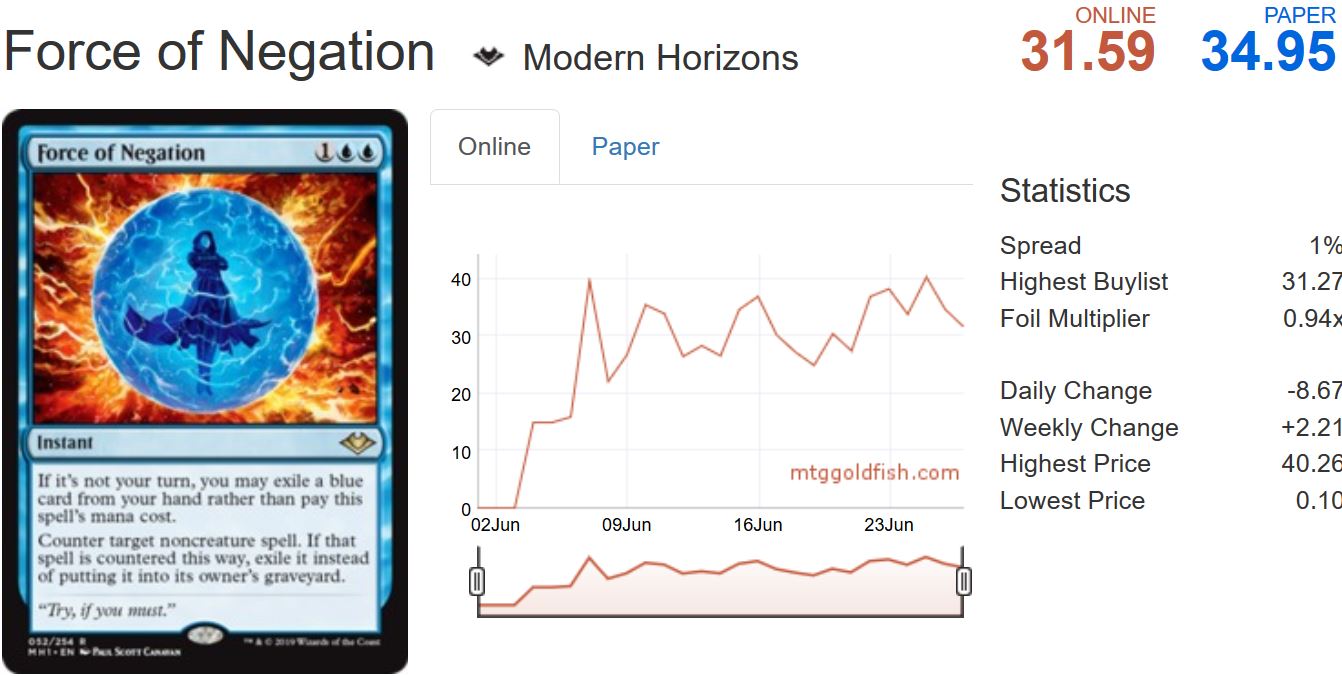
Force of Negation is having a larger impact on Modern and Legacy than many had anticipated. Its high price tag is largely due to it seeing significant play in tier one Modern decks (UW Control) and tier one Legacy decks (UR and Temur Delver). Although that won't likely change, what is true is that Force of Negation is going to continue to be opened at a decent clip for the next several weeks since it is only a rare. Although it's possible the going rate for Force of Negation might settle around $30 eventually, I can't imagine it holding such a high price in the short term.

3. Seasoned Pyromancer
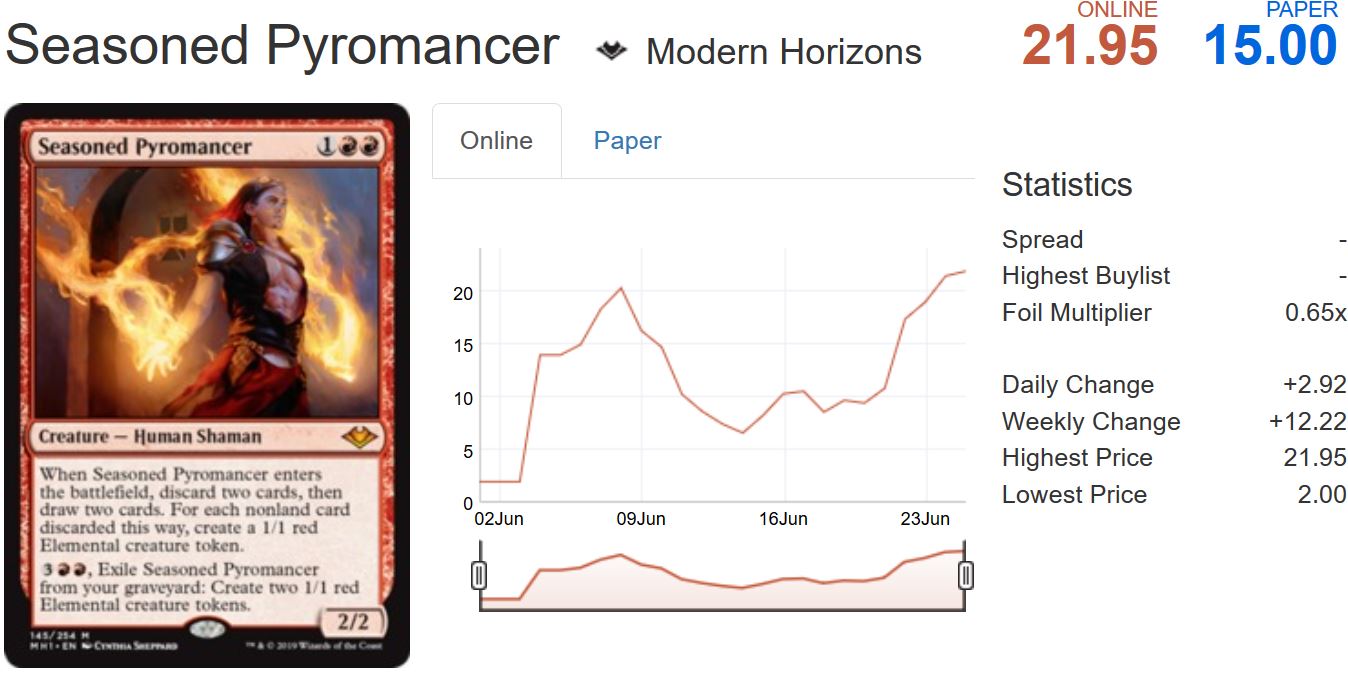
Seasoned Pyromancer has exceeded expectations and has really made its impact felt on Modern. It will likely get even stronger if some of the unfair graveyard decks are brought back to earth a bit with a ban. While I expect it to eventually settle well north of its current price point, I'm optimistic that buyers will get another chance to buy closer to $15 once Core 2020 releases.

II. What Mythics are Currently Undervalued?

1. The First Sliver & Morophon, the Boundless

Current Price: $0.75

Although they don't get talked about a lot, there are a lot of casual Magic players who play Commander on MTGO. MTGO is the only digital place to play Commander, and this means of playing has been popularized by MTGGoldfish's "Commander Clash" series. The First Sliver and Morophon, the Boundless will both likely see some amount of demand due to casual players, and the fact that they are both mythics in an expensive supplemental set means that there won't be all that many copies to go around. Both are going for $0.75 now, and that has nowhere to go but up. Popular 2018 Commander cards Tuvasa the Sunlit and Lord Windgrace have both skyrocketed in price, to $17 and $62 respectively, and it's possible something similar could happen to The First Sliver or Morophon.

2. Echo of Eons
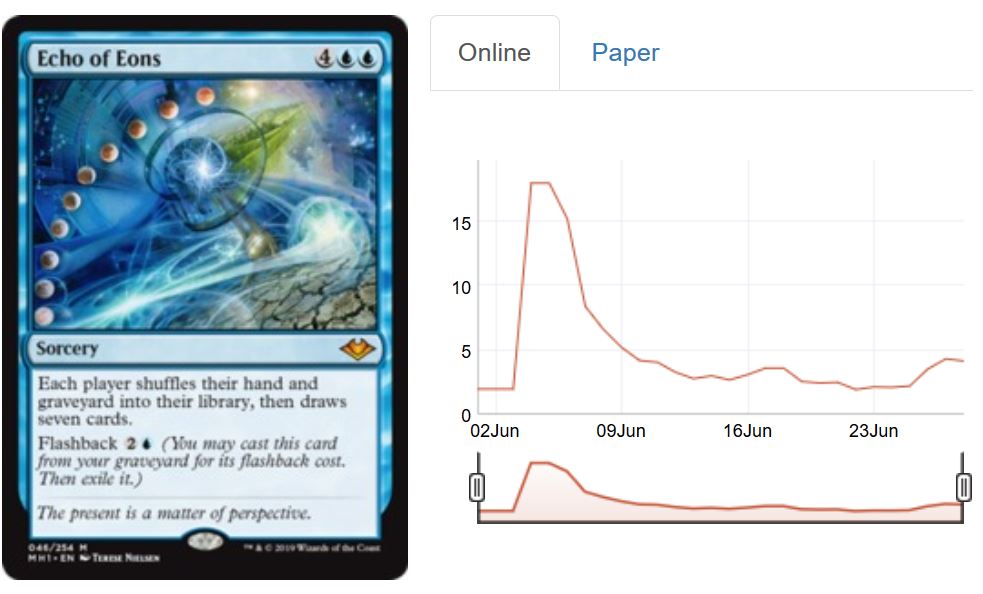
Current Buy Price: $4.14

Echo of Eons is one of the cards that received the most hype during spoiler season. The power here is self-evident, but its price is low because it has only really broken into Legacy thus far. Right now Modern is so dominated by Hogaak that nothing this slow can be anything more than cute* in Modern. I'm expecting a ban or two to come to Modern that will slow down the format, possibly of Hogaak himself, possibly of his best enabler Faithless Looting.

Echo of Eons' value seems to be based predominantly on its Legacy chops and not on its potential in Modern. I cannot say whether Echo of Eons will ever be a thing in Modern. But what I do know is that its price isn't going to crater because its supply is so low, so there is less risk in speculating here than there usually is. Just like MLB baseball players are taught to do nowadays, swing for the fences in Modern Horizons. It's okay to strike out some in order to chase the long ball. You don't have to try to hit a home run with Echo of Eons, but know that there are few times in MTG or MTGO finance where you can take a few free swings like you can with the cards in this set.

3. Yawgmoth, Thran Physician
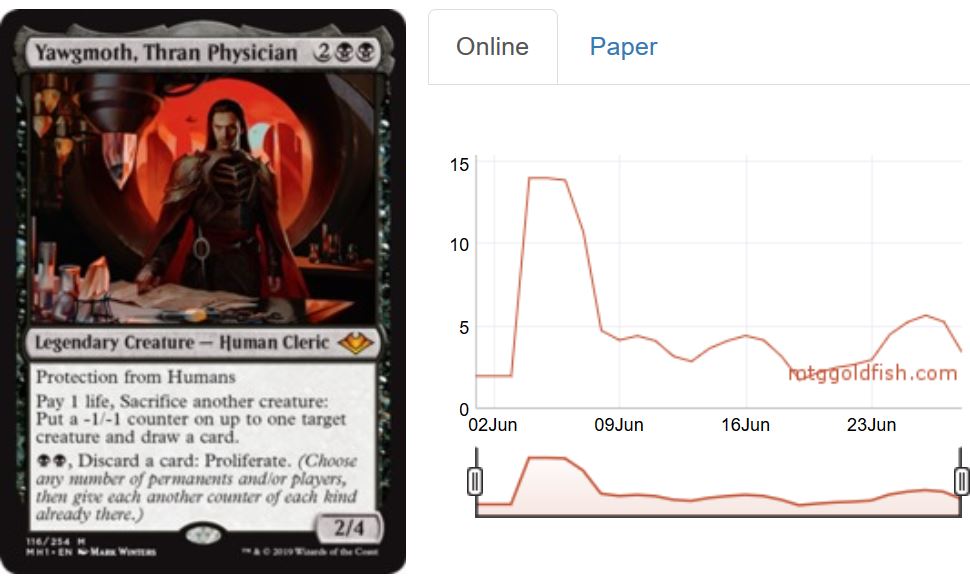
Current Buy Price: $3.49

Yawgmoth is among my favorite speculation targets from Modern Horizons. It is only seeing a tiny bit of play now because it is too slow in a Hogaak world. But if Hogaak decks get nerfed, I think Yawgmoth could become a real player in the format and command prices north of $15.  Yawgmoth is versatile and powerful and will likely go up in price if (and hopefully when) fair decks get a foothold in the Modern format.

III. Signing Off

In my next article (likely releasing later this week) I will cover the rares from Modern Horizons. What are your favorite speculation targets from this set?

I encourage those who have not drafted this set at all to do so. It is among the best draft formats I've ever played, and it's a shame I've been traveling down in Texas for the past few weeks so I've played a lot less of it than I would have liked. The draft portion is a bit harrowing and can sometimes feel arbitrary, but the gameplay is among the most interesting I've ever experienced. So many games are tight and come down to the decisions the two players make. Additionally, the value for non-phantom and phantom alike is higher than usual. The expected value for MTGO drafting overall is higher than it has been in at least five years, a subject I'll be thoroughly examining in July and August. Go get your Modern Horizons and War of the Spark drafts in.

QS Insiders who want to see my portfolio should contact me on Discord. My portfolio is up to date and includes all of my WAR and RNA season investments.

Thank you for reading and I will see y'all next time!
Learn From My Mistakes

Are you a Quiet Speculation member?

If not, now is a perfect time to join up! Our powerful tools, breaking-news analysis, and exclusive Discord channel will make sure you stay up to date and ahead of the curve.

After publishing my article last week, another Quiet Speculation writer shared his rationale for an alternate point of view. Specifically, David was skeptical of Modern Horizons so early into its release cycle and he provided a bullish case for Ophiomancer.

There was an error retrieving a chart for Ophiomancer

We exchanged ideas in the Insider Discord in a healthy discussion on these two points. On the one hand, I am standing by my support for Modern Horizons speculation. I still think this set will be relatively under-opened (even if the print run is high) and the playable cards in the set—especially foils—will continue to climb.

On the other hand, my call to sell Ophiomancer was clearly premature. This isn’t the first error I’ve made in MTG finance and it won’t be my last. Too often the vocal members of the MTG Finance community boast their hits and eschew discussion on their misses. Time to change that. I want to embrace them because I can learn from these mistakes. This week I am going to share some of my largest blunders along with the lessons I learned from them, in the hope readers can avoid the same pitfalls I encountered throughout my eight years of MTG finance.

Lesson 1: If You’re Early, You’re Wrong

I suggested selling Ophiomancer at its $13 high last week, but now copies can’t be found for less than $18. Apparently, the human shaman interacts well with Yawgmoth, Thran Physician in Commander. This is an interaction I overlooked in my face-value assessment, and clearly there are enough people interested in playing (or speculating on) this interaction.

I could argue that Ophiomancer’s parabolic move won’t be sustainable. Often times we see a new interaction spark a buyout, only to watch the spiked card’s price rapidly trend back down again. Once speculators get their fill, they compete in price and undercut each other, until buyers are willing to step in and a new price is established.

But the bottom line is I was too early on the sell call. Instead of selling last week at $13, one could conceivably sell their copies this week at $17. Selling may be the right call now, but selling too early would have meant missing 30% more upside. In this case, the early call to sell was the wrong call.

Another recent example where my timing was premature was when I acquired foil Thran Temporal Gateways. I still believe in this card’s long-term prospects, but buying up Card Kingdom’s copies at $3.49-$3.99 was not ideal given their price is now $2.99 ($2.49 for EX). Fortunately, I was able to ship some copies to ABU Games for decent trade credit. But the bottom line is I could have purchased fewer copies and instead waited for the price to come in.

There was an error retrieving a chart for Thran Temporal Gateway

I only hope my recent Modern Horizons pick-ups don’t follow a similar trajectory!

Lesson 2: The Sealed Product Trap

Years ago, I discovered the stellar returns sealed product yielded. I decided to buy in deeply, acquiring boxes from sets like Time Spiral, Planar Chaos, New Phyrexia, Coldsnap, Unhinged, and Innistrad. These purchases paid out nicely and the wait time for profit wasn’t as long as I anticipated, a nice bonus.

With that I decided to double down—I purchased around a dozen booster boxes of Return to Ravnica and Magic Origins. There seemed to be robust hypotheses behind both sets: the former contained Modern staples such as Shock Lands, Abrupt Decay, and Supreme Verdict. The latter was an under-opened set that contained the flip-Planeswalkers.

There was an error retrieving a chart for Jace, Vryn's Prodigy

After waiting a couple years, I realized these products were not going to provide me any appreciable yield. Despite a reasonable buy-in of around $80-$85 per box, I wasn’t seeing any opportunity to sell for profit. When taking fees and shipping into account, a booster box really has to appreciate at least 25% to become a worthwhile target. I ended up cashing out of all sealed product for a loss.

Despite the pain of such an unsuccessful purchase, I learned three valuable lessons about sealed product:

  1. Starting around the time of Return to Ravnica, Standard sets are printed into oblivion. In fact, you can still purchase booster boxes of Return to Ravnica and Magic Origins for under MSRP even now. Prior to that, buying any boxes with playable eternal cards would have made you significant profit. Those days are over.
  2. The opportunity cost of sealed product is very high. While sitting on these booster boxes, I had a couple thousand dollars tied up, rotting on my shelf. Other than their nice display, there is no benefit to sitting on sealed product—you can’t play with the cards and you can’t open the packs. They also take up a great deal of space. Instead of booster boxes, I’d rather use that capital to acquire cards that have upward potential—at least I can use them while waiting for that return!
  3. The exceptions aren’t worth pursuing. Yes, Khans of Tarkir boxes sell for $180 on Card Kingdom’s site. Yes, Japanese War of the Spark booster boxes have major potential due to the alt-art Planeswalkers. Yes, Kaladesh booster boxes retail for $200 because they contain Masterpiece These are all sound exceptions. But you know what? I still don’t want to deal with it. Packaging up the boxes, bringing them to the post office, paying the exorbitant shipping cost—to me it just isn’t worth it. You could have made $100 on a Kaladesh booster box because they contain Masterpieces, but you also could have made $100 by simply buying the Masterpieces themselves!

Lesson 3: Buylists Aren’t Always Forward-Looking

When I listen to CNBC podcasts, I sometimes hear about how certain industrial data is “forward-looking” and other data is “backward-looking”.  These terms are usually used to describe jobs data, inflation numbers, manufacturing data, etc. While there’s no direct parallel in Magic, the concept should not be overlooked completely.

I discovered this truth the hard way back in 2013. I remember it well—the promotional Scavenging Oozes started hitting the market, and demand was high. Prior to its reprinting in Magic 2014, the only copies of the popular Modern card were from the original Commander set, and they sold for top dollar. At one point these sold for $35 and buylisted for nearly $30!

There was an error retrieving a chart for Scavenging Ooze

Once I learned of the reprint, I knew its price would bottom quickly and rebound—I wanted to make this a major position in my portfolio. Copies started to hit eBay and the price began its precipitous drop. As copies started approaching $8, I became very interested. At that moment, Star City Games had an $8 buy price on the card. To me, this was license to go all in. I figured if Star City Games was buying at $8, then I should feel confident in doing so too.

After all, such an aggressive buy price meant that Star City Games believed the card would rise in price from there, right?

Wrong.

After buying a few dozen copies, my buylist safety net was pulled out from under me. Suddenly Star City Games was paying $6 a copy. Then even lower. Even more copies came to eBay at lower price points, and I simply couldn’t purchase them all. The price fell further over the course of a couple months, and that’s when I realized I wasn’t going to profit from this endeavor. Rather than throw the copies in my box of shame, I decided to liquidate and put that money to work elsewhere. I’m glad I made this decision because Scavenging Ooze’s price never recovered. Multiple reprints later, the promo version of Scavenging Ooze still sells for a $4.

The breakdown was in trusting a vendor’s buylist as a forward-looking indicator. This is a fallacy—major vendors don’t set their buylist price based on anticipated price movement. They set their buylist price based on their current supply and sale history. In other words, their buylist prices are based on what has happened up until that point (backward-looking), not what they expect to happen in the future. Keep that in mind next time you speculate on a card based on a vendor’s buy price. If market price is on par with a buylist price, it’s possible the buylist price drops instead of the market price rising.

Wrapping It Up

As I embarked on this article, I quickly realized just how many mistakes I’ve made in MTG finance over the years. It’s easy to remember all the correct calls and well-timed buys and sells. But in reality, I’m far from perfect and have my fair share of poorly executed investments. I highlighted three specific cases here because there are valuable lessons to take away from each. But in reality, the list is quite lengthy. I never even mentioned my failed speculation on Skaab Ruinator!

There was an error retrieving a chart for Skaab Ruinator

The good news with Magic speculation, though, is that you don’t have to be perfect to make money. In fact, you only need to be right more than you’re wrong to turn a profit. All things equal, a 50.1% success rate is still successful in my book (although the value of your time may be a factor). We all make mistakes, but hopefully, we can learn from each other’s to get our success rate up a little more. The three lessons I shared in this article will hopefully give you that additional edge needed to make your Magic hobby that much more affordable.

…

Sigbits

  • In keeping with the “failed spec” theme of the week, let’s examine Card Kingdom’s buylist prices on some of the cards I’ve unsuccessfully speculated on over the years. First and foremost, of course, there is Scavenging Ooze; Card Kingdom pays $2.75 on the promo version I once bought dozens of for around $8 a copy. Like I said before, I’m glad I decided to cut losses on this one when I did!
  • At one time I did believe Skaab Ruinator would be a hit in Standard or Modern—that never materialized. Card Kingdom doesn’t even have non-foils specifically listed on their buylist, meaning they’d consider it a bulk mythic rare at this point. At least they have another Innistrad card on their buylist that I once speculated on: Ghoultree. They’re paying a whopping $0.33 for the green creature!
  • Card Kingdom’s buy price on foil Thran Temporal Gateway: $0.90. I am still sitting on a few copies that I couldn’t unload profitably now that ABU Games dropped their buy price. In this case, I am going to wait patiently and see if the price gains traction over the next few months.
  • BONUS: At one point, I was sitting on nearly 100 Shock Lands. This was before the most recent return to the world of Ravnica, about a year after Return to Ravnica was released. I was so confident these would return to $20+ and I put my money where my mind was. But the returns didn’t pan out on the timeline I had projected, and ultimately I sold all my shocks to a buylist in GP Vegas a few years back. Nowadays those buy prices are about the same as they were when I sold. For example Breeding Pool and Watery Grave from Return to Ravnica buylist to Card Kingdom for $8.25. I’m happy I sold when I did because that opportunity cost was steep and the five-year return on that large investment would have been tiny.

Insider: QS Cast #127 – Previews? Here we go again! [Unlocked]

Are you a Quiet Speculation member?

If not, now is a perfect time to join up! Our powerful tools, breaking-news analysis, and exclusive Discord channel will make sure you stay up to date and ahead of the curve.

Welcome to the QS Cast 2019! Our co-hosts Chaz and Tarkan explore the financial aspect of Magic the Gathering – and in this episode they discuss the following:

  • Tarkan joins to discuss the first relevant information and results for
  • #ModernHorizons First look at official Core 2020 Previews!
  • Insider Questions!
  • Cards to Consider!


*This Podcast was Recorded on 06/12/2019 for QS Insiders. If you want live recording sessions and up to date postings before anywhere check out the QS Insider Discord!

Avatar photo

Chaz V

Started playing during Invasion block at the age of 13. Always a competitive person by nature, he continues playing to this day. Got into the financial aspect of the game as a method to pay for the hobby and now writes, Podcasts, and covers all aspects of the game, always trying to contribute to the community and create great content for readers and listeners.

View More By Chaz V

Posted in Free, QS Cast, UnlockedLeave a Comment on Insider: QS Cast #127 – Previews? Here we go again! [Unlocked]

Have you joined the Quiet Speculation Discord?

If you haven't, you're leaving value on the table! Join our community of experts, enthusiasts, entertainers, and educators and enjoy exclusive podcasts, questions asked and answered, trades, sales, and everything else Discord has to offer.

Want to create content with Quiet Speculation?

All you need to succeed is a passion for Magic: The Gathering, and the ability to write coherently. Share your knowledge of MTG and how you leverage it to win games, get value from your cards – or even turn a profit.

It Snow Game: Brewing Bant and Temur

Are you a Quiet Speculation member?

If not, now is a perfect time to join up! Our powerful tools, breaking-news analysis, and exclusive Discord channel will make sure you stay up to date and ahead of the curve.

Modern Horizons has deeply affected the format, and Core 2020 is now poised to emerge and shake things up further. But behind all that ruckus, a storm has been brewing—rather, I've been brewing up a snowstorm. Today we'll look at my adventures with Ice-Fang Coatl in Temur and Bant.

Dreadhorde Snow

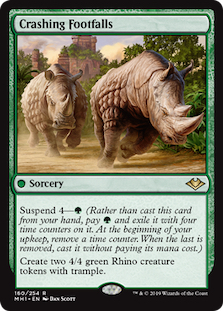
This shell combined a lot of the more recent cards I wanted to test, including Dreadhorde Arcanist, which I'd messed around with previously. Other newcomers included Wrenn and Six, a card I'd enjoyed thoroughly in GR Moon; Crashing Footfalls, a 0-cost spell to cheat out; and Prismatic Vista, Arcum's Astrolabe, and Ice-Fang Coatl, the snow package.

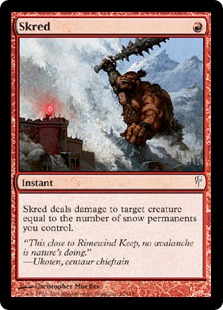
I started with Temur for access to Lightning Bolt and threw in Skred for good measure.

Dreadhorde Snow, by Jordan Boisvert

Creatures

4 Dreadhorde Arcanist
4 Tarmogoyf
4 Ice-Fang Coatl

Planeswalkers

4 Wrenn and Six

Artifacts

4 Arcum's Astrolabe

Enchantments

2 Blood Moon

Instants

4 Thought Scour
4 Lightning Bolt
4 Skred
1 Tarfire

Sorceries

4 Sleight of Hand
4 Faithless Looting
2 Crashing Footfalls

Lands

3 Prismatic Vista
3 Misty Rainforest
3 Wooded Foothills
1 Steam Vents
1 Stomping Ground
2 Snow-Covered Mountain
1 Snow-Covered Forest
1 Snow-Covered Island

Sideboard

2 Damping Sphere
2 Reclamation Sage
2 Alpine Moon
2 Ancient Grudge
2 Surgical Extraction
2 Life Goes On
1 Feed the Clan
2 Anger of the Gods

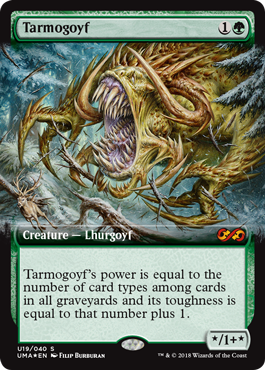
Between the cantrips and the wealth of one-mana removal, our turn one plan is to set up or disrupt opponents. After that, we're slamming powerful follow-ups. Dreadhorde requires plenty of one-mana spells to be a threat as of turn two; against decks that might have Bolt, we're better off leading with Tarmogoyf and drawing out more removal. Rounding out the curve at three mana is Blood Moon, which this deck functions under and which punishes opponents well-equipped to deal with our creatures.

Card Choices

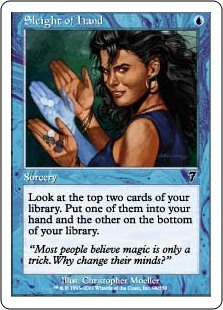
I went with Sleight of Hand over Serum Visions because I think it's better with Dreadhorde. Given an active Zombie, we'll have time after combat to  make more plays, and Sleight is better at setting those up. Serum excels at setting up later turns.
Crashing Footfalls is showing up in midrange and combo decks alike alongside Electrodominance, As Foretold, Finale of Promise, and Dreadhorde Arcanist. The idea for including it here was to turn Arcanist into a source of pressure in matchups where we'd need to lay the beats; linear combo decks like Tron don't care so much about a stream of value from across the table, but can die quick to a couple 4/4s, especially with Blood Moon in tow. Faithless Looting is here at 4 to enable this plan.

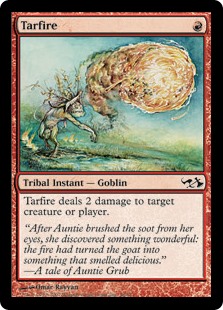
Tarfire is more of a vanity include than anything. Growing goyf to maximum P/T is a fun sub-game for me to play, no matter the deck!

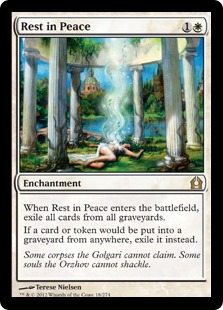
Looking to the sideboard, the pair of Reclamation Sages stand out as clunky and ineffective compared with Force of Vigor or the number of other effective options for removing artifacts/enchantments in green. Their primary purpose, though, is to snipe Rest in Peace, which otherwise shuts down most of what we're doing. Most of the Rest decks are control strategies, chiefly UW; against these, we want to ride one or two threats to victory so we don't fold to sweepers. That Reclamation provides a body is extremely helpful. Life Goes On works with Arcanist and patches up our spotty Burn matchup.

Deck Issues

I was impressed with how well this deck could grind, as well as how functional its engines were despite their many moving parts. Astrolabe and Coatl helped a lot with this by cantripping while developing our gameplan. I think snow decks are bound to include these two cards; the Snake is snow's main payoff, and Astrolabe is all but crucial when it comes to fixing mana and turning on deathtouch early. Because of that, snow decks enjoy an inherent consistency boost, a realization which informed my second, more combo-focused shell.
With all that said, hopping aboard the value train isn't exactly novel or difficult to achieve in Modern. It seems like almost every deck has the tools to do so, including the blazing-fast aggro-combo decks of this season. Since Dreadhorde Snow folds to Rest in Peace just as Hogaak Bridgevine does, and is otherwise worse on pretty much every metric, the deck couldn't work at the competitive level.

Undoing Snow

Of course the Narset-founded creation of Pitch Blue piqued my interest—I am Day's Undoing's most vocal supporter, ever. But my experience slinging the sorcery led me to pinpoint a couple beefs with established shells. For one, they weren't generating enough of a board advantage to make full use of the reset; they also felt quite slow in my testing. Finally, I picked up on some consistency issues: without Narset around, Undoing was just bad. My solution was to add dorks for the first two points and Teferi, Time Raveler for the last, giving up some of the great-on-paper free spells for cards that actually plug the deck's holes.

Undoing Snow, by Jordan Boisvert

Creatures

4 Noble Hierarch
4 Ice-Fang Coatl
3 Vendilion Clique

Planeswalkers

4 Narset, Parter of Veils
4 Teferi, Time Raveler

Artifacts

4 Arcum's Astrolabe

Instants

4 Path to Exile
4 Force of Negation
2 Remand

Sorceries

4 Sleight of Hand
3 Day's Undoing

Lands

4 Prismatic Vista
3 Flooded Strand
3 Misty Rainforest
1 Hallowed Fountain
1 Breeding Pool
1 Temple Garden
1 Mikokoro, Center of the Sea
1 Geier Reach Sanitarium
3 Snow-Covered Island
1 Snow-Covered Forest
1 Snow-Covered Plains

Sideboard

4 Rest in Peace
3 Damping Sphere
3 Kitchen Finks
3 Gut Shot
2 Nature's Claim

The snow package helps a lot in this deck, which could both use the consistency and the survivability fronted by Ice-Fang Coatl. Coatl also turns sideways for a reasonable amount with Hierarch on the battlefield. Rounding out the creature suite is Vendilion Clique, which not only combos with Narset by permanently tucking an opponent's card, but serves as our primary win condition.

Card Choices

Here's Sleight of Hand again, but for different reasons. Compared with Serum, which admittedly does a nice job of setting up the combo, Sleight makes the combo more reliable while going off. We can undo and then find the pieces we need to chain another Undoing, or dump our hand into play before the next reset. The immediacy of Sleight also helps when we're under pressure, letting us find Path to Exile or Force of Negation for an opponent's critical turn. And it has the extra benefit of letting us dig while opponents happen to have a Narset of their own.
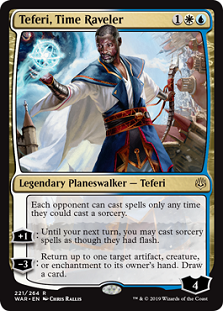
A more overt inclusion is Teferi, Time Raveler. Teferi-Undoing is of course worse than Narset-Undoing, which lets opponents draw just one card to our seven. But casting the sorcery on an opponent's end step using Teferi's plus mostly eliminates its drawback, and often has a similar effect; I've frequently drawn 7 on the end step only to then plant Narset and Undo again, putting away the game. The walker's minus also helps us survive and digs further into the combo. With both walkers in play, draw-step Undoings leave opponents totally handless, as they've already drawn for turn. Finally, instant-speed Undoing has the benefit of disrupting graveyard combos, even if it won't literally end an opponent's turn as it would ours.
Remand is a flex spot that gives us a mix-up option with Coatl. It's especially potent against linear combo and big-mana shells, while fairly useless against aggro-combo. Mikokoro and Geir Reach are both nuts with Narset in play, especially the latter; each are legends, and so only appear at 1.

Finally, the sideboard. Our colors and gameplan let us run some of the best two-mana hosers in Modern, and in huge quantities. Finks is here pulling double-duty as a floater against midrange and lifegain against aggro. Gut Shot exists for enemy planeswalkers and small creature decks.

Deck Issues

Between its powerful ambitions, resilience to hate, and ability to pack so much itself, I found the Bant deck much stronger than the Temur one. But a little more tuning might go a long way. I lost a game to Hogaak in which I stuck two Rest in Peaces and ended up getting beaten down by a bunch of menacing Neonates; having even a vanilla 2/2 in play would have won me the game, but we don't have access to anything like that in the mainboard. Perhaps something like Tarmogoyf is necessary in the main, and could also improve the other aggro matchups.

Here to Stay

Ice-Fang Coatl is certainly good enough for Modern, and apparently not going anywhere. I anticipate the snow package will remain a solid include in decks looking for what it offers: consistency and increased survivability against efficient beaters. How have you tamed the Snake?

Insider: QS Cast #126 – #Oathbreaker with Bryan Spellman! [Unlocked]

Are you a Quiet Speculation member?

If not, now is a perfect time to join up! Our powerful tools, breaking-news analysis, and exclusive Discord channel will make sure you stay up to date and ahead of the curve.

Welcome to the QS Cast 2019! Our co-hosts Chaz and Tarkan explore the financial aspect of Magic the Gathering – and in this episode they discuss the following:

  • #ModernHorizons dive! We currently have all the Mythics/Rares. Reactions, discussions, personal takes from Chaz, Tarkan and special guest Bryan Spellman!
  • Bryan talks to us about #Oathbreaker, charity, and where Oathbreaker can end up!


https://weirdcards.org/

*This Podcast was Recorded on 05/30/2019 for QS Insiders. If you want live recording sessions and up to date postings before anywhere check out the QS Insider Discord!

Avatar photo

Chaz V

Started playing during Invasion block at the age of 13. Always a competitive person by nature, he continues playing to this day. Got into the financial aspect of the game as a method to pay for the hobby and now writes, Podcasts, and covers all aspects of the game, always trying to contribute to the community and create great content for readers and listeners.

View More By Chaz V

Posted in Free, Oathbreaker, Podcasts, QS Cast, UnlockedLeave a Comment on Insider: QS Cast #126 – #Oathbreaker with Bryan Spellman! [Unlocked]

Have you joined the Quiet Speculation Discord?

If you haven't, you're leaving value on the table! Join our community of experts, enthusiasts, entertainers, and educators and enjoy exclusive podcasts, questions asked and answered, trades, sales, and everything else Discord has to offer.

Want to create content with Quiet Speculation?

All you need to succeed is a passion for Magic: The Gathering, and the ability to write coherently. Share your knowledge of MTG and how you leverage it to win games, get value from your cards – or even turn a profit.

MTG Finance Trader Profiles

Are you a Quiet Speculation member?

If not, now is a perfect time to join up! Our powerful tools, breaking-news analysis, and exclusive Discord channel will make sure you stay up to date and ahead of the curve.

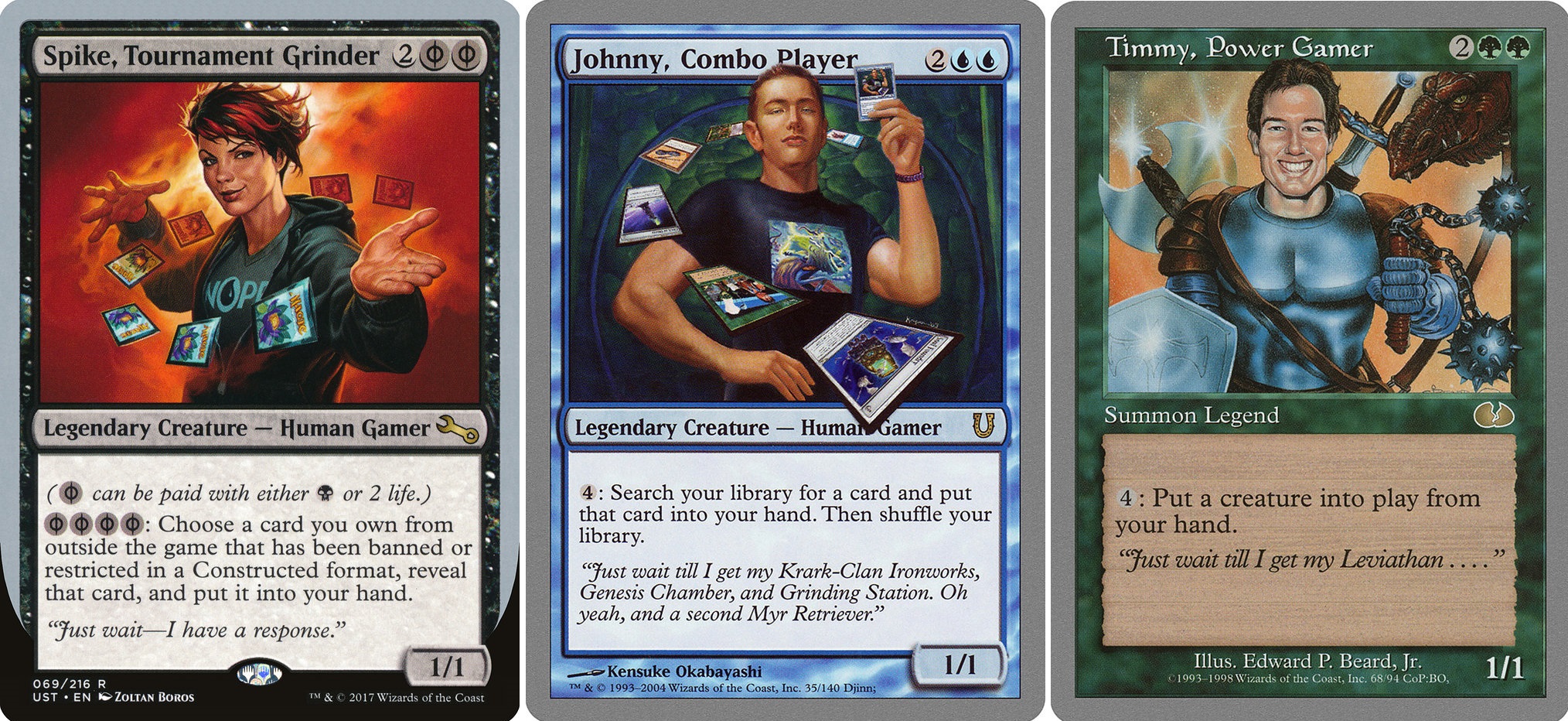
We’ve been told for years now that players come in three types: Timmy, Johnny, and Spike. These are affectionate nicknames for common psychographic profiles that players tend to fall under; with Timmy referring to the power gamer who plays Magic for fun and to cast exciting spells, Johnny referring to the combo player who loves cool interactions and innovations, and Spike is the tournament grinder who sustains himself with two-for-ones.

I’ll assume you’ve heard of these if you’re indoctrinated into MTG Finance, but have you considered how these players approach the financial aspect of the game? I imagine that most people do not, as these archetypes do not easily slot into MTG Finance psychographic profiles.

There are Timmys who don’t care about the value of their cards and never sell them, and Timmys who are excited to open the chase mythic from the newest set at prerelease and will sell it to the highest bidder. While it’s clear that our traditional psychographic profiles are not particularly useful for assessing interests in MTG Finance, it’s also clear that player archetypes do exist for the financial aspect of the game.

You know them well

MTG Finance Trader Profiles

Having three archetypes works excellently for our purposes here. I've come up with these three names as the basis for our descriptions: Alex, Bailey, and Cassidy. (Note: these names are not meant to represent any real person, living or dead.)

Alex is the binder-grinder #MTG Finance guru. They subscribe to Quiet Speculation, they check overarching price trends daily, they speculate on cards now and then, and they finance some portion of their favorite hobby with this work. If you’re reading this article, you’re most likely an Alex.

There was an error retrieving a chart for Black Lotus

Bailey is the category most Magic players I know fall into. Bailey cares about the value of their cards. They love it when the cards they own spike in price and hate it when the cards they need for a tournament or Commander deck spike in price.

Bailey does not commonly read finance articles or pay attention to price charts because MTG Finance is firmly secondary to playing the game for them. Bailey may sell their cards frequently to help afford the next deck they move to, or only sell when they notice an egregious spike, depending on their financial disposition.

There was an error retrieving a chart for Bridge from Below

Cassidy does not care about MTG Finance. Full stop. They may have not even heard of MTG Finance. Cassidy has a full-time job that bankrolls the game for them. To Cassidy, Magic is a hobby that they dump a few hundred dollars into here and there that they do not expect to see again.

If they ever stop playing, they will likely sell their collection, but it is not even close to worth Cassidy's time to haggle in Facebook groups or set up a TCGPlayer store. Note that Cassidy doesn’t necessarily have to be an affluent adult, but they can also be a younger person who does not have time for MTG Finance, is not aware of MTG Finance, or is not interested in MTG Finance.

There was an error retrieving a chart for History of Benalia

What Can We Do With These Descriptions?

We’ve established the MTG Finance trader profiles. Let’s see if we can create some useful heuristics from these. For this article, I’m going to assume you’re an Alex (sorry Baileys). As an Alex, I’m sure you’re aware of how different it can be to interact with a Cassidy or with a Bailey, if only on an intuitive level. The way you would trade with another Alex is going to be entirely different than the way you would trade with a Cassidy, because Alex and Cassidy both want totally different things from a trade or purchase.

The reason I outline these three archetypes is to try and help Magic traders, buyers, and sellers think more about approaching business in a way that benefits both parties. I’ve met many an Alex who won’t trade with other Alexes because they don’t think they will get any value from the trade. As an Alex, I personally prefer to trade with other Alexes. All you have to do is identify what reason they’re trading for and give them that in return, while ensuring to get what you want out of the trade as well. As an example, most Alexes I've met just want value, and will be happy with a trade like the following:


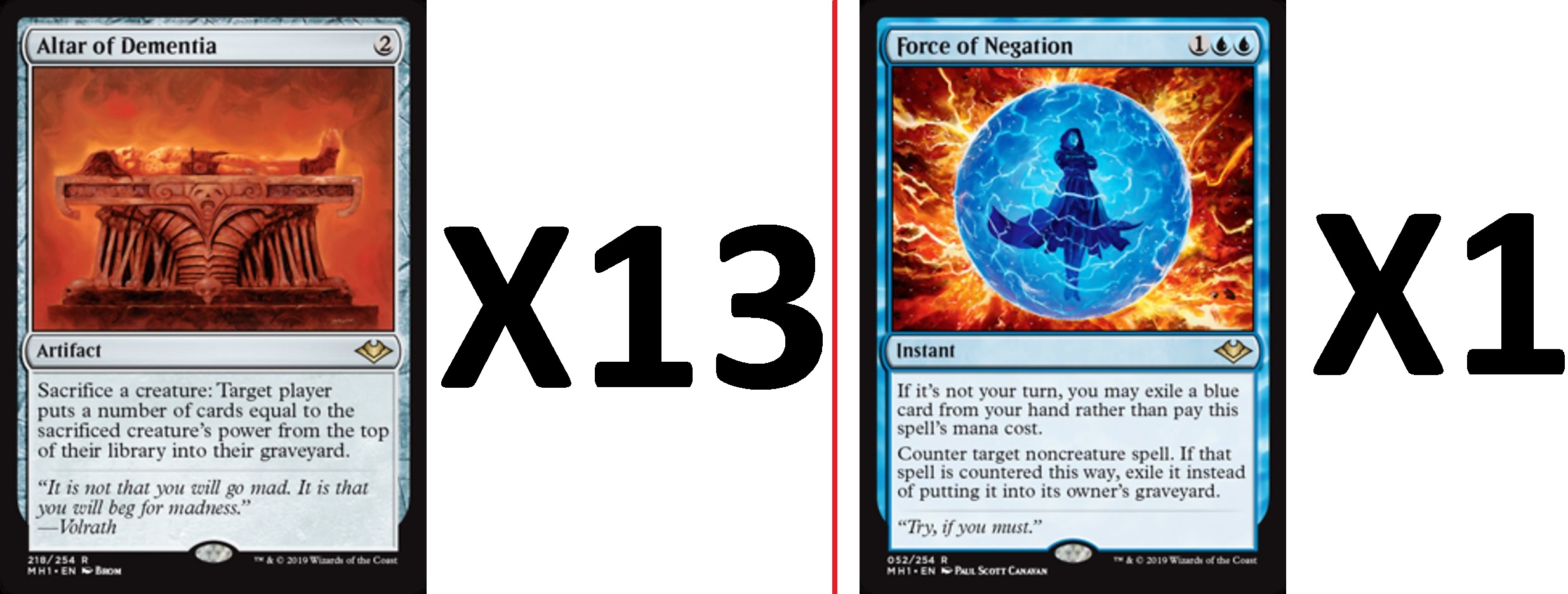
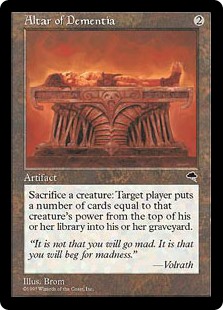
Which side of this trade do you prefer? The TCGPlayer value (as of June 20th, 2019) of the left side is about $39 total. The TCGPlayer value of the right side is $27. As an online store, TCGPlayer Direct fees are extremely high for cards valued $3 and under. I would make probably about $19 cash from selling these Altar of Dementias, or slightly higher from a buylist if I’m lucky. The Force of Negation will put roughly $22 in my pocket.

This one is on the closer end, but I think lots of Alexes would accept even 11 or 12 Altars, which would make this a great trade for both ends. The Altars will trade at $3 all day long, so my fellow Alex is happy. I will profit $3-9 dollars, so I’m happy. Conversely, while some Baileys may take this trade, no Cassidy ever will. What would Cassidy need 13 Altar of Dementias for?

Clearly consolidation and direct value are two valuable end results of a trade. Just how valuable consolidation is will vary from person to person and from trade to trade. One thousand $1 cards for a single $1000 card is a significantly more lopsided trade than five $10 cards for a single $50 card. On the latter trade, you wouldn't want to add more than 5-10% of the value of the trade to make it even. With the former trade, I wouldn't even be thrilled to trade a $1000 card for double value in $1 cards. There's no perfect formula to measure the value of consolidation, so it's important to come into a trade with some idea of how important it is to you personally.

The last of the three primary motivations for an Alex is speculation. Any Alex worth their salt is going to attempt to trade away their rotating standard cards before they fall too far, and is going to prioritize more stable cards with some potential for future gains. For this reason, I put all my specs that are not yet for sale in my trade binder. This is something I don't see many Alexes do, but having legitimately strong specs in your binder can entice a fellow Alex to kick some value your way, or to give you a more lenient consolidation trade.

Speculatory trades are far more precise in nature. How high do you expect the card to go, and what percentage chance do you think it has of getting there? These are numbers you should already have in mind in relation to your specs, but it's important to be able to calculate these on the fly when flipping through a trade binder. I'm not speculating on Monastery Mentor right now, but it's going to be insane in Modern when Hogaak, the Arisen Necropolis gets banned, and is already putting up results. If I see these in a trade binder, I'll prioritize them, unless the person I'm trading with is also banking on them gaining value.

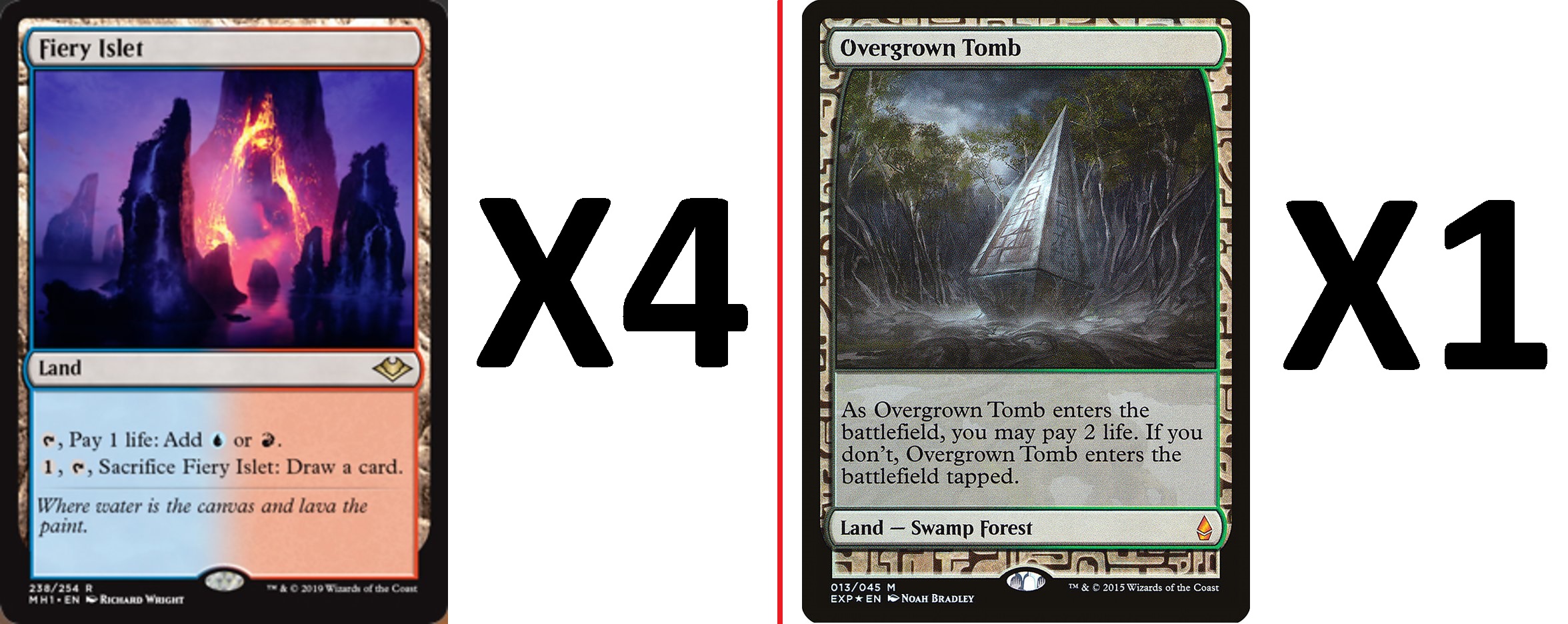
Speculation trades create complex situations to navigate. Which side of this trade do you want?

Either is fine. Fiery Islets will go up from their current price of $20, but how high they go and how quickly they get there is speculatory. Expedition Overgrown Tomb clocks in at $80 currently and is the value consolidation play, and a decent spec, albeit a long-term one.

Wrapping Up

Now that you have a clearer idea of these distinct differences in the ways that players approach MTG Finance, hopefully, you can use this methodology to create more favorable deals with more varieties of people. I’ll leave the specifics of these heuristics to your imagination for now, as I’ll be diving into more detail on how I interact with the various archetypes in a future article. Follow me on Twitter @MahouManSam for daily finance updates.

Outsider Tribes: Core 2020 Spoilers

Are you a Quiet Speculation member?

If not, now is a perfect time to join up! Our powerful tools, breaking-news analysis, and exclusive Discord channel will make sure you stay up to date and ahead of the curve.

This is a bit sudden: Modern Horizons has only been out for two weeks, but here we are starting Core 2020 spoilers. The summer release schedule has ensured that Modern is utterly saturated with new cards, and it is struggling to absorb them all. There hasn't been much time to determine the effects that War of the Spark  and Horizons have already had. I have no major events besides MTGO providing data, and so cannot accurately determine the metagame. Therefore, I'm going to be focusing on the new cards in a vacuum.  Rather than speculating on their impact on the indeterminate metagame, I'll be analyzing them on their own merits and potential homes.

Modern Horizons had minor tribal themes with decent numbers of slivers and changelings. Core 2020 is continuing this path, with tribal synergies for goblins, elementals, and flying, somewhat incongruously. At time of writing, with just over half the set spoiled, the two former tribes have received cards that may finally push them into Modern viability. The latter has some interesting possibilities for Spirits. I will be focusing on the tribal decks today.

Up in the Air

The first tribe isn't actually one, but it does only apply to one. There is a significant flying tribal theme in 2020, which while mostly targeted at Angels affects Spirits too. So far I haven't seen anything skyshaking; it's really hard to compete with Mausoleum Wanderer and Spell Queller. However, there are some interesting cards already that could find a home in Spirits. It will take the right circumstances, but it is possible.

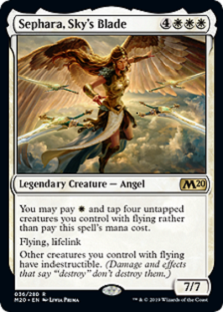
To preemptively respond to something I've been asked in person multiple times, Sephara, Sky's Blade is not going into Spirits. There's no constructed-worthy way to give spirits vigilance, so in playing Sephara for her alternate cost, the only reason to play her at all, pilots forego the opportunity to attack with four spirits, which almost certainly extends the clock by a turn. You're giving your creatures indestructible, which Selfless Spirit could already do, in exchange for giving the opponent another untap step. That's a bad deal. The only possible application I can think of is in mirror matches where the board's stalled out, and even then, why jump through hoops just for indestructible? She doesn't even benefit from tribal synergies. Leave Sephara for the BW Tokens dreamers.
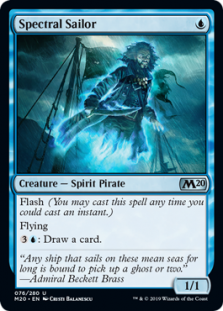
Spectral Sailor

While the Sailor has an awesome type-line, I don't think it'll make it in Spirits. The ghost pirate has the appearance of constructed viability, as flash and flying are Spirits' keywords and the reason to play the tribe. However, he's only a 1/1. If Sailor included some disruption or even a stat boost like Wanderer, it'd be in business. However, most of the time, all Sailor will be is a beater.
The other ability is very interesting, but it's not good enough to push Sailor into viability. Azure Mage has seen constructed play before (as a Standard sideboard card, admittedly), so a cheaper front-side isn't outside the realm of playable. UW Spirits also lacks card advantage except for blanking opposing spells. In a very grindy Modern, Sailor could be a critical card against control and midrange, and less disruptable than Moorland Haunt (graveyard hate is everywhere, and often good in those matchups). However, such a Modern has never really existed, and I don't see it happening anytime soon. I'll be keeping Sailor in my back pocket, but I'm not holding my breath.

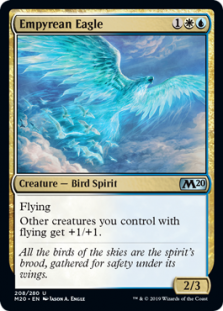
Empyrean Eagle

And now there's another spirit lord, kinda (sorry, Unsettled Mariner). Eagle has better stats though a worse ability than Drogskol Captain for the same cost, so it is definitely playable. The question is whether that's good enough. CMC 3 is a crowded curve slot for Spirits between Captain, Spell Queller, Geist of Saint Traft, and toolbox creatures like Deputy of Detention or Eidolon of Rhetoric. Captain and Queller are the reasons to play the deck, so Eagle is competing for flex slot space.
Where Eagle shines is matchups where racing matters. Boosting power/toughness is only critical when you have to kill first. Costing three means that Eagle should be seen as the final push over the top. Right now I don't think racing is very important while disruption is, so Eagle isn't an automatic inclusion for me. I'm currently trying it as a 2-of and have been quite happy. Depending on how things shake out, I could see cutting Eagle. However, the fact that Eagle exists suggests there are more spirits to come, and that may mean a radical redesign is in order.

Elementary

The next tribe is more speculative. Ever since Lorwyn block, elementals have been the most commonly-supported multi-color tribe. The problem has been a lack of reason to actually invest in the tribe. Most of the time, the only elementals on a constructed board are Young Pyromancer tokens. There are countless interesting elementals, from Horde of Notions to Nivmagus Elemental, but only Voice of Resurgence, Flickerwisp, and Fulminator Mage ever see Modern play. Many of the other Modern-worthy elementals don't have tribal synergies, like Nivmagus and Kiln Fiend. 2020 is aiming to change things with more tribal synergies. While I don't think such a deck is there yet, it is becoming more plausible.

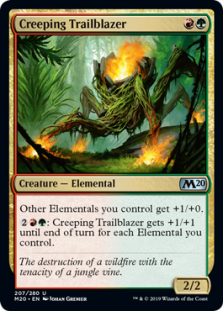
Creeping Trailblazer

If any tribal deck is going to be viable, it needs cheap creatures that do something, usually hit hard. Those are pretty limited and niche in elementals, but Creeping Trailblazer is a good start. Pumping Flamekin Bladewhirl or Voice's power is fairly blah, but I suspect that an elemental deck will be based on token making, though again there's not a lot of viable options. In such a deck, power boosts will be essential since 1/1 tokens aren't that threatening and there's not many other options for elementals. Trailblazer is also a reasonable threat on its own; a 2/2 for two almost-lord isn't a bad rate, and on a crowded board threatens a kill if left unblocked. This is a decent start, but there needs to be more to make the deck attractive.
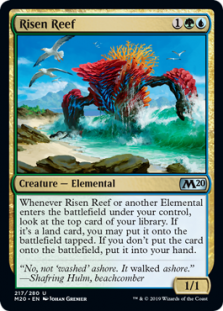
Risen Reef

Now we're talking. On its own, Risen Reef is an expensive Coiling Oracle, and since Oracle is barely playable I probably seem insane. However, Reef also triggers off other elementals hitting play. Turning creatures into cantrips isn't bad, though a bit expensive, but I'm seeing combo possibilities.
Alongside a token maker like Chandra, Acolyte of Flame, Reef generates absurd amounts of card advantage and/or ramp every turn. Goblins has shown before that it's ok to play unimpressive creatures as long as you can play a lot of them. An active Reef will simply overwhelm other decks once it gets going, as every turn more and more elementals can be found then cast. This is definitely a build-around, protect-the-queen sort of card, but if it can be made to work, there's absurd amounts of power to be had.

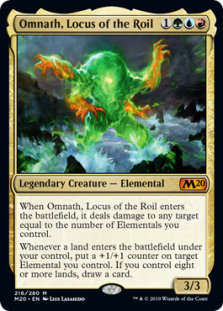
Omnath, Locus of the Roil

However, every engine needs a payoff. 2020's answer is another Omnath, and a potentially playable one at that. Omnath, Locus of the Roil synergizes incredibly well with Reef, which is a great reason to look in the first place. Elementals tend to just be big boom-booms, so giving them a chance to bust through creature decks is essential. However, there's also a chance that Omnath simply combo kills the opponent. With Amulet of Vigor in play and a deck full of cheap elementals, Reef and Omnath become a kill. Resolving elementals finds more elementals or lands, which are then untapped to cast more elementals. Each elemental then domes the opponent until they're dead.
Goblins

When Goblin Matron was spoiled in Horizons, I noted that old-school Goblins was inching toward viability. The combo enabler and key consistency card being legal made the tribe far more plausible than before. It doesn't matter the context; any deck improves with tutors. That the tutor also enables tribal synergies and attacks is incredibly good. However, the deck was still missing the midgame oomph that could actually make it viable. The combo versions weren't consistent enough, and the go wide-decks couldn't hit hard enough. Seeing the best card isn't enough without a bridge between the early setup and the payoffs. That card has traditionally been Goblin Ringleader, and without that, Goblins still floundered.

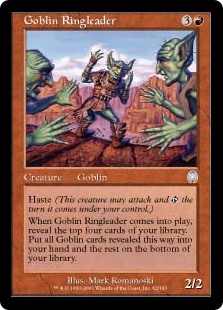
Goblin Ringleader

Well, isn't this convenient. I really didn't expect Ringleader would be reprinted, ever. All that's missing from the (commonly played) Legacy version are the disruption lands, Goblin Lackey, and Gempalm Incinerator.
Despite its mediocre stats, Goblin Ringleader is arguably the best goblin ever printed. There are more individually powerful goblins, but Ringleader is the critical card. Most goblins are 2/2's at most. The tribe's goal is to flood the board in a hurry and swamp opponents with haste. Ringleader adds to the board and attacks immediately, but more importantly he finds more fuel. Militia Bugler is a very good card for Humans in attrition matchups, and Bugler is a poser compared to Ringleader. Goblins may finally be a real tribe in Modern.

Finding a Niche

The question now is what niche to fill. In Legacy, Goblins is really a mana-prison deck in the same vein as Death and Taxes. The deck relies on Wasteland and Rishadan Port slowing down the opponent until the board is either flooded by goblins, or the Ringleader engine has pulled them too far ahead on cards to overcome. Goblins also has a very high curve featuring numerous four-drops and Siege-Gang Commander. While it is possible to really stifle decks with Ghost Quarter, Field of Ruin, and Tectonic Edge in Modern, it's nowhere near as effective. Goblins will need to evolve to find a home in Modern.

Going faster pushes Goblins toward being 8-Whack, and given that deck's lack of success to this point, I wouldn't go that route. Taking a cue from Legacy, I'd take Modern Goblins in a midrange/beatdown route, which isn't a typical style of deck in the format; creature decks are generally fast, and midrange decks are full of non-creature spells. This would require Goblins to go the Stompy route.
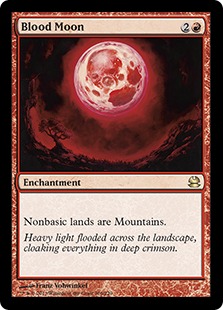
Stompy could work by going for a prison build. This would involve using Quarter and Field alongside Blood Moon to restrict opposing mana, Chalice of the Void to lock opponents out, and then Goblin-dropping until the opponent dies. For added zest, Ensnaring Bridge coupled with Krenko, Mob Boss could be an option for swamping aggressive decks. The question is if this is better than the Skred prison decks that have occasional success in Modern, but never last.

The alternative is to go the combo route. I'd previously tried to make a Modern version of Dirty Kitty work, and couldn't because I couldn't make the engine fire consistently. With Ringleader in the picture, things are different. Horizons gave Goblins an analogue for Gempalm Incinerator in Munitions Expert, and the closest we're likely to get to Goblin Sharpshooter in Sling-Gang Lieutenaunt. Such a deck would use token generators and Expert to survive early pressure, then Ringleader into Lieutenaunt to kill the opponent. The only problem is fueling the Sling-Gang. The Onslaught block version of this deck used Patriarch's Bidding to rebuy all the goblins spent early, and if there's an equivalent in Modern I'm unaware of it. Still, the alure of chaining Ringleaders, using Skirk Prospector to keep the Goblins churning, and then turning all that into a kill in one turn is very alluring, and I'm going to keep working on the theory.

Gearing Up

There's still just over half the set yet to see. so there's every chance the real tribal payoffs are still waiting. In the meantime, there's plenty of intriguing cards to puzzle over and get to brewing. This is continuing to be a most engaging summer.

Buying and Selling the All-Time Highs

Are you a Quiet Speculation member?

If not, now is a perfect time to join up! Our powerful tools, breaking-news analysis, and exclusive Discord channel will make sure you stay up to date and ahead of the curve.

On a daily basis, I review MTG Stocks’ Interests page to track the largest movers in the market. This tracking doesn’t necessarily help me get in front of trends, but it at least keeps me abreast of market dynamics. This is valuable when constantly buying and selling cards.

One sub-page of MTG Stocks I don’t review nearly as often is the All-Time Highs/Lows page. But in reality, this is arguably the more valuable summary to review. Often times a card is bought out and its price is temporarily warped, making it seem ridiculously high on MTG Stocks.

There was an error retrieving a chart for Primal Beyond

That card may be hitting its all-time high, but that high only lasts one day. Most frequently a card that spikes proceeds to retract in the days following the buyout. Therefore, such cards don’t appear on the all-time high list for more than that 24 hour period, making most cards on this list a better representation of what is actually sustaining higher prices.

This week I’m going to review this underutilized page and flag cards that I think are a buy at all-time highs and cards I’d consider a potential sell. Such a review will reveal my thought process as I assess some of this market’s strength.

Buying at the Highs

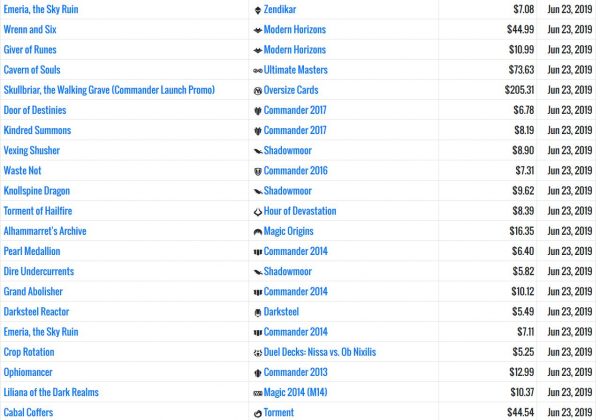
To start, here’s a partial list of June 23’s all-time highs, which is the list I’m referencing for this week’s article:

I want to focus first on the Modern Horizons all-time highs: Wrenn and Six and Giver of Runes. Both of these cards are making waves in tournament play, and their recent movement is a reflection of how easily a Modern Horizons card can pop. With the higher MSRP, the overlap with Core 2020 and War of the Spark, and so many single-printing cards, Modern Horizons is a gold mine of potential profits. A card from this set need only have some success in a Modern or Legacy list, and its price can pop like a coiled spring.

With this backdrop, I’d consider these two cards worth holding. I’m not that excited about them now that they’re $40+ and $10, respectively, but I don’t see them giving up recent gains either. It’s hard to buy a card at its all-time high, but if you want these for play I don’t think waiting around will do much unless you think their impact on Modern and Legacy will evaporate…in which case, why would you want them to begin with?

Another card on this list I would still buy at highs is Pearl Medallion.

There was an error retrieving a chart for Pearl Medallion

In reality, the full cycle of Medallions is hot right now with Sapphire Medallion leading the charge. Card Kingdom has fairly aggressive buy prices on the Commander 2014 printings of these artifacts, and they are EDH gold as far as I’m concerned. Even though only Pearl Medallion showed up on June 23’s list, I see Jet Medallion hit its high June 22 and Sapphire Medallion hit its high June 19.

Unless Wizards does another mono-colored cycle of Commander decks (not likely), I don’t think they’d randomly throw these in a subsequent Commander product. I suppose they could show up in a Standard set at some point, but this is also doubtful.

Speaking of popular Commander cards, it’s not surprising to see Omnath, Locus of Mana hitting all-time highs. Wizards keeps printing new versions of Omnath—Omnath, Locus of Rage in Battle for Zendikar and Omnath, Locus of the Roil in Core Set 2020—but other than one From the Vault product, they won’t reprint the original version from Worldwake. This naturally drums up interest in the original version and I expect all three work well together in a Commander deck. Let’s not forget how rare mythics are from Worldwake, too. That set was released nearly ten years ago at this point, during a time when Magic wasn’t opened in the quantities it is today.

Selling Into The Highs

I don’t have a crystal ball and there’s no way I can predict what cards will be reprinted and what cards won’t be. But my thesis for selling certain cards at all-time highs boils down to two simple factors: a card is expensive due to being old and seldom reprinted, and it doesn’t have demand in formats where four copies are played in a deck.

One example of such cards is Alhammarret's Archive.

There was an error retrieving a chart for Alhammarret's Archive

After bottoming throughout 2017, this card has steadily climbed to its current all-time high and is closing in on $20. The card seems like a casual player’s dream, doubling life gain and card draw is something we all appreciate. I know better than to blindly trust EDHREC’s numbers, but it appears the card does have some utility in Commander. That said, it’s not ubiquitous in the format and it definitely doesn’t see play in Modern or Legacy. So why is the card so expensive? The card was printed once, as a mythic rare, in Magic Origins—a four-year-old set that wasn’t opened a ton.

If the card continues to dodge reprint, then of course Alhammarret's Archive’s price can continue to steadily climb. But this seems like an easy card to reprint, either in a supplemental Commander set or even in Standard. After all, the card isn’t exactly too dangerous to put back into Standard, and it seems like low-hanging fruit for WotC if they’re looking to juice a set’s EV a little bit. There’s no need to panic sell this one, but you should be aware of its high price tag and vulnerability.

The next card on the all-time high list I’d consider selling is Ophiomancer.

There was an error retrieving a chart for Ophiomancer

This is a Gray Ogre that gives you one 1/1 snake. I suppose this is effective as a chump blocker, and you get the snake back every upkeep, meaning you can block each of your opponents’ biggest attackers (without trample). Or, more likely, you could sacrifice the snake to some greater effect every turn. But this card isn’t in many Commander lists on EDHREC. I suspect its price tag of $13 is due to its single printing back in Commander 2013.

I suppose if this dodges a reprint another six years, it’ll be more expensive than it is today. But it’s certainly easy to throw in a future Commander product. If I owned any copies, I’d think long and hard about the utility I’m getting out of this Human Shaman and consider converting that $13 into something more powerful or with more potential upside.

The most obvious sell on this list is Trained Cheetah.

There was an error retrieving a chart for Trained Cheetah

This Portal: Three Kingdoms card was $3 for years and years and is only now, suddenly worth $160? I don’t think so. I smell a buyout. But the market price is $10, so I doubt we’ll see the Cheetah back to its former $3 price tag. That said, this card’s price is driven solely by rarity and collectability. I don’t even think this makes the cut in casual Cat decks. Sell them if you’ve got them. While you’re at it, sell Pale Bears at its high of $9 and Bear Cub at its high of $8.

Wrapping It Up

The all-time high list is really helpful in tracking real price movement of cards because it doesn’t shine a spotlight on buyouts. Sure, cards that are bought out that day show up on the list, but the majority of cards are steady climbers with real demand.

Since the stock market is at all-time highs and I’m looking to trim various positions into this strength, I thought I’d apply a similar thought process and examine which cards on the all-time high list are a buy and which are a sell. Sometimes the momentum and strength in demand are real, and a card hitting highs one day is likely to hit a new high the next. But not all all-time highs are created equally, and sometimes a card’s price gets too high for its utility and risk. An easy reprint of an obscure card printed in one set many years ago is quite risky to hold onto, and all-time highs can be an attractive exit point.

Right now, my general thought is that anything Modern Horizons is a buy or hold, even at highs. The most desirable cards from that set will be very hard to come by a couple years from now and I want to be a buyer while supply is high. Meanwhile, I’m bearish on anything related to bears (forgive the pun). I believe this trend won’t last, and even if it does, do we really think Pale Bears can sustain a $10 price tag? I’m not a believer.

Sell out of Bears, buy into Horizons, and you should be well positioned to ride higher highs and avoid any major pullbacks.

…

Sigbits

  • Don’t get me wrong, there is a newfound demand for all these random Bears. But some of these prices are ludicrous and Card Kingdom isn’t chasing. They currently have a $0.90 buy price on Pale Bears and a $0.21 buy price on Striped Bears. These are certainly above bulk now, but still don’t get me all that excited.
  • With recent spoilers, we’re also seeing Elemental cards gain interest from a tribal standpoint. Cards are exiting bulk and popping onto Card Kingdom’s buylist. This includes Roil Elemental ($0.80), Hellspark Elemental ($0.25), and War Elemental ($0.21). If you’ve got some time, dig through your bulk and pull out any Elemental cards you find—they just might fetch you a quarter each.
  • I’m noticing a trend with International Collectors’ Edition cards on Card Kingdom’s buylist. It appears that even the most unexciting of commons are buylisting for around a buck nowadays. Healing Salve, Holy Strength, and Holy Armor will each fetch you a dollar cash if they’re near mint. It may be time to dig through your obscure websites and LGS to see if you can find any of these near bulk prices.

Speculating Around Yarok, the Desecrated

Are you a Quiet Speculation member?

If not, now is a perfect time to join up! Our powerful tools, breaking-news analysis, and exclusive Discord channel will make sure you stay up to date and ahead of the curve.

***Warning Magic Core Set 2020 spoilers***

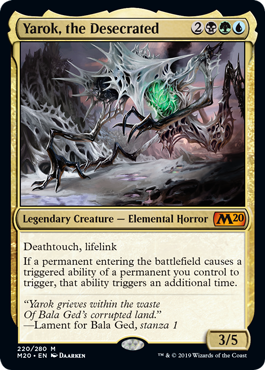
We got quite the bomb dropped on us June 19th with the spoiling of Yarok, the Desecrated. This legendary creature is sure to be a huge hit in Commander and I wouldn't be surprised to see him make the top 5 favorite Sultai commanders. Panharmonicon has been a casual favorite since it was spoiled and now we have a more powerful version, as Yarok affects all permanent's enter-the-battlefield (ETB) triggers and not just artifacts and creatures, and it's stapled to a legendary creature in arguably the best three color combination.

Now not surprisingly we already have a good Sultai commander that tends to play a lot of creatures with ETB abilities in Muldrotha, the Gravetide, so we can begin looking through the top creatures in that deck and focus on ones with ETB abilities.

Picks

There was an error retrieving a chart for Palinchron
This is my number one speculation pick for Yarok. It checks all the boxes;
  1. Reserved List
  2. Creates an infinite combo with Yarok
  3. Already desirable
The biggest downside is the relatively high buy-in of $23-$30 (depending on condition). I purchased 7 copies after Yarok was spoiled and while the price hasn't gone haywire yet, it definitely went up a few bucks since Yarok's spoiling. The fact that the "diet" version of this card Great Whale is already $8+ dollars and doesn't go infinite means that this card could easily be $35+ once a lot of people jump on the Yarok train.
Now, it is important to note that while this combo does provide you with infinite mana, that isn't necessarily an automatic win. You still have to have something to do with all that mana to actually win the game. Usually, when you can get infinite mana you can do whatever other broken things you want to do and win from there.
There was an error retrieving a chart for Panharmonicon
My number two pick is another card that's already popular in a multitude of Commander decks and is another "auto-include" in Yarok. The buy-in price on this one is in the $5.5-$6.5 range so it's not as painful to go a bit deep on. Foils already have a pretty significant multiplier of 3.5x. As we would expect any Yarok deck to play a significant number of creatures and artifacts that have ETB abilities, it's a no brainer to add another artifact that will add an additional trigger, giving you potentially three of every trigger.
There was an error retrieving a chart for Deadeye Navigator
My number three pick is one I'm actually ashamed I didn't immediately think of when Yarok was spoiled. In fact, my friend brought up that he'd purchased six extra copies during a ride back from our Thursday Commander night at our favorite LGS. I was able to buy 13 regular copies and one foil while riding back home.
Deadeye Navigator is an extremely powerful card in any deck with decent ETB creatures and he allows you to get infinite mana with Peregrine Drake, Great Whale, or Palinchron and you can at least get infinite ETB triggers with Cloud of Faeries. Deadeye Navigator already has a home in a lot of existing Commander decks and with a buy-in of around $3.5 for non-foils it seems like a relatively low-risk speculation opportunity with good potential upside of being an $8+ card.
There was an error retrieving a chart for Lotus Cobra
One important aspect that Yarok provides that we previously didn't have available was that all ETBs from any permanent trigger twice. This is critical because it means it can double abilities like Landfall. As this is a three-color deck that is likely to be very mana hungry, having a creature that can generate absurd amounts of any color of mana seems necessary. It's had a total of three printings, one of which was as a gorgeous GP promo, the most recent was in Iconic Masters, which was a limited print run set, and its original printing was as a mythic in Zendikar.
I bring all this up to imply that there are likely fewer copies floating around than you might initially think. Looking through TCGPlayer at the time of this writing there were 10 pages of Iconic Masters and 12 pages of Zendikar non-foils listed. Admittedly that is a decent supply, but I expect we'll start to see movement on the cheapest copies in the coming weeks as brewers start posting decklists on EDHREC and an "optimal build" begins to materialize.
There was an error retrieving a chart for Eternal Witness
Eternal Witness has had numerous printings thanks to it being a Commander staple and yet it still always manages to rebound in price somewhat. With most copies sitting around $4 currently. What intrigues me more is the foil Modern Masters copies which are under $10. There have been five opportunities to get foil copies of Eternal Witness; the UMA and Modern Masters ones are both under $10, but the Modern Masters version has the original Terese Nielsen art which is both iconic and beloved.
This is one of the rare occasions in which I advocate for not the cheapest option, though I wouldn't fault you for picking up some foil UMA ones given that they have less than a 2x multiplier to their non-foil counterpart.
There was an error retrieving a chart for Greenwarden Of Murasa
Eternal Witness's bigger brother, Greenwarden does see less play thanks to it's higher CMC, however, what amazes me is that foil copies can be had for under $4 currently. I do understand that Battle for Zendikar did get opened a ton due to people hunting expeditions, but still, that does seem awfully low for such a powerful card.
I picked up two copies writing my article just so I'd have them for myself. You could also spec on non-foil copies, but as so much product was opened I'd rather buy 1/3 as many copies of a foil mythic than a plain mythic in this case.

Conclusion

It's important to note that our Discord chat went a bit crazy when Yarok was spoiled, as there are so many good creatures in the Sultai color range with powerful ETB abilities. There are a lot of cards that could and likely will become "auto-includes" for this commander, but my focus is on the ones I feel will be in 80%+ of the decklists posted on EDHREC as those cards will be the ones with the most potential for significant gains.
Obviously, if they are good enough cards that they fit into a lot of other decks, that can be a huge plus. We'll have to wait and see how things shake out when Core Set 2020 is released

Beat This: Evaluating One-Mana Beaters

Are you a Quiet Speculation member?

If not, now is a perfect time to join up! Our powerful tools, breaking-news analysis, and exclusive Discord channel will make sure you stay up to date and ahead of the curve.

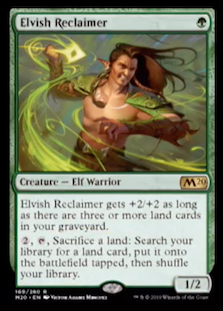
Core Set 2020 spoilers are under way, and a couple cards have already caught my attention. The one we'll discuss today is Elvish Reclaimer, a potential 3/4 for one mana... with upside! But can its drawbacks be mitigated effectively? Let's find out by comparing Reclaimer to Modern's other one-mana combat creatures, seeing in the process what the format necessitates for these cards to succeed.

While my previous work on combat creatures has included aggro standbys like Goblin Guide and Monastery Swiftspear, this article focuses solely on the beefiest one-drops: the ones that both attack and block with gusto (read: the magic number 3). Sorry, Kird Ape!

Cost vs. Reward: The Former

This article's about one-drops, or creatures that cost a single mana. But truly proficient combat creatures this cheap are tough to come by in Modern, a format defined by the bulk of its beaters. While they may all cost one mana, the threats discussed here tax pilots in other ways—either when it comes to casting them or maximizing them.

Resources Needed

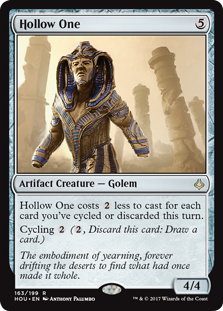
Magic is a game of resources, of which boundary-pushing card design ensures there are plenty of. Mana is but one such resource, if the most obvious; others include cards in the graveyard (Nimble Mongoose), land types in play (Wild Nacatl), life not had below a certain number (Death's Shadow), or number of cards discarded this turn (Hollow One).
Resources needed refers to the resources players must have available to deploy a given threat, as with mana; a one-mana spell, for instance, requires one land in play to cast. That land is not consumed by the spell, and can be tapped again next turn.

Resources Used

By contrast, resources used refers to the resources players must expend to deploy a given threat. In this case, the land is indeed spent, as by Scythe Tiger. This steep cost has always prevented Scythe Tiger from seeing Modern play in any capacity.

An apt comparison exists between Nimble Mongoose, which needs cards in the graveyard to become 3/3, and Hooting Mandrills, which spends cards in the graveyard. Multiple Mongeese can be dropped into play with seven cards in the graveyard; with just five, players may cast only one Mandrills for one mana.

Casting Time

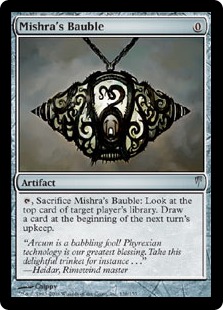
A subtler contributor to playability is casting time, or flexibility regarding when players must invest mana into their creature. Consider Hooting Mandrills, a threat that requires five cards in the graveyard to be cast for one mana. Playing Mandrills on turn one is not really feasible in Modern. Doing so on turn two is much easier, especially given something like Thought Scour. Assuming two land drops, both fetches, even Gurmag Angler is castable turn two with a Scour. Grixis Shadow decks aren't interested in taking chances, though, and like to have mana up for Stubborn Denial when possible, so they've come to include Mishra's Bauble to mitigate the casting time requirement of their delve threat.

Grixis Shadow, by Rayton Espiritu (8th, SCG Louisville Classic)

Creatures

4 Death's Shadow
4 Gurmag Angler
3 Snapcaster Mage
4 Street Wraith
1 Jace, Vryn's Prodigy

Artifacts

3 Mishra's Bauble

Instants

4 Thought Scour
4 Stubborn Denial
4 Fatal Push
2 Temur Battle Rage
2 Dismember
1 Kolaghan's Command

Sorceries

4 Thoughtseize
2 Inquisition of Kozilek
1 Faithless Looting

Lands

4 Bloodstained Mire
4 Polluted Delta
2 Scalding Tarn
2 Blood Crypt
2 Watery Grave
1 Steam Vents
1 Island
1 Swamp

Sideboard

1 Engineered Explosives
1 Nihil Spellbomb
1 Grim Lavamancer
1 Ceremonious Rejection
2 Disdainful Stroke
1 Kolaghan's Command
1 Lightning Bolt
2 Surgical Extraction
1 Jace, Vryn's Prodigy
1 Jace, the Mind Sculptor
2 Liliana, the Last Hope
1 Collective Brutality

Grixis Shadow employs a similar strategy with Death's Shadow, its namesake one-mana beater. Shadow can't be cast on turn one, either; pilots must first drop themselves to below 13 life. Hence the deck's painful manabase and use of additional enablers like Street Wraith—and all to increase casting time flexibility. Looking at the opposite end of the spectrum, Champion of the Parish is another build-around one-drop that must be cast at a specific time to achieve its potential: in this case, before other creature spells, or as early as possible. Similarly, Hollow One prices players into spending mana on the Golem during turns they discard spells, even if they've drawn another juicy castable off their Goblin Lore (say, Fatal Push). In lieu of another looting spell, they may otherwise miss out on the chance to cast their creature at all.
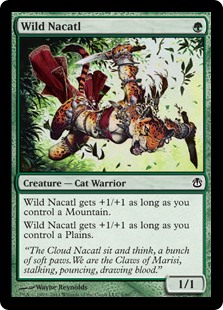
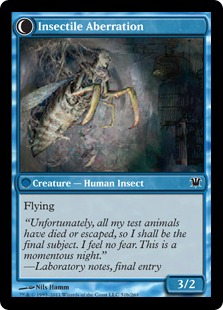
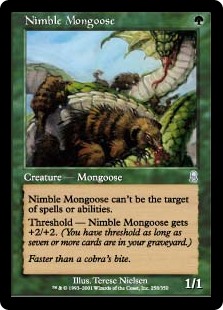
Like Gurmag Angler, Nimble Mongoose asks for a certain number of cards in the graveyard before it assumes its final form for one mana. Granted, Mongoose solicits more cards than Mandrills or Angler; players will be hard-pressed even to have Mongoose swinging for 3 on turn two. But Mongoose beats the delvers on casting time, as pilots can cast Mongoose as of turn one.

In "Tough as Nails: Combat, Removal, and Stats," I conceptualized this principle by sorting creatures into stages—that is, the part of the game they become live. More flexible creatures, like Mongoose, fall into earlier stages. Other Stage 1 creatures include Wild Nacatl and now Elvish Reclaimer; besides the missed combat steps shared by all late-cast creatures, and the fact that late-game boards may prove more hostile to smaller threats, these beaters don't lose or gain anything from being cast at a certain time or not. Their casters then enjoy more choice about how to invest their mana, enabling lines like two-mana follow-up plays.

Cost vs. Reward: The Latter

On to our spoils, or what we get for casting the creature at all.

Stats

Stats tend to be the single most important factor when determining the playability of combat creatures. No way Hollow One would headline a deck at 3/4, or that Wild Nacatl would have ever eaten a ban at 3/2. That's why the most-played one-mana combat creatures are the biggest ones: Gurmag Angler; Death's Shadow; Hollow One.

Abilities

There are three types of abilities creatures can have: evasion, utility, and static. Evasion abilities, such as trample on Hooting Mandrills, let them penetrate enemy defenses. Utility effects provide some additional benefit to the caster, like Tasigur's activated ability. And static ones vary from creature to creature: the main draw to Nimble Mongoose, for instance, is its shroud keyword, which protects it from enemy removal; Death's Shadow, on the other hand, has the ability to grow larger at will when pilots are sitting behind a fetchland, or perhaps gripping a Street Wraith.

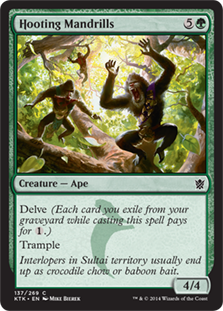
Evasion keywords are becoming increasingly common on cheap combat creatures, but they often replace raw stats, a bad trade for our purposes. Hooting Mandrills and Delver of Secrets are the only one-drops in Modern with 3 or more power and an evasion ability.
Utility is even rarer on a one-mana combat creature, as these are already pushed to begin with. But they do exist; a solid recent example is Hexdrinker, which arrives as a just-okay 2/1 but boasts the ability to grow larger should players have extra mana sitting around. Such abilities again tend to cannibalize stats—creatures can only do so much for one mana.

Static abilities on one-drop combat creatures often take the form of drawbacks, lowering the overall reward for producing the threat in question; the aforementioned Mongoose and Shadow theoretically provide exceptions to this rule, but both of them also contain static-ability text that limits their reliability as large beaters.

Durability

The final factor to assess is durability, or the odds of a threat staying on the battlefield to do combat once resolved. Protective keywords like Mongoose's shroud contribute favorably to this metric, but don't quell the threat of damage-based sweepers such as Anger of the Gods. Stats do, though, and every point matters, especially with Gut Shot, Collective Brutality, Lightning Bolt, Flame Slash, and Lightning Axe all co-existing at Modern's top tables.

Of course, some removal spells slaughter beaters regardless of toughness, which is where converted mana cost enters the equation. Fatal Push may have damaged the rep of Modern's premier combat creature, but it can't touch Hollow One or the delve creatures, making such threats attractive ways to punish opponents looking to chop up Goyfs on the cheap.
Another element of durability lies with a threat's reliability over time. Turn-two Hooting Mandrills could care less about a subsequent Rest in Peace, but copies in hand are functionally blanked by the enchantment resolving. And Nimble Mongoose is rendered an eternal 1/1 no matter where it finds itself when Rest comes down. In this sense, delve creatures are more robust than those that check the graveyard from the battlefield, as ones quickly deployed can sidestep the hate.

Evaluating Elvish Reclaimer

With the metrics for playability among one-mana beaters clearly outlined, we can apply this theory to existing creatures in Modern. In terms of cost, Nimble Mongoose is potentially a 3/3 with shroud that leaves used resources intact and can be played at any time. So why doesn't it see any action? Because of its low reward: Mongoose is slower than Mandrills or Angler at getting in for full damage, always soft to the common practice of graveyard nuking, vulnerable to popular sweepers despite the shroud, and with no evasion, outclassed by many of Modern's creatures. Let's apply these same principles to newcomer Elvish Reclaimer and see how the Warrior ranks.
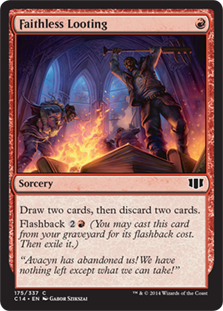
Cost

Resources needed: Reclaimer asks for three lands in the graveyard. Fetch, fetch, fetch, done! But in this case, a turn-one Reclaimer can't attack for 3 until turn three, and that's only if players make three consecutive land drops... all of them fetches. Players looking to get aggressive early will need some other engine to get the gears moving. Faithless Looting and Thought Scour seem like natural enablers, but neither guarantees a "flip," and neither is free, functionally increasing the Elf's mana demands.

Resources used: None. Flying colors on this one.
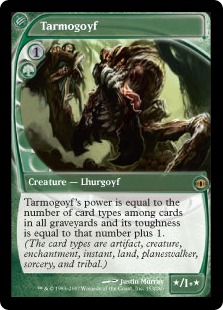
Casting time: Reclaimer is clearly a Stage 1 threat. In fact, Reclaimer outshines most other Stage 1 creatures in terms of sheer potential—of its ilk, only Mongoose also dodges Lightning Bolt. Still, every Stage 2 creature dwarfs Reclaimer in combat, as they do other Stage 1 creatures.

Reward

Stats: We've seen better at 4/4, 4/5, 5/5, and 12/12, but Reclaimer plays nice with other copies of itself, a feat claimed among the larger beaters only by the ever-fickle Hollow One and the tightrope-walking Death's Shadow. And at 3/3 or less, the smaller guys really are smaller. An additional point of toughness lets Reclaimer tangle with most everything at its price point and a little higher.

Abilities: Icing on the cake, really, since players will mostly want Reclaimer for its body. But Modern is certainly full of powerful lands. Blast Zone springs to mind, although I think Bojuka Bog will end up a likelier sideboard bullet—it enters tapped anyway, and threatens to instant-speed empty enemy graves as early as turn two.

Durability: As a 3/4, Reclaimer beats most toughness-based removal spells, best of all the ubiquitous Lightning Bolt. Still, Rest in Peace and even one-time nukes like Nihil Spellbomb stand to defang the Elf quite decisively. In my preliminary testing, I've found it difficult to "reclaim" the lost stats after losing the graveyard.

Takeaways

As is a common theme of my writing, I find myself sizing up Elvish Reclaimer against Tarmogoyf, once the only cheap beater in Modern that resisted Lightning Bolt. Here's yet another, and for half the mana. But do its ensuing drawbacks offset that up-front reduction?
Like Goyf, Reclaimer promises to reach bigger-than-Bolt stats just by virtue of our playing the game—we were fetching lands anyway. Additional setup is only necessary if we want it to grow up early. Which, of course, we do; a one-mana 3/4 wows on turns 1-3, but ends up underpowered next to most Stage 2 creatures (unlike Goyf, which keeps pace by getting even larger). So that promise of +2/+2 for doing nothing mostly ends up ringing hollow.

I have yet to be blown away by Reclaimer in Temur Delver, the shell I spent yesterday testing it in. But the Elf did have its moments. I'm up to 4 Scour, 4 Looting now in a bid to accelerate its development; so far, the additional cogs smooth things out considerably. They've also left me wondering if there's not a better creature to spend all that effort enabling; Pteramander again, maybe, or just Arclight Phoenix.
And the Beat Goes On

In any case, M20 spoilers have only just begun. Here's hoping we get another promising one-mana combat creature to put through the evaluation ringer. In the meantime, have any new cards tickled your aggro-deck brewing bone?

Emergent Decks From Modern Horizons

Are you a Quiet Speculation member?

If not, now is a perfect time to join up! Our powerful tools, breaking-news analysis, and exclusive Discord channel will make sure you stay up to date and ahead of the curve.

New metagames can be hard to pin down, as fresh cards lead to new brews and new tech, forcing established decks to adapt. This forces the new decks to adapt to the new pressure, and their success or failure creates ripples through the metagame. With War of the Spark and Modern Horizons released in quick succession, Modern is undergoing considerable churn.

Under normal circumstances, there would be SCG Open or Grand Prix results to start analyzing for new metagame trends. That's not happening this time. The next big Modern event is GP Dallas at the end of the month. Even once that data is in, it will almost immediately be mooted as a metagame indicator, because the metagame will be shaken up further wiith Core 2020 two weeks later.
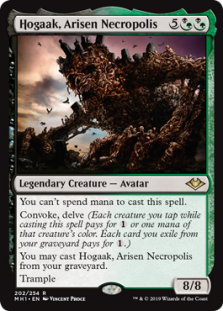
If that isn't enough, Core 2020 will also inaugurate the London Mulligan to the general public. While the exact impact of this change on Modern is unclear, there is little doubt that it will have a huge impact on Modern. Given that Modern hasn't fully absorbed the previous two shocks yet, the two following shocks ensure that there is no definitive Modern metagame yet. However, some decks are rising to the top, and they're worth investigating in detail for clues about Modern's future.

Crossing Hogaak's Bridge

The results we have so far come from MTGO, and given Wizards' policy of curating the League lists, the only reliable metagame data comes from the Challenges. The first Challenge was dominated (though not won) by Hogaak, Arisen Necropolis-fueled combo decks. The second Challenge was won by Hogaak, though the deck's total placings were down. Hogaak took 10 of 32 places in the first Challenge, and six of 32 in the second. These impressive results, coupled with the potential for early kills, has already spurred streamers and other pundits into ban mania.
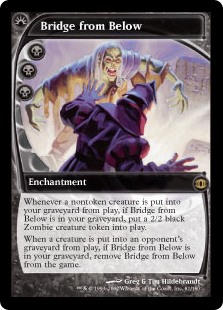
The combo works by first finding Hogaak, either by drawing it naturally or via Faithless Looting/Insolent Neonate, or by milling it with Stitcher's Supplier/Stinkweed Imp. Hogaak then needs to be cast from the graveyard by convoking at least two black or green creatures and delving away the rest of his cost. From there, Hogaak is sacrificed, ideally to Altar of Dementia, to generate Bridge from Below tokens. With Altar out, the combo becomes self-sustaining, as you mill your whole deck. It then turns into an outright win, as all tokens made during the loop are sacrificed to empty an opponent's library. The absolute perfect draw kills on turn 2, and more reasonably turn 3. Without Altar, the combo will peter out at some point, but not before building an overwhelming board presence.

History Check

If this sounds familiar, it should. Hogaak-Bridge is just the latest version of Bridgevine, as in the core of the deck is completely unchanged and room's been made for new cards. Last August Bridgevine appeared on the scene, and almost the exact same mania occurred. The deck was seemingly everywhere following it's debut at PT 25th Anniversary. But within a few months, the threat had completely subsided. Bridgevine has a lot of fundamental weaknesses which, once known, were easy to exploit and defeat. Hogaak has changed the deck, but not enough that I can't see history repeating itself.

The More Things Change...

The main difference between Hogaak and the older version of Bridgevine is kill speed. The best Bridgevine hands generated an unanswerable board turns 2-4 and then actually won the turn afterwards. There's very little way to answer three hasty 4/3's that early, not to mention all the tokens. Hogaak can do the same thing, but under the right circumstances, outright wins via decking the same turn it goes massive. I'd argue that the functional kill speed is about the same as before, but the actual kill is slightly faster, which makes it harder to disrupt.

The other advantage is that Hogaak isn't a glass-cannon aggro deck. If the fast kill didn't come together or was somehow answered, Bridgevine didn't have any other options. Altar gives Hogaak a valuable second angle of attack. Bypassing the combat step closes a significant vulnerability for Bridgevine. Before, Bridgevine would lose to a fast Ensnaring Bridge or Anger of the Gods destroying their board. They could rebuild from Anger if Viscera Seer was on-board, saving their Vengevines and scrying into gas. However, losing the combat step was a significant setback.
It seems clear that Horizons has made Bridgevine faster and more versatile. Normally, this would be enough to say that the new card signifiantly improved the deck. In this case, I hesitate. Kill speed and vulnerability to disruption were not the problems that drove off Bridgevine last year, and Hogaak and Altar haven't fixed them.

...The More They Stay the Same

Bridgevine had its moment last year, and then faded away. Odds are, the same will happen to Bridgevine now. Altar has given Bridgevine another win condition and Hogaak has made it more of a combo deck, but they haven't fundamentally altered the deck. Bridgevine was, and Hogaak-Bridge is, one-dimensional in that it cannot function without a graveyard. Any hate causes the engine to splutter out and become 1/1s-with-menace-beatdown. Bridgevine could theoretically power through thanks to Goblin Bushwacker, but Hogaak is far more invested in the combo plan. The deck loses to Rest in Peace/Leyline of the Void unless they find enchantment removal.

The other problem is one that Bridgevine shared with another deck that exploded into Modern then faded away, Hollow One. Both decks relied on randomness going their way to really function. For Bridgevine, that meant Stitcher's Supplier hitting Bridges and Vengevines off the top of the library. For Hollow One, that meant drawing but not discarding its fatties with Burning Inquiry or Goblin Lore.

When the Random Numbers God favors these decks, they prove crushingly powerful. However, the RNG is characteristically fickle. Hollow One and Bridgevine fell off because they lost to themselves as often as they exploded onto their opponents.

Hogaak has the same problem. There is no guarantee that the combo will actually go infinite. The copies of Bridge from Below that make it possible may not show up from the first Altar activation, or even a second. In those cases, the deck doesn't do anything. Given that Hogaak-Bridge retains the most pressing weaknesses of its predecessor, I would expect its Modern run to play out similarly.

Impact and Implications

If history is instructive, the return of Bridgevine won't have a lasting impact on the metagame. It didn't last time, and the Hogaak combo hasn't made the deck better enough for me to believe that will change. Long-term, Hogaak will remain a threat, but a manageable one so long as the metagame doesn't forget about it. In the short term, I expect fewer Surgical Extractions and more broad-pattern graveyard hate.
Surgical is very good at stopping the combo (Hogaak must be cast as a normal creature), but it's not very good at stopping the deck. Hogaak is a huge threat, as are the Bridges and Vengevines. You need to kill the whole graveyard to effectively shut down the deck. Leyline and Rest are the obvious best options, but are slow and answerable. I'd look to Ravenous Trap if the combo ends up too consistently fast for the enchantments. These changes will serve to keep other graveyard decks down as well. Phoenix may also benefit from a decrease in Surgicals.

The Sickness Spreads

The other deck making a return is Infect. The Gitaxian Probe ban effectively killed Infect as a metagame force, though it still puts up results when no-one's looking. The problem for Infect is partially that it can't sculpt the game to its advantage using information from Probe, and also because cheap removal became more common. It wasn't that hard to overcome Lightning Bolt, but Fatal Push is another story.
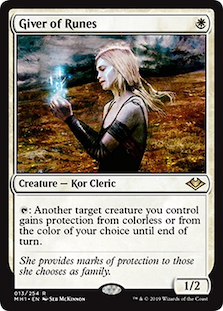
Horizons promised to change Infect's fortunes with Scale Up. Second only to the setup-required Become Immense in terms of power-for-cost among pump spells, Scale combines with Might of Old Krosa or Groundswell to produce ten poison damage as early as turn 2. This was possible before Scale, but it took two Might/Groundswell and a Mutagenic Growth on Glistener Elf to pull off. The Scale kill requires one fewer card, and that makes it more statistically likely to happen, though the odds are still small.

Prison Strategy

However, that doesn't appear to have been enough. Infect isn't appearing in the aforementioned challenges like Hogaak. Instead, there have been rumblings in the Leagues of Bant Infect. The idea is to use Teferi, Time Raveler to moot opposing interaction, simultaneously making the protection spells like Blossoming Defense more effective. Teferi can also sometimes remove blockers for Glistener Elf to break through. In addition, Teferi gives Infect some long-game potential via card drawing.

While they haven't made the standings, I've also seen some pilots go further by playing Giver of Runes. Spellskite has long been played as creature protection, but Giver can also make creatures unblockable. True, Giver can only be used once per turn, and not immediately. But she's also cheaper and can protect from more things than Spellskite; protecting from creatures aside, Giver can save a creature from Kolaghan's Command or Pyroclasm where Spellskite couldn't, for example.

The combination of Teferi and Giver conspires to give Bant Infect a prison-like plan. This isn't a Whir Prison-style hard lock, but instead Infect is trying to lock opponents out of the one thing that matters in the match, interaction, and then ride that lock to victory. In theory, this is effective repositioning for Infect and could help it return to the metagame.

Papering Over Problems

However good of an idea the additional protection and faster kill potential is, it doesn't actually solve Infect's problems. Infect is a deck with a fundamental weakness: it relies on 12 1/1 creatures to win the game. To do its thing, it must draw the right combination of intrinsically weak creatures and payoff spells, a condition it shares with Boggles. Infect frequently has to mulligan aggressively, which leaves it resource-poor, a brutal result for a critical-mass deck. Removing pump spells for Teferi or Giver arguably worsens this predicament. Scale's raw efficiency reduces the need for other pump spells, but can't eliminate it, and can make things worse should the non-stacking Scale appear in multiples.
There's also the fact that Teferi and Giver don't add much protection-wise. Infect was not hurting for creature protection between Defense, Vines of Vastwood, and Apostle's Blessing. The advantage of Giver and Teferi is they cost no mana on the kill turn, but they have to be played beforehand, and so won't be a surprise. Teferi also doesn't stop sorcery-speed removal, and therefore, he only actually shields Inkmoth Nexus.

Old Weaknesses, New Vulnerabilities

Experienced players know that you don't kill Infect's creatures in or around the combat step. Doing so lets Infect get additional value from playing Blossoming Defense in response to the removal spell. Instead, wait until Infect's end step or your own turn. You also want to kill infectors at the earliest opportunity. Therefore, Teferi will have no practical impact on Blighted Agent or Glistener Elf surviving to attack. Giver must be in play before the infector to protect them, which means that there will be more opportunities to Thoughtseize them, which can be fatal for Infect. In other words, the new cards don't alter the playstyle against Infect.
Going Bant also makes Infect vulnerable to Blood Moon in a way it wasn't previously. Moon was never very good against Infect, since the infectors came down first, and being two-color, it was easy to fetch around Moon. The play patterns I've seen from Bant Infect so far indicate that Moon is suddenly devastating against them. Trying to set up Giver and/or Teferi protection slows the deck down, often by a turn or more. This gives opponents the time needed to land Moon, and since Bant Infect plays fewer basics than UG, it is often a hard lock. I've seen many Infect players try to resolve Teferi intending to kill with Nexus the following turn only to have him countered or removed then be locked and lose to Blood Moon. In the end, the fastest Infect kill is slightly more likely, but I'm seeing the average kill turn decrease slightly. I'm not certain where this leaves the deck.

Implications and Impacts

Even if the new protection spells don't work out for Infect, I would expect the appeal of the fast kill to renew interest in the strategy. It's unlikely to become the boogeyman it once was, but having Infect around puts pressure on decks to be more interactive. Creature decks like Humans tend to struggle against Infect for this reason, as does Tron. Since both are expected to be boosted by the London Mulligan, it could be healthy for the metagame to introduce another predator.

The other effect of Infect's return would be to re-incentivize Jeskai Control. Jeskai is another natural predator of creature decks, arguably moreso then UW Control since it's harder to answer waves of cheap spot removal than costly sweepers. Last year, when Jeskai returned, we saw a dip in Humans and an increase in BGx midrange.

Churning On

Spoilers forr Core 2020 have already begun, though at time of writing there's little worth discussing. This will change next week, and then we can start to speculate as this most turbulent of Modern periods grinds on. Perhaps the holes in the new decks will have already been filled by then.

All the Spoiler Seasons

Are you a Quiet Speculation member?

If not, now is a perfect time to join up! Our powerful tools, breaking-news analysis, and exclusive Discord channel will make sure you stay up to date and ahead of the curve.

Is it Magic Core Set 2020 spoiler season already? Weren’t we just celebrating the success of War of the Spark? And then there was that supplemental set in between that catalyzed massive buyouts of the most unlikely of cards.

There was an error retrieving a chart for Bearscape

How is anyone keeping up with the flow of new, impactful set releases? I know this period of activity was scheduled in advance, but I honestly never considered the implications of this back-to-back flow of information. Keeping up has become difficult both from a mental capacity and wallet capacity standpoint. Whether you’re purchasing boxes or singles from the new sets, or you’re speculating on other cards as new spoilers are released, how does anyone have any money left?

Perhaps they don’t.

Perhaps these sets are all going to cannibalize one another in some capacity. Perhaps the amount of War of the Spark product to be opened is going to be negatively influenced by Modern Horizons’ release, which in turn will be held down by Core Set 2020. This is a real possibility, and if events do transpire this way, then I have some low-risk ideas worth your consideration.

War of the Spark – Planeswalkers Galore

Themed around Planeswalkers, War of the Spark has a fairly impressive list of interesting cards that could benefit from a potentially lower open rate. I want to focus on the Planeswalkers, specifically. There is one in every pack, and depending on whether you’re opening English or Japanese product, you could open a Planeswalker worth $0.05 or $1000.

At these prices, Japanese booster boxes of War of the Spark contain the most valuable cards in the history of Standard legality. But I digress…

My point here is there are many Planeswalkers in this set, and players love their Planeswalkers. As this game becomes more and more dominated by the casual player, these are surely going to be a hit. And if less product is opened due to hype around subsequent sets, then perhaps sitting on some Planeswalkers from War of the Spark for the long haul isn’t such a bad idea.

Where should one park money, though? This is what I love most about the set—there are numerous options that fit into anyone’s tastes in Magic. If you love bulk, you could buy up hundreds of the cheap, uncommon Planeswalkers. Better yet, you can purchase some of these in foil. With a recent eBay coupon I picked up a few foil Vraska, Swarm's Eminence—not because I think this particular Planeswalker suddenly breaks out, but because I like the assassin creature token theme from a casual standpoint. But really, it doesn’t matter. All of these should gradually climb over the next few years, and having a diverse basket of foil Planeswalkers should pay out regardless of what you choose.

There was an error retrieving a chart for Vraska, Swarm's Eminence

Other attractive options include foil Ashiok, Dream Render, Saheeli, Sublime Artificer, and Kasmina, Enigmatic Mentor. Even non-foils at near-bulk pricing would be fine to sit on as a buylist play a couple years from now. If you are ok with spending a little more money, aiming for the rare Planeswalkers, such as Tamiyo, Collector of Tales or Ugin, the Ineffable may pay off well over time. Especially if you look at the rarer alt-art Japanese versions.

There was an error retrieving a chart for Ugin, the Ineffable

If you don’t want to sit on loads of cheap cards, look no further than the alternate-art Japanese Planeswalkers. You can go for the glory and purchase a foil Narset, Parter of Veils which is likely to be valuable for years to come. Or you could pick a lesser card whose artwork you particularly appreciate. Again, I think you really can’t go wrong here—much like Masterpieces, these will be rare and only become harder to find going forward.

Lastly, if you want to play it safest of all, you could purchase a few Japanese War of the Spark booster boxes to sit on. I personally don’t deal in sealed product anymore because storing and shipping them is a major pain. It looks like there are numerous boxes for sale on eBay from Japanese sellers, with prices that hover around $165. I’m not a gambling man, but cracking one of those foil Lilianas in a $165 box seems like the ultimate Magic payout. Who knows how many people will be willing to take that gamble a few years from now?

Modern Horizons Potential

Even though Modern Horizons is not a “limited print run” set, I wonder if the higher price tag and the overlap with War of the Spark and Core Set 2020 will limit interest. I’m seeing tweets from multiple MTG finance people reflecting this sentiment.

This leads to an interesting result. When a masters set doesn’t get opened as much, the harm is minimal because the entire set is filled with reprints. The supply on the overall market for those reprinted cards can only increase, making prices drop at least for some period of time. But when you have an under-opened set with unique cards relevant to Modern—cards that aren’t reprints—the price implications can be surprising.

I know the set just came out, and prices may steady, but I can’t help but wonder if the long-term EV of this set will be very high. Right now, there are 19 rares/mythics in the set worth more than $10. This could fluctuate as we approach peak supply, but how big will that peak actually be? Once Core Set 2020 is released, how quickly will this set be forgotten?

But if the set will be forgotten, why invest in it? Well, the set may be forgotten but the most impactful cards from the set certainly won’t be! Think of the most impactful Conspiracy cards in Legacy and what their price trajectory was. Leovold, Emissary of Trest was worth $50 for the longest time before being reprinted in Ultimate Masters.

There was an error retrieving a chart for Leovold, Emissary of Trest

Council's Judgment is a $20 rare from Conspiracy based on a little Legacy demand and a modest Commander demand; foils are through the roof due to their rarity. And let’s not forget Expropriate, a $50 card from Conspiracy: Take the Crown.

My point is the most popular cards from Modern Horizons—the ones with no other printings—will have high potential. The cards from Conspiracy only see Legacy or Commander play. Modern Horizons cards will see Legacy, Commander and Modern play. Modern is a major driver for card prices, and I anticipate the most popular cards from Modern Horizons, whatever they are, will have tremendous upside. As soon as the new Modern metagame comes into focus, it may be wise to pick up the most impactful cards from this set.

Wrapping It Up

When Wizards releases so many sets back to back, it can be overwhelming both from a mental and wallet capacity standpoint. Even if I could keep up with all the new releases, I couldn’t possibly buy into every product with any significance.

I suspect others will be in the same boat, and that means there will be major potential for gains a few years from now. The community will realize the most desirable cards from War of the Spark and Modern Horizons are quite rare. But if they have a profound impact on non-rotating formats like Modern, Legacy, and Commander, then their price tags will continue to climb. It’s difficult to envision right now because we’re around peak supply. Just wait six to twelve months, and the real rarity of these cards will start to show.

For me, I like foil low-end Planeswalkers from War of the Spark. I think they’re quite neat from a casual player’s perspective, and this should help prices slowly climb over time. Alternatively, I’m also considering an acquisition or two of the alt-art foil Japanese Planeswalkers because I believe these will be exceptionally rare a couple years from now. I don’t want to purchase during peak hype, but I don’t know if prices will be dropping on these any time soon.

From Modern Horizons, I can’t recommend specific cards until I see the Modern metagame unfold further. I love all the Snow builds players are attempting, and I did pick up a few cheap Dead of Winters recently. I don’t know if these will pay out, but a pseudo-Damnation could go a long way in helping a B/U/x control strategy manifest itself in Modern. The Horizon Canopy lands could also be a wise investment, especially in foil. I’ll be following the QS Insider Discord to see what deck-lists are catching folks’ attention and speculate from there.

While I can’t pinpoint the best cards to buy into, I am confident in one thing: cards from War of the Spark and Modern Horizons have a great deal of potential, and I will want to be involved with the price action in some capacity no matter what.

…

Sigbits

  • Tropical Island is back on Card Kingdom’s hotlist, this time with a $205 price tag. While not terrible, that level doesn’t quite interest me yet. If I can get around $160-$170 for a heavily played (aka “Good”) copy, I may be tempted to out an extra. That means a $225 buylist price is enough to at least tempt me.
  • After peaking a couple months ago, the buy price on EMA Mana Crypt had retracted quite a bit at Card Kingdom. But that retraction has ended, and the buy price has rebounded from a low around $120 back to $155 in recent weeks. I wouldn’t sell any copies at that buy price, though. I’d hold out for returning back to highs because there’s no reprint on the horizon and demand is likely to remain strong as long as Commander continues its reign as most popular Magic
  • Eternal Masters copies of Force of Will now have a buy price of $95. The impact of this reprint has basically been eliminated completely, and Force of Will’s price is back around its all-time high. With no further reprint in sight, expect to see this climb even higher.

Stitched Together: Early Successes from Horizons

Are you a Quiet Speculation member?

If not, now is a perfect time to join up! Our powerful tools, breaking-news analysis, and exclusive Discord channel will make sure you stay up to date and ahead of the curve.

Modern Horizons becomes legal today in the paper world, but it's been tearing up Magic Online for a good week. Wizards has published two events since then: a Modern Challenge and a league. Today, we'll scour each for the hottest tech stirring up the format.

Scourge of the Format?

In the very first Horizons-featuring event published online, Hogaak, Arisen Necropolis bulldozed a Modern Challenge, and with it the tolerance of many players. I agree the deck seems quite powerful, but am always hesitant to call for bans so early into a deck's creation; after all, look what happened with Neoform. Here's the deck in all its glory:

Bridgevine, by NIEDZWIEDZ (2nd, Challenge #11885863)

Creatures

4 Hogaak, Arisen Necropolis
4 Bloodghast
4 Carrion Feeder
4 Gravecrawler
4 Insolent Neonate
4 Stitcher's Supplier
4 Vengevine

Artifacts

4 Altar of Dementia

Enchantments

4 Bridge from Below

Instants

1 Necrotic Wound

Sorceries

4 Faithless Looting

Lands

4 Blackcleave Cliffs
4 Blood Crypt
4 Bloodstained Mire
1 Godless Shrine
4 Marsh Flats
1 Polluted Delta
1 Swamp

Sideboard

4 Wispmare
2 Necrotic Wound
2 Ingot Chewer
4 Leyline of the Void
1 Shenanigans
2 Silent Gravestone

Bridgevine received two superb sacrifice outlets in Modern Horizons: Carrion Feeder and Altar of Dementia. Together with Stitcher's Supplier and Bridge from Below, these cards help generate boards of creatures faster than opponents can even deploy their Rest in Peace. Hogaak, Bridge, and Altar together have particularly potent synergy. And that's the main draw to this strategy: its pieces work together extremely well.
What follows are the decks from the other online event published by Wizards so far. This league features plenty of Horizons-fueled innovation, which I've aimed to capture exhaustively.

Combo Summer

We led off the last brew report with a section on combo decks, and today's is no different. Horizons seems to have infused existing combo decks with some critical tech.

Abzan Vizier, by WOOOP_ORC (5-0)

Creatures

1 Yawgmoth, Thran Physician
1 Anafenza, the Foremost
4 Birds of Paradise
4 Devoted Druid
1 Eternal Witness
2 Kitchen Finks
1 Knight of Autumn
4 Knight of the Reliquary
1 Murderous Redcap
4 Noble Hierarch
1 Scavenging Ooze
1 Viscera Seer
4 Vizier of Remedies
1 Walking Ballista

Instants

4 Eladamri's Call

Sorceries

4 Finale of Devastation

Lands

2 Field of Ruin
1 Gavony Township
1 Ghost Quarter
1 Horizon Canopy
2 Overgrown Tomb
3 Snow-Covered Forest
1 Snow-Covered Plains
1 Snow-Covered Swamp
2 Temple Garden
4 Verdant Catacombs
4 Windswept Heath

Sideboard

1 Anafenza, the Foremost
1 Bojuka Bog
1 Collector Ouphe
1 Eidolon of Rhetoric
2 Gideon, Ally of Zendikar
1 Kataki, War's Wage
2 Path to Exile
2 Plague Engineer
1 Remorseful Cleric
1 Sin Collector
2 Vivien, Champion of the Wilds

Once named for Collected Company, Abzan Vizier runs the same packages, but 0 copies of its "namesake" insant. Instead, this deck packs two newcomers to Modern in its spell slots: Finale of Devastation, a standout searcher from War of the Spark, and Eladamri's Call, a Commander-staple-turned-Modern-staple via timely reprint. All that searching, and at such an economical rate, helps Vizier assemble its combo with surgical precision, all while enabling a toolbox package rounded out by Yawgmoth, Thran Physician. The Human plays double-duty here as removal and card advantage should opponents find a way to weather or blank the combo.
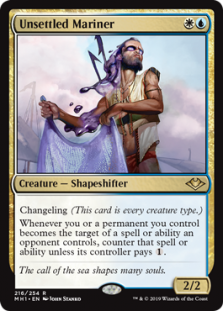
Kiki-Chord, by KAISERMAGUS (5-0)

Creatures

3 Prime Speaker Vannifar
4 Birds of Paradise
4 Coiling Oracle
3 Ice-Fang Coatl
2 Bounding Krasis
1 Breaching Hippocamp
1 Deputy of Detention
1 Eternal Witness
2 Kiki-Jiki, Mirror Breaker
4 Noble Hierarch
1 Reflector Mage
2 Restoration Angel
1 Scryb Ranger
1 Selfless Spirit
1 Shalai, Voice of Plenty
1 Tireless Tracker

Instants

3 Chord of Calling

Sorceries

3 Eldritch Evolution

Lands

1 Breeding Pool
2 Fire-Lit Thicket
1 Sacred Foundry
3 Snow-Covered Forest
1 Snow-Covered Island
1 Snow-Covered Plains
1 Steam Vents
1 Stomping Ground
1 Temple Garden
2 Prismatic Vista
4 Windswept Heath
4 Wooded Foothills

Sideboard

1 Collector Ouphe
1 Eidolon of Rhetoric
1 Kataki, War's Wage
1 Kitchen Finks
1 Knight of Autumn
1 Magus of the Moon
4 Path to Exile
1 Remorseful Cleric
4 Rest in Peace

Another creature combo deck, Kiki-Chord also forsakes Collected Company, instead running Chord of Calling and Eldritch Evolution in its spell slots. This deck boasts the ability to straight-up win if it untaps with Prime Speaker Vannifar, and gains an unlikely ally in Ice-Fang Coatl. Beating down the Kiki deck while disrupting their combo becomes a lot more difficult with Coatl in the mix, and the cantripping snake can be sacrificed to Evolution to tutor Vannifar or a bullet at no card disadvantage.

Thopter-Sword, by MUKESH (5-0)

Creatures

4 Urza, Lord High Artificer

Artifacts

4 Mishra's Bauble
4 Mox Opal
1 Damping Sphere
1 Ensnaring Bridge
2 Nihil Spellbomb
2 Pithing Needle
3 Sword of the Meek
4 Thopter Foundry
1 Time Sieve
1 Welding Jar

Enchantments

1 Mirrodin Besieged

Instants

4 Whir of Invention

Sorceries

2 Collective Brutality
4 Inquisition of Kozilek
2 Serum Visions

Lands

1 Breeding Pool
4 Darkslick Shores
4 Polluted Delta
5 Snow-Covered Island
1 Snow-Covered Swamp
4 Spire of Industry
1 Watery Grave

Sideboard

2 Abrupt Decay
1 Assassin's Trophy
3 Battle at the Bridge
1 Echoing Truth
1 Engineered Explosives
1 Grafdigger's Cage
2 Negate
1 Torpor Orb
3 Unmoored Ego

Moving on from creature combo and into artifact combo, Urza, Lord High Artificer is at his best in this Thopter-Sword shell, where he serves as combo finder (with his stall-breaking draw ability), combo enabler (by generating mana), and combo piece (by going infinite as a third cog in the Thopter-Sword engine). Mirrodin Besieged also makes an appearance here as an alternate win condition. Damping Sphere and Ensnaring Bridge also feature as findable win-buttons against certain Modern's decks.

Ain't Nuttin But a "Tribal" Thang

While Horizons may have been packed with Slivers, it's other tribes that have received more from the expansion, at least at first blush.

Goblins, by BOBTHEBUILDER24 (5-0)

Creatures

4 Goblin Matron
4 Warren Instigator
4 Boggart Harbinger
2 Munitions Expert
2 Frogtosser Banneret
2 Goblin Chainwhirler
2 Goblin Chieftain
2 Mogg War Marshal
2 Siege-Gang Commander
1 Goblin Cratermaker
1 Goblin Piledriver
1 Goblin Trashmaster
1 Goblin Warchief
1 Pashalik Mons
1 Sling-Gang Lieutenant
1 Earwig Squad
1 Kiki-Jiki, Mirror Breaker
1 Skirk Prospector

Artifacts

4 Aether Vial

Instants

1 Tarfire

Lands

4 Auntie's Hovel
4 Blood Crypt
4 Cavern of Souls
4 Fiery Islet
6 Mountain

Sideboard

1 Earwig Squad
1 Goblin Chainwhirler
1 Goblin Chieftain
1 Goblin Trashmaster
1 Sling-Gang Lieutenant
4 Damping Sphere
1 Goblin Rabblemaster
2 Stingscourger
3 Tormod's Crypt

One of two Goblins decks featured in the latest dump, this one makes the most of Goblin Matron. The infamous Goblin drops a turn after Warren Instigator on the curve, letting it search up whichever Goblin is best-suited to make an appearance; Matron also finds removal in the form of Munitions Expert or the cheaper Tarfire. A full set of Fiery Islets sneak their way into this list as a means of mitigating mid-game flood.

Merfolk, by RAGINGTILTMONSTER (5-0)

Creatures

4 Cursecatcher
2 Mistcaller
4 Lord of Atlantis
4 Master of the Pearl Trident
4 Silvergill Adept
4 Merfolk Trickster
3 Merrow Reejerey
1 Harbinger of the Tides

Artifacts

4 Aether Vial

Enchantments

4 Spreading Seas

Instants

4 Force of Negation
2 Vapor Snag

Lands

1 Cavern of Souls
14 Island
4 Mutavault
1 Oboro, Palace in the Clouds

Sideboard

4 Ceremonious Rejection
2 Deprive
4 Grafdigger's Cage
3 Master of Waves
1 Phyrexian Revoker
1 Ravenous Trap

Merfolk has always run a small number of noncreature spells to interact with opponents. Removal like Vapor Snag and Dismember is the most common, but Spell Pierce has also seen play in this spot. Force of Negation, though, seems like their most attractive option yet—now, the deck can continue to deploy threats while fading removal, planeswalkers, sweepers, and combos.

Canopy Humans, by ASA1986 (5-0)

Creatures

3 Giver of Runes
4 Champion of the Parish
4 Meddling Mage
4 Thalia's Lieutenant
4 Phantasmal Image
3 Unsettled Mariner
1 Thalia, Guardian of Thraben
4 Mantis Rider
3 Reflector Mage
2 Kessig Malcontents
1 Restoration Angel

Artifacts

4 Aether Vial

Instants

4 Lightning Bolt

Lands

4 Sunbaked Canyon
3 Fiery Islet
2 Cavern of Souls
3 Flooded Strand
1 Hallowed Fountain
3 Inspiring Vantage
1 Sacred Foundry
1 Snow-Covered Plains
1 Spirebluff Canal

Sideboard

1 Giver of Runes
3 Thalia, Guardian of Thraben
3 Deputy of Detention
1 Izzet Staticaster
4 Rest in Peace
3 Spell Queller

After some testing, David concluded this week that Unsettled Mariner probably wasn't going to make a huge splash in Humans after all, as the deck is simply too tight to accommodate it in an open metagame. But he hadn't accounted for the deck undergoing a total redesign. Granted, I don't think the stock Humans deck is going anywhere, but this new build is still intriguing—it's got seven Canopy lands to combat flooding, and those lands end up informing the shell by letting more non-Humans enter the fray. Notable additions include Giver of Runes, a one-mana Spellskite; Spell Queller, a combo-breaker from the board; and Deputy of Detention, an answer to any permanent.

Dashing Through the Snow

Horizon's snow theme has also made waves in Modern, if mostly on the back of Lore-Scale Coatl.

Sultai Sno-Co, by CHANDRIAN (5-0)

Creatures

2 Plague Engineer
4 Ice-Fang Coatl
1 Thrashing Brontodon
4 Birds of Paradise
2 Eternal Witness
1 Fauna Shaman
1 Fulminator Mage
1 Jace, Vryn's Prodigy
2 Liliana, Heretical Healer
1 Nissa, Vastwood Seer
2 Noble Hierarch
4 Sakura-Tribe Elder
2 Scavenging Ooze
3 Tireless Tracker

Instants

4 Collected Company
1 Abrupt Decay
2 Fatal Push

Lands

2 Blooming Marsh
1 Breeding Pool
2 Field of Ruin
2 Hissing Quagmire
4 Misty Rainforest
2 Overgrown Tomb
4 Snow-Covered Forest
1 Snow-Covered Island
2 Snow-Covered Swamp
2 Verdant Catacombs
1 Watery Grave

Sideboard

3 Fulminator Mage
1 Abrupt Decay
1 Fatal Push
1 Big Game Hunter
2 Deadeye Tracker
2 Extirpate
1 Liliana, the Last Hope
1 Maelstrom Pulse
2 Plaguecrafter
1 Reclamation Sage

Here's our Collected Company deck, but this one's all value. Coatl helps deal with enemy attackers while plussing in the meantime. That the Snake succeeds here bodes well for its applications across multiple archetypes; indeed, it's even reared its head alongside Wilderness Reclamation.

Shardless-Less Shardless, by FREAKLE (5-0)

Creatures

4 Ice-Fang Coatl
4 Tarmogoyf
2 Snapcaster Mage
3 Tireless Tracker

Planeswalkers

2 Liliana of the Veil
1 Liliana, the Last Hope

Artifacts

4 Arcum's Astrolabe
1 Engineered Explosives

Instants

1 Abrupt Decay
3 Assassin's Trophy
3 Fatal Push

Sorceries

3 Inquisition of Kozilek
3 Thoughtseize
1 Unearth
2 Dead of Winter

Lands

4 Prismatic Vista
1 Breeding Pool
2 Misty Rainforest
1 Overgrown Tomb
2 Polluted Delta
3 Snow-Covered Forest
1 Snow-Covered Island
4 Snow-Covered Swamp
4 Verdant Catacombs
1 Watery Grave

Sideboard

3 Ashiok, Dream Render
1 Collective Brutality
2 Damping Sphere
1 Disdainful Stroke
1 Flusterstorm
1 Force of Despair
1 Kalitas, Traitor of Ghet
1 Nissa, Vital Force
2 Plague Engineer
1 Vraska, Golgari Queen
1 Weather the Storm

No Shardless Agent here, but Coatl does a mean Baleful Strix impersonation in this port of the Legacy rock deck. It even rewards running Arcum's Astrolabe, which provides the artifact type for Tarmogoyf.

Canadian No-Bug, by SPIRALPRINCE (5-0)

Creatures

4 Nimble Mongoose
4 Tarmogoyf
4 Ice-Fang Coatl
3 Snapcaster Mage
3 Hooting Mandrills
1 Nimble Obstructionist

Enchantments

3 Blood Moon

Instants

4 Lightning Bolt
4 Skred
4 Thought Scour
2 Mana Leak
2 Spell Snare

Sorceries

2 Faithless Looting

Lands

4 Misty Rainforest
1 Scalding Tarn
3 Snow-Covered Forest
3 Snow-Covered Island
1 Snow-Covered Mountain
1 Steam Vents
1 Stomping Ground
1 Fiery Islet
4 Prismatic Vista
1 Waterlogged Grove

Sideboard

2 Ancient Grudge
2 Ceremonious Rejection
2 Dismember
3 Flusterstorm
2 Grim Lavamancer
2 Scavenging Ooze
2 Surgical Extraction

Who needs Delver of Secrets? In another Legacy port, SPIRALPRINCE chooses to omit the archetype lynchpin in favor of, you guessed it, Ice-Fang Coatl. Curiously, Delver of Secrets itself has had a strong showing since Horizons became legal, putting multiple decklists into this 5-0 dump and showing up in the Top 36 of the Modern Challenge.

Other Developments

A few more decks that caught my eye proved harder to sort under one umbrella, but here they are.

Bant Infect, by DDMEELOW (5-0)

Creatures

4 Blighted Agent
4 Glistener Elf
4 Noble Hierarch
1 Spellskite

Planeswalkers

3 Teferi, Time Raveler

Instants

4 Blossoming Defense
4 Might of Old Krosa
4 Mutagenic Growth
2 Spell Pierce
4 Vines of Vastwood

Sorceries

4 Scale Up
2 Distortion Strike

Lands

2 Breeding Pool
1 Dryad Arbor
2 Forest
4 Inkmoth Nexus
2 Pendelhaven
2 Temple Garden
1 Verdant Catacombs
3 Windswept Heath
3 Wooded Foothills

Sideboard

1 Spellskite
1 Spell Pierce
1 Dismember
1 Grafdigger's Cage
3 Kitchen Finks
2 Ravenous Trap
2 Return to Nature
3 Shapers' Sanctuary
1 Surgical Extraction

I'd heard Waterlogged Grove pegged as a breakout Horizons card for Infect, but no copies appear here. Instead, DDMEELOW stretches his manabase to support Teferi, Time Raveler, a brilliant tech that forces opponents to interact with Infect's creatures at inopportune times. It's also nuts with Inkmoth Nexus, especially considering the sheer bulk provided by Scale Up.

Soul Sisters, by ORIM67 (5-0)

Creatures

4 Ajani's Pridemate
3 Martyr of Sands
4 Ranger of Eos
4 Serra Ascendant
4 Soul Warden
3 Soul's Attendant
4 Squadron Hawk

Enchantments

4 Force of Virtue

Instants

3 Path to Exile

Sorceries

2 Proclamation of Rebirth
4 Spectral Procession

Lands

2 Field of Ruin
16 Plains
3 Windbrisk Heights

Sideboard

4 Damping Sphere
2 Disenchant
2 Grafdigger's Cage
1 Ratchet Bomb
4 Rest in Peace
2 Stony Silence

In a bizarre development, Soul Sisters improves post-Horizons thanks to Force of Virtue. The enchantment drastically increases the deck's potential clock without costing pilots tempo, an aspect it may have been missing to compete. It doesn't hurt that the sideboard is full of the format's best hosers.

Esper Shadow, by VOLOLLO (5-0)

Creatures

4 Death's Shadow
3 Ranger-Captain of Eos
2 Gurmag Angler
2 Jace, Vryn's Prodigy
3 Snapcaster Mage
2 Street Wraith

Planeswalkers

2 Teferi, Time Raveler

Instants

1 Dismember
3 Fatal Push
3 Path to Exile
3 Stubborn Denial
4 Thought Scour

Sorceries

2 Inquisition of Kozilek
1 Lingering Souls
4 Thoughtseize
2 Unearth

Lands

3 Flooded Strand
2 Godless Shrine
1 Hallowed Fountain
1 Island
3 Marsh Flats
1 Plains
4 Polluted Delta
1 Swamp
2 Watery Grave
1 Silent Clearing

Sideboard

1 Fatal Push
1 Lingering Souls
1 Path to Exile
1 Stubborn Denial
1 Ceremonious Rejection
2 Disdainful Stroke
1 Kaya's Guile
3 Leyline of the Void
2 Rest in Peace
2 Stony Silence

Traverse Shadow decks once splashed white to employ Ranger of Eos as a plan to dig up more copies of Death's Shadow. Here, Ranger-Captain of Eos leaves behind a better body, but only searches one Shadow. In return, it costs just three mana, which lets players reanimate the creature with Unearth for insane value.

The Setting Sun

There are plenty of juicy lists here, and I'd love to discuss any of them further in the comments. Which piqued your interest? Do you like the direction Modern is headed post-Horizons? Drop us a line!

Want Prices?

Browse thousands of prices with the first and most comprehensive MTG Finance tool around.


Trader Tools lists both buylist and retail prices for every MTG card, going back a decade.

Quiet Speculation