Are you a Quiet Speculation member?
If not, now is a perfect time to join up! Our powerful tools, breaking-news analysis, and exclusive Discord channel will make sure you stay up to date and ahead of the curve.
It's maybe been said to the point of platitude at this point, but Modern is a format that rewards deck mastery. At least for me, it's also way more fun when you can find a deck that ticks all your preference boxes. I've been playing Eldrazi Stompy since Thought-Knot Seer was spoiled, and Counter-Cat since before I started writing for Modern Nexus, let alone designed the Temur Delver deck that got me the gig in the first place. Today, we'll update both decks with cards from Modern Horizons and M20.
Never Leaving London
I wrote that Colorless Eldrazi Stompy was better positioned than perhaps any Modern deck to benefit from the London mulligan. And indeed, despite Eldrazi Tron being far better suited to abuse the format's hottest new planeswalker, Colorless continues to clock results.
Colorless Eldrazi Stompy, by Jordan Boisvert
If You Karn't Take the Heat...
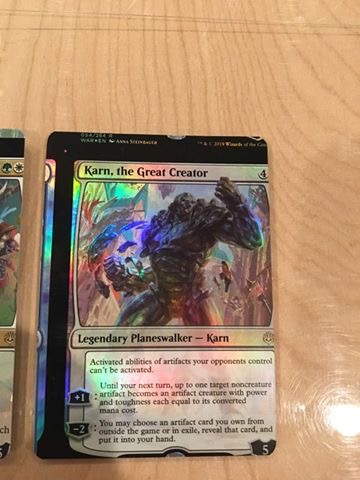
It's been three months since Karn, the Great Creator was spoiled, and since I outlined its virtues in Colorless Eldrazi Stompy. The walker has been legal for less time, but players have had ample time to tinker with different configurations. The verdict on Karn seems split, with some successful lists forsaking him altogether and others packing as many as three mainboard copies.
 The main argument against the walker is that it doesn't fit with our primary gameplan. Colorless Eldrazi Stompy wants to slam a lock piece and then clean up the mess with big dudes, applying pressure via raw bulk while disrupting the opponent. In this way, it offers a go-tall analogue to Humans' go-wide strategy. This point has been bolstered by the London mulligan, which lets players execute whatever gameplan they prefer with heightened accuracy. We used to open Temple most of the time; now, we open Temple all the time. So why dip into a Plan B at all?
My reasons for including Karn haven't changed. I'll concede that the walker doesn't fit with our primary goals, and somewhat clashes with the London—between countermagic and hand disruption, sculpting a gameplan around a Karn opened or drawn early isn't very attractive; the walker is best peeled off the top once games have stabilized, or as a utility failsafe lying in the deck. Rather, I have enough faith in my good matchups to not mind sometimes watering down my Game 1 plan with a couple potentially-dead Karns. We already do so with cards like Serum Powder. Karn adds to the density, but it can simply be sided out post-board when it's no good.
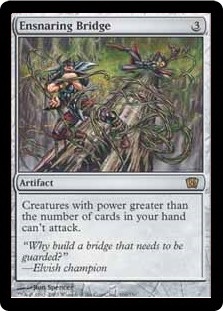 The reward for maining Karn is that previously impossible matchups become feasible. Whir Prison has become Urza's Thopter-Sword, and a resolved Karn makes life as tricky for that deck as it does for dedicated Bridge strategies. Besides, the Mycosynth lock is still an option against decks wielding Ensnaring Bridge. Another artifact deck we could almost never beat pre-Karn is Hardened Scales, which still exists post-Horizons. And UW Control, also a lacking matchup, is a great place for Karn to shine. Similarly, Jund's comeback bodes well for value-packed haymakers like Karn.
Landing on Two Feet
I'd also like to discuss my land choices, which are becoming less and less accepted. Many players have opted to cut Zhalfirin Void to make room for more manlands and Blast Zone. While I agree that Blast Zone is nuts in this deck, I think Void is a poor cut with Karn in the deck. We want to draw the walker naturally at a certain point in the game, and Void helps us do that. Additionally, since Karn pulls us more towards a midrange role, Void shines brighter, as our games are extended by a turn or two on average. The London indeed grants us more consistency, but I don't think responding by cutting our existing consistency tools is necessarily a justified way to celebrate.
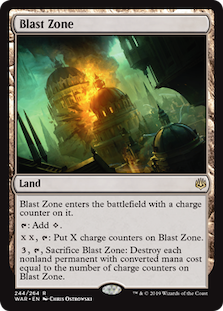 I'm up to 3 Blast Zone and don't anticipate going down any time soon. Having mass removal on an untapped land is just superb in this deck, no matter how clunky it might be. I've had to learn to sequence better with Zone in the deck, at times taking turns off to prevent dying a few turns down the road to something I could have sniped a bit earlier (e.g. Thing in the Ice or a planeswalker).
Ghost Quarter feels less relevant than it has in the past, but is still a necessity at 3 thanks to Tron. The five manlands are as vital as ever, and I would play a fourth Mutavault if I had space. I think the most expendable land is the second Gemstone Caverns, but right now, would rather double the odds of opening it on the draw than slightly increase my threat density. While I once had a 24th land in the deck, I've gone back to Smuggler's Copter, which does too much for us at 1 to omit.
Other Choices
Endless One is still here, although other players overwhelmingly prefer Matter Reshaper. I think the three-drop slot in this deck is a bit clogged, and always has been; the going-long points gained from Karn help alleviate Reshaper's value, and Endless pulls weight in the matchups Karn flounders. Besides, the card has been phenomenal with the London.
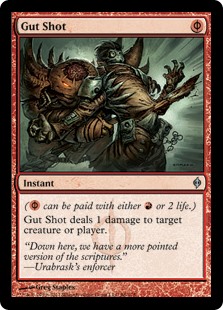 In the sideboard, I'm sticking with Gut Shot, planeswalker sniper extraordinaire that also excels against small creature decks. After War of the Spark's release, Gut has become even more vital, as Modern decks have come to increasingly rely on planeswalkers.
Finally, Mystic Forge makes an appearance as the first M20 card to enter Colorless. I've long wanted a pure value grab for Karn, and so far the best option has been Crucible of Worlds. But plenty of games came up where fetching Crucible wouldn't net any value, such as when I lacked the utility lands to make good use of it. Forge lets us draw two or more cards per turn, and its exile ability makes it better than something like Experimental Frenzy by getting us through additional lands. We can also bin Serum Powders we don't want to cast and throw Eternal Scourge directly into exile to dig deeper. Running Forge makes Karn a more significant threat against control and midrange.
Nine Lives, Maybe More
Another old favorite that I'll probably never truly relinquish, no matter how bad it seems and in fact is, Counter-Cat has also received a significant makeover lately.
Counter-Cat, by Jordan Boisvert
Mainboard Alterations
There are three major changes to Counter-Cat's mainboard: threats, cantrips, and lands.
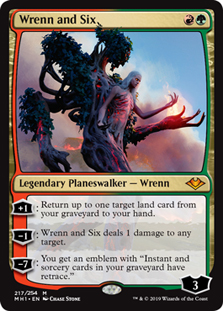 In terms of threats, Wrenn and Six joins the fray. Domri, Anarch of Bolas also performed well in this deck, and I ran a copy after War of the Spark. When Wrenn came out, I tried splitting the walkers, but found myself wanting Wrenn more every time. While Domri is a nice mid-game board-breaker, Wrenn fundamentally changes the way the deck plays.
Tarmogoyf has always been critical in Counter-Cat as a follow-up to our one-drop dying. Therefore, as Goyf's stock fell, so did the deck's. I addressed this issue by making Goyfs bigger via Bauble and Wrenn and by increasing the number of Goyfs—again, by adding Wrenn. Goyf used to be the perfect funeral procession for a killed Cat or Insect, but Wrenn is just as good, plopping down a value engine that ticks up towards a wincon and pressuring opponents significantly. It hurts linear combo decks less, since it's not as fast against them, but making land drops still gets us to the point faster where we can drop threats while holding up interaction. Fair decks, on the other hand, have a doozy of a time removing Wrenn, especially through our walls of heavy-duty removal.
 I was immediately impressed with Wrenn in GR Moon, where it revitalized my interest in another of my longstanding brews. In that deck, it combines with Faithless Looting to keep the cards coming. I ended up having to add Lootings to Counter-Cat as well. Otherwise, Wrenn would offer us a grip full of fetchlands in the mid-game and nothing to do with them. Still, Wrenn lets us cut a land, and makes the London mulligan much easier for us than for other decks—we can just bottom extra lands without much of a care once we find Wrenn. Bauble also alleviates the low land count.
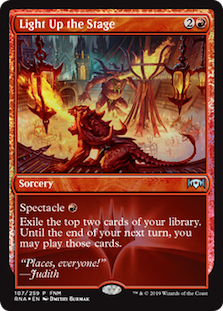
Light Up the Stage is another red cantrip new to the deck. With eight one-drops, Wrenn to ping, trampling beaters, and a set of Bolts, spectacle is quite easy to enable. Here, Light Up is like a super-powered Chart a Course, churning through the deck and gassing us up for one mana. I've even recast Light Up with Snapcaster Mage for full Divination price in some matchups and been impressed by the results.
To accommodate all these extra red spells, I had to add Sacred Foundry. Pool-Foundry is now a common and adequate shock pair, as we've got plenty to do with a red land and often even want double red in the mid-game. The colors are pretty even, save for white, which exists just for Path and Nacatl.
Sideboard Tweaks
Many sideboard cards are the same as in previous versions, so I invite you to take a look at the Counter-Cat archives for more information on those. Still, there are a few newcomers:
 Damping Sphere is great against so many decks. We cantrip a lot, but a Sphere in play doesn't just beat us as it does other decks. Great against Tron, Phoenix, Storm, Neoform, etc.
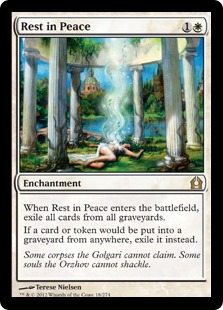
- Rest in Peace is actually supportable. It's just not for the Jund matchup. Against the graveyard decks, having Rest in play means we just win until they remove it, and then our Goyfs are re-activated and we've stolen heaps of time.
- Fry roasts Lyra Dawnbringer, Thing in the Ice, Mantis Rider, and Teferi, Hero of Dominaria, among other things. A removal spell for Humans that's also great against UW.
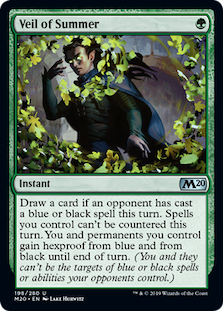
- Veil of Summer is an elegant answer to interactive decks, fading Fatal Push and targeted discard as well as Liliana of the Veil's -2. It's also strong vs. control for its applications against countermagic, and can counter random stuff sometimes (I hit a Mind Funeral the other day). I love me a one-mana Cryptic, and Veil is one of the more reliable we've gotten.
How Many of Us
These two decks aren't leaving my collection maybe ever—I love them too much! With Hogaak gone and M20 just released, it's the calm before the storm, as we're about to see a whole lot of new tech enter Modern. In the meantime, have your favorite decks enjoyed a boost from the format's recent newcomers?



 For the most part, they're all just
  it.
it. 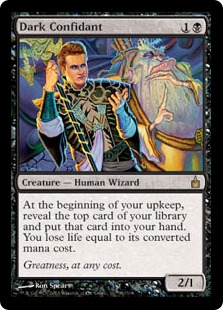 Part of this upsurge may be Legacy spillover. I'm told that Wrenn is taking over Legacy. Most Legacy creatures are X/1's, so Wrenn's downtick is very relevant, but more importantly Wrenn is great with and against Wasteland. Thanks to dual lands, the opportunity cost of just running four-color piles in Legacy is pretty low. The ubiquity of Wasteland keeps these decks in check. Wrenn undoes Wasteland, and now
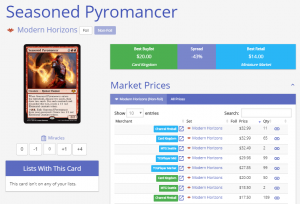
 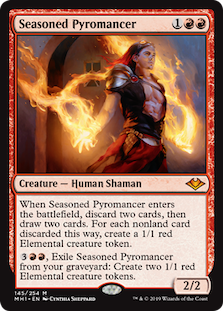 Seasoned Pyromancer is an exceptional card in any version of Jund. The 2/2 body isn't that impressive, but it doesn't matter given the card advantage it provides. I'm told, but can't verify, that Jund is cutting Dark Confidant because he's bad against Wrenn, and Bob is an investment. Pyromancer gives new cards up front, potentially with value. Obviously, discarding Wrenned-back lands is good, but turning useless discard spells into Elementals alleviates the problem of drawing the wrong part of the deck at the wrong time. He can then provide value from the graveyard. Pyromancer is a very solid card, and in my opinion, a far better reason than Wrenn to play Jund.
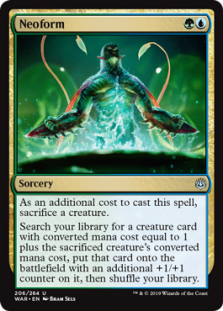 The other big trend I've seen is that Neoform combo is back. It was
  However, that dream scenario isn't probable. The deck
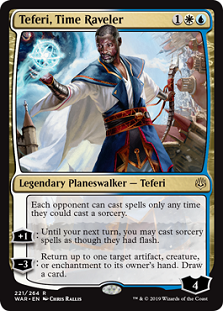
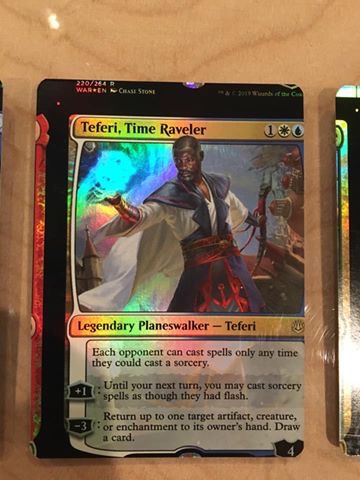
 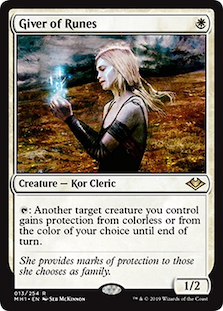 The Bant versions I've faced so far have been really clunky. They've gotten a lot of Oops, I Win! combinations, but if they don't come together they really struggle. Giver of Runes and Teferi, Time Raveler are great for forcing through an infector and Scale Up allows some truly out-of-nowhere wins. However, these cards are replacing the pump spells that infect still needs to assemble so it can secure victory. The move from UG to Bant Infect appears to have exacerbated the "wrong-half problem" the deck already had.
 because of the London mulligan; theorists
  With London, it feels like you're making sacrifices. Frequently I and those I've spoken to have mulliganed into good seven-card hands, but once you start cutting cards they become unplayable. It feels worse when I London to five and and am left with a mediocre hand after choosing which cards to bottom rather than I opened a mediocre five. Then there are the times you bottom cards based on how you expect things to go, and they go a completely different direction, retrospectively making your mulligan decision bad. Again, I know that statistically and strategy-wise such a decision was good, but the loss feels worse.


 The idea of
  A Whole New Modern
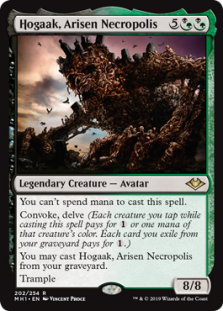
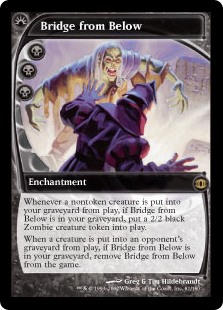 In context, though, it is enough to pull the trigger on Hogaak. Affinity doesn't just fold to hate. It also folds to waves of removal. Even if I don't hit my Stony Silence against Affinity, I can still play normal Magic, take care of the enablers or the payoffs, and plausibly win. Because of Bridge and the sacrifice outlets, normal removal just isn't effective against Hogaak. They'd respond to any removal spell by sacrificing the creature for value and making zombies to replace it, which fair decks have no answer for. Thus, hate was necessary, and Hogaak had answers to the hate, so the win rate didn't dip enough post-sideboard.
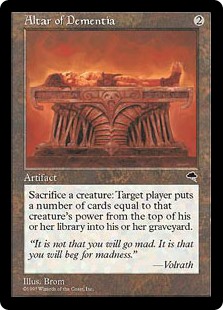 This ban was laser-targeted at Bridgevine.
 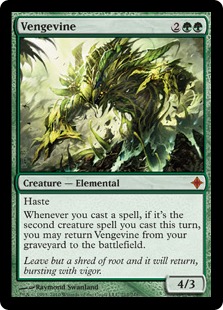 I disagree. Without the possibility of a combo kill, there's very little reason to bother feeding Hogaak to Altar. The deck that remains is a straight Vengevine aggro deck, intending to swarm the opponent quickly with recursive threats. There's no reason to spend a turn playing and then sacrificing Hogaak, since such a deck needs to hit well with Stitcher anyway.
 Looking elsewhere is also trouble. Cutting enablers like Shriekhorn is out of the question, as is cutting the dredge package; they're what make the deck work. Lands can't be cut since Dredge already runs the bare minimum. Creeping Chill is critical to giving Dredge other angles of attack, and has significantly increased the deck's success since its printing. Darkblast is the weakest card in Dredge, so maybe cutting it and having Hogaak as a one-of is acceptable.