menu

Jason’s Archives: Splendid Ways to Experience Magic, WotC’s Need of Editors & Innovation Not Good for But Silver

Are you a Quiet Speculation member?

If not, now is a perfect time to join up! Our powerful tools, breaking-news analysis, and exclusive Discord channel will make sure you stay up to date and ahead of the curve.

Greetings, Speculators!

It isn't every day you get to touch a part of Magic history.

Recently I got to bear witness to a transaction that involved moving a copy of "Splendid Genesis" to the winner of a private auction. For those who don't know what exactly "Splendid Genesis" is, there is a Magic Wiki online that offers next to no help.

Basically, Dr. Garfield wanted to think of a way to commemorate a very special occasion in his life and then he remembered he had created the most popular trading card game in the history of ever and could just make a card to celebrate.

At 110 copies in total, Splendid Genesis is one of the rarest cards in Magic. Its intimate nature and collectible appeal mitigate its unplayability and makes it a chase cards of the highest order. The demand is low among players, which is fine, because so is the supply among ... everybody.

Snapping a grainy camera phone pic of this gem during its transition to the buyer was a fulfilling experience for me. It's easy to get jaded in the world of MTG finance when you routinely buy collections of power and duals only to out them as quickly as possible for profit. It's usually only later that you remember to slow down and remind yourself of the cooler aspects of having this many cards passing through your hands. "Woah, I owned a set of Power 9 there for a minute. How cool is that?"

In this instance, however, I didn't need to check myself at all. I was fully aware that I was holding a piece of Magic history (not literally; it was encased in an inch of polypropylene casing that could stop a Barret .50 caliber round [citation needed]).
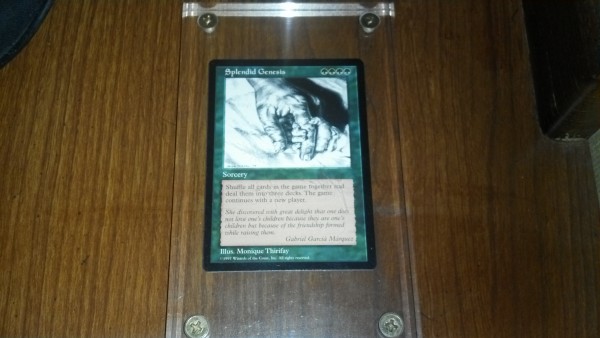
The only card on earth more rare than an Alpha Fungusaur.

I work 70-hour weeks, have no retirement or health benefits and spend most weekends away from home, but it's moments like this that remind me that I have the best job in the world.

Does WOTC Need a Copy Editor? (I'm Available and Work Cheap)

I'm not even going to lie. I'm a bit of a pedant sometimes.

It genuinely bothers me when people use the wrong "your" or the wrong "its" or the wrong "to". While in most cases attacking grammar, syntax or spelling are the feeble tools of a losing argument, my assault on inaccuracy is my opening salvo. After all, how persuasive can your argument truly be if you can't make the simple distinction between "you're" and "your" (let alone more common and understandable errors like "enquire" vs. "inquire")?

Pedantry can lead to a few embarrassing situations when one makes an error of one's own; situations like that are so common they've spawned their own law. My editors both past and present can attest to my own writing being far from perfect. But it's nice to have hobbies; mine are Magic and nitpicking.

But I don't think it's nitpicking to point out a few of the more glaring errors made recently by a multi-million-dollar subsidiary of the world's largest toy company.

Do you guys remember my post a few weeks ago about the incorrect power and toughness of Firewing Phoenix? Refresh your memory here. It turns out they may not have been quite finished with their screw-ups in Duel of the Planeswalkers.
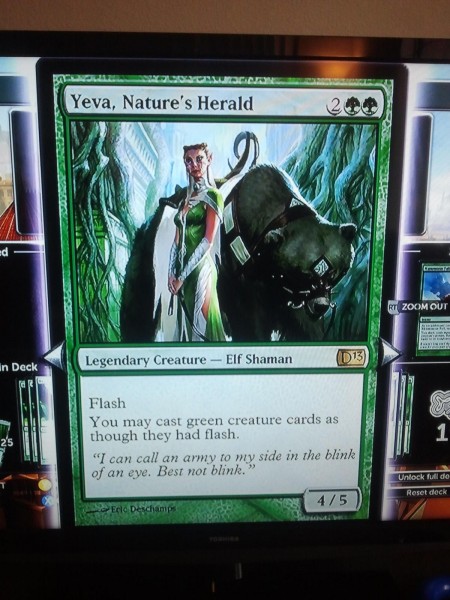
Let's face it, she was underpowered at 4/4.

Keen-eyed Redditor tellerfan caught another DotP error. It appears the missing toughness from the Phoenix ended up getting tacked on to a creature that probably didn't need the help. I already had to suspend my disbelief to accept the premise of a scantily-clad elf, who likely weighs 75 pounds when soaking wet, surviving a lightning bolt or killing four people in one attack-- let's not make it tougher by letting her survive a Char to the dome.



Pottery may not be super manly, but he's still better than all in my book.

Redditor Figworth noticed a pretty hilarious typo on a survey about cube drafting on the Magic Online website. Spell check won't help you if you accidentally type in a real word!
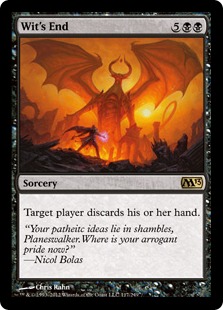


Someone let these go out like this. Talk about the end of wits.

I'm sure everyone has noticed by now the typo on Wit's End. Just remember not to correct Nicol Bolas. It sickens him.
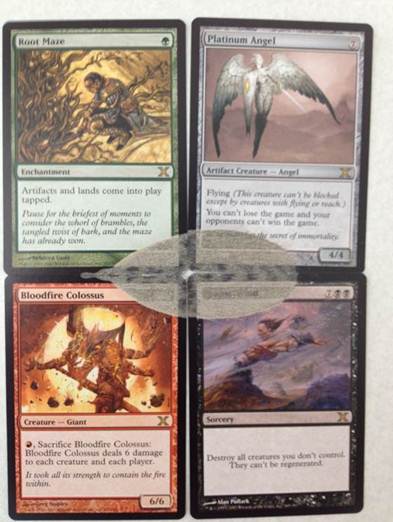


Happy accident or the mark of anti-Magic ecoterrorists?

Redditor Chemaba shared this pic of what looks like the result of a leaf falling onto the printing sheet. What a nice binder page those four cards would make!

Buffalo Dreamstomp

A rare white buffalo was born this year in Goshen, Connecticut. This is a big event in the lives of the local Indian tribes, serving as a sign that things are going to get better. Unfortunately, it seems the universe has decreed that for this buffalo dream to live, another buffalo dream has to die.

This weekend in Buffalo, New York, Kurt Crane proved that if you come up with a novel and entertaining decklist, test it exhaustively and play the tightest Magic of your life, you too can live the dream of losing in the finals to the same stupid deck everybody has been playing since the printing of Restoration Angel. Isn't Magic fun?

Top 16 Standard Decks

Running four copies of both Genesis Wave and Green Sun's Zenith, Crane's Elf deck had multiple ways of building to a lethal crescendo. Village Bell-Ringer is one of the linchpins, untapping the elves used to cast a large Genesis Wave or Craterhoof Behemoth so they can join the alpha strike. [card Ezuri, Renegade]Ezuri[/card] is a great mana sink as well. While not quite a Glimpse of Nature, Soul of the Harvest has great potential for keeping the stream of elves going or just smashing domes in on his own. This is the kind of deck you really want to see win events.

Conversely, Carl Dillahay piloted a pretty unoriginal concept, albeit with a few updates that incorporated M13. Augur of Bolas and Talrand, the Sky Summoner both fit with the "play lots of instants and sorceries to flip my [card Delver of Secrets]Delver[/card]" theme we're all used to by now. Moving the Restoration Angels to the sideboard, this deck makes great use of Talrand. Great job, Carl!

The Top 8 consisted of three Delver decks and two Pod decks, which is becoming par for the course.

Also worth noting is Fabiano's Wolf Run Blue deck, which uses four Temporal Mastery to go all-in on the "I'm a big lucksack" plan, popular among Bonfire of the Damned proponents these last few months. Just how big of a lucksack is Fabiano, anyway? 40th place.

40th place is pretty good compared to the 319th place finish of Josh Cho. Maybe Standard isn't his format.

Top 16 Legacy Decks

But maybe Legacy is! Making room for Master of the Pearl Trident by trimming a few Coralhelm Commanders, Cho fishslapped the competition in Sabretown (is hockey big enough there to call it "Sabretown?" -- I feel like I made that up), warming the heart of Corbin "tha hussla" Hosler and other merfolk enthusiasts worldwide.

That hot European tech of jamming Omniscience into Show and Tell decks has caught on in a big way. Scoffing at hate like Gilded Drake and Stingscourger, this play off of a Show and Tell is good stuff. It also helps a bit to get the extra turn trigger off of [card Emrakul, the Aeons Torn]Emrakul[/card]. I don't know how permanent this development is, but seeing four copies in the Top 8 is encouraging.

Two copies of eight different decks comprised nearly the entirety of the Top 16. To me, that indicates what continues to be a healthy format. The anxiety revolving around Sneak and Show seems to have been unfounded as players have found myriad ways to keep its explosive power in check. Unbanning Land Tax seems to have been OK as well as zero copies appeared in the Top 16 here.

They may screw up the occasional flavor text, but WotC knows what they're doing when it comes to the Banned and Restricted list.

Divine Providence

Providence Standard Top 8 Decks

Shockingly, U/W Delver won in Providence. Oliver Tiu took an approach opposite the one from Buffalo and jammed Restoration Angels main and [card Talrand, the Sky Summoner]Talrands[/card] in the board. Otherwise the two winning decklists look very similar. That may not mean an unhealthy format, but it does make analyzing decklists boring. I really hate when the same deck keeps winning.

That's why I'm glossing over Tiu's list (Congratulations are in order though, no question. Way to go, Oliver!) to talk about something exciting that came out of Providence: this bad boy.

A Smallpox deck?! In Standard?! This kind of innovation is why I love looking at weekend decklists. I am definitely sleeving up this seventy-five for FNM this week. This deck was always nearly possible, and it may have been Ravenous Rats that finally gave it the gas it needed. Gravecrawler and Geralf's Messenger are obviously nutty with Smallpox, and Liliana of the Veil helps keep the edicts coming long after you run out of poxes. Attacking both their hand and the board, this deck mitigates the pain of symmetrical discard and sacrifices by recurring zombies to great effect.

Sure, neither of them won their events, but I think Joseph Snyder and Kurt Crane deserve a brofist for keeping Magic fun.

That's All for Now

Join me next week when I'll have some previews of the good times in store for the web's only financial podcast crew at Gencon.

Until next week!

Insider: Your Guide to Trading At GenCon

Are you a Quiet Speculation member?

If not, now is a perfect time to join up! Our powerful tools, breaking-news analysis, and exclusive Discord channel will make sure you stay up to date and ahead of the curve.

With GenCon a little under two weeks away, this is a great time to get ready for trading your heart out at the world's largest Magic convention. Since there's plenty of Magic as well as all sorts of other games going on, it can take a little knowledge going in to get the best deals around. This week, I'll share some veteran GenCon info from myself and other long-term attendees. If you aren't sure that you're going to the con or if you have no plans, most of this information can be generalized into basic large-event information. Ergo, there's something for everyone.

Working the Dealer Hall

One of the best draws is the Dealer Hall, which is full of lots of Magic vendors looking to buy and sell you cards. The trouble is, the Dealer Hall is also slam-full of other dealers selling things. You'll see Fantasy Flight's board games, D&D product demos, the Magic Online beta testing and a goggle-boggling number of steampunk costume vendors. The hall can get really chaotic, making it hard to stand around in crowded aisles and browse bulk boxes.

Speaking of bulk boxes, they are home to some real hits. If you arrive early on Thursday or Friday, spend a little time looking through dollar boxes. While most dealers are pretty sure of their stock to set down the $1,000 a day to have a booth there, you can still find some real gems. Kelly still talks about the $1 AQ Hurkyl's Recall he dug out of a box a year ago! That said, I don't think it's worth spending a huge amount of time looking through bulk boxes unless you truly have nothing else to do. Foil boxes are the same way; now and then, you can pull out some extreme gems that dealers have no idea the value on. Have I bought Japanese Tendrils of Agony out of a junk foil box for $1 before? I have.

With so many dealers around, you can also get the best prices for your cards. I was shopping out some Grim Monoliths last year that needed to get out of my inventory. Prices varied from $7 to $20 and I probably would have settled for $14 if I hadn't kept looking. This can be time-consuming and a pain in the butt for dealers to deal with, but you can build a grid of buy prices for a dozen cards and look who is giving the best on it. Remember that a dealer should offer you more in trade credit and this is often negotiable - it never hurts to ask for 5% more than they're offering if you'd like to trade into some cards.

Next, the dealer hall is a great place to dump your bulk rares - but don't just unload everything you think is worthless and walk away. There are a few dealers - Troll and Toad and Strike Zone come to mind - that will honestly look through your stacks and give you real values. I've been with a friend before who went up with 300 bulk rares, wanted his dime apiece, and ended up getting closer to $120. Not all dealers will do this for you; seek out the ones who will, in non-peak hours. In terms of GenCon, this means during work hours on Thursday and Friday.

A trip down Artist Alley

Another huge appeal for me is the Artist Alley, where many Magic artists reside and will sign cards for free or a small donation. This can be a mixed bag because people like Wayne Reynolds are immensely popular - think Wild Nacatl and Cunning Sparkmage. It can take half an hour or more to get your cards signed by them. If you really want to get the most out of the Artist Alley, be sure to look up the full artist list a few days before the event and then Gatherer-search their cards to set aside.

Be aware that signing almost universally decreases the value of the card. The only exception I can think of is Fay Jones of Stasis, who is just about the hardest signature to get.

GenCon is also one of the very few times you'll see some Magic artists out and about. April Lee, of Intuition and Lotus Petal, only comes to GenCon. Susan Van Camp also makes an appearance - and she's kind of a character. She'll charge you for any signatures over four and she's been going through a "cats with fairy wings" period for the past decade.

If you want to get cards or artist proofs altered, be prepared to pay a few bucks and wait. If you have a huge stack to get signed, then sling the artist some dollars and let other people get their cards signed after every few of yours. I can't count the number of times that Jimmy Backpack has set 250 cards down in front of an artist and I just want to get three cards signed...

Finding the best times to trade

The best times to trade are kind of hard to narrow down; they come in bands. People coming there are mostly at GenCon to play Magic, not to trade. Thus, you'll have to hit a couple periods of time to make the most of trading. For example, I don't think it's worth doing a whole lot of trading on Thursday or Friday before about 5pm unless you want to do some high-volume trades with other like-minded traders. To hit the casual and local store crowds, it's best to start hunting around dinner on Thursday and Friday. Friday night is typically the Free FNM event. You might get a lot of traffic if you wait around until the end of the second round - people who drop might be interested in seeing your cards.

If you move Legacy or Vintage staples, then staying around for those events is a smart idea. While most of the Vintage people will be playing in the Vintage champs, they'll have a bit of time to trade in between rounds. This is only advised if you have some real Vintage hits or oddities. Japanese Spell Snares play, English Huntmasters do not.

Trading happens at all hours because the TCG Hall is open all day and all night. During the day, all you're going to run into will be sharks - don't get deep in those waters unless you really want to. However, long after the sharks have gone off to a steakhouse and the dealers have closed up, people are still playing and trading. It's truly a 24-hour event; you can get some monster trades done at 4am if you decide that you're going to be a night owl instead of an early bird. I'd go so far as to say that you've got the best trading field available late at night.

Finding the elusive and skittish casual trader

While GenCon sprawls all over the convention center, remember that there are people playing Magic in the hotel lobbies and hallways all over Indianapolis. If you're looking for more casual traders, it's absolutely worth it to go looking in the Marriott lobby in the mornings for Magic players. I don't advise trying to rip these guys off, but they might be more interested in your casual cards than other people are. I find that even when I explain that yes, your Snapcaster is worth $17 and I'm willing to trade multiple cards for it, I often end up getting rid of what I consider low-end, low-volume cards for good binder materials at a fair trade. These players often don't want to trade with people inside the convention itself, since they feel out of their depth. The best approach isn't to go up and say "got a trade binder?" but to engage people about how cool something is that's happening on the board and going from there into asking about trading.

It's imperative that you never let on that you're just around to trade with people - always have something specific that you can say you're looking for. Remember that casual players are easily scared off of trading because they and their friends have been ripped off before! You can say "hey, I'm looking for weird old foil cards for a cube deck, do you have anything like that on you?" or "I'm trying to get a fourth Restoration Angel for my deck, can any of you guys help out?" It helps to have a physical short-list of cards that you're hunting for, too.

It also pays to stack a binder for low-end trading. You want to do everything you can to NOT look like a trading machine. This means that those Unlimited dual lands go in another binder. It means you don't flash around expensive Standard staples to them or brag. If you assume the appearance of a small-time Magic player, you can get access to more binders. Again, it pays to be friendly about the game of Magic.

General Safety

"I keep my bag wrapped around my leg, I keep it on my shoulder when I'm walking around, and I never let it out of my sight."

This strategy works until you're taking a wizz and someone pushes you into the urinal, grabs your bag and takes off. This actually happens. Don't make yourself a target; don't flash around any cards you aren't willing to trade or lose. Drop your things off in the hotel room when and if you can. Don't show off stacks of cash. I even go so far as to use bathroom stalls instead of the ol' trough - better safe than sorry! The buddy system is also essential. Even two scrawny dorkolites, no greater than 1/1s, can keep predators away. People can also jack your iDevices, so be aware.

Remembering what you're there for

GenCon is great to trade at but it's best used as a convention - meet people, have a great time and see some cool stuff. I've developed many friendships through conventions and there's a cast of characters that I look forward to seeing each year when I return. Make the most of it!

If you have GenCon tips and tricks or if you have specific questions, please share your comments below.

Until next week,

Doug Linn

getting casual traders

Douglas Linn

Doug Linn has been playing Magic since 1996 and has had a keen interest in Legacy and Modern. By keeping up closely with emerging trends in the field, Doug is able to predict what cards to buy and when to sell them for a substantial profit. Since the Eternal market follows a routine boom-bust cycle, the time to buy and sell short-term speculative investments is often a narrow window. Because Eternal cards often spike in value once people know why they are good, it is essential for a trader to be connected to the format to get great buys before anyone else. Outside of Magic, Doug is an attorney in the state of Ohio.  Doug is a founding member of Quiet Speculation, and brings with him a tremendous amount of business savvy.

View More By Douglas Linn

Posted in Finance, Free Insider8 Comments on Insider: Your Guide to Trading At GenCon

Have you joined the Quiet Speculation Discord?

If you haven't, you're leaving value on the table! Join our community of experts, enthusiasts, entertainers, and educators and enjoy exclusive podcasts, questions asked and answered, trades, sales, and everything else Discord has to offer.

Want to create content with Quiet Speculation?

All you need to succeed is a passion for Magic: The Gathering, and the ability to write coherently. Share your knowledge of MTG and how you leverage it to win games, get value from your cards – or even turn a profit.

Building for Commander — An Extensive Undertaking

Are you a Quiet Speculation member?

If not, now is a perfect time to join up! Our powerful tools, breaking-news analysis, and exclusive Discord channel will make sure you stay up to date and ahead of the curve.

Hello and welcome! My name is Andy Martin and I am a long-time Magic player from Minnesota. I started when 5th Edition came out and have played ever since (cracking Shivan Dragons was sweet). While I have dabbled in almost every format Magic has to offer and spent quite a bit of time playing competitively, I usually gravitate back towards casual formats. The one competitive format that does still hold my interest is Limited. But my passion is Commander.

A judge friend of mine introduced me to Commander a few months after it's creation, and I found it to be a refreshing take on casual Magic. I've spent the last few years building and tearing apart Commander deck and loving every minute of it. I hope these articles provide my readers with unique and refreshing perspectives on Commander and keep the format going strong.

Building a Commander deck can be quite a daunting task, especially if you haven't played Magic for 15+ years. Even if you have, the pool of quality Commander cards is so much more vast than in other formats which can be overwhelming.

Today I am going to show the step-by-step process I use when creating a new Commander deck. Hopefully you can employ these strategies yourself and get the full value out of what Commander has to offer.

Step 1: An Idea

When I run across a deck with an arbitrary commander and ninety-nine remaining cards seemingly chosen with no synergy in mind, it makes me cringe. This is what I call a 'good card Commander deck'.

I see this all the time, most often with new Commander players. I am certainly not allowed to say this isn't fun, but you will never see any of my decklists built like this. To truly unlock the splendor of Commander your deck needs to create an interesting game of Magic for you and your opponents. I believe this is most easily done with dynamic synergies.

This brings us to step one, an idea. Every time I build a Commander deck, it needs to have at least one theme. Here are a few themes that are easily doable in Commander:

  • [card Doubling Season]Tokens[/card]
  • [card Living Death]Reanimator[/card]
  • [card Ghostway]"Enters the battlefield" triggers[/card]
  • [card Gilt-leaf Archdruid]Tribal[/card]
  • [card Stoneforge Mystic]Equipment[/card]
  • [card Replenish]Enchantments[/card]
  • [card Vicious Shadows]Death[/card]

These are just a few, and the list goes on and on. As you become a seasoned deck builder, you will begin to derive decks that make use of obscure themes people would never expect. This is the most satisfying kind of deck for me.

Choosing a theme prior to building your Commander deck will ensure that you have many fun synergies and interactions to keep your deck exciting. The above strategies are so broad that they can be used as the sole theme of a deck without requiring much filler. When using more obscure themes with fewer available cards (e.g. tribal snakes) it will be helpful to add a second theme so your deck doesn't devolve into a boring collection of 'good cards'.

Step 2: Choose a Commander

Another folly that I encounter in a lot of decks is the irrelevant commander. I can't tell you how many times I've watched my opponent do nothing turn after turn while his/her commander sits in the command zone, only to remark after losing, "Oh, I guess I could have played my commander." Your commander should not be an afterthought! He is the identity of your deck and you should be excited to play him as soon as possible.

I often begin with a theme or two and choose my commander afterwards, although sometimes a commander will inspire a theme. Choosing a commander requires a simple gatherer search for every legend printed. There may be several choices that fit the theme, but a lot of times one will stick out.

Say I want to make a reanimator-themed deck. Here are a few options that I would consider as a commander, followed by some pros and cons for each.

Balthor the Defiled

Pros:

  • He reanimates a lot of creatures at once and can easily be repeated because he exiles himself.
  • Low mana cost (relative to most commanders).

Cons:

  • Mono-colored.
  • Little chance of utilizing commander damage.
  • Might help opponents.

Bladewing the Risen

Pros:

  • He is a reanimator target himself.
  • He can be quite aggressive with his pump ability.

Cons:

  • High mana cost.
  • Only reanimates dragons.

Chainer, Dementia Master

Pros:

  • Repeatable, cheap reanimation.
  • Can reanimate opponents' creatures.

Cons:

  • Mono-colored
  • Little chance of utilizing commander damage.
  • Lose reanimated creatures if he dies.

All three of these are solid choices, but Bladewing the Risen catches my eye. I like this choice because it forces a secondary dragon theme (which isn't much of a handicap as there are so many dragons) and he is two colors. This opens up much more design space.

Step 3: The 'Theme' Core

I put the theme(s) of the deck at the forefront of design and prioritize them first when choosing cards. I again turn to a gatherer search.

It requires a bit of thought to ensure I see all possible cards for my deck without spending hours weeding through every card ever printed. The first thing I do is set the filter to the colors of my commander. I obviously can't use cards outside my commander's color identity, so why look them up? Second, I carefully apply other filters to narrow the search to on-theme cards. This may require multiple searches.

Say I am making a blue-green deck with an "enters the battlefield" theme. My first gatherer search would be like this:

This provides me with every card in blue or green that does something when it enters the battlefield.

Or, back to the Bladewing the Risen deck, I would make these searches:

I usually have a text doc open to keep track of cards in consideration. This process provides me with a strong core of cards that establishes the deck's theme.

You may have noticed the lack of artifacts in the searches. I like to do two searches at the end for every artifact and land. If you don't want to peruse through that many artifacts you can apply the above filters to narrow the search. It's kind of hard to apply filters for lands, so I just look through all of them.

Step 4: Support Cards

This is where the 'good cards' go. Most of the time the theme won't fill all major aspects of a Commander deck, so we need to fill out the deck with good support cards. Here are some examples for the Bladewing deck:

Mass removal:

Targeted removal:

Card advantage:

Tutors:

Mana ramp:

These are some examples of 'good cards' that I would use to fill roles that my theme couldn't. Commander decks also need win conditions but my theme already fills this role quite well with a horde of terrifying dragons!

Evaluating card quality in Commander is much different than in any other format. Low mana cost is less relevant because games often go on and on and starting with forty life makes you stay in the game much longer. Also, because Commander is a multiplayer format, one-for-one cards should be minimized, except for particularly versatile or cost effective ones (think Vindicate or Terminate).

In my opinion generating a lot of extra mana is the key to victory, so I make sure that every deck I make has some sort of mana acceleration. Being able to cast your expensive spells first is usually good!

Step 5: Lands

This step is pretty straight forward. I just do a gatherer search for every land and choose the best ones for my deck. Be careful not to run too many lands that enter the battlefield tapped, because while the format is slow, being a turn behind the whole game still sucks. Also, make sure you have at least some basic lands for cards like Path to Exile, New Frontiers, Ruination or Blood Moon.

There are a few lands that are surprisingly powerful in Commander. Two that often get overlooked are High Market and Tower of the Magistrate. People often play stealing effects and being able to sacrifice your creatures for free is very beneficial. Tower of the Magistrate gives protection from artifacts to an opponent's creature that's reaching for a Sword of Fire and Ice or some other equally powerful equipment.

There are other lands that are better than you'd think, so don't be quick to pass judgment.

You can expect your opponent to be running lands like this as well, so it is a good idea to run Strip Mine, Wasteland, and Dust Bowl. Don't be a jerk and Strip Mine someone's first turn Plains though.

Step 6: Make the Deck

Now that I have a good database of cards I need to actually build the deck. Hopefully I have 20-40 solid candidates for cards fitting the theme. Once those are chosen, I add the filler 'good cards'.

I usually shoot for about 60 spells and 40 lands but there is a bit of wiggle room here. Remember this is a mana intensive format, so always err towards more lands and acceleration.

Step 7: Playtest

Once I have compiled a list I get to move onto the fun part: playing some Magic!

This is an important step because I want to find out the deck's weaknesses and what it's lacking. I always play several games against a variety of Commander decks before making any judgments about cutting or adding cards. As I play, I note which cards don't work with the theme as intended, whether the curve of the deck is too high, and which cards are beating me. Then I adjust accordingly.

I usually go through two or three versions of my deck before I get it how I want it. The process may take a while, but in the end I am rewarded with a finely-tuned, entertaining Commander deck.

I find it important to spend a lot of time crafting a deck to ensure your play experience with it is enjoyable. I've witnessed many people, including myself, hastily construct a Commander deck and take it apart within a day because it's just a pile of awkward cards that don't provide an entertaining game of Magic. Hopefully this article provides you with ideas and strategies to avoid this problem as you begin/continue exploring the world of Commander!

Andy Martin
arm7845@gmail.com

Insider: A GP Columbus Review

Are you a Quiet Speculation member?

If not, now is a perfect time to join up! Our powerful tools, breaking-news analysis, and exclusive Discord channel will make sure you stay up to date and ahead of the curve.

GP Columbus has come and gone. Most people who attended already summarized their visit in the past week. I decided to de-prioritize my summary in favor of the Behavioral Economics discussion, which I believe was a well-received decision.

That being said, I did have some experiences and observations at the GP that I want to at least touch on. Some cards were easy to sell to dealers, while others were surprisingly cold. While my performance was solid at 5-3, it wasn’t necessarily anything worthy of words in this space. Therefore, the second portion of this article will be geared towards an observation Corbin has already touched upon along with a surprising exception or two.

Walking the Dealer Booths at GP Columbus

Entering the Grand Prix doors in Columbus, I had one financial objective in mind: to sell off some of my Alpha cards for profit. A few months before the event I developed a fascination with the scarcity of Alpha rares and the recent increase in buy prices that Star City Games had implemented. While everyone was drooling over Kiki-Jiki, Mirror Breaker (which I’ll return to later) and other Modern stars, I was busy acquiring Alpha rares – even played copies – for as cheaply as possible.

Prior to the event, I had spent well over $700 on Alpha cards ranging from Giant Spider to Wheel of Fortune. While it was tempting to continue a collection of Alpha, I realized this would be a costly endeavor and it wasn’t my priority. I have a soft spot for many cards that I wish to hold onto, but Alpha cards did not necessarily fall into this category.


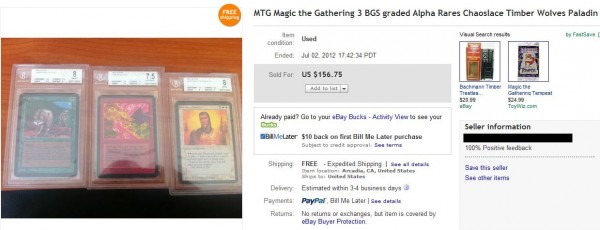
(A purchase I made on eBay leading up to GP Columbus)

I asked many contacts on site which vendor would be optimal to sell the Alpha cards to for maximum value. I even asked a couple of the different vendors for their opinions. Many of them suggested Strike Zone, so I headed to their booth. What happened next was highly unexpected.

I asked the person at Strike Zone if they’d pay well on Alpha cards and they seemed uninterested. There was a man wearing bright yellow sitting next to me, however, who said he would buy them. Turns out, it was Ogre, a guy who had his own booth. Because Ogre played in an “Alpha League”, which I had never heard of until then, he was highly interested in my Alpha.

Twenty minutes later we had just over $500 in deals on the table. After selling a few stragglers to Star City Games (who paid surprisingly well) I had made about $100 in profit from the Alpha cards I sold. I had difficulty moving the graded Alpha cards I bought, but I hope to eventually have some success with those on eBay.

Moving On

Many of you may not be interested in Alpha, but the point of this story was that profit can be had even selling to dealers. How many categories of cards can you buy from multiple individuals and sell straight to dealers for 20% profit (my average margin). Yet either people undervalue their played Alpha or dealers overvalue them. Either way, there is room for you to profit just as I did.

Another large sale I was pleased with was my SP Revised Savannah. I grabbed the card for $50 on MOTL a month ago and I was bound and determined to sell it for profit. I went from dealer to dealer asking them what they’d pay on the card and the first four dealers offered $50. Not good enough. I finally found a dealer selling their Savannah for $90, much too high. Sure enough they offered $60 on my copy and I snap-sold.

As for other sales, I made a surprising amount of money in selling sub-five dollar cards. I went from booth to booth and was delighted to see how many cards I could sell for just over bulk pricing. It’s a great feeling to get a buck on a card like Intruder Alarm, which sat in my binder for years. And no matter how many cards I sold to a vendor, the next vendor would identify more they wanted to buy.

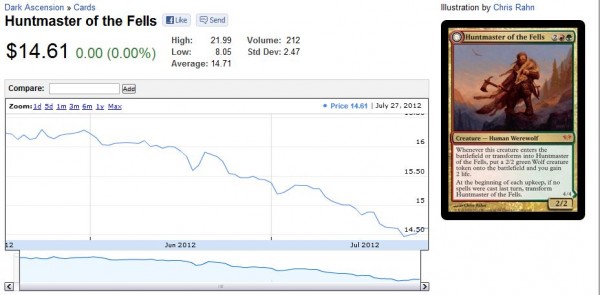
Equally surprising were the cards I couldn’t move for a fair price. Every vendor offered me a mere eight bucks on Huntmaster of the Fells!? (chart courtesy of blacklotusproject.com)

I understand the card has been declining in value, but I also feel it should be stabilizing soon. The card has demonstrated its power in constructed play, it’s a Mythic Rare from a small set, and it should be well poised to perform once rotation occurs. Dealers’ lack of interest was unexpected.

The Innistrad Dual Lands also fetched disappointing amounts at the dealer booths. Many offered one to two dollars on them and I know they will be worth more. One dealer even confessed that these cards were likely to jump in price yet he could not offer me a penny more. The charts at blacklotusproject.com agree with the upward trend, which should continue as rotation occurs:

Needless to say, I did not sell many Standard cards at the event. It seems dealers are much more willing to negotiate on older cards than Standard. I suppose this makes sense based on the apparent supply of Standard vs demand, especially during the “Dead Zone”, as Corbin put it.

Few Cards Showing Life in the “Dead Zone”

I wanted to emphasize the validity of Corbin’s observations in his latest article: https://www.quietspeculation.com/2012/07/insider-making-the-most-out-of-the-dead-zone/?ampt=2051172678

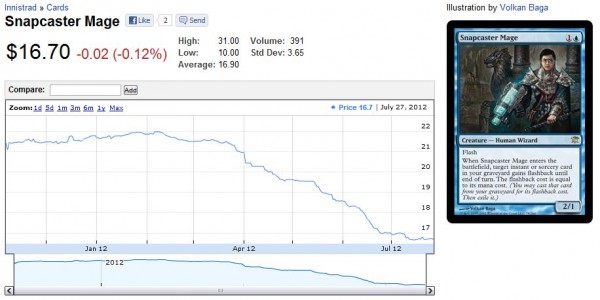
Independent of his article, I, too, have noticed the lack of inspiration this time of year. While I feel like Innistrad and Dark Ascension cards such as Huntmaster of the Fells and Geist of Saint Traft should be strong buys, their price trends do not reflect this. Standard staples like these have been on the steady decline. Even Snapcaster Mage has been hit by this “Dead Zone” (chart courtesy of blacklotusproject.com).

These cards are likely to be impactful in the new Standard and they will be even harder to find once Return to Ravnica is released. Yet, their prices are on the decline and it’s difficult to predict where they will end up. It appears based on their charts that their prices are almost stabilized and I may start buying soon, but not yet.

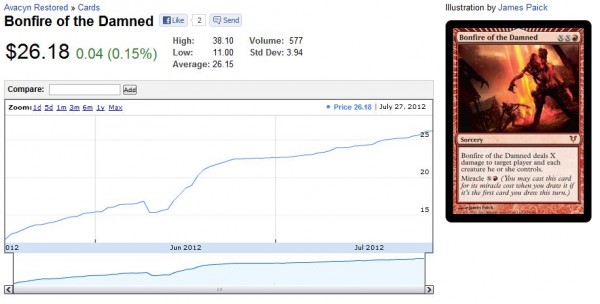
But just like the stock market, there is always a bull somewhere. Which cards are performing well right now? Take a look at my most recent fascination: Bonfire of the Damned (chart courtesy of blacklotusproject.com):

This is a trend I can get behind! And since I’ve been looking to pick up a set of these to play with in Standard, I happen to know firsthand that these cards cannot be found on eBay for less than $30 without ultimate patience. Star City Games is sold out of these at $39.99. Net, the upward momentum on this hot card is still there.

But how high can Bonfire reach? I am having a difficult time answering this question because there’s so little precedent in past Standard formats. When was the last time a red sorcery was the most valuable card in Standard??? Hammer of Bogardan from Mirage? Relentless Assault from Visions? Seriously, if you have the answer to this question I would be very interested in reading your thoughts on this one.

I don’t think there’s a single card in Standard hotter than Bonfire right now. But there may be other buys during this lull in speculation. Entreat the Angels is so powerful yet the card sells for as low as ten bucks on eBay. Innistrad Duals are on the rise yet they have not peaked. But as of right now, there are few sure things in the format.

Moving Forward

Once Return to Ravnica is released, Standard will coalesce into a more defined format. Hopefully it will be clear then which cards are all-stars and which ones deserve their downward trend.

Until then, it may be tempting to acquire the Standard cards you feel are viable in the new format. Cards like Snapcaster Mage and Geist of Saint Traft are at all-time lows, and if they are strong in the new Standard they should pick back up again. But if they aren’t, you could lose some significant value. The risk is yours to take in this scenario.

That is why I am moving in on Innistrad Duals, Bonfire of the Damned and Alpha rares. They seem like the cards with the most life in this “Dead Zone”.

In the mean time, perhaps it’s time to dig through my bulk commons and find as many Ponders and other $0.10 commons I can for the next Grand Prix, which will be GP Boston. Hope to see you there!

-Sigmund Ausfresser
@sigfig8

Basic Web Analytics for MTG eCommerce

Are you a Quiet Speculation member?

If not, now is a perfect time to join up! Our powerful tools, breaking-news analysis, and exclusive Discord channel will make sure you stay up to date and ahead of the curve.

Figuring out how customers find your website is perhaps the biggest challenge of running any online business. As the president of technology at MTG Card Market, my responsibility is managing our technology stack, marketing and infrastructure. That means I'm the guy in charge of web analytics and SEO, alongside UI/UX.

I've learned a lot building Quiet Speculation and I've been applying the same skill set to MTG Card Market. A basic primer on how to figure out your traffic sources and user behavior patterns seems to be in order for those starting their own sites.

I use Google Analytics and, while others use things like MixPanel, I'm used to GA and have been using it for 3 years. It's easy to use, easy to set up and tells me what I need to know. I can also automate reports to send my team on a weekly basis. I set these reports up once, deciding which variables and dimensions to map, chart and visualize, and they get automatically generated and shipped out on whatever time table I so desire.

Having an analytics package in place is an absolute non-negotiable for an online business. You simply need to understand where your traffic comes from, what your users do, how long they spend on the site and from which pages they exit. While there are dozens of other dimensions you can track, these are crucial. Going forward, this piece will be assuming the use of Google Analytics.

Communicating With Your Team

To supplement these automated reports and infographics, I do a weekly traffic report write-up that I send to the team. In the early stages of development and launch, you'll want to explain to your team exactly what the metrics mean, how they compare to previous timeframes and the business implications behind them.

Remember that the majority, if not all, of your team is non-technical. I'm the Geek of Geeks: the rest of the team are MTG players/traders and/or investors. They have no idea what a good "bounce rate" is, nor do they know how to read a page navigation summary visualization. They want to know the take-aways, actionables and forecasts.

One of our investors relayed some great advice he received from a mentor: He explained that I don't need to give him the whole story, just the 5 basic points that the executives need to understand.

Initially, I will explain the whole story to ensure a baseline level of competency on the team, but going forward I avoid rehashing the fundamentals. They can ask for clarification if they need it.

Different Traffic Sources

Direct Traffic: This is traffic that comes from a visitor typing in your URL (http://www.mtgcardmarket.com) or clicking a bookmark. This is not an especially useful number, since there is no one source you can verify. We hand out business cards and stickers at events, which can easily turn into a direct traffic referral. If you get a biz card and wish to visit our site, you'll just type in our URL in all likelihood.

Organic Search: Visitors who are searching on keywords relevant to your site's topic or name. We probably get a lot of people who search "MTG Card Market" in Google instead of typing in the full URL. Again, this tells us very little. Unfortunately, recent changes to Google Analytics make it impossible to know which keywords are being searched, so we have to play stupid guessing games.

Paid Search: Only applicable when you run an AdWords campaign, these visitors are directly correlated to the ads you pay to display on Google. I generally do not like this scattershot approach to traffic and publicity, so I cannot speak to the method any further.

Referral Traffic: This is the one you care about. We can break down exactly which sites are sending us traffic. It should come as no surprise that our biggest referrers are Facebook and Twitter, given that I have a large following on both channels. We use these channels to fire off deals, specials and to announce new rare items added to our site.

Knowing your referral sources is crucial, since you can easily target the effectiveness of different strategies. When I first started QS, I did nothing but put a link to my site in my forum signature on assorted MTG boards. That generated bout 100 hits a day, enough to bootstrap me into bigger and better things.

Coupon Codes for Tracking

Sometimes you can't track the referral source, as with the business card example above. In this case, you can opt to add a coupon code to the mix. Your eCommerce package should allow for this. In the biz card example, we could hypothetically include a coupon code on the card itself, like "BCARD001", that gives 5% off. (And no, that code is not active. Don't bother!) This way, we can check redemption logs to see how many of the biz cards converted into sales.

Derive the cost of a biz card, multiply by the number you give away, and compare that to the number of coupon redemptions. You've just figured out the ROI on business cards! Don't forget to account for the 5% hit on your retail price too.

What Are These Numbers?

Here are a few numbers that you'll want to focus on when learning the basics of your analytics package:

Visitors and Unique Visitors: Google Analytics can tell when you've been to our site before, and while we want to know how many of our visitors are returning vs new, that's a separate metric. The Visitors number tells us how many times our site is navigated-to. Unique Visitors removes all the duplicates and tells us, approximately, how many individuals are coming in. While it's harder to account for visitors using multiple devices, the number is accurate enough.

When you correlate your unique visitor count to your sales numbers, you can start to get an idea of what the average visitor is "worth", how many of them reliably convert into sales, and if you set up your Analytics right you can even see the path the user took through your site, from entrance to the closed sale.

New vs Returning: I personally like to keep this number close to 50%. The farther it deviates from 50/50, the worse, because we are either not getting enough new eyes on the site or we are not retaining enough customers. I'm glad to say that MTG Card Market is hitting this target very effectively on an ongoing basis!

Bounce Rate: Ever get to a site, finish the article and the X out? That's a bounce. Defined as a visit that leaves the site instead of viewing other content, a high rate of bounces is not disired. Bounces happen, but if it's over 30% you should be worried. You might want to make sure that other content on the website is easily accessible and has some solid incentive to encourage readers to keep reading.

Mobile vs Desktop: We designed MTG Card Market to be very mobile-friendly. I just spend an evening at a lecture on UI/UX design, and I learned that the average eCommerce site has a 90/10 split on desktop/mobile. This number is considerably higher outside North America, since most of Africa and Asia visit websites almost exclusively on mobile devices. As this number grows in North America, the importance of your mobile site grows too.

You also want to take into consideration that, in my experience, mobile users spend between 50%-80% less time on your site and visit fewer pages overall. Considering most mobile users are engaged in short, 2-minute bursts while waiting in line at the bank or on public transportation, you want to remove as many finger-taps as possible between the customer's first navigation and the point of sale.

Tying It All Together

While the world of analytics is vast and the dimensions you can track are almost limitless, this should give you a baseline level of competency when you fire up your Google Analytics account for the first time. Get creative and try to think about different ways you can mix and match dimensions to try to predict user behavior.

There are so many variables: perhaps you want to know how iOS users in Canada are finding your website. Maybe you're curious to see how many non-mobile users came from a link on QuietSpeculation.com. The rabbit hole goes far deeper than you can imagine, but if you're a creative scientist, there's no end to the correlations you can find.

As Barney Harford, the CEO of Orbitz.com, told me, you want to capture every single click of the user's mouse if you can. There's no downside to gathering data from Day 1, even if you have no idea how to use it. That's the beauty of data: there are usage cases you can't even imagine until you've already got the data.

Adventures in Qualifying: Grand Prix Columbus

Are you a Quiet Speculation member?

If not, now is a perfect time to join up! Our powerful tools, breaking-news analysis, and exclusive Discord channel will make sure you stay up to date and ahead of the curve.

What do you get when you mix one part road trip, two parts convention center, and a dash of thousands of Magic players? A Grand Prix of course! Hopefully you know of the Grand Prix this weekend in Columbus because you were fortunate enough to be in attendance. I talked a while ago about what an epic experience these large events are and Columbus was no exception.

Modern was the format to solve for this event and pros from all over showed up to walk the walk. Modern is becoming more accessible, so if you're still new to the format don’t let that intimidate you. Hopefully we will get the Ravnica shock lands back when we Return to Ravnica this fall but until then there are plenty of affordable decks to build.

If you are at all familiar with Modern, the Top Eight decks should be unsurprising. Here are the decks that made it to the elimination rounds.

  • Jund
  • Birthing Pod Combo
  • RUG Delver
  • 3x RWU Delver
  • Affinity
  • RG Tron

Cats, Insects and Spirits: All American Team

The big story of this event was certainly the All American Delver deck. With three copies breaking into the Top Eight, players will have to acknowledge this deck as a contender moving forward. The other decks were fairly typical known quantities.

I also played the new Delver of Secrets deck in Columbus. This summer I identified RWU Delver as one of the most underrated decks in Modern and began working with it. Before this Grand Prix, most players did not know this deck needed to be taken seriously. Now I’m sure players will be prepared for it. Rather than posting my own deck list from the event, I will post the three that were most successful.

Chris Piland
6th place at Grand Prix Columbus

Untitled Deck

Creatures

4 Delver of Secrets
2 Geist of Saint Traft
1 Grim Lavamancer
4 Snapcaster Mage
4 Steppe Lynx
1 Vendilion Clique

Spells

4 Lightning Bolt
4 Lightning Helix
4 Path to Exile
4 Remand
4 Serum Visions
2 Spell Snare

Lands

4 Arid Mesa
1 Eiganjo Castle
1 Hallowed Fountain
1 Island
3 Marsh Flats
2 Misty Rainforest
1 Moorland Haunt
1 Mountain
1 Plains
1 Sacred Foundry
4 Scalding Tarn
2 Steam Vents

Sideboard

2 Disenchant
1 Dispel
1 Grim Lavamancer
2 Kor Firewalker
4 Molten Rain
2 Relic of Progenitus
3 Spell Pierce


Shahar Shenhar
5th place at Grand Prix Columbus

Untitled Deck

Creatures

4 Delver of Secrets
4 Geist of Saint Traft
4 Snapcaster Mage
4 Steppe Lynx

Spells

1 Faithless Looting
1 Gitaxian Probe
4 Lightning Bolt
4 Lightning Helix
4 Path to Exile
4 Remand
4 Serum Visions
1 Vapor Snag

Lands

4 Arid Mesa
1 Eiganjo Castle
1 Hallowed Fountain
1 Island
1 Marsh Flats
3 Misty Rainforest
1 Mountain
1 Plains
1 Sacred Foundry
4 Scalding Tarn
2 Steam Vents
1 Watery Grave

Sideboard

1 Elesh Norn, Grand Cenobite
4 Gifts Ungiven
1 Isochron Scepter
4 Molten Rain
1 Smash to Smithereens
1 Sphinx of the Steel Wind
1 Unburial Rites
2 Vendilion Clique


Max Tietze
3rd place at Grand Prix Columbus

Untitled Deck

Creatures

4 Delver of Secrets
3 Geist of Saint Traft
4 Snapcaster Mage
4 Steppe Lynx

Spells

4 Lightning Bolt
4 Lightning Helix
1 Mana Leak
4 Path to Exile
2 Pillar of Flame
4 Remand
4 Serum Visions

Lands

4 Arid Mesa
2 Hallowed Fountain
1 Island
2 Marsh Flats
3 Misty Rainforest
1 Moorland Haunt
1 Mountain
1 Plains
1 Sacred Foundry
4 Scalding Tarn
2 Steam Vents

Sideboard

1 Annul
2 Kor Firewalker
4 Molten Rain
1 Negate
1 Relic of Progenitus
1 Smash to Smithereens
2 Spell Pierce
1 Surgical Extraction
1 Sword of War and Peace
1 Twisted Image

Let’s start with the most important fact about Red White Blue Delver: it has raw power. It puts the opponent on a clock immediately and then disrupts or delays their game plan. It also gets to play one of the most powerful creatures in Modern, Geist of Saint Traft. Lots of decks in the format simply fold to a six-power hexproof beatstick.

The deck plays out like a Zoo deck from Legacy. It casts a tier one creature on turn one and backs it up with awesome removal like Path to Exile, tempo cards like Remand, and the most efficient burn spells in the format in Lightning Bolt and Lightning Helix. Opponents who mismanage the game will be dead before they know it.

Taking It Out for a Spin

Even though I didn't make Day Two, I feel a small amount of pride for having chosen the right deck for the tournament. Clearly it was not my day. I realized this as I continued to draw opening hand after opening hand without a one-mana play and proceeded to draw my Steppe Lynxs on turn four or later. This is obviously not the way you want the deck to run. Here is my short event recap.

Round 1 – Bye

1-0

Round 2 – RG Tron

Many players use valuable spots in their sideboard for Molten Rain to make this match better. I say why try to improve something that is already amazing? In my opinion, no spots in your sideboard should be devoted to this match because you are a strong favorite. Your early clock and loads of burn spells are nearly impossible for the ramp deck to deal with. I was able to take this match down in two quick games.

2-0

Round 3 – RG Tron

After destroying my last opponent, I was feeling confident about this match and the event in general. I played well and even though I lost a game and then mulliganed to five in game three, I still took the match. If you are on the Tron side of this match, do not over-sideboard because you need the core of your deck to remain intact to make sure you can execute your plan.

3-0

Round 4 – GB Rock

For most of this match I thought I was playing against Jund and based my decisions on that. In reality, I was playing against a more controlling deck that closed out the game with Loxodon Warhammer. I don’t think that piece of equipment is viable in Modern, but it certainly did beat me up. If I had found red mana sooner in game two, my triple Lightning Bolts and Lightning Helix would have sent it to game three. This didn’t happen though and I picked up my first loss to a deck I felt I should have beat.

3-1

Round 5 – RUG Delver

This is basically a mirror match where they have the edge because of cards like Cryptic Command. My opponent this round beat me down soundly with an answer to every card I played in both games. I remember telling my friends how well I played in this match and how much that didn’t matter because of his sick draws. If RWU Delver becomes a big part of the format, we may see RUG Delver rise in popularity to combat it.

3-2

Round 6 – Sig with Birthing Pod Combo

It was great to finally meet Sigmund in person after talking to him online and working with him here on Quiet Speculation. It was also great to play such an intense match of Magic. All three games were insanely close and could have been won by either deck. In the end though, Pod won the match and ended my tournament.

3-3

Overall this deck is a blast to play but quite skill intensive. You must know when to use your burn spells on your opponents creatures and when to send them at your opponent. If you plan to play this deck, make sure you test some games against a variety of decks so you are prepared for the in-game decisions.

Next week I will hopefully have a great Standard PTQ report for you guys. First I'll need to figure out what deck I am playing.

Until next time,

Unleash the Force!

Mike Lanigan
MtgJedi on Twitter
Jedicouncilman23@gmail.com

Insider: Targeting Real Estate on MTGO

Are you a Quiet Speculation member?

If not, now is a perfect time to join up! Our powerful tools, breaking-news analysis, and exclusive Discord channel will make sure you stay up to date and ahead of the curve.

The announcement of the structure of the new Ravnica block has opened up a good speculative opportunity. The first set, Return to Ravnica, will consist of the Selesnya (G/W), Izzet (U/R), Golgari (B/G), Rakdos (B/R) and Azorious (W/U) guilds. Under the assumption that the Shocklands will be reprinted in the set where the corresponding guild appears, then Temple Garden, Steam Vents, Overgrown Tomb, Blood Crypt and Hallowed Fountain will appear in Return to Ravnica (RtR).

This will leave Sacred Foundry, Watery Grave, Stomping Ground, Godless Shrine and Breeding Pool to be printed in Gatecrash, the second large set in the block. These lands correspond with the Boros (R/W), Dimir (U/B), Gruul (R/G), Orzhov (W/B) and Simic (G/U) guilds respectively.

Given the information of the block structure and the assumption that Shocklands will be reprinted within the block, there is a distinct asymmetry which speculators should be aware of. Mana bases for decks that feature the guild colour combinations from RtR will be more robust in Fall Standard than the guild colour combinations from Gatecrash. Also, powerful multicolour cards will be appearing with the RtR guilds.

Having access to the Shocklands and powerful multicolour cards for half the guilds will skew Standard in the direction of those guilds. For a historical comparison, peruse the top 8 Standard deck lists from Worlds 2005, which featured 9th Edition, Kamigawa Block and Ravnica: City of Guilds.

Selesyna Crashes Worlds 2005

Japan broke out in 2005 as a Magic powerhouse, and their crowning achievement was placing 3 players in the top 8 as well as Katsuhiro Mori taking the title of World Champion.  The breakout deck of the tournament, which all three of the Japanese representatives played, was a Selesnya concoction featuring the token generators Selesnya Guildmage and Vitu-Ghazi The City Tree powering up Glare of Subdual.

Overall, 17 copies of Loxodon Hierarch and 13 copies of Temple Garden appear among the top 8 decks. The cards from the first Ravnica set skewed the environment strongly in the direction of the four guilds introduced therein. We can expect RtR to have a similar impact on Fall Standard.

In these decks, we can also see that redundancy in the mana bases is valuable. Painlands are present with Brushland, Yavimaya Coast and Underground River all making contributions to the stability of the mana bases. From a speculators perspective, this would indicate that we should examine M13 and Innistrad block for attractive real estate.

The core set duals have been printed enough that there is little upside to speculating on these. With Golgari and Izzet returning as guilds, the best bets corresponding bets are Woodland Cemetery and Sulfur Falls. Both cards will work well with their respective guild Shocklands and history indicates that these colour combinations will be over represented relative to the as yet unprinted guilds. Sulfur Falls also benefits from appearing in Modern U/R combo decks.

Applying a similar logic to the various utility lands from Innistrad block, the best bets to see play are Gavony Township and Moorland Haunt, which have both proven to be playable in Standard as well as Modern, where mana bases are robust. Desolate Lighthouse, Grim Backwoods and Stensia Blood Hall each might get some attention in Fall Standard, but they have not proven to be constructed playable as of yet so speculating on these is for gamblers only.

Return to Ravnica and Modern

Looking out beyond Fall Standard towards the Modern PTQ season starting at the end of year, there will be a plentiful supply of the new Shocklands but the same number of the old Shocklands.

For MTGO speculators, correctly timing the purchase of Shocklands has been a profitable endeavor and another opportunity has presented itself. Leading up to the new Modern season, general price inflation will occur for all Modern staples as speculators get on board and as players prepare for the season by rounding out their decks. But this season will begin with an abundance of half the Shocklands, the ones printed in RtR, and a dearth of the others - the ones to appear in Gatecrash.

For this reason, focusing on the Shocklands that are expected to be printed in Gatecrash is the best bet as the run up to this year’s Modern season will occur before the release of Gatecrash.

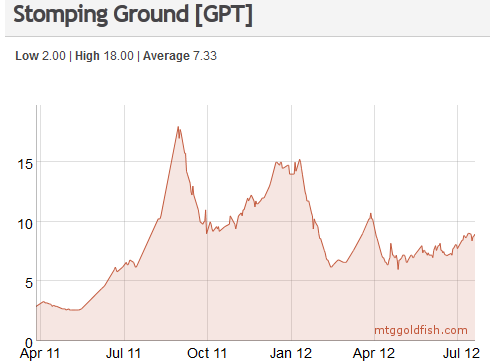
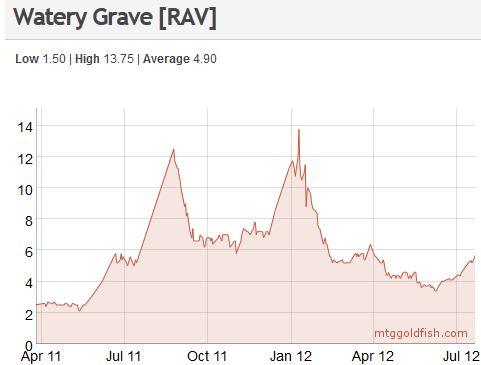
For MTGO, the Shocklands that appeared in Dissension have the highest prices, followed by Guildpact and then Ravnica: City of Guilds, showing the 3rd set effect well. The biggest swings in price occur for the scarcer cards, so Breeding Pool is the best overall bet, with Stomping Grounds and Godless Shrine in the second tier, and then Sacred Foundry and Watery Grave pulling up the rear.

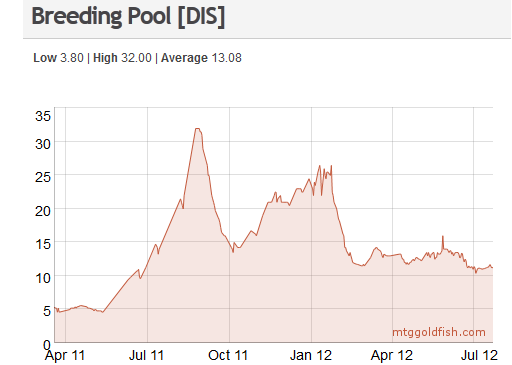
All charts courtesy of mtggoldfish.com which presents MTGO prices from supernovabots.com.

The chart for Breeding Pool shows a strong spike during the speculative frenzy that came with the announcement of the Modern format and then a drop followed by a rise and a secondary peak during last year’s Modern season. For this card, the actual playability of it in Modern matters little as the herd behavior of speculators and the scarce supply will inevitably combine to form a new price spike. Keep your eye on this card or get in now at the Modern era price floor of 10-11 tix, then sell into the market at or near the start of the PTQ season when prices will have risen.


Stomping Ground and Godless Shrine both have similar charts as compared to Breeding Pool, but with less pronounced peaks and lower price floors as one would expect from more plentiful rares. These cards appear in more decks than Breeding Pool, but not in great numbers. Stomping Ground is usually a one or a two of in Jund and Zoo decks, and Godless Shrine makes the occasional appearance in token strategies and Doran decks. Nevertheless, expect price increases to happen for both come November and December.

However, their current high prices of 10-11 tix indicate that upside is limited. Godless Shrine peaked at a little over 13 tix mid season and Stomping Ground peaked at 15 tix. Timing will be crucial to make a small profit on these, but if interest in Modern expands or the metagame shifts to favor these cards, then a higher price ceiling is possible. If prices soften in the Fall (as usually occurs during October release events), then keep your eyes out for prices in the 8 to 9 tix range. At that price, the risk reward ratio is more favorable and both would be a good buy.


As for the two other guilds appearing in Gatecrash, Dimir and Boros, their respective Shocklands represent riskier bets, so avoid these despite their lower absolute prices. The risk comes from the high amount of supply of Sacred Foundry and Watery Grave in the market, so price moves will be muted in comparison to Breeding Pool, Stomping Ground and Godless Shrine. If you had caught them at their Spring low, then you could have held for a small profit with little risk, but at this point they have risen in price such that the risk outweighs the potential gains.

Again, if prices soften, be prepared to buy. Both represent good value at 5 tix.

Hold the Phone

The one big caveat to this strategy is the instance that the Shocklands, in fact, do not return, or they return all at once in RtR.

The second possibility is doubtful as WoTC should rightly seek to spread out some of their most popular rares among the block as opposed to frontloading all the Shocklands in the Fall expansion. The first possibility, that Shocklands do not return, is not aligned with their goal of making Modern an accessible eternal format. By reprinting Shocklands, they will bring down the average cost of Modern decks.

Also, as Corbin has hinted at in his ‘Digging Up the Plants’ article, M13 being full of cards such as Farseek (over Rampant Growth) and Arbor Elf (over Llanowar Elves) point to the return of dual lands with the basic land type, i.e. Shocklands.

If you are a dabbler in speculating on MTGO and looking to get your feet wet with a couple of tix, go with Gavony Township and Moorland Haunt.

For those with a few more tix, add in Woodland Cemetary and Sulfur Falls but don't over pay for these! Watch the prices, look at historical charts and try to time your purchases to coincide with lows in the market.

And for those who want to try their hand at pricier positions, go with Breeding Pool. These are the surest bets presented here, and good opportunities overall looking out to Fall Standard and the Modern PTQ season.

Insider: Making the Most out of “The Dead Zone”

Are you a Quiet Speculation member?

If not, now is a perfect time to join up! Our powerful tools, breaking-news analysis, and exclusive Discord channel will make sure you stay up to date and ahead of the curve.

This is one of the worst times to be in Magic finance.

What do I mean by that? No, I don’t mean you should quit what you’re doing now, nor am I going to lecture you about how much it was “back in the day.” Instead, I simply mean this. We are in the “dead zone” of Magic finance right now.

When I played tennis in high school, I was late to the game. I started playing my Junior year, having never thought about the game before. I turned out to be decent at it and made it a game short of the state tournament with my partner, but in those first few weeks the biggest lesson I had to learn was about the “dead zone.”

In tennis, it refers to an area in between the front line and the back line where most of your opponents’ shots will land. Standing in this area is the worst. You can’t properly play the ball back because you’re neither close enough to the net to spike it, nor are you far enough back to wind up a shot. This was a hard lesson for me, and I screwed up tons of shots before I finally figured out how to best handle it.

In Magic, the dead zone refers to the time we’re in right now. M13 hype is out of the way and the set has already more or less made its impact on the format. Thragtusk spiked as expected, and will now come back down due to its inclusion in an Event deck. The impending rotation means that players are in a severe holding pattern with their cards. People don’t want Scars block cards, but they’re being extra careful with their Innistrad cards since they’ll be around. To top it off, with no idea what’s coming in Ravnica, people are scared to trade away what they might need.

In a change of pace for me, I’ve been able to attend several FNMs in a row (once football season starts I’ll be back to covering games every Friday), and I’ve had a surprising lack of trading partners at those FNMs. No one wants to part with their Innistrad dual lands, and, worst of all for me, they don’t know what they’re looking for. When people don’t know what they want, it’s hard to make much of a case for them opening your binder.

It will be like this until Ravnica spoilers start to roll in. I’ve cleared out nearly all of my Scars block stock as I’ve been suggesting, so I’m not losing much value in my binder, but it’s hard to turn stuff over at all.

Hence, the Dead Zone.

Making the most out of the Dead Zone

I have a few strategies I like to use during this time to ensure we can still turn some profit.

The first is stocking up on the easy-to-spot cards from the current sets, even if there’s not a ton of upward potential for them to move. For instance, look at Champion of the Parish, Restoration Angel and Silverblade Paladin. These seem like slam dunk creatures post rotation, especially since Champion can outgrow Bonfire range quickly. By the way, Bonfire is going to be the single most important card post-rotation. I know this, you know it, and everyone knows it. People love to play these Human decks, because they build themselves and are very solid on top of that.

The problem with everyone knowing it is that it means it’s already somewhat factored into the price. There’s some room to grow for both these cards, sure, but not as much as we’d typically like.

But here’s why I stock up on these anyway: liquidity. These are easy to move now, and I expect them to be even easier to move after Rotation. That means, even if we’re not making much money on what we get them in at (since we don’t expect a huge spike after Rotation), we can still make profit when we out these cards, merely because they will be so easy to move.

It’s the same principle that allows people to ask for premiums on Legacy cards (obviously to a lesser scale). If everyone wants a card, we don’t have to move it at the first opportunity. We’ll have plenty of chances, so we can wait for the most profitable deal to come along.

Like I said, it’s harder to get in as many trades right now as we could have a few months ago, but that means you have to make the most of what you can do. You take almost no risk by loading up on these cards, even if the trade you make at the time doesn’t look so great on paper. In fact, if somehow you’re able to move Scars block cards for soon-to-be staples like these, I don’t even mind taking a loss on a trade to set myself up for when the trading heats back up.

Other ideas

That’s not all we can do to use this time effectively.

Get out there and buy some collections. Scour Craigslist, ask around the store, even take to social media outlets if you must. You’re not going to have a better time to devote some hours to a project like this than right now. There’s a lot of money to be made in collection flipping if you do it right, and those hours you’re spending trying to grind trades in uncertain waters could be better spent elsewhere.

If that’s not your style or maybe you don’t have the capital to get going, I suggest turning to your own closet. We all have hundreds if not thousands of Magic cards sitting in boxes somewhere in our house, and, unless you’re a master, there’s money to be found here. Pull those Commons and Uncommons that are worth a quarter out of an old box. You may even find some hidden gems that got tossed aside like Mind Funeral. There’s a reason buying masses of cards sight unseen works well, and it’s because people just lose track of what’s around.

Figure out what the next big event you’re attending is, get in touch with a dealer, and move out some of these cards. Sort through your “bulk” rares and find the quarter and 50-cent ones hiding in the stack. You’ll expand your knowledge of sorting, and should be able to turn some money from doing so. As for actually selling out once you’ve done this, here’s a primer I wrote a few weeks ago that will help you along.

Back to the trade tables. Find that group of EDH players you don’t usually trade with. They’re less concerned about rotation, and there’s probably some good trading there. Go check out another store you haven’t been to before to find some fresh blood. It may require going up to the card shop or someone’s home on a different night than you’re used to, but it’s a valid way to spend your time during the Dead Zone. It may be less profitable than an “average” night at your usual store, but it’s a heck of a lot better than staring at the same binders over and over and banging your head against the wall.

Of course, there’s one other option worth mentioning: Just take a break. Grinding out value week after week is great and all (and you should), but everyone needs a break sometime, and this is a pretty good time to do so. Just hang out at FNM, spend time playtesting or playing casual games if you need to. Trust me, once Ravnica starts rolling in, the trade tables will kick back up again, big time. You don’t want to be burned out when that happens.

Conclusion

Like I said at the outset, we’re in a lame-duck period of Magic finance right now, but that doesn’t mean you can’t profit from it, even if it takes a different path than what you’re used to.

Thanks for reading,

Corbin Hosler

@Chosler88 on Twitter

Legacy Griffins: Food Chain, Manipulate Fate and Fun

Are you a Quiet Speculation member?

If not, now is a perfect time to join up! Our powerful tools, breaking-news analysis, and exclusive Discord channel will make sure you stay up to date and ahead of the curve.

So, I have to be honest: Tier 1 decks bore the hell out of me in Legacy.

I have sleeved up Sneak & Show, Reanimator, RUG Delver and even Stoneblade-whatever and brought them to tournaments. In addition to typically being very linear (here's looking at you, Sneak & Show), there's something unsettling about your opponent being able to map out your decision tree based off of your first fetch.

While all of those are solid decks that can easily win their share of matches, for me they are void of that little serotonin burst accompanied by doing something that I think is awesome.

What do I think is awesome? Well, here's one of my favorite plays. Ever.

I played that in BUG Control until the wheels fell off. Even if I had the Jace in hand, I didn't feel satisfied until I did close to nothing turn after turn except strip my opponent's hand and make stupid Worms.

After Team America turned bad and my manabase evolved into said BUG Control, which I rode for a couple months until Stoneforge started making 4/4 Invincible Germs, I sort of let go of the Intuition dream. Then the metagame shifted, as it always does, and I started playing whatever deck sounded remotely fun from Forrest Ryan's Legacy gauntlet.

But then something happened. A new card being printed actually caught my attention:

Meow.

So I ordered me some Food Chains at $1.50 apiece and picked up a playset of these birdies for $2 a pop at a local gaming store (Monster's Den in Minneapolis, Minnesota), since it seemed no one wanted to touch this poor blue card.

Just to be clear, the following two cards produce infinite mana that can be used to cast creatures:

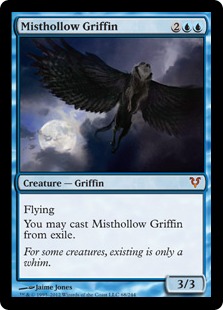
The Food Chain nets X+1. Since the Griffin can be cast from exile, you can just keep recasting it. If you need another color, just make two or three billion blue mana, then spend some of it to keep recasting the Griffin producing the new color of mana.

While at Monster's Den, I also picked up a playset of Manipulate Fates.

What's that? You have to read the card? Well, let me summarize it for you: A blue and a colorless, draw four.

(Obviously that's not true. I just like to pretend.)

Thus began the evolution of my current pet deck:

Food Chain/Food Fate/Griffin Chain by Tyler Tyssedal

Creatures

3 Misthollow Griffin
3 Fierce Empath
4 Noble Hierarch
3 Wall of Roots
3 Mulldrifter
1 Emrakul, the Aeons Torn
1 Aethersnipe
1 Griselbrand

Spells

4 Food Chain
2 Jace, the Mind Sculptor
3 Manipulate Fate
4 Force of Will
3 Daze
4 Brainstorm
3 Ponder

Lands

4 Tropical Island
2 Island
2 Forest
4 Misty Rainforest
4 Verdant Catacombs
2 Ancient Tomb

Sideboard

3 Spell Pierce
1 Flusterstorm
3 Tarmogoyf
2 Vendilion Clique
2 Surgical Extraction
3 Submerge
1 Krosan Grip

I brewed this in my living room while watching Psych on Netflix, which is a decent show to have running in the background. Only weeks later did I hop online to see what others were doing with it, discovering that people were trying to make Coiling Oracle and more creatures work, which I tested and fully disagree with.

For the record: Coiling Oracle rarely does what you want it to. It's either a bad Elvish Visionary or a weak Wall of Blossoms. I, instead, opted for Wall of Roots, which, as I'll get to later, can Chain into a Griffin immediately.

So I've been playing it for around two months now, tweaking it from week to week. It started out with Show and Tells, which I eventually cut because they weren't terribly fun to cast. Even though they stole some games, they also weren't very good against certain matchups and required more Emrakuls than I really wanted.

So what does this deck do well?

  • Well, it wins games. I have played in 7 Legacy tournaments in the past two months, most averaging between 16 and 30 players, Top 4ing six of the seven. A lot of this may have to do with other factors outside of the deck's control, such as my opponent's decks, the parity of my and my opponent's play skill and my love of winning on the backs of stupid bird things.
  • It has a solid matchup against Maverick and, it seems, RUG Delver. If there were a kryptonite for this deck, I would say it's Bant/New Horizons, but that's just from my play experience.
  • It's also elusively impressive, as no one counters the Manipulate Fates unless they have seen you play before, which is sort of what happens after a while. Or read an article about it, I guess. But still. Manipulate Fate? Really?
  • It can blow up out of nowhere. Evoking with Food Chain on board nets 3 mana with Mulldrifter and 4 mana with Aethersnipe, which can let you just blow up with a mere Noble Hierarch on field.
  • It beats Karakas and Moat.
  • It also has some nut draws, which I can get to later.
  • It meets my criteria for being both fun to play and actually competitive. I started off believing it was around Tier 5, but each win and refinement has slowly crept my opinion of the deck up to being in that ambiguous zone of "good enough". Whatever that means.

So what does this deck do badly?

  • Win against a resolved Humility, since your Aethersnipe no longer does anything.
  • Mulligan, I guess.
  • Convince your friends it isn't terrible.

Cool things.

Turn two kill

When your opponent has no T1 disruption or permission and you're on the play.

Turn three kill

You may be wondering, "What's up with that Griselbrand? That costs four black! And you're not cheating nerds in with Show and Tell, Sneak Attack or Reanimate! You're stupid!"

And you'd be right on all accounts. But the thing is this series of plays:

Turn 1: Play Tropical Island; Noble Hierarch. Say go.

Turn 2: Play Ancient Tomb; Food Chain. Say go.

Turn 3: Play Fierce Empath. Fetch Aethersnipe

Chain away the Noble Hierarch, evoking the Aethersnipe. Sacrifice trigger on the stack, target the Fierce Empath, remove the Aethersnipe to the Food Chain for 7 green mana.

Recast the Fierce Empath, get a Griselbrand, remove the Fierce Empath for black, cast the Griselbrand. Then you can either draw a bunch of cards, getting a Misthollow Griffin and another Empath or an Emrakul. Win. Or say go.

Ramp with evoke

It's not a secret, and I mentioned it earlier, but with a Food Chain on board, you can evoke a Mulldrifter and respond to the sacrifice trigger by removing it from the game with Food Chain. This little interaction nets you three more mana than you had before. You can evoke an Aethersnipe and do the same thing, netting four mana.

This can actually be really helpful when you need just that little boost. It's also really fun to drift into another Mulldrifter, which you can then hard cast and go to town with 2/2 flyer beats.

Set the clock with expensive birdies:

There's more I'd like to say

But this just about does it for me. I really enjoy playing this deck. It's competitive enough that the funness of doing cool things isn't crushed by 0-X records. While I don't expect it to dethrone Delver, as that deck is bonkers, I wouldn't be so quick as to write it off as all out trash.

I know that SCG has done a few deck techs with builds trying to do similar things, but I feel that this list is superior to other builds in many ways. Maybe that's just, like, my opinion, man, but there's a reason I play it week in and week out.

I also wouldn't sleeve up my list, as it's my baby and I don't want you taking my baby.

GP Columbus: Of Islands, Faeries and Misplays

Are you a Quiet Speculation member?

If not, now is a perfect time to join up! Our powerful tools, breaking-news analysis, and exclusive Discord channel will make sure you stay up to date and ahead of the curve.

I have a Vedalken Shackles. What could possibly go wrong?

These were the words that went through my mind as I threw away my perfect performance at GP Columbus.

It was round five and I was playing Faeries against Josh Rayden’s UWR Delver. I tapped low for what I had hoped would be a back-breaking Shackles, but he casually drew and played Geist of Saint Traft. It turned out he could break those cuffs.

I couldn’t believe how loose my play was. I’d like to blame it on sleep deprivation, but the real problem was that I hadn’t played a deck like Faeries in over a year. My list was sub-optimal and my play was of the same nature. Honestly, I don’t even think that Shackles belongs in the deck in the first place - a conclusion that I would have reached with some minor testing.

After punting round five, I went on to punt round six and ultimately lose round 9 to finish 6-3 and not make day two. All things considered, I believe that Faeries is among the best decks in Modern and if I had another Modern tournament to play in I would only make minor changes to my list.

For reference, here is what I played:

Faeries

spells

4 Spellstutter Sprite
4 Scion of Oona
3 Mistbind Clique
3 Vendilion Clique
2 Snapcaster Mage
4 Mana Leak
4 Remand
4 Cryptic Command
1 Dispell
1 Dismember
3 Spell Snare
2 Vedalken Shackles

lands

4 Mutavault
1 Faerie Conclave
2 Tectonic Edge
18 Island

I was very happy with my choice of deck, but there are some clear problems with the list. Here’s an overview of what worked and what didn’t.

What Worked

Spellstutter Sprite, Remand and Mana Leak

I completely stand by playing all four copies of these two-mana counters. Spellstutter Sprite belongs for obvious reasons, but it is my understanding that many Faeries lists are not playing the full eight Mana Leak and Remand. By filling up this slot the deck has the best ability to fight both opposing three drops and counter-wars. The clearer you can keep the board in the early turns, the more powerful your Cryptic Commands become - as if they needed any help.

Cryptic Command

My friend Jens and I used to joke that Cryptic Command’s text should just be “Pick two.” Let’s be real, this card does everything. It counters, it cantrips, it fogs, it Stone Rains. Play four. No exceptions.

Vendilion Clique

Vendilion Clique was largely underappreciated when it was first printed, but the community has caught up at this point. The only thing that I’m not 100% on is whether or not to add a fourth. While it is true that the fragile body allows most decks to kill Cliques very easily, I still found it surviving in a surprising percentage of games. The ability to target yourself and wheel extras might be enough to sell me on the full four-pack considering that I just intend to counter all of their spells anyway.

Spell Snare

This card is extremely efficient and has so much value in games when you’re on the draw. There were four in the list that I was given and I definitely think that I was wrong to cut one.

What Needed Improvement

Vedalken Shackles

For the most part, this card was stinky. Faeries is so good at countering opposing threats that generally only one-drops are able to sneak by. The major problem with Shackles is that in most situations you can’t cast it without leaving counter mana up. Generally you’ll want to leave this mana up until the end of your opponent’s turn, which more or less means that your Shackles double time-walked you. All of this tempo loss when the problem is most commonly a one drop is painfully bad. I would easily cut these in favor of a second Dismember and a Repeal.

Scion of Oona

I showed up in Columbus with no intention of playing Scion, but Josh Rayden ended up talking me into it. I was of the impression that it was terrible and he was of the belief that it was one of the best cards in the deck. We were both wrong about it. The card is the very definition of okay.

It serves as a counterspell and/or a flash threat, but it does both of these jobs rather poorly: the counter being very narrow and the threat often being underwhelming. It certainly sped up my Mutavault clock by a turn or so a few times, but it never at all mattered in a close game. I could easily see cutting these guys from the deck entirely.

Faerie Conclave

I never activated this card in a game that I won and I lost at least one game to it coming into play tapped. Personally, I would cut it for an Island, but I wouldn’t fault anyone for replacing it with another Tectonic Edge.

Moving Forward

As I said above, the biggest problem with the deck was the inability to effectively deal with one-drops. The strong counter-suite is very good at locking opponents out of the game starting on turn two. Bounce spells are possibly the best option to answer one-drops, as they can be Spellstuttered on their way back down.

Vapor Snag is worth considering as it efficiently deals with more expensive creatures as well, but I’d lean toward Repeal as there isn’t much in the way of card draw in the deck. It’s also just insane against Insectile Aberration.

Faeries is so insane against any sort of combo or midrange deck while still being competitive against aggressive decks that I’m surprised it didn’t post better numbers in Columbus. I suppose that this is in part my bad.

Hey, what happened to that sweet Grixis deck?

A couple weeks back I wrote about the Grixis deck that I played during the last Modern PTQ season. I was really happy with the deck last year, but I think that Restoration Angel has completely invalidated the deck. I don’t feel that fair decks can reliably beat the Angel decks without being able to consistently counter Restoration Angel. Not only does it generate insane value in tandem with cards like Kitchen Finks, but its four-toughness backside is just tough to deal with in the first place.

~

I understand that Modern isn’t super relevant as of now, but I also don’t think that the format is going to change very much between now and the next PTQ season. If M13 is any evidence of where power levels are trending, then there shouldn’t be too many cards that will shake up Modern in the coming months. If nothing else, it’s probably a very good deck to run through dailies in the meantime if Modern is your format of choice.

Good luck, high five.

-Ryan Overturf

Insider: Following Up

Are you a Quiet Speculation member?

If not, now is a perfect time to join up! Our powerful tools, breaking-news analysis, and exclusive Discord channel will make sure you stay up to date and ahead of the curve.

Today I wanted to follow up on a few items I've discussed over the last couple months, and see if we need to update our opinions. Following up, in general, is one of the most important things in business. It's the #1 thing sales people need to learn to close deals. It's how managers check in on project progress. It's also how you make sure the decisions you made in the past are still sound.

Just like when we play Magic, each turn you need to "follow up" on what your plan was prior. No matter what. Sure, I should have played this 3 drop last turn, but I didn't. Do I just not cast it the next turn either to validate the misplay? No, you update your beliefs, and make the best play now, regardless of what happened previously. The same can be said for speculation and trading.

Snapcaster Mage

This one is really a follow-up to a follow-up. I had initially felt Snapcaster would bounce back after the banning scare, and then followed it up by looking at it a bit more in depth. Nothing has really changed since then, so you either liked my reasoning or not, but it hasn't rebounded, and it hasn't fallen much further yet. I'm still in the camp that sees this card hitting $12-15 retail in the next 6 months.

Thragtusk

Last week, I noted that Thragtusk was sold out nearly everywhere, and I'd want to be getting rid of these while they are hot. Well, new developments since then, since there will be an Event Deck containing the 5-drop Beast. StarCity's buy price sits at $6, even though they are sold out at $15 retail. This tells me that they are also anticipating the card to drop fairly quickly.

If they are sold out, that means they can move that card pretty quickly if it were in stock. So for them to be buying at only $6 tells me that even in a quick turn around time, they don't want to be stuck with these at the expense of their margins (and who can blame them). I initially thought it would be around $6, but would have to wait for rotation to see its time in the spotlight. Looks like I missed out on this early hype, but the long term price I'm still feeling good about.

Onslaught Boosters on MTGO

I presented the thought of buying into Onslaught Boosters during Cube season, and it faced some amount of skepticism. According to MTGGoldfish.com, prices have fallen on those boosters by about 10% since that article, and the Cube season has ended. Only time will tell if the prices will come back up. It looks like WotC has, at least, attempted to correct the issue that came up with Time Spiral packs in the last cycle, by offering Onslaught drafts for a full week during this "lame duck" no-M13 season, giving people an opportunity to use up these packs.

It certainly appears to have prevented a huge drop in price, and may be just the right move. If this turns out to be how they will repeat this process going forward, then we'll have a better idea of how to predict the price movements. The good news? It's not too late to make a move on these if you think they'll come back up, which I do. The bad news? They didn't fall nearly enough to make a huge windfall when prices do recover.

Cathedral of War


In my Coreset review, I thought this card was a steal at $4, and it's climbed up to $5 since then. I expect it to hit around $6, and will be hanging on to mine until then. While it may or may not see competitive play, casual appeal will keep this card afloat. (Have you seen that art?)

AVR Set Redemptions

I feel like we nailed this one pretty good. As expected sale price of the completed listings on Ebay has fallen by about $10-15 over the last month, (about 10%) and Bot Prices to buy the cards on MTGO have fallen by about $.20 on average (just over 10%). This could mean that there is still some room to make money here, even though I initially felt it was time sensitive. I will note, however, that there are a handful of listings that went unsold on EBay, so be prepared to sit on the sets if need be.

Trading for (not) Value

Last week I told a story about a recent trading experience, and got some great feedback on alternate ways to deal with such situations. Check out the comments since then, if you haven't already. Also, for completeness, I want to add that I've since talked with the friend mentioned, and it turned out that I was able to sell the cards he traded me for more than what I would have gotten for the Foil Command Tower.

I told him, by the agreement we came to, I'd work something out with him on the next trade. The important part of laying your priorities out on the table when you trade, is following up with your trade partner if things didn't turn out as expected. Especially if you plan to trade with them again in the future, keeping their respect is paramount.

I hope you guys enjoyed the peek back over the last couple months. I'm about to dive into another M13 draft, you should do the same! I love that I'm able to still flip Rancors back to the store towards more drafts before that card falls to the "dime a dozen" category.

Jason’s Archives: The Boon of Twitter, Food for Thought, and All GP’s All the Time

Are you a Quiet Speculation member?

If not, now is a perfect time to join up! Our powerful tools, breaking-news analysis, and exclusive Discord channel will make sure you stay up to date and ahead of the curve.

Greetings, Speculators!

What a difference a Twitter account makes!

I went to the Grand Prix in Columbus this last weekend. With few exceptions, I've made it to every Grand Prix this year within a six-hour drive from Michigan, including an excruciating marathon to Orlando. There is no better place to sell off collection chaff or grind a binder. Artists I like are frequent guests at Grands Prix and a lot of my friends from the area make the trip down as well. But having been very late to the party in getting on Twitter, I was blown away by the difference tweeting had on my GP experience.

If you're not on Twitter, I certainly can't say anything to admonish you because I resisted it as well. It seemed at first to be a medium for the narcissistic to broadcast the minutiae of their lives to an audience of people who themselves are more interested in their own minutiae than other people's opinions. There certainly is an element of that on Twitter. But like most slow adopters of technological trends, once I see the value in something I become a big advocate of the new technology.

Twitter Will Make You Better at Magic

Magic is more than just a game at this point. Magic is a community, and the difference between a community and a disparate group of autonomous players is connectivity. So how do you stay connected after the tournament hall is empty save for the janitorial staff left to sweep piles of Essence Drains off the floor and launder the smell of nerd funk out of a thousand tablecloths? Typically everyone piles into their cars to trek back to their separate LGS to brew in isolation until the next time comes to converge. But does it have to be that way?

Twitter helps your playgroup expand into hundreds of other playgroups. It lets you bounce ideas off of more people than just your team members. It helps you see which cards people are picking up, what's getting played, which cards other players are looking to sell and why. It helps you keep on top of aspects of the game that don't involve playing and speculating. It helps you get info on Friday night that others will have to wait for Monday morning to read about.

Like anything else, Twitter is a tool, and you can either use it to your advantage or ignore it to your detriment. But only by seeing what an advantage it afforded was I able to fully appreciate just what a detriment ignoring it truly was.

Who You Meet at a Grand Prix

For me, the real advantage of post-Twitter Jason over pre-Twitter Jason is the number of personal connections he's made with successful Magic financiers who don't necessarily publish articles or own stores. At this Grand Prix, more than at any in recent memory, I met in person dozens of people whom I knew from conversations on Twitter. It was a gratifying experience.

If you don't have Twitter, I would recommend signing up. The amount of solid Magic information out in the open is astounding, the connections you make will help you improve as a player or trader or financier, and your appreciation for all aspects of the game will deepen. Trust me, it's not all a bunch of nobodies telling everyone what they had for lunch.

That's Instagram.

Speaking of Lunch

Anyone else hungry? I found some culinary Magic delights for you this week.

Enjoy having a purple tongue for a week after eating those black ones.

Redditor Darthcampfyre brings us this recent pic of some Magical cupcakes concocted by a friend of his. Luckily for me I only have four friends so there are enough for everyone.


Always with the black frosting!

RogueDiamond used this cake as an opportunity to let Reddit know he had a girlfriend. A pretty talented one, at that. I for one am jealous that he has a girlfriend.

Girlfriends are so much better than wives.


Don't like cakes? A cookie can just as easily be decorated as a cake, and the detail achievable with icing on a flatter surface can be impressive.

These could be used as counters to track your life from 20 to diabetes.

The blog "Not your Mama's Cookie" was the source for these delectable-looking morsels. The full blog article can be found at this weblink.

Unless you're Martha Stewart, I'm guessing your first attempt at Magic cookies wouldn't go so well. A little digging turned up another useful site.

Geek Crafts provides a guide with a few tips on how to stencil the designs and apply the base color icing. (Don't be a hipster; frosting a cookie before it's cool rarely goes well.)

For reference, Geek Craft's cookies looked like this:

Proper color wheel arrangement makes all the difference


The cookies used to represent poison counters contain laxatives. Block accordingly.

Finally, the mttgfan tumblr account provides this (super timely) pic of some themed cookies from a few sets back. Check out the blogpost here.

An Embarrassment of Grands Prix

With a whopping three Grands Prix this weekend (São Paulo, Columbus and Ghent) there was a lot of Magic going on. Rehashing São Paulo doesn't do us much good since it was Limited, so let's plow right ahead and eat our dessert first by talking about the Legacy Grand Prix in Ghent.

Top 32 Legacy Deck Lists

Perhaps nothing was all that remarkable about the decks that did well. The standard variety of eight different decks gracing the top eight, nothing really all that new.

One deck with real potential that didn't fare as well as its designers may have hoped was piloted by a few players. These brave souls were using Show and Tell to cheat in a copy of M13 newcomer Omniscience.

Everyone knows how fun it is to Show and Tell an [card Emrakul, the Aeons Torn]Emrakul[/card] into play. It's even better to cast that [card Emrakul, the Aeons Torn]Emrakul[/card] with Omniscience, netting the extra turn and drawing tons of gas off your also-free Griselbrand. Omniscience is a pretty bad card when you're paying its mana cost, but with Ancient Tomb and Lotus Petal to increase the chance of a turn one Show and Tell, Omniscience starts to look pretty good. It goes without saying this deck is built to take advantage of [card Show and Tell]Show and Tell's[/card] symmetrical effect, while your opponent is merely getting discounted Goblin Lackeys and Mother of Runes.

One innovation we saw from event winner Timo Schünemann was his use of Gitaxian Probe. In my article last week I mentioned that Past in Flames and Burning Wish aren't entirely dead but rather are beginning to make a comeback in Ad Nauseum Tendrils lists. Gitaxian Probe, while a liability in Ad Nauseum decks, is a powerful tool that allows you to plan your turn, [card Cabal Therapy]therapy[/card] with precision and draw out countermagic. It's also a free cantrip in a deck that loves cantrips when it's time to cast Past in Flames. Congratulations to Timo Schünemann and the rest of the top eight field in Ghent!

I'm sure what we all really want to hear about is Modern, so let's dive right in.

Modern Decklists

First time Day 2 competitor Jacob Maynard piloted Robots to great effect, winning the event with an odd mixture of mulliganing to five and then topdecking like a champ.

Is this deck a fluke or is the incredible power of an unblockable Etched Champion coupled with the explosiveness of Cranial Plating too much to deal with? Only time will tell.

While Kiki-Jiki, Mirror Breaker was the hot money card of the weekend, it only saw play in one top eight deck. Copying utility creatures and offering up token sacrifices for Birthing Pod, this card gives the deck a lot of options. Only time will tell if the price spike was due to insane demand or a cornered market.

Another card I couldn't keep in my binder was the innocuous-seeming Eiganjo Castle. At first glance this is an EDH-only card that screams "bulk rare," but closer inspection reveals it to be the perfect enabler to help Geist of Saint Traft attack with confidence. Obviously a poor choice in Legacy, teeming as that format is with Wasteland, it has a home in Modern which makes it excellent trade bait. With three decks running Geist of Saint Traft in the top eight, Castle could be here to stay.

One more oddity was Orrin Beasley's Jund list which contained a baffling choice: Rakdos Augermage. I think this latest inclusion means every Magic Invitational card has been used in a deck that made top-eight at a GP or better. (If I am wrong correct me in the comments.)

Tron continues to be a factor with turn three Karn, Liberated ruining a lot of lives this weekend. Local hero Caleb Estrada opted to run RG Tron, a relative newcomer to a format ruled for a long time by UW variants.

But the main story is that [card Delver of Secrets]Delver[/card] continues to impact all formats. Easily the most influential card printed in recent memory, Delver launched three players into the top eight with quick beats, permission and more removal than you can shake a stick at. Steppe Lynx was a force to be reckoned with all weekend long, dealing loads of damage and capitalizing on the explosive power of fetchlands. The WUR delver list is tier one with a bullet and should make everyone's testing gauntlet.

Now to Make like Doran and Leave

With under a month until Gencon I'm busy putting together my trade binders and making last minute arrangements for the trip. If you're there, follow me on Twitter to find out where I am and when. That's what it's there for.

Jason Alt
@JasonEAlt on Twitter

Insider: GP Columbus and the state of Modern

Are you a Quiet Speculation member?

If not, now is a perfect time to join up! Our powerful tools, breaking-news analysis, and exclusive Discord channel will make sure you stay up to date and ahead of the curve.

Grand Prix Columbus was a great time - I was there - and it pulled in almost 1,050 players, which is impressive for a format that people seem to hate on the internet. Most of my opponents had not played the format before, but just about everyone expressed that they thought it was a fun format that they'd like to keep playing. That makes me happy because Modern is a personal favorite format. I'm sick to death of Jace and Stoneforge Mystic. Modern has a nice pace and a deep cardpool that lend themselves to good and inventive deckbuilding.

The one thing that Modern lacks right now is a robust non-WOTC tournament scene. Time after time, I've been reading from people online that their store had Modern for awhile, but nobody came. I don't believe that this is an issue due to lack of interest in the format, though. Columbus had over a thousand people there, many international players who weren't just trying to get pro points. Locally in Columbus, we had two tournaments with over 50 players - put on by interested traders and store owners, not WOTC. The key to getting well-attended events is advertising them effectively and getting the word out. I wish that there was a formula for this; I've even attempted to get events going in Cincinnati, but I haven't found a store owner yet who is willing to work to get something going. Financially, getting a Modern scene going in your shop is great; it blows wide open the demand for older cards. Both store owners and traders benefit from more people playing Modern in a shop. My hope is that with Return to Ravnica, people will want to get a lot more use out of the shocklands that they open and maybe give Modern a try - the barrier to entry based on lands is an oft-cited criticism of the format.


The individual tech cards at GP: Columbus

First, here are all of the T8 decks.

One of the most popular decks was UW/x tempo-control with Vendilion Cliques and Geist of St. Traft. Both cards are Legends and die painfully to Pyroclasm and Volcanic Fallout, so the hot card the morning of the event was Eiganjo Castle. Castles were selling for $7 and up before the tournament. I love the card in theory, but it has a few flaws that make it not a sure bet. First, it's not fetchable, which would not matter as much except for the fact that card draw and filtering in Modern is pretty bad. Next, it's a bad color; you want White as a support color, but it's not great to have in the opening hand. Finally, the Castle is really mana-intensive. If you play Geist of St. Traft on the third turn, you're still exposing him to Pyroclasms on the next turn. You've got to hold off on a lot of plays to make sure you keep Castle mana up. Noble Hierarch definitely lessens this problem, but it's still an issue. I played UR Tron and never feared the Castle; my Pyroclasms hit home on every old ghost that popped up.

Another tech card is Linvala, Keeper of Silence. You know that this lady is good against the Pod mirrors; the Yokohama Pod players would just scoop up in the face of her, it's that good. She is why Combust is still a reasonable sideboard card for Pod decks and also why another piece of tech has been showing up. Zealous Conscripts is also not much of a secret at this point, but it does steal Linvala and let you combo off (or sacrifice her to your Birthing Pod). Conscripts, incidentally, will make infinite tokens with Kiki-Jiki because you can target your own Goblin and untap him over and over.

Next, Restoration Angel demonstrated that she is here to stay. Not only has the Angel made appearances in the Naya Pod decks, but she's also the bedrock of all the Snapcaster control lists we've seen bouncing around. My friend and teammate, Brian Demars, made 9th place in Columbus and ran several of the saucy angel in his deck. The scary thing about UWG 'good stuff' decks is that they have flash monsters on 2, 3 and 4. They don't ever have to tap out to make a threat against you, thanks to that critical mass. That is dangerous in a slower format like this.

Finally, keep an eye on both Fulminator Mage and Molten Rain. The latter is particularly harsh because it hits everything, not just nonbasics. This is a level of land hate that we're not going to see again and if your deck plans on winning through dealing damage, then this is a sharp card to get a set of. I predict that Molten Rain will continue to be a hot uncommon.

Affinity Prevails, Citizen

Affinity is not respected enough, apparently. The T8 decks run a pitiful count of artifact hate cards, apparently forgetting that an Ornithopter with Cranial Plating will still turn you into paste. It is therefore not surprising that the banner aggro deck of the format won the whole thing. I heard people remarking that "a tuned aggro list could smash this event" and that mystery deck just turned out to be Affinity. While none of its monsters really scare me on the individual level, Affinity can outlast a lot of decks with its little guys. The Plating off the top is scary, but the Steel Overseer on the first turn that gets everyone out of Pyroclasm range immediately is also scary. The Nexuses pumping each other gives the deck a good long game. I don't believe that Blood Moons are the right call on the sideboard any more because they don't actively do much to win you the game and all of the Tron decks just seamlessly work around The Bloodening. Maybe the aforementioned Molten Rain is the better call.

Financially, Arcbound Ravager and Etched Champion continue to be solid bets. I think Steel Overseer is better in Affinity than Arcbound Ravager is because its effect works better with manlands and Ornithopters. All three of these cards are good Modern acquisitions, but I wouldn't trade highly for them unless you foresee Modern coming to your area. At QS, we've been on top of Etched Champion for the better part of a year and I'm glad that the WOTC commentators named it as the card of the event. It's one great piece of reach for Affinity and singularly causes a lot of problems for other decks.

So many singles!

The other interesting thing about so many of these lists are the strange singleton cards. Orrin Beasley had the really bizarre Rakdos Augurmage in his Jund maindeck. I can understand running powerful singletons like Vedalken Shackles, but nobody played Drillbit Taylor when it was legal in Standard! I suppose it functions as a pseudo-Liliana, either holding an x/3 at bay or forcing some mutual discard. Max Tietze had a Twisted Image on hand, which has a lot of good corner applications. For sure, I want it against Pod - it kills Hierarchs, Birds and walls. It blows up Spellskites and Ornithopters. I cannot, however, see it being strong enough to bring in if I'm only going to value-kill 4 or 8 cards in an opponent's deck. There's a lot of fun in running singletons, though - it's fulfilling to cast one at the right time and take control of a game. My friend Brian had an Oust in his sideboard, which is one of his pet cards, along with a single Harm's Way.

Contemplating all that, please note that Gavony Township is the real deal in Pod decks. If your opponent has to kill you in a fair manner, then getting Township going and just making aggro happen is really hard to deal with. One game I witnessed had an opponent die to a pair of 4/5 Birds of Paradise, for example - while the Snapcaster Mages in his hand sat useless.

Making Modern happen for you

One reason that I'd like to get Modern going locally is that I want to get an article series out of it - starting a tournament scene is challenging and everyone would like a blueprint for success. I'd wager that the best way to make money on Modern as a casual trader at your local store is to get people interested in having an event with real prizes. From there, you can build a base of people who want cards for their Pod list, their Affinity deck or their Control variant. Those Cryptic Commands in your binder start getting more attention. If I have anything good to report, I'll definitely fill you in on how this goes. If you have had success or failure in getting Modern started in your area, what factors influenced the final outcome?

Until next week,

Doug Linn

Want Prices?

Browse thousands of prices with the first and most comprehensive MTG Finance tool around.


Trader Tools lists both buylist and retail prices for every MTG card, going back a decade.

Quiet Speculation