If not, now is a perfect time to join up! Our powerful tools, breaking-news analysis, and exclusive Discord channel will make sure you stay up to date and ahead of the curve.
Welcome to the MTGO Market Report as compiled by Matthew Lewis. The report will cover a range of topics, including a summary of set prices and price changes for redeemable sets, a look at the major trends in various Constructed formats and a "Trade of the Week" section that highlights a particular speculative strategy with an example and accompanying explanation.
As always, speculators should take into account their own budgets, risk tolerances and current portfolios before buying or selling any digital objects. Please send questions via private message or post below in the article comments.
Redemption
Below are the total set prices for all redeemable sets on MTGO. All prices are current as of June 5, 2018. The TCGplayer market and TCGplayer mid prices are the sum of each set's individual card prices on TCGplayer, either the market price or mid price respectively.
All MTGO set prices this week are taken from GoatBot's website, and all weekly changes are now calculated relative to GoatBot's "full set" prices from the previous week. All monthly changes are also relative to the previous month's prices, taken from GoatBot's website at that time. Occasionally, full set prices are not available, and so estimated set prices are used instead. Although Hour of Devastation (HOU), Amonkhet (AKH), Aether Revolt (AER), and Kaladesh (KLD) are no longer available for redemption, their prices will continue to be tracked while they are in Standard.
Redeemable sets are highlighted in green and sets not available for redemption are highlighted in red. Ixalan (XLN) and Rivals of Ixalan (RIX) officially go offline for redemption this week, but as announced on the MTGO client home screen, both sets are being reprinted and will be available for redemption in about a month.
Standard
Each set except for Ixalan (XLN) was down this week in the wake of the Pro Tour. This is a normal market reaction as players sell their pet cards and their decks coalesce around the metagame established by the pros. If you haven't already, check out the top decks here. I don't speculate much on the Standard pro tours anymore, but if you are holding cards that have benefited from the pro metagame, it's time to be a seller.
Goblin Chainwhirler is well represented in Charlotte and this is having a chilling effect on the price of former top cards in Standard. Legion's Landing was 3.5 tix when Dominaria (DAR) was released and it now sits at a little over 1 tix. Have a look at the chart, courtesy of MTGGoldfish.
This is exactly the kind of card that will benefit when Standard rotates. Although Goblin Chainwhirler will be in Standard as long as Legion's Landing, Hazoret, the Fervent and Chandra, Torch of Defiance will both be on their way out in October. There's also the matter of Core Set 2019 (M19) that releases in early July. The chances that red continues to dominate all summer and into the fall are slim so looking for cards that have bounce-back potential, such as Legion's Landing, is a great idea. I don't think the current downtrend is over though, and a price in the 0.5 to 0.7 tix range is in view
The release of M19 will shake up the MTGO economy beyond just what it adds to the Standard metagame. That's when DAR will stop being opened heavily in Draft, which will signal a buying opportunity for that set. M19 will also herald the end of XLN block draft queues, which means XLN and Rivals of Ixalan (RIX) boosters will be valued solely on the expected value of their contents.
The next month is the time for speculators to be building up their stock of tix. Sell underperforming positions, particularly Standard ones. There's a countdown on with the summer lull on the way and fall rotation in the medium term. Holding onto cards from Kaladesh (KLD) block and Amonkhet (AKH) block and hoping for a price rebound is not a good strategy.
Foil Mythic Rare Strategy
One strategy that has performed very well is DAR foil mythic rares. At this moment it looks like the price of full foil set has peaked at around 350 tix. On top of that, the sum of the buy prices for foil mythic rares makes up 82 percent of that full set price. This is a good sell signal as RIX peaked at 83 percent while XLN peaked a little lower at 77 percent. You can see how these metrics have evolved for DAR in the chart below. Note that the left axis is in tix and corresponds to the blue and red lines, while the right axis is in percent and corresponds to the green line.
Further upside on foil mythic rares is difficult to see at these levels. DAR is the most expensive foil set in recent memory; at a certain point, it becomes difficult for any set to rise in price further as it becomes more and more economical to just open product. The link to the paper market through redemption helps to establish this cap, even when there's no positive expected value in cracking boosters on MTGO.
The foil mythic rare strategy has worked very well for DAR. Prices have been rising since the set was released and value has been flowing to foil mythic rares. The tricky part of employing the strategy this time around was the fact that prices for singles were high relative to foil mythic rares from past sets. Those who gritted their teeth and plunked down their tix have been rewarded handsomely. For the portfolio, on paper returns are on the order of 80 tix per set or forty percent.
For players and speculators, this is a great strategy that I expect will continue to perform with the next chance at employing it coming in July with M19. The best buying window on foil mythic rares has been shrinking so be sure to have your tix ready to employ this strategy as soon as M19 is released.
Modern
Modern prices were not as strong this week, with many cards giving back their recent gains. It's very important to realize we are in a period that is different from the winter when grassroots demand is strong and prices have a strong upward bias. There's just going to be less broad bases support on all Modern cards and speculators will have to plan accordingly.
We have to be cautious in deploying tix over the summer, as the best opportunities are always available in September and into the fall. We don't want to be heading into October needing to raise tix; we want to be ready to be liquid and ready to buy! This can be hard and a good test of patience as having tix in your account doesn't give you anything. The important thing to realize is that having tix gives you options. You can choose to buy whatever you like. Once your tix are running low, your options are getting narrower as you become tix-constrained.
What this all means is that we have a few weeks prior to the release of M19 to consider what to be selling. That's not much time in advance of the next big draw on market liquidity. Players will be interested in M19 and will be selling their cards in order to draft. Karn Liberated is an example of a card that has seen a recent dip and a rebound and is getting ripe for selling, have a look at the chart, again courtesy of MTGGoldfish.
You can see where the winter peak occurs, just prior to the release of RIX and then again just prior to the release of Masters 25 (M25). That's the key time to be a seller, but I think a return to over 40 tix is going to happen in the next month, which will reward those that bought below 30 tix with about a 20-percent gain per copy.
Trade of the Week
For a complete look at my recent trades, please check out the portfolio. I took the opportunity recently to sell down my stock of Hazoret the Fervent after it bounced back up into the 13- to 14-tix range. Just to reiterate, it's time to be selling cards, especially those cards that are set to rotate out of Standard in the fall. This wasn't a great spec, but they can't all be winners. Holding on too long will just yield to bigger losses as the market grinds forward into the summer.
If not, now is a perfect time to join up! Our powerful tools, breaking-news analysis, and exclusive Discord channel will make sure you stay up to date and ahead of the curve.
There are a few cards in Modern that everyone absolutely loves unconditionally. Particularly the ones that don't allow them to cast their spells. You know, we have Blood Moon, Stone Rain, and Choke as some common fan favorites! Spreading Seas for the less devout, and Sea's Claim for the more dedicated. Ghost Quarter and Field of Ruin for those who don't like using up spell slots for such nonsense. But what about another approach? What if we don't care about whether or not the opponent can cast their spells, so much as whether they resolve?
No, calm down control players, I don't mean like that—and before someone speaks up about Isochron Scepter, forget it. We're talking Chalice of the Void. The infamous little artifact that could. As card pools get wider for older and older formats, those formats become more and more about brutal efficiency. As a result of this, the average converted mana cost in a particular deck goes down in turn. Modern follows this trend, too, which is a big part of the success behind decks like Grixis Death's Shadow. They are so efficient at double-spelling it is difficult for them to fall behind. Both their answers and their threats often cost them one mana, so they can usually stay in the game no matter what is being thrown at them.
Enter Chalice of the Void. Grixis can still be pretty good at casting multiple spells a turn, but suddenly not so good at resolving them. Most of their deck turns off with a Chalice on one in play, and while they do have some answers to a resolved Chalice, they have been cutting on their number of Kolaghan's Commands lately. Many other decks in the format don't have any answers to a resolved Chalice at all, at least in game one.
Pair this with the taxing effects of Thalia, Guardian of Thraben, or Leonin Arbiter stapled to a Ghost Quarter, and it can become difficult for the opponent to resolve any spells at all. Being light on mana while facing down a Chalice on one and a spell-taxing effect is not a good recipe for executing a game plan. At this point you can throw down a Thought-Knot Seer both to end the game quicker and steal an opponent's out for when they eventually will have enough mana to actually cast something. Perhaps you just bash with a Reality Smasher to put your opponent out of their misery sooner.
The biggest reason this deck is exciting to me is its commitment to accelerating out taxing effects. Three copies of Gemstone Caverns and four copies of Simian Spirit Guide can lead to some incredibly early lock pieces. Sure, we all understand how backbreaking turn-one Chalice can be, but what about turn-one Thalia? Turn-one Leonin Arbiter? In specific situations these plays can be just as powerful at locking an opponent out. If you play a turn-one Arbiter on the play, it is entirely possible your opponent will not have access to any mana for the remainder of the game, depending on their number of fetchlands.
Another content creator, going by the username of SpiderSpace, has been playing this deck for a while and fine-tuning it. He has found some additional online success with it recently, hitting the usual 5-0s in leagues, but also 7-0 in a recent Modern Challenge and 7-2 in the PTQ Finals. If you are interested in checking out more about the deck I highly recommend taking a peak at his Twitch channel for more content regarding the list.
I hope you enjoy the matches and as usual, I'm interested to hear what kind of content you'd like to see moving forward, so I can continue to evolve and improve my videos. Let me know what you would like to see! If you want similar content, check out my Twitch channel for some more live Modern.
If not, now is a perfect time to join up! Our powerful tools, breaking-news analysis, and exclusive Discord channel will make sure you stay up to date and ahead of the curve.
As I'm writing this, the Pro Tour is going on. We already know Karn, Scion of Urza is a great card, but with decks with UG Karn coming on the scene we still don't know where its price will settle. If Karn's price stabilizes after a while, I think it will be worth investing in for Modern. Meanwhile, I will be talking about other cards in Modern I think are worth a look.
Lands
Shambling Vent is a great creature land that gains life. In the current metagame, Humans and Burn are the best aggro decks. These decks are giving other archetypes headaches because no matter how much life gain you pack in your deck, decks like Burn can still top-deck burn spells and kill you.
Shambling Vent, although slow, gives an additional out to players. Looking at the other creature lands in the cycle, Celestial Colonnade and Raging Ravine were very cheap in the beginning but went up in price when they made it into top-tier decks like Jund and Jeskai Control. I think Shambling Vent could have a similar trend in the future.
Field of Ruin is an uncommon that sneaked into Modern and slowly became popular after a while. Before its existence, Ghost Quarter was the go-to answer against big-mana decks like Tron. When we compare Field of Ruin to Ghost Quarter, the downside of Ghost Quarter is that you will be down one land after you use it, while for Field of Ruin, you are required to pay mana but in return get another untapped land.
In two-color decks like UW Midrange or Control, it's possible to play Field as a four-of while not getting color-screwed. Doing so also gives you an edge against many decks in the format, since most play more than two colors. Therefore, I think in the long run, Field of Ruin is a great card that will see more play.
Botanical Sanctum has fluctuated a surprising amount throughout its days in Standard. It capped at about 12.5 tickets when Four-Color Energy was the best deck in Standard, and then slowly dropped to the current price at 2 tickets. With UG Karn showing up at the Pro Tour, I think that Sanctum will have a chance to rise again in Standard.
Even if it doesn't, it's part of one of the best land cycles in Modern. I've run into plenty of decks that play this card online—it's just that they're categorized under "rogue decks." I wouldn't be surprised if those decks become top-tier one day, and I strongly recommend picking up playsets of Sanctum while it's still cheap.
Creatures
Thought-Knot Seer is a staple in Modern and Legacy. Among creatures with similar effects like Tidehollow Sculler and Brain Maggot, it is the hardest to deal with once resolved. Also, the card that the opponent gets is just a random card instead of the card that was exiled, which is likely to be worse. In my opinion, this is the strongest version of this effect you can find.
In the long run, I don't think WotC will print a similar creature that's stronger than TKS, so I think it's a good investment. Cards that are hard to replace like this can easily go up to 20 tickets when they become popular. Other examples of irreplaceable cards include Collective Brutality, Kolaghan's Command, and Surgical Extraction—if you're still unsure about Thought-Knot's potential, I'd advise having a look at those cards.
Tireless Tracker is another card that is played in both Modern and Legacy. Although it's not the strongest green creature available, its ability makes it great as a mirror-breaker. Card advantage is one of the most important criteria in evaluating cards, and Tracker does an excellent job of providing it.
I've seen versions of BG Midrange that play the full four copies of Tracker, alongside Field of Ruin to synergize with it. I think it won't be long before the price of Tracker increases to 6 tickets again.
Spells
As I said earlier, Burn and Humans are very good aggro decks in the format, which makes a lot of the Modern decks available unplayable simply because it's difficult for them to stabilize. With Phyrexian Unlife, white decks can take an additional 10 damage at least. This is very good tech against aggro decks in my opinion.
Meanwhile, Ad Nauseam is really underplayed right now, and the entire deck is super cheap. Ad Nauseam is a deck that pretty much always wins game one unless you're really unlucky. It may be unpopular right now, but the deck is still competitive enough. If you think Ad Nauseam is going to come back, Phyrexian Unlife is one of the cards you should invest in now.
Traverse the Ulvenwald is the best creature tutor in the format, provided you can get delirium. The last time this card became expensive was after Jund Death's Shadow won a Grand Prix. For this card to increase in value again, it needs to be played as a four-of in a top-tier deck.
With the number of cards in the format, Modern isn't lacking for good creatures—so the possibility of another creature tutor deck appearing in the future is very high. At 0.5 tickets, Traverse is really cheap to invest in now, and I strongly suggest you do so.
Next week, we'll be talking about PT Dominaria based on the past two articles I wrote. I'll be discussing what this latest event can teach us about improving our specs before a PT.
Alright guys, that’s all for now. Thanks for reading, and I’ll see you again next week.
If not, now is a perfect time to join up! Our powerful tools, breaking-news analysis, and exclusive Discord channel will make sure you stay up to date and ahead of the curve.
With the Pro Tour in the books, it's time to figure out how to move forward as investors and speculators over the next few weeks. Mountains proved to be the best land at Pro Tour Dominaria, as seven of the Top 8 decks were base-red, and the winning deck played a pristine twenty-four Mountain mana base.
We also got a good sense of the lay of the land in Standard. Red-Black Aggro was the best deck at the Pro Tour, as it dominated midrange strategies and maintained a favorable matchup against UW Control. It was the success of Red-Black Aggro against midrange Constrictor decks that allowed a Mono-Red Aggro pilot to win the whole thing, as Mono-Red Aggro has a favorable matchup against Red-Black Aggro.
Perhaps the best way to understand the Mono-Red Aggro deck that took down the trophy is as a mirror-breaker. We saw this on camera quite a bit – the RB variant loses tempo in the mirror when its lands come into play tapped, a fact Darby identified and exploited to full effect. If it's game-losing for you to top-deck Canyon Slough when you're sitting with Glorybringer in hand and four lands on the battlefield, then why not see if you can cut Black? That was a masterclass in deck-building, and his victory was well-deserved.
Judging by how red staples prices are behaving, it seems that Red-Black Aggro is being recognized as the deck to beat going forward. Unlike in paper, though, prices are not going to increase across the board. As of Sunday evening, here's how the prices of Red staples have been faring:
Overall, Standard red staples have experienced a modest 11-percent gain as a result of their Pro Tour success. Those cards that were seeing play in both Mono-Red Aggro and Red-Black Aggro went up by the most, and in fact, they are the ones that are continuing to climb. This suggests to me that Red will increase its metagame share slightly going forward, especially the Red-Black variant.
I. Standard Implications
1) Avoid Black-Green Midrange cards.
Although the pilot of the winning deck indicated that his deck struggled against BG Constrictor, BG Constrictor just wasn't good against RB Aggro, the archetype that will become the most popular deck going forward. Don't expect Constrictor to rise to counter Mono-Red Aggro, and many of its cards are rotating soon.
2) Avoid Speculating on the Red Aggro cards.
Although in paper these cards are likely to experience a nice bump, it is unlikely that Red staples will continue to climb. It's fine to buy them if you want to play with them, but don't expect them to actualize price gains good enough to merit speculation. The time for speculating on these cards was before the PT, not after it.
3) Consider Esper Control cards.
That The Scarab God and Torrential Gearhulk are my two favorite speculation targets in light of the results of the Pro Tour signals that I don't believe that the Pro Tour has created a lot of opportunities for MTGO speculators. In light of the Pro Tour data, Esper Control has definitely unseated UW Control as the best control deck. If we look at cards contained in Esper Control not contained in UW Control, the two cards currently at low points in their price trajectories are The Scarab God and Torrential Gearhulk.
Both are risky spec targets since they will rotate in September, and we only have one more infusion of new cards that can alter the fabric of Standard and change the fundamentals of our card valuations. In fact, I sold my copies of The Scarab God over the weekend before its price dipped. I wanted to free up some capital to speculate on Modern cards and, soon, Dominaria cards.
Something in me says that Torrential Gearhulk is too good to be left out of the metagame and that 7.60 tix is too low a valuation. I'm on the fence about taking the plunge, but I think throughout the month of July its price will fall between 5 and 15 tix, so buying in at 7.60 tix means that the odds are in my favor.
Ultimately, I think that Standard speculators should be asking: "How will players who don't want to play aggro try to combat the trio of Goblin Chainwhirler, Rekindling Phoenix, and Glorybringer?"
II. Modern Implications
As Matt Lewis wrote last week, now is a good time to be investing in Modern since Standard has the spotlight. This will begin to change over the next one to two weeks as Standard grows a bit stale and players want a change of pace as they look toward the 25th Anniversary Pro Tour in August. This window is closing fast, so it's better to be the hare than the tortoise.
1) Buy the staples you need for Modern now!
It's been a long time since you could get Blood Moon for this low, and I use it to highlight the fact that Modern cards are depressed right now.
2) What Modern cards did I speculate on this weekend?
I was happy to speculate on both of these cards, as both are at relative lows and should see modest gains, regardless of metagame percentage. I'm aiming to sell Collected Company at 20 tix and Selfless Spirit at around 2.5 or 3 tix.
Fulminator Mage is definitely my favorite spec of the week. It is basically at its lowest point ever since its reprint a few years ago, and it has two spikes up to 30 tix under its belt in the interim. While it needs a specific metagame to spike, I have faith that that metagame will manifest itself sometime over the next year, and tripling up sounds good to me.
Since the release of Dominaria, Nahiri's value has been cut in half, from 9 tix to 4.2 tix. She and Gideon, Ally of Zendikar are at post-rotation lowpoints, and both I believe make for good speculations long-term. I've bought two playsets of Nahiri and am mulling over a similar investment into Gideon. Nahiri strikes me as the better of the two for speculators.
III. Signing Off
A copy of my portfolio can be found here. I invested in a few other cards over the weekend (in fact, I've bought and sold more in June than in all of May, and it's only June 3rd!), so feel free to have a look at the Buy Transactions and Sell Transactions tabs of the portfolio. Leave your comments and questions down below, and as always thank you for reading!
If not, now is a perfect time to join up! Our powerful tools, breaking-news analysis, and exclusive Discord channel will make sure you stay up to date and ahead of the curve.
There is an old proverb about the best-laid plans. I intended to examine the results from SCG Regionals this week, but at writing time, they had not been officially posted. The few forum and reddit posts provide patchwork at best data, so that article will have to wait. Instead, I will be discussing how I and my fellow Colorado Magicians are preparing for GP Las Vegas in a few weeks.
Quite a few local players are planning on going to Vegas. This means that in addition to increased turnout at the weekly events, there have been a lot of special testing sessions. In turn, I have gained considerable insight into how the format is evolving locally. On the basis that players across the country are seeing the same information, I have been adjusting my metagame expectations and my deck selection. The question that I'm in the process of answering is whether my assumptions translate into reality. Initial results are inconclusive but encouraging.
Metagame Considerations
Everyone is aware that Humans is on top of Modern at this point. Players are similarly aware that Affinity and Jeskai Control are good against Humans. Thus, a lot of players are morphing their decks around this fact. I haven't noticed players changing which deck they're playing, mind; just how it's built. This is Modern, and specialization is critical to success. What I'm seeing is a lot of repositioning to make decks less vulnerable to Humans' disruption and to improve their Jeskai matchup, while Tron of all flavors has disappeared from the local meta.
Evolving Decks
A clear example for me is a certain player's Affinity list. He's been on Affinity for some time and has been struggling to win the closer games. There's a lot of splash damage from Humans in addition to the normal Affinity hate. Recently, he's been dropping Galvanic Blast for Tainted Strike and Mirran Mettle. His justification is that Affinity is almost a combo deck anyway, so why bother having interactive cards? Mettle is functionally identical where lethal damage is concerned, and has the upside of countering Lightning Bolt. Tainted Strike can win games out of nowhere. I don't know if it's actually good, but it's beaten a lot of woefully unprepared players, me included.
Rogue Factor
There are also the polite euphemisms and other free thinkers to consider. I had previously wondered about the UR Artifact Prison deck and if it could ever beat control. Then I played a local player that was developing a very similar deck and he, rather dejectedly, informed that it "didn't, really." He also explained that his reason for playing the deck was that it was unexpected and had many ways to land Ensnaring Bridge around Meddling Mage.
Given that he expected Tron, another almost-impossible matchup, to be on the decline because it's weak to Humans and Affinity while aggressive decks are all the rage, he anticipated few deck that can interact with non-creature permanents, a perfect time for prison. Stony Silence doesn't bother artifact prison, and Ancient Grudge is mediocre thanks to redundancy and a full set of Welding Jar.
I asked what he had planned for control matchups and he just shrugged. And fair enough: Modern is diverse enough that hoping to dodge is a viable strategy. In short, "Humans on top" doesn't mean Modern is completely solved; there are still plenty of players dissatisfied with its traditional offerings and are looking to exploit the metagame on their terms.
The Proving Ground
I haven't done a tournament report in quite a while. Between the disappearance of western Opens and stores being priced out by the new Invitational Qualifier system, competitive level Modern events have been scarce. There just aren't many around here besides PPTQ season. In response to players bemoaning this fact, a number of stores have started running IQ-style events, which essentially offer similar competition and prize structures without an invite at the end. Since IQs served as a kind of minor league for grinders, these have been the perfect replacement, and a great way to get practical information about the metagame while refining decks. That's why I attended one last weekend.
My Deck
Given that I expect Humans, Elves, and Affinity to be very popular in Las Vegas, my normal deck choices aren't optimal. Merfolk has an even matchup versus Humans and terrible ones against Affinity and Elves. Death and Taxes variants shine against Humans and Affinity, but pale against Elves and decks that prey on those three. Thus, I am favoring going back to my control roots, and since I don't ever want to play traditional control mirrors, there was really only one choice for me.
Jeskai Tempo, by David Ernenwein (6-2, Competitive Event)
Creatures
4 Snapcaster Mage
4 Spell Queller
3 Geist of Saint Traft
Sorceries
4 Serum Visions
Instants
4 Lightning Bolt
4 Path to Exile
4 Lightning Helix
3 Mana Leak
2 Electrolyze
4 Cryptic Command
Lands
4 Celestial Colonnade
4 Flooded Strand
4 Arid Mesa
2 Spirebluff Canal
2 Hallowed Fountain
2 Steam Vents
1 Sacred Foundry
3 Island
1 Plains
1 Mountain
Sideboard
1 Dispel
3 Vendilion Clique
2 Negate
2 Spell Snare
2 Relic of Progenitus
2 Supreme Verdict
1 Wear // Tear
1 Elspeth, Sun's Champion
1 Timely Reinforcements
This build is mostly identical to the one that was everywhere at the end of last year and still sees play. My quirks are Arid Mesa and Mana Leak. I play Mesa over Scalding Tarn because Mesa can fetch Plains. Against Blood Moon decks, white mana is critical Tear the Moon; Plains also helps against Burn, which demands white but punishes shocking. Mana Leak sticks out for being so situational, but I've become increasingly frustrated with Logic Knot. The double-blue cost has frequently forced me to fetch in ways I'd prefer to avoid and in the early game, and it often underwhelms. There's no guarantee that I will have fetches to feed delve or have played anything at all when I need to counter something, and I've had Knot rot in hand far too often. With Tron apparently disappearing from the meta, I wanted the counter that is easier to cast and more reliable.
I've found sideboard Spell Snare more valuable against control and combo than any other counter. Storm is still a huge player in the meta, especially in my local one, and Snare counters the most important combo pieces. Against control it hits Snapcaster and Negate. More importantly, it answers Search for Azcanta on the draw, and that card can be crushing if we can't stick Geist early.
I know that I posted a build with Declaration in Stone a few weeks ago, but nobody is playing Hollow One. I didn't think Declaration was that great overall, only that it was an excellent counter to the best Hollow One starts. Given that I didn't expect to see any, it was cut. Hollow One perplexes me somewhat, as it barely shows up in individual paper results and its metagame presence has declined. I know it is more popular online and that MODO does all the random discard automatically, but that can't be the reason for the disparity. In any case, I don't worry about the deck anymore.
The Tournament
28 players made the journey to the site, which was less than I expected. Previous events have been 6 round affairs, but early June is an awkward time schedule-wise with school just letting out, vacations being taken, and larger tournaments going on elsewhere. I didn't see any top level players, or at least didn't recognize any, but the field was packed with mid-level grinders. This was actually perfect, since I expect GP fields to be similarly full of these kinds of players. I also saw a lot of known Collected Company players, so at the last minute I substituted an Anger of the Gods for Vendilion Clique.
Round 1: BR Shadow
Game 1 (Draw; 6/7)
My opponent begins by fetching an untapped Blood Crypt and Thoughtseizeing me. He then doesn't do anything else except shock in another Blood Crypt. Having no clear idea what's going on, I stick to my gameplan and slam a turn three Geist of Saint Traft. Again, my opponent does nothing on his turn. I attack and he kills the angel token. The following turn he starts digging with Faithless Looting, discarding several Lingering Souls he can't cast yet. I keep swinging and stop Souls with Queller.
Sideboarding:
-3 Mana Leak
+2 Relic of Progenitus
+1 Wear // Tear
I don't actually know what my opponent is doing, but I assume it's Mardu Pyromancer and this is how I board, assuming my hand will be shredded by discard so cheap counters are irrelevant.
Game 2 (Draw; 7/7)
My opponent misses his second and third land drops, but has a discard spell every turn. I had only answer cards in hand so I'm unable to punish this slow start. Eventually he gets lands and I find Spell Queller and Quell a Liliana the Last Hope. Then, when he's at seven, he sneaks in a Blood Moon, and I didn't see any fetches to play around it. I burn him down to four, swing in with Queller, then proceed to lose as I brick while he kills Queller and gets out Death's Shadow and Young Pyromancer.
Game 3 (Play; 7/7)
My opponent starts very slow, which is fine by me. The first real action is my eating Last Hope with a Queller that he can't successfully remove. He plays a large Death's Shadow and I take a solid hit, but I Queller and Snapcaster on his end step hit for lethal.
1-0
Round 2: Mardu Pyromancer
Game 1 (Draw; 7/6)
My opponent's first action is to Collective Brutality me before landing Blood Moon. I was able to play around it this time, and land Geist turn three. He plays Young Pyromancer but no other spell, so I just Bolt it and Geist goes the distance. His Moon hurt him more than me because he didn't have a Swamp until after I killed the Pyromancer.
Sideboarding:
Same as last round.
Game 2 (Draw; 7/7)
The is a pure attrition fight, but he gets out a string of Pyromancer tokens while I flood out. A Blood Moon makes it worse, but honestly I was doomed even if my mana was free.
Sideboarding:
-2 Electrolyze
+1 Anger of the Gods
+1 Timely Reinforcements
Electrolyze is normally good against token decks, but my opponent is clearly all-in on Mooning me. Since my opponent always takes it with discard, I want cards that are less color intensive to Snapcaster back.
Game 3 (Play; 7/7)
My mana is awkward and I get Mooned again, but I do manage to get out my basics. I answer several Pyromancers but Elementals and Spirits nearly kill me. I use Geist as a blocker and Helix to not die when my opponent decides not to play the Bedlam Reveler he's been telegraphing for several turns nor his graveyard Lingering Souls. This means I get to draw Relic, crack it to remove the threat, and draw the Lightning Helix I need to survive the next attack.
That Helix reduces my opponent's offense to a single Elemental and one Spirit. After I draw for my turn, he uses Kolaghan's Command to make me discard and shock me, so I use the Path I drew to remove his Spirit, then attack him to 8. There's a stalemate with me at one life for a few turns until I draw Bolt for the Elemental and hit him to 2. He finally has the mana for Bedlam Reveler after several turns of throwing discard spells at my empty hand, and rolls for the lethal Bolt but comes up empty.
2-0
If my opponent didn't play around the Supreme Verdict absent from my deck, I would have definitely lost.
Round 3: Grixis Death's Shadow
Despite being surrounded by Company, Affinity, and Humans players, I continue to pair with BRx decks.
Game 1 (Play; 7/6)
My opponent makes his deck choice very clear with an accelerated Gurmag Angler into Shadow. I path the Shadow, get in a Snapcaster chipshot, and then burn him out.
I haven't found a reason to change my standard plan against the deck from last year.
Game 2 (Draw; 6/7)
My opponent once again has a turn two Angler, but takes so much damage that I can race with a Queller. At 8 life, my opponent shocks in a land for reasons unclear and dies to Bolt-Snap-Bolt.
3-0
At this point, there are only three undefeated players because of unintentional draws. There are some very slow GW Valuetown and Jeskai Control players present. I'm not paired down, so I can double draw against Bogles (happy to dodge) and Humans.
Quarterfinals: Grixis Death's Shadow
The Top 8 consists of two Abzan Company decks, Bogles, Humans, Death and Taxes, myself, and the Mardu Pyromancer and Grixis Death's Shadow decks I faced earlier. I'm third seed.
My round three opponent is back for a rematch and not pleased that I'm on the play.
Game 1 (Play; 7/5)
The double mulligan is bad enough, but my turn three Geist is salt in the wound. He's taken aback by Geist and asks if it's actually maindeck. He apparently thought I was pure control. There's nothing he can do but kill the angel several times and try to play blockers, but I have Path.
Sideboarding:
See above.
Game 2 (Draw, 7-7)
My opponent drops double Death's Shadow with Stubborn Denial backup. I can't remove them in time.
Game 3 (Play; 7/7)
My opponent Thoughtseizes my Geist and plays turn two Gurmag Angler, which I Path. I draw and play a turn three Geist. My opponent can't directly answer it. At nine life, he Thoughtseizes again and sees that I have two Bolts and a Queller. He takes a long time to decide to take a Bolt and play Gurmag Angler, telegraphing his Fatal Push. I play Queller to force through damage then draw Path again to win.
By this point it's late in the day, so the Top 4 just split prizes to go home.
Tournament Takeaways
While prizing and running well and great by themselves, I'm rather torn about the result. My purpose was to test the deck and it doesn't feel like I did. I never saw Mana Leak, and didn't have matchups where that or Logic Knot were relevant in the first place, so I don't know if my substitution was valid. The main thing that was confirmed was how good Geist is against not-linear aggro, to the point where I want to run a full set maindeck.
I am very happy with Jeskai Tempo over pure control. While that version certainly has a better long game and Humans matchup, Tempo is still favored there, and Geist is amazing. I prefer to punish slow draws and force my opponent to have the answers or die, so I won't be switching off anytime soon. This is just personal choice; the decks are only differentiated by how quickly they win. I will say that a number of my wins were only possible because of Geist.
Gazing West
What I saw during the tournament corroborated my earlier format observations. The meta was primarily BRx and Company Decks, which are robust enough to survive Humans' disruption and have the tools to withstand Jeskai Control. In this case, it was going in on Blood Moon and just racing, but I saw a number of other strategies including Phyrexian Arena. I also didn't see a single Tron piece, and there were several players that had previously been huge Tron fans.
It's clear that everyone is looking for that edge against the known decks, but there isn't consensus yet. How are you looking to attack the metagame? Let me know in the comments.
If not, now is a perfect time to join up! Our powerful tools, breaking-news analysis, and exclusive Discord channel will make sure you stay up to date and ahead of the curve.
Hello, everyone and welcome to a new edition of the Daily Stock Watch! The Pro Tour is done and over with and based on its results, I don't think there's much to say about how lopsided the format is because of Goblin Chainwhirler and his peers, so other than Demonlord Belzenlok and its Mono Black potential, there aren't too many cards in the format that we could exploit financially. With that in mind, I'd like to talk about a guy from another timeline that's gaining financial steam, thanks a lot to the arrival of its kin in Dominaria.
Saproling overload is now a real thing in Commander and we've got those fungi from Dominaria to thank for. Tendershoot Dryad was at the forefront of this revolution, elevating itself from mediocrity, and becoming a solid card with multi-format potential. Our card for today is considered one of their overlords, and Nemata, Grove Guardian has just reached its all-time high of $11.49 today after being on the receiving end of numerous buyouts and speculation talks.
But just how exactly does a saproling deck look like? Here's one for reference.
Iname, Death Aspect Combo Control
Commander
1 Nemata, Grove Guardian
Creature
1 Craterhoof Behemoth
1 Elvish Farmer
1 Eternal Witness
1 Kamahl, Fist of Krosa
1 Mycoloth
1 Nullmage Shepherd
1 Psychotrope Thallid
1 Regal Force
1 Sakura-Tribe Elder
1 Savage Thallid
1 Seedborn Muse
1 Sporemound
1 Sporesower Thallid
1 Sporoloth Ancient
1 Tendershoot Dryad
1 Thallid
1 Thallid Devourer
1 Thallid Germinator
1 Thallid Shell-Dweller
1 Thelonite Hermit
1 Utopia Mycon
1 Verdant Force
1 Verdeloth the Ancient
1 Vitaspore Thallid
Other Spells
1 Boundless Realms
1 Cultivate
1 Fungal Sprouting
1 Harmonize
1 Harvest Season
1 Kodama's Reach
1 Overrun
1 Parallel Evolution
1 Saproling Symbiosis
1 Shamanic Revelation
1 Skyshroud Claim
1 Spontaneous Generation
1 Caged Sun
1 Eldrazi Monument
1 Extraplanar Lens
1 Gauntlet of Power
1 Illusionist's Bracers
1 Skullclamp
1 Sol Ring
1 Beastmaster Ascension
1 Cryptolith Rite
1 Doubling Season
1 Fecundity
1 Growing Rites of Itlimoc
1 Night Soil
1 Parallel Lives
1 Perilous Forays
1 Sporogenesis
1 Verdant Embrace
1 Vernal Bloom
1 Zendikar Resurgent
1 Garruk Wildspeaker
Lands
1 Blighted Woodland
1 Gaea's Cradle
1 Ghost Quarter
1 Homeward Path
1 Mosswort Bridge
1 Myriad Landscape
1 Nykthos, Shrine to Nyx
1 Oran-Rief, the Vastwood
1 Reliquary Tower
1 Slippery Karst
1 Snow-Covered Forest
1 Strip Mine
1 Temple of the False God
1 Tranquil Thicket
1 Yavimaya Hollow
4 Forest
A bulk rare jumping to the $10 range is not new nowadays, especially with the way people are buying out cards that aren't even used in any competitive deck, but is considered as speculation shoo-ins due to its inclusion in the reserved list. Nemata is one of those guys that have gained financially because the archetype where it belongs is somehow that of a rare one, and also something that both casual and competitive crowds alike will love in the long run. As a legendary creature from a very old set, the possibility of it seeing a reprint in the future (considering the success of saproling tribal in Standard in the looming months) is not unlikely, but it is not very high on the list of things to get a reprint. If we consider that factor, it would be a good idea to start scouring your old bulk bins for this critter. This current price tag may dwindle down a bit to somewhere in the $6-$8 range if it doesn't sustain the hype but for now, I surely am a buyer.
At the moment, StarCityGames and ChannelFireball is already out of stock of Nemata, Grove of the Guardian, while there's still one more left standing via CardKingdom at $9.59. TCGPlayer sellers are already all out on the market with their new prices of $18-$22, and everyone else should follow suit eventually. Try getting your copies now from old binders in your LGS, or try scouring them from old friends who have already stopped playing. I know a lot of players who've been collecting legends in the past, and it's not too farfetched that you might have guys like this in your circle. It would be awesome if you could also dig these from bulk packages that you've purchased in the past. Also keep in mind that foil copies of this card is worth quite a fortune.
And that’s it for today's edition of the Daily Stock Watch! See you again next time, as we check out a new card that should be on the go, or good enough for speculating. As always, feel free to share your opinion in the comments section below. And if you want to keep up with all the market movement, be sure to check in with the QS Discord Channel for real time market information, and stay ahead of the hottest specs!
If not, now is a perfect time to join up! Our powerful tools, breaking-news analysis, and exclusive Discord channel will make sure you stay up to date and ahead of the curve.
As I keep watch over prices from Magic’s beloved classics, I tend to identify breaking trends as they’re happening. As soon as I see something worth mentioning, I write about it so that Quiet Speculation readers can be aware of the changes that are taking place.
While everyone focuses on the latest news, whether it be Pro Tour results or spoilers from the newest set, I continue to research Magic’s earliest cards. I do so out of appreciation, of course, as I will always cherish older cards and their aesthetic over new cards. But I also monitor these trends most closely because they have been some of the most lucrative opportunities in Magic’s history. Anyone who followed me into Old School can attest to that.
This week I have a new trend I want to flag. It’s starting off very tiny so I can’t promise there will be tremendous gains here. But if history is any indicator, I think there could be yet another window closing, ever so slowly.
Some Background
I tend to look under stones others aren’t paying much attention to. This has paid many dividends for myself and my readers in the past. For example, in February 2017 I wrote what must be one of my most prescient pieces: an article about Collectors’ Edition.
Here’s a quote from that column: “Over the past week I began searching the internet for Collectors’Edition and International Edition cards and I discovered…extremely few.” I used Disrupting Scepter as an example, flagging the fact that only ABU Games had some in stock at $6.49 (their price is $22.99 now). The article proceeds to mention surprising sales on these square-bordered cards. Since publishing, Collectors’ Edition cards—especially high-end pieces—have skyrocketed in price. If only I had kept all the cheap copies I purchased!
In September 2017 I wrote about Alliances. This set is filled with Reserved List gems that are either playable in Commander or at least offer a dose of nostalgia. I mentioned Thawing Glaciers as a top pick in that article.
I also mention the cycle of Reserved List “replacement lands” (Lake of the Dead, Kjeldoran Outpost, Balduvian Trading Post, Heart of Yavimaya, Soldevi Excavations), each of which has been the subject of conversation as prices jump.
In December 2017 I flagged some movement in Alpha prices. We all know how that turned out. It took a few months, but Card Kingdom, ABU Games, and Star City Games finally caught on to the emerging trends. Now all the underpriced Alpha cards at major retailers are pretty much gone.
Then most recently in April 2018 I talked about Revised movement. Since then we have seen significant growth in a handful of Revised cards: Sedge Troll, Rock Hydra, and Savannah Lions are a couple big ones.
There was an error retrieving a chart for Sedge Troll
The Latest Underappreciated Set
Pop quiz time: we all know Antiquities copies of Strip Mine have spiked, likely due to heightened demand from Old School players. But without looking it up, what’s the TCGplayer Market Price on the Fourth Edition printing?
Give up? It’s $16.40! When did that happen?! Apparently, this card spiked in April of this year, and I have seen virtually no discussion about it. When a card doubles from $8 to $16 in a month’s time we usually hear about it on podcasts or read about it somewhere. But I don’t know if I’ve seen much mention of this Fourth Edition card.
There was an error retrieving a chart for Strip Mine
Another frequently played card, Sylvan Library, has also seen some solid price appreciation recently. This increase has happened in the face of a recent reprint in Eternal Masters. Its market price is nearing $20 at this point.
There was an error retrieving a chart for Sylvan Library
These trends have me thinking…are we wrong for ignoring Fourth Edition cards?
The white-bordered set was printed over 23 years ago, back in April 1995. Because it’s an older set, Crystal Keep recorded the approximate print run: at least 700 million cards (more were being printed when the Crystal Keep numbers were published). Even if we assume that print run increased 50% further, it still means that Fourth Edition cards are less than two times more common than Revised cards. In other words, the delta between Revised and Fourth Edition isn’t so great. If Revised Savannah Lions can hit $8, Fourth Edition copies could easily hit $4.
I’m starting to believe this set is becoming quite undervalued relative to previous core sets based on print run. Don’t forget Fourth Edition cards use original artwork and original frames, so they are playable in events that use Eternal Central rules. This is a huge plus—as older printings of key staples get out of hand, Fourth Edition will become a desirable, more affordable entry point into the format.
Some Cards to Watch
This is not a call to action! I need to start with this disclaimer. I don’t want anybody going out and buying dozens or hundreds of copies of Fourth Edition cards. It may be quite difficult unloading such quantities and it’s not healthy for formats that rely on these cards. But if you wanted to pick up a couple playsets now to own just in case, I think that course of action may be merited.
First off, a simple advanced search of Fourth Edition cards on TCGplayer will sort for us the most popular sellers over a recent time period. The number one seller: Mishra's Factory. I’m not surprised. As the original Antiquities printings have all skyrocketed in price, Fourth Edition copies remain affordable options for Old School players. Market price is under $2 and played copies are still dirt cheap. I am tempted to grab one or two MP playsets myself for future budget deckbuilding. Can’t hurt.
Next on the list are some commons with multi-format playability: Lightning Bolt and Dark Ritual. While extremely useful, Fourth Edition commons aren’t exactly that exciting. What did catch my eye is Fellwar Stone.
There was an error retrieving a chart for Fellwar Stone
For being an uncommon, this card has surprisingly low stock on TCGplayer. It’s very helpful in Old School and the original printing is already a bit costly.
Then there’s Mana Vault.
There was an error retrieving a chart for Mana Vault
This card has been climbing steadily for a while now, and stock on TCGplayer remains low despite many printings. Copies in nice condition are approaching $30 and I don’t see a reprint on the horizon. I suspect most demand for this card is coming from Commander, appearing as it does in over 21,000 lists on EDH REC.
Another surprisingly interesting uncommon is Spirit Link. Did you know that Legends copies of the card can be sold to buylists for $12? That’s incredible for a non-Reserved List uncommon. Meanwhile Fourth Edition copies buylist for about a nickel. Is that 240x multiplier merited? Maybe, but I’m not so sure. I think Fourth Edition copies are perfectly reasonable to use as a budget option in Old School.
Then there’s casual-favorite Shivan Dragon. While it doesn’t rank highly on TCGplayer for recent sales, you can’t argue with that $1.40 buy price at Card Kingdom. Why pay $6 for a Revised copy when Fourth Edition copies look almost the same and are like one tenth the price? Of course, the older the version the better, but as prices continue to run away from casual collectors these Fourth Edition copies will see gradual pressure.
Other noteworthy Fourth Edition cards with surprisingly high prices include Mind Twist (you never know if it’ll be unbanned in Legacy!), Ball Lightning, Mana Flare, Royal Assassin, Smoke, and Greed. Basically the cards with some form of demand—whether it be Commander, Old School, or casual—will gradually see their prices rise over time.
Again, I don’t think you buy these cards in significant quantity and double your money overnight. This is not that kind of play. I’m merely advocating that you consider picking up some cheap copies while you’re shopping around for other stuff, throw them in a box, and wait a year or two. If trends on Strip Mine and Sylvan Library are any indication, I think there’s some real potential for prices to move more noticeably over the next 18-24 months.
Wrapping It Up
For the longest time, cards from Collectors’ Edition and Revised were ignored. The former were eschewed for their unplayability in tournament environments, while the latter were disliked for their washed-out appearance and significant print runs. But as people start to acquire these cards for play in nostalgic formats, their prices have really shown significant movement.
If these trends continue, I believe Fourth Edition cards will continue to gradually climb in price. We’ve already seen some of this begin with the most desirable cards from the set: Sylvan Library, Strip Mine, Land Tax, Mana Vault, etc. But pretty soon I think we see other Fourth Edition cards showing up on MTG Stocks’ Interests page. As copies disappear from TCGplayer, buylists will steadily climb. What once was $0.50 will soon buylist for over a buck.
This trend won’t happen overnight, so if you’re the type who pursues huge returns and quick flips, stay away from Fourth Edition. This kind of thing is more for those who want to build budget Old School decks or buy affordable cards for their future Commander decks.
Revised was a viable budget option, but this is slowly becoming prohibitive for those with the tightest of budgets. I offer Fourth Edition copies as a perfectly reasonable way to enter these formats while not breaking the bank in the process. Then in time you may find your white-bordered, once-forgotten cards are suddenly worth a bit more than what you paid.
I love it when that happens!
…
Sigbits
I mentioned that some buy prices on Fourth Edition cards are surprisingly high—especially for Near Mint copies. MTG Seattle is paying $28 on Land Tax, for example, and this seems very impressive to me. I mean, the card is about to be reprinted in Battlebond! I’m inclined to be a seller of copies so this is one you may consider unloading rather than acquiring. If nothing else, cash out and put that money into a Legends copy, which should be far more immune to pricing damage from reprints!
Winds of Change used to be a bulk rare. But enough Commander generals were printed that punish your opponents for drawing lots of cards, and now the red sorcery buylists for $4.40! There aren’t a ton of copies on TCGplayer either so this could be another one that steadily climbs higher. I would not sell copies, especially since there hasn’t been a reprint since Fifth Edition.
Strip Mine—an uncommon in Fourth Edition—is buylisting for $7.50. That is absolutely baffling to me. Yes, it’s a heavily used Commander card but I wonder if this is more driven by Old School demand, where it’s used ubiquitously as a four-of. The crazy part is, I’m not sure Wizards will reprint this one again so quickly, so the price could conceivably climb even higher despite the fact that there are a ton of copies out there in white border.
If not, now is a perfect time to join up! Our powerful tools, breaking-news analysis, and exclusive Discord channel will make sure you stay up to date and ahead of the curve.
Hello, everyone! George Tudor here again with Quiet Speculation. Today I want to go over my experience at GP: Washington D.C., and tell you how my QS membership helped me prepare for and maximize my time and value out of my trip.
If you read my previous GP report, you'll know that I had a disastrous trip at Grand Prix Atlanta. I was woefully unprepared and spent much more money on my trip than I made, which would have been fine if I went to play and enjoy the experience, but considering I went specifically to sell cards to vendors, it was an unmitigated disaster. This time around, I was much better prepared, resulting in a very productive and successful weekend.
All of the vendors I dealt with this weekend were professional, polite and friendly. They were nearly all out of money on Sunday, something that they were very pleased and surprised with since this was a Limited GP and not a Constructed one. The primary vendors I went to throughout the weekend were Moose Loot, Dice City Games, Cool Stuff Inc., and The Comic Book Store. I was also able to visit 95mtg toward the end of the weekend and had a very successful sale to their lead buyer, who gave me some additional tips that I would like to remind others of in order to maximize their success of selling on the weekend.
This time around, I was much better prepared. I have most of my collection sorted, and my plan coming in was to sell as many surplus high-value cards that I had in order to maximize my value. I also had a rough idea of what many of these cards were worth thanks to Quiet Speculation’s Trader Tools, TCGplayer and eBay completed sales.
Based on all of that information, my first go around began late Friday afternoon, where I took a small amount of high-dollar rares and went to each of the dealers and asked for offers. For anything less than $5 or $10, this is probably a waste of time; however, for anything above that, I would recommend doing what I did, which was to take the best offers from each dealer on each card, write them down, and then compile a list of your highest offers.
As I compiled my list, I was able to take all of my highest offers, visit a vendor who I hadn’t yet visited that afternoon (Dice City Games), and the buyer was quickly able to determine if he was able and willing to meet those buy prices or if he wanted to pass. He decided to match nearly all of the buy prices and was willing to buy some older bulk that I had as well.
I would strongly recommend to any person trying to sell cards on the weekend to take multiple offers and use it to your advantage if you have the time; after all, the whole reason you bring your cards to a large event is to maximize your value, and since multiple vendors are there competing with each other for your cards, it’s in your best interest to take a little extra time on the higher-dollar ones to find the best offers. Then if there is a vendor you like and/or have dealt with previously, you can save the time of going vendor to vendor if one will just match the high prices of everyone. In speaking with the vendors, they strongly prefer this as well: if you know what you want for your cards and the prices are reasonable, it saves you both time, and in your case and theirs, with a limited amount of time in the weekend, time is money!
A couple of things I observed were that Cool Stuff was paying the highest prices on Standard cards and shocklands, while Channel Fireball was paying a premium on Legacy staples, especially dual lands. The demand for dual lands and Reserved List cards in general seemed very high at GP DC, while the demand for cards in the Old School Format (printed in 1993 and 1994) was very low.
On Saturday and Sunday, I simply pre-priced many of my rares, starting at .25 and continuing at .50, .75. $1, $1.50, $2, $2.50, etc. all the way up to $5. Anything above $5 I had in binders for vendors to make offers on. I strongly recommend putting your cards that buylist for more than bulk-rare rates but less than .25 in the quarter pile. Best-case scenario, you get .25 for something you were going to have to sell for less; worst-case scenario, you put it into a bulk rare pile to sell for later. I was also given helpful advice that once vendors have looked through your ogre box, if you simply want to sell everything in it, regardless of price, take out everything at your lowest price point and move all other cards down to the next lowest price point in the box and go back to each vendor. Eventually, they will likely buy everything you have at a price point that is attractive to them. This is great if your goal is simply to leave with as few cards as possible.
Friday will always be the best day to sell cards at a Grand Prix as vendors are flush with cash, and while Sundays are usually very good for buying cards from vendors, it can also be a last opportunity to get good offers from vendors who didn’t buy nearly as many cards as they wanted to. I was able to use this to my advantage when a fellow QS member let me know of a vendor that hadn’t spent nearly as much as they intended, so I was able to take an ogred box over to the vendor and offload some cards that other vendors weren’t interested in.
Some vendors were reluctant to buy quite as much as they normally would since they want to have as much cash on hand as possible for the very large Grand Prix in Las Vegas in a couple of weeks, hence why many ran out of money, as they didn’t expect to be buying as many cards in D.C. as they are expecting to in Vegas.
In conclusion, Grand Prix: DC appeared to be very successful for the vendors, as they were able to buy much more than they anticipated, and great for players looking to sell, as they had multiple vendors to get the best prices from. Nearly all the vendors were paying very competitive prices on singles, some even higher than TCG low, in order to re-stock their inventory.
While I only sold cards at GP: DC, at the next Grand Prix I attend, I intend to try to utilize some of the great trade-in bonuses vendors provide in order to find some underpriced singles and truly maximize my time and value at the event. Going to sell or trade at a large event with a plan helped me to be much more successful this time than my previous Grand Prix experience. Utilizing QS’s Trader Tools and the information gleaned from the Insider-only discord also helped me determine the best cards to offload now and ones to keep an eye out for in case of arbitrage opportunities or other mispriced cards to take advantage of.
Got any pro tips on buying and selling at GPs that you'd like to share? Leave a comment below!
If not, now is a perfect time to join up! Our powerful tools, breaking-news analysis, and exclusive Discord channel will make sure you stay up to date and ahead of the curve.
With Humans the de facto best deck in the format, now's an exciting time to be interacting in Modern. The control renaissance offers players plenty of options when it comes to picking their poison. Whether they're zapping Champion of the Parish with Lightning Bolt or Fatal Push, or closing out games with Tarmogoyf or Celestial Colonnade, interaction lovers of all taste profiles are likely to find something for them in Modern. Doing so effectively depends on understanding the roles available choices play in the metagame and the relation of each deck to the others.
This article provides a basic framework for Modern's top-performing interactive decks with the aim of guiding players toward the kill-spell shell best suited to their preferences.
Decade of Aggression
Current interactive figureheads can be elegantly sorted by levels of aggression. The raw proactivity of each is more of an open question—who's to say whether chaining attacks after stabilizing is more proactive than winning just as fast with Bolt-Snap-Bolt? But aggression focuses on how quickly the deck begins closing out the game, or in practical terms, attacking. This more specific metric is useful for matching preference with playstyle, and gives us a tangible benchmark to sort the decks by.
(Click to expand.)
A notable takeaway from this table: the aggressive interactive decks trend towards employing Tarmogoyf and targeted discard, while the more reactive ones trend towards Snapcaster Mage and permission. Targeted discard excels at clearing a path for functional Goyfs, meaning unconditional, cheap creatures that put a squeeze on opponents in some way to enable quick wins and buff a deck's reversibility. Meanwhile, countermagic better supports Snapcaster Mage, which interacts with topdecks (cards found later in the game than those hit by targeted discard).
Traverse Shadow
Traverse Shadow triples up on functional Goyfs, with Death's Shadow and Traverse the Ulvenwald serving as additional copies of the infamous beater. The deck is so streamlined precisely to ensure the kind of no-strings-attached aggression so many Goyfs provide, which lets Traverse Shadow get under the big mana decks that have traditionally hassled interactive strategies in Modern.
Traverse Shadow, by IBEME (5-0)
Creatures
4 Death's Shadow
4 Tarmogoyf
4 Street Wraith
Artifacts
4 Mishra's Bauble
Instants
2 Abrupt Decay
1 Dismember
3 Fatal Push
4 Manamorphose
3 Stubborn Denial
2 Temur Battle Rage
Sorceries
4 Inquisition of Kozilek
4 Thoughtseize
4 Traverse the Ulvenwald
Lands
4 Polluted Delta
4 Verdant Catacombs
3 Bloodstained Mire
2 Overgrown Tomb
1 Blood Crypt
1 Breeding Pool
1 Watery Grave
1 Swamp
Sideboard
1 Stubborn Denial
2 Ancient Grudge
2 Collective Brutality
1 Delay
1 Disdainful Stroke
1 Engineered Explosives
1 Golgari Charm
1 Izzet Staticaster
2 Kozilek's Return
1 Maelstrom Pulse
2 Nihil Spellbomb
Configuration
Traverse Shadow runs a mere one to two basic lands, supporting a precarious manabase with Traverse the Ulvenwald and a bulky suite of free cantrips. The cantrips play another role, too, in buffing the deck's Goyfs and rushing them out with formidable bodies. Its gameplan tends to play out thusly: destabilize opponents with discard and removal, land a clock, and then protect a key attack or two with Stubborn Denial, or cheese a win with Temur Battle Rage.
Strengths
A huge draw to Traverse Shadow is the deck's eminent customizability. Players can splash white for Lingering Souls or Ranger of Eos, forego blue altogether and play three colors, pack bullets like Grim Flayer or Ghor-Clan Rampager to staple additional utility onto Traverse, or dip into efficient delirium enablers like Tarfire or Architects of Will if they prefer more consistency. The very nature of Tarmogoyf, Modern's most flexible combat creature, is at play here, and Traverse Shadow's got all the reversibility of the infamous beater it's built around. Deckbuilders can easily prioritize one end of the aggressiveness spectrum over another by ramping up on Temur Battle Rage instead of the aforementioned midrange options.
Weaknesses
While it could be construed as a strength by those who like the challenge, Traverse Shadow is hugely difficult to play. The deck boasts a high skill ceiling thanks to the difficult sequencing decisions it offers pilots at nearly every turn cycle of the game, not to mention the skill involved in micro-managing a resource few Magic decks take full advantage of: life total. Its notorious difficulty has led Reid Duke to characterize Shadow as an ideal Modern deck for experts.
For an obvious example of this difficulty, Shadow players must walk a fine line against Lightning Bolt decks where they stay at, or can reach on demand, nine life or less (so that Shadow doesn't die to the instant); nine's also a precarious total against Bolt-Snap-Bolt decks, which can then put games away out of nowhere and without even attacking. Navigating such tension is standard fare for Traverse Shadow players.
Even skilled pilots must find remedies to the deck's strategic weakness: its fragility. Being highly proactive, highly interactive, and highly consistent all at once does come with a cost, and in Shadow's case, it's a pronounced weakness to hosers. Chalice of the Void, Blood Moon, and Rest in Peace all do numbers on this deck, as do speed bumps like Runed Halo or Reflector Mage. When a deck has so few actual threats, cutting one off for an extended period of time hampers it tremendously.
Of course, there are ways around the hate. But since so much of the available answers in Modern shine against Traverse Shadow, pilots must stay on their toes and familiarize themselves with the play patterns against each. Some matchups even require balancing between beating multiple lock effects!
Jund
Perhaps Modern's best-known interactive deck, Jund recently got one of its favorite creatures back: Bloodbraid Elf. The card's release resulted in a BGx comeback that may have helped propel the bigger interactive decks to Modern success.
Jund, by Victor Wood (3rd, SCG Minneapolis)
Creatures
4 Bloodbraid Elf
4 Tarmogoyf
4 Dark Confidant
3 Scavenging Ooze
Planeswalkers
4 Liliana of the Veil
1 Liliana, the Last Hope
Instants
4 Lightning Bolt
1 Fatal Push
1 Terminate
1 Abrupt Decay
2 Kolaghan's Command
Sorceries
3 Inquisition of Kozilek
1 Maelstrom Pulse
2 Thoughtseize
Lands
1 Forest
2 Swamp
4 Blackcleave Cliffs
1 Blood Crypt
2 Bloodstained Mire
2 Overgrown Tomb
3 Raging Ravine
1 Stomping Ground
2 Treetop Village
1 Twilight Mire
4 Verdant Catacombs
2 Wooded Foothills
Sideboard
1 Engineered Explosives
2 Grafdigger's Cage
2 Fulminator Mage
3 Kitchen Finks
2 Dismember
1 Liliana, the Last Hope
2 Anger of the Gods
2 Collective Brutality
Configuration
Jund's got loads of lands, which allows Raging Ravine to finish the game after players exchange resources and improves mana-hungry creatures like Scavenging Ooze and Bloodbraid Elf. It also allows Jund to hit its perfect curve of discard, Goyf, Liliana more often; this deck does not want to be stuck on two mana. Bloodbraid Elf gives the deck some much-needed velocity and helps sift past extra lands in the mid-game. Jund tends to run 13-15 creatures and four to five walkers.
Strengths
Elf is a huge addition to this deck, giving it more mid-game power and letting Jund come back from behind. It functions as Snapcaster Mage does for the more aggressive blue decks, and can also be played both ways, although Snap is a bit better on defense thanks to flash. Still, Snapcaster won't ever make a Liliana of the Veil.
Weaknesses
Jund's biggest weakness is that it's "too fair"—successful Modern decks in this era often cheat on resources, especially mana, and Jund doesn't do too much of that. As such, creature decks bending the mana rules, like Eldrazi and Hollow One, are natural favorites against Jund. Jund's also weak to decks that go over it, as it's not quite proactive enough to reliably pressure Tron. Against these strategies, the deck can feel very underwhelming. It shines brightest against small creature decks, which it picks apart with extreme prejudice.
Grixis Shadow
This Shadow deck is much less focused on powering out its namesake than Traverse Shadow, preferring to play a reactive game that extracts value from Snapcaster Mage as it disrupts opposing plays and holds down the battlefield with delve threats.
Grixis Shadow, by Scott Markeson (17th, SCG Minneapolis)
Creatures
3 Gurmag Angler
1 Tasigur, the Golden Fang
4 Death's Shadow
4 Snapcaster Mage
4 Street Wraith
Instants
4 Thought Scour
3 Lightning Bolt
2 Fatal Push
2 Dismember
1 Kolaghan's Command
2 Stubborn Denial
2 Temur Battle Rage
Sorceries
4 Serum Visions
4 Thoughtseize
2 Inquisition of Kozilek
Lands
1 Island
1 Swamp
2 Blood Crypt
4 Bloodstained Mire
4 Polluted Delta
3 Scalding Tarn
1 Steam Vents
2 Watery Grave
Sideboard
1 Engineered Explosives
1 Izzet Staticaster
3 Leyline of the Void
2 Ceremonious Rejection
1 Disdainful Stroke
1 Kolaghan's Command
2 Stubborn Denial
1 Liliana of the Veil
1 Liliana, the Last Hope
2 Anger of the Gods
Configuration
The free cantrips come out of Traverse Shadow in favor of Thought Scour, a more expensive analogue that enables the delve threats. These creatures remain powerhouses even after Rest in Peace comes down (so long as they're already on the battlefield), and can cost as little as one mana with enough in the graveyard, while Goyf always costs two. But since they require setup, they're inherently less aggressive. Scott's build employs Lightning Bolt alongside Snapcaster to play a more traditional URx game against Humans.
Strengths
Like its cousin, Grixis Shadow is fairly customizable, if not as much as Traverse. It plays Shadow more as a late-game win condition than as another threat for opponents to deal with quickly, and so is more reactive than Traverse Shadow. Players who like the card, or supplementing permission with discard, but prefer a slower or more value-centric gameplan, are likely to enjoy Grixis Shadow. Serum Visions ensures this deck is more well-rounded than Traverse Shadow, and allows it to run more noncreature bullets in the sideboard.
Weaknesses
That consistency and reliability doesn't come free: Grixis Shadow is much slower than Traverse Shadow, which can prove problematic in race-based matchups, including Tron. Notably, its Temur Battle Rages get significantly worse when they grow a 5/5 or 4/5 than when pointed at a 6/7. Grixis is better against Blood Moon (three colors) and Rest in Peace (Young Pyromancer Plan B), but softer to Chalice without access to Ancient Grudge.
Mardu Pyromancer
Mardu's right in the middle of the above table, but it doesn't play exactly Tarmogoyf or Snapcaster Mage. Still, it manages to offer players something of an intermediary playstyle between the two camps.
Mardu Pyromancer, by Cameron Rolen (9th, SCG Minneapolis)
Creatures
4 Bedlam Reveler
4 Young Pyromancer
Enchantments
2 Blood Moon
Instants
4 Lightning Bolt
3 Fatal Push
3 Kolaghan's Command
Sorceries
4 Inquisition of Kozilek
3 Thoughtseize
4 Lingering Souls
3 Collective Brutality
1 Dreadbore
4 Faithless Looting
Lands
4 Blackcleave Cliffs
4 Bloodstained Mire
4 Marsh Flats
2 Blood Crypt
1 Sacred Foundry
3 Mountain
3 Swamp
Sideboard
2 Engineered Explosives
3 Ensnaring Bridge
1 Nihil Spellbomb
3 Goblin Rabblemaster
1 Blood Moon
3 Surgical Extraction
2 Wear // Tear
3 Swamp
Configuration
A black-red deck at heart, Mardu only splashes white in the mainboard for Lingering Souls, which can also be cast out of the graveyard thanks to Faithless Looting, the deck's primary filtering engine. Subsequently, it gets to play Blood Moon main, which is great at supporting its pressure.
That pressure is often supplied by Young Pyromancer, the deck's Tarmogoyf analogue. Mardu also boasts a Snapcaster analogue in Bedlam Reveler, a creature it uses to pull ahead in midrange mirrors. Kolaghan's Command returns these two creatures to the hand from the graveyard, negating the need for more threats in the main besides Lingering Souls, which plays multiple roles.
Of course, with just Looting to find its pieces, Mardu usually ends up playing whatever game its draws tell it to. It doesn't have control over its threats like the Shadow decks, nor a critical mass of similar ones like Jund. Spell-slingers looking for a varied experience across many matches (i.e. Commander lovers) may be drawn to this aspect of the deck.
Strengths
Mardu's biggest strength is its power in midrange mirrors. The value generated by Bedlam Reveler is tough for any interactive deck to beat, including the Snapcaster decks; among those, only the hoser-packed UW Control can reliably trounce Mardu.
Weaknesses
Highly proactive decks can get under Mardu despite its heavy removal suite, since the deck is just too clunky to always have what it needs at the right time. Decks going very big can also beat it, including UW and, of course, Tron. Graveyard hate also hurts this deck's Plan A significantly, requiring additional threats like Goblin Rabblemaster from the sideboard. Rest in Peace aside, the ubiquitous Nihil Spellbomb is particularly nasty against Bedlam Reveler.
Jeskai Control, by Jonathan Rosum (2nd, SCG Minneapolis)
Creatures
4 Snapcaster Mage
Planeswalkers
2 Teferi, Hero of Dominaria
Enchantments
2 Search for Azcanta
Instants
4 Path to Exile
3 Lightning Bolt
3 Lightning Helix
3 Logic Knot
4 Cryptic Command
2 Electrolyze
1 Negate
1 Secure the Wastes
Sorceries
4 Serum Visions
2 Supreme Verdict
Lands
4 Flooded Strand
4 Scalding Tarn
2 Hallowed Fountain
1 Sacred Foundry
2 Steam Vents
1 Sulfur Falls
3 Celestial Colonnade
2 Field of Ruin
1 Glacial Fortress
3 Island
1 Mountain
1 Plains
Sideboard
1 Engineered Explosives
2 Runed Halo
2 Celestial Purge
1 Ceremonious Rejection
1 Disdainful Stroke
2 Dispel
1 Negate
1 Wear // Tear
2 Vendilion Clique
1 Elspeth, Sun's Champion
1 Timely Reinforcements
Configuration
Newcomer Teferi, Hero of Dominaria does a lot for Jeskai's most reactive builds. David might have trouble crediting the deck's recent success to the arrival of one planeswalker, but I disagree—in my eyes, its success isn't so much a coincidence as the deck finally having enough of the pieces it needed to become a competitive staple in Modern. The other piece isn't Jace, the Mind Sculptor, but Search for Azcanta, an enchantment that's proved to be critical for blue reactive decks.
Jeskai Control runs very few creatures, preferring to put the game away with a Colonnade attack and some leftover burn spells. It's a through-and-through Cryptic Command deck, digging for the right pieces with Serum Visions to maintain control over the game at all times.
Strengths
One big strength of Jeskai is its reach. The deck packs plenty of burn spells, allowing it to close games seemingly out of nowhere and keeping opponents on their toes. It also gains a plethora of tools after sideboarding, ranging from Vendilion Clique to Elspeth, Sun's Champion. Finally, Search and Teferi give the deck enough cheap, repeatable card advantage engines that Jeskai can set up a means for plussing without tapping out into opposing shenanigans.
Weaknesses
All that value isn't enough to beat multiple Revelers, though, and faster decks don't care so much about facing down mid-game draw engines. Tron, too, poses problems for Jeskai. All that said, this deck is very well-rounded, and a fine option for players looking for a powerful reactive deck with a shot at beating everything. In other words, it's the "Humans" of interactive decks!
UW Control
UW Control dumbs down the Snap-Knot philosophy, cutting reach for hosers and value engines and gaining an edge in big mana and midrange matchups.
UW Control, by Noah Andrew (22nd, SCG Minneapolis)
Creatures
4 Wall of Omens
2 Snapcaster Mage
1 Vendilion Clique
Planeswalkers
1 Gideon of the Trials
2 Jace, the Mind Sculptor
Enchantments
2 Detention Sphere
4 Spreading Seas
2 Search for Azcanta
Instants
3 Cryptic Command
1 Negate
4 Path to Exile
1 Settle the Wreckage
1 Sphinx's Revelation
Sorceries
4 Serum Visions
2 Supreme Verdict
1 Wrath of God
Lands
4 Celestial Colonnade
4 Field of Ruin
4 Flooded Strand
1 Ghost Quarter
2 Glacial Fortress
2 Hallowed Fountain
5 Island
3 Plains
Sideboard
1 Crucible of Worlds
2 Rest in Peace
1 Runed Halo
1 Stony Silence
1 Condemn
2 Dispel
1 Negate
1 Vendilion Clique
1 Elspeth, Sun's Champion
1 Supreme Verdict
1 Terminus
2 Timely Reinforcements
Configuration
UW looks more like a Standard deck than a Modern one. It plays that way, too—no Bolt-Snap-Bolt here. UW wants to take over the game and eventually win the old-fashioned way: by turning permanents sideways, be they creatures, planeswalkers, or manlands.
Strengths
Creature decks of all sorts struggle to defeat UW. It's got Verdict for go-wide creature aggro and Gideon for those presenting individual threats, as well as Wall of Omens to hold the line early. Its array of hosers takes care of angles those creature decks might leverage to beat UW.
Those same hosers also give UW a favorable matchup profile against Tron, especially relative to that of other interactive decks. Maxing out on Spreading Seas and Field of Ruin helps defeat that deck, making UW appealing for control mages sick of turn three Karn.
Weaknesses
UW is light on actual permission compared with other UWx decks, opening it up to certain combo strategies. Anyone who doesn't care about Path to Exile will have an okay time against UW. It runs into the same issue as Jund, too: it's a little fair for Modern. Missing red doesn't even let it cash in on one of the big draws to Snapcaster decks in Modern, Bolt-Snap-Bolt. The deck is also pretty sluggish, and sometimes goes to time during events.
An Embarrassment of Riches
Interactive mages have never had so many viable options to choose from in Modern. The tiered decks alone span an impressive range of aggressiveness values. Which do you prefer? Do you think there are more productive ways to break down Modern's interactive options? Let me know in the comments.
If not, now is a perfect time to join up! Our powerful tools, breaking-news analysis, and exclusive Discord channel will make sure you stay up to date and ahead of the curve.
I’ve stepped up my Magic finance activity this year in an attempt to cash in on some of the incredible growth we’ve seen in the market and ride the uptrend we’ve been seeing. I’ve found that an easy and reliable way to do that is to buy undervalued cards and sell them immediately for a quick profit. My process is essentially a basic form of arbitrage, tracking down copies of spiked cards that are still at the old, lower price, and immediately selling them into the hype and locking in profits at a high price.
There was an error retrieving a chart for Bazaar Trader
This process requires closely watching the market in order to learn of buyouts and spikes as quickly as possible after they happen, while opportunities to buy cards at the lower price are still available. The next step is to sell them immediately – the typical movement of cards that spike is to peak and then slowly fall as people sell into the spike and take profits.
Cards increase in price for various reasons, but there seem to be three main drivers for most spikes:
Buyouts, like has been happening lately with all sorts of reserved list cards;
New cards making old cards suddenly more attractive, like happened last week with various Commander coinflip staples, including Krark's Thumb and Frenetic Efreet, due to the spoiling of Battlebond cards Zndrsplt, Eye of Wisdom and Okaun, Eye of Chaos; and
Tournament results elevating cards to a higher level, which could happen this weekend at the Pro Tour if an unknown Standard deck breaks out and spikes a card. For example, if a deck with four copies of Mox Amber wins it all and is suddenly the hot thing in Standard, the card’s price would skyrocket because up until now, it has seen almost no competitive play.
Maximizing profit from any of these spikes means catching wind of it as it happens. It’s why Quiet Speculation sends a floor reporter to every Pro Tour to relay what’s going on as it’s happening, which goes far deeper than what’s shown on the coverage stream. The coverage stream is the main source of information on the Pro Tour and will be reacted to by the masses in real-time, with high-exposure cards being bought heavily, so there will be plenty of opportunities to sell. The trick is acquiring the hot cards before everyone else, which is why the floor reporter is invaluable for the early information he’s providing.
Spikes resulting from lower-profile tournaments occur after results are released, like when the Colorless Eldrazi deck was published as winning an SCG Standard Classic and spiked the price of Gemstone Cavern. In this case, there was an opportunity to recognize the impact the deck would have and its potential to drive demand, but even catching wind of the spike immediately would have likely left some time to pick up cheap copies.
Keeping on top of non-tournament related spikes means checking card price movements daily on sites like MTGStocks and looking for massive movements that leave opportunity for arbitrage. Once I catch wind of a spike, I first investigate the card and try to figure out why, because spikes driven by new interactions and real demand will be easier to sell into than a random buyout by speculators, and in the case of the recent Commander-related spikes, bring foils into the picture as another way to capitalize.
Then comes searching for cards to buy, which is nothing more than the brute work of checking every storefront you can find for copies of the card, and determining if the price leaves you any room for profit. You’d be surprised at how often a major store will have copies of a card in stock after it has been bought out on TCGplayer, a major driver of price spikes based on it being an easy target for speculators and being indexed by price sites. I also scour more obscure sites, whether it’s checking stores I’ve seen before or Google searching for new ones. There’s also the opportunity to acquire cards locally, especially in stores that pre-price their cards.
Selling into spikes is best done soon, before waves of sellers enter the market to take the new price point and eventually drive down the price. When spikes are driven by hype, like tournament-driven results like those associated with the Pro Tour, it's more imperative to sell quicker than a spike driven by new interactions and real demand, like with the recent Commander spikes. Still, all spikes will draw speculators and will be subject to these sellers, but the spikes with more solid footing will hold better in the long-term because they will eventually start rising.
There are plenty of different ways to sell cards, but I’ve found the easiest way to sell into a spike is on TCGplayer and eBay, where I can reach a huge audience of buyers, and I’d be using MagicCardMarket if I was in Europe. These sites also provide the ability to price competitively against the market, and I tend to undercut the market in order to lock in a quick sale and profit, which is better than the risk of not selling and the price falling.
Take for example one of my recent scalps, on Hall of Bandit Lord. It spiked some time on Sunday when the results of the Modern Challenge from the day prior was posted, and it became news that the Hall of the Bandit Lord-driven Devoted Druid combo deck had won. The deck has been a known quantity for months, but it finally broke through – with the help of the new Adventurous Impulse, in fact – and spiked.
I was able to find two cheap copies from two different stores, for about $10 each. I had to suffer high shipping costs for just one copy at each store, so I bought in at around $14, but by posting them for sale immediately, I was able to cash in one at the peak of the spike for $24. My second copy sat for a couple more days, but by continuing to bring my price down with the pack I was able to secure a sell at $20. At some point, the price will stabilize and could turn around, so I could have held out for some growth and made more down the line, but I’d rather take my money and run to the next spec than be tied up in the card, not to mention avoid the risk of it falling further.
Hall of the Bandit Lord also offered me an interesting no-risk opportunity that I hadn’t explored, locking in a sale before I even buy a card. One of the places I found some for sale had a cheap played copy, which I bought to flip, as well as a playset of near-mint copies priced much higher, close enough to the post-spike price that it left very little room for profit. Buying them might have left me a few dollars of profit after fees, a bit more if I locked in at a high price, but buying them for a quick flip just didn’t seem worth the risk and effort.
On the other hand, I decided that I could secure a premium for the near-mint copies, and maybe even more of a premium for having the full playset, I could make a really nice profit. I decided my best course of action was to simply list them for sale and wait for someone to bite. If they sold, I would immediately buy the cards. I made sure to check the inventory often so I could remove my listing if someone else bought them, but I was actually able to keep my offer up for days and bring my prices down as the market price slipped. Eventually some of the store’s copies sold, at which point the price had fallen far enough that mine wouldn’t have sold anyways, so I removed my listings, but it’s an experiment I’ll try again in the future, likely starting with a lower price so I’m more likely to sell and lock in some small profit rather than risk making none.
The worst-case scenario with this scheme would be if I sell the cards only to find that the inventory was sold out from under me, in which case I would search for other copies and try to earn a small profit, buy some copies and take a small loss or suffer the consequences of canceling the sale.
There’s also the potential to simply wait for the prices to fall and buy some cheaper copies to fulfill your orders. This happened to me inadvertently last week with coinflip card Chance Encounter, of which I scored six copies for about $6 each average after the price spiked.
I listed them on TCGplayer and eBay for $13, and before I knew it, I had sold out on TCGplayer and also sold two more on eBay, which left me two copies in the hole. I didn’t want to cancel the buys, but my search for cheap copies failed to find anything that left me a profit. I had a couple days to wait for my copies to arrive before I could ship them out, and my frequent searches in this time period eventually yielded the fruit of two copies for $8 each after shipping, which allowed me to fulfill all of my orders and make even more profit than I initially anticipated – all while teaching me to be very careful about cross-listing inventory. I should have simply split my inventory so I could never oversell, and then adjusted the balance of inventory as they began to sell. Lesson learned – although it's nice when these things work out well.
If not, now is a perfect time to join up! Our powerful tools, breaking-news analysis, and exclusive Discord channel will make sure you stay up to date and ahead of the curve.
If not, now is a perfect time to join up! Our powerful tools, breaking-news analysis, and exclusive Discord channel will make sure you stay up to date and ahead of the curve.
If not, now is a perfect time to join up! Our powerful tools, breaking-news analysis, and exclusive Discord channel will make sure you stay up to date and ahead of the curve.
We've got all of Battlebond spoiled now and it looks like yet another home-run for Commander players. Battlebond follows a similar route as Conspiracy and Conspiracy: Take the Crown in that it's a standalone product that is not Standard nor Modern legal. With both Conspiracy sets we got some great Commander reprints, however, nowhere near as many as we are getting with Battlebond.
That being the case, we want to review Battlebond's reprints and determine our speculation strategy. Before we do that, we should look at the Conspiracy reprint prices to get an idea of what kind of price drop they saw (before rebounding, if they in fact rebounded).
However, there is one very important aspect related to both Conspiracy sets that I don't feel will be applicable with Battlebond. Both Conspiracy sets were designed specifically for a draft environment (and some rares and uncommons are unplayable in regular constructed play, including in Commander). The sets were initially drafted heavily, and a large number of cards entered the supply within the first two months or so of the sets' release. However, interest seemed to quickly ebb, and the flood of copies quickly became a trickle.
Looking over the Battlebond spoilers, it's pretty clear that while many of the cards are definitely designed for Two-Headed Giant Sealed, they still work in a single-player deck. There are also a lot more Commander reprints. I expect this product will prove quite popular and that we will see a lot more copies of cards enter the supply. This especially thanks to the new dual lands, which initially pre-sold for around $10 each and are still sitting in the $5+ range.
If this proves true then the price floor will take longer to reach than with the Conspiracy sets, so we will likely want to hold off on aggressively picking up any targets. Without any further ado, let's look at our Conspiracy Commander reprints and try to get a feel for how much the prices tend to drop from initial release.
Conspiracy
With the first Conspiracy we got a few good targets.
Mythic Rare
There was an error retrieving a chart for Mirari's Wake
Mirari's Wake initially sold for around $10 and quickly dropped to a floor of $6.50. It slowly climbed back, rising all the way up to $15 before the Commander reprint dropped it back down. This shows around a 30% drop from the initial price for our first mythic reprint.
Pernicious Deed started at around $15 before quickly dropping down to $7. It continued to fall until it hit around $5, where it has plateaued (though the reprint as a rare in Masters 25 likely killed any potential gains this card may have had). Here we see a drop of 66% for our second mythic reprint.
There was an error retrieving a chart for Hydra Omnivore
The original version of Hydra Omnivore hit $12+ for a couple months, but the announcement of its inclusion in Conspiracy tanked the price. While the original Conspiracy version was $7, it quickly dropped to $2.50, and has slowly risen back to $3.50 now. We see an 80% drop for our third mythic reprint.
Average Drop: 58.6%. One can argue that the Hydra Omnivore demand prior to the reprint was rather limited, and that its drop skewed our percentage upward a fair amount.
Rare
There was an error retrieving a chart for Exploration
Exploration started out around $19.5 and dropped all the way down to $7. It has since rebounded back to $21 (I definitely advocated for picking them up at that price way back in 2015, so I hope you did). So for our first rare reprint we have an initial drop of 64% (though an eventual gain of 8%).
Similar to Exploration, Orrery started out at a decent price of $5.5 and quickly dropped to $1.50, where it sat for several months before slowly gaining. Now it's sitting at $20.25. Thus it had an initial drop of 73% before eventually gaining 268%.
Reflecting Pool started out around $10 before plummeting to $4.50 (though it actually started gaining back relatively quickly), and is currently sitting at $12. So it had an initial drop of 55% before eventually gaining 10%.
Altar of Dementia started out around $4 before plummeting down to $0.86 (almost bulk rare status). It has since rebounded nicely to right back around $4. It had an initial drop of 78.5% before rebounding back to its initial price (thus gaining 0%).
There was an error retrieving a chart for Decimate
Decimate too started out around $4 before plummeting down to a near-bulk price of $0.70. It has since rebounded somewhat back to $2.25. Thus it had an initial drop of 82.5% before rebounding to a loss of only 43.75%.
Average Drop: 70.6%. In all instances of the rares we have a pretty large initial drop from the initial release price (which, to be fair, we see with almost every card from every set, save the sleepers).
Conspiracy: Take the Crown
Mythic Rare
There was an error retrieving a chart for Show and Tell
Though not really much of a Commander card, Show and Tell was a significant Legacy reprint so we'll include it here for posterity's sake. It started out at $30 and quickly dropped to around $15 before slowly falling down to around $14.25. This it had a drop of 52.5%.
Another card that likely draws more demand from Legacy (due to the Infect deck), Berserk still does see some play in Commander decks, so again we'll include it here. Its initial price was $34 before dropping to as low as $10—ish—thus having a significant drop of 70.5%.
Phyrexian Arena had an initial price of $5.5, which quickly dropped down to $3.10 and has since gained to $8. Thus we see an initial drop of 43.6% with an eventual gain of 45.5%.
Birds of Paradise started out around $5.70 before quickly dropping to $4 and then beginning its rise to the current price of $7.12. Thus an initial drop of 29.8% followed with a gradual gain of 24.9%.
There was an error retrieving a chart for Burgeoning
Burgeoning started out around $10 before quickly dropping to $3 and then beginning its rise to the current $5.8. Thus an initial drop of 70% followed by gradual gains (though a reprint in the Commander 2016 deck likely hurt this spec a fair bit). I definitely pushed this card back when it was around $3, and tried to pick up a fair number of copies myself.
Inquisition of Kozilek quickly plummeted from $10 down to $6, then regained most of its loses and jumped back to $9.42. Subsequent successive reprints (at uncommon no less) have crushed the price back down to $4.25, though it has made some modest gains back to $5. So here we have an initial loss of 40%, regaining almost all losses before another loss back down by 58.5%.
There was an error retrieving a chart for Platinum Angel
Similar to Burgeoning above, Platinum Angel started out around $7, quickly dropped in half to $3.50, and has made modest gains since (though a reprint in From the Vault: Angels definitely didn't help). So again we see an initial drop of 50% followed by its most recent drop of only 40%.
Average Drop: 46.68%
Battlebond Specs
Between the two sets, we have an average mythic rare drop from initial pre-sell prices of 60%, and an average rare drop of 58.6%. So both ended up being around 60%. Knowing this, we can set some target price pickups for our Battlebond specs.
The last column in the table below is the key one here. I would have set different pickup percents if the rare vs. mythic rare drop rates were different enough to be statistically significant, but they were both at or close enough to 60% that it seemed like a good ball-park.
Card
Rarity
TCGplayer Low (Battlebond Version)
Pickup Price (40% of Current)
Doubling Season
Mythic
$38.95
$15.58
Diabolic Intent
Rare
$8.93
$3.57
Land Tax
Mythic
$17.94
$7.18
True-Name Nemesis
Mythic
$17.25
$6.90
Seedborn Muse
Rare
$12.48
$4.99
Nirkana Revenant
Mythic
$9.94
$3.98
Greater Good
Rare
$7.48
$2.99
Mystic Confluence
Rare
$7.40
$2.96
Vigor
Rare
$6.49
$2.60
Kor Spiritdancer
Rare
$4.25
$1.70
Sower of Temptation
Rare
$3.85
$1.54
Spell Snare
Uncommon
$3.40
$1.36
Tidespout Tyrant
Rare
$2.70
$1.08
Mycosynth Lattice
Mythic
$9.90
$3.96
Mind's Eye
Rare
$5.85
$2.34
Conclusion
I do think it's very important to keep in mind that a couple of these reprints (namely Doubling Season and Seedborn Muse) are highly desirable Commander staples, so they are likely not going to drop by the full 60%. However I would point out that when Doubling Season was reprinted in Modern Masters it actually did sell for around $14-$15 for a solid six months, so it's not like the price dropped too suddenly and the market quickly rebounded.
We also can't be certain that none of these will be reprinted again shortly (as we saw with Inquisition of Kozilek), which can crush the chances of significant gains after a bottoming out. So I wouldn't go too deep on any non-Reserved List cards when it comes to speculating, even when they seem to have a lot of upside potential.
However, I think it's definitely worth the risk to pick up a couple playsets of most of these, as the gains from the non-reprinted ones will likely beat the losses from any that end up reprinted again soon. Though again, I believe that this set will be opened a fair bit more than either Conspiracy set thanks largely to the fact that it's designed with both Constructed and Limited formats in mind.
Want Prices?
Browse thousands of prices with the first and most comprehensive MTG Finance tool around.
Trader Tools lists both buylist and retail prices for every MTG card, going back a decade.



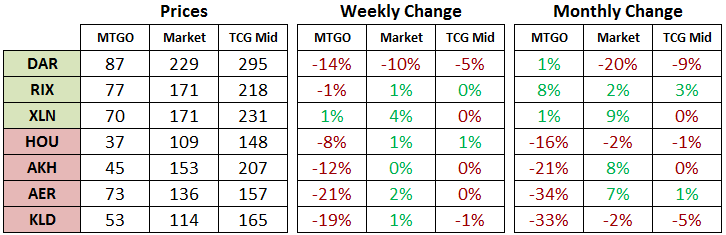
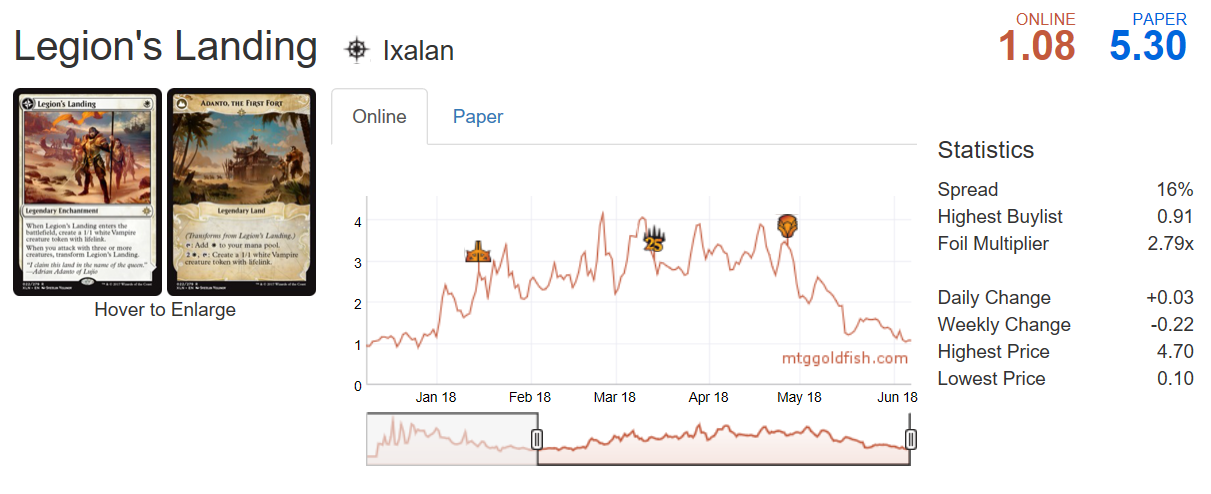 This is exactly the kind of card that will benefit when Standard rotates. Although Goblin Chainwhirler will be in Standard as long as Legion's Landing, Hazoret, the Fervent and Chandra, Torch of Defiance will both be on their way out in October. There's also the matter of Core Set 2019 (M19) that releases in early July. The chances that red continues to dominate all summer and into the fall are slim so looking for cards that have bounce-back potential, such as Legion's Landing, is a great idea. I don't think the current downtrend is over though, and a price in the 0.5 to 0.7 tix range is in view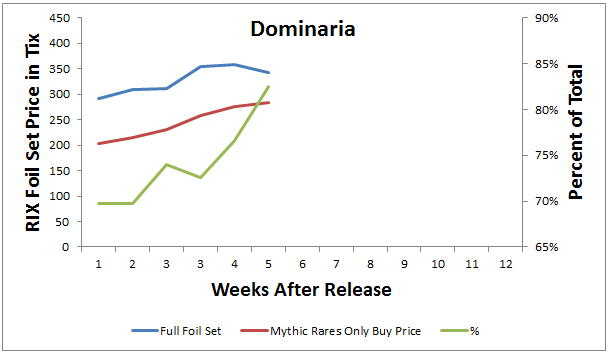
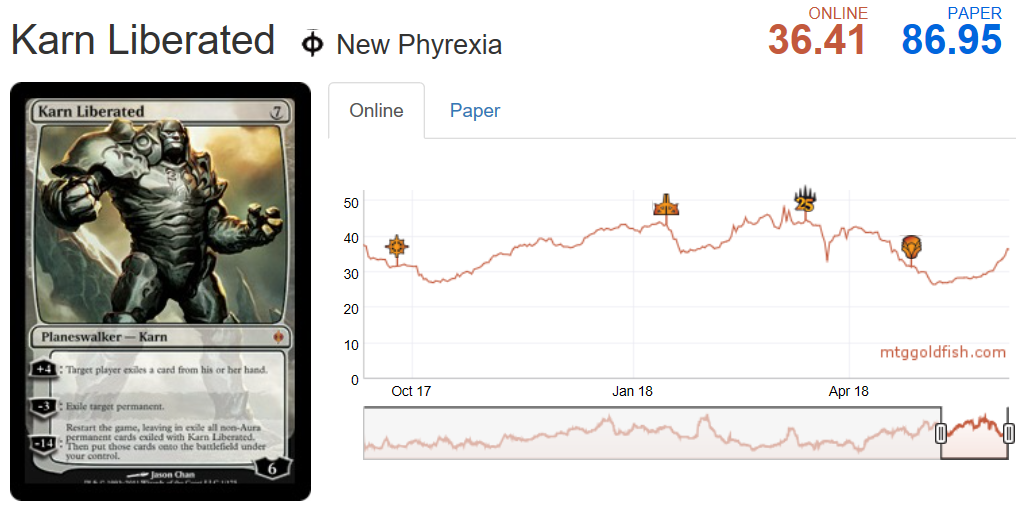 You can see where the winter peak occurs, just prior to the release of RIX and then again just prior to the release of Masters 25 (M25). That's the key time to be a seller, but I think a return to over 40 tix is going to happen in the next month, which will reward those that bought below 30 tix with about a 20-percent gain per copy.
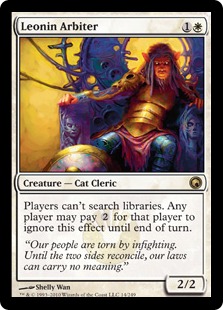 Pair this with the taxing effects of Thalia, Guardian of Thraben, or Leonin Arbiter stapled to a Ghost Quarter, and it can become difficult for the opponent to resolve any spells at all. Being light on mana while facing down a Chalice on one and a spell-taxing effect is not a good recipe for executing a game plan. At this point you can throw down a Thought-Knot Seer both to end the game quicker and steal an opponent's out for when they eventually will have enough mana to actually cast something. Perhaps you just bash with a Reality Smasher to put your opponent out of their misery sooner.
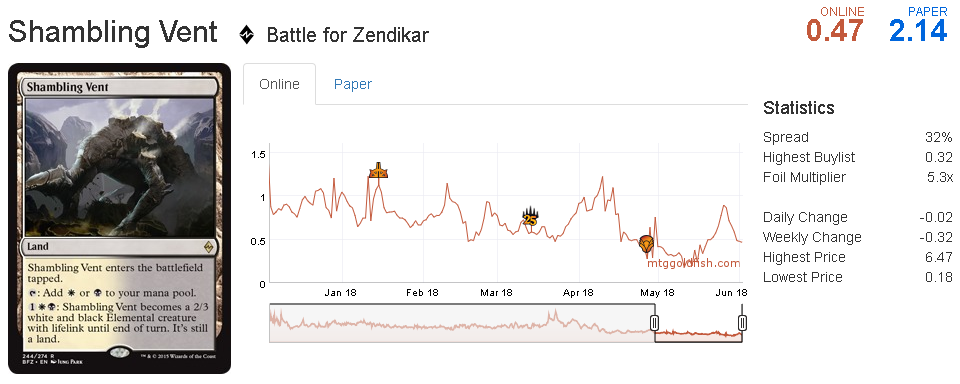
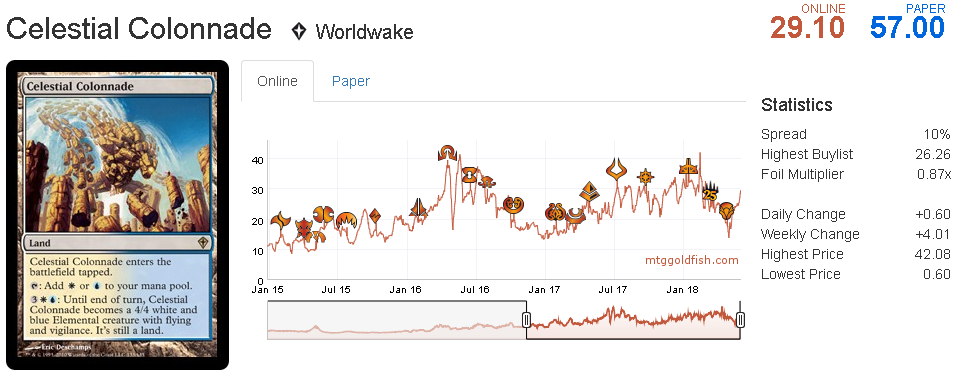
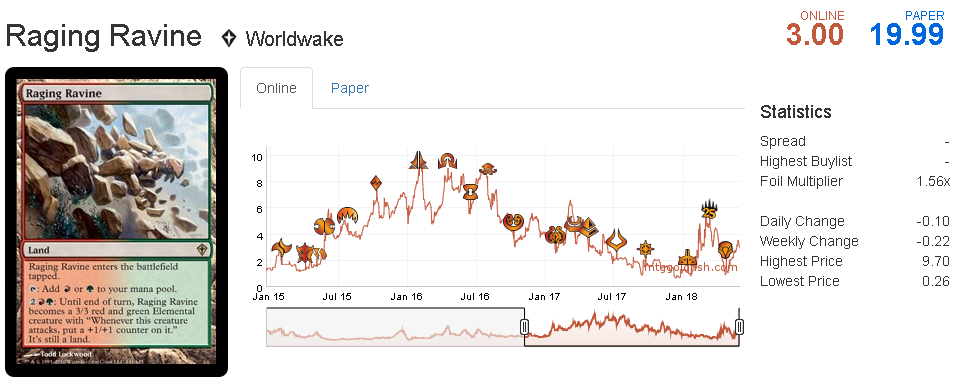
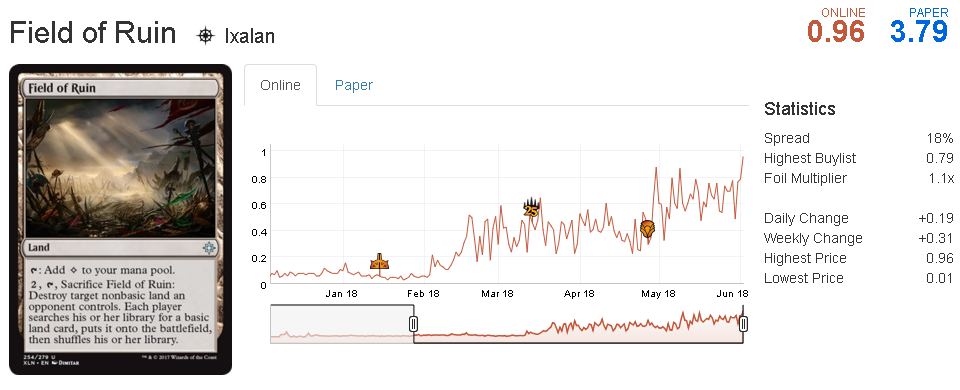
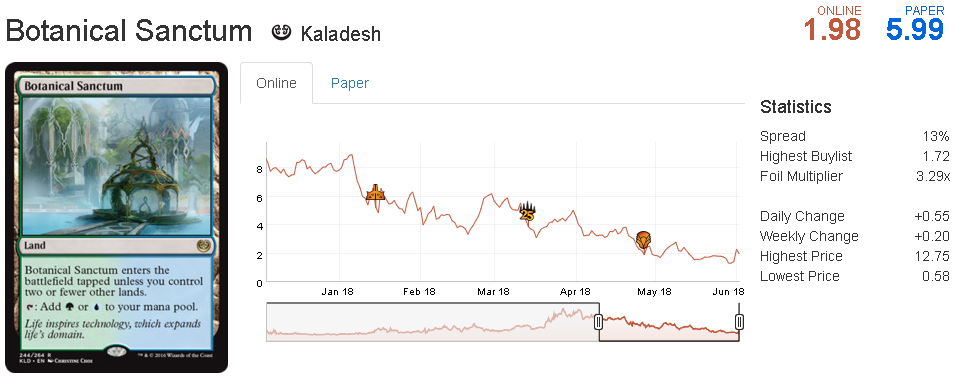
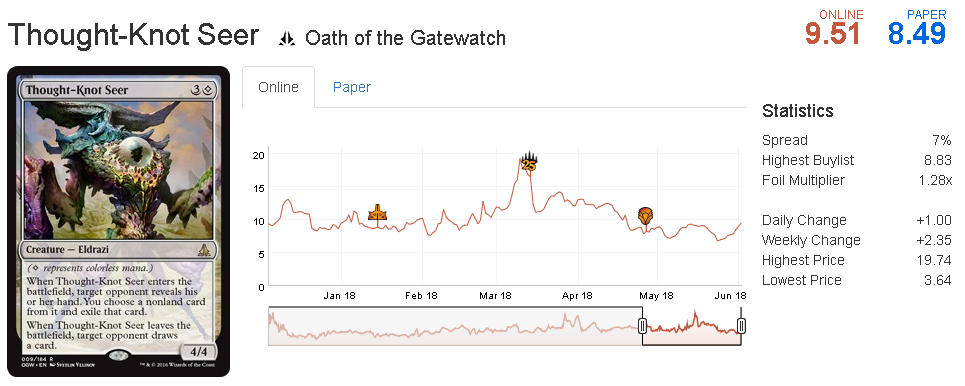
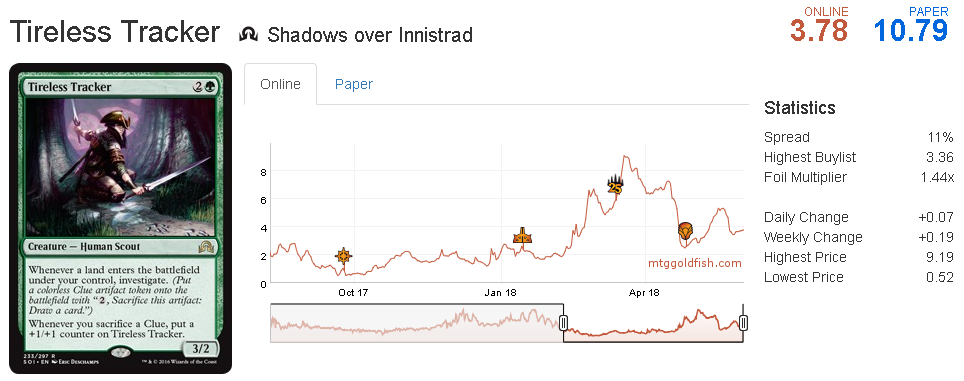
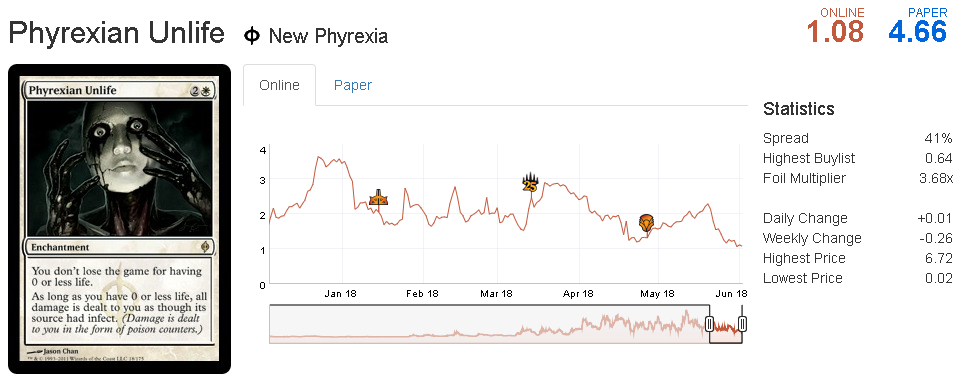
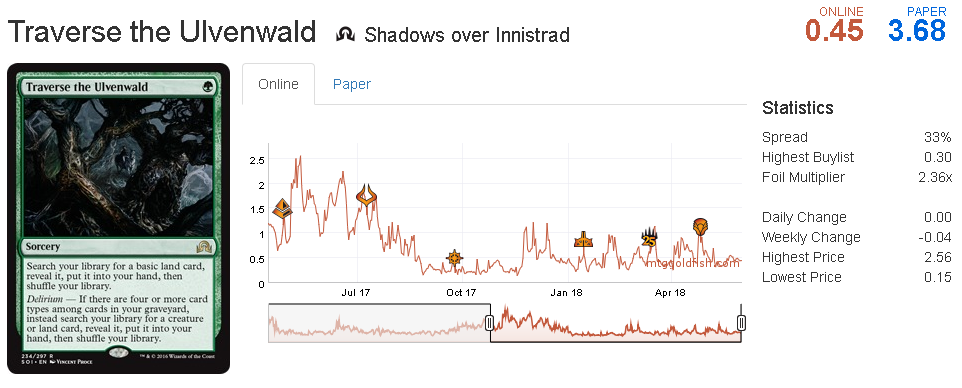
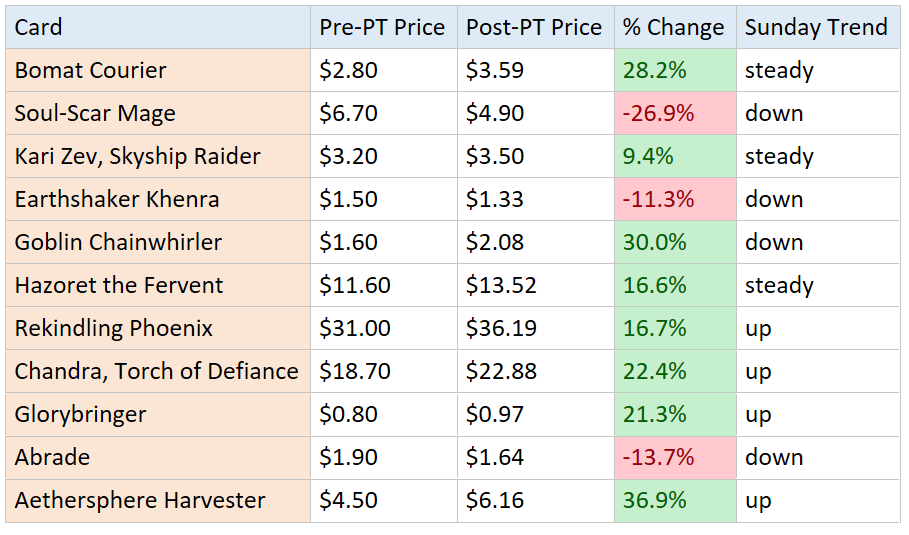
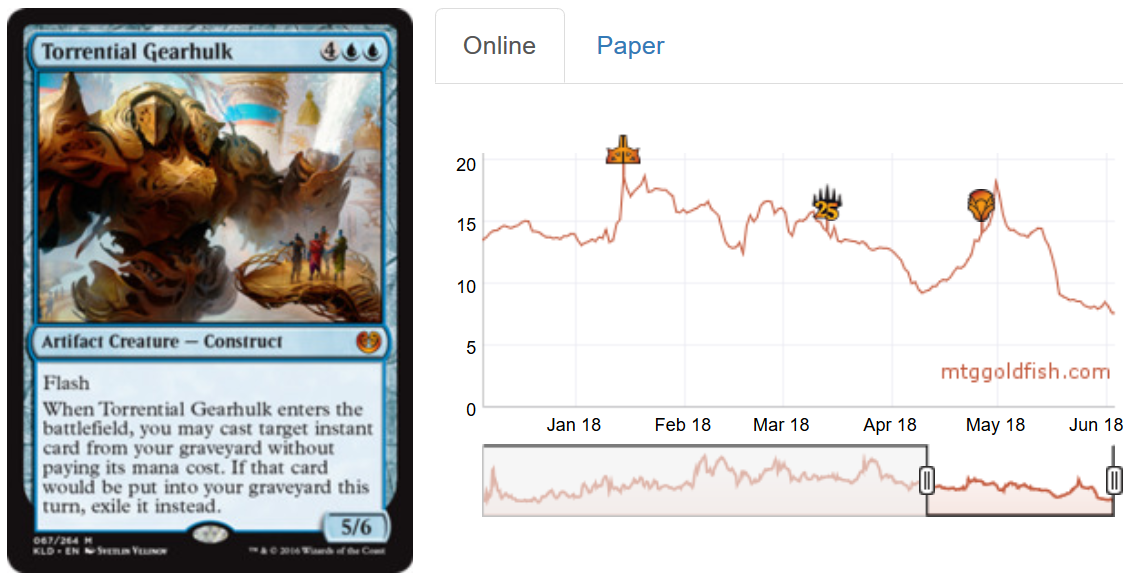
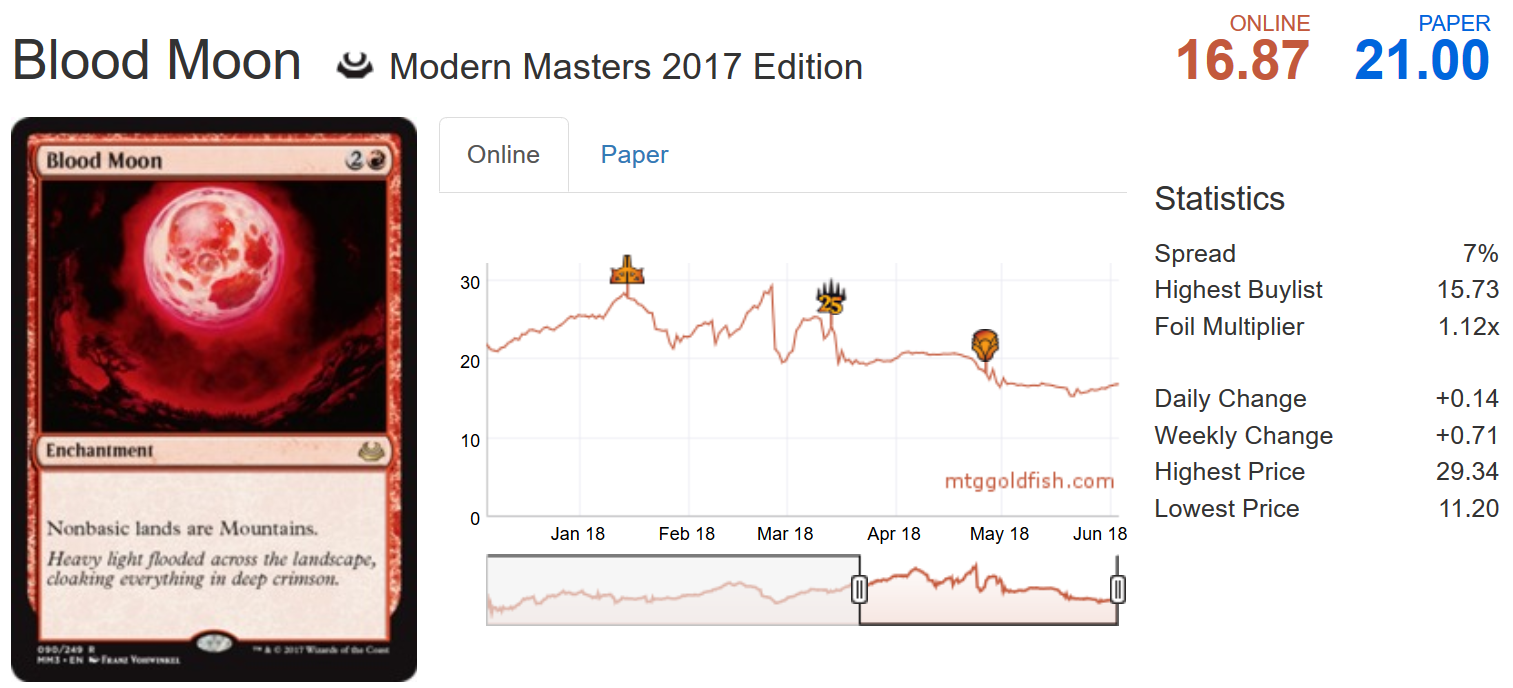
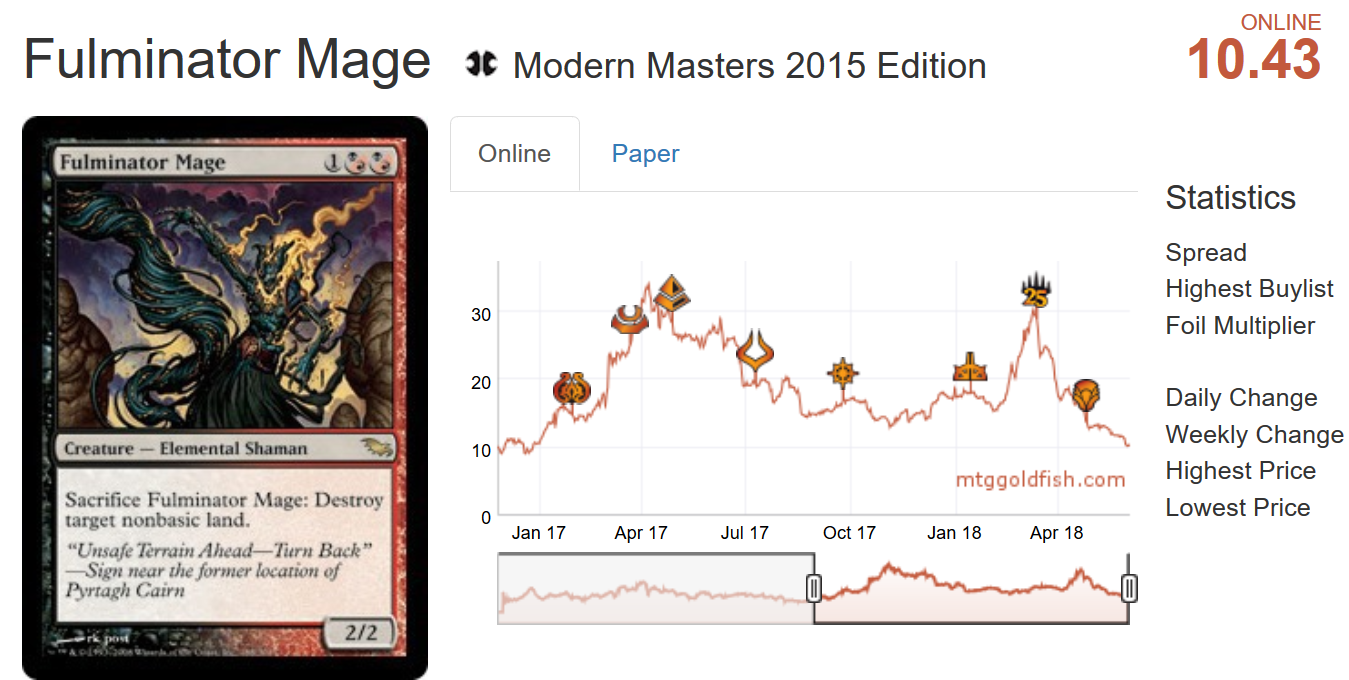

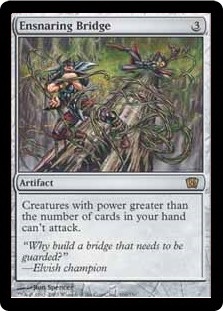 local player that was developing a very similar deck and he, rather dejectedly, informed that it "didn't, really." He also explained that his reason for playing the deck was that it was unexpected and had many ways to land Ensnaring Bridge around Meddling Mage.
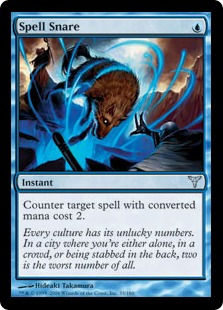 I've found sideboard Spell Snare more valuable against control and combo than any other counter. Storm is still a huge player in the meta, especially in my local one, and Snare counters the most important combo pieces. Against control it hits Snapcaster and Negate. More importantly, it answers
  My opponent begins by fetching an untapped Blood Crypt and Thoughtseizeing me. He then doesn't do anything else except shock in another Blood Crypt. Having no clear idea what's going on, I stick to my gameplan and slam a turn three Geist of Saint Traft. Again, my opponent does nothing on his turn. I attack and he kills the angel token. The following turn he starts digging with Faithless Looting, discarding several Lingering Souls he can't cast yet. I keep swinging and stop Souls with Queller.
 My opponent misses his second and third land drops, but has a discard spell every turn. I had only answer cards in hand so I'm unable to punish this slow start. Eventually he gets lands and I find Spell Queller and Quell a Liliana the Last Hope. Then, when he's at seven, he sneaks in a Blood Moon, and I didn't see any fetches to play around it. I burn him down to four, swing in with Queller, then proceed to lose as I brick while he kills Queller and gets out Death's Shadow and Young Pyromancer.
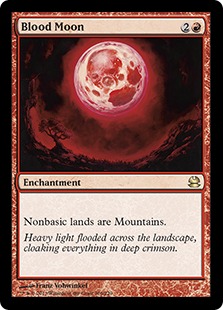 My opponent's first action is to Collective Brutality me before landing Blood Moon. I was able to play around it this time, and land Geist turn three. He plays Young Pyromancer but no other spell, so I just Bolt it and Geist goes the distance. His Moon hurt him more than me because he didn't have a Swamp until after I killed the Pyromancer.
 and Helix to not die when my opponent decides not to play the Bedlam Reveler he's been telegraphing for several turns nor his graveyard Lingering Souls. This means I get to draw Relic, crack it to remove the threat, and draw the Lightning Helix I need to survive the next attack.
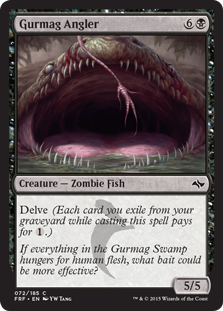 Game 1 (Play; 7/6)
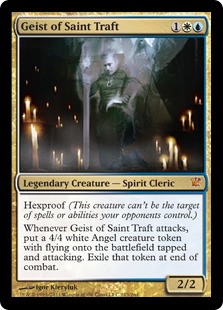 The double mulligan is bad enough, but my turn three Geist is salt in the wound. He's taken aback by Geist and asks if it's actually maindeck. He apparently thought I was pure control. There's nothing he can do but kill the angel several times and try to play blockers, but I have Path.
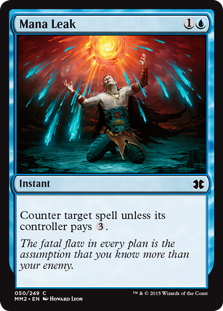 What I saw during the tournament corroborated my earlier format observations. The meta was primarily BRx and Company Decks, which are robust enough to survive Humans' disruption and have the tools to withstand Jeskai Control. In this case, it was going in on Blood Moon and just racing, but I saw a number of other strategies including Phyrexian Arena. I also didn't see a single Tron piece, and there were several players that had previously been huge Tron fans.


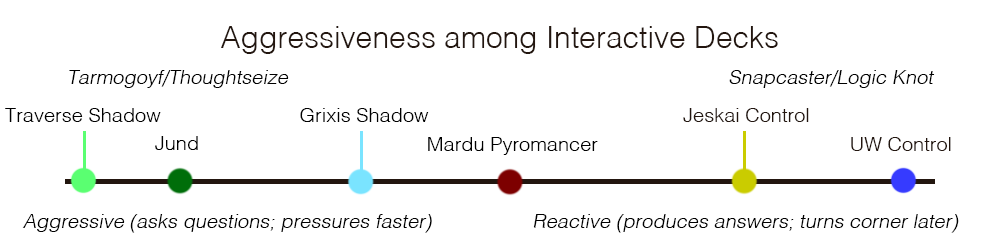
 A huge draw to Traverse Shadow is the deck's eminent customizability. Players can splash white for Lingering Souls or Ranger of Eos, forego blue altogether and play three colors, pack bullets like Grim Flayer or Ghor-Clan Rampager to staple additional utility onto Traverse, or dip into efficient delirium enablers like Tarfire or Architects of Will if they prefer more consistency. The very nature of Tarmogoyf, Modern's most flexible combat creature, is at play here, and Traverse Shadow's got all the reversibility of the infamous beater it's built around. Deckbuilders can easily prioritize one end of the aggressiveness spectrum over another by ramping up on Temur Battle Rage instead of the aforementioned midrange options.
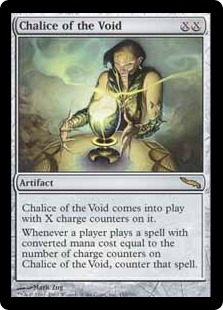 Even skilled pilots must find remedies to the deck's strategic weakness: its fragility.
 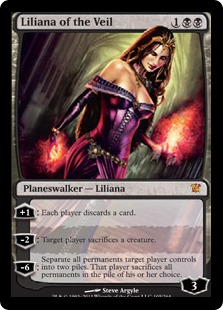 Strengths
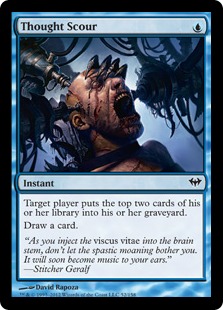 Strengths
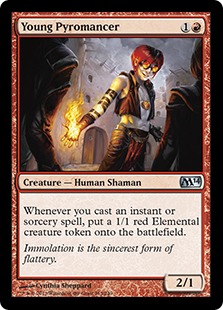 That pressure is often supplied by Young Pyromancer, the deck's Tarmogoyf analogue. Mardu also boasts a Snapcaster analogue in Bedlam Reveler, a creature it uses to pull ahead in midrange mirrors. Kolaghan's Command returns these two creatures to the hand from the graveyard, negating the need for more threats in the main besides Lingering Souls, which plays multiple roles.
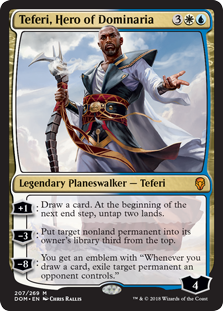 Newcomer Teferi, Hero of Dominaria does a lot for Jeskai's most reactive builds.
 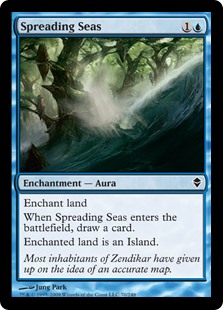 Those same hosers also give UW a favorable matchup profile against Tron, especially relative to that of other interactive decks. Maxing out on Spreading Seas and Field of Ruin helps defeat that deck, making UW appealing for control mages sick of turn three Karn.