menu

Daily Stock Watch – Thrashing Brontodon

Are you a Quiet Speculation member?

If not, now is a perfect time to join up! Our powerful tools, breaking-news analysis, and exclusive Discord channel will make sure you stay up to date and ahead of the curve.

Hello, readers and welcome to a new edition of the Daily Stock Watch! Pro Tour Dominaria is upon us, and the biggest question that the format poses is "what deck will be good enough to beat B/R Agrro on a consistent basis?" I guess we'll just find out over the weekend what the answer is (or it will take a stroll in the park and just clobber everyone again). For now, let's focus on one of the cards that has gained steam heading to the event, and how good it will be after everything has been said and done.

There was an error retrieving a chart for Thrashing Brontodon

Despite the dominance of Blue White Control, Black White Aggro and Black Red Aggro, there are still decks out there that are trying to swing the balance to their favor, and most of them are splashing green for flexibility. One of the best cards that could go offensively and defensively is Thrashing Brontodon, which at three mana and its 3/4 power and toughness, is a very solid crit in a number of decks that tries to pummel the opposition while being able to neutralize some of its biggest threats at the same time. Its presence is felt most prominently in this Golgari Midrange deck which tries to maximize the brute force of green, and the removal efficiency of black.

Golgari Midrange

Creatures

4 Thrashing Brontodon
2 Walking Ballista
4 Greenbelt Rampager
4 Scrapheap Scrounger
4 Blooming Marsh

Instants and Sorceries

3 Vraska's Contempt
2 Fatal Push
2 Cast Down

Other Spells

3 Nissa, Vital Force
4 Karn, Scion of Urza
1 Vraska, Relic Seeker

Lands

11 Forest
2 Ifnir Deadlands
5 Swamp
4 Woodland Cemetery
4 Blooming Marsh

Sideboard

2 Treasure Map
1 Sorcerous Spyglass
1 Naturalize
2 Golden Demise
4 Duress
2 Doomfall
1 Vraska, Relic Seeker
2 Fatal Push

Not a lot of decks could feature a sideboard-material card on its main list, but this dinosaur fits just right on this one. In case you aren't aware, Thrashing Brontodon is already a sub-$3 card as we speak, and that's a pretty nice price tag for an uncommon in Standard. I'm not really sure what the ceiling of the card is once the vehicles have rotated out of Standard (even though the saga series will stick around), but I'm looking at a $5 card if one to two copies of a green-based deck makes it to the top eight of the event with it on its 75.

What the Dino Could Trash

The card is a walking beatstick that could answer the likes of what you could see above, and it benefits some more for being in the same color pool as that of Verdurous Gearhulk and Winding Constrictor. Already sturdy as it is, it's something that you could draw at any point of the game and still be effective on both ends. It is a steady roleplayer in an era of big bombs, and it could be due for a break out if a green deck goes over the top. This should be a safe pick up right here, and a good investment if you hoarded it early.

At the moment, you could easily get copies of Thrashing Brontodon from StarCityGames, ChannelFireball, Card Kingdom and TCGPlayer for anywhere between $2.49 up to $3.23. There won't be any shortage of uncommons from a Standard set at this point in time, but buyouts could change the story if it does occur after this card gets a boost from the Pro Tour results. I'd recommend going after the foil copies as there are better utility cards in the older formats that does the same thing as it, so just try picking up loose ones in some bulk trades or packages. It would be a good feeling for you if you stored them in your bins while it was still under a dollar. Either way, I still like it as a solid pick up at $2 or less, and you could still gain some value out of it in the coming months as the Nationals approach.

And that’s it for today's edition of the Daily Stock Watch! See you again tomorrow, as we check out a new card that should be on the go, or good enough for speculating. As always, feel free to share your opinion in the comments section below. And if you want to keep up with all the market movement, be sure to check in with the QS Discord Channel for real time market information, and stay ahead of the hottest specs!

Insider: Early Speculation for Pro Tour Dominaria

Are you a Quiet Speculation member?

If not, now is a perfect time to join up! Our powerful tools, breaking-news analysis, and exclusive Discord channel will make sure you stay up to date and ahead of the curve.

Hey, guys.

This week we are going to do some early speculation on Pro Tour Dominaria. After many weeks of Standard action, everyone knows the top decks in the format by now. The most recent Grand Prix was dominated by BR Vehicles—no doubt a deck that will be a big part of the Pro Tour.

Having seen the power level of the red deck, I predict one of two things for the coming PT. Either it's going to be full of aggro decks like Pro Tour Hour of Devastation (the Top 8 consisted of 6 Ramunap Red variants, 1 BG Midrange, and 1 Zombies deck), or Shota Yasooka will come out with some special control brew and beat everybody.

Best Card in the Format

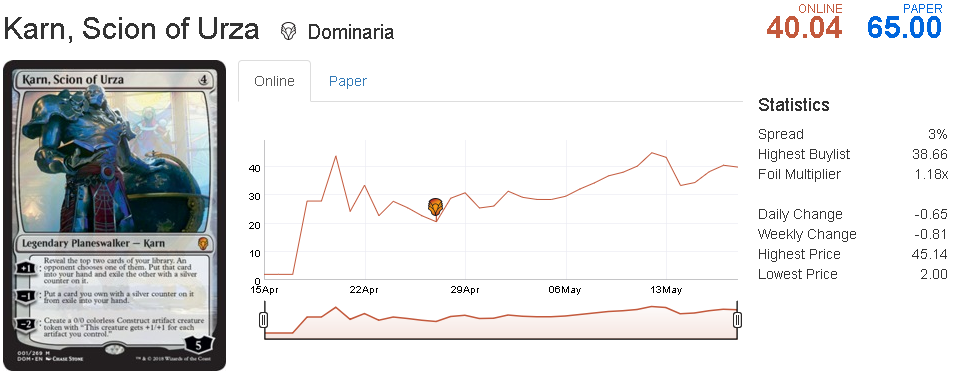
Karn, Scion of Urza is definitely the best card in the format. It's powerful, and can be played by any deck in the format. Its price did stabilize around 40 tickets after a few weeks, and this is definitely not the card you guys want to stock up before the Pro Tour. The card may still increase beyond 40, but it's too risky to pick up copies right now.

The Aggro Deck

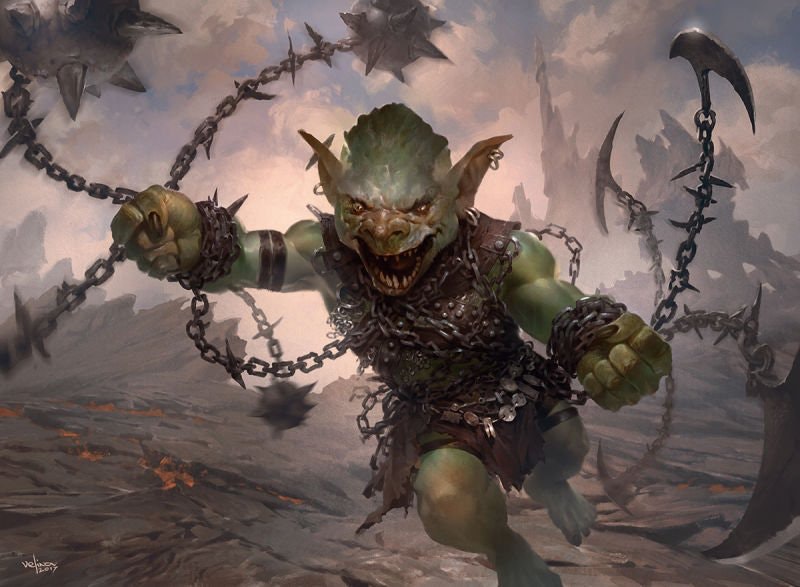
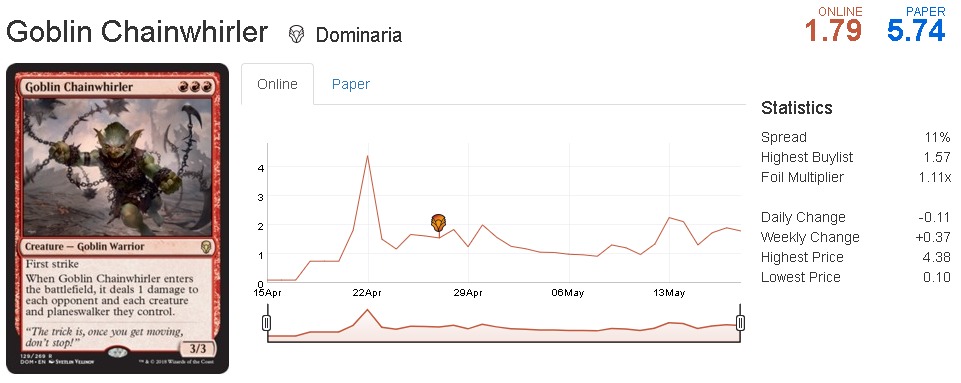
Goblin Chainwhirler is a card that every red deck needs. Its enter-the-battlefield effect is great for an aggro deck that wants to keep attacking, as it reduces the ability to block (especially against one-toughness creatures).

From past experience, we know that a four-of staple in an aggro deck will increase in price if the deck makes Top 8 of the PT. This happened to Earthshaker Khenra at PT HOU (it increased from 2.8 tickets to 6 tickets in a week). Chainwhirler has room to grow, and I like it as a pre-PT spec.

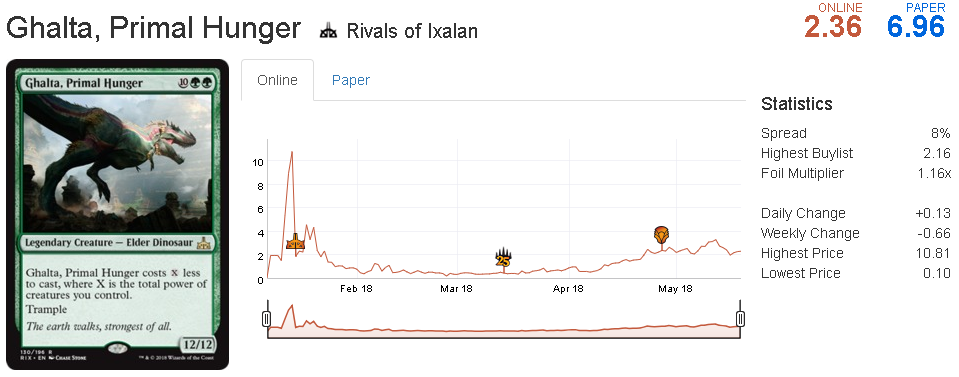
Next up is the Mono-Green Stompy deck, which plays a bunch of cheap, huge creatures like Rhonas the Indomitable, Steel Leaf Champion, and Ghalta, Primal Hunger. I think this deck can potentially become very broken with Ghalta. We can compare this to the Metalwork Colossus deck from a few seasons ago, which caught lots of players unprepared.

Both can decks can cast a huge creature for very cheap. The difference between Ghalta and Colossus is that the Mono-Green deck plays creatures that can start attacking from turn one, while the Colossus deck played a bunch of artifacts that didn't do much on their own. I think Ghalta will be played at the PT, and I recommend buying some playsets.

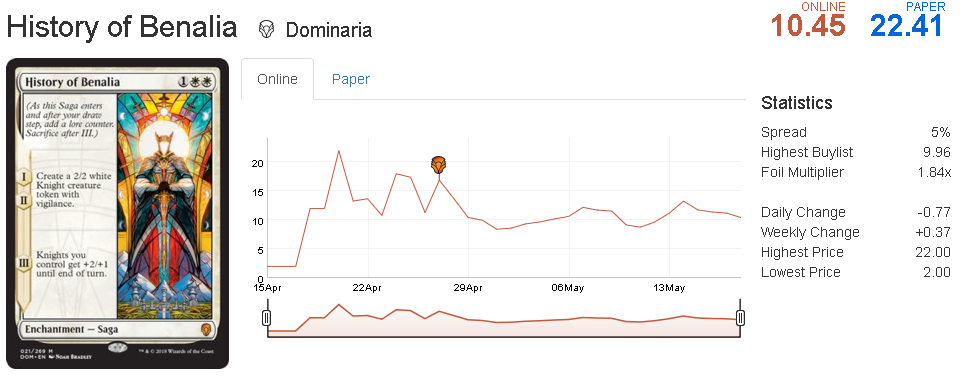
History of Benalia is one of the highest-rated mythics in Dominaria. At 1WW, the ability to create 2/2 tokens and pump them after two turns is pretty strong on its own. I think this card is currently underplayed, and I'm expecting some kind of white aggro deck to come out to compete with RB Aggro.

Currently this card is played in a couple of white control variants, WB Vehicles, and the green-white Sram's Expertise tokens deck (which we'll cover shortly).

The price hasn't gone very high because online players always pick the best deck to play. If you look at paper prices, however, it has reached the 20-ticket mark, but it's still 10 tickets on MTGO. At mythic rare, the supply is low enough that when and if the card shows a sign of making Top 8 during the first two days of the PT, there's a high chance that it will start increasing in price online.

Return of GW Tokens

There's a GW Tokens deck running around online these days with a lot of potential. The deck can go wide really fast with cards like Sram's Expertise, History of Benalia and Legion's Landing, and it also has protection against Goblin Chainwhirler with Benalish Marshal.

GW Tokens cards have plenty of room for price increases, as the entire deck is super cheap right now (below 80 tickets). Let's look at some of my picks from the deck:

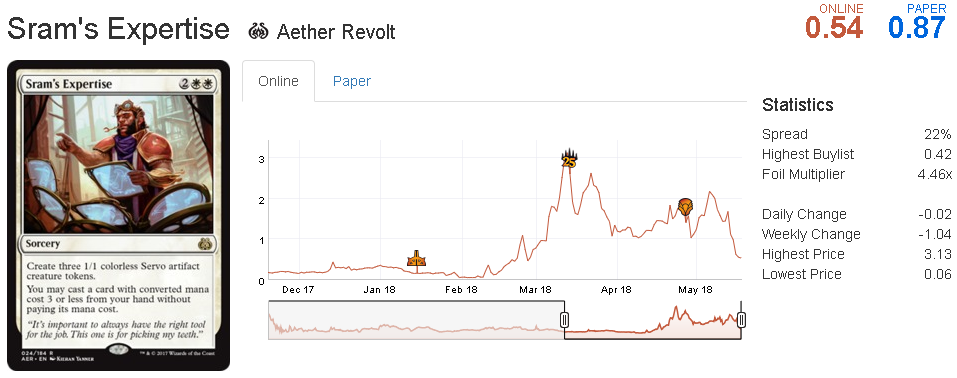
Sram's Expertise is one of the core component of the GW Tokens deck. The ability to cast a three-CMC spell for free on turn four is pretty powerful, unless you're playing against a blue deck keeping counterspells up. But with the current metagame full of aggressive decks, I think qualified players will prefer not to bring control decks to the PT unless there's a really good build. Thus, I think the white Expertise has some potential, and I recommend buying some playsets just in case.

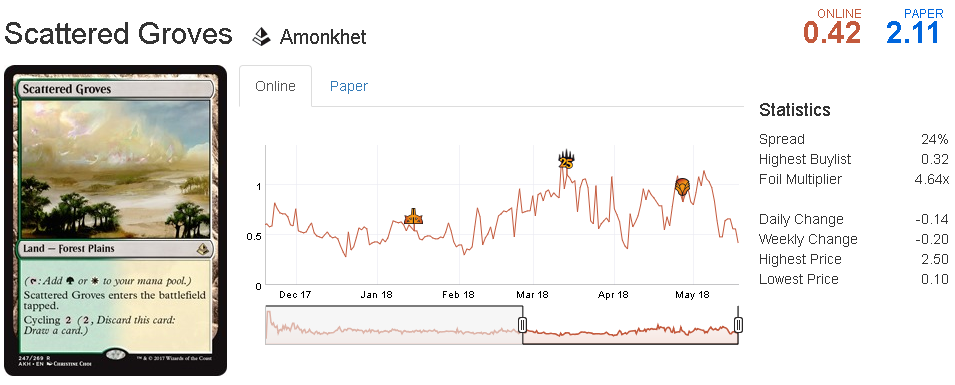
For every PT, there are usually certain lands that will increase in price. Every deck needs lands, right? Scattered Groves is my pick this time. It just recently decreased in price and it has a cyclical trend, which means that even if it doesn't perform well at the PT, there's still opportunity after the event. I would suggest buying playsets of the card for investment.

Anti Aggro Components

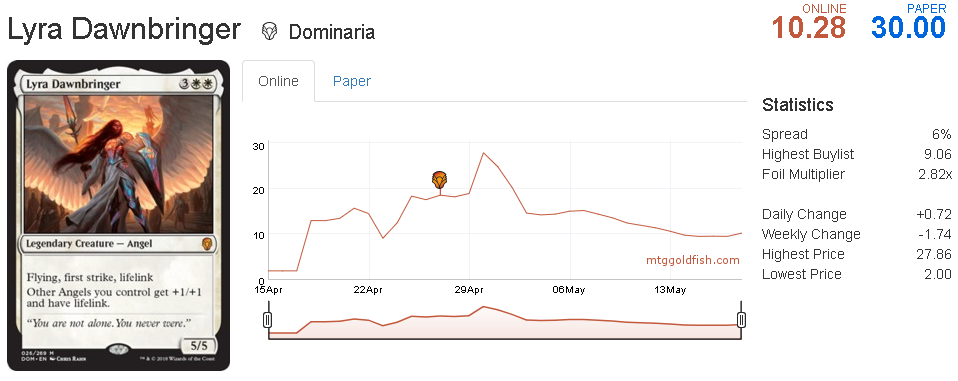
Lyra Dawnbringer is played in the sideboard of current WU Control decks. For the control decks, in order to beat super aggressive decks, they need to survive until they resolve Lyra. That is too slow in my opinion—and Lyra is already expensive—so I would say this is not what you want to buy under this category.

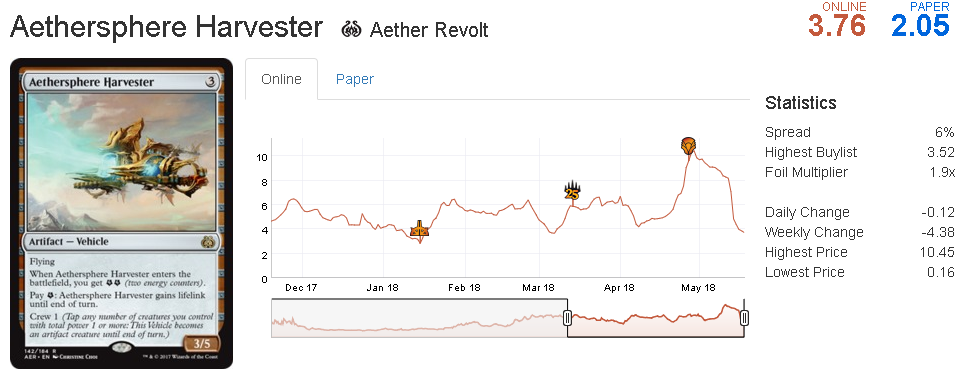
Aethersphere Harvester, on the other hand, has a high toughness and lifelink. I predict that this will be the major anti-aggro card at the coming PT. The aggro decks will play this in the sideboard, while other midrange decks will probably play it mainboard. Looking at the graph, the price is going downhill at the moment, which is the best timing for us to grab some copies as PT specs.

The Ninth Mox

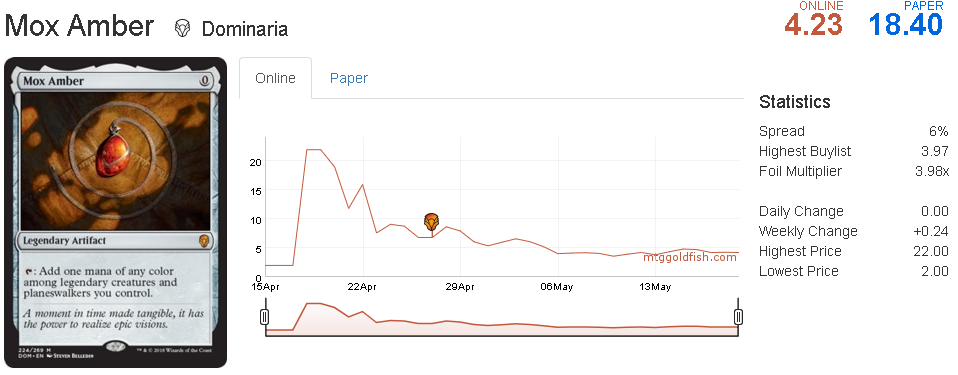
Is the ninth Mox the real deal? Players have been playing around with this card, but nobody's had much success yet. However, in my opinion, yes, this card will increase in price at one point in the future.

It might not be playable in Standard, as there aren't a ton of cheap legendary creatures. The point of playing moxen is to cast a bunch of stuff early—if you can't turn it on early, it doesn't accomplish much.

However, in older formats, turn one or two acceleration is possible with Mox Amber, as there are plenty of one- and two-mana legendaries around. It's just that players have not found the best build. I would suggest buying Mox Amber for investment.


Alright guys, that’s all for the week. Thanks for reading, and I’ll see you again next week.

Adrian, signing off.

It Was Foretold: Jeskai Control’s Return

Are you a Quiet Speculation member?

If not, now is a perfect time to join up! Our powerful tools, breaking-news analysis, and exclusive Discord channel will make sure you stay up to date and ahead of the curve.

I've been doing a lot of theoretical work over the past few months. With Dominaria's release there was plenty of need—and opportunity—to explore and brew. During this process I was constantly underwhelmed by Modern's ostensible top deck, Humans. It was a fine deck, but it didn't really shine. As I explained last week, this left me perplexed about Humans's persistent stand on top of Tier 1. That trend is especially odd given that Jeskai and other control decks effectively prey on both it and Affinity, which is keeping pace with Humans.

Apparently I wasn't the only one, because Jeskai was out in force at Louisville. In both pure control and Tempo forms, too. Today I will be looking at the Louisville results and examining the return of Jeskai. I also have an update regarding my banlist testing series at the end.

Louisville Meta

Since the Pro Tour back in February, large-scale Modern events have been sparse. Instead, Team Constructed has dominated, which doesn't generate very reliable metagame data. Team events allow weak decks to squeak through the Swiss, and Unified Constructed events require creative deck choices, so the picture is muddied. Modern is finally moving back into the spotlight with a string of SCG events leading into GP Las Vegas, meaning there is going to be better data on how the metagame is moving, starting with Louisville.

Prior to the event, I and a number of other writers speculated that Jeskai Control was due for a resurgence, either because the metagame was favorable or because of new cards. Apparently the collective wisdom agreed, because Louisville's Day 2 metagame is dominated by Jeskai decks. Star City has 16 decks listed as Jeskai Control, with another two decks listed separately as flash and aggro. Humans and Affinity sit in the second and third places, with 13 and 11 decks respectively. Elves trails at 9 decks. Given that all those are favorable matchups for Jeskai, I must conclude the Jeskai players made the correct metagame call. The type of deck they wanted to hit was actually present in very large numbers, so they did quite well Day 1.

This trend continued on Day 2, as Jeskai is the most represented deck in the Top 32 with six members. In fact, fair interactive decks did extremely well in Louisville, making up 14 out of 32 decks. This is a strong pushback against what had been a linear aggro metagame, and it is a welcome one. The other striking thing is how known the Top 32 is. The only decks that qualify as rogue or outlier decks are RG Hollowvine, Amulet Titan, and arguably Infect. This doesn't mean anything yet, but if we continue to see expected decks it would indicate a settling in the metagame, which would provide opportunities to exploit the complacency.

Pure Control

The most played version of Jeskai was the pure control deck, representing five of six Jeskai decks in the Top 32. Frankly, it's a deck exactly as you'd expect.

Jeskai Control, by Jonathan Hobbs (2nd, SCG Louisville)

Creatures

4 Snapcaster Mage

Planeswalkers

1 Gideon, Ally of Zendikar
2 Teferi, Hero of Dominaria

Enchantments

2 Search for Azcanta

Instants

4 Path to Exile
3 Lightning Bolt
3 Logic Knot
3 Lightning Helix
1 Negate
2 Electrolyze
4 Cryptic Command
1 Secure the Wastes

Sorceries

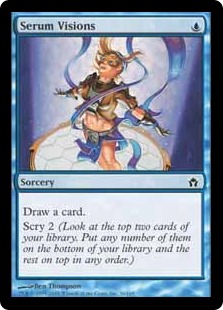
4 Serum Visions
2 Supreme Verdict

Lands

4 Flooded Strand
4 Scalding Tarn
3 Celestial Colonnade
2 Hallowed Fountain
2 Steam Vents
1 Sacred Foundry
1 Sulfur Falls
1 Glacial Fortress
1 Field of Ruin
3 Island
1 Plains
1 Mountain

Sideboard

2 Dispel
2 Celestial Purge
2 Vendilion Clique
1 Engineered Explosives
1 Baneslayer Angel
1 Detention Sphere
1 Runed Halo
1 Disdainful Stroke
1 Negate
1 Settle the Wreckage
1 Wear // Tear
1 Elspeth, Sun's Champion

The interesting inclusion is Teferi, Hero of Dominaria. It has become a theme in my writing, but Jace needs to be built around and supported because he is fragile. Jace will take over a game as few other walkers can if left unchallenged, but with Lightning Bolt's resurgence that is very unlikely. Teferi is not as powerful as Jace, but he is easier to wield. Jace's best mode adds no loyalty, unlike Teferi, but Teferi also allows you to tap out and then protect him during the opponent's turn. This is a huge plus in Teferi's favor, as ease of use frequently beats raw power. In mirrors I would prefer Jace because he's a mana cheaper and Brainstorm is so much more powerful than a random draw, but outside of that scenario I think Teferi will keep getting the nod.

Jeskai Tempo

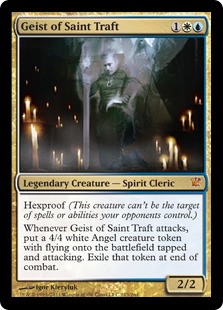
The other Jeskai deck was Jeskai Tempo, which often acts like a control deck but isn't a traditional one. The control decks answer everything and win via overwhelming advantage, whereas Tempo answers just enough to win with Geist of Saint Traft, combined with burn and Spell Queller protection. If the control decks appear stock, this deck is even less interesting. I played this deck with some changes in the mana base and another Geist instead of the third Electrolyze last year.

Jeskai Tempo, by Jimmie Smith (4th, SCG Louisville)

Creatures

4 Spell Queller
4 Snapcaster Mage
2 Geist of Saint Traft

Instants

4 Path to Exile
4 Lightning Bolt
4 Lightning Helix
3 Logic Knot
3 Electrolyze
4 Cryptic Command

Sorceries

4 Serum Visions

Lands

4 Flooded Strand
4 Scalding Tarn
3 Celestial Colonnade
2 Hallowed Fountain
2 Steam Vents
1 Sacred Foundry
1 Sulfur Falls
1 Glacial Fortress
1 Field of Ruin
3 Island
1 Plains
1 Mountain

Sideboard

2 Vendilion Clique
2 Celestial Purge
2 Dispel
1 Engineered Explosives
1 Detention Sphere
1 Negate
1 Settle the Wreckage
1 Surgical Extraction
1 Wear // Tear
1 Lyra Dawnbringer
1 Pia and Kiran Nalaar
1 Supreme Verdict

It's fascinating how familiar this list is. If a deck that is almost unchanged over a year is still viable, why did it disappear? And is it better or worse than the alternative hard control deck?

In Comparison

While I classify these decks separately and their play patterns are noticeably different, looking at the decklists they're extremely similar. The core of both decks is the package of instants and Serum Visions. The numbers are different, with Tempo preferring more burn while Control has Supreme Verdict, but broadly speaking both decks are built to maximize Snapcaster Mage. The only question is win speed. It is possible for Control to win quickly with an unanswered Gideon, Ally of Zendikar, but that's improbable.

Having played both versions, there is no particular reason to prefer either clock. Tempo can severely punish a stumbling opponent but it will get overwhelmed in the long game. Control will always win as the game goes on, but it also gives opponents plenty of time to recover. Which deck you prefer is dependent entirely on your own playstyle as a result. The sheer number of pure control decks vs. Tempo doesn't inherently mean anything since we don't know starting population.

Signs of Adaptation?

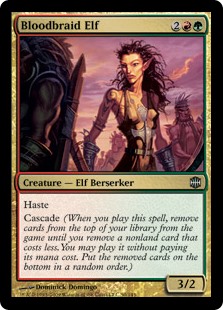
What strikes me most about these decks is how stock they are. Substitute Teferi for any other planeswalker and these decks could be from last year. To an extant his is to be expected. The core of Jeskai is the removal package and Cryptic Command, but that begs the question of why it fell off so severely in the first place. Jund is a possible explanation as Bloodbraid Elf is a huge boost in the matchup, particularly against Jeskai Tempo, but Jund has never been enough of the meta to truly fear. Even if that was the explanation, the decks show no sign of any special consideration being given to that matchup.

My theory is that perception drove the Jeskai downtick. Players thought that Jund would be much bigger than it currently is and subsequently thought that Tron would be a bigger presence to feed on Jund. This hasn't really happened thanks to Humans, and given enough time between events, players came to realize this and go back to their old lists. Conversations with a number of players tell a similar story, and it makes logical sense. I can't say it's definitively true, but I haven't come up with a more plausible theory.

Interestingly...

The Modern Classic Top 8 is full of Tron. If you count Mono-Green and GR together, Tron is the most represented deck in the Top 16. In my experience the Classic is populated by players that washed out of the main event, which means that its results are indicative of the Day 1 metagame. While Tron was well represented in Day 2, it didn't hold a candle to Jeskai or the other Tier 1 decks. The degree to which this means anything is ambiguous; this is Modern after all. Players play the decks they like more than anything else, but metagaming does still happen. I am very interested to know if Tron started out Day 1 as a large percentage of the field and simply fell off. If it did, that would indicate that a lot of players actually anticipated Jeskai coming out in force last weekend. Those who did simply missed their target and leveled themselves—as despite Jeskai being the most popular single deck, aggro was still the most represented archetype. If anyone has insight, please comment.

Banlist Testing Update

It has been almost six months since my previous banlist test. I've been asked when the next one is coming out and the answer is I don't know, because real life is getting in the way. I have to scale back. I do intend to continue doing these tests, but each is going to take much longer to finish. Rather than three a year as I did the past several years I'll only be able to get one more in this year. If things change I will certainly adapt but I cannot promise anything. I could amass less data, but that's not really an option. The whole point is to remove speculation and get actual data about the impact of banned cards in Modern. Shrinking my sample size would delegitimize the results. Therefore, while I'm getting started on the next test soon, don't expect anything until winter comes.

The Candidates

This leads me onto the possible candidates. Stoneforge Mystic is the most plausible unban, but I've already tested it. While a redo isn't out of the question, I can't imagine the results would be different enough to be worthwhile. I'd rather stick to something new. The problem is that most of the cards that remain are either clearly broken (Rite of Flame, Hypergenesis) or had their chance and have proven problematic (e.g. Birthing Pod). As a result, I'm really only considering the following three(ish) cards for testing:

  • Dig Through Time - Dig never really saw any play before it was banned because Treasure Cruise far overshadowed it. The fact that Dig proved itself too powerful for Legacy suggests that Wizards was correct that it would just replace Cruise, but there's no proof. I want to give Dig a chance to prove itself.
  • Green Sun's Zenith - Green Sun's Zenith (GSZ) was banned because there was no reason for any green deck not to run it. The card just did everything. However, times have changed and current green decks with Collected Company need non-green creatures to survive. It may be that the format has moved on from GSZ.
  • The Artifact Lands - The artifact lands have always been banned because Wizards was afraid that Affinity would be as broken in Modern as it had been in Standard. Some would argue Affinity is still that broken, but many have tried the Artifact lands in Affinity and been underwhelmed. I want to try it in Ironworks combo. There may be no reason to revisit the old combo-Affinity, but supercharging Ironworks may be too good.

I have no real pull to one card over another, so I'm leaving it up to you. Cast your vote for the next test card by leaving a comment down below. I'm only going to count comments left here on Modern Nexus. The poll will close next Monday, and the victor will be my next test.

End Turn

Disclaimer time: SCG Louisville is the first pure Modern event since Dominaria released. Thus it is our only datapoint as to where the metagaming is heading. Don't read too much into these results yet. SCG Minneapolis is likely to look very similar to Louisville simply because it's a week afterward and there isn't enough time to adapt. It won't be until GP Las Vegas that there will be enough data to draw meaningful conclusions.

Unlocked Insider: Major Movements in Alpha

Are you a Quiet Speculation member?

If not, now is a perfect time to join up! Our powerful tools, breaking-news analysis, and exclusive Discord channel will make sure you stay up to date and ahead of the curve.

Editor's Note: Sigmund is out for the week on family business. In the meantime, please enjoy this unlocked Insider article from the end of last year in which he predicted—correctly, as it turns out—some major movement in lower-rarity Alpha cards.

As the year comes to an end, I’m hearing summary discussion on various MTG finance podcasts. Analysts are looking back at the last twelve months and commenting on where they perceive market strength and weakness to lie. Many have expressed at least some level of concern that the hobby is less lucrative than it once was due to the massive wave of reprints and endless supply of new sets.

The fact that you can purchase Iconic Masters booster boxes for $148—far under MSRP—underscores the situation at hand. Wizards of the Coast has communicated time and again they want to avoid a Chronicles 2.0. We’re not quite there yet, but we are approaching that level rapidly without sign of reversing course.

Perhaps this uncertainty has pushed speculators and investors into the direction of the Reserved List and Old School. If there’s one consistent communication we’ve received from Wizards, it’s that the Reserved List isn’t going away. Period. End of discussion. Thus, money invested in these classic cards is protected from all that is going with reprints and supplemental product.

Another Reserved List Article?

Before you close the window to avoid reading another article touting the Reserved List, stick with me for this next section. I’ll be first to admit the Reserved List well has run fairly dry, at least for the short term. Gains realized on cards like Library of Alexandria may not be replicated so easily over the next few months as prices reach all new highs.

There was an error retrieving a chart for Library of Alexandria

This got me thinking, though. We’ve seen all the Arabian Nights, Legends, Antiquities, and The Dark cards spike like crazy. Meanwhile, there is a class of cards that are far rarer than all of these. One set in particular is so rare that many singles from the set are virtually sold out on TCGplayer, eBay and many major vendors. If we consider how parabolic the Reserved List cards went in price, I think this similar trend is in media res as we speak.

I’m referring to Alpha, Magic’s first set.

You’ve seen print runs for Alpha cards right? Only 1,100 of each Alpha rare was printed, 4,500 of each Alpha uncommon, 16,000 of each Alpha common and 85,500 of each Alpha land (per picture). Chas Andres over at Star City Games wrote a valuable piece on this set back in 2012, and I find the numbers more compelling than ever.

In that article, Chas goes on to point out that every Alpha common is rarer than an Unlimited Black Lotus. Add in the fact that many Alpha cards have been lost or damaged over their 25 year history, and you have a recipe for extremely rare and collectible pieces that will never be damaged by a market filled with reprints.

The New Information

Everyone actively involved in the Quiet Speculation community is probably familiar with the numbers on Alpha. So none of this so far is new information. But I do have some particularly interesting numbers that make it a worthwhile article topic this week.

First, let’s take a quick look at some specific card prices that Chas points out in his article. Below are Star City Games buylist prices at the time of his article’s publishing in August 2012. To the right of each I list the current SCG buy price and current highest buy price on Trader Tools. Keep in mind these are Near Mint numbers.

 Card  SCG Buy Price (2012)  SCG Buy Price (2017)  TT Highest Buylist
Wrath of God $200 $500 $600
Swords to Plowshares $60 $200 $213
Disenchant - $25  $30
Lord of Atlantis $80 $250 $300
Demonic Tutor $60 $250 $300
Wheel of Fortune $150 $600 $800
Lightning Bolt $15 $100 $125
Fireball - $15  $18
Birds of Paradise $200 $750 $1000
Chaos Orb $125 $500 $700

I hope you're as blown away by these numbers as I was. Buylists (and likely market values) of Alpha cards have all exploded over the last five years. We’re talking about gain percentages in the hundreds. I’ve always viewed Alpha cards as solid investments, but I could not have predicted this explosive growth. But despite these high numbers, I think the growth is far from done. Indeed much of this growth likely happened over the past couple years thanks to Old School. And most recently, interest in Alpha has been on the rise.

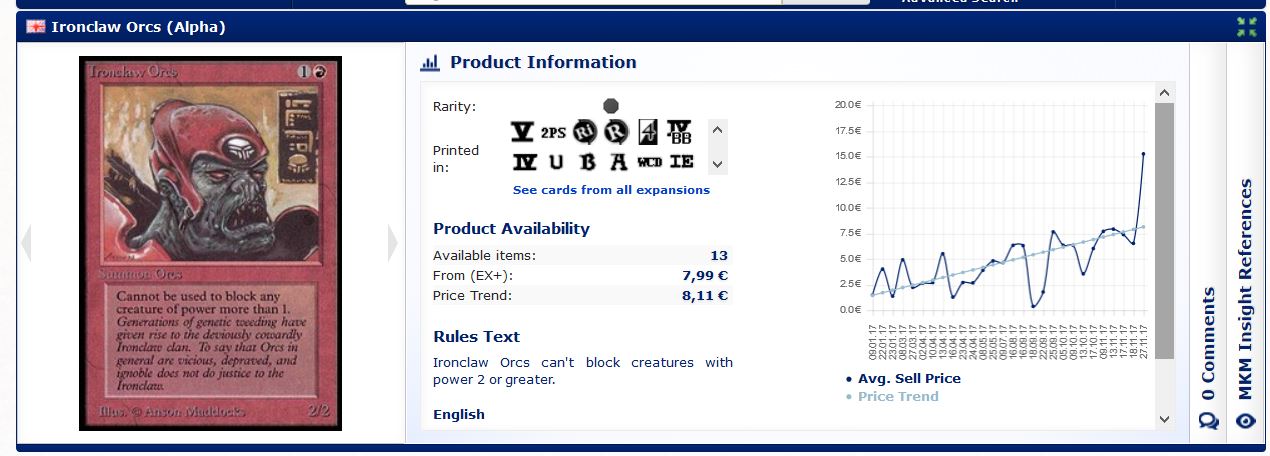
Here’s another number for you: 20. That’s the number of Alpha cards completely out of stock on TCGplayer. And this isn’t a collection of twenty cards you would be able to readily guess, either. It’s not just the Power 9 and dual lands that are out of stock. Instead, it’s pretty random stuff like Ironclaw Orcs and Uthden Troll.

There was an error retrieving a chart for Uthden Troll

Old School players and collectors are moving on these original cards aggressively, leading to a surge in prices and a sudden reduction in stock. Even with such limited numbers, it still takes a good amount of speculation/demand for a common to disappear from the market, but it is happening over and over again.

You need to be aware of this trend. Five years from now, the number of “out of stock” Alpha cards on TCGplayer will be even larger. There will come a time when an Alpha card you want won’t even be readily available on the open market—literally zero copies will be for sale.

Where to Shop for Alpha

Perhaps these numbers convinced you to shop around for a few Alpha cards you always wanted to own. I myself have been acquiring Alpha cards fairly aggressively lately—nothing expensive, mind you. Just some potentially useful commons and uncommons for Old School. You don’t need to invest in Alpha Shivan Dragons to make money on the set’s rarity. Even Alpha Dragon Whelp is sufficient.

There was an error retrieving a chart for Dragon Whelp

So where have I been doing my shopping? I’ve focused on a couple primary places.

First and foremost, Cool Stuff Inc has been my favorite vendor for Alpha cards. Their stock has been dropping steadily like everyone else’s, but their prices are quite competitive. A few times I have even been able to buy cards from their site to directly resell for a modest profit. The fact that they include high-quality pictures of most of their worthwhile Alpha cards is an added bonus, and their markdown on played copies are especially interesting.

Next, I have had some success acquiring Alpha cards from Tokyo MTG, an easily accessible Japanese vendor. Their prices are a little more hit-or-miss given the recent weakness in the US Dollar, but I love that they accept PayPal USD payments and they offer PWE shipping. This makes the site just as easy to buy from as any domestic vendor.

Beyond major vendors, I have done plenty of shopping on TCGplayer. Filtering out HP and Damaged cards has helped me focus on playable cards that aren’t too ugly to be buylisted to stores. Some of the obscure cards have been lucrative for me—it seems many vendors apply a standard minimum buylist price on Alpha commons and uncommons, and some smaller TCGplayer sellers don’t know about this (or don’t care). This has led to some immediate arbitrage opportunity.

I’ve even bought cards directly from Star City Games recently. It seems some playable Alpha cards have recently jumped in price, and vendors have been a little slow to adjust. Twiddle, Orcish Artillery, and Plague Rats are a few examples of cards you may find at an online vendor with prices that haven’t been adjusted to match recent market pricing.

There was an error retrieving a chart for Twiddle

Finding good deals on Alpha cards is becoming tougher and tougher. But by shopping around extensively you have a decent chance of finding that underpriced gem simply because vendors aren’t used to wildly fluctuating prices for Alpha singles. But that seems to have been changing lately.

Wrapping It Up

Alpha cards are arguably the most investible pieces in Magic. They have extremely small print runs, their age implies the number of remaining copies in nice condition are even smaller, and they are 100% immune to reprint. Wizards could churn out a dozen Masters sets over the next couple years and Alpha cards would do nothing but rise in price.

Speculators and collectors are catching on to this trend most recently, and even random commons like Ironclaw Orcs are disappearing. In Europe, these cards are moving in a big way as reflected by Magic Card Market’s price charting.

(Click to expand.)

The trajectory has always been upward, but most recently things have begun to go parabolic. “Begun” is the operative word now. I am flagging this trend to you as it is happening, and it may not be too late to pick up a few gems for your Old School decks, cubes, portfolio, etc. But there will come a time when it will be too late, and the card you’re looking for just isn’t available for sale on the open market. At least, not at a real price that isn’t silly.

Then again, with a market as special as Alpha cards, maybe there is no such thing as “silly” pricing anymore. A month ago I would have said 15 euros was already too silly for an Alpha Ironclaw Orcs, after all. This just goes to show you how real this market trend is. I’ll conclude with this completed eBay listing below, just for awareness.

…

Sigbits

  • I did a quick browse of Star City Games’ stock on Near Mint Alpha cards and the numbers are staggeringly low. There are a few random ones left, don’t get me wrong. But unless you’re looking for a Near Mint Ankh of Mishra or Chaoslace, the available stock is nearly nonexistent. I am extremely tempted to try buying their Near Mint Healing Salve simply because of auctions like this one:

  • I just checked and confirmed that every common and uncommon from Alpha that is out of stock on TCGplayer is also sold out on Star City’s website. Coincidence? Or are these cards really in demand? Either way, if you can find any copies of these cards you could set the new market price by listing the only copy for sale on TCGplayer.

The Economy of Arena Takes Shape

Are you a Quiet Speculation member?

If not, now is a perfect time to join up! Our powerful tools, breaking-news analysis, and exclusive Discord channel will make sure you stay up to date and ahead of the curve.

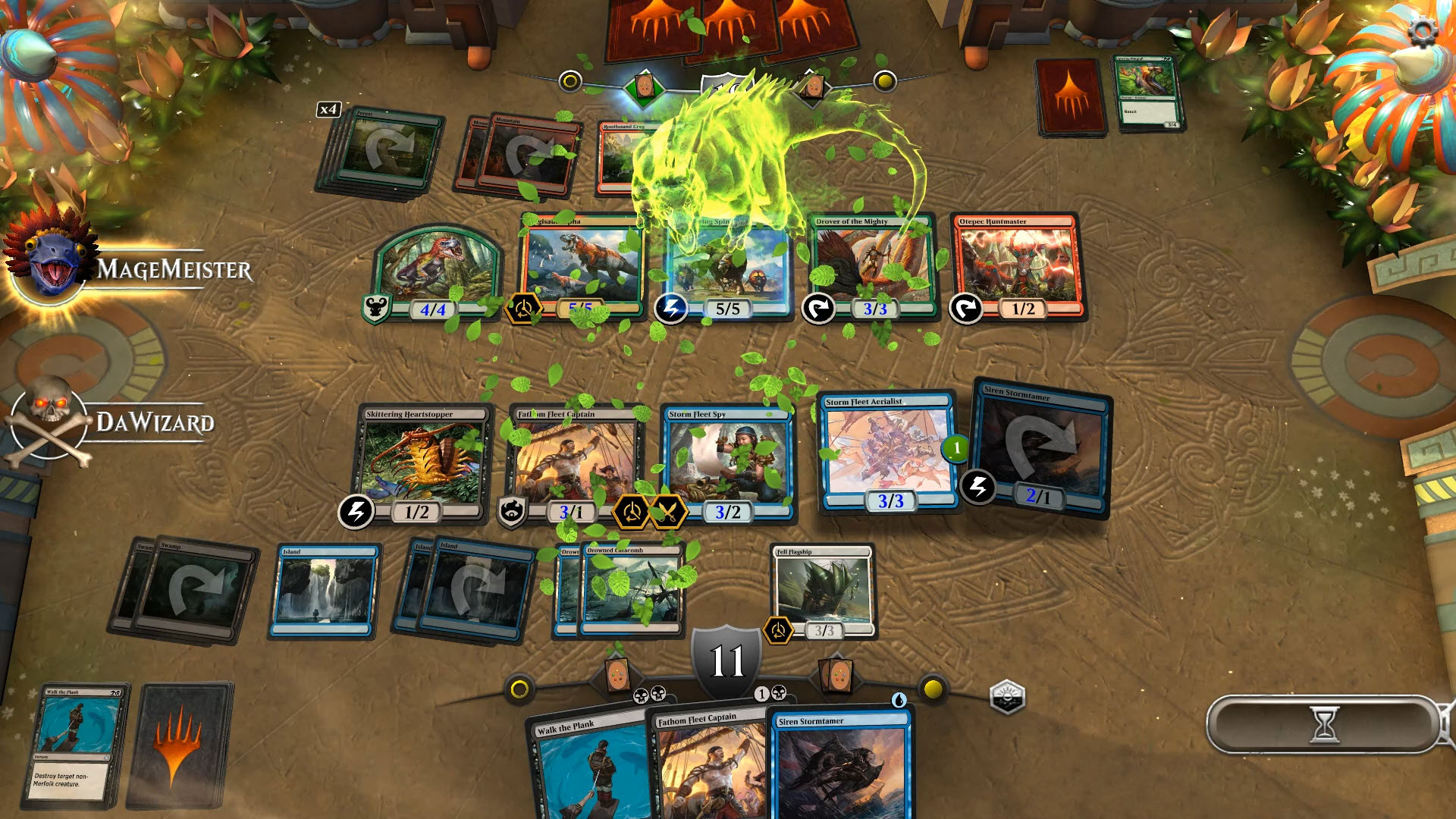
The last time I wrote about Magic Arena it was still in alpha testing. Arena is now in closed beta testing, and about a month ago we got the great Dominaria economic update, which unveiled some major economic changes and gave us a clear picture of the full economic model that Arena would be employing. While some minor tweaks might occur before its official release sometime later this year or early next year, we now have a good idea of how the Magic Arena economy will operate and the experience one can expect to have given how much one plays and pays. The silhouette has been fleshed out.

Today I will be (i) going over these economic changes and (ii) sharing my thoughts and impressions about Magic Arena as an investor on MTGO. Initially, there was a lot of hoopla made of the impending death of MTGO, and with it, the money folks have invested into the program for decades. Due largely to a widespread pessimism regarding the Arena economy, that talk has subsided.  As someone with a few thousand dollars tied to the MTGO platform, however, I'm still somewhat worried and am paying close attention to the development and progress of Arena.

The most important question to me is whether Magic Arena is being designed and executed in such a way that the player base on MTGO will change. Will Magic Arena directly compete with MTGO for Standard and Limited players? Will Magic Arena spur such significant growth in the game overall that the MTGO playerbase will stay the same, or perhaps even grow? These are the sorts of questions I am asking – because they will impact the MTGO economy and the value of our collections in the future.

I. The Introduction of Events and the Pay-to-Play Economy

New game modes Quick Draft and Quick Constructed were one of the two major additions to the Magic Arena economy in April. The other was the introduction of the "pay-to-play" economy. Before, the economy consisted entirely of playing matches until you earned enough gold to purchase booster packs (1,000 gold per pack). Now players can purchase gems (every $1 you spend gives you between 150 and 200 gems. The more money you spend, the more gems per dollar you get). Gems can be used to purchase booster packs, and either gems or gold can be used to enter the new Quick events. If you want to read the full update that introduced these changes, click here.

It is frustratingly difficult to quantify the value of these events, and sadly that is by design. Not only are there multiple currencies to juggle, but with no secondary market and the possibility to buy, sell, or trade, the value of the cards one opens and the booster packs one wins is largely determined by how committed you are to playing Standard on Arena. The pricing is also designed to prevent you from maximizing your purchases efficiently (many have labeled it "predatory"), so that's another variable that's hard to quantify. For example, for $100 plus tax you get 20,000 gems, but buying the 90 booster pack bundle costs 18,000 gems, leaving 2,000 gems dangling in your collection.

Both Quick Draft and Quick Constructed have linear payout structures and are best-of-one, signaling that these events are geared for less competitive players (but competitive enough to put their money on the line). The sole remaining major economic update will be the introduction of best-of-three tournaments with a more top-heavy prize structure, but for now these two modes are the only modes we have.

A) Quick Constructed

Let's talk Quick Constructed first. Importantly, the house wins overall, as players lose about 90 gold on average (the equivalent of $0.90), and you have to have a 4-3 record or better to get a card of note (a random rare from a Standard-legal set). The median player who goes 3-3 spent 500 gold to enter and receives 400 gold back along with 3 random uncommons from a Standard-legal set. If you go 4-3 every time you will break even on gold and net a random rare, so that's a net positive, although that's building your collection at a glacial pace. Unless you have already built your top-tier deck, it's more worth it to grind for gold by doing your daily quests and playing on the ladder, which is probably why the Arena developers said that they expected players to enter these Quick events only after playing 1 to 1.5 hours on the ladder. This is especially true for those who don't yet have a top-tier deck.

Another important thing to note. While it is possible to "go infinite" playing Quick Constructed events, Arena has a feature that will push players more toward a 50-percent win rate that MTGO doesn't have. One's MMR (similar to a chess elo-rating) helps determine which opponents you face. This is operative in Quick Draft as well.

Overall, MTGO's Constructed events offer better overall prize support than do those offered on Magic Arena. I personally do not expect this to change going forward. With that said, I do think that playing 7 matches of Magic for $1.00 is a good deal, so I expect Quick Constructed to continue to be a reasonable option for Arena players to spend their time after playing their daily ladder games.

B) Quick Draft

Quick Draft is the fun one to discuss because it highlights several issues I have with Magic Arena as a whole. Let's take a look at the entire payout structure:
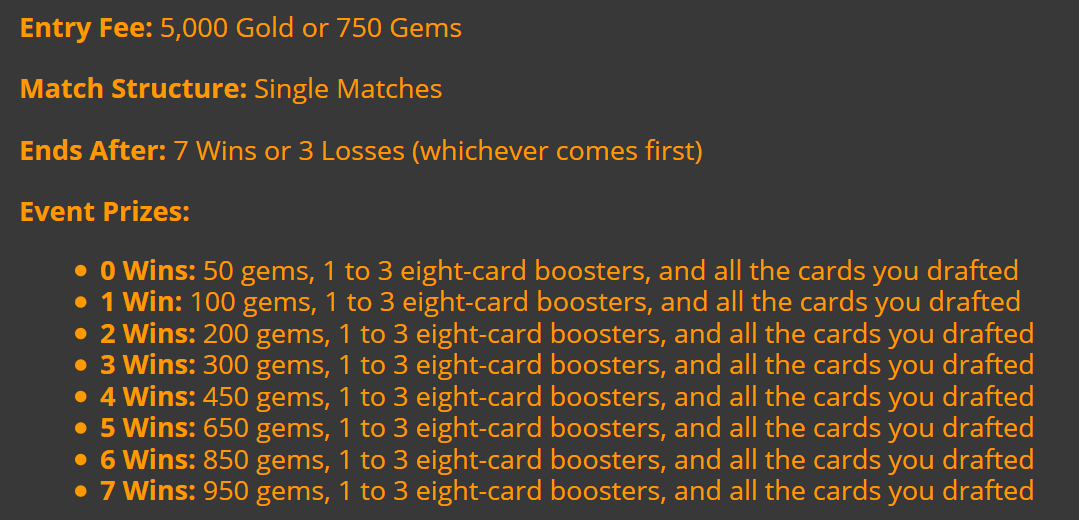
Ostensibly, you're getting a lot for $5.00 here. On average you're going to get about half of the gems back along with a booster pack and the cards you drafted. Better drafters will be able to get closer to 75 percent of their gems back on average.

The devil is in the details, however, and there are a few worth discussing. First is that gold is not part of the payout structure, meaning that the frequency at which free-to-pay players can draft is severely limited: about three times every two weeks so long as they forego the temptation of Quick Constructed. This is advertised as a way for free-to-pay players to get access to "premium currency," but in reality, it is a way to ensure that free-to-play players can't draft very much.

Second is that a large part of the reward comes in the form of additions to your Arena collection. To maximize the value of Draft on Arena, therefore, you really have to be wanting to play Standard. This is very interesting to me, and is a big break from paper Magic or MTGO.

On one hand, it is true that MTGO incentivizes players to play Constructed. In Constructed, players typically gain $0.23 per event, while in Limited players can expect to lose $5.00 per draft event or $2.00 per sealed event, but MTGO doesn't ask players who enjoy playing Limited to play Constructed and those who enjoy playing Constructed to play Limited.

Arena is more Orwellian in this way: it really wants you to play Standard, and it rewards are structured to nudge you in that direction. This is a feeling I get a lot when playing Arena – I feel like I'm being told what to do by the program.

The interesting question to me is whether it is worth it to use Arena if one only wants to draft ad infinitum. If I only purchased gems in $100 bundles, how many drafts could I expect to do for that amount of money? Let's say I have a 50-percent win rate. That means that, on average, I'm spending 750 gems and receiving 346 back, a net loss of 404 gems per draft. That means the cost for me to draft is about $2.00 per draft, enabling me to do about 50 drafts for $100. With an initial investment of $100, you should be able to draft forever if you have a win rate of about 64 percent.

That's actually really good value. For the vast majority of people, that's better value than MTGO, and as an MTGO investor, that makes me a bit nervous. Basically, drafting on Arena will be slightly better than drafting used to be before the introduction of playpoints on MTGO. Back then, MTGO players would lose between $2.00 and $3.00 per draft on average, numbers much closer to this first iteration of Arena draft. Once "real drafts" with eight-player pods and best-of-three matches are introduced in the coming months, we'll have to see whether those events give you as much bang for your buck, but this is worth keeping an eye on going forward.

To summarize what we've covered so far: at present, Constructed events provide better value on MTGO; Limited events provide better value on Arena. I would have expected the opposite.

II. Wildcards: Who Is Arena For, Exactly?

Instead of Hearthstone's dusting system that lets you destroy old cards to create new cards of your choice, Magic Arena is implementing a "wildcard system" in which cards inside booster packs are sometimes replaced with a "wildcard" that you can use to create a new card of your choice. I am puzzled that the Arena developers chose this system, as this has a few different consequences that I would not have intended were I in charge of designing the program.

In my first Arena article, I argued that Arena's greatest virtue would be that it would allow for a more casual digital Magic experience, allowing players to build decks from whatever random cards they acquired and play against other players doing the same thing. I thought, too, that Arena would give players the chance to brew random off-the-wall decks and have fun with them – basically, I thought Arena would be good for newer players, more casual players and SaffronOlive devotees.

Arena does everything it can to quash those players' spirits and desires and convert them into Spikes. Johnny and Timmy fare much better on MTGO or in paper than they do on Arena, and in no small part that's thanks to the wildcard system.

Because cracking packs usually doesn't help you build the decks you want to build, you are forced to use your wildcards to create the uncommons, rares and mythic rares you want to play with. But since these wildcards are limited in number, you are strongly incentivized to create the cards that are the most powerful and used in the most decks.

Kumena, Tyrant of Orazca is used in only one archetype; Rekindling Phoenix, Lyra Dawnbringer, Ravenous Chupacabra, Irrigated Farmland, and Jadelight Ranger are used in multiple archetypes. Karn, Scion of Urza is used in every possible archetype. The only way, therefore, to grind towards playing multiple different decks is to create those multi-deck all-stars with your wildcards, not weird off-the-beaten-path cards like Firesong and Sunspeaker, Kumena, Tyrant of Orazca or Gishath, Sun's Avatar. Once you use a wildcard, it's gone forever, and as someone who has played Magic Arena, I can confirm what most people say: it feels really bad when you "waste" a wildcard on something fun.

Put succinctly, it costs hundreds of dollars or hundreds of gameplay hours to brew and play with novel decks. "Budget Magic" for Magic Arena is an oxymoron – the budget decks in practice will be the decks that stray the least from the most played rares and mythic rares. This is what budget on Magic Arena looks like if you're thinking how to maximize your dollar over the long haul. Arena is a Spike program thanks to the wildcard economic system, and I don't think that bodes well for Arena's future.

Lastly, the wildcard system will make rotations hit players harder than veterans of other online CCGs are used to. In Hearthstone, every Standard-legal card in your collection has 100-percent utility now and 25-percent utility in the future (since four of any rarity can be "dusted" into a new card of that rarity). In Arena, every Standard-legal card in your collection has 100-percent utility now and 0-percent utility in the future.

This will keep players spending money over time, and it also punishes players more for taking a break from the program. Asking casual and newer players to become spikes and commit completely to the program strikes me as counterproductive and unwise. As an MTGO investor, I'm not sure what to think about this. I want Arena to get newer players interested and invested in the game, but I don't think an economy based on wildcards will help achieve that objective.

III. Signing Off

What do you think of this latest economic update? Have any of you tried the Arena beta? I'm looking forward to hearing what you have to say and answering any questions you may have. Thanks for reading!


Love What You Play: Taking the Taste Test

Are you a Quiet Speculation member?

If not, now is a perfect time to join up! Our powerful tools, breaking-news analysis, and exclusive Discord channel will make sure you stay up to date and ahead of the curve.

Modern has at times been described as a format hostile to Spike, the player demographic in search of winning at any cost. Indeed, "spiking" tournaments as players do in other constructed formats—by playing the best deck and understanding the mirror—isn't a reliable path to success in Modern. Rather, this format rewards players for picking a couple strategies (ideally a pair of decks that operate very differently) and getting to know them inside-out. As for which decks to choose, I think the obvious answer's also the best: your favorites!

This article explains my own strategic preferences and applies those to my deck choices in Modern. Hopefully, witnessing the process will help those lost in the format establish their own playstyle priorities, and serve as a friendly wake-up call to players stagnating on a deck they understand well enough to prize with, but don't enjoy enough to learn more deliberately. I'll close things out with some practical tips for identifying preferences.

No Accounting for Taste

Love is a two-way street—beloved decks can't be expected to deliver on all fronts. Enjoying a strategy is one thing, but taking the time to learn its strategic intricacies is critical to success. To do that, pilots must play attentively, with an open mind and an appetite for growth.
That being said, I wouldn't recommend mastering a deck you don't like playing. Personal hangups about whatever strategy might get in the way down the road, causing you to burn out or become disinterested. Modern is chock-full of archetypes, decks, and individual cards, so there's very little incentive to play anything but an exhilarating deck—and that deck is out there! Find it and cherish it.

The Taste Test

Part of what allows me to enjoy Modern so much is that I'm often playing something I love. I can select those decks by understanding my biases. Here's how I like my decks to be:

  • Aggressive. It bothers me to waste too many combat steps early in the game. We only get one per turn, and I intend on using those resources when possible. Aggressiveness loosely correlates with proactivity, but has more to do with establishing pressure quickly and putting opponents on the back-foot, even if the aggressive deck (i.e. Goblins) wins on the same turn (in this case, four) as an equally proactive, but not aggressive deck (i.e. KCI Combo).
  • Adept at combat. Aggressive decks already attack plenty, so the emphasis here is on blocking. If I'm not vying for King of the Red Zone, I don't feel like I'm playing Magic.
  • Disruptive. Modern strategies that don't seek to combo-kill opponents on turn three or four are required to run interaction. While I otherwise enjoy as proactive a playstyle as possible, I wouldn't want to not interact at all. The two types of disruption I favor are cards that interrupt plays (i.e. cheap kill spells, permission) and cards that interact very efficiently with an opposing strategy (i.e. hosers, lock pieces).

These three points already lock into aggro-control territory, which limits me to tempo or midrange decks.

  • Reversible. Reversibility refers to an aggro-control deck’s ability to assume the role of its archetypical opposite when necessary—in other words, the ease with which a midrange deck can play like a tempo deck and vice-versa. I want control over the kinds of games I play.
  • In-game consistent. Registering a pile of four-ofs isn't enough for me; rather, I require ways to control which cards I see during a game.
  • Risky. Specifically, I like decks that give me opportunities to take risky lines, not ones that force me into them.
  • Flashy. I'd be lying if I said I didn't like winning in style. This particular metric gives the decks I design extra points over existing ones.

Seven points. Is that too much to ask of one deck? I don't think so. After all, I've found decks that check all the boxes. And a deck doesn't need to hit a home-run on every aspect for me to enjoy it—if my priorities were a tad more on the "winning" side than on the "fun" side, I'd happily sleeve up Affinity over Colorless Eldrazi Stompy when the metagame called for it.

Pencils Out

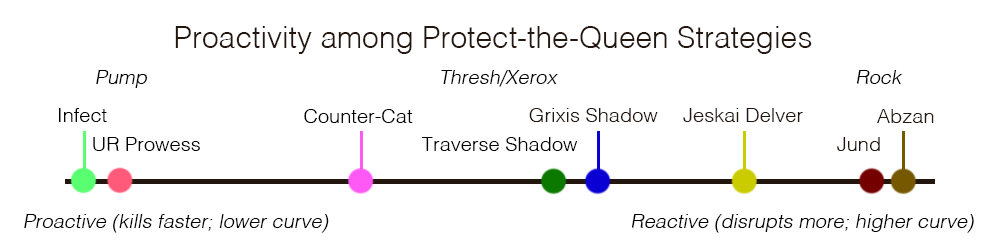
To illustrate some of the above points in action, consider this chart detailing proactivity among protect-the-queen strategies in Modern. Protect-the-queen is a playstyle that relies on sticking a highly impactful threat (i.e. Tarmogoyf) rather than flooding the board with bodies, and then defending that threat until it can win the game. In other words, they're usually aggro-control decks packed with disruption. The following decks are sorted from fastest to slowest.

(Click to expand.)

Infect and UR Prowess are the most aggressive decks on the chart, as they goldfish kills faster than any other deck here. These decks pass my test on aggressive, in-game consistent, and risky, but fail the other metrics (okay, UR Prowess is kind of flashy). Most damning of all, they're not disruptive—these pump-style strategies are aggro-combo decks, not aggro-control ones.

The next-most aggressive deck here is Counter-Cat, capable of explosive Zoo-style openers and Growth-Bolt burn blitzes. I've tweaked this deck to meet my exact needs, so it passes every test with flying colors.

Counter-Cat, by Jordan Boisvert

Creatures

4 Wild Nacatl
4 Delver of Secrets
4 Tarmogoyf
3 Hooting Mandrills
2 Snapcaster Mage

Instants

4 Lightning Bolt
4 Path to Exile
3 Mutagenic Growth
2 Spell Pierce
2 Mana Leak
2 Thought Scour

Sorceries

4 Serum Visions
2 Sleight of Hand
2 Chart a Course

Lands

4 Misty Rainforest
3 Scalding Tarn
2 Wooded Foothills
2 Flooded Strand
1 Steam Vents
1 Temple Garden
1 Hallowed Fountain
1 Stomping Ground
1 Breeding Pool
1 Island
1 Forest

Sideboard

2 Bloodbraid Elf
2 Huntmaster of the Fells
2 Snapcaster Mage
2 Negate
2 Spreading Seas
2 Ancient Grudge
2 Pyroclasm
1 Engineered Explosives

The aspect I'd like to touch on here, since I haven't mentioned it in my other articles on the deck, is riskiness. Each turn, Counter-Cat presents pilots with loads of choices to make, many of which revolve around mana constraints. Deciding whether to cantrip into needed pieces, hold up disruption, or tap out for threats to speed up the clock make piloting the deck a thrill.

Traverse Shadow is one of the new-to-Modern midrange decks I alluded to above, and the only rock deck I can truly get behind. It's not quite aggressive enough for my tastes, but it's close, and the many optimization possibilities help with flashiness. Grixis Shadow, on the other hand, is too reactive for me. A full third of its creatures aren't built for battle. Blech!

On to Jeskai Delver: by no means a popular deck, but a helpful one for our purposes. I've messed around with Delver builds of all colors, including Jeskai. My beef with the wedge is its lackluster defense—nothing in these colors can block! The closest we've got is Young Pyromancer, which leaves much to be desired by further exposing us to damage-based sweepers and not actually deterring attacks. More aggressive builds of Jeskai featuring Steppe Lynx or Monastery Swiftspear offer no solution to this problem.

Abzan and Jund are Tarmogoyf decks, so they're great at combat. They're also slow as heck. BGx Rock would enjoy a much better Tron matchup if it had access to a reliable, compact aggressive plan to up its reversibility, but it doesn't. These decks also fail on riskiness and flashiness, as they're safe and cliché—notably, they both fare okay on in-game consistency these days thanks to their respective adoption of Grim Flayer and Bloodbraid Elf.

Pencils Down

Looking at the chart overall, it's no surprise that the decks in the middle of the proactivity spectrum are the ones with the highest reversibility. These decks can't go under or over everybody, but they do get to choose which kind of game they play for the most part. Naturally, then, these thresh/xerox decks are the sort of threat-light aggro-control decks I gravitate to.

Changing Paradigms

I define midrange as an aggro-control archetype that tends to disrupt opponents first, then play out its threats (compare with tempo, an aggro-control archetype that plays out its threats first and then disrupts opponents). I used to think I didn't like midrange decks, but I was wrong; in truth, I don't mind disrupting opponents first. In order to have my aggressiveness needs met, though, a given midrange deck needs to follow that early disruption with lots of pressure, the likes of which few can muster outside of combo-style strategies. But combo goes out the window because I need to be blocking.

A deck like this simply didn't exist in Modern for most of the format's lifespan, so I spent years mistakenly believing I didn't like to play midrange at all. Then, one popped up.

Colorless Eldrazi Stompy, by Jordan Boisvert

Creatures

4 Eternal Scourge
4 Eldrazi Mimic
4 Matter Reshaper
4 Thought-Knot Seer
4 Reality Smasher
4 Simian Spirit Guide

Artifacts

4 Serum Powder
4 Chalice of the Void
1 Smuggler's Copter

Instants

4 Dismember

Lands

4 Eldrazi Temple
2 Gemstone Caverns
4 Zhalfirin Void
4 Blinkmoth Nexus
2 Mutavault
3 Ghost Quarter
2 Scavenger Grounds
2 Wastes

Sideboard

4 Relic of Progenitus
1 Surgical Extraction
3 Spatial Contortion
2 Gut Shot
3 Ratchet Bomb
1 Sorcerous Spyglass
1 Gemstone Caverns

Colorless Eldrazi Stompy differs wildly from Counter-Cat: it's more synergy-based; it's far more streamlined; it's creature-focused, rather than spell-focused; its disruption is mostly on noncreature permanents; it boasts zero colors to Counter-Cat's four. And yet, this deck too checks all of my boxes.

Mimic and Temple give us reversibility by bolstering our aggressive capabilities for a midrange deck; large Eldrazi bodies serve as Tarmogoyf analogues for red-zone dominance; Chalice of the Void compliments Dismember as hyper-efficient interaction; Zhalfirin Void compliments Serum Powder as in-game consistency. As for riskiness, the deck regularly mulls to four in search of the perfect opener, and Modern doesn't get much flashier than exiling Scourge with Powder to start the game with more than seven cards.

Eldrazi vs. Humans

Just as Counter-Cat shares many strategic similarities with Traverse Shadow, Colorless Eldrazi Stompy also has a tiered analogue. In my eyes, that deck is Humans, a fish-style tempo deck with huge creatures, mana acceleration, and walking disruption. But unlike Traverse Shadow, Humans doesn't appeal to me.

It's adept at combat and disruptive all right, and more aggressive than Colorless overall. But Humans isn't so reversible, struggling against midrange decks heavy on removal spells that break up its synergies. Without searchers like Traverse the Ulvenwald or card selection cantrips, midrange-eating bullets in the sideboard aren't a reliable solution to this problem. The deck also wants in-game consistency besides the anemic Horizon Canopy, making it prone to flooding, and earns a big fat "F" on riskiness and flashiness.
I think Humans is an amazing Modern deck, and perhaps the most powerful option currently available. But I don't think that's a compelling reason for any ol' Modern player to pick up the deck seriously. Without a love connection, most players will lack the patience necessary to become Humans experts.

Refining Tastes

Playing with Colorless Eldrazi Stompy threw a lot of what I thought I knew about my tases for a loop. After years of clawing my way to close victories with Delver of Secrets, I was winning games unequivocally; I'd previously figured winning was only fun for me if I had to work hard for it. And here I was on a midrange deck rather than a tempo one; it wasn't that I wanted to commit threats first after all, but that I just had to be more proactive than Modern's old midrange decks. Eldrazi even forewent cantrips, cards I once considered necessary in decks I'd bring to real tournaments; it turned out any card selection method did the trick for me, even the unassuming (but familiarly named) Serum Powder.
Critically, I wasn't broadening my tastes by learning to like new things; I was refining them by realizing I liked things I had never tried, which brought me a more accurate understanding of what I liked about my original deck in the first place. I only learned these lessons about what I truly do and don't enjoy by exposing myself to other playstyles, and I encourage anyone uncertain of their tastes to do the same.

Practically, this task entails trying different decks and seeing how they feel. The more technical you make the task, the more useful it's liable to be: take notes on your feelings during games, after plays, while you're winning or losing; also note how you feel when the game ends, or ten minutes after. Pooling this data and reviewing notes might help the more distracted pinpoint aspects they like or dislike about individual decks, which brings them closer to a clear idea of their tastes.

Saying Grace

Modern players are extremely fortunate to play a format where succeeding with a favorite deck isn't just possible, but the norm. Whether they take advantage of this aspect is up to them, but I suspect that decision has a profound effect on their win ratio.


R&D first came up with player demographics to help with design. Spikes like to win, as mentioned; Timmies like casting big creatures; Johnnies like winning with flair, or using combination decks. But the average Modern player isn't producing a game for millions of consumers, and personal taste reaches much deeper. Do you prefer your decks forgiving, or punishing? Relaxing, or demanding? Linear, or complex? Which aspects of each turn do you most enjoy? Which feelings do you hang onto after your games?

Coming out with a better idea of where you stand will prove supremely helpful when it comes to serious deck selection in the future. There's no accounting for taste. Let me know yours in the comments!

Daily Stock Watch – Unwinding Clock

Are you a Quiet Speculation member?

If not, now is a perfect time to join up! Our powerful tools, breaking-news analysis, and exclusive Discord channel will make sure you stay up to date and ahead of the curve.

Hello, readers and welcome to a new edition of the Daily Stock Watch! We've strayed away from talking about cards that have been gaining ground financially as casual favorites over the past weeks so it's time to go back to that side of the fence. The card that I will talk about today is one that has reached its all-time high of $6.92, even though it's not being used in any competitive decks in Magic. We love to check out cards of this kind every now and then, so we could make some profit out of it while we can.

There was an error retrieving a chart for Unwinding Clock

A lot of cards from New Phyrexia are already gaining steam financially, as it has been seven years since it was released. Unwinding Clock is one of those cards that actually look good when you see it, generally because of the powerful Seedborn Muse effect that is brings to the table for artifacts, but hasn't really been broken as a combo piece, thanks largely to the strength of artifact-themed decks such as Affinity and Lantern Control which doesn't need its power to stay relevant. As a matter of fact, it's hard to find a deck that's relatively dependent on this card, but we could definitely check a Commander list that would be able to benefit from its presence.

I've been looking for some neat ideas on where you could slot it in, but all I ever found that was a bit interesting was a deck that looked like this:

Unwinding Architect

Creatures

2 Grand Architect
3 Palladium Myr
3 Phantasmal Bear
2 Phantasmal Image
4 Phyrexian Metamorph
2 Solemn Simulacrum
1 Wurmcoil Engine

Artifacts

3 Crown of Empires
1 Druidic Satchel
1 Mox Opal
1 Pristine Talisman
3 Scepter of Empires
2 Sword of Feast and Famine
3 Throne of Empires
3 Unwinding Clock

Other Spells

3 Tezzeret's Gambit

Lands

1 Darkslick Shores
4 Drowned Catacomb
1 Island
1 Swamp

It's a casual deck that tries to take advantage of weenie creatures and Grand Architect, and the powerful trio of Crown of Empires, Throne of Empires and Scepter of Empires. It's a bit dreamy if you ask me, and it seems to me that Unwinding Clock keeping this price tag is also in that accord. I just don't think that it will ever be used as a centerpiece of a combo deck, despite of the promise that it holds as a card that could keep your board always ready at all times. If we follow the trend of how cards like this has progressed in the past few months (take note of Dolmen Gate as an example) then we could expect it increase for a few more bucks before it settles down at a price where it would stay for a while. I'm just not the type of guy who would keep this in my bin and wait for it to gain more ground financially. I'd like to get out of this investment as much as possible.

At the moment, you could get copies of Unwinding Clock from online stores such as StarCityGames, Card Kingdom, TCGPlayer and ChannelFireball for anywhere between $5.86 up to $7.99. Foil copies of this card can be obtained from anywhere north of $15, and that should say a lot about how these stores put a high regard to its possibility of breaking out in the future. Recent trends about cards that only have casual appeal would usually give us the idea based on how much the foil copies are being sold for, so I'd say that you could try picking up the foil ones for bigger gains if it really does break out soon. I'd like to move my normal copies around if possible, but it should still reach the $8-$10 range barring any reprint. Just keep an eye out for it in the market.

And that’s it for today's edition of the Daily Stock Watch! See you again tomorrow, as we check out a new card that should be on the go, or good enough for speculating. As always, feel free to share your opinion in the comments section below. And if you want to keep up with all the market movement, be sure to check in with the QS Discord Channel for real time market information, and stay ahead of the hottest specs!

Video Series with Ryland: Goryo’s As Foretold

Are you a Quiet Speculation member?

If not, now is a perfect time to join up! Our powerful tools, breaking-news analysis, and exclusive Discord channel will make sure you stay up to date and ahead of the curve.

Last time we battled with Mardu Pyromancer, one of the decks I would consider placing among the top three in the format. This time we're going to mix it up with something a little spicier. The deck caught my eye after quietly sneaking in to the Top 8 of the SCG Baltimore Team Open. Star City called it "Goryo's As Foretold," but that name doesn't encapsulate everything that's going on. What we're really looking at is an amalgam of several powerful combos in Modern all alongside each other, including both a Kiki-Jiki and a Griselbrand kill.

I must admit, when first looking at the deck it seemed all over the place. Even after the initial shock wore off, it was clear the deck had a ton of moving parts. Once I played a few games however, it felt like a puzzle where all the pieces came together in just the right way.

The deck does attack from a lot of different angles, but its ability to do so is one of its greatest appeals. Think of the most comparable deck, Grishoalbrand. (One could argue Mono-Blue Living End is a closer parallel, but we'll forgo that discussion for now.) Grishoalbrand is an A+B combo deck that is trying to put a Griselbrand into play via either Goryo's Vengeance or Through the Breach. As such, it is a relatively easy deck to Thoughtseize. Yes, it has two plans, but most hands will still have clear targets for disruption.

Now consider our As Foretold monstrosity. It is essentially a combo deck with the ability to assemble A+B, or B+C, or C+D, and so on. Many of our "combos" don't win the game on the spot; in fact, only Deceiver Exarch plus Kiki-Jiki, Mirror Breaker kill immediately. However, As Foretold plus Ancestral Vision puts the deck very far ahead, as does Goryo's on Griselbrand. In the latter case, usually you can set up to win the game the following turn, often with redundancy. Consider the possibility that you were able to assemble As Foretold and Living End, but weren't able to find a Deciever. Guess you'll have to settle for a one-sided Wrath of God that also reanimates that Griselbrand you pitched! Having all these different options frequently makes your hand quite the puzzle for your opponent and generally makes it easier for you to rebuild post-disruption.

Certainly some consistency problems with the deck will be quickly discovered, but the sheer amount of card draw can help quite a bit. Between Ancestral Vision and Faithless Looting alone, you will be seeing your fair share of cards. A quick aside, but an important one: you'll notice that I've been playing a ton of Looting decks in Modern lately—Dredge, Mardu, Goryo's (and even a Soulflayer deck). Faithless Looting is absolutely busted. It's easily in contention for Modern's best cantrip, rivaled only by Ancient Stirrings. Basically every time you register a 75 with Looting in it, you want to draw it nearly every turn. I can't count the number of times I've said or thought, "If I can just draw Looting here..." I don't think the card is too good for the format, but I do think it bears mention that we should be playing it whenever reasonably possible. It struggles a bit against graveyard hate, but honestly, what powerful card doesn't these days?

Really though, can we just not talk about graveyard hate? This deck does not do well against basically any piece, and certainly not with hard hate like Leyline of the Void or Rest in Peace. Sure, it has some ways to fight back, and nothing is stopping you from assembling Exarch plus Kiki the "hard" way. Realistically though, the deck is not well set up to make that happen. Any deck that presents yard hate and a reasonable clock will generally take you down. In this way, I think Grishoalbrand looks favorable in our mini-comparison—that deck performs much better against that kind of disruption. Breach is the perfect way to get around your opponent's Rest in Peace.

That said, I'm honestly not sure which deck is better, and I think there is a genuine debate to be had. My results with this deck have been surprisingly positive and it has undoubtedly been a blast. I think more tuning could definitely be done to the list, and I'm looking forward to see if the archetype produces any results in the future.

I hope you enjoy the matches and, as usual, I'm interested to hear what kind of content you'd like to see moving forward, so I can continue to evolve and improve my videos, so let me know! If you'd like to see similar content, check out my Twitch channel for some more live Modern.

[youtube https://www.youtube.com/playlist?list=PL261kJ_cAQC_vIcs8g5o8LIHO0UaPcBLA]

Goryo's As Foretold

Creatures

4 Deceiver Exarch
4 Griselbrand
2 Jace, Vryn's Prodigy
3 Kiki-Jiki, Mirror Breaker
2 Simian Spirit Guide

Enchantments

4 As Foretold

Instants

4 Goryo's Vengeance
4 Izzet Charm
3 Lightning Axe

Soceries

4 Ancestral Vision
4 Faithless Looting
3 Living End

Lands

2 Blackcleave Cliffs
1 Blood Crypt
3 Bloodstained Mire
1 Cascade Bluffs
1 Island
1 Mountain
3 Polluted Delta
1 Scalding Tarn
2 Spirebluff Canal
2 Steam Vents
1 Swamp
1 Watery Grave

Sideboard

2 Anger of the Gods
3 Collective Brutality
1 Dispel
2 Engineered Explosives
2 Gonti, Lord of Luxury
1 Nimble Obstructionist
1 Repeal
2 Sorcerous Spyglass
1 Swan Song

Insider: What is “Coolness Factor” – and Why Does It Matter in MTG Finance?

Are you a Quiet Speculation member?

If not, now is a perfect time to join up! Our powerful tools, breaking-news analysis, and exclusive Discord channel will make sure you stay up to date and ahead of the curve.

I will begin by saying that we live in crazy times when it comes to Magic Finance. Crazy in the sense that there has been unprecedented movement on secondary-market cards over the past few months. In particular, when it comes to early editions and Reserved List cards. Many of these cards have been valuable and/or desirable for a long time now, but clearly, the market has changed and the prices have been shooting up.

The biggest factor that has triggered the growth, in my opinion, is the fact that more and more players, collectors, and investors have been getting onto the same page about what the best method of investing in Magic will be moving forward: old and Reserved List cards are where the money is at.

Many, many of the writers for QS (myself included) have been preaching the value of getting into the Old School and Reserved List cards for years now, and it would appear that everybody who followed suit and adopted a similar strategy is getting paid off hard in the here-and-now.

Brave New Era

Sigmund Ausfresser had a really well-executed article earlier this week on this very subject:

https://www.quietspeculation.com/2018/05/insider-is-this-the-new-era-of-mtg-finance/

I agree with virtually all of what Sigmund lays out in here. My only objection is a semantic one. I would argue that the new era of Magic finance began with the release of the first Modern Masters set and the community has slowly, slowly been adjusting to the implications of a continuous string of reprint sets and how that changes the marketplace.
Most importantly, it creates a system where the value of the 99 percent of Magic cards that can be reprinted have a lesser value than the one percent of Magic cards that can't – i.e., the Reserved List cards.
What I believe has happened is that the majority of the community is finally catching up to where the elite MTG finance people have been for several years. We have reached a point where players and speculators and vendors are on same the page about what is going on with reprints and Reserved List cards. The steadily climbing prices reflect an understanding among players and collectors: This is the way it is now.
The biggest thing that has changed is a widespread perception about what investing in Magic looks and feels like in a post Modern Masters world.
There was an error retrieving a chart for Tarmogoyf

More Reserved List Strategies

Well, it looks like our job here is done. Finance is solved. Time to pack it in.

There was an error retrieving a chart for Jester's Cap

Joking.

I've been meaning to write an article about my favorite flavor texts of all time, and if I did, this one would surely make the cut:

"There is always a greater power." 

From the card Cruel Ultimatum, featuring artwork with the giant Demon Malfegor battered and beaten down with the imposing shadow of Bolas cast over him. Cool stuff.

The fact is, that there is always a bigger fish, a better way, and/or a greater strategy than what you or I know to exist. The key is to figure out what it is and implement it before others figure it out as well!

I believe one of these angles relates to what I like to call the "Coolness Factor," and will open up avenues for producing productive investments.

There was an error retrieving a chart for Shivan Dragon

There is a reason that cards like Beta Shivan Dragon, Juzam Djinn, and Guardian Beast have surged beyond most cards that exist when it comes to price. It has little to do with the actual playability of the cards. I'm willing to concede that Guardian Beast and Juzam Djinn have some applications in Old School Magic, but realistically, their price tags are linked directly to two factors: 1. Reserved List, and 2. Nostalgia / Iconic Status / Coolness.

People love to formulate narratives. I'm formulating one right now. One key to being a "good reader" is to see multiple narratives and be able to separate the ones that make the most sense from the ones that lack substance.

  • Juzam is expensive because of Old School.
  • Juzam is expensive because it's on the Reserved List.
  • Juzam is expensive because it is cool and iconic and people want to own it.

Juzam Djinn has always been expensive. It has always been expensive because it is cool, iconic, and nostalgic and because people want to own a piece of history. The card may be ten times as expensive today as it was two years ago, but the change in price is merely an adjustment in what the marketplace looks like.

When I was a kid playing Magic, Juzam Djinn was one of the most expensive cards in the game. It was more expensive than a Mox. When I got back into the game in college, Juzam Djinn was still one of the most expensive cards in the game despite the fact that it was 100-percent unplayable in any Constructed format. Today, Juzam Djinn remains one of the most expensive cards in the game despite only seeing play in a tier-two Old School deck.

Juzam's price tag has always been a reflection of the fact that it is a very cool piece of Magic history and a neat collector's item. I would argue that the current price tag is merely an adjustment of Juzam Djinn (the coolest card in MTG) as properly priced in a world with $400 dual lands and $25000 Moxen. As crazy as it sounds to say this, at around $1250, the card may be undervalued at the moment!

Sigmund pointed out in his article that one area where the current buyouts differ from the previous ones has to do with the intent of the buyers. He argues that the strategy in the past was for buyers to buy out cards, spike the price, and resell into the spike. He postulates that now buyers are less interested in selling into the spikes, and more interested in holding onto these cards for a long time.

There was an error retrieving a chart for Time Walk

There's obviously no way to confirm what other people will, or won't, do with the cards they purchase – but his observation syncs up with what I've been doing for years: picking up sweet old cards whenever I can and holding onto them, because I knew they would become more scarce and more valuable.

Targets

Let's think about other cards that have that it factor.

The biggest problem with using this strategy to invest is that most of the marquee cards have already been hit. Juzam is sick, but if you don't have one, it feels like you might have missed the boat on getting a great deal (although I think the card will just continue to go nuts).

There was an error retrieving a chart for Tawnos's Coffin

Of the random, cool, old cards, there are few that are actually as "good" as the Coffin. I play this card in my Battle Box, Old School Battle Box, and include it in every Commander deck that I build. It is simply a very, very powerful Magic card. I personally own four copies, one for each deck and an extra just in case.

As far as coolness factor cards that have a lower price tag than I would expect, this is on top of my list.

There was an error retrieving a chart for Chromium

I think the Legends Elder Dragon cycle is another very good place to invest in coolness factor cards that have a reasonable price tag. I wrote an article about six months ago where I suggested investing in low-dollar, iconic, old cards (Legends rares, The Dark rares, and Beta uncommons). One of the cards I suggested then, and continue to suggest, are the Elder Dragon Legends because they are relatively cheap for how cool they are. These cards have basically tripled since I first suggested them, but can still be found in the $20 range on eBay or at LGSs.

The Elder Dragon cycle was the selling point of Legends when it came out. These Dragons were nearly the price of Moxen until Chronicles sank their ship.

I think people sleep on stuff like this because of a couple of reasons:

  1. There are a zillion white-border copies because of Chronicles.
  2. These cards are not on the Reserved List.

Nobody wants a Chronicles Arcades Sabboth. I think a lot of people would enjoy having a Legends one in an Old School Battle Box or binder full of sweet old cards.

There was an error retrieving a chart for Arcades Sabboth

A lot of the older cards, like Royal Assassin, Shivan Dragon, the Elder Dragons, etc. do not appear on the Reserved List and have been reprinted many times. The key is that even if the cards are reprinted, Wizards cannot reprint Beta or Legends, which means the old, nostalgic, and cool versions will always be desirable with collectors and fans of the game.

To wrap up, I'd like to highlight a very smart thing that Sigmund wrote in his article that I have always done myself when collecting: get the things you want now!

The prices on old cards are only going to continue to climb as more and more people accept the new marketplace dynamic. If you really want to own a Beta Royal Assassin, now is the time, because if you wait a year or two, chances are you'll be paying double or triple the price.

A lot of people are on that plan, so expect prices on the kinds of cards you'd want to collect to continue to climb and climb.

Insider: Reserved List Buyouts and Foreign Versions

Are you a Quiet Speculation member?

If not, now is a perfect time to join up! Our powerful tools, breaking-news analysis, and exclusive Discord channel will make sure you stay up to date and ahead of the curve.

Welcome back, readers!

You'd have to be living under a rock with no cell reception to be unaware of all the recent Reserved List price spikes . It seems that cards of all types (Legacy staples, Commander staples, and random garbage cards) are getting bought up by the droves on TCGplayer.

Many of these cards have gains in the 400-percent range over the past month or so. The boat has sailed on these. This is especially true when you consider what I mentioned last week: stores are slow to increase their buylist prices in response. We see a card's TCGplayer price shoot up some massive percent only to see the market price remain relatively stagnant—the surest sign of a buyout.

I have stated repeatedly that I'm against buyouts, as they more often than not are attempts to pump-and-dump. However, with this latest round, it seems the buyers are simply sinking a ton of money into the cards and sitting on them. Their plan seems to be for prices to stabilize at some higher number, and then to start selling them slowly, hoping that the low supply by itself is enough to keep the new price up (or slowly rising).

As I showed with my last article, this isn't guaranteed for all buyouts, but it's certainly plausible that it will work for some cards. It also means that the people orchestrating these buyouts are forced to have a lot of cash tied up in a rather illiquid asset—but that's their call.

But enough about that. Let's look at how we can profit from others buying out cards. The MTGStocks website looks only at TCGplayer for its data. There are two key components to unpack from that:

  • If you go to other non-TCGplayer sites, you might be able to find copies of cards moving at the "old" price, and thus pick them up cheaply to flip ASAP.
  • Most people have the default language set to English for cards on TCGplayer. Thus you can often pick up foreign copies at a decent discount. If you go down this route, don't forget that foreign ones are often more difficult to move than English.

Other Sites to Check

It's important to have a good list of sites you can check regularly for underpriced cards. It seems that more and more stores are hopping onto the TCGplayer bandwagon and selling on the platform, however, there are still some stores who don't:

  • Card Kingdom
  • ABU Games
  • Cool Stuff Inc
  • MTGDeals.com
  • Ninety Five
  • Face to Face Games

In addition to these, there are plenty of other larger stores not selling on TCG. Depending on how quick stores react, you can often snag good deals on other websites. The best targets are stores that adjust their prices themselves (i.e. don't have them tied to TCGplayer), as well as any LGSs that pre-price cards (which does seem to be a dying trend).

When you find these types of stores it's often worth your time to look through as much of their inventory as possible. It's extremely difficult to keep track of all card prices in any sort of manual way. Thanks to odd jumps here and there, you can score some really nice finds as long as you have the knowledge.

Whenever I travel, I always try to find a local store or two to visit (as long as I'm in town long enough and/or my fiance doesn't mind). You really do find hidden gems from time to time.

Foreign Cards

I've mentioned above how it can be more difficult to move foreign cards. This is especially true for Commander staples, because people don't like having to explain what a card does in the middle of a game. However, Commander players fall on the casual spectrum, and that's the group of players most willing to buy the cheapest copy available.

So the trick here is to find really good eternal cards in foreign languages that are:

  1. Recognizable. The more so the better, as people will have to explain what they do a lot less often.
  2. Competitive. You'll often see casual players slowly begin to incorporate more competitive cards into decks, which then increases demand. A cheaper option is very appealing when one wants to "upgrade" their deck. It also means you attract both casuals and competitive players.
  3. Staples. As with all formats, there are typically staples for a given color combination. For example, most green-white decks include Mirari's Wake, and most blue decks include Cyclonic Rift. Being a staple tends to also means the card is "recognizable" as well, so these categories overlap somewhat.
  4. Reserved List. This isn't a requirement, but it certainly does help.

Special Sales

While it's already come and gone, Star City Games had a foreign card sale at the beginning of April. I purchased a fair number of Reserved List cards in foreign languages, emphasizing Japanese versions. Some of these cards don't have foil printings, so the "most pimp" version is the one in the language printed the least. Back in the days before Russian was an option, this was Korean or Japanese, depending on the set.

I went pretty deep with this sale and spent far more than I originally anticipated. Here's what I picked up.

  • 4x Dream Halls (Japanese): $5.15 - This was before they jumped thanks to Muldrotha, the Gravetide, but being a Reserved List card that was a four-of in some Legacy decks (mainly Know and Tell), I felt it had a lot of potential at the time. Stronghold was printed in both Japanese and Korean—Korean copies would have been preferable, but I haven't actually seen any on the market.
  • 6x Mind Over Matter (Japanese): $11.85 - This was also before it jumped two weeks ago. Mind Over Matter enables multiple combos in Commander, though the casting cost is a bit prohibitive for some decks. It is often desired by competitive players.
  • 4x Replenish (Japanese): $16.74 - This is a staple in W/x archetypes that utilize a lot of enchantments, whether they be voltron, stax, or enchantress builds.
  • 4x Yavimaya Hollow (Japanese): $15.47 - This is a staple for pretty much every deck that runs green and creatures (which is pretty much all green decks).
  • 2x Treachery (Japanese): $12.05 - This is the preferred version of Control Magic for most competitive players. It's essentially free thanks to the untap, and can even generate mana if any of your lands produce extra mana.

All of these cards saw their English counterparts jump dramatically since early April. Even the foreign versions are selling for considerably more than I paid for any one of them (though I haven't sold any yet).

Italian Legends

Legends cards have been no stranger to the recent Reserved List buyouts, and some have had some huge percentage gains in the past few months. Interestingly enough, Italian versions can be found far below the English ones.

While we have exact print runs for Magic's earliest sets (including Legends) we don't have the print run numbers for Italian Legends. I've heard it's likely around three times as much, which would definitely explain why the Italian ones are cheaper than the English versions. However, what's interesting to note is that some of the most expensive Legends cards have a relatively low multiplier between Italian and English versions.

There was an error retrieving a chart for The Tabernacle at Pendrell Vale

Looking at both versions on TCGplayer, there's definitely a premium for English, at least in the LP category. However, the Italian ones are not too far behind (ignoring the NM English one).

That isn't the case for every Legends card. Look at The Abyss.

There was an error retrieving a chart for The Abyss

Here we see a definite gap between English and Italian options, with the LP Italians going for around 40% of the English option. This translates to a 2.5x multiplier, which falls in line with our estimate of the larger print run.

What about the non-Legacy staples?

There was an error retrieving a chart for Angus MacKenzie

Here we see a pretty wide range for the NM English versions. We only have one Italian version and it's on par with the NM English version. Granted, the market price on this card is only $167 (as of May 15) so they aren't selling for the upper-end prices yet.

However, I've picked up not one, not two, but three SP Italian Angus MacKenzie from a well known store for $39.99 each within the past two weeks. They are sold out of them now thanks to me, but the point is that there are a lot of opportunities to find some of these cards at bargain prices if you look around.

Now, eBay shows that the Italian Angus's are selling at closer to $82 (taking the average of the three below). These recent sales do put the multiplier between English and Italian at around 2.5x as well.

The point is that we are likely to see movement on Italian Legends cards that are desirable for Commander in the coming months, as casual players buy up the much cheaper options (for fear of missing out on ever getting to play them in Commander).

Conclusion

I think there's some definite promise in foreign Reserved List cards that are played in Commander (despite the fact that I personally avoid foreign Commander cards like the plague). Casual players will often wait for a reprint to drop the price of cards they want—for Reserved List cards that's not an option.

I myself have picked up a couple extra copies of the Italian Legends cards I think are most underpriced, specifically cards that are very playable in Commander and have a multiplier of more than 3x between the Italian and English versions.

Daily Stock Watch – Tendershoot Dryad

Are you a Quiet Speculation member?

If not, now is a perfect time to join up! Our powerful tools, breaking-news analysis, and exclusive Discord channel will make sure you stay up to date and ahead of the curve.

Hello, everyone and welcome to a new edition of the Daily Stock Watch! Standard season is in full bloom and there is still no clear picture as to what the best deck in the format is, so we'd like to take advantage of all the breaks that we could get as finance junkies. The card that I would feature today is one of those cards that gained some leverage from the arrival of Dominaria, as it rose from the ranks of a bulk rare to that of a vital cog and the centerpiece of a mid-tier deck in the format. Our card for today just reached its all-time high of $6.99, and there might some more room for growth if it gets the much needed exposure that it clamors for in the Pro Tour.

There was an error retrieving a chart for Tendershoot Dryad

Tendershoot Dryad was a bad card until Slimefoot, the Stowaway, Llanowar Elves and company arrived from DOM. Suddenly, you have a Saproling lord that produces its children every turn (mini Groots, if you don't mind) and pumps them subconsciously to smash you whenever they get the chance. Backed with some efficient removals from black, the deck could give every opposing deck a run for its money on any given time. Just so you know what I'm talking about, take a look at this Golgari Saproling deck.

Golgari Saprolings

Creatures

4 Llanowar Elves
1 Metallic Mimic
2 Slimefoot, the Stowaway
4 Yavimaya Sapherd
4 Sporecrown Thallid
4 Tendershoot Dryad

Instants and Sorceries

4 Fatal Push
2 Vraska's Contempt
1 Vicious Offering
4 Spore Swarm
2 Cast Down
4 Saproling Migration

Other Spells

2 Aethersphere Harvester

Lands

2 Field of Ruin
8 Forest
4 Swamp
4 Blooming Marsh
4 Woodland Cemetery

Sideboard

1 Nissa, Vital Force
2 Naturalize
2 Lost Legacy
1 Fungal Plots
3 Fungal Infection
4 Duress
1 Doomfall
1 Arguel's Blood Fast

With a steady flow of threats that are scattered across the board, this deck is balanced on both offense and defense until it could power out Tendershoot Dryad which serves as a pseudo-Overrun effect if you're unable to stymie the saproling platoon that has been established before its arrival. It doesn't have a hard time reaching the absolute stage of ascension with all the tokens around, and it seems that clogging the board is how Standard would look like for the next couple of months. I really like how this deck is looking, and I think that it is well-positioned to beat any deck on a consistent basis because of its resilience. There's probably more room for financial growth for this card, as this deck is very cheap to build with majority of the role players coming in from DOM.

Ascension Key Cards

Some of these cards will finally make sense as we enter an era of permanents in Standard. With Settle the Wreckage and Fumigate as the solid real creature sweepers in the format, games could start to get dragging if the meta shifts to a midrange-control type of environment. Since players are still working on fast decks that rely on the likes of Goblin Chainwhirler and Heart of Kiran, it might take some time before this Golgari Saproling deck becomes a legit threat to the upper tier of the format. It would be a good start though to get your copies, as Ixalan will be around for a while and this will probably be one of the best shells to build on once some of the Standard sets rotate out in the latter part of the year. I like how Tendershoot Dryad and its kin are positioned to make a run in the future.

At the moment, you could get copies of Tendershoot Dryad from online stores such as StarCityGames, Card Kingdom and TCGPlayer for anywhere between $6-$7.99. Channel Fireball is dried out and should be refilling at the same price range soon. I think that this card will easily be a $10 in the future, barring any insane addition to the other decks in the upcoming core set, so get yours while it's still on the rise. I could be wrong about this, but I just feel that it would actually be a good time to pick them up now, especially if you intend to play Standard for the coming season.

And that’s it for today's edition of the Daily Stock Watch! See you again tomorrow, as we check out a new card that should be on the go, or good enough for speculating. As always, feel free to share your opinion in the comments section below. And if you want to keep up with all the market movement, be sure to check in with the QS Discord Channel for real time market information, and stay ahead of the hottest specs!

Insider: MTGO Market Report for May 16th, 2018

Are you a Quiet Speculation member?

If not, now is a perfect time to join up! Our powerful tools, breaking-news analysis, and exclusive Discord channel will make sure you stay up to date and ahead of the curve.

Welcome to the MTGO Market Report as compiled by Matthew Lewis. The report will cover a range of topics, including a summary of set prices and price changes for redeemable sets, a look at the major trends in various Constructed formats and a "Trade of the Week" section that highlights a particular speculative strategy with an example and accompanying explanation.

As always, speculators should take into account their own budgets, risk tolerances and current portfolios before buying or selling any digital objects. Please send questions via private message or post below in the article comments.

Redemption

Below are the total set prices for all redeemable sets on MTGO. All prices are current as of May 14, 2018. The TCGplayer market and TCGplayer mid prices are the sum of each set's individual card prices on TCGplayer, either the market price or mid price respectively.

All MTGO set prices this week are taken from GoatBot's website, and all weekly changes are now calculated relative to GoatBot's "full set" prices from the previous week. All monthly changes are also relative to the previous month's prices, taken from GoatBot's website at that time. Occasionally, full set prices are not available, and so estimated set prices are used instead. Although Hour of Devastation (HOU), Amonkhet (AKH), Aether Revolt (AER), and Kaladesh (KLD) are no longer available for redemption, their prices will continue to be tracked while they are in Standard.

Redeemable sets are highlighted in green and sets not available for redemption are highlighted in red. This week I've removed the TCG Low price in favor of the TCG Market price. This is an improvement overall and will yield interesting insights down the road as I build a new dataset with this metric.

Standard

Dominaria (DAR) is walking on water at the moment just prior to the opening of redemption. With reported product shortages in paper, demand from redeemers is going to be heavy. Longer term this could make DAR a relatively scarce set online but it's currently holding up quite well. There's no real strategy at the moment to capitalize on this set though. Pro Tour DAR is still ahead of us, and the set will be drafted heavily for six more weeks. A good time to be a buyer of full sets of DAR and singles will be near the end of June, just prior to the release of Core Set 2019 (M19).

There was an error retrieving a chart for Karn, Scion of Urza

Checking in on the price of foil mythic rares, the buy price for all fifteen of them is tipping over 230 tix while the sell price for a complete set is almost at 320 tix. It still looks like foil sets of DAR is going to reach a higher price and this is looking like another profitable trade using the foil mythic rare strategy. Unfortunately, the buying window was extremely short this time around as the opportunity becomes more widely recognized, something to keep in mind in advance of M19.

Both of the Ixalan (XLN) sets have risen nicely this week and the rise in paper prices is helping via redemption. XLN is back in stock but this is the last official week before redemption goes offline. I don't expect prices to be meaningfully impacted by the end of redemption next week. There's still a lot of excitement about Standard and Pro Tour DAR is still ahead of us. Still, price targets are being reached and the selling window is upon us. It's time to be a seller of XLN cards, broadly speaking.

There was an error retrieving a chart for Carnage Tyrant

In yesterday's announcements, Wizards of the Coast clarified that Rivals of Ixalan (RIX) is being reprinted, but won't be available in the store for six to eight weeks. This extends the holding period for this set, so if you are holding complete sets of RIX it's fine to be more patient. When redemption reopens there will be a final burst of demand for this RIX, but just like XLN this set has reached my price target and we are firmly in the selling window.

Modern

The unbanning of Jace, The Mind Sculptor and Bloodbraid Elf created financial shock waves in the Magic Online economy. It's not every day that a card goes from about 10 tix to over 80 tix in under a month. Have a look at the chart below to see the price action from the last six months, courtesy of Goatbots.

Looking at the chart for Bloodbraid Elf, the price is essentially back to where it was from before the ban.

I wouldn't have guessed that the unbanning of these two cards would be ultimately a non-event. Looking at the most commonly played cards in Modern, courtesy of MTGGoldfish, Bloodbraid Elf slots in at number 22 on the list. Jace doesn't fare so well, though, and doesn't appear at all in the top fifty overall cards. With more and more data in the books pointing to these two cards as being safe for Modern, Wizards of the Coast must be looking at other potential cards to unleash on the format.

At the top of the list and a great card to speculate on is Stoneforge Mystic. It would be a mistake for me to claim good knowledge over what this card being unbanned would mean for the format, but I think it's only a matter of time before it happens. Not only that, the periodic price swings on this card mean that it'll be worth speculating on regardless of whether or not it is unbanned. Have a look at the GoatBots chart.

This card periodically spends time in the 1- to 2-tix range, but on average, it's closer to 2 to 3 tix with occasional bumps to the 4-tix level. The card is currently jumping up, so it's not a great time to be a buyer, but it's definitely worth accumulating when it gets down to the 2-tix level again.

As for Bloodbraid Elf, that card is worth looking into at current prices. When demand for Modern is at a peak next winter, it's easy to imagine that card getting back to the 1-tix level or higher. A patient speculator will buy a play set or two here and there, targeting the cheapest copies they can find. Everyone wants to make tix quick, but it's hard to do. It's much easier to bide your time on can't-miss opportunities.

On the other hand, the outlook for Jace is not good. The downtrend on this card looks like it will continue unabated. Trying to pick when this card will find a bottom is foolish, but if it reaches the 15 to 20 tix range, I think players picking up a playset would be a fine idea. Speculators should reassess the situation and the playability of this card in the Modern format if it reaches that price level over the summer.

Trade of the Week

For a complete look at my recent trades, please check out the portfolio. At 2 tix and the next Banned and Restricted announcement over a month away, it seemed like a good idea to be a buyer this week of Stoneforge Mystic. Someone else had the same idea though as the price has risen to over 3 tix in the past couple of days. A 3-tix price would be great if I knew for certain that this card would be unbanned in Modern come July, but I don't think that's the case. As a result, there's no trade this week, and I'll just have to be patient to wait for this card to come back down to a more reasonable price level.

Insider: MTGO Block Staples to Watch – Lorwyn & Shadowmoor

Are you a Quiet Speculation member?

If not, now is a perfect time to join up! Our powerful tools, breaking-news analysis, and exclusive Discord channel will make sure you stay up to date and ahead of the curve.

Hello, guys.

Welcome to another Block Staples to Watch article. This week we will be visiting two small blocks together: Lorwyn and Shadowmoor. Between the two, the sets in these blocks consist of Lorwyn, Morningtide, Shadowmoor, and Eventide. Considering each of these small blocks doesn't have enough notable staples, I'm covering them together.

Cryptic Command used to be a staple in Modern when Splinter Twin was dominant. Without the combo piece, and with everything faster today, blue control is much weaker.

Furthermore, Cryptic Command has been reprinted in several sets. I wouldn't say this is the top pick when we want to get some singles as investment, but it is still a card that we should watch out for. Blue decks remain popular and the card is likely to come back into vogue again.

Thorn of Amethyst is a Legacy/Vintage card used by creature decks to combat other decks playing lots of free or low-cost spells. I haven't seen a Modern deck that used this card well, so you can probably ignore the Modern metagame when you are looking at this card.

As you can see in the graph, the price of Thorn fluctuates a lot from time to time. Currently it is at a relatively low price, which makes it a good time to pick up sets for investment.

Thoughtseize is undoubtedly one of the best cards across multiple formats where it's legal. However, as with many other format staples, it has been reprinted multiple times, which reduces the demand by a big chunk.

Having said that, I still think Thoughtseize is a staple that no MTGO investor should neglect. As time goes on demand for this card will increase bit by bit, because it's still the best discard spell available in every eternal format.

After Lorwyn, lets visit some of the notable singles in Morningtide. This is a set which consists of many staples played in the Faeries deck. Faeries is unique in Modern as a creature-based control deck that turns the tide very fast with its clock. As I said earlier in the article, control decks are worse nowadays since aggro decks are everywhere.

With a card like Bitterblossom, paying life to create 1/1s is no match against the aggressive creature decks in the format. However, a deck will not always be dominant in Modern based on past experiences, and keeping a card in our watchlist isn't going to hurt.

Mutavault is one of my favorite lands as it has helped me to win lots of games. This card was expensive when it was legal in Return to Ravnica-Theros Standard because it was played in many decks. Today it's still being played in several Modern archetypes, but we rarely see its price increase beyond 8 tickets.

Decks playing Mutavault include Merfolk, Death & Taxes, and some versions of Eldrazi. While they're not popular among the top performing decklists, these archetypes are still viable and it wouldn't take much for them to take off. In any case, I definitely recommend buying Mutavaults right now, as the current price around 4-4.5 tickets is an all-time low.

Scapeshift is yet another card seeing much less play than in the past. Two weeks back, I talked about this card and recommended it as a buy. My suggestion remains the same now: buy Scapeshift for its current price.

The GR Valakut deck looks like one of the best-positioned decks against the current top decks in Modern. Take a look at the top four decks according to MTGGoldfish:

Three of the four can be beaten by including more red sweepers like Pyroclasm or Anger of the Gods, while the last deck—Jund—is the natural prey of big-mana decks like GR Valakut. I'm not saying that Valakut will come to dominate the metagame, but it's definitely a deck I expect to increase in value in the near future.

Moving onto Shadowmoor, we have Fulminator Mage, which I mentioned two weeks ago. What I said back then is still true—it's the best land destruction available in Modern, and it's cheap to keep as an investment.

What I'm more excited to highlight, however, are a few common/uncommon cards from Shadowmoor.

Looking at the graph we can identify Gleeful Sabotage as a card with a clear cyclical pattern. While this card definitely isn't played in powerful formats like Modern, it sees lots of play in Pauper sideboards. Assuming your deck plays creatures, Sabotage is among the best artifact and enchantment hate available in Pauper.

If you don't play Pauper, you may not have known about the existence of this card. Now that you do, you can start watching it to try to benefit from the periodic spikes. The most ideal price for buying Gleeful Sabotage is around 1 ticket.

Kitchen Finks is a very flexible card, with applications against many decks in Modern. It's strong against both aggro and midrange, and can even be useful for gaining card advantage in grindy matchups. It also forms part of several three-card combos, alongside Viscera Seer and Melira/Anafenza.

I'm not sure why the combo isn't being played right now, but I think it's still a good deck when players aren't expecting it. I suggest buying Kitchen Finks when they are at low prices like now.

Manamorphose was cheap back before Modern Storm became popular. That has changed since the printing of Baral, Chief of Compliance, and the addition of Gifts Ungiven to the deck.

Right now, the lowest possible price for this card is around 1.2 tickets, but it frequently goes back up to 2.5 tickets. I can't say that's a huge profit, but if you can ride the periodic cycles, you'll be surprised how fast it adds up!


Alright guys, that’s all for the week. Thanks for reading and I’ll see you again next week.

Adrian, signing off.

Want Prices?

Browse thousands of prices with the first and most comprehensive MTG Finance tool around.


Trader Tools lists both buylist and retail prices for every MTG card, going back a decade.

Quiet Speculation