menu

Insider: QS Cast #82: Vendor Series- MythicMTG

Are you a Quiet Speculation member?

If not, now is a perfect time to join up! Our powerful tools, breaking-news analysis, and exclusive Discord channel will make sure you stay up to date and ahead of the curve.

Play

The QS Cast returns! Chaz Volpe, and Tarkan Dospil come together as the new panel – and in this episode they discuss the following:

1. Mark - owner of MythicMTG joins the cast!
2. Opens discussions about MythicMTG how they started, and their growth in merchant space.
3. MythicMTG's operational structure - Policies and procedures, card grading, etc.
4. Discussion about being a large vendor in current market. Is it becoming more difficult? Online vs large LGS business?
5. MythicMTG's thoughts on "Magic Finance". Vendor perspective on making money in magic and magic as an investment vehicle.
6. This will naturally lead into Wotc's aggressive reprint policy....what does that look like from the vendor perspective? Is Wotc in danger of threatening the secondary market?
7. Is Magic thriving?
8. Wrap up with speculation picks from the cast, including MythicMTG, and brief context for choices.
9. Out-tro encouraging listeners to sell cards to MythicMTG and telling them how to do that!

Enjoy!

Find us on Twitter: @ChazVMTG @the_tark

Avatar photo

Chaz V

Started playing during Invasion block at the age of 13. Always a competitive person by nature, he continues playing to this day. Got into the financial aspect of the game as a method to pay for the hobby and now writes, Podcasts, and covers all aspects of the game, always trying to contribute to the community and create great content for readers and listeners.

View More By Chaz V

Posted in Free Insider, QS CastLeave a Comment on Insider: QS Cast #82: Vendor Series- MythicMTG

Have you joined the Quiet Speculation Discord?

If you haven't, you're leaving value on the table! Join our community of experts, enthusiasts, entertainers, and educators and enjoy exclusive podcasts, questions asked and answered, trades, sales, and everything else Discord has to offer.

Want to create content with Quiet Speculation?

All you need to succeed is a passion for Magic: The Gathering, and the ability to write coherently. Share your knowledge of MTG and how you leverage it to win games, get value from your cards – or even turn a profit.

Deck of the Week: Orzhov Planeswalker Control

Are you a Quiet Speculation member?

If not, now is a perfect time to join up! Our powerful tools, breaking-news analysis, and exclusive Discord channel will make sure you stay up to date and ahead of the curve.

Hello again, Nexites, and welcome to a new edition of "Deck of the Week." Today, I'll be sharing a deck that I think is a good choice for the current metagame. It went undefeated in one of MTGO's Competitive Modern Leagues, and should be something that's worth trying.

Orzhov PW Control, by aytor_92  (5-0, Competitive Modern League)

Creatures

1 Baneslayer Angel
3 Wall of Omens

Artifacts

3 Relic of Progenitus

Instants

4 Fatal Push

Planeswalkers

1 Elspeth, Sun's Champion
1 Gideon Jura
2 Gideon of the Trials
3 Liliana of the Veil
1 Ob Nixilis Reignited

Sorceries

1 Collective Brutality
2 Damnation
3 Inquisition of Kozilek
3 Lingering Souls
4 Night's Whisper
3 Thoughtseize
1 Wrath of God

Lands

4 Concealed Courtyard
2 Fetid Heath
1 Godless Shrine
4 Marsh Flats
3 Plains
4 Shambling Vent
3 Swamp
3 Tectonic Edge

Sideboard

1 Celestial Purge
1 Collective Brutality
1 Fracturing Gust
3 Fulminator Mage
2 Kor Firewalker
1 Rest in Peace
2 Runed Halo
2 Stony Silence
1 Surgical Extraction
1 Timely Reinforcements

Since Collins Mullen's Humans deck took down SCG Cincinnati, a lot of players have decided to give the deck a try. One week later, Matt Ling won the SCG Washington Classic using almost the exact same list that put the whole Modern world on notice. And just recently, three more variants of the Humans deck made it to the Top 8 of the SCG Invitational Qualifier in Danbury. It's about time to adjust to this trend by using a deck that will give it a run for its money.

One look at this list and you'll notice that this is a control deck. With seven card disruption spells on the main deck, it is able to get rid of Humans's troublesome cards like Meddling Mage, Kitestail Freebooter, and Thalia, Guardian of Thraben. By taking away that element of their deck, you'll be able to draw out your army of planeswalkers with ease, or wipe out any board presence that they've established with the help of Wrath of God and Damnation. The singleton Baneslayer Angel will always come in handy as soon as it hits the battlefield whether you're ahead or defending.

Orzhov colors have always been flexible when it comes to sideboarding, and this deck's boarding plan has been well thought of. It has answers to some tricky matchups like Burn with cards like Kor Firewalker, Celestial Purge, and Timely Reinforcements. And if the hand disruption isn't enough, it also has Runed Halo which is able to shut down combo decks on its own.

If you're a control player who's looking for a decent deck, I think that this build is actually pretty good. The mana base is solid, the planeswalkers are all powerful, and the spells are all relevant in today's metagame. With the relative dearth of true blue control decks, there aren't too many bad matchups out there for it.

So that’s it for this edition of “Deck of the Week.” Stay posted for our next feature next week. Until then, happy shuffling and thanks for reading!

You’ve Got Another Thing Coming: Building Sideboards in an Open Meta

Are you a Quiet Speculation member?

If not, now is a perfect time to join up! Our powerful tools, breaking-news analysis, and exclusive Discord channel will make sure you stay up to date and ahead of the curve.

Modern remains wide-open, which carries implications for deckbuilding. Last week, I talked about mainboard flex slots. This week, we’ll tackle a significantly thornier topic: sideboarding. Due to Modern's wide variety of linear decks, and the relative lack of powerful catch-all answers that you see in formats like Legacy or Vintage, ours is a format that puts a lot of pressure on sideboard slots. Building a proper sideboard is crucial to successful event preparation.

This article is the second in a two-part series that breaks down the implications of an open metagame for prospective deckbuilders. It discusses various sideboard-building philosophies, and analyzes which work best in a diverse field. As with mainboard flex spots, we'll see that proactive decks and reactive decks operate differently on this front.

Careful Study: Categorizing Decks

In order to provide a framework in which to evaluate sideboard choices, I've summarized this handy tier list breakdown by the MTG DataMine to see if we can spot any trends. We'll only include decks indicated in the analysis as being 1% of the metagame or more to keep things brief. The categorizations will mostly be done in accordance with Jordan’s article on archetype conventions. I will also note common types of sideboard cards that shine against the decks in question.

DeckMetagame ShareArchetypeGood Sideboard Cards
Gifts Storm7.33%Combo (spell-based)Permission, discard, graveyard hate, spot removal
Affinity6.85%Aggro-comboArtifact hate, spot removal, sweepers
Grixis Death’s Shadow6.13%Midrange (rock)Graveyard hate, spot removal
Eldrazi Tron5.53%Aggro-combo-controlArtifact hate, land hate, sweepers
Jeskai Tempo5.41%Control (Weissman)Permission, graveyard hate
5c Humans5.05%Tempo (fish)Land hate, spot removal, sweepers
Gx Tron4.45%Combo (land-based)Artifact hate, permission, land hate
Death and Taxes3.97%Tempo (fish)Spot removal, sweepers
Burn3.49%Aggro-combo (critical mass)Land hate, lifegain, spot removal
Counters Company3.37%Combo (creature-based)Permission, discard, graveyard hate, spot removal, sweepers
Titan Shift3.25%Combo (land-based)Permission, land hate
Dredge3.00%Aggro-combo (synergy)Graveyard hate, sweepers
Abzan2.88%Midrange (rock)Graveyard hate, land hate
UW Control2.76%Control (Weissman)Permission, graveyard hate
Lantern Control2.64%Control (prison)Artifact hate, permission, graveyard hate
Bant Company2.64%Aggro-combo-control (goodstuff)Permission, graveyard hate, spot removal, sweepers
Infect2.40%Aggro-combo (pump)Permission, discard, spot removal, sweepers
Elves2.04%Aggro-combo (synergy)Permission, spot removal, sweepers
Jund2.04%Midrange (rock)Graveyard hate, spot removal
Blue Moon1.80%Combo-control (spell-based)Permission, graveyard hate
BGx Death’s Shadow1.44%Midrange (rock)Graveyard hate, spot removal
GW Company1.44%Midrange (goodstuff)Permission, graveyard hate, spot removal, sweepers
Merfolk1.44%Tempo (fish)Spot removal, sweepers
GR Ponza1.08%Midrange (stompy)Permission, discard, land hate, spot removal
U-Tron1.08%Combo-control (land-based)Artifact hate, counterspells, land hate

One takeaway from these numbers is that graveyard hate is awesome right now---many of the decks performing well of late derive value from it in some form or fashion. The splashability of pieces like Relic of Progenitus and Grafdigger's Cage provides ample incentive to pack at least some graveyard interaction. Land hate is also in a good spot, although few decks can easily accommodate cards that can punish Modern's ubiquitous greedy manabases.

Slice and Dice: Proactive vs. Interactive

In moving beyond these broad trends, we must again distinguish between proactive and interactive decks. My definition of proactive deck, for the purpose of this analysis: one heavily invested in advancing its primary gameplan at the expense of interacting with its opponent’s. Interactive decks do the opposite.

Thunderstruck: Proactive Decks

As mentioned above, most proactive decks are linear in nature, and generally should expect opponents to board in "hate cards" or "hosers" that inhibit their deck’s gameplan. Some classic examples include Stony Silence against Affinity or Relic of Progenitus against Dredge.

One major decision proactive deck pilots must make is whether to dedicate sideboard space to fighting hosers, or to try dodging them in the interest of bolstering their matchups against the field at large. The validity of either of approach depends heavily on how generally applicable the hosers in question are against the field. Remaining space should be used to address potential weaknesses in the primary gameplan. Proactive decks generally don’t want to side in many cards at once---diluting their primary gameplan rarely ends well.

An example of a deck that packs cards to fight back against hate is Dredge. As we saw in the summary of frequently played Modern decks above, graveyard hate comes in handy against a wide variety of decks, which means that most opponents facing Dredge should have cards to bring in against them. A Dredge pilot that prepares for the hate gives the deck a shot to succeed, as evidenced by this list that did well in a Magic Online PTQ:

Dredge, by wild88plk (7-1, Modern PTQ #10985218)

Creatures

4 Bloodghast
3 Golgari Thug
3 Insolent Neonate
4 Narcomoeba
4 Prized Amalgam
4 Stinkweed Imp

Instants

2 Darkblast

Sorceries

4 Cathartic Reunion
1 Collective Brutality
3 Conflagrate
4 Faithless Looting
3 Life from the Loam

Lands

4 Arid Mesa
2 Blood Crypt
4 Copperline Gorge
2 Dakmor Salvage
2 Gemstone Mine
1 Mana Confluence
2 Mountain
1 Scalding Tarn
1 Steam Vents
2 Stomping Ground

Sideboard

2 Abrupt Decay
2 Ancient Grudge
2 Collective Brutality
3 Failure // Comply
1 Hallowed Fountain
2 Lightning Axe
1 Maelstrom Pulse
1 Nature's Claim
1 Vengeful Pharaoh

This Dredge sideboard features various ways to destroy the artifacts and enchantments typically used to hold down graveyard decks, employing Abrupt Decay, Ancient Grudge, Maelstrom Pulse, and Nature's Claim. Its remaining space is mostly spent on ingeniously covering its primary gameplan’s main weakness (spell-based combo decks such as Storm) with Failure // Comply. If cast from the hand, this card buys Dredge two turns to finish opponents before their payoff spells hit. Furthermore, Comply can be proactively used from the graveyard to stall for a turn.

Another deck that considers this approach is the resurgent Infect. Thanks to the possible speed of aggro-control decks, few Modern decks have ever done well while skimping on spot removal, so poison counter enthusiasts should expect to protect or replace their creatures with some regularity. And most decks pack at least a couple of extra removal pieces in their sideboard. Fortunately, there are several options an Infect pilot can use to ward off enemy interaction to good effect. Here’s a list from the recent SCG Regionals tournament in Atlanta that prepared for spot removal:

Infect, by Zan Syed (4th, SCG Regionals Atlanta)

Creatures

4 Blighted Agent
4 Glistener Elf
2 Jace, Vryn's Prodigy
4 Noble Hierarch

Instants

1 Apostle's Blessing
3 Become Immense
3 Blossoming Defense
2 Dismember
4 Groundswell
4 Might of Old Krosa
4 Mutagenic Growth
4 Vines of Vastwood

Sorceries

1 Distortion Strike

Lands

2 Breeding Pool
1 Dryad Arbor
2 Forest
4 Inkmoth Nexus
2 Misty Rainforest
2 Pendelhaven
2 Verdant Catacombs
2 Windswept Heath
3 Wooded Foothills

Sideboard

1 Dispel
2 Dissenter's Deliverance
2 Grafdigger's Cage
2 Nature's Claim
2 Shapers' Sanctuary
2 Spell Pierce
2 Spellskite
2 Viridian Corrupter

Zan's sideboard employs a variety of anti-interaction tools. It has the classic permission package of Dispel and Spell Pierce, a redirection effect in Spellskite, and a useful newcomer in Shapers' Sanctuary. Sanctuary keeps Infect from running out of gas as it uses protection spells to ward off removal, improving the deck's defensive and counterattack capabilities. As with Dredge, this list's remaining sideboard real estate counters Infect's other major weakness (artifacts such as Chalice of the Void and the aforementioned Spellskite).

Lastly, we’ll look at the other side of the coin. A proactive deck that I don’t believe should worry much about sideboarding for hosers is Gx Tron. This powerful big-mana deck requires somewhat specific hate cards to be bottled up (Blood Moon and Spreading Seas come to mind), and even those cards only buy the opponent time. Rather, Gx Tron should focus its sideboard on beating the fast aggressive decks that have preyed on it over the years. This list espoused those priniciples to the tune of a 6-1 finish at a recent Modern Challenge:

GB Tron, by dm95 (6-1, Modern Challenge)

Creatures

1 Emrakul, the Promised End
1 Ulamog, the Ceaseless Hunger
1 Walking Ballista
1 World Breaker
3 Wurmcoil Engine

Artifacts

4 Chromatic Sphere
4 Chromatic Star
4 Expedition Map
4 Oblivion Stone

Instants

1 Dismember

Sorceries

4 Ancient Stirrings
3 Collective Brutality
4 Sylvan Scrying

Planeswalkers

4 Karn Liberated
2 Ugin, the Spirit Dragon

Lands

1 Blooming Marsh
3 Forest
1 Ghost Quarter
1 Llanowar Wastes
1 Sanctum of Ugin
4 Urza's Mine
4 Urza's Power Plant
4 Urza's Tower

Sideboard

1 Dismember
2 Nature's Claim
3 Relic of Progenitus
1 Seal of Primordium
2 Surgical Extraction
2 Thought-Knot Seer
3 Thragtusk
1 World Breaker

Not allotting much space to anti-hoser tech lets Tron play powerful anti-aggro tools like Thragtusk and Thought-Knot Seer, along with some ever-handy graveyard hate in Relic of Progenitus. All that said, GB Tron is somewhat unique among successful proactive decks in its ability to ignore hate cards. 

Blood and Thunder: Interactive Decks

Interactive decks face a similar dichotomy to proactive ones when crafting their sideboard, but in the opposite direction. While packing sideboards with focused hosers can turn certain matchups around, it’s a bet that only cashes in against opponents vulnerable to those particular hosers. As there simply aren’t enough sideboard spots to hose the entire field, interactive decks must decide between specialist and generalist sideboards. The latter affords them room to tech for unfavorable matchups, at the expense of not squelching the proactive types quite as efficiently.

One deck that favors a generalist sideboard is Jeskai Tempo. Because the combination of burn spells, counterspells, and instant-speed threats is so universally effective, Jeskai has little need to pack hate cards for one or two decks. Instead, it can use that sideboard space to aim at graveyard and big mana strategies, which the Jeskai mainboard is soft to. Here’s another example list from the Modern PTQ that illustrates this point:

Jeskai Tempo, by superradjoe (7-1, Modern PTQ #10985218)

Creatures

3 Geist of Saint Traft
4 Snapcaster Mage
4 Spell Queller

Instants

3 Cryptic Command
2 Electrolyze
4 Lightning Bolt
4 Lightning Helix
3 Logic Knot
4 Path to Exile
1 Spell Snare

Sorceries

4 Serum Visions

Lands

4 Celestial Colonnade
4 Flooded Strand
2 Hallowed Fountain
3 Island
1 Mountain
1 Plains
1 Sacred Foundry
4 Scalding Tarn
2 Spirebluff Canal
2 Steam Vents

Sideboard

1 Anger of the Gods
1 Celestial Purge
1 Ceremonious Rejection
2 Disdainful Stroke
2 Dispel
1 Izzet Staticaster
2 Relic of Progenitus
2 Stony Silence
1 Supreme Verdict
1 Vendilion Clique
1 Wear // Tear

Even seemingly narrow cards in this sideboard (like Ceremonious Rejection and Celestial Purge) cover a lot of ground. Rejection works against Eldrazi or Tron in addition to Affinity and Lantern Control, and Purge answers anything from Blood Moon to Liliana of the Veil to Death's Shadow to Tasigur, the Golden Fang. The main cards of interest in this sideboard are Disdainful Stroke (handy against big-mana decks of all stripes in addition to anyone trying to cast Collected Company or Gifts Ungiven) and article all-star Relic of Progenitus.

Of course, many interactive decks do have a “blind spot” wherein their interaction lines up poorly with what opponents are doing. These matchups are generally to be considered extremely difficult to win unless the pilot packs dedicated hate. When expecting the blind-spot deck in question, preparing to face it can be sound strategy, so long as the hosers do not compromise effectiveness against the field. Take Death and Taxes, which is generally considered to fare poorly against fast go-wide decks like Affinity unless it hates them out post-board. Here’s a list that did exactly that at an SCG Regionals tournament in San Diego:

Death and Taxes, by Gilbert Saiz Jr. (8th, SCG Regionals San Diego)

Creatures

4 Thraben Inspector
4 Thalia, Guardian of Thraben
4 Leonin Arbiter
4 Flickerwisp
3 Blade Splicer
1 Aven Mindcensor
1 Thalia, Heretic Cathar
2 Mirran Crusader
4 Restoration Angel

Artifacts

4 Aether Vial
2 Smuggler's Copter

Instants

4 Path to Exile

Lands

1 Cavern of Souls
1 Eiganjo Castle
4 Ghost Quarter
4 Horizon Canopy
9 Plains
4 Tectonic Edge

Sideboard

1 Declaration in Stone
2 Dusk // Dawn
2 Ethersworn Canonist
1 Gideon, Ally of Zendikar
2 Grafdigger's Cage
1 Mirran Crusader
1 Phyrexian Revoker
2 Rest in Peace
1 Settle the Wreckage
2 Stony Silence

While Stony Silence might raise eyebrows given the number of artifacts in this shell (especially considering most of them are handy against the likes of Affinity, and thus unlikely to come out postboard), having the ability to deal a crippling blow to the robots’ efficiency makes having the card worthwhile. Another pseudo-hoser for go-widers in Settle the Wreckage gives the deck more shots at finding the backbreaker it needs to overcome that sort of tough matchup. As Modern becomes less open mid-season, hedging against specific strategies in this way can yield many victories.

In the End

That’s all for this series. I hope you’ve enjoyed it. If you have any thoughts on the deckbuilding philosophy principles I espoused in this or my previous article (in agreement or otherwise), please leave them in the comments section below. I look forward to your feedback, and thanks for reading.

Insider: MTGO Market Report for November 15th, 2017

Are you a Quiet Speculation member?

If not, now is a perfect time to join up! Our powerful tools, breaking-news analysis, and exclusive Discord channel will make sure you stay up to date and ahead of the curve.

Welcome to the MTGO Market Report as compiled by Matthew Lewis. The report will cover a range of topics, including a summary of set prices and price changes for redeemable sets, a look at the major trends in various Constructed formats and a "Trade of the Week" section that highlights a particular speculative strategy with an example and accompanying explanation.

As always, speculators should take into account their own budgets, risk tolerances and current portfolios before buying or selling any digital objects. Please send questions via private message or post below in the article comments.

Redemption

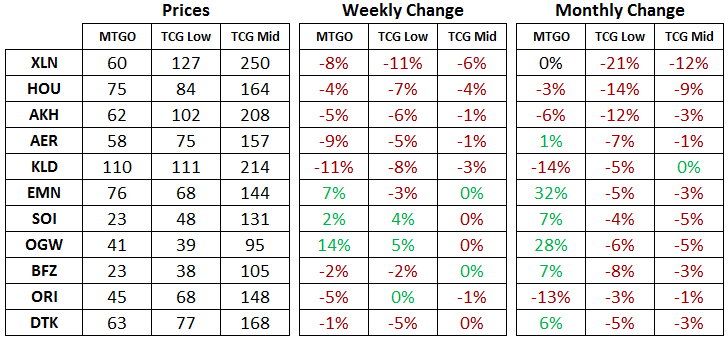
Below are the total set prices for all redeemable sets on MTGO. All prices are current as of November 14, 2017. The TCGplayer low and TCGplayer mid prices are the sum of each set's individual card prices on TCGplayer, either the low price or the mid price respectively.

All MTGO set prices this week are taken from GoatBot's website, and all weekly changes are now calculated relative to GoatBot's "full set" prices from the previous week. All monthly changes are also relative to the previous month's prices, taken from GoatBot's website at that time. Occasionally, full set prices are not available, and so estimated set prices are used instead. Although both Aether Revolt (AER) and Kaladesh (KLD) are no longer available for redemption, their prices will continue to be tracked while they are in Standard.

Play Points and Treasure Chests

Wizards is continuing to experiment with the Magic Online economy this week, as you'll be able to buy Play Points for the first time ever. On top of that, Play Points will carry a bulk purchase discount from the Magic Online store, which has never happened before to my knowledge. Check out the full announcement here.

Bulk discounts are something sorely lacking since MTGO went live. To this day, there is no opportunity to buy a box of boosters at a discount to the price of the individual boosters. Although there are other discounts available in the MTGO economy, this is a jarring difference from retail in the real world.

With the advent of free-to-play games like Hearthstone, its clear that Wizards is trying to lower the price of Magic Online where they can. Last year, they dropped the tix-only entry fee of drafts from 14 to 12 tix, effectively dropping the equilibrium price of boosters from 4 tix to 3.3 tix. Interestingly enough, if you buy the 1200 Play Point bundle for $100, this is the same fraction discount of about 17 percent.

There was an error retrieving a chart for Bargaining Table

I suspect this change will have minimal impact on the MTGO economy, and it might even be a net positive. Play Points  are not tradeable and can only be used for event entry, which severely limits their potential impact. It's almost impossible for this change to introduce first-order market distortions, although we might see lower booster prices on the secondary market as a result. After all, if the cheapest way to draft is through Play Points with a bulk purchase discount, this will lower the equilibrium price of boosters. But since you do need to pony up $100 for the discount, it's not clear that the magnitude of the change will be large. Not everyone can afford to drop $100 at a time in order to play Magic Online; most players are used to only paying for the next draft.

When it comes to playing Constructed, you'll still have to pony up cash or tix in order to get a deck together, and this is where a potential positive impact could occur. Overall, cheaper ways to play Magic Online will encourage more play, which is effectively going to drive a growing economy. If more players are taking up Constructed, demand for singles will go up and this is the easiest speculative environment, the equivalent of a bull market.

The other big change announced is a new exclusive slot in Treasure Chests, as well as the addition of full Standard sets in the curated selection. Adding full sets is a fantastic change to the Treasure Chest system. Previously, old and obscure cards with low availability were included due to their high secondary market prices, which helped to keep a lottery aspect to cracking them from a Chest. But since they were in low demand, the price of these cards would fall rapidly after being introduced in Treasure Chests. Rishadan Port is the poster child for this effect, as it carried a price of over 200 tix last year at the release of Kaladesh and now sits at less then 80 tix.

Putting complete Standard sets into Chests means that the lottery aspect will always be there, and the value of winning that lottery will be relatively stable. Standard is a format with stable demand, and the price of a Standard set is largely a function of that. By their actions, it looks like WotC has recognized an inherent problem with Treasure Chests in that they were mining reprint equity that would get rapidly depleted. Adding complete sets means that they are shifting some of that activity into the more accessible vein of Standard.

Standard and Standard Boosters

All Standard sets dropped in price this week in both digital and paper. With Iconic Masters (IMA) on the way, this looks like the market wants liquidity and is getting ready to shell out some cash for the new product. The reality of the Standard format being dominated by the energy mechanic is also weighing on prices, as pet strategies get tossed out for ones that can compete.

There was an error retrieving a chart for Energy Field

With IMA on the way, look for a dip in the price of Standard boosters. Although there's very little opportunity in Amonkhet (AKH) and Hour of Devastation (HOU) boosters, a dip below 2.8 tix for Ixalan (XLN) boosters should be considered a good buying opportunity. As usual, boosters are a grindy speculative strategy that requires time and effort for small, incremental gains, but if you've got  some spare time and tix this weekend, I anticipate a wave of selling in order to fund IMA drafts. Prices will normalize in a few weeks, and selling in the 3.0- to 3.2-tix range is anticipated. There's some uncertainty being introduced with the sale of discounted Play Points, so those who are risk averse or new to speculating should not try out this strategy. Ordinarily, I would say it's a guaranteed bet, but it's good to be a little more cautious when Wizards introduces changes to the MTGO economy.

Modern

The four sets that have rotated out of Standard all posted zero price movement in the TCGplayer-mid weekly change column, which is encouraging to see. It's only a matter of time before they put in a price bottom, and this looks like it has the potential to be just that. Next week, we'll look for increasing prices to help confirm the change in trend. On MTGO, the bottom was in weeks ago and we are seeing another round of price increases on these sets, except for Battle for Zendikar (BFZ) which saw a two-percent decline.

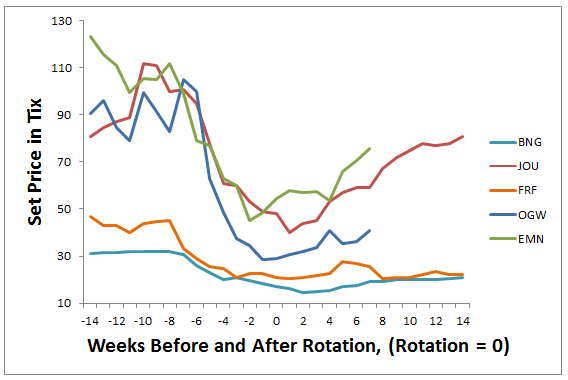
Checking our the chart of prices around Standard rotation, Eldritch Moon (EMN) is following the path that Journey Into Nyx (JOU) took, finding a price bottom in a littler earlier, but generally rising rapidly after rotation. JOU ultimately peaked in January of 2016, and it looks like the bulk of the gains for EMN are baked into the current price already. Selling EMN in the next six weeks looks to be correct at the moment.

Oath of the Gatewatch (OGW) is not rising as quickly, but the uptrend is clearly in place. This set has a little more room to run and I am not looking to sell in the near term.

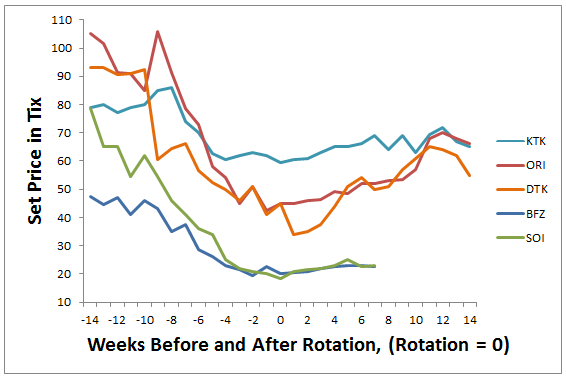
On the large set front, Shadows over Innistrad (SOI) and BFZ look very anemic in comparison. Their prices are largely unchanged in absolute terms. They definitely appear to be following a price path similar to Khans of Tarkir (KTK), one that is relatively flat but sloping upward. At this point, a price of 30 tix is still possible for both sets, and they will bear further watching over the coming months.

Trade of the Week

For a complete look at my recent trades, please check out the portfolio. This week I started buying Infernal Tutor, which is a staple of Legacy in decks built around the Storm mechanic. Interest in Legacy is at a low ebb, but that will change in early 2018 with two Grand Prix events in the spring that feature Legacy Constructed. MTGO is still the best testing ground for any Constructed format, so the plan is look for increased demand for Legacy staples over the next six months.

Infernal Tutor has regularly cycled up and down between 20 and 50 tix over the last few years, and was as high as 50 tix as recently as last April. These do show up on the curated card list, so old price floors are no longer valid. I've been a cautious buyer at the moment, but I'll continue to watch for lower prices over the coming weeks to expand my position.

Insider: GP Atlanta Selling Review

Are you a Quiet Speculation member?

If not, now is a perfect time to join up! Our powerful tools, breaking-news analysis, and exclusive Discord channel will make sure you stay up to date and ahead of the curve.

I've been writing reviews for GP Atlanta for the past few years now. This weekend I didn't want to break with tradition. I went down on Saturday to see what I could sell off to dealers and to pick up some good trade stock. I am happy with the results of both, which I will dig into.

Pre-Selling

Every GP I attend—typically just GP Atlanta and GP Charlotte, as I live in South Carolina—I bring a box (or three) of random cheap cards I've picked up in collections. More often than not they are cards that buylist for between $0.1 and $1 (the vast majority) and retail between $0.25-$2.

However, the trick here (as I've said in numerous other articles) is quantity. Every ten $0.1 cards is a whole dollar and those can add up quickly. One of the great things about Magic is that it's easily transportable, and each card actually takes up very little space. A single fatpack can hold upwards of 500 cards (I've actually never counted) which means one full of 10 cent cards ($0.1) can net you $50. It gets even better when you have a lot of $0.25 and $0.5 cards.

As I buy collections and bulk, I sort through and pull out everything worth money, or that could be worth money, and set it in another box to be re-examined when I have time. I then try to semi-organize the box, ideally by putting the same cards together so that when I price things out I only have to look up any given card once.

About a week or two before any GP I'm attending I go through said box and price out cards. Anything selling for $0.1 or more (that doesn't have a ridiculous spread on it) I put into priced-out piles. Once that's done I simply place those piles in fatpack boxes (I can fit three comfortably in my backpack) separated by toploaders that mark the card price of everything behind it. Then I can simply walk up to dealers, tell them that the price in front of each section is what I want per card, and let them take what they want.

One could track every card sold to each dealer, but that would honestly be very time-consuming. One of the major benefits to dealers of buying pre-priced cards is that they can quickly scan through stuff (though most will still look up some prices or their inventory while doing so). They can often look through my boxes in under 40 minutes. If you handed a dealer 1,500 cards and they had to look up each price, it could easily take several hours.

Time is money, and saving it saves both you and them money. It also means you can visit more dealers (I can usually make it to almost all of them in a single day).

Dealers usually bring only so much money, and while they sell a good bit, their main purpose in vending at a GP is to increase their inventory. This means they tend to buy a lot more than they sell. It also means that the earlier in the weekend you get to them, the more likely they'll buy stuff from you. This is why I always sell on either Friday (if I took the day off work) or Saturday morning.

This year I wanted to be a bit more methodical in my approach (partly to give everyone a bit more detail in this article), so I actually did a full count of the number of each card at each value, and added everything up before I left for the GP. I went to GP Atlanta with $889.50 worth of random buylist cards.

I also read through my previous notes/articles and made sure to visit the vendors who have bought the most from me first. I gave them first dibs because they tended to buy more—so in theory if I could sell everything to the first few vendors, I could spend the rest of the time trading or playing side events.

Selling

Cape Fear Games

The first vendor I went to was Cape Fear Games. I've had a lot of luck in the past selling to them and I've always found their buyer, Greg, extremely nice and easy-going (which I appreciate a lot). As he got first go at my stuff it's not surprising to note that he bought a lot of stuff, totaling $274.35. That's a huge amount just starting out and a great way to start the day.

Cape Fear Games often buys a lot of random-ish stuff so I bring along a lot of good Commander and Pauper stuff. For tracking purposes, I counted the cards in each price category that the vendors purchased. The table below lists these data.

Vendor - Cape Fear Games
Price $0.10 $0.25 $0.50 $0.75 $1.00 $1.25 $1.50 $1.75 $2.00 $2.75 $3.00
Qty 66 151 53 50 36 13 9 5 36 6 1

As you can see by the table, he bought of a lot of differently priced cards, though clearly liked my prices on a lot of the $0.25 cards.

Miniature Market

The next vendor I went to was also very easy-going and we chatted about the venue. When he found out I was mainly selling cards to help pay for my upcoming wedding, we discussed his wedding a bit as well. He didn't find nearly as much as Cape Fear Games, but it was an enjoyable experience and I left with around $25.

Vendor - Miniature Market
Price $0.10 $0.25 $0.50 $0.75 $1.00 $1.25 $1.50 $1.75
Qty 47 4 4 3 2

This buyer too was a fan of my $0.25-priced card selection.

Dave and Adam's Card World

I've definitely bought stuff from these guys in the past (I bought my Conspiracy 2: Take the Crown boxes from them earlier this year). When I sat down and pulled out my boxes the buyer was pretty quick to mention that they don't really like to buy anything under $5. So I thanked him anyways and moved on.

I made sure to ask any vendors I went to after this if they had any bottom limits on what they would buy. Luckily, these guys were the only ones who seemed to.

Coolstuff Inc

I've had a good bit of success with Coolstuff Inc before so I had actually meant to go to them second (after Cape Fear Games), but their buyers were busy. Sometimes you just audible and go to whichever buyer is available. The buyer for Coolstuff was very professional but not all that chatty. Still, he was able to find a little less than $40 worth of stuff so my 30 minutes with him was well worth it.

Vendor - Coolstuff Inc
Price $0.10 $0.25 $0.50 $0.75 $1.00 $1.25 $1.50 $1.75 $2.00
Qty 21 42 10 4

He clearly liked the $0.5 card options the most.

Channel Fireball

The Channel Fireball buyer was also pretty quiet, but also really efficient. He was able to find a good bit of stuff in my boxes. Going back through my numbers now, I actually have a small discrepancy in value so the numbers don't match up exactly. I don't know if I wrote down the buy counts wrong or what, but I got $127 from them when I should have gotten around $132. I imagine it was an incorrect count on my part as I don't see CFB doing anything shady.

On a different but interesting note, as I was sitting there at the buyer table, the gentleman next to me was selling them a ton of Near Mint 93-94 cards and I remember the buyer being surprised at how good a condition so many of the cards were in. When I left the booth he'd sold them over $4,000 and hadn't even gotten into Arabian Nights yet. With older cards like that "NM" is a bit more subjective, and they didn't care as much that most of them were definitely LP.

Vendor - Channel Fireball
Price $0.10 $0.25 $0.50 $0.75 $1.00 $1.25 $1.50
Qty 37 38 65 19

CFB liked my $1 cards a lot. I believe they bought all my Mystic Remoras that I've been sitting on for about two years now.

Card Monster Games

The buyer here was easy to talk to. While he didn't find much, it was understandable, as I'd already sold over $450 worth of stuff. We talked a bit about Pauper (which is mostly what he bought).

Vendor - Card Monster Games
Price $0.10 $0.25 $0.50 $0.75
Qty 22 1

He did find a lot of $0.5 cards and bought $11.75 worth of cards. Not terrible for about 25 minutes worth of selling, but not anything to write home about.

Pink Bunny Games

The seller at Pink Bunny Games was wearing a big pink suit (with top hat) and was yet again another easy-to-talk-to and nice gentleman. We even had to pause mid-selling so a guy could get a good picture of him (which didn't bother me at all). He was able to find some lower-end stuff and I ended up leaving the booth with another $20.

Vendor - Pink Bunny Games
Price $0.10 $0.25 $0.50 $0.75 $1.00
Qty 22 14 7 9 4

The Comic Book Store

As usual the buyer here was a nice guy that was happy to talk with me while he looked through my stuff. At this point in the day I felt I'd likely sold most of what I was going to sell, and after he only found about $10 in cards I called it a day.

Vendor - The Comic Book Store
Price $0.10 $0.25 $0.50
Qty 9 17

Other Vendors

There were several vendors I didn't make it to, but it's important to include them on this list and my reasons for not doing so.

  • Star City Games - Obviously everyone knows SCG and they typically have a line in front of their selling booth. Usually I see players unloading large collections to them which takes a ton of time, and I prefer to just find a vendor whose buyers aren't busy. I've actually never tried to sell them pre-priced stuff before mainly because of this, so if I ever walk by and they aren't busy I will definitely test the waters to see if they would buy pre-priced cards.
  • 95 - This was basically the Hareruya games booth with a different logo. I've tried selling to them in the past, but they tend to only want cards in the $3+ range. They do seem to operate on the profit-by-volume-of-transactions methodology that Aethergames used to do, but my past experiences hinted that I would likely not have much success with them as my cheap buylist stuff had never interested them in the past.
  • Troll and Toad - I have never had any luck with T&T in the past with pre-priced cards. I've sat down with their buyers on two previous occasions and walked away with $0 both times. That being said, I have a lot of praise for them when it comes to buying.
  • Card Logic - I had really hoped to try to sell to these guys, but their buyers always seemed to be in the middle of transactions every time I walked by.
  • ARG - I had the same problem with these guys as with Card Logic; their buyers were pretty busy the whole time I was at the event.
  • The Sourcery - I don't actually recall seeing these guys at the event. There was one booth spot next to Cape Fear Games that wasn't being occupied and I wondered if they backed out.
  • MTG Deals - I've had a lot of luck in the past selling to these guys as well and I really wanted to hit their booth up, but yet again they were always busy. I've also found that after I've sold about 50-60% of what I've brought with me that most dealers don't find much they need and there is diminishing returns waiting on buyers to open up.

Buying

I didn't just sell cards at this GP. I actually spent a good bit more than I had expected to, but luckily still came out in the black (thanks in large part to selling around $509 worth of stuff).

Normally when I buy cards at GPs I have specific targets in mind.

  • Cards I'm speculating on that I feel have a strong chance of growing by at least 50% in value.
  • Heavily Played (HP) Commander staples that I can easily trade at a good value to players locally, especially if they are very underpriced.
  • Cheap Reserved List rares that see at least some eternal play (whether it be Commander, Legacy, Vintage, or Modern).

I didn't actually have any luck with the first bullet. I did see an HP Judge foil Bribery I was tempted to pick up for $15, but I've found that HP foils are a lot harder to unload because most players who are willing to pay the premium to foil out their decks want good-looking foils.

However, the last two I did extremely well on. The first thing I do whenever I go to any GP is hit up the Star City Games HP section, and they didn't disappoint this year. If you get there early (we were there around 9:30) you can typically get a lot of really good deals and pick up some solid trade fodder at a steal. The first thing I bought for the day was a $20 Spanish Yawgmoth's Will that's in pretty good shape (and I directed my friend with me to buy the other one or I'd buy it too, as he was waffling over it for his own Commander deck).

My other big finds were at the Troll and Toad HP cases, which had a ton of value in them if you knew prices. My buys from this section include:

  1. 2x Gaea's Cradles for $145 each
  2. 1x Mind Over Matter for $6
  3. 2x Morphlings (for $1 and $2 each)
  4. 1x Magistrate's Scepter for $2
  5. 1x Meditate for $2
  6. 1x Mana Echoes for $5 (and I regret not buying the second one they had)
  7. 1x Thawing Glaciers for $3

Of these purchases, only two of them were not on the Reserved List (Mana Echoes and Magistrate's Scepter) and most were purchased at 50% or less of their NM retail price. I already have one potential buyer lined up for one of the Cradles (which is my absolute favorite card to pick up because they are so highly in demand from Commander players), and I can easily move the other for a decent profit as well.

Notes

Two other interesting notes from this trip. I waffled on picking up a few Japanese Spike Weaver's from the SCG HP section at $3 each (they had like 12 so I wasn't too worried). When I finally went back to buy a couple, the gentleman in front of me had a tablet with MagicCardMarket up that he was using to look up a lot of cards. He ended up buying all 12 copies.

I was a bit upset with myself for not buying an $11 card for $3 earlier. I do tend to avoid foreign Commander cards that aren't extremely well known, as I don't like explaining what they do to people. Still, I think that sometimes it's worth it if the discount is high enough.

The other very interesting note is that while talking with the vendors I found out that CFB was raising the cost of vendor tables per event to $8,000+. That is much higher than the current rate, and was upsetting to the vendors. This may mean that some early GPs next year may have a lot fewer vendors at them and could hurt GP attendance overall.

I'm honestly still baffled that Wizards would instill a monopoly on one particular vendor simply for "consistency and quality of player experience," and not consider that this could easily do the opposite. With a monopoly there are no checks and balances regarding vendor booth prices, judge pay, or player entry fee cost. I will withhold passing judgment until after I go to a CFB GP next year, but I am a quite concerned with WotC's decision to do this.


Daily Stock Watch – Mana Drain

Are you a Quiet Speculation member?

If not, now is a perfect time to join up! Our powerful tools, breaking-news analysis, and exclusive Discord channel will make sure you stay up to date and ahead of the curve.

Good day and welcome to the Tuesday edition of the Daily Stock Watch! Today, we'll take a look at card number two of our five-day Iconic Masters special. I believe that it arguably is the best card in the set, both power-level and demand-wise.

There was an error retrieving a chart for Mana Drain

Originally printed as an uncommon in Legends, a lot of people (including me!) thought that this card was part of the Reserved List. Due to some technicality with card rarities, Mana Drain is very legal to be reprinted and is now part of the upcoming Iconic Masters, where it is rightfully classified as a mythic rare. For those of you who aren't aware about how good this card is, just take a look at this Oath of Druids deck:

Oath of Druids

Creatures

1 Griselbrand
1 Inferno Titan
1 Void Winnower

Instants and Sorceries

4 Abrupt Decay
1 Ancestral Recall
1 Ancient Grudge
1 Brainstorm
1 Demonic Tutor
1 Dig Through Time
1 Flusterstorm
4 Force of Will
1 Gaea's Blessing
2 Mana Drain
1 Mindbreak Trap
1 Swan Song
1 Time Walk

Other Spells

1 Black Lotus
1 Dack Fayden
2 Jace, the Mind Sculptor
1 Mox Emerald
1 Mox Jet
1 Mox Ruby
1 Mox Sapphire
4 Oath of Druids
1 Pernicious Deed
4 Standstill

Lands

1 Creeping Tar Pit
4 Forbidden Orchard
1 Forest
4 Mishra's Factory
4 Misty Rainforest
1 Scalding Tarn
1 Treetop Village
1 Tropical Island
2 Underground Sea
1 Volcanic Island

Sideboard

2 Dread of Night
1 Elesh Norn, Grand Cenobite
1 Engineered Explosives
1 Flusterstorm
1 Mindbreak Trap
3 Naturalize
2 Nihil Spellbomb
1 Pernicious Deed
1 Pithing Needle
1 Steel Sabotage
1 Stormtide Leviathan

Back in the day, you'd probably see a complete playset of Mana Drain in that list. Times have changed and other cards have been used for more flexibility, but it is undeniable that the advantage it brings to the caster is something that's hard to pass up on. If only this card isn't banned in Legacy, it would definitely cost higher -- but thanks to Commander demand, this reprint won't drop its price that much despite of the expected influx of supply.

The Best Permissions

Take a look at the cards above. These are cards that belong in the same league (utility wise, at the very least) as Mana Drain, and most of them already have multiple printings (with the exception of Mystic Confluence). Almost all of them have kept their respective price tags since they are staples across all the formats that they are legal, and I expect the same thing to happen with Mana Drain.

What will probably take the biggest hit from this reprint is the Italian version of Mana Drain. From my perspective, I'd actually go for the IMA copies (foil included even with the judge foil hanging around) since it has the authenticity seal, which makes me feel secure about having a real card that does the same thing as that of the old one. The judge foils should also see a dip in value, but don't trust me too much on this one as I am someone who doesn't fancy card arts and foils. Trust your instinct if you think that it will hold its value over time.

The pre-selling price of the IMA Mana drain is currently at the $100-110 range, with major stores like Star City Games, Card Kingdom, Channel Fireball, and TCGPlayer selling over a hundred playsets combined. So far, only SCG is pre-selling foil copies for $249.99, and I actually think that this is a good price if you're a foil collector. Seeing how many of the judge foil copies are out there, I suggest that you snag a copy of the IMA foil version if you could get it for $200 or less. For financial reasons, let's learn from that Force of Will episode, shall we?

If you're someone who fancies the original art of your collection, keeping your Legends version of Mana Drain is never a bad thing at all. Just like Mana Crypt and Karakas, I don't expect WoTC to reprint this card within the next two to three years. This printing should be enough to cater to the market's demands and help in stabilizing its price. If the price tag goes to something like $70 for the IMA version, I'd buy all that I could. I'd gladly allow it to drain my wallet for as much as it wants.

And that’s it for today! Check back in tomorrow as we continue this special edition of the Daily Stock Watch. As always, feel free to share your opinion in the comments section below. And if you want to keep up with all the market movement, be sure to check in with the QS Discord Channel for real time market information, and stay ahead of the hottest specs!

Enter Clean-Up Step: Metagame and Ixalan Updates

Are you a Quiet Speculation member?

If not, now is a perfect time to join up! Our powerful tools, breaking-news analysis, and exclusive Discord channel will make sure you stay up to date and ahead of the curve.

Sometimes it's necessary to revisit older topics. Whether it's previously unavailable data coming in, or assumptions and beliefs evolving, it's good to revisit previous statements and articles to see if they're still valid. Today I will first finish off my Regionals update, then I need to revisit some Ixalan cards both because I missed them and because I said I'd have more results to report.

Updating Regionals

First thing's first, the results from Regionals are finally all in. Chicago's Top 8 was posted sometime after my metagame update was published. I don't know when it was posted—I didn't notice until late Friday. Rather than update that article well after publication and have nobody notice, I waited to include them. I like my work getting recognized. As I predicted, it made very little difference to any of my conclusions.

DeckTotal
Jeskai Control18
Affinity17
Gifts Storm14
Grixis Death's Shadow11
Eldrazi Tron9
Counters Company9
Infect7
Humans7
UW Control6
Abzan5
Burn5
UG Merfolk4
Bant Company4
GB Tron3
Jund3
Elves3
Ad Nauseam3
Titan Shift3
Mardu2
UR Breach2
BW Eldrazi2
GW Company2
GR Ponza2
Death and Taxes2
Mono-G Tron2
Titan Breach1
Saheeli Evolution1
8-Rack1
Temur Aggro1
Knightfall1
BW Eldrazi and Taxes1
5-Color Death's Shadow1
GR Devotion1
RW Prison1
Bant Eldrazi1
Abzan Company1
Grixis Control1
Living End1
Skred Red1
Bogles1
4-Color Company1
RG Vengevine1
GR Tron1
Naya Company1
4-Color Knightfall1
GW Hatebears1
Grixis Delver1
4-Color Death's Shadow1

As I said, nothing has substantially changed from last week. The success of Grixis Delver and Four-Color Shadow adds more diversity into the pool, but as I noted singletons don't mean anything analytically. The biggest impact was Jeskai Control overtaking Affinity at the top of the chart. That is all I would read into this. The difference is too small, meaning there's no evidence that Jeskai Control is actually better or more successful. I do believe that Jeskai is advantaged over Affinity and Storm, but the evidence doesn't prove that true.

As for the wider metagame, the results do muddy the waters about Eldrazi Tron and Counters Company. They've closed the gap on Grixis Death's Shadow enough that it's not clear that they're still Tier 2. I'm fairly certain that all three ride the boundary between Tiers 1 and 2 using our usual formula. I still don't have the time to do the data entry to verify this; I'm relying on years of working with data to eyeball the standard deviation. I think it's reasonable to say that GDS, Etron, and Counters Company are Tier 1.5 based on my data. They're strong decks that are positioned poorly compared to Tier 1 but better than Tier 2.

The Next Update

This is where the metagame stands going into GP Oklahoma City. We have a fairly well established Tier 1 to attack, with a wide field of decent decks to prepare for. I do not intend to update my table until after the GP, which will be the prospective metagame going into the Pro Tour. I am not going to include RPTQ decks in my sample. As of typing this sentence they're not posted anywhere, and I have no idea when or if they will be, so the point is rather moot. However, even if they were available, I'd be leery of using them because the RPTQ is an invitational event. Thus, it has a low, non-random sample size, which limits how descriptive it is of the metagame as a whole. I've been over this before. Should results come in, they're worth looking at as curiosities and deckbuilding exercises, but I'm skeptical of their value to this data set.

Assessing Ixalan Acquisitions

Every time a new set comes out, everyone has to get in on reading into the new cards. And why not? It's fun to guess and speculate. We do it too. What doesn't always happen is going back over your assumptions to see how they've played out. After several months with the cards, I have some more information and results to share. I still stand by everything from my spoiler article, but I have some nuance to elaborate upon. And a card that I need to actually consider.

Branchwalking

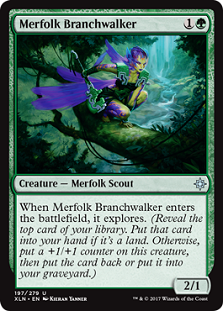
Merfolk Branchwalker continues to flummox me. Admittedly, I covered this fairly comprehensively before, but I'm still unsure what to think. Having continued to play the card, I've constantly wondered if I'm playing it wrong. The problem isn't the card in a vacuum; you play it for value (still not a full card of it, but really close). The problem is what to do when you have a choice between Branchwalker and Silvergill Adept. I can't shake the feeling that there is a correct way to sequence them and I'm not doing it right.

Follow me. When you Adept, you draw another card. Simple and straightforward. With Branchwalker, you reveal the top card and if it's a land it's slightly worse than if you'd played Adept because your opponent knows you drew a land. Otherwise, you get a better creature on the board and the option to improve your next draw. In some situations, that is actually better than a cantrip. Also the more lands left in your deck, the more likely it is that you hit land. This pulls me in two directions, as the first point indicates that you play Branchwalker later when you can bin cards more freely, but the first suggests early plays so you hit needed lands.
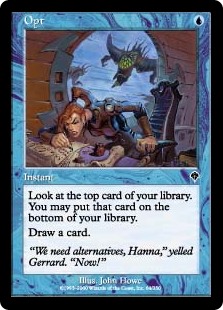
The other consideration, which never occurred to me until it happened in-game, is against discard. If you main phase Adept, draw a good card, but can't play it yet, it becomes vulnerable to discard. With Branchwalker, you can only expose a land to Thoughtseize. Yes, it might get you Thought Scoured, but that's arguably good for you because it's not great for your opponent (Scour's funny that way). That situational benefit again makes it hard to say Adept is better and I'm starting to chase my own mental tail about these two cards. I'm starting to lean to Branchwalker being better early. Is it just me, or is anyone else struggling with this problem?

Opting Out?

Next is the much hyped Opt. Everyone was all over this card. We joined in the hype too, though halfheartedly compared to some. Modern doesn't have many good cantrips, and an instant-speed one that is actually card selection is unheard of. It made perfect sense to start running the card in every blue deck and wild speculation declared the death of Serum Visions. As always, at Nexus we were far more circumspect and Jordan identified that it wouldn't replace any existing cantrips, but it could see play as an additional cantrip.
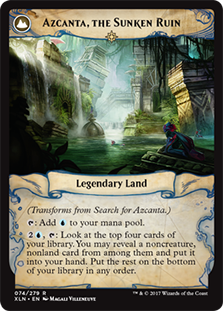
And after a full month, almost nothing has changed. Since October, I've only seen Opt occasionally. During September I saw plenty of four-ofs in Storm and Jeskai lists. These days it's maybe a two-of in Storm occasionally. I can't speak for the Storm players, but I tried it for weeks in Jeskai Control/Tempo/Geist/Whatever-Star-City-Arbitrarily-Calls-It-This-Time and it was very meh. It was nice as a supplement, but never great. Just nice. I never ran it exclusively, always in addition to Serum Visions and it just isn't as impactful. Leaving up one blue mana isn't that relevant to Jeskai. The effect was nice, but I was always ambivalent once it resolved. My experience says that fair decks don't want that kind of incremental effect. And I don't think Storm needs it, though I could be mistaken.

Fruitless Searching

This brings me to the main reason I wanted to recover this topic: Search for Azcanta. When this card was spoiled, I immediately dismissed it. I instinctively declared it unplayable. It just looked too durdly, and the more I thought about it, the more convinced I became. It's a two-mana enchantment that doesn't do anything when it hits play, and even once it starts working it's not doing much. Thassa, God of the Sea may cost more but she also impacts the board and still sees no play. We have better ways to filter draw steps and fill the graveyard. For the same cost you could have Bitterblossom, which wins the game if unmolested. Some pointed to Azcanta, the Sunken Ruin as the real reason to play Search, but again the payoff just seemed too low. You get a legendary land that durdles more for effectively four mana. That just didn't sound playable.

Imagine my surprise when I started seeing bold declarations about the card. I'm always willing to assume that I'm wrong, but this didn't make sense. So I tried it for myself in some online leagues. Afterwards, I found out that several other control players at my LGS had the same thought. After about a week of tournaments, we all compared notes and had come to the same conclusion.

Search wasn't worthwhile. Not one of us had seen any improvement in our win percentage. One player on UW Control saw his go down significantly. And yes, we were all playing durdly control decks, two Jeskai and the aforementioned UW. And yes, we were playing it on turn two to maximize the value and built our decks around the enchantment. It didn't help. Emma Hardy compared it to Gideon of the Trials yesterday (it makes more sense in context), but I wouldn't even go that far. Search wasn't doing enough to justify the slot for any of us. I was dead first. You lose tempo playing the card and that does matter. Incremental draw-step improvement doesn't help much playing from behind. Even when you did flip into Azcanta proper, it still wasn't great. If you needed the land drop, it always took too long to matter.
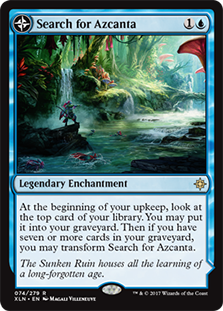
If you needed spells you had to pay to find them. Yes, you could pull ahead on cards going long, but by the time any of us had that opportunity the game was decided. The opponent was either out of cards already, or we were dead. It was easy to get ahead on cards, but that didn't always matter. If you think you can dig for answers as you need them, they'd better be really cheap because four mana is a lot when you're desperate. Our conclusion was that Search is a win-more card, and I was glad to get off the durdle plan and back to Spell Quellers and Geist of Saint Traft.

The Problem of Incremental Advantage

This leads into a topic that I've wanted to discuss for some time, but I couldn't stretch into a full article. Incremental advantage is overrated. Piling up tiny edges and bits of card quality can work (that's Jund's plan), but it can't be all that you're doing. You need 100 pennies to equal a dollar. I just realized as I was typing that sentence that it's the perfect analogy and I'm dropping everything else to run with it. Yes, every penny you collect gets you closer to that dollar, but you get there a faster with nickels. Even then, if your opponent is collecting dimes, you're losing ground.

If you're straight up multiple-for-oneing your opponent, that's like you're getting several dollars worth of value in a game. When you're spending the same resources as your opponent, but your cards are a little better than theirs, you're gaining incremental value. Trading up on mana or value is getting some change back from the exchange, and that does add up. But it needs to be relatively substantial to matter. Jund works because it is built to play better cards than their opponent so they always trade up. This is like getting quarters back. You only need four to get the full dollar of value. This is why Ancestral Vision was so good against Jund. You got back the value you lost from them and doing so a few times buried Jund.

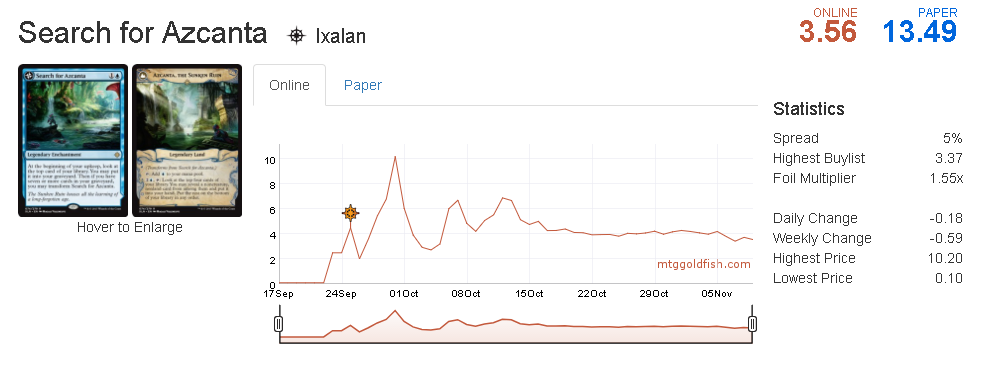
Incremental engines like Search are attractive because they do build over time. The problem is the amount of time it takes. You can have all the incremental advantage in the world, but the hard advantage from a single impactful card will effortlessly overwhelm it. Consider Search against Geist of Saint Traft. Search will get you value over a long game, but Geist ends it. Compare this to Bitterblossom, which is an incremental engine but creature tokens are far closer to real cards that improving your draw. It gets you there faster.

For that reason, you need to be careful with incremental advantage. It has to be fairly impactful to begin with to be worthwhile. In other words, the problem with Search for Azcanta is that it only gives you pennies worth of value until it becomes Azcanta, the Sunken Ruin, when it still provides less than a dollar of value.

End Turn

That's it for this week. If you have any additional insights into the cards I've discussed I'm happy to hear it. See you next week.

Insider: Reevaluating Ixalan Standard and the Pro Tour

Are you a Quiet Speculation member?

If not, now is a perfect time to join up! Our powerful tools, breaking-news analysis, and exclusive Discord channel will make sure you stay up to date and ahead of the curve.

Hello, guys. How are your Pro Tour Ixalan speculations? The top eight of the Pro Tour was pretty diverse, including the following decks:

  • Four-Color Energy (two)
  • Temur Energy
  • Sultai Energy
  • Jeskai Approach
  • White-Blue GPG
  • Mardu Vehicles
  • Ramunap Red

Half of the top decks were energy-themed, a quarter of them are aggro and the other quarter are control. This is one of the most balanced top eights in recent Pro Tour memory. Before we jump into any analysis, let's recall my picks for the PT from two weeks ago:

  • Vona, Butcher of Magan – 1.16 ticket
  • Ripjaw Raptor – 0.88 ticket
  • Search for Azcanta – 4.04 tickets
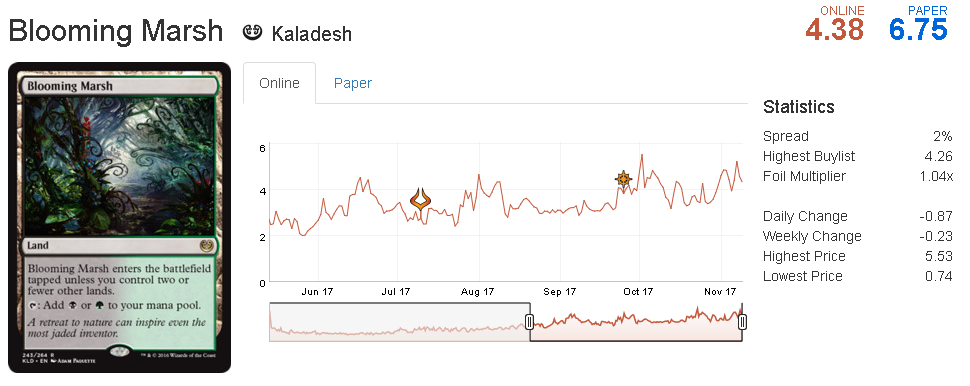
  • Blooming Marsh – 3.66 tickets
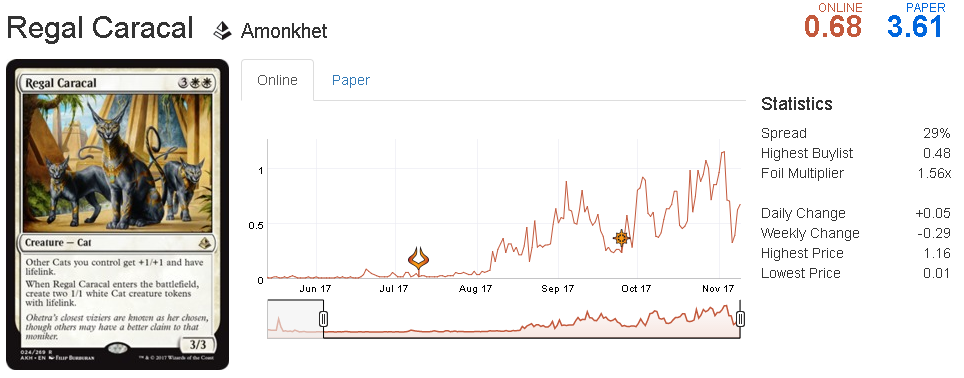
  • Regal Caracal – 1.08 ticket
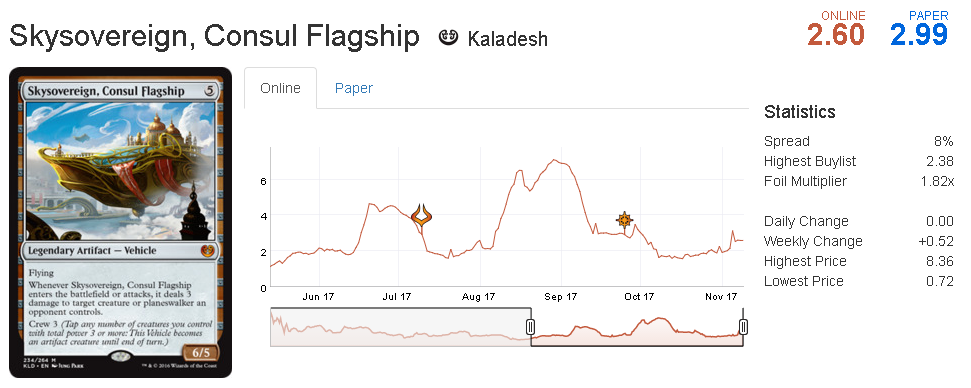
  • Skysovereign, Consul Flagship – 2.04 tickets
  • Vizier of Many Faces – 0.17 ticket

Overrated Picks

I mentioned previously that the Blue-White Approach the Second Sun deck is a very stable deck in the current Standard environment. If there were more players at the Pro Tour playing this card in their deck, the price of this card would probably have shaken up a bit.

However, I think I made a mistake by picking this card. Here's the reason: the price of this card had already stabilized somewhere at 4 tickets and maintained that price for three weeks before I wrote about it in my article. With the graph showing a rather straight line, I should have assumed that the market for Search for Azcanta would not move much even with the Approach deck positioning well in the metagame. A majority players online prefer to play the Temur/Sultai/Four-Color Energy decks rather than slow decks, in my opinion due to the time constraint on MTGO. In the future, we might need to consider more closely an MTGO player's point of view in our speculations.

As for Regal Caracal, I think this card was overrated for this Pro Tour because energy decks were too powerful, but the Cat lord still has plenty of time to shine in Standard. Whenever you guys can get them cheap, I would suggest to picking up playsets in preparation for future price increases. I mean, putting seven power (more than half of it with lifelink) onto the field for just five mana remains pretty strong!

Good Picks

I previously mentioned that Brad Nelson played two copies of Skysovereign in his Temur Energy deck to some good finishes. At the Pro Tour, we saw another player, Piotr Glogowski, doing the same in his Four-Color Energy deck, which took a top-eight slot.

Overall, this card is just a great mirror breaker that dodges Chandra, Torch of Defiance and Glorybringer. If you haven't bought this card, may I suggest picking up copies at a price around 2.5 tickets, as energy decks will remain the top-tier archetype, and this kind of mirror-breaking card has a very high potential to spike – just like the spikes we can observe in mid-June and mid-August.

Mythics that can break open mirror matches provide real potential to earn us profit when decks that play them become popular. Good examples like the Skyship are Vraska, Relic Seeker, Ob Nixilis Reignited and Thrun, the Last Troll.

Blooming Marsh went up in price a little bit, but it doesn't seem like it was affected by the Pro Tour much, even though Seth Manfield won the event with a list that plays four copies of Marsh. This land is probably locked into the cyclical movement pattern at this point. Unlike another land in its cycle, Botanical Sanctum, which has gone up by 200 percent since Ixalan's release, we can still expect to gain value by buying and selling Blooming Marsh before the next set releases. Anyway, to optimize the cyclical price, you guys should have sold this card somewhere near 5 tickets.

Picks of the Week

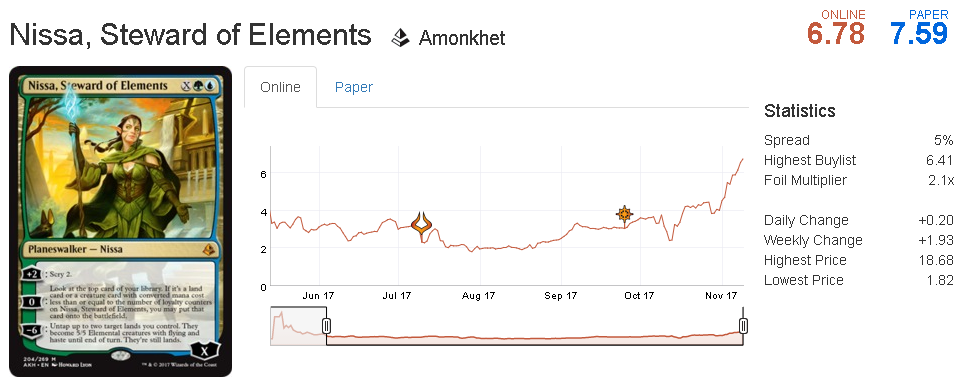
As of this week, Nissa, Steward of Elements is going up steadily and is now at about 7 tickets. I did talk about this card before in an article when the planeswalker legendary rule was changed. Although Nissa did not grow in price due to the legendary rule change, she does see play in the sideboards of energy decks, namely Temur, Sultai and any variations of these.

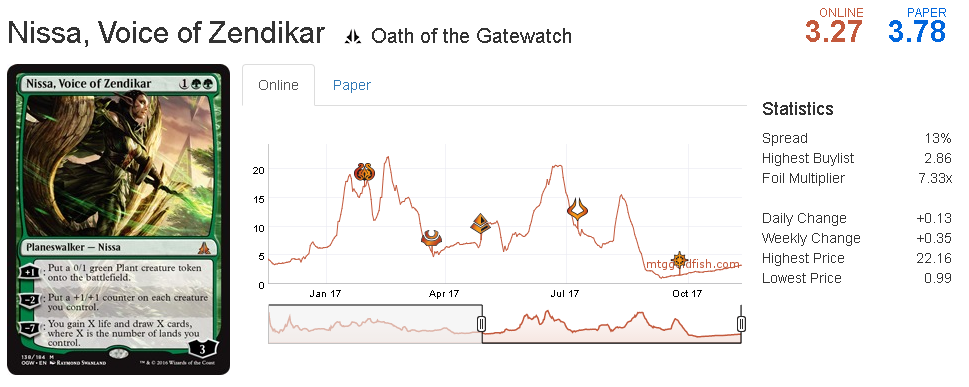
Remember Nissa, Voice of Zendikar, which was a 6-ticket card even while not being played much, and demonstrated it could go up to 20 tickets when it becomes the core of tier-one decks. Let's have a look at Voice of Zendikar's graph:

You can see that the price of this three-mana planeswalker spiked several times from around 5 tickets to 20 or more tickets. This trend is similar for many powerful planeswalkers, so I predict a similar thing happening for the price of Nissa, Steward of Elements.

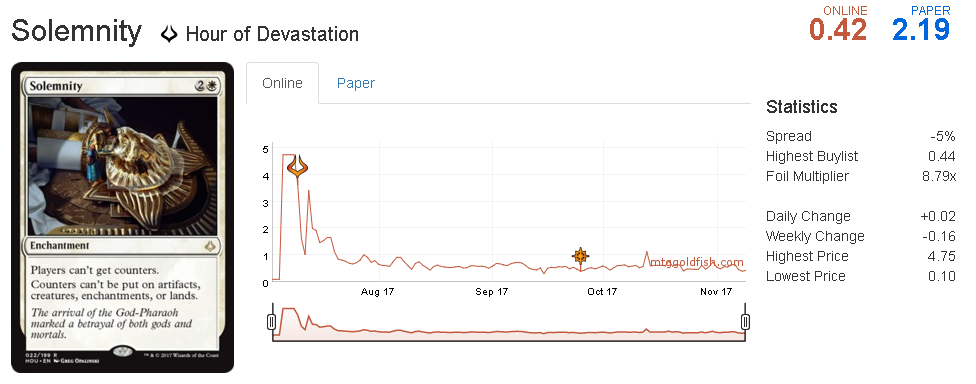
As everyone who pays attention knows, energy/Winding Constrictor decks are the pillar of Standard right now. Maybe this card is not popular yet, but at a low price, I see a bunch of reasons to buy into this card for speculation purposes. If I were to make a deck to beat the meta, I would start with a black-white or Esper Control list with mainboard Solemnity and a couple of removal spells and sweepers.

Besides, white-blue decks such as GPG and Approach the Second Sun are also pretty competitive right now. I wouldn't be surprised to see this three-mana enchantment in their 75. From past examples in my articles, like Leyline of the Void and Fumigate, we know that hate cards can become very valuable when they gain popularity. Now is a fine time to invest in some cheap copies of Solemnity.

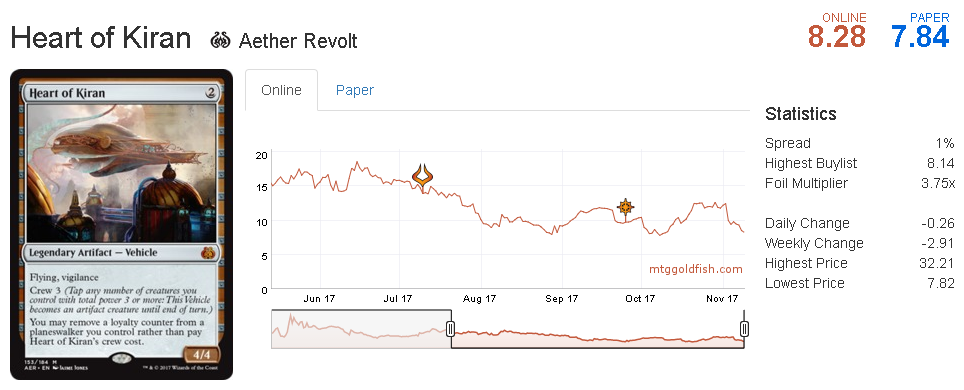
This card has been a staple in Standard since Smuggler's Copter was banned. Mardu Vehicles and green-black aggro decks have plenty of three-power creatures to crew this 4/4 flying vehicle, and it became Aether Revolt's format defining card when 26 copies of Heart appears in the top eight of PT Aether Revolt! In my opinion, the legendary vehicle is at its best position right now to attack the format. Reason being, it doesn't die to Glorybringer, Chandra, Torch of Defiance, a majority of the sorcery removal effects in the format, and it has the ability to pressure planeswalkers on the opponent's side. I think it would good timing to stock up on playsets of Heart – what do you think?


Alright, guys, that’s all for this week. Thank you all for reading, and I’ll see you all again next week!

–Adrian, signing out.

Daily Stock Watch – Ancestral Vision

Are you a Quiet Speculation member?

If not, now is a perfect time to join up! Our powerful tools, breaking-news analysis, and exclusive Discord channel will make sure you stay up to date and ahead of the curve.

Hello, finance junkies and welcome to another week of the Daily Stock Watch! This week will mark the release of Iconic Masters, so I'll be going over five cards from that set that I think will have some major movements (both positive and negative) in the long run.

Last week, I already talked about Aether Vial, which is one of the cards that's going to see a reprint in IMA but I'll still try to feature one card per day until the set's full release on November 17. Today, I'm going to talk about my favorite card from the set:

There was an error retrieving a chart for Ancestral Vision

There's a reason why Ancestral Recall is a Power 9 card. Drawing more cards than you're supposed to is almost always an advantage when you're playing Magic, especially if it comes at a very low cost. When the price of Ancestral Vision went bananas back in May of this year, it barely surprised me at all. In fact, I was more flabbergasted when I learned that the card wasn't as popular as I thought it would be in Modern if it wasn't for its emergence in the sideboard of the Grixis Delver deck. I think that it deserves more attention than what it is actually getting.

Grixis Delver

Creatures

4 Delver of Secrets
2 Gurmag Angler
4 Snapcaster Mage
2 Tasigur, the Golden Fang
1 Young Pyromancer

Instants and Sorceries

1 Collective Brutality
1 Cryptic Command
2 Fatal Push
2 Kolaghan's Command
4 Lightning Bolt
2 Mana Leak
2 Remand
4 Serum Visions
3 Spell Snare
3 Terminate
4 Thought Scour

Lands

1 Bloodstained Mire
1 Creeping Tar Pit
2 Island
1 Mountain
4 Polluted Delta
4 Scalding Tarn
1 Spirebluff Canal
2 Steam Vents
1 Swamp
2 Watery Grave

Sideboard

3 Ancestral Vision
1 Anger of the Gods
2 Ceremonious Rejection
1 Collective Brutality
2 Countersquall
2 Dispel
1 Engineered Explosives
1 Izzet Staticaster
2 Rakdos Charm

Patiently waiting for its suspension (no pun intended) to be lifted from the sideboard of this deck are three copies of Ancestral Vision. The card is absolute gas if you could get it going on your first turn, as it gives your opponent something to seriously think about for the next four turns. In a war of attrition, the player who draws more is favored to pose more threats, and that's how Grixis Delver mirror matches are won and lost. This reason alone was enough to pad Ancestral Vision's price to a high of $62.95 for the normal version, and up to north of $200 for the foil ones.

After some good tourney finishes, the deck was "checked" and new archetypes emerged. The demand for Ancestral Vision saw a gradual decrease, but people were reminded that it's a really good card and that was enough reason for it to retain its value. After seeing its inclusion in IMA, I was so thrilled that I'd be able to snag copies of the card for a lower price... and I think that you should be as well.

Modern Drawers

The cards above aren't exactly what I would call "draw spells", but all of them have been used more than Ancestral Vision by top performing decks based on my Utility Checker. On the surface, I think most of us would prefer having Ancestral Vision on our decks more than those cards. But these cards are doing what they're supposed to on the turn that they are called upon -- something that can't be done by Ancestral Vision.

Not unless...

Team Cascade

Just imagine if the Bloodbraid Elf unbanning really does happen. People will definitely start brewing decks that will take advantage of its power (hello Hypergenesis) and that should be enough reason to start another price spike. If you buy in now and that happens, you'd be making so much profit out of it. If it doesn't, I don't think it's a bad idea to hold on to them longer. This card is really, really good.

Prior to the IMA reprint, there have been three printings of this card. As of posting time, you should be able to find copies of Ancestral Vision via TCGPlayer for as low as $17.50.  Star City Games, Card Kingdom, and Channel Fireball have copies that are in the $25-30 price range for the older versions, and for $23-25 for the IMA version. The foil versions are all above the $100 mark with the IMA version as the cheapest, and the Time Spiral version being the most expensive at $150. I would encourage you to get foil copies if you could, but keeping normal ones if you could get them below $20 would be the best bargain.

And that's it for today! Check back in tomorrow as we continue this special edition of the Daily Stock Watch. As always, feel free to share your opinion in the comments section below. And if you want to keep up with all the market movement, be sure to check in with the QS Discord Channel for real time market information, and stay ahead of the hottest specs!


Insider: Ixalan MTGO Speculation, Part IV

Are you a Quiet Speculation member?

If not, now is a perfect time to join up! Our powerful tools, breaking-news analysis, and exclusive Discord channel will make sure you stay up to date and ahead of the curve.

Hi, folks. This article will conclude my series on Ixalan speculation. I hope that you have found the first three parts helpful. The Pro Tour halted the growth of Ixalan prices, and as of this writing the set value of Ixalan is only $4 higher than it was at its lowest point one month ago. Undoubtedly, you will have through Christmas and New Years to make great investments in Ixalan, so buy only at price points you're happy with, and ones that you feel represent the floor of the card in question.

(1) Ruin Raider

Ruin Raider is one of my favorite sleeper picks in Ixalan. It is an intrinsically powerful flagship card for a hyper-aggressive black deck. One main reason why I like this card as a speculation target is that it will benefit the most from future sets being added – with every set printed, we are likely to find cheap black ones and twos that can help make black aggro a top-tier archetype. The other main reason I like it is that we already have some powerful pieces for that sort of deck – it works well with Heart of Kiran, and Glint-Sleeve Siphoner and Scrapheap Scrounger are excellent aggressive cards.  This is definitely a card that could fall to near-bulk if it never sees play, but my money is that the card will attain a value between 1.75 and 2.50 tix in the future.

I'm buying Ruin Raider at: 0.20-0.25 tix

(2) Rare Tribal Payoffs

I would caution against investing in any purely tribal card. Even at rare, these cards are too narrow in their applicability to see meaningful time at spiked prices. Two Dinosaurs that many people are curious about – Ripjaw Raptor and Regisaur Alpha – are broader in application, so those have more merit as potential speculation targets. I'm still not optimistic about either of them because of Glorybringer and Bristling Hydra. It's also just so easy for Wizards to print a big dumb green creature in future sets that render these obsolete. During spoiler season, I anticipated Raptor seeing more play than it currently does, because I thought it was a good counter to Hour of Devastation, but in a world in which white wraths are the dominant board wipes of the day, Raptor loses its one potential purpose in Constructed. I'd stay away unless any of these cards fell below 0.05 tix.

(3) Captain Lannery Storm

Captain Lannery Storm, I think, is a card worth speculating on. I have not yet pulled the trigger, but soon I will probably start buying copies below 0.07 tix. I've heard pros say that they like the card, but it has yet to find a competitive home. She probably sings Seething Songs on her ship. Like Ruin Raider, I think an expanded card pool will do wonders for her viability going forward. There's also less risk involved in investing in her because you're buying her at near-bulk.

I'm buying Captain Lannery Storm at: 0.05-0.10 tix

(4) Sunbird's Invocation

Many MTGO users are curious about Sunbird's Invocation because of its intrinsic power and because it has already been a key player in some competitive strategies lurking beneath the top tier of Standard. Might the Invocation be a good speculation target? I believe so; I think it could be a sideboard staple in certain ramp strategies that could potentially emerge in the future, and of course it could anchor a competitive deck of some kind in the future. I don't think that's likely, but I definitely think it's possible. As a large-set rare, though, my main fear is that, should the card spike, that spike will be very brief, so it might be hard to realize a profit, especially if you want to unload a lot of copies. My recommendation is to buy it at bulk prices for a rare – between 0.01 and 0.02 tix, and no more than 25 copies. I think you can get it at that price, and that way you won't be incurring any significant risk.

I'm buying Sunbird's Invocation at: 0.01-0.02 tix

(5) Treasure Map

Treasure Map is a difficult card to evaluate because of its unique text box. My concern with Map is that it is backward looking, not forward looking –  it synergizes well with old mechanics like improvise and revolt and individual cards from Kaladesh block like Tezzeret the Schemer, and yet no Treasure Map deck is tier-one. I suppose there are just better ways to gain card advantage, yet I really like the fact that it is an artifact and so can fit into any deck.

The speculations that pay off the most are often the ones around which the darkest clouds of uncertainty overhang. It would not surprise me if, one year from now, Treasure Map were a 6.00 tix card; nor would it surprise me if it were mired between 0.50 and 0.75 tix. If you invest in  Map, know that you are taking quite a serious risk. I won't be investing in it unless its price dips below 1.25 tix, but I think that any investment up to 1.50 tix is defensible.

Treasure Map offers us a good lesson – one variable that we should take into account when conducting a risk/reward calculus is looking at the card's potential ceiling. The higher the potential reward, the more risk we should be willing to incur, all else being equal.

I'm buying Treasure Map at: 0.90-1.15 tix

Signing Off

Thanks for reading this week. As always, leave your questions and comments below and I will get back to you! A copy of my portfolio can be found here. I've had a busy past couple of weeks of buying and selling. What Ixalan cards are you most excited about investing in? Did I miss an uncovered gem?

Insider: A Look at Reprinted Classics

Are you a Quiet Speculation member?

If not, now is a perfect time to join up! Our powerful tools, breaking-news analysis, and exclusive Discord channel will make sure you stay up to date and ahead of the curve.

Another week gone by, another round of Alpha cards spiking. I won’t drone on about this topic again, but I will at least share the recent Interests page for last week to underscore my points made in previous articles. While much of Magic finance stagnates through the holidays, this is one sector that remains very robust.

(Click to expand.)

In all honesty this is a fairly muted time. People are saving money or selling cards to raise cash for the holidays. In general this is a great time to be buying cards rather than selling.

That said, there are a few pockets of strength I want to touch on this week—no, they’re not all the Reserved List cards. While I certainly have a preference for those cards, they’re not the only ones I have my eye on. Though, they are all older cards. That’s my area of focus these days, after all!

Legends Legends

When I started playing back in 1997, my friends and I referred to all multi-colored creatures as “legends.” I’m not sure if that was a broadly accepted term or just a misnomer that we applied within our playgroup, but the term sticks with me even today. Perhaps now they merit the term “legend” simply due to their legendary price movement.

I’m not just referring to Reserved List cards here; those already jumped as part of the Reserved List buyout craze back in August and September. Now we’re seeing non-Reserved List cards—cards that have been reprinted already—jump in price. Most recently we saw the spike in Nicol Bolas (you can see it towards the top of the Interests list above). Before that we saw a huge spike in Legends Nebuchadnezzar.

There was an error retrieving a chart for Nebuchadnezzar

Both of these cards were reprinted in Chronicles. Nicol Bolas was even reprinted with a black border in Time Spiral. Yet here we are staring at higher prices for the original printings.

What’s next? Well, I can see the other Elder Dragon Legends jumping over the next few months. Card Kingdom already has an aggressive buy price on them. And while they won’t get anywhere near Nicol Bolas’s price tag, they will almost certainly trade higher six months from now. Chromium and Arcades Sabboth are my favorites but this is probably a matter of personal preference.

Any other rare, legendary creature from Legends also has potential to pop. We can use TCGplayer to identify those with the highest urgency based on supply. One card I made sure to get my copy of recently is Johan. This is an unassuming legendary creature with fairly minimal utility, yet with only 25 sellers on TCGplayer there is a potential for a price increase once the remaining cheaper copies sell.

There was an error retrieving a chart for Johan

Other Legends legends have a bit more stock, but that doesn’t make them less interesting. It just means their time horizon is longer. I recommend keeping an eye on Dakkon Blackblade, Xira Arien, and Rubinia Soulsinger but there is no need to buy copies immediately.

Other Cards to Watch

Beyond those cards mentioned above, there are a handful of other cards I’ve noticed with fairly low stock—this despite the fact that they’ve been reprinted!

Have you noticed the price movement on Presence of the Master lately? I didn’t even know this card had already been reprinted! But the original artwork with a person who looks remarkably like Albert Einstein makes the Legends printing far more collectible. I made sure to grab a set of this one and supply is dwindling quickly. Will this card stick over $20? Probably not. But a move from $2 to $8 is certainly in the cards here.

There was an error retrieving a chart for Presence of the Master

Copies of Revelation are also nearly sold out on TCGplayer. There are a few HP copies at low prices, but a nicer-condition copy will cost you $7. Considering that Card Kingdom has been paying north of $5 per copy for a while now, the higher price tag seems merited. But if you haven’t been tracking this one closely, it could have easily escaped your radar. Concordant Crossroads has gotten even crazier in price—even Chronicles copies have hit double digits on buylists!

There was an error retrieving a chart for Concordant Crossroads

Shifting away from Legends cards, I’ve noticed some other reprinted cards have been selling well lately. Titania's Song from Antiquities has gotten relatively low in stock lately considering it was only an uncommon in the set. I even saw Card Kingdom’s buy price pierce a buck at one point. This one is definitely worth digging for if you have some bulk lying around.

A card that shows up on Interests now and again is Stone-Throwing Devils. I don’t think you’ll see a reprint of this card any time soon, but technically it’s not on the Reserved List. There are still plenty for sale on TCGplayer, but nicer copies are getting a little costlier.

Ivory Tower has been reprinted a ton, but that doesn’t stop the original Antiquities printing from being worth a few bucks. This one was played a lot back in the day, so it’s no surprise that heavily played copies are still cheap. But a Near Mint copy will cost ya…if you can find any. There are currently none on TCGplayer; lightly played copies are in thin supply as well.

In a similar camp is Colossus of Sardia, which has moved up in price lately.

There was an error retrieving a chart for Colossus of Sardia

This is yet another card with no near mint copies in stock and a dwindling supply of lightly played copies remaining. There are still some heavily played and moderately played copies available, but with just 34 sellers listed there really aren’t an excess of copies for sale. This, despite the multiple reprints!

What About the Reprinted Versions?

In nearly all cases, the price movement we’re seeing is related to either collectors’ demand or Old School playability. Therefore, in general I’d recommend against buying any of the reprinted versions of these cards. If you’re looking for budget old school, I wouldn’t hold anything against you for purchasing a Chronicles printing of a card. Even Timeshifted cards are acceptable in most play circles. But don’t expect much return on these newer printings.

That said, I wanted to name a couple of exceptions. These aren’t going to make you the same kind of profits that original printings have yielded over the past couple months. That said, a few reprints are not worthless and this is worth mentioning. But be careful: in many cases the newer printings of these cards are vulnerable to additional reprints!

I’ve already talked about Chronicles Concordant Crossroads. But that’s not the only Chronicles card worth looking at. City of Brass from Chronicles has been fairly volatile lately. I picked up a few copies when stock on TCGplayer got near zero, expecting a spike that never happened. I ended up buylisting my copies to ABU Games for some trade credit, but these may not be that horrendous of a long-term hold. Now that the original Arabian Nights printing is a fortune and a half, Old School players may be more inclined to reach for the budget-friendly Chronicles printing.

There was an error retrieving a chart for City of Brass

The same can be said for Chronicles Hell's Caretaker, which has risen above bulk status. The original Legends printing isn’t nearly as expensive, however, so it may take time for this spec to simmer. And while there are a lot of copies still in stock, it’s tough to find a single vendor with many copies for easy speculation.

But the most exciting reprint of all is certainly Nicol Bolas. In step with the jump in the Legends printing, we’ve also seen a similar percentage jump in Chronicles copies. The move from $1.50 to $2.50 is certainly unexciting, but the graph on this card has gone parabolic most recently. Copies are dwindling, and this may actually be a decent pickup despite the white border.

Wrapping It Up

Reserved List speculation isn’t dead. Many cards from this elite group are getting targeted over and over again. But things have finally settled down a bit, giving opportunity to reexamine the market and identify targets to watch. This is especially true as we enter the holiday season, when Magic cards tend to soften in price.

Not all cards are seeing softened demand, however, and that includes cards that aren’t on the Reserved List. In fact some hot targets right now have already been reprinted! Many of the “Legends legends” have been targeted lately despite their Chronicles reprints. Other collectible or Old School-playable cards are also on the move. Hopefully some of the cards I mentioned were a surprise to you, and gave you some ideas to ponder.

With all of this said, don’t lose sight of the real bull market: Alpha and Beta cards. These have seen some explosive growth recently as copies disappear from TCGplayer. While these original cards won’t have the same liquidity as a normal spec, there’s plenty of upside remaining. It’s fine to diversify, just don’t forget about Magic’s first set.

…

Sigbits

  • Star City Games has just a few copies of Nicol Bolas from Chronicles. At $1.99 for Near Mint, their price tag is actually very competitive. Don’t expect those to last. While we’re at it, don’t expect those Timeshifted copies to remain in stock either. They’re a bit more expensive at $3.99 (Near Mint), but they are black-bordered and in the original frame, which makes them more attractive than their Chronicles counterparts.
  • Years ago, Timetwister was a far inferior piece of the Power 9 and it sold at a significant discount to the other members of this elite group. But that has changed, perhaps with the popularity of Commander (where it is still legal). Now a Near Mint Timetwister retails for $1200 while a less popular Mox is $1500–these have really gotten close in price!
  • Near Mint Library of Alexandria is now $1000 on Star City Games’s website. Let’s welcome it to the four-figure club. Granted played copies are still dramatically cheaper, but the relentless climb higher for these Vintage cards is no less than astounding. By the way, it wouldn’t surprise me to see Juzám Djinn join the four-figure club very soon. Many sites are sold out of the card and SCG is no exception. With a $900 price tag, a $100 bump seems inevitable.

Daily Stock Watch – Aether Hub

Are you a Quiet Speculation member?

If not, now is a perfect time to join up! Our powerful tools, breaking-news analysis, and exclusive Discord channel will make sure you stay up to date and ahead of the curve.

Aloha, everyone and welcome to our Friday edition of the Daily Stock Watch! This will be my last pick for the week, so I'll try to leave you with something to think about. I also noticed that this would be my first non-rare pick (Aether Vial started as an uncommon but is now classified as a rare) since I continued working on this segment.

Let's take a look at this very popular land from Kaladesh:

There was an error retrieving a chart for Aether Hub

Standard's ultimate mana fixer is the most played card in the format. According to my Utility Checker, sixty two percent of decks that made the top 8 of this year's relevant Standard tournaments use an average of 3.6 copies of Aether Hub; a usage rate that trumps the second most relevant card (Harnessed Lightning, thirty nine percent of winning decks used 3.8 copies on average) by quite a distance. For more reference, check out these decklists:

4 Color Energy

Creatures

3 Bristling Hydra
4 Longtusk Cub
4 Rogue Refiner
4 Servant of the Conduit
2 The Scarab God
4 Whirler Virtuoso

Instants and Sorceries

3 Abrade
4 Attune with Aether
1 Blossoming Defense
4 Harnessed Lightning
1 Supreme Will

Other Spells

2 Skysovereign, Consul Flagship
2 Vraska, Relic Seeker

Lands

4 Aether Hub
1 Blooming Marsh
4 Botanical Sanctum
4 Forest
1 Island
1 Mountain
2 Rootbound Crag
1 Sheltered Thicket
3 Spirebluff Canal
1 Swamp

Sideboard

1 Appetite for the Unnatural
2 Cartouche of Ambition
1 Chandra's Defeat
1 Confiscation Coup
2 Deathgorge Scavenger
1 Jace's Defeat
3 Negate
2 Nissa, Steward of Elements
2 River's Rebuke

Grixis Control

Creatures

2 The Scarab God
4 Torrential Gearhulk

Instants and Sorceries

2 Abrade
4 Censor
2 Disallow
1 Essence Scatter
1 Fatal Push
4 Glimmer of Genius
4 Harnessed Lightning
2 Hour of Devastation
2 Opt
3 Supreme Will
1 Vraska's Contempt

Other Spells

2 Search for Azcanta

Lands

4 Aether Hub
3 Canyon Slough
2 Drowned Catacomb
2 Fetid Pools
1 Field of Ruin
6 Island
4 Mountain
4 Spirebluff Canal

Sideboard

2 Chandra's Defeat
1 Dark Intimations
1 Doomfall
1 Magma Spray
3 Multiform Wonder
3 Negate
1 Search for Azcanta
3 Whirler Virtuoso

Mardu Vehicles

Creatures

3 Archangel Avacyn
3 Pia Nalaar
4 Scrapheap Scrounger
4 Thought-Knot Seer
4 Thraben Inspector
4 Toolcraft Exemplar
2 Walking Ballista

Instants and Sorceries

1 Cut / Ribbons
2 Fatal Push
4 Unlicensed Disintegration

Other Spells

1 Aethersphere Harvester
4 Heart of Kiran

Lands

4 Aether Hub
1 Canyon Slough
4 Concealed Courtyard
1 Ifnir Deadlands
4 Inspiring Vantage
2 Ramunap Ruins
2 Shambling Vent
2 Shefet Dunes
4 Spire of Industry

Sideboard

3 Aethersphere Harvester
1 Anguished Unmaking
2 Authority of the Consuls
2 Chandra's Defeat
1 Doomfall
1 Fatal Push
1 Fumigate
3 Gideon, Ally of Zendikar
1 Nahiri, the Harbinger

All these decks run four copies of Aether Hub for a very obvious reason, which is to stabilize an otherwise clunky mana base without it. The first two decks also have means of refilling their energy to make Aether Hub work like a pseudo Mox Opal, while Mardu Vehicles uses it like it's a Tendo Ice Bridge minus the energy refill.

For all that heavy usage, it's still sitting pretty at $2, which is just half of what it was worth during it's peak ($4.24). Common knowledge would dictate that this should be a $5 card by now, but it hasn't happened and it won't happen. I'm pretty sure there are people who've kept a pile of these cards (or its FNM version) and is still hoping that it will still go up for like, say, another dollar.

If you're one of these people, I think it's about time for you to cash out now.

Calls to ban this card, along with Aether Hub, grew louder in the aftermath of Pro Tour Ixalan. Almost half of the playing field brought decks that had both Attune with Aether and Aether Hub on it. To add insult to injury, the deck that won the whole event had four copies of each. Touché. I'm not one of the people who wants to see it get banned, but honestly, Standard would be a different world without these two. Maybe two to three more decent energy cards and it could have made its way to Modern. Too bad this never happened.

In the next two months, you'll see more energy decks in action. Let go of your spare copies soon, especially if you could get some profit out of it already. If you think that I scared you enough, you could always sell them to online shops like Card Kingdom, who I think is offering a good buying price for it ($1.15 for normal copies, $1.30 for FNM ones). But if you think that there's still room for growth for this card, you should be able to buy them for $2 or less. Otherwise, keep your own playset for playing purposes.

That should do it for this week! Check back in again on Monday for a new edition of the Daily Stock Watch. As always, feel free to share your opinion in the comments section below. And if you want to keep up with all the market movement, be sure to check in with the QS Discord Channel for real time market information, and stay ahead of the hottest specs!

Insider: Finding Judge Foils with Low Multipliers

Are you a Quiet Speculation member?

If not, now is a perfect time to join up! Our powerful tools, breaking-news analysis, and exclusive Discord channel will make sure you stay up to date and ahead of the curve.

Welcome back, readers!

In last week's article I dug into the Reserved List cards that were printed as judge foils. Those are obviously the safest ones to purchase (as Wizards's self-instated reprint policy won't allow for specialty foil printings anymore). However, there are a lot of judge foils that aren't on the Reserved List. Today we will review those to look for potential.

Note that many of the more recent judge foils seem to be aimed heavily at Commander players (with quite a few cards out of the Commander products printed as judge foils). Obviously, plenty of Commander players will simply take the cheapest option available. However, as always there is a subset of players (typically the competitive ones) who like to foil out their decks. Anyone willing to go to this effort will likely do so only for a commander they really enjoy that's also powerful.

With this in mind, I want to look at all the judge foils to date. I'll look at the price of the most recent non-foil printing, and then compare that to the judge foil cost to determine its multiplier (i.e. how many more times the judge foil is worth than the cheapest option).

Card Name Judge Foil Year Current Price (JF) Most Recent Non-foil Price Judge Multiplier
Argothian Enchantress 2003 $33.99 $7.13 4.77
Armageddon 2004 $34.85 $3.60 9.68
Avacyn, Angel of Hope 2017 $49.21 $18.89 2.61
Azusa, Lost but Seeking 2016 $80.44 $46.05 1.75
Balance 2004 $16.64 $1.79 9.30
Balduvian Horde 1999 $2.62 $0.39 6.72
Ball Lightning 2001 $8.43 $2.41 3.50
Bitterblossom 2011 $75.99 $32.99 2.30
Bloodstained Mire 2009 $139.99 $17.46 8.02
Bribery 2013 $33.04 $17.99 1.84
Burning Wish 2009 $29.39 $4.84 6.07
Capture of Jingzhou 2017 $140.86 $372.49 0.38
Command Beacon 2016 $12.60 $6.98 1.81
Command Tower 2012 $45.00 $1.19 37.82
Counterspell 2000 $23.70 $1.70 13.94
Crucible of Worlds 2013 $93.95 $61.76 1.52
Cunning Wish 2007 $36.74 $7.25 5.07
Damnation 2015 $39.99 $18.95 2.11
Dark Confidant 2011 $108.00 $45.99 2.35
Dark Ritual 2009 $47.49 $0.57 83.32
Decree of Justice 2007 $16.42 $0.39 42.10
Defense of the Heart 2016 $18.37 $9.20 2.00
Demonic Tutor 2008 $280.00 $27.49 10.19
Deranged Hermit 2004 $31.55 $9.49 3.32
Doran, the Siege Tower 2017 $57.00 $9.47 6.02
Doubling Season 2011 $83.49 $57.62 1.45
Dualcaster Mage 2015 $4.90 $0.71 6.90
Elesh Norn, Grand Cenobite 2014 $248.60 $16.80 14.80
Entomb 2014 $17.72 $11.99 1.48
Exalted Angel 2006 $34.23 $1.82 18.81
Feldon of the Third Path 2015 $10.42 $3.15 3.31
Flooded Strand 2009 $136.60 $15.00 9.11
Flusterstorm 2012 $115.99 $38.53 3.01
Force of Will 2014 $344.99 $79.97 4.31
Forest- Terese Nielsen 2014 $104.95
Gaddock Teeg 2017 $39.99 $18.59 2.15
Gaea's Cradle 1998 $944.58 $292.95 3.22
Gemstone Mine 2005 $39.95 $7.08 5.64
Genesis 2013 $7.99 $6.06 1.32
Goblin Piledriver 2008 $27.24 $1.89 14.41
Goblin Welder 2011 $24.02 $3.33 7.21
Greater Good 2014 $30.09 $12.28 2.45
Grim Lavamancer 2006 $21.43 $3.68 5.82
Hammer of Bogardan 2002 $6.26 $0.42 14.90
Hanna, Ship's Navigator 2014 $21.00 $2.50 8.40
Hermit Druid 2004 $30.78 $2.76 11.15
Homeward Path 2017 $18.59 $3.79 4.91
Imperial Recruiter 2013 $199.95 $260.00 0.77
Imperial Seal 2016 $144.92 $524.99 0.28
Intuition 2003 $167.21 $35.17 4.75
Island- Terese Nielsen 2014 $152.50
Karador, Ghost Chieftain 2014 $16.79 $7.70 2.18
Karakas 2012 $86.41 $37.65 2.30
Karmic Guide 2012 $17.37 $1.99 8.73
Land Tax 2010 $90.24 $19.90 4.53
Lightning Bolt 1998 $238.47 $2.84 83.97
Living Death 2003 $33.08 $5.67 5.83
Living Wish 2008 $48.99 $6.99 7.01
Mana Crypt 2011 $117.98 $78.19 1.51
Mana Drain 2016 $167.49 $102.99 1.63
Maze of Ith 2009 $95.83 $9.72 9.86
Meddling Mage 2006 $49.25 $17.48 2.82
Memory Lapse 1999 $5.24 $0.20 26.20
Mind's Desire 2008 $20.99 $0.49 42.84
Mishra's Factory 2005 $41.99 $0.86 48.83
Morphling 2010 $33.94 $9.97 3.40
Mountain- Terese Nielsen 2014 $55.00
Mystic Confluence 2016 $21.99 $9.50 2.31
Natural Order 2010 $76.34 $14.25 5.36
Nekusar, the Mindrazer 2014 $14.99 $3.59 4.18
Noble Hierarch 2012 $152.32 $54.99 2.77
Oath of Druids 2001 $41.00 $1.30 31.54
Oloro, Ageless Ascetic 2014 $14.68 $3.60 4.08
Orim's Chant 2008 $29.99 $6.30 4.76
Overwhelming Forces 2013 $13.27 $55.00 0.24
Pernicious Deed 2006 $37.68 $5.02 7.51
Phyrexian Dreadnought 2010 $37.06 $15.24 2.43
Phyrexian Negator 2004 $6.32 $0.71 8.90
Plains- Terese Nielsen 2014 $77.72
Polluted Delta 2009 $143.74 $18.40 7.81
Prismatic Geoscope 2017 $23.49 $2.51 9.36
Ravages of War 2015 $59.60 $212.50 0.28
Ravenous Baloth 2007 $3.97 $0.39 10.18
Regrowth 2005 $37.99 $2.95 12.88
Riku of Two Reflections 2014 $16.47 $10.47 1.57
Rishadan Port 2015 $165.20 $99.99 1.65
Shardless Agent 2015 $11.94 $2.85 4.19
Show and Tell 2013 $39.99 $14.25 2.81
Sinkhole 2010 $11.94 $4.50 2.65
Sneak Attack 2012 $37.22 $20.99 1.77
Sol Ring 2005 $150.35 $2.69 55.89
Stifle 2009 $25.36 $4.00 6.34
Stroke of Genius 1998 $14.72 $0.46 32.00
Survival of the Fittest 2009 $303.22 $44.99 6.74
Swamp- Terese Nielsen 2014 $71.25
Sword of Feast and Famine 2014 $47.22 $24.99 1.89
Sword of Fire and Ice 2011 $84.47 $46.49 1.82
Sword of Light and Shadow 2012 $39.90 $30.99 1.29
Swords to Plowshares 2013 $35.00 $1.25 28.00
Temporal Manipulation 2015 $42.09 $52.35 0.80
Thawing Glaciers 2010 $85.25 $9.61 8.87
Time Warp 2004 $67.46 $18.00 3.75
Tradewind Rider 2002 $8.94 $1.77 5.05
Vampiric Tutor 2000 $71.72 $40.00 1.79
Vendilion Clique 2011 $107.45 $29.93 3.59
Vindicate 2007 $44.93 $5.71 7.87
Vindicate 2013 $15.52 $5.71 2.72
Wasteland 2010 $99.57 $27.00 3.69
Wasteland 2015 $100.00 $27.00 3.70
Wheel of Fortune 2010 $285.00 $85.00 3.35
Windswept Heath 2009 $104.99 $13.00 8.08
Wooded Foothills 2009 $94.89 $16.50 5.75
Xiahou Dun, the One-Eyed 2012 $37.00 $83.99 0.44
Yawgmoth's Will 2007 $225.00 $49.61 4.54
Zur the Enchanter 2016 $17.00 $0.99 17.17

The most recent non-foil printing is a good stand-in for the cheapest copy. If we see that the judge foil isn't that much more expensive than the most recent non-foil printing, then that might be one we look at investing in. After all, if people are willing to pay $10 for the non-foil, then the foil should surely be worth a good bit more.

There are a few instances in which the judge foil is worth less than the most recent non-foil printing. This appears to be limited to Portal: 3 Kingdoms rares (which are exceedingly rare) and one from Portal: Second Age (Temporal Manipulation).

So without further ado, here's our list of judge foils with a multiplier of 2.0 or less:

  1. Azusa, Lost but Seeking
  2. Bribery
  3. Command Beacon
  4. Crucible of Worlds
  5. Defense of the Heart
  6. Doubling Season
  7. Entomb
  8. Genesis
  9. Mana Crypt
  10. Mana Drain
  11. Riku of Two Reflections
  12. Rishadan Port
  13. Sneak Attack
  14. Sword of Feast and Famine
  15. Sword of Fire and Ice
  16. Sword of Light and Shadow
  17. Vampiric Tutor

That's quite a list. However, one thing we might want to consider is the cost of speculating on some of these. If you're like me, you don't have the bankroll to invest in too many cards greater than $50. If we ignore those, our list drops to the following cards. (Note: Trader Tools does not track judge foils separately, so graph data appears for non-foils.)

There was an error retrieving a chart for Bribery

Bribery has seen some play in Modern, typically in the Mono-Blue Tron decks. It's also a casual favorite, as Commander is a format of giant powerful creatures and cheating your opponent's best creature into play way before they might be able to is very powerful. It is also important to note that this is a four-year-old judge foil (as the playerbase increases, so does the judge base, which means that newer judge foils likely have higher print runs).

There was an error retrieving a chart for Command Beacon

Command Beacon is a colorless land, so in theory it can go into any Commander deck. For decks that heavily rely on their commander being in play, this is a good insurance policy when your commander gets killed. The fact that the judge foil is under $13 seems like it's a solid speculation target given the regular is almost $7. This is also the only foil option of this card, which is always something to keep in mind.

There was an error retrieving a chart for Defense of the Heart

Defense of the Heart has only one other printing back in Urza's Legacy. The judge foil is about half the cost of the pack foil (which honestly seems a bit low for an Urza's Legacy foil at around $37) and green is the most powerful color in Commander. The one downside with this card has always been that it needs to stay in play until your next upkeep to trigger, and it puts a massive target on your head. However, it does this because it's insanely powerful.

There was an error retrieving a chart for Entomb

Entomb is a Legacy staple as one of the most important cards in the Reanimator deck (and occasionally seeing play in Jund Lands variants). It's also popular in Commander thanks to a lot of reanimator-style commanders. The biggest slight against it is that the Graveborn and judge foil share the same artwork as the original, and there were a lot of Graveborns printed.

In fact, this judge foil was originally slated for 2011, but got pushed back to 2014 due to the impending release of Graveborn. I actually have two of these I picked up a couple years ago, expecting that the effect of the Graveborn version would slowly diminish over time, and it's worth the same as it was when I traded for it two years ago. I wouldn't suggest investing in this one.

There was an error retrieving a chart for Genesis

Genesis has one of the lowest multipliers on the list. The fact that you can pick up the judge foil for about 30% more than the regular version means it might very well be a solid speculation target. It's another four-year-old judge foil so there are likely fewer available then newer judge foils.

There was an error retrieving a chart for Overwhelming Forces

Overwhelming Forces doesn't appear on the list above, as the Portal 3: Kingdoms version is more expensive. However, unlike the others in this boat, it's quite affordable. Granted it's a worse version of Decree of Pain as it targets a player instead of all opponents, but it's still a powerful card (especially in one-vs.-one Commander, where it is much closer to Decree than in multiplayer). I may not buy any as a speculation target, but I'll be looking to pick one up for my personal use.

There was an error retrieving a chart for Riku of Two Reflections

Riku of Two Reflections is a strong commander for a deck that used to be very popular. His current price shows relatively steady gains since his release in 2013. The judge foil in 2014 likely kept the price in check somewhat. I also have a judge foil in my speculation box that hasn't grown much since I got it.

This is the first card that can act as a commander on our list. One challenge with those is that, unless a new card specifically combos with an existing commander, players tend to retire the old ones in favor of newer ones (so demand recedes with time). Looking at EDH REC he is still the #2 Temur commander behind Animar, Soul of Elements. I do think there is room for this one to grow though, and I'd be  happy to trade for another one or two if I can find them at their current price.

There was an error retrieving a chart for Sneak Attack

Sneak Attack has been on a steady decline since July of 2014 (when Sneak and Show was one of the top dogs of Legacy). The latest Eternal Masters printing with the same artwork and foil option didn't help this one. Neither did the general decline of the Sneak and Show archetype (not to mention the rise of Karakas). I am not really a fan of targeting this judge foil if only because you can get Eternal Masters versions for about $10 less and they are likely rarer than the judge foil versions.

There was an error retrieving a chart for Sword of Feast and Famine

Sword of Feast and Famine is the closest card we've reviewed to our self-established $50 price ceiling. They did give it the old artifact border for the judge foil so there will be players who prefer it. However, there is a Masterpiece foil now and that will likely keep the judge foil price in check (as it's rarer and thus more "pimp").

There was an error retrieving a chart for Temporal Manipulation

Temporal Manipulation is our only Portal: Second Age card on the list and one of the only ones worth any money. It's a slightly better Time Warp as it can't be redirected (because it doesn't target). I'm actually very surprised this one isn't worth more. It too is near our $50 ceiling, however, it only has two printings (the original and the judge foil).

The price may be held down due to fear of reprint from players. Most people I talk to are wary of picking up any expensive Portal cards because their value is so heavily tied to scarcity and any reprint would tank them by a lot. I could see this showing up in the next Masters set, but if it managed to bypass a reprint, I could see it going to $75 within the next year or two.

There was an error retrieving a chart for Xiahou Dun, the One-Eyed

Xiahou Dun, the One-Eyed is not a very popular commander (and mono-black isn't a popular commander choice in general). He slides into 25th place in the top 25 mono-black commanders according to EDH REC, which isn't saying much. He's another one whose original version is heavily propped up due to the scarcity of Portal: 3 Kingdoms.

However, the big difference here is that all the other judge foil options tend to be more popular in Commander (except for maybe Ravages of War, as mass land destruction is frowned upon by the majority of the Commander playerbase). At its current price I have no interest in picking up a copy even for personal use.

Conclusion

This week we reviewed some of the cheaper judge foils that weren't that far off of their most recent non-foil printing's price. There are a good number of options on this list and none of the prices are so obscenely cheap that they are blatantly obvious pickups. However, I do think a few of them have a lot of potential.

If I had $200 to invest on judge foils on this list, I'd personally get: 2x Bribery, 2x Command Beacon, 2x Defense of the Heart, 3x Genesis, 1x Overwhelming Forces, and 2x Riku of Two Reflections. I'm not advocating people go out and buy these cards immediately, but I like this basket as I think there isn't a ton of risk and there's definitely some solid potential.

As an aside, I will be at GP Atlanta this weekend—selling to vendors, trading, possibly buying some solid HP Commander staples, and hopefully playing in a Legacy or Commander side event or two. Feel free to introduce yourself to me as I'm always happy to chat with fellow QSers.

Want Prices?

Browse thousands of prices with the first and most comprehensive MTG Finance tool around.


Trader Tools lists both buylist and retail prices for every MTG card, going back a decade.

Quiet Speculation