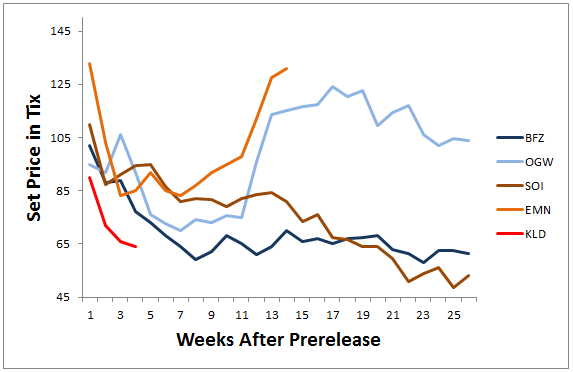
menu

Modern Finance: Planning for the Year’s End Sale

Are you a Quiet Speculation member?

If not, now is a perfect time to join up! Our powerful tools, breaking-news analysis, and exclusive Discord channel will make sure you stay up to date and ahead of the curve.

As we roll down another great year of Magic, we will find card prices starting to bottom out. Modern PPTQ season has been over for a while and the demand for new Modern cards quickly falls with it. After Grand Prix Dallas last weekend, there won't be another Modern Grand Prix until February. After the Star City Games Open in Columbus next weekend, there won't be another Modern Open until Indianapolis at the end of February. Basically with all of the premier Modern tournaments drying up until after Pro Tour Aether Revolt, there will be a lot of time to get into to some cheaper cards. Let's take a look at what I'm expecting to be good buys.

fortuitous-find

Real Estate

I think it's fairly safe to say we won't be seeing a reprint of shocklands anytime soon. Most people already own their playsets, but if you don't, the bottom might finally be falling out of them. What is important to note is that the price of shocklands is finally starting to meet the actual demand rather than the perceived value of the card.

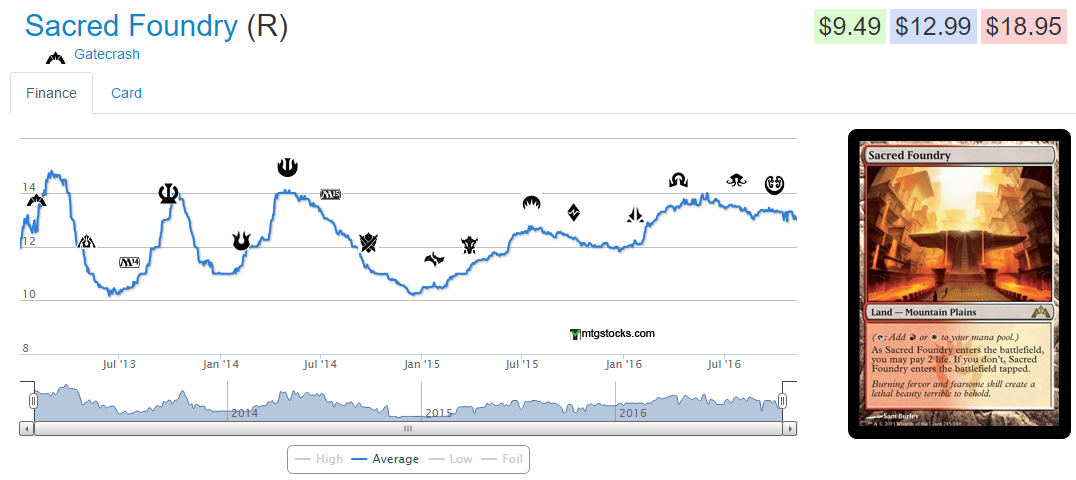
If you had to guess the most expensive shockland, what would you guess? Probably Steam Vents, right? Scalding Tarn is the most expensive fetch and Spirebluff Canal is the most expensive Kaladesh fast land. You're partially right—it's the most expensive from Return to Ravnica, but the Gatecrash shocks are by far the most expensive. I have some theories as to why, but the most important one is that the decks that play them are just cheaper generally.
sacred-foundry

Yep, Sacred Foundry is one of the most expensive shocks and shows no real chance of slowed growth. Burn and Zoo decks are generally less expensive than GB or UR decks and frequently play 3+ Sacred Foundry. The demand for this one is pretty high but if you see yourself playing an aggressive red deck in the future, you may want to pick up a few copies in December.

[wp_ad_camp_1]
stomping-ground

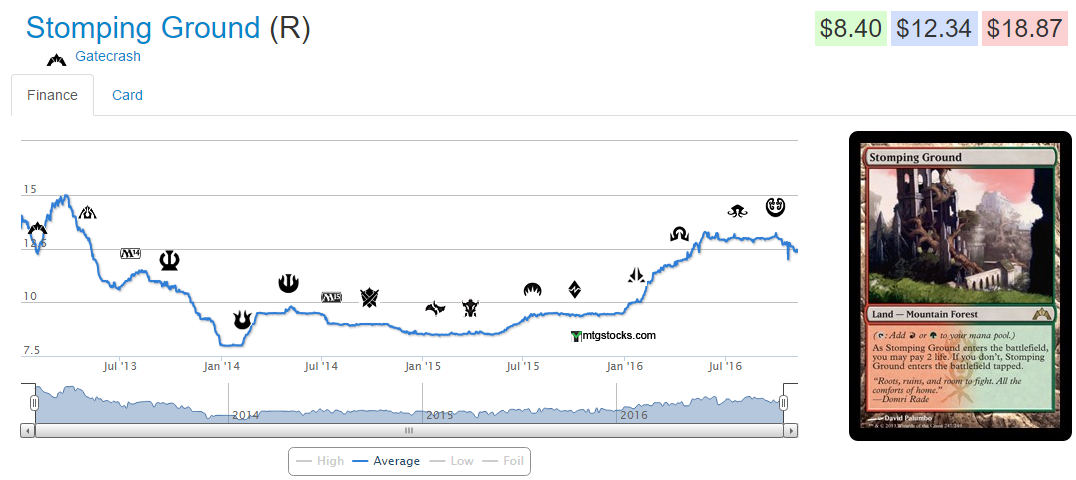
Stomping Ground has also basically bottomed out and will likely never be less than $10. It's played in Jund, Burn, Dredge, and every Valakut deck. The real key to this card's price is that Valakut decks almost always play 4, which is pretty unusual for a shock. Unless Valakut, the Molten Pinnacle becomes basically unplayable (which I don't see happening) it's unlikely to ever see a big decline.

Most of the rest of the shocks still might have a little bit to fall. If Infect remains very popular, it's possible that soon will be the best time to buy Breeding Pool. The cornerstone of a lot of the more expensive archetypes tends to be more fetches and fewer shocks. This causes the anemic price tag we see on Overgrown Tomb and Blood Crypt, despite the number of decks that actually play Blood Crypt.

If you're looking to spend the least possible on your Modern experience, don't forget this principle. Playsets of most shocks in Modern are effectively just 1-2 copies because there just isn't enough room in the mana bases for more in the world of Blood Moon. So while you may be tempted to quickly buy-it-now an eBay auction for 4x Overgrown Tomb, I can almost assure you that you will never sleeve up that many in one deck.
heath

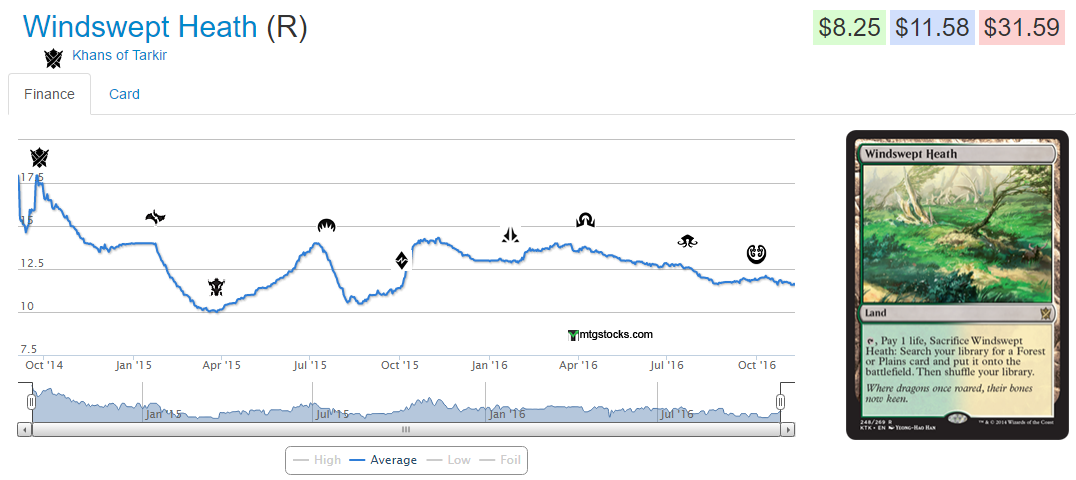
Fetches rotated out of Standard with the Release of Shadows over Innistrad, so they've really only had seven months to start their decline. That being said, they may become the cheapest they will ever be in the foreseeable future in December. Unlike shocks, fetches are a bit more expensive and played in much larger quantities. Khans of Tarkir sealed product is starting to creep up, which is pretty unusual given the recent history of sealed product. I think people don't quite realize how many fetches they need and every set that doesn't include a Zendikar fetch reprint adds to the stress on Khans of Tarkir fetches.

In order of importance, I think it depends on what archetype end up settling on. Some decks can play substitute fetches and it won't matter. Infect is one of the bigger ones because it can play Windswept Heath and Wooded Foothills instead of Misty Rainforest since they don't typically play a basic Island. Similarly, it doesn't really matter which Mountain fetchland you play in Valakut decks, Dredge, or Burn. Substitutes work worst in three-color decks like Jeskai and Jund, but those aren't very budget-friendly to begin with. While writing this I've basically convinced myself that you should probably steer clear of blue fetches because they are the lowest-impact unless you're playing Esper.
flooded-strand

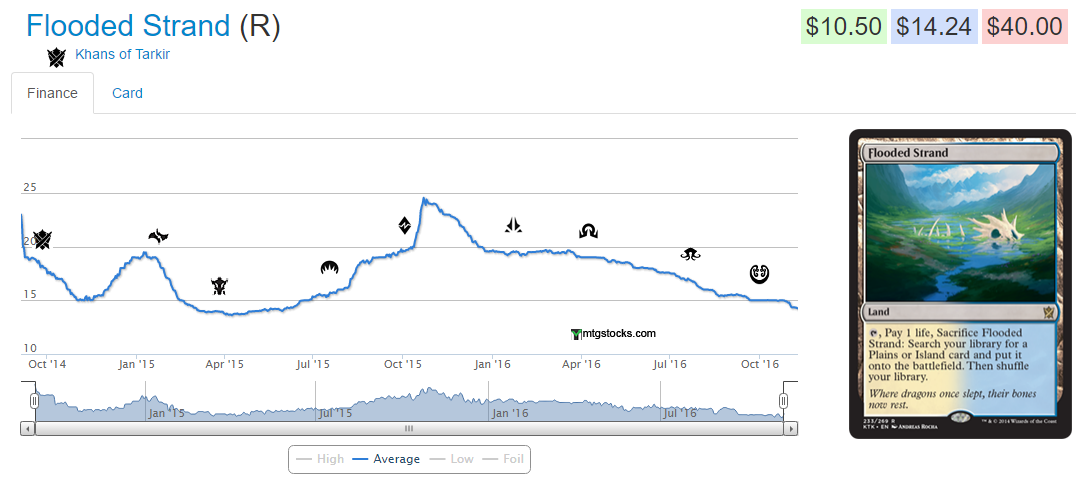
That being said, if you do play blue decks more often and have a few bucks left over, then I think blue Khans of Tarkir fetches are at a great price right now. When Rally was the most popular deck in Standard, the two blue fetches were the most expensive, despite the fact that they couldn't get all of your colors and were played in the same quantity as Windswept Heath. While there is an argument to be made that Heath was cheaper due to it being in a precon, the difference isn't explained by that alone. People just have a higher respect for Island fetches. You can see that from the price of Misty Rainforest, which is is rarely played in decks with both basic Island and basic Forest.

The Likely Foreclosures

I'm not a big fan of buying any of the lands from Time Spiral block (Grove of the Burnwillows, Horizon Canopy, River of Tears, etc.), which are expensive mostly because of their rarity. There is just too high of a chance we get one or all of those headlining Modern Masters 2017. If you're going to Grands Prix and need every edge you can get, you should be safe until the summer—but I think most players trying to buy into Modern will be better off spending their money elsewhere. Similarly, I think it would be comical for Wizards to pass up an easy opportunity to reprint Cavern of Souls in Modern Masters 2017.

Filter lands are kind of like a blessing in disguise. You don't often play them, but when you do it's rarely more than one. It helps to keep them relatively cheap as Shadowmoor and Eventide are two of the least-opened sets in Modern.

The allied-colored painlands are in a weird place. They've got names that make them hard to put into Standard (similar to the enemy-colored painlands, which were only reprinted in the last core set). I can't figure out a reason why Brushland can continue to be this expensive forever but I've been wrong before. Given the price of all of these lands I wouldn't put any of money into them until I was done with the rest of the deck first.

Modern Masters Reprints

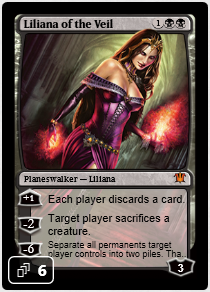
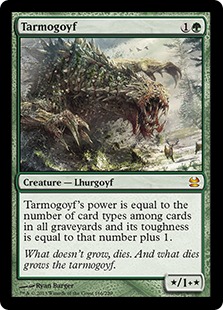
Most of the cards that were reprinted in Modern Masters 2015 are unlikely to be reprinted again in Modern Masters 2017—as such you should look to get them at the end of the year. Liliana of the VeilComparing Modern Masters 2013 to Modern Masters 2015, only six rares or mythics were in both sets (Tarmogoyf, Vendilion Clique, Dark Confidant, Kiki-Jiki, Mirror Breaker, Blinkmoth Nexus, and Cryptic Command). That being said, most of the cards you could have picked got a lot more expensive since then because the rest of their respective decks got cheaper. Arcbound Ravager and Glimmervoid got more expensive because Mox Opal, Cranial Plating, and Etched Champion fell in price. Coincidentally, the same thing happened when Tarmogoyf and Dark Confidant got reprinted again, causing Blackcleave Cliffs and Raging Ravine to jump in price.
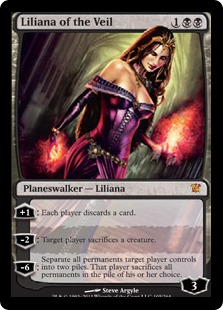
This Modern Masters set will almost certainly include Snapcaster Mage and Liliana of the Veil, so some thought must be given to the decks that use them most proficiently. Maybe for you that's Jeskai Nahiri or Abzan, but you should take a good look at cards that are the newest from those decks and acquire them sooner rather than later. At this point I think Nahiri, the Harbinger might be one of the best cards you could buy as a Modern control player. She's available on TCGPlayer for $14 now, only a few dollars from her lowest ever. That Jeskai deck is really only a Snapcaster Mage, Celestial Colonnade, and Scalding Tarn reprint away from being extremely affordable.

Next Year's Promos

Emrakul, the Aeons Torn is the RPTQ promo for all of next year. We know that doesn't inject a ton of supply into the market, but from I've heard the art is a big hit, so it should be about as expensive as the Snapcaster Mage promo. gttlccwxhqNow I'm not going to judge you if you're playing Nahiri and don't own one of these... No, I lied, I'll probably judge you. I think this is a great new art and I'm glad Emrakul hasn't been unseated as the biggest villain of them all.
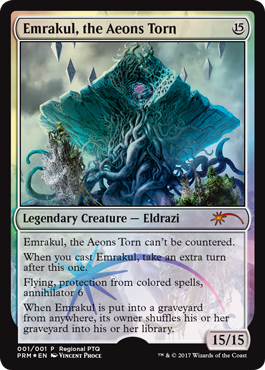
Progenitus is the Grand Prix promo for next year. I'm not really sure why this was chosen, but I have to assume people will run out of uses for ten-mana 10/10s very quickly. Both promos are numbered 1 out of 1, so it's unlikely we will get a different promo halfway through the year (as used to be custom with GP Promos). If you go to any of the Grands Prix at the beginning of this distribution period (starting in December with GP Denver), I'd make sure to sell your copy quickly. Griselbrand and Stoneforge Mystic still haven't recovered from their price drops, and Progenitus is starting out a lot lower.

Checking In on Some Reprints

  • Inquisition of Kozilek. It seems possible that a lot more people skipped Conspiracy: Take the Crown than we expected. There were a ton of products released this year and it's impossible to buy them all. That being said, Inquisition isn't really taking the dip I was expecting. If they stays steady at $9 through December, you may want to jump on them before they have a chance to start climbing.
  • Serum Visions. This card is in the same boat. It's luckily a reprint and not a new card like the increasingly expensive Leovold, Emissary of Trest. Serum VisionsStores are paying $1.25 for copies of this card, so I can't imagine it can realistically make it down to $2 per copy. If it stays steady at $3 in December, you may want to just bite the bullet before it climbs.
  • Aether Hub. It's not technically a reprint, but it's functionally the same as Tendo Ice Bridge. If you want a few just for safe keeping, you should probably wait until it rotates out of Standard or buy it during December. There will likely be more energy cards that increase its already high usefulness in Standard. It could pop back up to a $3-4 uncommon after Pro Tour Aether Revolt.
  • Modern Commander reprints: Scavenging Ooze, Past in Flames, Boros Charm, Beast Within, Terminate, Reveillark, Murmuring Bosk, Master of Etherium, Karplusan Forest, Ghostly Prison, Thopter Foundry. None of these are really hits out of the park but you may be able to find some people on Friday who don't need everything in the deck to trade for some. Some of the more expensive cards like Past in Flames and Scavenging Ooze will probably drop a dollar or two over the next few months. Wizards was careful not to include too many good reprints that would draw non-Commander players to the boxes.

Hype Train Off the Rails

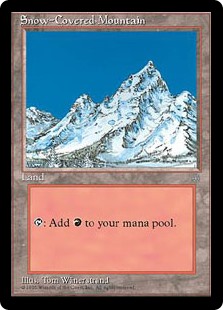
It's sweet that Skred Red won the Grand Prix last weekend, and a bunch of self-proclaimed savvy speculators bought out Snow-Covered Mountain and Scrying Sheets, and started to make a dent in Koth of the Hammer. I'm not a big fan of Skred Red because of how it needs to get favorable matchups to win. But if you're looking to play it anyway, just wait for the price increases to subside. Most of the people buying right now aren't looking to keep any of the cards. They'll get more desperate to unload in a few months and then you can get the stuff closer to what it was before it spiked.

Keep or Mull?

I want to start something new to end my article each week. I'm pretty proficient with Burn and I know what I would do, but what would you do? Would you keep or mulligan this hand? I'd like this to drive some interesting discussion, so keep the criticism constructive! Next week I'll start with my answer and my reasoning.
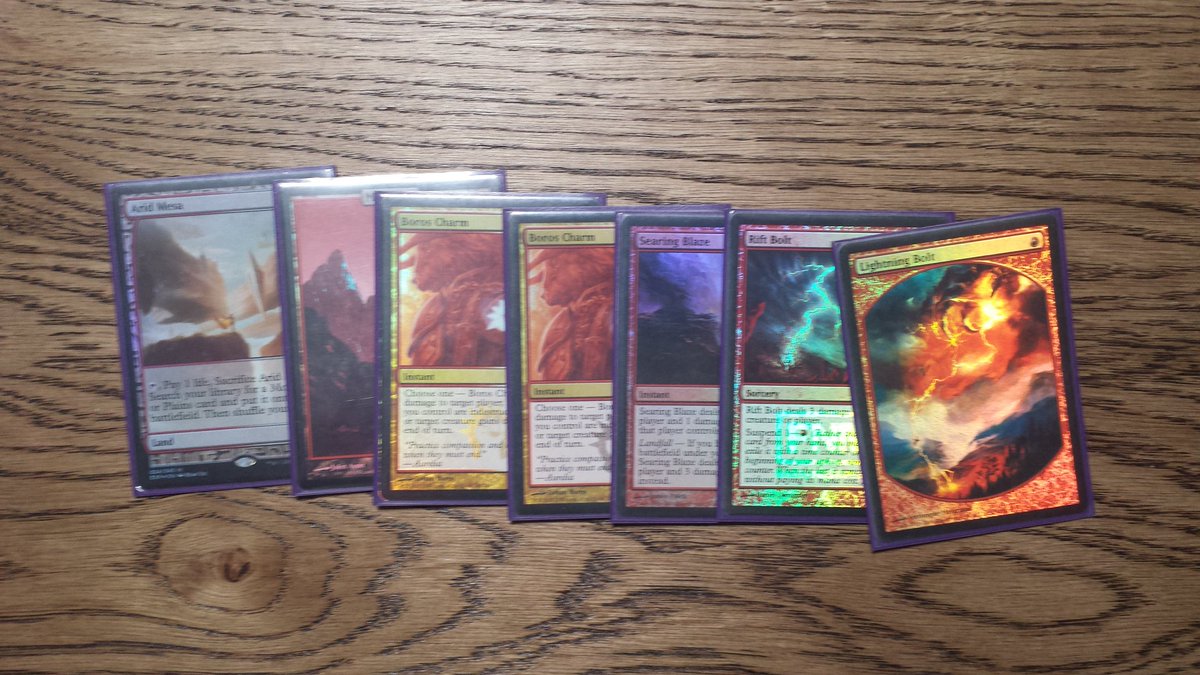

cwjqw6yviaaxn4h

Tuning Monkey Grow for Post-Dallas Modern

Are you a Quiet Speculation member?

If not, now is a perfect time to join up! Our powerful tools, breaking-news analysis, and exclusive Discord channel will make sure you stay up to date and ahead of the curve.

America was watching, riveted. Eyes glued to screens across the nation. All signs pointed to a win for blue. But Modern is a strange beast. During the tournament's final hour, its rust belt of Lightning Bolts exploded into a sea of crimson. Cries of "how did this happen?" and "where did we go wrong?" echoed around the top tables as the disenfranchised triumphed, and expensive manabases bowed to an unlikely tyrant. Skred Red had won a Modern GP.

ravager of the fells (huntmaster) art crop

Kevin Mackie's win with Skred signals major shifts in Modern we must account for to succeed in the format. With an RPTQ on the horizon, tuning Monkey Grow to combat this new metagame has been my number one priority. This article details the testing I've done over the last week with an overhauled sideboard that benches Bedlam Reveler and returns to the deck's Huntmaster roots.

Addressing Modern's Linearity

A couple weeks ago, I wrote an article detailing how to beat the many linear decks currently dominating in Modern. The two best ways, I argued, were either to play a faster linear deck or to run hate. In terms of overall metagame picture, Modern's linear shift can be attributed to the rise of Dredge. The biggest effects of that deck's success are the renewed viability of linear decks and the redesigning of interactive decks to deal with it.

Linear Decks Thrive

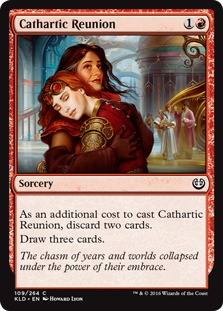
cathartic-reunionInfect had a tremendous showing at GP Dallas, trumping every other archetype in terms of representation. Bant Eldrazi, Dredge, Burn, Affinity, Death's Shadow Aggro, and Valakut were runners-up. This metagame spread demonstrates how fast Modern became to usurp Dredge, a deck that put up impressive numbers pre-Kaladesh, and then practically reached boogeyman status after the printing of Cathartic Reunion.
Against linear decks, Bedlam Reveler has never been the plan for Monkey Grow. Several of these linear matchups even had me missing Huntmaster of the Fells, including Eldrazi, Burn, and Affinity. With Modern pedaling away from interaction, Reveler loses some appeal.

Interactive Decks Struggle

The problem with control decks in Modern has always been their need to address too many issues at once. All these linear decks breaking out has done a number on goodstuff answer strategies like Jund, reinforcing this notion. Interactive decks are turning out in record lows since the Eye of Ugin fiasco.

Many interactive decks in the format seem to be turning to heavy-duty hate to help themselves stay relevant. Grafdigger's Cage and Relic of Progenitus have dwindled in blue and green sideboards, being replaced by Rest in Peace (Eldrazi, Nahiri) and Leyline of the Void (Jund, Abzan).

I have been impressed with the Bedlam Reveler package's performance in Monkey Grow and amazed by how favorable it turned our Jund matchup. But I acknowledged the plan's weakness to hate cards, specifically citing Chalice of the Void and Rest in Peace and omitting Leyline of the Void based on its absence from top decks. With Leyline enjoying more play than ever, relying on Bedlam Reveler to beat up on interactive decks becomes very suspicious, especially considering there are even less interactive decks around to beat up on in the first place.

[wp_ad_camp_1]

Updating Monkey Grow

If the RPTQ were tomorrow, I would play this.

Monkey Grow, by Jordan Boisvert

Creatures

4 Hooting Mandrills
4 Delver of Secrets
4 Tarmogoyf
1 Snapcaster Mage

Instants

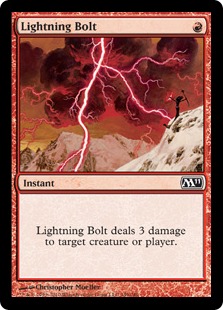
4 Lightning Bolt
2 Tarfire
1 Vapor Snag
3 Thought Scour
4 Disrupting Shoal
3 Mana Leak
3 Stubborn Denial
2 Simic Charm

Sorceries

4 Serum Visions
4 Gitaxian Probe

Lands

4 Misty Rainforest
4 Scalding Tarn
1 Wooded Foothills
2 Steam Vents
1 Breeding Pool
1 Stomping Ground
3 Island
1 Forest

Sideboard

3 Huntmaster of the Fells
3 Blood Moon
2 Pyroclasm
2 Destructive Revelry
1 Ancient Grudge
1 Dismember
3 Surgical Extraction

Shoal and Bolt: A Linear Deck's Nightmare

The main draw to Monkey Grow is the deck's positioning against linear strategies. Disrupting Shoal makes even nut draws from the fastest combo decks manageable, and Lightning Bolt is still the most effective way to interact with opponents counting to ten.

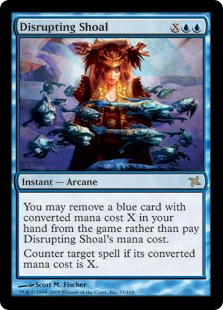
Dredge posed a potential problem for Monkey Grow, although Shoal has always given us an edge in the matchup other Delver decks lacked. Cathartic Reunion made Dredge so explosive and resilient I found we needed to include some sort of specific hate in the sideboard to beat it. Transitioning away from Traverse-Reveler and towards the lighter Huntmaster package gives us space to play Surgical Extraction in the sideboard, which I believe is the best way for interactive aggro decks to attack Dredge. With Dredge taken care of, and Huntmaster pulling Disrupting Shoalweight again vs. go-wide red decks like Zoo, our linear matchups are totally covered.
Vapor Snag has been awesome against faster aggro decks, so I made sure to keep one in the main. Same with Tarfire, which stays on at two copies. I considered a fourth Thought Scour to push out speedier Apes, but many of the linear decks currently in Modern are ones we need to interact with via Lightning Bolt before committing threats, so delve tends to pay for itself. The lack of spell-based linear decks like Tron and Ad Nauseam makes me think three is still the optimal number of Scours.

Snap and Simic: Little Hedges for Interactive Decks

In previous versions, I decried Snapcaster Mage as the deck's worst card and a necessary evil for the Traverse plan in the sideboard. Having access to a searchable copy of any spell in the graveyard was too good to pass up in many post-board games. Here, Snap serves as an additional tool against interactive decks and a fifth Bolt in matchups that put Monkey Grow on the defensive.

Simic Charm is another archetype staple that's been omitted from recent versions. Bedlam Reveler works best in a shell with as many one- and zero-mana spells as possible. This condition, combined with the rise of pump decks in Modern, made Vapor Snag a more appealing choice. The nail in the coffin for Simic was that we had interactive decks covered with Bedlam Reveler, so getting over a big Goyf with +3/+3 or saving Delver from Abrupt Decay with hexproof was less relevant.

Without Bedlam Reveler, we'll need some more points against interactive decks in the mainboard. Ultimately, a two-mana Vapor Snag remains pretty valuable against pump decks. Charm's other modes help enough against Jund & co. that I'm liking a pair for now.

Considering Metagame Cycles

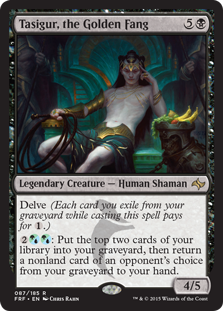
TasigurWhen modifying a deck to combat a given metagame, it's crucial to remember that metagames are cyclical. For example, Corey Burkhart correctly anticipated a field of linear aggro decks at GP Dallas, and tuned Grixis Control to beat up on those decks by stocking it full of self-replacing removal spells. Despite Modern becoming more linear as a whole, control decks made a strong showing in the Top 8.
Midrange's Possible Return

One might construe after GP Dallas that interactive midrange decks like Burkhart's and Mackie's are about to make a comeback in Modern. These decks—especially Jund—have always presented issues for Monkey Grow, and Bedlam Reveler addressed this weakness perfectly. So why abandon the Reveler now?

I don't think Monkey Grow pilots need to fret too feverishly about a Terminate renaissance. For one, a metagame dramatically tilted towards linear aggro seems to me like the only one in which Modern control decks can succeed. The counterspells control decks need to employ to deal with linear combo decks simply aren't efficient enough to make those matchups walks in the park, even with proper tuning. This situation explains why Wizards bans linear combo decks that enjoy levels of success similar to those of linear aggro (Storm, Amulet Bloom). Removal, on the other hand, is plentiful, giving midrange decks adequate tools to quell a ground assault.

Setting the Combo Stage

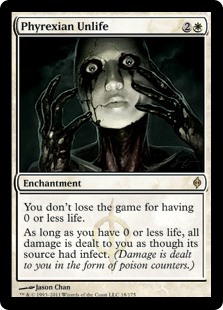
One obvious way to attack these removal-heavy Terminate decks is to sleeve up linear combo, and I'm sure we'll see more Ad Nauseams in the immediate future. Mackie himself admitted these matchups were close to impossible for phyrexian-unlifeSkred Red to overcome, and I doubt Burkhart's blend of Bolts and Commands would have proved much more competent. Notably, Temur Delver specializes in stomping decks that win on the stack.
A natural reaction to removal-based control decks would be for linear aggro to decrease in metagame share. But I don't think the metagame can afford to slow down to deal with Grixis Control and friends, if only because Dredge forces other aggro decks to be so proactive. With linear combo poised to return in some capacity, and linear aggro going nowhere, the Huntmaster plan seems superior to the Reveler one despite last weekend's victories for Grixis, Jeskai, and Snow.

The Sun Will Rise in the Morning

Skred Red winning a GP is weird, but it's certainly not as discouraging as Eldrazi Winter. Modern seems like it's in a great place right now. Dredge is crazy, but I'm fine with a deck-to-beat slightly warping the format if deck and archetype diversity remain possible. Mackie and Burkhart showed us this weekend that Modern fans can play whatever they like, even in a world of Amalgams. Burkhart himself said it best:

“Grixis Control is my tried-and-true love, so that's what I played,” he said simply, moments before moving to 13-0 at Grand Prix Dallas with an archetype that many pundits have declared dead in the explosive format. “I know the deck well, and I enjoy playing it. People just play their favorite deck — it's Modern.”

I'm as excited about Monkey Grow as I ever have been, and every metagame shift invigorates me with new ideas, projects, and challenges. If I could wish one thing for all Modern players, it's that they too find a deck they love enough to play and tune no matter the metagame.

Insider: MTGO Cards to Buy, Sell or Hold – Episode 17

Are you a Quiet Speculation member?

If not, now is a perfect time to join up! Our powerful tools, breaking-news analysis, and exclusive Discord channel will make sure you stay up to date and ahead of the curve.

Welcome back to another BSH! I haven't opened or closed many positions this week, in part because Standard prices have barely changed. My profitable positions should keep going up and there aren't many interesting options to buy due to high prices overall.

Let's see the picks for this week:

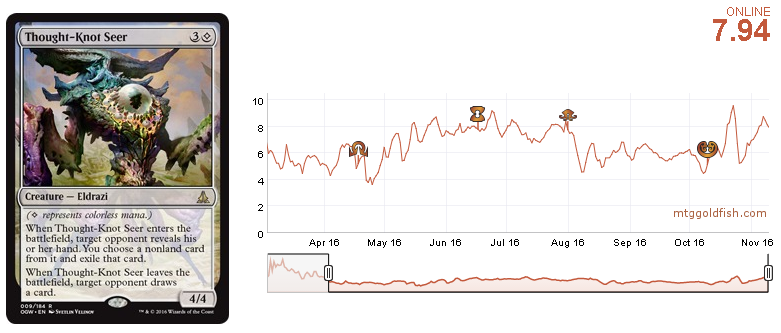
Thought-Knot Seer

thought-knot-seer

Bant Eldrazi didn't have a good performance at the Modern GP, and Thought-Knot Seer remains unplayed in Standard, which means it should go back to the 4 to 6 tix range in the next few days. It could see a rebound if Modern players choose the deck again, but it seems unlikely. The best option is to sell your copies now, close to its historic high levels.

Verdict: SELL

Tireless Tracker

tireless-tracker

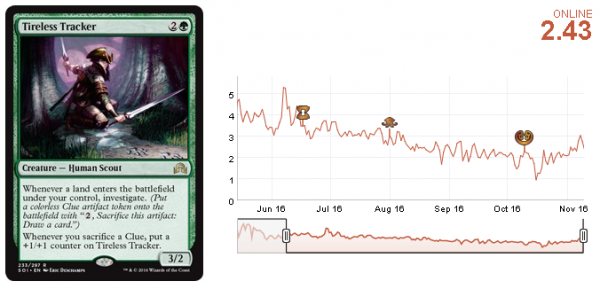
Tireless Tracker can easily be included in a wide range of decks. Standard is currently in a situation where players are trying to find a new deck to beat the top tier, and Tireless Tracker is a powerful card that brewers are working with. It's been slowly trending upward over the past month, and I think it will continue this pattern. It is a bit late to jump on this investment now, but it's definitely worth it to hold your copies.

Verdict: HOLD

Liliana, the Last Hope

liliana-the-last-hope
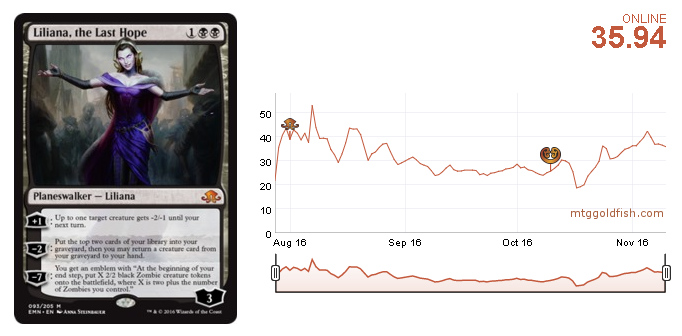
Liliana, the Last Hope was released three month ago and has been the most expensive card from Eldritch Moon since. This is a really rare distinction! But it is even rarer for a card to maintain such a high price over time. Prices from old sets usually drop when a new set is released – there is a bigger pool of cards to choose from, making the metagame shift, and older cards become less played and correspondingly their prices go down. We are still two month ago from the next Standard release, but Liliana is unlikely to go up in the meantime. Now is a good time to sell her.

Verdict: SELL

Sigarda, Heron's Grace

sigarda-herons-grace
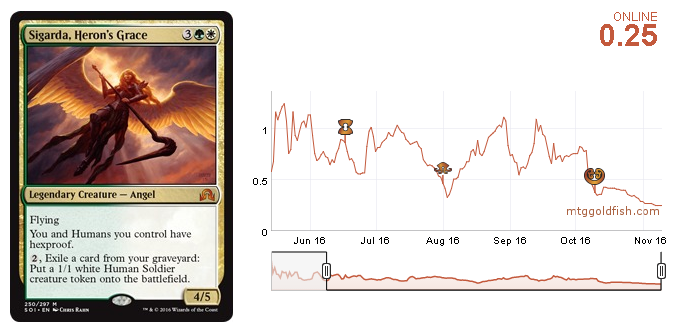
Sigarda, Heron's Grace is currently a bulk mythic, sitting at its all time low of 0.25 tix. I will play the hit-or-miss strategy here. The upside is that it is extremely cheap and unlikely to go even lower, so if it misses, I'll just be losing the spread between buylist and retail. Sigarda is good against Emrakul, the Promised End, making her viable for a new deck strategy and attractive for casual decks that cause big spikes when hyped. The reward here has the potential to be much larger than the risk.

Verdict: BUY

Ishkanah, Grafwidow

ishkanah-grafwidow
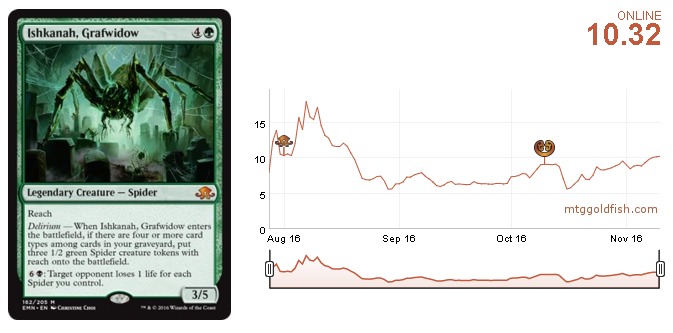
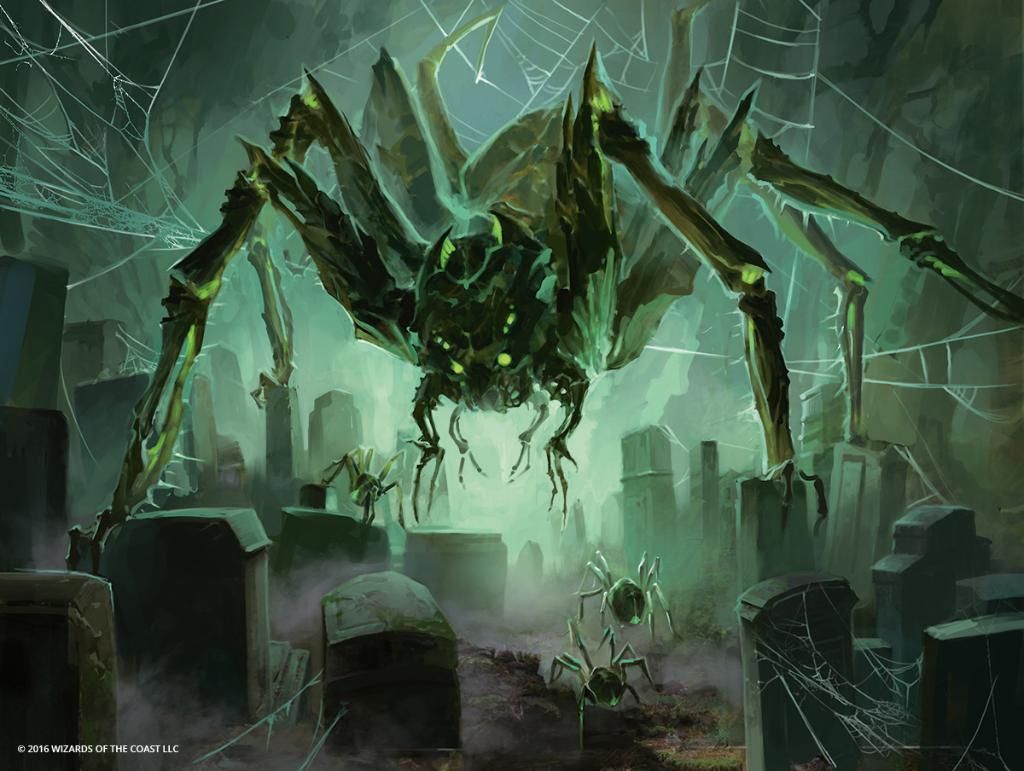
Following the same line as Emrakul, the Promised End, this big spider is a major player in the format's most-played deck, Black-Green Delirium. If a new deck that uses it should emerge, the core will likely be similar to what BG Delirium is now. This means that BG players will already have their copies of Ishkanah, Grafwidow and won't buy new copies to drive the price. The card won't go much higher, not even in the most optimistic scenario, so now seems like a fine time to sell

Verdict: SELL


That all for now, investors. Have a profitable week!

High Stakes MTGO – Oct 30th to Nov 5th

Are you a Quiet Speculation member?

If not, now is a perfect time to join up! Our powerful tools, breaking-news analysis, and exclusive Discord channel will make sure you stay up to date and ahead of the curve.

Hello, and welcome back for another High Stakes MTGO article!

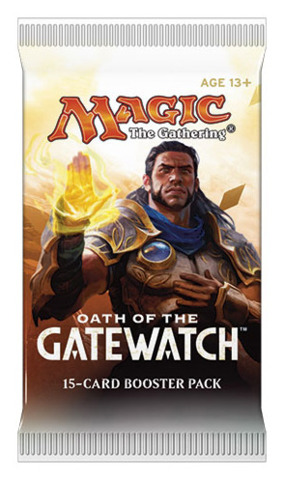
Last week was undeniably a very good one for my bankroll. After two months of mixed or clearly disappointing results I closed half a dozen positions for over 600 tix in benefits. Only the Oath of the Gatewatch boosters I sold were negative—just one of the eight positions sold last week—a rate I hadn't see in far too long.

Modern prices have not fully recovered, but we're entering a period of likely gains beginning with the filled-to-capacity Grand Prix in Dallas. Things should get much better soon for Modern speculators. A lot of specs are already doing better now; almost all of my most recent Modern picks are up, and I've even sold a few of them, as you'll see below. I'm also trying to be more conservative with my objectives, which has the double advantage of closing specs faster and with a higher rate of success.

The positive trend in Standard has also continued this past week. Singles, foils, full sets and boosters were on the sales menu, at excellent profit margins. The value of an Eldritch Moon full set is nicely mirroring the trend we observed for Oath of the Gatewatch, amounting to, finally, a great full set spec.

On the topic of full sets, Battle for Zendikar is about to make a improbable comeback. As you read these lines I might even be in a position to sell my BFZ sets for more than what I (over)paid. A month ago BFZ sets were valued a 49 tix; they are now over 72 tix and firmly on their way to top the 78.5 tix record established last June.

Let's look at all of this in more detail; all the moves I made last week are summarized in the portfolio snapshot.

Buys This Week

op

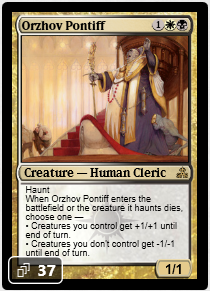
Once a silver bulet in the almighty Pod deck, and omnipresent in the sideboard of WBx decks, the competitive applications of Orzhov Pontiff are currently near zero. At 1 tix earlier last week, a two-and-a-half-year low, the price of the Pontiff totally reflects its weight on the current Modern metagame.

When nobody wants it is exactly when I want to buy it. It might take a few months for this card to spike again at 5 tix or higher, but as long as Orzhov Pontiff can dodge a reprint in Modern Masters 2017, the potential remains. I'm ready to add a few more playsets if the price gets lower again.

dtk

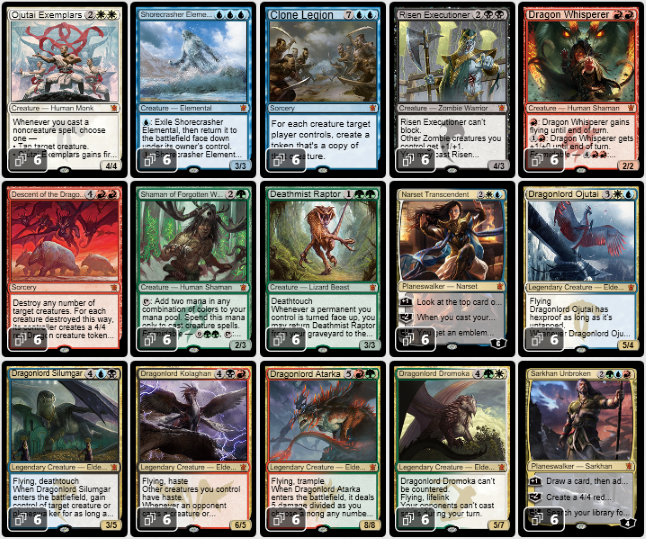
A second round of Dragons of Tarkir full sets. I'm in for six more full sets for a total of sixteen now. The periodic rise and fall of Collected Company is what creates the little oscilliations we see for the online price of a DTK full set, while the paper is still dead flat at the moment.

November and December are usually when freshly-rotated sets start to rise in price again. Let's see where DTK can go from this extremly low price tag for a third large set.

ori-sets

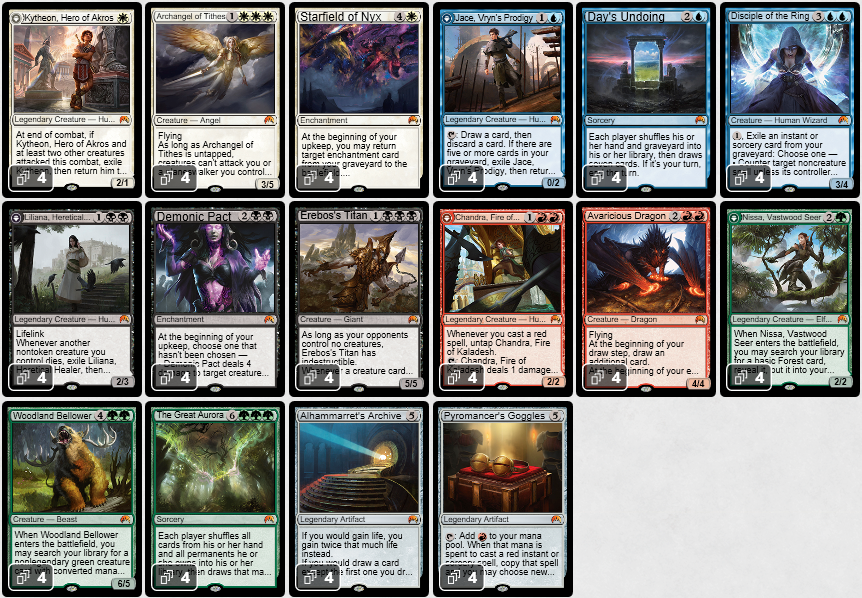
I'm also in for four more Magic Origins full sets. Unless prices significantly drop further, I think I have what I want for both ORI and DTK full sets. The four other core sets with complete records (Magic 2012, 2013, 2014 and 2015) show an increase in their full set value between January and April after their rotation out of Standard. With most of the price hike happening in January, that is my time target to sell my ORI full sets.

lotv

Innistrad flashback drafts end this Wednesday. Following these two weeks of flashback drafts, this iconic version of Liliana fell from almost 100 tix to 70 tix, a bottom she hadn't reached since January 2015.

Liliana of the Veil has been very consistent price-wise for the past three years, despite Jund falling in popularity in Modern. With several Modern events lining up for the next two months, I'm betting Liliana of the Veil can regain 15 to 25 tix in a short period of time. That could represent a middling gain from a percentage point of view, but this is an opportunity to make around 100 tix with only a playset and a half of cards traded.

Sales This Week

As Dredge rises in popularity in Modern, weapons to fight the graveyard-based strategies do too. I bought this Leyline back in September after Magic 2011 flashback drafts and I think now is a good time to safely withdraw from the position with a comfortable profit.

Leyline of the Void is very close to its record high. I would rather sell now than be caught by a disappointing Dredge performance during Grand Prix Dallas or, more likely, by an innevitable adjustment of the Modern metagame.

Collected Company is certainly here to stay in Modern, as the card is extremly powerful and flexible enough to be included in several archetypes. Even if I do believe that Company will have a trajectory similar to Cavern of Souls, the road will be bumpy and the price will most likely cycle up and down a lot.

For now, I'm fully satisfied doubling my bet on a position I bought not even a month ago. I'm certainly ready to buy Collected Company again if the price comes back down closer to 7 tix.

In the vein of Leyline of the Void and Collected Company, I sold the rest of my Gemstone Mines because I considered them to have done their job. There's still a potential for 2 or 3 more tix, but the card would need to go to the top again.

I was only in for this spec to take advantage of the sharp dip that Mine experienced two weeks ago. After a lot of disapointment in Modern positions in these past two months, I'm more looking to secure profit than take risks.

Standard can be very volatile and opportunities may not present themselves twice. Not only did I buy this BFZ land at a higher-than-ideal price, but I also missed two decent opportunities to get out in April and August. I could not seriously decline another opportunity to sell my Prairie Stream for a good price.

If the hits and misses with my enormous ORI painland spec taught me one thing, it's to try to close the majority of large positions whenever possible, without constantly asking for more. You never now how long a price hike will last or whether another will occur. A 48% profit on 100 copies of a 300-tix position sounds like a good number to me.

I also sold 35 more copies of the black-red BFZ land this past week. With only 18 copies left to go, the price of Smoldering Marsh has gone back to 2.5 tix. Will it head back in the 3 tix range? That's exactly what I just talked about. It may have been safer, faster and better just to sell everything here while I could do so around 2.8 tix.

fgf

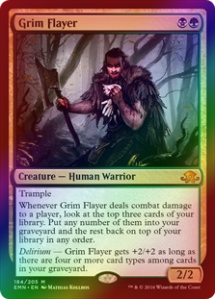
Although it's always a few tix behind, the foil version of Grim Flayer is naturally following the trend of its regular counterpart. The ceiling seems to be 25 tix for the regular version at the moment, while the limit for foils is suprisingly only 21 tix.

Having taken little to no risk on that spec, I sold my last two copies of foil Grim Flayer for 18.8 tix each, closing this position with an average profit of 120%. That's all I needed here.

eldritch moon

Finally a largely postitive speculation with a full set. As anticipated, Eldritch Moon follows in Oath of the Gatewatch's footsteps in terms of price trend, with the price of an EMN full set rising from 90 to 138 tix in less than a month.

If EMN prices are not exactly the same during comparable periods (OGW was around 75 tix before the SOI release and rose to 120 quickly afterwards), the price evolution in terms of percentages is analagous. And if OGW is any indication, there's not much else to expect from EMN full sets. That is why I decided to sell my EMN full sets now to move on to something else.

ogw

Along with BFZ boosters, I have no hope of closing OGW boosters with a profit. As they are doing a little bit better pricewise than a month ago, I'm selling part of my stock a little bit at a time. Still very far from the 3-3.5 tix price range I wish they were in.

On My Radar

The next two months should be interesting because both Modern and Standard prices should rise, but fairly boring at the same time because nothing very special should happen. I'll try to sell my BFZ full sets at a profit and jump on any Modern opportunities—that's as targeted as my goals can be for the next few weeks.

There is one thing I'll look at closer to see if it promises any speculative opportunities: mythics from DTK and ORI.

These are two large sets from the second part of the Standard season. In the past, certain third-set mythics with both casual and competitive appeal have provided nice returns on investment if you were able to pick them up early enough. Sliver Hivelord, Athreos, God of Passage, Ajani, Mentor of Heroes, Avacyn, Angel of Hope, Entreat the Angels, Gisela, Blade of Goldnight, and Kalonian Hydra are examples of this trend that could be exploitable.


Thank you for reading,

Sylvain

Stock Watch- Koth of the Hammer

Are you a Quiet Speculation member?

If not, now is a perfect time to join up! Our powerful tools, breaking-news analysis, and exclusive Discord channel will make sure you stay up to date and ahead of the curve.

Many players were very surprised to see Skred Red take down a Grand Prix this weekend. Players seemed equally surprised when I tell them that the deck is at least as good as Merfolk, but I digress. Players are moving in on the deck, and we've seen growth in Snow-Covered Mountain, and now Koth of the Hammer

There was an error retrieving a chart for Koth of the Hammer

Koth was around $8 at the start of the week, and at this point that price looks to be more like $10 as copies disappear off the internet. Being a planeswalker, Koth has plenty of casual command, and Koth is a hallmark of red sections of Cubes. I would be happy to pick up copies of Koth as close to $8 as I can, as there is plenty of demand for the powerful planeswalker.

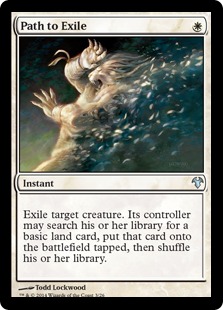
Further, I believe that the Skred Red deck is much more powerful in Modern than it is given credit for. It is true that many Modern decks have won Grand Prix, and that not all of them have been great, but I believe this to be a truly powerful archetype. Skred is at least on par with the power level of Path to Exile, and the new technology with Eternal Scourge and Relic of Progenitus is more than just a cute trick. Not to mention that you can never fully discount the Blood Moon players.

Insider: Different Printings of Picks

Are you a Quiet Speculation member?

If not, now is a perfect time to join up! Our powerful tools, breaking-news analysis, and exclusive Discord channel will make sure you stay up to date and ahead of the curve.

My visibility on the Internet hasn't been what it usually is over the past couple of week. I mean, my articles have still been coming out every Thursday, and I've still been "guesting" on Brainstorm Brewery every week, but I've mostly been absent from Twitter and Cartel Aristocrats.

The combination of grad school, work, and collection buying has gotten a bit hectic, so I've had a lot of catching up to do, with very little time on Wednesdays for #breakingbulk. This situation has been breaking my heart a bit, so we'll go back to more of a bulky topic this week. This topic was submitted a while ago as a question for Cartel Aristocrats that I never got the chance to answer. I can't find the exact tweet, but we're gonna talk about the difference between this:

arcane1

And this:

arcane2

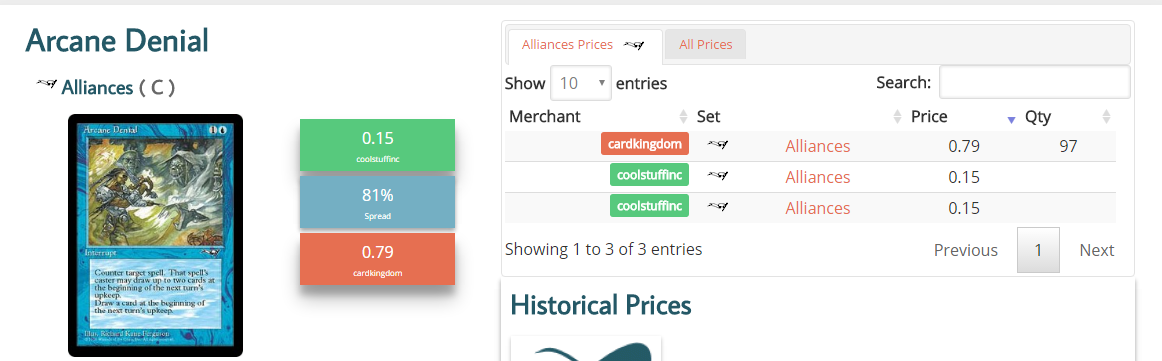
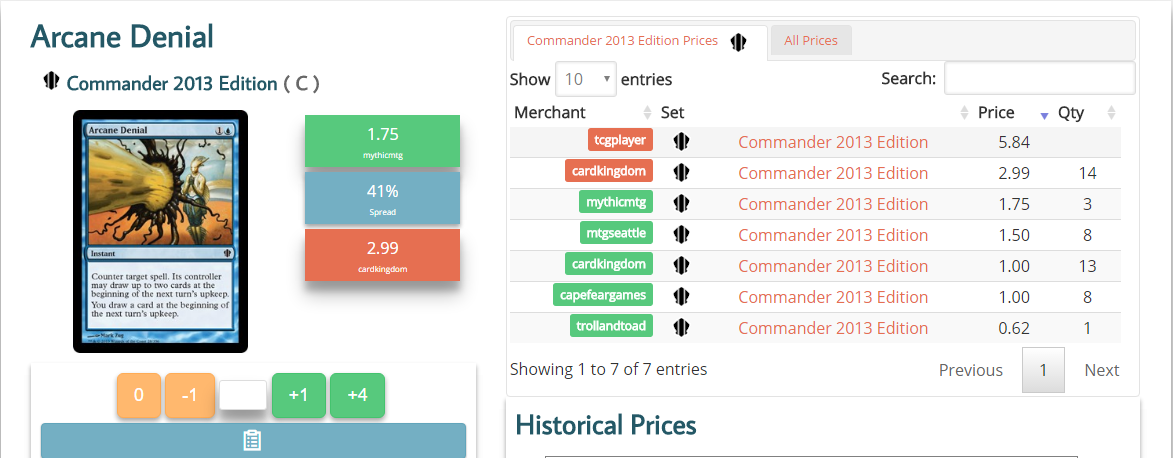
These are the same card. Neither of them are foil. One of them is worth a fraction of a dollar, and the other easily crests $3 at market price.

So what gives?

For several years, we've heard the mantra that old-bordered cards are preferred to the modern border, and that has historically come with a price increase based in part on an overall lower supply.

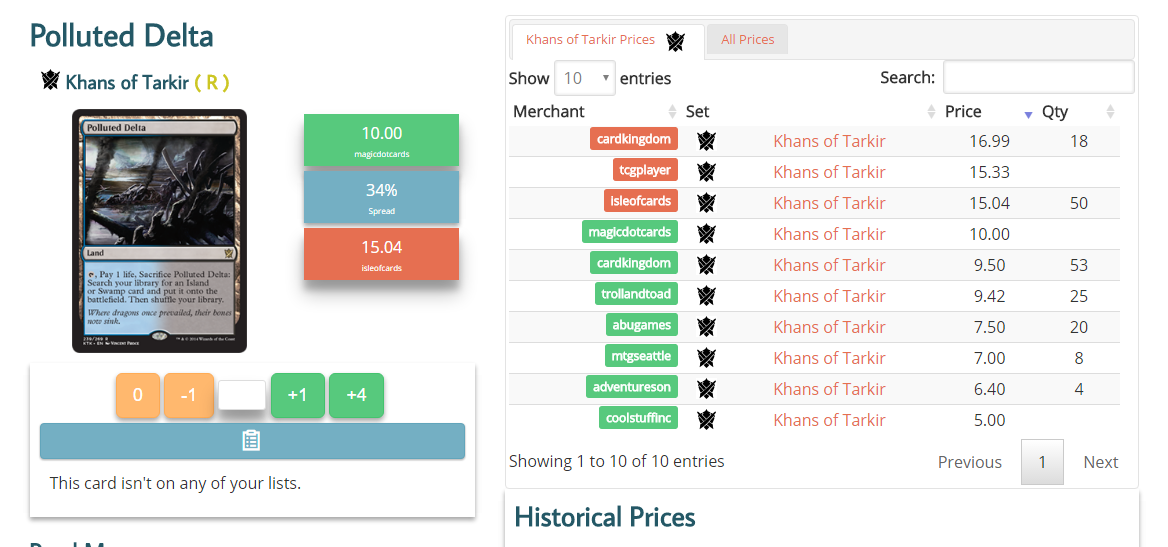
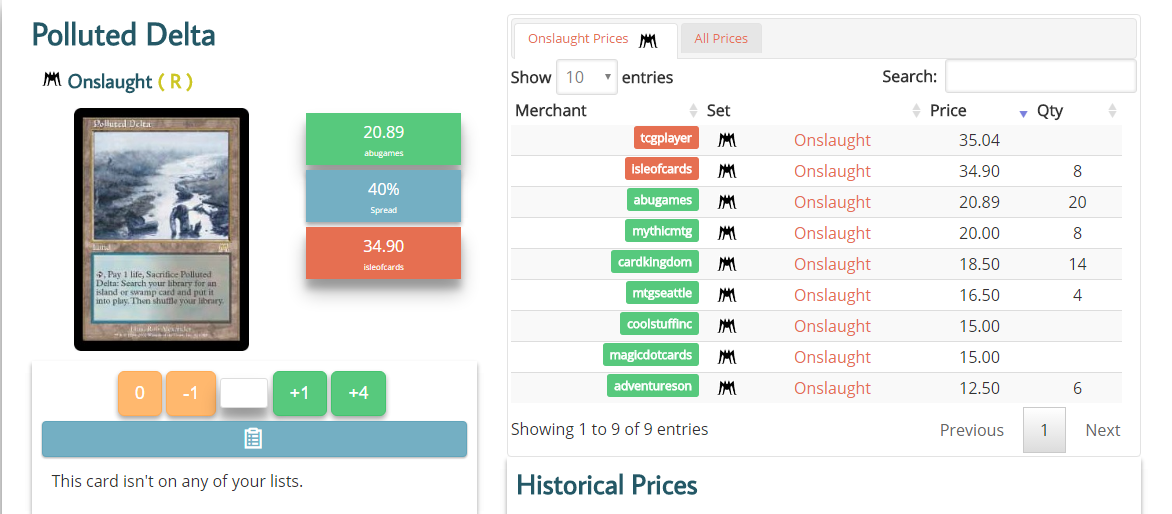
The first example that comes to mind is the difference between Onslaught and Khans of Tarkir fetchlands: While Polluted Delta no longer reigns on its $100 throne, the 2002 version still holds up to a multiplier of three on the more recent printing. Those who aren't inundated with bulk might be confused that the same doesn't always hold true with pickable bulk commons and uncommons that have been reprinted in a different style.

delta1

delta2

Let's start by looking at this from the most basic level.

Supply

If you go on TCGplayer, you'll see literally hundreds of "axe" and "sword" variants of Alliances printings for Arcane Denial. When you compare that to the fact that there are only 50 total listings (separate sellers, not counting the quantity possessed by each seller) for the Commander 2013 and Commander 2016 printing combined, that speaks to the volume of bulk available on the market.

There would have to be an exponential increase in demand for the older printing for it to be worth a significant figure next to the reprints, but stores just have so much Alliances bulk that the demand that does exist doesn't matter in the slightest. Digging further into TCGplayer's listings reveals that there are still almost eighty stores with four or more copies listed, and some of those stores have up to 32 of just one of the artwork variants. When it comes to bulk collections, there's just a ton of leftovers from the "Force of Will lottery" that nobody really wants to touch.

The next point is more abstract and less measurable, but still evidenced by the hard numbers that we can see. As the vocal minority on social media, Twitter, Reddit, and competitive Magic events, we often forget that a huge portion of the player base started getting into the game long after the old border died out. While we bling out our decks with old-border judge foils and revel in Old School MTG, there's a massive silent majority that enjoy that same symmetry the rest of us love, but their collections are all modern border.

To put it simply, the old border is ugly to these people, and the abstract painted art style just doesn't appeal. We'll get into this point a little bit further down with some other cards that explain it more clearly, but this is a perspective shift more than anything – newer players like the new border.

Color Matters

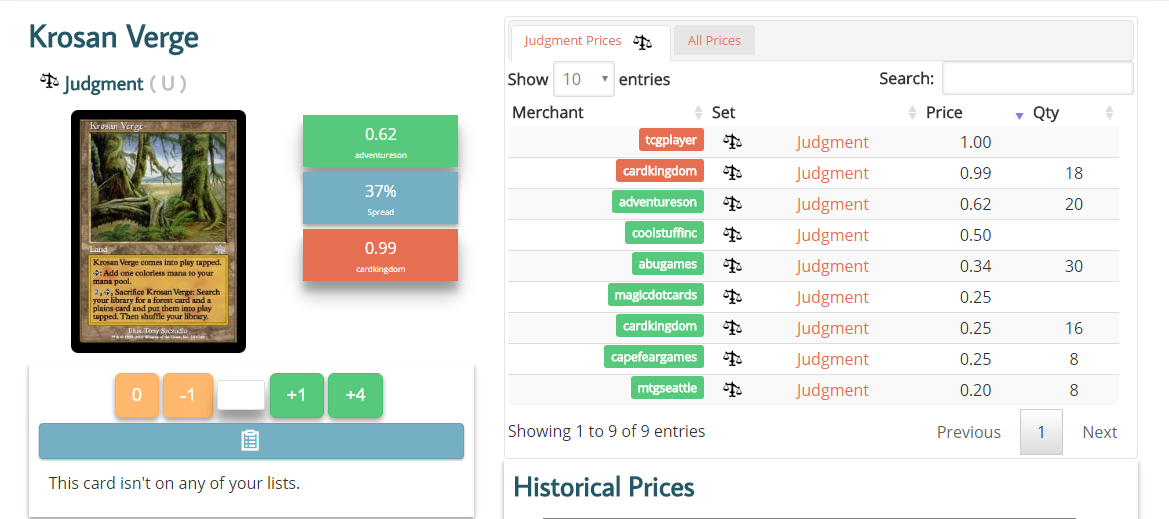
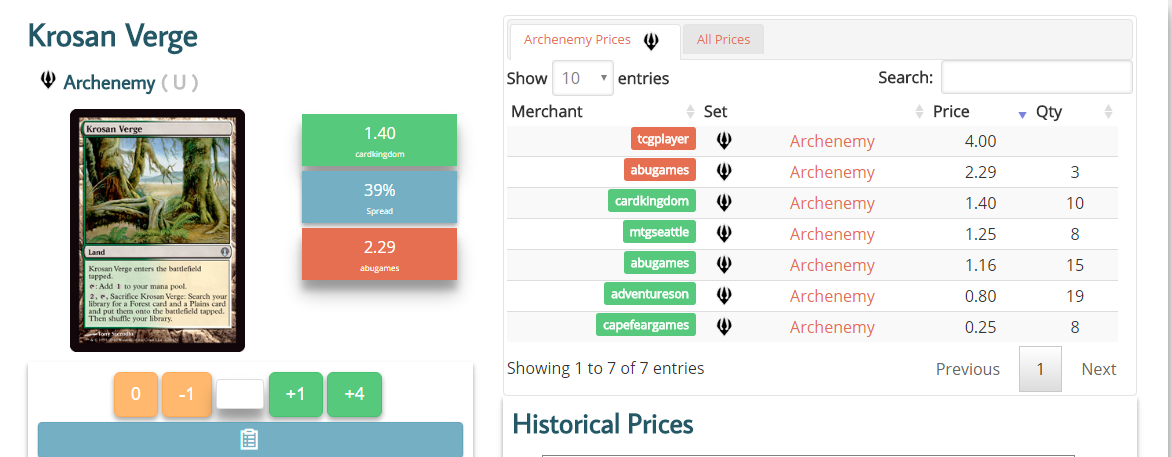
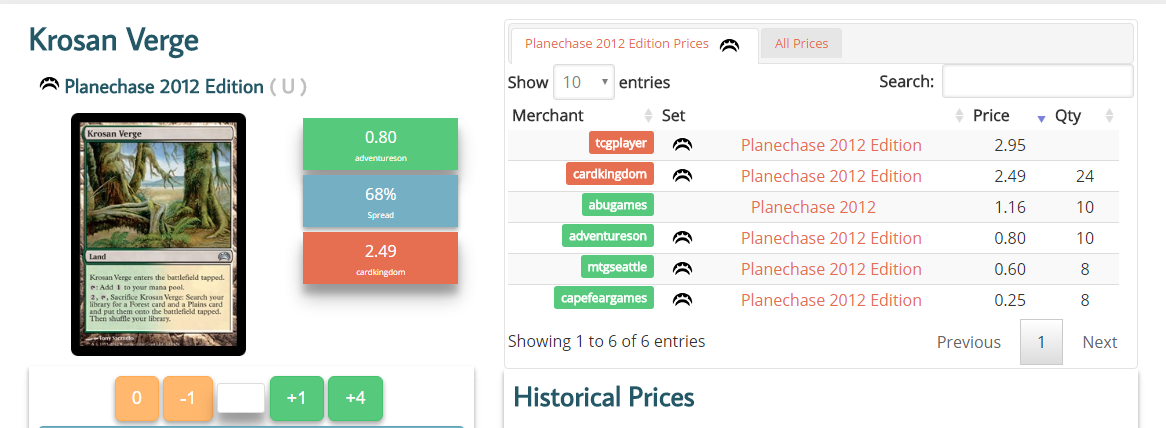
Here's another example that helps illustrate the point more. Krosan Verge is a well-known Commander card, and sees play in thousands of G/W/X decks. The Judgment printing is $1 retail and around $.50 buylist; a solid pick and an excellent (albeit kinda obvious) #breakingbulk. However, the two supplemental product printings are more than double the original! In this case, we can't really blame the artwork. They reused the same piece of art for all three printings, so that factor remains the same. The oracle text has remained steadfast over the past decade, with the only change being the "one colorless mana" updated to a symbol that would itself later become obsolete for star mana. So what's the difference here?

verge1

verge2

verge3

Other than incredibly low supply (again, by looking on TCGplayer we can see that the now three supplemental products add up to a fraction of the available supply of Judgment), the big difference in these printings is literally the color of the card. I mean, they're all "colorless" in game terms, but I'm talking about the visual colors that we see: the frame for old lands that tapped for colorless mana used to be that brown-orange chromatic that was later shifted to gold.

Since the reprintings, Wizards felt that it would be more aesthetically pleasing for this pseudo-fetchland to be updated to reflect its ONS and ZEN counterparts. Now with a Commander 2016 printing bearing down and the amount of value already packed into these decks, we're finally seeing this frame style converge with the Judgment printing.

Thankfully, you'll still probably be able to pick and buylist Planechase and Archenemy copies because of the astronomically low supply, and stores will still want to have them in stock to sell at $2.50 or $3 to the completionists out there. TCGplayer literally has only three Archenemy copies listed on the site. No filters, all conditions – just three.

So Today...

So how does this affect you today? I mean, it helps if you're picking bulk that includes supplementary products to know that the reprinted cards with updated frames and artwork are usually worth significantly more, sure. But what about those of you who, uh, aren't doing that? Well, there's a few cards in particular that are being released in that very same Commander 2016 that have some new characteristics that will make them stand out.

There was an error retrieving a chart for Boros Charm

Right now, Boros Charm is a $2 card. There will be a lot of people who expect this reprint to crush it to a $1 card, but I disagree.

This printing is unique in that the formatting is so much cleaner than previous other releases, and those bullet points will make this printing the desired one by a non-zero number of players. While foilers are gonna foil, this is by far the cleanest printing of the Charm cycle, and I would be happy to continue trading for these at $1 all day.

Note that this isn't something that I expect to make Merciless Eviction a non-bulk rare; it's still totally a bulk rare until the end of time. However, this is still definitely the "value" charm to look out for and to not underestimate if you end up picking Commander 2016 bulk.

Got any other similar examples of a reprinted card showing more financial stamina than its original older border? Let's have a chat in the comments or on Twitter. Have a great weekend!

Insider: What to Do About Graveyards

Are you a Quiet Speculation member?

If not, now is a perfect time to join up! Our powerful tools, breaking-news analysis, and exclusive Discord channel will make sure you stay up to date and ahead of the curve.

Attention, everyone. I have an announcement to make. The graveyards are taking over. I repeat: the graveyards are taking over.

We need to do something. The unfortunate thing is that depending on the format, we are severely limited with what we can do. But never fear, there are always options!

Graveyard Decks in Every Format

If you’ve noticed lately, graveyard shenanigans have been dominating in multiple formats. Let’s take a look at how players are utilizing their graveyards for their benefit. We will start off with Legacy.

RB Reanimator by Kurtis Frazer (8th place Legacy Champs)

Creatures

4 Chancellor of the Annex
3 Griselbrand
1 Elesh Norn, Grand Cenobite
1 Sire of Insanity
1 Tidespout Tyrant

Spells

4 Lotus Petal
4 Dark Ritual
4 Faithless Looting
4 Thoughtseize
4 Entomb
4 Reanimate
4 Exhume
4 Animate Dead
4 Unmask

Lands

4 Blooodstained Mire
4 Polluted Delta
3 Badlands
1 Bayou
2 Swamp

Sideboard

3 Abrupt Decay
1 Archetype of Endurance
2 Collective Brutality
1 Iona, Shield of Emeria
2 Pithing Needle
3 Reverent Silence
3 Stronghold Gambit

First up we have Red-Black Reanimator. This version differs quite a bit from the typical blue-black build. The creature choices overlap a bit with cards like Griselbrand but differ greatly in the rest of the deck. By adding red instead of blue we gain some additional discard outlets, which helps streamline the deck towards achieving its goal. I played against this archetype twice at Eternal Weekend and it seems like it's catching on in Legacy. It’s definitely not the most expensive deck in the format and may even be one of the more affordable options.

The main threat of the deck, Chancellor of the Annex, can help you out against your opponent as well. I know when I played against this deck, that card impacted my game plan quite a bit. Your choices against the white chancellor are to let your first spell get countered or to wait until you can pay the extra amount for your spell, thereby slowing your game down drastically. Neither option is good for the opponent. Chancellor of the Annex is no longer bulk thanks to this deck, so nab some copies cheap if you can find them.

Next up, we’ll move onto Modern from this past weekend.

Dredge by Brian Braun-Duin (5th place Grand Prix Dallas)

Creatures

4 Insolent Neonate
4 Bloodghast
4 Narcomoeba
4 Prized Amalgam
1 Scourge Devil
4 Stinkweed Imp
4 Golgari Grave-Troll

Spells

4 Faithless Looting
4 Cathartic Reunion
3 Conflagrate
3 Life from the Loam
1 Shriekhorn

Lands

4 Bloodstained Mire
4 Wooded Foothills
2 Blood Crypt
2 Stomping Ground
4 Copperline Gorge
2 Dakmor Salvage
2 Mountain

Sideboard

1 Ancient Grudge
2 Bojuka Bog
1 Collective Brutality
2 Darkblast
1 Gnaw to the Bone
2 Lightning Axe
4 Nature's Claim
2 Vengeful Pharaoh

Since Golgari Grave-Troll was unbanned, players have been working with this strategy to try and find the right build of the deck. It wasn’t until Prized Amalgam was released that the archetype really gained traction in the Modern format. Now that the deck has been around for a little while, most players would consider this deck an important part of the format. Despite being essentially a combo deck, Dredge in Modern has a lot of lines of play as well as great sideboard cards.

The card that stuck out to me in this deck was actually Collective Brutality. This is not the first time I’ve seen this Standard card being used in Modern. It actually has a ton of utility for Dredge – you want to be discarding, so you may as well get some added benefits from doing so.

Finally, let’s see what’s happening with graveyards in Standard.

Golgari Delerium by Niels Molle (2nd place Grand Prix Warsaw)

Creatures

4 Grim Flayer
2 Pilgrim's Eye
1 Tireless Tracker
2 Kalitas, Traitor of Ghet
2 Mindwrack Demon
3 Ishkanah, Grafwidow
1 Noxious Gearhulk
1 Emrakul, the Promised End

Spells

4 Traverse the Ulvenwald
2 Grapple with the Past
4 Grasp of Darkness
2 Murder
1 Ruinous Path

Lands

1 Evolving Wilds
4 Blooming Marsh
4 Hissing Quagmire
7 Forest
7 Swamp

Sideboard

1 Appetite for the Unnatural
1 Dead Weight
1 Emrakul, the Promised End
2 Flaying Tendrils
2 Natural State
1 Ob Nixilis Reignited
1 Pick the Brain
2 Tireless Tracker
1 To the Slaughter
3 Transgress the Mind

Green-black has many different archetypes associated with it in Standard right now, and Delirium is usually at the top of that list. This deck reminds me a lot of Jund. There are plenty of great threats as well as ways to disrupt your opponent. You can combine those things with some removal for a great midrange strategy. This deck is dominating the format right now, and if you expect to succeed in Standard, you’d better be prepared for it.

Preparing to Battle the Undead

Most of the ways you can prepare for these strategies are by knowing they exist so you can determine a game plan to beat them. One important factor is to focus some of your sideboard spots towards mitigating the graveyard threat to whatever level you can.

There was an error retrieving a chart for Leyline of the Void

In Legacy, we don’t mess around. We submit decklists with four copies of Leyline of the Void or make room for Surgical Extraction. Lately, though, I don’t think players are taking these graveyard strategies as seriously as they should be. Most decks I see are devoting just one or two sideboard slots toward stopping graveyard strategies like those I’ve outlined above. Simply put, that’s not good enough. If you hope to defeat decks like these, start sideboarding with severity against them.

In Columbus, I ran four Leyline of the Void and a Relic of Progenitus as my dedicated hate cards for those Legacy matchups. The fact that I had five cards ready to bring in against decks like this was a huge boon and helped me win many matches. If you want to have good matchups against these decks, start sideboarding with this thought process in mind.

There was an error retrieving a chart for Rest in Peace

Legacy is one story, but what about Modern and Standard? Legacy players typically have a game plan for graveyard decks because there are so many of them. In Modern and Standard, though, we don’t always have to worry about strategies such as these – but right now we do.

Modern Dredge isn’t going anywhere. If anything, it’s gaining supporters. Not only that, but we face other commonly played cards that use the graveyard to their benefit like Snapcaster Mage and Tarmogoyf. Yet with all these cards seeing play, no one is fighting against them. Not only do we have Leyline of the Void and Relic of Progenitus like I mentioned above, but we have other powerhouses like Rest in Peace.

The Standard Conundrum

Standard is another story altogether. The main problem with Standard is that there aren’t great ways to fight against these graveyard-centric decks. There just aren’t very many options for that type of effect. Maybe it’s time for a little Shamble Back action in our decks, though. Or maybe we could rely on Descend Upon the Sinful to clear the board and stop the follow-up plays, but that card is probably too slow.

Once we start seeing cards from Aether Revolt, one of the first things we should look for is graveyard hate, because it will change the format immediately. Well, that is if players actually adopt it into their sideboards. My thought process is that we have to start taking these decks as seriously in Modern and Standard as we do in Legacy. Surely they aren’t as potent as in the older format, but they are certainly great with respect to the other decks in their respective formats.

There was an error retrieving a chart for Descend upon the Sinful

Because I think there will be an uptick in the amount of graveyard hate seeing play, I advocate picking up some of these cards now. Especially if you don’t own these cards already, they have nowhere to go but up – with the exception of the always-present risk that they get a reprint. Even if you already own these cards, now might be the time to start acquiring some extra copies. There are plenty of great options for Modern and most of them do double duty in Legacy as well. I think of the cards I’ve mentioned today, Leyline of the Void is my favorite because it can fit in any deck.

That’s all I’ve got for today. What are your thoughts about graveyard decks in these formats? Are they really taking over? How many slots do you usually dedicate towards these matchups when you are building your deck? Let me know in the comments and let’s work together to defeat these decks!

Until next time,
Unleash the Force!

Mike Lanigan
MtgJedi on Twitter

Putting Jeskai Delver to the Test

Are you a Quiet Speculation member?

If not, now is a perfect time to join up! Our powerful tools, breaking-news analysis, and exclusive Discord channel will make sure you stay up to date and ahead of the curve.

About a month and a half ago I presented a Jeskai Delver build that I had been tinkering with, and today I have some changes to discuss. I was able to play a 61-person event last weekend, piloting an updated version to the semifinals of the event, where I was ultimately felled by Jund, which is among Jeskai Delver's worst matchups.

electrolyze-banner-cropped

My motivation for sleeving up Jeskai Delver as opposed to the usual Grixis was the general rise in the power of linear decks. I expected Infect to be decidedly well represented, and at least a few players to be picking up Dredge. Modern pairings can be quite unpredictable, but I wanted to crush these decks. I felt that Path to Exile was the best tool for the job, and after reflecting on the small amount of experience that I had with Jeskai Delver, I landed on this list:

[wp_ad_camp_1]

Jeskai Delver, by Ryan Overturf

Creatures

4 Delver of Secrets
4 Snapcaster Mage
4 Spell Queller
1 Vendilion Clique

Instants

4 Spell Snare
4 Path to Exile
4 Lightning Bolt
4 Mana Leak
3 Electrolyze
3 Lightning Helix

Sorceries

4 Serum Visions

Lands

2 Steam Vents
1 Hallowed Fountain
1 Sacred Foundry
2 Spirebluff Canal
2 Seachrome Coast
2 Island
1 Mountain
1 Plains
4 Scalding Tarn
4 Flooded Strand
1 Misty Rainforest

Sideboard

2 Surgical Extraction
3 Negate
2 Spell Pierce
1 Dispel
2 Engineered Explosives
1 Wear // Tear
1 Gut Shot
2 Gideon, Ally of Zendikar
1 Magma Spray

There are two major changes from my previous article. I decided that it's fine to have both Path to Exile and Mana Leak in the maindeck, and that Electrolyze deserves at least as many slots as Lightning Helix. The plan is to board either the Leaks or the Paths out, though both have their uses in most game ones, and both stay in post-board against decks like Jund just due to the diversity of cards that matter. With regard to the burn spells, Electrolyze has consistently over-performed while Lightning Helix has been consistently medium. If not for the difference in mana costs, I would already be playing a 4-2 split in favor of Electroylze—as is I would consider making that change anyway.

When building the manabase, I replaced Arid Mesa with Misty Rainforest since I wanted basic Island way more than the other basics and because I don't own an Arid Mesa. Very scientific. I cut down to one Hallowed Fountain as the deck is generally looking for double red and seldom for double-white, though having a fetchland that can only find one source of one the deck's colors is probably just bad deckbuilding. The Misty should just be a Mesa, and I did play a game during the swiss in which I controlled five lands and was unable to cast a Gideon.

Anyway, let's talk about some games from this weekend! With 61 players that meant six rounds of swiss play, and my round one matchup was quite fitting.

Round 1 - Grixis Delver

Grixis Delver is a very interactive deck, which is where Jeskai Delver is a little weaker. Luckily, my opponent was playing the Young Pyromancer version, which meant that his built was a bit worse at interacting as well. Three copies of Electrolyze was also a significant edge that my list had here.

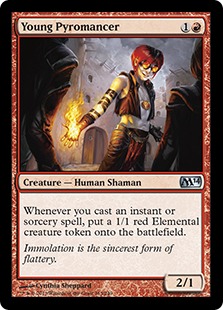
Young PyromancerI lose game one to a Tasigur that I'm unable to Path, and things look grim when I reach for my sideboard. When I play Grixis, I'm able to board out my Delvers. With this build, I know that I won't want Mana Leaks for this matchup, and I don't have a ton of cards that I want to bring in. I opt to bring in Magma Spray, the Gideons, and Dispel over the Leaks, and hope for the best.
Despite leaving Delvers in, I take the draw because even with a bad win condition, the matchup is still about attrition. I am pleased to see that my opponent also left his Delvers in, and I win game two pretty easily. Game three is weird, as I miss my third land drop for like, ten turns, but have ways to barely hold on with a hand full of uncastable Spell Quellers. My opponent played a Delver while I was still stuck on lands, and didn't flip it on the following turn, presumably because he drew the second Delver that he played that turn. On my turn I hit my third land drop, and somehow my Electrolyze on both Delvers resolved, and suddenly it was my game to lose. This should be a bad matchup, though the Pyromancer builds and lists that are unable to board out Delvers make things much easier.

Record: 1-0

Round 2 - RG Tron

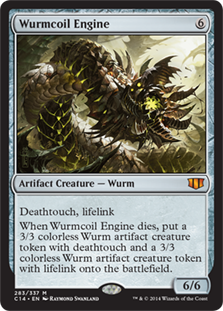
I got Tronned pretty hard in game one, and really wished that I was on Tasigur to have more access to fast clocks. Given the density of burn spells in my list, I decided that I would focus on playing like a Burn deck. Wurmcoil EngineI elected to board out Path to Exile instead of Lightning Helix and Electrolyze, given that I probably wasn't going to beat a Wurmcoil Engine on the play if I couldn't win in one turn anyway. I won game two by dealing exacties the turn my opponent dropped a Wurmcoil, and felt pretty good about my decision.
For game three I brought two Paths back in as I felt much less favored to actually close on time while on the draw, though the game didn't exactly play out like a race. My opponent played a Chromatic Star off of Urza's Mine on turn one, while I declined to play a Delver and just left up a fetchland on my turn. My opponent played a second Mine, cracked his Star to attempt a Sylvan Scrying, and the Spell Pierce that I tagged it with basically won the game on the spot.

Record: 2-0

Round 3 - Elves

In game one I drew a few counterspells and lost handily to both a fast hand and Cavern of Souls. Post-sideboard I turned my Spell Snares into removal spells and things got a lot better. There is some merit to hoping they don't have Cavern so you can counter a Dwynen's Elite, but I'd rather just try to form a more consistent gameplan. My plan was to set everything on fire and leave in Mana Leaks to hit Collected Company and Chord of Calling. Things went much better post-sideboard, and while many games will be tight, I feel that this matchup is favorable.

Record: 3-0

Round 4 - Bant Spirits

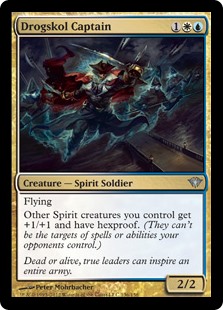
My opponent's build was either very close to Caleb Durward's list or Durward's list exactly, and I was pretty unhappy to be playing Path to Exile against a Mausoleum Wanderer-plus-Geist of Saint Traft deck.drogskol captain

I was hungry, because somebody (who shall remain nameless) did not take my lunch order, and I made several mistakes during this match. The most punishing was casting a Snapcaster Mage to flashback a Path to Exile in the hopes to hit a Spell Queller... which was being protected by a Drogskol Captain at the time.

To be fair, I do think this matchup might be kind of poor, though it seems winnable and my play wasn't doing me any favors. I imagine that this matchup is better for Grixis Delver given how horrible Path is here.

Record: 3-1

Round 5 - Jund

A few things have to line up well for you to beat Jund. If you don't have a Snapcaster Mage or a Mana Leak when they cast Liliana of the Veil, you're likely in trouble. I was able to take game one without much of a hitch due to drawing the right spells against Liliana, and my opponent took game two convincingly after I mulligained.

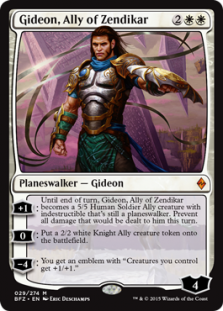
Gideon Ally of ZendikarIn game three I was able to keep pace and even pulled slightly ahead before hitting my fourth land and slamming Gideon. If the game is even remotely close when you cast Gideon, you will probably win very easily. I felt good stealing one from a tough matchup, and it was time to find out what the last round would look like.
Record: 4-1

Round 6 - UB Heartless Summoning

There were too many 12-point players to consider a draw, so I had one more match to play to try to lock up a Top 8. My opponent was on a spicy brew featuring Heartless Summoning, Grand Architect, Myr Superion, Wurmcoil Engine, and Tezzeret, Agent of Bolas. It did a lot of cool things, but nothing that my deck has much of any difficulty interacting with.

Given the access to Tezzeret animating Darksteel Citadel and Wurmcoil Engine this was one spot where I was pretty happy to have Path to Exile. A win here locked me as the second seed of the tournament.

Record: 5-1

Quarterfinals - Faeries

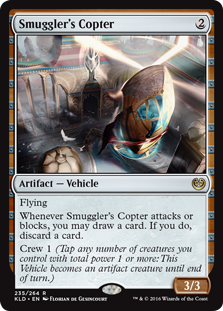
I sat next to my opponent earlier in the tournament, and knew that he was on Smuggler's Copter and Bitterblossom. smugglers-copterI knew Spell Snare was an important card for me, and that Thoughtseize was a powerful countermeasure from his side.
Back when Faeries was the best deck in Standard, and when it was a great Extended deck, I was always the player who piloted it in my testing group. I'm very confident in my ability to navigate my way through such a blue mirror, though the discard spells specifically threatened to give my opponent an edge.

The way that our games played out, the most defining factor was the respect I showed Spellstutter Sprite—I was consistently able to kill creatures in response to its trigger to stop it from countering spells. Despite losing game one to a Bitterblossom, I was able to take the match.

Semifinals - Jund

My opponent hit me with a discard spell early in game one and saw two Spell Snares. He followed up with a Liliana, to which I had no answer. I discarded cards to maintain Snares in my hand, while he patiently kept two-drops in hand until I had to discard them. I desperately needed Electrolyzes and Snapcaster Mages off the top of my deck, but I found only garbage and eventually succumbed to Liliana.

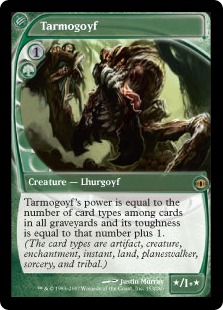
Game two started out a little better, and I was even able to keep parity for a while. I landed a Gideon, though it was felled by the lone Maelstrom Pulse in my opponent's deck. TarmogoyfWhen I cast Vendilion Clique on my opponent the following turn and saw three Tarmogoyfs in hand to my zero Spell Snares or Path to Exiles, the writing was on the wall. As I've said, Jund is a matchup where you would much rather be on Grixis Delver.


The Verdict on Jeskai Delver

Going forward I wouldn't make too many changes. I would likely add the fourth Electrolyze, and might find some other way to cut one or both of the other Lightning Helixes. That card was pretty dang bad. I honestly don't hate the idea of a 22nd land, and something like a Cryptic Command or some other such big spell could be spicy. I could even see the argument for a maindeck Gideon. I would of course also remedy the Misty Rainforest/Hallowed Fountain situation, likely by getting my act together and buying an Arid Mesa.

This tournament was a great learning experience, and did a lot to bolster my confidence in Jeskai Delver. I played a deck that is configured to beat up on linear decks. Despite playing against several interactive decks—decks I had sacrificed percentage points against compared to Grixis Delver—I still managed to make the Top 4. This is evidence that Jeskai Delver is more than just a metagame deck.

Thanks for reading.

-Ryan Overturf
@RyanOverdrive on Twitter

Deck Overview- Modern Temur Prowess

Are you a Quiet Speculation member?

If not, now is a perfect time to join up! Our powerful tools, breaking-news analysis, and exclusive Discord channel will make sure you stay up to date and ahead of the curve.

Today's deck is going to feel very familiar, but is going to look very different. Austin Toler's 21st place list from GP Dallas is a wild mix that resembles both Infect and Death's Shadow Zoo, pulling strengths from both decks.

Temur Prowess

Creatures

2 Bedlam Reveler
4 Kiln Fiend
3 Monastery Swiftspear
4 Thing in the Ice

Spells

4 Gitaxian Probe
4 Serum Visions
2 Sleight of Hand
4 Blossoming Defense
4 Lightning Bolt
4 Manamorphose
4 Mutagenic Growth
4 Temur Battle Rage

Lands

1 Breeding Pool
2 Island
1 Mountain
3 Polluted Delta
4 Scalding Tarn
4 Spirebluff Canal
2 Steam Vents

Sideboard

1 Bedlam Reveler
3 Blood Moon
2 Dispel
1 Shattering Spree
2 Surgical Extraction
2 Twisted Image
2 Vapor Snag
2 Young Pyromancer

Where Death's Shadow Zoo and Infect utilize Become Immense, this deck instead sticks to creatures large enough to make lethal with Temur Battle Rage without the powerful delve spell. Instead of the raw explosive power of Become Immense, instead this deck biases towards the protective elements of Infect by featuring the full four Blossoming Defense.

Thing in the Ice is a bit less explosive and requires more work than the threats that you see in the other pump spell decks, though the ability to reset the battlefield definitely has value against other creature decks. I also dig the Bedlam Revelers as a way to gas back up, which is something that Infect and Death's Shadow Zoo have to do over the course of multiple turns. The tension with Reveler is likely a primary motivator for the exclusion of Become Immense. I don't know to a certainty which is better, though I admire that Toler is attempting this angle instead of accepting the conventional wisdom.

Only playing three copies of Monastery Swiftspear is rather suspect, though the intention is definitely just to be a little more robust rather than to be the fastest linear deck. For that reason I could see this deck having some issues in combatting the other hyper-aggressive decks, though it looks like it would play better against the Junds of the world. And if that isn't true, you can just Blood Moon them out of the sideboard.

Insider: MTGO Market Report for November 9th, 2016

Are you a Quiet Speculation member?

If not, now is a perfect time to join up! Our powerful tools, breaking-news analysis, and exclusive Discord channel will make sure you stay up to date and ahead of the curve.

Welcome to the MTGO Market Report as compiled by Matthew Lewis. The report will cover a range of topics, including a summary of set prices and price changes for redeemable sets, a look at the major trends in various Constructed formats and a "Trade of the Week" section that highlights a particular speculative strategy with an example and accompanying explanation.

As always, speculators should take into account their own budgets, risk tolerance and current portfolios before buying or selling any digital objects. Please send questions via private message or post below in the article comments.

Redemption

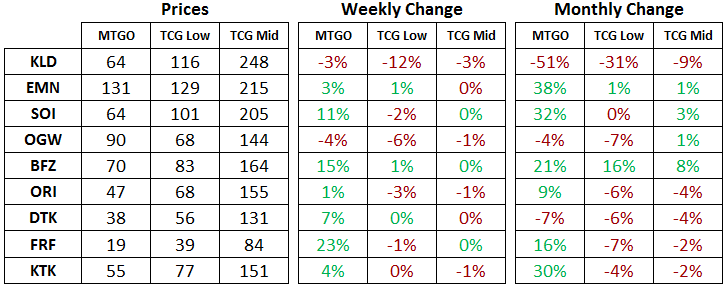
Below are the total set prices for all redeemable sets on MTGO. All prices are current as of November 7, 2016. The TCGplayer low and TCGplayer mid prices are the sum of each set's individual card prices on TCGplayer, either the low price or the mid price respectively. Note that sets of Theros (THS), Born of the Gods (BNG), Journey Into Nyx (JOU), and Magic 2015 (M15) are no longer redeemable as the redemption cutoff date for these sets has passed. They have been removed from the price table and will no longer be reported on.

All MTGO set prices this week are taken from GoatBot's website, and all weekly changes are now calculated relative to GoatBot's "full set" prices from the previous week. All monthly changes are also relative to the previous month's prices, taken from GoatBot's website at that time. Occasionally, full set prices are not available, and so estimated set prices are used instead.

nov7

Flashback Draft of the Week

This week, the flashback queues return to a core set with Magic 2012 (M12). This was the second appearance of the titan cycle, and Primeval Titan tops the list of most valuable cards from this set at over 7 tix. After that Modern staple, the set quickly veers into fringe Modern playable cards or staples that have been reprinted many times like Birds of Paradise.

There was an error retrieving a chart for Birds of Paradise

One of the returning mechanics in this set was bloodthirst, which shows up on black and red creatures. The creatures featuring this mechanic tend to be excellent if you can reliably do damage to your opponent. Gorehorn Minotaurs is a potential 5/5 for 2RR and Stormblood Berzerker is a a potential 3/3 with evasion for 1R. Both of these cards are high-quality examples and should be considered top picks.

The need to "turn on" the Bloodthirst creatures made the red common Goblin Fireslinger a valuable pick in draft. If you get a chance to enter the flashback queues early on, picking up multiples of this fairly innocuous common will ensure your deck rolls out smoothly and can finish off an opponent. Forcing red in draft is a fine line of play for any drafter comfortable with aggressive strategies.

Standard

Below is a chart tracking the price of each of the Standard sets in the six months after their release. Two things jump out at me when I examine this chart. Kaladesh (KLD) is the red line in the chart and is the first set that will have a shortened redemption window. The market appears to be pricing this fact in right off the bat relative to Battle for Zendikar (BFZ) and Shadows over Innistrad (SOI), KLD has started at a lower price and this price gap has remained. In other words, KLD is cheaper than both SOI and BFZ at the same point in time.

weeksafter3

It will be worth watching to see if this trend persists. It's possible that the shortened redemption window will generate a surge in redemption demand for KLD sets as dealers seek to wring the value out of their online assets before the redemption window closes. However, I would caution that KLD is a poor target for speculators. Once redemption on this set ends in the spring, their will be nothing to anchor the value of the set and prices will drop, especially on cards not played in Standard or Modern.

There was an error retrieving a chart for Liliana, the Last Hope

The other noticeable trend is the peaking of Eldritch Moon (EMN) in a similar time frame as Oath of the Gatewatch (OGW). Further gains are possible, but the period of rapid increases in EMN's set price appear to be over. Liliana, the Last Hope peaked at over 40 tix this past weekend and is back down to 36 tix. If you are holding copies of this card or sets of EMN, 90 percent of the price gains appear to be already baked into the current price. Selling now is a good opportunity to get liquid without too much trouble. I have sold all of my sets of EMN and have been reducing my single-card speculative positions as well.

Modern

Grand Prix Dallas/Fort Worth was this past weekend featuring Modern constructed. Here are links to the top eight decks and the rest of the top 64 decks. The two archetypes that got a big boost from KLD were Infect and Dredge, and both of these decks were represented in the top eight, but the finals came down to Skred Red versus Grixis Control. Skred Red won it all and Koth of the Hammer is seeing a bump this week as a result.

There was an error retrieving a chart for Koth of the Hammer

When trying to asses the health of the Modern market on MTGO, I look to the recent price history of Scalding Tarn as an indicator. This card had been in a downtrend for months, then the release of KLD and the announcement of Treasure Chests really put the boots to the price and it's been sitting around 22 tix in recent weeks. This week, Scalding Tarn has bumped back up to 30 tix, a sure sign of strength. Confirming this strength are the higher number of players entering the Competitive Modern League. The buying window on Modern staples in general is starting to close, so be sure to get your portfolios in order in advance of the Regional Pro Tour Qualifier season in December.

Standard Boosters

EMN boosters hit a new post-release high this week, powering all the way to 3.5 tix. That's a substantial increase of 150 percent from a low of 1.4 tix. Part of this is driven by the skewed prize distribution of the 6-2-2-2 draft queues, part of this is driven by EMN carrying the highest set price in Standard, and part of this is driven by the removal of the BFZ block draft queues. Based off how the price of EMN boosters moved over the past six weeks, Aether Revolt (AER) boosters could be an excellent speculative strategy in the spring.

Trade of the Week

As usual, the portfolio is available at this link. Ari Lax took a fringe strategy to Grand Prix Dallas/Fort Worth and his deck was featured in the coverage from day one. Check out the article here. The deck seeks to cast Restore Balance off of a spell with Cascade, in the same way that Living End decks do. As a result of the coverage, the namesake card saw a jump from 0.5 to 1.3 tix.

There was an error retrieving a chart for Restore Balance

Although Lax failed to make the top 64, he likes the deck a great deal, and it's clear the deck has potential. Although it can be a bad idea to chase a price spike on MTGO based off of a fringe strategy, sometimes it's still fun to put together a deck and take it out for a spin. For players looking to try out new archetypes, there is often a way to acquire cheap copies of cards that have already jumped in price.

If you find yourself keen to try out the latest splashy deck from coverage, but prices have already jumped higher on the key cards, start your search for singles with the foil versions. Older foils are often discounted due to having no extra utility on MTGO. Foil singles are often cheaper by 10 percent or more regardless of whether or not they appeared in a new deck.

On top of that, foil prices don't tend to respond as quickly to current events. If you hunt around for foil copies, you can often buy them at yesterday's prices. This is exactly what I did on Sunday after perusing the day 1 coverage. With regular versions of Restore Balance at 1.3 tix, I was able to buy foil versions for 0.6 tix in order to build a copy of the deck to test out for myself. The next time you hear about a great new deck in Modern that you want to try out, hunt around for foil copies of the key cards and you are liable to save a few tix.

Considering Control’s Conundrum

Are you a Quiet Speculation member?

If not, now is a perfect time to join up! Our powerful tools, breaking-news analysis, and exclusive Discord channel will make sure you stay up to date and ahead of the curve.

Happy/Miserable Election Day to all my US readers! Regardless of what actually happens tonight, the world is certainly ending for half of my readership. Before you celebrate or run off to join Jordan in Canada, I have some unfinished business to attend to. Two weeks ago I claimed that the problem with control wasn't that control was bad, but that it was misbuilt. Today I am going to explain that statement.

counterspell-banner-cropped

By complete coincidence, this is a rather timely piece. The finals of GP Dallas were a control deck versus a sort-of control deck. In fact, the winner, Kevin Mackie and his Skred Red deck, seem to have already picked up on a lot of what I'm going to say today. If true, bravo sir. You may be clairvoyant. I'd also like to point out that I mentioned Skred's power several months ago. No point to make, just shameless bragging.

I also want to give a shoutout to 12th place finisher Zane Houston. Zane frequents the same game shop I do and regularly demolishes my Merfolk with his Rock deck. Nice job getting a stream highlight and a Top 16! And especially nice job on doing so well with an interactive deck.

[wp_ad_camp_1]

The Problem

To summarize and paraphrase the opinions that I commonly hear, and those expressed in the comments of my first article on aggressive decks, Modern is too diverse and fast for a control deck to thrive. There are simply too many decks that attack from too many angles to for a deck to defend against. There are incredibly fast aggressive decks, decks that play creatures that scale, midrange decks, toolbox decks, fair combo decks, degenerate combo decks, and Dredge. Trying to have answers to all of those decks puts too much strain on your resources and the lack of a universal answer Ă  la Counterspell leaves control players stretched too thin to survive.

CounterspellThe difficulty associated with answering every deck means that action is favored over reaction. The more time you take not trying to win, the more likely it is that your opponent will find what they need to win. You can't answer everything. In order to accommodate this reality, decks that want to take the control role have to play a midrange game of disrupt-and-interact so that they can drop their own threat and then ride it to victory. One problem with this is that if you're going midrange you're going to be up against Jund. And no deck has proven that they can be Jund as well as Jund. Thus the only viable path for those who don't like aggressive decks or combo is to play Jund or worse Jund.

I sympathize with this point of view. I really do. However, the time I've spent thinking about how Modern behaves and what decks constitute the metagame has changed my perspective.

How Players See Control

I think that when players approach control in Modern they are making two mistakes. One is a conceptual mistake about what it means to be control and the other is a perceptual mistake about Modern itself. I think that players have an unrealistic view of what it means to be control in Magic and they look at the Modern metagame incorrectly. From my perspective, the format is ripe for a correctly built control deck to succeed.

counterbalanceBased on conversations I've had about control and comments on the subject from many different sites, I believe that most players think of control in terms of Legacy Miracles. Decks that play entirely reactively, answer everything the opponent does, and win the game well after the opponent has lost. Their win condition is becoming undefeatable. This is not surprising, as early Magic was dominated by draw-go decks that did exactly that, to the point that Wizards has been leery of counterspells ever since. Ravinca-Theros Standard's Azorius Control is another excellent example. Decks like this aren't viable in Modern.

TarmogoyfThe problem I have is that if you define control in those terms you are disregarding the vast history of control decks. If you go back and do the history, that type of control deck has been far less prevalent than the control archetype as a whole. Midrange style control, commonly called tap-out control, and combo-control decks have a long and decorated history in Magic.

Toward the end of Affinity's time in Standard, mono-blue decks packing lots of counterspells began to gain metagame share. These decks spent the first few turns staying alive and then dropped Keiga, the Tide Star and took the initiative, tapping out every turn to overpower their opponent with their more powerful win conditions. The following Standard saw Gifts Ungiven control decks that won by tutoring up a recursion engine that they'd tap out for every turn. 5-Color control took the control role until it landed Broodmate Dragon and suddenly seized the initiative. Next-Level Blue did this in Extended. There's more to control than being an answer deck.

How I See Control

When I think about control, I think about decks with a large number of answers and a small number of threats. Each threat is not only capable of winning the game by itself, it can shape the game around itself. Once it's on the table, it becomes a must-answer threat and forces the opponent to yield the initiative. They cannot continue to pressure the control player because their win condition will kill them if left alone. How and when the threat is deployed is less important than how it changes the dynamic of the game.

Lightning BoltI also believe that a real control deck should maximize its hard answers. Lightning Bolt is a good, efficient answer, but it's still a soft answer because it asks if the target has three toughness or less. When I'm playing control, I want my answers to ask only if they can target the threat. If they can, it's dead. Period. This is why I have long thought of Jeskai Control as a slow burn deck rather than a control deck. Control answers should be hard answers.

When I think about control, I see a deck that wants to deplete opposing resources and then force the opponent to answer it instead. True "control" like Miracles is unnecessary—its goal is to invalidate the opposing strategy. Therefore, I have no problem with the fact that draw-go isn't viable. What I don't like is for control decks to only masquerade as control decks. As much as possible, they should be decks with hard answers. This is one reason Jund does so much better than Jeskai.

How I see Modern

I see Modern with a lot of deck diversity, but not much archetype diversity. It is dominated by aggressive decks with a small number of midrange and combo decks. There may be a wide variety of decks that see play, but most will fall under some part of the aggressive deck banner as I've been discussing for the past few weeks. And all of these decks are vulnerable to hard answers.

I'll prove it. Open the Top Decks page in a new tab. Look at Tiers 1 and 2. Count the number of aggressive decks, fair decks, combo decks, and ramp decks. As I'm writing this article, I count eleven aggressive decks, three fair, one combo, and three ramp decks. I count Abzan Company as an aggressive deck, but I won't fault you if you count it as combo. Regardless, aggressive creature decks outnumber all the other decks combined. This is an aggressive format.

As a result, control decks can afford to focus on those creature decks and accept some weakness to the other archetypes because they're not likely to see them at all! You are far more likely to enter a field full of aggressive creatures than of Tron and Jund. I think that control players should just accept this reality and take advantage.

How Do I Approach the Problem?

I'll lead off by saying that Counterspell would not solve the problem that players believe control has in Modern. It would definitely induce more players to pick up the archetype, but it doesn't change the underlying reason that control decks struggle in Modern. Let me explain.

Path to ExileI don't see the lack of control decks in Modern as the result of control being bad in Modern. I see it as the result of control players stretching themselves too thinly and allowing themselves to become bad Jund. Because I see Modern as an aggro-dominated format, and because I understand statistics and can read the Top Decks page, I know that if you want to answer the format you do that by answering creatures. Not just small creatures, but any creature. I blame the focus on Lightning Bolt for Eldrazi's rise and Jeskai Control's downfall. Control struggles because they don't play the right answers to the metagame now, answers which do actually exist.

Reality SmasherBecause control decks need to answer creature decks, I believe that they need to actually answer them. Not hope that they hit the right answer at the right time but that any answer drawn anytime will do the job. Some may work better than others, but one of them should be a hard answer that cleanly one-for-ones any creature it targets.

I acknowledge the speed of the format and the ability of many decks to hemorrhage threats faster than you can answer them. This is why I also believe that control decks need some forgiveness built into them. They aren't required to keep up with aggressive decks exactly, just enough so that they survive to sweep the board and recover. Lifegain is also a good idea. I also dislike control decks that are vulnerable to hate. Auto-losing to Blood Moon or Rest in Peace is not where I want to be with a control deck.

Therefore, as I see it, the problem with control isn't control itself; it's players misunderstanding the metagame and subsequently misbuilding their control decks. They're casting too wide a net and their results are suffering.

The Fear

"What if I hit a combo deck?" is the frequent whine I receive in response to this position. Players are deathly afraid of running into a deck that they cannot answer and just losing. This is behind the impulse to play proactive decks that pressure slower decks so that they don't just durdle around and lose. My reaction is always, "So what?" Combo is a very small portion of the metagame. Yes, you lose to Grishoalbrand. No, it doesn't matter because that deck isn't barely Tier 3 in most metagames.

Be realistic; the odds of hitting any combo deck is very low and The Fear they cause is entirely irrational. The combo deck you are most likely to see is Ad Nauseam, which is only 2.1% of the metagame as I write this sentence. The aggro decks just of Tier 1 constitute 36.6% of the total metagame. You are far more likely to be matched against aggressive decks than anything else. So stop worrying about other decks. That's what a sideboard is for.

My Solution

Players that want to play control should play a control deck. Not a midrange deck, not a glorified burn deck. A deck that targets creatures with hard answers, has hard-to-answer threats that win the game, and has some forgiveness built in to compensate for a slow start. And I know that such a deck is viable in Modern. I lose to it frequently.

There are several players in my local metagame that regularly run a UW Control deck that matches my exacting standards. When I'm on Merfolk I have to get lucky to beat them. When they're running well, they dominate the normally aggressive metagame I play in. Jund is no worse than a coin flip for them and even Bant Eldrazi is beatable (when they don't get really broken Eldrazi Temple draws). If you want to run a real control deck, I think you should start with their example.

I don't have the lists they currently play available (nor would I post them if I did) but they look very similar to this list:

UW Control, by David Ernenwein

Creatures

4 Snapcaster Mage
2 Vendilion Clique

Enchantments

1 Detention Sphere

Instants

4 Path to Exile
4 Condemn
3 Spell Snare
3 Mana Leak
2 Blessed Alliance
2 Cryptic Command

Planeswalkers

2 Elspeth, Sun's Champion

Sorceries

4 Serum Visions
3 Supreme Verdict
3 Ancestral Vision

Lands

4 Ghost Quarter
4 Celestial Colonnade
4 Hallowed Fountain
4 Flooded Strand
3 Plains
4 Island

Sideboard

2 Stony Silence
2 Surgical Extraction
2 Wrath of God
4 Geist of Saint Traft
1 Vendilion Clique
3 Dispel
1 Crucible of Worlds

Now this is a control deck I can get behind. It is effectively pre-boarded against aggressive decks and leaves worrying about combo or control decks to the sideboard. It's a bit soft to Tron even with Crucible and Ghost Quarter, but you cannot be strong everywhere. You should pick your battles based on what you are most likely to see, and then prepare for eventualities. You may not beat everything reliably, but you can beat aggressive decks and Jund consistently. I know because I've seen it happen.

Go to War Against the Enemy You Know

I do not understand how players complain about Modern being overrun by aggressive decks, and turn around and complain that the format is too diverse and large to answer everything. If the format is as aggro-dominated as they claim, why not target those decks? If it really is as linear as they claim, then it should be fine to ignore the other archetypes.

The format cannot be simultaneously as narrow as they claim and too wide to respond to. I think that there are a lot of aggressive decks, and thus I see an opportunity for control decks. Narrow your focus and build according to the meta as it actually exists. I think you'll find control isn't that difficult to build.

Avatar photo

David Ernenwein

David has been playing Magic since Odyssey block. A dedicated Spike, he's been grinding tournaments for over a decade, including a Pro Tour appearance. A Modern specialist who dabbles in Legacy, his writing is focused on metagame analysis and deck evolution.

View More By David Ernenwein

Posted in Modern, Opinion, StrategyTagged , , , , 17 Comments on Considering Control’s Conundrum

Have you joined the Quiet Speculation Discord?

If you haven't, you're leaving value on the table! Join our community of experts, enthusiasts, entertainers, and educators and enjoy exclusive podcasts, questions asked and answered, trades, sales, and everything else Discord has to offer.

Want to create content with Quiet Speculation?

All you need to succeed is a passion for Magic: The Gathering, and the ability to write coherently. Share your knowledge of MTG and how you leverage it to win games, get value from your cards – or even turn a profit.

Insider: Three Different Kinds of Value Trades

Are you a Quiet Speculation member?

If not, now is a perfect time to join up! Our powerful tools, breaking-news analysis, and exclusive Discord channel will make sure you stay up to date and ahead of the curve.

I was a trading machine over the course of the past week. I hit up Grand Prix Dallas and when I wasn't busy infecting my opponents in the tournament, I was getting my trade on. It occurred to me after it was all said and done that I engaged in three very different types of trading and that each one was very effective at achieving a different particular goal. With that in mind, I'd like to outline the different kind of trades I took part in and describe how you can use these different strategies to your benefit in the future.

Depending upon your objectives and the type of items you have available, it often helps to use different strategies to maximize your collecting goals. It was pretty interesting to me in hindsight that by doing three very different types of trades that I was able to get the most out of my cards.

1. Trading on Behalf of a Store

I ended up going down to Dallas with my local game store, RIW Hobbies. They had worked out an arrangement to have a small table to buy cards. Since they are my buddies, I figured I'd help out while I wasn't actively playing in the tournament.

It turns out that there was a miscommunication somewhere along the way because the deal that was worked out only provided the store the opportunity to buy cards, and not sell or trade cards at the buy table. So as it turns out, the store had brought down several binders full of awesome bling foils but had literally no outlet to do anything with them.

I offered to take the binders and go out on the floor and trade out of them. Here is the program I worked out on the trade floor: I didn't want to get the contemptuous groan of disgust from fellow players for saying I was a store and I wanted to trade for people's cards at 70%. I've never been a big fan of "stores" who demand getting a better percentage on the trade floor. I always figured, "If you were a store then why don't you pay for a booth like all the other real retailers?" People who do that and try to slightly undercut the dealer prices without having to pay the steep booth premium are just not my style.

Anyways, what I ended up deciding to do was sit down with potential trade partners and let them know I was trading for a store but that I'd trade with them normally. I said that I could only take high-turnover cards, but that I'd give them equal trade and they could take whatever they liked out of my foil binders loaded with Masterpieces, Expeditions, and other Modern and Legacy foils.

I found several extremely enthusiastic trade partners who were exceptionally happy to get 100% trade value on their cards in exchange for high-end, desirable foils.

The key to why this trade was effective is that these types of foils, while really neat, don't tend to be the quickest-turn-over sellers in a retail store. Sure, $100 Masterpiece Crucible of Worlds is great but it really has a small niche market at an LGS.

On the other hand, the store tends to have a lot of trouble keeping certain highly-played staples in stock: Path to Exile, Grim Flayer, Stony Silence, Noble Hierarch, and Snapcaster Mage all come to mind. For a store that runs a lot of Standard and Modern tournaments, these are the kind of cards that players constantly buy, and we have trouble keeping up with demand. So, while I wasn't technically turning a profit on these trades, I was flipping cards that are slow sellers and turning them into cards that are much more liquid.

Granted, it obviously would have been better to trade from the table while buying, but that wasn't the arrangement that had been worked out. My creative trading solution created some solid value for the store's inventory that made the best out of the situation.

Moral of the story: If you have an outlet to turn cards into cash it is often better to have cards that are more liquid than cards that are expensive but harder to sell.

The same can be said even for people who are only looking to make trades. There are certain kinds of cards that everybody is looking for like I described above, and it is always good to keep in mind how easy or difficult cards will be to move. It is always better to have cards that are easy to trade than ones where you are looking for a very niche buyer.

2. Trading for Negative Value With a Store

I ran into a group of traders who run a mono-trading store in North Carolina. They seemed like nice guys and they laid out their strategy: "We will take anything you have at 80% of TCG Market Price and you can take anything we have at 100%. I don't typically like these types of arrangements, but I did like that 80% is higher than more trade floor stores offer and I really liked the fact that they would take anything. I also loved the fact that they said they would take foreign cards for the same price as English.

I wrote about how I organize my collection a few months ago, and basically I have three separate things going on. I have my personal collection of cards that I use for tournament play and I don't trade out of these cards. I have a binder of cards that I think are good investments that I'm sort of holding on to until they mature. Then, I have a trade binder full of cards that I'm looking to trade for better cards that would go into the "investments" binder.

I would categorize the actual trade binder as cards that have diminishing value and/or have some value but are fairly low-demand. It is basically the binder that no buyer at a booth actually wants to deal with because it is full of cards that are challenging to turn over.

I ended up completely flipping the entire binder to them. I figured that if I am getting 80% on the dollar for cards that are hard to move, and can put that toward cards that are highly liquid, the amount of time I'm giving up in 20% tax is easily worth the time I save. I won't have to sell them online or find the perfect trading partner who wants a Japanese Ajani Steadfast.

I ended up trading the contents of the binder for a Mox Ruby, Savannah, City of Traitors, and a playset of Liliana, the Last Hope. I couldn't have been happier with the deal. Getting 80% in trade is much higher than dealers ever would have offered on these cards, and I turned it into desirable, high-end cards.

Moral of the story: Sometimes you can lose value but actually win in the long term. The "convenience tax" of 20% was well worth getting to transform a collection of tedious and undesirable cards into Grade A beefcake cards.

3. A Deal With a Friend

Kevin Cron, a fellow Vintage fan and good friend of mine, proposed a deal at Eternal Weekend where we might work something out to swap his foreign black-border (FBB) dual lands for my Unlimited copies. He wanted some Unlimited copies for alters he was planning and knew that I'd prefer FBB. I agreed as long as the deal made sense for me to do, so we met up yesterday and tried to figure things out.

Obviously, the FBB duals are worth more than the Unlimited ones. So there was some value to be made up for, but we were able to make it work.

Sometimes the best possible way to make a trade is just to find a person who has what you want and wants what you have! Duh, simple, right? Well, it isn't always easy to find that exact situation but that is exactly what ended up happening.

Obviously, we are friends who aren't looking to take advantage of each other and genuinely wanted what the other player had. So, we looked up each card and got a range and eventually settled on a deal. It was one of the biggest trades I've ever made!

We looked up all of the cards and assigned them cash values and traded straight-up with prices adjusted for condition.

img_2087

The Mox Ruby that I picked up from the trade store helped fill out the value of the trade quite nicely!

The cool thing about making a trade like this with a friend is that you both get maximum value for your cards. If I had sold my cards online, eBay and PayPal would have taken a cut—the same thing would have happened on Kevin's end. If we both would have tried to trade with a dealer instead of each other, we would have both lost thousands of dollars in value!

Moral of the story: The best way to trade is always with other players who are willing to trade straight-up with you. When both players want what the other has and are willing to trade evenly, the benefits are real and in both parties' favor. The ability to duck paying online fees or giving a hefty chunk of value to a dealer is absurdly awesome.

Obviously, the problem with trading straight-up when it comes to highly desirable items like FBB duals and Power 9 is that most players don't have the same selection for trade as a dealer would. However, when you find those types of situations—"Interested in trading your Unlimited duals for FBB?"—you should always be ready to jump at it and be fair with your trade partner.

Final Thoughts

All things considered, I'm pretty happy that I'll be able to play all black-bordered decks in Legacy and Vintage from now on.

Trading isn't an exact science and in some ways it is kind of an art form. Different types of objectives and portfolios lend themselves to different kinds of trades. The key is always to take what you have, get the most for it as possible, and put it toward getting what you really want.

Stock Watch- Snow-Covered Mountain

Are you a Quiet Speculation member?

If not, now is a perfect time to join up! Our powerful tools, breaking-news analysis, and exclusive Discord channel will make sure you stay up to date and ahead of the curve.

Skred Red has been a deck in Modern for a while, but winning a Grand Prix certainly made the deck more visible. When I was an FNM warrior you could find Snow-Covered Mountains in the community land boxes at your LGS pretty frequently, though today the card is in the $2-3 range.

scm

I would definitely not be looking to pickup Snow-Covered Mountains at this time, though there is no shortage of these in the bulk of established players. I'm sure many of you have a small stack that you could locate without much difficulty.

Both the Coldsnap and Ice Age versions are buylisting for over a dollar currently, which is always nice for a card that was once very easy to come by. This is also a nice one to stick in your trade binder to round out trades. Given that Skred Red plays double-digit copies of the card, the demand is relatively high as compared to players who actually need the card, which is good for the card's long-term price.

Avatar photo

Ryan Overturf

Ryan has been playing Magic since Legions and playing competitively since Lorwyn. While he fancies himself a Legacy specialist, you'll always find him with strong opinions on every constructed format.

View More By Ryan Overturf

Posted in FreeTagged 2 Comments on Stock Watch- Snow-Covered Mountain

Have you joined the Quiet Speculation Discord?

If you haven't, you're leaving value on the table! Join our community of experts, enthusiasts, entertainers, and educators and enjoy exclusive podcasts, questions asked and answered, trades, sales, and everything else Discord has to offer.

Want to create content with Quiet Speculation?

All you need to succeed is a passion for Magic: The Gathering, and the ability to write coherently. Share your knowledge of MTG and how you leverage it to win games, get value from your cards – or even turn a profit.

Want Prices?

Browse thousands of prices with the first and most comprehensive MTG Finance tool around.


Trader Tools lists both buylist and retail prices for every MTG card, going back a decade.

Quiet Speculation