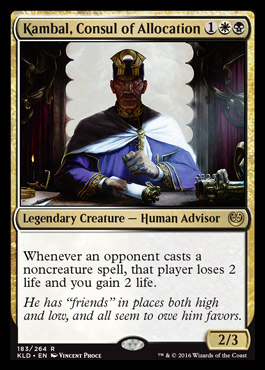
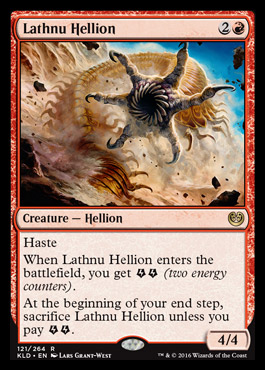
menu

Insider: I Used the Ion Core Scanner to Sort My Cards and Maximize Buylisting Efficiency

Are you a Quiet Speculation member?

If not, now is a perfect time to join up! Our powerful tools, breaking-news analysis, and exclusive Discord channel will make sure you stay up to date and ahead of the curve.

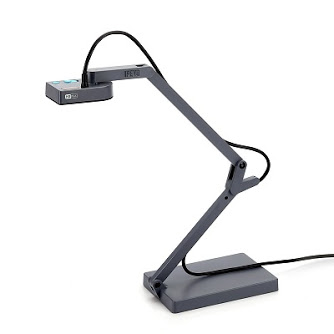
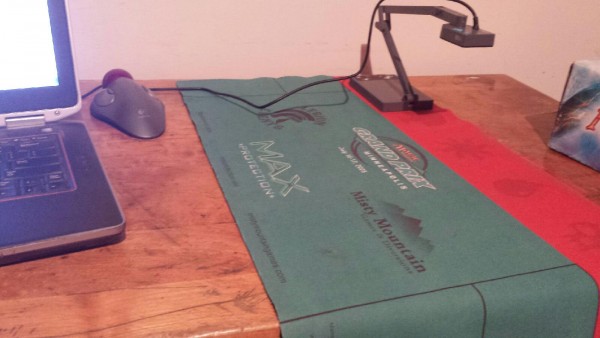
Selling all of the extra cards in my Magic collection has been decades in the making. I’ve accumulated tons of cards from simply playing, whether it be from Limited events or cards I’ve acquired for Constructed formats. I’ve also bought more than a handful of collections and moved through plenty of cards in my day. I have been an active trader at different times in my life, I have gone through a few rounds of buylisting cards online and I’ve sold off a mass of bulk cards locally. What I have left is a hodgepodge, and I set out to liquidate it into cash. I knew the Ion Core Scanner was revolutionary, and I knew it would be a great tool to help me sell my cards, especially for someone like me who has largely failed in efficiently organizing my cards over the years.

ioncoreworkstation

I started by taking stock of my collection. I have an enormous swath of the Modern metagame, with about a dozen or so decks decks assembled or ready to be assembled, and I want to retain those to keep my options open in any future events. I also have a couple long boxes dedicated to extra Modern staples that I’m not using in decks now but could use in the future. My goal was to coordinate my decks and boxes, selling anything extra beyond playsets, and trimming down the extra cards to those I might realistically use. I approached Legacy with a similar mindset, but I have just a couple decks together, and sought to keep only premium staples while liquidating all the extraneous cards.

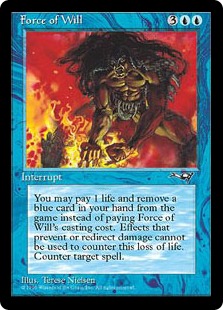
force of will.ashx

Once I knew what I was going to sell, I started running cards through the Ion Core Scanner and sorted them into piles by highest buyer so I could sell them to various buylists. I soon realized that my collection was too massive and full of too many low value cards to make buylisting feasible. One problem was shipping costs cutting into profits, but an even bigger issue was the condition of my cards since almost everything is played, some considerably so, and mostly stored in less-than-ideal fashion. Many cards are even stamped from professional drafts, and a few damaged. I didn’t want to take massive hits in value for being played, especially when it was out of my hands. and I also risked large return shipping bills.

At this time I remembered back to reading an article on QS about options for selling your collection, but while searching for it I found another article that set the direction of my Ion Core process, which explained the concept of using the program to organize your collection by buylist value.

I loved the concept of sorting my collection by value and using this as a baseline for buylisting in person, which seemed a lot better for the realities of my collection than mailing to buylists. I reasoned it would allow me to negotiate with various outlets, allowing me to get more value for my played cards, and would cut down on shipping costs and the risk of return shipping. At this point I begrudgingly resorted the cards I had already gone through, and then plunged right into the rest of the collection.

I sorted cards into piles similar to what David Schumann recommend in his article I linked, $0.01, $0.05, $0.1, $0.25, $0.5, $0.75, $1, $1.25, $1.5, skipping $1.75, $2, $2.5, $3, $3.5, $4, $4.5, $5, $5.5, $6, $7, and everything above. I added a category for each of $0.2, $0.3 and $0.4 because so many cards were falling on those numbers, and I figured the further I delineated the cheaper cards the more value I could extract.

The largest portion of my efforts were focused on boxes of cards that I had previously considered above bulk and too good to simply get rid of, but didn’t have any other immediate use or place for. I had culled some of these boxes through crude rounds of buylisting years earlier, but I knew they were packed full of money if I put the time into sorting them.

The cards above $7 I sorted separately, figuring it would be worth the time and effort to extract max value from them by selling at a premium face to face or on TCGplayer/eBay. These cards will also be relatively easy and fast to buylist in person without sorting ahead of time, and because they might be more susceptible to price changes I don’t want to value them until closer to the sale.

I had a box of “bulk” rares that I decided to run through Ion Core to extract full value, and it was certainly worth the time when I turned what would have been $40 in $0.10 bulk rares to well over $100 in buylist value.

I also had a large box of above-bulk rares to sort, mainly cards that escaped previous buylists, but also any random rares that I acquired since it was an easy depository. Processing this box was consuming, because there were not many duplicates and the cards were in no way sorted, but it was also the only way to ensure I got full value from a large swath of cards that I could have never kept track of in my head and would have taken ages to look up individually.

I still had a binder of rares from a collection buy a few years ago, so I took this apart and sorted these. I also sorted a large old trade binder of relatively low-value cards, which proved to be a breeze to run through Ion Core Scanner because they were sorted by color and duplicates were together. Organization pays off, and I learned the more work you do ahead of time makes running cards that much easier.

I cut a ton of bulk from my collection, but rather than sell this at bulk prices I will attempt to get more value by trading or selling to speculative locals or selling on Craigslist, which I have had previous success doing. I could get about $4 for 1,000 bulk cards from a dealer, but I expect I could get at least twice this from a consumer. I also separated my uncommon bulk from the commons, so I can market the uncommons at a higher price. As far as the bulk rares, stores pay $0.1, and the best best rates on Amazon and Ebay seem to be about $0.19 each in lots of 100. Many of my rares had buylist prices of $0.15, so that seems like an easy sale unless I expect I can get more locally. I could include them in a Craigslist sale and hopefully get the $0.2 or maybe even more, especially if I bundle all of my bulk together and market it as a collection.

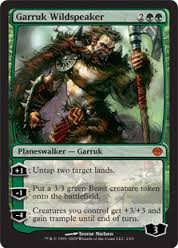
I’ll turn to eBay to sell some random things, like an open but complete Garruk vs Liliana Duel deck and loose booster packs from various sets. I could also unload deckboxes, dice, playmats, and pins.

url

Some cards I kept as specs because the buy prices were simply too low, like Theros-block Temples. Also the new Magic 2015 and Khans of Tarkir block-forward Frontier format in Japan could be a thing in the future as an alternative to Modern, so holding the cheap cards from those sets seem like a good move. I’m holding stacks of Treasure Cruise rather than selling them for a penny and keeping my playset of Dig Through Time put away for a rainy day rather than cashing it in for $1.

Sorting my cards with the Ion Core Scanner was a fast process, but it was still hard work and took a few nights of grinding past midnight. It was effective, fun, taught me good sense of card values, and it feels great having them sorted. It also hopefully pays off, since in theory I extracted thousands of dollars in value. I intend to shop my collection around, using the values as a guide to ensure I get max value and a basis for negotiation. I’ll start with the many local shops, which hopefully supplies players and builds goodwill. There’s also a huge shop not too far away with a large online retail presence, and it’s known for offering good buylist prices. Then I’ll bring the remaining, hopefully lightened, load to a Grand Prix where I can convert to cash quickly and easily, extracting max value from my collection with minimal transaction costs. This seems like a great way to accomplish my goals, I’ll be sure to report back with my experience on the next half of the process: actually selling the cards.

-Adam

WMCQ Decklists!

Are you a Quiet Speculation member?

If not, now is a perfect time to join up! Our powerful tools, breaking-news analysis, and exclusive Discord channel will make sure you stay up to date and ahead of the curve.

With Kaladesh set to come out tomorrow, we are on the eve of a possible shake-up in the Modern landscape. Still, the decklists keep coming, this time in the form of multiple World Cup Magic Qualifier events worldwide! These events are always high-level, as players fight valiantly for the chance to represent their home country on the World Cup stage. While the number of simultaneous events means there a ton of decklists to go through, one of the side effects of this type of weekend is that there are no clear "winners" to shift the metagame. So, this leaves us with the unique ability to focus on one thing, and one thing only. Decklists! Let’s get to it!

Manic Scribe

Esper Mill, by Sven Restel (7th, WMCQ Australia)

Creatures

4 Hedron Crab
3 Manic Scribe

Artifacts

2 Mesmeric Orb
2 Ensnaring Bridge

Instants

4 Archive Trap
2 Crypt Incursion
2 Path to Exile
3 Surgical Extraction
2 Thought Scour
4 Visions of Beyond

Planeswalkers

2 Ashiok, Nightmare Weaver

Sorceries

4 Glimpse the Unthinkable
3 Mind Funeral

Lands

2 Darkslick Shores
1 Flooded Strand
2 Ghost Quarter
1 Godless Shrine
1 Hallowed Fountain
3 Island
4 Marsh Flats
3 Polluted Delta
1 Shelldock Isle
2 Swamp
3 Watery Grave

Sideboard

2 Echoing Truth
1 Ensnaring Bridge
3 Hurkyl's Recall
4 Leyline of Sanctity
3 Nihil Spellbomb
1 Ravenous Trap
1 Whelming Wave

Let's get warmed up. Yes, it had a nice run at Grand Prix Los Angeles earlier this year, but Esper Mill as a viable strategy is way down there with Skred and Budget Jund. Still, Top 8’ing a WMCQ is a pretty solid performance and deserves at least some recognition! Mesmeric Orb can help us turn on delirium for Manic Scribe, and together both cards can add up to a lot of action turn after turn. With maindeck Crypt Incursion and some Path to Exile to help fight creature decks, Sven's list is tuned to buy a bit of time so as to race most of the aggressive matchups in the format. With Surgical Extraction to rip away combo pieces that have been milled over, this deck has surprising game against most of the decks in the format.

At the end of the day, however, Mill is Mill. I’ve received a bit of heat in the past for my strong opinions regarding certain archetypes, and I try not to let bias affect my decision-making process too much, but I don’t expect this performance to be a precursor of a “Mill uprising” or anything crazy. At best, Glimpse the Unthinkable is on par with Boros Charm (milling eight cards when we need to turn over around 45 is a little less than “4 damage”) but the rest of our deck is below rate. Against a field full of slower strategies or a very polarized field where we can tune our deck to beat the majority, it’s possible this archetype could see continued success, but I’m confident in calling this one a flash-in-the-pan performance.

[wp_ad_camp_1]

RG Ponza, by Matt Mealing (4th, WMCQ Canada)

Creatures

4 Arbor Elf
2 Kitchen Finks
4 Stormbreath Dragon
2 Thundermaw Hellkite
1 Birds of Paradise
2 Obstinate Baloth

Enchantments

4 Blood Moon
4 Utopia Sprawl

Instants

2 Beast Within

Sorceries

3 Bonfire of the Damned
2 Harmonize
3 Mwonvuli Acid-Moss
1 Primal Command
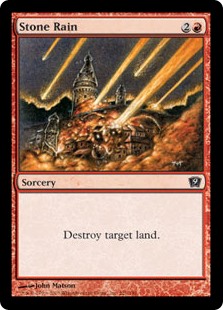
4 Stone Rain

Lands

8 Forest
1 Kessig Wolf Run
2 Mountain
3 Stomping Ground
4 Windswept Heath
4 Wooded Foothills

Sideboard

2 Ancient Grudge
1 Anger of the Gods
1 Choke
2 Kitchen Finks
1 Obstinate Baloth
3 Relic of Progenitus
2 Scavenging Ooze
2 Sudden Shock
1 Thrun, the Last Troll

As I’ve been harsh on RG Breach decks lately, I figure spotlighting “RG Ponza” might work to repair some of the burned bridges I seem to have developed with RG players lately. Up until this weekend I hadn’t really seen this deck before, but through my research I’ve found that it’s been putting up some results here and there on MTGO for a few months, with the first "attention" being given to it in March by a Deck Digest article on SCG, and a primer written by Matt Mendoza after he won Kansas States with it. Recently, the deck put up a few results at some SCG IQ events, and this past weekend Ponza took two strong finishes in WMCQ Canada and England.

Stone Rain

Essentially, RG Ponza is a mana acceleration/land destruction deck that looks to either Blood Moon its opponents or power ahead on mana and deploy bombs like Harmonize and Stormbreath Dragon until it wins. Unlike traditional RG Ramp strategies that need a delicate mix of lands/acceleration and payoff cards, Ponza generally is in a good position as long as it can get ahead and stay ahead. Utopia Sprawl and Arbor Elf work to overcome the general clunkiness of Stone Rain and Blood Moon against aggressive strategies that might develop too quickly for them to be effective, and should they deploy too much to the board too quickly, Bonfire of the Damned and Obstinate Baloth do good work cleaning up the ground.

Ponza is good right now because Blood Moon is just excellent. Even though Tron strategies haven’t been putting up strong results lately, Blood Moon is probably one of the best cards in the format right now, specifically for that reason. Tron has been out of the spotlight for a while so Blood Moon has disappeared from boards, which has caused a gradual shift in the metagame towards numerous archetypes that just no longer respecting the card anymore.

Like RW Control before it, I think Ponza is a “okay” deck propped up by a few good cards. It plays much better on the play than the draw, and can struggle if it either doesn’t draw/the opponent can kill Arbor Elf or Utopia Sprawl. Still, while the format is primarily aggro decks and decks weak to Blood Moon, and while midrange is still on the decline, I can’t deny that RG Ponza is a solid choice.

UR Prowess, by Gary Lau (1st, WMCQ Australia)

Creatures

4 Stormchaser Mage
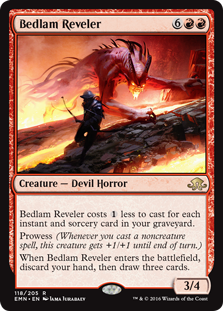
4 Bedlam Reveler
4 Monastery Swiftspear
1 Blistercoil Weird

Instants

1 Dismember
4 Lightning Bolt
3 Manamorphose
4 Mutagenic Growth
2 Temur Battle Rage
4 Thought Scour
2 Vapor Snag

Sorceries

2 Faithless Looting
4 Serum Visions
1 Forked Bolt
4 Gitaxian Probe

Lands

4 Bloodstained Mire
1 Island
2 Mountain
2 Polluted Delta
4 Scalding Tarn
3 Steam Vents

Sideboard

1 Dismember
1 Dragon's Claw
1 Forked Bolt
1 Grim Lavamancer
1 Izzet Staticaster
1 Pillar of Flame
2 Smash to Smithereens
2 Temur Battle Rage
2 Thing in the Ice
1 Tormod's Crypt
2 Vandalblast

U/R Bedlam Reveler taking first (and third) in WMCQ Australia should not be overlooked, especially considering the upgrade this deck will be soon receiving in the form of Spirebluff Canal. With free spells like Gitaxian Probe, Mutagenic Growth and Manamorphose to power out Bedlam Reveler, this deck has the ability to be very aggressive yet still maintain power going into the lategame. Stormchaser Mage does great work as Monastery Swiftspear 5-8, but I’m still left wondering if Delver of Secrets could find a way in the deck. I know the list is relatively tight, but 31 spells that flip Delver is just begging to be taken advantage of.

Bedlam Reveler

With how mana efficient the rest of the list is, I’m wondering if Faithless Looting couldn’t just be cut. I know that Faithless Looting does good work setting up Bedlam Reveler, and flashing it back later is a good way to get rid of some extra lands stuck in our hand, but given any other option we would rather do anything else with our mana. We’re already playing one Blistercoil Weird, so it seems a quick change to fit at least three Delver of Secrets into the maindeck. Still, this deck has been actively tuned for a couple months now (since Bedlam Reveler’s release) and I think we’re on the precipice of a breakout into one of the top tiers of Modern. Keep an eye out for this one!

Esper Midrange, by Atsuki Kihara (5th, WMCQ Japan)

Creatures

4 Geist of Saint Traft
2 Gurmag Angler
4 Jace, Vryn's Prodigy
3 Tasigur, the Golden Fang

Instants

4 Disfigure
4 Path to Exile
1 Slaughter Pact
4 Thought Scour

Planeswalkers

3 Liliana of the Veil
1 Liliana, the Last Hope

Sorceries

4 Inquisition of Kozilek
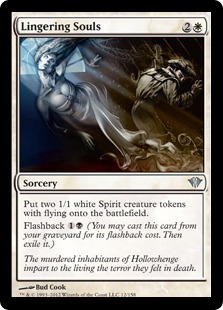
4 Lingering Souls
2 Thoughtseize

Lands

1 Creeping Tar Pit
4 Flooded Strand
1 Godless Shrine
1 Hallowed Fountain
1 Island
4 Marsh Flats
1 Plains
4 Polluted Delta
2 Swamp
1 Watery Grave

Sideboard

3 Dispel
3 Engineered Explosives
1 Gideon, Ally of Zendikar
2 Spell Pierce
2 Surgical Extraction
4 Timely Reinforcements

Lingering SoulsFinally, I’d like to take a look at this sweet Esper list from WMCQ Japan. Rather than messing around with Sphinx's Revelation or Esper Charm, Kihara instead modeled this archetype after the Grixis and Jund midrange strategies in the format. Removal, diverse threats and card advantage - this deck has it all. Where Grixis has Lightning Bolt and Kolaghan's Command, this Esper list is opting instead for Path to Exile and Lingering Souls. Backed up by a bunch of removal, Geist of Saint Traft is a hard-hitting, difficult-to-interact-with threat that attacks opponents from an entirely different direction than Liliana of the Veil, Lingering Souls and Gurmag Angler. Most Esper decks were already packing Geist of Saint Traft in their sideboard, so I like that Kihara chose to just embrace that post-board plan of attack for Game 1 as well.

There is a lot of built-in adaptability with a list like this, thanks in large part to the overall power level of its various components. When we’re packing four Lingering Souls, four Jace, Vryn's Prodigy, four Geist of Saint Traft, four Liliana’s and five delve threats, the rest of the mix can be whatever form of disruption/card advantage/removal we desire. Kihara chose for this event to play a playset of Disfigure alongside Path to Exile (the assumption being if we can get to the midgame we should have no problems winning) but any mix of Serum Visions or more discard spells could see play given the right metagame conditions. I plan on testing this deck out extensively in the coming weeks.

Conclusion

This round of WMCQ events gave us a bunch of sweet new decklists to look at heading into Kaladesh. I did my best to present some of the most interesting options, but I really only skimmed the top of what is an extensive list of data out there to analyze. What did you think about any of the lists we went over today? Did I miss something you think I should be paying attention to? Let me know in the comments, and I’ll see you next week!

Thanks for reading,

Trevor Holmes

The_Architect on MTGO

Twitch.tv/Architect_Gaming

Twitter.com/7he4rchitect


Stock Watch- Smuggler’s Copter

Are you a Quiet Speculation member?

If not, now is a perfect time to join up! Our powerful tools, breaking-news analysis, and exclusive Discord channel will make sure you stay up to date and ahead of the curve.

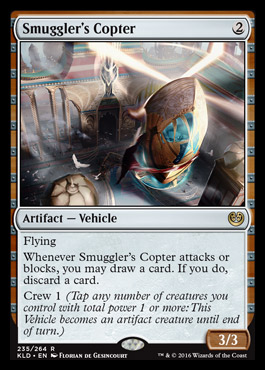
This is another card that was identified as great early on in spoiler season, and has inflated in price the longer that pre-orders were available. Initially it wasn't entirely clear just how good the Copter would be, though now most have identified it as one of the best cards, if not the best card in the set.

When I first wrote about Smuggler's Copter it was pre-ordering for about $2, and I correctly identified it as a good buy. As of now, the card is in the $8-9 range, which makes sense for such a great card from a set that is just being released. That said, the Masterpiece effect will certainly impact the price of rares going forward. A good reference point is the price history of Sylvan Advocate.

There was an error retrieving a chart for Sylvan Advocate

Sylvan Advocate has been a major player in Standard in multiple decks basically since it was printed, and despite this has never even been a $10 card. I think that Smuggler's Copter is a good enough card that we'll see peaks and valleys around other set releases, though as Kaladesh packs are opened over the next month I expect the price to fall.

Smuggler's Copter is absolutely poised to have a great Pro Tour performance, and there could potentially be a PT bump, though I wouldn't expect dramatic gains from the current price. I would be looking to sell Copters soon, and move off the card completely after the Pro Tour to possibly reinvest later. Again, this is a great card, it is just commanding a value that is going to be difficult to hold in a Masterpiece world.

Avatar photo

Ryan Overturf

Ryan has been playing Magic since Legions and playing competitively since Lorwyn. While he fancies himself a Legacy specialist, you'll always find him with strong opinions on every constructed format.

View More By Ryan Overturf

Posted in FreeTagged , 1 Comment on Stock Watch- Smuggler’s Copter

Have you joined the Quiet Speculation Discord?

If you haven't, you're leaving value on the table! Join our community of experts, enthusiasts, entertainers, and educators and enjoy exclusive podcasts, questions asked and answered, trades, sales, and everything else Discord has to offer.

Want to create content with Quiet Speculation?

All you need to succeed is a passion for Magic: The Gathering, and the ability to write coherently. Share your knowledge of MTG and how you leverage it to win games, get value from your cards – or even turn a profit.

Insider: Kaladesh First Impressions

Are you a Quiet Speculation member?

If not, now is a perfect time to join up! Our powerful tools, breaking-news analysis, and exclusive Discord channel will make sure you stay up to date and ahead of the curve.

Wanna take a ride? This isn’t just a quote from one of my favorite movies of all time (Contact), it’s almost the central theme of Kaladesh - We are visiting a world where magic fuels the day-totday life of the citizens. They drive in magical cars and create all of these wonderful inventions.

In game terms though, I’ve been rather critical of this new, flashy card format. What I’ve realized is that using these artifacts is almost like having equipment. But instead of buffing your creature it becomes its own creature. I think if we categorize the vehicles like we do with equipment then we can build our decks with the correct number of creatures and spells so that we make the best use of our attack trains and flying cars.

The first thing I’ve experienced and learned firsthand is that these vehicles are much better than I anticipated. This is largely due to my change in categorizing them as spells rather than creatures, but there are other aspects that shifted my perspective as well. Most creatures you play have to wait a turn to attack, but with a vehicle in play it’s almost like giving all of your creatures haste. Imagine if Loxodon Warhammer were a vehicle instead of equipment - you’d be attacking for three rather than buffing your creature - and you begin to appreciate vehicles more.

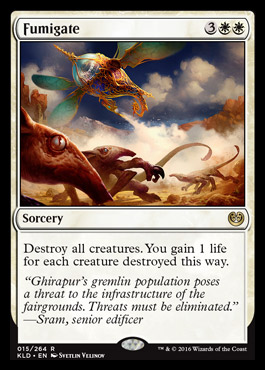
Another benefit to this new artifact cycle is that you cannot kill them with sorcery speed removal. That means cards like the new Fumigate or Radiant Flames won’t ever be able to deal with them. You need cards like Blessed Alliance or Unlicensed Disintegration in order to remove the possibility of your opponent speeding towards your life total every time they play a creature.

Of course, there are weaknesses with any card type, and vehicles have theirs as well. They are artifacts in addition to creatures so more removal spells will destroy them. Additionally, there will be times when your vehicle won’t be able to attack because you don’t have a creature to crew it. Originally, that was a risk that I was unwilling to take, but if we think of them more like equipment, then obviously there were times when we had Sword of Feast and Famine and no creature to equip it too. As long as that’s in our thought process, we can minimize that weakness.

With how much perspective I gained this weekend at the Prerelease, I wanted to revisit the vehicles as well as some of the other artifacts in the set and break them down. So, let’s fly right in!

Limited Power

First up, we have a boat, a mech, a train, and a couple cars. The cards in this group have higher mana costs but more importantly higher crew values. Bomat Bazaar Barge, Demolition Stomper, Aradara Express, Ballista Charger, and Ovalchase Dragster are all great Limited cards, but you’re never going to be able to play many of them because you can realistically only pilot a couple of them per deck.

These vehicles may not be breaking down the doors of Standard trying to make their mark, but it will feel that way in Limited some times. Even the common train, Aradara Express, is hard to beat once it gets rolling. I lost a couple games to my business partner who found his Key to the City and attacked with unblockable giant vehicles like this one.

Questionable

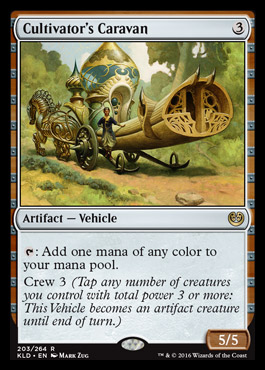
Once we start getting into the rare ships like Fleetwheel Cruiser, Cultivator's Caravan, and Skysovereign, Consul Flagship, we obviously find ourselves driving some more high quality machines.

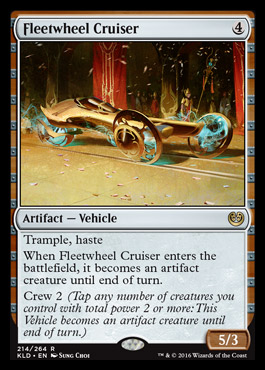
Originally I liked Ovalchase Dragster and thought that card might see play in Standard, but I think Fleetwheel Cruiser is an upgraded version of the card design. I like being able to attack with a vehicle the turn it comes into play, especially if you don’t have a creature to crew it. The higher the crew the more difficult it will be to find a suitable creature to sit in the driver’s seat. In regards to the Dragster, Ball Lightning-style cards have always been playable and I think this new version will find a home in a Standard deck.

Cultivator's Caravan fills a very different role in any constructed format, that of mana fixing. Although it’s slow for a mana accelerant and color fixer, the Caravan does something unique right now in the format. With the available card pool, we don’t have many options for generating any color of mana. Being able to set yourself up to reliably cast your spells is always important, but its unclear if we need a three mana card that can turn into a late game threat in order to help us with our consistency.

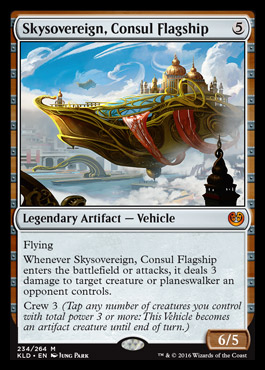
Skysovereign, Consul Flagship also does something unique by dealing damage to creatures and planeswalkers repeatedly. My main concern with this Flagship is that it requires a crew of three to operate. If it were only two, we could jam it into any control deck with other planeswalkers like Gideon, Ally of Zendikar and use the creature they make to pilot the ship. But because it requires a crew of three though and doesn’t hit players, we may not have a Flagship of Constructed, but of Limited.

Ready to Fly

There are a couple vehicles though that seem eagerly anticipating their time to soar through the ranks of the tournament scene. My short list is only Sky Skiff and Smuggler's Copter.

There will be no surprise that these are the two that should see the most play. They have the lowest mana cost and the lowest crew value and are combined with the best stats for their cost. Even though Sky Skiff is only a common, a 2/3 flyer for two is definitely a big deal. Right now we are seeing 2/1 flyers for two like Selfless Spirit and Rattlechains making us think about the way we build our decks. You may need another creature to pilot it, but with a 2/3 body, Sky Skiff is ready to take the fight to the skies.

Alright, I know I might be the last one on board with Smuggler’s Copter, but it’s definitely good and it was a mistake to leave it off my Top 10 list for Kaladesh. If Sky Skiff’s 2/3 body wasn’t good enough to entice you, Copter bumps it up the power by letting you fly a 3/3 for the same mana cost. Not only that, but you also get a Looter il-Kor ability as well. With a filtering ability like that within a presumably aggressive strategy, you will be able to find the right cards to take down any opponent.

When players are utilizing new cards in Modern, it’s time to stop and take notice. Even when I saw that Affinity players were trying to build new versions of their deck that included Smuggler's Copter, that wasn’t enough for me. I had to experience it for myself. I got beat down by not only this rare but many others I’ve discussed in this article. As I’ve said before, most of them I was able to beat with the same strategy: if you eliminate their creatures, they won’t have anyone to crew the vehicles. That said, they can just play another creature the next turn and it basically functions like it has haste. No matter which way you look at it, I think we will be seeing at least one vehicle flying through the skies of Standard.

Key to the City

Earlier I mentioned Key to the City, for a good reason. I think this artifact will be unlocking some playable strategies in the near future. We could use this as a discard outlet for the madness cards, a way to get our zombies in the graveyard or just to give our aggressive creatures a way to smash the opponent without being  blocked. You may have to discard a card, but you can always pay extra mana each turn to draw another card. Most likely you will just be discarding extra lands anyway, so this is a way for you to find more gas and keep speeding through any opponent’s life total.

This is a great financial pick up right now. You don’t get much better than bulk when it comes to a spec and I like this target a lot. I know I’ll be pricing it at $1.50 to start out after release this Friday and I wouldn’t be surprised to see it go up a little past that as well. We do have the Inventions holding the card prices down, but there will be a little wiggle room for card growth on some cards.

Filigree Familiar

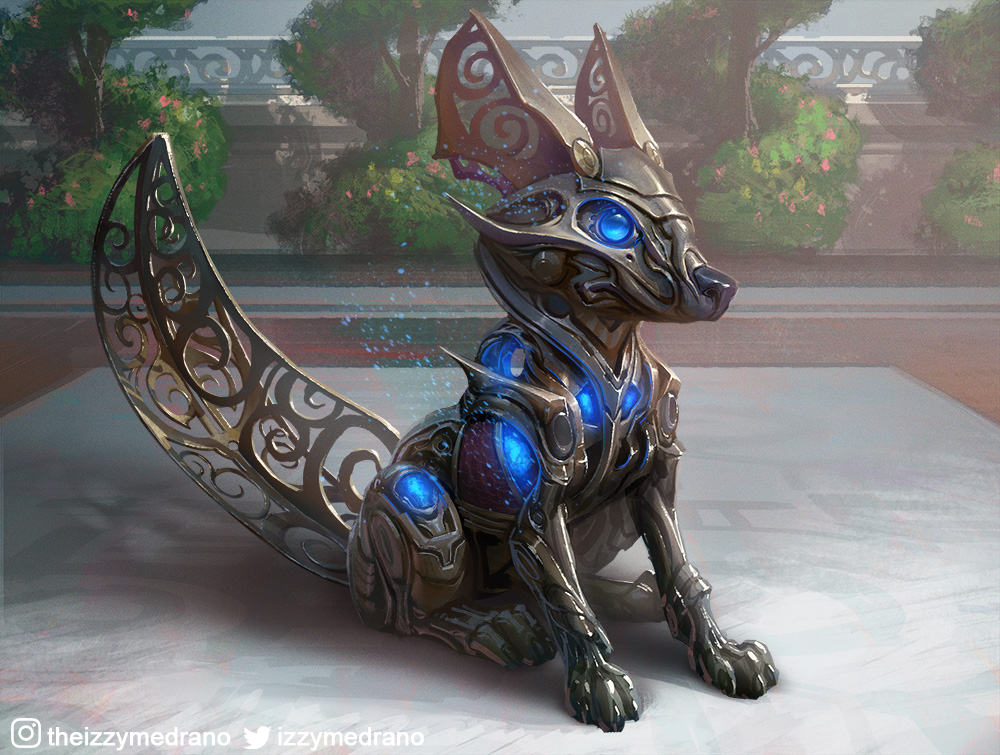
Someone asked me what my favorite card in the set was and I said I think it’s Filigree Familiar. It just does everything! For a mere three mana you get a respectable 2/2 body and gain two life. Then when he dies, you get to draw another card! With two power, I think he will trade with some creatures in Standard as well. Even if he doesn’t trade with another guy, you are still buying a lot of time for yourself to stabilize the board.

Most importantly, now we know what the fox says! He says gain two life, obviously.

Kidding aside though, I think Filigree Familiar will be great and the foils should look sweet. They should also be worth tracking down because they’ll be worth a couple bucks too. I don’t know if the current $5 foil price is accurate, but even if it drops down, it definitely won’t be a bulk foil.

What have your experiences been with the vehicles or any other cards from Kaladesh? Did you enjoy all the new mechanics at the prerelease? What cards do you think are still underrated? Let me know in the comments. Thanks for reading.

Until next time,
Unleash the Force of Kaladesh!

Mike Lanigan
MtgJedi on Twitter

INSIDER: Lightning Blast, Bannings, and Poison

Are you a Quiet Speculation member?

If not, now is a perfect time to join up! Our powerful tools, breaking-news analysis, and exclusive Discord channel will make sure you stay up to date and ahead of the curve.

So how was everyone's Prerelease? I went 3-1 with a pretty mediocre black/white energy deck, and I opened a Chandra, Torch of Defiance from my four packs. Better lucky than good, right?.

Expensive Lightning Bolts

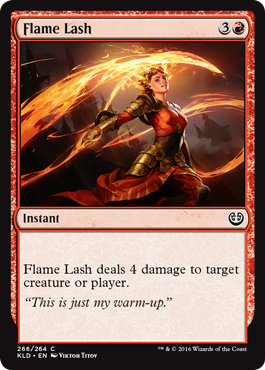
A decent chunk of this week's article will be focused on a different four mana red spell in Kaladesh though, and this one is even harder to find in a booster pack. Wizards decided that it's finally time to bring Lightning Blast back into Standard, in the form of Flame Lash; a common only available through the Chandra Planeswalker intro deck.  Nissa got her own exclusive cards too, but none of the cards in her deck are really expected to shine in Standard. For reference, here is a list of the eight cards between the two decks that you cannot get by opening Kaladesh booster packs. While Terrain Elemental is a bit blunt in the face of power creep, Standard is lacking for a decent-rate burn spell that can still be applied directly to the face when needed. Because of this expected demand and low supply, Flame Lash sits comfortably at $3.70 on MTGstocks.com, although a more accurate number is the $1.96 that TCGplayer Market Price represents on their website. 

flame-lash-chandra-planeswalker-deck-exclusive

So what's all the hubbub? Well there's an initial head-scratching if you've been reading all of the content lately that suggests Standard will be gutted by the Expedition effect, then you suddenly see a random common burn spell selling for Lightning Bolt prices in 2016. Standard won't be cheap after all! Those dirty #MTGFINANCE speculators are gonna buy up all the Planeswalker decks, and new players are gonna starve!

There was an error retrieving a chart for Lightning Bolt

Well, not exactly. First of all, remember that we're still in pre-sale fairytale land where prices can be whatever they're hyped up to be. Pain Seer was still a $10 card in the week before its release, and we all know how that turned out. Flame Lash competes very directly with the obvious go-to four drop in red nowadays, Chandra herself. This silly common has to beat out a whole arsenal of walkers and creatures of a much higher power level before it even gets considered as a 1-of. Secondly, it's a 4-of in the Planeswalker deck that you will always be able to grab for $15 at your local LGS or Walmart, and Chandra, Pyrogenius herself takes up half of that value. Her deck also has the non-terrible Fleetwheel Cruiser, sliding in to eat up $3 more out of the deck's value ceiling. We're left with $4 to distribute among the other couple bulk rares, basic lands, commons, and those four prized Flame Lashes. It's going to be extremely difficult for the card to hold even a $1 market price average, even if Chandra herself simmers down to $5.

Unfortunately, neither of these decks really have any other standout casual cards that make picking the bulk exciting years down the road. Even if Flame Lash ends up being a solid $.50 on a buylist, it'll only have around 18 months to shine before it's literally just a Lightning Blast by a different name. Intro deck bulk is often the least picked of all bulk, because the previous owner may have only been involved in Magic for a brief period of time before passing onto another game or hobby. Some preconstructed decks end up being worth way more than MSRP because of potential sleepers, but not even the "If you have a Chandra or Nissa in play" creatures appear to be worth casting down the road when we get even more Chandras and Nissas released. Nissa's deck in particular is especially unattractive for only the newest of casual players.

A Quick Note on Bannings/Unbannings

This kind of post has been done to death for the most part, so I won't take too long to explain my position here. Every few months, we get the inevitable Reddit threads and Facebook group conversations of "What do you think will be unbanned? Do you think they'll let Stoneforge Mystic free? What about giving us Splinter Twin back? Do you think Deathrite has been gone too long?" Bloodbraid Elf is always in the discussion somewhere, but it's not really a "bulk" card by my definition, so I'm leaving it alone. Buying banned cards can be extremely profitable if you're smart, lucky, patient, or some combination. We've seen so with Ancestral Vision, Bitterblossom, and Thopter Foundry (by association with Sword of the Meek, the latter of which is down to a paltry $1-2 after not actually being any good). Do you want to know what the investment cost of Foundry was before the unbanning? $.25, give or take. The card was true bulk and you could easily find them in leftover remnants of shredded C13 product, along with Viscera Seers.

Maybe I'm crazy, but I make sure to set aside every Punishing Fire and Mind Twist I get in bulk, just in case. I don't want to tie up money investing in Stoneforge Mystic over and over again when there are collections and bulk to be had, but the risk of setting aside the two previously mentioned cards seems so low that I'm perfectly happy losing out on a potential couple of dollars when the multiplier on the payoff is so ridiculously high.

End Step

Being on two weekly podcasts and writing a weekly article makes it really hard to come up with a "pick of the week" at the end of every single piece of content, so here's a sneak peek at my pick on Brainstorm Brewery this week. I'm a huge fan of hard to reprint commons and uncommons, and you don't get much harder to reprint than Infect. While "pick up Glistener Elf and Blighted Agent" is a song sung to death by me and Corbin Hosler, I'm also a huge fan of slowly accumulating the other budget Infect cards that see marginal competitive play and more heavy "budget competitive" play.

There was an error retrieving a chart for Blight Mamba

Blight Mamba and Carrion Call have both seen play in the BG and UG infect decks at times to allow the list to play a more impactful late-game, and there's overlap with the "I can't afford Noble Hierarch and Inkmoth Nexus so I'll play mono green Infect and cheese the hell out of people at FNM" crowd. Foils are a fine watch here as well, considering foil Blighted agent is a billion dollars and Glistener Elf is only suppressed by having an FNM promo. I'm not saying foil Carrion Call should be $50, but true bulk seems low. I'm also setting aside Necropedes when I pick them up, and you should know that Ichorclaw Myr is a real dollar bill on its' own. Until next week!

Finance 101: Understanding Spread

Are you a Quiet Speculation member?

If not, now is a perfect time to join up! Our powerful tools, breaking-news analysis, and exclusive Discord channel will make sure you stay up to date and ahead of the curve.

A common question I hear people ask is, "Will this card go up in price?" While it's almost impossible to prove, there are many signs and data points you can use to determine if a card is trending up or down. Sometimes the card doesn't see a lot of competitive play right now but it is still trending up due to casual play or supply constraint. One of the best ways to tell which way a card is trending is to look at the spread. Spread is one of the most important factors that can lead to you a decision of when to buy and where the card is trending.

dynavolt

Spread is a concept in finance that refers to the difference between buy price and sell price. In Magic finance, spread is usually expressed using the buylist price as a percentage of the sell price. For example, a card that sells for $100 and is bought for $50 has a spread of 50%. This percentage is directly related to how a vendor feels about the value of a card. Dealers offer lower spreads on card they are more aggressively acquiring, which could be for a number of reasons. Ultimately, whether it's because they're out of stock or selling the card quickly, the end result is that they're willing to pay more money for the card.

[wp_ad_camp_1]

Spread and Price Movement

When a card's spread gets too low, it's not worth selling at the old price and the price goes up. Sometimes this happens very quickly, to the confusion and irritation of many players. Sometimes it happens slowly and people wonder how nobody noticed. Let's take a look at a few cards and analyze how spread could have helped us predict a card's future movement. All of the following charts come from Quiet Speculation's Trader Tools app.

Priced to Move

hierarch
(Click to expand.)

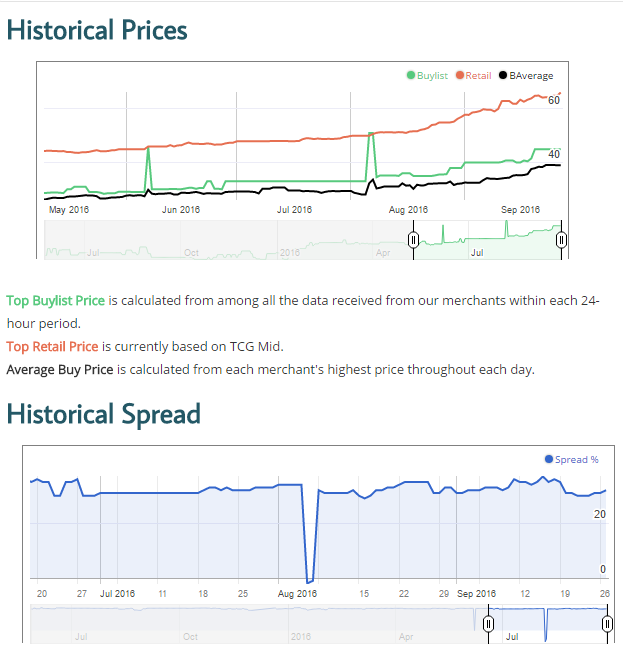
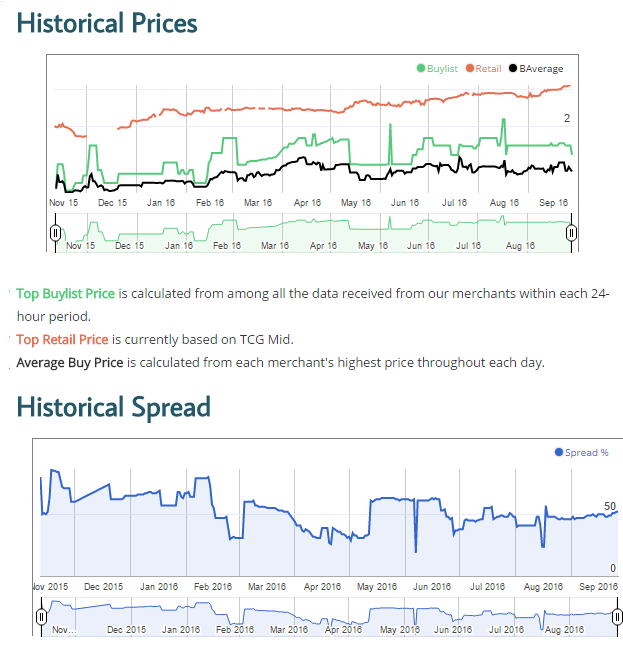
This is the price graph for Noble Hierarch. The current spread is 32% between the best buylist and the best sell price, which is pretty good for a staple. You'll see on the Historical Spread graph that during August the spread takes a nosedive and ends up below the graph. That is not an error. Because Quiet Speculation pulls information from multiple vendors it is possible for cards to have a negative spread. This means you can buy them from one vendor and sell them to another vendor for more money. This is known as arbitrage, and it also happens in the global financial market. Opportunities for arbitrage are rare and often short-lived, so it's important to take note when they do happen. If it happens for long enough, vendors are likely to take notice and raise/lower their prices to remove the arbitrage opportunity. Arbitrage can happen at events too. I have purchased cards from a vendor at a Grand Prix and walked them to the other side of the hall to sell them for more than I paid.

Noble Hierarch is currently showing that it still has room to grow. If you're putting off getting them to finish your deck you are not doing yourself any favors. Because the buy price of the card has been consistently rising alongside the sell price, it shows that people are willing to pay more and won't sell for the same amount. This graph is a good textbook example of typical Magic pricing.

Slowly Falling

inquisition-of-kozilek
(Click to expand.)

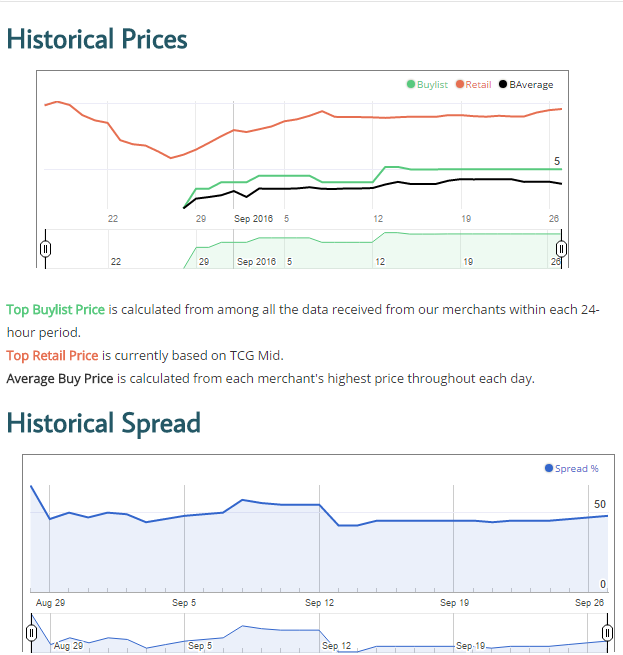
The above graphs are for the Inquisition of Kozilek reprint from Conspiracy: Take the Crown. In the past few weeks we've seen the spread grow. It's small enough that you won't immediately notice it but this is part of the reason why I said Inquisition of Kozilek was in for a really rude awakening. The current retail price of $10 can't survive much longer. At some point, the buylist price will either become laughable or stores will have too many copies in stock and be forced to lower their price. Right now Inquisition has a spread of 48% which is among the worst for Modern staple cards. I've said that I think this card could be $4-5 in December and this price graph shows us vendors think we're heading in that direction too. If you've been thinking about buying Inquisition of Kozilek, you'll be doing yourself a favor by waiting.

Blue Chips

tarmogoyf-price
(Click to expand.)

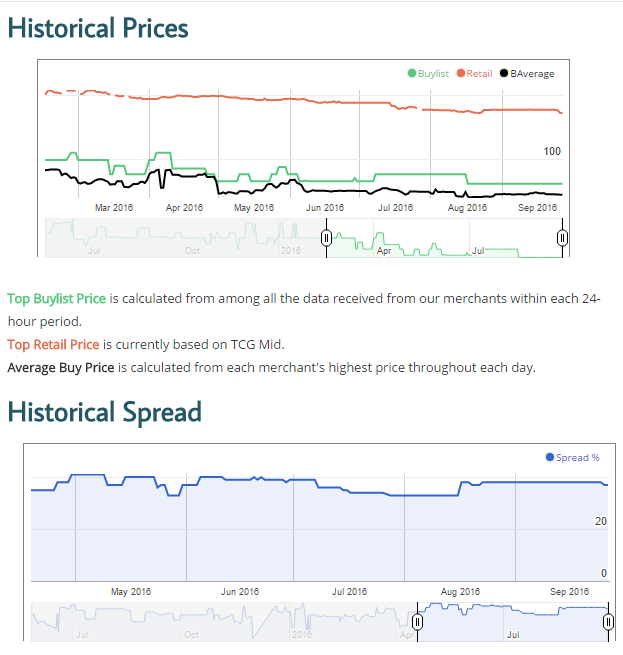
Some cards fall in price but still maintain a pretty reasonable spread. Do you know what card this graph represents? If you guessed Tarmogoyf, you're right. The spread for Tarmogoyf hasn't really changed much since the beginning of the year as it has bounced between 35% and 41%. This is despite the fact that this graph shows Tarmogoyf falling $20 in five months. Dealers can be confident that certain cards will sell despite a falling price. Tarmogoyf is as close to a "blue chip stock" as you can get in Modern. It's powerful and irreplaceable and has a legendary status that gives it value to everyone who plays Magic. It doesn't matter if Tarmogoyf becomes less popular; it will always be worth some amount of money due to it being a status symbol. That said, cards like this are really hard to predict accurately because even though the price of the card is falling, the spread is staying almost the same.

Reprint Targets

snapcaster-mage
(Click to expand.)

If you read my previous articles, you know I advocate waiting for reprints when the timing makes sense. Modern Masters 2017 was announced a few weeks ago as part of next year's product lineup. There's not a lot of information in the article except that it will include cards from Innistrad and Return to Ravnica blocks. If Wizards wants to sell a set with cards that headlined Innistrad block, it's hard to leave out Snapcaster Mage and Liliana of the Veil.

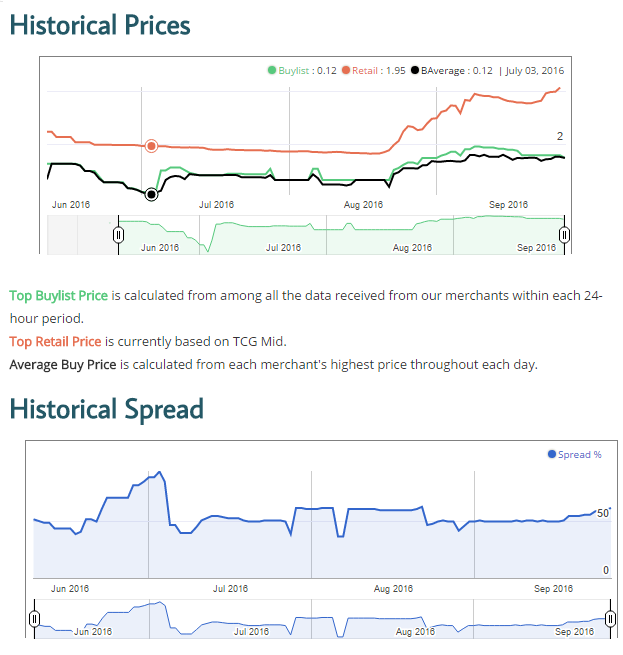
The above graph is the current price graph for Snapcaster Mage. With a spread of 35%, it's almost as solid as Noble Hierarch but it's also been on the downturn this year. Some of this is because of its blue chip-ness and some of it has to do with the fact that the theoretical reprint is still six months away. The recent history shows the spread decreasing on Snapcaster Mage but I would be very wary of buying in now if it's not the last card you need to finish your deck. I think we could see some vendors loosen up and let the card drop a bit now that Modern PPTQ season is over. How the spread changes over the next two months will be a big indicator of how low it can go.

Similarly, Liliana of the Veil also has a pretty tight spread. At 30% it's one of the lowest for Modern Staples. The reprint risk is high in Modern Masters 2017 and I would be wary of buying them if you don't feel like you will get significant play in the next six months. Liliana is the second most expensive card in Modern after Tarmogoyf and comes with a ton of risk buying in now.

What other cards might have a lot of risk?

CardPriceBuylistSpread
Arid Mesa$56$4028%
Cavern of Souls$61$4525%
Damnation$65$4530%
Horizon Canopy$75$5330%
Misty Rainforest$56$3930%
Scalding Tarn$87$5735%
Verdant Catacombs$75$4638%

As you can see, the most expensive cards in Modern have some thin margins. Vendors are happy to buy them close to their sell price, confident in their ability to sell them at a profit before they decrease in price. That being said, if you are looking to get any of these cards they won't decrease in price until they get reprinted. The demand is just too high at the current prices for there to be any incentive to lower them. These types of cards are the biggest hurdles for newer players trying to get into Modern and players trying to switch decks. I believe Wizards of the Coast has many of these cards on their radar for reprints over the next few years.

Hype-Based Spikes

bloodbraid-elf
(Click to expand.)

Sometimes cards get really expensive or popular because of rumors. Sometimes people panic-buy and they spike. In both cases, watch the spread. If buylists don't quickly follow and the spread increases instead, then this is probably not a good buy. The graph above is for Bloodbraid Elf. It's a card that was rumored to be removed from the Modern banned list this month. As Bloodbraid Elf crept up in price, the spread also crept up. It's up to an enormous 63% right now which should tell you all you need to know: it's not worth the $4 it's currently selling for. Vendors are only paying $1.50 for it, and now that it hasn't been unbanned I expect it to drop back down to $2 in a few months.

Cyclical Spread

sol-ring
(Click to expand.)

Sometimes buylist prices go up and down without really changing the price of a card. This kind of activity is most common on more casual staples like Sol Ring (shown above). When a store runs out or runs low they will bump their buylist price up to get some more supply. Right now Sol Ring has a spread of 30% because one vendor is paying $1 more than all of the other vendors on a $3 card. If you play competitive Modern you are unlikely to see many of these cards come up. If you play more casually, you will see it with the types of cards that are played in fringe decks and more casual formats like Commander. Platinum Emperion (until recently) is a good example of the type of fringe or casual Modern card that will see some periods of negative spread while stores try to restock.

Final Thoughts

  • Prices should remain relatively stagnant for about a month until the next Modern Star City Games Open in Milwaukee (Oct 22-23). I'm not sure if there will be a ton of people trying out new cards in Modern this weekend but keep a close look at the top of the Classic just in case.
  • If you're a big fan of watching Modern, there are really only a few events left until the end of the year. We will only have one Modern Grand Prix with Kaladesh before Aether Revolt. After the Open in Milwaukee there is only one more Modern Open (Columbus) and the Player's Championship before we close out the year.
  • Modern cards (as well as Standard) should be trending down for the rest of the year. I'll make sure to remind you as the time approaches, but the best time to buy will be in December.

Identifying Modern Playables in Kaladesh

Are you a Quiet Speculation member?

If not, now is a perfect time to join up! Our powerful tools, breaking-news analysis, and exclusive Discord channel will make sure you stay up to date and ahead of the curve.

In my opinion, recent sets have done a great job of influencing the Modern format. The two-block model increases the need for flagship cards in individual sets, which lines up with the fact that more Standard-legal cards are making their way into Modern. Some recent additions to the format have been less welcome than others, though I would say that overall Wizards has done a great job of printing new cards that impact older formats.

kld-banner-cropped

Oath of the Gatewatch definitely impacted Modern too heavily, though actually breaking Modern is a pretty difficult feat to accomplish. I think that Kaladesh has a handful of interesting cards for the format without adding anything broken, which is great for a Standard-legal set. Today I'd like to cover all the cards that I've identified as potential Modern players. I'll explain what deck(s) I see each card fitting into and how likely it is to make a splash.

[wp_ad_camp_1]

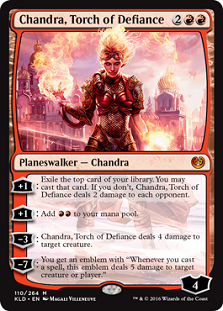
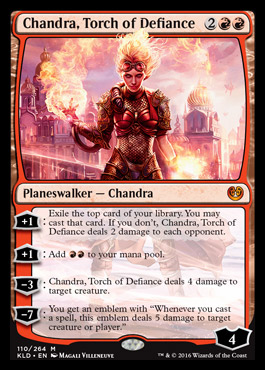
Chandra, Torch of Defiance

chandra-torch-of-defiance

I won't guarantee that Chandra will see Modern play, though four-mana planeswalkers have a way of making their way in. Nahiri, the Harbinger, Gideon, Ally of Zendikar, and Elspeth, Knight-Errant are all within the range of Modern playability. Chandra seems like a solid four-mana spell for a Primeval Titan deck. Casting a Rampant Growth effect on turns two and three enables a turn four Titan, and just playing Chandra on three instead gives you some interaction against aggressive decks that also lets you Titan a turn earlier if your Chandra survives. Not to mention that if you don't have the Titan, Chandra offers a small amount of draw power to help find it. I don't know that Chandra necessarily fits anywhere else in Modern, though I think it shows promise in Titan decks.

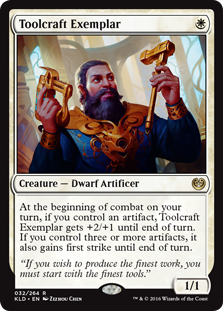
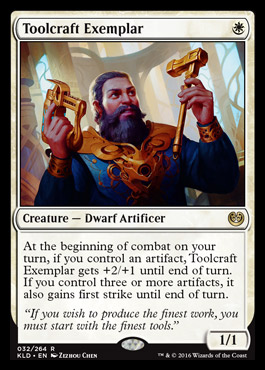
Toolcraft Exemplar

toolcraft-exemplar

Does this card have a home in Affinity? Hard to say. Affinity decks definitely spend more time attacking than blocking, so they don't really care about a card being bad on defense. What they might care about is wanting early white mana. Theoretically you can jam this guy and Dispatch, which are both powerful spells, but it's unclear that Affinity is looking to adapt. Toolcraft Exemplar does seem like one of the better things you can have on the battlefield when your opponent casts Stony Silence. But when it comes to hate I'm pretty sure Affinity players have accepted their lot in life. Unless a one-mana three-power creature proves to be worth caring about white mana in a more general sense, this one might not make it. I fully expect it to be tried by Affinity players though.

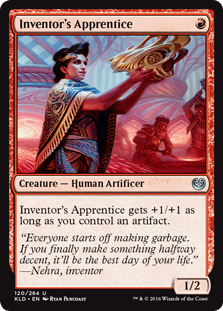
Inventor's Apprentice

inventors-apprentice

Inventor's Apprentice is just worse than Toolcraft Exemplar when you think of textboxes that Affinity wants to play, though being red fits with the Galvanic Blasts you see in many lists. This one seems significantly less likely to make the cut, but it's hardly a laughable inclusion.

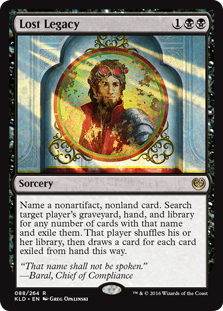
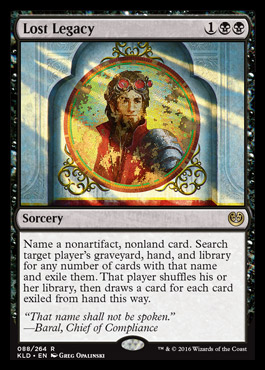
Lost Legacy

lost-legacy

I won't be the first to tell you this isn't a very powerful card for Standard play, though it just might fit the bill for some Modern sideboards. If Ad Nauseam is popular in your area they'll have a hard time beating this without Leyline of Sanctity. This can also be quite solid against particular Valakut decks, and it seems phenomenal against Living End. Keep in mind that this card is inherent card disadvantage. I fully expect it to be overplayed, but against decks that are extremely focused on one spell, the fact that this card costs three instead of the four mana of most Cranial Extraction effects is significant.

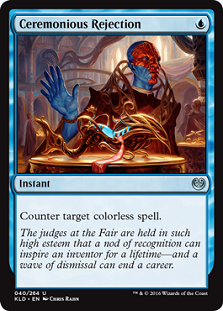
Ceremonious Rejection

ceremonious-rejection

I would be remiss if I didn't discuss this card, though I expect it to be extremely overvalued for Modern play. Ceremonious Rejection counters most everything that matters out of Affinity and Lantern Control at a great rate, though against Eldrazi and Tron I believe this card falls a bit shy of the mark. Countering Expedition Map can be brutal, though blue decks already have Mana Leak for the big hits out of either deck. The problem is that Tron now features a fistful of cast triggers and Eldrazi can just blank all of your counters with Cavern of Souls. If this card said "exile" instead of "counter" I would be more on board with it, though as is I imagine it's too narrow for most blue sideboards. I could see Merfolk picking up a couple copies for their sideboard, but as a Snapcaster Mage player I can say this counter doesn't matter against the things I care about. This card seems much better for Vintage and Legacy than it does for Modern.

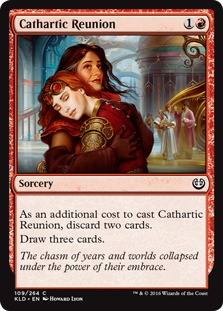
Cathartic Reunion

cathartic-reunion

The obvious starting point for Cathartic Reunion is Dredge, but I think decks featuring Pyromancer Ascension and Jeskai Ascendancy can really benefit from this one too. Combo decks in Modern suffer from having to live with the cards they draw naturally as opposed to Legacy where they can be Brainstormed away. Cathartic Reunion cycles away two cards you'd prefer to have in the graveyard, and it's a significant upgrade over Tormenting Voice. Obviously getting this one countered is miserable, though counter-heavy decks are not terribly popular in Modern. Drawing three cards for two mana is also very powerful relative to the other options available in Modern. Getting hit by a Spell Snare is a huge blowout, though what this card does for consistency against non-blue decks is well worth the cost. It wouldn't surprise me in the least to see this card in multiple Modern decks.

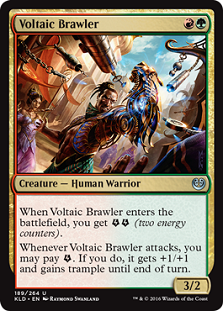
Voltaic Brawler

voltaic-brawler

A two-mana creature that attacks for four trample damage twice seems to fit what you might want in a Modern deck. It's no Tarmogoyf, but really what is? Being a Human could definitely be significant, as the Human tribe has some solid support in Modern. More cards that are great on their own definitely wouldn't hurt there, and a curve of Champion of the Parish into Burning-Tree Emissary plus Brawler sounds pretty nuts. Follow up with a turn three Thalia's Lieutenant and you've got yourself a stew goin'!

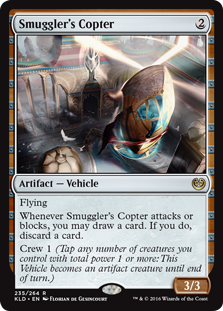
Smuggler's Copter

smugglers-copter

This one might look like more of a stretch than the one-mana creatures for Affinity, but I don't think Smuggler's Copter is completely outside of the range of cards that fit into the deck. It doesn't pack the punch of Cranial Plating, but the Copter let's you convert your Memnites into evasive attackers, and the looting is significant in a deck that doesn't require many mana sources. Obviously not passing the Bolt test is a significant factor for Modern play, and that fact alone could push this one out---though I believe that it could have legs... er, wheels... wings?

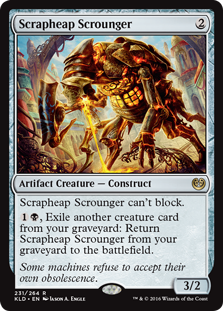
Scrapheap Scrounger

scrapheap-scrounger

This card is almost tailor-made for Dredge. You can start bashing with it when you draw it naturally and have mana to spare, and it clocks faster than whatever else you'd be casting in the face of a Leyline of the Void. Leyline will obviously ever be a weakness of the deck, and a 3/2 for two is unlikely to just win the game on its own, though the point is worth mentioning. When you dredge over Scrapheap Scrounger, of course, that's one more card that matters in your graveyard and triggers Prized Amalgam. The rate is also theoretically good enough to fit into a more fair Modern deck, though for the most part I expect this to see play in Dredge.

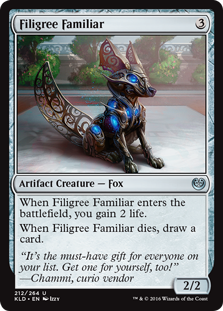
Filigree Familiar

filigree-familiar

This is one of the standouts from the set for Standard play, though I haven't seen any discussion of Filigree Familiar in Modern. It's sort of an artifact analog to Kitchen Finks, and while it's definitely a worse version, I could see decks that have difficulty casting Finks employing Robo Dog. This might be my most ambitious mention, and I'm not sure what kind of deck necessarily wants this card, but the amount of value you get for three generic mana is very high. Perhaps it's a solid speedbump for aggressive decks out of Tron?

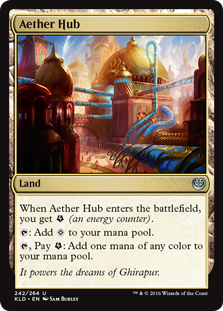
Aether Hub

aether-hub

Tendo Ice Bridge shows up in Modern a non-zero amount, and this is just an upgraded version. Not to mention that it's much easier on your wallet! This card won't see a huge amount of Modern play, though there are definitely decks that will be happy to register Aether Hub.

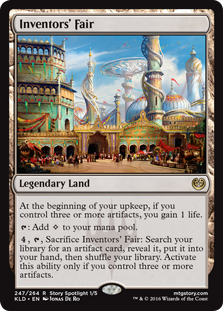
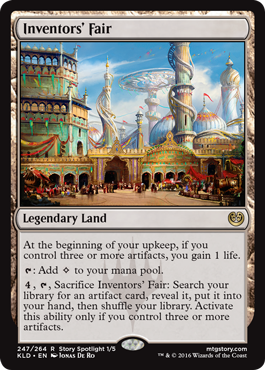
Inventor's Fair

inventors-fair

As a legendary land, they'll only play one, but this land is perfect for Lantern Control. It's a tutor for whatever you're missing (presumably Ensnaring Bridge more often than not), and the lifegain can completely lock up those games where your opponent has a small chance to topdeck burn spells. This card would be totally nuts if it wasn't legendary, but even as is it's a great inclusion for the deck.

Fastlands

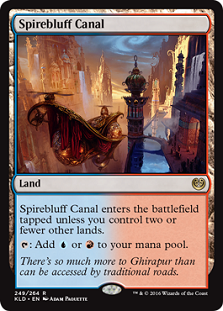
Lastly, we come to the fastlands. You've heard plenty about these by now, I'm sure. Spirebluff Canal is great because it lets you cast either Serum Visions or Lightning Bolt on turn one without taking any damage, and it's not hard to imagine wanting to lead on a fetch into a tapped dual into any of the enemy-colored fastlands. These cards should all slot into Modern in some capacity, though not every deck will want them.

spirebluff-canalI've been asked about how this cycle will impact Grixis Delver, and the answer is that it won't matter to that deck in any significant way. Fetchlands help enable delve and also let you shuffle away unwanted cards that you see with your Delver trigger. I can't tell you how many games I had to wait a turn on casting Tasigur because I didn't draw enough fetches, and that's miserable. I'll happily convert the one-of Darkslick Shores I've been registering into a Canal, but that's as far as I'll go. Jeskai Delver, however, I would definitely retool the manabase for. I'm not trying to add any Inspiring Vantage, but I could see making room for anywhere from two to four Spirebluff Canals.

The other thing I haven't seen discussed as much is the weakness of fastlands against Blood Moon compared to fetchlands. Fetchlands find basic lands, and reducing access to your basics is a real cost to including too many fastlands in your deck. If your deck is in the market to generate four mana on turn four, as many Modern decks are wont to, that is also a real cost to overloading on fastlands. So the printing of this cycle is significant, but I don't think it will revolutionize Modern by any means.

Kaladeshi Contributions

I really dig what Kaladesh is bringing to the table for Standard play, and I'm happy to see so many potential Modern players as well. If you think there are some potential Modern sleepers I've missed I would be happy to read your thoughts in the comments!

Thanks for reading.

-Ryan Overturf
@RyanOverdrive on Twitter

Stock Watch- Chandra, Torch of Defiance

Are you a Quiet Speculation member?

If not, now is a perfect time to join up! Our powerful tools, breaking-news analysis, and exclusive Discord channel will make sure you stay up to date and ahead of the curve.

Chandra opened at a high price, and only climbed from there during pre-order season. Currently, Star City Games has their pre-orders sold out at $60, though this weekend we'll start to see exactly how deserving the new four ability planeswalker is of this level of demand.

If you check out pre-orders on TCG Player, you'll see that the low listings are barely above $40. Realistically, a price higher than that for a large set mythic rare would require complete format dominance. The Masterpiece Series makes that reality even more pronounced, and this price just isn't abstractly maintainable even in the face of format dominance.

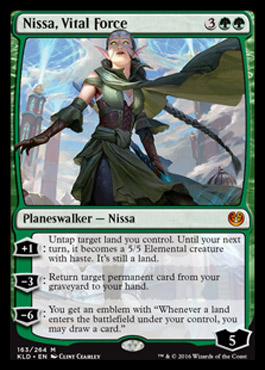
What I'm really here to report on though, is that Chandra is not living up to her hype in playtesting. Is she a powerful card? Absolutely! Is she the second coming of Jace? Not even close. She can technically fit into any red Standard deck, though she simply doesn't make the cut in many lists. She's too expensive for Boros, and she's a bit incoherent in aggressive energy decks. Her matchups against both Gideon, Ally of Zendikar and Nissa, Vital Force are also very problematic, as either one of these 'walkers can take Chandra down with relative ease. The resilience of Smuggler's Copter to sorcery speed removal, a card that is looking like it will be in a major player in Standard, is yet another significant point against Chandra.

Will Chandra crack the Top 8 of the Indianapolis Open this weekend? I think I would lean more "probably" than "maybe", though my line is her being in 1.5 decks, not 3.5. All things considered, I expect Chandra to be more of a $15-25 card, and if I had any I'd be in a hurry to sell.

Insider: MTGO Market Report for September 28th, 2016

Are you a Quiet Speculation member?

If not, now is a perfect time to join up! Our powerful tools, breaking-news analysis, and exclusive Discord channel will make sure you stay up to date and ahead of the curve.

Welcome to the MTGO Market Report as compiled by Matthew Lewis. The report will cover a range of topics, including a summary of set prices and price changes for redeemable sets, a look at the major trends in various constructed formats, and a "Trade of the Week" section that highlights a particular speculative strategy with an example and accompanying explanation.

As always, speculators should take into account their own budget, risk tolerance and current portfolio before buying or selling any digital objects. Questions will be answered and can be sent via private message or posted in the article comments.

Redemption

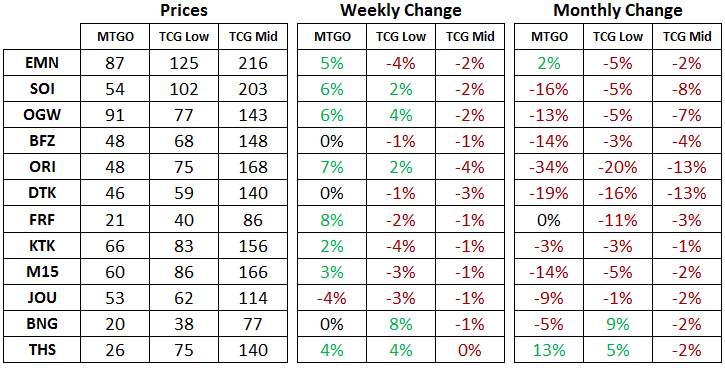
Below are the total set prices for all redeemable sets on MTGO. All prices are current as of September 26th, 2016. The TCG Low and TCG Mid prices are the sum of each set’s individual card prices on TCG Player, either the low price or the mid price respectively. Note that sets of Theros (THS) are out of stock in the store, so this set is no longer redeemable.

All MTGO set prices this week are taken from Goatbot’s website, and all weekly changes are now calculated relative to Goatbot’s ‘Full Set’ prices from the previous week. All monthly changes are also relative to the previous month prices, taken from Goatbot’s website at that time. Occasionally ‘Full Set’ prices are not available, and so estimated set prices are used instead.

sept26

Flashback Draft of the Week

The final booster gets added to Scars of Mirrodin (SOM) block draft this week with New Phyrexia (NPH). The new booster is full of valuable cards, including two non rares that go for over 4 tix each in Gitaxian Probe and Dismember. Keep your eyes out for these Modern staples as they will help to keep the costs of your draft down. Batterskull, Karn Liberated and Spellskite are the top rares to look for.

Standard

Eldritch Moon (EMN) and Shadows over Innistrad (SOI) continue to be the sets to focus on in Standard as this draft format nears its conclusion. Last week I examined whether or not these two sets were at or near their price bottoms based on how long it took similar sets to bottom out, and all signs pointed to them being close to, if not already at, a bottom.

This week both sets have rebounded by about 5% but they still represent excellent value. To illustrate another possible way to evaluate this, I'm going to revisit a metric I have used in the past. It's a simple ratio between the MTGO set prices and the TCG Mid prices as reported in the set prices table. The one extra wrinkle is that the redemption fee of $25 is tacked onto the MTGO price before calculating the ratio. Although I am mixing tix and dollars in this ratio, the point is to get a sense of relative value between sets on MTGO and in paper. Drawing a precise meaning from the ratio is not the goal of this exercise.

Produced below is the current TCG Mid ratio for all redeemable large sets, as well as the average ratio calculated from historical weekly prices. There is also an "Average" column which is a simple average of the various ratio numbers, excluding the SOI ratios. Note that Theros (THS) is no longer redeemable due to being out of stock so it is also excluded from this table and any calculations.

ratio-l

The current TCG Mid Ratio for SOI is lower than any other redeemable large set and is 23% below the current average of these large sets. This suggests SOI has room to expand its ratio, either by a drop in the price of paper sets, a rise in the price of a digital set, or some combination of the two. The seasonal trend is for higher prices as we head into the fall and the other trend is the end of SOI drafting. Both of these trends gives confidence that the price of a digital set of SOI is set to rise. I think that the ratio will at least reach 0.50 as the winter approaches.

Looking at how the paper price of Dragons of Tarkir (DTK) and Magic Origins (ORI) moved heading into the winter of 2016, DTK rose by 5% and ORI dropped by 13%. Let's assume a 15% drop in the TCG Mid price of SOI as a worst case scenario. This leaves a paper TCG Mid price of $173. For SOI's ratio to hit 0.50, this implies a price on MTGO of 61 tix. If we instead assume a constant MTGO price of 54 tix to go with a ratio of 0.50, this implies the set price of SOI is set to drop by 22%.

This type of stress testing, combined with historical experience, the power level of SOI, and the fact that the set was drafted over the summer, suggest a very limited downside at current prices.

All this theorizing was done in a worst-case-scenario perspective, but the upside is unaccounted for. It's possible that SOI actually appreciates in paper, dragging up the price of digital sets through redemption. A 10% increase in the TCG Mid price to 223, holding the ratio constant at 0.50, implies a digital set price of 87 tix.

ratio-s

Like SOI, the current TCG Mid Ratio for EMN is lower than any other redeemable small set and is 21% below the current average of these small sets. Applying a similar analysis here, a 15% drop in the TCG Mid price of EMN, combined with a ratio of 0.65, implies a digital set price of 94 tix. Assuming a flat digital set price of 87 tix, and a constant ratio of 0.65, this implies a 20% drop in the TCG Mid price of EMN.

Again, this is a worst-case scenario I am looking at. For both EMN and SOI, the risk of buying sets is largely just the opportunity cost of holding them. There is very little downside risk on the set prices themselves, and plenty of room for an upside surprise. Players should have no fear in getting their playsets from SOI and EMN right now.

Leaving the second Innistrad block aside for the moment, we are going to get our first glimpse of Kaladesh (KLD) Standard this weekend with the Star City Games Open in Indianapolis. All sorts of cards are going to be jockeying for position in the new format, and we'll start to see the implications of the rotation of Collected Company. Although SOI and EMN are excellent value right now, picking up cards from Battle for Zendikar (BFZ) and Oath of the Gatewatch (OGW) that could benefit from a change in the format is reasonable as well, though a more speculative strategy in nature.

If you've got your fill of SOI and EMN, look to cards from BFZ and OGW that have seen play in Standard in the past and are currently at a low price. I've been picking up cards that fit this description, including Part the Waterveil, Gideon, Ally of Zendikar, Ulamog, the Ceaseless Hunger, Nissa, Voice of Zendikar and Chandra, Flamecaller.

I don't plan to hold these cards very long, but it will depend on how they look in the new Standard format over the next month. If they are a no-show in the top decks of the SCG Open series as well as Pro Tour KLD, then I expect to book a loss on these cards. However, one winner will be enough to make it worthwhile as the prices on these cards are already depressed.

Modern

When KLD is released in a couple of weeks, there will be a liquidity crunch as players and bots drive up demand for tix looking to buy the new cards. That will be a good time to start hunting for value in Modern staples, so my advice right now is to leave Modern alone and to focus on opportunities in Standard.

That being said, October is historically a great month for players and speculators to be looking to buy cards like the Zendikar fetchlands, so be sure to save a few tix for when Modern cards go on sale.

Standard Boosters

OGW boosters have dipped to an all-time low of 2.6 tix this week and they're definitely approaching an interesting level for speculators. A sustained drop below this price during Kaladesh (KLD) prerelease events should be seen as a good opportunity to buy OGW boosters at a discount.

BFZ boosters continue to languish around 1.1 tix and these should be treated much more warily than OGW boosters. Players who want to draft the OGW-BFZ format over the winter shouldn't hesitate to grab a few boosters during KLD prerelease events, but speculators should be looking for a deep discount before wading in here.

With SOI and EMN boosters, I think it's best to take a wait-and-see approach. The introduction of Sealed and Draft leagues has changed the market for boosters substantially, increasing the float of boosters on the market and depressing the long-term price. Once KLD hits the older leagues go offline, meaning a large supply of boosters is still on the market and in players' collections with only draft queues as an outlet.

Observing how the prices of OGW and BFZ boosters have acted points to draft queues as being inadequate to support prices over the long term. If you are holding more SOI and EMN boosters than you think you need, selling in advance of the KLD prerelease weekend is correct.

With all of that in mind, there is still room for speculative purchases during KLD prerelease events. Keep an eye out for steep discounts on all Standard boosters, and be prepared to flip them back into the market for a short-term trade.

Trade of the Week

As usual, the portfolio is available at this link. I have continued to buy sets of EMN and SOI this week. There's no point in fooling around trying to figure out which Modern cards are good value in advance of Standard rotation. Just buy the currently drafted sets and ride the price changes into the winter.

Testing Stoneforge Mystic in Modern: Part Two

Are you a Quiet Speculation member?

If not, now is a perfect time to join up! Our powerful tools, breaking-news analysis, and exclusive Discord channel will make sure you stay up to date and ahead of the curve.

Here it is. The actual data from my investigation into Stoneforge Mystic. After well over 600 matches with my Abzan test decks, I can finally give a decidedly data-driven answer to whether or not Stoneforge deserves its place on the banlist and how it would impact Modern.

stoneforge-2-banner-cropped

I tried to be as clinical and scientific as possible in my treatment of the material and how I approached my results. I initially intended to include an actual statistical study, complete with confidence intervals and regression analysis, but my proved too small for a reasonable margin of error. That requires at least twice as much data, realistically triple, and I don't have the time for that. If anyone wants to do their own data collection and add it to mine, you are welcome to try.

Hypothesis

If the goal is to be as scientific as possible, then we need a hypothesis to actually test. You cannot just do experiments, you need to be trying to prove or disprove something. For this test I want to avoid something too broad like, "The viability of unbanning Stoneforge Mystic." After looking through postings on the subject throughout the greater Modern community, there is a consensus about why to unban Mystic. To the best of my ability to decipher, it is:

Stoneforge Mystic would allow more fair midrange and control decks to exist in Modern by slowing down aggressive decks and reducing their metagame presence.

Therefore, I will be performing my investigation with this hypothesis in mind. If Stoneforge slows the format down and makes fair decks a more attractive option then it is a good candidate for unbanning. If it does not accomplish that goal it should stay banned.

[wp_ad_camp_1]

Describing Matches

I'm going to provide general impressions of the matchups rather than detailed descriptions. Trying to be specific about 600+ matches is a Sisyphean task to write and incredibly boring to read. In addition, most of the games can simply be described as, "If Abzan Liliana of the Veilruns the opponent out of resources it wins, if not it loses." If you want more detail about a specific matchup ask in the comments.
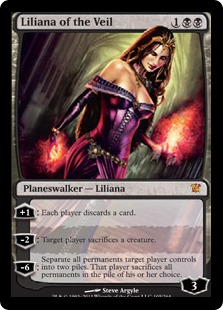
I took copious notes and statistics as I went through and any particularly interesting and relevant ones are included in addition to the research I was actually conducting. Hopefully they will serve to provide additional color to my results and insight into my conclusions.

I looked up the consensus wisdom about whether Abzan was favored or unfavored before each test, partially to guide how I approached the matchup (I wasn't an Abzan player before this test) and to provide some guidance for the validity of the testing. I will include the consensus evaluation alongside my own findings.

The Stoneforge Data

I will begin by discussing Stoneforge Mystic herself. For the most part, the way I played Mystic did not change between matchups so it makes sense to deal with the associated data separately. Unless otherwise noted, I played Mystic at the earliest opportunity possible opportunity and fetched Batterskull.

  • Opening Hands Containing Mystic: 54%
  • Games including Mystic: 72%
  • Average Mystic Turn: 3.80
  • % Total Games Mystic Played on Turn 2: 49%

This is remarkably close to the results that Sheridan reported. The decreased average Mystic turn is most strongly the result of play adjustments made for the Jeskai matchup. The increased turn two percentage comes from the additional games played and mulliganing decisions, held down again by the Jeskai adjustment, which will be explained in the appropriate section.

Data

Without further ado, in the order that I tested them, here are the results of my investigation by deck with sideboarding information. The specific decklists are in my article from last week. I didn't record sideboarding strategies from my opponents unless they changed them because of Mystic. Also, I never made matchup-specific considerations for my game one mulligans to try and keep things as "real world" as possible.

Infect

Stock List

The community believes that Abzan is favored thanks specifically to Lingering Souls, but it needed disruption to be safe. I tended to mulligan for Souls and/or Inquisition in all my matches as a result.

  • Game One Win %: 48% (24/50)
  • Match Win %: 64% (32/50)

Abzan Sideboarding:

-2 Painful Truths
-2 Tasigur, the Golden Fang

+1 Engineered Explosives
+2 Fulminator Mage
+1 Curse of Death's Hold

Games were not expected to go long and grinding wasn't a factor. Either Abzan died quickly or Infect was successfully exhausted in the opening few turns. I lost a number of game ones due to hands with unplayable Tasigurs, or tapping out for Truths, so they get cut rather than interactive cards.

Losing the dead cards for more answers to Inkmoth Nexus and Blighted Agent drastically improved the matchup, proving the consensus correct. The few games Curse hit play my opponent scooped.

Mystic Abzan

I mulliganed a little less because of keeping hands with Stoneforge Mystic and disruption, but that didn't impact the matchup very much. It was decent against Glistener Elf, but less effective than Souls had been.

  • Game One Win %: 50% (25/50)
  • Total Match Win %: 62% (31/50)

Abzan Sideboarding:

-1 Sword of Feast and Famine
-1 Tasigur, the Golden Fang
-1 Scavenging Ooze

+1 Sword of Fire and Ice
+1 Engineered Explosives
+1 Slaughter Pact

I was decided that the additional creature kill was more important here than discard, so I swapped swords. Explosives and Slaughter Pact were the best removal in the sideboard and I couldn't cut too many threats or any interaction to bring in more. In the end I didn't end up missing the Fulminator Mages and it didn't affect the matchup. I did miss the "I win" aspect of Curse several times. Maelstrom Pulse didn't have much impact game one so I didn't think it necessary games two and three.

Burn

Stock List

Burn used to be considered a very good matchup for Abzan, but that was when it ran Kitchen Finks maindeck. Opinions on whether Siege Rhino actually replaces Finks appears mixed, and consensus has weakened on the matchup. I'll take the assumption that it has moved to being more even these days.

  • Game One Win %: 40% (20/50)
  • Total Match Win %: 52% (26/50)

Abzan Sideboarding:

-2 Painful Truths

+2 Timely Reinforcements

Truths cost too much life and Timely was just as many cards if you follow the Philosophy of Fire. Nothing else was expected to have an impact. Thoughtseize was not cut because it gained an average of one life per use. There was also nothing else I wanted to bring in.

Burn Sideboarding:

-3 Searing Blaze

+3 Path to Exile

On the Draw:

-1 Monastery Swiftspear
-1 Goblin Guide

+1 Skullcrack
+1 Deflecting Palm

Abzan didn't give Burn that many targets for Blaze so they were cut for the Siege Rhino answers. On the draw creatures were shaved on the assumption that they would be neutralized earlier and that Burn would have to play a longer game.

The extra lifegain was very important to pulling up Abzan in games two and three, but most wins still came from early disruption followed by Tarmogoyf. Siege Rhino was impactful, but also easy to anticipate and counter with a sandbagged Atarka's Command or Skullcrack, frequently resulting in Burn victories.

Mystic Abzan

I mulliganed fairly aggressively for Mystic in games two and three, assuming that Batterskull would be very important.

  • Game One Win %: 66% (33/50)
  • Total Match Win %: 60% (30/50)

Batterskull was quite important, and in game ones Burn only won once when it was played turn three thanks to a lot of Skullcracks.

Abzan Sideboarding:

-1 Sword of Feast and Famine
-2 Thoughtseize
-1 Maelstrom Pulse

+1 Sword of Fire and Ice
+2 Duress
+1 Scavenging Ooze

The Sword was changed only because protection from red was relevant. Pulse was unnecessary, and with fewer lifegain spells and Duress available, Thoughtseize was less necessary.

Burn Sideboarding:

-4 Eidolon of the Great Revel
-4 Lava Spike

+4 Destructive Revelry
+1 Searing Blaze
+3 Path to Exile

My opponent wasn't sure what to take out, but knew what to bring in. Answering Stoneforge and Batterskull was the priority and it happened enough to improve the win percentage. I was frequently forced to slow-roll Mystic thanks to hands containing multiple answers, which meant I often had no pressure.

Ad Nauseam

I know that the Worlds coverage team claimed that combo decks are good against GBx decks, but in my experience the matchup is slightly tilted in GBx's favor, since disruption plus a clock is good against combo and that's all GBx does. This is especially true of combo decks that require multiple cards to win.

Stock Abzan

Consensus was mixed, with the stronger one saying Ad Nauseam is favored. I suspect the dissent comes from the recent addition of Collective Brutality.

  • Game One Win %: 42% (21/50)
  • Total Matches Won: 46% (23/50)
  • Ideal Abzan Opening Hands: 24% (12/50)
  • Ideal Abzan Opening Win %: 91.7% (11/12)
  • Times Ad Nauseam killed itself: 10% (5/50)
  • Times Ad Nauseam would have died anyway: 60% (3/5)

A few things to explain: by "ideal Abzan opening" I mean Thoughtseize, Tarmogoyf, Liliana openings. Ad Nauseam killing itself counted the times it died to Spoils of the Vault, either from exiling all its win conditions or actually killing itself from life loss. My opponent was usually forced to play it to prevent dying next turn and more often than not it didn't work.

Abzan Sideboarding:

-4 Path to Exile
-3 Scavenging Ooze

+3 Stony Silence
+2 Fulminator Mage
+2 Surgical Extraction

Take out dead cards, add in less dead cards. Extraction comes in because taking all of a combo piece, especially Ad Nauseam itself was frequently game over. This was balanced by how powerful Leyline of Sanctity was against Abzan.

Mystic Abzan

It was correct to find Sword of Feast and Famine in this matchup. While the discard was too slow to stop a fast combo, it helped tighten the screws and ensure victory.

  • Game One Win %: 40% (20/50)
  • Total Matches Won: 48% (24/50)
  • Times Ad Nauseam killed itself: 16% (8/50)
  • Times Ad Nauseam would have died anyway: 87.5% (7/8)

I really missed the additional Thoughtseize in the other Abzan list. Sword never won a game where I was behind, but it put me over the top of a few.

Abzan Sideboarding:

-3 Path to Exile
-1 Tasigur, the Golden Fang
-1 Scavenging Ooze
-1 Lingering Souls

+2 Stony Silence
+1 Maelstrom Pulse
+2 Duress
+1 Liliana of the Veil

All the extra discard had a significant impact, as did an additional answer to Leyline.

Merfolk

Full disclosure: by this point I was well over 300 matches in with the two Abzan decks and the practice was having an effect on the results. My play and subsequent win rates improved by an unquantifiable amount as I moved through the decks.

Stock Abzan

Based on my experience I expected this to go Merfolk's way. Abzan has less removal than Jund, and Merfolk can power through Lingering Souls more easily than other aggro decks. Abzan wins when it can race with large creatures.

  • Game One Win %: 36% (18/50)
  • Total Matches Won: 44% (22/50)

In game one Merfolk's speed and mana disruption were decisive and Abzan struggled to find its feet. It required a critical mass of answers plus a good clock to power through Merfolk's redundancy, and that didn't come together that often.

Abzan Sideboarding:

-3 Thoughtseize
-1 Lingering Souls
-2 Tasigur, the Golden Fang

+1 Engineered Explosives
+2 Timely Reinforcements
+1 Curse of Death's Hold
+2 Damnation

Take out the less impactful or slow cards and find sweepers and board-cloggers. Truths stayed because you really needed to find a sweeper or two to win.

It didn't change between decks, but I did record Merfolk's sideboarding.

Merfolk Sideboarding:

-4 Aether Vial
-2 Spell Pierce

+3 Tectonic Edge
+3 Relic of Progenitus

Merfolk wants more mana distruption and cantrips rather than tempo cards. Relic also answers Ooze, Tarmogoyf, and sometimes Souls.

Mystic Abzan

The plan was to use Batterskull to race as much as possible. Having slightly less disruption made this far more important.

  • Game One Win %: 44% (22/50)
  • Total Matches Won: 46% (23/50)

Access to Batterskull did make racing easier and made Lingering Souls much more impressive.

Abzan Sideboarding:

-2 Thoughtseize
-1 Tasigur, the Golden Fang
-1 Sword of Feast and Famine

+1 Scavenging Ooze
+1 Engineered Explosives
+1 Slaughter Pact
+1 Maelstrom Pulse

Having fewer sweepers was crippling for the deck and the win percentage suffered as a result. Swords were swapped mostly for protection colors as Fire and Ice killed very few creatures when Abzan wasn't going to win anyway.

Death's Shadow

Stock Abzan

Consensus apparently hasn't been reached about Abzan vs. Death's Shadow, except that Abzan really needs to watch out for an instant kill. On the one hand Abzan is good against Zoo but it's not so good against trampling double-strikers.

  • Game One Win %: 46% (23/50)
  • Total Matches Won: 52% (26/50)
  • Game One Death's Shadow is Zoo: 62% (31/50)
  • Game One Win %, Death's Shadow is Zoo: 65.2% (15/23)
  • Adjusted Win %, Death's Shadow is Zoo: 48% (15/31)
  • Game One Death's Shadow Combos: 38% (19/50)
  • Game One Win %, Death's Shadow Combos: 34.8% (8/23)
  • Adjusted Win %, Death's Shadow Combos: 42% (8/19)

By Zoo vs. Combo I mean the games where Death's Shadow played creatures and attacked over a number of turns and ground down Abzan's life total like a traditional aggro deck, vs. wins by combining Temur Battle Rage and Become Immense. Pulling off the combo was harder than expected. DS was able to find the pieces easily enough---it was keeping Temur Battle Rage and Become Immense in hand long enough that proved challenging. The strategy for Abzan was to not lose and let DS nearly kill itself, then win with Spirit tokens.

Abzan Sideboarding:

-2 Painful Truths
-3 Scavenging Ooze

+2 Timely Reinforcements
+1 Engineered Explosives
+2 Damnation

In comes the anti-creature cards, out go clunkers. Gaining extra life and sweeping the board was very helpful. Ooze never got to grow due to mana constraints and Truths was unnecessary. I wanted to leave in as many naturally large creatures as possible.

Death's Shadow Sideboarding:

On the Draw:

-3 Steppe Lynx

+3 Hooting Mandrills

On the play my opponent thought that the maindeck was fine, but on the draw they thought my discard would assist playing Mandrills early, which was correct for the most part.

Mystic Abzan

Batterskull used to be very good at beating fair creature decks, so I assumed that reliable access would improve things for Abzan.

  • Game One Win %: 44% (22/50)
  • Total Matches Won: 52% (26/50)
  • Game One Death's Shadow is Zoo: 58% (29/50)
  • Game One Win %, Death's Shadow is Zoo: 81.81% (18/22)
  • Adjusted Win %, Death's Shadow is Zoo: 62% (18/29)
  • Game One Death's Shadow Combos: 42% (21/50)
  • Game One Win %, Death's Shadow Combos: 18.18% (4/22)
  • Adjusted Win %, Death's Shadow Combos: 19% (4/21)

I didn't record whether the change in the number of Zoo vs. Combo games was because I disrupted the combo less or they found it more. Still, Abzan logged an improvement in games where DS was forced to play fair like traditional Zoo.

Abzan Sideboarding:

-1 Sword of Feast and Famine
-1 Scavenging Ooze
-1 Tasigur, the Golden Fang

+1 Sword of Fire and Ice
+1 Engineered Exposives
+1 Slaughter Pact

I swapped Swords mostly because discard wasn't very relevant by the time it hit and I wanted to draw more answers.

Death's Shadow Sideboarding:

-2 Mutagenic Growth

+1 Ancient Grudge
+1 Dismember

On the Draw:

-3 Steppe Lynx

+3 Hooting Mandrills

My opponent wanted some answers to Batterskull and cut the least impressive card to do so.

Jeskai

Last matchup!

Stock Abzan

Consensus says its a very even matchup and whoever wins the attrition fight wins the match. Nahiri gives Jeskai the potential for free wins, but in practice she never does unless Jeskai already won the attrition fight.

  • Game One Win %: 48% (24/50)
  • Total Matches Won: 50% (25/50)
  • Game One Jeskai suspends Ancestral Vision turn one: 46% (23/50)
  • Game One Jeskai suspends Ancestral Vision turn one and wins: 87% (20/23)

Winning attrition by drawing cards was quite good and when Jeskai drew more at no cost it had the advantage.

Abzan Sideboarding:

-3 Abrupt Decay

+1 Painful Truths
+2 Fulminator Mage

Extra cards and mana disruption are pretty effective against Jeskai.

Jeskai Sideboarding:

-3 Remand
-1 Vendilion Clique

+2 Spreading Seas
+1 Celestial Purge
+1 Wrath of God

Same plan applies for Jeskai. Remand is great only against flashbacked Souls so it was cut for more impactful cards.

Mystic Abzan

After the practice games we adjusted how I played Stoneforge Mystic. Initially I just played it as soon as possible, but that frequently allowed Jeskai to adjust how it sequenced its plays to answer the equipment more effectively, so I began playing it as the last threat once Jeskai was down on cards.

  • Game One Win %: 54% (27/50)
  • Total Matches Won: 52% (26/50)
  • Game One Jeskai suspends Ancestral Vision turn one: 52% (26/50)
  • Game One Jeskai suspends Ancestral Vision turn one and wins: 80.08% (21/26)

Jeskai got a few extra Ancestrals on the draw due to Abzan missing one Thoughtseize, in addition to normal variance. The increased wins came from Stoneforge being a threat by itself and then finding another threat.

Abzan Sideboarding:

-4 Abrupt Decay
-1 Path to Exile

+1 Liliana of the Veil
+2 Duress
+1 Scavenging Ooze
+1 Sword of Fire and Ice

Additional disruption and another Sword to search for to make Spirits into real threats.

Jeskai Sideboarding:

-3 Remand
-1 Timely Reinforcements
-1 Vendilion Clique

+2 Spreading Seas
+1 Celestial Purge
+1 Wrath of God
+1 Wear // Tear

An answer was required for all my equipment. My opponent tried Stony Silence and found it dead too often to use. The lack of card draw hurt more than expected.

Limitations

No data set is ever perfect, and as a result no analysis will ever be perfect. There are limitations and flaws in any study, and unfortunately my testing was no exception. What I didn't realize when testing began was how the different sideboards would impact matchups. Mystic lacking stock's sweepers had a noticeable effect on the creature matchups, as did the extra discard against combo and control for Mystic. As a result the deviation between total matches won was fairly small, due to cards missing from both sideboards having greater-than-expected impact on the overall win percentage.

To account for that I will be focusing my analysis on the game one win percentages. Maindeck composition between the test decks is very similar and also isolates the impact of Stoneforge Mystic rather than Stoneforge plus sideboard cards, so it is more useful analytically.

Analysis

With our limitations in mind, lets look at the important numbers together.

  • Stock vs. Infect Win %: 48% (24/50)
  • Mystic vs. Infect Win %: 50% (25/50)
  • Stock vs. Burn Win %: 40% (20/50)
  • Mystic vs. Burn Win %: 66% (33/50)
  • Stock vs. Ad Nauseam Win %: 42% (21/50)
  • Mystic vs. Ad Nauseam Win %: 40 % (20/50)
  • Stock vs. Merfolk Win %: 36% (18/50)
  • Mystic vs. Merfolk Win %: 44% (22/50)
  • Stock vs. Death's Shadow Win %: 46% (23/50)
  • Mystic vs. Death's Shadow Win %: 44% (22/50)
  • Stock vs. Jeskai Win %: 48% (24/50)
  • Mystic vs. Jeskai Win %: 54% (27/50)

That's still pretty messy. Let's simplify things by tracking the change between versions.

  • Infect Win % Change: 2%
  • Burn Win % Change: 26%
  • Ad Nauseam Win % Change: -2%
  • Merfolk Win % Change: 8%
  • Death's Shadow Win % Change: -2%
  • Jeskai Win % Change: 6%

Clearly Stoneforge had an effect on some matchups more than others. We can discount the 2% changes, as those represent only a single game's difference, easily ascribed to normal variance. Jeskai, at only three games difference is right on the cusp of being relevant. I will ascribe a weak impact there, with Merfolk having a moderate impact. However Burn has been severely and unequivocally impacted by Stoneforge Mystic. In fact if you group the aggressive decks together you get a total impact of +34% for Abzan.

That would point towards confirming our hypothesis that Mystic would slow the format down by preying on aggro decks. However, that is not the full story. We must also consider Sheridan's results with Affinity, and those indicate a worrying trend.

If we group the decks by fairness and look at the match results again:

Fair

  • Burn: 26%
  • Merfolk: 8%
  • Jeskai: 6%

Less than Fair

  • Death's Shadow: -2%
  • Infect: 2%
  • Affinity: 12%, based on Sheridan's results vs. Frank Karsten's expectations, reported by Sheridan as low-impact.

Unfair

  • Ad Nauseam: 2%

Stoneforge Mystic affected fair decks far more often and more strongly than it did less-than-fair decks. This stands to reason when you consider that Batterskull is just a beater against combo and a much slower one compared to Tarmogoyf. Meanwhile it actively works against the aggro strategy and dominates the mid- to late-game. Even against midrange decks it is a strong, hard-to-kill threat. This split is corroborated, though not confirmed, by investigating the impact on the fair Death's Shadow games vs. the unfair games.

  • Stock vs. Zoo style win %: 48%
  • Stock vs. Combo style win %: 42%
  • Mystic vs. Zoo style win %: 62%
  • Mystic vs. Combo style win %: 19%

Which yields an end result of:

  • Total change vs. Zoo style win %: 14%
  • Total change vs. Combo style win %: -23%

I doubt that Mystic is the actual reason the combo win rate got so much worse, but the results are the results. Adding Mystic to Abzan dramatically increased its win rate when Death's Shadow played fair and hurt its chances at beating unfair attacks.

Impact

So what does all this mean? If my results accurately model real Modern, then it is fair to say that Stoneforge Mystic would not have an absolutely warping effect on the metagame. It is a powerful card but not truly degenerate, and it ultimately advantages fair midrange decks against aggressive decks.
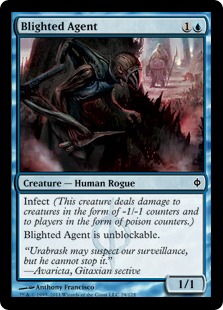
Blighted AgentThe problem comes when we consider what kind of aggressive decks will feel the blow. Fair decks will be impacted much more strongly than unfair decks. Infect definitely doesn't care about Batterskull any more than it does Tarmogoyf, and Affinity can care but it has plenty of options to get around it and win anyway. When Death's Shadow is playing fair it cares as much as any Zoo type deck, but when it assembles its combo kill then Batterskull doesn't matter. I would therefore expect them to try to combo more often.

The only reason that Batterskull would change an unfair combo matchup is by gaining more life than the combo can erase, which is hard considering how slow a clock Skull is compared to a turn two Tarmogoyf.

As a result, I would expect that in the wake of Stoneforge Mystic being unbanned there would in fact be a decrease in the total number of aggressive decks in Modern as Merfolk, Zoo, and Burn take a hit. This would slow things down as more players try slower decks with Mystic. However, after the initial slowdown, the format would accelerate as players notice that unfair decks aren't affected. This will push players to play more Infect, Affinity, and combo decks and the aggro players will try to incorporate more unfair elements to fight back against Batterskull.
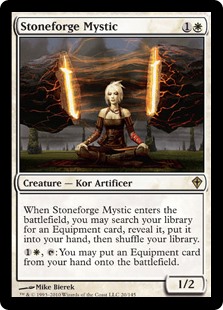
Stoneforge MysticThere is also the effect on other midrange decks to consider. The Jeskai results suggest that those decks that play Mystic will have an advantage over those that don't. I suspect that had the Mystic deck run Painful Truths, Abzan would have been more strongly favored. The fact that Mystic still pushed it over Jeskai suggests that it would drive the format towards greater homogeneity. If you have to play Stoneforge to win, that does limit your deckbuilding options.

Could we adapt? Possibly. The Burn matchup would have been much more in Abzan's favor if not for Destructive Revelry. Adding more targeted artifact removal might keep it in check, but I suspect that if players start doing that then Mystic decks will similarly adjust and run extra equipment and protection for it. This also doesn't consider whether or not decks can afford the space with unfair decks running around.

Conclusion

Based on the results of my testing Stoneforge Mystic in Junk Abzan I recommend against unbanning. My results partially prove the hypothesis true, but analysis of the impact suggests that over the long term it will have the opposite effect.

While its power is manageable and it would give players more reason to play white, its impact would not be positive. It negatively impacts the viability of fair aggro decks and non-Stoneforge midrange decks, while having a negligible impact on the less fair decks. The likely outcome would be a shift to more unfair decks and the speed of the format increasing to try to ignore and invalidate Batterskull and Swords. Therefore there is no reason to unban Stoneforge Mystic.

I'm sure that many of you have questions about my conclusions, methods, or more specifics about how matchups played out. As always I am happy to discuss them with you in the comments. Next week, tune in for something completely different.


Kaladesh: The Overrated and Underrated

Are you a Quiet Speculation member?

If not, now is a perfect time to join up! Our powerful tools, breaking-news analysis, and exclusive Discord channel will make sure you stay up to date and ahead of the curve.

Well, the prerelease honeymoon is over and it is time to get down to the serious business of putting these exciting new cards into real constructed decks. Leading up to this point, there has been excitement about nearly everything. What can we do with this? Can we put that card into a deck? Is this color combination going to be good? Can we cast counterspells again? It doesn't take long before most of these riddles have been fairly accurately solved and we get a taste of which cards are going to be good and which ones were preorder fool's gold.
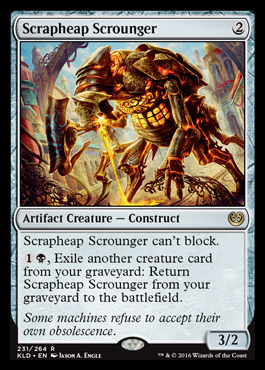
There is always an obvious amount of "hyped pricing" when it comes to preorder prices. Being that everybody needs, well, everything, it is hard to imagine a moment in time when demand for these cards will be much higher. The situation at hand makes it hard to "win" when buying cards right when a new set comes out. Often, the best strategy is just to buy a couple of boxes and trade of the majority of the highly coveted new cards for more stable older staples.

With that being said, I'm going to go through the Kaladesh list and comment on all of the cards that I believe are relevant. I'll weigh in on whether the card is overrated or underrated and give my speculative advice as a pro player on each card.

Mythics

Aetherworks Marvel

aetherworksmarvel

The entire value of this card is tied to the premise of a constructed energy combo/ramp deck. I've seen these decks toyed with in playtesting but nobody has come up with one that can consistently make the magic happen.

The versions of the deck that I've seen so far are typical RG Ramp and do have some very explosive draws. The problem is that there are a lot of moving pieces that all need to come together in order for you to win. Whiffing is a thing even when you have the nut draw.

The upside is that somebody makes a good version of the deck and it spikes up into the $10+ range. The downside is that the card is mediocre and becomes a $1 card. Marvel is one of the most potentially volatile cards in the set because it's either going to be broken or complete trash and there is no middle ground.

Even if the deck is great and tier one I don't see this card being able to sustain much more that $8-$10 price for very long. There will be a lot of the set opened and it is really only useful in Standard.

Verdict: Potential contender. Sell.

Angel of Invention

angelofinvention

Three years ago this card would have been absolutely absurd in Standard, but now it is a very "meh" offering. The Angel is an undoubtedly powerful Magic card but in a world of Archangel Avacyn this card picked the wrong time to be a 3WW-costed threat. Given the alternatives this card is unlikely to matter too much.

Verdict: Pretender. Sell.

Cataclysmic Gearhulk

cataclysmicgearhulk

In many ways the Gearhulks are the eye candy of the set (well, aside from Masterpieces) and I think they are all pretty amazing cards. I love the way that Wizards gave them the drawback of being artifacts but then curtailed all of the artifact removal in Standard to specifically not kill them...

Cataclysmic Gearhulk is one of the best ones in the cycle and it will see a ton of play in the coming months.

Verdict: Contender. Hold. Presale prices are always on the high side and I expect some decline. But Cataclysmic Gearhulk should maintain a solid chunk of value compared to the average.

Chandra, Torch of Defiance

chandratorchofdefiance

Chandra is obviously good. It does a bunch of things and appears to have powerful applications. My issue with the card is that it keeps underwhelming me in nearly every deck that I try it in. It is never bad, but there are so many great cards in Magic now that a deck needs to have strong synergy. Without a doubt the card will be constructed-playable---but it is not all that and a bag of potato chips.

Verdict: Overrated contender. Sell. The card is real but not $50 real. I would avoid this card for a month or so unless you absolutely need it for a deck you want to play in a tournament.

Combustible Gearhulk

combustiblegearhulk

I already mentioned that the Gearhulk cycle is a centerpiece of the set, just like the core set Titans. With that being said, I highly doubt that Wizards would make any that turn out straight unplayable.

People have been hating on this card but I think it actually looks pretty powerful. I've cast it quite a few times (albeit in highly flawed and experimental decks) and it always felt really good despite the fact that it was in decks that were kind of zany. I think this card will find a home and be good.

Verdict: Contender. Hold. I think this could be a card that ends up making money based on the current low price and the fact that I think it is a lot better than people realize. Obviously, prices are high now and it is hard to advise buying things when 90% will lose value, but this is a card that could have legs. I wouldn't part with these easily.

Demon of Dark Schemes

demonofdarkschemes1

I don't like to be dismissive of new cards because anything can have potential, but this doesn't feel like a great card to me. If anything it is another cog in the Aetherworks Marvel deck so that if you miss on Emrakul you can at least have energy to shoot again next turn.

The joke is that an energy deck could easily cut black entirely, so there is a chance that my Aetherworks Marvel deck wouldn't even play Demon. Even if it is in the Marvel deck it still settles in at a couple of bucks.

Verdict: Pretender. Sell. If I have this card and somebody wants to trade for it I'm going to be happy to let it go.

Dovin Baan

dovinbaan

It is hard to say that planeswalkers are bad because they are all so powerful, but this card seems pretty unlikely to see much play for a while. I mean, why would you ever play this card when you could be casting Gideon? Niche card at best.

Verdict: Pretender. Sell.

Metallurgic Summonings

metallurgicsummonings

Random EDH card.

Verdict: Pretender. Sell. Foil ones could be nice value down the line.

Nissa, Vital Force

nissavitalforce (1)

Nissa has the same problem as the Angel we just talked about. Fine card but competing with truly great cards. I had this card in my G/W Walkers first draft and immediately cut it for more green Gearhulks.

Verdict: Pretender. Sell.

Noxious Gearhulk

noxiousgearhulk1

I think Noxious Gearhulk might be the worst one by a wide margin. With that being said, I still think it is an obviously good Magic card and will see play. Remember the Titans.

Verdict: Contender. Sell.

Saheeli Rai

saheelirai2

There is an Aetherflux Reservoir deck that will probably play a couple copies of this card to potentially copy the Reservoir. I could see this card being alright in some older-format combo decks. With that being said, $25 is a joke. I think this card is a niche player at best.

Verdict: Pretender. Sell.

Skysovereign, Consul's Flagship

skysovereignconsulflagship

Obviously powerful card is powerful. With that being said, I think it has a ton of competition in the five-drop spot. Most of the vehicle-based decks that I've seen are lower to the ground than this.

Verdict: Borderline contender. Sell.

Torrential Gearhulk

torrentialgearhulk

If this card allowed us to get back sorcery spells it would be so busted. Time Walk Robot! Unfortunately (and by "unfortunately" I mean fortunately), that is not the case.

I think all of the Gearhulks are good, though, and this is no exception.

Verdict: Contender. Sell.

Verdurous Gearhulk

verdurousgearhulk

Green Gearhulk is by far the most impressive card I've seen in the set so far. It is unreal powerful and turns close games into jokes. A lot of power for five mana. This card is just unreal.

Verdict: Super contender. Buy. I preordered a Japanese playset and I never buy cards.

Rares

Aetherflux Reservoir

aetherfluxreservoir

Card is real. I'm not sure if it is any more real than Jeskai Ascendancy combo in Standard. Also, I haven't tried to combo with this card in Modern. It could be good. I've heard people talking about this for Vintage play---which is saying something.

Verdict: Contender. Buy. They are only like a buck or so online. You could do worse than to bet on random combo card.

Authority of the Consuls

authorityoftheconsuls

I respect this card. It is a good Magic card. People will cast this card. With that being said it will never have more value than it has right now.

Verdict: Contender. Sell.

Enemy Fastlands

bloomingmarsh

This land cycle is obviously Standard- and Modern-playable. With that being said, there are going to be so many of these floating around in a month. Just look at Shambling Vent. Poor Shambling Vent...

Verdict: Contender. Sell. This applies to all the enemy fastlands.

Bomat Courier

bomatcourier

I think this is one of the better cards in the entire set. I am excited to put this into Affinity. It is just a good card. You can't beat one mana. I could easily see this card maintaining its very modest price tag or going up in the future.

Verdict: Contender. Buy.

Confiscation Coup

confiscationcoup

If I have to hitch my horse to a wagon it might as well be this one. I think this is actually a very good Magic card. It is also pretty sweet that it steals creatures or artifacts---forever. It's basically a bulk rare but I could see it being a player somewhere. I'll trade for a bunch of these that people don't want and hold onto them with high hopes.

Verdict: Contender. Buy.

Cultivator's Caravan

cultivatorscaravan

I think this is one of the better vehicle cards. I could actually envision a world where this card sees real constructed play in tournaments.

Verdict: Contender. Hold.

Depala, Pilot Exemplar

depalapilotexemplar

This card looks powerful but I kept cutting it from all of my red-white aggro vehicle decks. That isn't a good sign. It will see some constructed play but it won't be worth squat.

Verdict: Contender. Sell.

Fleetwheel Cruiser

fleetwheelcruiser

I like this card a lot and think it is very good. It will probably go into Vintage Workshop Aggro decks. With that being said, it'll be selling for a buck in no time.

Verdict: Contender. Sell.

Fumigate

fumigate

Fumigate is probably the best 5cc wrath ever. However, the five-cost wrath effects have been pseudo bulk rares pretty consistently.

Verdict: Contender. Sell.

Insidious Will

insidiouswill

Great card. Not Summary Dismissal in a world of Emrakul.

Verdict: Contender. Sell.

Inventor's Fair

Inventor's Fair

This is a super cool card, and I think it will see tournament play. With all of that being said, I think the tag is relatively accurate.

Verdict: Contender. Hold.

Kambal, Consul of Allocation

kambalconsulofallocation

Neat card. Probably sweet in Commander. Maybe neat as a sideboard card against Storm decks or something. Not a good Standard card.

Verdict: Pretender. Sell.

Lathnu Hellion

lathnuhellion

I just realized this card existed and it seems kind of cool. It probably won't be worth anything but I could see this going into a R/G Energy deck. It can't really be worth less, so I guess it is a hold.

Verdict: Contender. Hold.

Lost Legacy

lostlegacy

It names Emrakul and is therefore playable. It won't be worth anything though.

Verdict: Contender. Sell.

Madcap Experiment

madcap-experiment

Cool combo: you use it to tutor up Platinum Emperion and you don't lose any life. Maybe a cool thing to do in Modern. Seems like a sweet sideboard plan for a RG Tron deck against Burn.

Verdict: Fringe contender. Sell.

Master Trinketeer

mastertrinketeer

This is a powerful Magic card. I could see this thing being very real. I think this card is underpriced.

Verdict: Contender. Buy.

Paradoxical Outcome

paradoxicaloutcome

This card is busted in half. It is the centerpiece of the Aetherflux Reservoir combo deck. Imagine what you could do with this card and moxes in Vintage? Or, zero-drop artifacts in Modern or Legacy?

This card could have legs.

Verdict: Contender. Buy.

Pia Nalaar

pianalaar

I think this card is fine. Not great, but fine. It is good enough that it will go into some decks but not at all exciting.

Verdict: Contender. Hold.

Scrapheap Scrounger

scrapheapscrounger

I have a really hard time with a card like this. It does a lot of stuff so it must be good, right? At the very least it triggers Prized Amalgam. Too much stuff not to be a good card.

Verdict: Contender. Hold.

Smuggler's Copter

smugglerscopter

Probably the best card in the set. The high price tag reflects that. It might tick up as everybody starts raving about it---but it will undoubtedly settle below $8.

Verdict: Contender. Sell.

Syndicate Trafficker

syndicatetrafficker

Good stats. Not sure what to do with it. It doesn't feel like there are enough artifacts to have dedicated artifact decks in Standard. Maybe after the next set.

Verdict: Pretender. Sell.

Toolcraft Exemplar

toolcraftexemplar

Card is great. Will be a staple of all the aggressive white decks until it rotates. The price tag is pretty low right now. It'll probably tick up a little bit before coming back down to earth. You might be able to make a few bucks if you get them quick and dump them when they peak.

Verdict: Contender. Buy.

Conclusion

Well that was a lot of cards. Here are my picks for the Top 8 best value cards in Kaladesh:

8. Cataclysmic Gearhulk
7. Bomat Courier
6. Master Trinketeer
5. Confiscation Coup
4. Paradoxical Outcome
3. Toolcraft Exemplar
2. Verdurous Gearhulk
1. Aetherflux Reservoir

Enjoy the new cards! Hope you have some sweet brews for Indianapolis this weekend, and I'll see you all there.

Insider: Long Shots #2

Are you a Quiet Speculation member?

If not, now is a perfect time to join up! Our powerful tools, breaking-news analysis, and exclusive Discord channel will make sure you stay up to date and ahead of the curve.

Welcome back, readers! Today's topic will cover some "long shot" speculations (the second in the series)---cards with potential that haven't shown it yet, or that did but then were forgotten or eclipsed.

Magic has existed for 23 years now. WoTC has printed a lot of unique cards in this time span. It's not always hard to spot a card with a lot of potential (some might remember how Star City Games couldn't keep Jace, the Mind Sculptor in stock when they started preselling them at $25). But plenty of times a card flies under the radar only to blow up later, oftentimes when it combos with a new card like we saw with Allosaurus Rider and Eldritch Evolution.

Today's article again focuses on the long shots. Cards that for the most part have been under $2 their whole lives (we'll exclude pre-sell prices because those often come crashing down shortly after release). While we won't always stick to these bullets we'll ideally look for cards that meet the following criteria:

  1. Single printing
  2. Pre-Innistrad block (as the playerbase grew rapidly around this time, so a lot more copies of each card entered the market as more and more packs were opened).

Arcbound Reclaimer

There was an error retrieving a chart for Arcbound Reclaimer

This unique rare from Darksteel got overshadowed during the days of Affinity. It cost four mana---way more than that deck wanted to spend on a single creature, especially a 2/2. Over the years the number of ways to add +1/+1 counters (or double them) has grown, and that happens to be a favorite play style for many casual players. If you have a way to keep adding counters to this card you can keep recurring artifacts from your graveyard to the top of your deck.

This isn't as powerful as Academy Ruins, but the fact that the land is over $20 and this guy is under $2 tells me he has at least some potential. It doesn't hurt that Darksteel is a 12-year-old set, and thanks to Affinity's dominance in Standard I imagine WoTC is weary of bringing any of these mechanics back to Standard.

Artificer's Intuition

There was an error retrieving a chart for Artificer's Intuition

This one has slowly been on the move upwards, doubling up in the past two years. It's a cheap enchantment that tutors up artifacts. So it only gets better as more cheap artifacts (or artifacts that want to be in the graveyard) get printed. As a toned down Survival of the Fittest, it has a lot of potential.

It doesn't hurt that thanks to WoTC printing Mana Crypt in both Eternal Masters and as a Masterpiece in Kaladesh, there are more for Commander players to jam into their decks, and a lot of those players like repeatable tutoring.

Enshrined Memories

There was an error retrieving a chart for Enshrined Memories

This one is aimed heavily at Commander players. After the power level of the Mirrodin block, WoTC toned Kamigawa block down heavily. I didn't play during this time (I was in college and didn't really have time), but my friends that did all remember it as a very forgetful block for the most part.

If you look at most Commander decks nowadays you might see a few Kamigawa cards pop up here and there, but as a block it tends to be pretty under-represented. Betrayers of Kamigawa, arguably the least powerful set of the block, you see even less.

Enshrined Memories is a card I'm happy to draw almost any time as it can give you a small card advantage early in the game or a huge one late. It plays really well with any sort of tribal Elf deck as their power level is very much tied to synergy and mana production, which plays really well with this card.

Homura, Human Ascendant

There was an error retrieving a chart for Homura, Human Ascendant

This one is slightly over $2 (but just barely) and I wanted to at least give it a shot in here. It's another Kamigawa block card (so everything I mentioned about the block previously applies here). Most people don't want to play a 4/4 for six mana that can't block, but there are tons of ways to sacrifice creatures in Commander and the flip side is really powerful. Supplying your army with a double Glorious Anthem, flying and firebreathing is a really quick way to kill people.

This one goes best in a tokens-based deck as the benefit is obviously more powerful with the more creatures you have. Red has a good number of token generators. I used to play a Márton Stromgald deck that could quickly kill out of nowhere. This leads me to my next choice.

Márton Stromgald

There was an error retrieving a chart for Márton Stromgald

Editor's Note: Márton Stromgald apparently has no historical price data in Trader Tools, which is why it's showing up strangely.

Just about every Commander players has to read this card when you play it. He's insanely good in a token-based deck (as I just mentioned) and you can play him as your Commander. The challenge with him is that he tends to die the first combat you swing with him (unless you can make him unblockable or indestructible), but he ends games in a hurry. He also has a low enough CMC that it's not unheard of to cast him 4-5 times in a game.

He's an Ice Age rare, which means the newest copies are still old enough to drink here in the US. I realize Ice Age felt like it was printed into oblivion, especially when you recognize that most of the earliest sets kept selling out almost immediately (save Fallen Empires and Homelands). But with the playerbase now exponentially larger than it was in 1995, these rares are still likely more rare than anything Modern-legal.

In fact, Ice Age is the last set we have a known print run of, so we can say there are only 101,000 Márton Stromgalds out there. It's also worth mentioning that this card is on the Reserved List.

Lich's Tomb

There was an error retrieving a chart for Lich's Tomb

I realize this one might seem a bit out there, but the printing of Harmless Offering has brought us closer to a critical number of pieces for a Donate combo deck. There are already Commander decks (I'm looking at Zedruu the Greathearted) that look to give harmful things to the opponent. The best of these are often in black (which Zedruu decks can't play), so artifact versions carry more weight.

The biggest challenge with this card is that a smart opponent would make sure they sacrificed this card first, so one would have to do a lot of damage in one shot to really make it painful.

Immortal Coil

There was an error retrieving a chart for Immortal Coil

Speaking of cards one might want to donate to their opponent, this bulk rare from Shards of Alara plays extremely well with the previously mentioned Harmless Offering. What intrigues me here is that you can use it as a semi-fog (if your own graveyard is full) to buy time to donate it to your opponent via Harmless Offering or Bazaar Trader.

If a deck like this exists in Modern, it might want to run graveyard hosers like Leyline of the Void or Tormod's Crypt, which aren't bad maindeck cards anymore thanks to the likes of Dredge, Living End, GBx Delirium, and decks with Snapcaster Mage. With a Leyline or Crypt, donating the Coil becomes lethal immediately.

This is the type of deck that could win a major event simply by being off the radar, which would spike the price of the major cards (though whether this type of deck could remain competitive I honestly don't know).

Conclusion

I enjoy writing this series a good bit, as it makes me 1) delve into older sets that I may or may not have played; 2) look at each card through different lenses (Modern, Commander, Legacy, casual, etc.); and 3) force me to consider what cards might play well with each. While I don't know if any cards in this series will spike for sure, I can't imagine that none will.

I am a huge fan of older cards with potential and low buy-in. I know Sigmund Ausfresser is a big fan of investing in the Reserved List and it's hard to argue that by having a fixed supply any new demand can cause a card to jump. But there is still plenty of room for non-RL cards to spike, especially since the Reserved List doesn't affect Modern.

I still feel like Modern is the biggest contributor to legitimate older card growth (I don't count buyouts as actual card growth). Though obviously I'm not opposed to RL picks either, as evidenced by my pick of Márton Stromgald for Commander/casual.

I hoped you enjoyed my Long Shots #2 and I'm looking forward to #3. If you have any card suggestions for this list please feel free to PM me or comment below and I'll be happy to review them for upcoming articles.

Haruya to Hold “Frontier” Format Tournament

Are you a Quiet Speculation member?

If not, now is a perfect time to join up! Our powerful tools, breaking-news analysis, and exclusive Discord channel will make sure you stay up to date and ahead of the curve.

There is a significant contingent of players who dislike Modern as a format and/or who believe that the format is too expensive. These players would likely be interested in the Frontier format announced by Hareruy and BigMagic yesterday.

The original announcement is, of course, in Japanese, but you can check out the Reddit thread on the topic here. The format consists of all sets from Magic: 2015 forward, or any set with rares that have authenticator stamps.

The announced tournament is free to enter, and has some pretty solid prize support considering that. Players are excited about this format given that it likely isn't terribly expensive to play, though they're not as excited as dealers would be about this format taking off. A successful Frontier format would make a large chunk of cards into more valuable assets.

It's unclear exactly what will come of the Frontier format, and I definitely advise against investing in Frontier staples if you think that's a great idea. You'll recall that Mantis Rider was only a dollar during a point in time in which it was featured in the best deck in Standard. If I were to invest anywhere, it would be in important rares from the legal core sets. Specifically, this format would certainly balloon the price of Jace, Vryn's Prodigy.

There was an error retrieving a chart for Jace, Vryn's Prodigy

I'm curious to see if any interest in Frontier manifests in the United States, and I'm interested in trying it. I loved Extended, and this is kind of just Extended for now. Not to mention that I've been going through Treasure Cruise withdrawal for a while.

Want Prices?

Browse thousands of prices with the first and most comprehensive MTG Finance tool around.


Trader Tools lists both buylist and retail prices for every MTG card, going back a decade.

Quiet Speculation