menu

Insider: The Complete Guide to Eternal Masters in Modern

Are you a Quiet Speculation member?

If not, now is a perfect time to join up! Our powerful tools, breaking-news analysis, and exclusive Discord channel will make sure you stay up to date and ahead of the curve.

Deep dark secret time: I used to be a serious Legacy player. Heresy, I know! For some current Legacy players, anyone who picks up a Modern deck (let alone switches formats entirely) can be as welcome in the play-group as droids at Wuher's Mos Eisely Cantina: "We don't serve their kind here."

As for the Modern players, some of us might like to play Legacy but don't see the format as sustainable, and others may prefer something where a Grand Prix Top 8 doesn't have seven of eight decks running playsets of the same two cards, and where four of those decks are the exact same thing. Can you imagine the outcry if Modern had Top 8s full of Miracles, Force of Will, and Brainstorm like Legacy?

No matter where you fall on the Modern and Legacy spectrum, it was hard not to get excited at Eternal Masters. Sure, the end product might not have quite lived up to initial hype, but who doesn't love opening $50-$150 bills in your booster packs?

Big bucks with Eternal Masters

As many Legacy mages have discussed, including QS's own Ryan OverturfEternal Masters can only go so far in opening up some of Legacy's best decks. I'm not getting into a Reserved List discussion/debate/dust-up today, but suffice to say the List's current form is severely restrictive to Legacy growth. When Volcanic Island is up to $350 per copy, it's no wonder Aaron Forsythe doubled down on Modern's original promise to "consist of cards that we are willing and able to reprint."

Despite its shortcomings (where the heck is Rishadan Port?), Eternal Masters still provides a number of staples for Legacy, Vintage, Commander, and even Modern play alike.

There was an error retrieving a chart for Rishadan Port

Adam Prosak, writing in his "Developing Eternal Masters" article a month back, explained the set would be focused on using "non-Modern-legal cards" whenever possible, and Modern-legal ones only to "help bridge gaps in strategies." Bad news for those who wanted the Snapcaster Mage reprint this spring, but promising for those who are looking to use their Eternal Masters cards in Modern.

Today, I'm doing a comprehensive breakdown of all the Modern-playable cards in Eternal Masters. If a card has seen current or past play in a Tier 1, 2, or 3 deck, then it's showing up today. Even some Tier 4 fringe might make an appearance! This will give you all the information you need to see if your Eternal Masters cards will hold up in the Modern finance game. I'll start with four of the biggest appearances before moving to the roughly 30 other options.

Before we get started, I will say it's probably better to just sell unopened boxes and packs and then use the proceeds to buy Modern cards. There's much more value in an unopened Eternal Masters box than one with two Sphinx of the Steel Winds and no other mythics. Instead of getting into that debate today, I'm going to assume you're just looking to use Eternal Masters cards in Modern, particularly the new foil versions.

Wall of Omens

Our first two cards on the list, Wall of Omens and Heritage Druid, are the highest-tier Modern cards in Eternal Masters. Wall is the odd case of one of those 2011-era uncommons which gradually climbed up to the $7-$8 mark and never looked back. These are the kinds of cards you have sitting around in bulk boxes from your Zendikar drafting days (the common Serum Visions from Fifth Dawn is also in this category).

Given its recent price-tag, Wall's reprinting is welcome news to players looking to break into Jeskai Control, Kiki Chord, and even lower-tier U/W Control strategies.

There was an error retrieving a chart for Wall of Omens

As I wrote about in my recent Modern Nexus metagame breakdown, Jeskai Control solidified its status as a Tier 1 player for the month of May. Kiki Chord has done the same in Tier 2, repeating its April performance with more respectable showings. Wall is an integral piece of most Kiki Chord builds, and many Jeskai lists are now moving towards the color-shifted Wall of Blossoms as well. See Shaun McLaren's recent attempts at optimizing the Jeskai core.

Wall of Omens and Modern pals

Following its reprinting, Wall is back down to the $3-$4 range, where it is likely to stay for the foreseeable future. There's a decent chance it even drops more, once the full Eternal Masters stock hits online retailers. This won't save you much on those Snapcasters and Scalding Tarns, but it's a nice bonus for those who are investing in the decks or buying Eternal Masters anyway.

Heritage Druid

Unlike its Collected Company partner in crime, Abzan Company, the Elves deck has never hit Modern's Tier 1 standings. It's never gotten better for the little green dudes than Michael Malone's win at Grand Prix Charlotte 2015, although Elves has managed to stick around in the 2%-3% Tier 2 range for basically every metagame period since then.

Following the Wall of Omens pattern of random low-print-run uncommons going for top dollars, Heritage Druid distinguished itself as one of Elves priciest cards, and also one of its least negotiable. His Eternal Masters reprinting means big savings for anyone who wants to get on Team Elves.

There was an error retrieving a chart for Heritage Druid

Druid hit a spike of $20 around the time of Malone's win, but has been gradually dropping ever since. It was already in the $11-$12 range before Eternal Masters, and its newest edition should guarantee the mana-engine Elf stays closer to $6-$8 for months to come.

Foil Heritage Druids also get a lot cheaper after the reprinting. Unlike Wall of Omens, a relatively high-volume opening from the widely played and drafted Rise of the Eldrazi, Druid hails from the mediocre and much rarer Morningtide. That's bad news for folks hoarding Druid foils, but good news if you want to foil out one of Modern's most consistent and powerful aggro/combo hybrids.

Bloodbraid Elf & Jace, the Mind Sculptor

No, you did not miss any Reddit-breaking B&R updates. Yes, both Bloodbraid Elf and Jace, the Mind Sculptor are still banned in Modern. But if---a big "if"---these cards ever hit the Modern stage, their Eternal Masters reprinting helps mitigate the risks of huge spikes. That's especially true for Bloodbraid, an uncommon who has now seen multiple printings.

Also, who doesn't want to play this beastly and beautiful new art?

There was an error retrieving a chart for Bloodbraid Elf

As we've been tracking since the April 4 elimination of the hated Eye of Ugin, Jund remains the most-played deck in Modern, occupying the peak of Tier 1 in the 8%-10% range. This was also true in May, despite a huge uptick in R/G Tron from 3%-4% in April to 7%-8% by May 31. So long as Jund puts up these kinds of numbers, Bloodbraid will stay where she is.

That said, if the BGx super-star ever falls out of Tier 1 for an extended period of time, and if Abzan can't rise to take its place, then Bloodbraid might make her storied return. Sadly for Jund fans, this would require months of consecutive failings. The Reid Dukes of the world can only hope!

Speaking of improbable unbans, in the wake of Twin's banning, many blue mages lamented how their colors and strategies were rendered unplayable. Some proposed Jace's unbanning as a possible correction.

There was an error retrieving a chart for Jace, the Mind Sculptor

No new art or introductions required for this bad boy. Jace was a preemptive Modern banning before the format even hit tournament floors---no one wanted to see a reprint of the disgusting Caw Blade Standard and Extended of 2011. That said, Modern is a very different format than this old environment, with many decks winning before Jace can even hit play. This has led some blue players to advocate for Jace's return to incentivize players for committing to blue and holding out into the mid-game.

Like Bloodbraid, Jace is unlikely to return unless the metagame looks significantly different than it does now. Jeskai Control is poised to stay in Tier 1 for some time, and Wizards is unlikely to overshadow their new Nahiri, the Harbinger with the old Jace. I don't expect we see a Jace unban in the next 1-2 years, but it is a possibility if blue falls back into the metagame red zone in the long run.

Although Bloodbraid's price would likely stay reasonable following an unban, Jace's would soar to Reserved List levels even with the Eternal Masters reprinting. Wizards has never explicitly stated this is reason to not unban a card, but it's certainly a consideration for R&D, players, and investors alike. Keep an eye on these cards and maybe pick up a playset where you can.

Full Eternal Masters Listing

Moving past these headline reprints, Eternal Masters still offers some relevant reprints to a number of less prominent Modern strategies some. In this final section, I'll go card-by-card on all the set's Modern playables, noting where they see play so you can decide if they're worth keeping or ditching.

In most cases, these cards' prices were low before their reprinting, so I won't say much about their finance spec. In others, the reprint is a welcome relief to an otherwise higher price-tag. I'll mention those when we get to them.

Final disclaimer: it's possible I'm leaving some off the allegedly "complete" list (e.g. Commune with the Gods for those still trying to get GWx Nykthos Enchantments to work), but for the most part, this should be a comprehensive list covering all the Tier 1, 2, and 3 archetypes. If I missed something big, or you just want me to weigh in on a card that got left out, hit me up in the comments.

White

  • Intangible Virtue: B/W Tokens mainstay.
  • Raise the Alarm: Previously just for B/W Tokens. Now also for G/W Tokens, as played by Matt Nass at Grand Prix Los Angeles.
  • Rally the Peasants: I've been seeing this more and more as part of Dredge decks on MTGO. The deck is still evolving, so we'll need to see where Rally falls.
  • Wall of Omens: See top section of article.
  • Wrath of God: Supreme Verdict is still the sweeper of choice, but Wrath does see play in Jeskai decks. Also, where the heck is Damnation?

Blue

There was an error retrieving a chart for Counterspell
  • Counterspell: Got ya! Not (yet) legal in Modern, but doesn't that frame, art, and elegant layout just make you want to play it? Maybe one day...
  • Jace, the Mind Sculptor: See top section of article. Sadly, Eternal Masters really dropped the ball with blue. It just makes Modern blue mages want Daze, Deep Analysis, Memory Lapse, and Hydroblast more than ever.

Black

  • Blood Artist: Rally the Ancestors isn't consistent Modern material, but it did put up some decent results in past SCG Opens and similar events---check out the MTG Salvation primer for more details.
  • Duress: Thoughtseize substitute in BGx and Grixis decks for when Burn is an issue and Inquisition of Kozilek alone can't cut it.
  • Innocent Blood: I can't tell if this reprinting makes Blood more or less likely in the thematic and flavorful Eldritch Moon. Please Wizards??
  • Night's Whisper: Grishoalbrand and Grixis Griselbrand draw-spell of choice. The deck is currently stuck under Tier 3, but if it returns, Whisper is a key consistency element in a notoriously inconsistent deck.

Red

  • Desperate Ravings: Storm is not well-positioned these days, but Ravings is a key draw spell in it. Unlike Looting, another Storm possibility, Ravings gives you card advantage, not just selection, in a deck that is already very redundant.
  • Faithless Looting: Huge in all the new Dredge and Prized Amalgam strategies. Also a Griselbrand staple. Its reprinting ensures low prices for the foreseeable future.
  • Flame Jab: Fringe inclusion in the fringe Assault Loam and Aggro Loam decks that have cropped up on MTGO.
  • Kird Ape: Here's one of the bigger reprints, especially for those looking to foil out their Gruul Zoo or Burn + Ape decks.
  • Mogg Fanatic: Bubble Hulk is one of my favorite Modern combo decks, and Fanatic is its kill-condition of choice.
  • Young Pyromancer: Modern ain't Legacy or Vintage, and the tempo-oriented Pyromancer has suffered as a result. Although no current top-tier Grixis or U/R builds use him, he could return under the right circumstances.

Green

  • Flinthoof Boar: Another big reprint. Various Gruul Zoo and Burn hybrids use the Boar, and its single printing kept prices higher than they needed to be. Foils in particular benefit from Boar's Eternal Masters run.
  • Harmonize: It's a Commander all-star, but Harmonize also sees regular play in the transient Tier 3 Nykthos Green deck.  This one is a favorite on the local Japanese Modern scene, and the reprint will help lower prices on this major inclusion.
  • Heritage Druid: See top section of article.
  • Nature's Claim: Sideboard all-star for R/G Tron, Infect, and other lists that need a catchall and don't care about life.
  • Rancor: Infect bullet, sometimes even in the maindeck, for particularly creature-clogged metagames.
  • Regal Force: An occasional Elves player with great Summoner's Pact and Chord of Calling synergy. One of those cards that was well over $10, Force should be much tamer now that Eternal Masters is out. Also, like Druid and Morningtide, this was from the seldom-opened Eventide set, making a reprint even more important.

Multicolored

  • Bloodbraid Elf: See above.
  • Shaman of the Pack: More aggressive B/G versions of Elves have used the Shaman to great effect, although the recently-printed Elf probably didn't need a reprint so soon after the first.
  • Zealous Persecution: B/W Tokens got a lot of love in Eternal Masters. The under-appreciated Tokens strategy has hit Tier 3 and even Tier 2 in the past, so don't expect it to stay on the fringe for long.

Artifacts

  • Goblin Charbelcher: Okay, so it's not a Modern staple or even a Modern playable. But as someone who has been known to Belch some Forests, I love the new art and am happy the deck's centerpiece is now cheaper.
  • Pilgrim's Eye: We've seen Eye in the U/W Sun Titan control strategies in past Modern seasons, but the already-reprinted artifact never needed much love to begin with.
  • Relic of Progenitus: Graveyard hate all-star, especially in R/G Tron. These spiked close to $5 for a while during Tron's Fall 2015 surge, and its Eternal Masters reprinting should prevent this from occurring again.

As I mentioned earlier, Eternal Masters isn't quite the Modern bonanza like the more format-specific Modern Masters, but you can still get some value if you're opening packs. I for one appreciate Wizards' willingness to throw Moderners some bones like Druid and Wall, even if we could use more Lilianas along the way.

Thanks for joining me today as we embarked on this grand tour of Eternal Masters. Let me know in the comments if you have any questions or feedback about the article, and I'll see you all next week!
Eternal Masters Price Guides For This Weekend

Are you a Quiet Speculation member?

If not, now is a perfect time to join up! Our powerful tools, breaking-news analysis, and exclusive Discord channel will make sure you stay up to date and ahead of the curve.

eternal_masters


The big summer special set is here, and we've got the prices for it. Below are links to PDFs for the alphabetically sorted and price sorted guides. We eliminated everything that isn't at least $1 to make it all concise.

Eternal Masters Cheatsheet - Price Ranked


Eternal Masters Cheatsheet - Alphabetically Ranked


We don't have foil prices yet - that's because we believe that most prices on the foils are dramatically higher than they will end up. For example, Daze is currently preselling for $62 as a foil. My reference is Spell Snare, which is $23 for the original foil and $16 for the Modern Masters one. We believe that these prices will drop precipitously, ending up being worth 3x to 5x the non-foil version. Trade away your foils at a 5x multiplier this weekend (if you can) and if you want to get some, we suggest waiting a week or so.

Douglas Linn

Doug Linn has been playing Magic since 1996 and has had a keen interest in Legacy and Modern. By keeping up closely with emerging trends in the field, Doug is able to predict what cards to buy and when to sell them for a substantial profit. Since the Eternal market follows a routine boom-bust cycle, the time to buy and sell short-term speculative investments is often a narrow window. Because Eternal cards often spike in value once people know why they are good, it is essential for a trader to be connected to the format to get great buys before anyone else. Outside of Magic, Doug is an attorney in the state of Ohio.  Doug is a founding member of Quiet Speculation, and brings with him a tremendous amount of business savvy.

View More By Douglas Linn

Posted in Free5 Comments on Eternal Masters Price Guides For This Weekend

Have you joined the Quiet Speculation Discord?

If you haven't, you're leaving value on the table! Join our community of experts, enthusiasts, entertainers, and educators and enjoy exclusive podcasts, questions asked and answered, trades, sales, and everything else Discord has to offer.

Want to create content with Quiet Speculation?

All you need to succeed is a passion for Magic: The Gathering, and the ability to write coherently. Share your knowledge of MTG and how you leverage it to win games, get value from your cards – or even turn a profit.

Living With Less: Modern Mulligans

Are you a Quiet Speculation member?

If not, now is a perfect time to join up! Our powerful tools, breaking-news analysis, and exclusive Discord channel will make sure you stay up to date and ahead of the curve.

In the Pro Tour: Oath of the Gatewatch quarterfinals, the Eldrazi-toting Luis Scott-Vargas mulliganed to four against Pascal Maynard's Affinity. The match announcers were baffled when Luis shuffled away an admittedly unexciting five of Ghost Quarter, Blinkmoth Nexus, Wastes, Matter Reshaper, and Endless One, but after some thought, realized Luis had correctly identified that hand as too slow.

ston silence art crop

The ability to take good mulligans separates great Magic players from average ones. Mulliganing is tremendously complex, and as a result, very difficult to master. This article explores some of the different types of mulligans, the reasons players mulligan, and how the age-old mechanic applies to Modern specifically.

[wp_ad_camp_1]

Modern and Mulligans

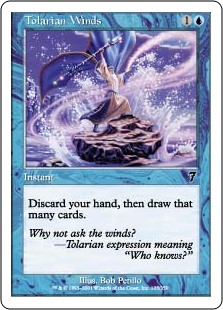
As a Miracle Grow-deck enthusiast and Magic player generally, I'm very interested in resource management. Land drops, cards in hand, and life points are all resources players tap into during games. Mulligans are another, though often overlooked. At the start of each game, players have the ability to turn one of the cards in their hands into a zero-mana Tolarian Winds. Having this ability is incredibly powerful and should never be taken for granted.

ImageThe point of a mulligan is to start the game with a hand that has a better chance of winning than the current one. Simple enough, but things get tricky when it comes to the "better chance"---it's impossible to know if one hand is objectively more likely to win than another. Still, skilled players take more successful mulligans than unskilled ones, so expertise is a factor at work. I think the most efficient way to improve at taking mulligans is to practice, and to pay close attention to openers and how games play out with different hands. My advice for anyone afraid of taking mulligans: when in doubt, send it back! At worst, you lose; at best, you improve.
Mulliganing is especially important in Modern, a turn-four format with plenty of linear decks that attack from various angles. Many strategies lean heavily on their ability to mulligan when it comes to beating them.

I've organized the types of mulligans into three categories, based on how obvious it is that a hand should be shipped.

Type 1: Obvious Mulligans

Obvious mulligans are the least complicated of the bunch. These mulligans take very little time to resolve---you look at your hand, quickly determine it unplayable, and ship it away. Since obvious mulligans are so intuitive, I won't spend much time here, but I do want to outline the different types. Sometimes, hands that at a glance look like obvious mulligans have more going on than meets the eye.

No-Landers

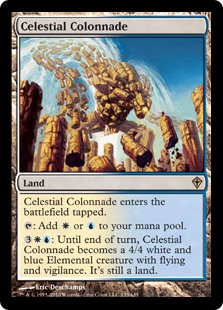
Celestial ColonnadeOutside of that's-not-Magic decks like Dredge, it's almost never correct to keep a no-lander. These hands fall into the basic trap of "if I only drew ___." In Modern, even a hand full of one-drops is unlikely to win a game if it never makes a second land drop, meaning no-landers require players to draw two lands to reap any rewards.
Six-Landers

Hands with six or seven lands are also unkeepable. Off the top of my head, I can't think of a matchup where a player would want to make six consecutive land drops badly enough to risk not casting any spells for six turns. This format has plenty of decks that punish slow starts. Even the grindy decks can turn the corner quickly when they need to. Modern's control decks are more proactive than those in other formats; in draw-go mirrors, six-landers open you up to on-curve Snap-Serums and Nahiris.

Type 2: Deceptive Mulligans

These are "trap hands," or hands that might look keepable but will realistically win a very small number of games. Inexperienced players almost always keep these hands. When I teach people to play Magic, one of my earliest lessons involves recognizing trap hands and learning to ship them away fearlessly.

Too-Slow Hands

Frequently called "hands that do nothing," too-slow hands do have plays, but not until later in the game. An example hand that falls into this category, from Jund:

Liliana of the Veil, Kalitas, Traitor of Ghet, Tasigur, the Golden Fang, Raging Ravine, Twilight Mire, Blackcleave Cliffs, Forest

These kinds of hands can be keepable in the right matchup, but in the dark, they should always be shipped. With this hand, Jund doesn't get to play Magic until turn three. Burn, Affinity, and Infect would walk all over this hand, and opponents with a little disruption can also pose problems. What if your Liliana gets Thoughtseized? Suddenly, you don't get to play Magic until turn four. And by then, your opponent might very well be beating you with an unanswerable Tarmogoyf.

One-Landers

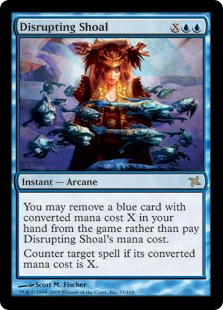
Disrupting ShoalLet's be real: I keep one-landers all the time. An important distinction to make here is that I mostly play decks that mulligan frequently, and that are built to function on few lands. Modern is a format dominated by midrange and aggro, so most decks aren't built that way. Here's an example one-lander I would keep:
Delver of Secrets, Tarmogoyf, Lightning Bolt, Thought Scour, Disrupting Shoal, Simic Charm, Scalding Tarn

I have certain rules with Temur Delver when it comes to shipping one-landers. My favorite is that a cantrip is not enough to keep a one-lander unless it's a Serum Visions. Beyond that, a hand needs two "bad" cantrips (Thought Scour, Gitaxian Probe) and something else for me to want to keep it. One exception is a hand with two Delvers, which I'll keep even without any cantrips. The hand above demonstrates another exception, which is that it has lots of plays even if I don't find a second land. Bolt is an extremely potent interactive tool in Modern, and Shoal acts as a Spell Snare or a Mental Misstep in this hand if I need it to. I even have Scour to dig for the second land once I've exhausted my interaction, and power play in Tarmogoyf to capitalize on pulling that land.

Like most tempo decks, Temur Delver loves to mulligan and doesn't love making land drops. Midrange decks feel the opposite way. Here's a one-lander to stay far, far away from:

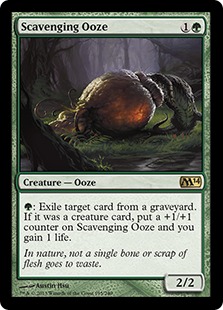
Inquisition of Kozilek, Liliana of the Veil, Scavenging Ooze, Lightning Bolt, Tasigur, the Golden Fang, Maelstrom Pulse, Blackcleave Cliffs

Scavenging OozeThis hand has a couple pieces of early interaction in Inquisition and Bolt, as well as some respectable plays later on. But that "later on" is pretty distant. If Jund draws a Forest, it can make Scavenging Ooze, but the Ooze doesn't stand his ground very well on the board this early in the game. The real money cards, Tasigur and Liliana, won't land until the third land drop is made.
If this hand had a Tarmogoyf or a Dark Confidant instead of Scavenging Ooze, it would be much better. But I still wouldn't call it acceptable. Midrange decks like Jund have serious difficulty keeping one-landers, which explains why they play so many lands in the mainboard, often sitting around 24. For comparison, Temur Delver plays 17!

Aggressive decks, with their low curve and land count, churn out seductive one-landers more than any other. But it's still usually wrong to keep them. Here's an example Affinity hand that I would, after some deliberation, shuffle back into the deck:

Steel Overseer, Memnite, Cranial Plating, Etched Champion, Blinkmoth Nexus, Galvanic Blast, Ornithopter

This hand has enabling artifact weenies and big payoff cards, but it lacks the mana necessary to deploy them in rapid succession. One thing this hand has going for it is that it's pretty explosive if it does draw a land. Then again, opponents can neutralize the Overseer any number of ways, after which they only have some Plating-equipped Memnites to worry about. The prospect of landing and suiting up the Champion is probably too far off with this hand to seriously consider before the game begins, since Affinity needs two mana sources to make that play.

Players also need to be aware of how opponents can interact with their one-land hands. In this example, URx can practically stabilize with a single Electrolyze, and a discard spell out of BGx can turn the hand to chaff by snatching Cranial Plating. Considering widely-played Modern answers, and understanding what they do to a hand, is invaluable to taking good mulligans.

A big difference between the above Temur Delver hand and the subsequent Jund and Affinity hands is that the Delver hand can use all of its cards except for Tarmogoyf with its one land. The other two hands need more cards to get moving.

Hands That Don't Follow Your Gameplan

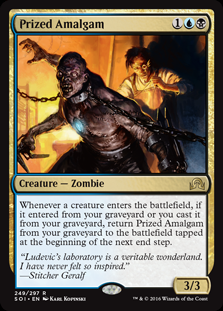
Prized AmalgamYou're Dredge in a post-board game against Temur Delver. Your opponent keeps seven cards, and you ship an obvious mulligan to end up with six. What do you do with this hand?

Prized Amalgam, Lightning Axe, Faithless Looting, Blackcleave Cliffs, Blackcleave Cliffs, City of Brass

This hand has mana, a removal spell, and a way to dump dredgers. But it doesn't have any dredgers! I was testing with a buddy last week, and he kept this six. It did not beat me.

Dredge is pretty linear, but its gameplan shifts in different matchups. Against Affinity, a hand full of interaction would be keepable. In this matchup, I don't think so. The deck wants to get going as soon as possible, and this hand just doesn't do that. It kills one creature, casts Looting, and then sits around waiting for Golgari Grave-Troll. Against Temur Delver, and a fair share of proactive Modern decks, waiting for Troll is not a winning line.

Certain decks need a combination of a few card types to succeed. Dredge is one of them---it needs a dredger, a way to dump that dredger, and some mana. Temur Delver is another, counting on threats, interaction, and land. Manipulation can take the place of any of these pieces, since it helps get to the ones players need; that's why cards like Serum Visions prove so invaluable for tempo strategies in general. Here's a Temur Delver hand I would never keep in Game 1:

Snapcaster Mage, Simic Charm, Breeding Pool, Scalding Tarn, Hooting Mandrills, Steam Vents, Mana Leak

Hands like these are the reason Temur Delver plays Thought Scour and Gitaxian Probe. The presence of either over a land, or even over Leak or Charm, would fix this hand. Engine-grease cards can unbrick these hands by helping us cast Hooting Mandrills on time, or giving us something to do with Snapcaster. Otherwise, as is the case with this hand, they're just too durdly. Three lands is far too many, and it doesn't seem like we'll be attacking until turn four. Simic Charm doesn't do much if it's not protecting a threat. We have some interaction with Mana Leak, but it's too slow to matter against decks like Burn and Infect.

This kind of hand might be palatable in something like Temur Midrange, which runs Huntmaster of the Fells and sometimes Cryptic Command in the mainboard to take advantage of opening so many lands. But that deck has a different game plan than Temur Delver, and can therefore keep different sorts of hands.

Type 3: Situational Mulligans

Types 1 and 2 describe hands players would be categorically wrong to keep. When we discuss mulligan decisions, we're almost always referring to situational mulligans. These are the hands that don't offer a clear path. They tend to be very divisive among players, as shipping them comes down to individual goals and personal preference.

Hands That Lack Game-Winning Hate

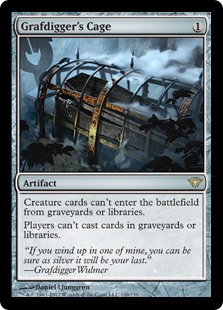
Grafdiggers CageSome decks have post-board plans that involve bringing in and aggressively digging for specific hate cards. Stony Silence, Grafdigger's Cage, and Spellskite are all examples of cards so important in certain matchups that it becomes preferable to mulligan otherwise reasonable hands that lack them. Against Affinity, for example, many hands from Abzan Midrange are just too slow to interact efficiently.
Abzan's strength lies in its ability to "go bigger" than other BGx midrange strategies with Lingering Souls and Siege Rhino (not sure how meta-relevant this concept is anymore, but let's go with it for the sake of the argument). It would be silly for Abzan to redesign its mainboard to enable easy role-shifting post-board to beat Affinity, since that would rob the deck of its strengths against the rest of the field. Abzan also doesn't have access to elegant two-for-ones like Ancient Grudge.

The ideal solution, then, is to board in some number of Stony Silence, a card that shuts Affinity players out of key cards and multiple mana sources, and to dig for them the only way most non-blue decks know how: with mulligans.

Risky Hands

Perhaps the most contentious mulligans involve risky hands. Mulligans become simple when the risk can easily be identified; if the presumed risk of this hand not winning is greater than the presumed risk of a new, smaller hand not winning, players mulligan. In many ways, skillful mulligans depend on an ability to estimate the risk of keeping or shipping a hand. But some hands can prove very difficult to analyze. Take this one:

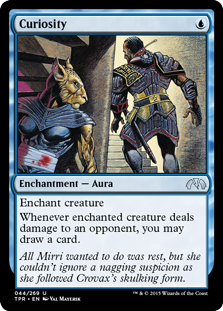
Delver of Secrets, Curiosity, Scalding Tarn, Mana Leak, Lightning Bolt, Simic Charm, Hooting Mandrills

Our play is to fetch Steam Vents, cast Delver, suit it up with Curiosity, and go to town looking for land drops. We also have Lightning Bolt to disrupt opposing plays. The risk with this hand is that a single Lightning Bolt from the opponent can throw it way off-kilter. Steam Vents won't cast Hooting Mandrills, and we'll be groping in the dark for a land drop to even be able to play Magic. Of course, if we do find a second land quickly, this hand becomes very good.

As players improve, so does their ability to make deliberate decisions about whether hands are keepable or not, and move them into the Type 2 category of mulligans. But there are plenty of hands (in fact, an infinite amount) that even seasoned Magic veterans will have trouble deciding on. I feel that's what makes this game so great.

The Acquired Taste of Gabagool

curiIn part thanks to my own curiosity, I might keep the risky Delver hand above. I like observing how interesting hands play out. After all, only 46% of all Modern decks play Lightning Bolt! I'm also big on challenging my deck to get me through tight spots, and measuring its strengths and weaknesses in different scenarios. Mulligans are so fun because there often isn't a right or wrong answer---only interesting decisions and endless learning opportunities. Openers are some of my favorite things to discuss, and I'd like to hear about some of your own questionable hands in the comments. And don't hesitate to point out if I missed a certain kind of mulligan in my skeletal overview. Until then---and I mean this in the nicest way possible---may you send it back!
Jordan Boisvert

Jordan is Assistant Director of Content at Quiet Speculation and a longtime contributor to Modern Nexus. Best known for his innovations in Temur Delver and Colorless Eldrazi, Jordan favors highly reversible aggro-control decks and is always striving to embrace his biases when playing or brewing.

View More By Jordan Boisvert

Posted in Modern, Strategy, TheoryTagged , , , 8 Comments on Living With Less: Modern Mulligans

Have you joined the Quiet Speculation Discord?

If you haven't, you're leaving value on the table! Join our community of experts, enthusiasts, entertainers, and educators and enjoy exclusive podcasts, questions asked and answered, trades, sales, and everything else Discord has to offer.

Want to create content with Quiet Speculation?

All you need to succeed is a passion for Magic: The Gathering, and the ability to write coherently. Share your knowledge of MTG and how you leverage it to win games, get value from your cards – or even turn a profit.

“Pre-ordering” and Puca Trade

Are you a Quiet Speculation member?

If not, now is a perfect time to join up! Our powerful tools, breaking-news analysis, and exclusive Discord channel will make sure you stay up to date and ahead of the curve.

I've written about Puca Trade before with regard to the flaws of using TCG mid as a system for valuing cards, and yesterday I came accross a Reddit thread exposing a store who abused this metric to try to scum some players on Eternal Masters cards. To get up to speed on the particulars, you can find the thread here.

Basically, you can set up a want list before a set launches, and stores can post cards at higher prices to inflate the average price. A store called The MTG Place was inflating prices, and then sending cards for inflated Puca Point values to members of Puca Trade. Fortunately, by using accounts of the same name on both sites this scam was easily exposed, and The MTG Place has been banned from Puca Trade. To my knowledge no action has been taken by TCGPlayer, and there's really no issue with what was done with regard to matters only involving TCGP, and as such I wouldn't expect any action from them. It's only because of Puca Trade's system that it becomes problematic for others to list your inventory at a price that nobody would spend.

I have been told that paid accounts on Puca Trade enable users to set a max value that they would spend on a card, and while I don't know that I would spend money on a Puca Trade account, I do know that I would not maintain a want list on the site without this feature. A system with prices based on averages is easily exploitable, and while my personal preference would be that Puca Trade put effort into setting card values that were at least difficult to manipulate, given the current system the best I can do is to advise users of the flaws of the system.

If you list cards on TCGPlayer to inflate prices on Puca Trade, frankly getting banned on Puca Trade is the minimum punishment that you deserve. For honest traders, just remember that you can't always expect honesty from everybody else.

Avatar photo

Ryan Overturf

Ryan has been playing Magic since Legions and playing competitively since Lorwyn. While he fancies himself a Legacy specialist, you'll always find him with strong opinions on every constructed format.

View More By Ryan Overturf

Posted in Free2 Comments on “Pre-ordering” and Puca Trade

Have you joined the Quiet Speculation Discord?

If you haven't, you're leaving value on the table! Join our community of experts, enthusiasts, entertainers, and educators and enjoy exclusive podcasts, questions asked and answered, trades, sales, and everything else Discord has to offer.

Want to create content with Quiet Speculation?

All you need to succeed is a passion for Magic: The Gathering, and the ability to write coherently. Share your knowledge of MTG and how you leverage it to win games, get value from your cards – or even turn a profit.

Virtually Infinite – Winning at Eternal Masters Draft, Part 2

Are you a Quiet Speculation member?

If not, now is a perfect time to join up! Our powerful tools, breaking-news analysis, and exclusive Discord channel will make sure you stay up to date and ahead of the curve.

This series is dedicated to helping you go infinite on MTGO through a combination of playing and investing better. Today we bring you the second in our series on beating EMA draft alongside our two draft gurus: Matthew Watkins and Bing Luke. Part One of the series looked at rareshifts and underrated cards in each color—check it out here.

As we discussed yesterday, there are ten two-color pairs in Eternal Masters:

  • W/U Flying Matters
  • U/B Reanimator/Recursion
  • B/R Sacrifice
  • R/G Fast Aggro
  • GW Enchantments
  • W/B Enters-the-Battlefield Effects/Blink
  • U/R Flashback/Retrace
  • B/G Elves
  • R/W Tokens
  • U/G Threshold

There may also be other “hidden” archetypes, as well as particular three- and four-color combinations that have synergy. I asked Matthew and Bing their views on the format, and in particular their views on the ten archetypes Marshall Sutcliffe identified. Would these be “strong” archetypes, like in Lorwyn, where you really can’t win if you aren’t in a tribe, or “weak” archetypes where they add value but aren’t essential?

“With Lorwyn on Magic Online flashback, it's a great opportunity to revisit what a format on rails looks like and how different it looks from draft formats nowadays,” wrote Bing. “In Lorwyn, the strongest decks can play any card that have the respective creature type in the text box (Elvish Eulogist being a prime example of a card that goes from filler to unbeatable once you have 15+ elves). Most of the archetypes in Eternal Masters appear based on the synergies that have a more straightforward relationship with card power to deck power.”

“This feels a little more like a standard limited set with modern design principles than something like a cube or Vintage Masters. The ‘build-around-me’ uncommons are based off of strong synergies (like Intangible Virtue, Timberwatch Elf, and Animate Dead), but don't include format-warping cards like Lightning Rift or Brain Freeze."

"There are also a number of incredibly strong commons across all colors that can by themselves lead to some pretty busted decks depending on how many you get. My initial reaction is that the best decks will have a critical mass of overpowered commons that are supported by on-theme uncommons or rares rather than being a deck that only does its one thing very well.”

Matthew had a slightly different take: “This is very much an archetype-based format, like the other Masters formats. I think that you are heavily advantaged to read the signals and get into the correct archetype as soon as possible and then try to squeeze out every ounce of synergy you can. Every deck gets powerful cards in this format; it's a very deep format where virtually every common and uncommon is there to fill a specific role in an archetype. If you aren't building on synergy, then you are losing the only edge you are going to get.”

For Matthew, the deepest colors are green, red and blue, in that order. “I think any deck in those colors is going to be pretty solid by the end of the draft. However, the colors are all so strong and deep that I think going for the ‘safe’ color is a huge mistake. A decent archetype deck is going to be stronger than even a very good ‘good stuff’ deck.”

Archetypes

W/U Flying Matters

Archetype payoff

Traditional skies version

Tempo version

It looks like the set will support two distinct versions of the W/U Flyers deck. The first is a more traditional “skies” deck that seeks to lock down the ground and use evasive threats to kill the opponent in the mid game. The second is a more aggressive tempo deck that will look to play threats early and back them up with removal and bounce to win the race.

The first set of cards is strong in either deck, but the others will probably only flourish in one type or another. (Note that I didn’t mention Swords to Plowshares or Pacifism here—both are first-pick quality removal that are great in any white deck.)

Matthew "considered putting the white-blue deck in the top five, but my concern is that the synergy just won’t be enough to compete against strategies like Vengeance, Threshold, or Elves. I would be glad to be wrong about that, since W/U Flyers tends to be one of my favorite decks to draft in most formats. But white-blue also has the problem of just not having the powerful commons that red gets in Firebolt and Carbonize, as well as missing out on the depth and versatility that you get from green."

U/B Reanimator/Recursion

Archetype Payoff

Blue and black have a lot of great control and card advantage elements. There is also a reanimator and recursion sub theme which will allow the deck to cheat in a fatty in the early game or grind out value in the late game.

I think the jury is out on this. Matthew notes, "I don’t think a reanimator strategy is a good idea unless you pick up multiple Ingestors. Instead, I think it’s powerful to center the deck around a control strategy that leans on value creatures to hold and trade on the ground, and then uses reanimation spells to recycle that value. Of note, Animate Dead is an aura that probably splashes really well in into the white-green deck."

Bing writes, "I was viewing reanimation as having two main routes. The first is the more traditional reanimation strategy, but this is contingent on opening one of the premium targets like Sphinx or Inkwell. Without those cards, it might be good enough to have cards like Jetting Glasskite or Prowling Pangolin if you get them out on turn two or three, but which are still castable on curve."

Contingent on premium targets

In other words, reanimation is a tool in the kit, but you'll need other tools as well. Fortunately, blue and black have some strong control elements and defensive creatures that can hold the ground while you're up to no good. Merfolk Looter is strong in most blue decks, but really shines here. Even better, some of the key cards for the blue-black control deck will table because no one else wants them (I'm looking at you, Urborg Uprising and Innocent Blood).

B/R Sacrifice

Sacrifice Payoff

Sacrifice Fodder

This deck combines a bunch of seemingly mediocre cards together with strong synergies, similar to B/R Goblins in Lorwyn. It is probably best played aggressively, though there will be midrange versions as well that use recursion to accrue value.

Neither Bing nor Matthew had much enthusiasm for this deck, which suggests it may also be overlooked at draft tables. That doesn't mean it's good, but if it's open there are multiple redundant cards that can combine into a powerful strategy.

R/G Fast Aggro

Fast Aggro (?)

Matthew argues that R/G Fast Aggro isn't a thing. Obvious it was designed to be so, but it turns out that most of the green cards are more suited for a midrange deck, and the "fast aggro" cards are just weak in general. Instead, the red-green deck is more of a good stuff midrange deck that leans on great green creatures and powerful removal spells, as well as being a great color for splashing.

G/W Enchantments

The Payload

The Fuel

Green-white has a lot of aggressively costed cards. It also has an enchantment subtheme. As you can see, there are only a few cards that pay you for playing enchantments, so don't move into this deck unless it's open. This deck did not appear on Bing or Matthew's radar.

W/B Enters-the-Battlefield Effects/Blink

Key ETB Creatures

ETB Enablers

By Matthew's reckoning, "W/B Enters the Battlefield isn't a thing. Yes, they tried to go there, but there simply isn't enough support for the archetype. The deck leans way too hard on Whitemane Lion, without paying you off like it should. It really needed more flickering at common for that deck to be a thing. Instead, you just get a white-black midrange deck that probably isn't good enough unless you get a ton of great removal, which could definitely happen."

U/R Flashback/Retrace

The Payoff

The Enablers

Matthew argues that "calling the blue-red deck Flashback is very misleading, since the flashback deck only really exists if you have Burning Vengeance. Yes, there's a great U/R Burning Vengeance deck, but trying to force that every time you end up in blue-red will be pretty disastrous. However, the blue-red deck is still probably one of the strongest decks in the format on the back of three very powerful common bounce spells in Man-o'-War, Silent Departure, and Stingscourger. A blue-red tempo deck with powerful flashback spells to close out the late game seems awesome."

U/R Tempo

With all the aggressive creatures in red and blue, getting in some early damage shouldn't be hard.

B/G Elves

Elves!

This is the only tribal deck in the set, and provides a fairly linear strategy. Do not underestimate these folks. As Matthew mentioned in the last article, Timberwatch Elf is bonkers, and there are enough incidental elves that even non-dedicated decks will find a home for some of these synergies.

R/W Tokens

The White-Red Horde

White-red is super aggressive, whether you're seeking to go wide or not. In the token deck, the idea here is to go wide and overwhelm the opponent with an aggressive swarm backed by pump effects and burn. Rally the Peasants is a total beating at common and will steal some games. As with white-black, Whitemane Lion and Glimmerpoint Stag will be in high demand so take them early.

U/G Threshold

This one is pulled right from Odyssey block, but with a few nice additions.

Threshold and Flashback

If you can get a Wonder in this deck you're golden---your fatties will outclass anything else in the air. This deck lacks removal but has a tempo, bounce and card advantage strategy that is hard to keep up with.

Other Decks

So what do we miss when we only look at the two-color pairs?

Bing: "I can imagine some great decks that go real deep on Hondens. Otherwise, the fixing doesn't seem very deep, so any deck that goes above two colors is going to need some strong rewards. Initially, Jund or Sultai look like the best fit for a "good stuff" deck, full of independently strong cards. That being said, there are some great rares and mythic rares that I could easily see trainwrecking my mana to fit them into my 40. If I open Jace, the Mind Sculptor in my pack three and I'm not blue, I'm going to find a great excuse before I pass it."

Matthew: Of the archetypes that didn't get covered, "one of them is, I suspect, the best archetype in the format: RGu Burning Vengeance. Yes, the U/R Vengeance deck looks great, but I suspect that the R/G Vengeance deck is the optimal build. A red-green deck can lean on Abundant Growth, Pilgrim's Eye and Civic Wayfinder to fix mana while also generating velocity in the deck. But the key card comes in Commune with the Gods."

RGu Burning Vengeance Enablers

"This common lets you dump a bunch of cards into your discard pile while also finding Burning Vengeance. You even get good flashback spells in Sylvan Might and Roar of the Wurm. The really powerful part is that you still get to splash all the blue flashback and retrace cards that you want."

"[Another uncovered] archetype is 5-Color Green. This set gets three powerful common fixers on top of the full cycle of Khans of Tarkir gain lands. That by itself is not enough to create a five-color archetype, but this set has so many powerful bombs and removal spells that it would not be hard to find good reasons to play all five colors. There are both an abundant amount of fixers, as well as some powerful bombs and removal, even at the uncommon level. On top of that, you can lean on the RUG Hondens for a powerful long game if you are already in three colors."

Conclusions

So what’s our verdict? Which archetypes do you want to be in?

Matthew: I would rank the top-tier archetypes in some order close to the following:

(0.) Decks with Burning Vengeance
1. RGu Midrange
2. B/G Elves
3. U/G Threshold
4. U/R Tempo
5. R/W Tokens

The decks I'm most excited to try are the following:

1. U/G Threshold
2. B/G Elves
3. U/B Control/Recursion
4. W/G Enchantress
5. 5-Color Green

The one combo I would avoid is white-black unless I just have an incredible density of removal, but even then I'd probably move into one of the other colors and just splash either white or black.

For Bing, "I'm looking forward to having those busted decks with the commons that get really stupid in multiples. Something like the seven Squadron Hawk deck, or four Elvish Vanguards with a Wirewood Symbiote."

When asked if he had final thoughts Bing replied, "I would like to use this to reiterate that it is simply wrong that Silvos, Rogue Elemental is just an Elemental and not an Elemental Rogue."

There was an error retrieving a chart for Silvos, Rogue Elemental

Good luck this weekend going rogue, whichever way you choose to do it... Let us know your thoughts in the comment section, and enjoy your drafting!

-Alexander Carl
@Thoughtlaced

Insider: Using Eternal Masters to Get Into Legacy

Are you a Quiet Speculation member?

If not, now is a perfect time to join up! Our powerful tools, breaking-news analysis, and exclusive Discord channel will make sure you stay up to date and ahead of the curve.

While I've previously expressed my skepticism that Eternal Masters (EMA) will garner any significant interest in Legacy as a format, that's not to say there won't be any ways to make money off the set. The first-time foils in EMA are exciting targets, though I believe there are other long-term targets that will be worthwhile.

The Reserved List is indeed a barrier to the growth and general sustainability of Legacy as a format. But Legacy is still capable of drawing large crowds for events, and there are plenty of people who are interested in buying in who haven't yet. While many of these people will never purchase a $200+ card to this end, Legacy currently has some very powerful options that can be had on a relative budget.

The Eldrazi

The current breakout deck in Legacy is Colorless Eldrazi. The deck can be built from scratch for about $1,500, which isn't exactly cheap, though I imagine very few people are just going out and buying entire Legacy decks. This isn't Standard, and you aren't building the deck for this weekend. It's an investment that will hold value for some time, and you can take your time developing a sound strategy to invest in it.

Devin Keopke's Top 8 list from the Atlanta Classic is a good baseline for the deck:

Colorless Eldrazi

Creatures

4 Eldrazi Mimic
2 Endbringer
4 Endless One
4 Matter Reshaper
4 Reality Smasher
4 Thought-Knot Seer

Spells

4 Chalice of the Void
2 Dismember
4 Thorn of Amethyst
2 Umezawa's Jitte
1 Warping Wail

Lands

4 Ancient Tomb
4 Cavern of Souls
4 City of Traitors
4 Eldrazi Temple
3 Eye of Ugin
2 Karakas
4 Wasteland

Sideboard

3 Ashen Rider
1 Dismember
4 Leyline of the Void
2 Pithing Needle
3 Warping Wail
2 Winter Orb

The only Reserved List card from this deck is City of Traitors. City just exploded, though is unlikely to see another spike in the immediate future. That said, there's really no reason for the value to decrease, so if you want to build this deck I'd intend to sink $400 into your set of Cities sooner rather than later.

The creatures for this deck are all Standard-legal, and you either already own them or will be able to get them cheaply upon their exit from the Standard format. Despite play in other formats, there will always be somebody willing to sell something at the time of rotation on the cheap.

Cavern of Souls is quite pricey at the moment, and Umezawa's Jitte and Chalice of the Void are on the expensive side as well. It has been a while since these cards were last printed and none are likely to show up in a Standard-legal expansion. That said they are all re-printable in some capacity, and there's no strong indication that right now is the best window to buy into these pieces.

If you have the funding to buy the deck outright, these in all likelihood won't be reprinted soon and are likely to increase in value between now and the time of a reprinting. There are other pieces of the deck, however, that are entering a better window for purchase. I will say that Cavern of Souls specifically continues to grow in popularity and is realistically a solid spec even at its current price.

There was an error retrieving a chart for Cavern of Souls

Karakas and Wasteland are both in EMA, and as copies of the new printings enter the market the new few weeks will be the ideal time to buy into these cards.

The other prime buys in the deck are Eye of Ugin and Eldrazi Temple. Eldrazi Temple dipped with the Eye ban in Modern but has started to show up in Modern again already. Eye of Ugin itself looks to be at a floor as players pick up copies for casual formats and Legacy.

Death & Taxes

A similar deck at a similar price that's a good springboard into the Legacy format is Death and Taxes. The key difference between the two decks from an investment standpoint is that nothing from D&T is on the Reserved List. To some extent, this means that your investment is more liable to potentially lose value, though from the perspective of buying into a format it means that there's nothing like the guaranteed cost of a $400+ set of City of Traitors.

There are a few variations in how to build D&T, though the Classic-winning list from Atlanta is a good baseline.

Death and Taxes

Creatures

4 Phyrexian Revoker
4 Eldrazi Displacer
3 Flickerwisp
4 Mother of Runes
4 Stoneforge Mystic
1 Vryn Wingmare
2 Mangara of Corondor
4 Thalia, Guardian of Thraben

Spells

4 Aether Vial
1 Batterskull
1 Sword of Fire and Ice
4 Swords to Plowshares
1 Umezawa's Jitte

Lands

11 Plains
2 Mishra's Factory
4 Rishadan Port
4 Wasteland
2 Karakas

Sideboard

1 Grafdigger's Cage
1 Pithing Needle
2 Ethersworn Canonist
2 Containment Priest
2 Veteran Armorer
1 Leyline of Sanctity
1 Rest in Peace
1 Warmth
2 Path to Exile
1 Gideon, Ally of Zendikar
1 Cataclysm

There are a lot of great buys for this deck right now. Phyrexian Revoker was very recently in Standard and with core sets being removed and Phyrexia no longer part of the story it's unlikely to re-enter Standard. It's a very good buy at less than a buck, and foils aren't terribly expensive either.

Stoneforge Mystic is the current Grand Prix foil, and if you don't mind playing foils, odds are that you know people who play GPs who wouldn't mind trading their promo for your $10. That's burrito money.

There was an error retrieving a chart for Stoneforge Mystic

Again, we have a Karakas and Wasteland deck, both of which will be good buys soon. The most significant barrier to playing this deck is Rishadan Port. Port spiked recently, which makes now a pretty miserable time to buy. It is reprintable, though, and is likely something that WotC has in mind to boost sales of a future release---perhaps a second Eternal Masters two years from now.

If you're patient you can wait until then, and either way this shouldn't be a priority purchase to build the deck at this time. Aether Vial is on the expensive side as well, and it wouldn't be terribly surprising to see it get another printing within the next year.

Elves

The last deck that I want to talk about today that's largely resistant to the Reserved List is Elves. This is another deck in the $1,500 range, and like Eldrazi has an expensive Reserved List card in Gaea's Cradle.

Cradle is more expensive than City of Traitors and doesn't have the upside of also fitting into other decks. If you're really into Glimpse of Nature though, then a set of Cradles will cost you somewhere in the ballpark of $600. A couple Bayou will add $200+ to that cost as well.

Here's James Hess' Top 8 list from the Atlanta Classic:

Elves!

Creatures

2 Birchlore Rangers
2 Craterhoof Behemoth
4 Deathrite Shaman
4 Elvish Visionary
3 Heritage Druid
4 Nettle Sentinel
4 Quirion Ranger
1 Reclamation Sage
4 Wirewood Symbiote

Spells

1 Sylvan Library
4 Glimpse of Nature
4 Green Sun's Zenith
4 Natural Order

Lands

2 Forest
2 Bayou
1 Cavern of Souls
4 Windswept Heath
4 Wooded Foothills
4 Gaea's Cradle
1 Pendelhaven
2 Dryad Arbor

Sideboard

1 Pithing Needle
1 Elderscale Wurm
1 Scavenging Ooze
1 Shaman of the Pack
4 Abrupt Decay
1 Surgical Extraction
1 Progenitus
1 Ruric Thar, the Unbowed
4 Cabal Therapy

Apparently this is a 61-card deck, so you want to cut... something. At any rate, there are a few reprints in EMA for this deck that will be good pickups soon:

While you'll want to pick all of these up very soon, the best buy from the deck right now might be Glimpse of Nature. With so many reprints and the deck being relatively inexpensive for Legacy, Glimpse of Nature at a mere $17 is pretty low. The card has gained a small amount of value since EMA was spoiled, and I anticipate this growth will continue.

There was an error retrieving a chart for Glimpse of Nature

There are certainly other good buys in EMA, such as Sensei's Divining Top, Mana Crypt, Force of Will, Entomb, Sinkhole... Actually the list is rather long, though the primary point of this article was to outline a strategy to start playing Legacy. All three decks highlighted are both inexpensive relative to the format and quite competitive.

Unfortunately, if you're looking to play Force of Will in Legacy then your deck will be more expensive than these options, though the principles outlined here will translate to any Legacy deck. The Reserved List cards aren't going down in price, the freshly reprinted cards are, and with regard to everything else you just want to be mindful of whether the card will be reprinted soon and to invest or wait accordingly.

Thanks for reading,

-Ryan Overturf
@RyanOverdrive on Twitter

The Colors of Modern – Part Two: Blue

Are you a Quiet Speculation member?

If not, now is a perfect time to join up! Our powerful tools, breaking-news analysis, and exclusive Discord channel will make sure you stay up to date and ahead of the curve.

Last week, I began a five-part series focused on analyzing the varying impact each color in Magic has upon Modern, based on the individual cards that see play in the format and, to a broader extent, the archetypes made possible by these cards. If you missed last week’s article on white, check it out there; I’ll be using a similar format but elaborating in a few key areas. Through this analysis, our goal should be to highlight a large (but not comprehensive) list of some of the key blue cards in Modern, and with it gain some insight as to the relative strengths and weaknesses blue provides in the format. Through this process we can gain a better understanding of blue’s color identity, what it does best, where it struggles, and how it can be improved through future innovation. Let’s begin!

Cryptic-Command-cropped

The Cards

Staples

  • Snapcaster Mage
  • Serum Visions
  • Ancestral Vision
  • Spell Snare
  • Mana Leak
  • Remand
  • Dispel
  • Jace, Vryn's Prodigy

Sideboard Powerhouses

  • Kira, Great Glass-Spinner
  • Teferi, Mage of Zhalfir
  • Hurkyl's Recall

Strong Options

  • Vendilion Clique
  • Blighted Agent
  • Cryptic Command
  • Various Merfolk cards
  • Jace, Architect of Thought
  • Pact of Negation

[wp_ad_camp_1]

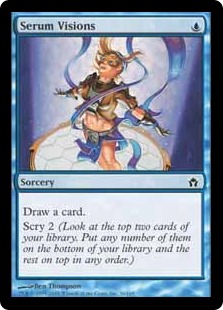
Blue’s color identity in Modern is almost singlehandedly defined by one thing: card advantage and selection. Its best three spells (Serum Visions, Ancestral Vision, and Snapcaster Mage) all are focused on generating advantage of some form, be it re-buying spells, cantripping with selection, or just a delayed Ancestral Recall. Serum VisionsAny archetype with access to blue will almost automatically include 4 Serum Visions and 4 Snapcaster Mage, and every list that these cards supplement is arguably better and more consistent for it. The importance of card advantage is generally well known in the Magic community. Understanding why it's so crucial will help us identify blue's role in Modern.
The inherent variance of Magic that lies at the core of every game and allows for variation in gameplay and replayability is simultaneously a boon and a curse for Magic players everywhere. We’ve all been victim to fate, whether we call it “variance,” “bad luck,” “mana-screw,” or a million other terms---the fact remains that Magic games are often decided by the order of the cards, and access to library manipulation can drastically shift a player’s odds. Scrying with Serum Visions to dig deeper for specific answers, sideboard powerhouses, or even simply more lands/more action can often be the difference that sways the course of an entire game. Bottoming two lands that we otherwise would have been forced to draw can avert disaster, and that’s just one of the surface-level uses that Serum Visions can provide.

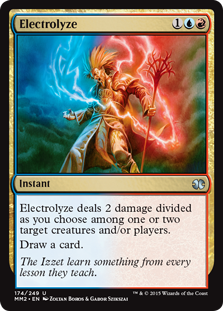
ElectrolyzeThe fundamental principle of card advantage is relatively straightforward. Access to more resources to leverage against an opponent will translate into greater material advantage in the end, all things being equal. Electrolyze killing a Dark Confidant and cantripping counts as card advantage, as does Izzet Staticaster invalidating a plethora of opposing creatures out of Abzan Company/Infect/Affinity. Card advantage rarely has to include the actual words “draw a card” printed on a piece of cardboard, but of course blue does that quite well too.
Note that cantrips like Serum Visions don't technically generate card advantage, but for the purposes of reducing variance they do the trick just fine. In the late game especially, bottomed lands often are virtually identical to extra drawn cards, as the eighth land drop (and so on) typically isn't worth a full card.

With this main strength in mind, let’s take a look at a few lists that seek to push this element of card advantage as a main path to victory.

Jeskai Control, by Francis Cellona (9th, GP Los Angeles)

Creatures

4 Snapcaster Mage
1 Emrakul, the Aeons Torn

Instants

2 Cryptic Command
4 Lightning Bolt
2 Lightning Helix
2 Mana Leak
4 Path to Exile
2 Remand
2 Electrolyze
2 Spell Snare

Sorceries

4 Serum Visions
1 Supreme Verdict

Planeswalkers

4 Nahiri, the Harbinger
1 Tamiyo, the Moon Sage

Lands

1 Arid Mesa
4 Celestial Colonnade
4 Flooded Strand
2 Ghost Quarter
2 Hallowed Fountain
2 Island
1 Mountain
1 Plains
1 Sacred Foundry
4 Scalding Tarn
2 Steam Vents
1 Sulfur Falls

Sideboard

2 Anger of the Gods
1 Crumble to Dust
1 Dispel
1 Elspeth, Sun's Champion
1 Izzet Staticaster
2 Negate
1 Rest in Peace
2 Stony Silence
2 Timely Reinforcements
2 Vendilion Clique

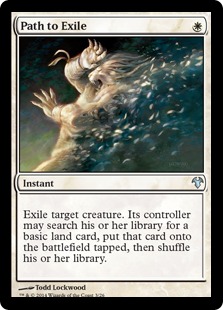
The purest form of a “card advantage engine” available to us in Modern, Jeskai Control is built to accomplish one purpose: survive. Besides lands and one true win condition, every card in the deck is focused on either making exchanges with the opponent or pulling ahead with card advantage. Path to ExileHere we see Serum Visions and Snapcaster Mage, along with other blue card advantage-generating spells like Electrolyze and Cryptic Command, working to bend the natural one-card-per-turn resource bottleneck that normal decks experience in Magic. We’ve all seen these cards before, but incorporating them into our archetype carries with them a few connotations.
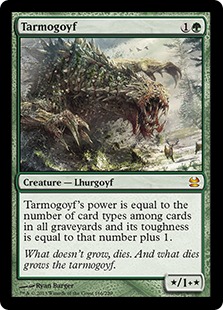
As a control-type strategy built on making exchanges and pulling ahead through card advantage, Jeskai Control (and similar strategies) are reliant on a certain amount of redundancy in terms of their reactive elements. For example, Path to Exile handles pretty much every creature well (besides tokens). Lightning Bolt does just as well considering its cheap mana cost, and can even combine with a Snapcaster Mage to kill a large creature, attack a planeswalker, or even damage an opponent directly. Mana Leak handles most threats well enough to be functional, albeit awkward, though the comparative merits of counterspells in Modern are perhaps better elaborated on in another article. TarmogoyfWhile certain spells might trade variability for power (think Lightning Bolt vs. Flame Slash as an extreme example) as a general rule we often see reactive strategies employ the most variable answers as possible to react to opposing threats.
Imagine a common scenario as Jeskai Control, where an opponent plays a Tarmogoyf while we’re tapped out. While it’s true that we deserve the beating we’re about to get, as we should never have gotten ourselves in this situation in the first place, our goal is regardless to find an answer to the Mean Green Machine as quickly as possible. This is where blue’s knack for card advantage and selection shines, as we can power through our deck with Serum Visions and Snapcaster Mage to dig for a Path to Exile or other answer to handle the Tarmogoyf. Were our deck filled with narrow, awkward answers (think Grixis Control trimming Terminates for Kolaghan's Command and other tricky spells) we would have difficulty finding our target spell in time, effectively spinning our tires chaining cantrip into cantrip yet actually getting nowhere.

Grixis Control, by Corey Burkhart (8th, GP Los Angeles)

Creatures

3 Tasigur, the Golden Fang
4 Snapcaster Mage

Instants

3 Kolaghan's Command
2 Spell Snare
4 Lightning Bolt
1 Remand
3 Terminate
4 Thought Scour
4 Cryptic Command

Sorceries

1 Dreadbore
4 Serum Visions
4 Ancestral Vision

Lands

1 Blood Crypt
2 Creeping Tar Pit
3 Island
1 Mountain
1 Negate
4 Polluted Delta
4 Scalding Tarn
2 Steam Vents
2 Sulfur Falls
1 Swamp
2 Watery Grave

Sideboard

2 Anger of the Gods
1 Crypt Incursion
2 Dispel
1 Engineered Explosives
3 Fulminator Mage
1 Izzet Staticaster
1 Negate
1 Slaughter Games
2 Spellskite
1 Sun Droplet

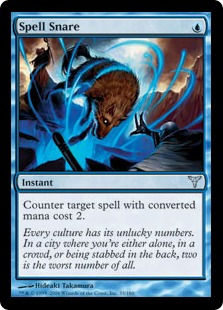
Grixis Control is another example of a reactive strategy built on exchanges that seeks to pull ahead through the use of card advantage to gain a material edge against the opponent and leverage that towards a win. Spell SnareHere, Corey is using the trifecta of Snapcaster Mage, Ancestral Vision, and Serum Visions, backed up by a whole bunch of removal and other card advantage spells to tie it all together.
While I won’t talk too much about the intricacies of this specific list, those familiar with Grixis Control in Modern will see the dedication Corey applied to the concept of card advantage, including the now defunct Thought Scour alongside the Big Three Blue spells for a functional 16 copies of cheap cantrips! All those instances of “draw a card” will do wonders for Corey’s mileage out of his sideboard spells, not to mention helping him find extra lands when he needs them and powering out cheap, quick copies of Tasigur, the Golden Fang.

Permission

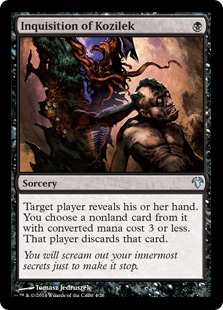
The other major contribution blue offers is its suite of counterspells. These run the gamut from more situational (Spell Pierce, Mana Leak), to hard counters that remain live long into the late game (Cryptic Command, Spell Snare). Inquisition of KozilekAs an answer, a counterspell presents certain unique advantages over disruption cards in the other colors. Compared to discard spells like Thoughtseize and Inquisition of Kozilek, the counterspell doesn't suffer from the top-deck problem. A late-draw Thoughtseize can sometimes be dead, whereas ripping a Cryptic Command off the top usually fills the blue player with a cushy sense of security for the future, assuming the game isn't already decided. Answers that aim to remove a permanent after it comes down, on the other hand, won't always negate the effects of the spell. Enters-the-battlefield abilities are a dime a dozen in creatures, and in fact constitute one of the major hurdles Modern-playable creatures must clear. The power to simply say "no" is hard to outclass in Magic, and helps explain why so few non-blue control strategies exist.
Enabling Combo Kills

The natural strengths of blue tend to make it suited to combo. This doesn't take the form of any specific combo itself, but rather the surrounding shell that blue can provide. Cantrips and card selection let combo pilots find the specific piece they're missing at any given point, mitigating the downside of running so many situational or "dead" cards that can spell doom for combo archetypes. Pact of NegationThis selection often doubles as extra insurance against hate cards post-board, digging for the counter-hate, permission, or alternate win condition we've brought in.
Permission can also play a key role in these combo archetypes, as the answer to whatever disruption the opponent presents. When you're trying to kill using a very specific interaction between just a few cards (often just two), the number of relevant cards from the opponent goes down markedly. A well-timed counterspell often will clinch the victory for the blue combo pilot, stopping the lone kill spell, opposing counterspell, or other disruption piece the opponent is able to muster.

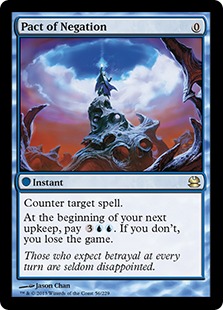
Modern is littered with all sorts of combo decks that aim to take advantage of the selection and counter-disruption blue can offer. Storm, Ad Nauseam, and the now-defunct Amulet Bloom make prominent use of cantrips to put their plan in action. In the case of the latter two, Pact of Negation is a crucial component. More controlling strategies like Scapeshift tend more towards the permission avenue, looking to go long and fire the combo off with protection. Even Infect, an aggressive strategy at heart, employs combo elements as well, using cantrips to piece together the perfect hand on the critical turn and things like Spell Pierce to keep the opponent off balance.

Major Takeaways

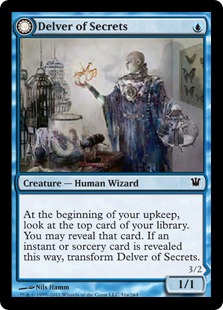
While blue in Modern has shown that it’s capable of doing things other than library manipulation and permission, most of those options can be grouped under the umbrella of tempo. Merfolk as a strategy basically consists of a group of like-spells that work better together, and Aether Vial helps to power them out quickly. DelverWhile very different in terms of overall strategy and execution, Delver of Secrets and Blighted Agent are both looking to push a specific form of tempo as well---Delver by itself and Blighted Agent in concert with pump spells for a quick kill.
Beyond that, blue is almost entirely defined by card selection and permission. Like white, it lacks truly powerful creatures or threats of its own (unless you plan on dedicating a whole archetype to synergistic threats à la Merfolk, similar to Tokens, Soul Sisters, and Death and Taxes in white). Snapcaster Mage is absolutely a powerful creature, but more so as a result of the utility he provides re-buying once-used spells and not as a creature ideally suited for actual combat. As a result, blue often finds itself paired with other colors capable of either presenting powerful threats (green for Tarmogoyf, red/white for Nahiri, the Harbinger) or applying those card selection and permission attributes towards combo strategies.

Conclusion

To fight Blue, disruption and cheap threats have been used to great effect in the past. These can either overload blue’s permission elements or capitalize on its “answer-light” nature by taking a specific reactive spell like Path to Exile with a Thoughtseize and then hoping blue stumbles in its attempts to find the right answer.

More than anything else, blue has found difficulty contending with the sheer variety of powerful things players can bring to the table in Modern, having to simultaneously fight against Lava Spike, Cranial Plating, Scapeshift, Tarmogoyf, and more. Blue in Modern has always existed in this delicate balance where it just barely is able to contend with a multitude of things being thrown at it at once, but the printing of a Counterspell-type effect would also prove too powerful and push it over the top. Right now, blue is at one of the best spots it’s been in Modern, and I don’t see that changing anytime soon.

Thanks for reading, and I’ll see you next week!

Trevor Holmes

The_Architect on MTGO

Twitch.tv/Architect_Gaming

Twitter.com/7he_4rchitect

Legacy Gauntlet is Live on MTGO

Are you a Quiet Speculation member?

If not, now is a perfect time to join up! Our powerful tools, breaking-news analysis, and exclusive Discord channel will make sure you stay up to date and ahead of the curve.

In case you missed the inaugural Modern Gauntlet, there's a new way to play phantom constructed events on MTGO in which you are assigned a deck randomly for an eight-person three-round swiss event. Yesterday was the first day that a Legacy Gauntlet was live on MTGO, and the thirteen decks featured in the Legacy Gauntlet can be found here.

There was an error retrieving a chart for Force of Will

I will say that the lists appear slightly unorthodox, and it looks like there was a bias in building towards getting a mix of a few deviations rather than favoring a particular build of a deck. Things like a 2-2 mix on Gitaxian Probe and Preordain in Sneak and Show and the maindeck Progenitus in Elves aren't necessarily things that you find in the wild, though I really love the idea here and it's not like any of the major archetypes are butchered in a way where you won't get a feel for how the deck plays. I'm even mostly happy with their build of Temur Delver, and I'm a hard man to please on that front. The only thing that is somewhat outlandish to me is the "Grixis Pyromancer" deck featured, which I can personally justify by thinking about it in terms of Legacy just being a curveball format. The deck looks serviceable, though it's more of a nod to the fact that all kinds of whacky things can happy in Legacy than it necessarily being an optimized build of a commonly played archetype.

These queues are a great intro into the format for players looking to get their feet wet, and while I personally would like to see the prize structure revisited for these they serve their purpose. Going 2-1 will allow you to break even on the 60 Play Point entry, and a third win will get you 90 Play Points and a QP. A common complaint of the Modern Gauntlet was that there was a good amount of no-showing for matches, which defeats the purpose of a queue with the entire idea being to test new decks. The only semi-guaranteed way around this is to make the stakes higher, which is somewhat counterintuitive if the appeal is supposed to be to the inexperienced. I don't know if there's a realistic way to fix the prize structure honestly, as the downsides of maintaining the current structure or raising the stakes are both obvious. As these exist, the value of the queue is almost entirely in experiencing Legacy, and to that end I hope that these are popular. It's a great format, and I hope that these are effective in widening the format's audience.

Avatar photo

Ryan Overturf

Ryan has been playing Magic since Legions and playing competitively since Lorwyn. While he fancies himself a Legacy specialist, you'll always find him with strong opinions on every constructed format.

View More By Ryan Overturf

Posted in FreeTagged , , , 2 Comments on Legacy Gauntlet is Live on MTGO

Have you joined the Quiet Speculation Discord?

If you haven't, you're leaving value on the table! Join our community of experts, enthusiasts, entertainers, and educators and enjoy exclusive podcasts, questions asked and answered, trades, sales, and everything else Discord has to offer.

Want to create content with Quiet Speculation?

All you need to succeed is a passion for Magic: The Gathering, and the ability to write coherently. Share your knowledge of MTG and how you leverage it to win games, get value from your cards – or even turn a profit.

Infographic – The Value of Standard Sets

Are you a Quiet Speculation member?

If not, now is a perfect time to join up! Our powerful tools, breaking-news analysis, and exclusive Discord channel will make sure you stay up to date and ahead of the curve.

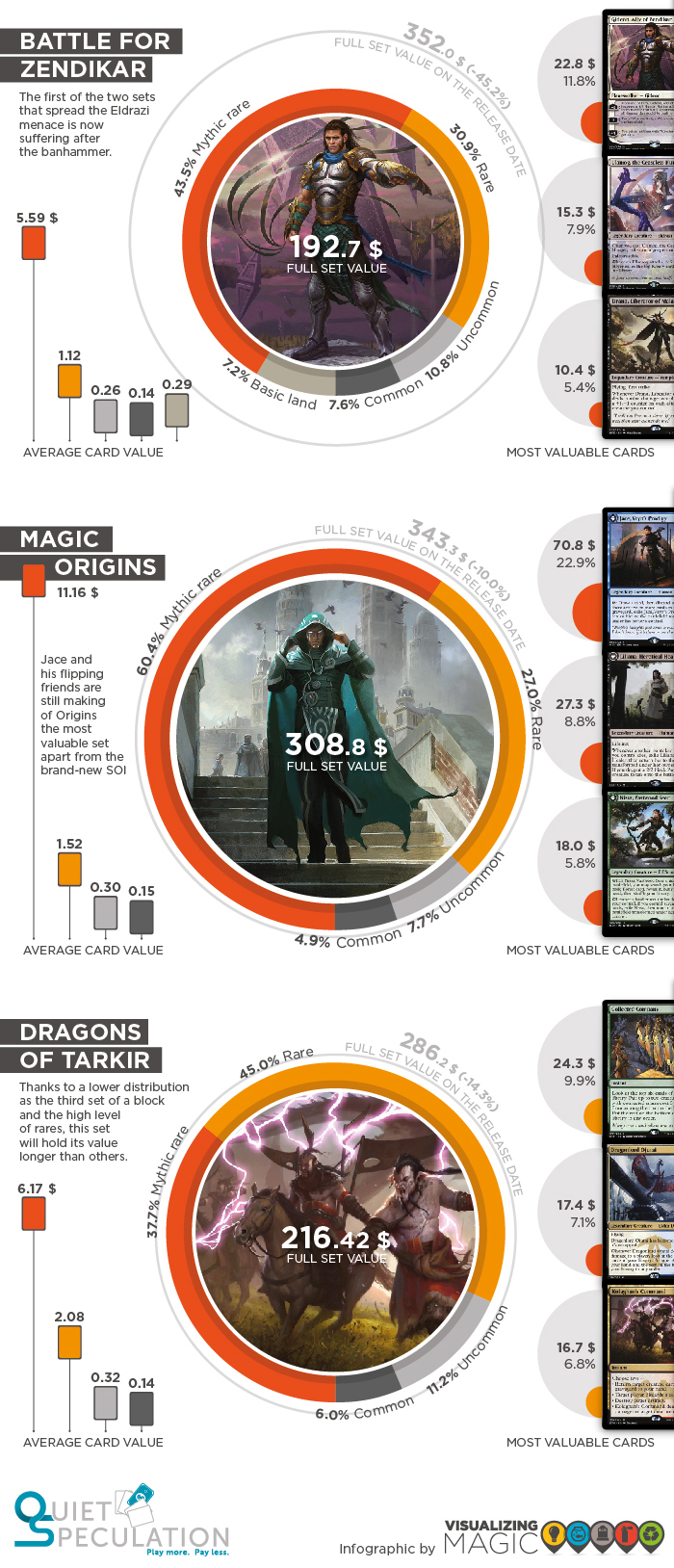
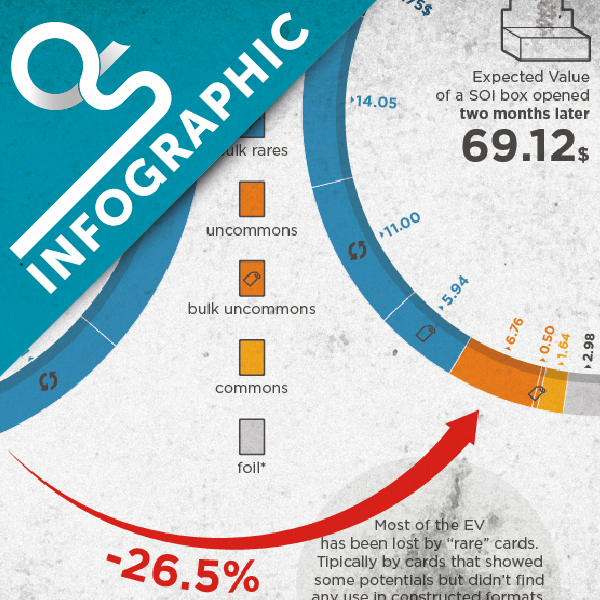
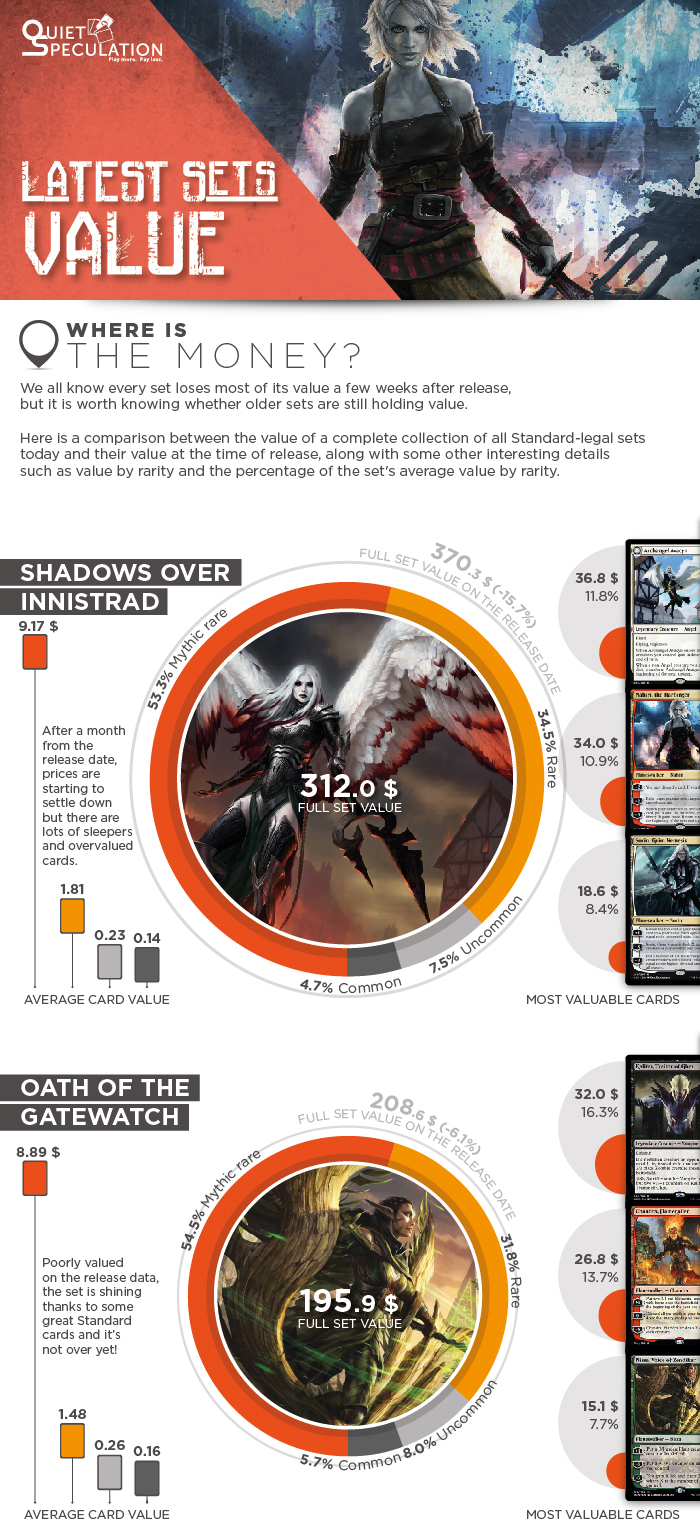
Unexpected bans, card spikes, new tier one decks rising... Among others, these factors influence the value of the latest printed sets over and over again.

Which set is the most valuable? How much of a set's value can a single card hold? How have different sets changed value since their release date?

In this infographic you will finally be able to discover all you need to know!

QS_201605_B Last sets value

QS_201605_B Last sets value

High Stakes MTGO – May 29th to June 4th

Are you a Quiet Speculation member?

If not, now is a perfect time to join up! Our powerful tools, breaking-news analysis, and exclusive Discord channel will make sure you stay up to date and ahead of the curve.

Welcome back to another High Stakes MTGO article!

This week again saw a decent amount of movement on my account, with about a dozen positions bought and sold. The upward momentum on prices consecutive to the release of the full list of Eternal Masters is still on this week.

After a little expected price weakness, Infernal Tutor and Counterbalance seem to be back up as I'm writing this article. Even Chrome Mox, a reprint-to-be card, is almost back to its pre-spoiler price.

At the other end of the format spectrum, my beloved Magic Origins painlands, especially Caves of Koilos and Llanowar Wastes, took a little hit this past week.

Nonetheless I was still able to sell several playsets of Shivan Reef following the hype around Saito's UR deck. Whether everyone wants to draft Lorwyn or save for EMA, I'll have to be more patient for the rest of my painland collection.

The most recent snapshot is here.

Buys This Weeks

GV

Goryo's Vengeance seemed to be on a soft baseline between 15 tix and 19 tix since this past Fall. A peak at 35 tix in February showed us the potential of this card before Betrayers of Kamigawa flashback drafts hit and sent the price back to its baseline for the past 2-3 months.

I decided to take my chance on this one as the price was getting into the 14-15 tix range. Hopefully this floor holds and we are only looking up from now on.

BFZ boosters

Since last April the price of Battle for Zendikar packs has been declining, looking for a solid floor. By the end of May it seemed that the floor may been reached.

I therefore decided to add more boosters to the pile of BFZ packs that, as it seems, I had started a little bit too early. Both BFZ and OGW boosters went up recently. We'll see if the trend is real or if it's only a speculator movement.

FM

Another Modern Masters 2015 pick I clearly held for too long and was probably too greedy with. A proper selling window would have been sometime this past January.

The price of Fulminator Mage went back to 10 tix last week, its floor since the MM2 reprint, and I decided to consolidate my position. Let's try not to miss the next good selling window.

Vesuva

A timely article from Alexander is all it took to put Vesuva back on my buying bucket list. I was okay with grabbing this land at 4 tix a few weeks ago---I'm even happier to complete my stock here with 33 additional copies under 3 tix each on average.

WH

A first target from Lorwyn flashback drafts. I'm looking to acquire more copies, so this is a first round of purchase. My target for these lands was 3 tix or less. We'll see in the coming days if 3 tix was a good price or if it can go lower with a second week of flashback drafts in the world of Lorwyn.

There are obviously other great targets in Lorwyn that I haven't had a chance to get on yet (Thorn of Amethyst, Cryptic Command and Thoughtseize to name a few). Maybe this week I'll get to them.

CC

Brian DeMars made a great point about Corrupted Crossroads in his last article. This land is able to produce any color of mana and colorless, which could come in handy with the Eldrazis still around after the next Standard rotation.

At this point this is nothing more than a bulk spec with virtually zero risk, and great potential upside if things line up perfectly next September. The price of Corrupted Crossroads may go a little bit higher as other speculators catch up. But without a real demand from players, I would expect the price to drop back below 0.1 tix soon and it will be time to restock again.

Sales This Week

Two cards from sets next on the Standard rotation chop block. These specs didn't match my hopes so I was looking for any good window to sell them, which is what happened last week. Exquisite Firecraft could get better if Saito's deck gets more popular but rather than betting on that I decided to sell my copies now with only minimal losses.

Omniscience was one of the biggest winners following the EMA hype---jumping from 7 tix to 15 tix in just a week. I was holding 25 copies for a while now and the recent price bump is exactly what I was hoping for. Having almost doubled here I thought it was a great time to sell the blue enchantment.

Am I potentially leaving some money on the table by selling even before the release of EMA and before Legacy Festival events start? Possibly. However turning down more than 80% profit now and crossing my fingers for more in the coming month is not something I'm inclined to do.

The only painland I sold this past week. Saito's UR deck most likely helped sustain the price growth of Reef while other painlands plunged. Still more than 300 copies to sell with the red-blue painland.

Since last April this powerful mythic from Khans of Tarkir was on a slow but fairly consistent upward trend. Although a great Modern card, Anafenza is not heavily played these days so I don't know how long that upward trend can keep up.

With a price reaching 4.5 tix, I felt it was time to take my profit on that spec and move on.

Soon after Chrome Mox was spoiled in EMA its price dropped below 3 tix. A week later the price bounced back to 4 tix.

I saw an opportunity to exit this position with minimal losses and I'm ready now to rebuy the Mox during EMA release events. I would expect the price to drop again below 3 tix.

On My Radar

What I'm expecting from the next few weeks is pretty much the same as last week. All my positions susceptible to benefit from the hype around EMA did so; Infernal Tutor is currently topping its record high for instance. Odds are it might climb much higher.

One category of specs I have been paying more attention to recently is my BFZ foil mythics. Many of them have been on the rise for about a month now, and as it stands these positions are starting to pay off.

On average all of my BFZ foil mythics are currently up by about 25%. That doesn't seem like much but I was expecting these guys to yield a return similar to full set specs, and they are finally entering that range of returns.

This is also a significant number because, as with full sets, I was able to sink a lot of tix in a small number of cards---more than 2500 tix in only about 200 cards. Now that my BFZ foil mythics are getting profitable I'll be monitoring their prices more closely.

Not all foil mythics behave the same and not all sets have the same distribution of foil mythics. The only thing that seems consistent between the most recent sets when it comes to foil mythics is that their prices appear to sustain for as long as the set is redeemable.

So I'm not in a rush to sell my BFZ foil mythics, but for now on that's something I'm going to keep an eye on. I haven't bought any OGW or SOI foil mythics yet but I might review the data we have available and reconsider foil mythics in these two sets.


Thank you for reading,

Sylvain

Insider: Eternal Masters Top 10 Financial Movers

Are you a Quiet Speculation member?

If not, now is a perfect time to join up! Our powerful tools, breaking-news analysis, and exclusive Discord channel will make sure you stay up to date and ahead of the curve.

Eternal Masters may be a reprint set, but that doesn’t mean we can’t do a Top 10! Unlike with my other Top 10 articles, we won’t be looking at which are the best new cards or the ones that will impact constructed formats. With this article we will focus on the cards that will impact the financial sector the most.

One thing I want to stress about this set is that the supply is quite small. I’ve been repeating this for the past couple of weeks and it's one of the most important factors to keep in mind when delving into the finance of this set. If these cards were in a normal release, like the upcoming Eldrich Moon, we would see prices fall off a cliff and find new lows. That’s not at all what’s happening with Eternal Masters.

Certainly the supply will increase due to the newly printed product, but just like with Modern Masters this set should also reinvigorate demand for these cards. We have already seen this trend with the preorders on a bunch of cards from the set.

This has been a much faster timeline than I anticipated but it’s no surprise. I still believe that we will see prices drop to some degree once the set is released on Friday, but then we will start the climb back upward again.

For a more comprehensive look at the financial implications of this set, check out my article from last week where I broke down the major ways EMA will impact the market and why.

Honorable Mention

Let’s start this Top 10 with the cards that nearly made the list.

Brainstorm

We're getting up there in printings for Brainstorm with a total of 11. That's a lot of versions of one card but it's still holding onto its price and has been recovering and then trending upward after each printing settles. This should come as no surprise for Legacy's premier draw spell. Pick up any leftover copies of this card you see lying around and don’t hesitate getting some as throw-ins on your next trade.

Natural Order

One of the things we want to pay attention to with this set is which Legacy decks become easier to build because of these reprints. On my watch list is Natural Order.

Natural Order seems like a great pick-up because Commander players love this sick tutor and Elf players need it for their deck. What will hold this card back is the same thing that always has---the other important Elves cards like Glimpse of Nature, but more importantly Gaea's Cradle. That's a huge barrier for entry into the Elf club.

Ashnod's Altar

I mentioned this card a couple times last week because Ashnod's Altar a first-time foil as well as having new art on the new border. Some players might not know how potent this artifact is unless you’ve seen it in play in Commander, but this card’s an all-star. This Altar nearly made number 10 on the list, but with no Legacy play, I decided to lower its stock value. I still think it's a great pick-up though, especially foils.

Without any more honorable mentions, let’s move right into the Top 10!

Eternal Masters Top 10 Financial Movers

10. Relic of Progenitus

There was an error retrieving a chart for Relic of Progenitus

One of the best parts about this set is the uncommons. You can open Cabal Therapy, Swords to Plowshares and Bloodbraid Elf, and that’s just a couple of the money uncommons! You’ll gain a lot of value out of your packs just from this rarity.

Relic of Progenitus sticks out to me as one of the easiest financial gainers in the set because of how many formats it sees play in. We see many decks in Modern playing this artifact in their main deck because it interacts with the graveyard as well as cycles to replace itself. We know this card is good, but the fact that it’s good in so many places is solid evidence that it will grow once more. I’d be looking to acquire a stack of these to hide away for a rainy future day.

9. Shardless Agent

There was an error retrieving a chart for Shardless Agent

It took me a while to decide on the number nine slot, Shardless Agent, but once I put the puzzle pieces together, the rest of the Top 10 fit right into place.

As one of the most popular archetypes, Shardless BUG should gain some more pilots with this reprinting. Many Modern players picked up their Ancestral Visions once again after it was unbanned in the format. I think many of those same players will look to cast that draw spell in Legacy as well. Like most other cards on this list, Shardless Agent is great in Commander as well.

8. Vampiric Tutor

There was an error retrieving a chart for Vampiric Tutor

Even with its banned status in Legacy, Vampiric Tutor has still maintained a price tag above $20. This obviously powerful tutor can help out every type of player but I think a lot of players will be looking for foil versions of this sweet Cube card. With more copies available, Commander players will jump in with their wallet too.

7. Sensei's Divining Top

There was an error retrieving a chart for Sensei's Divining Top

No Commander deck is complete without a copy of Sensei's Divining Top. With so many fetch lands in a typical Commander deck, this artifact lets you set up whatever strategy you’re looking to pull off. I know I’ve had two playsets of this card for a while now so I could utilize this effect anywhere I needed it. Because it’s an artifact, it’s widely applicable too. Maybe this only pertains to my region, but lots of players are interested in playing Counter Top in Legacy and this will help spur them toward finally building the deck.

6. Price of Progress

There was an error retrieving a chart for Price of Progress

This set has possibly the best uncommon print run of any set to date, and Price of Progress is part of that greatness. While this big burn spell might not see much play in Eternal Masters Limited, burn players will be jumping at their chance to light someone on fire in another format. This new printing will give players an excuse to rid themselves of the terrible Fire and Lightning foiling as well. These should be cheap; make sure to secure at least one extra play set.

5. Chain Lightning

There was an error retrieving a chart for Chain Lightning

With basically the same reasoning as Price of Progress, Chain Lightning should be a top priority pick-up. Copies of this card should dip considerably before rebounding in a couple months. Burn is one of the most popular archetypes of all time and it should be one of the cheapest Legacy decks to build now with all the reprints its getting. I’m excited to see what this foil looks like as well.

4. Sylvan Library

There was an error retrieving a chart for Sylvan Library

Although Sylvan Library isn’t the most popular Legacy card, it still does see some play. Every green Commander player wants a copy of this card for their deck though. You have forty life to start with so what’s the harm in paying four life a couple times to draw some extra cards? I know I follow this line of thinking quite a bit and I’m sure you know players who do as well.

Foils should be cheaper than the Commander’s Arsenal copies and players will jump on that as well. With how confusing the old wordings have been, I wouldn’t be surprised if players bought in for the updated text box too.

3. Jace, the Mind Sculptor

There was an error retrieving a chart for Jace, the Mind Sculptor

The most popular planeswalker of all time, Jace, the Mind Sculptor, is in this set. If you’ve never sold this card you may not know just how popular he is.

I can barely keep copies of this card in stock. I’m always surprised at the type of players who buy this broken card---i.e. every type of player. You’d be shocked to see how many players sell their collection but keep this guy as one of their only leftovers because they wouldn’t think about getting rid of him. I’m ecstatic to have this guy back in stock.

There’s been a lot of chatter from players thinking Jace isn’t too good for Modern. I disagree and think he would be bonkers (see Nahiri, the Harbinger for evidence), but plenty of writers have cited this as a potential card to come off the banned list.

If Wizards was ever going to attempt this unbanning, now would be the time. With more copies in stores' inventories it would be more feasible for players to acquire the best four-mana planeswalker ever printed. I doubt this will happen but since Jace is such a great investment, it doesn’t hurt to hold a few copies for a while to see if Wizards risks it.

2. Wasteland

There was an error retrieving a chart for Wasteland

Wasteland is a colorless land that sees play in tons of different archetypes in Legacy. This format staple gets played in the other formats as well and has shown resiliency with its price stabilizing around fifty dollars. So many players want this card for their Legacy deck and many will adopt this new-bordered version.

Due to limited availability of previous versions, I think this foil should be the most affordable. The Expedition is down to about $150 and I would expect this version to be at or below that one.

If the price of this new-bordered Wasteland drops below $40, I’d say buying in will become lucrative in the long run. Just like most other cards in this set, I think holding is your best bet.

1. Force of Will

There was an error retrieving a chart for Force of Will

The most popular Counterspell that surpassed even the original Counterspell is in this set and players are jumping at their chance to own this iconic blue card. Force of Will will always be a pillar of the Legacy format and blue mages can’t defend themselves from the insanely fast combo decks without it.

I expect all the Mind Sculptor buyers to also buy in on this card. We may see more makeshift Legacy decks for a while, but players will start with this flashy spell.

The preorder price for Force of Will is already higher than the Alliances printing! This same phenomenon has happened with some other cards in the set as well. Players purchasing at this elevated price should give you a look into what the demand for the card will look like once the set is released.

~

That's all for me this week. I hope you enjoyed my look into what the best financial investments should be. Remember, even if you don't invest in any of the high-dollar cards, stock up on the uncommons and you won't be sorry. Tune in next week for Box Report time!

Until next time,
Unleash the Force!

Mike Lanigan
MtgJedi on Twitter

Virtually Infinite – Winning at Eternal Masters Draft, Part 1

Are you a Quiet Speculation member?

If not, now is a perfect time to join up! Our powerful tools, breaking-news analysis, and exclusive Discord channel will make sure you stay up to date and ahead of the curve.

At long last, Eternal Masters is here.

Eternal-Masters-Booster-packs_1024x1024

Who wants to draft?

This series is dedicated to helping you go infinite on MTGO through a combination of playing better and investing smarter. The past couple weeks our recommendations for picks before the release of Eternal Masters (EMA) have made strong gains. Our earlier picks, including Reserved List staples, are reaching maturity.

If you’ve been playing at home, you’ve amassed a nice war chest for drafting the new set. Investing is a nice way to cover costs, but ultimately we’re here to game.

Introducing Our EMA Draft Gurus

Today we start a two-part series on beating EMA draft alongside two draft gurus: Matthew Watkins and Bing Luke. They may not be household names on the pro circuit, but you don’t want to see yourself paired against these guys in the queues. Both are great at explaining their approach, and I can’t think of anyone better to guide us through a new format.

Matthew Watkins
Matthew Watkins

Matthew Watkins: Probably best known for his data-driven Ars Arcanum series at PureMTGO, Matthew has also been writing weekly “flashback” draft primers on the LRCast Subreddit. His ability to break down new draft formats is legend. In addition to being a “local end boss” in MTGO and paper, Matthew is a podcaster, storyteller, father, author, and educator.

Bing Luke: Bing is a three-time Magic Online Championship Series finalist, which means he has run the grueling MOCS gauntlet not once, not twice, but three times. He’s the only person to ever do so. He, like Matthew, is also a Community Cup competitor. When not mastering draft formats, Bing is an attorney and a certified Level 3 flavor judge.

I love new limited formats because they reward theory and experimentation rather than reps. I’m lucky if I draft twice a week, so I’ll never win the grind. Bing and Matthew will help us uncover overlooked cards and strategies that can pick up some wins before the format is solved.

Bing Luke
Bing Luke

It’s a good thing, too, because EMA drafts are going to be expensive. It will be hard to find more than a draft or two at your local game store. Most drafting will take place on MTGO, where it will be available for three weeks on demand.

Based on the EV projections—which will drop further once drafting starts—I’d estimate each draft will cost upwards of 10 tix for a player of average skill. There’s a lot of variance there, but on MTGO only two cards (Wasteland and Force of Will) are worth more than the cost of a draft.

Unless you have a strong feel for the format I recommend the phantom drafts. The Sealed decks are decent value as well. That said, there will be few better feelings on MTGO than taking down an EMA 8-4.

Assessing Individual Cards

Today, in Part 1 of the series, we will focus on individual cards in each of the five colors. What are the key shifts in rarity, and do they hold the key to the format? What cards will be underrated because they are unfamiliar or find themselves in a favorable context?

Tomorrow, in Part 2, we will tackle the ten two-color pairs and highlight other strategies that involve more than two colors.

Before we launch into a card-by-card analysis, it’s worth noting that the power level of this set is extremely high. As Matthew put it,

There are basically no bad commons in the set except for Tidal Wave. Everything else is a powerful card slated for a particular archetype or an important potential sideboard card like Fog (which will be important against the R/W Tokens matchup). When I saw Swords to Plowshares at uncommon that immediately signaled to me that WotC was not going to be pulling their punches with this set.

Rareshifted Cards

Speaking of not pulling punches, Wizards once again used rareshifts to enable particular approaches and archetypes. In parsing Vintage Masters (VMA), Modern Masters (MMA) and Modern Masters 2015 (MM2), one of the keys was understanding the rareshifts. They usually provide a signpost to where the development team is trying to lead us.

Here’s what they shifted this time:

From rare to uncommon

From uncommon (or rare) to common

I asked Bing and Matthew about the rareshifts and was somewhat surprised by Matthew’s response.

“I honestly think that the rarity shifts aren't that important for drafters to focus on. Sometimes they indicate card that WotC was trying to push, especially to make an archetype more consistent or powerful. But a lot of the time the rarity shift was made simply because the card was printed at the incorrect rarity the first time.

Havoc Demon, Emmessi Tome and Battle Squadron just wouldn't cut it at rare any more. Similarly, Glacial Wall, Tidal Wave, Night's Whisper, Carbonize, Roots, and Sylvan Might just wouldn't seem that out of place in a modern limited format.”

That said, Matthew picked eight cards where the rareshift really stood out to him:

  1. Phryexian Ingester at uncommon is clearly a move to make the U/B Reanimator archetype more powerful. In Vintage Masters, you had a couple of mediocre green creatures to reanimate, and the archetype sucked because of that. But when you're bringing back a giant Nekrataal, that's going to make an impact.
  2. Mesa Enchantress is key for the white-green deck. I think that the W/G Enchantment deck in general is going to be one of the worst archetypes, simply because you have three first-pick quality bounce spells in the format. Mesa Enchantress allows you to get back the cards you spend on auras, which allows you to compete.
  3. Sprite Noble is going to really surprise people. It's a three-mana 2/2 flyer that automatically makes you much more capable of blocking with your flyers, but also allows you to quickly put on the pressure in a game.
  4. Rally the Peasants at common is going to be miserable to play against. In general, I think the R/W Tokens deck is going to be overplayed and often weak, but when you cast and flashback a Rally, it's going to feel absurdly broken.
  5. Warden of Evos Isle at common is a huge deal, especially because it allows you to immediately turn on your five-drop flyers like Peregrine Drake, or even cast another Warden plus a Phantom Monster on turn four.
  6. Desperate Ravings at common is huge deal for the blue-red deck. In a deck that wants things in the yard, Ravings is so much better than Think Twice. This is going to be a very important role player.
  7. Elvish Vanguard at common is a huge deal. It used to be a strong rare. Now, you're going to dump it on turn two, and it'll be a 4/4 or 5/5 in no time.
  8. Sylvan Might is a much more powerful pump spell than we are used to (besides Confront the Unknown which spoiled us in Shadows over Innistrad). The trample bonus is so much more important than it seems, and sometimes getting the card for free off of milling yourself will be a big game.

For Bing, rareshifts played a bigger role.

"We'll certainly see once people have had a chance to draft the format, but a lot of my thoughts of the format are based on the rarity shifts. The cards that immediately stand out are Orcish Oriflamme, Elvish Vanguard, Sylvan Might, Elephant Guide, Elite Vanguard, Mistral Charger and Rally the Peasants. Also, Coalition Honor Guard isn't a rarity-shift per se, but it's a card that has no right to be printed at common, so take that for what it's worth."

Context is Everything

The set features ten two-color pairs. We’ll dig deeper into these in Part 2, but be sure to keep these in mind since synergies play an important part in the set. I’m going to use the ten archetype descriptions from Marshall Sutcliffe’s article on the mothership (though, as we’ll discuss tomorrow, it’s not clear these capture what each color pair does best).

  • W/U Flying Matters
  • U/B Reanimator/Recursion
  • B/R Sacrifice
  • R/G Fast Aggro
  • GW Enchantments
  • W/B Enters-the-Battlefield Effects/Blink
  • U/R Flashback/Retrace
  • B/G Elves
  • R/W Tokens
  • U/G Threshold

Color by Color

Next, let's look at the commons and uncommons from each color. Pick orders will depend on archetype and context, but I’ll mention some cards that caught my eye, as well as those Bing and Matthew see as especially key. (Tell me in the comments what I got wrong!)

I always find that when I take out those distracting rares and mythics and break down a set list visually by common and uncommon it's a clarifying exercise. Let's go for it:

White Commons

White Uncommons

Every color is deep, but white seems especially redundant. The commons all trend aggressive except for Second Thoughts and Honor Guard. Get used to reading these creatures sideways, since they'll spend a lot of time in the horizontal position.

My first picks, for what it's worth, are Pacifism and Kor Hookmaster. Pacifism has never not been first-pickable, and it has nice synergies in the green-white deck. Hookmaster is a huge tempo boost; I've heard him described as the white Man-o'-War, and he's exactly what you want to be doing in white.

Bing’s first impression is that, “looking at the commons cards, white looks like the strongest color by far, and has the commons that can support a deck regardless of whatever else you are doing. White-red aggro and blue-white fliers at first seem like the best use of those overpowered commons.”

“The first thing I noticed is that Coalition Honor Guard is included at common, which is messed up. There are really, really, really, really few common answers to it, and I'm not sure people remember how dumb flagbearers can be. I’m not sure Coalition Honor Guard is the best white common, but it's something that's interesting and it's going to be strange that every white deck will have access to one.”

Many of white’s uncommons are synergy-driven: Field of Souls, Honden, Intangible Virtue, Enchantress, Soulcatcher and Wall of Omens are near-unplayable outside of the right deck. But they’ll be powerful in their home.

Matthew was not as impressed by white. As we'll hear tomorrow, the U/W Flyers deck may have wings, but he's going to focus on other strategies...

I asked him for an underrated common and uncommon in each color, so I'll be listing those for each.

Shelter --- This is one of the best combat tricks of all time. It’s a trick that beats other tricks, protects your creatures, allows you to push damage through, and do all kinds of cool stuff, but that also draws you a card.

Wall of Omens --- This card is always pretty decent since it’s a two-for-one, but it’s also going to be very important for the W/U Flyers deck. It comes down on turn two, before most of the flyers, and holds the fort while you attack with flyers. It’ll be a high priority in the deck.

Blue Commons

Blue uncommons

Blue gets Matthew’s nod for the third most powerful color. Matthew's picks for the underrated players:

Shoreline Ranger – A 3/4 flyer for 6 is really unexciting, but this one is going to be pretty good in a variety of decks. Islandcycling is great because it allows you to keep so many more hands, while still giving you a powerful body in the late game. The cool part is that it slots in very well with all the blue archetypes: in white-blue it will often cost 5 mana instead of 6; in blue-black it cycles and then you can reanimate it for cheap or just have a good target for Gravedigger; in blue-red and blue-green it gets you closer to threshold.

Wonder – A 2/2 flyer for 4 is decent, but this card becomes great because your opponent just really can’t trade with it. The decks where this really seems amazing are U/R Tempo and U/G Threshold, both of which will be milling themselves some amount, and both of which will really be looking to give their aggressive creatures mass evasion.

My picks for top blue commons are Man-o'-War, Silent Departure, and Warden of Evos Isle. Deep Analysis and Phantom Monster are super powerful, but might be too slow.

Black Commons

Black Uncommons

Matthew's underrated picks for black are:

Carrion Feeder – The biggest problem with the R/B Sacrifice deck is that there aren’t enough ways to sacrifice creatures that give you an advantage, but Carrion Feeder fills that niche very nicely. The sacrifice ability costs no mana, so you can play the red echo creatures, get their effect, and then sacrifice them and still get the counter. It plays well with tokens and with morbid, so Wakedancer becomes a pretty potent card as does Tragic Slip. It’s one of the best ways to turn on Dragon Egg, and it turns Keldon Marauders into a great creature. The black-red decks are going to revolve around how many Carrion Feeders you can get.

Victimize – This is a tricky card to use and to set up, but it’s likely to be one of the most important role players in the format. Combining it with enters-the-battlefield creatures allows you to generate a lot of value. In the white-black deck, it gives you a sort of blink spell that can make that value strategy kind of work. In blue-black it reanimates your Phyrexian Ingesters and Man-o'-Wars. In black-red it allows you to sacrifice an echo creature and get back a Phyrexian Rager and a Nekrataal. In black-green it even allows you to grind through Civic Wayfinders and possibly even Regal Force. The setup is still pretty high, but I think the payoff will be worth it.

I personally think Carrion Feeder might flat-out be the best common in black. So many synergies. Eyeblight's Ending is a versatile removal spell, and Tragic Slip will be great in black-red since morbid will be easy to trigger.

Red Commons

Red Uncommons

Bing says,

Red looks very strong as well. The aggro decks look like they have a high ceiling.

[While not a high pick,] Orcish Oriflamme is also an interesting card. It's a card that does strange things in multiples. Rally might just be better though.

It's very strange for me to think of cards like this as commons. They are going to steal some games, but other times will be dead.

Matthew's underrated picks for red are Stingscourger and Keldon Champion:

Stingscourger – This was one of the best commons in Planar Chaos, and that set didn’t have as many synergies with Stingscourger. It’s going to be an important card in all of the decks, getting something out of the way so that other tempo decks can close out the game, while also providing a body that can be recurred in the black or white decks.

Keldon Champion – Again, echo is interesting in this set because the red-black deck can sort of ignore it and just sacrifice it, while the green-red and blue-red decks will occasionally get value out of just letting the creature die to fuel threshold, and the white deck can potentially bounce it with Whitemane Lion. This isn’t the best uncommon in red, but it will be a powerful card that people might not value highly enough.

For me, Firebolt is the best red common. I think the format will be tempo-oriented and being able to take out your opponents early drop and come back for more is huge. It also has synergies with Burning Vengeance, which we'll discuss tomorrow as a lynchpin of red strategies.

Green Commons

Green Uncommons

Both Matthew and Bing saw green as strong. Matthew thinks it might be the best color in the format, while Bing preferred white but felt that, “Green looks like it is the most safe. It has traditionally solid cards like Civic Wayfinder and Elephant Guide at common that give a lot of flexibility.”

I like Green because it can either play the aggressor role, go midrange, or serve as the foundation for powerful multi-color decks (which we’ll discuss tomorrow). And Elves can be a nice archetype that will sometimes dominate if they are open. My pick for top common, in a vacuum, is Werebear, but I don't know how strong threshold will turn out to be. I suspect Nimble Mongoose will be overrated because it's a house in Constructed.

Matthew's underrated picks are:

Civic Wayfinder – This is an elf, which helps the black-green deck, but it also fixes and gets you card advantage. Wayfinder has been a premium common every time it’s been printed, and I expect it to continue to be amazing here.

Timberwatch Elf – This is one of the best uncommons in the set. When it was first printed, it was common, but it was still stronger than most of the rares. In this set, it’s going to be the uncommon that really puts the elf archetype above the competition. Once this thing is active, you just win every combat, and often you can just push through for the win in a turn or two.

Multicolor Uncommons

No multicolor commons. The uncommons are all super powerful, and a third or fourth pick will usually signal that color pair is open.

Colorless Commons

Colorless Uncommons

Not much to see here in the lower rarities. You’ll play every Mishra's Factory you pick up---don't forget it blocks as a 3/3, but not on the turn it's played. Most artifact fixing comes at uncommon, so I suspect it will be hard to go multicolor unless you are green. I have a feeling Pilgrim's Eye will be a key role player in slower decks, providing a speed bump while fixing mana.

~

I hope this has whet your appetite! Next week we'll be digging in to specific archetypes. Drop a line in the forums if you disagree and let us know what your top uncommon and common is in each color.

-Alexander Carl

@thoughtlaced

Insider: Evolution of the Expected Value of an SOI Box

Are you a Quiet Speculation member?

If not, now is a perfect time to join up! Our powerful tools, breaking-news analysis, and exclusive Discord channel will make sure you stay up to date and ahead of the curve.

Should I buy a box?

This is one of the first questions most players ask themselves when a new set comes out. Many buy boxes to draft with friends or for the sake of opening boosters---and that's totally fine!

But what about those of us evaluating the purchase from a financial perspective? The common wisdom here on QS is that a box should be bought, opened, and all cards sold within the first days after the release, otherwise you'll start losing your money.

But how much is the loss?

Starting from Shadows over Innistrad, we aim to provide you solid data to help assign the proper value to all your unopened boxes!

QS_model01
QS_model01

Want Prices?

Browse thousands of prices with the first and most comprehensive MTG Finance tool around.


Trader Tools lists both buylist and retail prices for every MTG card, going back a decade.

Quiet Speculation