menu

Insider: MTGO Market Report for December 2nd, 2015

Are you a Quiet Speculation member?

If not, now is a perfect time to join up! Our powerful tools, breaking-news analysis, and exclusive Discord channel will make sure you stay up to date and ahead of the curve.

Welcome to the MTGO Market Report as compiled by Sylvain Lehoux and Matthew Lewis. The report is loosely broken down into two perspectives.

A broader perspective will be written by Matthew and will focus on recent trends in set prices, taking into account how paper prices and MTGO prices interact. Sylvain will take a closer look at particular opportunities based on various factors such as (but not limited to) set releases, flashback drafts and banned/restricted announcements.

There will be some overlap between the two sections. As always, speculators should take into account their own budget, risk tolerance and current portfolio before taking on any recommended positions.

Redemption

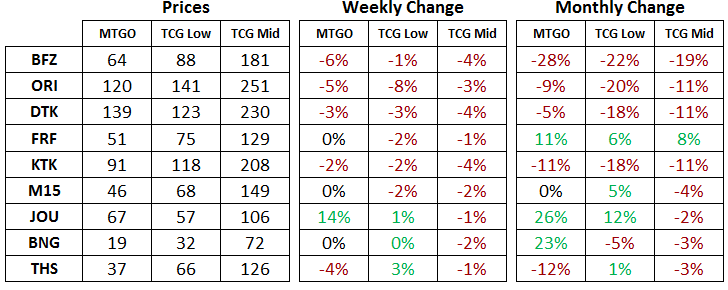
Below are the total set prices for all redeemable sets on MTGO. All prices are current as of November 30th, 2015. The TCG Low and TCG Mid prices are the sum of each set’s individual card prices on TCG Player, either the low price or the mid price respectively.

All MTGO set prices this week are taken from Goatbot’s website, and all weekly changes are now calculated relative to Goatbot’s ‘Full Set’ prices from the previous week. All monthly changes are also relative to the previous month prices, taken from Goatbot’s website at that time. Occasionally ‘Full Set’ prices are not available, and so estimated set prices are used instead.
Nov30

Theros Block & M15

The bottom is not yet in for the paper version of Theros (THS). The TCG Mid price continues to fall, while the MTGO price is getting close to its October low. Despite this general price weakness, there are pockets of strength accumulating value from this set.

The digital versions of Ashiok, Nightmare Weaver and Elspeth, Sun's Champion are showing signs of strength. As fringe-playable Modern cards, these two planeswalkers look set for further gains down the road as interest in Modern builds into the winter.

Magic 2015 (M15) has been eerily stable for nearly two months on MTGO, hovering around the 45 tix level. Like THS, the paper version of this set is still looking for a bottom. Last year, Magic 2014 (M14) bottomed by the end of December, which seems a reasonable guide for M15. A bottom in the paper price is a sufficient condition for higher prices in digital.

Journey Into Nyx (JOU) continues to power higher off the back of Keranos, God of Storms. Since the second week of October, JOU has risen 68%, going from 40 tix to 67 tix, with most of that gain attributed to the blue-red god.

There was an error retrieving a chart for Keranos, God of Storms

The resilient Modern threat looks primed for further gains, and the third-set effect is on full display here with a real lack of excess supply. Look for this card to peak in the 40-45 tix range as players add this key sideboard card to their collections.

To a lesser extent, Eidolon of the Great Revel has also contributed to JOU's recent gains. After peaking at 20 tix, this card fell to 16 tix before rebounding slightly to where it now sits at 17 tix.

As a staple of Modern Burn and Zoo decks, two archetypes that haven't seen much headline success lately, this card currently represents an attractive risk-reward proposition. There is time over the next two months for a high-level finish to push this card into the spotlight and back over 20 tix.

Tarkir Block & Magic Origins

Price weakness continues to pervade Tarkir block and Magic Origins (ORI) in both paper and on MTGO, with all four sets down in price in the last week. With high-profile Legacy and Modern events on tap, interest in the Standard format is at a low ebb.

Consistent with that observation are the recent price declines observed on various Abzan cards in Standard. Exhibit A is Anafenza, the Foremost of Khans of Tarkir (KTK), which is back to the 10 tix level after peaking at 15 tix only a few weeks ago.

In Fate Reforged (FRF), the Abzan one-drop of choice, [card]Warden of the First Tree[card], has also been dipping in the last two weeks. It now sits under 5 tix, low enough for speculators to start considering the card as a potential buy. A renewed interest in Standard will push this and other Standard staples up in price.

Elsewhere in FRF, two cards demonstrate a large consolidation of the set's value, with Monastery Mentor and Ugin, the Spirit Dragon together forming over half the sticker price of a set. Both cards are priced between 13 and 14 tix at the moment and have more downside than upside in that price range.

Kolaghan's Command and Atarka's Command from Dragons of Tarkir (DTK) are seeing heavy play in Modern, and they're currently priced at over 10 tix on MTGO. The flexibility of the black-red command has enabled the Grixis colour combination's ascent in Modern, and the green-red command has replaced Skullcrack in decks seeking to prevent life gain.

With a high-profile Modern tournament on MTGO approaching soon, and the constructed portion of Pro Tour Oath of the Gatewatch also featuring Modern, there will be lots of attention placed on this format between now and February. These two DTK rares look primed to hit 14-16 tix at some point in that time span.

Battle for Zendikar

The newest set continues to plumb new depths in both paper and digital. Although paper prices have not yet bottomed out, the decline is slowing. The drop in TCG Low and TCG Mid paper prices in the past week is the smallest week-over-week drop yet in absolute terms, and nearly the smallest by percentage as well.

This deceleration in price declines roughly mirrors the price path of KTK last year, which appeared to bottom at the end of December before rising a little into January. Paper KTK prices resumed their downtrend by the end of January though, and continued heading lower for months, ultimately bottoming in June.

For MTGO players and speculators, this signals that the price bottom on BFZ sets is still a ways off. Value should be sought elsewhere at the moment, in overlooked Modern staples or in cards from DTK and ORI that could benefit from the Spring rotation.

Standard Boosters

The introduction of Legendary Cube draft has put a crimp in most Standard booster prices as players seek to sell excess boosters in order to play the new draft format. As a result, BFZ boosters, which were hovering near 4 tix, have dipped down below 3.7 tix.

These will be under pressure for the next two months as players increasingly choose to sell their boosters instead of draft with them. The next buying opportunity for them will be during Oath of the Gatewatch (OGW) release events.

The price of KTK and FRF boosters appears to have stabilized in the last week. This is good news for speculators holding these boosters, as it indicates the resumption of the uptrend is in the works. Once the current iteration of Cube draft is retired on December 9th, look for the price of these two boosters to head higher.

Typical rates of increase are in the range of 0.1 tix per week, but flashback events during the holiday break would again provide an alternative to Tarkir block draft. Assuming five to six weeks of demand, and a rate of increase consistent with our predictions, the short-term potential price for KTK is 3.8 to 3.9 tix, and for FRF 3.1 to 3.2 tix.

Modern

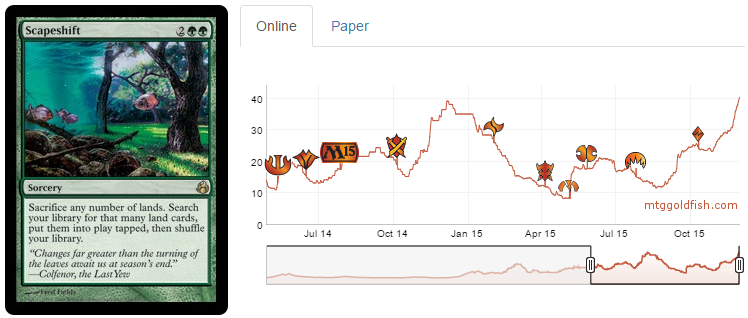
Upward pressure on Modern prices keeps pushing staples higher and higher. This past week several of the most valuable Modern staples have matched or even outperformed their previous historical record high.

With a strong price growth over the past few weeks, Celestial Colonnade, Creeping Corrosion, Obstinate Baloth, Scapeshift, Oblivion Stone, Voice of Resurgence, Grove of the Burnwillows and Horizon Canopy are among the Modern positions currently cruising to new price records.
SS

While we believe all Modern positions are worth holding until later in January, some price dips due to speculative movements are to be expected. However, these should not affect the general upward trend anticipated for Modern staples leading up to Pro Tour Oath of the Gatewatch.

As we mentioned two weeks ago, prices of some Modern staples remain surprisingly unaffected by this seasonal price hike. Batterskull and Shadow of Doubt, for instance, are currently priced around their two-year-plus low.

Goblin Guide, a true staple in any Modern Burn deck, can hardly break out from a baseline of 6ish tix acquired after the release of ORI. Burn's lack of popularity at the moment is probably the reason why Eidolon of the Great Revel and Goblin Guide are not trending up along with many other Modern staples.

It’s nonetheless only a matter of time before Burn decks make a comeback, and Modern speculators would do well to place a few bets on that outcome.

Lastly, the Legendary Cube will run for one more week, continuing to award Legendary Cube Prize Packs (PZ1) as prizes. These packs contain a lot of Commander and Legacy cards, and also a few Modern staples like Deceiver Exarch, Eternal Witness and Ghostly Prison.

Consequently, other versions of these Modern cards haven’t gained any value over the past two weeks. The PZ1 versions of these cards are also heavily discounted for now, a price gap that's likely to close up next week when PZ1 packs stop being awarded.

Even if a card like Eternal Witness may not go back to 4 Tix anytime soon, at ~0.10 Tix (as of Monday), the PZ1 version certainly looks like a steal.

Legacy & Vintage

If Legendary Cube Prize Packs are relevant for Modern speculators, they might be even more so for Legacy and Vintage speculators. Commander 2015 and its brand new set of cards were released in paper about two weeks ago. Unlike previous Commander sets, Commander 2015 won’t be available through the official MTGO store.

The only way to obtain digital copies of the new cards is via the PZ1 packs awarded by Legendary Cube queues. Without the possibility of direct purchase in the store, the biggest chase cards from this set won't have their price capped this time around. Prices could grow rapidly once supply from the Legendary Cube stops.

If the above assumptions hold true, a large basket of Commander 2015 mythics and rares, or even PZ1 boosters themselves, could represent good speculative positions in the mid term.

The strength of such specs also relies on a non-recurring appearance of PZ1 packs in the prize structure. This, unfortunately, could happen as soon as later this month with the traditional Holiday Cube offering.

PZ1

The second MTGO Power Nine Challenge was held last weekend. Attendance clocked in at under 100 participants, short of the turnout for the first P9 Challenge. Could the Thanksgiving holiday be blamed for the lower attendance?

Eric Froehlich and his Storm deck finished in 1st place. The Top 16 decklists were a little bit more combo-oriented this time around, with two Doomsday decks and three Storm decks.

The biggest novelty of the tournament was the inclusion of Dark Petition in the Storm decks. Froehlich's deck featured the full play set---who doesn’t want to play five Demonic Tutors, after all?

There was an error retrieving a chart for Dark Petition

At near-bulk prices, Dark Petition may be worth acquiring, in case any brewers get inspired and try to use the card in Legacy, Modern, or even Standard.

Pricewise, the Total VMA Price index and the P9 index have stalled for about a week since the price hike that hit in November. With the disappointing attendance at the second P9 Challenge, it's unclear at this point if Vintage prices will resume their upward trend, and it may be worth selling speculative positions.

Pauper

In the wake of the announcement of Pauper Leagues, prices for the cheapest competitive format continue to rise again this week. Nonetheless, some of the big gainers from the past two weeks have recently lost ground.

It's unsurprising to see some positions subject to speculative sales after such a large price hike. Mental Note, Chittering Rats, Unearth, Innocent Blood and Cloud of Faeries are among the positions with a double-digit-percentage drop in price this past week.

Other Pauper staples are likely to see similar price corrections in the following weeks. However, providing the renewed interest in Pauper continues, price bottoms will probably be found at higher levels compared to just a month ago. Speculators should then be prepared to see Pauper positions rebounding at higher prices.

Targeted Speculative Buying Opportunities

Modern

Goblin Guide
Shadow of Doubt
Batterskull

Legacy

Legendary Cube Prize packs
Targeted Speculative Selling Opportunities

None

Deck of the Week – Naya Humans

Are you a Quiet Speculation member?

If not, now is a perfect time to join up! Our powerful tools, breaking-news analysis, and exclusive Discord channel will make sure you stay up to date and ahead of the curve.

We're revisiting our weekly article structure throughout December, so we're bringing back the "Deck of the Week" spotlight we ran earlier in the summer and fall. This will hopefully give brewers some new sources for inspiration, veterans some neat tech (or a couple of laughs), and Modern players format-wide a chance to see original decks. We're kicking off December with an explosive Naya Humans list that earned 5th at a StarCityGames Invitational Qualifier in Galtinburg.

Lightning Mauler art

This is the second time we've looked at a Humans list in "Deck of the Week", following our foray into the five-colored version back in July. The 5C Humans list leaned more heavily towards catchall utility creatures such as Meddling Mage, Thalia, Guardian of Thraben, and Anafenza, the Foremost. Naya Humans doesn't have time for this slowrolled interaction. Deck pilot Phillip Kendall doesn't have a single Human with a converted mana cost over two, which is exactly what we'd expect when Humans moves into the same colors as the million-and-one Zoo variants. These are Nactl-sized shoes to fill, and Kendall's list does its best to meet the high bar.

[wp_ad_camp_1]

Naya Humans, by Phillips Kendall (5th, SCG Gatlinburg 11/2015)

Creatures

4 Mayor of Avabruck
3 Boros Elite
4 Burning-Tree Emissary
4 Champion of the Parish
3 Ghor-Clan Rampager
4 Lightning Mauler
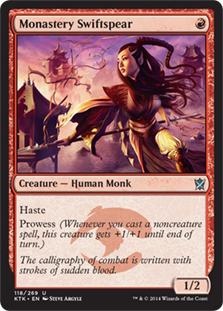
4 Monastery Swiftspear
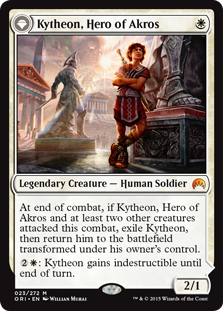
3 Kytheon, Hero of Akros

Instants

4 Atarka's Command
3 Boros Charm
4 Lightning Bolt

Lands

1 Forest
1 Mountain
1 Plains
1 Arid Mesa
2 Cavern of Souls
3 Sacred Foundry
2 Stomping Ground
2 Temple Garden
3 Windswept Heath
4 Wooded Foothills

Sideboard

2 Firemantle Mage
2 Deflecting Palm
3 Destructive Revelry
2 Path to Exile
2 Kataki, War's Wage
2 Melira, Sylvok Outcast
2 Thalia, Guardian of Thraben

Whenever we're looking at a rogue aggro list, we need to be asking ourselves a few questions. Are we playing a worse Affinity or Burn? If we're playing tribal, are we a worse Merfolk? Do we have an answer to Twin? Can we race random combo decks or beat them out of the sideboard in games 2-3? These contextual questions help us situate a deck in the broader Modern scene as opposed to just analyzing cards on their own merits.

Turn Three Potential

If you're playing aggro in Modern, you need to be winning by turn four with all but the most mulligan-crippled hands. Ideally you can also sneak in turn three wins if uncontested or against opponents who are too suicidal with their life totals (see turn 1 fetch-shock-Thoughtseize). If Naya Humans can perform at these benchmarks alongside Burn and Affinity, that's a promising start for a nascent aggro build.

There are almost zero Naya Human hand configurations that don't kill on turn four if undisrupted, so Kendall's list is already meeting the standard for Modern aggro viability.Kytheon Card Can it push a turn lower though? For reference, both Burn and Affinity can blast off with turn three wins under the right circumstances. Thankfully for humankind, the tribe has a turn three edge too. Turn one Kytheon into turn two Burning-Tree Emissary and Lightning Mauler hits for six on the spot and flips the walker. Follow that up with a turn three swing off all your creatures (eight more damage) and then add your pick of Boros Charm, Atarka's Command, Lightning Bolt, or Ghor-Clan Rampager. Command and/or Bolt combine with any of the other finisher to get you to lethal. You also have a wide array of creature combinations that make it there on turn three, typically involving Emissary but sometimes just leveraging Swiftspear and Atarka's. Add in an opponent's self-inflicted shock/fetch damage and it's even easier!
Why Not Burn?

monastery swiftspearTo skeptical readers, this entire approach probably sounds very Burn-esque, which begs the question about why we aren't just playing Burn. Or Nacatl Burn, Nacatl Burn plus Kird Ape, Gruul Zoo, or any of the other aggressive decks on the Burn spectrum. What makes Naya Humans special?
Unlike the standard Red Decks Win variants, or the Naya ones, we're running a turn four aggro deck that is much harder to "break up". Contemporary Burn pilots rely on those initial Goblin Guides and friends to chip in 4-6 damage from turns 1-3. That's how the Burn mage gets you into Bolt, Spike, and Command/Crack range. It's no coincidence that Bolt itself is one of the best ways to stop Burn: answering that first Guide or Swiftspear is often enough to buy time for an eventual game-win, even if it's earned by inches. For its part, Naya Humans derives damage from redundant creatures, not from spells. This means a Humans opponent can't depend on Bolting an early threat and eking into the midgame. That Bolted threat quickly gives way to two more un-Bolted threats as the Naya player clogs the board with creatures. It's a Gruul Zoo approach, but with slightly better synergies that let you go a bit wider at the cost of lower-powered solo threats.

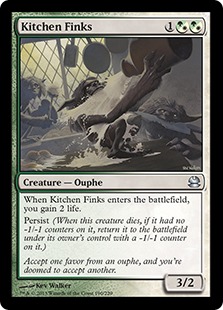
Sustained damage also gives Naya Humans some innate resilience against anti-Burn bullets like Feed the Clan. By a similar token, an enemy Lightning HelixKitchen Finks becomes much more palatable because it's not effectively countering a spell and killing a creature. You only lose one guy and can take back the regained life in another attack phase. As an added bonus, you don't have to worry as much about a lone Tarmogoyf outclassing your entire board: you're going far wider than the Goyf can effectively contain. That all said, Humans' creature emphasis turns Kitchen Finks into your worst nightmare, especially if the Finks are backed up with even a single removal spell. Lingering Souls is equally problematic, although Rampager mitigates it. Tron's Pyroclasms, and similar sweepers out of red boards, can be gamebreaking, but our Charms and Commands can insulate us from these effects if used properly. All of this just means you're shifting Burn's vulnerabilities, making Naya Humans a metagame call in a similar fashion to Gruul Zoo.
Because we're playing tribal aggro, we also have to ask why we aren't playing Merfolk. The biggest reason is explosiveness. I've never seen Merfolk win on turn three in a real game, although its turn 4-5 wins are some of the most consistent in the format and are often backed up with interaction like Cursecatcher, Spreading Seas, and Vapor Snag. We trade that interaction for an all-in aggro approach, which is a slight edge we have over Merfolk. I'm not seriously suggesting Naya Humans is better than Merfolk, but our speed is an advantage we have over the fish.

Improving the List

I haven't answered a glaring question from earlier in the article, and it's front and center in this improvements section: what the heck do we do about URx Twin? Affinity can try racing Twin and at least has a one-mana kill for Exarch in Galvanic Blast. Burn lists also play the footrace game, although they have slightly worse spot-removal to actually interact with the combo. Naya Humans? We have the worst of both worlds, with slower creatures than Affinity and worse damage-spells than Burn. Our turn three wins are also more vulnerable and less consistent than those in Affinity and Burn, even if we trade this for immunity to catastrophic hate like Stony Silence and for some creature width Burn doesn't have. So how do we manage Twin?

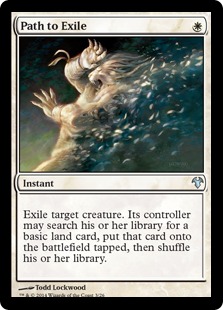
Path to ExileOne option is to cut the Boros Charms and replace them with Path to Exiles. Path has the added bonus of exiling those pesky Finks' and giving us better removal against random decks that want to do bad things to us with creatures during turns 1-3 (looking at you, Primeval Titan and Wurmcoil Engine). Dismember is another option, but I'm already nervous about the Burn race and Dismember doesn't do you any favors there. It also doesn't answer Engines and Titans, even if it does remove Exarch. The Path-Charm swap would definitely reduce our turn three kill rate, but the percentage points gained in the turn four race might be worth the marginal loss of a few turn threes. Shipping Charms to the board still leaves us the option of protecting our army from the inevitable games 2-3 sweepers.
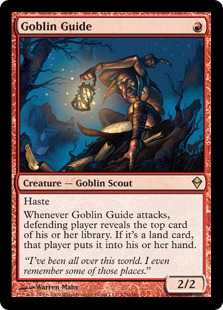
A big danger in adding Path is that we are trying to be something we have no business being: a Naya Zoo imitator. True Burn decks don't play Path and don't screw around with dedicated removal outside of the board.Goblin Guide Path might dilute our strategy more than enhance it. A much better option is probably ditching those highly questionable Boros Elites and replacing them with Goblin Guide or Wild Nacatl. Guide seems like a better option here because it gives us way more lines for flipping Kytheon, and Guide's net damage output should exceed the cuteness we get in Champion counters, batallion triggers, and Mayor's buff. Topdecking Elite on turn three is a huge buzzkill. Topdecking Guide can close a game, especially if a Command is waiting to support the Goblin. Running Guide also lets us randomly win off multiple hasty Goblins. A pair of the one-drops will deal 10 damage over three turns. A pair of Elites or Champions? 3-5 damage if you're lucky.


In the end, I'd probably just make the following change ot the maindeck and see where we can go from there:

-3 Boros Elite
-1 Champion of the Parish
+4 Goblin Guide

Naya Humans in Context

Ultimately, my biggest takeaway from Kendall's finish has little to do with the strength of Naya Humans and much more to do with the power of linear strategies in Modern. If you've ever played Jund or Abzan, especially in recent months, you can attest to this. There are too many weird decks doing too many weird things, and it's next to impossible to cram sufficient answers into your 75. Only a master of reading metagame information will make those calls correctly. Naya Humans exploits whatever holes remain in a BGx or Grixis board, attempting to race the other weird decks or just stomp them flat in games 2-3 with sideboard trumps (Kataki, War's Wage, Melira, Sylvok Outcast, etc.). In that respect, Naya Humans shares a lot with other decks floating at Modern's fringes, and we should expect to see more renegade aggro finishers like this in the future.

Insider: Assessing Your Store’s Strengths and Weaknesses

Are you a Quiet Speculation member?

If not, now is a perfect time to join up! Our powerful tools, breaking-news analysis, and exclusive Discord channel will make sure you stay up to date and ahead of the curve.

Welcome back, readers! I came up with today's article while helping my favorite local game store (LGS) evaluate their business.

For a bit of back story, there are seven Magic stores within a 40-mile radius of me (with another two about an hour away), so competition can be a bit fierce. My preferred LGS used to be top dog, but when the 7th store opened up they pulled away a decent number of customers.

Recently I had a talk with the owner of my preferred LGS (we'll call him "Dave" for simplicity's sake). One of the older players had been shopping his massive collection around to players, to no avail. He finally offered it to the LGS's and the new store must have made him the best offer.

I ran into the guy and found out how much they had paid. When I relayed this information to Dave, he was blown away. He was surprised that the newly-established competition could afford to spend over $3000 on a single collection when he could not.

This was eye-opening for me, because I had assumed he had enough capital to pick up this type of collection when it came in (it's rare for something that large to go on the market around here). I asked him why he couldn't and he admitted that business wasn't going great, but he didn't know what to do to improve.

I talked it over with my girlfriend (who has both a B.S. and M.S. in business) and came back to him with a proposal for some market research to see where the issues laid.

Gathering Data

The first step was to gather input from current and former customers. I sought this information out on Facebook and relayed the information anonymously, which meant customers could respond to a third party without fear of reprisal.

The other half of the data was Dave's self-assessment of his store's own strengths and weaknesses. By comparing the problems he saw to the problems reported by customers, I could identify any major disconnects and suggest ways to improve them.

I copied the comments from Facebook messages and placed them into a text document, splitting off the strengths and the weaknesses to form two columns for easy comparison. I then did the same thing with Dave's response.

Next I put the information into a PowerPoint document, illustrating both the strengths and weaknesses with a pair of Venn diagrams.

1280px-Venn-diagram-AB.svg

This presentation provided a simple and intuitive comparison between Dave's perceived strengths and weaknesses, and what his customers believed they were.

The first thing that popped out was a lot of complaints from customers, none of which corresponded to weaknesses on Dave's list. This shows a major disconnect between what he thinks the problems are and what they actually are. This is a bad sign, because it means any efforts to improve will target the wrong things.

I made sure not to sugarcoat any of the customer feedback, even though some of it might have seemed vindictive or mean. As a store owner, you need to develop a thick skin, and understand that any random person who walks in might notice the same issues and never come back.

Analyzing Data

The data we gathered from this exercise was all qualitative, so we can't just run the numbers or anything like that. Some of it might be a little random and hard to analyze, but that's not the case for all of it.

"We have the best prices."

One of the strengths Dave listed was that he had the best prices. To make a statement like that you ought to have some metric you use to validate it. In his defense, he occasionally had a third party call other stores asking for a price check to compare to his own prices. But if you aren't doing that a lot and consistently, then you have too few data points to identify a trend.

The other question is who was he comparing himself to? If it's just the stores in the upstate, his statement might be accurate, but compared to online prices he's nowhere near competitive on many things.

To make matters worse, I compared his in-store prices with his TCG Player store prices and found some cards were cheaper online. This is a huge no-no, as selling on TCG Player loses you about 10% to their sales marketplace, and additional money to shipping.

It's only natural that consumers will gravitate towards the cheapest prices---in this case you're incentivizing them to go through the middle man to buy your own cards!

When I brought this to Dave's attention he couldn't give me a decent answer, but I did see him offer to drop prices for a customer to match the online store. So it seems he has grasped the issue and is taking steps to remedy it.

"Our store holds the most competitive tournaments."

This was another strength he listed and again I had to question what metric he was using.

Another store owner in the area can claim he played on the Pro Tour in the early 2000's, whereas my LGS has several players who repeatedly day-two major events, and one who lost in the finals of an SCG Open. That's some pretty nebulous information to try to process, and I'm hesitant to make a blanket statement one way or another.

There are plenty of good players in our area. If a store wants to make such a claim, I feel they should have a very high percentage (if not a monopoly) of the customer base who consistently does well at larger events.

The other half of this equation is what the store is doing to encourage competitive play. Whether it's running a lot of larger events or hosting playtesting sessions, there are plenty of things stores can do to attract the most competitive players. I believe that claiming one is "the most" of anything requires this type of dedication and "above and beyond" thinking.

Evaluating Data

The last step in a breakdown like this is to evaluate the feedback that was received. It's critical to split the weaknesses into things that can be immediately remedied, things that will take a little time, and long-term or systemic issues that may take considerable time and effort to address.

You'll want to work on all of these things immediately, but stay realistic. As expected, systemic issues may take longer to fix, but any progress is promising.

It's just as important to recognize one's strengths, so that they aren't lost in the changes. After all, you don't want to solve one problem only to create another or override a strength to the point that it no longer exists.

Keep in mind that customers may or may not notice positive changes immediately. But they will eventually, and that shouldn't stop you from making progress towards improving. At the end of the day, if you can improve the overall experience, you'll be able to attract new customers and retain them better.

Insider: Managing Hype Traps in Modern

Are you a Quiet Speculation member?

If not, now is a perfect time to join up! Our powerful tools, breaking-news analysis, and exclusive Discord channel will make sure you stay up to date and ahead of the curve.

I stumbled into a speculation hype trap during Grand Prix Kansas City in July 2013. Todd Anderson was blitzing his way into the top tables with a nasty Griselbrand and Goryo's Vengeance reanimator strategy. It was #griselbanned meets Modern and, as a combo player, I was in love.

There was an error retrieving a chart for Griselbrand

This wasn’t the first time I’d seen Griselbrand Reanimator in Modern (it was all over MTGO in the months leading up to the event). It also wasn’t the most stunning performance---Todd finished in the Top 16 and zero other players were on the deck.

Nevertheless, I spent more money on more copies of the deck's core cards than I care to admit.

In the following months, I earned a modest profit on these investments, but the deck never took off. My resale efforts, especially in hours logged, were barely worth the returns. I had fallen into the hype trap.

Past Hype Traps in Modern

I’ve come to define a “hype trap” as a speculation decision driven by excitement and flashy performances, which leads to negligible profit margins, breaking even, or an outright loss in money.

Yes, hype traps can turn a profit, but you’re often investing so much internet time, eBay photography, postage, and other effort into the turnaround that it’s barely worth it in the end.

Because Modern is such an open format with frequent rogue finishers, we’ll find a hype trap in almost every major tournament. The 24/7 Magic content mill won’t allow us to ignore these traps, and I’d be lying if I said I’ve never vouched for potential hype trap cards in my own articles. We finance writers just want to help and would rather cast a wider net than a narrower one.

There’s also significant incentive, both financially and in regards to your reputation, to be at the cutting edge of a breakout investment target. This often translates into milking potential hype traps. Even if you avoid Magic financial advice, it’s hard to resist filling your TCGPlayer cart after a techy deck breaks into a Top 8.

Today, I want to give readers a few tips on navigating hype traps. We’ll look at two cards that illustrate some guiding principles for when to get in, when to get out, and when to stay away.

You can’t get ahead in Magic finance without taking risks, and hopefully these tips will help you distinguish the good risks from the hyped pitfalls.

The Short-Term Spike: Slivers

Modern tends to reward linear decks. This is a function of a card pool with a huge list of non-interactive synergies, but one that lacks the strong generic answers available in Legacy. Control and midrange often can’t answer every single linear deck that comes their way, which means even the roguest Tier 5 deck can sneak into major Top 8's.

That’s exactly what happened during Star City Games’ Cincinnati Open when Adam Bowman took his Slivers list to an 8th Place finish.

Slivers in Modern

Bowman put up a great showing en route to his Top 8 performance, and Slivers turned out to be a decent choice in a metagame heavily geared towards spot removal.

The markets reacted instantly. Sliver staples shot up overnight, especially the older slivers from Time Spiral block (e.g. Sinew Sliver). It wasn’t the first time we’d seen slivers in action, but it was their biggest victory to-date and the subsequent price spikes reflected that fact.

Nowhere was this price explosion more apparent than in Sedge Sliver.

There was an error retrieving a chart for Sedge Sliver

The Sedge Troll homage jumped from a TCG median of about $2.50 to over $15.00 in about 24 hours. The TCG high was even crazier, leaping from the $4.50 range to $40-$50.

No matter which price jump you look at, that’s an insane 600%-1000% increase for a deck that hadn’t seen a large tournament Top 8 since May 2015 (Bryan Dubois in 5th at an SCG Premier IQ in Dallas-Fort Worth).

Since September, Sedge Sliver has stabilized in the $9-$14 range, despite Bowman’s bid at Grand Prix Pittsburgh for another Top 8 (he finished at 131st). Wizards still hyped the deck in a spotlight, although this time the price held stable.

The only time you would have turned a profit on Sedge Sliver is if you had bought that baby in the first few hours of the buyout hype. Late to the party? The Sedge was already a $10 card on the basis of a single 8th place finish. It doesn’t get much more overvalued than that.

Navigating the Hype Trap

There was only one smart way to invest in Sedge Sliver: buying it intentionally as a short-term turnaround.

You had to buy in the first few hours, resist the urge to keep buying while everyone else was losing their minds, and then get out as soon as possible. Anything else wouldn’t have been worth the effort or, worse, would have lost you money.

Many Slivers investors bought in on the hype of Bowman’s finish, but they gave little thought to Slivers’ context in Modern as a format. Although the deck isn’t bad in Modern, it’s not nearly as good as competing options.

Slivers Outclassed

Want to play fast, creature-based aggro? Gruul Zoo and Nacatl Burn are far more explosive than Slivers. Interested in Collected Company aggression? Naya Company is really where you want to be. Utility creatures? That’s Hatebears or Death and Taxes. Synergy-based creatures? It doesn’t get any better than Merfolk or, depending on how you define the strategy, good old Affinity.

No matter how you shake it out, these Tier 1, 2, and 3 decks don’t leave any room for Slivers. That’s bad news for anyone who spent $40 on a Sedge Sliver playset hoping to play the long game. But it’s irrelevant news if you were just buying to sell.

Whenever buying into a potential hype trap, it is imperative that you consider the card and its deck in the context of the Modern metagame. Slivers is a perfect example of a deck that can’t convert its hype into a real metagame presence.

Everyone is looking for the next breakout deck, and a careful analysis of context can help you decide whether you’re in the money or getting trapped. I'll always point to my own Modern Nexus metagame breakdowns as a great source of information on the format, but there are plenty of other places you can get insight as well.

Hype Traps to Cash Out Fast

The Total Bust: Restore Balance

If you’re playing the Magic finance game, you’ve probably busted on a major speculation at least once. This typically happens during spoiler seasons. Laboratory Maniac gets revealed? Say goodbye to the internet-wide Leveler stock.

Speculations like this tend to raise card prices by no more than $.50-$1.00 in the long run, if you’re lucky. Even if you are, it often ends with you up fifty Levelers sitting in your trade binder and no way to unload them at a buck a piece.

You also see this in Modern, particularly if you speculate around the Top 8 listings for random SCG IQs and other midsize regional tournaments. Restore Balance is a prime example.

There was an error retrieving a chart for Restore Balance

Back in October 2015, Albert Vizcarra took 6th at an SCG Premier IQ in Atlanta. His Restore Balance list has been around in Modern for ages: Peter Vieren brought his own take to the format’s inaugural Pro Tour Philadelphia in 2011. We’ve also seen the list crop up in MTGO Dailies and local tournaments over the intervening years.

Of course, when Vizcarra’s build made Top 8 in this current era of hypervigilant Modern speculation, the market response was much more dramatic than in Vieren’s years.

Restore Balance Spec Targets

I saw a number of Modern players, both on content websites and in forums, ask or advise about cards like these. No one wants to be at the back of the line if Restore Balance is the breakout combo deck of the year, which means aggressively purchasing staples when the deck rears its head.

Unfortunately, if you were one of the Restore Balance investors (either now or in Vieren’s time), you’re going to be sitting on these purchases for a long time before you see any significant change.

Both the TCG mids and even the highs were largely unaffected by Vizcarra’s finish, even if some people went nuts about the prospect of a new Living End-style deck. Although stale stocks did diminish in the wake of the Atlanta Premier IQ, their actual prices held stable.

This itself is an early indicator that a speculation has already busted in the short term---double-trouble when the stable median is right around the pre-tournament median. This suggests long-term gains will be slow to come.

Restore Balance is the kind of card you can’t even turn a short-term profit on. The Modern context is working too heavily against it, and cards like this almost always become major busts.

Navigating the Hype Trap

Modern decks will come and go, but weird decks in Top 8's are eternal. As a Modern consumer, you need to separate the weird finishes that might lead to short-term spikes (see Slivers) to the weird finishes that are too far off the beaten trail.

A weird linear deck like "Extra Turns" (or whatever Wizards wants to call it) will come up at a Grand Prix every blue moon. This doesn't make it a Modern regular. It doesn't even make it a good deck. It just means there are lots of decks in Modern and some untiered renegades can slip through the cracks.

There was an error retrieving a chart for Time Warp

When you're looking at a "breakout" deck that no one but you has noticed, ask yourself why this deck succeeded. Did it win because it's just one of many rogue decks that tend to sneak into Top 8's? Or is it really the next big thing?

If you think it's the latter, you'll need to do a careful analysis of format context. It can even be a quick review right as you're dumping copies into your TCGPlayer cart! You'll still need to do it.

Is this deck better than URx Twin? Infect? Ad Nauseam? Scapeshift? Decks like these are the true iconic combo decks of Modern. If your speculation target doesn't stack up favorably against them, you're buying into a hype trap that is unlikely to gain more than a dollar.

You'll also need to conduct a more qualitative analysis of the format and see how much interest surrounds the deck. Slivers have the honor of being a tribe players and fans have been trying to build competitively for years. It just takes a single finish to restore hope.

Something weirder like Restore Balance? People are just going to stick with Living End, because there's no real demand for a competitive Restore Balance deck in the format.

These two points of comparison can help you steer clear of hype traps that won't even enjoy short-term gain.

Modern Speculation Busts

Future Hype Traps in Modern

It's hard to make any money in Magic if you aren't willing to take risks. At a certain point, you'll come across these Modern hype traps and will need to decide whether to dive in or keep away.

The metagame context clues I've discussed above can help you identify the short-term gainers and the all-around busts, which is the key to making big bucks in Modern speculation.

What are some other hype traps you have come across? Any cards you want me and other readers to weigh in on? Or other advice you want to see about navigating the perilous waters of Modern hype?

Let me know in the comments, and I hope everyone enjoyed a great Thanksgiving week.

Stock Watch- Reiterate

Are you a Quiet Speculation member?

If not, now is a perfect time to join up! Our powerful tools, breaking-news analysis, and exclusive Discord channel will make sure you stay up to date and ahead of the curve.

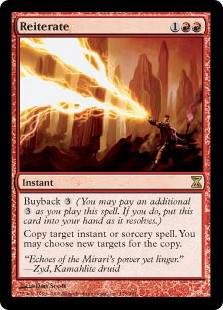
It's not everyday that you see a casual card completely explode, though new Commander releases can cause this to happen. In case you missed it, Reiterate has climbed from a low-end rare to one of the more expensive cards from Time Spiral.

There was an error retrieving a chart for Reiterate

Reiterate has always been a popular EDH card, but this spike is tied directly to the newly released Mizzix of the Izmagnus. Buylist prices for the card haven't made any serious corrections yet, and I would definitely avoid buying into the card for any serious percentage of the current TCGPlayer price, and I would be looking to unload these if I had any.

Avatar photo

Ryan Overturf

Ryan has been playing Magic since Legions and playing competitively since Lorwyn. While he fancies himself a Legacy specialist, you'll always find him with strong opinions on every constructed format.

View More By Ryan Overturf

Posted in FreeTagged , 3 Comments on Stock Watch- Reiterate

Have you joined the Quiet Speculation Discord?

If you haven't, you're leaving value on the table! Join our community of experts, enthusiasts, entertainers, and educators and enjoy exclusive podcasts, questions asked and answered, trades, sales, and everything else Discord has to offer.

Want to create content with Quiet Speculation?

All you need to succeed is a passion for Magic: The Gathering, and the ability to write coherently. Share your knowledge of MTG and how you leverage it to win games, get value from your cards – or even turn a profit.

Deck Overview- Legacy Four Color Maverick

Are you a Quiet Speculation member?

If not, now is a perfect time to join up! Our powerful tools, breaking-news analysis, and exclusive Discord channel will make sure you stay up to date and ahead of the curve.

Maverick was a deck that I never entirely understood in Legacy. It always kind of seemed like a goofy Death and Taxes to me, but the Punishing Fire builds represented angles that I respected more. Tom Keating's winning list from the Legacy Open in Somerset this weekend features that technology and plenty of other great metagame options.

Punishing Maverick by Tom Keating

Creatures

4 Dark Confidant
4 Knight of the Reliquary
1 Scavenging Ooze
1 Gaddock Teeg
1 Dryad Arbor

Spells

4 Chalice of the Void
4 Mox Diamond
2 Sylvan Library
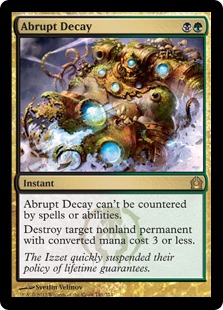
4 Abrupt Decay
3 Punishing Fire
2 Green Sun's Zenith
2 Life from the Loam
3 Liliana of the Veil

Lands

1 Forest
1 Badlands
2 Barren Moor
2 Bayou
3 Grove of the Burnwillows
1 Maze of Ith
1 Savannah
1 Scrubland
1 Taiga
1 Tranquil Thicket
4 Verdant Catacombs
4 Wasteland
2 Windswept Heath
1 Karakas

Sideboard

1 Ethersworn Canonist
1 Containment Priest
1 Reclamation Sage
1 Engineered Plague
3 Leyline of the Void
1 Golgari Charm
2 Thalia, Guardian of Thraben
1 Garruk Relentless
1 Maelstrom Pulse
2 Thoughtseize
1 Toxic Deluge

One of the major upgrades over traditional Maverick is replacing Noble Hierarch with Mox Diamond. Turn two Knight of the Reliquary is cool and all, but a turn one Chalice of the Void is completely backbreaking. Keating defeated two Storm decks in the Top 8 of the Open, which is a comically difficult feat for traditional Maverick decks.

There was an error retrieving a chart for Mox Diamond

Abrupt Decay over Swords to Plowshares is another huge improvement. One of these cards is great against Miracles, and the other is super terrible. Swords is, of course, more efficient and can deal with larger creatures, but Abrupt Decay is so much more flexible.

Liliana of the Veil is another upgrade over traditional Maverick, as Liliana is kind of just good against everything that people currently play other than Elves, which Chalice of the Void and Punishing Fire do great work against.

I have a hard time convincing myself not to play a Brainstorm/Force of Will deck in Legacy, but Chalice of the Void/Life From the Loam/Sylvan Library help make up for these exclusions. If you're looking to switch things up in Legacy, this is a very solid option.

Insider: Reexamining Old School Magic & Out-of-Print Cards

Are you a Quiet Speculation member?

If not, now is a perfect time to join up! Our powerful tools, breaking-news analysis, and exclusive Discord channel will make sure you stay up to date and ahead of the curve.

One of the most significant financial trends over the past few months has been the tremendous gains made by "Old School Magic" cards. For those who are unfamiliar, OSM, or "1993-94 Magic" as it is also sometimes called, is a casual format where players build constructed decks only using cards printed in The Dark or before.

I don't think, like some in the finance community, that this format is a one-shot deal based on hype alone. Playing with these cards is truly a special experience, and it's not as if they haven't supported outrageous prices in the past. Collectors already covet them, and being on the Reserve List means they can only go up.

I've had the opportunity to play the format a few times and it is certainly interesting to go back in time and play with the original cards. The format is basically exactly how I remember Type I when I first got into Magic as a sixth grader.

OSM in a Nutshell

The games feel very different than modern games. For one thing, there is a lot more grind to the format.

The answers are much better than the threats--just look at Juzam Djinn, one of the premier threats, alongside Swords to Plowshares or Counterspell. This is vastly different from Standard Constructed nowadays where Siege Rhino and Mantis Rider are considerably better than the available removal and permission.

There was an error retrieving a chart for Juzam Djinn

Speaking of Juzam, the card has jumped up almost $100 in the past month because of its popularity in Old School Magic. While the threats may be worse in the format, they are certainly both cool and iconic. I mean, who wouldn't want to beat down with this truly epic card?

The complete flip of the script compared to modern Constructed offerings is what makes Old School Magic so unique and fun to play. Since threats are considerably weaker than answers, games typically go longer and feel more developed or complex. Players have the opportunity to maneuver their sequencing without much worry of getting beat down before they ever get set up.

That isn't to say that Old School Magic is slow and boring. The Power 9 is legal and so while the threats may appear tame compared to Tarmogoyf and Dark Confidant, players can use Moxen to accelerate those threats onto the battlefield! Of course, the ability to play busted iconic cards like Moxen and other Vintage-restricted cards is another big reason the format is so popular.

Right now the format is characterized by a bunch of different "house rules" that vary by region and playgroup. Some groups don't allow for Revised cards like dual lands, some don't allow new card face reprints, some allow Collector's Edition or International Edition, and some even allow slightly newer sets like Ice Age and Fallen Empires.

The key here is that the format is in the beginning stages of development, and people are taking it in a lot of different directions. Basically, people agree they want to find a way to play with all the old cards like they did back in the day, but there appears to be many interpretations of how this should work.

I don't think this is a bad thing either. One of the problems I see with a format like 1993 Magic is that it never rotates or changes. Multiple versions of the format give players something to experiment with and switch between to keep things from getting too stale.

Are you bored of playing the same decks against each other in your play group? Well, let's add Ice Age and Fallen Empires to the mix and see what happens...

Collector's & International Edition

I really like Collector's Edition (CE) and International Edition (IE) cards as investments right now. I believe most play groups and tournaments for OSM will ultimately allow square-corner cards, which will have a nice effect on the prices of format staples. Look for cards like Power 9, dual lands, and other Reserve List staples from these promotional sets to pick up steam next year.

In particular, the CE and IE cards look really nice (despite having square corners and gold backs) and feature the original Beta card face and lettering. They much more accurately fit the feel of Old School Magic than Revised versions, because they look like the originals.

I also like the idea picking up some of the weird playable cards from the format that are not too expensive. Chaos Orb is exactly the kind of CE card that I could see being a solid pick-up right now.

There was an error retrieving a chart for Chaos Orb

I've noticed that Chaos Orb has actually gone up significantly in the past month, and the rise of OSM is almost certainly one of the reasons. Many people don't know this but Orb is easily one of the best cards in the entire format. It's basically a colorless Vindicate that every single deck plays!

I've actually picked up a couple copies of Chaos Orb and stashed them away in my investment portfolio.

I think that CE and IE duals and Power are certainly going to be the highest-yield cards from the square-border set. Now that there's a legitimate outlet for players who want to use and enjoy these gorgeous cards, they will see increased demand.

Arabian Nights

Almost the entirety of the Arabian Nights expansion has seen significant gains over the past month. Pretty much any card that you'd recognize by name (and also a bunch you wouldn't) went up in value because of Old School.

The set actually has a pretty high power level compared to the rest of the format. Aside from the ridiculous and laughable power level of the P9, many of the format-defining cards hail from this small expansion.

In particular, the djinn and efreet cards are among the most efficient threats in the format. It isn't surprising that Juzam Djinn and both of the Serendibs saw huge gains already. It's also kind of funny that King Suleiman and City in a Bottle have seen significant spikes as an answer to the dominant threats.

There was an error retrieving a chart for City in a Bottle

City is easily the best sideboard card in the format. Against the aggro decks it may well kill multiple threats, and then sit in play as a virtual Meddling Mage naming most of their creatures!

There was an error retrieving a chart for Library of Alexandria

There was a long period of time when Library of Alexandria was considered quasi-Power 9. Back in the day Library was always in the discussion for the most powerful card in the game, and it's worth noting that for much of its history it held the same value as a Mox.

Old School makes it easy to remember why this card was always held in such high regard. With slower games, grindy card advantage becomes important, and Library is easily the best card in the format. It can win games all by itself if unanswered.

The OSM price surges have spiked the value of Library. I've cashed out store credits at two different local stores and picked up a couple of extra Libraries to hold onto for a while.

There has also long been discussion of unrestricting Library in Vintage. If this were to happen, the price is almost certain to climb even higher.

~

I've noticed a lot of stores haven't updated prices on old singles, and it really is a prime time to take advantage. Old cards (especially expensive ones) tend to turn over slowly, sitting on shelves until that very specific buyer comes in.

Now might be the time to make a move on cards that have been hanging around shelves at your local game store. If your store isn't aware that Old School is a thing, or that prices have been on the move, they may be offering some very nice deals on hot Beta, Arabian Nights, or Legends cards that have gone up.

The cool thing about these Old School cards is that most of them are also Reserve List cards. Many are already collector's items, and without a possibility of reprint, the floor is very high.

The neat thing about 1994 Magic is that it gives these collectible cards a home for actual play. My opinion is that old cards are among the safest, most surefire investments in all of Magic collecting. They are iconic, significantly rare, cool to look at, and now with OSM once again playable! It's the perfect storm.

Trevor Holmes Plays MTGO Ep. 9: Jeskai Twin!

Are you a Quiet Speculation member?

If not, now is a perfect time to join up! Our powerful tools, breaking-news analysis, and exclusive Discord channel will make sure you stay up to date and ahead of the curve.

What’s up guys! Welcome back to my Modern Nexus Video Series, where we take a deck in the format and run it through some matches on Magic Online. This week we have Alex Bianchi's GP Pittsburgh winning Jeskai Twin list! While many Twin players chose the more traditional U/R Twin route over Grixis Twin in Pittsburgh, Alex branched out, riding Path to Exile and Restoration Angel all the way to victory. Does this deck have what it takes to supplant U/R, Grixis, and Temur for the coveted "best Twin deck" position? Let's find out!

Thumbnail_Master

"Jeskai Twin, Alex Bianchi, 1st - GP Pittsburgh"

Creatures

1 Wall of Omens
4 Snapcaster Mage
4 Deceiver Exarch
1 Pestermite
1 Vendilion Clique
2 Restoration Angel
1 Kiki-Jiki, Mirror Breaker

Sorceries

4 Serum Visions

Instants

4 Lightning Bolt
4 Path to Exile
2 Spell Snare
1 Dispel
3 Remand
1 Electrolyze
1 Cryptic Command

Enchantments

3 Splinter Twin

Land

4 Scalding Tarn
4 Flooded Strand
3 Steam Vents
1 Hallowed Fountain
1 Sacred Foundry
3 Island
1 Mountain
1 Plains
1 Sulfur Falls
1 Cascade Bluffs
3 Celestial Colonnade

Sideboard

2 Dispel
1 Wear // Tear
1 Stony Silence
1 Pia and Kiran Nalaar
1 Engineered Explosives
1 Celestial Purge
1 Keranos, God of Storms
1 Elspeth, Sun's Champion
2 Blood Moon
1 Flashfreeze
1 Negate
2 Timely Reinforcements

[wp_ad_camp_1]

Deck Tech

[youtube https://www.youtube.com/watch?v=Jn4r-T6qgeE&w=560&h=315]

Round 1

[youtube https://www.youtube.com/watch?v=CSN_RuG5z3g&w=560&h=315]

Round 2

[youtube https://www.youtube.com/watch?v=XNA9IZwfY6E&w=560&h=315]

Round 3

[youtube https://www.youtube.com/watch?v=32fvO4v1V94&w=560&h=315]

Conclusion

All in all, I'm pretty happy with our results. Amulet Bloom seems like it should be a relatively even matchup, but after playing it I can see how it can go either way. Path to Exile, Lightning Bolt and Snapcaster Mage add up to a TON of removal, which seems awesome against all these creature decks running around. Against midrange, counterspells and sideboard bombs seems to be a great plan, and we could always just combo them (yeah, this deck does that too!). Thanks for watching guys, I'll see you next week!

Trevor Holmes
The_Architect on MTGO
twitch.tv/Architect_Gaming
twitter.com/7he4rchitect

Scrap Savant – Life for Jeskai

Are you a Quiet Speculation member?

If not, now is a perfect time to join up! Our powerful tools, breaking-news analysis, and exclusive Discord channel will make sure you stay up to date and ahead of the curve.

Hello, everyone! Welcome back to Scrap Savant. We voted, we built our list---now it's time to see the deck in action!

After playing a few test games with our preliminary list, I made some adjustments (which I'll cover below.) The goal is to arrive at a semi-viable deck, and then discuss options for upgrading with some extra small investments.

It's been great to get acquainted with MTGO as I've started this project. As I get more comfortable, we'll work our way up to more competitive channels, and look to take future decks into Leagues.

Today we'll look at the edited list, see how it fared on MTGO and provide the next round of polling. Let's not waste any more time!

Life for Jeskai

Creatures

4 Arashin Cleric
4 Seeker of the Way
3 Felidar Sovereign

Spells

4 Lightform
3 Singing Bell Strike
4 Brutal Expulsion
3 Jeskai Charm
3 Valorous Stance
3 Fiery Impulse
2 Anticipate
1 Stasis Snare
1 Treasure Cruise
2 Arcbond

Lands

4 Mystic Monastery
1 Blighted Steppe
3 Island
3 Mountain
4 Plains
4 Wind-Scarred Crag
2 Tranquil Cove
2 Swiftwater Cliffs

Sideboard

3 Surge of Righteousness
1 Stasis Snare
2 Ondu Rising
1 Felidar Cub
2 Negate
1 Treasure Cruise
2 Wild Slash
1 Roast

At the time I uploaded this list to MTGGoldfish, the deck was going for a grand total of 2.48 tix, or $26.93 in paper. That's some seriously low-budget pricing right there!

Intro & Games

Deck Tech

Games 1-2 vs. Abzan Blue

Games 3-4 vs. Atarka Red

Thoughts on the Deck

In the final build I decided Watcher of the Roost just wasn't going to cut it. I found a great replacement in Lightform.

Lightform fills the deck's needs in every way, playing better with Arcbond as well as Seeker of the Way. As another source of repeatable life gain, it also gives us a better chance to reach the threshold needed to trigger Felidar Sovereign.

The deck had an issue keeping up with the value plays of other decks, which is to be anticipated. What we tried to do was put ourselves in a situation to combat them as best we could, and build enough of a life buffer to close out the game with a well-timed Felidar Sovereign. For the most part, we did actually keep up---but then quickly ran out of resources.

Another thing to note is that Arcbond can do some really crazy things. It's really not that bad a card, and in some scenarios against aggressive decks it's a complete blow-out.

Especially on a lifelink creature, an opportune Arcbond can effectively end the game right on the spot. As you can see above, it really helped us Game 1 against Atarka Red.

Arcbond might merit a second look in Standard before it rotates. It's a sneaky play coming out of the sideboard against hyper-aggressive lists, and might be powerful enough for the highest levels of competitive play.

Additional Upgrades

If you have a little more budget to work with, there are a few choice cards that go well in our core strategy.

I mentioned before that this deck would love a Soulfire Grand Master. I would look to that card as the first way to upgrade the list. It opens the deck up to a different play style and gives us a lot more mileage out of burn spells. Additional funds could then be used to add cards like Exquisite Firecraft.

Being able to lean on Radiant Flames and a better manabase would make it vastly easier to battle against the Tier 1 decks. The combo of Flames plus Soulfire would also give us another realistic way to trigger Felidar Sovereign's "win the game" clause.

Replacing the unreliable, temporary removal like Singing Bell Strike with burn spells would also be nice. All these upgrades are still relatively inexpensive outside of Soulfire Grand Master, and vastly improve the interactions in the deck.

As it turns out, Brutal Expulsion didn't really pull its weight, for the most part. It was much better against a deck like Atarka Red, and can certainly be revisited when Khans rotates. This is part of the learning process of this series, and we should expect similar surprises moving forward. The addition of Soulfire Grand Master would also help here, providing a little extra lifegain boost on one of Expulsion's modes.

So if you're looking to budget extra funds for the deck, here are my initial recommendations:

  • Soulfire Grand Master - 4.38 tix/$10.72 each
  • Exquisite Firecraft - 1.29 tix/$3.99 each
  • Hidden Dragonslayer - 0.38 tix/$2.33 each
  • Radiant Flames - 0.51 tix/$1.98 each

Here's a sample upgraded list with the additional budget:

Life for Jeskai (Additional Budget)

Creatures

4 Arashin Cleric
4 Seeker of the Way
2 Felidar Sovereign
2 Hidden Dragonslayer
4 Soulfire Grand Master

Spells

3 Radiant Flames
3 Brutal Expulsion
3 Jeskai Charm
2 Valorous Stance
3 Fiery Impulse
2 Anticipate
3 Exquisite Firecraft
2 Arcbond

Lands

4 Mystic Monastery
1 Blighted Steppe
3 Island
3 Mountain
4 Plains
4 Wind-Scarred Crag
2 Tranquil Cove
2 Swiftwater Cliffs

If you don't have the budget for everything, I would prioritize Soulfire Grand Master and Radiant Flames. These two cards will have the biggest impact on the deck's effectiveness.

Time for the Next Poll

Now on to the next project. By the time polling is finished this round, everyone will likely be in a Thanksgiving coma, so hopefully that leads to some interesting results! Stay safe, and be sure to carve out (ha!) some time to participate in the polls.

Choose 2 from this poll:

Choose 1 from this poll:

I'm eager to see the results! Enjoy the holidays everyone, and see you all back real soon.

- Chaz @ChazVMTG

Insider: Playing and Selling at GP Pittsburgh

Are you a Quiet Speculation member?

If not, now is a perfect time to join up! Our powerful tools, breaking-news analysis, and exclusive Discord channel will make sure you stay up to date and ahead of the curve.

Grands Prix mean something different to every player. For some they evoke high level competition, while others hear those words alongside the cha-ching sound of profit ringing in their ears.

For me, a Grand Prix is always a bit of both. I treat each Grand Prix as more of a convention, similar to Origins or Gen Con. These trips are a time to rev up the competitive engine, make some money, and also have a ton of fun.

My outlook differs from that of some of my friends. One friend sees this as the time to scour the dealer booths for a good deal, sell some cards, and complete collection goals he set for himself at the beginning of the trip. Another friend enjoys chaining side events to win as many boxes as possible.

Whatever your goal, there's a metric ton of fun to be had.

The Main Event

My number one goal for any large event, such as Grand Prix Pittsburgh this past weekend, is to take each match one game at a time and end up with a spot for Day 2. Reaching this goal often requires knowledge of the format, getting an edge with unexpected cards or strategies, and a little luck.

Here's the deck I sleeved up for my hometown GP.

Kiki Chord by Mike Lanigan

Creatures

4 Birds of Paradise
2 Noble Hierarch
3 Wall of Roots
3 Voice of Resurgence
3 Blade Splicer
2 Courser of Kruphix
4 Restoration Angel
2 Siege Rhino
2 Kiki-Jiki, Mirror Breaker
1 Spellskite
1 Reclamation Sage
1 Sin Collector
1 Eternal Witness
1 Orzhov Pontiff
1 Avalanche Riders
1 Pia and Kiran Nalaar
1 Linvala, Keeper of Silence

Spells

4 Chord of Calling

Lands

4 Wooded Foothills
3 Windswept Heath
3 Arid Mesa
1 Stomping Ground
1 Temple Garden
1 Sacred Foundry
1 Overgrown Tomb
1 Blood Crypt
1 Godless Shrine
1 Fire-Lit Thicket
1 Rugged Prairie
2 Gavony Township
1 Forest
1 Mountain
1 Plains

Sideboard

1 Melira, Sylvok Outcast
1 Scavenging Ooze
1 Tunnel Ignus
1 Qasali Pridemage
1 Sin Collector
2 Path to Exile
1 Abrupt Decay
2 Ancient Grudge
1 Kolaghan's Command
2 Domri Rade
2 Sorin, Solemn Visitor

Birthing Pod, oh how I loved thee---but just because you’re gone doesn’t mean I’m going to stop hanging out with your friends.

Even without Pod, the old archetype's supporting cast is still strong. Chord of Calling remains one of the best tutors in the format. Many players moved from a deck like this to a more aggressive Collected Company shell. But I still believe in Restoration Angel, which forms the centerpiece of the Kiki Chord strategy.

My main reason for standing strong behind this strategy is its adaptability and overall strength against the format at large. Chord of Calling can find Reclamation Sage against Affinity, Orzhov Pontiff against tokens, or Sin Collector against Grixis Control. Add in access to any number of other silver bullets and you have a strong core to build around.

Previous versions of this deck have focused on assembling the combo and lacked an aggressive strategy that could legitimately win the game. This version, while lacking in Birthing Pod power, revs up its fighting strength with lines like Blade Splicer into Restoration Angel.

In terms of tournament success, this Grand Prix seemed far out of reach. My opponents were drawing the second Galvanic Blast off the top to kill me exactly in game three, or using Tron to cast Ulamog, the Ceaseless Hunger against my land-light draw. Meanwhile I was flooding or struggling to cast my spells.

The games where I drew an acceptable mix of lands and spells were winning endeavors, but otherwise I was left helping my opponents’ tie breakers.

Speaking of Tron, it picked up some sweet high-cost spells from recent sets which have pushed the power of the archetype. Take a look at this version that made Top 32:

G/R Tron by Tim Turner (Top 32 GP Pitt)

Creatures

2 Spellskite
3 Wurmcoil Engine
2 Ulamog, the Ceaseless Hunger
1 Emrakul, the Aeons Torn

Spells

4 Ancient Stirrings
4 Chromatic Sphere
4 Chromatic Star
4 Expedition Map
2 Relic of Progenitus
4 Sylvan Scrying
4 Oblivion Stone
4 Karn Liberated
2 Ugin, the Spirit Dragon

Lands

4 Urza's Tower
4 Urza's Mine
4 Urza's Power Plant
2 Ghost Quarter
4 Grove of the Burnwillows
1 Eye of Ugin
1 Forest

Sideboard

2 Spellskite
1 Ulamog, the Ceaseless Hunger
2 Nature's Claim
2 Rending Volley
2 Torpor Orb
1 Vandalblast
1 Crumble to Dust
1 Thragtusk
3 Pyroclasm

Ulamog’s evolved form is tremendous. Being able to blow up two permanents regardless of whether or not it resolves is astoundingly good. I even spoke to a couple players that pulled off successful mill victories. Come prepared, or Ulamog’s going to eat you.

This strategy is clearly improved from previous versions, but players are bringing their hate cards to battle the new and improved threat. I’m seeing more Blood Moons, Stony Silences and Crumble to Dusts than ever before. So, if you want to ramp into giant monsters, you need a plan of action against these hate cards.

The Dealer Booths

The GP is rare where in addition to my competitive drive, I don't also have a financial agenda. For this event, I was looking to unload a couple spec targets, as well as some unnecessary Tiny Leaders cards.

Lately I’ve been hearing a dragon’s hoard worth of complaints about the financial cost of Magic. When players start complaining about prices, I am always quick to remind them that their collection can start making these purchases for them. If cards in general are more valuable now, that goes for your cards too.

In Magic, we take on many side quests. In addition to building your latest Standard or Modern deck, there will always be fads like Tiny Leaders. While my love for that format continues, the availability of opponents dried up. Don’t let those fun projects turn into a Ruinous Path. Put them in your trade binder or unload them via the selling method you prefer.

These days we're flooded with options for selling our cards. Do you take the store route and list everything on eBay or TCG Player, or do you find the best buy prices to liquidate large amounts of cards quickly? Having more options may seem daunting, but it's ultimately a good thing if you take the time to sort through them all.

One of the big perks of a Grand Prix is the dealer booth selection. Most Grands Prix have ten or more dealers buying and selling cards all weekend long. Your mission, should you choose to accept it, is to determine which dealers are offering the best value for the cards you're trying to move.

Every store has a different outlook on buying. The amount of store credit bonus offered, if any, may differ, and every store has their own unique buylist they operate from. In this situation, like in most, knowledge is power.

The best way to win at selling is to know what your cards are worth and what the likely buy price will be. If you sell a lot, you become accustomed to what cards sell for what prices. You also have lots of resources here on Quiet Speculation to assist you in this process.

Step one in my process is to case the room. If you watch detective shows, you know this terminology means to gain knowledge about your surroundings. Walk around the room and see which dealers showed up at the convention. While you’re at it, take a look at their hot list boards and see if any cards you need to sell are listed.

If you are looking to purchase specific cards, you can also use this opportunity to see what each dealer has for sale. This is a good idea even if you aren’t in the market for anything in particular because occasionally you will happen upon a deal too good to pass up.

Negotiating with Dealers

Once you’ve cased the room, determine who your first dealer will be and sit down with one of their buyers. If you take one thing away from this article, let it be this: it’s okay to say no.

I see a lot of people who are too afraid to say no to a buy price. Buyers have tactics to cajole you into selling to them. Every dealer isn’t out to get you, but you need to determine if the price they’re offering is high enough to accept.

While you cannot look up every card individually, if you are uncertain about a buy price, take a moment while they’re on some other card to look it up and inform yourself. Even if they already piled out your cards, you can always pull cards back out later.

Your approach should differ depending on the value of the cards you're selling. If you only have a few high-end cards to move, take your time and ask every dealer what their buy price is before selling.

Developing a rapport with dealers is helpful so you can negotiate. I know when I'm headed to a GP, I'm going to say hi to all the dealers I'm friends with, and most likely sell to them too. Selling regularly at GP’s will give you some street cred, so to speak, and might earn you a couple better deals than other patrons might receive.

Most dealers have some kind of specialty. Some focus on high-end foils, while others are in the market for Eternal cards. You can usually find that one dealer who will buy cards no matter the condition. Every dealer is different so getting to know them is worthwhile.

Cards I Sold

There was an error retrieving a chart for Protean Hulk

By this point, you surely know that Protean Hulk is a bulk rare no longer. After selling them this weekend, I grew distraught to see them jump up farther. But now they appear to have stabilized in the $6-7 area, and the numbers I got for them seem reasonable in retrospect.

If you’ve been reading here on the site or following me on Twitter, you should have made a bunch of money on this spec like I did. If not, get in on the next one.

There was an error retrieving a chart for Footsteps of the Goryo

Just like Protean Hulk, this reanimation spell saw an uptick in price due to its play in the same deck. Footsteps has seen only one printing, many years ago. Thus, despite being an uncommon, its ceiling is high.

The current prices of Footsteps of the Goryo and Protean Hulk seem stable under $10 unless the deck really takes off. If that happens, expect another bump in price.

There was an error retrieving a chart for Nyxathid

Since the popularity of Tiny Leaders has waned, I thought this spec box card needed to go. I sold my two playsets as well as the couple foils that I had. We have not seen an increase in price on this guy for quite some time, so it was time to reinvest in another target.

The other cards I sold were mostly Tiny Leaders cards like foil Smother, as well as some extra Modern cards I had lying around. One of my recent goals has been to acquire one of each Expedition to make my cube a little prettier. A resource I utilized for that purpose was the other foils of those lands that were previously in the cube.

Foil Khans fetches took a little hit with the printing of the Expeditions, but they’re still good long-term investments. They will be a less expensive way to foil your deck but have it still look sweet.

Speaking of Expeditions, you may have noticed some of them coming out of the pack in less than Near Mint (NM) condition. As this doesn’t happen to every card, it's creating a major price discrepancy. The truly NM copies are rare enough that dealers are charging a premium for them.

There is no consistency though. Some dealers have Slightly Played (SP) or even Moderately Played (MP) Expeditions marked at the same price as the NM ones. Be extra careful ordering these cards online, as sellers are not marking their condition accurately.

What all this means is higher prices overall and paying a premium for the condition you want in the future. Expeditions, especially NM ones, are a great long-term investment. Buying these cards in person so you can judge the condition means it’s okay to pay a little extra.

~

Well that’s a wrap for my GP Pittsburgh experience. Hopefully you can profit from my experience as well. If you have any questions about GP finance or the event, hit me up in the comments or on Twitter.

Until next time,
Unleash the GP Force!

Mike Lanigan
MtgJedi on Twitter
Jedicouncilman23@gmail.com

Black Friday Magic Deals

Are you a Quiet Speculation member?

If not, now is a perfect time to join up! Our powerful tools, breaking-news analysis, and exclusive Discord channel will make sure you stay up to date and ahead of the curve.

As we close in on the biggest shopping day of the year, I know that I won't be shopping on Black Friday, and I certainly won't be going out on Thanksgiving evening. That said, there are a number of deals that a Magic player could be taking advantage of this week, if one were so inclined. Reddit user meatwhisper has consolidated all the Magic related deals that have been posted on Reddit into one convenient post.

If you speculate on under-priced cards out of pocket then it would be a good idea to peruse these deals for some goodies. This also wouldn't be a bad time to pick up any missing EDH pieces or gifts for other players.

There was an error retrieving a chart for Goblin Snowman
Avatar photo

Ryan Overturf

Ryan has been playing Magic since Legions and playing competitively since Lorwyn. While he fancies himself a Legacy specialist, you'll always find him with strong opinions on every constructed format.

View More By Ryan Overturf

Posted in FreeTagged Leave a Comment on Black Friday Magic Deals

Have you joined the Quiet Speculation Discord?

If you haven't, you're leaving value on the table! Join our community of experts, enthusiasts, entertainers, and educators and enjoy exclusive podcasts, questions asked and answered, trades, sales, and everything else Discord has to offer.

Want to create content with Quiet Speculation?

All you need to succeed is a passion for Magic: The Gathering, and the ability to write coherently. Share your knowledge of MTG and how you leverage it to win games, get value from your cards – or even turn a profit.

Insider: QS Cast 14 – Making Money on Modern

Are you a Quiet Speculation member?

If not, now is a perfect time to join up! Our powerful tools, breaking-news analysis, and exclusive Discord channel will make sure you stay up to date and ahead of the curve.

Play

This week, the cast digs into GP: Pittsburgh. They look at Twin, the lack of Tarmogoyfs, and a respectable and truly “budget” deck to play around with!

If you want to leave a message for the cast, you can record a message for the cast!


Douglas Linn

Doug Linn has been playing Magic since 1996 and has had a keen interest in Legacy and Modern. By keeping up closely with emerging trends in the field, Doug is able to predict what cards to buy and when to sell them for a substantial profit. Since the Eternal market follows a routine boom-bust cycle, the time to buy and sell short-term speculative investments is often a narrow window. Because Eternal cards often spike in value once people know why they are good, it is essential for a trader to be connected to the format to get great buys before anyone else. Outside of Magic, Doug is an attorney in the state of Ohio.  Doug is a founding member of Quiet Speculation, and brings with him a tremendous amount of business savvy.

View More By Douglas Linn

Posted in Free Insider, QS Cast1 Comment on Insider: QS Cast 14 – Making Money on Modern

Have you joined the Quiet Speculation Discord?

If you haven't, you're leaving value on the table! Join our community of experts, enthusiasts, entertainers, and educators and enjoy exclusive podcasts, questions asked and answered, trades, sales, and everything else Discord has to offer.

Want to create content with Quiet Speculation?

All you need to succeed is a passion for Magic: The Gathering, and the ability to write coherently. Share your knowledge of MTG and how you leverage it to win games, get value from your cards – or even turn a profit.

Want Prices?

Browse thousands of prices with the first and most comprehensive MTG Finance tool around.


Trader Tools lists both buylist and retail prices for every MTG card, going back a decade.

Quiet Speculation