menu

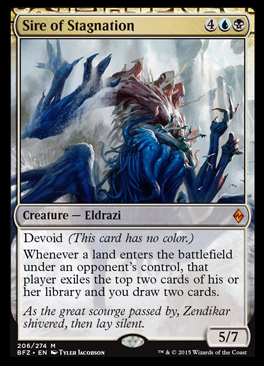
Sire of Stagnation Just Took Battle for Zendikar to the Next Level

Are you a Quiet Speculation member?

If not, now is a perfect time to join up! Our powerful tools, breaking-news analysis, and exclusive Discord channel will make sure you stay up to date and ahead of the curve.

sire_of_stagnation

Now that’s an Eldrazi that I’m afraid of! I’ll be honest, up until now, the Eldrazi cards on the Battle for Zendikar spoiler page have not gotten my adrenaline pumping until now. Don’t get me wrong, we’ve seen a lot of cool cards. I’ve been more excited that the Eldrazi are making 1/1s instead 0/1s rather than being impressed with the overall power level. Think about all the original Eldrazi and how terrified you were that they would hit play. If you play Modern or Legacy, you might still live in fear of that very moment.

There was an error retrieving a chart for Kozilek, Butcher of Truth

When you cast this monster you draw a pile of cards, then when he attacks he annihilates the opposing board before you have a they to block. Unlike our next fiend, at least it's killable.

There was an error retrieving a chart for Ulamog, the Infinite Gyre

We also had to deal with an indestructible foe who exiled your best card and then took more away when he attacked. Better have the right removal spell or you’re doomed. Then comes the biggest and baddest of them all.

There was an error retrieving a chart for Emrakul, the Aeons Torn

The Eldrazi are the most popular villain in the Magic universe mainly due to this monstrosity of the skies. One hit and you typically lose the game. He doesn’t usually have to deal the full twenty damage before your opponent is signing the match slip. I’m sure when he hits tables across the world, the rest of the players groan unanimously.

These are the Eldrazi of legend. These are the ones we have nightmares about facing. The spoiler isn’t complete yet, so we still have a little time to get scared and Sire of Stagnation is exactly what we needed to get our blood pumping. Take a look at this guy again.

sire_of_stagnation

Castable, check. Good stats to mana cost, check. Benefits to cheating into play earlier, check. Amazing ability that will send chills up your opponents’ spine, double check!

The Eldrazi are supposed to impact the game in a big way. Ulamog, the Ceaseless Hunger does that somewhat because he gets to exile two permanents and wins you the game even if your opponent chump blocks every turn. Sire of Stagnation changes the way your opponent must play the game. If they need lands in order to cast their spells, you get to draw two cards. Now that’s a powerful ability! The ability is more like opponent choose one: never play lands again or lose the game to your opponent’s card advantage.

Sire of Stagnation has really gotten me revved up for the epic battle about to ensue on the plane of Zendikar. What Eldrazi cards are you most exicted about? Do you think Sire of Stagnation is all I’ve pumped it up to be? Let’s get the conversation started in the comments.

Until next time,
Unleash the Force!

Mike Lanigan
MtgJedi on Twitter
Jedicouncilman23@gmail.com

How Lantern Control Won and How to Beat It

Are you a Quiet Speculation member?

If not, now is a perfect time to join up! Our powerful tools, breaking-news analysis, and exclusive Discord channel will make sure you stay up to date and ahead of the curve.

Ghoulcallers Bell Banner

The Scene: I was enjoying my weekend, minding my own business, working my way through the Battle for Zendikar spoiler in cool, calm, collected fashion. Aside for a momentary lapse in reading ability, I was relatively under control, ready to calmly burst dreams and inform readers exactly why Shambling Vent is unimpressive at best.

Then Zac Elsik tore through Oklahoma City like a *POOR ATTEMPT AT TORNADO JOKE REDACTED*. Looks like the BFZ spoiler discussion will have to wait! The questions that should be on everyone’s mind (besides what is Cheez Whiz made of) are: 1) How was Zac able to do so well with a rogue deck? 2) How do we go about fighting Lantern Control? And 3) Where do we go from here? Let us proceed.

[wp_ad_camp_1]

Lantern Control

If we're going to start anywhere we should probably start with the decklist in question.

"Lantern Control, Zac Elsik, 1st, - GP Oklahoma City"

Artifacts

4 Lantern of Insight
4 Ghoulcaller's Bell
4 Codex Shredder
4 Ensnaring Bridge
4 Mox Opal
3 Pithing Needle
2 Pyrite Spellbomb

Creatures

3 Spellskite

Sorceries

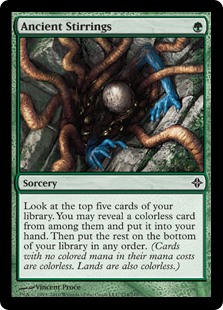
4 Ancient Stirrings
4 Inquisition of Kozilek
2 Thoughtseize

Instants

2 Surgical Extraction
2 Abrupt Decay


Enchantments

1 Ghirapur Aether Grid

Lands

4 Glimmervoid
4 Llanowar Wastes
2 Blackcleave Cliffs
1 Copperline Gorge
1 Tendo Ice Bridge
1 Forest
2 Ghost Quarter
2 Academy Ruins

Sideboard

1 Pithing Needle
4 Sun Droplet
3 Pyroclasm
3 Welding Jar
2 Grafdigger's Cage
1 Ancient Grudge
1 Nature's Claim

For those that are unfamiliar with the basic strategy of the deck, I suggest reading Modern Nexus’ Primer on the archetype here. Seriously, do your homework, there will be a quiz later. Unlike almost every other combo deck in the format, Lantern Control has the unique ability to simultaneously protect and execute its gameplan through normal means, without jumping through hoops to craft the gamestate to a favorable position. Let me explain.

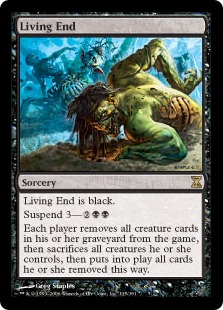
Living EndMost combo decks in Modern function on a strict principle of non-interaction, concentrating primarily on consistency and speed, relying on their “payoff” to win the game outright as long as they’re able to get there. We see this all the time in decks like Living End, Amulet Bloom, and Tron; strict adherence to non-interaction, looking to set up a certain combination of cards as fast and consistently as possible. Yes, Living End's combo has an interactive element, but it gets there non-interactively and the interaction is incidental so it fits. Burn can even be considered an extension of this, where it’s “combo” is 6-7 cards that do 3 damage to the face. These strategies are powerful thanks to a potent combination of speed and consistency which is exactly why they are a large threat in the format.

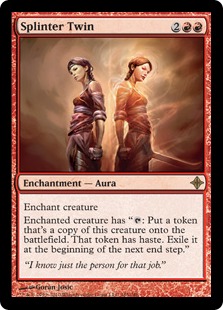
On the other hand, we have interactive combo like Splinter Twin and Scapeshift, that are similarly trying to do unfair things, but are looking to react along the way (sacrificing speed and consistency for interactive elements). The strength of this approach lies in their resiliency; by “slowing down” their combo gameplan they are able to interact with the opponent, giving them more game against hate and a chance to win if their opponent has a faster goldfish or their own plan stumbles. The downside to this approach is clear, however. By reducing the speed and consistency of their primary gameplan in favor of interaction, decks like Twin and Scapeshiftoften experience poor/slow/awkward draws that contain both combo and reactive elements. They play fewer ways to find the combo than more dedicated non-interactive combos and so may never be able to assemble the combo and win.Ensnaring Bridge

Back to Lantern Control. While the “combo” of the deck is Ensnaring Bridge + no cards in hand, the real strength of the deck lies in its ability to control the game without sacrificing combo elements. Lantern of Insight, Ghoulcaller's Bell, and Codex Shredder work to kill the opponent but slowly, focusing instead on manipulating the top of the library so the opponent never draws a relevant card to put up a fight while simultaneously digging for Ensnaring Bridge and additional/missing combo pieces. Inquisition of Kozilek and Thoughtseize also serve a double function. They interact with the opponent’s hand (stripping answers and threats) while emptying our own hand quickly to enable Ensnaring Bridge. The strength of the discard spells in this deck is second to none, except perhaps Suicide Zoo. Regular readers of my column might remember a discussion about “using every part of the buffalo” in regards to Thoughtseize, and the concept applies here as well.

GP Oklahoma City

Glistener ElfLast week, we discussed how Todd Anderson was able to take an unexpected deck into a field aimed primarily at Grixis Control and dominate. Todd capitalized on positioning by choosing a powerful, linear deck to successfully attack a field pushed too far towards one end of the metagame-spectrum. While everyone was focused on grinding out Grixis Control with Relic of Progenitus and resilient anti-control measures, Todd “next-leveled” the field, wielding a fast, consistent aggro deck against opponents caught out of position. For Oklahoma City, Infect was on everyone’s minds. No one wanted to lose to it again so they made sure that they could interact with it and prepared accordingly.

So what did we see in Oklahoma City? Infect comprised 7% of the Day Two metagame, but no lists were able to make it to a Top 32 finish. This suggests a field loaded up on spot removal for Infect. What’s great against decks packed with removal? Ensnaring Bridge! This point is further supported by the relatively strong performances of Naya Company, Elves, Amulet Bloom and Scapeshift (40% or better Day 2 conversion rate). Collected Company and combo definitely seemed to be where you wanted to be on Day 2 in Oklahoma, and Zac was able to blast through the field all the way to the finish line and take the trophy.

How Do We Beat It?

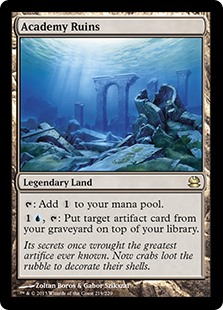
So far, Lantern Control has been able to leverage one interesting resource that hasn’t really been discussed: it’s weird! The deck contains many “free” interactions and angles of attack that make it difficult to hate out directly. Its existence as an artifact-based combo deck already reduces the field of possible interactive elements down to a thin list, unlike something like Splinter Twin where anything from Dismember to Vines of Vastwood to Torpor Orb and Virulent Plague can disrupt it.Academy Ruins In addition, many alternate paths to victory are present in the deck, and they fit in the maindeck too! Academy Ruins can keep buying back Ensnaring Bridge or Codex Shredders forever to win via decking, and Ghirapur Aether Grid and Pyrite Spellbomb can even let the deck win through damage! Spellskites, additional Academy Ruins, and Welding Jars out of the sideboard make life horrible for anyone relying on Kolaghan's Command to get them there against “artifact decks”. A full playset of Sun Droplets are present to fight Burn.

All is not lost, however. The deck has a few weaknesses that can be exploited, but full disclosure, my Gatherer search of “destroy target lantern control” returned zero results. Looks like it’s the hard way boys.

Blood Moon: Aside from Mox Opal and a basic Forest, the list has no ways to produce colored mana under a Blood Moon. This mean that if we can stick one, they won’t be able to Abrupt Decay our follow up Stony Silence or other hate card, which should give us enough time to find a path out from under their Ensnaring Bridge. This is a tough fight to win, however, as they play a bunch of discard that we need to dodge, and doesn’t solve the Academy Ruins/Ensnaring Bridge loop. I think we can do better. [EDIT: astute readers have caught that Blood Moon does stop the Academy Ruins loop, because that's what Blood Moon does. Thanks readers! -Trevor]

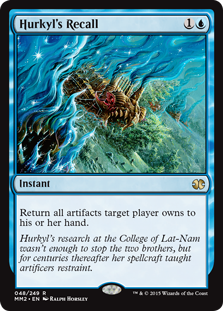
Hurkyls RecallHurkyl's Recall: Look, it might be time. Affinity is still good (though it will catch some splash hate from Lantern’s performance) and Recall dodges Spellskite/Welding Jar/Academy Ruins shenanigans. Depending on size of fatties involved you might only need one attack step to win the game and if not the number of artifacts on the field could result in two or more attack steps, as it might take Lantern two full turns or more to dump their hand again to the point that Bridge becomes effective.

Ancient Grudge: Remember this card? It used to be the default artifact hate until new kid Kolaghan's Command kicked it off the playground. Now, however, that flashback is looking better than ever. Yes, Grafdigger's Cage may be an issue if they board it in, but if not then the mill rocks will not prevent you breaking the Bridge and swinging for lethal. And it hits Affinity!

ScapeshiftDon’t plan on winning with creatures: Scapeshift seems to be a strong option, as it dodges Inquisition of Kozilek and cares nothing about the combat step. Lantern is really reduced to just hoping Scapeshift never finds, you know, Scapeshift, which can be a pipe dream since Scapeshiftcan Serum Visions/Anticipate/Peer Through Depths early enough to find it before Lantern gets Lantern online. Aside: I propose no longer naming decks after cards in those decks. It makes crafting legitimate sentences impossible. Tango has been thrown around pretty liberally lately, I propose Lantern become Tango Control. Scapeshift can just go die. In addition, Lantern Control has a tough time beating Burn, as seen by the playset of Sun Droplet plus a Nature's Claim in the board. A critical mass of burn spells means that Burn can often have two or three in a row on top of the deck, and it can normally do 10-12 damage before Ensnaring Bridge comes down, meaning Lantern has to fade a LOT of draw steps to win.

Karn LiberatedTron gets better: Maindeck Relic of Progenitus to fight Academy Ruins, the consistency and redundancy to get Tron online even through opposing library manipulation, and a top end of Oblivion Stone, Karn Liberated, and Ugin, the Spirit Dragon drawing seven cards should do well against Lantern Control. It even gets access to Nature's Claim (which it was playing to fight Blood Moon and Affinity anyway) and it benefits from the field diluting their boards to fight Lantern as well. If I was playing a big event tomorrow, Tron is probably where I would start (I can’t believe I just said those words).

Where Do We Go From Here?

These past few weeks have been pretty linear, and while hindsight is 20/20, nothing that has happened so far should be too surprising. The format moved too far to midrange, and Infect took over, at which point it became too removal-focused, which allowed combo to take advantage. Lantern Control is resilient and difficult to attack directly, but fortunately for the rest of us the deck is also difficult to pilot (and especially difficult to pilot quickly) which means that it will probably be a little more under-represented than it should be in the metagame, not unlike Amulet Bloom. The same was said about Eggs, however, and people still played Eggs to the point of its banning. I’m definitely not saying Lantern is deserving of a ban: just referencing the fact that the justification “the deck is too hard/weird/slow to play” only works to a certain point. Ignore it at your own risk because Lantern Control is a real deck.

Lightning BoltMoving forward, I’m definitely expecting better positioning for Burn, Tron, and Scapeshift. These decks seem to have good matchups against Lantern, so they’re a good place to start, but we have to be careful not to focus too much on Lantern. The best deck to fight Infect was Grixis Control, but the Grixis hate was a little too strong in Cincinnati and correcting that oversight (and overestimating Kolaghan's Command) allowed Lantern to take Oklahoma City. If people keep trimming graveyard hate for artifact hate, we could see Amulet or Grishoalbrand or Living End come back (another deck that has been punished by Grixis hate recently) and take the field by surprise. Currently, Modern is about to experience a slow month; the next big event for Modern is SCG States in the middle of October. Prepare to welcome our Eldrazi overlords, and use this time to perfect that sweet Zur the Enchanter list!

Thanks for reading! Did I miss any sweet tech for fighting Lantern Control? Have a prediction for the next “best deck”? Have a brew you want me to play on stream? Let me know in the comments!

Trevor Holmes
Twitch.tv/Architect_Gaming
Twitter.com/7he4rchitect

Insider: Evaluating Standard’s Powerful New Lands from Battle for Zendikar

Are you a Quiet Speculation member?

If not, now is a perfect time to join up! Our powerful tools, breaking-news analysis, and exclusive Discord channel will make sure you stay up to date and ahead of the curve.

Lands matter. They really do! Last time around, landfall did not have much impact outside of a couple creatures like Steppe Lynx and Plated Geopede. We did see some players utilizing Teetering Peaks in their aggressive decks and some man-lands, but outside of those situations, you might not have noticed the importance of the ability lands very much.

This time around things will be different. We still have some of the same types of effects but now there are more of them, and they’re a bit better. Let’s start with the cycle of commons.

Enters-the-Battlefield Ability Lands

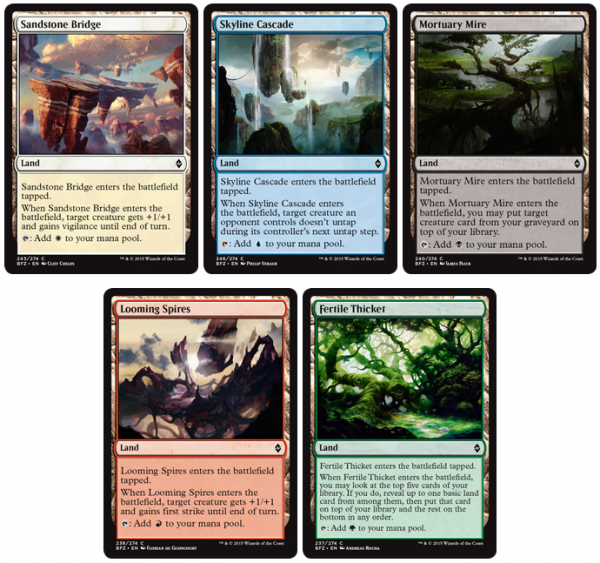
BFZ Common land cycle

This cycle contains some powerful lands that Standard decks can really take advantage of. Depending on how the format shapes up and what the decks look like, we might see a lot of these lands. If we are all playing three-color decks, I doubt these will make the cut, but keep them in mind down the line.

Both of the pump lands are great and the added vigilance or first strike can have a big impact on how the combat plays out. In black we get to know our next draw will be a threat and late in the game that’s how you win games. Green gives us exactly what we want: more lands. Then finally, in blue we get our first controlling land in a long time. Although we have to wait until the creature becomes tapped, which can be a little slow, this land allows us to slow our opponent down with a mere land drop and use our mana for other aspects of the game.

Man-lands

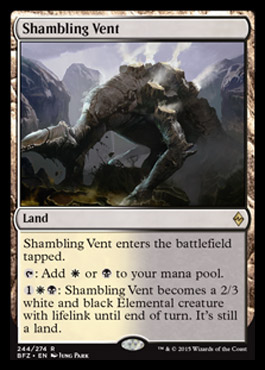
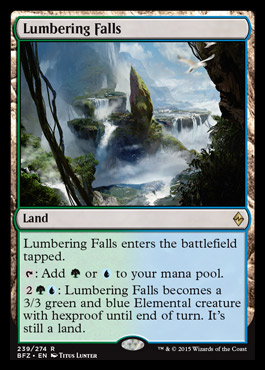
shamblingvent lumberingfalls

We only know two lands in this cycle so far, but they show us that this will be a major part of the metagame. Cards like this leave me hesitant most of the time because they seem so innocent. For example, not many players are afraid of a five-mana 3/3 hexproof. That’s way above curve. We would have to up the ante to something like Fleecemane Lion to get our attention.

What we need to remember is that this is a land and not a spell. You are going about your business, playing the game, and fixing your mana. Then all of a sudden you activate your land and add another creature to the board. It doesn’t really matter how good the creatures attached to the man-lands are, they’re always going to be better than gaining one life.

Usually the man-lands with the lower activation tend to be the stronger, more played ones, but all five should see play no matter what their stats are. My recommendation is to pick up your playsets when you can because they will be a relied-upon resource the entire time they’re in Standard. Even if you don’t think they are good enough, they will be playable.

Blighted Lands

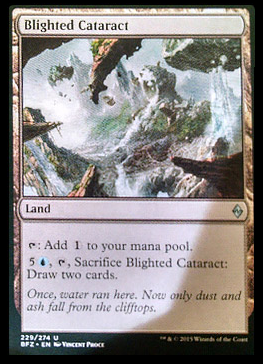
blighted_cataract

I’ve heard that there will be a whole cycle of these lands and that is wonderful if it’s true. If not, only blue mages will reap the rewards of this land. Think about how potent Desolate Lighthouse is with helping you dig for whatever you need. With Blighted Cataract it goes beyond mere looting--we get actual card advantage.

Getting more cards out of your land is going to shape the format. We could see this land getting played in a variety of control decks but also in ramp strategies. There have been a number of green ramp decks that added blue mana in for a variety of reasons. Most recently blue was added to Green Devotion for cards like Prophet of Kruphix and Cyclonic Rift. If we see that idea implemented this time around, Blighted Cataract is going to be an all-star. I’m excited to see what other effects this cycle brings us.

Landfall

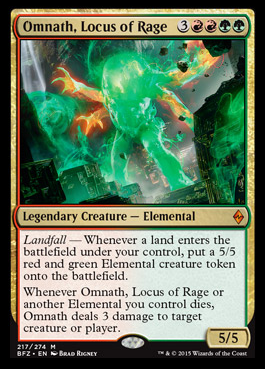
Omnath,_Locus_of_Rage

Speaking of ramp decks, check out Omnath, Locus of Rage! Last time, Omnath, Locus of Mana’s job was to get our gears ramping up. This time around, he’s the payoff. If you want an end-game card that can add a lot to the board the turn he comes into play, the rageful Omnath is the way to go.

I know this card has been spoiled for a while now, but he hasn’t gotten nearly enough hype. Not only is he a 5/5 that makes more 5/5’s, but your opponent will also take damage if they kill any of them! The fun part of my heart desires more elementals for some sick tribal action. If they reprinted Smokebraider, I’d be all over that in Standard.

Regardless of how many other elementals are available to us, Omnath is a powerful card that needs a home. We all know how well Whisperwood Elemental pairs with Omnath, now we just need to build a deck around those two. I don’t usually want my ramp decks to have red mana, but for Omnath, I will make do.

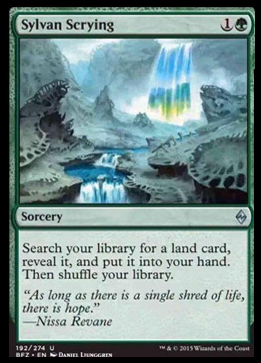
sylvan_scrying

Sylvan Scrying is no joke and we all know its power in Modern, but I’m curious to see how many decks take advantage of this effect. I would prefer Farseek or even Rampant Growth, but formats with those types of cards tend to have a high power level. For Sylvan Scrying to be played, we would need lands that demand we search for them.

Although we have more lands spoiled in this set so far than most sets have total, I haven’t found a reason yet that we would want to search for lands other than basic forest from Nissa, Vastwood Seer. We would need a land like Eldrazi Temple or Cloudpost for us to take this card seriously.

Regardless of how much Standard play it sees though, foils will be desirable for Tron players as well as Commander aficionados.

Landfall Enchantments

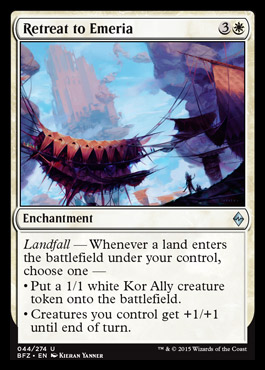
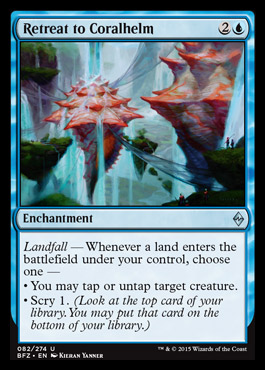
retreattoemeria retreattocoralhelm

Up next, we have a cycle of enchantments that generate pretty strong effects every time you play a land. All these abilities are amplified due to the fact that we have fetch lands in Standard. While I'm not sure that any three- or four-mana card that doesn't effect the board immediately will see much play, some of them demand our attention.

Take the white one, Retreat to Emeria, for example. It turns your lands into more creatures or pump spells for your team. That's a powerful effect. Costing three and four mana makes this cycle unlikely to see lots of play, but we have seen cards like the sieges on the battlefield. This cycle is not as powerful, but they do provide an interesting addition to any deck.

Until next time,
Unleash the Force of Battle!

Mike Lanigan
MtgJedi on Twitter
Jedicouncilman23@gmail.com

Bonus Decklist

This deck is sweet and everyone should know about it. I don't know when I'll have time to write about Modern again, but this deck got me excited about the format again. Also, it's good. Test it out. Play a guy and then make him huge. I might change up to the full four Remand because that card is basically Time Walk in this deck, but I'm sure Chapin had a reason for not playing them all.

Temur Prowess, by Patrick Chapin

Creatures

4 Monastery Swiftspear
3 Snapcaster Mage
4 Abbot of Keral Keep
4 Tarmogoyf

Spells

4 Mishra's Bauble
4 Gitaxian Probe
4 Serum Visions
4 Vapor Snag
4 Lightning Bolt
1 Seal of Fire
2 Rancor
2 Remand
2 Izzet Charm

Lands

4 Scalding Tarn
4 Misty Rainforest
1 Polluted Delta
1 Wooded Foothills
2 Steam Vents
1 Breeding Pool
1 Stomping Ground
1 Copperline Gorge
2 Island
1 Mountain

Sideboard

3 Dispel
2 Deprive
2 Feed the Clan
2 Ancient Grudge
2 Spellskite
1 Seal of Fire
1 Roast
1 Volcanic Fallout
1 Izzet Staticaster

Three Insights from GP Oklahoma City

Are you a Quiet Speculation member?

If not, now is a perfect time to join up! Our powerful tools, breaking-news analysis, and exclusive Discord channel will make sure you stay up to date and ahead of the curve.

You don't need to play a tier 1 Modern deck to win a major tournament. Michael Malone knew this back in June when he led his company of Elves to victory in Charlotte, taking down a field of Affinity, Burn, and Jund. Gerard Fabiano's Sultai Control was another entry in the list of rogue tournament finishers, stealing SCG Baltimore from Seth Manfield's UR Twin. As we look back on Modern throughout 2015, we'll remember these finishes as some of the bolder performances of the year. What was the boldest? We still have a few more major events left in the year, but it is unlikely that any of their winners will top Zac Elsik's GP Oklahoma City win at the helm of Lantern Control.

GP-Oklahoma-City-Banner-JPG

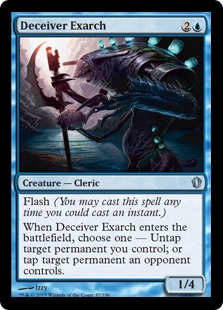
The synergy between Lantern of Insight, Codex Shredder, and Ensnaring Bridge undoubtedly stole the show over the weekend. But as anyone who checked out the Day 2 metagame breakdown and the Top 32 knows, there was much more to GP Oklahoma City than just BBD's Deceiver Exarchs standing on one side of an Entangling Bridge while twiddling their claws. These data sources are a rich trove of metagame information, and this article breaks them down into the three biggest takeaways from the Grand Prix.

[wp_ad_camp_1]

Day 2 and Top 32 Metagame Comparison

I remember a time in Modern coverage history when I was happy to get a Top 16, let alone a Top 32 and a detailed Day 2 metagame breakdown. GP Oklahoma City had it all, except, of course, for a full Day 1 metagame description (one of these days, Wizards? Please?). This is a great opportunity for us to see how decks did between the start of Day 2 and the end of the tournament. Of course, without that elusive Day 1 information it's impossible to know whether those Day 2 decks were themselves over or under-representing the Day 1 metagame shares. We can live with that: if anything, the Day 2 to Top 32 conversion is more important because we're looking at better players with better decks.

The table below shows Day 2 and Top 32 shares for all decks with four or more appearances (2%+ prevalence) on Day 2. Although the decks with three or fewer showings are interesting (Lantern Control is one of them), it's hard to draw metagame-wide conclusions from their performance. This is both because the sample size is a bit small, and also because the decks include lower-tier examples that don't fit well into our overall tier 1/tier 2 metagame picture (decks like Storm, Living End, and Domain Zoo). We'll stick with the 2%+ decks for now, looking at their tournament shares, their conversion rate from Day 2 to the T32, and the difference between the Day 2 and T32 shares themselves. This gives us a few different metrics to analyze deck performance at the GP.

DeckDay 2%Top 32%Day 2 / T32
Conversion
Day 2 / T32
Difference
Affinity15%
16%
20%
+0.6%
Jund
11%
3%
5%
-8.3%
Infect
7%
0%
0%
-7%
Burn
6%
6%
20%
+0.2%
Merfolk
5%
3%
11%
-2.3%
RG Tron
5%
3%
11%
-2.3%
Naya Company5%
13%
50%
+7.7%
UR Twin
4%
3%
17%
-0.5%
Grixis Twin
4%
6%
33%
+2.6%
Abzan
3%
3%
20%
+0.1%
Elves
3%
6%
40%
+3.2%
Amulet Bloom
2%
6%
50%
+3.8%
Grixis Control /
Grixis Midrange
2%
6%
50%+3.8%
Scapeshift
2%
6%
50%
+3.8%

You'll note that these numbers don't align perfectly with the Day 2 breakdown in Wizards' article. I've combined a number of decks where necessary: there's something to be gained by Wizards' separation of"Hangarback Affinity" from "Affinity", but not at a metagame analysis level. This leads to some confusion with Grixis Control and Grixis Midrange. The two "Grixis Control" decks in the Top 32 are much more midrangey than controlling, with no Cryptic Commands and a much more proactive gameplan than even the Angler/Tasigur-powered Control deck normally leverages.

Before we get into the big three takeaways from this table, here are some general observations about the GP.

  • Arcbound RavagerThe top five Day 2 decks at GP Oklahoma (Affinity, Jund, Infect, Burn, Merfolk) are almost identical to the top five decks in the overall metagame as per the 8/1-8/31 metagame breakdown article (Burn, Jund, Affinity, Grixis Control, Merfolk). The only exception is Infect replacing Grixis Control at the GP. This shift reflects both the anti-Grixis trends of Worlds, and also the recent success of Infect at events like SCG Cincinnati. As for those unstoppable robots, anyone who is surprised by Affinity's dominance either missed Worlds 2015 or my article reviewing the event. I'll return to this one later as it's one of the biggest takeaways from the GP.
  • Of decks with 4+ showings on Day 2, no deck did better than a 50% conversion rate between the beginning of Sunday and the posting of the Top 32. Relative to the starting Day 2 shares, Naya Company had the best conversion rate (50%) with eight Day 2 showings sending four players to the Top 32. Infect had the worst, with its 7% Day 2 share converting to a flat 0% in the Top 32. By a similar token, Naya Company had the best share improvement between the two datasets (over-representing its 5% Day 2 share as a 13% Top 32 share), while Infect had the worst (7% for one, 0% for the other).
  • siege rhinoJund had a similar Day 2 story to Infect, seeing an initial 11% Day 2 share crash to 5% in the Top 32. Jund was also underrepresented in that Top 32 by about eight percentage points. Abzan had fewer Day 2 showings than Jund but a much more average conversion rate: Siege Rhino and friends sent one of their five pilots to the Top 32 for a 20% conversion and an expected 3% share of both Day 2 and the Top 32. We're going to need more metagame data to know if a true Jund-to-Abzan shift is underway, but preliminary September data is already pointing to a Rhino comeback. Unfortunately for Abzan mages, GP Oklahoma City might slow that trend. If the format shifts too heavily away from Grixis (as we saw over the weekend), BGx mages might want to stick with Lightning Bolt over the Tasigur/Angler-killing Path to Exile. Moreover, with both Jund and Abzan putting one representative each in the Top 16, the GP saw no clear winner between the two. This will likely favor the more popular deck, Jund, as we go into October.
  • TwinFollowing the trends we observed in August, Twin continued to underperform relative to previous GPs and metagame periods. Even if we combined UR Twin (4%), Grixis Twin (4%), and Temu Twin (2%) into one URx Twin super-archetype (10%), it would still be only the third most-played deck at the tournament. That said, Twin had a very respectable T8/T16 showing, with two pilots at 15th and 16th and a third getting 2nd place, so I wouldn't count Deceiver Exarch out of the fight just yet. As in the August breakdown, however, there's no clear frontrunner Twin deck. If you're a Twin player, don't be afraid to try a new version to see how it fits in the metagame. If you're a Twin opponent, don't metagame too hard for one over the other.

There's a bunch of other takeaways to pull from the above table (for example, Amulet Bloom's presence and Grishoalbrand's absence, or the preference for Naya Company/Elves over Abzan Company), but these are some of the bigger ones to think about as you head into the end of September. With these in mind, I want to drill down on three specific conclusions out of GP Oklahoma City that I think will shape the format in the coming months.

1. Be (More) Afraid of Affinity

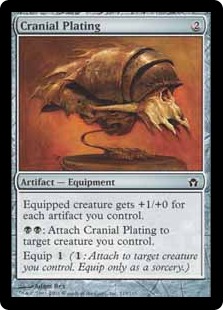
If you read my Worlds 2015 retrospective, this header should look familiar. If you didn't, you might be one of the people at GP Oklahoma City who thought your 2-3 Kolaghan's Commands were enough to stop the Arcbound Ravager in the room. In many respects, Oklahoma saw a repeat of what Cranial Platinghappened at Seattle back in August. Some players tried to get fancy with all their Collected Company shenanigans and Abbot of Keral Keep trickery. Others tried to metagame too heavily against Grixis Control decks and, to a lesser extent, Jund. Others still were too heavily invested in their own Grixis and Jund shells, putting (too much) faith in the BR Command hype train (particularly when paired with Snapcaster Mage in Grixis). All of these players made smart metagame decisions and innovative deck choices, and almost all of them were run over by Affinity. Don't be fooled by the single copy of Affinity in the Top 8 (a beautiful Hangarback Walker, Thoughtcastless machine by Joseph Reiter). Affinity had 25 pilots on Day 2 before sending five of them to the Top 32. That's a commendable conversion rate for such a widely-played deck, and a perfect match between Day 2 and Top 32 representation (15% and 16% respectively). Affinity was also the most-played deck at Worlds, a dominating deck in August, and is en route to being the most-played deck of September.

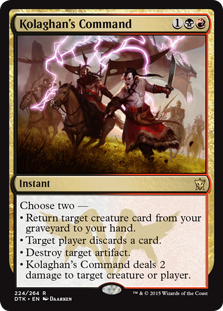
If we've learned anything from Worlds and GP Oklahoma City, let it be this: Affinity demands a dedicated series of hate slots. This doesn't need Kolaghans Commandto be a Hurkyl's Recall playset that you are never going to use outside of the matchup. It should, however, be a diverse set of 4-5 cards that kill the Affinity matchup while also having relevance elsewhere: Ancient Grudge, Suppression Field, and, of course, Stony Silence all come to mind. Kolaghan's Command is insufficient. Heck, even Snapcaster and Command together aren't enough to stop the modular, infectious, battle-crying hordes. Ari Lax wrote a premium article covering this back in June, where he discussed the relative weakness of Kolaghan's Command against Affinity and how other deck/format shifts would keep the artifacts on top. This is truer today than it was after the SCG Open in Baltimore, and I expect to see even more Affinity on top until players start respecting the deck more. As an added bonus, your Affinity hate will give you game in random matchups like RG Tron and the much-loved, much-hated Lantern Control.

2. Trust Format Pillars

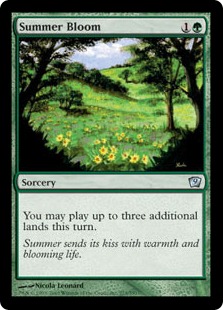
I promise I'll talk about Lantern Control before this article is over, but before we praise Zac's finish we need to put that finish in context. Lantern Control might have been the breakout deck at the GP, or at least the deck everyone will remember, but the deck I am most impressed with is Deceiver ExarchBrian Braun-Duin's UR Twin list. GP Oklahoma City players rocked crazy cards like Ghoulcaller's Bell, returned to old brokenness in Summer Bloom, or tried to speed things up a few notches with Burning-Tree Emissary. Meanwhile, BBD was playing a UR Twin pile so old and boring that it might as well have been a netdecked version of either Dan Lanthier's GP Vancouver build or Antonio Del Moral Leon's list from PT Fate Reforged. Which is also to say, it was an excellent metagame call by the veteran BBD, or at least by Sam Pardee who helped BBD decide on his final deck. BBD took an established pillar (UR Twin) and upgraded it with tech for the current metagame (the three maindecked Dispels and not one but two Desolate Lighthouses are beautiful). This approach got him a second place finish and is the same approach we saw in Jasper Johnson-Epstein's Burn deck, who was the first seed going into the Top 8 before an ugly mulligan sealed a loss to Elsik's Lantern Control.

For me, "trusting in format pillars" means two things. First, it means you, like BBD, can always fallback to a big four deck (UR Twin, Affinity, Burn, and Jund/Abzan) when you don't know what else to play. You'll need some baseline knowledge of the deck and its matchups, but you can rely on these pillars having what it takes to get you to the top on raw power alone. Finishes like BBD's or Johnson-Epstein's, not to mention all that darn Affinity, should cement the importance of these decks. A lot of us look at metagame breakdowns and assume high-prevalence decks are tier 1 based purely on popularity, not on performance. GP Oklahoma City Dispels that narrative, showing yet again that these decks really do have what it takes to get you to the top. Format pillars might not be the "best" metagame choice at any given moment, but they are often "good enough" assuming you have the gameplay skills and metagame knowledge to fill in the gaps.

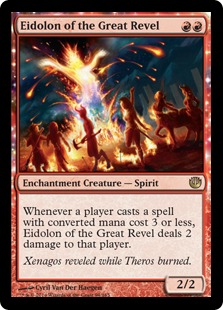
The second meaning behind "trusting in format pillars" is that you will often play against these decks, particularly at a Grand Prix. We'll always attend the occasional FNM, PPTQ, or WMCQ-style event where we prepare for a tier 1 Affinity deck and play nothing but weird Allies, Slivers, and Goblins brews all day long. To some extent, you'll also see that on Eidolon of the Great RevelDay 1 at a Grand Prix. Come Day 2, however, and it's time to roll up the sleeves and put on your big boy pants because the format pillars are coming back in force. You'll also see this in the Top 8 at the smaller events although, again, it's not a given. All of this means you need to know how your deck matches up against these pillars, and that you need to prepare for these matchups with the right cards. That said, as a related point, don't over-prepare at the expense of other matchups. Boarding in 3-4 Torpor Orb will certainly wreck Twin's day, but then you lose your complaining rights when you "only had room for" a few anti-Burn cards: what else do you expect when you commit so heavily to narrow cards like Orb? Overall, knowing your format pillars gives you fallback options in unknown metagames and prepares you for inevitable matchups at higher tables. It's up to you to gain that comfort.

3. Master Rogue Decks

Back in the summer of 2013, I tested a weird prison deck and reported my findings to its thread on the MTG Salvation forums. I liked the deck, was impressed with its matchups against a few key decks like Jeskai Control and Melira Pod (remember when those matchups Lantern of Insightwere format benchmarks?), and overall thought it could see some game in the future. What I didn't know was that a dedicated core of brewers, testers, tuners, and players had been secretly mastering the ins and outs of Lantern Control for over two years since I first came across the deck. Zac Elsik, aka Shadowgripper on MTGS, was one of those players, and their shared (and individual) knowledge and experience paid off big when Elsik stormed GP Oklahoma City with a Lantern of Insight in one hand and a Ghoulcaller's Bell in the other. For many players, it was a sign that Lantern Control was the next tier 1 deck, the true coming of control to Modern (those proactive Grixis Control chumps don't count), and even a bannable force that could ruin the format. Although the deck is certainly strong, and certainly stronger than many realized for years, its GP Oklahoma City win was not so much a testament to the deck itself as it was a testament to the deck's pilot. Elsik, who had already cracked the Top 16 at Charlotte with the deck earlier in the summer, was so confident in his deck and its card choices that he played an identical maindeck a few months later at Oklahoma City.

bloomWe've all heard the Modern adage before: it's more important to play a deck you know than it is to play a deck that is "good" in the metagame. This only takes you so far (ask anyone who tried to stick with Storm during Deathrite Shaman's reign), but Elsik's finish is a great example of this wisdom in action. As we saw time and time again on camera, Elsik understood both his own play trees and his opponents', which gave him an edge in all those matchups. Elsik knew exactly what he was doing and what his opponent was doing. The other player? It was like watching Justin Cohen's PT Fate Reforged run with Amulet Bloom all over again. Opponents countered, discarded, and killed the wrong cards. They spent their resources the wrong way, not knowing what Elsik could draw or do with his board state. This advantage will certainly diminish with time, as it did in Amulet Bloom's case with the surge of Blood Moons, but it served Elsik well in the event.

The closer you can come to mastering a deck, the better you will do with it in the long run at tournaments. Bonus points if it's good in the metagame, and bonus points again if it's so unknown that people won't know how to beat it. Do you need to play a rogue deck? Absolutely not: just ask Brad Nelson, BGx master himself, who couldn't have played a more traditional Jund list en route to 10th place. Mastery itself is important, but it can only help if your opponents lack mastery in the matchup. Lantern Control is unlikely to get any higher than tier 2, but I hope its success encourages other players to try out their own pet decks (Faeries, Smallpox Loam, Restore Balance, Esper Control, and others all come to mind).

Modern After GP Oklahoma City

As both the Day 2 and the Top 32 show, Modern remains an incredibly diverse format, and not just in the same rhetorically-charged way Wizards always says it at the beginning of Modern-themed articles. We have legitimate format diversity in archetype, color, and individual decks. Indeed, we might have too much diversity for some players' liking, and Affinity's success in recent months is probably attributable to this: when deciding on sideboard slots, those Stony Silences are a tempting cut. I expect this diversity to continue for the rest of the year, especially if the BFZ spoilers give some added power to existing decks like the established RG Tron or the upstart Allies.

What were some of your takeaways from the GP? Any breakout performances I missed that you think should have been included? Any interesting observations from the data? Take it to the comments and I'm excited to join you next week with some BFZ coverage!

Insider: MTGO Market Report for Sept 16th, 2015

Are you a Quiet Speculation member?

If not, now is a perfect time to join up! Our powerful tools, breaking-news analysis, and exclusive Discord channel will make sure you stay up to date and ahead of the curve.

Welcome to the MTGO Market Report as compiled by Sylvain Lehoux and Matthew Lewis. The report is loosely broken down into two perspectives. A broader perspective will be written by Matthew and will focus on recent trends in set prices, taking into account how paper prices and MTGO prices interact. Sylvain will take a closer look at particular opportunities based on various factors such as (but not limited to) set releases, flashback drafts and banned/restricted announcements.

There will be some overlap between the two sections. As always, speculators should take into account their own budget, risk tolerance and current portfolio before taking on any recommended positions.

Redemption

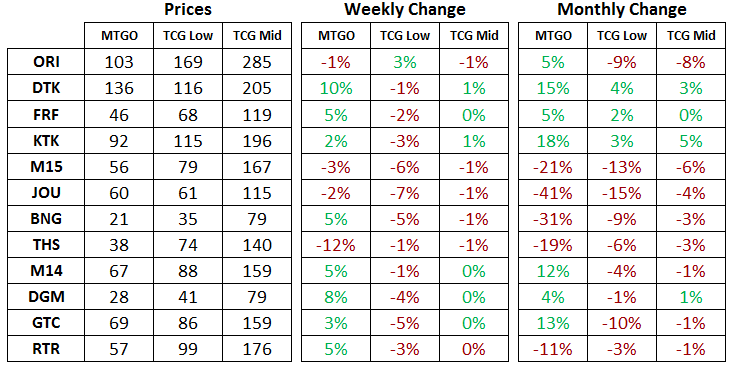
Below are the total set prices for all redeemable sets on MTGO. All prices are current as of September 14th, 2015. The TCG Low and TCG Mid prices are the sum of each set’s individual card prices on TCG Player, either the low price or the mid price respectively.

All MTGO set prices this week are taken from Goatbot’s website, and all weekly changes are now calculated relative to Goatbot’s ‘Full Set’ prices from the previous week. All monthly changes are also relative to the previous month prices, taken from Goatbot’s website at that time. Occasionally ‘Full Set’ prices are not available, and so estimated set prices are used instead.

sep14

Return to Ravnica Block & M14

Jace, Architect of Thought recently bottomed at 6 tix two months after RTR went offline for redemption and now it has crept back up to over 7 tix. It shows up as one- a or two-of in various Modern control strategies and can come out of the sideboard of U/R Splinter Twin. Having put in a price bottom, look for this card to soften in price during BFZ release events before picking up any copies for play or speculation.

Similar to Jace, Voice of Resurgence has been riding higher on the seasonal uptick in Modern Constructed that occurs in September. It's doubtful that this card will hit a new peak with less than two weeks to go before the release of BFZ, so look for this card to head lower into October. 18 tix for this card is the new price target for players and speculators.

There was an error retrieving a chart for Obzedat, Ghost Council

Jeff Hoogland has been running an innovative Esper build which features GTC mythic rare Obzedat, Ghost Council as a reanimation target. You can check out the complete build on his Twitter account. Ghost Dad's blinking ability means that using Goryo's Vengeance to get it out of the graveyard returns it to play indefinitely, if you correctly stack the end of turn triggers. This is a previously unrecognized interaction in Modern Constructed play that could develop into higher prices for this card.

Theros Block & M15

The trend on these sets continues to be down. It's still early to be bottom fishing, but any mythic rare from THS or M15 that dips to 0.4 tix or less is a safe speculative play. These two sets remain the only ones to pay attention to as they are the most likely to be attractive to redeemers down the road.

In THS, Xenagos, the Reveler has dipped below 1 tix and is at a very attractive price. The only uncertainty is that THS was opened quite heavily in the V3 client's last year. There is the potential for a significant amount of supply on any THS mythic to be floating around, so stay disciplined and wait for further price declines.

The same concerns do not exist for M15, so we might have already seen the bottom on a card like Jace, the Living Guildpact. Ajani Steadfast appears to have put in a bottom months ago at just under 3 tix. If this card drifts down back into that range, do no hesitate to start buying. Nissa, Worldwaker and Garruk, Apex Predator are also both threatening to dip below 3 tix.

None of these planeswalkers see any play in Modern Constructed, but they still have cachet and value to redeemers. They should all be on your list of potential speculative targets, with the right price being the trigger.

Tarkir Block & Magic Origins

With BFZ release events looming, all Tarkir block boosters are going to become quite irrelevant to drafters. It's time to sell any boosters from these sets that have been purchased for speculating before they drop in price.

ORI boosters will also drop in price in October, but as that is the first set to be drafted after the addition of play points, it's not clear what type of drop to expect on ORI boosters. As October unfolds, look for signs of a price bottom on all of these boosters, as they will rebound in price heading into the winter once the initial frenzy of BFZ drafting winds down.

Both DTK and FRF feature a number of uncommons that get regular play in Standard Constructed. With the pending rotation in Standard, previously marginal cards will have a chance to fill the space that departing cards such as Stoke the Flames hold. Look to today's recommended buys for a basket of uncommons. KTK uncommons have a much higher supply due to being drafted for longer, so the upside on KTK uncommons is lower. Roast of DTK at over 1 tix is a good example of what an in-demand uncommon can be priced at.

Jace, Vryn's Prodigy keeps cruising higher, and even shows up as a four-of and key graveyard enabler in Hoogland's aforementioned Modern Esper deck. We've not yet seen the full impact of ORI on Modern Constructed, but seeing an older archetype, such as Gifts Reanimator, invigorated by new cards suggests ORI will be reverberating in that format for a while yet.

Modern

The unexpected victory of Zach Elisk’s Lantern Control deck at Modern GP Oklahoma was certainly the big new of this past weekend in Modern. After a Top 16 at GP Charlotte three months ago Zach put his Lantern brew once and for all on the list of the threats to consider in Modern.

Financially speaking, Lantern of Insight was a bulk uncommon until last June and spiked to 2.5 Tix after Zach’s first finish. Back to near bulk value about a month later the Lantern had started to creep up again a few weeks ago. Expect the Fifth Dawn artifact now to reach new summits and to stick to it for a while. Similar to Night's Whisper a 5 Tix price tag might be possible. At that price tag, and probably before that, selling would be a serious consideration.

Ensnaring Bridge may be the other card to benefit from the impressive run of this deck. Although already around 30 Tix, Bridge could definitely go higher if the Lantern hype catches up. Other Modern cards used in the deck, such Mox Opal, Inquisition of Kozilek, Spellskite, Abrupt Decay and Glimmervoid, would also certainly receive an additional momentary boost in price.

Besides Lantern Control taking home the trophy, the GP Oklahoma Top 8 also saw eight totally different decks--Merfolk, Scapeshift, Amulet Bloom, Elves, U/R Twin, Naya Burn, Affinity and Lantern Control. Outside of the Top 8, we saw a less diverse Top 32, with half of the decklists comprised of Naya Company, Grixis Control/Twin or Affinity.

Considering everything, we believe that there’s more to gain by selling several Modern positions this month, even for a limited or null profit, in order to reinvest in ORI rares. As we also discussed, the decision also depends on everyone’s perspective, bankroll size and portfolio preferences.

The release of BFZ will put pressure on all prices, including Modern prices. Selling MM2 positions susceptible to lose value over the next four weeks in order to acquire ORI positions that will maintain steady growth until later this Fall is the strategy that should yield the best outcome.

Legacy & Vintage

All Legacy and Vintages indices remain mostly unchanged this week. On average prices for these formats evolve very slowly and have been on a subtle upward trend for the past several weeks.

Pauper

Pauper keeps evolving and its prices keep fluctuating mostly following cyclical variations. This week, blue-based decks took over the first places for the most represented decks from Mono-Black and Stompy a few weeks earlier.

There was an error retrieving a chart for Innocent Blood

Although it has peaked to 2 Tix several times in the past, Innocent Blood seems trapped in a 0.3-to-1 Tix cycle since the release of Fate Reforged. This card may currently be at a local high and selling now may be the right option.

After falling to 2 Tix for the second time in two months, Sunscape Familiar’s price is regaining some strength. For the position we recommended about two month ago we missed a good selling opportunity earlier this month and will adjust our expectations next time the price is cycling up.

Finally, Collected Company reinvigorated Elves in Modern, giving a boost, among other cards, to Nettle Sentinel, a common from Eventide also played in Pauper Stompy. Nettle Sentinel has regularly fluctuated between 2 and 4 Tix since last April. After a third peak at 4 Tix three weeks ago this Elf is back to 2 Tix, despite a decent finish of Elves at last weekend's GP Oklahoma. No reason to think that it won’t go back up to 4 Tix in a near future.

Targeted Speculative Buying Opportunities

Standard

Rending Volley
Foul-Tongue Invocation
Silumgar's Scorn
Draconic Roar
Valorous Stance
Wild Slash
Abbot of Keral Keep
Yavimaya Coast
Shivan Reef
Llanowar Wastes
Battlefield Forge
Caves of Koilos
Exquisite Firecraft
Hangarback Walker
Languish
Vryn Wingmare
Herald of the Pantheon
Despoiler of Souls
Gilt-Leaf Winnower
Infinite Obliteration
Sigil of the Empty Throne

We think it's time acquire some ORI rares. This list is composed of obvious picks and a few bulk rares that, at their current price, offer potential big rewards with close to no risks. Other ORI rares will probably be recommended in the following weeks but are likely to further decrease in price in our opinions.

Targeted Speculative Selling Opportunities

Standard

KTK boosters
FRF boosters
DTK boosters

Modern

Spellskite
Marsh Flats
Remand
Dismember
Mutagenic Growth
Deceiver Exarch
Obstinate Baloth
Threads of Disloyalty
Shattering Spree

Boosters and Modern positions are coming to a tipping point. Some of these picks may not have been as profitable as we expected, or even not profitable at all, but we believe that opportunities with better potential outcomes are available at the moment.

Pauper

Crypt Rats
Innocent Blood

These two specs never really delivered. Similarly to our other sell recommendations here too we are making room for likely more profitable positions.

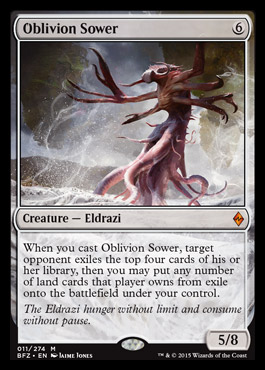
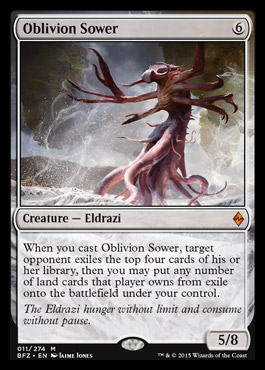
Insider: QS Cast 5: The Case for Oblivion Sower

Are you a Quiet Speculation member?

If not, now is a perfect time to join up! Our powerful tools, breaking-news analysis, and exclusive Discord channel will make sure you stay up to date and ahead of the curve.

This week, Kelly, Doug and Chaz tackle the newest spoilers from BFZ and look at how new cards are affecting older rares.
Play

Douglas Linn

Doug Linn has been playing Magic since 1996 and has had a keen interest in Legacy and Modern. By keeping up closely with emerging trends in the field, Doug is able to predict what cards to buy and when to sell them for a substantial profit. Since the Eternal market follows a routine boom-bust cycle, the time to buy and sell short-term speculative investments is often a narrow window. Because Eternal cards often spike in value once people know why they are good, it is essential for a trader to be connected to the format to get great buys before anyone else. Outside of Magic, Doug is an attorney in the state of Ohio.  Doug is a founding member of Quiet Speculation, and brings with him a tremendous amount of business savvy.

View More By Douglas Linn

Posted in Free Insider, Podcast, QS CastLeave a Comment on Insider: QS Cast 5: The Case for Oblivion Sower

Have you joined the Quiet Speculation Discord?

If you haven't, you're leaving value on the table! Join our community of experts, enthusiasts, entertainers, and educators and enjoy exclusive podcasts, questions asked and answered, trades, sales, and everything else Discord has to offer.

Want to create content with Quiet Speculation?

All you need to succeed is a passion for Magic: The Gathering, and the ability to write coherently. Share your knowledge of MTG and how you leverage it to win games, get value from your cards – or even turn a profit.

Loving Lands: Battle for Zendikar Preview

Are you a Quiet Speculation member?

If not, now is a perfect time to join up! Our powerful tools, breaking-news analysis, and exclusive Discord channel will make sure you stay up to date and ahead of the curve.

It's spoiler season once again and the Battle for Zendikar previews are trickling in. While there are many interesting cards for Limited and Standard that are coming out of the woodwork, what about for Modern? Thanks to the Eldrazi theme, Battle for Zendikar has a lot of high cost spells and creatures. As I'll talk about later, that's fine for Tron but not as good for everyone else. As long as Splinter Twin exists, Modern will be a turn four format and many of the splashy cards from Battle for Zendikar do not have enough impact to justify their higher mana costs. With that said, there are a few major cards that look to shake up the Modern landscape and certainly the Modern mana base.

MTG-Battle-Zendikar-Logo

It's Good to Have Lands

The Manlands

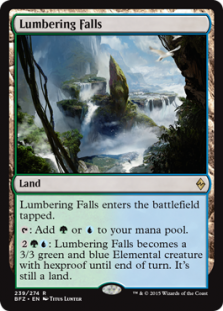
Lumbering FallsThe first major set of cards that will almost certainly have an impact in Modern post Battle for Zendikar are the manlands, of which two have already been spoiled with the expectation of a third. The first land spoiled was Lumbering Falls, which becomes a 3/3 blue and green hexproof elemental for 2GU. This card has major potential in decks like Temur Twin and Scapeshift where having a creature the opponent cannot interact with that also fixes two colors is outstanding. This should card help push the Tarmo-Twin deck further into prominence by helping against BGx decks that posed major problems in the past. Falls also makes the green splash easier to facilitate. While I do not believe that Temur Twin in its current iteration is a tier 1 deck, the addition of manlands could help push it over the top by blanking the removal of decks like Grixis and BGx. Tarmo-Twin had problems getting threats through black removal previously and the addition of a color fixer that attacks through removal might be all it takes to move up the rankings.

Falls is also strong in Scapeshift, where a 3/3 hexproof is huge. The manland can safely knock opponents from 20 to 17, which is below the 18 life threshold associated with a typical Scapeshift combo. Lumbering Falls also threatens to block smaller creatures to slow down the game against more aggressive opponents without risking an opponent's removal becoming a one-mana Stone Rain.

[wp_ad_camp_1]

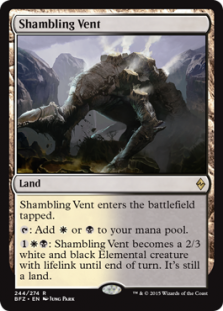
The next manland is not as exciting as Lumbering Falls, as it lacks both Falls' protection or the durability of the original Zendikar standout Celestial Colonnade. Shambling VentShambling Vent is a black and white manland which becomes a 2/3 lifelink creature for 1WB. The card looks okay for decks like BW Tokens or the older BW Pack Rat/Deadguy Ale deck that lost some ground in the past months, but in decks like BGx where it really wants to shine it does not compare well to Stirring Wildwood. That is a real issue. While I could see one Treetop Village becoming a Shambling Vent, the fact that Vent dies to Lightning Bolt is a problem. Vent also has a relatively lackluster ability compared to trample or reach, both of which help close some of BGx’s weaknesses (unlike lifelink). The lifelink is not irrelevant against Burn, but Vent itself is a little slow and low impact against that deck. This all makes me question its inclusion in my Abzan lists. Besides, the BG manland is still unknown and would probably be preferable in BGx. Tokens might play Vent if they really need mana fixing or maindeck lifegain but that seems unlikely. In my eyes, Vent is a niche card that whose power is unclear until we see the BG manland. Overall, I think there is very little chance Shambling Vents makes as big a splash as Lumbering Falls.

The Battle Lands

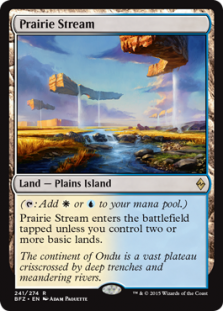
Prairie StreamThe next big cycle of lands that have the potential to make a big difference are the Battle Lands (or whatever you are calling them until we decide on a name), which are fetchable dual lands that enter untapped if you control two or more basic lands. These lands are going to make a splash in two colors decks that want to splash a third color for sideboard cards or value cards without making their mana more painful. Unlike the shocklands, Prairie Stream and company do not force you to start at 17 life, but they also do not allow you to use them for mana right away before turn three. These are probably not as powerful as the shocklands but will definitely see play as a way to improve Burn matchups while still maximizing the value of your fetchlands. Some places where I expect these lands to excel are in decks like Grixis Twin, which only splashes a few black cards like Tasigur, the Golden Fang and Terminate and already plays a good amount of basics. Another deck that is on the rise that gets some love from this cycle is UW Ojatai Control, such as Nathan Holiday's list at GP Oklahoma City or Jessy Hefner's 6th place list from the SCG Open in Cincinnati. The deck tends to let its shocklands enter tapped anyway so the drawback is not too severe. The deck also runs plenty of basics. UW Titan, Michael Segal's 13th place deck from the Charlotte SCG Open, will be a natural home for Prairie Stream since that deck is always looking for ways to turn on Emeria, the Sky Ruin. It will take more work to make the Battle Lands work, but for some decks the payoff may be worth it.

One of the biggest problems with these lands is that decks playing several one-drops will not want them. BGx has no use for another land that cannot play a turn one Thoughtseize or Noble Hierarch. Burn and other aggro decks will not play a land that prevents them from making plays on curve. The Battle Lands will be limited to slower midrange decks. I personally like these lands, but they will not be more than two-ofs in most lists. Next set, if the rest of this cycle is finished, look forward to decks like classic BG Rock and UR Twin gaining more lands that can tap for both of their colors while reducing some pain in their manabase. This should elevate these decks' popularity closer to that of their three color cousins.

Allied Offensive

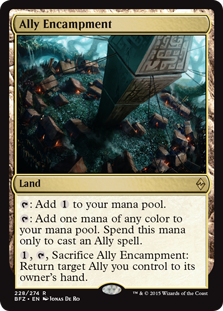
Ally EncampmentGrand Prix Oklahoma City introduced many players to a spicy modern deck that has been on Magic Online for some time, a deck that has a lot of potential moving into Battle for Zendikar. The deck is Allies and with the printing of Ally Encampment, the deck can color-fix and cheaply protect key allies from removal without using deck space. The current Allies deck had a good showing at the Grand Prix with a Day 2 appearance in the hands of Stephen Perigo. With the addition of many allies from Battle for Zendikar and this new five-color land the deck stands to gain even more power. If the allies in Battle for Zendikar can bolster the deck, it could potentially take the format by surprise in the same way Collected Company Elves did at Grand Prix Charlotte. While I am not sure if the deck can thrive even with these new additions (most of the allies we've seen so far are a little slow and clunky), it is certainly one of the decks to keep in mind while testing for Grand Prix Pittsburg in November and moving forward in the Modern meta.

Urza's Battleground

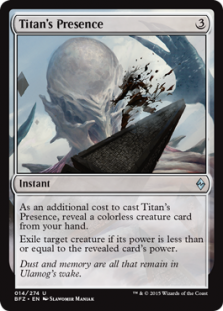
Titan's PresenceAs I mentioned at the beginning, Tron looks to be the big winner for Battle for Zendikar: a block full of giant colorless monsters has got to provide something for the ramping menace. Whether or not there's something to replace the current slate of haymakers is not known, but we have seen a few cards that will heavily impact Tron, for good or bad. So far, the biggest new standouts are Titan’s Presence and Crumble to Dust. The biggest reprint, largely from a price standpoint, is Sylvan Scrying. Titan’s Presence is a colorless instant for three that allows a player to reveal a colorless creature and exile a creature with power less than or equal to the revealed creature’s power. The fact that this card is an instant really propels it into the realm of playability for Tron as it can answer Splinter Twin decks without a Chromatic Star, Chromatic Sphere, or Grove of the Burnwillows. I quite like this card since it is also very good in the mirror and can answer nearly any threat including a Primeval Titan from Amulet Bloom if you have a Wurmcoil Engine. The only major issue I foresee with this card is that it does require a creature, but the upside is there if you can find a Wurmcoil Engine or one of your Eldrazi. It is also possible that some of the new Eldrazi may find a home in Tron, making hitting with Presence more likely. I suspect this card will show up as a two of or three of maindeck and maybe in the board depending on the Splinter Twin density after Battle for Zendikar hits tournaments.

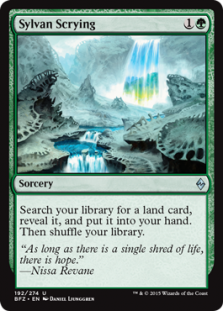
Sylvan ScryingI am just going to mention Sylvan Scrying as it is already a Modern Tron staple, but it is worth picking up your copies now. Since Scrying is an uncommon, getting a set for Tron or other decks in the future is a worthwhile proposition while the card is in Standard. Tron has gotten a useful tool in Titan’s Presence that means access to Sylvan Scrying will be important for anyone convinced to move towards the big-mana decks after gaining an answer to the terrible Twin matchup. As I said Tron is sure to get a boost from Titan's Presence if nothing else, and nothing else seems unlikely, so you should pick up your staples before demand increases. Tron might get more monsters as the block evolves, so if you think you might want to play Tron in the near future, get your Scryings now.

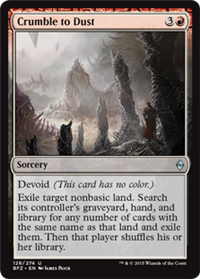
Now that I have covered the cards that boost Tron, lets talk about one that looks to answer Tron and other land based combo decks like Amulet Bloom and Scapeshift: Crumble to DustCrumble to Dust. This is a functional reprint of Sowing Saltwith two differences. The first, a minor one, is that Sowing Salt is red whereas Crumble to Dust is colorless. I do not expect will have a major impact on the playability of this spell. However, the second difference between Crumble and Sowing Salt is much bigger. Crumble is 3R to cast rather than Sowing Salt’s 2RR. This difference in casting cost is huge, allowing decks that did not want to invest so heavily into red like Jund  to keep their best answer to Tron in the sideboard without too much pressure on an already stretched manabase. This should find its way into Grixis variants, especially Grixis Control, to combat Tron. The card is also strong against Scapeshift, which returned to form at Grand Prix Oklahoma City this past weekend with a Top 32 and a Top 8 showing. This card looks like it has a place in almost every sideboard that needs help against Tron or land based combo decks. I expect that Sowing Salt will almost entirely fall out of favor for this card and any deck running red that struggles versus big mana decks should look to acquire one to two copies.

Using Lands for Fun and Profit

So having looked at what is being gained, what might a post-Battle for Zendikar Modern deck look like? By taking Matthew Duggan’s Scapeshift deck from the Top 8 of Grand Prix Oklahoma City and changing the mana slightly we get a glimpse. The manlands add an extra angle of attack for control matches where comboing off is often difficult. The deck also gained Crumble to Dust for the sideboard replacing two Sowing Salts to combat Tron, which is a tough matchup given Karn can exile lands and they deploy big threats as early as turn three:

Battle for Zendikar Scapeshift, by Sky Mason

Sorceries

4 Scapeshift4 Search for Tomorrow2 Anger of the Gods2 Compulsive Research

Creatures

4 Sakura-Tribe Elder2 Snapcaster Mage


Instants

4 Remand4 Peer Through Depths4 Lightning Bolt3 Cryptic Command2 Repeal

Lands

2 Stomping Ground
2 Cinder Glade
4 Steam Vents4 Misty Rainforest2 Breeding Pool2 Lumbering Falls2 Valakut, the Molten Pinnacle
3 Island
2 Forest2 Mountain
60 Cards

Sideboard

2 Crumble to Dust1 Firespout1 Teferi, Mage of Zhalfir2 Combust3 Obstinate Baloth2 Dispel2 Ancient Grudge1 Fracturing Gust1 Creeping Corrosion

In addition to the manland and a sideboard upgrade, this deck gets to cut down on the number of shocklands it has to run as the new Battle Lands count as mountains for Valakut while not costing life in a deck that frequently will have two or more basics as early as turn three or four. This change allows players to still fetch for untapped GR sources while having the option of sequencing lands to take less damage and still have untapped GR sources later into the game. The deck utilizes both types of new lands especially efficiently since they help with the deck’s main win condition. In addition, post-BFZ Scapeshift also gains a valuable sideboard card that takes stress off a manabase that was trying to cast Sowing Saltand Cryptic Command in the same deck. I think Scapeshift gains the most from Battle for Zendikar so far and I would look to pick up some Scapeshift pieces before they increase in price, especially with the solid performance from Matthew this weekend.

The biggest addition Battle for Zendikar brings to Modern is more lands that can have impact on how you craft your mana base and supplemental manlands in colors that were short a recurring mana dump. There are many other noteworthy cards in Battle for Zendikar, but so far they all fall under the issue of mana cost verses impact in a format where Thoughtseize, Lightning Bolt, and Splinter Twin all see play. Crumble to Dust certainly has impressed as a flexible sideboard option for any deck running red without putting too much stress on manabases, as has Titan's Presence. Until we have more spoilers, I would say the card I most recommend picking up out of either cycle of lands is the Lumbering Falls as it is the most impressive and is very useful in decks that had been declining prior to GP Oklahoma City and could use a boost.

As more previews role in we are certain to see more cards with Modern potential. Are there any I missed? How do you think Battle for Zendikar will impact Modern? See you in the comments!

Insider: My Current Modern Specs (Part 1)

Are you a Quiet Speculation member?

If not, now is a perfect time to join up! Our powerful tools, breaking-news analysis, and exclusive Discord channel will make sure you stay up to date and ahead of the curve.

Welcome back readers. In today's article I'm going to discuss my current spec targets (i.e. what I have sitting in my "speculation box"), specifically the ones I've targeted for the Modern format.

Keeping Track of Specs

Before I start digging into specific card choices, I thought it would be wise to first discuss how I maintain my specs.

It's very easy to become "too diversified" when it comes to speculation targets and end up just having a box of random "good stuff". The danger here is that while it takes the least amount of effort, you often forget what may or may not be in the box. This can cause you to miss out when a spec actually does spike due to hype (and you need to flip it quick).

So the first thing you'll want to do (and it can be daunting) is to open up a spreadsheet and start compiling all your spec targets onto it, along with quantity. I also note which format the spec is related to. This will give you a tool to quickly check how many copies of each target you have in the case you want to sell to a buylist or list on a website. That's one half of the work right there.

The next step would be to organize your specs in one fashion or another. An obvious one would be to sort alphabetically, though you could also color-code the sleeves by format, depending on how big your spec box actually is.

The Spec Box, A-H

Abrupt Decay

This is one that a lot of us have been touting for quite a while. It's currently sitting at around $16 on the mid and its low was $6.50 back in November of 2013. This was a pretty obvious pickup as it immediately found a home in Standard, Modern, and Legacy and proved to be a very powerful, versatile removal spell. For a while it even had its buddy Deathrite Shaman in Modern to really strengthen the Golgari color combination.

Academy Ruins

This incredibly powerful land was $14+ before plummeting back down to the $6 range. I picked it up a while ago and it's already nearing the all-time high again, despite the MMA reprint. This land just gets better and better as more artifacts are printed and it pairs extremely well with Engineered Explosives (which is a pick a bit farther down).

There was an error retrieving a chart for Abrupt Decay
There was an error retrieving a chart for Academy Ruins


Bottled Cloister

This was a cheapo spec (my buy in was around $0.3), that combos extremely well with Ensnaring Bridge and also provides continual card advantage. It can't get hit with Abrupt Decay, but is extremely weak to Ancient Grudge. If we ever see Grudge start to fall out of favor this could definitely see some growth.

Chord of Calling

I advocated on here for everyone to buy these when they were $3.5-$3.75 as it seemed like an obvious home run after its previous high of almost $40. The fact that it was reprinted in a core set (which wasn't heavily drafted/cracked) only added to its potential. I'm very happy with this spec and have almost tripled my buy-in.

There was an error retrieving a chart for Bottled Cloister
There was an error retrieving a chart for Chord of Calling


Clifftop Retreat

I picked these up back when Innistrad rotated out as I felt that buddy lands were underutilized in Modern (and expect them to see more play in the future) and unlike the allied-color ones, these lands were limited to just an Innistrad printing. Boros is a strong color combination in Modern on the aggro end of things and I still think these have room to grow.

Copperline Gorge

Back when Blackcleave Cliffs first jumped up to around $5, the rest of the Scars fastlands were still very low. At the time Jund preferred Raging Ravine to Copperline, however, the fact is in a format that has multiple decks that can win on turn 3-4, dual lands that come into play untapped and don't hurt you to tap for mana are a huge boon (especially when Burn is prevelant).

There was an error retrieving a chart for Clifftop Retreat
There was an error retrieving a chart for Copperline Gorge


Damping Matrix

This is one I picked up after reading Brian DeMars talk about it on one of his QS articles. The buy-in is quite low and the card is extremely powerful. Unfortunately this card is currently overshadowed by Stony Silence in Modern (which is all around better) and thanks to white having the best removal spell in Modern (Path to Exile), it's played enough that if you can run Stony Silence over Damping Matrix you will.

Dark Confidant

This is a more recent spec target, but with his continual drop after Treasure Cruise took over Modern and the MM2 printing this once-$90 card could be had for as low as $30 at one point (I bought one from a vendor for that at GP Charlotte). With a resurgence in Jund/Junk and a need for continual card advantage I see this guy moving back towards $60.

There was an error retrieving a chart for Damping Matrix
There was an error retrieving a chart for Dark Confidant


Darkslick Shores

This one follows the same reason as Copperline Gorge, except for the longest time blue-black was barely seen in Modern. With the arrival of Grixis Control decks to the format, this one has doubled in value since I bought in.

Disrupting Shoal

I remember when this card spiked hard after a Travis Woo deck (Ninja Bear Delver) jumped into the Modern spotlight. As the format's closest thing to Force of Will it went from near bulk to $5 all of a sudden, then petered back down to around $2 when I picked them up. They have since rebounded twice to a current almost $14.

There was an error retrieving a chart for Darkslick Shores
There was an error retrieving a chart for Disrupting Shoal


Elesh Norn, Grand Cenobite

This is a recent spec pickup. This Modern, Legacy, and casual power house was close to $30 at one point before the MM2 printing obliterated its price. However, good cards are still good cards and the fact that she was reprinted at mythic in a short-printed set still means she has a lot of upside.

Engineered Explosives

As I previously mentioned, this is another card that once sat at nearly $20 when it was all the rage in Legacy. The MMA reprint killed the value and MMA copies could be had for around $5. It avoided a second reprint in MM2 and has since recovered back to almost $17.

There was an error retrieving a chart for Elesh Norn, Grand Cenobite
There was an error retrieving a chart for Engineered Explosives


Falkenrath Aristocrat

This once mighty pillar of Standard sat at $22 (while in Standard) before plummeting to its current $3 status. I picked up a good bunch at $1.75 (after offering that sum to my LGS to buy all 10 copies they had at once) as a long-shot mythic. Should it show up in Modern, it could easily return to $15+ (thanks to coming from Dark Ascension, which outside of Mikaeus, the Unhallowed and Huntmaster of the Fells has nothing over $7 in it). I'd heard rumors of someone porting The Aristocrats deck to Modern and I wanted to get in early with this one. So far it has stayed flat and hasn't moved since I bought it.

Fulminator Mage

Another more recent pickup. I remember when this guy was sitting at $40+ (thanks to the single printing of Shadowmoor and limited options for non-red decks against Tron in Modern). Thanks to the MM2 printing his price plummeted and I was able to pick up MM2 copies for $15 at GP Charlotte. He's currently sitting at around $21, but nobody in my area is willing to trade any copies so I expect to see him slowly climb back towards $26-$30.

There was an error retrieving a chart for Falkenrath Aristocrat
There was an error retrieving a chart for Fulminator Mage


Garruk Relentless

The only flip Planeswalker before Origins debuted. He's a four-drop planeswalker with strong abilities, he can be slotted into Junk/Jund in Modern, and for WoTC to reprint him they'd have to include the flip card inserts again. Thanks to the power of Collected Company I feel the four-drop slot has a ton of competition in Modern now, but he fits well into BGx EDH decks and I still have hope for him finding a home in Modern (likely as a mirror breaker).

Gavony Township

I bought these while watching PT DC and the dominance of Junk/Siege Rhino decks that used Gavony as a mid- to late-game powerhouse.

There was an error retrieving a chart for Garruk Relentless
There was an error retrieving a chart for Gavony Township


Geist of Saint Traft

I feel like Jeskai aggro is always on the verge of playability in Modern (with Mana Leak, Geist, Bolt, and Lightning Helix) and I can't think of a better threat than Geist for the deck at the three slot. Hexproof is an incredibly broken ability and it's easy for this style of deck to make sure he never dies.

Gideon Jura

I remember when this card first came out in RoE and people were trading away Baneslayers/JTMS's for him (shortly after release). His plus ability is incredibly powerful against aggro decks, Twin, and Infect. He's incredibly hard to kill, and he's a powerful mono-colored planeswalker in one of the best colors in Modern.

There was an error retrieving a chart for Geist of Saint Traft
There was an error retrieving a chart for Gideon Jura


Gifts Ungiven

I've had a weak spot for this card since shortly after Modern's inception, when a friend played a Gifts control deck against me that repeatedly reanimated Elesh Norn or Iona (depending on what I was playing) and just neutered my deck. An instant speed search that can get both a giant monster and the reanimation spell with flashback into your yard is just stupidly powerful, and a lot of the control decks in Modern now splash a Gifts package (since it doesn't take up a lot of sideboard space, but can stop a lot of decks cold). I still feel like it has room to grow, but I'm happy that I got my MMA copies at around $4.

Hero of Bladehold

This is sort of a "casual" Modern card, as the B/W Tokens decks rarely do well at major events (though I do recall seeing someone play one on camera at PT DC). However, the Hero is a very powerful four-drop that can quickly take over a game (similar to Goblin Rabblemaster, but much harder to kill thanks to the four toughness).

There was an error retrieving a chart for Gifts Ungiven
There was an error retrieving a chart for Hero of Bladehold


Hinterland Harbor

As I previously mentioned, all the buddy lands are more powerful than many realize and are the perfect land drops after turn one (ideally you fetch up a shock tapped) and have perfect painless mana from that point forward. Blue-green is one of the weaker Modern color combinations (typically only seeing play in RUG Twin or RUG Scapeshift, the latter which doesn't really want non-mountain nonbasics). I've held onto them for awhile now, and though the gains have been modest, I feel like these are a strong long-term spec, barring reprint.

There was an error retrieving a chart for Hinterland Harbor


And there you have the first half of my Modern specs. Join me for the next article when I'll cover the other half of the alphabet.

9 Cards I Want To See in a Battle for Zendikar Standard Deck

Are you a Quiet Speculation member?

If not, now is a perfect time to join up! Our powerful tools, breaking-news analysis, and exclusive Discord channel will make sure you stay up to date and ahead of the curve.

I love to brew. The big fall set release is my favorite time of year because all bets are off. The oppressive Theros block is gone, replaced by a quirky, powered-up group of creepy tentacle aliens and their dire enemies, “the rest of the world”.

I’m really exited by the set so far, but there are a few cards that stand out, screaming “build around me” as loudly as a piece of cardboard can.

Greenwarden of Murasa

Finally, a card that goes really, really well with See the Unwritten.  Triggers happen in such a way that his enter-the-battlefield ability brings back See the Unwritten if you’d like, and he ensures that you’ll be able to snap off the Ferocious trigger next time (if he survives).  If he doesn’t, well, bring back something else!

Green warden of Murasa Battle for Zendikar
It’s actually pretty easy being green these days.

An Eternal Witness effect on a 5-power creature is pretty amazing, to say nothing of his death trigger, which is optional, because the folks at R & D realize that choices are fun.   Ostensibly, Greenwarden of Murasa is at least a 2-for-1, and a 3-for-1 if you’re willing to exile him to become Eldrazi food (a drawback that might not be as benign as it first appears).

As for what to build around, really what doesn’t work here?  You surely want to be able to cast this guy (or See the Unwritten, the same mana cost), so you’ll probably want to run Rattleclaw Mystic.   The mighty morphing mana dork lets you cheat the curve a little bit, depending on how you play your game, but beyond that, I think that the best use of this card will be in tandem with other awesome green cards.

And there are many, for example...

Undergrowth Champion

This card may be one of my favorites in the set.  On last week’s QS Cast, I discovered how much I love the interaction between these, fetch lands, and Stubborn Denial.  There aren’t a ton of ways to kill Undergrowth Champion outside of slowly grinding him down with damage, but cards like Foul-Tongue Invocation come to mind.  Stubborn Denial does a great job of stopping these cards, especially if you wait until turn 4 to play the Champ and follow him with a fetch land (just don’t sacrifice it until you need to respond to a removal spell, otherwise tricky timing can spell your doom).

Undergrowth Champion Battle for Zendikar
See? Real easy.

The obvious pairing is Scythe Leopard, as you’ll want to maximize your landfall value.  I’m not sure you want to play with the more expensive ones like Oran-Rief Hydra and Guardian of Tazeem, but if we don’t get many more good landfall cards, they might be our only choice.   Nissa's Renewal, also discussed here, looks like a really strong choice to push through an landfall-fueled alpha strike.  Retreat to Kazandu is tempting, as it just screams “grindy value card”, but I am pretty sure it won’t be good enough to move the needle.

Kiora, Master of the Depths

Kiora seems to be considered the weakest of the bunch, and that’s probably not incorrect, but lets look at how her abilities will reasonably play out.

First, her +1 can be considered as some combination of defense and mana acceleration.  I’m specifically considering her +1 as a way to generate 2 extra mana each turn with Rattleclaw Mystic (or 4 with Shaman of Forgotten Ways, as I am not so impressed with the idea of giving an attacker pseudo-vigilence.

Kiora, Master of the Depths Battle for Zendikar
Fun Fact: She used to be named “Kiora Atua”, but that means “Hello, God” in Maori. So they changed it.

Her -2 is fine, but I think I’d rather be building around the +1.  It’s a great source of card advantage, but I don’t like that you can’t get more than 1 activation before she dies or you need to +1 again.  It’s a powerful effect (drawing 2 extra cards a turn tends to be), but it’s not consistently going to be worth 2.  If there’s a way to abuse the cards in the graveyard, like Treasure Cruise or Tasigur, the Golden Fang, then I’m more eager to play ball.

Her -8 will never happen in constructed, and I am glad to pretend it doesn’t exist.

I see her fitting into a deck that really values the mana ramp, and can also make use of the extra card draw to ensure that it can keep up the pressure in the late game.  I will be very curious to see how she goes at the Pro Tour for sure.

Ob Nixilis Reignited

I was not a fan of this card at first but I have come around.  LSV said it best when, to paraphrase, “every turn he is on the board, you are slowly winning the game”.  Ignore the loss of one life.  That doesn’t matter here.  What matters is that a 5 loyalty Planeswalker is already mighty hard to kill, especially when he can turn around and blow away any creature at will.

Ob Nixilis Reignited Battle for Zendikar
Phyrexian Arena, Murder or Underworld Dreams gone wild. You must choose!
Unlike Kiora, I think his ultimate is absolutely attainable (what a difference a turn makes) and potentially more powerful.  A bunch of sea monsters will probably end the game, but 4 unstoppable damage per turn cycle (at a minimum) will almost assuredly end it.

The natural assumption here is that he belongs in a control deck, but I will challenge that and say he might be an awesome curve-topper in an aggressive deck.  Control decks have a lot of choices for card draw, and don’t tend to dump their hand as quickly.  Aggro decks, on the other hand, love to vomit their hand onto the board and badly need effective reloads.  They are also in a good position to defend the big mean guy until you can mark them for death.

Aggro decks can also use the -3 to swing tempo back into their favor, removing their best blocker and keeping the way clear so you can bring the beatdown.  All things considered, I think I’d prefer to see this in the aggressive shell, and I would not be surprised to see him played that way at the Pro Tour.

Planar Outburst

We’ve seen loads of 5-mana board sweepers lately, but none that can empty a board yet leave you with an attacker.  Thanks to the Awaken mechanic, now we have one.  Planar Outburst is a control deck’s dream; it kills all the things, but it also gives you a late-game finisher if you need one.  5 mana is often a turn too late for a sweeper, but in this case the option to switch on a 4/4 beater is worth it (and only 3 extra mana!)

Planar Outburst Battle for Zendikar
That little Eldrazi just got land-dropped.

It might seem odd to want to build around a board sweeper, but I don’t think we’ve seen one like this before.  The closest analogue is Martial Coup, but that is still pretty far off.  What kind of control deck emerges is hard to predict, but I’m sure we’ll see plenty of people try their hand at one for Pro Tour: Battle for Zendikar.

Gideon, Ally of Zendikar

He’s so linear that I don’t need to say much here; you can either play him as an Ally or not, but either way he’s going to be a real problem for the opponent.   His ability to pump out Knights forever is very powerful, as is the threat of crashing in for 5.  I don’t think that there’s much to build around; if there are a critical mass of Allies that reward ETB triggers, then Gideon is an obvious choice.  If not, he’s still a solid Planeswalker.

Gideon, Ally of Zendikar Battle for Zendikar
Yet another case of “hedron photobomb” in the BFZ art.

The card he pairs best with is, curiously, Tragic Arrogance.  They fit perfectly on-curve and the synergy is almost sure to leave you with a favorable board position.  You can either make another token or send in a 5/5 attacker that’s basically unkillable.  Seems good!

Finally, his third mode works really well with Eldrazi Scion tokens and any other way of making a large number of creatures.  I don’t see that there are a critical mass of these effects in Standard so far, but we’ll keep an eye out for sure.

Nissa's Renewal

This card looks like a junk rare, but as Brian deMars pointed out this week, it has a lot more potential than might appear at first glance.  7 life is indeed enough to keep you alive for an extra turn, and three extra lands is huge.

Nissa’s Renewal Battle for Zendikar
But I thought life gain was “bad”. Always. No matter what!

The question is, what landfall triggers do we want to stack around this?  The card is solid as it stands, but the real reason this card will win is because it slaps 3 counters on the already-aggravating Undergrowth Champion (one of my favorite cards in the set so far).  I suppose that if you happen to have some Scythe Leopards in play, that’s great too, but I’m not as keen to build around him.

I can foresee an Eldrazi Control deck wanting this card, as it’s in pseudo-competition with See the Unwritten as a “big green spell”.  Decks that run one probably won’t run the other, and Eldrazi decks focused around the “must be cast” guys seem like a better home for this kind of effect than a deck that wants to cheat giant monsters into play.

A control shell would also place a higher premium on the life-gain.  Most control decks need a midrange card that can put them out of range of super-aggressive decks, and 7 life should be enough to do the job.


Oblivion Sower

So it was printed in a Duel Deck.  So was Polukranos, World Eater.  That doesn’t mean it’s destined to be a junk Mythic!  I love this card at a $3.50 pre-order, and a lot of the QS staff agree.  We’re quickly finding out that exiling cards is going to be relatively easy, and that the rewards for doing so are probably pretty good.

Oblivion Sower Battle for Zendikar
“Sower” does not rhyme with “Sour”. Please remember this.

At this point, the combo everyone is crowing about revolves around Crumble to Dust, and rightfully so.  Oblivion Sower doesn’t care how the cards got to exile.  Nuking a dual land and putting your opponent behind by a turn, while simultaneously putting yourself ahead by a turn (or four) seems devastating, especially if your curve continues well past 6 (which it ought to!)

The question is not “is this a good card”, because the answer to that is, objectively, yes.  The question is, what’s the best way to make maximum usage from this guy?  I’m not 100% sold on Crumble to Dust, but I think I’m convinced it’s got a spot in the deck.

Other cards that make this scarier: Fathom Feeder (a staff favorite), Titan's Presence (premium removal), Ulamog's Nullifier (so you get value out of non-land cards too), Transgress the Mind, Horribly Awry (which can chain nicely into some of your later cards while keeping the board clear, Blight Herder ( which can really help hit that 6th or 10th mana) and, of course, Ulamog, the Ceaseless Hunger.

That’s a lot of context considering our set isn’t even half spoiled yet.

Oblivion Sower is a giant body with an ability that can totally change the nature of a game.  If you can get to 6 mana, he can be sure you have mana for the really scary stuff you want to cast (which in almost all cases will be Ulamog, right?)   There’s nothing not to like about this, unless you’re a fan of See the Unwritten like I am.  Even still, I want to build a deck with four of these monsters, as hitting double-digit land counts seems like it’ll feel really good.

Smothering Abomination

I’ve been big on this card since first reveal.  It’s an aggressively costed and evasive attacker, and the drawback is very mild compared to the tremendous advantage you can get with it’s trigger.  In fact, I’m glad it has this drawback;  too often do you have creatures to sacrifice but no outlet to do so.


Smothering Abomination Battle for Zendikar
Add this to the list of “cards that shock my friends that quit magic in 1998"

A 4 power flier for 4 mana that turns into a card-drawing engine seems like a great deal.  The question is, what do we surround this card with?  It’s definitely a build-around me sort of thing, and if we’d like we can play games with Grim Haruspex (not a bad deal either, as a 3-power attacker for 3).  However, the fact that Eldrazi Scion tokens exist make Haruspex kind of a crappy choice here.   From Beyond is an obvious choice too, though occupying the same spot on the mana curve is a bit awkward.

Hangarback Walker seems like a natural fit here, but there aren’t a lot of other great cards that get better when they die.  Gideon, Ally of Zendikar feeds the beast pretty well, but Tragic Arrogance seems like it can really do some work here, possibly blowing a game wide open.


More Battle for Zendikar Articles & News

Join the discussion in the QS Forums

[MTGO] 1 Year, 100 Tix – August Report

Are you a Quiet Speculation member?

If not, now is a perfect time to join up! Our powerful tools, breaking-news analysis, and exclusive Discord channel will make sure you stay up to date and ahead of the curve.

Welcome back to the 1 Year, 100 Tix project report.

This month we passed the symbolic mark of 500 Tix, the goal I set at the beginning of the project, with four months to go! Following a seasonal dip triggered by the release of Magic Origins, most prices moved back up, and with them the value of the 100 Tix 1 year account. Modern and Pauper positions were again the number one gainers this month.

This month the unlocked article from my Nine Months of Portfolio Management series is Part 8 – Mismanaging Return to Ravnica Block Positions. In this article I review several positions that didn't go well. Inadequate expectations, wrong timing and lack of attention can make you miss on profitable specs or even make you lose money. See if what went wrong with my Return to Ravnica block bets can help you with your Khans of Tarkir block specs this year.

More information about the 1 Year, 100 Tix project can be found here:

August and September can be very active months as it is a good time to sell Modern or Pauper positions in order to reinvest in core set and Standard opportunities. Although I was not very active in August this month turned out to be very profitable. Let's review it here.

August Numbers

A simple look at the graph is enough to tell you that things have been going quite well in August. The value of the "100 Tix 1 Year" account jumped from 348 Tix in July to 501 Tix this month, a 44% increase.

This 44% might only be the third best increase of this project in terms of percentage points but is definitely the best increase in term of Tix--a value of 153 Tix was added to the account. With the exception of the distinct dip corresponding to the release of Magic Origins, the upward trend has been solid and consistent since May.

At the beginning of this project I considered 500 Tix a good final goal. Eight months later this mark is already passed and it seems like there's still plenty of room to grow.

Summary of the Specs

Here what account looked like by August 31st.

If you compare this to what the account looked like at the end of July you'll see there are very few differences in the cards, but 50 additional free Tix. Indeed, very little action took place in August but the account is still worth 153 Tix more than four weeks ago.

The release of Magic Origins had pushed prices down all across the board at the end of July. The trend was simply reversed in August and this is why, without many transactions, the account grew spectacularly.

Very nice profits came once again from Pauper positions such as Chittering Rats and Lava Spike. This is not the first time I've specced on the rats and with such frequent and high variations it might not be the last one. Small bankrolls should definitely take advantage of these types of price fluctuations to quickly generate extra Tix. Doubling up in price is very common in the realm of Pauper.

Monastery Siege is another bulk spec that did wonders for me in August. I had bought that card back in June at 0.087 Tix per copy. I thought the card had some potential and therefore was undervalued at 0.087 Tix. My bet was simply to wait for Standard to rotate and for prices to slowly rise over the summer. However I could not wait more and pass on selling these at eight times their buying price.

Holding or Selling MM2?

With August down there are only four months left to this project. The account has already reached the highest expectations I had at the beginning of the adventure. Nonetheless there is one last big block of specs to devote my Tix to--Magic Origins positions. The big question now is what to do with my MM2 positions.

As I'm writing these lines I have already sold several of my Modern positions in order to accumulate as many Tix as possible to buy ORI cards. Cards such as Leyline of Sanctity, Mutagenic Growth and Hurkyl's Recall were easy to sell. They have nearly doubled and these gains are totally within my expectations.

It's not so easy with card such as Noble Hierarch, Emrakul, the Aeons Torn and Spellskite. They merely have increased by 15-20%. Should I sell and move to something else or hold for more profit? Is it going to go up or down from here? The same questions again and always.

A few things will help me decide here. If MM2 positions are, on average, expected to go up from here the release of Battle for Zendikar is probably going to put a halt to the trend, at least for many of them. Prices of uncommons and rares are usually more sensitive to seasonal pressure than mythics. Doubling or tripling is most likely the best outcome I could expect with the MM2 positions I'm currently holding.

Concerning ORI, the price trend is inevitably up for the next two to three months and the release of BFZ won't affect this. For the most part ORI prices are at their bottom at the moment and the price of many rares and mythics could easily quadruple before the end of the year. Some bulk or near bulk ORI rares could also multiply their price by 10 or even 20 if used after Standard rotation.

The timeline and potential profit of ORI positions clearly offer better outcomes than most of my current MM2 positions. With too much risk, not enough reward and better positions to sink my Tix into, selling all of my MM2 uncommons and rares is the prudent move. I will probably only keep Wilt-Leaf Liege and Eye of Ugin as their current price is still extremely low compared to what they were pre-MM2.

I'm also tempted to keep my MM2 mythics. Mythics are usually less sensitive to price depreciation and cheap mythics such as Iona, Shield of Emeria, Ulamog, the Infinite Gyre and Tezzeret the Seeker feel particularly underpriced to me.

We'll see in two or three months if these choices pay off.

Thank you for reading and following,

Sylvain

Insider: Zendikar Expeditions Hype and BFZ

Are you a Quiet Speculation member?

If not, now is a perfect time to join up! Our powerful tools, breaking-news analysis, and exclusive Discord channel will make sure you stay up to date and ahead of the curve.

I’m currently en route home to Detroit from the Modern Grand Prix in Oklahoma City and it is time to put Modern in the rear view mirror and begin looking forward to the upcoming release of Battle for Zendikar. I’ve had a blast playing Modern the past few weeks and put up a solid 63rd place finish at the Grand Prix playing my Hangarback Affinity list.

I was very surprised to see Lantern Control end up taking down the whole event (I actually had the displeasure of getting crushed by Zac Elsik on day one) but the power of the deck is pretty undeniable. All of that being said, I’m ready for a break from Modern and find myself really looking forward to a new set and a drastically different Standard environment.

In today’s article I’ll share my initial thoughts about the set and how I’m approaching it from the financial side.

The "Buried Treasure" Effect

I think the most significant aspect of this set is the inclusion of essentially “super-duper rares” as premium foils. Approximately once per case a person can open a foil, full art, highly desirable non-basic land with a very high retail price. I cannot overstate the impact this lottery ticket element will have on cracking packs--it will significantly push sales of this new set.

I keep my ear to the ground about this kind of stuff and one thing that I’ve been picking up on is the fact that a lot of people have arrived at the same conclusion that buying cases is a good plan for BFZ. The fact that once per case an individual is apt to open one of these super rare lands makes buying cases seem to make more sense.

I’ve seen the good fetchlands pre-selling on eBay in the $300 range which seems really high to me. Two weeks ago when the new lands got spoiled I said that I thought these lands should be worth about $150-200 for fetches, $100 for shocks and $50 for the tango lands (by the way "tango lands" because it takes "two basics to tango").

I still feel pretty confident in my assessment of these cards at least in the short term. I believe there will be a lot of people who open these lands and look to move them in the first three months. As a result, I can see the price going down simply because the number of sellers will be higher than buyers. In the long term, yes these will continue to steadily rise but the true value will be acquiring these cards and holding them for two or three years until they become truly difficult to acquire on the secondary market.

If people assume that the price of these premium cards will command this kind of price tag it makes sense to buy into cases and crack product. The joke is that if it seems like insane value to actually buy into cases, the effect might end up correcting for itself. If everybody is doing the same thing expecting to get paid off there can’t possibly be enough money to go around to actually pay everybody off.

My suggestion is that if more people are going to be opening product at a record pace, it will significantly effect the prices of the other cards in the set. Assuming the former, it stands to reason that the market will end up flooded with more cards than the players actually need to satisfy demand. Prices are always high right out of the gate because people are scurrying to get the cards for their decks together. However, I strongly suspect that after the initial first week hype we will see a steep decline in singles prices as collectors continue to crack packs chasing “golden ticket” full art lands.

My advice is that if you are planning on cracking a few cases of BFZ that you have a method in place to quickly sell rares and mythics before they begin to dip in price. If I were going to buy into BFZ I would likely crack all of my boxes and go to a big FNM somewhere and try to trade off as much of it as I possibly could as quickly as possible.

I also think that preselling this set on eBay or through an online venue makes a lot of sense. You can undersell the preorder prices on SCG and other online dealers but still get significantly more in cash for your cards than they will end up being worth a month down the road.

I think it's important to keep this dynamic in mind if you are weighing the pros and cons of buying into cases of BFZ. A lot of people are all thinking the same thing which can end up being dangerous when it comes to making an investment. For instance, remember Beenie Babies? Be careful not to buy too hard into the hype.

Oldies to Keep and Eye On

All of the cards that accelerate mana production have already seen a spike in the short term as people speculate on what will be the best ways to ramp Eldrazi fatties into play in BFZ Standard. The biggest gainer so far has been See the Unwritten which has spiked from a bulk mythic up to $10 in the past month.

Here are a few outside-the-box cards to think about that break out of the paradigm of simply being green ramp cards.

Silumgar, the Drifting Death

There was an error retrieving a chart for Silumgar, the Drifting Death

I like Silumgur, the Drifting Death a lot as a card that could be primed to be a big player in new post-rotation Standard. The card is already great in the Esper Dragons style decks and gets the benefit of turning on all of the "dragon spells" like Silumgar's Scorn and Foul-Tongue Invocation. It also has a huge butt and hexproof which makes it really difficult to kill.

The other aspect of this card that I enjoy very much is that it eats up an entire army of Hangarback Walker thopter tokens. I feel very confident that Hangarback is going to be one of (if not the) most important cards in Standard moving forward and a card that neutralizes it has a ton of upside.

The other thing to keep in mind is that Eldrazi Scion Tokens are likely to impact constructed Magic and Silumgur completely takes that avenue away from a ramp player. Also, being a legendary dragon gives the card lots of casual appeal down the road.

I don't think it is possible to lose on this card at less than a dollar and I'm looking to pick up as many copies as I can in the next few weeks. I'd be very surprised if any deck playing Polluted Delta was not casting this dragon post-rotation.

Hidden Dragonslayer

There was an error retrieving a chart for Hidden Dragonslayer

I've written about this card before in the context of being an Abzan Megamorph all-star sideboard card. With the entire engine of that deck (Den Protector and Deathmist Raptor) still intact post-rotation, I think it will likely be a key player. Hidden Dragonslayer is another tool that this deck can use to enable its morph strategy.

Another thing that I think makes this card get decidedly better post-rotation is that it will be able to flip up and kill giant Eldrazi Monsters that get into play.

Hallowed Moonlight

There was an error retrieving a chart for Hallowed Moonlight

If See The Unwritten is an archetype in new Standard then Hallowed Moonlight is one of the best cards against that deck. Basically, it is a two-mana, cantripping answer to the powerful sorcery.

It is also pretty great that the card is a flexible answer to many other annoying things that are likely to be good. In particular, it stops a player from getting Hangarback Walker thopter tokens. It counters Hordeling Outburst and draws a card. It also stops Deathmist Raptor from coming into play from the graveyard.

I think that it is certainly a card that will have an opportunity to see some play in sideboards (if not maindecks) throughout the next year. It also has the added bonus of being potentially Eternal playable.

Promising New Cards

Oblivion Sower

oblivionsower

Personally, I think this card is completely insane. It has a huge body, ramps, and creates card advantage. I have a feeling that this card will be a huge player in new Standard. I also think that this card is criminally underpriced for the $5 preorder price. I know it is in a duel deck but I still think it is a better card than that price tag.

First of all, the duel deck foils look terrible. Most tournament players are going to want "real" copies and not the weird promo foils. I think a good comparison for this card is Polukranos, World Eater which had a $10+ price tag despite the duel deck version when it was at its peak in Standard.

It is also worth noting that Sower has way more casual appeal than Polukranos. It can go in any Commander deck!

I preordered a playset for myself at $5 and I don't typically place preorders.

Nissa's Renewal

nissasrenewal

Currently preselling at $1. I think the upside on this card is extremely high. There is a very good chance that it ends up being a pillar of new Standard. The fact that it ramps you from six to nine mana is really important if you are trying to cast gigantic Eldrazi monsters.

The other important aspect of this card is that it gains a ton of life which allows you to actually survive taking a turn off in the critical midgame to cast a ramp spell. It's Primal Command that gets three lands.

Enemy Manlands

shamblingvent lumberingfalls

I'm looking forward to watching the rest of the spoilers go up in the next week or so. I'm obviously also excited to see what the rest of the manland cycle ends up looking like. So far the two that have been spoiled look pretty 'blah' compared to the Worldwake ones, but it's important to keep in perspective that the Worldwake lands are really, really pushed in power level. It almost doesn't matter what the new manlands do because they are guaranteed to be amazing in Standard.

I'm also curious to see if we get a Tectonic Edge style card to combat manlands. If they print a land that somehow kills lands it could have a really huge impact on Modern as well. I'm not suggesting the second coming of Wasteland or anything, but I'm interested to see what the foil for these creature lands will be.

~

Post-rotation brewing for Standard is one of the coolest moments in Magic. It only happens once a year and things change so quickly. The best thing to do is keep your eyes and ears open and listen to what people are getting excited about because these are the cards that will end up defining Standard for the next year.

The first people to figure it out have a huge advantage on the trade floor. Personally, the card I'm most excited to build around is Oblivion Sower.

Primers: Lantern Control

Are you a Quiet Speculation member?

If not, now is a perfect time to join up! Our powerful tools, breaking-news analysis, and exclusive Discord channel will make sure you stay up to date and ahead of the curve.

Randall Thompson has been working on and playing Lantern Control since March of 2013, working alongside many other architects of the deck, including GP Oklahoma City winner Zac Elsik, in the MTGSalvation forums.

Lantern Control has recently attained notoriety in the Modern community.  The existence and nature of the deck is often one that sparks debate and heated opinions, but there is no doubt of the power of the deck in the hands of a capable pilot.  It is mainly known by this year’s two Top 16 finishes, along with sporadic presence among smaller tournaments. Zac Elsik put this deck on the map with his 15th place finish at GP Charlotte, and with his recent win at GP Oklahoma City, the deck is sure to be shredding Modern tournaments for months to come.
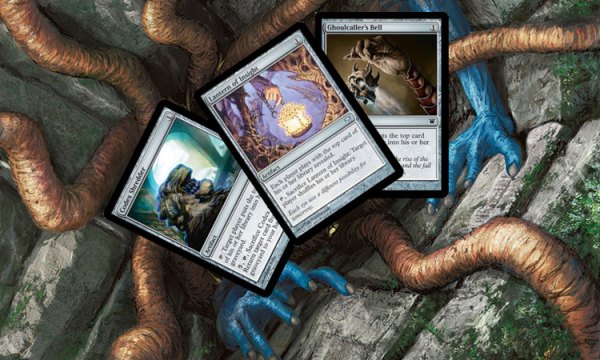
Lantern-Control-Banner

While there are still those who may doubt the effectiveness of combining the information that Lantern of Insight provides and the draw control that Codex Shredder and Ghoulcaller's Bell provides, it seems only a matter of time before the deck becomes a major player in the Modern metagame. This goal of this primer is to examine and explain the deck and its nuances. Before we get started, I want to give a huge shoutout to the players, brewers, and testers in the MTG Salvation Lantern Control thread for all their work and deck development.

[wp_ad_camp_1]

Examining the List

Let’s start with a look at two versions of the deck: my own list, and then Zac Elsik's GP-winning list from last weekend's GP Oklahoma City.

Lantern Control, by Randall Thompson

Artifacts

4 Lantern of Insight
4 Codex Shredder
4 Ghoulcaller's Bell
4 Ensnaring Bridge
3 Pithing Needle
3 Mox Opal
2 Pyrite Spellbomb

Creatures

3 Spellskite

Instants

2 Surgical Extraction
2 Abrupt Decay

Sorcery

4 Ancient Stirrings
3 Duress
3 Inquisition of Kozilek

Enchantment

1 Ghirapur AEther Grid

Lands

2 Academy Ruins
3 Blackcleave Cliffs
2 Copperline Gorge
3 Ghost Quarter
4 Glimmervoid
4 Llanowar Wastes

Sideboard

3 Welding Jar
1 Nature's Claim
1 Seal of Primordium
1 Ancient Grudge
3 Pyroclasm
4 Sun Droplet
2 Grafdigger's Cage

Lantern Control, by Zac Elsik (GP Oklahoma City 2015, 1st)

Artifacts

4 Codex Shredder
4 Lantern of Insight
4 Ghoulcaller's Bell
4 Ensnaring Bridge
4 Mox Opal
3 Pithing Needle
2 Pyrite Spellbomb

Creatures

3 Spellskite

Enchantments

1 Ghirapur Aether Grid

Instants

2 Surgical Extraction
2 Abrupt Decay

Sorceries

4 Ancient Stirrings
4 Inquisition of Kozilek
2 Thoughtseize

Lands

4 Glimmervoid
4 Llanowar Wastes
2 Blackcleave Cliffs
1 Copperline Gorge
1 Tendo Ice Bridge
1 Forest
2 Ghost Quarter
2 Academy Ruins

Sideboard

1 Pithing Needle
3 Pyroclasm
2 Grafdigger's Cage
1 Nature's Claim
4 Sun Droplet
3 Welding Jar
1 Ancient Grudge

Most players' first introduction to Lantern Control came from Zac Elsik’s GP Charlotte list and Ali Aintrazi’s SCG Open Charlotte list. After this weekend, Zac Elsik's GP Oklahoma City list is sure to hype the deck even more. The core strategies and synergies that make Lantern Control work mean that few differences are apparent between decks.

Lantern Control is probably one of the, if not the, most complicated decks to pilot in Modern.  Every decision, from what order to play cards, to what cards to allow the opponent to draw once the combo is constructed, has an enormous influence on whether the pilot is going to win or lose.  In addition, simple choices in what cards to supplement the prison pieces in a given metagame may impact the success of the deck.

Card Choices: The Maindeck

Supplemental choices are varied, and a tremendous number of options have been cyclically tried, discarded, and tried again by each pilot who decides to adopt the deck.  The history of the deck goes back some years now, and through the combined work of dedicated players, the list of cards that have been found to be most effective has narrowed. For more information on what cards were tested and what cards are good or bad for certain metagames, you can check out (or join) the discussion in the MTG Salvation thread.
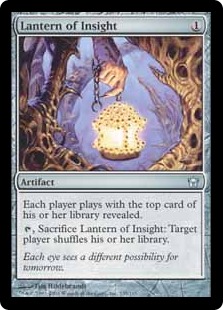
Lantern of InsightThe key to narrowing the list of possible supplemental cards is a deeper understanding of how the deck works and what weaknesses need to be corrected.  Lantern Control makes use of the idea of inevitability.  Jeff Cunningham wrote an article about this, and it’s definitely worth reading whether you plan on piloting Lantern Control or want to be prepared for it as Lantern Control is one of the most inevitable decks in the metagame.  The longer the game plays out, the more likely the Lantern deck will win-as long as the pilot makes correct plays.  The opponent isn’t actually prevented from playing spells or drawing cards.  Instead, the Lantern pilot is effectively choosing what cards are and are not in the opponent’s deck.  He or she is just doing it as the game plays out, within the legal restrictions of the game, rather than before the game as part of deckbuilding.

The weakness to this strategy is that the opponent is still allowed to draw cards as normal.  If the opponent has more threats in his or her deck than the Lantern pilot has “mill rocks” (Codex Shredd, Ghoulcaller's Bell) available, then the opponent still has inevitability.  Eventually, enough threats will slip through that the opponent will be able to piece together a win.  This is where the long evolution of the deck comes in.  Many options have been tried to patch this weakness.  The most effective is Ensnaring Bridge. Ensnaring BridgeIt worked perfectly with the low converted mana cost of the core combo cards, isn’t reliant on playing specific colors, and essentially plays like a Moat - but better.  The effectiveness and function of Ensnaring Bridge is one of the primary events that lead to the inevitability described above.
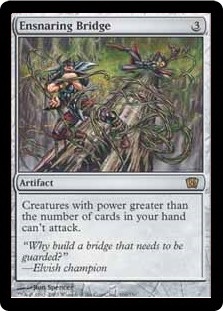
This discovery brought about additions like Pithing Needle and Surgical Extraction.  Discard spells like the painless Duress and Inquisition of Kozilek provide information so that the pilot can make fully informed decisions on what the opponent is missing, picks out cards that may break the prison, and removes cards that may allow the opponent to win before a complete lock is set.

Abrupt Decay is a popular choice as a filler answer-all.  It rarely is short of targets and frees up sideboard slots that would otherwise be filled with answers for cards like Stony Silence and Kataki, War's Wage.
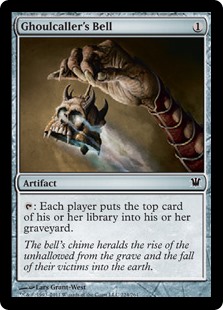
ghoulcaller's bellThe manabase of the deck may look blasphemous in the current world of fetchlands and shocklands, but has been shown to be effective. Pilots should avoid lands that reshuffle the library and require them to pay too much life for relevant plays in the early game.  The lack of self-shuffling effects effectively allows the pilot to “stack” his or her deck with each Ancient Stirring played, and life points are a precious resource to begin with (the deck also suffers from a rough Burn matchup, and fetches/shocks don't help).  The most commonly played utility lands are Academy Ruins and Ghost Quarter.  Ruins allows the pilot to reclaim countered, discarded, destroyed, or even self-milled artifacts as needed.  Ghost Quarter acts as additional disruption against certain matchups, prolonging the game and increasing the likelihood of victory.  The average converted mana cost is relatively low, so the deck runs efficiently on 18 lands and three Mox Opals.

Card Choices: The Sideboard

Lantern Control's sideboard is designed partially to help shore up the deck's weaknesses and partially to pre-emptively answer expected cards that opponents will be sideboarding in.  The most important aspect of the sideboard is for each card to be versatile as possible.  Ancient Grudge assists in improving the Affinity matchup, but is also important to answer a Chalice of the Void.  It has a role against Tron variants and Amulet Bloom decks as well.
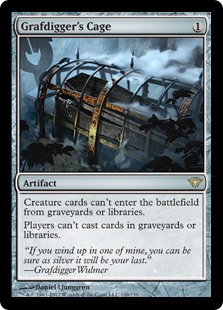
Grafdiggers CageGrafdigger's Cage singlehandedly shuts down every copy of Collected Company and Chord of Calling in an opponent’s deck.  It also does impressive work against decks like Grishoalbrand, and keeps the ever popular Snapcaster Mage from flashing back key spells that have been milled away.

Nature's Claim and Seal of Primordium are designed to answer the troublesome Leyline of Sanctity, Stony Silence, and Suppression Field.  They do double work against Robots, Tron, and Amulet Bloom as well.

Pyroclasm slows down many of the aggressive creature-based decks, like Merfolk, Delver variants, Elves, Affinity, and even slows down Burn: remember that a good amount of Burn's damage comes from creatures like Guide and Eidolon. Pyroclasms are included in order to keep the game going until an Ensnaring Bridge puts the opponent’s deck at a snail’s pace.

A fourth Sun Droplet is often interchangeable with a Sunbeam Spellbomb, depending on the build. Both cards address the otherwise abysmal Burn matchup, but they also have applications against similar decks as well.

Welding Jar assists in preparing against the often-included artifact destruction and opponent brings in.  We run three in the sideboard, but you can even go up to four depending on the metagame. The Jund matchup typically has the most artifact destruction at its disposal, and Jund-heavy metagames might call for a full Jar playset.

Cards That Didn't Make the Cut

Lantern Control has been around since late 2012, despite only seeing serious play in the recent summer 2015 tournaments. In that time, Lantern Control players have tested dozens of alternate options and cards, many of which were ultimately cut in favor of better options. Here are just a few of the suboptimal cards that didn't make the final list.

Artificer's IntuitionArtificer's intuition
An enchantment that seems like it would fit great in the deck, and has been suggested a great number of times, Artificer’s Intuition is filling a role the deck doesn't need.  It requires the same total mana investment as Trinket Mage, but without the 2/2 body and requires dumping an artifact in order to search one up.  The game should typically already be locked up by the time this card is useful for what it’s suggested for, and it can’t get Ensnaring Bridge, which is often the last piece needed.

Trinket Mage

Speaking of the Mage, this card increases the average converted mana cost of the deck, putting it at odds with Ensnaring Bridge.  It also only fetches out a select few cards in the deck.  While there is the possibility to try the Mage out in a build more oriented towards a toolbox-type deck, this is not the direction that has proven most effective.

Life from the Loam

While it may seem like it plays well with the self-mill plan and is great for getting back an Academy Ruins, Loam is designed to put cards into your hand.  That doesn’t bode well in a deck that is looking to empty the hand for Ensnaring Bridge in order to stay alive.  Codex Shredder can do the same job, and is already a staple in the list.

Next Level Playing Tips

General Deck Tips

  • Patience is its own reward
    It isn’t uncommon for a newer pilot to become overly aggressive milling in the early game.  The tried and true method is to wait until the end of the opponent’s turn and then evaluate if milling will do more harm than good.  The early game is when a pilot should be more interested in keeping an opponent locked down.  If an opponent has a card on top that will do him or her no good, then it is best to let him or her have it and to instead use the mill ability to assist you in digging deeper into your deck.  And, of course, at the end of an opponent’s turn unless absolute necessity calls for it.
  • Sometimes it is correct to “sandbag”Ancient Stirrings
    Correctly playing Ancient Stirrings is often the difference between a win and a loss.  It’s better to allow an opponent to discard the Stirrings in hand than to use it and allow them to discard an Ensnaring Bridge.  It is also correct to hold a Stirrings if the card that we intend to grab with it is already on top of our library.  Why pay a green mana and spend a card to get something that the deck was going to give us anyway?
  • Know your enemy
    Surgical Extraction provides nearly all the information needed to make informed decisions,  whether it’s the card that we need to name with Pithing Needle or the number of “outs’ an opponent has still left in the library.  It also lets a pilot know if using that Ghost Quarter is going to shut out a color of mana or not, and may even be used as an instant speed discard spell during the draw phase.
  • Playing slow is not playing patiently
    It’s not uncommon for opponents to refuse to concede when they have been put into the prison.  It’s also not uncommon for opponents to become emotionally upset when playing against Lantern Control, and decide to use alternate tactics like stalling and then attempt to blame a draw on the Lantern deck.  This means that the Lantern Control pilot must not only be mentally aware enough to make the correct decisions, but to be able to do so in a timely manner in order to avoid going to time against an unhappy and vindictive opponent.

Single Card Tips

  • Pithing Needle
    Correctly playing Lantern Control typically requires a pilot to be intimately familiar with the Pithing Needlemetagame.  Nearly every deck has a card that Needle can shut off, and knowing which card(s) to name is the sign of someone who knows what they are doing.
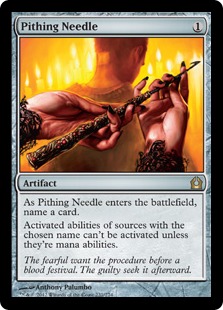
  • Spellskite
    Many misplays can be attributed to a misunderstanding of what can and can’t be targeted with Spellskite’s ability.  It’s important to know the intricacies of this, or risk losing to what could be an otherwise silly mistake.
  • Getting information: Inquisition of Kozilek, Duress, Lantern, and Surgical Extraction
    These card provide the pilot with complete information.  There is rarely an excuse for not writing down the cards seen when playing targeted discard.  The more information available, the more likely a correct decision can be made when choosing when and when not to mill.
  • Play order: Inquisition of Kozilek and Duress
    In addition, it is logically correct to play Inquisition of Kozilek before Duress in the early turns of the game.  Inquisition can be used to remove early threats, while Duress is often better for taking care of cards that have to wait for the prerequisite land drops to be played.

Sideboard Guide

Jund
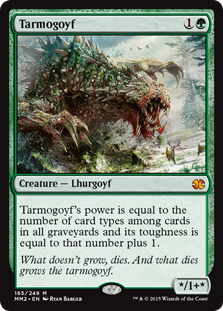
TarmogoyfOUT
-1 Codex Shredder
-1 Ghoulcaller's Bell
-1 Duress

IN
+3 Welding Jar


Typically one of the deck’s worst matchup.  The combination of a fast clock and large numbers of active cards make for a difficult matchup.  The key card to name with Pithing Needle is Liliana of the Veil because an active Lily will take over the game.

Affinity
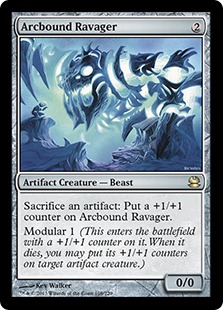
Arcbound RavagerOUT
-2 Surgical Extraction
-3 Duress
-1 Ghoulcaller's Bell

IN
+1 Seal of Primordium
+1 Ancient Grudge
+1 Nature's Claim
+3 Pyroclasm


One of the more favorable matchups.  The maindeck Pithing Needles and Ensnaring Bridges are supplemented with six cards out of the board, often leading to a very one-sided post-board game.  The early game discard slows down the opponent’s deck until the rest of the cards stop it entirely.

Burn
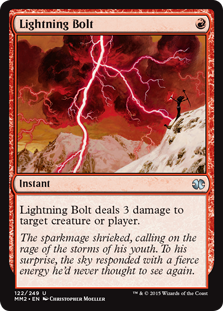
Lightning BoltOUT
-1 Codex Shredder
-1 Ghoulcaller's Bell
-2 Surgical Extraction
-3 Pithing Needle

IN
+4 Sun Droplet
+3 Pyroclasm
+2 Welding Jar


One of Lantern Control's worst matchups (if not the worst matchup period). The additional Sun Droplets and Pyroclasms serve to prolong the game to the point where it doesn’t matter how much burn the opponent draws, it won’t be enough to overcome the Droplet lifegain. Welding Jars act as additional protection to give Sun Droplets, Spellskites, and Ensnaring Bridges the staying power needed to keep the prison intact against Burn's Wear // Tear, Destructive Revelry, and/or Smash to Smithereens. Jars also help drop the hand size quickly in order to bring the Bridge to full power as soon as possible.

RG Tron
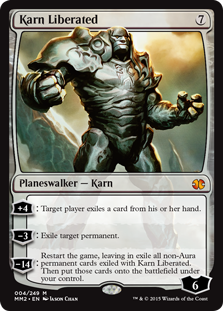
Karn LiberatedOUT
-1 Inquisition of Kozilek
-1 Codex Shredder
-1 Ghoulcaller's Bell

IN
+1 Seal of Primordium
+1 Nature's Claim
+1 Ancient Grudge


Maindeck Pithing Needles do major work in this matchup, while Ensnaring Bridges keep Wurmcoil Engines and even Emrakul, the Aeons Torn at bay.  Bringing in the artifact hate helps out against Wurmcoils and Oblivion Stones if and when the Needles and Bridges aren’t set up yet.  The sideboarding for this matchup is very tricky.  Welding Jars can help against Oblivion Stones and the Nature's Claims/Ancient Grudges that an opponent may side in, but some RG Tron pilots will also side in Spellskites, making Jar a dead card.

Infect
Blighted AgentOUT
-2 Surgical Extraction
-3 Pithing Needle
-1 Ghoulcaller's Bell

IN
+3 Welding Jar
+3 Pyroclasm


The Infect matchup is typically a race against time.  While Welding Jars do help to ensure that Spellskite and Ensnaring Bridge stay out, they are also extremely important in turning Bridge up to 11 as soon as possible.

Grixis Control / Grixis Twin
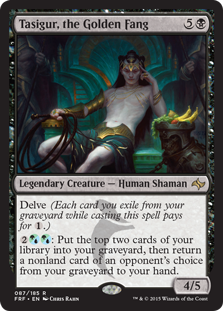
TasigurOUT
-1 Pyrite Spellbomb
-1 Codex Shredder
-1 Ghoulcaller's Bell
-1 Inquisition of Kozilek

IN
+2 Grafdigger's Cage
+2 Welding Jar


Against Grixis Control, we want to name Tasigur, the Golden Fang with our Pithing Needles, and then use the extra Needles for cards that we expect or know the opponent has against us.  We can get that information from Surgical Extraction, but we can typically expect to see Engineered Explosives.  If nothing else, we can name fetchlands. Against Twin variants, Needles are best to be set on Deceiver Exarch, Pestermite, and expected cards/fetchlands, in that order: remember that Splinter Twin gives the activated ability to the creature, so never, ever name "Splinter Twin" off Needle.

Company/Chord Variants (Abzan, Elves, Naya, Kiki, etc.)
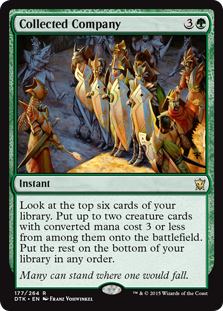
collected companyOUT
-2 Surgical Extraction (Elves)
-2 Abrupt Decay (Elves)
-1 Pithing Needle (Elves)
-1 Codex Shredder (-2 for non-Elves)
-1 Ghoulcaller's Bell (-2 for non-Elves)
-3 Inquisition of Kozilek (non-Elves)

IN

+2 Grafdigger's Cage
+3 Pyroclasm
+2 Welding Jar


While these decks have similar gameplans, what to take out can be very dependant on what particular build the opponent has.  The main choice for Needle against Elves is Ezuri, Renegade Leader. Don't name Heritage Druid or other mana-ability Elves. CoCo Combo decks have a variety of choices, each dependent upon the build.  Some versions go for Kiki-Jiki for the combo, others go for Viscera Seer and/or Cartel Aristocrat.  Some builds run some number of Qasali Pridemage too, which is another viable Needle target.

Merfolk
Master of WavesOUT
-3 Pithing Needle

IN
+3 Pyroclasm


Merfolk is typically one of the easier matchups.  Pithing Needle is often the most dead card so it's easily traded off with Pyroclasms for some early game disruption when combined with discard spells.  Once a Bridge hits the battlefield, it’s just a matter of keeping the opponent off of Hurkyl's Recalls, Echoing Truths, and so on.  Some opponents will hold Lords in order to keep the fish small enough to swing under a Bridge if we have a single card in hand.  Those opponents will often attempt to use Vapor Snag to bounce Spellskite to put a card in our hand to get this plan to work.

The Future of Lantern Control

Lantern Control will only get better as pilots become more comfortable playing it.  It’s a daunting deck to handle and I've heard it said that it’s not much fun to play against. That said, it’s difficult to argue against the strength of being able to control what an opponent can draw as early as turn two.  This often means that opponents just cannot risk keeping a hand that is anywhere near questionable. With Lantern Control's recent success at GP Oklahoma City fresh in everyone's mind, you can be sure we'll see more of the deck as Modern continues to evolve.

I hope that this has been informative, and I look forward to seeing more copies of this deck placing in events in the future! Do you have any experience with the deck? Any tips or tricks you want to share with the readers? What about lingering questions you have on the deck? Ask in the comments. Thank you for reading and I look forward to seeing more Top 8 Lantern Control finishes in the future.


Insider: Learning from Khans to Prepare for Zendikar

Are you a Quiet Speculation member?

If not, now is a perfect time to join up! Our powerful tools, breaking-news analysis, and exclusive Discord channel will make sure you stay up to date and ahead of the curve.

Khans of Tarkir was the most sold set in Magic history. As we all know, the inclusion of allied fetchlands and consequent introduction of these cards to Modern bolstered sales substantially. With the announcement of Zendikar Expeditions and the hype surrounding them, we can expect that Battle for Zendikar (BFZ) will also be a wildly popular set.

With Khans, the fetches were in the regular rare slot, and as such they consumed most of the value of the set. With BFZ, many boxes won't contain even a single Expedition, but the the lottery aspect will still cause players to buy product and consequently drive prices down in a more general sense. It would take a pretty disappointing set outside of the Expeditions to diminish the hype from the Expeditions alone, and as such I expect price trends for BFZ to closely resemble those of Khans. If you look at Khans prices now, you can see this means there won't be a lot of value in the set.

So How Do We Profit?

While prices of cards in Khans are low now, that wasn't always the case and soon enough we will see how much the prices can recover from the damage of being featured in the game's most popular set. What we do know for certain is that the fetchlands have long-term potential, and indeed they have already started showing healthy gains.

There was an error retrieving a chart for Polluted Delta

There are other cards that are poised to gain value from Khans, but we'll have plenty of time to think about long-term holds from BFZ. What we learned from Khans was that even in a set where the value of the set is projected to tank, there is still the potential for some great quick flips. Let's take a look at some of the early winners from Khans and how we might be able to capitalize on this data for BFZ.

There was an error retrieving a chart for Sarkhan, the Dragonspeaker

Sarkhan pre-ordered in the $15-20 range, and saw early success in Standard in the hands of Kevin Jones. There was a window where this card fetched $35+, which might be hard to believe when you consider that the card is doing nothing right now and is currently worth about $5. Holding onto these guys has been a bad position ever since the initial spike, but for a brief period there was money here.

This makes me think that there's money to be made pre-ordering the new Gideon as a quick-flip.

gideonallyofzendikar

By now we should be able to look at Gideon and understand that he is a very powerful card. Much like with Sarkhan, the Dragonspeaker, it's not uncommon to see great cards win in a new format even if the deck they find themselves in doesn't end up being a pillar of the format. I'd be a little shocked if we didn't see at least four Gideon in the Top 8 of the first SCG Open after BFZ launches, even if they round out a horrible deck.

The point is that this card has a lopsided impact on games relative to other cards and that a single week of success early on drives hype. If and when this happens, expect a spike.

Completed listings for Gideon on eBay show a number of sets going for $20 a piece, with some lucky bidders ending closer to $15 a piece. If you can land a couple sets near that $15 mark, I expect you'll be able to nearly double-up on this card in the short term.

There was an error retrieving a chart for Jeskai Ascendancy
There was an error retrieving a chart for Siege Rhino
There was an error retrieving a chart for Dig Through Time

These cards were all solid short-term gainers when Khans launched, with Dig Through Time exploding from $1-2 to $10. The common link here was that all of these cards were minimally Modern playable, with bannings pushing Dig straight out of Modern and the banning of Treasure Cruise functionally removing Jeskai Ascendancy from the format.

Eventually, a reprint of Siege Rhino and bannings caught up with these cards with regard to eternal demand, but even still it's important to note that these cards were seeing Standard success in addition to eternal play. It's unclear if there will be much in the way of Modern playables in BFZ, but even if they do show up it's important to note that in-print Modern staples don't see nearly the bump that older staples do. Even the Modern staples will see a decrease in price initially before a great time to buy in emerges--usually around when the card rotates out of Standard.

These cards were great buys on pre-order, but the most profit was made by those looking to flip them, not hold them for Modern. The bannings and reprint confound this point, but I think we all understand that supply came crashing down on Siege Rhino before it was ever reprinted.

There was an error retrieving a chart for Pearl Lake Ancient
There was an error retrieving a chart for Mantis Rider

These guys saw their gains exclusively from Standard, and we can see from their price graphs how that panned out for them. Both cards started off at $1-2 and saw huge gains to the $5-7 range. The potential to profit was there, if only briefly.

I don't think it's wise to try to pick the next Rider or Ancient before it happens. I believe that these are the types of cards you want to see spike, and then sell from whatever product you've opened or cherry pick from stores that haven't adjusted their prices yet. Otherwise you could end up investing in cards like this:

There was an error retrieving a chart for Savage Knuckleblade

Savage Knuckleblade pre-ordered a bit higher than the above cards, but that's because people were so sure it was going to be a hit. It still might pick up, but people who are going to profit off of this card are buying them now in preparation for rotation, not to try to hit on an early penny stock from a very hyped set.

For BFZ, my plan is to mostly ignore the singles market. The exceptions are I like buying Gideons right now, and I'm going to pay attention to early gainers and try to pick them up and flip them immediately. I'll keep my eyes out for other generally undervalued cards, but as we all know those are becoming rarer all the time.

sacredfoundry

Lastly, I would hope that we all understand that the Expeditions are going to be great long-term holds. I'm still not sure what kind of prices we can expect on these cards, but I can't imagine they'll avoid a drop in the short term after the set launches. Then, much like Khans fetches I would recommend getting your hands on a bunch of these.

I would guess that they'll be pretty expensive even after they come down, but if you have a pile of money that you're sitting on I can think of a lot of worse ways to invest it. Clearly they're terrible picks for diversifying your portfolio and liquidity, so I guess these will mostly be a rich get richer type investment.

Want Prices?

Browse thousands of prices with the first and most comprehensive MTG Finance tool around.


Trader Tools lists both buylist and retail prices for every MTG card, going back a decade.

Quiet Speculation