menu

Insider: Modern Masters 2015 Non-Reprint List

Are you a Quiet Speculation member?

If not, now is a perfect time to join up! Our powerful tools, breaking-news analysis, and exclusive Discord channel will make sure you stay up to date and ahead of the curve.

Hello, readers! Welcome back.

This article, I wanted to follow up on this article, and touch on a little more on Modern Masters 2015.

One of the fine QS forum posters asked this:

Can a QS writer analyse and send out an email with a list of best non-reprinted targets, like they did for other sets?

Instead of writing an email, I figured I’d just write an article. I also went ahead and put together the “Modern Masters 2015 Non-reprint List” for everyone’s own use and consideration. The list was also posted here on the QS forums, and I think it’s an invaluable tool. As I mentioned in my last article, the cards not being reprinted in these sets are just as important to document and profit from. So, why not have them all in one spot?

Here’s the Trader Tools list.

I left out M12 because I’m not exactly sure if it missed the cut-off or not.  Richard Hagon specifically mentioned other Core sets when discussing MM 2015, and while it would be reasonable to assume that M12's absence implies omission, I'd rather not assume one way or another. When we get new info,  we can certainly add M12 cards to the list. I mentioned in my article listed above, a few of the cards that are going to be left out of Modern Masters 2015, but it was a brief list. So, like the forum posters on the QS forum ask, I shall deliver some blurbs on some highlighted cards on the “Master List.” I will highlight a few of the more obvious cards on there, and some of the not so obvious cards.

What’s great about compiling them on Trader Tools, is QS Insiders and forum members can quickly browse not only the cards, but the buy/sell prices as well. In addition to that, you can see the spread.

The Obvious

The Obvious Choices

I just wanted to put these here, and people can clearly see these cards on that list as well. I’m going to be honest here, I think what I have to say about these has been said numerous times already.

In particular I highlighted Thundermaw Hellkite in my most recent Quick Stocks.

Now, some of these may not have the highest incentive to because of their buy-in price. Though; a few of them are still very attractive. It’s during these time periods between the most recent block leaving (in this case RTR Block) where cards like these, tend to stagnate. Voice of Resurgence, and Abrupt Decay being the more recent. I’ll cover this more in my next article dealing with rotation.

I’d say the most attractive one here is Voice of Resurgence if not just for the pitiful amount of Dragon’s Maze opened. I think maybe 20 boxes were opened in North America? *That was sarcasm.* In any event, it was still one of the more under-opened sets in recent Magic history.

With the success of “Little kid Junk” appearing on multiple MODO lists, one can be optimistic of this card trending back upward. It’s almost always played as a three- to four-of in those decks, and is starting to become popular in decks centered around Collected Company. I will highlight Voice more in the Quick Stocks, so you can all see the data behind this, and perhaps that can shed some light on this potential target.

Going back to Thundermaw Hellkite, it’s not as widely played as say Voice, but should this new "fad" of trying to jam dragons (and dragon-related cards like Silumgar's Scorn) into Modern, then Hellkite will surely be a part of that. Hellkite’s spread has even lowered since writing my Stock article, down to about 13% as of today, from about 20% when I wrote the Quick Stocks.

The only thing I really can see holding back Hellkite, is it’s never really played as a full playset, and a lot of its success is contingent on how well UWR-based decks perform. So, with Hellkite, there still is time to play the “sit and wait” approach. On the other hand; if another deck utilizing it in a different way crops up, you can be sure these will disappear extremely fast.

The Not So Obvious

Not Obvious Choices

Now, in terms of “not obvious” some of these cards may not be spotlighted by inclusion in prime Constructed decks. I know my readership has a few of these noted already, because you’re smart people. As smart people we need to make sure to document their spreads, and watch these like a hawk together.

  • We already know Entreat the Angels is played in UWR Miracles in Legacy, and is quite the casual hit too in terms of table-top/EDH games. It depicts one of the most popular creature types in the game, and a very unique ability that may not always fit in a main block set. So, this leaves us with Commander/supplemental product. From the Vault: Angels is in the pipeline, so I’d exercise caution here until that set is spoiled. Other than that, it may be quite some time before this is inserted into any sort of product.
  • Detention Sphere has a lot going for it, already being incorporated into Modern decklists. This may be a card that doesn’t have the ability to spike all too much, but has a chance to provide at least some sort of profit. For now, with a 50% spread, we can continue to sit and wait on this one. It’s been stagnating for quite some time, and without a new outlet of demand, I think this will stay right where it is.
  • I’m not really an EDH/casual aficionado, but the only card I can compare Dictate of Erebos to is Grave Pact. There’s a lot of copies out there to be had, and if anything were to happen to foil copies of this, this would probably force the price of this upward from the paltry .49c it’s sitting at currently. A powerful effect, and these types of cards somehow command a premium, even when they’re reprinted numerous times.

Well, that’s all for this time. I really wanted to share the Trader Tools list with you all, as I think it’s really beneficial for all of us on QS to have access to. I will continue to add/remove cards as seen fit, and by the feedback you all give me. Monitor the spread of these cards, and take note that any changes in these could easily push prices up drastically.

I outlined in my last article how certain cards don’t take long to increase in value after Modern Masters set releases. The more obvious cards will start to trend upward first, so if you’re compelled to hold these at all, I’d say your chances of having them at the lowest price decrease the longer one waits.

I’m eager to hear everyone’s feedback on this list, and will be happy to discuss the cards already listed further with all my readers. Either tweet at me, or comment here. Are any other cards that I missed worth watching? Be sure to make a good case for the card and we can certainly talk about adding them to the list.

Before I go, in case any of you haven’t read Brian DeMars' article about picking long-term winners, he mentioned some of these cards too.

Some of the Slivers are also mentioned, which have been listed on my Master List--I think there’s some real potential there too.

Slivers? Are they worth it?

Until next time!

Chaz
The Blackest Rose: Marchesa, the Black Rose Commander

Are you a Quiet Speculation member?

If not, now is a perfect time to join up! Our powerful tools, breaking-news analysis, and exclusive Discord channel will make sure you stay up to date and ahead of the curve.

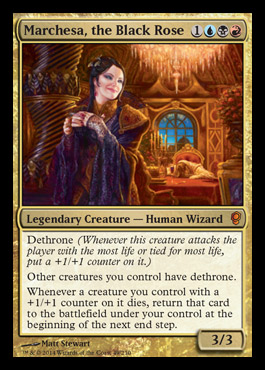
So, I confess, I have a new lover. Even though she's from a rough corner of the shards being Grixis and all, she has a great 3/3 body, abilities that keep me interested, and at just 4 mana she doesn't break my mana pool. Yes yes yes, it true, Marchesa, a rose by any other color wouldn't be nearly as sweet.

It all started late one evening when I was looking for new special someone to take charge of a good 99 for me. Then it happened. Daily MTG updated promptly at midnight and that's where I saw her for the first time. She was perfect, my muse. I instantly ran down stairs and started preparing a proper proposal for when she'd arrive.

Here's the list for my new queen:

Marchesa, the Black Rose

Commander

Creatures

Spells

Lands

6 Island 6 Swamp 5 Mountain Opal Palace Polluted Delta Bloodstained Mire Scalding Tarn Mana Confluence Temple of the False God City of Brass Grixis Panorama Command Tower Sulfur Falls Drowned Catacomb Dragonskull Summit Temple of Epiphany Temple of Deceit Temple of Malice Tainted Isle Tainted Peak Underground River Shivan Reef Sulfurous Springs Blood Crypt Steam Vents Watery Grave

I can't ever rant and rave enough about the synergistic interactions between Marchesa and this deck. Your army is relentless and with a sac outlet you're almost unstoppable. I don’t think I really need to break down each of the non-land choices so I’ll just go on about some highlights.

The lady of the hour, my Grixis gal, Marchesa, the Black Rose is a one-woman power house. She’s cost effective, has an interesting ability (dethrone) that she shares with her team and, the best yet, makes your boys resilient. Before she was spoiled I was planning on remaking my Grixis EDH that starred Thraximundar. Marchesa "dethroned" Thrax but kept him as one of her loyal subjects in this list.

The main mechanics I tried to embrace in this deck were dethrone, undying and tribute. Basically anything that gives a +1/+1 counter to work with our general. I thought about more evolve guys but there weren't very good options in mono-blue, the same as with graft. The outlast options in mono-black were very limited as well. Although having Mer-Ek Nightblade does make for some awkward combat trades for your opponents.

The first card I want to talk about is Cryptborn Horror. He wasn't in my first draft of the deck but I tried him out in my MTGO list. I was very pleased with it. I swung, hit for 5, and jammed it in as a 5/5, swung a turn later, hit for 10, sac'd it to Goblin Bombardment for an extra 1, and then Marchesa brought it back as an 11/11. Value town!!!

I've read other lists for this commander and almost everyone had Mikaeus, the Unhallowed. Yes, it's sick, yes, it's combo-tastic with 90% of the other creatures in the deck. I guess there isn't too much more to say about it.

Grave Betrayal is the nuts. Oh, your guy died, it's mine now, with a +1/+1 counter, which means, it comes back under my control with my girl in play.

Another interesting direction a friend of mine took with his Marchesa Commander deck was that of an infect plan. You don’t actually deal them damage so there’s no issue of kicking them off the throne and trying to bring yourself down to their life total or below. I did consider including a few infect creatures in my list but I decided I didn't want to mess with infect in my Commander games since everyone tends to have different house rule when it comes do poison damage.

As for cost, the deck is not very expensive. The mana base is by far the most expensive portion of the deck. Since this is a casual format and, in my opinion at least, not meant to be competitive, there are a lot of land choice that can be swapped out for less expensive counterparts.

So without rambling on for a few dozen more paragraphs I’ll just end on this. The deck is tons of fun. Try it out and please feel free to make any suggestions or comments. I'm a EDH/Commander fanatic and love to hear about new decks and ideas.

Thanks for checking out my article!

x Julian Biondillo x

Julian, AKA hardcoreniceguy on Twitter

biondillodesign@gmail.com

Ponder Shuffle Episode 9- RPTQQing

Are you a Quiet Speculation member?

If not, now is a perfect time to join up! Our powerful tools, breaking-news analysis, and exclusive Discord channel will make sure you stay up to date and ahead of the curve.

Ryan and Jens discuss Ryan's road back to the pro tour, the proper method to approach brewing to win, and some sweet decks from the first batch of RPTQs.

Avatar photo

Ryan Overturf

Ryan has been playing Magic since Legions and playing competitively since Lorwyn. While he fancies himself a Legacy specialist, you'll always find him with strong opinions on every constructed format.

View More By Ryan Overturf

Posted in Free, Podcast, StandardLeave a Comment on Ponder Shuffle Episode 9- RPTQQing

Have you joined the Quiet Speculation Discord?

If you haven't, you're leaving value on the table! Join our community of experts, enthusiasts, entertainers, and educators and enjoy exclusive podcasts, questions asked and answered, trades, sales, and everything else Discord has to offer.

Want to create content with Quiet Speculation?

All you need to succeed is a passion for Magic: The Gathering, and the ability to write coherently. Share your knowledge of MTG and how you leverage it to win games, get value from your cards – or even turn a profit.

Bant Slivers Testing: Video

Are you a Quiet Speculation member?

If not, now is a perfect time to join up! Our powerful tools, breaking-news analysis, and exclusive Discord channel will make sure you stay up to date and ahead of the curve.

bant slivers diffusion

Last month I brewed up a Bant Slivers list; this month I put it through the initial trials in the Magic Online tournament practice room to see if it's good enough for dailies and to see what changes need to be made.

The list is the same as before except with an initial sideboard draft -- it ain't pretty, but it ain't terrible either.

[wp_ad_camp_1]


Bant Slivers by Sean Ridgeley

Creatures

4 Galerider Sliver
4 Diffusion Sliver
4 Phantasmal Image
4 Sidewinder Sliver
4 Sinew Sliver
4 Predatory Sliver
4 Adaptive Automaton

Instants

4 Path to Exile
4 Vapor Snag

Artifacts

4 Aether Vial

Lands

2 Windswept Heath
2 Flooded Strand
1 Breeding Pool
1 Temple Garden
2 Hallowed Fountain
2 Island
3 Mutavault
2 Plains
1 Sliver Hive
4 Seachrome Coast

Sideboard

1 Relic of Progenitus
4 Harm's Way
3 Spell Pierce
1 Spellskite
2 Kataki, War's Wage
1 Rest in Peace
1 Thalia, Guardian of Thraben
2 Harmonic Sliver

See what happened below.

Lessons Learned

Some things to take away from this:

  • Slivers is maybe not the place for Thalia. Against the decks we bring her in for, she'll hurt them more than us, but the damage can still be significant. This could just be a playstyle preference (I'm heavily biased against anti-synergy).
  • Diffusion Sliver underperformed. I still stand by it, but it's not the bomb I expected. The inherent problem with it is it's for decks with lots of removal, but decks with lots of removal make the game drag out, which makes her worse. It also suffers the same way Mana Leak suffers: it's pretty useless late game. It probably fares much better against Abzan than Delver, though.
  • We should maybe run 21 or even 22 land. We should probably run a Forest, too (partly for enemy Paths and partly because we need more green sources).

The basic message is this: Slivers is not viable in Modern. We can make tweaks, we can add Manaweft Sliver and try Lead the Stampede and maybe Bonescythe Sliver and different disruption, but even with all that, I'm confident the archetype just isn't the powerhouse it needs to be to compete. But, as I say in the video, it's fine for casual play. You could bring it to Friday Night Magic too, but in a formidable meta, you're likely to lose too often for it to be fun (if you're one of those weirdos that doesn't need to win ever to have fun, then obviously, you should have at it).

Slivers works decently in Legacy because a quick clock with a variety of answers backed up with free counterspells is always good, but we don't have that in Modern, and unlike with Merfolk, we don't have a solid, versatile package to work with. We're not that far off, but even small advantages can make a huge difference in this format, and they certainly do with this archetype.

So, we tried. Not all of these experiments will work out, but that shouldn't stop us from giving them a shot. Until next time!

Is Three Years A Long Enough Suspension for Known Cheaters?

Are you a Quiet Speculation member?

If not, now is a perfect time to join up! Our powerful tools, breaking-news analysis, and exclusive Discord channel will make sure you stay up to date and ahead of the curve.

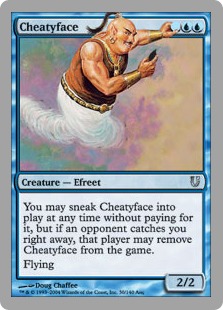
At Pro Tour Dragons of Tarkir Steven Speck was caught presenting a 53 card card with the seven cards that he wanted in his opening hand tucked somewhere out of sight. This is a clear and blatant cheat, and as such the investigation of Speck was open and shut.

There was an error retrieving a chart for Cheatyface

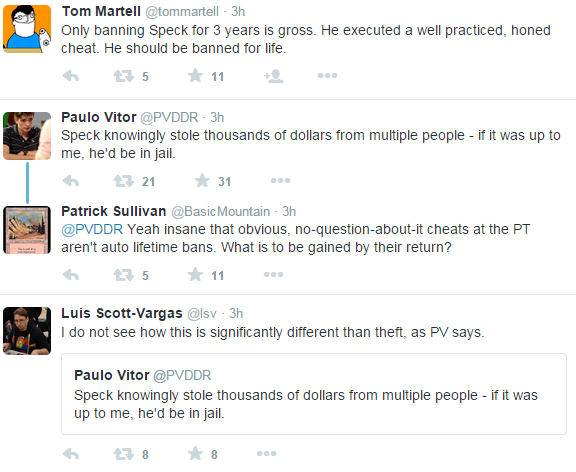
Speck was given a three year ban for his cheat, which by many accounts is too light.

Speck

Known cheater Alex Bertoncini famously came off a three-year ban and immediately started cheating again. This makes one wonder- how likely is it that somebody who commits a cheat heinous enough to deserve a three year ban would ever come back and play a straight game?

Lifetime bans sound extreme, but at the end of the day playing Magic isn't a right. Minimally, I support the camp that says that three years isn't a long enough suspension, especially when you consider the thousands of dollars of prizes that were more or less taken out of the pockets of honest players.

Avatar photo

Ryan Overturf

Ryan has been playing Magic since Legions and playing competitively since Lorwyn. While he fancies himself a Legacy specialist, you'll always find him with strong opinions on every constructed format.

View More By Ryan Overturf

Posted in FreeTagged 17 Comments on Is Three Years A Long Enough Suspension for Known Cheaters?

Have you joined the Quiet Speculation Discord?

If you haven't, you're leaving value on the table! Join our community of experts, enthusiasts, entertainers, and educators and enjoy exclusive podcasts, questions asked and answered, trades, sales, and everything else Discord has to offer.

Want to create content with Quiet Speculation?

All you need to succeed is a passion for Magic: The Gathering, and the ability to write coherently. Share your knowledge of MTG and how you leverage it to win games, get value from your cards – or even turn a profit.

Insider: Artful Maneuvers – Plain Old Borders, Pt 2

Are you a Quiet Speculation member?

If not, now is a perfect time to join up! Our powerful tools, breaking-news analysis, and exclusive Discord channel will make sure you stay up to date and ahead of the curve.

Today I bring you the thrilling finale of our first alter. If you missed Part 1, be sure to check that out before reading on.

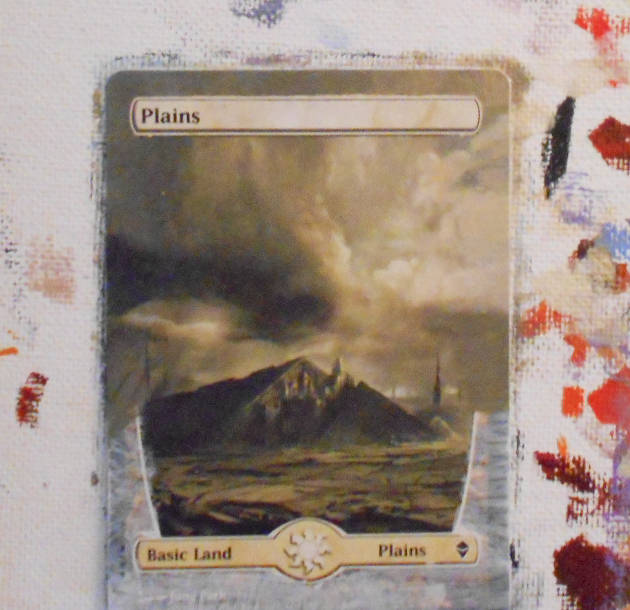
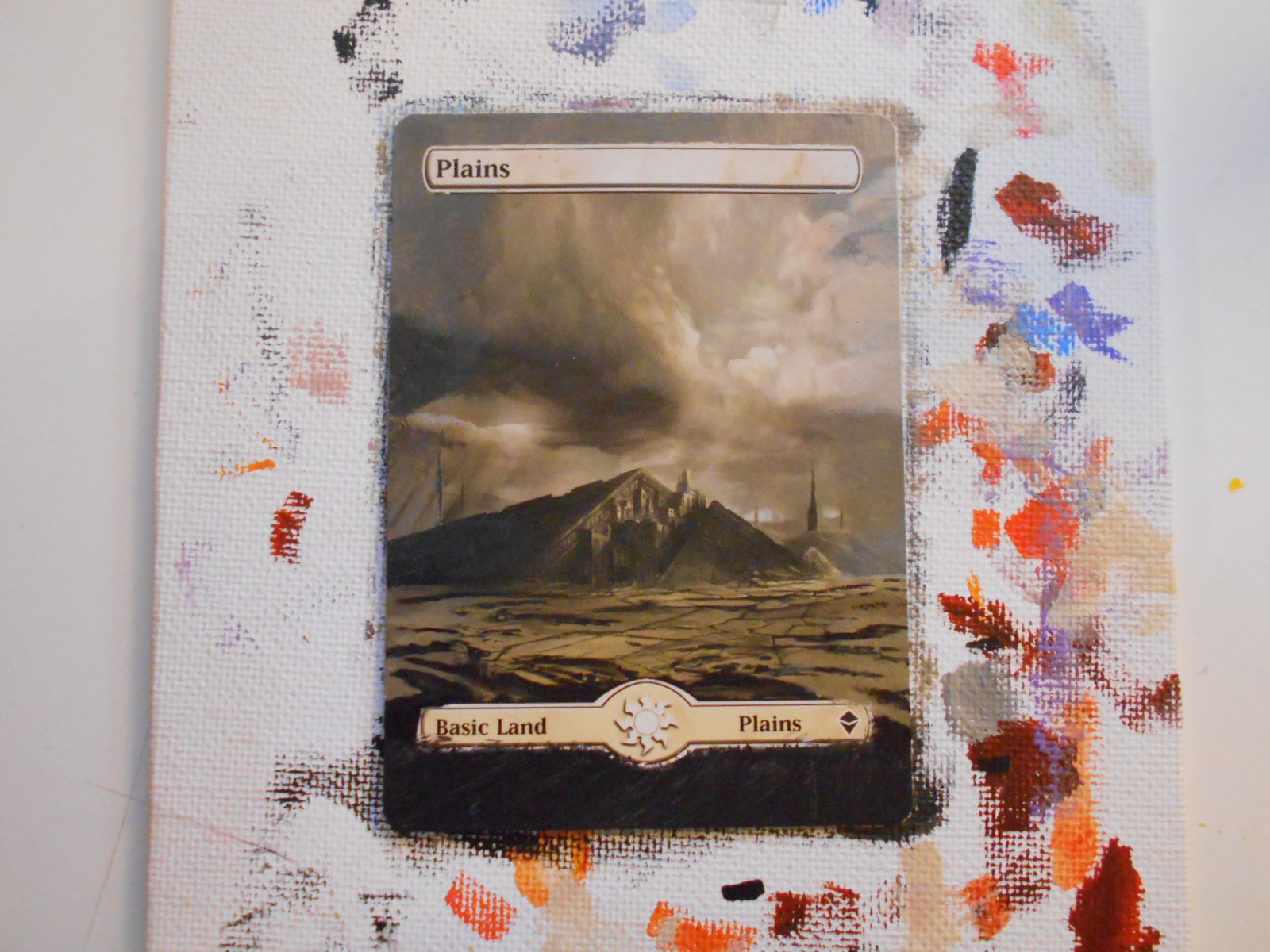
When we last left our card (hopefully now dried and in a safe place), it was only mostly finished. We still have yet to paint the ground and all of those ridiculously tedious looking cracks. Your progress should look like this.

The story so far...
The story so far...

Today we are going to focus on the intimidating part of the card and discover that this might be the easiest part of the card to paint. It's very easy to be discouraged by what looks like a formidable job ahead, but you must remember one very important rule: it is not our job to show the viewer every detail. As long as we hint at detail here and there, the viewers' mind will fill in the gaps. This will save us a ton of time and energy. I'll show you how.

Laying the Groundwork

We will be using the same three colors as last week, in the same fashion. If you can remember exactly how you mixed your white, yellow, and black in order to achieve a hue that nearly matches the art on your card then you are all set. If not, then take a little time to experiment again before you start. Remember that color mixing is only mastered through practice.

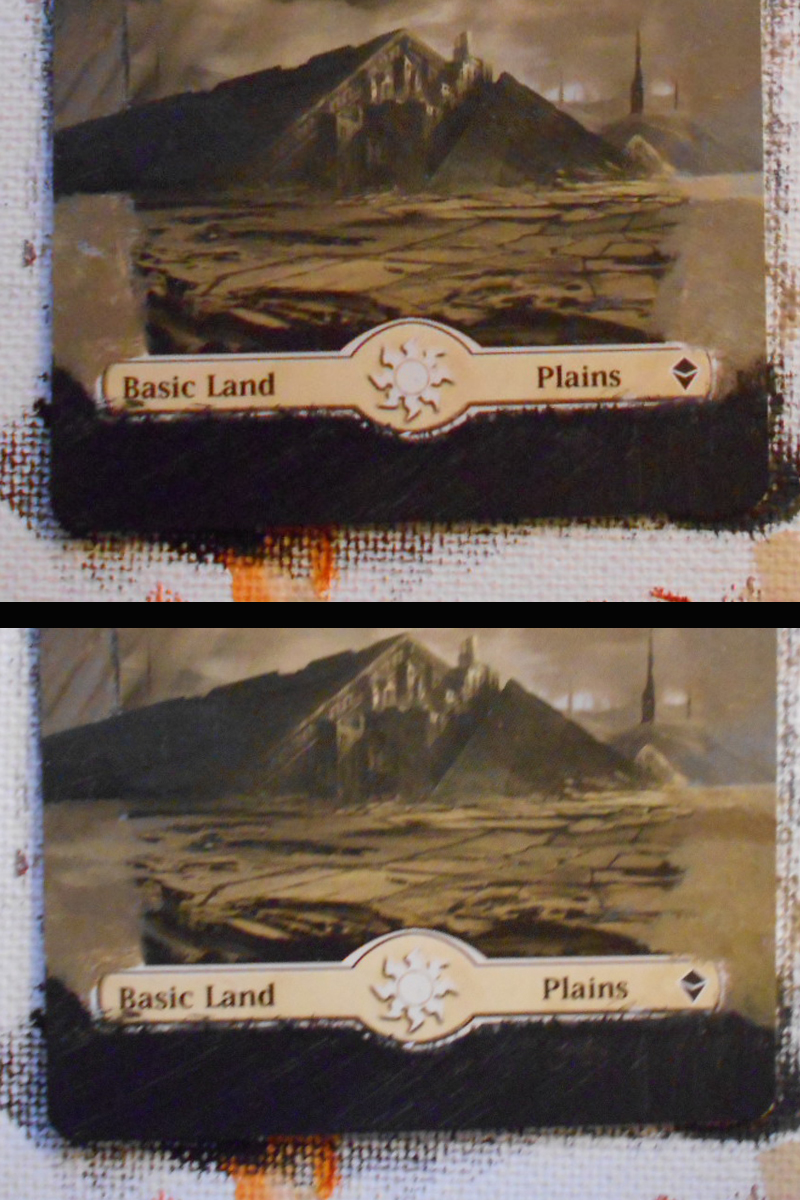
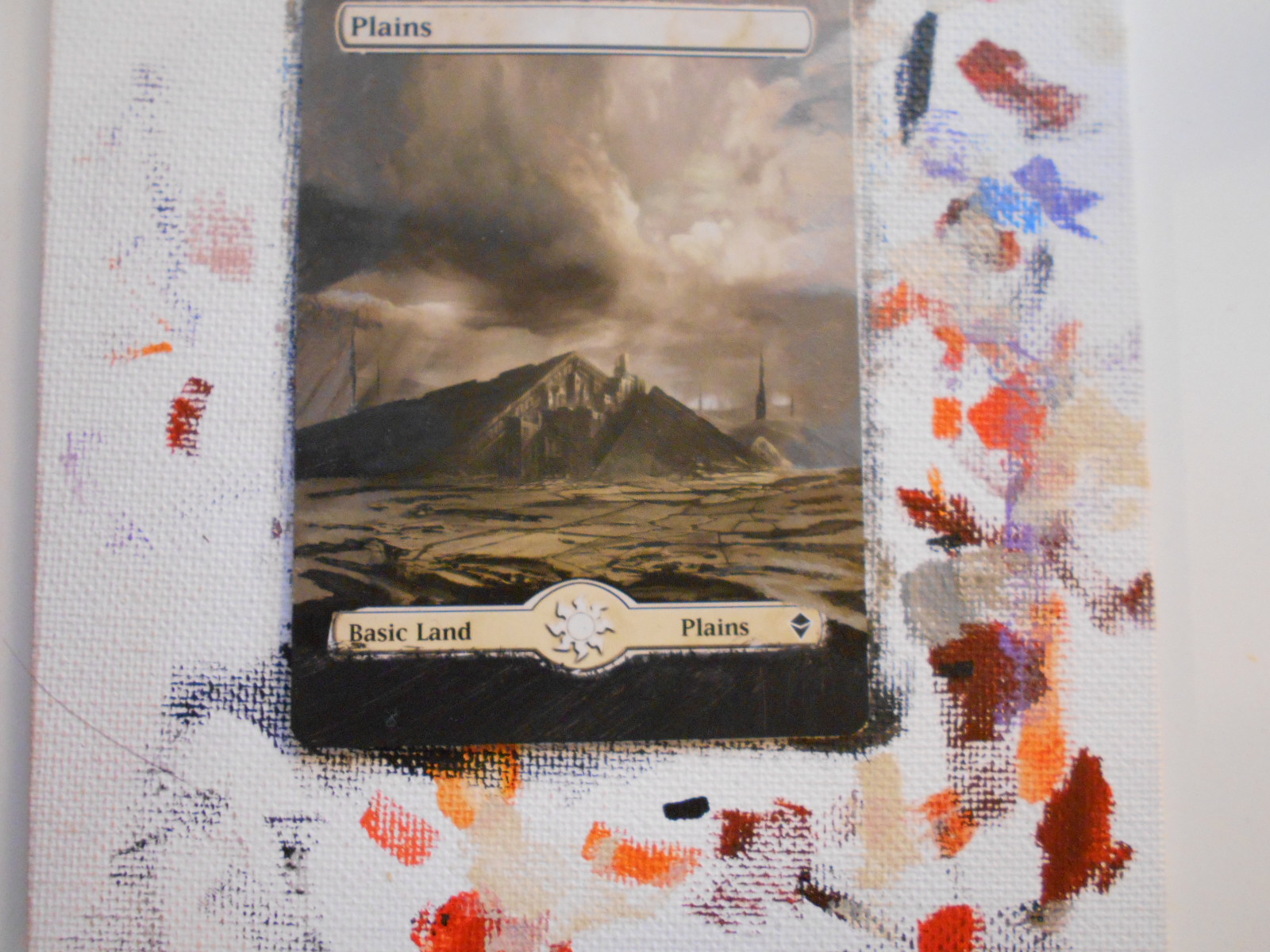
Just a bit of color....and a bit more
Just a bit of color...and a bit more

You'll need to lay a base coat of matching colors from the horizon on downward. That is a very slightly yellowed black for the pyramid, and those lovely sand colors for everything else. Ignore the cracks in the stone for now.

I chose to black out everything under the type plate and mana symbol. To the viewer, this will represent a drop-off or a cliff, but to us it represents a lot of time not filling in details and rocks or plants.

Remember that your time is money here. If I can save fifteen minutes on a commission then my wage per hour goes up. You should never sacrifice quality to do this, so pick your spots wisely.

After that first base coat, I laid another more exact layer of color on. I tried to match the varying color of the sandstone and the result is a subtle color shift on either side. When putting these colors in, make sure to overlap with the original art by pushing color in over the rocks. Try to avoid doing so in a straight line. If you look closely at the picture you'll see what I mean.

Filling in the cracks

Now for those tedious looking cracks. This part is actually quite simple. Take some black paint (lightened up slightly by your sand colored mixture) and with your flat brush, lightly paint in some cracks.

Cracks, crevices and creativity

The paint should be on the very tip of the bristles and you should barely be touching them to the card. Create your cracks as logical continuations of the original art. You can follow my example or do as you see fit.

Don't worry too much if one comes out looking a little fatter or weirder than you intended, we will fix that in the next step. All you need to worry about is that there is paint were the cracks need to be.

Bring It All Together

As with the clouds above, our finishing touches are going to be the highlights. The front most edges of

Highlights are the best finisher for anything!

the rocks in the foreground should be highlighted with a lighter color. You create these with the same fragile brush strokes used to create the cracks. This is also where you get to paint over any misshapen crevices and create the vision that you had for it.

Colors will almost always appear lighter and duller in the distance than they do in the foregound so you may wish to lighten some of the cracks in the distance. Creating this color effect in your art will convey the depth and distance that helps to bring everything in this piece together.

From this point on you are just playing with the finicky details. Is that highlight bright enough? Does that rock look jagged enough? It is important at this stage to make sure everything is the way you want it. Now sit back and take notice of how with just a couple of colors and some very basic lines we've created the landscape of a foreign plane.

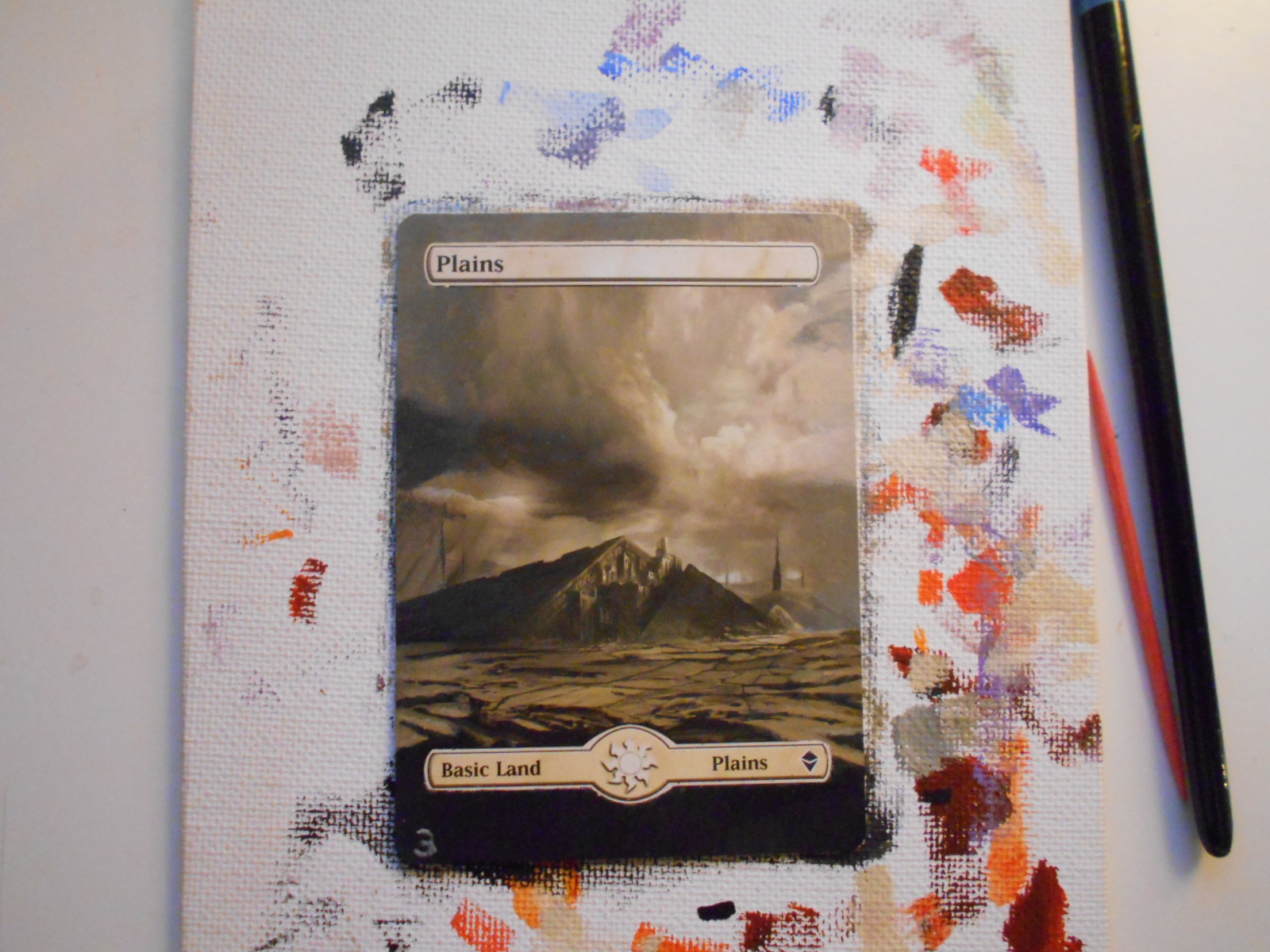
If you are happy, grab a toothpick and smooth out the borders of the type box. You have now completed your alter. Now sign it. Your signature should be simple, meaningful and easy to create. It is an important part of your brand. I always sign with a number three.

All finished!
All finished!

I'd like to thank Warriors 3 Comics and Games in Wayne, Michigan (@Warriors3MI) for supplying me with this week's card.

Be sure to share your work with me on Twitter @PaintersServant. I'm always happy to give tips and helpful critiques, and starting this very week I'll be sharing some of my favorites.

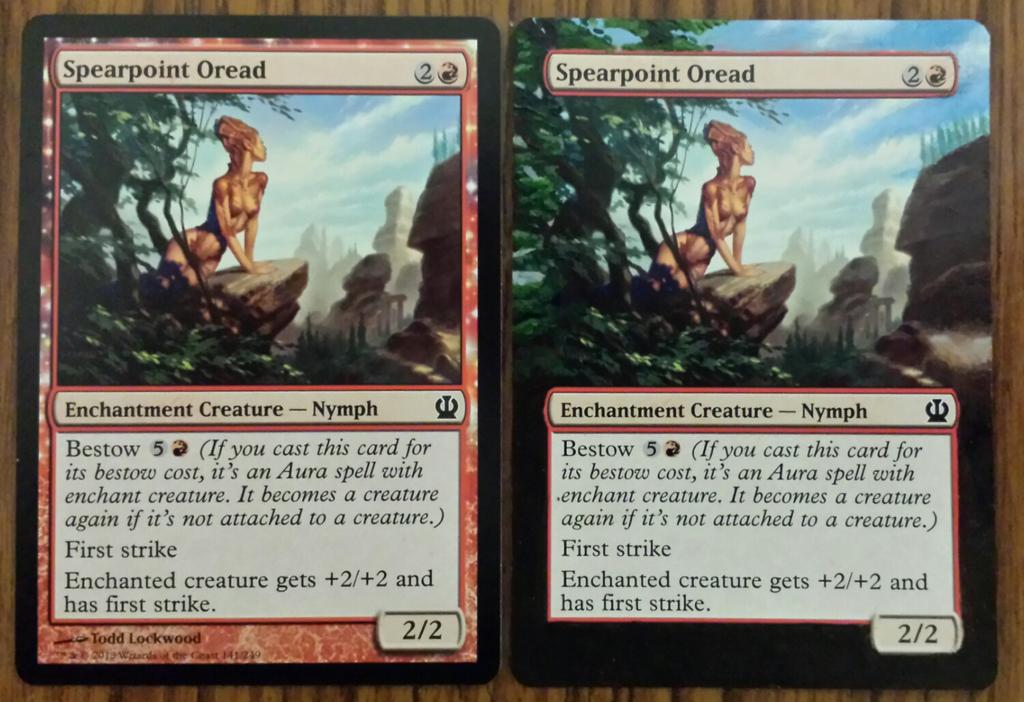
This week comes from @BazKahuna, who after reading my very first article decided to give a Spearpoint Oread his best. I think this is an amazing first alter and a great example of somebody trying something for the first time and finding they are actually quite good! See you next time!

CCsktjGUkAISGqC.jpg large
Spearpoint Oread by a faithful viewer

Insider: Everything I Learned From the First RPTQ

Are you a Quiet Speculation member?

If not, now is a perfect time to join up! Our powerful tools, breaking-news analysis, and exclusive Discord channel will make sure you stay up to date and ahead of the curve.

Tournament Report – aka Batman Villians

Play tight.
Do the best you can do.
Stay focused.
Have a positive attitude.
Rptq Go.

I wrote those words right before the player meeting of the first Regional Pro Tour Qualifier in Chicago this past weekend. Those are generally my feelings before a big event and really in life as well. Bruce Wayne said it like this: “It's not who I am underneath, but what I do that defines me.”

While I don’t normally subscribe to that line of thinking in life, in terms of my Magic career I have those types of thoughts often. This RPTQ was one such event where I thought I had something to prove--then came the villians.

Round 1 – The Rhino (Mono-Red Aggro)

As we get started with game one, it’s immediately apparent that my opponent will kill me unless I do something quickly. He starts out with the walking fireball (Lightning Berserker) and follows up with a pump and Monastery Swiftspear on turn two. I chose the get-out-of-the-way approach to dealing with The Rhino because all my lands came into play tapped and once I did have creatures in play, he used his horn (Goblin Heelcutter) to knock me out of the way. The day could have definitely started on a better note.

Games two and three went much better for me. I had solid hand backed up by good removal spells and my curve was much slicker after sideboarding out things I didn’t need against this deck. He had no one-drop which is very important to Red's game plan so I was able to get out ahead to grab The Rhino by the horn and throw him to the ground.

Game three he had a hard time picking himself up off the pavement after the beating I gave him. Being battered he obviously started with some bruises (mull to five) and he never really assembled a game plan. So, after a brief scare, I ended up winning round one which was a huge relief.

Record 1-0

Round 3 – The Riddler (Esper Dragons)

This new deck definitely goes against the conventional wisdom of not playing creatures in your control decks. The saying usually goes like this: Riddle me this, what do you get when you combine three removal spells, three Counterspells, and a dragonlord together? A dead opponent.

For game one, I kept a reasonable hand of three solid creatures and the lands to cast them. This is normally a great hand if you draw into removal spells or overwhelm your opponent before they can recover. Unfortunately, that was not the case.

The Riddler asked me, how do you win a game against Dragonlord Ojutai without drawing removal spells? The answer: you don’t. I dealt myself tons of damage because my only mana sources were pain lands. So, once the dragon came on the scene, all he had to do was attack three times and I was lying on the ground defeated.

Game two should be better because I get to side out my bad removal and add in more threats. The problem is, you still need removal spells for the dragons or you will lose to them like I did in game one. So, I kept in a bunch of removal that was versatile but removed the things that couldn’t kill Ojutai. Even though I sideboarded well, I still died to the same sequence of plays from the villain. The Riddler asked me the same question yet again and I still had no answer so he threw me in the x-1 group of players at the tournament and went on his way.

Record 1-1
Games lost to Dragonlord Ojutai: 2

Round 3 – The Scarecrow (Jeskai)

Trying to figure out which version of Jeskai you are actually playing against can be tricky. It’s like when The Scarecrow sprays you with some concoction that causes you to hallucinate. Let’s say they start out with Seeker of the Way--which version are they on based on that? What if it’s Soulfire Grand Master instead of Seeker?

Even if you think you figured out which version it is, there’s still a good possibility that the deck you’re playing against is different than the typical build. Unlike other archetypes in Standard, Jeskai seems to be the one where players try to do a lot of switching things up and trying different combinations of cards. There are so many possible iterations in the available card pool that switching a couple of cards dosen’t cause you to lose any power from your deck. This makes it more attractive for players to adjust their decks.

This particular version I played against mainly contained creature cards and burn spells. It did make tokens from Monastery Mentor just not from cards like Hordeling Outburst. Game one, which can be tricky due to all the hallucinating, I actually won. I had a good curve and a couple removal spells. That’s what the deck is supposed to do every game, but unfortunately that is not the case.

Game two, when I boarded in a bunch of useful spells like Drown in Sorrow, didn’t go as planned. I thought The Scarecrow was continuing his tricks but the Dragonlord Ojutai ended up not being an illusion after all. After dealing with some early threats, my tool belt was empty and we headed for game three.

The third game against this villain was spectacular, but unfortunately not for the hero. I kept an awkward hand of a couple creatures and double Drown. The awkward part was the lack of a second source of black mana but I had lands, spells, and threats so it was a keepable hand that improved drastically with any draw step revealing another black mana.

I did indeed draw the mana I needed as well as many other lands to go along with it. I guess I wished too hard and so my deck rewarded me with land after land. Both of my early creatures were killed and my opponent started amassing an army of monks, or I thought they were monks but who knows, it’s The Scarecrow afterall.

Late in the game I still had both Drown in Sorrow which was convenient because I would need both of them to kill the real Dragonlord Ojutai who showed up again. Normally I would only need one removal spell to kill a creature but you have to draw them to use them. Tool belt was nearly empty except for these awkward Drowns.

I kept putting pressure on him with my creatures so that I would kill him shortly after I dealt with his dragon. Unfortunately I never got another turn. The dragon flew overhead for five damage and the card he drew plus the one he drew for the turn was enough to defeat the hero.

Record 1-2
Games lost to Dragonlord Ojutai: 4

Round 4 – The Joker (Mirror Match)

Even though two losses would almost certainly not make Top 8, I still stayed in to salvage my rough start. Batman’s arch-nemesis would have none of it though. First he started the match off by giving me only unstable ground with which to stand on (all lands come into play tapped). Then, once they were in play, he thought it was funny to not allow me to draw anymore. The Joker continued to bring more and more goons to the party and after a couple of turns, it was clear that this day was lost.

Game two was The Joker’s biggest prank. He sent clones to defeat me. So many clones that I couldn’t have them in play together at the same time. Playing legendary creatures can still be a liability. Despite the plethora of playable removal spells, getting legends stuck in your hand is a serious drawback that can lead to your defeat. In this case it was all four Anafenza, the Foremost and two Surrak, the Hunt Caller.

Don’t worry though, I didn’t have double green to cast Surrak. In addition he stole my tool belt and left me with no way to interact with him. Sometimes you get awkward hands like this but you can still give yourself time to draw out of it by playing some removal spells. That was not the case here but often it is. The Joker is the arch-nemesis for a reason I guess.

Some tournaments are not yours to win. Despite your best effort, sometimes your deck does not give you the tools you need to win. Even though my preparation was good, I was unable to leverage that to help me succeed.

So, at the event there were 113 players, with 7 rounds, and Top 4 qualify, but I was not one of them. At least I live to fight another day.

***No players were hurt in the writing of this tournament report. All opponents were good sports and are actually not villians.

Dragons of Tarkir

Regardless of what event you are attending, whether that be FNM, PPTQ, or a bigger event like a SCG Open or GP, you need to determine the best way to fight against dragons. The Dragonlords have asserted their will on the format and if you want to be successful, you go through them. These warlords have staked their territory in the metagame and sometimes they will even work together to destroy the surrounding landscape. Even the low man on the totem pole, Dragonlord Kolaghan, shows up from time to time to swoop in for some destruction.

Not only should you be concerned about fighting against them in Standard, but you should also closely be following their prices. As I mentioned a couple of weeks ago, this cycle feels very similar to that of the titans. Every titan saw some amount of play while it was legal and I expect that to be the same for the Dragonlords.

One part that has stayed the same are the sales numbers. While the numbers will always skew towards playable Standard cards, the sales for this cycle is close to even for all five cards. I sell almost as many Dragonlord Kolaghan as I do Dragonlord Ojutai.

If we see a deck do well with an inexpensive Dragonlord, we could see a quick price bump. My advice is to trade for all of these cards because they should move well in trades, buylists, or in your online sales.

Tiny Leaders Finance

This weekend, while I was at the RPTQ, I thought a lot about the new and awesome Tiny Leaders format. At the event, they had signups for eight-man pods with a prize structure similar to drafts. As far as I know their other events, like a cash prize PPTQ, were much more popular and so they did not fire many if any Tiny Leaders tournaments.

There were a bunch of players having fun playing the format throughout the room though. My friends and I, as well as some other players, were jamming games between rounds. This format attracts many players who would be qualified for this type of event and I think we will start seeing this format a lot more in the side events listings.

You can take advantage of this knowledge by trading and speculating on some cards in the format. Smother, for example, kills every creature in the format that can be targeted. As with most cards in the format, the most desirable versions are the foils. With the smaller deck size and singleton nature of the format, it makes it much easier to pick up foils for your deck. Recently I had success doubling up with FNM Smother but this fact applies to basically every good card in the format. The type of player who pays $50 for a foil Brainstorm is the same type of player who loves this format.

There is plenty of money to be made by getting ahold of underpriced foils. Any foil tiny leaders are good pickups and are probably worth more than what you are trading for them. Any of the Standard foils are worth keeping your eye out. Some of the foil commanders to look for are Yasova Dragonclaw, Shu Yun, the Silent Tempest, and Alesha, Who Smiles at Death. These three creatures are all very popular because of their versatility as commanders.

Playable Legacy and Modern staples are also great pickups. More players will be looking for them and we know they are good long-term investments. A couple cards that stand out are True-Name Nemesis, Council's Judgment and Abrupt Decay. I won’t spend a ton of time talking about things you already know but if you see these, they are still great cards to trade for.

Finally, as with most formats, planeswalkers are strong and see a lot of play. With Tiny Leaders there are not many legal cards with this type but all of the three-cost ones are great. Here are the legal planeswalkers: Ajani, Caller of the Pride, Dack Fayden, Jace Beleren, Domri Rade, Askiok, Nightmare Weaver and Liliana of the Veil.

These cards could see a price bump over the next year because they are playable in so many places plus being very desirable for casual players. Liliana of the Veil, in particular her promo, seems like it will be a great card to get towards the end of the year. She is the promo for the RPTQs for the whole year so getting some copies when supply is at its height would be the best idea.

That’s all for me this week. If you have thoughts on good Tiny Leaders specs please share them in the comments.

Until next time,
Unleash the Force!

Mike Lanigan
MtgJedi on Twitter
Jedicouncilman23@gmail.com

Stock Watch: Safe From Reprint, Snapcaster Mage Slowly Gaining

Are you a Quiet Speculation member?

If not, now is a perfect time to join up! Our powerful tools, breaking-news analysis, and exclusive Discord channel will make sure you stay up to date and ahead of the curve.

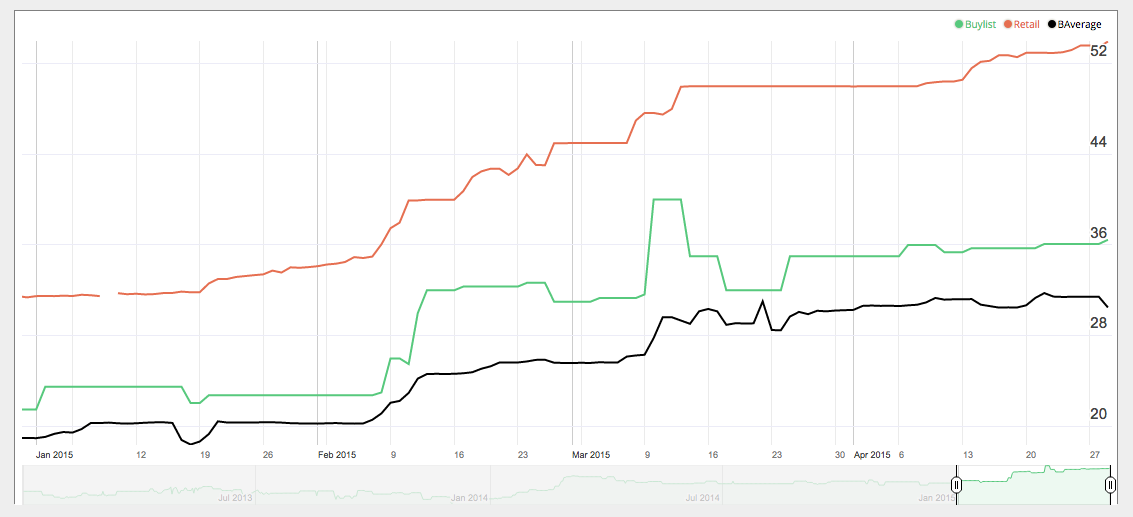
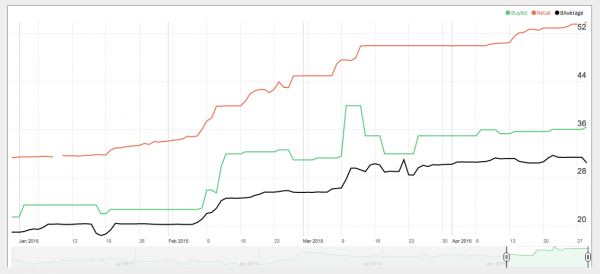
So, the majority of what you see on the chart below is old news.  Snapcaster Mage has been trending up since early February, and interestingly enough the trend sequence is inverted from what we usually see.  The retail price began to move in mid-January, but the buy price didn't even start to wiggle for weeks.  The retail price found stability at $50 for over a month, and aside from the quick spike to $40 on the buylist (during which I think I probably should have sold my extra playset...), the bid price stabilized at $35.

snapcaster mage mtg price
Snapcaster Mage, April 29th 2015
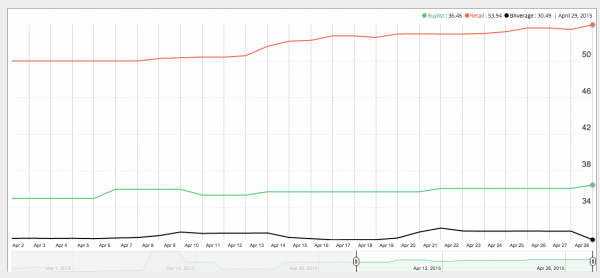
What's interesting is that we're seeing very similar movement in the retail price starting mid-April, and we're only now starting to see movement in the bid price a few weeks later.  Take a look at the chart below, which is only April, for a more fine-grained view.

snapcaster mage mtg price
Snapcaster Mage, April 2015
I'm tempted to ignore the little bid bump on the 6th, but it is definitely relevant in hindsight.  You'd be reasonable to have ignored it on, say, April 7th, but it actually preceded an ever-so-slight retail increase a few days thereafter.  The real movement starts on the 12th, and the bid price follows suit, once again, ever-so-slightly, on the 21st.  There's been a second wind, however, as of yesterday.

All these changes are relatively minor in the scheme of things, but as MM2015 draws near, we are all keeping our eyes out for the shock waves.  The cards in the set really have nowhere to go but down but the cards that have been guaranteed omitted, specifically Innistrad block staples like Liliana of the Veil, Snapcaster Mage and Geist of Saint Traft are probably due for some gains.    We can safely assume that Liliana isn't in Origins because there's another Lilly already in the set, and both she and Geist have just been reprinted as promos, and none of the three seem like probable candidates when we return to Zendikar.

There was an error retrieving a chart for Snapcaster Mage

This is a case where running a spec is going to be very expensive, but you want to ensure you at least have your play sets, as I suspect that Snapcaster Mage and its other Innistrad compatriots will not be much cheaper any time soon.  Even if Snap gets reprinted.

Tuning Grixis Delver

Are you a Quiet Speculation member?

If not, now is a perfect time to join up! Our powerful tools, breaking-news analysis, and exclusive Discord channel will make sure you stay up to date and ahead of the curve.

May is coming in a few days, which means it's time to start preparing for summer. For some of us, this meas  breaking out the sandals and pumping up your bike tires. But for you Modern players out there, it should mean getting ready for the Grand Prix blitz that is coming in June. And there's no better way to prepare for those events than tuning up your Grixis Delver for tournament glory. I wrote about this deck last week and can't emphasize enough just how strong this deck is looking going into the summer. Its enjoyed an unprecedented rise on MTGO that has even converted into enough paper showings to cement tier 2 status. It has all the cards and synergies needed to succeed in this metagame, and it also boasts one of the best UR Twin matchups in the format. So if it's a hot deck you want for summertime Modern, look no further than the newest face of Delver of Secrets in Modern.

Thought Scour Cropped

Although Grixis Delver has seen a lot of success in the past months, much of it has been isolated to MTGO dailies and regional events. We haven't experienced a Modern GP since February, and it will be just over three full months between GP Vancouver and the next GP on the horizon (GP Charlotte). Grixis Delver might look good now, but it hasn't proved itself on one of Magic's biggest stages. That also means its different lists aren't as tuned, optimized, or even agreed-upon as with more established decks like Twin or Abzan. In this article, I want to look at some common Grixis Delver lists and try to identify  key changes that can help this deck perform at upcoming events. Grixis Delver mages have been frantically brewing and testing to get their lists right, and I want to examine some of the major disagreements and technologies that have come out of this. In the end, we'll have a leaner and meaner list to prove that even without Treasure Cruise, Delver is still a force to be feared.

[wp_ad_camp_1]


Grixis Delver Lists

Before we get started, here are two Grixis Delver lists illustrating two overlapping but competing ways of building the deck. The first was piloted by Luke Goodwin at two back-to-back events in early April. He won a TCG States with this one weekend and then an SCG States with it in the next. This kind of consistency is almost unheard of outside of GPs, and although Nebraska might not be the most hopping Modern scene in the States, it's still a very respectable finish we need to appreciate. I'm going to call this "Traditional Grixis Delver" because it follows a very traditional approach to both Delver decks and Grixis Delver lists.

Traditional Grixis Delver by Luke Goodwin (SCG States Nebraska: 4/12/2015)

Creatures

4 Delver of Secrets
4 Snapcaster Mage
3 Young Pyromancer
3 Tasigur, the Golden Fang

Instants

1 Electrolyze
1 Kolaghan's Command
4 Lightning Bolt
3 Mana Leak
2 Murderous Cut
2 Remand
2 Spell Snare
1 Terminate
4 Thought Scour

Sorceries

4 Gitaxian Probe
4 Serum Visions

Lands

2 Island
1 Mountain
1 Swamp
1 Blood Crypt
2 Bloodstained Mire
1 Darkslick Shores
4 Polluted Delta
3 Scalding Tarn
2 Steam Vents
1 Watery Grave

Sideboard

2 Dragon's Claw
2 Spellskite
1 Sower of Temptation
2 Blood Moon
2 Counterflux
1 Flashfreeze
1 Kolaghan's Command
1 Spell Pierce
1 Jace, Architect of Thought
1 Shatterstorm

The second list is a more aggressive approach to Grixis Delver, favoring larger delve creatures and heavier removal options instead of Tempo staples like Pyormancer and black staples like Inquisition. This list has gone 4-0 in two separate MTGO Dailies, both piloted by Grixis Delver veteran Lejay (whose lists I have seen a few times in my MTGO data entry). Here's his/her list from 4/27, which I am affectionately calling "Big Grixis Delver" because of its 4 maindecked Anglers.

Big Grixis Delver by Lejay (4-0 at Daily #8188902: 4/12/2015)

Creatures

4 Gurmag Angler
4 Delver of Secrets
2 Snapcaster Mage
2 Tasigur, the Golden Fang
1 Vendilion Clique

Instants

2 Burst Lightning
4 Lightning Bolt
3 Mana Leak
2 Spell Snare
1 Stubborn Denial
4 Terminate
4 Thought Scour

Sorceries

4 Gitaxian Probe
4 Serum Visions

Lands

1 Blood Crypt
1 Bloodstained Mire
3 Darkslick Shores
2 Island
4 Polluted Delta
2 Scalding Tarn
2 Steam Vents
2 Sulfur Falls
1 Swamp
1 Watery Grave

Sideboard

2 Snapcaster Mage
2 Stubborn Denial
2 Blightning
3 Blood Moon
2 Molten Rain
4 Rakdos Charm

These lists do not represent every Grixis Delver configuration in Modern, but they are the two kinds of lists I am going to discuss today. A lot of the card choice tensions I touch on later are apparent in these lists, and if we want to have a shot at these upcoming GPs, we need to understand and reconcile those differences.

Grixis Delver Baselines

When tuning a list like Grixis Delver, one with a lot of promising early results but no big stage victories, we need to be very clear about what we are tuning for. Because the deck is so new (relatively speaking), it's hard to know if it is enjoying popularity because of flavor of the month craze, a genuine power level, or some combination of this and other factors (Delver nostalgia!). If we speculate too much on all the reasons the deck is good or bad, we are never going to know what to tune for. Modern has too many matchups we need to worry about as is. We can't add a layer of speculative theorycrafting on top of that too.

This means we need to focus on tuning Grixis Delver around what we know, not what we hope to find out in a few months. And what we know right now, or at least what I think we can reasonable believe, is the following.

  • Grixis Delver has an awesome UR Twin matchup
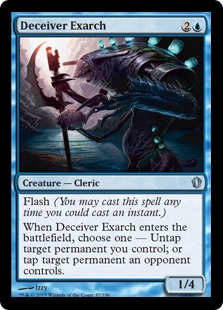
    Deceiver ExarchIt is rare that a deck's theoretical strengths are so strongly reflected in quantitative data. Grixis Delver is such a deck. On paper, the different Grixis Delver lists look incredibly strong against Twin. They have cheap removal and countermagic. They have fast clocks and resilient threats. They have tempo gameplans that allow them to drop threats and then hold the line while the threat goes to work. This is exactly the sort of approach you want against Twin (one of them, anyway), and it feels very much like the days of TC-based UR Delver, when Twin was all but absent from Modern. How does that work in practice? All things considered, just as well as it works on paper. Looking at the MTGO Deep Dive Dataset, I found Grixis Delver to sport a nasty 11/13 (85%) match win percentage against UR Twin. Although I'm sure the "true" MWP for this matchup is closer to 60%-70%, that's still an insane place for a new deck to be. When you see numbers like that, it's no wonder Grixis Delver has risen so rapidly through the MTGO ranks.
  • Grixis Delver has a not-so-awesome Abzan matchup
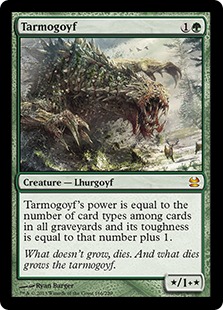
    TarmogoyfEven the hottest new decks have both success and failure stories, and Grixis Delver is no exception. Beating UR Twin is the good news. Getting smashed by Abzan is the bad news. Like with the UR Twin matchup, this is something we can confirm both qualitatively and quantitatively. From a theoretical perspective, Delver decks have never been great against BGx. In fact, before TC and Dig Through Time gave them a way to refuel from early exchanges, BGx decks were the main reason Devler wasn't very viable in Modern. Abrupt Decay is as much a beating in real life as it is on paper. So are the hardy Abzan threats that can't be profitably burnt out, not to mention discard magic that can't really be countered. In practice, it's just as bad as it sounds: the MTGO Deep Dive found Grixis Delver going 1/9 (11%) against Abzan. The true MWP of this matchup is probably closer to 30%-40%, but that's still not where you want to be against a deck that is probably the "best", and certainly the most enduring, deck in the format.

Our tuning needs to stay focused on these two baselines. We want to make changes that do some combination of the following: improve our Abzan matchup, don't hurt our Twin matchup, don't make our Abzan matchup even worse, don't help the Abzan matchup at the expense of hurting the Twin matchup, etc. Of course, we also don't want to make changes that will adversely impact other matchups. For instance, if we maindecked Thoughtseize, this might further improve our Twin matchup, but would definitely hurt our Burn matchup. We don't necessarily want zero-sum changes, although maybe it's worth it to trade a little in one department for a little in another. All in all, this is how we need to orient our thinking towards tuning at this stage, and this is where I am going to approach the process from.

Manabase Tuning

Both the Traditional and Big Grixis lists have robust manabases that support all their colors and allow both decks to run Blood Moon out of the board. But Big Grixis does this in a much less painful way. Traditional Grixis is packing 18 lands, 5 of which are painless:

Traditional Grixis Delver: Manabase
2 Island
1 Mountain
1 Swamp
1 Darkslick Shores

By contrast, Big Grixis is up to 19 lands (+1 to support the slightly more expensive Gurmag Anglers), but is up to a full 8 painless lands:

Big Grixis Delver: Manabase
2 Island
1 Swamp
3 Darkslick Shores
2 Sulfur Falls

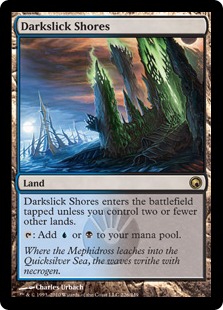
This second manabase appears to be a sizable improvement over the first. It's much stronger against Burn and Affinity, not to mention all the other random aggro decks like Merfolk, Zoo variants, etc. I am Darkslick Shoresparticularly fond of Darkslick Shores, because Grixis Delver is the best of the three-colored Delver decks to support fastlands. Sultai and Esper Delver can use Shores too, but non-red Delver is pretty terrible in Modern so that's already a nonstarter. Jeskai Delver can use Seachrome Coast, but Geist of Saint Traft and Seeker of the Way are worse positioned than Tasigur and company. Same goes for Path to Exile versus Terminate (although Helix is still quite strong). Temur Delver may have Goyf to compete with the delve-fatties, but Copperline Gorge is the only fastland that deck can play, and Gorge turns off too many turn 1 blue-based plays. This gives Grixis Delver a competitive edge over other tempo decks in a metagame that rewards painless, three-colored manafixing.

As a final comment on manabases, Big Grixis is using 7 fetchlands as compared to Traditional Grixis's 9. If you want to run 2-3 Blood Moon out of the board, 8-9 fetchlands seems better than 7. This guarantees you have all the mana in place to cast other spells and drop a Moon on turn 3 to ruin your opponent's day. More fetches are also going to help us cast the delve spells, which will become more important in the next section.

Angler vs. Pyromancer

The most glaring difference between the Traditional and Big Grixis lists are in these two creatures. Young Pyromancer is a staple URx Delver tempo effect that quickly takes over games if unanswerered. Gurmag Angler is a 5/5 monster that can toe-to-toe almost any big creature in the format, including the average 4/5 Goyf, opposing Tasigurs, and Siege Rhino. Grixis pilots are unsure about which to run or even what combination of the two to run, because there are clear benefits and costs to any combination of Angler/Pyro.

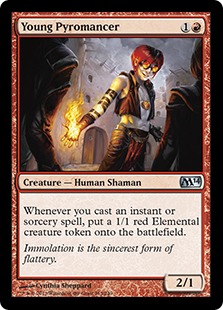
Young PyromancerInstead of theorizing too heavily about Pyro and Angler in a vacuum, I want to think about these two cards with respect to our baseline assumptions. That is, how do these cards affect our Abzan and Twin matchups? Let's start with Pyromancer because he has historically been a Delver posterchild. Pyro's biggest advantage against Abzan is protection against Liliana of the Veil, effectively "turning off" 3-4 pieces of Abzan removal. He's also great at clogging boards, particularly against Goyfs and Tas's, and at being a "remove or die" threat that just gets better the longer he goes unanswered. This last point is important against Twin, which will typically switch to a more controlling approach against a Delver deck full of countermagic and spot removal. If they expend resources to kill Pyro, you still probably get a token out of the exchange and now Twin is behind a card and some mana. If they don't, Pyro takes over the game while Twin tries to interact with you. Pyro's biggest weaknesses are that he's relatively slow, quite fragile to removal, and not a game-saving turn 4 topdeck in bad situations.

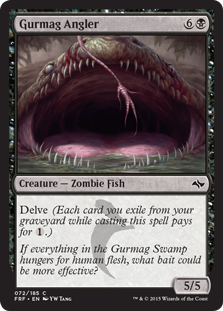
Gurmag AnglerAngler brings a different set of strengths to Grixis Delver. Most obviously, it's just a massive creature. Unless Lily is in the graveyard, Abzan's Goyf will be stuck at 4/5 and unable to brawl with an Angler. Nor can Rhino or Tas. Twin can't profitably burn Angler, Abzan can't Decay it, and both decks need to answer it immediately or quickly fall behind in a race. Against Twin, Angler's biggest weakness is Remand, but once the fish sticks, he's there for life. Against Abzan, Angler is soft to Path (like everything else) and more importantly soft to Lily (very much unlike Pyromancer). It makes up for this, to some extent, by being too fat to fight, although this too is complicated by Spirit tokens that can get in its way. That all said, there's another card we need to keep in mind when evaluating Angler: Stubborn Denial. Denial is absolutely unsupportable in a Pyro deck. You need at least 6-8 consistently "Ferocious" creatures to ensure Denial is good, and Pyro decks just can't accommodate that. This is too bad, because Denial is brutal in tandem with Angler. Going turn 3 Angler with one mana open for Denial is an almost unbeatable line of play against both Abzan and Twin.

As many of you may have noticed, this isn't an "either-or" situation. We are totally capable of running both Pyro and Angler in the same deck (the same can't be said of Denial and Pyro, however). From what siege rhinoI have seen of Grixis Delver and the overall metagame, I think this split is the best approach. After all, 4 Pyromancer is almost always going to be too many, so trimming to 3 leaves you at least 1 more slot open for additional threats. This might suggest a 3-1 split between Pyro-Angler. But I would actually push this further to a 3-2 split for two reasons. The first is Pyromancer's weakness to Abzan strategies. Elemental tokens don't do anything against either Rhino, Lingering Souls, or Treetop Village, and you are more likely to be staring down those cards than staring down Lily. Moreover, many Abzan decks are actually going down to 3 Lily in this current metagame, further limiting Pyro's effectiveness against her. We are also seeing BGx decks play more cards like Zealous Persecution and/or Golgari Charm in the sideboard or maindeck (Gerrard Fabiano's Sultai Control ran Charm main). This makes Pyro weaker but keeps Angler as a strong option. Lily's decline is particularly favorable for Angler.

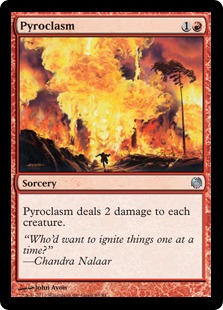
pyroclasmThe second reason to go 3-2 on Pyro-Angler is broader metagame context. Affinity, Merfolk, Collected Company Podless Pod, and, of course, Grixis Delver are all on the rise in Modern. This is going to lead to more decks running sweepers like Pyroclasm and Anger of the Gods to combat them. We are also seeing more BRx midrange and control decks emerging that will be capable of adopting these countermeasures, notably the return of Jund. These conditions are going to make Pyro a little worse as the metagame progresses. But they will be perfect for Angler to thrive. So why not go all-in on Angler? Pyro is still an excellent card and is one of the big reasons this deck is so good against Twin. We don't want to compromise that by ditching too many of them. At most, I would do a 2-2 split between Pyro-Angler, although I still advise 3-2 for most metagames. As for Denial, it's a good card, but it isn't giving us a huge edge in matchups where we aren't already doing well.

Terminate vs. Cut

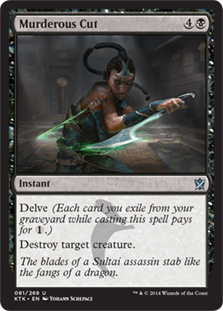
Murderous CutAnother important question raised by the Traditional and Big Grixis lists is about Terminate and Murderous Cut. Big Grixis went all-in on Terminate, upping the count to 4 and showing Abzan decks they weren't the only black-based strategies playing efficient kill spells. Traditional Grixis kept that down to 1 copy, running 2 Cut in place of the other copies. In a deck like this, I think Cut is going to be a mistake for a few reasons. Grixis Delver is only capable of supporting so many delve spells. Based on counts from the TC Delver era, we would pinpoint this delve ceiling at around 4 cards. Maybe 5, depending on what enablers we were using. This means we need to weigh the relative strengths and weaknesses of different delve options.

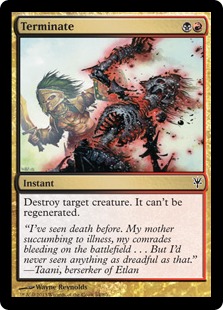
TerminateUnfortunately for Cut, this is where Terminate gets the edge. Even at its absolute best, Cut is only one less mana than Terminate. At its worst, it will be twice as expensive (or more). This puts us in awkward turn 2-3 positions where we need to be conservative with dropping a threat like Tas versus saving cards in the yard to play a cost-effective Cut. Moreover, what we gain from a 1 mana Terminate is way less than what we gain from a giant 5/5 monster shoring up our threat base. Terminate is still basically Terminate at 1 or 2 mana. It doesn't really improve our deck's reach. But packing a 5/5 behemoth in a low-toughness Tempo deck gives us an entirely different set of gameplay options. This kind of threat diversity makes Grixis Delver much harder to play against. Because we can't support both Angler and Cut in the same list, the competitive advantage goes to Angler for giving us much more bang for our delve buck.

Final List

Based on this, here is what I expect a good, Grand Prix slaying Grixis Delver list to look like by June:

Updated Grixis Delver by Sheridan Lardner (4/29/2015)

Creatures

4 Delver of Secrets
3 Snapcaster Mage
3 Young Pyromancer
2 Tasigur, the Golden Fang
2 Gurmag Angler

Instants

1 Electrolyze
4 Lightning Bolt
3 Mana Leak
2 Remand
2 Spell Snare
4 Terminate
4 Thought Scour

Sorceries

4 Gitaxian Probe
4 Serum Visions

Lands

2 Island
1 Swamp
1 Blood Crypt
2 Bloodstained Mire
3 Darkslick Shores
4 Polluted Delta
2 Scalding Tarn
2 Steam Vents
1 Watery Grave

Sideboard

2 Dragon's Claw
2 Spellskite
1 Sower of Temptation
3 Blood Moon
2 Counterflux
1 Flashfreeze
1 Spell Pierce
1 Jace, Architect of Thought
1 Shatterstorm

There are also other cards I want to talk about eventually (Kolaghan's Command, for one), but this is a good starting point. (EDIT: 4/29) And there's still the giant question of the sideboard: this one is basically a copy of the Traditional Delver sideboard above. But those are questions for another article.

Of course, it is totally possible that the lists we see in June will do things differently, but I think this more hybridized version of Grixis Delver has a lot of promise for the competitive scene. I'm looking forward to more work with Grixis Delver, whatever its form, and to see those results it will inevitably put up in a few months.

Gray Areas- Scouting

Are you a Quiet Speculation member?

If not, now is a perfect time to join up! Our powerful tools, breaking-news analysis, and exclusive Discord channel will make sure you stay up to date and ahead of the curve.

Sometime in the last few months scouting has become a hot topic in the Magic community. I don't recall where the allegations came from, but the issue was framed as pros having access to spreadsheets of players and the archetypes that they were playing and sharing this information with other members of super-teams gave them an unfair advantage.

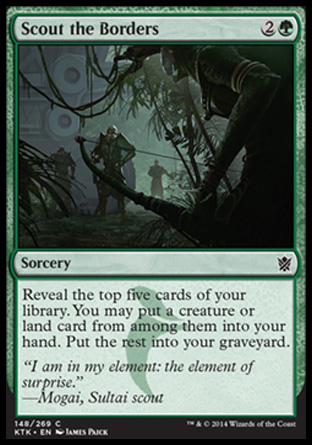
There was an error retrieving a chart for Scout the Borders

This position seems a little silly to me considering that top-level pros tend to get the most exposure from the coverage team. Their decks are featured in feature matches and deck techs, which exposes a lot more information than an archetype in a spreadsheet. This exposure is what makes the Pro Tour even possible, so it obviously isn't going anywhere.

Matt Sperling wrote an article for Channel Fireball yesterday outlining the problems with scouting and offering potential solutions, though there are a number of difficulties in working through the problem- if you even view scouting as such.

When it comes to Standard, it's been a long time since knowing my opponent's archetype has had a dramatic impact on my mulligan decisions. This information does have a much higher impact on Modern and Legacy mulligans though, where Lightning Bolt can either be the best card in your deck or a functional mulligan.

There was an error retrieving a chart for Lightning Bolt

Even still, the advantage gained by mulliganing aggressively is minimal. The cards that you don't want to draw are still in your deck, and you are starting with one fewer card in your hand after all. I have never put in the effort to scout, as despite the fact that it's very easy to scout, the benefit still isn't worth it. Even when players have approached me to tell me what my opponent was playing before a round, the information has never benefited me in any meaningful way.

I am curious though. Regardless of the practicality of a solution, do you think that scouting has a place in Magic? Does it matter that the advantage is negligible, or is any advantage from discovering deck information constitute too much of one? Does it matter that any team is capable of scouting? Please expound on your opinion in the comments!

Avatar photo

Ryan Overturf

Ryan has been playing Magic since Legions and playing competitively since Lorwyn. While he fancies himself a Legacy specialist, you'll always find him with strong opinions on every constructed format.

View More By Ryan Overturf

Posted in Free, Gray AreasTagged , 4 Comments on Gray Areas- Scouting

Have you joined the Quiet Speculation Discord?

If you haven't, you're leaving value on the table! Join our community of experts, enthusiasts, entertainers, and educators and enjoy exclusive podcasts, questions asked and answered, trades, sales, and everything else Discord has to offer.

Want to create content with Quiet Speculation?

All you need to succeed is a passion for Magic: The Gathering, and the ability to write coherently. Share your knowledge of MTG and how you leverage it to win games, get value from your cards – or even turn a profit.

Insider: How To Pick Long-Term Winners

Are you a Quiet Speculation member?

If not, now is a perfect time to join up! Our powerful tools, breaking-news analysis, and exclusive Discord channel will make sure you stay up to date and ahead of the curve.

There are a lot of different strategies and tactics one can use to grow the value of their Magic collection.  In today’s article I will discuss my favorite go-to strategy which I call “going long.” Basically, I am almost always looking to trade for or to acquire cards that I believe will be solid earners at some point in the future.

The easiest way to consistently make your Magic investments pay off is to be smart and make acquisitions that are likely to succeed. Obviously, right? The real question is: how can I consistently pick winners?

Quick Flips

There is certainly a time and a place to speculate on cards likely to spike in the short term that can be quickly flipped for a nice profit. For me, nine out of ten times “quick flips” are cards that I target right out of the gate from a new set that I feel are likely to be big gainers in the Standard market. For instance, anybody who identified that Dragonlord Ojutai was a great card ahead of the curve and traded for copies when they were between $8-$12 is getting a very nice payday now that it has rocketed up above $30.

Quick metagame spikes are always awesome when you are on the good side of them but there is always an expiration date. Dragonlord Ojutai is the kind of card that will likely track up for a while, but if history has told us anything, it's that this kind of card always slides back down to the price range where it belongs.

The Dragonlord reminds me a lot of Baneslayer Angel in that respect. Five-drop angels and dragons are for newbs or are they actually format defining? There is a huge spike as tournament players clamor desperately to find copies and then things level off. The Dragonlord has way more similarities in my opinion to Baneslayer Angel than Jace, the Mind Sculptor. The dragon will clearly be a cornerstone of Standard for a while to come, whereas Jace was basically the entire metagame!

“Quick flips” are a game of information where you are able to predict and identify underrated cards and get them before the information cascade breaks. Just like Baneslayer Angel, all quick flip gainers need to be gotten rid of at the right point. I would certainly predict that Dragonlord Ojutai will hit his peak at some point this month.

Stay the Course for Long-Term Gains

The way that I approach long-term specs is functionally the same: identify cards that are undervalued or underrated, acquire them, and then wait for the rest of the world to catch up. The biggest difference between long- and short-term specs is that the value gain occurs without any direct influence from dynamic metagame shifts.

Genrally speaking, my goal with speculation targets is to try and figure out which cards are at low points and will steadily rise in price. One thing to keep in mind is that casual cards tend to be really, really nice long-term gainer cards. Typically, it takes a couple of years removed from being in Standard and players cracking cards out of packs for them to reach maturity.

My collection is basically organized into three parts.

1. The cards that I play with. I never trade these cards as long as I think there is a chance that I am likely to play with them in the future.

2. Cards that I pick up that I think are my long-term gainers. I have a separate box for cards that fall into this category and I don't ever trade these cards away. I'm anticipating that these are cards that will rise significantly in value in the future so why would I want to trade them away when they are poised to grow?

3. Everything else. Every single card that I own that isn't in the first two groups of cards is for trade and my entire goal is to turn all of those cards into either cash or cards to put into my long-term gainers box.

Let's talk about some of the things that are in my "long-term gainers" box and why I put them there.

Dual Lands, Shocklands, and Khans Fetchlands

Lands are the absolute cornerstone of Magic. It doesn't matter if you are flipping cards around a kitchen table or playing in the finals of a Pro Tour--everybody needs, wants, and requires lands.

All three of these land cycles are extremely popular in basically every format where they can be played as well as with casual players (never underestimate the casual market!) and it is my opinion that they literally have nowhere to go but up in price in the future.

Notice that I didn't put Zendikar fetchlands on my list. I currently only own four of each in my "cards I play with" stash. There is a very high probability that they get reprinted at some point in the next few years and we all saw what happened to Onslaught fetch prices once that happened.

It is important to be buying in at the right time when things are low. I was definately on board with picking up Zendikar fetches when they were $10-$15 because once again at those prices they have nowhere to go but up. However, when they got really, really prohibitively expensive I cashed them out because it just felt like Wizards would have to do something via reprinting to keep their cost from oppressing the Modern format. Lo-and-behold, Khans of Tarkir fetches.

There has been so much written about why lands are good to hold onto so I'm not going to beat a dead horse, but I feel like I have to at least mention it as a preface to some of the other stuff that I'm going to talk about.

Speculating on Casual Winners

Let’s take a look at some specific cards that I think are at that critical point where they have nowhere to go but up over time.

There was an error retrieving a chart for Krenko, Mob Boss

O.K., so maybe I’m a little bit biased toward this card because it was in my draft deck in Top 8 of the M13 Limited GP
Nonetheless, it is significant that Krenko is a one-time rare from a core set, which tends to get opened less than block expansions.

One advantage I’ve always had in picking spec targets is my experience managing Magic inventory at a game store, where I see which cards casual players buy a lot of.

No joke--casual players buy a lot of Krenkos...

It makes a lot of sense because the card is actually pretty intrinsically powerful. I mean, it is good enough to have seen play in Legacy Goblin decks. The card is quite powerful. It also has a couple of nice niche things going for it. First of all, Krenko is legendary which makes him a solid candidate as one of the best Mono-Red deck commanders.

Sometimes with casual spec cards you have to think about Magic through the eyes of a casual player. It is also interesting that the card gets exponentially more degenerate with each activation. There are not many cards that you can simply tap to put 10 goblin tokens onto the battlefield. He’s the kind of card that you can really go deep with if you are trying to build a deck that “goes big.”

I mean, can you even imagine making a Dragon Fodder, Hordeling Outburst, Krenko deck that is powered up by Jeskai Ascendancy
 Um, tap Krenko make a Goblin, cast Hordeling Outburst untap Krenko make five more goblins.

Admit it, some part of you kind of wants to build that deck...

Here is another casual powerhouse:

There was an error retrieving a chart for Parallel Lives

Parallel Lives has already grown a little bit in the past few months but I think it still has a lot of room to increase in value. It is a Commander card but also just a really fun casual card. It is a bad Doubling Season for people who don’t want to spend $20. A bad version of a $20 card is still a really desirable commodity for casual players.

From the perspective of card store inventory, Parallel Lives has been consistently one of the hardest cards to keep in stock over the past year. Literally every single copy of the card that I buy or trade for gets sold within a day or two of me putting it into the showcase.

There was an error retrieving a chart for Johnny, Combo Player

Keeping a mental inventory of which cards seem to be constantly sold out at your local game store is a great way to figure out which cards have an extremely high demand.

Parallel Lives is only a few years removed from being in Standard which means the supply was quite high, but look for that to change in the near future. It is only going to get harder to find copies of this card and it is extremely popular with all sorts of casual players.

Also, note that like Krenko, Mob Boss, Parallel Lives has the same “scaling combo” quality to it where it lets the caster do really absurdly big things. “Going big” is really important with casual spec targets.

Remember the player archetypes? Timmy, Johnny, and Spike. The cards that Johnny Combo players at kitchen tables all over the world love my all-time favorite cards to pick up and hold onto.

There was an error retrieving a chart for Rings of Brighthearth

Rings of Brighthearth is the perfect example of "casual cards gone wild." It followed the exact trajectory that I hope my other casual picks will take down the road. UP! UP! AND AWAY!

It was always sold out everywhere and basically every copy in existence is in either the hands of speculators or in an EDH or casual deck.

Return to Ravnica Block in the Long Term

Right now Return to Ravnica block is a great place to look for cards with a low value and lots of room to grow.

There was an error retrieving a chart for Jace, Architect of Thought

How is this a $3 card? First of all, it is a “Jace.” Casual players love Jace. He’s like the Boba Fett of MTG.

He is part of a commander infinite combo that includes Doubling Season and Wheel of Sun and Moon enchanting yourself. You play J.A.O.T. with those two other cards in play and he comes into play with double loyalty which is enough to immediately ultimate him. The ultimate reduces his loyalty to 0 but instead of dying the Wheel of Sun and Moon shuffles him back into your library. Then his ultimate resolves


You search your library for a card and each of your opponent’s libraries for a card. When you search your library you find, surprise, the same Jace and can repeat the process endlessly which allows the caster to essentially play every single spell in every single one of his or her opponent’s deck.

Aside from solid “brand recogniton” among casual players, I think that Jace, Architect of Thought is actually a pretty reasonable Modern-playable card. Gerard Fabiano had one in his SCG Open winning decklist and I’ve played with and against the card several times. It’s quite good.

Is Jace ever going to be a staple four of? No. Yet, a mythic planeswalker that is Modern-playable seems like it will settle well north of three bucks.

There was an error retrieving a chart for Supreme Verdict

Verdict is another card that has nowhere to go but up. It is one of the best versions of this effect in existence and sees play all the way into Legacy. Cards that are "the best at what they do" always rise to the top and Verdict will likely be the best sweeper they print for some time to come.

I think Terminus is another great card to pick up because it too is a unique, Legacy-playable staple that's at home in any Commander deck. I don't even care that they amended the "tuck" rule because bottoming every creature in play for one mana is insane no matter how you slice it!

I've been pretty actively trying to trade for lots of cards from RTR block the past few months and I've already been rewarded with many of the casual mythics. Progenitor Mimic and Hellkite Tyrant have already made some pretty nice gains out of the bargain bin.

Long-term speculating isn't the sexiest or flashiest thing in the world but it is the most solid way to consistently make dividends when building your Magic collection. The downside is that it will often take a a couple of years for your fruits to come to fruition if you are starting to do it now. The cool thing is that when you stick with it year, after year, after year, your cards are constantly blooming all the time.

If you stick with this strategy year in and year out you'll be consistently rewarded. Cards don't typically go from $1.50 straight to $10. However, cards certainly do start at that price and grow to even greater heights. The key is to always be on the lookout for any card, whether a format staple like fetchlands or a casual kitchen table gem like Parallel Lives, that has nowhere to go but up, and picking up lots of copies when they're are at their lowest.

Insider: MTGO Market Report for April 29th, 2015

Are you a Quiet Speculation member?

If not, now is a perfect time to join up! Our powerful tools, breaking-news analysis, and exclusive Discord channel will make sure you stay up to date and ahead of the curve.

Welcome to the MTGO Market Report as compiled by Sylvain Lehoux and Matthew Lewis. The report is loosely broken down into two perspectives. A broader perspective will be written by Matthew and will focus on recent trends in set prices, taking into account how paper prices and MTGO prices interact. Sylvain will take a closer look at particular opportunities based on various factors such as (but not limited to) set releases, flashback drafts and banned/restricted announcements.

There will be some overlap between the two sections. As always, speculators should take into account their own budget, risk tolerance and current portfolio before taking on any recommended positions.

Redemption

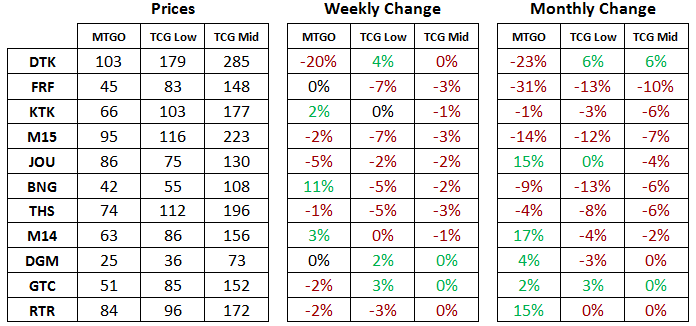
Below are the total set prices for all redeemable sets on MTGO. All prices are current as of April 27th, 2015. The TCG Low and TCG Mid prices are the sum of each set’s individual card prices on TCG Player, either the low price or the mid-price respectively.

All MTGO set prices this week are taken from Goatbot’s website, including the ‘Full Set’ price for DTK, which was available at the time prices were collected. All weekly changes are now calculated relative to Goatbot’s ‘Full Set’ prices from last week, except for DTK which is relative to the sum of singles prices from last week. Monthly changes are still relative to Supernova’s prices from last month before their prices started diverging from market prices.

apr29

Return to Ravnica Block & M14

Paper prices on these sets continue to fluctuate with no clear trend in recent weeks. The upcoming release of MM2 is the next potential catalyst for bumping up demand for these sets. It will be interesting to see how prices react to the start of official spoilers for MM2, but it’s easy to expect a modest price bump to show up.

Speculators holding junk mythic rares from these sets, such as Darksteel Forge, should be looking to the next round of price increases to exit their position. Some of these cards have appreciated nicely, while others continue to hang around at their price lows. Although it’s possible that new highs are reached later into the summer, the risk-versus-reward calculation on these cards is starting to tip away from the reward side of things. Holding a card has the hidden cost of tying up tix in a speculative position, where the tix might be put to better use elsewhere.

On the other hand, mythic rares that are both redeemable and Modern-playable, such as Sphinx's Revelation, can be held well into the summer as they could see higher prices due to metagame shifts or just straight up expanded interest in the format.

A card recommended in the past, Domri Rade, has shown to be a non-factor in Modern up to this point. Although not total junk, the trend is not favorable on this card, and so weighing this card to be sold sooner rather than later is prudent.

Theros Block & M15

THS is the only set of these four that has a paper price (TCG low) high enough to imagine there is some demand from redeemers. However, the trend on all of these sets is unmistakable. It won’t be long until each of these sets is setting new all-time lows in both paper and digital.

Though getting to that point will have its ups and downs. For example, Master of Waves is seeing a bump in price this week after it showed up as a four-of out of Mike Flores’ Dragon deck from this past weekend. With mono-red strategies being cheap and effective on MTGO, a prepared sideboard strategy deck is essential and the merfolk wizard fits the bill.

Similarly, something like Ashiok, Nightmare Weaver might see one last price jump if control mirrors start to be the only matchup that matters.

Tarkir Block

Dragonlord Dromoka showing up as a three-of in Flores’ aforementioned dragon deck has sent that card up over 100% in the past week. The next double up is difficult to see though. It’s more likely that this card and Silumgar see about the same price in the medium term based off of playability. So far, the only one of the cycle not to see much play is Dragonlord Kolaghan, and at around 1 tix, this seems like a good contrarian bet.

FRF looks to have found a floor at around 45 tix. For comparison, the last two small sets, BNG and JOU, bottomed while they were being drafted at around 42 tix and 64 tix respectively. From a pure power level standpoint, FRF has more in common with JOU than the underpowered BNG. At these prices, don’t be afraid to start socking away some of the mythic rares, though avoid the rares until we get closer to the release of Magic Origins.

No real change for KTK, though prices are a little firmer this week, at least on the digital side of things. In paper, the pace of declines appears to be slowing, but a bottom hasn’t been established yet.

Modern

New Modern Masters 2015 spoilers have appeared recently, most of them important reprints. As of now these are not officially confirmed but seem to come from a trusted source. These cards are still to be considered carefully.

The new mythics from that list include All Is Dust, Dark Confidant, Elesh Norn, Grand Cenobite, Iona, shield of Emeria, Splinter Twin, Vendilion Clique, Tezzeret the Seeker, Mox Opal, Ulamog, the Infinite Gyre and Kozilek, Butcher of Truth. Two mythics are still missing to bring the count to 15.

Concerning the rares, Fulminator Mage, Goblin Guide and Noble Hierarch appear on that list as well as the five Lorwyn commands, meaning a return of Cryptic Command.

If this list holds, two more mythics are still unknown. Since Shards of Alara, planeswalkers have always taken a mythic slot in any set, and it is very unlikely that we’ll see rare planeswalkers in MM2. With Tezzeret the Seeker on that unofficial list, a few other planeswalker should be considered for speculative purposes.

Ajani Vengeant, Venser, the Sojourner and Tezzeret, Agent of Bolas are three planeswalkers that speculators should keep in mind. These planeswalkers are not particularly in favor in the current Modern environment, but would certainly retain a good speculative value in the mid- to long-term if not reprinted in Modern Masters 2015.

Vintage & Legacy

Tempest Remastered will be released next week and the details concerning prizes and events have been posted. The important message here is that TPR packs can be used to enter any TPR events. Being able to use boosters as part of the entry fee means that TPR queues will be a cheaper than if they were tix only.

This should ensure a greater opening of packs, which will apply more pressure on the price of Tempest block cards. Legacy and Vintage tournaments will also award TPR boosters during the three weeks of TPR release events.

Speculators should expect an important price drop of the currently most expensive Tempest block cards, namely Wasteland, City of Traitors, Intuition, Humility and Mox Diamond. The best period to pick up speculative positions is usually on the weekend of release periods, the first and/or second weekend after May 6th in this case. Depending on the success of this online-only set, keep in mind these data as reference points to accumulate discounted cards.

Vintage prices are still relatively flat or slightly declining overall. A bump in some staples' prices could occur once TPR hits and lowers the price of a playset of Wasteland into the 50 Tix range, for instance.

Pauper

While some Pauper positions have stayed stable, others have severely tanked recently, including Mental Note and Innocent Blood. It is too early yet to say if this is a sign that Pauper is not taking off as expected or simply a cyclical effect.

Sell targets may have to be reconsidered once prices move again. Holding on to current Pauper positions despite this recent price fall is nonetheless still recommended.

Targeted Speculative Buying Opportunities

None.

Targeted Speculative Selling Opportunities

Standard

Temple of Enlightenment
Doomwake Giant
Pharika, God of Affliction

The temple has reached its previous high of around 10 Tix and seems to have stabilized around that mark for the last week. With a comfortable 50% gain in about three weeks and with not much to expect due to the approach of Standard rotation we recommend selling it now.

Pharika and the giant, on the other hand, have never recovered since the release of Fate Reforged and are out of favor in the current Standard environment. We recommend selling these disappointing positions now before they drift down further.

Uncertainty in Modern Masters 2015 Allocations – Significantly Smaller than MM1?

Are you a Quiet Speculation member?

If not, now is a perfect time to join up! Our powerful tools, breaking-news analysis, and exclusive Discord channel will make sure you stay up to date and ahead of the curve.

For months I have been hearing that Wizards would be allocating a larger printing of Modern Masters 2015 as compared to the original. It seems that this is presumed to be a confirmed fact around the financial community, but there has never been any true, official statement to this effect.

I bring this up because I had an interesting discussion with one of my local shop owners here in Michigan. I have his permission, and wanted to share that text conversation verbatim. He agreed to remain anonymous and so he shall be called "The Big Boss Man".

Responding to me putting in a preorder for a box of Modern Masters 2015.  Emphasis is mine.

Big Boss Man: "No Worries. This set is just disgusting good"

Me: "It really seems that way...I can't wait for more spoilers. Will you guys be running just the one draft of it?"

BBM: "Oh yea. One day, $60 drafts and out.

BBM:"We only have 90 boxes, period.

Me: "I keep reading about stores running drafts until Origins and getting confused

BBM: "Yea, there was a ton of confusion about supply. There is very little, less than the previous release"

Me: "I thought WOTC said there would be a larger supply?

BBM: "Distributors took huge preorders, told us we would be fine, then cut us way back. I had 150 promised to me and actually scored 90"

Me: "That's promising for card values

BBM: "Then WOTC let us know this was the only print run"

Me: "Wow...that's very interesting. Can I use you as an anonymous source in a future article?"

BBM: "Sure. I don't know where WOTC ever said there would be more. We all hoped, but I never saw anything official."

Me: "I guess that's just something that everyone assumed was true and ran with it. All of the finance podcasts and articles I listen to state it as fact. So you get 90 this time around, what did you get last time?"

BBM: "We launched at 110 [boxes of Modern original Masters] before and got 2 more waves of like 30 or so

Me: "Is there any chance that larger stores are getting a larger allotment of product?"

BBM: "Some will, I don't think it will be hundreds more though"

This is the first I've heard of this, but thinking back I also can't think of any time where there was an official announcement by Wizards regarding a larger print run. I may be missing something, and if somebody has a link then please share. The store owner in question did not attempt to put his name or business on this, and is a close friend of mine. There is no reason for him to lie about this. It is possible that a large portion of the print run was reserved for the three (four if you count Las Vegas twice) Grand Prix on release weekend.

If it is true that this printing will be smaller than expected, then there will certainly be huge ramifications for card prices and speculation. It may be time to start from square one on our predictions. What are your thoughts on this? Has anyone else heard anything like this?

Want Prices?

Browse thousands of prices with the first and most comprehensive MTG Finance tool around.


Trader Tools lists both buylist and retail prices for every MTG card, going back a decade.

Quiet Speculation