menu

Insider: [MTGO] Online Aftermath of the Pro Tour Journey into Nyx

Are you a Quiet Speculation member?

If not, now is a perfect time to join up! Our powerful tools, breaking-news analysis, and exclusive Discord channel will make sure you stay up to date and ahead of the curve.

Unlike what I announced last week, I'm taking a break from my portfolio management series to write about the outcomes of PT Journey Into Nyx.

I want to discuss a little bit about what happened, and what did not happened, in terms of past and future speculations. We'll see if what I wrote three weeks ago in my article Speculating on Block Cards held true for this PT.

PT Journey Into Nyx

The Format

I heard and read several times before and during the event that this PT was going to be PT Elspeth.

For sure, Elspeth, Sun's Champion is a great midrange/control card, and every non-aggro deck playing white was playing several copies, if not a playset, of the white Planeswalker. Red/Green decks splashed white for Elpseth and Banishing Light. Not to mention that the final of this PT was a battle of Elspeths.

However, after an on site visit on Friday, and after watching some coverage videos--to me this was PT Courser/Caryatid.

In a vast majority of midrange decks, 4 Courser of Kruphix and 4 Sylvan Caryatid were the pillars. Whatever your preferences were among BUG, Junk, BWG Constellation or RG, the Courser and the Caryatid had to be in your deck.

There was an error retrieving a chart for Courser of Kruphix
There was an error retrieving a chart for Sylvan Caryatid

Beyond that, Journey Into Nyx cards did not radically change the block format, as we had seen with the Innistrad and Return to Ravnica blocks. Rather, cards nicely mixed with existing archetypes and reinforced known control and aggro decks.

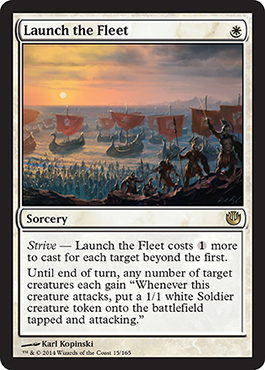
Mana Confluence and the other Scry lands allowed tricolor decks to be more stable. Banishing Light and Silence the Believers were added to the arsenal of removal. Launch the Fleet and Satyr Hoplite contributed to a more robust Heroic deck. Only the Constellation.decks were totally new.

There was an error retrieving a chart for Silence the Believers
 
There was an error retrieving a chart for Launch the Fleet

In the end, of the 35 non-land cards in the Pat Chapin deck list, you'll find only five cards from Journey Into Nyx. In the BUG list from Josh Utter-Leyton, only four from Journey Into Nyx among the 36 non-land cards.

Nonetheless, for what I knew of the Theros block format on MTGO prior to Journey Into Nyx, several modifications occurred. The Reanimator deck was mostly unseen at the PT. RG Monstrous with a playset of Polukranos, World Eater got modified to incorporate Elspeth and Banishing Light, and the legendary Hydra got kicked out of the deck. Mono Black devotion also got adjusted to be more aggro, with cards such as Gnarled Scarhide and Master of the Feast. And probably others I forget.

My Targets During the PT

As I mentioned before, I really think that in terms of speculation the best play is to wait for more confirmation from the PT itself, or simply do nothing. Was it going to be the same story here?

After my visit to the PT on Friday, it was clear that midrange Green decks were dominant. These decks all included a playset of Sylvan Caryatid and Courser of Kruphix.

The newer the set, the better for these kind of hype speculations, and the more mythic the better too. With such an omnipresence, my first and only purchase on Friday was ten Coursers. I was looking to acquire them at 7 tix or less, and I should have bought a playset or two more.

In the end, ten Courser of Kruphixs @ 6.55 tix/each.

Only after the result of the final did I decide to get some Elspeth, Sun's Champion and try to ride a very transient wave. I went for 17 copies of Elspeth at 16.95 tix/each. Elspeth was anticipated to be a major actor of this PT, and its price was already at its highest. It needed a strong finish to potentially be a profitable quick flip.

I sold these two positions on Monday night, and I would have done so whatever the price would have been. I sold the Coursers for 8.65 tix/each (+2.1 tix), and the Elspeths for 17.3 tix/each (+.35 tix). A minimal profit after 48h, but no risk taken.

Here are some examples of price evolution among the favorite cards of the PT. As anticipated, prices spiked over the weekend and dropped on Monday. And as you can see, many cards could have been potential targets and could have generated a few tix.

The Cards I Voluntarily Didn't Consider

Prognostic Sphinx got its share of hype, and if you were on it and acted quickly, you probably made a couple tix. I did not jump on the Sphinx for two reasons.

First, this card is a junk rare and even if the % fluctuation looks incredible, I may have made more tix with my Elspeth than with 50 copies of the Sphinx.

Secondly, the Sphinx is only a junk rare from the first set, Theros. Being a pure ,event-specific metagame choice, and having no implication outside of the Theros block, means that there's bazillion copies of Prognostic Sphinx out there. Pretty much impossible to properly make quick flips with this target.

Fleecemane Lion was a little bit like the Sphinx. Too little to gain here, and not much support from outside block. It probably remains a card to watch, however

Prophetic Flamespeaker. This cards got some attention before the PT and was anticipated to show some of its power in Atlanta. Despite couple of players running a red aggro deck containing four copies of the Flamspeaker, the red mythic from JOU didn't perform. For that kind of investment, I would need to see some results before committing.

The risk real and the reward minimal, Prophetic Flamespeaker was overestimated here. However, and with recent results in Modern and Legacy, and with a new lower price, the Flamespeaker could be a good target in the short/mid run. Still, nothing is sure for the next Standard, and even if this cards seems strong, I would be very cautious.

Eidolon of Blossoms got a similar trajectory as the Prophetic Flamespeaker. Even if the enchantment creature was part of the finalist's deck list, it didn't make as big of a finish as some would have expected. I still like the card and we can envision many scenarios where it could do well. Let's have its price settle down for couple more weeks.

There was an error retrieving a chart for

The Opportunities I Missed

If the Courser was obvious to me, I should have considered Sylvan Caryatid as well. I didn't consider it because the wall doesn't see much play outside of Standard and I considered it as a low price tag card for me.

However, the Caryatid is not really a junk rare (its price was always around 0.5 tix) and it might as well have a great potential in the future. Its price doubled during the PT and I should have collected some tix in between. Depending on the future sets, Sylvan Caryatid could be the mana fixing of choice of many midrange/control decks of the future, in Standard and in Modern.

Kiora, the Crashing Wave, Brimaz, King of Oreskos, Ashiok, Nightmare Weaver, Silence the Believers and Mana Confluence. Based on my strategy on how to take advantage of PT results for quick flips, I should have picked up these five cards. To the exception of Brimaz, all of them got between a moderate to a very nice spike during the PT. These cards matched the criteria for quick flips over a PT weekend. A lack of time made me focused on only the targets I mentioned above.

All the cards mentioned here may have a shot in the next Standard, so keep an eye on them.

Lost in Translation

Some cards shined by their absence during this PT block and should, in my opinion, be considered seriously for fall Standard or Modern. They didn't fit the Theros block metagame and they might represent a good opportunity to get some copies while their prices are still "low".

  • The Gods. Did you know that God cards were in Theros? Ten of them? Very few of them made the cut in PT Journey Into Nyx deck lists. I'm not at all an expert in Standard top decks, or top decks to be, but I'm sure some Gods might still be very relevant next Standard season, especially if we get some help from colored permanents in M15 or Khans of Tarkir to fuel the devotion. If the Gods from Theros may be easier to play, the Gods from Born of the Gods and Journey Into Nyx will especially be more likely to see bigger price changes.
  • Talking about devotion, no deck really exploited this mechanism in block. Is it time to pick up some Master of Waves or Reverent Hunter? I want to know more about the next sets before making a move.
  • Anger of the Gods. When so many decks include Courser of Kruphix and are midrange or control, this red mass removal becomes kind of useless. Aggro strategies were simply not good enough, and the Heroic decks can manage to dodge it. Still, this is a great sweeper that has already proven to be Modern playable. I believe that it is a great target for next year.
  • Soldier of the Pantheon. Hard to imagine that one of the best 2/1 creature for one mana would not see play in the future. Multicolored creatures in Khans of Tarkir could make it stronger, and with potentially more humans and aggro strategies to come, the Soldier could be a key card of these decks.
  • As mentioned above, Prophetic Flamespeaker didn't shine at this PT. Nonetheless, it remains a very powerful creature, especially with equipment. How to imagine a set whose symbol is two swords would not have couple of scimitars, sabers or swords in it?
  • Nykthos, Shrine to Nyx. This land can propel devotion deck to another level. Since devotion was not the flavor of the weekend a week ago, this land is currently quiet cheap for what it could offer. Being playable in Modern and Standard could make its price rises next fall. Definitely a card to keep an eye on.
  • Thoughtseize was, unsurprisingly, in all decks playing black. Despite a strong presence, its price remains around 5 tix, which seems to be about its bottom. As we are approaching Modern season and Theros block will be less and less drafted, it may be time to pick up your copies of this multi-format all star.

For all these target, around M15 release events should be the best time period to pick up.

~

Next week, I'll resume my portfolio management series.

Thank you for reading,

Sylvain lehoux


Insider: Hold or Fold

Are you a Quiet Speculation member?

If not, now is a perfect time to join up! Our powerful tools, breaking-news analysis, and exclusive Discord channel will make sure you stay up to date and ahead of the curve.

You've got to know when to hold 'em
Know when to fold 'em
Know when to walk away
Know when to run
You never count your money
When you're sittin' at the table
There'll be time enough for countin'
When the dealin's done

Kenny Rogers, The Gambler

Kramer: Roger's can't sell chicken around here, we got chicken places on every block.
Jerry: He is the gambler.

Seinfeld, The Chicken Roaster

I alluded briefly in an earlier installment to a scenario where you would find a card on a buylist for an unacceptably-low price. There are several things you can do in this scenario, and I have a system that I put into place that seems to work for me.

So how do you determine what isn't a good price for a card? What do you do with it if no one is offering an acceptable price? How do you get Dr. Pepper out of the cloth interior of a Honda Civic if you have to wait until the end of a road trip and you're pretty sure the stain has set and you know it's probably your fault for not opening the cap just a small amount to see if it was going to fizz over, but you really didn't count on Ryan dropping your Dr. Pepper and then not bothering to tell you, and he only dropped it because his hands were full and how hard is it to just ask the clerk for a bag?

We'll get to most of these topics today, because you all deserve it.

Easy One First

If you think the price of a card is too low, put it in a separate box for similar cards.

. . .

What?

That's It? That's All You Have to Say?

Well, I mean, I can elaborate a bit, but does it really have to be that hard? If you think a card is underpriced on all of the buylists, don't sell it to the buylists. That's a no-brainer.

But while you would jam all the cards that are not nor will ever be picks in boxes of "pure bulk" for later disposition, you want to keep these picks separated. Don't put them by the bulk or they will get mixed in. Don't just say, "Well, I guess no one is buying Birchlore Rangers right now, guess it's trash!" and flush a potential quarter down the turlet.

One of these suckers.

OK, that brings up a good point. We're talking about potential quarters sometimes. So that means you have a longbox in one corner of your work space, and if you identify a candidate for the "hold" box, jam it in there quickly.
Time is money. If bulking it is half a cent and setting it aside means a quarter or dime later, don't spend too much time. You're paying yourself pretty poorly if your entire "hold" box sells for $25 later and you spent five hours on it.

That is a hyperbolically-low price and a hyperbolically-long amount of time spent, but my point stands. Don't waste too much time on your hold box.

Should you arrange it alphabetically? No, you should not arrange it alphabetically. Should you dig through it every time you buylist? No, you should not dig through it every time you buylist. Should you wait forever? No, you should not wait forever.

One way to deal with cards in this box is to figure out what price they would sell for if the spread were more reasonable and just jam them in an ogred box. If a dealer feels like a Birchlore Rangers is an okay buy at a dime, you'll be glad you didn't just bulk them out.

In fact, I don't do this in two separate steps. I have several boxes with cardboard partitions that divide the box into ten sections roughly as long and wide as a card laid horizontally. I label the different "wells" with a price--mine are $0.05, $0.10, $0.25, $0.35, $0.50, $0.75, $1, $1.5 and $2.

What goes in are both cards I intend to ogre and cards that are good "hold" cards due to their high spread or inexplicable absence from any buylist at that time. "Hold" doesn't mean "never sell," it just means, to me, "Don't bulk or buylist this right now because you'll make more money if you don't."

Keeping your ogre box next to your work area allows you to jam cards in there as you come across them. This allows you to avoid sorting them later because they are arranged by price. You'd arrange them alphabetically or some other way just to make it easier to look the price up, and if you're ogreing, they're sorted by price already.

This efficiency allows you not to get sidetracked too much when you come across a card that seems like a good hold. If you get into a rhythm, stopping dead in your tracks will hurt you.

On the other side of the coin, just flipping these absentmindedly into a pile to deal with later isn't the best either, because you will have to look everything up again to figure out what to try and sell it for. I feel like jamming them in an ogre box by price is the perfect solution to reconcile these two scenarios.

Now the Harder One

So how do you determine if the price being offered on a card is not acceptable? Presumably, these buylists are populated by dealers; people who know what they're doing. If they aren't buying the card or aren't buying it above a certain price, the card must not be worth that price, right?

Eh, maybe. Maybe not though, and to sell for too cheap is to lose money, and to lose money is to do it wrong.

Before I talked about how to quickly identify cards that are worth a surprisingly-high amount by using Trader Tools. To briefly recap--

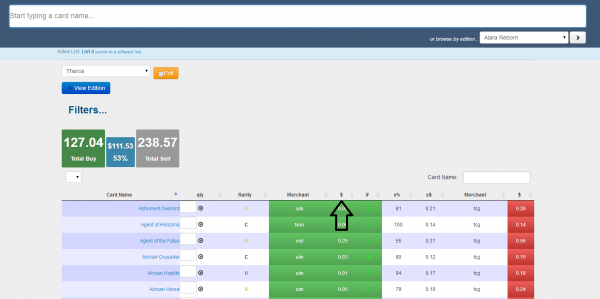
sort

Click there to bring up the set.

sort

Click there to sort by buylist price.

You will see the cards on the buylist for the most money and some may surprise you. However, some obvious picks are way lower on the list than they should be.

There was an error retrieving a chart for breakthrough

Say what? Breakthrough is worth $1.50 and buylists for $0.32?

So how inclined are you to fork over Breakthrough for $0.32? You may think your two options are to buylist it or sell it on TCG Player--and with TCG Player inclined to chop $0.50 plus another $0.152 for their fees, plus shipping costs because some other dude already has them listed for $1.52 with free shipping, you might opt for buylist. Losing that much on TCG Player seems awful because then you're stuffing an envelope just to make practically buylist.

Both of those are garbage options. The only option three you may be able to think of is to chew up four ambien and go take a 28 hour nap.

Leave those pills unpopped, readers, because you have other options! Jamming the Breakthrough in an ogre box for $0.75 or even a modest $0.50 is going to lead a dealer to see Breakthrough in your ogre box and even if he says "These aren't on my buylist," you can say, "You sell those for $2" and I bet someone snaps them for $0.75. Either way, it's better than selling for $0.32.

If they sit in the ogred box for a while and you look them up later, maybe they'll be going for more money as dealers run out of stock. Maybe in a little while you'll care less about wringing and extra $0.40 (to be fair, 40 cents is an extra 125%) out of the card and just jam it in a buylist order. Maybe you'll find someone who wants to trade for it at $2. Maybe your house will burn down, and the insurance check will pay for a new jet ski and you'll leave this life behind and go fight crime that occurs near water.

You don't know what can happen, but you can be sure that you don't take either bad option of "sell for too little right now," and, "put a little more work in to still sell for too little".

So, selling a $1.50 card for a fifth of that is obviously bad. But how do we determine a good cutoff point?

There was an error retrieving a chart for doomgape
There was an error retrieving a chart for krovikan mist

There was an error retrieving a chart for high tide
There was an error retrieving a chart for planar void

These are all cards that I can't justify shipping for the price dealers want to pay, at least not until I have exhausted other avenues.

Sometimes other dealers will be paying more and the issue lies with the small sample size of dealers you're looking at. If you only sell to Card Kingdom, you'll end up with a big stack of gas that other dealers pay well for but Card Kingdom has in abundance. Increasing the size of the net you cast can help you avoid these awkward scenarios.

But adding more dealers adds to your processing and shipping costs and hassle. I keep it to three or four dealers and even then I only ship when I get to about $1,000 worth of cards to sell between the four. If we're keeping our dealer net small for most of what we do, we can set aside these "hold" cards and ship them to another dealer or look at another site like bidwicket or individual store online buylists.

Know When to Hold 'Em

So how do we quickly and easily determine which cards to hold? The same way I picked which cards to use as examples in the article!

I used Trader Tools to sort by buylist percentage instead of price, and I went through a few sets until I found good candidates, with prices around $1 or $2 and a buylist amount for a fraction of that.

Do you see what all of my examples have in common? Go back and look. Did you catch it right away? It's a spread of 75% or more. A high spread means a lot of things, and we're not getting into that right now. The point of looking at spread in this context is that a high spread is going to show us cards not worth buylisting.

Ideally, you're buylisting cards under $10 that have a spread of around 40% +/- 5%. Ideally. Once you start getting a higher spread, that means you're losing more money. Remember when I said losing money was doing it wrong?

If a card's spread is something like 75%, just put it aside. I glance at its sell price and if one of my designations is close to 40-50% of its value, I put it in that slot. I have Breakthrough in the $0.75 slot in my ogred box, but I'll take $0.50 because I know the alternative is buylisting it for $0.32. If someone wants to trade for it at $2 or whatever it is on SCG, super. If a dealer wants to pay $0.50, super. If I can't get rid of it for more, I know I can always buylist it for $0.32 if I want to.

If you see a buylist price with a 10% spread or something obscene like that, hurry. Get that sent off as quickly as possible, because it's likely this is an emergency price because the dealer wants to restock in a hurry. However, a high spread means the price is not going to change anytime soon, and if it does, it will be for the better. You can afford to sit on cards with a high spread until it improves, you find a better out, or you get sick of sitting on the card and just ship.

Check the spread and if it's too high, maybe you want to try to get more money elsewhere. You can "fold" and ship that card for the buylist price anyway, if you want. Just don't be afraid to hold.

Avatar photo

Jason Alt

Jason Alt is a value trader and writer. He is Quiet Speculation's self-appointed web content archivist and co-captain of the interdepartmental dodgeball team. He enjoys craft microbrews and doing things ironically. You may have seen him at magic events; he wears black t-shirts and has a beard and a backpack so he's pretty easy to spot. You can hear him as co-host on the Brainstorm Brewery podcast or catch his articles on Gatheringmagic.com. He is also the Community Manager at BrainstormBrewery.com and writes the odd article there, too. Follow him on Twitter @JasonEAlt unless you don't like having your mind blown.

View More By Jason Alt

Posted in Buylist, Finance, Free InsiderTagged , , , , , , , , , , 1 Comment on Insider: Hold or Fold

Have you joined the Quiet Speculation Discord?

If you haven't, you're leaving value on the table! Join our community of experts, enthusiasts, entertainers, and educators and enjoy exclusive podcasts, questions asked and answered, trades, sales, and everything else Discord has to offer.

Want to create content with Quiet Speculation?

All you need to succeed is a passion for Magic: The Gathering, and the ability to write coherently. Share your knowledge of MTG and how you leverage it to win games, get value from your cards – or even turn a profit.

The Story Behind the “Kibler Playmat”

Are you a Quiet Speculation member?

If not, now is a perfect time to join up! Our powerful tools, breaking-news analysis, and exclusive Discord channel will make sure you stay up to date and ahead of the curve.

You may have seen this around the Internet, but the full story has never been made clear. I know you're saying stuff like "But we have Conspiracy Spoilers and new Standard decks to talk about!"

But this is clearly more important, right?

The Man, the Myth and the Legend all rolled into one, right?

Brian Kibler is a great player and ambassador for Magic, and he knows how to poke fun at himself. I wouldn't be caught dead using a mat like this myself, but I understand why a lot of people do. After all, it's a conversation starter at least, right?

Anyway, these have become the new fad of the week, so I thought we should at least figure out the story behind them, right?

Well, Kibs has our collective backs.

A few nights during the cruise are formal nights, which are prime picture-taking time, since people are dressed their best. On one of those nights, Natalie and I went around from station to station having our pictures taken. We’d had a few drinks, so we were being pretty silly. At one of the stations, they had us pose together, and then had Natalie lay down on a lounge chair by herself for her solo shot. When it was my turn, I insisted on posing the exact same way. When we went to look at the pictures the next day, we knew we had to buy that one because it was just too funny...

You can read, in his own words, the rest of the full story of how this came to be on his blog, which you can find here.

Enjoy! Remember, this is important stuff.

Avatar photo

Corbin Hosler

Corbin Hosler is a journalist living in Norman, Oklahoma (also known as the hotbed of Magic). He started playing in Shadowmoor and chased the Pro Tour dream for a few years, culminating in a Star City Games Legacy Open finals appearance in 2011 before deciding to turn to trading and speculation full-time. He writes weekly at QuietSpeculation.com and biweekly for LegitMTG. He also cohosts Brainstorm Brewery, the only financial podcast on the net. He can best be reached @Chosler88 on Twitter.

View More By Corbin Hosler

Posted in Casual, Feature, Free5 Comments on The Story Behind the “Kibler Playmat”

Have you joined the Quiet Speculation Discord?

If you haven't, you're leaving value on the table! Join our community of experts, enthusiasts, entertainers, and educators and enjoy exclusive podcasts, questions asked and answered, trades, sales, and everything else Discord has to offer.

Want to create content with Quiet Speculation?

All you need to succeed is a passion for Magic: The Gathering, and the ability to write coherently. Share your knowledge of MTG and how you leverage it to win games, get value from your cards – or even turn a profit.

Insider: Modern Drift and Power Shift

Are you a Quiet Speculation member?

If not, now is a perfect time to join up! Our powerful tools, breaking-news analysis, and exclusive Discord channel will make sure you stay up to date and ahead of the curve.

Each week I sit down and write my article based on a single relevant topic. Often these articles relate to sudden price shifts of certain cards or analyses of recent tournaments. Researching what’s moving and shaking in the world of MTG Finance yields inspiration for the seeking writer. Thank goodness there are dozens of sites dedicated to this game, because there is always something to talk about.

This week is no exception – but there’s a twist. My research has inspired me to write on two separate topics. Since each topic alone may not be sufficient enough for a full article, however, I’ve decided to merge the two topics into this week’s column. The two are unrelated, but both are relevant right now and if one does not meet your interests, perhaps the other will. I can only hope.

Modern Pullback

The first topic on my mind this week relates to the Modern format. A few months ago, prices of Modern staples were exploding, enabling many cards to hit record highs. It appears the market overreacted because many of these same staples have pulled back notably off their highs.

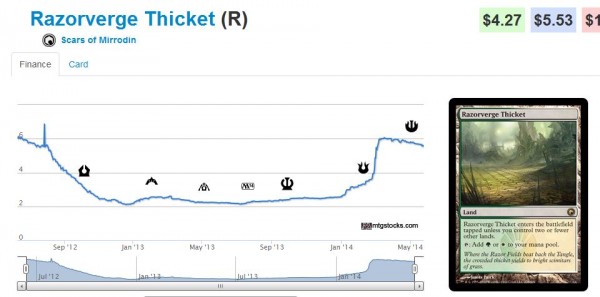
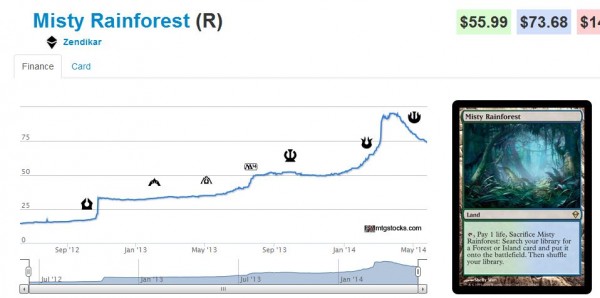
Last week I showed a chart for Snapcaster Mage, and it had a very clear downward trend over the last month or so. This curved shape is not unique to Snapcaster Mage, though. In fact, many Modern staples are following a similar trajectory:

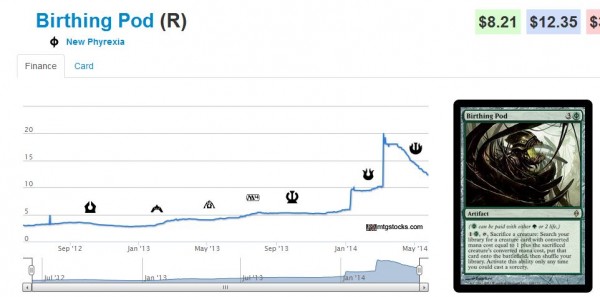
Thicket
Misty
Pod

Notice how the price curve on these cards spike to an all-time high earlier this year, only to drift downward since at varying rates? The trend is quite consistent.

Shortly after Richmond I unloaded a good deal of my Modern stock despite nay-sayers exclaiming this was a reckless decision so far in advance of Modern season. As it turns out, the decision wasn’t horrible, as many buylists have dropped significantly to reflect this recent decline. I was able to buylist my set of Snapcaster Mages for $27 each, and now the top buylist is a significant percent lower.

There was an error retrieving a chart for ’Snapcaster

As someone who enjoys analyzing financial trends, my natural inclination is to identify motivations for these price drops. With Modern staples, I can think of a number of driving forces.

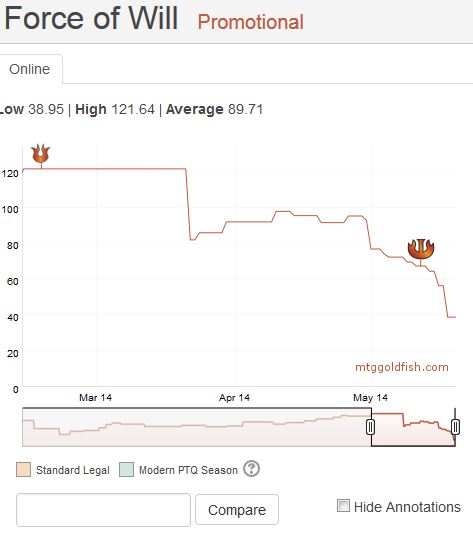
First, the reprint fear is something speculators live with on a daily basis. Before Modern existed, I remember very few discussions about potential reprints. The phenomenon has happened from time to time, but the potential was not a driving force for investing. I actively acquired Legacy staples ranging from Force of Will to Carpet of Flowers and everything in between without even thinking of reprint implications.

Now that WOTC has created this in-between Modern format designed to be Eternal but affordable, the “R-word” gets thrown around almost every day. Even last week someone got wind of potential Convoke cards in M15 DOTP and immediately people are fearing a Chord of Calling reprint.

At the time of the Modern spike, Modern season was still a few months away. With so much unknown about future products, perhaps people were risk-averse and sold based on potential reprints.

A second factor could simply be the decline in Modern interest. Everything came to a head back at GP Richmond, where the largest constructed MTG tournament ever took place. No changes to the Banned & Restricted list last time around created no news for the format. Perhaps the stagnation and decline of Modern staples reflects a natural shifting of interests.

Finally, perhaps the trend is simply related to factors external to Magic. It is possible the summer leads to a small decline in prices simply because people are less engaged in Magic. Schools are out for the year and people are finding alternate activities.

All of these factors could be playing a role in price declines. But this should change soon.

Well, two of the three factors above will change, anyway. Summer is still here, but Modern PTQ season is just two weeks away! This will mean players will become eager to test decks at FNM’s, more Modern talk will take place, and hopefully we’ll start seeing a bounce in card prices. I fully expect such a bounce is coming, and while I can’t say a cash buy on Modern staples will always be profitable, trading for some of these repressed singles could yield reasonable gains when we enter the thick of Modern season.

Just make sure you unload them when they hit their local maxima because there could be another large sell-off at the end of this Modern season. Modern Masters 2 will be a thing, and other reprint potentials means the fear that drove prices down over the last few months will be magnified.

By this fall I hope to have virtually no Modern cards in my binder. But as we head into Modern season, staples seem like solid pick-ups.

Speaking of Solid Pick-Ups

Admittedly there was no easy transition from the Modern season topic to this one, so I am grasping at straws here.

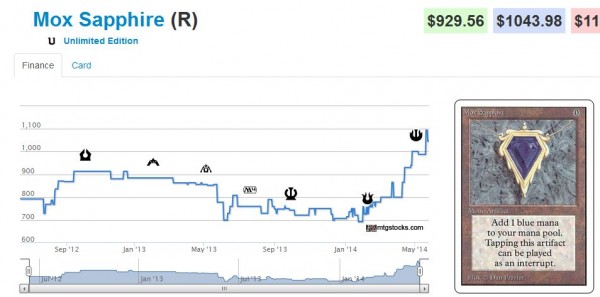
But has anyone noticed how difficult it is to acquire Power lately? I’m seeing less and less of these cards available for sale. Last week I tweeted an observation that Star City Games had exactly four Moxen in stock – as of today that number is down to three. Two graded Mox Sapphires and an MP Mox Ruby.

Sapphire

A couple years ago I was able to acquire a HP Sapphire for under $400. Now this card could easily trade at $1000 (if only I had kept mine). And the trend is continuing. While Modern staples have largely pulled back lately, Power is on a tear. And with so few copies available on the open market, any increase in interest will drive prices higher.

Even buy lists are starting to gain traction and follow prices higher.

There was an error retrieving a chart for Mox Sapphire
There was an error retrieving a chart for Time Walk

I know the Power 9 is a group of iconic, expensive cards from Magic. Most new players probably couldn’t trade their entire collection for a piece of the Power 9. As a result, this section of the article may not be relevant for all readers, but I want to emphasize this trend to drive awareness of what is happening.

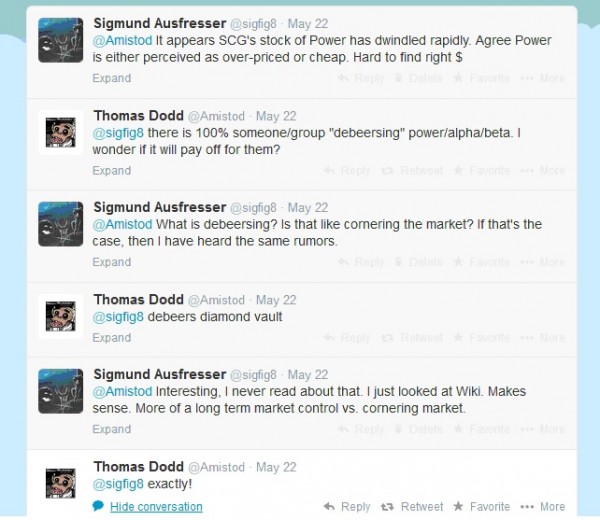
Anecdotal evidence suggests to me that this trend is being driven by a small group of investors looking to control the market for Power.

Tweet

Could this really be happening? Is there a small organization of people attempting to buy up enough Power to virtually control the market? It sounds like conspiracy (and not the new MTG set kind), but the rumor is certainly consistent with recent price trends. Even if this is all malarkey, the fact that Vintage Masters is driving more Vintage discussion will be a thing regardless.

I’m acting on this by putting my money where my mouth is. While I don’t expect I’ll have the resources to acquire all of the Power 9, my hope is to pick up a few played Unlimited pieces for some exposure to this market. It wouldn’t surprise me to see every part of the Power 9 over $1,000 in the next five years, and I definitely don’t want to be priced out of them completely if I can avoid it.

Summing It Up

As I opened this article, my mind is constantly bouncing back to two dichotomous MTG Finance trends. Modern staples have been drifting downward while Power 9 has been on a rapid rise. The two events are completely unrelated except for the fact they are both related to MTG Finance.

This is why I continue to love this hobby – where else can you have such a diversity of trends, experiences, and connections playing a game while still making money? I’m truly blessed to be involved in this game and to have such a strong community to enjoy it with.

And with many new adventures ahead as new products are released, I believe there’s still plenty of money to be made from the game. Here’s to a profitable Modern PTQ season and an exciting Fall Block!

...

Sigbits

  • When Temple of Malady was first released, it was selling on eBay for $5.50 to $6 and retailed for $8. Now just a couple weeks later the price on these has already drifted upward and SCG is now sold out of both foil and nonfoil copies at $19.99 and $9.99 respectively. I can see nonfoils being relisted at $11.99.
  • Eidolon of Blossoms is clearly a bust so far. The price on this card has tanked hard since being spoiled. But the card has seen some life of late, and copies have been getting more expensive over the last week. SCG has only 7 in stock and their price of $1.99 is actually in-line with TCG Low when shipping is included. I expect a bump to $2.99 from SCG very soon.
  • Does Herald of Torment see play outside of Standard? For some reason SCG is out of stock on foil copies at $6.99, which is already greater than the usual 2x premium for foils. Not sure what the driving force is here, but it's certainly noteworthy if you could trade for a couple.

Insider Video: Zwischenzug Plays Midrange Gifts

Are you a Quiet Speculation member?

If not, now is a perfect time to join up! Our powerful tools, breaking-news analysis, and exclusive Discord channel will make sure you stay up to date and ahead of the curve.

The Deck, and How To Play It

Midrange Gifts

Creatures

1 Birds of Paradise
4 Noble Hierarch
4 Tarmogoyf
2 Scavenging Ooze
1 Courser of Kruphix
1 Elesh Norn, Grand Cenobite

Other

1 Slaughter Pact
1 Path to Exile
2 Thoughtseize
2 Inquisition of Kozilek
1 Raven's Crime
1 Life from the Loam
1 Abrupt Decay
1 Mana Leak
1 Maelstrom Pulse
3 Lingering Souls
4 Liliana of the Veil
4 Gifts Ungiven
1 Unburial Rites

Lands

4 Verdant Catacombs
3 Misty Rainforest
2 Marsh Flats
1 Forest
1 Swamp
1 Godless Shrine
1 Temple Garden
1 Hallowed Fountain
1 Breeding Pool
1 Watery Grave
1 Overgrown Tomb
1 Razorverge Thicket
1 Twilight Mire
2 Creeping Tar Pit
1 Treetop Village
1 Celestial Colonnade
1 Tectonic Edge

Sideboard

1 Obstinate Baloth
1 Terastodon
1 Kitchen Finks
2 Nihil Spellbomb
1 Rule of Law
1 Thrun, the Last Troll
1 Iona, Shield of Emeria
2 Stony Silence
1 Dispel
2 Shadow of Doubt
2 Duress


Match 1

There was an error retrieving a chart for Gifts Ungiven

Match 2

There was an error retrieving a chart for Elesh Norn, Grand Cenobite

Match 3

There was an error retrieving a chart for Life from the Loam

Match 4

There was an error retrieving a chart for Creeping Tar Pit

Conspiracy Spoiler – Grudge Keeper

Are you a Quiet Speculation member?

If not, now is a perfect time to join up! Our powerful tools, breaking-news analysis, and exclusive Discord channel will make sure you stay up to date and ahead of the curve.

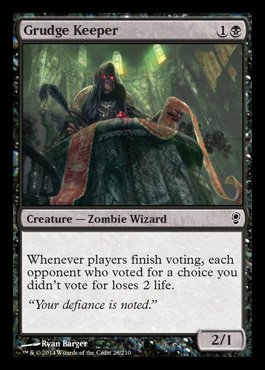
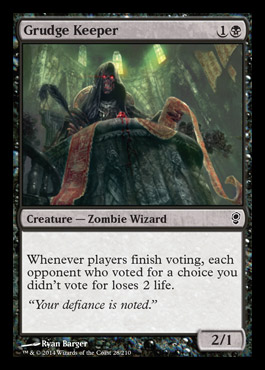
grudge keeper

Here's a card that is so dirty it gets its own spoiler on an otherwise slow day.

This card is going to be easy to draft in quantity and you will have no shortage of triggers, but maybe not enough for him to deal more than 2 or 4 damage a game. You can draft cards that force people to vote, but he forces you into a color, which sucks because you can't just go "mono-votes goodstuff" unless he is part of a cycle and the other colors got similar keepers. "Knowledge Keeper 1U 1/3 Whenever players finish voting, you draw and discard a card then  for each opponent who voted for a choice you didn't vote for" etc.

The thing that is kind of clunky about Grudge Keeper is that your own Will of the Council spells aren't the best way to trigger Grudge Keeper. The later you get to vote, the better he is, but you may find yourself voting against your best interests in an attempt to get value. When you vote first, it's easier for an opponent to play around. This card is very clunky, but it has real potential depending on the rest of the set.

What do you think? Are you excited to be punishing opponents with this guy, or is he relegated to the bench?

Avatar photo

Jason Alt

Jason Alt is a value trader and writer. He is Quiet Speculation's self-appointed web content archivist and co-captain of the interdepartmental dodgeball team. He enjoys craft microbrews and doing things ironically. You may have seen him at magic events; he wears black t-shirts and has a beard and a backpack so he's pretty easy to spot. You can hear him as co-host on the Brainstorm Brewery podcast or catch his articles on Gatheringmagic.com. He is also the Community Manager at BrainstormBrewery.com and writes the odd article there, too. Follow him on Twitter @JasonEAlt unless you don't like having your mind blown.

View More By Jason Alt

Posted in Conspiracy Spoiler, Free5 Comments on Conspiracy Spoiler – Grudge Keeper

Have you joined the Quiet Speculation Discord?

If you haven't, you're leaving value on the table! Join our community of experts, enthusiasts, entertainers, and educators and enjoy exclusive podcasts, questions asked and answered, trades, sales, and everything else Discord has to offer.

Want to create content with Quiet Speculation?

All you need to succeed is a passion for Magic: The Gathering, and the ability to write coherently. Share your knowledge of MTG and how you leverage it to win games, get value from your cards – or even turn a profit.

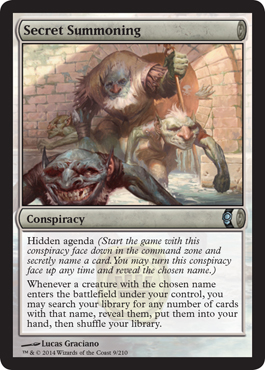
To Draft a Conspiracy

Are you a Quiet Speculation member?

If not, now is a perfect time to join up! Our powerful tools, breaking-news analysis, and exclusive Discord channel will make sure you stay up to date and ahead of the curve.

A lot has been made of Wizards' newest set, Conspiracy. We're all looking forward to drafting it and playing with the sweet new cards. And, of course, Dack Fayden. The idea of a new set with cool new mechanics made specifically for drafting and not for Standard or Eternal play is somewhat novel and definitely a lot of fun.

I will be pulling on the Conspiracies I can.

Of course, there's one thing lost in all this talk of cool new cards: How do we actually play with them? How do we physically draft the set? And just how do these multiplayer games work in a draft? For all the talk I've seen about how fun it will be to draft and play Conspiracy, there hasn't been nearly enough talk about how to actually play and draft Conspiracy. 

Luckily, the Mothership has us covered. Sam Stoddard has us covered, as he changes how the set overcomes some of the normal limitations of drafting. It's well worth a read.

Avatar photo

Corbin Hosler

Corbin Hosler is a journalist living in Norman, Oklahoma (also known as the hotbed of Magic). He started playing in Shadowmoor and chased the Pro Tour dream for a few years, culminating in a Star City Games Legacy Open finals appearance in 2011 before deciding to turn to trading and speculation full-time. He writes weekly at QuietSpeculation.com and biweekly for LegitMTG. He also cohosts Brainstorm Brewery, the only financial podcast on the net. He can best be reached @Chosler88 on Twitter.

View More By Corbin Hosler

Posted in Casual, Conspiracy, Feature, FreeTagged Leave a Comment on To Draft a Conspiracy

Have you joined the Quiet Speculation Discord?

If you haven't, you're leaving value on the table! Join our community of experts, enthusiasts, entertainers, and educators and enjoy exclusive podcasts, questions asked and answered, trades, sales, and everything else Discord has to offer.

Want to create content with Quiet Speculation?

All you need to succeed is a passion for Magic: The Gathering, and the ability to write coherently. Share your knowledge of MTG and how you leverage it to win games, get value from your cards – or even turn a profit.

M15 – Intentional Spoilers

Are you a Quiet Speculation member?

If not, now is a perfect time to join up! Our powerful tools, breaking-news analysis, and exclusive Discord channel will make sure you stay up to date and ahead of the curve.

Duels of the Planeswalkers 2015 looks like the best game yet. I'm not here to discuss all the ways that it's going to be amazing because I have a Playstation 3 and apparently I can just go suck it. Me sucking it aside, unveiling Duels of the Planeswalkers has also spoiled some crads, and now let's look at those crads.

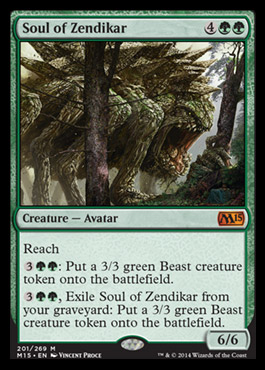
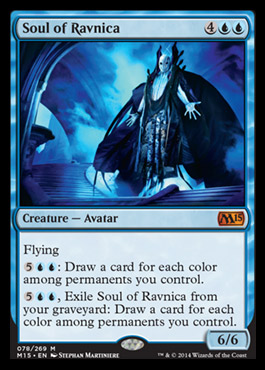
Soul Cycle

soul of zendikar

soul ravnica

There was some speculation that "Soul of Zendikar" was proof positive that Fetchlands were getting reprinted in M15. "How could they not?" everyone said. "Zendikar is the plane where M15 takes place, clearly. Sell your fetches!"

Well, I didn't jump to such conclusions because I didn't think we had enough data. The spoiling of Soul of Ravnica puts a pin in that little theory. Sorry, everyone. Better buy those fetches back so you can sell them during Modern season.

These are not great for 100 or 60 card decks, but I imagine 40 card decks will be glad to have them. Although, calling a Mythic "good in limited" may be damnation with faint praise.

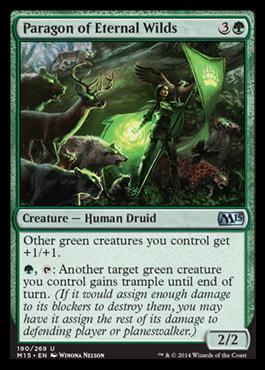
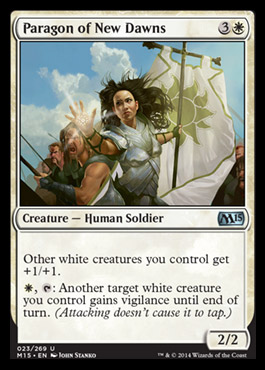
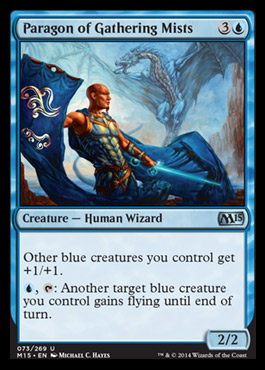
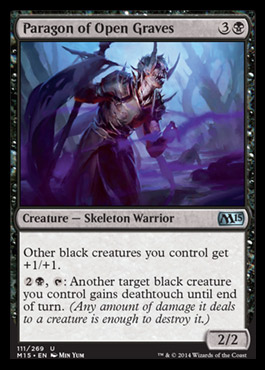
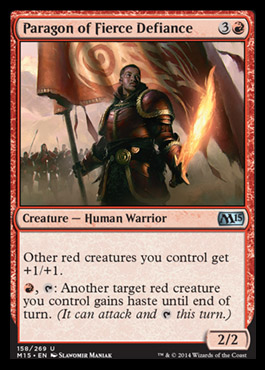
Paragon Cycle

paragon eternal wilds

paragon of new dawns

paragon gathering mists

paragon open graves

paragon fierce defiance

Well, these are financially irrelevant. I think they'll be playable in Limited, though. Buffing other creatures is solid and granting Flying or Deathtouch or Trample is amazing - Vigilance is fine and Haste is historically not great. Remember, these only target a creature of the same color- narrowing their appeal a bit. How many blue non-fliers do we expect in the set?

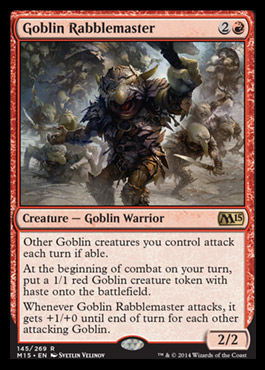
Goblin Rabblemaster

goblin rabblemaster

This could do something. I don't think Legacy gobbos wants this guy, and we'd have to get quite a few good goblins in M15 to make this worth it in Standard, but casual decks will jam this. Lords historically end up worth more than you'd imagine, and this guy is a built in Goblin Assault which is appealing. I like this guy a ton, and his durdliness should make him drop under the radar initially which gives us an opportunity to pick these up on the cheap later. Is this going to be the next Captivating Vampire? I don't know. I will say that you buy Lords.

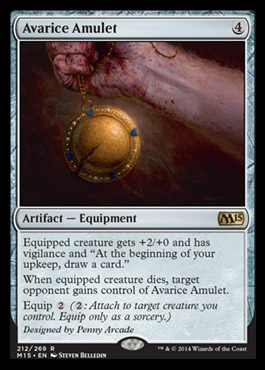
Avarice Amulet

avarice amulet

Ugh. You don't want this. Drawing cards is good. Rewarding your opponent for killing your creatures is not.

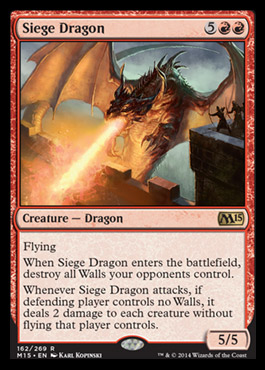
Siege Dragon

siege dragon

So I guess there will be a lot of walls in M15. Why print this card otherwise? They wouldn't print a dragon that said "Destroy all creatures with banding" and I don't think this card would reference walls if there were none in the set. This is so narrow I don't see it tracking with other dragons in the future, so I think this is a future bulk rare. Could standard end up slow enough that a 7 drop dragon is good enough? Cooking their entire ground seems very, very strong, but 7 mana is a lot for 60 card games. Time will tell on this guy. Don't preorder.

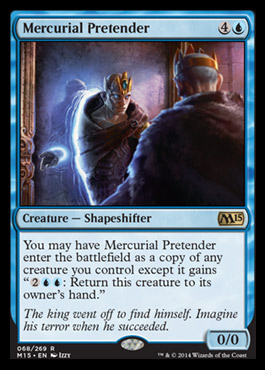
Mercurial Pretender

mercurial pretender

This is either better or worse than Clone depending on what you end up wanting to copy and how often. Too slow for standard, and too "not Phantasmal Image" for eternal. I don't like it.

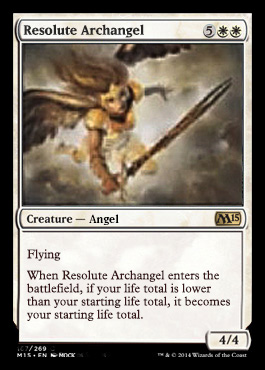
Resolute Archangel

resolutearchangel

This is an angel and it has a very splashy effect. Trade these off of spike and ship these to Timmy.

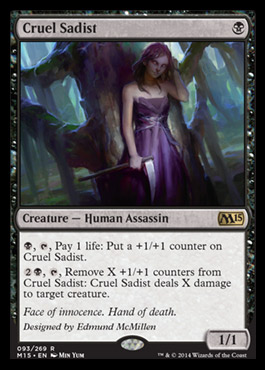
Cruel Sadist

cruelsadist

You'd have to be a masochist to play this sadist.

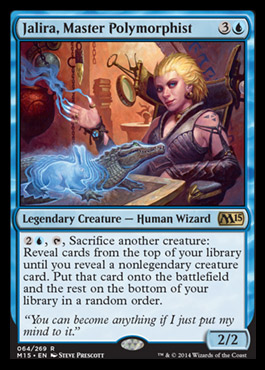
[Redacted], Master Polymorphist

master polymorphist

This is silly in EDH. I could easily see this in a deck with Shape Anew where the only non-Legendary creature is Blightsteel Colossus. This has a ton of potential and 100 card players are already big on this. Its non-mythic status will really hurt its potential. In fact, I'm not convinced this won't be mythic given the errors we saw in Duels 2014.

Indulgent Tormeter

indulgent tormentor

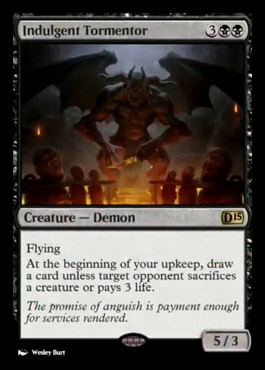
Wow. This is quite good. His body is disappointing, but that card advantage is solid. The question is whether this could see play when Bloodgift Demon did not. The future metagame will be very different. Will it be different enough to give this guy a chance? Either way, I bet his pre-order price is too high.

Chasm Skulker

chasm skulker

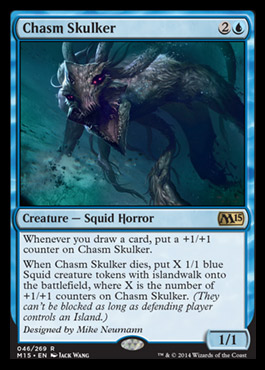
Vorel of the Hull Clade decks want this. I don't know what else does. It's just rare, so that hurts it. This is great in limited, great in select 100 card decks and interesting enough that it may get some play. Likely a bulk rare, though.

Phy[Redacted]

phyto

This is annoying. Very annoying. Luckily it will be summoning sick after dying which makes this a better blocker until it trades with enough dudes that they can't muster and offense, and then it's a closer. This is fine in limited, and casuals will like this, but a lot of this card screams "bulk"

Avatar photo

Jason Alt

Jason Alt is a value trader and writer. He is Quiet Speculation's self-appointed web content archivist and co-captain of the interdepartmental dodgeball team. He enjoys craft microbrews and doing things ironically. You may have seen him at magic events; he wears black t-shirts and has a beard and a backpack so he's pretty easy to spot. You can hear him as co-host on the Brainstorm Brewery podcast or catch his articles on Gatheringmagic.com. He is also the Community Manager at BrainstormBrewery.com and writes the odd article there, too. Follow him on Twitter @JasonEAlt unless you don't like having your mind blown.

View More By Jason Alt

Posted in Free, M15Tagged , , , , , , , 1 Comment on M15 – Intentional Spoilers

Have you joined the Quiet Speculation Discord?

If you haven't, you're leaving value on the table! Join our community of experts, enthusiasts, entertainers, and educators and enjoy exclusive podcasts, questions asked and answered, trades, sales, and everything else Discord has to offer.

Want to create content with Quiet Speculation?

All you need to succeed is a passion for Magic: The Gathering, and the ability to write coherently. Share your knowledge of MTG and how you leverage it to win games, get value from your cards – or even turn a profit.

Insider: Exclusive Interview with MTGO Traders’s Heath Newton

Are you a Quiet Speculation member?

If not, now is a perfect time to join up! Our powerful tools, breaking-news analysis, and exclusive Discord channel will make sure you stay up to date and ahead of the curve.

The Vintage Masters spoiler will be out before this goes to print (hope you fared well!), so this week we’ll focus on big-picture issues related to the MTGO economy. I couldn’t think of anyone better to talk us through these issues than Heath Newton, owner of MTGO Traders and Cape Fear Games.

MTGO Traders is the bot chain by which all others are measured. They are known for their well-stocked bots, competitive prices, and excellent customer service. They are also one of the few sites where you can buy cards from the website and have them delivered to you in the client.

Heath manages a staff of 19 employees between MTGO Traders and Cape Fear Games, so we appreciate him taking the time out to talk to us. He has tracked the Magic Online economy closely for the past 12 years, and there is probably no one better versed in how the MTGO market works.

When not at the store, Heath enjoys outdoor sports and time with family
Heath in his native habitat

This interview is packed with insights, including Heath’s prediction for the price of a Black Lotus, how the beta client will affect the market, how MTGO Traders prices cards, and his thoughts on speculators and the GoatBots incident. Enjoy!


Quiet Speculation (QS): When did you found MTGO Traders? How did you come up with your business model?

Heath Newton (HN): I started MTGOTraders back in either late 2002 or early 2003, I cannot remember for sure. I did not have a business model as I started MTGOTraders while I was in college by buying and selling MTGO redeemed sets on eBay. I took out a $2,000 student loan when we started the site to buy the initial inventory.

[pullquote]Buying him out was the best thing I ever did.[/pullquote] When I say “we”, I had a partner when I first started that I eventually ended up buying out. Buying him out was the best thing I ever did as we would argue a lot about the direction we wanted to take the business, and being able to focus on my vision and put all my efforts into it was very rewarding.

Since then the business has grown pretty substantially so I have had to really work on the business side of things. I have a computer science degree which helped me a lot with the technical aspect of things but not with running an actual business. I’ve read a fair amount of books and have some friends with large corporations that I talk to often for advice. The book I’m reading now is called The Advantage, and I highly recommend it for anyone with a decent amount of staff members.


QS: Do you ever get to play these days? What formats and decks does the man who can play anything go to battle with?

HN: It’s funny when I opened my game store I envisioned myself finally having a place in town to play games at but the longer it’s open the harder it becomes to actually play there. I have two young kids and a wife so my priorities are with them after work. I still play but I do not keep up with Standard and mostly just enjoy EDH/Commander and any type of sealed format. Sealed 2HG is probably my favorite format currently.


QS: That's one of my favorites, too. One question that often comes up in the forums is whether there a way to trade your physical cards into virtual cards. I understand that you offer a way to do that through Cape Fear Games, right? Can you explain how it works?

HN: Yes, this has been huge for CapeFearGames as it’s a major selling point to get people to give us a try. It’s actually really simple and the great thing about it is there are no eBay/PayPal/etc. fees and you get paid the same day we receive your cards M-F.

All you have to do is go to www.capefeargames.com/buylist and submit a buylist with the cards you want to sell. Once our buyers grade your cards you will get a gift certificate to www.MTGOTraders.com for the amount with an additional 20% bonus. You can use that just as you would cash on our site so you can purchase boosters, bot credits, singles, etc. It’s a really good deal and a lot of people take advantage of it.

The buylist from Cape Fear Games allows players to convert paper to digital (with 20% bonus)
Trade in your paper cards to Cape Fear Games so these guys can play with em (you get 20% bonus out of the deal...)

QS: Do you have any tips for someone buying into a constructed deck on MTGO and starting to build their portfolio? Would you advise a friend to buy in now and, if so, in what format? What do you advise for people building their collection?

HN: A lot of this depends on the format because it’s almost always a good time to buy a Standard deck as the margins are so small you will take a very minimal loss when you sell compared to what you would take in paper. [pullquote]The best time to buy into eternal formats will be around eight days after the set is released.[/pullquote] I would not buy into any eternal formats right now with Vintage Masters and V4 rolling out about the same time. We are in for a pretty wild ride with prices for the older sets and it should be interesting to watch. Probably the best time to buy into eternal formats will be around eight days after the set is released.

Depending on if the beta goes live in a month or so, that may be a fantastic time to buy in. We might have a pretty substantial crash in prices, and if we do I plan on buying a lot of inventory as well. During the last transition we saw ticket prices plummet all the way down to $0.70 each. While I do not see it being that bad this time around I do think we will see a fair amount of sell-off. I have already seen a large increase in veteran players selling off their collections before the beta goes live.

Another thing I always suggest is only buying playable cards. A lot of people think it’s a good idea to just get 4x sets so they will have every card they need but honestly you are not going to ever play 70% of those cards so it’s a total waste of money. I also suggest buying cards with PayPal because a site like mine gives 8% off when you use the coupon code “qspaypal”.

QS: You mentioned that eight days after release will be about the best time to buy into VMA. We've never dealt with Special rarity before, so I understand there's considerable uncertainty. But what's your best guess for the price of a Black Lotus eight days into drafting on MTGO? What about a Mox Sapphire? What about Force of Will and Tundra, both printed at rare?

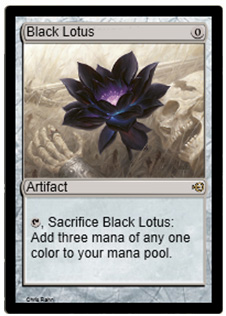
HN: [pullquote]My guess for Black Lotus would be around $250 at that point but I see it dropping to $200ish later.[/pullquote] My guess for Black Lotus would be around $250 at that point, but I see it dropping to $200ish later.

The big thing I’m uncertain of is how much it’s going to be drafted. Mox Sapphire I would guess around $180 and dropping to $150ish later. Force I think will drop all the way to $20ish and Tundra could easily hit $15.

How much with these be worth?

QS: Unlike some bots that actively discourage speculators, you seem to welcome their business. What are your thoughts on Magic speculation?

HN: Well you may or may not know that I used to be pretty negative and even a tad hostile towards speculators. [pullquote]We do not mind speculators at all and I think my original viewpoint was incorrect.[/pullquote] I felt like I was always getting taken advantage of by the same few people and I even cancelled a few orders in paper that earned me some pretty negative feedback from some customers. Since then I have changed my stance because we were able to come up with automated pricing that flows with supply and demand. We do not mind speculators at all and I think my original viewpoint was incorrect. We do limited the number of cards you can buy at one time on our site but we do not have any limits on our bots or any sort of blacklist. I do understand why some bot owners that do not have automated pricing block speculators as a few speculators can have a much larger impact on a small bot chain.

The thing I still have an issue with is hoarding, where a few users are able to singlehandedly drive up the price on a card by decreasing the supply. Users with big enough pockets are able to hit up all of the bot chains within a few hours and if the card is a good target they can easily double the price.


QS: How do you price your cards? Is it based on algorithms? Where does the human factor come in?

HN: [pullquote]How the algorithm works is obviously tuned a lot and we add in more specific ranges as we find flaws in our current algorithm.[/pullquote] A human sets the starting point and then the algorithm takes it from there.  How the algorithm works is obviously tuned a lot and we add in more specific ranges as we find flaws in our current algorithm.  We will of course manually change a card if there is a reprint, during a big event, banning, etc.

How do you get on this guy's radar?

QS: I often check your Hotlist because it has excellent buy prices and will purchase up to eight cards at a time. How do you determine which cards show up on the Hotlist?

HN: Currently it is based on the number of cards in stock on our website. We are planning on launching a second hotlistbot soon and we will start buying foils but only four at a time. I’m looking forward to expanding it as it helps us keep all cards in stock in our website at all times. The hotlistbot buys a much more extensive list than what is on hotlist on our website. [pullquote]The hotlistbot buys a much more extensive list than what is on hotlist on our website.[/pullquote] Soon we will be removing the ability to submit a list with the site and we will instead list the full hotlist that the bot will purchase. We do not do that now because we are so busy filling orders that it is hard to get to the hotlists in time.


QS: Most bots make their money exclusively off the spread between buy prices and sell prices. Do you ever “take a position” in the market by, for example, selectively stockpiling cards that you think are underpriced?

HN: Our buyers may do this sometimes in paper but never to a point where it’s “hoarding”. [pullquote]I’m really surprised people do not speculate on Boosters more often.[/pullquote] I’ve bought up a ton of boosters on MTGO because I thought they were underpriced, but I typically do not bother stockpiling because it seems pretty close to hoarding if it do it enough. Speaking of which, boosters are the lowest-risk targets that are often overlooked. Their spread is extremely small and they almost always bounce back. I’m really surprised people do not speculate on boosters more often.

logo_vintagemasters

QS: What do you expect will happen with Vintage Masters? Will Vintage become a real format? What will Vintage Masters do for Legacy on MTGO?

HN: That is the million dollar question. I can see it being an extremely popular draft format but I’m not sure past that. I sure hope it catches on. I lost a lot of money with the recent drops as well but that’s just how this game works. I hope the prices stay low as I would prefer for them to be low so that more people get into the format. [pullquote]I hope the prices stay low as I would prefer for them to be low so that more people get into the format.[/pullquote] People often think that dealers want high prices but this is actually not true. I would rather turn more cards per day than sit on a bunch of $100+ cards and only sell a few per week.

I would assume that in the short term, Legacy will see a big drop in interest but I’m not sure what will happen long term. A lot of it depends on how WoTC plans to support them and how much the investment is for a tournament deck.


QS: Are you frustrated with their choice to reprint so many valuable cards? My portfolio took a major hit in the past couple weeks, and I can only imagine what happened to the major bots.

HN: I’m actually very happy about it even though I also lost a ton of money. I lost a lot short-term but being able to sell more cards will more than make up for it in the long run. I do however feel bad for collectors that were holding on to them or people that had them for their decks.

Eternal staples fell off a cliff, but Heath is not concerned
Eternal staples fell off a cliff, but Heath is not concerned.

QS: You were one of the major bot owners during the transition from V2 to V3. I understand it was an extreme market disruption and many people sold their collections. What do you expect when use of the Wide Beta client becomes mandatory in July?

HN: [pullquote]I expect around a 20% drop in prices and for tickets to drop to around 0.85 for a bit.[/pullquote] I expect around a 20% drop in prices and for tickets to drop to around 0.85 for a bit. Honestly a lot of it is up in the air as it’s hard to tell what all WoTC is going to do. The beta is not horrible and if they would fix the chat that sure would help us dealers a lot.

What will the July switchover mean?

QS: I feel like MTGO is pushing ahead with the rollout of a product that is clearly not ready for primetime. If they go forward with this, what will it mean for the MTGO market in the short and longer term?

HN: Short-term there will be a pretty substantial sell-off from people that do not like the software or just cannot run it, and prices will drop. Long-term it all depends on if WoTC is able to make good on their promise and focus on fixing one version of the software instead of two. There are a lot of issues at WoTC when it comes to software development and I feel like we have been here before and it’s just more of the same. I love the guys that work there but sure wish whoever is hiring players instead of programmers would figure out that they need to start hiring some higher paid software developers with experience.


QS: What bot software do you use?

HN: We use the cardbot software. They no longer rent it out.


QS: Are you ready for Version 4? Do you know if "MTGO Library" bots will be able to operate on the new client? I expect in the early days of the switch-over there will be fewer bots online, and thus less competition.

HN: We are ready now. Our bots are completely ready and I’m hoping they will fix some of the chat issues which makes it really hard to properly interact with customers and deliver orders. The “50k” binder limit is also a very major hurdle for us and something I’m hoping they will increase to at least 150k.

Goatbots has launched new software that is in compliance
New Goatbots software  seems to have resolved  things.

QS: Several months ago you and other bot owners were vocal in your concern that Goatbots may have “hacked the client”. Goatbots was ultimately banned by Wizards and just came back online with a rebuilt bot software. A couple weeks ago, Goatbots took to Twitter to claim that you had hacked the client. What does it even mean to hack the client, and what are the implications for users?

HN: With WoTC you are supposed to run bots that use Optical Character Recognition. [pullquote]I have since spoken to Goatbots and I do not believe they are currently hacking their bots and we are on good terms.[/pullquote] The other ways to program a bot are .dll injection and hacking the stream (very risky and easy for them to detect). I have since spoken to Goatbots and I do not believe they are currently hacking their bots and we are on good terms.  We are also not using hacked bots and will send WoTC our bot’s source code if they ask for it. We have way too much to risk by running hacked bots but you could potential lose your collection if you decide to run hacked bots.


QS: What are your hobbies outside of MTG ? What do you do to blow off steam when the Beta client crashes?

HN: My hobbies include spending time with family, disc golf, being active in my local church, surfing, any type of table top games (I don’t play RPG’s though), pickup games of any team sport, running, etc. I love being outdoors and love competition so any sort of outdoors sport I’m typically game for.

When the beta crashes I typically go play a quick game of Titanfall or if it’s down for a while I’ll head into CapeFearGames and hang out.


QS: I hope there are fewer beta crashes in our future, but at least it sounds like you have plenty to keep you busy. Thanks again for your time.

-Alexander Carl (@thoughtlaced)

Insider: a Vintage Dredge Primer – Pt. 2

Are you a Quiet Speculation member?

If not, now is a perfect time to join up! Our powerful tools, breaking-news analysis, and exclusive Discord channel will make sure you stay up to date and ahead of the curve.

Greetings again, Vintage aficionados!

In my last article I wrote about the essential cards that make up it's maindeck and sideboard. If you haven't gotten a chance to read that article, take a moment to do so now.

Today I'm going to delve a little deeper and talk about strategy with the deck.

Sideboarding Strategies and Matchup Analysis

Dredge doesn’t really have matchups against decks, but rather against individual sideboard cards. Many of the hate cards that are used to combat dredge can be played in almost any deck. Very few of them care about color, a lot of them are artifacts and some of them are free. Knowing what all the possibilities are and being able to deduce what decks are more likely to play certain kinds of hate is a good tool to have.

For example if you are facing an Oath of Druids deck they are likely to not have Graffdigger’s Cage as their hate card of choice because it hurts them as well. This is where the advantage of being favored in most game ones is helpful. Sometimes you can use game two as a feeler for what sort of hate you are up against.

I’ll go through the most common sideboard hate cards and maindeck cards in particular archetypes that match up well against Dredge.

Workshops - Workshop does have a few maindeck cards that are good against Dredge. Wasteland and Strip Mine kill your Bazaar, while Steel Hellkite and Wurmcoil Engine can race you by killing your zombie tokens and via lifelink respectively. In terms of sideboarding, the more common cards that they have for the Dredge matchup are graffdiggers cage, relic of progenitus, tormod’s crypt, pithing needle (naming Bazaar of Baghdad), Leyline of the Void and from time to time, The Tabernacle at Pendrell Vale. Tabernacle is very good against Dredge as you are not able to pay for more than one creature most of the time and do not play any sideboard answers for it because it is not a common sideboard card.

Cards to consider bringing in after sideboarding are

Blue Decks - These decks include Blue Angels, Suicide/Jace/Vault and U/W Landstill. U/R Landstill, Grixis, BUG Control, and Tezzerator. Most blue decks have the common maindeck weapons of tinker for blightsteel early in the game or assembling Vault/Key.

You can also lose game one by making the error of getting too low on cards in your library. Since Ancestral Recall targets a player they can potentially use it to deck you. This just means you shouldn’t get too greedy because you rarely ever need that much of your library in your graveyard to win game one.

Decks with Trinket Mage usually run one piece of hate in the main to tutor for. This is usually Graffdigger's Cage as it is also good against Oath of Druids. Blue decks with black and white after sideboarding are very dangerous because they have access to Leyline of the Void and Rest in Peace, which are the two best pieces of hate against Dredge. They of course can also run any of the artifact hate: Needle, Cage or Crypt. They usually don’t run Relic of Progenitus because it does not do enough against Dredge and these decks may have access to Yawgmoth’s Will.

Decks without Trinket Mage have been known to run one Nihil Spellbomb in the main to tutor for, but that is less common these days. Blue decks that have black will have Leyline of the void and possibly Yixlid Jailer.

Cards to consider sideboarding against blue decks are

Creature decks - This includes Hate Bears, Humans, Noble Fish, BUG Fish and Merfolk. These are some of the decks that can actually afford to run some number of hate cards in their maindeck. Some of these decks run Graffdigger's Cage in the maindeck to combat Oath of Druids along with Dredge and can run creatures like Deathrite Shaman and Scavenging Ooze alongside Wasteland and Strip Mine for your Bazaars. Also these decks are more likely to run spell-based hate like Ravenous Trap, Surgical Extraction and Extirpate because of their potential access to Snapcaster Mage (this obviously doesn’t apply to Trap).

Cards to consider sideboarding are

Oath of Druids - They won’t be playing Graffdigger’s Cage because it hurts them and they also have nut draws that can beat you like Tinker for Blightsteel and turn one Oath into hasted fatty in game one. In sideboarded games they are likely to have Leyline of the Void, Tormod’s Crypt or Nihil Spellbomb.

Cards to consider siding in are

Combo Decks - This includes Storm, Belcher and Burning Oath. These are the decks that you are an underdog to in game one. You are both non-interactive decks but most of the time they simply goldfish faster than you. These decks usually run 0-4 hate cards in their sideboard as they do not need to lock you out of the game like other decks, but just need to buy an extra turn or two in game two when you are both trying to disrupt the other. A couple of notes about library management when playing against combo decks; these decks have access to multiple draw-7 effects and you should be mindful at all times how many cards you have in your library when deciding how much to dredge. Once you fall below 15 cards in your library you have given them another avenue of victory by chaining draw-7s and decking you.

Cards to consider siding in are

Dredge - The mirror match is slightly dependent on the type of Dredge deck you are running and if you have any hate cards for the mirror match. The combo version can kill as early as turn two and is favored against the grindier version with no Dread Returns. The deck that has Leyline in the maindeck obviously has that advantage, where the other versions with Dread Return have Elesh Norn, Grand Cenobite out of the board.

Sideboard cards to consider

Playing Against Hate

Playing against hate is one of the most important skills a Dredge pilot can master. As I explained above, this depends more on the specific card than the deck that’s playing it.

Let’s talk about ways to play when you are facing hate cards and cannot answer them or you have attempted to and were not successful.

This is one of the more popular hate cards against Dredge because it is also an effective hate card against anyone playing Oath of Druids. Cage stops your Bloodghasts, Ichorids and Narcomeobas from coming into play and it stops you from flashing back Cabal Therapy and Dread return. Cage does not stop you from dredging and does not stop your Bridge from Belows from triggering. This means that your evoke creatures are at a premium because Chewer kills cage and either of them can be evoked without a target and trigger your Bridge from Belows. So start casting those Bloodghasts and Narcomeobas and attacking.

These are two of the strongest hate cards against you. They both stop you from having a graveyard at all, which means that you have to start casting creatures if you cannot get rid of them. Hardcasting your creatures is your backup plan if you cannot remove these permanents.

I have grouped these together because these are all one-shot effects that remove your graveyard. The key to playing against these is patience--never commit too much of your library into your graveyard. This means always keeping a dredge card in your hand so that you can continue to dredge after they use their hate card and accomplish your game plan. If you suspect Ravenous Trap from your opponent, simply take your draw step and try to disrupt them with a Cabal Therapy or Unmask to clear the way. You are not forced to use Bazaar every upkeep.

These spells will most likely be targeting your Bridge from Belows to stop you from making tokens. These are more likely to show up in combo decks that are just trying to get another turn, or decks with Snapcaster Mage. There isn’t really much to playing around these cards and they are usually the least effective at stopping you from accomplishing your game plan.

This is the best creature against your deck. Since it is not very popular though, dedicating too many slots can be a drawback if you don’t face them and is not answered by many of your sideboard options. It is also a clock on it’s own whereas other hate cards do not actively win the game for your opponent. Darkblast is your best answer, but remember that if you are not successful you cannot get your Darkblast back from the graveyard. So again start hardcasting creatures, battling in the red zone and digging for answers with Bazaar.

Tabernacle is usually only found in Workshop sideboards and some Landstill sideboards. Ghost Quarter is usually in Workshop and can be found in the sideboards of creature decks like Merfolk or G/W Hatebears. You do not have answers to Tabernacle so hope they don’t draw it or value your color-producing lands highly if you suspect it. Ghost Quarter can be combatted with Petrified Field and that is it.

These particular cards are usually not good enough by themselves as they are mana-intensive or once-a-turn effects. If you have already dredged once before either of these come online they are not much of a problem.

While playing against Deathrite Shaman, remember that you can simply go to your draw step to dredge and if they activate Shaman you can respond with Bazaar.

When your opponent is ahead in the game with a hate card plus one of these two creatures you are most likely locked out of the game if you do not answer them first, as they are both a hate card and a clock that will kill you quite quickly. Start hardcasting creatures and searching for answers with Bazaar.

Remember that ultimately sideboarding strategies are not set in stone. Since many hate cards are colorless or potentially free, i.e. Lelyline of the Void or Ravenous Trap, anyone can play them if they choose. Workshop decks can play these two cards even though they usually can't cast them. This is where the overwhelming advantage you usually have in game one comes into play. Pay attention to what hate you see and correct any sideboarding for game three if you lose game two. This may mean playing out a game longer than you would like to potentially see more cards from your opponent, as information is key.

Gameplay

Let us move forward to actual gameplay with the deck. I will go through each step of a turn and talk about tactics, triggers, timing and strategy.

Opening Hands and Mulligans

When considering mulliganing with Dredge, you only have one thing to consider: does this hand have a Bazaar of Baghdad in it? If it does you keep. If it doesn’t, does it have a Serum Powder? If not you mulligan. Keep going till you find one. In game one I would go all the way down to one card to find it.

In sideboard games stopping at two is okay as you will be facing a hate card and will need to find answers using your draw step. If it does contain Serum Powder then a majority of the time you use Serum Powder. Unless you have a hand with 3-4 Bridge from Below, as that is a card that is unique and no other card in your deck gives you that effect, the rest of your deck is redundant besides Cabal Therapy. I would use Serum Powder to get a new hand otherwise.

Even after sideboarding if a hand has a Bazaar and no hate answers I would keep. You will be drawing more than one card per turn and your chances of finding 1-2 answers is fairly high.

There is definitely some merit to consider keeping hands without Bazaar once you get down to four cards. Since your opponent is compelled to keep hands with a hate card, there is a good chance they might not have a threat to back it up. So keeping a four card hand with a rainbow land and an answer to their hate is quite reasonable and you will have to hope to topdeck better than they do, get enough cards in your hand to discard dredgers or start casting your two-drops and attacking.

Turn One

Since you have smartly mulliganed to Bazaar, you will lead with it as your first land in game one 99% of the time. There are some corner cases, such as facing a hate card game one, then leading with a 5-color land and an answer is usually the play to make. But assuming you aren’t facing hate in game one you will lead with Bazaar.

In game two it is more than reasonable to lead with a 5-color land to destroy a hate card or to lead with a Cabal Therapy to hit hate cards.

Whether or not you activate Bazaar right away in game one is another question. This depends largely on your decklist. If you are playing cards that you want to play on turn one, such as Unmask, Chalice of the Void or Lion’s Eye Diamond, you should activate it to find them.

If you are not, then waiting to activate Bazaar until your opponent’s end step is usually best. This allows you to assess more accurately what deck you are facing, what cards to discard and which ones to keep.

Upkeep

During your upkeep is when you will be doing the majority of your dredging or looting. This allows you to make sure that you have a dredger in your graveyard for your draw step and gives you the most information with how to further play the rest of your turn.

Your upkeep is when any Ichorids that you have in your graveyard will trigger. Ichorid does not target a creature in the graveyard, which means you should respond to them by activating Bazaar of Baghdad. Then you can remove a black creature after you have the most information and options.

When considering what creatures to remove, Golgari Thug is usually at the top of the list unless it is your only dredger. Bloodghast is the other options and this depends how much access to lands you have at the time and whether or not you have a Bridge from Below in your graveyard. It may not be worth it to bring back Ichorid by removing Bloodghast if you will not get any tokens when it dies at the end of the turn.

While you are dredging using Bazaar you have the potential of putting Narcomeobas into your graveyard and triggering them. The way that Narcomeoba triggers work is that they do not resolve until you are finished resolving your Bazaar activation. So once you decide what cards you are discarding then your Narcomeobas can come into play.

In sideboarded games you will usually not be digging with Bazaar on your upkeep but will be using Bazaar to find answers to hate after you draw.

Draw Step

During your draw you will usually be dredging something and triggering Narcomeobas in game one. In games two and three you are most likely facing some kind of hate card and will usually be using your draw step to find answers.

Against many sideboard hate cards you will not be able to dredge because your graveyard has been shut off as a resource. This is where the ability to dig with Bazaar comes in handy. Obviously you cannot keep drawing with Bazaar every turn because you will eventually have no hand.

You can somewhat break even by activating Bazaar every other turn which will give you a really good shot at finding answers. Remember that the turns when you cast your answers that puts you down a card and you may need to wait an extra turn to start using Bazaar again.

Main Phase

This is where you must assess your graveyard and the board state to consider whether you should attack with the creatures you have or keep them back on defense. When you are assessing your graveyard, take your time because you could easily have 6-8 relevant cards to think about in your graveyard. Playing too quickly with this deck will cause you to miss triggers or flashback spells that could change the course of the game.

If you imagine that in Dredge your graveyard is like your hand then it is obvious that there are many lines of play. Dredge is favored in game ones because of the way it operates and there is some room for error and making this a habit may not cost you too many game ones, but it will cost you plenty of matches.

One of the biggest things to have in mind when considering these decisions is whether you have Bridge from Belows or Cabal Therapies or both in your graveyard. If your opponent has creatures then you must consider whether or not you are willing to lose your Bridges in combat, which might mean casting Therapies first is preferable.

Also remember that when you flashback Therapy with Bridge in your graveyard, the Bridge triggers go above the therapy on the stack. Make sure that you announce those triggers and that you will be getting zombies before naming a card as otherwise it’s a missed trigger.

The other relevant trigger occurrence involving Bridge from Below is when you evoke creatures, specifically Ingot Chewer. If you evoke a Chewer and destroy an artifact creature you get to stack the destroy effect and the sacrifice effect from the evoke mechanic. Make sure that the sacrifice effect resolves first so that you get zombie tokens from your Bridge from Belows.

Combat

When considering whether or not to attack, always have in mind how many Bridges you have in your graveyard. What I really want to discuss is when your opponent blocks, for example an Ichorid, and they trade in combat, how the Bridge from Below triggers work.

Both of the creatures will go to the graveyard and since all the triggers from Bridge belong to you, you get to stack them how you want. You want the zombie token trigger to resolve first and the removing of Bridge from Below trigger to resolve last.

With that out of the way it is usually correct to be aggressive in combat because many decks in Vintage do not play creatures and giving them as few turns as possible is usually correct.

End Step

Make sure your Ichorids die when they trigger at end of turn and that you get any Bridge tokens. Besides that there is not too much that goes on in this stage of the average turn.

Sideboarding

Sideboarding is one of the more difficult aspects of playing dredge. Figuring out the first 6-8 cards to side out is usually pretty straightforward, but the last 3-5 are a little more difficult and not very obvious.

First of all, the following cards should never be cut in any number:

These cards are the core of your deck and you will be at a disadvantage if you side these out. The only card on this list that I would consider in siding out in very rare cases is Serum Powder and I would never side out more than 1 and I would need a REALLY good reason. Multiple mulligans is one of the ways that you can lose sideboarded games before they even start. So you need your deck to be able to find Bazaar with as many cards in hand as possible and powder helps in that respect greatly by essentially giving you free mulligans.

You can consider siding out the following when sideboarding.

Dread Return and its targets

These are usually the first to go in games two and three as the games will go longer and they will most likely be dead if you keep them in and draw them. You want Dread Return for the mirror match, but may need to swap your maindeck target for a different one.

If you know that you will not be facing Yixlid Jailer or other hate creatures with one toughness, i.e., Thalia, Dryad Militant, etc. Siding out all of your Darkblasts is worth considering.

If you find yourself hardcasting creatures in sideboarded games in certain matchups, Ichorid is worth cutting. I usually would not cut all of them, but 1-2 is definitely worth considering.

Always consider your need for lands in whatever matchup you are facing when going to your sideboard. Decks with Wasteland, Strip Mine or Ghost Quarter will be destroying your Bazaars so don’t side out lands against them. Against decks without land destruction side out Petrified Field and Riftstone Portal for answers to hate cards.

If you are looking for a final card to cut, Thug is usually a pretty good choice. Sideboard games will go on longer and it is a slow clock and doesn’t pressure your opponent enough.

Conclusion

Dredge is a powerful deck that can be very dangerous in the hands of a competent pilot. As there are so many situations in Magic, especially Vintage, the best way to become a competent pilot and understand the deck better is through practice. Not only potentially considering what I have written here, but also considering that some situations will come up that will force you to think outside the box and even go against some of the things I have suggested.

It is common that people do not like to playtest against Dredge, which is understandable especially if you are testing game ones because those play out very similarly a lot of the time. It is important to test sideboarded games as those will be the more interactive games that you play.

Testing will also help you get rid of the “fear” that can come with playing a graveyard-based strategy. Even though people dedicate half their sideboard for this matchup it is still a force in the Vintage metagame, has won both of the biggest and most prestigious Vintage tournaments in the last three years (Vintage Champs 2011 and the 2012 Bazaar of Moxen) and you should remind yourself of that when you consider whether or not this deck is viable in a large tournament or any tournament for that matter.

After you win a sideboarded game by attacking with Bloodghasts and Narcomeobas when your opponent has two Graffdigger’s Cage, a Pithing Needle naming Bazaar and has cast Timetwister multiple times shuffling in your graveyard (a true story from my first Vintage tournament with Dredge), you can’t help but become a believer.


Draft Format Analysis, the Power of Stats!

Are you a Quiet Speculation member?

If not, now is a perfect time to join up! Our powerful tools, breaking-news analysis, and exclusive Discord channel will make sure you stay up to date and ahead of the curve.

I'm not a huge Magic Online player, but I am someone who loves a good stat line. In fact, as a sportswriter, a healthy appreciation for stats comes with the territory.

That's why I especially appreciated this article over on PureMTGO analyzing exactly how the draft format has changed since Journey into Nyx entered the format.

Sure, things have slowed down, but launching the fleet will still end a game early.

At the risk of spoilers, the answer is: it hasn't changed much. A lot of people expected the format to slow down quite a bit with the addition of the new pack, and while that has held true to a very small extent (games go one-tenth of a turn longer), by and large things haven't changed. That means those seven-drops that were unplayable before aren't exactly high-tier picks just because it's slowed down by a tenth of a turn.

One other interesting note is that, while the average game-ending turn didn't move much, the median one did. More games are ending on Turns 7 and 8 than on Turn 5 and 6 than before. I'm not sure how exactly you can use this information to crush more drafts on Magic Online, but hey, knowledge is power!

Avatar photo

Corbin Hosler

Corbin Hosler is a journalist living in Norman, Oklahoma (also known as the hotbed of Magic). He started playing in Shadowmoor and chased the Pro Tour dream for a few years, culminating in a Star City Games Legacy Open finals appearance in 2011 before deciding to turn to trading and speculation full-time. He writes weekly at QuietSpeculation.com and biweekly for LegitMTG. He also cohosts Brainstorm Brewery, the only financial podcast on the net. He can best be reached @Chosler88 on Twitter.

View More By Corbin Hosler

Posted in Drafting, Feature, Free, Journey Into NyxLeave a Comment on Draft Format Analysis, the Power of Stats!

Have you joined the Quiet Speculation Discord?

If you haven't, you're leaving value on the table! Join our community of experts, enthusiasts, entertainers, and educators and enjoy exclusive podcasts, questions asked and answered, trades, sales, and everything else Discord has to offer.

Want to create content with Quiet Speculation?

All you need to succeed is a passion for Magic: The Gathering, and the ability to write coherently. Share your knowledge of MTG and how you leverage it to win games, get value from your cards – or even turn a profit.

Insider: Theros Block Sideboard Cards Fortell Future Standard

Are you a Quiet Speculation member?

If not, now is a perfect time to join up! Our powerful tools, breaking-news analysis, and exclusive Discord channel will make sure you stay up to date and ahead of the curve.

Last weekend was Pro Tour Journey Into Nyx, the annual Block Constructed Pro Tour. The name of the game was Theros Block, encapsulating the three sets Theros, Born of the Gods, and Journey Into Nyx.

Wizards has dropped a lot of support for Block lately, particularly by removing the PTQ season that we’ve seen historically. It’s still heavily played on Magic Online, and it’s seeing upcoming support and Grand Prix Manchester, but overall I imagine the format will not have much competitive relevance to majority of QuietSpeculation.com readers.

That being said, the results are still quite relevant.

Why?

Block constructed results are some of the most valuable pieces of information available for predicting the future of Standard. Once the new fall set hits, the entire Return to Ravnica block and M14 will be gone, meaning Standard will be the fall set, the new core set (M15), along with the entire Theros block.

That weighs Theros block heavily into the equation. The best block cards will be among the best in future Standard, and the top block decks will port into Standard. There is a strong competitive and financial incentive to stay on top of the block constructed format.

Those who were around last year may remember Jace, Architect of Thought as the all-star of the block Pro Tour. It correspondingly rose in price throughout the summer before peaking near triple the initial value after the Standard Pro Tour in October, when it was played in two tier-one decks--UWx control and Monoblue Devotion. That’s just one recent example of Block constructed foretelling the future.

Today I’m going to look past the obvious--past the maindeck 4-of cards like Fleecemane Lion and Elspeth, Sun's Champion, and to the sideboards, where hidden gems can be found.

Sideboard cards of Block constructed will hold valuable information about the future of Standard. Sideboard cards do not exist in a vacuum, and many of them have been chosen to combat a specific problem within the Block. While some of these may be too niche for the upcoming Standard format, others may become absolute staples.

Today I will sort that out and choose the sideboard cards most likely to make an impact this fall. I will study top 8 and winning-record lists from the Block Pro Tour.

Removal

There was an error retrieving a chart for Drown in Sorrow

Drown in Sorrow is the go-to board wipe against the rush aggro decks in the Block format. Many of the most successful decks in the format are controlling, and they are based in the color Black. Chapin’s Junk deck, the ChannelFireball Pantheon BUG deck of Utter-Leyton and others, and the TCGplayer Constellation deck by Conley Woods all played this in the sideboard. It even saw maindeck play in some versions of BUG.

While the block format has plenty of strong tools for aggressive decks, cards like Drown in Sorrow keep them down. New Standard formats tend to err towards aggression, and Drown in Sorrow will be an important tool for combating aggressive decks,

There was an error retrieving a chart for Anger of the Gods

Anger of the Gods is the red equivalent of Drown in Sorrow. The deck that defined the block format online before the Pro Tour, and one of the top decks at the Pro Tour, was a deck known as “RG Elspeth”. It’s basically a RG midrange deck that ramps into Elspeth, Sun's Champion at the top of the curve.

It’s important the deck survives until it can play the planeswalker, and Anger of the Gods out of the sideboard is important to buying time against aggressive decks. It made the the top 8 in the sideboard of Mengucci’s deck and was one of the most popular sideboard cards in decks with winning records. Like Drown in Sorrow, it also saw some maindeck play. Anger of the Gods is an important sweeper for post-Theros Standard.

There was an error retrieving a chart for Magma Spray

Magma Spray is unique as the most efficient one-mana general removal spell in the format. It does two damage for one mana, often destroying creatures up the curve. It does not hit players, which limits its maindeck potential, but it’s a strong sideboard option. The fact that it removes a creature from the game may have utility going forward depending on what is printed.

There was an error retrieving a chart for Reprisal

Reprisal is white removal against large creatures like Polukranos, World Eater. It saw a lot of sideboard play in block, and it’s a great option for white decks if large creatures play a big part of the future Standard format.

Enchantment Hate

Efficient enchantment removal comes in various forms for various colors, and those spells are going to play their part in the coming Standard format. The commonly played pieces are:

There was an error retrieving a chart for Feast of Dreams

Feast of Dreams was a very popular sideboard card, found in almost every black deck. While it doesn’t draw heads in Standard, the block format is full of enchantment creatures, particularly the bestow creatures like Boon Satyr and Herald of Torment.

It also removes one of the block’s most defining cards, Courser of Kruphix, and dedicated hate against enchantment decks built around Eidolon of Blossoms and Doomwake Giant. Feast of Dreams is most impressive because it’s removal for two mana, the block constructed equivalent of Doom Blade.

There simply isn’t much cheap removal in the format, and in matchups where it has targets, Feast of Dreams is among the most efficient. Enchantment creatures are going to play a big part in future Standard, which will be another reason to keep an eye on Feast. It will certainly be played in sideboards, and, though unlikely, could even see maindeck play depending how the next few sets turn out.

There was an error retrieving a chart for Deicide

Deicide is enchantment removal for the color white. The biggest upside to the card is how it eliminates indestructible gods.

Unravel the Aether is a highly-functional sideboard card that comes with the benefit of being able to remove indestructible gods and artifacts by shuffling them away. While artifacts are not major players in Standard or block, the future may be different. Unravel the Aether is going to see play in sideboards as dedicated enchantment removal, and it will become an all-star if artifacts become relevant in Standard.

There was an error retrieving a chart for Destructive Revelry

While it comes with more difficult colored mana requirements than other options, Destructive Revelry is essentially Naturalize with a burn spell tacked on. This is obviously great for aggressive decks, but it’s of particular note because the burn can be redirected to a planeswalker, often to amazing results. This makes it a threatening control card.

Colorful

One class of card that saw significant play at the Block Pro Tour were the color-hating cards from Theros. They are, as follows:

There was an error retrieving a chart for Gainsay
There was an error retrieving a chart for Dark Betrayal
There was an error retrieving a chart for Glare of Heresy
There was an error retrieving a chart for Hunt the Hunter

Efficient forms of removal and disruption against specific colors, these cards are necessarily among the best sideboard options in the format. They will be just as powerful and efficient in the coming Standard and will be among highly played. Their specific popularity will depend on the texture of the coming metagame.

Not to mention Hunt the Hunter combos particularly well with Sylvan Caryatid.

I’d like to note that Peak Eruption is not included because it is not in the same class. Peak Eruption is not actual creature removal, which makes it worse than the rest. It’s still useful as land destruction, and as direct hate against Chained to the Rocks, but it remains to be seen if this is going to be valuable in future Standard.

Et al

There was an error retrieving a chart for Hammer of Purphoros

Hammer of Purphoros was a common sideboard card in red sideboards. It’s great against control strategies, where the haste ability gets creatures in past removal, turning them into pseudo-burn spells, and the ability to repeatedly generate Golems can be used in a war of attrition to outlast opposing removal.

It saw play in Red Rush Aggro, and was commonly seen in the sideboard of RG Elspeth. Hammer of Purphoros has seen Standard play, it’s proven itself an even bigger player in block.

There was an error retrieving a chart for Harness by Force

Harness by Force is an upgrade on the classic Threaten. It has a lot of value in aggressive decks against large creatures, where it creates a large tempo swing for one turn, often enough to win the game. This card has a huge upside with Strive, allowing it to hit more than one creature, which makes it comparable to Insurrection.

There was an error retrieving a chart for Psychic Intrusion

Psychic Intrusion saw play in the sideboards of BUG decks as a way to punish slower, more controlling decks. It’s effectively an expensive discard spell that doubles as a form of card advantage/card selection. It’s narrow, but it will play a part in the sideboards of future control decks.

~

The cards I shared today were among the most popular and successful sideboard cards at the Theros Block Pro Tour--cards I expect to play a part in the coming Khans of Tarkir Standard format. I’m interested in hearing what others make of the format, and what cards you expect to see this fall.

-Adam

Insider: Magic Finance – a Story, a Path, a Choice

Are you a Quiet Speculation member?

If not, now is a perfect time to join up! Our powerful tools, breaking-news analysis, and exclusive Discord channel will make sure you stay up to date and ahead of the curve.

"One more into the fray,

Into the last good fight I'll ever know

Live and Die on this day....

Live and Die on this day...."

I don't know what it is about these philosophical messages, but damn do they ever hit me somewhere deep inside. It's a subtle reminder that even the small things are what build up into grandiose symphonies of sound and separate themselves from the cacophony of just clanging metal on metal.

Much like Magic: The Finance.

That poem from The Grey is epic in and of itself, but then add Liam Neeson with his gravelly bellow to the overall soundscape of a moment like that, and it just becomes iconic. "How bad do you want it?" it almost taunts. Insinuating that the person on the receiving end is not prepared to understand the depths of pain, weariness, and exertion that must be expelled from the body as one climbs to the top. Just remember--the top is a lonely place. Do not go there for comfort.

It highlights for me just another reason how this game of ours is exactly what you make of it. Know what you want as you go in, and you will be able to achieve feats unimaginable to most.

Are there riches beyond belief? Maybe. Often times, the visible examples of wealth in the Magic community are small--the massive collections sit behind safety and security. As a group, we are not very flashy. Instead we resort to playing decks that let us show off our bling. Not because it will get the most compliments, but when we sit down and shuffle the foil whatever and our opponents' eyes bulge a little, it's about the, "Yes, that's mine. I worked my ass off for that."

We really don't want anyone to know how much we have. And who can blame us? Recent issues with Magic have once again shed a rather large spotlight on the fact that this is a money game. Cards can turn into dollar bills at any moment. Again emphasizing the point that it's not about how much you get paid on a card.

It's all profit if you paid nothing for it.

There was a recent break-in that made headlines back where I call home. Some know, others don't--but the South East is where I cut my teeth. I made some mistakes. I made some excellent strides. The one thing I have learned though is that the South East looks out for each other. Word spreads far and wide about break-ins and thefts. It's something about the mentality in the South.

"It's ours. We worked hard for it. How dare you try to take it."

I'm sure this hits hard for you, too. Most players are just people, working your average 9-5. Getting paid twice a month, and occasionally wanting to buy the random booster box or foil for their Commander decks. There is a sense of pride in the Magic community, and the people who undermine that consistently think they can get away with it.

It's such an odd thought. How exactly do you plan to get away with it, when the Magic community is so small? Oh, it looks big but trust me. It's not. Word of the Alpharetta, GA break-in reached friends of mine in Michigan within about five hours via Facebook.

It was clear as day in my feed, and honestly--I wasn't surprised.

I bring this up for only one reason.

If you are a thief, a liar, a cheat, a swindler, a hoodwink, a burglar, a bandit, a pilferer, an opportunist, an embezzler, a pick pocket--any of these things--I have just one question for you: "Why?"

Why are you all of these things? Why must you take something else that someone worked so hard for, climbed so long for, and sweated through the throngs of trade binders for?

Why are you doing all of this, when all you have to do is the right things and players will flock to you?

A strange thing happened during my days in Atlanta. First, I remember walking into Neutral Ground Atlanta when it was owned by the Dousts, and I happened to walk in right as Jim Sorel was opening a booster case. My son, who is now 15, was still in a stroller. I think it was sometime around the Urza's Destiny release.  Jim had bought a case, and was selling the store singles they needed in order to subsidize his case.

"Wow! What a great idea!"  I thought. This event was the inspiration for myself getting involved in Magic finance. The thought process of cost vs. yield was exciting and affordably building a large amount of inventory when hype and demand was high was amazingly intoxicating. Years later, Jim would not only open Super Games and become a force to be reckoned with, but during a conversation he would give me this gem:

"This is a business that rewards you for doing the right things. 1) Charge a fair price 2) Give fair values. That's it. People will come to you in droves if you just do those things."
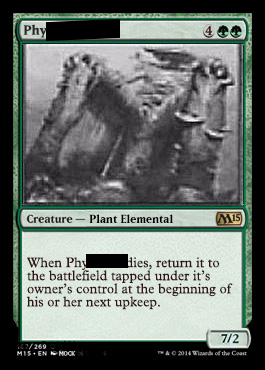
Now that Modern season is upon us, remember this--in life, love & the pursuit--it all comes down to one thing: It's not always the results you get--there are many destinations to choose from.  It's about how you got there. Choose wisely.

Magic: The Finance offers many avenues to explore. There are numerous ways to climb the rungs and make something out of nothing. I have found Modern and casual Magic to be one of the best. Competitive Magic singles are always going to be the easiest to flip and flip quickly, but sometimes the road less traveled will offer the better vistas, prices, and conversations. Knowing your community, remembering the whys and hows of it, will keep your vision clear and your steps going in the right direction.

You don't have to have the lowest prices, beg, cheat, or steal in order to make this a success-filled venture. You won't need to cut the throat of another binder grinder, card store, or competitor to achieve what you have to accomplish.

What you do need is to have a sense of where you are, where you have come from, and the people you surround yourself with. Forgetting what the average player needs or wants is the greatest of all death sentences. Putting yourself first, before the players you deal with is the greatest of all suicide pacts.

All of these are lessons that will make the time, energy, sweat and tears you put into climbing to the top worthwhile. Enjoy the camaraderie. Enjoy making money. Just remember this game is already set up in your favor. It's the work you put into it that gets the added benefits. The results you get are all determined by how you work. How you dive once more into that fray. Back into the one good fight you'll ever know. Live and die by your choices. Live and die by your choices.

-Till Next Week

(Note: The events that took place this week are real and serious. Next week, I will dive into "Event Horizon II - Sideboard Cards for Your Radar" as the lead-up to Modern season is almost fully upon us.)

Avatar photo

Dylan Beckham

Dylan has been involved in Magic: The Gathering since the heyday of The Dark. Continually invested in the community, he's been a Pro Tour Player, Trader, Judge, Tournament Organizer, Volunteer, and Vendor. Currently involved with the day to day operations of selling online, Dylan has brought his experience to Quiet Speculation to make you a better investor. Hailing from the Atlanta area, and now part of the Dallas scene - he's often at big events sourcing cards or discussing Life, the Universe, and Everything. Have a question? Feel free to comment, message, or email anytime.

View More By Dylan Beckham

Posted in Finance, Free Insider4 Comments on Insider: Magic Finance – a Story, a Path, a Choice

Have you joined the Quiet Speculation Discord?

If you haven't, you're leaving value on the table! Join our community of experts, enthusiasts, entertainers, and educators and enjoy exclusive podcasts, questions asked and answered, trades, sales, and everything else Discord has to offer.

Want to create content with Quiet Speculation?

All you need to succeed is a passion for Magic: The Gathering, and the ability to write coherently. Share your knowledge of MTG and how you leverage it to win games, get value from your cards – or even turn a profit.

Want Prices?

Browse thousands of prices with the first and most comprehensive MTG Finance tool around.


Trader Tools lists both buylist and retail prices for every MTG card, going back a decade.

Quiet Speculation