menu

Magic 2015 Accidental Spoilers?

Are you a Quiet Speculation member?

If not, now is a perfect time to join up! Our powerful tools, breaking-news analysis, and exclusive Discord channel will make sure you stay up to date and ahead of the curve.

Basically, spoilers have gone one of two ways recently. Either the entire set is spoiled early, the surprise is ruined and people get banned (or maybe that was just New Phyrexia), or Wizards keeps tight control of the spoilers and rolls them out a little at a time.

But we may have a chink in the armor here.

Pretty different, I know. But also pretty cool.
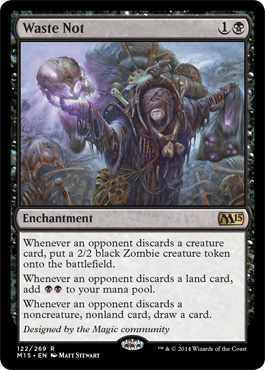
Dat new card frame for M15.

Looks like WOTC gave a Duels of the Planeswalkers preview to IGN, and some stuff was found that wasn't supposed to be (wink wink).  Look, I have no idea if this was an actual "leak" or done on purpose (solid move on Wizards' part if so), but it's cool we've got some spoilers. Convoke, as seen on stuff like Sprout Swarm is returning, which could also mean a Chord of Calling reprint to help bring down the price.

We'll see. In the meantime, you can check out the up-to-date spoilers here, including all the new ones that were possibly "leaked."

Avatar photo

Corbin Hosler

Corbin Hosler is a journalist living in Norman, Oklahoma (also known as the hotbed of Magic). He started playing in Shadowmoor and chased the Pro Tour dream for a few years, culminating in a Star City Games Legacy Open finals appearance in 2011 before deciding to turn to trading and speculation full-time. He writes weekly at QuietSpeculation.com and biweekly for LegitMTG. He also cohosts Brainstorm Brewery, the only financial podcast on the net. He can best be reached @Chosler88 on Twitter.

View More By Corbin Hosler

Posted in Feature, Finance, Free, M15Tagged , 4 Comments on Magic 2015 Accidental Spoilers?

Have you joined the Quiet Speculation Discord?

If you haven't, you're leaving value on the table! Join our community of experts, enthusiasts, entertainers, and educators and enjoy exclusive podcasts, questions asked and answered, trades, sales, and everything else Discord has to offer.

Want to create content with Quiet Speculation?

All you need to succeed is a passion for Magic: The Gathering, and the ability to write coherently. Share your knowledge of MTG and how you leverage it to win games, get value from your cards – or even turn a profit.

Conspiracy Spoilers – May 23

Are you a Quiet Speculation member?

If not, now is a perfect time to join up! Our powerful tools, breaking-news analysis, and exclusive Discord channel will make sure you stay up to date and ahead of the curve.

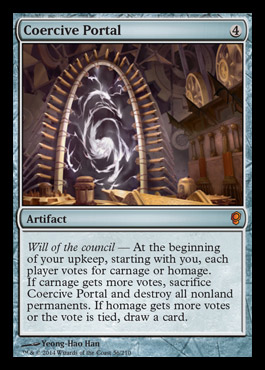
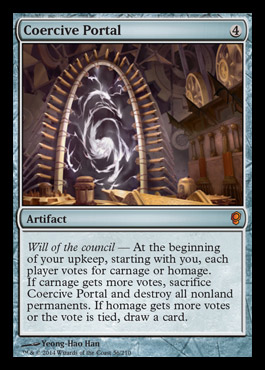
Coercive Portal

coercive portal

I love politics! This is such a great card for EDH games. Ironically, I feel like this is the least coercive of all "Will of the Council" cards so far. You draw cards until several opponents think the board needs wiped. You don't get to use this card except to draw, everyone else uses it to blow things up. I love it. Financially, I could see this doing something. It's a mythic, it's a wiper and it's a Rhystic Study and Oblivion Stone alternative occupying the same card slot - in any deck. Yep.

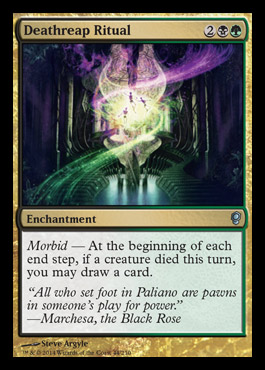
Deathreap Ritual

deathreapritual

This would be much better in the Standard format it will never be legal in.

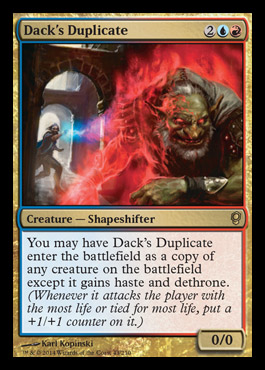
Dack's Duplicate

dacks duplicate

Yep! I like this card a lot. I don't know if it will be overpowered or anything, but I like it. Marchesa will welcome this to the fold, and clone effects are prized in EDH. This one goes right for the jugular and gets bigger. Yes, please.

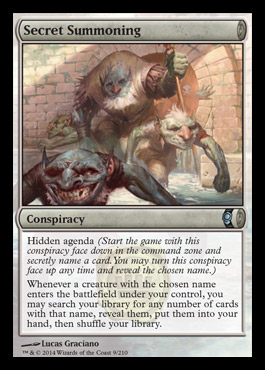
Secret Summoning

Narrow, like all of the other Conspiracies. Again, I'm not sure how financially relevant these will be, and even if a group allows them in EDH, you don't want this one.

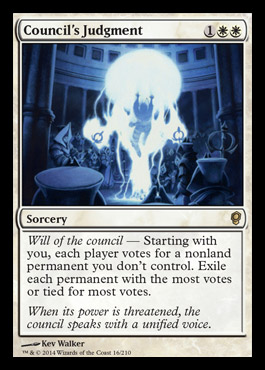
Council's Judgment

councils judgment

Would you like to also name your True-Name Nemesis or would you like to get 2-for-1'd?

This has real applicability in Legacy, which is pretty rare for cards in this set. I don't think it will be a 4-of and the double white hurts it, as does its 3 mana cost, as does the fact that we have no idea how much Conspiracy is getting printed. We'll see. This should be at least $5ish. This is less good in EDH, but still fun.

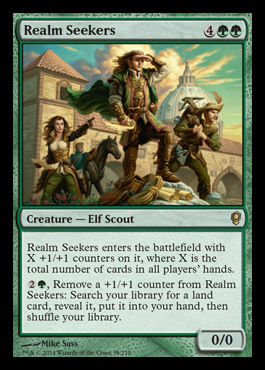
Realm Seekers

realm seekers

Yep. This is a card. This is no Sylvan Primordial but neither is it restricted to basic lands. a Multani, Maro-Sorcerer that can search for any land is just ridiculous. I love this card so much for EDH. I don't know how good it will be in Conspiracy draft, but I don't care. I need foils of these today. So do you.

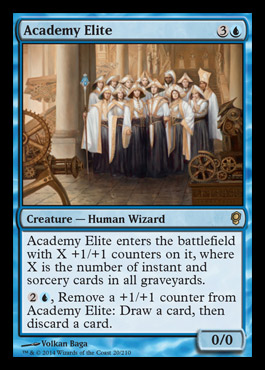
Academy Elite

academy elite

Roughly a tenth as good as Realm Seekers. I expect the price to reflect this.


Avatar photo

Jason Alt

Jason Alt is a value trader and writer. He is Quiet Speculation's self-appointed web content archivist and co-captain of the interdepartmental dodgeball team. He enjoys craft microbrews and doing things ironically. You may have seen him at magic events; he wears black t-shirts and has a beard and a backpack so he's pretty easy to spot. You can hear him as co-host on the Brainstorm Brewery podcast or catch his articles on Gatheringmagic.com. He is also the Community Manager at BrainstormBrewery.com and writes the odd article there, too. Follow him on Twitter @JasonEAlt unless you don't like having your mind blown.

View More By Jason Alt

Posted in Conspiracy Spoiler, FreeTagged , , , , Leave a Comment on Conspiracy Spoilers – May 23

Have you joined the Quiet Speculation Discord?

If you haven't, you're leaving value on the table! Join our community of experts, enthusiasts, entertainers, and educators and enjoy exclusive podcasts, questions asked and answered, trades, sales, and everything else Discord has to offer.

Want to create content with Quiet Speculation?

All you need to succeed is a passion for Magic: The Gathering, and the ability to write coherently. Share your knowledge of MTG and how you leverage it to win games, get value from your cards – or even turn a profit.

Conspiracy Spoilers – May 21-22

Are you a Quiet Speculation member?

If not, now is a perfect time to join up! Our powerful tools, breaking-news analysis, and exclusive Discord channel will make sure you stay up to date and ahead of the curve.

Let's get back on it, shall we?

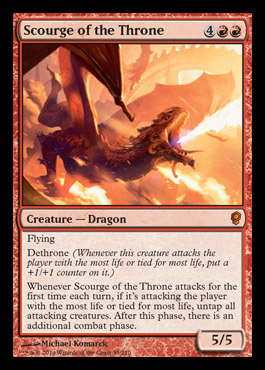
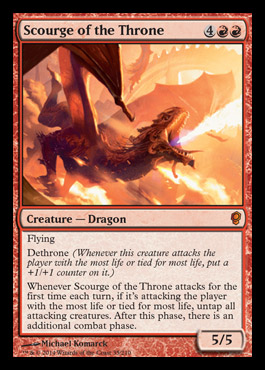
Scourge of the Throne

scourgeofthethrone

Yep, that's a Dargon alright.

The community seems split on Dethrone as a mechanic. I personally like the dimension it adds to the game. Layers of decision making are skill testers and they separate the good players from the bad. This Dargon is very cool and I've already seen players discuss how to jam it. I think Hellkite Charger is more busted in a lot of cases, but I still expect this to see play. I bet it's too much money pre-order, though.

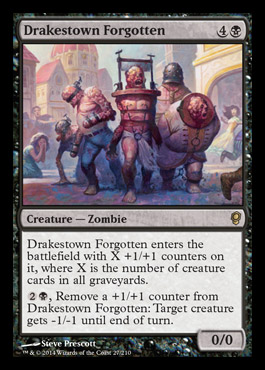
Drakestown Forgotten

drakestownforgotten

It's a zombie, so it's got that going for it. I think this has potential to be huge, but I don't know if that's enough. I like the second ability, but it's very mana-intensive. Obviously nutty in Limited.

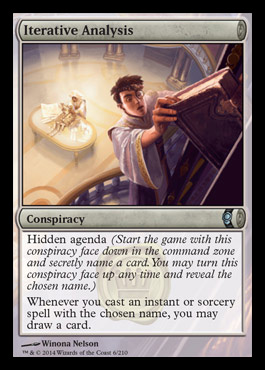
Iterative Analysis

iterative analysis

This seems a little weak, but, like most of these Conspiracy cards, there is a real sense of "better something than nothing" and this can potentially win you a game on the back of drawing you a free card for nothing. Potentially.

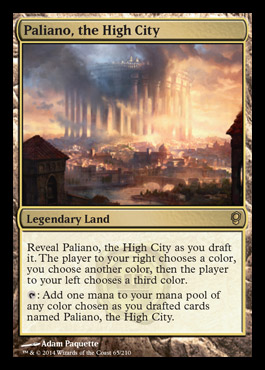
Paliano, the High City

paliano high city

Sweet! This card is pretty cool. Hoping your opponents guess what colors you're in incorrectly and give you a second mana in your colors is great. But if you pack this early, do you know your colors? Will you draft according to what this will tap for? Can an opponent subtly influence what you take? This is going to be a better than average non-basic land in play and it's going to spice up drafting so much. I love it. Love, love, love it. Outside of draft, this card is worthless.

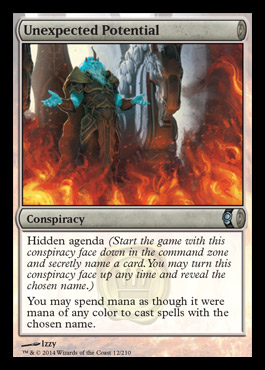
Unexpected Potential

unexpected potential

Splashing just got a whole lot easier, huh?

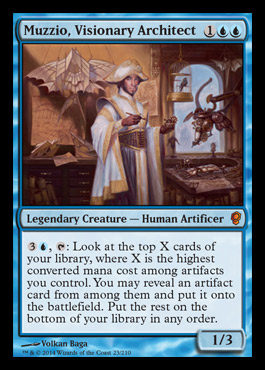
Muzzio, Visionary Architect

muzzio visionary architect

Well this has real potential. I can see this being good in a situation where the only artifact you control is Sensei's Divining Top. The fact that it isn't an artifact with mana cost X or less, but rather any artifact lends itself to this being very strong. I can see you putting out some huge artifact creatures very early. Would you rather play Sharuum, the Hegemon? Probably! But this guy could be a sweet commander, or just get jammed in a Sharuum deck. I like this a lot. He could retain some value since he's better suited to EDH than Conspiracy drafts.

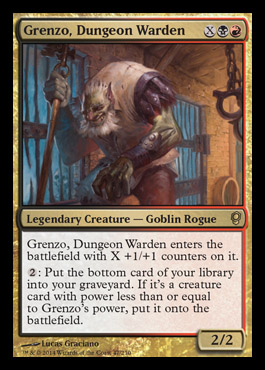
Grenzo, Dungeon Warden

grenzo dungeon warden

My reaction when I saw this card

This has real potential. I would look at Shirei, Shizo's Caretaker decks for a starting point. This can be played turn 2 and the fun can begin. Maybe Heartstone to churn through cards, or Ashnod's Altar or Phyrexian Altar to keep you going. All sorts of cheap creatures have non-trivial triggers when they enter or leave play. A deck with Living Death effects will really benefit from a yard full of dudes, even puny ones. The deck isn't obvious right away, but this seems breakable. As far as financial values are concerned, I see this as a $5ish card and I hope it gets to that level quickly. There is a deck here, I know it.

Avatar photo

Jason Alt

Jason Alt is a value trader and writer. He is Quiet Speculation's self-appointed web content archivist and co-captain of the interdepartmental dodgeball team. He enjoys craft microbrews and doing things ironically. You may have seen him at magic events; he wears black t-shirts and has a beard and a backpack so he's pretty easy to spot. You can hear him as co-host on the Brainstorm Brewery podcast or catch his articles on Gatheringmagic.com. He is also the Community Manager at BrainstormBrewery.com and writes the odd article there, too. Follow him on Twitter @JasonEAlt unless you don't like having your mind blown.

View More By Jason Alt

Posted in Conspiracy Spoiler, FreeTagged , , , , , , , 31 Comments on Conspiracy Spoilers – May 21-22

Have you joined the Quiet Speculation Discord?

If you haven't, you're leaving value on the table! Join our community of experts, enthusiasts, entertainers, and educators and enjoy exclusive podcasts, questions asked and answered, trades, sales, and everything else Discord has to offer.

Want to create content with Quiet Speculation?

All you need to succeed is a passion for Magic: The Gathering, and the ability to write coherently. Share your knowledge of MTG and how you leverage it to win games, get value from your cards – or even turn a profit.

Insider: One Last Look at Theros Block Constructed

Are you a Quiet Speculation member?

If not, now is a perfect time to join up! Our powerful tools, breaking-news analysis, and exclusive Discord channel will make sure you stay up to date and ahead of the curve.

It feels like not very long ago we were talking about the “new enchantment block. With Gods!”

But that was actually like eight months ago, and these days both Theros and its gods have fallen, both in price and in the literal sense.

I’ve talked the last several weeks about Theros block, both because of the Pro Tour and its possible impact on Standard next year. At the risk of everyone being tired of the block and its million Prognostic Sphinxes, I want to talk one more time about it now that we have Pro Tour results to analyze.

Again, the point of this exercise is to not to evaluate what will grow in price from the Pro Tour, because that’s not really a thing this year. And it’s not like Block matters from this point on.

Rather, the point is to evaluate the cards and decks that will be strong enough to make it into Standard. That means we’re looking for powerful cards and decks rather than just synergistic like Eidolon of Blossoms, a deck that got away with playing a few subpar cards because the format was slow enough to allow it to build that long-term advantage.

So let’s dig in.

The Top 8

You can find the Top 8 lists here.

Looking over the lists, there is one thing that should stand out to you more than anything else: 28 Courser of Kruphix and 24 Sylvan Caryatid. 10 Ashiok. 20 Hero's Downfall. 15 Elspeth. 12 Sphinx.

Those all make sense. But what about 19 Silence the Believers? Anyway, if you want a cross-section of the format, that picture tells you quite a bit but not everything.

For example, the most prominent thing about Block is that there was no available Wrath variant outside of Fated Retribution, a card that no one played (though maybe they should have, given how long games went). That fact allowed Sphinx to rule the roost since it was practically unkillable, but it also meant that Caryatid never died and Courser never stopped providing incremental advantage.

That last sentence really defines the format, and anything good in that environment was powerful. If that’s the format you can expect after rotation, you can basically expect the same cards to dominate.

But I really don’t anticipate that being the case. If memory serves, there hasn’t been a Standard format without a Wrath variant since at least Magic 2010, which means it’s unlikely we’ll have one this coming rotation. Keep a close eye on Magic 2015, since that’s the most likely place to find a Wrath, probably in the form of Day of Judgment.

That said, if it doesn’t happen you can pretty much expect the Standard format post-rotation to feature many of the same cards since they’re so good in that environment, even if the shells of the decks they’re in change.

So what about the aggro decks we heard so much about? Well, they mostly got cut out of the Top 8, though one of my favorite picks for next year, Herald of Torment, did sneak into the Top 8.

I also like Silence the Believers. I put a notice on it a few weeks ago as a casual card to watch out for because the exile clause and scalability give it nice long-term appeal. Well, it turns out it’s also enough for Constructed, and I expect this to stick around after rotation simply due to how flexible it is. While something like Elspeth certainly has some clear upside, the fact that the buy-in is so high makes it a little less appealing, at least in percentage terms, compared to something like Silence the Believers.

Speaking of planeswalkers, Ashiok is also very good in a slower environment and is at an all-time low of $6. Assuming no reprints, I have to assume $5 is the floor in both the short and long term. I like getting into these because even if they don’t pay off next season they are a safe long-term play. And this was all over the room, if only in the sideboard.

There was an error retrieving a chart for Ashiok, Nightmare Weaver

The Not Top 8

While the Aggro decks outside of R/W Heroic may not have made it into the Top 8, they were well-represented among the decks that did well, which you can find here.

That list of decks is usually more enlightening than the Top 8 lists, to be honest. And in those decks, we find 10 playing Herald of Torment, which I suggested picking up at the $1.50 presale price and still like at the $2 they can be found for now.

There was an error retrieving a chart for Herald of Torment

I don’t know (read: I doubt) that there will be “another Desecration Demon” next season because it’s unlikely there will be a deck as dominant as Mono-Black was earlier this season. That said, if there is to be a card that fits the bill it will be something like Herald of Torment: powerful on its own, flexible in how it can be played and able to fit into several different decks. That’s a role that Herald fills much better than something like Master of the Feast.

Another card that I find appealing is Hero of Iroas, which has a fair amount of casual appeal baked on top of an attractive print run (i.e. not the first set of the block). Furthermore, the decks it appeared in are all somewhat “budget,” which means a few things financially.

When budget-conscious players try to put together a deck, they don’t mind shelling out decent money for a few cards if the rest of the deck is draft leftovers. And with goodies like Stratus Walk and Ordeal of (whatever you want), these Heroic decks certainly qualify. Outside of Brimaz and some lands, these are very inexpensive decks, so there’s definite room for Hero to grow.

Mana Confluence will return to being $15-18. I get that several of the decks playing it at the Pro Tour will have better mana in Standard and won't need to kill themselves with it, but keep in mind we're basically at peak supply for this thing right now. It's going to get reprinted at some point, but it's going to be in demand across formats between now and then, and likely won't be cheaper than it will be in the next month or so.

That pretty much wraps up my major impressions from the format. I expect the cards that were well-represented in the Top 8 to show some growth heading into next season, particularly those that are from Born of the Gods or especially Journey Into Nyx, simply because there are so many fewer out there.

By the way, within a year you can expect Banishing Light to be the next Boros Charm, a $2-3 uncommon even after a reprinting. The newest Oblivion Ring is simply too good and too in-demand across multiple formats to not be worth a few dollars before it gets reprinted into oblivion.

Thanks for reading,

Corbin Hosler

@Chosler88 on Twitter

Insider: Why Block Matters to You

Are you a Quiet Speculation member?

If not, now is a perfect time to join up! Our powerful tools, breaking-news analysis, and exclusive Discord channel will make sure you stay up to date and ahead of the curve.

Welcome to the wild world of Block Constructed, where cards that should never see play do because there are no better options!

Block Constructed is important to your future:

Some off-the-wall cards may very well get played, but I always find Block extremely interesting. There are two main reasons why Block intrigues me. The first is because it provides a spotlight on Standard-legal cards that do not see much play. Of course, we all know cards like Courser of Kruphix and Hero's Downfall are solid playable constructed cards, but what about Ashiok, Nightmare Weaver and Prognostic Sphinx?

[cardimage cardname='Ashiok, Nightmare Weaver'][cardimage cardname='Prognostic Sphinx']

Those, along with many others, are cards we have not seen used effectively in Standard. Because Block has a much smaller card pool, players need to turn to other cards outside their normal options.

This is significant because working with these new cards intensely helps highlight their strengths and weaknesses. Sometimes you don’t know how a card will play until you actually cast it in a game or two. Once you have cast the new card, think through whether it is good or did not hold up to your expectations. By analyzing the cards in different situations, that will give you more information about whether the card can transfer over to Standard or not.

The second reason that Block is important is because the most powerful cards in the three sets rise to the top for everyone to see. In Theros block cards like Elspeth, Sun's Champion, Sylvan Caryatid and Courser of Kruphix are so potent that they have been impacting Standard since their release.

Yes we know how good Elspeth is, but the Pro Tour helped me understand that she is so good that she should be seeing even more play than she already is. One of the major decks in the format was basically the R/G Monsters deck you are used to seeing every week at FNM, but with some changes. The Block version of the deck splashed white for Elspeth--a double-colored card. That’s how powerful the planeswalker is.

There was an error retrieving a chart for

By analyzing the block format, we can better understand what is really going on in Standard and try to predict what cards will carry over into the next Standard format once rotation happens in the fall.

Transitioning Block to Standard

If R/G Monsters is splashing for Elspeth in Block, maybe we should be doing the same thing in Standard. Here’s a sample of what the deck looks like.

R/G Elspeth by Todd Anderson (30th place at PTJOU)

Creatures

4 Sylvan Caryatid
4 Voyaging Satyr
4 Courser of Kruphix
2 Polis Crusher
4 Stormbreath Dragon

Spells

4 Lightning Strike
4 Magma Jet
2 Banishing Light
4 Xenagos, the Reveler
4 Elspeth, Sun's Champion

Lands

2 Temple of Abandon
4 Temple of Plenty
4 Temple of Triumph
3 Mana Confluence
6 Forest
5 Mountain

Sideboard

2 Destructive Revelry
2 Fated Conflagration
3 Magma Spray
1 Reprisal
3 Purphoros, God of the Forge
2 Glare of Heresy
2 Revel of the Fallen God

As you can see, there are definitely some Block-specific cards in this list like Polis Crusher. There are a tremendous amount of Detention Spheres and Banishing Lights running around these days, but I don’t think that’s enough to make the red-green cyclops good enough for Standard. Most of the other cards are ones we’re familiar with from other successful decks. Now, let’s look at what a current version looks like in Standard.

R/G Monsters by Matthew McCullough (8th place at SCG Cincy)

Creatures

4 Elvish Mystic
3 Sylvan Caryatid
3 Scavenging Ooze
4 Courser of Kruphix
3 Polukranos, World Eater
4 Ghor-Clan Rampager
4 Stormbreath Dragon
1 Xenagos, God of Revels

Spells

3 Mizzium Mortars
4 Domri Rade
3 Xenagos, the Reveler
1 Garruk, Caller of Beasts

Lands

4 Stomping Ground
4 Temple of Abandon
2 Mutavault
8 Forest
5 Mountain

Sideboard

3 Mistcutter Hydra
2 Nylea's Disciple
3 Magma Spray
2 Unravel the Aether
1 Ruric Thar, the Unbowed
1 Garruk, Caller of Beasts
2 Harness by Force
1 Mizzium Mortars

As you can see, there is a big overlap between these two decks. Some of the strongest cards in the block are featured in both decks. Seeing how much overlap there is and how powerful Elspeth, Sun's Champion can be in many different decks, I think it’s about time we try this strategy in Standard.

R/G Elspeth (Standard Version)

Creatures

4 Elvish Mystic
4 Sylvan Caryatid
2 Scavenging Ooze
4 Courser of Kruphix
2 Polukranos, World Eater
2 Ghor-Clan Rampager
4 Stormbreath Dragon

Spells

3 Mizzium Mortars
3 Domri Rade
3 Xenagos, the Reveler
3 Elspeth, Sun's Champion

Lands

4 Stomping Ground
4 Temple Garden
4 Temple of Plenty
4 Temple of Triumph
5 Forest
3 Mountain

After looking over how this deck ports into Standard, it seems like it could be a real contender. Elspeth gives the deck another game-winning threat to ramp into and the other strengths of the deck are still intact. The burning question in my mind is whether or not the deck still needs Domri Rade or whether we can move in a different direction.

From my perspective, Ghor-Clan Rampager seems a bit out of place as well. There are many directions to take this concept, but adding Elspeth is the key knowledge to focus on. The deck is strong enough without her, but with her it seems like the deck could wreck up some tournaments. White also offers some powerful sideboard options as well.

[cardimage cardname='Domri Rade'][cardimage cardname='Temple of Plenty']

A Financial Conspiracy

The internet has started preselling boxes of Conspiracy and despite the supposed large supply, the boxes are selling for more money than a typical set. The lowest prices I could find online for a box at the time of writing is around $110.

There seems to be a high number of desirable Legacy and Commander staples being reprinted in this set so that may be one reason the boxes are more expensive. Another possibility is that the demand for the set is higher than expected. If the format turns out to be great, it may be worth holding onto some of these boxes long-term.

As far as the financial implications of the singles, there will definitely be a market for many of the foils from the set. I imagine the median of foil prices in this set to be higher than a normal set.

Who better to push the price of foils other than Commander and Legacy players? Dack Faden is preselling higher than any card since Liliana of the Veil due to its Legacy potential and any other new cards will need to be evaluated for their playability as well.

Until Next Time,

Unleash the Elspeth Force!

Mike Lanigan
MtgJedi on Twitter
Jedicouncilman23@gmail.com

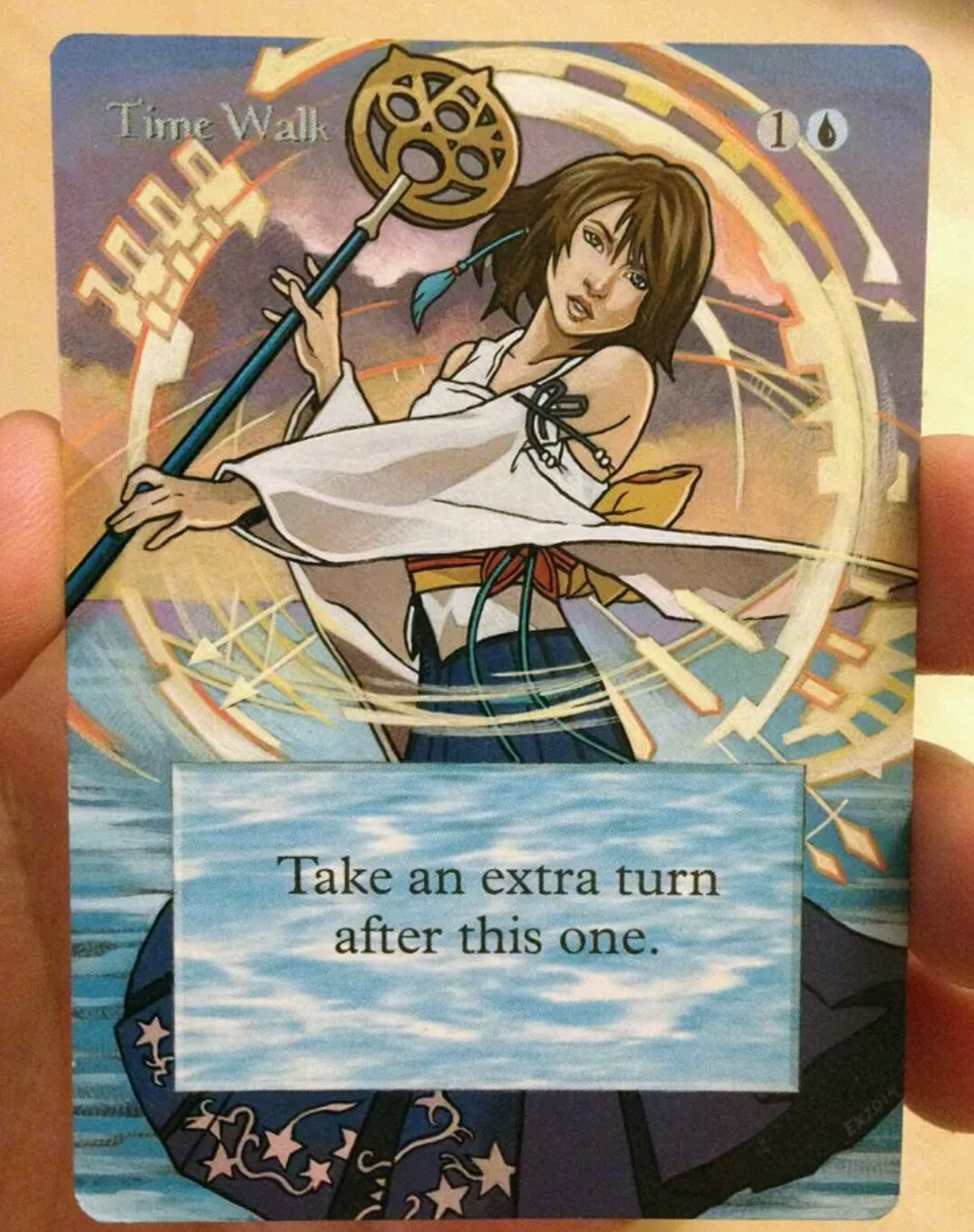
This is an Awesome Alter

Are you a Quiet Speculation member?

If not, now is a perfect time to join up! Our powerful tools, breaking-news analysis, and exclusive Discord channel will make sure you stay up to date and ahead of the curve.

About as cool as it gets.

Some days I come up with witty titles. And some days I just let the title say it all.

This is one of the second kind days, and I'm pretty sure it lives up to the hype. I'm really someone who is into alters. I have a few that I've picked up along the way, but I've never gone out of my way to have any done. I appreciate looking at them, but that's usually where it ends for me. Well, except for my custom-painted Silvergill Adept playmat, but that's not so much of an alter.

Of course, if I did, I know where I'd be going for them. This alter, as well as a ton of other awesome ones, are done by Eric Klug, Magic alterist extraordinaire. You can find more his work here.

Of course, I'm sure some of you out there have your own cool alters to share, so let's see them!

Avatar photo

Corbin Hosler

Corbin Hosler is a journalist living in Norman, Oklahoma (also known as the hotbed of Magic). He started playing in Shadowmoor and chased the Pro Tour dream for a few years, culminating in a Star City Games Legacy Open finals appearance in 2011 before deciding to turn to trading and speculation full-time. He writes weekly at QuietSpeculation.com and biweekly for LegitMTG. He also cohosts Brainstorm Brewery, the only financial podcast on the net. He can best be reached @Chosler88 on Twitter.

View More By Corbin Hosler

Posted in Casual, Feature, FreeTagged 12 Comments on This is an Awesome Alter

Have you joined the Quiet Speculation Discord?

If you haven't, you're leaving value on the table! Join our community of experts, enthusiasts, entertainers, and educators and enjoy exclusive podcasts, questions asked and answered, trades, sales, and everything else Discord has to offer.

Want to create content with Quiet Speculation?

All you need to succeed is a passion for Magic: The Gathering, and the ability to write coherently. Share your knowledge of MTG and how you leverage it to win games, get value from your cards – or even turn a profit.

Insider: The Basics of Buylists

Are you a Quiet Speculation member?

If not, now is a perfect time to join up! Our powerful tools, breaking-news analysis, and exclusive Discord channel will make sure you stay up to date and ahead of the curve.

Welcome back, readers and speculators!

Today's article will focus on buylists and buylisting.

The Basics of the Buylist

To first figure out buylisting we should probably take a look at the reasons behind the buylist prices. First and foremost, though, we need to define a buylist.

To put it simply, a buylist is a list of cards and prices for those cards an entity is willing to pay. They may or may not have stipulations on quantity, but they almost assuredly will have them on conditions. Obviously, the worse condition your card is the less they want to pay for it.

With more and more stores opening up and creating an online presence, there is more competition to buy cards. The good news (for those of us selling cards to buylists) is that the buylist price for the more in-demand cards will go up because of this. The bad news is that as awesome as our Trader Tools program is, it doesn't include all buylists--some because they don't want to be included, and many more because they simply haven't requested to be added or may not even be known to exist.

It's important to keep in mind that a because a buylist is determined by a store, there are many extraneous factors that can go into that pricing. For example, if the player base in the area is heavily focused on Standard, then that store will often take a more aggressive approach to buying Standard staples that they can sell easily. That same store might choose not to pick up Moxes or Ancestral Recalls simply because they don't have anyone in the area to unload them to.

Some stores don't maintain a buylist, or even worse just choose to use another store's. Many owners just use Star City Games' buylist for their buylist prices and the sell price for their selling prices; unfortunately for them, they doesn't understand that the reason SCG prices their cards they way they do is because they have access to a much larger player base and also maintain a much larger stockpile of cards.

Think of a buylist as a gauge of how "in demand" a card is at that particular store.  If the store owner sees a strong demand for a card and can't keep it in stock, then it's obviously smart to get more of the cards while demand still exists; the easiest way to do this is to raise your buylist price to encourage your players to sell to you.

However, when you simply use another store's buylist you're making the assumption that the demand they see is the same as the demand you see, which is often not the case.

A good example is a store in my area that purchased a very large collection from a player that included a lot of dual lands and Onslaught fetchlands. Now, I happen to know this store falls into a "doesn't maintain their own buylist" policy. To make matters worse, his player base has no desire to play Legacy.

While he may have gotten the duals and fetchlands far below their market retail value, he can't move them and won't break them down into stock that he can move (his choice). This is why it's critical, as a store or even individual, that when you create a buylist you maintain it and understand your core audience (i.e. who you expect to sell to as well as your outs).

The "demand gauge" I mentioned earlier is the primary reason that buylist prices actually do differ between stores, sometimes quite vastly. I know my favorite LGS owner will take every Sensei's Divining Top he can because our local EDH community wants them in every single deck, just as I know he won't touch power (unless the price is really good and he has me come look at it) because there's no demand in our area.

Lastly I want to talk about the spread. Its calculation is simply (Current Sell Price - Current Buy Price) / Current Sell Price. So if a card currently sells for $10 and the highest buylist price is $5 then the spread is ($10-$5)/$10 or 0.5 (50%).

The reason this calculation is important is that it signals how badly the buyer really wants this card. The closer it gets to 0, the closer they could just go and buy it elsewhere immediately; whereas the closer to 1 the less badly the buyer wants it.

My favorite cards to buylist are low-spread cards because when you factor in the costs of selling the cards to people online (you typically lose 10-13% anyways) you're selling them close to your retail profit anyways, but you're doing so immediately and all to one (hopefully) trustworthy source.

The Basics of Buylisting

Now that we know what buylists are and what they are meant to convey, let's get down to the money making part. Because the stores are competing to buy your cards, buylist prices can change quite often. This is also one of the reasons that once you set cards aside for buylisting you shouldn't sit on them. Trust me, nothing sucks more than spending hours separating cards one night, forgetting about them for a couple days, and then going back to finish sending your buylist order in to see that some of the cards are no longer desired or the price has dropped.

Keep in mind that most of the stores in Trader Tools are typically very critical on condition. This makes perfect sense as players will pay the most for NM cards, thus they need cards coming in to be NM condition. As people grade cards differently, the safest approach for these stores is to be incredibly strict, so as to appease the most number of potential customers.

I can't stress this aspect enough. It's upsetting to find out that you aren't getting what you thought because they grade your cards differently than you. Whenever I come across a card that might be questionable, I hold it back, as the "value reduction" for poorer condition is often enough to dissuade me from sending the card.

It is also important to review the stores you're looking to send to ahead of time (our own Reseller Review section in the forums is spectacular for this). You can get a feel for how strict the store grades; how they deal with condition discrepancies (some send the cards back and remove the cost of return shipment from your payment, some keep the cards, some downgrade them without alerting you, some you have to request an alert); how quickly they pay (from very slow to right on the ball); if certain payment methods will cost extra (some charge you for sending out a check, some simply delay the check, most won't gift with PayPal, so you'll lose PayPal's percentage); and most importantly how reputable they are (after all once the cards are in the mail, they don't really belong to you anymore).

Lastly, one useful strategy when you're planning to go to a big event like a GP is to research what vendors will be there ahead of time. Then look for cards you're willing to unload to them on site. The reason this helps is that you can see them grading your cards in front of you (and you can say no if they downgrade it),you can save on shipping costs, and you get paid immediately and without losing money for PayPal fees or them cutting a check.

My Personal Buylist Strategy

I wanted to seperate this bit from the previous paragraph because this is an example of how I buylist and there is certainly no "right way" to buylist.

  1. I determine which vendors I feel comfortable selling to (hence why I suggest you do a thorough read of our Reseller Review section).
  2. I make 5x7 notecards and list the vendor name at the top. At this time I figure out if I think I'll want to be paid in cash or store credit. This is important because if the store has something I really want I may be more lax on my step 3 requirements in order to make sure the numbers add up.
  3. I go through my binder and figure out what I really want to hold on to, what hasn't moved, and sometimes what I just want to sell before I think it will lose value.
  4. I go to TT3 and look up values and spreads--my personal preference is 35% or below.
  5. Verify the quantity the store with the highest buy price (on my "approved vendor list from step 2") wants.
  6. Thoroughly check the condition of each card I place in the pile.
  7. Move on to the next card.
  8. Once I've compiled my buylist piles, I put them in a fatpack box (marked "Buylisted")  to keep them isolated from other trade stock. If I have time I'll swing by my favorite LGS and let him comb through the box and pull out anything he wants (so long as he matches the highest buylist price on TT3).
  9. Place buylist orders with approved vendors.
  10. Place each vendors buylist order in a small box with appropriate packaging (the old tournament pack boxes are great for orders of 50-70 cards and a packing peanut can be put inside to keep the cards from shifting about).
  11. Place those boxes into a bubble mailer.
  12. Go to my local post office (I've found their prices are much lower than UPS or Fedex) and mail off my order.
  • The cost of shipping goes up depending on how far away the destination is, however it's usually not that much more.
  • Weight is a major factor in the cost of shipping. Sometimes it's cheaper to ship two smaller packages to the same location than one larger one.
  • Keep in mind shipping costs when determining whether a buylist is worth sending; after all, if you're sending out $5 in buylist to a store but shipping costs $3 to get it there you're really only making $2.

Insider: Modern Izzet Delver and Eidolon Zoo

Are you a Quiet Speculation member?

If not, now is a perfect time to join up! Our powerful tools, breaking-news analysis, and exclusive Discord channel will make sure you stay up to date and ahead of the curve.

Phone. Wallet. Keys. Backback. Did I remember to put my deck box in my backpack? Okay, it's there. Is that for sure the deck box I put my deck in? Those look like the right sleeves. I'll just double-check to make sure that the right cards are in here...

I constantly worry that I'm forgetting something. I have no idea when or why this compulsion started, and somehow despite this I manage to forget things from time to time. When I left home for GP Minneapolis, I must have left my ability to think clearly behind.

I know that I'm not perfect--as player or person--and I've certainly punted my fair share of games, but my tournament last weekend was outright embarrassing. My 6-3 record could easily have been 8-1 if I just played with a little more focus. My play was at best greedy and at worst foolish.

The silver lining from the weekend (outside of the Super Sunday Series top 8) was that I came up with a sweet list.

Izzet Delver

creatures

4 Goblin Guide
4 Delver of Secrets
4 Snapcaster Mage

spells

4 Lightning Bolt
2 Pillar of Flame
4 Mana Leak
1 Remand
4 Spell Snare
4 Gitaxian Probe
3 Vapor Snag
4 Serum Visions
2 Vedalken Shackles

lands

4 Steam Vents
4 Scalding Tarn
4 Misty Rainforest
3 Arid Mesa
3 Island
2 Mountain

sideboard

1 Steel Sabotage
1 Hurkyl's Recall
1 Hibernation
1 Combust
1 Electrickery
2 Negate
1 Relic of Progenitus
1 Counterflux
2 Spell Pierce
1 Dispel
2 Magma Spray
1 Dismember

Cutting Young Pyromancer looks like a bold move, but the card really didn't fit the deck. Goblin Guide and Delver of Secrets are the pinnacle of efficient one-mana creatures--the very embodiment of tempo. Snapcaster Mage rebuys all of the excellent tempo spells in the deck, and is arguably the strongest card in Modern.

Young Pyromancer, on the other hand, is something of a grindy value creature. Randomly (and seldomly) he was amazing, but I could never shake the feeling that he was out of place. While writing my article on sideboard options, I had a pretty wild idea.

There was an error retrieving a chart for Vedalken Shackles

Mana intensive? Yes. Slowest element in the deck by a mile? Sure.

But it's good.

When I think of Vedalken Shackles, I think of controlling strategies. That is to say, that's what I used to think. Then I played a couple games where I Bolted and Snagged a creature or two before slamming Shackles on turn three. It felt real good.

Having a Shackles in play makes it a lot harder for a Splinter Twin player to combo off and also does a lot of work in the type of games that the rest of the deck struggles with--that is where your opponent just kills all of your guys. Obviously it doesn't have protection from Abrupt Decay, but I don't know that there's a great solution to that problem.

Hibernation was a card that I hadn't seriously considered until the day before the GP. Pod was a tough matchup, and I was looking for any way to solve it. I saw that Travis Woo was sideboarding them in his Ninja Bear Delver deck, so I thought I'd take it for a test run.

Long story short, the card definitely isn't leaving the sideboard, and a second might be warranted. It bounces the majority of their permanents and even hits the Voice of Resurgence token generated when you play it on their turn. That, and it gives you a pretty unreal tempo play against Hexproof.

There was an error retrieving a chart for Voice of Resurgence

I took this list to a grinder on Friday night and punted round three to a pretty mediocre U/W Control deck after dispatching Living End and Affinity. The Grand Prix itself went like this:

Round 1: Bye
Round 2: 2-0 vs. Affinity
Round 3: 2-1 vs. Affinity
Round 4: 1-2 vs. Nathan Holiday on Birthing Pod
Round 5: 2-0 vs. R/G Tron
Round 6: 2-1 vs. Izzet Delver
Round 7: 2-0 vs. Paulo Vitor Damo da Rosa on Birthing Pod
Round 8: 1-2 vs. Merfolk
Round 9: 1-2 vs. RUG Scapeshift

In round four I played right into an Orzhov Pontiff in what I believe would otherwise be a very winnable game. In round 8 I cast a second Shackles before activating my first Shackles, which ate all my mana and ended up costing me a game. In round 9 I can't really point to specific errors, but I know that I didn't play well.

That all in mind I was never disappointed in the deck and would absolutely play it again. I wouldn't change anything in the maindeck, and the only sideboard change that I'm considering at this time is making room for a second Hibernation.

Changing Gears

If I were looking for a different Modern deck to play though, I'd work on something like what Dana Kinsella played this weekend. He was playing Zoo featuring what has quickly become my favorite card from Journey Into Nyx:

There was an error retrieving a chart for Eidolon of the Great Revel

After its Standard Open win in Knoxville, I think that people are starting to realize how good this card is. Comparisons to Pyrostatic Pillar are a bit short-sighted. Sure, you could never Lightning Bolt a Pillar, but it also never attacked you for two on top of punishing you for playing Magic.

Outside of being a maindeckable answer to Storm, a previously problematic matchup for Zoo, Eidolon also beats up on anybody trying to play Serum Visions. Snapcaster Mage also loses quite a bit of stock when it costs four life to cast him and the flashback target.

The only question on my mind is whether Eidolon belongs in Small Zoo or Big Zoo. It seems to me that the more time you take killing your opponent, the less the Eidolons matter. You could make the argument that having spells like Thundermaw Hellkite that don't ding you makes sense, but I think a more efficient and aggressive deck in general will give you better mileage.

I would recommend hedging against losing to your own Eidolon somewhat, but I think that just jamming these will do the trick:

There was an error retrieving a chart for Lightning Helix
There was an error retrieving a chart for Ghor-Clan Rampager

Helix for the fact that you still gain one life with an Eidolon in play and Rampager not only for being a four-mana spell, but also a two-mana trick that won't trigger Eidolon.

Dana's list was heavily red, and I don't see a compelling reason to change that. Wild Nacatl into Eidolon of the Great Revel is probably the deck's ideal start. Here's a rough sketch of an Eidolon Zoo maindeck:

Eidolon Zoo

creatures

4 Wild Nacatl
4 Kird Ape
4 Goblin Guide
2 Grim Lavamancer
4 Tarmogoyf
4 Eidolon of the Great Revel
2 Scavenging Ooze
4 Ghor-Clan Rampager

spells

4 Lightning Bolt
4 Lightning Helix
2 Path to Exile
1 Pillar of Flame

lands

4 Arid Mesa
4 Scalding Tarn
4 Verdant Catacombs
3 Stomping Ground
3 Sacred Foundry
1 Temple Garden
1 Mountain
1 Forest

Dana was playing a 2-2 main-side split of Path to Exile, which I just went ahead and applied here. I know that you want all four in the 75, but I'm not sure what the exact configuration should be, so I just deferred to him as he's played this type of deck a lot more than I have.

To round out the sideboard I know I'd want something against burn, something against Twin, something against Affinity, something against Pod and probably some Thalia, Guardian of Thraben. You'll note the maindeck Pillar of Flame, which is largely a nod to Kitchen Finks. I would definitely want more of this type of effect in my sideboard.

Modern to Come

Come Modern PTQ season I'll be putting more work into both of these decks and hopefully I'll be able to see some success with one of them. It's entirely possible that Birthing Pod is the strongest deck in Modern, but it's both difficult to play and on the short list for decks to possibly see a ban in the near future.

Both of these reasons are keeping me off the deck, though I would say it's an excellent choice if you have access to it and can play it well. If you're looking for an alternative, I believe that both of the decks that I featured today are excellent options.

Next week I'll be dipping back into Standard. Specifically I'll highlight the Red Devotion deck that I top 8'd the Super Sunday Series tournament at GP Minneapolis with as well as examining other homes for Eidolon of the Great Revel in Standard.

Thanks for reading.

Walking the Hero’s Path

Are you a Quiet Speculation member?

If not, now is a perfect time to join up! Our powerful tools, breaking-news analysis, and exclusive Discord channel will make sure you stay up to date and ahead of the curve.

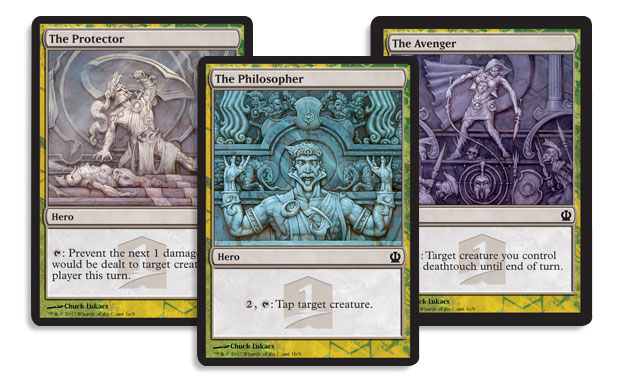
Have you been following the Hero's Path?

If you don't know what it is, it's a cool little "campaign" released by Wizards of the Coast along with Theros block. At Game Day for each of the sets you take a different challenge, whether it's fighting the Hydra or something else. It's pretty fun and different, allowing you to take a team approach similar to Archenemy. 

Walk the path!
Walk the path!

Of course, this is something that was mostly for casual players, and that's okay. Most of the tournament grinders I know weren't super excited about it, but they're not the intended audience anyway. In fact, one of the great things about Wizards is how they can appeal to so many different segments of the playing population.

Anyway, I know one group that did enjoy the experience, and that's the awesome folks over at Loading, Ready, Run. A video of the group walking the path of the hero was posted to the Mothership on Wednesday, and it's well worth a watch as always. You can find it here.

http://www.wizards.com/Magic/Magazine/Article.aspx?x=mtg/daily/feature/300c

Avatar photo

Corbin Hosler

Corbin Hosler is a journalist living in Norman, Oklahoma (also known as the hotbed of Magic). He started playing in Shadowmoor and chased the Pro Tour dream for a few years, culminating in a Star City Games Legacy Open finals appearance in 2011 before deciding to turn to trading and speculation full-time. He writes weekly at QuietSpeculation.com and biweekly for LegitMTG. He also cohosts Brainstorm Brewery, the only financial podcast on the net. He can best be reached @Chosler88 on Twitter.

View More By Corbin Hosler

Posted in Casual, Feature, FreeLeave a Comment on Walking the Hero’s Path

Have you joined the Quiet Speculation Discord?

If you haven't, you're leaving value on the table! Join our community of experts, enthusiasts, entertainers, and educators and enjoy exclusive podcasts, questions asked and answered, trades, sales, and everything else Discord has to offer.

Want to create content with Quiet Speculation?

All you need to succeed is a passion for Magic: The Gathering, and the ability to write coherently. Share your knowledge of MTG and how you leverage it to win games, get value from your cards – or even turn a profit.

What card were you most wrong about?

Are you a Quiet Speculation member?

If not, now is a perfect time to join up! Our powerful tools, breaking-news analysis, and exclusive Discord channel will make sure you stay up to date and ahead of the curve.

This is a conversation brought on by an interesting Reddit post (which you can find here), so I decided I may as well share one of my most embarrassing misses.

The highlight of that thread, for me, is Brian Kibler being completely honest about his biggest miss: Daybreak Ranger. I remember when that happened and Ranger was supposed to be the next big thing, but it never really took off.

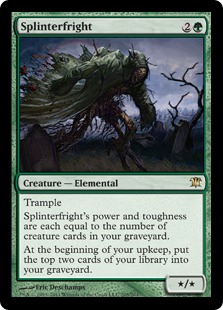
It was the same with my biggest miss: Splinterfright.

I own 94 of these to remind how wrong I was.

I thought this would be a thing. I got 94 of them at under 50 cents, and I thought with Dark Ascension the archetype could really take off. And, to be honest, it nearly did. There just never came the right metagame for it, even after more support cards came.

The investment definitely didn't work out, but it's not keeping me up at night either. I didn't lose much on these, and had it worked out it would have paid off really well. But hey, live and learn, right?

Anyway, that's my story. What was your biggest miss, either speculative or just in theory? What did you think would become a force but never quite did?

Avatar photo

Corbin Hosler

Corbin Hosler is a journalist living in Norman, Oklahoma (also known as the hotbed of Magic). He started playing in Shadowmoor and chased the Pro Tour dream for a few years, culminating in a Star City Games Legacy Open finals appearance in 2011 before deciding to turn to trading and speculation full-time. He writes weekly at QuietSpeculation.com and biweekly for LegitMTG. He also cohosts Brainstorm Brewery, the only financial podcast on the net. He can best be reached @Chosler88 on Twitter.

View More By Corbin Hosler

Posted in Casual, Feature, FreeTagged , 12 Comments on What card were you most wrong about?

Have you joined the Quiet Speculation Discord?

If you haven't, you're leaving value on the table! Join our community of experts, enthusiasts, entertainers, and educators and enjoy exclusive podcasts, questions asked and answered, trades, sales, and everything else Discord has to offer.

Want to create content with Quiet Speculation?

All you need to succeed is a passion for Magic: The Gathering, and the ability to write coherently. Share your knowledge of MTG and how you leverage it to win games, get value from your cards – or even turn a profit.

Insider: Trading Literally Anything

Are you a Quiet Speculation member?

If not, now is a perfect time to join up! Our powerful tools, breaking-news analysis, and exclusive Discord channel will make sure you stay up to date and ahead of the curve.

I got the opportunity today to discuss the case I run at an LGS. I like when I get the opportunity to talk about that case because I feel like it's instructive to do so. As much as I fell bass-ackward into it a little bit, I still feel like it was a great example of seizing an opportunity when a good idea occurs to you.

I've talked about that case at length. I've discussed how I came up with the idea, how I negotiated the deal, etc. I've even talked about how to use it as a place to subtly establish the price of a bulk rare as $1 to make your instant collections jammed with bulk rares seem more appealing.

I don't really want to talk about that right now because I've gotten an idea for something that I don't talk about enough about but which matters as much as any of the rest of it. I know I normally talk about how to out your cards using a buylist, but what you sell matters as much as how you sell it.

Filling Up the Case

There are other shops in the town where my LGS is located. In fact, there are too many. Last summer it was "my" store and one other; run poorly by a borderline criminal and whose idea of a "sale" was selling for "just" Star City prices.

That store had a community built around Friday Night Magic so they still had the market on competitive singles cornered. When I first started running the case, I figured I'd run a bunch of different stuff up the flagpole and see who saluted. I jammed some casual stuff, some competitive Standard stuff, some Legacy and a bunch of dollar rares.

The dollar rares sold well as long as I cycled the contents of the boxes. If someone digs through and sees the same cards twice, they won't dig through a third time; Einstein's definition of insanity and all that. I noticed that the Standard stuff sold okay, but the casual dollar rares sold better than the staples. The Legacy stuff scarcely moved.

I left some of it in there after the prices increased to see what would happen and it just didn't move. No one was interested in $9 Shardless Agent. It would have been worth it to me to sell them for that cheap if the buyer told his friend what he paid and where he got them, but no dice. Legacy stuff just sat.

I put together a playset of Urzatron lands with the same art and sold a set of 12 for $10 and those all moved, which was cool. Playsets of things like Dragon's Claw and Oblivion Ring moved in the boxes I stuff them into, which really beat the buylist price and allowed me to fuzz the value by putting individual copies in the boxes for about 40% of what I sold the playsets for. It's easy to beat your own prices; I recommend doing it as much as possible.

I rotated the contents of the boxes of commons and uncommons and there seemed to be no discernible pattern. Goblin Matron didn't sell better or worse than Trinket Mage, Muscle Sliver didn't sell better or worse than Fiend Hunter, etc.

Uncommons with very low spread just sat in the boxes for a while if they sold at all, so I started putting high spread cards like Squadron Hawk in the box to see if I could get more than the "basically dildos" I'd get for them on a buylist. Again, no discernible pattern, but stuff sold and it's hard to sneeze at free money unless you're allergic to it.

EDH staples moved well, even some of the super expensive stuff, which puzzled me. I didn't sell a $9 Shardless Agent over a two-month period but I sold a $100 Karakas in under a week. Foot traffic is a funny thing and that appears to have been an isolated incident.

Cards that were only available in the Commander decks moved quickly, and even some foil cards (and even some foreign cards) that are good in EDH moved. Clearly the traffic into the store was more casual than competitive.

I combined these data with one immutable truth I learned almost the very first time I checked in on my case.

I Can't Keep Planeswalkers in Stock

Like, even a little bit. I cannot keep copies of Tibalt, the Fiend-Blooded in the case. I cannot keep copies of Chandra Nalaar. I cannot keep copies of Sorin Markov.

If you would like, I can make a list of all of the planeswalkers I have a difficult time keeping in stock in my case because the answer is "all of them." Accordingly, the list of planeswalkers I need to pick up at any given time is also "all of them." I need to get every planeswalker I see in a binder.

Seriously, all of them. If I see damaged ones on TCG Player for close to buylist, I buy those and put those in the case. They sell even better because they're below full retail. I just write the near mint price on the sleeve, cross it out and write a cheaper price on there and kiss the cards goodbye. As long as the cards have four corners, plus or minus one, and are not nor have ever been on fire, I can move them.

It's no mere coincidence that the number of players joining the game began to expand exponentially when Lorwyn was released. Planeswalkers have captured the casual community's imagination like nothing ever before. If you're insulated from that community, you may not be aware of how differently planeswalkers are treated by that community.

I keep going back to this example because I feel like it's illustrative and it has the benefit of being a true story which gives me all kinds of built-in gravitas.

I was at a local community college because I had discovered that players hung out in a common area near the cafeteria and jammed casual games for hours in the afternoon between their classes. I gave them my trade binders and they blew past the first few pages with all the "good" stuff like Snapcaster Mage and Huntmaster of the Fells and began salivating over the "bad" stuff like the foil promo Moonsilver Spear; one of them literally ejaculated a "Holy crap!" when he saw I had three more copies of the spear in the binder page behind the first. "I will trade you literally anything for that!" which sounded like an odd thing to say.

As we got trading and I pointed to a Liliana of the Dark Realms to see if it was for trade, two of his friends both said in unison "he won't trade that" and he had to interject and assure me that, yes, it absolutely was on the table. His friends seemed taken aback. It was then I realized that what sounded hyperbolic to me was actually a coded phrase--he was telling me, "I will even trade the Liliana that has been sitting in my binder that I don't even let me friends breathe on."

Another member of the group explained to me that the page on the back of his binder that had five of the cheapest planeswalkers on it was not for trade. He was collecting all of the planeswalkers. He didn't have Jace, Liliana, Karn or any of the ones over $20, but he was collecting them, dammit!

I had always known that casual players liked planeswalkers instinctively. What I did not know was that some groups liked planeswalkers so much that if you didn't do the secret handshake you weren't allowed to point to the page they were on. This was excellent news. The next time I went back I made sure I had some cheap walkers. Garruk Wildspeaker, Elspeth Tirel; I thought two of them were going to fight over who got to trade for Tibalt. It was insane.

Since most of you don't have a display case where you can sell planeswalkers for retail, how can you leverage this observation? Is there a way you can benefit from trading for planeswalkers at retail and buying jacked up copies online?

Grim and Spread 'Em

The way to deal with planeswalkers is to be aware of where there is a margin built into them. First of all, it's important to get a sense of what we're dealing with.

There was an error retrieving a chart for nissa revane
There was an error retrieving a chart for garruk wildspeaker

There was an error retrieving a chart for sarkhan vol
There was an error retrieving a chart for sarkhan the mad

There was an error retrieving a chart for chandra nalaar
There was an error retrieving a chart for sorin markov

The spread varies a bit, but it hovers around 30% +/- 10% for almost all cases for mediocre planeswalkers. I target mediocre planeswalkers for a few good reasons.

First of all, competitive players don't care about them at all. Even if they look the price up, something they might not even do, there will be no inertia. A guy trying to trade for a True-Name Nemesis isn't going to beat you up over the price of his Venser the Sojourner; you'll likely get value on principle. You can afford to trade for the planeswalker at retail price easily because you know you're going to have no trouble trading your planeswalker out.

Second of all, mediocre planeswalkers are attainable. If you show up at the community college with a binder page of Japanese foil Jace, the Mind Sculptor, you might as well have farted and fanned it under their noses. They'll just look at it, sigh, look at their binder and say something like "I could never afford that."

Don't bum them out. The crazy thing is, they'll see a slightly warped Jace Beleren and say "I don't think I can afford that" and you get to show them that they totally can when you take stuff out of their binder they don't care about. You know an excellent place to get copies of True-Name Nemesis? The casual player who bought a Mind Seize at Walmart and has no use for a 3/1 merfolk in his demons and dargons multiplayer deck.

Since I realized all of this, I started targeting every mediocre planeswalker I saw in binders and it was a strategy that I continue to be very happy with.

OK, so the technique of "trade casual cards from competitive players and competitive cards from casual players" isn't exactly a huge revelation to many of you--this is that principle but with all of the thinking taken out of it. Since you know the spread range for any planeswalker, no matter how little it's played, is going to be around 30%, you can aggressively trade Standard stuff for it.

If you have a binder with 100 copies of Polukranos, you can take it to an imaginary dealer and they'll give you about $350. That's going to pay for the trip, but we can do better. Selling a card with a 40% spread that is so desirable in Standard right now feels bad. If you can get players on the floor to value Polukranos at around $7 and trade you two copies of their $11 Nissa Revane for three of your $7 Polukranos, making up the extra dollar with either hand-waving or a pull from your $1 binder of dime rares, you can turn 100 Polukranos into 66 Nissas which will buylist for $544.50. Moreover, the Nissas are much more likely to retain value. I will snap trade any "hot" Standard card for planeswalkers. They are quickly becoming my favorite place to stash value.

Even Riskier Business

When there is a real gap in spread like between Standard staples and planeswalkers, it can make real sense to buy in with cash. You can pay retail on cards with big spread, like Polukranos, Sylvan Caryatid, Master of Waves and trade them for any one of the many planeswalkers whose spread is closer to 20%. If your goal is to sell to a buylist at the end of the weekend, you can easily double your money by buying hot Standard cards and trading them with the many, many willing trade partners who don't value low-spread casual cards.

Are there cards with lower spreads than planeswalkers? Sure, but if you don't have them all memorized, you know for sure that a planeswalker will have a low spread, high desirability, retain its value even in spite of a reprinting or two and will serve as a secret handshake to get casual players excited to see you every week.

I won't even sell the planeswalkers at buylist like in the example because I know I can move them in my case for full retail. If you can buy the Standard cards at buylist prices or even above buylist, even better. Paying $4 for Master of Waves is below retail, above buylist, and a great way to have cards a competitive player wants, making him more than happy to pitch you a few copies of Chandra Nalaar for the equivalent value in Masters.

Planeswalkers have a lot of profit built into them for the people willing to mine them out of competitive players' binders. Even the spikiest of spikes may have a soft spot for certain walkers and sometimes they aren't for trade, but if you do see them in a binder, you don't need to get your phone or go into the tank.

Try it next time you go trade. Tell people you are only looking for planeswalkers, you don't care which ones. You will get trades, and people might even come find you when they hear you are looking for them. You can track exactly how much you made trading straight across because of the low spread and high saleability of Magic's most iconic card type. How can you not make money? They're worth literally anything.

Insider: Block to Standard – Looking Ahead

Are you a Quiet Speculation member?

If not, now is a perfect time to join up! Our powerful tools, breaking-news analysis, and exclusive Discord channel will make sure you stay up to date and ahead of the curve.

Block Constructed Pro Tours are divisive. Some people enjoy them, and others think they’re a waste of time. It’s a format many of us will only see once, and over the last couple years we’ve seen that Block does not always predict the following year’s Standard.

There was an error retrieving a chart for Wolfir Silverheart
There was an error retrieving a chart for Advent of the Wurm

However, it would be an error to just discount the results of this event entirely. There is lots to observe, and thus lots to learn. Let’s take a look at some of the opportunities presented by the top eight.

The Defining Cards

The most frequently played cards in the tournament were the usual suspects: the ten scry lands were all over the place, fixing mana and draws all at once. These lands are all currently sitting at around $5. More and more, it seems likely that they will see a bump after rotation.

I’m unsure how high they can go, but because of the 6:2:1 drafting ratio, the best targets are from Journey Into Nyx and Born of the Gods. I believe Temple of Epiphany will see play in Modern combo decks, and being from JOU probably makes it the best pickup of the ten.

There was an error retrieving a chart for Temple of Epiphany

At least one copy of Mana Confluence showed up in seven of the top eight decks, totaling 18 copies. With lots of three-color decks in the format, this makes sense, although I am surprised that even control decks were running this card. I suppose being able to play one’s spells is important enough to make the life loss worth it.

I expect the card to be a format staple for aggro decks moving forward, but I doubt it will be this prevalent among control decks. How next year’s Standard shapes up will dictate the trajectory of this card. Given the new set and the inherent lack of supply that comes with it, I’m looking to sell copies for a couple weeks until the summer lull, at which point a buy-in may be warranted.

There was an error retrieving a chart for Mana Confluence

But besides lands, which cards really dominated the top eight? With 28 copies each among the day-three competitors, these little guys simply defined the format:

There was an error retrieving a chart for Courser of Kruphix
There was an error retrieving a chart for Sylvan Caryatid

Unfortunately, the price points for both of these cards are not particularly attractive for buy-ins. Sylvan Caryatid is a rare from a large fall set, which is hardly a recipe for a huge price tag. Courser of Kruphix is close to $10, which is probably already somewhat inflated due to BNG’s underwhelming card pool.

While I wouldn’t suggest buying in with an eye toward profit, these are cards you should be holding for next year. Looking to play Standard after rotation? Prioritize getting your copies. Trading more volatile cards (like RTR-block or JOU cards) for these must-haves is a viable option as well.

Every Day I’m ‘Walking

If there’s one thing this event had a lot of, it was planeswalkers. All five of the block’s planeswalkers saw heavy play throughout the tournament. In the top eight, there were 15 copies of Elspeth, Sun's Champion, 10 copies of Kiora, the Crashing Wave, 10 copies of Ashiok, Nightmare Weaver, eight copies of Xenagos, the Reveler, and two copies of Ajani, Mentor of Heroes, for a total of 46 among the eight decks.

There was an error retrieving a chart for Elspeth, Sun's Champion

Elspeth is likely to be a format staple next year, but at close to $20 retail, I don’t like it as a buy. Last year, Jace, Architect of Thought was a great spec at half the price, and when it spiked, it fell just short of $30. I don’t see Elspeth as a $40 card, so again, copies should be traded for and held, but not aggressively acquired.

There was an error retrieving a chart for Ashiok, Nightmare Weaver

On the other hand, Ashiok is coming in with a low spread paired with a low retail price. Whether or not Ashiok is good next year will be dependent on the metagame, but casual demand will never allow a planeswalker purchased for $5 to $6 to be a huge loss. I’m looking to trade for copies aggressively and will keep an eye out for particularly well-priced copies.

There was an error retrieving a chart for Xenagos, the Reveler

Everything said about Ashiok applies to Xenagos with regards to price, spread, a casual floor, and my ideas regarding acquisition. Xenagos is great against control and will thrive in a control-dominated metagame.

There was an error retrieving a chart for Kiora, the Crashing Wave

Kiora is such a cool card, but I can’t advocate buying or even trading for copies at the current price. Yes, Born of the Gods was opened at only a third of the rate of Theros, but it’s very unlikely that Kiora crosses the $30 threshold. That’s pretty common for freshly-released planeswalkers, but that number is very seldom reached after the hype wears down.

There was an error retrieving a chart for Ajani, Mentor of Heroes

Ajani is too freshly released to be picked up now. I knew this was the case before even looking up the price, and once I did, my instinct was proven true. I’m waiting for Journey cards to settle.

Get Out of My Way

Two rare removal spells each saw 20 copies in the top eight (okay, one had 19).

There was an error retrieving a chart for Hero's Downfall

Hero's Downfall was instrumental in destroying creatures and planeswalkers both, though we quite often saw it fall short of truly answering Elspeth—those tokens cause some real trouble!

Since Theros was released, Hero's Downfall has fallen from about $15 to $5. As a rare in a large fall set, this drop was expected. A reprint in an event deck merely quickened the decline. At its current price, Hero's Downfall is likely not a great spec, but if you don’t have your copies yet, you should get on that before the summer ends.

There was an error retrieving a chart for Silence the Believers

Silence the Believers is an interesting one. At less than $1 retail, it’s hard to find a cheaper buy-in among cards that dominated this tournament.

However, it’s important to note that Theros block lacks a true sweeper. Silence the Believers may have saw an inordinate amount of play due to the fact that it can serve as spot removal in the early-to-mid game, but can act as a sweeper of sorts in the late game.

It’s extremely good against bestow, so the future of this card depends on the sweeper situation in Standard and how much bestow is being played in tournaments. You certainly can’t go wrong trading for copies at the current price, and buying in is certainly worthy of consideration.

There was an error retrieving a chart for Thoughtseize

While not a removal spell per se, there were 18 copies of Thoughtseize in the top eight, which is actually lower than I would have expected. This card does good work in every competitive format; it’s a true staple. With the Lorwyn printing reaching as high as $65 before the release of Theros, the card’s financial future has lots of upside.

There will be a time to buy in, but the question is whether that will be this summer or when Theros rotates. Given the MTG community’s growing knowledge of basic finance principles, as well as the growing Modern playerbase, I have a good feeling this summer will be the time to buy. Have some funds ready to devote if the retail price drops below $15 at any point.

It’s a Trap

Finally, I’d like to highlight three cards from which I am staying away despite being prominently featured in the event coverage.

There was an error retrieving a chart for Prognostic Sphinx

Corbin was quick to point out on Twitter that Prognostic Sphinx was likely performing so well due to the lack of a sweeper in the format. This is accurate, but even more so, the problem with the Prognosticator is that it doesn’t really fit in aggro and doesn’t close the game out fast enough in control.

The card is powerful, though, so perhaps a midrange blue deck looking for value will want it post-rotation. I have been getting these as trade-ins for quite a while, so personally I’d love to see a spike, but I’m not putting any money toward this card, despite the very low buy-in price.

There was an error retrieving a chart for Eidolon of Blossoms

Despite being talked up all weekend long, including in the top eight, the fact is that only one Eidolon of Blossoms deck made it to day three. This doesn’t mean the card isn’t good (quite the opposite really—somebody made top eight with it!), but it’s not as dominating as the coverage guys led us to believe over the weekend.

With a promo printing and being only a rare, I can’t see this card exceeding $5. At a $2 buy-in, you’d be lucky to break even at that price. Trading for your playset is probably not a bad idea, though.

There was an error retrieving a chart for Stormbreath Dragon

The two copies of R/G Elspeth in the top eight both packed Stormbreath Dragon as a four-of. The card is powerful and at its lifetime floor. Thundermaw Hellkite flirted with $50 during its time in Standard, so this seems ripe for purchase, right?

The thing to remember is that there was literally a gajillion times more Theros printed than M13, so the Thundermaw Hellkite comparison is not exactly relevant (Thundermaw was also probably a better card).

I’m willing to be wrong about Stormbreath, but I just can’t see it going past $25 in even the best circumstances. It’s probably lower than it will be come rotation, so get your copies if you’re determined to play with it. But there are better cards to speculate on.

Does It Translate?

Again, Block Constructed does not always give a clear indication of how next year’s Standard will look. Reading too much into these results can give you some major misconceptions regarding which cards are good pickups, but it’s foolish not to at least consider what could be good moving forward.

The summer is the time to pick up Standard cards for rotation, so regardless of whether these results mean anything, we should all be keeping our eyes peeled for good buys. Some profit in the fall is just the way to start the school year out right.

Insider: [MTGO] Nine Months of Portfolio Management – M14 Mythics, a 100% Winning Blind Bet?

Are you a Quiet Speculation member?

If not, now is a perfect time to join up! Our powerful tools, breaking-news analysis, and exclusive Discord channel will make sure you stay up to date and ahead of the curve.

"This is the bet you can't lose! Buy all of them and you'll win 100% of the time. Guaranty! Even your Grandma will win this one! No other investment has been any safer. It's amazing, I can't believe it, I just simply can't lose with these positions!" 

Does it sound like a sketchy catchy ad for a financial scam? Does it seem too good to be true? Does a sure bet exist on MTGO?

On MTGO, if you keep yourself alert, updated and on the top the trendiest deck techs, you may probably be able to buy cards when they are cheap, and relatively under the radar, and sell them with some profits later on. And you may be right more often than not.

But is it possible to buy several cards, even without knowing what they are, and generate predictable profits? The text inside the card frame doesn't matter, the metagame doesn't matter, past and future sets don't matter.

It seems like buying all fifteen mythics from the core set a couple of days after release and selling them several months later is actually a pretty safe way to speculate.

Is it that simple? You set your brain aside and simply buy all the mythics? And it works?

Buying was relatively easy. Selling requires a bit more attention. However, if you look at the prices I bought my fifteen M14 mythics, you'll see that all of them--no exceptions--were more expensive at some point between August 2013 and April 2014, and thus had the potential to generate profits.

Recent history and charts of M12 and M13 mythics let me think that there may be some very sage investments to make here. Let's explore.

Core Set Mythics

My interest in the core set mythics started here on the QS forums. Back in July 2013, I was making some observations and data analysis to come to the conclusion that core set mythics are as close as can be to a sure bet. And nice profits could have been made by betting on all of the M12 and M13 mythics, not just +10% after six to ten months. Briefly, here is a summary of what I was saying ten months ago, which prompted me to experiment with the M14 mythics. Based on the prices history of M12 and M13 mythics, it appears that between soon after their release and January-April of the following year, both M12 and M13 mythics index experienced a very nice increase:

The index simply represent the sum price of each mythic in the set. Looking at the graphs, and in M12, for example, if you had bought one of each M12 mythic about two weeks after their release for ~73 Tix, the same 15 mythics are now, in March 2012, worth ~105 Tix. A 40% increase.

Same observation with the M13 mythics, from ~60 Tix (two weeks after release) to ~115 Tix--a 90% increase.

It appears that all the mythics are at their near their average absolute bottom about two weeks after the release of the core set. Some mythics experienced their highest during the fall, but most hit their ceiling the following winter or spring.

According to the index, selling all these cards between January and April seemed to be the best overall move.

I looked in details at the price evolution of each M12 and M13 mythic and tried to see if there was a trend that would help us predict which mythics would be more likely to generate profits and if there were losers to avoid. I compared the casting cost, the color, being reprinted or not, and the type of card.

None of the results I got led me  to believe that being a Planeswalker, a blue card or even a newly printed mythic was a key factor for success. Briefly, here is what I concluded:

  1. Being reprinted or not doesn't affect the potential highest price a card may reach. Garruk, Primal Hunter was in M12 and M13, and the M13 version hit 20 Tix. However, reprinted cards start with a lower initial price tag, especially if they were not really played previously. Ajani, Caller of the Pride was in M13 and steadily dropped from 12 to 4 Tix. The M14 version started at 3 Tix, and finally reached 10 Tix in December. The ground was set for a nice raise (+233%).
  2. It was fairly impossible, with the data that I had, to predict any winner in advance. All have the potential to grow. Some mythics would explode, most would show moderate gains, and very few would drop.
  3. …very few would drop? Actually, it is striking that between two weeks after their release and their highest point in January-April, only three of the thirty M12/M13 mythics experienced a lower price! Ajani, Caller of the Pride being the worst with -22%. By comparison, most of the mythics from other sets do drop, and very few are profitable. In fact, there are very few losers among the core set mythics, at least during the first six to nine months.
  4. Fun fact: the two best raises seen among the thirty M12 and M13 mythics were from the only two mythic enchantments: Angelic Destiny and Omniscience.

The Theory

If the total value of the fifteen mythics from the core set raises between their release and the following spring, and if it's pretty much impossible to be sure which one is going to go bananas, then buying all fifteen mythics is likely to be a good move.

In addition, buying an equal amount in tix of all the core set mythics is probably better than buying a fixed quantity of each mythics in order to even the profit variance.

If an expensive mythic (let's say 12 tix at release) goes down (let say by 30%), the tix loss can't be counter balanced by a junk mythic (0.5 tix) that goes up by 200%. I you buy one of each, and with these types of % results, you end up losing 2.6 tix. Whereas if you buy 12 tix of each, and with the same % results, you will end up with a profit of 20.4 tix.

Finally, according to M12 and M13 charts, I concluded that the best period to buy the core set mythics was about two weeks after their release, where prices were on average the lowest. Individually, some mythics might be cheaper later or sooner, but, as a whole, two weeks after the release of the set is likely to be the best time.

According to the prices history of M12 and M13, the best selling period would be anywhere between January and April.

The Experiment

To put this theory to the test, I decided to buy, in equal tix, all fifteen M14 mythics. No questions asked, no discrimination--simply buy all of the M14 mythics.

I originally wanted this investment to be about 5% of my total portfolio size (5133 tix), or about 250 tix per mythic. I quickly realized that buying 250 Tix of the junk mythics was going to be close to impossible, so I finally capped the amount at 115-120 tix. I purchased all of the mythics during the second week after the release of M14.

I was looking at prices from Mtgotraders, Goatbots, MtgoLibrary and posted some ads on the Classifeids. 90% of my purchase came from Goatbots. The speed and the quantity available on their bots, especially for the junk mythics, was a key factor here. I was buying about 50 copies of Devout Invocation, Darksteel Forge, Ring of Three Wishes and Windreader Sphinx every day! Finally, I was set with this:

For a grand total of 1782.98 tix invested. I had decided to be flexible with the selling time frame, following price trends and moving accordingly. If needed, I would sell before the estimated selling period in order to secure some benefits.

The Results

There is something fundamental that has changed from the two past years and this 2013-2014 season, and I didn't really take it into account: the Standard PT was in October this year, compared to February the past two years!

I should have adapted to this, as it is probably a large reason why most of the M12 and M13 mythics spiked around February-March in previous years, and why the M14 mythics index showed its highest, so far, to be in October 2013.

Anywho, here is the final result:

In the end, I sold all of my M14 mythics for a total of 2037.23 Tix, a 29.3% profit. A very decent number considering that during the same period, the M14 mythics index went up by about 35% (with some spikes), and considering that I brainlessly bought everything! I also didn't end up selling them during my expected selling period, selling many as they rose.

Let's drill down a bit and see how it went.

There was an error retrieving a chart for Ajani, Caller of the Pride

Because Ajani was kind of disappointing last year in M13, its starting price was quiet low. I was expecting a better fate for the white Planeswalker this year, and great profits considering its low price in August.

I started to sell it in November when its price rose and rushed to finish closing my position when the suspension of big events on MTGO were announced. The mimic panic triggered by the announcement didn't last long and the price of Ajani, Caller of the Pride kept rising to 10 tix.

Too bad for me, maybe with the suspension of MTGO events I would have waited longer, probably until ~8 Tix. No much more, though, to be honest.

There was an error retrieving a chart for Archangel of Thune

This guy started as the most expensive mythic of the set. However, not much movement really occurred with the archangel. PT Theros was going to be a test for the archangel to me--if the archangel was not showing up in top decks, I would sell it.

So far, the 30-40% increase was based on nothing. No Archangel of Thune at all at PT Theros. I sold all my copies. That was a good move since the archangel plunged to 9 tix and only recovered in February, while I had already reinvested my tix elsewhere.

There was an error retrieving a chart for Chandra, Pyromaster

Underestimated or not, Chandra was reasonably cheap after its release. The first Standard tournament included it and she even made an appearance in Reid Duke Jund list at the GP Detroit. That was enough for Chandra to jump from 5 tix to 10 tix, then 15 tix, a finally 25 tix for Theros release. Chandra had tripled in no time.

Once again, PT Theros was going to decide if I should stick to Chandra or sell it. After a quiet disappointing show, the decision was pretty obvious, especially after having almost quadrupled.

There was an error retrieving a chart for Garruk, Caller of Beasts

This version of Garruk was one  revelation from PT Theros. Its price moved from 8 Tix to 20 Tix in three weeks. Garruk was also the only "big" M14 mythic that clearly stabilized later, about one month after its release. That was totally expected, by systematically buying all the mythics two weeks after their release I knew that was going to overpay some of them.

Nonetheless, I sold my copies of Garruk into the hype for a comfortable 70%. When a mythic (or any card) jump from 8 to 20 Tix in three weeks, you really have to consider selling and wonder if it could actually get any better in the coming months. The choice was clear to me.

There was an error retrieving a chart for Shadowborn Demon

Not much action until December. The demon spiked from 3 Tix to 6 Tix. I sold only a few copies at that time, and I should have sold them all, as it was a good opportunity to double so close to my estimated finish line.

Its price went back down to 3 tix again and spiked recently, when I sold the rest of my Shadowborn Demon--maybe too soon, but I was not so sure about the ceiling of that second peak and I didn't want to wait to much.

Overall, the best move should have been to sell this position after the first spike, and maybe reinvest later on.

There was an error retrieving a chart for Kalonian Hydra

This is the counter example of Archangel of Thune or Shadowborn Demon. The hydra got trendy in October as well, with a spike at almost 14 tix, and finally collapsed down to 4 tix. Unlike the demon and the archangel, there was no redemption for the hydra, and I got stuck all the way with them until I close the portfolio.

Liliana of the Dark Realms, Primeval Bounty and Jace, Memory Adept

These three cards got some ups and downs and I never felt that I had a good opportunity to sell. I stuck to my plan and waited for spring. So nothing fancy here--Jace and Liliana ended up with a slight profit and the green enchantment finished in the negative, right before Journey into Nyx revitalized it, with some constellation tricks I guess?

There was an error retrieving a chart for Scourge of Valkas

This dragon was never a true junk mythic, and stayed mostly flat around 1 Tix. His fate could have been different without Stormbreath Dragon. Still the time for the M14 mythic dragon never came and I sold my copies and the end of the experiment with a 25% loss.

There was an error retrieving a chart for Rise of the Dark Realms

I consider this card as a junk mythic, despite its price generally being around 1 tix. Actually, its price reached the junk status a little bit before Theros release. Nonetheless, the price Rise of the Dark Realms crossed the 1 tix value line often enough so I was able to sell couple of copies over several months for a nice 37% profits in the end.

Devout Invocation, Ring of Three Wishes, Darksteel Forge and Windreader Sphinx

These four junk mythics never did anything. They were fluctuating around 0.5 tix, my buying price. If I was able to sell some copies above 0.5 tix, it was near impossible to move more than 200 copies of each card at a better price. I had not placed great hopes in these positions and they confirmed it. Moving that many cards in such a short period of time (the two/three last weeks of April) negatively affected the price.

Teachings and Perspectives for M15

This experiment was overall a success. Beyond this fact, I think several aspects of this experiment can be modified to be even more successful this year with M15 mythics.

Tix Distribution and Junk Mythics

I will not buy hundreds of copies of junk mythics. Buying 4 or 5 x 250 cards is okay--selling them at a decent price is a nightmare and takes hours and hours.

In this experiment here I stuck to my rule of buying the same tix worth of all mythics. In the future I would suggest to modify this a little bit. I would cap the maximum copies at 50 units.

That is what I will do for M15. Whatever my budget will be for M15 mythics, I will spread it as evenly as possible among the fifteen mythics, but I won't buy more than 50 copies of any card.

The extra tix not spent on the junk mythics will be redistributed for the "regular" mythics. In M14, this would have capped to 50 the four junk mythics, Rise of the Dark Realms, and Scourge of Valkas.

Timing Revision

I would keep buying about two weeks after release, as it was the best timing and also made things easier.

One little exception to this is for the junk mythics. I bought mine at 0.50 tix on average and 0.67 Tix for Rise of the Dark Realms. However, all of them dropped a little bit more and reached 0.30-0.40 Tix at some point, even the black sorcery.

For the true junk mythics, which you can pretty much identified right away, I would wait after the two weeks window to get them cheaper. Even if it was close, I would not consider Scourge of Valkas a junk mythic.

Selling. This will be the biggest difference, and it might be even trickier next time. This summer, the PT Standard will be right after the release of M15, still in the "old" Standard. M15 might be barely available on MTGO at that time. Prices might go crazy, and could be artificially high. Or some mythics could be totally useless in the "old" Standard and become stars in the new?

They should be rising and falling according the fall set and along the new Standard era. This time around I will focus only on the price. If a mythic is about to double from my buying price, I will seriously considering selling it.

Rises and Falls of The Core Set Mythics

Among the M14 mythics, some of them had two clear peaks with a fairly long dip in between: Archangel of Thune and Shadowborn Demon. Others, Kalonian Hydra or Garruk, Caller of Beasts, spiked in October-November and have been dipping until now.

The take home message here? Sell whenever you see a significant spike, and watch the metagame trends to maybe rebuy later and ride another wave.

Conclusion

This experiment was clearly a success.

Systematically buying all of the fifteen mythics of the M14 set two weeks after their release has proven to be a viable strategy to generate profits. With some adjustments, this way of investing could generate even more tix.

I'm definitely looking forward to repeating it this summer with M15. However, and due to another change in the PT schedule, I'll have to adjust again.

I hope that this report convinced your that the core set mythics are very valuable investments on MTGO. The core sets are special sets when it comes to speculations. They are release late in the season, as a kind of 4th set, and stay in Standard for only one year.

We'll se next week that the core set rares can be very interesting as well.

Thank you for reading.

Want Prices?

Browse thousands of prices with the first and most comprehensive MTG Finance tool around.


Trader Tools lists both buylist and retail prices for every MTG card, going back a decade.

Quiet Speculation