
menu

Insider: Valuable Takeaways From Last Week

Are you a Quiet Speculation member?

If not, now is a perfect time to join up! Our powerful tools, breaking-news analysis, and exclusive Discord channel will make sure you stay up to date and ahead of the curve.

This past week I had a few ah-ha moments (not like the picture from rockturtleneck.blogspot.com). I’m plodding along throughout the day minding my own business when all of a sudden a light bulb goes off. Usually this is triggered by a bit of my daily MTG research. If you’re going to keep up with MTG Finance these days, then checking relevant sites a few times a day isn’t unreasonable.

These minor epiphanies are probably too small to each merit their own article, but I'd like to combine them together and summarize each in a relevant way.

I’ll begin with a public service announcement which dawned upon me while reading through the QS Reseller Reviews forum. Then I will touch upon some minor shifts in my Standard portfolio coming out of the Pro Tour. Finally, I want to discuss some behaviors that are uncovered thanks to the new website mtgstocks.com.

Without further adieu…

Pre-ordering on eBay – The Ultimate Scam?

Note: I posted a short topic in the QS forums about this topic, but I feel further elaboration can be useful here.

Imagine a scenario where you are a day trader on Wall Street and your job is to cover all IPO’s (new stock listings). Throughout your week you get wind of new companies going public and you begin your assessment of what their initial stock prices should be. Then an idea dawns upon you!

You can determine the value of every new company and then, before the company goes public, you can offer pre-orders of the company’s shares. Since other people haven’t done as thorough of an analysis, you can also probably get away with charging inflated prices per share. This way you have a high likelihood of profiting, since you’d be confident the stock price will quickly drop below your artificially inflated pre-sale price.

And if for some reason there is one all-star for every 100 IPO’s that actually goes up even further – well, you just don’t give the buyers their shares when the time comes. You can just cancel the order and refund their money.

This scenario is utterly ridiculous. Yet it happens all the time! Check out the QS Reseller Review sub-forum if you don’t believe me. So many recent complaints have been about poor pre-order experiences on eBay. Sellers are exploiting a loop-hole where they can participate in price-gouging during pre-ordering season while minimizing risk on any cards that do explode.

They just don’t ship orders on the all-star card (see chart for Boros Reckoner from mtgstocks.com below, Gatecrash’s all-star) and refund the buyers’ money, which results in minimal backlash in most cases. Worst case scenario, the seller receives a negative feedback, which gets diluted in the 1000’s of positive feedback received for all their other sales.
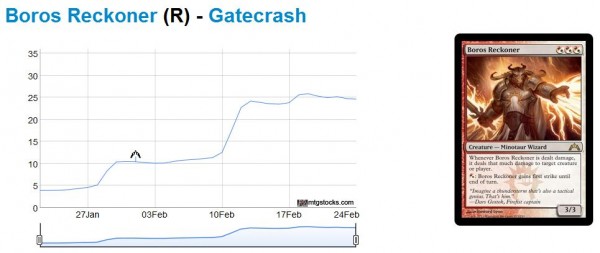
My ah-ha moment in all of this? Proceed with extreme caution when pre-ordering on eBay. If you’ve had success with a seller in the past, I suggest you stick with them indefinitely. There are too many sellers on eBay exploiting this loophole and I don’t want to see you left with a cancelled order and no “reward” for correctly calling a particular new card. Take special caution when pre-ordering more than 45 days before a set’s release, as you risk being unable to open a case against the seller.

Standard Shifts

While minor, I sense a shift in the Standard metagame, and I’d like my portfolio to reflect this somewhat. For example, Boros isn’t taking shape in the way I suspected. Sure, Boros lands are highly popular right now and at the helm of most Boros strategies is none other than Boros Reckoner.

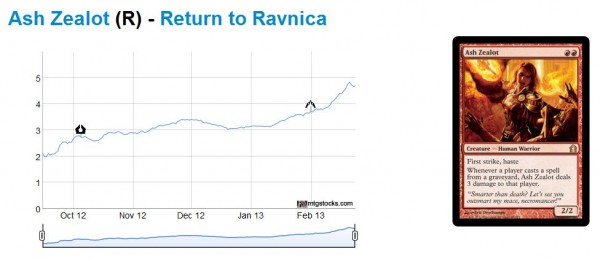
But what happened to Ash Zealot? This card shows up on occasion, but it isn’t as prevalent as I had anticipated. What’s more, I’ve noticed a subtle decline in the card’s price on eBay. I was able to sell my first set for $15.99, but I am having trouble moving the last couple sets at $13.99. Looking at mtgstocks.com, it appears the card’s rally is taking a break, and it’s difficult to predict what will happen from here. I’m selling my copies so that I can move into other cards.
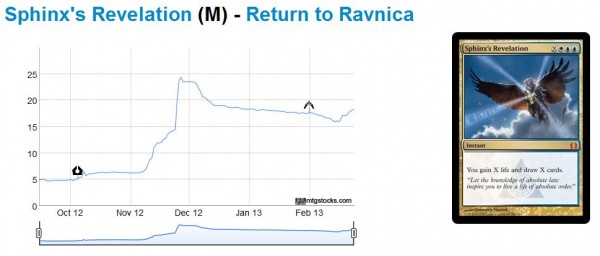
The more control strategies are successful at major events, the more I like Supreme Verdict. Even Sphinxs Revelation is enticing at this point, which is a few bucks off its high according to mtgstocks.com. As more sets come out and Return to Ravnica cards dry up from people’s trade binders, these will become harder to find. If they remain a cornerstone of control decks, Sphinx’s Revelation should be well positioned for a bump. If Bonfire of the Damned can hit $40, it shouldn’t be impossible for Revelation as well.
Finally, I am also still a fan of Abrupt Decay. And in a month or so, I will also be actively looking to acquire Gatecrash Shock Lands. Even with Shock Lands appearing in Dragon’s Maze, I still feel these will rebound in the mid-to-long term.

Card of the Day

The final revelation (pun intended) I experienced this past week was regarding my new go-to pricing site, mtgstocks.com. You probably noticed my conversion from Black Lotus Project to mtgstocks.com by now, and I intend to stick with them moving forward. But besides providing up-to-date pricing trends on cards, the site has also yielded an incredibly interesting tool: Interests.

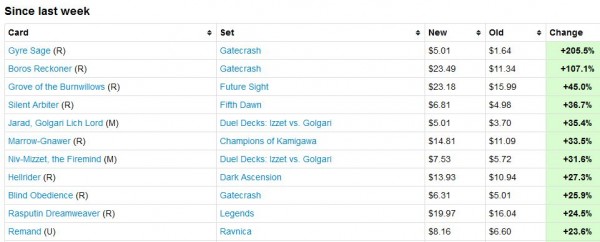
It seems innocent – the top movers of the day on TCG Player is organized into a list. But this feature has revealed some serious shenanigans of late. No longer can someone buy out TCG Player quietly – within 24 hours, mtgstocks.com reveals such behavior. This past Friday, it was Hall of the Bandit Lord.
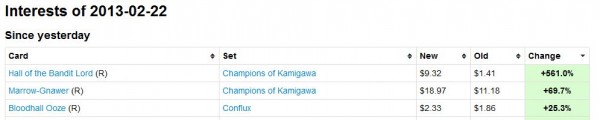
Then on Saturday, yet another card spiked, albeit less significantly. I even joked about this on Twitter that day, but I am truly suspect that someone is behind this shift as well. How many of you were aware of the recent jump in Rasputin Dreamweaver?
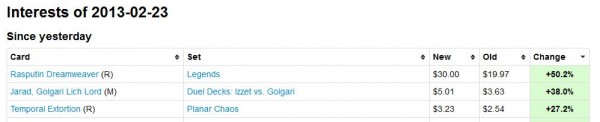
With such an old card, it doesn’t take much for someone to decide the card should be worth $30 and not $20 by buying out the cheapest few copies on TCG Player. I have my eye on this one.

But the card that jumped this past Sunday is much more interesting.

It looks like Thrun, the Last Troll caught on all of a sudden. A jump of more than double is very significant, and in this case the card actually has merits as well. This may be more speculative buying for playability rather than a pump and dump like Hall of the Bandit Lord, but, either way, it is incredibly valuable to stay on top of this news.

The major takeaway here – visit mtgstocks.com every day and check out the Interests section. This will ensure you are always within 24 hours of knowing the recent ridiculous (and sometimes merited) speculation movement. As tools like this become more widespread, it will become very obvious when someone is attempting to corner the market of a card. I’m not sure what I can do about this behavior at this point, but I’m open to others’ ideas.

Turning Insight Into Action

The observations I’ve made this past week have led me to multiple insights, which I’ve summarized above. But such knowledge is only valuable when it’s applied. I’ve summarized the action I am taking in the first two sections of this article, but I’m not sure what I can do about the last one. I cannot stop people from doubling a card’s value overnight.

All I can do is be aware of such movement and sell anything that jumps irrationally. It all goes back to the mantra “buy low, sell high”. If a card jumps up suddenly with no logical basis and you are sitting on copies of the card, sell right away and ask questions later. Nine times out of ten this should pay off nicely.

Sigbits

While the top mover of the day on mtgstocks.com is the most interesting, the number two or three cards are also noteworthy. Consider these recent movers.

  • Greater Good is on the rise. SCG only has a couple copies in stock, and the card has been a top mover on multiple occasions according to mtgstocks.com. While the card seems solid for EDH, I’m not sure if such movement is merited or not. I’ll leave that up to you.
  • Sen Triplets has been on quite the run lately. The card has risen from $6 to almost $11 according to mtgstocks.com. It seems casual play continues to move many card prices, and as the player base increases this trend should continue.
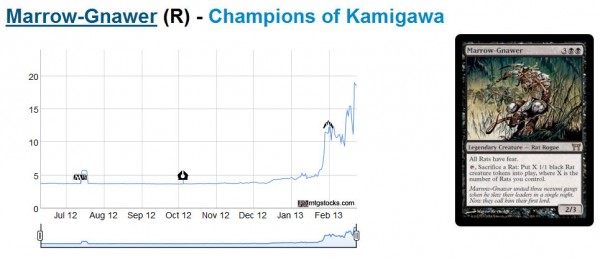
  • Marrow-Gnawer? Seriously?! I mean, Rat Rogues are cool and all, but I’m not paying $20 to Rats in EDH. Someone else clearly is, however, and you should be aware of this. But if someone had told me that Marrow-Gnawer would become one of the most valuable cards from Champions of Kamigawa I would have laughed.
-Sigmund Ausfresser
@sigfig8

SCG Cincinnati Topics

Are you a Quiet Speculation member?

If not, now is a perfect time to join up! Our powerful tools, breaking-news analysis, and exclusive Discord channel will make sure you stay up to date and ahead of the curve.

SCG Cincinnati Prep

Last week, I was working on my Zoo deck and took it to a local event for more practice. At the event, I went 3-1, losing only to Mono-Red. I felt the loss was due to poor draws that involved lots of mana or no mana of a color. My last round opponent was a friend and we were discussing my deck. His thought was that I needed to dive into the Boros Reckoner hype and add them to my deck. It’s the best creature in Standard right now, he said, and you need to be playing them in this deck.

That statement stuck with me and I kept mulling it over in my head. Switching to Reckoners had a lot of pros going for it. The one that stuck out the most was the mana cost. Reckoner would be much easier for me to cast. As long as I have three lands, I can cast him. The same cannot be said of Silverblade Paladin. The normal arguments about why Reckoner is so good also apply here. The card does have a high power level and can be difficult to kill.

Depsite all the reasons to include him, I found myself hesitant to replace Silverblade Paladin with Boros Reckoner. The damage output on Silverblade is insane and I thought I would be taking a lot of aggression out of the deck if I made the switch.

When I was discussing the switch with a friend, I started realizing some other powerful reasons to make the switch. Rancor. Can you think about Rancor on a Boros Reckoner for a second? Yes, it is as powerful as it seems. Not only can you have a 5/3 first striker, but it allows you to break through the defenses of your opponent. What about if you pump your Reckoner with Ghor-Clan Rampager? Not only does your opponent take a bunch of trample damage, they also take damage from their creature blocking and dealing damage! Suddenly, it’s seeming like you’re not losing that much damage with the switch. When thought about the interaction between Reckoner and Thragtusk, that finally sold me. Reckoner fights through Thragtusk better than any other ground creature because you just give it first strike.

With those interactions fresh in my mind, I drove quite a ways to a shop last Thursday after work to hand over eighty dollars in order to obtain my playset.

If I was going to play Boros Reckoner, I figured I would try out Domri Rade as well. The interaction between those two cards blows out a lot of the aggressive decks in the format right now. The new green-red planeswalker is definitely not the best ever but he's only a little worse than Liliana of the Veil in this deck. When you draw cards from his plus one ability, he is actually good. I just wish that ability was worded a little bit differently. These were the two primary changes I made to the deck two days before the event. While there are not many changes to the deck, it plays a bit differently. Here’s the list I played.

Untitled Deck

Creatures

4 Experiment One
4 Rakdos Cackler
3 Dryad Militant
3 Strangleroot Geist
4 Flinthoof Boar
4 Boros Reckoner
4 Ghor-Clan Rampager

Spells

4 Rancor
4 Boros Charm
2 Searing Spear
3 Domri Rade

Lands

4 Temple Garden
4 Sacred Foundry
4 Stomping Ground
3 Rootbound Crag
4 Sunpetal Grove
2 Mountain

Sideboard

3 Skullcrack
2 Pillar of Flame
3 Oblivion Ring
3 Ray of Revelation
1 Rest in Peace
3 Purify the Grave

SCG Cincinnati Report

Round 1: G/W Humans

If I am honest, I won this round easily. My opponent was playing Mayor of Avabruck and missed triggers to flip them as well as triggers to make wolf tokens. These mistakes made it much harder for him to win. He did have Fiend Hunters in his deck though and they were very good against me especially because they were usually bigger than their printed stats. Because his creatures were generally smaller than mine, Domri Rade did a lot of work for me.

I almost lost game two because I made the greedy play instead of the safe play. He had a Fiend Hunter that had eaten my Strangleroot Geist paired with a Silverblade Paladin. I had enough power in play to kill him if I got rid of the Fiend Hunter and could then attack with my Strangleroot. At the time, I knew the safer play was to kill the tapped Silverblade but with his one card in hand, I thought he was dead so it didn’t matter. Despite the fact that he was playing all humans and I had not seen any in the previous game, he blew me out with Restoration Angel on the Silverblade Paladin. Once they were paired my team was decimated. I did manage to kill those two creatures and crawl my way back into a win, but I could have made the safe play in the first place.

Record 1-0

Round 2: Naya Humans

After the match my opponent told me, “I’m not sure what I could have done in this match, your deck was just faster than mine.” That was basically how the match went. With my aggressive draws against him, I had his back to the wall quickly in both games one and two. There was not much he could do to slow me down. Between Ghor-Clan Rampager pumping, and a coupleBoros Charms, he was dead pretty quickly. Game one I finished him with end of turn Boros Charm, untap Boros Charm. That last eight damage can come off in chunks like that with this deck.

Record 2-0

Round 3: Naya Midrange

Game one was all about the Reckoners. I drew three of them and despite my opponent dealing with two of them, he couldn’t defeat the third. He lost a lot of life by killing the first two with a huge [card Bonfire of the Damned]Bonfire[/card]. Game two was a close one, but the combo of pumping with Ghor-Clan Rampager and giving double strike with Boros Charm kills many an unsuspecting opponent.

Record 3-0

Round 4: Jund Midrange/Control

Game one was over quickly because I had a one-drop into double one-drop hand. I also had the burn to finish him off even after he used a couple removal spells. Game two was going well, but his bait of Vampire Nighthawk successfully lured me into using my Searing Spear. That allowed him to play Olivia Voldaren and take over the game by stealing my [card Rancor]rancored[/card] Reckoner. Game three was fairly close but I boarded in Oblivion Rings as more removal for his Olivias. That allowed me to kill two of his finishers and mop up afterwards. After the match he told me that he top-decked the Olivia in game two. I felt better because I had no idea he had that in his hand and usually I am able to read my opponents decently well.

Record 4-0

Round 5: Caleb Durward with Junk Reanimator

I have much respect for Caleb as a player and writer and I knew I was in for a difficult match. In the first game he mulliganed to five and I went to six. For five and six, our hands did some powerful things. He played double Arbor Elf and I played a couple early aggressive guys. I was able to set up a massive attack where I pitched a Ghor-Clan Rampager and double-striked with Boros Charm to deal him a huge chunk of damage. His blocks left him at two life. He untapped, smiled and cast Angel of Serenity. The three creatures that were going to kill him on my turn suddenly disappeared and it looked like the game was out of my control. I drew my second Boros Charm of the match and almost slammed it on the table. Later I learned that he had topdecked the seventh land to cast the Angel.

Game two I kept a hand you really cannot mulligan but would rather not keep. The hand consisted of no one mana-cost creatures so it was a bit slow. Even with eleven one costs, there will be some games you don’t have one in your opening hand. Because I did not have a fast enough hand, his sequence of Farseek into Trostani, Selesnya's Voice into Thragtusk put the game out of reach quickly. When his life total increased even more, I picked up my cards to try out game three.

Before the game started, I did something that players often forget. I resideboarded. I knew I wanted some Oblivion Rings to deal with the lifegaining machines he added from his sideboard. Also, I thought that bringing in Pillar of Flame on the play might kill his mana creatures and set him too far behind to catch up. Domri Rade isn’t that good in the match because other than mana creatures, my guys are smaller than his.

The last game was a bit frustrating but proves why I only play three Strangleroot Geists. I would have easily won this game if I could have cast them on turns two and three, but instead I had to cast them much later in the game, and by that point I was unable to punch through the last few points of damage. The match was amazingly close and a ton of fun to play. I felt my sideboard decision with the two Pillars was ultimately wrong and I should have left the Searing Spears in the deck.

Record 4-1

Round 6: UWR

Game one was a hasty victory. One downfall of winning so fast is that you do not get to see much of your opponent’s deck. I was not even sure what my opponent was playing other than that I had seen some blue, white, and red lands. I think he cast one spell, Azorius Charm, and that was all for game one. I assumed he was playing a midrange or tempo version of URW but with a higher curve than some of the other versions I had played against previously.

Game two showcased the power of Boros Reckoner, but on my opponent’s side of the field. I dealt with the first one by losing a couple cards and the second one was too much for me to handle. In addition he had three or four Azorius Charms and two Restoration Angels. That combination of cards did not allow me much room to actually play the game.

The decider was quite the crazy game as well. With my mulligan to six cards my opening hand contained two shocklands, two one-cost creatures, Flinthoof Boar and a Boros Reckoner. I hope you’re thinking that’s an amazing six card hand because I sure was. The sequence went like this.

Turn one – Me: One cost dude. Him: Land.

Turn two – Me: Boar. Him: Land.

Turn three – Me: I did not draw a third land but did draw another one-cost dude. Play both one-cost dudes. Him: Rolling Temblor

What? Yes that’s right, Rolling… worst Pyroclasm ever… Temblor. I was pretty blown out by it and extremely surprised. The thing is, if I had drawn my third land, I would have played Boros Reckoner so that three mana spell would have proven useless. Honestly I was surprised that he sideboarded it in for this match.

I recovered well the next turn when I drew my third land and the game continued. He played some removal spells and put guys back on top of my deck once or twice, but I found a second Boros Reckoner. That seemed like it would seal the match but he got bold and Bonfired the two Reckoners away. Luckily I drew a third one. With my seven mana in play, I tapped one of it for the Rancor in my hand and attacked. He blocked with Augur of Bolas and then used Izzet Charm to deal the final two points of damage to my creature. This left him at two life and within range of my Boros Charm in hand. I went to tap my mana and kill him only to find out that even with my plethora of lands, I only had one white mana (a Temple Garden) which I had used to cast Rancor for no reason. I thought I would still win on my next turn until he cast a main phase Sphinx's Revelation for three putting him back at five life. On his next turn he played Boros Reckoner, while I drew nothing.

Then the following turn is what really blew my mind. The card he played was not anywhere in my mind as a playable card or one I would even expect from his deck: Gisela, Blade of Goldnight. I was completely taken aback. Why would this card be in his deck? Because he did it allowed him to kill me a turn earlier than he should have. In the end though, I lost the game myself because of my misplay. The game should have been won with a Boros Charm, but instead I have a story to tell about what you can do better while playing.

As far as the deck goes, I think my Zoo list is close to perfect for this metagame. I don’t have any games in against the new Aristocrats deck so my opinion could change based on that information, but I love this deck against any other deck in the room. If you are looking for some quick matches, this is definitely the deck for you. I had more time in between rounds with this deck than any other I’ve played with in quite some time.

Tournament Tips

When you are playing Magic, what’s the most important thing? I would argue it's mana. From teaching new player frequently, I know that learning what mana is and how to use it can be difficult. Once you start going to tournaments, we start to take mana for granted a bit. It’s obvious you play a land and cast your spells depending on what lands you have in play. Do you ever consider making a different play based on what lands you have though? Here’s an example from my Zoo deck.

First turn: play untapped Stomping Ground and cast Experiment One.

Second turn: Your only other land is Temple Garden. Your options are to cast the Rakdos Cackler and play your land tapped or cast the Flinthoof Boar.

There are actually a ton of intricacies to this scenario. If you play Cackler, your Experiment One will grow twice and you will take less damage. The other cards in your hand matter though. For instance, I had Boros Charm in hand so that makes Boar a little better here because I can hold the Charm for protection and not be tapped out. If you knew your opponent had Blind Obedience or Rolling Temblor, you might favor the Boar, but if they only had Supreme Verdict or Mutilate, you might want the Cackler for the extra evolve trigger and the haste on the Boar.

Your mana is a resource that can be used in many ways. It is just one aspect of the game that grants you many choices each turn. Using your mana wisely each turn can lead to getting more out of your spells. Paying attention to the colors you have available to you is extremely important as well. If you only have one green mana, that may change the order of spells you play.

Looking specifically at my play, I lost a match because I tapped my mana wrong. That ended up basically knocking me out of the event. Tapping my mana different was a very small thing, but still I overlooked it. We are all human, but mistakes like that can and should be avoided. To accomplish this, think about what you are playing and pause for a second to look over your lands. Working on things like this can improve your game, even if only a small amount. Every little edge counts.

Until Next Time,

Unleash the Zoo Force!

Mike Lanigan
MtgJedi on Twitter
Jedicouncilman23@gmail.com

Insider: Avoiding Losses on MTGO

Are you a Quiet Speculation member?

If not, now is a perfect time to join up! Our powerful tools, breaking-news analysis, and exclusive Discord channel will make sure you stay up to date and ahead of the curve.

There are plenty of adages that are bandied about when talking about speculating. "Don't put all your eggs in one basket," "A rising tide lifts all boats," "Buy the rumor, sell the news" are some financial sayings you might be familiar with. Each has a nugget of truth and is worth thinking about on its own. But here's a doozy from Warren Buffet that needs to be learned, relearned, studied, and remembered.

Rule #1: Never Lose Money; Rule #2: Never Forget Rule #1

Losses are painful, and one thing that the mind is ready to do in order to avoid this pain is to pretend that a loss wasn't as bad it looks, or that there were external factors that caused the loss, or just to forget about it entirely. This is very natural behavior. No one likes to dwell on their mistakes and relive past failures. Focusing on successes and good times feels better! It might be a really obvious to say "Never lose money." But in practice it takes an honest approach and a few losses under your belt before Buffet's insight can be properly understood. Once you are not fooling yourself on how well you are speculating, then you can be begin learning from your mistakes.

A Rule of Thumb for Junk Rares

When looking for speculative targets, it's easy to look at a long list of rares in the 0.05 to 0.25 ticket range and imagine the possibilities of one of these cards breaking out and shooting up in price. It's been my experience that this doesn't happen often, especially once a set has been out for a while. In a few weeks, most of the best cards from Gatecrash will be largely figured out, making the chances of brand new deck archetypes increasingly slim. And yet those junk rares will still be attractive due to their low price.

However, the margins that bots give on rares at this price are not favorable for speculating. Suppose you were looking at supernovabots's price list (all prices current as of Feb. 20th, 2013) for cards to speculate on. If you are buying a card like Assemble the Legion right now the buy/sell prices are 0.094/0.155.  That's a spread of 0.061 tix or a spread percentage of 39%. To calculate the spread percentage, take the sell price, subtract the buy price, and divide by the sell price.

If this card doubles in price to 0.31 tix, and the spread percentage is the same, then selling this back to supernova would get you about 0.19 tix, which is a net profit of 0.035 tix. A card doubles in price, and you get 23% profit when dealing with a bot. That doesn't sound so hot, especially considering the amount of work involved.

Compare this to a card like Hallowed Fountain, which has buy/sell prices of 3.1/3.6. This is a spread of only 14%. If this card doubles in price to 7.2 tix and the spread is maintained, then you could sell back to supernova for 6.2 tix. In this case, a double in price translates into 72% profit. In terms of percentage your net profit is much higher. In this case, a lower margin has translated into higher profits for the speculator.

Let's figure out what it would take to get a 72% net profit on Assemble the Legion. In order to net 72% on .155 tix, the buy price has to be 0.266 tix. At a spread of 39%, this suggests a sell price of 0.436 tix. All told, you'd need Assemble the Legion to almost triple in price to get the same net profit in percentage terms as compared to a doubling in price of a lower margin card like Hallowed Fountain.

When speculating on junk or near junk rares through bots, to make a decent profit percentage you are looking for something like a triple in price. And the further you get away from junk prices, this becomes more and more unlikely. A tripling in price is much easier if the card starts at a price of 0.05-0.1 tix. As a rule of thumb, avoid speculating on junk rares unless they are in this price range. Junk rares are bought and sold at much higher margins meaning your potential profits are much smaller. Treat junk rares as a gamble and stick to the cheapest ones.

In terms of mythic rares, the price level cut off is a bit higher, but in general avoid mythics that are over 0.60 tix. These ones are easy to spot. They are things like Quicksilver Gargantuan and Balefire Dragon, big creatures that aren't really doing anything worthwhile. Watch out for a card that has been or will be heavily opened though. Quicksilver Gargantuan hit 0.35 tix during New Phyrexia release events, so thinking a junk mythic is a good buy at 0.5 tix might be a mistake if there are release events yet to flood the market. Also, the recent change to redemption fees means we might see new, lower price floors for junk mythics.

Avoid Speculating on Niche Formats

Classic/Vintage and Legacy don't have a strong level of interest on MTGO. Hype tends to build for these formats if there are tournaments worth playing for, but otherwise the background level of interest remains too low to fire events consistently. And without events firing consistently, demand for singles stays low. If there is a Magic Online Championship Series (MOCS) tournament or other special events to play for, then interest will be ignited for a short while, but otherwise it's just not going to happen for these formats. If you are curious about these formats and are looking for some discussion about why they have difficulty catching on, head over to Classic Quarter and check out the forums there.

For speculators, this means that these formats don't see a lot of volume when cards are moving. Lower volume means the bots are collecting higher margins. With higher margins, it'll take either more work to use the classifieds in order to buy and sell these cards, or you need really dramatic price swings to make a profit, as you can see from the junk rare analysis above.

Sticking to Standard and Modern means you are working withing a space where there are times of strong demand and a higher volume for singles. This means that any position is generally easy to liquidate and bot margins are smaller. Standard is the most popular constructed format on MTGO, and is generally active all year. Interest in Modern has been building, and is getting official support from WoTC with online PTQs and reprints to keep costs down. As a general rule, both formats should be the speculator's first focus before branching out and looking at other something like Legacy or Pauper.

Think About What Can Go Wrong

During the MED events from late Fall, I bought ten copies of Force of Will at an average price of 83.3 tix. I bought seven of them by posting to the classifieds and scooping up cards from drafters, and the last few I bought from bots. By the end of the first weekend of events, Force of Will sat above 90 tix, and my position was looking good. I had identified an opportunity, bought at the bottom, and could already cash out for a small profit. It looked like the start of a decent trade. I was anticipating that a MOCS event in 2013 would be Legacy and that by that time, the price of Force of Will would have increased enough that I could book some nice profits. After all, Force of Will hit 140+ tix in and around the last Legacy MOCS event. In this case I had sized up all the things that could go right and decided to take the plunge on a high-priced spec.

What was I ignoring in this case? Well, first of all, the MOCS schedule is not announced in advance. There might have been an event last year in the Summer, but maybe this year it would have got pushed back to the Fall. This was quite a few tix to tie up in a position that didn't have a target exit date. By having no definitive timeline, I was exposing myself to more uncertainty and more risk.

But lo and behold, the first MOCS championship turned out to be Legacy! What a stroke of luck! Prices might ramp up considerably in a short while and I would stand to reap a ton of short term profit selling Force of Will to eager Legacy players. Well, the fact that promo Force of Wills were handed out for getting 15 QPs leading up to the Legacy MOCS torpedoed any chance of booking a profit on this position. Lacking a timeline for exiting this position exposed it to some uncertainty, and this was compounded by the reprint of Force of Will.

Reprint risk is something to always keep in mind for older cards. Aside from timing my buys well and approximately hitting the bottom, I took on too much risk in order to speculate on a niche format. WoTC has shown a willingness to reprint cards in novel ways, so sticking to Standard and Modern cuts down on this particular type of risk. If you were ultra vigilant around reprints then you'd speculate on sets currently in or just rotated out of Standard.

Stick to What Works

One great way to avoid losses it to stick to what works. There are a few consistently profitable strategies that should be the bread and butter of every speculator on MTGO. First of all, pay attention to redemption. This MTGO feature drives the most consistent (if somewhat boring) profits from the MTGO economy. This means buying up mythics from sets that have just rotated out of Standard and sitting on them until their prices rise due to demand from redeemers. Although the recent changes to the redemption fee haven't yet become fully understood, this strategy should remain intact.

While on the subject of Fall rotation, if you had only a few weeks in the year to take all your speculative positions, the best choice would be the end of October and early November, hands down. Besides scooping up cheap mythics from rotating sets, Modern staples from these sets will be on sale too.

Next, if you have a choice to speculate on real estate or some other card, stick to real estate. Good dual lands are widely used by all players which means that they will hold value over time. Even the core set dual lands are still worth something despite multiple reprints. On the other hand, a card that is a standout in a certain format might not translate very well into others. In comparison, you can bank on good dual lands being use in multiple formats.

Lastly, cards from a third set are better speculation targets than ones from a second set, which in turn are better than cards from the Fall set. Differing block structures can muddy this up a bit, but it's a great rule of thumb and you'll often hear speculators referring to the "third set effect." Generally, the cards from sets that have been opened the least have the greatest speculative potential due to their relatively short supply. All things being equal, focusing time and energy on cards from third sets pays off with higher profits due to more limited supply.

With all of this in your back pocket, you could happily reap consistent profits from speculating on digital cards. Stick to what works, avoid losses and you'll be building up a sizable portfolio over time.

Insider: Pro Tour Post Roundup

Are you a Quiet Speculation member?

If not, now is a perfect time to join up! Our powerful tools, breaking-news analysis, and exclusive Discord channel will make sure you stay up to date and ahead of the curve.

The Pro Tour was last weekend, and we all know what happened so I won’t bore you with rehashed details. In fact, I don’t plan on spending much time on the top eight at all, though I do want to touch on a few cards.

Champion of the Parish

Not going to lie; I’m surprised this has only gone up $1.50 since we started buying them up a few months back. That said, it is slowly rising so I think it’s a hold for the moment. I personally have a rather large chunk I’m hoping will continue to rise.

Falkenrath Aristocrat

I’ve been all around this card in the last year. I advised picking it up cheap, got a bunch myself, and advised moving them out at $20 a few months back.

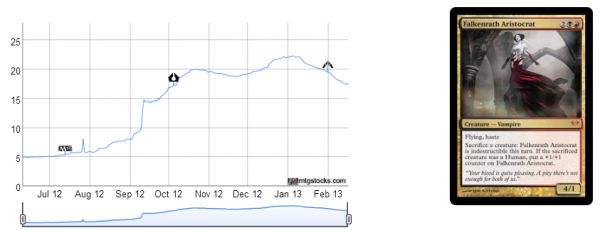
Since then, the card dropped as I predicted, though not as far as I initially thought due to the low amount of Dark Ascension opened. Now, though, even after the Pro Tour it’s still under $19, after holding $20 for a bit when it was a 4-of in a sustained top deck. Again, maybe a hold for the time being, with an eye toward outing these before too long, since it can’t be far from its ceiling.

Domri Rade

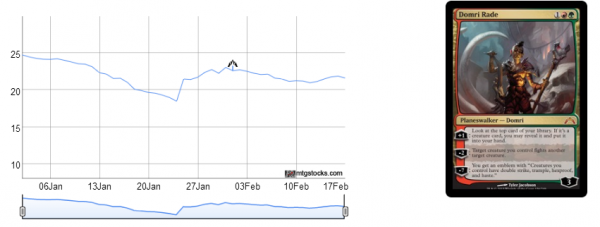
Putting a hold call on this as well, with an inclination closer to sell before buy. It got one deck to the top eight and is doing well elsewhere, but the market is picking up more and more as we go. If this doesn’t take off soon, I’m looking to move them out before they dip below $20.

Gyre Sage

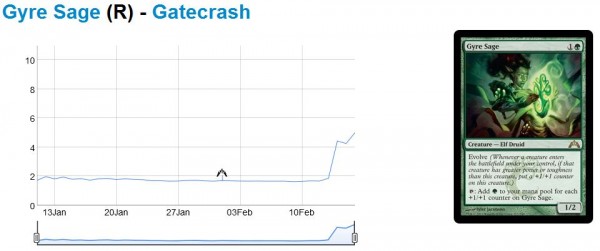
Talked about this last week when it was $1.50, and it’s tripled since then. Move these out now, same reason as above apply.

Scouring the Depths

Now for the more fun part. Wizards makes a list of all the decks that earned at least 18 points during the tournament, and we can use this as a great jumping point for speculation. Pretty much nothing on this list is huge right now, but it’s the type of thing that you can pick up very cheaply in trade and out at many times that if any of these decks have a big weekend.

Basically, I’ve done the work for you of digging through dozens and dozens of decklists to try and find some low-risk, high-reward targets. Let’s see what I turned up.

Abrupt Decay

This card isn’t necessarily the best example of this list, but it’s worth talking about anyway. This answers the overpriced Boros Reckoner very well and should only get better as Standard employs more and more efficient creatures. Combined with the fact it’s low from RtR redemptions and is a Modern and Legacy staple, it’s time to get in on this card now if you haven’t been hoarding already.

These can be had for around $5 right now, and I’m going after these hard in trade at the moment.

Mizzium Mortars

This card was everywhere last weekend, and at $2 it’s a good play. I don’t know how much the price can go up realistically, but this is one of those cards that trades better than its price, since the decks it goes in are pretty difficult to build without it. That means when someone needs it, they really need it, and that gives you a good opportunity.

Lingering Souls

A bit of a resurgent weekend for Lingering Souls. It’s still hovering around $2-2.50, and honestly will probably stay there for its life in Standard. But I’m going to keep talking about these until they’re $5, which is going to happen in the next two years or so at the latest.

Supreme Verdict

These are rightfully inching back up, and they’re still a great trade target at $4. This is likely the best Wrath of God variant we’re going to see, which means it will be the go-to in everything from Modern to Legacy to Commander.

Wolfir Silverheart

More and more decks have started to pop up and include this guy again. He’s not going to reach $15 again, but Avacyn Restored is a pretty scarce set as far as Standard goes so more play from this guy going forward makes it a good one to keep stocked in the binder.

Wandering Wolf

I’m joking. But really, there was a deck at the Pro Tour packing 4 Wolves, 4 Giant Growth and 3 Titanic Growth that performed as well as some top pros running the eventual Pro Tour-winning deck. Of course, another deck in this list had three Yeva, Nature's Herald and two Mystic Genesis in it. Food for thought.

Dreadbore

This is at an all-time low at $3 right now despite seeing a fair amount of play in the Pro Tour. I expect this to crawl back toward $5-6 in the next few months, since it’s an all-around solid removal spell.

Angel of Glory's Rise

The ship may have sailed at this point, though I’ve been talking it up since RtR released. This could go a little higher, which makes it a good hold or cheap trade target at the moment, though I don’t like a cash buy. But gaining infinite life doesn’t suck, so this is worth keeping an eye out for still.

Mutilate

Another card I think you were better off getting a month ago, but one that still presents a real opportunity as cheap as it is.

Along with Mutilate I’ll include Crypt Ghast, which truly can get broken quickly, and Gloom Surgeon, the other off-the-wall hit from Conley Woods’ deck.

Wrapping Up

That more or less sums it up. These lists are great for digging around for ideas that can later become something real. After all, Angel of Glory's Rise arose from just such an exercise during last year’s Block Pro Tour.

Before I go, I’ll leave you with this teaser. There was a deck on the list that included 4 Wingcrafter, 4 Precinct Captain, 4 Lyev Skyknight, 2 Azorius Arrester 1 Odric, Master Tactician, a pair of Nevermores in the sideboard along with an Island.

If you want to peruse all these decks yourself, the list is here.

Thanks for reading,

Corbin Hosler

@Chosler88 on Twitter

Insider: PT Gatecrash Debrief

Are you a Quiet Speculation member?

If not, now is a perfect time to join up! Our powerful tools, breaking-news analysis, and exclusive Discord channel will make sure you stay up to date and ahead of the curve.

Well, the Pro Tour is behind us, and what a sweet event it was. In my opinion, WotC has really stepped up the live coverage and I was impressed. With this new information I want to take a look at where Standard will go from here. First let’s look at the decks that came out of the event.

WotC posted a list of all decks that earned 18 match points or more, during the standard portion of the Pro Tour, which is the equivalent of 6-4 or better.

Jund Midrange

First on the list is Jund Midrange, quite a few people played it at the Pro Tour, and two copies made it into the top 8. Given so many players were playing it, this doesn’t surpise me. As a deck that was known to exist before the Pro Tour, I’m a bit surprised it performed as well as it did. While the decks vary quite a bit, they all feature Thragtusk, Olivia Voldaren and Huntmaster of the Fells. In my opinion, none of those are great targets already sitting at high prices, but Abrupt Decay is a card I can get behind right now, and I’ll be talking more about that later.

Jund Aggro

There was one player (as far as I know) playing a Jund Aggro list. After watching a bit of his matches, the deck had some shaky mana for an aggro deck, but was quite effective. Featuring cards like Experiment One, Falkenrath Aristocrat, Flinthoof Boar and Strangleroot Geist, the efficiency of the creatures was clearly the focus. Before the Pro Tour, I suggested picking up Flinthoof Boars, and they haven’t moved much yet, but still have plenty of room to move up in price, especially once Standard season rolls around this Summer. I’m also considering picking up some copies of Experiment One. I had always felt this was simply a better card than Gyre Sage, and I expect the more aggressive decks to play this card rather than the slower Sage.

Esper Control

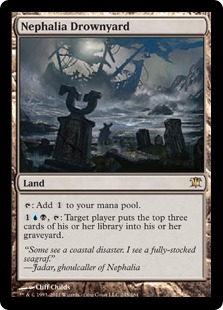
A huge number of Esper Control decks are found on this list. A majority of the ChannelFireball team was on the deck, as well as a handful of similar lists from other teams. Nephalia Drownyard was a 3 or 4 of in these decks, while the creatures varied quite a bit from list to list. Some played Augur of Bolas, some played Restoration Angel, and some, suprisingly, omitted Snapcaster Mage. Drownyard has crept up about 50% on TCG player mid pricing since I started talking about this deck a while back, and I’d expect that to continue now that this deck has shown some success. There’s no reason this shouldn’t be a $3 card when Standard season comes. I’d also like to see these decks play Mutilate, but the current builds certainly won’t support it.

The Aristocrats

After winning in the Top 8, the “Aristocrats” deck will certainly get a lot of press. It’s key rares are Champion of the Parish, Boros Reckoner and Falkenrath Aristocrat. I find this deck to be a metagame choice, and otherwise a bit clunky. People are going to have to stop playing Searing Spear as their removal in a format flooded with Boros Reckoners, and something will have to give. I expect that if Abrupt Decay starts seeing more play, this deck’s sole threat becomes Falkenrath Aristocrat. I do think it says something that the White human shell containing Champion was strong enough to support a R/B Vampire, that future iterations of human decks will be around for the remainder of the season and into PTQ summer. I’m going to continue to hold my Champions, although I’ve been beginning to trade them out at a profit.

MBC

Conley Woods piloted a Mono Black (splash Red) control brew featuring 4x Griselbrand and 4x Mutilate, all fueled by Crypt Ghast. On Sunday at my local Standard tournament, everyone was asking me for Mutilates becase they knew I had been stocking up. I was able to dump 2 sets of these at $14/set. This covered my cost on the other 3 sets I have of these, and I plan to hold these a bit longer because I think it has potential to go higher. Crypt Ghast is an interesting card, and I’m not sure what to think of it. It’s TCGplayer Mid is still under $3, and it certainly has a powerful effect and will grace Commander games at a minimum. However, I’m unsure if this specific deck will garner enough attention to shoot the card up a bit, or if it will find a home in a different deck. I’m tempted to pick up one set just to not miss out on this one.

There were a few other decks that made the 18+ list, but none that have huge impact on the format in my opinion. They were either known existing decks, or slight variations on decks from previous formats. I do think one thing is evident, that Boros Reckoner will define this format, and that means more to how people will build decks than anything else. There are some removal spells that just laugh at a card like Reckoner. Victim of Night, Abrupt Decay and non-damage sweepers. I expect the control decks to adopt this removal and really shut these aggro and midrange decks down for a while. I dont know if the Esper decks can afford to splash green, or if they simply become more black focused to cast Victim and possibly pick up Mutilate along the way. Sever the Bloodline is a more splashable option, while slower does have the potential for big blowouts, and even Evil Twin is an interesting answer to the Reckoner.

What are other was the format can shift to deal with Reckoners? Is there something other than removal that will trump him?

Insider: The Aristocrats and New Standard

Are you a Quiet Speculation member?

If not, now is a perfect time to join up! Our powerful tools, breaking-news analysis, and exclusive Discord channel will make sure you stay up to date and ahead of the curve.

The latest Pro Tour has come to an end, and there are some interesting deck lists to delve through. We are no longer in an age of incremental advantage decks. Delver of Secrets is a thing of the past. We are in an age of blowout advantage, and there are a few cards that let us do that. Sphinx's Revelation is one of the main reasons, and for that we will see it maintaining a fair price tag, and potentially continuing to rise as RTR stops being opened.

Sometimes we still need that incremental advantage in the decks that don't get it, and for that reason my favorite Gatecrash card is still Domri Rade. Domri Rade both allows for removal and card advantage in a creature-heavy deck, as Liliana of the Veil does in a graveyard-centric deck.

We saw one of these decks in the top eight, and it even made it to the Semifinals. He ran 4x Domri Rade, 4x Mizzium Mortars, and 28 Creatures. 28 creatures give him just under a 50% chance of hitting on Domri's +1 ability, And it certainly added the advantage he needed.

However, a lot of other decks are using massively efficient creatures and spells. Instead of relying on Think Twice to win a game, you need Think Twice to find you a backbreaking card. we used to love things that did a single damage or gained a single life. Now, every effect needs to be huge and multifaceted to make a difference. A 3/3 first strike for 3? Nah, we need one that has combo potential, kills 2 creatures when it blocks, and can kill a player when you Blasphemous Act. Our midrange creatures aren't 6/6 for 4 with trample. That's not good enough. We need a 5/3 for 4G that gains 5 life, and dumps a beast back if you kill it.

So, when looking for the next amazing Standard card, look for that blowout advantage. Drogskol Reaver draws us a card and gains life, but Sphinx's Revelation draws us six. Why reanimate Griselbrand and win in a few turns, when you can reanimate Borborygmos Enraged and start bolting them in the face, or wiping the board?

We can hopefully gauge the next set, Dragon's Maze, using that mentality. Does it hit the board and sit there being mean and scary only to get chump-blocked or killed, or does it drop down and make your opponent realize they've lost? Harder, Better, Faster, Stronger. That's what this game is about, and we're seeing it big time.

But, The Real Reason I'm Here...

I'd like to hit on a new deck that has emerged –- one that I've taken quite a liking to. It is called The Aristocrats, and this name is well-suited, as the obvious stars are Falkenrath Aristocrat and Cartel Aristocrat. It uses some powerful interactions and efficient creatures to nullify anything from your opponent's creatures to their removal. On top of that, it runs things like Orzhov Charm and Lingering souls, which I think are two of the best uncommons in Standard.

Photo Courtesy Of MTGStocks.com

Falkenrath Aristocrat is a great card to look at right now. I might be trying to turn my Huntmaster of The Fells into these, now that they have hit $35. You can make the assumption that Falkenrath Aristocrat only decreased in value because Huntmaster of The Fells increased.

While watching the Pro Tour, I decided to buy myself a playset of Falkenrath Aristocrats. I paid $12.30 each for near mint copies, and the next morning none existed below $14. It is pretty obvious that we will see some increase here, even if mid prices were not effected yet.

There are of course some other great cards to focus on in this list. I think I've mentioned Champion of the Parish in nearly every article I've written, and for good reason. It is a card we don't want to have in our binders come May/June, but mine aren't leaving until they hit $8. I got in at $3-$3.5, and I am determined to be right on this one. We are seeing it in more and more decks, and with people like me hoarding 4-5 playsets, I can't imagine stock is too great.

Another thing I'd really like to point out here is the land base. We have all seen Clifftop Retreat hit $15 recently, but were you aware Isolated Chapel was $12? I think we will continue to see it increase, as black-white likely becomes the most popular color combination in the pro decks. We could also see Godless Shrine increase, once the shocks all settle in price.

And We Can't Forget the Foils!

There are a couple of foils I really like right now, but I want to stray from the regular commons/uncommons this week. I'd like to point out some foils that should be worth more over the next few years.

Thespian's Stage -- I have seen this in nearly every EDH deck. It is Vesuva, but insane. we can expect, due to EDH foils always being as expensive as Legacy foils, that this will get expensive. But wait, what's this? It's being played a bit in Legacy too. I think we can safely pick up these in foil. They are already at $7-$10, but if you can find them cheap, grab them. These will likely be a $15 foil down the road.

Merciless Eviction -- It is two colors, which holds it back a little, but the foils are cheap right now. Any EDH sweeper, especially one with a foil this beautiful, will see some love, and should be a 300%+ foil. I am still holding my foil Day of Judgments for this reason as well. However, this one is much better, and gets rid of indestructible and regenerating creatures.

Sylvan Primordial -- This is seeing a splash in EDH decks as the new Terastodon. 4-player EDH? kill three permanents, grab a Forest, a Savannah and a Temple Garden? Yes please. These can be had for $7-$9 in foil, and I think we can probably see it stay around that. If this guy ever falls, I will pick up just about every copy I can find, and I suggest you do the same.

Unexpected Results -- I wasn't expecting this card to be very good, but using it to get a free Izzet Boilerworks, followed by a Palinchron for the game win was pretty great. I am not sure how high we can expect this to go, but I like seeing it in any U/G EDH lists I build in the future. It is terribly efficient, even if it can whiff at times. I also see it as a nice play after Enter the Infinite.

So, I'll be playing The Aristocrats Friday if all gets mailed in time, and hopefully it does as well for me as it did for Tom Martell! How did you guys like the deck?

Insider: Casually Thinking

Are you a Quiet Speculation member?

If not, now is a perfect time to join up! Our powerful tools, breaking-news analysis, and exclusive Discord channel will make sure you stay up to date and ahead of the curve.

You may be wondering if this is another article telling me I should pick up Doubling Season because it’s a good casual card. Don’t click back on your browser just yet. Hear me out.

Introduction

As a small preamble, my name is Valter, otherwise known as Mr.C online, and I’ve been making some pocket change with Magic since 2002 when I found out while living in Brazil that I could make a ‘ton’ of money by using principles of arbitrage.

You see, back then Brazilians hated old cards and gave them away for cheap. Think $3 duals. Vintage was picking up steam in the US, and that was a golden opportunity. Then when Legacy was created, I started stocking up like mad on staples and decided I loved trying to guess what’s going to be good.

Unfortunately, since I’m not really a tournament player, I’m bad at spotting obvious playables (Deathrite, Goyf, even Snapcaster). So why am I even writing an article for QS you ask?

Why should you care?

Well, I happen to be reasonably decent in spotting good casual cards, and even better keeping up with what’s being played on the kitchen table. For example, did you know Vampiric Dragon buylists for $2.50, even though it’s been reprinted and is not actually good?

Or how about that Dragonspeaker Shaman buylists for $1.50, even though it’s been reprinted three times? But perhaps you know that Exquisite Blood, although a dollar rare, actually sells for three or four times that in stores that cater to casual players?

Do you have any idea how sick Havengul Lich is in a casual UB Zombie deck?

Better than it looks!

It's better than it looks.

Probably not. If you’re like the majority of grinders, value traders and speculators, you don’t generally pay attention to this kind of stuff. I'd like to help you learn how cards like how Inkmoth Nexus is, at the time of this writing retails for $5 on SCG, yet is finishing auctions @ 24 per set on eBay. Or how Venser, Shaper Savant has recently doubled in price.

Makes sense. I mean, what everyone really cares about are what cards are doing well in tournaments, right? Right?

Not quite. Casual players are the bread and butter of Magic, and they are excellent people to trade and sell to. Unlike tournament players, they are less likely to haggle on purchases and trades and tend to not care what the card is going for on eBay, if its rotating, or whatever. One of my LGSes sells Exquisite Blood consistently for $4.

That’s four times retail and they can’t keep them in stock.

Now what?

With that in mind, how do you spot a good casual card? A good start would be to pay attention to what the casual players are actually using and talking about at your local store. In my case it’s easy because I actually play casual. I have decks ranging from a 75 card Enchantment “tribal” deck to UB Zombies to RG Beasts and so on.

Build yourself a janky casual deck. Join in some games. You’ll make friends and make a killing on sales of cards you’d otherwise have to buylist.

Here are some examples of good, overlooked casual cards from recent sets:

Parallel Lives: Last June, I had a standing offer of $1 cash for Parallel Lives. It’s pretty obvious, really. A half-Doubling Season, and yet value traders and grinders were shipping me them like no tomorrow, to the point I stopped buying them (I cap myself at 12 playsets, just in case I’m wrong).

 Here's 9... the other 3 are decked 🙂

Mimic Vat: It has a 31% spread on mtg.gg. Really. Cardkingdom buys it for $1. It’s a solid EDH card, very solid in 60 and 75 card casual decks, goes in everything, and every casual player loves killing their buddy’s best creature then getting to bash face with it!

Deadeye Navigator: It’s pretty much worthless right now, but it’s picking up steam in our local group. Blink on a stick? Are you kidding me? It’s nutty, just nutty with anything with a CITP effect. Acidic Slime, Tusk, things that make tokens, things that put counters, things that take control of other things. Just insane.

So many possibilities...

So many possibilities...

Sanguine Bond: This should be obvious by now, but worth mentioning because many players are willing to sell cards at 70% or 80% of whatever the posted price on SCG is, which is $10 right now. StrikeZone buys it at $8.09, giving it a 31% spread on mtg.gg. Not much to say about it, other than it’s also nuts in casual, especially when combine with…

Exquisite Blood: The other half of the combo. I keep saying this, but this is insane in black. It triggers for all opponents. In multiplayer, one opponent attacks another, you gain life. In black, where you otherwise have no decent lifegain, it’s golden. The fact that it’s a 2 card "ping-you-you’re-dead” combo with Sanguine Bond is just gravy.

The card has quadrupled in retail value due to the spoiling of Vizkopa Guildmage. Gonna be kind of hard to get it in bulk now… Another reason to pay attention to casual cards!

Lurking Predators: It buylists for $1.40. 11% spread. I bet you have a bunch sitting in your 10c box. I know I did. I like to be able to flip a Terra Stomper off the top of my deck when my opponent plays anything. Casuals also like that. It’s a slow grower, and can still be easily had as bulk. Free money.

Last but not least, Training Grounds: 34% spread. Buylists for over $1, which is even better than Mimic Vat. I love reducing the costs of my abilities. It’s better than the previous card used for that, Heartstone, because it doesn’t affect my opponent and only costs {U}. A perennial favorite in anything that uses blue. A local has a pretty nifty deck with Deadeye Navigator and this, with a bunch of CITP creatures. End of turn blink my dude seven times, do crazy things.

Therefore...

So casual cards are important and can be solid money makers. 90% of the people with trade binders don’t even blink when you offer bulk rate for most of the listed cards, yet they can be sold to stores for a very high percentage of their retail value. I’d go out on a limb and say that if you’re looking to trade down into things that you will ship to buylists for some quick cash, it’s worthwhile looking at the casual cards almost before looking at staples. You’ll make way more money that way, guaranteed.

Until next time,

Valter

Mr.C on MOTL, MTGSalvation, and pretty much everywhere else

valter.cid@gmail.com

Jason’s Archives: I Never Was on the Pro Tour

Are you a Quiet Speculation member?

If not, now is a perfect time to join up! Our powerful tools, breaking-news analysis, and exclusive Discord channel will make sure you stay up to date and ahead of the curve.

Greetings, Speculators!

I have a joke for you!

Q: What's funnier than a bunch of Magic Players clearly thinking someone got an invite to the Pro Tour just because she's a woman, but don't want to say it out loud?

A: She X-0's day one and makes top eight.

Let's Not Spend Too Much Time on This

If you thought Melissa DeTora only got invited to play on the Pro Tour because she's a woman, that's understandable. I get that. But if you said that out loud in front of another person, or worse, on Twitter or Facebook, understand that you're a bad person. Is her inclusion based on "community contribution" unfair to people with much better records for the season who didn't qualify? Sure, I guess. But understand one thing.

The Pro Tour is WoTC's event. Do you know which part of WoTC's budget these events come out of? That's right, Marketing. The Pro Tour is a three-day commercial for a Hasbro product. I don't mean that cynically, I happen to love the concept. The event is considered "advertising" and that's ultimately what the event accomplishes. Decisions that affect the impact these marketing dollars have on sales, future event attendance and general reception of the game are made with respect to growing the brand. If you lose sight of that for a second and start to view the PT as anything else, it's a lot easier to get butthurt about someone who didn't qualify for the PT getting invited. Twitter was full of a lot of "If she gets invited, I should definitely have been invited! I had blah blah blah more top eights this year" and not only is that whiny and sad, it also kind of misses the point.

DeTora's invite wasn't about WoTC relaxing their standards to a lower level to make an exception for one person. If you had the same (or a better) record this PT qualifying season and you didn't qualify, stop pretending you should have been invited, too. This was a case of WoTC wanting a popular player who has been grinding hard for over a decade to be at the event --partly-- because she may make high-level Magic seem less inaccessible to female players. When you remember that WoTC used money from their advertising budget to include her in the event, you may see where they're coming from as a brand.

To whom is that actually unfair? If you didn't qualify, you didn't qualify. If you didn't qualify and additionally weren't granted an invite for your contribution to the community, it's probably because you didn't contribute as much as DeTora. Play better next season and make it on the Tour. This entire ugly incident exposed the underbelly of a male-dominated game once again and the sense of entitlement and covert sexism (honestly, overt as well) came to the fore as it so often does these days.

However, the simple fact remains that someone who didn't qualify for the Pro Tour got to play on the Pro Tour. Do I think Melissa being a woman contributed to her inclusion? It probably did. But I don't think that's a bad thing. I think she is an inspiration to other female magic players (an endangered species) and she should be an inspiration to men, too. She isn't just some random sorority girl they thought was photogenic and shoved in front of a camera with a deck in her hands. She's a good f%^$ing Magic player.

Ask me how I know. That's right, she X-0'd day one and made the top eight. On the Pro Tour. An event where a lot of people spent the last week pretending she didn't belong. Make no mistake, Melissa belongs on the Tour. WoTC gambled with this discretionary invite, it paid huge dividends, and the people who were most wrong about the whole incident were the most cynical among us and they deserve to be wrong. This was good for WoTC and it was good for Magic, and anything that's good for Magic can't be that bad.

Homework

  1. Ask yourself if anyone would have cared if Finkel hadn't qualified and WoTC gave him a "community contribution" invite. Would anyone have even noticed?
  2. Ask yourself if anyone would have called Finkel a "cheater" and a "disgrace" if he had cast Grisly Spectacle on an artifact creature. Did you know that card couldn't hit artifact creatures? I won't pretend I did.
  3. Ask yourself if there is another single person whose invitation to the event would have been better advertising for WoTC.

It's up to us to allow WoTC to bask in the glory of their gamble that paid off. Let's understand what they were going for and actively make this game accessible to females on the upper echelons of competitive play. Let's not embarrass out entire gender by being a bunch of crybabies at best and sexist douchebags at worst. I realize I'm likely preaching to the choir here, but I'm also preaching to the part of everyone's brain, sexist or not, who thought "Oh, man. I bet I can guess why she got invited". Melissa's top eight was good for all of us, so you should thank Wizards for inviting her. I know I do.

So, About That Pro Tour

Apparently the one person in America who agrees with Marcel and me about Mutilate is Conley Woods, and his start to the PT was....not strong. His undefeated Day 2 got a lot less coverage than Melissa's undefeated Day 1 but it was no less remarkable. Conley finished 14th overall.

But if no one else is going to run Mutilate, I guess I'll advocate a deck that absolutely gets is pants pulled down by Mutilate -- The Aristocrats.

If you don't have a ton of Falkenrath Aristocrats right now, I'd advise you to scoop them before they hit $25 again. This deck is the real deal and it put a ton of people in the top sixteen at SCG Cinci (more on that later) and won the Pro Tour for Tom Martell. This deck laughs at Supreme Verdict, and the other sweepers get countered by the midrange decks like Melissa's Wolf Run Bant (I know I'm harping on her a lot but she had the only Bant deck in the top eight).

Verdict is bad against Boros Charm, though. Why exactly is everyone running Verdict? Is this why Planar Cleansing sold out of every dealer's table at the PT? I can't answer these questions for you. What I will say is that both Mutilate and Planar Cleansing are very good against The Aristocrats (especially the versions running Assemble the Legion) and if that deck dominates the way I expect it will, you'll want a backup plan for when your Supreme Verdict leads to you getting KO'd by a 13/12 indestructible Aristocrat or maniacal laughter as your Wrath makes you die to Blood Artist. There are a lot of ways to build this deck, and I for one am brewing with a list I saw in Cinci, although Martel's list isn't a bad place to start (it obviously gets there).

PT Gatecrash Top 8 Decks

Also in the top eight we had Naya, Esper, two Junds, two RUW and a Bant deck. I like Efro's list a ton and Burning Tree Emissary continues to be a contender. Apparently being able to cascade into a card in your hand appeals to people right now in Gruul and Naya. Reckoner was everywhere, trading as high as $40 at one point at the PT (things were calmer in Cinci as SCG had them in their case at $25 all weekend and had copies to spare the whole time at that price) and the Friday coverage showing Sam Black lose to Martin Juza after Juza cast a 14-point Harvest Pyre on his own Boros Reckoner had a lot of people audibling into RUW before Saturday in Cinci.

[card Obzedat, Ghost Council]Obzedat[/card] may be the most disappointing card in the set since I had the highest hopes for him ([card Prime Speaker Zegana]Zegana[/card] is a close second). He's largely relegated to sideboards as he may be "too little, too late" a lot of the time in this aggro-heavy metagame. I'd like to see him get played more, but I doubt he can maintain a $25 pricetag for long. Armada Wurm was $25 once, too, and SCG had those in their case for $3 this weekend. The bigger they are... All of which confused me I suppose because initially when I hit the trade floor in Cinci I had a lot of people ask me for Obzedat right before the event.

I guess my biggest takeaway from the PT is that even the pros are still just adding Gatecrash cards to their pre-Gatecrash decks right now. I don't see a ton of new archetypes. The Aristocrats is new and it runs exactly three new cards outside of the manabase --to be fair, one of them is a titular creature; "The Aristocrat" sounds like a MAD TV ripoff of a Christopher Walken sketch from SNL. I expect more innovation to come. So far no one has attempted cipher, battalion, extort, or even bloodrush as a central element to any successful build. Sure, Blind Obedience and Ghor-Clan Rampager get play, but they are just too good not to play and Rampager isn't exactly in a bloodrush deck but more included because he is absurdly good. I hope to see more innovation as the meta struggles to deal with Boros Reckoner in a way other than, "run your own Reckoners, herp."

I'd recommend taking the time to peruse the coverage archive on the mothership and watch some of it unfold. I kept up via Twitter from the trade tables and it informed what I picked up.

Speaking Of Trade Tables

Supreme Verdict at $3 seemed absurd, and I don't think reality can sustain the simultaneous $8 Inquisition of Kozilek/$5-$6 Cabal Therapy situation we currently have. $10 Therapy seems more like it. Buy accordingly. For whatever reason, people balked at $15 on Deathrite Shaman but the same people snapped Thragtusk at $15 without even thinking. Those people are wrong, but they are in the majority right now so if you can trade a Tusk straight across for a Deathrite, you do it. If you can get a Deathrite plus a throw-in for Thragtusk, do that, frankly.

Price memory is keeping Thragtusk higher than it deserves right now and I would come off of them before it hits $10. Deathrite is on an upward trajectory and $15 will likely be the buylist price in a few months. Most people think Reckoner's price is absurd and he's tough to move in trade for value, but he's still the most requested card. I want out of Reckoner and I traded them out aggressively. Pick up Blind Obedience right now, too. That is a card you'll want a ton of in the next two weeks. Assemble the Legion is the card I target as a throw-in when we're off a bit in a trade (something I try to make happen on purpose if I can) and that could hit a few bucks very easily given how good it is coupled with Aristocrats. This should still be relevant information for Indianapolis in two weeks because I imagine the same crowd will hit both events.

Oh, yeah. I guess a few people decided to play Magic while I was having two absolutely insane days of trading. Their loss, I suppose.

SCG Cinci Standard

I like this B/W Zombies deck a lot. Cartel Aristocrat is seeing a lot of play as a sac outlet and Blood Artist thanks it for doing so much work. I plan to jam a few Blood Artists in my Aristocrats build for FNM this week and they do just as much work in this deck. In addition to being generally a good card, I imagine Restoration Angel does some real work with Geralf's Messenger.

I'm not going to congratulate Ray Perez on his top four finish with Esper because he audibled into the deck at literally the last minute, and when you're trying to help lend him cards it makes you want to karate chop him in the neck. Still, not bad for no practice. The deck choice got there, representing the only duplicate archetype in the top eight.

A lot of people clearly watched some Friday PT coverage. I see a few familiar decks here. It's fun to see the metagame adapt in under twenty-four hours.

Even Jund is running Falkenrath. If you needed more incentive to scoop these, this is probably it.

I like how the meta looks in the top eight, but if you went to the floor and watched a lot of matches, nearly every playmat had Reckoner on it. I learned by watching a lot of matches that Reckoner belongs in maybe 45% of the decks that ran it in Cinci, and a few people who were boarding him in wished he hadn't been on the sidelines in the first place. If you're fast, be fast. Don't board in a blocker. Once the initial hype around Reckoner dies down, the decks continuing to run him will be those that best utilize him. He sure is fun to steal with a Zealous Conscripts, attack with, then sac to an Aristocrat, though.

Congrats to all high finishers and if you're around the Midwest, stop by and watch QS' own Mike Lanigan living the dream. He never recovered from losing a clutch X-1 round to Caleb Durward, but there is always next week. While you're doing that, come say hi to me at the trade tables. Or just come to events at all, frankly, because events are great value, and you can imagine how full trade binders are when there is only one buyer in the room. With a GP in Charlotte and an Open in Indianapolis the weekend after that you have no excuse. Other than, you know, myriad legitimate excuses. You know what I meant.

SCG Cinci Legacy

Watching Michael Tabler go off with High Tide on two lands will always be funny to me. I hate that deck and I want it to die, but I still got a chuckle out of watching. High Tide is another one of those pet decks that can get there any given Sunday, and that's perhaps the best thing about Legacy. I wish Maverick weren't a pet deck right now, but it looks like it is. Still, Evan Wagstaff got there, so bravo, Evan.

I think there were more copies of Esper Stoneblade in this top eight than the last three top eights combined. Is the deck getting better, are its bad matchups losing earlier or was it a fluke? Hard to tell, but the deck has game.

Forget Stoneblade, I want to talk about Stiflenought! How much fun is that? All of it, that's how! Is Vision Charm tech I don't know about? I don't judge; I used to run Piracy Charm in Canadian Threshold and it did work.

Honestly, as healthy as Legacy is, it needs a shot in the arm. The event in Cinci was so under-attended it made me rethink how I felt about SCG's decision to do a rotation of Sunday events. Legacy is really expensive, and prices on almost everything have doubled in the last fourteen months. That's not sustainable price growth and the format as a whole could suffer if a price bubble bursts. Even Modern, seen as a cost-effective way to play Eternal, is getting ridiculous. The law of supply and demand is ruling the day, but we could be on the precipice of a major event that could take the game down if we're not careful. I still see Legacy staples as more stable long-term investments than any newer card, but I'm a bit nervous having so much of them. I'm starting to feel like my money would be safer in my mattress.

Don't despair, however, because cheap, Legacy-viable decks exist. Build them for someone at your LGS, take them with you to their first Sunday at a SCG Open and watch them realize why people play Legacy -- it truly is Magic at its best.

That's All For Now

Tune in next week where I'll let you know how things went at a GP in Charlotte, NC.

Delving into Pauper

Are you a Quiet Speculation member?

If not, now is a perfect time to join up! Our powerful tools, breaking-news analysis, and exclusive Discord channel will make sure you stay up to date and ahead of the curve.

It took a bit of trial and error, but I finally have a Delver list that I’m happy with. Ultimately I didn’t come up with a list that does any one thing that other lists don’t, but the combination is rather unique, and the list might look rather odd at a glance. Here’s the list:

MUC Delver

spells

4 Delver of Secrets
4 Phantasmal Bear
4 Spire Golem
1 Stitched Drake
4 Gitaxian Probe
4 Ponder
4 Preordain
2 Gush
2 Daze
4 Counterspell
1 Deprive
2 Dispel
4 Vapor Snag
1 Echoing Truth
1 Curse of Chains

lands

18 Island

There are a lot of directions that this deck can be taken and changing one or two slots can dramatically alter the way that the deck is played. I’ve gone the route of building a control deck that is pretty good at attacking. Let’s break it down in my typical fashion, highlighting cards played and notable omissions.

The Creatures

For the most part the creature suite is comprised of creatures that block well. There’s a lot of Monogreen Stompy and Monored Goblins running around so having creatures with 2+ power and toughness matters a lot. If you can’t at least trade with Nettle Sentinel and [card]Goblin Cohort then you’re not playable. It also doesn’t really matter what your creatures look like against Post decks because they either die or they don’t.

Stitched Drake

Stitched Drake is a card that hasn’t really been played in anything since being featured as a miser’s copy in Illusions in Standard. It serves the same role in this deck that it did in that deck; breaking creature mirrors. It’s about as big as they come and serves as our fifth copy of Spire Golem. It’s less dependable but more powerful. We’ll almost always have a dead Phantasmal Bear to cast it, and I haven’t had trouble with the drawback thus far. I do board it out in the mirror because Vapor Snag is a thing, but that’s not super relevant.

Notable Exclusions: Ninja of the Deep Hours, Spellstutter Sprite and Frostburn Weird

All three of these cards have games when they seem very good but they also have games when they perform extremely poorly. Time was when you could see the glow in my eye as I picked up a Mulldrifter to put in a ninja, but Pauper is just a different animal now. It’s just too inefficient these days and I honestly can’t remember the last time I hit somebody twice with the same Ninja. Running into opposing Spire Golems and Sea Gate Oracles is just too embarrassing.

When Infect was a deck Spellstutter Sprite was necessary as nothing else than another Counterspell. While it is still able to counter something in about every matchup, the spells that it counters have become less relevant and the body has become basically worthless. It’s also just way less good if you’re not Ninja-ing. This isn’t Spellstutter’s time.

I haven’t played a ton with Frostuburn Weird, but it wasn’t accomplishing the one role that I wanted it for well. It’s just too inefficient to leave up a mana every turn to make your Horned Turtle into a creature than can trade only to have it Lightning Bolt near constantly. The inefficiency was also prevalent in games when I needed to be aggressive, and the card was solidly disappointing.

Draw Spells

There’s not much more to say here than that cantrips are good. They’re the spells that allow you to operate on such a low land count and Gush speaks for itself. Gitaxian Probe gets sided out against the aggressive red decks but they’re not a large enough percentage of the metagame to not want to play a free peak.

Notable Exclusion: Brainstorm

So, Brainstorm in a format without fetchlands is an interesting one. The card still has a good amount of power, but it’s not good to cast in the early game and it doesn’t generate the card advantage that Gush does. Brainstorm gains its power in Pauper from waiting until the last possible turn to cast it and then, hopefully, winning on that turn. It’s really awful to have in your opener in the absence of Preordain/Ponder and often enough you won’t have the mana to waste burning through two spells at sorcery speed. I’d consider trimming Gitaxian Probe for one or two but I believe it to be a far cry from a staple.

It’s also worth mentioning that Brainstorm really isn’t adding anything to the deck if you’re using it to flip Delver. Delver does a great job flipping on its own and it also does a great job of dying a lot of the time. You gain so little from using Brainstorm in this fashion that it’s really not worth considering.

I also see players frequently keeping land light hands and using Brainstorm to try and find lands aggressively. This line is almost always terrible. Locking yourself off of land drops for the next two turns is a very real possibility, especially in a 16-18 land deck. It’s just way too greedy.

Removals

The bounce spells aren’t anything out of the ordinary and they just make sense in a tempo deck. Curse of Chains isn’t in every list, but it’s a card that has been performing very well. You won’t always be able to get enough value out of your bounce spells to win games and sometimes having an actual removal spell, either offensively or defensively, can make all the difference. It’s especially good against opposing Spire Golems and Razor Golem, which have a tendency to get the better of you if you’re unable to counter them.

Counters

Counterspell is a no brainer. Deprive isn’t in a ton of lists, but having the fifth unconditional hard counter matters a lot against slower decks. Not having the counter for Mulldrifer or Serrated Arrows can just be disastrous.

Daze is a card that I board out a lot, but it has been solid. As others have told me, almost nobody plays around it. It’s pretty satisfying to get people, though if there comes a time when people actually start respecting it there is no reason that a monoblue deck should ever want this card. Even with Delver the clocks that the deck presents just aren’t fast enough and the deck has no reach. Daze is conceptually awful but it works surprisingly well in practice. It’s definitely important to note whether your opponent is respecting it or not when it comes time to sideboard though, and it’s always awful against Post whether they are afraid of it or not.

Dispel has long been one of my favorite cards in Pauper. It wins counter wars and it’s awesome against removal. The ability to probe on turn one and then play Delver with Dispel backup on turn two should not be written off. Sometimes that’s the whole game when your deck is this creature light.

Notable Exclusions: Exclude

So, Exclude is a very powerful card, but I just can’t abide the inefficiency. Two for ones are nice but the creature heavy decks are loaded with one drops and the decks playing more expensive creatures tend to be the decks that are capable of fighting counter wars, where inefficiency really hurts you. I think the card is fine as a one of but I don’t see it as necessary. If I were to play it I’d play it over Deprive but I like the hedge in counter wars and against Serrated Arrows and Rolling Thunder.

Next week I intend to go over various matchups and the sideboard, which I think in Pauper more than most formats depends a lot on the choices that you make in your maindeck. In case you want to get battling right off here’s the current sideboard:


That’s it for this week. If you enjoy grindy aggro/control decks then by all means give this one a whirl! It’s a bit expensive as far as Pauper decks go but I think the total deck is only in the 50-60 tix range and it’s very competitive against the major archetypes in the format, and the general strategy won’t be going away anytime soon short of a ban.
Thanks for reading.

-Ryan Overturf
@RyanOverdrive on Twitter

Touch of the Eternal — Scanning For Oddballs #2

Are you a Quiet Speculation member?

If not, now is a perfect time to join up! Our powerful tools, breaking-news analysis, and exclusive Discord channel will make sure you stay up to date and ahead of the curve.

Welcome to another installment of Touch of the Eternal, your guide to the movers and shakers in the Legacy and Modern finance world. In my article two weeks ago I looked for the oddball cards showing up in some top-level lists, the type of cards that can jump drastically overnight (especially if they are from an older set or a limited print run). Often these are the "tech" cards, used to beat the latest new decks or shore up bad matchups.

So without further ado, here are a few stranger options that finished high in tournaments lately. (All players and decks are taken from the last three weeks of SCG Opens.)

Jund (by Owen Laufersweiler)

Pernicious Deed -- Deed, while being a big part of Nic Fit's plan and seeing play in BUG lists from time to time, hasn't shown up in any Jund lists yet. This is because it affects both sides of the board and Jund typically plays cheap creatures that Deed will kill. However, Liliana of the Veil, already a four-of in Jund, does survive a Deed and some of the damage can be mitigated by holding back threats when you know it's coming. I don't expect Deed to get widely adopted, but it could certainly serve as a flash-in-the-pan catchall for some players. The fact that this card was only printed in Apocalypse (and as a judge foil) keeps it's price high, but its lack of success in the Legacy format makes me want to pass on this one.

Ensnaring Bridge -- This was an old-school catchall to powerful creatures. When you can control your hand size, you can control the attack step. The fact that it blanks [card Emrakul, the Aeons Torn]Emarkul[/card] (and more often than not Griselbrand) makes it an excellent "tech" card when fatties are the name of the game. With 4x Liliana of the Veil, Owen could control the board via her and the Bridge and simply grind his opponents out, as most decks would not bring in dedicated artifact hate against Jund. The fact that Bridge gets hit by Abrupt Decay does weaken it a bit, but it's highly unlikely you'd bring it in against anyone playing B/G (except possibly Nic Fit). The fact that this card has been printed three times will unforunately keep it from sky rocketing, however it has jumped over 200% in the past year.

Zombies (by Charles Smith)

Meekstone -- Meekstone is similar to Ensaring Bridge in that it locks down larger creatures. The beauty of Meekstone is that one can often make it a one-sided effect through deck building choices. It works well with noncreature damage sources (like Goblin Bombardment) and helps Zombies stall the tempo decks that utilize super-efficient threats (Tarmogoyf, Delver of Secrets, Nimble Mongoose, Knight of the Reliquary).

Maverick (Evan Wagstaff)

Thrun, the Last Troll -- While Thrun isn't completely new to the Legacy scene, he doesn't make that many appearances. Thrun provides an uncounterable threat that is difficult to destroy. He can block Tarmogoyf indefinitely and always beats a Nimble Mongoose in combat (unless RUG players adopt Simic Charm, which some have). The fact that he's a mythic from a middle set means he has room to grow. Maverick has been on the decline with the resurgence of Show and Tell decks, but with BUG Delver holding those decks at bay, Maverick has an opportunity for a resurgence. My guess would be the Punishing Fire version, as it's very good against BUG delver.

Sneak and Show (Josh Ravitz)

Through the Breach -- While not unknown in Modern, Through the Breach is less common in Legacy. Through the Breach has not usually been associated with Legacy due to the fact that it costs 5 and only wins you the game when you have a threat to cheat into play from your hand. It serves as another copy of Sneak Attack, albeit one that can only be used once.

Sneak and Show (Sean Park)

Not of this World -- A clever solution to cards aimed at killing Griselbrand, which happens to cost nothing. If this card weren't an uncommon it could easily be a break-out all star, however as it stands the ceiling on this card is rather low. Foil copies on the other hand certainly possess a lot more room to grow, so scour your bulk foils and pull any of these out for later.

12-Post (Austin Katzin)

Thespian's Stage -- While many immediately brushed this card off as an EDH card, Austin realized that it can serve as yet another post in a pinch. And given the deck generates obscene amounts of colorless mana, using 2 to get even more seems perfectly reasonable. While this card has cooled off greatly from it's initial hype, I do think there's room for it to grow. It will always have casual demand and all it needs is to break out in a good Legacy deck and it will easily become a 7-8 dollar card.

Insider: How MTG Finance Differs From Wall Street

Are you a Quiet Speculation member?

If not, now is a perfect time to join up! Our powerful tools, breaking-news analysis, and exclusive Discord channel will make sure you stay up to date and ahead of the curve.

The MTG financial market is absolutely absurd nowadays. It seems one small meme can rapidly cascade into a massive buyout frenzy, causing prices to increase multiple hundred percent in a matter of days. But this is no Harlem Shake. This meme has actual consequences.

I don’t think many people would challenge me on this claim. But for those who are skeptical, consider the top moving cards of the past week provided by mtgstocks.com:

While some of these may seem a bit out of place (Rasputin Dreamweaver), the number one mover Gyre Sage is likely tied directly to the meme that Saito was testing the card in a deck. That’s basically all it took. A rumor here, an idea there, and next thing you know our Insiders are alerted to the card’s potential and the card triples in price within a week.

While the direct cause of this is crystal clear, I suspect there are some underlying limiting factors that accelerate these price movements. What’s more, I don’t think there are such limiting factors in other markets, such as the stock market. These key differences create the wild price swings we’ve been observing and participating in, and I’m wondering if building knowledge of them would make us all wiser MTG speculators.

Finite vs. [Virtually] Infinite Supply

Return to Ravnica was the largest selling set of all time. That being said, the quantity of a given single available for sale on the internet is somewhat finite. As the average age of Magic players have increased, many speculators have a high level of funds to buy with. If I want to spend $1000 on Gyre Sages, theoretically, I could.

But there is a problem.

On the stock market, there are very large quantities of floating shares available for buying and selling. And because many publicly traded companies have valuations larger than the average Joe’s bankroll, there is essentially an infinite amount of a given stock to purchase. Consider some share numbers on Apple (AAPL) for example:

According to the Shares Outstanding number above, there are almost 1 Billion shares owned by investors. While not all of them are for sale at a given time, I’m fairly confident that at any time you can readily find thousands of shares for sale within a very narrow price range.

When it comes to the likes of Gyre Sage, this just is not the case. In fact, even across eBay, TCG Player, Card Shark, etc. I wouldn’t expect there to be more than a few thousand copies for sale at any given time. And this includes those daydreamers who have priced Gyre Sage at $9.99 shipped.

Key Takeaway: The MTG market is impacted much more by speculators than the stock market, even with smaller bankrolls. A healthy meme can lead to a 200% increase in a card with only forward-looking projections from third parties. The same isn’t true on Wall Street.

Transaction Time

Another major difference between the stock market and MTG market is transaction time. When I place an order with my stock broker, I immediately obtain the shares. They are instantly in my portfolio, available for me to sell at whichever price I choose.

The same isn’t true for paper Magic. If I want to invest (speculate?) in Chains of Mephistopheles (chart from mtgstocks.com), I click buy on the copies I want and then I wait… and wait… and wait some more.

Finally a week or so later I have the card in my hands. Because price fluctuations tend to be so drastic on speculative cards, it is difficult to predict what the price will be when the card arrives. In the case of Chains of Mephistopheles, I bought the last copy from TCG Player for $70. The card is scheduled to arrive in the mail today, and by the time it’s in my hands I will have already made over 20% in profit.

Why did the price jump so much? Again it only took a couple people to desire the card at a given moment. Once enough buzz is created to get the ball rolling, the buyers come out in full force. And because Chains of Mephistopheles is especially older and harder to find, it didn’t take long to move the price. And while a record number of Chains of Mephistopheles are in the mail, an all time shortage occurs on the internet. When new copies are finally listed the price is naturally inflated.

This delay just does not happen on the stock market. It would be a dream world where I could buy a stock at $70, immediately own it, and have it be worth $85 once the transaction is completed. Of course the direction could be negative as well. When I bought a handful of Nivmagus Elementals, I was already fending off losses by the time the cards arrived. It’s an added risk associated with Magic.

Key Takeaway: Buying a speculative card has time implications, and the card's values may be significantly different by the time they arrive in your mailboxes. This is a harsh reality of the game. This is why I always encourage speculators to have an exit strategy in mind – one needs to be incredibly agile when it comes to quick flips.

Many Events Can Change Demand

The last factor I want to discuss which distinguishes the Magic Card Market from the likes of Wall Street lies in non-speculative reasons a card moves in price – namely, when a card actually sees an increase in play.

There are a ton of professional players competing with various deck strategies each week. All it takes is one particular card to receive enough attention to transcend all the “noise” and the snowball can begin. In fact with the case of Gyre Sage, the card doesn’t even have to win a major event. The hype leading up to an event is often enough to move the market. In the case of Gyre Sage, Eric Froehlich did bring it to the Top 4 at this past weekend's Pro Tour.

On Wall Street a company’s stock price cannot be jostled so easily. Day to day fluctuations are inevitable, but it’s relatively infrequent for a company’s price to drift significantly away from Wall Streets norm. And when we start talking 200% increases in one week, we are truly talking very rare types of news that may do the same for a company. Usually this occurs in the form of an acquisition. Only very few, rare cases would exist. In Magic, 200% shifts are not only fairly regular, but they can also be triggered by a multitude of sources. (chart from mtgstocks.com)

Key Takeaway: Agility is absolutely critical. Additionally, MTG speculators really need to keep their fingers on the pulse of the market. If you don’t want to check and read articles daily, then I wouldn’t recommend speculating on hot targets like Gyre Sage. To play this game requires an acute awareness of the MTG community’s overall mindset.

MTG Speculation – A Beast All On Its Own

It seems like a weekly occurrence that we’re watching particular cards double or even triple in price. The mtgstocks.com interests tool does a great job capturing significant market movements. With drastic price jumps like these, we start to see the parallel between MTG Finance and Wall Street break down.

The factors for this breakdown are worth keeping in mind because it helps establish expectations for what can and cannot happen. As long as we’re dealing with physical cards, minimum transaction times, and many sources that can affect demand, we will continue to watch this market evolve more rapidly than ever. Technology has been a major enabler for the accelerating dynamics, and I look forward to observing what changes will come down the pipeline in the future.

Sigbits – Crazy Gainers

I’ve already touched upon some recent price spikes in this article. But there are also others worth making a note of. Some may surprise you.

  • I’ve watched Pendelhaven go on a nice run over the last few months. Since November of last year the card has about tripled on TCG Player, according to mtgstocks.com. I’d trade for these if you find them a little undervalued.
  • Aven Mindcensor has also nearly tripled in price since the beginning of 2013. While it’s obvious this is driven by Modern, I’m not clear on whether or not the price belongs this high. I see the card in some sideboards, but it seems like the card is a bit inflated. With additional risk of reprinting in Modern Masters, I see little reason to hold onto this card as Modern PTQ season nears its end.
  • How did Path to Exile reach $6.99 at retail? This card had traded in the $3 range for the longest time. I know it’s often played in Modern, but it’s also been printed four times! Archenemy, Conflux, Duel Decks: Venser vs. Koth, and Commander. If this card appears in Modern Masters, especially as an Uncommon, I expect it to be valued at about half of where it is now.

-Sigmund Ausfresser
@sigfig8

Horde Magic 2.0 – Introducing The Raid

Are you a Quiet Speculation member?

If not, now is a perfect time to join up! Our powerful tools, breaking-news analysis, and exclusive Discord channel will make sure you stay up to date and ahead of the curve.

Hi again, everyone.   It’s been a while since I’ve written anything about Horde Magic, my pet project that I introduced on Quiet Speculation last year, but I am back again with some new Horde Magic goodness to try and breathe some new life into the format and to provide some updates.

Today’s article delves into a meta-discussion about casual Magic and the appeal of the story that makes Magic great, and the story that Horde Magic provides.

A Brief Refresher

You can read my original article here, and the followup here.

Horde Magic is a variant of Magic in which players play cooperatively against an automated enemy deck.  Many people liken the format to Archenemy, except without a pilot for the Archenemy deck.  The object is to collectively survive and eliminate the opposing Horde deck alongside your allies.  Check out this article on DailyMTG for a good rules breakdown.

What is Horde Magic and Who is it For?

What I find most appealing about Horde Magic (as well as Archenemy and Planechase) is that it essentially takes the Magic game that we know and love and turns it on it head.  While Magic works perfectly well rules-wise with more than two players, in reality the game is designed as a battle of wits between two mages.

When there is a new way to use Magic cards, however, I get excited because, as much as I like to play in FNMs, PTQs, and Grand Prix, I get to experience Magic in a way that I haven’t before.

Horde Magic is for the casual player.  Many of my Magic playing friends are serious competitive players,  and when shown Horde Magic are not interested in playing a format with no competition, or when they do they immediately try to break the format.

There is no argument that if you stack your deck with four Moats you can routinely beat the Zombie Horde.  At first I proposed a banned list, and then a “blanket” banned list (i.e no Wraths), but I ultimately scrapped the idea of that altogether.  The people who enjoy playing Horde Magic and building new Horde decks are not the same people clamoring that the format is too easy to “solve.”

At the same time, the idea behind Horde Magic is that you can whip it out any time (much like a Type 4 stack) and play with whatever decks you have. If you are trying to game the system then you are doing it wrong.

I learned many things about Magic from Mark Rosewater, but some of the best lessons involved the psychographics of Magic Players: Timmy, Johnny, and Spike.  Horde Magic is for Timmy.

Many people mistakenly liken Timmy to mean a bad Magic player.  This is wholeheartedly false. These embodiments don’t encompass play skill or knowledge of the game, but simply the motivations for playing Magic.  At the heart, Timmy wants to experience something.  A Timmy wants to cast Souls Majesty and Beserk on the same creature, kick a Rite of Replication on a Craterhoof Behemoth, or even as simple as attack with Shivan Dragon (it’s a freaking huge dragon!). Win or lose the game, Timmy wins when he does something really cool that everyone will remember.

Magic players live and die by the story - be it bad beat story, a story of an interesting limited combo, or a karaoke after party story.

At the heart of Magic player’s enjoyment is the hunt for the story

New Horde decks: Crafting the Story

What I have come to realize is that every good Horde deck needs a believable story.  With the original Zombie Horde, the story was recognizable and salient.  The survivors are teaming up in an effort to survive the zombie apocalypse.  The team is in survival mode for a few turns before attacking the Zombies it’s source. There are many Zombie movies and video games, and so the idea of being able to roleplay a survivor is pretty appealing.

Now that Horde Magic is a more robust format and people are experimenting with many different types of Horde, I think it’s interesting to think about what makes a good Horde deck.  To me, it’s the story.  Why am I battling this Horde? What is the mission and what are we doing trying to complete it?

Horde Magic Variant - The Raid

The dedicated Horde magic player is a character in a roleplaying game.  He or she working together with their party to finish a quest.  Horde Magic requires the same dedication and imagination that playing a quest in Dungeons and Dragons does - you could magically gift yourself some high-level items to make the quest really easy, but that’s not fun.  D&D is about the experience, and so is Horde Magic.

To give an example, and keeping with the theme of roleplaying games, I present to you a spin on Horde Magic that focuses on completing a series of quests. When trying out this format, please bear in mind it is a work-in-progress and you may have to a lot of trial and error to get the right set of rules and Horde deck to achieve the best gameplay.

The Raid variant plays the same as a normal Horde magic game, but takes a few liberties.

  • First, the Horde deck needs to be semi-ordered before you can play. This makes sure that you fight the battles in the correct order, but the cards within each “quest” should be random.
  • Secondly, when an artifact is flipped over, it doesn’t count as a non-token card and is considered loot for the survivors to use for themselves.
  • Finally, you can’t attack the Horde deck in the Raid variant.  This makes constructed Horde decks (and choosing the deck you play with) little more difficult because you are playing defense the whole time.  Your milage may vary, so you should feel free to add any additional rules that you find makes games more fun.

What I like about this variant is that it allows the Horde-deck builder to assume the role of the Dungeon Master.  You could mix-and-match quest lines and have your friends complete a series of quests each week building up to a powerful end-boss-Horde-deck.  I think there is a lot of room for designing interesting Raid decks and innovating on these rules.

The Dragonborn

I call this deck “The Dragonborn.”  I have been playing a lot of Skyrim recently (late to the party, I know), and got to thinking how I can pay homage to that game through a Horde deck.  This deck requires a different set of rules, but I think if you follow them, you will actually find that the roleplaying feel come alive.  Right in time for the beta of Elder Scrolls Online, too!

The Dragonborn

7 Wolf Token
3 Beast Token
3 Insect Token
1 Rhino Token
1 Grizzly Bears
1 Creeping Corrosion
1 Daggerback Basilisk
1 Duskdale Wurm
1 Predatory Rampage
1 Primal Huntbeast
1 Prized Unicorn
1 Spined Wurm
1 Tangle Mantis
1 Terra Stomper
1 Pristine Talisman
8 Knight Token
5 Soldier Token
2 Bird Soldier Token
1 Accorder Paladin
1 Crusader of Odric
1 Knight of the Holy Nimbus
1 Captain of the Watch
1 Glorious Anthem
1 Common Cause
1 Elesh Norn, Grand Cenobite
1 Warriors Honor
1 Mirran Crusader
1 Sword of Vengeance
8 Flying Vampire Token
1 Assassin Token
2 Demon Token
3 Skeleton Token
1 Vampire Nocturnus
1 Vengeful Vampire
1 Barter in Blood
1 Delirium Skeins
1 Stronghold Discipline
1 Braids, Cabal Minion
2 Bad Moon
1 Sengir Vampire
1 Sword of Light and Shadow
3 Dragon Tokens
10 Zombie tokens
1 Breath of Darigaaz
1 Chain Reaction
1 Hellkite Overlord
1 Chandras Fury

Here’s the way to set up the “Dragonborn” Horde deck.  Put the deck in this order, and within each ground make sure they are randomized:

  1. Green cards and Tokens
  2. First Dragon Boss
  3. White cards and tokens
  4. Second Dragon Boss
  5. Black cards and tokens
  6. Red Cards and Zombie Tokens.
  7. Final Boss

You’ll first notice that the list looks like a complete mess, but hear me out.  As a team, your goal is to eliminate Alduin and his army of newly-risen dragons.  However, you find yourself trapped in the forest filled with wolves, bears, and other detestable creatures.  Your goal is to battle through the wilderness, single-handedly stymie the Stormcloak rebels, retrieve a valuable artifact from Dark Brotherhood, and then make your way to Sovngarde to put an end to the world-eating dragon.

Feel free to give this a shot – I felt that the survivors were very favored in this particular matchup, which leads me to want to add either a reset rule after each stage or more sweepers as random effects.

Let me know what your experiences in the comments!

Enter Gatecrash's Rats

Every new Magic: The Gathering set means new Horde Magic toys, and Gatecrash did not let us down. One card in particular has a lot of Horde potential: Ogre Slumlord. His existence in the set also brings us Rat tokens for perusal. Together they are just asking to make a Horde deck around them.

"Rats, at the hand of a seedy crime syndicate, have invested your city.  It’s your job to exterminate every last rat on your way to reclaiming your home from mercilious criminals."

Rats

Random Effect Creatures

2 Chittering Rats
2 Disease Carriers
2 Earsplitting Rats
2 Ravenous Rats
1 Gnat Miser
1 Locust Miser
1 Okiba-Gang Shinobi
1 Throat Slitter
2 Ichor Rats
1 Slum Reaper
1 Highway Robber
1 Mausoleum Turnkey

Blanks

1 Bog Rats
1 Nezumi Cutthroat
1 Typhoid Rats

BAMFs

1 Swarm of Rats
1 Ink Eyes, Servant of Oni
2 Pestilence Rats
1 Ogre Slumlord
1 Stabwhisker the Odious

Token Inevitability

2 Bad Moon
3 Sorin Emblem Token

Random Others

1 The Rack
1 Intimidation
1 Delirium Skeins
2 Devour Flesh
1 Infest

Tokens

45 Rat Tokens
18 Poison Counters

So per usual, some cards don’t just work without a brain telling them what to do, so we have to utilize some of the Horde Magic specific rules here.   For example, I wanted to use Masuleum Turnkey because it fits in with our criminal sub-theme, so remember that any creature you return goes directly into play (because the Horde deck plays things from their hand for free).

Also, don’t forget that when the Horde is asked to target something, they do so randomly (ala Disease Carriers and Ravenous Rats).

You’ll notice two new twists in this Horde decklist.

First are the poison counters.  You have to beat the Rat Horde deck before the entire city is doomed to disease.  Every time a poison counter is flipped, it adds to the poison total.  10 poison counters means game over.

Secondly, I’ve been experimenting with ways to buff Horde decks in different ways, and in this deck I am trying out using Sorin’s emblem.  The card plays like a token, so it triggers another flip and buffs the rats permanently.  From my experience, anthem-esque effects are great for Horde decks because they increase the difficulty over the course of the game to scale with the survivors being able to cast bigger and better spells.   This is especially important seeing as the rats are 1/1s versus other, bigger tokens.

While I am also including Bad Moon as a hedge, I want to stop using that card as a crutch to help scale up my black Horde decks, but I haven’t found a way that I am in love with yet.

This list comes with the normal caveats: your mileage might vary depending on which decks you choose to play with when battling the Rat Horde.  Some levers you can pull to make the deck harder or weaker are to add or remove discard spells or some bigger spells like an additional Plague Wind or Barter in Blood.

Horde Deck ideas

Here are some more cool ideas for Horde decks that you might consider building:

  1. Pirate themed Horde deck.  While there aren’t any pirate tokens, you can battle against various blue tokens such as Merfolk and Drakes while also trying to reclaim the high seas from nefarious pirates
  2. Goblin Horde deck – lots of goodies to work with here.
  3. Goats.  They seem so innocent at first.   Until they get super buffed with Glorious Anthems, various awesome enchant creatures and equipment, and – dare I say it – a Domri Rade emblem?
  4. Assassin Horde deck.  A six-pack of beer to the first person who can make an awesome and balanced Horde deck based on the deadly assassin token.
  5. Squirrels – Who wants to live in a world overrun by these pesky critters?

If you are just getting into Horde Magic right now, I suggest you start with the basic Zombie Horde but build it from scratch.  Zombies work very well for this format, and there are a lot interesting card choices.  Try to learn the balance between the number of tokens in the list, the ratio of random effects to random creatures, and you can also experiment with new ideas without having to worry about too many variables at once.

Wrapping Up

From the Raid variant and the idea of crafting a story for your Horde deck, I think that it goes to show that there are still many different ways one could take Horde Magic going forward.  I’d love to hear your thoughts and ideas in the comments or on twitter (@mtg_pete).  I’ll make sure to stop in again when I make any new breakthroughs.

Till next time!

Insider: MTGO Market Report

Are you a Quiet Speculation member?

If not, now is a perfect time to join up! Our powerful tools, breaking-news analysis, and exclusive Discord channel will make sure you stay up to date and ahead of the curve.

It's been a while since we've looked at the MTGO-to-Paper ratio, so checking in on what is happening there might show some interesting trends. Gatecrash also gets its first reported ratio, which is important because it is the first set with the higher redemption fee.

Previously, we could compare the ratio between sets to judge relative demand from redeemers. Also, it gave us benchmarks for set prices and an idea as to whether the set was expensive or cheap. With the higher redemption fees, we'll have to develop new benchmarks for comparison, although our older numbers will maintain some use.

Set MTGO-to-Paper Ratio (Nov 14th) MTGO-to-Paper Ratio (Jan 3rd) MTGO-to-Paper Ratio (Feb 14th) Supernova SCG Trend
Scars of Mirrodin 0.45 0.58 0.56 $70 $125 Flat/Down
Mirrodin Besieged 0.39 0.58 0.60 $60 $100 Flat/Up
New Phyrexia 0.57 0.95 0.84 $92 $110 Down
Magic 2012 0.36 0.53 0.52 $78 $150 Flat
Innistrad 0.51 0.58 0.48 $133 $275 Down
Dark Ascension 0.64 0.76 0.69 $103 $150 Down
Avacyn Restored 0.76 0.79 0.58 $146 $250 Down
Magic 2013 0.5 0.58 0.49 $122 $250 Down
Return to Ravnica 0.39 0.34 0.39 $108 $275 Up
Gatecrash N/A N/A 0.39 $117 $300 N/A

Gatecrash

The latest release from WoTC is making waves in Constructed and after PT Gatecrash this weekend there should be some better information on the early direction of Standard. For the moment though, despite still being in the release period, Gatecrash's (GTC) ratio is already closing in on what Return to Ravnica's (RtR) ratio was a month after release. This suggests that the new redemption fees are already being priced into the market with lower prices for GTC singles on MTGO.

The big push of supply for GTC mythics will occur soon due to the first weekend of release events. There might be some opportunity to buy up junk mythics for a short term flip, but in general this is not the correct time to be bottom fishing with GTC cards. This set will be opened in draft right through the summer, and the Dragon's Maze release events in particular will produce a large flood of cards onto the market. Keep your bullets dry till that time to scoop up junk mythics or other speculative targets from this set.

Return to Ravnica

The ratio from this set has bumped up recently, which is entirely due to the drop in SCG's price. The set price on MTGO has fallen to a new low as players liquidate the cards they have for tix in order to play in GTC release events. This price weakness for digital RtR cards should be short-term. Once GTC release events wind down, focus will return to Standard and Block Constructed. Combined with the shift away from RtR drafting, this will support prices for RtR cards going forward.

There might be an opportunity to cash out on junk mythics and other cards from this set if demand from redeemers pushes prices up. This will be evident in the MTGO-to-Paper ratio, so keep an eye on this metric over the next few months.

Innistrad Block and Magic 2013

All three sets from this block have seen their ratio falling lately. For these sets, demand from redeemers is only a small component in the price. Much more important is the relative playability of the cards and the current need players have for tix.

Last year, there was some opportunity in both Elesh Norn, Grand Cenobite and Sword of War and Peace. Both cards tanked in price prior to Dark Ascension releases events for no apparent reason. Both cards rapidly recovered their price once the short term pessimism or need for tix dissipated. The timing of the fall in price and subsequent rise is a little different for each card, but both give an idea of what is possible for short term opportunities in cards from last year's sets. Have a look at the charts below to see how quickly prices can change on MTGO.

Looking into the recent price activity on cards from Innistrad block does not reveal an equivalent play this year. Although we're seeing some price weakness in staples from these sets in general, nothing screams out as being irrationally priced in the manner of Elesh Norn, Grand Cenobite and Sword of War and Peace at this time last year.

Three cards have been on my radar due to recent low prices. Olivia Voldaren has seen a recent drop in price which might fit the above pattern, but the magnitude of the drop is not similar. If you've been waiting to get your play set, it's a fine price currently but it doesn't look like a snap buy.

Thragtusk has been in a steady decline since peaking at around 18 tix in mid-November. This week it appears to have found a short term bottom at around 7.5 tix, and then has bounced higher to around 10 tix or so. It could see a return into the 13-14 tix range depending on how Standard works out. However, Boros Reckoner is going to have a big say on what Standard looks like moving forward.

Temporal Mastery is another card I have kept my eye on. Of all three, this one has the best short term speculative potential. See this article for a more detailed breakdown of why this card might bounce up in the short term.

Both Olivia Voldaren and Thragtusk offer some short term potential, but neither is a strong buy. If you decided to take a gamble on these cards, keep in mind that prices for Innistrad block and Magic 2013 will start coming down in the Spring. If these cards are rotting away in your collection at that time, the outlook for gains will be grim. Fighting against the market is a losing proposition, so consider these only as a short-term gamble.

Scars Block

Checking in on these sets, the ratios for Scars of Mirrodin (SOM) and Mirrodin Besieged have been relatively flat. New Phyrexia (NPH) has seen a drop off in prices due to reduced demand from redeemers.

As a set, NPH offers very little value to redeemers lately. Since the start of 2013, the ratio for NPH has been very high compared to other redeemable sets. This means that there is little demand to prop up the value of junk mythics in this set. This trend is obvious if you look at the price chart for Etched Monstrosity.

Since the start of the New Year, the price on this card has been tanking. When Modern season winds down, and if prices on cards like Batterskull, Karn Liberated and Spellskite drop, then an opportunity to buy up junk mythics such as Etched Monstrosity might come up.

Looking at the other Scars block sets, their flat ratios don't tell the whole story of what is going on in terms of redemption. Both sets have seen price increase on their mythics. Cards like Tezzeret, Agent of Bolas and Elspeth Tirel have seen steady gains since bottoming in the Fall. Both cards have little application in Modern, which suggests that steady demand from redeemers is responsible for the rising prices of particular cards.

Scars block sets and Magic 2012 will all be redeemable until the Fall of 2013. If you have been holding cards from SOM, NPH or M12, there will be continued price increases in the mythics from these sets over the coming months. If you need liquidity, selling now is not incorrect, but if you can afford to wait a until the summer, then this will be a better time to cash out on demand from redeemers.

Want Prices?

Browse thousands of prices with the first and most comprehensive MTG Finance tool around.


Trader Tools lists both buylist and retail prices for every MTG card, going back a decade.

Quiet Speculation