
menu

Three Reasons to Hold off on Buying Cards

Are you a Quiet Speculation member?

If not, now is a perfect time to join up! Our powerful tools, breaking-news analysis, and exclusive Discord channel will make sure you stay up to date and ahead of the curve.

A couple weeks ago I pulled the trigger on a card I’ve been watching for a while now: a Beta Lord of the Pit. For those who haven’t been playing this game since the 1990’s, this black creature epitomizes peak nostalgia for the time period. A 7/7 flying, trampling creature was virtually unstoppable. And unlike the Elder Dragon Legends, this one had a palatable casting cost.

My dream was always to combine this card with Breeding Pit—the two cards together ensured your Lord of the Pit was well fed turn after turn.

The copy I purchased was on the nice side of heavily played (it was listed on TCGplayer with pictures) and cost me upwards of $300 after tax.

There was an error retrieving a chart for Lord of the Pit

Fast forward two weeks, and this happened:

I never thought I’d regret the day I purchased such an amazing, nostalgic card. But here we are. Maybe I shouldn’t have rushed out to purchase the card given some imminent factors at play.

Reason to Wait #1: Competition Is Heating Up

I’m exaggerating for effect. In reality, I could never regret buying a Beta Lord of the Pit—the card is far too awesome. But I do regret that I didn’t purchase it during this 15% bonus bucks promotion. That purchase would have netted me about $40 in store credit—enough to pick up a bundle of the latest set, a couple low-end Alpha commons, or a random Reserved List Legends card for my collection.

In other words, I missed out on some real money.

Taking a step back, though, I appreciate that this is actually a really encouraging sign for buyers of Magic cards. We hadn’t seen a TCGplayer promotion in quite some time. In addition, one of TCGplayer’s primary sources of competition, eBay, has scaled back their eBay bucks promotions drastically. What was once a weekly occurrence has become an exception—a true rarity.

But all of that is about to change thanks to Channel Fireball. Why is Channel Fireball the catalyst for the 15% Bonus Bucks promotion? It all comes down to their new marketplace, designed to be a direct competitor to TCGplayer.
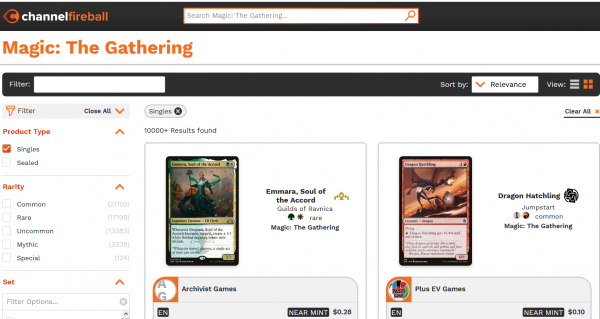
In fact, with the launch of the Channel Fireball marketplace, they included a 20% bonus buck promotion of their own. Was it coincidence that shortly after this launch, TCGplayer initiated a 15% bonus buck promotion? I highly doubt it!

In the grand scheme, this competition will be a fantastic thing for individual buyers like myself. Not only will I have another spot to browse for the best price on my Magic cards and products, but the competition will hopefully fuel more promotions like the ones we saw last week. What better way to get a sudden influx of sales on your platform than to incentivize with a cash back incentive?

It may take a little while for events to unfold. But if I don’t miss my mark, I’d predict we see a number of cash back promotions in the coming months. My advice: I’d hold off on purchasing cards unless you absolutely need them immediately. There may be some compelling reasons to make your purchases from certain marketplaces at certain times…you’ll know when the time is right.

Reason to Wait #2: Holiday Season Discounts

In addition to the potential for more promotions, I believe the incoming holiday season is yet another reason to hold off on purchasing cards in the near term. Black Friday and Cyber Monday are notorious for cash back deals and significant discounts offered by marketplaces and individual vendors alike. I seem to recall last year’s discount shopping season was underwhelming; with the advent of the Channel Fireball marketplace, I suspect promotions will be more aggressive this year.

There was an error retrieving a chart for Hesitation

This is a second reason to put any non-urgent Magic needs on hold. Over the next three months, we should see a wide array of incentives, bonus bucks, discounts, etc. To purchase cards now could mean leaving cash on the table (as I had done with my Beta Lord of the Pit. Fool me once shame on you, fool me twice shame on me.

I will not make this same mistake again.

Reason to Wait #3: Strengthening Dollar and an Uncertain Market

I may have studied microeconomics and macroeconomics in college, but that hardly qualifies me as an expert. I can’t explain all the trends and their inter-relatedness, but I definitely follow them closely as they have profound impacts on my investments and my dollar’s purchasing power.

Right now, the dollar is relatively strong. Below is a 1 year chart for the DXY, the US Dollar Currency Index that tracks the strength of the greenback.
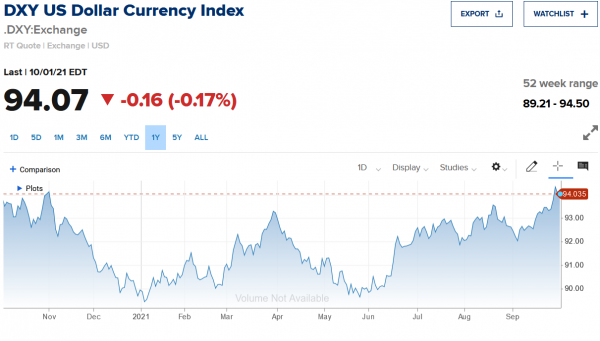
As you can see, the U.S. Dollar is currently flirting with its 52-week high. I can understand this much. What I can’t reconcile is how inflation numbers are coming in hot month after month, yet the dollar remains this strong. If there’s high inflation, it means prices are climbing and a dollar buys less goods than it did before. This is happening, and yet the dollar is the strongest it’s been since this time last year? Perhaps someone more well-versed in economics can explain what seems like a paradox to me.

Nevertheless, I wonder if the strengthening dollar will prove to be a headwind for Magic card prices. While off recent lows, gold and cryptocurrency have both pulled back from their highs. I’ve grown used to seeing Magic cards following in lockstep.

I’m not going to pretend to make any confident predictions here, but it does give me reason to pause. The crypto market and stock market are both showing pockets of weakness. Is this another headfake, or will we see an actual pullback in the market this time around? If stocks were to sell off, I’d be inclined to allocate more of my liquidity to these traditional equities rather than cardboard. If others follow suit, it could mean a softening of card prices—yet another reason to hold off for a little bit to see where things head.

Wrapping It Up

I don’t claim to have a crystal ball—not one that works, anyway. But I’m seeing a few factors unfold that could lead to more attractive prices for buyers in the coming months. Increased competition leads to lower prices, the holiday season should bring along numerous discounts, and the recent market volatility could lead to a pullback in non-traditional investing.

These three factors lead me to believe that rushing out and buying cards right now (unless their prices are no-brainers) may not be optimal. Of course, attempting to time the market is also a fool’s errand—card prices could jump 20% from here before pulling back…or we may have already seen the peak and prices are already on a downward trajectory. It’s hard to tell just yet.

In light of this uncertainty, my advice is simple: wait. Don’t rush out and purchase cards. This is especially true for collectible, investment-type cards. Cards such as Alpha and Beta commons/uncommons, Four Horsemen cards like Eureka and Island of Wak-Wak, and lesser Reserved List cards may offer more attractive entry points in the coming months.

There was an error retrieving a chart for Eureka

As for Alpha and Beta rares, I believe those may be transcending traditional market dynamics given their scarcity. It’s highly unlikely any catalyst suddenly shifts demand for something like an Alpha Fungusaur or Beta Wrath of God. Those I consider in a class of their own. Still, any cash back incentive could make purchasing these far more attractive at a later date rather than right here and right now.

There was an error retrieving a chart for Fungusaur

As a result, I’m not going to be rushing out and purchasing anymore cards for the time being. I’m going to wait for some of these factors to play out. I am especially confident there will be more promotions and bonus bucks deals throughout the remainder of 2021. If nothing else, I’m going to try and time my purchases to line up with such promotions for the rest of the year. I’m not going to be stuck leaving money on the table again. You shouldn’t, either.

Avatar photo

Sigmund Ausfresser

Sigmund first started playing Magic when Visions was the newest set, back in 1997. Things were simpler back then. After playing casual Magic for about ten years, he tried his hand at competitive play. It took about two years before Sigmund starting taking down drafts. Since then, he moved his focus towards Legacy and MTG finance. Now that he's married and works full-time, Sigmund enjoys the game by reading up on trends and using this knowledge in buying/selling cards.

View More By Sigmund Ausfresser

Posted in Analysis, Beta, Black Friday, Economics, Finance, Reserved List, TCGPlayerTagged , , , 2 Comments on Three Reasons to Hold off on Buying Cards

Have you joined the Quiet Speculation Discord?

If you haven't, you're leaving value on the table! Join our community of experts, enthusiasts, entertainers, and educators and enjoy exclusive podcasts, questions asked and answered, trades, sales, and everything else Discord has to offer.

Want to create content with Quiet Speculation?

All you need to succeed is a passion for Magic: The Gathering, and the ability to write coherently. Share your knowledge of MTG and how you leverage it to win games, get value from your cards – or even turn a profit.

A Deep Dive into Pioneer Izzet Phoenix

Are you a Quiet Speculation member?

If not, now is a perfect time to join up! Our powerful tools, breaking-news analysis, and exclusive Discord channel will make sure you stay up to date and ahead of the curve.

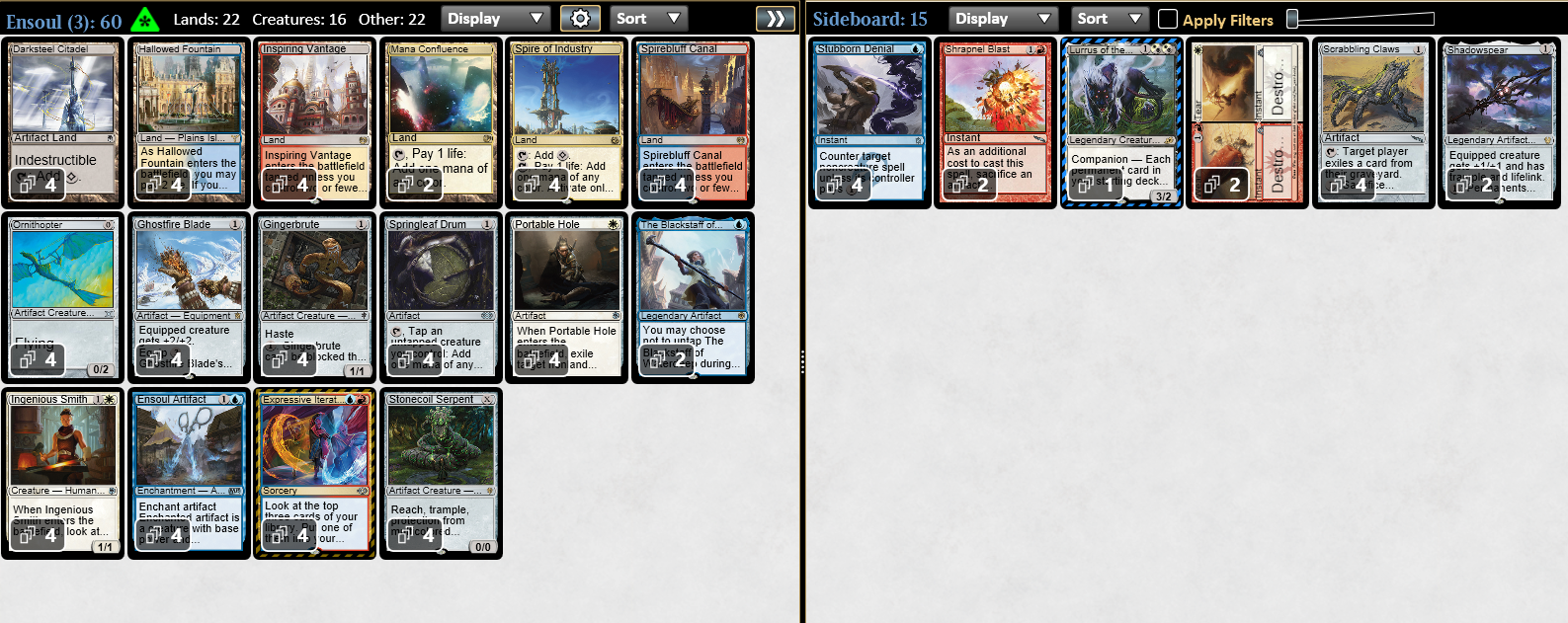
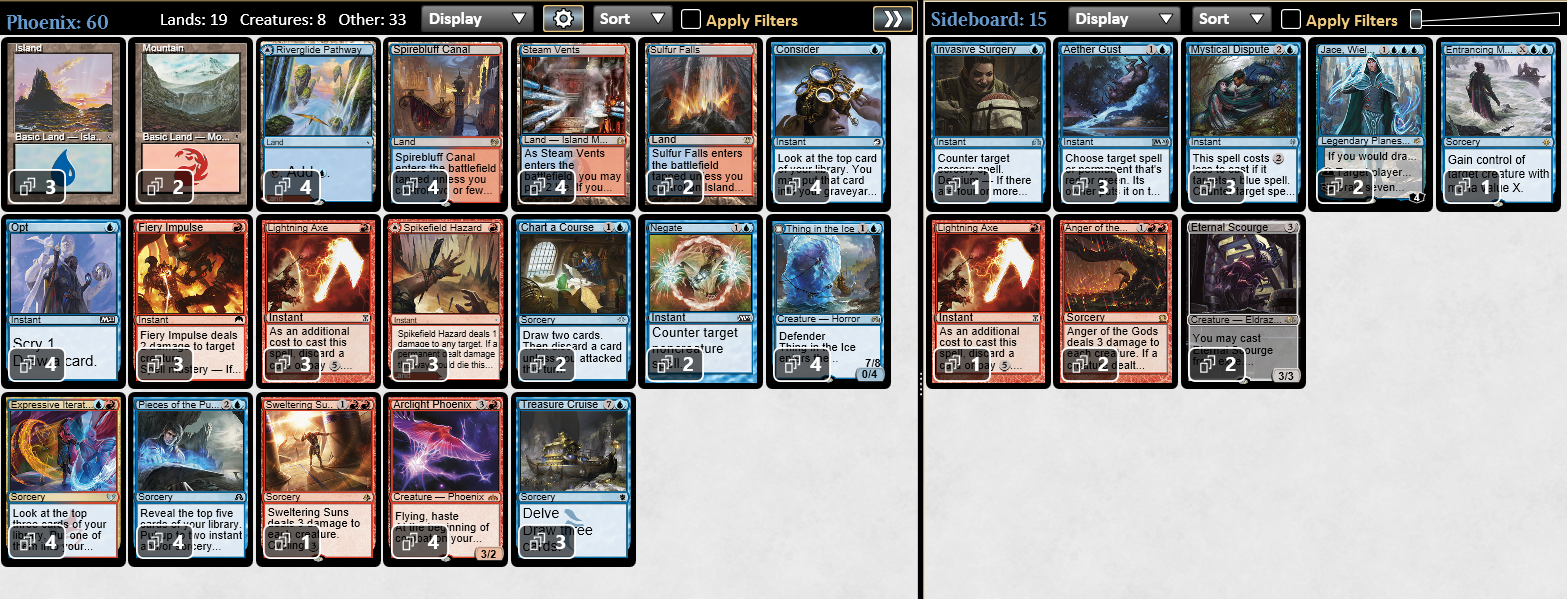
This past weekend I piloted Izzet Phoenix to back-to-back high finishes, including a Top 8 in the ManaTraders event and a win in the Magic Online Pioneer Showcase Challenge. I took the original list from Edgar Magalhães (@EdgarMTG) and made some small adjustments along the way. Here is what I'd currently recommend trying as well as my explanations for all the card choices. Enjoy!

Cantrips

It felt awkward not seeing Pieces of the Puzzle in my opening hands, as it felt like the most efficient way to use three mana to advance my position and I just wasn’t making the most of my turns without it, so I suggest trying four. It is also really good at helping you recover from mulligans and overpowering Go Blank, and it's especially nice to have more as Go Blank decks play Thoughtseize.

Only two Chart a Courses will make it a bit harder to discard Phoenix vs control and combo decks, but I think it’s worth trying this to be able to fit everything else in.

I wanted to fit in an extra Fiery Impulse. With four Pieces of the Puzzle and Expressive Iteration, I felt the deck had access to a lot of card draw, so I've cut a Treasure Cruise for now. That said, Cruise is one of the best cards to find off Pieces, letting you have explosive turns in the midgame, so I am not sure yet.

Burn Spells

I am keeping the main deck Sweltering Suns, as it seems convenient to have access to a board wipe. It's worth noting that if you cut it you can play Jegantha, The Wellspring in game one at least.

I put in a third Fiery Impulse as it felt pretty important to have early interaction. What pushed me to try the third was that I found Lightning Axe somewhat awkward versus BR Arcanist, so I wanted the ability to potentially trim Axe against them post-board. I felt an extra Fiery Impulse would go a long way in letting me do that. I would also expect people to try and fight Phoenix with Burn, though I think in the end Phoenix should emerge victoriously. I played the matchup like six times last weekend and won every time, feeling pretty comfortable along the way. All the upgrades to the deck have made the matchup feel pretty good so far.

The Sideboard

Alternative Threats

There was an error retrieving a chart for Jace, Wielder of Mysteries

The best alternate win-condition I know of. You are pretty good at drawing your deck but can have trouble converting that into winning the game. If you haven’t played Jace before, you will likely be impressed, running away with games by casting this after your opponent Go Blanks you, weaving victorious against Niv-Mizzet Reborn where they have Slaughter Games’d your Arclight Phoenix. The +1 is better than it looks, as milling two can combine with Aether Gust to permanently deal with a threat, in addition to just fueling Cruises and digging to Arclights and Eternal Scourge.

There was an error retrieving a chart for Eternal Scourge

With Pieces of the Puzzle, there is some concern of running out of cards as you rip through your deck, Scourge being a sticky threat you can mill over is quite convenient. I wasn’t too excited about this at first, as investing three mana into a vanilla 3/3 didn’t seem like that good of a deal to me. Even with what it can accomplish vs Go Blank, it represents some virtual card disadvantage because you aren’t leveraging your mana as effectively as possible. It has seemed good enough for me so far.

Counterspells

This card is busted. The second coming of Pyroblast. Three has felt like a pretty healthy number. It could be more, but then you run a higher risk of having awkward spots in the mid to late game where it’s dead. I would say play as many as your gut tells you to play.

This card was brought to my attention by Tristan Wylde-LaRue. The ability to be a hard counter for one mana is quite nice. The Jeskai Ascendancy and Lotus Field decks can produce a lot of mana, and it can be difficult to counter Treasure Cruise with Dispute in the mirror. Negate is a nice card, but leaving up two mana is difficult. To make matters worse, passing to an opponent with a Negate up and having them Mystical Dispute your Negate can be a devastatingly bad exchange that will make you question your entire approach to the matchup. I like trying one Surgery for now. 

Three might seem excessive, but I have been impressed. There are many threatening, difficult-to-deal-with threats like Surrak Dragonclaw and Klothys, God of Destiny. I also got paired into the Mono-Green Devotion deck three times last weekend, and being able to toss around a gigantic Voracious Hydra was nice. You generally want to be able to find multiple of these in a game, so that is why three is a reasonable number in my view.

Removal Spells

A couple more sweepers for when you want them. If you think you don’t want sweepers you can cut them, but having a few seems reasonable to me.

This card is mostly for the mirror, I felt low on answers to Thing in the Ice. Even more so when my opponent had cards like Crackling Drake and my removal felt pretty taxed. Obviously fine to side in other matchups too, but that is the primary reason. Having four main felt a bit much to me, but it’s obviously somewhat marginal stuff.

I wanted a card to deal with creatures that were too large to remove, or indestructible. For example, an Ensoul Artifact plus Darksteel Citadel, or an Ethereal Armored weenie. It brings nice synergy being a sorcery for Pieces of the Puzzle compared to Brazen Borrower, for example.

Closing Thoughts

As a closing note, I will add, the mana base isn't set in stone so feel free to make some changes, it seems reasonable to me, and I don't want to change anything yet or sweat over this small stuff.

Avatar photo

Daniel Goetschel

Daniel Goetschel started playing Magic while in middle school and quickly became interested in competing in events. He has participated in numerous tournaments over the last decade, with top finishes including second place in the 2021 Magic Online Championship Showcase (MOCS), and winning Grand Prix Niagra Falls, a Legacy GP, in 2019.

View More By Daniel Goetschel

Posted in Free, StrategyLeave a Comment on A Deep Dive into Pioneer Izzet Phoenix

Have you joined the Quiet Speculation Discord?

If you haven't, you're leaving value on the table! Join our community of experts, enthusiasts, entertainers, and educators and enjoy exclusive podcasts, questions asked and answered, trades, sales, and everything else Discord has to offer.

Want to create content with Quiet Speculation?

All you need to succeed is a passion for Magic: The Gathering, and the ability to write coherently. Share your knowledge of MTG and how you leverage it to win games, get value from your cards – or even turn a profit.

A Deep Look Into Revised and Foreign-Language Dual Lands

Are you a Quiet Speculation member?

If not, now is a perfect time to join up! Our powerful tools, breaking-news analysis, and exclusive Discord channel will make sure you stay up to date and ahead of the curve.

I will never forget the feeling I had riding in the passenger seat of my friend’s car after we purchased 40 dual lands together. As we headed back to Montevideo –the seller lives 25 miles away from the capital city where we live– my hands were shaking. I felt a mixture of excitement and concern. What have I just done? I kept asking myself over and over. I could feel the small acrylic box containing 23 lands, my share of the 40, inside my right jacket pocket.

It was January 2021, a few days after my 32nd birthday. My friend needed a few duals to complete all ten playsets of Revised. He had also arranged to buy some extras for other people as well. I asked if I could come along. I had never owned a dual land before and thought it was an opportunity to pick up one or two for a good price. A nice weekend plan, I thought.

Warming Things Up

After chatting a little bit with our host, he went to a cabinet and grabbed a small pile of cards without any sleeves. There they were: 40 duals. The lot he was selling had 20 Revised, 19 Foreign White Border (FWB), and one Italian Foreign Black Border (FBB) Plateau. The reason the seller had so many foreign cards is because he had intentionally collected one copy of each dual land in both French and Italian. I was shocked that he kept these treasures with no sleeves at all. He did not play Magic, anymore but still had a massive collection and was definitely not a newcomer.

Taking Them All

Events escalated quickly. What was at first a friendly trip to purchase a couple of duals soon turned into a negotiation between us and him to purchase the whole lot. After an hour of checking prices and discussing payment methods, we closed a deal. The cards were worth well over $20,000 and we agreed to pay $12,000 in three monthly installments of $4,000.

I was after volume and did not mind the language at all, so I absorbed most of the cheaper FWB lands, ending up with more cards than my friend as a result. After selling 13 of them –I was financially unable to keep them all– I kept eight FWB duals, a Revised Tundra, and the FBB Plateau, a beautiful piece. One of each for my Vintage Cube was my reasoning behind what I kept, though I knew very well that I would use proxies and the real cards would rest safe and sound in my binder.

Recently, I have seriously thought about selling most of them. Prices have risen this year, and I would make a pretty good profit. I've also considered the possibility of upgrading to Revised with that money. These thoughts are what inspired this article. If you too are contemplating buying or selling, here are three considerations to keep in mind: Price, Scarcity, and Safety.

Price

This is the most obvious comparison between Revised and FWB. We all know how picky Magic players can be about the language of their cards. I know several people in my country who would not buy a card in a language other than English. But if you're not concerned with language, you can pick up a tournament-legal copy of any dual land at a much lower price.

Let’s take Volcanic Island, for instance. Card Kingdom currently has the card listed in NM condition at $800 without stock. Their price on the single Good copy they have available is $560. In the meantime, you can pick up a very clean, EX copy of the card from MagicCardMarket (MKM) in Europe in its FWB version, for €500 (nearly $580). The card shown below is from an MKM seller. It is almost the same price, for the “same” card, but in a much better condition.

I have seen an uptick in sales of Volcanic Island. This could be due to the popularity of the UR Delver deck in Legacy, after the massive additions it received in Modern Horizons 2, among other factors. Playsets of Dragon's Rage Channeler, Murktide Regent and Ragavan, Nimble Pilferer all from MH2 feature in nearly every published list. My guess is that players are either returning to or preparing for the return of paper events and buying accordingly.

There was an error retrieving a chart for Volcanic Island

A more dramatic example of price differences would be Underground Sea, a land that is seeing far less attention in Legacy. CardKingdom has the card listed in NM at $850 without stock, with available copies in VG at $680. In turn, you can acquire an EX copy in Italian or French like the one below (again taken from an MKM seller) for €470, which is less than $550.

There was an error retrieving a chart for Underground Sea

This price trend is true of all the dual lands if you do not care about the language. There is, of course, a difference between the foreign languages themselves. Italian is the cheapest language, due to its population, followed by French. German copies are more expensive, and the leap is even bigger when you compare FBB versions.

Also, I have been told by some German players that they do not like Magic cards in their own language because the text box becomes too crowded. The combination of these two factors explains in my opinion why the most expensive and in the better condition listed FWB duals in MKM are always, no exceptions, German.

I believe that FWB will appreciate in price in the future. This is because as high-end Reserved List staples rise in price, there will eventually be players who will not be able to afford English Volcanic Island and will necessarily have to shop for an Isola Vulcanica instead.

Scarcity

Legends was the set that got Italy hooked into Magic: the Gathering. The general consensus is that it had a much higher print run, with some users on Reddit and other informal sources stating that it was between three and six times more printed than its English counterpart. This is pure speculation of course. No one knows for sure. It would be a great, though highly unlikely, service to the collectors' community if Wizards of the Coast published this information.

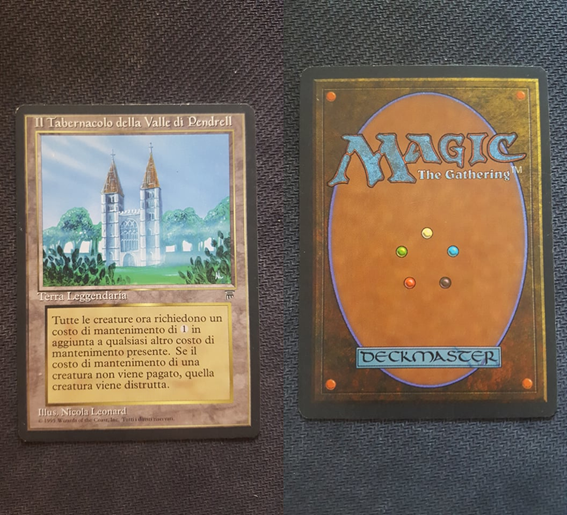
Italian was historically regarded as the “poor man’s” version for people who could not afford copies of the cards they wanted in English. The difference in price in high-end Legends cards in English is substantial: Card Kingdom currently has six listed copies of The Tabernacle at Pendrell Vale in EX for over $4,000. However, across the ocean, you could buy the EX Tabernacle in Italian shown below for less than €2,300, nearly $2,650.

There was an error retrieving a chart for The Tabernacle at Pendrell Vale


Though it hasn't been updated since January 1996, (exactly 25 years before I bought my dual lands!) The Crystal Keep is generally regarded as the Holy Bible of information on early English set print runs. According to it, 18,500 of each Unlimited dual and 289,000 of each Revised dual were printed. This gives a ratio of over 15:1. Information on Foreign Magic: The Gathering print runs is much, much obscure. I could not find a source like the one cited above for comparison, and not everyone accepts these numbers as truth.

As one user on Reddit stated while challenging the Crystal Keep data: “We only have confirmed numbers for very few sets (…). Everything else is speculation. I can't stress this enough. If someone tells you one of the more popular myths about print runs like for example that there are about 300k (or 289k) copies of each Revised dual land out there or that Italian Legends had a print run three times as large as English Legends then that's a completely random guess based on no actual information. And it's almost certainly a very wrong guess”.

So the best we can do is make educated guesses, really. Revised was released April 1st of 1994 and Legends followed two months later. Almost a year later, on January 1st of 1995, both FWB and Legends in Italian were released. The game was quickly expanding –In Uruguay the first well-known set was Ice Age, released in early June 1995– so I think it is pretty safe to say that the population of FWB duals is bigger than the Revised one; assuming the Crystal Keep numbers are close to reality, all it would take is less than 100.000 copies of each dual land in French, Italian and German. Seems reasonable.

A small note: I have also read on Reddit that there are similar amounts or even less FBB rares than there are Unlimited rares. Again, this is pure speculation, but it certainly makes me look at my FBB Altopiano (Plateau) with different eyes.

Safety

Counterfeit Magic: the Gathering is definitely an issue. All you need to do is Google “counterfeit Revised dual lands” in order to get a massive amount of articles and videos, either of people who sadly got scammed or people trying to help other players and collectors avoid this issue.

When we bought our dual lands in January 2021, we were absolutely sure that all the dual lands we were purchasing were authentic. The seller was a very well-known and reputed member of our local community, even having represented Uruguay in the Magic: the Gathering World Championships. We didn’t run the usual tests to check the authenticity of the cards. There was really no need at all.

One thing that he said during the course of the negotiation that I thought was very clever was “Back in the day, some players would prefer to buy a FWB over a Revised dual land, not only because it was cheaper, but also because it was a way to make sure that the copy you were purchasing was authentic”.

I believe some people will find this combination appealing: lower prices for 100% legitimate cards in better condition. I have not found a single article online about fake FWB cards. Why would you bother to counterfeit a card in French?

As I stated before, for many players, English is their top choice when purchasing cards, and this is no secret to counterfeiters. Despite this, you should never think of a card as authentic just because it is in a foreign language. These are expensive cards we are talking about and one must still do all the proper checks when purchasing. For less experienced people, however, this tip could help them buy into duals with more confidence.

Conclusion

Let's face it: despite Ben Bleiweiss' fantastic article, and how we as players and collectors might feel about the Reserved List, it isn't going anywhere in the near future. Partly because of this, I believe that in the years to come the market will appreciate foreign dual lands more, especially the FWB duals, as Revised (not to mention Alpha, Beta, or Unlimited for that matter) will go out of range for a majority of players and collectors. At the very least, foreign duals are an alternative worth exploring. After all, they are still tournament-legal, unlike Collectors Edition or International Edition dual lands. We also can't forget the cool factor of having a card like Mangrovensumpf (yes, that is German for Bayou) in your deck.

Collecting Magic Long Term: Building a Set Cube

Are you a Quiet Speculation member?

If not, now is a perfect time to join up! Our powerful tools, breaking-news analysis, and exclusive Discord channel will make sure you stay up to date and ahead of the curve.

About five years ago I culled a major portion of my Magic collection. Playing Magic for nearly 30 years adds up to a lot of cards. I had tens of thousands, if not 100k cards in my collection, and it was getting cumbersome to live and move with. Weeding through the collection, I stumbled across a large number of draft leftovers from Invasion block. Some were from throwback drafts done by my local game store in recent years before the prices of sealed product climbed out of control. The majority though were leftover from when I'd been drafting Invasion two decades ago.

This Magic Moment

Invasion block was the first block where I learned how to draft. It was not the first block where I got any good at drafting, that didn't happen until much later. Since then, I've always had a soft spot for the format, and over the years I've drafted it at every opportunity. As the prices of sealed Invasion block boosters top $40-$60 per pack and become more and more scarce, the chances of experiencing this limited format as it was intended are rapidly dwindling. As I weeded through 30 years of bulk rares and draft leftovers, a wave of nostalgia struck when I hit that clump of Invasion cards. Why not build an Invasion block cube? I thought to myself. Better yet, why not make it a Set Cube?

The Cube Format

For those unfamiliar, the Cube format is a singleton draft format composed of a curated list of cards. If you've played Magic Online or Magic Arena, you're likely already familiar with the Cube format. Building a cube is a great way to take cards sitting in your collection and find a new use for them. The Cube format has a ton of variety built-in, as the themes and cards included are all up to the individual curating it. Check out cubecobra.com for examples and ideas for curating your own cube. A Set Cube is a particular variation on the normal singleton Cube format.

Setting up the Cube

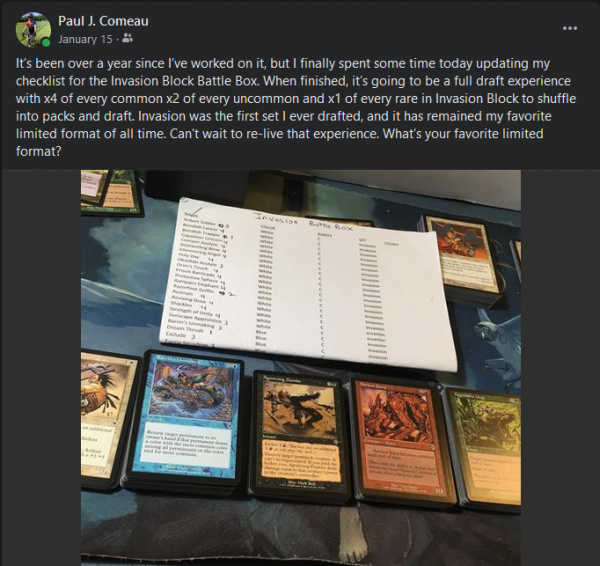
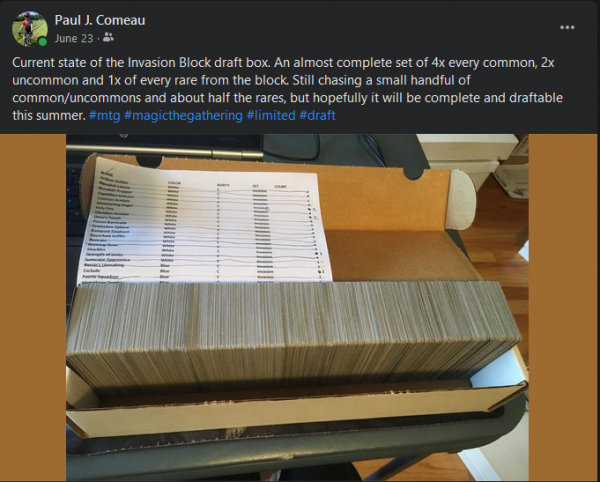
Instead of being a singleton format, a Set Cube mimics the experience of drafting an actual set or block from Magic's past. To achieve this, it contains three to four of every common, two of every uncommon, and one of every rare card found in the chosen format. For Invasion block, the cube consists of cards from the Invasion, Planeshift, and Apocalypse sets. In a normal cube, cards are shuffled randomly into 15-card faux booster packs regardless of rarity. In a Set Cube, the cards are separated by rarity and sorted into packs following the normal rarity distribution of sealed booster packs. For Invasion block boosters, this distribution is 11 commons, three uncommons, and one rare per pack. For those curious, there were no Mythics back when Invasion block was printed, and no basic land slot in booster packs. Those changes didn't happen until Shards of Alara, eight years later.

Assembling the Collection

A large, but incomplete mix of commons, uncommons, and a smattering of rares from my bulk collection formed the basis of my Invasion block cube. I added cards to the box over the next several years as I made trades and bought old Magic collections. It wasn't until January of 2021 that I got serious about completing the cube as a pandemic project, for whenever we returned to playing Magic in person.

Invasion Cards, Assemble!

to complete the cube I built a spreadsheet of all the cards in Invasion block, separated by set, by color, and alphabetized. Then I organized the boxes of bulk Invasion cards I'd accumulated over the years. I removed all the duplicates in excess of our target numbers and kept only cards in LP or better condition. This gave me roughly a third of the cards needed to finish the cube. At this point, I had an important decision to make before I sent the updated spreadsheet to friends.

Invasion: Remastered

From the start of this project, I made a conscious decision to include every common and uncommon printed in Invasion block in the cube. While I was open to cutting cards that people would never play, I wanted to start with pretty much everything and whittle down from there, with five exceptions:

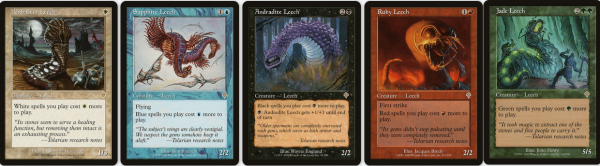
The Leech cycle in Invasion are five of the worst rares ever committed to cardboard, by any standard. Are there worse cards? Sure. But either way, these are not the kind of cards you want in your cube if you want your friends to enjoy playing it. I made the call not to include these in the cube and removed them from the list.

The Value of Invasion Block

The average price of Invasion block cards is a little over $1. A handful of Invasion block cards though have prices ranging from $10 - $70. These are mostly popular Commander cards like Phyrexian Altar, Diabolic Intent, and Elvish Champion. To put the cube together, I either needed to cough up some cash or do some serious trading to get my hands on these cards.

There was an error retrieving a chart for Phyrexian Altar
There was an error retrieving a chart for Diabolic Intent
There was an error retrieving a chart for Elvish Champion

Organizing My Trades

I sent my spreadsheet out to everyone who said they might have cards I needed and then assembled a trade binder of excess cards in my collection. This included Commander and eternal staples, fetch lands, shock lands, and a variety of other cards. I organized the binder by price, with higher dollar cards towards the front, and the rest in descending value. I kept the minimum price in the binder to $1 and above, with more than half the binder at $5 and up. My goal was to turn the cards in the binder into cards for the cube as quickly as possible. The most direct way to do this was to trade down.

Trading Down

With the average price of Invasion block cards being a little over $1, in most cases, I was trading down higher value cards for cards to add to the cube. Trading down is a great strategy to employ when trying to collect a large volume of lower-value cards. It's nice to be able to turn one card in your trade binder into multiple cards you're looking for, and it is usually equally rewarding for the player trading up. Be mindful that trading down does not mean trading a $20 card for a $2 card. It means trading a $20 card for 20 $1 cards, or 10 $2 cards. It doesn't have to be exactly even to the cent, it just needs to be close enough that both parties are agreeable to the deal. When making trades, always be willing to trade down or up if the deal makes sense, and both you and the other party are happy with the end result. In my case, not only did I acquire cards to complete the cube, but I hooked up several friends with cards they needed, and I was happy to do so.

Closing Deals and Buying the Difference

I traded with about a dozen friends to acquire most of the cards I needed. Their willingness to dig through their own bulk collections to come up with the cards on my list went a long way towards completing the cube. With those deals done, there were about 300 cards remaining to acquire. I bought all but three of those remaining cards from my local game store and found the other three on TCGplayer.

Long-Term Play Value

Building this cube not only found a use for hundreds of cards sitting in my collection, but it also gave me the impetus to trade away a number of cards I'd otherwise still be sitting on. I don't imagine that I'll ever have the opportunity to crack sealed boosters of Invasion to draft again, short of Wizards releasing an official Invasion Remastered set. With the Invasion block cube, I will be able to relive that experience over and over.

Last Picks

Have you built a cube before? What are your favorite cube themes? Your favorite limited format? Let me know in the comments or on Twitter. Extra special thanks to all my friends who helped make this possible, and to everyone at my local game store, Tabletop Gaming Center in Newington, CT. Now, who wants to draft?

Avatar photo

Paul Comeau

Paul is Quiet Speculation's Director of Content. He first started playing Magic in 1994 when he cracked open his first Revised packs. He got interested in Magic Finance in 2000 after being swindled on a trade. As a budget-minded competitive player, he's always looking to improve his knowledge of the metagame and the market to stay competitive and to share that knowledge with those around him so we can all make better decisions. An avid Limited player, his favorite Cube card is Shahrazad. A freelance content creator by day, he is currently writing a book on the ‘90s TCG boom. You can find him on Twitter and LinkedIn.

View More By Paul Comeau

Posted in Collecting, Cube, Drafting, FreeTagged , , , , , , , , 1 Comment on Collecting Magic Long Term: Building a Set Cube

Have you joined the Quiet Speculation Discord?

If you haven't, you're leaving value on the table! Join our community of experts, enthusiasts, entertainers, and educators and enjoy exclusive podcasts, questions asked and answered, trades, sales, and everything else Discord has to offer.

Want to create content with Quiet Speculation?

All you need to succeed is a passion for Magic: The Gathering, and the ability to write coherently. Share your knowledge of MTG and how you leverage it to win games, get value from your cards – or even turn a profit.

The Bird is Groggy: Evaluating Jeskai Phoenix

Are you a Quiet Speculation member?

If not, now is a perfect time to join up! Our powerful tools, breaking-news analysis, and exclusive Discord channel will make sure you stay up to date and ahead of the curve.

It has now been a full week since Innistrad: Midnight Hunt hit MTGO and a couple of days since it became paper legal. So I'm able to start measuring the initial impact on Modern. And... it's minimal. Not that I was expecting too much from the set. However, I did at least think that nostalgia and a desire to brew would induce some players to branch out and try new decks. However, as far as the data is concerned, that isn't happening. The data from the past week looks basically identical to the previous weeks. Which is odd, considering how hyped one deck in particular was.

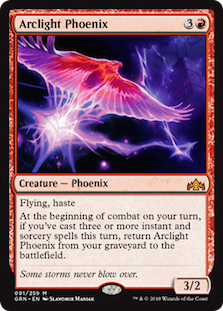
In my spoiler review, I mentioned that I was certain that Consider and Faithful Mending would revive Jeskai Phoenix. I had no idea if it would be good, but it would definitely see play out of nostalgic hope that Jeskai Phoenix is, in fact, good. And I was right, if only thanks to the numbers of streamers and Youtubers playing Jeskai Phoenix. Naturally, I expected that placings in the Preliminaries and Challenges would follow. They have not. Aspiringspike's list from the first weekend of legality is the only Premier result for Jeskai Phoenix, even considering that there's usually a huge influx of players on a new deck right after release and then a dramatic drop-off. The difference is that Phoenix isn't entirely new, nor is it entirely fixed.

The Deck

Not for the first time, I find a surprising lack of innovation among the lists. Every list I've seen is taking their cues or even whole list from Aspiringspike. Which is fair, he does have the only result and has put out a lot of Phoenix content recently. However, I have to ask if all this following the leader is helping or hurting. Spike's a good player and deckbuilder, but did he actually get it right, or is there value in going another direction? Certainly, his list isn't putting up numbers. However, it is what we have to work with, and so here's the latest build I could find.

Jeskai Phoenix, Aspiringspike (League 4-1)

Creatures

4 Arclight Phoenix
4 Demilich

Sorceries

4 Serum Visions
4 Prismatic Ending

Instants

4 Consider
3 Gut Shot
4 Lightning Bolt
4 Thought Scour
4 Faithful Mending
4 Faithless Salvaging
4 Manamorphose

Lands

4 Flooded Strand
4 Scalding Tarn
3 Steam Vents
2 Spirebluff Canal
1 Hallowed Fountain
1 Sacred Foundry
2 Island

Sideboard

2 Path to Exile
3 Flusterstorm
3 Surgical Extraction
2 Alpine Moon
2 Chalice of the Void
3 Wear // Tear

And it's basically the same as his first lists. Does Spike really believe this is the best list or has he simply not had to change anything? Is there a difference? These are the kinds of questions that keep me up at night.

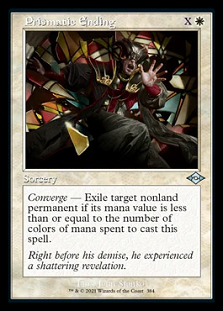
Expanding into white allows the deck to run everyone's favorite multipurpose removal spell in Prismatic Ending, and I actually think that's a greater argument for going Jeskai than even Faithful Mending. The old decks often struggled against non-creature, non-planeswalker decks and now they have a multipurpose answer to everything. Hole closed.
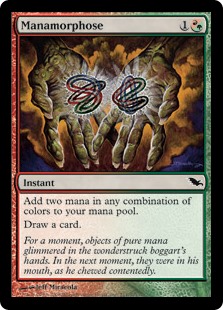
One thing I find odd is no Expressive Iteration. Every other deck with UR as main colors has been running this two mana draw 1-2 since Strixhaven, so its absence is notable. I do know that there's no room for all the 1-mana cantrips, Manamorphose, and the two ways to discard the threats. And also that it's unlikely that Phoenix or Demilich will be cast from exile. However, when an otherwise ubiquitous card is missing from a list, it's worth taking notice.

What's New?

It's tempting to say nothing. Really tempting. And the problem is that while it isn't true, it's not wrong, either. Strategically and even structurally, the deck hasn't really changed since 2018. Therefore, by all means, it's safe to rely on the guides and commentary from 2018/2019 to learn the deck. The deck's gameplan is the same as it's always been.
However, a couple things have changed just enough to make a difference in how games play out. Again, the plan of Phoenix decks has not really changed, but how it feels has. Jeskai Phoenix is at least a turn slower than 2019 Izzet Phoenix. There's no way to dump drawn Phoenixes (or Demiliches) turn one to set up for a big swing turn two. Consider binning Phoenix into Manamorphose and Mending (pitching two Phoenix's) and Gut Shot is the main line for a big swing turn, and that's improbable.
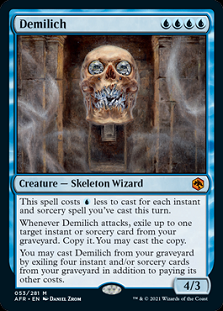
Instead, this is very much an avalanche style deck. It won't do much but durdle for the first few turns, but once it does get going, things become overwhelming. It can blast out multiple early Phoenixes, but in my experience, it typically gets them out one or two at a time and adds more depending on opposing answers. More commonly, and I think more potently, it can ride Demilich as both a clock and card advantage tool. Demilich doesn't immediately generate advantage or trade well. Rather, it just incrementally pulls ahead of opposing fair decks until there's no return. And that is a big change from the earlier builds.

Why It's Good

Which is also the single biggest advantage I've found with Jeskai Phoenix. The gameplan is, again, largely unchanged, but it feels more complete. The 2019 version was all about chaining spells into one big payoff, and afterward they didn't really do anything. Now there's a reason to keep the deck churning so Demilich can keep building its card advantage wave.
However, there's also the fact that all the threats in Jeskai Phoenix cost four. There's been a trend for decks to up the curve of their threats thanks to Prismatic Ending. Which is currently the second highest played removal spell in Modern behind Lightning Bolt. When any deck can permanently remove any 1-2 mana threat, it makes perfect sense to go bigger. Four is a particularly dangerous number in this regard. The triomes let decks splash colors easily, which in turn makes Ending more widespread. However, there's a catch. A single triome is pretty free, but every one after the first is risky, as it slows the mana. It becomes significantly harder for decks to hit four-mana threats, which means that Phoenix can grind through the non-exile removal easily.

A Lesson in Ironworking

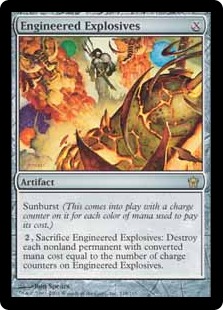
At the same time, Phoenix is also running Ending, harkening back to a different banned deck. Remember Krark-Clan Ironworks? The problem with that deck wasn't the combo or engine card itself but instead it was Engineered Explosives. The card fit perfectly into the general combo gameplan while also providing a maindeck answer to all relevant hate. Ending is now doing that job in Phoenix. Ending will normally be used defensively against threats, but can be used to clear the way for attacks while enabling the threats. Also and again, Ending answers hate that used to give Phoenix trouble, most importantly Ensnaring Bridge and Rest in Peace.
Improved Sideboard

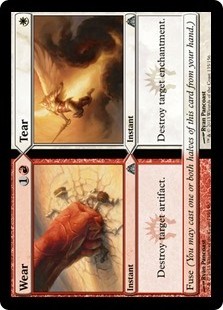
This logic extends to the sideboard as well. White has always had the best sideboard cards and Phoenix can finally avail itself rather than just being victimized. I imagine a lot of players focus in on the Path to Exiles against creature decks, but the bigger addition is Wear // Tear. This is by far the bigger pickup simply because it's one of the best sideboard answers around. No other piece of artifact and enchantment removal can remove two permanents for three mana, and more importantly, fuse lets it get around Chalice of the Void. This is where I think there's a lot more value to be derived than what Spike managed, and would be interested to see more development of the sideboard.
Metagame Positioning

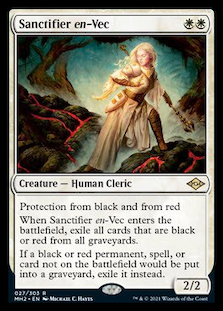
The biggest plus for Jeskai Phoenix at the moment is its metagame positioning. The metagame is not well prepared against Phoenix's strategy, which is part of why Ending has been good. Both maindeck and sideboard cards are being chosen for their strengths against the big four decks (currently: Hammer Time, Cascade Crashers, UR Thresh, and UW Control) and Phoenix is positioned to exploit that lack of focus. It's particularly apparent in sideboard cards where Sanctifier en-Vec is the most common form of graveyard hate thanks to it's phenomenal positioning against UR Thresh. Phoenix can answer Sanctifier, but it also relies more on blue and white cards than red ones to fuel its engine, dodging most of the hate.
Furthermore, Phoenix is far less vulnerable to Chalice of the Void, and not just thanks to Ending. Chalice on one shut down all the cantrips including the critical Faithless Looting before the ban. Mending costing two makes it dodge most Chalices and subsequently means the engine can keep going and dig for answers or threats. On a similar note, with Ragavan and Dragon's Rage Channeler on players' minds, Path to Exile isn't seeing much play, and that card really ruins Phoenix's day.

Why It's Bad

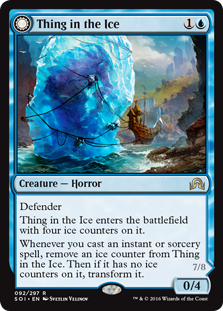
Of course, there are good reasons that Jeskai Phoenix isn't seeing play. Some are more legitimate than others, and at the top of the legitimate list is that Phoenix is far more linear than before. The older lists wanted their graveyards as a resource, and not just because that's how they dumped power into play to quickly win the game. However, they didn't absolutely need them. Thing in the Ice was the primary backup threat and worked perfectly well under Rest in Peace. Similarly, Crackling Drake's power was unaffected and provided a solid backup to Thing. While the other option, Bedlam Reveler, doesn't strictly need a graveyard to function, paying full price for that card is a losing proposition.
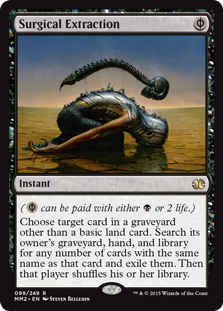
There's no Thing in Jeskai Phoenix. There isn't even an equivalent. All the deck's threats absolutely hinge on the graveyard to be good. Without a graveyard to flashback spells from, Demilich is a vanilla 4/3. For whatever reason, players are sticking to the all-graveyard attack plan, and that means that when they do run into non-Sanctifier hate they're just finished. Surgical Extraction was painful in 2019, but now it's practically lethal. The deck is far too narrow these days and easily answered if the opponent is ready.

A Strength and Weakness

And that's not even discussing the fact that the big strength I mentioned is also a weakness. By being slower, Phoenix is able to snowball and overwhelm the fair decks and thus win in a relatively fair metagame. However, it can't effectively race anything anymore unless it has an abnormally good hand. Phoenix's biggest strength before was that its clock kept pace with the best combo and aggro decks while being too fast for control to contain. Now it has to win the hard way, and that is a much bigger problem. Creatures have gotten bigger and Thassa's Oracle gives combo a sneaky way to win. The latter is not currently much of a problem, but a slower value deck having to contend with 8 power of rhino on turn 3 certainly is.
The Substitute Effect

There's also the less legitimate reason that players just aren't excited by the ability to play Phoenix again. Phoenix was The Deck of late 2018/early 2019 and many players got their fill back then. There's no excitement over getting to play something new, more a nostalgia for what was, and that doesn't bring in the pilots. Moreover, there's a reluctance to try the deck when UR Thresh is doing something similar, is a known good deck, and doesn't demand four new mythic rares. Why take the risk on something unknown? There's just not a good enough reason to want to play Jeskai Phoenix over the alternatives. Maybe with more refinement and a change in attitudes but not right now.

Time Always Tells

However, this is only the first week. Anything is possible down the line and as next week's metagame update will show, the metagame is already shifting. Perhaps the changes will incentivize playing new decks rather than old standbys and lead to more brewing.

Uncommon Report #6 – Theros Block

Are you a Quiet Speculation member?

If not, now is a perfect time to join up! Our powerful tools, breaking-news analysis, and exclusive Discord channel will make sure you stay up to date and ahead of the curve.

Theros Block

Theros block, with its mono-colored and enchantment themes, was an interesting block thanks in large part to a dramatic shift away from its predecessor Return to Ravnica and its multi-colored focus. The Devotion mechanic proved powerful enough to justify players switching to mono-colored decks, mainly blue and black, and using the newly introduced scry lands simply for the scry and ignoring the second color source. It was also one of the first blocks after the playerbase explosion, and that growth seemed to plateau around this time. This means that print runs were quite large for Theros block and there are minimal speculation opportunities. However, just because the print runs for Theros were much larger than those of sets just a few years prior, doesn't mean there is no opportunity for speculation. It just means we need to be pickier because the supply is so much larger. It takes a lot of demand to cause any reasonable gains.

Theros

There are no uncommons that meet our $1.49 or greater TCGMarket price requirement for this section.

Theros- Watchlist

There was an error retrieving a chart for Kragma Warcaller

Theros brought us a lot of new minotaurs, which unsurprisingly caused a temporary spike in Didgeridoo. Again unsurprisingly, Didgeridoo collapsed back down, only to jump anytime a new minotaur is printed. While not the most favorite of tribes amongst casual players, minotaurs do have their fans and they do build decks. Kragma Warcaller hasn't been reprinted and is a strong minotaur lord. Due to the large print run of this set, this is definitely the type of card I would sell into any demand caused by some new minotaur being spoiled.

There was an error retrieving a chart for Prowler's Helm

Given how few commander decks include any walls, Prowler's Helm essentially makes a creature unblockable. This is the type of card that will continue to rise in value slowly so long as it dodges a reprint. It will likely max out in price in the $2 range. Prowler's Helm is a card that many likely pass by when picking bulk assuming it is not a $1 card.

There was an error retrieving a chart for Burnished Hart

Burnished Hart used to regularly sell for $1.49 for me. its current price has plummeted thanks to its recent Commander Legends and Mystery Boosters printings. It's also been included in almost every Commander product since its original release. That said, this card is just too much of a staple to stay down forever. If Wizards were to stop adding it to every Commander product for a year or two I could see its price rebounding back to the $1 range.

Born of the Gods

There was an error retrieving a chart for Springleaf Drum

This was one of the more hyped reprints from the set when it was first spoiled, and saw an additional reprint in Double Masters. Its price has bounced back recently thanks to the new Hammer Time deck in Modern. This is one of those cards that six months ago you might have passed by while picking bulk simply because Born of the Gods was such a low value set that one might think it has no value.

Born of the Gods- Watchlist

There was an error retrieving a chart for Archetype of Endurance

There was an error retrieving a chart for Archetype of Imagination

There was an error retrieving a chart for Archetype of Courage

There was an error retrieving a chart for Archetype of Aggression

There was an error retrieving a chart for Archetype of Finality

This cycle has waffled in price for quite some time. I have sold plenty of Archetype of Endurance for $1.99 in the past and the others all have a market price of around $1. These are great budget Commander cards, and all provide useful abilities for you and remove useful abilities for your opponents. The last three have dodged any reprints, but Archetype of Endurance and Archetype of Imagination were both in Mystery Boosters. Archetype of Imagination was also in Commander 2018.

There was an error retrieving a chart for Sunbond

While this card might seem unassuming, it's easy to forget that there are lots of ways to gain life and plenty of creatures that can abuse +1/+1 counters. The most obvious is Spike Feeder, which simply gains you infinite life.

Journey into Nyx

There are no uncommons that meet our $1.49 or greater TCGMarket price requirement for this section.

Journey into Nyx- Watchlist

There was an error retrieving a chart for Eidolon of Rhetoric

The original Rule of Law actually used to be worth almost $3 until Faithless Looting got banned and the Izzet Phoenix boogeyman of Modern faded out of tier 0 status. Not surprisingly, a Rule of Law that you could hit off of Collected Company also saw a jump to around $2. We are seeing a resurgence in the Phoenix archetype, in Jeskai form now. If the deck proves it has staying power, expect the hate cards to rise.

There was an error retrieving a chart for Solidarity of Heroes

I'll bet even those who deal with bulk picking a lot didn't realize this card's market value is over $1. It happens to have two very desirable keywords "double" and "+1/+1 counters" which are a favorite amongst casual players.

There was an error retrieving a chart for Felhide Petrifier

As I stated previously with Kragma Warcaller, minotaur tribal decks wax and wane in the casual community. Whenever some new minotaur legend is spoiled, the cards always jump for a bit, and deathtouch is a very powerful ability when applied en masse.

There was an error retrieving a chart for Thoughtrender Lamia

Paying six mana for a 5/3 that makes all opponents discard a card hardly seems worth it nowadays. The fact that you can repeat it with Constellation does open up some possibilities. The biggest hindrance is that currently, the top enchantment-themed Commander decks tend to be Bant-colored. However, if we ever get a powerful enchantment-themed Abzhan commander, this card would almost certainly be a staple.

Previous Uncommon Reports

  1. Kaladesh Block
  2. Return to Ravnica Block
  3. Innistrad Block
  4. Shards of Alara Block
  5. Zendikar Block

Star City Games Stepping Up Their Alpha & Beta Buylist

Are you a Quiet Speculation member?

If not, now is a perfect time to join up! Our powerful tools, breaking-news analysis, and exclusive Discord channel will make sure you stay up to date and ahead of the curve.

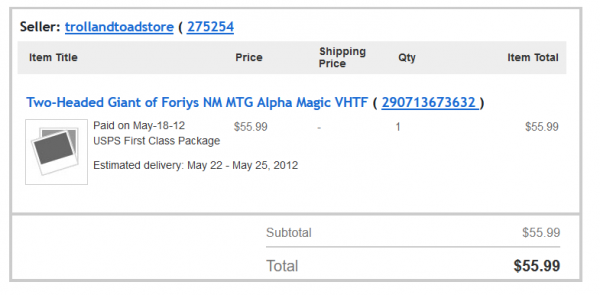
When I first started learning about the rarity of Alpha cards—rares, in particular—one of the first cards I purchased on a whim was a near mint Alpha Two-Headed Giant of Foriys. The card was sold to me by Troll and Toad, and I made the purchase through eBay for $55.99 shipped. In fact, I still have the order confirmation email, as proof!

I made this purchase knowing Star City Games was paying $60 on their buylist, so it was guaranteed profit with upside.

How much upside? Sadly, I didn’t believe strongly enough in the prospects of Alpha cards back in 2012, so I didn’t hold the card for very long. This was before I learned about Old School and Alpha 40, two formats where this card would be playable.

I flipped the card shortly after purchasing, locking in a modest gain. But I have to know…just how much could I have made had I kept the card until today?

Comparing Buy Prices

Card Kingdom is my de facto store to sell cards to nowadays. I just love their dynamic buylist, ease of use, and competitive pricing. Looking up Alpha Two-Headed Giant of Foriys on their buylist, I see they are currently offering $1200 for near mint copies. Had I kept the card from 2012 until today, I would have made over 2,000% in profits from this investment. That annualizes to over 200% a year.

Even Tesla stock would struggle to keep pace with such a growth rate.

There was an error retrieving a chart for Two-Headed Giant of Foriys

While kicking myself, I did some due diligence work and looked up buy prices at a couple of other sites. Here are the numbers:

ABUGames: $1020 (for MINT copies)
Channel Fireball: $1200 (do they even buy cards now that they’re moving to the marketplace model?)
Star City Games: $1300

Hold on a second! Star City Games is paying $1300 for near mint Two-Headed Giant of Foriys? Since when did they have competitive buy prices on Alpha cards? In fact, I’m not sure when they started posting actual buy prices on Alpha cards outside of Power and Dual Lands. For the longest time, they simply didn’t have prices posted for stuff like Two-Headed Giant of Foriys. Now, without my realizing it, they are suddenly best in class?

Maybe this is one of those gimmicks, where a vendor posts an exorbitantly high buy price on a near mint Old School card to attract attention, but then offering severe reductions for played copies. I remember Channel Fireball implementing such a strategy a while back. And for Alpha, Beta, and Unlimited cards, Card Kingdom’s downgrade percentages can be rough.

At 80%, 60%, and 40% for EX, VG, and G respectively, Card Kingdom is effectively offering $960 for lightly played copies, $720 for moderately played, and $480 for heavily played. How does this compare with Star City Games’ played pricing?

Well, Star City Games offers $1000 for “PL” copies, which to me equates to Card Kingdom’s EX. I’ve always been impressed with Star City Games’ grading, and many times I’ve been able to purchase PL copies of a card from them only to turn around and sell it to another vendor as near mint. So drawing this equivalence of Star City Games “PL” and Card Kingdom “EX” seems appropriate. In this case, Star City Games is yet again in the lad, paying $40 more than Card Kingdom.

How about “HP” copies? Well with Star City Games, “HP” can be kind of a craps shoot. You may get a very nice moderately played copy, or you could get a pretty beat up (though still sleeve playable) heavily played copy. I’ve gotten both. So for the sake of argument, I’ll equate Star City Games’ HP with Card Kingdom’s “Good” condition, though there is a chance for upside.

Card Kingdom is paying $540 for Good copies. Star City Games is paying $800 for their HP condition! That means, even if you equate Star City Games’ “HP” with Card Kingdom’s “VG”, you still get paid more for selling your copy to Star City Games rather than Card Kingdom!

Here Comes a New Challenger

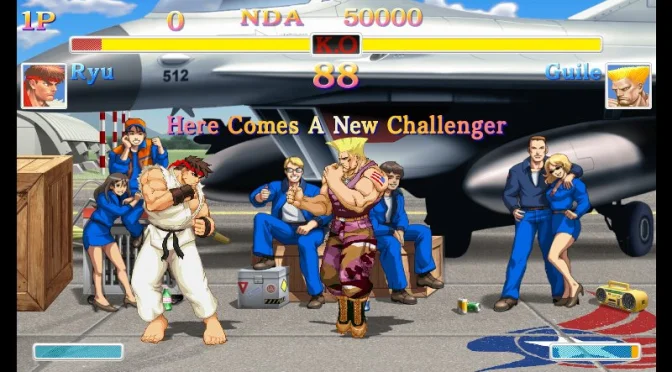
Have you ever played a classic arcade fighting game, like Street Fighter II, where a second human player could interject in the middle of a fight and challenge the other human player? They could be in the middle of an important fight against the computer, but the fight is immediately suspended so that the challenger can play.

This is what I’m envisioning when I see Star City Games enter the Alpha and Beta buylist market with competitive buy prices.

Yes, they have solid prices posted for Beta too. I didn’t mention that yet—I was considering selling a heavily played Beta Clockwork Beast I picked up from eBay not long ago. I know this is like a $100 card, but vendors aren’t paying all that great for heavily played copies.

Card Kingdom, for example, pays $120 for near mint, so their heavily played (“Good”) offer would be a measly $48. Cash-wise, ABUGames offers $66.94, which is a little better I suppose. But Star City Games has a $90 buy price on heavily played copies of the card! That’s almost double Card Kingdom’s HP buy price and a significant premium over the rest of the competition.

There was an error retrieving a chart for Clockwork Beast

Another quick example: Beta Control Magic. Card Kingdom, my go-to vendor, offers $115 on near mint copies, or $46 for “Good” condition copies. ABUGames pays $132.60 for “MINT” copies (whatever that actually means) and $53.55 for heavily played. Meanwhile, Star City Games pays an impressive $150 for near mint and $90 for heavily played copies! Once again, this is significantly higher than their competitors.

I could sit here and write up a dozen such examples. But rather than trying to cherry-pick these comparisons, I’ll make a broader suggestion to prospective sellers: make sure you check Star City Games’ buylist before listing a card for sale or selling it to a different buylist. They have significantly improved their offers on these collectible cards from Magic’s first couple sets, and this means they deserve some business! I know I’ll be checking their buylist a bit more frequently now as I think about how to price out my cards.

What About the Four Horsemen Sets?

If Star City Games has updated their buylist to pay competitively on Alpha and Beta cards, it begs the question of whether or not they pay well on other early Magic sets as well.

I started with a quick comparison of Arabian Nights buy prices between Card Kingdom and Star City Games. For this set, Star City Games is lacking. Card Kingdom pays much better than Star City Games on cards like Bazaar of Baghdad, City in a Bottle, and Diamond Valley. Even though Card Kingdom is not paying near their previous highs, they still pay better than the Virginia-based vendor.

The same trend holds for the other Four Horsemen sets as well (Legends, Antiquities, and The Dark). Star City Games’ numbers just don’t compete with Card Kingdom’s. What’s more, Card Kingdom’s downgrade percentages for condition are significantly more generous to sellers on these sets vs. the percentages on Alpha, Beta, and Unlimited. If Card Kingdom’s near mint buy price is better than Star City’s, I am confident the same trend will hold true for all other conditions as well.

Perhaps this trend will also change in time—Star City Games makes less frequent updates to their buylist but when they do, it’s usually a significant overhaul. Until then, it looks like Star City Games is competitive in Alpha, Beta, and [possibly] Unlimited. But for the rest of the Old School market, stick to Card Kingdom for now. Or, in a couple of cases, ABUGames (e.g. near mint Elephant Graveyard, where ABUGames pays best).

There was an error retrieving a chart for Elephant Graveyard

Wrapping It Up

A walk down memory lane ended up informing me of a new trend in the buylist market. Star City Games has stepped in with some very competitive offers on Alpha and Beta cards across the board. No longer are they only interested in Dual Lands and Power from these sets. Now they’ll buy almost any card, and in many cases, their offer is best in class.

I’m not about to rush out and sell Star City Games a stack of Alpha and Beta cards. I learned my lesson with the Two-Headed Giant of Foriys. I’d rather be a buyer than a seller of these ultra-rare collectible pieces from the game’s history. But if I do decide to sell a card or two in order to raise cash and fund further purchases, I’ll definitely be looking to Star City Games’ buylist for some pricing information. To ignore their buy prices could mean leaving money on the table. Especially if you were thinking of going the buylist route anyway.

I’m not sure how long this trend will last, but it’s noteworthy enough to be aware of, for starters. Back in 2012 when I first started researching Alpha cards, Star City Games’ buylist was best in class. They offered at least $60 on any Alpha rare, during a time when demand for unplayable Alpha cards was thin at best. Fast forward to 2021, and Star City Games is at it again. Only this time, they’re paying north of $300 on nearly every Alpha rare, with a couple of exceptions (poor Jade Monolith with its $175 buy price…those you should sell elsewhere).

There was an error retrieving a chart for Jade Monolith

It makes me wonder what buy prices will look like in another nine years. Will the cheapest Alpha rare sell for north of $500? At current growth rates, I’d say it’s highly likely. When only approximately 1,100 copies of a card are printed, it means tremendous scarcity in a collectible market with orders of magnitude more participants. It’ll be interesting to watch this decade. One thing is for certain, I am not going to rush out and sell any Alpha rare for meager gains this time (I only own a few as it is)!

Avatar photo

Sigmund Ausfresser

Sigmund first started playing Magic when Visions was the newest set, back in 1997. Things were simpler back then. After playing casual Magic for about ten years, he tried his hand at competitive play. It took about two years before Sigmund starting taking down drafts. Since then, he moved his focus towards Legacy and MTG finance. Now that he's married and works full-time, Sigmund enjoys the game by reading up on trends and using this knowledge in buying/selling cards.

View More By Sigmund Ausfresser

Posted in Alpha, Beta, Buylist, Finance, Finance History, Old School Magic, SCGLeave a Comment on Star City Games Stepping Up Their Alpha & Beta Buylist

Have you joined the Quiet Speculation Discord?

If you haven't, you're leaving value on the table! Join our community of experts, enthusiasts, entertainers, and educators and enjoy exclusive podcasts, questions asked and answered, trades, sales, and everything else Discord has to offer.

Want to create content with Quiet Speculation?

All you need to succeed is a passion for Magic: The Gathering, and the ability to write coherently. Share your knowledge of MTG and how you leverage it to win games, get value from your cards – or even turn a profit.

From Player to Investor: Buying Magic in Pandemic Times

Are you a Quiet Speculation member?

If not, now is a perfect time to join up! Our powerful tools, breaking-news analysis, and exclusive Discord channel will make sure you stay up to date and ahead of the curve.

Both 2020 and 2021 have been great to me so far. It was unexpected, given the unfavorable economic context worldwide. I found out that working from home is extremely compatible with the side hustle of buying and selling Magic: The Gathering. While working at home all day, you can easily sell cards to someone that messaged you. You can buy something cool that you saw online. You can take a phone call and discuss a trade while still working on your duties. These are all things that you just cannot do at the office.

Magical Origins

I'm from Uruguay and started playing Magic back in 1995 when Ice Age came out. I was six or seven years old at the time. A few years later, falling in love with Basking Rootwalla and Wild Mongrel, my pet deck became Blue/Green Madness, which I played at school with my friends. I took a break from playing around Legions and returned to the hobby during Khans of Tarkir-Theros Standard. At the time, I remember being amazed that fetch lands were back and Standard-legal.

Not long after getting back in the game, I became a Modern player, searching for greatness with the mighty Burn deck. My biggest accomplishments as a player were netting a Pro Point at Grand Prix Sao Paulo 2017, and losing a finals match to go to Pro Tour Brussels 2020 at a Latin American (LATAM) Series Event in 2019, again in Sao Paulo. I lost to Dredge, the story of my life. It's not much, but I worked at it: testing hard for events, trying to find good sideboard cards, etc. The normal life of an aspiring Spike.

It was at that point that the pandemic and the 2020 lockdown came along and changed all our lives and mindsets. You could not gather at a store to play anymore. Because of the shutdown, I decided to sell my two Modern decks, Burn and Humans. With the recent uptick of prices in Modern, it's safe to say both my buyers made some serious profits, but at the time, I had no interest in keeping decks if I had no chance to play them.

Reserved List Fever

Around August 2019, before we knew the pandemic was coming, I began watching a famous YouTube channel about collectibles and finance called Alpha Investments. The host Rudy said something that really struck me: "If you like Magic: The Gathering and you've been around for a while, buy a little Reserved List card here and there. Save it. You'll be amazed one day at the size of the pool, and at what you have accumulated." I am paraphrasing, but what he said really hit me.

This was the pivotal moment where I converted from being a Modern player to a small collector, investor, and speculator. None of those words accurately define what I do, though. Truthfully, what I do is hoard Reserved List cards. I remember at the time feeling stupid, that it took a YouTube channel in 2019 to introduce me to the Reserved List, after being linked to Magic for more than a decade. I quickly saw the upward trend of Reserve List prices, and the discovery lit something inside me. "Let's stop regretting what we didn't do in the past and buy our first Reserved List card," I said to myself. I was determined to buy the first Reserved List card I saw, no matter how bad it was.

The First Card(s)

It was September 2019 that I found it. I was at Dragon Stone, a local store. A friend of mine was showing me his binder and there it was: a beautiful lightly-played Rofellos, Llanowar Emissary in English.

"How much for this little guy?," I asked. He checked Card Kingdom, the main price reference used in Uruguay.

"$30," he replied, before doing the conversion to our local currency.

I also found an Argothian Wurm on the next page, and I took that card as well.

There was an error retrieving a chart for Rofellos, Llanowar Emissary

There was an error retrieving a chart for Argothian Wurm

That was the beginning of my crazy, appetite for Reserved List cards. I did what the madman on YouTube told me to: I bought them all. Survival of the Fittest for $100? You’ve got yourself a deal. Copy Artifact for $50? Here you go. There is one other Reserved List buyer in my hometown Montevideo. Because he has a wide collection of singles, comparable to that of a medium-sized store, I usually pay a little higher price to compete with him.

There was an error retrieving a chart for Survival of the Fittest

There was an error retrieving a chart for Copy Artifact

A Growing Obsession

It's been two years since I started buying all the Reserve List cards I could get my hands on. After much grinding, I've accumulated a very nice collection. Some of the highlights include one of each dual land (mostly foreign white border), a Gaea's Cradle, and a few high-end Reserved List foils. I have over 500 other minor and midrange Reserve List cards, a small Portal Three Kingdoms lot in English, sealed boxes, and more. I've become a hoarder, simply put, and I feel good about my prospects. I like my stock, as they say. I believe in this. I'm not afraid to park money in Reserved List cards because I am sure that the future is bright: nearly all of the cards I have bought, no matter how unplayable they are, have risen in buylist prices.

Playing For The Endgame

When I first started buying Reserved List cards, I did not have any kind of endgame in mind. For me, buying and selling cards was just a way to stay connected to the game in a time where I could not play physical Magic: the Gathering. I have a thirteen-year bank loan on my house which I'm currently paying back, so I've figured that this is a good time frame for me to hold onto my collection. Then, once I own my house, I can set a new course. Finance a project, maybe even buy a second property? Thirteen years is a lot of time, but it comforts me to think that I will not only have a place to live, but also collectible assets that could help me finance other projects when that time comes.

The Status of My Collection, and Future Prospects

Today, Card Kingdom is offering $180 for copies of Survival of the Fittest. Copy Artifact is not quite there, still only at the $50 I paid for mine, but it will get there. If lockdown has taught me one lesson, it's the exercise of patience. One must be willing to wait. When I first got into Reserved List cards, I was obsessed with prices and tracking my collection to see the changes. Now, I do not even look into it anymore. I don't even know how much money I have tied up in cards. After the last retrace and the apparent latest uptick in several Reserved List items, my mindset has changed. I also have this feeling in my gut that Magic: The Gathering is gathering more attention—with the Secret Lair crossovers and the Netflix series⁠—I am very excited about what 2022 has to offer. Even though the pandemic has brought sad times to all of us, I feel fortunate to have found something good to take out of it.

Hooglandia Open: the Future of the Standard Format

Are you a Quiet Speculation member?

If not, now is a perfect time to join up! Our powerful tools, breaking-news analysis, and exclusive Discord channel will make sure you stay up to date and ahead of the curve.

This past Sunday, The Hooglandia Open gave many a first look at post-rotation Standard. 95 players playing on Arena brought their best brews to the table in a double-elimination event organized by Twitch streamer Jeff Hoogland and broadcast on his channel. With Thrones of Eldraine and company gone, the remaining sets in Standard finally had their chance to shine alongside newcomer Innistrad: Midnight Hunt. Let's look at what cards players brought to the table. Are these the new cards to beat?

The Usual Suspects

It was exciting to see many new cards in the spotlight for the first time, but a couple of established cards that survived the rotation are now likely poised to dictate the shape of Standard moving forward. These include cards like Goldspan Dragon and Alrund's Epiphany.

There was an error retrieving a chart for Goldspan Dragon

Goldspan Dragon is still a large hasty finisher that can close out a game on its own. It's on a shortlist for the title of the most powerful card in Standard, as attested by the variety of decks it slots into. At the Open, this ranged from Gruul Aggro to Jund Midrange, to the post-rotation version of Izzet Dragons. If you want to curve into big creatures, there doesn't seem to be a better top-end than Goldspan Dragon if you're in red.

There was an error retrieving a chart for Alrund's Epiphany

One of the driving cards of the Sultai Ultimatum deck prior to rotation, Alrund's Epiphany is good whether you are ahead or behind. While the decks that performed with Alrund's Epiphany at the Open were Izzet Dragons and Simic Midrange, It's likely blue-based control decks will want this as well. Creating a finisher, and allowing the control player to reset their mana sounds great in a format that so far lacks an obvious control win condition. There is one card though, that might be able to claim that position.

Time to Shine

There was an error retrieving a chart for Ebondeath, Dracolich

Ebondeath, Dracolich is one card high on my radar. Only a sideboard card in James Rutherford's second-place Orzhov Midrange deck, it's easy to imagine the recursive Dracolich as a possible control finisher, or as the top-end in the main deck of a black-based aggressive deck. A very different kind of four-mana creature in tournament winner Christopher Williams' deck is also getting time in the spotlight.

There was an error retrieving a chart for Yasharn, Implacable Earth

Virtually all the big mana decks prior to rotation wanted to be Sultai colors. Yasharn, Implacable Earth suffered from being in the wrong color combination and saw little play. With Emergent Ultimatum gone from the format, it's more likely that big mana decks like Williams' will be Selesnya or Naya-colored moving forward. This is great for Yasharn. The four mana 4/4 will be right at home fixing mana or beating down opponents in those lists. It's not the only green card taking off in popularity though. Another green card that quietly saw play prior to rotation has now emerged into the spotlight.

There was an error retrieving a chart for Esika's Chariot

Alongside Yasharn, Esika's Chariot was a big part of Williams' winning deck in the Open, and with good reason. Great on defense, and even better on offense, the Chariot is poised to turn a game around or shut the door on an opponent almost the moment it hits the battlefield. The Chariot is protected from most sorcery speed sweepers by virtue of being a vehicle, making it a resilient threat. I won't be surprised if it becomes the most-played green card in Standard. It also pairs fantastically with a new green five mana threat, which we will get into.

New to the Festival

While rotation has brought a number of existing cards to the spotlight, Innistrad: Midnight Hunt has also brought a number of new guests to the party. Here are a few that made waves in the Hooglandia Open that are worth keeping an eye on for the future.

There was an error retrieving a chart for Storm the Festival

While it wasn't fully responsible for winning the day, this explosive card made for some of the most exciting moments of the Hooglandia Open. Storm the Festival is like a massive Collected Company. Though only Sorcery speed, the ability of the Festival to hit any permanent of Mana Value five or less allows this to drop massive haymakers like Esika's Chariot into play and take over a game. The ability to hit any permanent also means that this card never whiffs 100%, though hitting lands or mana dorks is much less exciting than slamming a Chariot, or the next card in our discussion.

Planeswalk With Me

There was an error retrieving a chart for Wrenn and Seven

There are 19 planeswalkers in Standard post-rotation, including the newest additions from Innistrad: Midnight Hunt. Of all of them, I feel like Wrenn and Seven is the one poised to be the best in Standard. Its token-making ability pairs excellently with Esika's Chariot's token copy ability. The two together are a potent duo. Both can also be cast for free together off a single Storm the Festival, as Open winner Christopher Williams' tried to do with his deck. Wrenn wasn't the only planeswalker that saw considerable play in the open though. Here's a couple of others that also caught my eye.

There was an error retrieving a chart for Lolth, Spider Queen
There was an error retrieving a chart for Arlinn, the Pack's Hope // Arlinn, the Moon's Fury

Lolth, Spider Queen, and Arlinn, the Pack's Hope // Arlinn, the Moon's Fury, both had considerable success in a variety of decks at the Open. One player, Johann Ayala Serrano, even paired the two up with Wrenn and a bevy of other Planeswalkers in his Jund Super Friends list. Serrano finished 26th in the Open. Serrano's list is worth considering If you're interested in slamming powerful planeswalkers onto the battlefield. Whatever planeswalkers you're contemplating playing though, the ultimate litmus test for all of Standard may come down to how well your deck is capable of answering a one-mana 3/2 flyer on turn one.

Delving Into Standard

Delver of Secrets is back in Standard! Matthew Garner made a deep run in the Open, piloting an Izzet list featuring Delver, Goldspan Dragon, and Alrund's Epiphany to a 9th place finish. Garner's list is designed to curve into larger and larger threats. The strategy worked well for him, but I'm not sure if his list is the ideal Delver shell or a Goldspan Dragon deck that happens to also have Delvers. Whatever the case, I'll be looking out for more streamlined Delver lists in the coming days. In the meantime, I've already crafted my copies for use on Arena and can't wait to beat down with insects in both Standard and Historic.

What cards are you most excited about in Standard? What cards do you have on your radar to play or to speculate on? Let me know in the comments or on Twitter.

ChannelFireball Announces Magic: the Gathering Las Vegas Nov 19-21

Are you a Quiet Speculation member?

If not, now is a perfect time to join up! Our powerful tools, breaking-news analysis, and exclusive Discord channel will make sure you stay up to date and ahead of the curve.

Today ChannelFireball.com announced the Magic: The Gathering Las Vegas tournament weekend including two $25,000 main events. Taking place at the Las Vegas Convention Center November 19-21st, the weekend includes Modern and Sealed main events, each with $25k prize pools paid out to the top 32 players in each event, and numerous side events throughout the weekend.

MTG Las Vegas Main Even Prizing

Main Event Details

The main events will each be Modified Swiss-style, with eight rounds on Day One, six rounds on Day Two for those who qualify, followed by a cut to the top eight players for single-elimination playoffs to determine the winner. Additional details on the main events can be found at the MTG Las Vegas Main Event Fact Sheet.

Side Events

ChannelFireball has promised a number of side events in a variety of formats including Commander, Modern, Legacy, and more. Details on side events can be found on the event schedule.

Safety Precautions

CFB Vaccination Announcement Tweet

ChannelFireball is taking plenty of safety measures for their first major Magic event since the pandemic. In addition to announcing that proof of vaccinations or negative Covid tests and masks were required, they are taking a number of additional precautions to ensure the safety of their staff and the community. Additional safety information for the event is available at: https://www.mtglasvegas.com/safety

The Gathering

Magic: The Gathering Las Vegas is ChannelFireball's first large Magic event since the pandemic. It follows on the heels of their Flesh and Blood event, The Calling, which also took place in Las Vegas earlier this month, and was largely successful, with over 750 players in the main event alone.

For complete details and registration for Magic: The Gathering Las Vegas, check out the full event website at: https://www.mtglasvegas.com/

Avatar photo

Paul Comeau

Paul is Quiet Speculation's Director of Content. He first started playing Magic in 1994 when he cracked open his first Revised packs. He got interested in Magic Finance in 2000 after being swindled on a trade. As a budget-minded competitive player, he's always looking to improve his knowledge of the metagame and the market to stay competitive and to share that knowledge with those around him so we can all make better decisions. An avid Limited player, his favorite Cube card is Shahrazad. A freelance content creator by day, he is currently writing a book on the ‘90s TCG boom. You can find him on Twitter and LinkedIn.

View More By Paul Comeau

Posted in Free, Modern, News, SealedTagged , , , , , Leave a Comment on ChannelFireball Announces Magic: the Gathering Las Vegas Nov 19-21

Have you joined the Quiet Speculation Discord?

If you haven't, you're leaving value on the table! Join our community of experts, enthusiasts, entertainers, and educators and enjoy exclusive podcasts, questions asked and answered, trades, sales, and everything else Discord has to offer.

Want to create content with Quiet Speculation?

All you need to succeed is a passion for Magic: The Gathering, and the ability to write coherently. Share your knowledge of MTG and how you leverage it to win games, get value from your cards – or even turn a profit.

An Introduction to the Pioneer Format

Are you a Quiet Speculation member?

If not, now is a perfect time to join up! Our powerful tools, breaking-news analysis, and exclusive Discord channel will make sure you stay up to date and ahead of the curve.

This month's ManaTraders event is Pioneer, so it is a good time for us to explore the format. For those who are not familiar, Pioneer is a nonrotating format introduced in October 2019 using sets from Return to Ravnica onward. It features an extensive ban list including all the Khans of Tarkir fetch lands. A metagame breakdown of the format from MTGGoldfish looks like this:

Quick Takes on The Pioneer Metagame

I’ve played a bit of the format recently and here are my quick thoughts on some of the most played decks.

Rakdos Pyromancer

Pros: Busted threats ( Kroxa, Titan of Death's Hunger / Dreadhorde Arcanist / Lurrus of the Dream-Den ) great cheap interaction ( Thoughtseize / Fatal Push etc.). 

Cons: Potentially not great vs Niv-Mizzet Reborn, Jund Sac, or hate cards like Grafdigger's Cage and Yasharn, Implacable Earth.

I was never really allured by this deck so I haven’t played it much. It's a reasonable choice if it speaks to you.

Ascendancy Combo 

Pros: Gets to play Treasure Cruise / Expressive Iteration. The Combo-control archetype is generally a nice spot to be in. Consider + Cruise seems potent.

Cons: Can have issues vs both slower and faster decks. It doesn't goldfish for a win that fast. Whenever I try and play the deck I feel I just die when I go to cast Ascendancy. There is also potential difficulty beating other control decks due to Slaughter Games + Narset, Parter of Veils + Dovin's Veto type of cards.

I am lower on this deck than most people. I’ve heard many say this deck is the best in the format and they don’t think it is close. I think this deck is a good metric for what your Pioneer deck's power level should look like. The deck is playing most of the “good” cards in the format, so if you have trouble keeping up with this deck it might mean your strategy is underpowered. (though there’s also cases where your primary gameplan might just line up poorly, such as Jund Food)

Jund Citadel

Pros: Proactive gameplan while maintaining a very defensive posture vs creature decks. In other words, the deck is good at winning the game by casting/finding Boals' Citadel but also good at making it hard for the opponent to kill you because Woe Strider /Mayhem Devil / Catacomb Sifter are somewhat defensive.

Cons: When I play this deck I feel it’s hard to win the game without casting Bolas's Citadel. Most of the creatures feel so mopey, as is probably usual for sacrifice-type decks. I felt a bit all-in on the Citadel, and vulnerable to my opponent having a plan for that, but I'm not super sure. I also felt Mayhem Devil was pretty weak in this deck, Korvold, Fae-Cursed King to a degree too. Without Witch's Oven and Cauldron Familiar you don’t get many free sac triggers. I might be underrating it just because it wasn’t as good as when I played them in Cat Oven decks. The deck can feel weak to hate cards like Grafdigger's Cage and Yasharn, Implacable Earth. Needing a constantly high creature count for Collected Company can make the deck feel inflexible.

If you are interested in trying this deck I would look at Courser of Kruphix. I think the synergy with the scry cards is pretty strong, but not sure if it’s good enough.

There are also Cat Oven sac variants utilizing Cauldron Familiar and Witch's Oven you can explore as well.

Izzet Phoenix

Pros: Hard for people to interact with Treasure Cruise. Kind of easy to cast Cruise, and you are usually in a good spot after casting it.

Cons: Potentially awful vs Burn (which is usually quite popular). Not sure exactly what distinct weakness I would give to the deck. It plays many cantrips so it can have “airy” draws, but those cantrips are also the deck's strengths, allowing it to play Cruise. 

Niv To Light

Pros: Cast spells into Niv-Mizzet Reborn / Bring to Light.

Cons: Linear game plan?

I can’t speak much on this deck, but it feels like a solid tier one or two deck, similar to Jeskai Ascendancy. It plays most of the good interaction and the good card advantage. Seems a bit inelegant, but I'm not sure how much that inelegance will translate into win rate.

Vampires 

Pros: Thoughtseize into Sorin, Imperious Bloodlord is powerful. The deck has a decent game plan whatever matchup is thrown at it.

Cons: lower power level cards like Gifted Aetherborn, and Dusk Legion Zealot mixed with some narrow removal spells, and high land count.

UB/UW/Jeskai control

This is your typical control deck. If you like control try the flavor that suits you. I haven’t really touched these decks so I can’t speak too much on them. If you are looking for the best chance to win, you are likely well served to try them at some point to see what all the fuss is about. Consider seems like quite an upgrade to me with the Delve spells.

Ensoul

Pros: Access to explosive draws with Springleaf Drum plus Ornithopter. A low aggressive curve with staying power from cards like Ingenious Smith and Ghostfire Blade .

Cons: Can have trouble removing problem creatures like Omnath, Locus of Creation / Kalitas, Traitor of Ghet / Spell Queller.

I’ve played this deck quite a bit over the past few weeks and have been enjoying it. Here's my list:

I'm not exactly sure about the sideboard cards. You want a couple of answers to Omnath/Kalitas so I think Devout Decree or Valorous Stance is likely your best bet. There is the new card Fateful Absence which seems like it should be a way better card than either of them but hasn’t felt great for me so far. Whenever I draw it, it feels bad to cast. Only time will tell I suppose.

The Glass Caskets in the list could also be replaced with something else. I put them in there because I wasn’t sure what else I wanted and they seem reasonable. I have Stubborn Denial over Mystical Dispute because I thought the ability to counter spot removal and board wipes would be bigger than countering creatures. The cost of holding up mana for a counter is pretty big, and it felt like I was falling behind if I held up mana for Dispute and the opponent had a removal spell or a board wipe.

Iterating on Ensoul

I’ve recently been messing around with an Ensoul list using Expressive Iteration. I noticed that I tended to win the games where I cast Ingenious Smith, and had a more difficult time when I didn’t draw the Smiths. I wanted access to more copies of the card somehow, and Iteration seemed like the most similar effect. Luminarch Aspirant has been decent for me so far. It sometimes feels low impact when I cast it, and sometimes feels excellent like the card is a white Bitterblossom. Most of the time though it just feels like a bad Ingenious Smith. The Shrapnel Blasts in the sideboard here might be better off as typical white removal, and you might even want them main. I'm still not sure, but this was the latest version of the list.

Final Thoughts

Keep an eye on the synergy between Consider and Treasure Cruise. I don't imagine the Delve spells will stay around in the format forever. Along with Lurrus, of the Dream-Den, they are the best cards in the format in my opinion. As each new set comes out, Cruise decks are likely to get more and more streamlined, pushing everything else out of the metagame.

I will likely play Phoenix or Ensoul this weekend personally. Best of luck to all playing!

Seeking Stoneblade: Testing in the New Meta

Are you a Quiet Speculation member?

If not, now is a perfect time to join up! Our powerful tools, breaking-news analysis, and exclusive Discord channel will make sure you stay up to date and ahead of the curve.

The pandemic persists, and consequently Wizards has yet to restart their premier paper events. Which might not be a bad thing. Considering how badly the MPL went and the lack of clarity over what comes next, it's better to give them time to figure it out. However, that does mean that many players with the competitive itch can't scratch it. Thankfully, the community provides. As I live in a state with high vaccination rates, individual stores are allowed to run larger events. Consequently, there have already been a few $1-2K tournaments and more are coming up. I've testing for these, and today will be a recounting of what I've learned during that testing.

It's been very weird for me playing paper Modern after a year of only online play. I knew it intellectually, but it was hard to actually live the reality that paper is much tougher than online because there's nothing to hold your hand. All the triggers, timing issues, general memory requirements, and other shortcuts that the MTGO client takes care of being on me again was quite a shock. For the first few weeks of restored in person play I played like garbage. All the muscle memory and experience I'd built up was just gone. I'm slowly getting it back but it has been a journey.

General Stumbles

In fact, that's been the single biggest lesson I've had to relearn now that paper play is back. MTGO is MTGO, and not Magic: the Gathering. Yes, it's the same card game, but it lives in its own world. The online metagame is nothing like the paper metagame. It never has been, but again that's something that's hard to internalize after being away for so long. I knew it would be the case, but actually experiencing that for the first time in over a year was quite jarring when FNM started up again. It also says a lot about the state of the game as a whole at the moment and how disconnected everything truly remains thanks to the pandemic.

In the Real World...

I've said it plenty of times but the MTGO metagame is just the MTGO metagame. It has been so since the beginning. The online meta moves in mysterious ways that are impossible for paper Modern. Primarily, the rental services severely reduce the cost of switching decks online and this means that not only can the meta move more quickly, but there is incentive for it to do so. Once a player buys into a deck in paper Modern, the expense is sufficient to keep them on that deck for some time. Additionally, they can't play that deck constantly so they'll want to hold on for a while to experience all that deck has to offer them. On MTGO, streamers need to keep switching decks to keep views coming in and so the metagame churn is far higher.
Consequently, I've played players that haven't updated their decks since 2019. And they're doing well with them. This would not happen online; there's too much incentive and pressure to constantly adapt. Therefore, I'll argue that while the online metagame is very clearly bending knee to Dragon's Rage Channeler and Lurrus of the Dream-Den, Modern is much broader than it appears and there is considerable space for older decks to survive and even thrive. It simply requires having the mastery of the deck to correctly pilot. And/or the stubbornness/poverty to refuse to change with the times.
Blending In with the Locals

This disassociation between online and paper leads to extreme confusion when brewing decks and building sideboards. Again, this is something I was used to pre-pandemic and was aware that I would need to adjust. I simply failed to remember how big of an adjustment it would be. The online meta is reasonably predictable month to month. There are a few known best decks and a lot of weird brews from streams, but they tend to fall along similar lines to what was already doing well and can therefore be prepared against. For example UR Thresh follows the same patterns as Izzet Prowess did and can be attacked in similar fashion. Thus, building sideboards is relatively straightforward.
Building against paper players is harder because it's more unpredictable. You don't see the same decks week to week because not every player can be there every week. One player may dominate for several weeks and twist the metagame towards beating them only to disappear and leave everything in turmoil. Online someone else playing a known deck will just take up the mantle, but in paper there may never be any consistency in what wins. Consequently, it's much harder to make educated guesses about what you actually need to prepare against.

Finding the Way

What all this is building up to is that I'm just as confused about what to do in paper as everyone else. I'm as aware of what's "good" on MTGO as anyone else and it doesn't help me at all when it comes to paper. I'm constantly rebuilding and reassessing every deck I build and every time I'm left feeling confused and frustrated. Even when I'm trying one of the top decks from the Updates. Maybe that's how it is for everyone, but as a format analyst, I'm quite frustrated. There are a lot of decks out there that do very well online and even sometimes in paper, but I'm left wondering why. It feels to me like everyone has just agreed that Modern is a certain way now when it doesn't have to be. And it doesn't have to be because everyone is trying to exploit the same strategy.

Where I'm At

Admittedly, I haven't helped myself very much. I spent 2020 taking advantage of low card prices to stockpile cards. This has greatly expanded the range of decks I'm willing to play and now that I'm able to, I have been. For the first few months back I switched decks every week just to finally get some mileage out of my new cards. And it was great. I had success and a lot of fun. However, as things have settled down and started getting serious, I've had to match that and it isn't working out. A lot of decks that had been working suddenly stopped performing despite the metagame not being particularly hostile. It might be a rut, but I'm also at a loss to explain the deck that's worked the best for me the past two months is UW Faeblade.

UW Faeblade, Test Deck

Creatures

4 Stoneforge Mystic
4 Spellstutter Sprite
2 Brazen Borrower
2 Vendilion Clique

Artifacts

1 Kaldra Compleat
1 Batterskull
1 Sword of Feast and Famine

Planeswalkers

3 Teferi, Time Raveler

Enchantments

3 Shark Typhoon

Sorceries

4 Prismatic Ending

Instants

2 Path to Exile
4 Counterspell
3 Archmage's Charm
2 Force of Negation

Lands

4 Flooded Strand
4 Field of Ruin
2 Misty Rainforest
2 Celestial Colonnade
2 Hallowed Fountain
2 Glacial Fortress
2 Mystic Gate
1 Raugrin Triome
4 Island
1 Plains

Sideboard

2 Supreme Verdict
2 Engineered Explosives
3 Auriok Champion
3 Relic of Progenitus
1 Force of Negation
2 Dovin's Veto
2 Test of Talents

Faeblade made the rounds in August. I'd been tooling around with the idea before it broke out, and that convinced me to actually take it to FNM. I've been adjusting based on what I actually see in my local metagame and ended up here. I haven't maindecked Supreme Verdicts in a while because aggro is fairly low. The deck really needed another value engine and cascade decks have been popular, so T3feri got the call.

Sanctifier en-Vec is outstanding against UR Thresh and Dredge, but there aren't many of those in my local meta. Instead, there's lots of Burn, and Auriok Champion is much better in that matchup. With these changes and several weeks of play, I can say with confidence that this is a 3-1 kind of deck. Not really powerful enough to win the whole tournament, but it can take you deep.

Deck Frustrations

Thing is, I can't explain why it's doing relatively well for me. Spellstutter Spite is quite mediocre outside of the Cascade and Thresh matchups. However, when I replaced it with Snapcaster Mage to improve my rates against everything else (especially important when Cascade went on a downswing), my actual results cratered. I haven't been hitting a significantly different metagame, nor did the cascade decks come roaring back. It just has consistently worked better to have the more narrow card even in matchups where Sprite is bad. And I don't know why.
Worse, the deck feels like it's taunting me. It has consistency issues, which makes sense with no cantrips. However, when I've tried to fix that problem by adjusting my curve or adding cantrips the deck fell apart. Having only Archmage's Charm for card draw led to late-game struggles, but switching T3feri for Jace, the Mind Sculptor or Teferi, Hero of Dominaria suddenly ruined the deck. And this despite T3feri being actively bad in the metagame I was facing. It's like the deck was as it wanted to be and was rejecting any changes. It's just baffling.
And then there's my frustration with the deck's main threat. Stoneforge Mystic is a good card and an extremely powerful threat coupled with Kaldra Compleat. However, is Kaldra actually better than Sword of Fire and Ice in Stoneblade? Or Maul of the Skyclaves in Death and Taxes? I genuinely don't think so, but I feel compelled top play it anyway. The problem with Kaldra is that if cheated into play, it's the best individual threat around. In every single other circumstance it's an uncastable brick and a big reason I wanted Jace. However, the high point of Kaldra is enough higher than the sword that I feel compelled to keep playing it. Even if I really don't want to. And that's frustrating.

Where's the Adjustment?

And leads into my big gripe with Modern at the moment: I'm flabbergasted that this is all working. The best decks' gameplans revolve around doing a powerful thing on turn 3 (sometimes 2 when it's Hammertime) and hoping that's enough. If it isn't, they have a limited number of attempts to retry, and after that they're on a (frequently mediocre) value plan for the rest of the game. And it's working. Hammertime, UR Thresh, Cascade Crashers, and Elementals have been defining Modern for months, and it's like players are letting them.

I realize how weird and arrogantly dismissive that sounds. But I can't shake the thought. It first came to me back in July when I saw 2018-era GR Breach Titan piloted... I'll say unevenly by a newer player utterly demolish one of the store's best players running the latest UR Thresh build extremely well. Said good player playing the best deck would be crushed a few weeks later by a truly mediocre Zoo deck because it had more creatures than he could kill while they had the removal for his Murktide Regents. It's gotten worse as decks like Green Eldrazi and Mono-Green Stompy have been putting up results despite being bad by most Modern standards. If decks like that can win, why aren't they doing so more often?

Living in a New World

The more I'm going through results for the Metagame Update while comparing my experiences and those of various streamers and Modern commenters, the more I'm left wondering if the online meta is only the way it is because players have agreed for it to be. It seems like there's tons of space left in the meta for a lot more decks, many of which are very well positioned against the ostensible best decks, but they're just not seeing play. It's like MH2 introduced cards that were sufficiently Legacy-like and everyone just agreed to play Legacy-lite for a while. Which is great fun, but it also means that players are just ignoring the realities of the Modern cardpool and letting this happen when it doesn't have to.

Double Masters VIP Edition: The Set Time Forgot

Are you a Quiet Speculation member?

If not, now is a perfect time to join up! Our powerful tools, breaking-news analysis, and exclusive Discord channel will make sure you stay up to date and ahead of the curve.

Time Heals All Wounds

The entire world has been going through great changes the last few years, and Magic has changed a lot as well. Wizards of the Coast has cranked up the production line, pushing flashy products and slamming us with a packed lineup of releases. It's a departure from the previous consistency and modesty of past product lineups. The release of Double Masters came smack dab in the middle of that transition. It's not a surprise some of its better qualities were underappreciated at the time. Packs of Double Masters VIP Edition, the most blingy and exclusive version were nearly $100 a pack at release, an astounding price. They've since risen nearly an additional 50%, (if it hits $200 a pack it will be fitting, seeing as the set is called Double Masters). Draft booster boxes for the set are also performing well as we move past the one-year mark since Double Masters' release, making it is a good time to revisit this product and see what stuck to the wall, and what fell off, and take a look at its possibilities for future growth.

Why VIP Matters

With all of the flashy products of our day, and Wizards seeming to continue to raise the bar with each release, it's hard to process why Double Masters VIP Edition matters. Like it or not, the style of cards in this set is something truly different. It is very much akin in spirit to the Masterpieces of 2015-2017. The increased accessibility is what tightens the chase. These cards only come in foil, and only in VIP Edition packs. With all of the lottery sets like Kaladesh or Amonkhet, you could buy a pallet of cases and not pull any Masterpiece cards. That kind of odds does very little to chase up the price of sealed. With Double Masters VIP Edition packs, however, you already know that something is in it. Is it gonna be a filter land or a Cavern of Souls is the question, not whether or not you are gonna get one at all. This is what makes VIP Edition important. What makes this product so good is that anyone with a couple of hundred bucks can walk into a store and walk out with a Masterpiece of their own. I can say with a certain amount of confidence that in five years this product will have aged like a fine wine, a taste worthy of any player, gambler or not.

Modern Is Back with a Vengeance

With the return of in-store play and tournaments from minor organizers popping up all over the place, Modern prices are on the rebound. I think that while a lot of that value has shifted around to newer staples from Modern Horizons 2, the rising tide has truly raised all ships. While the tide has fallen and the waves have steadied, this ocean has taken a turn up. With this resurgence of Modern, it's important to note just how many staples and must-haves are in Double Masters. There's Mishra's Bauble, Manamorphose, Fatal Push, and that's just in the uncommon slot. When you look at the rare slot almost every other card is either on the top 20 cards in Modern, or is a crucial sideboard card. The foil commons, uncommons, and rares from Double Masters VIP Edition are so plentiful, you can get some of these foil cards for the same price as non-foils. Some of this is due to poor quality control, but the rest is due to the pure flood of VIP Edition packs that were opened around release time. As supply has dwindled, especially with the uneven quality control of the product, the scarcity of those foils in good condition could reach a point where they might demand a higher premium. This adds to the draw of this product long-term, with its abundance of Modern cards, foils, borderless, and all. Modern staples aren't the only goodies found in VIP Edition though.

There was an error retrieving a chart for Manamorphose
There was an error retrieving a chart for Mishra's Bauble

Commander, the Shepherds Crook

Commander is now the most popular format in the game, and blinging out your deck is a more commonplace thing to do here than in any other format. It's obvious Wizards knows this because the abundance of Commander cards printed in Double Masters VIP Edition is incredibly high. The inclusion of premium versions of cards like Kaalia of the Vast and Atraxa, Praetors' Voice was a very good idea and makes the set as a whole better, but the Masterpiece-style versions were what really put VIP Edition over the top. Add format staples like Toxic Deluge and Mana Crypt, and there are just so many chase cards. Commander players can open several boxes, get fancy new versions of cards for their decks, and still be left longing for more. Remember, Commander players are like shepherds guiding the prices of cards upwards. They have a powerful influence, and should never be left out of the equation.

Marketing, That’s Their Job

Wizards of the Coast is a company, and like every company, their main goal is making money. To make money, people must buy their products. Who would've guessed? Regardless of what people's objections to their treatment of the game itself may be, Wizards are very good at getting people to buy their products. Double Masters is the magnum opus of that vision. The set has dozens of chase rares and mythics, an all-star uncommon lineup of highly played cards across several formats, and in VIP Edition, an exclusive specialty version of many of those cards found only in an increasingly expensive, cheaper to produce, and easier to ship sealed product. VIP Edition will only become more scarce as time goes on and the game continues to grow. As 2020 era product supply dwindles, Double Masters VIP Edition just might be the crème de la crème of 2020 era sealed product.

My Prediction

As time goes on, I think these will perform very well. This was a home run set for a reason. Draft boxes are already sitting at around $500. Because of the scarcity of the VIP Edition, it will perform better long term, especially as the unique borderless foil treatment cards increase in value. The prospects for the normal foils are not as high, and their ceiling may simply be equivalent to the price of the normal card, meaning there is not much of a reason to go out on a limb for them. The ceiling for the next four years on sealed VIP Edition is about $1K for a quarter case. I can see it going higher but I feel a moderate estimate is appropriate. We shall see as time goes on.

What to Do?

My suggestion is to take notice. Take a minute to examine where we have passed. VIP Masters was easily the best of the specialty products, but in this age of flashy products coming one right after another, it can seem to all blend together. It is very hard to not feel fatigued. This is why you must take a step back. Reflect on what you missed. Try to remember what you forgot. If you get the chance, pick up a few packs. Above all, stay for the ride. The real money to be made is in the patient reflection of thought, a concept we all seem to be growing a stranger to after a year of cheap tricks and quick money. We spend so much time waiting for the next thing it can be easy to forget what we already have. Leave what's gone behind in the past. Remember to trust your gut and your mind, for the real work has only just begun. Have a great rest of your week, and I hope to see you all soon.

Avatar photo

Kai Haas

Kai has always had a profound connection to the game of MTG, and as time went on, the allure of the financial aspect took hold. They spend most of their spare time looking into the ins and outs of the bizarre and erratic world of MTG finance. When they aren't speculating, they mostly play Commander, CEDH, Draft, Cube, and more recently, Standard. The most important thing to Kai is the pursuit of knowledge, because it's not what you know, it's knowing where to find what you don't.

View More By Kai Haas

Posted in Double Masters, FreeTagged , , , , , , , , , Leave a Comment on Double Masters VIP Edition: The Set Time Forgot

Have you joined the Quiet Speculation Discord?

If you haven't, you're leaving value on the table! Join our community of experts, enthusiasts, entertainers, and educators and enjoy exclusive podcasts, questions asked and answered, trades, sales, and everything else Discord has to offer.

Want to create content with Quiet Speculation?

All you need to succeed is a passion for Magic: The Gathering, and the ability to write coherently. Share your knowledge of MTG and how you leverage it to win games, get value from your cards – or even turn a profit.

Want Prices?

Browse thousands of prices with the first and most comprehensive MTG Finance tool around.


Trader Tools lists both buylist and retail prices for every MTG card, going back a decade.

Quiet Speculation