menu

Insider: MTGO Standard Market Snapshot

Are you a Quiet Speculation member?

If not, now is a perfect time to join up! Our powerful tools, breaking-news analysis, and exclusive Discord channel will make sure you stay up to date and ahead of the curve.

Something interesting is happening on MTGO. For a few weeks now, Avacyn Restored (AVR) Limited events have been far outpacing Innistrad/Dark Ascencion (ISD/DKA) events. Glancing at the list of events from the Limited Queues room, AVR 4 pack sealed is firing at a three-to-one rate over ISD/DKA, and there are eleven AVR drafts to exactly zero ISD/DKA drafts. This was all over a three hour time period on the morning of Sunday August the 19th of 2012. This difference in quantity of events has been ongoing since at least the start of M13 release events.

AVR is a format that players have stated they don't like. But on MTGO, given the option of what format to draft, players see more value in AVR than ISD/DKA Limited. It's not our job to listen to what players say, but to observe what they do. And in this case they are currently voting with their tix for AVR Limited.

It appears that the relative novelty of AVR combined with high singles prices has left it the default format for drafters when they are not interested in playing M13. Bonfire of the Damned is the only card in Standard to command a price higher than 30 tix at the moment. The set also has two of the highest priced rares in Cavern of Souls and Restoration Angel. One might not crack a Bonfire that often, but when a single rare can cover close to half the cost of a draft, that is the kind of expected value which encourages continued play. If this trend keeps up over the medium term, ISD and DKA are going to be in much shorter supply than people anticipate.

Charting the Evidence

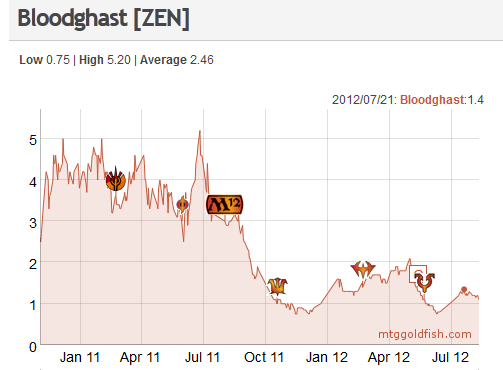
We can see in the chart below that the [card Sulfur Falls]ISD dual lands[/card] have started moving up in the first week of August (chart courtesy of mtggolfish.com). Many writers and commentators have been calling these lands good investments for the Fall and this appears to be correct at this time.
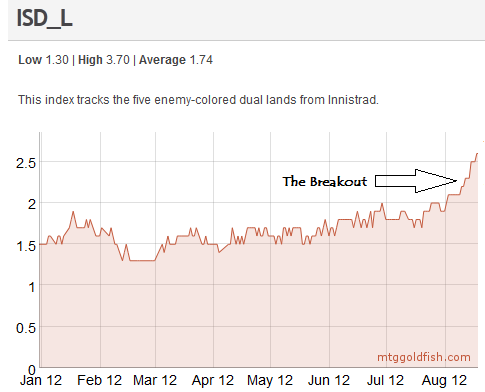
On the chart is highlighted the start of an uptrend after a long sideways trend, labelled 'The Breakout'. This price move coincides with the release of M13 and the slowdown in ISD/DKA Limited. Expect to see the [card Sulfur Falls]Innistrad duals[/card] continue to rise in price until their utility in Fall Standard can be determined. The amount of fresh supply from Limited events coming onto the market is low, which is putting upwards pressure on the price.

Supply vs. Fresh Supply

Some would argue that the amount of fresh supply is irrelevant to the price. As evidence they would present the large amount of product opened from October to May when ISD and then ISD/DKA were the Limited formats of choice. Although the total amount of cards opened over this time period is probably large, this idea ignores the distinction of how Limited events actually affect market supply.

Cards in the hands of a grinder are sold quickly, keeping a fresh supply of cards coming into the market which keeps prices in the stable to falling range, depending on playability. But many players are more casual, and these types of players will hold onto cards longer. Sometimes they will just not play for weeks or months at a time. This effectively reduces the overall supply of a card. The cards in these players' collections do not actively circulate on the market to the same degree as those of the grinders of MTGO.

Although the total supply of ISD lands on MTGO is quite high, the fresh supply of ISD rares has been severely curtailed recently due to the slowdown in ISD/DKA Limited events. This lack of fresh supply can be observed in the recent price surge in the ISD duals index, and is corroborated by cards like Snapcaster Mage, now at 8+ tix, and the two DKA zombies, Gravecrawler and Geralf's Messenger, both of which have crept over 6 tix.

Comparing Prices from Multiple Sources

The MTGO Library bot network is a useful tool in gauging the depth of a market and will be used here to offer some evidence for the dearth of fresh supply from ISD and DKA. Using their price wiki function one can look up a particular card and compare its price across a number of bots. The price at each bot will be listed as well as the number of copies for sale. This gives a rough guide to the state of the market supply. The following is an example of a price wiki search.
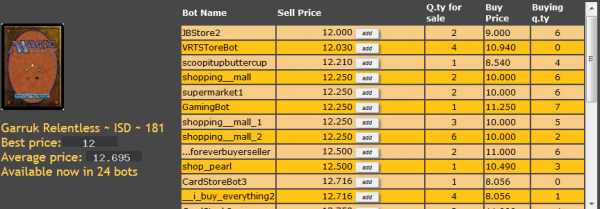


Below is a summary of market data collected from the price wiki, as well as prices from cardbotmtgo.com and Star City Games for comparison. The * indicates 'out of stock'.Ā This table gives a rough estimate of the availability and price range for the two highest-priced mythics from each set of the last year. Some comments follow. All prices as of Aug 18th 2012.

Card Name Quantity Price Range Average Price (Tix) Cardbot (Tix) StarCity Games (US$)
Geist of Saint Traft Ā 43 $25-29 $26.40 $25.81 $21.99
Liliana of the Veil 53 $21-26 $21.86 $21.60 $19.99
Huntmaster of the Fells 40 $18-23 $19.33 $19.07 $17.99
Sorin, Lord of Innistrad 36 $14-15 $14.48 $14.56 $12.99*
Bonfire of the Damned 30 $39-44 $40.95 $39.78 $49.99*
Tamiyo, The Moon Sage 71 $14-20 $15.29 $15.41 $19.99
Ajani, Caller of the Pride 71 $11-17 $12.69 $11.50 $19.99
Sublime Archangel 70 $8-14 $9.17 $8.80 $24.99


Analysis

Overall, the most readily available cards are from M13. It is not surprising to see the M13 mythics as being the most plentiful due to the set's novelty and popularity. The least available are DKA mythics, which is consistent with the slowdown in ISD/DKA Limited and Dark Ascension being a small set in a large-small-large block structure.

Bonfire of the Damned has the least amount of copies for sale of any of the cards on the table and is also the highest priced. Although Limited play is putting a steady supply of new copies onto the market, it appears that its cardboard price combined with high playability means that demand remains strong relative to supply. This card's price is currently taking a breather online but it might make another push towards 50 tix in the coming weeks, especially if IRL prices continue to rise.

The largest cardboard-digital price discrepancies occur for the two M13 mythics. Once M13 drafting slows down and redemption fires up, prices should normalize between the two. This indicates that Sublime Archangel and the new [card Ajani, Caller of the Pride]Ajani[/card] have room to move up in price online.

The card with the shallowest market supply is Sorin, Lord of Innistrad. It has a relatively low number of copies available online, and is one of two cards on the list out of stock at SCG. Its price range is by far the narrowest with all three prices in close alignment. This card took a brief dip below 14 tix this week before bouncing back to 14.56 on Cardbot, indicating the price floor of 14 tix has held and will not likely be breached in the near term. All told, the low amount of ISD/DKA events firing combined with it being a middle, small set has created a situation where any DKA breakout in Fall Standard will cause a rapid and large price increase.

Extrapolating Future Price Shifts

Comparing prices and availability from multiple sources is a great way to get a feel for the market. Combined with the observation of other trends, such as the type and amount of Limited events firing, it can provide a solid basis for projections about future price movements.

As an exercise, see if you can suggest the future price movements on Geist of Saint Traft and Huntmaster of the Fells based on the evidence presented here and their probable place in Fall Standard. Post your analysis in the comments or the forums under Ask the Author.


The 10 Most Green Cards in Standard

Are you a Quiet Speculation member?

If not, now is a perfect time to join up! Our powerful tools, breaking-news analysis, and exclusive Discord channel will make sure you stay up to date and ahead of the curve.

As you may have noticed, I did not write an article last week. The reason I was unable to do so is because I was on vacation in the great country of Ireland. I went there to explore and learn a little bit more about my heritage. While I was there, I was surrounded by nature and it got me thinking about the color green in Magic. I have also been out of the competitive loop of the game for those two weeks so it seemed like the perfect time to write about a "less serious" topic.

The goal today is to discuss the cards that most embody the color green, at least as I see it. I wanted to limit the card pool a little bit so I am sticking to Standard cards.

For maximum enjoyment, read this article with an Irish accent.

10.

Despite the fact that any color deck can play this card due to the Phyrexian Mana in the cost and activation, this is actually a very green card. Birthing Pod is a tutor specifically for creatures. Other green cards do this as well, such as Worldly Tutor, Primal Command, Green Suns Zenith and the new Mwonvuli Beast Tracker. Every color gets some tutoring effects but green always searches for creatures.

The fact that this is a repeatable tutor effect obviously makes this artifact amazing. Birthing Pod reminds me of the build-around-me enchantments that the color used to get like Aluren, Earthcraft, and Survival of the Fittest. Birthing Pod is going to be one of those cards that players are using for years to come.

9.

At this point, most of us think of Acidic Slime as a core set staple because it has been available for the last three years. This M10 card affects the board in a very green way. Naturalize is an effect that green used to share with white. Now, white only gets to destroy enchantments and red gets the artifact destruction side. Green still gets both though.

When Acidic Slime was printed I was surprised that it was able to destroy a land. It had been a little while since green had a Creeping Mold effect. I think we take this creature for granted sometimes and forget just how good it really is. In addition to removing hard to deal with permanents, the card also gives you a 2/2 bear that trades with most other ground creatures.

When I was working on Wolf Run Black a couple months ago, Acidic Slime was one of the key cards I missed the first time I built the deck. When I remembered the innocent-looking card, it fleshed out the deck and helped me in many matchups. As long as it is in Standard, look for Acidic Slime to have an impact.

8.

Green is known for its ability to fix your mana. There are always a variety of ways to do this in Standard. We still have both Rampant Growth and Farseek as well as Borderland Ranger. The reason I chose Abundant Growth is because the way green used to fix mana was often through enchantments. It has been a while since cards like Wild Growth and Fertile Ground were legal in Standard.

Although this new enchantment does not accelerate your mana, it does replace itself and grant you access to whatever color you are in need of. When Return to Ravnica comes out don’t forget about Abundant Growth in your deck building. Allowing your land to tap for any color of mana is a powerful effect that may open up possibilities with the new multicolored set.

7.

I know this card is not going to blow you away with its power level, but the effect it provides is a very green one. The ability to "regrow" cards back from your graveyard is only given to green.

Regrowth is powerful enough that it is still restricted in Vintage. Revive only allows you to get back green cards and that takes the card from all star to nearly unplayable. I would not be surprised if we saw this effect being printed in Ravnica as a multicolored card. Revive will allow you to get back a lot of cards coming out in the new block so although it most likely won’t see play, it is worth remembering.

Do you think reprinting Regrowth would be too powerful for Standard? Let me know your thoughts to that question below in the comments.

6.

A top ten list idealizing green would not be complete with out a sweet pump spell. Giant Growth was in the core set for years and there have been many different versions of that effect. Green also gets pump effects that leave the counters on the creature. Decree of Savagery comes to mind. In fact, the increasing cycle including Increasing Savagery seems like a shout out to the decree cards from Onslaught Block. Even though it is rarely used, being able to flash this spell back will definitely win you a few games.

5.

Every color gets some type of card drawing and green is no exception. If you are playing a lot of creatures like green tends to, this sorcery has the ability to draw you a lot of cards. Even with a high percentage of creatures in your deck you can still hit one or zero creatures in some games which is why this has not seen more play.

When it was first printed I tried it out many times. Later once Innistrad Block was out, I worked with it again in Birthing Pod decks and I always thought it belonged in that deck.

4.

For me, Rancor is a classic green card. In the past green has been an aggressive color. Wizards has moved away from that identity until this year when they printed Strangleroot Geist and now Rancor. These two cards make an aggressive green deck a possibility once more. Rancor embodies the resiliency that is often associated with the color green as well.

3.

Speaking of resiliency, Thrun brings further meaning to that word. Many players have forgotten just how good Thrun is because he has been overshadowed by the power level of the clones, Phantasmal Image and Phyrexian Metamorph. Thrun is good enough that even at four mana he has seen some Legacy play. One characteristic of green creatures is being hard to kill, and with not only hexproof but also regeneration, Thrun fits the bill. His only drawback is his vulnerability to clone effects.

2.

This five cost creature is in my opinion one of the best ever printed. How is an aggressive deck supposed to beat this insane card? Five additional life is a lot, considering the power and toughness you get on the creature. Again with green's creatures being resilient, Thragtusk always leaves behind a 3/3. It doesn't matter how they remove it the first time, you always get your 3/3 to replace it. I know this guy is not seeing much play right now but unless combo becomes a major part of the new Standard format, Thragtusk will definitely have a big impact on the format.

1.

The number one spot goes to . . . Dungrove Elder, of course. It doesn't get much more green than power and toughness equal to your forested lands. Historically green does get a lot of creatures with stars for power and toughness and this is one of the best examples of the effect.

Well there you have it. The top ten cards that epitomize the color green. Honorable mentions go to Cudgel Troll, Garruks Companion, Llanowar Elves, Predator Ooze, Stingerfling Spider and Jade Mage. All of those cards were ones that I gave serious consideration to during the process of writing this article. If I missed a card that you think idealizes green, post it below in the comments.

Finally, I will leave you with my favorite picture from my Ireland trip. Next week I'll be back, hopefully covering some sweet spoilers from Ravnica.

Until Next Time,

Don't forget, Magic is supposed to be fun.

Mike Lanigan
MtgJedi on Twitter
Jedicouncilman23@gmail.com

Insider: The Pros and Cons of Bulking

Are you a Quiet Speculation member?

If not, now is a perfect time to join up! Our powerful tools, breaking-news analysis, and exclusive Discord channel will make sure you stay up to date and ahead of the curve.

It seems like the perfect scenario. Your trade partner has some expensive cards you want, whether it’s a Sword or a Bonfire of the Damned. The best part is, he just wants the crap out of your binder that isn’t worth anything! Everyone wins, right?

Wrong.

Let’s start by defining bulking. Bulking is where someone (usually a dealer) gives a flat rate of 10-12 cents on all your supposedly worthless rares. Other traders will sometimes try and do the same.

The Cons

Bulking is an old trick to trade cash for cards. When a person gives 10 cents per bulk rare in trade, they’re essentially buying those cards at cash prices, or even below cash prices because you can sometimes get 12 cents per bulk rare, depending on the store. You must be wary of this trap, because it sounds good on the surface but doesn’t usually turn out that way.

Here’s the problem with bulking. You pull out the expensive card of theirs that you want. Say, for instance, it’s a Sword of Fire and Ice. You ask them their price, and they respond with a fair offer of $35, which you accept. Then they ask you if you’re interested in bulking, and say they even offer you 12 cents per rare.

Assuming for the sake of this scenario that all the rares pulled out are indeed bulk (this is rarely ever the case, something we’ll get to). Because 12 cents is a cash price and not a ā€œtradeā€ price, it is literally the exact same as using cash to buy a card, especially when you’re at a GP where the bulk is easily liquidated. You’ve essentially just bought a Sword at full retail, and the other guy has sold one at that price.

I have a few suggestions on how to handle someone asking you to bulk to them.

-Ā Ā Ā Ā Ā Ā  Just say no if you aren’t comfortable. Many people don’t know what is true bulk and what isn’t, so chances are you could be giving away even more than you know.

-Ā Ā Ā Ā Ā Ā  If you are comfortable with bulking, demand a cash price on their card as well. That means buylist price of whatever site they’re using. If you’re playing with cash numbers, they should be doing the same.

-Ā Ā Ā Ā Ā Ā  Target Standard cards in the exchange. Sure, it’s fine to go all the way up to a dual or something, but if you’re working with buylist numbers you’re going to get the best deal by looking at Standard cards, since they will have the lowest buylist-to-retail spread.

Now after this I can certainly see why you’d just want to avoid the process altogether, and there isn’t anything wrong with that. But it’s also an incomplete evaluation, because there are ways for both parties to win with bulking, as there is in any trade.

The Pros

I’ve recently become much more involved in the bulking game because I’ve found a local store paying 25 cents per bulk rare, which is absolutely unheard of. I imagine it’s a terribly unprofitable business practice for the store, but then again maybe they get enough gems in the bulk to make it worth it. Either way, it works out great for me.

I’ve begun allowing people to bulk to me at 15 cents per rare, which is the best rate they will get anywhere. We usually determine a near-cash price for whatever I’m giving them, so this deal actually makes a lot of sense for that party. I’m then able to flip the bulk at a quarter apiece, essentially making a dime on every 15 cents I spend. In short, it’s very profitable.

But let’s assume you’re not lucky enough to have such an outlet (I assume you’re not). What does this mean to you?

Well, there are several other reasons to offer bulking to your trade partners, particularly in your local area where you may be one of their best outlets. A lot of local stores don’t even want to buy bulk, so you can fill a whole in the market.

We’ve established that bulking cards is the same as selling them in cash. And cash is something we can always work out a favorable deal with. Suppose you have a Thragtusk that somebody wants. A fair trade price is $12-15 for the card, and you won’t get more than $7 in buylist for it.

You and your trade partner could work out an equitable trade for the Thragtusk and call it a day. Or, you can get a little creative to make some cash. If you’re looking to out the Thragtusk for cash, you’re not getting more than $7 from a dealer. At the same time, the player who needs it isn’t going to get it for less than $12 from a dealer.

I smell a middle ground!

You can both win here. Just put a $10 price point on the Thragtusk and take that many bulk rares at whatever rate you can out them for (let’s assume a dime each). 100 bulk rares later, you have essentially $10 in cash and your trade partner was able to out a bunch of Vizzerdrix for a discount on a highly-desirable card for his deck. Everyone wins.

Unexpected Benefits

Under the examples thus far, we’ve assumed every card is true bulk. If you’ve ever been involved in this practice, you know that’s hardly ever the case. Even other traders have bulked to me cards that aren’t true bulk, such as Royal Assassin, which you can get 20 to 25 cents for. I realize that doesn’t sound like much, but as we know it all adds up very quickly. When you’re dealing with hundreds of cards, finding a few not-bulk cards per dozen will quickly add up, and all of a sudden you’ve sold that Thragtusk for above retail value.

And chances are you’re going to get more than just a few gems. I’ve seen Proclamation of Rebirths go for bulk to basic Zendikar lands to Asceticisms and Darksteel Plates. It’s all about grinding out value, and bulking is a way to give yourself a lot of opportunities to do so easily. It’s not the sexiest way of getting value, but as you get better at picking bulk you’ll really start to do well.

And this extends to Commons and Uncommons. Many times people will just throw these away, so grabbing them for essentially free can be insane. For instance, at GenCon last week Kelly and I picked 5,000+ C/U I had from a collection. We pulled infinite cards like Imperious Perfect, and I even found a Spell Snare and a foil Zendikar Mountain!

OfĀ  course, when you’re trading for these you’re not quite as lucky to do so well, but I imagine you’ll definitely be able to find some Manamorphose-type cards in the bunch.

Bulking is a great power. And like Uncle Ben says, that comes with great responsibility. A lot of people are intimidated by the concept when they are introduced to it, but I hope I’ve demonstrated today how both parties involved can utilize it to great effect.

Thanks for reading,

Corbin Hosler

@Chosler88 on Twitter

Insider: Playing to Your Outs

Are you a Quiet Speculation member?

If not, now is a perfect time to join up! Our powerful tools, breaking-news analysis, and exclusive Discord channel will make sure you stay up to date and ahead of the curve.

As far as lessons we have to learn while playing Magic going, playing to your outs is one of the most important. Top decks that save games only even happened because the pilot put themselves in a position where if they drew their out they could still win. In finance an out is a much different thing. Your out (or outlet) is your method for converting cardboard to cash or open positions to closed ones. Of course, you need to shop around each sale to really get the very best value, but having outlets prepared for various types of cards is very important.

Often times, people will ask me, "What's the best way to sell XYZ?" My answer is most frequently EBay, but there's a handful of caveats here. It's just as important to consider why you are selling as it is what you are selling.

EBay is generally your best bet, so long as you aren't in any immediate rush for your sale (either because you're short on funds or because you expect prices to change promptly). EBay promises you that players will pay fairly close to retail values, but you'll be stuck paying some fees both to EBay and Paypal.

These fees add up to approximately 10+% of your sale price, and this adds a significant dent into your bottom line. EBay is also risky in the sense that it is not a quick method of sale. During the time it takes for your item to sell, things could change and you may end up losing some money. So if I've been speculating on a card, and I feel now is a decent time to get out, I'll typically recommend EBay if I don't think there is a risk in waiting for the auction to close.

If you don't have time to wait for your product to sell on EBay, you also have the option to sell your items to your local LGS or an online store. You're going to get a much lower value for your stuff from a retailer, but you get your money immediately. To sell to your LGS you'd need to be fairly confident that values are dropping on the cards you want to sell before you could sell them any other way.

Selling to online buylists is a little better on the wallet as you can shop around more buylists online and find the very best value on each card you you want to sell. This does leave you paying your own shipping costs unfortunately. This is a middle ground, finding dealers or online stores that give you good buylist prices are important to have lined up in advance, so when you need to make a sale you aren't wasting precious time hunting down options. Standard cards more frequently fall into this category as their pricing tends to be very volatile compared to older formats.

I'm lucky enough to have a local EBay dealer who gives very good Buy prices on stuff he turns around on EBay. This is most frequently how I get rid of my cards, if I don't want to wait for EBay myself. I get the benefit of a LGS or online retailer in the sense that he'll buy nearly anything, but I also get some of the value from EBay because it provides him a market to sell. He even gets to sell at above average pricing due to his volume store level on EBay and high ranking in the user rating system. For me, this is often the perfect mix of both worlds, as I always get great value, without any time risk or loss.

If you don't know any local EBay dealers, try shopping around EBay a little, and use the search filters to find out if there is someone local that moves items at a decent volume. Network with that person and you're all set. If your local community doesn't have an EBay dealer, maybe there's an opportunity for you to become one. I wrote an article about how to run an EBay store about a year ago, which you can find here.

The reason you'll want to have your outlets lined up in advance, is you don't want to hesitate when you have a card you need to get rid of before a price change. Being first to make a move, even after an announcement that triggers your decision, will often be enough to guarantee the buyer will still take what you have. If you act too slowly, however you give other people the opportunity to beat you to those sales before buylists are adjusted. Some of the most common times I'll go to EBay with my sales are during Pre-Release. I'll set 3 day auctions at the end of the Pre-Release weekend, so that they end well before the release date and you'll still have a chance people will fight over what you've got. Especially if you got a desirable foil.

Because my local EBay dealer gives good value on most things, there are fewer times I sell on EBay, but bulk is something to consider. Often times what I would make off of my bulk, minus the transaction fees, it makes more sense for me to go to my dealer anyway. If you don't have that luxury, having some pre-made listings saved somewhere will go a long way to make your life easier when it comes time for posting.

No matter what you're selling or why, be smart about it. You don't want to bleed value by underselling your stock, but you can't afford to bleed time either by waiting for lengthy auctions, shopping around on buylists, or waiting for someone to contact you from MOTL. (As a note, I think MOTL is a great place to sell and buy cards, however speed needs to be very low on your priority list). Have your outlets prepared in advance so when it comes time to make a move you can efficiently find the right outlet promptly.

Avatar photo

Chad Havas

Chad has been with Quiet Speculation since January of 2011. He uses price speculation to cover all his costs to keep playing. Follow his journey from format to format and be prepared to make moves at the right times.

View More By Chad Havas

Posted in Finance, Free Insider, Selling5 Comments on Insider: Playing to Your Outs

Have you joined the Quiet Speculation Discord?

If you haven't, you're leaving value on the table! Join our community of experts, enthusiasts, entertainers, and educators and enjoy exclusive podcasts, questions asked and answered, trades, sales, and everything else Discord has to offer.

Want to create content with Quiet Speculation?

All you need to succeed is a passion for Magic: The Gathering, and the ability to write coherently. Share your knowledge of MTG and how you leverage it to win games, get value from your cards – or even turn a profit.

One Plus One Equals Three

Are you a Quiet Speculation member?

If not, now is a perfect time to join up! Our powerful tools, breaking-news analysis, and exclusive Discord channel will make sure you stay up to date and ahead of the curve.

Building a good deck is more than throwing every good card from a color into a pile and shuffling them together. As somebody who has built many, many decks, I can say without a shadow of a doubt that starting a deck with the idea of playing a specific card or color tends to lead to much weaker decks than building around particular interactions and synergies.

When Bitterblossom was first released I immediately knew that I wanted to play the card. For the most part, however, I jammed it into black decks that didn’t take any advantage of it besides it being a very powerful two-drop. If I was smart I would’ve just built Faeries from the get-go. It turns out that the deck built around Bitterblossom is much stronger than a deck that simply includes it.

Now and again the best cards have some inherent synergies that make this principle somewhat difficult to observe. UW Delver, for example, might look to some like it’s just a pile of strong cards. Upon closer inspection, Snapcaster Mage and Delver of Secrets have more in common than might be initially perceived. It’s obvious that the two are intended to be played with a high Instant/Sorcery count, but the specific Instants and Sorceries that get played with these cards are picked because of how well they play with each - not just in order to establish a threshold.

Vapor Snag is the card that really exemplifies this point. It’s not a particularly powerful card, but it plays excessively well with the best cards in the deck. I’ve heard people remark about how something as simple as the loss of one life turned the unplayable Unsummon into a format all-star, but the one life really didn’t have much at all to do with it. It had a lot more to do with the fact that it turned on your 3/2 flyer while often allowing you to Time Walk with your Tiagos.

The importance of such synergies is the principle of deck building that I see players neglect on the most regular basis.

I’ve seen a lot of Trading Post brews recently, and most lists that I’ve seen have been guilty of this. From my experience Posting I have drawn two very important conclusions with regard to building around Trading Post:

  1. Trading Post + Wurmcoil Engine is the best endgame you’ll ever need.
  2. It often takes a long time to set up this endgame.

In light of this, slots that aren’t occupied by Posts and Wurms should be dedicated to ensuring that a player survives to cast these spells. This is why my Counter Repost deck features Snapcaster Mage and Vapor Snag. In a fashion not terribly dissimilar from UW Delver, these cards function as Time Walks so that I can survive long enough to start making Wurms.

Considering these points, I found Brad Nelson’s GW Post list to be rather vexing.

In this list he supplements his Post engine with, for the most part, a lot of big spells. Thragtusk doesn’t make much of any sense with Trading Post to me. It just does the things that the deck is already trying to do in a much smaller way and with a card that doesn’t do much with Trading Post.

A singular Thragtusk just doesn’t do as much offensively or defensively as a Wurmcoil Engine, and I really don’t see why you would want any ā€˜Tusks before you had at least two Wurms. Additionally, if we’re into life gain and five drops, where are the other two Pristine Talismans? The inclusions of Thragtusk reads to me as just playing a good card because it’s good.

The Jund Rule

Of course, there are times when you should just jam the best cards. The most obvious deck that was mostly just a pile of strong spells in my mind was Standard Jund. Basically, Bloodbraid Elf was too good. So what exactly is the threshold for going out of one’s way to play good spells?

I would argue that it falls somewhere between a three for one and Bloodbraid Elf.

In case I lost you there, here is what Bloodbraid Elf was often the equivalent of:


While the individual cards wouldn’t combine terribly well, a Bloodbraid Elf into Blightning was about four cards worth of value. Certainly higher than three. And if your opponent had a Planeswalker, it could be closer to five…

It’s true that Jund did make some exceptions in the name of synergy. For example, without Cascade I’m certain that Lavalanche would have been very widely played. I mean, it’s Bonfire of the Damned… But for the most part Jund just jammed Bloodbraid Elf and every other good on-color card, most of which being two-for-ones - all of which being considerably weaker than BBE.

It’s easy to see how a card that generates around three cards of value is worth eschewing synergy for raw power, but what about playing a deck full of two-for-ones? What about…

The Deadguy Ale Dilemna

If you don’t know a lot about tier 3 Legacy decks with obscure names, Deadguy Ale is a Black/White deck that utilizes cards like Hymn to Tourach and Stoneforge Mystic to grind out marginal advantage in a world of efficiency and degeneracy.

Deadguy Ale is a deck that is doomed to stay a lower-tiered deck because it simply mashes good cards. Hymn to Tourach and Dark Confidant are strong, to be sure, and they play well enough together, but they’re not exactly synergistic. As I alluded to in the Jund section, playing a lot of two-for-ones is not the same thing as synergy. This only works out if the value cards that you’re playing are more powerful than the format at large.

When it comes to being more powerful that the Legacy format, decks that don’t include this card are questionable at best:


Does Deadguy Ale do anything that is remotely as powerful as Brainstorm? Sure, Stoneforge Mystic and Dark Confidant can generate a great deal of value, but it’s not immediate and there are a lot more Lightning Bolts and Swords to Plowshares than there are Red Elemental Blasts. The simple fact of the matter is that Brainstorm does a much better Ancestral Recall impression than any other card in Magic.

It’s true that Deadguy Ale Top 8’d a recent SCG Open, but let’s not lose sight of the fact that Esper Stoneblade won that event. In a match between the two, Esper should win the vast majority of the matches. Brainstorm is far and away the strongest card in either deck and Jace the Mind Sculptor is capable of generating more value than most cards ever.

tl;dr

Specific examples aside, the basic messages that I’m driving at are these:

First, it’s better to find cards that play well together than cards that are simply good. This is unless, of course, the good card in question crosses a threshold of being worth approximately three or so cards.

Most importantly, if you feel the need to just jam good cards, make sure that you’re jamming the best good cards. Don’t bring a Thragtusk to a Wurmcoil Engine fight.

Play decks. Don’t play cards.

-Ryan Overturf

How Good Is Too Good in Commander?

Are you a Quiet Speculation member?

If not, now is a perfect time to join up! Our powerful tools, breaking-news analysis, and exclusive Discord channel will make sure you stay up to date and ahead of the curve.

Zur, the Necropotence

How good should a Commander deck be? This is the question I have struggled with my entire Commander career.

I have assembled vastly powerful Commander decks that consistently defeated my opponents with ease, and others that I promptly disassembled in a fury of disappointment after losing several games in succession. Were these all 'good' Commander decks? It all depends on how 'good' my opponents' decks were, and this is what I find to be the format's fundamental flaw.

Commander was initially designed as a fun way to play Magic that involved many friends at once and allowed for unique play. But things like Armageddon and Blood Moon are legal cards. Should you run these cards? They are extremely powerful in Commander, but they aren't very fun to play against. The problem is that these decisions are made on an individual basis.

A Little Too Broken

Hokori, Dust Drinker is hands down the best Commander deck I have ever made. Can you imagine playing a game of Commander against these cards?

No creatures, no spells, only pain.

What if I [card Mishras Helix]tap every land[/card] you play the entire game and slowly kill you with a few soldier tokens? I had this deck together for only a few weeks before I retired it out of principle. It was the most boring deck to play against ever because absolutely nothing happened, and I won very slowly. Why would I create such a monstrosity? I wanted to see how 'good' a Commander deck I could make. The context in which I use 'good' here is, "a Commander deck that only cares about winning."

When someone asks what a good deck in Legacy is, their meaning is, "what deck is best at winning?" What about in Commander? What does a player mean when they ask what a 'good' Commander deck is? This is a very difficult question to answer. Obviously you want your Commander deck to be good, but the context is determined by your interpretation of how Commander is meant to be played.

My idea of how a Commander game should end is with everyone being excited about the awesome manner in which they were killed.

"Oh, you finally assembled your stupid combo and won? I'm glad I just wasted an hour on this game of Magic to be killed by such a flavorless combination of cards," is not what I want to be thinking after a game of Commander.

I would rather be thinking, "It was pretty sweet when my opponent EoT casted Sphinx of Uthuun into Enigma Sphinx which cascaded into Fact or Fiction thus resulting in two FoF sphinxes which he killed me with." I couldn't care less whether I lose a Commander game as long as I died in an interesting way.

So, let break down the various tiers of quality that Commander decks fall into.

The Commander Deck Quality Spectrum

Quality Competitive

This is where the ridiculous turn four combo decks and my Hokori deck belong. They play to win and don't pull punches. "Of course I'll Wasteland your turn two [card Izzet Boilerworks]bounce-land[/card], I don't care if you can't cast spells and don't have fun. I play to win."

I have encountered many Commander decks in this category. The players that pilot them are usually competitive Magic players that were lured by how fun everyone says Commander is. Sadly, this isn't the format for them.

Terrible Competitive

This is usually the work of a player who sucks at building decks, but tries to win in any way possible. An example of a deck in this category would be something like, "Finally, my combo which is the only way I can win finally worked on the seventh game we played." These decks are pretty infuriating to play against. Either they win in some boring fashion, most likely involving a stupid combo, or you crush them with no resistance.

Sadly I recently constructed a deck that falls here. I had acquired a Lich and was determined to incorporate it into a Commander deck. I ended up with a Savra, Queen of the Golgari deck that occasionally combos off on turn five in spectacular fashion.

Quality Ruthless

These are similar to Quality Competitive, but don't win quite as consistently. The players that usually build these decks are competitive players trying to play 'fair'. A deck like this may have a couple combos and a few cards most people scoff at, but overall tries to play to the spirit of Commander. Occasionally I'll get a good game of Magic against a deck like this.

Terrible Ruthless

This is what you get when a bad Magic player assembles every stupid combo and un-fun card he/she has encountered and shoves them into a Commander deck filled mostly with bad cards. Occasionally they will win with their terrible cards backed up by things like a timely Armageddon or Obliterate.

Quality Fun

This is the sweet spot, which every Commander deck should strive for.

A deck like this will put up a fight, keep the game interesting, and usually win in a spectacular fashion. These decks typically won't contain silly two card combos, or boring cards like Ruination and Contamination. They are built in such a way that they react instead of deny and wound instead of kill.

I try to make most of my Commander decks fall between here and Terrible Fun (see below). Current successes in this endeavor include: Kiki-Jiki, the Mirror Breaker, Seton, Krosan Protector, Toshiro Umezawa, Lyzolda, the Blood Witch, Jor-Kadeen, the Prevailer, and Maelstrom Wanderer.

Turns out this guy sucks at Commanding things.

Terrible Fun

Another good place for a Commander deck. These decks are similar to Quality Fun decks, but not as efficient or stable. While they may assemble a neat combination of cards that lead to an interesting game, they may be left with no cards in hand, so when their shenanigans are thwarted they are essentially out of the game.

Garbage

These decks are just bad. They contain a pile of terrible cards that were scrounged together from leftover draft sideboards picked up in the local game store parking lot. Most of the time playing against a deck like this is the same as gold-fishing your Commander deck, except it's easier to win.

Conclusion

We could break this down even further and look at the spectrum that lies between quality and terrible, but you get the idea. The more efficient and better at winning a deck is, the more 'quality' it will be.

I have always tried to make decks spread throughout the spectrum of quality, because hey, sometimes playing two garbage decks against each other is fun, and that is what Commander (and Magic in general) is all about!

If playing a Quality Ruthless deck is fun for you, then do it, but be aware that most people don't play Commander that way. The best way to craft a Commander deck is to build for your play group. If your play group plays mostly lower quality fun decks, then make one too and have fun. If that's not your forte then you should try other formats.

Some people, however, don't really have a reliable Commander play group, so it's a lot more difficult for them to craft a deck they will have fun playing against the diverse spectrum of Commander deck quality.

Working part time at a game store puts me face to face with this situation and leads me to explore varying styles of Commander play. I never enjoy playing with or against competitive and ruthless Commander decks, but I usually try to keep a deck or two in these categories just in case I encounter a foe of this caliber.

Also, if you are ever playing for money, packs, store credit, etc. always play to win. In this case don't be afraid to bust out the obnoxious deck that crushes your opponents on turn four. But remember, the next time you build a Commander deck think about your play group and build accordingly. Not only should you be having fun, but your opponents should too.

Jason’s Archives: Gen Con Wrap-up Extravaganza

Are you a Quiet Speculation member?

If not, now is a perfect time to join up! Our powerful tools, breaking-news analysis, and exclusive Discord channel will make sure you stay up to date and ahead of the curve.

Greetings, Speculators!

Newly arrived from Gen Con, I am not back on a normal sleeping schedule yet, but I tried.

Five mornings in a row waking up after less than five hours of sleep can take a toll on the human body, especially as we start to approach thirty. Fifty may be the new thirty, but that doesn't make thirty the new fifteen. Attending Gen Con as an exhibitor, I used to get up at 6:00, work until the dealer hall closed at 6:00 pm, tidy up for two hours and afterward head out to the bar until 3:00 am. Then repeat for the next four days. But I'm not the spry 22-year-old I used to be.

While it's possible to get three hours of sleep every night during Gen Con, the entire five day marathon (coupled with the taxing, albeit shorter-than-others'-journeys, four-hour drive home) can lead to quite the Monday morning hangover. So keep your voices down, dim the lights, and let's talk about what happened in Indianapolis.

What Happens in Indianapolis Stays... Thoroughly Photographed and Videotaped For Posterity

If you happened to miss Gen Con, billed as the best four days in gaming, you missed a lot. All of the things, really. Here is a confusing list of happenings taken completely out of context and arranged in a counter-intuitive way, designed to make you feel like a dope for having to work or living in Europe or whatever excuse you had:

Also, this--

My mother said I could be anything when I grew up, so I became a library.

If nothing else, you also missed your chance to snag a set of the Brainstorm Brewery Spirit tokens we were handing out all weekend. Don't miss your chance to grab some at the next GP.

What Happens in Vegas Teaches Sleight of Hand Techniques

Redditor SlimGrin reminded me today of a TED video I watched a while back by Tabletop Magic Master Lennart Green. I watched this video again during the recent scandal in Detroit where a player stood accused of some audacious cheats and we were all left to marvel at his sheer mastery of sleight of hand.

This fascinating video shows how far complicated shuffle tracking and other techniques can take an adept cheater. Tom Martell's analysis (linked above too) is an interesting look at what I'm calling "Puerto Rican Shufflegate" (working title) or PuRiShuGat for short.

There are some compelling questions to ask, such as why Iramain didn't check for a basic land after Path to Exile when he knew the bottom card was Etched Champion and both Mountains were out, but did check later when the [card Etched Champion]Champion[/card] had been shuffled in? This looks like cheating to me, and unfortunately we have some experience watching similar videos for sketchy behavior.

Seriously, though, watch the whole Lennart Green video. It's funny, entertaining, and reveals just how natural a talented cardsmith can make complicated tracking look.

Shuffling a deck presented to you by an opponent should be second nature to you as a player. Also watch for the chop cut; as Martell points out it has no value as a shuffling technique and only serves to put chunks of potentially ordered cards closer to the top of the library.

This is the second scandal involving Vendilion Clique. Whenever a card's exact location in the library is known by either player, there will be temptation to cheat. Exercise some caution out there and let's keep it fair. And by "fair," I mean, "a game where the more highly-skilled player spends twenty-five minutes incrementally eking out well-deserved advantage only to lose to a [card Bonfire of the Damned]Bonfire[/card] off the top."

What Happens at Gen Con is the Only Thing Anywhere

Since they aren't naive beyond belief, Starcity Games and TCGPlayer opted not to hold Open events that would conflict with Gen Con this weekend. I am going to devote my coverage space this week to the World Cup results because I think there is valuable information about Standard therein.

Start With a Big Pile

World Magic Cup Decks: 3-1 or Better

Exhausted yet? We have our work cut out for us. Let's deal with our presumptions about the format first. I opted to start at the top of the page, Ctrl+F "delver" and see how many times the scroll stopped. That number was "36".Ā The total number of decks listed is 86, meaning 42% of the 3-1 and better decks had Delver of Secrets in them.

I don't usually re-use jokes, but I realized I made this exact face when I saw the results.

It would seem that at the most competitive echelons, players really don't want Magic to be fun. No wonder they call them "grinders".

Nothing New Under the Sun

Primarily concerned with making my job simple on occasion, the mothership has taken pains to arrange their coverage page in a manner similar to how I would have in this article. They also took care of something I like to do every week, which is to scour an otherwise boring list of Delver and R/G Aggro piles to find any novel or interesting decks worth discussion. This is, after all, a financial website, and it's not very useful to hear me say, "Herp, [card Bonfire of the Damned]Bonfire[/card] is worth a lot of money, huh? You should have bought those before they hit $50."

What is useful is to point out, once again, that people are doing big things with Trading Post.

I got so sick of being offered a dollar on Trading Post that I took them out of my binder before giving it to dealers. I am hoarding these like they were made out of acorns. It's not a secret that this card is criminally underpriced and many of you have contacted me on Twitter or e-mail to ask my opinion, not to mention our ranting about this card on Brainstorm Brewery. You may consider it bonus financial info in a free article, but really all I'm advocating is to pull the trigger on something you already knew was a good pick-up.

If you can get Trading Post for two or three bucks, it would be silly not to. Even if you don't want to go deep speculating on it, pick up a cheap four-of set for your deckbuilding stock before they go up more. This card is worth building around, and how much do EDH players love a card that does four different things?

Peter Vieren got a deck tech interview, via Zac Hill, on the power and novelty of the R/G Trading Post deck. Who remembers Kuldotha Phoenix?

Another innovation is pushing the [card Talrand, Sky Summoner]Talrand[/card] plan even further than we discussed last week. If it's good value to play free spells to power Talrand and Runechanter's Pike, why not swing for the fences with a Tarmogoyf approximation?

Quirion Dryad does a nice impression of Goyf in an instant-heavy deck. It puts the opponent in an awkward spot by demanding removal lest they get stomped flat before playing a fifth land, and growing scarier every time you counter the spells inevitably aimed at it.

I hope you will agree that even though it's super boring to see Delver decks keep winning, innovation can keep the deck fresh enough to maintain interest.

To see more, check out Lucas Siow's conversation with BDM about U/G Delver.

A special congratulations goes out to the team from Chinese Tai Pei for winning the World Cup. Check out the Brainstorm Brewery homepage in the coming weeks for Marcel's interview with the team after their impressive victory.

Until next time

That does it for me this week. If you don't mind, I plan to lapse into a coma and not wake up until tomorrow when I'll have to process a week's backlog of eBay sales. Take care of each other out there, kids!

Jason Alt
@JasonEAlt on Twitter

Insider: Digital Tools to Make Connections

Are you a Quiet Speculation member?

If not, now is a perfect time to join up! Our powerful tools, breaking-news analysis, and exclusive Discord channel will make sure you stay up to date and ahead of the curve.

Gen Con took place this past weekend in Indianapolis and it looks like everyone had a great time.

Sadly, I was unable to attend. When you have many other commitments such as family, work, school, etc., it becomes difficult to stay actively engaged in the Magic Community by going to these premier events. I haven’t even been to Friday Night Magic since before my son was born, almost six months ago.

Staying connected with other Magic players can be incredibly valuable though. The more people you know, the more potential trade partners you are comfortable dealing with, the more rumors you hear about certain cards, and the more you stay on top of card values.

Because I lack traditional opportunities to network with the Magic community, I do my best to come up with creative ways of staying in touch with other Magic players. In this article, I will present some valuable avenues worth pursuing to network with other Magic players as well as some of the immediate benefits from doing so.

Twitter – The Digital Water Cooler

If you’ve read some of my previous articles, you’ve already learned how much of a proponent of Twitter I am. Although it’s not the sole reason, I don’t think I would be writing for this prestigious website today if it weren’t for Twitter.

But I’m jumping ahead a little bit. I’m here to talk the basics.

Step one, go to www.twitter.com and sign up for a Twitter account if you don’t already have one.

Step two, follow key MTG finance people. For starters, I’d recommend @mtgmedina, @chasandres, all the finance writers for this site, which can be found on this thread, and some of the active participants in the QS forums.

Step three, profit.

Perhaps it’s not this easy, but it doesn’t take too much investment of effort to begin reaping the benefits of this digital, public chat room. People are constantly commenting on MTG trends, identifying cards to speculate on, and discussing price changes. If you’re not listening into these conversations, you're missing out on some of the earliest tips for what cards to buy.

For example, here’s a recent conversation I had on Twitter discussing recent pricing trends on Unhinged & Unglued basic lands:

The best part of it all – the information is available no matter where you are and at no cost. Waiting in line at Starbucks? Check your Twitter feed. Slow day at work? Hop onto Twitter for a brief chat. The beauty of Twitter is that there is always new information to read and it’s incredibly easy to voice an opinion, spreading the word. The more you Tweet and get others’ attention, the more networked you will quickly become.

So try it out – send me a Tweet and let me know what you think! @sigfig8

MOTL – The Digital Bulletin Board

Wouldn’t it be nice to have your finger on the pulse of MTG card values, with new information coming at you minute by minute? Some major Magic retailers may already provide this, but their prices are often higher than what you can expect to get for your own cards. There is a better way to learn how cash values of cards are constantly changing.

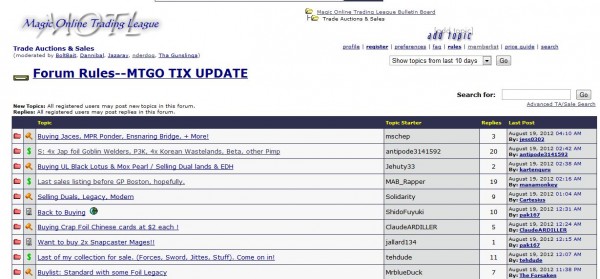
MOTL, which stands for Magic Online Trading League, is a site that enables Magic players around the world to buy, sell, trade, and discuss Magic Cards. Every few minutes a new list of cards for sale/trade is updated. Here’s the snapshot from this morning:

Signing up for the site is easy, and valuable information can become immediately available. You don’t even need to perform a single transaction to learn about how card values are changing.

How is that possible? Every time someone posts a new list of Magic Cards for sale, other members of the community can post their interest in purchasing said cards. Which cards do you think sell first? The underpriced ones, of course! Sometimes you even see someone undervaluing a particular card severely and there will be four or five posters expressing interest in that same card. This isn’t coincidence – that card’s value is likely higher than the posted price.

On the other hand, some people post prices closer to retail – their threads frequently get no buyers or a handful of lowball offers. The MOTL community is very much in tune with the cash value of cards, and staying up to date with this forum provides you with how others in the Magic community are viewing card values – not just the big retailers.

Finally, it is worth noting that there is a Trading and Value thread in MOTL as well. Although it’s not as… classy… as the QS forums, it still does contain a few tidbits of useful information.

So check it out – you can even view these threads without having an account, so there is no risk to you for visiting the site. And since there’s no FNM’s involved and no need to commit hours at a time to the site, I’m able to actively buy, sell and trade Magic Cards without ever stepping foot outside my door.

Well, except for the occasional trip(s) to the Post Office.

Twitch – The Digital Tournament Table

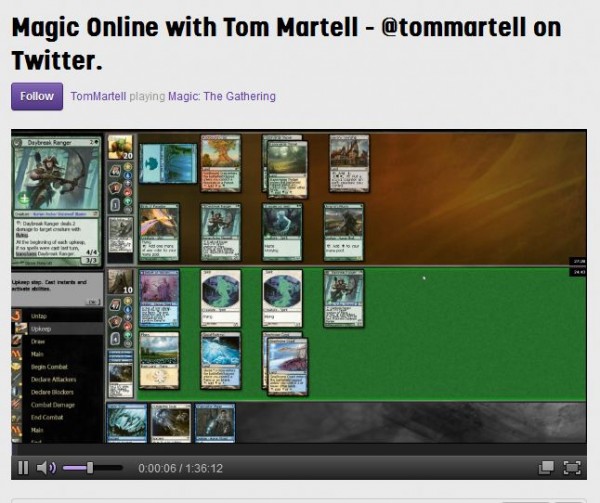
Twitch – www.twitch.tv – is a recent discovery of mine. Through this website, I am able to watch some of the better Magic players duel it out on MTGO live without leaving my home. It’s like I’m looking over their shoulders as they sling their spells and battle for some free digital packs.

The value here is again very steep without much investment. The site is free to visit and often times some well-known Magic players stream, such as Brian Kibler (bmkibler), Ceddy P (ceddy p), Jackie Lee (jackiel33), Tom Martell (tommartell) and many more. Even Star City Games and TCG Player stream their tournaments live on Twitch TV, enabling people to watch live Magic action from anywhere.

Why is this valuable? For starters, you can check out the different types of decks these well-known players are testing. While still in its infancy, live streaming could be a new way to check out up-and-coming deck strategies the pros are trying.

There’s also the added benefit that you have an opportunity to interact with the pros. Some of them respond fairly well to the chat window scrolling next to their video – a great way to ask about particular cards.

Community Is Critical

Many members of the Magic community still have the opportunity to attend weekly FNM’s, PTQ’s and an array of premier events. Through this, they are able to network with other players and build valuable connections within the community.

As the game ages, the average age of Magic players also appear to age. Many are getting married, starting families and maintaining a full time job outside of Magic. For these players, like myself, it’s very difficult to attend enough events to build that strong community.

But this doesn’t mean we can’t have one. Through multiple online channels such as Twitter, MOTL, Twitch, Quiet Speculation and more, I am well equipped to not only stay in touch with the Magic community but also contribute something valuable. I’d strongly encourage those of you in the same situations as mine to take advantage of these digital tools, which allow me to fully engage in the game of Magic and stay up to speed on trends.

That being said, attending the occasional Grand Prix can really help strengthen the bonds you make through Twitter and MOTL. There is often no replacement for meeting people in person at a major event, and I’d encourage you to at least attend one or two events a year to strengthen these connections. You’ll be glad you did.

By the way, I will be at Grand Prix Boston this weekend. If you’d like to meet, shoot me a Tweet on Saturday.

Special thinks to Yori Rubinson for this article topic suggestion.

-Sigmund Ausfresser
@sigfig8

Avatar photo

Sigmund Ausfresser

Sigmund first started playing Magic when Visions was the newest set, back in 1997. Things were simpler back then. After playing casual Magic for about ten years, he tried his hand at competitive play. It took about two years before Sigmund starting taking down drafts. Since then, he moved his focus towards Legacy and MTG finance. Now that he's married and works full-time, Sigmund enjoys the game by reading up on trends and using this knowledge in buying/selling cards.

View More By Sigmund Ausfresser

Posted in Finance, Free InsiderLeave a Comment on Insider: Digital Tools to Make Connections

Have you joined the Quiet Speculation Discord?

If you haven't, you're leaving value on the table! Join our community of experts, enthusiasts, entertainers, and educators and enjoy exclusive podcasts, questions asked and answered, trades, sales, and everything else Discord has to offer.

Want to create content with Quiet Speculation?

All you need to succeed is a passion for Magic: The Gathering, and the ability to write coherently. Share your knowledge of MTG and how you leverage it to win games, get value from your cards – or even turn a profit.

Insider Basics: Do you talk about prices? Changing our language of trading

Are you a Quiet Speculation member?

If not, now is a perfect time to join up! Our powerful tools, breaking-news analysis, and exclusive Discord channel will make sure you stay up to date and ahead of the curve.

I had a blast at GenCon this past weekend, mainly because I get to spend a lot of time with the larger-than-life personalities of QS , including Editor-in-Chief Tyler Tyssedal, founder Kelly Reid and established writer Corbin Hosler. We played a lot of Danger Room and we were casually trading the whole time. This week, I'm going to share what I picked up on the language of how we trade cards from watching dozens of trades happen. This is fundamental stuff but in a way, it's not a task for freshmen. Like in poker, either your personality sets you to playing the cards or playing the people, and this is for the readers who want to work with people to make trading easier and less tedious.

Observation 1: It's possible to trade without talking about price, even once.

The scene:Kelly and I are playing some Danger Room and Kelly has the front page of a personal binder open, loaded with juicy stuff, sitting on the table. We are in an area where other people are trading but it's clear that we are actually casting magical spells. The presence of the binder makes people still approach and ask if we are interested in trading.

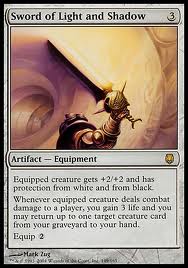
How quickly would you trade this away?

The trades: One person walks by and his friend comes with him. The person browses Kelly's binder and doesn't see anything he's really into, but his friend is practically salivating at the Sword of Light and Shadow on the front page of the binder. "Is that for trade?" he asks. Kelly responds, "of course it is, let me see your binder and I'm sure we can work something out."

Kelly goes back to playing his turn and then flips through the friend's binder. "Here, let's make this really easy. That Sword is yours for this set of Talrands and this Restoration Angel." The guy is in love with this sword and readily parts with two of the hottest cards in Standard.

Why this is so great: at no point did Kelly say "what do you value these at?" or say "well, I put that Sword at thirty." He used the very powerful tool of moving first, making an easy proposition that looks pretty fair. Sure, Kelly could have probably ground out the guy for more cards, but in a minute, he got five really liquid Standard cards for a Commander card that is figurative binder poison, since they rarely actually move.

The takeaway: Can you make a trade without bringing up dollars? If you suggest a trade and it looks fair on the face of it, you can probably just conclude right there. Otherwise, you've set yourself up as someone who can ballpark card prices but does not come off as a grinder. If the person rejects your offer, you can just keep the negotiations going if you feel like you'd still like the cards.

Observation #2: If you ask people to be reasonable, they often end up being generous.

The scene: Again, Kelly and I are playing more Magic. He isn't actively looking for more trading partners, but people keep coming up. One guy needs to fill out his deck and he's asking for a Tragic Slip. Kelly just hands one to the guy - it's a cheap enough card, after all. A minute later, our player comes back and asks him for a Devil's Play and Kelly remarks that there's one in the binder and the guy should find it.

The trade: Our player does, indeed, find his Devil's Play and asks Kelly what he wants for it. Now, this is a card that's above bulk, but only barely. Kelly just responds along the lines of "I don't know, give me something that's not trash and I'll be fine with it." The guy then looks through his stack of cards and peels off a Rootbound Crag for him.

Why this is so great: this is some Tom Sawyer-esque level trading, even if it's for small change. Kelly recognized that there's little use in trying to get 50 cents of value out of the burn spell, so he just flipped it to this guy to make things reasonable, especially in light of just getting hooked up with a common. Kelly makes the guy look through his binder for the card and still gets a rare land that retails for about $2.00 for his time!

The takeaway: One semi-bulk rare for another? One card that's just slightly more liquid for another? These are fine trades as long as you aren't putting much time into it and you can often eke out a little extra value from it. This person gave away what was roughly an equal card to them for something of realistically much less value, and it required very little work as long as Kelly was not particularly interested in the outcome. I have half a mind to believe he would have just told the guy to take the card and leave him alone if there was nothing the guy had to offer!

Observation #3: Walk away early, walk away often

The scene: I was with another trader from my hometown at this point and two situations came up back to back that solidified this observation. We are chatting and someone fixes their fancy on his foil Dragon Broodmother. My friend proceeds to pull out some cards, then hand the pile over and say "I'll give it to you for this [fairly reasonably balanced] stack."

The trade: The person balked about trading away some of the cards, at which point my friend offered that the person could pull out those cards and he'd find something else of value. The guy backed off on whether he wanted the dragon at all, trying to get him to commit to giving it away for less. My friend handed him his cards, closed up his binder and ended the transaction.

In the other situation, someone who was starting off with the dream of running their own online store approached my friend soon after. The guy had a pretty good collection of cards in his binder but was clear that he had to make value. My friend was having none of this and said that he'd be happy to trade for some older stuff and trade out Standard cards at equal value, trading on the premise of helping this guy get more liquid stock and picking up some cards he knew he could trade. The guy was insistent on getting a "deal" from my friend, who had binders full of great Standard chase cards, and didn't understand that his Antiquities Mishra's Factories would rot in a store that needed to make quick cash flow. My buddy just packed up his cards, said he didn't think they could find a value, and politely ended the transaction.

Why this is so great: I think a lot of traders want to make the deal happen every time. Both of these instances showed that you can be picky about wanting to make the deal. You only have to buy or sell if you are getting terms that are favorable to you. In the meantime, you aren't wasting time arguing over $2 worth of value.

The takeaway: Knowing that you have the power to walk away, that you will see plenty more Sorins and Snapcasters today, should embolden you. The trade does not have to happen and you can be perfectly frank with the person you're trading with. Maybe they don't want the card very much; maybe they have a different trading style or a disagreeable personality that makes you just want to pull out. There's some sense in playing the "let's make this even" game if it's $2 on a $110 trade, but with a $2.75 trade, how invested in it are you? Do you want the hassle? Can you use the walk-away to take advantage of someone else's desire to make the deal happen every time? The fear of losing can be powerful.

What techniques do you use? How has your language evolved away from "got a binder?" and "what do you value this at?" to make you a better trader? Share in the comments below!

Until next week,

Doug Linn

Douglas Linn

Doug Linn has been playing Magic since 1996 and has had a keen interest in Legacy and Modern. By keeping up closely with emerging trends in the field, Doug is able to predict what cards to buy and when to sell them for a substantial profit. Since the Eternal market follows a routine boom-bust cycle, the time to buy and sell short-term speculative investments is often a narrow window. Because Eternal cards often spike in value once people know why they are good, it is essential for a trader to be connected to the format to get great buys before anyone else. Outside of Magic, Doug is an attorney in the state of Ohio.  Doug is a founding member of Quiet Speculation, and brings with him a tremendous amount of business savvy.

View More By Douglas Linn

Posted in Finance, Free InsiderTagged , , , , , 6 Comments on Insider Basics: Do you talk about prices? Changing our language of trading

Have you joined the Quiet Speculation Discord?

If you haven't, you're leaving value on the table! Join our community of experts, enthusiasts, entertainers, and educators and enjoy exclusive podcasts, questions asked and answered, trades, sales, and everything else Discord has to offer.

Want to create content with Quiet Speculation?

All you need to succeed is a passion for Magic: The Gathering, and the ability to write coherently. Share your knowledge of MTG and how you leverage it to win games, get value from your cards – or even turn a profit.

Insider: Quantity vs. Quality, a Devil of a Dilemma

Are you a Quiet Speculation member?

If not, now is a perfect time to join up! Our powerful tools, breaking-news analysis, and exclusive Discord channel will make sure you stay up to date and ahead of the curve.

Every year after I finish school, I go home. At school I’m less than 30 minutes from Minneapolis, which has a surprising number of Magic: The Gathering players, and I’m ideally positioned to drive to any one of a number of nearby PTQs if the need strikes me.

Stunning Beyond Belief

I return, however, to Anchorage, Alaska. I love Anchorage very much - the people are wonderful, the scenery is stunning, and the weather is just how I like it. But it does lack a real trading scene. There are two stores in town that do FNM’s, and those rarely have more than 15 or so people. One does GPTs and PTQs, but unless the PT in question is going to be close (think Seattle, as opposed to Atlanta), the big guns only come out to get some points.

40 people is a big number for an Alaskan tournament. And, even worse, an almost unthinkable problem arises: I’m the only one there with a trade binder.

Even at the 20 person mini FNMs in Minnesta I can keep myself busyish with trades, but in Alaska the surrounding cardpool is so smallĀ  that people have become very accustomed to not being able to find what they need from their fellow competitors. The result is that the people who need cards buy them - trading is practically nonexistent.

Unfortunately, this leaves me with a dilemma, being primarily a trader with not much to do during the summer hands on with cards. What I can tell you, however, are a couple of important things to realize when you go into a trading slump or simply end up in a place where trading is not as common.

When one leaves a state of high quantity value movement, like Minneapolis, to go to a low quantity value movement, like Alaska, one can’t depend on the same practices to make money. Thus, when the school year ends, I enter a state of financial hibernation.

One of the first things a new trader learns is the level of fluctuation different types of investments have - Vintage Power is always a good investment, Legacy staples rarely go down and Standard schlock is rarely worth investing in for the long term. As such, especially over the summer when there’s less Magic going on and the transitory formats are about to see not one but two major upheavals (new core set in the summer, new thematic set in the fall), it might not pay to still have a thousand dollars in Silverblade Paladins sitting in your binder.

Prior to GP: Minneapolis, I was split fairly evenly between Legacy and Modern/speculative/Standard cards. As you’ll know if you've read my previous articles, I advocate for small money Standard cards as the most effective way to build value quickly without ripping people off. So it should surprise no one that my stock of Silverblade Paladin, Restoration Angels and Innistrad duals were of a quantity and value that many would classify as obscene.

Knowing that the frozen wasteland that is my home state

Literally Colder Than This.

would give me no opportunity to take advantage of deckbuilding trends, let alone a way to dump useless stock, I dedicated myself to building up a collection of cards that I knew would maintain value throughout the summer and not face any chance of crashing whatsoever. Starting that day, I began to cash out my Standard stock.

As of today, I have over a thousand dollars in fetchlands, and another 800 in Legacy staples. I have a single promo Silverblade Paladin and one normal Restoration Angel - many of the INN duals were sold to purchase a German NM Tropical Island. White bordered, before you get too excited.

This has allowed me comfort in the knowledge that no matter what happens to the market over these few months when I’m utterly removed from the physical world of Magic finance, I will not lose all of my investment to changing trends.

One of my best friends did not engage in this practice, partly because I forgot to tell him to, and is now finding what was once a plump binder at the end of the last school year is now rather dismally outdated trading material.

Obviously that very simple lesson wasn’t worth its own article, and to drag it out into one would be a waste of your, not to mention my, precious time.

Therefore, I have another opinion to present to you, one that isn’t too time intensive, but one I hope you will appreciate. This is the debate between having a small, potent binder that covers a lot of bases, or carrying around a backpack with every card ever made in it.

Potency vs. Potpourri

May your binder never look like this. Egads.

I’m the first to admit that, for many, the best choice of how you manage your binder is the one you feel most comfortable with.

Here are the basic grounds by which I judge the value of these two approaches:

  1. There’s total investment into your stock and the risk involved
  2. You have the appearance of these options to non-traders
  3. You have flexibility when it comes to trends, bannings, etc.
  4. Finally, you have the time involved.

Let’s start with point one!

It should be readily apparent that a person with a half full binder is probably going to spend much less time and money on his collection than the guy hauling a suitcase around full of cards. Money wise, the investment is massive in comparison - if you just take the good cards from one binder and spread them around to three or four binders full of rubbish, the advantages involved in having options are suddenly lost.

A major floor trader might keep 2-10 copies of as many cards as possible to supply any demand, but that obviously requires more investment than my binder, which looks skimpy in comparison. If you have very little money to spend, is it worth the up front price of all those cards to have the extra options for an interested customer?

Aside: If you answered that you had the cards anyway and you didn’t spend your money on them, you’re missing the point. Those cards are money. They are an investment. Regardless of whether you bought them as singles, simply having them means that money can’t be put into other things. Like rent. It’s cool to have a sweet collection. Is it worth not eating well? I submit that it is not. End aside.

In addition to this money issue, can you afford to lose it? If I lose my binder, I take a hit, but I still have cash set aside in a bank account. It would be a tragedy, but not backbreaking for my life as a whole. If you lose your 15,000 dollar collection on a GP floor because you took your hand off the suitcase for ten seconds, how do you reconcile that with yourself? The risk is easily dealt with through a standard of vigilance, but it nevertheless exists.

Second consideration!

When a player, casual or otherwise, looks at a guy with a binder and a deckbox, they probably aren’t too wary of him.

If that same guy had the binder alone, most people would probably acknowledge that he’s there to trade.

Is there a psychological difference between seeing that and seeing a guy walk up with a rolling suitcase full of binders, organized by price? Of course there is. This is obviously not a gamebreaker, since being seen as the eminent authority when it comes to paper product acquisitions would help your business, but the risk of being labeled a shark would be a definite risk for you.

Consideration, the third!

I turned my entire collection over from Standard crap with some Legacy material to almost an entirely Legacy collection in less than three weeks.

Can you do that with your suitcase?

My vote is probably not, simply because there aren’t enough peak trading hours in the week to move that kind of product at small events. At that point, I would submit that you resign yourself to some level of financial loss if some of your product rotates, gets banned or falls out of favor.

Fourth and finally

You have my most important point - Time!

There are a few factors involved here, some obvious and some less so.

Obviously, if you have a large stock of cards, you have to organize them to find what you need. And, if you don’t, you have to spend more time looking for the cards you want to pull. Less obviously - how long does it take people to look through your binder?


Let’s let that little tidbit sink in. If you’re doing exactly what I told you to do in my previous articles, you’re trading small cards at high margins. If a trade takes you 5 minutes, you can make 12 trades an hour with solid consistency. If you’re trading those small cards out of eight binders, how much longer does it take people to find what they’re looking for? How likely is it that those small trades are going to make more money off the suitcase method than the single binder approach. Not only are the trades not bigger (nobody wants 200 dollars worth of Silverblade Paladins), but they’re taking longer to boot.


Let’s throw in a consideration on top of that. If a person goes through your binder and sees a couple cards they’re kind of interested in, and you find a Zendikar fetch, you could probably make the trade work.

If they go through 6 binders, what are the chances they’ll settle for the mediocre card? They know you’ve got better stuff, they just have to hold out. I’ve used this approach to consistent success, refusing to commit to a trade that doesn’t allow me to pull juicy cards.

If you have one Onslaught fetch in your binder of Standard stuff, nobody’s going to waste your time with a truly bad offer, let alone refuse to trade their Bonfire of the Damned unless you bust out your Heath.

If you have 7 Heaths, and 6 of each other fetch, you become an easier target in many eyes - you have so many, you should be willing to part with them for less. You don’t need that many, and it’s unfair and sharkish to refuse the fair offer of Bonfire for Heath, since they’re pretty close retail. It’s not like you’d be losing. It’d be a drop in the pond.

I’m not saying it’s perfect, or that it’ll work for everyone - a lot of people do very well with the suitcase, I’m just not one of them, but here’s my approach: I keep a small binder for several reasons. I’m not a rich man and can’t afford a large collection, I need that money elsewhere and I can’t afford to lose all of my money in one place. I also think I come across better as a friendly fellow player that just happens to want to trade than as a hardcore grinder with all the cards in the world - which also means I don’t get as many people coming to me for their every need, but that’s the trade off.

Having a small collection allows me to turn its focus on a dime, something a larger collection can’t. My fetchland density per card would be impossible with a much larger collection, and I keep plenty of value lying around to facilitate those turnarounds.

I can also afford to spend much less time maintaining my collection because of my ability to move it around so quickly - I don’t have to organize, I don’t have to go to every FNM, and, most importantly, I can make trades happen more quickly and more efficiently than my competitors on the floor. I can pull my pet cards from the binder as I get them and stick them in my deckbox, which makes me look like a player. And I don’t get any questions about how a person with Molten Psyche and a Baneslayer Angel for rares could get their hands on my Force of Wills.

In the end, it’s personal preference, but I hope that this gives you a brief understanding of what I consider to be both sides of the issue.

If you have any questions, comments or snide remarks, I look forward to reading them in the comments section!

Avatar photo

Tucker McGownd

Hi, I'm Tucker McGownd. I'm a low risk trader that spends most of my time in Minnesota, where I go to school, play magic, study for school, play Ultimate for my college team, study for school, and read. I've been playing for a long, long time (I first played during Mercadian Masques block, and first bought a pack in Urza's Saga). I was incredibly lucky when I cracked packs until I learned how much cards were worth, at which point I proceeded to open Thoughtlace in every set until Scars, where I picked up more than my fair share of molten psyche. I'm currently looking forward to the inevitable reprint of Chimney Imp.

View More By Tucker McGownd

Posted in Free Insider2 Comments on Insider: Quantity vs. Quality, a Devil of a Dilemma

Have you joined the Quiet Speculation Discord?

If you haven't, you're leaving value on the table! Join our community of experts, enthusiasts, entertainers, and educators and enjoy exclusive podcasts, questions asked and answered, trades, sales, and everything else Discord has to offer.

Want to create content with Quiet Speculation?

All you need to succeed is a passion for Magic: The Gathering, and the ability to write coherently. Share your knowledge of MTG and how you leverage it to win games, get value from your cards – or even turn a profit.

Insider: Why MTGO Redemption Matters

Are you a Quiet Speculation member?

If not, now is a perfect time to join up! Our powerful tools, breaking-news analysis, and exclusive Discord channel will make sure you stay up to date and ahead of the curve.

An oft-heard complaint about playing Magic online is that you don't actually own anything, even though you're putting money into the game. Cardboard has value - you can touch it, play with, sell it, it's yours to do what you will. If WoTC goes belly up, you can still play with all your cards indefinitely. The same cannot be said for MTGO.

WoTC actually owns everything to do with the online version of Magic. Although you have cards in your collection and you are buying and selling digital objects in what appears to be a free market, no single piece of your collection is truly yours. WoTC owns them, and they are just letting you use them according to the terms of service.

In practice, though, you have complete control of your collection and players and dealers alike feel confident enough that WoTC is a benevolent power that will not upset it's customers. Since players clearly believe in the fiction of ownership in digital objects, this belief breathes value into the cards, packs and tix of MTGO.

The other process that gives digital objects value is redemption.

The Details of Redemption

Redemption is a large and mostly unseen presence, working in the background of the MTGO market. It connects the digital market of MTGO with the real world market. Once you collect an entire set, you can redeem that online set for a physical copyĀ for a small fee. The digital set is destroyed and WoTC ships you a factory sealed version. This provides a link to the real world, which keeps prices of redeemable sets somewhat in line with cardboard prices. Getting these in the mail is even more fun than you'd imagine.

If the online market gets flooded with a ton of cards, then redeemers will step up their activity in order to capitalize on the relatively cheap digital cards. If cardboard prices take off for a particular set, then redeemers likewise have an incentive to get to work. In both cases, redemption acts as a stabilizing mechanism which keeps digital and cardboard prices closer than they otherwise would.

Shards block and M10 are no longer available for redemption and Zendikar block and M11 will not be available for redemption after November 5th of this year. Details on redemption cut off dates are at the bottom of this page. You'll notice a column titled Redemption Guarantee Date. WoTC will keep producing factory sets until this date and then after that redemption orders will only be filled until their stock runs out. It's unusual that they run out of stock, but it bears keeping in mind.

Below is a table which holds sets from the last four years, along with prices from Supernova Bots on complete sets (prices in tix as of Aug 12, 2012) and beside that are prices from SCG (prices in $US as of Aug 12, 2012). The last column is a simple ratio where the price of online sets are divided by the price of cardboard sets. This allows some conjecture based on the ratio's value. As a side note, SCG might have inflated prices relative to eBay and your LGS, but it's not a big concern because the useful information is in the ratio - where we consider the the relative price of digital sets versus cardboard.

What Do the Numbers Say?

Set Supernova Bots Star City Games Ratio
Shards of Alara 41 175 .23
Conflux 46 140 .33
Alara Reborn 30 110 .27
Magic 2010 34 150 .23
Zendikar 125 225 .56
Worldwake 96 130 .74
Rise of the Eldrazi 134 175 .77
Magic 2011 62 150 .41
Scars of Mirrodin 75 200 .38
Mirrodin Besieged 64 160 .40
New Phyrexia 107 175 .61
Magic 2012 73 200 .37
Innistrad 107 200 .54
Dark Ascension 91 200 .46
Avacyn Restored 145 275 .53
Magic 2013 87 260 .33


From the chart, it is obvious that the sets that are no longer redeemable have plunged in price online relative to IRL prices. The four lowest ratios are all held by the Shards block sets and M10. This suggests that speculators should be aware of pending cutoff dates in order to not get caught with depreciating assets such as the Eldrazi monsters.

Elspeth, Knight Errant, Noble Hierarch and Maelstrom Pulse are the three most expensive digital cards from Shards block, suggesting that playability in Eternal formats is what drives the price of cards after the redemption cut off date. Staples such as the Zendikar fetch lands will hold their value over time, but something like Eldrazi Monument might not.

As a block, Zendikar holds the highest ratios. This is not surprising, as redemption demand would have steadily reduced the online supply of cards and drafting of Zen block wrapped up last October.

Although M10's ratio is in line with Shards block, you might ask why M11 has such a low ratio compared to the Zen block sets. One hypothesis is that there are quite a few Eternal staples in Zen block, including the fetch lands, Jace, The Mind Sculptor and Stoneforge Mystic, while M11 only has a handful of fringe Eternal cards that have seen multiple printings, such as Birds of Paradise and Jace Beleren.

The Scars block ratios are a bit all over the place but have been coming down as rotation nears. Expect further erosion in these ratios as players let go of their Scars block cards and look forward to Fall Standard.

In and around October, the price of Scars block cards will bottom out with players dumping their former Standard staples for tix. After that, expect a gradual increase in the value of the Scars block mythics as redeemers seek to capitalize on the difference in price between digital and cardboard sets.

As a general rule, Fall rotation is the best time to be picking up Eternal staples and depressed mythics from the sets that have just left Standard.

Magic 2013 is not yet available for redemption, so it's ratio is still relatively low. Release events will finish on Aug 15th, and redemption will start up at the end of the month. At that time, the price of M13 cards as a whole will have found a near term bottom. In the meantime, be sure to round out the playsets of the cards that you like from M13. For the most part, the mythics won't get cheaper for a while.

The Choke Point

A combination of factors ensures that a given set's price will largely be determined by the price of its mythic rares. Outside of Eternal staples, the only cards to hold value after rotation are mythic rares.

Mythics are the choke point of redemption. In order to redeem a set, you need a copy of every card from that set. Mythics are the hardest to come by, therefore they command the highest prices in the market. The sheer amount of drafting that occurs online limits the value of rares, and bulk rares routinely sell for .05 tix or less. Most of the value of a set is locked within the mythics.

As good speculators, this means that over the next few months, target only Eternal staples and mythics. Here are some examples from last year showing when a few mythics bottomed out in price.

The chart for Nissa Revane shows a bottom in early September of around 3.5 tix. If you had waited till the end of October, you still could have bought in for an attractive 5.5 tix. The chart shows a steady uptrend following rotation, with some price weakness and the possible beginning of a downtrend after July.

This chart is more typical of a junk mythic, and the bottom occurs much earlier in the year in mid-April. Once again, though, if you had bought during Innistrad release events, you still would have enjoyed a tidy profit by the turn of the calendar year.


Another junk mythic, this chart shows another early bottom at the beginning of May. If you had bought Cast Through Time at rotation, you would be hard pressed to turn a profit on this card. It appears that playability still matters to the price of a card. In this case, Cast Through Time truly is junk and even redemption did not impact the price strongly enough for a speculator to turn a profit.

Keep this in mind when buying mythics in the Fall. Playability still matters. If a card has zero casual appeal, the market might have enough copies floating around to satisfy demand from redeemers.

Lastly, here's an example of a card that saw steady play in Standard as part of vampire decks and sees fringe play in Modern as part of Small Pox decks. Clearly not the definition of an Eternal staple, buying these up at rotation would have yielded next to no profit. Rares are plentiful enough that redemption has little impact on their price at any time.

* * * * *

Redemption is a key part of the MTGO economy and market. It subtly supports the prices of in print cards and can drive up the price of rotated mythics. Using this knowledge, combined with some basic market timing tied to rotation, it's possible to reap consistent profits with little to no risk. For example, Quicksilver Gargantuan was at .35 tix in July of 2011. Mythics this cheap are almost always worth moving on (and if you have doubts, ask in the QS MTGO forum). It climbed up to 1.1 tix and settled to .7 tix at this point. This junk mythic doubled and tripled in price, based only on redeemers.

Like I said, consistent profits, little risk.

Matthew Lewis

Matt Lewis currently lives in Ottawa, Canada and is a long time player and PTQ grinder who now speculates and plays exclusively on MTGO. He's always ready to discuss ideas and investment strategies, so drop him a line in the comments, the forums or on modo, username mattlewis.

View More By Matthew Lewis

Posted in Finance, Free, Free Finance, Free Insider, MTGO, Unlocked9 Comments on Insider: Why MTGO Redemption Matters

Have you joined the Quiet Speculation Discord?

If you haven't, you're leaving value on the table! Join our community of experts, enthusiasts, entertainers, and educators and enjoy exclusive podcasts, questions asked and answered, trades, sales, and everything else Discord has to offer.

Want to create content with Quiet Speculation?

All you need to succeed is a passion for Magic: The Gathering, and the ability to write coherently. Share your knowledge of MTG and how you leverage it to win games, get value from your cards – or even turn a profit.

Insider: Where Will All the Fatties Go?

Are you a Quiet Speculation member?

If not, now is a perfect time to join up! Our powerful tools, breaking-news analysis, and exclusive Discord channel will make sure you stay up to date and ahead of the curve.

Standard PTQ season is winding down as we anticipate Return to Ravnica spoilers and From the Vault: Realms. Many of the cards we considered Standard staples, in addition to some that rarely made an appearance, will continue to experience demand in other formats after leaving Type 2.

I have had some discussions with the EDH crowd at my local store and tried to form some opinions about the soon-to-rotate mythic rares. Commander was an instant hit among casual play groups, especially those that had already played the previous incarnation of EDH. Many of the competitive types were resistant to play a casual format, but in my experience, more and more competitive players are delving into the ā€œfun zoneā€.

Primeval Titan

This guy has ranged as high as $40 and as low as $8, which is about where he sits today. He has obviously defined big green decks in Standard for the last two years. He’s also been a Commander staple since the moment he was printed and will forever be included in every green deck hereafter.

Of the group I polled, a majority said they were hoping to pick up another Primeval Titan after rotation to fill out a second deck or replace a proxy. I expect we’ll see the Titan continue to dip from now through rotation, but then after just a few months rebound back to $8 or higher. If it falls to $6 or lower, I’m going to pick them up as aggressively as possible.

While it’s unlikely, he could see some applications in Modern, but for now the ramp deck (Tron) doesn’t need to play green. I see moving in on him around $6 as a very safe play due to his huge demand in Commander, with massive possible upside if he makes a real deck in Modern.

Consecrated Sphinx

Consecrated Sphinx saw his day in Standard as part of the grindiest control deck to see play in quite some time (U/B Drownyard). Since the printing of Cavern of Souls, control decks have all but disappeared, and cards like Consecrated Sphinx don’t hold up well against Vapor Snag. Now found at some retail stores for $4, I think it’s a good buy.

As another card that will see consistent play in Commander (unless it gets banned), this dude will eventually climb back up to the $6-8 range. I expect that to take some time, as people will be unloading Standard stock for a while, but once he's no longer sitting in every trade binder in your LGS, his price will start to climb. If you didn’t sell yours earlier in the year, I’d hang on to them now.

Wurmcoil Engine

Of all the options for speculators, this one will see the most play outside of Commander. Wurmcoil Engine is a key piece in a Legacy Goblin Welder deck, providing fuel to continue ā€˜welding’ him in and out of play. Due to his colorlessness and unique combination of abilities, a variety of strategies might want this guy for Modern in the future.

However, his applications in Commander aren’t as exciting. While he does see Commander play, he doesn’t have an ā€œEnters the Battlefieldā€ effect, and the death trigger just doesn’t matter enough in multiplayer games. That being said, he’s aggressively costed and the lifelink/deathtouch combination is certainly powerful.

Some of the people I’ve talked to said they thought he would maintain his current price, but I see him falling at least a little. Wurmcoil dropped as low as $6 on eBay during his lifetime in Standard, and I really don’t see his long-term price rising any higher than that. Especially since there is a promo copy available, these aren’t going to be very difficult to find.

Elesh Norn, Grand Cenobite

This seven-drop has been on a steady decline from $20 to $10 since March when it was a four-of in Unburial Rites decks. Now it sees play in some Birthing Pod lists, but most have moved away from it; however, this card does see play as a one-of in Reanimator in Legacy and as a win condition in U/W Tron in Modern. You’ll see it at EDH tables, but it’s by no means a format staple.

This card should drop as low as $7, maybe lower, by the time rotation hits, and I expect it to climb back to $10 for Modern season next year. We’ll have to reevaluate this card near November to decide if we should pick it up in anticipation of Modern season.

The ā€œSleeperā€ Praetors

While Elesh Norn isn’t a complete powerhouse in EDH, Jin-Gitaxias, Core Augur and Vorinclex, Voice of Hunger are. Both of these cards can be found under $3 at various retailers.

Many of mono-blue combo decks in EDH play the Core Augur to refill their hand or strip hate from the hands of their opponent. In a format where ten mana isn’t necessarily prohibitive, he has a huge effect. Likewise, in Legacy Reanimator he often saw play, but now that Griselbrand is an option we may see less of him there. Drawing cards without paying life is nice, especially since the life loss from Reanimate is often significant, but Jin-Gitaxias is much more vulnerable to removal.

Still, I think in the distant future this card will have disappeared from trade binders, and people who want it for EDH will be forced to pay $5. I don’t suggest a buy-and-hold now, but if the price falls further, I’d jump in.

[card Vorinclex, Voice of Hunger]Vorinclex[/card] is a nasty beast to play against in EDH because his effect can literally lock people out of the game. The green decks that are focused on ramping (See: Most Green Decks in Commander) can power him out early enough to cripple opponents and progress the ramp plan. Since he's green, you can easily tutor for him in a variety of ways, and I’ve seen many Commander games end nearly instantly when a player slams their Vorinclex.

At under $2 I like him as a buy. I’m going to pick up eight copies to start with, and if he continues to fall I may pick up eight more. This card could easily stabilize at $4-5 half a year from now.

Notable Omissions

I get all of my charts from BlackLotusProject.com, if you're looking to do any peeking around yourself. While rotation isn't generally a great time to be buying, the targets I like are cards that gain value long-term as they disappear from trade binders. Some other cards I considered but ultimately didn't find promising were Karn Liberated, [card Sheoldred, Whispering One]Sheoldred[/card], Myr Battlesphere, Blightsteel Colossus, and the remaining Core Set titans.

What other casual cards that are likely to see higher value down the line am I missing? Let me know in the comments or the QS forums.

Counter Repost in Kansas City

Are you a Quiet Speculation member?

If not, now is a perfect time to join up! Our powerful tools, breaking-news analysis, and exclusive Discord channel will make sure you stay up to date and ahead of the curve.

We didn’t get there in Kansas City.

I made a pretty egregious punt in round one in the middle of doing sweet things, which put the kibosh on my tournament. Remember to sacrifice your opponent's Birthing Pod to Phyrexia's Core when you Phantasmal Image their Zealous Conscripts kids!

After that I spent a few rounds doing some mulliganing and ultimately dropped at 3-3. I was pretty disappointed with the result, but I’m not stupid enough to believe that the result of one event means much in terms of a deck’s viability. I still believe that Counter Repost is a fine choice for a Standard deck, as most of its matchups are favorable… when you play them correctly.

For reference, this is the 75 that I sleeved up in KC:

Counter Repost

spells

3 Phantasmal Image
4 Mana Leak
4 Ponder
4 Vapor Snag
4 Ichor Wellspring
2 Trading Post
2 Wurmcoil Engine
4 Snapcaster Mage
4 Pristine Talisman
2 Phyrexian Metamorph
3 Mental Misstep
2 Dismember

lands

2 Buried Ruin
4 Phyrexias Core
16 Island

sideboard

2 Cavern of Souls
2 Consecrated Sphinx
3 Steel Sabotage
1 Negate
2 Dissipate
1 Phantasmal Image
2 Ghost Quarter
1 Mental Misstep
1 Batterskull

You’ll notice that I cut the Spine of Ish Sah. It certainly generated a lot of value, but it never really did anything better than just having a Wurmcoil Engine. Recurring Vindicate is, in fact, strong, but it doesn’t gain a million life, generate tokens or actually kill your opponent.

Let’s talk about some matchups:

Zombies

Provided that you don’t mulligan to five, the zombies matchup is very close to a bye. I’ve been indiscriminately casting Mental Misstep on their one drop if I have i,t considering that you lose the same amount of life on turn two whether they have another one drop zombie or not. I think that it’s fair enough to bet against them, seeing that if they don’t have it you buy a lot of time, and if they do, nothing really changes. It can be slightly awkward if their second turn play is Diregraf Ghoul plus rebuy Gravecrawler, but it’s not like we have any way of predicting this.

Watch out for these cards:

Messenger and Aristocrat are basically the only cards you really have to worry about, and Cavern can make them very difficult to handle. You’ll have to Vapor Snag Messenger more than you’ll probably like to, but this matchup is all about buying enough time to start gaining life with Trading Post and Wurmcoil Engine.

Wolf Run RUG

If you like grinds, you're in for a treat. Interestingly, the biggest problem cards in this matchup are all lands:


Cavern makes it so that you’ll have to use your Mana Leaks at any open window. Once they name Giant and play a Primeval Titan, your Leaks will be all but dead.

I’ve found that cloning and Snagging Titans is a winning strategy, but actually killing Inkmoth Nexus is a must. In the main your only out is Dismember, so game one can be rather awkward. This is the reason we have Ghost Quarters on the sideboard. You’re already planning on cloning their Titans anyway, so killing their Inkmoth is pretty much a sure thing in post-board games. Most lists can only afford to play one Inkmoth and one Wolf Run, so I find that Post is very favored in sideboarded games.

Birthing Pod

I think that this matchup is quite favorable, but it is very difficult to play. Knowing what to clone and when is of paramount importance. If you can buy enough time to get an active Post and a Wurmcoil, you should be able to win - just make sure to leave up Post or Core to play around Zealous Conscripts. Their best card is obviously Birthing Pod itself, so be sure to leave up Mana Leak in the early turns.

Delver

This is Post’s toughest matchup by a mile. How things play out are pretty heavily impacted by how good your opponent is, so your numbers will look better at an FNM than a PTQ. You have a fair number of outs to Delver of Secrets and Geist of Saint Traft, but Restoration Angel and Cavern of Souls can be real problems. Runechanter’s Pike can also give you fits.

This is the matchup that you’ll definitely need to practice for if you want to be able to beat it. There are just too many variables that affect your play, not the least of which being your perception of how your opponent will play.

Dungrove Green

This matchup is pretty tough to lose. Having Mental Misstep for Rancor is a tremendous boon. They can’t play Cavern, so you’ll often just be able to Leak Dungrove Elder. I’m almost positive that this deck can’t beat a Wurmcoil Engine, so this matchup is no sweat.

Esper and Other Such Control Decks

Aaaaaaaand, we’re back in grind city. I don’t think that I overstate things when I say that Wurmcoil Engine plus Trading Post is the most powerful endgameĀ currently available in Standard, but Sun Titan + Phantasmal Image can give you a run for your money. Fortunately we have our own Images to call.

If you play smart with your Wurms, I think you’re very favored in control mirrors, though Mental Misstep can be somewhat embarrassing. Just make sure to leave up Buried Ruin and Trading Post to properly combat opposing Nihil Spellbombs.

A Few Notes on the Deck

One thing that was incredibly frustrating that became apparent in KC was this this deck absolutely does not punish your opponent’s mulligans, and it absolutely feels the impact of its own.

I think that 22 lands is probably a little too greedy. Trimming a Misstep for another Island (or Buried Ruin if you’re feeling saucy) makes sense to me.

I am very much enjoying the Trading Post engine, but I feel that I might be winning more games in spite of the blue shell rather than because of it. Ponder has been really good considering the low frequency of high impact cards in the deck, but Cavern of Souls has embarrassed a lot of my Mana Leaks.

This all in mind, I think that I’m going to take a second look at my red build. It is in need of a few tweaks, such as probably wanting more Phyrexian Metamorphs, but it's much better at just killing opponents and plays zero cards that are impacted by Cavern of Souls. I’ll post an updated list if this is the direction I decide to go.

~

While Kansas City did not go swimmingly, I am still pretty happy with Counter Repost. The deck generates a lot of interesting decision trees and does some very powerful things. If that’s what your into, then you should definitely give it a try.

Good luck, high five.

-Ryan Overturf

Want Prices?

Browse thousands of prices with the first and most comprehensive MTG Finance tool around.


Trader Tools lists both buylist and retail prices for every MTG card, going back a decade.

Quiet Speculation