If not, now is a perfect time to join up! Our powerful tools, breaking-news analysis, and exclusive Discord channel will make sure you stay up to date and ahead of the curve.
I was at California States last weekend, but I wasn't playing Standard. I spent the day battling Commander and trading for sweet new foils for my decks, and I had a great time. A lot of the people I played had decks that I didn't have a whole lot of fun playing against, because of Armageddons and combo kills, but I also played against some decks that were built very powerfully while letting their opponents play more Magic. As I toured the tables, I cycled through the decks I had in tow a few times, and I kept thinking about my Nenzorn, Thief of Talents deck. Well, the thing is, since I moved down to L.A. I've been playing with Wrexial, the Risen Deep as my Commander because I didn't want to add another level of complication on top of adjusting to my new playgroup's norms. Without Nenzorn at the helm, a deck full of Control Magics wasn't very interesting to play. So, that night when I got home I sat down to think about a solution to the problem.
Roll Out
I've spent a lot of time writing about how to build enjoyable Commander experiences for your opponents, but up until Saturday night I hadn't really thought about doing the same for myself. The human brain is a fickle creature; you can't tickle yourself because you know it's coming, but a lot of things go on subconsciously regardless of what you're aware of. I've had people tell me that I spend too long trying to optimize how my Commander decks play, that the point of the format is just to throw things together. On one level they're right; no good will come of tuning a Commander deck to be an efficient killing machine, and many of us derive a lot of fun from the fact that we can run cards in our Commander decks that would be suicidal to run in other formats. But I don't subscribe to the idea that fun has some mystical quality that can't be understood. At present, our species' understanding of it's own thought processes is at best elementary, but just because we don't fully comprehend what's going on inside our heads doesn't mean that we should stop doing what we do best: recognizing patterns.
If you really sit down and examine the last few games of Commander you've played, you'll see which parts you enjoyed and which ones you didn't. It's easy to see how other people feel during the game, but examining your own response can pull you out of the fun you're having in the moment. Looking back avoids this problem while still giving you valuable information about what it is that you enjoy. Luckily, this sort of process isn't strictly necessary. The good folks over at Wizards of the Coast put an enormous amount of effort into making this game as much fun as it can be, and just a cursory examination of which decks you've liked playing will lead you to a great time. Nonetheless, if you, like me, have a lot more time to spend thinking about Commander than actually playing it why not put some effort into maximizing the amount of fun you'll have?
Super Saiyan I
The first level is pretty straightforward, and undoubtedly something you manage without thinking too hard about it. If you don't like Oppression, don't play Oppression. No matter what anyone tells you, there's no right way to build your Commander deck; ultimately, if you're not enjoying a card it isn't worth having in there. Don't take that to mean you have free reign. Commander is a format that you play for fun with your friends, and while there may not be a right way to build your deck, there are plenty of wrong ones. You should be careful not to make things unfun for the other players at the table, but again, you have to make sure you're having a good time. If you continually find people upset about the decks you enjoy, you're going to need to find some sort of compromise so that everyone is enjoying themselves, even if neither you nor your opponents are having as much fun as they might be able to in a vacuum.
What?
But why can't your friends enjoy it when you Time Stretch? Everyone likes different aspects of Magic, but moreover, from a game design standpoint, you're not having the same experience. Countering an opponent's spell makes me feel accomplished and in control. I've protected my position and gotten value out of leaving my mana up. Having my spell countered is a different feeling altogether. Hopelessness. Self-loathing. Resignation. I put myself in my oppponents' shoes and decide not to play many counterspells in my blue decks, but doing so has consequences.
Voltron
A deck is greater than the sum of its parts. Taking countermagic out of my blue Commander decks makes them play very differently from traditional blue decks. No longer do I have an incentive to leave all of my mana up for instants, and so sorcery-speed draw spells no longer feel as anemic when compared to their instant-speed counterparts. But more than just affecting my card choices, the decision to keep countermagic to a minimum makes my decks feel different to play. Losing the ability to say no means losing the feeling of control and security that blue normally offers. The game stops being a puzzle about how to survive, and takes on a more similar nature to what the other colors play with: threats and answers, aggression and defense, caution and spontaneity. Doing away with an aspect of a given deck certainly alters the experience of playing it, but what defines what we want the deck to feel like?
At some level, we influence what our decks play like by choice of theme. Got an Elf deck? You were probably yearning the feeling of momentum that comes with an ever increasing supply of mana and power. Land destruction? You're most likely looking to feel the same security as you would behind a wall of countermagic. Did you, like me, build a deck full of Persuasions and Ashen Powders? I was looking to have a whole new set of cards to play with every game. I wanted to play with what other people enjoyed playing, and to build synergies in game, a sort of turn based deck building exercise.
And Knowing is Half the Battle
If you know what experience you're really looking for when a given deck idea sounds interesting, you can consciously make decisions to further that aim and thus end up more satisfied playing your deck. When I really sat down and examined what I'd been trying to do when I built my Nenzorn deck, it was obvious that Geth, Lord of the Vault would serve as a better Commander. Playing Mind Controls limited the number of opposing creatures I would control at a time, requiring a custom-made Commander to get the level of crazy interaction I was looking for, but with nothing but ramp and Geth I would be able to build up an equally intriguing board state.
Similarly, looking back at the Hellcarver Demon decks I brewed up a few weeks ago through this lens, it's obvious that I want to go with the second list. If I wanted to just keep all of my permanents I could play any other deck; Hellcarver offers the option to play a Type IV variant in Commander. If the idea sounded appealing, that suspense and impulsiveness must be something I'm missing, so I should embrace it wholeheartedly.
But when I look at my Shirei, Shizo's Caretaker deck this way, I realize an inconvenient truth. I built that deck to grind. In some deep, dark place, I love attrition, and quite frankly, it's not the most fun game for my opponents to play. Should I once again embrace the experience I'm looking for and stick in Noxious Toad and Chimney Imp to really kick things into overdrive? Instead, as with individual cards, I need to find a happy medium. I want to feel like I'm grinding, but I need to do so without making everyone else at the table feel hopeless. Bottle Gnomes is good at this. Thoughtpicker Witch is not. Then again, more than any specific card, one of the deck's problems is its sheer consistency.
It should all be coming clear now
A lot of people bemoan consistent Commander decks because the format inherently promotes an experience of mystery and discovery. With singletons and huge decks, you never know what'll come next. Commander makes you adapt, not just to your opponents' plays, but also to the huge range of cards you could topdeck. Shirei's not like that; multiple cards fill every role, tutors ensure that I always have a lot of mana and an engine with Shirei, and all of the different creatures I can draw play the same way even if they have different effects. Consistent decks like this feel somehow scripted, but in a way, they're meant to. I built my Shirei deck to grind, and to do so every game. The bigger problem is when the format starts to feel scripted even when the decks aren't intended to be. Staples make games feel similar, but even beyond that, playing a lot of a given effect leads to repetitive games.
Mighty Morphing
In regular Magic you can play four Psychic Possessions, and in Commander you can only play one, but when an effect stops being unique Commander's singleton rule stops making games vary. Playing four Day of Judgments isn't very different from supplementing one with Wrath of God, Kirtar's Wrath, and Sunscour. Not every part of every deck is going to lead to in-game improvisation, a theme requires some consistency, but if you're trying to capture the essence of Commander, you would do well to scrutinize which effects you're doubling up on.
Find Out on the Next Episode
What are you trying to accomplish with your decks? Could they be doing it better, or do you need to tone them down for the good of your playgroup? Give it some thought, and you'll have more fun Commander games in the future.
Until next week,
Jules Robins
julesdrobins@gmail.com/Google+
@JulesRobins on twitter
If not, now is a perfect time to join up! Our powerful tools, breaking-news analysis, and exclusive Discord channel will make sure you stay up to date and ahead of the curve.
Hey QS Insiders! First, I must apologize for the light content lately. We've had a few writers take hiatus for personal reasons; school, work, etc. This comes at the worst possible time for us. The vast majority of our staff's time is being put towards developing tools for our subscribers rather than written content. In theory, this work was supposed to happen behind-the-scenes while our content hummed along steadily. Clearly, this has not been the case.
Our current focus, going forward, is data-driven content. We still have a capable staff of writers and editors producing awesome stuff, but the future of MTG trading lies in the numbers, not the written word. Written content will always have a home on QS, but as our technology stack gets more advanced we'll able to crunch more numbers, faster, and with more precise results. We have some really big plans, but they will take time to bear fruit. You have my word that the wait will be worth it. Rather than having generic Insider email blasts, we will be transitioning to user-customized alerts, which will inform you of price changes as they happen. You'll be able to specify your thresholds, specific cards, sets, and almost any other variable you can imagine. This software is being written 100% by hand, customized for our subscribers. This will be the first of many "power-user" tools that we plan to deploy.
While the software is not ready for prime-time yet, we are starting to use the "rough" version to generate data nuggets for you guys. We want to be sure that market activity backs up our predictions, so as we gather more data and generate more advanced reports, our subscribers will reap the benefits many times over. I implore you to be patient and bear with us. Custom software is neither quick nor easy, but the upside is that we're getting exactly what we want. In addition to our market tracker, we're looking at ways to revamp the prediction tracker from the ground up. Again, we imagine customized alerting, a slick and searchable UI, and market data comparisons. We're unreasonably excited about the future, and we can't wait for the future to get here!
Enough excuses. You came here for data, and data I shall provide. Innistrad is hitting the "dip". This dip comes about a month to 6 weeks after the set hits shelves, and it represents the point at which supply begins to exceed demand. Players have their cards for States, the PTQ season is bringing cards into the market rather than out, and people are drafting constantly. This means that the supply-demand curve is getting ever less favorable for sellers. The big money cards are crashing down to earth as predicted, and the data backs it up. Since our software is still in early development, I have to do a lot of the production by hand. As we develop more and better tools, the process will get faster and I'll be able to produce more graphs than you could ever possibly imagine.
Sun Oct 16 - Thurs Oct 20 (TCG Player)
For this particular chart, I wanted to use TCGPlayer.com's data. We're not compensated in any way for using their info, but I wanted to attribute my sources. I decided to use TCGPlayer because their site aggregates about 70 online stores. Big ones like ChannelFireball.com help set the market, and seeing how the smaller stores react can inform us as to what the "market" will bear.
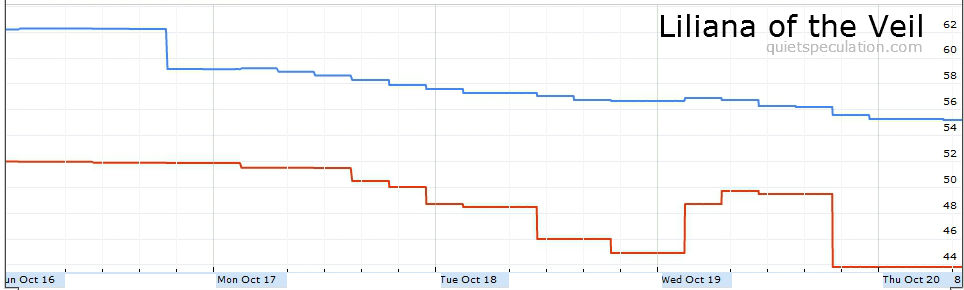
This chart, representing Liliana of the Veil's average and lowest price, covers a date range from Sunday the 16th through Thursday the 20th. In this ~5 day span, we can see 2 very important things:
1: Liliana of the Veil's average price dropped from $62 to $55
That's a drop of $7 within a span of 5 days. Incredible. We all knew the bubble would pop, but this fast?
2: Liliana of the Veil's low end price dropped from $52 to $44
On the low end, the drop was slightly more pronounced, dropping an additional dollar.
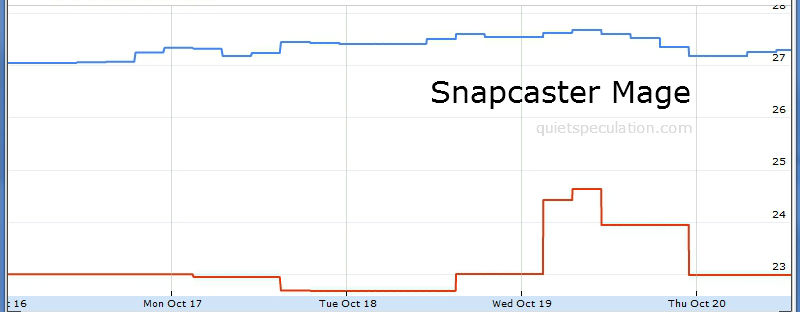
This is pretty damning evidence for "the dip". It's hard to say whether we should evaluate the average or the low price, as each has its own merits. Looking at both, for now, should suffice. As our analytic tools get more robust, we can fine-tune the model some. Let's take a look at another chase card, Snapcaster Mage:
Sun Oct 16 - Thurs Oct 20
This chart tells a different story. We see an almost static line on both sides. Somewhere on Wednesday, it seems some copies sold through, or someone bumped up their price. Either way, the market corrected itself down to where it's been hovering. Very odd that a $20+ rare is holding it's value, but we can probably blame multi-format play for this. I'd love to do a breakdown of the States deck lists and compare Liliana and Snapcaster usage, but such an undertaking is beyond what I'm currently capable of. It's clear that Snapcaster Mage is resisting "the dip", but we'll have to dig deeper to figure out exactly what's going on. Expect more charts to follow.
This is just a tiny taste of the sort of things we are working on behind the scenes! Please let us know if you like this kind of analysis want more. Thanks to all our Insider subscribers that have stayed loyal through some of our growing pains. We are always looking to add value to your subscription, and we think that the data-centric model is going to do nothing short of revolutionize Magic trading! We hope you agree.
If not, now is a perfect time to join up! Our powerful tools, breaking-news analysis, and exclusive Discord channel will make sure you stay up to date and ahead of the curve.
Hit the button to play, or download the entire episode!
This Week in Magic
It’s live again! Tom just can’t get enough, and it gets even better when we have a bunch of people in the chat window and some live callers. You can join us each week at http://www.talkshoe.com/tc/41574.
Gavin Verhey (@GavinVerhey) joins Tom for his last MNM before joining "the man" at WoTC in the R&D department!
Listener Emails
As promised, live callers and chat questions! Thank you to everyone for the donations. Add another piece of art to the pregnant magic creature file. Check out Xlblaze's newest holiday creation with Rudolf, the Red Nosed Reindeer.
Email in your questions for Gavin for his last ever podcast appearance next week to Tom at pitimp@mtgcast.com.
MTGCast News
Let Tom know what you think of a more live-based format for MNM and we will work on bringing the best audio quality we can.
Subscribe to the MTGCast Monday Night Magic RSS feed! RSS feed for Monday Night Magic iTunes feed for all shows on the MTGCast network RSS feed for all shows on the MTGCast network Twitter for MTGCast Hoodchefz favored by MTGCast crew
If not, now is a perfect time to join up! Our powerful tools, breaking-news analysis, and exclusive Discord channel will make sure you stay up to date and ahead of the curve.
State/Provincial Championships were this past weekend, and I attended the tournament here in CA as a judge. This was my first event judging, outside of typical rules questions at the LGS. This means I got to scan 230+ decklists. I also helped some friends test for the event. At the end of the day, I was ready to say, “Why haven’t they banned Green Sun's Zenith?” For the same reason it was banned in modern, it’s just too good. I know it’s been around for a little while now, and it hasn’t yet oppressed the format, and the reason for that is green hasn’t been playable. Now that Preordain and fetchlands (which play nicely with Ponder) have rotated, and blue’s firm grasp on the format has loosened, Green is showing up in force. In a base green deck, it’s literally copies 5-8 of all your green creatures, but only takes up 4 slots. It also allows silver-bullet one-of’s and even just overall smoothness with Birds of Paradise. It creates consistency, power, and inevitability like no other card in the format. I expect Green Sun's Zenith to be strong for the remainder of it’s legality, which is why I’m sticking Thrun on my buy list. A mythic that has already disappeared from trade binders and into longboxes, is ready to be called back up to the Majors. A great finisher in GSZ decks that need a threat control deck’s struggle to solve. Watch him.
What is the allure of States? To be honest, I just don’t know. Sure, it’s a bit of pride attached to saying you’re the champion of your state, and that on it’s own is a pretty cool thing. States haven’t fed into Nationals in quite some time, and prizes include things like a playmat, a plaque, and free entry to PTQ’s and GP’s (excluding limited formats). Since it’s currently a limited season, and the upcoming local GP is also limited, this portion of the prize has literally no value until Modern PTQ’s start next year. The thing about States that is so interesting, is it always follows the Fall set release. We get to see what cards and decks will be hot, because people need orders filled promptly to finalize decks for states. I saw a number of people on twitter complaining their orders didn’t make it on time and they couldn’t play, while people who were paying sky-high prices on EBay were praying their’s would show up in the mail. People’s need to compete in States created a temporary spike in demand that has now passed, and the prices of cards that were simply hard to find early are starting to come back down. People who paid $60+ for their Liliana’s are racing to get back $35 while they can. This recession in prices should be expected. Unless you’re an SCG grinder, the need to keep a fully-tuned, high-dollar standard deck is minimal. People recovering that money to put into Modern or another format, are doing so at an alarming rate. The same thing happened with Koth of the Hammer last year.
So where do we start digging for opportunities to find gems, if everything is coming down in price? Two places.
Firstly, look for cards that decline too far. As people panic to dump their stuff, the market will flood quickly, and trade partners you encounter will be anxious to get rid of stuff. If you prey on this, you can find value. I’ll be trying to nab up Snapcaster Mages, and Liliana’s from anyone who takes the price drops too seriously.
Secondly, look for cards that never spiked, but have new value in the metagame. The GP featured 6 green decks, only one of which was a non-Wolf Run, and 2 U/B control decks. The Snapcaster Mage version, took down the event. There’s no question that U/B is the control deck best suited to beat the ramp decks, but what beats the U/B decks. If rock smashes scissors, what covers rock? U/B is going to struggle with swarm decks. The sweeper of choice is Black Sun's Zenith, which is clunky and slow, and can be stopped with a gal often forgotten, Melira, Sylvok Outcast. Melira actually solves a lot of problems right now, if you can reasonably protect her, and I wouldn’t be too surprised to see her popping up quite a bit. She prevents the poison kill option from Inkmoth Nexus, and protects you from a Black Sun's Zenith sweep, and the newly popular Mono Black Infect deck. It also means your creatures can block infect guys without shrinking. She varies wildly on EBay from well under a dollar up to as much as $1.50, and she retails for about $2 on most sites with plenty of stock. I can see this hitting $4 at the right moment, but it would take a perfect storm. The problem is, if you’re not abusing her abilities with your own deck, then there are some matchups where she’s just a Legendary Grizzly Bear. Melira-combo decks exist in Modern and Legacy, and I wouldn’t be surprised at all to see a competitive Melira deck appear at the top of Modern when PTQ season rolls around since the blue based combos have been neutered without Preordain or Ponder to dig, or Rite of Flame to ramp quickly. I’m starting to pick up Meliras when I can, if under a dollar. She’s going to be a sweet sideboard option at worst in Standard, and likely a key player in Modern.
I tend to focus a lot on the seasonality of Magic events. For me, someone who doesn’t grind trade after trade after trade... I make more calculated choices, and plan my timings to maximize my value that way. This has worked for me time and time again, and each year when the process repeats I have more knowledge to reference from years past. Start looking at what happens after States. Look at what happens when a format that is not often played, suddenly becomes a PTQ format to prepare for Modern. Even though Extended was never a hugely popular format, Modern will likely have a similar pattern to it once season begins. Keep in mind, Magic is huge right now, so most things are going to have steeper growth and decay rates as more people both want to buy and dump holdings rapidly when things change. My hope is that my individual calls aren’t the only thing you get from these articles, but a formal way to process the information that comes to you, and the tools to make key decisions at the right times.
If not, now is a perfect time to join up! Our powerful tools, breaking-news analysis, and exclusive Discord channel will make sure you stay up to date and ahead of the curve.
In this episode of CommanderCast, we have recurring guest hosts and new segments. Cassidy Silver and Bennie Smith join Andy and Donovan in the continued quest for Commander enlightenment this week and discuss Doucheology, Voltron strategy, and the Magic 2012 set review.
Hit the button to play, or download the entire episode! The full show notes can be found here.
If not, now is a perfect time to join up! Our powerful tools, breaking-news analysis, and exclusive Discord channel will make sure you stay up to date and ahead of the curve.
Welcome back to another week of financially-minded set reviews. This week, we are finishing our look at Time Spiral, an incredible set for players and collectors. Like I said before, Time Spiral was a set that rewarded long-time players. There were the obvious references, like Magus of the Candelabra, but there also existed more subtle throwbacks, like Ib Halfheart, Goblin Tactician. We're more interested in money than flavor in this article though, so let's get into the thick of it!
$1.75
I see this come up now and then in dollar boxes. The margin at that price is never great, but it's good to pick up for Commander trading. Nether Traitor (and man, would Nether Trader be an insane column name... storing that one away) harkens back to Nether Shadow, the first creature that just wouldn't stay dead. Nether Spirit was a big fan favorite, playing well in Black Weenie decks from the beginning of Magic. In Ice Age/Mirage Standard, there existed a deck that utilized Nether Shadow and Ashen Ghoul to take advantage of then-new Buried Alive. The best plan was something like a first-turn Dark Ritual with Buried Alive for three recurring monsters, followed by a pump knight on the second turn. If that knight died, another beastie was quick to follow. The deck ran Bad Moon to amp up its attackers, and the UW control decks at the time had the hardest challenge - their Wrath of Gods never kept the enemy down, and you only had so many Swords to Plowshares. At the time, I thought Buried Alive was a dreadful card (having not yet learned the concept of reanimator) and I was surprised to see how well the "junk" card performed.
Nether Traitor takes even less work than Nether Shadow to come back and the thing has "engine" written all over it. I love it like I love Reassembling Skeleton. When you need something to die for a card like Victimize or Skullclamp, here's Nether Traitor to fall on the spike for you. It requires a certain amount of salesmanship to convince a lot of Commanders of its usefulness, but everyone wants to abuse their graveyard in Commander and this is about as painless as it gets.
$4.00
The downside of this Angel has never really counted for much. People use it with Aether Vial early on, or they simply pay WW on the fourth turn with a Counterspell in hand. Serra Avenger is a solid B+ Legacy creature and I have died to them a few more times than I want to admit. The card's real potency lies in the combination of Flying and Vigilance. With those two, you can tag a value-adding equipment like a Sword or Jitte on her and have both a bombastic attacker and terrifying blocker. A 3/3 that stays home to block is not terrible to begin with, but the addition of flying makes her even more devastating. The price of this card is also heavily influenced by Angel collectors, who especially prize Angels that are actually good!
$5.50
Stuffy Doll is a casual card that appeals to the casual nostalgic fan. The continuously punished doll showed up in hits like Black Vise and The Rack; true fans can name the other three cards that it has also popped up on without resorting to the Googles. On top of being a fun throwback, it's the heart of casual combos, utilizing cards like Guilty Conscience or armies of En-Kor to thwart attacking. It's also a popular multiplayer card, because it essentially tells opponents that it's just not worth hitting you; you'll get them (or whoever you picked out) instead. Sometimes it even lets you get around the pesky players who hide behind Propaganda effects. Name that person and then encourage opponents to swing big monsters into your evil little doll!
$1.50
Trickbind is occasionally useful in Legacy and it's also thrown about as anti-combo protection in Modern. Trickbind will stop a Storm deck and it'll also win the game against a Hive Mind deck if they aren't playing at the top of their game. I think it's useful to have a few copies if you intend to play Modern, but we'll see if it has a real role later on.
$9.00
My, how the mighty have dipped. Vesuva saw a brilliant and brief spike after the Cloudpost decks picked up in Modern. With Post gone, Vesuva has halved in price. If there is another big mana deck in the format, it'll probably use the Urza lands instead of anything worth cloning. That means that Vesuva is regulated, once again, to cloning Maze of Iths in Modern.
That's it for Time Spiral. You may be curious about the Timeshifted cards; I looked through all of them and none are really more expensive than the originals. We lack enough data to tell established prices on the foil versions of cards that were not previously foiled. That said, cards like Tormod's Crypt are definite foiled hits. Pass on those foil Squires, though...
Join me next week when we take a look at the color-shifted Planar Chaos set, a darling of MaRo but a failure among players who had never seen the original cards. Until then,
If not, now is a perfect time to join up! Our powerful tools, breaking-news analysis, and exclusive Discord channel will make sure you stay up to date and ahead of the curve.
Standard is a complex puzzle with multiple correct answers. There are some rules you must adhere to if you are to succeed though and first on that list is beating mono red. One reason that it is so difficult to beat mono red is because our tools are not as good as they were in the previous format. We lost key cards like Kor Firewalker and Obstinate Baloth. Timely Reinforcements is a great card but sometimes its not enough. The best way to beat the current red deck is to have some way to get rid of their creatures and probably gain some life as well. There are not very many decks that can do this which is why red is so successful right now. I think it speaks to the power of red that there are no two deck lists that are the same. Every red deck that does well, does it with a different array of spells. Red does a better job of interacting in the first three turns of the game than any other deck in the format, make sure you have a way to interact with them as well. This was the one downfall of my top 8 deck from philly, the inability to interact often in the first three turns of the game. Brian David Marshall summarized the tournament for Starcity Games and it was an interesting read.
Caw-Blade is alive and well but that is not the topic of this article. Another deck I have favored in the past Standard season, Voltron, is the focus for today. Initially I thought that because the deck lost very few cards that would make it tier one. I was wrong about that. The loss of Basilisk Collar was huge, as was the loss of the card advantage of Squadron Hawk. Still, I think that Puresteel Paladin is an amazing engine and one that can be successful in Standard. I have been working on a new list this week and I think I am much closer than I was with the initial list. I have seen other authors try some deck lists and I have thought them sub par. Nothing against anyone else, my first list was sub par as well, but there is room for almost every deck to grow in Standard.
The one card in particular that I have thought might be the wrong direction to include is Invisible Stalker. I, like many others, was running it in my list because equipping him up and attacking will close out many games. The reason I think that playing him might be wrong goes back to interacting in the first three turns of the game. Invisible Staker is not designed to block. That seems obvious, why would you block with him? He is designed to get damage in and not care about what your opponent is doing. Sure that's great and all but is that really what you want against other aggro decks? As much as I hate to admit it, Doomed Traveler really might deserve the spot more. It really might be a competitive card. He blocks well, becomes evasive once he dies, and your opponent will never want to attack into him or use a spell to kill him. He has play mistake written all over him. Doomed Traveler is a card that will cause opponents to play badly because they undervalue it and because if they spend two cards to kill your one cost creature, you should certainly win the game.
Take a look at the current version of Voltron I am working on.
Untitled Deck
Creatures
4 Doomed Traveler
4 Puresteel Paladin
2 Mentor of the Meek
2 Trinket Mage
1 Phyrexian Metamorph
Equipment
4 Flayer Husk
4 Mortarpod
3 Sword of War and Peace
2 Sword of Feast and Famine
1 Sword of Body and Mind
1 Sylvok Lifestaff
1 Blazing Torch
2 Batterskull
Spells
4 Dispatch
1 Oblivion Ring
1 Mox Opal
Lands
4 Seachrome Coast
4 Glacial Fortress
2 Inkmoth Nexus
2 Moorland Haunt
9 Plains
1 Island
Sideboard
3 Celestial Purge
4 Dissipate
3 Phantasmal Image
1 Oblivion Ring
2 Revoke Existance
2 Day of Judgment
As you can see, there are a lot of similarities like four Puresteel Paladins and the living weapons. There are some notable new inclusions as well. I already mentioned Doomed Traveler but Batterskull and Blazing Torch make an appearance as well. This may not seem very different but it really is. This version is much more of an aggro deck with a small amount of control and a true aggro control deck like its previous version. It probably still needs tweaked but I think this list is much closer to optimal.
One crazy idea I had was based on the creature type of Doomed Traveler, Puresteel Paladin, Trinket Mage, and Mentor of the Meek. All of these creatures are humans. Why is that important? Well, because Champion of the Parish was just printed. Look at the Voltron deck that plays off this human creature type theme.
Untitled Deck
Creatures
4 Champion of the Parish
3 Doomed Traveler
4 Puresteel Paladin
2 Mentor of the Meek
2 Trinket Mage
Equipment
3 Flayer Husk
4 Mortarpod
3 Sword of War and Peace
2 Sword of Feast and Famine
1 Sylvok Lifestaff
1 Blazing Torch
2 Batterskull
Spells
4 Dispatch
1 Oblivion Ring
1 Mox Opal
Lands
4 Seachrome Coast
4 Glacial Fortress
2 Inkmoth Nexus
2 Moorland Haunt
9 Plains
1 Island
Sideboard
3 Celestial Purge
4 Dissipate
3 Phantasmal Image
1 Oblivion Ring
2 Revoke Existance
2 Day of Judgment
What did I have to sacrifice to include this amazing early game creature? One of each Flayer Husk and Doomed Traveler as well as the Phyrexian Metamorph and Sword of Body and Mind. That does not seem like too much to remove for the possible aggressive draws that Champion of the Parish provides. This may not be the best deck to abuse Champion of the Parish, but he will almost always be Isamaru, Hound of Konda and sometimes a Wild Nacatl. That is a lot for a card that was added as a foot note. By definition, some of the time he will only be a 1/1 but you were only getting a 1/1 from Flayer Husk and Doomed Traveler anyway right? That being said, I am still not sure exactly the right distribution of cards for this deck but I will probably try out some humans for FNM and see what happens
I am not sure which of those versions or a different configuration is the best but I will be testing both and playing one on Friday at FNM. If you have thoughts about possible inclusions in the list , feel free to include them in the comments below.
I do not want to spend a lot of time on this next topic but I have been thinking a great deal about Heartless Summoning so I decided I would share my thoughts on the card. Heartless Summoning seems as powerful if not more so than Lotus Cobra, a staple in previous Standard and a card that is powerful enough to see play in Modern and Legacy in my opinion. Heartless Summoning being an enchantment makes it inherently more powerful because it is hard to remove. the fact that it gives your creatures Night of Souls Betrayal might seem like quite a large drawback but it is one that we can take advantage of similar to, though not as powerful as, Skullclamp.
We can undo the drawback by playing cards that take advantage of your creatures dying like Viridian Emissary and Perilous Myr. We don't care if either of these creatures die because we are getting a Rampant Growth or a Shock. Add in your combo with Glissa, The Traitor and you can kill any number of two or less toughness creatures in play and keep Perilous Myr in your hand to use again. Even if your opponent does not have any creatures that die to Shock, the ability to do an extra two damage any time a control deck kills one of your creatures will end the game quickly. It's nice that Heartless Summoning turns on Morbid for you as well. Take look at my current Heartless Pod list.
Untitled Deck
Creatures
4 Perilous Myr
4 Viridian Emissary
3 Phyrexian Rager
3 Glissa, The Traitor
1 Hollowhenge Scavenger
1 Morkrut Banshee
1 Solemn Simulcrum
1 Phyrexian Metamorph
1 Skinrender
1 Wurmcoil Engine
1 Sheoldred
3 Acidic Slime
3 Bloodgift Demon
Spells
4 Heartless Summoning
4 Birthing Pod
2 Garruk Relentless
Lands
10 Forest
10 Swamp
4 Woodland Cemetary
This is a rough list but I think it is doing a lot of things right. Many of my friends have said that the Birthing Pods might not be necessary, but I think you want to combine both Heartless Summoning and Birthing Pod to create a more consistent deck.
My main goal was to include the creature killing combo but keep a solid chain for Birthing Pod. With Heartless Summoning you want a bunch of cheap creatures that you can "go off" with when you untap with the enchantment or go straight to a five mana creature. I chose Acidic Slime because it chains well with Birthing Pod and also hitting it turn three is pretty good. The main way I thought to abuse Heartless Summoning was with Bloodgift Demon. You play him turn three and create such an advantage to hopefully overwhelm your opponent. I think the idea is solid and Heartlesss Summoning is an amazing card, it will just take some time to flesh out the list.
Two interesting new decks to consider for states. Good luck if you are attending and have a great time at one of the best tournaments of the year.
If not, now is a perfect time to join up! Our powerful tools, breaking-news analysis, and exclusive Discord channel will make sure you stay up to date and ahead of the curve.
With Innistrad flowing in steadily and States happening tomorrow, we can easily see where the metagame is at. Solar Flare is huge, and UW lists are still performing well, as is Red.
What isn’t doing so good is Birthing Pod. It’s been completely absent from the top decks so far this season and the price on Pod hasn’t really come down yet, but I can tell you from anecdotal evidence that demand on the trade floor sure is. As I tweeted about early last week, dump Pods quickly. It may make a comeback in the metagame, but the price is going to have a really hard time sustaining $12.
Wolf Run Green, on the other hand, seems sweet, but I watched it get crushed over and over by UW variants last night. While it’s good (and continue to pick up the pieces of it), it’s not going to consume the format.
States is this weekend, and you’ve probably completely broken the meta with your homebrew. But on the off chance you aren’t winning States this year, chances are you’re going to be trading. So this week I wanted to do something a little different – let you on to a few valuable cards you might not have known about, and ones that most players don’t.
I’ve talked about a few of these before, but chances are something on this list will surprise you. People criminally undervalue this group of cards, and there is literally no better way to pad your margins than to pick these up as throw-ins.
This type of list is why I love Doug’s set reviews every week, because they set up the money cards that I otherwise wouldn’t know about. I’m going to aim for some stuff more recent than that, hopefully some cards you can pick up on the cheap at States. While these aren’t incredibly expensive cards, and certainly aren’t sexy, there’s no better way to make some money on a trade by picking up a few random cards that happen to be expensive.
This top ten is in no particular order, and I’ll be quoting Star City buy prices, which means you know you can get AT LEAST this amount in cold hard cash for these cards. I’ve also double-checked other sites on these, this isn’t a case of one dealer needing to fill stock, these cards are legitimately expensive across the board.
10. The Liege Cycle
I would like to think that most of you know about these, since I talk about it regularly. This is one of my best profit centers in Magic. People let these go for a dollar or as throw-ins in trades, and they are deceptively valuable.
The highlights of the cycle are Deathbringer Liege and Creakwood Liege, both of which are being bought by SCG at $3. Murkfiend and Balefire come in close behind at a $2 buy price. If you spot one from Eventide, pick it up for sure. The Shadowmoor ones are less valuable, but still worth targeting as “throw-ins.”
Why are you so good to me, my Liege?
9. Immaculate Magistrate
Who would have thought this Elf “Lord” would command the same buy price as Legacy and Modern silver bullet Gaddock Teeg? Casuals are crazy about their Elves, and this card is very easy to pick up as just another dollar rare and then flip for twice that.
8. Door of Destinies
If you’re noticing a trend so far, it’s that “lord” type cards are crazy popular casually and command a high price tag as such. Most serious players don’t have any idea about this market and even those who are learned in EDH values on stuff like Divinity of Pride ($3 SCG buy price) or Rhys The Redeemed ($3 buy price) can miss out on a card like Door. Keep your eyes peeled, and if in doubt, trust the Lord card from a small set like Morningtide or Eventide.
7. Vigor
Another goodie. If you are starting to see the pattern here, you’ll see that Vigor also has a Lord effect of a sort and actually just screams “CASUAL” to you. Admit it, when you started playing Vigor would have looked insane. That’s the kind of thing that lets you start to get a handle on finding these cards in the dark. Necroskitter, anyone? ($2 buy price)
6. Greater Auramancy
I first stumbled onto this card when I was helping a friend of mine build a casual Enchantment deck (which is actually insane). You’ll get $2 from SCG for this one, but most players will let it go for just about anything.
Speaking of enchantments, Mana Reflection will also net you two bucks.
5. Death Baron
I’m pretty sure this one is just a reaction to all the Zombies from Innistrad, but SCG will give you $3 for it. Jump on this one and move out quick, since it has no tournament application. Zombies, however, are pretty big casually as a tribe (more of that pattern thing), and this is a pretty good Lord for the tribe.
It’s really not even unreasonable to find local dealers mispricing these still, and if you can get them at $2 you’re making easy money.
4. Nirkana Revenant
The other night at my local shop I was trading and spotted these in a guy’s binder. I pulled them out along with some other reasonable cards and a bulkish rare I was getting for a friend. This guy called the bulkish rare “about a dollar,” and said the Revenants were “literally valued at fifty cents.”
Forget being confident, THIS is like catnip to my ears. SCG gives $2 for these, and I’ve seen other dealers giving up to $4 at events on these. Being from Rise of the Eldrazi, these aren’t even that far out of print, so you should definitely be able to find some in a binder at States this weekend.
3. Reliquary Tower
SCG will give you a dollar for this Uncommon. While this is no secret to EDH players, I include it on the list because most people are still extremely happy to trade this uncommon for a bulk rare, since they’re getting the rare, after all. This is strictly driven by EDH demand, and as such isn’t as easy to find from players who don’t know what it’s worth.
That said, knowing this is worth a dollar to a dealer is a very nice weapon to add to your trading arsenal.
2. Mill cards
Ever since the days of Glimpse the Unthinkable, casuals have been going nuts for milling cards. That trend hasn’t stopped in recent years, even if there hasn’t been a marquee $10 Glimpse to sell the genre.
Some of the recent Mill pickups you’ll want to be on the lookout for – Mind Funeral ($1 buy price), Nemesis of Reason ($1 buy), Archive Trap (not being bought by SCG at the moment, but usually good for at least fifty cents), Hedron Crab, and basically anything else that has Mill on it.
Grab them as throw-ins, you won’t be disappointed.
1. Sanguine Bond
I’ve touched on this one before, but it’s worth repeating. Dealers online have paid me $3 on this, and yet it’s thrown away in trades.
Bond, I think, is a bit different from some of these other cards, because it’s from Magic 2010. M10 was hugely popular and supply ran short when Wizards didn’t print enough product quickly enough to meet demand. That means a casually popular card like this never got a chance to come down to lower price levels before being pushed out of the market. I pick these up for a dollar in trade all the time, and chances are you can too.
Even those traders who know that Bond isn’t bulk often don’t value it at $7-8. I wouldn’t love trading these at $5 or so, but it’s entirely reasonable to do so, knowing you can get $2-3 in cash on them, which is often a better percentage than you’ll get on some Standard cards.
Wrapping it up
I know none of these are groundbreaking cards, but they add up incredibly fast, accounting for a lot of the profit you’ll make during a typical trading day at a big event. When I’m at a big event where I can cash out on site, I love to trade down to get cards like these, because they sell at or higher than their perceived value when trading.
If you knew about all of these cards, then congratulations, you’re awesome already. If not, I hope I helped to make you some more money the next time you take to the trading floor.
If not, now is a perfect time to join up! Our powerful tools, breaking-news analysis, and exclusive Discord channel will make sure you stay up to date and ahead of the curve.
So, as reported last week. The first PTQ of my sealed season just passed, and I got to dip my feet into Innistrad a bit farther. However, almost none of my plan was a success. I scrubbed at 2-2 drop from the event, and due to the enormous turnout, there was not enough product for side-drafts. I did get a chance to meet a bunch of new trading partners, but most everyone was looking for Innistrad cards, namely Liliana or Snapcaster, for States. I was able to trade away my Stromkirk Nobles, while they were high, and also traded for a couple [card]Kessig Wolf Run[/card’s (both Pre-Re picks of mine) as I heard about the deck from the SCG open.
A sealed PTQ season is not as lucrative as a Standard one can be, or at least not with out a much higher concerted effort. Dealers aren't crazily buying singles to meet demand, so grinding trade tables is essentially your only hope to get any value. I’ve found the side event drafts to be extremely profitable, but they are always prizes in packs, which normally i wouldn’t be very enticing to me, but now I feel differently.
As I mentioned as this season started, one thing to remember as a PTQer is what types of currencies are most liquid. And sure, the big money cards move quick, but in all reality, boosters are extremely hot right now. People need packs to practice sealed, money draft, and open money rares. Dealers were buying packs at the PTQ so they could run drafts when they return to their brick-n-mortar store, and negotiations over draft-sets for 3v3 team drafts were tense. The typical draft set is going to cost you between $7 and $8 but I saw a set go for as much as $10 when people were trying to get their game on. Being the guy holding the packs is a pretty strong play. Also, when trying to target desirable cards, boosters are always a great way to even the trade, and can typically be valued fairly close to retail, depending on your trade partner. I don’t have a huge stock of Innistrad stuff yet, and the key rares I do have, I’m hanging on to. As a result, I’m having to get creative with what I can offer my partner for the things I need. Sometimes it’s boosters, sometimes cash, but the thing to remember is: Don’t trade out of need.
Especially at a larger event where you’re more likely to encounter strangers, don’t make it obvious why you need what you need, or why you like it. If they know you need a card for States, they will force you to value it higher. If they know you’re likely to walk away with the pile of boosters THEY need, they could be willing to work with you. Just keep this in mind as you meet new people. Remember, tons of traders read both this site, and others to gain an edge in training. It’s time to next level.
Your Trading Style needs a Sideboard. Prepare for your Metagame.
Trading, just like constructed, is a metagame. Literally speaking, a metagame is just any game that exists because of Magic, but happens outside the boundaries of 60 cards and 20 life. Deck selection fits this mold, as does trading. Trading at a large event, you need to quickly size up your partner and choose your correct path. The key things to look out for are the ‘shark signals’. “What do you value this at?” Is obviously common, but the real way to identify a shark, is that they ask and talk about values, and not what cards they are interested in. They don’t CARE what cards they trade from you, as long as there’s value there. Sure, many of you may be in the same boat, but not everyone is. This type of behavior alienates most casual traders, and will lose you lots of trade partners. Against another ‘spikey’-trader, it just makes the trading experience miserable, as it operates like a mono-blue control mirror from 1997. The first one to make a move loses. How do you next level your mono-blue control mirror, and how do you tone it down to not scare away the casual EDH crowd. This is the metagame of trading.
Mirror-matches are the most skill testing in constructed, and the same can be said for trading. In constructed, I like to have unusual card choices, that are good mirror blowouts available in my repertoire. In trading it’s no different. The key is to take them out of their typical routine, and force them to make some moves on the spot. (For chess players: “Take them out of their opening book.”) I’ve used this line a bunch of times, to great success. “Let’s cut the crap. We’re both trying to gain value here, and this will just take a while. Want to start any sort of list of stuff you actually need for a deck, and see where it goes?” This forces them to take the role of the casual trader, and you as the card dealer. (“Who’s the beatdown?” j/k) Now you have something THEY need, and you can start valuing cards as such. If they resist this line, because they A) don’t need anything, or B) don’t want to fall into your trap, all is not lost. Sometimes I’ll follow up with one more line like, “I don’t really need anything either, just thought we might be able to help each other out. No worries, some times there’s not always a good fit.” If they don’t immediately respond with something that sounds promising. Just walk away. Really. You may lose out on a potential trade, but chances are that you aren’t going to get the value you want out of it, and if you do, it will be time consuming. You’re better off finding a new partner.
An example from the PTQ:
I had my binders out on the table, and an obvious shark slid across from me with a cheesy grin and a pink Monster binder. I smile back, and play dumb. I just let him do all the talking. After about a minute of him talking about his PTQ scrub-out and bad beats, he pops the big question. “Are those trades?” I slide my binders to him, and he is flipping through, searching for stuff I under-value, and I just sit there with his binder in front of me for a long while. After he gets half way through my stuff he says, “You weren’t going to look at my binder?”. My reply? “Nah, let me know what you need out of there, and we’ll find something fair.” His face went blank. He sorta stopped looking at my binder, and had no idea how to proceed. His overly cheesy grin visibly faded a bit, and his cheery tone vanished. He slowly and quietly flipped through my binder, and and at the end he said. “Well, I dont know what you value this stuff at, but I really want to pick up a Solemn.” I said simply, “I usually try to pick those up around 8, but I think they’ll continue to be pretty hot in the near future, so I’d be willing to get rid of them around 10.” I looked at his binder, pointed at a Consecrated Sphinx, and said, “This okay?” He muttered a bit, and asked me to throw in a Spikeshot Elder, and the deal was done. This trade was over in just 2 minutes, and it was all possible because I disarmed him of his typical Shark routine. My style may not work for you, but experiment with it. Go into it prepared to walk away from the trade if your experiment isn’t working. Find a couple key phrases that put you in the good position to make trades. In my opinion, taking the Sharks out of the ‘used-car salesman’ routine is the best thing for the community anyway.
Good luck, and let me know if you have techniques to reccomend, or feedback on the ones suggested here.
Happy Trading
Chad Havas
@torerotutor on Twitter.
If not, now is a perfect time to join up! Our powerful tools, breaking-news analysis, and exclusive Discord channel will make sure you stay up to date and ahead of the curve.
I wasn't able to play as much Commander this past weekend as I would have liked because I spent my time practicing Sealed Deck for the Grand Prix Trial that my local game store ran. The effort seemed to pay off as I was able to come away from the 8-man event with the three byes I'd been looking for, but the time commitment means that this week's discussion lies in earlier happenings.
Raving Mad
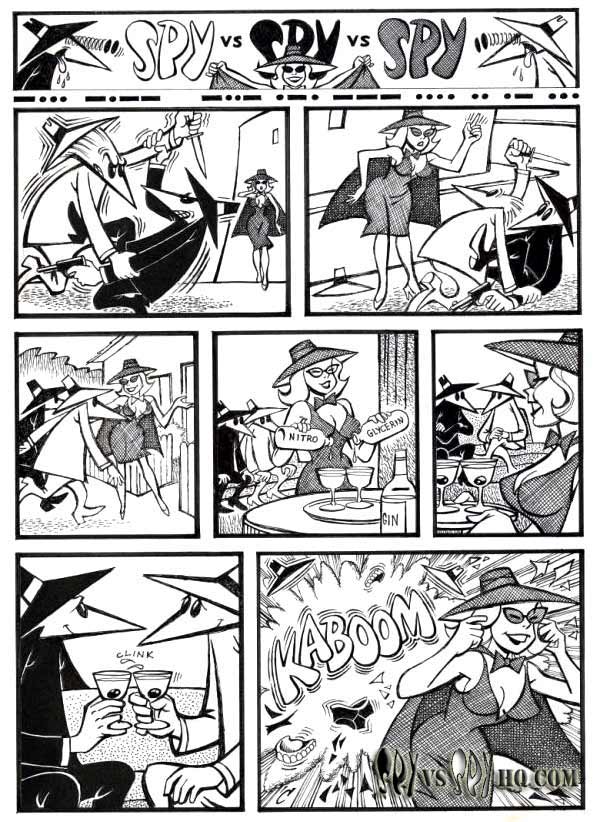
The week before last, I played a new Commander variant for the first time. Watch the political intrigue thicken as you overlay a game of Bang!/Sanguo Sha on top of your Commander games. Each player gets a random role card loosely based on Mad Magazine's Spy Vs. Spy:
The Lead Black Spy reveals his or her card, and wins if all players other than Black Spies have been eliminated.
The Lead White Spy plays the same role, but in opposition.
The other Black Spy leaves his or her card face-down and has the same victory conditions as their leader.
The other White Spy again mirrors the Black.
The Lone Wolves (one in a five player game, two in a six player game) leave their cards unrevealed and only win if they're the last player standing. They aren't on a team together.
(Apparently this is a local variation on the Hidden Allies Format Abe Sargent discussed recently.)
What is the Meaning of this?
Variant formats offer a lot to your playgroup's Commander experience. First and foremost, they offer, well, variance. Commander already does a good job of introducing extra variance into Magic games, but if your playgroup runs a lot of tutor effects or simply doesn't play a very wide range of decks, you may be on the lookout for something more. Spies offers not only a different political dynamic via fixed alliances, but also introduces a sense of mystery and paranoia that doesn't usually pervade Commander games.
On top of variance, many Commander variants can speed games up. Commander is notorious for four hour brawl sessions, and while those can be a lot of fun, oftentimes they're simply too hard to make time for. Spies encourages attacking because you always have somebody who knows you're an enemy (other revealed players if you're revealed, other unrevealed players if you aren't) who you can start gunning for. On top of that, it's simply easier to end the game when you have fewer people to oust.
And finally we come to balance.
Variants can provide a way to balance Commander games involving decks of vastly different power levels. Spies doesn't have a built in way to do this, but making the guy with the ridiculous combo deck play as a known lone wolf is certainly a start.
Foriysian Wars
Not all formats can accommodate as large a variety of sizes as Spies, but with an even number of players, you can always go for X-Headed Giant. Unfortunately, taking simultaneous turns can get pretty annoying when they're as complex as those found in Commander and doing so becomes basically impossible once you get into Mount Rushmore territory. On the other end of the spectrum, Two-Headed Giant has been a staple of Prereleases for quite a while now, and the reason is clear: it's a great way to play cooperatively with a friend, with no fear of backstabbing.
In general, I think this is one of the few areas that Magic lacks in. As a kid, I remember always wanting to play Super Smash Bros. cooperatively with a friend against AI opponents. Competition is engaging and fun, but it's also the way that people burn out playing Magic. X-Headed Giant doesn't completely solve this problem because, as Paul Sottosanti pointed out in a great game design post, cooperative games need hidden information and banned communication and/or a timing component to keep them from being a single-player game.
Army of the Damned
Luckily, we have a better cooperative format right here on Quiet Speculation! If you missed Peter Knudson's Horde Magic, now's the time to read up, and if you follow him as @MTG_Pete, you'll see he's got more in the works. For those of you who refuse to click links, here's a quick rundown.
All players are on one team that shares turns and can block for one another. They have a shared life total of 20x the number of survivors. And take three turns before the Horde deck starts playing.
These survivors battle against a Horde deck that plays itself which consists of tokens and spells that require no choices of the caster.
At the start of each of the Horde deck's turns it flips cards from the top of its library until it hits a non-token, then casts all of the revealed cards.
Creatures the Horde deck control have Haste and attack each turn if able.
If damage would be dealt to the Horde deck, it mills that many cards instead. The Horde deck loses if it controls no permanents and has no cards in its hand or library.
I admit I have yet to play Horde Magic, but I'm not above theorycrafting so here goes nothing: fighting the horde gets rid of practically all of the bad blood one normally sees in multiplayer games. A strong deck doesn't feel as unfair when it's on your side, nobody can take an irrational vendetta against somebody they're fighting alongside, and because the survivors share a life total you don't even have the issue of a teammate letting you take a hit because they think their removal will be more useful elsewhere. Moreover, fighting with chainsaws should offer a sense of collaboration and camaraderie completely absent in normal games of Magic, making Horde Magic one of the most variant of variant formats. I can't really say much about the variant's speed without having played it, but I imagine it should take less time for four players to dish out eightyish damage to kill the Horde than the one-hundred and twenty damage it would take to beat the other three players in classic Commander.
Going Supernova
Next up is an oldie but goodie. Star is played with five people, and each player's goal is to eliminate the two players who aren't adjacent to them. Oftentimes Star is played with five mono colored decks so that each color has to oppose its enemies, but the political underpinnings of having to eliminate people without letting you 'allies' win stays intact without this extra level of organization. Star plays out very differently depending on the level of politicking that your friends engage in. In apolitical groups, Star is a great way to avert hurt feelings because who each person is supposed to go after is established at the start. In more underhanded settings, the format entails trying to snipe wins out from under 'allies' who have killed your mutual enemy. In this setting, Star plays very much like a control mirror of old. You aren't looking to throw out a bunch of strong plays, but rather to sneak something good enough through at some point by drawing attention elsewhere. Despite this sort of calculating play, Star goes a lot faster than a five player free-for-all because so many people are left alive at the end. Unfortunately, Star does little good in the realm of balance and can actually exacerbate the issue as often a powerful deck can kill off its enemies without the rest of the table's actions being relevant. On that note, I've never been a fan of Attack Left/Right. It brings the same balance issues as Star but without any of the political intrigue. What's more, in Commander limiting who you attack doesn't even make a huge game manageable since targeting often has more impact than attacking.
Failin' with Palin
But what about instituting a range of influence so that Wraths don't keep the game from progressing? While I know a fair number of people who play Range Commander when they get a big group, in my experience it always devolves into misunderstandings about what does or doesn't effect who unless the rules are such that literally nothing outside of your range happens from your perspective. With that rule set you might as well just split into two games...
King of the Castle
Then again, ranges aren't all bad. Emperor uses a limited range for a purpose that keeps it from feeling like separate games jammed together. It alleviates the issue that teams can cause where one person can't hold off the combined assaults of the opposing team without combining each team into one 'player' like Two-Headed Giant. My biggest complaint about Emperor is that it can make Commander games take yet longer, but it's a great way to spend an afternoon if you have five friends and want to avoid politics. The extra time and ability to outsource creatures to your teammates make it play fairly distinctly from your average Commander game (unless you play Zedruu a lot), and the teams' ability to swap around creatures keeps weak decks from getting run over. Nonetheless, isolating the Emperors can lead to some balancing issues since the more powerful late-game deck will almost always hit a breaking point.
Supervillians
Then again, giving somebody the time to pull off their most ridiculous late-game can be as much a feature as a bug, and it's one that last year's Archenemy embraces wholeheartedly. The format works a little bit less well in Commander because the schemes have bigger fish to compete with, but this fact makes Archenemy a great way to knock the strongest deck at the table down a peg and get some revenge without pissing off whomever happens to be playing it. On the other hand, Archenemy might not feel as different from your normal Commander games as you'd like. After all, the table usually devolves into Archenemy as soon as some one drops an unanswered Memnarch or Necropotence. I'd recommend playing a supervillian role to keep things fresh and fun; after all, who doesn't appreciate a good monologue?
Hot Pursuit
To top it all off, let's look back to the 2009's summer multiplayer product: Planechase. The proposed gameplay with individualized planar decks was more or less a bust, but a shared planar deck can make for some exciting games, and with some careful selection, can serve to speed things up without making the outcome feel arbitrary. That said, the enormous amount of variance that a shared planar deck introduces can be oppressive, so if you want to break out your planes I'd recommend using the Eternities Map rules. If you do, you'll still find a game of chaos, but there shouldn't be any more moments that disappoint everyone at the table. The one downside is that by reducing the randomness' role you give yet another advantage to whichever deck can generate the most mana, but the variant's novelty is well worth it.
There are an endless number of ways to play Magic, and the vast majority of them can be applied to your Commander table. What are your favorite variants? Do any of the ones here sound interesting enough to try? Share in the comments!
Jules Robins
julesdrobins@gmail.com/Google+
@JulesRobins on Twitter
If not, now is a perfect time to join up! Our powerful tools, breaking-news analysis, and exclusive Discord channel will make sure you stay up to date and ahead of the curve.
"If I may lend a machete to your intellectual thicket."
- Captain Jack Sparrow
Hello SitS fans...Scene in the Store is happy to announce that our sponsor, The Game Room, has hosted its first full fledged Magic event! So yeah we had our first real event at the store on Sunday, complete with promo cards and prize payouts. It was a great success and with that we'll jump right into why that matters...
Trepanation Blade OWNS FACE! More on this later...
Since this was the store's first event, and mostly unadvertised, I decided to mix things up a bit with the sealed deck event that we hosted. We offered 6 packs of any combination from New Phyrexia and Innistrad, and this made for some very interesting deck builds. The pack counts were widely varied from all 6 Innistrad to 5NPH/1ISD and everything in between. This little experience can provide us with several different points of interest.
* As I mentioned earlier, Trepanation Blade is insane in a sealed/limited environment! Now I know in other formats it loses some of its glint, but in sealed and/or limited format is where it's sharpest. This artifact kept a stable board presence no matter who or how they played it. All you drafters out there should remember this as well; in your little limited bubbles. This card has plenty of haters but all's fair in a sealed war...oh and if you can pull the foil...try not to drool on it before you sleeve it, it's gorgeous.
* It's interesting how many Stromkirk Nobles are actually cracked in the course of opening a booster box. It's like WotC knew that all the red mages were losing a bit of "off the line" speed when Zendikar rotated out and slipped this unsuspecting gem in to compensate.
* The Phyrexian mana cards are still super fun and super utilitarian. Mutagenic Growth, Vault Skirge, and Gitaxian Probe are still some of my favorite cards from the set. And let's not forget the popularity of Dismember and new all-star Gut Shot. I could see the entire Phyrexian mana group of cards becoming increasingly popular as time goes on and NPH rotates out. I've got a box dedicated to holding a fair number of play sets of each of these Phyrexian mana cards.
* One of the major things I think we can take away from this little experience is the fact that Innistrad appeared to be the stronger of the two sets. While New Phyrexia had some bomb cards that got cracked, it was the consistent strength of Innistrad that lead its major supporters to top spots in the final standings. With this in mind we can remember to aim towards packs of Innistrad when presented with options of sets to choose from. One for its immediate strength at any given sealed situation, and two for its strength in the trade realm.
* This "choose your own destiny" style of sealed deck was an interesting look into casual play styles. The success of this past Sunday's event has gotten me thinking of other ways to go about casual events. I've got an idea for some sort of "randomizer" tourney. An appropriate number of packs are put into a box, the players blindly pull a pack, pass to the left, and so on, until all players have their 6 packs. We'll explore these ideas more in future posts. I feel like events such as these will be great for testing players deck building skills, as well as providing a fresh approach to playing. Check out this article, if you haven't already...Horde Magic by Peter Knudson. If anyone else out there has come up with some other interesting casual events, please feel free to share in the comments below.
Ok folks, that wraps up this Tuesday's SitS post. I want to thank those of you that are supporting Scene In The Store and I look forward to providing you with lots of new material and outside-of-the-box perceptions on this game we have all come to know and love.
If not, now is a perfect time to join up! Our powerful tools, breaking-news analysis, and exclusive Discord channel will make sure you stay up to date and ahead of the curve.
This week I want to take the chance to talk about something I've been thinking about for awhile: the most poorly recieved deck I've ever built. Not my Child of Alara Lands Deck, and not my Zubera Combo Deck, but something altogether more straightforward, and seemingly more fair and interactive.
The first deck I built was a Bant deck with all best ramp spells and creatures that I could find in my collection in those colors, and as many ways to cheat on mana costs as possible. The deck was built around one of my favorite cards at the time, Phelddagrif. Don't give me that look; I promise I'm not talking about Group Hug! The deck I built only cared about Phelddagrif's first ability; the one that gives other players creatures.
You see, the deck wasn't built around "fair" ways to cheat on creatures like Natural Order and Polymorph, though it did run them at the time. My deck was built around Oath of Druids and Defense of the Heart, and all you did was put the most offensive, non-interactive creatures into play you could think of. Things like Painter's Servant and Iona, Shield of Emeria, while the pair was legal, or more recently Bringer of the White Dawn and Treasure Mage fetching Mindlsaver. Sidenote: I know Bringer isn't technically legal, but my group is pretty lenient regarding what decks Bringers go in. Let's dive right in and take a look at what makes a deck like that function:
Phelddagrif Oath
Phelddagrif (Commander)
Oath of Druids
Defense of the Heart
Copy Enchantment
Pattern of Rebirth
Wild Pair
Academy Rector
Idyllic Tutor
Enlightened Tutor
Wargate
Tooth and Nail
Natural Order
Green Sun's Zenith
Lost Auramancers
Sensei's Divining Top
Sylvan Library
Skull of Orm
Eternal Witness
Auramancer
Monk Idealist
As you can see, the deck so far is just a giant pile of tutors and card selection, trying to get Defense of the Heart or Oath of Druids into play as quickly as possible. If that doesn't work, then you'll just play out kind of like a ramp deck, except that your top end is infinitely more unfair than any other ramp deck I've ever played with. The thing is that green creatures tend to be inherently fair. Sometimes terrifyingly efficient and gigantic, but still fair. White and Blue get some of the dumbest creatures in the game, especially when you consider the interactions between them. If I were to build this deck today, here's the selection of creatures I'd use:
Big, Dumb, Fatties
Jin-Gitaxias, Core Augur
Vorinclex, Voice of Hunger
Aegis Angel
Ulamog, the Infinite Gyre
Consecrated Sphinx
Sakashima the Impostor
Woodfall Primus
Reya Dawnbringer
Yosei, the Morning Star
Keiga, the Tide Star
Karmic Guide
Reveillark
Body Double
Blazing Archon
Sun Titan
Iona, Shield of Emeria
Primeval Titan
Phantasmal Image
Phyrexian Metamorph
Back from the Brink
So there's a couple of interactions here that are pretty important, but, first and foremost, the idea is to fetch whatever combination of creatures is most backbreaking, and then make it as difficult to deal with either one of those creatures as you can. For example, you can fetch Jin-Gitaxias, Core Augur or Vorinclex, Voice of Hunger against a primarily Blue or Green table respectively, and then protect the guy with Aegis Angel. On the following turn you could Copy the Aegis Angel. If they deal with your combo of dumb guys, you just get Karmic Guide or Body Double, and if they deal with that, you get Reveillark.
Honestly, the deck probably wants an Adarkar Valkyrie more than I'm willing to admit, mostly because of the obscene interaction between the Valkyrie and legendary Kamigawa dragons like Yosei, the Morning Star and Keiga, the Tide Star. With Sun Titan and Phantasmal Image, you could lock out multiple players, or steal multiple creatures every turn. Right now, this kind of interaction is approximated by Reya Dawnbringer, which is generally more powerful, but more of an endgame card than a "protect my guys" card.
And then you've always got the ever-popular combination of Iona, Shield of Emeria and Sakashima the Impostor. The first game I ever played with this deck, I [card Oath of Druids]Oathed[/card] up an [card Iona, Shield of Emeria]Iona[/card] on turn four, and then [card Sakashima the Impostor]Sakashima[/card]'d my Iona on the next turn naming the two colors people were playing. That sure was a fun game, wasn't it?
The last card here is something I'd be interested in trying if I were to build the deck again. Back from the Brink is an amazing card advantage engine in the late game, especially if you're casting the kind of bombs that this deck tends to cast. The problem with it is that once you've recast the creature it's gone for good, unless you run something like Riftsweeper. Worth it? Probably, but you'd have to be pretty careful about which creatures you recast with Back from the Brink, and which ones you wait to recur naturally.
So, what's the supporting cast for a deck like this? You want reasonably costed threats that are going to run away with the game if they don't get dealt with, and which don't require additional investment every turn, so that you can focus on ramping and cheating out fatties. Planeswalkers are the ideal partners to a strategy like this. They provide you with an alternate way to generate card advantage, they must be answered, and some of them even interact favorably with your big, stupid creatures!
Planeswalkers
Garruk, Primal Hunter
Garruk Relentless
Jace Beleren
Jace, the Mind Sculptor
Venser, the Sojourner
Now, the Jaces are pretty straightforward. They're generic card advantage in a format like Commander. The Garruks and Venser are much more interesting. Garruk, Primal Hunter serves as a threat and a card advantage engine not to be underestimated with any of your gigantic creatures. Oddly enough, though, Garruk Relentless is probably the most powerful planeswalker in this deck. As long as you can find a way to flip him, he serves as a very powerful defensive mechanism, and also helps you tutor up answers, recursion, or threats as appropriate for the current gamestate. He's certainly not as powerful as your Plan A, but he's still a great role player.
Finally, Venser, the Sojourner serves a very interesting purpose in this deck. Not only do you have powerful "enters the battlefield" abilities that you'll always be happy to trigger again, there are also creatures like Iona, Shield of Emeria, which can be blinked to name a different color, or you can pick new targets for Sakashima the Impostor and Aegis Angel. The most interesting thing about Venser is how threatening a table finds him. In my group, at least Vensers go ultimate a startling amount of the time, because people are less concerned with Venser himself than with the creatures he's blinking.
Now that we've covered the framework and support cards of the deck, there's just one more component: the acceleration. Acceleration is incredibly important since you won't always be able to cheat on mana costs. But even when you can, having a ton of lands lets you do even more broken things that you would be able to normally. You get to start doing stupid things like recurring Defense of the Heart and tutoring up Copy Enchantment to double up on Defense of the Heart on the next turn.
Acceleration
Swiftfoot Boots
Lightning Greaves
Explosive Vegetation
Cultivate
Kodama's Reach
Skyshroud Claim
Search for Tomorrow
Wood Elves
Far Wanderings
Solemn Simulacrum
Sakura-Tribe Elder
Yavimaya Elder
Sol Ring
Everflowing Chalice
Mind Stone
Trinket Mage
Swiftfoot Boots and Lightning Greaves may not technically be acceleration in the same way that these other cards are, but they give your Titans haste, and let you do other stupid things with your gigantic creatures, so they're honorable mentions here as far as I'm concerned.
Now, the previous lists of this that I ran had much less acceleration, and more cantrips, but I think I like this set up better. This gives you a realistic chance to cast the gigantic threats at the top of your curve, rather than just messing around with the top of your deck until you manage to "combo" and drop a threat. Sure, the games where you Ponder or Preordain yourself into a stupid creatures on the third or fourth turn are awesome, but I'd rather sacrifice that explosiveness for consistency and redundancy.
That said, with the addition of the Praetors from New Phyrexia, I don't see myself tutoring up terribly many of the other gigantic creatures any more, and so you could probably cut things like Keiga, the Tide Star to make space for cantrips to make the deck a consistent turn five deck instead of a turn six or seven deck.
As always, the last thing I want to look at before summing up the deck list is the mana:
Manabase
Mosswort Bridge
High Market
Vesuva
Dryad Arbor
Forbidden Orchard
Horizon Canopy
Flooded Strand
Windswept Heath
Misty Rainforest
Breeding Pool
Hallowed Fountain
Temple Garden
Savannah
Tundra
Tropical Island
Flooded Grove
Mystic Gate
Wooded Bastion
Glacial Fortress
Hinterland Harbor
Sunpetal Grove
Reliquary Tower
Temple of the False God
Seaside Citadel
Wasteland
Strip Mine
Halimar Depths
Winding Canyons
4 Forest
3 Island
2 Plains
Alright, so most of it is fixing, but there are a couple of standout cards here. There's the obvious interaction between Forbidden Orchard and your key pieces, Oath of Druids and Defense of the Heart. This probably the most narrow inclusion in the whole list, and is frequently just worse than a basic land. The problem with cutting it is that you're then completely reliant on Phelddagrif to trigger your Oath of Druids and Defense of the Heart, and that's not really a place I want to put myself in.
Next, there are cards that play well with gigantic creatures. Things like Mosswort Bridge are stupidly easy to activate, and let you cast gigantic and unfair fatties at instant speed. What's not to love? Vesuva is purely in this deck to copy Mosswort Bridge, or other people's strong utility lands, like someone else's Cabal Coffers when someone had an Urborg, Tomb of Yawgmoth in play!
Lastly, Winding Canyons plays a similar role to Mosswort Bridge, but is both better and worse. Winding Canyons is better because the effect is repeatable, and the interaction with Seedborn Muse is just about strong enough for me to want to run the two together. However, Mosswort Bridge comes with a free card and lets you cheat on mana costs, and I definitely don't want to play down how valuable those effects are! Now let's take a look at the final list:
[deckbox did="a129" size="small" width="560"]
So, here's the problem with a deck like this: when the game is playing out the way that you want it to, no one else gets to play. You'll have locked them out with [card Yosei, the Morning Star]Yosei[/card], [card Jin-Gitaxias, Core Augur]Jin-Gitaxias[/card] and [card Vorinclex, Voice of Hunger]Vorinclex[/card] or some such, and no one will be able to do anything about it. On the surface, the deck looks like a very Commander-friendly deck, with giant creatures and lots of ramp, but when you actually play, the only thing your deck does is prevent other people from playing. You're not smashing face with giant fatties, you're locking other people out of the game with them, and actively trying to limit their ability to interact with you. In my experience, people would rather play against a wacky combo deck, even if that archetype is traditionally the least interactive.
So there you have it! Out of all the decks that I've built in recent years, decks of this style are the ones that have been hated on the most, as surprising as that is. Next week, I'm hoping to have finished up a deck I'm really excited about building in a color combination I've personally never played before! Meanwhile, if you've got any questions, comments, criticism, or decks you want to talk about, be sure to get in touch! I'm always glad to talk shop!
Carlos Gutierrez
cag5383@gmail.com
@cag5383 on Twitter
If not, now is a perfect time to join up! Our powerful tools, breaking-news analysis, and exclusive Discord channel will make sure you stay up to date and ahead of the curve.
Thank you for joining me on Part 2 of our look at the Melira combo in Modern. We will be covering fundamentals of design, along with serious "give a man a fish" lists of stuff to look at; I guarantee there's something in here for you.
Understanding Melira's Place In The Metagame
-or-
How to Not Totally Screw Up Building This Deck
Modern is defined by one rule at the moment: nobody can win before the third turn. Let this set in for awhile; R&D has taken a firm stand on the idea that people should have longer Modern games. What this means for us is that fast combo will be anomalous and fleeting, existing for three months and then probably being banned away. This is superb news for Melira players, because the Modern format emphasizes the midgame more than any other format around right now! In Legacy, decks need an answer to the turn-1 Storm kill between the maindeck and sideboard. This results in having to play things like Thoughtseize and Chalice of the Void, which do nothing for a game plan and don't even work all the time.
Since Modern has a base win time of three turns, we can run better answers and avoid cluttering our sideboard with combo answers. Since we can wait a little for combo stoppers, we can run fewer of them and intend to draw into them. The other side effect of this is that combo stoppers that are built with speed in mind are not great in the deck. Melira cannot put on the pressure early enough to back up Thoughtseize; it has no Tarmogoyfs or Wild Nacatls. Therefore, I do not think it is necessary to run much discard (or any). Begone, Tidehollow Sculler! Combo like Twin can sling a Lightning Bolt at it or just play around it. Single-card discard can be disappointingly inefficient when we can't press our immediate advantage.
We can't get too bold about running 1-of answers, though. You must look at every singleton card and ask "will I ever tutor for this?" That's my main issue with cards like Tidehollow Sculler; if you can get a 2-drop, would you want Sculler against someone? Against Twin, maybe - but Gaddock Teeg is a stalwart man himself and a better tutor target. Against other decks, you'll just be temporarily snagging a card while stepping the Sculler into a Kitchen Finks. I even have issues with Eternal Witness, since the only time I want to see her is really when I am Chording for her to get a Birthing Pod back onto the battlefield. At other times, I would rather have something that applies more pressure. The cards in our graveyard are, frequently, lands and sacrificed creatures. Not exactly a fertile recursion ground.
A good Melira deck should, then, be able to consistently pull off the combo by tutoring it up or naturally drawing it. It should also not be so anemic that it cannot beat down against a deck when its main methods of killing are removed. If you can remove the Meliras or Birthing Pods from the deck and still stand a decent shot at winning, your deck is probably built correctly.
The Superiority of G/B/W
Melira can be built with any splash colors that you'd like. The two core cards, Melira and Finks, are both green and you can use a colorless combination card like Blasting Station to make it hum without black's Viscera Seer. I believe that G/B/W is the best color combination at the moment, and that's because it offers the best silver bullet creatures.
My list is, at its core, mostly green; it only branches out for small splashes. If we want to get the most power out of Birthing Pod and Chord of Calling, we should run plausible bullet creatures that are affordable and really hurt opposing decks when they hit. White and Black have the best monsters for that purpose, as you will see in my compendium of creatures, below. The manabase is very easy to work with, and blue and red don't do enough on their own. Sure, you have Highland Thrinax if you go red and you have the incredible Phantasmal Image if you go blue, but the taxing on the mana base adds up. This isn't the deck to go five colors.
Alternate Strategies
If you don't want to run Chord because it's clunky, there are a few other ideas that can work fine. These are untested, but they provide a good path for further research.
Time of Need for Kataki is exactly the opposite of what Affinity wants to see.
Time of Need is a surprisingly versatile tutor in Modern. In a G/W deck, it can get Kataki, War'sWage, Melira, Gaddock Teeg, Linvala, Keeper of Silence and more. It can grab Mangara of Corondor if you need to blow something up, for example. You can go get Yosei, the Morning Star to freeze the board and set up incredible lockdowns. A deck with Time of Need has a leaner curve; it is limited in its tutor targets, but it costs much less to get an effective impediment on the board.
We also have access to Fauna Shaman + Squee, Goblin Nabob. This is an ersatz Survival strategy and, undisrupted, can take over a game in short order. The first Shaman activation gets Squee, if we have time. After that, every activation means a free dude. We can get Skinthinner, Acidic Slime and our plain ol' combo parts. I don't know if we can bank on a 2/2, and my early testing showed me that sometimes you want to pay GGG1 for Viscera Seer and just be done with it. That said, this is a great midrange strategy and one that a lot of people have overlooked. It's not worth it to run one Fauna Shaman, but four present a real threat.
I have also been thinking about Dimir House Guard as a combo engine. You could conceivably run four and change the deck up a little bit. DHG gets Pod, Bramblecrush, Creeping Corrosion, Wrath of God (if you want it), Persecute, Nekrataal, Linvala and more. It seems seriously weird to just run House Guard for its transmutative properties, but it does enable a turn-3 Pod more easily. I'd be inclined to run at least eight one-drops able to make black mana - so Elves of the Deep Shadow might get more attention!
There's also the largely-untested idea of Allosaurus Riders. The idea is that you get it down for free and then Pod it into something obscene. There's Akroma, Sundering Titan, Platinum Emperion and more. This is reliant on Birthing Pod and doesn't immediately win the game, but it does seem really cool. You can also use Weird Harvest to pull enough green creatures together to actually play Riders effectively.
Generally Bad Ideas
The potential to get cute is high in this deck. I have seen people suggesting paying seven mana for a card that is not called Cruel Ultimatum. There's no need to run Protean Hulk, even if you can eat it and instantly win. You cannot Pod up to that level successfully without a bunch of turns - you usually start on a 3-drop, so we're looking at four uninterrupted turns of Podding to produce a win. Hitting seven mana naturally, even with Walls and Birds, is unreliable, and we don't have Fauna Shamans to get that uncastable Hulk out of our hand.
The same theory goes for Body Double. Look, I get it that with Reveillark and Viscera Seer, you can continually recur Reveillark. You know who else does that? Saffi Eriksdotter. The Icelandic Sensation (I'm so close to calling her Bjork) is on-color and will do the same recursion that Body Double does! Simply sacrifice her to protect your Lark, then eat the Lark and bring back Saffi and another monster, like Acidic Slime. Generate infinite mana with Wall of Roots. Use Nekrataal to stop any board problems. This deck can only depend on its draw step to get more cards, so don't waste your draws on things you can only Pod up. I think Saffi is a fine card to run, since the Reveillark loop is a Real Thing, but there are limits. Hulk and Body Double are definitely Cool Things that don't belong.
This is a good time to talk about your creature curve, too. When talking Pods, we need to be sure we can hit solid things at each step that we want to hit. The fundamental source of non-combo card advantage comes singly from Podding Finks into a 4-drop, so it's critical to have good Fours. Nekrataal is superb; it recurs with Reveillark and it's easy to cast naturally. I also like Linvala, and Redcap is also a great target even if you lack the combo. Beyond that, the best Fives to Pod into are Reveillark by a mile and then Acidic Slime. I only run Slime because I have not determined whether I like it or Necrotic Sliver better for its function. If I Pod away a Reveillark, I don't even care if I have a Six in the deck! A dead Lark means I can unleash a terrifying array of hurt onto the board immediately. I've never been in a position where my Lark dying would not save me, but that same Lark Podding into a Sun Titan or a Yosei would solve things. Remember that Pod chains are slow and they often cost real quantities of life. It's unrealistic to expect that you'll cast Sun Titan; much better to maximize your Larks with cards like Saffi, instead. The same goes for Persisters at 2 and 4; your Finks are doing the hard work and at Four, you don't need Heartmender - you need Redcap into Lark.
The Monster Manual
What follows is a pretty comprehensive list of creatures that I have considered for Birthing Pod in GWB, along with explanations of why they're good or only situational.
Black
Modern's next combo engine?
Dimir House Guard - DHG is simply incredible in the deck, since this deck wants a 4-drop sacrifice outlet. At other times, it gets Birthing Pod, which is great. I love seeing this thing in my opening hand. I advise you to cut Ranger of Eos for it, since they fundamentally serve the same function - a 4-drop that you can use to finish up the combo. Sure, Ranger gets Seer, which lets you scry into Redcap territory on your next turn, but infinite life with House Guard is just fine and you can Pod your Finks into that Redcap, too.
Nekrataal - Four mana is a lot to ask for a Terror. In Modern, as I said, even the most threatening decks are threat-light. Knocking someone out with this guy and then sacrificing it for Reveillark is the best. I run it over things like Shriekmaw specifically for its recursion.
Shriekmaw - I like Shrieky, but I'm not going to Pod into it at 5 mana and I'm in a bad place if I have to hardcast this. I advise against running it.
Skinthinner - Skinthinner looks kind of bad - it doesn't straight kill a guy and it doesn't come back from Lark. However, it does trade with two guys more reliably than Nekrataal. A 3/3 is more relevant against a field of Nacatls.
Tar Fiend - I really hate six-drops, but man, this thing is what you want to be getting with six mana. Forget those Sun Titans, why would you want Kitchen Finks back when you can Mind Twist someone's hand and then have a 10/10 left over? This card is essentially "Path or no?" against Zoo. Sure, they can Path it in response, but if they lack it, they're getting run over by this giant. It takes forever to get going, but if I played a Six, I'd run this. I am comfortable with it on the sideboard, too. With a Melira deck, the opponent is unlikely to be holding back removal spells anyway.
Withered Wretch - Some graveyard disruption is probably necessary, and Wretch is nice for that. There aren't exactly many other good graveyard-blanking creatures in Modern. Loaming Shaman is a possibility, though it doesn't begin to fight things like Punishing Fire.
Green
Acidic Slime - Man, five mana is a lot. This is a bad 2-for-1, and I'd love to cut it for something else like Wickerbough Elder. As it is, I run it, but I resent the possibility of having to waste a Pod activation on this. Getting it back with Reveillark is so good, though, that Slime sticks around.
Eternal Witness - I like Witness in general, but it doesn't have many great targets in this deck. I am close to cutting mine, but it does nice things with Reveillark. It's another in the category of "I never Pod for this."
Glissa Sunseeker - If you can survive in the first three turns against Affinity, Glissa can do the rest. I like the idea of grabbing her, but I'd want more early turn stuff like Pridemage, Seal of Primordium and Kataki to survive the early turns.
This is the most savage "all-in" card in Melira, and it's particularly crazy with Kitchen Finks' Persist.
Mycoloth - The deck has enough little dorks in it that an unanswered Big Mike will end things in a turn. Again, this prompts Zoo to say "Path or lose?" You'll often have two or three little guys, and making a swarm of 1/1s out of them is just fine.
Obstinate Baloth - I want to like Baloth, but it just seems slow! I'm inclined to run Sylvok Lifestaff over it, since I can score 6 or more life from it. Baloth has never felt like it's worth Podding for, and if I am staring down a bunch of burn spells I need to get out of, then maybe there's a better option.
Wall of Roots - I'm committed to Chord at this point, and Wall counts for two mana with Chord. Aside from that, it's a great blocker with some mana attached. Melira decks have to manage their life totals well against aggressive decks, and Wall of Roots absorbs a lot of life. At 2, it's good to Pod away; that's why I prefer it over Sakura-Tribe Elder.
Wickerbough Elder - The Wicker Man is a fine removal spell, and a 4/4 body that comes with it is a fine finisher on its own. Wickerbough cannot be recurred with Reveillark like Pridemage can. It's worth considering, though.
White
Archon of Justice - Archon, like Acidic Slime, can wipe out problem permanents. I don't like that I have to kill it, but its power is a little better than the Slime. I wouldn't run Archon, but it's worth remembering.
Aven Mindcensor - I like this Aven a lot. If we are going to run landkilling permanents, then this one is a superb one. Great in the mirror, shuts down fetchlands and tutors, etc. A 2/1 flier is a fine beater; it doesn't close the clock quickly, but it has been good for applying some pressure. I like one in my 75.
Ethersworn Canonist - Canonist buys you a big pile of time against combo and Elves. It's easy enough to Chord for, too. It's folly to devote a lot of space to anti-combo cards, but this has real applications against Elves that, I think, makes it valuable enough to keep around.
Hokori, Dust Drinker - Hokori was a lot better when Post decks were around, but I still like the guy. We have so much creature mana that Hokori doesn't matter too much to us. Unfortunately, there's not much that he really shuts down; it slows Twin a bit, but not enough to make it a solid bullet. Again, worth remembering that this card exists.
Kataki, War's Wage - Affinity is a real deck and a real problem. I love Kataki, but don't forget to pay for your Vials and Pods. Also know that Kataki doesn't slow down Affinity if it's already established. They can still pay for three artifacts if two of those are Ornithopter and Cranial Plating. You'll lose to those draws, but blow them out against the triple-Memnite, Darksteel Citadel opening.
Linvala, Keeper of Silence - Linvala is critical in your current 60 cards. She's a gigantic pain in the butt for almost every deck. It stops Pridemage, Lavamancers, mana elves, Knight of the Reliquary and more. It's your best shot against Twin, too.
Ranger of Eos - As I described in my entry in Dimir House Guard, this creature is really only good for getting Seers. I'd rather just get my sacrifice outlet in my 4-drop, instead of paying extra for it. This just doesn't do enough for me to run it.
Reveillark - If Melira is the main combo, Lark Advantage is the other combo. It's not necessary to loop Lark over and over if you have things like Acidic Slime or Nekrataal coming back and forth. A single Lark trigger is just fine, and you can buy it back later with Eternal Witness if you have to. I like Lark a lot, and with the minimal support I have for it, I'm not worried about losing my Redcap to graveyard hate.
Sun Titan - I don't like Sixes, but this is decent recursion. It's not as good as...
Yosei, the Morning Star - I don't like plans that intend to recur this, but Yosei is fine enough to Time Walk someone. I don't think it's worth a spot in the 75, but maybe its usefulness will increase.
Multicolored
Fulminator Mage - This was much better when Post was around. Now that it's gone, I don't need this if I have Acidic Slime. You can occasionally punish people who keep greedy hands, but are you going to Pod for this ? Chord for it?
Gaddock Teeg - Teeg shuts down a bit of combo, but he also shuts down your Chords and Pods. I don't like that tradeoff, so I don't run him maindeck. You can run him against Twin, but unless there's a Cryptic Command deck around, I wouldn't spend time on this kithkin.
Harmonic Sliver - What I like about Harmonic Sliver is that you don't have to sacrifice it to get work done. It's a convenient stepping-stone into a Four, but I'm more inclined to run Wickerbough Elder, since Podding away a Finks is more profitable.
Necrotic Sliver - This costs about a billion mana to pull off, but it's one of the few tools we have for killing Planeswalkers. I'm torn between this and Acidic Slime in the maindeck, but I run Slime because of its Lark power.
Orzhov Pontiff - Pontiff kills Elves dead. If you have Elves around, this is the absolute answer.
Qasali Pridemage - At one point, I had two to three of these when Twin and Pyromancer Ascension decks were around. I'm down to one right now, but I might drop to zero maindecked. I'm uninclined to Pod it up, and it's very hard to Pod into a 2 most of the time.
Saffi Eriksdotter - Saffi is my one concession to Lark loops. She's fine as a 2/2 bear and devastating with Lark. It's hard to get her with Pod (we only have seven Ones), but when I draw her organically, I just shift over to Lark maximization plans.
Making Your Mana Work
Your manabase can be forgiving because Melira does not have strenuous color requirements. For this reason, you can skimp down on shocklands if you have enough fetchlands to get the ones that you run. You can usually run at least four basics, and I also highly suggest running a Wooded Bastion and Twilight Mire. The reason is that you can't always count on Finks to pad your life, and you'll be blowing a lot of life when you are Podding. Mire and Bastion fix mana very well.
I'm also big on Murmuring Bosk right now, whose existence people seem to have forgotten. It's a Forest, so you can get it with your fetches. I only run one because I can't play it untapped, but it's another great mana fixer. It's good for those situations where you have a good hand (Wall of Roots and Pod, for example), but no 1-drop.
I also run Aether Vial, which I haven't seen in other lists. I love Vial a lot in these kind of decks, because you have a lot to do with your mana other than just casting guys. Vial on turn 1 lets me play out things like Kitchen Finks on the same turn that I want to play a Pod. I usually keep them around 3; if I draw a Finks, I can play it easily (and trap Nacatls), and it's primed to ramp to four. There's enough griefy pseudo-counterspells like Remand that you can just bypass with Vials.
My Current List
Here's what I have sleeved right now:
Untitled Deck
4 Birthing Pod
4 Kitchen Finks
4 Wall of Roots
4 Aether Vial
4 Birds of Paradise
3 Melira, Sylvok Outcast
3 Viscera Seer
3 Chord of Calling
1 Murderous Redcap
1 Nekrataal
1 Reveillark
1 Acidic Slime
1 Linvala, Keeper of Silence
1 Saffi Eriksdotter
2 Dimir House Guard
1 Eternal Witness
1 Spellskite
4 Misty Rainforest
4 Verdant Catacombs
2 Overgrown Tomb
1 Twilight Mire
1 Wooded Bastion
1 Temple Garden
3 Forest
2 Swamp
2 Godless Shrine
1 Murmuring Bosk
The list is changing around here and there; I am inclined to try cutting Wall of Roots for Noble Hierarch, but that leaves you so soft to random attackers. It does, however, speed the deck up. If you trim up more space for three more lands, you can also cut out Wall of Roots for other interesting Walls, like Overgrown Battlement and Wall of Omens.
As far as sideboarding goes, my best advice is that you can trim things like Slime, Witness and Linvala to free up some space for a few (a FEW) boarded-in cards. I like Seal of Primordium, Deathmark is nice, I like Slay a LOT, and multiples of things like Kataki are not out of the question.
At this point, I turn things over to you guys, and I am happy to answer questions on the deck!
-Doug Linn
Want Prices?
Browse thousands of prices with the first and most comprehensive MTG Finance tool around.
Trader Tools lists both buylist and retail prices for every MTG card, going back a decade.



 What?
What? It should all be coming clear now