menu

Making the Best of a Slow Week

Are you a Quiet Speculation member?

If not, now is a perfect time to join up! Our powerful tools, breaking-news analysis, and exclusive Discord channel will make sure you stay up to date and ahead of the curve.

Right now it is mid-afternoon on Thursday and I have no clue what to write on. Last week, there was the StarCity buylist going up and all the fun financial ramifications from that. It was easy. This week, not so much. There were a few high-profile events and announcements over the past week that I was just going to go over and reflect upon, but then I was alerted to the fact that StarCity took down their front page buylist and added an explanation as to why they did,  that made this week much easier to write about. Also, I wonder if the people here understand the difference between "Out of Stock" and "Sold Out?"

Star City taking down Buylist

Now, they didn't take it down per se, they just removed it from the front page. Not that big of a deal but still a noticeable change. However, they added this on their buylist page:

"3/30/11 - A little backed up on acquisitions, so we're down to a smaller buylist for now! We will be buying our full range of cards in person at shows!"

Interesting. This could mean a few things really. The obvious thing is that they bought a ton of cards. With prices they had listed, I would be surprised if they didn't. It would also be safe to assume that they bought more of a particular card then they wanted, thus removing items from the list or lowering their prices. Whether this causes some prices to settle remains to be seen. I would be leaning more towards 'no' on that one. A lot of the other stores have raised their buy prices because of SCG and probably will not be lowering them for a bit now. I would expect prices to be silly until the end of the Summer.

Titans in 2012

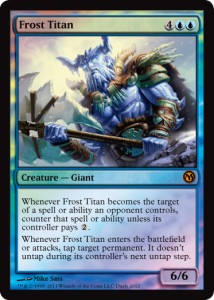
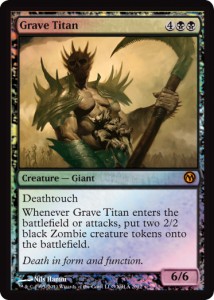
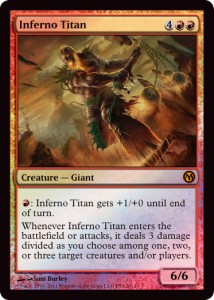
I don't have much to say about this. Should be pretty obvious what will happen. Titan prices should sink across the board, but man, are those new Duel of the Planeswalker promos hot looking! Only thing to save them would be for a single one to show up in several different archetypes in several formats. However, doubt that will happen at this point. I am already dumping my Primeval Titans, probably only keeping Grave Titan and Inferno Titan because I see myself playing those for the upcoming PTQ season. Sucks for cards like Consecrated Sphinx that were primed to replace the titans at the 6 drop spot.

SCG: LA and GP Barcelona

Tons of Jaces everywhere. Out of the 16 decks in the 2 T8s, there were only 5 decks that don't run the full 4 of Jace, the Mind Sculptor. Three Valakuts also show up, along with an Infect and Tezz Control. It seems like U/B control is more popular in Europe while Caw-Blade has shown its dominance state-side. Going into the PTQ season, I would look for RUG to be more and more popular due to its good matchup against Caw-Blade and its versions.  Inferno Titan could potentially break $10 with play in both Valakut and RUG. There is still a whole other set to come out before then which could greatly alter the landscape, depending on how far WoTC pushes infect and what the new Sword will do. Actually, it almost doesn't matter what the Sword of War and Peace does, it has pro Red and White, which basically neuters the Boros deck. It also gives your Squadron Hawks pro-Squadron Hawks, so if this sword has any kind of decent ability, it could easily take the place of the Sword of Body and Mind or just in addition to, who knows at this point?

The Legacy half of the SCG: LA is a bit intriguing because we see a total lack of Counter-top and a total dominance of Combo decks of different types. Six different combo decks in the T8 (Painter, Breakfast, TES, Dredge, Elves, and Belcher) and a total of 10 out of 16 in the total T16. This is something to watch for because WoTC has stated they don't like formats like this. I don't see this being the standard going forward but if it goes on for  too long, I could see WoTC doing something to shake up the format again.

Pick Ups

As for any pickups, let's just say I am doing my best to break Gifts Ungiven in Legacy. It is just too powerful to not be seeing play at the moment.

I would be doing myself a disservice if I didn't let everyone know about the National Qualifier that my LGS was granted by WotC. Here is the link if anyone wants to come out and see me or play in the NQ or Standard $1k that we are running on May 1st.

The Vault Comic and Games National Qualifier and Standard $1k- May 1st

That's about all I got for this week, but man, how hot are those Titan promos?!

Contact
E-mail: tennis_stu_3001@hotmail.com
MOTL/MTGO: stu55
AIM: stoopskoo15
Store: The Vault- Greensburg, PA

A New Type of Aggro

Are you a Quiet Speculation member?

If not, now is a perfect time to join up! Our powerful tools, breaking-news analysis, and exclusive Discord channel will make sure you stay up to date and ahead of the curve.

[Note: This is Mike Lanigan's first Spike offering for Quiet Speculation. Please let us all know in the comments what you think and whether or not you'd like to see more from Mike! -Dylan]

It was a cold and rainy night. The results from pro tour Paris were in, and an aspiring young mage was pouring over the data. He was wrong, there was a new deck in Standard and it was tearing up the tournament scene like a California brushfire. This new deck had a strange name, CawBlade, and resembled a previously known foe. With this new version, though, there was more to it than meets the eye, he thought to himself. No longer was it a slow controlling deck that couldn’t win for ten or more turns. No, now it was more of a dominant strategy that controlled the game and won before you knew what happened. How had he not seen this? All the information was there. Is this new Sword really that good? It couldn’t be. He and all his friends had made fun of how lame the Sword was and how horrible it was even compared to Sword of Body and Mind, the least powerful of the three printed so far. The more he thought about it, the more he realized just how broken this new Sword of Feast and Famine was in a Control deck like this. Sure it was subpar in an Aggressive deck, but what an all-star it could be in a more Aggro-Control type of deck! Not only did it put your opponent on a fast clock, but it also deprived them of resources by making them discard a card. On top of that, it allowed you to untap your mana to play a powerful Planeswalker spell or keep the mana open to counter something. Wow, how could this Sword have been underestimated so much? You can even tutor for it with Stoneforge Mystic, so you often only need to run one copy. That is simply amazing.

The next few short weeks, this CawBlade deck continued to dominate tournaments from local FNM’s to large Star City Games hosted events everywhere. The young mage, Mike Lanigan, read articles, built decks, and tried his best to build a comparable strategy that could take down this "Jund-like" beast (or "Faerie-like" if you prefer). One day when he was testing with some friends, he had an idea. Right there in the middle of the game they were playing, everything went into slow motion. Could this be it? This cheap, underused card, could this really be the answer?

He apologized for his lack of attention to the game and for stopping partway through, but continued to make changes to the deck he was playing. His mind raced so fast that his hands could barely keep up with the changes he wanted to make. How am I going to make room for four of those? Now if I make that an instant, does that change the mana base? All these things coursed through his thoughts as he quickly made the changes and shuffled up, ready for another game. All of a sudden, the games started going his way. Now, he dictated the flow of the game. It was like the game was being played on his terms now. He started winning a lot more than he lost. Could this really be the answer? But most players don’t even really consider this to be a real deck now that CawBlade was arguably the only Tier 1 deck.

So I bet you are wondering, what is this deck and what was the card that made the difference? I am Mike Lanigan, and today I am going to tell you all about it. I don’t want to just give it away so I’ll give you a few hints and we will see if you can guess correctly. Hint 1: it costs one Black mana. Hint 2: It can completely destroy any Standard players’ chances to win the game. Hint 3: It is a sorcery that has typically only been played in Control decks.

Okay, so you guessed it right? Well if not, the card is Inquisition of Kozilek. This seemingly innocent little card is one of the most powerful things you can be doing in Standard today. Think about this card in any game of Magic right now. How many decks rely heavily on their early plays to set up the game for them? Let’s take CawBlade for example. If you Inquisition them and see that their only early play is Stoneforge Mystic or Squadron Hawk, what happens if they no longer have that in their hand? The answer is, typically, that they lose the game. What about another popular archetype right now, Kuldotha Red? Can they win if you take the Kuldotha Rebirth from their opener? Even Valakut relies on accelerating their mana through Explore, Harrow, Khalni Heart Expedition, and Cultivate. Think through every deck you played against at your last tournament. Now, imagine if they had no relevant early play in the game: think just how many more games you would have won! Inquisition of Kozilek is just that good. Blue-Black Control relied on this card for as long as it was a competitive deck. Control is not what you want to be playing against CawBlade though because they will just tear you apart, very similarly to how Faeries does in Extended. What about disrupting their early game and applying pressure all at the same time? We need to end the game as quickly as possible.

Enter the Vampires

Vampires, really? Yes, Red-Black Vampires. This deck is aggressive, disruptive, and can combo-win the game out of nowhere. You may be thinking that you have beaten Vampires many a time at tournaments but this isn’t your typical Vampires. Let’s see that decklist already!

Untitled Deck

Creatures

4 Vampire Lascerator
4 Viscera Seer
4 Bloodghast
4 Kalastria Highborn
2 Vampire Hexmage
4 Gatekeeper of Malakir
2 Hero of Oxid Ridge

Spells

4 Inquisition of Kozilek
4 Lightning Bolt
2 Burst Lightning
2 Go for the Throat

Lands

4 Dragonskull Summit
4 Lavaclaw Reaches
4 Blackcleave Cliffs
3 Verdant Catacombs
3 Marsh Flats
5 Swamp
1 Mountain

Alright, let’s dig into this decklist. As you can see, there are quite a bit of differences but the core of the deck remains intact.

Vampire Lascerator: This is the most aggressive thing you can be doing on turn one, and usually you want to be doing just that. In many games your plan is to play this guy turn one and then keep your opponent off balance as long as possible so he can beat down. This card plays similar to the way Goblin Guide does in a Red deck.

Viscera Seer: This innocent little draft leftover can have quite a powerful affect on the game. Many games are won and lost by playing this card correctly. His first job is to filter the top of your library into what you need it to be. If you need land, more creatures, or the right removal spell, this creature can help you get what you are looking for. When you combine this creature with Bloodghast and a fetchland like Verdant Catacombs, there is a lot of Scrying that can take place. The most important thing to remember is to not miss an opportunity to Scry. Let’s say turn one you play this Viscera Seer, turn two you play your Bloodghast, then on turn three (after you have attacked but before you have played your land) make sure to sacrifice the Bloodghast to Scry. Then, play your land to recur the Bloodghast. Little things like that make this card so powerful. The second purpose for this creature is to provide a late game way to sacrifice your creatures for additional life loss through Kalastria Highborn. Make sure to utilize all the triggers when your opponents kill your creatures as well. You should always sac to Scry in response to a removal spell. If your opponent has not gotten the memo about how good this creature is, make them pay for it by abusing it repeatedly.

Bloodghast: This creature never dies. How much more do you need? Sure you can combo with Viscera Seer and Kalastria Highborn but did you really need anything past "he never dies?" If you still need more, it’s not like they are going to counter it so if you think they are keeping mana open to counter a spell, that is the perfect time to play your Bloodghast.

Kalastria Highborn: This is the glue that holds the deck together. Typically you don’t want to play her unless you have mana open to use her drain life ability. Because this ability is so powerful, she is good at any stage of the game.

Vampire Hexmage: By now you know that killing Planeswalkers is important, and this card does just that. The first strike ability she has is quite relevant in the format right now as well. Also, don’t forget that if you need to you can sacrifice her with no real targets to drain life with Kalastria Highborn.

Gatekeeper of Malakir: Two-for-ones are always great, and he provides a huge tempo boost with some potentially hard choices for your opponent. Once in a while, you might want to target yourself and sacrifice one of your own creatures to drain your opponents life for those last two points of damage with your Kalastria Highborn. Making them sacrifice their turn two play on your turn three is amazing against any deck.

Hero of Oxid Ridge: Who is going to be expecting this card in Vampires? No one. No one ever sees it coming. It can win the game out of nowhere. Sometimes it is correct to save this card until after your opponent casts Day of Judgment if you have a Kalastria Highborn in play. Make sure you always have mana open to use Highborn’s ability and don’t over commit to the board unless absolutely necessary.

Inquisition of Kozilek: I am not going to spend much time here but this card is crucial to the deck. Against CawBlade, always take their creature, or if you draw it later, take the Sword they searched for. In general you want to take whatever your opponent is relying on the most for the early game. Generally on the play, you want to play a guy on turn one then turn two play Inquisition. On the draw, usually it is opposite of that. Play Inquisition first then on turn two play a guy. CawBlade is now even splashing Black for this card sometimes, so you know that it is good. This is one of the best things you can be doing in Standard right now.

Lightning Bolt: One of the best removal spells of all time. Also, the most efficient burn spell of all time. Every red deck should be playing four of these by now.

Burst Lightning/Go for the Throat: Between these two cards, you should be able to deal with just about anything. The Burst Lightning is new. They used to be Arc Trail, but being a sorcery was too much of a liability. Being able to burst their guy in response to it being equipped is game winning. Also, being able to pay five mana and deal them four damage will often just win you the game. Arc Trail is awesome and often kills two of their guys from your one spell, but Burst Lightning is just better for this metagame. You still want the two/two split because Go for the Throat kills [card Frost Titan]Titans[/card]. If you have a significant amount of artifact creatures running around in your metagame it’s possible that you wan the Go For The Throat to be Doom Blade instead, but I think since you have Lightning Bolt that Go For The Throat will almost always be better.

The manabase: Most of the cards are pretty standard. Playing Hero of Oxid Ridge, you want just a little more Red than normal so that you can cast him reliably when you need to, hence the one Mountain. It doesn’t seem like much but that one Mountain really does make a difference. You don’t want more than one though because drawing them early in the game can result in you not being able to cast the rest of your creatures. Also, I think six fetchlands is the right number for this deck. You want to reliably recur the Bloodghasts and have plenty of sacrifice triggers to use as well. With six fetches, you should have at least one in most games.

The Sideboard: I will provide some general guidelines for you to mold your deck for your specific metagame. If you build the sideboard yourself, you are more likely to side correctly than if you just try to follow word for word what someone tells you to do.

Demon of Death's Gate: Valakut still has no outs to this card. Literally if you play this on turn two, three, or four, they cannot possibly win the game. If you think you will play against Valakut, don’t leave home without them.

Pyroclasm: It might seem an odd choice, but a necessary one if you expect a lot of Kuldotha Red. Trust me, there will be a lot of Red decks with the new tournament ready preconstructed decks. It happens to also be pretty good against just about every aggro deck out there if you sideboard into a more controlling deck. If you can’t bring yourself to sideboard Pyroclasm in an aggro deck you can still board Arc Trail. It won’t be nearly as good but Arc Trail is still amazing.

Dark Tutelage: I never liked to run Dark Tutelage maindeck because against an Aggro deck, you'll usually just lose if you play it. Against a Control deck like the previously dominant Blue-Black Control though, it was amazing. Usually I sided this card in with Duress to completely wreck Control.

Crush/Manic Vandals: I have been amazed at how good Crush has been for me. It’s cheap and an instant. It is great against equipment and any Tezzeret deck you happen to play against. Manic Vandals are also great and remind me of the [card Gatekeeper of Malakir]Gatekeepers[/card]. Be careful not to raise your curve too much or dilute the deck too much with artifact removal though because you risk not being able to win the game if you do so.

Skinrender: If you have extra spots, Skinrender is a beating against any Aggro deck. I would never have more than two in the sideboard though because four mana is a lot for this deck.

Act of Treason/Mark of Mutiny: This type of card that steals your opponents creatures is great against titans and other huge monsters. I have found it unnecessary in my sideboard for a few weeks now but in the right metagame I could see adding them back in.

Here are a couple points about playing this deck. The most important thing to remember is that it is based on tempo. The plays you make should be designed to keep disrupting your opponent while making sure the game stays under your control. If your opponent taps out for a creature, play your Gatekeeper to get it out of the way and force through more damage. If you did not have an Inquisition to take their early creature, use your removal to get rid of it early so you can continue to attack. In most matches you want to be the aggressive deck but you can easily switch gears to a more controlling deck depending on your draw and also quite easily after sideboard.

The second most important thing about this deck is practice and experience. Get familiar with this deck before you take it to a tournament. You need to make sure not to miss any triggers with Viscera Seer, Boodghast, or Highborn and the more practice you get playing the deck the easier this will be.

With Inquisiton of Kozilek maindeck and a properly built sideboard, no match up in Standard is unwinnable. CawBlade, the best deck in Standard, is actually a good matchup. Games against CawBlade where you have the Inquisition are greatly in your favor, and they usually rely on top decking another creature just for them to have a shot at winning the game. The games where you do not have an early Inquisition are really a fight though, so be prepared. Sometimes you win those games, sometimes you lose them, but you always have a shot. However, even if you don’t have the hand hate, if you can untap and Gatekeeper their creature, usually that puts them too far behind to beat you. I have had multiple CawBlade opponents tell me that Gatekeeper is the card they are most afraid of in Standard because it is so bad for them.

All of the ramp decks like Valakut, RUG, and BUG play out pretty much the same. You want to kill or stop their early mana acceleration while keeping pressure on them by attacking. Set yourself up so that if they get their big threat on the board, you can just win by sacrificing your creatures to Seer and draining with Highborn.

Against any aggro deck, you want to kill as many of their creatures as you can while still playing your creatures. This deck has a low mana curve for a reason. Make sure to take advantage of being able to play your creature and kill one of theirs all in the same turn. By practicing with this deck, you will learn how to switch between being the Aggro and the Control when you need to. The only aggressive deck that you always are the control deck against is Kuldotha Red. They are much faster than you are so you need to control the game as much as you can. Don’t hesitate to trade with their early creatures. They do not have much removal and your Bloodghast will usually win you the game. Against any aggro deck the most important thing to remember is that the life gain from Kalastria Highborn will likely win you the game so make sure you always have mana available to pay for her ability.

Vampires built and played correctly can be a real threat in this metagame. Your opponents have likely not played against such a disruptive build of this deck that can also end the game quickly so they most likely won’t be prepared for you. Feel free to message me in the forums if you have any questions and have fun beating down with some bloodsuckers.

Don’t forget to come get some financial information next week, as I will be back over on the financial side. I’m sure I will be writing about more sweet Standard decks in the future, so if you liked this article let me know. Also, if you thought there was room to improve, feel free to pass that along as well. I am always open to constructive criticism or topic suggestions.

Mike Lanigan

Twitter: mtgJedi
Email: jedicouncilman23@gmail.com

Analysis of the Caw

Are you a Quiet Speculation member?

If not, now is a perfect time to join up! Our powerful tools, breaking-news analysis, and exclusive Discord channel will make sure you stay up to date and ahead of the curve.

Caw-Blade has been clearly established as the dominant deck in this Standard format.

As most of you know, it exists in 3 broad frames: straight Blue-White, the Red splash, and the Black splash. The following table shows examples of each taken from the StarCityGames Open Series. It is somewhat messy because it does not follow the conventions of a normal decklist, but rather is organized in terms of which cards are common among the decks.

UW, Rick Zou UWb, Gerry Thompson UWr, AJ Sacher Agreed Upon
Gideon Jura 3 3 3 3
Glacial Fortress 4 3 3 3
Island 4 2 2 2
Jace, the Mind Sculptor 4 4 4 4
Mana Leak 3 3 2 2
Plains 4 5 4 4
Preordain 4 4 4 4
Seachrome Coast 4 4 3 3
Squadron Hawk 4 4 4 4
Stoneforge Mystic 4 4 4 4
Sword of Feast and Famine 1 2 2 1
Tumble Magnet 2 2
Arid Mesa 1 4
Celestial Colonnade 4 3
Day of Judgment 3 3
Scalding Tarn 1 3
Spell Pierce 4 3
Baneslayer Angel 1
Sylvok Lifestaff 1
Tectonic Edge 4
Condemn 1
Creeping Tar Pit 4
Darkslick Shores 3
Doom Blade 1
Go for the Throat 1
Inquisition of Kozilek 4
Jace Beleren 1
Marsh Flats 4
Swamp 2
Inferno Titan 1
Lightning Bolt 3
Mountain 3
Terramorphic Expanse 2

Maindeck Total 60 61 60 34

Sideboard Total 15 15 15 2


Flashfreeze 2 4 4 2
Volition Reins 2 1
Divine Offering 2 2
Sun Titan 1 1
Condemn 3 1
Baneslayer Angel 1
Kor Firewalker 3
Mortarpod 1
Oust 2
Sword of Body and Mind 1
Doom Blade 1
Duress 2
Into the Roil 2
Jace Beleren 1
Memoricide 1
Basilisk Collar 1
Cunning Sparkmage 4
Spreading Seas 1
Sylvok Lifestaff 1

It is tempting but ultimately futile to analyze each color individually, as card selection can vary wildly. It would be possible to build an Esper-colored Caw-Blade deck which eschews Inquisition of Kozilek for additional copies of Doom Blade and a 60-card deck. It is possible to take the Red manabase and put the Cunning Sparkmage in the maindeck.

The shared "core" of the deck is 34 cards, including 12 lands. This leaves room for an additional 14 lands and 12 non-land cards (assuming you wish to adhere to the rule of 60).

For nonland cards, Rick Zou chose 2 Tumble Magnet, 3 Day of Judgment, 4 Spell Pierce, 1 Baneslayer Angel, 1 Sylvok Lifestaff, and an additional Mana Leak,

Gerry Thompson chose 2 Tumble Magnet, 1 Condemn, 1 Doom Blade, 1 Go for the Throat, 4 Inquisition of Kozilek, 1 Jace Beleren, and extra Sword of Feast and Famine and Mana Leaks. He also played an extra land to go to 61 cards.

AJ Sacher chose 3 Day of Judgment, 3 Spell Pierce, 3 Lightning Bolt, 1 Inferno Titan, an extra Sword of Feast and Famine, and added 1 to the land count.

The important thing is not to pick a color for the cards, but to pick cards for a purpose and then realize which cards can and cannot be shared in the same deck.

The basic rule is thus:

Black cards cannot be played alongside Red cards. Neither Black or Red cards can be played alongside Tectonic Edge. The logic here is simple: the manabase becomes too fragile.

What's the consequence of that rule?

If you splash, the deck becomes correspondingly weaker to manlands, Valakut, and Eldrazi Ramp. The deck designer must decide whether to accept this gained weakness, or regain that advantage via other means.

Where Lightning Bolt is chosen, Basilisk Collar in conjunction with Cunning Sparkmage reduces the threat level of Primeval Titan and the [card Ulamog, the Infinite Gyre]Eldrazi[/card].

Where Creeping Tar Pit is chosen, the ability to attack the mana ramp with Inquisition of Kozilek is the game plan.

Let's evaluate some of these specific card choices more closely.

Day of Judgment

Excluding [card Day of Judgment]Day[/card], as Gerry Thompson did, significantly weakens the deck in Aggro matchups, putting more weight on the spot removal, Gideon Jura, and leading to the use of Squadron Hawk as chump-blockers. The important thing to note about cutting Day of Judgment is that Inquisition of Kozilek can represent a massive life-total swing over the course of a long game by hitting a powerful 2-drop such as Plated Geopede, or even a Goblin Guide when on the play. This is what gives the Black version of the deck breathing room when cutting sweepers. A similar effect can be achieved with use of Lightning Bolt in the Red deck, whereas Oust and Condemn are both somewhat awkward to use in this manner in the no-splash version. Condemn is obviously the better of the two, but is weaker elsewhere.

Remember that the goal of cutting Day of Judgment is to free up room elsewhere in the deck to gain advantages against other matchups. As such, the Black version is the most well-positioned of the 3 to make this move. Cutting Day of Judgment to play 4 Condemn alongside 4 Oust or 4 Lightning Bolt would be entirely counterproductive.

Spot Removal

The endless argument over Doom Blade and Go for the Throat is largely irrelevant. At the current point in the metagame, Doom Blade kills Precursor Golem, where Go for the Throat kills Creeping Tar Pit, but the two are essentially comparable. The real debate is between the non Black kill spells: Lightning Bolt, Oust, and Condemn. Ironically, Lightning Bolt is arguably the worst of the creature removal spells, but does double duty against Jace, the Mind Sculptor and can kill a Creeping Tar Pit. Condemn is the absolute best against anything that has to attack, and is able to kill a swinging Creeping Tar Pit, but is miserable against Primeval Titan[card], [card]Emrakul, the Aeons Torn and creatures with activated abilities - most relevantly Cunning Sparkmage and Fauna Shaman. Oust is nearly as good as the Black kill spells against activated abilities and Eldrazi, but awful against manlands and Sword of Feast and Famine. The other main option is Mortarpod which mostly sees play because it can be searched with Stoneforge Mystic.

Precursor Golem Creeping Tar Pit Walkers Cheap Dorks Eldrazi Titans Equips Activated Abilities
Lightning Bolt + + + + + +
Condemn + + + + - +
Oust + + + + +
Doom Blade + + + + + +
Go for the Throat + + + + + +
Mortarpod + - -

Obviously none of these deal with [card Emrakul, the Aeons Torn]Emrakul[/card], and Doom Blade can't deal with Grave Titan. The minus denotes that the card is somewhat useful, but not universally so. Condemn on a Primeval Titan can help - but often will leave you dead to Valakut triggers. Mortarpod can kill a Cunning Sparkmage, but it can't kill a Fauna Shaman without help.
Doom Blade, Go for the Throat, and Condemn can deal with Gideon Jura in combat, but not otherwise.

Example Usage

Let's say we want to build Caw-Blade to beat Valakut.

Tectonic Edge is the first non-core card to enter the deck, and forces us to abandon the splash colors. Oust becomes our spot removal of choice, making us vulnerable to manlands (the Edge shores up that weakness, which makes this a nice pairing). We play additional counterspells in the main, including Spell Pierce. Tumble Magnet will join the fray since it can stop Primeval Titan from attacking. Sword of Body and Mind becomes our second equipment, since it can render Valakut, the Molten Pinnacle useless. We put Baneslayer Angel in the deck since its lifelink will slow down Valakut's clock by a turn or two, and it gives us a better chance to kill them. Our sideboard will contain Flashfreeze as well as possibly Spreading Seas, and would contain high-impact cards such as Day of Judgment to flip modes against other decks.

Untitled Deck

core

3 Gideon Jura
3 Glacial Fortress
2 Island
4 Jace, the Mind Sculptor
2 Mana Leak
4 Plains
4 Preordain
3 Seachrome Coast
4 Squadron Hawk
4 Stoneforge Mystic
1 Sword of Feast and Famine

nonlands

2 Tumble Magnet
4 Spell Pierce
3 Oust
1 Mana Leak
1 Baneslayer Angel
1 Sword of Body and Mind

lands

4 Tectonic Edge
10 UW lands

sideboard

4 Flashfreeze
3 Spreading Seas
4 Day of Judgment
1 Sylvok Lifestaff
1 Sun Titan
2 Divine Offering

As you'll note, this is very similar to Rick Zou's maindeck. The sole differences are that Zou ran a single Sylvok Lifestaff maindeck where I have Sword of Body and Mind, and he has Day of Judgment over Oust. This gives him a solid matchup against both Valakut and Aggro decklists. Obviously my list here is overkill - Day of Judgment is perfectly serviceable as a "spot kill" card against Primeval Titan, and is quite good against Avenger of Zendikar.

Choosing Day over Oust is a perfect example of how to "split" the advantage - to let one card choice give you an advantage in multiple matchups by serving completely different roles. Against Valakut (and other ramp decks), Day is "spot removal" that kills anything from Primeval Titan to Emrakul, the Aeons Torn. Against Aggro decks, Day serves its more conventional role as the best sweeper in the format.

On paper, going straight Blue-White with this strategy gives the deck an advantage against the Aggro decks and ramp decks, while not having much of a specialized plan in the mirror match.

Another Split Advantage

Inquisition of Kozilek is the ultimate role-player in this regard. Against aggressive decks, it acts as pre-emptive removal, taking out an early threat. In the mirror, it can free the way for a spell to resolve by yanking a counterspell, it can "destroy" a Sword of Feast and Famine - or stop the opponent from ever searching one up by taking Stoneforge Mystic. Against ramp decks, it aims to take the mana ramp itself, pairing off with Sword of Feast and Famine and Mana Leak to attempt to deny the opponent the ability to ever land Titans or Eldrazi in the first place, and to use Tumble Magnet to prevent them from attacking if they do land a threat. In addition, the inherent upgrade of Celestial Colonnade to Creeping Tar Pit gives the deck an undeniable advantage in the mirror match's Planeswalker fights - unless it gets hit by Condemn!

However, Valakut, the Molten Pinnacle can go over the top the "hard way" against this variant, and trading in mass removal for spot removal and discard is a dicey proposition at best against the fast Aggro decks.

Angry Birds Win

Lightning Bolt kills Lotus Cobra and Joraga Treespeaker against Ramp. It can kill a creature in response to an equipment being moved, it can kill either Jace, it can even kill players outright. Not to mention, Cunning Sparkmage wearing a Basilisk Collar kills damn near everything! So why isn't this just the obviously best variation? The mana is worse, for one thing - unlike a dual land which can be used for either color multiple times, a fetchland can only get one color forever, so a Mountain grabbed early can cut you off double Blue or double White. A dead Cunning Sparkmage isn't killing anything, and one without a Collar can't kill much. While this is almost certainly the best variant of Caw-Blade to run against an aggressive deck such as Boros, its decreased consistency and lack of Tectonic Edges give it a worse Valakut matchup. Switching other cards around could change this, at some cost - which probably isn't worth it (it'd be better to go back to the straight Blue-White version).

Final Words

This article doesn't have a decklist to pick up and go play. It contains a shell, and rough guidelines on how to build upon that shell. Doing so will allow you to understand why your deck is playing the cards it is, and perhaps give you a better sideboarding plan as a result. If you accept the 34-card core of Caw-Blade, you have 14 lands and 12 nonland cards to change at will, plus a 15-card sideboard. If you think Gerry Thompson is crazy for not playing Day of Judgment you're already down to only 9 free slots in your potentially 3-color deck. Those 9 maindeck slots (8 once you include a second equipment!) must attack a metagame which is so turned in on itself that the mirror match and Valakut are the two most prevalent decks in existence, with Aggro on the outside looking in, and people metagaming by building Naya decks specifically to hate you out. Your sideboard must be focused and flexible at the same time - able to attack the mirror, Valakut, Boros, Vampires, Mono Red, Goblins, Eldrazi Green, miscellaneous Naya homebrews, and that one guy's Genesis Wave/Ezuri, Renegade Leader/Pyromancer Ascension deck. Some of these options are simple - Red loses to Kor Firewalker, Naya loses to Linvala, Keeper of Silence, Boros, Vampires, and Elves all lose to more sweepers (barring an Eldrazi Monument!), various fatties across the board are worth stealing with Volition Reins, the mirror can be fought with Divine Offering and Sun Titan, and... wait, how many sideboard cards is that now? And what am I taking out for each of these matchups? It's not at all simple, and the deck must be built so that it has the flexibility to focus on each in turn.

The first broad course of action is to powerfully target specific decks with the maindeck, then take those cards out for cards that target other specific decks instead. The downside here is obvious - you sacrifice your game 1 odds against the "other" decks, and if you guess wrong, you will be holding dead cards far too often. The upside is that your sideboarding decisions become simpler, and Jace can pair with many cards in Caw-Blade to shuffle off the dead cards.

The second course of action is to play multirole cards and board in more focused cards. However, this makes sideboarding decisions very complicated as your maindeck will no longer contain anything which is inherently bad against a particular deck! I've seen people put 8 cards in their sideboard for their "worst matchup" then be utterly unable to find more than 2 or 3 cards to take out. That's a result of insufficient testing and ill-thought-out deckbuilding. It is depressingly common to see people copy decklists with this strategy and actually make their deck worse in a matchup after sideboarding.

It is worth noting that the "core" cards in Caw-Blade are not sacred cows! Some players board out the 4th Squadron Hawk in certain matchups, and boarding a Jace or two out against Aggro decks is a fairly common play as well. Mana Leak is another card which can be cut from the core if the situation requires it.

SCG Atlanta

A word to visitors: SCG Atlanta is not even in Atlanta - it's OTP, some 30 minutes away from Midtown. The upside to this is that there's ample parking, and it's all for free.

However, when you go to look something for to do after you 0-2 drop because you played Kuldotha Red, the nearby Discover Mills has some interesting shops and restaurants, including a Medieval Times (though that's likely incompatible with tournament success and you may have to make a reservation). Those of you who haven't been to a Five Guys burger joint should consider it for your junk food needs, but if you insist on conventional fast food, there is a Wendy's nearby. I haven't been in either of the taverns nearby, so I can't attest to their relative quality.

Those of you looking to party Saturday night and not play in any tournaments Sunday should make the drive into Atlanta (provided you have a place to sleep within walking distance, or a designated driver) and hit up the bars and restaurants in Midtown/Ponce. Depending on just how depraved (or depressed from losing) you are, the options range from generic bars and taverns all the way up to the well-known Clermont Lounge.

The Vortex, home of the Double Bypass Burger, is famous due to an appearance on Man versus Food. Despite this, it's actually a quality restaurant.

Too much burger for you? Sublime Donuts is a local donut shop that puts Krispy Kreme to shame. If you want the best of both worlds, Cypress Street Pint & Plate makes a Sublime Burger which is served on two of the namesake Donuts.

Had enough food and booze suggestions? Dad's Garage is an improv comedy theater and also home of Baconfest Atlanta. Unfortunately, the Baconfest was last weekend, so you'll have to settle for comedy. Their last show starts at 10:30 on both Friday and Saturday and runs until roughly midnight.

The Georgia Aquarium is an extremely popular tourist attraction, but don't let that deter you - it's an amazing experience. The tunnel that lets you walk underneath the sharks is truly impressive.

The nearby World of Coca-Cola, on the other hand, is really only of interest to coke junkies and marketing buffs. That said, it's absurdly popular for some reason, and pranking your buddies into drinking Beverly is almost worth the price of admission in and of itself.

As for me? I want a trophy in each arm by the end of Sunday night.

Joshua Justice

@JoshJMTG on Twitter

Calling Besieged – A Progress Report

Are you a Quiet Speculation member?

If not, now is a perfect time to join up! Our powerful tools, breaking-news analysis, and exclusive Discord channel will make sure you stay up to date and ahead of the curve.

If you’ve read much of my past work, you know I’m a big fan of writers holding themselves accountable, especially for financial calls. So when I got an e-mail from the Powers-That-Be at QS about grading calls on Mirrodin Besieged, I was quick to take the suggestion and run with it.

As such, I’ll be reviewing this article on Besieged cards written just before the prerelease. In addition, I’ll be looking way back at this piece, The Top 10 post-Alara Uncommons, which I wrote nearly 8 months ago. For the purposes of this article, I’m going to keep the grading system simple. Good calls are going to be a “WIN,” missed call are a “FAIL,” and I’m going to apply an “inconclusive” to cards that are still up in the air as to where they’ll end up.

Prices are going to be SCG prices, since that’s what I used when I wrote the original articles. Let’s get started.

Hero of Bladehold

What I said then: “A nice Mythic and a prerelease card. This might enable some new strategies, but so far I’m not seeing it, in Standard or Extended. A cost of 4 and no haste makes it likely too slow for Extended, and I don’t think it has the tools it needs to work with in Standard. A well-timed Consume the Meek takes care of the Hero’s buddies, and that spells the end of the theoretical deck it goes into. It will still appeal to a lot of players, so I see it ending up in the $5-7 range.”

Now: The card is going for $7.99 on SCG, which is about what I projected, though a little higher. The card is going to continue settling down as more packs are opened, and unless it begins to see heavy play, stay where I predicted.

Call: WIN

Mirran Crusader

What I said then: “Sweet card, and it’s a Knight, which means it apparently has some casual value (see Knight of Exemplar at $6 on SCG). Its use in Standard probably relates directly to the possibility of Infect becoming a real deck. $3-5.”

Now: $6.99. Apparently having Protection from Target Extended Format will help a card’s price. Again, it’s around what I predicted and will settle down as we move out of Extended season.

Call: WIN

Consecrated Sphinx

What I said then: “I’m addressing this because it’s a Mythic, but it’s pretty clearly a bulk Mythic that might go into Casual/EDH decks. $2.”

Now: $4.99 on SCG. Oops. This thing might have applications in Block, I’ve heard very faint rumors of it appearing in Standard, and it’s as popular casually as I thought. You could have picked these up cheap near release time, and made some money later. In fact, you probably still can. This thing screams “bulk” at you, but it’s a $5 card anyway.

Call: FAIL

Go For the Throat

What I said then: “This is a stellar card that is sure to see competitive play (almost always better than Doom Blade at this point in the meta). Speaking of Doom Blade, did you know it will cost you 50 cents to pick one of these up on SCG, and $3 for a foil? I see the same thing happening with Go For the Throat, especially since it’s an uncommon, so make sure to look through the cards people leave on the table to find these.”

Now: All right, this one was obvious, but I’ll take the wins where I can get them. This is now $2.50 on SCG, in line with what we knew would happen.

Call: WIN

Phyrexian Crusader

What I said then: “I’m really on the fence about these new Infect cards. I think the deck is a one-drop away from actually being competitive, and if it gets there cards like the Crusader are going to go for $6-9 apiece. Infect has insane popularity among casual players (see Hand of the Praetors at $5 apiece on SCG). With even a hint of playability attached to Infect, the Crusader can hang around $7-9 for a good while. Pick these up at $4 if you can. It’s preselling at $5 on SCG, and while I think you can get value out of trading for it on prerelease day at $4-5, I wouldn’t clean out SCG’s inventory.”

Now: Picking up play in Kibler’s UB Infect list, the card is going for $6.99 on SCG, right in line with my call. Saying to not clean out SCG’s inventory at $5 apiece is close to looking suspect, since the BlackLotusProject price of the card is actually over $4 and rising.

Call: WIN

Phyrexian Vatmother

What I said then: “Same as above. I haven’t tested the theoretical Infect deck at all, but this card could have a place in it. Pick up as bulk this weekend, and it might pay off down the road. It’s preselling at $2, so there’s not much risk associated with this.”

Now: $1.49 on SCG, but a sliver of hope still lies with the Vatmother. Originally in Kibler’s maindeck, it has since moved to the sideboard, but as the Dragonmaster said, it’s a very good card against a deck like RDW. As I pointed out before, this is a purely speculative investment, and isn’t likely going to make you a ton of money, but it is a possibility.

Call: Inconclusive

Hero of Oxid Ridge

What I said then: “If there’s going to be a Battle Cry deck, this guy has a realistic shot of having a place in it, due to haste. I don’t advise picking these up at the (now $8) presell price, but it’s a card to keep an eye on moving forward.”

Now: When I originally wrote the article, Hero was priced at something like $5, and I advised picking him up then. Apparently SCG hacked into the QS WordPress account and stole my column, because they raised their price before publication (that’s my theory, anyway). Now selling for $9.99 on SCG, it’s unfortunate that I saw his potential and use but failed to have enough faith in myself to up the call.

Call: FAIL

Green Suns Zenith

What I said then: “This is my vote for best in the cycle. It has a number of decks it already slots in – Elves of pretty much any format, Ramp decks and basically every Green EDH deck with lots of mana and big monsters (so, most of them). It was pre-selling at $5 (now $8). I think it ends up as a $5-7 card. I’ll be looking to pick this card up as much as possible in trades this weekend, especially foils.

*Note: This also went up to $8 after originally starting much lower. Pick them up all day at $4-5, and sell at $7-8.”

Now: Now $9.99. I wish the card had stayed at $5 until I published the article, it would have been the easiest call ever. Moving it up to $8 actually made me reconsider my stance on it, but it looks like the Legacy scene stepped up to bolster the Zenith’s price enough for me to call this a…

Call: WIN

Thrun, the Last Troll

What I said then: “I really think this guy is going to be a house, especially teaming up with Great Sable Stag to beat up on Faeries in Extended. As such, I think it will hang around $20 for awhile before slipping to $15ish as we move out of Extended season and more copies become available.”

Now: $9.99 on SCG. Easily my worst call of the lot, but at least I wasn’t alone, since pretty much everyone thought he was going to be insane (You did, don’t lie). Thrun is still an incredibly powerful card, but he just doesn’t have a home yet. If Infect isn’t big post-rotation, Thrun might find somewhere to slot in.

Call: FAIL

Tezzeret, Agent of Bolas

What I said then: “I think the presale price of $35 is high, but Dark Tezzy does have a ton of utility. The ultimate factor in his price is going to be whether or not he finds a home in Standard, which he might well do before his run in Standard ends. That said, I don’t see such a deck existing right now in Standard. Tezz is nuts in Vintage, though that doesn’t drive demand that much. I’m going to put a call of $20-25 BlackLotusProject.com average on him after a few months. Same thing as above applies, keep an eye out for any winning decks sporting Tezzeret, because if he jumps, he’s going to jump big.”

Now: Luckily, I very quickly realized my mistake on Tezzeret after playing a few matches with him, and wrote this column the following week about how insane he was. I was still ahead of the price spike by a good month, so I’m chalking this one up to a win.

Call: WIN

Phyrexian Revoker

What I said then: “I’m not sold on this card, since most of the time you want your Pithing Needle to stay alive, which the 1 toughness makes difficult. It’s likely it will find it’s place in a variety of formats, but I don’t think it will hold its presale price of $4. I think it will eventually settle around $2-3.”

Now: $2.99 on SCG. Pretty much spot-on here. It’s awesome having a beater of a Pithing Needle, but the Revoker is just too fragile to make an impact.

Call: WIN

[card]Sword of Feast and Famine [card]

What I said then: “Decks sporting Stoneforge Mystic are getting yet another option with this card. I think it’s primary use is going to be for bashing through Tarmogoyfs in Legacy, where the Mystic is starting to see more regular play. It also gives Boros another good target to search for when playing against U/B or a theoretical B/G Infect deck. I see this being on the level of Sword of Body and Mind, though protection from Black might take it a bit further. $8-10 when it’s all said and done.”

Now: Um, that’s kind of like predicting the rise of CawBlade, right? In my defense, this card was one of the last spoiled, and I didn’t have a lot of time to evaluate it, and the general rise of all the Mythic Swords hadn’t happened yet. On second thought, forget that. No excuse is even possible here. Just an…

Call: EPIC FAIL

Inkmoth Nexus

What I said then: “This is one of my favorite cards spoiled so far, and it provides the theoretical Infect deck valuable reach. I’m not convinced it will see play in Control decks like Mike Flores suggested on his article on the mothership, but it’s going to be very popular nonetheless. I can see this holding its presale price of $8 (now $10). I love lands, so I’ll be trading aggressively for them anyway, but you should probably do the same. You can flip these at $10-12 all day long, and probably can pick them up at $7-8 from traders who still think Poison cards are jokes.

*Note: This has gone up to a $10 pre-sell price since the first draft of this article.”

Now: $11.99 on SCG. I wrote my initial review before Flores’ Mothership article, and there actually was a lot of skepticism going around as to where Inkie would end up. Luckily, I think I pegged pretty much exactly where the card was going. It has seen play outside of some Infect decks, but not in every Control deck ever as MJ originally suggested.

Call: WIN

That’s the end of the cards I put calls on before the Pre-release. Looking back over the results, we have:

8 WINS

3 FAILS

1 Inconclusive

1 EPIC FAIL

Considering I only put calls on the more controversial cards before the Prerelease, I think getting 8 out of 12 right is pretty acceptable. While I certainly wish I had gotten Thrun and Sword correct, not everyone can bat 1.000 (which is perfect, for you non-Baseball people)

Now moving on to this piece, which was my first foray into video content (which could come back, if there was interest for it), I listed the Top 10 Uncommons to hold onto after the rotation of Alara. Keep in mind that Scars wasn’t even being previewed at the time I did this. Again, I’ll use SCG prices.

Top 10

10. Pelakka Wurm

Then: $.25

Now: $.50

I tagged this card as viable because of the lifegain aspect, which I thought would make it good tech in ramp decks against aggro. It turns out that after playing a Turn 6 Primeval Titan it was better to follow it up with an Eldrazi. The Wurm has seen some sideboard play, which is what I expected. Also, they went and printed Wurmcoil Engine, so there’s that.

9. Oust

Then: $.50

Now: $.50

No change to the price, and Oust has seen some play, though not near as much as I thought it would.

8. Goblin Ruinblaster

Then: $.50

Now: $.99

Modest increase in the Ruinblaster, as I expected. He still blows up Valakuts pretty well.

7. Joraga Treespeaker

Then: $1

Now: $2

The Lorax was only #7 on my list because he already commanded a dollar bill. Now he pulls $2 apiece and is just as insane as I thought he would be.

6. Combust

Then: $.50

Now: $.50

A theme in this Top 10, you’ll notice I overrated Baneslayer Angel and underrated the Titan cycle, which has had a huge impact on the playability of a few cards on this list.

5. Autumn's Veil

Then: $.25

Now: $.50

The Veil has seen (very) modest play in a few different formats, but hasn’t really caught on anywhere. At the time of this article, I was predicting UW Control to be the dominant deck moving forward, and I thought Veil would have more a role for Green decks moving forward. Summoning Trap is superior in nearly every way, which also helped cause the demise of Veil.

4. Everflowing Chalice

Then: $1

Now: $2

This was a pretty easy call, as scalable mana ramp is always good.

3. Condemn

Then: $.75

Now: $.99

Though I do actually show a “win” on this call, Condemn hasn’t been anywhere near as played as I thought it would. It seemed like the best Path to Exile replacement, but again, underestimating the Titan cycle caused me to misrank this card.

2. Crystal Ball

Then: $1

Now: $.50

This is my biggest miss. I thought the Crystal Ball would see some Standard play as a 1 or 2-of, but obviously that didn’t pan out. I also expected its EDH/Casual appeal to keep it at a dollar, but obviously not.

1. Wall of Omens

Then: $2.50

Now: $1.99

This is partially another victim of my misconception that a traditional UW Control build would be dominant, but the removal of Bloodbraid Elf and Blightning from the format made Wall a lot less useful. It is still playable if the metagame shifts correctly, so it’s still safe to hold onto these.

I hope you enjoyed this look back at my metagame predictions and enjoyed laughing at me!  I’ve learned a few lessons from cards like Thrun (good cards need to be more than good – they need to fit in a deck) and Sword (card AND mana advantage on a card is pretty good), and I hope this look back helps you when you’re evaluating new sets.

Thanks,

Corbin Hosler

@Chosler88 on Twitter

Autographs: My Next Level Collection

Are you a Quiet Speculation member?

If not, now is a perfect time to join up! Our powerful tools, breaking-news analysis, and exclusive Discord channel will make sure you stay up to date and ahead of the curve.

Most players of the game have things that they collect that are a subset of the game itself. Perhaps your lofty goal is to have one of every card ever printed. Maybe you just want one of every Goblin. Judge foils. Italian Legends. Summer Magic. Or maybe, like Dr. Jeebus, you want to have one playset of every card with Rebecca Guay art on it, who am I to judge? In truth, this is a collectible card game that we play, and it hasn't lasted this long by failing to tap into that desire to hunt, to possess, and to complete that drives most any collector.

As for me, I don't have a card collection to speak of. Up until now I've dallied in assembling complete sets, but dropped that pursuit in lieu of a goal more tied with my ambitions, and that is to own every single preconstructed deck released. Hey, I review 'em for Ertai's Lament, so I might almost consider it a professional expense. However, in terms of an actual card collection, I've not really given it much thought.

Until now.

As I've aged I've more and more found the idea of autographs to be a bit... silly. Rather than fawning over the scrawled signature of some celebrity, why not go out yourself and do something worthwhile? Still, I've never been quite able to shake the attraction of a time/place memento, a keepsake to remember that you were there, or this meant something to me, and autographs fit the bill as good as any. So I'll be beginning my collection of autographed Magic cards(foil wherever possible) but with a slight twist, as inspired by two recent events.

True Story #1

I began Ertai's Lament in June of 2010 with little more than a few starting decks (the Duels of the Planeswalkers ones), a WordPress account and a masochistic curiosity as to how long I could maintain a pace of a new review every other day. I knew that I loved Magic and had grown increasingly devoted to the preconstructed scene, but really had little idea of how much of an audience there was out there for something devoted wholly to the topic. So in some ways I was as surprised as anyone when I crossed the three-month mark at full steam, a threshold a great many start-up blogs fail to cross. To commemorate the event, I decided to stage a massive giveaway. I'd held a couple small-scale ones before (an Archenemy deck here, booster packs there), but for this one I enlisted the generous aid of my local gaming store, Moonlite Comics.

Moonlite came through in a big way, offering up scads of foil and promo cards, a pack of rare "Euro lands," and even an Infest playmat. Given the abundance of riches before me, I had enough to divide the prizes into three piles a la Fact or Fiction, allowing each winner in turn to pick their preference from what remained. One of the Magic community's more prominent personages, Chewie (of The Mana Pool fame) ended up with the "Playmat Package" which contained not only the playmat, but nearly a dozen foil cards including Emrakul, the Aeons Torn and Sun Titan. Score! I shipped off his gear and that was that. Or so I thought...

As it happens, I've since organised a number of giveaways in recent months. I usually try and do one about once a quarter, but somehow the conditions ripened to deliver a flood of them. First there was the Mirromancy giveaway. Then we had the foil Elspeth/Fauna Shaman giveaway. Shortly after came the Quiet Spec 'Second Chance for a Prerelease' contest. Next was the 'Send Jay Boosh to Toronto' raffle. Now we've got the Coldsnap Beyond the Grave comment lottery. One thing's for certain, it's a great time to be a reader!

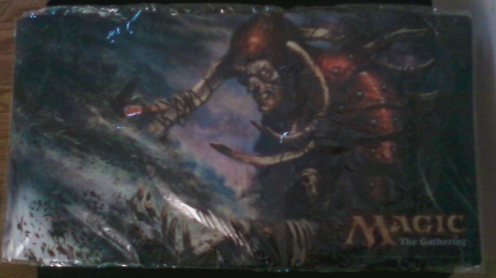
So perhaps I managed to store up a smidgen of good karma, because last week I was the grand prize winner of the giveaway drawing staged by the Mana Pool podcast. They had a stack of sealed product and some accompanying playmats, with the winners getting to select one of each in the order chosen. Not only that, but they'd sign the playmats to boot, creating a nice commemorative keepsake. Impossible not to notice amongst the playmats was this hideous stylish number:

Now where had I seen that before?

Ahh, right...

I actually thought long and hard about taking it back. Although I could scarcely abide the art (much too pretty for my tastes), getting it returned to me half a year later (and signed no less) had a certain poetic quality to it, like some cursed magic item that shows back up in your rucksack even after you throw it from a cliff. In the end I resisted, deciding it simply too good-looking to deny another and instead selected the much more drab and mundane Battlegrace Angel one. My loss, of course, but I hope the new owner appreciates owning not just an attractive playmat, but a piece of history.

Or at least an amusing tale.

True Story #2

It's the last weekend in February. A slow day at home and the baby's asleep, so I decide to carve out a few minutes for myself and check out the coverage from SCG Live for the Star City Open in Washington DC. As luck has it, there's a familiar face starting up a feature match- Jonathan Medina. My enjoyment of the match turns to horror as he punts the game away with a misplayed Destructive Force. One of the chat-room trolls proclaims that Medina "looks like the kind of person I'd stab in the parking lot," and I disgustedly realise that there's at least a dozen better uses for my time.

Jonathan is nothing if not a great sport, though, and shortly after as I'm organising the Quiet Speculation 'Second Change for a Prerelease' giveaway, I decide he'd be perfect for a judge's spot on the panel. In my email, I even half-jokingly suggest that he consider donating a signed foil Destructive Force to the prize pool, the perfect commemorative keepsake for the moment. Jonathan went on to one-up me, and pulled one of the D-Force's from the actual deck he played, a card which is at the time you read this en route to a soldier stationed in Afghanistan, the winner of the Second Chance.

The Collection

So put them together and what do you have? Autographed, foil cards that tell a tale of sorrow or mirth, adventure or accomplishment, or have some sort of resonance with the individual being handed a Sharpie and shiny cardboard. It's enough to get me started!

Patrick Chapin: Blightsteel Colossus

Why not begin by aiming high? When the Colossus was spoiled, the Twitterverse erupted with howls of protest (as well as the occasional squeal of delight). In part because of his stature amongst the Magic community, Chapin's voice was one of the loudest, and he aimed it right at Wizards directly. Peppering the likes of Mark Rosewater and Aaron Forsythe with protestations and perturbations, the usually-upbeat Chapin morosely proclaimed "some of my innocence is gone" before at last concluding "I feel like part of me died." I have no idea what sort of reaction I'd get handing "The Innovator" a marker and a BSC, but I'm willing to bet it'd be memorable.

Jonathan Medina: Destructive Force or Bear Umbra

The D-Force had it's moment in the sun above, but not to be overlooked is the Bear Umbra- the card that virtually put Medina on the map and made him a fixture in the Magic community. Hard to imagine it was nearly a year ago, but in his famous "Pack to Power" quest Medina went from a single booster of Rise of the Eldrazi, trading up in true One Red Paperclip style until he'd gotten his hands on a Mox Pearl.

Jesse "Smi77y" Smith: Kuldotha Phoenix

A fixture on one of the best podcasts in the game right now, The Eh? Team, Smi77y is eternally being roasted for his missteps along his path towards becoming a top-flight deckbuilder. Whether it be his assertion that "[card Koth of the Hammer]Koth[/card] is better than [card Jace, the Mind Sculptor]Jace[/card]," or building a competitive deck around Mul Daya Channelers, none has had the enduring legacy that his championing of the Ka-KAW Phoenix. Now something of an Eh? Team catchphrase, this is the perfect embodiment of Smi77y's relentless perseverance and optimism blended with the occasional tactical misplay. Illegitimi non carborundum!

Dr Jeebus: Invoke Prejudice

In my 'younger days,' I was attracted to internet message boards where antagonism and wit were the coins of the realm. Beginning with the Jim Rome "Trollboard" and ending with the Old Firm Fans Forum "Slagging Match," I've known many a Jeebus- the acerbic wit which has an uncanny knack for provoking responses from others. Have a look at the comments section for most any of his Quiet Spec pieces and you'll find the Doc with a long-ladled spoon, stirring things up. Chip Hitler, this one's for you.

Chewie and the Dorks (The Mana Pool): Infest

Because if I can't bring myself to take back the playmat, the next best thing is obvious! And finally...

Jay Kirkman: Ertai, Wizard Adept

Hey, I've gotta start out with something easy, right?

And in that vein, which Magic personalities would you want to put pen to paper... and what would you have them sign?

Mr. Moneybags

Are you a Quiet Speculation member?

If not, now is a perfect time to join up! Our powerful tools, breaking-news analysis, and exclusive Discord channel will make sure you stay up to date and ahead of the curve.

I wanted to start this by saying how much it sucks that I had to miss SCG Open LA. I was busy this past weekend and Just couldn't make it out, sorry to those I was hoping to see. Regardless, there is still a ton of great things going on right now in the financial MTG world, so lets jump into that!

Alright, so I gave it a little while to sit there, but I want to talk about the updates to the SCG buy list prices for Legacy and Vintage. This is actually a huge deal, because now it presents a few interesting scenarios that we should consider.

First, there is the possibility that this is going to inflate price to a point where there is a format "bubble burst" as far as prices go. This is a legitimate concern, but not probable, lets take a look at why.

- Legacy is exploding in popularity. The numbers of attendees going up almost every week in every Open Series across the country already shows this. The format is growing by the week, and with that so is the demand.

- The format is what you make of it. You can spend an absurd amount of money getting into it, or you can go with more more "budget" options of Goblins and Merfolk, both very good options as they both see good results in a diverse metagame. No matter how the meta has shifted, patient Goblin and Merfolk players have always had a decent shot at doing well.

- With the lowest bar of entry on par with the price of most tier 1 standard decks, players are finding it to be more financially secure to get into legacy. Personally I dislike how my standard and extended staples have a shelf life on them. For legacy staples this is very rarely the case, with the exception being bannings. This is the reason I've shifted most of my assets into legacy, its a much stronger long term investment.

Those are the three main reasons why I doubt the new price hike in legacy cards will see a falling out. There are counter arguments to all of them of course, though for the most part none of them that I've heard have the same strength as the reasons why the bubble won't break.

So what do you try to get if you're just getting into the legacy market? This is a hard question to answer, since it depends on what you have access to locally, but I would say that common and uncommon staples are the place to start. Those cards include but are not limited to:

Daze

Brainstorm

Blue Elemental Blast

Lotus Petal

Red elemental blast

Swords to Plowshares

Aether Vial

Sensei's Divining Top

Cabal Therapy

Common & uncommon Merfolk cards (example here)

Common & uncommon Goblin cards (example here)

Common & Uncommon Elf cards (example here)

There are many others as well and some will not be as profitable as others, but all of the singles I listed there have gained an average of 15% over the past 6 months. I listed the three tribes in terms of investment strength. Elves has a sporadic showing while Merfolk is almost always found in the top 16.

I've read the comments on Stu Somers article, Reaction to SCG Buylist, and I am rather surprised that people think this is actually going to cause the format to be destroyed. One of the comments I really liked however was this one from QS member Wade:

"...I agree with the idea of a Master's set that includes all that type of stuff. Make it like 20 packs per box and $8-10 per pack with 6 cards in a pack. Something like that. "Oh crap I spent $10 for a pack and only got a Dark Confidant, DARN". Or "Score Force of Will. There has to be a way to do something like this."

This is a truly viable option that would help the price of anything not on the reserved list drop. Yes it would cause an inflation of reserved list cards but I believe that we can all agree that until recently, lands have been the majority of a decks price. Now you're looking at $19.99 Aether Vial from SCG and CFB, and Sensei's Diving Top between $14.99 and $19.99. A masters set being released will keep prices under control for a large majority of the staples in the format, and would address the current cries of "the bar for entry is too high!" which is also false, but at least then people would stop complaining as much.

I've given a lot of advice on pick-up's today, so I'm going to point out some noticeable price watches.

Skithiryx, the Blight Dragon has risen back to $11.99 on SCG, and $10.99 on CFB, a gain of about $1.50 over the weekend. If you have them, hold onto them as I expect its play to go up after this weekend. If you can trade them away at $15+ in value, then do so.

Phyrexian Vatmother is a good trade item at this point, and are able to be bought for $1.49 on SCG and $0.99 on CFB. You can easily trade them for $2.50-$3.00, and are good easy money. If you don't have them on hand, consider spending a few dollars to pick some up. As a rare they will have a tough time breaking the ceiling on price above $5, but continued success of the infect deck could do it.

Phyexian Crusader ticked up to $6.99, and can easily go higher. All of the Phyrexian affiliated cards can easily gain a boost due to the news of the new set being New Phyrexia, and is a good piece of news to keep in mind when trading.

Mirran crusader is also up to $6.99 on SCG, and it should be noted that if the infect deck continues to do well, it could easily become an in demand card. The promotional one is only a dollar more, and could provide much more than a dollar in value for trading purposes.

That's all for this week,

Stephen Moss

@MTGstephenmoss on twitter

mtgstephenmoss@gmail.com

Brainstorm

Are you a Quiet Speculation member?

If not, now is a perfect time to join up! Our powerful tools, breaking-news analysis, and exclusive Discord channel will make sure you stay up to date and ahead of the curve.

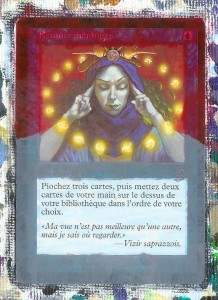
Figure 1

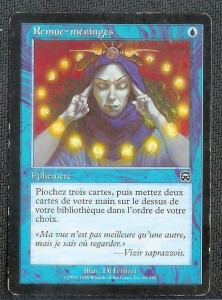
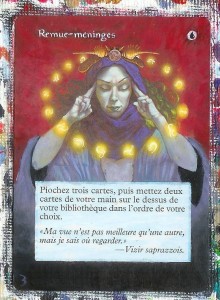
Welcome Back! I hope all of you were successful in your Go for the Throat alters. For today's article I'd like to begin by discussing one of the main financial benefits of this process, and that is “upgrading” cards that are a little beat up. It's no secret that cards in less than near mint or excellent condition are sometimes desirable. Force of Will, Revised dual lands and Tarmogoyf are popular choices for this as it holds their prices down a bit. Of course these cards can be altered to increase their value, and hopefully can be flipped for a tidy profit, but what happens when you have a beat up card that is only $3 or $4 when it is in perfect condition? A card like Swords to Plowshares or Brainstorm that sees a lot of play in many legacy decks can be difficult to move in played condition. This is where your art skills can have a huge effect on your trade binder. By painting these cards you can take a piece of dead weight and turn it into an interesting and important part of your collection, while increasing the cards' value and the efficiency of  your binder all in one fell swoop. Without further adieu, let's dive into today's demonstration.

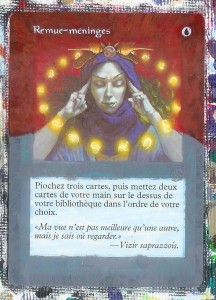
Figure 2

As you can see in figure 1, today's card is the aforementioned Brainstorm. This particular version is French. I picked it up a couple of months ago as part of a larger trade but it hasn't drawn any interest since then so it is a perfect candidate for an upgrade. To start with, lay down your first coat of paint. For the upper half, use Naphthol Crimson and the bottom half should be done in a mid-tone Grey created by mixing Mars Black and Titanium White. The half-way point is determined by where you think the lady's cloak will end up. As you can see in figure 2, the Red does not cover as well as the Grey does. This will not be a problem as its' main function right now is to give a base color and help you visualize what the project will look like when completed.

Moving forward, it is worth noting that it is almost always right to start with the background and move forward when painting. This will help with the illusion of depth and will also allow you a certain amount of leeway when painting near borders. So looking at the background, take note of its' colors. While the overall effect is Red, upon closer examination the pattern is made up of everything from a dark Grey to a bright Orange highlight. To recreate this effect start with the darkest color and move upwards from there in tone. There is also a handy brush technique to help achieve this as well and it is called dry-brushing.

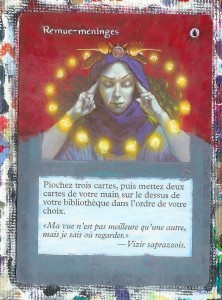
Figure 3

The process of dry brushing is very simple, but it can be used to create very interesting patterns and effects, as well as being an excellent blending technique. Just take your brush, dip it in a small amount of paint, and then brush it on to your canvas until you notice the paint streaks thinning. At this point you then apply quick “wispish” strokes to your project. This will add a small amount of pigment onto your project while still allowing the color underneath to show through. Turning towards your card, try doing this with a very dark Grey mixed from Naphthol Crimson and Mars Black. Remember to use short swishing brush strokes, you are not looking for coverage as there will be a number of coats to come after this. When you've finished the whole background with the grey, gradually add more Red to your mixture and repeat the process. After a while you should get to a point where you are not mixing the black in at all and are using straight Red. At this point it's time for a new mixture of color. Before you do that however, it may be worth your while to clean up the name of the card as well as its casting cost before you lose them under the paint. Find your trusty toothpick and very carefully and gently pick out the name of the card and the casting cost (Fig. 3). Take your time on this, one slip up can cause an alarming amount of time fixing it.

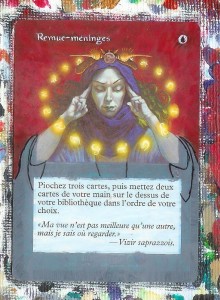
Figure 4

For the next mixture add Cadmium Yellow to Naphthol Crimson until you have a color slightly on the Red side of Orange. Then mix in Sparing amounts of Titanium White to achieve the proper hue. Lightly dry-brush this color onto your background. Remember that due to print runs and ink cartridges, not all cards are the same exact color, so work with your colors until they match your specific card. Repeat this process until you are satisfied with your background. Don't forget to overlap with the original art a bit to help blend the colors (Fig.4).

Now that the background is finished, it's time to turn our sights to the lower, more tricky half of the card. It is here that you must stop and think about composition and design. The woman’s arms do not stop at the frame anymore and neither does her cloak. You must think about how and where their respective forms complete themselves. When you have a basic idea about how this will happen, sketch out how you want these details to look. I've used a pen in figure 5 to help you see where I've made my marks, but usually a pencil will work just fine and will be easier to paint over.

Once you've made your guide it's time to paint it. Remembering to paint the farthest object first, start with the inside of the sleeves using Mars Black. The cloak appears to be blue, but it is actually a mixture of Purples and highlighted with a very light Blue. An equal mixture of Naphthol Crimson and Ultramarine Blue with a touch of Titanium White gives it a lavender hue. Taking your queue from the artist, match this color with the folds of the cloak, using White and Blue to vary the shades as needed. Paint in long thin brush strokes to emulate the folds of the cloak. Fill in with a mid-tone of the Lavender you've created. The highlights can be created by mixing the Ultramarine Blue with Titanium White. The highlights can be very easy to over-do, so be careful. Take the color of the sleeves down the border as far as you want to. It will eventually be faded into Black at the bottom. The woman's arms are a bit tricky. The color is a lighter version of the purple that we used on the cloak. It is important to note that it is also reflecting the light from the glowing symbols. So add a touch (really, just a touch) of Cadmium Yellow to your mixture for the highlights for the arms.

Next we have the neck. Use the base skin tone from the arms here. The shadows can be created and matched by a subtle blending of the skin tone with Naphthol Crimson and Cadmium Yellow. Don’t forget that the cloak will create a small pencil thin shadow where it meets the skin.

Finally, to finish the bottom of the card fade the design into black. This is done by creating the mixture of paint used on the cloak and gradually adding black to it. Black is a very strong color, so it will take very little to overpower a light purple such as the one you are using. The blending should be done with a slightly damp brush to ease the gradient together on the sides of the text box.

Let your card sit for a little while, drying. Stand up, stretch and get a drink. Make sure you look at something completely unrelated at this point. This will allow you to come back to the card with a fresh eye. After about ten minutes return to your card and decide on any finishing touches you may want to add. Are the highlights on the cloak light enough? Is the color uneven in spots? Look critically at your own work as if you had never seen it before. This last minute scrutiny can take artwork from good to great (Fig.6 if I may say so myself). Once you have finished your review, find your trusty toothpick and clean up the text box.

For a lucky number of you, this will be the end of your project. For the rest of us, you will finally learn that your toothpick is not infallible. Occasionally, on certain cards paint can leave a slight residue even after being scratched off. It

Figure 6

doesn’t happen often, and it is not noticeably apparent, but it is enough to drive an artist nuts. The only thing that can be done is to ignore it. Most people won't notice it.

Congratulations! You've just upgraded your binder without even a single trade partner! It should be a lot easier to find a home for this card now that you've made it beautiful!

Don’t forget to leave some sort of feedback to help me improve these articles. Whether it's by leaving a comment here or contacting me on Twitter (PaintersServant), or even sending me an email (Mbajorek02@gmail.com). If you do decide to email me, try to send pictures of your work and maybe I'll post it here!

Until next time!

-The Painter's Servant

Staying Casual

Are you a Quiet Speculation member?

If not, now is a perfect time to join up! Our powerful tools, breaking-news analysis, and exclusive Discord channel will make sure you stay up to date and ahead of the curve.

The art of trading can be a very difficult skill to perfect, and even more so when dealing with certain types of traders.  Today’s topic will be covering one of these types of traders, the casual player.  This is a very broad topic so I will be breaking it up into a couple of installments as there is a plethora of different types of casual players, and each has their own unique trade style.  Casual players, unlike my last two topics, are not something you will regularly find at larger events.  This is a boon for a savvy trader as you don’t usually have to look through a binder that has already been picked through.  The casual players will hardly ever know true value on cards and frankly even if you tell them values most of the time they just don’t care.  They are strictly in this game to have fun at a kitchen table level with their friends and rarely if ever venture into a competitive shop.  The best locations to find these types of players are in smaller casual card shops or local college cafeterias.  If you have the time and commitment to devote to a small amount of searching and traveling you can find yourself a great set of new binders to search through.  This article will concentrate on two types in particular, the one-for-one trader and the color trader.

One-For-One

These players can be a whole new experience to the trading world if you have never encountered them before.  They don’t care for values and don’t want to know how much your collection is worth, or there’s for that matter.  They typically acquire cards through buying the occasional packs or sometimes even boxes and trading with their small group of fellow casual players.  What does this mean for you?  It means that they don’t have access to a lot of binders and will jump at a chance to look through everything you bring with you.  Now as I’m sure you have deduced by now one for one means just that, they want one of your rares for you one of their own. Some groups even have their own rules for commons and uncommon.   But bringing a hefty box of these can net you some solid rares for a great price as well.  The only thing you have to watch out for here is to keep in mind what you hand them, that Grim Tutor may look cool to them but I doubt you will be finding much that can equal such value for yourself.  Keeping your more expensive cards in your bag can keep you out of awkward situations where you have to tell them you can’t part with particular cards. The best things to bring to the table are a hefty box of bulk rares and perhaps your cards you have been sitting on for too long.

Before I go any farther I just want to say as much as I am for value trading (That is how I pay for Magic now) that doesn’t mean you have to rake these kids over the coals.  Even if a trade ends up heavily in your favor, which it always will, its still good practice to throw these guys some extra stuff at the end.  This not only lets you sleep at night and makes you feel better, it also serves as a barrier for future trades.  Who doesn’t want to trade with someone who gave them an extra 5-10 rares for their deck last time.

These trades typically conduct themselves, just be warned there will be cards in these kids binders that they don’t want to part with, and you just have to accept that.  Unlike competitive players who do this, I am willing to accept that these players don’t know the etiquette of a proper trade and just move on. Causing problems or conflict will get you nowhere and destroy any chance for future trades.

Color Trader

This is probably the most casual player of them all. The player picked a color when they started playing the game and every deck since then has been that color.  I have seen everything from black based discard to green saproling builds and everything in between.  You just have to realize these players will never be more than a casual player and move on. You can give them slight critiques but there’s just no point in trying to tune this into a PTQ winning deck or even FNM.  This trader is very similar to the one for one trade and many times will follow the exact same rules except for one major difference, they don’t care about the rest of the color pie.  This is a good thing to know when looking through their binder as you can streamline the trade by directing them straight to the part of your binder/box that they would be interested in.  At the same time you also know what to look for in their binder, they are always happy to part with a card as long as it can’t fit into one of their current decks.

The Attitude

I can’t stress enough how casual you must be in these trades. Just like any clique or group they will be wary of any new face.  Keep this in mind when approaching them for the first time, sometimes it is best just to sit near and watch.  Running up and asking for binders can be a huge turn-off and can lose you business now and in the future.  Usually after you break the ice lightly and show them you can be a friendly individual you will be welcomed back if you treat them with respect.  Yes they are not the best at the game, no they don’t care, as long as their deck can hold its own in their 6 man multiplayer chaos games they are content.  While in the trade don’t command the trade, allow them to, similar to the EDH  (commander) player to drive the trade.  Let them pick out what they want first, even perhaps pointing out cards that could give their deck that little boost they desire.  Keep in mind also these players love combos, no matter if it’s a ridiculous five card combo that requires perfect timing. It’s what they play for.  The flashier the better and pointing these synergies out can not only net you more trade but also create a better relationship with the player.  Skim their binder for cards your interested in while they are searching but don’t rush to pull cards out, for the same reason as the EDH player it is much more difficult for them to say no if they already have their heart set on some of your goods.

Keeping a good relationship with these players as I’m sure you have deduced by now is key.  This doesn’t mean you have to show up every day or even week to trade, nor should you, but popping in every few weeks can be a great idea.  Another key to conducting future trades is keeping an idea of what each player is playing/looking for.  This may not be exact cards but even just keeping themes in mind can keep your stock fresh for them and can create easy future trades.  Not only does it allow you to trade again, but it also makes them seek you out when you show up, hoping perhaps you have a treasure for them this time.  Many of these cards can be acquired very inexpensively from your more competitive cliental whether at your local shop or a major event.

Keeping all this in mind, finding a group can sometimes be difficult, but well worth the effort.  Calling the less competitive shops and figuring out what days these players show up can help the search but sometimes you just have to go out and do a process of elimination.  As I stated, local colleges can be a great place to find a play group. Many of these colleges will have a club of sorts set up and figuring out this information can be helpful. If nothing exists, cafeterias and local restaurants can be a great place to start.  Many people don’t know these groups even exist and getting in with them can be a great boon to your binder when back at your competitive shop as well.

If you are as fortunate as me to have multiple shops/colleges in your area, take advantage of this. Having more binders to trade with is never a bad idea and once you get into a routine these groups will know when to expect you.  As I stated showing up every day or each week is probably not in your best interest as their binders aren't likely to have changed much at all. The only time I advise this is when a set first releases as they are likely to be buying more packs during this time and will be looking for the new cards which you may well be stocked on.

Well that’s all for this week, I will be continuing next week with the other types of casual traders to conclude this article, if anyone has any particular trader they would like covered or perhaps one you have encountered that may be something of a rarity let me know either through the comments or message me through any other form of media.

Until Next Time Stay Casual

Ryan Bushard

@CryppleCommand on Twitter

Ryan Bushard on Facebook

ryanbushard@hotmail/gmail.com

SNEAK ATTACK!

Are you a Quiet Speculation member?

If not, now is a perfect time to join up! Our powerful tools, breaking-news analysis, and exclusive Discord channel will make sure you stay up to date and ahead of the curve.

Recently, I had a reader send me an email. He had a series of questions about a fun card for a Legacy deck with a lot of potential.  Sneak Attack can make some explosive things happen, and this reader wanted to know about some ideas that he had.

(Judge!) After playing Sneak Attack, can I play Yawgmoth's Will and use the Sneak Attack to put creatures from my graveyard into the battlefield?

Yawgmoth's Will is a very powerful card. It allows you to play all the cards in your graveyard as if they were in your hand. However, those cards are not actually in your hand. So those cards cannot be snuck into play.

(Judge!) What happens if I use Sneak Attack to put a Viashino Sandstalker on the battlefield? At the end of the turn it is sacrificed or does it comes back to my hand?

Both the Sneak Attack trigger and the Viashino trigger happen at the start of your end step. So you would get to choose the order that they are put onto the stack. They would then resolve in the opposite order. Long story short, you would get to decide if the creature gets sacrificed or returns to your hand.

(Judge!) If I use Sneak Attack to play a Thopter Assembly at the beginning of my upkeep does the Thopter go back to my hand and I get 5 1/1 Thopter artifact creature tokens with flying?

Thopter Assembly triggers at the beginning of your upkeep. The first opportunity you have to sneak it into play would be after this trigger would go off. There is no way to make this happen by sneaking the assembly into play during your upkeep. (See BONUS RULES STUFF for more info on this)

(Judge!) What happens if I use Sneak Attack to put a creature on the battlefield during my opponent’s turn and he uses Control Magic on it? Does it still get sacrificed? What if I Disenchant the Control Magic in the same turn?

Sneak Attack’s delayed trigger will go off at the end of your turn weather you control the creature you snuck into play or not. If you don’t control the creature when it resolves you can’t sacrifice it. If you do control the creature you will have to sacrifice it, regardless how many times it may have switched sides.

A side note: the delayed trigger will only happen once. If you regain control in a later turn that creature will remain in play.

(Judge!) Can I use Sneak Attack to put an attacking creature on the battlefield right after declaring attack (like the effect of the Hero of Bladehold)? What is the latest moment after declaring attack when I can sneak a creature and still attack with it?

Unfortunately, the name of Sneak Attack lends itself to this idea. Since there are other cards that have this type of effect, you might think that Sneak Attack would put attacking creatures into play, but it doesn’t. The last opportunity you would have to put a creature into play on your turn and still attack with it is the Declare Attackers Step in your Combat Phase, before you declare your attackers.

(Judge!) If I announce I’m using Sneak Attack to sneak a creature, it is possible to use some spell with split second that prevents me from actually doing it?

Technically, no. Unless that spell is Trickbind. Split second prevents you from putting spells or activated abilities onto the stack on top of the spell with split second. It doesn’t affect the things on the stack beneath it. Trickbind, though, counters activated abilities, and it would put a wrench in your Attack plans.

However, it only stops a single activation. Since you don’t announce which creature your Sneaking into play until the ability resolves, the only thing you really lose in this exchange is one red mana. You can Sneak another creature into play right after the Trickbind resolves with no problems.

(Judge!) Do you have any suggestions of creatures to use with Sneak Attack to have fun effects and play fun games? I don’t use Emrakul, the Aeons Torn because it makes every game the same boring game.

This one I’m not so good at. Building decks has never been one of my strong points in magic. If you’re reading this and have some suggestions, please leave a comment with some awesome creature ideas. Maybe a cool combo you can think of. This is for a Legacy deck, so pretty much anything goes.

As always, Keeping it Fun

Kyle Knudson

Level 2 Judge

Allon3word at gmail.com

BONUS RULES STUFF

“At end of turn” triggers are interesting. They sound like they should happen at the very end of your turn, and they do... sort of.

“At end of turn” really means “At the beginning of your end step.”  Sneak Attack requires you to sacrifice it at the beginning of the next end step. If you Sneak a creature into play during the end step, however, it will stay in play until the beginning of the next end step.

This is a neat trick within the rules that would allow you to get your Thopter Assembly's tokens. If you Snuck the Thopter Assembly into play during your opponent's end step, it would stick around during the beginning of your upkeep and trigger as normal.

There are a lot of cards that use this wording that can take advantage of this rule. The unearth mechanic uses this wording, as do Elemental Mastery, Incandescent Soulstoke, and Kiki-Jiki, Mirror Breaker.

Can you think of any other cards?

I Am Strictly Better Than You

Are you a Quiet Speculation member?

If not, now is a perfect time to join up! Our powerful tools, breaking-news analysis, and exclusive Discord channel will make sure you stay up to date and ahead of the curve.

An argument broke out on Twitter about a week ago regarding the term "strictly better", and it's an argument that I've seen countless times in many different venues. It's time to set the record straight, once and for all.

First of all, the term "strictly better" is not new. To my recollection, the term was first used by members of R&D in the duelist in the mid 90's to explain why they would never reprint the original dual lands. The official stance of R&D at the time (and history shows us it is still their policy) was that they would never again make lands that were strictly better than basic lands.

So what does it mean to be strictly better? For card A to be strictly better than card B, one of two conditions must be met: either card A must have identical rules text to card B for a cheaper or less colour intensive mana cost, or card A must have an identical effect of card B with other abilities for an identical mana cost. It is important to note the the supertype "legendary" is a drawback on a card and relevant to the discussion, whereas the supertype "basic" is ignored for the purposes of these discussion. Do not attempt to argue the latter point. If you want to argue the latter point then either you need better reading comprehension skills or you suffer from short term memory loss: I just said that the first definition of "strictly better" stipulated that the original dual lands are strictly better than basic lands.

The first condition is very easy to check. Counterspell is strictly better than Cancel because it has the same rules text for 1 less mana. Were there a counterspell that cost 2U that would also be strictly better than Cancel because while they both cost three mana, the hypothetical version is less colour intensive. Dark Ritual is not strictly better than Cabal Ritual because while Dark Ritual costs 1 less mana for the same base effect, Cabal Ritual has a threshold ability as well. Simple enough? God I hope so.

Now we get to the tricky part. At least, this is the part that others find tricky for reasons I will never understand. Shatter is strictly worse than Shattering Pulse. Shattering Pulse has the same effect for the same cost, but it also has the buyback option. It should also probably be in your EDH deck. Kavu Titan, as well as at least a dozen other cards, is strictly better than Grizzly Bears. Again, identical card, except Kavu Titan has kicker. At first glance it would appear that Braingeyser is better than Mind Spring because you have the option of making another player draw cards as well. However, while they have identical mana costs, they have different effects. The general use of these two cards is normally the same, to make yourself draw cards, and in that regard Mind Spring is better because it can't be redirected and you can cast it even if you have shroud. Even so, the effect is technically different and they cannot be compared in strict sense.

So where do the problems come up? Why do people have difficulty with this? The first trap that people fall into is comparing apples and oranges. You might say that Volition Reins is strictly better than Confiscate, but you would be wrong. Volition Reins is regular better, sure. However, while they both cost 6 mana and have similar effects, they do not have identical mana costs nor identical effects.

You see, comparing cards as "strictly better" is basically like science. You need a control with only a single variable. Only then can you make an accurate judgment on one card being strictly better. Lightning Bolt and Shock have the same mana cost. They also share the effect of dealing two damage to something, however Lightning Bolt does a third damage. Vampiric Tutor is strictly better than Imperial Seal because they have the same mana cost and effect, but Vampiric Tutor can be used at times when Imperial Seal cannot. It's important to note that the effect does not have to be good or useful, so long as it is not a drawback. Flagstones of Trokair is not strictly better than Plains because while it has the same cost, text, and an additional positive ability, it has the negative ability of being legendary. Conversely, a hypothetical card:

Strictly Better Forest

Land - Forest

({T}: Add G to your mana pool)

{o0}: Punch yourself in the face

would be strictly better than a Forest because it always can do what a forest does identically, but it has an additional ability. You will never use that additional ability unless you're a masochist, but it's still there.

The second post common pitfall people encounter is trying to compare cards with multiple similar variables. Zap is not strictly better than Flare. They both cost the same and have some of the same rules text. However, they both have an additional ability. As such, they cannot be compared in strict terms. Zap is clearly better, but not strictly better.

And now the elephant in the room: the most common argument used to prove that cards are never strictly better. Corner cases card interactions. Simply put, card interactions are not taken into account. Cards are strictly better than each other in a vaccum. Mindslaver and Counterbalance do not change anything. Counterbalance argues that more expensive versions of identical cards can be better, however this is dependent on the makeup of the Counterbalance deck and the metagame. The existence of Counterbalance changes nothing about what the cards do. Likewise, Mindslaver does not make cards fail to be strictly better. I'd rather be holding a Shock than a Lightning Bolt if I get Mindslavered, but that's because Lightning Bolt is a better card. Someone forcing you to play sub-optimally does not change the actual efficacy of a card.

One final note on this whole "strictly better" debate: should you always play a strictly better version of a card given an option? Nope! That's right, identifying a card as strictly better does not necessarily invalidate the existence of other cards. Perish is strictly better than Nature's Ruin because Perish buries whereas Nature's Ruin destroys. However, if Meddling Mage is running rampant and your opponent is expecting you to board Perish, you'll be glad that you played the strictly worse card on your sideboard instead. Magic is a complicated game and identifying cards as strictly better, while potentially useful, is not the automatic end to all conversation.

I hope everyone in the world reads this and understands it so that this conversation never needs to come up again. And if I ever catch you improperly using the term "strictly better", I will [cast]Donate[/card] my hypothetical Strictly Better Forest to you, Mindslaver you, and force you to activate it's extra ability until you give yourself a concussion.

Investigating Invasion

Are you a Quiet Speculation member?

If not, now is a perfect time to join up! Our powerful tools, breaking-news analysis, and exclusive Discord channel will make sure you stay up to date and ahead of the curve.

Sets like Shards of Alara and Ravnica owe a lot to Invasion's gold theme. Invasion was the first set of a block that took a look at how colors matter and interact with each other. It is a favorite set for fans, because lots of people like gold cards. Gold cards tend to be more powerful than mono-colored cards, so Watchwolf is better than Bear Cub. We like to see powerful cards, and if they can make us work for them, we like them more. It can be hard to design cards with a hindrance because sometimes, players just don't get what makes something good. The first time I saw Basking Rootwalla (during a hiatus from the game), I thought “this would be okay if someone casts Hymn to Tourach on you, I suppose.” The Madness mechanic took some work to figure out and take advantage of. Luckily, gold cards have no such problem, since most Magic players know how they work. You plug in a white and a green mana and you get a 3/3 instead of a 2/2 for your work. Gold cards also fit into theme decks really well, since sometimes, a theme is just the colors in the deck.

Part of the lingering wisdom from Invasion is how accurately-costed the gold cards are. That set the tone for how to price gold cards in Magic. We last saw that many gold cards in Legends, where the “goldness” was supposed to be cool enough to pay a premium. Thus, you got clunkers like Lady Orca. With Invasion block, we got a concrete idea of how much an ability should cost. For example, in Apocalypse, we saw that “destroy target permanent” cost either 4GG (Desert Twister) or 1WB (Vindicate). The cost to both bounce a creature and force a discard is 1UB, thanks to Recoil.

Though I am entirely too tired of gold cards now, they are fun in limited numbers and Invasion brought a lot of cool things that players hadn't seen before. If you picked up Magic after Invasion, let me tell you – you rarely saw gold cards. Sometimes they were cool, sometimes they were indecipherable. You didn't know whether Harbor Guardian or Windreaper Falcon were actually any good, but they looked cool. Thus, a set with a lot of gold cards must have been way cool to color-deprived players. You had to go back all the way to Stronghold to see a gold card, which is just mind-boggling to me today. You could have picked up Magic in Urza's Saga and played for two years and never opened a gold card in a pack.

That's why gold cards mattered so much to players when Invasion came out.

Let's take a look at some of the highlights of the set! Since there are a lot of goodies in this set, I'll be breaking the review into two different articles so you don't get overwhelmed.

AbsorbOne of the coolest things for people in Invasion was to look at just what two cards, paired together, would cost. Thus, you get Absorb, which is Counterspell + Healing Salve (kinda). Easy and elegant design and highly understandable by players. Absorb saw a lot of tournament play, more than its evil buddy Undermine. This is because, to a deck that plays counterspells, gaining three life is more important than doing damage to the opponent.Absorb remains popular with players and it has a decent appeal in EDH, where many decks can run it. It's also a card you can play at casual tables and not get totally hated on for playing.$2.50Artifact Mutation and Aura MutationThese two rares are both nice for the cost; you get some power on the board and get to remove something pesky. The downside of actually needing targets is lessened in multiplayer formats, where you will likely find something to point this at. I don't remember either getting much tournament play, simply because the permanents at the time weren't worth playing. However, I did enjoy running Artifact Mutation in Vintage Tog decks to wreck Stax.$1.00Aura ShardsWhen you look at lists of the best gold cards for EDH, this one constantly makes the top of the list. Aura Shards never lacks for a target and you can neglect to use it if you want to be political. I made very good friends at an EDH table with a guy playing a mono-red deck full of artifacts. He saw the enchantment and when I evoked a Mulldrifter into it, someone asked me if I'd hit one of his things. I remarked that he wasn't hurting me, so I'd leave him alone. He didn't attack me through the whole game. That's the power of a “may” clause, folks!Aura Shards is good to find in piles of bulk, since people want the card for all their EDH decks.$1.25 ($5.00 in foil)Blazing Specter
Hypnotic Specter was back! People loved Blazing Specter mainly because they didn't have Hippie anymore. It hit on the same turn Hippie would and hey, you still had Dark Ritual in the environment for awhile to power this out. It formed part of the disruption in Tom Van De Logt's Machinehead deck, alongside Flametongue Kavu and Terminate. Even though it doesn't force a random discard, it was still good enough for the environment.

I'm a little surprised that the Specter is still actually worth something; it's a hasted Abyssal Specter, not a slightly-slower Hippie. Selective discard is a lot worse than random discard. My best guess is that people will pay a little for nostalgia in their discard decks.

$1.00

Captain Sisay

The Cap'n is mainly used these days as an EDH general. I've got a list with her floating around, and she can be pretty devastating. For example, you can go get Gaddock Teeg, then Hokori, Dust Drinker and Kataki, War's Wage and just pester the heck out of people. Tag an Umezawa's Jitte on one of your soldiers and you can peck away at people with annoying bears. Near-limitless tutoring is her main appeal, and when you can combine her with Thousand-Year Elixir or Minamo, School at Water's Edge... you get results.

$1.00 ($23.00 in foil)

Collective Restraint

The real breaking factor in this card is that it counts dual lands. Thus, it was used in Extended in both CounterTop and Gifts Rock because it paired with the Ravnica duals. You could easily make an opponent shell out five mana to get a single attack in, which is pretty debilitating. It gets a little attention in Legacy, but it's really too slow to do much good.

$1.50

Crosis, the Purger

The return of Elder Dragons was way cool in Invasion. They remain very popular among fans, even though many have been reprinted here and there. When you connected with Crosis, you could make that poor sap lose their whole hand if you guessed the color right! What a blowout against that pesky Elves player! That said, having a 6/6 flier meant that most of the time, the ability was worthless because you didn't need it with a body that big. It's the Gleancrawler syndrome.

$3.50 ($20.00 in foil)

Darigaaz, the Igniter

Darigaaz is a little less cool than Crosis, since you merely get a bit more damage instead of wiping someone's hand. That explains why this Jund Dragon is less valuable.

$2.00 ($10.00 in foil)

Devouring Strossus

There was a time when this was the biggest, meanest creature around. It was hard to kill since it regenerated and it sealed things up really quickly when you attacked. It's the best in the line of black “Demons” that require you to pay mana or sacrifice a creature every turn, lest it betray you. I think part of its value comes from being a good finisher for casual token decks.

$1.00

Dromar, The BanisherDo you know why Dromar blows? If you name three of the five colors in Magic, he'll bounce himself. So it's really only good against those Karplusans. What a joke, right? Dro' still has fans, though. He's the right colors to be annoying in EDH, for one. People played him in Standard, surrounding the Dragon with the most busted blue cards at the time. Just to give you an idea, you could pack your deck with Absorb, Probe, Fact or Fiction, Repulse and Exclude and be entirely too hateful to creatures and spells, while rolling in card advantage. One of the criticisms of Invasion was that blue card advantage was just incredible. It was a wake-up that Standard needed less-strong blue draw if you didn't want blue to dominate all the time.So back to Dromar – he's worth a few bucks, worth a few more in foil.$3.25 ($14.00 in foil)Dueling GroundsPeople like this in EDH for games that they want to drag out. Pretty worthless, except in foil.$6.00 in foilElvish ChampionEven though Elvish Champion has been reprinted, it's still big among Elf People because it's a pump-lord. It was the first pump-lord for Elves for a long time and people still remember it. Like Lord of Atlantis, it gives evasion and a power boost; if your opponent has trees on the field, he won't be able to stop those elves from coming over to visit.$2.50Fact or Fiction
Fact or Fiction was rarely fair. Even if you flipped over only one good card, you could draw four from it. Or to put it another way, the fewest number of cards you were guaranteed, at instant speed and for only one blue mana, was three. What a rocker, especially if you flipped into more copies of FOF! People are notoriously bad at splitting FOF, and you'd often flip five cards, only to see the two cards you wanted put in the same pile! It's even worse than Gifts Ungiven for that! Card draw hasn't been this good for a long time. The closest it got was Careful Consideration. Until that, we had a spate of sorcery-speed draw like Concentrate and Tidings to teach us that we can't hold up countermagic as well as draw cards all the time.

Although it's been reprinted a lot, FOF is still pretty valuable. It's a great power uncommon that you can still find in boxes. Interestingly, the foils are worth little more than the regular versions these days.

$4.75

Hanna, Ship's Navigator

Another bedrock EDH general. Hanna is best friends with Mindslaver, I'll tell you that much!

$1.50

Obliterate

When you have to reset a multiplayer table, Obliterate is handy. It makes insidious appearances in Jhiora EDH decks, especially since there will usually be an Eldrazi or something else nasty following up behind the board-wipe.

$1.50

Join me next week when we round up the hits in Invasion!

Until then,

Doug Linn

www.twitter.com/legacysallure

All Will Be One

Are you a Quiet Speculation member?

If not, now is a perfect time to join up! Our powerful tools, breaking-news analysis, and exclusive Discord channel will make sure you stay up to date and ahead of the curve.

Welcome back to On The Hunt, where this week we head over to the darker side of the color pie with a new brew after the release of Mirridon Besieged. I've been wanting to make a poison deck during Scars, but it didn't have enough oomph to really do anything. However, with Besieged we've got more Infect guys to purge the unbelievers and to kill your opponents faster! So for the typical poison archetype, we have a certain amount of choices color-wise to work with: We have mono Green, mono Black, GB, and UB. We can set most of these into multiple aggro, midrange and control variants, so for now let's use my development list to see what we have to use for each archetype.

Infect
Green
Blight Mamba
Blightwidow
Carrion Call
Cystbearer
Phyrexian Hydra
Putrefax
Rot Wolf
Tangle Angler
Tel-Jilad Fallen
Viridian Corrupter

Black
Flesh-Eater Imp
Hand of the Praetors
Ichor Rats
Phyrexian Crusader
Phyrexian Vatmother
Plague Stinger
Septic Rats
Skithiryx, the Blight Dragon
Tainted Strike

Here, we are looking at the basic infect colors of the set, and there are a vast number of choices here to try out: most notably the new additions of Phyrexian Vatmother, Phyrexian Crusader, Viridian Corrupter and Inkmoth Nexus stand out.

Blue
Corrupted Conscience

Multicolored
Glissa, the Traitor

Artifact/Colorless
Blightsteel Colossus
Core Prowler
Corpse Cur
Ichorclaw Myr
Necropede
Plague Myr
Vector Asp
Inkmoth Nexus

So let's take a look at the basic list of new additions to the infect line of Besieged, since the war now appears to have a 50/50 chance of either side winning (GO PHYREXIA!...) Ahem, anyways Blue really didn't give us any usable tools infect-wise except a limited bomb Mind Control in the form of Corrupted Conscience with, in this author's opinion, the best art in the set.

Lists:

Mono-Green

Untitled Deck

Creatures

4 Cystbearer
4 Putrefax
3 Rot Wolf
3 Birds of Paradise
2 Viridian Corrupter
2 Bellowing Tanglewurm

Spells

4 Lead the Stampede
3 Eldrazi Monument
2 Sword of Body and Mind
2 Sword of Feast and Famine
3 Vines of Vastwood
3 Mimic Vat

Land

4 Tectonic Edge
18 Forest
3 Oran-Rief, the Vastwood

Tidbit of what deck is suppose to do: The point of the deck is to get your infect guys out as fast as possible then use Bellowing Tanglewurm, the Swords, Eldrazi Monument, and the Mimic Vat+Putrefax combo to win.

Mono-Black

Untitled Deck

Creatures

4 Hand of the Praetors
3 Skithiryx, the Blight Dragon
3 Ichor Rats
4 Phyrexian Crusader
3 Phyrexian Vatmother
4 Corpse Cur
3 Plague Stinger

Spells

3 Go for the Throat
2 Sword of Feast and Famine
3 Black Sun's Zenith
3 Grim Discovery
2 Sword of Body and Mind

Land

4 Inkmoth Nexus
4 Verdant Catacombs
14 Swamp

Tibbit of what deck is suppose to do: More or less the mono Black equivalent of the infect deck (without Green or Blue). I'll be blunt, it has trouble against maindeck Sword of Feast and Famine. Luckily we can put enough pressure to poison out and take out any creatures that we might have trouble with by -1/-1 counters, Go for the Throat, and Black Sun's Zenith.

UB Poison

Untitled Deck

Creatures

3 Ichorclaw Myr
3 Necropede
4 Plague Myr
3 Phyrexian Crusader

Spells

4 Go for the Throat
4 Inquisition of Kozilek
3 Jace, the Mind Sculptor
3 Mana Leak
4 Preordain
2 Sword of Feast and Famine
4 Tezzeret, Agent of Bolas

Lands

2 Creeping Tar Pit
4 Darkslick Shores
4 Drowned Catacombs
4 Inkmoth Nexus
3 Island
1 Misty Rainforest
4 Swamp
1 Verdant Catacombs

Tidbit of what deck is suppose to do: Yes, this is basically a UB Tezzeret deck that pumps out Tezz to make all the artifact infectors into huge beatsticks, while the backup plan is for Jace to either ultimate or to help get turn card advantage into our other threats. Trust me, when you're on the wrong end of a 5/5 Inkmoth Nexus, you know just how beastly the deck can be.

GB Poison

Untitled Deck

Creatures

4 Hand of the Praetors
4 Ichor Rats
4 Ichorclaw Myr
3 Lotus Cobra
4 Plague Stinger
4 Putrefax
3 Skithiryx, the Blight Dragon

Spells

2 Garruk Wildspeaker
4 Doom Blade
4 Vines of Vastwood

Lands

6 Forest
2 Marsh Flats
2 Misty Rainforest
7 Swamp
3 Inkmoth Nexus
4 Verdant Catacombs

Tidbit of what deck is suppose to do: Typical GB infect deck that uses Lotus Cobra's landfall to quickly put out our infect creatures with Garruk as a finisher.

Here is a quick match report on the mono Black list I ran:

Match 1- Qna's UB Shape Anew/Colossus

Game 1:
So I was very excited for a long time to be able to test out this deck list and finally got the chance to do so. The first thing that came to my mind was that this was a typical Tezz deck, but I found out during game two that it was indeed something out of left field. I win the die roll and I draw 2 swamps, a Phyrexian Crusader, a Marsh Flat, Black Sun's Zenith, a Hand of the Praetors and Inkmoth Nexus.

I lay down Marsh Flats and pass the turn. Qna then plays a Darkslick Shores and follows up with an Inquisition of Kozilek which gets a grunt from me. Now if anyone knows how to Jedi mind trick, I pulled this off somehow: I reveal my hand and immediately take Black Sun's Zenith and place it in my graveyard and say, "Okay?" He agrees and passes the turn, when he certainly should have taken my Crusader. I pop the Marsh and go to 19 (M:19 - Evil:20/0) getting a Swamp. I draw a Skithiryx, the Blight Dragon and play Inkmoth Nexus, passing the turn. He draws and play his own Marsh Flats and goes to 19 (M:19-Evil:19/0) and passes the turn.

I draw Go for the Throat, and I play a Swamp and the Phyrexian Crusader, fully aware that he has Mana Leak mana up. I wanted to bait him, knowing I have ways to bring it back to my hand, but he lets it pass and I was worried that I might have walked into a Go for the Throat or something similar. Alternatively, he might be trying to let me overextend my board. Turn 3 he plays a Drowned Catacomb and taps all three to play a Trinket Mage which left me with a "Huh?" look as he fetched up a Darksteel Axe (which made me go out of the Tezzeret gameplan and think he was maybe on some mediocre UB metalcraft deck). Turn 4 I draw another Inkmoth Nexus, play it, and tap out for Hand of the Praetor's. My attack with the Crusader takes him to three poison (M:19-Evil:19/3).

He draws for his turn and quickly plays a Go for the Throat on my Hand and taps his Catacombs for his Darksteel Axe, passing the turn. Turn 5 I draw a Verdant Catacombs, play it and tap two Swamps to activate both Inkmoth Nexuses and attack with them and the Phyrexian Crusader. He blocks the Crusader with the Trinket Mage and takes two poison from the Inkmoths (M:19-Evil:19/5). During his turn he taps his three lands and plays Black Sun's Zenith, putting the Crusader at 1/1 as he shuffles up the Zenith into his library. On my turn, I pop the Catacombs and got to 18 (M:18-Evil:19/5).

With him tapped out I can play my Swamp and attack with Skithiryx, the Blight Dragon, drawing a Marsh Flats. I play it and pop for a Swamp and he concedes in the face of lethal poison.

Game 2:
This game went pretty fast, and I wasn't smart enough to actually remember to log this game, but I know he mulliganed to 5 (much to my delight) and I kept my initial hand of Ichor Rats, 2 Swamps, an Inkmoth Nexus and a Hand of the Praetors, Go for the Throat, and Black Sun's Zenith. He decided to play first, playing a Darkslick Shores and Inquision of Kozilek that took my Ichor Rats. I draw and play a Marsh Flats, passing the turn, while on turn 2 he plays another Shores and plays See Beyond. As for me, I'm still confused as to what the deck could possibly do, and I go to 19 popping the Marsh Flats. I draw a Swamp and play it before passing the turn.

He plays an Inkmoth Nexus getting me back into the, "Oh hell, he's actually is playing some sort of Tezz build", and plays a Trinket Mage for a Darksteel Axe, and all of a sudden I'm thinking, "Please equip Axe to Nexus so I can Go for the Throat!" Basically here is what happened: I draw my Ichor Rats, play it, and we each get a poison counter. He plays a Swamp and taps it for Darksteel Axe and passes. I draw a Phyrexian Vatmother, much to my happiness but soon to be my grief. Now here is why he's playing Darksteel Axe: he plays another Nexus, taps four, and much to my surprise, Shape Anew. Cue the head banging on my desk, because there's only one reason to play that card and that card was Blightsteel Colossus. Apparently only two artifacts in the deck besides the Nexus were the one-ofs Axe and Colossus. Soooo, we go to game 3.

Game 3:
Only thing I get out early is a Plague Stinger, which gets killed by a Disfigure, and I follow up with an Ichor Rats and him with a Crusader of his own. The next couple of turns he Trinket Mages into an Axe and casts Shape Anew for the Colossus.

Oops.

I'll see you next time with some news and some more interesting deck builds and another match report from those builds.

Kellen Huber

@cavemankellen on Twitter

Future-tech

Are you a Quiet Speculation member?

If not, now is a perfect time to join up! Our powerful tools, breaking-news analysis, and exclusive Discord channel will make sure you stay up to date and ahead of the curve.

I’m trying a new concept this week, in which I highlight theoretical, prototypical, or early stage beta ideas that we’re thinking about behind the scenes. While I can’t always talk about the latest projects we haven’t released, I do many thought experiments each day, some of which yield interesting ideas. I’ve been jokingly calling this “QS Labs”, since it’s where we try to develop some next- level tools for Magic players, traders, and those in the industry. I’m hoping to open up dialogue on how to use technology to improve our lives as lovers of this game, and these pieces will be largely theoretical. We may very well have advanced prototypes working behind the scenes which we cannot speak of in public, but for all intents and purposes, treat these ideas as one big “wouldn’t it be nice if...”

The problem I wanted to tackle with today’s thought experiment stemmed from the mind-numbing task of sorting and inventorying cards. MTG Online solves this problem, but for those of us who own physical paper cards and don’t intend to make the total conversion to digital, it’s a problem that will always exist and grow with our collection. Now, you could practice reducing your collection by 80% every so often, employing the Pareto Principle, and in fact I suggest doing this very thing in a piece I wrote for ManaNation that’ll go live on Thursday. Short-term, this is an awesome way to keep your sorting needs low. But I wanted more, so I dug deep into my brain and asked how I could remove the need for sorting altogether. I wasn’t going to allow myself to outsource it for this experiment, though most people could easily do so. That would’ve been pulling the parachute too early. No, I wanted to completely obsolete the need to sort cards.

The first thing that sprung to mind was, “wouldn’t it be nice if my computer just knew what I had at all times?” I agreed with myself out loud, “Yes! That would be amazing! Too bad a computer has no idea how to do that.” My mind reeled with the potential. If we assume that we can teach a computer to recognize cards (without worrying about how), a new world of possibility opens up to us. After all, computers can recognize far more complex structures than a 2.5x3.5 inch rectangle with predictable angles and patterns. I had to assume this was doable. It’s out of my skillset to implement, but it’s doable. The question became, then what?

Once a computer can recognize a Magic card, a new world opens up. Right now, we sort Magic cards in a way that’s meaningful to humans, similar to how we organize our paperwork into files in a cabinet. The physical storage medium (paper) defines the shape of the container, the accessibility, and implies a need to group similar items together. When you need to see last month’s profit and loss statement, you go to the 2011 cabinet, the March folder, and the P&L sub-folder. You pull the report, and you have it.

The problem is that, unlike chronologically generated reports, you can easily acquire a large quantity of Magic cards that are, theoretically, totally random, at any given time. I sort Magic cards faster than damn near anyone I know, which is a really lame superlative, and it still takes me about an hour per thousand cards to get them sorted as I like. The truth is, I waste so much time sorting that I’m about ready to forswear paper cards altogether. Managing physical inventory sucks eggs. Then you have the problem of display-based sorting (think about trade binders), correlating human accessibility with the sorting mechanism and perhaps even in accord with how your eCommerce site organizes the cards. It may make more sense to you to organize by rarity first, but your eCommerce inventory page might sort by Alphabetical first. It’s madness.

Once a computer can spot a Magic card on sight, all this trouble disappears instantly. We are assuming that we have technology that can, at a glance, snapshot a card, compare it against a database of known cards, and output the results. Here’s why I’m so excited. Assuming it takes me an hour to sort a thousand cards, and I process 100,000 cards a month, I’m looking at 2 very painful weeks of just sorting and processing cards. To hell with that. We’ve all got better things to do than neatly arrange piles of cardboard and work on our Carpal Tunnel syndrome. I’d rather sit in the park and read a book. We don’t have to build a perfect system here, we just have to build a system that lets us process 1000 cards faster than a human being without much intervention.

I For One Welcome Our New Robot Overlords

How can we kill that hour sorting time per 1k cards? Easy. Just don’t sort them. Problem solved. Thanks for reading!

Naw, just playin’. Solving one problem by creating another is often a great way to come to a solution. It’s also a great way to piss off parents and teachers as a schoolkid, but the practice has served me well in my adult life up until now. If we challenge the assumption that cards must be sorted to be accessible, we find a nice little glitch in the matrix. Humans need logical hierarchies to access data, much like the file cabinet example above. Computers don’t. In fact, it’s often less efficient for a computer to store it in a means that is accessible and structured to suit human access. I have never once organized my Google Documents, where I’ve been storing articles, concept designs, notes, and almost anything else relevant, for two years. Not once have I organized it. I can still find everything, since it’s indexed. I type in “QS” and it shows me everything related to QS. I don’t care where they store it. I don’t care what folder it’s in. I care that it’s about this here website, and as soon as I ask for it, I get it. I want to do that with physical cards. When your computer stores something to RAM (Random Access Memory), its location is irrelevant, just as long as the computer knows how to tell the assorted programs accessing RAM where to look for what they need. In our case, it is a human that needs to know the “address” of a card rather than another piece of software.

When you can give your computer a pair of “eyes” in the form of cheap webcam camera circuit boards and teach it to spot Magic cards, you can get the data you need. I have a few hardware designs in my head that will work in tandem with this hypothetical software to process stacks of Magic cards quickly. I’m not quite ready to build prototypes, but the hardware is rudimentary and can be made from spare parts at an electronics store. A hardware device controlled by the software will flip through the cards, scanning each in front of the camera and placing the card into a stack after scanning. This output stack will be identical to the input stack. The computer will then be able to record each card’s position in the stack and identify the card itself. Once the card is identified, all the remaining information about it is preloaded. If the computer knows “ CARDNAME = “Avalanche Riders”, then the computer also knows everything about the card that is on the Internet (as long as we tell it who to ask and where to look).

Here’s where we bring it all together. You take your thousand-count box full of random cards and feed it through the machine. You can then get a report of the contents. From there, you can do all kinds of fancy data processing, the least of which starts with inventory and card valuation. Perhaps you could even teach a high quality camera to approximate card grading! To me, the most valuable piece of information here is the card’s location in a box. It’s pretty easy to look at a stack of boxes, sorted by set and alphabet, and find a given card. It’s pretty hard to find a given card in a bunch of totally random boxes. There’s so much labor in setting up the former, but accessibility is a breeze afterward. The latter is horribly inefficient for human access on a per-event basis. Once you have the contents of the box stored in a database, you can give the boxes names or numbers and, in doing so, give the computer yet another way to specify the location of a card. Effectively, you’ve developed a coordinate system for your cards!

Let’s assume you have 10 boxes of 1000 cards, all of which are totally random and have been indexed by our software. They’re labelled BOX1 up to BOX10. In each box, there are about 1000 slots. These slots can be delineated by colored separators after every x cards, by dividers in the box, or however else suits your fancy. I like the idea of colored markers every 20, with a different color every 100. 20 cards can be gone through in little more than a glance.

Once you have a coordinate system, you can use it to find cards. Let’s say you’re looking for a Tezzeret in your recently-acquired collection, which is largely unsorted. After automatically indexing it with image recognition software (while you go and do something productive and profitable) and querying the database, you find out that there are two Tezzeret, Agent of Bolas somewhere in the boxes and you need one right now. You have a few options:

A) Sort all 10,000 cards. This will guarantee you find a Tezzeret, and it will set up further queries to execute MUCH faster, since all subsequent queries will require almost no sorting. Unfortunately this is not terribly efficient, and we really want to avoid sorting cards at all. This is the frontloading of effort we want to avoid.

B) Dig until you find a Tezzeret. The statistics aren’t on your side here. You’re looking at long odds, and even though you could potentially go through 9,998 cards before finding your query result, you’ll still be no closer to solving your next query and you’ll have wasted a lot of time. This is where the drawback of human access on an as-needed basis kills us.

C) Ask the computer where the hell it put the card. Wait, what? Well, if you ran the cards through the indexing software, it would know the exact location of every card it’s seen. Thus, if you scan 10 boxes of new cards upon receipt, it can spit out a coordinate pair (or two, since there are two in the collection) and tell you precisely where to look. It might look something like this.

Tezzeret, Agent of Bolas | 2 In Stock | Loc: B4-473, B7-135

Remember, all we care about is that we need a copy of this card right now. We don’t care about building infrastructure, sorting cards, or anything like that. Our only need is this card, as quickly as possible. Well, it should be fairly academic given those coordinates. We can go to Box 4, look for the separator that marks the start of position 500, and just grab the chunk preceding it. In those ~30 cards will be our Tezzeret. Time expenditure from “problem” to “solution”? Maybe five seconds, at most. Run the query, pull the box, flip to the number, and you’re done. What if your buddy accidentally took Box 4 to a tournament this weekend. Wel, If Box 7 happens to be more handy than Box 4, just grab it instead , and get the Tezzeret instanced at B7-135. Why is Tezzeret in B7-135? It doesn’t matter. That’s where it is, and you will always know exactly where it is, regardless of how little sense its position makes to the human eye. You just get the card you want without concerning yourself with infrastructure or sorting whatsoever.

The best part is that inventory accuracy is enforced. As soon as you query a card, you can easily indicate that you have removed it from its position in its box. Removing Tezzeret B4-473 will cause all cards from B4-474 and higher to shift down a position automatically. No remembering what goes where. As far as the computer is concerned, the card which was occupying B4-474 is now occupying B4-473, no matter if it’s another Tezzeret or a Beast Hunt (which should have been filtered out by your bulk filtering algorithm, you lazy bones!) You don’t care, because you only access the coordinates when they become relevant to you rather than assigning them manually by a traditional sorting process. As cards are removed from a box, all the numbers adjust accordingly as long as the user marks the card as removed. If you screw up badly enough, just run the whole box through the scanner again. Then you’re guaranteed accurate information. Heck, if the scanner is fast enough, you can just run a few boxes here and there during your work day and always be assured your inventory is accessible and up to date.

As this system scales, the entire nature of the beast changes. Finding one card is a breeze since you have exact coordinates, but when you need to pick multiple orders, it becomes a pain. The best part about a sorted box of cards is that you can just as easily grab all of a card as a single card. The need to do so usually only arises when you’re moving around an entire sorted box, such as moving all of Zendikar to a larger container. There are a few ways to tackle this problem. First, let’s say we have 100 copies of Pyromancer Ascension, spread over those 10 original boxes and we need a playset of them. That should be pretty easy, since there will probably be 10 per box. Just run the query, and tell it you need four copies. It can automatically show you the 4 closest-together instances of the card. If there are 3 copies in B3, it will show you all 3, then it’ll show you the copy in B4. Rudimentary AI can handle this task, and by doing so, you optimize the “random” access that a human being must perform. What if we need all of the copies? That’s the only time in which this becomes truly inefficient, but considering that the majority of queries are not for all copies of a card, the tradeoff is worth it. Remember, the alternative is perfect sorting which takes ages.

Even when it would be faster to pull the 100 copies from a sorted box, having a specific instruction set that reads, “Go here, grab these, then go here, repeat” is a dream for any entrepreneur. You can hand those instructions to someone who knows nothing of Magic and they can execute them flawlessly. They can read the card name, or better yet, match an image of the card which has been cleverly printed on the coordinate sheet!

When you have multiple different cards to pull, it gets really fun. You can apply the same logic of “nearest neighbor” across cardnames. If I need the whole Pyro deck, my system can show me where the Pyromancer Ascensions are, and where the closest Preordains and Halimar Depths are relative to each other. It can optimize the order in which I go through the boxes and guide me to specific locations in each box where the needed cards live. Once one gets the rhythm of scanning these boxes by coordinate, it can go far quicker. If there are 4 Preordains and 4 Halimar Depths in a box, the software will guide me to that box since it has a great depth of query results within. If another box also has the same 8 cards, the software can easily see which is less “fragmented”. If we have a box in which all 8 cards are dispersed randomly throughout the box, but another box (the remains of someone’s collection) has each playset intact, the software’s AI will of course guide you to the better “organized” box. Accidental organization, as I will discuss shortly, is hard to control but it’s a random factor that appears often enough that it’s worth accounting for.

The entire system is built on maximizing efficiency of repetitive tasks while accepting that a small subsegment of tasks will remain inefficient or will actually get harder. Considering the time saved on the common tasks, I believe this will be an effective compromise.

There’s no reason the system can’t scale, either. If you have 1,000,000 cards in 1k boxes, you’ll have 10,000 boxes. That’s enough to take up a large room easily. You can keep adding hierarchical layers to your sorting tree once you’ve hit a number of boxes that cannot be easily addressed. Once you have defined a box as an encapsulated unit, you can then start building units that contain multiple boxes, like shelves. Multiple shelves fit on a bookcase style rack, multiple racks fit in a row, multiple rows fit in a room, and many rooms can fit in a warehouse. From there, you can simply replicate warehouses and scale to infinity. It’s conceivable that your coordinates will read WH3-RM4-ROW1-RK3-SH5-B2-423. Yep, that’s hell to try to memorize, but if you’re dealing with so many cards that you have three warehouses of the things, a string of digits like that will probably be a welcome simplification to whatever sorting system you have now. Let’s stick to the single-room realm for now to keep things simple and realistic. That’s still millions of cards, which is daunting to a human doing inventory.

What happens at that scale, though, when cards can theoretically exist very far apart? It seems bad to need to walk from one end of a room to another to get the second copy of a card since you’re working off of random access. It works for computers because the hard disk platters spin many thousands of times a second and the drive head passes over each area quite fast. Hard drives are also considerably smaller than warehouse rooms. It doesn’t quite work in the same way as this system scales up, so we need to introduce scalable ways to combat scaling! The answer lies in binary sorting, which can be done by a machine (as opposed to perfect sorting which would be difficult to build into hardware).

Binary sorting is the act of splitting a set of data into two groups based on a single yes/no query. I usually begin my perfect sorting process by doing a few binary sorts to reduce the space in which I’m working. Look for a characteristic of a card that can be measured in “yes” and “no”, and one in which the two answers are as evenly distributed as possible. I find that sorting New/Old border style works amazingly for this, since it should cut a randomly distributed set of cards almost directly in half. Granted, older cards are tougher to find so it will be well skewed towards newer cards, but it is still the most useful and easy binary sort to perform.

Each binary sort should, in theory, cut the working problem space in half while introducing a new unit of divisibility. Thus, if the size of your inventory doubles, you can perform a binary sort using automated hardware to keep your maximum “fragmentation” the same. Let’s say we have 2 boxes, but we want to double the chance that we can find multiple copies of the same card in a single box. Sort it binary, and you’ve cut the potential locations of that card in half. Apply this to 10,000 boxes and you’ve eliminated 5,000. Apply another layer of binary sorting and you’ll cut it in half again, albeit with the upfront work of doing 2 fairly quick sorts. Again, this is yet another compromise that will work better than blindly sorting every card that walks in the door. It’s the most minimalist version of sorting around, and considering how well it scales against large quantities, it’s about the best we have when it comes to balancing sorting against random access.

The device I’m currently building in concept can easily put cards into two piles, but more piles would require much more advanced work and logic. This device will work with two motors from an old RC car or somesuch. Thus, teaching it to binary sort and actually perform the physical separation will not be difficult once the hardware is able to manipulate the cards accurately. The piles can be recorded as the binary sort is happening, preventing the need for a second pass before the camera lens.

By mixing a bit of sorting with a bit of technology, we can find a happy medium in which our access methods and storage methods grow and scale with our inventory size. The coordinate system removes the need for pre-sorting, but it still allows semi-sorted cards to remain relevant. While the system must be designed to perform strongly under true randomness, almost no collection acquired is truly random. People often group cards by set, name, color, and other relevant factors and this sorting, however rudimentary or advanced and however complete or incomplete, makes finding cards easier. By leaving these pockets of organization intact, you reap the benefits of someone else’s labor without ever needing to sort the cards yourself. You won’t even notice that this accidental sorting exists until you query a card and you see four of them in adjacent slots. Tim Ferriss and his “low information diet” would swoon. With so much information available, delivering relevant and timely information is more crucial than ever. There’s no need to show the end user data that’s not actionable or relevant until it becomes actionable or relevant. The only time you care about Tezzeret is when you’re actively working on a problem that requires a Tezzeret, such as filling a customer order or building a deck.

The most exciting part of this is yet to come. The implications of digital recognition are clear from this essay, but we are working under the assumption that such technology is possible. I told a cheeky lie earlier when I said it was an assumption, because I actually have a working prototype of it. I can say with total authenticity that I have in my possession a device that can successfully identify a Magic card based on a photograph of an unknown card. It’s here. It’s real.

The catch, of course, is that it’s a second-stage proof of concept, and its buggy, slow, and extremely limited. I have a feeling that our beta release of the technology will be much crisper, but I can’t say more right now. I can tell you that the first stage proof of concept was a webcam, a stand fabricated out of a soda bottle and a cardboard box, and a piece of paper taped to the bottom with the outline of a card on it. The software was an open-source image comparison engine, a webcam software suite, and a photoshop rotate/crop/resize macro. Necessity is the mother of invention.

The second stage concept, which currently lives on my desk in my office, is a thousand-count box with a side cut out. Inside the box lives a small plastic deck box, in which is affixed a web cam circuitboard. It connects to a PC via USB. This solved the issue of needing to concern myself with rotation or distance - the card was always a fixed distance away and was always flush with the corner of the box. New software improvements have removed the need for all of these things.

The software is slow. Comparing an image against a database of tens of thousands takes a lot of time and CPU power. We’re working on ways to optimize every aspect of the comparison, but for now, I’m content to say that I have successfully taught a computer to recognize and name a specific Magic card based only on a photograph. As this software improves alongside a growth in computing power, I forsee us bringing this concept to the mainstream and offering a hardware and software solution. There is no date for release planned, as this project is still in the “Labs”, so to speak, so it may never even see the light of day. If you want to get involved in this, or any of our future-forward tech projects, shoot an email to quietspeculation@gmail.com and we’ll get you connected to the right project manager. If you have an idea for a project that’d go well in the Labs, email us as well.

The world of image recognition is still young, and combined with some of our data-centric projects, will reinvent the way Magic players transact and store cards forever. I’ll discuss what I want to do with data at a later date, but I’ll close by simply reminding people that data exists, or can easily exist, for just about anything on the planet you care to measure. It’s just a matter of finding or building the right tools, looking at the right numbers, and putting the right rows and columns next to each other. Think of data mining like a giant word jumble, where you just need to match up the right numbers to the right ideas to prove or disprove theories. Once the bottleneck of the human memory and processing ability is opened up with image recognition and data processing, our entire way of handling Magic cards will be fundamentally changed.

Got a sweet idea for a Futuretech concept? Been working on a passion project and want some publicity? Send us your info and what you’re doing! Please remember that the ideas and concepts in these Futuretech articles are just that - ideas - and that they are in no way a promise of features to come. Heck, some of the basic concepts might be wrong. If you spot an error or have a better suggestion for how to do something, leave us a comment and we’ll integrate your feedback. Better yet, if you’re an expert on something we’re working with, get in touch. We’d love your expertise. Enjoy the weird science, and if you’d like to support our efforts to bring cutting edge technology to our favorite card game, consider signing up for an Insider membership. Insider lets us pay our writers so they don’t need to live on Ramen Noodles, and it also keeps our servers pushing out data every day. Whatever you do, enjoy!


Kelly Reid

Founder & Product Manager

View More By Kelly Reid

Posted in Finance, Free, Free Finance11 Comments on Future-tech

Have you joined the Quiet Speculation Discord?

If you haven't, you're leaving value on the table! Join our community of experts, enthusiasts, entertainers, and educators and enjoy exclusive podcasts, questions asked and answered, trades, sales, and everything else Discord has to offer.

Want to create content with Quiet Speculation?

All you need to succeed is a passion for Magic: The Gathering, and the ability to write coherently. Share your knowledge of MTG and how you leverage it to win games, get value from your cards – or even turn a profit.

Want Prices?

Browse thousands of prices with the first and most comprehensive MTG Finance tool around.


Trader Tools lists both buylist and retail prices for every MTG card, going back a decade.

Quiet Speculation