menu

Insider: QS Insider Cast – Eldraine Spoiler Season!

Are you a Quiet Speculation member?

If not, now is a perfect time to join up! Our powerful tools, breaking-news analysis, and exclusive Discord channel will make sure you stay up to date and ahead of the curve.

Welcome back to the QS Cast! Say hello to your new hosts, Chris Martin, Chris O'Berry, and Sam Lowe. This cast was originally broadcasted live to Insiders in the QS Insider Discord, September 16, 2019.

Show Notes

Throne of Eldraine! Lots to discuss here, but we're going to focus on the following:
a. Collector’s Boosters
b. Power Level (list our favorite card spoiled in Eldraine so far, could include a Brawl deck)
c. Brawl impact on Standard – what happens if a Brawl card ends up being a hit in Standard? How high is the ceiling?
- Discuss Arcane Signet and implications for EDH until a wider print run occurs
d. Roundtable – share our opinions on preordering standard cards

Cards to Consider

Chroberry - Teferi, Hero of Dominaria (when it hits the floor 4-8 weeks post-rotation)
Sam - Saheeli Rai, now is best at ~$5-7ish range, expecting a double-up into the mid-teens
Chris - Urza, Lord High Artificer, still hovering at $35-40, expecting it to get closer to $60 based on results in Modern (with longer runway when MH1 goes out of print)

Wanna chat? Find us on Twitter

Chroberry - @chroberry
Chris Martin - @ChiStyleGaming
Sam Lowe - @MahouManSam

Tall Tales: Throne of Eldraine Spoilers, Week 2

Are you a Quiet Speculation member?

If not, now is a perfect time to join up! Our powerful tools, breaking-news analysis, and exclusive Discord channel will make sure you stay up to date and ahead of the curve.

Thrones of Eldraine spoilers are rolling on, and I'm having more fun watching them than any other set I can remember. That's not to say that  Modern Horizons was boring nor War of the Spark lacking content. Rather, there are more opportunites to make your own fun with Eldraine than the other sets. Rosewater showed how the cards are designed to tell stories, and it does work quite well. However, because I'm an insufferable intellectual, I prefer to point out which fairy tales and fables are being referenced. And then wax pedagogical about them. Fun for everyone!

Last week, few cards had been spoiled, so I focused on the mechanics themselves and speculated to fill in the gaps. With plenty of cards available, this week will be all about the cards. At time of writing, there continue to be no playable adamant cards nor adventures for which you mainly want the creature. I also haven't seen anything that would faeries good again. However, plenty of other decks stand to considerably gain from Eldraine, presented in alphabetical order.

Charming Prince

Kicking things off, Prince Charming is both a great pun and an extremely attractive card. Cheap creatures with abilities and relevant creature types always have at least a chance of making it in Modern, and the Prince is starting off at an advantage, as befits his station. His three abilities (a callback to the charms, i.e. Azorius Charm) are all incredibly relevant, valuable, and potentially incredibly powerful. Gaining three life isn't the most powerful ability, but with Burn being a major player it is certainly welcome. Kitchen Finks was a staple for years. Charming gives more life upfront and that alone may be enough.
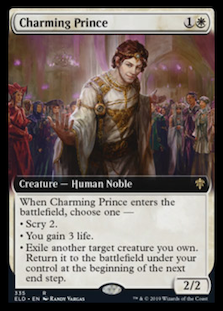
But enough won't satisfy royalty. Charming's most powerful ability (in a vacuum anyway) is his first: scry 2. It doesn't look like much, but white doesn't get card draw or library manipulation very often. Even when it does, it's usually about enchantments (see Idyllic Tutor) or much worse than other colors' options (see Thraben Inspector). Charming is very similar to Serum Visions, but being a creature gives him greater flexibility. Charming could help close the variance gap between white and other colors.

The final, and most contextually powerful, ability is flickering your own creatures. The Prince is no Flickerwisp, and cannot be used to directly disrupt the opponent or to give you mana back flickering by your land. All he does is save creatures with Aether Vial or recycle ETB effects. As the rise of Bant Ephemerate decks shows, creature-based value generation is incredibly powerful. Add in that Charming's a Human, and the card suggests the makings of a Modern staple.

Quest for the Kingdom

However, much like actual royalty, Charming's value may not be needed. Value for value's sake is frequently a trap. It has to be useful in context, or it's just durdling. There needs to be a deck where Charming can not only fit but be good within the deck, and it's not clear that such a deck exists.

Consider Humans. That list is so tight there may not be room for extra value. The flex slot is currently Deputy of Detention, and given Whirza's popularity I can't imagine that changing. Therefore, something from the main Humans package has to go, but cutting on disruption dilutes the main appeal of Humans and reduces the chances to gain value. Charming also can't reset Phantasmal Image. I don't know if that's acceptable or a deal breaker.
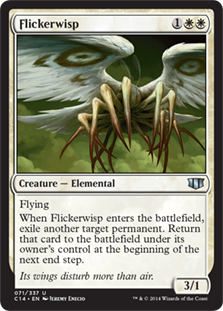
Outside of Humans, I'm not sure what deck wants the Prince around. He is only a 2/2 ground pounder, and white decks have no shortage of those. Death and Taxes has Flickerwisp and wouldn't cut them for Charming. Frequently, as good as getting value flickering your creatures is, it's better to flicker an opposing creature or equipment during combat. Wisp also kills tokens, steals a land drop, resets planeswalkers, and can break up combos. Add in flying and Charming can't replace Flickerwisp.

As both a value creature and a flicker, Charming's a natural fit into Bant Ephemerate. However, that deck doesn't actually need more of either effect. The deck's packed with small value creatures, Soulherder, and Ephemerate itself. The deck doesn't really need more value; it needs some punch for when value isn't enough.

Color Hosers

Eldraine features a new twist on the color hosers. Rather than another round of Celestial Purge-type hate, it's Glare of Heresy-style. The new cards have some effect that gets better if you target the same color as them. Obviously intended to allow these cards to see maindeck play, I don't think they're entirely successful. The two cards that could see Modern play will only be sideboard cards. They may prove very good sideboard cards, but that will depend on how the metagame moves.

Mystical Dispute
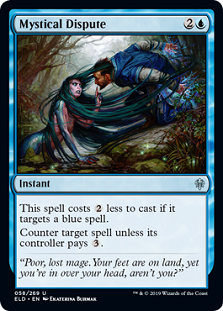
There was a saying back in the day that whoever drew the blue half of their UW Control deck won the mirror. Before planeswalkers, blue provided all the card advantage and interaction that was actually relevant in the control mirror, where white was just creature removal. While this isn't as true anymore, blue's planeswalkers and counters are still more relevant than Path to Exile in the mirror. Mystical Dispute threatens to upend this strategic truism.

Gainsay used to see some play, and at one mana, Dispute is better. Countering a Teferi, Time Raveler is obviously good, but unlike Gainsay, Dispute can target any spell. This means it's never actually dead if your opponent pivots away from planeswalkers and card advantage and toward Monastery Mentor. I suspect Dispel is better in an actual control mirror, but for Stoneblade or other tempo decks, Dispute's flexibility may be more valuable. The card can safely come in against nonblue decks that demand countermagic from opponents.

Specter's Shriek

Replace the word "exile" in all instances with "discard" and Specter's Shriek is maindeckable, and possibly busted. As-is, exiling opposing spells is very good because denying graveyard synergies is very good, even with Hogaak gone. However, imagine if Intrusion was discard a card instead. In that case it's disruption and an enabler, and one of the best cards in Magic. I'm thinking of Dredge removing opposing hate and then discarding Stinkweed Imp. Which, I'm sure, is why it exiles.
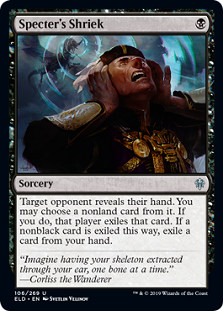
Exiling a card for targeting a nonblack spell is a very high price. Yes, if you're hellbent, then there's no drawback, and Shriek is better than Thoughtseize. However, in that scenario, it's unlikely that you wanted a discard spell at all. The only way to utilize the drawback  is with Eternal Scourge or Misthollow Griffin. Otherwise, Shriek is card disadvantage. Against a mono-black deck this is better than any other discard spell. Against everything else, I can't imagine the price is worthwhile when Thoughtseize's drawback is marginal at most.

Embercleave

With Stoneforge Mystic in Modern, any potentially playable equipment deserves another look. Of course, the bar is still very high, but it's not insurmountable. On its face, Embercleave can't compete with swords or Batterskull. The stat boost is worse, though trample and double strike partially make up for that, they're not better than protection. That it has flash and cost-reduction is nice, but not enough to make it in Modern.
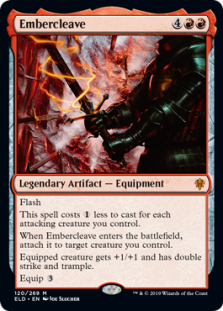
What might be enough is attaching for free. It can only happen once, but that might be all it takes. Temur Battle Rage sees play with Death's Shadow, and if Embercleave enters via Mystic, it's better at the same price. Yes, it's likely unplayable if Mystic dies, but in a swarm deck that might not be relevant. Definitely worth testing.

Fires of Invention
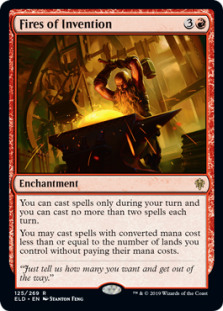
I don't know if this card is good, but it seems like it could be. Free spells are frequently broken. However, Fires only allows for two spells, and only on your own turn. It's intended to be a weakened As Foretold, and can only really be used in a combo deck. It can't just go off like Experimental Frenzy or Mystic Forge. However, there's no risk of clunking out from a string of lands. You also don't really benefit from cheating it out, since those free spells are tied to your land count. There's no real point in cheating out 1-2 mana spells with a four mana enchantment. I have no idea what deck could use Fires or in what capacity, but I'm sure one exists.

Emry, Lurker of the Loch

The Lady of the Lake is here to offer Excalibur to Urza, Lord High Artificer. Metaphorically and in theory, anyway. In Whirza, she can easily be played turn one to dig towards Sword of the Meek and Thopter Foundry, then allow Foundry to be cast from the graveyard. It is important to note that she doesn't cheat cards into play, just allows them to be recast. Thus, she's a bit worse than Goblin Engineer.

Whirza's Friend...
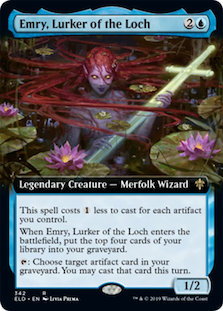
As in the legends, the Lady is here to help her chosen champion. Whirza is a deck filled with enablers and a few cards that matter. It is imperative that Whirza has Sword in the graveyard and Foundry in play, and the Lady helps on all accounts. Yes, she's worse than Engineer. However, her upside is that she can keep functioning after Shatterstorm. Unless there's another artifact ready to go, Engineer becomes a dead card where Emry will bring back whatever Urza needs to get going again. She also works in the face of Ancient Grudge and is only limited by available mana, not a cost restriction. Emry may not be as reliable as Engineer, but she does enough that Whirza can make use of her boons.

...And Enemy

However, as the Lady giveth, the Lady can taketh away. (And in some retellings, imprison within a tree after a foreseen betrayal.) The Lady reduces Whirza's vulnerability to Shatterstorm and targeted removal, but not to graveyard hate or Stony Silence. In fact, she arguably increases Whirza's weakness to Rest in Peace.

Just like Engineer, she does nothing without a graveyard. This may not be a problem by itself, but when Emry enters play, she mills four random cards. In the best case, they're all artifacts that can be cast. In the worst, they're just Urza. Without Whir and Urza, Whirza is extremely anemic. The question is whether that risk outweighs the reward.
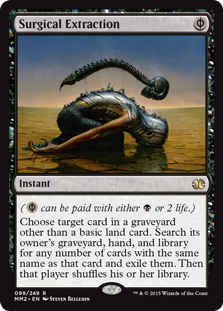
Following from that, Emry uniquely makes Whirza more vulnerable to Surgical Extraction. In practical terms, Whirza has the Thopter-Sword combo and Urza to win the game. By flipping cards into the graveyard, Emry gives Surgical targets. Potentially crippling targets. Normally Surgical is mediocre at best, but there are so few real cards in Whirza that it is a concern. As an additional problem, Emry is not an artifact herself and will take up at least a few artifact slots, reducing the redundancy and synergy of the deck.

Glass Casket

On a similar note, Glass Casket may be the card that actually pushes Whirza over the edge. Normally, Journey to Nowhere effects aren't Modern-playable except as niche cards in Enduring Ideal. However, unlike its forbearers, Glass Casket is an artifact. That means it's findable with Whir of Invention, the supercharger that guarantees Casket sees play.
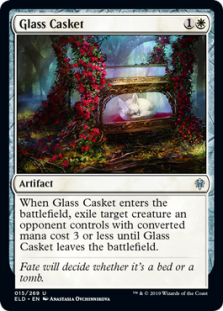
Deputy of Detention, Collector Ouphe, and Plague Engineer are all strong cards against Whirza, and now they can be answered at instant speed. Yes, Casket is vulnerable to Knight of Autumn or Disenchant, but that may not be relevant. If the hate creature is off the board even for an instant, that may be all Whirza needs to combo off.

Once Upon A Time...

This card is not Land Grant. I want that to be perfectly clear. Grant replaces lands because (assuming it resolves) it's guaranteed to find one. It is also free anytime that you don't have a land in hand. The risk of whiffing with Grant is non-existent, and any deck that needs/wants very few lands in their deck can safely run Grant.
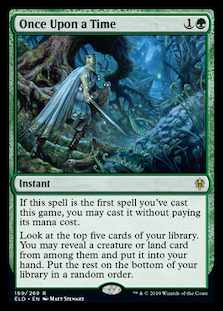
Once cannot do that. Frank Karsten did the math for Once, and the odds of hitting with Once change drastically as you reduce the desired hits. The odds are still decently high, but there's no guarantee. There's also no control over which potential hit you actually do. Grant let you choose, which is relevant if you need a specific color to get going. There's also the fact that for Once to be free, it has to be the first spell played. Thus it presumably has to be in your opening hand, and odds of that are only ~40%. Few decks will want to avoid playing a spell turn one on the off-chance they draw Once turn two.

Still, Once is an extremely powerful cantrip, especially if it can be played for free. However, its Modern playability is entirely dependent on being free. If decks wanted Once's effect, they could already have it and choose not to. Seek the Wilds is a weaker but already legal version and sees no play. In fact, the only similar cards that see play are Ancient Stirrings for its cost and flexibility and Oath of Nissa in Saheeli-Cat.

...There Was Neobrand.

I've heard a lot of chatter about Once in Neobrand. The argument is that it finds either the mana or Allosaurus Rider to get the combo going. This is technically true, but given that the deck already runs Summoner's Pact, I don't think Neobrand needs help finding Rider. However, getting choked on mana is a major problem since Neobrand runs 14-16 lands and 4 Chancellor of the Tangle at most. Once will reduce Neobrand's mulligan variance, in theory.
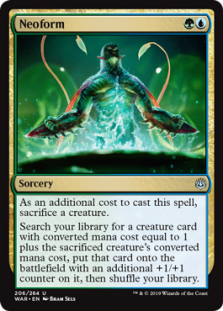
However, what Once can't do is find Neoform or Eldritch Evolution. Neobrand is a multi-card combo, and Once not finding everything reduces its value. Additionally, Once only helps Neobrand get there on mana if it's in the opening hand, which is only a ~40% chance. I don't know the odds of Neobrand successfully comboing turns 1-2, but they're not high. The actual effect of adding a swingy card into an already swingy deck is unclear. The math of such things depends heavily on the assumptions made and can either increase or decrease variance. Given that Once can't find the tutors, its own variance, and Neobrand's already high variance I don't know if the deck can afford the deck space.

Elsewhere....

For every other deck, the question is if they want an otherwise marginally playable effect on the ~40% chance to have it for free. It isn't impossible, but I'm skeptical. Looking at green decks, there isn't much need. Tron is happy with Ancient Stirrings. Elves has tons of mana and Lead the Stampede. Jund is Jund, or it could have Traverse the Ulvenwald. I don't know why any deck would want Once except for it to be free.

Robber of the Rich

My final card is Robin Hood. Dire Fleet Daredevil saw some play in Humans against Jeskai Control, and Robber of the Rich is somewhat better. Haste is more relevant than first strike most of the time, and the effect is repeatable and doesn't have to be used immediately. However, Robin is indiscriminately stealing cards, so there's no control over what you get. He also can't steal all the time, and you can't cast the spells unless you've attacked with a rogue. That's a lot of caveats.
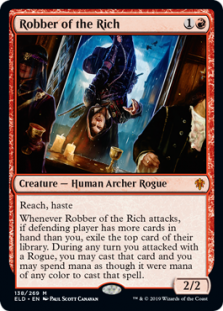
However, Robin could be a mirror-breaker for Burn. If Robin can steal a burn spell, even if it can't ever be cast, that's damage that didn't go to your face. That's also a spell out of the deck and a slightly improved chance of them hitting a land and flooding. If you can cast it, it's like drawing extra cards. Haste is the minimum barrier for Burn creatures, and while Robin could never replace existing options maindeck, as an engine against the mirror there is potential.

In a Land Far Away

Eldraine promises to be a very interesting set for Modern. There have been a few solid playables, but many more that need the right home or some work to be good. I'd rather see lots of interesting cards than obvious ones because they're less likely to break something, so here's hoping the trend continues through the week.


Three Tips When Shopping Around For Deals

Are you a Quiet Speculation member?

If not, now is a perfect time to join up! Our powerful tools, breaking-news analysis, and exclusive Discord channel will make sure you stay up to date and ahead of the curve.

Some pockets of the market have become noticeably softer over the past few months. To describe this market as a buyer’s market doesn’t do justice to the deals that can be had. Some Old School and Reserved List prices, in particular, have dropped down to thresholds that players didn’t expect to see again!

But just because it’s a buyer’s market doesn’t mean one should rush out and buy cards indiscriminately. For one, some vendors haven’t embraced this new reality of lower prices, so they are now overcharging for their goods. Conversely, other vendors are flush with high-value Old School cards they can’t sell. Rather than hide their heads in the sand to wait for this pullback to end, they’re dropping their prices to attractive levels to maintain cash flow.

Their adjustment is your opportunity.

This week I’m going to share three tips on how to pick up some of these older cards opportunistically, paying lower prices and keeping more cash in your pocket.

Tip 1: Why “Below Good” Is Actually Awesome

I’m just going to come out and say it: Card Kingdom is my favorite vendor to work with. Hands down, they offer the best buy prices, competitive sell prices, great customer service, and fast turnarounds on transactions. I’ve shipped buylists to them numbering in three digits and I’ll ship them many more in the future.

But Cardkingdom.com is not where I’ve found the best deals from Card Kingdom. Instead, I’ve done my best deal-finding by browsing Card Kingdom’s eBay page.

Why would you want to browse Card Kingdom’s eBay page rather than their actual site? Put simply, eBay is where Card Kingdom lists cards to sell that they can’t (won’t?) sell on CardKingdom.com. This includes altered cards, foreign cards, signed cards, and my personal favorite, “below good” cards.

Since the lowest condition Card Kingdom offers on their site is called “good”, anything that receives a worse grade is called “below good”. And anything that is below good and still worth selling gets listed on eBay!

Here’s my poorly kept secret: you know how Card Kingdom’s pricing on “good” condition Alpha, Beta, and Unlimited cards drops off significantly from higher conditions? Well, Card Kingdom extends that pricing trend to their “below good” cards, meaning the prices are very low!

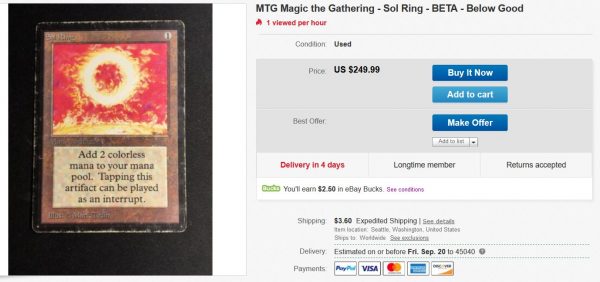
Check out the Beta Sol Ring in the listing above, for example. It’s sleeve playable, and doesn’t even look that terrible. The cheapest copy listed on TCGPlayer right now is a damaged copy for $251 and change. This one could be considered damaged, but it’s on the nice side of damaged. Without pictures, I have no clue how terrible the one on TCGPlayer will be. Better yet, Card Kingdom takes offers on these below good cards—I wonder if they’d accept $220, for example. They liquidate the card, you get a sleeve playable Beta Sol Ring for a price no other store is currently willing to offer.

Tip 2: A Perplexing Move by ABUGames

Let’s stick with eBay for a moment, but shift gears away from Card Kingdom to another large online vendor: ABUGames. Much like Card Kingdom, ABUGames does most of its business through its website. I leverage ABUGames.com on a weekly basis, shipping them less liquid Old School cards for huge piles of store credit, which I in turn use to acquire Modern and Legacy staples. Mox Opal, Force of Will, and Tundra have been a few of my favorite pick-ups lately. The copies that are played or heavily played are priced more attractively than the near mint copies, so that’s what I aim for.

There was an error retrieving a chart for Mox Opal

Also like Card Kingdom, ABUGames also has an eBay storefront.

Clearly ABUGames leverages eBay more than Card Kingdom—they have more than five times the feedback. While Card Kingdom uses eBay to sell cards they don’t have a good spot for on their website, it appears ABUGames uses it to sell…well, most anything.

On the front page of their eBay storefront, I see spindown dice, oversized Commander cards, Italian Legends cards, Duel Decks, Masterpieces, Funko Pop toys, and everything in between. For this reason, I recommend running a search for “mtg” on their store to hone in on their Magic cards.

But I wouldn’t stop there—they’ve got nearly 80,000 eBay listings for items with “mtg” in the listing title, and that’s too much to browse through. Fortunately, I have some tips on how to narrow the list down to the best deals.

First and foremost, I’d stick to their auctions (about 5% of their listings are auctions). It appears to me that they list cards at auction when they’re most interested in liquidating for cash. That means the pricing is most competitive. And when an auction goes the full seven days without a bid (which happens most of the time), then ABUGames will frequently re-list the auction again with a lower starting bid. They will even do this multiple times in order to get a card sold.

The second important tip to keep in mind is that ABUGames will accept offers on their auctions that haven’t received any bids yet.

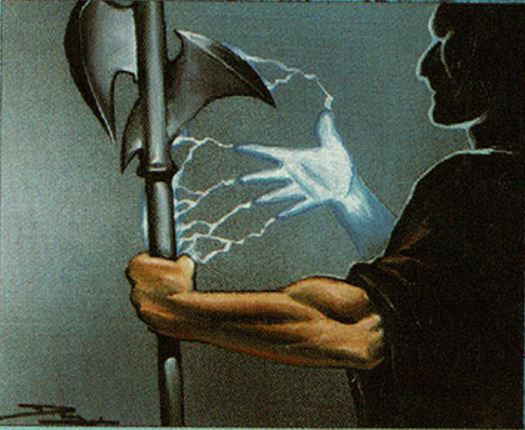
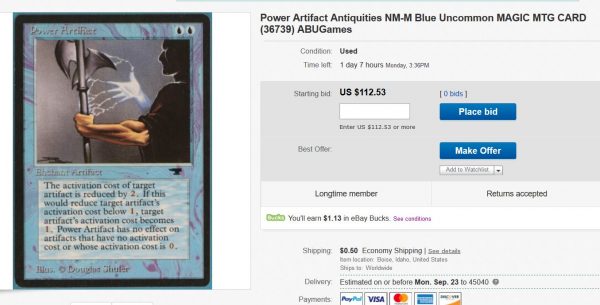
As time ticks down for the auction and no bids are placed, ABUGames may realize their listing isn’t likely to receive a bid, and they could negotiate. I’ll admit I’ve tried this a few times in the past, and in general they don’t accept offers below the starting bid price. In the example above, an offer of $100 for the near mint Power Artifact wouldn’t be accepted. But $112 may be. They haven’t gotten a bid in the auction’s first six days, so maybe they’d be content to sell it immediately at around that starting bid price.

There was an error retrieving a chart for Power Artifact

Or, if you’re feeling lucky, you could throw this card on your eBay watch list and wait for the auction to expire without a bid. Shortly thereafter, ABUGames will re-list the card with a slightly lower starting bid. In Dutch Auction style, you could wait for a price you’re happy with. It’s another great way to score deals on eBay during this time of weakened demand. Plus, sometimes you can get cards from ABUGames' eBay store for such a good deal, that you could immediately ship the card BACK to ABUGames for 50-75% higher store credit, which can in turn be used to acquire their less overpriced stock of cards. I don't make the rules, I just exploit them!

Tip 3: Have You Checked Facebook Lately?

For a while, I had ignored the High-End group on Facebook—it seemed like the sales group was riddled with Masterpieces and pre-Modern booster boxes. At least, that was my perspective.

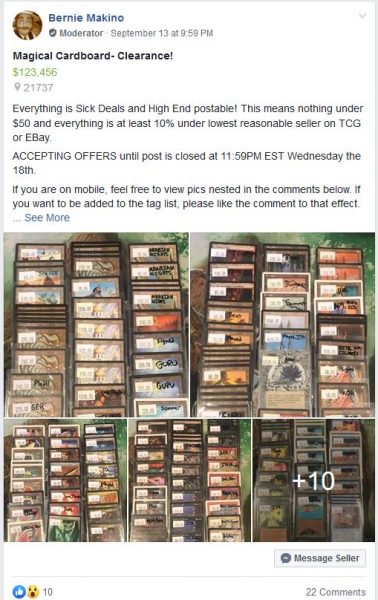
Now the Facebook group looks completely different. It’s an Old School player’s paradise—it seems every other listing is filled with Alpha, Beta, and Unlimited cards, along with Dual Lands, Power, and heavy hitters from Magic’s earliest expansions. Case in point, here’s the first post that shows up when I visited the site this morning:

Bernie is a well-known vendor who runs Moose Loot, a Grand Prix staple. Notice anything interesting in the sale post? In this one, he’s explicitly stating his willingness to negotiate. His prices are usually already decent, but he’s willing to beat the market in order to liquidate some of this inventory. That eagerness to sell is your opportunity to acquire cards on the cheap!

This isn’t the only post filled with deals. As I browse the Facebook page, I see post after post filled with high-end Old School cards—cards that were once impossible to find at competitive prices. The market’s weakness has truly manifested itself on Facebook, and there are deals to be had if you’re willing to browse through them and purchase from individuals.

I’d recommend sticking to the major sellers, like Bernie, and you’ll receive the same great customer service as you’d get from Card Kingdom and ABUGames.

Wrapping It Up

While it’s true the Magic card market is a little soft right now, especially for Old School cards, it doesn’t mean one can shop around and blindly purchase any cards; not if they’re on a budget and on the hunt for deals (and who isn’t?).

Only some vendors have embraced the current reality and decreased their prices accordingly. Card Kingdom has begun deflating their prices in response to dwindled demand, but some of the best deals can be had from their eBay store. ABUGames is another great example—the pricing on their site is as inflated as ever, but their eBay prices are far more competitive. In Dutch Auction style, you can wait for them to re-list the same auctions over and over again, continuously dropping their prices little by little, until you see a price you’re happy with.

In both eBay cases above, I encourage you to leverage the opportunity to make offers on their listings. They’re quite reasonable, and you’d be surprised with what offers they’ll accept. It doesn’t cost anything to at least try, and you just may get that deal you’re looking for.

If eBay isn’t your jam, then I’d encourage you to check out the High End Facebook page. Once a fruitless endeavor, it’s now worthwhile to window shop there looking for deals. Some fairly well-known vendors sell cards there, so you can buy from them confidently knowing the cards will be authentic and as described.

No matter who you’re buying from these days, it’s wise to make offers rather than pay sticker price directly. Vendors are overloaded with Old School cards, and may be motivated to cut down on this slow-moving inventory even if their margins suffer. Cash is king, and liquidity is absolutely critical for these larger vendors to remain healthy and in business. Therefore, this is your license to go after deals in the hopes of acquiring pieces for your decks that were once out of reach.

...

Sigbits

  • Card Kingdom brought Volcanic Island back to their hotlist, with a $310 buy price. This is interesting considering their other Dual Land buy prices aren’t too inspiring. The disconnect in my mind is this: vendors aren’t paying well on duals right now, but any time I list one on Twitter at TCG low minus 10%, they sell within minutes. Clearly there’s demand for these, and I’m wondering why vendors insist on maintaining higher price points.
  • Arabian Nights Serendib Efreet is back on Card Kingdom’s hotlist. While their current buy price of $270 isn’t their best offer to-date, it’s still an improvement. This goes to show that the most playable Old School cards have held up better price-wise as compared to the less-than-playable counterparts.
  • Here’s something new on Card Kingdom’s hotlist: Guru They are paying $235 for the promotional basic land. They’re paying $225 for Guru Forest, but they don’t currently have a buy price offer for the other three basics. Food for thought.


Chapter 2 in Throne of Eldraine Spoilers

Are you a Quiet Speculation member?

If not, now is a perfect time to join up! Our powerful tools, breaking-news analysis, and exclusive Discord channel will make sure you stay up to date and ahead of the curve.

Throne of Eldraine spoilers are now fully underway. While David dissected the set's mechanics earlier this week, today's post reviews the cards themselves to see how they might fare in our shifting Modern format. It also revisits an old brew of mine using a certain exciting newcomer. Let's dance!

Certain Playables

So far, four cards stand out to me as clear includes in existing Modern strategies.

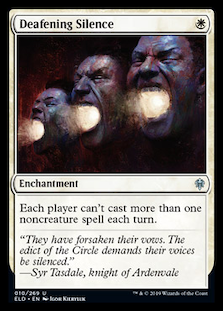
Deafening Silence

Which strategy does Deafening Silence fit into? Not-Storm, Not-Phoenix, Not-Whirza. But anyone looking to beat these kinds of high-velocity, spell-based combo decks should consider the enchantment for their sideboards. It's white, sure, but so are most of the format's best sideboard cards. And at just one mana, Silence provides a definite improvement over the previous best-of-breed, Rule of Law, whose ability to slow creature onslaughts isn't so relevant in a format where decks looking to dump many bodies onto the field are trying to have you dead by the time Rule can even be cast.

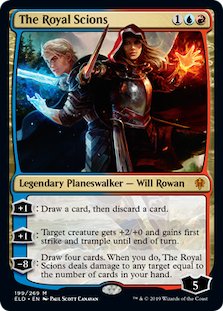
The Royal Scions

After Wrenn and Six, Modern players may be a bit spoiled, making it tougher to evaluate new planeswalkers fairly. But I think The Royal Scions is nonetheless pushed for its mana cost, and will see play in decks that don't need their planeswalkers to come down and immediately protect themselves. It's a hard-to-remove card filtering engine mixed with Ancestral Vision, as three turns after cast, the Scions' ultimate threatens to bury opponents in card advantage—and damage. Expect Blue Moon to sleeve these up for sure, and for other Izzet-colored decks to consider Scions as a bullet for the grindy post-board games where Saheeli or Keranos can shine.
Charming Prince

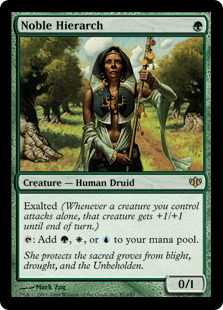
Charming Prince is indeed a Human, but that deck is so stretched for space the 2/2 might not make it there. Instead, I expect Prince to make waves in the new set of Blink decks ascending online. While none of Prince's effects are especially impactful, repeating any one of them over multiple turns should prove deadly in the right matchup. And the creature combines quite a bit of utility on one card, offering synergy, card selection, and help during a damage race.

Once Upon a Time

On to my favorite card of the set. A series of memes I've seen on social media lately compare Once Upon a Time to Ancient Stirrings, alternately arguing the card will break Tron or replace the one-mana cantrip when it's inevitably (their word, not mine) banned.

But I don't see Time excelling in Tron, where unlike Stirrings it can't find many payoffs; besides, that deck is already in the habit of aggressively mulliganing into its lands, so settling for a free Ancient Stirrings isn't really in the cards.

Rather, the two decks I expect Time to revolutionize are Eldrazi decks and mana dork decks. The former are always in the market for another copy of Eldrazi Temple, and are made up of mostly creatures anyway. In GR and GW Eldrazi, for instance, Time has about as many hits as Stirrings, and I'd rather grab Bloodbraid Elf or Stoneforge Mystic than a mana rock.

An eternal struggle of mana dork decks is how much better they are when starting with a dork on turn one. Of course, they also need a payoff spell, and a second land to ensure ramping to three mana on turn two should the dork live. Once Upon a Time helps on all fronts, helping what are already often combo-focused decks assemble their pieces quickly and efficiently. Devoted Druid combo decks seem like the scariest shell for Time so far.
Possible Crossovers

Throne of Eldraine also includes plenty of cards that appear interesting on the surface, but may or may not make it into Modern as full-timers. These cards might already have homes, but at the cost of competing with established options for space. Their inclusion depends mostly on how the metagame shakes out.

Midrange

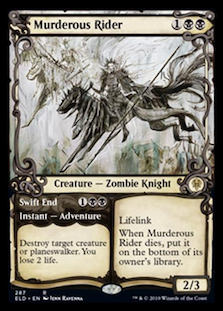
Murderous Rider: BGx decks ran Hero's Downfall years ago. Nowadays, the card is better suited to greenless black decks, as Assassin's Trophy fills up the flex removal spots in Golgari, Jund, and Abzan. Grixis Control, UB Faeries, and Mono-Black are all lower-tier contenders that should appreciate the upgrade to Rider, a Downfall that turns into a creature after use.
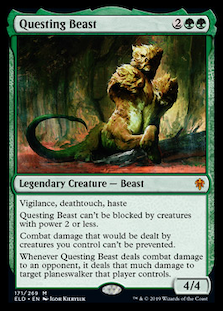
Questing Beast: As far as Throne's pushed creatures go, Beast takes the cake. But its Modern viability is up in the air. Beast has uses against Jund and UW, decks that frequently hide behind Liliana of the Veil or Teferi, Time Raveler on turn three. Answering these walkers with Beast requires pilots to be ahead on mana and to have Beast at the right time, which may be too many demands; on the other hand, the card might slot into mid-size beatdown decks like Zoo as a curve-topper.
Artifacts

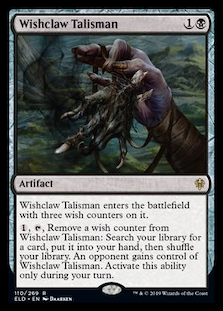
Wishclaw Talisman: With Whir of Invention-fueled combo decks on the rise, and Karn, the Great Creator increasingly relied upon as a finisher for any mana-generating strategy, Wishclaw may find a home in Modern. It turns both cards into tutors for any card in the deck, but players will need to find ways to capitalize on the search in a game-winning way for that to be enough.
Emry, Lurker of the Loch: Remember Blue Steel? That and other fringe artifact decks may find a friend in Emry, an easily castable grinding engine. For my part, I'm eager her alongside Mishra's Bauble, Mox Opal, and Mox Amber to rush out some planeswalkers.

Tribal Aggro

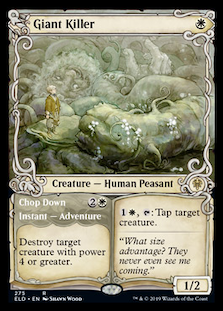
Giant Killer: Killer may prove a bit niche in the end, but the utility of a one-drop Human that keeps an opponent's best combat creature at bay while offering the upside of sniping another one gives it potential in certain metagames. After all, we saw Big Game Hunter rear its head in Death's Shadow-dominated Modern. If GW Eldrazi really is on the precipice of a format takeover, a creature that handles Batterskull tokens and Reality Smashers at once may have its day.
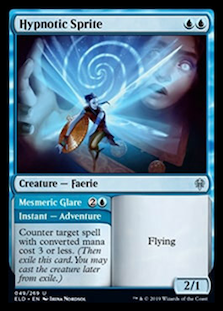
Hypnotic Sprite: Another adventure creature, Sprite's front end is a bit pricey for traditional Modern play. The card could find more luck as part of a Faeries deck, though, as an all-in-one Snapcaster Mage, disrupting opponents and applying pressure without relying on the graveyard.
Synergy Helpers

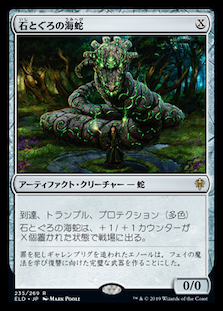
Stonecoil Serpent: Serpent enters with X +1/+1 counters, and has reach, trample, and protection from multicolor. Endless One and its ilk saw fringe play in Bridgevine strategies before Hogaak warped them into a format-destroying menace, but otherwise hasn't done much in Modern. Serpent is a clear improvement for decks not on Eldrazi Temple, though, and should more functional 0-drops be needed somewhere, its addition of keywords should outweigh the supposed fragility of artifacts. After all, Kolaghan's Command won't save players from the Snake.
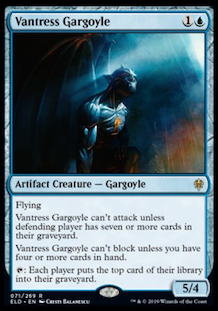
Vantress Gargoyle: Undercosted beaters are my favorite kinds of Magic cards. This latest one utilizes a peculiar resource—cards in an opponent's graveyard. I'd write off Gargoyle immediately if not for Jace's Phantasm, another card with a similar function and requirement. Perhaps the two of them together could amount to something. In any case, I'll be testing to find out!
Bonus Brew: Rogue Runners

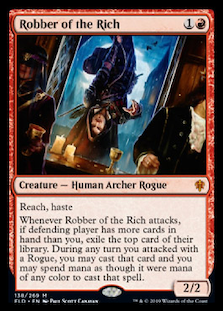
There's one mythic-rare creature I left out of the tribal aggro section. Is Robber of the Rich actually red's pushed two-drop? I sure hope not; in that case, it would invalidate my latest brew, Five Guys!

Robber has a creature type that I'm always looking for on new spoils: Rogue. I used to believe that enough playable rogues would turn Thieve's Fortune into a forgivable cantrip, and one that turbo-charged Tarmogoyf at that. As such, I've brewed many decks featuring those blue and green cards.

Throwing red into the mix for Robber complicates things quite a bit, although my first two drafts of Rogues were indeed Temur-colored. I brewed that in pre-Fatal Push Modern, and before we received some critical one-drop enablers in Faerie Miscreant and Fourth-Bridge Prowler. Their addition moved the deck into Sultai.
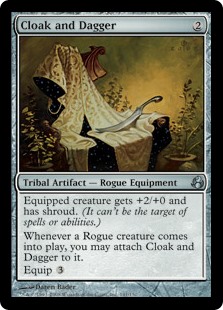
Then there's Stoneforge Mystic. When the card was unbanned, I toyed with the idea of splashing the 1/2 into Rogues as a Plan B with some gusto as well as a way to tutor up Cloak and Dagger. The equipment overperformed with cheap fliers like Miscreant and Faerie Impostor, but locating it early meant running multiple copies, which made the deck softer to enemy proaction and established boards. As part of a package that also insulated the deck from aggressive starts, Cloak appeared more promising.

Adding both Robber and Stoneforge meant going back to five colors. But as demonstrated by Five Guys, I ain't skeered, especially when it comes to carving out a proof of concept.

Roguenbogen, by Jordan Boisvert

Creatures

4 Faerie Miscreant
4 Fourth Bridge Prowler
4 Tarmogoyf
4 Stoneforge Mystic
4 Robber of the Rich
1 Faerie Impostor
1 Spellstutter Sprite
1 Snapcaster Mage

Planeswalkers

3 Wrenn and Six

Artifacts

1 Cloak and Dagger
1 Sword of Fire and Ice
1 Batterskull

Instants

4 Thieves' Fortune
2 Fatal Push

Sorceries

4 Traverse the Ulvenwald
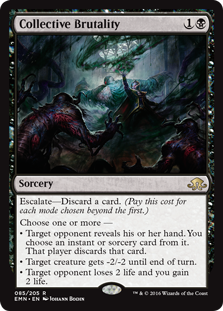
4 Collective Brutality

Lands

4 Verdant Catacombs
4 Misty Rainforest
2 Polluted Delta
1 Blood Crypt
1 Temple Garden
1 Overgrown Tomb
1 Breeding Pool
1 Steam Vents
1 Swamp
1 Island

The idea here was to throw all my new ideas together and see which colors were the most expendable. Blue and green were locked in, as the concept itself revolves around Goyf and Thieve's Fortune. So red, white, and black were all battling for dominion. Some quick thoughts on the deck after a few days of testing:

  • Collective Brutality is crucial here as a way to unclog hands, turbo-charge delirium, and interact efficiently with opponents while setting up our admittedly terrible gameplan.
  • Fire and Ice tested better than other swords given our density of fliers and need to interact with the board while attacking.
  • Impostor, Spellstutter, and Snapcaster were all invaluable as Traverse targets.
  • Wrenn and Six helps assemble all our colors and attacks opponents from a novel angle. The walker provides another draw to red.
  • Prowler is quite hit-or-miss in this metagame. Another one-drop Rogue in a color other than black would make abandoning the color altogether a possibility. We could use Bolt as cheap removal, but would need a replacement for Brutality.
  • The Stoneforge plan was obviously very useful in its own rite, but it's far from flavorful. Nevertheless, having such unconditional access to Cloak and Dagger put serious hurting on attrition decks. Should we get more cards along Robber's lines, we could maybe ditch white and ramp Cloak's numbers back up again.

As for Robber itself, I was impressed with the card, but I don't think it will see mainstream play. Asking to connect with a Rogue is all but impossible for most Modern decks, meaning if Robber dies, the cards it "drew" while alive won't be of much use. Naturally, its utility depends on the kind of deck opponents are on, but against anyone playing fair, I found the 2/2 surprisingly adequate.



Reclaiming the Throne

After all the buzz surrounding Modern Horizons, Throne of Eldraine seems on track to remind format aficionados that Standard, too, can provide plenty of playables. Which new cards have you tinkering?

So You Want to Build a Cube: A Card Kingdom Starter Cube Review for 2019

Are you a Quiet Speculation member?

If not, now is a perfect time to join up! Our powerful tools, breaking-news analysis, and exclusive Discord channel will make sure you stay up to date and ahead of the curve.

Last year, I wrote a review of Card Kingdom's Starter Cube, a 360-card cube with 35 of each basic land and enough sleeves for the whole set, all for a price of $99.99. While we can expect a product like this to not be packed with financially valuable cards at this price, I do believe the set can be a perfect starting point for someone looking to begin building their own cube. Card Kingdom has iterated on its starter cube some number of times now, and it recently became clear a new review was warranted for the Starter Cube Redux.


In general, I'm impressed with this list. Just scanning through, this cube is absolutely packed with commons, uncommons, and even a few rares that I recognize as high draft picks in various Booster Draft formats or even as staples of high-powered Cube formats. The addition of uncommon planeswalkers to Magic adds a lot of power to the list as well.

Let's start with the rares in the set:

Card Kingdom Starter Cube Redux Rares


More than 10 percent of this list, 43 cards, are rare. None of them are worth much more than bulk, if that, but most of them are powerhouses in their respective Draft formats, and there are even a few Commander-playables on this list. There are no mythic rares in this iteration of the Starter Cube.

If you're aiming for a high-powered cube akin to the MTGO Vintage or Legacy Cubes, 23 cards are in one or both of those lists:

Cards in Common with MTGO Vintage/Legacy Cubes


Sure, there's not much financial value here, but a lot of these cards are very high picks during draft – particularly the counter, draw, and burn spells and mana dorks.

Approaches to Make this Cube Your Own

You could purchase this product and leave it exactly as it is designed. It looks like a decently fun list and it would let you play with other people without having them own their own cards. For most readers, though, that just simply won't do. There are many ways one could upgrade or streamline this cube list, but I see three distinct approaches that make a lot of sense to me:

1. Make It a Pauper or Peasant Cube

Pauper cubes contain only commons, whereas Peasant cubes, also referred to as "c/ubes", contain commons and uncommons.

In this case, by removing the 43 rares listed above, you've given yourself a very inexpensive and mostly straightforward task – find 43 commons and uncommons that fit in with this cube's supported archetypes to fill those slots. You probably already own these cards, meaning that you can have a playable and powerful Peasant cube for the price of this product alone. You can keep this strictly as a common/uncommon cube, making upgrades inexpensive for the entire time you continue to maintain your cube.

Going the Pauper route will take more initial work to get something playable set up, but it will make those upgrades even cheaper over time. Both of these cube designs also offer another intangible worth considering: minimal worry around other people playing with your cards.

2. Use It As Your Starting Point for a Traditionally Powerful Cube

This will be the lengthiest and most expensive option, but it's also probably reflective of why most people get into Cube in the first place: the chance to play with Magic's best and most beloved cards.

You're not starting with a ton here. You're likely going to want to replace all but the above 23 cards in common with the Vintage/Legacy cubes (and you might even want to replace those!). The good news is that you can play with the cube while you develop it. Each time you add 10 or 20 new acquisitions to your list, you will feel the power level of your cube increase and witness the games get more outlandish. It can be a project that lasts as long as you continue to play Magic, constantly tracking down new cards.

In truth, people going this route are probably least likely to find the Card Kingdom Starter Cube a good bargain. Sure, you'll get a few hundred decent Ultra Pro Black Gloss sleeves, which would probably cost you roughly $30, but you'll probably want to get better sleeves when you start adding truly expensive cards to your list, and you're going to ultimately be planning to upgrade virtually every card here. There's also no guarantee that the good cards that do come in this product will be from the sets you would choose if you just ordered the cards you wanted yourself. If you want to lovingly craft your cube from scratch, this is probably not where you want to start.

3. Make It a Draft Nostalgia Cube

As I said above, this list is packed with a number of cards that were among the best commons or uncommons in their respective sets for Booster Draft. The rares in this list also include a ton of Booster Draft bombs that never really broke through in any Constructed formats.

If you're a player who has loved drafting for a long time, this product is a perfect opportunity to craft a draft set that includes cards you once loved to play but haven't had the opportunity much (if at all) since those sets stopped being drafted. Here are just a few examples from this list of cards I would personally put in that category:

Cards I Enjoy(ed) Playing in Draft but Not Much Since


There are plenty more. Not all of these are completely unplayable in more powerful cubes, but I don't see them in most highly tuned lists. I do think, however, the idea of a cube that recreates and combines various fun drafting experiences one has had over the years could have a lot of value to a draft-centric playgroup. That's going to look different for everyone, but I'd be surprised if this list didn't have some number of cards in this category for just about every player.


The Card Kingdom Starter Cube remains a solid product to get players into the Cube format. If you want to start cube drafting with your playgroup as soon as possible, I can't think of a better way to get started than this. It's not the type of product that has appeal for established cube owners (unless starting a new cube where this would address a lot of the starting goals) and certainly not for speculators, but not every product has to be for you or me.

Yes, you could build the same product yourself by individually purchasing everything, but don't do that. It undervalues your time for savings that are going to come out to well less than minimum wage – and to be honest, I can't say with confidence that you could build this cube on TCGplayer for less than $99.99 (nevermind the boxes, sleeves, and lands included).  I'm not inclined to build a shopping cart for it, but if you are, it would be interesting to learn what you find in the comments.

What do you think about this product?

Core Set 2019: Our Final Preparations for Rotation

Are you a Quiet Speculation member?

If not, now is a perfect time to join up! Our powerful tools, breaking-news analysis, and exclusive Discord channel will make sure you stay up to date and ahead of the curve.

Rotation is less than three weeks out for Arena (September 26th) and four weeks for paper Magic (October 4th)! If you haven't already, now is the time to be crafting your watchlists for rotating cards and set your target buy-ins. Assuming history repeats itself, the paper price of most cards from Ixalan, Rivals of Ixalan, Dominaria, and Core Set 2019 will fall as we head into the release of Throne of Eldraine and bottom-out within 4-8 weeks from there. Eternal playables will touch their low-points then begin a rebound upwards until they are reprinted. Be ready!

If you are into Commander and haven't already done so, please go check out the other three articles I wrote for this mini-series. I covered each rotating set in chronological order with this being the fourth and final installment of the series.

Core Set 2019 is quietly one of my favorites of the past 10 years, mostly because of the way Wizards revisited the lore of the original Elder Dragons. The Magic storyline tied to Core Set 2019 covers the birth and aging of my two favorite characters of all-time: Nicol Bolas and Ugin, the Sprit-Dragon.

There was an error retrieving a chart for Nicol Bolas

Unsurprisingly, the set includes Bolas and his kin, but sadly Ugin did not get included with a creature card (I am so wishing this happens someday!). The way Wizards designed Nicol Bolas, the Ravager as a flip card transforming into a planeswalker was simply marvelous. It showed me even with their smaller sets they pay close attention to detail.

Supply Considerations

Core Set 2019 was delivered quietly last summer where it competed with its standard brethren Dominaria (one of the best selling sets of all-time); Battlebond (a huge hit in its own right); and Commander 2018 (more of a casual product, but a product nonetheless).

I don't have sales data on the sealed product to back this up, but my hypothesis is that this expansion was lesser sold compared to its peers and that could lead to a smaller supply of cards than we are used to with Standard sets.

If true, this could make the price of playables from Core Set 2019 rebound faster after rotation than some of the more widely distributed sets in recent memory. Without any significant chase cards in the set and no Masterpiece Series to bolster the desirability of cracking sealed product, I feel this product was under-opened by stores and players alike. As cards find their way into Commander decks, the lower supply could be felt in the secondary market and the Eternal playable cards could rebound quite a bit faster as a result.

While I cannot confirm this in a truly meaningful way, I decided to factor in a small premium to my timelines for prices to rebound after rotation (note: I feel similar about this with Ixalan and Rivals of Ixalan).

Chris's Commander Corner

There was an error retrieving a chart for Nicol Bolas, the Ravager

I said earlier that there weren't any notable chase cards from Core Set 2019; Nicol Bolas, the Ravager is about as close as it comes, though. An iconic character printed in a throwback manner to the Magic Origins flip walkers, this Bolas card was fortunate enough to dodge From the Vault: Transform meaning a reprint could be particularly elusive in coming years. Furthermore, with Bolas's storyline presumably over (for now), the only real opportunity to reprint a flip card like Nicol Bolas, the Ravager would be in as a promo or in a supplemental set.

I chose Nicol Bolas, the Ravager as my top target to acquire post-rotation because of its reprint situation and because it makes for a very fun commander. From my experience, the EDH community particularly enjoys foiling out their commander which makes Nicol Bolas, the Ravager foils especially attractive.

Investment Plan - I

I'll be aggressively targeting copies of Nicol Bolas, the Ravager for personal use and to have it in inventory. I anticipate adding these to my watchlist until the non-foils come down to the $5-6 range and foils hit $20-22. It could take until December for these prices to hit, but I plan on being patient given the minimal play Nicol Bolas, the Ravager sees outside of EDH. Copies will vacate binders for weeks after rotation, but not more than a couple months after the prices hit their floor will Nicol Bolas, the Ravager turn into a fantastic long-term hold.

I am anticipating Nicol Bolas, the Ravager foils to retrace back into the $40+ range by Spring 2020 with the non-foils moving back to $10-12 in the same timeframe. The multiplier for foils will be higher than usual simply because of it being a playable general in EDH (it is approaching 1,000 decks already according to EDHREC).

There was an error retrieving a chart for Arcades, the Strategist

One of Nicol Bolas's brothers takes the second spot on my rotation watchlist for Core Set 2019. Arcades, the Strategist is a hard card to evaluate from a price-point perspective because it sees play in so many places.

First off, casuals like myself loved when Arcades was first spoiled because building a "walls" EDH deck was too unique and fun to pass up. Additionally, plenty of players in Standard have made budget Arcades decks which haven't been competitive enough to win major events but made plenty of showings during Friday Night Magic. Even Saffron Olive hopped on the Arcades train with his Against the Odds series running a build in Modern.

You can see the EDH impact on the price when looking at the current foil multiplier (almost 5x) compared to the non-foil counterpart. This tells me that foils will be harder to come by within as little as six months because so many copies are already sleeved up and ready for the Command Zone. Commander players won't be selling their foil copy at rotation thus supply won't refill nearly as much as other rotating cards.

Investment Plan - II

I estimate foils could get down to $10 but I cannot imagine a scenario where it goes any lower than that. If you can find LP or better copies for that price, scoop up a few and hold them for six months with an expectation that you'll be able to move them at $15-20 by Spring 2020.

Given the possibility of a reprint in a supplement set, I am avoiding the non-foils. Worth noting that Arcades is mythic, so a reprint in a Commander precon would likely be done at mythic as well and thus foils wouldn't be safe, either.

There was an error retrieving a chart for Cleansing Nova

As the world of EDH goes, so do board wipes. And as many content creators for EDH will tell you, board wipes are a dime-a-dozen these days, so what makes Cleansing Nova special?

Flexibility.

Destroying creatures is built into hundreds of cards, but the choice to destroy all artifacts and enchantments makes Cleansing Nova one of the best utility board wipes in all of Commander. The best comparison I could find is Austere Command which costs one more mana to cast and $5 more to buy. Granted the flexibility of Command is a bit higher than Nova, but it is also one more mana and at the end of the day redundancy is king in EDH.

Players seem to agree with my assessment of Cleansing Nova because it ranks as the most-played card in commander from Core Set 2019 according to EDHREC.

Investment Plan - III

I love acquiring non-foils of Cleansing Nova at its current $0.50-$0.75 price. I don't see this card dropping too much further from its current price. It'll be a tough card to keep in stock for vendors, but it'll also make for a relatively easy reprint in due time. We should be safe for a little while though with Core Set 2020 and the commander precons behind us. Cleansing Nova did get the "Promo Pack" treatment recently, but that supply is so small I see it as negligible to the price trajectory over the next 6-12 months.

I personally plan on grabbing foils at their current $2 price-point. I have my eye on some lightly played copies already and am monitoring supply in September to see if more come online before I pull the trigger. These don't stand to drop much more even if a little supply is added to the market because of how well they sell. Looking at CardKingdom, they are already selling NM foil copies for $3.49 and I won't be surprised to see this jump to $4.99 within six months.

Additional Watchlist Targets

Here's a shortlist of additional uncommons and rares I have added to my personal watchlist. As usual, I am focusing on foils and here are my targets for each card:

  1. Psychic Corrosion: in at $2 (NM foil) and targeting $5 exit in 6-12 months. It is a mill wincon for wheel decks making it very appealing at the kitchen table and viable in a few EDH strategies as well (ex: Niv-Mizzet, Parun).
  2. Poison-Tip Archer: in at $2 (LP foil) and targeting $5 or buylist exit for comparable value in 6-12 months. Elves are always among the most popular tribes in any format, so any sort of hype around them would bode well for Poison-Tip Archer. Furthermore, the Aristocrats strategy has been pushed a lot in recent sets and it shows with foils already in low supply on TCGPlayer (two pages at time of writing). I won't be surprised to see supply for this come back online first before it makes a push higher towards $5. Full disclosure: I purchased two LP foil copies for $2/each.
  3. Liliana's Contract: in at $1.50 (NM foil) and targeting $5 or buylist exit for comparable value in 3-6 months. The fact that this card says "you win the game" on it is immediately enough to make it actionable. Pair that with the Demon creature-type and the flavor to Liliana's storyline and we have a home run. The art is wonderful, too, which will only further help its case in foil. I expect to sell these fairly quickly given the popularity of demons, Liliana, and the historically-strong appeal of "you win the game" cards.
  4. Mirror Image: in at $1 (NM foil) and targeting $3-5 or comparable buylist value within 3-6 months. Shapeshifters have been exceedingly popular recently thanks to Modern Horizons. Additionally, the fact that Mirror Image is just a straight upgrade to Clone bodes well for its long-term price trajectory. I picked up 8 copies of this at the aforementioned $1 price-point and don't anticipate there being any issue reselling those. I don't like non-foils for a few reasons, however. Mirror Image is at uncommon so supply is larger, and the reprint risk always looms for a card like this.

Wrapping Up

There you have it! We've done four sets in eight weeks and the primer for rotation is complete. If you haven't already, leverage the "save for later" feature on TCGPlayer or comparable websites and set up your cart for when the prices on rotating cards make sense to you. As a final reminder, rotating cards typically bottom out between 4-8 weeks with the most played cards typically bottoming a little sooner. Cards that have commander appeal will begin to climb in price again by this winter and a full rebound (including them possibly being worth more than they were in their Standard lifetime) is likely for many of the cards I called out by Spring 2020.

These cards are all out-of-print at this point, so the supply that is in the wild is all we have to work with now. Remember that as you evaluate cards, and remember aside from Dominaria these rotating sets were opened less than recent Standard sets have been due to the missing "lottery" (Masterpieces) aspect.

If you have any questions I can help with, please feel free to reach out on QS Insider Discord or DM me on Twitter. Thanks for reading!

Mechanical Fancy: Eldraine Spoilers, Week 1

Are you a Quiet Speculation member?

If not, now is a perfect time to join up! Our powerful tools, breaking-news analysis, and exclusive Discord channel will make sure you stay up to date and ahead of the curve.

This has been an utterly insane summer for Magic. Three set releases in close proximity, followed by Hogaak, and then a major banlist update. Modern players are struggling to remember what it means to have a metagame, much less investigate one. We've barely had time to catch our breath for the past four months, and now it's time for another spoiler season.

Thrones of Eldraine spoilers have just begun, and this is a very promising set. Not that Modern actually needs new cards after Modern Horizons, but that also isn't quite what I mean. Eldraine is being billed as a watershed set for Magic. The setting is based on fairy tales, primarily Grimm ones, and that's something players have been requesting for years, which means lots of interesting cards that have likely been ruminating for a long time. It's also a set with the first Magic book in years, and more importantly several types of boosters. In addition to the normal packs we've been used to since the beginning of the game, there's also color-themed packs and a collector's version, which has alternate-art cards. This means many cards have been spoiled twice so far. Thus, I'm focusing on the mechanics of Elraine alphabetically, rather than on specific cards.

Adamant

The first mechanic is Adamant, which is effectively scaled-down devotion. If you cast an adamant card with three mana of its color (i.e. a white adamant spell needs three white mana), you get an extra effect. At time of writing, there are no Modern-playable cards with adamant. However, should there be one, it will see a considerable amount of play.

Adamant is clearly meant to promote mono-colored decks in Standard, but the only reason that would happen in Modern is an aggressive white creature. Modern's mana makes it possible for Esper Control to run Cryptic Command alongside Damnation and Settle the Wreckage if so inclined. Therefore, a decent adamant spell could be run in any deck that wants it and is at least somewhat on-color. For example, a playable adamant blue instant could be run in anything from Merfolk to Grixis Control with very little burden, and the expectation that it will get the bonus almost every time. I expect that the front of such a spell can be a bit weak if the enhanced version is solidly playable.
It will take quite a bit for any non-white adamant creature to see play. The bar for creatures in Modern starts pretty high, and there are already a lot of creatures with heavy color requirements and considerable compensating power that don't see play. Phyrexian Obliterator is very dangerous to play against, but there's no deck that can actually harness its power. A similar mono-blue creature would be operating in Merfolk's space, while a red one would compete (probably unsuccessfully) for a slot in Burn. Death and Taxes-style decks have the flex slots to make such a creature work and could use some raw power for when their disruption isn't effective. We need to wait and see what shakes out.

Adventure

The apparent centerpiece of the set, adventure is a unique hybrid of previous mechanics. A creature with adventure is a normal creature that has an instant or sorcery attached to it. If cast it as a creature, it just enters play that way. If players cast the instant or sorcery, upon resolving, the card is exiled. You can then cast the creature. This is a spell with a choice (modal), a creature that can play like a spell (evoke), and additional value from replaying the card (flashback). Spells with lots of utility and versatility are often Modern-playable even if their effects aren't the strongest in a vacuum (see also: Collected Brutality). The question is which side of the adventure spell is the attractive one.

Rewarding Curiosity

The first casting mode is for the instant or sorcery to be the desirable effect. Here, the creature is a bonus that decks may not actually need. At time of writing, the only playable adventure cards are in this category. The effects are a bit weak on their own, but in the right deck or circumstance could be good enough. Getting a body out of the deal makes them more attractive than otherwise.

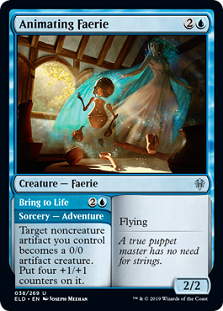
Animating Faerie: I don't know why any deck would want to make their noncreature artifacts into 4/4s. Tezzeret, Agent of Bolas makes 5/5s repeatably and sees no play. However, Ensoul Artifact has been run in Affinity before, and Bring to Life is arguably better. Yes, the creature is smaller and the effect costs more, but it also doesn't stop being a creature if the enchantment falls off. An Animated Darksteel Citadel doesn't fear Assassin's Trophy, where an Ensouled one does. And at the end of it all, you get a 2/2 flier to wear Cranial Plating. If artifact control gains ground or grinding becomes more important, I expect Faerie to start making it.
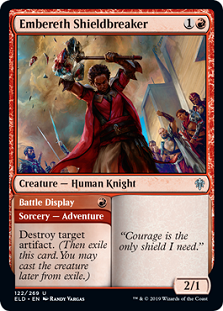
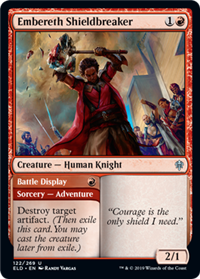
Embereth Shieldbreaker: Against any artifact heavy deck, Shattering Spree or Vandalblast will be much better than Battle Display for the same price. However, there will be plenty of times where such cards are overkill. If instead you want cheap, maindeckable hate, then Shieldbreaker is better than any other option I can think of in mono-red. There's also the benefit that against decks with only a couple artifacts (*cough* Stoneforge Mystic), Shieldbreaker isn't a dead card if they never play the artifact. A 2/1 for two isn't a great deal, but having the option to destroy a Batterskull first is.
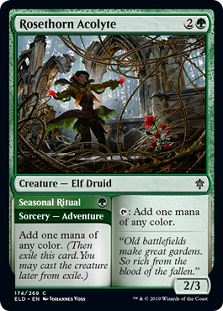
Rosethorn Acolyte: Seasonal Ritual is Manamorphose's little sister, and Manamorphose is an absurd card in velocity decks. However, it's mostly been played in red combo decks, and mostly because it cantrips. Ritual has to be played in green decks and doesn't replace itself right away, but it is still a "free" spell, and fixes mana while upping the storm count; the velocity of Manamorphose is gone, but Ritual doesn't technically go down a card, since Acolyte can then be cast from exile. Acolyte isn't too far off Modern playable as-is thanks to being an elf, so I could see a some UG combo using Ritual to fix mana, then Acolyte to help ramp. The only current deck that fits the bill is Neoform, where Ritual would be extra fixing, with Acolyte available as the consolation prize for a failed combo attempt. If a Heartbeat of Spring combo ever emerges, Acolyte may fit right in.
Alternate Route

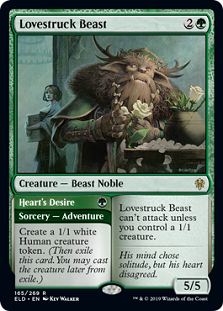
The other possibility is for an adventure creature to be playable on its own, and the adventure part to provide the bonus. As of this moment, there aren't any examples in this category. Lovestruck Beast is close, but is too conditional; no deck wants to make a 1/1 Human token for G.
Even beyond that issue, what decks want a 5/5 for three with downside? Aggro decks like Humans may play 1/1's, but they don't stay that small for long. Ramp decks may use Sakura Tribe-Elder, but they don't even play Wayward Sawtooth, who actually supports their strategy. Beast is very close to playable, but I think there are too many question marks.

For a card to actually make it this way, I think it needs to be in the same vein as Reveillark. The front-end creature must be good enough to make a deck. The adventure part could be something fairly niche or situational that wouldn't normally be played, but in the right circumstance is needed. It remains to be seen if that will pan out.

Food

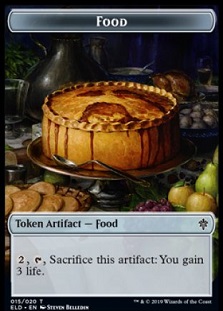
The final formal mechanic is food. Food follows on from Innistrad's clue tokens and Ixalan's treasures as token artifacts created by reasonable spells as additional value. I'm unaware of treasure doing anything in Modern because there's no good repeatable way to make treasures. Clues do see play, mostly because of Tireless Tracker. Thus on face, it will take a generator at least as good as Tracker for food to be playable.
However, it will need to be quite a bit better, since food tokens seem much weaker than their predecessors. Clues are the strongest since they draw cards; treasure is as good as Lotus Petal. But food gains three life for two mana. That's not a great rate, and while a constant stream can potentially shut out Burn, they're not going to have much impact elsewhere. However, Wizards is apparently aware of this, and they don't really expect gaining three life to be the real utility of food.

Utilizing the Means of Production

Instead, Wizards appears to have designed food as a fuel source for other cards. So far, there are some decent ways to not only make food but also use it, which could mean that it makes the transition to Modern if the payoffs pay off.

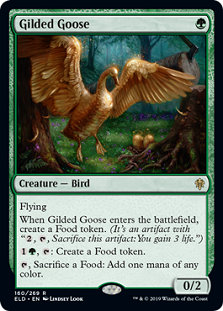
Gilded Goose: The Goose lays the Golden Egg. Then, it pays tribute to Deathrite Shaman. Bring the kids for a fun day out! In seriousness, Goose is not in the same league as the banned-everywhere Shaman. That doesn't mean that it's not still playable.
By itself, Goose can only accelerate mana once, and requires food mana to keep it going. Goose is a weaker fixer than Birds of Paradise, but it also doesn't die to Gut Shot. If there's cheap, repeatable food generation, Goose could be a decent card. If there's repeatable flickering, then it becomes a good source of food.

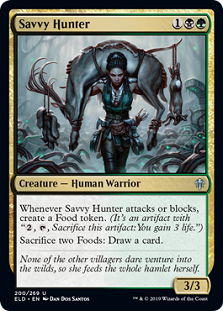
Savvy Hunter-This is more what I'm looking for. Hunter's stats aren't that great, but repeatable card draw in BG is very good (again, see Tireless Tracker). Hunter's main limitation is that she only makes one food a turn, and so can only draw a card every other turn. On her own, she's not good enough. However, pair with another repeatable generation and there's an engine here. It's still worse than Tracker since it's not self-contained, but for Tracker to generate more cards a turn requires fetchlands, which also require life payments. In a Burn-heavy meta, that's not insignificant.
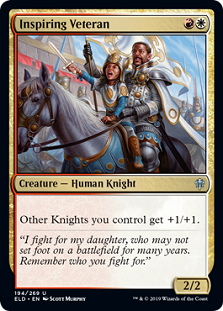
Eating Well

The other option is to feed food to a combo engine. Token artifacts are good fodder for any combo that wants to sacrifice artifacts for value. Krark-Clan Ironworks is the obvious engine, but it's banned and there aren't really good replacements. Grinding Station is the best pure combo payoff I could find, and it would take a very good token generator to be better than existing options. Urza, Lord High Artificer can make food into mana, though

Tribal

The final mechanic, though not a formal one much like in Core 2020, is the palpable tribal synergy in Eldraine. The most prevalent one is for Knights. Apparently, there's a kingdom for each color, so there may be knights for each color, but so far all the Knight support has been Mardu-colored. This presents both opportunities and a problem for the tribe.
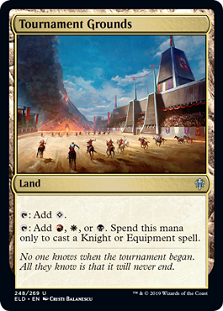
Modern is full of playable knights, and they're getting a two-mana lord in Inspiring Veteran. Given the additional fixing from Tournament Grounds, it won't be hard to put together a very solid aggressive knight deck. Many already have first strike and some form of protection or other defensive ability. Combine with the three-mana knight lords, and you produce a solid ground game of tough, mid-size creatures. Throw in Haakon, Stromgald Scourge and you've got a deck that will grind with the best.
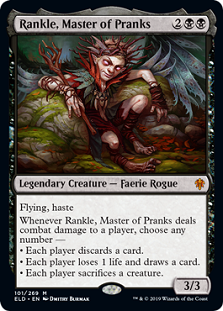
That gameplan is very similar to Spirits, who have the benefit of flight. Knights also competes with Humans, which will necessarily be a faster deck with inbuilt disruption. And there's the problem of being a Mardu deck. Why be a tribal Mardu deck rather than Death's Shadow or midrange? It's going to take some very strong knights for them to finally make the cut in Modern.

The Fair Folk

The other revealed tribe is Faeries. Having fallen far since the days of Lorwyn Standard, Faeries is a deck that seems like it should be far better than it actually is given Bitterblossom and Mistbind Clique. Exactly why this is the case depends on who you ask, but I say it's a combination of the creatures being 1/1's, Burn existing, and the deck's difficulty to master. The power of the synergies is very good, but it takes so many to compete with other decks that it's barely worth trying.

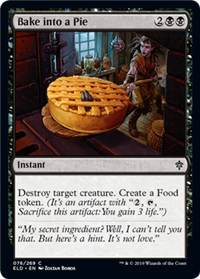
Unfortunately for the holdouts, I'm not seeing anything that pushes Faeries back into contention. Yet anyway. The best cards are too expensive and/or symmetrical to make it in Modern, while the cheap ones don't gel with the Faerie strategy. Rankle, Master of Pranks looks very potent, but it's hard to make any ability but his first benefit you more than your opponent, and why bother when there's the cheaper Liliana of the Veil? I suspect that it will take another, beefier Spellstutter Sprite for Faeries to be good again, and I'm skeptical that such a card will be made given Faerie's history.

Grimm Dawn

This is just the beginning of spoiler season. By next week, there will be far more individual cards to discuss and tales to tell. If nothing else, this is the most artistic set Wizards has ever done, and that's notable by itself.

Insider: Insights into Throne of Eldraine

Are you a Quiet Speculation member?

If not, now is a perfect time to join up! Our powerful tools, breaking-news analysis, and exclusive Discord channel will make sure you stay up to date and ahead of the curve.

Throne of Eldraine spoilers started this past week and the set is definitely turning out to be interesting, to say the least. The first thing we should cover is the new mechanics which can be seen in the following cards spoiled so far.

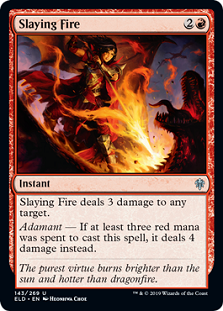
Food Tokens

The Food token creation is a very thematic addition to the set. The fact that you have to pay 2 mana and sacrifice it to gain 3 life makes it look like more of a "worse" clue token, as most players would rather draw a card than gain 3 life. The one benefit is that because gaining 3 life is much less powerful than drawing cards, it is possible for WoTC to push the mechanic more on cards. These tokens are artifacts, so there is potential synergy with previous artifact-based strategies like Affinity.

Potential Speculation Opportunities

Currently, I don't see any speculation opportunities for this mechanic at this time. We haven't seen any spells creating Food tokens that create a lot of tokens for cheap, which is what would likely play well with older artifact strategies.

Adventure

This mechanic is a bit more interesting and more complicated than the Food tokens. You can either cast the Adventure part of the card and then exile the creature part, after which you are allowed to cast the creature part from that exiled zone, but ONLY if it was exiled with the Adventure mechanic. This may be a bit of a nightmare for judges who have to differentiate between the card being exiled in this manner versus any other.

That being said, it's similar to the Flashback and Aftermath mechanics in that it allows you flexibility with your spells after they've been cast. With those two mechanics, we typically see the original spell being a bit over-costed for this flexibility.

We have seen a fair number of these cards spoiled so far and while nothing comes off as heavily pushed, I personally see some benefits to Embereth Shieldbreaker as a sort of Wear//Tear style sideboard option. It gives you the ability to take out a problematic artifact early and then serve as an additional threat later in the game when resources have been used up. This mechanic has great potential if any of the cards are pushed in power level.

Potential Speculation Opportunities

While I haven't seen anything with the Adventure mechanic that combos with anything in eternal formats, it is important to note that there are some fairly aggressively costed creatures that happen to be Knights and have this mechanic. With enough support, it is very possible we could have a Mardu Knight aggro deck in Standard. We are already seeing some movement in older Knight creatures for Commander with Knight Exemplar and Kinsbaile Cavalier trending upward.

There was an error retrieving a chart for Knight Exemplar
There was an error retrieving a chart for Kinsbaile Cavalier

A Knight that I think has a LOT of potential in a Mardu Knights Commander deck is Marton Stromgald which is a Reserved List card that provides a repeatable powerful pump effect for aggro decks. I've previously built a Commander deck with him as the Commander, enabling the deck to kill multiple opponents out of nowhere thanks in large part to him as the general.

Another potential speculation target for a Mardu Knights Commander deck is Eastern Paladin, specifically 8th Edition foils. Green is the most powerful color in Commander, so it's likely to have plenty of targets in most games. At present, the 8th Edition foil is the only foil available with the original artwork from Urza's Saga, and you can pick them up for under $2. You could also go for the 7th Edition foils, as those are still around $8 and have unique artwork.

There was an error retrieving a chart for Eastern Paladin

Adamant

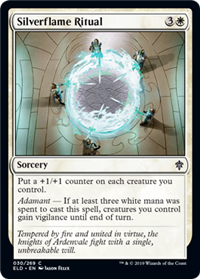
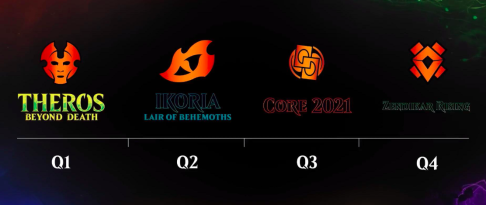
This mechanic is similar to Devotion from Theros block in that it incentivizes players to not be too greedy with their mana bases. We haven't seen a ton of cards spoiled with this mechanic yet, but the few that we already have appear to be over costed in their non-Adamant abilities and simply 'okay' with Adamant. It is important to keep in mind that Devotion was pushed hard in Theros and spawned multiple tier 1 Standard decks: Mono-Black, Mono-Blue, Mono-Red, and Mono-Green devotion. This type of mechanic could be powerful if WoTC pushes it. It's also important to note that WoTC released the set schedule for the upcoming year and the next block appears to be a return to Theros.

If we see a return of the Devotion mechanic, it's likely we will see some of the Adamant spells played in those decks.

Potential Speculation Opportunities

As this mechanic is based on the mana one puts into the spell, it stands to reason that lands that can produce multiple mana of a single color might make for decent speculation targets. As we are returning to the plane of Theros, I might be hesitant to buy any more Nykthos, Shrine to Nyx pending a possible reprint in the set. I do like the Shadowmoor block filter lands as potential speculation opportunities. They provide mana fixing when needed but also serve as a way to increase a single color of mana.

Prior to their reprinting in Masters 25, many of these lands were $20+. I especially like the ones that were printed first in Eventide as that set was less opened than Shadowmoor and there are arguably fewer of them. Interestingly enough, there appears to be almost no difference between the original Eventide printings and the Masters 25 reprints. It may be wiser to target the Eventide copies if you decide to speculate on these.

There was an error retrieving a chart for Flooded Grove
There was an error retrieving a chart for Cascade Bluffs
There was an error retrieving a chart for Fetid Heath
There was an error retrieving a chart for Rugged Prairie
There was an error retrieving a chart for Twilight Mire

Fetchable Spell Lands

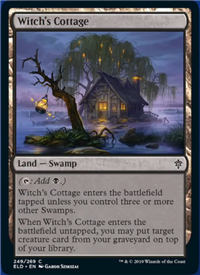
While Witch's Cottage isn't absurdly broken, lands that have spell abilities are always something to keep an eye on. Even more important, just like the Shadowmoor cycle (Mistveil Plains, etc) this land can be fetched out, which is something to keep in mind. It's also important to note that the Shadowmoor cycle always came in tapped, which is definitely a deck-building cost, whereas this land can come in untapped later in the game.

Potential Speculation Opportunities

As we only have one of these lands currently spoiled, I wouldn't speculate on anything just yet. If we get one that is clearly pushed, picking up the cheapest fetches that can retrieve it wouldn't be a bad idea, especially given that the Khans of Tarkir fetchlands all currently look like reasonable pickups anyways.

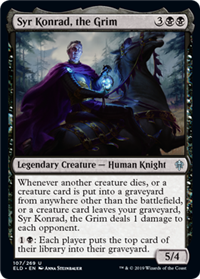
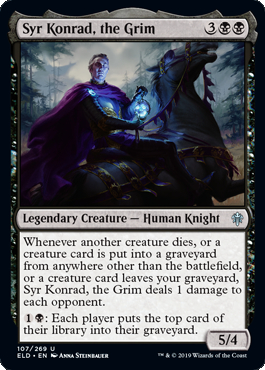
Syr Konrad, the Grim

Finally, I'd like to close with a focus on this card. While this rules text isn't a mechanic we'll necessarily be seeing on more cards, when this card was spoiled I immediately went and bought up 13 nonfoil and 2 foil copies of Morality Shift as a potential combo card with Syr Konrad, the Grim. We have already seen some movement on Mortal Combat foils due to this card as well. The doctoral thesis comprised in his text box screams combo potential and the fact that his damage is to each opponent means it's easy to combo kill all opponents in one shot if you build the deck right. Keep your eyes peeled.

There was an error retrieving a chart for Morality Shift
There was an error retrieving a chart for Mortal Combat

Takeaways from MagicFest Indianapolis

Are you a Quiet Speculation member?

If not, now is a perfect time to join up! Our powerful tools, breaking-news analysis, and exclusive Discord channel will make sure you stay up to date and ahead of the curve.

I arrived on-site at MagicFest Indianapolis at around 10:20 am, Friday morning. My mission: to sell some Alpha and Beta cards in an attempt to raise cash. With around ten vendors in the room of varying sizes and shapes, I was reasonably confident I’d find the right buyer.

Entering the room, I went first to the MTG Deals booth to say hi to some buyers there I knew from Twitter. When I approached them, I asked if they were interested in purchasing some Alpha and Beta cards. They promptly replied, “We aren’t buying any Old School cards this weekend. We only want Modern bordered stuff and casual cards.”

This may be harder than I thought, I pondered as I walked to the next booth.

In all, about half the vendors had no interest in Old School cards whatsoever. Some wouldn’t even make offers. Others made offers so low that it was clear after two or three cards that they weren’t really interested in buying these collectibles. I couldn’t even find a reasonable offer on my Alpha Mind Twist, which I thought for sure would garner some interest since it’s so rare and valuable.

The MagicFest Indianapolis Atmosphere

If I could describe MagicFest Indianapolis’ Friday atmosphere in one word, it would have to be “desolate”. There was a massive sea of empty tables. Vendors were milling about, itching for things to do. One vendor even commented as much—when I asked for a few offers on cards and apologized when I declined each time, they defeatedly stated, “It’s fine, I have nothing else to do.”

It seems the Las Vegas event of a couple years ago still left folks with a Magic hangover of sorts. Perhaps that’s a major factor in why not many showed up on Friday for the event. Or, it could be related to the fact that it was scheduled around the time many were returning to school. Perhaps fewer people could get the day off coming off a 3-day Labor Day weekend. Whatever the reason, the turnout was abysmal that first day.

So with vendors there to buy cards, eager to justify their booth purchase at this event, you’d think they’d be happy to pick up some highly coveted Alpha and Beta cards. But this was simply not the case. There was a ton of Old School on display at most booths, and not much of it was moving. The market on these cards has truly cooled off. Even some of the hottest collectibles from Arabian Nights have dropped in price significantly from their recent highs.

There was an error retrieving a chart for Juzám Djinn

Everyone clearly wanted Modern and Commander staples. Hotlists were paying aggressively on cards like Mox Opal, Leyline of the Void, and Fetch Lands. As for Old School, the only card on anyone’s hotlist was Chaos Orb, on which 95MTG boasted a $1000 buy price (I asked…they were offering $500 for heavily played copies).

There was an error retrieving a chart for Mox Opal

95MTG to the Rescue

I don’t know very much about this vendor, other than they generally post aggressive buy prices at large Magic events and they have an international presence. It turns out this was all I needed to know because they were the only vendor paying well on my Alpha and Beta cards. (I did sell a couple cards to smaller vendors on site, but sparingly).

Why did 95MTG pay well while other vendors wouldn’t touch these older cards with a ten-foot pole? It all came down to their international presence. They have a Cardmarket (formerly MKM) account and sell cards in Europe. It turns out Alpha prices are quite high in Europe and these cards still sell relatively well there. Using MKM’s site to study pricing, 95MTG’s buyer and I negotiated and agreed upon many of the cards I was looking to sell. If it wasn’t for them, I would have walked out of that event with very little to show for it.

One collection of cards 95MTG’s buyer and I couldn’t agree upon was my Beta rares. I only had a few, ranging from useless stuff like Animate Wall and Farmstead up to some half-way decent playables like Crusade.

There was an error retrieving a chart for Crusade

While MKM pricing on Alpha cards is still quite high, many Beta cards can be purchased for at or below my 55%-60% of ABUGames store credit valuation. For example, I tried to sell my played Beta Elvish Archers for around $175 since ABUGames pays $332.50 in store credit for them. Going lower wouldn’t make much sense when I can ship the card to ABU Games and get a $190 card without much effort.

Unfortunately, you can buy a near mint copy from MKM for about $220. So for 95MTG to make any money on my copy, they’d probably have to list at around $200. After fees and shipping, they’d probably net $175-$180 on the card. Therefore they had no interest in purchasing mine at $175 as it left them with no margin. The same pattern exhibited itself across all my Beta rares.

The Beta market, it seems, is not as hot as the Alpha market in Europe.

Moving Forward

Overall I was pleased with my success in selling cards to 95MTG at the event. I also sold a couple cards to other vendors to round out a solid day of selling. But I was left with two actionable next steps.

First, I continued to be baffled by vendors’ refusal to make a good offer on my played Alpha Mind Twist. Channel Fireball almost offered me $1500, but deemed the card “heavily played” and therefore dropped the offer too far for my liking. Each time the message track was the same: my desired price of $1500 is probably solid, but they had no interest in buying such an expensive card, only to have it sit in their inventory to rot.

While this is understandable in principle, I knew for a fact that an Alpha Mind Twist would not sit and rot in inventory if marketed in the right place. I had shopped it around on the Old School Discord and got some interest. And I had the card listed on eBay and declined a $1600 offer there already. Alpha Mind Twist will move if priced correctly.

To prove this to myself (I doubt the vendors care), I threw it on the Old School Discord with a $1550 asking price. It sold within ten minutes, literally.

The other takeaway I had from the event was that my Beta cards have very little demand and that ABUGames’ trade credit was probably my best out for them. This is what I have begun doing—I shipped them a couple Beta cards and a few straggling Alpha cards no vendor wanted. With the store credit, I’m acquiring Modern and Commander staples. These are what’s hot right now, and moving from illiquid stuff like HP Alpha Bad Moon into Force of Will, Mox Opals and Fetch Lands seems like the right play.

There was an error retrieving a chart for Force Of Will

Maybe the Old School market will pick up again. It seems almost inevitable—there’s a recession of sorts in these assets for now, but prices can’t get much lower. There is still a ton of activity in the Old School Discord, and any cards listed at competitive prices are immediately purchased. Prices may have gotten ahead of themselves last year when they spiked, but there’s plenty of real demand for these cards at reasonable prices. We won’t be seeing $200 Library of Alexandrias and $100 Chaos Orbs again. There are simply too many people itching to buy these once their prices come in enough, and this will be sufficient to buoy the market and prevent major sell-offs.

Wrapping It Up

All in all, I was very happy with my time at MagicFest Indianapolis. The slow crowd on Friday worked as a boon for me because vendors didn’t mind looking through my older cards and making offers. I checked with the 95MTG buyer multiple times to make sure he didn’t mind the tedious negotiation process. He reassured me that all was good—it was dead quiet, there were no lines, and my advanced preparation made the process smooth for both of us. That spreadsheet I created and printed out was a lifesaver because it gave the buyer all my numbers up front, making for easy negotiation.

I wasn’t able to sell everything I set out to sell, but that’s OK. I don’t mind trading ABUGames unplayable Beta rares to acquire Modern staples, which apparently everyone wants. I also couldn’t move a single Dual Land. Buy prices on heavily played duals were incredibly low—one vendor had offered me about $30 on a Plateau and $120 on a Tundra. These sell instantly on social media at $70 and $170, respectively, so there was no reason for me to sell these.

There was an error retrieving a chart for Tundra

The net takeaway from the event: the Old School market has definitely softened. There’s no doubt about that. But there’s still demand for the most playable of cards, especially in Europe, as evidenced by 95MTG’s willingness to purchase my Alpha cards. They even have Chaos Orb on their hotlist, so clearly, they see demand for Old School cards.

From here, I’m going to make the effort of trading out of the unplayable Old School cards and into Modern and Legacy staples. This will increase my liquidity and save the hassle of trying to negotiate and sell cards that very few people want. Thanks to ABUGames’ aggressive trade credit numbers, I’ll still do well shipping them some of these Beta cards. So it all works out well in the end.

If you’re in the same place as me, I’d recommend considering a similar approach. If, on the other hand, you’re in the market for Old School cards, now may be a great time to be buying. Since the market is soft, prices are low. I’d suspect vendors would even negotiate a bit on their Old School stock since the stuff isn’t moving nearly as quickly nowadays. Some food for thought as we navigate the coming months, when the market will hopefully pick up again.

…

Sigbits

  • Another Beta rare ABUGames pays quite well on is Lord of the Pit. They currently pay $198.45 cash and $427.50 in-store credit for the iconic card. This was another one no one wanted near this price, and I was honestly content to keep my copy for the time being.
  • Card Kingdom doesn’t have many Old School cards on their hotlist, but since dropping their price on Library of Alexandria and Juzám Djinn, they have added the two cards to their hotlist. Both currently boast an $840 buy price. Whether the price goes up or down will depend on how quickly they take copies in at that price point and how quickly those acquired copies move. But I suspect prices won’t drop much lower given how quickly the community pounced on copies once their price dropped.
  • After spiking and then retracing significantly, it’s interesting to see Gaea's Cradle on the move again. Card Kingdom has slowly been increasing their buy price on the card, and it currently resides in their hotlist with a $240 buy price. I don’t know if there’s newfound demand for the card or if, like Library of Alexandria and Juzám Djinn, they dropped their price and copies started moving quickly.


Throne of Eldraine Commander Specs

Are you a Quiet Speculation member?

If not, now is a perfect time to join up! Our powerful tools, breaking-news analysis, and exclusive Discord channel will make sure you stay up to date and ahead of the curve.

Throne of Eldraine spoiler season has begun, and the new cards paint a picture of a very flavor-driven set designed from the top-down. It’s a land of fairy tales and legends, which means lots of legendary creatures - and that means new Commanders. In recent years new Commanders have been among the most important catalysts for Magic price increases. Each new Commander could potentially increase demand for dozens of old cards, some which could see significant price spikes. With many new legendaries already spoiled this week, Throne of Eldraine is sure to have a big impact on the market. 

When the set was first teased Chulane, Teller of Tales was spoiled, and it has been followed up with three more three-color legends to complete the cycle of four Commander, each leading a preconstructed Brawl deck: Syr Gwyn, Hero of Ashvale, Korvold, Fae-Cursed King, and Alela, Artful Provocateur. These cards were clearly designed with not only Brawl but the Commander player in mind, and the new Commanders decks they will inevitably spawn will drive demand.

The spoilers have already got some cards moving, but generally, there is a lag time as players figure out what cards they want before they spike. It's led me to start sleuthing to figure out what cards might be next to move. The best resources to utilize are the community and the players themselves, as well as other speculators, so I’ve been looking at initial decklists on EDHREC and scouring places like Twitter, Reddit and the QS Discord for insight into just what these new cards might do to Commander and the market. 

Syr Gwyn, Hero of Asvhale might be the most important of the new Commanders in terms of market impact. Its dual focus of equipment and Knight tribal increases demand in both aspects. Commander decks based around equipment are nothing new, with about a dozen Commanders supporting it. Syra Gwyn is unique for dipping into black, while its ability is arguably the most powerful yet for an equipment-based deck.

Especially appealing are equipment with prohibitive equipment costs, making Colossus Hammer a shoo-in. One of the best targets seems like Heartseeker, which has a great effect when it equips for zero and effectively turns all of your creatures into Visara, the Dreadful.

There was an error retrieving a chart for Heartseeker

Heartseeker, a fifteen-year-old dollar-rare, feels like a bargain and it’s already showing some signs of minor upward movement this week.

Another good option is Sunforger, which could find plenty of strong spells in a Mardu deck.

There was an error retrieving a chart for Sunforger

The most important aspect of Syr Gwyn is the Knight tribal aspect, which is not entirely new, but for the first time has access to the full Mardu wedge. The tribe should reach a new level of popularity, especially because the spoilers continue to show strong support for the tribe. That means any old Knight tribal card is on the table for speculation, like Knight Exemplar, which has already increased a few dollars. 

There was an error retrieving a chart for Puresteel Paladin

One of the best plays, or at least what seems like one of the safest, could be Puresteel Paladin, which offers the crossover synergy of being a Knight with an equipment theme. That plus Modern play in the Cheerios Combo deck makes me think Puresteel Paladin will see strong growth into 2020.

Korvold, Fae-Cursed King has a lot of people excited as a really strong commander for sacrifice decks. It's a huge upgrade over Kresh the Bloodbraided that should bring this self-sacrifice style of Jund deck to the next level. There are a ton of applications, but I’ve been most intrigued some unfair ones, specifically a few infinite combos the community has identified and that could drive the market. There are various convoluted ways to go infinite with Korvold, and one simple example is Phyrexian Altar with Words of Wilding to generate infinite +1/+1 counters and enter-the-battlefield and death triggers, so both of these cards could be good targets.

There was an error retrieving a chart for Phyrexian Altar

Phyrexian Altar had its price suppressed by Ultimate Masters and is still a bargain compared to the old price. Words of Wilding recently spiked on the back of demand for Ayula, Queen Among Bears and spiked, so a further surge in demand would likely send the price significantly higher. 

Alela, Artful Provocateur is a more open-ended card than the other generals in what it asks, so building and speculating around it is trickier, and at this point, I haven’t seen any cards that jump out as specs, so I’m avoiding it for the time being.

Spoiler season has also revealed Throne of Eldraine will contain uncommon legends, and the first so far, Syr Konrad, the Grim, already has Commander players talking. Its ability offers multiple applications, like in sacrifice decks as a Blood Artist effects, but what has people excited is using it in a self-mill deck full of creatures. The best and most straightforward combo is the potential to KO an opponent immediately with Morality Shift, which as an old obscure rare from a third set looks like a great spec target at a 50 cent price point.

There was an error retrieving a chart for Morality Shift

Syr Konrad also has great synergy with Mindcrank, with each trigger milling the opponent and really punishing creature decks. 

There was an error retrieving a chart for Mindcrank

Iconic Masters Mindcrankis now over $1, double its price at release, and well on its way towards the nearly $4 the New Phyrexia printing once commanded.

Another target is Mortal Combat, which is a nice alternate win condition for a creature-filled self-mill deck, and another bargain at about $1.

There was an error retrieving a chart for Mortal Combat

Syr Konrad, the Grim also lends itself to some infinite combos of its own, including one using Phyrexian Altar and Gravecrawler plus any Zombie. Another option is to use Basalt Monolith and Mesmeric Orb, which with an Eldrazi in the deck to prevent decking will deal infinite damage. I’m not sure I’d go and jump on any of these, but it’s another positive for Phyrexian Altar. 

Throne of Eldraine spoilers are only beginning, and there will be more important legendaries with Commander applications to come. At this point, they are all fair game and I like casting a wide net, but over time we’ll definitely see some rise above as the most popular. At that point, I’d recommend focusing speculation on diving deeper into these decks as they become more fleshed out and standardized on EDHREC.


Reforging the Fire: Introducing Goyfblade

Are you a Quiet Speculation member?

If not, now is a perfect time to join up! Our powerful tools, breaking-news analysis, and exclusive Discord channel will make sure you stay up to date and ahead of the curve.

With the August 26 banning announcement, Hogaak was exiled from Modern, to the aplomb of pundits. Many were also pleased with Wizards's other decision: to axe Faithless Looting. This change affected me differently—not only had I recently spliced Looting into Counter-Cat, the card had always formed the backbone of GRx Moon, a longstanding pet project of mine.

Today's article introduces a first draft of the TURBOGOYF deck post-ban.

In any case, without Faithless Looting, there was nothing "turbo" about this deck. So a name change was also in order:

Goyfblade, by Jordan Boisvert

Creatures

4 Tarmogoyf
4 Stoneforge Mystic
4 Seasoned Pyromancer
2 Magus of the Moon
4 Birds of Paradise
4 Noble Hierarch

Planeswalkers

4 Wrenn and Six

Artifacts

1 Lightning Greaves
1 Sword of Light and Shadow
1 Batterskull

Enchantments

4 Blood Moon

Instants

4 Lightning Bolt
2 Tarfire

Sorceries

2 Flame Slash

Lands

4 Wooded Foothills
4 Windswept Heath
2 Misty Rainforest
2 Arid Mesa
2 Stomping Ground
1 Sacred Foundry
1 Forest
1 Plains
1 Mountain
1 Dryad Arbor

Sideboard

2 Damping Sphere
2 Rest in Peace
2 Collector Ouphe
2 Ancient Grudge
3 Path to Exile
2 Dire Fleet Daredevil
1 Knight of Autumn
1 Veil of Summer

The Slice of Life

The adoption of Stoneforge Mystic wasn't totally unprecedented, nor should it be particularly surprising for longtime readers. TURBOGOYF's eternal struggle has been one of finding adequate threats to compliment Tarmogoyf. From our last jaunt around the block:
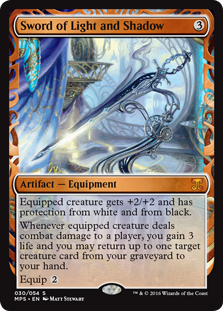
Outside of namesake nut-draws chaining Faithless Looting into turbo-charged Tarmogoyfs, TURBOGOYF has always had a problem establishing an adequate clock. I’ve looked to closers such as Goblin Rabblemaster, Huntmaster of the Fells, Siege Rhino, Goblin Dark-Dwellers, Stormbreath Dragon, Traverse the Ulvenwald (as extra Goyfs), Chandra, Torch of Defiance, Nahiri, the Harbinger, Bloodbraid Elf, and Hazoret the Fervent. Evidently, few of these have stuck.

Domri, Anarch of Bolas, Seasoned Pyromancer, and Wrenn and Six had just come in like wrecking balls, enabling Goblin Rabblemaster to assume a reliable damage-oriented role; combined with Looting, Pyromancer gave the deck a huge burst of velocity. But without Looting in the picture, too many three-drops can clog early. Stoneforge Mystic presents an alluring option as an early, must-answer threat that generates value even when sniped on-site.

Swordly Missed

Equipment isn't totally new to GRx Moon. Early in the deck's lifespan, I ran as many as 3 Sword of Light and Shadow to protect Goyf, Huntmaster of the Fells, and Magus of the Moon from relevant removal and retrieve late Lhurgoyfs from the graveyard. As Modern sped up, and the deck evolved to fit more proactive threats, the Swords quickly lost favor. But as part of a streamlined Stoneforge package, Light and Shadow can once again rear its head in the archetype; Fatal Push and Path to Exile are the premier removal options when it comes to beefier threats, and much of our deck already resists Lightning Bolt when given +2/+2.
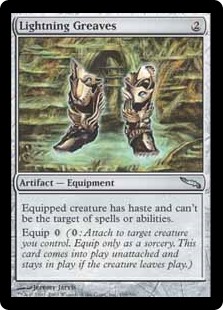
I also tried Sword of Feast and Famine, thinking the ability to untap all my lands and make more plays in Main 2 would gel with the deck's sifting nature. But Goyfblade can't really do that without Faithless Looting, needing to rely solely on Seasoned Pyromancer to meet its velocity needs. In the end, that extra mana was often superfluous.

Bolts and Greaves

Regardless, I knew I wanted three pieces of equipment in the deck to ensure Stoneforge would remain live in the mid-game. I ended up settling on Lightning Greaves, an old favorite that's never had much of a place in Modern. Alongside Stoneforge, though, we're seeing it crop up in creature-combo decks, and I think it might have a place in "big aggro" strategies like Goyf.dec and even Eldrazi. Being searchable makes Greaves significantly better, as gameplans can be sculpted around the card without needing to run multiple copies (any beyond the first are more or less dead).

Having Greaves on the battlefield forces opponents to respect the threat of an immediate 4-8 damage, as well as a sudden life point swing—we can drop Stoneforge, search Skull, suit up the Kor, tap it to cheat out Skull, and then grant our lifelinking, vigilance Germ shroud and haste. The shroud function can also protect threats holding Sword of Light and Shadow, turning evasive creatures like Birds of Paradise into tough-to-contest value engines.
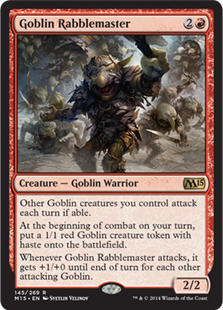
Then there's Batterskull itself, a major reason to dip into Stoneforge at all. I wouldn't consider playing her without the living weapon, but Skull doesn't do much for us it doesn't do elsewhere, so we won't spend much time on it.

Man-a Down

In "Back Again: Arclight Phoenix Rises over Modern," I introduced the idea of strategic curving, or deckbuilding that respected the stage of a game in which cards are best resolved, irrespective of their manacosts. Without Looting to dig for properly-curving follow-up plays, and Stoneforge bursting into the two-drop slot, Goyfblade's strategic curve remains up in the air.

A New Magic Number

TURBOGOYF's strategic curve felt effortless. We'd keep hands with a mana dork or Wrenn, or with Looting in a pinch; that gave us 16 cards that okayed our openers. If our mana dork was killed, we could follow with Goyf/Wrenn, or with a removal spell and Looting/dork to set up for the next turn. If not, we had Moon, Pyromancer, and Rabblemaster to capitalize on the extra mana. Other games, we'd use Looting to set up the second turn, finding a second land or Goyf/Wrenn to begin clocking opponents.
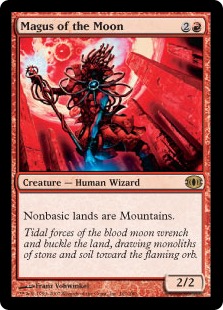
Adding Stoneforge and removing Looting mucks things up a bit. Goyf, Wrenn, and Stoneforge are all two-drops at their best deployed on an empty board while opposing shields are down. In other words, there aren't much better ways to chase a deceased dork. On the other hand, our critical mana point shifting from three to two has its share of drawbacks.

The new curve actually feels more cohesive when opponents kill our one-drop. If they don't, we've just got Moon and Pyromancer to punish them with. While the former remains an excellent option, and has defined the deck since I first built it, the latter leaves something to be desired without Looting in the picture. The sorcery let us sift through extra lands drawn naturally or recouped with Wrenn, while Pyromancer chewed past Sprawls and Moons to buff Goyf while creating 1/1s. But now, Pyromancer finds itself ruefully towing the fields, since we have no other way to turn our lands those into fresh meat. A 2/2 is much less impressive than the four-power bursts we're used to generating.
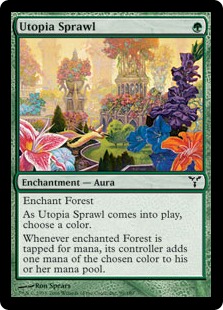
Rabblemaster previously filled the gap, being an excellent turn-two play that pressured opponents via multiple bodies. But the hefty Stoneforge package makes it tougher to fit, especially alongside Domri, Anarch of Bolas; that planeswalker is what turned Rabblemaster from a fringe consideration of times past into proper pressure. Instead, I've returned to Magus of the Moon, additional functional copies of Blood Moon. If opponents kill our dork, no problem; we'll follow with Goyf or Stoneforge, and the Magus is all but insured on turn three. If they don't, Magus is free to resolve and probably to stick around, since any existing kill spell would likely have been pointed at the dork by then.

Other Changes

We have a couple more new developments to discuss, mostly pertaining to card types.

New Dorks on the Block

Gone from this version are Arbor Elf and longstanding pseudo-dork Utopia Sprawl. Sprawl was long favored as an accelerant because of its resilience to commonly played removal like Bolt and Push. But as we'd just as well have our dorks die in this version, less robust, but higher-utility dorks like Hierarch and Birds get the nod.

In the previous version, Arbor was insane, ramping us large amounts and facilitating the mana-hungry Looting plan; we could use Arbor for mana while trading our drawn and recurred lands into the graveyard for business from the deck. But between ditching Sprawl and Domri and adding a third color, Arbor loses a lot of stock as a dork.

Noble Hierarch is widely considered the best dork in Modern; in this deck, it plays second fiddle to Birds of Paradise. Exalted is nice, sure, but casting Pyromancer off Hierarch is pretty tricky. Birds gives us choice galore on how to spend our mana, and man does it carry a Sword.
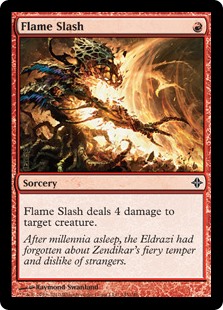
While it's not exactly a mana dork (until, God willing, Green Sun's Zenith comes off the banlist), Dryad Arbor is still a green creature that taps for colors. We've discussed its utility alongside Wrenn, which allows Arbor to chump block or attack each turn. This utility is increased with Stoneforge Mystic in the mix. Even if the Kor should die, the equipment it's fished out can be endlessly picked up by the fetchable, recurrable Arbor. And connecting with the Sword-equipped Forest retrieves our dead Stoneforge. Similarly, the 1/1 tokens created by Seasoned Pyromancer gain relevance with Sword.

Sorceries

Maxing out Tarmogoyf is the pet project that drew me to GRx Moon shells in the first place, and I wasn't about to stop here. But it seems that without Faithless Looting, there are precious few sorceries playable in this style of deck. After trying options as diverse as Forked Bolt (not enough targets) and Light Up the Stage (not enough triggerers), I landed on just a pair of Flame Slashes. Slash is pretty nice right now, as it kills Thing in the Ice as well as freshly-deployed Stoneforges and even 4/4 Germs.

Sideboard

As always, with a new build and meta comes a new sideboard.

  • Damping Sphere, Collector Ouphe, Rest in Peace: anti-combo options to combat Tron, Storm, Urza, Dredge, and the like.
  • Ancient Grudge, Knight of Autumn: Stoneforge breakers, with the latter also pulling weight vs. Burn.
  • Path to Exile: For when Moon isn't good enough or we need to remove lots of creatures, like against Jund or Humans.
  • Veil of Summer: A fun bullet for midrange and control decks. Could be anything.

Edging 'Em Out

Stoneforge Mystic changes GRx Moon significantly, as does losing a core component in Faithless Looting. I'm not sure how optimistic to be about the deck's future, but only testing will tell if Goyfblade can keep up with its immediate predecessor. One thing's for sure: the interplay between Stoneforge, and Wrenn, and Arbor has taken me by surprise, and I'm excited to see Stoneforge emerge as a plan in more non-traditional homes over the coming months!

First Look at Stoneforge

Are you a Quiet Speculation member?

If not, now is a perfect time to join up! Our powerful tools, breaking-news analysis, and exclusive Discord channel will make sure you stay up to date and ahead of the curve.

The first week of the entirely new Modern is over and nobody has any idea where we're heading. So far all the excitement has been focused on the unbanning, and with good reason. I imagine most players are as tired as I am of the graveyard heavy format we've had for the past year and a half-ish. It does mean that we need to start relearning how Modern works, and that is proving quite hard.

The Initial Data

The logical place to start examining this new Modern would be with the data. There was a major SCG event over the weekend, and it included a dump of all the Day 2 decklists. This data shows a relatively lack of Stoneforge Mystic decks and no dedicated graveyard decks. On face, this suggests that the banning was completely successful in killing the old, graveyard-centric metagame. It also indicates that the unbanning hasn't done anything yet, but that's not surprising. It takes time to figure out how to play with new cards. Honestly, this mostly looks like a fluctuating metagame trying to sort itself out.

Perspective

At this point, I'd typically do some overview of the event, note the a priori expecatations, and then introduce the data in table form. That's not happening this week. Simply put, its not only too early to draw any conclusions, what conclusions there are to draw aren't very helpful. Burn, Whirza, and Tron dominated Day 2. This shouldn't have surprised anyone; something similar has happened right after every major ban. Following Splinter Twin's ban, Burn, Affinity, and Tron were the decks in Modern. And remember, this happened at the start of Eldrazi Winter.
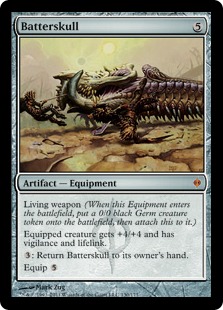
Burn, Tron, and the artifact deck of the moment always dominate the first events right after a major banning. The former two do well because they're known, solid strategies that don't require much, if any, tuning for the metagame, making them above average-choices facing the unknown. The artifact deck also gets a lot of play, partially since specific hate is usually down, and partially thanks to hype. These results mostly indicate that a new metagame is forming rather than anything about that meta.

Classic Complication

Additionally, the Dallas Modern Classic did as the Classic has been want to do and muddies the picture from the main event. True, there are four Burn decks in the Top 16 as well. However, that's the only parallel with the other results. Dredge won the Classic, but I don't see it anywhere in the Open's Day 2. Whir of Invention was a major player in the Open and completely absent in the Classic. Therefore, other than to say that the metagame looks to be fluctuating, there's nothing to analyze. Rather, SCG Dallas should be regarded as a starting point to see how the metagame develops from here.

Natural Home

I'm not surprised by how few Stoneforge Mystics are in the SCG data. As the card has never been in Modern before, everyone is struggling to figure out how to fit it into their decks, it being commonly believed that she slots in anywhere. I don't know if that's true or not, but there was one deck that Mystic very glaringly slotted into, and that's where I've been playing her most so far.

Death and Taxes, David Ernenwein (Test Deck)

Creatures

3 Thraben Inspector
2 Giver of Runes
4 Leonin Arbiter
4 Thalia, Guardian of Thraben
4 Stoneforge Mystic
4 Blade Splicer
4 Flickerwisp
2 Mirran Crusader

Instants

4 Path to Exile

Artifacts

4 Aether Vial
1 Batterskull
1 Sword of Fire and Ice
1 Sword of Light and Shadow

Lands

12 Plains
4 Tectonic Edge
4 Ghost Quarter
2 Horizon Canopy

I took this list to Mythic Games's (formerly Black Gold's) 45-player Modern FNM last week and went 3-1, beating Traverse Shadow, Ad Nauseam, and Jund while losing to a Sigarda's Aid combo deck. All in all, I was pretty satisfied with how the deck performed. However, I wouldn't take this list to any larger event, partially since I built this deck for a local meta full of Jund, Burn, and Stoneforge mirrors; the sideboard is a bit of a mess.

Legacy Death and Taxes decks have three pieces of equipment, but Umezawa's Jitte is still (thankfully) banned. Therefore I went with Sword of Light and Shadow, partially since I expected lots of Esper Stoneblade (knowing the player base) and because it grinds very well. This package was fine. Blocking black creatures came up a lot more than returning creatures, but I rarely needed the Swords in any of my games. Having them still felt good, especially when they drew opposing discard spells rather than my actual threats.
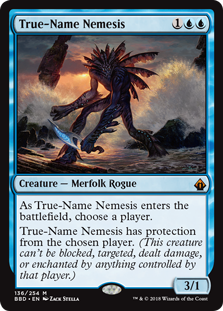
Leonin Arbiter doesn't seem like he plays well with Mystic, but it works out. You don't actually have them together all that often, and even when you do I almost always want one out much more than the other. In grindy matchups you want to get Mystic down as quickly as possible, while Arbiter is mostly a 2/2; conversely, against Tron, Mystic is very poor. Vial also helps play around the tax.

Incremental Improvements

The big question is, of course, whether Stoneforge makes DnT a real Modern deck. I won't go that far, but it feels a lot better than it ever has before. Having a cantrip-creature more potent than Thraben Inspector is a huge boon. Stoneforge has the additional benefit in that, while it's not much a threat by itself, the promise of an instant speed Batterskull means players kill her on sight instead of disruptive creatures. I can safely say that the deck has improved and feels very similar to the Legacy version.

The Great Stone Hope

The bigger story of Mystic is, of course, the old saw that it's the key to a Modern control revival. At least, that's what the advocates have claimed forever. The idea is that Stoneforge gives control a very versatile and fast clock that is well-integrated into its overall strategy, and the ensuing Modern Stoneblade decks would give control a permanent place in Modern. I have long disputed the underlying assumptions about control in Modern, so I've been very skeptical of this position. My experiences since the unban have not dissuaded me. There's a lot of potential for Mystic in Modern, but the current thinking of control deck plus Mystic is unlikely to work out.

Incomplete Transfer

I can't remember where I saw it, but right after the announcement someone somewhere joked "Stoneblade players should rejoice. Now they can go 5-4 in Modern too." While I can't speak to the veracity of the statement, I agree with the sentiment. Stoneblade is not that great a deck in Legacy. It has a lot of powerful cards and can be a very effective control deck. However, it's a fairly middle of the road deck. Rather than it being a hard control deck, it's a cross between rock midrange and tempo. It can attack from multiple angles and take any role, but it doesn't excel at any of them. This is why when Miracles was at its height, Stoneblade couldn't compete. Banning Sensei's Divining Top made Stoneblade competitive again, but it's never excelled. This makes me skeptical that Stoneblade will be any better in Modern.

While it's easy to say that Modern's lack of cantrips make this a no-brainier, that's not the real problem. Simply put, Legacy Stoneblade is a mediocre control deck, but True-Name Nemesis wielding a Sword is utterly busted. I argue that Stoneblade's strength isn't actually that it's a control deck with a proactive win condition or even its flexibility, but being really good at protecting True-Name. The closest creature Modern has is Geist of Saint Traft, which while a better clock is also blockable and vulnerable to Pyroclasm. Unopposed, Geist does kill faster. However, True-Name is far more likely to survive and actually get that kill.
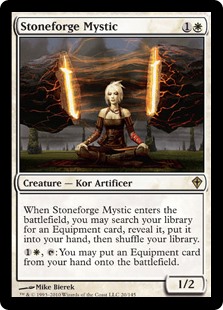
This problem has led to all the Stoneblade decks I've tried or seen played so far feeling anemic if not fatally clunky. Even when I flawlessly curve Stoneforge into Geist into a Sword and equipping the Geist, I'm struggling to have that be any better than my Jeskai Tempo deck from last year. In fact, Jeskai lists have performed the best for me simply because plan of dropping Geist, clearing the way with burn and counters, and then riding him to victory works just as well now as it did back then. Stoneforge has been largely superfluous.

Tensing the Blade

Then there's the internal tension the Stoneforge plan is creating. Again, the great hope is that going Stoneblade would allow control decks to have proactive plan that is simultaneously defensive. A 4/4 on turn three is a decent clock against unfair decks, and it being a vigilant life-linker should stifle fast aggro. From what I've seen and experienced, that isn't working out.

Stoneforge Mystic is a high-maintenance card, requiring at least six deck slots. Drawing the equipment without the Mystic clogs up the hand. There's also no guarantee that casting either Mystic or the equipment does anything. Does Tron actually care about the clock from Batterskull? Does it actually brick Humans? Or Spirits? The control deck is effectively playing a lot of individually dead cards since the whole is more than the sum of its parts. It just isn't that much more in many cases.
The other problem is altered play patterns. The first few turns are the most vulnerable for a control deck. By playing Stoneforge, they're agreeing to go shields-down for a 1/2 cantrip creature on turn two with the hope they can spend another two mana the next turn to get a 4/4, assuming my Squire is still in play. The germ also has to survive for 'Skull to do anything. If that's not the case, I've given my opponent a lot of tempo, which might be lethal. If my intention was to get a fast clock, then I'd have a better one on the same turn for less time investment just playing Geist. If I was looking for board control, then Wall of Omens also cantrips and I'm willing to block with it. Afterward, I can keep mana up to answer threats.
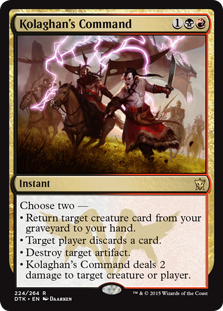
All the Stoneblade decks I've seen so far have been control decks fitting in Mystic, and I haven't seen proof that works. Their wins have come not through Mystic but by being control decks. The more they resemble pre-unbanning decks, the better they've done. This tells me that Stoneforge may not be the control players' hope as expected. Rather, it's a good threat for creature and tempo decks that really embrace it outside of best case scenarios.

A Question of Counterplay

All this may suggest that Stoneforge's unban will end up having no impact on Modern. If it's not supercharging control, being easily slotted into every deck, or shutting down other decks, it must have always been safe for Modern. But I think that would be a hasty judgment.. There's only been a single week of work put into the Stoneblade lists, and an optimal list could change everything. Secondly, and on that note, players lack experience with Stoneforge. This means the decks are unrefined and performing poorly, which is keeping their numbers down. On the other side, Stoneforge's impact is also being exaggerated thanks to players playing badly against it.

My experience so far has been a lot of opponent's misplaying and misevaluating my Stoneforge decks. Their running scared from 'Skull, and tend to bend their thinking around that card. The most common example has been with Kolaghan's Command. Command is a good maindeckable answer to equipment, but it has a lot of other uses. If I go for an early Mystic, even if they kill her I don't play the equipment, they'll refuse to cast Command so they can answer the said artifact. This ends up winning me the game.
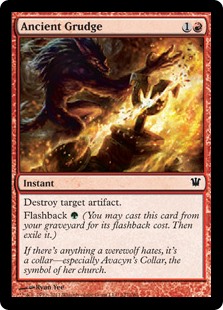
I had one match at FNM where I had an unequipped Batterskull out, a Vial, and five lands. My Death's Shadow opponent had drawn (and clearly telegraphed) Command with four lands. I held up three lands to represent picking up the 'Skull while adding creatures to the board. He did nothing, waiting for the opportunity to smash the 'Skull. It never came and I simply swamped the board and crushed him. A few rounds later, I beat Jund and the pilot noted that if he'd saved his Command he could have used to killed my Batterskull and Gideon, Ally of Zendikar many turns later. However, I pointed out that the sequence he described was only possible because he'd used the Command to clear my Blade Splicer board. I had a far easier route to victory with my tokens than without them, regardless of 'Skull surviving.
While testing Jeskai Stoneblade, I had a Jund opponent win game 1 then sideboard in all the artifact hate for games 2-3, including Collector Ouphe and Ancient Grudge. I had played an early Mystic in both games which immediately died without cheating the Sword out. In both games I instead rode a naked Geist to victory, using my mana to clear the road rather than play the Sword. Said opponent died with both Grudges and a Command in hand and two dead Ouphes. Players are so afraid of Stoneforge they're focusing on that piece of the deck and not the context of the deck or matchup. This knee-jerk fear is bound to subside in the coming weeks as Modernites familiarize themselves with Stoneforge.

What Goes Around

I expected this to be the case. Years ago, I started testing a Jeskai TwinBlade list to test the theoretical impact of a Stoneforge unban. I never published the results, as Twin was banned first. Instead, the enduring take away was that my opponents struggled to play correctly against the list. On paper, that TwinBlade list was really clunky. In practice, particularly against Jund, it gained huge amounts of value when opponents didn't know which plan they should care about. Using Abrupt Decay on Stoneforge protected against 'Skull, but left open the gate to getting comboed out. Conversely, target the combo plan too much and they'd get raced. A lot of my victories came not on the merits of my deck, but on exploiting opposing confusion and misplays. I'm having a lot of deja vu as a result.

Players think that the threat of Stoneforge represents a fundamentally different gameplan than they're used to, and are overreacting. It really isn't; it's a different type of creature, but it's still just a ground-pounding assault. It's normally correct to treat it as nothing special and play normally. Until this is understood, misplays will inflate Stoneforge deck's win rates at least as much as suboptimal decklists are depressing them. Thus we don't have data on how Stoneforge really behaves in Modern, and cannot make any generalizations about its eventual place in the overall metagame or the ban's impact.

Forging Ahead

I think that a lot of players will be disappointed that Stoneforge doesn't fix all their decks problems. I also think that those who persevere will be greatly rewarded. And we still have yet to really see what becomes of all the Looting decks. This is a fascinating time in Modern, so keep your ear to the ground. Great changes are afoot.

Three Exciting Catalysts for the Market

Are you a Quiet Speculation member?

If not, now is a perfect time to join up! Our powerful tools, breaking-news analysis, and exclusive Discord channel will make sure you stay up to date and ahead of the curve.

Magic finance has been somewhat boring lately. Sure, there’s a new Commander set to build around, and Modern just saw some major shake-ups. But these past few weeks haven’t offered me much inspiration. Others are likely finding avenues to speculate on some spicy targets, but I haven’t found much.

But I think that’s about to change.

These next couple months will bring with it many changes. Changes to the weather, changes to Standard, and an unfolding of recent Modern changes. Change is good. It fuels transactions, which equates to liquidity. Every time money exchanges hands for Magic cards, it reflects confidence in the market.

This week I’m going to examine three pending changes and identify what pockets of the market could exhibit strength as a result of these changes.

Standard Rotation

The most obvious change ahead is the rotation in Standard with the release of Throne of Eldraine. While Standard speculation doesn’t excite me like it once did, there will be money made on it by others. This happens every fall. A new, exciting set is released, a handful of sets depart Standard, and the drastically new metagame leads to significant price changes.

Of course, the newly developed Tier 1 Standard decks will contain cards that increase in value. This is inevitable. But other than rare, nonbasic lands with utility across multiple strategies, there isn’t much I have to offer here. I guess that means Lotus Field merits closer investigation, but at $8 I’m not sure if it’s worth picking up with cash.

There was an error retrieving a chart for Lotus Field

Your best bet is to read what other writers have to offer, engage in the Quiet Speculation Discord, and react to evolution in Standard along with the rest of our Insiders. Often times the group identifies the best pick-ups by working together and talking through ideas.

The other financially relevant outcome of Standard rotation is that prices on cards leaving Standard tend to drop. This means opportunity—cards that have utility in non-rotating formats such as Modern or Commander can pull back in price a bit in the short term, offering attractive entry points for the long term. Whether you’re trying to pick up cards for decks at better prices or you’re looking to make a few bucks over time, it’s important to pay attention to pricing trends as they unfold post-rotation.

Again, picking the right cards isn’t my strength since I pay so little attention to Standard nowadays. But with Dominaria’s departure, I wonder if we’ll see an attractive entry point on Mox Amber again. The artifact bottomed at $6, spiked almost to $20 on speculation while doing very little in Standard, and then pulled all the way back down towards $8. Rotation could bury it’s price even further, making it a worthwhile speculation target for a potential breakout in other formats.

I wonder how cheap Teferi, Hero of Dominaria will become. A pullback on that card could make for an attractive entry point if you’ve been itching for a copy.

There was an error retrieving a chart for Teferi, Hero of Dominaria

Modern Shake-ups

There’s plenty to be excited about in Modern now with the recent B&R shakeup.

What was previously a stale metagame revolving around a couple core cards should become something far more interesting. At least, it will for the first few weeks. Maybe the format will warp around some other card, who knows?

But until that happens, there’s a lot to unpack with these three seemingly simple changes. With Hogaak’s disappearance and the nerfing of Phoenix-based strategies in Faithless Looting’s banning, we should see far less graveyard-centric strategies going forward. And the unbanning of Stoneforge Mystic has opened up an entirely new design space in Modern.

Just like with Standard, I’m no Modern expert. I can’t predict what cards will be best in the new metagame (though again, I like multi-purposed, rare, nonbasic lands). Yet again, the QS Insider Discord will be where I turn when I want the latest and greatest Modern tech coming out of these B&R changes. Following tournament results shortly after this change takes effect will be another worthwhile investment of time.

The only thing that is certain is that cards will be bought and sold in response to the metagame shifts. That means liquidity and confidence in Magic, something that bodes well for anyone who owns cards. Beyond simple liquidity, though, is the influx of demand that stems from such changes. We’ve seen it already with Stoneforge Mystic and associated equipment prices—I’ve even already made some money on Batterskull, and the metagame hasn’t even had a chance to unfold yet!

There was an error retrieving a chart for Batterskull

The excitement of speculation and profit will breathe new life into Magic finance this fall, giving us yet another catalyst for growth.

Premium Set Price Increases

The third catalyst I want to talk about isn’t tied to a specific format. Instead, it’s an overall observation about trends on a subset of cards in the market. I’m talking about premium sets: Eternal Masters, Masters 25, Modern Horizons, etc.

I’ve noticed some traction on certain cards from these sets lately, and I’m wondering if it reflects the inevitable drying-up of supply from the market over time. Looking at MTG Stocks’ Interests page from the past week, I see a handful of these cards on the list.

Worldgorger Dragon has spiked for some reason (I’m sure someone reading this article knows why) and has one of the largest percentage gains of the week.

There was an error retrieving a chart for Worldgorger Dragon

Then you have Necropotence spiking, with Eternal Masters copies jumping from $10 to $14 in a few short days. This is directly tied to the comment made in Ian Duke’s B&R announcement article where he states, “Other cards we’ve discussed unrestricting in the future are Windfall and Necropotence."

I don’t like speculating on Vintage unrestrictions because the impact on actual demand is tiny. But that’s not going to stop speculators, and the market’s supply will dry up quickly as a result.

Ice-Fang Coatl has seen a significant run over the last week, rising from $3 to over $4. A dollar increase may seem inconsequential, but a lot of copies had to move in order for this 33% jump to take place. Modern Horizons supply isn’t likely to increase further, so any increase in the playability of this card in Modern will mean a higher price. Maybe this is a prime time to get some copies.

Other noteworthy increases include Giver of Runes (plays well with Stoneforge Mystic), Ball Lightning from Masters 25, and Sword of Sinew and Steel.

The point here is not that any rare or mythic rare from one of these premium sets is going to increase in price. Rather, my point is that these cards are all like coiled springs and any shift in market dynamic could result in a significant price jump. I don’t recommend buying these cards indiscriminately; rather, I recommend picking up copies of the cards you want most now, rather than waiting for a change in the metagame. I especially like the Horizon Canopy lands from Modern Horizons, which have become far cheaper than I anticipated they would.

There was an error retrieving a chart for Fiery Islet

Wrapping It Up

There are pockets of movement here and there, but the back half of the summer is typically a slow time for Magic and Magic finance. This year has been no exception.

Thanks to three catalysts, I expect the market will become much more interesting as we enter fall months. Standard rotation is always a chance for price fluctuation. Modern’s recent bannings and unbanning will surely shake up the metagame. (Vintage’s changes may also shake things up a bit). And while not directly tied to a format, I believe these shifts will cause some significant price increases on cards from premium sets.

Each of these factors will create fluctuations in market pricing, leading to the exchange of cash for cards. The continuation of these transactions represents a healthy, liquid market, giving confidence to players, speculators, and investors alike. With that confidence could come another lift of the tide, with values trickling up towards higher-end cards like Dual Lands and Power. While I do expect this will happen at some point, I won’t rush things. For now, I’ll be eagerly embracing any change in the market to make MTG finance a bit more interesting once again.

…

Sigbits

  • While a long ways away from its high, it’s interesting to see The Abyss return to Card Kingdom’s hotlist, with a buy price of $420. I don’t know why this card is suddenly showing up on the hotlist, but it’s encouraging to see. Cards like this one have given up much of their gains from last year. In fact now may be a very attractive entry point, while we’re still in the summer doldrums.
  • As I predicted last week, Mox Diamond’s buy price has reached a new high on Card Kingdom! They now offer $220 for the Stronghold printing of the card. They offered even more on the foil FtV printing for a day or two, but have since pulled their offer back to $200. If you’ve been sitting on copies, this could be an attractive exit point.
  • Pyramids may flaunt a $200+ price tag on TCG Player, but I don’t think Card Kingdom’s a believer. They restocked this card from Arabian Nights multiple times, and each time they sell out quickly. Despite this, they’re still only offering $56 for the card (though it is on their hotlist now). We may see another tick higher, but given the card’s limited utility, I suspect further increases will be a slow, step-wise process.

Want Prices?

Browse thousands of prices with the first and most comprehensive MTG Finance tool around.


Trader Tools lists both buylist and retail prices for every MTG card, going back a decade.

Quiet Speculation