menu

Make It Happen: Modern’s New Enablers

Are you a Quiet Speculation member?

If not, now is a perfect time to join up! Our powerful tools, breaking-news analysis, and exclusive Discord channel will make sure you stay up to date and ahead of the curve.

2019 may well go down in the books as the Year of Enablers. Between the Faithless Looting-fueled Phoenix decks and the Stitcher's Supplier-abusing Hogaak menace, Modern was defined this year by pushed cards locating, buffing, and ultimately breaking engines and payoffs. Of course, both Phoenix and Hogaak have left us by now. Without Looting in the picture, players have turned to new strategies—and new enablers. Today we'll look at the three biggest players powering the format's new school of competitive decks.

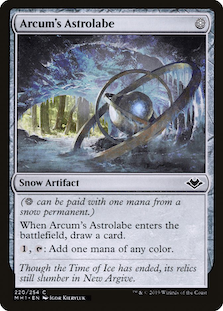
Arcum's Astrolabe

This unassuming artifact is first on our list, and has already popped up in decks ranging from totally fair to completely crazy.

Taste the Rainbow

On paper, Astrolabe serves one main purpose: filtering mana. It replaces itself in terms of card economy, only charging pilots a single mana for game-long access to colors of their preference. And boy, does the extra filtering go a long way! We've already seen four- and five-colored control decks rear their heads, as well as this behemoth, which continues to put up results against all odds:

Niv-Mizzet Reborn, by Dan Schriever (3rd, SCG IQ Danbury)

Creatures

3 Niv-Mizzet Reborn
1 Tolsimir, Friend to Wolves
1 Huntmaster of the Fells
1 Ice-Fang Coatl

Planeswalkers

3 Teferi, Time Raveler
1 Kaya, Orzhov Usurper
1 Wrenn and Six

Artifacts

4 Arcum's Astrolabe

Enchantments

4 Utopia Sprawl

Instants

3 Assassin's Trophy
1 Drown in the Loch
1 Izzet Charm
2 Kaya's Guile
1 Kolaghan's Command
4 Lightning Helix

Sorceries

3 Bring to Light
1 Dreadbore
1 Supreme Verdict
1 Unmoored Ego

Lands

1 Breeding Pool
1 Misty Rainforest
1 Overgrown Tomb
4 Pillar of the Paruns
4 Prismatic Vista
2 Snow-Covered Forest
1 Snow-Covered Island
1 Snow-Covered Mountain
1 Snow-Covered Plains
1 Snow-Covered Swamp
1 Stomping Ground
1 Temple Garden
1 Verdant Catacombs
2 Windswept Heath
1 Wooded Foothills

Sideboard

1 Abrupt Decay
2 Ashiok, Dream Render
1 Crumble to Dust
1 Dovin's Veto
1 Fulminator Mage
1 Izzet Staticaster
1 Kambal, Consul of Allocation
1 Kess, Dissident Mage
1 Knight of Autumn
1 Lavinia, Azorius Renegade
3 Rest in Peace
1 Unmoored Ego

Niv-Mizzet Reborn proves that even full of clunky-looking spells, drawing that many cards is as good a combo turn as any. The spells in question actually play much smoother than first appears thanks to Astrolabe, which lets the deck curve Assassin's Trophy into Teferi, Time Raveler into Huntmaster of the Fells quite smoothly. Indeed, it feels as though Astrolabe's filtering capabilities are unmatched in Modern.

Filtering, though, is less of a story right now than Astrolabe's other function: super-charging artifact decks. The best-performing of these strategies is Whirza, an aggro-control-combo hybrid that attacks opponents from a myriad of angles and has proven quite difficult to disrupt for all but the most disruption-heavy decks (AKA Jund).

Whirza, by Mason Grode (3rd, SCG Classic)

Creatures

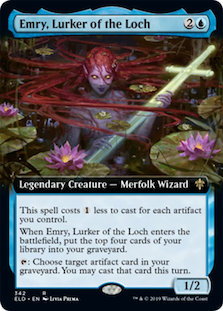
4 Emry, Lurker of the Loch
2 Sai, Master Thopterist
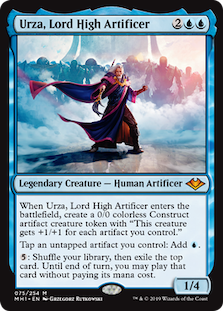
4 Urza, Lord High Artificer

Planeswalkers

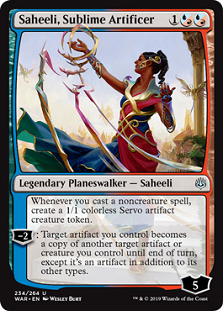
2 Saheeli, Sublime Artificer

Enchantments

3 Jeskai Ascendancy
1 Search for Azcanta

Instants

4 Paradoxical Outcome

Sorceries

1 Nexus of Fate

Artifacts

4 Engineered Explosives
3 Everflowing Chalice
4 Mishra's Bauble
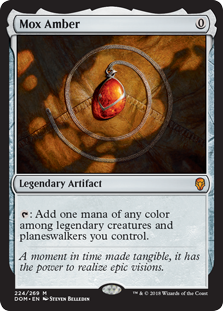
2 Mox Amber
4 Mox Opal
4 Arcum's Astrolabe

Lands

8 Snow-Covered Island
1 Snow-Covered Mountain
1 Snow-Covered Plains
2 Flooded Strand
1 Hallowed Fountain
3 Prismatic Vista
1 Scalding Tarn
1 Steam Vents

Sideboard

4 Chalice of the Void
4 Engineered Explosives
2 Ceremonious Rejection
2 Galvanic Blast
3 Generous Gift
2 Path to Exile
2 Teferi, Time Raveler

Jeskai Ascendency is a recent addition to these decks, and comes alongside the freshly-printed Emry, Lurker of the Loch. Between Mox Opal and Astrolabe, how to accommodate the enchantment's supposedly steep color requirement was never much of a concern.

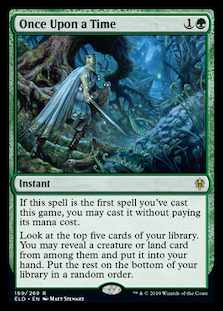
Once Upon a Time

Next up is Throne of Eldraine wave-maker Once Upon a Time. The unique cantrip seems to be redefining the way green-based Modern decks are built. Its success in big-mana strategies like Tron, Valakut, Eldrazi, and Amulet is old news now. But Time continues to impress in less-likely archetypes.

Traverse Shadow, by Ole Spree (4th, MCQ Utrecht)

Creatures

4 Death's Shadow
1 Murderous Rider
1 Plague Engineer
4 Street Wraith
4 Tarmogoyf

Artifacts

4 Mishra's Bauble

Instants

2 Assassin's Trophy
1 Dismember
4 Fatal Push
1 Kolaghan's Command
3 Once Upon a Time
2 Temur Battle Rage

Sorceries

4 Inquisition of Kozilek
4 Thoughtseize
4 Traverse the Ulvenwald

Lands

1 Blood Crypt
4 Bloodstained Mire
1 Forest
2 Nurturing Peatland
2 Overgrown Tomb
1 Stomping Ground
1 Swamp
4 Verdant Catacombs
1 Wooded Foothills

Sideboard

2 Alpine Moon
4 Collective Brutality
1 Collector Ouphe
1 Embereth Shieldbreaker
3 Fulminator Mage
1 Kolaghan's Command
1 Plague Engineer
2 Veil of Summer

Traverse Shadow employs Traverse the Ulvenwald as additional copies of its precious few threats, some of the best beaters in Modern. But the sorcery doesn't come online until delirium is set up, which can take up to a few turns. Enter Once Upon a Time, which locates Shadow or Goyf early on without fussing about graveyard requirements.

A topdecked Time won't find anything, naturally. But previously occupying this spot was the now-banned Faithless Looting, which helped turn on delirium fast enough for Traverse to dig up threats in a timely manner. Time fills a similar purpose, sculpting early plays while boasting an instant typeline; pre-Time, players would run enablers as lackluster as Manamorphose to ensure access to the card type.

Dredge, by Julian Hecker (6th, MCQ Utrecht)

Creatures

2 Golgari Thug
3 Merchant of the Vale
4 Bloodghast
4 Narcomoeba
4 Prized Amalgam
4 Stinkweed Imp

Artifacts

4 Shriekhorn

Instants

1 Darkblast
1 Once Upon a Time

Sorceries

2 Conflagrate
4 Cathartic Reunion
4 Creeping Chill
4 Life from the Loam

Lands

1 Blast Zone
1 Blood Crypt
1 City of Brass
1 Mountain
2 Bloodstained Mire
2 Forgotten Cave
2 Gemstone Mine
2 Stomping Ground
3 Copperline Gorge
4 Wooded Foothills

Sideboard

1 Leyline of the Void
3 Ancient Grudge
3 Lightning Axe
3 Nature's Claim
2 Thoughtseize
1 Haunted Dead
1 Ghost Quarter
1 Shenanigans

In the same Top 8, Julian Hecker's Dredge deck also makes use of Once Upon a Time, if just at one copy. By now, plenty of math has been issued on how to best abuse the cantrip, and one copy apparently makes sense depending on a deckbuilder's goals. It will be interesting to see this card appear at varying numbers in a variety of lists over the coming years.

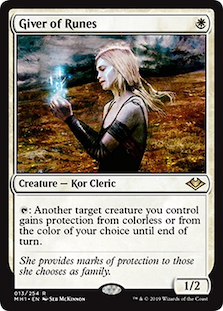
Giver of Runes

Our last feature is Giver of Runes, a card whose future seemed unsure when Modern Horizons was spoiled. Fortune has certainly smiled upon the Kor, who now co-stars in multiple creature decks. It turns out many are in the market for a one-mana Spellskite.

Mardu Shadow, by VOLOLLO (1st, Modern PTQ #11965105)

Creatures

4 Death's Shadow
4 Giver of Runes
1 Hex Parasite
4 Tidehollow Sculler
4 Ranger-Captain of Eos
4 Street Wraith

Instants

4 Fatal Push
2 Kolaghan's Command
2 Lightning Bolt
2 Temur Battle Rage

Sorceries

3 Inquisition of Kozilek
4 Thoughtseize
2 Unearth

Lands

2 Arid Mesa
2 Blood Crypt
4 Marsh Flats
3 Bloodstained Mire
2 Godless Shrine
1 Sacred Foundry
4 Silent Clearing
1 Plains
1 Swamp

Sideboard

1 Ashiok, Dream Render
1 Celestial Purge
1 Collective Brutality
3 Fulminator Mage
1 Kaya's Guile
1 Liliana of the Veil
1 Liliana, the Last Hope
1 Lingering Souls
1 Path to Exile
1 Pithing Needle
1 Plague Engineer
2 Wear // Tear

Mardu Shadow is my favorite of the Giver decks, using the creature as an all-purpose utility play. Here, Giver does it all: it draws removal away from Shadow, as do targeted discard spells; it pushes damage through blockers, as does Temur Battle Rage. And it helps block, as does Death's Shadow. That it's searchable by Ranger-Captain of Eos is the icing on the cake.

GW Eldrazi, by Tanner Bromer

Creatures

4 Eldrazi Displacer
4 Giver of Runes
4 Noble Hierarch
4 Ranger-Captain of Eos
4 Reality Smasher
4 Stoneforge Mystic
4 Thought-Knot Seer
1 Walking Ballista

Artifacts

1 Batterskull
1 Sword of Light and Shadow

Instants

4 Once Upon a Time
4 Path to Exile

Lands

4 Brushland
4 Cavern of Souls
4 Eldrazi Temple
1 Forest
2 Plains
2 Temple Garden
4 Windswept Heath

Sideboard

2 Blessed Alliance
2 Collector Ouphe
2 Damping Sphere
1 Hexdrinker
2 Nature's Chant
2 Rest in Peace
2 Thalia, Guardian of Thraben
2 Veil of Summer

While I haven't tested the above build of GW Eldrazi personally, archetype aficionado Tanner Bromer stands by this build as a viable alternative to more conventional Knotblade decks we've been seeing. The big difference? Gone is Ancient Stirrings, once a cornerstone of the strategy, to make room for Giver of Runes. The core of Once Upon a Time, Giver, Eldrazi Temple, Hierarch, and the strongest colorless creatures does seem potent, and I'm excited to take this Stir-free build for a spin.

Custom Brews Enabled

We'll no doubt see a new league of enablers emerge as the defining bunch of 2020, but Astrolabe, Time, and Giver are already setting the bar pretty high. Which role-player do you think is next to blow up?

Lessons Learned from SCG Indi and ELD Part 1/2

Are you a Quiet Speculation member?

If not, now is a perfect time to join up! Our powerful tools, breaking-news analysis, and exclusive Discord channel will make sure you stay up to date and ahead of the curve.

I’ve been on a bit of a hiatus from Magic recently, both from playing competitively and from watching market trends. How foolish I was, distracted largely by the wonderful 2004 iteration of World of Warcraft that has occupied the majority of my time for the last month and a half. This ends today. Magic is awesome, and it’s particularly awesome right now. Before we move on from WoW Classic, check your Auction House for Winterfall Firewater. I’ve been snapping these bad boys up for 50 silver a pop, and once more people are raiding on your server, they should be worth a decent amount more. I’ve farmed a ton of Winterfall Furbolgs and can say confidently that they’re not super easy to farm. Now, onto the card game!

My Tournament Weekend

Let’s start with the competitive side of Magic before delving into Finance. I played the following Four-Color Snowheeli Blade list:

Cast Saheelis to Escape Your Feelies

Creatures

4 Felidar Guardian
4 Stoneforge Mystic
4 Ice-Fang Coatl

Planeswalkers

2 Jace, the Mind Sculptor
4 Saheeli Rai
3 Teferi, Time Raveler

Spells

1 Batterskull
1 Sword of Fire and Ice
2 Spreading Seas
3 Force of Negation
4 Arcum's Astrolabe
4 Path to Exile
1 Winds of Abandon

Lands

1 Snow-Covered Forest
3 Snow-Covered Island
1 Snow-Covered Mountain
2 Snow-Covered Plains
1 Breeding Pool
4 Flooded Strand
2 Hallowed Fountain
4 Prismatic Vista
1 Sacred Foundry
1 Temple Garden
3 Windswept Heath

Sideboard

3 Blood Moon
2 Deafening Silence
2 Rest in Peace
2 Stony Silence
2 Timely Reinforcements
3 Veil of Summer
1 Ceremonious Rejection

I spent way too much time playing WoW and not very much time testing. I was really invested in hitting level 60 and not very invested in performing well in this tournament. I played two MTGO leagues to test. I 1-4’d with Neobrand and 2-3’d with this deck. Since 2 is better than 1, I played this deck. I also 3-2’d with Storm earlier in the week, but that deck scares me and I figured I’d misplay less with this deck. Whether or not that was true is unclear, as I managed to misplay many times with this deck anyway. The primary difficulty of this deck is just sequencing. Do you play out your Teferi, Time Raveler now, or your Saheeli Rai, or do you hold up your Stoneforge Mystic activation, or do you hold up hardcast Force of Negation? Or Ice-Fang Coatl?

This deck is really clumped on decisions for the Turn 3 mark and I did not have nearly enough experience to make those correctly. It’s certainly a powerful deck, but I didn’t feel like I was particularly favored against the format’s current mainstays. Urza, Lord High Artificer decks felt deceptively easy when playing against them online, but I’d only played against the new combo variants with Jeskai Ascendancy and/or Paradoxical Outcome. The variants that can Whir of Invention for Ensnaring Bridge or Pithing Needle proved to be much more difficult. The deck was a ton of fun, but I’m not passionate enough about it to champion the archetype, and that’s what it really needs right now.

I dropped half-way through day 1, but the bonfire was already lit.

Amulit. I'm sorry.

The Fire to Improve

I was going to put the work in and play a good deck, hopefully the best deck, whatever it takes. From the matches I’d played, and from my conversations with players, I’d determined the likely best choice for this would be Amulet Titan. I’m also good friends with a lot of the best Amulet pilots, so I have a wealth of resources to pull from to learn the deck. I approached Will Pulliam to get his decklist so I can buy the cards for it. I catch him just as he’s finishing his match, and he informs me that he’s currently 7-0.

It may not mean too much, but it felt like this was a sign that I’d chosen the correct deck. He happily shipped me his list, and through a combination of helpful Twitterers and Magic vendors, I acquired the 43 cards I needed from the deck for about $250 total. This process also revealed something magical to me: cards in the Amulet Titan deck are likely underpriced right now. These two graphs are very telling:

There was an error retrieving a chart for Azusa, Lost but Seeking
There was an error retrieving a chart for Amulet of Vigor

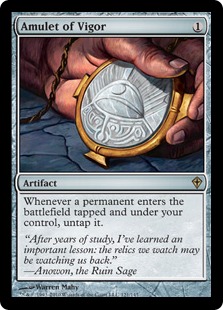
A lot of vendors had not noticed just how far these cards have dropped recently. One vendor had Azusa, Lost but Seeking available for $40 per. Another had the same card from the same set in the same condition for $20 per. Yet another had them for $30. Amulet of Vigor had a similarly wild price spread across vendors, albeit none asking quite so high as $40. Is $40 that unreasonable for Azusa though? She was nearly that high earlier this year, before the Summer Gaak Attack. With Amulet Titan back on top of the Modern metagame, I expect these and other staples of the deck such as Primeval Titan and Summoner's Pact to see some serious gains.

One powerful Magic card from this deck bridges us over to Throne of Eldraine’s massive impact on the market: Once Upon a Time. Be sure to check out last week’s iteration of the QS Cast to witness me underestimate this card’s potential. OUAT is the real deal folks. My misguided thoughts were limited to thinking of the card in terms of Mono-Green Tron and Neobrand. Two copies of Mono-Green Tron made the top 16 of SCG Indi, and one of them played 3 copies while the other played zero.

It’s just too easy to brick in a deck that is not reliant on its creatures in the early game and only plays 17-19 lands. In Neobrand, it’s a buck-wild “Allosaurus Rider or bust”, which is likely an improvement to the deck, but not a particularly impressive one. OUAT is busted in Amulet Titan though. It also seems to be performing quite well in Jund Death's Shadow, Devoted Devastation, and GW Eldrazi decks. When you have numerous good creatures that you want to hit at any point in the game, OUAT becomes very powerful.

Any queasiness I had from paying $13 a copy at Indi was quickly dispelled after playing with the card in Amulet Titan. Shortly after I completed this article, the decklists for Mythic Championship V were posted. Once Upon a Time is the most played card, with 169 copies across 68 decklists. It may spike before this article is even published, and I will discuss the Mythic Championship in more detail in next week's article.

A Powerhouse Set

Once Upon a Time is merely one of a wide swath of powerful cards impacting Modern already. The following cards are also already proving themselves in Magic’s most widely-played eternal format: Oko, Thief of Crowns, Brazen Borrower, The Royal Scions, Bonecrusher Giant, Emry, Lurker of the Loch, Drown in the Loch, Charming Prince, Castle Garenbrig, Wishclaw Talisman, Mystic Sanctuary, Grumgully, the Generous, Mystical Dispute, Witching Well, Merchant of the Vale, Gingerbrute, All that Glitters, and Into the Story. I think that’s everything for week one.

That is just so, so many eternally playable Magic cards in one set. And yet, prices for this set are relatively flat and stagnant across the board. Normally, this would be unheard of. This fall set is clearly powerful, but there’s a large, dark cloud blanketing the skies of MTGFinance: The banned and restricted list update announcement was moved forward to October 21st.

Magic players know this can only mean there is a change that needs to occur sooner rather than later, and only one archetype fits the bill: the Field of the Dead/Golos, Tireless Pilgrim decks in Standard. The Magic community at large believes that Field will get the axe, but will anything else go with it? It wouldn’t shock me if Wizards took out Teferi, Time Raveler as well, effectively unbanning Instants in Standard. I think Modern is unlikely to be touched, particularly after the wonderfully diverse metagame we saw in Indianapolis last weekend. Urza-related cards are likely safe for now, so if you need them, please help yourself by buying them before Monday while there is still apprehension about a possible ban.

As for Standard, little is safe. Oko, Thief of Crowns is very unlikely to get banned and is powerful enough to remain a mainstay of the format. Murderous Rider will definitely start seeing play if Black is at all playable. Fires of Invention could become the basis for the best deck in Standard, depending on how things shake out. The only easy buy here is Bonecrusher Giant, as it’s nearly certain to continue seeing play in Standard and is available for a mere dollar currently. I personally think the showcase version of this card is really cool, and they’re still cheaply available in both foil and nonfoil. I wouldn’t be at all surprised if $20 for a set of foils winds up seeming ridiculously cheap in a month.

There was an error retrieving a chart for Bonecrusher Giant

It's also possible that low singles prices may be ahead for Eldraine, as this set seems to be a victim of the "Dominaria Effect", in which a set has many powerful cards competing for the value of the booster box price. Be wary that if the diversity of value stays this wide, it could mean lower prices for all but Oko, Thief of Crowns.

Part 2 Comes Next Week

We’re just brushing the surface of Throne of Eldraine’s complexity here. There’s a bunch of money to be made if you can predict what deck is going to wind up on top of the post-ban Standard metagame. Right now may also be your last chance to get ahead of the Modern bull market! Join me next week for Part 2 of this article, where I will break down Throne of Eldraine Collector’s Boosters and how the numerous new premium variants of Standard cards fit into the current MTGFinance world. We'll also go over the financial implications of Mythic Championship V. Thanks for reading, tweet at me if you have any questions about buys/sells leading up to the ban.

See you all at #SCGATL and the #SCGINVI!

Metagame’s First Look: SCG Indianapolis Analysis

Are you a Quiet Speculation member?

If not, now is a perfect time to join up! Our powerful tools, breaking-news analysis, and exclusive Discord channel will make sure you stay up to date and ahead of the curve.

With a few weeks of online events and an SCG Team Event, the metagame is finally taking shape. It's nowhere near enough for any real analysis to take place, but it is a good starting point. With SCG Indianapolis in the books it's time to start pulling apart the data and contextualizing it.

Modern has been incredibly volatile this past year: Faithless Looting's ban knocked out a longstanding pillar, Hogaak, Arisen Necropolis warped the format, and we've been spoiled for new cards. So much has changed that I don't think it fair to compare the new metagame to the pre-Modern Horizons one. Therefore, I'm treating the new meta like a blank slate. I don't know what the metagame "should" look like anymore, so I won't judge and will continue to be open minded but skeptical until more data comes in.

Day 2 Meta

As has become tradition, I'll start with the broadest data and then get more specific. Prior to the tournament, the expectation was for Urza, Lord High Artificer-based decks to dominate. The deck appeared to be solid and the addition of Emry, Lurker of the Loch stood to supercharge the deck. Of course, this was all speculation, so let's see what really happened.

Deck NameTotal #
Other 28
Amulet Titan12
Urza Ascendancy12
Jund12
Mono-Green Tron11
Burn11
Urza Outcome8
Grixis Death's Shadow6
Eldrazi Tron5
5-C Whirza5
Humans4
UW Control4
Titanshift4
Jund Death's Shadow3
Dredge3
UW Stoneblade3
Bant Stoneblade3
Devoted Devastation2
Abzan Company2

I'll give the prophets partial credit: if you aggregate all the various types of Urza decks, they would be the best represented deck in Indy's Day 2. Even if you only lump the combo versions together, they'd be the most popular deck. They'd still be behind the other category, but this is Modern, so that fact doesn't really count. That I have to aggregate at all is one mark against the predictions. There's also the question of it being a self-fulfilling prophecy; as always, hyped decks show up in great numbers and then do well, so it's hard to say if the result is meaningful.

Jund is tied for first place among individual decks, which is surprising given the quantity of big mana decks (aka Jund's worst matchups). It would be easy to attribute this result to Wrenn and Six, and the ensuing hope all Jund players seem to have, but this may be legit. The power of Jund has always been playing slightly-better cards than the opponent, and more of them. Now Jund never has to miss a land drop end enjoys a consistency upgrade. I hope to see this result sustained.

Top 32 Results

Now to move onto the Top 32. I know I ususally only do the Top 16 in these articles, but I saw the results initially posted as the Top 32, and just rolled with it. (For those curious, the data for all Day 2 decks has now been released.)

Deck NameTotal #
Amulet Titan4
Urza Ascendancy3
Mono-Green Tron3
Burn2
Humans2
Grixis Death's Shadow2
Jund2
Urza Outcome2
Gifts Storm1
Jund Death's Shadow1
GW Eldrazi1
Dredge1
Devoted Devastation1
UW Stoneblade1
Esper Goryos's 1
Four-Color Whirza1
Boaryo's Vengence1
Elves1
Abzan Company1
Bant Snowblade1

Gifts Storm won the event, though that makes perfect sense given the bracket. The only Top 8 decks with relevant game 1 interaction were GW Eldrazi and Jund Shadow, and the only way Drake Sasser could have hit them was in the finals. Instead, Drake was fed a steady diet of other combo decks and just won the footrace each time. Storm is relatively easy for other decks to disrupt, but it is usually the faster and more reliable combo. From what I saw, Drake benefitted from his opponents' more complicated decks clunking to varying degrees.

The rest of the sample is a host of big mana and combo decks. I count 8 midrange or slower interactive decks, 5 aggro decks, 12 combo decks, and 7 big mana decks. The three most-played decks all fall in the latter categories. Why this happened is hard to say, though the low Humans turnout is likely a factor; Humans was initially built to thrash Storm, and the clock-plus-disruption strategy is the classic way to defeat any combo. It can also race most big mana decks and has considerable sideboard options against them. The lack of control is likely a combination of lots of bad matchups against big mana and uncertainty over how to build the decks. Between a developing metagame and difficulty making Stoneforge Mystic work, I'd wager they're just not ready for the big time yet.

Classic Complication

Finally, it's time to look at the frequently contradictory data, the Modern Classic. The Classic posts very different results from the main event so often that I can't imagine it's a coincidence. My theory has been that the Classic is composed of Day 1 drop-outs, and so reflects the starting population. However, it's been reasonably argued to me that some decks do better in shorter tournaments rather than long. I may never know the reason for the deviation, but it happened again.

Deck NameTotal #
Urza Outcome4
Amulet Titan2
Dredge2
Jund2
UW Control1
Izzet Kiki1
Burn1
Abzan Company1
Jund Death's Shadow1
Eldrazi Tron1

Only one version of Urza deck appeared, and it dominates the data. Amulet is alphabetically second, but tied with Dredge and Jund. The only version of Tron is Eldrazi Tron, which appears at copy. This is more in line with the aforementioned predictions and expectations and to an extent defies the Open. Again, I'm not sure what to make of it or how it relates, but it does provide an interesting data point for further investigation.

Bottom Line

Combo decks had a very good week, winning both events. Big mana was the next-biggest category, while the fair decks suffered. Given matchup expectations, I'd argue that players expected fair decks to be out in force and came with their predators. This suggests that in future weeks, anti-combo decks will be the metagame call.

Dangerous Outcome?

Urza, Lord High Artificer decks were clearly the most popular decks last weekend. There has been considerable attention on the deck, and a lot of high-level players claim it's the best deck in Modern. There haven't been many Modern events since Hogaak, Arisen Necropolis was banned, but Urza decks have done very well. Naturally, this has led the internet to start the usual banning speculation, as happens whenever a new deck does well. Normally I'd just ignore the calls, but there's a wrinkle this time.

Last week, Wizards suddenly announced that they were moving up the date of the next banned and restricted announcement from November 18 to October 21. This has naturally led to speculation that the new kid on the block was getting axed. This is almost certainly false. Given the timing of the announcement and the competitive schedule, it's more likely a Standard ban is coming.

The announcement came as decks were being submitted for this weekend's Standard Arena Mythic Championship, and Golos, Tireless Pilgrim decks were overwhelmingly popular. Prior to then, they were widely considered the best deck, and fairly oppressive since Standard lacks answers to Field of the Dead. Given that it looks like Field will dominate this weekend and there's another Standard MC next month, the land itself is the likely target. As a result, it is very unlikely that anything will happen in other formats.

Historical Precedent

That doesn't mean it is impossible for Modern to see another ban, just that it's not why the announcement was changed. If there is to be a ban, the only possible target would be the Urza decks. Nothing else appears to be as successful or (theoretically) dangerous. However unlikely I believe it is, there is a reasonable argument for why another ban could happen: simply put, the Urza combo decks look to be another round of Krark-Clan Ironworks, and can play out similarly to the previously-banned Eggs. These precedents make it more plausible for a ban should Urza cause enough problems.

The main problem is logistical. If observations from the weekend are to be believed, it may not be power or dominance that makes Wizards take action, but the repetitiveness. The linked clip was from Autumn Burchett taking nearly twenty minutes to combo off with Paradoxical Urza. While that is an absurd time to spend on one turn, I'm told Autumn has a reputation as a slow, delibrate player, and that turn was not unusual. The only reason this could translate into a ban is if these lengthy combo turns are universal, which I can't verify.

A linked problem is that the combo isn't deterministic: the combo decks don't necessarily have a combo kill. Singleton Aetherflux Reservoir is the closest I've seen to an immediate combo kill. Whether they're running Jeskai Ascendancy or not, these decks intend to win by making an absurd amount of Thopter or Servo tokens and maybe have Nexus of Fate for a combo kill delayed by one turn (until the tokens can attack). Tokens are fairly easy to interact with, and Plague Engineer can undo a great deal of comboing. All these factors result in dull gameplay for viewers and opponents.

Given that these problem are why Ironworks got banned, it's not impossible that something could get banned from Urza. If that happens, I expect it would be Urza himself, as it's generally preferred to ban engine cards. The Emry combo is less reliable and can also be shortcutted to victory.

Reliably Unreliable

I strongly doubt that anything will happen in Modern next Monday. Wizards just had a major banning, and therefore it's too early to be making proclamations about the metagame. We're just getting the first look at actual metagame data, and the picture is unclear.

Urza is very popular and is getting a lot of hype. This necessarily translates into metagame presence. As previously discussed, the hype says that Urza is busted, and decks featuring him are far better than anything else in Modern. Whether this is actually true hasn't been shown in results, but it's too early to be certain. It would take a very clear tale of Urza decks dominating MTGO, which only Wizards knows, for any action to be taken.

Going beyond the data, I'm also not certain on a qualitative level that anything needs to happen. I've been helping a friend test the Urza decks, and he's described it as the most frustrating deck in the world to test. When the Jeskai Ascendancy or Paradoxical Outcome versions are running well, it's the closest we'll ever come to playing paper Vintage. PO Urza's combo kill is basically a Black Lotus away from Vintage Outcome. However, when it doesn't, it feels like complete garbage. The deck is mainly air and needs a critical mass of artifacts to do anything.

Fearful Commitment

The problem has been that a given hand might be the former or the latter, and there's no way of knowing until you play out the game. On many occasions, we've kept turn-one Emry hands, completely whiffed on the mill, and then drawn only payoff cards without anything to make them good. The exact same hand with a mediocre-or-better Emry mill wins within a couple turns. The Ascendancy version is slightly better in that redundant enchantments stack and trigger each other when cast, so there's a chance to dig into gas; however, a Lightning Bolt on Emry can kill any chance that version has to win.

Testing the combo version has also turned my friend off the more reliable Whirza combo/prison decks. Having a reliable gameplan is great, but it feels anemic in comparison to the combos. The data disagrees, but he says it feels so much worse. Then there's the overarching issue with all these decks: they're very poor if Urza himself never resolves.

Just the Start

SCG Indianapolis is the first data point of this new Modern. As always, it will take quite a bit more data before any determinations or predictions can be made. Still, it is exciting to see Modern's rapid shift from this time last year.

Why MTG Finance Exacerbates My Smartphone Addiction

Are you a Quiet Speculation member?

If not, now is a perfect time to join up! Our powerful tools, breaking-news analysis, and exclusive Discord channel will make sure you stay up to date and ahead of the curve.

My name is Sigmund Ausfresser, and I have a problem.

After reading the book Digital Minimalsim by Cam Newport, I realized that I have an addiction to my cell phone. I found myself monitoring meaningless events from my phone rather than paying attention to what’s around me: my 2-year-old’s bath time, my son’s arts and crafts project, and my spouse’s daily conversation about her day. Does my phone really contain information more valuable than these in-person experiences with my family? This was the first indication that I needed to make a change.

Then I got a whiff of the data, graciously recorded by my iPhone, and the word “addiction” became more appropriate. How else can you explain something that grabs my attention for an average of 2 hours 33 minutes a day; something I pick up and look at an average of 105 times a day; and something that attempts to grab my attention via notifications an average of 66 times a day? I’d say that qualifies as an obsession, wouldn’t you? What a waste of time!

There was an error retrieving a chart for Time Stretch

What does this have to do with Magic? Much of the time I’m looking at my device, it’s because of a Magic engagement. Whether it’s Twitter, Discord, Slack, or browsing in Safari, I spend so much of my time using my phone to engage in the Magic hobby. While these services have a purpose, I think it’s time I make some drastic changes. Immediately.

What’s the Incremental Value…Really?

In the past, I have written about the material benefits of engaging with the MTG finance community on social media. Discussing cards on Discord, monitoring trends on Twitter, and watching metagames unfold on Twitch are fantastic ways to stay in the loop on what cards are making waves in the multiverse. But how often does engagement with these services provide quantifiable benefit?

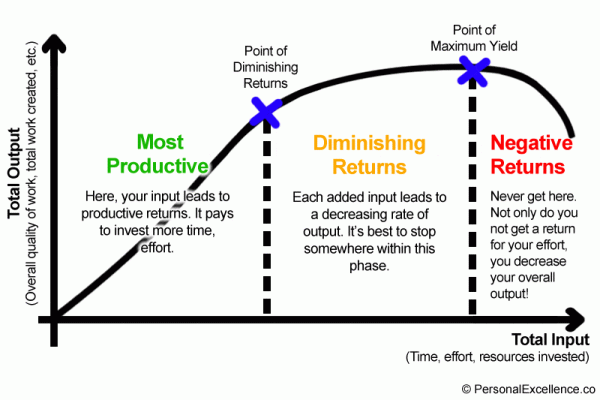
Consider the law of diminishing returns:

The first couple times these social networking services are engaged, productivity is realized. But it doesn’t take long before the benefit of each incremental check yields a diminishing return. When I wake up in the morning, I check MTG Stocks, Card Kingdom, Discord, and Twitter to see what trends unfolded overnight. There are usually a few valuable tidbits. But checking these same services and sites ten times more throughout the day offers minimal, if any benefit.

It’s time I put a stop to these unhealthy habits. I’ll still respond to people when they ask me MTG finance questions directly because I love interacting with the community. But my replies will be slower. Additionally, I’ve deleted Discord, Facebook, and Twitch from my phone so I can only interact with these services from a computer—this way the distractions won’t get to me while I’m out and about. My Twitter usage will also be severely reduced and I intend to cull the number of accounts I follow to better curate my feed (no offense to anyone I may unfollow!).

To enforce these rules for myself, I have also utilized the Screen Time function in iOS—now my access to the Twitter app is shut down after I use this service for fifteen minutes in a given day (I hope to reduce this time even further). This seems like ample time, but it goes by so quickly because Twitter is my primary interface with the community.

Will I miss some crucial event and fail to capitalize on a golden opportunity for profit due to these self-imposed restrictions? It’s possible, but highly unlikely. As long as I purposefully stay engaged when it’s convenient for my schedule, I’ll remain informed of major events: ban and restriction updates, metagame evolution (I don’t care much about Standard and Modern anyway), and special product releases.

It’s important to remain informed of these occurrences as they unfold, but these are acute events. Monitoring every person’s random tweet and following every buylist change on Card Kingdom’s website is far less valuable. It’s these behaviors that I intend to eliminate.

Jeremy’s Grab Bags: A Case Study

Quiet Speculation’s newest writer, Jeremy (@MissouriMTG on Twitter), has devised a brilliant method of liquidating cards while maximizing his time: selling grab bags. You can purchase these products in $100, $450, and $1000 increments. Because of his reputation, prospective buyers know they’ll receive “value” in purchasing these pre-assembled products. Every $100 spent is assured to realize at least $100 in cards.

I’ve purchased two of these grab bags myself. In the first, I received a near mint book promo Mana Crypt.  This card buylists for $160, so I made a 60% profit on this particular bag. A worthwhile investment! The second grab bag was a little less inspiring, containing an array of Modern-bordered cards whose buylist value was in the high $90’s. It was cool to open a semi-randomized grab bag of cards, but because I’m primarily an Old School player and collector, none of the cards had utility. I plan on selling all of these.

There was an error retrieving a chart for Mana Crypt

That brings me to why I think Jeremy is a genius for selling these products: even though he’s giving folks “value” by selling grab bags, he’s essentially buylisting these cards to players instead of stores. Think about it: he gets paid $100 right away, then ships whatever pile of cards he wants. As long as they’re worth at least $100, the customer is happy. This means he doesn’t have to submit 1000’s of cards to buylists, put them in alphabetical order, worry about downgrades in condition, etc.

What’s more, when Jeremy’s customers receive their grab bags they will need to sell cards in order to realize the “value” made by purchasing this product. This means effort. In my case, I’m submitting buylists to both Card Kingdom and ABUGames to eek out profit without wasting too much of my time. Others may choose to sell the cards on eBay or TCGPlayer. Either way, we the customers are acting like the resellers. Jeremy buylists the cards to us, the customers, and we are the secondary sellers looking to turn a profit.

Why is this brilliant? Let’s put it in the context of Digital Minimalism. Jeremy is bypassing the time and effort of being the secondary seller, by instead shipping these grab bags to players who are dying to hand over their hard-earned cash. In doing so, he’s essentially paying us (in cardboard) to sell all these cards for him! He’s paying for our service by selling us $110-$140 worth of cards for $100. Without realizing it, we’ve become his hired hands!

There’s still the thrill of opening that envelope without knowing what’s inside. Maybe you opened some cards you’re happy to keep. That’s all possible. But the bottom line is, Jeremy is paying us to make his life easier by accepting whatever cards he wants to liquidate. He’s paying us to sell these cards for him. I tend to enjoy placing buylists and working the grind, but in a world where I’m trying to cut down on my Magic finance time, I think I need to step aside and let others take advantage of this paid position. I applaud Jeremy for his ingenuity.

Wrapping It Up

Instead of being an MTG finance article, this week I wanted to dwell on something that is directly impacting my life at this moment: my smartphone addiction. I want to significantly cut down on how much time I engage with social media and various MTG websites. I'm on the unproductive portion of the diminishing return curve, and each incremental minute I’m spending is yielding negligible gains.

It’s time to change that. I’ve already deleted a bunch of applications from my phone, and the apps I’m keeping will be regulated using iOS’s Screentime capability. This will hopefully keep me in check when it comes to time I’m spending on my device. It’s so critical to remember there’s a real-life world around us—an experiential world that doesn’t require a screen interface. It’s about time I compulsively check what this world has to offer, rather than constantly escape into the dark hole that is social media.

As for the impact on MTG finance, I expect to spend less time engaging with the hobby. But this doesn’t mean I’ll be any less interactive—I just need to be more deliberate in where I spend MTG time. Checking buylists five to ten times a day out of boredom (yes, I have been doing this) can’t possibly be productive. Instead, I’ll do my checking once in the morning and once before bed, and that’s it. It’s highly unlikely I’ll miss some golden opportunity by adhering to this self-imposed rule. And even if I do, so what? Opportunities arise on a weekly basis in MTG finance, and if I miss one I’ll just as likely be able to find the next one.

Lastly, I’m going to consider more creative ways of moving cards in order to save time. I’ve already begun this by focusing on buylists rather than selling peer-to-peer. In other cases, I sell via Twitter to avoid the hassle of selling on eBay or TCGPlayer. I may even sell more aggressively moving forward, pricing cards low enough to make selling even faster and easier. I may leave a little money on the table by doing this, but the time it gains me back will be more than worth it!

…

Sigbits

Buylists have been relatively unexciting lately due to the softness in the Magic market. For this reason, I don’t have many inspiring data points to share. Instead, I’ll share a couple of recent purchases I’ve made from Card Kingdom (using store credit) because the pricing was attractive.

  • First, there’s King Suleiman. I actually didn’t have enough store credit to buy this one, but I still grabbed it because that $58.49 price tag for “Good” copies was so attractive. TCG low is $70, so $58.49 seemed like a great price. Also, I love the flavor, the card is on the Reserved List, and the artwork is terrific. Seemed like a win in my book!
  • Another very recent store credit pickup is Thunder Spirit from Legends. Unfortunately, Card Kingdom only had EX copies in stock, at $119.99 (I would have preferred a more played copy for cheaper). Still, TCG low for lightly played copies is $138 and market price is $210 so $119.99 for EX felt like a deal. They had a few more copies in that condition in stock, but it wouldn’t surprise me to see them gradually dry up, followed by a price hike.
  • My most exciting recent pickup was a VG Moat, for $479.99 in-store credit. I don’t think I’d ever purchase this card with cash, but I had a decent amount of credit and I wanted to acquire a higher-end card. Moat is playable, has iconic artwork, and TCG low is $535.49. Combining all these factors, I doubt there are as many deals worth grabbing as Card Kingdom’s VG Moats. This is one I intend to keep and enjoy for a while!

QS Insider Cast – Throne of Eldraine Release Week

Are you a Quiet Speculation member?

If not, now is a perfect time to join up! Our powerful tools, breaking-news analysis, and exclusive Discord channel will make sure you stay up to date and ahead of the curve.

Welcome back to the QS Cast! Join Chris Martin, Chris O’Berry, and Sam Lowe as they talk about Throne of Eldraine going into release weekend. This cast was originally broadcasted live to Insiders in the QS Insider Discord, October 3rd, 2019.

Show Notes

Standard

Cards to watch and consider - Rankle, Master of Pranks - fluctuating $9-10, glue card (run as 4x) in a couple Rakdos 5-0 lists

Simic clear favorite to start with - "deck to beat" - but Rakdos is also showing fringe decks with 5-0s include Gruul, Sultai, and Golos decks

Lands to watch: Breeding Pool and Temple of Mystery (might be worth selling these into hype if you are holding copies because the prices are going to climb nicely due to Simic's metagame share)

Knight of the Ebon Legion --> sell into hype ($10+ rares in Standard are tough to hold)

Spawn of Mayhem --> we think sell, take profits now because the upside is limited and the downside could be back to $2

Modern

Talked about Once Upon a Time: Sam's take is it is overrated; some good reports of it working well in Tron - Emry, Lurker of the Loch: running wild in Modern alongside Urza mostly, but a brand new deck has emerged as a combo deck around Emry (without Urza)

Cards to Consider: - Fatestitcher: 4x in the Emry decks ; target nonfoils at $1 and foils (LP condition) at $4 - Karn, the Great Creator and Teferi, Time Raveler -

Hand disruption: Inquisition of Kozilek and Thoughtseize - Graveyard and artifact hate continues to shine: Rest in Peace and Stony Silence respectively, not as big on Leyline of the Void yet due to reprint, but soon this will be a target worth acquiring, too.

EDH/CommandFest

Sentiment is that it is too early to make financial predictions on these new EDH standalone events hosted by ChannelFireball, but I gave some insights into the vendors which will be at these events and the potential for EDH to be a little less quiet over the winter than in past years. Sol Ring foils are a part of the sign-up package for MagicFest and CommandFest, and will likely become great speculation targets down the road (once supply runs out).

Wanna chat? Find us on Twitter

Chroberry – @chroberry
Chris Martin – @ChiStyleGaming
Sam Lowe – @MahouManSam

Start This Party Right: Brewing Gx Eldrazi

Are you a Quiet Speculation member?

If not, now is a perfect time to join up! Our powerful tools, breaking-news analysis, and exclusive Discord channel will make sure you stay up to date and ahead of the curve.

With Throne of Eldraine released, it's only a matter of time until the set's real players make themselves known. But despite the lack of data we've got at this stage, certain candidates are already hogging the conversation. Perhaps the most polarizing card in the set is Once Upon a Time. The instant has all the makings of a Modern playable: it's fast; it's free; it's powerful. But since "Leyline of Given Spell" has never been Modern-legal before, Time's true potential, or lack thereof, remains up for debate.

For my part, I've been especially happy with Once Upon a Time in green Eldrazi shells. Black pushes the deck too far into midrange territory to occupy its own niche; here, it's overshadowed by Jund. And blue doesn't really offer much to the strategy. That leaves white and red, two splashes my testing has indicated are super legit.

The Gx Eldrazi Core

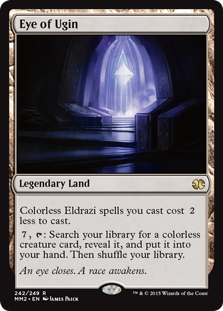
In "Weird Science: Dissecting Modern's Eldrazi Decks," I compared the draws to Colorless Eldrazi Stompy, Eldrazi Tron, and Bant Eldrazi, delving into how each deck sought to fill the fast-mana void left by Eye of Ugin's banning. Stompy ran Serum Powder to quickly locate Temple; Tron packed Urza lands as an additional mana engine that, while off-theme, was more explosive. And Bant ran Noble Hierarch, a card that buffed Eldrazi creatures via exalted, further improved Temple draws by leading to dreaded turn-two Thought-Knot Seers, and compensated for hands without Temple by nonetheless reaching one turn higher on the mana curve. While Hierarch cost players a mana and opened Eldrazi pilots up to disruption in the form of ubiquitous small-creature removal, it also let them run Ancient Stirrings, one of Modern's strongest enablers.

These decks all still exist in Modern, in one form or another. But it's the Gx builds of Eldrazi that improve directly from Throne of Eldraine, which grants them Once Upon a Time. Time is similar to Serum Powder in that it fixes opening hands, but dissimilar in that it makes for a pretty big topdeck in a deck that's already interested in making its land drops and sort of prone to flooding. In other words, Time is pretty much all upside.

Gx Eldrazi Core, by Jordan Boisvert

Creatures

4 Noble Hierarch
4 Thought-Knot Seer
4 Reality Smasher

Instants

4 Once Upon a Time

Sorceries

4 Ancient Stirrings

Featured here are the best-of-breed Eldrazi creatures, Noble Hierarch, and a suite of eight heavy-duty green cantrips. Between Time and Stirrings, both of which find Temple and Thought-Knot, resolving the four-drop a couple turns early should be par for the course in most games.

Where the deck goes from here depends on whether white or red is splashed.

Splashing White

Some of white's perks include:

  • An obvious additional Eldrazi creature in Eldrazi Displacer
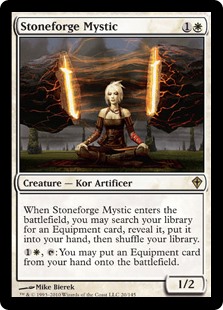
  • An alternate gameplan in Stoneforge Mystic
  • Blue-chip removal in Path to Exile
  • Powerful sideboard hosers, namely Rest in Peace

The above benefits are ranked from most important to least. While Rest is backbreaking for opponents in some metagames, it's by no means necessary. Similarly, there are other removal options available to this strategy, such as Dismember. But I think Stoneforge gives the deck a very potent angle of attack against other creature decks. Best of all is Displacer, which is a hoser in its own right against certain decks (Infect for instance) as well as a must-answer threat for attrition and aggro-control strategies alike.

GW Eldrazi, by Jordan Boisvert

Creatures

4 Eldrazi Displacer
4 Thought-Knot Seer
4 Reality Smasher
4 Noble Hierarch
4 Stoneforge Mystic

Planeswalkers

3 Karn, the Great Creator

Artifacts

1 Batterskull
1 Sword of Feast and Famine
1 Sword of Light and Shadow

Instants

4 Once Upon a Time
4 Path to Exile

Sorceries

4 Ancient Stirrings

Lands

4 Brushland
2 Cavern of Souls
4 Eldrazi Temple
2 Forest
3 Horizon Canopy
2 Plains
4 Prismatic Vista
1 Wastes

Sideboard

2 Damping Sphere
1 Dismember
1 Ensnaring Bridge
1 Grafdigger's Cage
2 Knight of Autumn
2 Collector Ouphe
1 Liquimetal Coating
1 Mycosynth Lattice
1 Phyrexian Revoker
1 Basilisk Collar
1 Walking Ballista
1 Weather the Storm

This list is based on Ally Warfield's suggested build from last month. To make room for Once Upon a Time, I've cut a Karn and the Talismen. Once should help find Temple often enough that the additional ramp isn't so necessary; in the late game, it finds closers like Reality Smasher, making the need for Karn less pressing. I have left the number of lands intact, though, reasoning that the Karn package does benefit from pilots making their land drops.

Splashing Red

I think red's allure is a little subtler than white's, but I'm overall more excited by this splash.

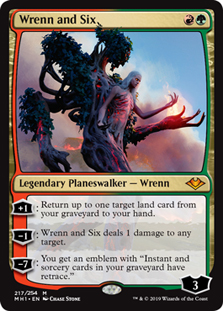
  • A card advantage, utility engine, and curve-fixer in Wrenn and Six.
  • An all-purpose removal spell in Lightning Bolt.
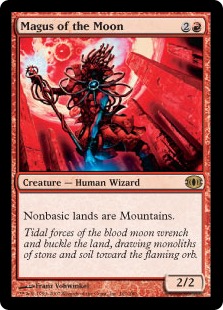
  • A free-win dimension granted by Magus of the Moon.
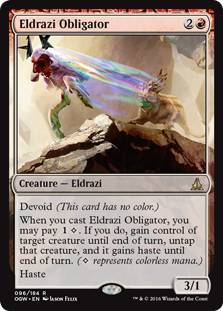
  • Some juicy role-players: a conditional tide-swinger in Eldrazi Obligator and a hoser for small aggro in Grim Lavamancer.

Something something Lightning Bolt good something. But Modern's best card isn't the best reason to go red. That honor goes to Wrenn and Six, the planeswalker that has revitalized Jund and even rendered wedges as suspect as Temur playable.

In this deck, Wrenn combines with fetchlands to ensure we hit our land drops, which has some serious implications for the deck's construction. For example, we can now top out the curve with World Breaker, giving us mainboard outs to Modern's available prison plans. Making land drops also helps pay for mid-game Times, which we can more easily chase with whichever fatty we rip off the top of our library.

Wrenn also gives us some utility dimensions. Dryad Arbor makes the cut as a fetchable, repeatable blocker, or even attacker in the right situation. And Tranquil Thicket turns Wrenn's plus into an actual plus. Finally, we can't really lose to land destruction anymore, eliminating a common pathway for opponents to deny us our gameplan.

Magus of the Moon is another exciting addition to the red build, and it comes with a couple Birds of Paradise. Time finds either creature, which lets us set up "Magus hands" with some ease, and lock opponents out of the game as early as turn two. Not everyone can answer a Magus; having access to that plan Game 1 without needing to commit to a bloated Blood Moon package is a huge boon.

One factor to address in GR is the absence of Eldrazi Displacer. We still need another Eldrazi to round out the curve and make Temple worthwhile. I'm currently on Matter Reshaper, with Obligator relegated to the sideboard. While the 3/1 haste has certainly put up numbers for the strategy in the past, I feel that with so much aggro and midrange in the format right now, Reshaper earns its slots. Obligator is high-impact, but also high-variance, only proving relevant in certain matchups. Additionally, it's more of a four-drop than a three-drop, and its ability requires a colorless source besides the first Eldrazi Temple. I didn't want to be locked into fetching Wastes every pre-board game.

Joining Obligator in the sideboard is Grim Lavamancer, which has proven a house against small creature decks. GR is fully capable of stuffing its graveyard, and with Time in the picture, we can open the little guy quite easily.

GR Eldrazi, by Jordan Boisvert

Creatures

4 Matter Reshaper
4 Thought-Knot Seer
4 Reality Smasher
4 Noble Hierarch
2 Birds of Paradise
2 Magus of the Moon
2 World Breaker

Planeswalkers

4 Wrenn and Six

Instants

4 Lightning Bolt
4 Once Upon a Time

Sorceries

4 Ancient Stirrings

Lands

4 Wooded Foothills
4 Prismatic Vista
4 Eldrazi Temple
2 Stomping Ground
2 Tranquil Thicket
1 Dryad Arbor
3 Forest
1 Mountain
1 Wastes

Sideboard

3 Collector Ouphe
3 Eldrazi Obligator
3 Grim Lavamancer
2 Damping Sphere
1 Grafdigger's Cage
1 Torpor Orb
2 Ancient Grudge

As far as the sideboard goes, Ancient Grudge is the only non-searchable card here. But I think it's too strong in this metagame not to include in a GR deck. The 3 Collector Ouphe may raise some flags, so let my mission statement be clear: I'm through losing to Whirza!

Christmas Come Early

Is GR the future of Eldrazi? Or will the just-released Stoneforge Mystic finish by proving its worth in this ultimate test? Let me know your thoughts in the comments. Until then, may you assemble the nut!

Betting on Core Set 2020

Are you a Quiet Speculation member?

If not, now is a perfect time to join up! Our powerful tools, breaking-news analysis, and exclusive Discord channel will make sure you stay up to date and ahead of the curve.

I came across a post on the mtgfinance subreddit about speculating on bargain Modern Horizons cards for the long-term - the theory is that supply of these cards hit their peak supply after Grand Prix Vegas, at which point focus started shifting towards Commander 2019 decks and Throne of Eldraine. With supply bloated, prices have sunk and look to have bottomed-out. With no new supply coming, prices should increase as the player base grows and demand increases. It all sounds nice in theory, and people shared all sorts of ideas on what cards to target. After digging deeper I’m not so confident in the premise. 

I decided to use QuietSpeculation’s Trader Tools to take a look at buylist prices and to get an idea of how these cards are performing in the market, and they paint a picture of very bloated supply. The spread numbers on the cards are very high, with buylists offering low numbers compared to what they are selling for. For example, the price of the top-upvoted recommendation in the thread, Unsettled Mariner, a surefire cross-archetype staple over the long-term, retails for about $1.50, but buylists for just $0.75.  It gives me the sense that these retail prices could fall further still as stores try to unload their bloated inventories. It also seems like supply is so high that it will require massive increases in demand to meaningfully increase of these most bargain cards, so any speculation would have to be done on a truly long-term time frame. 

There was an error retrieving a chart for Collector Ouphe

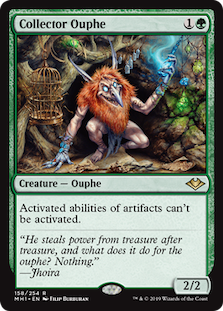
The Modern Horizons card with the lowest spread is currently Collector Ouphe at 33%, which buylists for $3 but can be bought for $3.50-$4. This smaller spread means it has much better legs to stand on as a good spec. It has a great appeal across formats as one of the best hosers in the game, so its future prospects look great.

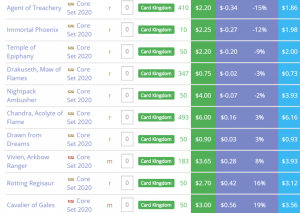
This buylist-focused approach to speculation got me looking at other sets, and I was blown away by the prices of Core Set 2020, which looks very different thanModern Horizons. Its spreads are very low, and at the time of writing, it even has multiple negative spreads that offer arbitrage opportunities.

*Immortal Phoenix doesn’t count since it’s a promotional card

These spread numbers are based on the TCGPlayer Mid price, so in reality, these cards can be had even cheaper and the spreads are even smaller. Numbers like 3% are actually on the negative side. It’s rare to see so much demand from such a recent set, and it points to the fact that Core Set 2020 was severely under-opened. It came right before the release of Commander 2019 decks, and after the exciting Modern Horizons, which made the core set release seem even more lackluster than usual.

Events like Grand Prix Vegas using Modern Horizons instead of Core Set 2020, which was released a month prior, is perfect evidence of the core set’s reduced importance being even further diminished.  Yet, it was actually quite a powerful set, putting multiple staples like Elvish Reclaimer and Mystic Forge immediately making it in Legacy, and currently dominating Standard with cards like Field of the Dead and Golos, Tireless Pilgrim. Buylist prices also paint the picture of a set with high casual appeal, which helps to explain the high buylist price for cards like Drakuseth, Maw of Flames and Chandra, Acolyte of Flames.

There was an error retrieving a chart for Drakuseth, Maw of Flames

There really isn’t much Core Set 2020 being opened anymore except by those cracking for singles, but demand is only going to increase, with the set still having a year left in Standard, and especially for the most playable Eternal and casual cards. I see the stage set for significant price increases in the coming months as Core Set 2020 is farther and farther back in the rearview mirror, so I like taking any opportunity to buy in on these cards for a good price with an eye towards significant gains next year. 

There was an error retrieving a chart for Agent of Treachery

The card with the lowest spread is Agent of Treachery, which makes sense to me as it is seeing play in Standard's top deck and has huge casual appeal. With a Standard ban of Field of the Dead looking inevitable, players will be looking to alternative late-game tools like Agent of Treachery, so its fortunes might further improve there into next year,  and its long-term casual prospects look great. 

There was an error retrieving a chart for Temple of Epiphany

Temple of Epiphany seeing such robust demand makes sense given it’s a Standard staple with casual appeal. What’s telling is that the price of the original printing fell very little after the printing, from around $3.30 to $2.40, and is already heading back up. The rest of the cycle tells a similar story, and I think that gives them all a strong foundation as a spec.

There was an error retrieving a chart for Drawn from Dreams

Drawn from Dreams is a truly powerful card, a fixed version of the Modern and Legacy banned Dig Through Time. It’s not seeing a ton of play in Standard, but it gained a major boost from Fires of Invention, which it's being used in combination with as up to a 4-of. With a ban looming players are going to look towards the next most powerful strategies, and surely Fires of Invention is on the shortlist of things the pros will be trying to break for the Mythic Championship next month. Its price is up nearly 25% from Throne of Eldraine release and about to crack $1.

There was an error retrieving a chart for Voracious Hydra

A Field of the Dead ban will really shake up the metagame and the market, so at this point really anything is fair game. Green-based multicolor ramp decks were the top in Standard even without Field of Ruin, and they are still now after rotation with Field of the Dead. I imagine they’ll still be on top afterward, just in some other form. That makes green look like a good bet overall. One prime target is Voracious Hydra, which stands out to me as a card already seeing play in some of these decks, a versatile tool that fits all flavors of green decks.


Throne of Eldraine Specs to Keep an Eye on

Are you a Quiet Speculation member?

If not, now is a perfect time to join up! Our powerful tools, breaking-news analysis, and exclusive Discord channel will make sure you stay up to date and ahead of the curve.

The breeze is brisk, the trees are changing colors, school is back in session. That can only mean one thing - rotation is here!

Rotation has passed us and that means that a new standard is in session. There are already some powerful decks putting up results on Arena and Twitch too. The two biggest contenders seem to be different builds of Oko, Thief of Crowns and variations of Field of the Dead, along with variations of Fires of Invention decks close behind. A lot of cards have already spiked because of this, but there are many others to look at. Keep an eye on the meta as it slowly shifts and settles with decks looking to beat the contenders. Let's take a look at some cards that have the chance to trend upward due to this.

The Fires Burn Bright

There was an error retrieving a chart for Fires of Invention

Fires of Invention decks are becoming more popular and thus rely on exactly that card to fuel their game. Currently sitting around $3, Fires is one of the key cards to this deck. Regardless of build (except maybe the Golos, Tireless Pilgrim decks) the decks are slow midrange without it.  There are articles showing up as well as popular YouTube/Twitch personalities playing it and it has proven to hold it's own against the meta. This card has the potential, in my opinion, to hit roughly $6-7.

Send in the Cavalry

There was an error retrieving a chart for Cavalier of Flame
There was an error retrieving a chart for Cavalier of Gales

Both of these cards are the beef of Fires decks.  Cavalier of Gales is able to set up your hand and hold the field while Cavalier of Flame puts pressure on the opponent and eventually wins the game. The red Cavalier is already on the rise, doubling up from $3 to $6 in the last week, and has the potential to hit $9. This is a decent indication that Gales can move past the $4 and would be wise to hold onto a few.

I'm going on an adventure!

Much like Bilbo Baggins, the cards from Throne of Eldraine allow us to seek out adventure. There are two up-and-coming decks that utilize this mechanic and try to abuse it with Lucky Clover. Sitting at a quarter, this card isn't the win condition of the deck but does allow it to become much more of a threat than a draft deck. These decks use cards like Lovestruck Beast, Edgewall Innkeeper, Order of Midnight, and Bonecrusher Giant to act as two-for-one type spells with the potential for more thanks to the Clover.

This deck reminds me of the 4-Color Gates decks that were popular at the beginning of Guilds of Ravnica Standard. They are a great entry point for players newly jumping into Standard, as many of the cards are cheap minus one or two, and are a great fit for FNM or casual gameplay. All of the uncommon adventure cards (especially alternate arts) have the potential to move into the $1-2 range and can be a great bulk pick-up.

Two great picks for a great deck

Fae of Wishes gives us yet another way to reach out for help in the sideboard much like Mastermind's Acquisition did.  The biggest difference though is that Fae of Wishes, while only being able to grab a noncreature card, is attached to a 1/4 flyer that can become reusable and is significantly easier to splash into a deck.  Keep in mind the most popular decks that are running blue are making room for the Fae in their lists.

Being able to search out an Unmoored Ego, a timely Time Wipe, or an Ethereal Absolution in decks that have the ability to play these cards (such as Fires or Golos) can facilitate a crucial turning point for the game. They are being run as a 4-of in the lists that maindeck them, and did I mention that the 1/4 flyer can block for days?

This card is something to definitely keep your eye on. It's currently sitting around $2 and has the real potential to hit $5+. Foils are also a great pick-up for Commander at about $4, as well as the foil alternate art around $8-9. The foils are a long-term hold of course, but I would expect to see the regular version with an upward trend soon. This glorious card also brings me to my final spec.

There was an error retrieving a chart for Chance for Glory

Now that Nexus of Fate has rotated out of Standard Chance for Glory might have a moment to shine. Instant speed, take an extra turn (whose "lose the game" trigger can be countered in the right build) is a pretty strong ability - but costing three mana and giving your creatures the chance to live another turn could be what takes the cake. Fae of Wishes can search for it when you're looking to attack with a horde of 2/2 zombies in Golos decks, it's an easy play if you need those few extra points of damage in Fires decks, or if you're looking at an aggro deck like Mardu Knights to keep swinging for the win.

It's an underrated mythic that can be found for bulk and has the ability to hit even $3 or $4. I don't think you can miss on this one - even after they rotate most "extra turn" cards trend upward thanks to Modern, Commander, and casual love.

Wrapping Up

I've listed a lot of cards here, and there are plenty more if you just keep an eye on what is happening in the meta currently. We've come to a new standard again and there is plenty to test. Pros and streamers are always looking for new ways to beat what is top tier and all it takes is a few wins for underrated and undervalued cards to have a breakthrough.


Cool Stories, Bro: Testing Throne of Eldraine

Are you a Quiet Speculation member?

If not, now is a perfect time to join up! Our powerful tools, breaking-news analysis, and exclusive Discord channel will make sure you stay up to date and ahead of the curve.

Throne of Eldraine is officially out, and that means that data is slowly trickling in. Very slowly, to the point that I can't draw conclusions yet. It will take a few more weeks of events and brewing before things settle enough to get an accurate view of the new metagame. Now is the perfect time to try out the wilder and weirder ideas. Or just get in lots of testing with more sober ideas. I've been doing a lot of the latter, and today I'm sharing my results.

Mr. Charisma

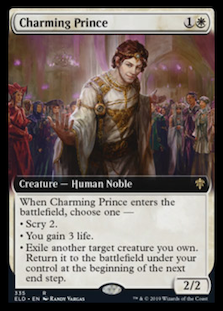
I'll start the article where I started testing. Charming Prince stood out more than the other Eldraine spoilers. It's not the flashiest card nor the most obviously powerful, but it was the one that most looked like it needed to be worked on. There wasn't an obvious kingdom for the prince, and it wasn't clear that existing decks wanted him at all. After considerable work, I can confirm that there is, though not in a way I expected.

He Only Belongs...

I have tried Prince in a lot of Bant Ephemerate shells along with Death and Taxes, and as predicted, the results have been resoundingly meh. Getting value from creatures is good, and getting to reuse the best abilities is great. However, Prince is fairly awkward. His own value abilities are a little marginal, which is fine because flexibility makes up for weak power (see also: Collective Brutality).

However, the fact that Prince only flickers is a problem. Flickering means returning the exiled creature at the beginning of the end step like Flickerwisp rather than an immediate return like the blink of Restoration Angel. Having to wait for value and being limited in targets meant that it didn't really fit into Bant or DnT. The former wants blink effects because it's all about chaining value continuously in a single turn, which Prince can't really contribute to. The later needs something more impressive or evasive than a 2/2. However, that doesn't mean that Prince isn't a Modern card. He just needs the right deck.

...Among His People

In my set review, I was somewhat skeptical that Prince could find a home in Humans. The deck is tightly constructed and the metagame context made me think that a flexible, but not exceptional, card like Prince couldn't make the cut. It turned out that I was thinking too linearly.

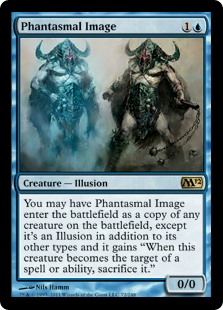
While I've always appreciated its utility, I've never actually liked Phantasmal Image, in Humans or otherwise. The card does nothing on its own by design; its value is dependent on how the game has played out up to the point it resolves. Thus, it tends to make good hands and situations great, and bad ones worse. Getting extra copies of Thalia's Lieutenant or Mantis Rider in a turn is the recipe for an instant kill. Alternatively, anything beats copying a tapped Noble Hierarch after everything else got removed. Prince gave me an excuse to replace the Images, and it has been working out well for me.

Untitled Deck

Creatures

4 Noble Hierarch
4 Champion of the Parish
4 Thalia, Guardian of Thraben
4 Thalia's Lieutenant
4 Meddling Mage
4 Kitesail Freebooter
3 Charming Prince
4 Mantis Rider
4 Reflector Mage
2 Deputy of Detention

Artifacts

4 Aether Vial

Lands

4 Ancient Ziggurat
4 Cavern of Souls
4 Unclaimed Territory
4 Horizon Canopy
1 Plains
1 Island
1 Silent Clearing

Sideboard

2 Grafdigger's Cage
2 Gaddock Teeg
2 Collector Ouphe
2 Auriok Champion
2 Dismember
2 Plague Engineer
2 Militia Bugler
1 Deputy of Detention

I swapped out the usual Waterlogged Grove for Silent Clearing, figuring that since I was playing more white cards, I would need the white mana. Periodically paying one less life for Dismember was also a consideration. I have no idea if this is a good change because it has yet to be relevant. I've never had any more or less trouble casting spells. That's the problem with testing one-ofs that aren't tutoring targets: the odds of drawing them are low enough that you're more likely to be in situations where they are average rather than good or bad, rendering them tough to evaluate.

What He Does...

The main reason I've replaced Image with Prince is that I've been playing against a lot of Jund and UWx Control, and Prince is much better against them. There's a lot of Burn too, but the impact Prince has is mainly felt Game 1 and is fairly small. Humans has a lot of sideboard options against Burn, and the matchup is already pretty good. However, in the grindy matchups, particularly with Vial in play, Prince's flickering is a house. Vialing-in Prince saves a creature from targeted removal and presents another threat, yielding a 2-for-1. Image just replaced the targeted creature; a 1-for-1. That it's a flickering effect also means that in the event of a sweeper, Prince can exchange himself with a more impactful creature like Mantis Rider. There's also the utility of netting extra enters-the-battlefield triggers.

However, the biggest advantage is that Prince is never a dead card. Given the density of removal in Jund particularly, it is very possible that Image will struggle to find anything to copy, stranding it in hand. A dedicated attack on both the hand and board can easily leave Humans desperately hoping to topdeck something to copy just to be rid of the Image. Meanwhile, Prince is always 2/2, and on an empty board scrys 2 towards the next threat, which in attrition matchups is sometimes game-winning.

There's also the issue of Image's fragility. The card is terrible against Jund, not only because of the aforementioned risk of no targets, but because Wrenn and Six just kills it. Image already died to everything anyway, true, but Wrenn's downtick means Image is dying while the opponent gets to keep their removal spells for other creatures. That advantage snowballs in the tight Jund matchup. Also, Prince is a Human, which means he benefits from Cavern of Souls against UWx. In other words, more blanked cards for the opponent and more threats for Humans.

...And What He Doesn't

However, Prince hasn't been universally better than Image. The fact that Prince flickers rather than blinks creatures makes the ability far more defensive than Humans wants to be, and that can impact tempo-relevant matchups. I really wish he flickered opposing creatures. For example: I have a board of random dorks including Reflector Mage being walled off by a Tarmogoyf and no Aether Vial. Drawing Image means copying the Mage and clearing the road for two turns. Prince can flicker Mage, but the road won't open until Mage returns on end step, leaving just a one-turn opening. Prince has cost me games against Zoo and Affinity as a result.

The other problem alluded to above is that Prince lengthens Humans's clock. With a Vial, Image, and Mantis Rider Humans can swing for 6+ damage (board depending) on turn three. Replace Image with Prince, and only 3 damage is locked in. Given that Humans' niche is fast, disruptive aggression from not-especially-robust creatures, that damage difference may prove fatal. I've already lost games because I couldn't quite race Valakut, but would have with Image. However, this factor has proven relevant fewer times than Image's fragility costing me games against Jund and UWx.

Overall, whether Humans should adopt Prince over Image comes down to how the metagame develops. In a non-interactive field of Tron, combo decks, and other creature decks, Image is the pick, since tempo is more important than value. If the meta shapes up as my experience indicates with Burn, UWx, and Jund dominating, then Prince is the pick, because life and grinding value matter more than tempo. I will be sticking with Prince due to my metagame, but with the overall meta still fluctuating, this may not last.

Wild Tonal Swings

The other topic is fan-favorite Once Upon a Time. When the card was first spoiled, the hype machine ran wild, and everyone assumed that it would be everywhere, ushering in a new faster era of creature combo. Once the card had been more thoroughly examined, the hype started to die down. That a swingy cantrip isn't appropriate in every deck is a lesson that needs to be relearned periodically. However, the potential is enough that Once can't be written off, and testing has shown that it can work in Modern, within reason.

Flat Note

First of all, I haven't seen anything to suggest that Neobrand is anymore of a deck now than before. When I first experimented with Neoform I found the deck to be swingy, explosive, and bad. With Once in the picture, Neobrand was still swingy, explosive, and bad. I just felt compelled to keep more speculative hands because I had Once to try and fix things. The deck's fundamental problem is its fragility since it is a multipart combo with very specialized pieces. Once helped a bit with finding Allosaurus Rider or a missing land, but those weren't really the problem anyway. The real struggle was finding and resolving a tutor, which Once can't help.

Wild Note

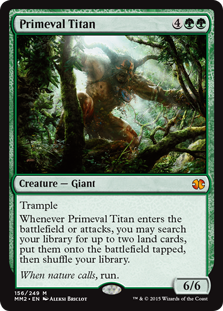
However, playing Once in more robust decks felt pretty good. Specifically, I tested RG Valakut and Amulet Titan, and Once was a reasonable card in both. I tried a lot of decks out, but only Valakut and Amulet actually made Once feel good. The main advantage those two deck have is that the lands are all they really need. Hitting Valakut, the Molten Pinnacle or Tolaria West isn't as obviously good as hitting Primeval Titan, but they can still outright win the game on their own (technically).

It was also far more reasonable to play Once either as the first spell or at any other time for these two decks. I keep hammering this point, but the main appeal of Once is getting played for free. Nobody would run the effect otherwise. Both Valakut and Amulet do run similar effects already, and as big mana decks, Once's cost isn't a problem. It actually felt just as good to pay full price as it did to cast Once for free. Free copies are generally speculative, finding what I think I need, where paid-for Once finds what I actually need. As a result, I was very satisfied with Once. Then I checked over my notes and realized something wasn't right.

Deceptive Noise?

Despite the positive effects I was noticing in-game, when I looked at my win-rate data, there was no noticeable improvement. In any matchup, for either deck. While I can't definitively explain this effect, my working theory is that the trade-offs made to run Once are steeper than expected. In Amulet, I had to cut on utility cards, particularly Engineered Explosives, while Valakut trimmed ramp spells. This meant that while my early game felt better, the mid-game was slightly worse. In Amulet, the lessened interaction meant that any hiccup in the gameplan was magnified. In Valakut, it became slightly harder to hit the last few land drops. These effects are certainly marginal, but so are the odds of casting Once for free.

There's also the issue of mulligan ambiguity. Do you keep an otherwise unkeepable hand on the promise that Once fixes everything? Once isn't Land Grant, and keeping hoping to find that critical missing piece is a dice-roll. There were instances in testing where I kept, hoping to hit a land, and saw only creatures. Or I needed a specific land (a non-karoo in Amulet; a green source in Valakut) to turn a garbage hand into a phenomenal one, then whiffed on Once and lost. I kept track of this data, and it worked out 13 times to 24 disasters. I'm therefore inclined to think that Once is a trap. Solidly playable, but an opening-hand trap. I need to further explore this disconnect between the quantitative and qualitative data.

First Draft

These are just the early results, and metagame swings and adjustments may change my evaluations. Also, I have a lot of work to go on a lot of other cards. How's your testing going? Let me know in the comments.

Best Bets for Long Term Investments – 7 Year Lookback

Are you a Quiet Speculation member?

If not, now is a perfect time to join up! Our powerful tools, breaking-news analysis, and exclusive Discord channel will make sure you stay up to date and ahead of the curve.

Can you believe my first Quiet Speculation article went live nearly 8 years ago, in November of 2011? Since then, I've written hundreds of articles across an array of topics. This week, I stumbled upon an oldie-but-goodie I wrote back in June 2012. This column covers a basket of trading card collectibles that could fit into a long-term investment portfolio. While seven years isn't long enough to plan retirement, it is enough time to make some interesting observations.

Did I make good suggestions? Were there any ideas that ended up as dead money? Would you have been better off buying my trading card ideas versus a general S&P500 market fund? Let's find out! (Updated text will be in bold italics throughout the article).

This past week, an interesting conversation on Twitter caught my eye. Chas Andres (@chasandres) was participating in the discussion, and since he’s a highly regarded finance writer in the realm of MTG, I paid close attention.

The topic: Magic: The Gathering cards as an investment. I am not talking about buying cards which may see an increase in play during the next PTQ season or the next biggest tier 1 strategy. I’m referring to investing in Magic Cards as an alternative to, say, a 401(k).

Here is a snippet of the conversation, which I eventually had to chime into since I am avidly interested in this topic.

A couple interesting tidbits and deductions leap out at me from this conversation. What are they? I’m glad you [maybe] asked!

Players are Fickle, Collectors are Dependable

Chas Andres agreed with my interjected comment – we both feel that one avenue for long term investing in Magic is highly graded Power 9. The reason is fairly obvious. These cards are exceptionally rare and collectors with lots of money are willing to throw thousands of dollars at these rarities. Because supply is so low, only a few well-off collectors need to “demand” the card in order for the price to fly high.

One may suggest that Dual Lands are likewise stable for investing. The return on Dual Lands has been remarkable these few couple years, especially relative to the stock market.

Underground Sea chart courtesy of blacklotusproject.com – note the chart only goes back to 2008, but I assure you the card’s value was growing steadily for a year or so before then as well. Compare this chart to the subsequent one, which is the performance of the S&P over the last five years, courtesy of Yahoo Finance.

Here are updated charts for both Revised Underground Sea and the S&P500. Which has been a better investment since 2012?

There was an error retrieving a chart for Underground Sea

While the S&P500 has about doubled since 2012, it pales in comparison against Underground Sea, whose buylist value nearly quadrupled in that same time. Interesting...

But I hesitate to embrace investment in Dual Lands for the long term. My one reason for caution lies in the unpredictable nature of the player. The game of Magic, Legacy in particular, is very popular right now. An increase in the player base has driven up these cards in value multiple times. But they are still driven up mostly by their playability and NOT their collectability. I had not anticipated the explosion in Commander back in 2012, but I suspect this format offers plenty of price support for Dual Lands.

While subtle, this difference separates the safe long term investments from the short term bubble. All it would take would be a major migration for Star City Games from Legacy to Modern and Dual Land prices could collapse. Same comment here about Commander--thank goodness for that format! Alternatively, even if Legacy continues to receive the same support, but players lose interest or become flustered with a hypothetical banning/unbanning, the prices still could drop further.

If I am moving significant quantities of cash into Magic Cards and not into other retirement plans, I want to make sure a card’s playability will not negatively impact my portfolio. This leads me to my second observation from the Twitter conversation.

Charizard Transcends Pokemon

How many people do you know who still play The Pokémon Trading Card Game? For me, the number is virtually zero, and I would wager this is not an uncommon trend. But if few people are still playing this game, then why in the world does a first edition Charizard still sell for hundreds of dollars???

The answer is consistent with my previous point – the card is highly collectible and rare. The card needs no player base to maintain value because it is rare enough such that even a few collectors will drive the price up substantially. Don’t believe me? Check out this eBay ended auction:

If you think nearly $700 is ridiculous for a Pokémon card, then you will be completely awe-struck to hear that a PSA 10 copy of this card sold for $1,826.00! All this despite the fact the game’s player support has dwindled significantly since its peak. Without realizing it, I mentioned one of the best long-term investment ideas right here. Thanks to the resurgence of Pokémon, these same cards reliably sell for thousands of dollars. A PSA 10 copy would clear $10,000, over 5x the initial investment.

The main takeaway here is that a card can lose popularity amongst players, but if that same card is very rare and collectible, it will maintain value. Hence why I support highly graded Power 9 as dependable avenues for investing. Any Near Mint copies of Power have skyrocketed in price since the writing of this article.

This Is Getting Costly

I don’t know about you, but if I were to purchase a PSA 8 Alpha Black Lotus, which retails for nearly $5,000, I would need to sell the vast majority of my collection. If only we could travel back in time! Assuming PSA 8 equates to EX condition, that same Alpha Black Lotus would now retail for around $60,000. Forget Dual Lands, this one purchase could have netted me a 1000% gainer if I had actually pulled the trigger in this long-term investment strategy. If only I had the liquidity at the time to make such a purchase! This is the opposite of diversification and I would not condone this strategy. If $5000 was too concentrated an investment, $60,000 sure must be!

There must be a happy medium. There must be a way one can invest in highly collectible cards which should increase in value while not having to shell out five grand on a single card.

I see a couple alternatives here, but they each have their drawbacks.

First, we could purchase lesser cards, such as a graded Bazaar of Baghdad or the like. At a few hundred dollars instead of a few thousand dollars, this option is much more affordable and, as long as the card’s condition is high enough, collectors should still keep this card’s value high. This was a great suggestion, as highly graded Bazaar of Baghdads now DO sell for thousands of dollars.

There was an error retrieving a chart for Bazaar of Baghdad

But let’s face it – there are fewer people interested in a PSA 8 Bazaar of Baghdad than a PSA 8 Alpha Black Lotus. So it will be more difficult to find sellers in the long term and the card may not appreciate as much.

Second, we could consider purchasing highly graded Unlimited Power. High-quality Unlimited Black Lotuses sell in the $1500 range and other Power should be even cheaper. This is an affordable way to still have a chunk of cash invested in high-quality Power. Near mint Unlimited Lotuses retail for $15,000, another 10x gainer. If only I had listened to my own advice!

There was an error retrieving a chart for Black Lotus

The drawback here is related to the supply. There are far greater quantities of Unlimited Black Lotuses than Alpha ones. Even though the demand may still be very high on this poster-child card of Magic, the supply keeps the value in check. Of course, you could find one of the few PSA 10 Unlimited Black Lotuses, as these are likely very rare. But these will again cost thousands of dollars, so the cost of entry barrier is still there.

Lastly, we could try to brainstorm other Magic products which are highly collectible, rare, and should maintain value even should the game of Magic lose popularity. Many of you already know I have a sizable investment in sealed Magic Booster Boxes. I feel these should not drop in value because they will assuredly decrease in supply while a sufficient casual market will maintain a sizable demand. There is no need for a Star City Games tournament circuit for a sealed Unhinged Booster Box to grow in value. These now sell for $600 on eBay. This is nearly triple the price from 2012--better than the S&P500 over that same time period, but a far cry from Black Lotus.

If Booster Boxes aren’t your thing, perhaps there are other options. Off the top of my head, there are misprinted cards, high-quality altered cards, or even sealed booster packs of older sets. I’m sure there are many other options and I would love to hear what other considerations you have come up with for a long term Magic investment.

Collectability And Rarity Are Key

The goal is to find a Magic product or card that is highly popular amongst collectors and somewhat difficult to find. These are the gaming assets that should maintain and build value in the long term. They rely little on the game’s popularity and even less on individual playability. Like a rare baseball card, they merely grow in value because they are very hard to obtain for the well-off collectors.

While Dual Lands, Force of Wills and the like have all returned terrifically in the past few years, I’m wondering how much room these cards have to run. Don’t get me wrong – I have no intention of selling my 40 Dual Lands and 40 Fetch Lands any time soon. I still like to play the game and I see the utility in these cards. But in terms of longer-term holdings, I see some significant advantage to something much rarer. Dual Lands would have been a stellar investment given their placement on the Reserved List. Thankfully, I talked folks away from Force of Will and Fetch Lands since they both got hit with reprints (though Force of Will has recovered from its reprinting).

There was an error retrieving a chart for Force Of Will

-Sigmund Ausfresser
@sigfig8

Final Thoughts

I hope you enjoyed this trip back in time. It was certainly eye-opening to me, reading through 7-year-old predictions and realizing just how insightful they were. If only I had the confidence to acquire large positions in the ideas I suggested, I would have outperformed my stock market investments handily. Alas, I was even more risk-averse then than I am now, so I am not surprised I held back.

Looking ahead, one may ask the same question that triggered this article years ago: Are Magic and other trading card games good bets for long-term investments? The challenge in 2019 is that so many prices are inflated already. The Reserved List buyout spree of last year really spiked prices hard, and the market is still finding equilibrium in recovery. I don't advise making any long-term investment purchases in Magic at this moment. Then again, everyone's talking about a recession on Wall Street...so maybe a few pieces of Power and some Dual Lands will outperform the S&P500 over the next 7 years as well? I'm not sure, which is why I diversify between the two. Only time will tell which strategy is the optimal one!

September Brew Report, Pt. 2: Creature Feature

Are you a Quiet Speculation member?

If not, now is a perfect time to join up! Our powerful tools, breaking-news analysis, and exclusive Discord channel will make sure you stay up to date and ahead of the curve.

Last week, we kicked off the September Brew Report, covering some of the juiciest decks to emerge from recent 5-0 dumps. As the format continues to find its footing after the Hogaak ban, the possibilities seem endless. Today we'll discuss the other newcomers.

Fair Enough

We'll kick things off with Modern's unsung heroes: the decks that play it fair against all odds.

Temur Midrange, by C4N7O (5-0)

Creatures

4 Tarmogoyf
4 Ice-Fang Coatl
4 Snapcaster Mage
1 Tireless Tracker

Planeswalkers

1 Jace, the Mind Sculptor
3 Wrenn and Six

Instants

2 Abrade
2 Cryptic Command
3 Force of Negation
4 Lightning Bolt
1 Magmatic Sinkhole
2 Mana Leak
2 Opt
2 Spell Snare

Sorceries

3 Serum Visions

Lands

1 Breeding Pool
1 Field of Ruin
1 Fiery Islet
1 Ghost Quarter
1 Lonely Sandbar
1 Lumbering Falls
2 Misty Rainforest
2 Prismatic Vista
3 Scalding Tarn
1 Snow-Covered Forest
4 Snow-Covered Island
2 Snow-Covered Mountain
1 Steam Vents
1 Stomping Ground

Sideboard

1 Alpine Moon
1 Ancient Grudge
1 Anger of the Gods
2 Ashiok, Dream Render
2 Damping Sphere
1 Engineered Explosives
1 Flame Slash
1 Fry
1 Keranos, God of Storms
1 Pyroclasm
1 Surgical Extraction
2 Weather the Storm

Temur Midrange has never been a deck in Modern, though that hasn't stopped players from trying time and again to crack the code. It simply lacks the heavy-duty removal options of black and white, as well as proactive non-creature plays with which to develop its position. Jund loses out on the ability to run counterspells, but gains targeted discard and Liliana of the Veil, draws that Temur could never match.

Until, perhaps, now. Joining the wedge's ranks are Wrenn and Six, a proven powerhouse in and out of Jund that offers Temur an on-plan way to satisfy its hungry mana requirements. Also new is Ice-Fang Coatl, a pseudo-removal spell with its condition met. Temur is already in the business of fetching basics, so the snow creature does a fine Baleful Strix impersonation for the deck.

Whether such developments turn the combination around remains to be seen, but color me doubtful for the time being. Discard spells greatly enhance this kind of nickel-and-diming playstyle, and Jund is a force to be reckoned with right now for that reason.

BR Claim, by IVAN_CATANDUVA_BR (5-0)

Creatures

4 Pestilent Spirit
4 Rix Maadi Reveler
2 Rotting Regisaur
4 Seasoned Pyromancer

Planeswalkers

1 Chandra, Acolyte of Flame
3 Liliana of the Veil

Instants

4 Gut Shot
3 Kolaghan's Command
4 Lightning Bolt

Sorceries

3 Claim // Fame
3 Inquisition of Kozilek
3 Thoughtseize

Lands

1 Barren Moor
3 Blackcleave Cliffs
1 Blood Crypt
3 Bloodstained Mire
2 Field of Ruin
1 Marsh Flats
3 Mountain
3 Swamp
4 Verdant Catacombs
1 Wooded Foothills

Sideboard

2 Anger of the Gods
1 Chandra, Torch of Defiance
3 Collective Brutality
4 Pillage
2 Plague Engineer
1 Shadow of Doubt
2 Surgical Extraction

BR Claim follows in the footsteps of a breakout deck post-Horizons, BR Unearth. That strategy aimed to abuse Unearth by reanimating juicy targets like Seasoned Pyromancer. Variations have dipped into three drops as diverse as Lightning Skelemental, Jace, Vryn's Prodigy, and Monastery Mentor. This deck runs the staple Seasoned Pyromancer and Rotting Regisaur. But it doesn't run Unearth; only Claim // Fame, which targets neither of those creatures.

Claim can only bring back one creature in the list: Rix Maadi Reveler. As such, it serves as a mini-velocity engine to power through the deck. But it's much less efficient at doing that than reanimating Pyromancer. Rather, the draw to Claim lies in its other half, Fame. With the aftermath spell in the graveyard, opponents need to be wary at every turn, as a 7-power Regisaur could emerge out of nowhere and take a bite out of their life points.

With all that said, I sincerely don't understand why this deck doesn't have any Unearths in it and would dearly appreciate any guidance in the comments!

Fishing for a New Religion

Fish-style tempo decks have taken many forms in Modern, and the strategy continues to emerge in unique constructions as new cards are released.

Deadguy Ale, by BENNYHILLZ (5-0)

Creatures

4 Dark Confidant
4 Giver of Runes
4 Thraben Inspector
4 Stoneforge Mystic
4 Kitesail Freebooter

Instants

1 Cast Down
4 Fatal Push
1 Slaughter Pact

Sorceries

1 Collective Brutality
4 Inquisition of Kozilek
3 Lingering Souls
3 Thoughtseize

Artifacts

1 Batterskull
1 Elbrus, the Binding Blade
1 Sword of Fire and Ice

Lands

4 Concealed Courtyard
2 Flooded Strand
2 Godless Shrine
4 Marsh Flats
1 Plains
2 Polluted Delta
2 Snow-Covered Plains
3 Swamp

Sideboard

2 Collective Brutality
1 Lingering Souls
3 Fulminator Mage
2 Kalitas, Traitor of Ghet
2 Liliana of the Veil
1 Liliana, the Last Hope
1 Manriki-Gusari
3 Rest in Peace

Deadguy Ale is a black-white fish deck with more midrange elements than your typical Death & Taxes, such as Dark Confidant and Inquisition of Kozilek. It's long been native to Legacy, but as Stoneforge has just arrived in Modern, the strategy is a newcomer here.

BENNYHILLZ did us the favor of breaking it in, employing Giver of Runes and Thraben Inspector to generate a beautiful curve without the need for Aether Vial. Lingering Souls plays exceedingly well with Sword of Fire and Ice, and Elbrus turns any flying creature (there are plenty) into a serious threat. A full set of Fatal Pushes round out this elegant list.

Trending away from synergy is rare in Modern, but as a lover of all-purpose disruption, I'm excited to see if such developments continue.

Company Hatebears, by POC (5-0)

Creatures

2 Knight of Autumn
2 Collector Ouphe
1 Eternal Witness
4 Giver of Runes
4 Leonin Arbiter
4 Noble Hierarch
4 Stoneforge Mystic
4 Thalia, Guardian of Thraben
2 Thalia, Heretic Cathar

Instants

4 Collected Company
1 Mana Tithe
4 Path to Exile

Artifacts

2 Batterskull

Lands

4 Field of Ruin
4 Ghost Quarter
4 Horizon Canopy
4 Razorverge Thicket
1 Snow-Covered Forest
2 Snow-Covered Plains
3 Temple Garden

Sideboard

2 Collector Ouphe
1 Knight of Autumn
1 Burrenton Forge-Tender
2 Phyrexian Revoker
1 Ramunap Excavator
2 Ranger-Captain of Eos
3 Rest in Peace
3 Tocatli Honor Guard

Speaking of moving away from synergy, Company Hatebears pulls a Naya Zoo in using its titular instant for non-combo purposes. When you're fishing out the best two-drops in Modern, among them Stoneforge and Thalia, who needs to go infinite?

A big factor allowing this deck to exist is Collector Ouphe, which gives it superb interaction against artifact strategies the likes of Whirza. That deck certainly isn't going anywhere, and Ouphe's stock should only rise as Emry makes a splash alongside Jeskai Ascendency come Throne.

Pride of the Pack

Of course, Modern is still home to plenty of synergy, and much of it has to do with creatures. These decks put innovative spins on that old concept.

Bant Pride, by INTERNETSURFER09 (5-0)

Creatures

4 Pride of the Clouds
2 Aven Mimeomancer
4 Birds of Paradise
3 Deputy of Detention
4 Empyrean Eagle
4 Mantis Rider
4 Mausoleum Wanderer
2 Noble Hierarch
3 Selfless Spirit
4 Unsettled Mariner

Instants

3 Collected Company
2 Force of Negation

Lands

2 Botanical Sanctum
1 Breeding Pool
1 Fiery Islet
4 Flooded Strand
1 Hallowed Fountain
2 Horizon Canopy
1 Island
1 Misty Rainforest
1 Plains
2 Razorverge Thicket
1 Sacred Foundry
1 Steam Vents
1 Temple Garden
1 Waterlogged Grove
1 Windswept Heath

Sideboard

1 Selfless Spirit
1 Collected Company
1 Force of Negation
2 Blessed Alliance
2 Celestial Purge
3 Collector Ouphe
1 Disdainful Stroke
3 Life Goes On
1 Reflector Mage

Behold Bant Pride, AKA flying tribal. But hasn't this deck been done before? Like, with Spirits? Well, kind of. Spirits has better lords, to be sure. But it doesn't have the grind game enabled by the forecast mechanic. Or durdle game?

Balancing out that snail-slow plan is Mantis Rider, the game's-now-over closer from Humans. Growing Rider above 3/3 is an interesting premise, and one I've spent many hours trying to implement well myself. The format's changed a lot since those days; perhaps it's the 4/4 or 5/5 Rider's day to shine outside its original tribal deck and alongside some straight-up draft cards.

Company Hatebears, by POC (5-0)

Creatures

4 Yawgmoth, Thran Physician
1 Acidic Slime
4 Birds of Paradise
1 Blood Artist
4 Geralf's Messenger
1 Kitchen Finks
1 Scavenging Ooze
4 Strangleroot Geist
1 Thragtusk
4 Wall of Roots
4 Young Wolf

Instants

3 Chord of Calling

Sorceries

4 Eldritch Evolution

Lands

4 Blooming Marsh
2 Forest
3 Khalni Garden
3 Overgrown Tomb
2 Swamp
4 Twilight Mire
1 Urborg, Tomb of Yawgmoth
4 Verdant Catacombs
1 Windswept Heath

Sideboard

2 Collective Brutality
2 Collector Ouphe
3 Damping Sphere
1 Dosan the Falling Leaf
4 Leyline of the Void
1 Obstinate Baloth
1 Reclamation Sage
1 Shriekmaw

Yawgmoth Undying might not play Collected Company, but it's got the other green creature-finders, Eldritch Evolution and Chord of Calling. That's because it's not looking for a critical mass of beaters or disruptors so much as one specific card: Yawgmoth, Thran Physician.

With the Cleric in play, Young Wolf and its undying buddies get a new lease on life, not from the graveyard this time, but from the bulk bin. Yawgmoth's -1/-1 counter cancels out the +1/+1 counter from undying, letting pilots draw cards at will. They only have 20 life, of course, but Geralf's Messenger races that clock by dealing twice as much damage each sacrifice, and recruiting Blood Artist first goes infinite. It's likely that players mid-combo will find a way to grab Artist in their next 10-or-so cards.

A Month in the Books

September has been very exciting for Modern, and the fun's just beginning: Throne of Eldraine is about to become legal! Which brews stand out to you the most? What kinds of decks do you hope to see emerge from the new expansion? Let's keep the discussion going in the comments.

Insider: Differentiators

Are you a Quiet Speculation member?

If not, now is a perfect time to join up! Our powerful tools, breaking-news analysis, and exclusive Discord channel will make sure you stay up to date and ahead of the curve.

Differentiator - one that shows a contrasting element that distinguishes.

I started this article off with the definition of my key term simply because not everyone may know what a differentiator is. In the business world, these are elements of your product or service that differ between you and your competitors. Some of the more common differentiators in the business world are:

  • Price
  • Availability
  • Quality
  • Customer service
  • Customization

Customization

Customization seems like a difficult one for a third party seller such as a Magic store owner to establish. That isn't to say it isn't possible. For example, if you own an actual brick and mortar store you could run unique tournaments or formats. One of my favorite ones I've played in the past was a "make your own Standard" where you picked two blocks and a Core Set and made a deck. If you own an online store, perhaps you could look at getting some custom tokens as business cards. The point is that while it may be more difficult to customize, it isn't impossible.

There was an error retrieving a chart for Customs Depot

Other differentiators are easier to establish for a Magic store. In fact, we can see some of these elements at play from some of the major stores.

Star City Games has almost everything available, great customer service, and they have good quality grading. However, they also tend to charge more and buy for less.

Card Kingdom has a large inventory, though not as big as SCGs, good customer service, and somewhat competitive prices. On the downside, they limit you to buying no more than 8 copies of a given card in a given condition so your availability is limited.

Troll and Toad sometimes has great prices on cards as well as a decent inventory. However, their grading has actually been a running joke in MTG finance realm. I can speak to this personally, though I will give them some credit with regard to their excellent customer service element.

TCGPlayer tends to have the lowest prices of any online sales platform, but at a cost. Grading is often lax and it is difficult to buy large quantities of older cards without having to buy from multiple vendors and accruing multiple shipping costs.

So as you can see, most companies don't try to maximize all the differentiators, as they cost money and can impact profits. It's important to find the right combination for your customer base and it's a delicate balance as you often can't ignore any one of them completely. The key here is to figure out what your customer base values and focus on maximizing those differentiators. After all, thanks to the internet and the general fungibility of Magic cards, you as a store owner have tons of competition.

Customer Service

A great way to determine which differentiators to focus on is going straight to the source by asking your customers. If you own a brick and mortar store, you should be able to get constructive criticism from your customers relatively easily. A word of caution; good constructive criticism focuses on flaws and may or may not include suggestions to fix them. It can be hard for some people to take constructive criticism. However, I personally believe it's one of the most important qualities to have in order to ensure your own success in life.

It is a bit harder as an online store as your customers are often unlikely to communicate with you unless something goes wrong, but you can still ask. If you sell on TCGPlayer, you get automatic feedback if the customer doesn't bother to leave any, but you may have more luck reaching out to customers who actually fill out the feedback option on TCGPlayer. You will find out very quickly that most people are happy to give their opinions when asked and the sheer act of asking will differentiate you from a great many of your competitors. One word of warning, though; you don't want your request to seem like a form letter, as that very quickly turns people off of providing good feedback. Make sure to personalize it with the buyer's name and perhaps what they purchased as well.

There was an error retrieving a chart for Aetherworks Marvel

Quality

As none of us actually manufacture Magic cards, you might think that this one doesn't apply, but we all do have to grade them and package them in some way. Our stores do have a Quality Assurance department, though they just may start with me and end with I. One of the most likely drivers of bad feedback for online stores is found in this category. I've found that by being a relatively harsh grader when I list cards, I very rarely get push back from customers and have on multiple occasions gotten feedback attune to "Card in better condition than I expected." Not surprisingly, I have had people buy from my store repeatedly, despite the fact that I don't have the cheapest possible price all the time.

One important thing to remember is to put yourself in the buyer's shoes; would you buy from a store with an 85% rating, 90% rating, 95% rating? Price is often the biggest driver behind whether I make a purchase or not, but I most definitely have passed on cheaper options because the seller had an unacceptable rating.

There was an error retrieving a chart for Acquire

Availability

This differentiator is another one that can be more difficult for online stores to utilize, but there are some obvious tricks. The one I most use is when I list a card for sale, I also list any cards it may combo with to allow potential buyers a "one-stop-shop" opportunity. If I get a Cabal Coffers in, I'll make sure to check to see if I have any Urborg, Tomb of Yawgmoth listed. This is also a fantastic way to move cheaper cards whose demand is often tied to another card.

There was an error retrieving a chart for Price of Progress

Price

Last, but let's be honest it's actually first, is price as a differentiator. In this day and age, a significant number of purchase decisions are heavily influenced by price. I've sold LP copies of a card I listed for $0.01 less than a NM copy before. It can be easy to forget that there are numerous Magic players out there that don't have a significant amount of expendable income to buy cards, so they save wherever they can. Of these given differentiators, the price you list cards will have the most impact on how many you actually sell.

Even worse, it seems like there is always someone willing to undercut you by a little bit and prices of cards can plummet rapidly when sellers are motivated to move them. For those of you who use TCGPlayer, you can actually get a price difference report under your seller admin tools. You can then sort it in either ascending or descending order, which allows you to quickly see where you may have opportunities to update prices. I have had most success when I keep my prices within about 15% of the lowest listing. However, I always factor in whether there is a shipping cost associated with that listing, as I know that newer sellers are defaulted to $2.99 shipping and will list $3 cards at $0.01 to try and get their early sales.

Conclusion

Hopefully, this article has caused you to consider ways in which you can differentiate your business from so many others. There are thousands of choices on the online marketplace, and setting yourself apart in a meaningful way can lead to success. If you can think of any other differentiators please feel free to reach out to me on the QS Discord or in the comments below.


Dem Boyz Is Here: Assembling Modern Goblins

Are you a Quiet Speculation member?

If not, now is a perfect time to join up! Our powerful tools, breaking-news analysis, and exclusive Discord channel will make sure you stay up to date and ahead of the curve.

There's an odd lull in Magic right before the set release. There's no point discussing spoilers anymore; the set's known and being tested. However, those testing results are questionable. There hasn't been enough time to process the new cards and produce results, nor has the metagame adjusted to reflect these new cards. This means content tends to be more speculative. Today's article bucks that trend, instead focusing on some old, well-tested business that I've never gotten around to discussing: Modern Goblins.
Over a year ago, I dug into Modern Goblins. Dominaria had just been released, and with it came Goblin Warchief and Skirk Prospector. It looked like a new era had dawned for the little red men. However, it wasn't meant to be. In my testing, whichever version of Goblins I tried proved anemic compared to alternative aggro decks. Goblins was very good at executing its gameplan, but it couldn't deal with disruption. It was mostly 1/1's and lacked card advantage, so any misstep spelled doom. I didn't see any future without Goblin Matron and Goblin Ringleader.

And then it happened. Modern Horizons brought not only Matron, but a replacement for Gempalm Incinerator in Munitions Expert. Then Core 2020 saw Ringleader reprinted. It looked like all the pieces now existed for a Goblins rebirth in Modern. Now, with months of testing under my belt, I can unveil my findings.

The Obvious Route: Pure Tribal

I started the same place I imagine everyone else did, with tribal Goblins. RB Goblin Bidding from Onslaught block is the deck most recent iterations aspire to, and with Goblins being one of Magic's original tribes, it just makes sense. The question is how to actually build the deck, and there's no single answer; it's extremely customizable. The core Goblins are Skirk Prospector, Mogg War Marshal, Goblin Matron, and Goblin Ringleader. Every other Goblin is negotiable depending on the metagame and what pilots wants from the deck. This does incentivize building a toolbox version, and my testing showed that it can be quite strong if the toolbox is built right.

That proved hard for me to consistently do, and given my existing bias towards aggro decks, I opted for a straight tribal aggro deck.

Tribal Goblins, Test Deck

Creatures

4 Skirk Prospector
3 Goblin Piledriver
4 Mogg War Marshal
4 Metallic Mimic
4 Munitions Expert
4 Goblin Matron
4 Goblin Chieftain
3 Sling-Gang Lieutenant
4 Goblin Ringleader

Artifacts

4 Aether Vial

Instants

2 Tarfire

Lands

4 Wooded Foothills
4 Bloodstained Mire
4 Cavern of Souls
4 Blood Crypt
4 Mountains

I borrowed the Tarfire from Legacy Goblins, and I ended up tutoring for it so much I put in an extra. There's a surprising amount of tension in building the deck because so many of the best cards cost three or greater. I'm running Goblin Chieftain in this version, but Goblin Chainwhirler, Goblin King, Goblin Warchief, and Goblin Rabblemaster are all valid additions. Were I feeling more adventurous I might run a mix, but I prioritized reliability over raw power.

It's often said that Goblins isn't an aggro deck. The creatures are lackluster on their own, and curving Goblin Piledriver into Goblin Warchief isn't so impressive anymore. Therefore, it's better to take a controlling role, making Goblins a board-control beatdown deck. This is true of most versions, but it doesn't have to be. My version is 100% an aggro deck with the option to sideboard into something more controlling. The truth is that Goblins can be made to fulfil whichever role it needs to in the situation.

The Multicolored Question

One note is that when going the tribal route Goblins really should be red-black. Sling-Gang Lieutenant is an excellent finisher and sometimes the only route to victory. But Munitions Expert is the real all-star of the deck, and I recommend a full set. Modern being Modern, creature decks are everywhere, and Expert is instant-speed removal that synergizes with the deck. What pushes it over the top is the ability to kill planeswalkers. War of the Spark is casting a very long shadow, and not having to attack walkers away is extremely valuable. I had some good times in testing killing Karn, the Great Creator in response to Mycosynth Lattice, then attacking for lethal. Being RB also means that Gobins can run Thoughtseize if necessary.
Control's Nightmare

As mentioned in my previous articles, Legacy Goblins is a nightmare for control decks, particularly straight UW. The traditional route to victory for control isn't to actually win the game, but to make opponents concede once all hope is lost. Between Matron, Ringleader, and token makers, it is almost impossible to adequately exhaust Goblins.
Cavern of Souls and Aether Vial moot a good chunk of control's best interaction. Stoneforge Mystic is trouble mostly because it's a 1/2 and thus blocks well, but the equipment isn't worrying thanks to the maindeckable Goblin Cratermaker and Goblin Trashmaster. Between Expert able to kill all control's win conditions and the sheer volume of cards Goblins can pull from, the matchup can be moved towards un-losable quite easily.

I found siding in Warren Weirding and Earwig Squad very effective for my deck, though it's not a strategy that works for every deck. Weirding's primary job is taking out the Baneslayer Angel's that control likes to bring in against creature decks, but in this deck it can also keep my board full when I'm throwing creatures away for damage. Squad exists to steal the few sweepers in UW, but can also take their win conditions in a pinch. This strategy works because I'm fully embracing being a go-wide aggro deck, and the slower toolbox builds can't throw away creatures as readily as I can.

Goblin's Nightmare

That said, I eventually abandoned tribal Goblins and started testing other decks. I had decent results, but never good enough to make me stay. A significant part of the problem is the metagame. The slower control decks that Goblins really beats on aren't an overwhelming metagame presence, and the overall picture hasn't been clear enough to metagame against. Goblins is a more like a creature-based control deck than a true beatdown deck, and that's a hard thing to make work in a shifting field.
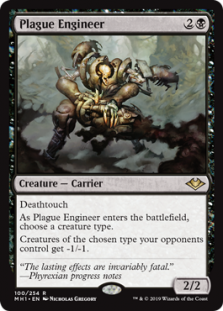
A far bigger problem for me was Jund. I could never find a reliable way to overcome the deck no matter how I tweaked Goblins, and the BGx stalwart is regaining popularity. Jund has always been solid against small creatures, but its fortunes improve further with access to Wrenn and Six. Worse, Plague Engineer is a card that kills almost everything in Goblins. The lords help some, but savvy Jund players prioritize removing those. In fact, Plague is such a house against Tribal Goblins that I found myself siding in more Tarfires, which are mediocre against Jund as a whole, and arguably a liability since they grow Tarmogoyf. However, I desperately needed reliable answers to Engineer, and Tarfire was better than anything else. Trying to sandbag around Engineer or go for critical-mass turns was also risky thanks to Jund's discard element.

Thanks to the volatile metagame and the apparently unwinnable Jund matchup, I shelved the deck. There's a lot of potential, especially for experienced toolbox tuners, but the inherent weakness to Engineer made me look elsewhere.

Throw Away the Key

The next place I went was to a prison version, similar to Legacy Goblin Prison. The conceit is to use the prison elements to make up for the inherent weakness of the creatures; locking the opponent out of the game long enough for your medium beats to steal the game. In theory, the plan is very solid, and the deck works better than I initially gave it credit.

Prison Goblins, Test Deck

Creatures

4 Goblin Rabblemaster
4 Skirk Prospector
4 Mogg War Marshal
4 Goblin Piledriver
4 Goblin Matron
4 Goblin Ringleader
2 Siege-Gang Commander

Artifacts

4 Chalice of the Void
4 Aether Vial
2 Trinisphere

Enchantments

4 Blood Moon

Lands

4 Cavern of Souls
4 Bloodstained Mire
4 Wooded Foothills
8 Mountain

Being a Blood Moon deck I had to cut the black, and so had to make do with the pricier Siege-Gang Commander. Rather than lords, I took a page from Mono-Red Prison and ran a full set of Rabblemaster, which is a very good clock when protected by Chalice. I speculatively went with Trinisphere as my last maindeck prison piece. I had begun work on this deck before Faithless Looting was banned, and Sphere was incredible back then. It still has its moments, especially when accelerated into, but I'm thinking maindeck Ensnaring Bridge is better now.

Solid Locks...
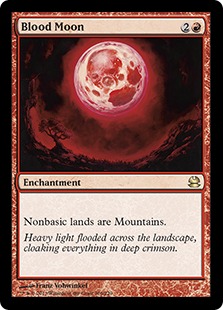
For my money, Blood Moon is highly underplayed. While it isn't very effective against Tron, there are vast swaths of the meta that behave like the card no longer exists. Jund, Humans, Death's Shadow, and Eldrazi decks are supremely vulnerable to the enchantment. Even decks with many basic lands like UW Control, Whirza, or Bant Blink heavily rely on their utility lands and fetchlands and can fail without them. In fact, I've found Blink decks to be so dependent on their fetchlands that they actually die to Moon.

...Weak Doors

The problem is that Modern Prison isn't as potent as Legacy prison. Chalice for 1 invalidates the typical Delver deck, but almost every deck relies heavily on Brainstorm and Ponder to function. Modern decks aren't so restricted on mana cost, and thus are far harder to actually lock out of the game. This means that prison cards may be irritating, but they're not an end by themselves. There's a reason Whirza is moving towards straight combo and Lantern Control isn't a deck anymore.

Still an Improvement

That being said, I liked this deck better than the typical mono-Red Prison deck. Those decks have a lot more lock pieces and interaction, and can frequently get them out turns 1-2. However, they also have to. Without a relevant lock piece on the board, Mono-Red Prison becomes a fairly clunky Mono-Red Control deck, and there's a reason Skred Red is a fringe strategy. I stress relevant because sometimes they go all-in on the wrong piece, like Blood Moon against a mono-colored deck or Ensnaring Bridge against Tron. The decks have the capacity to completely lock out other decks, but if they fail to do so, they're massive underdogs.
The other issue is the clock. Prison decks have some impressive threats like Hazoret the Fervent and Stormbreath Dragon, but there aren't many of them. It's not uncommon for the deck to use most of its opener pumping out a lock piece and then have to win with a single Chandra, Torch of Defiance and some lucky topdecks. If that one threat is answered, the opponent receives plenty of time to draw out of the prison. Modern isn't Legacy: Decks play more basic lands and a variety of mana costs.

The Goblins version is not as good a prison deck and can't always lock opponents out quickly enough. It also doesn't have to. Goblin Prison isn't exceptional at any one thing, but it is above average as a combined prison-and-beatdown, or stompy, deck. It doesn't have to worry as much about drawing the wrong half of its deck as Red Prison, nor mulligan as aggressively as Colorless Eldrazi. Both of its competitors have better best hands, but Goblins has slightly better average hands, and that's preferable for me.

This transforms it into something surprisingly effective. The creature beatdown plan is perfectly serviceable on its own. When executed in conjunction with the prison pieces it tends to play like a decent tempo deck. The Goblins easily flood the board and close the game while the opponent is working around a Chalice or restricted by Moon. There is increased risk of whiffing with Ringleader and sometimes you draw too many prison pieces and just die, but I'd play Goblin Prison over Mono-Red Prison any day.

Just Kill 'em

The other option is the combo route. I abandoned anything like Dirty Kitty early in testing. It was fun to run an odd Storm deck and confuse my opponents to no end, but even with Matron and Ringleader, the deck was never consistent enough to be worthwhile. Modern combo decks need to be far leaner and more efficient than Fecundity decks can possibly be. Going for Abzan Company-style Murderous Redcap combos proved more fruitful. However, there was a lot of tension in splashing green for Collected Company and Rhythm of the Wild. In the end, I decided that staying RB and using Metallic Mimic was just as effective.

Combo Goblins, Test Deck

Creatures

2 Pashalik Mons
4 Skirk Prospector
2 Goblin Piledriver
4 Mogg War Marshal
4 Metallic Mimic
4 Putrid Goblin
3 Munitions Expert
4 Goblin Matron
4 Goblin Warchief
3 Sling-Gang Lieutenant
4 Goblin Ringleader
2 Murderous Redcap

Lands

4 Wooded Foothills
4 Bloodstained Mire
4 Cavern of Souls
4 Blood Crypt
4 Mountains

This deck may look like the tribal deck, but it's actually home to a number of different combos. I have Goblin Warchief primarily as a cost reducer to make comboing off easier since the pieces are fairly expensive. In addition to Redcap, a sacrifice outlet, and Metallic Mimic, there's Putrid Goblin to feed Sling-Gang Lieutenant. Pashalik Mons is an alternative kill condition for any loop and a decent value play by himself.

Easy, But Hard
This was a very weird combo deck for me. It's almost alarmingly simple to find all the combo pieces, and often spares, thanks to Ringleader and Matron. Mimic is the sticking point, but Pashalik Mons alongside Lieutenant and Putrid Goblin frequently obviate the need for the full combo. Two damage triggers per sacrifice is very good, and given how often Goblins just floods the board, it has the same effect as the infinite combos. Multiple ways to achieve the combo combined with lots of ways to find the pieces meant that I could reliably get my pieces.

The problem was then getting them together on board. Without Vial, I was constantly choked on mana, and often Prospector couldn't make up the shortfall long enough to assemble the combo.

An Odd Hybrid

Ultimately, Combo Goblins didn't thrill me. It never felt necessary in light of Goblins' standard beatdown plan, which was still largely intact. In fact, it arguably hampered the beatdown strategy. I was tutoring to put the combo together rather than just killing my opponent by the shortest route possible, and while having something resistant to removal was sometimes nice, Putrid Goblin just didn't belong. I think Goblins is better off not trying for combo kills.

WAAAAAAAAGH

Were I to revisit Goblins in the future, I would definitely start with the combo version, but tune it in a beatdown direction. The Redcaps and combo aren't that impressive, but having the option to kill out of nowhere with Mons and Sling-Gang is too good to pass up. However, I'd need to see a large metagame shift to retake the plunge. Specifically, I'd need to see more control and non-Jund midrange than fast aggro or Whirza. Given how Modern is still catching up with everything that happened over the summer and a new set is coming out, Goblins will need to keep waiting.


Want Prices?

Browse thousands of prices with the first and most comprehensive MTG Finance tool around.


Trader Tools lists both buylist and retail prices for every MTG card, going back a decade.

Quiet Speculation