

Are you a Quiet Speculation member?
If not, now is a perfect time to join up! Our powerful tools, breaking-news analysis, and exclusive Discord channel will make sure you stay up to date and ahead of the curve.
Hello! My name is Jeremy, and today we’re going to go over what you’re doing wrong when it comes to buying and selling cards. I’ve been fortunate enough to work with several gaming shops, vend events by myself at the booth, as well as dig for every last nickel over the past several years. I know QS readers expect value for their subscription, and these tips should help you monetize your side hustle a little more without leaving extra money on the table.
Common Mistake #1 - Stacks
If you’ve ever been to a Magic player’s house, the first thing you’ll notice when walking in is cards everywhere. On the kitchen counter, the table, or maybe stacked next to the computer that you the reader are currently sitting at right now. Since you’ve presumably paid to access this content, you need to also keep your cards sorted in a way that is also more premium than the average binder grinder selling cards.
The first thing you should do when branching out into buying and selling is to organize everything. It doesn’t matter if every card is alphabetical, or if it is sorted by color. Every single card that is for sale should be in some sort of pull system. I highly suggest taking a weekend watching your favorite show, sport, or podcast and start organizing the thousands of cards that are gathering dust. After doing this, you won’t have to waste time in the future looking for a card that you misplaced or selling something last minute to a desperate player on Facebook looking for his 75th FNM card.
Another advantage of organizing your cards rather than stacks is being able to be the first one to buylist jank cards in your collection. Most people send their cards to Card Kingdom, but you can also sell bulk cards to Thomas Dodd’s Blueprint and get equal or higher numbers on a lot of stuff that Card Advantage can sell well. Selling bulk helps you in two ways: It clears up your small space where you sell cards and helps you maintain enough capital to play or buy more Magic. A lot of times, older established players will have a ton of nickels in their bulk boxes. By taking a couple hours a weekend, they could easily pay for a trip to a Grand Prix by digging these nuggets out and buylisting them.
While buylisting smaller cards, it is also relatively easy to check your higher-end cards. A lot of the time, the ION Scanner can show obscure cards that have a negative spread. By adding in higher-end cards with smaller spreads in an organized collection, you can essentially double-dip on the time you’re spending buylisting by easily accessing any profitable card in your collection at a relatively quick pace, rather than spending an entire day buylisting a couple hundred dollars worth of nickels.
Common Mistake #2 - Networking
Even if you the reader have never been to a MagicFest, it’s 2019 and we have a ton of data available at our fingertips nowadays. Most vendors post their hotlists online, such as 95MTG, before each Grand Prix. It is also possible to simply message the vendors ahead of time on social media and ask for a buylist before each event two days out. Vendors want to buy these cards and will happily let you know what cards they are looking for before each show if you ask nicely.
By bringing or mailing cards to these vendors, you start to establish rapport and can help each other out. A vendor may be able to buy an obscure foil for you that you’ve let them know that you are interested in. They may even offer it at a discount in exchange for helping them out with acquiring cards for their hotlist, or for putting someone in touch with them to conduct business.
If you have never been to a Grand Prix, there are plenty of other ways of making money through networking. Quite a few vendors sell on social media via Facebook and Twitter. By staying in contact with these vendors, you can easily acquire hard to find cards for prices well below TCG Market. Another reason networking is useful is arbitrage. Many QS Insiders use the Discord to figure out arbitrage deals, where both parties are essentially guaranteed free money barring reprints or a banning.
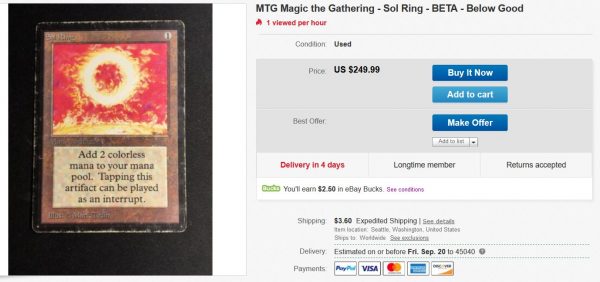
By reaching out to a party in Europe or Japan, you can easily save 30% on your Magic card expenses. Furthermore, you can even trade with these parties by shipping them cards that to them are cheap where you live. By establishing these relationships, not only do both parties profit but they help establish you as a person that can get any card as long as the buyer or seller is patient. For example, Sol Ring was for a very long time less than a dollar overseas, while $3 stateside.
It was very profitable to buy a large amount of Sol Rings from overseas and bring them to the states to flip for free money. As more people caught on, like anything in arbitrage, the price of Sol Ring internationally rose to where it is now. Currently, it is far less easy to make money on Sol Ring unless you are a vendor or high-profile seller.
Networking is also essential for capital investment. A lot of readers have messaged me in the past saying that their friend or whoever has a collection that they would like to sell, but that they themselves cannot afford to buy and flip the collection. Many vendors will give a kickback or referral if you pass that business along to them, as they can afford to buy some of the higher-end collections out there. I personally spent much of 2018 flying around the world buying Reserved List collections as prices reached the stratosphere, and it was beneficial to both myself and the person that recommended the collection to me.
By networking, you can help spread the image that you can buy any sized collection locally which establishes yourself as a trustworthy individual that is worth bringing their business to.
Common Mistake #3 - Becoming attached to your cards
If you are selling cards, you should have a clear distinction between your personal collection, and cards that you are selling. Over time, a lot of vendors start to build decks with cards they have acquired. If the purpose of using #mtgfinance is to make playing the game cheaper, then this is a sound move. However, many insiders also sell cards to try and actually profit off of the game. In this case, you should never move cards from your buys into your personal decks, unless you are selling the card to yourself.
It is always a slippery slope to take a card that you have bought to flip and move it into your own deck. Over time, you will start to reason with yourself more and more that you only paid X for a card, so it won’t be a problem. Costs like these add up. With a potential recession on the horizon, you are only hamstringing your capital that you could potentially have to scoop up collections when someone casts Armageddon on the stock market.
Another reason that you shouldn’t be attached to your cards is knowing when to let them go. Say you got a great deal on a foil Jace, the Mind Sculptor from Worldwake. Over time, this card has slowly trickled down as demand has shifted to both cheaper foil Masters set copies and a premium box edition as well. If you had bought a foil Jace from Worldwake for $400 a couple years ago, you’d be barely breaking even nowadays selling the card if you had held onto it.
If you are buying and selling cards for a profit, you should always flip those cards as fast as possible. A successful business can be a business that has low volume and high-profit margins, but the best businesses are the ones that have high inventory turnover and low margins, not unlike Amazon. By selling cards faster and recouping your income, you'll care less about the overall day-to-day of Magic and more about simply making 10-20% on each card that passes through your fingers. It may be more work, but it looks better for your online seller portal metrics as well as the number of customers that you can reach.
Wrapping Up
Hopefully, these three easy tips can help you to maximize your returns in order to play the game cheaper or make a little money on the side. Magic Finance is a complex issue with many different ways to maximize your return on the game. However, these general tips should help any reader better approach whichever avenue of finance you decide to follow. Smart practices lead to even smarter returns! If you have any questions, you can always reach out to me on Twitter @MissouriMTG.




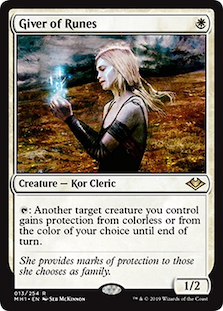 than eight targeted discard effects, or Giver of Runes, the Horizons update to Mother of Runes that's found itself everywhere from Company to Infect.
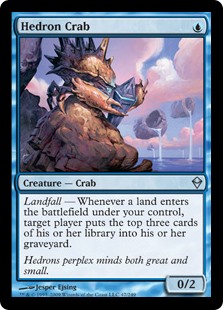 Vengevine's new incarnation combines multiple enabling engines with Stitcher's Supplier, here trending away from the pricey Satyr Wayfinder and towards Hedron Crab. Crab mills more, and faster; while Wayfinder provided Hogaak with explosive starts by also tapping for the 8/8, Crab gives the deck more of a turn two or three. Another blue one-drop, Memory Sluice, contributes to the count by milling four right off the bat, à la Wayfinder. The difference is Sluice can be copied by tapping controlled creatures, making it mill a potential eight cards. Rounding things out is Glimpse the Unthinkable, a no-nonsense mill-10.
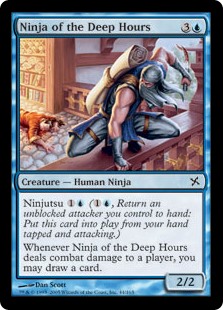 lock opponents out of interacting on our turn; with that landmine dodged, the deck can be stuffed full of high-impact disruption.
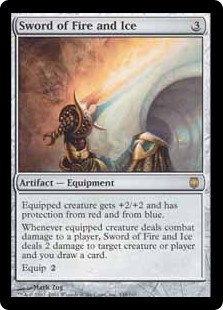 cheap fliers carry Sword of Fire and Ice exceptionally well. Spell Queller is another goodstuff creature with no tribal affiliation, but plenty of strategic relevance to the deck's gameplan.
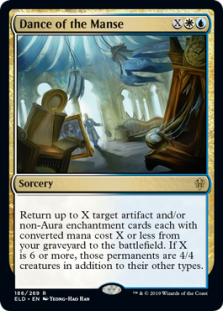 However, it remains a long shot. The cheap enablers, card drawing, and recursion are all there and have proven power, but
 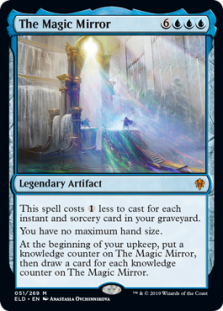 The other big artifacts are the cycle of story-relevant legends. I've covered Embercleave already, and its playability hinges entirely on Stoneforge Mystic. The Circle of Loyalty is also plausible in the unlikely event knight tribal is playable. Anthem effects are always decent, but Circle would be particularly good because it makes more Knights, and in several ways. However, the remaining three are traps to avoid.
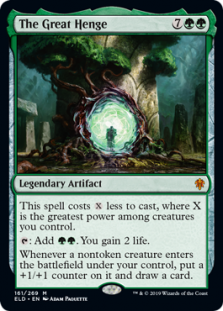 Mirror does nothing the turn it comes down and is slow to get going, which is not what
 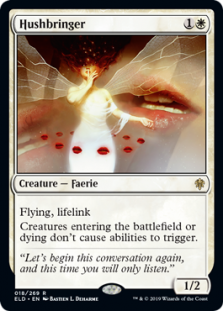 Gryff has never had an impact in Modern. Torpor Orb sees a little play as a Whir of Invention target, but giving it wings didn't make it more playable. The increased vulnerability of creatures is a factor, but the the primary problem is that Gryff is a creature. Creature decks are frequently packed with abilities Gryff shuts down, so it's risky to run Gryff even if their opponent may be hurt more. Control decks generally want the harder-hitting and more versatile Vendilion Clique as a three-mana flier. If they really need the effect, they can just run the Orb. Tocatli Honor Guard is another option, but a 1/3 ground creature needs to be phenomenal to see play.
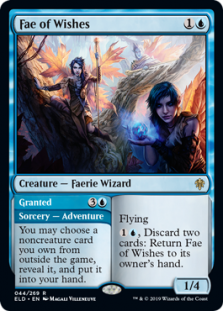 that at the same price, blue combo runs Gifts Ungiven. Gifts will be more powerful more of the time due to Past in Flames and finding multiple cards.
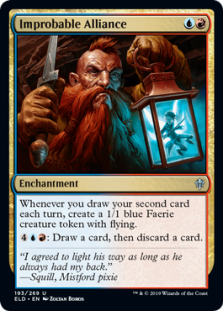 Eldraine seems intent on making Alliance work. The Royal Scions naturally curve out from Alliance and ensure a steady stream of Faeries.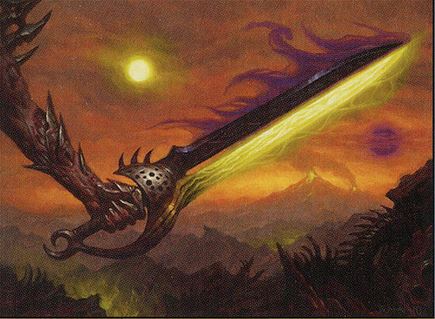

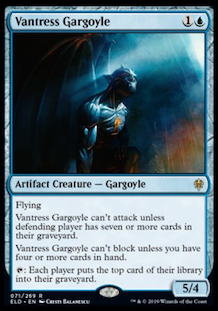 Today's article focuses on one such restriction-based creature: Vantress Gargoyle. A lover of
 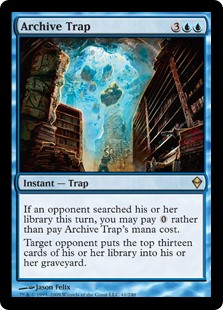 So are these creatures worth it? In "
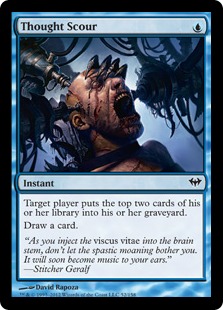 When it comes to incremental millers like Scour, every card matters, giving Vantress Gargoyle the advantage over Phantasm early on. Gargoyle also blocks creatures before we meet its graveyard condition. But Phantasm still costs just one mana, has an additional point of toughness, and isn't an artifact, making it preferable in pretty much any game state where opponents have a heavy graveyard.
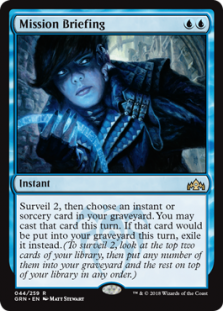 Removing Bolt made Snapcaster Mage less appealing, although I did like it alongside Thought Scour. But I soon swapped out the 2/1 for Mission Briefing. While Briefing lacks the tempo bonuses Snap brings to the table, it can retrieve a larger number of spells, since not using the flashback keyword forgives alternate casting costs. Archive Trap, Force of Negation, and Disrupting Shoal can all be cast for free from the grave with Briefing. Surveil also helps us piece together a gameplan.
 I still felt the need for more threats in the first version, so took a page out of the
 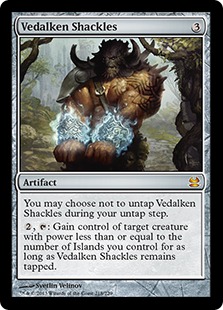 Out of the sideboard, Vedalken Shackles and Vendilion Clique served as extra plans. I did win a fair number of games with Shackles, but opponents would bring in artifact removal anyway after seeing Vantress Gargoyle, so this plan ended up being hit-or-miss.
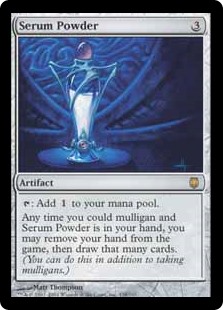 I went so far as to try Serum Powder to locate Archive Trap more reliably, but Powder requires decks to play far more lands, as it necessitates pilots to be comfortable going to 5 or less looking for their dream card. Since Trap isn't a land, finding that card alongside a land or two and some payoffs was too much to ask of my mulligans. Powder also clashed with Thing in the Ice, which prefers blue consistency tools.
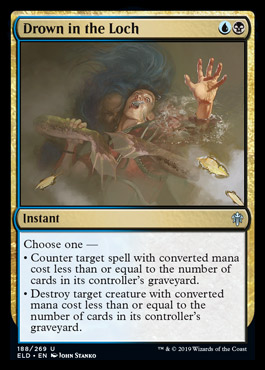 That card was Drown in the Loch. Drown could act as removal or permission, giving it utility in every matchup on top of its clear synergy with our Plan A. Having a card that so dependably slowed the game's pace increased consistency in its own rite, since the longer the game goes on, the more cards hit the bin to feed our creatures. But dipping into black at all provided me with another missing link.
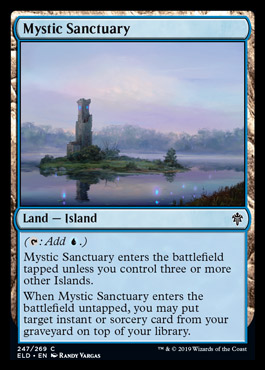 A couple of newer tech choices are Mystic Sanctuary (spoiled yesterday) and Temporal Mastery. Mastery can be searched up with Symmetry when we plan on not drawing the card this turn, such as to Trap opponents immediately. It's a great find when we've got a beater in play, as it significantly increases our clock. It can also be cast with an instant-speed cantrip on our opponent's turn.
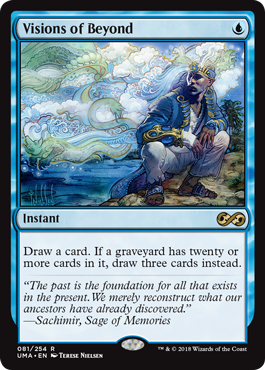 The land can also be used to get back the best instant in the graveyard at a given time. That's sometimes Drown in the Loch or Force of Negation, both of which protect us from enemy topdecks; more often, it's Visions of Beyond, which chains into other copies of itself as did Treasure Cruise. Because of Sanctuary's Island requirement, I went from 4 to 2 to 0 Darkslick Shores.
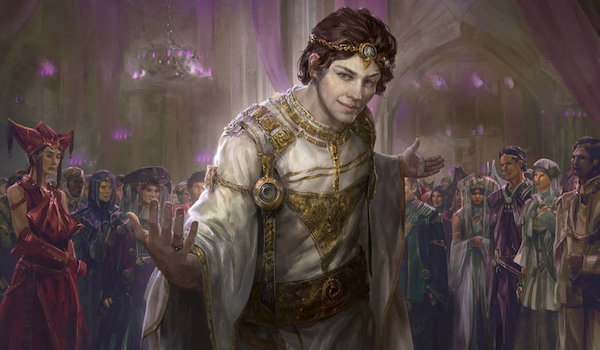
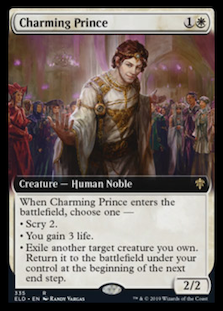 But enough won't satisfy royalty. Charming's most powerful ability (in a vacuum anyway) is his first: scry 2. It doesn't look like much, but white doesn't get card draw or library manipulation very often. Even when it does, it's usually about enchantments (see Idyllic Tutor) or much worse than other colors' options (see Thraben Inspector). Charming is very similar to Serum Visions, but being a creature gives him greater flexibility. Charming could help close the variance gap between white and other colors.
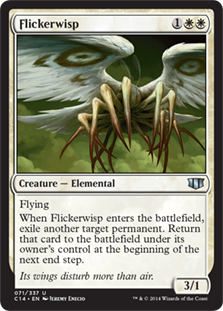 Outside of Humans, I'm not sure what deck wants the Prince around. He is only a 2/2 ground pounder, and white decks have no shortage of those. Death and Taxes has Flickerwisp and wouldn't cut them for Charming. Frequently, as good as getting value flickering your creatures is, it's better to flicker an opposing creature or equipment during combat. Wisp also kills tokens, steals a land drop, resets planeswalkers, and can break up combos. Add in flying and Charming can't replace Flickerwisp.
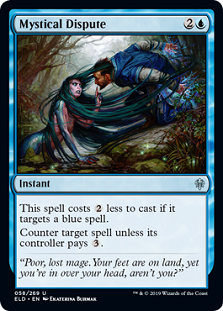 There was a saying back in the day that whoever drew the blue half of their UW Control deck won the mirror. Before planeswalkers, blue provided all the card advantage and interaction that was actually relevant in the control mirror, where white was just creature removal. While this isn't as true anymore, blue's planeswalkers and counters are still more relevant than Path to Exile in the mirror. Mystical Dispute threatens to upend this strategic truism.
 graveyard synergies is very good, even with
 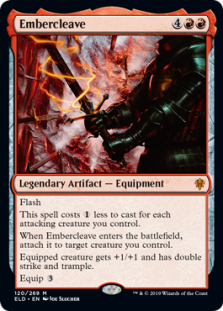 look. Of course, the bar is still very high, but it's not insurmountable. On its face, Embercleave can't compete with swords or Batterskull. The stat boost is worse, though trample and double strike partially make up for that, they're not better than protection. That it has flash and cost-reduction is nice, but not enough to make it in Modern.
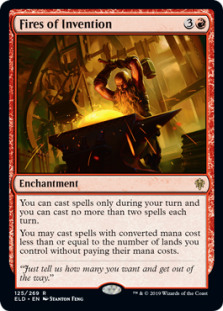 I don't know if this card is good, but it seems like it could be. Free spells are frequently broken. However, Fires only allows for two spells, and only on your own turn. It's intended to be a weakened As Foretold, and can only really be used in a combo deck. It can't just go off like Experimental Frenzy or Mystic Forge. However, there's no risk of clunking out from a string of lands. You also don't really benefit from cheating it out, since those free spells are tied to your land count. There's no real point in cheating out 1-2 mana spells with a four mana enchantment. I have no idea what deck could use Fires or in what capacity, but I'm sure one exists.
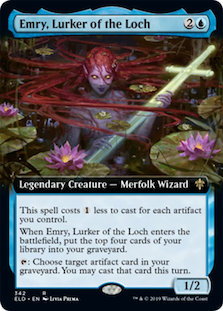 As in the
 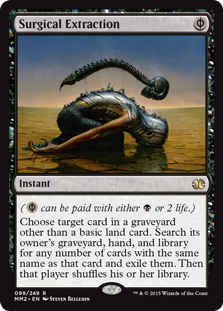 This may not be a problem by itself, but when Emry enters play, she mills four random cards. In the best case, they're all artifacts that can be cast. In the worst, they're just Urza. Without Whir and Urza, Whirza is extremely anemic. The question is whether that risk outweighs the reward.
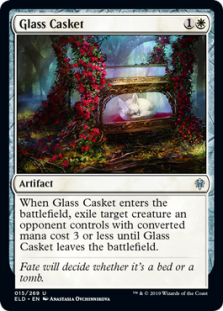 Normally, Journey to Nowhere effects aren't Modern-playable except as niche cards in Enduring Ideal. However, unlike its forbearers, Glass Casket is an artifact. That means it's findable with Whir of Invention, the supercharger that guarantees Casket sees play.
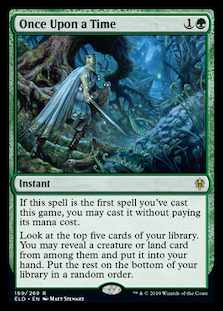 Once cannot do that. Frank Karsten did
 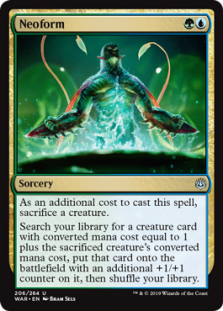 choked on mana is a major problem since Neobrand runs 14-16 lands and 4 Chancellor of the Tangle at most. Once will reduce Neobrand's mulligan variance, in theory.
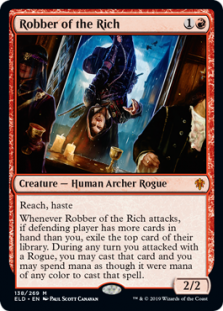 most of the time, and the effect is repeatable and doesn't have to be used immediately. However, Robin is indiscriminately stealing cards, so there's no control over what you get. He also can't steal all the time, and you can't cast the spells unless you've attacked with a rogue. That's a lot of caveats.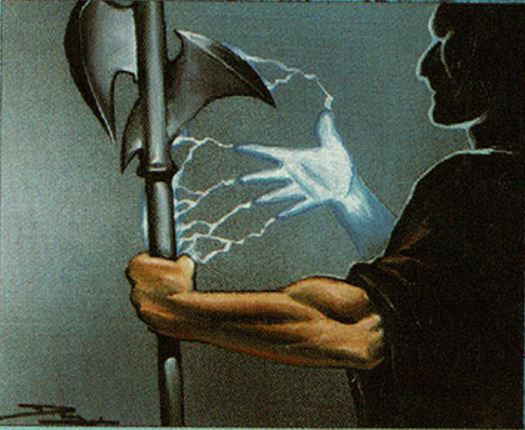


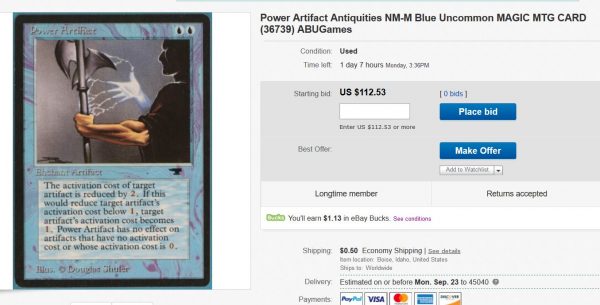
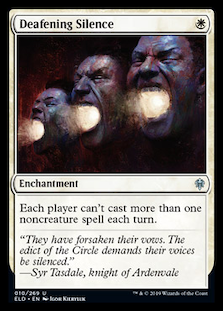 Deafening Silence
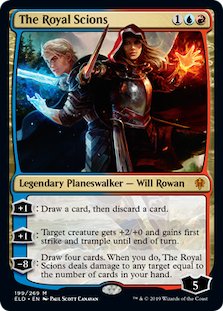 After Wrenn and Six, Modern players may be a bit spoiled, making it tougher to evaluate new planeswalkers fairly. But I think The Royal Scions is nonetheless pushed for its mana cost, and will see play in decks that don't need their planeswalkers to come down and immediately protect themselves. It's a hard-to-remove card filtering engine mixed with Ancestral Vision, as three turns after cast, the Scions' ultimate threatens to bury opponents in card advantage—and damage. Expect Blue Moon to sleeve these up for sure, and for other Izzet-colored decks to consider Scions as a bullet for the grindy post-board games where Saheeli or Keranos can shine.
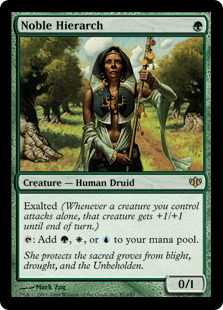 An eternal struggle of mana dork decks is how much better they are when starting with a dork on turn one. Of course, they also need a payoff spell, and a second land to ensure ramping to three mana on turn two should the dork live. Once Upon a Time helps on all fronts, helping what are already often combo-focused decks assemble their pieces quickly and efficiently. Devoted Druid
 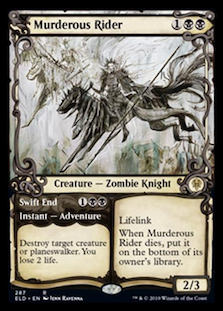 Murderous Rider: BGx decks ran Hero's Downfall years ago. Nowadays, the card is better suited to greenless black decks, as Assassin's Trophy
 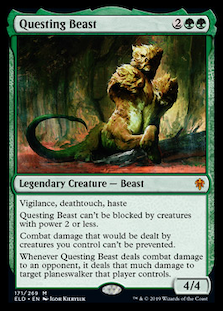 Questing Beast: As far as Throne's pushed creatures go, Beast takes the cake. But its Modern viability is up in the air. Beast has uses against Jund and UW, decks that frequently hide behind Liliana of the Veil or Teferi, Time Raveler on turn three. Answering these walkers with Beast requires pilots to be ahead on mana and to have Beast at the right time, which may be too many demands; on the other hand, the card might slot into mid-size beatdown decks like Zoo as a curve-topper.
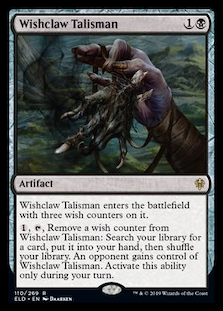 Wishclaw Talisman: With Whir of Invention-fueled combo decks on the rise, and Karn, the Great Creator increasingly
 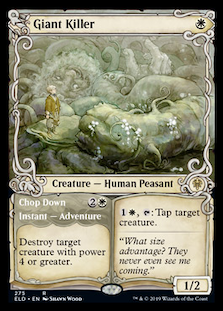 Giant Killer: Killer may prove a bit niche in the end, but the utility of a one-drop Human that keeps an opponent's best combat creature at bay while offering the upside of sniping another one gives it potential in certain metagames. After all, we saw Big Game Hunter rear its head in
 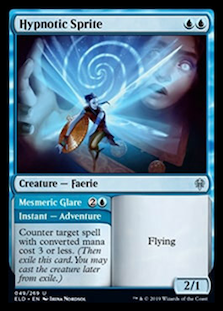 Hypnotic Sprite: Another adventure creature, Sprite's front end is a bit pricey for traditional Modern play. The card could find more luck as part of a Faeries deck, though, as an all-in-one Snapcaster Mage, disrupting opponents and applying pressure without relying on the graveyard.
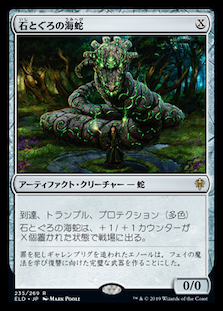 Stonecoil Serpent: Serpent enters with X +1/+1 counters, and has reach, trample, and protection from multicolor. Endless One and its ilk
 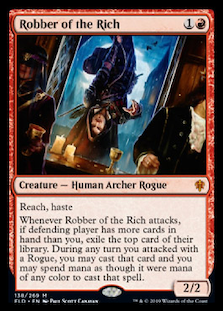 Throwing red into the mix for Robber complicates things quite a bit, although my first
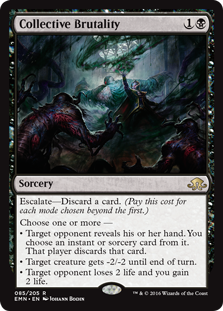
 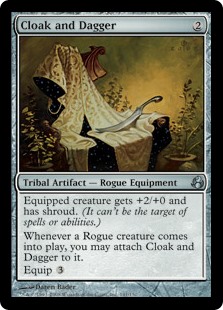 Collective Brutality is crucial here as a way to unclog hands, turbo-charge delirium, and interact efficiently with opponents while setting up our admittedly terrible gameplan.
 As for Robber itself, I was impressed with the card, but I don't think it will see mainstream play. Asking to connect with a Rogue is all but impossible for most Modern decks, meaning if Robber dies, the cards it "drew" while alive won't be of much use. Naturally, its utility depends on the kind of deck opponents are on, but against anyone playing fair, I found the 2/2 surprisingly adequate.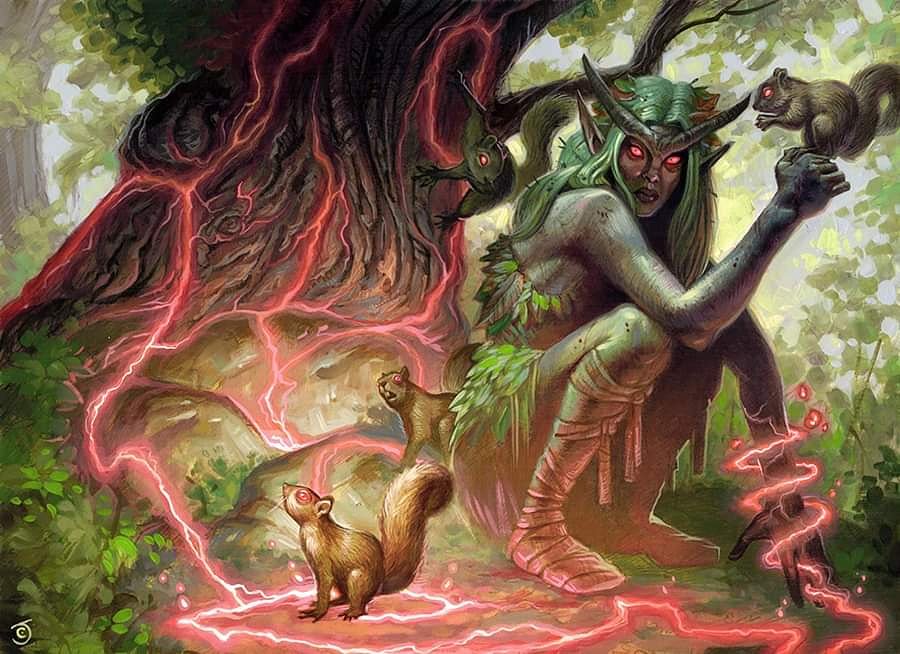

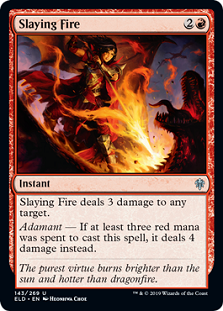 Adamant is clearly meant to promote mono-colored decks in Standard, but the only reason that would happen in Modern is an aggressive white creature. Modern's mana makes it possible for Esper Control to run Cryptic Command alongside Damnation and Settle the Wreckage if so inclined. Therefore, a decent adamant spell could be run in any deck that wants it and is at least somewhat on-color. For example, a playable adamant blue instant could be run in anything from Merfolk to Grixis Control with very little burden, and the expectation that it will get the bonus almost every time. I expect that the front of such a spell can be a bit weak if the enhanced version is solidly playable.
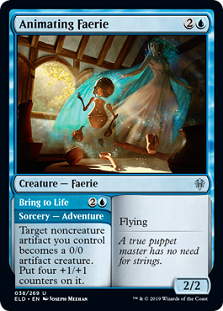 Animating Faerie: I don't know why any deck would want to make their noncreature artifacts into 4/4s. Tezzeret, Agent of Bolas makes 5/5s repeatably and sees no play. However, Ensoul Artifact has been run in Affinity
 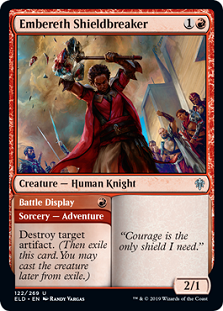 Embereth Shieldbreaker: Against any artifact heavy deck, Shattering Spree or Vandalblast will be much better than Battle Display for the same price. However, there will be plenty of times where such cards are overkill. If instead you want cheap, maindeckable hate, then Shieldbreaker is better than any other option I can
 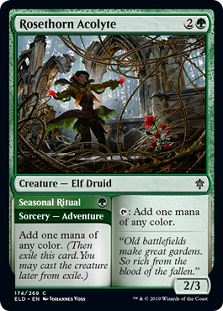 little sister, and Manamorphose is an absurd card in
 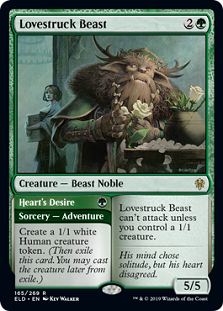 The other possibility is for an adventure creature to be playable on its own, and the adventure part to provide the bonus. As of this moment, there aren't any examples in this category. Lovestruck Beast is close, but is too conditional; no deck wants to make a 1/1 Human token for G.
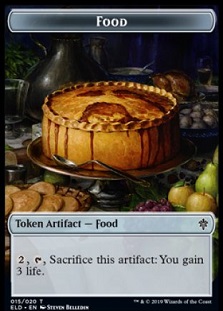 doing anything in Modern because there's no good repeatable way to make treasures. Clues do see play, mostly because of Tireless Tracker. Thus on face, it will take a generator at least as good as Tracker for food to be playable.
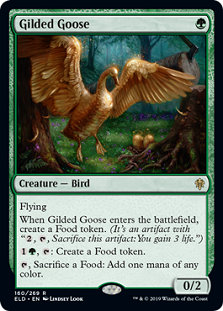 Gilded Goose: The Goose lays the Golden Egg. Then, it pays tribute to Deathrite Shaman. Bring the kids for a fun day out! In seriousness, Goose is not in the same league as the banned-everywhere Shaman. That doesn't mean that it's not still playable.
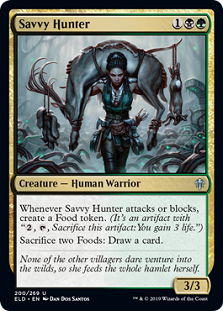 Savvy Hunter-This is more what I'm looking for. Hunter's stats aren't that great, but repeatable card draw in BG is very good (again, see Tireless Tracker). Hunter's main limitation is that she only makes one food a turn, and so can only draw a card every other turn. On her own, she's not good enough. However, pair with another repeatable generation and there's an engine here. It's still worse than Tracker since it's not self-contained, but for Tracker to generate more cards a turn requires fetchlands, which also require life payments. In a Burn-heavy meta, that's not insignificant.
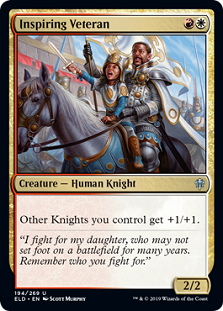 The final mechanic, though not a formal one
 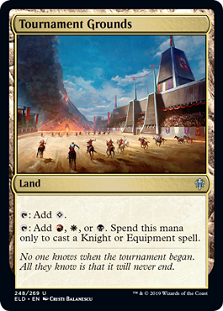 tough, mid-size creatures. Throw in Haakon, Stromgald Scourge and you've got a deck that will grind with the best.
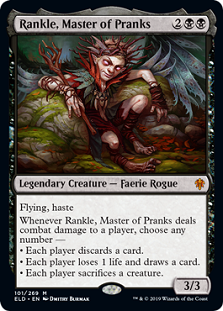 it's a combination of the creatures being 1/1's, Burn existing, and the deck's difficulty to master. The power of the synergies is very good, but it takes so many to compete with other decks that it's barely worth trying.