menu

The Grinder’s Guide to Tournament Finance

Are you a Quiet Speculation member?

If not, now is a perfect time to join up! Our powerful tools, breaking-news analysis, and exclusive Discord channel will make sure you stay up to date and ahead of the curve.

A surprising amount of MTG finance plays out on tournament floors. Between StarCityGames Opens and Grand Prix/MagicFests, these massive tournaments often wind up driving prices as much as or more than new set releases. Pro Tours/Mythic Championships are a different animal entirely; often dictating the course of the entire associated constructed format for weeks or months to come.

The Easy Stuff

Pro Tour finance tends to be very straightforward. A card that has a strong showing on camera will likely see a price increase. The order of magnitude is determined by how vast the difference is between the old perception of the card and the new perception of the card. A bulk mythic that turns into a 4-of in the best deck will see a massive price increase.

A more obviously powerful mythic like Teferi, Hero of Dominaria will see a smaller increase. Pro Tour finance is very intuitive, and stories of individuals buying numerous copies of a breakout card for a massive discount are common.

There was an error retrieving a chart for Teferi, Hero of Dominaria

The Aggressively-Not-Easy Stuff

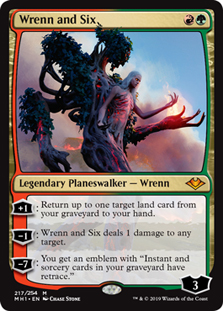
SCG Opens and MagicFests are far messier. Most competitors at these events are trying to mitigate their losses/maximize their gains, and don’t know the best way to do it. I get asked all kinds of questions at these events about blink-and-you’ll-miss it finance plays. “Should I sell my entire Hogaak, Arisen Necropolis deck to a vendor after the event?” “What’s the best way to convert prize tickets to cash?” “Should I buylist my Wrenn and Sixes for $62 per (MF Detroit buylist price) and hope to buy in cheaper in two months?” These are just a few examples, but they illustrate a similar picture: there are few or no common-knowledge heuristics for buying and selling cards at large Magic tournaments.

There was an error retrieving a chart for Wrenn and Six

Have Tickies, Want Monies

The easiest method to develop a heuristic for is converting prize tickets to cash. Unlike other MTG finance decisions, this one tends to change very infrequently. Aside from a few small deviations, prize ticket values and prizes are usually very similar from tournament to tournament. It can certainly be overwhelming to walk up to the prize booth and be met with over a hundred different methods of spending your prize tickets. Typically, most of these can be ignored if cash is your primary concern.

The most common valuable conversions are current set booster boxes, oversized cards, and uncut sheets. The latter two options are very rare items that can usually be sold for a higher rate than the normal ticket to booster pack conversion. In the past, I often saw complete sets being slightly undervalued by SCG’s prize wall, but they seem to price them more appropriately these days. I would still recommend calculating how many booster packs a complete set would cost you and compare that with how much you can sell it for on eBay if you’re willing to put in the work. Keep in mind that you’ll lose 10-15% of that eBay number to fees and shipping costs.

Current set booster boxes are easy to convert to cash. Just undercut Amazon/eBay in your local Magic Facebook group and a buyer will materialize. Undercut it by $5 if it’s a popular set, or by $10-$15 if it’s an unpopular one.

Going Big

Oversized cards and uncut sheets are much harder to sell, because the market is very niche and they are bulky and fragile, making them difficult to ship. With oversized cards, don’t even bother unless it’s a more iconic card that people will want, but there is a sweet spot. MagicFest Detroit had a sweet Japanese alternate art Narset, Parter of Veils as an oversized option, but it cost as many tickets as two oversized Lightning Bolts.
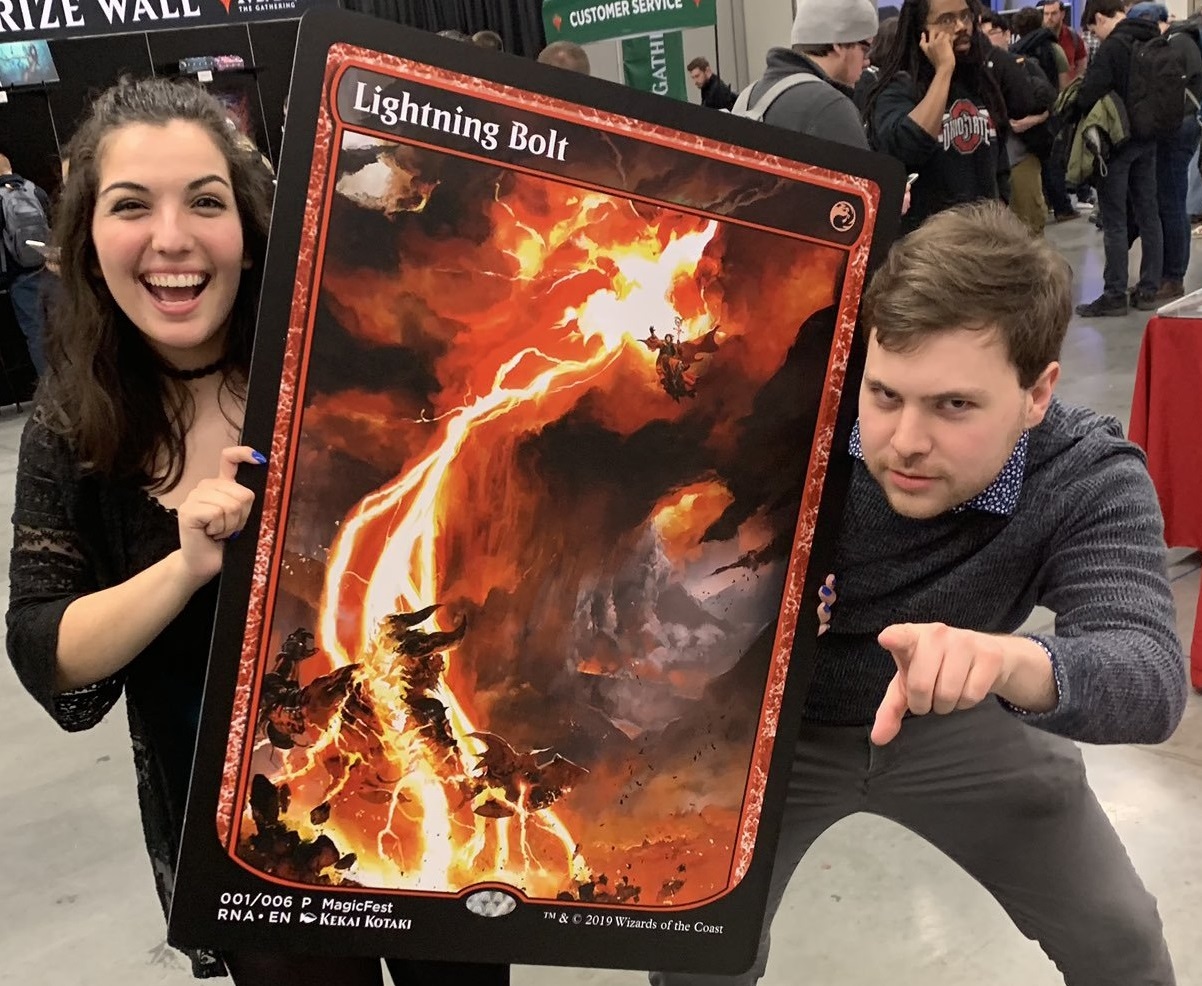
I doubt the monetary conversion would work out favorably there. Uncut sheets tend to be much more of a slam dunk because the demand for any uncut sheet is going to be higher than the demand for an oversized Glorybringer. The cardinal rule for uncut sheets is to treat them like they’re stolen paintings from the Louvre. They’re extremely fragile and easy to damage, and if you let that happen to yours, you’re going to feel like an idiot. Don’t bother with eBay on these; take them to one of the associated Facebook groups. The market there is stronger and the fees are lower or non-existent.

Let's Lay Down Some Ground Rules

An important rule to keep in mind when converting your tickets is to think about any purchases you might be making in the next few months. If you’d be spending cash to buy two boxes of sleeves in the next 3 months, you should absolutely save yourself the cash and snap those up now for tickets. Same goes for cardboard. Is there a new staple that you need for your deck? Grab store credit and save yourself the cash.

Our other frequent tournament questions are more contextual. We’ll stick to my two golden rules of MTGFinance for these:

  1. Lock in surplus value as soon as possible.
  2. Cut your losses as soon as possible.

Two rules.

These rules paint a very risk-averse portrait of me. This is an accurate portrayal. I’ll take some stupid risks sometimes for funsies, but most people would rather my advice make them some money rather than give them a stack of Sundial of the Infinites.

There was an error retrieving a chart for Sundial of the Infinite

Example Time!

An example of Rule 1: Did you buy your Wrenn and Sixes when they were $25? If so, go ahead and buylist them for $62 and lock in that value. Don’t expect them to randomly tank in value unless you like to gamble, so if you need some of those to play with, hold onto them.

An example of Rule 2: Go ahead and sell your Hogaak, Arisen Necropolis deck. This question was asked to me pre-banning at SCG Pittsburgh, and even now that the deck is coming back to the forefront of Modern, I still think selling was correct. Lots of the deck’s staple cards have gone down in price since then, so much so that if you still needed them you could have bought them back with your buylist bucks now.

Can you imagine how much of a slam dunk it would have been if Hogaak, Arisen Necropolis was banned as well? Or Vengevine? Don’t get greedy. If you care about money enough to consider buylisting the deck, you should buylist the deck. You may lose some amount of money depending on at what point you bought in, but if you wait a week to try and sell the cards online to an apprehensive market and get gut-punched by the banned and restricted announcement, you’re going to feel foolish.

There was an error retrieving a chart for Vengevine

Thank You For Reading!

If you try and apply these rules first and foremost to your MTG finance decisions on the tournament floor, you’ll find yourself more frequently in the situation of being able to buy card for the next tier 1 deck. More importantly, you'll less frequently be in the situation of leaving your banned deck in a deckbox on your kitchen table for 14 months until Survival of the Fittest gets unbanned in Legacy and spikes your Vengevines again. Thanks for reading, follow me on Twitter, flame me on MTGO, etc, etc.

Magic Finance is NOT Magic

Are you a Quiet Speculation member?

If not, now is a perfect time to join up! Our powerful tools, breaking-news analysis, and exclusive Discord channel will make sure you stay up to date and ahead of the curve.

MTG Finance ruined Magic for me.

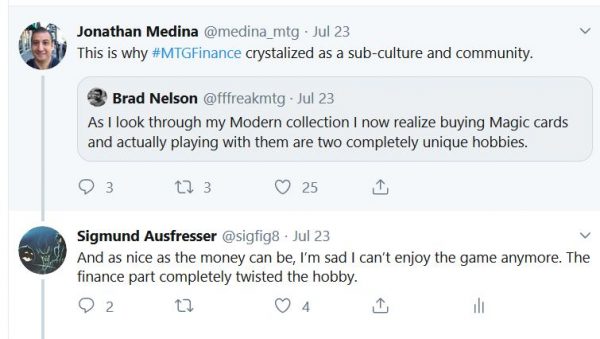
This is a bold statement to kick off an article on a website about MTG finance, but it’s my solemn realization. I think it’s been this way for a year or two now, but it’s only now sinking in that the game itself no longer exists for me. Brad Nelson (@fffreakmtg) put it best on Twitter recently, and Jonathan Medina (@medina_mtg) helped emphasize the point.

Thinking back, I can identify a few key events that flipped the switch in my brain, shifting my focus from Magic play to Magic finance. They may not be 100% mutually exclusive, but often enough a decision within one negatively impacts the other. And now, I’m sitting here wondering if I can ever enjoy the game itself again.

Acute Life Events

When I consider my shift from “playing with Magic cards” to “buying Magic cards”, I don’t think the move happened overnight. It was a series of life changes that cascaded into my current reality.

First and most significant, my spouse and I had a child in 2012. This was around the time I was most interested in playing Magic. I never really believed I could make it onto the Pro Tour, but I had ambition once upon a time. Most realistically, I had established myself as a formidable opponent at my LGS, grinding out weekly Legacy events and winning the occasional draft. I miss the days of Mystical Tutor’s legality in Legacy!

There was an error retrieving a chart for Mystical Tutor

In the year or two leading up to my son’s birth, I had been avidly collecting Legacy cards with the intent of playing multiple archetypes depending on my local metagame. But within a year or so of my son’s birth, I realized that playing in regular events was no longer so easy to prioritize. Around this time, Legacy staples all skyrocketed in price—this is when I developed the idea that I could use Magic to help offset my son’s college costs. I went to a local Grand Prix and sold out of Legacy.

Despite this cash-out, I still played Standard at local FNM’s and I thoroughly enjoyed the fledgling Modern format. I gravitated towards Melira Pod, and loved the infinite decision points the combo deck presents. Games were fun an interactive, and it always felt like there was a “way out” if I just utilized my Birthing Pod toolbox correctly.

Then Wizards banned the card.

I was really disappointed to see the value of my Modern deck drop considering my end goal was to fund my son’s college costs. How could I possibly justify owning cards with potential to drop in value if my end goal was to increase value?

I pivoted towards a Bloom Titan type deck and really enjoyed its engine. I acquired the cards for the deck as soon as I saw it perform well at a Pro Tour. But it performed too well, and shortly thereafter Summer Bloom received the banhammer. Fool me once, shame on you Wizards. But fool me twice, shame on me. I was done with Modern.

Around this time, I also lost interest in Standard because rotation hurt the bottom line too much. Imagine a format where every two years, entire sets were effectively “banned”. This wouldn’t fly.

Despite all the above, I still enjoyed the casual side of the game. A friend and I would get together about once a month and battled via all sorts of casual formats: Commander, Old School, worst deck challenges, pack wars, pack wars with Rainbow Vales, etc.

There was an error retrieving a chart for Rainbow Vale

Then my good friend moved away, and the monthly get-togethers ceased. Making new friends—especially Magic playing friends—is very difficult when you’ve got two young children. I lost my last outlet for playing Magic, and with that, my focus on the hobby shifted 100% towards finance.

Tension Points and Decisions

If you truly wish to optimize your involvement in Magic finance, then you have to be willing to make certain sacrifices. This is the realization I came to over the past few years—I’ve tried all sorts of ways to enjoy Magic play, and the Old School community is the closest I’ve come to success. But at the end of the day, there are still trade-offs that require suboptimal decisions about finance, and I continue to struggle with this tension point.

Here are some recent examples of decisions I’ve made where I prioritized one and sacrificed the other. As you read through these, think about how similar situations may apply to your own MTG involvement, and if you should be making alternate decisions depending on how you want to engage the two distinct hobbies.

Example 1:

Over a year ago, I tweeted that Card Kingdom was paying some silly-high dollar amount on Grave Robbers. I think it was in the $6.50 range. I had a copy but didn’t want to part with it because I find the artwork amusing. Card Kingdom’s current buy price: $1.25. In fact, I could have sold my copy and bought several only one year later with the proceeds. This is a small example that defines a major tension point between Magic play/enjoyment and Magic finance.

There was an error retrieving a chart for Grave Robbers

I have a diverse collection of Old School cards and buy prices went through the roof a while ago. Now many prices have dropped back down (appropriately so, the high prices were unsustainable and manipulated by “MTG Finance”, after all). The optimal move would have been to sell during the hype and buy back in, but I chose to prioritize collecting over finance, sacrificing hundreds of dollars in value as I watched my collection’s value drop.

Example 2:

I have played the same two Commander decks for many years now, only making occasional tweaks here and there. Since I play so infrequently, it makes little sense to optimize the lists. But it goes beyond a time investment—consider the financial drawbacks to maintaining Commander decks. Sure, some cards do appreciate over time; but a lot of them see reprints and drop in value. What’s more, rather than holding a valuable Commander deck and haphazardly scoring a profit here and there, I’d prefer keeping as little value in these decks as possible, prioritizing the money on cards I am most confident in.

The result: I don’t win very many Commander games. And every time a card randomly spikes, I find myself feeling the need to cash out opportunistically since the cards themselves offer little value outside their monetary one. This happened most recently with the Medallions, which have recently jumped. I could hold these to see if they rise further in price, but it’s just too tempting to sell into the spike and put the money to work elsewhere.

There was an error retrieving a chart for Ruby Medallion

Example 3:

This is the most recent example. After reading about the Alpha 40 format, I decided I wanted to try it out. I quickly built a Plague Rats deck, starting as budget as possible and then upgrading the deck as I went. I even managed to play some games with the deck, though the jury is still out on whether or not I think it’s all that fun (the deck-building options are fairly limited).

But now Alpha cards have spiked to the point where I could sell the deck and put a good chunk of money away for my kids’ college. I suppose Alpha cards have further upside still in the long-term, but is it possible we see another pullback like we did with other Old School cards? Is this capital better put elsewhere? I could even just put the money into a mutual fund—the returns may not be as exciting, but they’ll be more dependable. As my kids age, reliable growth is going to be more important.

There was an error retrieving a chart for Plague Rats

I haven’t made the sale yet, but I have to consider my end goal here: to help fund college costs. With that backdrop, I should be looking to sell opportunistically. But this comes at a cost: I can’t play an optimal deck and I can’t completely focus on building a collection of the oldest cards in existence. It’s a really hard trade-off I haven’t quite found the balance with yet. But since I don’t get to play the cards, you can understand my dilemma.

Wrapping It Up

If you believe you can equally engage in Magic play and Magic finance, you’re fooling yourself. Or, better put, you’re making some major sacrifices (perhaps without even realizing it). Making a decision to optimize one side of the hobby is often exclusive to the other side.

I have learned this gradually over the past few years, and my balance has tipped drastically in the direction of MTG Finance. In a way, I regret this progression because it occurred partly out of my control. I didn’t ban my two favorite Modern decks and I didn’t tell my friend to move away. But given my stage in life, this really is the best balance.

I could mourn my loss of interest in Magic play itself. But regretting the past is fruitless. I just need to make sure I delineate where my play/collecting hobby ends and where the finance hobby begins. Then as I make transactions accordingly, I can proceed with confidence in knowing that my actions are moving towards end goals. If they’re not, then I need to really scrutinize the action to determine if the happiness I’m going to get is going to outweigh the potential financial drawbacks.

At the end of the day I need to ask myself: am I getting enough enjoyment out of Grave Robbers, and Legacy cards, and Alpha cards, and all the other cards I decide to keep on a daily basis? If not, then my bend towards finance needs to take precedence. It’s the only way to proceed logically, with my end goals in mind.

But what about your end goals? Are you making optimal decisions based on how you’d prefer to engage with Magic?

…

Sigbits

  • A couple of older cards have returned to Card Kingdom’s hotlist after a lengthy absence. The top card right now is Candelabra of Tawnos ($510). I’m not sure if there’s a particular reason demand may have risen, but certainly a powerful, rare card. I’d love to own a copy myself, but I cannot justify the cost.
  • Arabian Nights City of Brass returned to Card Kingdom’s hotlist recently. They only have a few left in stock, so it appears these are on the move. Their current buy price is $245, but I remember their buylist peaking in the $270 range at one point. If you are interested, Cool Stuff Inc has a few copies that are competitively priced considering Card Kingdom’s aggressive buylist.
  • Two Dual Lands have reappeared on CK’s hotlist! Volcanic Island ($320) and Badlands ($145). This may not be their highs, but the numbers are solid. I have a few extra Duals I recently acquired with trade-in credit, and I like the idea of cashing credit into these for a 1-2 year hold. These tend to rise and fall in cycles, and the next increase should happen within that time period.

July ’19 Brew Report, Pt. 1: Fun-Earth

Are you a Quiet Speculation member?

If not, now is a perfect time to join up! Our powerful tools, breaking-news analysis, and exclusive Discord channel will make sure you stay up to date and ahead of the curve.

July in brewing? More of the same. More copies of Unearth, to be sure. And more of what's become known as Modern's calling card: novel experiments bursting with hot tech. Today we'll look at some of the month's breakout strategies: Elemental tribal, White Weenie, and the return of old-school Miracle Grow.

Disentombed Again

Unearth continues to make waves in Modern, now as part of an Elemental-recurring engine.

BR Thunderkin, by SEROX (5-0)

Creatures

4 Thunderkin Awakener
3 Dreadhorde Arcanist
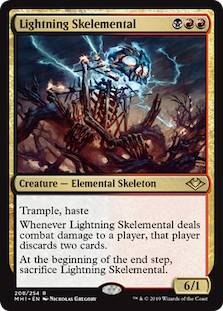
4 Lightning Skelemental
4 Ball Lightning
2 Seasoned Pyromancer
1 Insolent Neonate
1 Young Pyromancer

Instants

1 Dismember
2 Fatal Push
1 Kolaghan's Command
4 Lightning Bolt

Sorceries

4 Faithless Looting
4 Inquisition of Kozilek
2 Thoughtseize
4 Unearth

Lands

4 Blackcleave Cliffs
2 Blood Crypt
4 Bloodstained Mire
1 Dragonskull Summit
5 Mountain
2 Scalding Tarn
1 Swamp

Sideboard

3 Abrade
1 Engineered Explosives
3 Fulminator Mage
4 Leyline of the Void
2 Plague Engineer
2 Saheeli, Sublime Artificer

BR Thunderkin represents a natural evolution from the BR Unearth lists we saw cropping up a few months ago. Such decks were already abusing the hard-hitting three-drop core of Seasoned Pyromancer, Lightning Skelemental, and Unearth, and were bound to integrate Thunderkin Awakener once M20 dropped. This build in particular closely resembles the June lists, but with Thunderkin seamlessly weaved in alongside a set of Ball Lightnings to draw extra value from the newcomer.

More streamlined builds are also appearing:

BR Thunderkin, by LANTTO (5-0)

Creatures

4 Dreadhorde Arcanist
4 Lightning Skelemental
4 Seasoned Pyromancer
4 Thunderkin Awakener

Instants

2 Fatal Push
2 Kolaghan's Command
4 Lightning Bolt

Sorceries

4 Faithless Looting
4 Inquisition of Kozilek
4 Thoughtseize
4 Unearth

Lands

1 Arid Mesa
4 Blackcleave Cliffs
3 Blood Crypt
4 Bloodstained Mire
1 Fiery Islet
1 Marsh Flats
1 Scalding Tarn
1 Snow-Covered Mountain
2 Snow-Covered Swamp
1 Sunbaked Canyon
1 Verdant Catacombs

Sideboard

1 Abrade
2 Collective Brutality
3 Fulminator Mage
4 Leyline of the Void
2 Liliana of the Veil
2 Plague Engineer
1 Shattering Spree

This take on BR Thunderkin cuts right to the chase, Unearthing only the baddest creatures available and employing Thunderkin itself as a Skelemental machine. In a topdeck war, value chains can begin from any link—Dreadhorde flashes back Unearth which targets Thunderkin which reanimates Skelemental, and Seasoned Pyromancer digs pilots into a chain-starter, helping BR topdeck extremely well.
The Pyromancer-Skelemental-Unearth package isn't exclusively relegated to Elemental shenanigans now that M20's been released, though. It's also proven strong enough for the Hollow One deck, where it surfaced in a 5-0 before launching the deck back into metagame with a Challenge finish.

Another Crusade

One of Magic's oldest and most beloved archetypes, White Weenie has never had much success in Modern. We've even covered promising builds on Modern Nexus, only to see them retreat into the maelstrom. Now, the archetype is starting to rear its head in Modern, but not thanks to Force of Virtue, a card we've already seen splashed into Zoo to impressive effect. Rather, White Weenie owes its sudden relevance to a certain overlooked Elephant Cleric.

White Weenie, by INTERNETSURFER09 (5-0)

Creatures

4 Countless Gears Renegade
4 Signal Pest
4 Steppe Lynx
2 Dryad Militant
3 Benalish Marshal
2 Boros Elite
2 Dauntless Bodyguard
4 Judge's Familiar
1 Kytheon, Hero of Akros
2 Selfless Spirit
4 Thalia, Guardian of Thraben
1 Thalia, Heretic Cathar
4 Venerated Loxodon

Instants

3 Path to Exile

Lands

3 Arid Mesa
4 Flooded Strand
4 Marsh Flats
5 Plains
4 Windswept Heath

Sideboard

2 Selfless Spirit
4 Burrenton Forge-Tender
1 Declaration in Stone
4 Leonin Relic-Warder
4 Rest in Peace

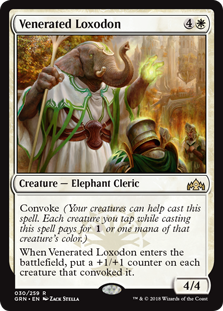
White Weenie plays out a bunch of cheap, white beaters and hopes for the best. It's no wonder Modern hasn't been kind to the strategy. But things start to look up when the deck's hopeful creatures tap to summon Venerated Loxodon.

The 4/4, besides providing sheer bulk itself, permanently grows an assault à la Thalia's Lieutenant in Humans. As White Weenie goes wider, and faster, than Humans, Loxodon ends up adding much more power and toughness than the Soldier—especially considering mana doesn't need to be spent on it. Pilots can instead empty the rest of their hand, then tap the team for Loxodon and set up a very rapid clock.

Kuldotha Weenie, by ERKS (5-0)

Creatures

4 Memnite
4 Ornithopter
4 Signal Pest
1 Kytheon, Hero of Akros
3 Martyr's Soul
4 Thraben Inspector
2 Venerated Loxodon

Artifacts

4 Mishra's Bauble
4 Mox Opal

Enchantments

4 Force of Virtue
3 Legion's Landing

Sorceries

4 Kuldotha Rebirth
2 Servo Exhibition

Lands

4 Blinkmoth Nexus
4 Darksteel Citadel
4 Inspiring Vantage
1 Plains
1 Spire of Industry
3 Sunbaked Canyon

Sideboard

2 Experimental Frenzy
4 Galvanic Blast
3 Grafdigger's Cage
2 Pithing Needle
1 Rest in Peace
3 Wear // Tear

Kuldotha Weenie offers a novel take on the strategy by melding it with Kudoltha Rebirth, the card helming another of Modern's age-old fringe decks. 0-mana artifacts, creatures or otherwise, pump out Loxodon even faster; in lieu of the Elepehant, Martyr's Soul acts as a Tarmogoyf of sorts, offering an impressive body for little- to no-cost. With Martyr in the picture, players are less likely to wind up with dead Ornithopters and nothing to convoke for.

Growing Pains

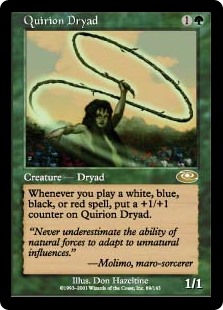
For years, I called my thresh tempo decks "grow" decks. Not that they aimed to grow their creatures, per se—those creatures entered the battlefield large enough. The name came, rather, from the heritage of the threshold archetype, which once employed Quirion Dryad as its primary beater. Chaining cantrips and sequencing disruption, the original grow decks sought to attack each turn with a progressively larger creature until destabilized opponents were defeated.
Quirion Dryad is far from a playable Modern card; Tarmogoyf, its spiritual successor and cross-format supplanter, has made sure of that. But what if it started with an extra point of power? And had flash? And was blue? Gro-a-Tog-ers, never fear: to find out, Brineborn Cutthroat is here!

Jeskai Grow, by MRRAEB (5-0)

Creatures

4 Brineborn Cutthroat
4 Snapcaster Mage
2 Spectral Sailor
2 Vendilion Clique

Instants

4 Opt
4 Lightning Bolt
4 Lightning Helix
4 Path to Exile
3 Logic Knot
3 Cryptic Command
1 Force of Negation

Sorceries

2 Serum Visions

Lands

4 Celestial Colonnade
4 Flooded Strand
2 Hallowed Fountain
3 Island
1 Mountain
1 Plains
1 Sacred Foundry
4 Scalding Tarn
2 Steam Vents
1 Sulfur Falls

Sideboard

2 Force of Negation
2 Disdainful Stroke
2 Jace, the Mind Sculptor
2 Relic of Progenitus
1 Spell Pierce
1 Supreme Verdict
3 Surgical Extraction
2 Timely Reinforcements

Jeskai Grow operates much like a Jeskai Tempo deck should, although Brineborn seems a fair improvement over other threats Jeskai has turned to in the past. It doesn't require tapping out, unlike Geist of Saint Traft; it doesn't carry a narrow casting window, as does Spell Queller. It also applies heaps of pressure if not dealt with. Another flash creature, Spectral Sailor, shows up here as a mana sink and card advantage engine.

Grixis Grow, by GALANATOR (5-0)

Creatures

4 Snapcaster Mage
4 Brineborn Cutthroat

Instants

4 Opt
4 Lightning Bolt
2 Fatal Push
1 Cast Down
1 Terminate
2 Logic Knot
2 Remand
1 Spell Pierce
3 Cryptic Command
2 Force of Negation
3 Kolaghan's Command
2 Fact or Fiction
1 Surgical Extraction

Lands

1 Blood Crypt
3 Creeping Tar Pit
1 Desolate Lighthouse
3 Island
1 Mountain
4 Polluted Delta
4 Scalding Tarn
1 Spirebluff Canal
2 Steam Vents
2 Sulfur Falls
1 Swamp
1 Watery Grave

Sideboard

1 Force of Negation
1 Spell Pierce
2 Surgical Extraction
2 Engineered Explosives
2 Fry
2 Keranos, God of Storms
2 Plague Engineer
2 Ravenous Trap
1 Spell Snare

Grixis Grow takes a leaner, slower approach, appearing closer on paper to the threat-light Gro-a-Tog decks of old. There's resultantly more value here, from Fact or Fiction to Kolaghan's Command, and less reach to close out the game with. Once opponents are exhausted of resources, Brineborn comes down and stands up tall to finish the game quick; it may also drain those resources in the early- to mid-game if allowed to flourish for long enough.

Temur Grow, by THEEXALTEDONE (5-0)

Creatures

3 Huntmaster of the Fells
4 Brineborn Cutthroat
4 Snapcaster Mage

Instants

1 Negate
4 Opt
4 Thought Scour
4 Lightning Bolt
3 Magmatic Sinkhole
2 Spell Snare
3 Archmage's Charm
2 Pulse of Murasa
3 Cryptic Command

Lands

2 Breeding Pool
1 Flooded Strand
1 Forest
5 Island
4 Misty Rainforest
1 Mountain
1 Polluted Delta
4 Scalding Tarn
3 Steam Vents
1 Stomping Ground

Sideboard

2 Alpine Moon
2 Ancient Grudge
2 Anger of the Gods
2 Ashiok, Dream Render
2 Damping Sphere
1 Disdainful Stroke
1 Dispel
1 Fry
1 Tireless Tracker
1 Vedalken Shackles

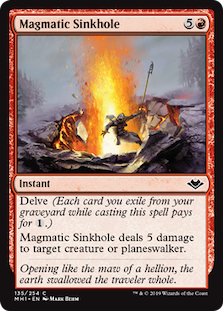
Last up is Temur Grow, which splashes not for Quirion Dryad or even Tarmogoyf, but for Huntmaster of the Fells! Long a pet card of mine, Huntmaster can take over creature matchups by himself, and at four copies is a highly reliable plan. Thought Scour is another instant-speed cantrip to support Brineborn, and this Temur shell funnels the extra binned cards into Magmatic Sinkhole, a card fast becoming the breakout removal spell of Modern Horizons.
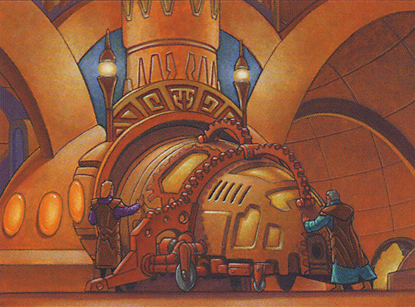


One thing all these Brineborn decks have in common? Their reliance on red, or more specifically, on Lightning Bolt. There are few better instants in Magic, let alone in Modern. Being castable at any time and eminently flexible, Bolt is exactly the kind of card an aggro-control deck like Grow wants at its fingertips.

20 Brews a Day

Okay, 20 might be an exaggeration. But the fact stands that M20 and Modern Horizons have injected a metric ton of new blood into the format. Next week we'll round out our July brew report with even more sweet tech from the MODO annals.

Insider: Simple Strategies for Safer Specs

Are you a Quiet Speculation member?

If not, now is a perfect time to join up! Our powerful tools, breaking-news analysis, and exclusive Discord channel will make sure you stay up to date and ahead of the curve.

I’ve been doing a lot of buying and flipping cards lately, and I’ve developed some simple strategies that help me make safer specs. There are a lot of opportunities out there. By following a few guidelines, I can focus on the specs with the lowest downside and those with the highest upside, all while avoiding potential disaster specs.

The Older The Better

As a general rule of thumb, the older a card is, the lower its supply. The lower a card’s supply, the lower the critical mass of demand is necessary to cause a spike, and the higher the potential price. Magic went through a boom in the player base and accordingly the print run of cards sometime around Zendikar in 2009, so I try to focus my specs on sets from before this time. Speculating on newer cards doesn’t make a lot of sense to me, because there’s simply too much supply out there for anything but objectively modest gains.

Speculating on more recent cards should be focused on the lowest supply cards, so Mythic Rares and those from special editions like Masters sets that have drastically smaller print runs than normal sets.

This brings me to another maxim, that speculating on cards from the third set in a block is better than the second set, both of which are better than the first. Drafting and sealed deck used to be done by block, so later sets in blocks were opened less. With third sets in blocks typically being released in late spring, that left only a short window during summer for the set to be opened before the next block came in the fall. This same idea extends to Core sets, which historically have and still are being released in the summer.

Combined with lower demand in general for these relatively bland sets, their supply is low and can lead to some extreme prices - see examples like the $5 uncommon Stoke the Flames and the $100 Jace, Vryn's Prodigy when they were in Standard.

There was an error retrieving a chart for Jace, Vryn's Prodigy

Two recent examples that made me a lot of money combined both of these principles, Veilstone Amulet and Storage Matrix. Both are old cards from the third sets in their blocks, and sudden surges in Commander demand led to massive growth in the realm of 1,000%. 

That brings me to my next point, focusing on the most playable cards.

Playable Cards Sell Well

In my experience, the cards that sell the best are the most playable. That doesn’t mean how good it is, it means how many people actually want to play it. Modern and Commander are the biggest formats with the most players, and that means these cards sell the best, at least in my experience. When Veilstone Amulet spiked I sold a steady stream of 1-ofs to Commander players for weeks until I ran out, while my Autochthon Wurm spec typically went in batches of 2 of 4-ofs to Modern players picking up the new Neoform deck. 

The general idea is to focus on Modern and Commander playables over other cards. Legacy, Vintage, and even Old-School or Pauper should be fair game, but I’d try to avoid the cards that don’t really fit anywhere and require a true collector. Standard is a world of its own and somewhere I don’t really speculate so I can’t offer many thoughts. I imagine it sells well but has intense competition, and only short windows to sell to capture the best prices. 

There was an error retrieving a chart for Fury of the Horde

I’ve had a tough time with foil cards, and I believe it’s because they violate the playability maxim. When I’ve picked up specs I’ve often been able to get some foils along with them, but these are always harder and slower to move. I often have to resort to buylisting them away because they never sold at all - see my foil copies of Fury of the Horde. Most players just want the cheapest thing they can play with, and that leaves foils for collectors and a small subset of players. 

I have often bought played foils, which is part of the problem. Players that do want foils are high-end consumers likely buying the nicest copies they can, and aren’t interested in played copies. In fact, I likely have been able to buy these played copies only because the smart money ahead of me already bought the Near Mint copies and specifically left the played copies knowing they won’t move. This is a lesson I’ll have to heed myself going forward and leave the played foils for someone else. 

Don’t Double-Down on Double-Spiked Cards

Another hard lesson I’ve learned is to avoid what could be called a double-spiked card, a card that previously spiked and is going through a second spike. Buying in somewhere in the middle and trying to catch the next spike is setting yourself up for disaster. My example is Primal Beyond, which was under $3 before Core Set 2020 spoilers started bringing attention to the Elemental tribe.

There was an error retrieving a chart for Primal Beyond

There were murmurs about Primal Beyond on the internet and places like the Quiet Speculation Discord, so when it started moving I bought in on a bunch and some money when it spiked to over $7. As the set was full spoiled and released and it became clear just how strong the Elementals and cards like Risen Reef were, Primal Beyond spiked again, and suddenly was flirting with $20. I got greedy and scooped up as many as I could at the old price under $10, but within a day or so the price had already tempered back down to the mid-teens and is now basically back at $10.  

What I failed to understand when I re-bought back in is that there were obviously speculators at hand in both price spikes, including those who bought in before the first spike that didn’t sell and held out for the second, which helped crash the market so fast. When a card spikes twice, there is very little room for upside. I could not have realistically expected Primal Beyond to spike again, but I should have seen a whole lot of downside, potentially all the way down to the level before the first spike.

I outed the final few playsets I had to buylists at break-even or worse just to make sure I don’t get caught holding a bag I am not confident in, because Primal Beyond lacks the playability factor of a real Modern staple and is only an obscure Commander card at this point.

Turn Over Your Cards ASAP

This brings me to my final point, turn your cards as soon as you can. The market is always moving and cards that spike tend to revert to the mean. My process is to aggressively sell cards on TCGplayer and Ebay to capture dollars, but I regularly check the buylist price of my portfolio. Whenever a good sell opportunity arises, I am quick to turn my cards into credit to fund my next spec.

There was an error retrieving a chart for Hexdrinker

If I bought a spec for credit then I’m always happy to flip for credit profit, like I did with a set of Hexdrinker I picked up at 16 credit each before it spiked last week, and when they arrived immediately resold to the same store at 24 credit each for a nice profit. Even if I bought in for cash, credit is often a fine option. Keep in mind that it helps avoid the fees, shipping costs, and time spent selling them individually. It also provides the service of locking in a price, which can be very valuable in a world of the “race to the bottom” which exerts constant downward pressure on cards.

-Adam

Chris’s Commander Corner: Ixalan Edition

Are you a Quiet Speculation member?

If not, now is a perfect time to join up! Our powerful tools, breaking-news analysis, and exclusive Discord channel will make sure you stay up to date and ahead of the curve.

Hi again, Readers!

I'd like to welcome you into a mini-series rendition of Chris's Commander Corner. Over the next four weeks, I am going to be focusing on the cards rotating in the fall which I believe will make for great long-term EDH-based specs. I'll be doing one article for each rotating set in chronological order from their original release, starting with Ixalan.

We all may remember Ixalan - it feels like dinosaurs were roaming the Earth when it was released (ha ha). Ixalan still strikes me as the first Standard set Wizards truly designed for Commander. Fortunately for my topic over the next few weeks, the sets that followed Ixalan continued that design pattern and there are plenty of cards to write about!

With a theme of Pirates, Dinosaurs, and Treasure Tokens, it is no surprise that "Commander gold" is everywhere in Ixalan, and narrowing the watchlist of targets down wasn't easy. Without further adieu, let's get into it!

The Watch List

There was an error retrieving a chart for Vanquisher's Banner

Starting with a bang, let's talk about the #1 most-played EDH card from all of Ixalan: Vanquisher's Banner. I love this card long-term in foil, simply because it is so easy to reprint in Commander precons where it would not receive a foil version.

The card is straight gas in tribal builds (an always popular strategy) and it just gets better and better as new tribes keep getting support (see: Ninjas, Elementals, Morophon, the Boundless, etc.). If you are running a tribal deck in EDH currently and don't have Vanquisher's Banner in your 99 I'd love to understand why (feel free to message me explaining!). For what it is worth, I currently have six tribal decks and every single one of them runs a copy.

Investment Plan - I

Unfortunately, the floor on Vanquisher's Banner foils happened over six months ago when it bottomed out around $5. Multiple large vendors are thinly stocked on this card which doesn't bode well for keeping its price low even with rotation looming. It sees virtually no play in Standard, so it is less likely to fall victim to a rotational price drop, thus if you need a copy or want to spec on this card, it's worth doing so sooner rather than later. The foil multiplier looks promising at 2.5x with room to grow, but I would shy away from non-foils due to the aforementioned reprint risk above.

If you can acquire LP or NM foils for $6-8, that should end up being a pretty solid price-point long-term. Vanquisher's Banner has all the makings of a $15+ foil by 2020, similar to the trajectory of Panharmonicon or Anointed Procession when they rotated.

Disclosure: I own four copies of Vanquisher's Banner purchased for $5 and currently listed for sale at $10.

The Buy-a-Box Promos

To be honest, the BaB promos might not be the best play here in all circumstances. With this series being extremely difficult to reprint (flip-cards set on Ixalan!), I actually love acquiring the non-foil pack versions of each card above as I think they are more cost-effective and have higher upside.

In particular, I think we're going to see Search for Azcanta completely bottom out over the next few months which will open the door for one of the lowest risk long-term specs I have ever called attention to.

There was an error retrieving a chart for Search for Azcanta

Investment Plan - II

Search has been played heavily in Standard throughout its lifecycle, but its non-foil price has already dropped dramatically since April. Some of this is metagame shift in Standard and some of this is in anticipation of rotation in the fall. Either way, be patient with Search and a few weeks after rotation, look for a nice entry on pack non-foils at or near $4.

I estimate by this time in 2020 (barring a judge promo reprint) Search for Azcanta will ascend back to $10 on the back of Modern playability and EDH appeal. With an entry of $4-5, this will make for a wonderful double-up if you have the patience to hold that long. It's also an equally appealing price-point to acquire copies for personal use (I'll be doing this for sure).

I suspect price memory will be strong for Search for Azcanta, so the window to the absolute floor may not last longer than a few weeks. Add this one to your watchlist and hop on for the ride!

There was an error retrieving a chart for Thaumatic Compass

For EDH purposes, my favorite from the BaB series is Thaumatic Compass. It does two things that a ton of EDH decks don't normally have access to - mana fixing and combat tricks. Being an artifact is such a huge advantage to its playability as it can slot into color combinations not normally able to do what Thaumatic Compass does (think Azorius, Boros or Rakdos, for example).

I'm a big fan of acquiring Thaumatic Compass Buy-A-Box Promo versions because the art is simply magnificent.

I am admittedly partial to the art on the BaBs; in fact, I am currently working on framing one of each Buy-A-Box Promo around the Ixalan Players Championship playmat - keep an eye on my Twitter and Instagram for when I post the photo of this coming to life!

Investment Plan - III

I'm looking to acquire a few copies of the Buy-A-Box Promos for $6-7 (NM) and I believe these can eventually return to a $12-15 price-point over time as the preferred option for EDH players. I do also love acquiring the pack non-foils for $1-1.50 with a plan of outing them at $5 in 6-12 months.

Best (BaBs) of the Rest

I could write an entire article around the Buy-A-Box series from Ixalan, but to save time (and words) so my editors don't yell at me (for real though, shout out to QS editors for being awesome!), I'm going to cover Primal Amulet, Growing Rites of Itlimoc, and Dowsing Dagger all at once.

These three cards all rank in the top 11 of the EDHREC Most Played from Ixalan list. In fact, Growing Rites and Amulet rank #2 and #5 overall while Dagger comes in at that #11 spot (for reference, Search is #8 and Compass is #6). My consensus feeling for all of these is that the non-foils are great acquisition targets roughly 6-8 weeks after rotation and that any of these will be a solid double-up prospect given 6-12 months (i.e. this time next year, any of these cards could very well be worth 2x what you pay in early-December 2019).

If you need any of the Ixalan flip cards mentioned for personal use or plan to spec on them, I recommend adding them to your watchlist and tracking their price trajectory. An additional indicator to follow is CardKingdom's buylist - as the prices fall on these, you'll notice CK will either drop their price in concert or remove the cards from their buylist altogether. Once they remove them, that is a good indication of a supply glut and rock bottom pricing should follow.

There was an error retrieving a chart for Sunbird's Invocation

Remember when Sunbird's Invocation was the hottest EDH spec since Paradox Engine? I do. I bought copies of this a long time ago when the foils still hovered around $9 and have taken a bath on them ever since. The card has plummeted 50% since I bought my four copies and in retrospect, this might be one of the worst single specs I ever chased.

But, good news for all of you! Sunbird's Invocation foils are sub-$5 and falling despite it being #7 on the aforementioned EDHREC list of most played from Ixalan. I'll admit I am hesitant to call this after other MTG finance outlets called it a long while back, but the hell with that mentality! Let's undo their wrongs and make a right.

Investment Plan - IV

I'm going to be watching for an opportunity to grab a handful of Sunbird's Invocation foils at $4. I think this is an entirely realistic price target despite the card seeing zero play in Standard and likely being unaffected at rotation. Buylists are extremely weak on the card already (CK is only paying $1.75 for NM foils currently) and I suspect this will fall further before having a chance to rebound back to $8-10 over the subsequent 6-12 months.

I'm focusing on foils for Sunbird's Invocation primarily because this type of card seems like it could be easily reprinted in a Commander precon where it wouldn't get a foil treatment. That said, non-foils are becoming an attractive bulk (penny stock) pickup in their own right, and if you have a shot at them for $0.50 or less I would take it.

There was an error retrieving a chart for Admiral Beckett Brass

Of this entire list, Admiral Beckett Brass might be my favorite card to acquire for the combination of personal use and speculative purposes.

The creature-type pirate is one I know has a deep following in the Commander circles and if we were to get more support for the tribe in #MTGEldraine and subsequent blocks (pirates are in fairytales, think Peter Pan) Admiral Beckett Brass would be a quick-hit spec. While this is entirely baseless at its roots, Admiral Beckett makes for a tough reprint that should only get more appealing in EDH over time (I wonder if pirates are the new ninjas from a tribe-lacking-enough-support perspective?).

Investment Plan - V

I will start off by saying I have no intentions of acquiring more than 2-3 foil copies of Admiral Beckett Brass. It won't be impacted much by rotation as it doesn't see any Standard play, and I suspect folks with this in their binder already may simply hold onto it in hopes of pirates getting more support for Commander (or Oathbreaker).

Notably speaking, the buylist on Admiral Beckett Brass is extremely strong - CardKingdom is paying $2 for NM foils while the TCG low is about $3. The spread of prices around the internet shows me that this card is relatively volatile and hard to keep in stock.

I like foils at $3 if you can find them but don't go deep on this one. That said, in my best estimate, copies at $3 will end up gaining faster than you might expect.

There was an error retrieving a chart for Jace, Cunning Castaway

I wasn't able to use the graph to depict the SDCC 2018 version of Jace, Cunning Castaway but that's the version I'll almost assuredly be speccing on (possibly sooner than rotation).

I love Jace, Cunning Castaway in general because its ultimate is easily achievable and it goes infinite with Doubling Season. It's also the type of card that just gets better with age as new interactions are created and it should be fairly difficult to reprint given its specific portrayal of Jace in the Ixalan storyline.

The card isn't seeing a whole lot of EDH play to date, so this call is based more on potential than existing data and results. That said, I like stashing a few of these (any version) away for a rainy day.

Investment Plan - VI

I am specifically going to be focusing my purchases on SDCC 2018 copies at $25. There are still copies out there at this older price despite the TCGPlayer most recent sold being at $33.

For the pack non-foil and foil versions, I see a good entry point at $1 and $4 respectively. Be patient with the pack versions as this card is one I suspect will drop further as binders empty out in coming months.

Some Runners Up for Consideration

Wrapping Up

However you decide to approach rotation, remember to be patient and use the available data to inform your purchasing decisions. Monitoring the cards you'd like to acquire on TCG and CardKingdom's buylist will help you time your purchases most optimally. Make sure to set a watch list by either adding the cards to your cart or to a simple spreadsheet - this can help you see the prices evolve over time and prepare you for the best time to get what you are looking for.

The list of cards I provided above is just what I'll be adding to my watchlist. What did I miss? Are there any I called that you think I shouldn't have? Hit me up in QS Insider Discord or on Twitter to continue the discussion!

See you all next week to talk about Rivals of Ixalan!


The Metagame Experience: MCQ Report

Are you a Quiet Speculation member?

If not, now is a perfect time to join up! Our powerful tools, breaking-news analysis, and exclusive Discord channel will make sure you stay up to date and ahead of the curve.

This is an odd feeling for me. For all its flaws, the PPTQ system meant that grinders like me always had competitive level events to grind and keep our skills sharp. The MCQ system is functionally the same as the old PTQ system, which means very few events and very spread out. Since I'm a Westerner deprived of SCG events, I've only played one competitive level event in 2019. Hitting a Modern MCQ is like picking up an old, beloved hobby after years of neglect.

As described last week, the metagame is still forming after months of upheaval. The data is too thin to draw any conclusions and decks are all over the place. Given that this event was happening parallel to a Standard GP, I figured that things would be even more volatile. Between players scrubbing out and out of town players, I didn't know what to expect. I ended up being very surprised—for surprising reasons.

The Deck

I had several options for this tournament. I played UW Spirits for most of last year, and following PPTQ season I was desperate to play anything else. I incidentally had most of the cards for Humans, so I finished and played it for most of the spring in between experimental decks. While I came to appreciate why the deck has done so well for so long, while preparing for the MCQ, I wasn't confidant in Humans.

I hate playing popular decks at big events. Other players will have practiced against the deck and prepare a good plan for victory. There's usually a very good reason that the deck was popular in the first place, and I knew Humans's power and flexibility could push through anything. However, I don't want to give my opponents any value from direct experience from their own preparation.
Also, and on a more practical level, I've been struggling with Humans for several weeks. Jund's gaining popularity and can dodge most of Human's interaction while picking it apart, so that's not great. Also, Blood Moon decks had started to spread, and Humans just loses to that card more than I'd like. Thus I defaulted to a deck that could beat Jund and not get Mooned out.

UW Spirits, David Ernenwein (MCQ Richmond)

Creatures

3 Spectral Sailor
4 Mausoleum Wanderer
4 Selfless Spirit
4 Supreme Phantom
3 Rattlechains
3 Unsettled Mariner
4 Spell Queller
4 Drogskol Captain

Artifacts

4 Aether Vial

Instants

3 Path to Exile
3 Force of Negation

Lands

4 Hallowed Fountain
4 Flooded Strand
3 Cavern of Souls
3 Field of Ruin
3 Plains
3 Island
1 Seachrome Coast

Sideboard

3 Auriok Champion
3 Rest in Peace
2 Stony Silence
2 Damping Sphere
2 Runed Halo
2 Detention Sphere
1 Path to Exile

I've adopted a lot of new cards. As I said in my preview article, Unsettled Mariner is an incredible card against interactive decks, but isn't great elsewhere. As I expected a lot of Jund, both Mariner and the grindy Spectral Sailor were necessary.

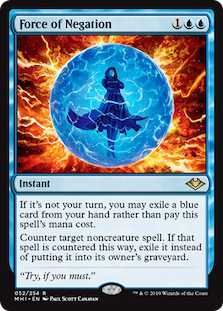
Force of Negation is a bit more speculative. I don't like the card, but it does close a gap in Spirits and it looked useful enough to make some room. Having to hold up Spell Queller in combo matchups can really kill your clock, and Force does let me tap out and not just lose.
For the record, I wouldn't run Force just for Neoform combo decks. Even if you run a full set, the odds of seeing one in a given hand are only 40%. It's never been the actuality of Force of Will keeping Belcher decks down in Legacy; it's fear of Force. I apply the same logic to Modern, and am only running Force so I can tap out and protect my creatures.

Sideboard

Fitting in Force meant I had to cut a Path, which I moved to the sideboard. A lot of players are running Deputy of Detention as their catch-all since it synergizes with Vial, but my Humans experience included a lot of Deputy blowouts. Therefore I went with the original Detention Sphere. Creature removal is more common than enchantment removal, and since I had the mana to make it work I went with the more robust option.

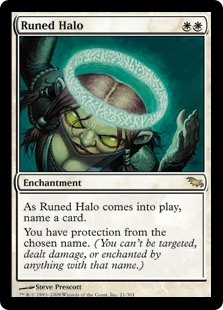
Runed Halo is a very underappreciated card. The number of decks that rely on very few threats and can't remove enchantments is surprisingly high. I started running it just against Valakut decks, but it's proved to be far more versatile than expected.
The Damping Spheres aren't only here for, or even because of, Tron. Spirits can play around anything but Ugin, the Spirit Dragon, so Sphere is not really necessary in that matchup. It's also why I cut Ghost Quarter for Field of Ruin. Rather, I'm running Sphere for Amulet Titan. I've won games with Sphere when my opponent didn't have non-bounce lands and couldn't pay for their Summoner's Pact.

The Tournament

Previous experience at GP PTQs and MCQs told me that the event would be so massive that the only way to Top 8 would be to go undefeated and have exceptional tie-breakers, since these events are limited to six rounds. However, that was last year, when the GP's were all huge. GP Denver was only about 600 players and the MCQ I was in had around 120 players. Subsequently, at least a few 5-1 records would make it into the Top 8.

The drop-off is certainly some combination of the confusion in Organized Play and the Standard format, but I don't know which is the stronger factor. This is both disappointing and encouraging: disappointing to see the collapse in numbers, encouraging since it made my odds of success much higher.

Rounds 1-2 vs Eldrazi Tron (Play, 1-1)

Rounds 1 and 2 were against Eldrazi Tron. In the exact same table and same chair. I'm on the play both matches, and the first two games play out exactly the same way; Only the Game 3s diverge.

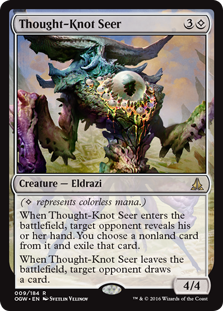
Both times, Game 1 is very easy as I simply run my opponent over. I opened on Vial into 1- and 2-drops turn two with Spell Queller for the turn three Thought Knot-Seer and just stomped to victory. Game 2, both of us see all our removal, and it turns into a staring contest. A highlight for me is getting two Walking Ballistas with Detention Sphere with Stony Silence out. However, even with lots of extra draws from Sailors (which end up doing a lot of damage), I just flood out and get smashed by spaghetti monsters.
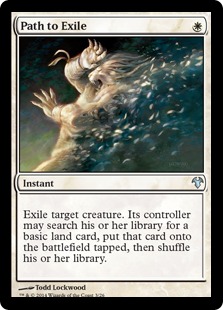
The first Game 3 I win when I have a decent curve and Eldrazi Tron didn't get any acceleration out.  At four, he chose to kill himself with Dismember. The other one plays out like Game 2 again. I'm drawing two cards a turn off Sailor and they're all just lands so my opponent has the time to find a win condition.

Sideboarding

-3 Force of Negation

-3 Unsettled Mariner

-1 Aether Vial

+2 Detention Sphere

+2 Damping Sphere

+2 Stony Silence

+1 Path to Exile

Round 3 vs Infect (Draw, 2-1)

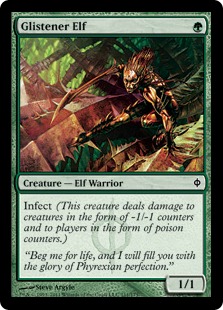
If I lose again, I'm certainly out of contention and just playing for prize. My opponent generously double mulligans on the play, plays a turn one Glistener Elf which I immediately Path, and does nothing further until I kill him.

In Game 2 he has many infectors which I answer, but my anemic followup clock lets him back in the game. He has all his Noble Hierarchs, so any infector connecting kills me. Fortunately, I can just keep chumping his Elf and try to race. Unfortunately, he finds Blighted Agent and I'm one point short of killing him.
Game 3 I have the removal for his Agents and Field for Inkmoth Nexus, but can only chump Elf. Fortunately, I get down Runed Halo and he has no answer, buying me the time to beat him down.

Sideboarding:

-3 Unsettled Mariner

-1 Aether Vial

-1 Selfless Spirit

+2 Detention Sphere

+2 Runed Halo

+1 Path to Exile

Round 4 vs Dredge (Draw, 3-1)

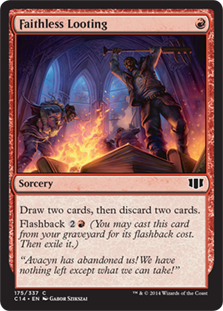
I knew my opponent was on Dredge, having sat next to him Round 2. I keep my Game 1 hand on the basis that I can Force his Faithless Looting and not just be out of the game. That happens, he has another Looting, dredges a lot, hits me with several Creeping Chills, and does nothing else until he's dead. His dredges were all bad and he didn't have green mana for his Life from the Loams.
Game 2 we both mulligan. Again he Loots then has a decent dredge turn two, but can't actually get his Prized Amalgams into play. I draw Rest in Peace that turn, slam it down, and he has nothing else to do while I assemble a kill. I was exceptionally lucky both games.

Sideboarding:

-3 Spectral Sailor

-3 Force of Negation

-3 Rattlechains

+1 Path to Exile

+2 Detention Sphere

+3 Rest in Peace

+3 Auriok Champion

Round 5 Affinity (Draw, 4-1)

I'm back to the same table and chair I started in. Not that I've been choosing it, but my opponents keep getting there first. It's a bit disconcerting, and I'm dreading another Eldrazi Tron. The narrative impulse here is for full-circularity. But my opponent surprises with traditional Affinity.

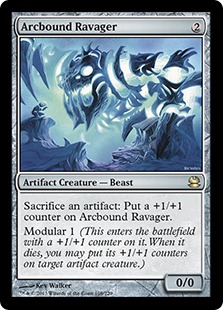
Game 1 he's got a lot of chaff and two Ravagers. I gradually chew through everything, Path his modular targets, and get favorable trades using Selfless Spirit until he's out of gas. Affinity doesn't do well against fliers. I have to beat him down from 32 thanks to huge Vault Skirges.
Game 2 is much the same. He has a lot of Ornithopters and three Cranial Platings but nothing to boost toughness. I have Phantom out and trade Sailors and Wanderers until he's out of creatures. Queller grabs his last-ditch Etched Champion.

Sideboarding:

-3 Force of Negation

-2 Aether Vial

-3 Unsettled Mariner

+1 Path to Exile

+2 Detention Sphere

+2 Stony Silence

+3 Auriok Champion

Standing are posted, and there are four undefeated players. I'm in 17th place with appalling tiebreakers, meaning for me to make it in I need four winning players ahead of me to drop dead of heart attacks. That being extremely improbable, I draw the last round so I can get my prize tickets and go home.

The Top 8 was the following morning, and I wasn't there, so I don't know its makeup. I do know that one BR Hollow Phoenix deck made it in. The pilot was running astronomically hot, with basically ideal openings all day, and that luck also meant that he wasn't punished for a number of misplays I witnessed. Better lucky than good....

Lessons Learned

The metagame may be in flux, but that doesn't mean players are following suit. The field I hit looked identical to what I was seeing two years ago, minor details aside. Players keep their decks for years in nonrotating formats, so I'm guessing that faced with uncertainty, the other players fell back on their old banners.

Eldrazi Tron was very popular based on the assumption that Jund is back in force. That Chalice of the Void is very good against Phoenix decks is also a huge bonus. I don't know how relevant either fact was on the day since I didn't see much Jund or Phoenix running around. I do know that there were lots of Moon prison decks hoping to prey on Tron and Jund there, and they did poorly because Blood Moon isn't a hard lock.

On the Deck

I was generally happy with my play, though I made some sideboarding mistakes. I thought Force was bad against Eldrazi, so I cut it for Damping Sphere. In hindsight that was a mistake, since everytime I got something going Game 2 it was crushed by All is Dust. Sphere was very ineffective since Eldrazi plays far more lands than normal Tron and doesn't really need the acceleration.


On the maindeck, I was frustrated by flood, but that's not a solvable problem. I can't run accelerants, and the deck is mana hungry. I can't really cut basics for Horizon lands because of Field and Moon. I cut Mariner almost every match, but that wasn't unexpected. I didn't hit the matchups the changeling is good in. I rarely needed Force but always brought in Path, so in future I'd cut a Force for Path.

Data Acquisition

With the results from the SCG Philadelphia Classic last weekend and a Modern MCQ this weekend, the data is building to sufficiently analyze the metagame. Then we can start to see the actual impact of all the change that Modern's undergone.

The Faerie Trickery of MTG Finance

Are you a Quiet Speculation member?

If not, now is a perfect time to join up! Our powerful tools, breaking-news analysis, and exclusive Discord channel will make sure you stay up to date and ahead of the curve.

We finally know the name of this fall’s Standard set: Throne of Eldraine! I like the name, and judging by the artwork that’s been released, it has the potential to be another smash hit. A set modeled off stories by The Brothers Grimm and classic faerie tales is something yet to be explored by Wizards of the Coast. My mind goes straight to another set with cards modeled off classic stories…

There was an error retrieving a chart for Shahrazad

Ignoring the musings of an Old School player, this set is sure to be popular.

But set flavor and aesthetic isn’t why people visit this website. The real question is, what is the financial relevance of what we know so far and where can money be made?

MTG Finance Groupthink

groupthink

noun

1  the practice of thinking or making decisions as a group in a way that discourages creativity or individual responsibility.

It only took one image of an alleged invite to get the MTG Finance community swarming like a clique of faeries.

This invitation had a picture of faeries and suddenly MTG Finance swooped in and started speculating on cards. The results are sad, really, considering we still knew virtually nothing about the set.

There was an error retrieving a chart for Secluded Glen
There was an error retrieving a chart for Willow Priestess

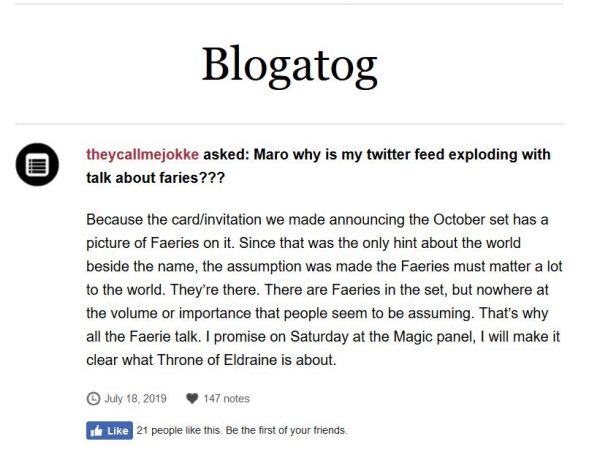
Shortly after this chaos ensued, someone asked Maro a relevant question via his Blogatog.

Mark Rosewater himself stated that Faeries won’t be present in Throne of Eldraine at the volume of importance that people were assuming. Since July 18, we’ve seen a steady flow of artwork showcasing the set’s theme. There may be a faerie or two in the mix, but I didn’t see anything that would encourage me to rush out and buy a terrible Homelands card.

This highlights one of my issues with MTG Finance. Don’t get me wrong: I’ve been grinding Magic cards for years now, and I am an active writer for this site. You’ll see me in the Insider Discord sharing ideas and talking about the next trend. But lately, I’ve become impatient with this behavior whereby people pile into spec targets based on a loose hypothesis.

This isn’t the first time people spent money on a premature theory and it won’t be the last. MTG Finance is very good at finding any thread of possibility that gets the group in front of a trend. Sometimes, even if the trend doesn’t manifest itself, the community still imparts its damaging effects on the market.

For example, foil Secluded Glen may be a more expensive card going forward thanks to this speculation. A combination of short supply (foil cards from Lorwyn can’t be all that plentiful) and price memory could be enough to double this card’s price permanently despite the only slight increase in interest from the new set.

There was an error retrieving a chart for Secluded Glen

Never mind the fact that speculators didn’t fully think through what faerie cards would even make these cards suddenly better. It would take a specific group of cards—and a lack of a reprint—to suddenly make Secluded Glen playable in a competitive format. It would take a more significant faerie theme in the set to generate enough traction for Commander interest. And I don’t know what miracle would be needed for Willow Priestess to suddenly see play. At least that one is on the Reserved List (disclaimer: after seeing the spike, I found a few copies on ABU Games and picked them up with some credit I had sitting around…why not?).

The Best Defense…

How can we equip ourselves to combat this speculative behavior, resulting in a FOMO-type emotion as card prices spike? In this case, the phrase “The Best Defense is a good offense” doesn’t apply. While this may feel like military conflict, this is not the scenario where an offensive is merited. For example, I would not recommend speculating on other faerie cards in an attempt to get ahead of the next spike.

Instead, my best advice to you is to do one of two things.

  1. If you already own copies of the cards that are spiking, I’d recommend selling into the spike. Thinking about this strictly from a numbers standpoint, the odds of these spikes going even higher and becoming the next hottest trend are very slim. The odds of a significant retraction in price are great. Therefore, from an expected value standpoint, the right move is surely to sell into hype.
  2. If you don’t own any copies of the spiking cards, your best bet is to ignore the buyout altogether. Unless you truly think we have enough information to suggest a measurable shift towards Faerie strategies in non-rotating formats, I see no merit to speculating on faerie cards. Such behavior is reckless, risky, and likely to result in a loss of money.

There are two exceptions I can think of to the rules I recommended above. First, if a card is on the Reserved List or unlikely to be reprinted in some form, and you want to own the copies for personal use anyways, then buying copies of a card before at their old price is fine. I had some ABU credit to burn recently and I was placing an order already—adding a few Willow Priestesses at the old price seemed like a no-brainer. I expect I’ll be able to buylist these for a couple bucks to Card Kingdom in response to the spike. But also, these are on the Reserved List and are unlikely to go anywhere.

Alternatively, if you’ve been wanting a promo Bitterblossom for your cube or Commander deck, now may be a smart time to grab that copy. The card hasn’t spiked dramatically (yet), and there’s no telling how much more silly hype gets drummed up as spoiler season begins. Since you want the card anyway, I see little harm in pulling the trigger now.

There was an error retrieving a chart for Bitterblossom

The second exception is very narrow. If you can find copies of a spiked card at the old price, and can acquire them quickly, you may be able to sell into the hype profitably. For example, if you noticed a spike in Secluded Glen and your LGS had copies in stock for under $5, there would be little harm in picking a few up. You could list them for sale at $10 and try to sell into the hype. If that endeavor failed, it’s unlikely these would drop below their old price, so you wouldn’t necessarily lose money. Worst case, you could ship the cards to Card Kingdom’s buylist and break even by taking their store credit option.

Wrapping It Up

Some folks may already know better, but this seems like a great time to remind folks not to chase silly speculation. The hive mind that is MTG Finance will swarm over any opportunity to make a buck, and the recent run on faerie cards was no exception. We saw multiple faerie cards spike. While something like Secluded Glen makes some sense, I’m not sure I can see a world where Willow Priestess remains $4. It’s from Homelands, folks. Cards from that set won’t be worth much for years to come (this coming from someone who loves the set).

Mark Rosewater himself stated there’s not really a faerie theme in Throne of Eldraine. The images depicting this set look amazing and I’m really excited to see more. But I don’t believe we have enough information with which to speculate. Chasing faerie cards based on a single image is peak foolish on the part of the MTG Finance community.

My advice to folks observing these buyouts is to ignore the noise. There’s no way these spikes stick, and some players who gave into FOMO will probably be regretting their purchases in a couple short weeks. If you can find cards at the old price and can either out them quickly or use them in your decks, then you have my blessing to pursue. But if these exceptions don’t apply, then stay far away. Don’t buy into the hype, fueling profits for speculators while losing money in the process.

Keep this in mind when spoiler season begins. We know very little about the new set, but there’s one sure thing: speculators will jump on any loose hypothesis they can to make a buck.

…

Sigbits

  • Foil Wrenn and Six is still climbing! Card Kingdom is still out of stock with a $379.99 price point! Their buylist is “only” $190, which could be why they aren’t getting many in stock. The more I watch videos with this card in action, the more I think a $500 price point for foils is possible.
  • For a hot minute, Card Kingdom was paying $95 for Near Mint Alliances Force of Wills. But that high buy price didn’t last, and now their buy price is down to $80. That said, they do still offer $90 on Eternal Masters copies of the card. I know this card sees play in Commander, but I have to imagine this is a sign that there is at least some Legacy demand for the card.
  • Masters 25 copies of Jace, the Mind Sculptor buylist for $100 again. All versions of this card fluctuate between $80 and $100 on Card Kingdom’s buylist, and this one seems to be the most in-demand at Card Kingdom for now.

Real Friends: Horizons Pet-Deck Update

Are you a Quiet Speculation member?

If not, now is a perfect time to join up! Our powerful tools, breaking-news analysis, and exclusive Discord channel will make sure you stay up to date and ahead of the curve.

It's maybe been said to the point of platitude at this point, but Modern is a format that rewards deck mastery. At least for me, it's also way more fun when you can find a deck that ticks all your preference boxes. I've been playing Eldrazi Stompy since Thought-Knot Seer was spoiled, and Counter-Cat since before I started writing for Modern Nexus, let alone designed the Temur Delver deck that got me the gig in the first place. Today, we'll update both decks with cards from Modern Horizons and M20.

Never Leaving London

I wrote that Colorless Eldrazi Stompy was better positioned than perhaps any Modern deck to benefit from the London mulligan. And indeed, despite Eldrazi Tron being far better suited to abuse the format's hottest new planeswalker, Colorless continues to clock results.

Colorless Eldrazi Stompy, by Jordan Boisvert

Creatures

4 Eldrazi Mimic
4 Eternal Scourge
2 Endless One
4 Thought-Knot Seer
4 Reality Smasher
4 Simian Spirit Guide

Planeswalkers

2 Karn, the Great Creator

Artifact

4 Serum Powder
4 Chalice of the Void
1 Smuggler's Copter

Instants

4 Dismember

Lands

4 Eldrazi Temple
2 Gemstone Caverns
4 Zhalfirin Void
3 Mutavault
2 Blinkmoth Nexus
3 Ghost Quarter
3 Blast Zone
2 Wastes

Sideboard

3 Spatial Contortion
2 Gut Shot
1 Surgical Extraction
4 Relic of Progenitus
1 Ratchet Bomb
1 Sorcerous Spyglass
1 Crucible of Worlds
1 Mystic Forge
1 Mycosynth Lattice

If You Karn't Take the Heat...

It's been three months since Karn, the Great Creator was spoiled, and since I outlined its virtues in Colorless Eldrazi Stompy. The walker has been legal for less time, but players have had ample time to tinker with different configurations. The verdict on Karn seems split, with some successful lists forsaking him altogether and others packing as many as three mainboard copies.

The main argument against the walker is that it doesn't fit with our primary gameplan. Colorless Eldrazi Stompy wants to slam a lock piece and then clean up the mess with big dudes, applying pressure via raw bulk while disrupting the opponent. In this way, it offers a go-tall analogue to Humans' go-wide strategy. This point has been bolstered by the London mulligan, which lets players execute whatever gameplan they prefer with heightened accuracy. We used to open Temple most of the time; now, we open Temple all the time. So why dip into a Plan B at all?
My reasons for including Karn haven't changed. I'll concede that the walker doesn't fit with our primary goals, and somewhat clashes with the London—between countermagic and hand disruption, sculpting a gameplan around a Karn opened or drawn early isn't very attractive; the walker is best peeled off the top once games have stabilized, or as a utility failsafe lying in the deck. Rather, I have enough faith in my good matchups to not mind sometimes watering down my Game 1 plan with a couple potentially-dead Karns. We already do so with cards like Serum Powder. Karn adds to the density, but it can simply be sided out post-board when it's no good.

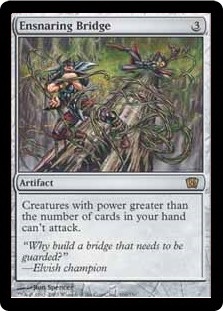
The reward for maining Karn is that previously impossible matchups become feasible. Whir Prison has become Urza's Thopter-Sword, and a resolved Karn makes life as tricky for that deck as it does for dedicated Bridge strategies. Besides, the Mycosynth lock is still an option against decks wielding Ensnaring Bridge. Another artifact deck we could almost never beat pre-Karn is Hardened Scales, which still exists post-Horizons. And UW Control, also a lacking matchup, is a great place for Karn to shine. Similarly, Jund's comeback bodes well for value-packed haymakers like Karn.
Landing on Two Feet

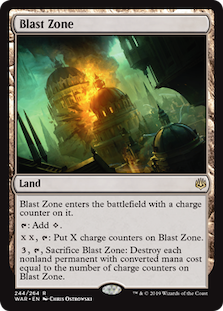
I'd also like to discuss my land choices, which are becoming less and less accepted. Many players have opted to cut Zhalfirin Void to make room for more manlands and Blast Zone. While I agree that Blast Zone is nuts in this deck, I think Void is a poor cut with Karn in the deck. We want to draw the walker naturally at a certain point in the game, and Void helps us do that. Additionally, since Karn pulls us more towards a midrange role, Void shines brighter, as our games are extended by a turn or two on average. The London indeed grants us more consistency, but I don't think responding by cutting our existing consistency tools is necessarily a justified way to celebrate.

I'm up to 3 Blast Zone and don't anticipate going down any time soon. Having mass removal on an untapped land is just superb in this deck, no matter how clunky it might be. I've had to learn to sequence better with Zone in the deck, at times taking turns off to prevent dying a few turns down the road to something I could have sniped a bit earlier (e.g. Thing in the Ice or a planeswalker).
Ghost Quarter feels less relevant than it has in the past, but is still a necessity at 3 thanks to Tron. The five manlands are as vital as ever, and I would play a fourth Mutavault if I had space. I think the most expendable land is the second Gemstone Caverns, but right now, would rather double the odds of opening it on the draw than slightly increase my threat density. While I once had a 24th land in the deck, I've gone back to Smuggler's Copter, which does too much for us at 1 to omit.

Other Choices

Endless One is still here, although other players overwhelmingly prefer Matter Reshaper. I think the three-drop slot in this deck is a bit clogged, and always has been; the going-long points gained from Karn help alleviate Reshaper's value, and Endless pulls weight in the matchups Karn flounders. Besides, the card has been phenomenal with the London.

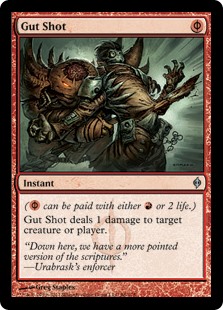
In the sideboard, I'm sticking with Gut Shot, planeswalker sniper extraordinaire that also excels against small creature decks. After War of the Spark's release, Gut has become even more vital, as Modern decks have come to increasingly rely on planeswalkers.
Finally, Mystic Forge makes an appearance as the first M20 card to enter Colorless. I've long wanted a pure value grab for Karn, and so far the best option has been Crucible of Worlds. But plenty of games came up where fetching Crucible wouldn't net any value, such as when I lacked the utility lands to make good use of it. Forge lets us draw two or more cards per turn, and its exile ability makes it better than something like Experimental Frenzy by getting us through additional lands. We can also bin Serum Powders we don't want to cast and throw Eternal Scourge directly into exile to dig deeper. Running Forge makes Karn a more significant threat against control and midrange.

Nine Lives, Maybe More

Another old favorite that I'll probably never truly relinquish, no matter how bad it seems and in fact is, Counter-Cat has also received a significant makeover lately.

Counter-Cat, by Jordan Boisvert

Creatures

4 Wild Nacatl
4 Delver of Secrets
4 Tarmogoyf
2 Hooting Mandrills
1 Snapcaster Mage

Planeswalkers

3 Wrenn and Six

Artifacts

2 Mishra's Bauble

Instants

4 Path to Exile
4 Lightning Bolt
2 Mutagenic Growth
2 Spell Pierce
2 Mana Leak

Sorceries

4 Serum Visions
3 Light Up the Stage
2 Faithless Looting

Lands

4 Misty Rainforest
4 Wooded Foothills
1 Scalding Tarn
1 Temple Garden
1 Steam Vents
1 Stomping Ground
1 Hallowed Fountain
1 Breeding Pool
1 Sacred Foundry
1 Forest
1 Island

Sideboard

2 Damping Sphere
1 Engineered Explosives
1 Rest in Peace
1 Surgical Extraction
2 Huntmaster of the Fells
1 Hazoret the Fervent
1 Snapcaster Mage
2 Pyroclasm
1 Ancient Grudge
1 Destructive Revelry
1 Veil of Summer
1 Fry

Mainboard Alterations

There are three major changes to Counter-Cat's mainboard: threats, cantrips, and lands.

In terms of threats, Wrenn and Six joins the fray. Domri, Anarch of Bolas also performed well in this deck, and I ran a copy after War of the Spark. When Wrenn came out, I tried splitting the walkers, but found myself wanting Wrenn more every time. While Domri is a nice mid-game board-breaker, Wrenn fundamentally changes the way the deck plays.
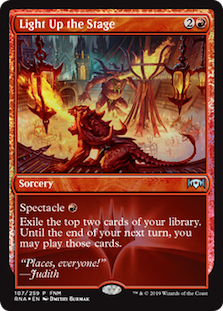
Tarmogoyf has always been critical in Counter-Cat as a follow-up to our one-drop dying. Therefore, as Goyf's stock fell, so did the deck's. I addressed this issue by making Goyfs bigger via Bauble and Wrenn and by increasing the number of Goyfs—again, by adding Wrenn. Goyf used to be the perfect funeral procession for a killed Cat or Insect, but Wrenn is just as good, plopping down a value engine that ticks up towards a wincon and pressuring opponents significantly. It hurts linear combo decks less, since it's not as fast against them, but making land drops still gets us to the point faster where we can drop threats while holding up interaction. Fair decks, on the other hand, have a doozy of a time removing Wrenn, especially through our walls of heavy-duty removal.

I was immediately impressed with Wrenn in GR Moon, where it revitalized my interest in another of my longstanding brews. In that deck, it combines with Faithless Looting to keep the cards coming. I ended up having to add Lootings to Counter-Cat as well. Otherwise, Wrenn would offer us a grip full of fetchlands in the mid-game and nothing to do with them. Still, Wrenn lets us cut a land, and makes the London mulligan much easier for us than for other decks—we can just bottom extra lands without much of a care once we find Wrenn. Bauble also alleviates the low land count.

Light Up the Stage is another red cantrip new to the deck. With eight one-drops, Wrenn to ping, trampling beaters, and a set of Bolts, spectacle is quite easy to enable. Here, Light Up is like a super-powered Chart a Course, churning through the deck and gassing us up for one mana. I've even recast Light Up with Snapcaster Mage for full Divination price in some matchups and been impressed by the results.

To accommodate all these extra red spells, I had to add Sacred Foundry. Pool-Foundry is now a common and adequate shock pair, as we've got plenty to do with a red land and often even want double red in the mid-game. The colors are pretty even, save for white, which exists just for Path and Nacatl.

Sideboard Tweaks

Many sideboard cards are the same as in previous versions, so I invite you to take a look at the Counter-Cat archives for more information on those. Still, there are a few newcomers:

  • Damping Sphere is great against so many decks. We cantrip a lot, but a Sphere in play doesn't just beat us as it does other decks. Great against Tron, Phoenix, Storm, Neoform, etc.


  • Rest in Peace is actually supportable. It's just not for the Jund matchup. Against the graveyard decks, having Rest in play means we just win until they remove it, and then our Goyfs are re-activated and we've stolen heaps of time.
  • Fry roasts Lyra Dawnbringer, Thing in the Ice, Mantis Rider, and Teferi, Hero of Dominaria, among other things. A removal spell for Humans that's also great against UW.
  • Veil of Summer is an elegant answer to interactive decks, fading Fatal Push and targeted discard as well as Liliana of the Veil's -2. It's also strong vs. control for its applications against countermagic, and can counter random stuff sometimes (I hit a Mind Funeral the other day). I love me a one-mana Cryptic, and Veil is one of the more reliable we've gotten.

How Many of Us

These two decks aren't leaving my collection maybe ever—I love them too much! With Hogaak gone and M20 just released, it's the calm before the storm, as we're about to see a whole lot of new tech enter Modern. In the meantime, have your favorite decks enjoyed a boost from the format's recent newcomers?

Fall Set Preview: The Royal Courts of Eldraine

Are you a Quiet Speculation member?

If not, now is a perfect time to join up! Our powerful tools, breaking-news analysis, and exclusive Discord channel will make sure you stay up to date and ahead of the curve.

You thought previews were over - Magic players!? Just when we thought the whirlwind of news, previews, and hype were over - here we go again. By the way: we still have Commander 2019 just around the corner as well.

Maro let us know that we would have a look at the newest addition to Magic sets at SDCC. The wait is over - enter "Throne of Eldraine"!

From the imagery and naming, we don't know all that much. But, what we do know is what appears to be the return of a fan favorite, and iconic tribe of past formats: Faeries! The Fae have garnered plenty of adulation and has produced some of Magic's most powerful cards. Such as Bitterblossom, Vendilion Clique, and Spellstutter Sprite. It's fantastic to see Magic: The Gathering return to a familiar fantasy landscape. While the bustling cities of Ravnica and a trip back to Dominaria were all well and good; there's nothing quite like being enveloped in some of the brief fantasy Eldraine images we've already been shown.

Thanks to the various sources over Facebook, Reddit and ScreenRant - we've seen some additional promotional images. Assuming we're going to learn even more before the weekend is over - and I for one am ecstatic to know more. While Maro confirmed that this plane is not Lorwyn, it would be fantastic to see some similar art direction. From a quick glance, there's a genuine chance that's what we're going to see unfold!

Gathering some past information and tidbits on what could be this set, Mark Rosewater has explained in previous works - that the plane is new, and that Garruk could play a major role in this new set and plane.

We're also aware of what appears to be the set symbol:

-

It would be remiss on this particular outlet not to talk about how this could immediately impact the Magic marketplace. Spoiler; it already has. While some players genuinely have negative emotions (and rightfully so, I may add) about card pricing increasing rapidly due to the nature of an announcement like this - I would like to remind folks that there are record numbers of Magic players out there.

They're just as excited as you are, and buying cards preemptively among many other types of players. While there are some who are genuinely only buying for non-personal use, it's likely that there are many more buying in the hopes that new powerful interactions will surface with some of the existing cards throughout Magic's timeline. The one good thought to keep in mind, that many of these cards that are bought-out/sold-out from the hype of a new set- only a fraction of the card(s) truly become better.

I'll leave you with this: here's a shortlist of cards that have been discussed to potentially see renewed interest, albeit it may only be temporary. Again; we haven't seen anything but a promotional art and name at the time of this article being published.

You Should Be Drafting More on MTGO (Seriously!)

Are you a Quiet Speculation member?

If not, now is a perfect time to join up! Our powerful tools, breaking-news analysis, and exclusive Discord channel will make sure you stay up to date and ahead of the curve.

I. A New Financial Outlook for Drafting

My very first article on Quiet Speculation painstakingly detailed how MTGO was becoming more and more expensive a hobby for drafters due to fundamental changes in the economy introduced by Lee Sharpe. Today I'm happy to inform you that the reverse is becoming more and more true. MTGO is offering better value for drafters than ever before, which means that it costs less to draft on MTGO than at any time in recent memory. Drafts are less stressful, and I'm enjoying playing MTGO more than I have in a few years.

Have a gander at this:

The cost to draft on MTGO has never been cheaper! Before Battle for Zendikar (2015), drafting on MTGO tended to cost about $3.33, assuming you were drafting in the equivalent to today's intermediate league and had a 50% winrate. From Battle for Zendikar through Core 2019 (2018), drafting on MTGO was incredibly expensive, usually clocking in around $4.25 to $4.50. Open Beta on MTG Arena changed that, as redemption demand outpaced drafting demand. Now it costs only $2.69 to draft the current set, Core 2020, a significant improvement over drafting even Theros and Khans of Tarkir, the first two sets I drafted on MTGO.

What this means is that Magic Online now offers a variety of draft formats that cost you the player about half of what it did just a year ago. You can draft War of the Spark for $0.42 (yes, $0.42!!). You can draft Modern Horizons for $3.54, and Core 2020 for $2.69.  And it's strange to me that this change has received such little press. I hope this article will make people aware that the drafting experience on MTGO has never been better. Folks who play Constructed on MTGO should give drafting another look; Folks who play Arena or paper should also consider hopping on MTGO if they enjoy drafting or want to get better at it.

The change in rake tells much the same story:

Before Battle for Zendikar, rakes were usually about 27% to 30%. From Battle for Zendikar through Core 2019, rakes usually were hovering around 35%. I'm happy to say that War of the Spark and Core 2020 both have clocked in under 30%, and we can expect that to continue with future sets. This graph highlights how Modern Horizons, in particular, is excellent value. The rake for Modern Horizons is 14.70% right now, which is historically low for any set and is particularly good for Masters-level sets. Modern Horizons will be available to draft on MTGO through mid-August.

Lower rakes also mean that the winrate needed to break even (i.e. "go infinite") has declined. For the past several years it has required an insane 65-70% winrate to break even on Magic Online drafts. That number has returned to a far more normal 60%.

II. Why is Drafting Less Expensive Now?

The main reason that drafting costs less now than it did a while ago is that Magic Arena reduced the amount of drafting being done on Magic Online. So, while demand for redemption has remained the same, the amount of drafting being done has declined, resulting in higher overall prices.

Until June, Guilds of Ravnica was also over $100. Overall it's too early to tell how Standard sets will fare a year after print in this post-Arena world. Will they bounce back after rotation in the Fall when Standard demand is at its peak like previous sets? Will Standard continue to be the second most popular format on MTGO? These are questions I don't yet know the answers to (my hunch is that yes, Standard will remain broadly popular and yes, I expect Guilds of Ravnica to bounce back after rotation). But what has heretofore been true is that sets now remain over $100 for several months after their release instead of three days after their release. This gives drafters significantly more time to enjoy and experience the format. No longer do you need to be anti-social and block off the first week of a draft format in order to maximize value.

In fact, both Ravnica Allegiance and War of the Spark have been cheaper to draft after the release of the next set. War of the Spark's current $162 set value is responsible for it becoming the cheapest set to draft in the history of Magic Online.

III. Will This Trend Continue?

Wizards has been making important improvements in the drafting experience on Magic Online, and I think the popularity of Arena has spurred changes that benefit Magic Online players. Wizards knows that if you can get two free drafts per week on Arena, the value you get in MTGO offerings needs to be better if players are going to continue doing MTGO drafts. Wizards increased the EV of all flashback and phantom drafts by adding a treasure chest as a reward, making these events more attractive. It was also no mere happenstance that Wizards introduced Modern Horizons tokens as a way to draft the set at a 20% discount. Expect these sorts of trends to continue.

The main way Wizards could hurt the newly improved value of drafting is by curtailing the amount of product able to be redeemed. I don't think it's in Wizard's best interests to do this, and it looks like Wizards thus far has been happy trimming around the edges and hoping that the higher prices of sets will reduce the amount of product redeemed overall.

Frankly, the market isn't behaving rationally, in part because people just aren't aware of the new financial reality of drafting on MTGO. Even though the value of drafting has gone up, drafting on MTGO is less popular now than it was 6 months ago, much less 12 months ago. To be sure Magic Arena has siphoned away a lot of drafting demand, but it wouldn't surprise me if overall drafting participation on MTGO increases some in the next several months as the player base catches on to the fact that drafting on the platform is cheaper than ever before.

Overall, though, I expect this to be the new reality going forward and as an MTGO drafter, I couldn't be happier.

IV. Signing Off

Thanks for reading! If you have any questions, leave a comment down below or message me in Discord. How have y'all been enjoying Modern Horizons and Core 2020 drafts? Is there any topic you'd like to see me cover in the next few weeks? Please let me know!

Rest, Relaxation, and Reflection on Time Management

Are you a Quiet Speculation member?

If not, now is a perfect time to join up! Our powerful tools, breaking-news analysis, and exclusive Discord channel will make sure you stay up to date and ahead of the curve.

Hello, Readers!

It's been a while since I sat down and put some keystrokes and thoughts into an article for you. This hasn't been for lack of ideas or lack of opportunity, either (there have been two full set releases since I last wrote about Niv-Mizzet Reborn). I was simply burnt out and needed a little mental recharge. Between a newborn son, a hectic (but very positive and successful) series of initiatives at work, and continuing to scale my online storefront (@ChiStyleGaming), I had my plate full and I overwhelmed myself a bit.

But...

And now that I am, I want to share some lessons from my time off and also provide a handful of cards I am currently watching as we head into the doldrums of summer.

What did I use two months off to do?

The most important thing I accomplished since my last article was learning some basics on how to be a father. Our son, Liam Thomas, was born on May 2nd, and since then I've learned all about sleep deprivation, changing diapers, and how to avoid total meltdowns. In all seriousness, it has been the most rewarding ten weeks of my entire life.

It also created a new opportunity to reexamine where I prioritize time and reevaluate how I value it. As a parent, I quickly learned the world is no longer about me and my desires; it's all about Liam. This isn't a bad thing, though. It's simply an adjustment. Honestly, it is a ton of fun watching a little one learn and grow each passing day (it moves too fast!) and I wouldn't trade these moments for anything. That said, the adjustment to fatherhood has forced me to be precise with how I spend the moments I get to myself.

I've cut back on things that I used to do often which weren't producing meaningful benefits or results (ex: video games). I also found ways to up my game when it came to repetitive tasks like my morning routine; it turns out I was wasting about 4-5 minutes every day! I now get coffee brewing while I take a shower and brush my teeth in the shower instead of before/after. That effectively gets all three things done in 7-8 minutes compared to the previous 12-15 minutes. That time saved goes to Liam or my wife or maybe a quick tweet. No matter how I spend it, it's time I couldn't have spent even 12 weeks earlier because it didn't exist.

That may seem ridiculous to think about, but imagine wasting 2.5 hours a month on inefficiencies in your routine! It can add up fast, especially if you find multiple inefficiencies, whether they be at work, school, or otherwise. Every few minutes you can save by increasing your efficiency opens the door to new possibilities on where to spend that time.

If you take nothing else away from this article, please consider this: the last two months made me realize just how much we take time for granted. I encourage you to reexamine how you spend your time to make sure it is well-allocated to your priorities and that you are happy with how you use it! I found that this has made me happier because I feel more productive and accomplished each day.

Ask yourself this: are you able to save a few minutes? How could you spend that newly acquired time? I'd love to hear more about your interactions with this thought-process on Twitter, the QS Discord, or the comments below. DMs are always open!

Chris, did you really give up Magic for two-months?

No, no, no... one doesn't simply escape Magic! I'm no exception.

I used the last two months to focus on scaling my business, Chicago Style Gaming, and took a little time off from producing articles and content. I've worked hard over the last 18 months to grow CSG into a trusted brand in the community. The last two months included me making my first major collection purchase in the last ten years and it also involved the formalization of an LLC so I can begin focusing on CSG as its own entity (i.e. separating it entirely from my personal finances). Both of those events were huge learning opportunities for me as I continue to transition into a full-time online reseller.

It's always an exciting time to be an entrepreneur but in the current MTG landscape, I can't imagine there being a better time to open a shop (online or otherwise). The game is so healthy - players are extremely engaged even as the summer lull is upon us - and Hasbro ($HAS) earnings continue to highlight Magic: the Gathering as one of the most meaningful growth levers of the entire company. I'm looking forward to continuing my efforts with Chicago Style Gaming and appreciate all of your support along the way!

Specs, the things we enjoy the most...

The other thing I did was monitor all of the set releases for commander specs I may acquire as prices deflate over the summer. I hardly acquired anything over the past eight weeks (aside from the aforementioned collection), but I did buy a couple foils from Modern Horizons. This small purchase was just before our QS Insider-only cast on June 21st.

The short-list of purchases I made included (name, quantity bought, price-per-card):

  • Morophon, the Boundless (three copies, $38)
  • Yawgmoth, Thran Physician (two copies, $78)
  • Generous Gift (two copies, $5)

Chaz and I discussed a three-month runway on the 6/21 cast where we felt supply would dry out on Modern Horizons and foil playables will appreciate (note: the above list is a not the complete one discussed on cast - join QS Insider to get a full look at that cast and many others like it!). I'll be updating these purchases on October 1st to see how we did.

Chris's Commander Corner for the Summer Lull

I have a list of cards on my watch list which I'd like to share for you. These are all cards worth speculating on and that I also plan to acquire for personal use. Some may have already bottomed as recently as last week, but in general, I think their appreciation will be steady over the next 6-12 months (note: timeframes vary and are noted on a per-card basis).

There was an error retrieving a chart for Narset's Reversal

I was extremely high on Narset's Reversal from the moment it was spoiled:

I targeted foils reaching $5-6 and we are SO close to getting there. Copies have quietly descended under $10 for most small-scale vendors on TCGPlayer. Card Kingdom continues to hold onto a $10.99 price, but their supply is strong on these as indicated by them not buying foils of the card currently. I'll be holding out for a further price drop to my original target (see above screenshot) before acquiring copies. With MTGO redemption in full force, I think we get there in August before "reversing" back up to $10 over the subsequent six months.

As an aside, I called Narset's Reversal as the most played War of the Spark card according to EDHREC; it is currently sitting in third place behind its counterpart Narset, Parter of Veils and a popular land, Karn's Bastion. Not bad.

There was an error retrieving a chart for Ashiok, Dream Render

Ashiok has four important characteristics that have me adding it to my watch list:

  1. Sees play in every Eternal format: according to www.mtgstocks.com, Ashiok appears in 12 Modern, 2 Legacy, and 1 Vintage list, and it currently ranks fifth on most-played list from War of the Spark on EDHREC
  2. Does something unique: shutting off fetches and tutors has only been printed on a few cards in MTG history and never on a planeswalker before, putting Ashiok into a league of its own
  3. Only gets better as more "search library" cards are printed: Wizards of the Coast indicated they would stay away from fetches in Standard but in Modern Horizons they printed cards like Prismatic Vista and Sisay, Weatherlight Captain which tells me "searching libraries" is a card-design that is here to stay
  4. Part of a collectible series: Ashiok is one of 36 walkers from War of the Spark, a set I suspect many collectors will want to complete, which could drain a little extra foil supply and make the price on playable War of the Spark walkers rebound more efficiently over time

While reprint risk always looms (especially since many are predicting a return to Theros in the near future), I like Ashiok for potential long-term gains. I'm targeting foils at $8 but this may take longer than three months to hit. Buylists are still strong on foil Ashiok (CK is paying almost $10 in credit), and it is entirely possible the floor may never get lower than now. Long-term, figure 12 months from here (and barring reprint of course), I see Ashiok, Dream Render foils having $15+ upside.

There was an error retrieving a chart for Winds of Abandon

Winds of Abandon is flying under the radar for EDH players so far as it only ranks 18th on the EDHREC most-played list for Modern Horizons. The drawbacks of being sorcery speed and ramping your opponents with tapped basic lands might be enough to keep this card down. Remember though, there are very few one-sided board-wipes in all of Magic and the keyword "exile" is crucial in commander gameplay.

The comparison that comes to mind for me (and Winds of Abandon was clearly designed around) is Cyclonic Rift. They both have the "overload" keyword to provide situational flexibility and from experience, I can confidently say "overloaded" Cyclonic Rift wins games. I suspect Winds of Abandon will do similar things as players test it more in their commander circles.

I dislike non-foils as a speculative target because Winds of Abandon will be extremely easy to reprint and could see one as early as Commander 2019. That said, a reprint in a commander set would actually be a boon for the Modern Horizons foils because players who buy precons and look to upgrade over time may be the first to truly recognize the power of Winds of Abandon.

The floor on Winds of Abandon foils was likely about 2-3 weeks ago when it was touching $8-10 on TCGPlayer. That said, the buylist values aren't particularly strong (averaging around $6-7 currently), so it is possible it could get back to $8-10 before supply is completely soaked up. Once supply on the foils is tested, I see this becoming a $15-20 card, airing closer to the high end of that range. I don't think it will take more than 3-5 months for this to happen, so if you want a foil copy, add it to your watchlist now and don't hesitate if the price makes sense for you.

Quick list of other cards to consider:

There was an error retrieving a chart for Nissa, Who Shakes the World

I love Nissa foils sub-$10. She is seeing play all over Standard which might be propping her price up a bit, but the long-term appeal of this Nissa in EDH is real. This is not an urgent pickup, but at rotation next year I can envision a scenario where we look her up and say, "wow, Nissa, Who Shakes the World foils are $20!?"

There was an error retrieving a chart for Rhythm of the Wild

Rhythm is one of the better uncommons printed in the last several years for EDH purposes. Tribal themes are hugely popular among commander players and Rhythm is hands-down one of the best cards to include in any tribal deck that can run it. It is ranked third on the EDHREC most-played list from Ravnica Allegiance yet it has quietly dropped to $7 for NM foils. Add this to your watchlist and be patient; I see Rhythm of the Wild foils dropping a little further to as low as $5 in August before a 6-12 month stretch of price-increases has it ascend back to $10.

There was an error retrieving a chart for Vindictive Vampire

Sleeper alert! Vindictive Vampire is already low supply, ranks top 10 in the Ravnica Allegiance list of most played in EDH, and it belongs to one of the more popular tribes in all of MTG. The card was already drained by Teysa Karlov commander players but found a second home recently with Yawgmoth, Thran Physician. I love buying into foil Vindictive Vampire as a penny-stock, though it won't be a penny-stock for much longer. I expect within 3-6 months these will be steady sellers at $5.

Wrapping Up

It's been a busy few months for me and I couldn't be happier. I appreciate the support from those of you who asked how things were going with the family, work, etc. I also appreciate you all hanging in there over the past couple months without me providing you information along the way. I plan on being back to status quo with activity and engagement moving forward, and I will be in Indianapolis covering GenCon 2019 this year. It's a special weekend for me as it will mark my one-year anniversary since I began writing for Quiet Speculation - Sigmund gave me a trial gig last year at GenCon and I have never looked back.

If you'll be in Indianapolis for GenCon, please (!) hit me up on Twitter or on QS Insider Discord! I would love to meet any of you there and maybe we can even play some games of Commander! I'm bringing tons of decks, so just let me know.

Until next time, see you on the battlefield!

No-Gaak: Early Metagame Observations

Are you a Quiet Speculation member?

If not, now is a perfect time to join up! Our powerful tools, breaking-news analysis, and exclusive Discord channel will make sure you stay up to date and ahead of the curve.

With Core 2020 and the London mulligan finally legal, the metagame can begin to take shape. Begin being the key word there. So much has changed in Modern over the past month that it is impossible to predict what exactly is changing.

At the end of this week, GP Denver looms. I'm not playing the main event since it's Standard and I'm not interested in Teferi.format. Instead, I'm preparing for the Modern MCQ on Saturday. This has proven rather difficult due to the metagame's lack of definition. Today I'll be going through what I've observed so far and what conclusions I've reached.

Thin Data

Normally, I'd fall back on the available data to draw informed conclusions about the metagame taking shape. However, that really isn't possible. At the moment all I have to go on are a 5-0 deck dump, which has no statistical value, and a single SCG Classic. The Classic is interesting and a decent piece of data, but it is only a single point. Therefore, the only conclusions I could draw would be about the event itself and not the entire metagame.

As a result, I'm forced to rely primarily on personal observations of both my local paper metagame and what I've seen on MTGO. I realize that my experiences may not be representative. Even if they don't accurately model the entire metagame, I'm getting one look at what players are thinking. And in short, it's the Wild West out there.

Dredge Rises Again

First thing's first: I have bad news for anyone sick of graveyard decks. Dredge is back like it never left. My LGS, Black Gold, has never had many Dredge decks because we all pack lots of hate at all times, but I'm seeing plenty online. Dredge never played Bridge from Below, so it's escaped another round of bannings unscathed. The only reason it declined from view was Hogaak inhabited the same space, but was better. Now the Necropolis is gone, Dredge is reclaiming its place.

For the most part, they're all just pre-Horizons lists. Dredge has been around a while and has proven itself, so it makes sense to trot the same list out again. However, there are those who are trying to innovate. In what I've seen so far, this mainly entails trying to fit Hogaak, Arisen Necropolis into existing shells. While I think it could work, so far I haven't actually seen it happen. The opportunity cost of Hogaak is pretty high for Dredge.

Others are trying to adapt Bridgevine to a Bridgeless world. While these lists have been fascinating to watch, they're significantly worse than Bridgevine, and in my experience much less consistent than Dredge. I admire the dedication, but it looks like wasted effort.

New World, Old Rules

Regardless, it's obvious that graveyard decks aren't going anywhere in Modern, so neither should your hate. I've seen way too many players cutting their hate assuming they don't need it. Never just concede the Dredge matchup, and don't forget that Surgical Extraction isn't very effective against Dredge. You'll need Tormod's Crypt or better.

The other thing to remember is how to play against Dredge, especially when timing your hate. Dredge consists of a lot of enablers and a few key cards. You want to time one-shot hate to get as many of those cards as possible. Individual dredgers are bad targets; Dredge always has more. Instead, you need to target Prized Amalgam and Conflagrate. The former is the primary threat and the later is the real power card. Don't crack your Crypt unless you have to, or can get at least two of these cards.

Jund Is Back

The other big trend I've seen is that BGx is back in force. Last week, roughly half the field was some form of BGx deck. I saw similar numbers online. There was classic Bloodbraid Jund, straight Rock, control Jund, an Assault Loam/Jund hybrid, and plenty of Wrenn and Six Jund decks. This wasn't surprising; Jund's got a lot of new toys recently, a really bad matchup is gone, and lots of players have invested a lot of time and money into the deck. Of course they'll play it again.

Six Reasons Why

The primary reason for this resurgence is Wrenn and Six. When I reviewed it, I was unimpressed. Wrenn just didn't do enough when it wasn't standing in for Life from the Loam. I stand by that assessment and remind everyone that Wrenn does nothing against Rest in Peace, but there was something I missed.

Never missing a land drop and thinning your deck is good. Wrenn provides that function to Jund, with a little value in killing small creatures. No cog in any machine is very good on its own, but Wrenn seems to be a cog that fits seamlessly into Jund and makes the machine run smoother.

A Catch

However, I don't know how good it actually is. Despite all their numbers (roughly a quarter of the field), no Jund deck has actually won our local tournaments in a month. I can't remember any going better than 3-1. I haven't had any greater difficulty playing against the new versions than the old ones, as the games come down to the same grind as before, making me think that the deck may not be more powerful so much as more attractive.

Part of this upsurge may be Legacy spillover. I'm told that Wrenn is taking over Legacy. Most Legacy creatures are X/1's, so Wrenn's downtick is very relevant, but more importantly Wrenn is great with and against Wasteland. Thanks to dual lands, the opportunity cost of just running four-color piles in Legacy is pretty low. The ubiquity of Wasteland keeps these decks in check. Wrenn undoes Wasteland, and now the piles are back. Logically, players are applying this logic to Modern and thus Jund is everywhere, hoping to replicate the Legacy success.
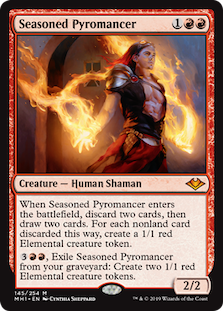
The other reason is that Wrenn plays very well with another new Jund card that definitely is as good as it seems.

Season of Grind

Seasoned Pyromancer is an exceptional card in any version of Jund. The 2/2 body isn't that impressive, but it doesn't matter given the card advantage it provides. I'm told, but can't verify, that Jund is cutting Dark Confidant because he's bad against Wrenn, and Bob is an investment. Pyromancer gives new cards up front, potentially with value. Obviously, discarding Wrenned-back lands is good, but turning useless discard spells into Elementals alleviates the problem of drawing the wrong part of the deck at the wrong time. He can then provide value from the graveyard. Pyromancer is a very solid card, and in my opinion, a far better reason than Wrenn to play Jund.
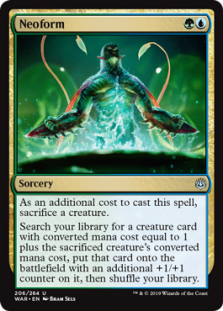
Modern Belcher

The other big trend I've seen is that Neoform combo is back. It was briefly seen during the London mulligan test, then disappeared. Now that it's back, I've seen people playing it again. And I'm rather ambivalent. On the one hand, the deck is very scary. On the other, it isn't very good.
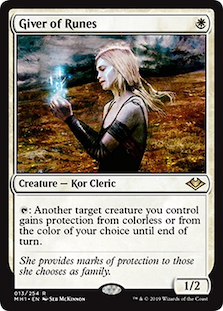
With the right hand, Neoform wins on turn 2. With a perfect hand, it can win on turn 1. It's looking to cheat Allosaurus Rider into play, sacrifice it to Neoform, find Griselbrand, and then draw its deck. With Chancellor of the Tangle, this only takes five cards and can happen turn 1, which can only be stopped by Force of Negation. And the deck runs Pact of Negation for protection from Force and slower interaction.

However, that dream scenario isn't probable. The deck has to mulligan very aggressively since most hands do nothing. The London mulligan makes it plausible to make it happen, to the point that I'm told it's the only reason Neoform combo is possible. However, it's still quite unlikely to come together.

Even if Neoform finds the combo, the deck is very soft to interaction. From Thoughtseize to Thalia, Guardian of Thraben, anything that disrupts the carefully and precariously built engine makes the car explode. If you survive the first few turns against Neoform, you're unlikely to lose. In my opinion, it's just Modern's version of Legacy Belcher: a scary deck that either kills you before you move, or it just loses. Play a reasonable Modern deck that doesn't just goldfish, and you'll be fine.

The Other Glass Cannon

On a similar note, I haven't been impressed with Bant Infect so far. I've lost to it plenty of times, but it keeps feeling like it was a failure of my deck rather than anything the opponent did. I realize that many have always felt this way, but since Gitaxian Probe was banned, I feel like Infect needs to outplay me to win.

The Bant versions I've faced so far have been really clunky. They've gotten a lot of Oops, I Win! combinations, but if they don't come together they really struggle. Giver of Runes and Teferi, Time Raveler are great for forcing through an infector and Scale Up allows some truly out-of-nowhere wins. However, these cards are replacing the pump spells that infect still needs to assemble so it can secure victory. The move from UG to Bant Infect appears to have exacerbated the "wrong-half problem" the deck already had.
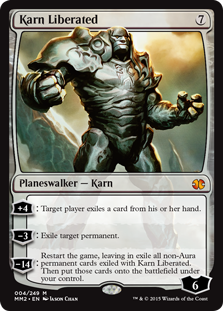
I've had plenty of games where Infect drew lots of protection and had the Scale Up kill, but never saw an infector. Other times they only got one infector and lost to a sweeper, Plague Engineer, or multiple removal spells. Sometimes, their only pump is Scale, and they only had a one-turn window to kill and couldn't. To me it looks like going Bant has exacerbated Infect's variance, and on net it's a negative for the deck.

Brewer's Format

Everyone is trying everything to see if anything sticks. Modern's received so many new cards, and they were only evaluated in the context of Hogaakvine. Everyone's playing catch-up now, and this means that brewers have the space to just go nuts.

For me, this means that this weekend will be very interesting. I expect to be surprised a lot and not see the same deck twice each round. On the one hand, the prospect is exciting. On the other, how do you prepare for the unexpected?

Reflections on a Mulligan

Finally, I need to address the elephant in the room. However, I don't really have an opinion on the London mulligan in practice. The Neoform players tell me their deck is only viable because of the London mulligan; theorists expect it to benefit less-than-fair strategies, and for it to have an overall negative impact on Modern. So far, I haven't seen any of that happening.
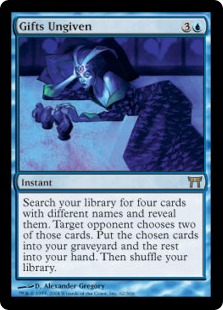
Now, I don't play decks that really benefit from the new mulligan. I swing between straight aggro to control, with a little Storm for spice. I don't need to mulligan for very specific cards all the time, so the new mulligan isn't really doing anything for me. Under the Vancouver rules I mulliganed roughly 1/3 of the time because I didn't have the right mix of lands and spells, and went to five or less once every ten mulligans or so. Over the past week I've recorded similar numbers. I'm not seeing any real difference in terms of playable hands.

Unforeseen Consequences

There have been a few problems that I didn't expect, and they make me question the longevity of this new mulligan. Problems within formats can theoretically be solved via bannings, but I'm seeing some structural problems with the mulligan itself. The first is the feel-bad aspect. Since you were drawing off the top and then scrying, there were limited opportunities to make a mistake. You either kept the scry or didn't based on the opening hand.

With London, it feels like you're making sacrifices. Frequently I and those I've spoken to have mulliganed into good seven-card hands, but once you start cutting cards they become unplayable. It feels worse when I London to five and and am left with a mediocre hand after choosing which cards to bottom rather than I opened a mediocre five. Then there are the times you bottom cards based on how you expect things to go, and they go a completely different direction, retrospectively making your mulligan decision bad. Again, I know that statistically and strategy-wise such a decision was good, but the loss feels worse.
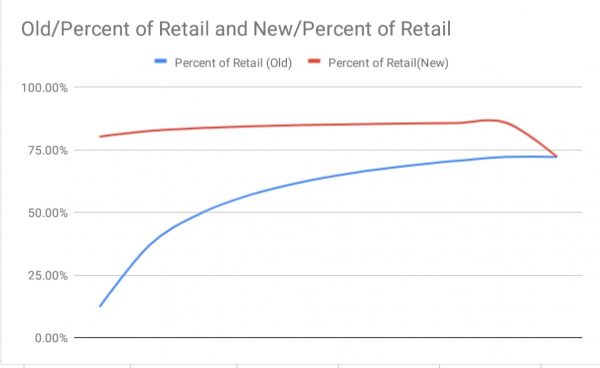

Then there's adjudication. I've seen several bitter disputes about how many mulligans players have taken escalate. Neither player wrote down how many mulligans they'd taken, and one or both lost track while drawing seven cards each time. This was rare with the Vancouver mulligan.

Several judges I know have admitted they're worried about cheating involving the mulligan, such as "forgetting" how many they'd taken or worse: deliberately writing down too many for the opponent and disputing it. In such a dispute the judges are forced to go with the better records, and they're worried that will lead to rewarding cheaters. Personally, I'll be more obsessive with my record keeping than normal this Saturday, but it is very concerning.

Bringing Everything Together

What all this means for me this weekend is that I'll need to really be watching my opponents. I'm naturally suspicious at GP's from experience, but now I'll really need to be careful. I also can't try to game the event as I've done in the past. As a result, it's best to go in with a proactive, disruptive deck so I'm not just dead to anything. And that sounds like familiar territory for me.

Insider: The Game Changer – Analyzing TCGPlayer’s New $5 Minimum

Are you a Quiet Speculation member?

If not, now is a perfect time to join up! Our powerful tools, breaking-news analysis, and exclusive Discord channel will make sure you stay up to date and ahead of the curve.

Many of you who have read my GP reports know that previously I've been a big fan of unloading low dollar cards to vendors at GPs. These are the types of cards you typically get as part of a bigger collection buy that may come as bulk or near bulk, I'm specifically referring to the $2 and less cards. Two months ago, trying to sell these individually on TCGPlayer was a sub-optimal strategy, as after fees and shipping were taken into account you were taking in less than 50%.

These were the cards I would "ogre" (sort by best buylist price) and offer to vendors en masse at GPs. After all, if I got $0.25 on a $0.75 card that I only paid $0.003 on I still made a whopping 8,333% profit. It's important to note that this process is still somewhat time-consuming, but I personally enjoy sorting cards and digging for treasure in collection buys, so I felt it was worth the efforts.

Recently TCGPlayer changed how cheaper cards could be purchased. Instead of a $2 minimum, they now allow buyers to purchase whichever cards they want with a big caveat - there's now a $0.78 additional charge PER store they are buying from if the total store purchase is under $5. The reason this is so important is that TCGPlayer is a pretty cutthroat environment, which forces many sellers to offer free shipping to compete.

A key thing to remember is that shipping costs are flat fees, typically in the range of $0.45-$0.6 per plain white envelope package. While it may not seem like much, this is a significant percentage overall for small sales. On a $2 sale, that shipping fee represents 22.5%-30% off the transaction. You then have to account for the flat $0.3 flat fee per transaction from PayPal (who processes the financial transaction), which is another 15% off the transaction. Finally, you have the percent fees of 10.25% for TCGPlayer and 2.5% for PayPal.
On a $2 order (that you previously could get $1 or so buylisting to stores at 40-50%) you are basically breaking even, as opposed to selling on TCGPlayer, except it was a lot less effort on your part to cash out. This is why it was smart under the old rules to price cards that were near $1 at $0.99, so people had to order more than two from you and cards near $2 at $1.99 for the same reason.

The New Way

By automatically adding the $0.78 fee for orders under $5.00, it basically eliminates the "free shipping" option that sellers were forced to offer to stay competitive. For that same $2.00 order that you would have gotten $1.00 on previously, you now net $1.68 or a 68% increase, which is massive. It's also important to consider the new key price point is $5.00. Cards that are near $1.25 are better sold at $1.24, cards that are around $2.50 are better sold at $2.49 and of course, $5.00 cards are best sold at $4.99. Here is a graphical comparison between $1.00 and $4.99 between old and new system.
As you can see, it's significantly better for sellers now with the graph merging at $5 as nothing changes for orders above $5.
There was an error retrieving a chart for Dragon Arch

Incidental Effects

This change will likely cause some side effects. As it's now far more profitable to sell cheaper cards on TCGPlayer, one would expect that many players who previously resorted to buylisting the cheaper cards will shift to selling on TCGPlayer. This means that stores may have a harder time acquiring the cheap cards that they used to get for pennies on the dollar. Stores will be forced to either increase their buylist prices on the hotter cheap cards such as key standard uncommons and many standard rare staples or resort to buying more bulk in hope of pulling them.

Obviously, not everyone will start selling on TCGPlayer, as many people currently don't. I don't imagine this is enough of a change to make them suddenly put in the effort, but if a lot of the binder grinders start listing cheaper cards, one of these two scenario's will likely happen. While not directly related to this change, WoTC's recent decision to support the Pauper format, which is one that tends to have a lot of staples that fall into this sub $5.00 category, may increase the pressure on vendors to aggressively buy Pauper staples at more competitive prices.

There was an error retrieving a chart for Fire Diamond

The $0.78 flat fee charged to buyers will likely serve as a good deterrent in making small purchases. I expect stores that list a lot of sub-$0.25 cards to see more cards purchased per order in order to break the $5 mark. This can be both a good and bad thing. The typical plain white envelope (PWE) shipping in the US does have size limitations which you can read about in a previous article of mine found here. If people buy a significant number of cheap cards in an order you can actually take a bigger hit on profits due to the higher shipping costs.

In that article, I calculated that you can fit about 16 Magic cards in a PWE and ship it with a single Forever stamp. Using this method, I can't guarantee you won't have any issue going through the sorter. However, the cost difference between PWE and bubble mailer tracked is around $2.25, which reduces profit further by about 45%. You could increase the number of cards per top loader by using higher point top loaders (the points appear to represent 1 mil or 1/1000th of an inch), which would then allow you to fit more cards per envelope. Keep in mind that higher-point top loaders tend to be a lot more expensive per piece than the common 20 point variety.

This shift in potential purchasing may mean you'll want to list playsets of these types of cards, along with playsets of cards that are often played in the same deck. For example; Chromatic Sphere and Sylvan Scrying.

There was an error retrieving a chart for Sylvan Scrying

Lastly, this change makes buying and picking bulk a more profitable endeavor. Note that it may be more difficult to find unpicked bulk in light of this change, as more people may decide it's worth their time to pick. If anything, you may have to pay more aggressively to acquire it.

Conclusion

This TCGPlayer pricing change is a huge boon for anyone selling cards on that platform. The majority of Magic cards fall in the under $5.00 realm. This means it's easier than ever to add cards that would typically rot in a binder or box to your overall inventory, and turn them into actual cash. I can honestly say I'm very happy with this change and I have re-listed cheap cards that I previously pulled out of my online inventory thanks to the new $5 minimum. This will also free up my time at Magic Fests, as I typically spent 6+ hours buylisting small stuff to various vendors and very little time trading and playing.

Want Prices?

Browse thousands of prices with the first and most comprehensive MTG Finance tool around.


Trader Tools lists both buylist and retail prices for every MTG card, going back a decade.

Quiet Speculation